
CrossVL: Complexity-Aware Feature Routing and Paired Curriculum for Cross-View Vision-Language Detection
Abstract
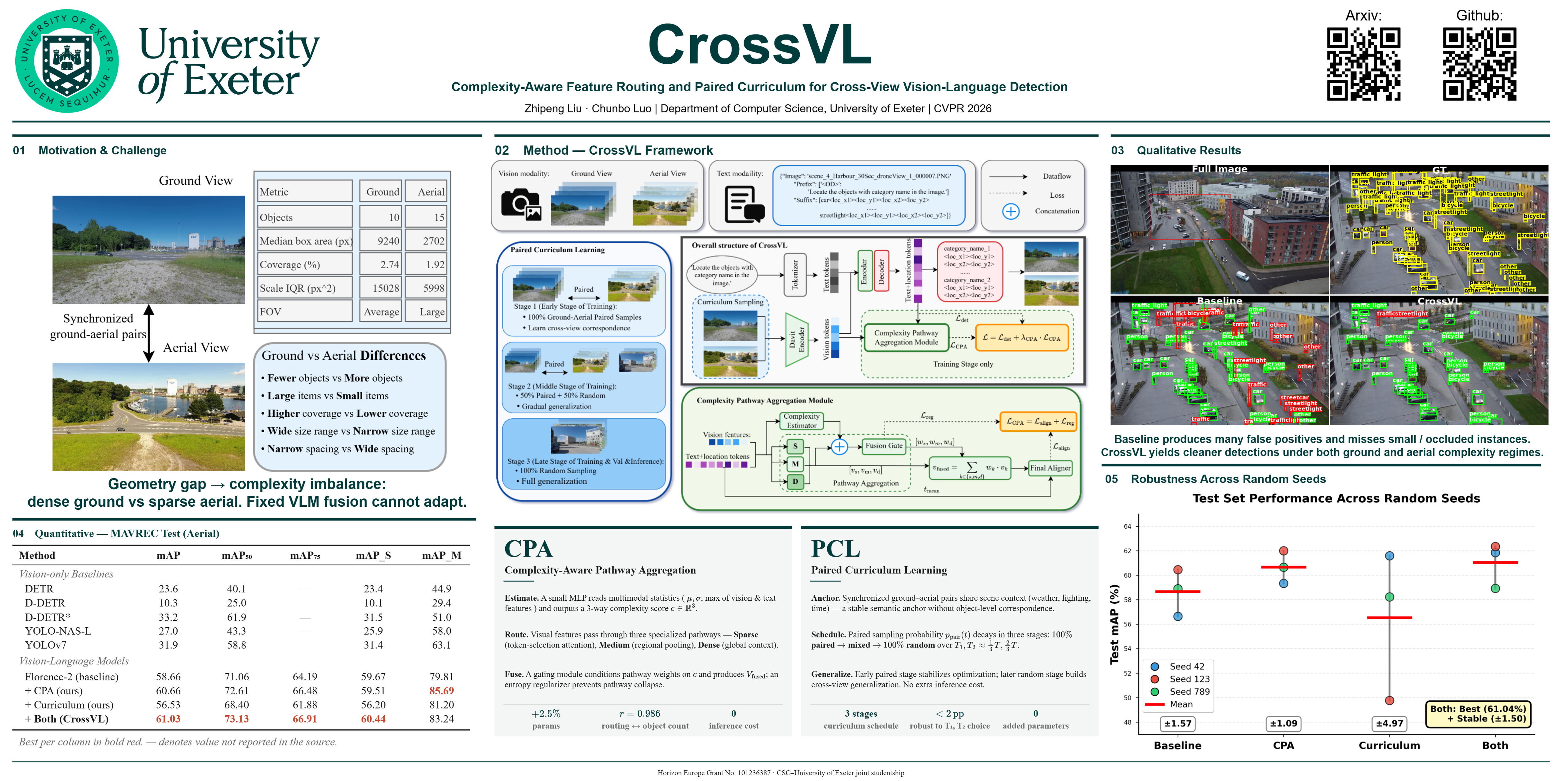
Vision–language models (VLMs) enable text-guided object detection but degrade severely under cross-view scenarios where ground and aerial viewpoints differ in altitude, scale, and spatial layout. These geometric changes introduce systematic complexity variations between viewpoints, e.g., ground view images contain dense and highly occluded structures, while aerial images are sparse and globally organized. Fixed VLM fusion mechanisms cannot handle this discrepancy. We propose \textbf{CrossVL}, a framework combining \textbf{Complexity-Aware Pathway Aggregation (CPA)} and \textbf{Paired Curriculum Learning (PCL)} for enhanced cross-view detection for VLM. CPA estimates scene complexity from multimodal statistics and routes visual features through multiple pathways to obtain view-specific representations. PCL leverages semantic consistency of synchronized ground–aerial pairs to provide stable early supervision and then gradually shifts toward randomized sampling. On MAVREC, CrossVL improves Florence-2’s aerial mAP from 58.66\% to 61.03\% and reduces the ground-aerial performance gap from 8.63pp to 6.65pp, while also achieving a 3.3× reduction in variance across random seeds. CPA provides stable complexity-aware feature aggregation, and PCL enhances optimization dynamics. Together, they demonstrate that coordinated architectural and training adaptations are crucial for robust cross-view VLM detection.