
Bridging Domain Expertise and Generalization for Performance Estimation
Abstract
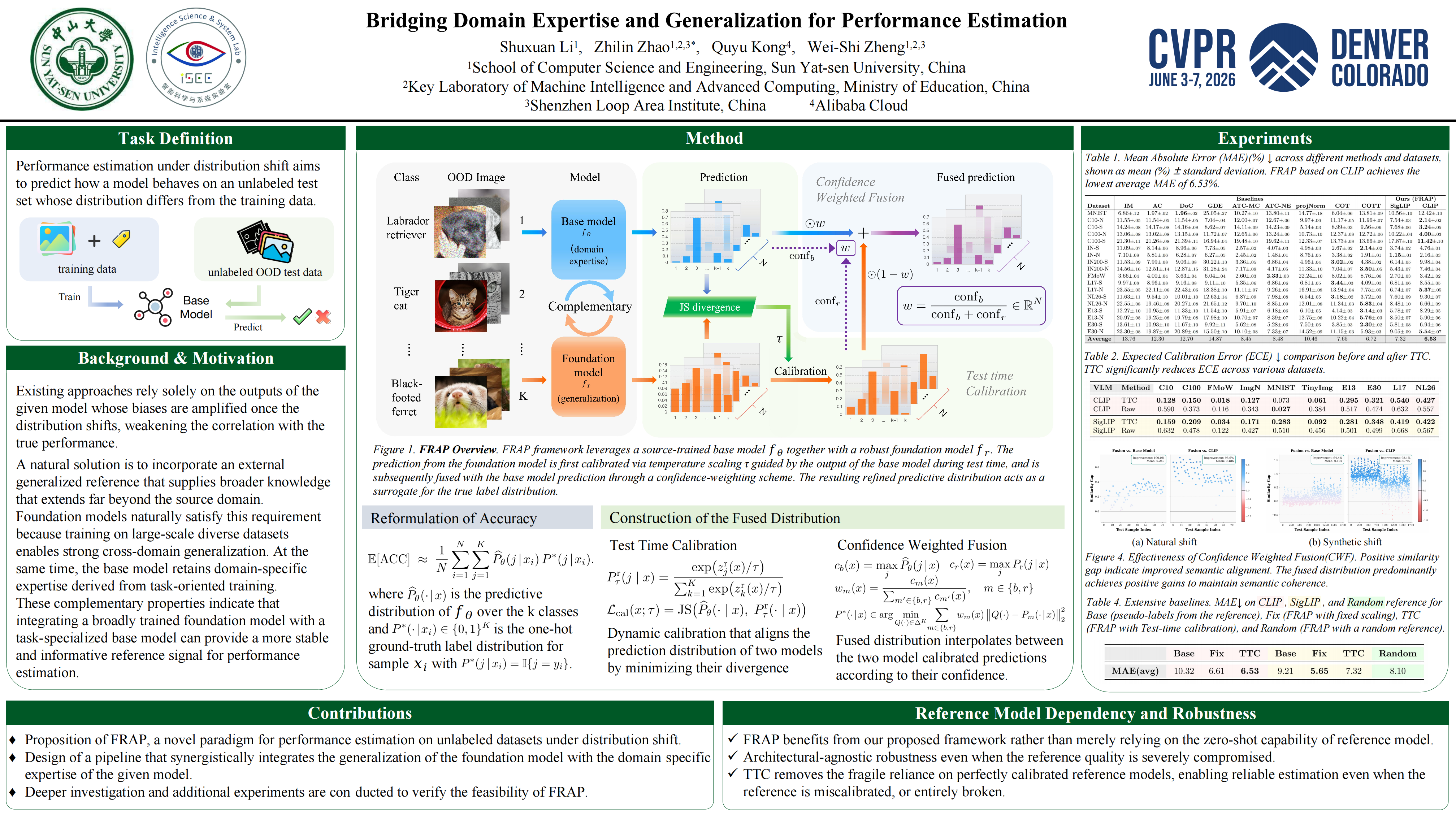
Performance estimation under distribution shift aims to predict how a model behaves on an unlabeled test set whose distribution differs from the training data, a scenario that requires reliable indicators that can faithfully reflect model behavior without ground-truth labels. Existing approaches rely solely on the outputs of the given model whose biases are amplified once the distribution shifts, weakening the correlation with the true performance. Motivated by this limitation, we propose \textbf{F}used \textbf{R}eference \textbf{A}lignment \textbf{P}rediction (FRAP), which leverages the complementary strengths of an external foundation model and the base model to construct a more reliable surrogate of the ground-truth labels. FRAP aligns the prediction distribution of the foundation model with that of the base model by applying temperature-scaled calibration that minimizes their divergence. The aligned predictions are fused through confidence-based weighting into a refined reference distribution that integrates robustness from the foundation model and domain-specific expertise from the base model, and performance estimation is obtained by measuring how closely the base model predictions agree with this reference. Extensive experiments across diverse datasets and architectures show that FRAP provides consistent and substantial improvements over representative performance-estimation methods under distribution shift.