
UDAPose: Unsupervised Domain Adaptation for Low-Light Human Pose Estimation
Abstract
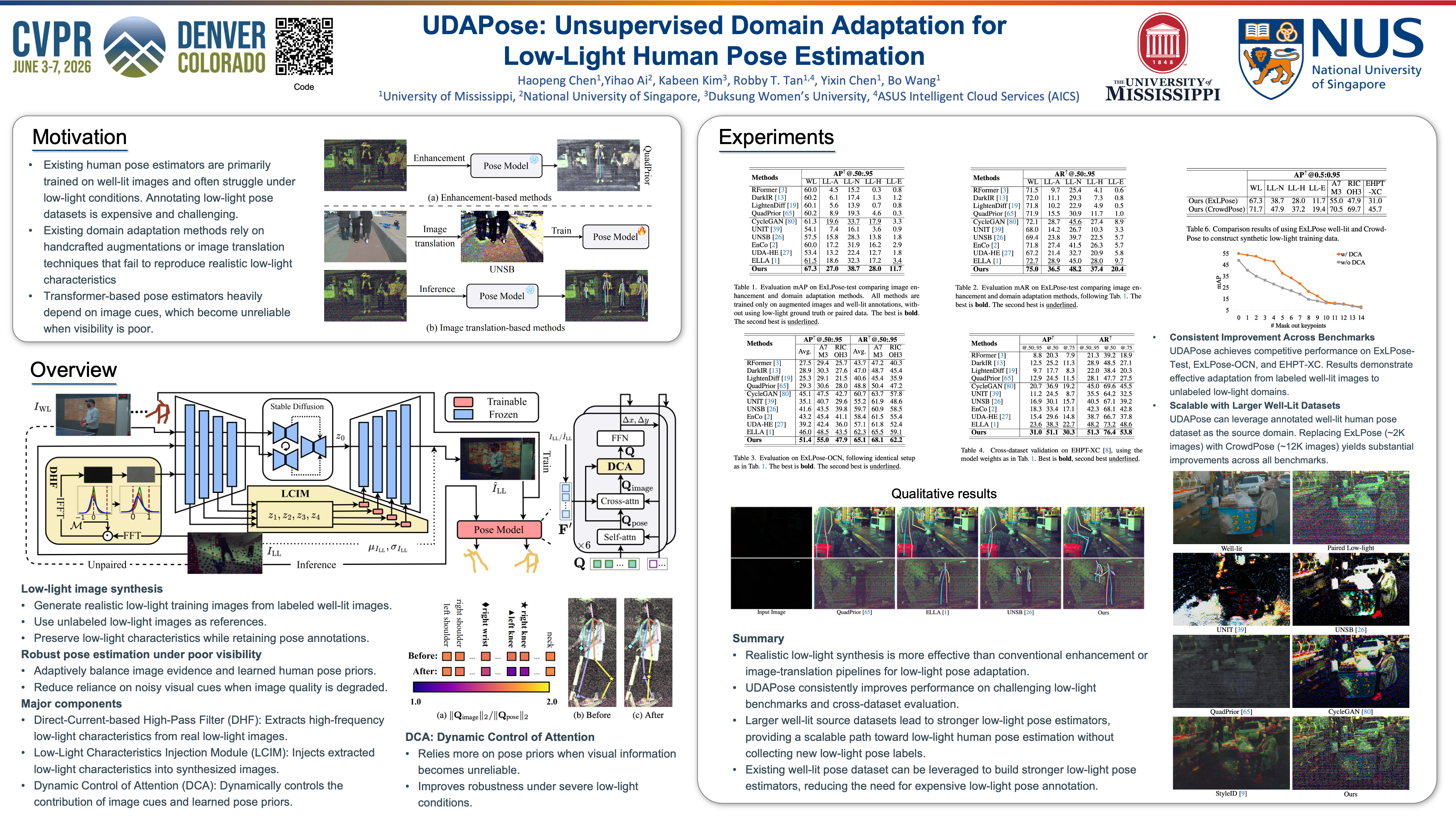
Low-visibility scenarios, such as low-light conditions, pose significant challenges to human pose estimation due to the scarcity of annotated low-light datasets and the loss of visual information under poor illumination. Recent domain adaptation techniques attempt to utilize well-lit labels by augmenting well-lit images to mimic low-light conditions.But handcrafted augmentations oversimplify noise patterns, while learning-based methods often fail to preserve high-frequency low-light characteristics, producing unrealistic images that lead pose models to generalize poorly to real low-light scenes.Moreover, recent pose estimators rely on image cues through image-to-keypoint cross-attention, but these cues become unreliable under low-light conditions.To address these issues, we propose Unsupervised Domain Adaptation for Pose Estimation (UDAPose), a novel framework that synthesizes realistic low-light images and dynamically fuses visual cues with pose priors for improved pose estimation.Specifically, our synthesis method incorporates a Direct-Current-based High-Pass Filter (DHF) and a Low-light Characteristics Injection Module (LCIM) to inject high-frequency details from input low-light images, overcoming rigidity or the detail loss in existing approaches.Furthermore, we introduce a Dynamic Control of Attention (DCA) module that adaptively balances image cues with learned pose priors in the Transformer architecture.Experiments show that UDAPose outperforms state-of-the-art methods, with notable AP gains of 10.1 (56.4%) on the challenging ExLPose-test hard set (LL-H) and 7.4 (31.4%) in cross-dataset validation on EHPT-XC.