
Sparsely Timing the Change: A Spiking Temporal Framework for Remote Sensing Interpretation
Abstract
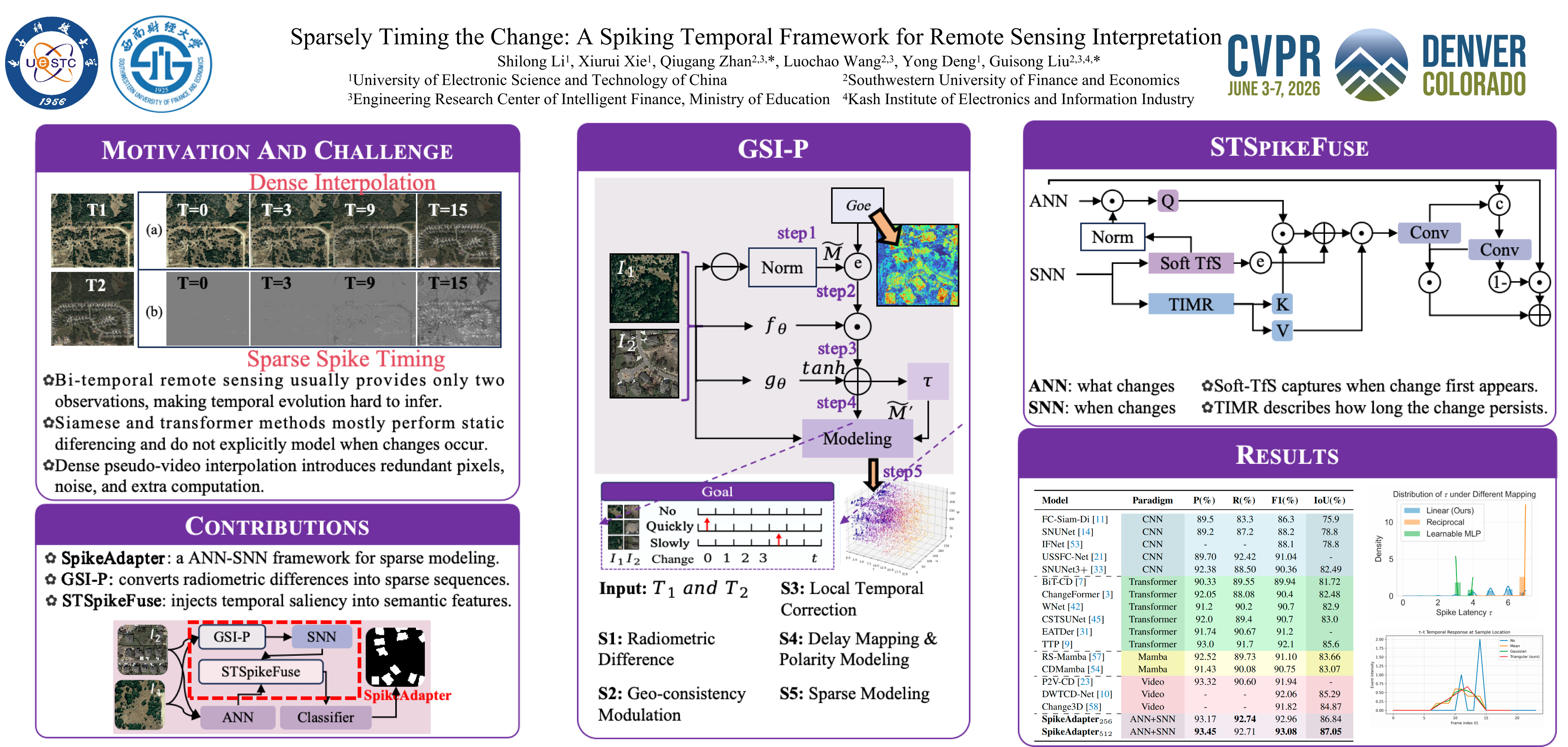
The temporal evolution patterns of surface spatial structures constitute a central concern within the field of intelligent remote sensing interpretation.However, constrained by the availability of only two temporal phases, modeling sparse spatio-temporal change processes to effectively interpret surface alterations remains a core challenge in intelligent remote sensing analysis. To address this, this paper proposes SpikeAdapter, a lightweight enhancement framework. This framework comprises Geo-Spike Interpolation (GSI-P), an spiking neural network (SNN) feature extractor, and the spatio-temporal fusion module STSpikeFuse. Inspired by the brain’s perceptual response to new and fading stimuli, the core GSI-P module transforms bi-temporal radiometric differences into sparse spike sequences with time-to-first-spike characteristics.Then we use a feature extractor of SNN to capture dynamic variations of land-surface targets. The STSpkeFuse module employs a learnable temporal decay mechanism to adaptively fuse the SNN features with the semantic representations. This representations are generated by a traditional artificial neural network (ANN) backbone.Extensive experiments on change detection datasets demonstrate that SpikeAdapter effectively enhances temporal awareness and interpretability.