
TimeLens: Rethinking Video Temporal Grounding with Multimodal LLMs
Abstract
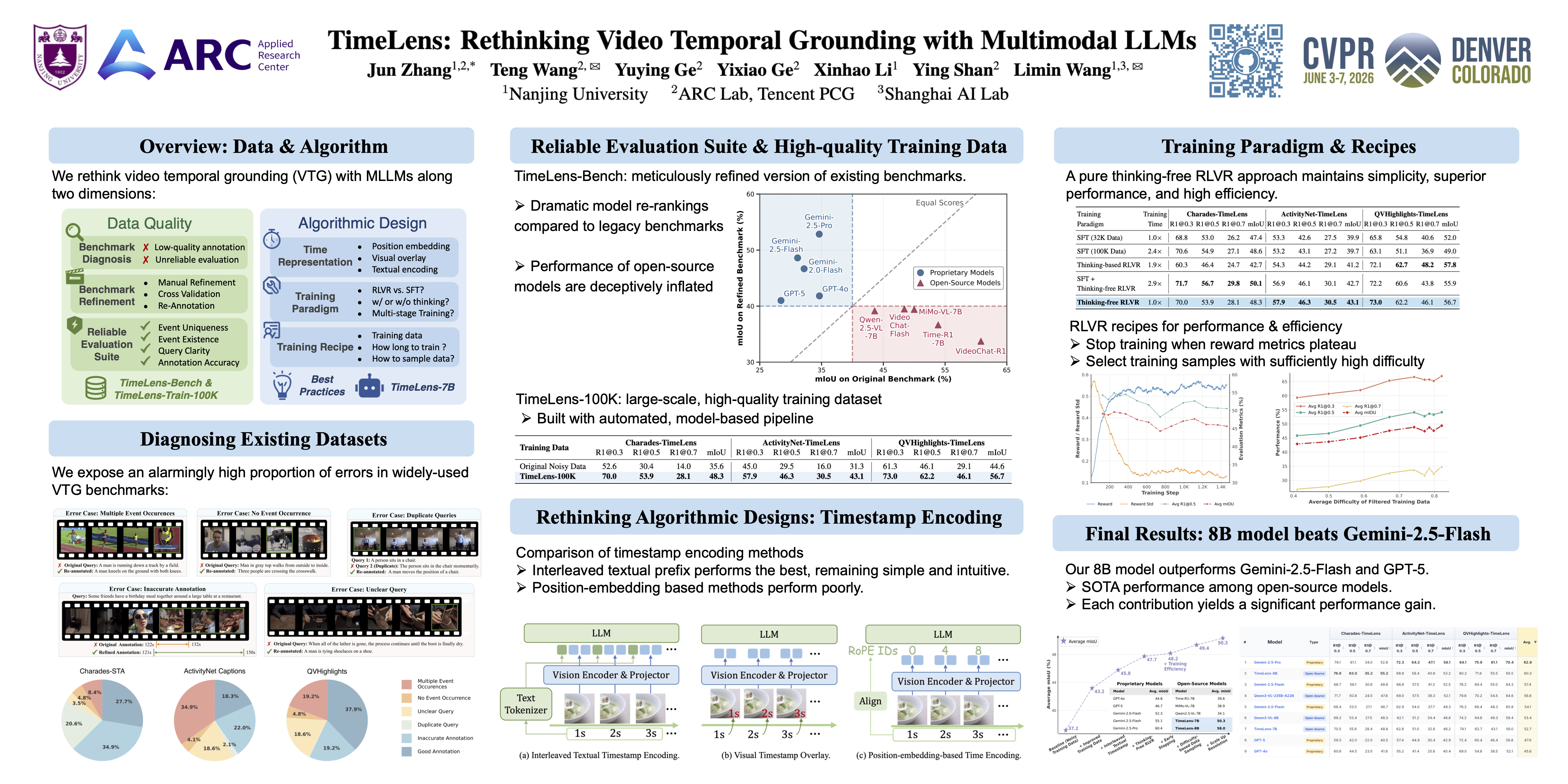
This paper does not introduce a novel method but instead establishes a straightforward, incremental, yet essential baseline for video temporal grounding (VTG), a core capability in video understanding.While multimodal large language models (MLLMs) excel at various video understanding tasks, the recipes for optimizing them for VTG remain under-explored.In this paper, we present TimeLens, a systematic investigation into building MLLMs with strong VTG ability, along two primary dimensions: data quality and algorithmic design.We first expose critical quality issues in existing VTG benchmarks and introduce TimeLens-Bench, comprising meticulously re-annotated versions of three popular benchmarks with strict quality criteria. Our analysis reveals dramatic model re-rankings compared to legacy benchmarks, confirming the unreliability of prior evaluation standards. We also address noisy training data through an automated re-annotation pipeline, yielding TimeLens-100K, a large-scale, high-quality training dataset.Building on our data foundation, we conduct in-depth explorations of algorithmic design principles, yielding a series of meaningful insights and effective yet efficient practices. These include interleaved textual encoding for time representation, a thinking-free Reinforcement Learning with Verifiable Rewards (RLVR) approach as the training paradigm, and carefully designed recipes for RLVR training. These efforts culminate in TimeLens-7B, an MLLM that achieves state-of-the-art performance among open-source models and even surpasses proprietary models such as GPT-4o and GPT-5. All codes, data, and models will be released to facilitate future research.