
Dual-Level Hypergraph Generation for Addressing Feature Scarcity in Whole-Slide Image Classification
Abstract
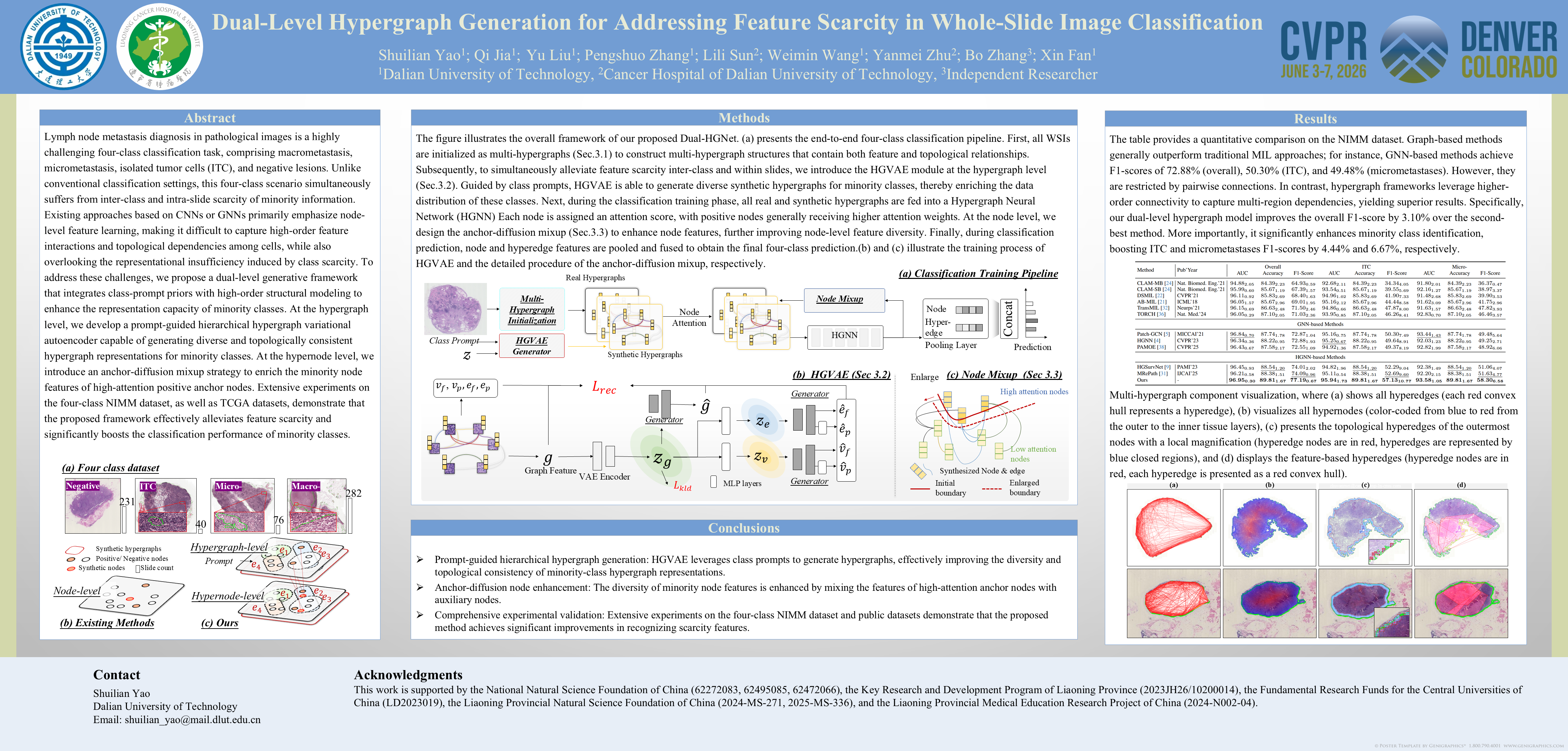
Lymph node metastasis diagnosis in pathological images is a highly challenging four-class classification task, comprising macrometastasis, micrometastasis, isolated tumor cells (ITC), and negative lesions.Unlike conventional classification settings, this four-class scenario simultaneously suffers from inter-class and intra-slide scarcity of minority information.Existing approaches based on CNNs or GNNs primarily emphasize node-level feature learning, making it difficult to capture high-order feature interactions and topological dependencies among cells, while also overlooking the representational insufficiency induced by class scarcity.To address these challenges, we propose a dual-level generative framework that integrates class-prompt priors with high-order structural modeling to enhance the representation capacity of minority classes.At the hypergraph level, we develop a prompt-guided hierarchical hypergraph variational autoencoder (HGVAE) capable of generating diverse and topologically consistent hypergraph representations for minority classes.At the hypernode level, we introduce an anchor-diffusion mixup strategy to enrich the minority node features of high-attention positive anchor nodes.Extensive experiments on the four-class NIMM dataset, as well as TCGA datasets, demonstrate that the proposed framework effectively alleviates feature scarcity and significantly boosts the classification performance of minority classes.