
When CLIP Sees More, It Fights Back Harder: Multi-View Guided Adaptive Counterattacks for Test-Time Adversarial Robustness
Abstract
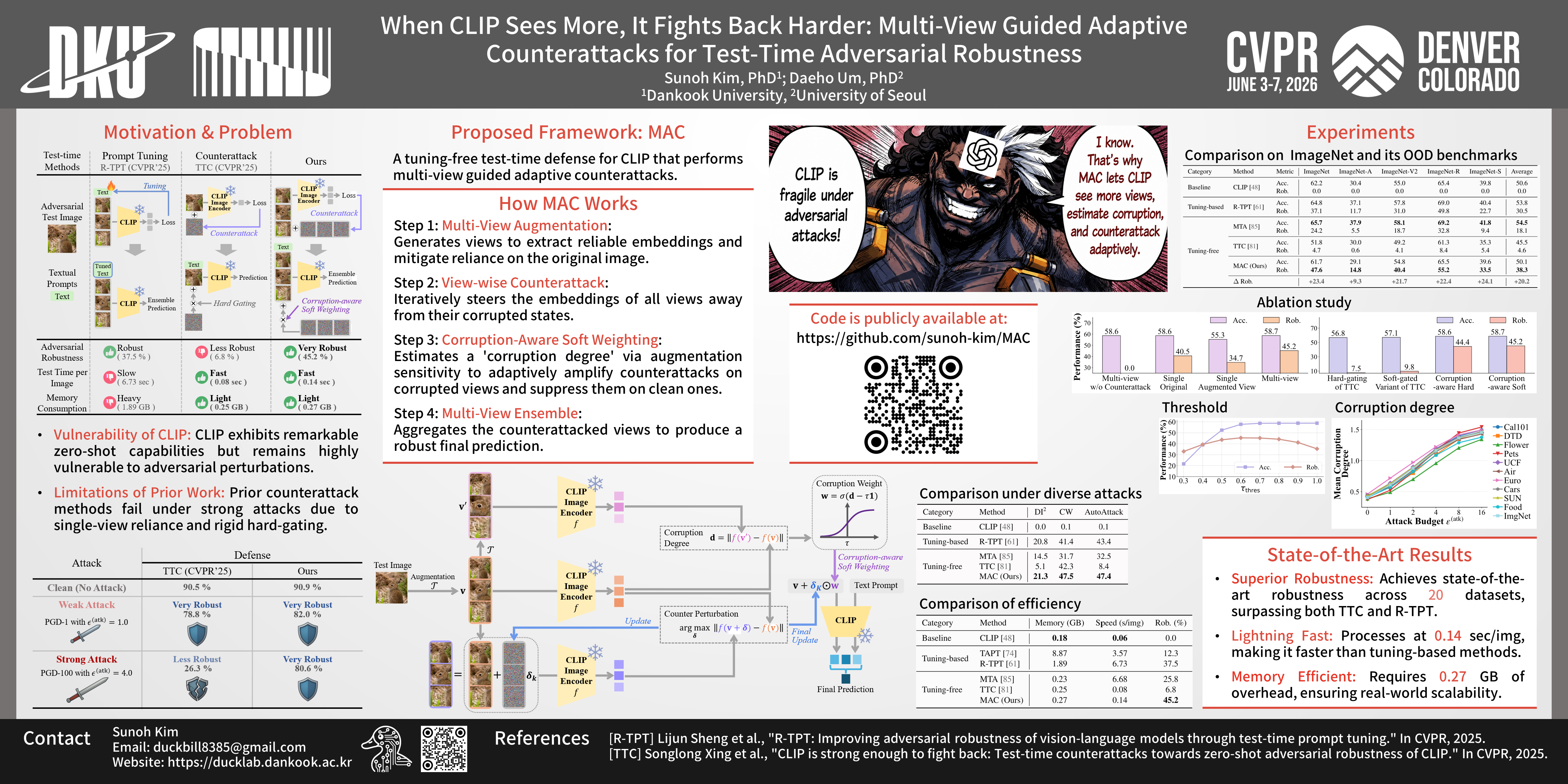
Vision-language models such as CLIP have achieved remarkable zero-shot recognition capabilities, yet their robustness against adversarial perturbations remains limited. Test-time counterattack (TTC) was recently proposed to improve CLIP's robustness by perturbing an input image to steer it away from a corrupted state during inference. However, TTC remains fragile under strong attacks because its counterattack relies on a directly corrupted original view and employs a noise-driven hard-gating scheme that cannot adapt to varying corruption severity. To address these limitations, we introduce Multi-view guided Adaptive Counterattack (MAC), which performs counterattacks for multi-view with corruption-aware soft weighting. Specifically, MAC first constructs augmented views of an input image to obtain diverse embeddings. It then performs counterattacks to refine corrupted embeddings of views. Next, MAC adaptively scales the counterattack intensity for each view based on its estimated corruption degree. Finally, the adaptively counterattacked views are aggregated to yield a robust final prediction. Extensive experiments across 20 datasets and diverse attack scenarios demonstrate that MAC substantially improves robustness while preserving high inference speed and memory efficiency with its tuning-free design. For reproducibility, we provide our code in the Supplementary Material and will publicly release it on GitHub.