
Modeling the Visual Ambiguity of Human Sketches
Abstract
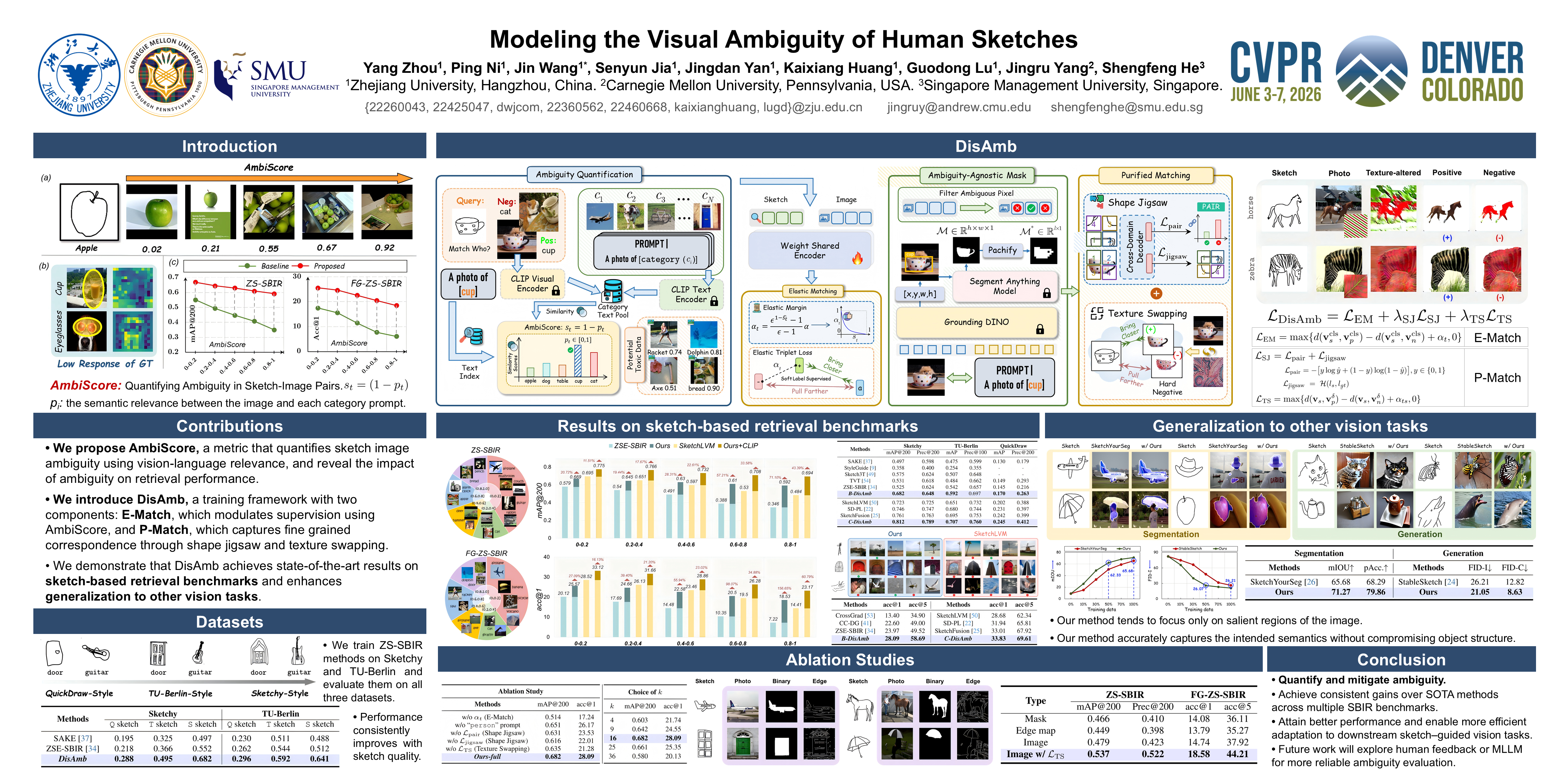
Human sketches provide a compact and expressive form of visual communication, but their sparse structural cues, while capturing essential object structures, introduce ambiguity because a single sketch can correspond to multiple plausible images, making cross-domain alignment uncertain and unstable. Such ambiguity fundamentally limits sketch-based vision tasks that rely on precise sketch--image correspondence. To address this challenge, we introduce AmbiScore, a metric that quantifies the ambiguity of sketch-image pairs, and use Zero-Shot Sketch-Based Image Retrieval (ZS-SBIR) as a testbed to reveal how ambiguous supervision leads to performance collapse in existing methods. We further propose DisAmb (Disentangling Ambiguity), a framework that explicitly models and mitigates ambiguity through two components: (1) Elastic Matching, which adaptively adjusts supervision strength using AmbiScore, and (2) Purified Matching, which employs ambiguity-agnostic masks to disentangle structure and appearance via shape jigsaw and texture swapping. DisAmb establishes new benchmarks under high ambiguity and provides a robust, transferable supervisory signal for downstream sketch-guided tasks.