
GA-VLN: Geometry-Aware BEV Representation for Efficient Vision-Language Navigation
Abstract
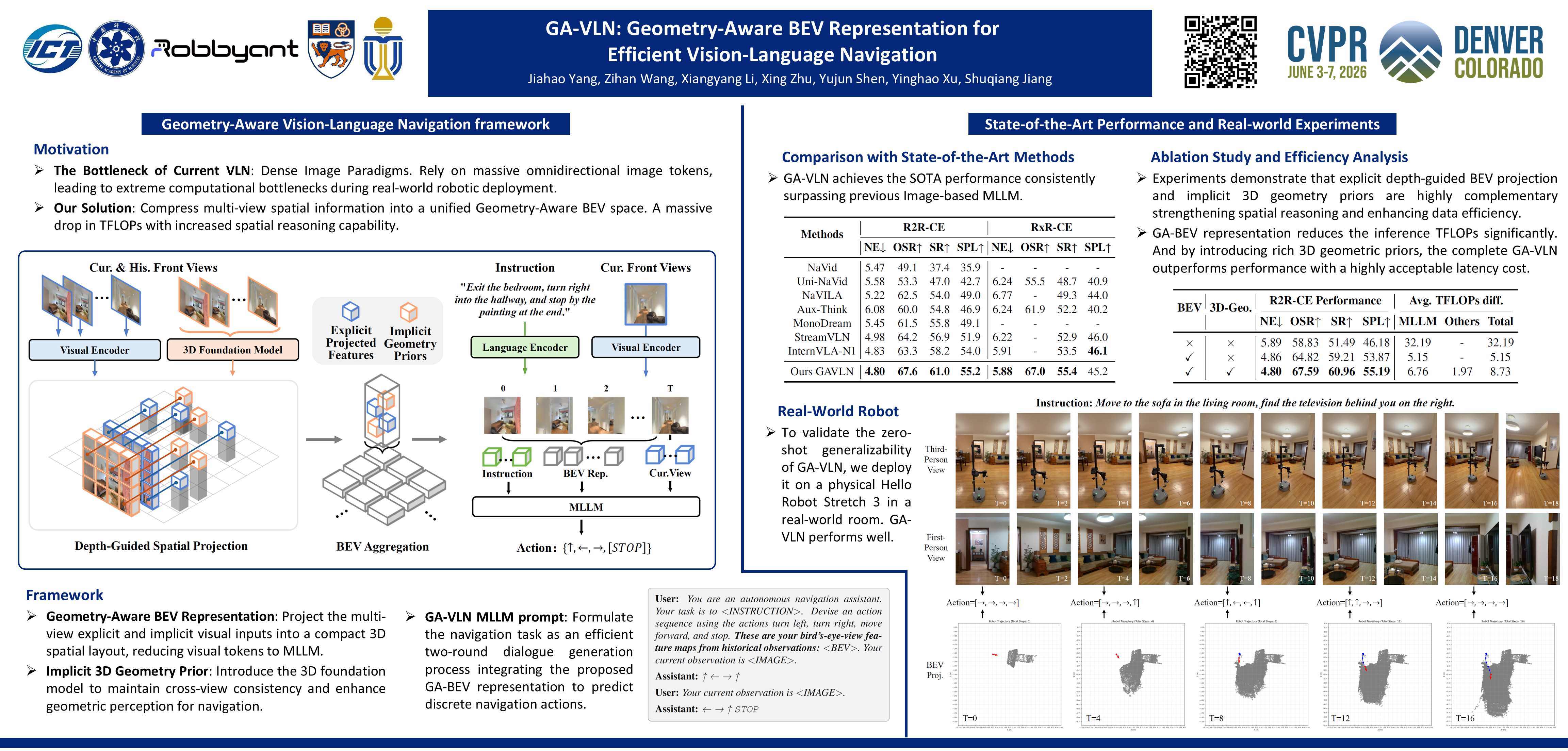
Despite significant progress in Vision-Language Navigation (VLN), existing approaches still rely on dense RGB videos that produce excessive patch tokens and lack explicit spatial structure, resulting in substantial computational overhead and limited spatial reasoning. To address these issues, we introduce the Geometry-Aware BEV (GA-BEV) —a compact, 3D-grounded feature representation that integrates both explicit and implicit geometric cues into multimodal large language model (MLLM)–based navigation systems. We construct BEV spatial maps from RGB-D inputs by projecting visual features into 3D space and aggregating them into an agent-centric layout that preserves geometric consistency while reducing token redundancy. To further enrich geometric understanding, we incorporate features from a pretrained 3D foundation model into the BEV space, injecting structural priors learned from large-scale 3D reconstruction tasks. Together, these complementary cues—explicit depth-based projection and implicit learned priors—yield compact yet spatially expressive representations that substantially improve navigation efficiency and performance. Experiments show that our method achieves state-of-the-art results using only navigation data, without DAgger augmentation or mixed VQA training, demonstrating the robustness and data efficiency of the proposed GA-VLN framework.