
FedARA: Resource-adaptive Low-rank Personalized Federated Learning via Anchor-driven Representation Alignment on Heterogeneous Edge Devices
Abstract
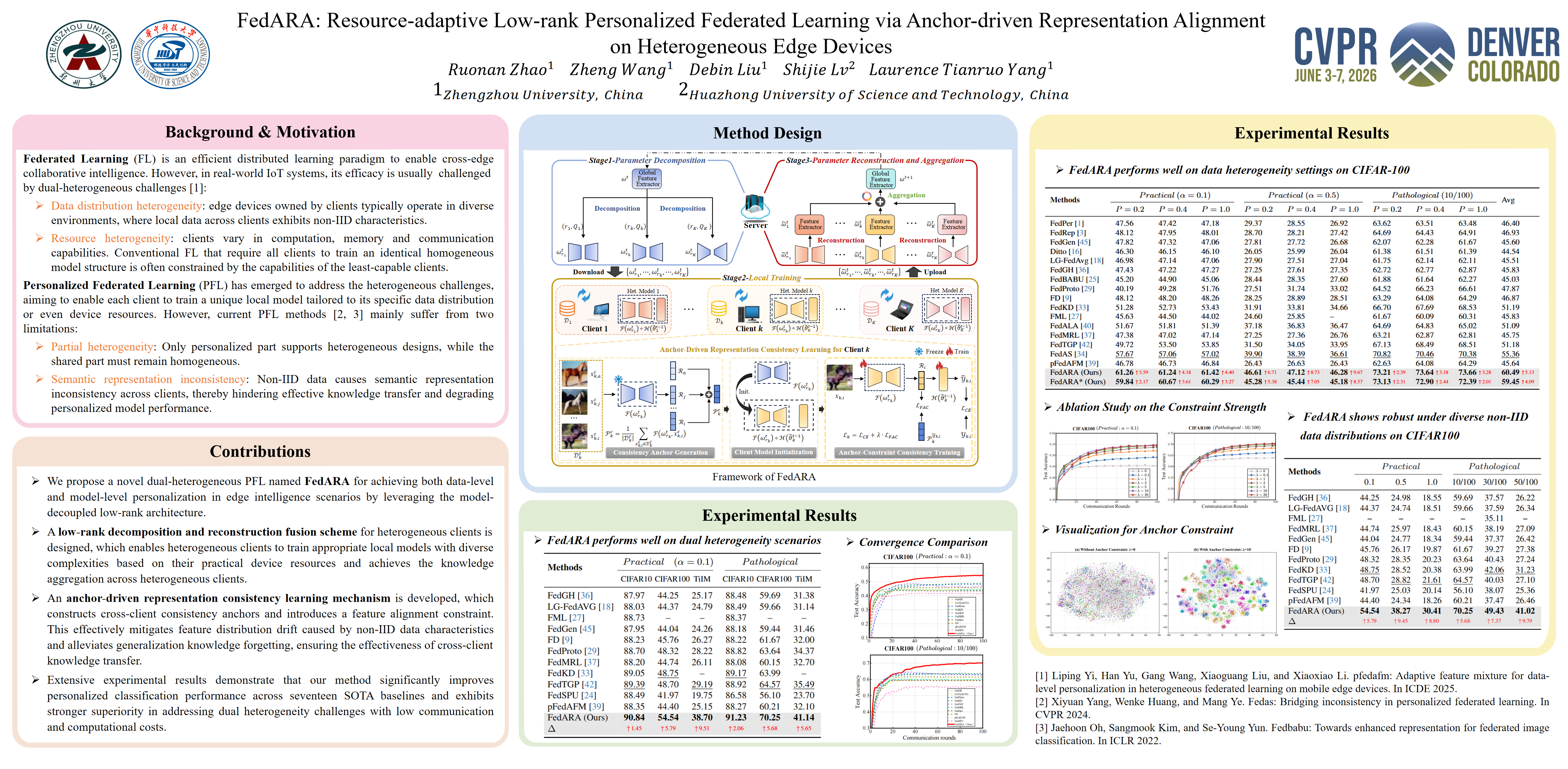
Personalized Federated Learning (PFL) has gained significant attention for enabling participating clients to train customized personalized models on non-IID local data. However, current PFL methods mainly suffer from two limitations: 1) Only the personalized part supports heterogeneous design, while the shared part must remain homogeneous. 2) The semantic representations of models generated on different clients with non-IID data characteristics inevitably tend to be inconsistent, negatively impacting model performance. To conquer them, this paper proposes a novel resource-adaptive personalized Federated Learning via Anchor-driven Representation Alignment (FedARA). Concretely, we design a low-rank decomposition and reconstruction fusion scheme for shared feature extractors based on the matrix decomposition technology, where each client can autonomously set the rank value based on its locally available resources, controlling the complexity of extractors and naturally reducing communication and computational costs. Moreover, to address the inconsistency of feature spaces across clients, an anchor-driven representation consistency learning mechanism is developed, which can guide client models to learn unified feature representations and alleviate global knowledge forgetting, thereby improving personalized model performance. Extensive experimental results demonstrate that our method significantly outperforms seventeen state-of-the-art baselines in diverse heterogeneous scenarios with less communication and computational costs.