
Towards Cross-Modal Preservation, Consistency and Alignment for Privacy-Preserving Visible-Infrared Person Re-Identification
Abstract
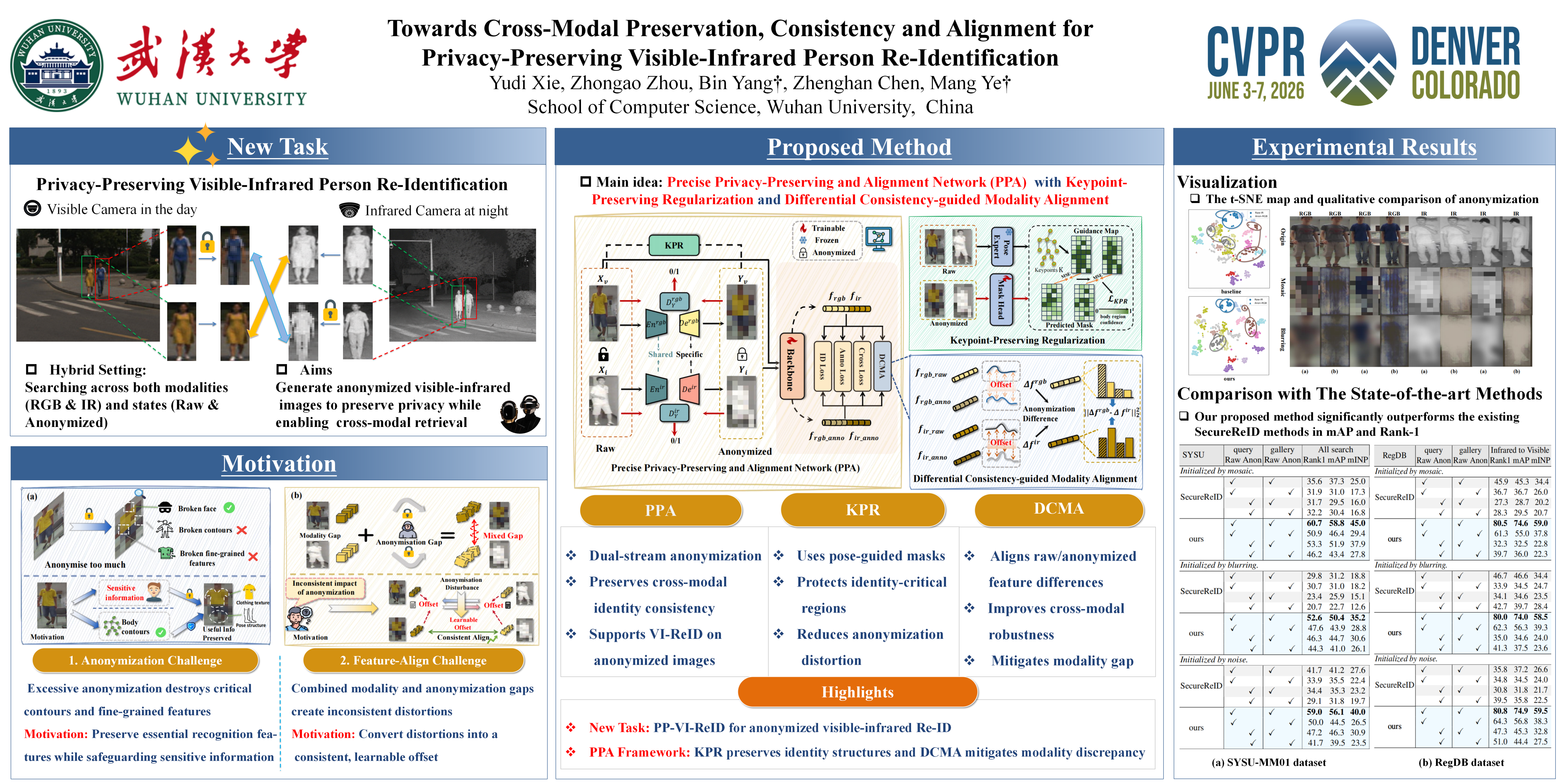
Privacy-preserving Person Re-Identification (PP-ReID) addresses the core privacy-utility trade-off in Re-ID by retrieving a person across multiple non-overlapping cameras while applying anonymization techniques to protect sensitive information. However, prior PP-ReID studies are confined to single-modality visible scenarios, as 24-hour surveillance systems require robust cross-modal visible-infrared (VI) capabilities. Extending PP-ReID to the cross-modal VI setting is therefore crucial for 24-hour surveillance. Accordingly, we introduce a new task: Privacy-Preserving Visible-Infrared Person Re-Identification (PP-VI-ReID). This task presents two severe challenges: 1) Crude anonymization strategies destroy identity-critical information and disrupt cross-modal alignment 2) The anonymization process creates inconsistent distortions across modalities. It disrupts color-based textures in visible images while obscuring thermal contours in infrared images. This inconsistency with modality gap forms a Mixed Gap. To overcome these challenges, we propose a framework, the Precise Privacy-preserving and Alignment Network (PPA) with two components: 1) A Keypoint-Preserving Regularization (KPR) module leverages human pose as a prior to guide structure-aware anonymization, preserving essential body features. 2) A Differential Consistency-guided Modality Alignment (DCMA) module. It treats anonymization perturbations not as varying noise, but as a stable, learnable offset, facilitating robust alignment between raw and anonymized features across modalities. Experiments on SYSU-MM01 and RegDB validate our framework, establishing a strong baseline for this task. The source code will be released.