
Bridging the 2D-3D Gap: A Hierarchical Semantic-Geometric Map for Vision Language Navigation
Abstract
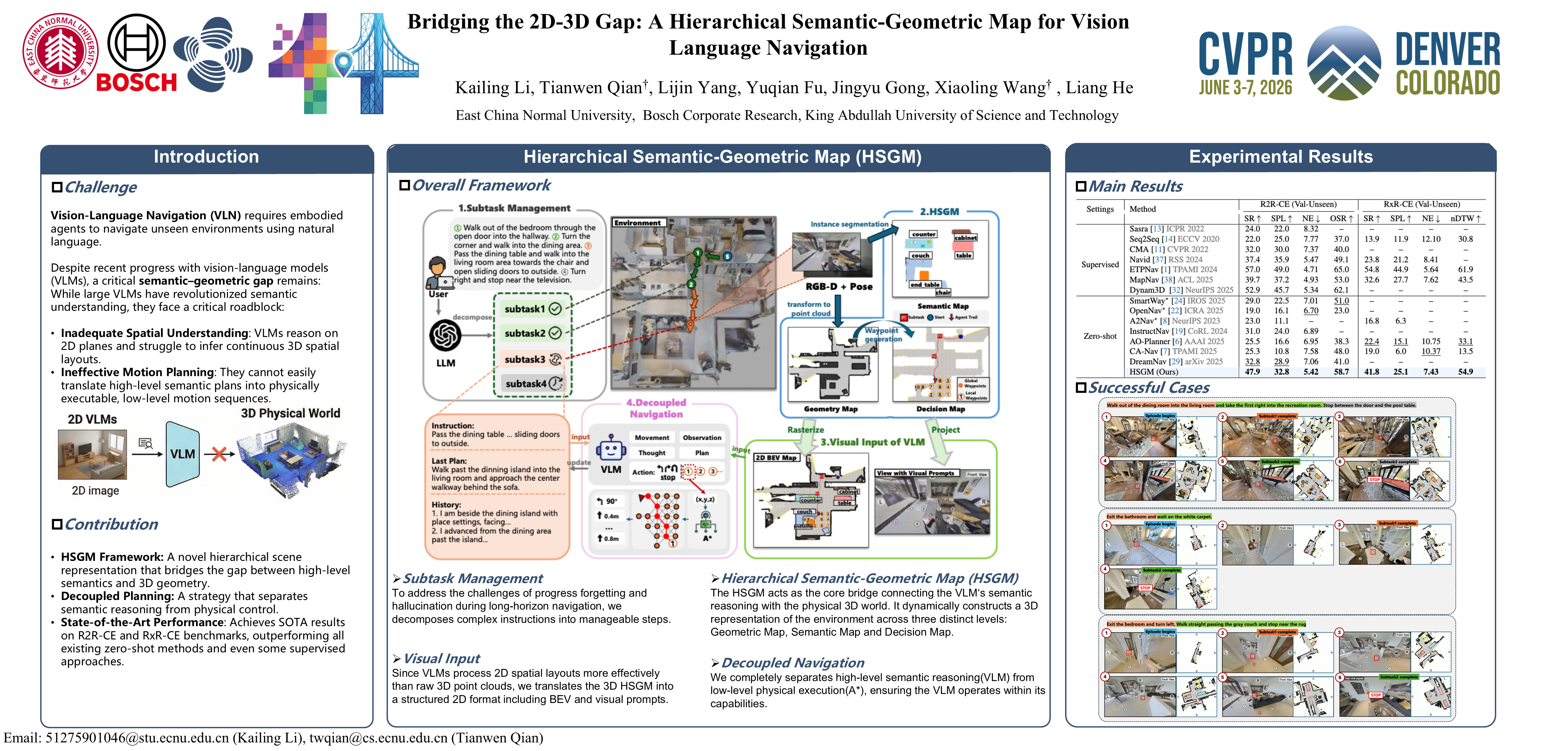
Vision-Language Navigation (VLN) enables embodied agents to reach target locations in unseen environments by following language instructions. Despite recent progress with vision-language models (VLMs), a critical semantic–geometric gap remains: while VLMs excel at language and 2D visual understanding, they struggle with 3D spatial reasoning and fail to capture the causal dynamics between actions and spatial transitions, resulting in unreliable navigation, particularly in zero-shot settings. To bridge this gap, we propose a Hierarchical Semantic–Geometric Map (HSGM) that transforms 3D geometric information into a structured representation compatible with VLMs, effectively linking them to the physical world. Specifically, HSGM is represented as a multi-channel top-down map organized into three levels: (1) geometric level that records navigable regions and obstacles, (2) semantic level that represents objects and their relations, and (3) decision level that supports high-level task reasoning and goal selection. During navigation, the VLM acts as a high-level semantic planner, interpreting the spatial layout encoded in the HSGM to select geometrically valid waypoints, while low-level, collision-free movements between waypoints are executed by a classical path-planning algorithm, fully decoupling semantic reasoning from action execution. Additionally, complex instructions are decomposed into subtasks to alleviate the problem of progress forgetting or hallucinating in long-horizon navigation. Extensive experiments on R2R-CE and RxR-CE benchmarks demonstrate that our zero-shot framework achieves state-of-the-art performance and even outperforms several supervised methods.