
TC-Padé: Trajectory-Consistent Padé Approximation for Diffusion Acceleration
Shaoxuan He ⋅ Benlei Cui ⋅ Bukun Huang ⋅ Zhizeng Ye ⋅ Yunyun Sun ⋅ Longtao Huang ⋅ Hui Xue ⋅ Yang Yang ⋅ Haiwen Hong ⋅ Jingqun Tang ⋅ Zhou Zhao
Abstract
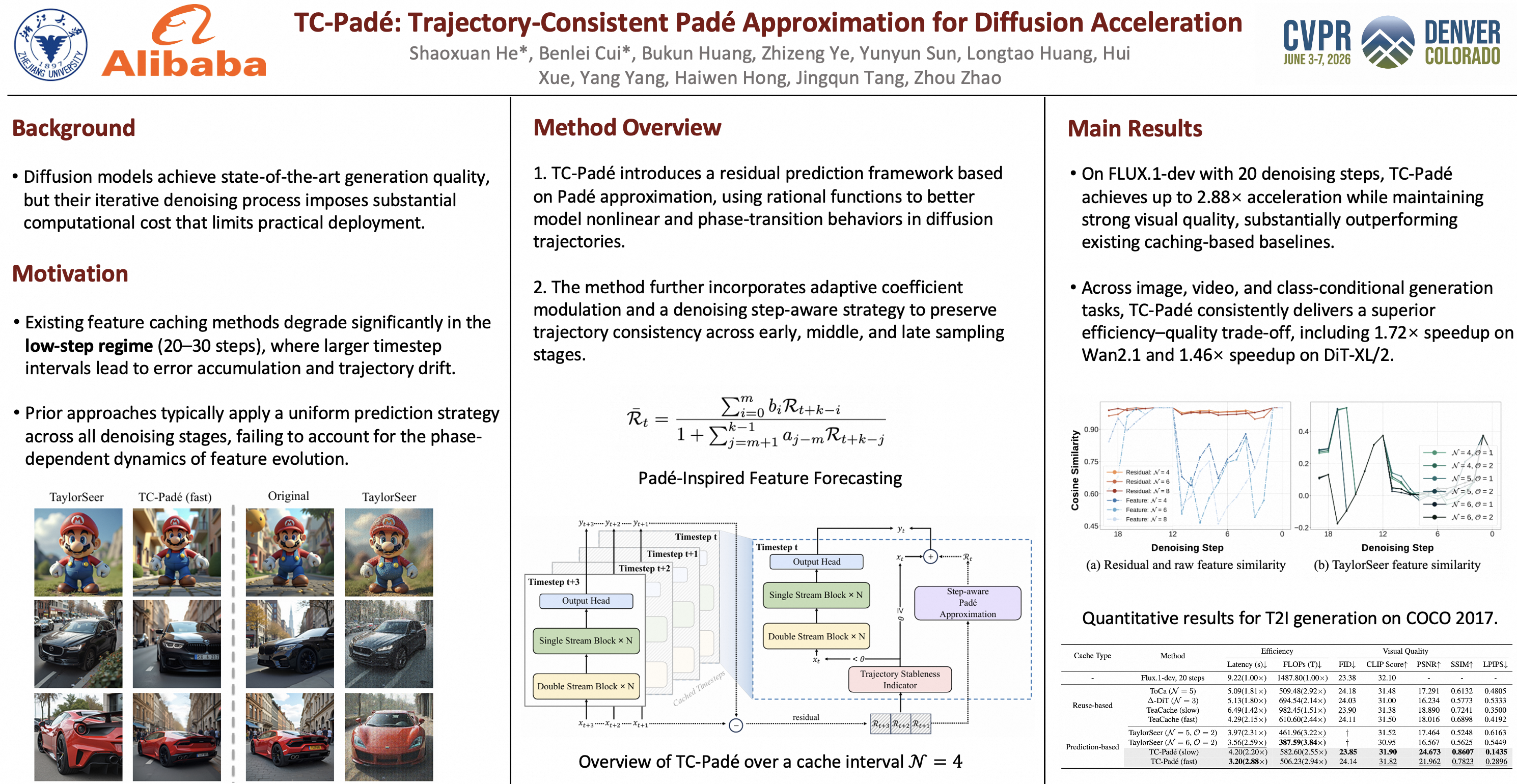
Despite achieving state-of-the-art generation quality, diffusion models are hindered by the substantial computational burden of their iterative sampling process. While feature caching techniques achieve effective acceleration at higher step counts (e.g., 50 steps), they exhibit critical limitations in the practical low-step regime of 20-30 steps. As the interval between steps increases, polynomial-based extrapolators like TaylorSeer suffer from error accumulation and trajectory drift. Meanwhile, conventional caching strategies often overlook the distinct dynamical properties of different denoising phases. To address these challenges, we propose Trajectory-Consistent Padé($\textbf{TC-Padé}$) approximation, a feature prediction framework grounded in Padé approximation. By modeling feature evolution through rational functions, our approach captures asymptotic and transitional behaviors more accurately than Taylor-based methods. To enable stable and trajectory-consistent sampling under reduced step counts, TC-Padé incorporates (1) adaptive coefficient modulation that leverages historical cached residuals to detect subtle trajectory transitions, and (2) step-aware prediction strategies tailored to the distinct dynamics of early, mid, and late sampling stages. Extensive experiments on DiT-XL/2, FLUX.1-dev, and Wan2.1 across both image and video generation demonstrate the effectiveness of TC-Padé. For instance, TC-Padé achieves 2.88$\times$ acceleration on FLUX.1-dev and 1.72$\times$ on Wan2.1 while maintaining high quality across FID, CLIP, Aesthetic, and VBench-2.0 metrics, substantially outperforming existing feature caching methods.
Chat is not available.
Successful Page Load