
Bulk RNA-seq Guided Multi-modal Detection of Anomalous Regions in Human Cancer via Spatial Transcriptomics
Abstract
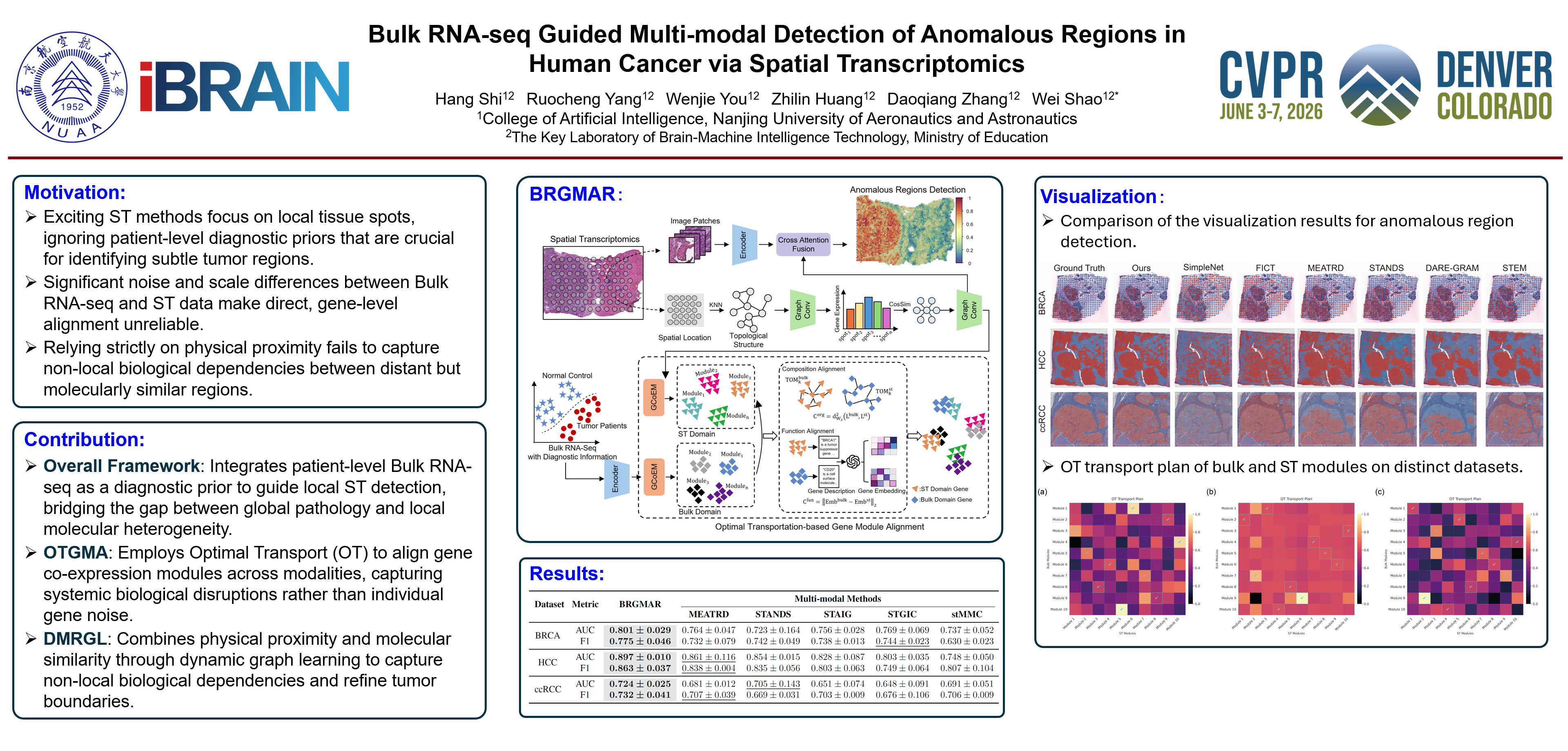
Spatial transcriptomics (ST) has emerged as a revolutionary approach in the field of tissue analysis that can offer spatial resolved molecular insights for the identification of anomalous regions (AR) on human cancers. Current ST-based methods for detecting AR focus narrowly on the molecular features of local tissue spots, overlooking the matched bulk RNA-seq data that contains crucial diagnostic information. This oversight limits their effectiveness in identifying subtle or heterogeneous tumors, where accurate detection depends on broader genetic context. Besides the genomic signatures, the pathological images can also provide rich visual information to reflect the morphology of AR. To utilize the patient-level diagnostic knowledge and harness complementary information from both histology images and ST, we develop a Bulk RNA-seq Guided Multi-modal Anomalous Regions Detection method (BRGMAR) for the identification of AR from human tissues. Specifically, to effectively model the dependencies in ST, we introduce a Dynamic Multi-Relational Graph Learning (DMRGL) module to adaptively capture complex relationships in ST, including both spatial proximity and gene expression similarity. Then, we design an Optimal Transportation-based Gene Module Alignment (OTGMA) approach to align ST data with patient-level bulk RNA-seq data by matching the compositional and functional similarities of their corresponding gene modules. Finally, we combine the learned genomic features with pathological image representations for accurate AR detection. We evaluate our method on three public available ST datasets for the purpose of identifying cancerous regions from normal tissues, and the experimental results demonstrate the advantage of our method in comparison with the existing studies.