
BiGMINT: Biologically-guided Hierarchical Multimodal Integration for Modeling Multiple Compound Activities in Drug Discovery
Abstract
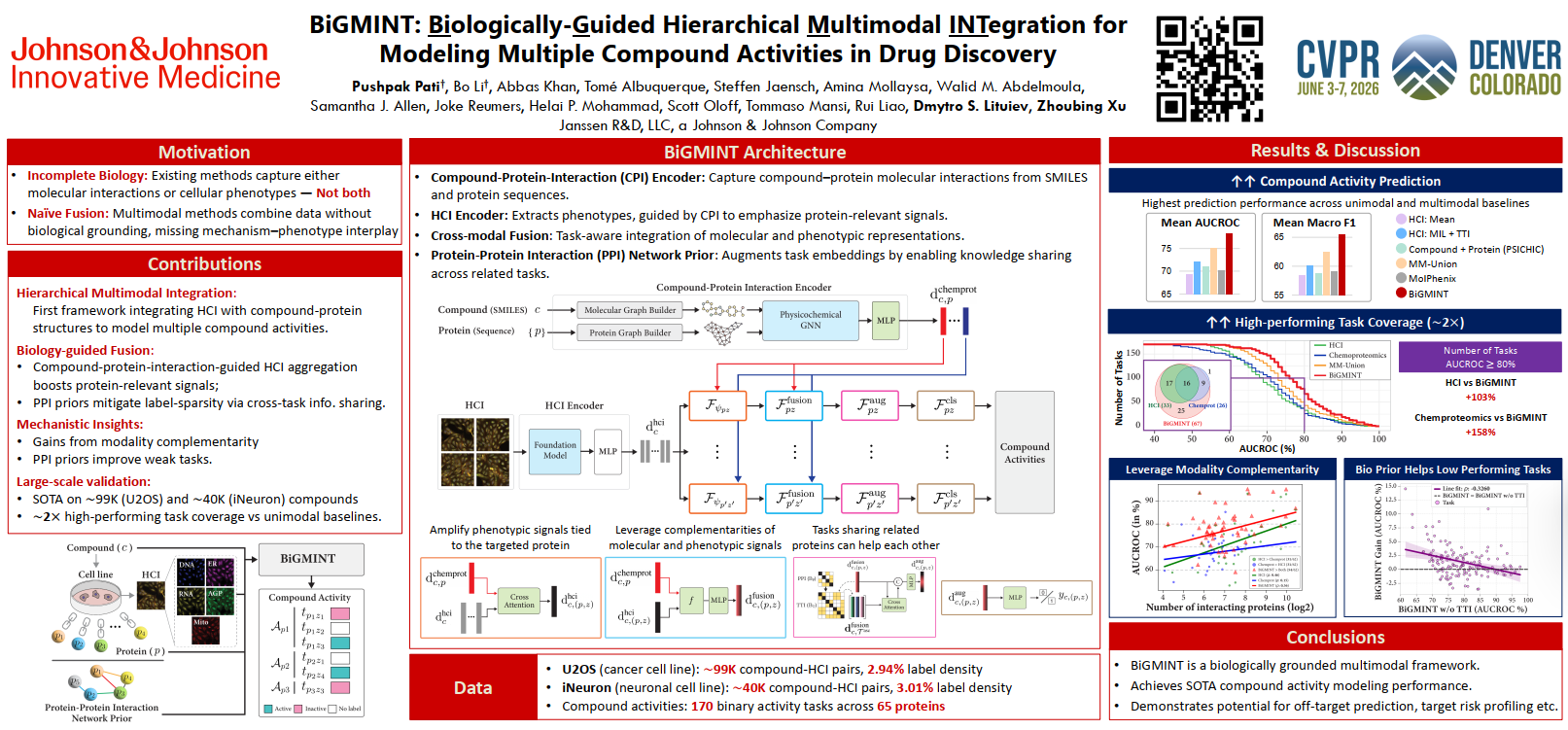
Compound activity modeling is critical for drug discovery, where accurate in silico predictions can significantly reduce reliance on expensive, time‑consuming target-specific experimental assays. Traditional machine learning approaches for compound activity modeling typically rely on either chemoproteomics-centric molecular data or phenotype-centric imaging screens, limiting their ability to capture complementary biological signals. While multimodal approaches show promise, they often fail to capture the interplay between molecular mechanisms and cellular responses. In this paper, we present BiGMINT, a Biologically Guided Multimodal framework that hierarchically INTegrates chemoproteomic and high-content imaging (HCI) data, introducing chemoproteomics-guided phenotypic aggregation, task-aware cross-modal fusion, and protein–protein interaction priors for modeling activities. On two large-scale in-house datasets, with 99K and 40K compound–HCI pairs from U2OS and iNeuron, BiGMINT improves mean AUCROC by up to 10.0% and 4.2%, and high-performing task coverage by up to 103% and 56% over best unimodal and multimodal methods. Thorough analysis revealed mechanistic insights, showing these gains stem from modality complementarity, and protein–protein priors enhance modeling of challenging activities. Code will be released for reproducibility on acceptance of the paper.