
Rethinking BCE Loss for Multi-Label Image Recognition with Fine-Tuning
Abstract
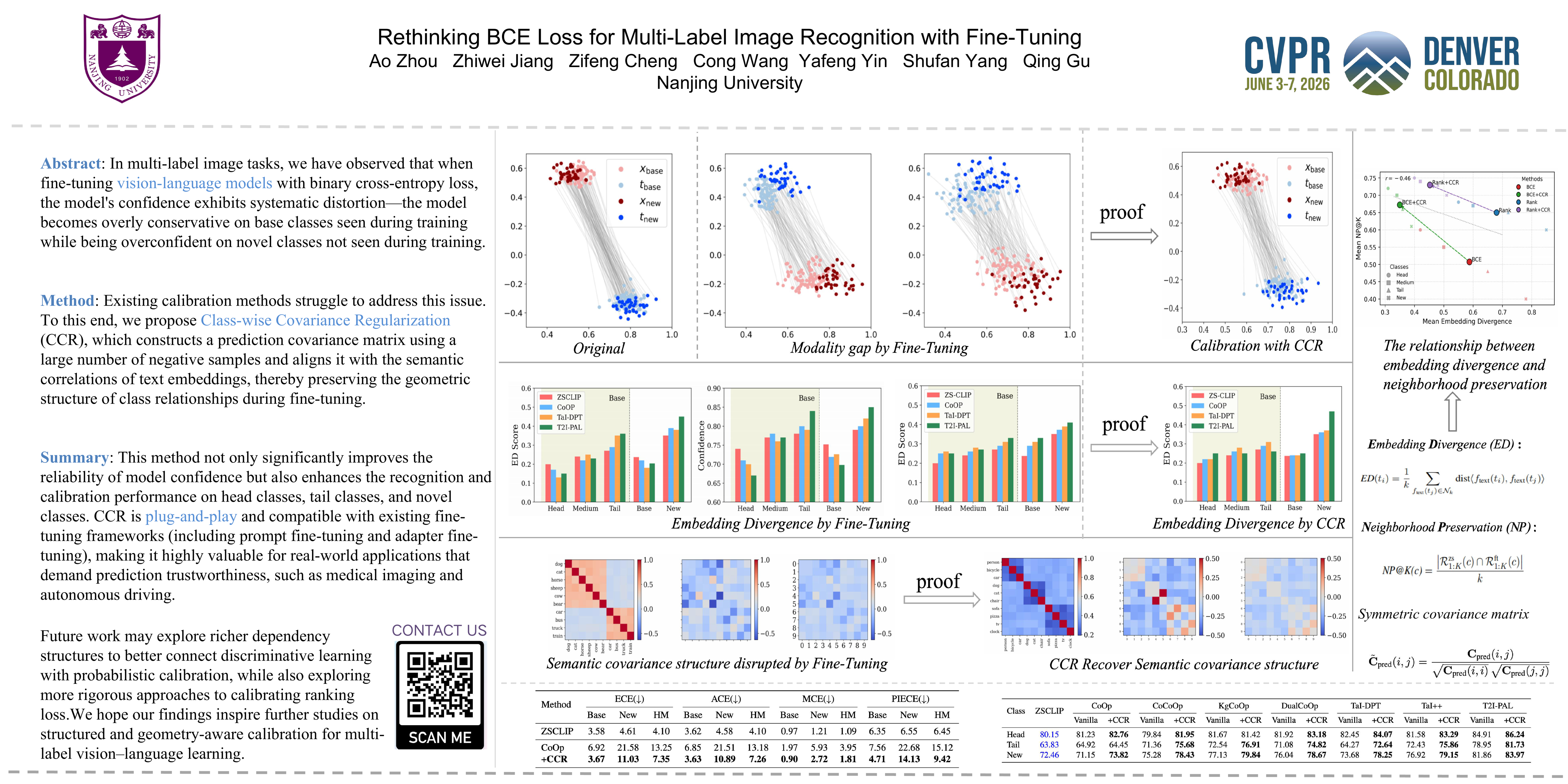
Fine-tuning vision–language models such as CLIP has become the mainstream paradigm for multi-label image recognition, and prompt tuning is widely adopted due to its lightweight parameter cost and strong transferability. However, we find that when these methods use Binary Cross-entropy as the supervision loss, the model’s confidence structure becomes systematically distorted, leading to pronounced miscalibration. Existing calibration techniques, such as temperature scaling or regularization-based methods, largely fail in multi-label settings because they cannot capture inherent semantic dependencies between classes, nor can they correct the global structural shifts introduced during fine-tuning. To address this issue, we propose Class-wise Covariance Regularization, which aligns the predicted covariance structure of class confidences with the semantic correlations encoded in pretrained text embeddings. This alignment preserves the geometric consistency of the class space throughout fine-tuning, resulting in more stable and interpretable confidence distributions across categories. Experiments on multi-label benchmarks show that CCR significantly reduces calibration errors while maintaining or even improving classification accuracy.