
PanoEnv: Exploring 3D Spatial Intelligence in Panoramic Environments with Reinforcement Learning
 Highlight
Abstract
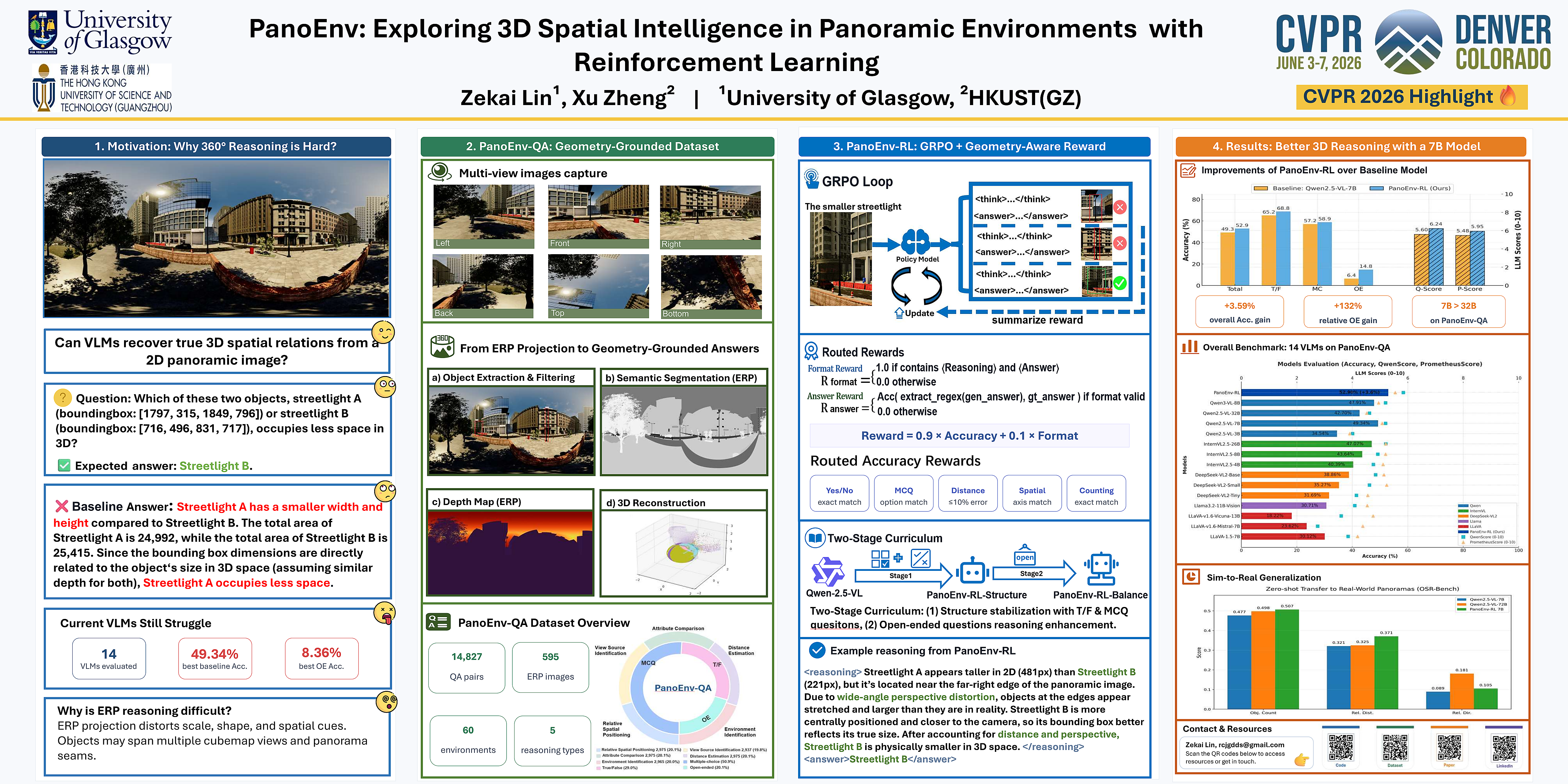
360° panoramic images are increasingly used in VR, autonomous driving, and robotics for holistic scene understanding. However, current Vision–Language Models (VLMs) struggle with 3D spatial reasoning on Equirectangular Projection (ERP) images due to geometric distortion and limited 3D supervision. We introduce \textbf{\textit{PanoEnv}}, a large-scale VQA benchmark built from synthetic 3D environments, containing 14.8K questions across five categories (e.g., relative position, volume comparison) grounded in accurate 3D annotations—depth, segmentation, and bounding boxes. Benchmarking 14 state-of-the-art VLMs reveals limited 3D understanding, achieving only 49.34\% overall and 8.36\% on open-ended (OE) questions. To enhance 3D reasoning, we propose a reinforcement learning post-training framework based on Group Relative Policy Optimization (GRPO) with a ground-truth-guided reward combining five geometry-aware strategies (e.g., distance tolerance, spatial consistency). A two-stage curriculum further mitigates catastrophic forgetting: Stage\~1 trains on structured tasks (T/F, MCQ), and Stage\~2 fine-tunes on mixed OE data for generalization. Our 7B model sets a new SoTA performance, improving total accuracy to 52.93\% (+3.59\%) and OE accuracy to 14.83\% while maintaining structured-task performance. It also achieves top semantic scores (Q-Score 6.24, P-Score 5.95), surpassing 32B models. These results demonstrate that PanoEnv-QA and our curriculum-based RL framework effectively instill 3D spatial intelligence in VLMs for omnidirectional perception.