
Solving a Nonlinear Blind Inverse Problem for Tagged MRI with Physics and Deep Generative Priors
Abstract
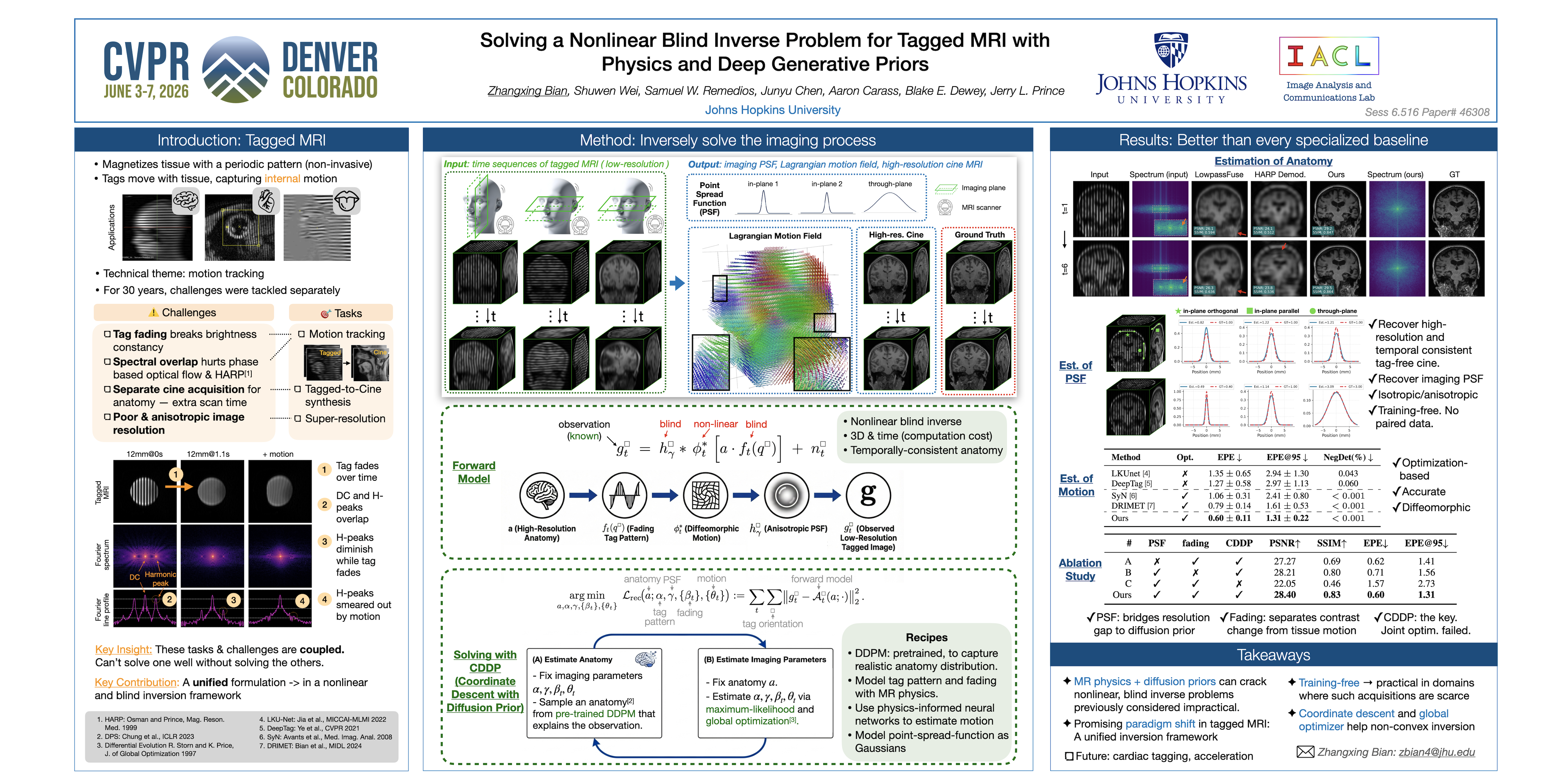
Tagged MRI enables tracking internal tissue motion non-invasively. It encodes motion by modulating anatomy with periodic tags, which deforms along with tissue. However, the entanglement between anatomy, tags and motion poses significant challenges on post processing. Existence of tags and imaging blur hinders downstream tasks such as segmenting anatomy. Tag fading, due to T1-relaxation, disrupts brightness constancy assumption for motion tracking. For decades, these challenges are handled in isolation and sub-optimally. In contrast, we introduce a blind and nonlinear inverse framework for tagged MRI that, for the first time, unifies these tasks: anatomical image recovery, high-resolution cine image synthesis, and motion estimation. At its core, the synergy of MR physics and generative priors enables us to blindly estimate the unknown forward imaging models, high-resolution underlying anatomy, while simultaneously tracking 3D diffeomorphic Lagrangian motion over time. Experiments on tagged brain MRI demonstrate that our approach yields high-resolution anatomy images, cine images, and more accurate motion than specialized methods.