
Prompt-Free Unknown Label Generation for Open World Detection in Remote Sensing
Abstract
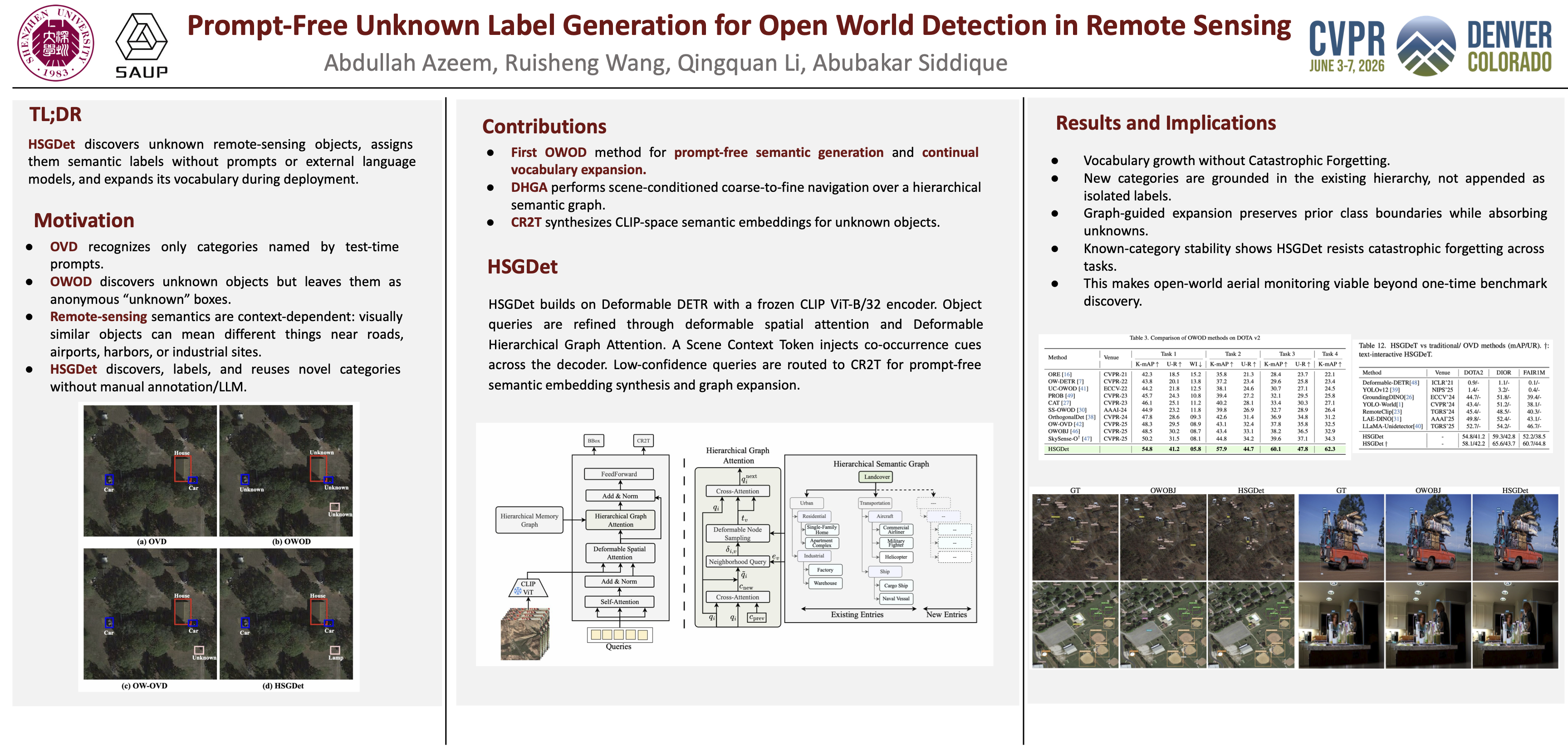
Autonomous object detection in remote sensing requires systems that can discover new categories and assign them usable labels during deployment. Existing Open-World Object Detectors identify unknown objects but leave them unnamed until manual annotation. In contrast, Open-Vocabulary Detectors recognize unseen categories only with provided prompts at test time, lacking autonomous discovery or naming. This work presents HSGDet, a detector that achieves both discovery and semantic assignment at test time without external prompts. This method introduces DHGA that navigates a hierarchical semantic graph to perform scene-conditioned coarse-to-fine classification of detected objects. It leverages spatial co-occurrence patterns from surrounding scene context to produce classification confidence scores. High-scoring regions are identified as known objects, while low-scoring regions are flagged as unknown detections. Unknown regions pass to CR2T, which synthesizes text embeddings by fusing visual features, hierarchical parents, and scene context, enabling prompt-free labeling and vocabulary expansion. This approach enables prompt-free semantic labeling and supports autonomous vocabulary expansion without requiring external models. Results demonstrate that HSGDet outperforms state-of-the-art methods by a large margin of 6.6 points in Known mAP and 9.9 points in Unknown Recall. It also reduces Wilderness Impact by 36\%, enabling scalable and autonomous aerial monitoring.