
Decoding 3D Perception via BrainSSD: Synergistic Fusion of EEG Representations from Static and Dynamic Visual Streams
Abstract
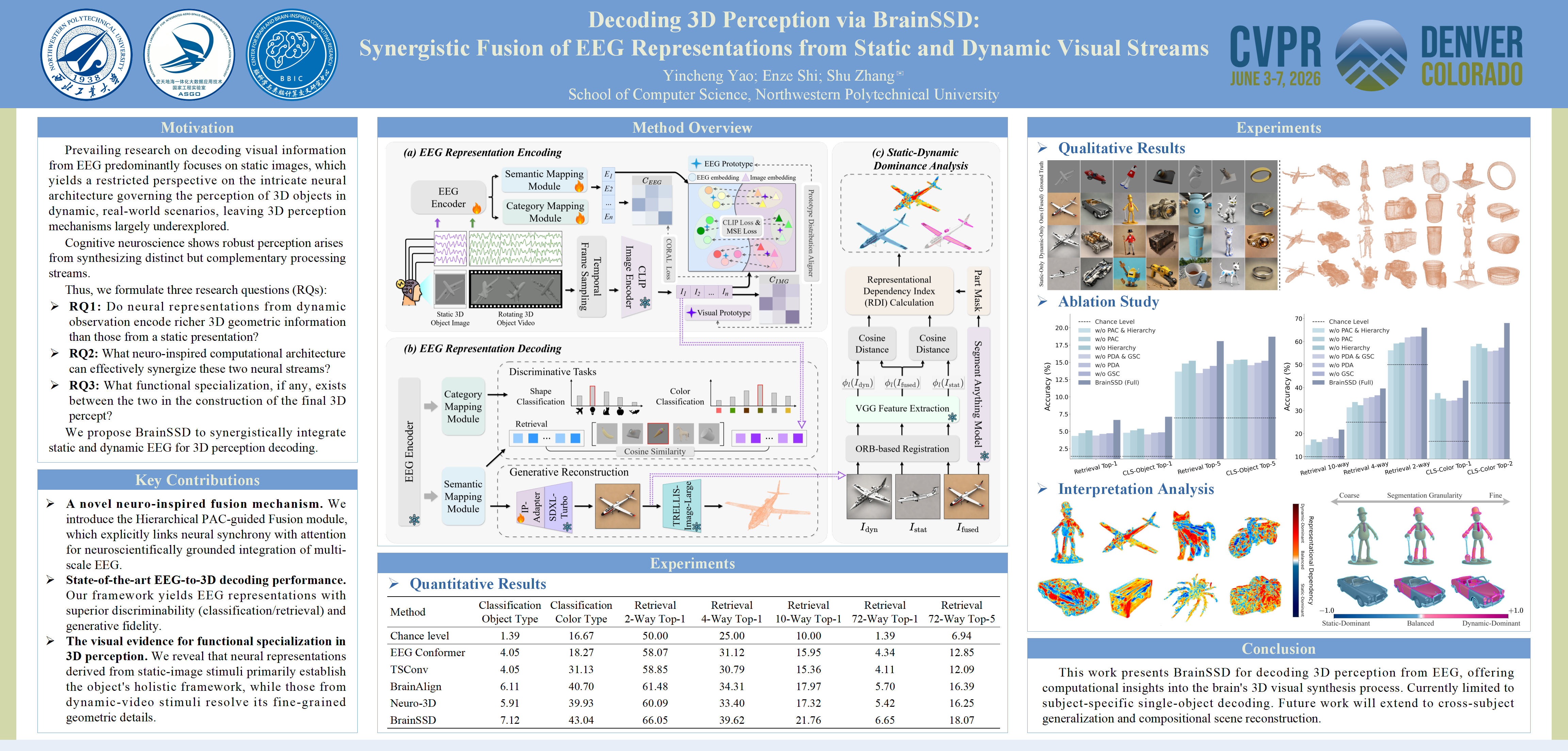
Understanding how the brain constructs coherent 3D visual percepts from multifaceted experiences remains a pivotal yet underexplored challenge. To investigate this, we introduce BrainSSD, a novel framework for decoding 3D representations from electroencephalography (EEG) signals. The core of BrainSSD is a neuro-inspired fusion architecture, Hierarchical Phase-Amplitude Coupling guided Fusion (HPACF), which synergistically integrates EEG from two distinct viewing paradigms: brief presentations of a static 3D object view, and sustained observation of the object undergoing full rotation. HPACF embodies two key principles of neural computation, namely hierarchical processing realized through multi-level cross-attention, and neural synchrony actualized by using a differentiable estimator of Phase-Amplitude Coupling (PAC) to dynamically guide the integration. The resulting fused representations are subsequently mapped to the visual domain via a multi-level alignment loss. Our framework establishes a new state-of-the-art across a range of EEG decoding tasks, achieving superior discriminative power and exceptional generative fidelity. Furthermore, our static-dynamic dominance analysis provides the first direct visual evidence for a functional specialization in the brain's 3D perception, revealing that neural responses to static object views primarily underpin the object's holistic structure and form, while responses to rotational observation are indispensable for resolving its fine-grained geometric details. Our work presents an advanced framework for probing EEG-based visual decoding and offers computational insights into the brain's synergistic strategies for 3D perception.