
Rethinking Visual Rearrangement from A Diffusion Perspective
Abstract
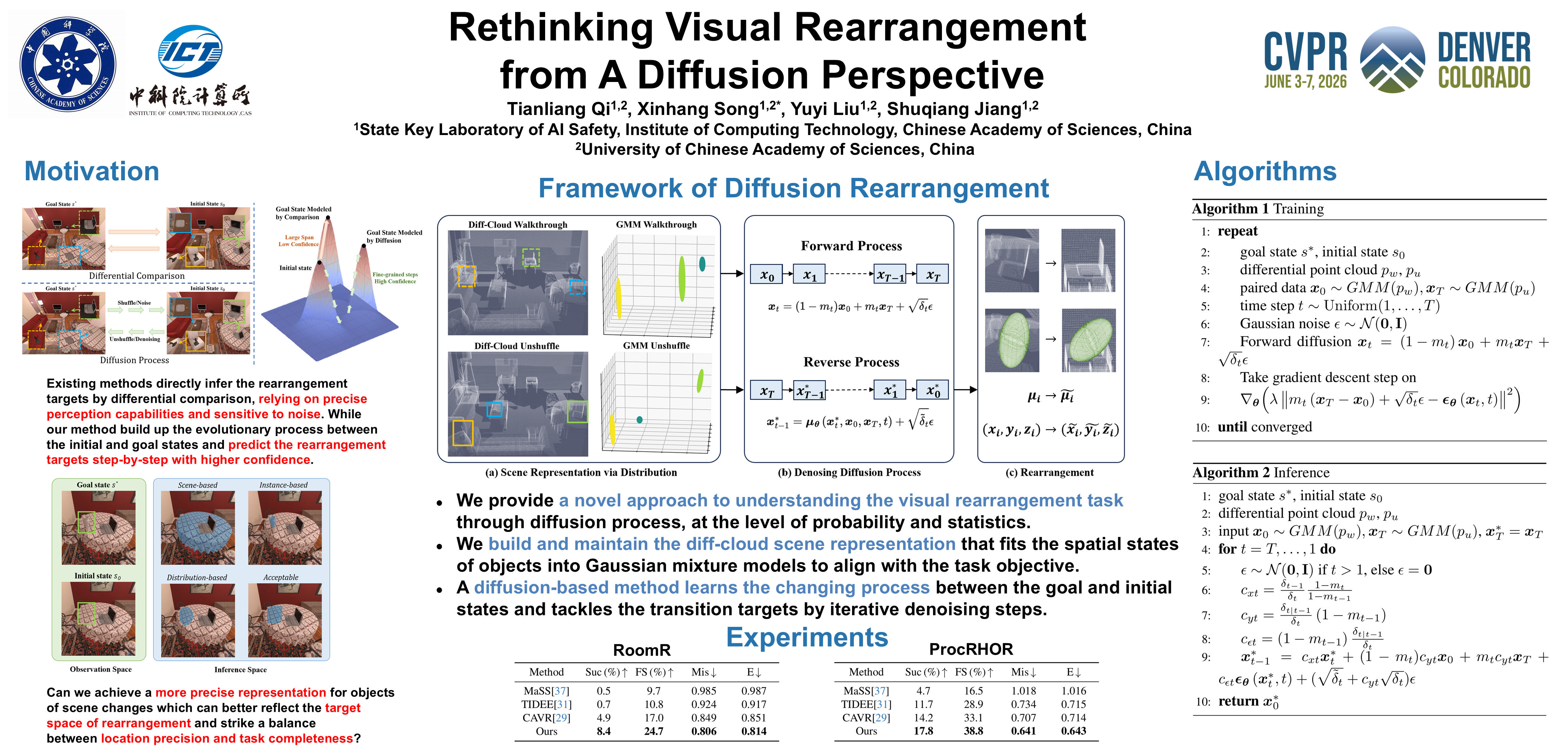
Rearranging disarrayed objects to their intended goal states requires the agent to comprehend the changes that have occurred in the scene and to reason about the process of these changes. To address this, we propose a novel perspective on the visual rearrangement task, drawing inspiration from the diffusion processes in molecular thermodynamics. We model the room shuffle and unshuffle stages as the forward and reverse processes of diffusion. In contrast to conventional methods that rely on scene modeling and differential comparisons, our approach provides insight into the intrinsic evolution process between the goal and initial states of the scene, which allows for a more reasonable rearrangement of objects through fine-grained and progressive denoising steps with high confidence. By analyzing the task objectives, we represent the scene via spatial distributions of objects and model the visual rearrangement process using a diffusion bridge model. Building upon this, we introduce the Diffusion Rearrangement model, which takes point cloud data as input, fits it into Gaussian mixture distributions to represent the states of objects, and predicts the rearrangement target through an iterative denoising transformer. Experimental results on the RoomR dataset demonstrate the effectiveness of our approach.