
Deciphering Genotype-Phenotype Mechanisms from High-Content Profiling via Knowledge-Guided Multi-modal Graph Learning
Abstract
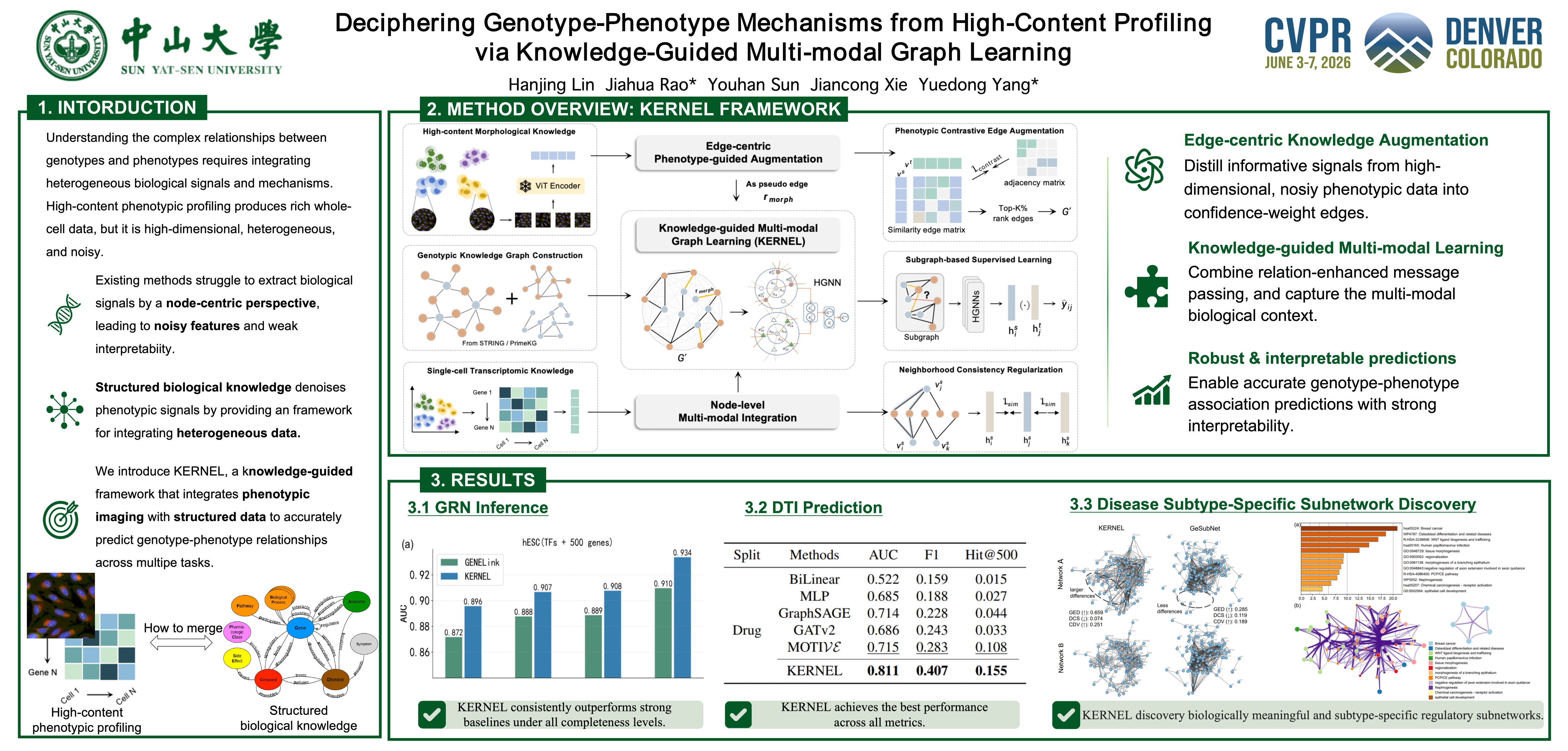
Understanding genotype–phenotype relationships is pivotal for advancing biomedical research, drug discovery, and precision medicine. With the rise of high-throughput cellular imaging, it is essential to tightly integrate high-content cellular morphology with structured biological knowledge to extract cellular-scale evidence for genotype-to-phenotype mapping.However, integrating high-dimensional, heterogeneous, and noisy phenotypes with structured knowledge remains challenging. Prior approaches typically treat phenotypes as node features, overlooking that phenotypes primarily convey cellular-scale relational signals about how perturbations reshape interactions. We present KERNEL, a knowledge-guided multimodal graph learning framework that integrates cellular imaging phenotypes into a unified knowledge graph to predict genotype-phenotype interactions, including GRN inference, drug-target interaction prediction, and subtype-specific subnetwork discovery. KERNEL dynamically augments task-relevant edges from noisy phenotypic signals, explicitly learns per-edge confidence and marginal utility, and uses knowledge gating to align graph topology with mechanistic pathways. Across large-scale imaging and single-cell datasets, KERNEL consistently outperforms state-of-the-art baselines, e.g., up to 38.1\% AUPR improvement for GRN inference, while delivering more accurate and interpretable DTI and subtype subnetwork discovery, demonstrating robust mechanism learning from richer, harder-to-denoise phenotypes.