
Beyond Myopic Alignment: Lookahead Optimization for Online Class-Incremental Learning
Abstract
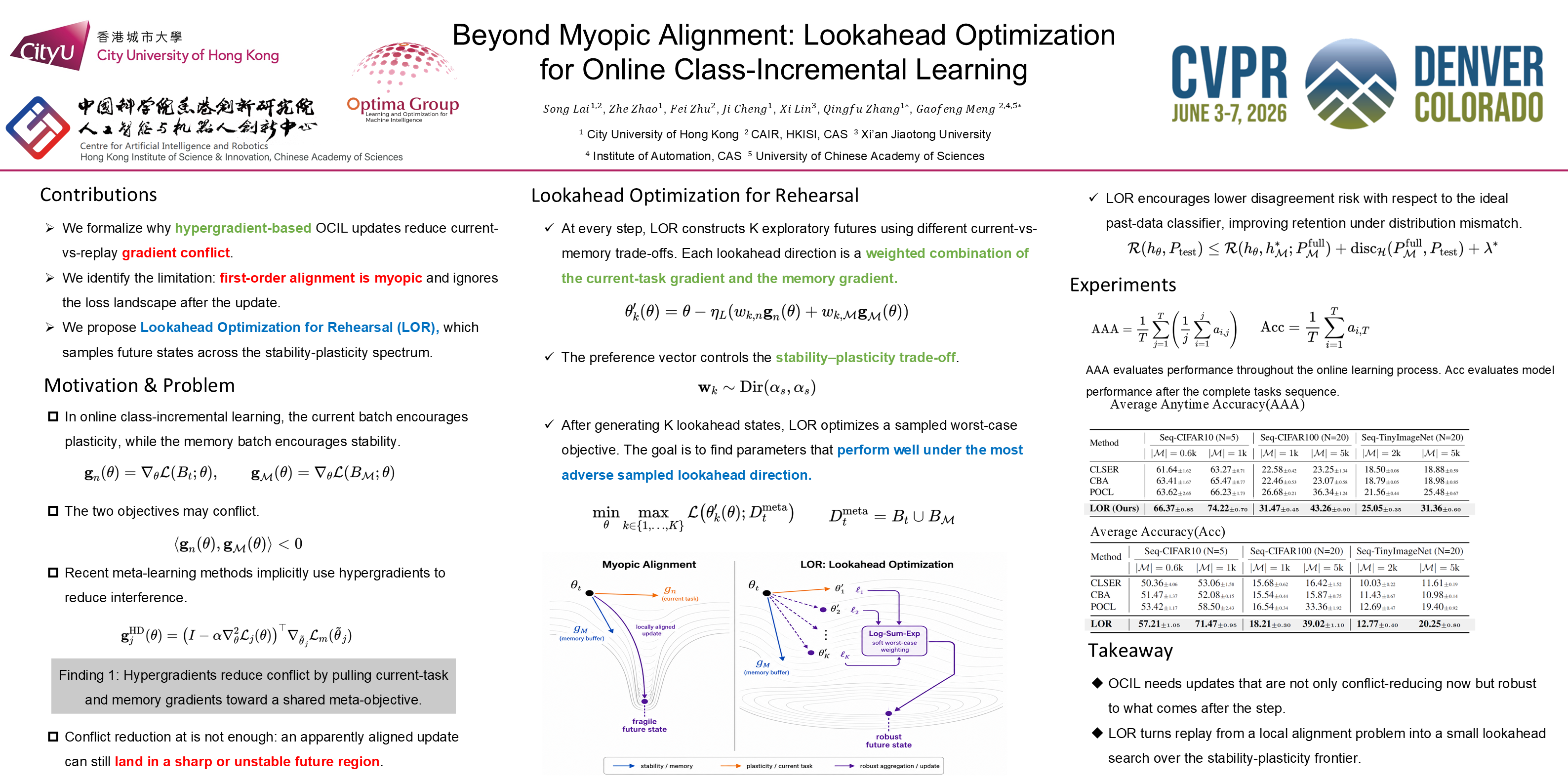
Rehearsal-based methods are the cornerstone of modern online class-incremental learning (OCIL), yet they face a fundamental challenge: the gradient of the current task often conflicts with that of the rehearsal data from the memory buffer, leading to catastrophic forgetting. Recent works have implicitly addressed this by using hypergradients, but the underlying mechanism has remained poorly understood. In this paper, we first provide a formal analysis revealing that hypergradients mitigate forgetting by aligning task-specific gradients towards a common meta-objective, thereby reducing their conflict. However, we argue that this conflict-reducing alignment is inherently myopic—it only considers the immediate gradient directions, failing to account for the loss landscape geometry just one step ahead. To overcome this limitation, we introduce a novel framework: Lookahead Optimization for Rehearsal (LOR). Instead of committing to a single update, LOR first explores a set of potential future model states by taking lookahead steps along different directions that balance plasticity and stability. To ensure the final update is robust, we formulate the optimization as a min-max problem, seeking parameters that perform well even under the worst-case lookahead scenario. This objective is made tractable by a smooth Log-Sum-Exp approximation, enabling efficient end-to-end training. Theoretical analysis from both optimization and statistical perspectives corroborates the robustness of our approach. Extensive experiments on Seq-CIFAR10, Seq-CIFAR100, and Seq-TinyImageNet demonstrate that LOR significantly outperforms state-of-the-art methods, establishing a new and more robust paradigm for rehearsal-based OCIL.