
Multi-level Causal LLM-based Text-to-Motion Generation with Human Alignment
Abstract
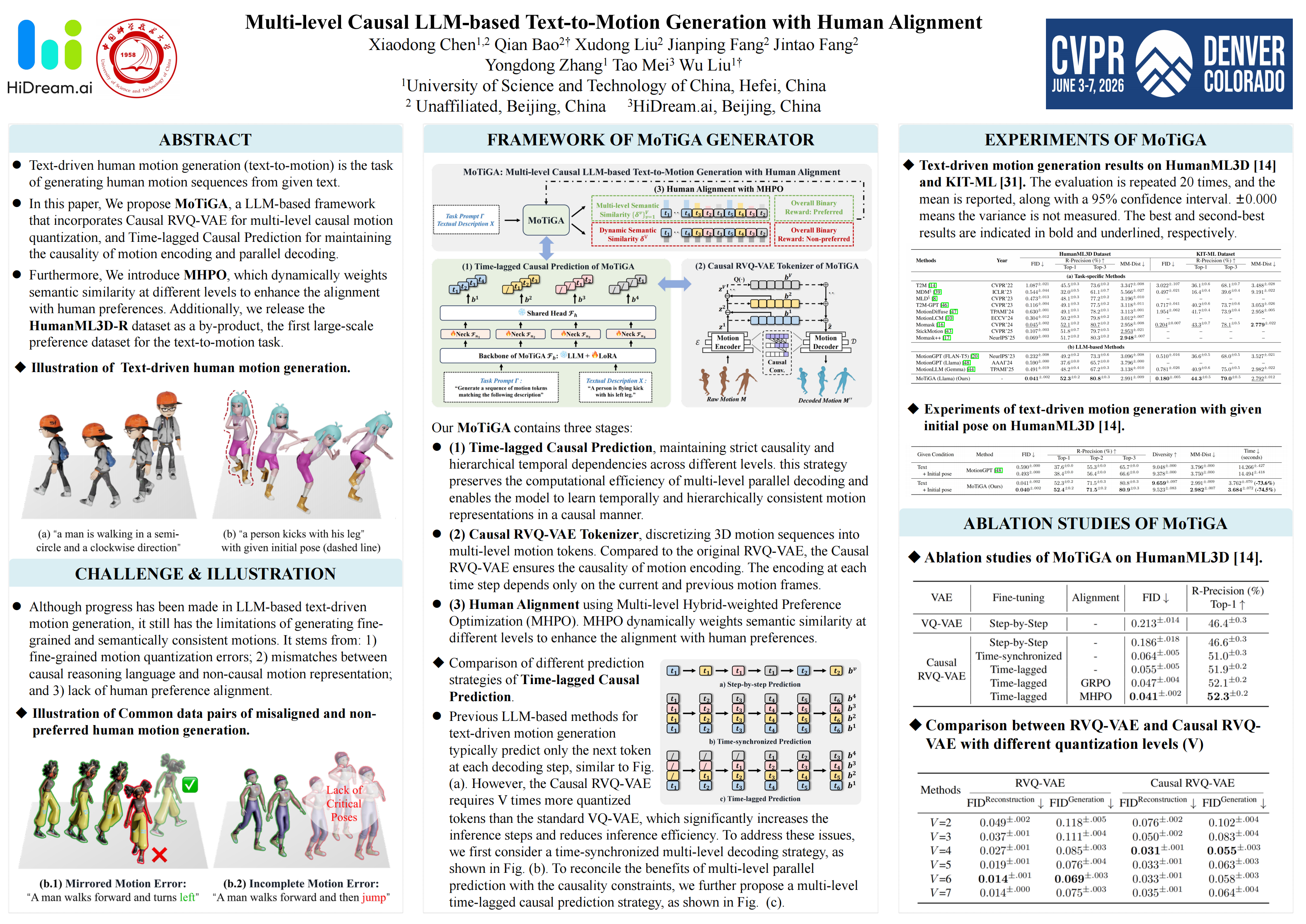
Although progress has been made in LLM-based text-driven motion generation, it still has the limitations of generating fine-grained and semantically consistent motions. These limitations stem from: 1) fine-grained motion quantization errors; 2) mismatches between causal reasoning language and non-causal motion representation; and 3) lack of human preference alignment. To solve them, this paper proposes MoTiGA, a multi-level causal LLM-based text-to-motion generation framework with human alignment. Firstly, MoTiGA employs Causal RVQ-VAE for multi-level causal fine-grained motion representation, then explores iterative residual quantization and causal convolutions to reduce fine-grained motion quantization errors, while preserving the causality as language presentation. Furthermore, the framework incorporates a time-lagged causal prediction strategy, enabling parallel prediction across motion token levels while maintaining temporal dependencies. Finally, to enhance human alignment, we propose Multi-level Hybrid-weighted Preference Optimization (MHPO), which dynamically adjusts semantic similarity weighting and continuous similarity scores. For MHPO, we also release the HumanML3D-R dataset, the first large-scale preference dataset for motion generation, with 101,490 human preference pairs. Evaluations show MoTiGA's superior performance, with an 82.3\% FID improvement on HumanML3D and a 64.7\% improvement on KIT-ML over other LLM-based methods.