
GH-NAF: Grid-Adaptive Hash-Level–Attended Neural Attenuation Fields for Discrepancy-Aware CBCT
Abstract
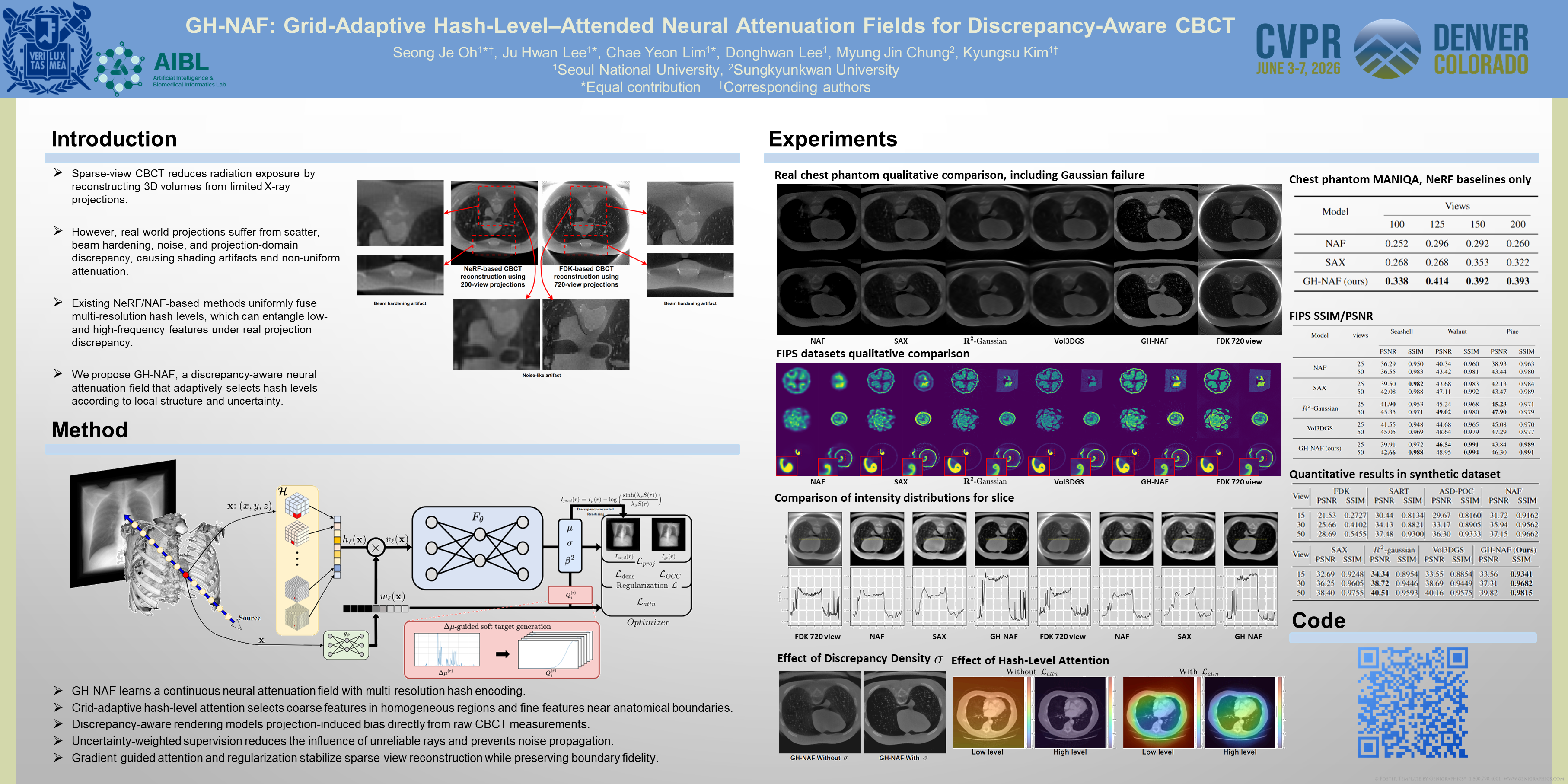
The advent of hash encodings has evolved neural radiance fields (NeRF)-based methods into fast and efficient 3D reconstruction techniques. In medical imaging, this framework has been extended to CT/CBCT reconstruction through neural attenuation fields (NAF), which directly model attenuation properties from projection data. Existing NeRF-based attenuation fields typically assume an idealized monoenergetic CBCT setting and therefore fail to model real-world projection inconsistencies such as scatter and noise contamination. Moreover, uniformly concatenating multi-resolution hash-grid features blends heterogeneous frequency components and noise into a single representation, causing artifacts: homogeneous regions acquire spurious high-frequency patterns, structural boundaries become blurred, and projection-induced bias propagates throughout the learned field. Given these limitations, we introduce the Grid-Adaptive Hash-Level–Attended Neural Attenuation Field (GH-NAF). Instead of collapsing noise-corrupted projection signals into a single feature space, GH-NAF trained each hash-grid level independently, guided by uncertainty-based confidence scores. This enables stable low-frequency modeling in homogeneous tissues while selectively preserving high-frequency detail around structural boundaries. Experiments on synthetic and real CBCT datasets demonstrate that GH-NAF reliably preserves intra-material contrast and achieves superior reconstruction quality compared with state-of-the-art methods.