
DASH: A Meta-Attack Framework for Synthesizing Effective and Stealthy Adversarial Examples
Abdullah Al Nomaan Nafi ⋅ Habibur Rahaman ⋅ Zafaryab Haider ⋅ Tanzim Mahfuz ⋅ Fnu Suya ⋅ Swarup Bhunia ⋅ Prabuddha Chakraborty
Abstract
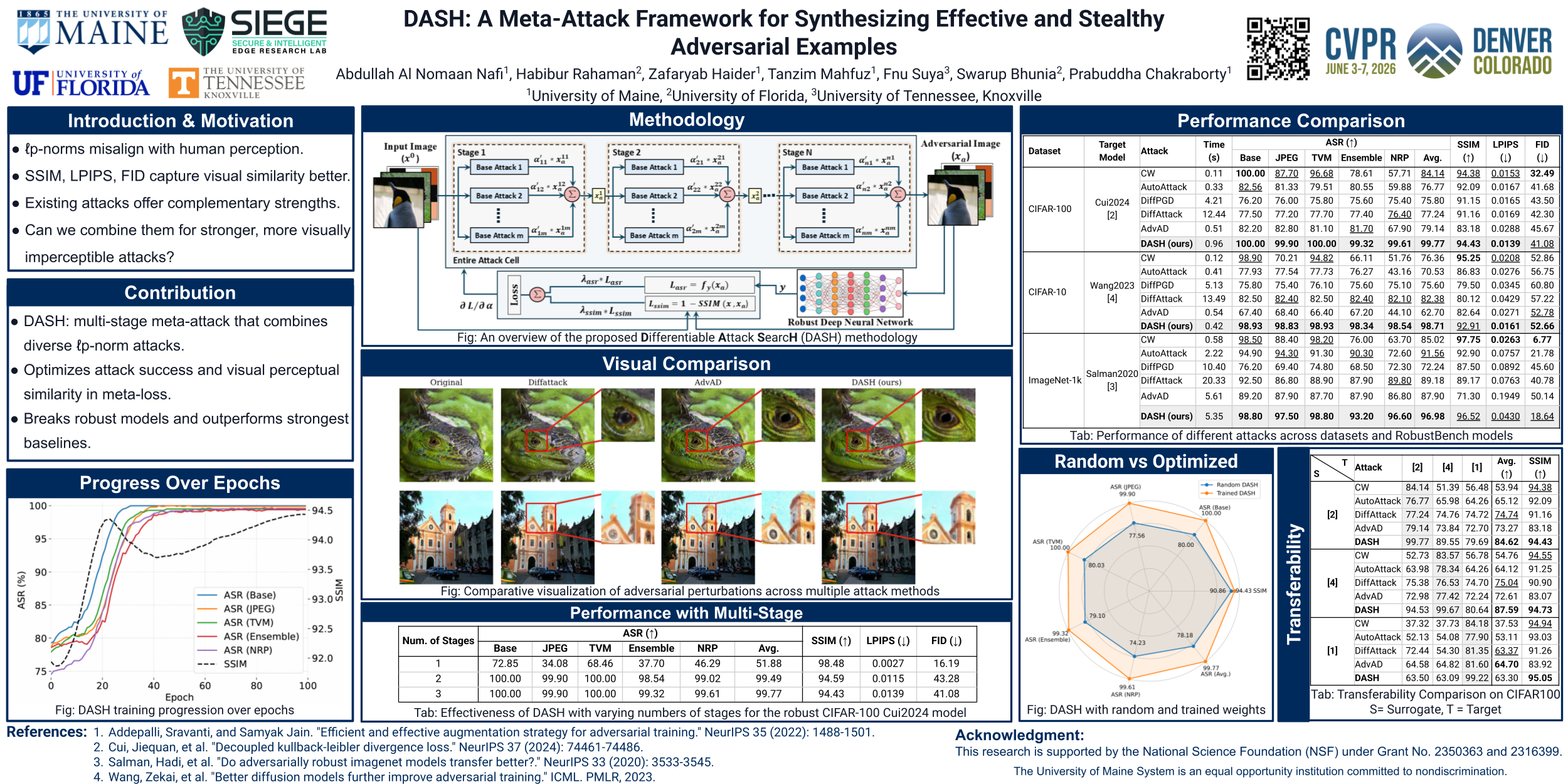
Numerous techniques have been proposed for generating adversarial examples under strict $\ \ell_p \$-norm constraints. However, such norm-bounded examples often fail to align well with human perception, and only recently have a few methods begun specifically exploring perceptually aligned adversarial examples. Moreover, it remains unclear whether insights from $\ \ell_p \$-constrained attacks can be effectively leveraged to improve perceptual efficacy. In this paper, we introduce DASH, a differentiable meta-attack framework that generates effective and perceptually aligned adversarial examples by strategically composing existing $\ \ell_p \$-based attack methods. DASH operates in a multi-stage fashion: at each stage, it aggregates candidate adversarial examples from multiple base attacks using learned, adaptive weights and propagates the result to the next stage. A novel meta-loss function guides this process by jointly minimizing misclassification loss and perceptual distortion, enabling the framework to dynamically modulate the contribution of each base attack throughout the stages. We evaluate DASH on adversarially trained robust models across CIFAR-10, CIFAR-100, and ImageNet while considering visual perception metrics (e.g. SSIM, FID, LPIPS) in the perturbation budget (instead of $\ \ell_p \$-norm). Despite relying solely on $\ \ell_p \$-constrained based methods, DASH significantly outperforms state-of-the-art perceptual attacks such as AdvAD, achieving higher attack success rates (e.g., 20.63\% improvement) and superior visual quality, as measured by SSIM, LPIPS, and FID (improvements of $\approx11$, 0.015, and 5.7, respectively). DASH generalizes well to unseen defenses and different white-box/black-box scenarios, making it a practical and strong baseline for evaluating robustness.
Chat is not available.
Successful Page Load