
Evo-1: Lightweight Vision-Language-Action Model with Preserved Semantic Alignment
Abstract
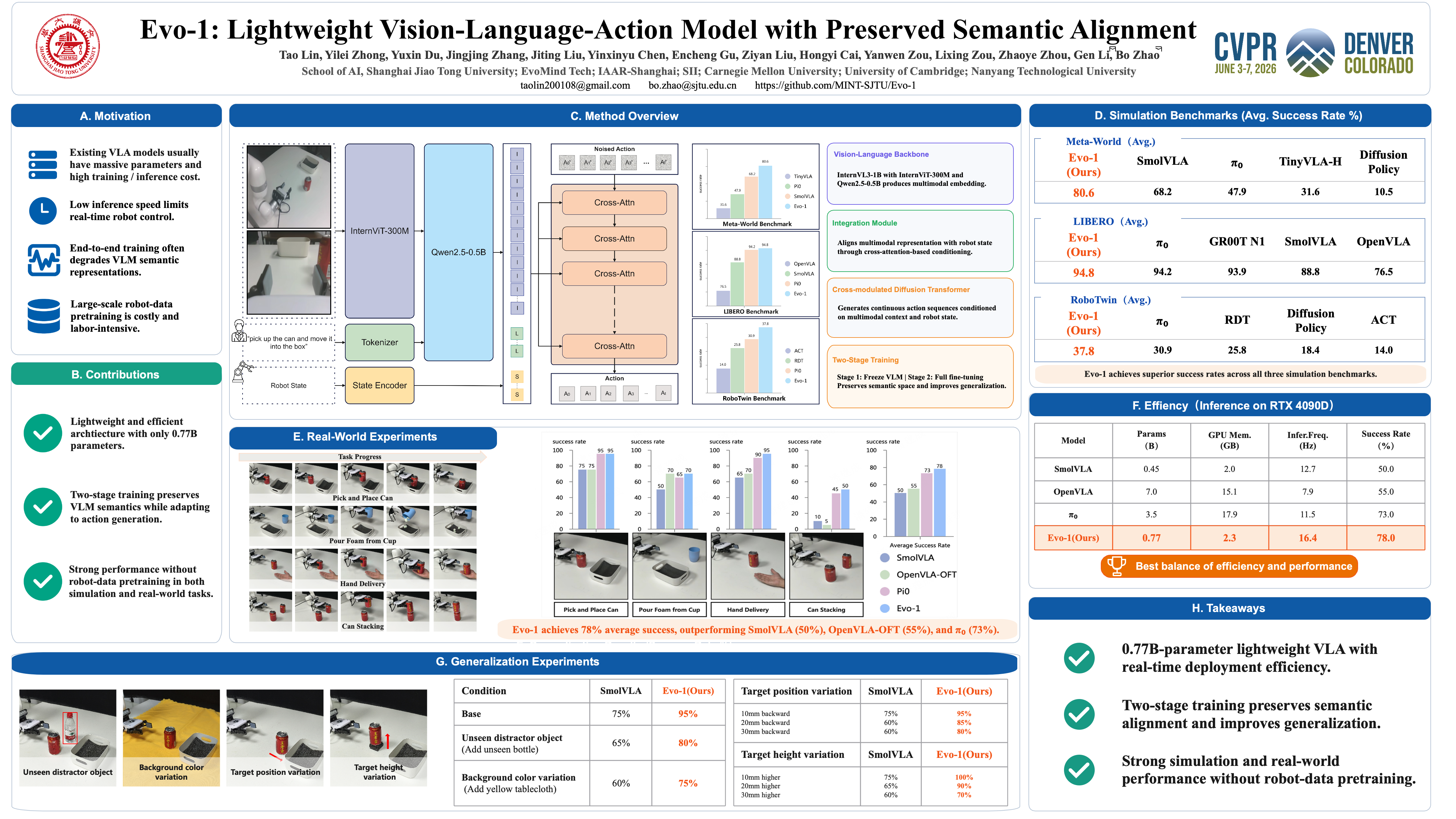
Vision-Language-Action (VLA) models have emerged as a powerful framework that unifies perception, language, and control, enabling robots to perform diverse tasks through multimodal understanding. However, current VLA models typically contain massive parameters and rely heavily on large-scale robot data pretraining, leading to high computational costs during training, as well as limited deployability for real-time inference.Moreover, most training paradigms often degrade the perceptual representations of the Vision–Language backbone, resulting in overfitting and poor generalization to downstream tasks.In this work, we present Evo-1, a lightweight VLA model that reduces computation and improves deployment efficiency, while maintaining strong performance without pretraining on robot data. Evo-1 builds on a native multimodal Vision–Language model (VLM), incorporating a novel cross-modulated diffusion transformer along with an optimized integration module, together forming an effective architecture.We further introduce a two-stage training paradigm that progressively aligns action with perception, preserving the representations of the VLM.Notably, with only 0.77 billion parameters, Evo-1 achieves state-of-the-art results on the Meta-World and RoboTwin suite, surpassing the previous best models by 12.4\% and 6.9\%, respectively, and also attains a competitive result of 94.8\% on LIBERO.In real-world evaluations, Evo-1 attains a 78\% success rate with high inference frequency and low memory overhead, outperforming all baseline methods.We release code, data, and model weights to facilitate future research on lightweight and efficient VLA models.