
LA-Pose: Latent Action Pretraining Meets Pose Estimation
Abstract
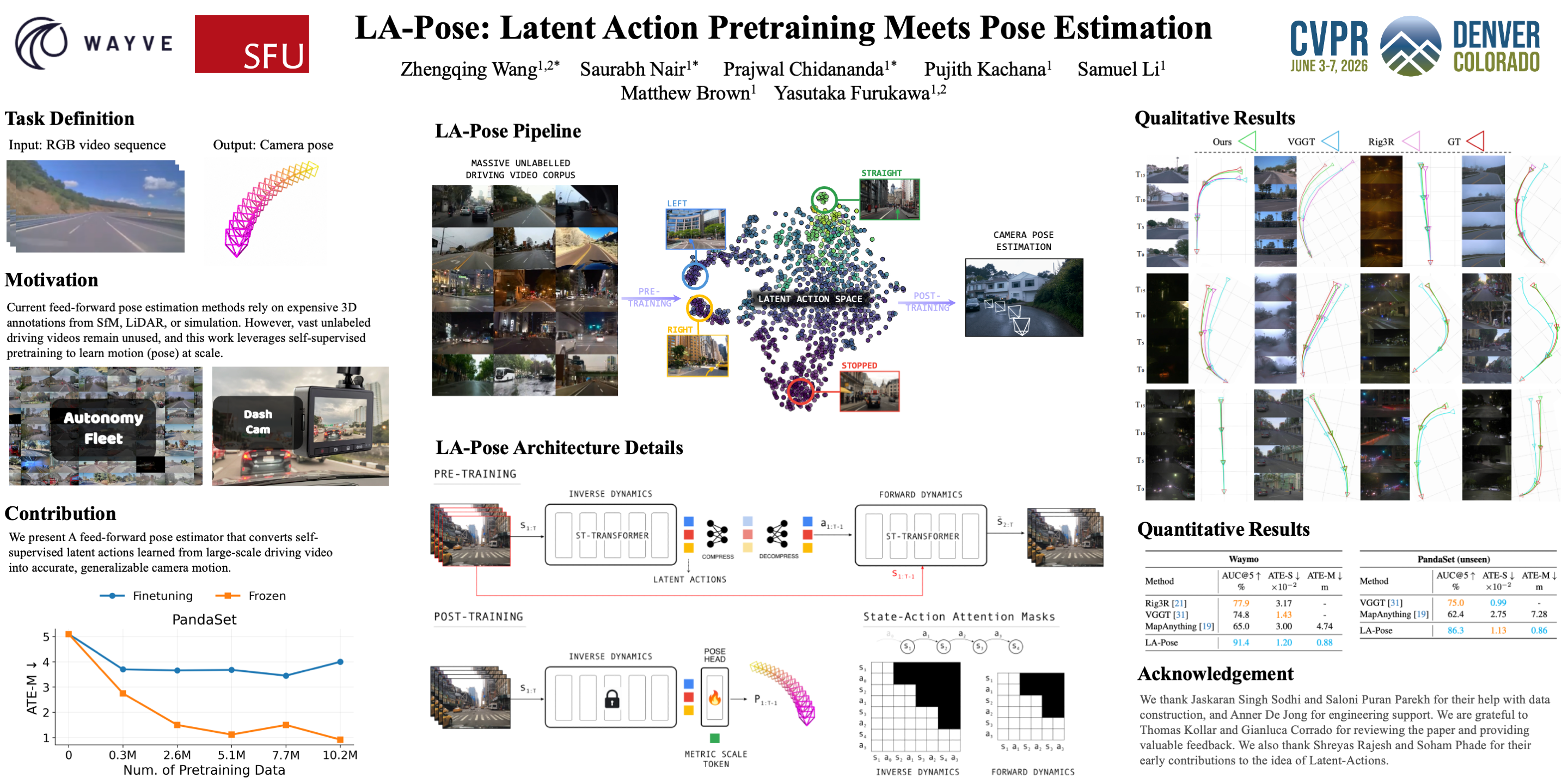
This paper revisits camera pose estimation through the lens of self-supervised pretraining, focusing on inverse-dynamics pretraining as a scalable alternative to the current trend of fully supervised training with 3D annotations. Concretely, we employ inverse- and forward-dynamics models to learn latent action representations, similar to Genie from large-scale driving videos.Our idea is simple yet effective. Existing methods use latent actions in their original capacity, that is, as action conditioning of world-models or as proxies of robot action parameters in policy networks.Our method, dubbed LA-Pose, repurposes the latent action features as inputs to a camera pose estimator, finetuned on a limited set of high-quality 3D annotations.This formulation enables accurate and generalizable pose prediction while maintaining feed-forward efficiency. Extensive experiments on driving benchmarks show that LA-Pose achieves competitive and even superior performance to state-of-the-art methods while using orders of magnitude less labeled data. Concretely, on the Waymo and PandaSet benchmarks, LA-Pose achieves over 10% higher pose accuracy than recent feed-forward methods.To our knowledge, this work is the first to demonstrate the power of inverse-dynamics self-supervised learning for pose estimation.