
Scaling Up AI-Generated Image Detection with Generator-Aware Prototypes
Abstract
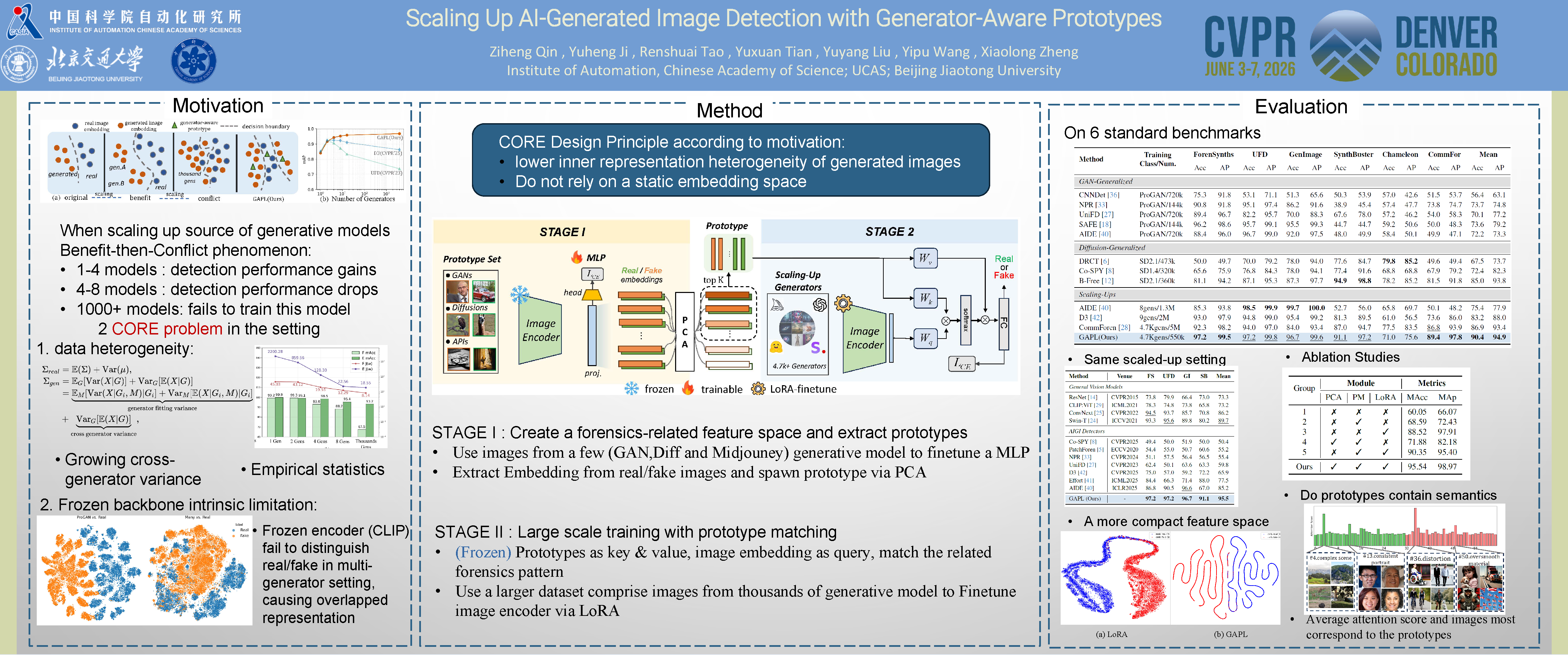
The pursuit of a universal AI-generated image (AIGI) detector often relies on aggregating data from numerous generators to improve generalization. However, this paper identifies a paradoxical phenomenon we term the Benefit then Conflict dilemma, where detector performance stagnates and eventually degrades as source diversity expands. Our systematic analysis, leveraging Linear Discriminant Analysis (LDA), diagnoses this failure by identifying two core issues: severe data-level heterogeneity, which causes the feature distributions of real and synthetic images to increasingly overlap, and a critical model-level bottleneck from fixed, pretrained encoders that cannot adapt to the rising complexity. To address these challenges, we propose Generator-Aware Prototype Learning (GAPL), a framework that replaces unconstrained aggregation with a structured learning paradigm. GAPL learns a compact set of canonical forgery prototypes to create a unified, low-variance feature space, effectively countering data heterogeneity. To resolve the model bottleneck, it employs a two-stage training scheme with Low-Rank Adaptation (LoRA) to fine-tune the feature extractor, enhancing its discriminative power while preserving valuable pretrained knowledge. This approach establishes a more robust and generalizable decision boundary. Through extensive experiments, we demonstrate that GAPL achieves state-of-the-art performance, showing superior detection accuracy across a wide variety of unseen GAN and diffusion-based generators.