
Selective, Regularized, and Calibrated: Harnessing Vision Foundation Models for Cross-Domain Few-Shot Semantic Segmentation
Abstract
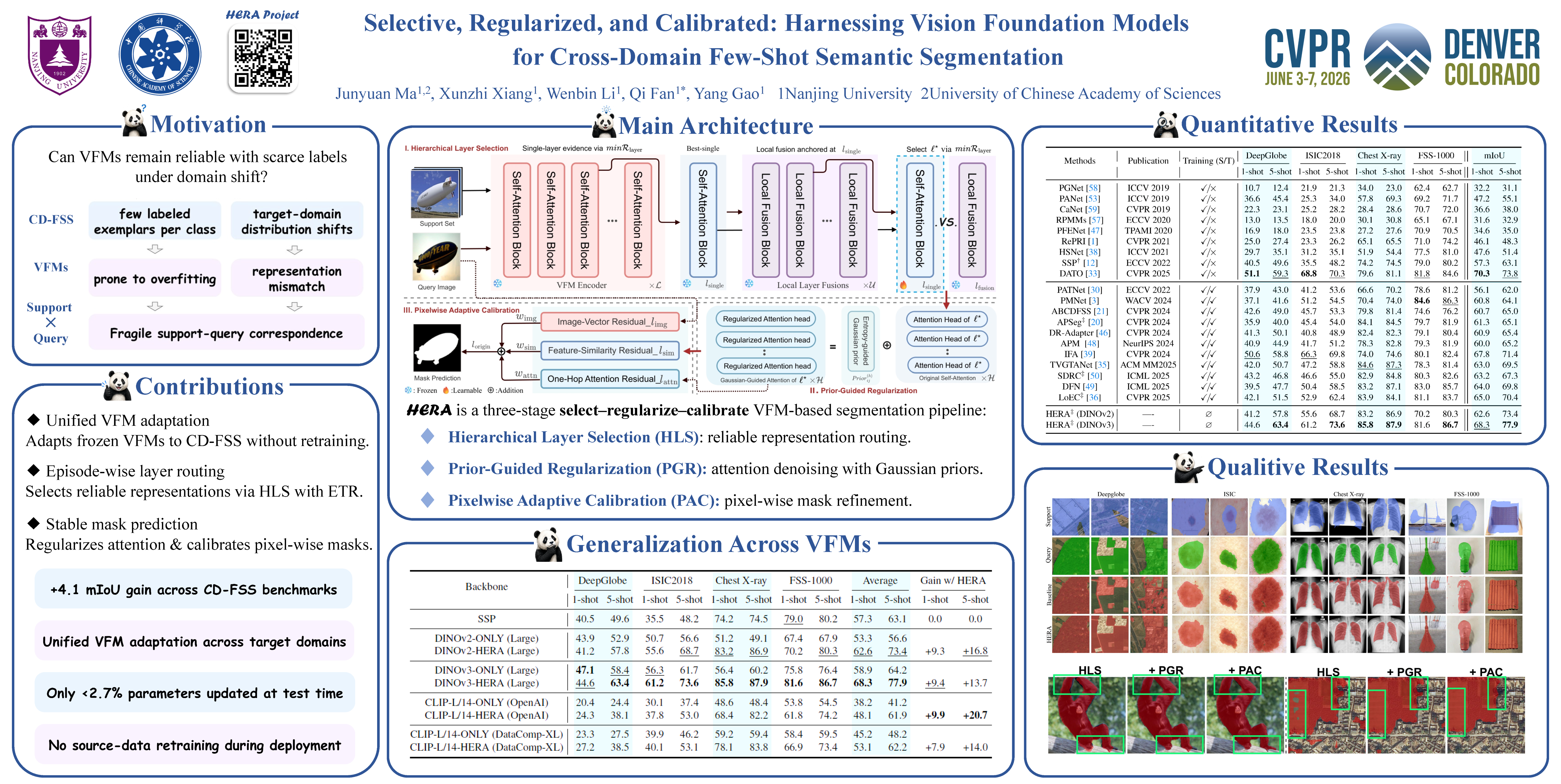
Vision foundation models (VFMs) have achieved strong performance across various vision tasks. However, it still remains challenging to apply VFMs for cross-domain few-shot segmentation (CD-FSS), which segments objects of novel classes under domain shifts using only a few labeled exemplars. The challenge is mainly driven by two factors: (1) limited labeled exemplars per novel class relative to the scale of VFM pre-training, causing overfitting prone under retraining, and (2) target-domain shifts underrepresented during pre-training, inducing cross-domain inconsistency and layerwise sensitivity. To address these issues, we propose Hierarchical Exemplar Representation Adaptation (HERA), a three-stage select-regularize-calibrate VFM-based segmentation framework that learns effectively from limited labels and adapts to novel domains without source-data retraining. We first design Hierarchical Layer Selection (HLS) to adaptively identify the most informative VFM layer using a data-dependent Exemplar Transfer Risk (ETR) computed for each candidate layer. Then, Prior-Guided Regularization (PGR) regularizes interactions on the selected representation, yielding well-structured local signals for the subsequent stage. Furthermore, Pixelwise Adaptive Calibration (PAC) combines the selected representation with the refined interaction maps to calibrate pixelwise predictions, producing consistent masks. Together, these stages form a hierarchical select–regularize–calibrate pipeline that guides frozen VFM features in new domains while fine-tuning less than 2.7% of parameters at test time. Extensive experiments show that HERA surpasses the state-of-the-art by more than 4.1 mIoU across multiple CD-FSS benchmarks.