
Generative Adversarial Perturbations with Cross-paradigm Transferability on Localized Crowd Counting
Alabi Mehzabin Anisha ⋅ Guangjing Wang ⋅ Sriram Chellappan
Abstract
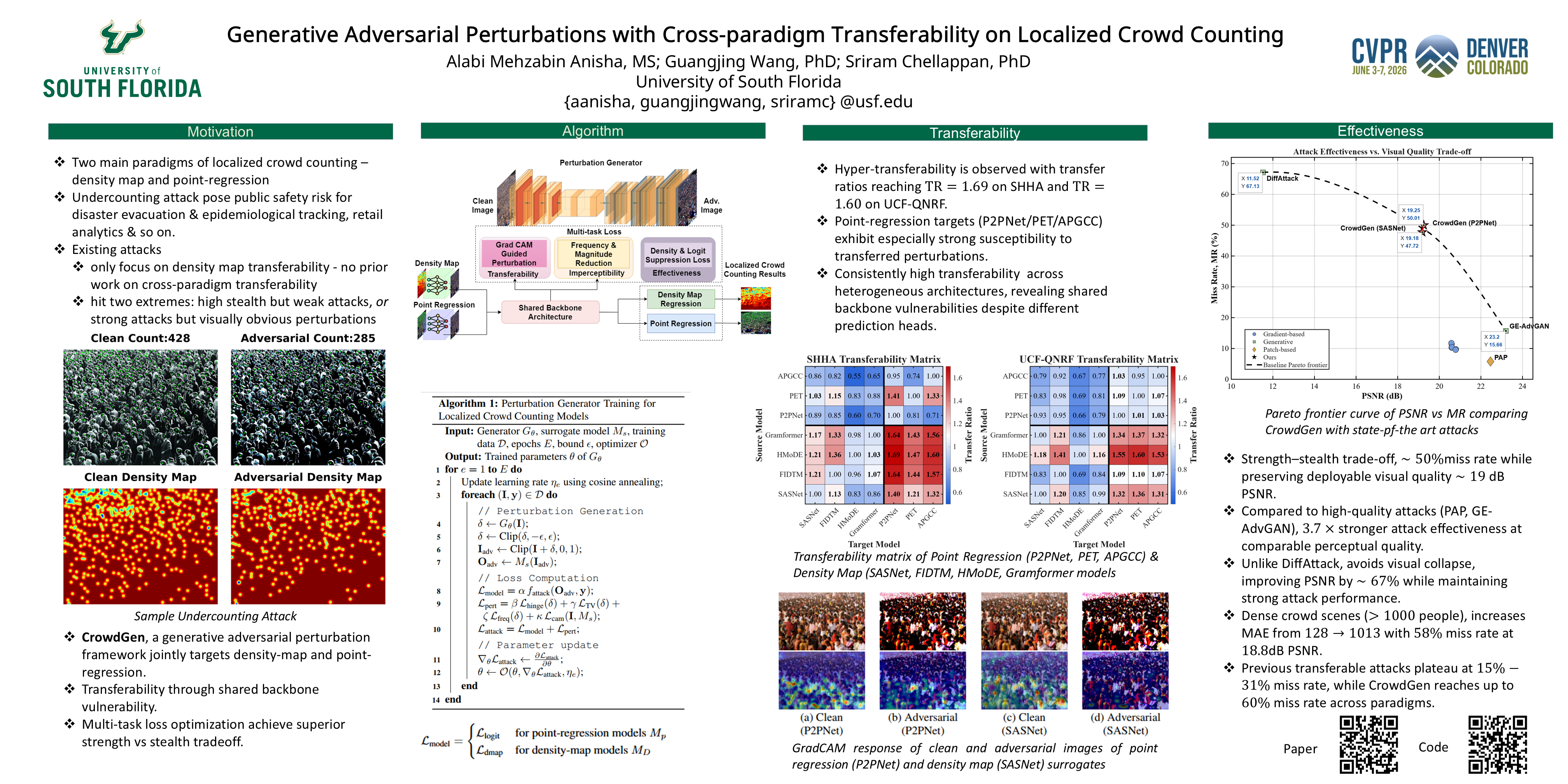
State-of-the-art crowd counting and localization are primarily modeled using two paradigms: density maps and point regression. Given the field's security ramifications, there is active interest in model robustness against adversarial attacks. Recent studies have demonstrated transferability across density-map-based approaches via adversarial patches, but cross-paradigm attacks (e.g., from density map-based models to point regression-based models) remain unexplored. We introduce a novel adversarial framework that compromises both density map and point regression architectural paradigms through a comprehensive multi-task loss optimization. For point-regression models, we employ scene-density-specific high-confidence logit suppression; for density-map approaches, we use peak-targeted density map suppression. Both are combined with model-agnostic perceptual constraints to ensure that perturbations are effective and imperceptible to the human eye. Extensive experiments demonstrate the effectiveness of our attack, achieving on average a $7\times$ increase in Mean Absolute Error compared to clean images while maintaining competitive visual quality, and successfully transferring across seven state-of-the-art crowd models with transfer ratios ranging from $0.55$ to $1.69$. Our approach strikes a balance between attack effectiveness and imperceptibility compared to state-of-the-art transferable attack strategies.
Chat is not available.
Successful Page Load