
Spatio-Temporal Difference Guided Motion Deblurring with the Complementary Vision Sensor
Yapeng Meng ⋅ Lin Yang ⋅ Yuguo Chen ⋅ Xiangru Chen ⋅ Taoyi Wang ⋅ Lijian Wang ⋅ Zheyu Yang ⋅ Yihan Lin ⋅ Rong Zhao
Abstract
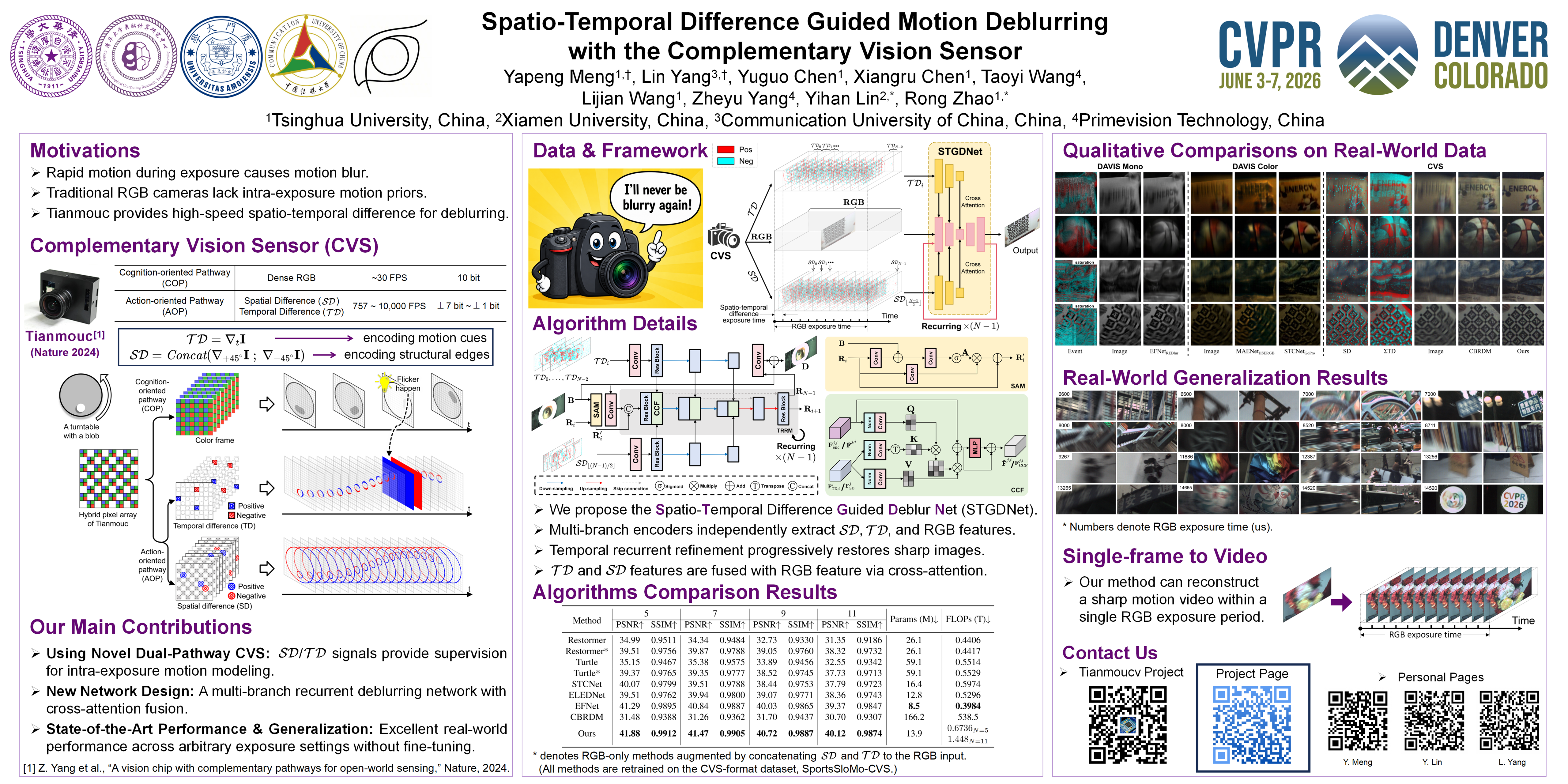
Motion blur arises when rapid scene changes occur during the exposure period, collapsing rich intra-exposure motion into a single RGB frame. Without explicit structural or temporal cues, RGB-only deblurring is highly ill-posed and often fails under extreme motion.Inspired by the human visual system, neuromorphic sensors introduce temporally dense information to alleviate this problem; however, event cameras still suffer from event rate saturation under rapid motion, while the event modality entangles edge features and motion cues, which limits their effectiveness.As a recent breakthrough, the complementary vision sensor (CVS) captures synchronized RGB frames together with high-frame-rate, multi-bit spatial difference ($\mathcal{SD}$, encoding structural edges) and temporal difference ($\mathcal{TD}$, encoding motion cues) data within a single RGB exposure, offering a promising solution for RGB deblurring under extreme dynamic scenes. To fully leverage these complementary modalities, we propose Spatio-Temporal Difference Guided Deblur Net (STGDNet), which adopts a recurrent multi-branch architecture that iteratively encodes and fuses $\mathcal{SD}$ and $\mathcal{TD}$ sequences to restore structure and color details lost in blurry RGB inputs. Our method outperforms current RGB or event-based approaches in both synthetic CVS dataset and real-world evaluations. Moreover, STGDNet exhibits strong generalization capability across over 100 extreme real-world scenarios. Our code, dataset and pre-trained weights will be fully publicly available.
Chat is not available.
Successful Page Load