
Fractal Camouflage: A Bio-Inspired Approach for Multi-Scale Adversarial Attacks in the Infrared Domain
 Highlight
Abstract
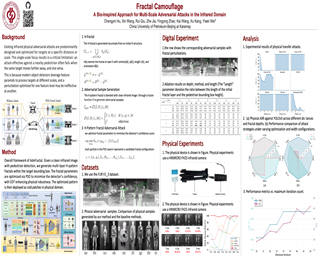
Infrared pedestrian detection is crucial in safety-critical systems but remains vulnerable to adversarial attacks. Existing physical attacks often rely on fixed, static patterns. However, they often lack robustness across scales, as their hand-crafted or uniformly generated structures are fundamentally limited by a fixed receptive field and fail to adapt to varying distances and scene contexts. In light of this, we propose AdvFractal, a black-box attack that exploits the innate self-similarity and structural richness of fractal geometry to naturally generate multi-scale, physically realizable adversarial perturbations. By modeling perturbations with H-type fractals and optimizing parameters via Particle Swarm Optimization, AdvFractal seamlessly coordinates attacks across scales, progressively disrupting detector features from local textures to global shapes. Experiments show AdvFractal achieves an attack success rate (ASR) of 97.54% in the physical domain and 99.16% cross-dataset, significantly outperforming state-of-the-art methods. The perturbations are highly effective in the infrared spectrum while remaining stealthy in visible light, offering a novel approach for evaluating and understanding the security of infrared detection systems.