
Deep Feature Deformation Weights
 Highlight
Abstract
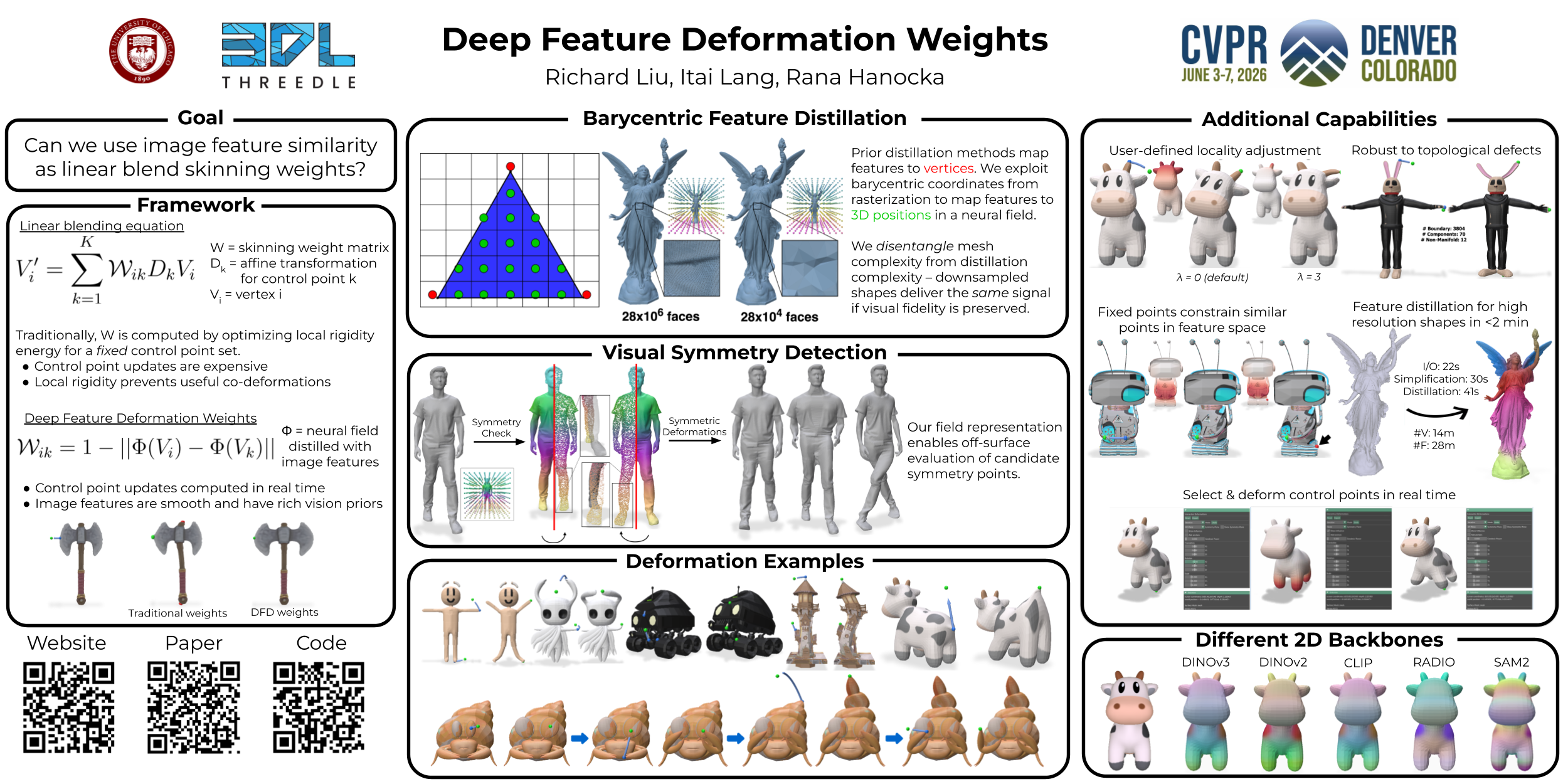
Handle-based mesh deformation has been a long-standing paradigm in computer graphics, enabling intuitive shape edits from sparse controls. Classic techniques offer precise and rapid deformation control. However, they solve an optimization problem with constraints defined by the choice of control handles, requiring a user to know apriori the ideal distribution of handles on the shape to accomplish the desired edit. The mapping from handle set to deformation behavior is often unintuitive and, importantly, non-semantic. Modern data-driven methods, on the other hand, leverage the data prior to obtain semantic edits, at the cost of fine-grained control and speed. We propose a technique that achieves the best of both worlds by leveraging the semantic prior of data and the precise control and speed of traditional frameworks. Our approach is surprisingly simple yet effective: deep feature proximity makes for smooth and semantic deformation weights, with no need for additional regularization. Importantly, these weights can be computed in real-time for any surface point, whereas all prior methods require optimization of these weights. Moreover, the semantic prior from deep features enables co-deformation of semantic parts. We introduce an improved feature distillation pipeline, barycentric feature distillation, which leverages the full visual signal from shape renders to make the compute cost robust to mesh resolution. This allows deep feature weights to be computed for even high resolution meshes in under a minute, in contrast to potentially hours for both classical and neural methods. We preserve and extend existing functionality of classical methods through feature space constraints and locality weighting.Our field representation allows for automatic detection of semantic symmetries, which we use to produce symmetry-preserving deformations. We show a proof-of-concept application which can produce deformations for meshes up to 1 million faces in real-time on a consumer-grade machine.