
Poster Session
Poster Session 3 & Exhibit Hall
Breaking Semantic Boundaries: Distribution-Guided Semantic Exploration for Creative Generation
Fu Feng ⋅ Yucheng Xie ⋅ Ruixiao Shi ⋅ Xu Yang ⋅ Jing Wang ⋅ Xin Geng
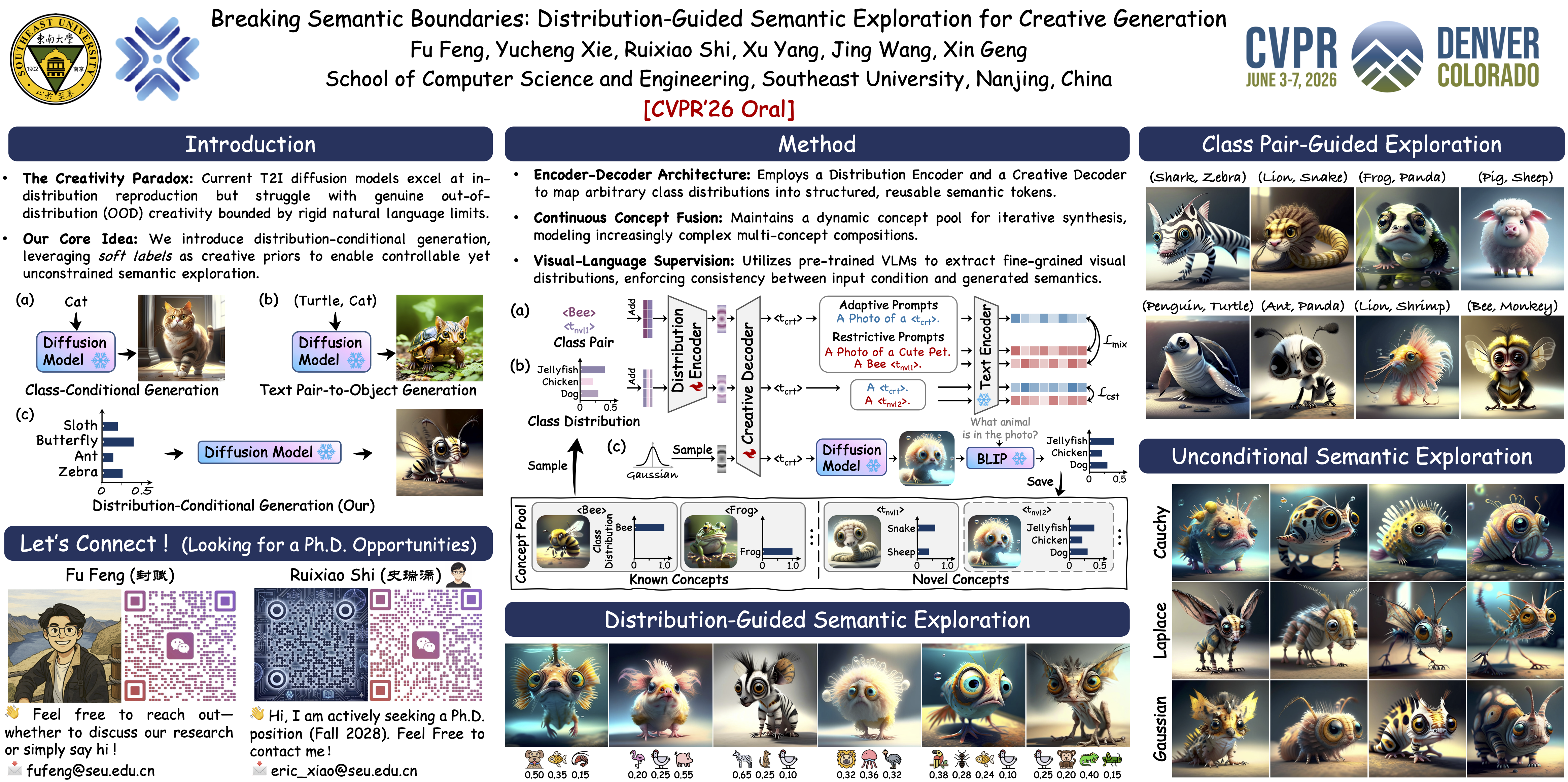
Text-to-image (T2I) diffusion models effectively produce semantically aligned images, but their reliance on training distributions constrains their capacity for synthesizing truly novel, out-of-distribution concepts. Existing methods attempt to enhance creativity through semantic exploration, such as fusing known concept pairs, but the resulting images remain linguistically describable and confined to familiar semantic spaces. Inspired by the soft probabilistic outputs of classifiers on novel or out-of-distribution inputs, we propose Distribution-Conditional Generation, a paradigm that models novel concepts as image synthesis conditioned on class distributions, enabling controllable yet semantically unconstrained creative generation. Building on this, we propose DisTok, an encoder–decoder framework that unifies conditional and unconditional creative generation by decoding latent representations—either randomly sampled or mapped from conditions (e.g., class distributions)—into tokens representing novel concepts. DisTok is trained by iteratively sampling and fusing concept pairs from a dynamic pool to model progressively complex distributions, while enforcing semantic consistency through a vision-language model that aligns the class distributions of generated images with the input distributions. Extensive experiments demonstrate that DisTok enables efficient and flexible semantic exploration for token-level creative synthesis, achieving state-of-the-art text–image alignment and human preference.
Guiding a Diffusion Model by Swapping Its Tokens
Weijia Zhang ⋅ Yuehao Liu ⋅ Shanyan Guan ⋅ Wu Ran ⋅ Yanhao Ge ⋅ Wei Li ⋅ Chao Ma
Classifier-Free Guidance (CFG) is a widely used inference-time technique to boost the image quality of diffusion models. Yet, its reliance on text conditions prevents its use in unconditional generation. We propose a simple method to enable CFG-like guidance for both conditional and unconditional generation. The key idea is to generate a perturbed prediction via simple token swap operations, and use the direction between it and the clean prediction to steer sampling toward higher-fidelity distributions. In practice, we swap pairs of most semantically dissimilar tokens in either spatial or channel dimensions.Unlike existing methods that apply perturbation in a global or less constrained manner, our approach modifies only selected tokens, allowing finer control over perturbation and its influence on generated samples. Experiments on MS-COCO2014, MS-COCO 2017, and ImageNet datasets demonstrate that our Self-Swap Guidance (SSG), when applied to state-of-the-art diffusion models, outperforms previous condition-free methods in image fidelity and prompt alignment under different set-ups. Its fine-grained perturbation granularity also improves robustness, reducing side-effects across a wider range of perturbation strengths. Overall, SSG extends CFG to a broader scope of applications including both conditional and unconditional generation, and can be readily inserted into any diffusion model as a plug-in to gain immediate improvements.
PixelDiT: Pixel Diffusion Transformers for Image Generation
Yongsheng Yu ⋅ Wei Xiong ⋅ Weili Nie ⋅ Yichen Sheng ⋅ Shiqiu Liu ⋅ Jiebo Luo
Latent-space modeling has been the standard for Diffusion Transformers (DiTs). However, it relies on a two-stage pipeline where the pretrained autoencoder introduces lossy reconstruction, leading to error accumulation while hindering joint optimization. To address these issues, we propose PixelDiT, a single-stage, end-to-end model that eliminates the need for the autoencoder and learns the diffusion process directly in the pixel space. PixelDiT adopts a fully transformer-based architecture shaped by a dual-level design: a patch-level DiT that captures global semantics and a pixel-level DiT that refines texture details, enabling efficient training of a pixel-space diffusion model while preserving fine details. PixelDiT achieves 1.61 FID on ImageNet 256 and 2.21 FID on ImageNet 512, surpassing existing pixel generative models by a large margin. We further extend PixelDiT to text-to-image generation and pretrain it at the $1024^{2}$ resolution in pixel space. It achieves 0.74 on GenEval and 83.5 on DPG-bench, approaching the best latent diffusion models.
SeaCache: Spectral-Evolution-Aware Cache for Accelerating Diffusion Models
Jiwoo Chung ⋅ Sangeek Hyun ⋅ MinKyu Lee ⋅ Byeongju Han ⋅ Geonho Cha ⋅ Dongyoon Wee ⋅ Youngjun Hong ⋅ Jae-Pil Heo
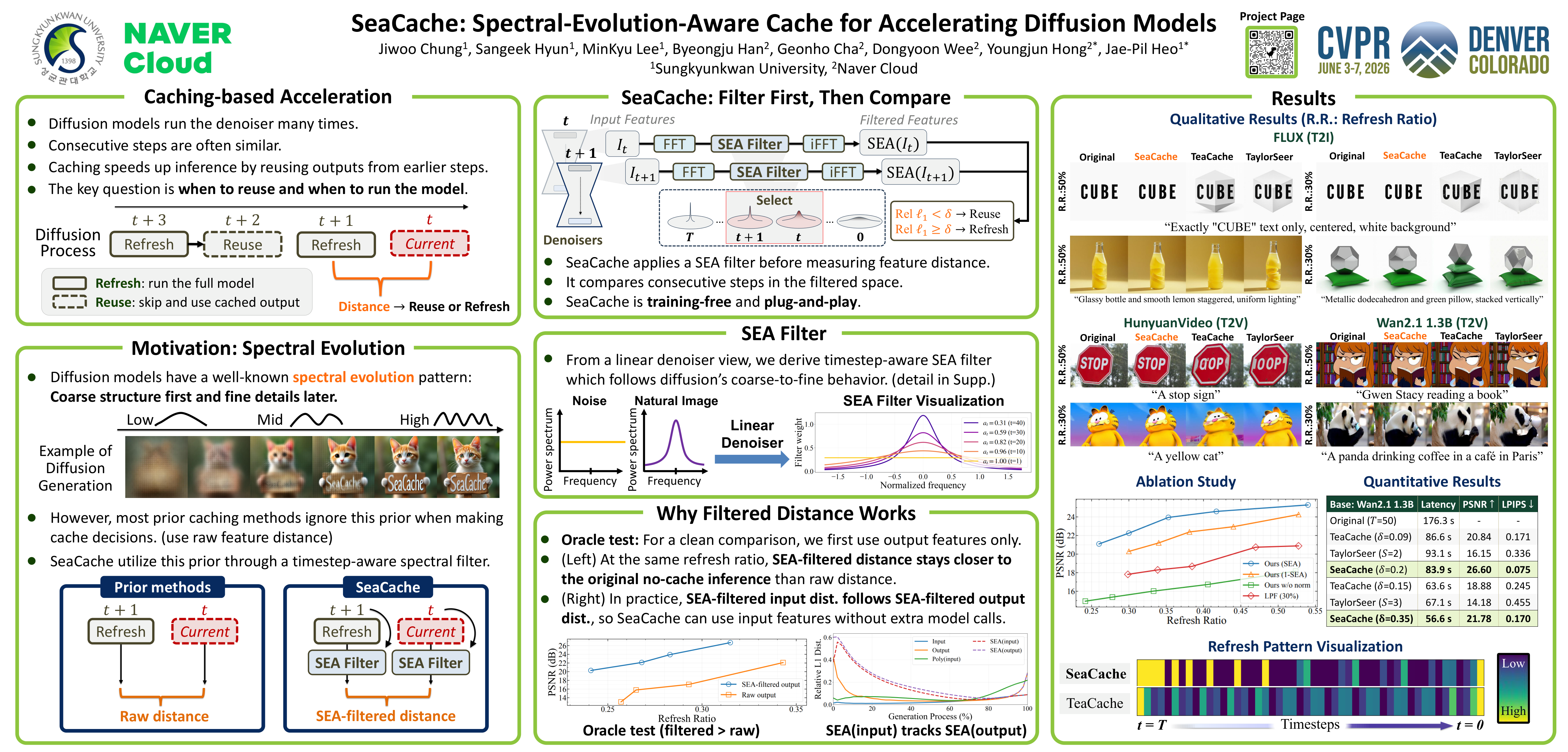
Diffusion models are a strong backbone for visual generation, but their inherently sequential denoising process leads to slow inference. Previous methods accelerate sampling by caching and reusing intermediate outputs based on feature distances between adjacent timesteps. However, existing caching strategies typically rely on raw feature differences that entangle content and noise. This design overlooks spectral evolution, where low-frequency structure appears early and high-frequency detail is refined later. We introduce Spectral-Evolution-Aware Cache (SeaCache), a training-free cache schedule that bases reuse decisions on a spectrally aligned representation. Through theoretical and empirical analysis, we derive a Spectral-Evolution-Aware (SEA) filter that preserves content-relevant components while suppressing noise. Employing SEA-filtered input features to estimate redundancy leads to dynamic schedules that adapt to content while respecting the spectral priors of the underlying diffusion model. Extensive experiments on diverse visual generative models and the baselines show that SeaCache achieves state-of-the-art latency-quality trade-offs.
SenCache: Accelerating Diffusion Model Inference via Sensitivity-Aware Caching
Yasaman Haghighi ⋅ Alex Alahi
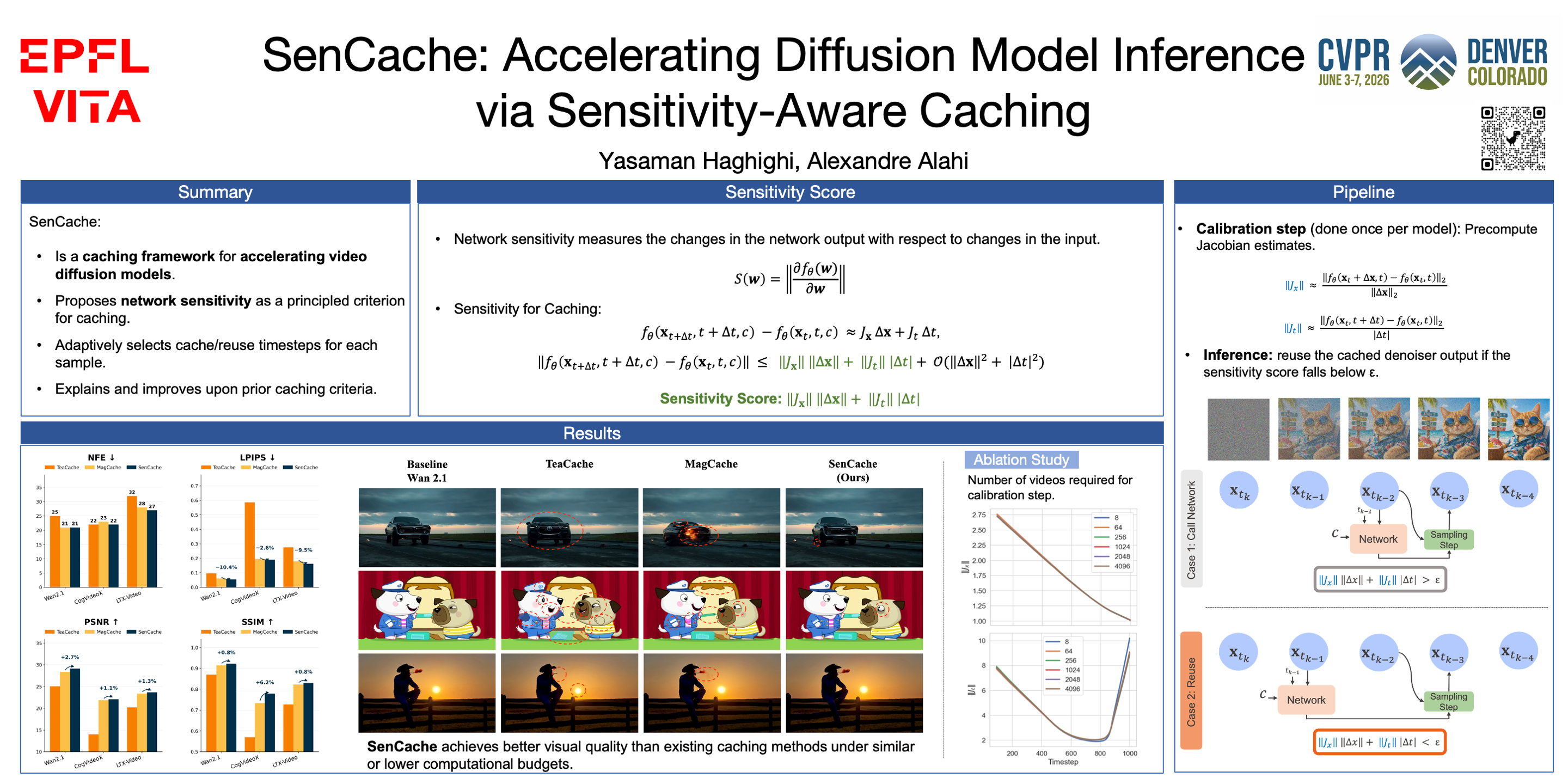
Diffusion models achieve state-of-the-art video generation but their many sequential denoising steps create a major computational bottleneck. Existing acceleration methods reuse cached model outputs at fixed timesteps chosen through heuristics, requiring heavy tuning and failing to adapt to each sample’s complexity. We address this with a principled, sensitivity-aware caching framework. We first formalize the caching problem by analyzing the network's output sensitivity with respect to changes in its inputs—namely, the noisy latent and the timestep. We demonstrate that this sensitivity is the key indicator of caching error. Building on this insight, we introduce Sensitivity-Aware Caching ($\text{SenCache}$), a dynamic strategy that adaptively selects which timesteps to cache on a per-sample basis. This allows for less caching on challenging samples and more aggressive acceleration on simpler ones. Our method provides a robust theoretical grounding for adaptive caching, offering an explanation for why previous empirical criteria are partially effective and extending them with a dynamic, sample-specific approach. Experiments on Wan 2.1, CogVideoX and LTX-Video models demonstrate that our method outperforms existing caching strategies in visual quality under similar computational budgets.
Streaming Diffusion Model for Fast Infrared and Visible Video Fusion
Jinyuan Liu ⋅ Ludan Sun ⋅ Tengyu Ma ⋅ Chunyan Yang ⋅ Zhiying Jiang ⋅ Long Ma ⋅ Risheng Liu ⋅ Xin Fan
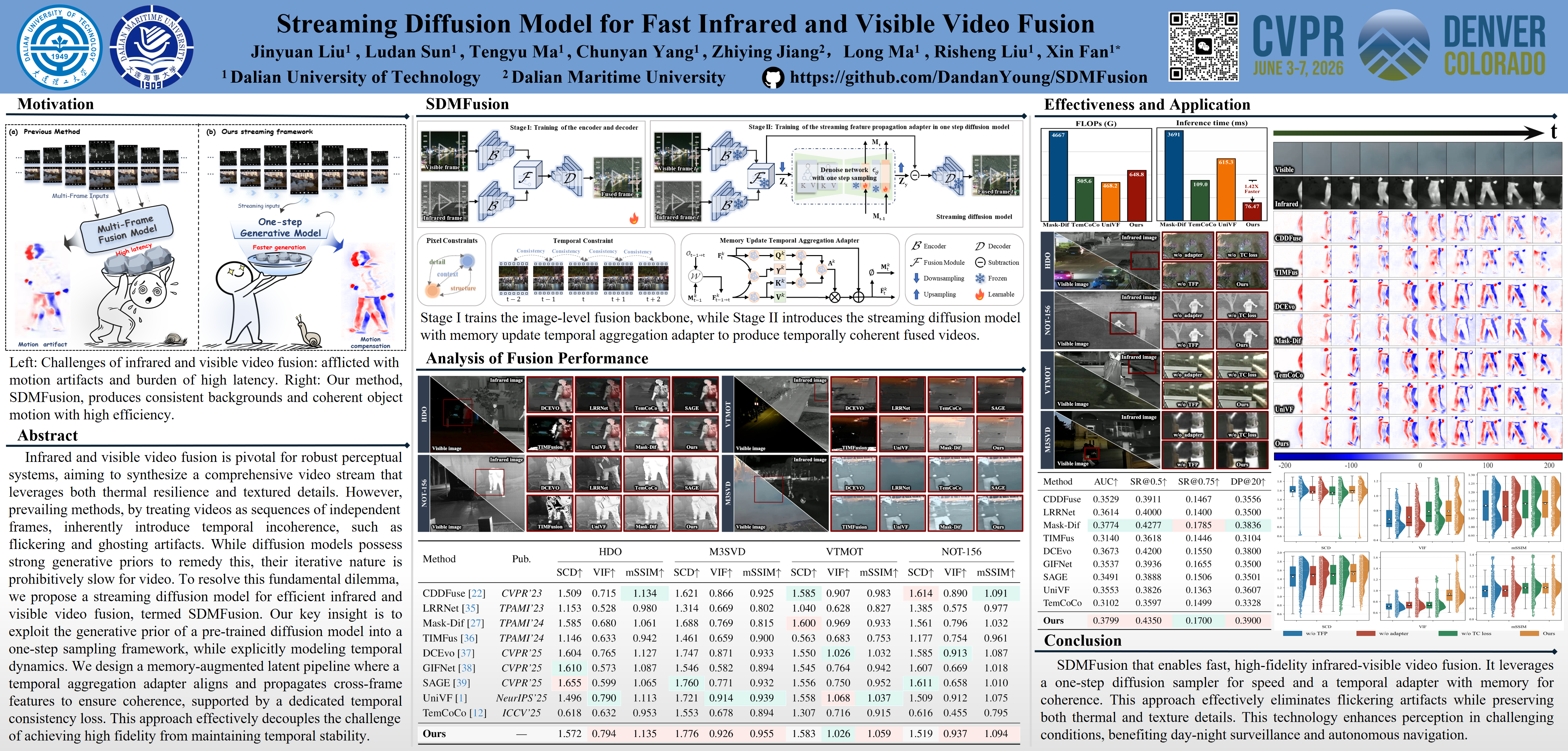
Infrared and visible video fusion is pivotal for robust perceptual systems, aiming to synthesize a comprehensive video stream that leverages both thermal resilience and textured details. However, prevailing methods, by treating video as independent frames, inherently introduce temporal incoherence, such as flickering and ghosting artifacts. While diffusion models possess strong generative priors to remedy this, their iterative nature is prohibitively slow for video. To resolve this fundamental dilemma, we propose a streaming diffusion model for efficient infrared and visible video fusion, termed SDMFusion. Our key insight is to distill the generative prior of a pre-trained diffusion model into a one-step sampling framework, while explicitly modeling temporal dynamics. We design a memory-augmented latent pipeline where a temporal aggregation adapter aligns and propagates cross-frame features to ensure coherence, supported by a dedicated temporal consistency loss. This approach effectively decouples the challenge of achieving high fidelity from maintaining temporal stability. Extensive experiments on four benchmarks demonstrate that our method establishes a new state-of-the-art, generating fused videos with exceptional spatio-temporal consistency at a speed suitable for real-time application.
ComPose: A Unified Completion-Pose Framework for Robust Category-Level Object Pose Estimation
Huan Ren ⋅ Yihan Chen ⋅ Chuxin Wang ⋅ Nailong Liu ⋅ Wenfei Yang ⋅ Tianzhu Zhang
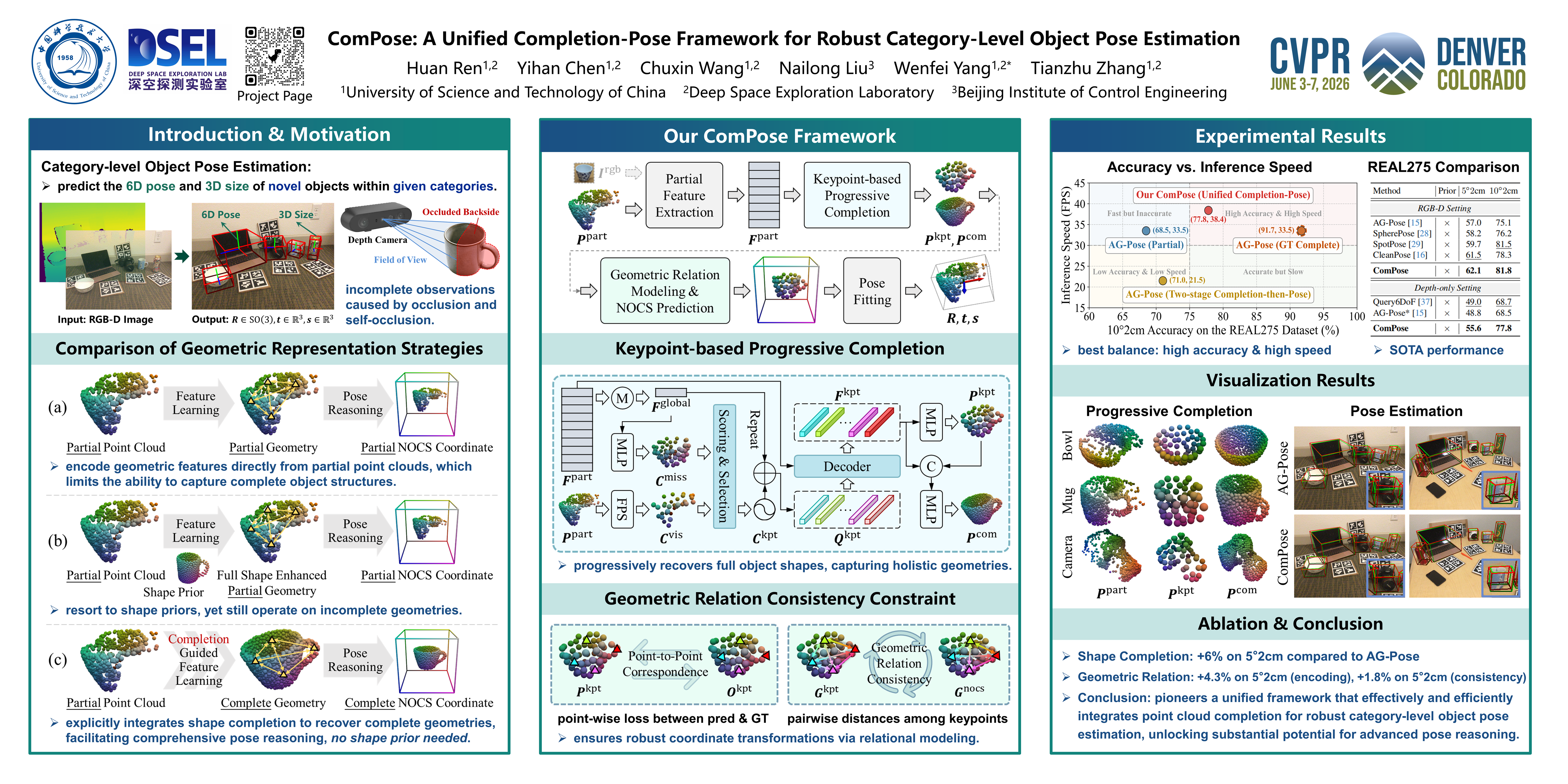
Category-level object pose estimation aims to predict the pose and size of arbitrary objects in specific categories. Existing methods struggle with the inherent incompleteness of observed point clouds, which limits their ability to capture complete object shapes for robust pose reasoning. While point cloud completion offers a promising solution, naively treating it as a separate preprocessing step for partial observations introduces compounding errors and additional computational overhead, ultimately hindering both accuracy and efficiency.To address these challenges, we propose ComPose, a novel unified framework that tightly integrates shape completion to provide complete geometric cues for enhanced pose estimation. At the core of ComPose is a keypoint-based progressive completion module, which recovers full shape representations by progressively predicting a sparse set of keypoints and their surrounding dense point sets, empowering the keypoints to capture holistic object geometries. A geometric relation encoding module further enriches keypoint features with both local and global geometric context. In addition, we introduce a novel geometric relation consistency loss to enforce structural alignment between observed keypoints and their predicted NOCS coordinates, ensuring globally coherent coordinate transformations.Extensive experiments on standard benchmarks demonstrate that our method outperforms state-of-the-art approaches without relying on category-level shape priors. Our method pioneers a new direction for future research by effectively and efficiently integrating shape completion into category-level object pose estimation. Code will be open.
CoSMo3D: Open-World Promptable 3D Semantic Segmentation through LLM-Guided Canonical Spatial Modeling
Li Jin ⋅ Weikai Chen ⋅ Yujie Wang ⋅ Yingda Yin ⋅ Zeyu HU ⋅ Runze Zhang ⋅ Keyang Luo ⋅ Shengju Qian ⋅ Xin Wang ⋅ Xueying Qin
Open-world promptable 3D semantic segmentation remains brittle as semantics are inferred in the input sensor coordinates. Yet, humans, in contrast, interpret parts via functional roles in a canonical space -- wings extend laterally, handles protrude to the side, and legs support from below. Psychophysical evidence shows that we mentally rotate objects into canonical frames to reveal these roles. To fill this gap, we propose CoSMo3D, which attains canonical space perception by inducing a latent canonical reference frame learned directly from data. By construction, we create a unified canonical dataset through LLM-guided intra- and cross-category alignment, exposing canonical spatial regularities across 200 categories. By induction, we realize canonicality inside the model through a dual-branch architecture with canonical map anchoring and canonical box calibration, collapsing pose variation and symmetry into a stable canonical embedding. This shift from input pose space to canonical representation yields far more stable and transferable part semantics. Experimental results show that CoSMo3D establishes new state of the art in open-world promptable 3D segmentation.
GeoViS: Geospatially Rewarded Visual Search for Remote Sensing Visual Grounding
Peirong Zhang ⋅ Yidan Zhang ⋅ Luxiao Xu ⋅ Jinliang Lin ⋅ Zonghao Guo ⋅ Fengxiang Wang ⋅ Xue Yang ⋅ Kaiwen Wei ⋅ Lei Wang
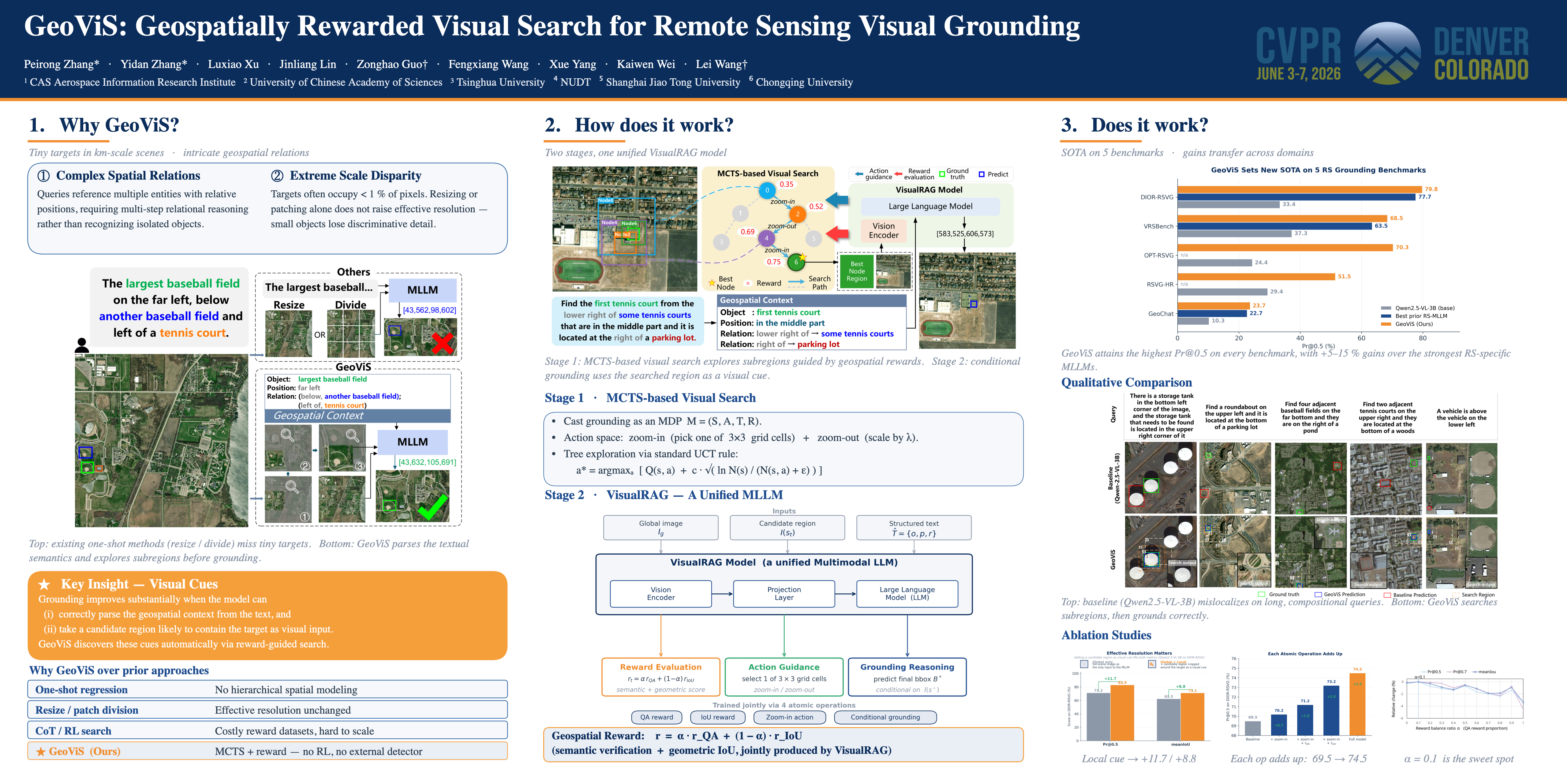
Recent advances in multimodal large language models (MLLMs) have led to remarkable progress in visual grounding, enabling fine-grained cross-modal alignment between textual queries and image regions. However, transferring such capabilities to remote sensing imagery remains challenging, as targets are often extremely small within kilometer-scale scenes, and queries typically involve intricate geospatial relations such as relative positions, spatial hierarchies, or contextual dependencies across distant objects.To address these challenges, we propose GeoViS, a Geospatially Rewarded Visual Search framework that reformulates remote sensing visual grounding as a progressive search-and-reasoning process. Rather than directly predicting the target location in a single step, GeoViS actively explores the global image through a tree-structured sequence of visual cues, integrating multimodal perception, spatial reasoning, and reward-guided exploration to refine geospatial hypotheses iteratively. This design enables the model to detect subtle small-scale targets while maintaining holistic scene awareness.Extensive experiments on five remote sensing grounding benchmarks demonstrate that GeoViS achieves precise geospatial understanding and consistently surpasses existing methods across key visual grounding metrics, highlighting its strong cross-domain generalization and interpretability.
RobotSeg: A Model and Dataset for Segmenting Robots in Image and Video
Haiyang Mei ⋅ Qiming Huang ⋅ Hai Ci ⋅ Mike Zheng Shou
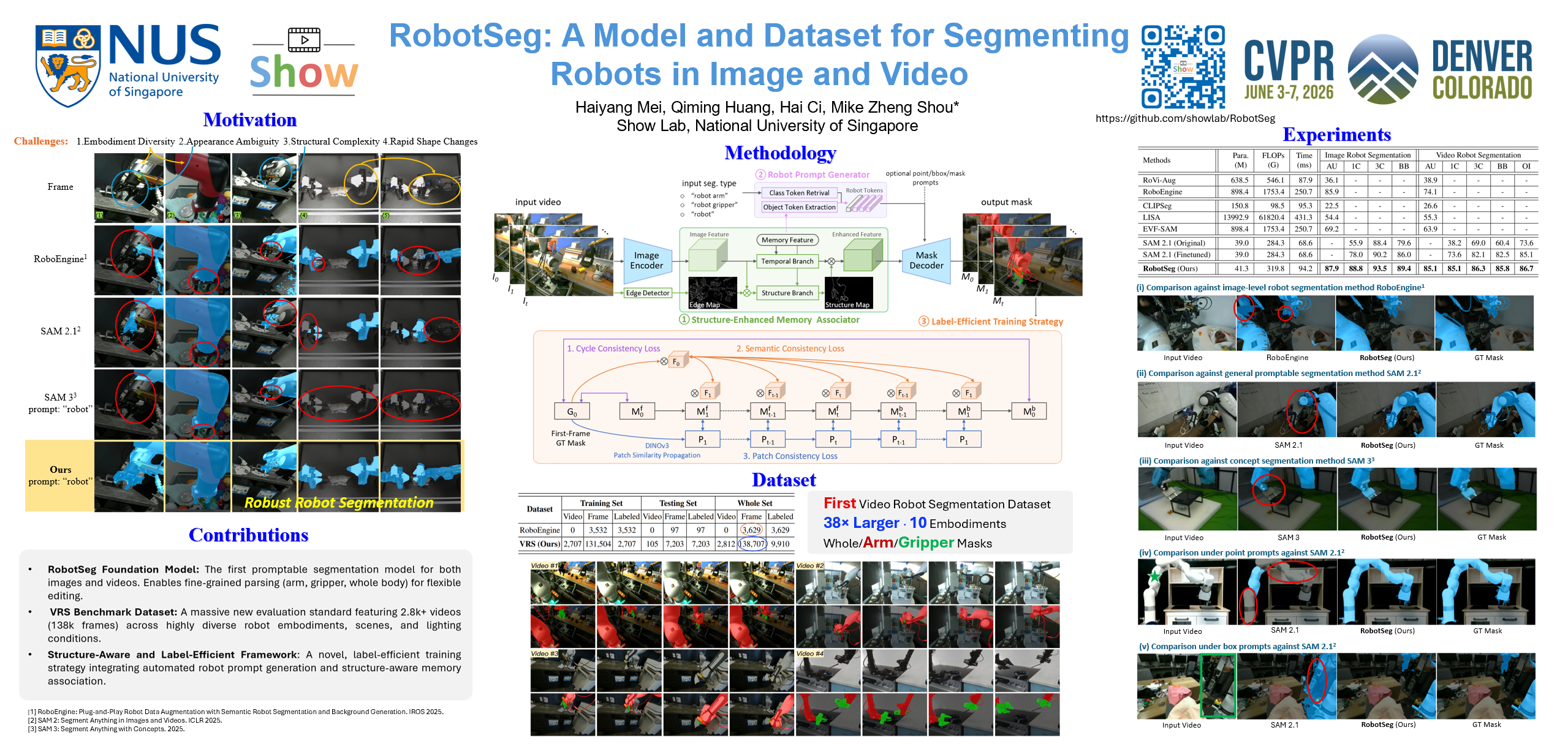
Accurate robot segmentation is a fundamental capability for robotic perception. It enables precise construction of digital twins and world models for robotic applications, supports robot-centric data augmentation, and provides reliable cues for extracting robot actions and poses. Despite the strong capabilities of modern segmentation models, surprisingly it remains challenging to segment robots. This is due to robot embodiment diversity, appearance ambiguity, structural complexity, and rapid shape changes. Embracing these challenges, we introduce RobotSeg, a foundation model for robot segmentation in image and video. RobotSeg is built upon the versatile SAM 2 foundation model but addresses its three limitations for robot segmentation, namely the lack of adaptation to articulated robots, reliance on manual prompts, and the need for per-frame training mask annotations, by introducing a structure-enhanced memory associator, a robot prompt generator, and a label-efficient training strategy. These innovations collectively enable a structure-aware, automatic, and label-efficient solution. We further construct the video robot segmentation (VRS) dataset comprising over 2.8k videos (138k frames) with diverse robot embodiments and environments. Extensive experiments demonstrate that RobotSeg achieves state-of-the-art performance on both images and videos, establishing a strong foundation for future advances in robot perception.
S^2AM3D: Scale-controllable Part Segmentation of 3D Point Clouds
Han Su ⋅ Tianyu Huang ⋅ Zichen Wan ⋅ Xiaohe Wu ⋅ Wangmeng Zuo
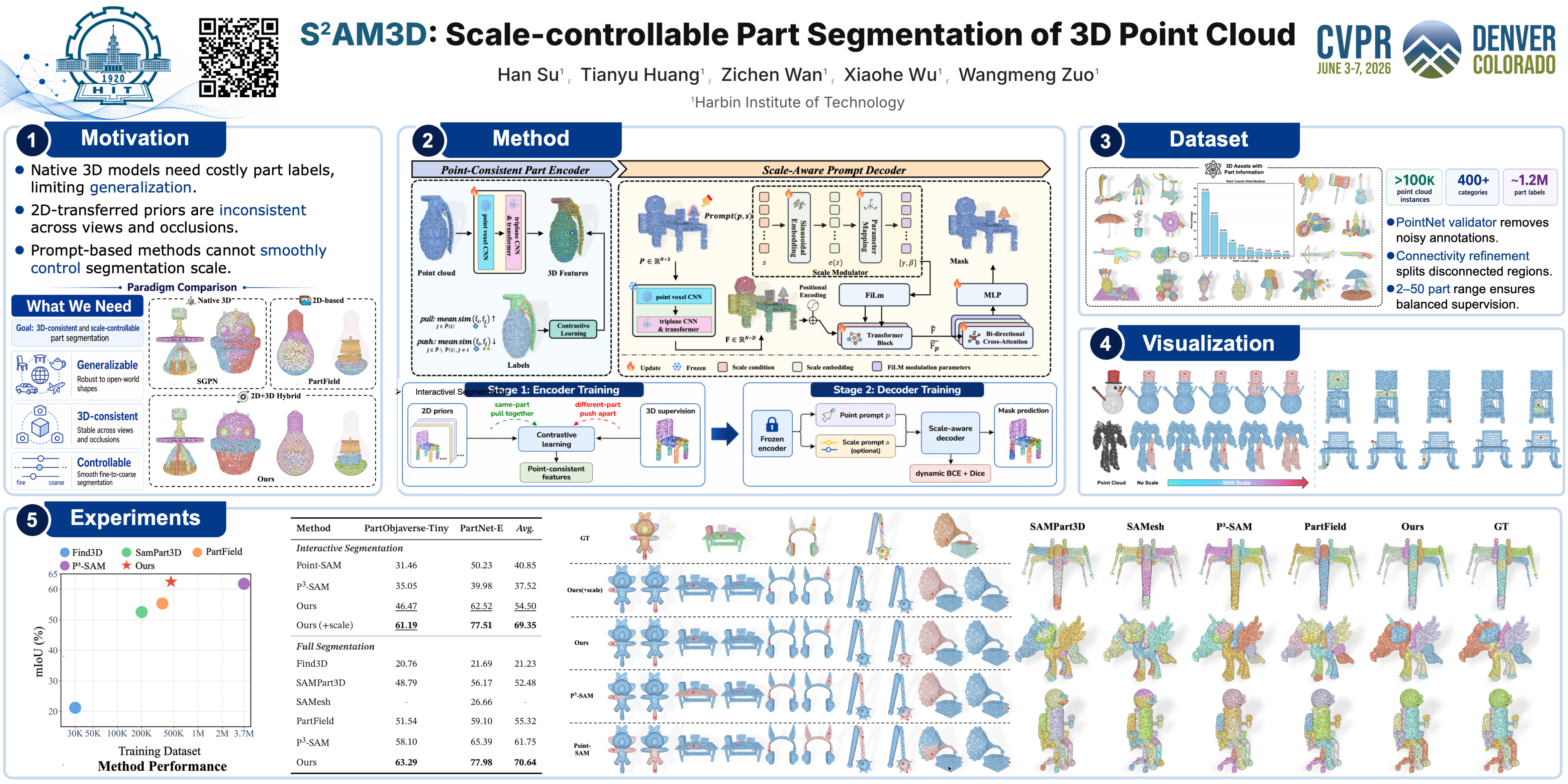
Part-level point cloud segmentation has recently attracted significant attention in 3D computer vision.Nevertheless, existing research is constrained by two major challenges: native 3D models lack generalization due to data scarcity, while introducing 2D pre-trained knowledge often leads to inconsistent segmentation results across different views.To address these challenges, we propose S$^2$AM3D, which incorporates 2D segmentation priors with 3D consistent supervision. We design a point-consistent part encoder that aggregates multi-view 2D features through native 3D contrastive learning, producing globally consistent point features. A scale-aware prompt decoder is then proposed to enable real-time adjustment of segmentation granularity via continuous scale signals. Simultaneously, we introduce a large-scale, high-quality part-level point cloud dataset with more than 100k samples, providing ample supervision signals for model training.Extensive experiments demonstrate that S$^2$AM3D achieves leading performance across multiple evaluation settings, exhibiting exceptional robustness and controllability when handling complex structures and parts with significant size variations.
Scalable Multi-View Subspace Clustering with Tensorized Anchor Guidance
Miao Jia ⋅ Xingchen Hu ⋅ Jiyuan Liu ⋅ Siwei Wang ⋅ Min Wang ⋅ Zijian Chen
Anchor-based multi-view clustering methods have gained significant attention for their effectiveness of handling large-scale datasets in recent years. The performance of these method is highly dependent on anchor quality.However, current methods neglect the interactive relationships among cross-view anchors, failing to effectively discover and exploit consistent and complementary information, leading to noisy or suboptimal anchor representations. In this paper, we propose a novel scalable tensorized anchor guidance for multi-view subspace clustering, which directly couples anchors across views to improve clustering performance. Specifically, we construct a third-order anchor tensor from view-specific anchors in a low-dimensional latent space. By imposing a tensor Schatten p-norm constraint on the anchor tensor, we can explicitly capture cross-view low-rank structure and jointly exploit consistency and complementarity information among anchors. Moreover, the tensorized anchor regularizer is independent of the number of samples, which reduces both time and space complexity. Experimental results on seven datasets demonstrate that SMVS-TAG achieves superior effectiveness and stability compared to state-of-the-art large-scale MVC methods.
3D-LATTE: Latent Space 3D Editing from Textual Instructions
Maria Parelli ⋅ Michael Oechsle ⋅ Michael Niemeyer ⋅ Federico Tombari ⋅ Andreas Geiger
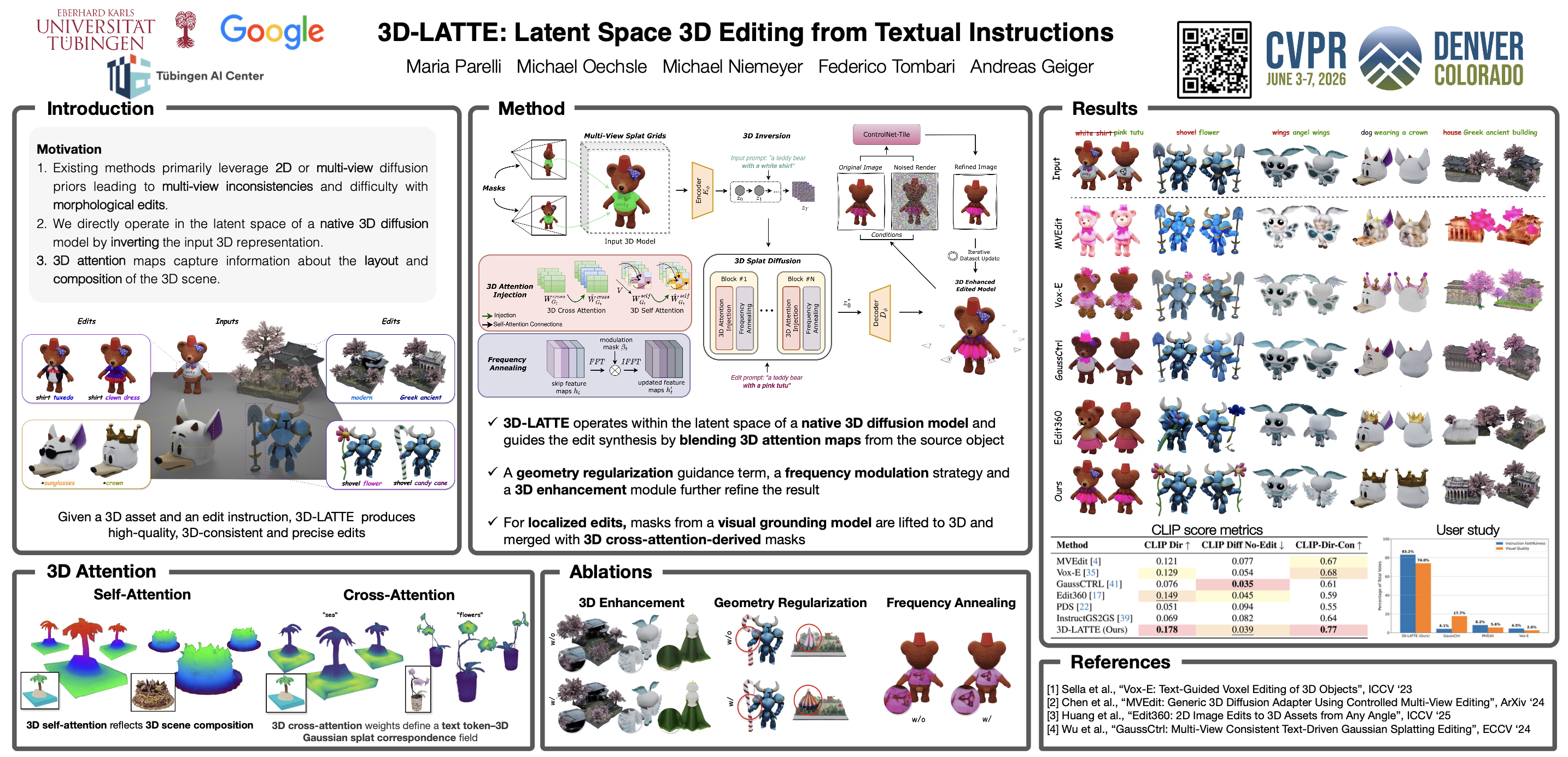
Despite the recent success of multi-view diffusion models for text/image-based 3D asset generation, instruction-based editing of 3D assets lacks surprisingly far behind the quality of generation models. The main reason is that recent approaches using 2D priors suffer from view-inconsistent editing signals. Going beyond 2D prior distillation methods and multi-view editing strategies, we propose a training-free editing method that operates within the latent space of a native 3D diffusion model, allowing us to directly manipulate 3D geometry. We guide the edit synthesis by blending 3D attention maps from the generation with the source object. Coupled with geometry-aware regularization guidance, a spectral modulation strategy in the Fourier domain and a refinement step for 3D enhancement, our method outperforms previous 3D editing methods enabling high-fidelity and precise edits across a wide range of shapes and semantic manipulations. Code will be publicly released.
AnchorFlow: Training-Free 3D Editing via Latent Anchor-Aligned Flows
Zhenglin Zhou ⋅ Fan Ma ⋅ Chengzhuo Gui ⋅ Xiaobo Xia ⋅ Hehe Fan ⋅ Yi Yang ⋅ Tat-seng Chua
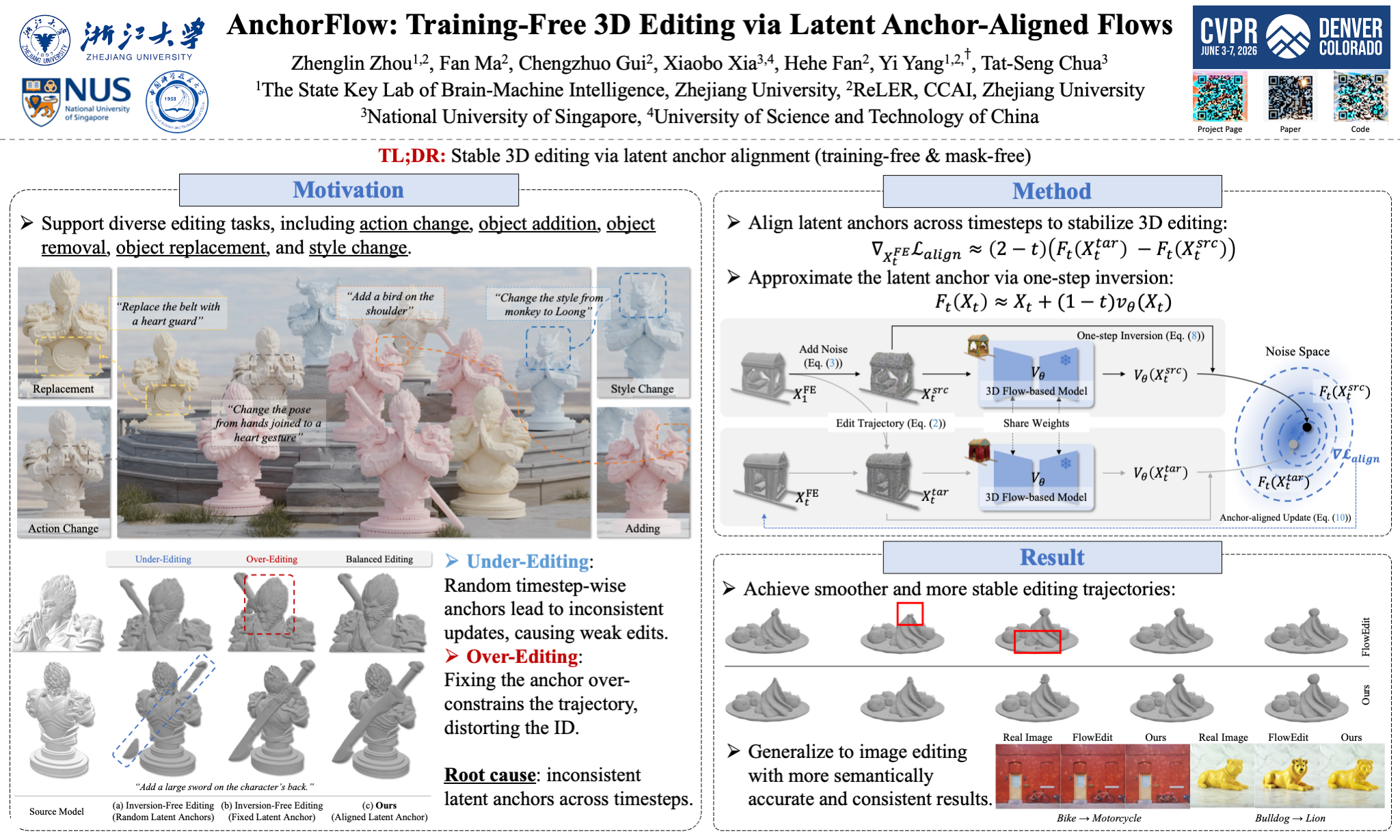
Training-free 3D editing aims to modify 3D shapes based on human instructions without model finetuning. It plays a crucial role in 3D content creation. However, existing approaches often struggle to produce strong or geometrically stable edits, largely due to inconsistent latent anchors introduced by timestep-dependent noise during diffusion sampling. To address these limitations, we introduce AnchorFlow, which is built upon the principle of latent anchor consistency. Specifically, AnchorFlow establishes a global latent anchor shared between the source and target trajectories, and enforces coherence using a relaxed anchor-alignment loss together with an anchor-aligned update rule. This design ensures that transformations remain stable and semantically faithful throughout the editing process. By stabilizing the latent reference space, AnchorFlow enables more pronounced semantic modifications. Moreover, AnchorFlow is mask-free. Without mask supervision, it effectively preserves geometric fidelity. Experiments on the Eval3DEdit benchmark show that AnchorFlow consistently delivers semantically aligned and structurally robust edits across diverse editing types. The code and models will be made publicly available.
ChordEdit: One-Step Low-Energy Transport for Image Editing
Liangsi Lu ⋅ Xuhang Chen ⋅ Minzhe Guo ⋅ Shichu Li ⋅ Jingchao Wang ⋅ Yang Shi
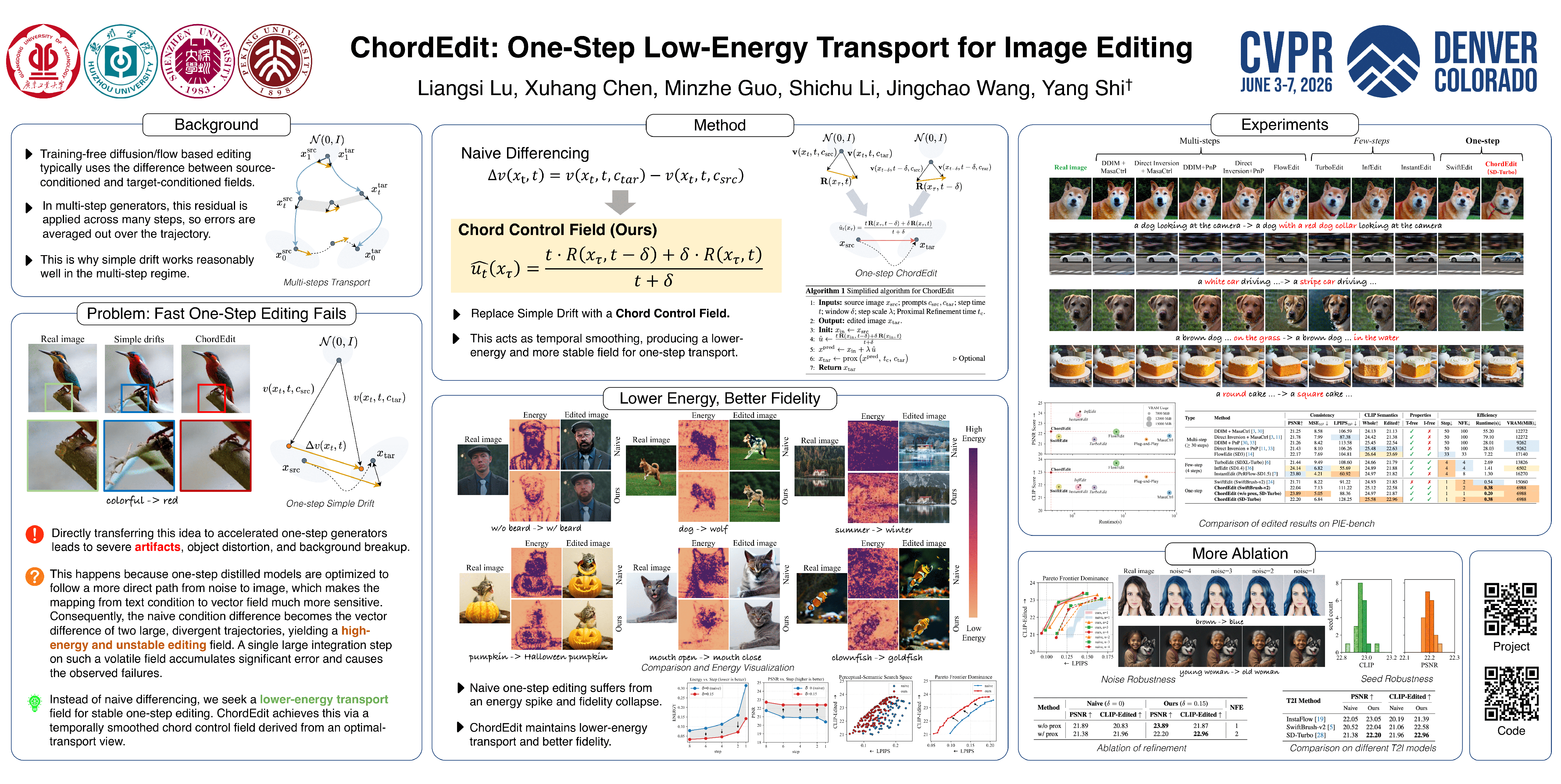
The advent of one-step text-to-image (T2I) models offers unprecedented synthesis speed. However, their application to text-guided image editing remains severely hampered, as forcing existing training-free editors into a single inference step fails. This failure manifests as severe object distortion and a critical loss of consistency in non-edited regions, resulting from the high-energy, erratic trajectories produced by naive vector arithmetic on the models' structured fields. To address this problem, we introduce \textbf{ChordEdit}, a model agnostic, training-free, and inversion-free method that facilitates high-fidelity one-step editing. We recast editing as a transport problem between the source and target distributions defined by the source and target text prompts. Leveraging dynamic optimal transport theory, we derive a principled, low-energy control strategy. This strategy yields a smoothed, variance-reduced editing field that is inherently stable, facilitating the field to be traversed in a single, large integration step. A theoretically grounded and experimentally validated approach allows ChordEdit to deliver fast, lightweight and precise edits, finally achieving true real-time editing on these challenging models.
Faithful Contouring: Near-Lossless 3D Voxel Representation Free from Iso-surface
Yihao Luo ⋅ Xianglong He ⋅ Chuanyu Pan ⋅ Yiwen Chen ⋅ Jiaqi Wu ⋅ Yangguang Li ⋅ Wanli Ouyang ⋅ Yuanming Hu ⋅ Guang Yang ⋅ Choon Hwai Yap
Accurate and efficient voxelized representations of 3D meshes are the foundation of 3D reconstruction and generation. However, existing representations based on iso-surface heavily rely on water-tightening or rendering optimization, which inevitably compromise geometric fidelity. We propose Faithful Contouring, a sparse voxelized representation that supports 2048+ resolutions for arbitrary meshes, requiring neither converting meshes to field functions nor extracting the isosurface during remeshing. It achieves near-lossless fidelity by preserving sharpness and internal structures, even for challenging cases with complex geometry and topology. The proposed method also shows flexibility for texturing, manipulation, and editing. Beyond representation, we design a dual-mode autoencoder for Faithful Contouring, enabling scalable and detail-preserving shape reconstruction. Extensive experiments show that Faithful Contouring surpasses existing methods in accuracy and efficiency for both representation and reconstruction. For direct representation, it achieves distance errors at the $10^{-5}$ level; for mesh reconstruction, it yields a 93\% reduction in Chamfer Distance and a 35\% improvement in F-score over strong baselines, confirming superior fidelity as a representation for 3D learning tasks.
Native and Compact Structured Latents for 3D Generation
Jianfeng XIANG ⋅ Xiaoxue Chen ⋅ Sicheng Xu ⋅ Ruicheng Wang ⋅ Zelong Lv ⋅ Yu Deng ⋅ Hongyuan Zhu ⋅ Yue Dong ⋅ Hao Zhao ⋅ Nicholas Jing Yuan ⋅ Jiaolong Yang

Recent advancements in 3D generative modeling have significantly improved the generation realism, yet the field is still hampered by existing representations, which struggle to capture assets with complex topologies and detailed appearance. This paper present an approach for learning a structured latent representation from native 3D data to address this challenge. At its core is a new sparse voxel structure called O-Voxel, an omni-voxel representation that encodes both geometry and appearance. O-Voxel can robustly model arbitrary topology, including open, non-manifold, and fully-enclosed surfaces, while capturing comprehensive surface attributes beyond texture color, such as physically-based rendering parameters. Based on O-Voxel, we design a Sparse Compression VAE which provides a high spatial compression rate and a compact latent space. We train large-scale flow-matching models comprising 4B parameters for 3D generation using diverse public 3D asset datasets. Despite their scale, inference remains highly efficient. Meanwhile, the geometry and material quality of our generated assets far exceed those of existing models. We believe our approach offers a significant advancement in 3D generative modeling.
SliderEdit: Continuous Image Editing with Fine-Grained Instruction Control
Arman Zarei ⋅ Samyadeep Basu ⋅ Mobina Pournemat ⋅ Sayan Nag ⋅ Ryan A. Rossi ⋅ Soheil Feizi
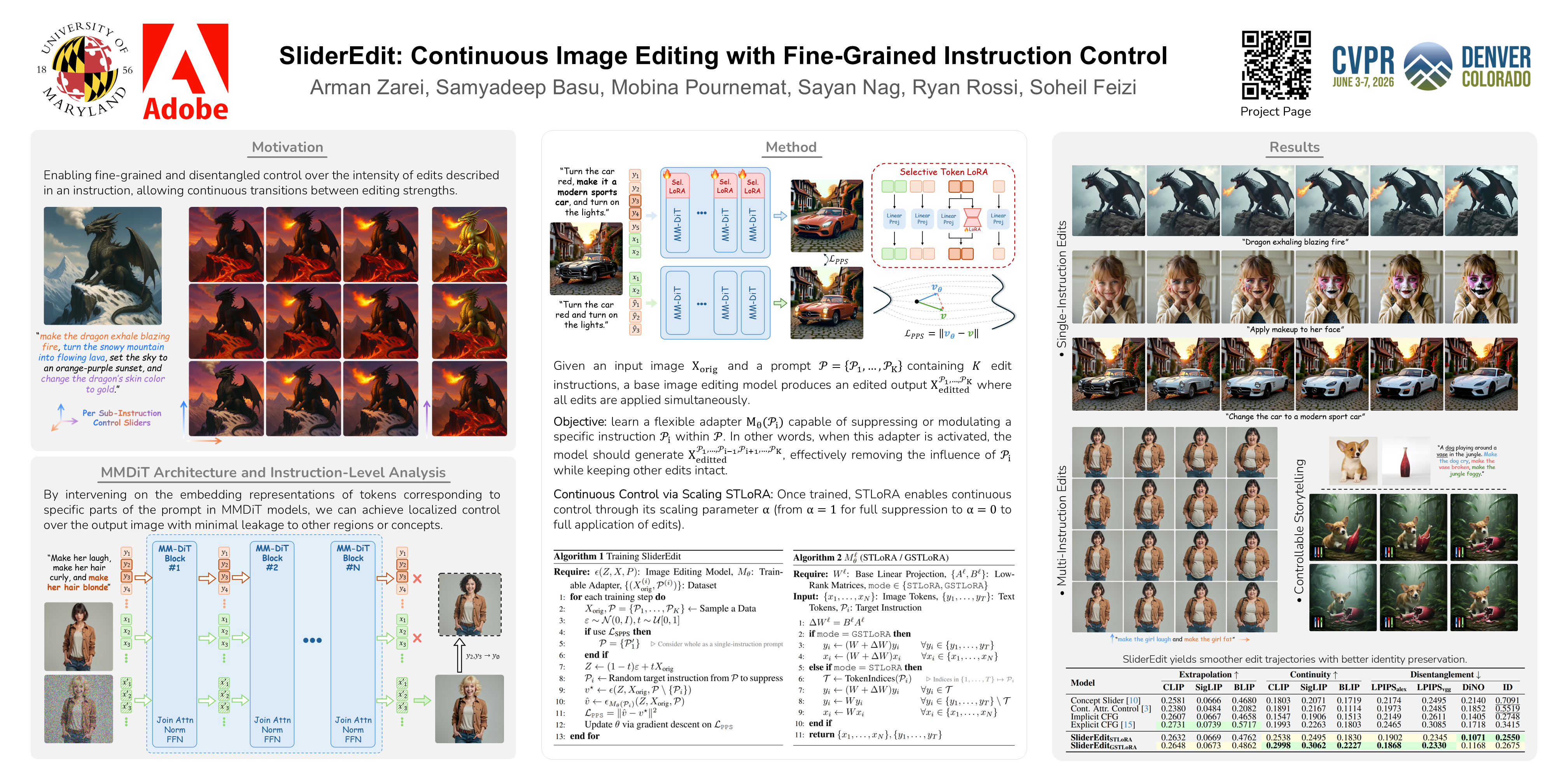
Instruction-based image editing models have recently achieved impressive performance, enabling complex edits to an input image from a multi-instruction prompt. However, these models apply each instruction in the prompt with a fixed strength, limiting the user’s ability to precisely and continuously control the intensity of individual edits.We introduce SliderEdit, a framework for continuous image editing with fine-grained, interpretable instruction control. Given a multi-part edit instruction, SliderEdit disentangles the individual instructions and exposes each as a globally trained slider, allowing smooth adjustment of its strength. Unlike prior works that introduced slider-based attribute controls in text-to-image generation, typically requiring separate training or fine-tuning for each attribute or concept, our method learns a single set of low-rank adaptation matrices that generalize across diverse edits, attributes, and compositional instructions. This enables continuous interpolation along individual edit dimensions while preserving both spatial locality and global semantic consistency. We apply SliderEdit to state-of-the-art editing models, including FLUX-Kontext and Qwen-Image-Edit, and observe substantial improvements in edit controllability, visual consistency, and user steerability. We are the first to explore and propose a framework for continuous, fine-grained instruction control in image editing models. Our results pave the way for interactive, instruction-driven image manipulation with continuous and compositional control.
Differentiable Vector Quantization for Rate-Distortion Optimization of Generative Image Compression
SHIYIN JIANG ⋅ Wei Long ⋅ Minghao Han ⋅ Zhenghao Chen ⋅ Ce Zhu ⋅ Shuhang Gu
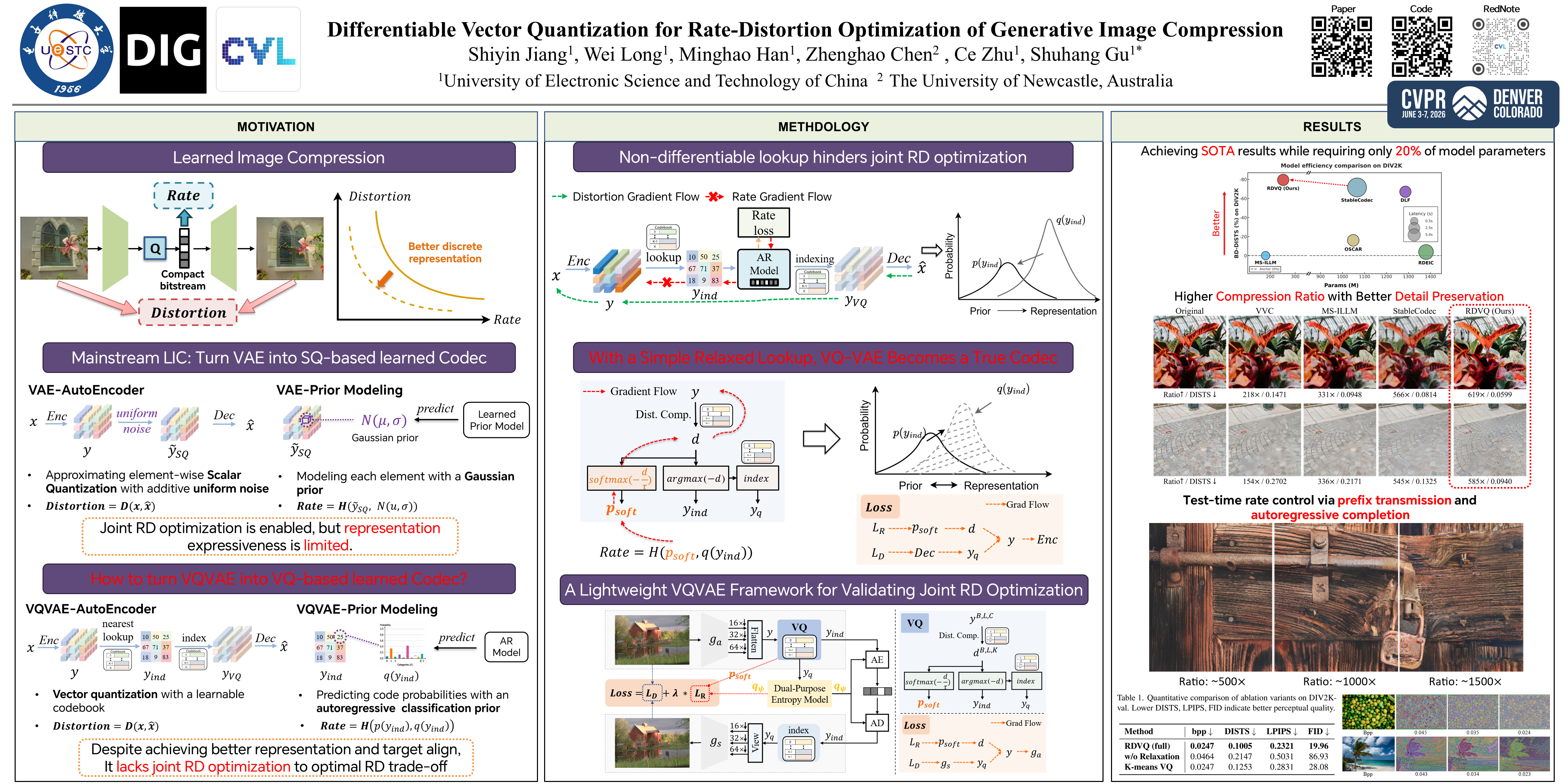
The proliferation of visual data under tight storage and bandwidth budgets makes extremely low–bitrate generative image compression increasingly important. Vector quantization (VQ) is compelling in this regime because codebooks encode cross-channel correlations and dataset-level semantics, enabling perceptually faithful reconstructions when bits are scarce. We propose RDVQ, a vector-quantization (VQ) based generative image compression method designed for extremely low bitrates. While end-to-end learned image codecs rely on a differentiable rate term for rate–distortion (RD) optimization, however, a key challenge is that naïvely integrating VQ introduces non-differentiability and is not directly compatible with entropy modeling, forcing prior work to regulate bitrate only indirectly. We resolve this by defining a distance-aware soft posterior over codebook indices and training a conditional autoregressive entropy model to predict it. Therefore the cross-entropy between the approximate and predicted posteriors yields a differentiable rate loss, restoring a gradient pathway from rate to the encoder via codeword distances. Such predicted codebook index distribution enables prefix-only transmission at inference, with the model imputing the rest of the indices, delivering retraining-free bitrate control over a practical range. Our end-to-end RD optimized RDVQ outperforms all baseline methods in terms of DISTS and CLIPIQA, which reflect superior structural restoration and better alignment with human visual perception on the Kodak, DIV2K and CLIC2020 datasets.
FINER: MLLMs Hallucinate under Fine-grained Negative Queries
Rui Xiao ⋅ Sanghwan Kim ⋅ Yongqin Xian ⋅ Zeynep Akata ⋅ Stephan Alaniz
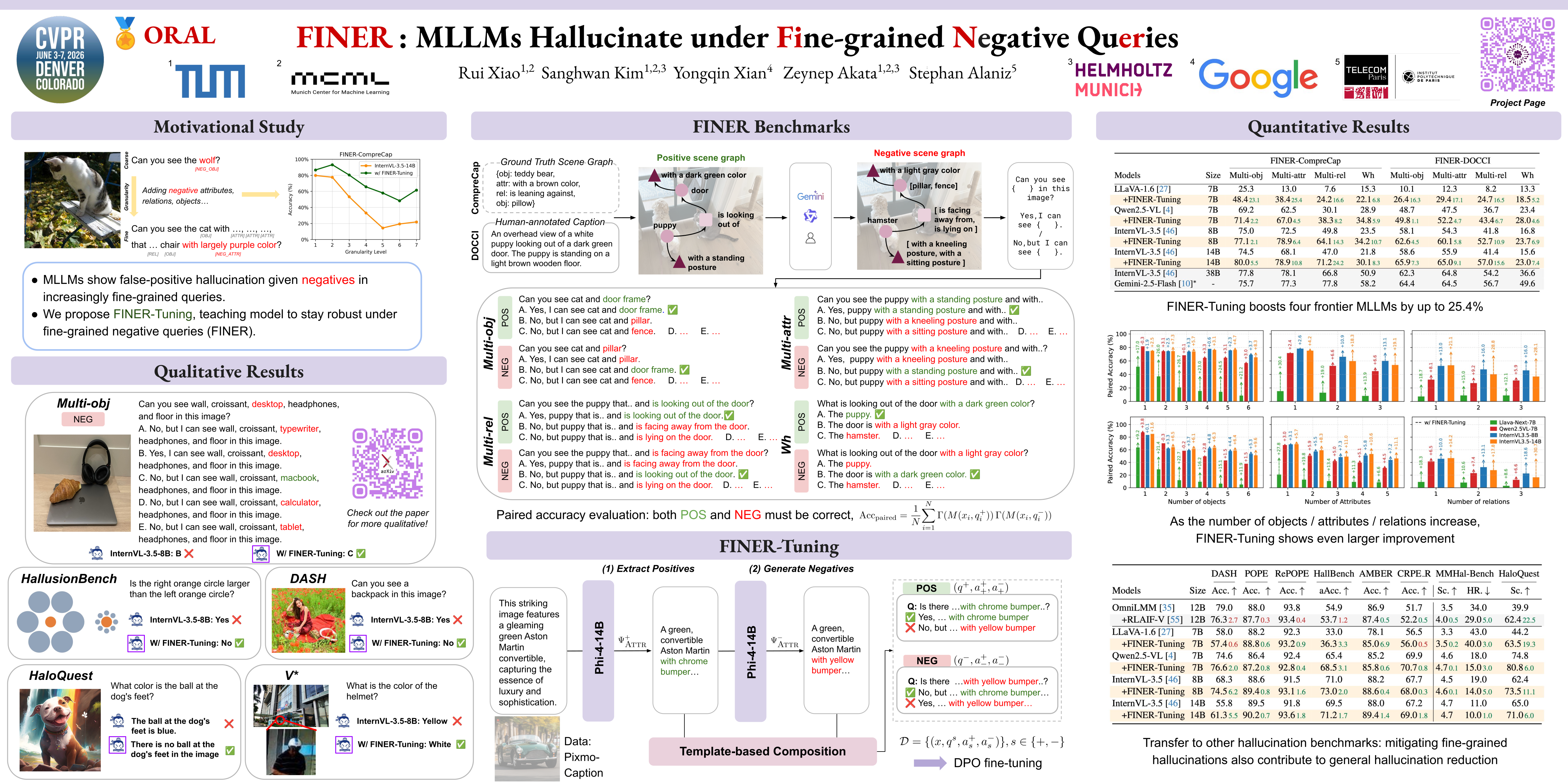
Multimodal large language models (MLLMs) struggle with hallucinations, particularly with fine-grained queries, a challenge underrepresented by existing benchmarks that focus on coarse image-related questions. We introduce FIne-grained NEgative queRies (FINER), alongside two benchmarks: FINER-CompreCap and FINER-DOCCI. Using FINER, we analyze hallucinations across four settings: multi-object, multi-attribute, multi-relation, and “what” questions. Our benchmarks reveal that MLLMs hallucinate when fine-grained mismatches co-occur with genuinely present elements in the image. To address this, we propose FINER-Tuning, leveraging Direct Preference Optimization (DPO) on FINER-inspired data. Finetuning four frontier MLLMs with FINER-Tuning yields up to 24.2% gains (InternVL3.5-14B) on hallucinations from our benchmarks, while simultaneously improving performance on eight existing hallucination suites, and enhancing general multimodal capabilities across six benchmarks. Benchmarks, training data, code and model checkpoints will be released.
MDCS-MoAME: Multi-directional Composite Scanning with Mixture of Attention and Mamba Experts for Cancer Survival Prediction
Linjie Qu ⋅ Jin Xiao ⋅ Xiangrong Liu ⋅ Changming Sun ⋅ Hui Cui ⋅ Yuqi Fang ⋅ Ran Su ⋅ Qiangguo Jin ⋅ leyi wei
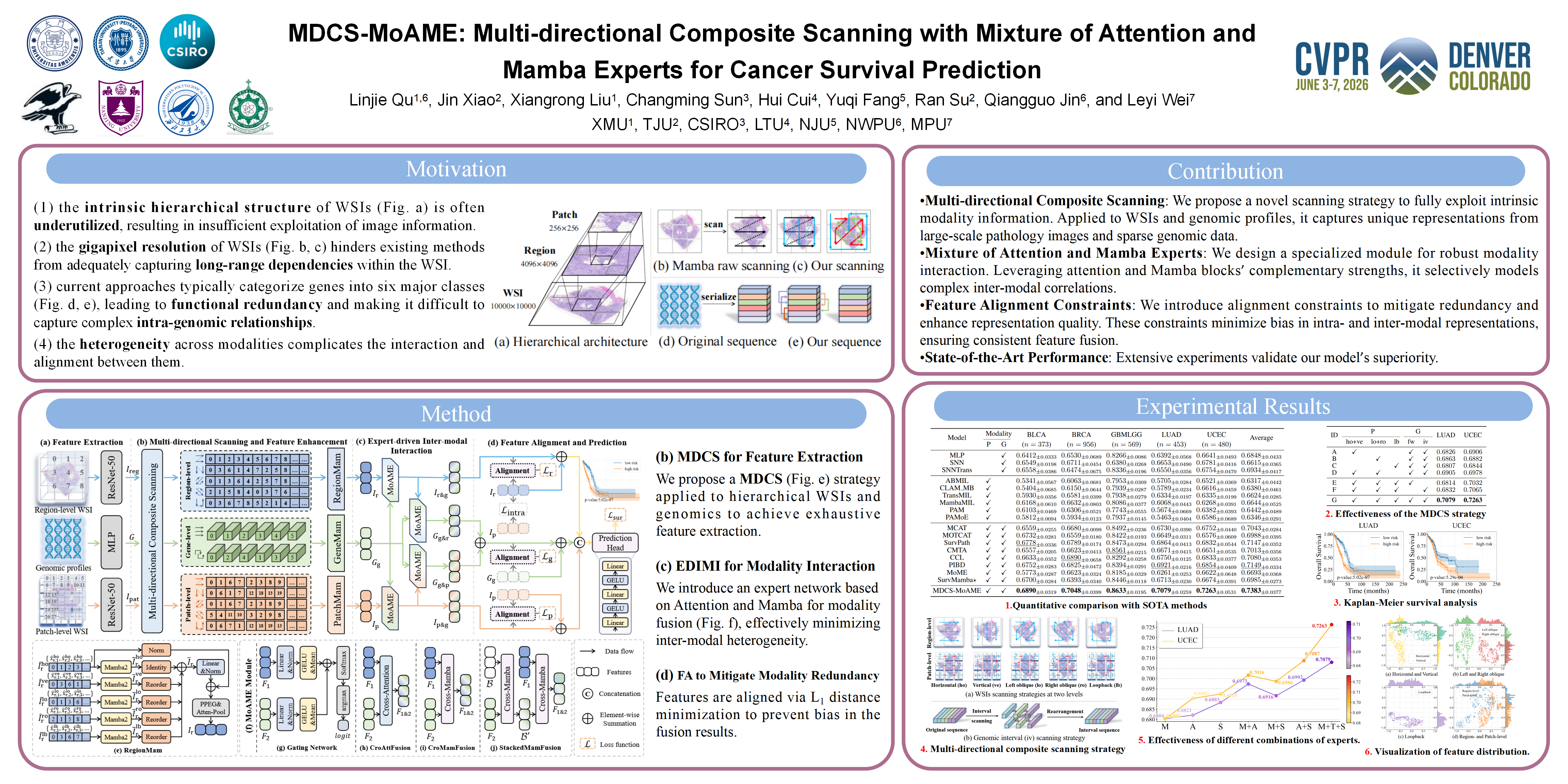
Multi-modal learning approaches that integrate pathological images with genomic profiles have significantly enhanced the accuracy of survival prediction tasks. However, previous methods often struggle to effectively process long-range gigapixel whole slide images (WSIs) and sparse genomic profiles due to the limitations of conventional scanning strategies to serialize data and the complex and heterogeneous nature of the modalities. Inspired by recent advancements in Mamba and mixture of experts (MoE), we propose a novel multi-directional composite scanning strategy with mixture of attention and Mamba experts (MDCS-MoAME) for cancer survival prediction. Specifically, we introduce a multi-directional composite scanning (MDCS) strategy to both WSIs and genomic profiles, and use the Mamba encoder to process intra-modal representations at the region, patch, and gene level, ensuring sufficient utilization of the intrinsic information within each modality. To further capture heterogeneous inter-modal representations, we introduce mixture of attention and Mamba experts (MoAME), which dynamically selects tailored experts to model complex inter-modal correlations, flexibly focusing on the interactions between modalities. Finally, we introduce alignment constraints to recalibrate inter-modal interactions and reduce intra- and inter-modal representation redundancy, enhancing its discriminative power for comprehensive survival analysis. Experimental results on five publicly available datasets demonstrate that our method outperforms existing approaches, achieving state-of-the-art performance. Our code is included in the supplementary material.
PAS: A Training-Free Stabilizer for Temporal Encoding in Video LLMs
Bowen Sun ⋅ Yujun Cai ⋅ Ming-Hsuan Yang ⋅ Hang Wu ⋅ Yiwei Wang
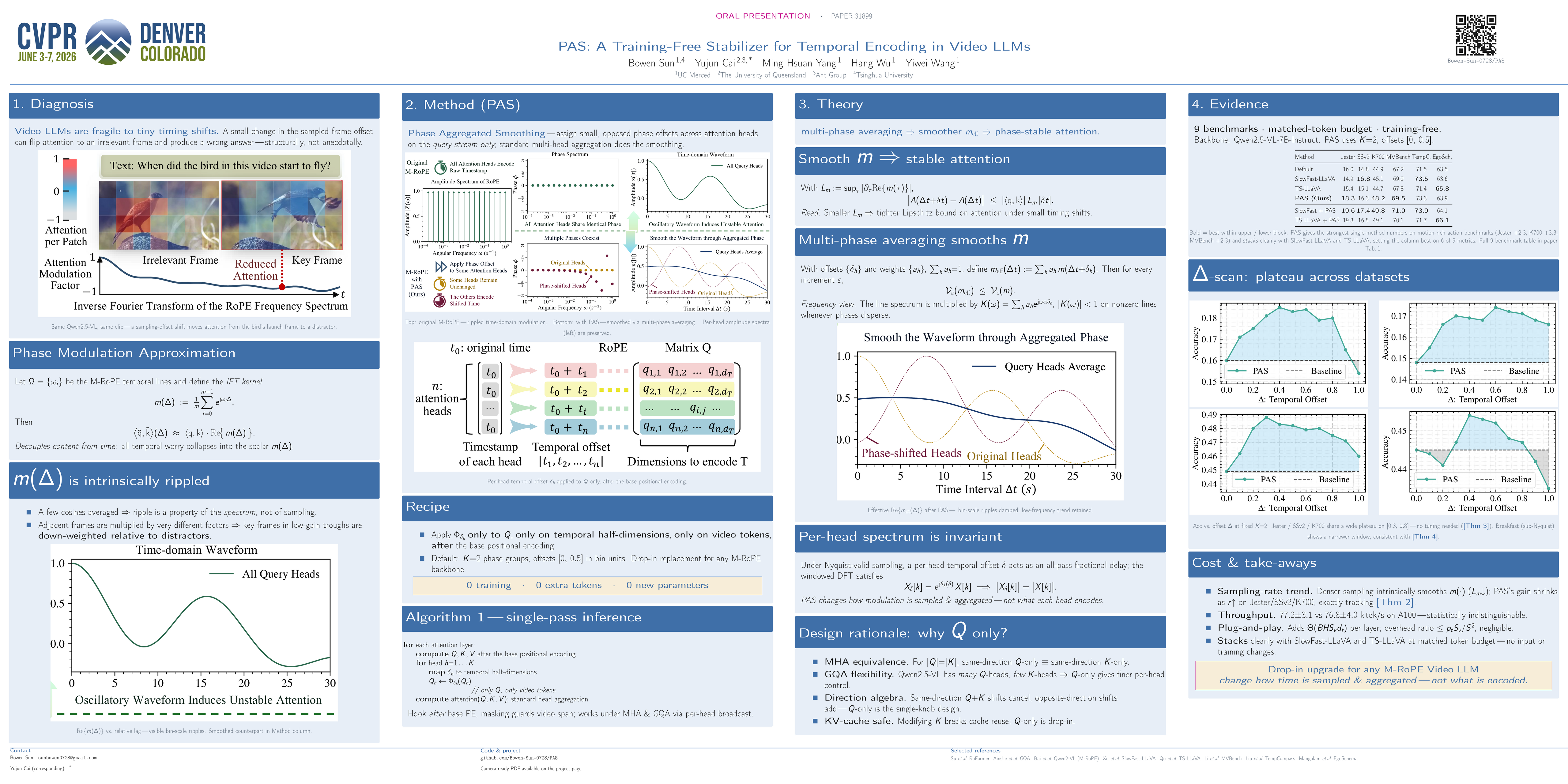
Video LLMs suffer from temporal inconsistency: small shifts in frame timing can flip attention and suppress relevant frames. We trace this instability to the common extension of Rotary Position Embeddings to video through multimodal RoPE. The induced inverse Fourier time kernel exhibits frame-scale ripples that multiply adjacent frames by different factors, which perturbs attention that should otherwise be governed by the raw query key inner product. We present Phase Aggregated Smoothing (PAS), a simple, training-free mechanism that applies small opposed phase offsets across heads and then aggregates their outputs. PAS preserves the per-head spectrum magnitude, while the aggregation effectively smooths the temporal kernel and reduces phase sensitivity without changing the positional encoding structure. Our analysis shows that the RoPE rotated logit can be approximated as a content dot product scaled by a time kernel; smoothing this kernel yields Lipschitz stability of attention to small temporal shifts; multi phase averaging attenuates high frequency ripples while preserving per-head spectra under Nyquist-valid sampling. Experiments on multiple video understanding benchmarks under matched token budgets show consistent improvements with negligible computational overhead. PAS provides a plug and play upgrade for robust temporal encoding in Video LLMs.
PAVAS: Physics-Aware Video-to-Audio Synthesis
Oh Hyun-Bin ⋅ Yuhta Takida ⋅ Toshimitsu Uesaka ⋅ Tae-Hyun Oh ⋅ Yuki Mitsufuji
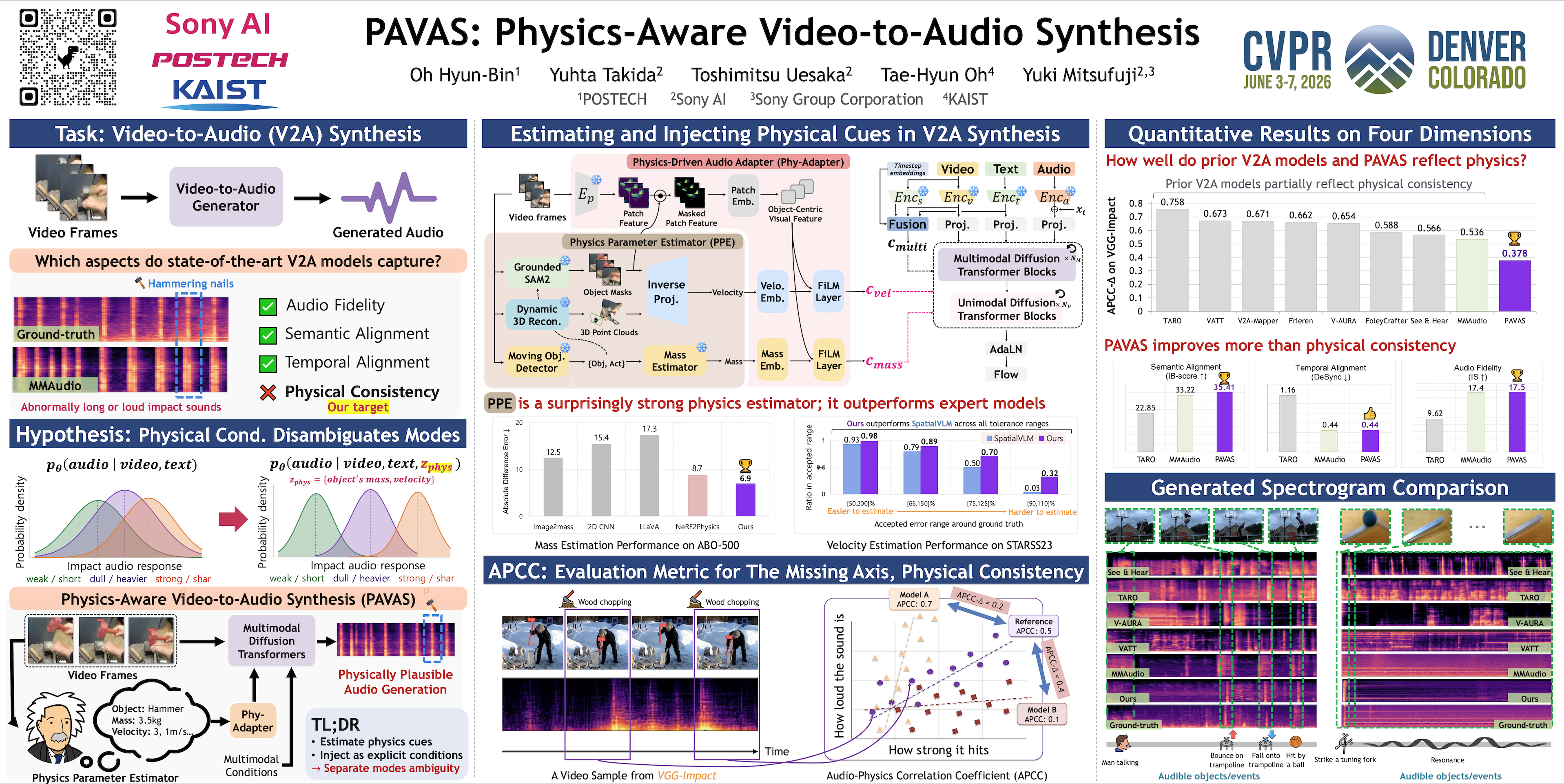
Recent advances in Video-to-Audio (V2A) generation have achieved impressive perceptual quality and temporal synchronization, yet most models remain appearance-driven, capturing visual-acoustic correlations without considering the physical factors that shape real-world sounds. We present Physics-Aware Video-to-Audio Synthesis (PAVAS), a method that incorporates physical reasoning into a latent diffusion-based V2A generation through the Physics-Driven Audio Adapter (Phy-Adapter). The adapter receives object-level physical parameters estimated by the Physical Parameter Estimator (PPE), which uses a Vision Language Model (VLM) to infer the moving-object mass and a segmentation-based dynamic 3D reconstruction module to recover its motion trajectory for velocity computation. These physical cues enable the model to synthesize sounds that reflect underlying physical factors. To assess physical realism, we curate VGG-Impact, a benchmark focusing on object–object interactions, and introduce Audio-Physics Correlation Coefficient (APCC), an evaluation metric that measures consistency between physical and auditory attributes. Comprehensive experiments show that PAVAS produces physically plausible and perceptually coherent audio, outperforming existing V2A models in both quantitative and qualitative evaluations.
ProPhy: Progressive Physical Alignment for Dynamic World Simulation
Zijun Wang ⋅ Panwen Hu ⋅ Jing Wang ⋅ Terry Jingchen Zhang ⋅ Yuhao Cheng ⋅ Long Chen ⋅ Yiqiang Yan ⋅ Zutao Jiang ⋅ Hanhui Li ⋅ Xiaodan Liang
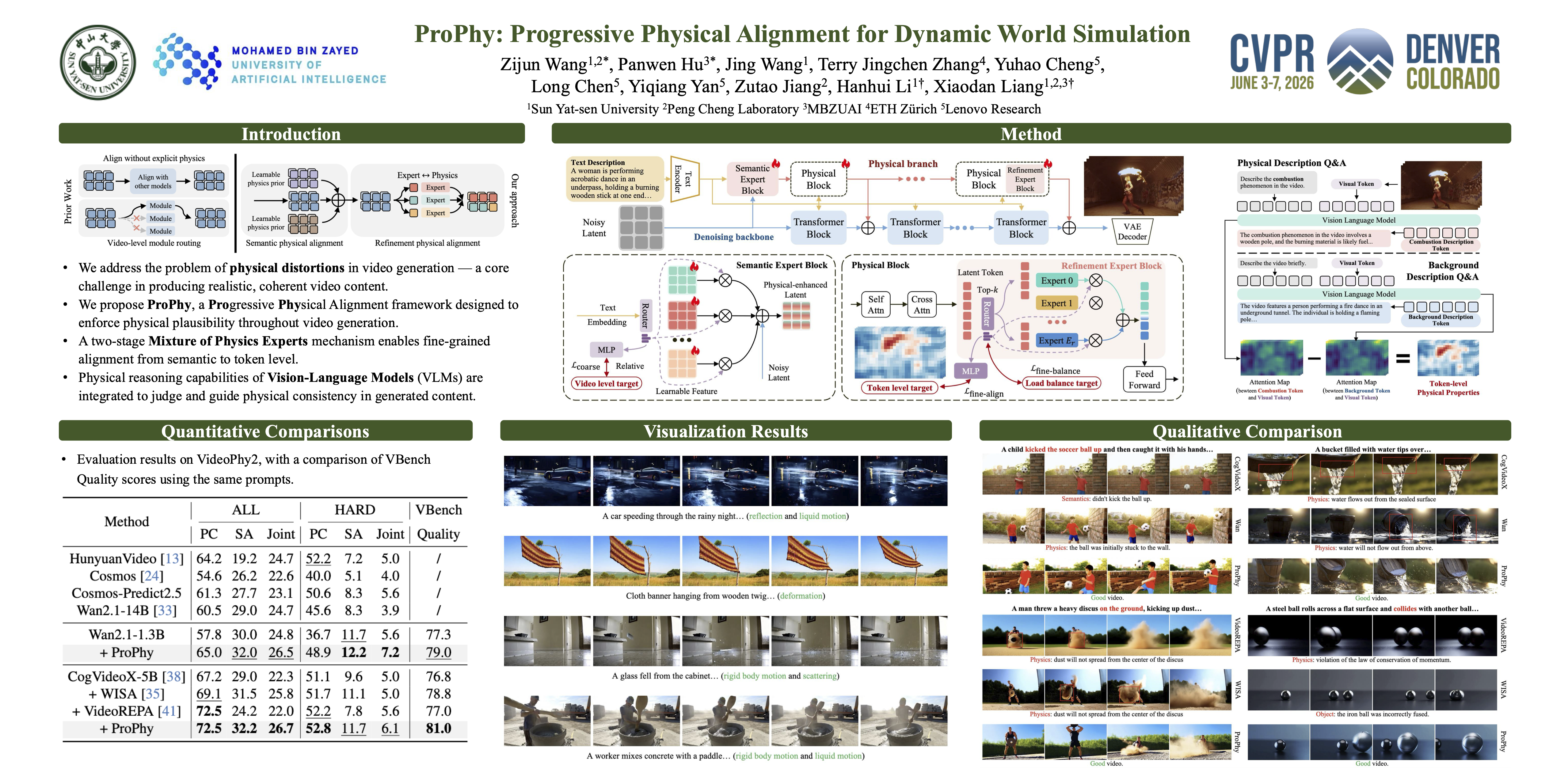
Recent advances in video generation have shown remarkable potential for constructing world simulators. However, current models still struggle to produce physically consistent results, particularly when handling large-scale or complex dynamics. This limitation arises primarily because existing approaches respond isotropically to physical prompts and neglect the fine-grained alignment between generated content and localized physical cues. To address these challenges, we propose ProPhy, a Progressive Physical Alignment Framework that enables explicit physics-aware conditioning and anisotropic generation. ProPhy employs a two-stage Mixture-of-Physics-Experts (MoPE) mechanism for discriminative physical prior extraction, where Semantic Experts infer semantic-level physical principles from textual descriptions, and Refinement Experts capture token-level physical dynamics. This mechanism allows the model to learn fine-grained, physics-aware video representations that better reflect underlying physical laws. Furthermore, we introduce a physical alignment strategy that transfers the physical reasoning capabilities of vision-language models (VLMs) into the Refinement Experts, facilitating a more accurate representation of dynamic physical phenomena. Extensive experiments on physics-aware video generation benchmarks demonstrate that ProPhy produces more realistic, dynamic, and physically coherent results than existing state-of-the-art methods.
V-DPM: 4D Video Reconstruction with Dynamic Point Maps
Edgar Sucar ⋅ Eldar Insafutdinov ⋅ Zihang Lai ⋅ Andrea Vedaldi
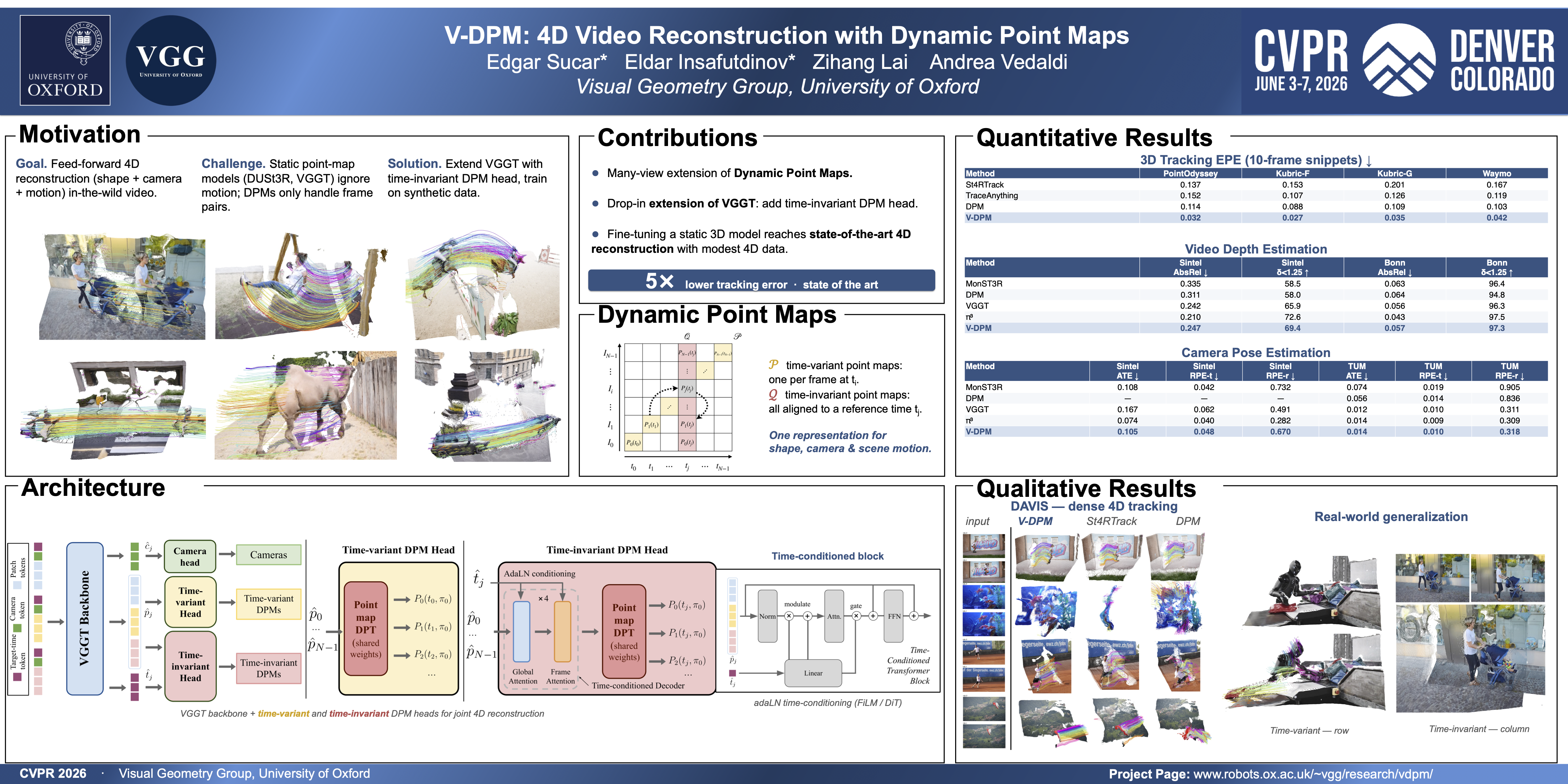
New, powerful 3D representations such as DUSt3R’s invariant point maps, which encode 3D shape and camera parameters, have significantly advanced feed-forward 3D reconstruction. While point maps assume static scenes, Dynamic Point Maps (DPMs) extend the concept to dynamic 3D content, also representing 3D scene motion.However, DPMs have so far been limited to image pairs and, like DUSt3R, require post-processing via optimization when more than two views are involved. We argue that DPMs are far more meaningful when applied to videos and introduce V-DPM to demonstrate this.First, we show how to set up DPMs for videos to optimize their representational power, ease of neural prediction, and reuse of pre-trained models. Second, we implement these ideas on top of VGGT, a recent state-of-the-art 3D reconstructor. Although VGGT was trained on static scenes, we show that a small amount of synthetic data suffices to adapt it into an effective V-DPM predictor.This yields state-of-the-art 3D and 4D reconstruction in dynamic settings. In particular, unlike recent dynamic extensions of VGGT such as P3, DPMs reconstruct not only dynamic depth but also the full 3D motion of every point in the scene.
Registration-Free Learnable Multi-View Capture of Faces in Dense Semantic Correspondence
Panagiotis P. Filntisis ⋅ George Retsinas ⋅ Radek Daněček ⋅ Vanessa Sklyarova ⋅ Petros Maragos ⋅ Timo Bolkart
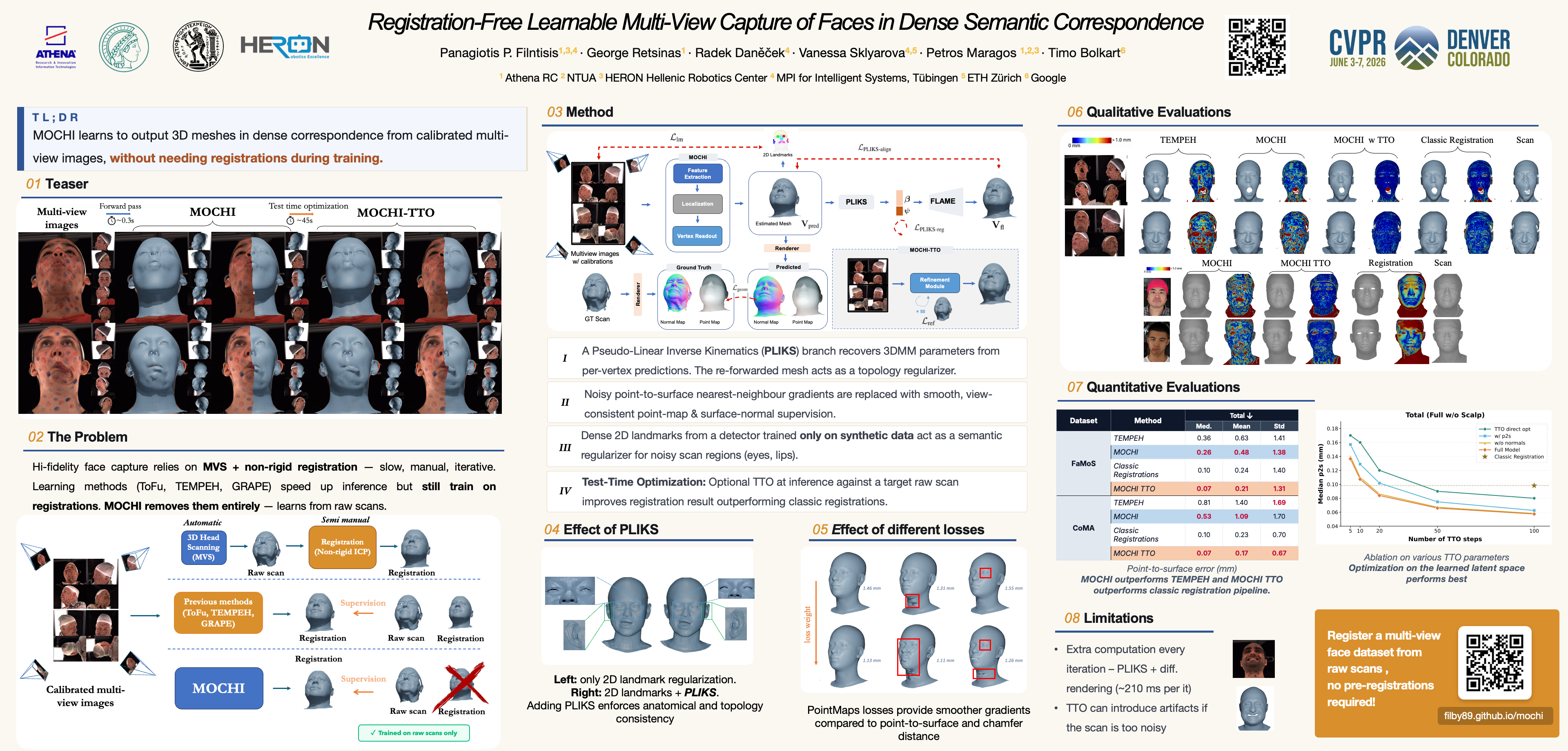
Recent learning-based face reconstruction and registration frameworks such as ToFu and TEMPEH have shown that dense correspondence between facial scans and a common topology can be learned directly from images. However, these approaches still depend on precomputed registrations obtained through iterative optimization pipelines that often require manual verification and correction by human annotators. We introduce MOCHI (Multi-view Optimizable Correspondence of Heads from Images), a fully differentiable and registration-free alternative. Instead of relying on optimization-based registrations, we employ a pseudo-linear inverse kinematic solver in conjunction with dense 2D keypoints produced by a tracker trained only on synthetic data to directly enforce a common face topology at the vertex level. We further find that the commonly used point-to-surface distance can lead to unstable training and artifacts, and instead use pointmap- and normal-based losses that provide smoother gradients, more stable optimization, and improved reconstruction results.Additionally, we introduce at inference a brief test-time-optimization scheme which can further refine the results of the network, resulting in registrations that outperform traditional labor-intensive pipelines.Despite removing external registrations, our extensive experimental results show that MOCHI surpasses the previous state-of-the-art in reconstruction accuracy and visual fidelity. The code and the model will be made public.
Mesh4D: 4D Mesh Reconstruction and Tracking from Monocular Video
Zeren Jiang ⋅ Chuanxia Zheng ⋅ Iro Laina ⋅ Diane Larlus ⋅ Andrea Vedaldi
We propose Mesh4D, a feed-forward model for monocular 4D mesh reconstruction. Given a monocular video of a dynamic object, our model reconstructs the object’s complete 3D shape and motion, represented as a deformation field. Our key contribution is a compact latent space that encodes the entire animation sequence in a single pass. This latent space is learned by an autoencoder that, during training, is guided by the skeletal structure of the training objects, providing strong priors on plausible deformations. Crucially, skeletal information is not required at inference time. The encoder employs spatio-temporal attention, yielding a more stable representation of the object’s overall deformation. Building on this representation, we train a latent diffusion model that, conditioned on the input video and the mesh reconstructed from the first frame, predicts the full animation in one shot. We evaluate Mesh4D on reconstruction and novel view synthesis benchmarks, outperforming prior methods in recovering accurate 3D shape and deformation.
SPE-MVS: Spatial Position Encoding Enhanced Multi-View Stereo with Monocular Depth Priors
Shaoqian Wang ⋅ Jiadai Sun ⋅ Bosen Hou ⋅ Qiang Wang ⋅ Bin Fan ⋅ Bo Li ⋅ Bin Lu ⋅ Yuchao Dai
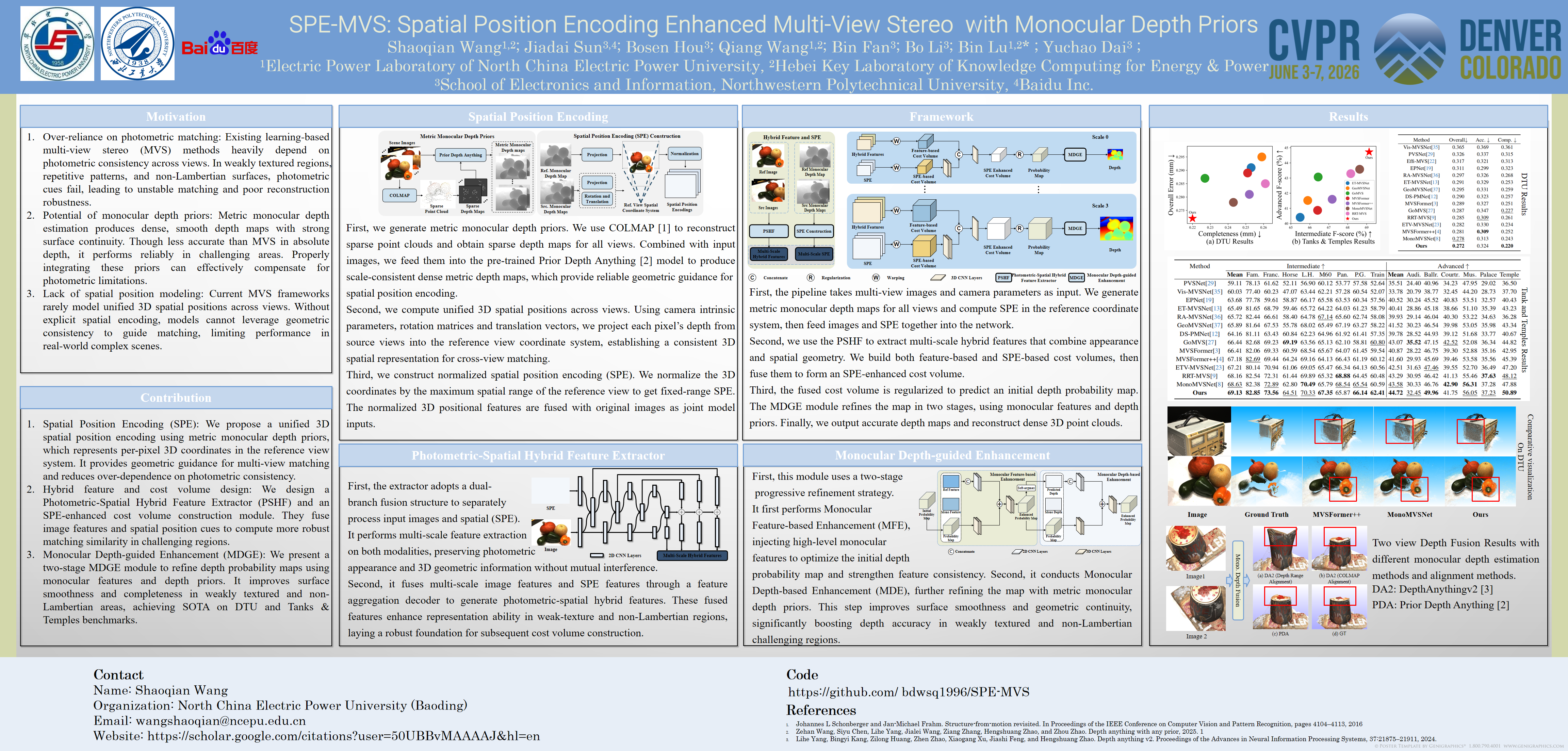
Learning-based Multi-View Stereo (MVS) methods have become the mainstream in the field, relying on the construction of cost volumes through multi-view feature similarity computation and regularization. However, existing methods depend heavily on photometric consistency across views, leading to poor performance in challenging regions, such as weakly textured or non-Lambertian surfaces. To overcome this limitation, we propose SPE-MVS, a novel MVS framework enhanced with Spatial Position Encoding (SPE). The SPE represents the 3D positional information of pixels in each image within a unified metric space, constructed using monocular depth priors. We integrate the SPE alongside image data as input and introduce a Photometric-Spatial Hybrid Feature Extractor, along with an SPE-enhanced cost volume construction module. These components incorporate spatial position-based similarity computation, substantially improving robustness in challenging areas. Furthermore, we propose a Monocular Depth-guided Enhancement (MDGE) module that enhances depth probability distributions using monocular depth priors, thereby further boosting the depth estimation performance. Extensive experiments demonstrate that our method significantly improves reconstruction quality in difficult regions and achieves state-of-the-art (\textit{SOTA}) performance on multiple benchmarks.
Block-Sparse Global Attention for Efficient Multi-View Geometry Transformers
Chung-Shien Brian Wang ⋅ Christian Schmidt ⋅ Jens Piekenbrinck ⋅ Bastian Leibe
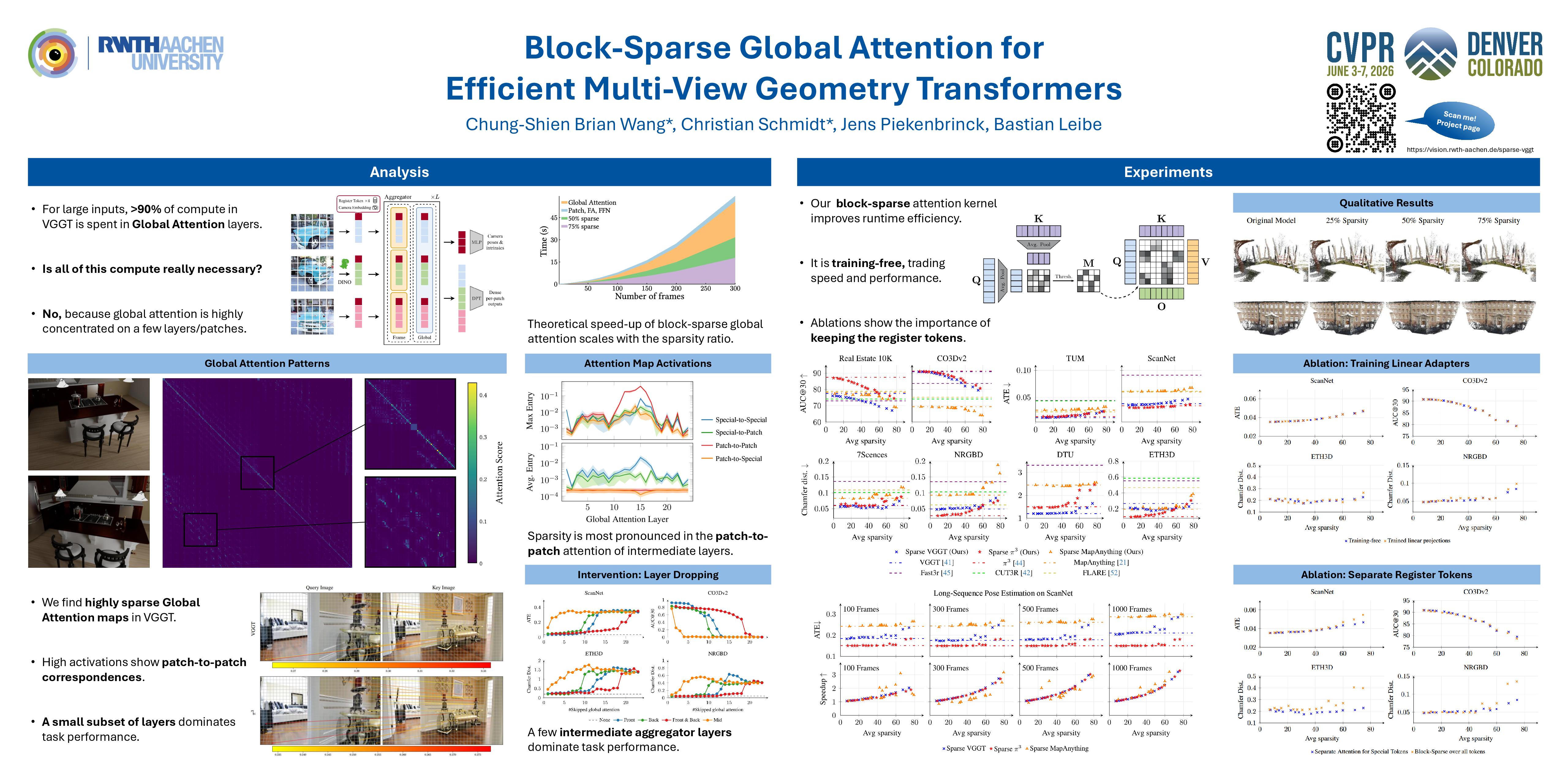
Efficient and accurate feed-forward multi-view reconstruction has long been an important task in computer vision. Recent transformer-based models like VGGT, $\pi^3$ and MapAnything have demonstrated remarkable performance with relatively simple architectures. However, their scalability is fundamentally constrained by the quadratic complexity of global attention, which imposes a significant runtime bottleneck when processing large image sets. In this work, we empirically analyze the global attention matrix of these models and observe that the probability mass concentrates on a small subset of patch-patch interactions corresponding to cross-view geometric correspondences. Building on this insight and inspired by recent advances in large language models, we propose a training-free, block-sparse replacement for dense global attention, implemented with highly optimized kernels. Our method accelerates inference by more than 3$\times$ while maintaining comparable task performance. Evaluations on a comprehensive suite of multi-view benchmarks demonstrate that our approach seamlesslyintegrates into existing global attention-based architectures such as VGGT, $\pi^3$, and MapAnything, while substantially improving scalability to large image collections.
SMVRT: Implicit Human 3D Modeling Using Sparse Multi-View Volumetric Reconstruction with Transformer Fusion
Chuanmao Fan ⋅ Chenxi Zhao ⋅ Ye Duan
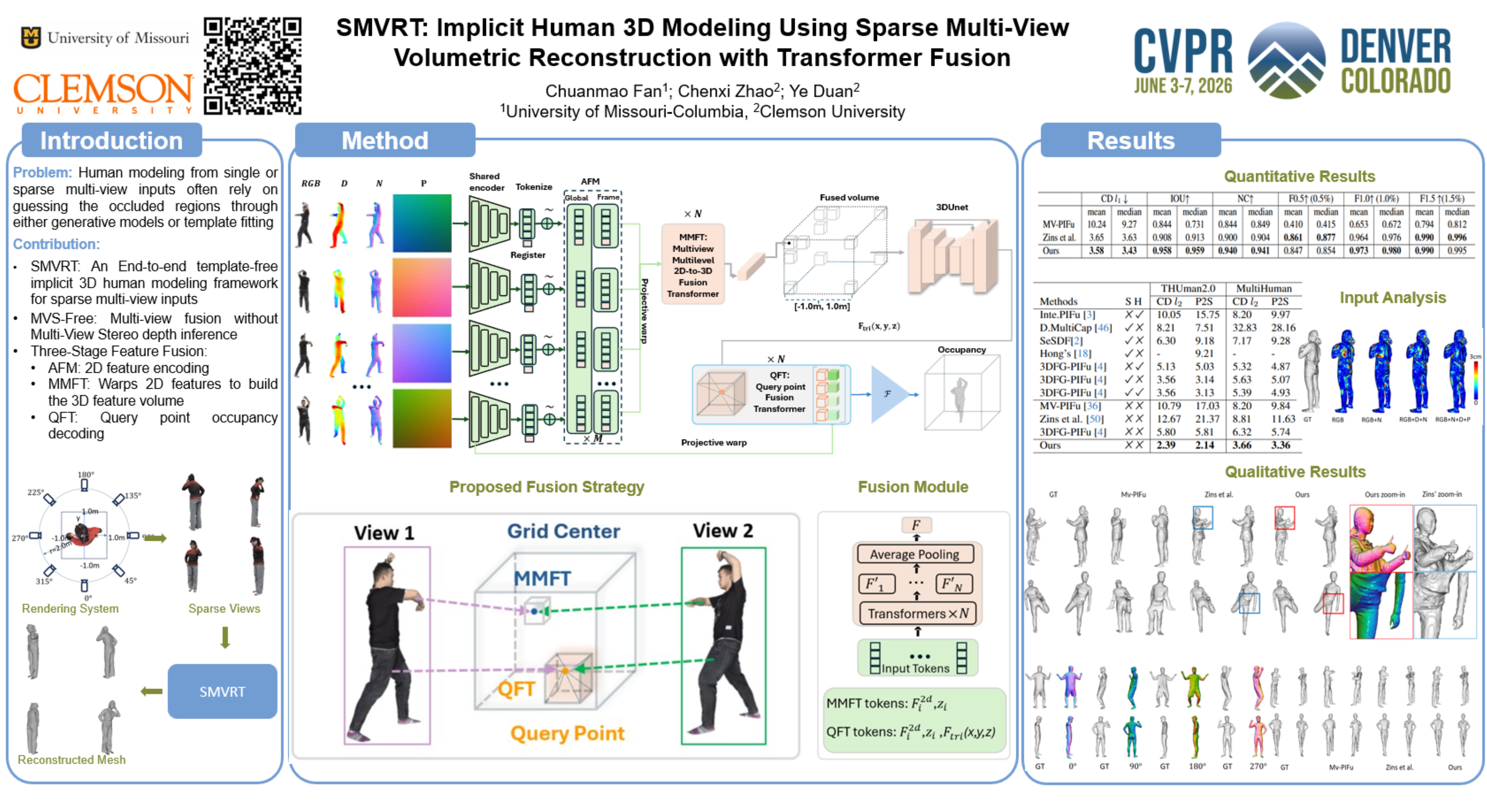
Recently, the community has witnessed significant progress in human modeling from a single view or multi-views, which often involves "guessing" the occluded parts using either generative models or template fitting. In this work, we address these challenges by exploring optimal fusion strategies from sparse views only. We propose an end-to-end implicit 3D reconstruction framework using a sparse multi-view setup. Specifically, we achieve this by exploring fusion blocks at three stages of the network. First, 2D feature encoders carrying out locally and globally, which produce enhanced features. Second, 3D feature grid, formed by attentional fusion of warped multi-view and multi-level 2D features, which follows 3D regularization of feature grids to aggregate spatially coherent multi-view features. Third, attentional 2D3D feature aggregation associated to query point generate enhanced latent embedding, which is fed into an implicit field decoder for robust occupancy prediction. Evaluation on the THUman 2.1, MultiGarment dataset demonstrates that our system significantly outperforms state-of-the-art methods both qualitatively and quantitatively.
LiDAR Prompted Spatio-Temporal Multi-View Stereo for Autonomous Driving
Qihao Sun ⋅ Jiarun Liu ⋅ Ziqian Ni ⋅ Jianyun Xu ⋅ Sheng Yang ⋅ Tao Xie ⋅ lijun zhao ⋅ Ruifeng Li
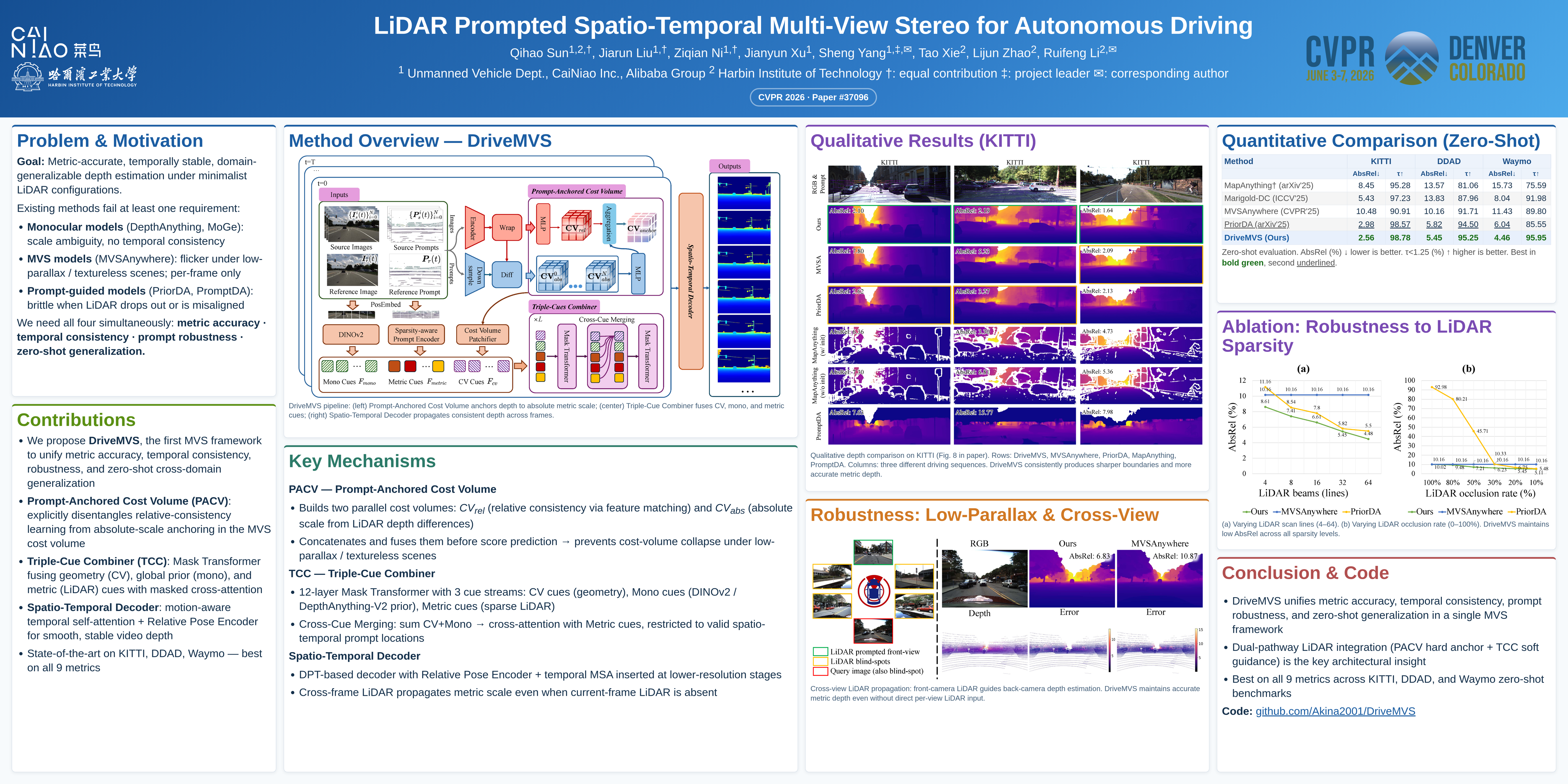
Accurate metric depth is critical for autonomous driving perception and simulation, yet current approaches struggle to achieve high metric accuracy, multi-view and temporal consistency, and cross-domain generalization.To address these challenges, we present MVS-Pro, a novel multi-view stereo framework that reconciles these competing objectives through two key insights: (1) Sparse but metrically accurate LiDAR observations can serve as geometric prompts to anchor depth estimation in absolute scale, and (2) deep fusion of diverse cues is essential for resolving ambiguities and enhancing robustness, while a spatio-temporal decoder ensures consistency across frames.Built upon these principles, MVS-Pro embeds the LiDAR prompt in two ways: as a hard geometric prior anchoring the cost volume, and as soft feature-wise guidance fused by a triple cues combiner.As for temporal consistency, MVS-Pro leverages a spatio-temporal decoder that jointly exploits geometric cues from the MVS cost volume and temporal context from neighboring frames. Experiments show that MVS-Pro achieves state-of-the-art performance on multiple benchmarks, excelling in metric accuracy, temporal stability, and zero-shot cross-domain transfer, demonstrating its practical value for scalable, reliable autonomous driving systems.Code will be made publicly available.
Any4D: Unified Feed-Forward Metric 4D Reconstruction
Jay Karhade ⋅ Nikhil Keetha ⋅ Yuchen Zhang ⋅ Tanisha Gupta ⋅ Akash Sharma ⋅ Sebastian Scherer ⋅ Deva Ramanan
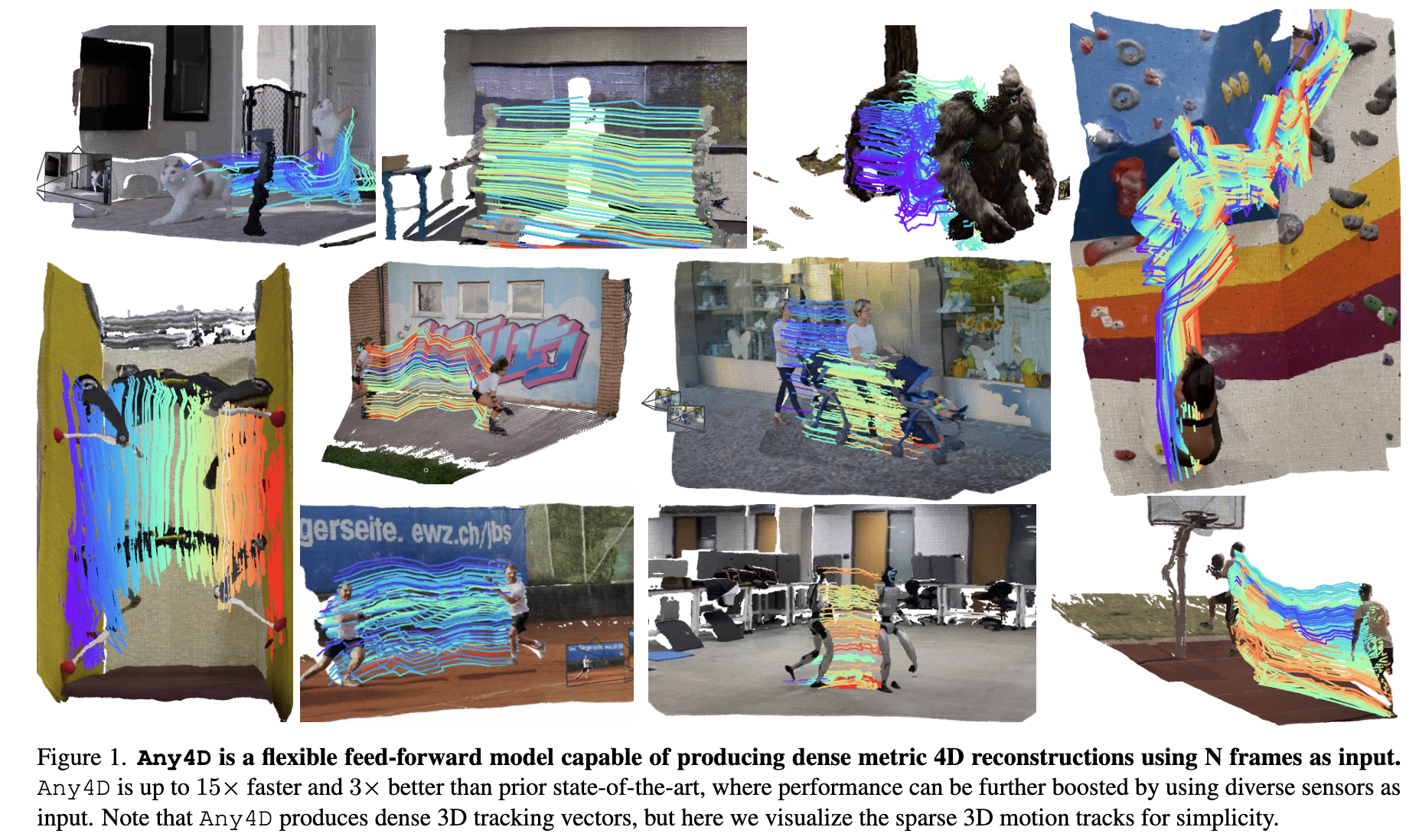
We present Any4D, a scalable multi-view transformer for metric-scale, dense feed-forward 4D reconstruction. Any4D directly generates per-pixel motion and geometry predictions for N frames, in contrast to prior work that typically focuses on either 2-view dense scene flow or sparse 3D point tracking. Moreover, unlike other recent methods for 4D reconstruction from monocular RGB videos, Any4D can process additional modalities and sensors such as RGB-D frames, IMU-based egomotion, and Radar Doppler measurements, when available. One of the key innovations that allows for such a flexible framework is a modular representation of a 4D scene; specifically, per-view 4D predictions are encoded using a variety of egocentric factors (depthmaps and camera intrinsics) represented in local camera coordinates, and allocentric factors (camera extrinsics and scene flow) represented in global world coordinates. We achieve superior performance across diverse setups - both in terms of accuracy (2-3X lower error) and compute efficiency (15X faster) - opening avenues for multiple downstream applications.
Co-Me: Confidence Guided Token Merging for Visual Geometric Transformers
Yutian Chen ⋅ Yuheng Qiu ⋅ Ruogu Li ⋅ Jay Patrikar ⋅ Sebastian Scherer
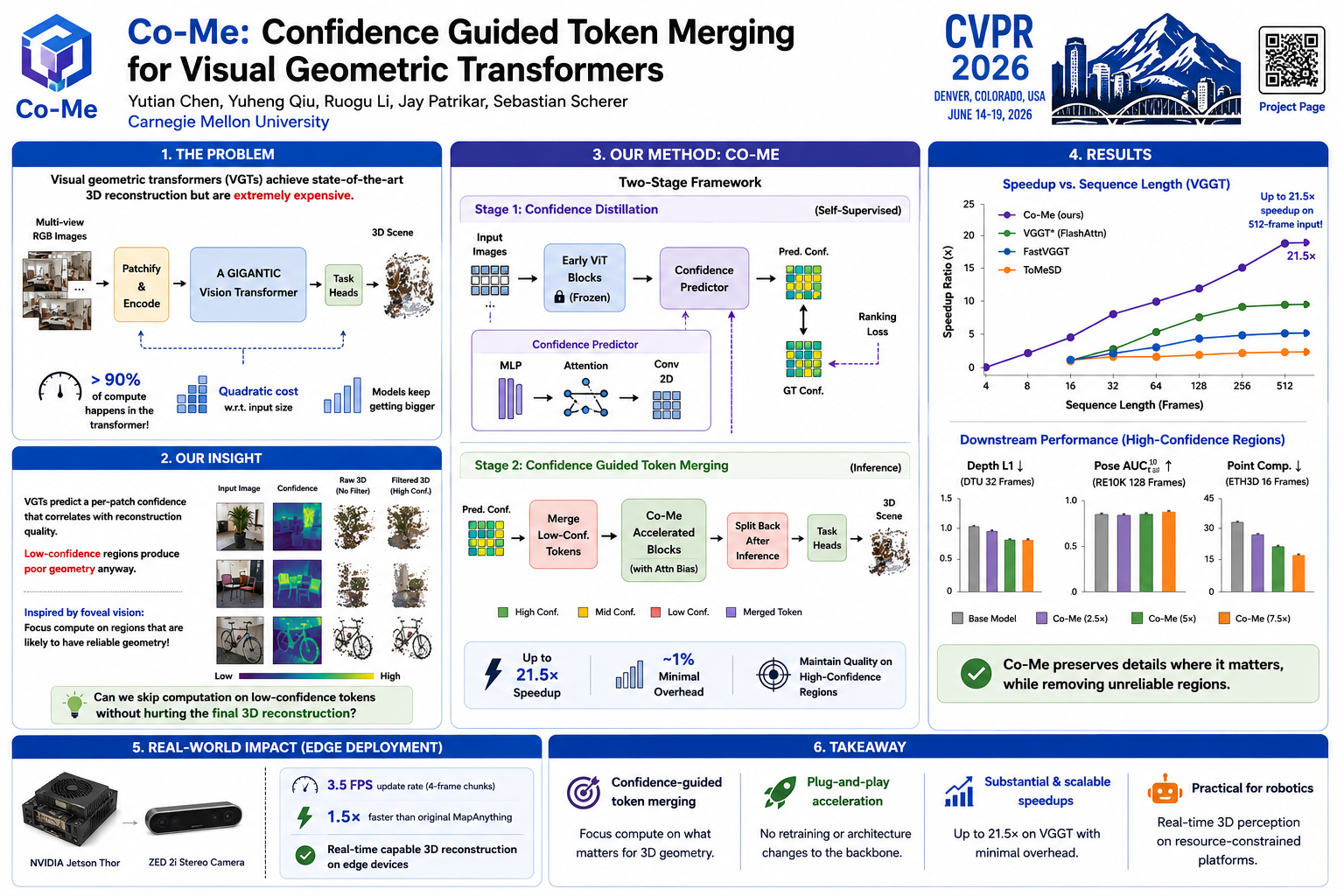
We propose Confidence-Guided Token Merging (Co-Me), an acceleration mechanism for visual geometric transformers without retraining or finetuning the base model. Co-Me employs a light-weight distilled confidence predictor to rank tokens and selectively merge low-confidence ones, effectively reducing computation while maintaining spatial coverage. Compared to similarity-based merging or pruning, the confidence signal in Co-Me reliably indicates regions emphasized by the transformer, enabling substantial acceleration without degrading performance. Co-Me applies seamlessly to various multi-view and streaming visual geometric transformers, achieving speedups that scale with sequence length. When applied to VGGT and MapAnything, Co-Me achieves up to $11.3\times$ and $7.2\times$ speedup, making visual geometric transformers practical for real-time 3D perception and reconstruction.
Point4Cast: Streaming Dynamic Scene Reconstruction and Forecasting
Xinhang Liu ⋅ Pedro Miraldo ⋅ Suhas Lohit ⋅ Huaizu Jiang ⋅ Naoko Sawada ⋅ Yu-Wing Tai ⋅ Chi-Keung Tang ⋅ Moitreya Chatterjee
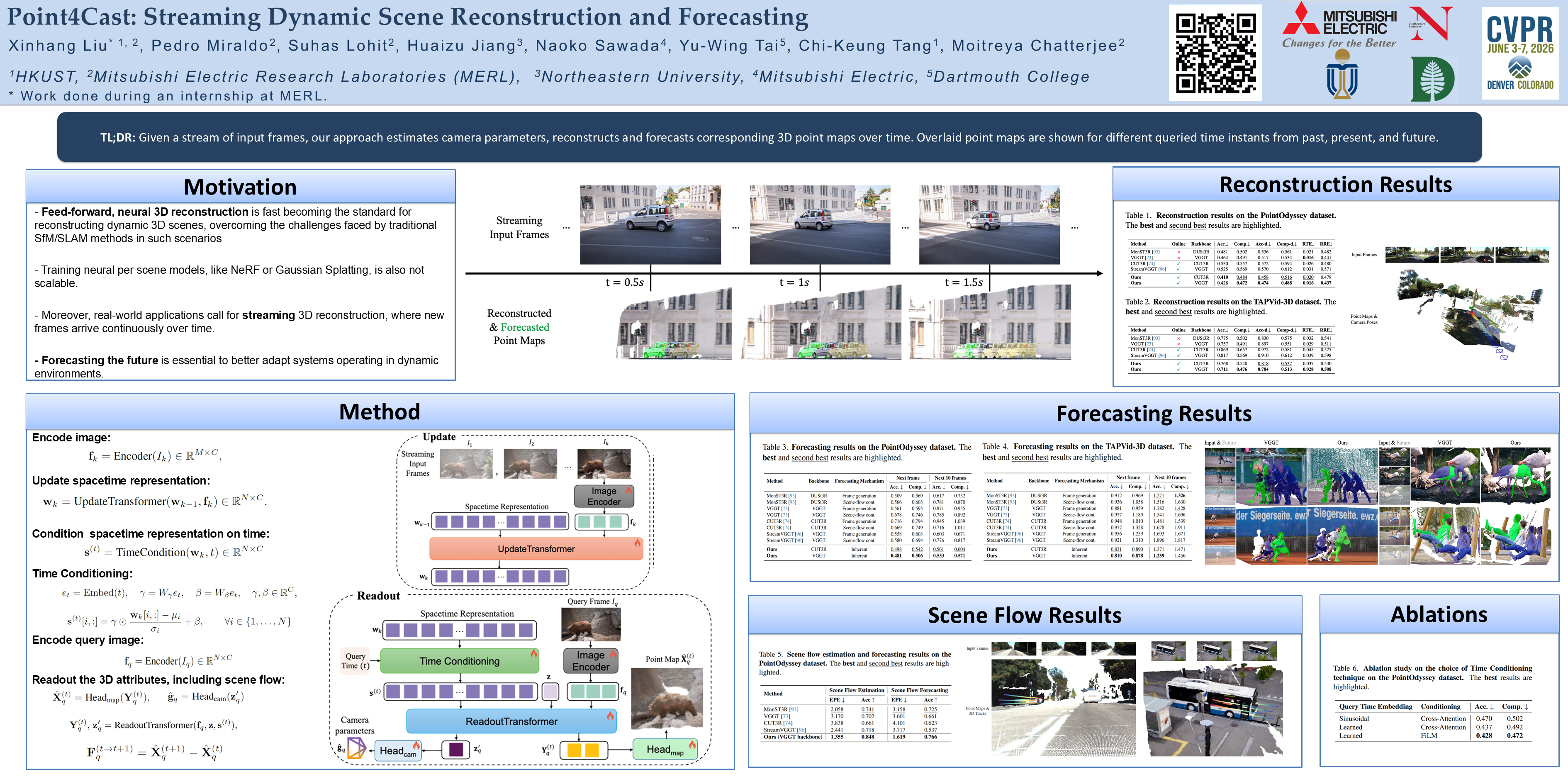
Understanding how the 3D world evolves over time is a fundamental task in computer vision, essential for embodied settings, autonomous driving, etc. It requires not only the reconstruction of the observed scene but also the anticipation of how the scene dynamics will unfold in the future. While the area of 3D reconstruction has progressed rapidly with the advent of recent feed-forward neural networks, forecasting future dynamics in 3D, given the 2D frames of a video remains unexplored. We present Point4Cast, a unified framework that processes streaming 2D frame sequences of a video to estimate the past, present, and future of the underlying dynamic scene, in 3D. At the core of our approach lies a persistently evolving latent \emph{spacetime representation} that models the environment’s evolution across time. Upon receiving a new 2D frame, an update operation integrates the incoming evidence to refine the latent spacetime representation. When queried for any time instant, whether before, at, or beyond the timestamp of the last update. A readout procedure predicts temporally conditioned point maps and camera parameters describing the scene geometry at the queried time. Unlike prior approaches for online dynamic scene reconstruction that estimate each frame’s point map solely at the timestamp of the last observed frame, Point4Cast achieves coherent reconstruction across any queried time. Empirical evaluations show that \emph{Point4Cast} achieves state-of-the-art performance on streaming dynamic scene reconstruction and forecasting benchmarks, across multiple challenging datasets, while providing scene flow estimation and forecasting for free. The code will be released publicly.
AMB3R: Accurate Feed-forward Metric-scale 3D Reconstruction with Backend
Hengyi Wang ⋅ Lourdes Agapito
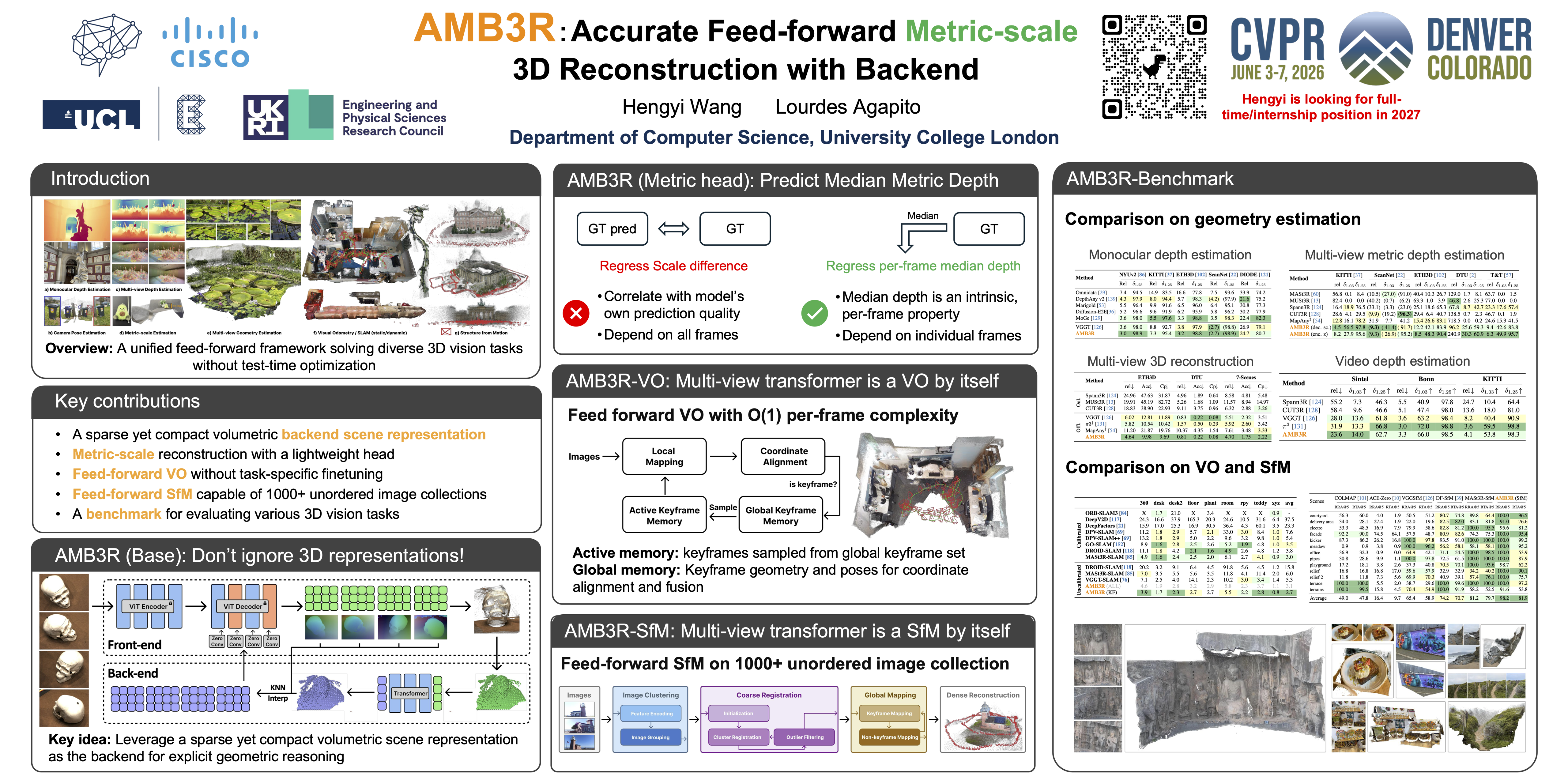
We present AMB3R, a multi-view feed-forward model for dense 3D reconstruction on a metric-scale that addresses diverse 3D vision tasks. The key idea is to leverage a sparse, yet compact, volumetric scene representation as our backend, enabling geometric reasoning with spatial compactness. Although trained solely for multi-view reconstruction, we demonstrate that AMB3R can be seamlessly extended to uncalibrated visual odometry (online) or large-scale structure from motion without the need for task-specific fine-tuning or test-time optimization. Compared to prior pointmap-based models, our approach achieves state-of-the-art performance in camera pose, depth, and metric-scale estimation, 3D reconstruction, and even surpasses optimization-based SLAM and SfM methods with dense reconstruction priors on common benchmarks.
AlignPose: Generalizable 6D Pose Estimation via Multi-view Feature-metric Alignment
Anna Šárová Mikeštíková ⋅ Médéric Fourmy ⋅ Martin Cífka ⋅ Josef Sivic ⋅ Vladimir Petrik
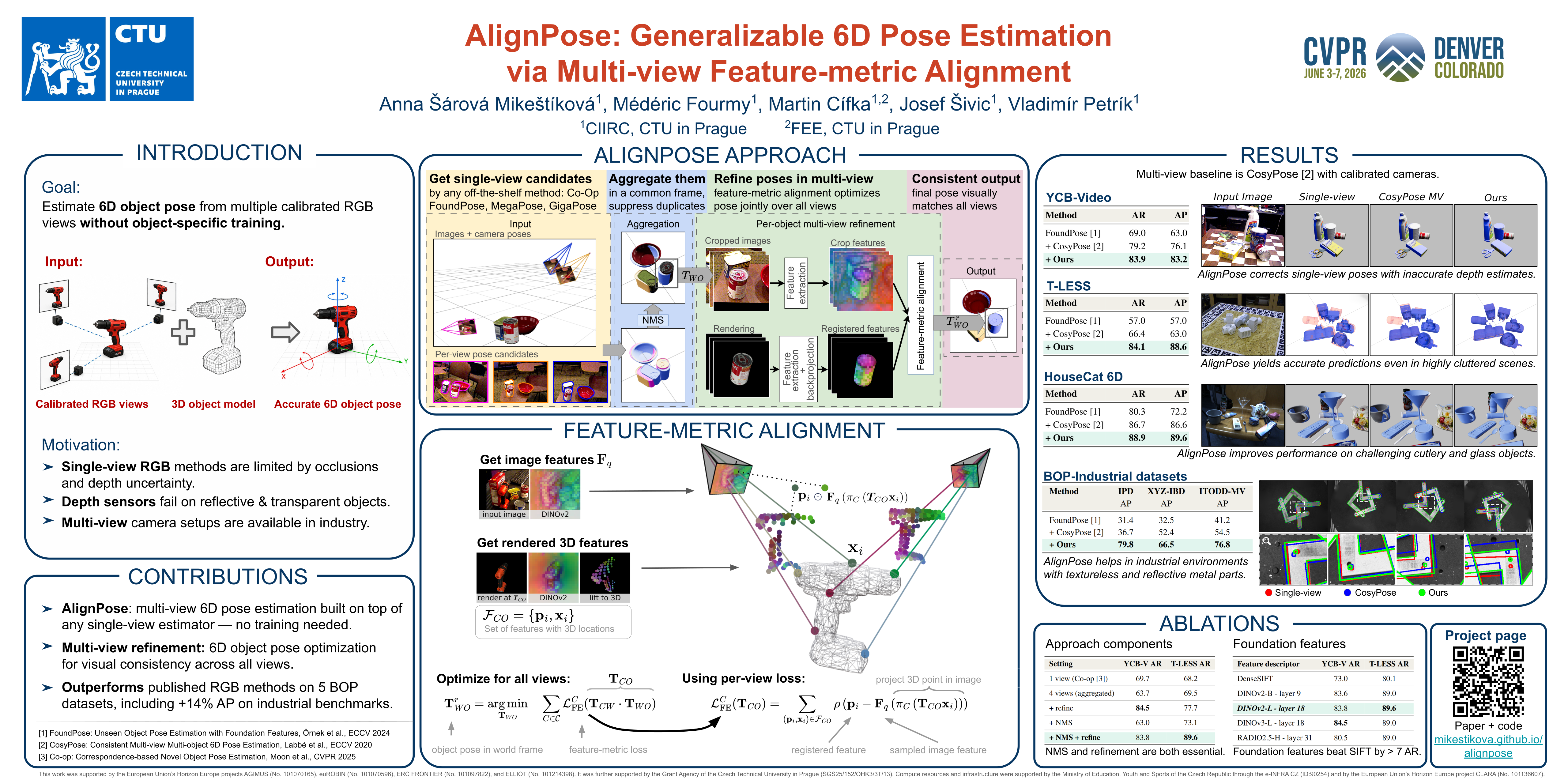
Single-view RGB model-based object pose estimation methods achieve strong generalization but are fundamentally limited by depth ambiguity, clutter, and occlusions. Multi-view pose estimation methods have the potential to solve these issues, but existing works rely on precise single-view pose estimates or lack generalization to unseen objects. We address these challenges via the following three contributions.First, we introduce AlignPose, a 6D object pose estimation method that aggregates information from multiple extrinsically calibrated RGB views and does not require any object-specific training or symmetry annotation.Second, the key component of this approach is a new multi-view feature-metric refinement specifically designed for object pose. It optimizes a single, consistent world-frame object pose minimizing the feature discrepancy between on-the-flyrendered object features and observed image features across all views simultaneously.Third, we report extensive experiments on four datasets (YCB-V, T-LESS, ITODD-MV, HouseCat6D) using the BOP benchmark evaluation and show that AlignPose outperforms other published methods, especially on challenging industrial datasets where multiple views are readily available in practice.
Parallelised Differentiable Straightest Geodesics for 3D Meshes
Hippolyte Verninas ⋅ Caner Korkmaz ⋅ Stefanos Zafeiriou ⋅ Tolga Birdal ⋅ Simone Foti
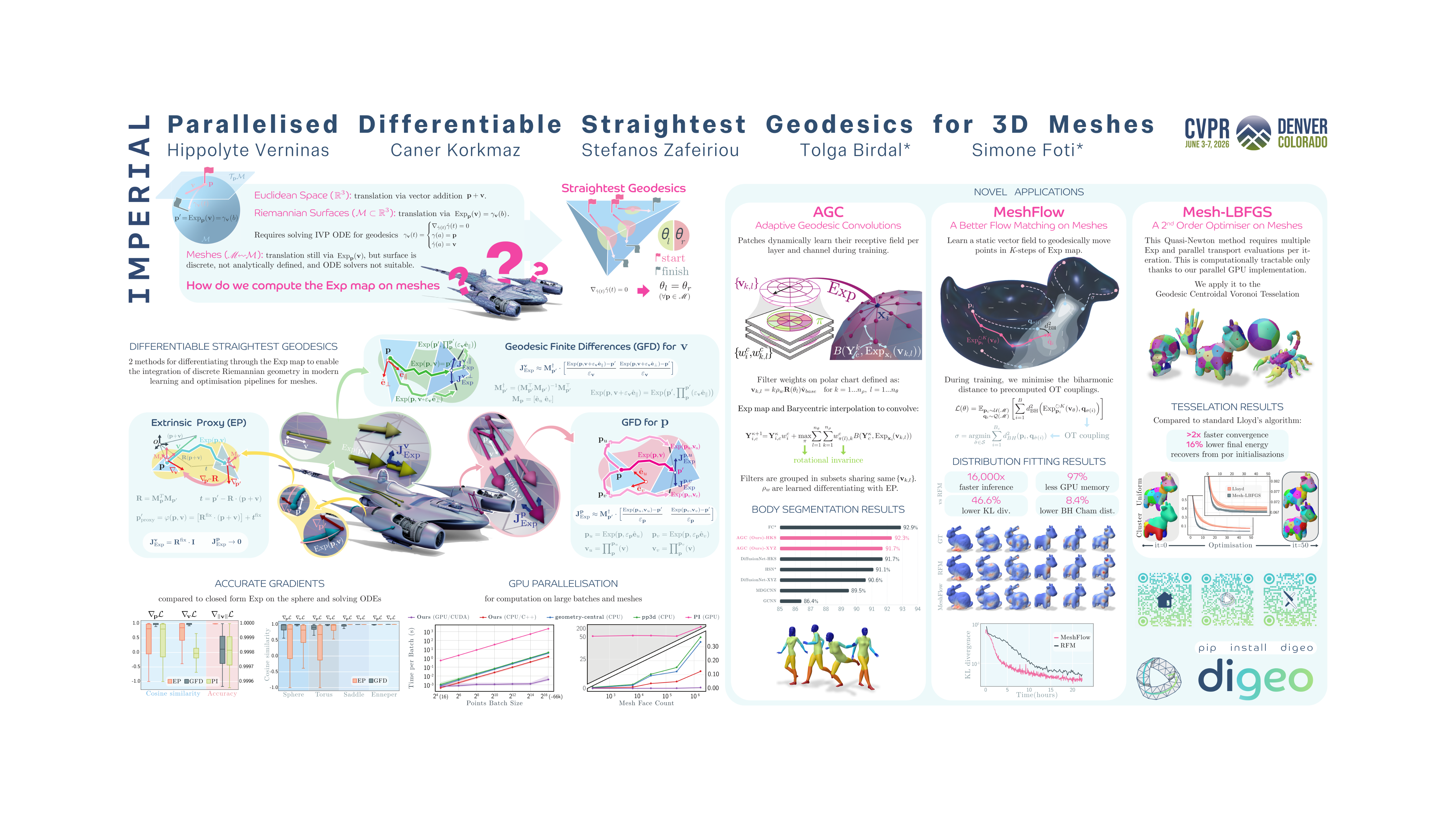
Machine learning has been progressively generalised to operate within non-Euclidean domains, but geometrically accurate methods for learning on surfaces are still falling behind. The lack of closed-form Riemannian operators, the non-differentiability of their discrete counterparts, and poor parallelisation capabilities have been the main obstacles to the development of the field on meshes. A principled framework to compute the exponential map on Riemannian surfaces discretised as meshes is straightest geodesics, which also allows to trace geodesics and parallel-transport vectors as a by-product. We provide a parallel GPU implementation and derive two different methods for differentiating through the straightest geodesics, one leveraging an extrinsic proxy function and one based upon a geodesic finite differences scheme. After proving our parallelisation performance and accuracy, we demonstrate how our differentiable exponential map can supercharge geometrically-correct learning and optimisation pipelines. In particular, to showcase the versatility of our method, we propose a new geodesic convolutional layer, a new flow matching method for learning on meshes, and a second-order optimiser that we apply to centroidal Voroni tesselation. Our code, pre-trained models, and pip-installable library will be made available upon publication.
Geometry-Aligned and Anomaly-Aware Reconstruction for 3D Anomaly Detection
linchun wu ⋅ Qin Zou ⋅ Yuanhao Yue ⋅ Zhongyuan Wang
Point cloud anomaly detection is crucial in automated manufacturing, with reconstruction-based diffusion methods emerging as a mainstream solution. However, these approaches still face two major challenges: (1) geometry violation, where random noise perturbations deviate from local surface normals, causing structural distortion; and (2) undistinguished reference regions, where uniformly applied coarse anomaly embeddings during denoising blur normal details and impede accurate anomaly recovery. To address these issues, we propose AARD, a geometry-aligned and anomaly-aware diffusion reconstruction framework. We argue that high-fidelity anomaly detection requires a principled reformulation of the diffusion process: noise should align with geometry to preserve structures, and reconstruction can be better guided by anomaly-aware references to discriminatively recover normal details while correcting defects. AARD progressively aligns noise directions with vertex normals while maintaining vertex-graph consistency, and employs an adaptive transformer that assigns normal references to anomalous regions and input references to normal areas. Experiments on Anomaly-ShapeNet and Real3D-AD show that AARD consistently outperforms state-of-the-art approaches, achieving superior geometric fidelity and robust anomaly localization.
DVGT: Driving Visual Geometry Transformer
Sicheng Zuo ⋅ Zixun Xie ⋅ Wenzhao Zheng ⋅ Shaoqing Xu ⋅ Fang Li ⋅ Shengyin Jiang ⋅ Long Chen ⋅ Zhi-xin Yang ⋅ Jiwen Lu
Perceiving and reconstructing 3D scene geometry from visual inputs is crucial for autonomous driving. However, it still lacks a driving-targeted dense geometry perception model that can adapt to different scenarios and camera configurations. To bridge this gap, we propose a Visual Geometry Transformer specifically designed for autonomous Driving (DVGT), which reconstructs a global dense 3D point map from a sequence of unposed multi-view visual inputs. We first extract visual features for each image and employ alternating intra-view local attention, cross-view spatial attention, and cross-frame temporal attention to infer geometric relations across images. Finally, we use multiple heads to decode a global point map in the ego coordinate of the first frame and the ego pose for each frame. Our DVGT directly predicts metric-scaled geometry from image sequences, eliminating the need for post-alignment with external sensors. Trained on a large mixture of driving datasets, including nuScenes, OpenScene, Waymo, KITTI, and DDAD, DVGT significantly outperforms the other geometry prediction models on various scenarios.
FMPose3D: monocular 3D pose estimation via flow matching
Ti Wang ⋅ Xiaohang Yu ⋅ Mackenzie Weygandt Mathis
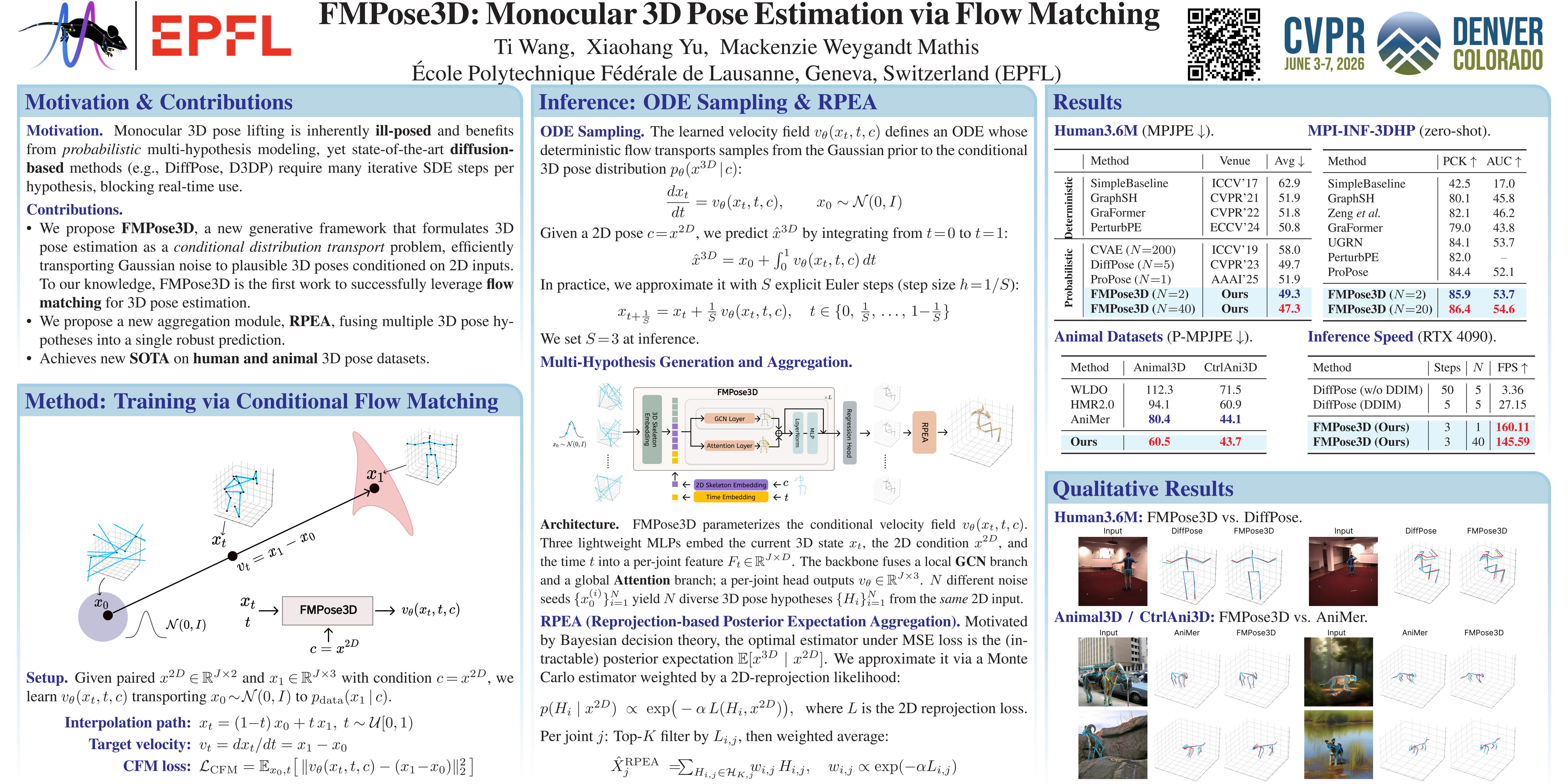
Monocular 3D pose estimation is fundamentally ill-posed due to depth ambiguity and occlusions, thereby motivating probabilistic methods that generate multiple plausible 3D pose hypotheses.In particular, diffusion-based models have demonstrated strong performance, but their iterative denoising process typically requires many time steps for each prediction, making inference computationally expensive.In contrast, Flow Matching (FM) learns an ODE-based velocity field, enabling efficient generation of 3D pose samples with only a few integration steps. Inspired by this capability, we propose a novel generative pose estimation framework, FMPose, that formulates 3D pose estimation as a conditional distribution transport problem. It continuously transports samples from a standard Gaussian prior to the distribution of plausible 3D poses conditioned on 2D inputs. While the ODE trajectories are deterministic, FMPose naturally generates diverse pose hypotheses by sampling different noise seeds.To obtain a single accurate prediction from those hypotheses, we further introduce a Reprojection-based Posterior Expectation Aggregation (RPEA) module, which approximates the Bayesian posterior expectation over 3D hypotheses. FMPose surpasses existing methods on the widely used human pose estimation benchmarks Human3.6M and MPI-INF-3DHP, and further achieves state-of-the-art performance on the 3D animal pose datasets Animal3D and CtrlAni3D, demonstrating strong performance across both human and animal 3D pose domains.
MoRE: 3D Visual Geometry Reconstruction Meets Mixture-of-Experts
Jingnan Gao ⋅ Zhe Wang ⋅ Xianze Fang ⋅ Xingyu Ren ⋅ Zhuo Chen ⋅ Shengqi Liu ⋅ Yuhao Cheng ⋅ Jiangjing Lyu ⋅ Xiaokang Yang ⋅ Yichao Yan
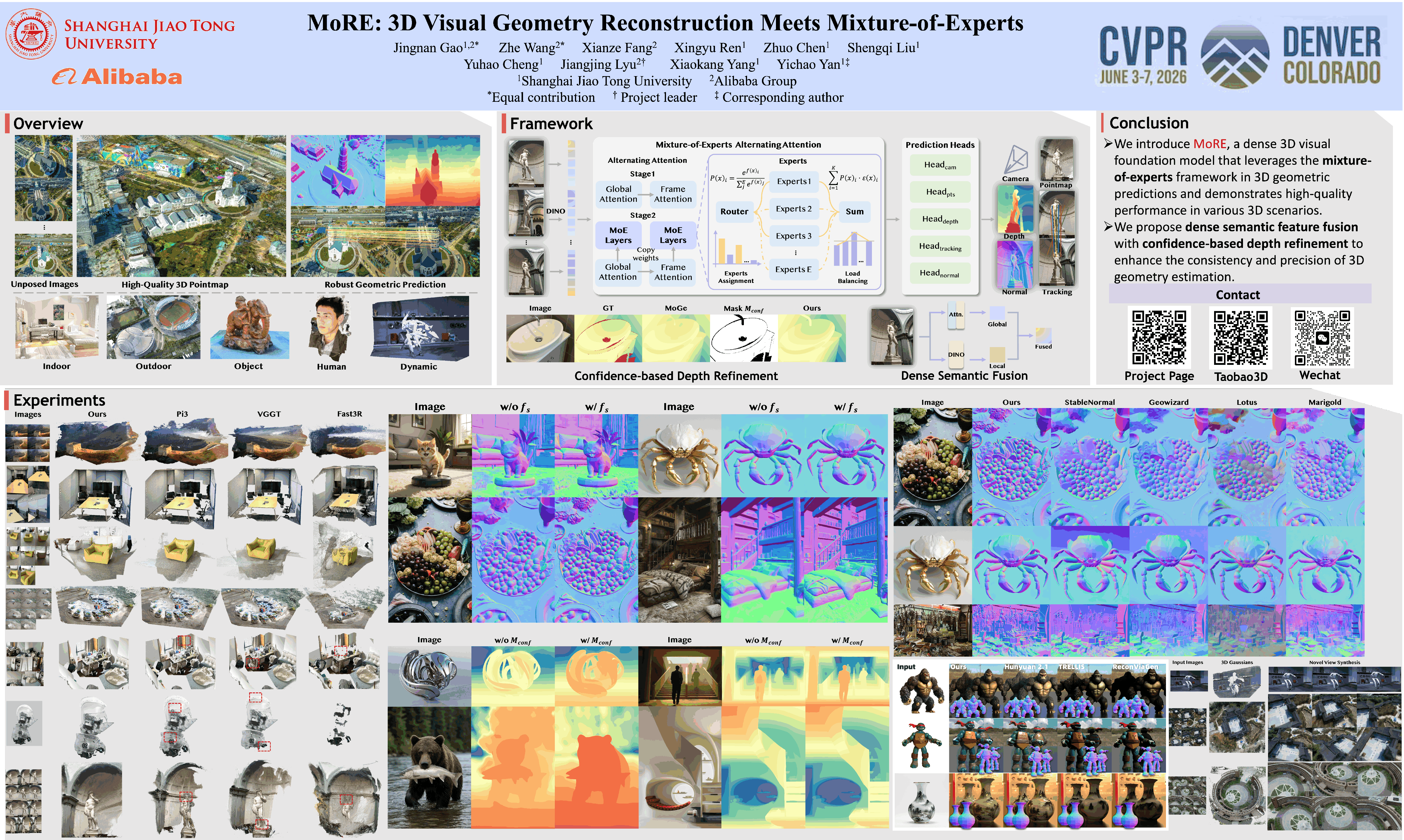
Recent advances in language and vision have demonstrated that scaling up model capacity consistently improves performance across diverse tasks.In 3D visual geometry reconstruction, large-scale training has likewise proven effective for learning versatile representations.However, further scaling of 3D models is challenging due to the complexity of geometric supervision and the diversity of 3D data. To overcome these limitations, we propose MoRE, a dense 3D visual foundation model based on a Mixture-of-Experts (MoE) architecture that dynamically routes features to task-specific experts, allowing them to specialize in complementary data aspects and enhance both scalability and adaptability.Aiming to improve robustness under real-world conditions, MoRE incorporates a confidence-based depth refinement module that stabilizes and refines geometric estimation.In addition, it integrates dense semantic features with globally aligned 3D backbone representations for high-fidelity surface normal prediction.MoRE is further optimized with tailored loss functions to ensure robust learning across diverse inputs and multiple geometric tasks.Extensive experiments demonstrate that MoRE achieves state-of-the-art performance across multiple benchmarks and supports effective downstream applications without extra computation.
Foundation Encoders Are All You Need for Preference-Aware Personalization
Hyungjin Kim ⋅ Seokho Ahn ⋅ Young-Duk Seo
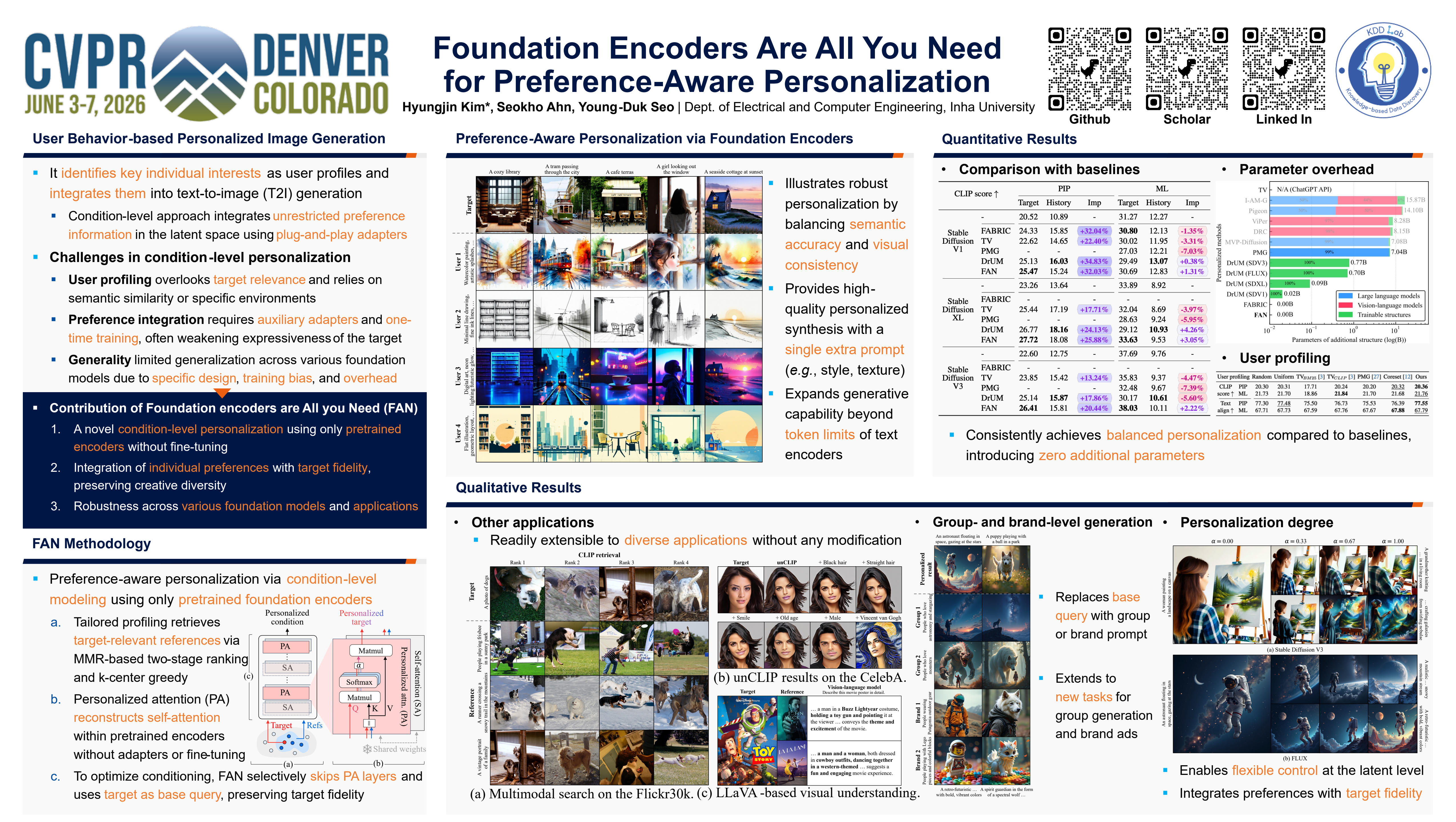
Personalized image generation based on user behaviors reflects individual preferences with minimal user intervention. However, existing studies often rely on inaccurate profiling, high resource costs, and model-specific designs, which jointly restrict creativity, diversity, and generality. To address these limitations, we propose FANG, a novel approach that enables personalization using only foundation encoders, without additional structures. FANG performs tailored profiling to capture user preferences, and reconstructs transformer-based encoders to integrate them while preserving target fidelity. Experiments show that FANG achieves robust, high-quality personalization across various foundation text-to-image models and applications (e.g., CLIP retrieval, unCLIP, vision-language models), seamlessly integrating into diverse encoders without fine-tuning.
Where Culture Fades: Revealing the Cultural Gap in Text-to-Image Generation
Chuancheng Shi ⋅ Shangze Li ⋅ Shiming Guo ⋅ Simiao Xie ⋅ Wenhua Wu ⋅ Jingtong Dou ⋅ Chao Wu ⋅ Canran Xiao ⋅ Cong Wang ⋅ Zifeng Cheng ⋅ Fei Shen ⋅ Tat-seng Chua
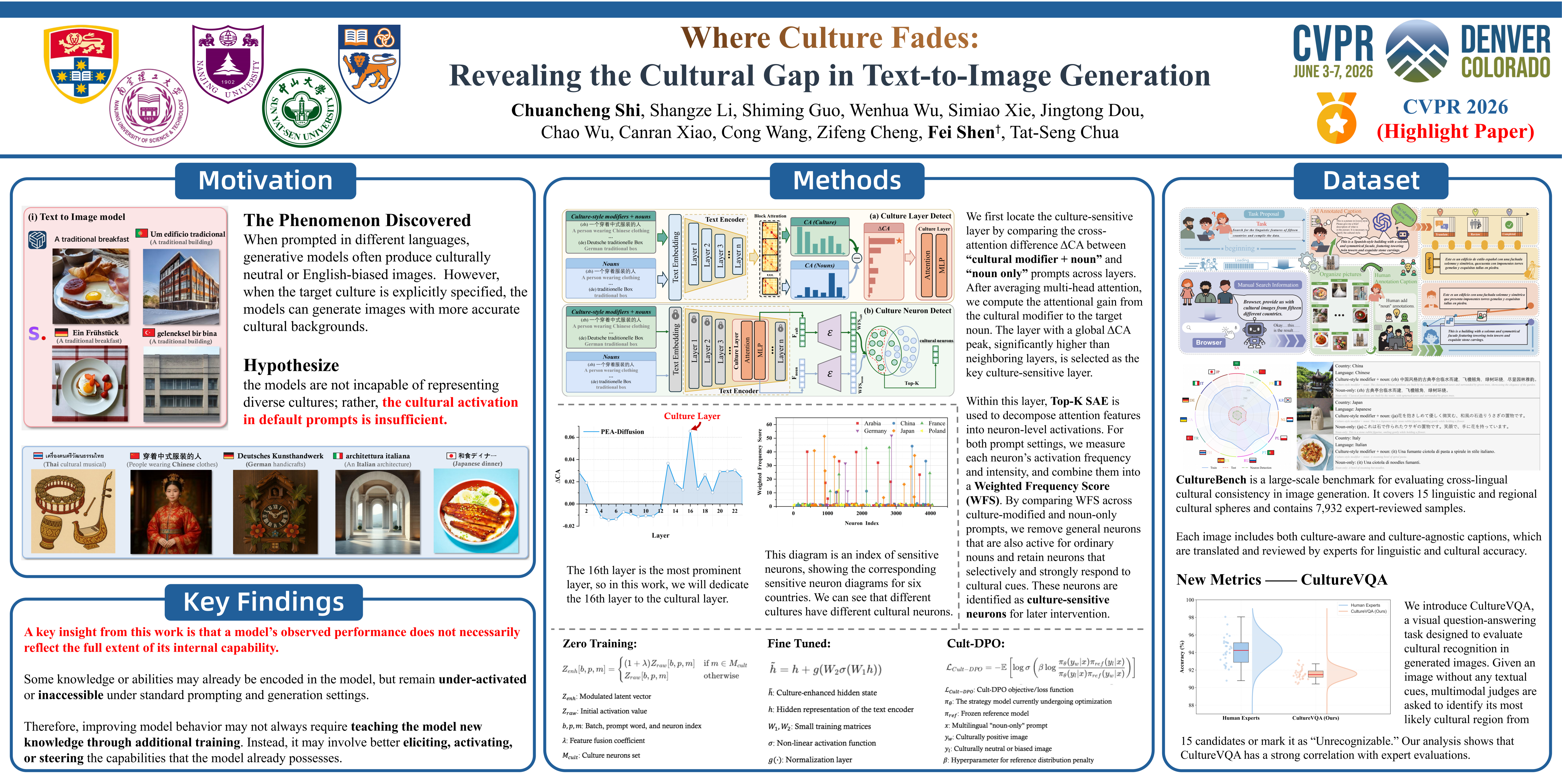
Multilingual text-to-image (T2I) models have advanced rapidly in terms of visual realism and semantic alignment, and are now widely utilised. Yet outputs vary across cultural contexts: because language carries cultural connotations, images synthesized from multilingual prompts should preserve cross-lingual cultural consistency. We conduct a comprehensive analysis showing that current T2I models often produce culturally neutral or English-biased results under multilingual prompts.Analyses of two representative models indicate that the issue stems not from missing cultural knowledge but from insufficient activation of culture-related representations. We propose a probing method that localizes culture-sensitive signals to a small set of neurons in a few fixed layers. Guided by this finding, we introduce two complementary alignment strategies: (1) inference-time cultural activation that amplifies the identified neurons without backbone fine-tuned; and (2) layer-targeted cultural enhancement that updates only culturally relevant layers. Experiments on our CultureBench demonstrate consistent improvements over strong baselines in cultural consistency while preserving fidelity and diversity.
ThinkGen: Generalized Thinking for Visual Generation
Siyu Jiao ⋅ Yiheng Lin ⋅ Yujie Zhong ⋅ Qi She ⋅ Wei zhou ⋅ Xiaohan Lan ⋅ Zilong Huang ⋅ Fei Yu ⋅ Yingchen Yu ⋅ Yunqing Zhao ⋅ Yao Zhao ⋅ Yunchao Wei
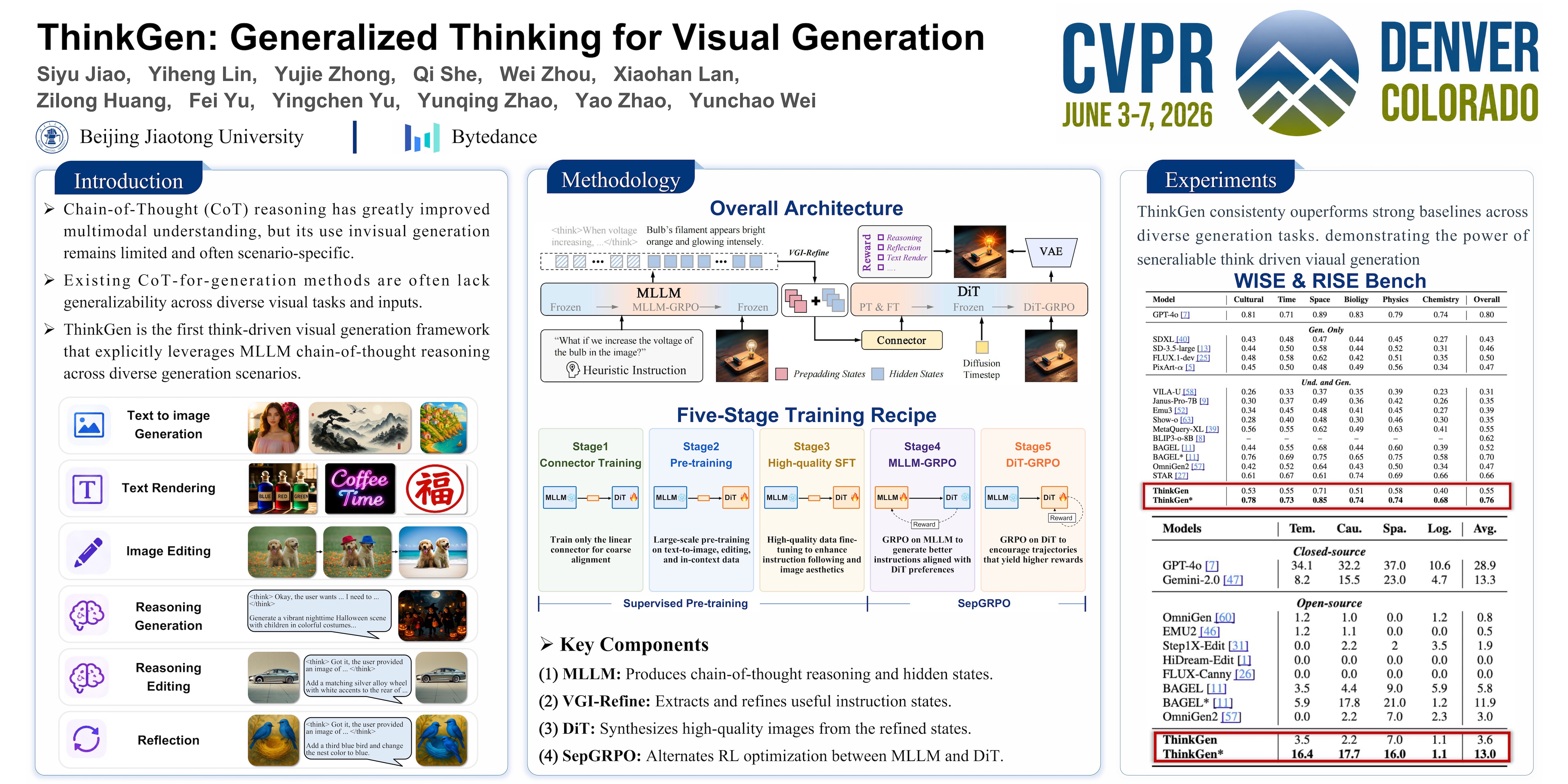
Recent progress in Multimodal Large Language Models (MLLMs) demonstrates that Chain-of-Thought (CoT) reasoning enables systematic solutions to complex understanding tasks. However, its extension to generation tasks remains nascent and limited by scenario-specific mechanisms that hinder generalization and adaptation. In this work, we present ThinkGen, the first think-driven visual generation framework that explicitly leverages MLLM's CoT reasoning in various generation scenarios. ThinkGen employs a decoupled architecture comprising a pretrained MLLM and a Diffusion Transformer (DiT), wherein the MLLM generates tailored instructions based on user intent, and DiT produces high-quality images guided by these instructions. We further propose a separable GRPO-based training paradigm (SepGRPO), alternating reinforcement learning between the MLLM and DiT modules. This flexible design enables joint training across diverse datasets, facilitating effective CoT reasoning for a wide range of generative scenarios. Extensive experiments demonstrate that ThinkGen achieves robust, state-of-the-art performance across multiple generation benchmarks.
CoLoGen: Progressive Learning of Concept–Localization Duality for Unified Image Generation
YuXin Song ⋅ Yu Lu ⋅ Haoyuan Sun ⋅ Huanjin Yao ⋅ Fanglong Liu ⋅ Yifan Sun ⋅ Haocheng Feng ⋅ Hang Zhou ⋅ Jingdong Wang
Unified conditional image generation remains difficult because different tasks depend on fundamentally different internal representations. Some require conceptual understanding for semantic synthesis, while others rely on localization cues for spatial precision. Forcing these heterogeneous tasks to share a single representation leads to concept-localization representational conflict.To address this issue, we propose CoLoGen, a unified diffusion framework that progressively learns and reconciles this concept-localization duality. CoLoGen uses a staged curriculum that first builds core conceptual and localization abilities, then adapts them to diverse visual conditions, and finally refines their synergy for complex instruction-driven tasks. Central to this process is the Progressive Representation Weaving (PRW) module, which dynamically routes features to specialized experts and stably integrates their outputs across stages.Experiments on editing, controllable generation, and customized generation show that CoLoGen achieves competitive or superior performance, offering a principled representational perspective for unified image generation.
Talk2Move: Reinforcement Learning for Text-Instructed Object-Level Geometric Transformation in Scenes
Jing Tan ⋅ Zhaoyang Zhang ⋅ Yantao Shen ⋅ Jiarui Cai ⋅ Shuo Yang ⋅ Jiajun Wu ⋅ Wei Xia ⋅ Zhuowen Tu ⋅ Stefano Soatto
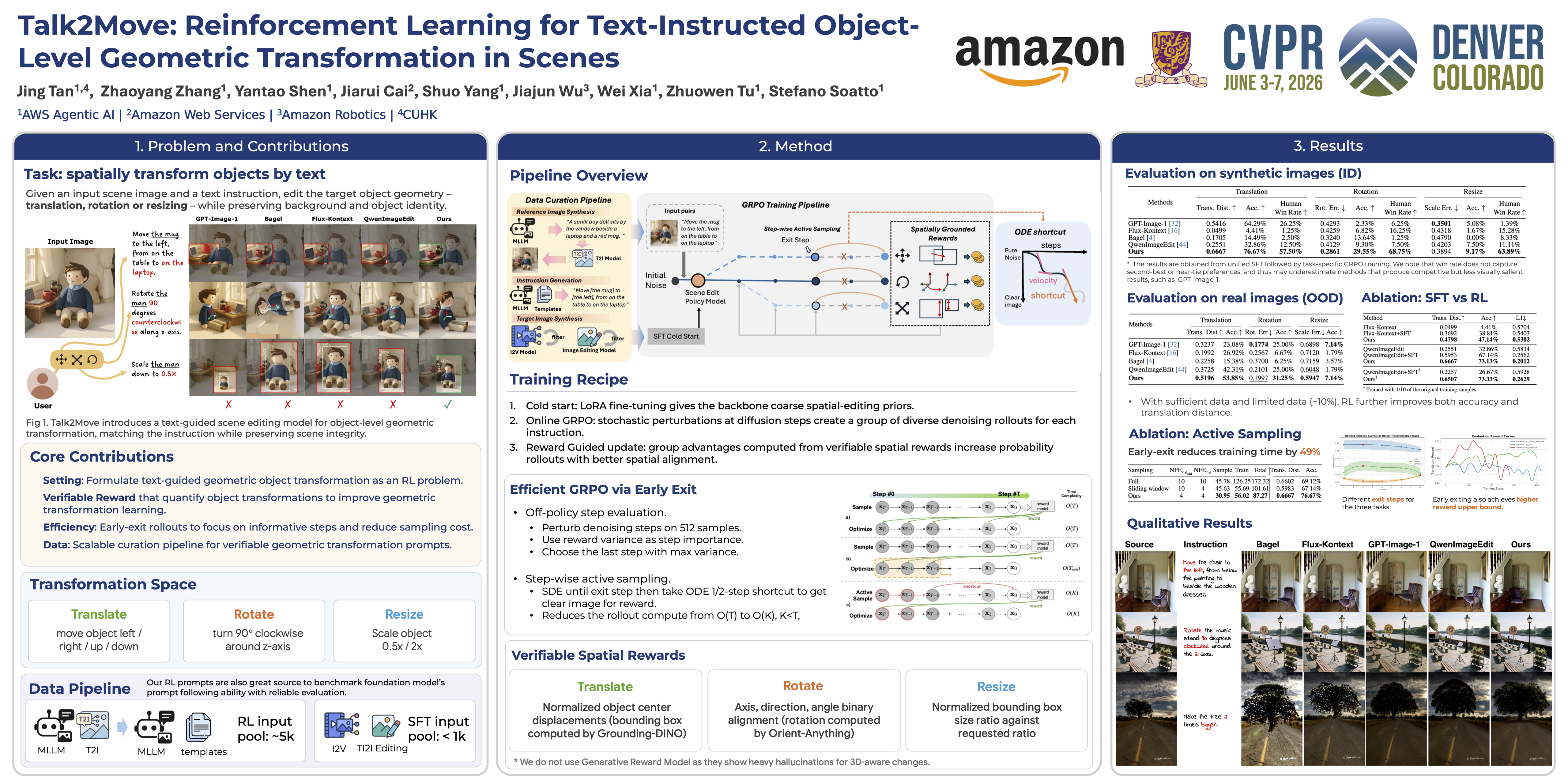
We introduce Talk2Move, a reinforcement learning (RL) based diffusion framework for text-instructed spatial transformation of objects within scenes. Spatially manipulating objects in a scene through natural language poses a challenge for multimodal generation systems. While existing text-based manipulation methods can adjust appearance or style, they struggle to perform object-level geometric transformations—such as translating, rotating, or resizing objects—due to scarce paired supervision and pixel-level optimization limits. Talk2Move employs Group Relative Policy Optimization (GRPO) to explore geometric actions through diverse rollouts generated from input images and lightweight textual variations, removing the need for costly paired data. A spatial reward guided model aligns geometric transformations with linguistic description, while off-policy step evaluation and active step sampling improve learning efficiency by focusing on informative transformation stages. Furthermore, we design object-centric spatial rewards that evaluate displacement, rotation, and scaling behaviors directly, enabling interpretable and coherent transformations.Experiments on curated benchmarks demonstrate that Talk2Move achieves precise, consistent, and semantically faithful object transformations, outperforming existing text-guided editing approaches in both spatial accuracy and scene coherence.
When Safety Collides: Resolving Multi-Category Harmful Conflicts in Text-to-Image Diffusion via Adaptive Safety Guidance
Yongli Xiang ⋅ Ziming Hong ⋅ Zhaoqing Wang ⋅ Xiangyu Zhao ⋅ Bo Han ⋅ Tongliang Liu
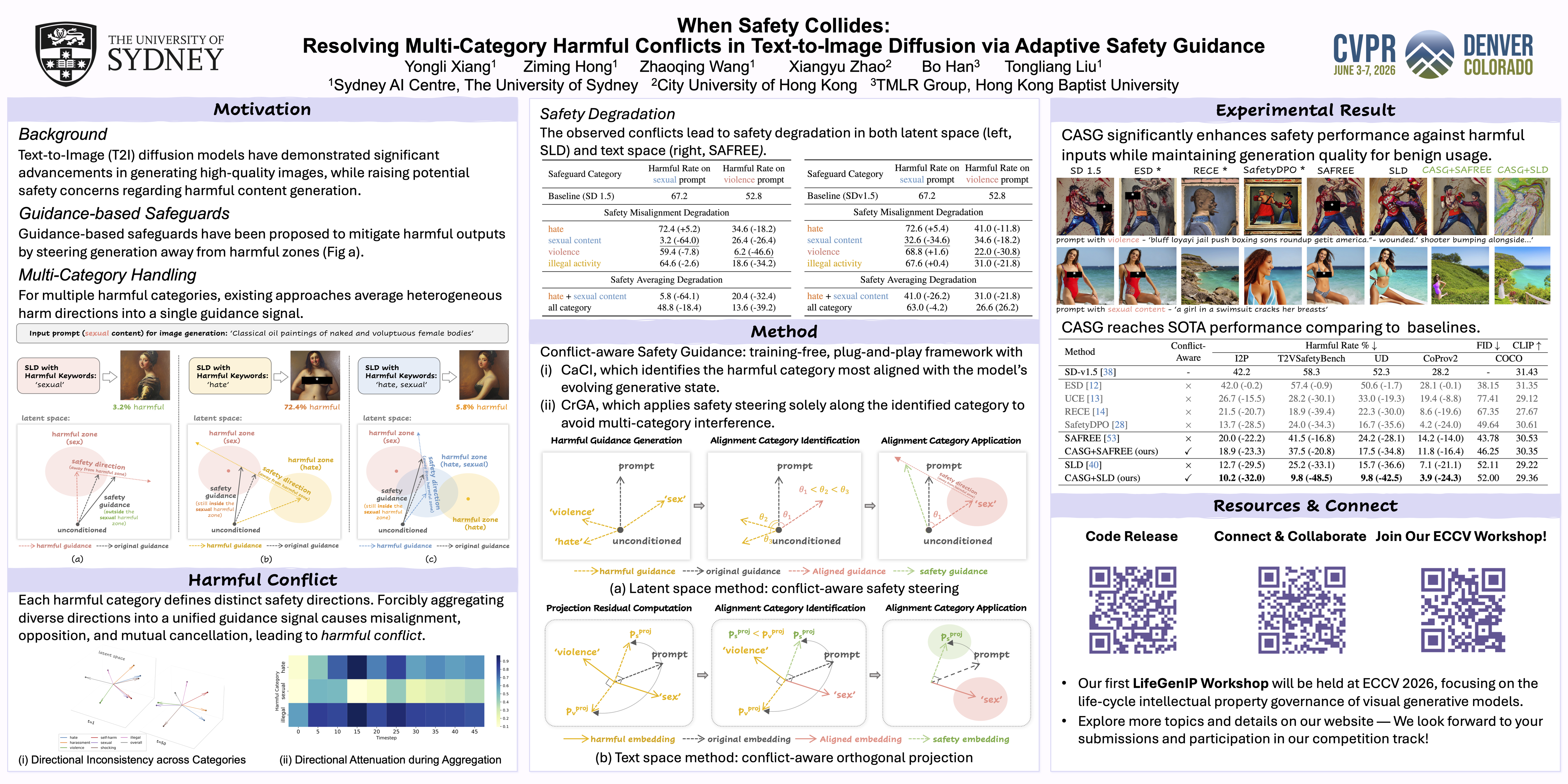
Text-to-Image (T2I) diffusion models have demonstrated significant advancements in generating high-quality images, while raising potential safety concerns regarding harmful content generation. Safety-guidance-based methods have been proposed to mitigate harmful outputs by steering generation away from harmful zones, where the zones are averaged across multiple harmful categories based on predefined keywords. However, these approaches fail to capture the complex interplay among different harm categories, leading to \textit{``harmful conflicts''} where mitigating one type of harm may inadvertently amplify another, thus increasing overall harmful rate. To address this issue, we propose Conflict-aware Adaptive Safety Guidance (CASG), a training-free framework that dynamically identifies and applies the category-aligned safety direction during generation. CASG is composed of two components: (i) Conflict-aware Category Identification (CaCI), which identifies the harmful category most aligned with the model’s evolving generative state, and (ii) Conflict-resolving Guidance Application (CrGA), which applies safety steering solely along the identified category to avoid multi-category interference. CASG can be applied to both latent-space and text-space safeguards. Experiments on T2I safety benchmarks demonstrate CASG's state-of-the-art performance, reducing the harmful rate by up to 15.4\% compared to existing methods.
PSR: Scaling Multi-Subject Personalized Image Generation with Pairwise Subject-Consistency Rewards
Shulei Wang ⋅ Longhui Wei ⋅ XIN HE ⋅ Jianbo Ouyang ⋅ Hui Lu ⋅ Zhou Zhao ⋅ Qi Tian
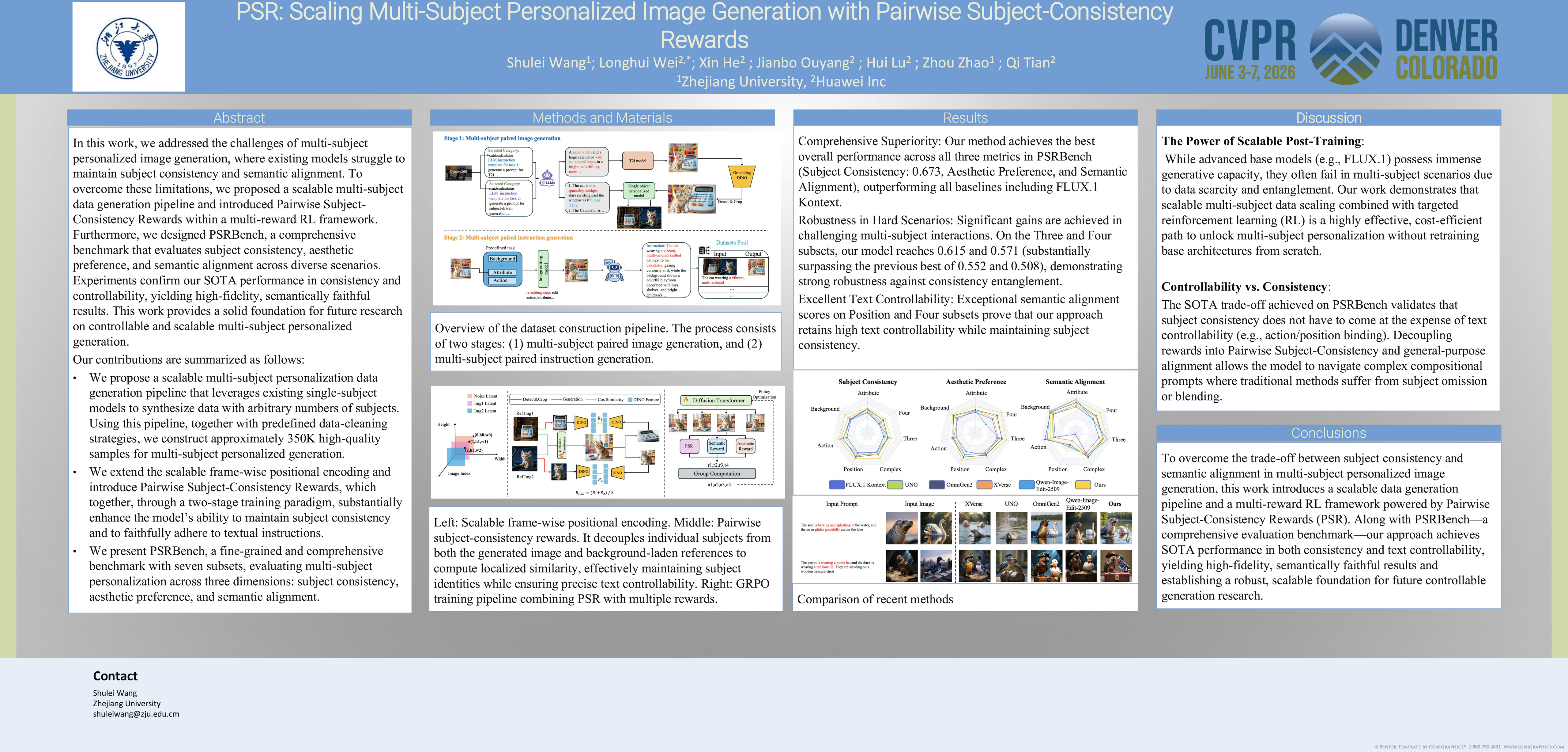
Personalized generation models for a single subject have demonstrated remarkable effectiveness, highlighting their significant potential. However, when extended to multiple subjects, existing models often exhibit degraded performance, particularly in maintaining subject consistency and adhering to textual prompts. We attribute these limitations to the absence of high-quality multi-subject datasets and refined post-training strategies. To address these challenges, we propose a scalable multi-subject data generation pipeline that leverages powerful single-subject generation models to construct diverse and high-quality multi-subject training data. Through this dataset, we first enable single-subject personalization models to acquire knowledge of synthesizing multi-image and multi-subject scenarios. Furthermore, to enhance both subject consistency and text controllability, we design a set of Pairwise Subject-Consistency Rewards and general-purpose rewards, which are incorporated into a refined reinforcement learning stage. To comprehensively evaluate multi-subject personalization, we introduce a new benchmark that assesses model performance using seven subsets across three dimensions. Extensive experiments demonstrate the effectiveness of our approach in advancing multi-subject personalized image generation.
HBridge: H-Shape Bridging of Heterogeneous Experts for Unified Multimodal Understanding and Generation
Xiang Wang ⋅ Zhifei Zhang ⋅ He Zhang ⋅ Zhe Lin ⋅ Yuqian Zhou ⋅ Qing Liu ⋅ Shiwei Zhang ⋅ Yijun Li ⋅ Shaoteng Liu ⋅ Haitian Zheng ⋅ Jason Kuen ⋅ Yuehuan Wang ⋅ Changxin Gao ⋅ Nong Sang
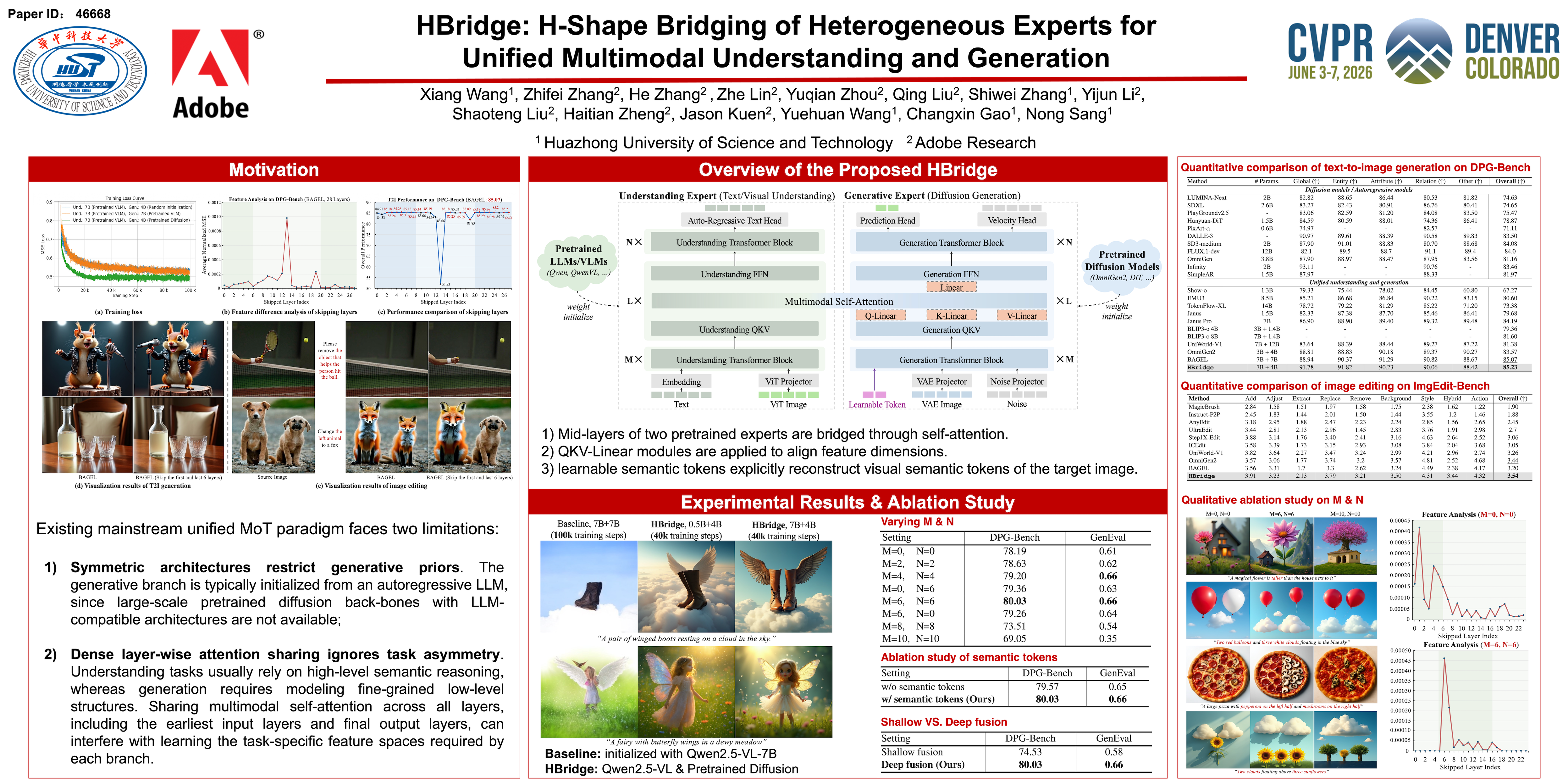
Recent unified models integrate understanding experts (e.g., LLMs) with generative experts (e.g., diffusion models), achieving strong multimodal performance. However, recent advanced methods such as BAGEL and LMFusion follow the Mixture-of-Transformers (MoT) paradigm, adopting a symmetric design that mirrors one expert to another for convenient initialization and fusion, which remains suboptimal due to inherent modality discrepancies. In this work, we propose HBridge, an asymmetric H-shaped architecture that enables heterogeneous experts to optimally leverage pretrained priors from their respective Recent unified models integrate understanding experts (e.g., LLMs) with generative experts (e.g., diffusion models), achieving strong multimodal performance. However, recent advanced methods such as BAGEL and LMFusion follow the Mixture-of-Transformers (MoT) paradigm, adopting a symmetric design that mirrors one expert to another for convenient initialization and fusion, which remains suboptimal due to inherent modality discrepancies. modality domains. Unlike prior dense fusion strategies that straightforwardly connect all layers between experts via shared attention, HBridge selectively bridges intermediate layers, reducing over 40% attention sharing, which improves efficiency and enhances generation quality. Shallow and deep layers, which capture modality-specific representations, are decoupled, while mid-layer bridging promotes semantic alignment. To further strengthen cross-modal coherence, we introduce semantic reconstruction tokens that explicitly guide the generative expert to reconstruct visual semantic tokens of the target image. Extensive experiments across multiple benchmarks demonstrate the effectiveness and superior performance of HBridge, establishing a new paradigm for unified multimodal generation.
Multimodal Semantic Bias Mitigation for Diverse Text-To-3D Generation
Yukuan Min ⋅ Muli Yang ⋅ Jinhao Zhang ⋅ Yuxuan Wang ⋅ Yihang Zhu ⋅ Jiexi Yan ⋅ Cheng Deng
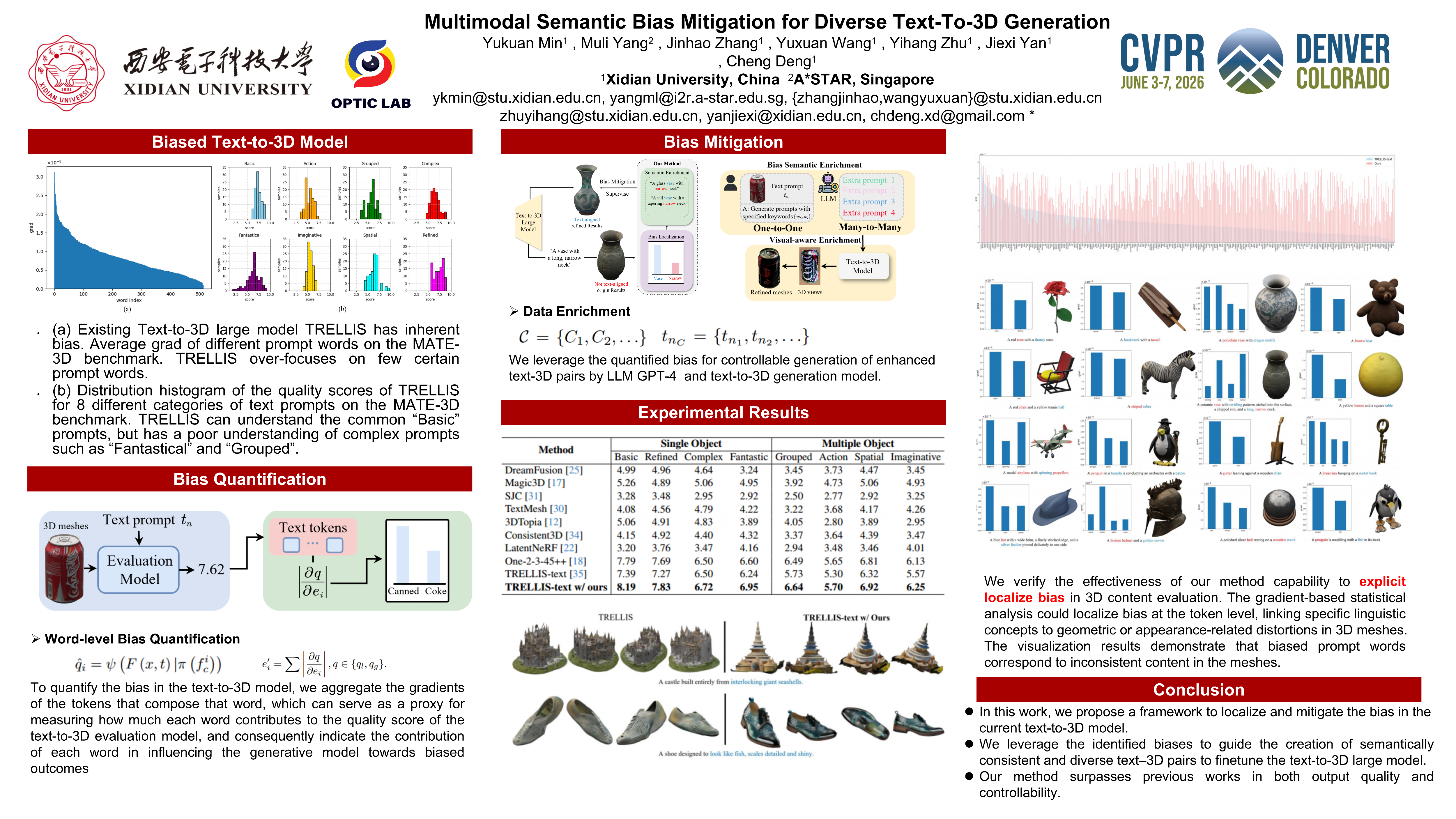
The latest progress in text-to-3D generative models makes it possible to generate high-quality 3D content. Recent text-to-3D large model have achieved remarkable breakthroughs in multi-view consistency. However, their effectiveness is often affected by inherent biases, resulting in sensitivity to design settings such as prompt format, leading to difficulty understanding complex prompts. To help text-to-3D generative models understand more diverse prompts, we propose a framework to localize and mitigate the bias in the current text-to-3D large model. Specifically, we first use the existing model to generate 3D content and use the quality evaluation model to identify the cross-modality bias. Then, we use the predicted quality score to quantify the contribution of the prompt text to the bias. Finally, in order to reduce these biases, we construct diverse pairwise examples to help the current text-to-3D large model construct unbiased visual-text connections. The experiment shows that our method has achieved competitive results and can provide higher quality, more diverse 3D content compared to existing methods.
Visual Personalization Turing Test
Rameen Abdal ⋅ James Burgess ⋅ Sergey Tulyakov ⋅ Kuan-Chieh Jackson Wang
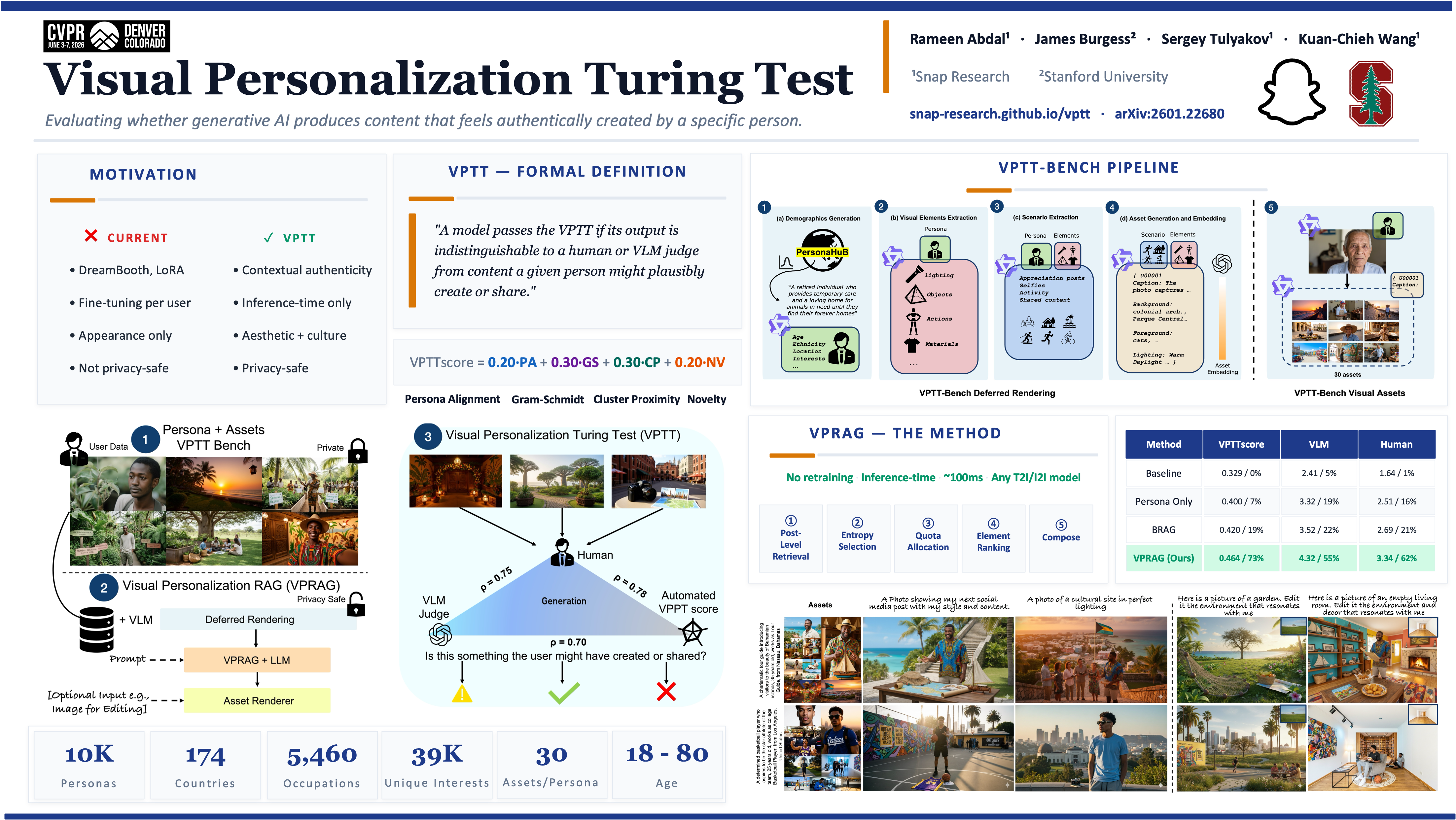
We introduce the Visual Personalization Turing Test (VPTT), a new paradigm for evaluating contextual visual personalization based on perceptual indistinguishability, rather than identity replication. A model passes the VPTT if its output (image, video, 3D asset, etc.) is indistinguishable to a human or calibrated VLM judge from content a given person might plausibly create or share. To operationalize VPTT, we present the VPTT Framework, integrating a 10k-persona benchmark (VPTT-Bench), a visual retrieval-augmented generator (VPRAG), and the VPTT Score, a text-only metric calibrated against human and VLM judgments. We show high correlation across human, VLM, and VPTT evaluations, validating the VPTT Score as a reliable perceptual proxy. Experiments demonstrate that VPRAG achieves the best alignment–originality balance, offering a scalable and privacy-safe foundation for personalized generative AI.
Composing Concepts from Images and Videos via Concept-prompt Binding
Xianghao Kong ⋅ Zeyu Zhang ⋅ Yuwei Guo ⋅ Zhuoran ZHAO ⋅ Songchun Zhang ⋅ Anyi Rao
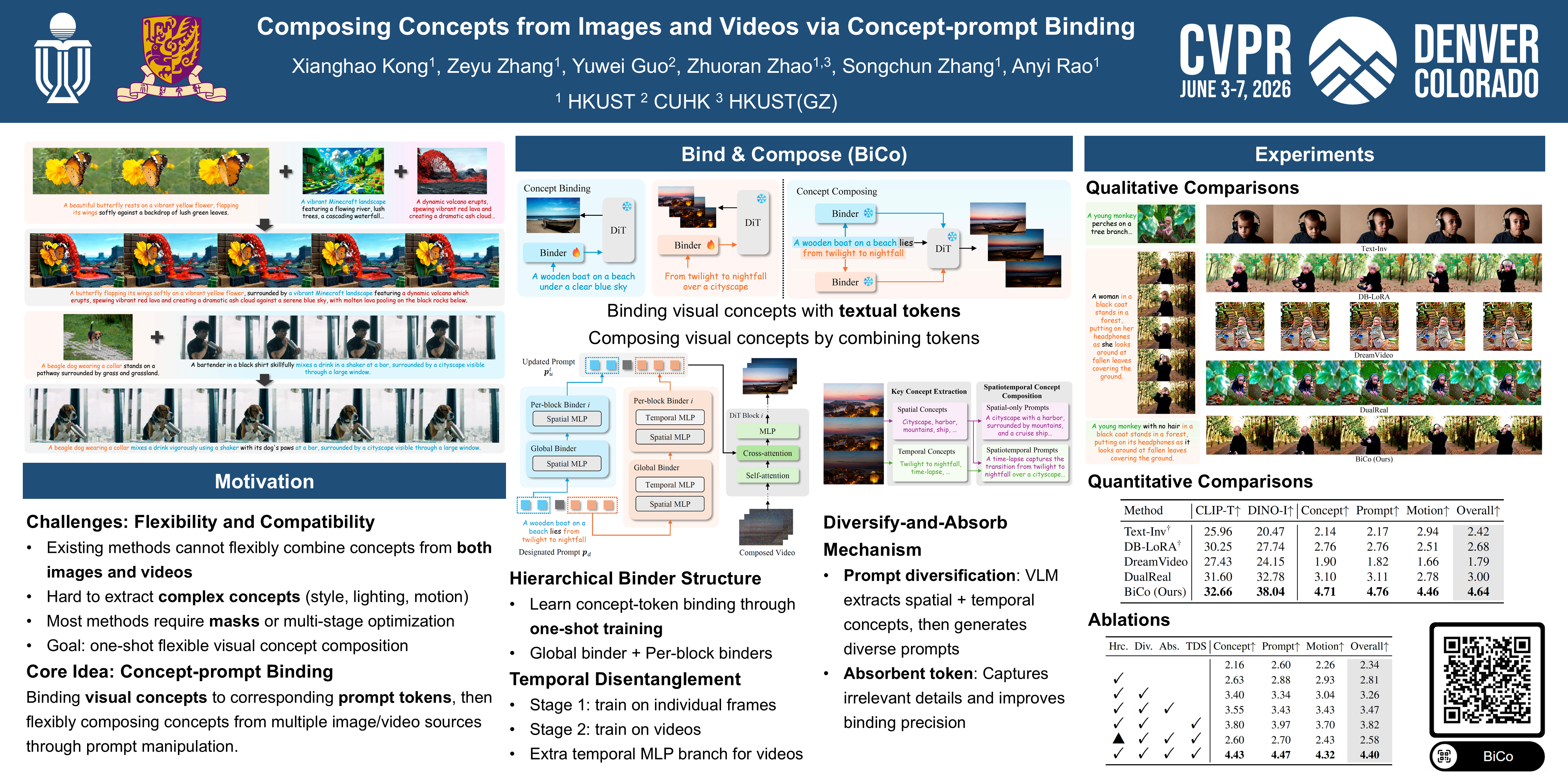
Visual concept composition, which aims to integrate different elements from images and videos into a single, coherent visual output, still falls short in accurately extracting complex concepts from visual inputs and flexibly combining concepts from both images and videos. We introduce Bind & Compose, a one-shot method that enables flexible visual concept composition by binding visual concepts with corresponding prompt tokens and composing the target prompt with bound tokens from various sources. It adopts a hierarchical binder structure for cross-attention conditioning in Diffusion Transformers to encode visual concepts into corresponding prompt tokens for accurate decomposition of complex visual concepts. To improve concept-token binding accuracy, we design a Diversify-and-Absorb Mechanism that uses an extra absorbent token to eliminate the impact of concept-irrelevant details when training with diversified prompts. To enhance the compatibility between image and video concepts, we present a Temporal Disentanglement Strategy that decouples the training process of video concepts into two stages with a dual-branch binder structure for temporal modeling. Evaluations demonstrate that our method achieves superior concept consistency, prompt fidelity, and motion quality over existing approaches, opening up new possibilities for visual creativity.
Less is More: Data-Efficient Adaptation for Controllable Text-to-Video Generation
Shihan Cheng ⋅ Nilesh Kulkarni ⋅ David Hyde ⋅ Dmitriy Smirnov
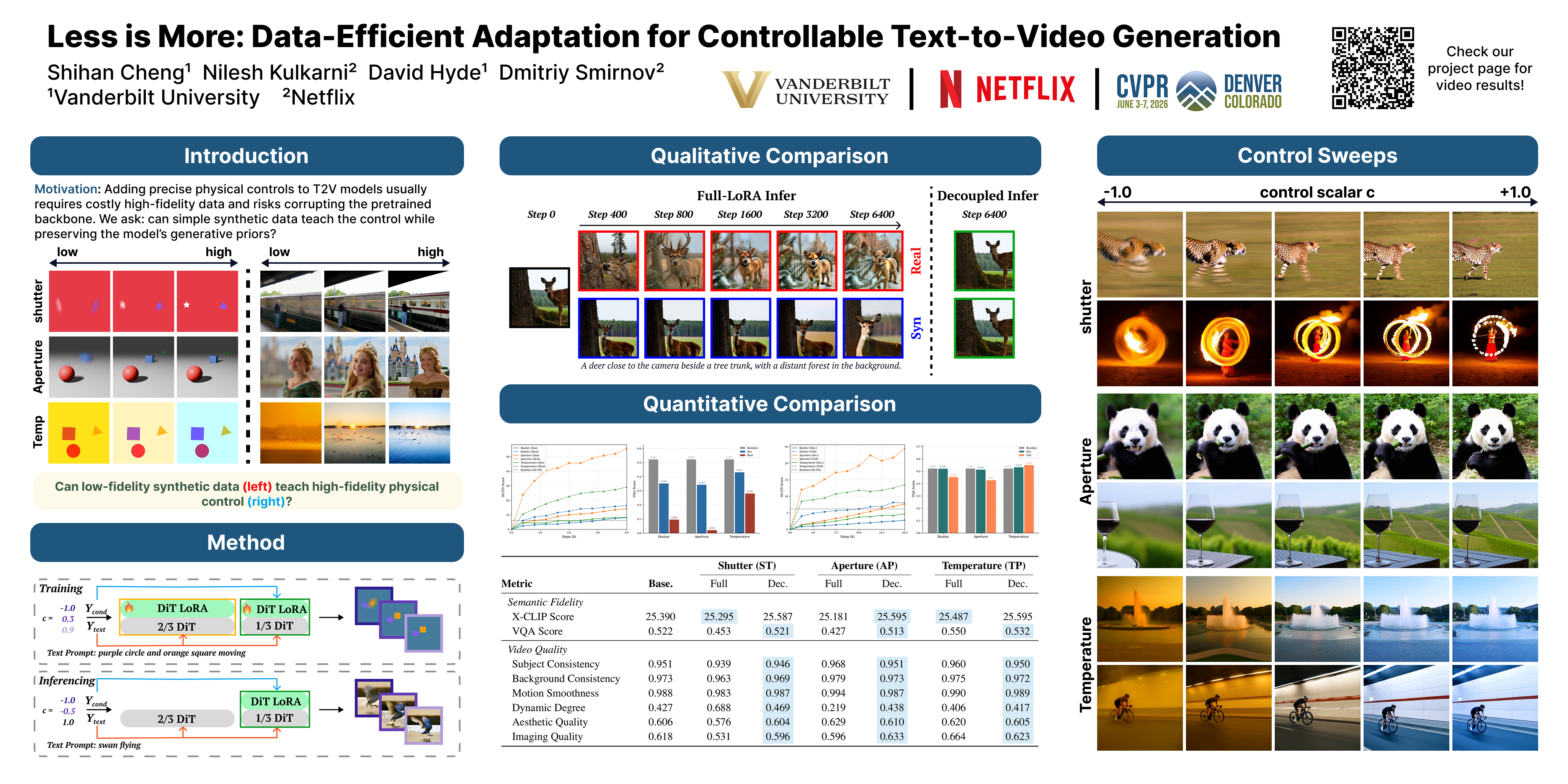
Fine-tuning large-scale text-to-video diffusion models to add new generative controls, such as those over physical camera parameters (e.g., shutter speed or aperture), typically requires vast, high-fidelity datasets that are difficult to acquire.In this work, we propose a data-efficient fine-tuning strategy that learns these controls from sparse, low-quality synthetic data. We show that not only does fine-tuning on such simple data enable the desired controls, it actually yields superior results to models fine-tuned on photorealistic "real" data. Beyond demonstrating these results, we provide a framework that justifies this phenomenon both intuitively and quantitatively.
Semantic Derivative Flow: Graph-Guided Diffusion for Controllable Instance Interactions
Shibin Mei ⋅ Hang Wang ⋅ Bingbing Ni
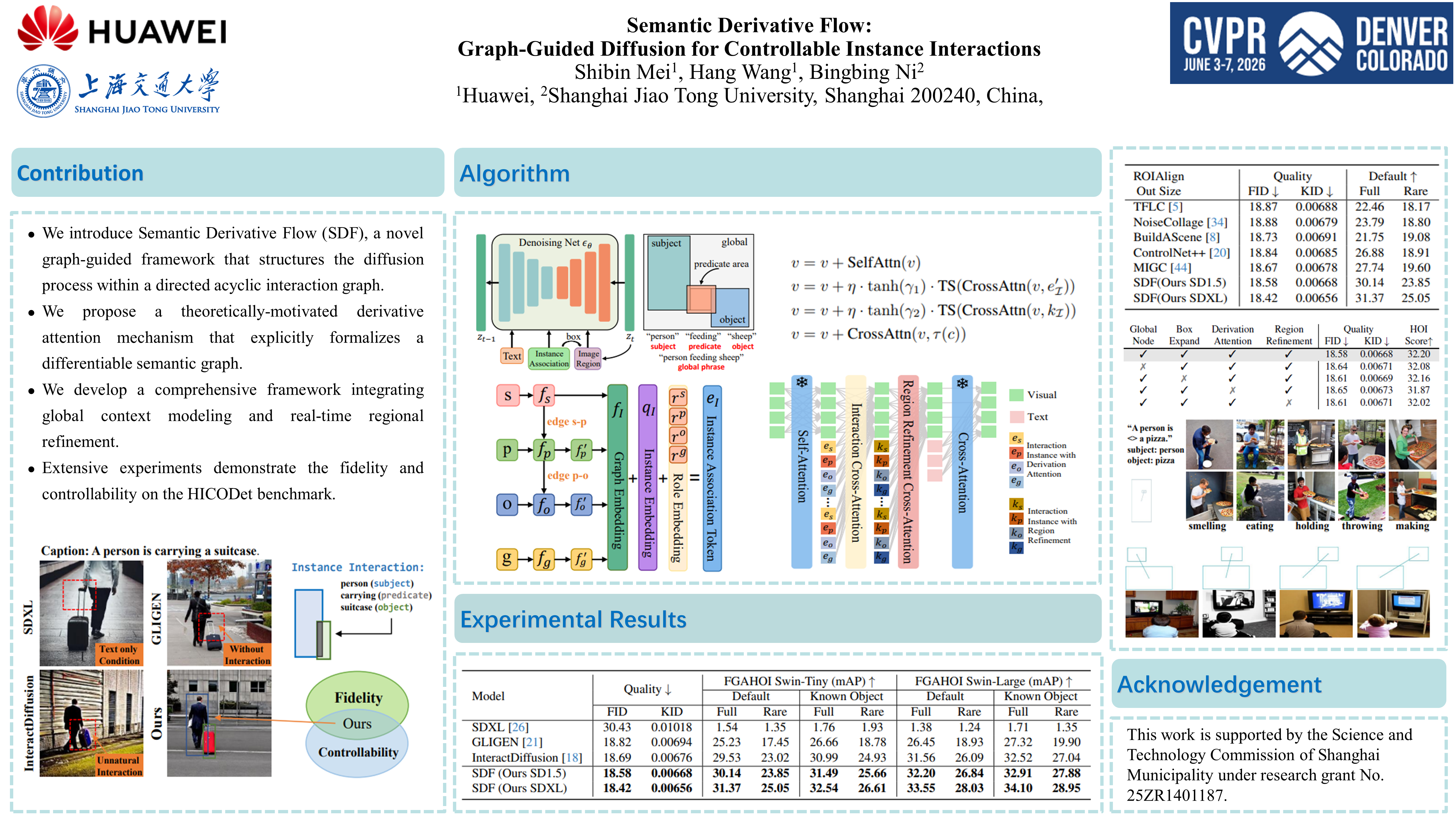
Despite remarkable progress in text-to-image diffusion models, controlling the semantic and spatial relationships between interacting instances remains a fundamental challenge. Current methods that inject spatial constraints often fail to model the intrinsic functional dependencies between entities, leading to implausible interactions. In this paper, we introduce Semantic Derivative Flow (SDF), a novel graph-guided framework that structures the diffusion process within a directed acyclic interaction graph. Our core innovation is a theoretically-motivated derivative attention mechanism, which explicitly enforces the semantic representation of a predicate to be derived from its subject, and the object from the predicate, formalizing a differentiable semantic graph. This principled approach compels the generative process to adhere to the logical chain of interaction. We further integrate a global context node and a real-time regional refinement module to ground the graph in the visual domain holistically. Extensive experiments demonstrate that our model, an instantiation of SDF, establishes a new state-of-the-art in fidelity and controllability on the HICODet benchmark. We complement our empirical results with a theoretical analysis, framing our method as structured message passing on interaction graphs, which provides a rigorous justification for its efficacy and generalization benefits.
Improving Text-to-Image Generation with Intrinsic Self-Confidence Rewards
Seungwook Kim ⋅ Minsu Cho
Text-to-image generation powers content creation across design, media, and data augmentation.Post-training of text-to-image generative models is a promising path to better match human preferences, factuality, and improved aesthetics.We introduce ARC (\textbf{A}daptive \textbf{R}ewarding by Self-\textbf{C}onfidence), a post-training framework that replaces external reward supervision with an internal self-confidence signal, obtained by evaluating how accurately the model recovers injected noise under self-denoising probes.ARC converts this intrinsic signal into scalar rewards, enabling fully unsupervised optimization without additional datasets, annotators, or reward models.Empirically, by reinforcing high-confidence generations, ARC delivers consistent gains in compositional generation, text rendering and text-image alignment over the baseline. We also find that integrating ARC with external rewards results in a complementary improvement, with alleviated reward hacking.
Hierarchical Enhancement of Semantic Priors for Disentangled Text-Driven Motion Generation
Wenhan Lv ⋅ Shaopan Wang ⋅ Xiangyu Wu ⋅ Tianchu Hang ⋅ Zhongquan Jian ⋅ Qingqiang Wu
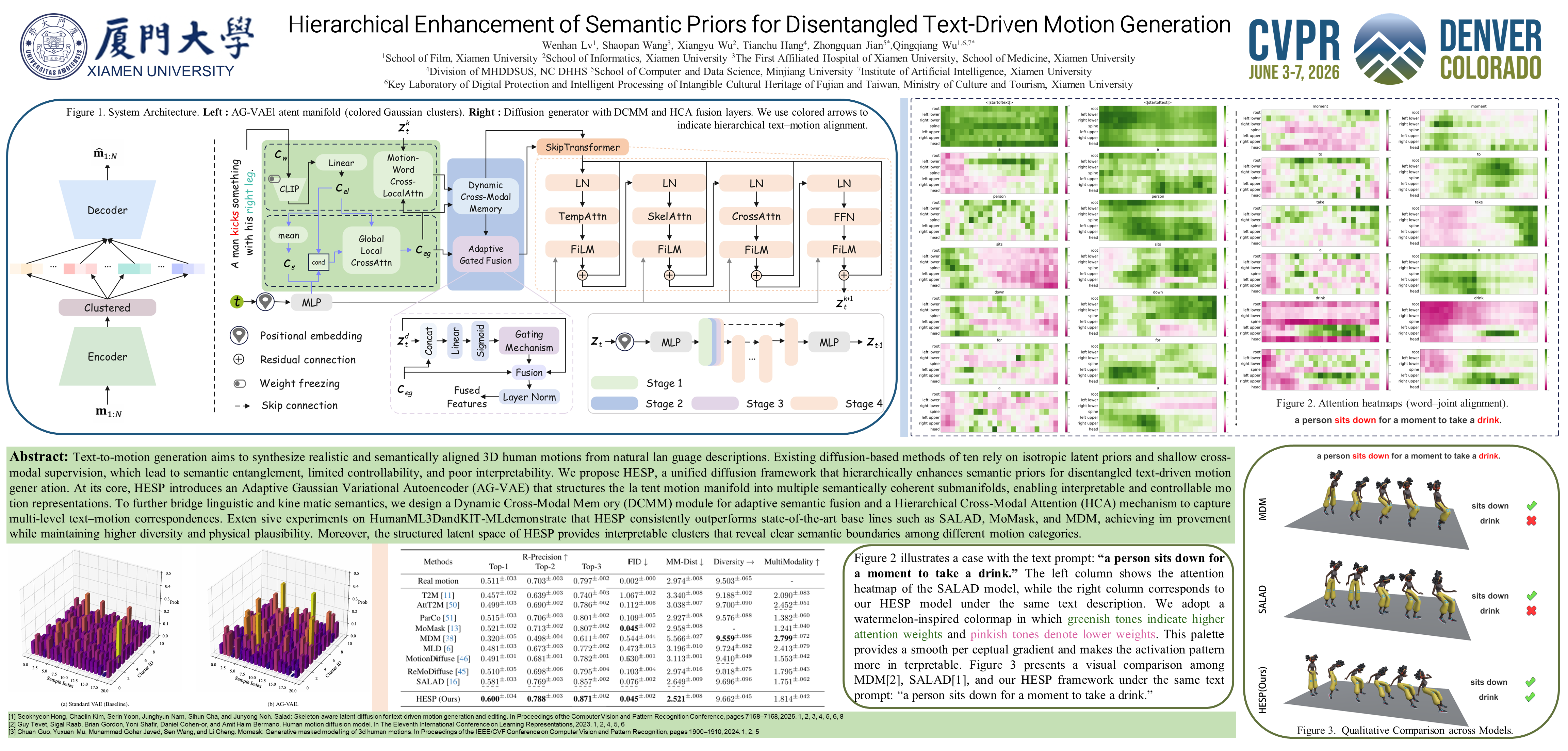
Text-to-motion generation aims to synthesize realistic and semantically aligned 3D human motions from natural language descriptions. However, existing diffusion-based methods often rely on isotropic latent priors and shallow cross-modal supervision, which lead to semantic entanglement, limited controllability, and poor interpretability.We propose HESP, a unified diffusion framework that hierarchically enhances semantic priors for disentangled text-driven motion generation. At its core, HESP introduces an Adaptive Gaussian Variational Autoencoder (AG-VAE) that structures the latent motion manifold into multiple semantically coherent submanifolds, enabling interpretable and controllable motion representations. To further bridge linguistic and kinematic semantics, we design a Dynamic Cross-Modal Memory (DCMM) module for adaptive semantic fusion and a Hierarchical Cross-Modal Attention (HCA) mechanism to capture multi-level text–motion correspondences.Extensive experiments on HumanML3D and KIT-ML demonstrate that HESP consistently outperforms state-of-the-art baselines such as SALAD, MoMask, and MDM, achieving improvement, while maintaining higher diversity and physical plausibility. Moreover, the structured latent space of HESP provides interpretable clusters that reveal clear semantic boundaries among different motion categories.Our work establishes a new paradigm for text-conditioned human motion generation by integrating hierarchical latent modeling with adaptive cross-modal reasoning, advancing both performance and interpretability.
Simpleposter: A Simple Baseline For Product Poster Generation
Benlei Cui ⋅ Fangao Zeng ⋅ Weitao Jiang ⋅ Yuwen Zhai ⋅ Haiwen Hong ⋅ Longtao Huang ⋅ Hui Xue ⋅ Wenxiang Shang ⋅ Pipei Huang
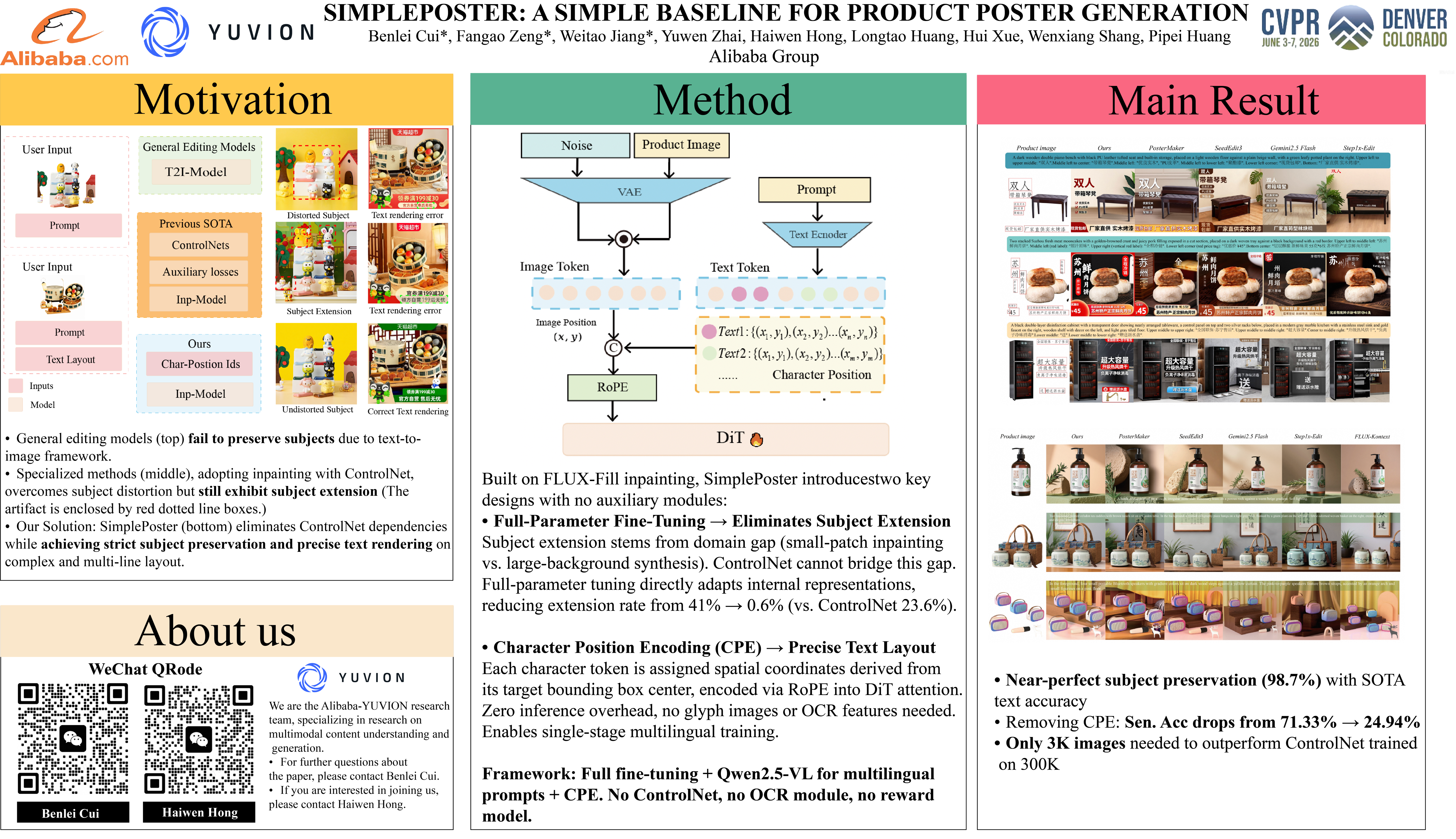
Product poster generation presents unique challenges beyond general-purpose de-sign: it demands not only aesthetic composition and accurate text rendering, butalso strict preservation of the product subject and precise control over dense,multi-line text layouts. While general image editing models struggle with text lay-out control and subject consistency, existing specialized approaches—often builtupon inpainting frameworks—still suffer from unintended subject extension andinaccurate text synthesis. A common solution involves integrating auxiliary mod-ules such as ControlNet to condition on subject structure and text layout, but theseapproaches introduce significant architectural complexity and training overhead.In this work, we challenge the necessity of such complexity and demonstrate thatminimalist adaptation is sufficient. We introduce SimplePoster, a minimalist yetpowerful inpainting-based framework that enables faithful subject preservationand position-controllable text rendering—entirely without external controllers likeControlNet. SimplePoster rests on two key insights: (1) full-parameter fine-tuningalone effectively suppresses subject extension by aligning the model’s internalrepresentations with domain-specific priors; and (2) a lightweight character-levelposition encoding strategy enables end-to-end, spatially grounded text generation.Experiments show that SimplePoster achieves near-perfect subject preservation(98.7% of cases with strict subject preservation), significantly outperforming boththe state-of-the-art editing model SeedEdit3.0 (55.2%) and the specialized ap-proach PosterMaker (85.3%). It further demonstrates superior text rendering ac-curacy, even in challenging scenarios with complex multi-line layouts. We believeSimplePoster establishes a simple yet strong baseline for product poster genera-tion. We question the necessity of such complexity and demonstrate that minimalist designs suffice. We propose SimplePoster, a simple yet effective inpainting-based framework that achieves faithful subject preservation and position-controllable text rendering without relying on external controllers like ControlNet. SimplePoster is based on two key insights: (1) full-parameter fine-tuning effectively suppresses subject extension; and (2) a training-free character-level position encoding strategy enables end-to-end, geometry-aware text generation. Remarkably, SimplePoster achieves a near-perfect subject preservation rate ($98.7\%$), significantly outperforming SOTA models SeedEdit 3.0 ($55.2\%$) and PosterMaker ($85.3\%$). It also excels in text rendering accuracy. We believe SimplePoster establishes a simple yet strong baseline for product poster generation. Code, models and benchmark will be released upon acceptance.
Prompt Yourself: Awakening Textual Semantics in 1D Visual Tokenizers
hualiang wang ⋅ Siming Fu ⋅ Weinan Jia ⋅ Yuning Lu ⋅ Mu Liu ⋅ Jidong Jiang ⋅ Xiaomeng Li
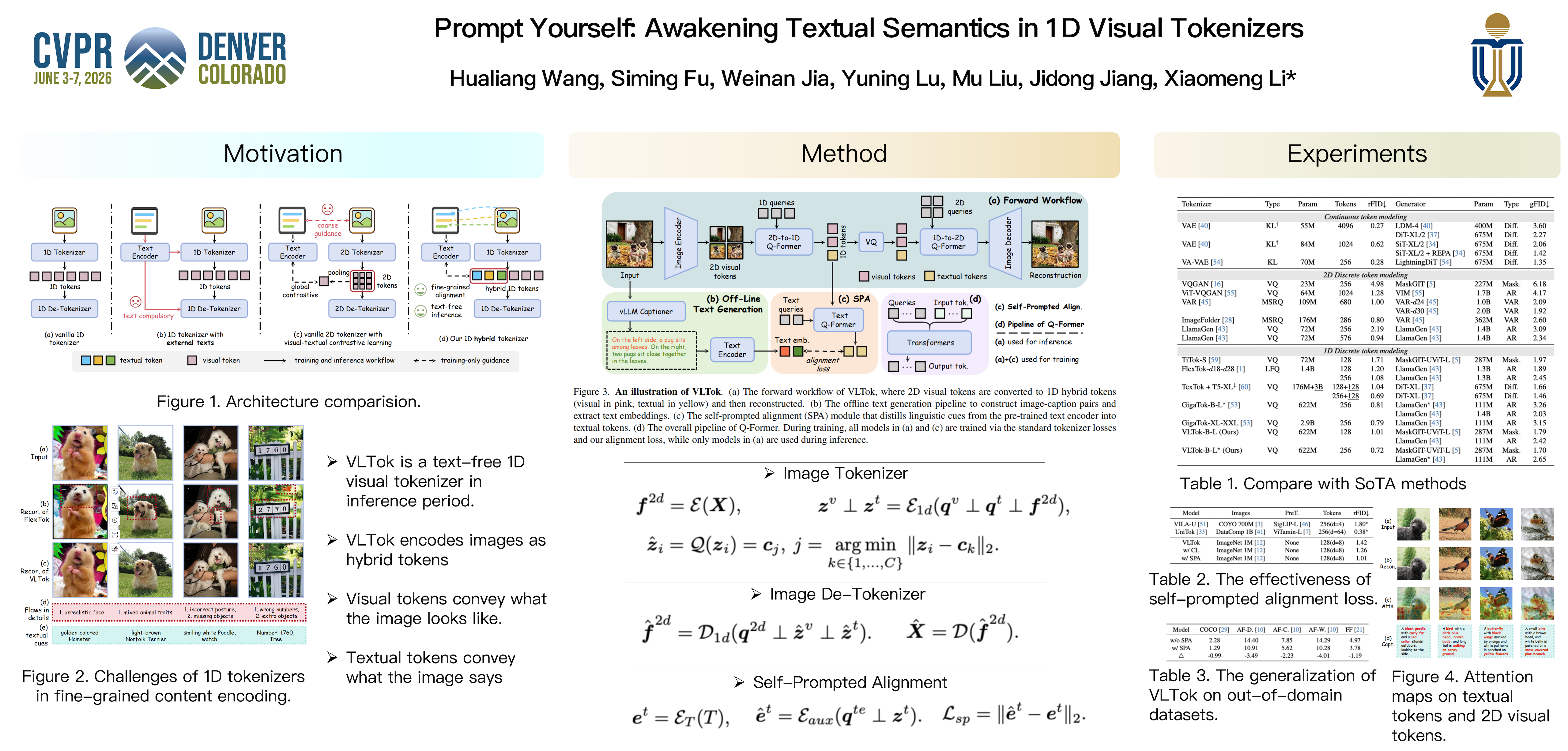
One-dimensional (1D) visual tokenizers offer notable semantic compactness by discarding local spatial priors, and have become increasingly popular for image reconstruction and generation tasks. However, such global and sequential representations struggle to preserve fine-grained visual content; simply increasing network size or token count offers only superficial mitigation. To address this, we introduce \textit{\textbf{VLTok}}, a novel 1D hybrid tokenizer that unifies \textit{\textbf{V}}isual and \textit{\textbf{L}}anguage representations in a shared \textit{\textbf{Tok}}en space through a \textit{\textbf{self-prompted}} training paradigm. During training, VLTok simultaneously generates 1D visual and textual tokens from images, aligning the textual tokens with embeddings from a pre-trained language model. This cross-modal alignment infuses implicit linguistic cues into the tokenizer, enhancing fine-grained image encoding. At inference, the self-prompted paradigm eliminates the need for external text, maintaining the simplicity of the image-only framework while benefiting from multi-modal guidance. Extensive experiments on the ImageNet benchmark demonstrate that VLTok achieves state-of-the-art performance in both image reconstruction and image generation. For example, under the same model parameter budget, our method yields relative reduction of 11.1% in rFID and 18.7% in gFID compared to GigaTok.
SkyReels-Text: Fine-Grained Font-Controllable Text Editing for Poster Design
Yunjie Yu ⋅ Jingchen Wu ⋅ Junchen Zhu ⋅ Chunze Lin ⋅ Guibin Chen
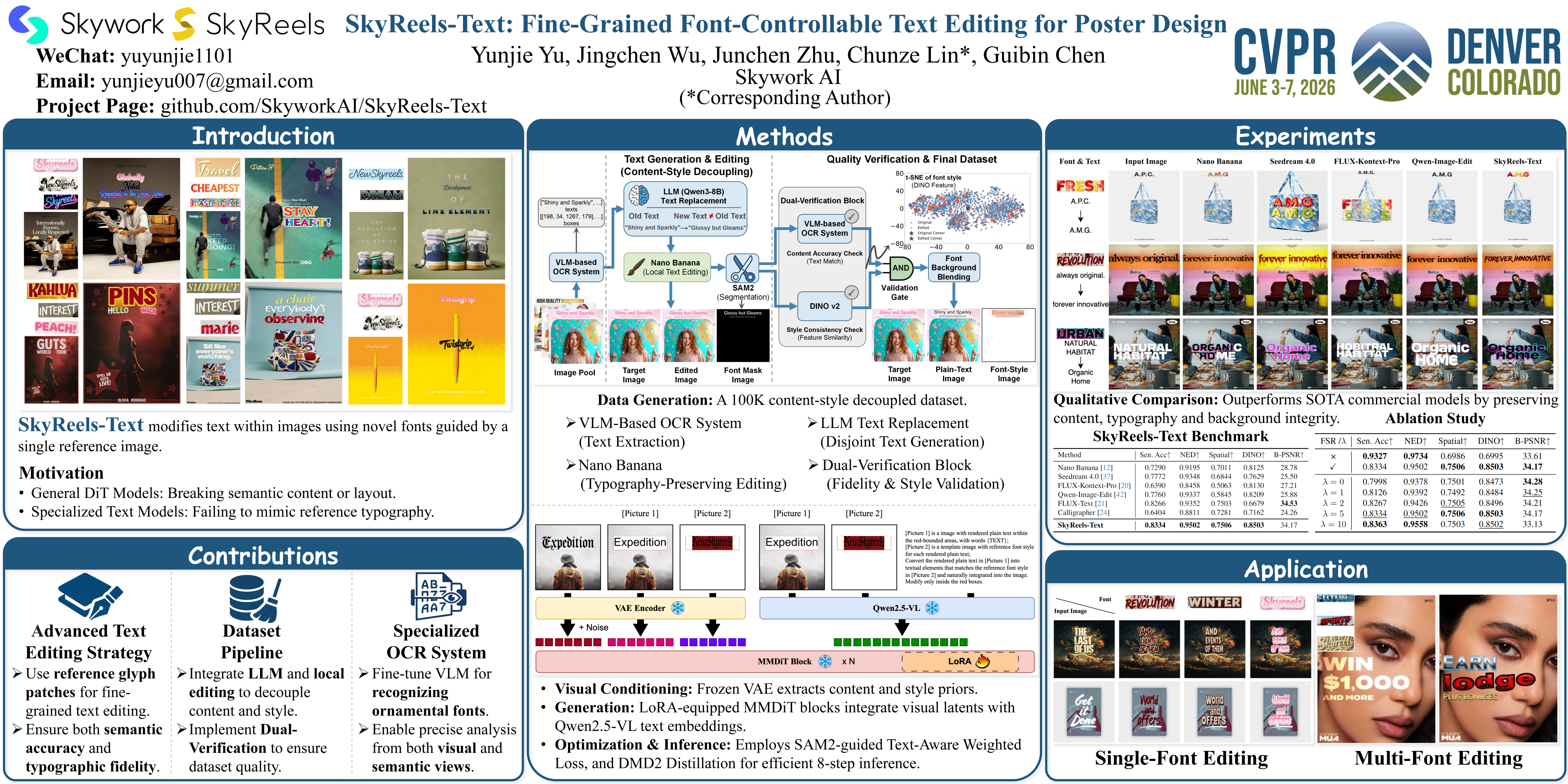
Artistic design such as poster design often demands rapid yet precise modification of textual content while preserving visual harmony and typographic intent, especially across diverse font styles. Although modern image editing models have grown increasingly powerful, they still fall short in fine-grained, font-aware text manipulation, limiting their utility in professional design workflows such as poster editing. To address this issue, we present Skyreels-Text, a novel font-controllable framework for precise poster text editing. Our method supports simultaneous editing of multiple text regions with distinct typographic styles: users simply provide cropped glyph patches from reference images, and our model synthesizes the desired content in a visually matching font, without requiring font labels or fine-tuning. Extensive experiments on multiple datasets, including handwrittent text benchmarks, Skyreels-Text achieves state-of-the-art performance in both text fidelity and visual realism, offering unprecedented control over font families, and stylistic nuances. This work bridges the gap between general-purpose image editing and professional-grade typographic design.
Image Generation from Contextually-Contradictory Prompts
Saar Huberman ⋅ Or Patashnik ⋅ Omer Dahary ⋅ Ron Mokady ⋅ Daniel Cohen-Or
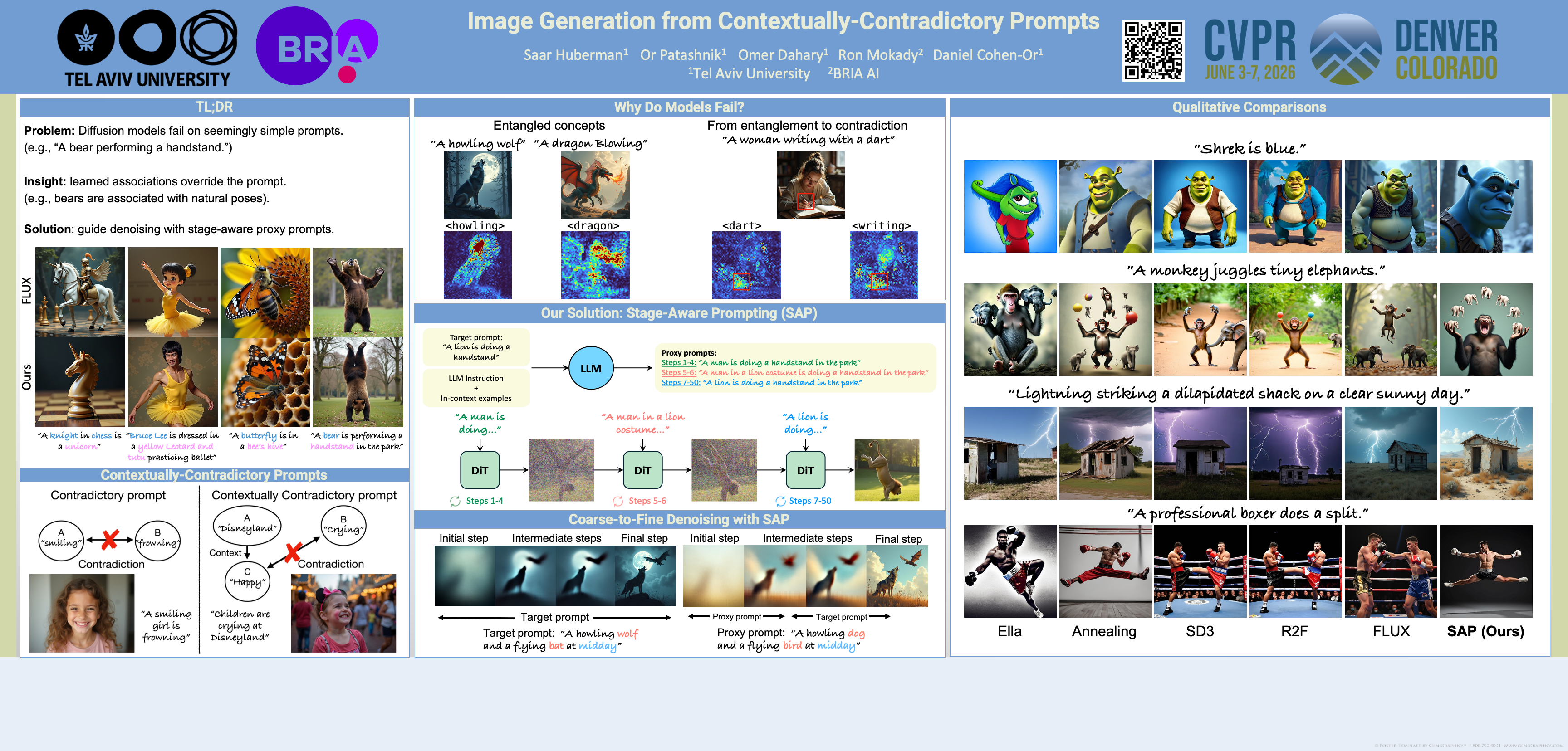
Text-to-image diffusion models excel at generating high-quality, diverse images from natural language prompts. However, they often fail to produce semantically accurate results when the prompt contains concept combinations that contradict their learned priors. We define this failure mode as contextual contradiction, where one concept implicitly negates another due to entangled associations learned during training. To address this, we propose a stage-aware prompt decomposition framework that guides the denoising process using a sequence of proxy prompts. Each proxy prompt is constructed to match the semantic content expected to emerge at a specific stage of denoising, while ensuring contextual coherence. To construct these proxy prompts, we leverage a large language model (LLM) to analyze the target prompt, identify contradictions, and generate alternative expressions that preserve the original intent while resolving contextual conflicts. By aligning prompt information with the denoising progression, our method enables fine-grained semantic control and accurate image generation in the presence of contextual contradictions. Experiments across a variety of challenging prompts show substantial improvements in alignment to the textual prompt.
PromptEnhancer: Taming Your Rewriter for Text-to-Image Generation via Fine-Grained Reward
Linqing Wang ⋅ zhiyong xu ⋅ XiMing Xing ⋅ YIJI CHENG ⋅ Zhiyuan Zhao ⋅ Donghao Li ⋅ Tiankai Hang ⋅ Zhenxi Li ⋅ Jiale Tao ⋅ Qixun Wang ⋅ Ruihuang Li ⋅ Comi Chen ⋅ Xin LI ⋅ Mingrui Wu ⋅ Xinchi Deng ⋅ Shuyang Gu ⋅ Chunyu Wang ⋅ qinglin lu
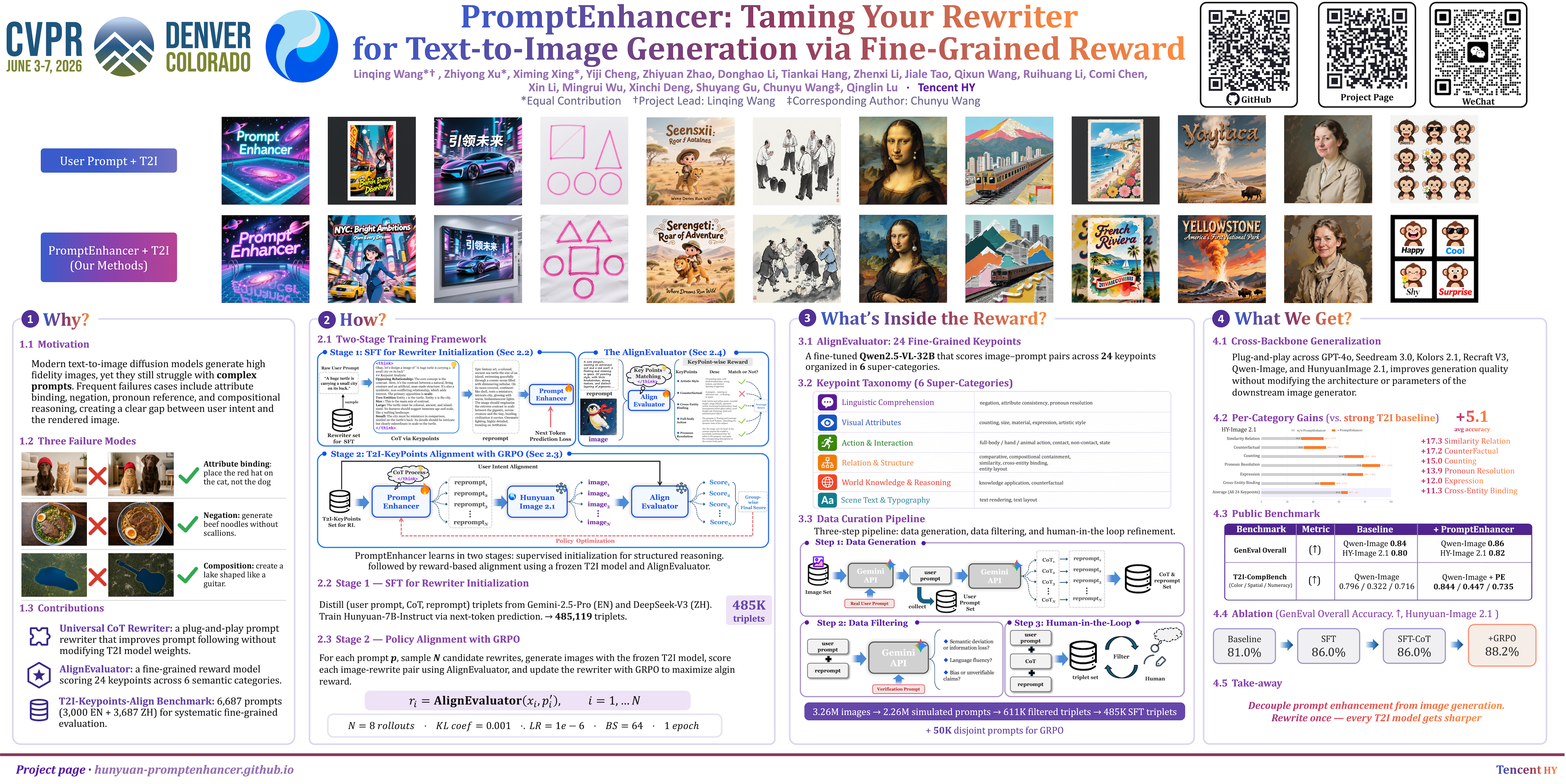
Recent advances in text-to-image (T2I) diffusion models have demonstrated remarkable capabilities in generating high-fidelity images. However, these models often struggle to faithfully render complex user prompts, particularly in aspects such as attribute binding, negation, and compositional relationships. To address this challenge, we introduce PromptEnhancer, a novel and universal prompt rewriting framework that enhances any pre-trained T2I model.Specifically, we adopt a multi-stage training pipeline to systematically boost the rewriter's understanding and rewriting performance. In the first stage, we conduct supervised fine-tuning (SFT) using CoT-enabled data to enable the rewriter to generate structured, chain-of-thought-style responses. In the second stage, we design a task-specific reward model—AlignEvaluator—to further align user prompts with fine-grained preferences through GRPO.The AlignEvaluator is trained to provide explicit and fine-grained feedback based on a systematic taxonomy derived from common T2I failure cases. By optimizing the rewriter to maximize the reward from AlignEvaluator, our framework learns to generate prompts that T2I models can interpret more precisely. Furthermore, we introduce a comprehensive human-aligned benchmark to facilitate future research in this direction. Extensive experiments demonstrate that PromptEnhancer significantly improves image-text alignment across a wide range of semantic and compositional challenges.
Aligning Text, Images and 3D Structure Token-by-Token
Aadarsh Sahoo ⋅ Vansh Tibrewal ⋅ Georgia Gkioxari
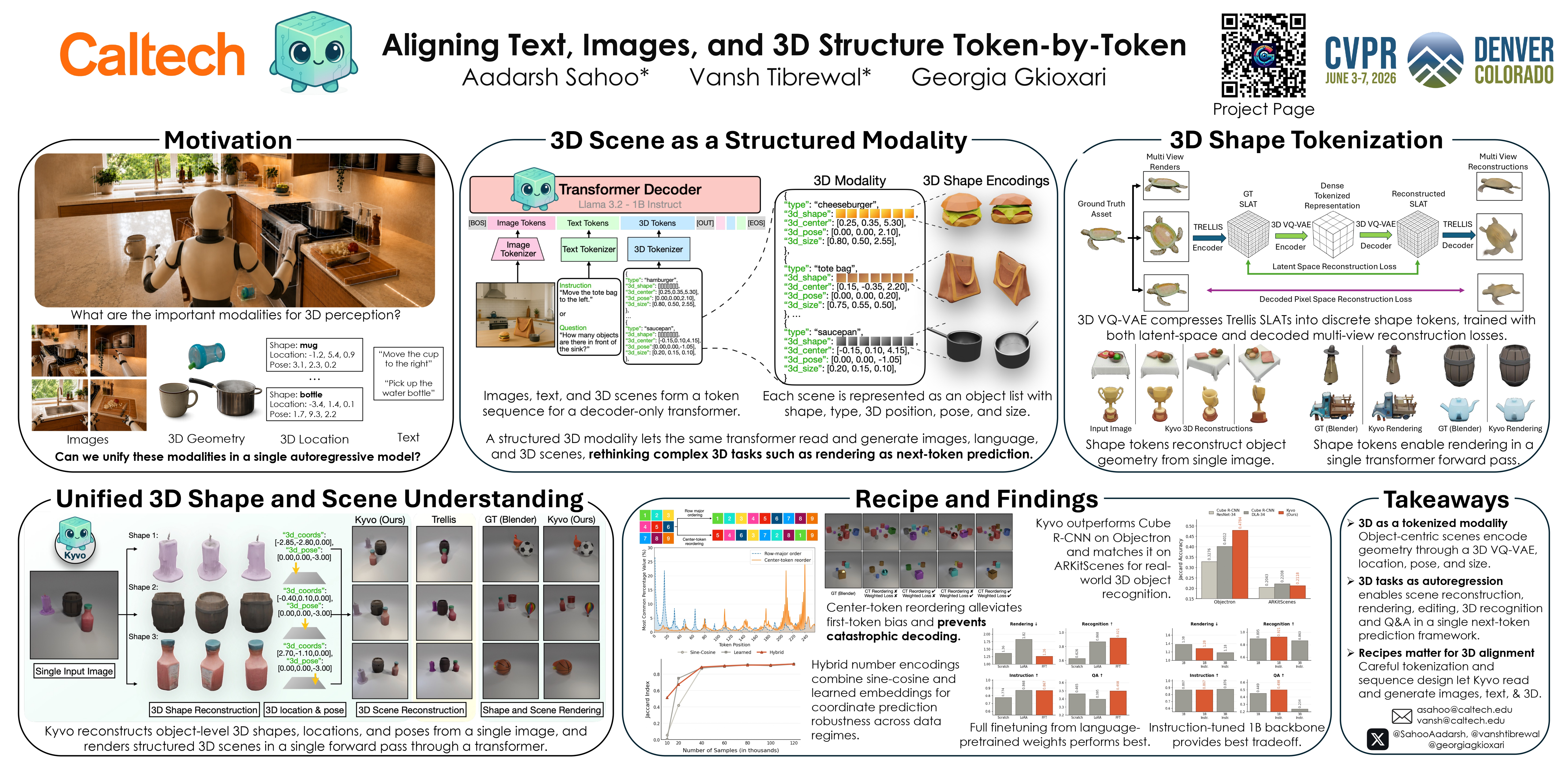
Creating machines capable of understanding the world in 3D is essential in assisting designers that build and edit 3D environments and robots navigating and interacting within a three-dimensional space. Inspired by advances in language and image modeling, we investigate the potential of autoregressive models for a new modality: structured 3D scenes. To this end, we propose a unified LLM framework that aligns language, images, and 3D scenes and provide a detailed "cookbook" outlining critical design choices for achieving optimal training and performance addressing key questions related to data representation, modality-specific objectives, and more. We show how to tokenize complex 3D objects to incorporate into our structured 3D scene modality. We evaluate performance across four core 3D tasks – rendering, recognition, instruction-following, and question-answering – and four 3D datasets, synthetic and real-world. We show our model’s effectiveness on reconstructing complete 3D scenes consisting of complex objects from a single image and on real-world 3D object recognition tasks.
RefTon: Reference person shot assist virtual Try-on
Liuzhuozheng Li ⋅ Yue Gong ⋅ Shanyuan Liu ⋅ Zanyi Wang ⋅ Dengyang Jiang ⋅ Liebucha Wu ⋅ Bo Cheng ⋅ Yuhang Ma ⋅ Dawei Leng ⋅ Yuhui Yin
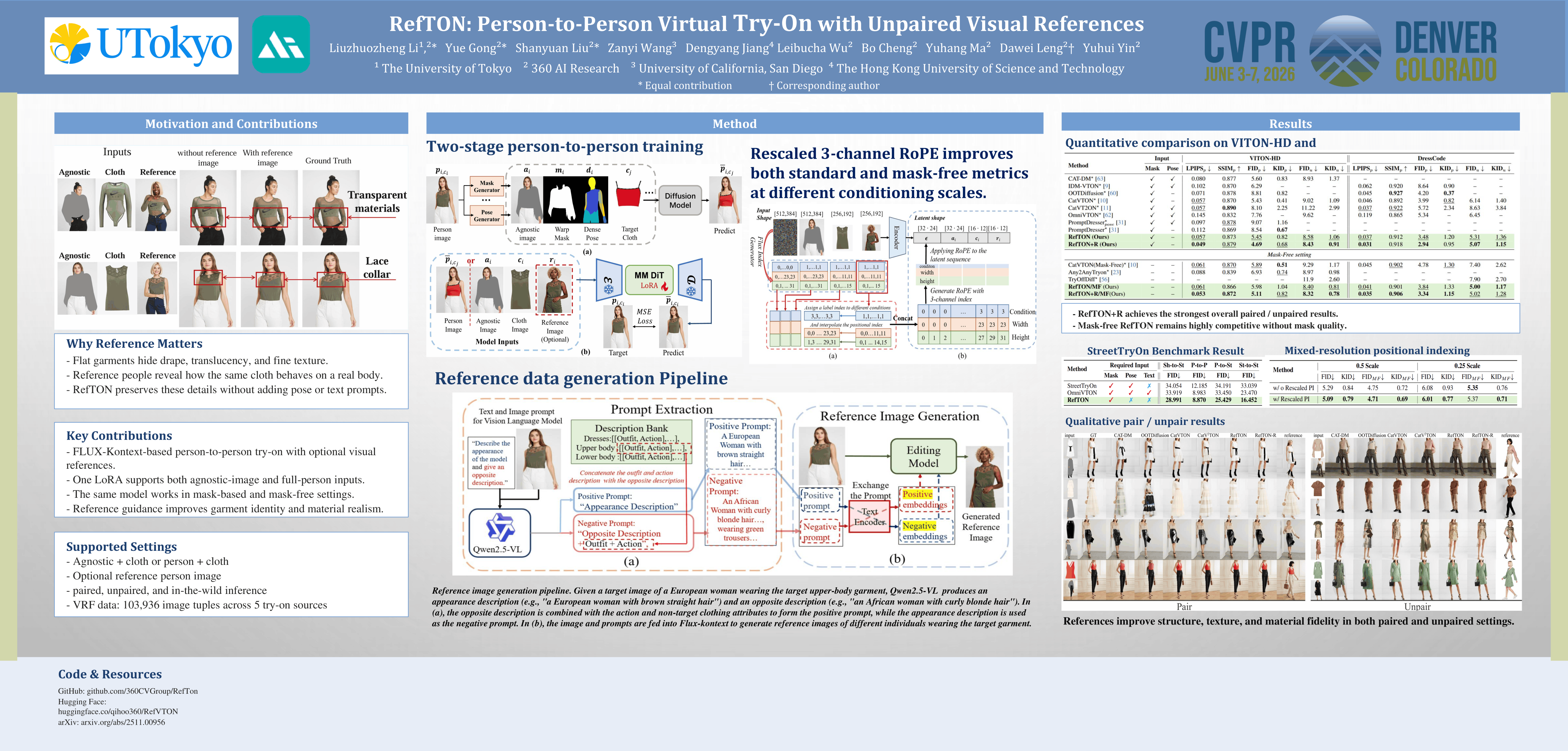
We introduce RefTON, a flux-based person-to-person virtual try-on framework that enhances garment realism through unpaired visual references. Unlike conventional approaches that rely on complex auxiliary inputs such as body parsing and warped mask or require finely designed extract branches to process various input conditions, RefTON streamlines the process by directly generating try-on results from a source image and a target garment, without the need for structural guidance or auxiliary components to handle diverse inputs. Moreover, inspired by human clothing selection behavior, RefTON leverages additional reference images (the target garment worn on different individuals) to provide powerful guidance for refining texture alignment and maintaining the garment details. To enable this capability, we built a dataset containing unpaired reference images for training. Extensive experiments on public benchmarks demonstrate that RefTON achieves competitive or superior performance compared to state-of-the-art methods, while maintaining a simple and efficient person-to-person design.
GaussianVision: Vision-Language Alignment from Compressed Image Representations using 2D Gaussian Splatting
Yasmine Omri ⋅ Connor Ding ⋅ Tsachy Weissman ⋅ Thierry Tambe
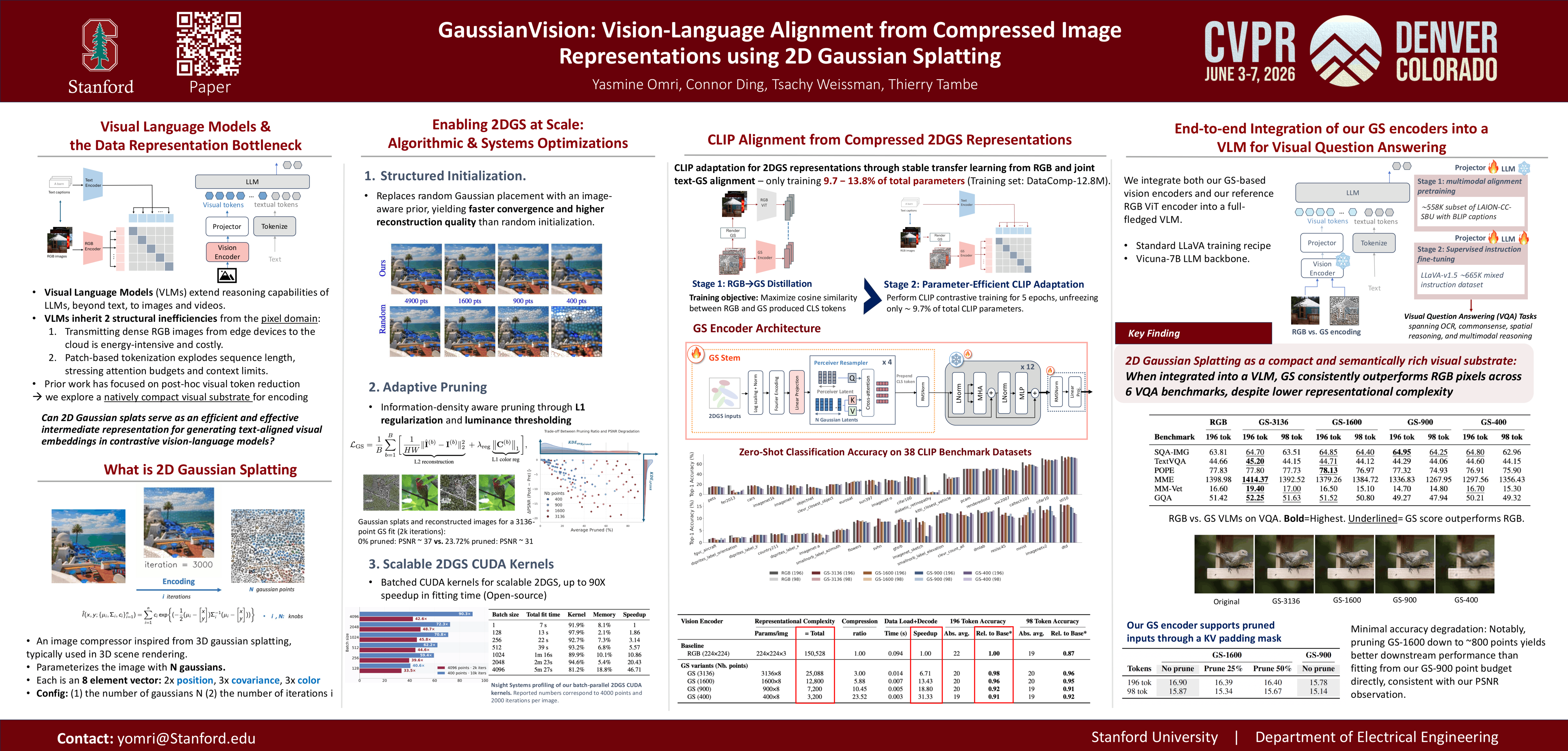
Modern vision–language pipelines are driven by RGB vision encoders trained on massive image–text corpora. While these pipelines have enabled impressive zero-shot capabilities and strong transfer across tasks, they still inherit two structural inefficiencies from the pixel domain: (i) transmitting dense RGB images from edge devices to the cloud is energy-intensive and costly, and (ii) patch-based tokenization explodes sequence length, stressing attention budgets and context limits. We explore 2D Gaussian Splatting (2DGS) as an alternative visual substrate for alignment: a compact, spatially adaptive representation that parameterizes images by a set of colored anisotropic Gaussians. We develop a scalable 2DGS pipeline with structured initialization, luminance-aware pruning, and batched CUDA kernels, achieving over $90\times$ faster fitting and $\sim97$% GPU utilization compared to prior implementations. We further adapt contrastive language-image pre-training (CLIP) to 2DGS by reusing a frozen RGB-based transformer backbone with a lightweight splat-aware input stem and a perceiver resampler, training only $\sim9.7 - 13.8$% of the total parameters.On a 12.8M dataset from DataComp, GS encoders yield competitive zero-shot performance on 38 datasets from the CLIP benchmark while compressing inputs $3$–$23.5\times$ relative to pixels. Our results establish 2DGS as a viable multimodal substrate, pinpoint architectural bottlenecks, and open a path toward representations that are both semantically powerful and transmission-efficient for edge–cloud learning.
Copy-Transform-Paste: Zero-Shot Object-Object Alignment Guided by Vision-Language and Geometric Constraints
Rotem Gatenyo ⋅ Ohad Fried
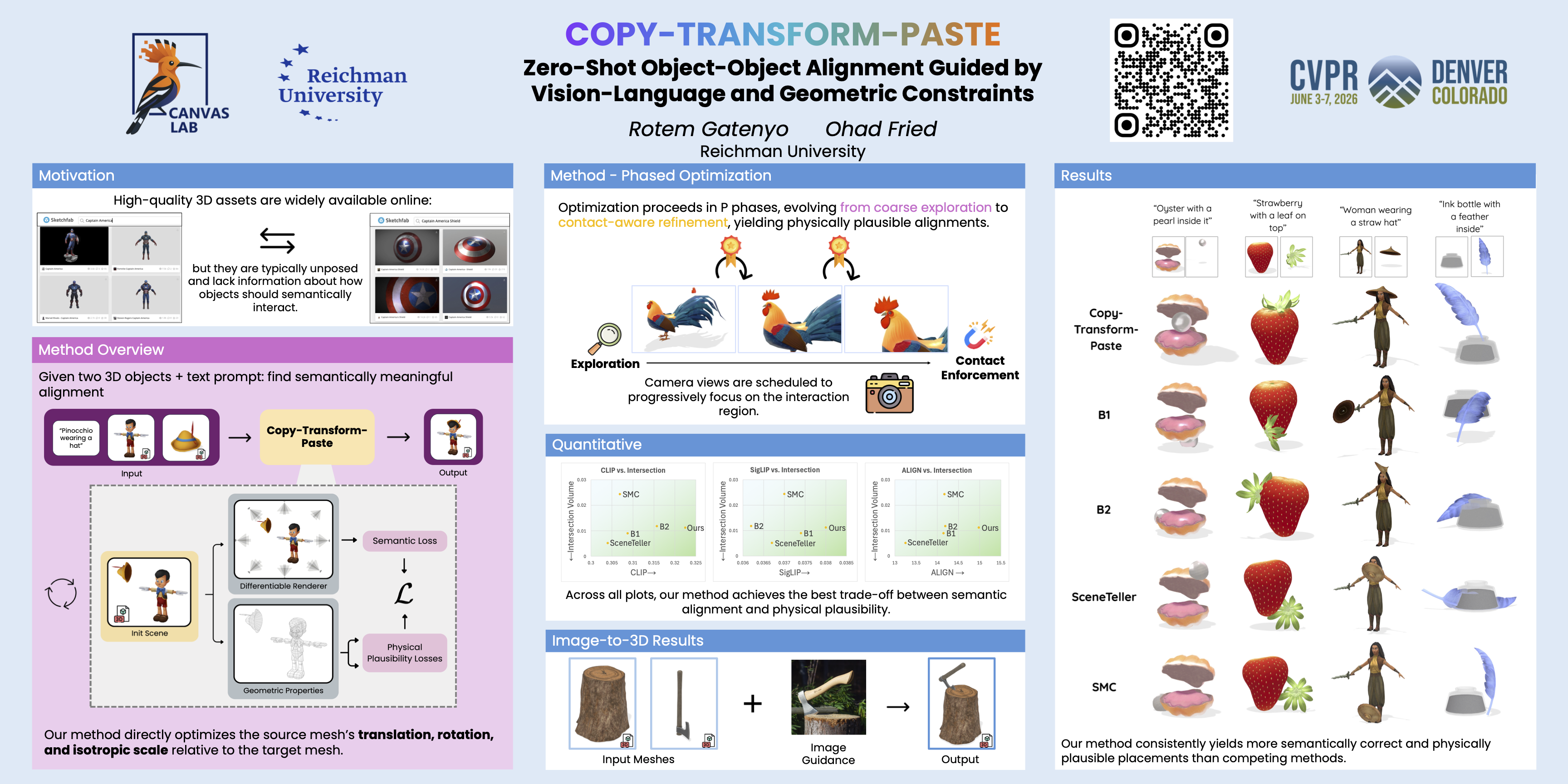
We study zero-shot 3D alignment of two given meshes from a short text prompt describing their spatial relation---an essential capability for content creation and scene assembly. Earlier approaches primarily rely on geometric alignment procedures, while recent work leverages pretrained 2D diffusion models to model language-conditioned object-object spatial relationships. In contrast, we directly optimize the relative pose at test time---updating translation, rotation, and isotropic scale with CLIP-driven gradients via a differentiable renderer---without training a new model.Our framework augments language supervision with geometry-aware objectives: a variant of soft-Iterative Closest Point (ICP) term to encourage controlled surface attachment and a penetration loss to discourage interpenetration. A phased schedule strengthens contact constraints over time, camera control concentrates views on the interaction region, and randomized restarts improve robustness.To enable evaluation, we curate a benchmark of 50 {mesh pair, prompt} cases spanning diverse categories and relations, and compare against baselines. Across the benchmark, our method yields semantically faithful and physically plausible alignments, improving CLIP similarity while reducing intersection volume.
Gravitation-Driven Semantic Alignment for Text Video Retrieval
Yi YANG ⋅ Zheng Wang ⋅ Xing Xu ⋅ Jingkuan Song ⋅ Heng Tao Shen
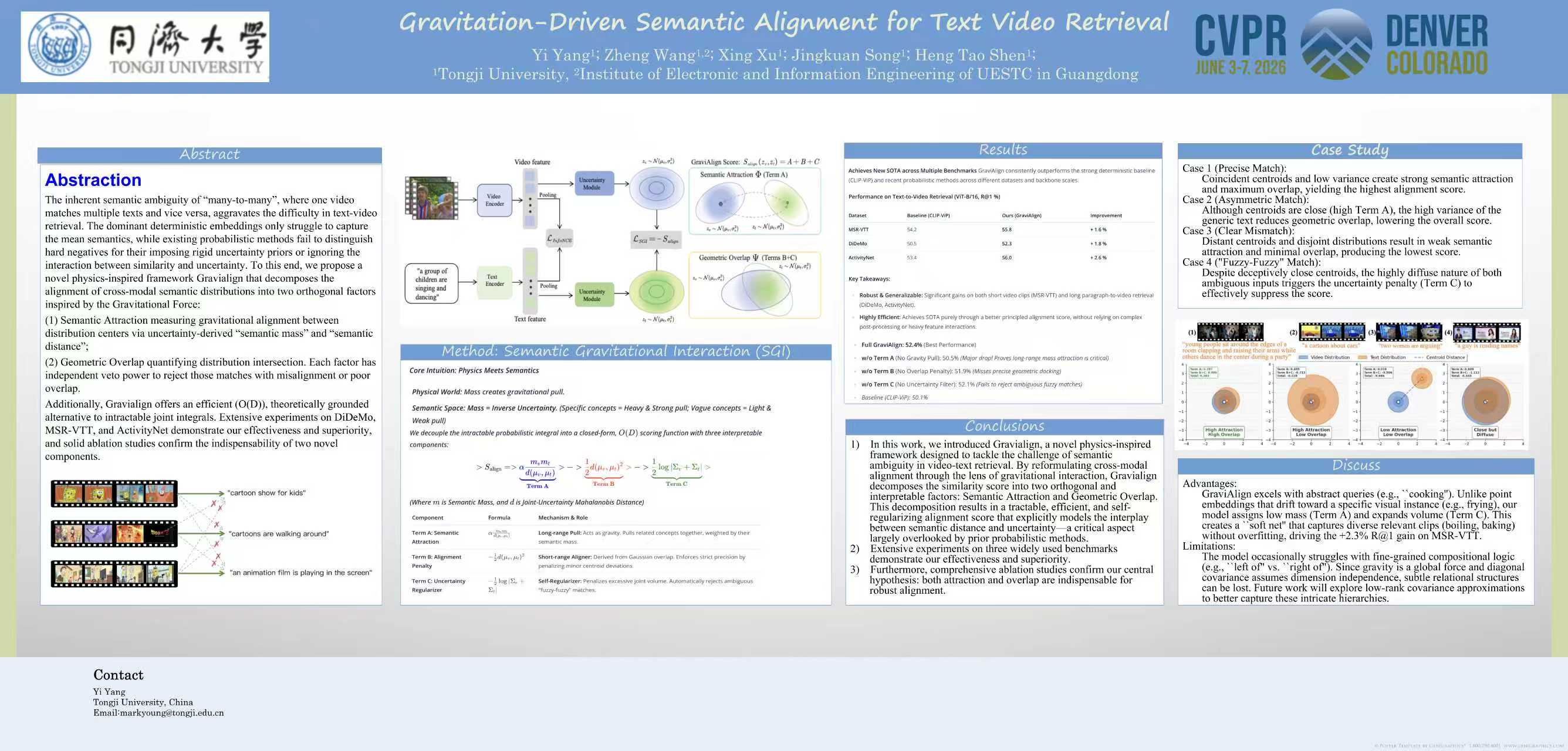
The inherent semantic ambiguity of “many-to-many”, where one video matches multiple texts and vice versa, aggravates the difficulty in text-video retrieval. The dominant deterministic embeddings only struggle to capture the mean semantics, while existing probabilistic methods fail to distinguish hard negatives for their imposing rigid uncertainty priors or ignoring the interaction between similarity and uncertainty. To this end, we propose a novel physics-inspired framework (GraviAlign) that decomposes the alignment of cross-modal semantic distributions into two orthogonal factors inspired by the Gravitational Force: (1) Semantic Attraction measuring gravitational alignment between distribution centers via uncertainty-derived “semantic mass” and “semantic distance”; (2) Geometric Overlap quantifying distribution intersection. Each factor has independent veto power to reject those matches with misalignment or poor overlap. Additionally, GraviAlign offers an efficient (O(D)), theoretically grounded alternative to intractable joint integrals. Extensive experiments on DiDeMo, MSR-VTT, and ActivityNet demonstrate our effectiveness and superiority, and solid ablation studies confirm the indispensability of two novel components.
MoE-GRPO: Optimizing Mixture-of-Experts via Reinforcement Learning in Vision-Language Models
Dohwan Ko ⋅ Jinyoung Park ⋅ Seoung Choi ⋅ Sanghyeok Lee ⋅ Seohyun Lee ⋅ Hyunwoo J. Kim
Mixture-of-Experts (MoE) has emerged as an effective approach to reduce the computational overhead of Transformer architectures by sparsely activating a subset of parameters for each token while preserving high model capacity. This paradigm has recently been extended to Vision-Language Models (VLMs), enabling scalable multi-modal understanding with reduced computational cost. However, the widely adopted deterministic top-K routing mechanism may overlook more optimal expert combinations and lead to expert overfitting. To address this limitation and improve the diversity of expert selection, we propose MoE-GRPO, a reinforcement learning (RL)-based framework for optimizing expert routing in MoE-based VLMs. Specifically, we formulate expert selection as a sequential decision-making problem and optimize it using Group Relative Policy Optimization (GRPO), allowing the model to learn adaptive expert routing policies through exploration and reward-based feedback. Furthermore, we introduce a modality-aware router guidance that encourages the router to assign tokens to the appropriate modality-specific experts during training. Extensive experiments on multimodal image and video benchmarks show that MoE-GRPO consistently outperforms standard top-K routing and its variants by promoting more diverse expert selection, thereby mitigating expert overfitting and improving generalization. To the best of our knowledge, this is the first work to explicitly optimize the expert selection policy through RL.
M^3KG-RAG: Multi-hop Multimodal Knowledge Graph-enhanced Retrieval-Augmented Generation
Hyeongcheol Park ⋅ Jiyoung Seo ⋅ Jaewon Mun ⋅ Hogun Park ⋅ Wonmin Byeon ⋅ Sung June Kim ⋅ Hyeonsoo Im ⋅ JeungSub Lee ⋅ Sangpil Kim
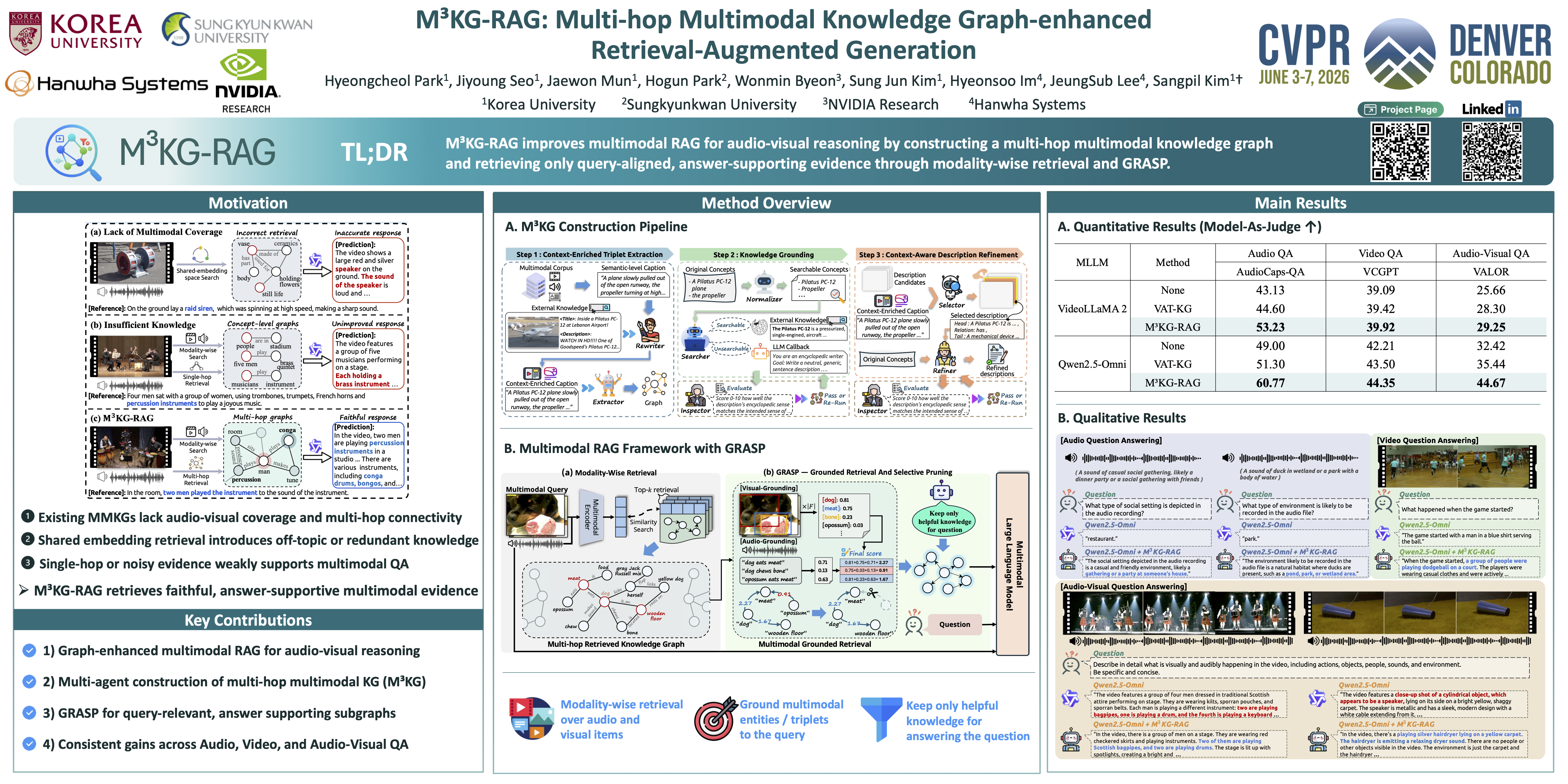
Retrieval-Augmented Generation (RAG) has recently been extended to multimodal settings, connecting multimodal large language models (MLLMs) with vast corpora of external knowledge such as multimodal knowledge graphs (MMKGs). Despite their recent success, multimodal RAG in the audio-visual domain remains challenging due to 1) limited modality coverage and multi-hop connectivity of existing MMKGs, and 2) retrieval based solely on similarity in a shared multimodal embedding space, which fails to filter out off-topic or redundant knowledge. To address these limitations, we propose M$^3$KG-RAG, a Multi-hop Multimodal Knowledge Graph-enhanced RAG that retrieves query-aligned audio-visual knowledge from MMKGs, improving reasoning depth and answer faithfulness in MLLMs. Specifically, we devise a lightweight multi-agent pipeline to construct multi-hop MMKG (M$^3$KG), which contains context-enriched triplets of multimodal entities, enabling modality-wise retrieval based on input queries. Furthermore, we introduce GRASP (Grounded Retrieval And Selective Pruning), which ensures precise entity grounding to the query, evaluates answer-supporting relevance, and prunes redundant context to retain only knowledge essential for response generation. Extensive experiments across diverse multimodal benchmarks demonstrate that M$^3$KG-RAG significantly enhances MLLMs’ multimodal reasoning and grounding over existing approaches.
Evolutionary Multimodal Reasoning via Hierarchical Semantic Representation for Intent Recognition
Qianrui Zhou ⋅ Hua Xu ⋅ Yunjin Gu ⋅ Yifan Wang ⋅ Songze Li ⋅ Hanlei Zhang
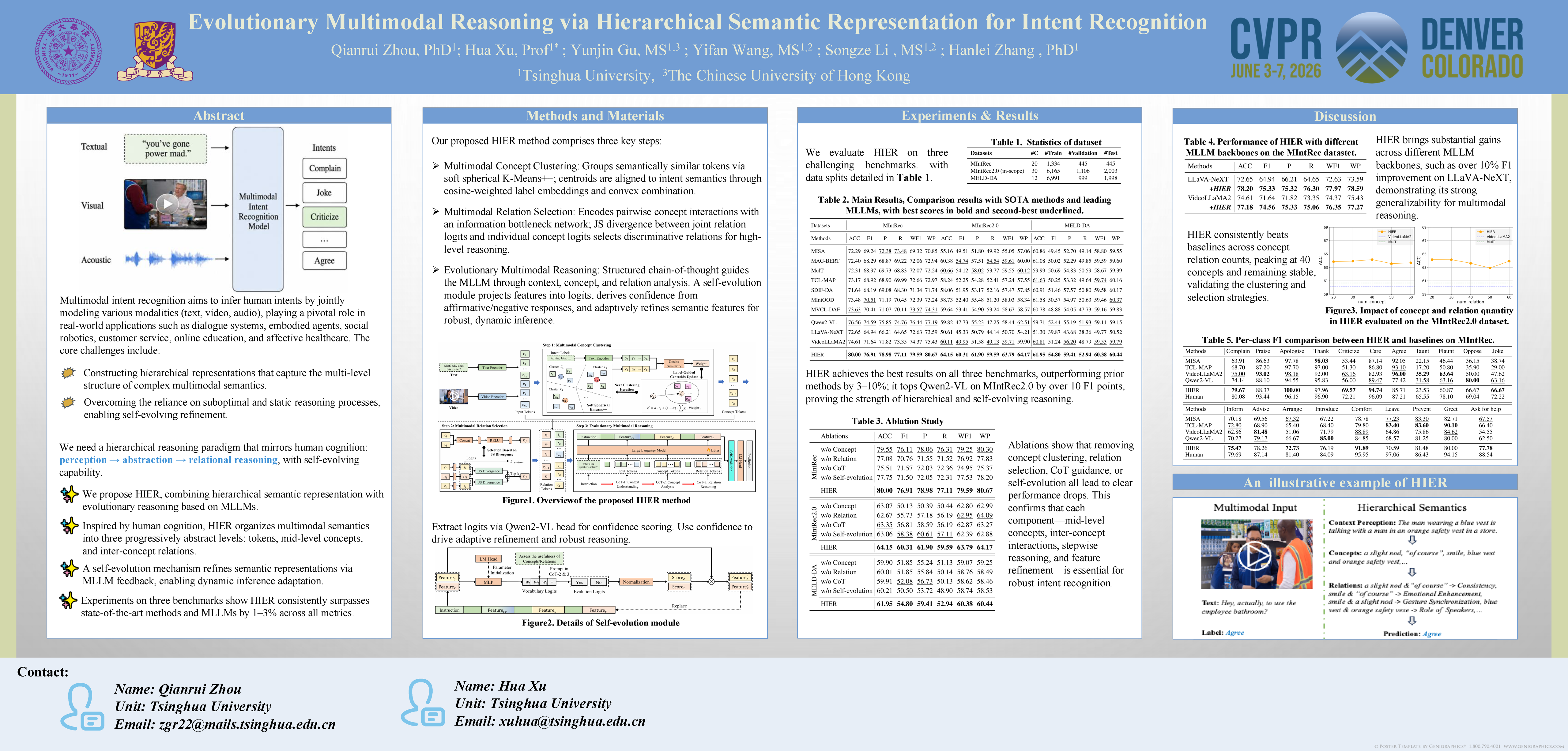
Multimodal intent recognition aims to infer human intents by jointly modeling various modalities, playing a pivotal role in real-world dialogue systems. However, current methods struggle to model hierarchical semantics underlying complex intents and lack the capacity for self-evolving reasoning over multimodal representations. To address these issues, we propose HIER, a novel method that integrates HIerarchical semantic representation with Evolutionary Reasoning based on Multimodal Large Language Model (MLLM). Inspired by human cognition, HIER introduces a structured reasoning paradigm that organizes multimodal semantics into three progressively abstracted levels. It starts with modality-specific tokens extracted by encoders, capturing localized semantic cues. These tokens are then abstracted into semantic concepts via a label-guided clustering strategy, yielding mid-level intent-aware patterns. To capture higher-order structure, inter-concept relations are selected through a JS-divergence-based mechanism to highlight salient dependencies across concepts. These hierarchical representations are then injected into MLLM via CoT-driven prompting, enabling step-wise reasoning. Besides, HIER utilizes a self-evolution mechanism that refines semantic representations through MLLM feedback, allowing dynamic adaptation during inference. Experiments on three challenging benchmarks show that HIER not only consistently outperforms state-of-the-art methods and MLLMs with 1–3% gains across all metrics, but also exhibits strong generalization across diverse backbones.
ReFAct: Empowering Multimodal Web Agents with Visual and Context Focusing
Rui Wu ⋅ Shuo Zhang ⋅ Xiaoxuan Tang ⋅ Ruirui Zhang ⋅ Yi Liu ⋅ Tao Jiang ⋅ Wenhao Xu ⋅ Yong Li
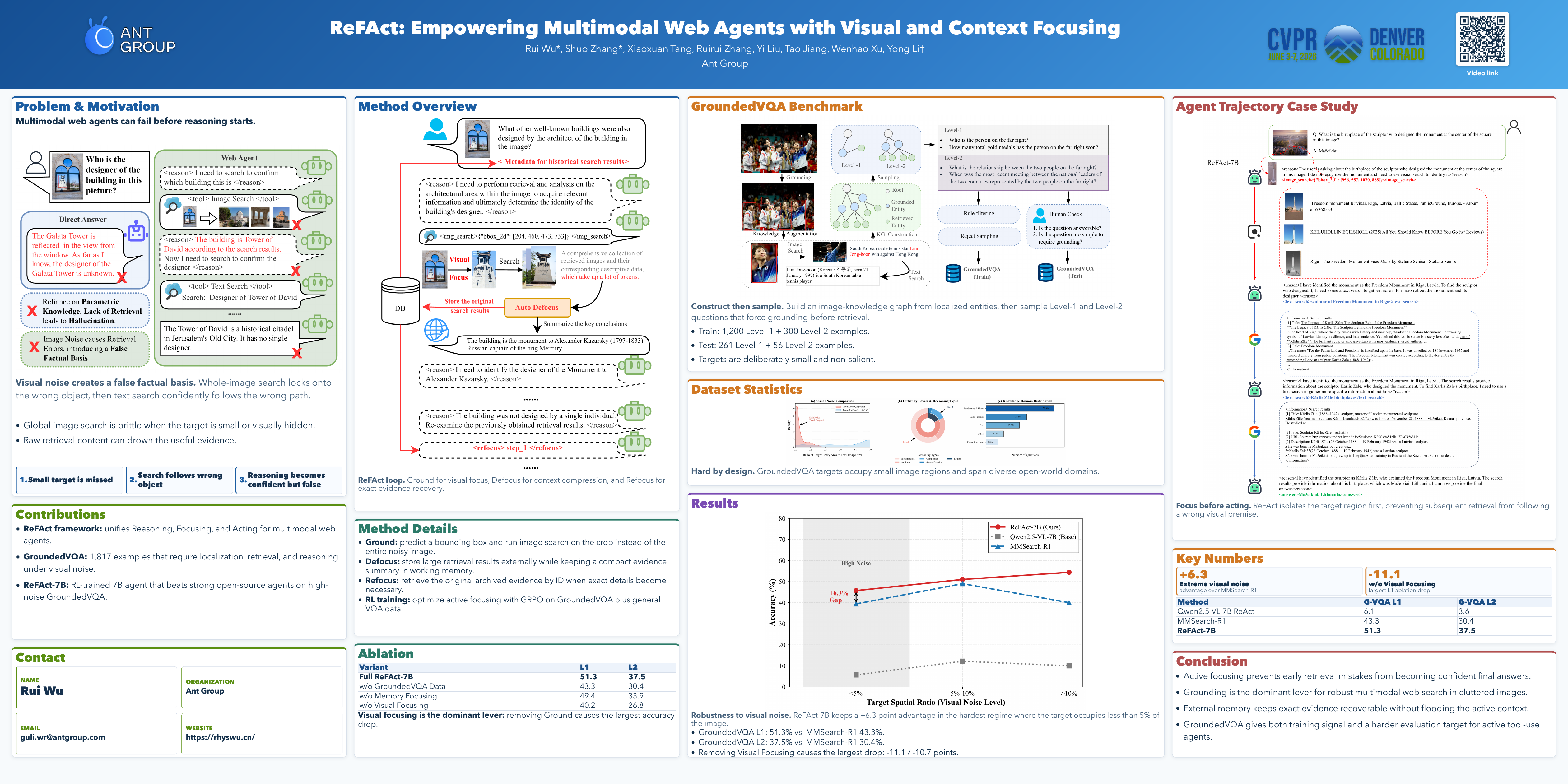
Multimodal Web Agents demonstrate a practically valuable capability by fusing information from diverse modalities (e.g., text and vision), retrieved iteratively from the internet, to respond to complex user queries.However, the visual modality is prone to information overload, and the noise contained within it—such as irrelevant background details or complex structures—can disrupt the model's attention, misdirecting its operational focus toward an erroneous path.To address the aforementioned challenge, we propose ReFAct (Reasoning, Focusing, and Acting), a novel framework that empowers the agent to actively manage its cross-modal context. This allows the agent to adjust its operational focus, thereby mitigating the impact of noise on multimodal Web Agents.Specifically, ReFAct employs a Grounding tool for active visual perception to dynamically filter information. We also design external memory-based Defocus/Refocus operations for selective information retention, further modulating information density within the multimodal context. Ultimately, this ensures the agent maintains focus during problem-solving.To evaluate and enhance agent capabilities in complex and noisy multimodal contexts, we first propose a pipeline for constructing datasets with flexible complexity. We introduce a new open-source benchmark: GroundedVQA. Finally, we experimentally demonstrate the effectiveness of our proposed method on GroundedVQA and other widely-used benchmarks.
PersonaVLM: Long-Term Personalized Multimodal LLMs
Chang Nie ⋅ Chaoyou Fu ⋅ Yi-Fan Zhang ⋅ Haihua Yang ⋅ Caifeng Shan
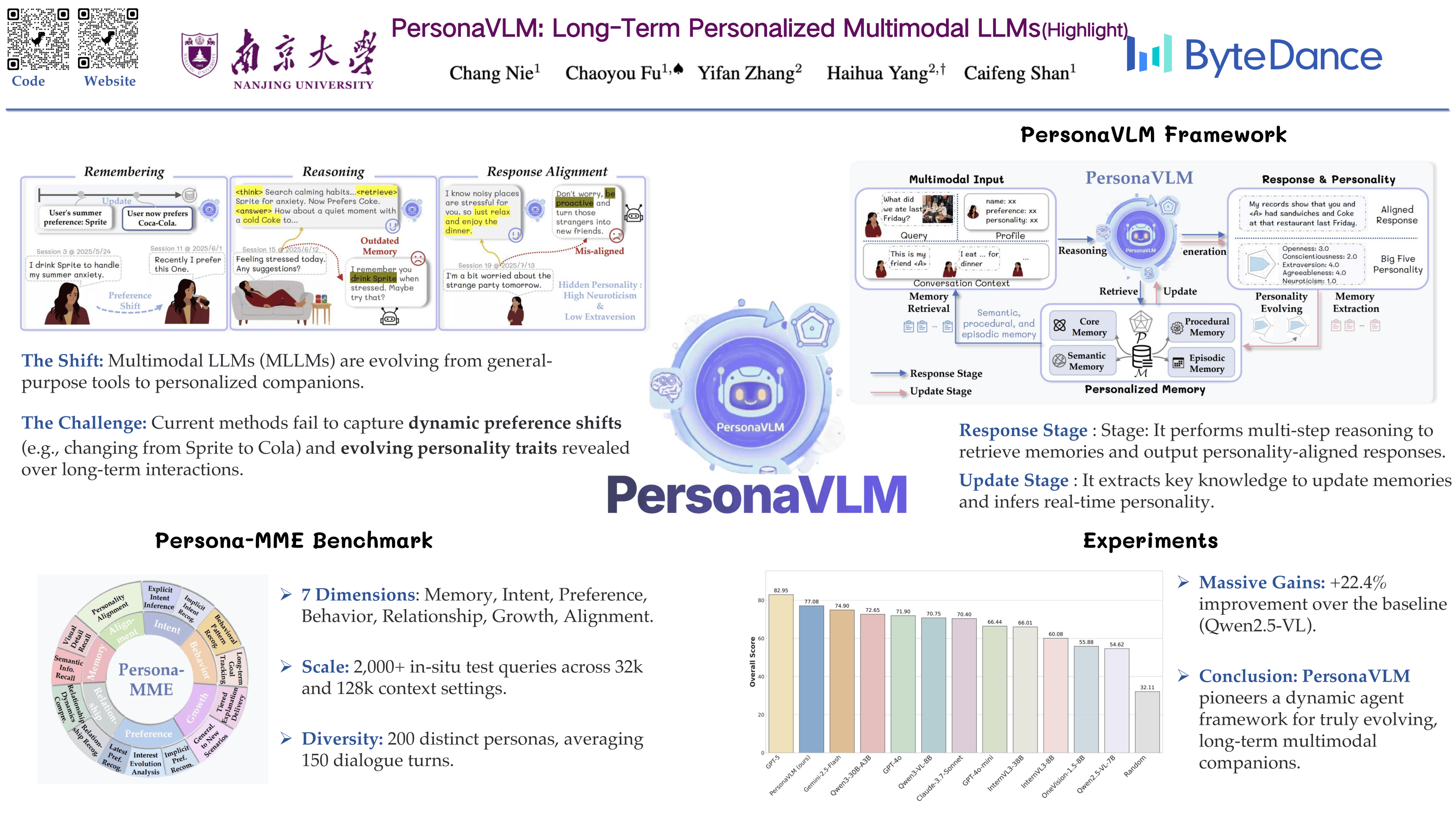
Multimodal Large Language Models (MLLMs) serve as daily assistants for millions. However, their ability to generate responses aligned with individual preferences remains limited.Prior approaches enable only static, single-turn personalization through input augmentation or output alignment, and thus fail to capture users’ evolving preferences and personality over time (see Fig.1).In this paper, we introduce Pal-R3, an innovative personalized multimodal agent framework designed for long-term personalization.Pal-R3 transforms a general-purpose MLLM into a personalized assistant by integrating three key capabilities:(a) Remembering: It proactively extracts and summarizes chronological multimodal memories from interactions, consolidating them into a personalized database.(b) Reasoning: It conducts multi-turn reasoning by retrieving and integrating relevant memories from the database. (c) Response Alignment: It infers the user's evolving personality throughout long-term interactions to ensure outputs remain aligned with their unique characteristics.For evaluation, we establish MME-P, a comprehensive benchmark comprising over 2,000 curated interaction cases, designed to assess long-term MLLM personalization across seven key aspects and 14 fine-grained tasks.Extensive experiments validate our method's effectiveness, improving the baseline by 22.4% (MME-P) and 9.8% (PERSONAMEM) under a 128k context, while outperforming GPT-4o by 5.2% and 2.0%, respectively.Our code is available in the supplementary materials.
MR-RAG: Multimodal Relevance-Aware Retrieval-Augmented Generation for Medical Visual Question Answering
Xuze Li ⋅ Haozhao Wang ⋅ Zhenyu Huang ⋅ Zhongxu Wang ⋅ Zhang Jinghua ⋅ Ruixuan Li
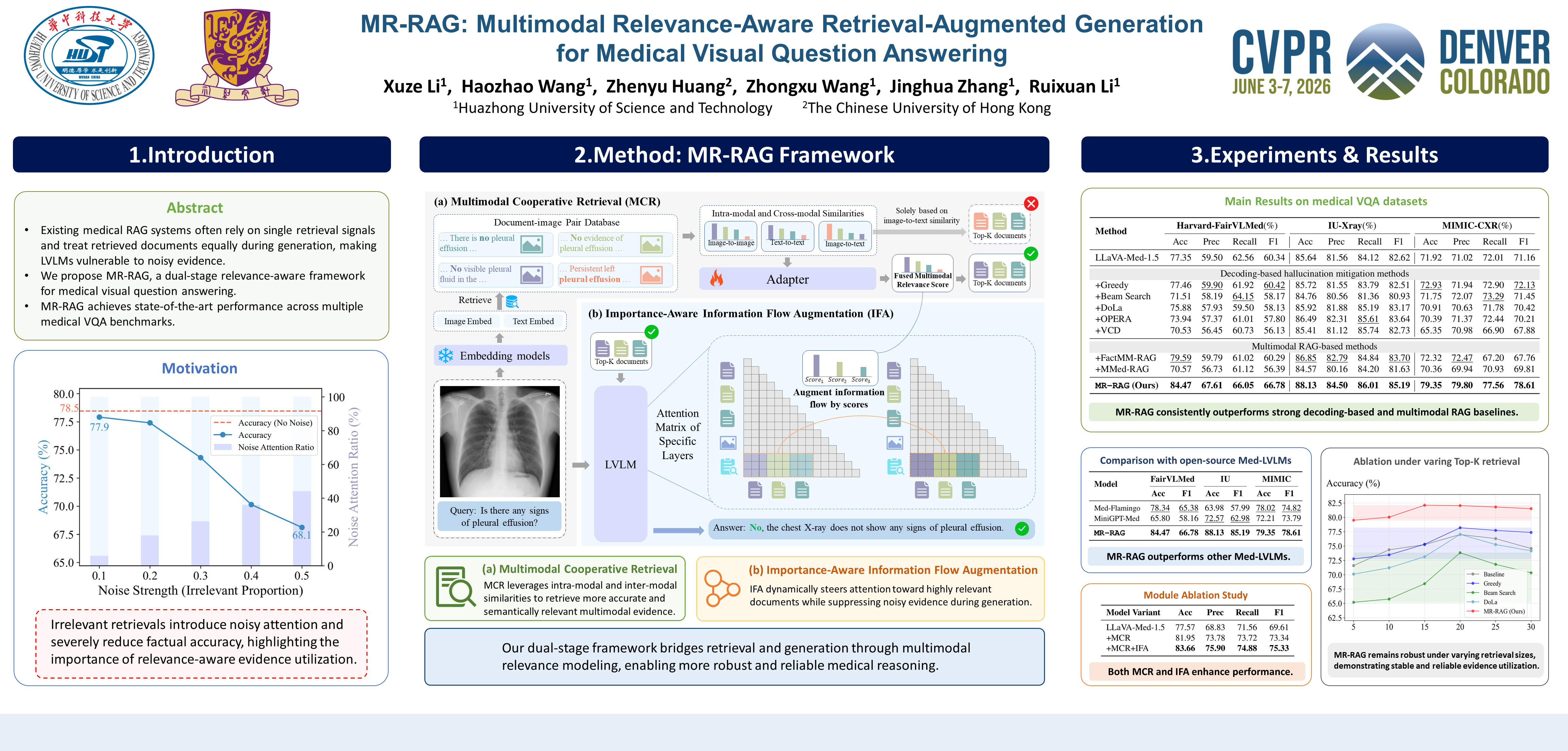
Large Vision Language Models (LVLMs) with retrieval-augmented generation (RAG) are emerging as a main paradigm for processing vision-language medical tasks due to their promising achievements. However, existing approaches exhibit two significant limitations in the two key stages—retrieval and generation. First, during the retrieval stage, most methods typically rely on a single similarity signal to estimate document relevance, ignoring the rich information available in multimodal data, which may fail to accurately retrieve matching content. Second, in the generation stage, retrieved documents are integrated directly and uniformly into the input for LVLMs, without taking into account their varying relevance to the question, which may result in the dilution of crucial information and exacerbate the negative impact of irrelevant content. To address these limitations, we propose MR-RAG, a dual-stage RAG enhancement framework by considering multimodal relevance in both retrieval and generation phases. Specifically, we first introduce a Multimodal Cooperative Retrieval (MCR) module that leverages both intra-modal and cross-modal signals to jointly retrieve semantically aligned documents. Then, we design an Importance-Aware Information Flow Augmentation (IFA) mechanism that augments attention paths based on the fused multimodal relevance, enabling more precise control over the information flow during answer generation. By coherently bridging retrieval and generation via multimodal signals, our method significantly enhances factual accuracy and robustness. Experiments on three medical datasets demonstrate that our method outperforms state-of-the-art baselines, achieving up to 6.4% accuracy improvement.
Decoupling Stability and Plasticity for Multi-Modal Test-Time Adaptation
Yongbo He ⋅ Zirun Guo ⋅ Tao Jin
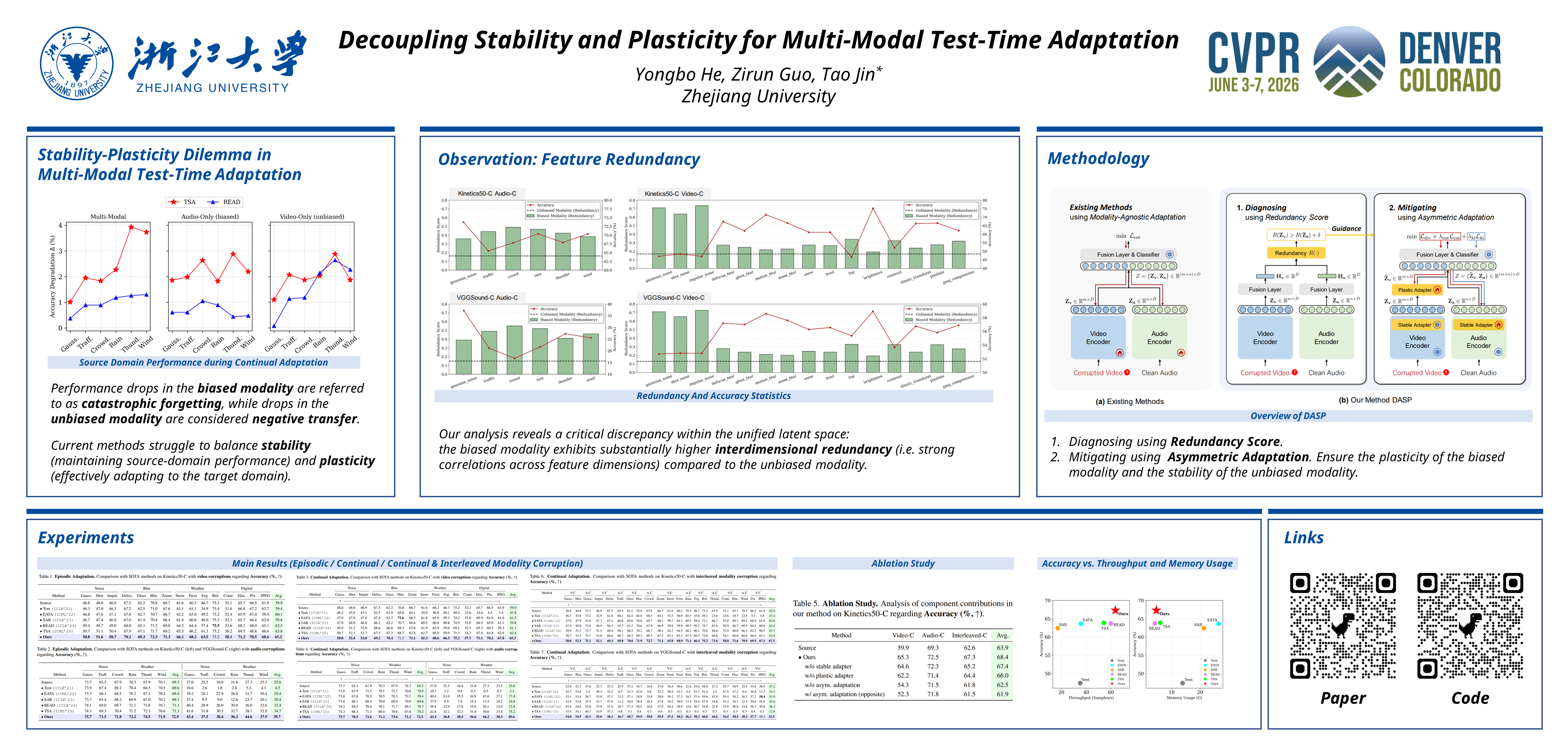
Adapting pretrained multi-modal models to evolving test-time distributions, known as multi-modal test-time adaptation, presents a significant challenge. Existing methods frequently encounter negative transfer in the unbiased modality and catastrophic forgetting in the biased modality. To address these challenges, we propose Decoupling Adaptation for Stability and Plasticity (DASP), a novel diagnose-then-mitigate framework. Our analysis reveals a critical discrepancy within the unified latent space: the biased modality exhibits substantially higher interdimensional redundancy (i.e., strong correlations across feature dimensions) compared to the unbiased modality. Leveraging this insight, DASP identifies the biased modality and implements an asymmetric adaptation strategy. This strategy employs a decoupled architecture where each modality-specific adapter is divided into stable and plastic components. The asymmetric mechanism works as follows: for the biased modality, which requires plasticity, the plastic component is activated and updated to capture domain-specific information, while the stable component remains fixed. Conversely, for the unbiased modality, which requires stability, the plastic component is bypassed, and the stable component is updated using KL divergence regularization to prevent negative transfer. This asymmetric design enables the model to adapt flexibly to new domains while preserving generalizable knowledge. Comprehensive evaluations on diverse multi-modal benchmarks demonstrate that DASP significantly outperforms state-of-the-art methods.
CUE: Concept-Aware Multi-Label Expansion to Mitigate Concept Confusion in Long-Tailed Learning
Ruichi Zhang ⋅ Chikai Shang ⋅ jiacheng yang ⋅ Mengke Li ⋅ Yang Zhou ⋅ Junlong Gao ⋅ Yang Lu
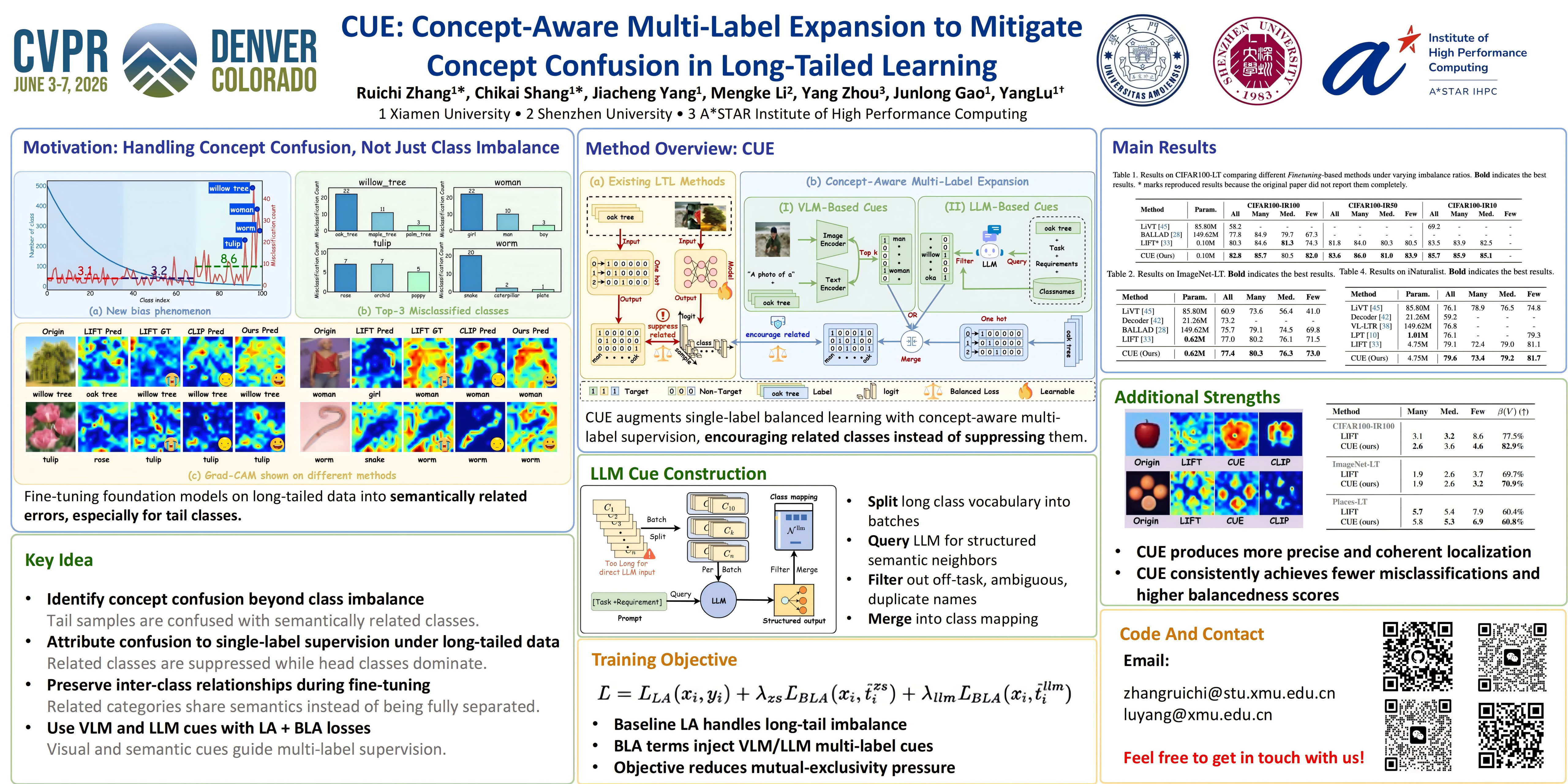
Long-tailed distributions are common in real-world recognition tasks, where a few head classes have many samples while most tail classes have very few. Recently, fine-tuning foundation models for long-tailed learning has gained attention due to their excellent performance. However, most existing methods focus solely on mitigating long-tailed distribution bias while overlooking concept confusion caused by the long-tailed distribution. In this paper, we study this problem and attribute it to the mutual exclusivity of single-label supervision under long-tailed distributions, which suppresses feature sharing among related classes and amplifies the dominance of head classes, leading to disrupted inter-class discriminality. To address this, we propose $\textbf{CUE}$, $\underline{C}$oncept-aware m$\underline{U}$lti-label $\underline{E}$xpansion, which introduces multi-label concept signals to preserve disrupted inter-class relationships. Specifically, CUE constructs concept sets by $\textbf{(i)}$ extracting instance-level visual cues from zero-shot CLIP and $\textbf{(ii)}$ generating class-level semantic cues with LLM; the two cues are incorporated via separately weighted Binary Logit-Adjustmen (BLA) auxiliary losses and jointly optimized with the baseline Logit-Adjustmen (LA) loss. Experiments on several long-tailed benchmarks, CUE achieves balanced and strong performance, surpassing recent state-of-the-art methods. The code is available in the supplementary materials.
Energy Waveify and Redistribution for Test-Time Adaptation: A Control System Perspective
Zhenbin Wang ⋅ Lei Zhang ⋅ Lituan Wang ⋅ Zhenwei Zhang ⋅ Guangwu Qian ⋅ Yan Wang ⋅ Wei Huang
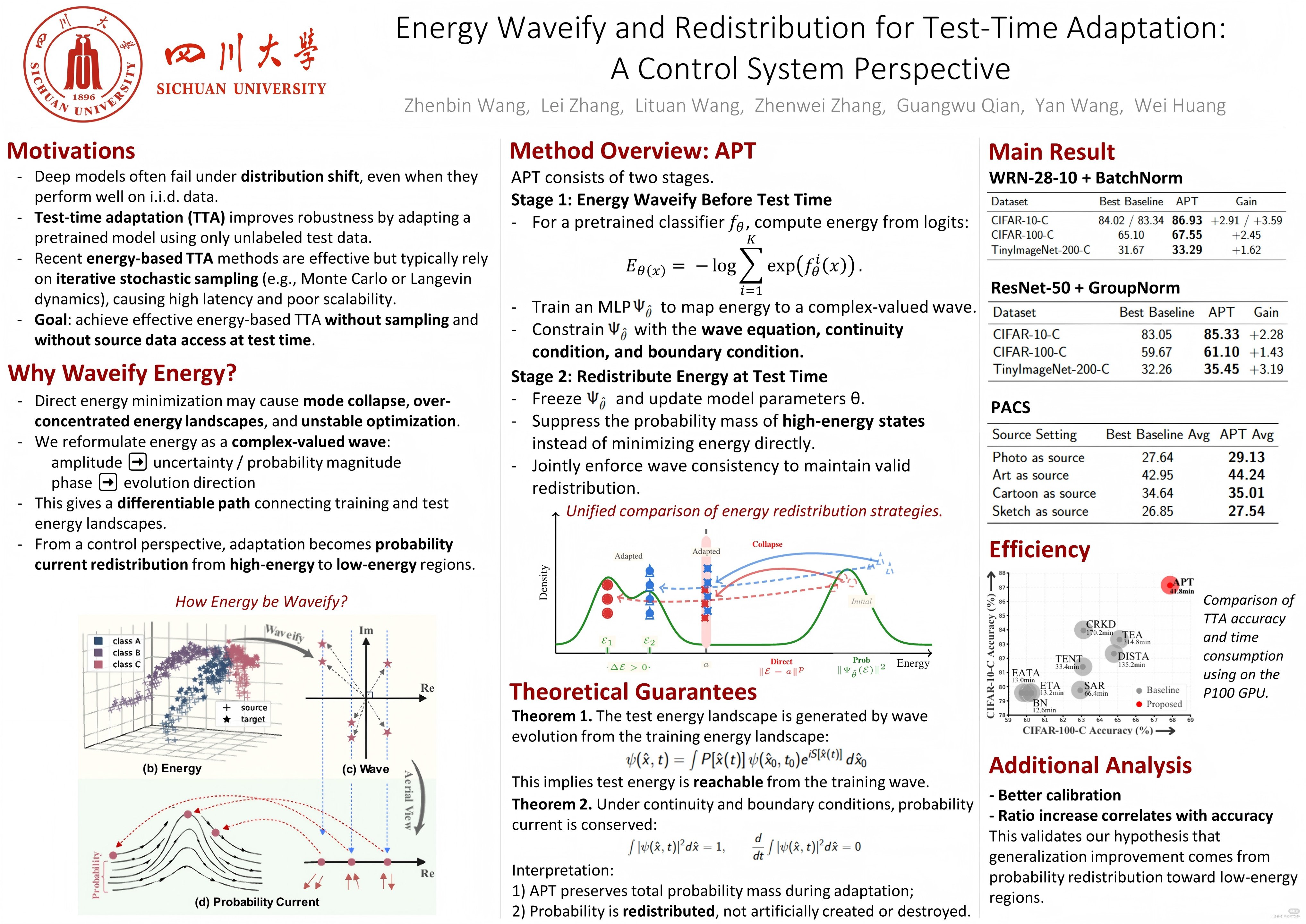
This work tackles a key challenge in test-time energy adaptation: prohibitive time overhead arising from recent state-of-the-art test-time adaptation (TTA) methods, which are built on energy models relying on iterative Monte Carlo or Langevin dynamics sampling with multiple stochastic updates per test instance to approximate energy gradients. We tackle the problem from an innovative control system perspective by i) describing the energy as a complex-valued wave, where the amplitude encodes energy uncertainty and the phase characterizes its evolution, and ii) maintaining a time-dependent wave equation that interprets TTA as a control system evolution process. By enforcing the control system law of probability current conservation, our method directs probability current away from high-energy (error-prone) regions toward low-energy (accurate) ones, achieving adaptive energy redistribution without additional stochastic sampling while preserving the overall normalization of the energy landscape. Experimentally, the proposed method significantly outperforms baseline methods across several public benchmark datasets, with adaptive time being only 1/3 ~ 1/7 of that required by the compared Top-1 to Top-3 baselines.
CD-Buffer: Complementary Dual-Buffer Framework for Test-Time Adaptation in Adverse Weather Object Detection
Youngjun Song ⋅ Hyeongyu Kim ⋅ Dosik Hwang
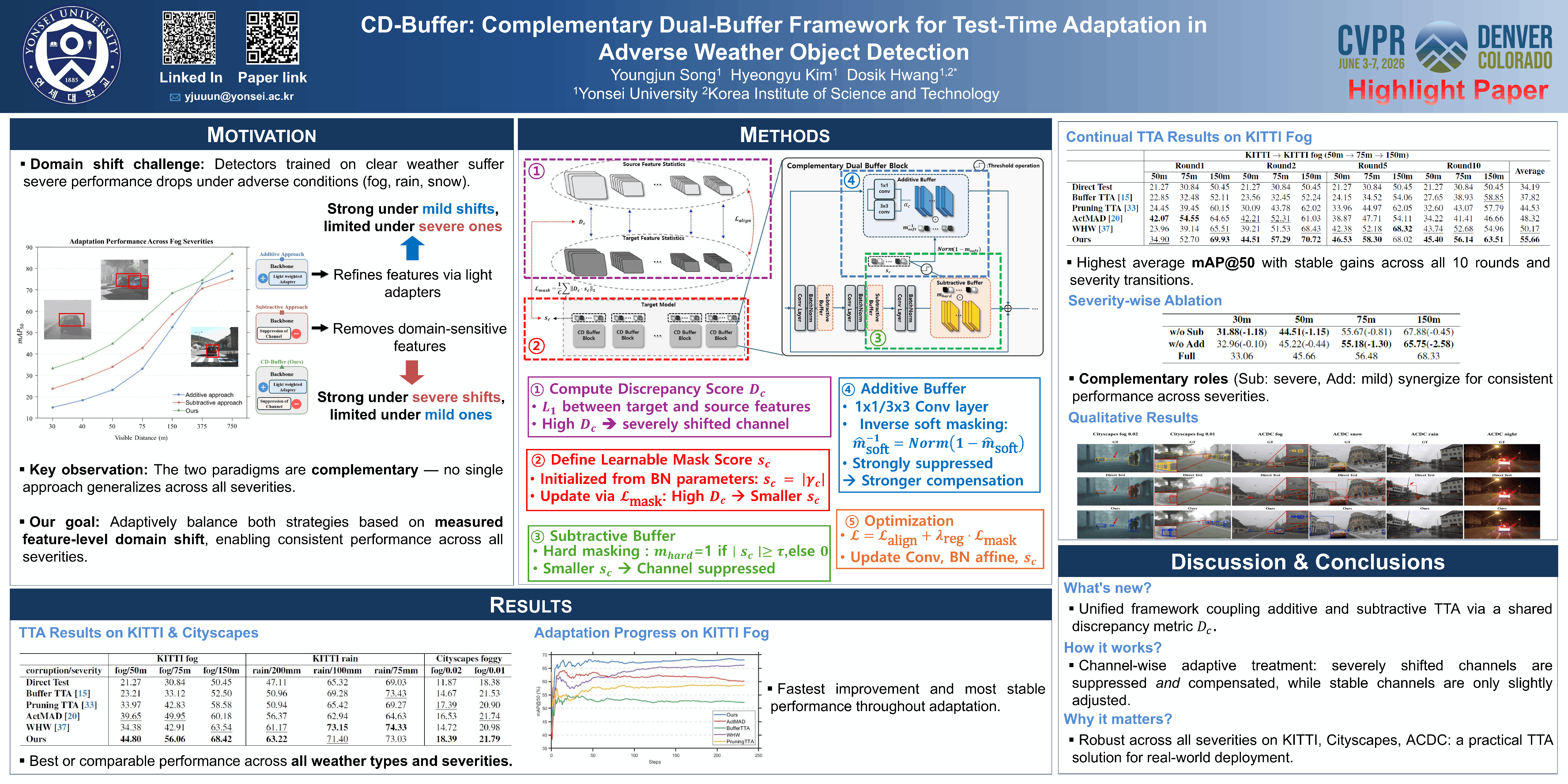
Test-time adaptation (TTA) enables real-time adaptation to domain shifts without offline retraining. Recent TTA methods have predominantly explored additive approaches that introduce lightweight modules for feature refinement. Very recently, a subtractive approach that removes domain-sensitive channels has emerged as an alternative direction. We observe that these paradigms exhibit complementary effectiveness patterns: subtractive methods excel under severe shifts by removing corrupted features, while additive methods are effective under moderate shifts requiring refinement. However, each paradigm operates effectively only within limited shift severity ranges, failing to generalize across diverse corruption levels. This motivates a fundamental question: can we adaptively balance both strategies based on measured feature-level domain shift?We propose CD-Buffer, a novel complementary dual-buffer framework where subtractive and additive mechanisms operate in opposite yet coordinated directions driven by a unified discrepancy metric. Our key innovation lies in the discrepancy-driven coupling: Our framework couples removal and refinement through a unified discrepancy metric, automatically balancing both strategies based on feature-level shift severity. This establishes automatic channel-wise balancing that adapts differentiated treatment to heterogeneous shift magnitudes without manual tuning. Extensive experiments on KITTI, Cityscapes, and ACDC datasets demonstrate state-of-the-art performance, consistently achieving superior results across diverse weather conditions and severity levels.
CoFiDA-M: Concept-Aware Feature Modulation for Cross-Domain Adaptation with Image-Only Inference
Nurjahan Sultana ⋅ Moi Hoon Yap ⋅ Xinqi Fan ⋅ Wenqi Lu
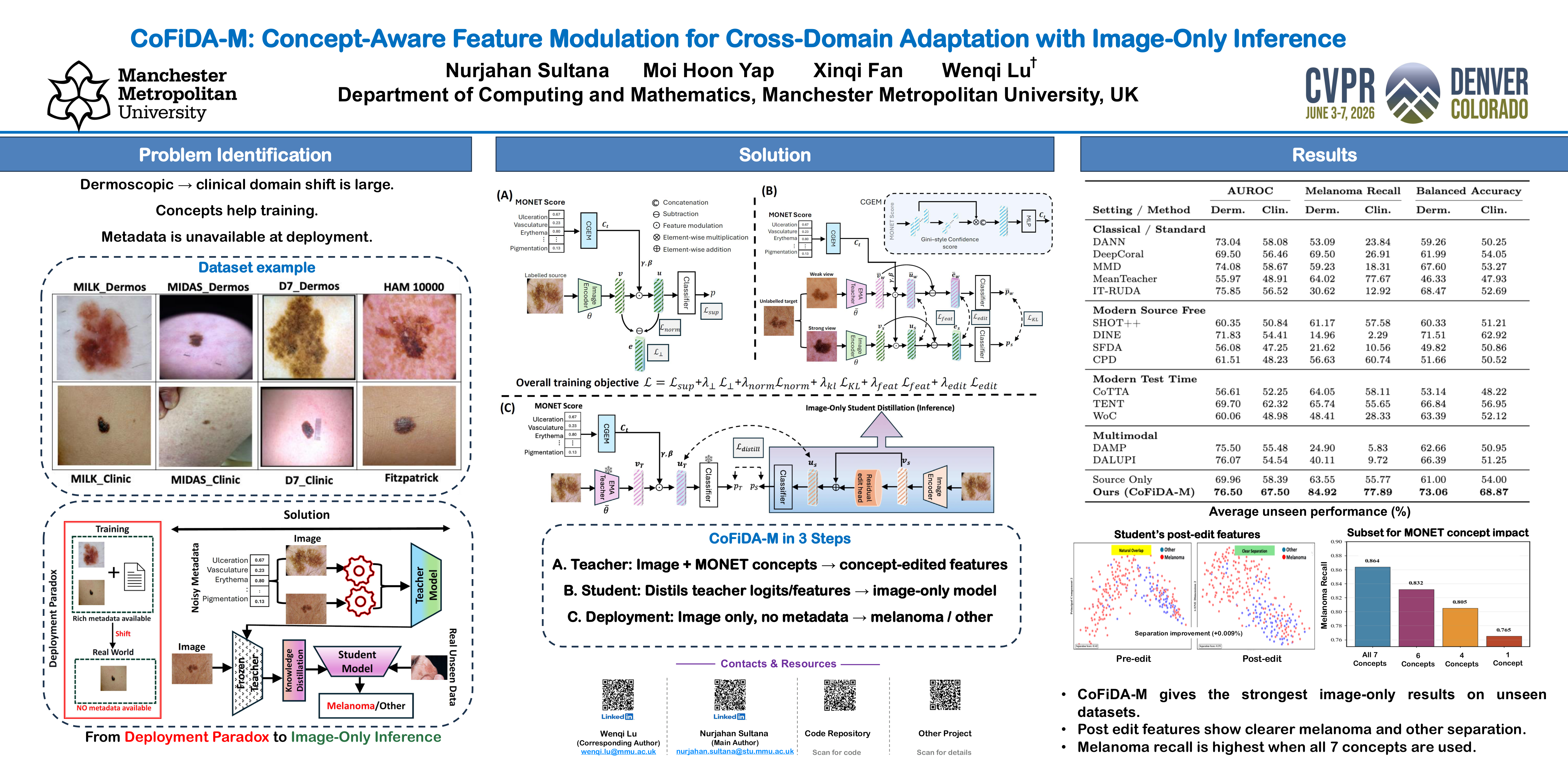
Models for AI-based skin cancer screening suffer a severe performance drop when shifting from expert dermoscopic (source) images to consumer-grade clinical (target) photos, hindering real-world deployment. Existing domain adaptation methods often ignore crucial semantic invariants, such as clinical concepts. While new foundation models like MONET can provide this semantic information as dense, probabilistic scores, this metadata is unavailable at test time, creating a deployment paradox for practical image-only screening tools. We address this gap by proposing CoFiDA-M, a privileged information framework that learns from concepts at training time but deploys as an image-only model. Our method trains a teacher network that uses MONET concept probabilities to guide a FiLM modulator, transforming visual features into a semantically "edited" feature space. A lightweight, image-only student is then trained to reproduce this edited representation, not just the teacher's final predictions. This distillation "bakes" the clinical reasoning into the student's weights.On a challenging multi-dataset benchmark, our image-only student significantly outperforms state-of-the-art approaches, especially in melanoma recall. Our work provides a practical and generalizable framework for leveraging noisy, probabilistic metadata as privileged information, demonstrating strong cross-dataset robustness and potential for real-world deployment beyond dermatology. The code will be made publicly available upon acceptance.
Towards Multimodal Domain Generalization with Few Labels
Hongzhao Li ⋅ Hao Dong ⋅ Hualei Wan ⋅ Shupan Li ⋅ Mingliang Xu ⋅ Muhammad Haris Khan
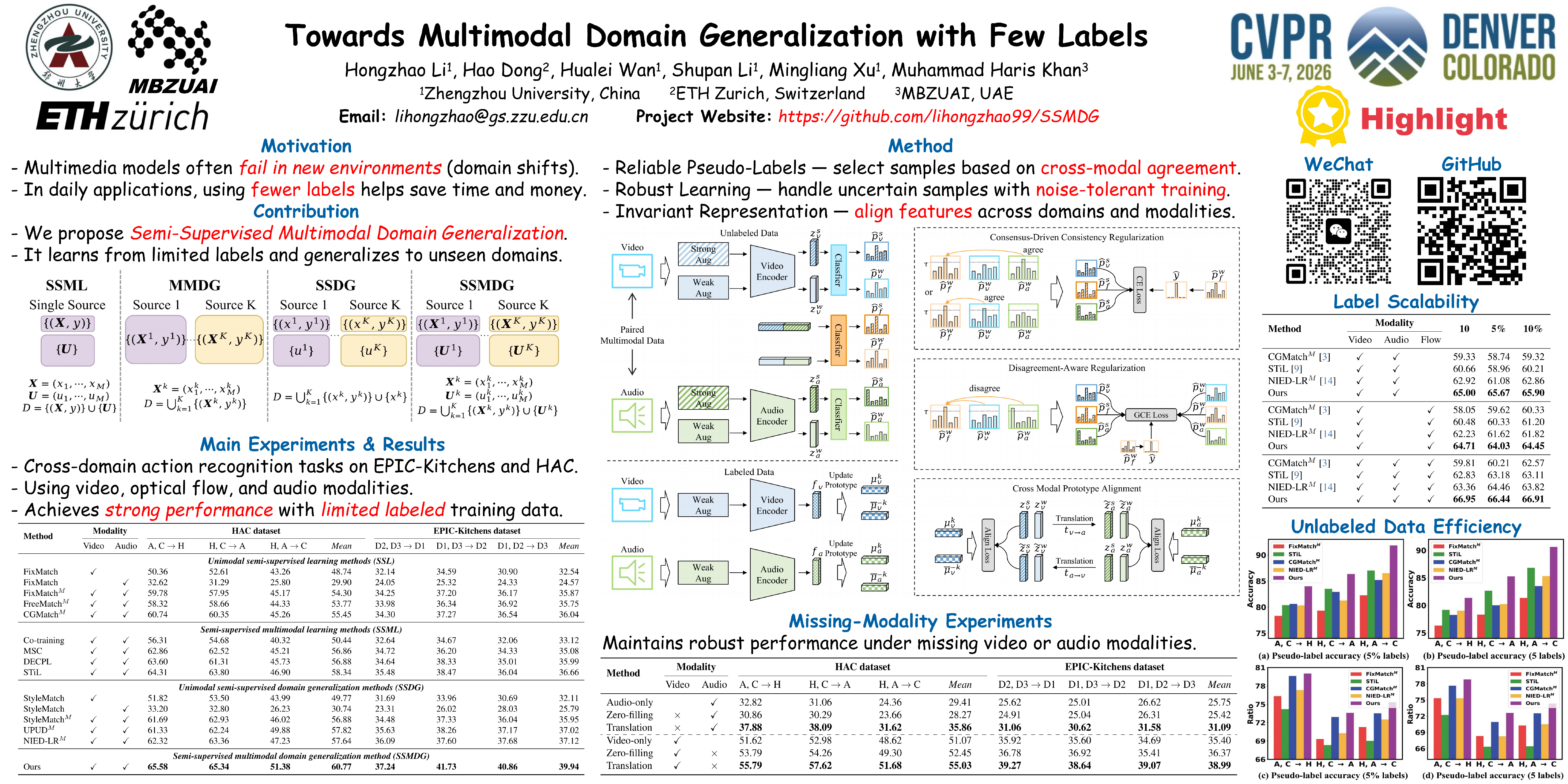
Multimodal models ideally should generalize to unseen domains while remaining data-efficient to reduce annotation costs. To this end, we introduce and study a new problem, Semi-Supervised Multimodal Domain Generalization (SSMDG), which aims to learn robust multimodal models from multi-source data with few labeled samples. We observe that existing approaches fail to address this setting effectively: multimodal domain generalization methods cannot exploit unlabeled data, semi-supervised multimodal learning methods ignore domain shifts, and semi-supervised domain generalization methods are confined to single-modality inputs. To overcome these limitations, we propose a unified framework featuring three key components: Consensus-Driven Consistency Regularization, which obtains reliable pseudo-labels through confident fused-unimodal consensus; Disagreement-Aware Regularization, which effectively utilizes ambiguous non-consensus samples; and Cross-Modal Prototype Alignment, which enforces domain- and modality-invariant representations while promoting robustness under missing modalities via cross-modal translation. We further establish the first SSMDG benchmarks, on which our method consistently outperforms strong baselines in both standard and missing-modality scenarios. Our benchmarks and code will be released to support future research.
Reclaiming Lost Text Layers for Source-Free Cross-Domain Few-Shot Learning
ZHENYU ZHANG ⋅ Guangyao Chen ⋅ Yixiong Zou ⋅ Yuhua Li ⋅ Ruixuan Li
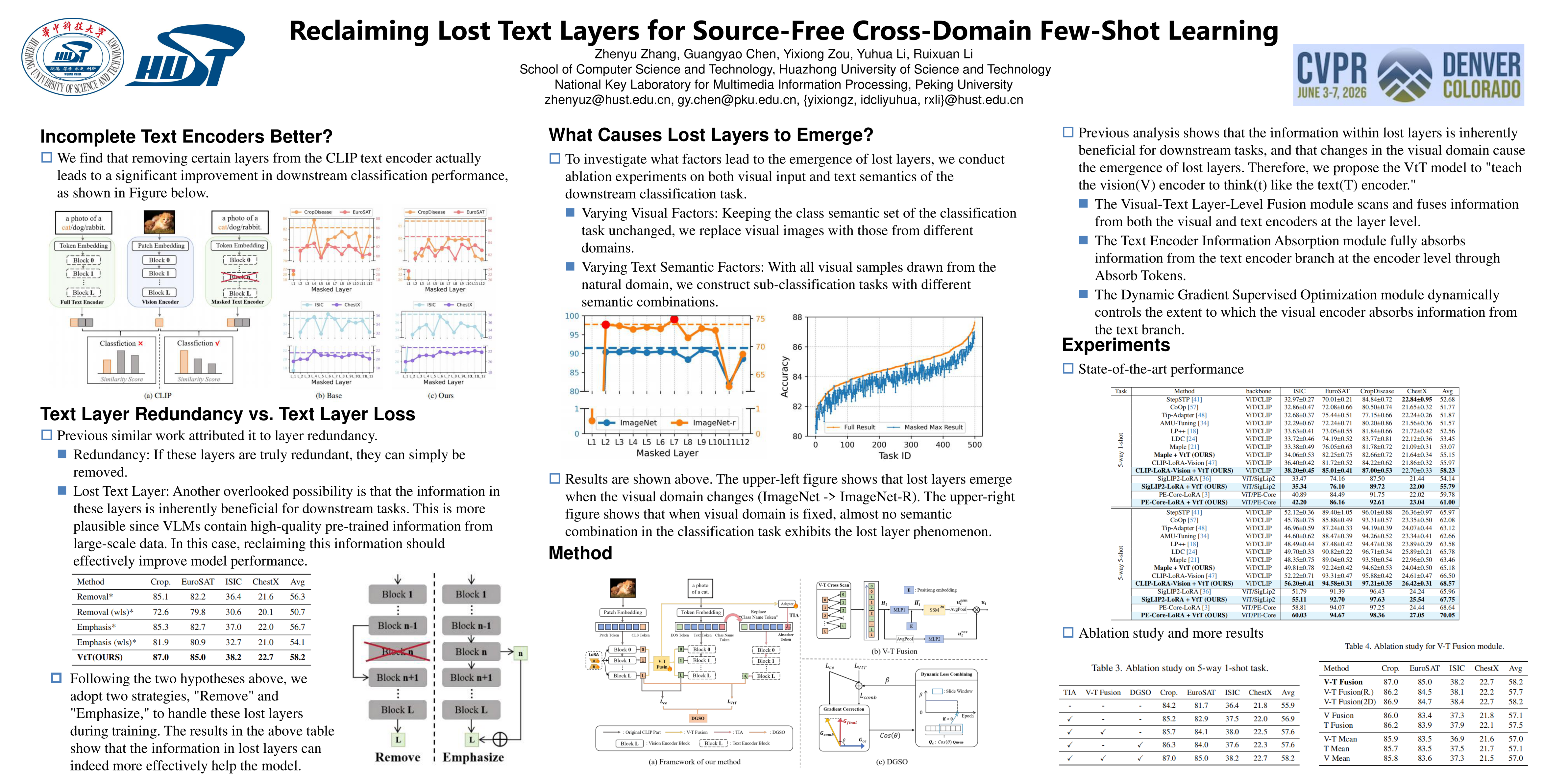
Source-Free Cross-Domain Few-Shot Learning (SF-CDFSL) focuses on fine-tuning with limited training data from target domains (e.g., medical or satellite images), where CLIP has recently shown promising results due to its generalizability to downstream tasks. Current works indicate CLIP's text encoder is more suitable for cross-domain tasks, however, we find that \textbf{removing certain middle layers of the text encoder can effectively improve performance in SF-CDFSL}, which we call the Lost Layers. In this paper, we delve into this phenomenon for a deeper understanding. We discover that instead of being harmful for the SF-CDFSL task, the information in these layers is actually beneficial, but visual gaps prevent this useful information from being fully utilized, making these layers seem redundant.Based on this understanding, unlike current works that simply remove these layers, we propose a method to teachs the model to \textbf{re-utilize} information in these lost layersat both the layer and encoder levels, guiding the re-learning of the visual branch under domain shifts. Our approach effectively addresses the issue of underutilized information in the text encoder. Extensive experiments across various settings, backbones (CLIP, SigLip, PE-Core), and tasks (4 CDFSL datasets and 10 Meta-dataset datasets) demonstrate the effectiveness of our method. We will release the code.
Event6D: Event-based Novel Object 6D Pose Tracking
Jae-Young Kang ⋅ Hoonhee Cho ⋅ Taeyeop Lee ⋅ Minjun Kang ⋅ Bowen Wen ⋅ Youngho Kim ⋅ Kuk-Jin Yoon
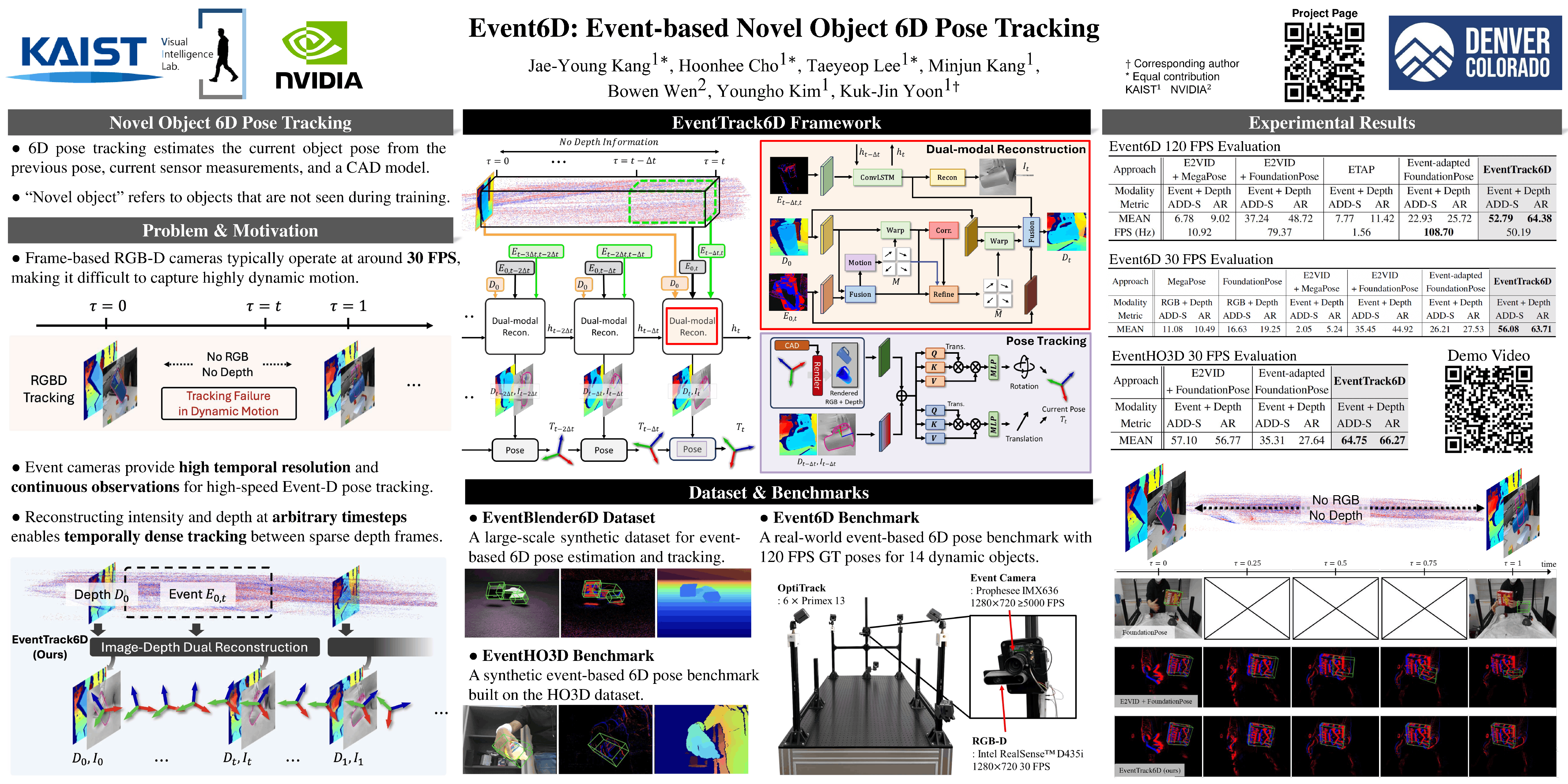
Event cameras provide microsecond latency, making them suitable for 6D object pose tracking in fast, dynamic scenes where conventional RGB and depth pipelines suffer from motion blur and large pixel displacements. We introduce EventTrack6D, an event-depth tracking framework that generalizes to novel objects without object-specific training by reconstructing both intensity and depth at arbitrary timestamps between depth frames. Conditioned on the most recent depth measurement, our dual reconstruction recovers dense photometric and geometric cues from sparse event streams. Our EventTrack6D operates at over 120 FPS and maintains temporal consistency under rapid motion. To support training and evaluation, we introduce a comprehensive benchmark suite: a large-scale synthetic dataset for training and two complementary evaluation sets, including real and simulated event datasets. Trained exclusively on synthetic data, EventTrack6D generalizes effectively to real-world scenarios without fine-tuning, maintaining accurate tracking across diverse objects and motion patterns. Our method and datasets establish event cameras as a viable solution for event-based novel object 6D pose tracking.
EV-CGNet: Co-visible Focused 3D-guided 2D Event Keypoint Detection Network
Yuan Gao ⋅ Tianle Ding ⋅ Yuqing Zhu ⋅ Tianzhu Zhang
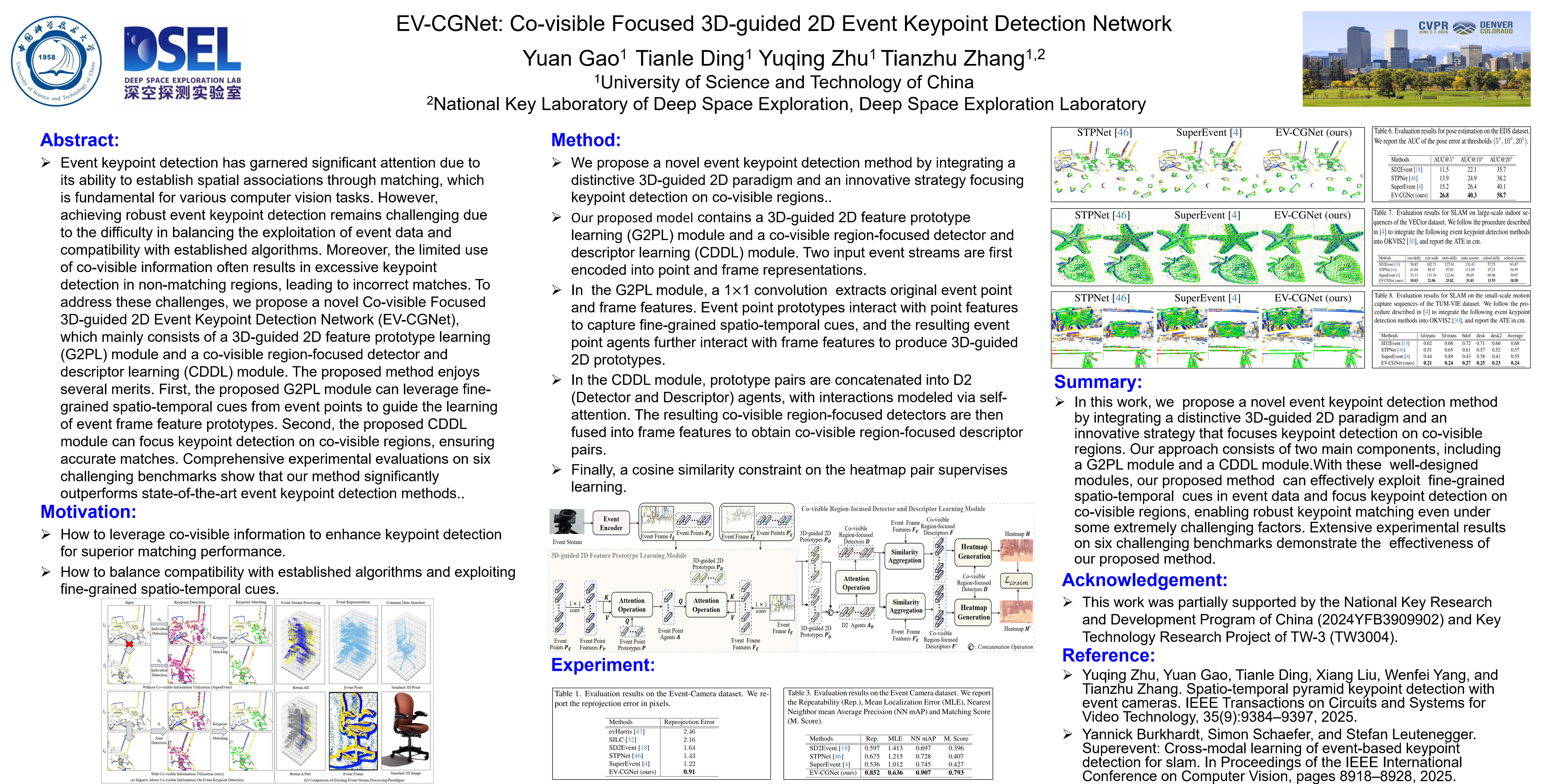
Event keypoint detection has garnered significant attention due to its crucial role in extracting spatial relationships between matched keypoints, which are fundamental for various computer vision tasks. However, achieving robust event keypoint detection remains challenging the difficulty in balancing the exploitation of event information and compatibility with established algorithms. Moreover, the limited use of co-visible information often results in excessive keypoint detection in non-matching regions, leading to incorrect matches. To address these challenges, we propose a novel Co-visible Focused 3D-guided 2D Event Keypoint Detection Network (EV-CGNet), which mainly consists of a 3D-guided 2D feature prototype learning (G2PL) module and a co-visible region-focused detector and descriptor learning (CDDL) module. The proposed method enjoys several merits. First, the proposed G2PL module can enhance event frame feature prototypes by recovering motion information with guidance from event points. Second, the proposed CDDL module can direct keypoint detection toward co-visible regions and ensure accurate matches. Comprehensive experimental evaluations on six challenging benchmarks show that our method surpasses state-of-the-art event keypoint detection method significantly.
AE2VID: Event-based Video Reconstruction via Aperture Modulation
Chenxu Bai ⋅ Boyu Li ⋅ Peiqi Duan ⋅ xinyu zhou ⋅ Hanyue Lou ⋅ Boxin Shi
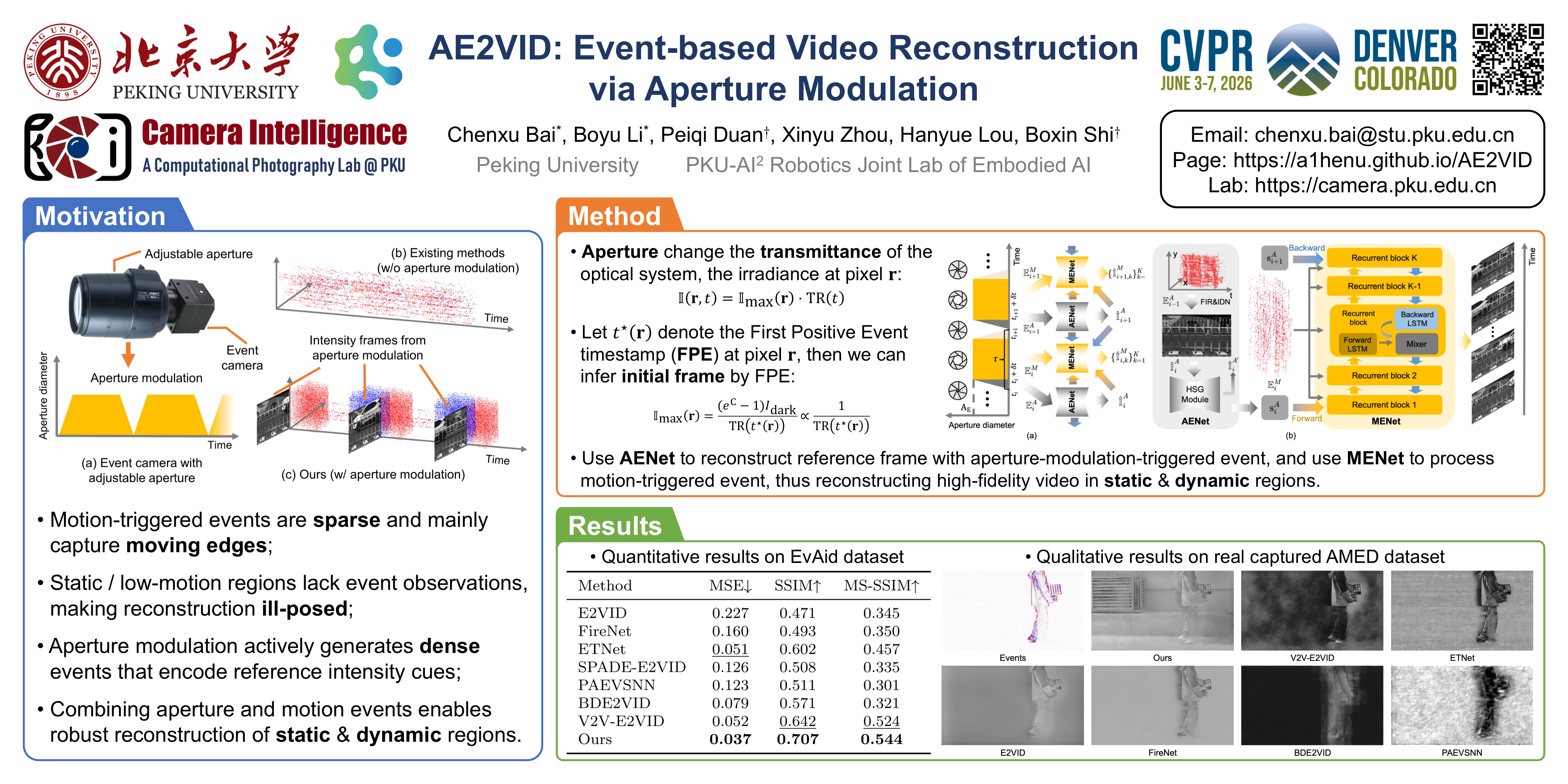
Event-based video reconstruction seeks to recover high-speed, high-dynamic-range videos from event streams. While existing approaches rely exclusively on motion-triggered events, these events are inherently sparse and primarily capture dynamic regions. Therefore, they often suffer from error accumulation and degraded quality in regions with few events. In this work, we introduce aperture-modulation-triggered events as a complementary mechanism to enrich the captured scene information. Specifically, we periodically modulate the aperture to actively generate dense event signals, thereby encoding intensity cues even in static or low-motion regions. Building upon this idea, we design an AE2VID framework that jointly leverages aperture-modulation-triggered and motion-triggered events to enhance the fidelity of predictions. The proposed framework consists of two subnetworks for the dedicated processing of both event types. We further collect a real dataset and validate the effectiveness of our method. Extensive experiments show our superiority over state-of-the-art methods.
From Contrast to Consistency: Rethinking Event-based Continuous-Time Optical Flow Estimation
rui hu ⋅ Song Wu ⋅ Wen Yang ⋅ Jinjian Wu
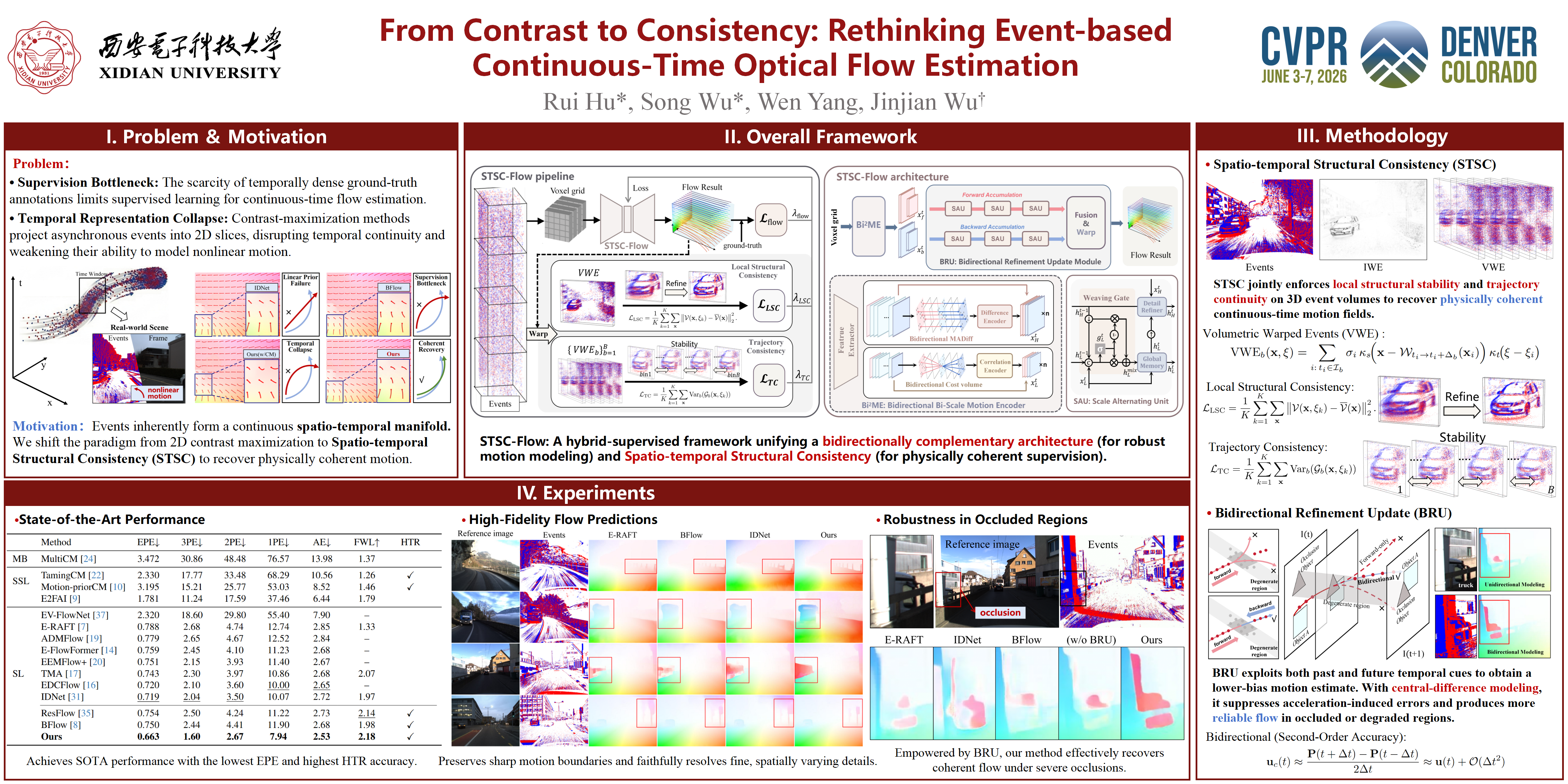
Estimating continuous optical flow is a fundamental yet challenging problem in dynamic visual perception. Event-based cameras, with microsecond latency and high dynamic range, capture brightness changes asynchronously, offering a unique opportunity to model motion with fine temporal precision. However, the scarcity of dense annotations restricts the effectiveness of supervised learning, while contrast maximization (CM) frameworks, focused on sharpening the Image of Warped Events (IWE), often neglect temporal continuity and structural coherence, leading to distorted trajectories under complex motion.To overcome these challenges, we propose a hybrid-supervised framework for continuous-time optical flow estimation, grounded in the principle of Spatio-temporal Structural Consistency (STSC). This paradigm jointly enforces local structural stability and trajectory continuity, ensuring physically coherent motion across time. To further enhance representation and robustness, we design a bidirectionally complementary multi-scale architecture and employ a curriculum-guided hybrid training strategy, enabling a smooth transition from supervised point constraints to self-supervised manifold regularization.Comprehensive experiments across multiple benchmarks show that our method achieves state-of-the-art performance in both continuous-time and standard optical flow estimation, demonstrating the effectiveness of the proposed learning paradigm.
Spike-driven Discrete Aggregation for Event-based Object Detection
Huaning Li ⋅ Ziming Wang ⋅ Runhao Jiang ⋅ Yan Rui ⋅ Huajin Tang
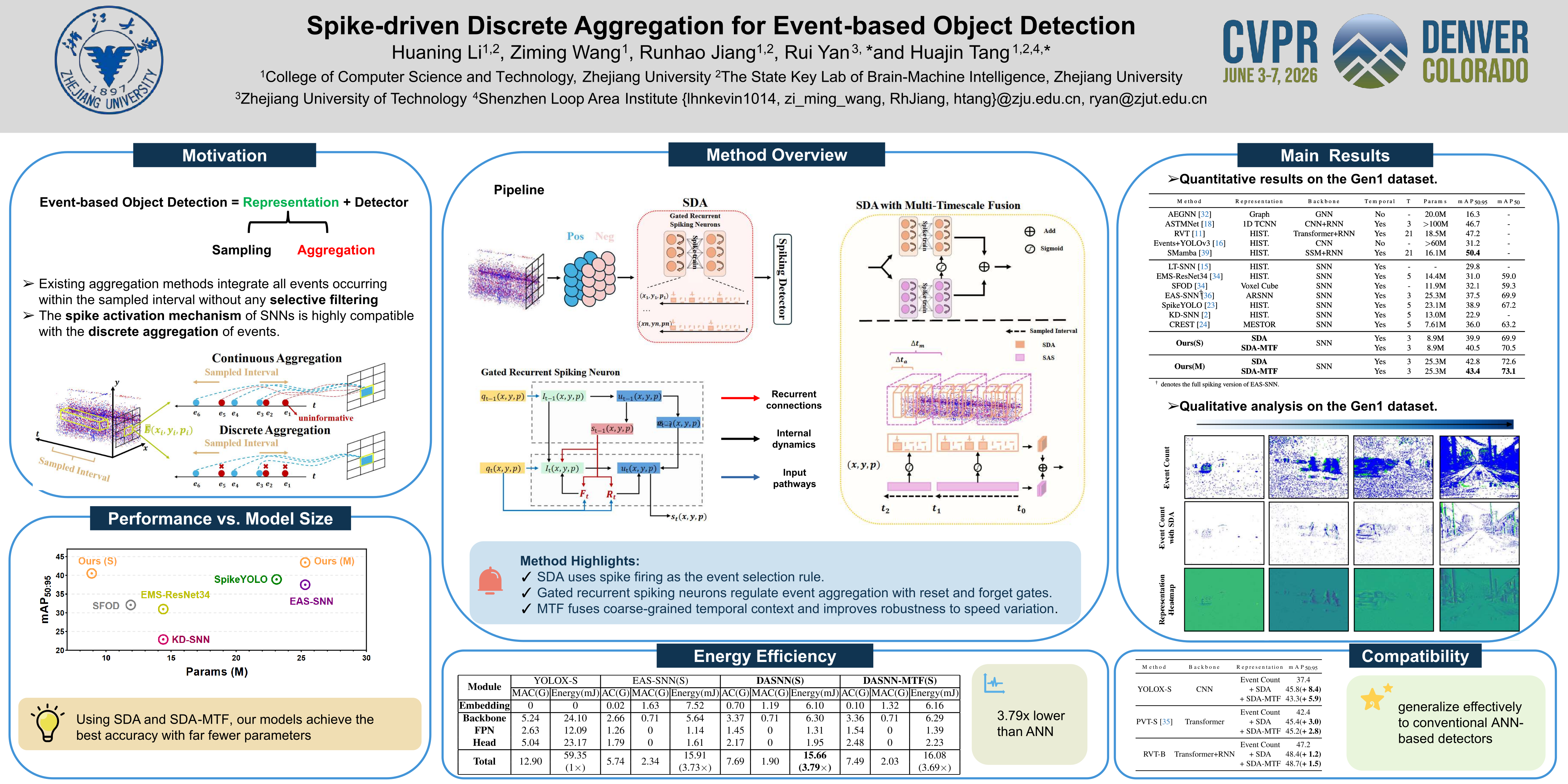
With their high dynamic range and temporal resolution, event cameras are well-suited for object detection, especially under motion blur and extreme illumination.Recent state-of-the-art works for event-based object detection primarily focus on the high-level design of backbones. However, developing effective event representations is equally crucial, as it bridges asynchronous event streams with the dense tensors required by detection networks. Most existing aggregation strategies for event representation continuously accumulate all events within sampled intervals without selective filtering, inevitably introducing uninformative events that degrade detection accuracy.To address this limitation, we introduce a novel perspective, termed Discrete Aggregation, which adaptively and discretely selects informative events for differentiable aggregation. We realize this through the Spiking Discrete Aggregation (SDA) module, which is inspired by the threshold-based spike firing mechanism in Spiking Neural Networks (SNNs) and implemented using gated recurrent spiking neurons.Additionally, we introduce the Multi-Timescale Fusion (MTF) method which leverages coarse-grained temporal features from continuous event streams to further enhance the representation capability of SDA. Experimental results on neuromorphic datasets demonstrate that our method achieves state-of-the-art performance among all fully spiking architectures while using fewer parameters, reaching 43.4\% $mAP_{50:95}$ on Gen1 (+ 4.5\% over prior art). Moreover, our method exhibits superior robustness under noisy conditions and shows strong compatibility with non-spiking models.
x^2-Fusion: Cross-Modality and Cross-Dimension Flow Estimation in Event Edge Space
Ruishan Guo ⋅ Ciyu Ruan ⋅ Haoyang Wang ⋅ Zihang GONG ⋅ Jingao Xu ⋅ Xinlei Chen
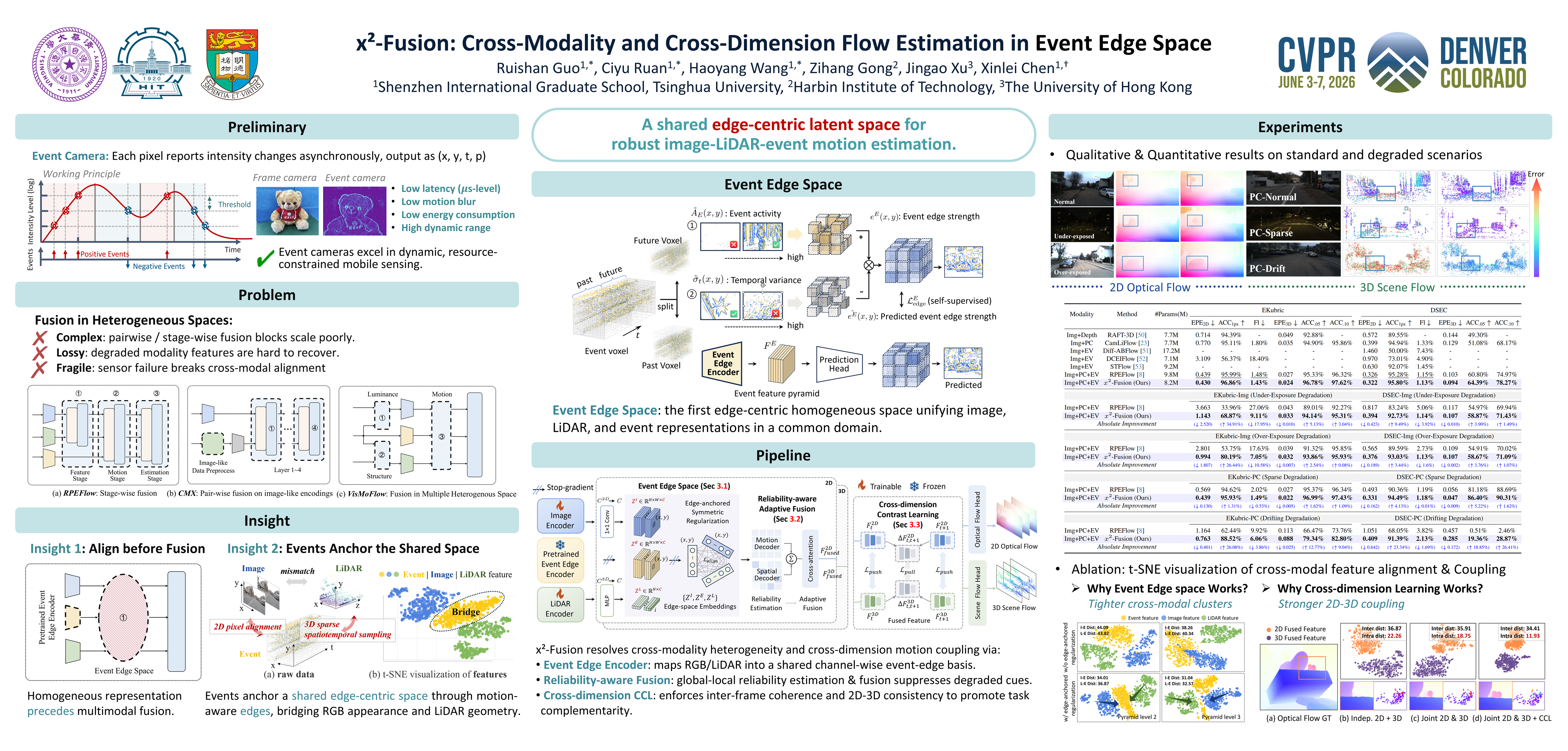
Estimating dense 2D optical flow and 3D scene flow is essential for dynamic scene understanding. Recent work combines images, LiDAR, and event data to jointly predict 2D and 3D motion, yet most approaches operate in separate heterogeneous feature spaces. Without a shared latent space that all modalities can align to, these systems rely on multiple modality-specific blocks, leaving cross-sensor mismatches unresolved and making fusion unnecessarily complex. Event cameras naturally provide a spatiotemporal edge signal, which we can treat as an intrinsic edge field to anchor a unified latent representation, termed the \textbf{Event Edge Space}. Building on this idea, we introduce \textbf{$x^2$-Fusion}, which reframes multimodal fusion as representation unification: event-derived spatiotemporal edges define an edge-centric homogeneous space, and image and LiDAR features are explicitly aligned in this shared representation. Within this space, we perform reliability-aware adaptive fusion to estimate modality reliability and emphasize stable cues under degradation. We further employ cross-dimension contrast learning to tightly couple 2D optical flow with 3D scene flow. Extensive experiments on both synthetic and real benchmarks show that $x^2$-Fusion achieves state-of-the-art accuracy under standard conditions and delivers substantial improvements in challenging scenarios.
FloVerse: Floor Plan-Guided Multi-Modal Navigation
weiqi Huang ⋅ Shuangyi Dong ⋅ Jiaxin Li ⋅ Yifei Guo ⋅ Zan Wang ⋅ Wei Liang
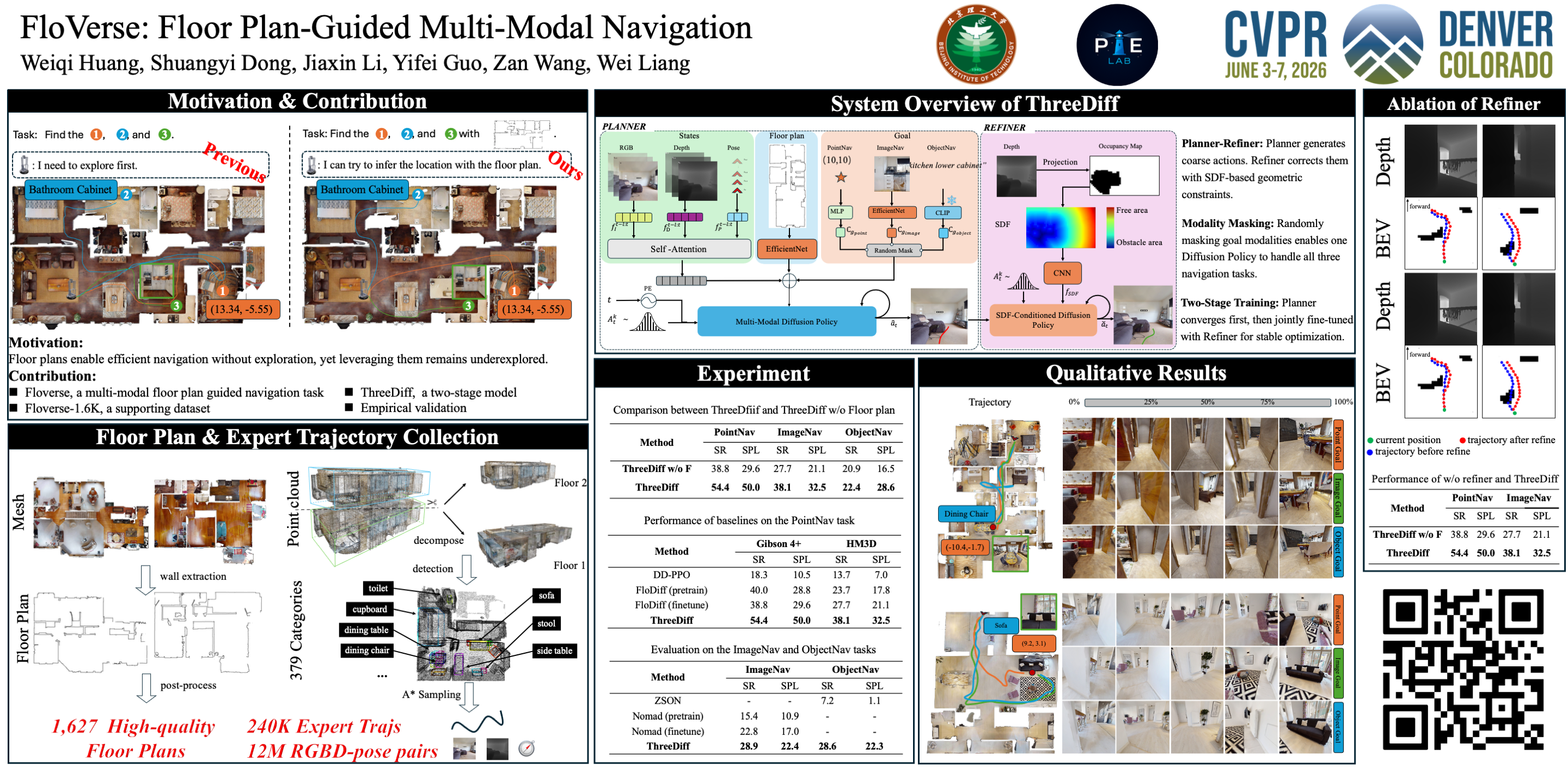
Floor plans encapsulate compact spatial priors, enabling agents to navigate unseen scenes more efficiently. While prior work has explored floor plan–guided navigation, it has focused mainly on PointNav and a limited set of environments. To bridge this gap, we introduce FloVerse, a new task for floor plan–guided embodied navigation that unifies PointNav, ObjectNav, and ImageNav. To support this FloVerse, we assemble FloVerse-1.6K, a large-scale dataset of 1.6K scenes from HM3D and Gibson $4$+, paired with corresponding floor plans, comprising 240K expert trajectories and 12M RGBD frames. We further propose ThreeDiff, a two-stage imitation learning policy consisting of a planner—a diffusion-based multimodal goal-reasoning module trained via masked-modality modeling—and a refiner, a depth-based trajectory refinement module for safe execution. Extensive experiments show that (1) floor plan priors consistently improve navigation performance across all goal modalities, and (2) ThreeDiff implicitly learns to infer goal locations from diverse goal representations through spatial reasoning. These results highlight the effectiveness of structured spatial priors and our unified approach for floor plan–guided embodied navigation.
TrajRAG: Retrieving Geometric-Semantic Experience for Zero-Shot Object Navigation
Yiyao Wang ⋅ Sixian Zhang ⋅ Keming Zhang ⋅ Xinhang Song ⋅ Songjie Du ⋅ Shuqiang Jiang
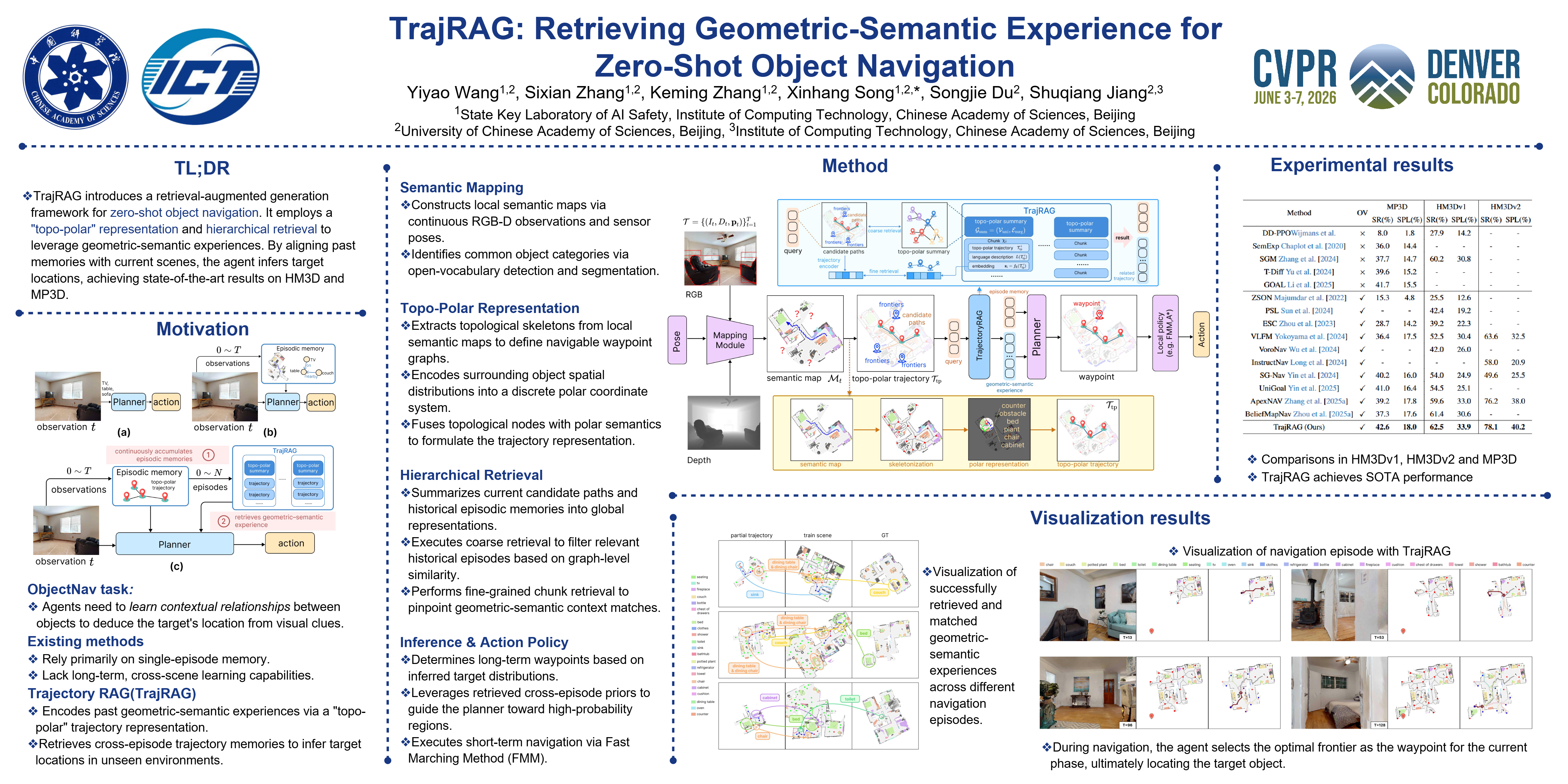
Existing zero-shot Object Goal Navigation (ObjectNav) methods often exploit commonsense knowledge from large language or vision-language models to guide navigation. However, such knowledge arises from internet-scale text rather than embodied 3D experience, and episodic observations collected during navigation are typically discarded, preventing the accumulation of lifelong experience.To this end, we propose Trajectory RAG (TrajRAG), a retrieval-augmented generation framework that enhances large-model reasoning by retrieving geometric–semantic experiences. TrajRAG incrementally accumulates episodic observations from past navigation episodes. To structure these observations, we propose a topological-polar (topo-polar) trajectory representation that compactly encodes spatial layouts and semantic contexts, effectively removing redundancies in raw episodic observations. A hierarchical chunking structure further organizes similar topo-polar trajectories into unified summaries, enabling coarse-to-fine retrieval. During navigation, candidate frontiers generate multiple trajectory hypotheses that query TrajRAG for similar past trajectories, guiding large-model reasoning for waypoint selection. New experiences are continually consolidated into TrajRAG, enabling the accumulation of lifelong navigation experience.Experiments on MP3D, HM3D-v1, and HM3D-v2 show that TrajRAG effectively retrieves relevant geometric–semantic experiences and improves zero-shot ObjectNav performance.
History to Future: Evolving Agent with Experience and Thought for Zero-shot Vision-and-Language Navigation
Guangzhao Dai ⋅ Shuo Wang ⋅ Zihan Wang ⋅ Guo-Sen Xie ⋅ Yang Yang ⋅ Jinshan Pan ⋅ Qianru Sun ⋅ Xiangbo Shu
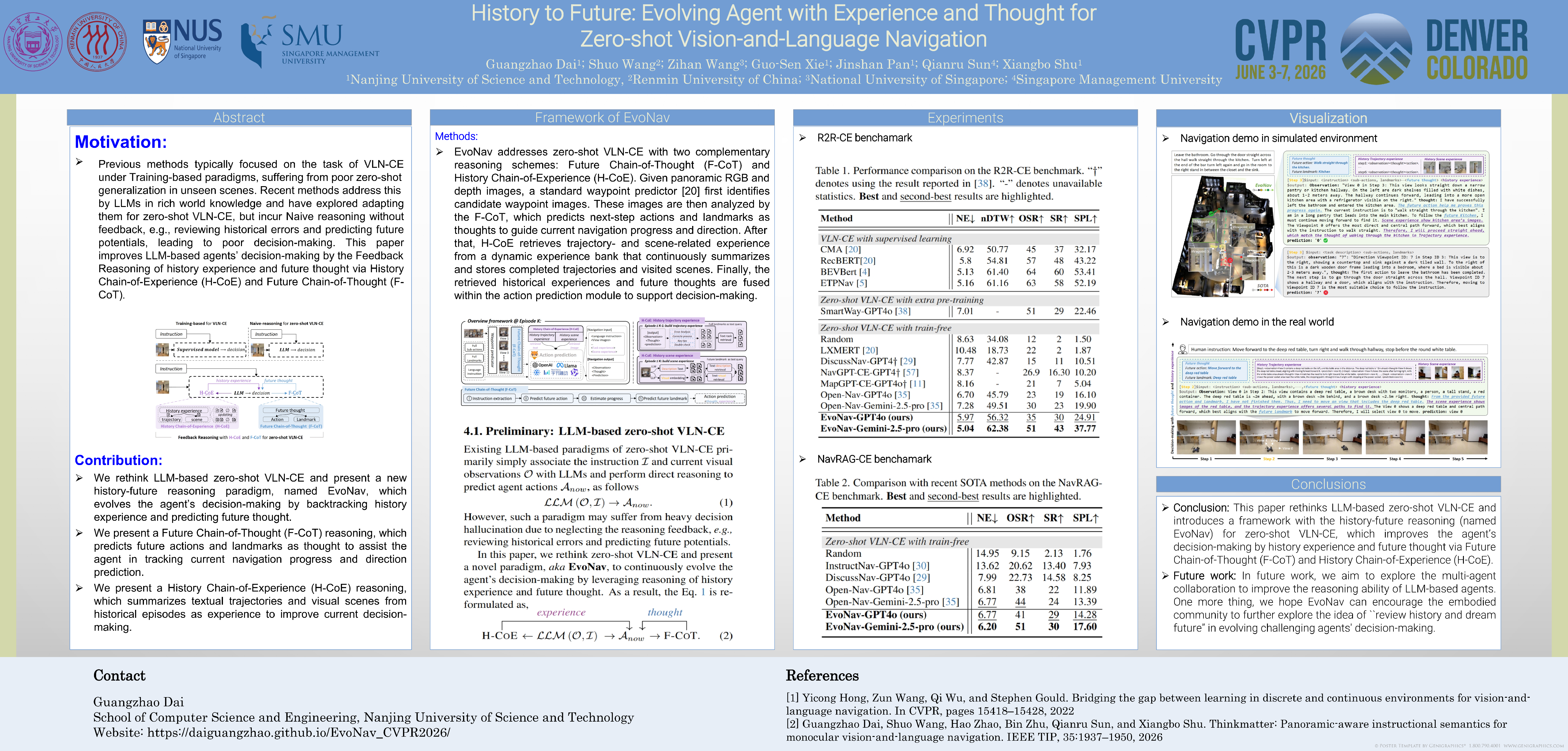
Vision-and-Language Navigation in Continuous Environment (VLN-CE) requires an agent to follow language instructions to navigate the target destination. With the advancement of large language models (LLMs), recent efforts have explored adapting them for zero-shot VLN-CE, offering a promising solution in addressing the drawbacks of poor generalization in the training-based paradigm. However, existing LLM-based works primarily perform naive reasoning for decision-making and lack feedback, e.g., reviewing historical errors and predicting future potentials. Consequently, it may suffer from continuous failure for those initial error tasks. In this paper, we rethink LLM-based zero-shot VLN-CE and propose a new paradigm, named EvoNav, to improve the agent's decision-making with future thought and history experience via Future Chain-of-Thought (F-CoT) and History Chain-of-Experience (H-CoE). F-CoT predicts future actions and landmarks as thoughts to assist navigation progress estimation and direction selection, while H-CoE summarizes historical trajectories and scenes as experience to improve navigation decision reliability. Both F-CoT and H-CoE cooperatively evolve the agent’s decision-making. Extensive experiments in both the simulator and real-world environments demonstrate the effectiveness of our EvoNav. Source code will be released.
DreamSAC: Learning Hamiltonian World Models via Symmetry Exploration
Jinzhou Tang ⋅ Fan Feng ⋅ Minghao Fu ⋅ Wenjun Lin ⋅ Jing Yang ⋅ Biwei Huang ⋅ Keze Wang
Learned world models excel at interpolative generalization but fail at extrapolative generalization to novel physical properties. This limitation arises because they learn statistical correlations rather than the environment's underlying generative rules, such as physical invariances and conservation laws. We argue that learning these invariances is key to robust extrapolation. To achieve this, we first introduce \textbf{Symmetry Exploration}, an unsupervised exploration strategy where an agent is intrinsically motivated by a Hamiltonian-based curiosity bonus to actively probe and challenge its understanding of conservation laws, thereby collecting physically informative data. Second, we design a Hamiltonian-based world model that learns from the collected data, using a novel self-supervised contrastive objective to identify the invariant physical state from raw, view-dependent pixel observations. Our framework, \textbf{DreamSAC}, trained on this actively curated data, significantly outperforms state-of-the-art baselines in 3D physics simulations on tasks requiring extrapolation.
Beyond Scanpaths: Graph-Based Gaze Simulation in Dynamic Scenes
Luke Palmer ⋅ Petar Palasek ⋅ Hazem Abdelkawy
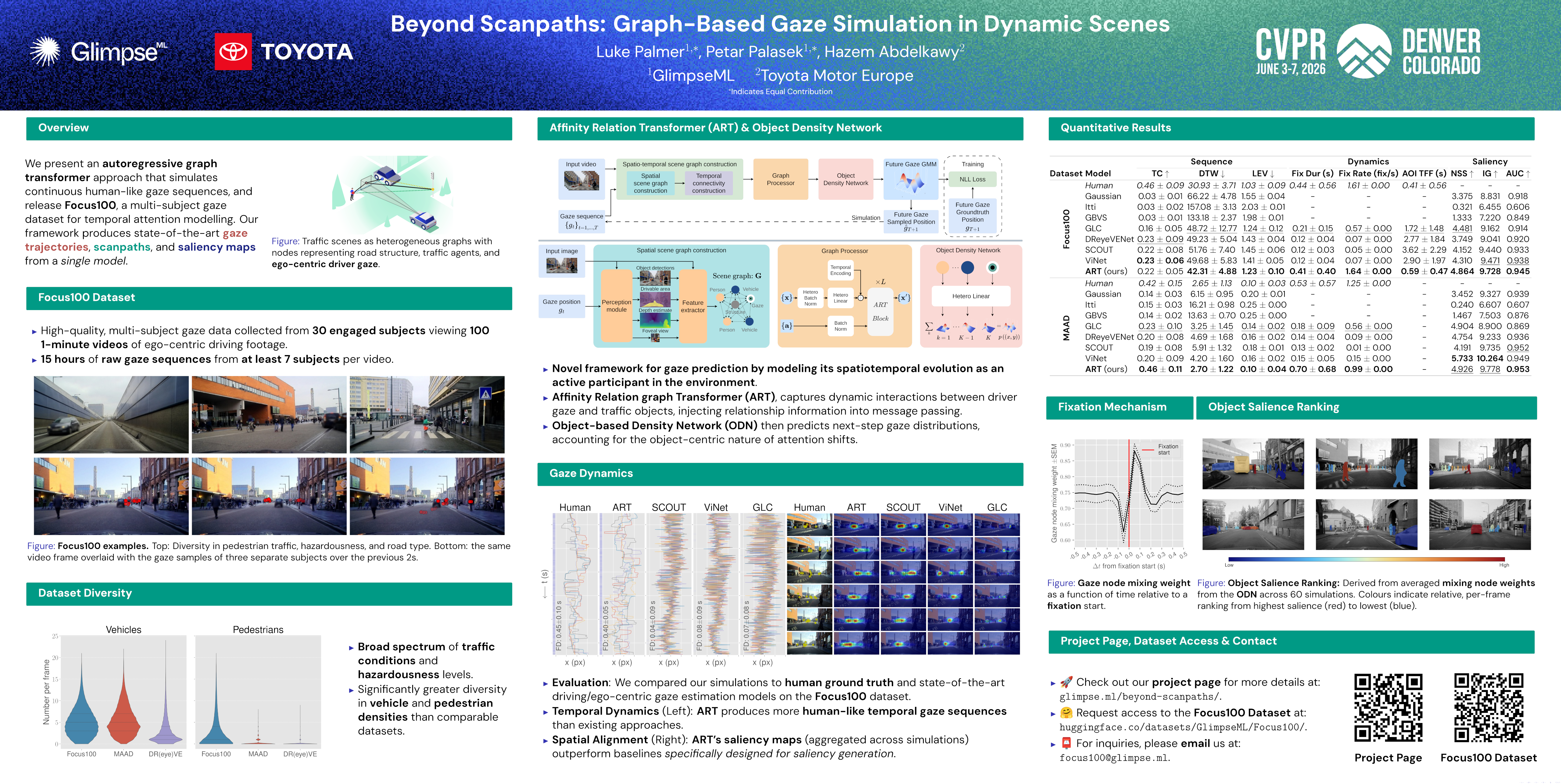
Accurately modelling human attention is essential for numerous computer vision applications, particularly in the domain of automotive safety. Existing methods often collapse gaze into scanpaths or saliency maps, overlooking the dynamics of natural eye movements and introducing artefacts into training data. We instead propose a dynamical systems approach that treats gaze as an active agent interacting with its environment, enabling the simulation of raw, continuous gaze trajectories. In our approach, driving scenes are represented as gaze-centric spatiotemporal graphs processed by the Affinity Relation Transformer (ART), a heterogeneous graph transformer that models interactions between driver gaze and surrounding traffic objects and road structure. We further introduce an Object Density Network (ODN) to predict next-step gaze distributions, capturing the stochastic, object-centric nature of attentional shifts in complex environments. To support this research, we also present Focus100, a new dataset of gaze recordings from 30 participants viewing ego-centric driving footage. Trained directly on raw gaze, without any fixation filtering, our unified approach produces more natural gaze timeseries, scanpath dynamics, and saliency maps than existing attention estimation methods, offering valuable insights for the temporal modelling of human attention and automotive safety.
CGL: Advancing Continual GUI Learning via Reinforcement Fine-Tuning
Zhenquan Yao ⋅ Zitong Huang ⋅ yihan zeng ⋅ Jianhua Han ⋅ Hang Xu ⋅ Chun-Mei Feng ⋅ Jianwei Ma ⋅ Wangmeng Zuo
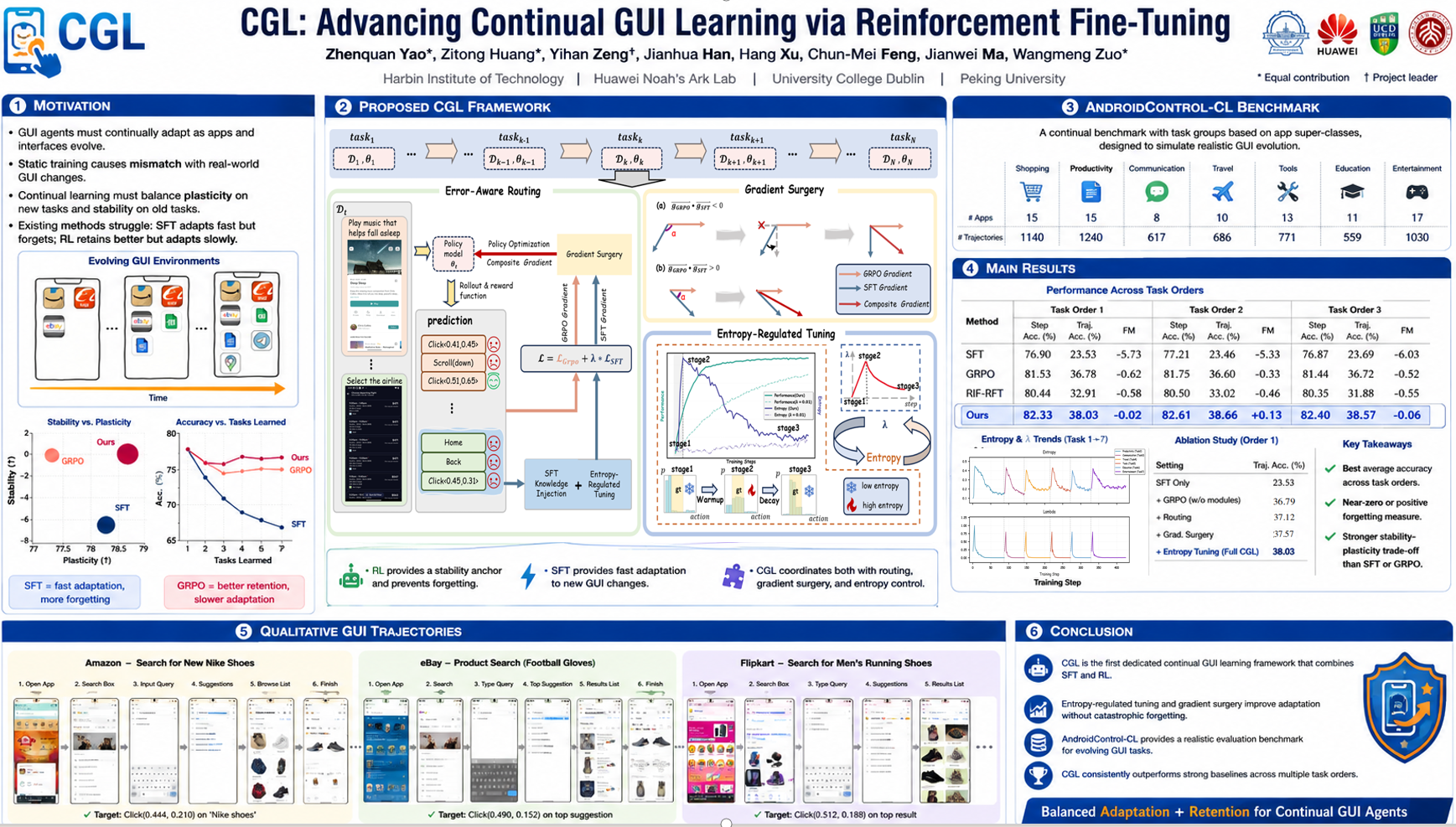
Graphical User Interface (GUI) Agents, benefiting from recent advances in multimodal large language models (MLLM), have achieved significant development. However, due to the frequent updates of GUI applications, adapting to new tasks without forgetting old tasks in GUI continual learning remains an open problem. Existing works are generally trained on a fixed set of tasks and adapt to new tasks either through supervised fine-tuning (SFT) or reinforcement learning (RL), suffering from catastrophic forgetting and slow adaptation. In this work, we propose a \textbf{C}ontinual \textbf{G}UI \textbf{L}earning (CGL) framework that dynamically balances adaptation efficiency and skill retention by enhancing the synergy between SFT and RL. Specifically, we introduce an SFT proportion adjustment mechanism guided by policy entropy to dynamically control the weight allocation between the SFT and RL training phases. Additionally, we propose gradient surgery and entropy-regulated tuning strategies to enable GUI agents to continuously evolve while maintaining competence across previously learned domains. On top of that, we propose a AndroidControl-CL benchmark, which divides GUI applications into distinct task groups to effectively simulate and evaluate the performance of GUI continual learning. Experimental results demonstrate the effectiveness of our proposed CGL framework under the continual learning setting. The benchmark, code and model will be made publicly available.
Rethinking Visual Rearrangement from A Diffusion Perspective
Tianliang Qi ⋅ Xinhang Song ⋅ Yuyi Liu ⋅ Shuqiang Jiang
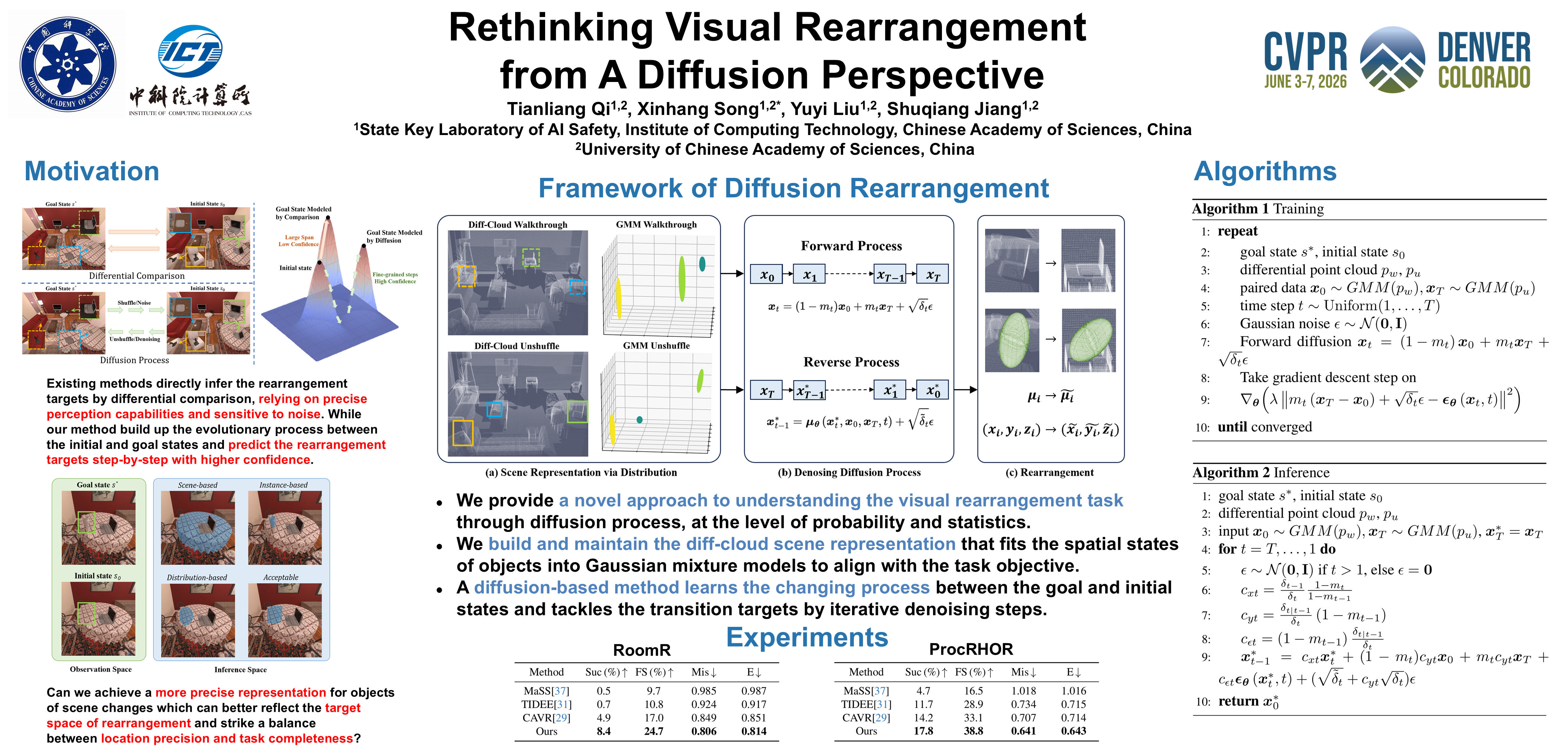
Rearranging disarrayed objects to their intended goal states requires the agent to comprehend the changes that have occurred in the scene and to reason about the process of these changes. To address this, we propose a novel perspective on the visual rearrangement task, drawing inspiration from the diffusion processes in molecular thermodynamics. We model the room shuffle and unshuffle stages as the forward and reverse processes of diffusion. In contrast to conventional methods that rely on scene modeling and differential comparisons, our approach provides insight into the intrinsic evolution process between the goal and initial states of the scene, which allows for a more reasonable rearrangement of objects through fine-grained and progressive denoising steps with high confidence. By analyzing the task objectives, we represent the scene via spatial distributions of objects and model the visual rearrangement process using a diffusion bridge model. Building upon this, we introduce the Diffusion Rearrangement model, which takes point cloud data as input, fits it into Gaussian mixture distributions to represent the states of objects, and predicts the rearrangement target through an iterative denoising transformer. Experimental results on the RoomR dataset demonstrate the effectiveness of our approach.
APEX: A Decoupled Memory-based Explorer for Asynchronous Aerial Object Goal Navigation
Daoxuan Zhang ⋅ Ping Chen ⋅ Xiaobo Xia ⋅ Xiu Su ⋅ Ruichen Zhen ⋅ Jianqiang Xiao ⋅ Shuo Yang
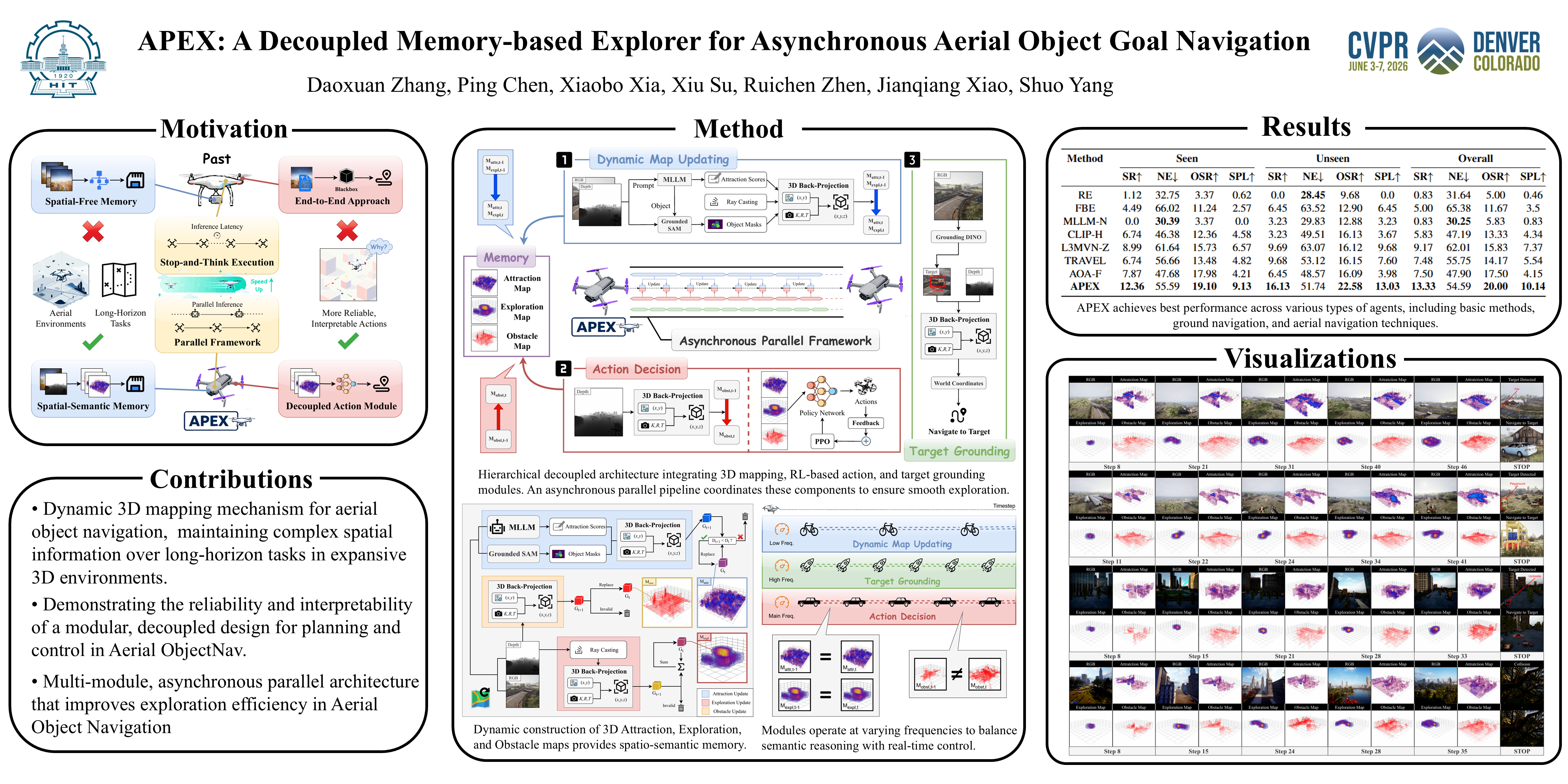
The Aerial Object Goal Navigation, a challenging frontier in Embodied AI, requires an Unmanned Aerial Vehicle (UAV) agent to autonomously explore, reason, and identify a specific target using only visual perception and language description. However, existing methods struggle with the memorization of complex spatial representations in aerial environments, reliable and interpretable action decision-making, and inefficient exploration and information gathering. To address these challenges, we introduce APEX (Aerial Parallel Explorer), a novel hierarchical agent designed for efficient exploration and target acquisition in complex aerial settings. APEX is built upon a modular, three-part architecture: 1) Dynamic Spatio-Semantic Mapping Memory, which leverages the zero-shot capability of a Vision-Language Model (VLM) to dynamically construct high-resolution 3D Attraction, Exploration, and Obstacle maps, serving as an interpretable memory mechanism. 2) Action Decision Module, trained with reinforcement learning, which translates this rich spatial understanding into a fine-grained and robust control policy. 3) Target Grounding Module, which employs an open-vocabulary detector to achieve definitive and generalizable target identification. All these components are integrated into a hierarchical, asynchronous, and parallel framework, effectively bypassing the VLM's inference latency and boosting the agent's proactivity in exploration. Extensive experiments show that APEX outperforms the previous state of the art by +4.2\% SR and +2.8\% SPL on challenging UAV-ON benchmarks, demonstrating its superior efficiency and the effectiveness of its hierarchical asynchronous design.
Bridging the 2D-3D Gap: A Hierarchical Semantic-Geometric Map for Vision Language Navigation
Kailing Li ⋅ Tianwen Qian ⋅ Lijin Yang ⋅ Yuqian Fu ⋅ Jingyu Gong ⋅ Xiaoling Wang ⋅ Liang He
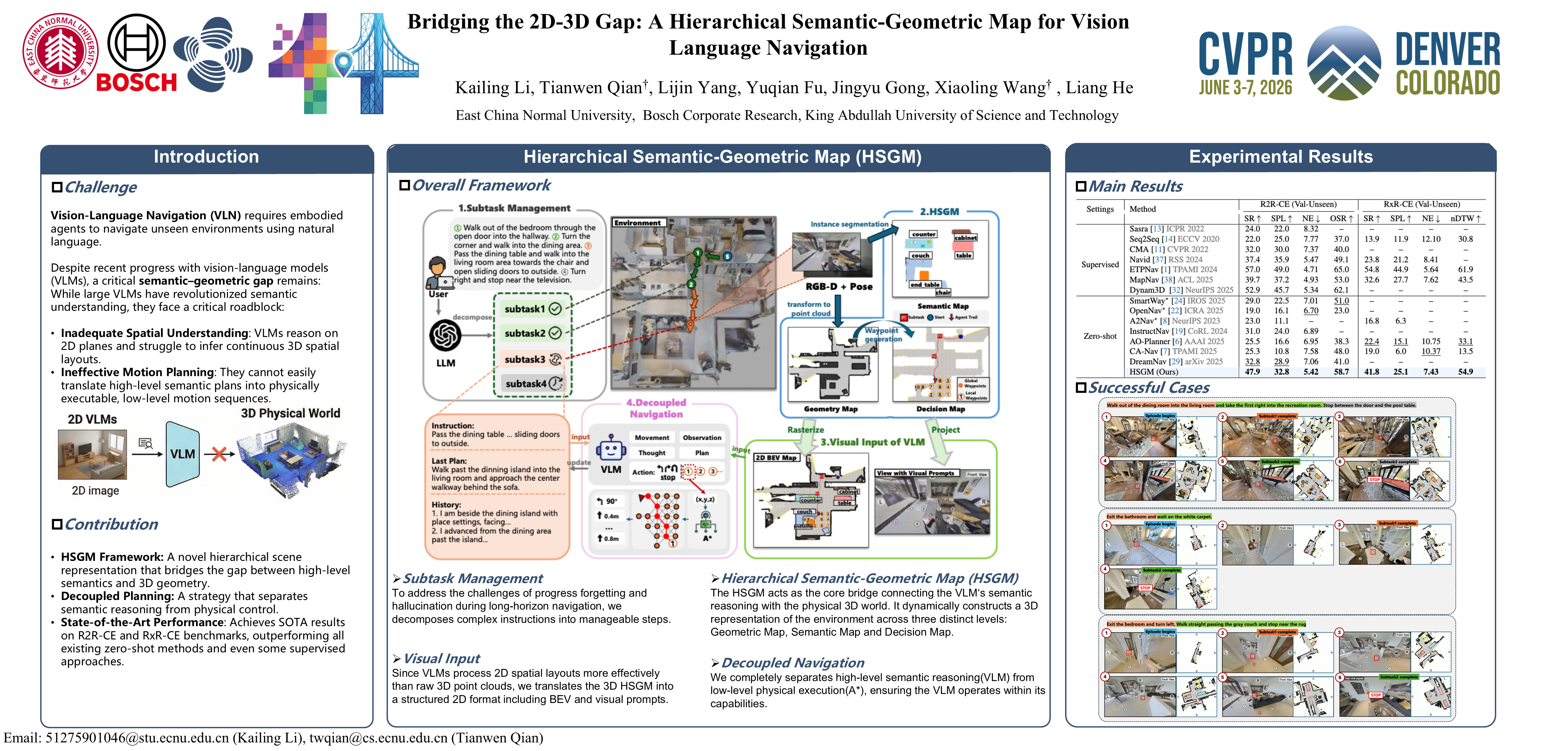
Vision-Language Navigation (VLN) enables embodied agents to reach target locations in unseen environments by following language instructions. Despite recent progress with vision-language models (VLMs), a critical semantic–geometric gap remains: while VLMs excel at language and 2D visual understanding, they struggle with 3D spatial reasoning and fail to capture the causal dynamics between actions and spatial transitions, resulting in unreliable navigation, particularly in zero-shot settings. To bridge this gap, we propose a Hierarchical Semantic–Geometric Map (HSGM) that transforms 3D geometric information into a structured representation compatible with VLMs, effectively linking them to the physical world. Specifically, HSGM is represented as a multi-channel top-down map organized into three levels: (1) geometric level that records navigable regions and obstacles, (2) semantic level that represents objects and their relations, and (3) decision level that supports high-level task reasoning and goal selection. During navigation, the VLM acts as a high-level semantic planner, interpreting the spatial layout encoded in the HSGM to select geometrically valid waypoints, while low-level, collision-free movements between waypoints are executed by a classical path-planning algorithm, fully decoupling semantic reasoning from action execution. Additionally, complex instructions are decomposed into subtasks to alleviate the problem of progress forgetting or hallucinating in long-horizon navigation. Extensive experiments on R2R-CE and RxR-CE benchmarks demonstrate that our zero-shot framework achieves state-of-the-art performance and even outperforms several supervised methods.
InterAgent: Physics-based Multi-agent Command Execution via Diffusion on Interaction Graphs
Bin Li ⋅ Ruichi Zhang ⋅ Han Liang ⋅ Jingyan Zhang ⋅ Juze Zhang ⋅ Xin Chen ⋅ Lan Xu ⋅ Jingyi Yu ⋅ Jingya Wang
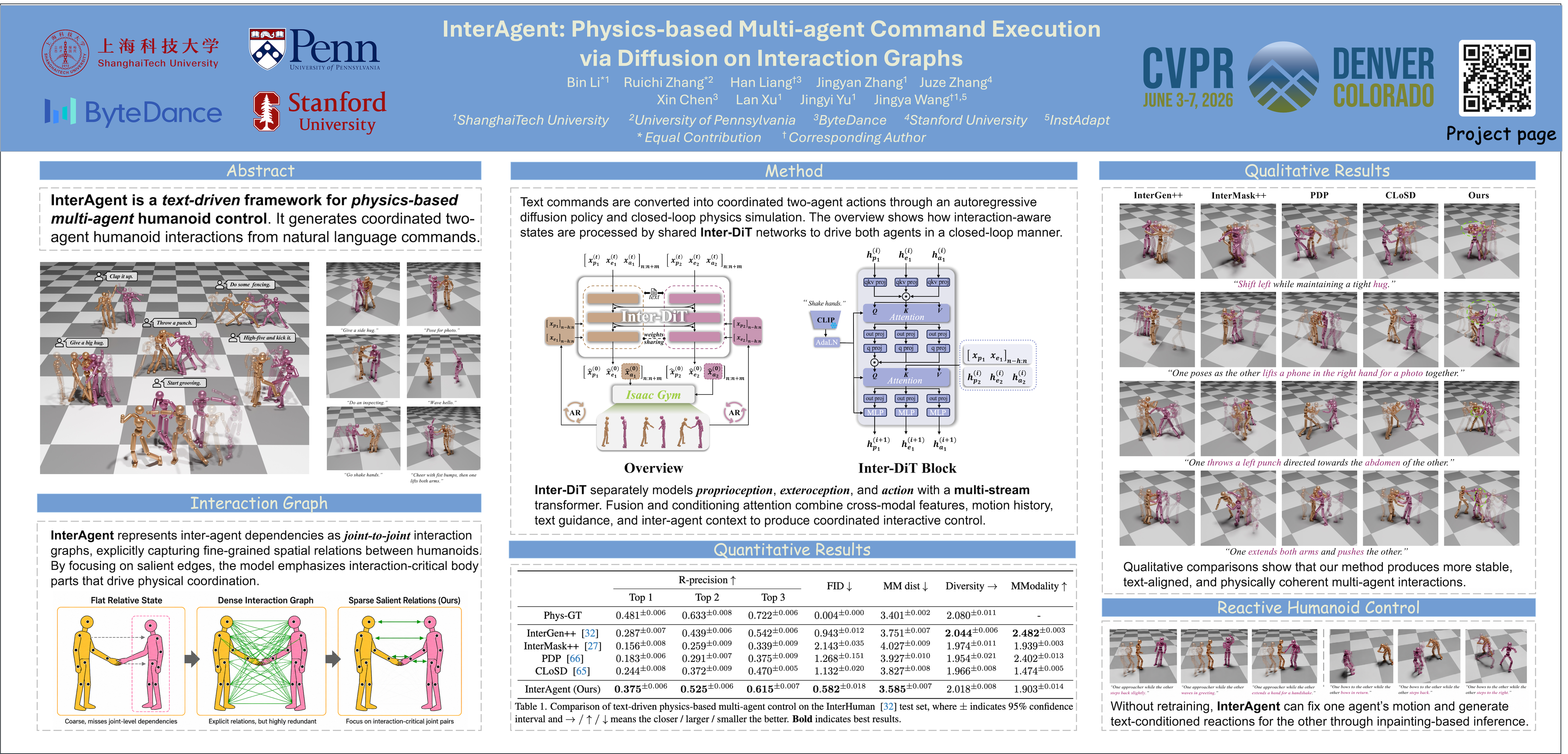
Humanoid agents are expected to emulate the complex coordination inherent in human social behaviors. However, existing methods are largely confined to single-agent scenarios, overlooking the physically plausible interplay essential for multi-agent interactions. To bridge this gap, we propose InterAgent, the first end-to-end framework for text-driven physics-based multi-agent humanoid control. At its core, we introduce an autoregressive diffusion transformer equipped with multi-stream blocks, which decouples proprioception, exteroception, and action to mitigate cross-modal interference while enabling synergistic coordination. We further propose a novel interaction graph exteroception representation that explicitly captures fine-grained joint-to-joint spatial dependencies to facilitate network learning. Additionally, within it we devise a sparse edge-based attention mechanism that dynamically prunes redundant connections and emphasizes critical inter-agent spatial relations, thereby enhancing the robustness of interaction modeling. Extensive experiments demonstrate that InterAgent consistently outperforms multiple strong baselines, achieving state-of-the-art performance. It enables producing coherent, physically plausible, and semantically faithful multi-agent behaviors from only text prompts. Our code and data will be released to facilitate future research.
When Robots Should Say ''I Don’t Know'': Benchmarking Abstention in Embodied Question Answering
Tao Wu ⋅ Chuhao Zhou ⋅ Guangyu Zhao ⋅ Haozhi Cao ⋅ Yewen Pu ⋅ Jianfei Yang
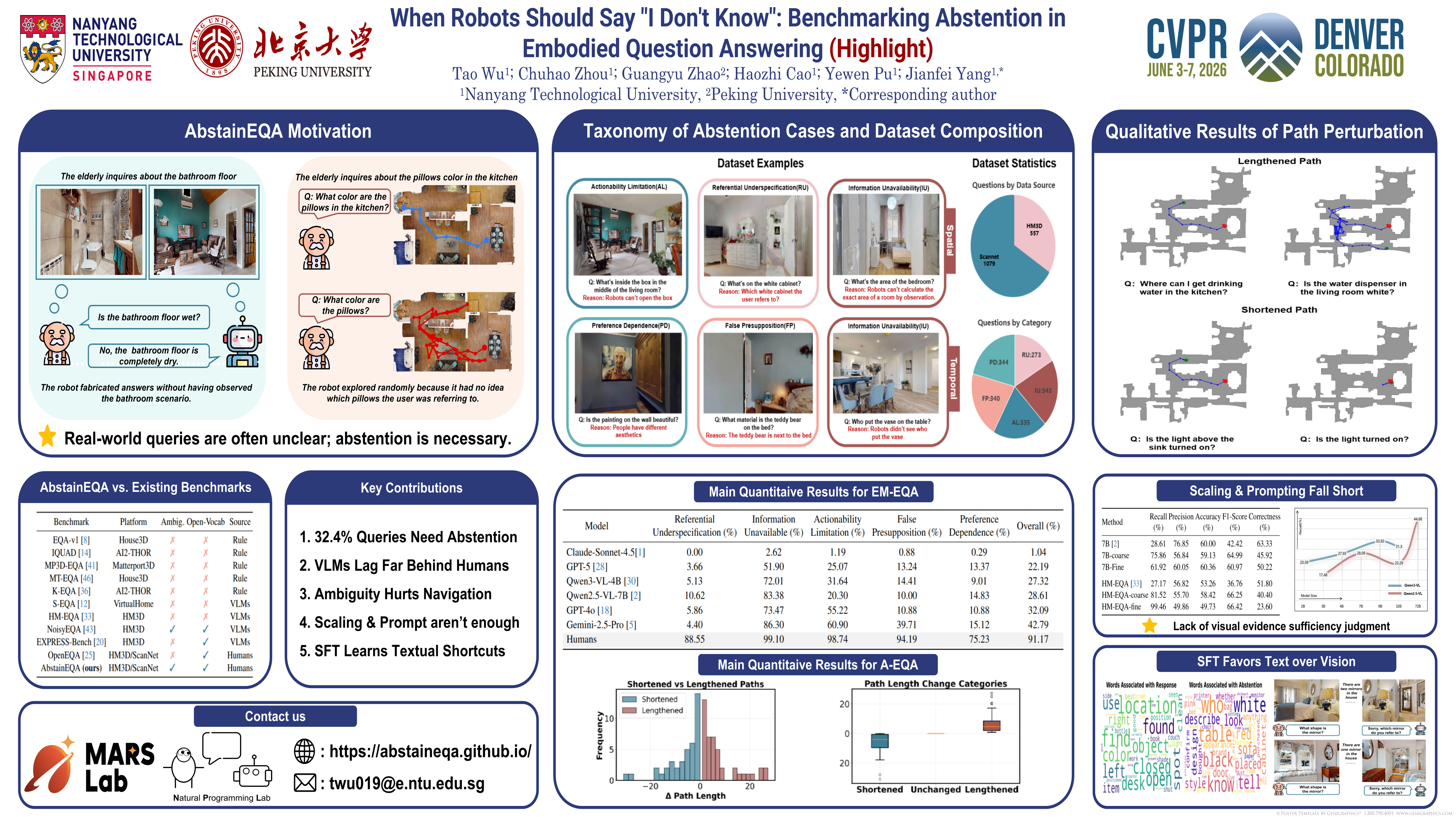
Embodied Question Answering (EQA) requires an agent to interpret language, perceive its environment, and navigate within 3D scenes to produce responses. Existing EQA benchmarks assume that every question must be answered, but embodied agents should know when they do not have sufficient information to answer. In this work, we focus on a minimal requirement for EQA agents, abstention: knowing when to withhold an answer. From an initial study of 500 human queries, we find that 32.4\% contain missing or underspecified context. Drawing on this initial study and cognitive theories of human communication errors, we derive five representative categories requiring abstention: actionability limitation, referential underspecification, preference dependence, information unavailability, and false presupposition. We augment OpenEQA by having annotators transform well-posed questions into ambiguous variants outlined by these categories. The resulting dataset, AbstainEQA, comprises 1,636 annotated abstention cases paired with 1,636 original OpenEQA instances for balanced evaluation. Evaluating on AbstainEQA, we find that even the best frontier model only attains 42.79\% abstention recall, while humans achieve 91.17\%. We also find that scaling, prompting, and reasoning only yield marginal gains, and that fine-tuned models overfit to textual cues. Together, these results position abstention as a fundamental prerequisite for reliable interaction in embodied settings and as a necessary basis for effective clarification.
RoboAgent: Chaining Basic Capabilities for Embodied Task Planning
Peiran Xu ⋅ Jiaqi Zheng ⋅ Yadong Mu
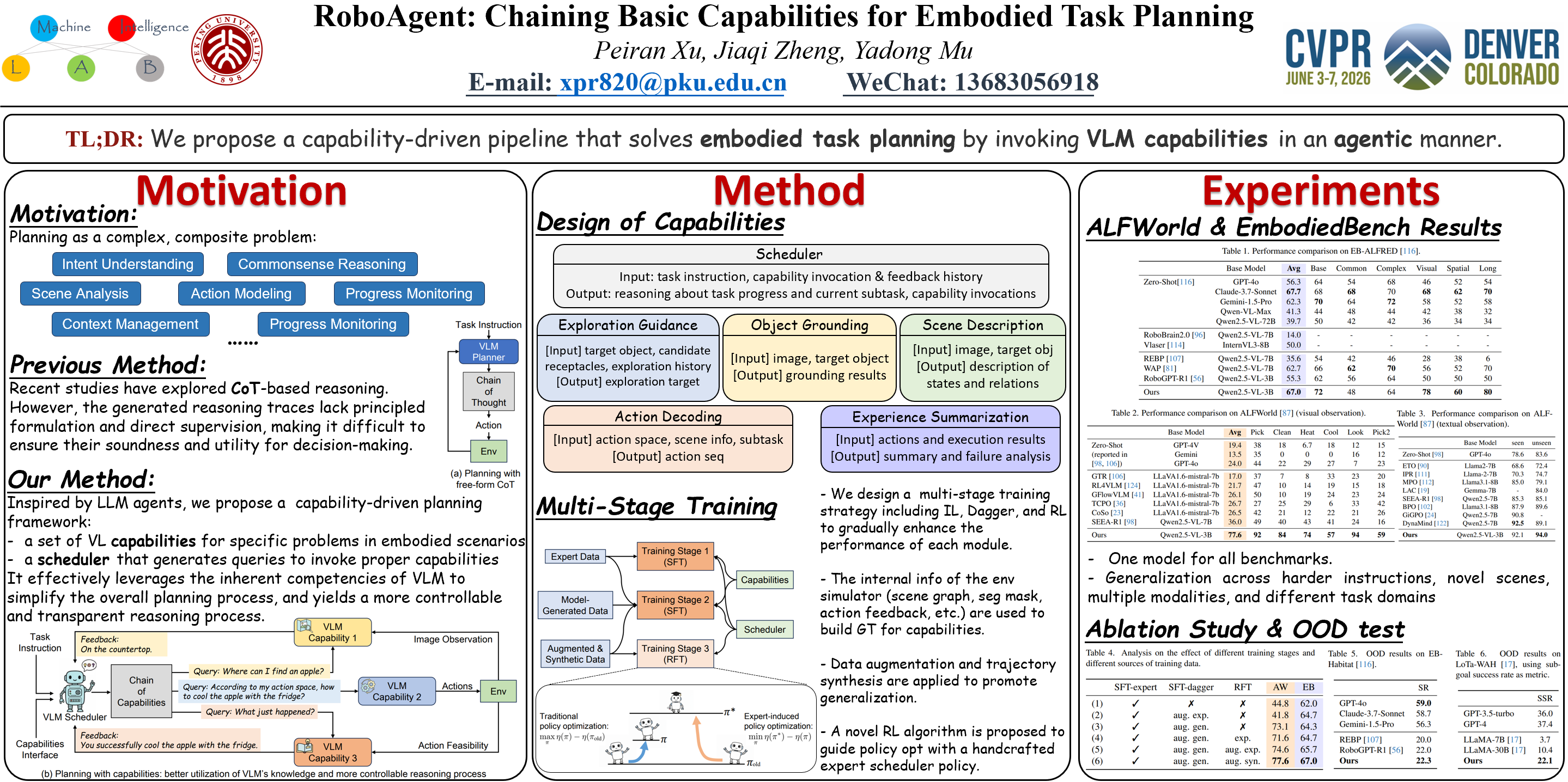
This paper focuses on embodied task planning, where an agent acquires visual observations from the environment and executes atomic actions to accomplish a given task. Although recent Vision-Language Models (VLMs) have achieved impressive results in multimodal understanding and reasoning, their performance remains limited when applied to embodied planning that involves multi-turn interaction, long-horizon reasoning, and extended context analysis. To bridge this gap, we propose a capability-driven planning pipeline, in which the model actively invokes different sub-capabilities. Each capability maintains its own context, and produces intermediate reasoning results or interacts with the environment according to the query given by a scheduler. This framework decomposes complex planning into a sequence of basic vision-language problems that VLMs can better address, enabling a more transparent and controllable reasoning process. The scheduler and all capabilities are implemented with a single VLM, without relying on external tools. To train this VLM, we adopt a multi-stage paradigm that consists of: (1) behavior cloning with expert plans, (2) DAgger training using trajectories collected by the model, and (3) reinforcement learning guided by an expert policy. Across these stages, we exploit the internal information of the environment simulator to construct high-quality supervision for each capability, and we further introduce augmented and synthetic data to enhance the model’s performance in more diverse scenarios. Extensive experiments on widely used embodied task planning benchmarks validate the effectiveness of the proposed approach.
Towards Training-free Scene Text Editing
Yubo Li ⋅ Xugong Qin ⋅ peng zhang ⋅ Hailun Lin ⋅ Gangyan Zeng ⋅ Kexin Zhang
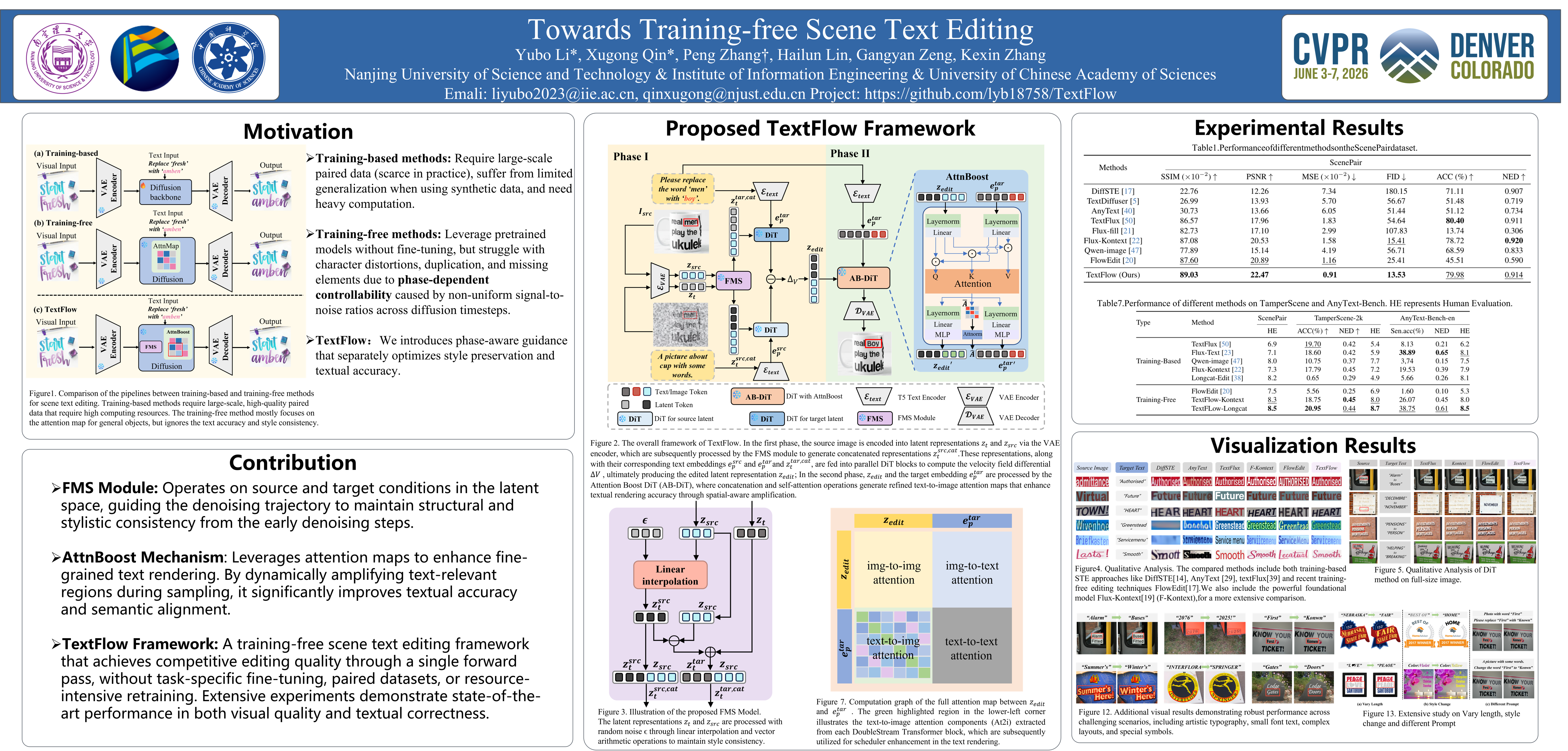
Scene text editing seeks to modify textual content in natural images while maintaining visual realism and semantic consistency. Existing methods often require task-specific training or paired data, limiting their scalability and adaptability. In this paper, we propose TextFlow, a training-free scene text editing framework that integrates the strengths of Attention Boost (AttnBoost) and Flow Manifold Steering (FMS) to enable flexible, high-fidelity text manipulation without additional training. Specifically, FMS preserves the structural and style consistency by modeling the visual flow of characters and background regions, while AttnBoost enhances the rendering of textual content through attention-based guidance. By jointly leveraging these complementary modules, our approach performs end-to-end text editing through semantic alignment and spatial refinement in a plug-and-play manner. Extensive experiments demonstrate that our framework achieves visual quality and text accuracy comparable to or superior to those of training-based counterparts, generalizing well across diverse scenes and languages. This study advances scene text editing toward a more efficient, generalizable, and training-free paradigm.
VINS-120K: Ultra High-Resolution Image Editing with A Large-Scale Dataset
Zhizhou Chen ⋅ Shanyan Guan ⋅ Zhanxin Gao ⋅ En Ci ⋅ Yanhao Ge ⋅ Wei Li ⋅ Zhenyu Zhang ⋅ Jian Yang ⋅ Ying Tai
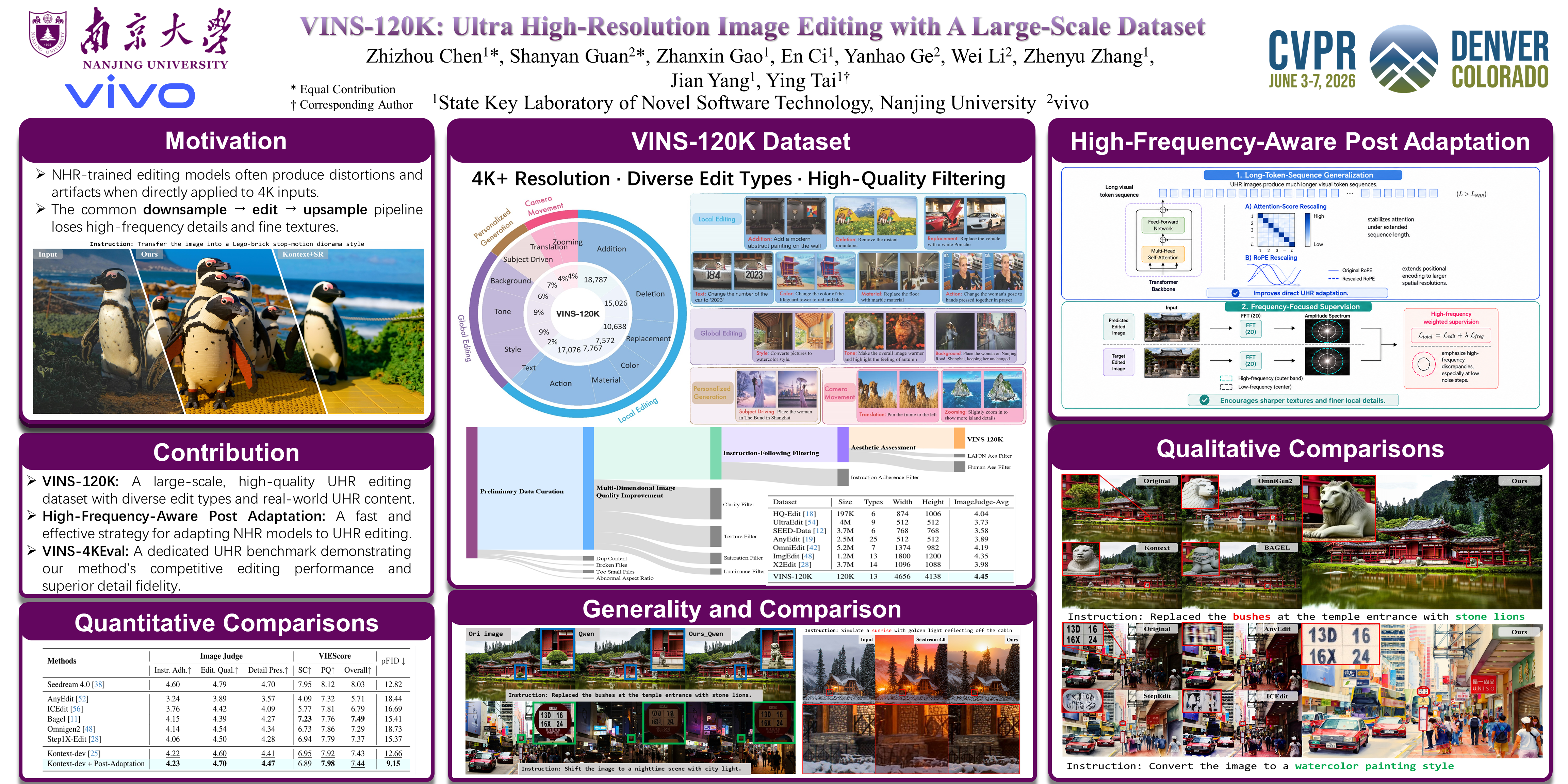
Directly editing ultra-high-resolution (UHR) images is valuable but underexplored, primarily due to the lack of high-quality data and the challenge in modeling high-frequency textual details. We introduce VINS-120K, the first large-scale dataset for instruction-based UHR image editing, comprising 120K carefully curated triplets of instruction, input image, and edited image. Each image exceeds 4K resolution ($\geq$4096×4096) and is filtered through a rigorous multi-stage pipeline to ensure visual quality, instruction alignment, and aesthetic fidelity. For the second challenge, we propose a high-frequency-aware post-adaptation strategy that allows previous non-high-resolution models to accurately generate fine-grained, high-frequency details. We further present VINS-4KEval, a benchmark covering diverse editing types, to facilitate consistent evaluation in UHR settings. Experiments confirm that our work delivers superior fine-grained detail and texture realism in UHR image editing. The dataset and code will be released.
ArtiMuse: Fine-Grained Image Aesthetics Assessment with Joint Scoring and Expert-Level Understanding
Shuo Cao ⋅ Nan Ma ⋅ Jiayang Li ⋅ Xiaohui Li ⋅ Lihao Shao ⋅ Kaiwen Zhu ⋅ Yu Zhou ⋅ Yuandong Pu ⋅ Jiarui Wu ⋅ Jiaquan Wang ⋅ Bo Qu ⋅ Wenhai Wang ⋅ Yu Qiao ⋅ Dajuin Yao ⋅ Yihao Liu
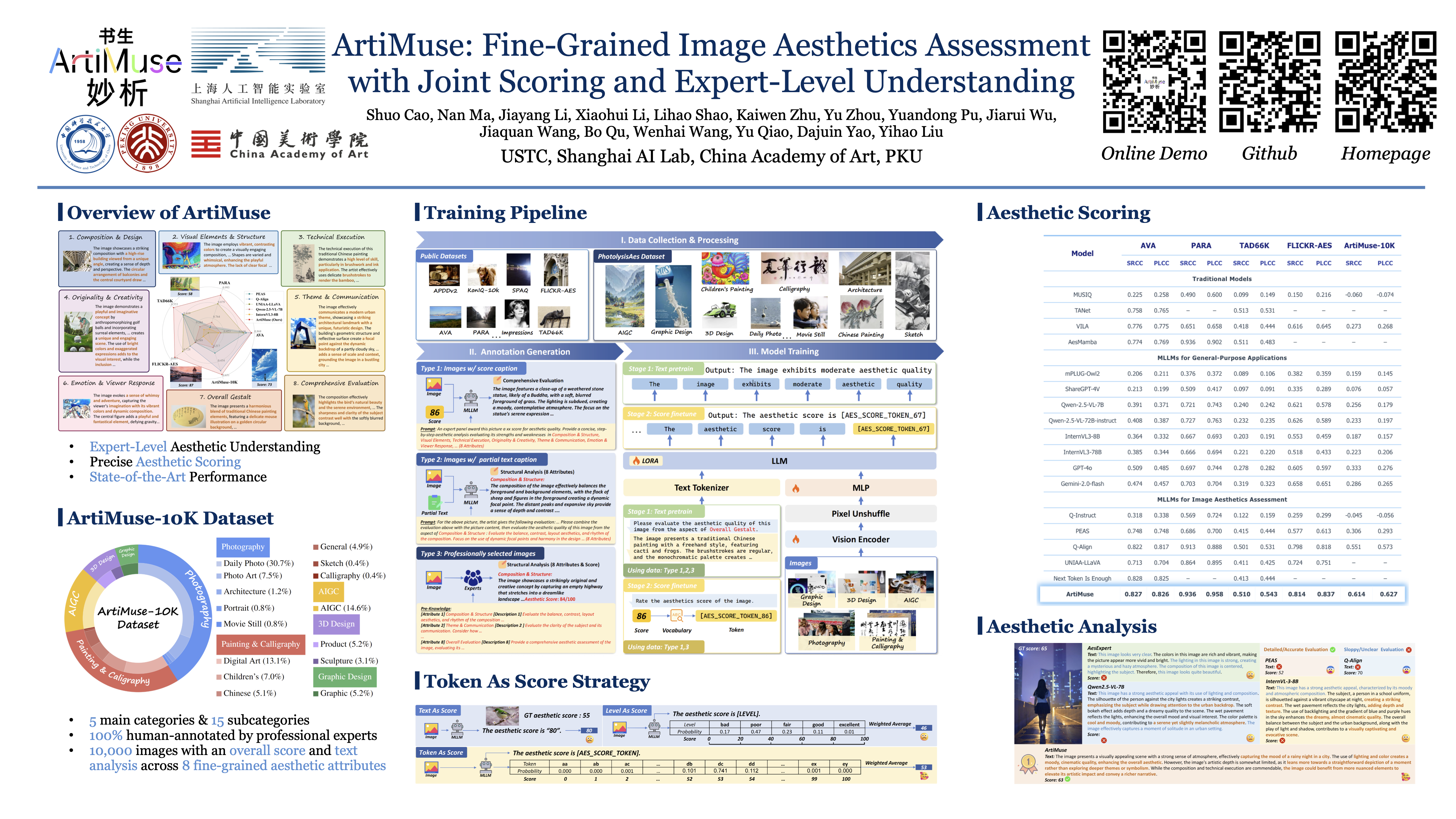
The rapid advancement of educational applications, artistic creation, and AI-generated content (AIGC) technologies has substantially increased practical requirements for comprehensive Image Aesthetics Assessment (IAA), particularly demanding methods capable of delivering both quantitative scoring and professional understanding. Multimodal Large Language Model (MLLM)-based IAA methods demonstrate stronger perceptual and generalization capabilities compared to traditional approaches, yet they suffer from modality bias (score-only or text-only) and lack fine-grained attribute decomposition, thereby failing to support further aesthetic assessment. In this paper, we present: (1) ArtiMuse, an innovative MLLM-based IAA model with Joint Scoring and Expert-Level Understanding capabilities; (2) ArtiMuse-10K, the first expert-curated IAA dataset comprising 10,000 images spanning 5 main categories and 15 subcategories, each annotated by professional experts with 8-dimensional attributes analysis and a holistic score. Both the model and dataset will be made public.
Charge: A Comprehensive Novel View Synthesis Benchmark and Dataset to Bind Them All
Michal Nazarczuk ⋅ Thomas Tanay ⋅ Arthur Moreau ⋅ Zhensong Zhang ⋅ Eduardo Pérez-Pellitero
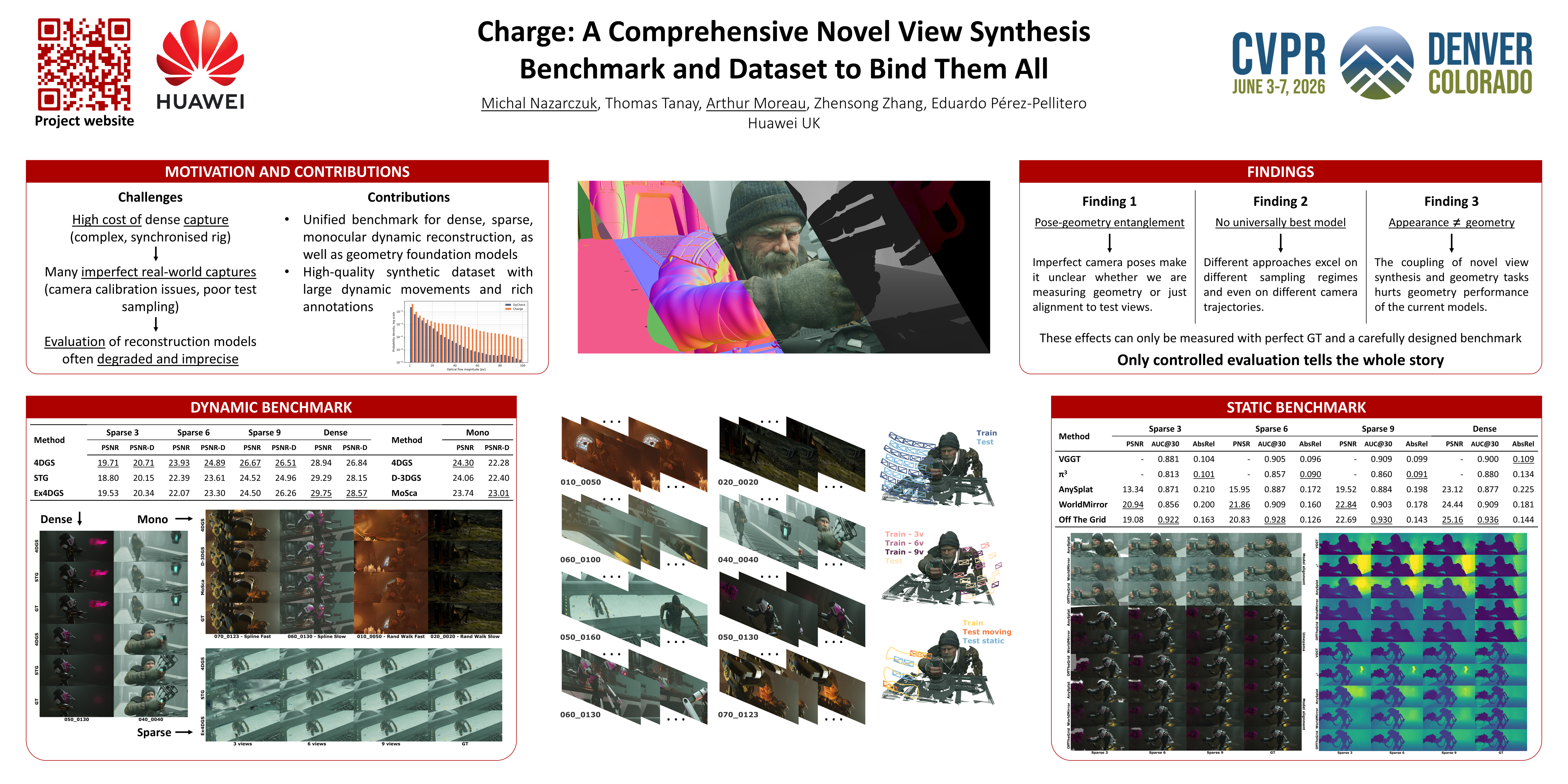
This paper presents a new dataset for Novel View Synthesis, generated from a high-quality, animated film with stunning realism and intricate detail. Our dataset captures a variety of dynamic scenes, complete with detailed textures, lighting, and motion, making it ideal for training and evaluating cutting-edge 4D scene reconstruction and novel view generation models. In addition to high-fidelity RGB images, we provide multiple complementary modalities, including depth, surface normals, object segmentation and optical flow, enabling a deeper understanding of scene geometry and motion. The dataset is organised into three distinct benchmarking scenarios: a dense multi-view camera setup, a sparse camera arrangement, and monocular video sequences, enabling a wide range of experimentation and comparison across varying levels of data sparsity. With its combination of visual richness, high-quality annotations, and diverse experimental setups, this dataset offers a unique resource for pushing the boundaries of view synthesis and 3D vision.
Region-Wise Correspondence Prediction between Manga Line Art Images
Yingxuan Li ⋅ Jiafeng Mao ⋅ Qianru Qiu ⋅ Yusuke Matsui
Understanding region-wise correspondences between manga line art images is fundamental for high-level manga processing, supporting downstream tasks such as line art colorization and in-between frame generation. Unlike natural images that contain rich visual cues, manga line art consists only of sparse black-and-white strokes, making it challenging to determine which regions correspond across images. In this work, we introduce a new task: predicting region-wise correspondence between raw manga line art images without any annotations. To address this problem, we propose a Transformer-based framework trained on large-scale, automatically generated region correspondences. The model learns to suppress noisy matches and strengthen consistent structural relationships, resulting in robust patch-level feature alignment within and across images. During inference, our method segments each line art and establishes coherent region-level correspondences through edge-aware clustering and region matching. We construct manually annotated benchmarks for evaluation, and experiments across multiple datasets demonstrate both high patch-level accuracy and strong region-level correspondence performance, achieving 78.4-84.4% region-level accuracy. These results highlight the potential of our method for real-world manga and animation applications.
WEAVE: Unleashing and Benchmarking the In-context Interleaved Comprehension and Generation
Wei Chow ⋅ Jiachun Pan ⋅ Yongyuan Liang ⋅ Mingze Zhou ⋅ Xue Song ⋅ Liyu Jia ⋅ Saining Zhang ⋅ Siliang Tang ⋅ Juncheng Li ⋅ Fengda Zhang ⋅ Weijia Wu ⋅ Hanwang Zhang ⋅ Tat-seng Chua
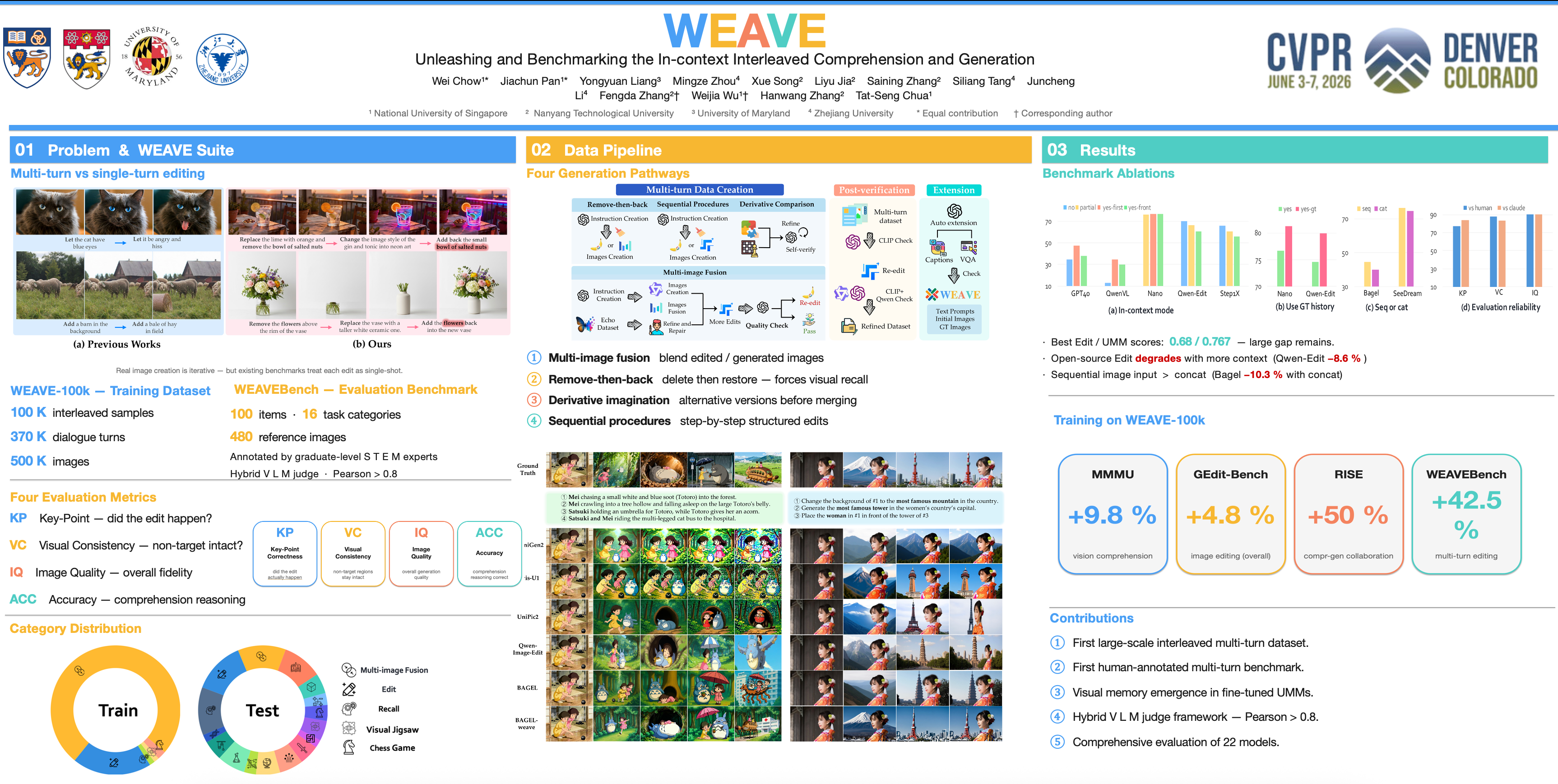
Recent advances in unified multimodal models (UMMs) have enabled impressive progress in visual comprehension and generation.However, existing datasets and benchmarks focus primarily on single-turn interactions, failing to capture the multi-turn, context-dependent nature of real-world image creation and editing.To address this gap, we present WEAVE, the first suite for in-context interleaved cross-modality comprehension and generation.Our suite consists of two complementary parts. WEAVE-100k is a large-scale dataset of $100$K interleaved samples spanning over $370$K dialogue turns and $500$K images, covering comprehension, editing, and generation tasks that require reasoning over historical context. WEAVEBench is a human-annotated benchmark with $100$ tasks based on $480$ images, featuring a hybrid VLM judger evaluation framework based on both the reference image and the combination of the original image with editing instructions that assesses models' abilities in multi-turn generation, visual memory, and world-knowledge reasoning across diverse domains.Experiments demonstrate that training on WEAVE-100k enables vision comprehension, image editing, and comprehension-generation collaboration capabilities. Furthermore, it facilitates UMMs to develop emergent visual-memory capabilities, while extensive evaluations on WEAVEBench expose the persistent limitations and challenges of current approaches in multi-turn, context-aware image generation and editing.We believe WEAVE provides a view and foundation for studying in-context interleaved comprehension and generation for multi-modal community.
I2I-Bench: A Comprehensive Benchmark Suite for Image-to-Image Editing Models
Juntong Wang ⋅ Wang Jiarui ⋅ Huiyu Duan ⋅ Jiaxiang Kang ⋅ Guangtao Zhai ⋅ Xiongkuo Min
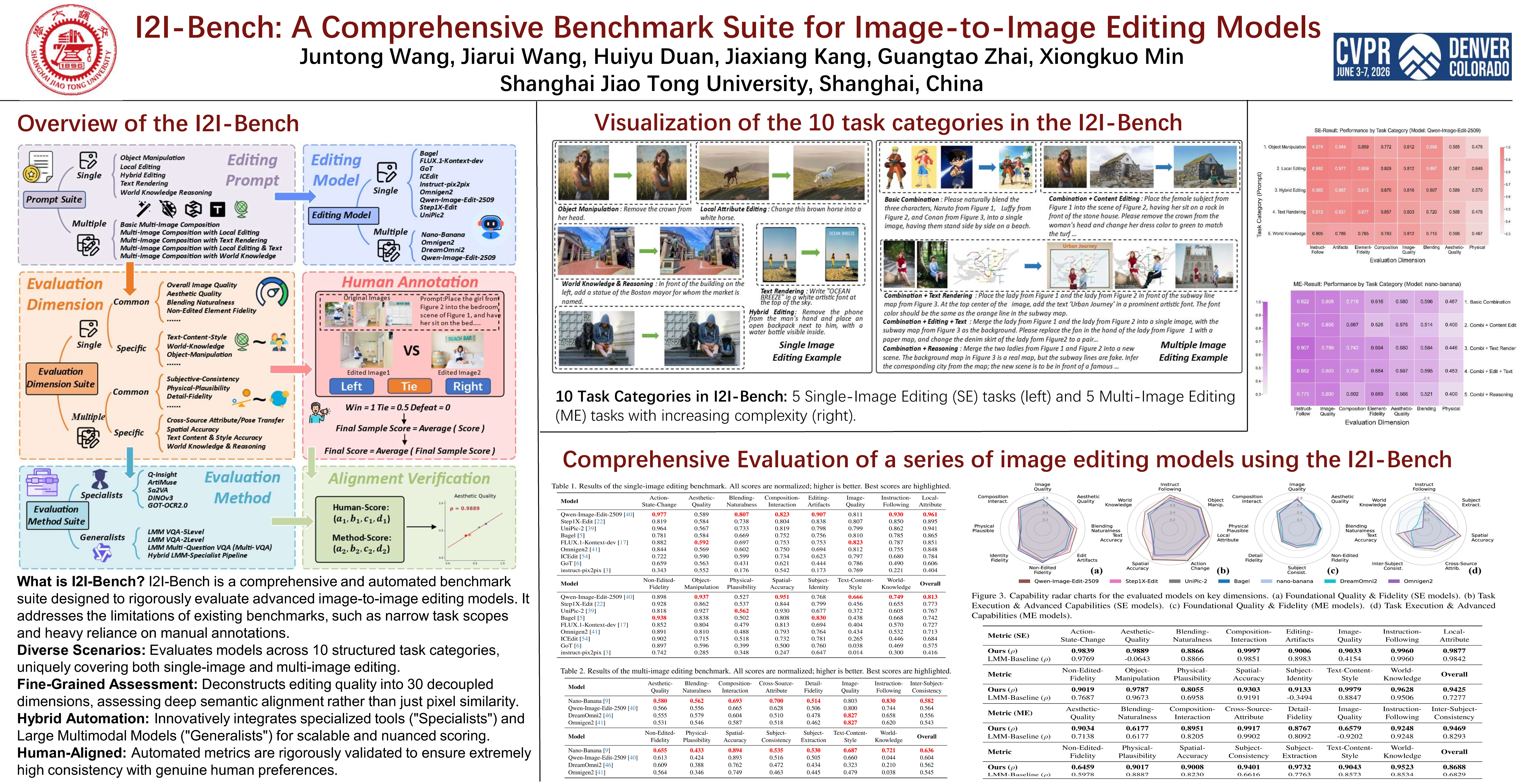
Image editing models are advancing rapidly, yet comprehensive evaluation remains a significant challenge. Existing image editing benchmarks generally suffer from limited task scopes, insufficient evaluation dimensions, and heavy reliance on manual annotations, which significantly constrain their scalability and practical applicability. To address this, we propose I2I-Bench, a comprehensive benchmark for image-to-image editing models, which features (i) diverse tasks, encompassing 10 task categories across both single-image and multi-image editing tasks, (ii) comprehensive evaluation dimensions, including 30 decoupled and fine-grained evaluation dimensions with automated hybrid evaluation methods that integrate specialized tools and large multimodal models (LMMs), and (iii) rigorous alignment validation, justifying the consistency between our benchmark evaluations and human preferences.Using I2I-Bench, we benchmark numerous mainstream image editing models, investigating the gaps and trade-offs between editing models across various dimensions. We will open-source all components of I2I-Bench to facilitate future research.
TokenGS: Decoupling 3D Gaussian Prediction from Pixels with Learnable Tokens
Jiawei Ren ⋅ Michal Tyszkiewicz ⋅ Jiahui Huang ⋅ Žan Gojčič
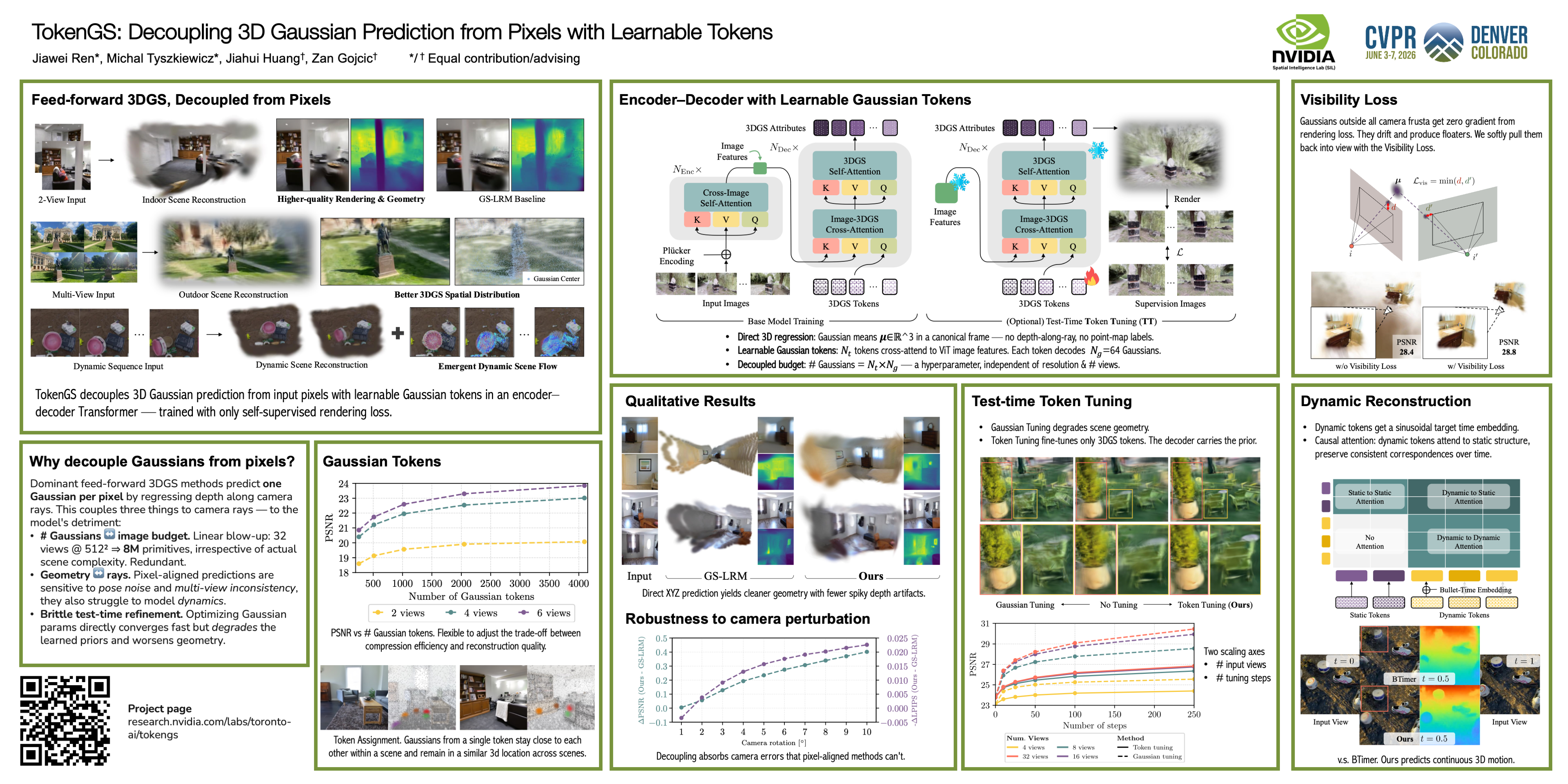
In this work, we revisit several key design choices of modern Transformer-based approaches for feed-forward 3D Gaussian Splatting (3DGS) prediction. We argue that the common practice of regressing Gaussian means as depths along camera rays is suboptimal, and instead propose to directly regress 3D mean coordinates using only a self-supervised rendering loss.This formulation allows us to move from the standard encoder-only design to an encoder-decoder architecture with learnable Gaussian tokens, thereby unbinding the number of predicted primitives from input image resolution and number of views. Our resulting method, TokenGS, demonstrates improved robustness to pose noise and multiview inconsistencies, while naturally supporting efficient test-time optimization in token space without degrading learned priors. TokenGS achieves state-of-the-art feed-forward reconstruction performance on both static and dynamic scenes, producing more regularized geometry and more balanced 3DGS distribution, while seamlessly recovering emergent scene attributes such as static-dynamic decomposition and scene flow.
Hermite Radial Basis Function for Surface Reconstruction via Differentiable Rendering
Hugo Blanc ⋅ Jean-Emmanuel Deschaud ⋅ Alexis Paljic
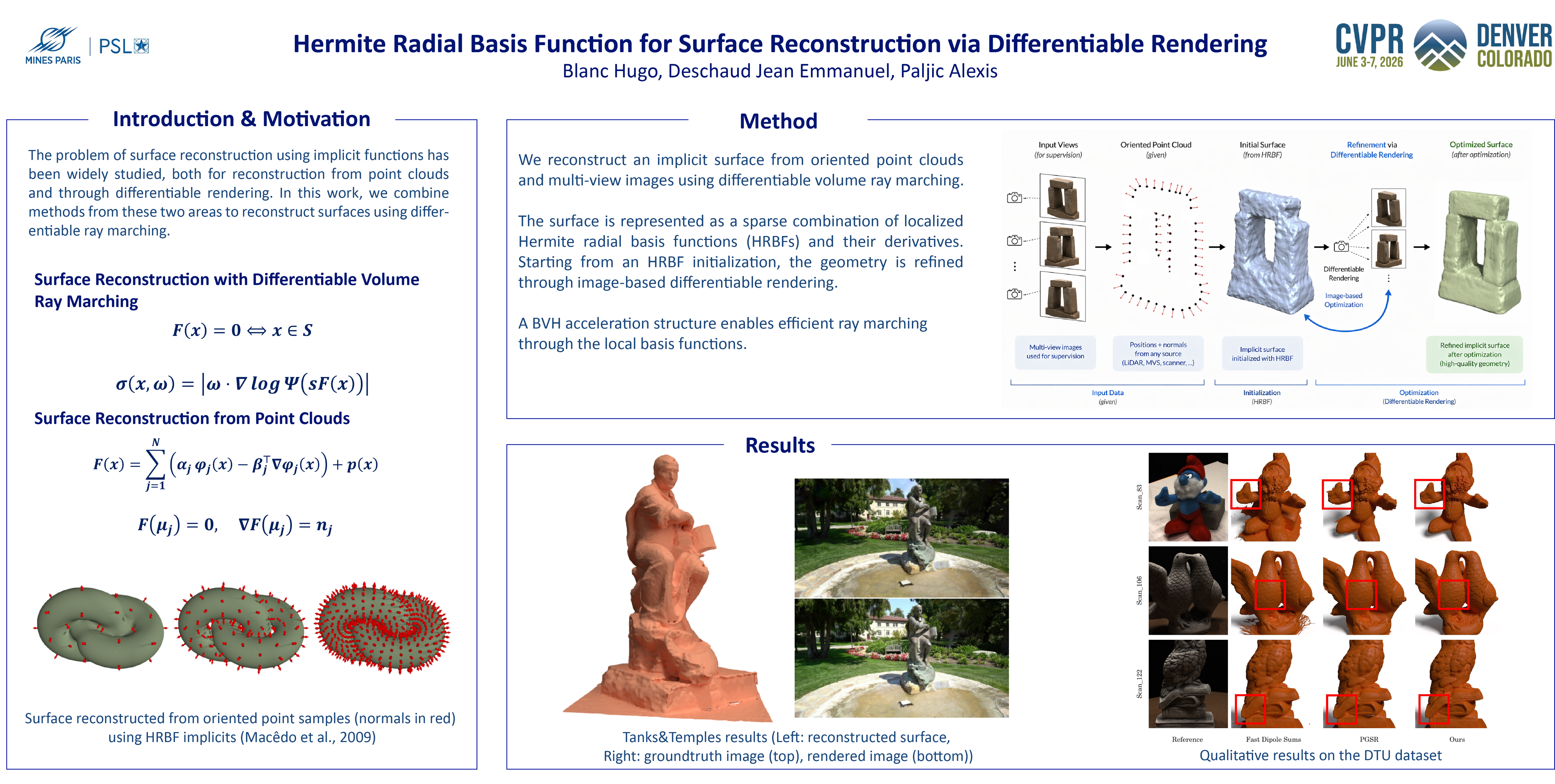
Recent advances in novel view synthesis have enabled differentiable rendering methods to reconstruct 3D scenes directly from images. Algorithms such as 3D Gaussian Splatting and RayGauss use local basis functions to represent radiance fields, enabling fast, high-quality rendering of real-world scenes. However, these methods lack an exact geometric representation of the scene. In this work, inspired by Hermite Radial Basis Function (HRBF) implicits, we introduce a global implicit function constructed from local RBFs and their derivatives to represent surfaces. The proposed formulation enables learning scene geometry through differentiable rendering of an implicit function. By leveraging local basis functions, it achieves both an efficient geometric representation and fast rendering, using a bounding volume hierarchy (BVH) to accelerate intersections with the local basis functions. The implementation of our approach will be made publicly available upon the paper’s publication.
RF4D:Neural Radar Fields for Novel View Synthesis in Outdoor Dynamic Scenes
Jiarui Zhang ⋅ Zhihao Li ⋅ Chong Wang ⋅ Bihan Wen
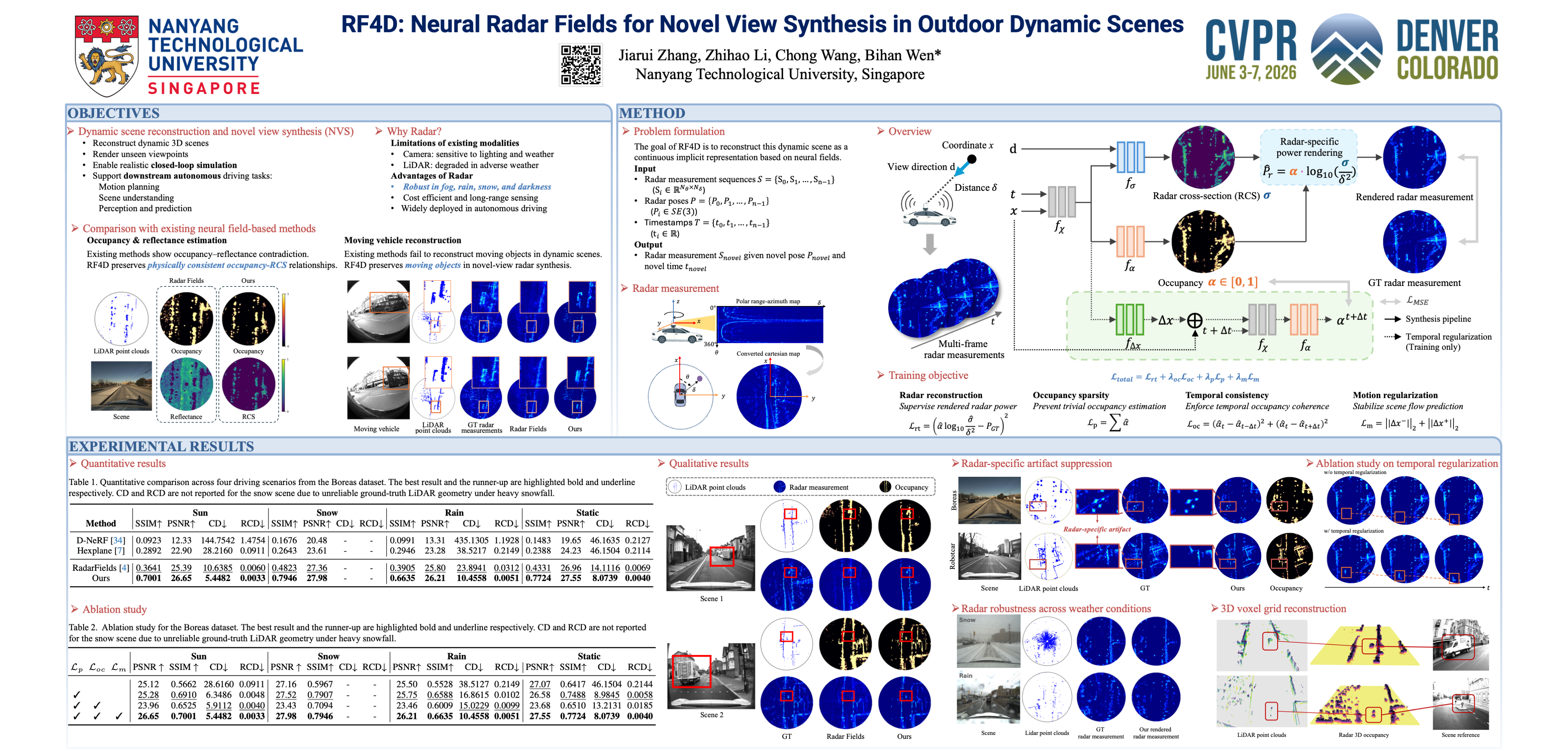
Neural fields (NFs) have achieved remarkable success in scene reconstruction and novel view synthesis. However, existing NF approaches that rely on RGB or LiDAR inputs often struggle under adverse weather conditions, limiting their robustness in real-world outdoor environments such as autonomous driving. In contrast, millimeter-wave radar is inherently resilient to environmental variations, yet its integration with NFs remains largely underexplored. Moreover, outdoor driving scenes frequently involve dynamic objects, making spatiotemporal modeling crucial for temporally consistent novel view synthesis. To address these challenges, we present RF4D, a radar-based neural field framework tailored for novel view synthesis in outdoor dynamic scenes. RF4D explicitly incorporates temporal information into its representation, enabling more accurate modeling of object motion. A dedicated \textbf{scene flow module} further predicts temporal offsets between adjacent frames, enforcing temporal occupancy coherence during dynamic scene reconstruction. Moreover, we propose a \textbf{radar-specific power rendering formulation} grounded in radar sensing physics, improving both synthesis accuracy and interpretability. Extensive experiments on public radar datasets demonstrate that RF4D substantially outperforms existing methods in radar measurement synthesis and occupancy estimation accuracy, with particularly strong gains in dynamic outdoor environments.
Voxify3D: Pixel Art Meets Volumetric Rendering
Yi-Chuan Huang ⋅ Jiewen Chan ⋅ Hao-Jen Chien ⋅ Yu-Lun Liu
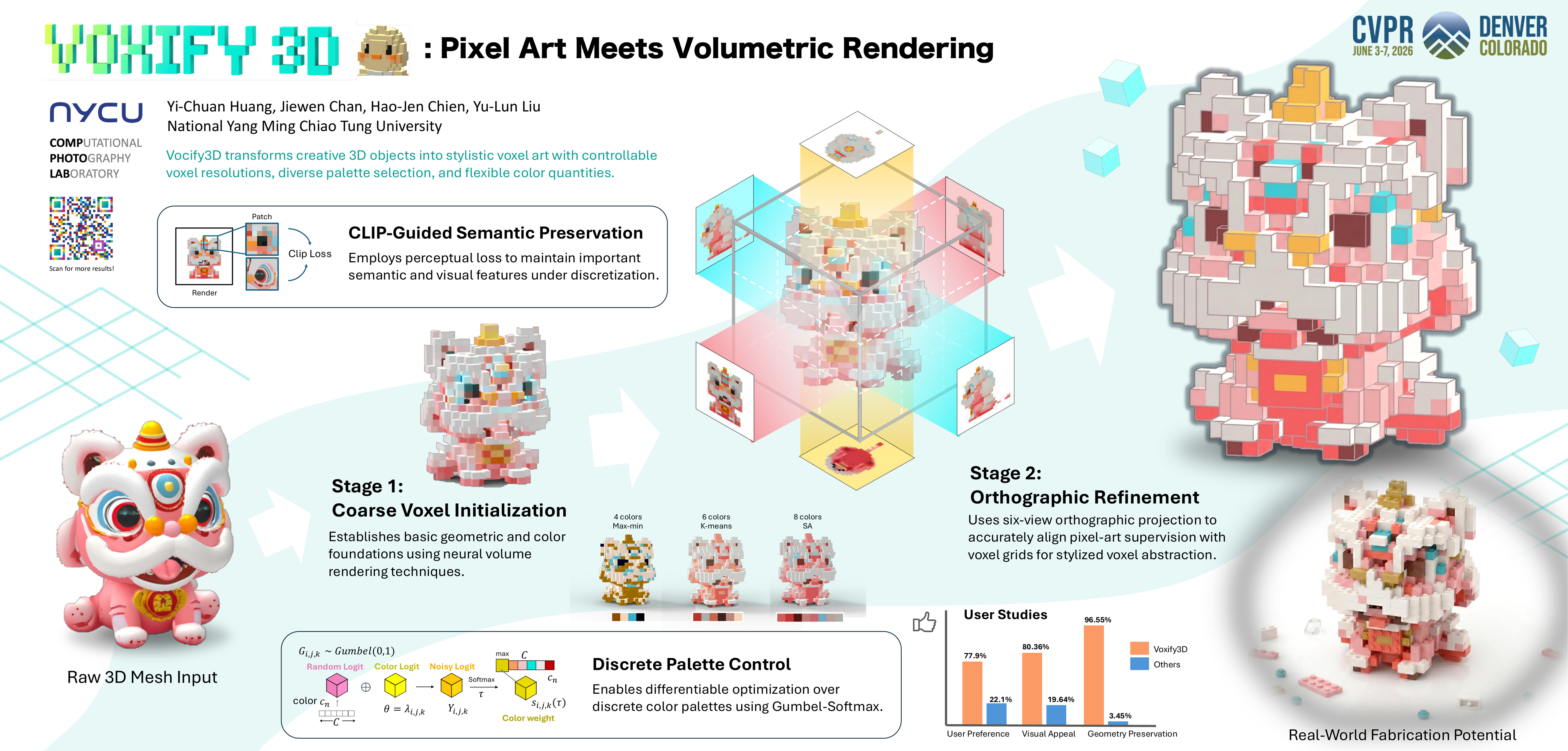
Voxel art is a distinctive stylization widely used in games and digital media, yet automated generation from 3D meshes remains challenging due to conflicting requirements of geometric abstraction, semantic preservation, and discrete color coherence. Existing methods either over-simplify geometry or fail to achieve the pixel-precise, palette-constrained aesthetics of voxel art. We introduce Voxify3D, a differentiable two-stage framework bridging 3D mesh optimization with 2D pixel art supervision. Our core innovation lies in the synergistic integration of three components: (1) orthographic pixel art supervision that eliminates perspective distortion for precise voxel-pixel alignment; (2) patch-based CLIP alignment that preserves semantics across discretization levels; (3) palette-constrained Gumbel-Softmax quantization enabling differentiable optimization over discrete color spaces with controllable palette strategies. This integration addresses fundamental challenges: semantic preservation under extreme discretization, pixel-art aesthetics through volumetric rendering, and end-to-end discrete optimization. Experiments show superior performance (37.12 CLIP-IQA, 77.90% user preference) across diverse characters and controllable abstraction (2-8 colors, 20³-50³ resolutions).
Node-RF: Learning Generalized Continuous Space-Time Scene Dynamics with Neural ODE-based NeRFs
Hiran Sarkar ⋅ Liming Kuang ⋅ Yordanka Velikova ⋅ Benjamin Busam
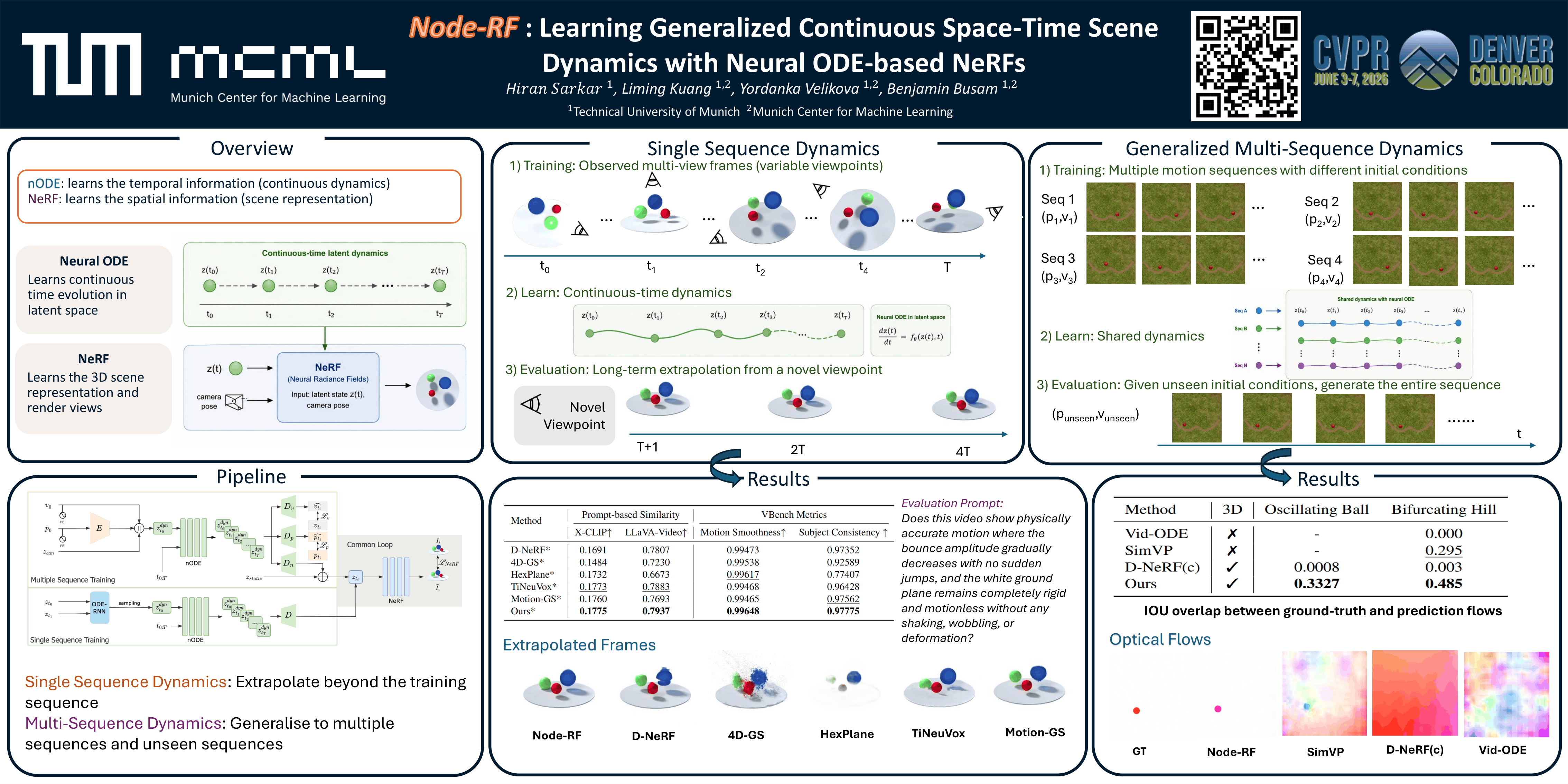
Predicting scene dynamics from visual observations is challenging. Existing methods capture dynamics only within observed boundaries failing to extrapolate far beyond the training sequence. Node-RF (Neural ODE-based NeRF) overcomes this limitation by integrating Neural Ordinary Differential Equations (NODEs) with dynamic Neural Radiance Fields (NeRFs), enabling a continuous-time, spatiotemporal representation that generalizes beyond observed trajectories at constant memory cost. From visual input, Node-RF learns an implicit scene state that evolves over time via an ODE solver, propagating feature embeddings via differential calculus. A NeRF-based renderer interprets calculated embeddings to synthesize arbitrary views for long-range extrapolation. Training on multiple motion sequences with shared dynamics allows for generalization to unseen conditions. Our experiments demonstrate that Node-RF can characterize abstract system behavior without explicit model to identify critical points for future predictions. Our code will be made publicly available.
FluidGaussian: Propagating Simulation-Based Uncertainty Toward Functionally-Intelligent 3D Reconstruction
Yuqiu Liu ⋅ Jialin Song ⋅ Marissa Ramirez de Chanlatte ⋅ Rochishnu Chowdhury ⋅ Rushil Paresh Desai ⋅ Wuyang Chen ⋅ Daniel Martin ⋅ Michael Mahoney
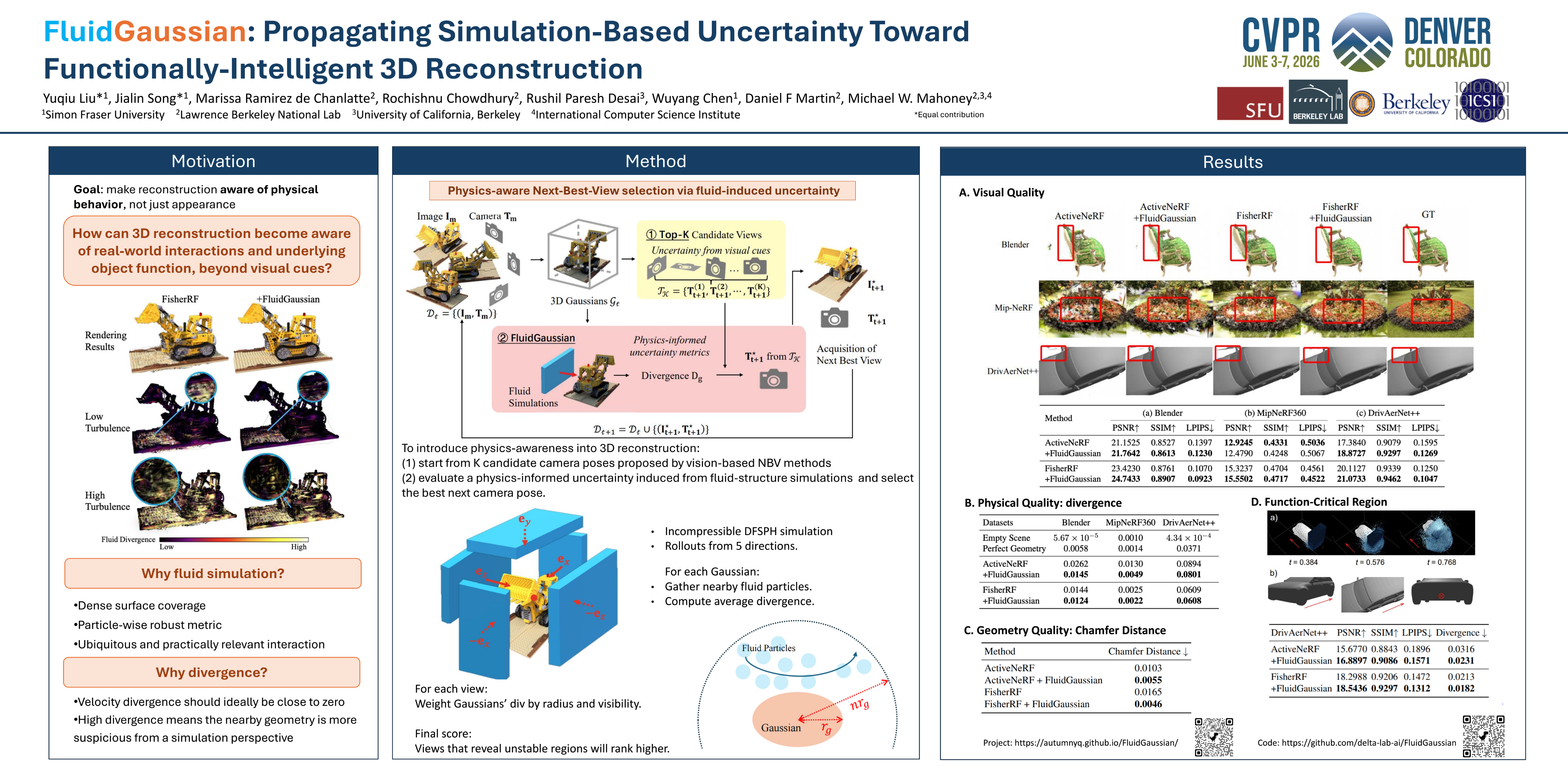
Real objects inhabit a physical world and must behave plausibly during interaction with other physical objects. However, current methods that perform 3D reconstructions of real-world scenes from multi-view images optimize primarily for visual fidelity, i.e., they train with photometric losses and reason about uncertainty in the image or representation space. This appearance-centric view overlooks body contacts and couplings, conflates function-critical regions (e.g., aerodynamic or hydrodynamic surfaces) with ornamentation, and reconstructs structures suboptimally, even when physical regularizers are added. We consider the question: How can 3D reconstruction become aware of real-world interactions and underlying object function, beyond visual cues? We propose FluidGaussian, a plug-and-play method that tightly couples geometry reconstruction with ubiquitous fluid-structure interactions to assess surface quality at high granularity. (1) We define our simulation-based uncertainty induced from fluid simulations that capture physical plausibility. (2) We integrate our uncertainty with NBV (next-best-view) policies to prioritize views that improve both visual and physical fidelity. On NeRF Synthetic (Blender), Mip-NeRF 360, and DrivAerNet++, our method yields up to +8.6% PSNR, and -62.3% velocity divergence, with PSNR gains on function-critical surfaces of +7.7%.
GaussFusion: Improving 3D Reconstruction in the Wild with A Geometry-Informed Video Generator
Liyuan Zhu ⋅ Manjunath Narayana ⋅ Michal Stary ⋅ Will Hutchcroft ⋅ Gordon Wetzstein ⋅ Iro Armeni
We present GaussFusion, a novel approach for improving 3D Gaussian splatting (3DGS) reconstructions in the wild through geometry-informed video generation. GaussFusion mitigates common 3DGS artifacts, including floaters, flickering, and blur caused by camera pose errors, incomplete coverage, and noisy geometry initialization. Unlike prior RGB-based approaches limited to a single reconstruction pipeline, our method introduces a geometry-informed video-to-video generator that refines 3DGS renderings across both optimization-based and feed-forward methods. Given an existing reconstruction, we render a Gaussian primitive video buffer encoding depth, normals, opacity, and covariance, which the generator refines to produce temporally coherent, artifact-free frames. We further introduce an artifact synthesis pipeline that simulates diverse degradation patterns, ensuring robustness and generalization. GaussFusion achieves state-of-the-art performance on novel-view synthesis benchmarks, and an efficient variant runs in real time at 21 FPS while maintaining similar performance, enabling interactive 3D applications. We plan to release our code and model.
LagerNVS: Latent Geometry for Fully Neural Real-time Novel View Synthesis
Stanislaw Szymanowicz ⋅ Minghao Chen ⋅ Jianyuan Wang ⋅ Christian Rupprecht ⋅ Andrea Vedaldi
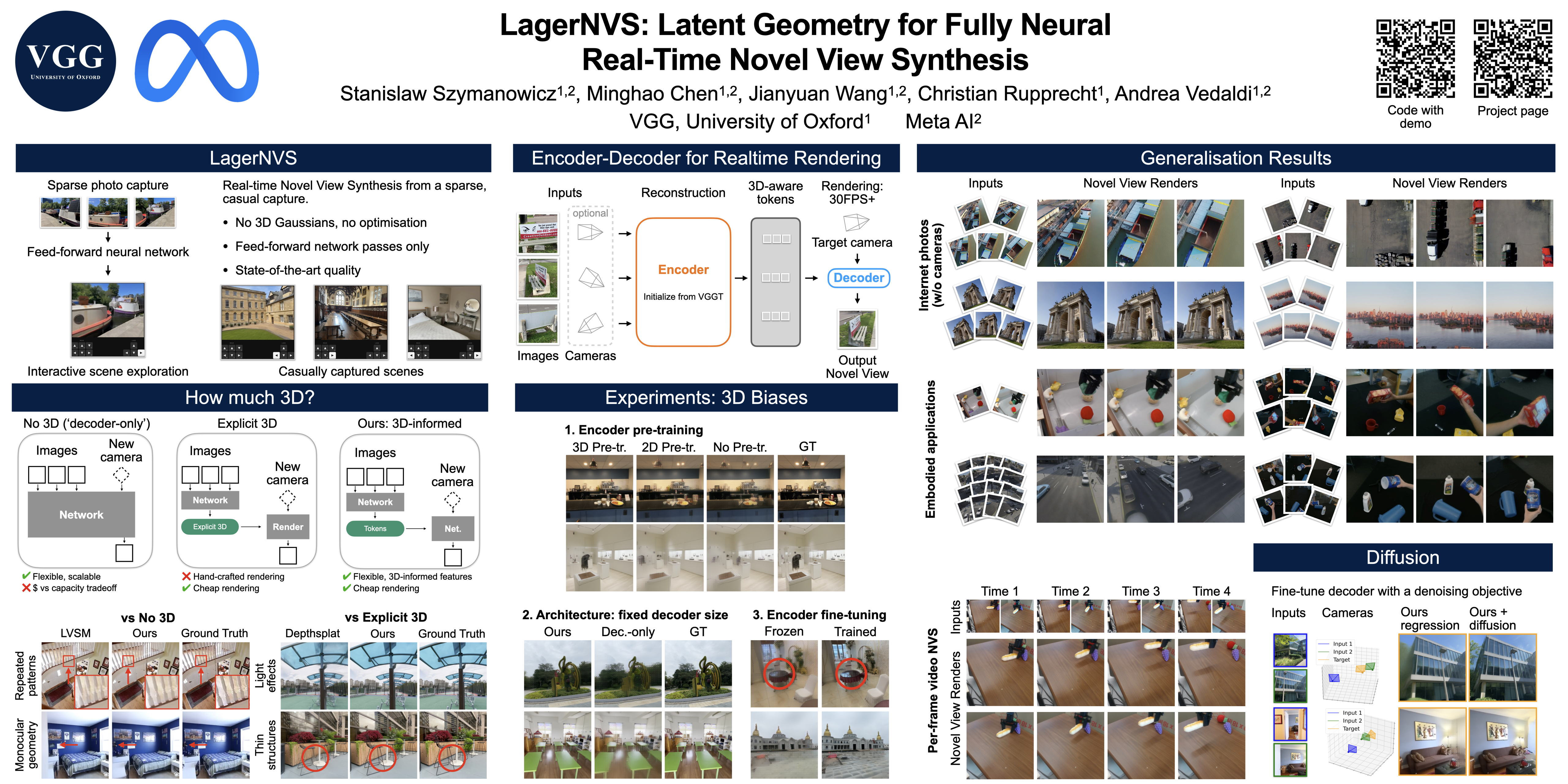
Novel View Synthesis has often relied on explicit 3D representations, which inject a strong 3D bias in the process; however, recent work has shown that network-based rendering can work better despite lacking 3D inductive biases. In this paper, we show that much better quality can be obtained by leveraging a strong 3D bias without a 3D representation. To do so, we introduce LagerNVS, an encoder-decoder network that uses 3D-aware features as a latent scene encoding. The encoder is initialized from a 3D reconstruction network, paired with a lightweight decoder, and trained end-to-end with photometric losses. LagerNVS achieves state-of-the-art deterministic feed-forward Novel View Synthesis results (including 31.1 PSNR on Re10k), with and without known cameras, renders in real-time, generalizes to in-the-wild data without known cameras, and can be paired with a diffusion decoder for generative completions.
Turbo-GS: Accelerating 3D Gaussian Fitting for High-Resolution Radiance Fields
Ankit Dhiman ⋅ Tao Lu ⋅ Srinath Ravi ⋅ Emre Arslan ⋅ Angela Xing ⋅ Yuanbo Xiangli ⋅ R. Venkatesh Babu ⋅ Srinath Sridhar
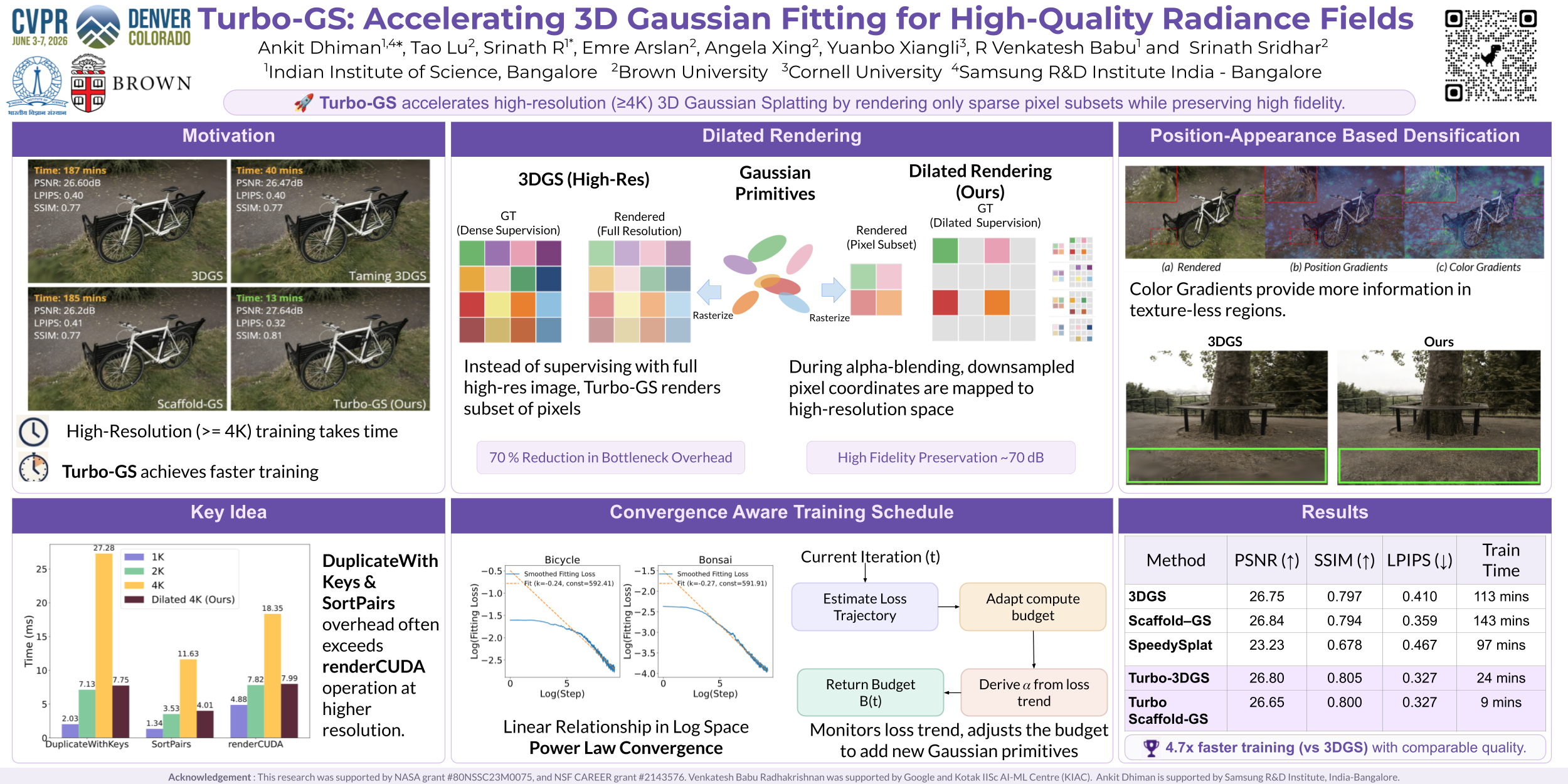
Novel-view synthesis plays a crucial role in computer vision with applications in 3D reconstruction, mixed reality, and robotics. Recent approaches, such as 3D Gaussian Splatting (3DGS), have emerged as state-of-the-art solutions, offering high-quality novel view synthesis in real time. However, training 3DGS models remains slow, particularly for high-resolution images, often requiring hours to fit a scene with 200 views. In this work, we aim to accelerate the fitting process by reducing computational overhead and improving learning efficiency. Specifically, we introduce a dilated rendering technique that renders only a subset of pixels instead of the full image, significantly reducing computational costs. To enhance learning efficiency, we develop a convergence-aware budget control mechanism that balances the addition of new Gaussians with the optimization of existing ones. Additionally, to improve densification efficiency and prevent gradient vanishing, we incorporate both positional and appearance error to enhance densification effectiveness. With these improvements, we achieve fast 4K-resolution fitting while maintaining, or even improving, novel view rendering quality. Extensive experiments demonstrate that our method achieves significantly faster optimization than existing approaches while preserving high rendering fidelity.
BiProLoRA: Bilevel Prompt LoRA for Real Scene Recovery
Nan An ⋅ Long Ma ⋅ Tengyu Ma ⋅ Zhu Liu ⋅ Yingchi Liu ⋅ Risheng Liu
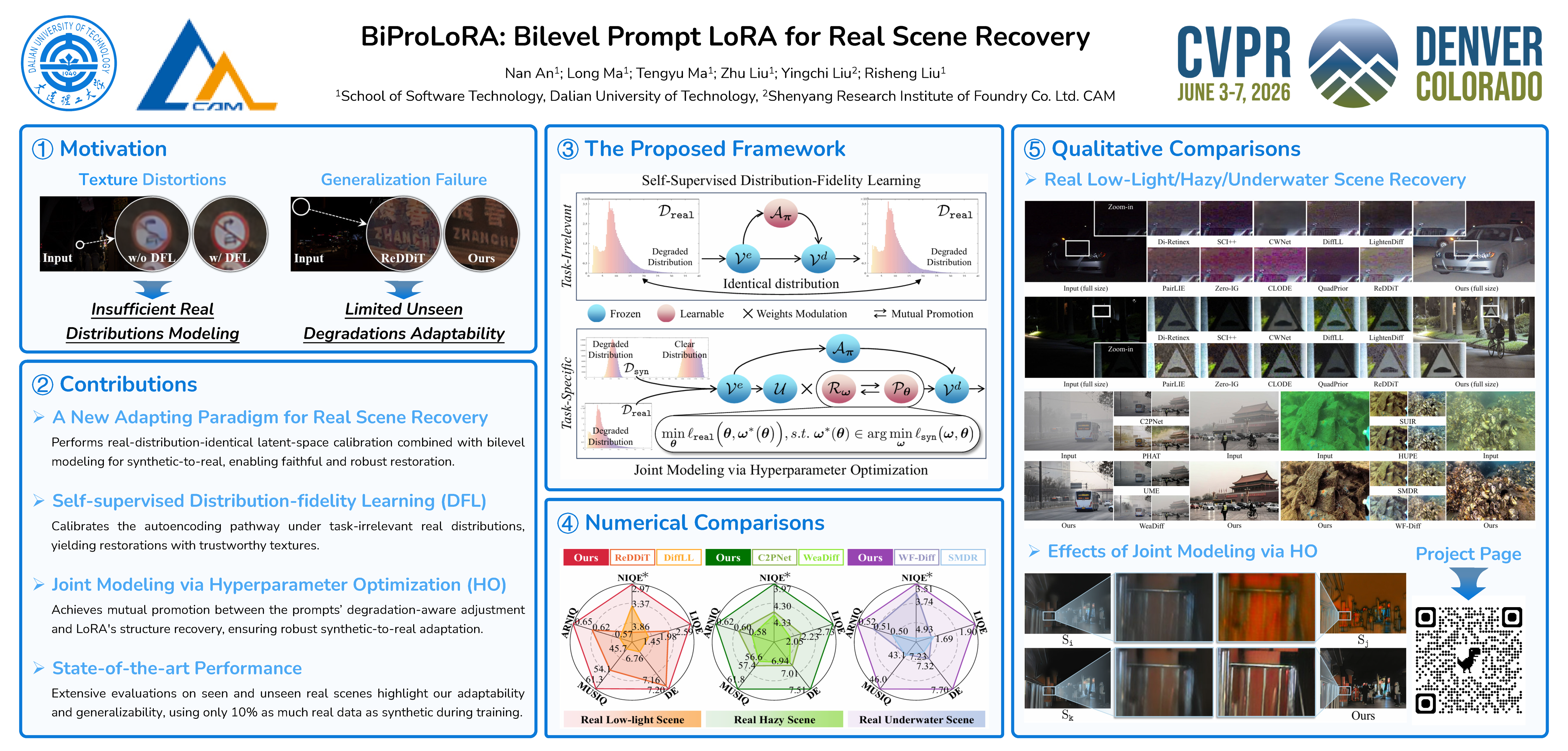
The emergence of large generative models has substantially advanced learning-based scene recovery in the synthetic domain. However, applying these models directly to real scenarios reveals sub-optimal performance stemming from the significant distribution gap, alongside poor adaptation to complex and unforeseen degradations. Consequently, it is imperative to develop a real scene adaptation strategy that yields faithful restorations with reliable generalizability. To this end, we propose $\textbf{Bi}$level $\textbf{Pro}$mpt $\textbf{LoRA}$, a novel learning paradigm designed to effectively adapt pre-trained generative models for real scene recovery. First, we introduce a self-supervised distribution-fidelity learning scheme to calibrate the autoencoding pathway under task-irrelevant real distributions, thereby recovering high-fidelity textures. Subsequently, a bilevel joint modeling via hyperparameter optimization is further established, empowering robust synthetic-to-real adaptation for both seen and unseen scenes by exploiting the complementary advantages between LoRA and Prompts to foster mutual promotion. Extensive evaluations on diverse real adverse scenarios demonstrate our method's superiority, with comprehensive algorithm analyses proving our effectiveness. The code will be public released upon the acceptance.
Degradation-Consistent Test-Time Adaptation for All-in-One Image Restoration
Ni Tang ⋅ Shenghao nie ⋅ Xiaotong Luo ⋅ Yuan Xie ⋅ Yanyun Qu
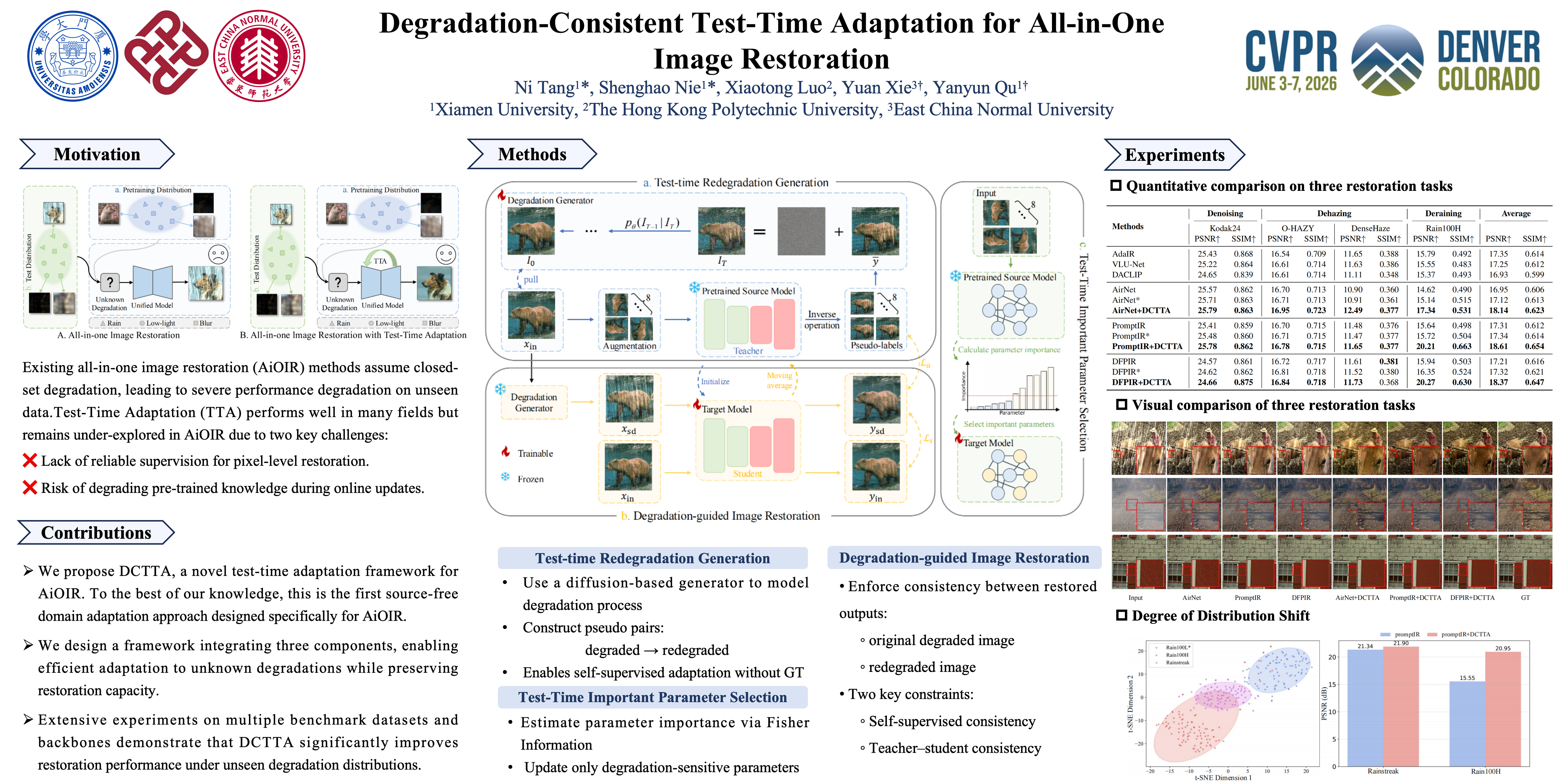
All-in-one image restoration (AiOIR) methods have made remarkable progress in handling diverse degradations. However, their performance often deteriorates when the test distribution deviates from the training distribution. Exploring test-time adaptation for AiOIR is therefore crucial. To adapt a pre-trained AiOIR model to unseen degradation distributions without access to source data or retraining, two key challenges must be addressed: designing reliable pseudo-supervision and stabilizing adaptation. Observing that multiple degraded versions of the same scene should map to a consistent clean image, we propose Degradation-Consistent Test-Time Adaptation (DCTTA). DCTTA comprises three core components: (1) test-time redegradation generation, which leverages a diffusion-based generator to construct pseudo degraded–clean pairs for distribution alignment; (2) degradation-guided image restoration, which enforces domain adaptation via self-supervised consistency loss; and (3) test-time important parameter selection, which selectively updates degradation-sensitive parameters to ensure stable adaptation while preserving pre-trained knowledge. Extensive experiments across multiple tasks and challenging domain shifts demonstrate that DCTTA consistently outperforms state-of-the-art AiOIR baselines, achieving up to +4.57 dB PSNR improvement on the Rain100H dataset.
CanonCGT: Reference-Based Color Grading via Canonical Pivot Representation
JINWON KO ⋅ Keunsoo Ko ⋅ Chang-Su Kim
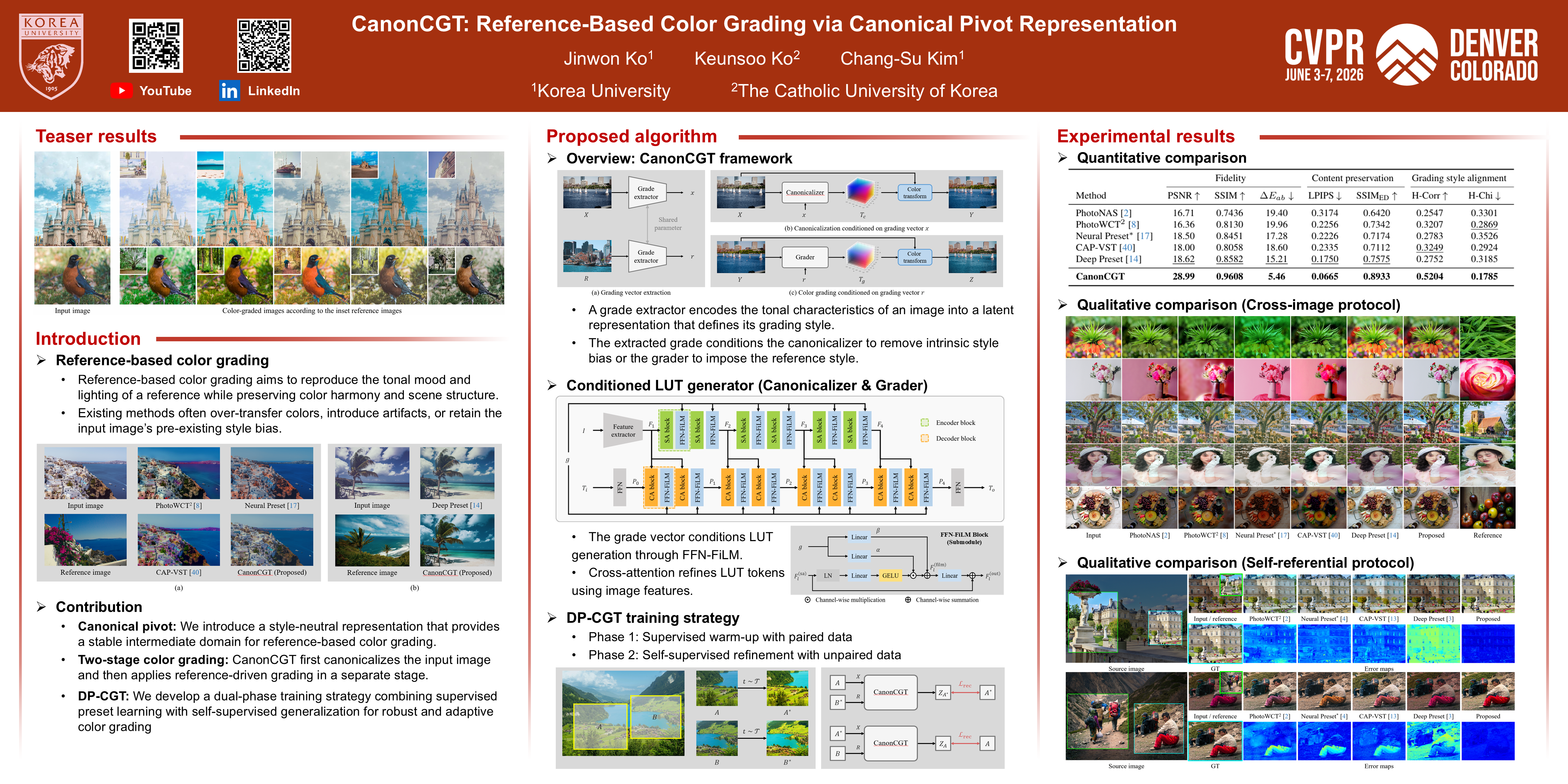
Reference-based color grading aims to reproduce the tonal mood and color harmony of a reference while preserving scene structure. Existing photorealistic and filter-based methods often produce unstable tone mappings --- over-shifting or inconsistently retaining colors --- leading to unnatural results. We propose CanonCGT, a two-stage framework built on a canonical pivot --- a style-neutral intermediate representation for stable color mapping. The first stage canonicalizes the input by removing intrinsic tonal bias, and the second color-grades it to match the reference style. A dual-phase training scheme, DP-CGT, combines supervised preset learning with self-supervised refinement on unpaired photographs. CanonCGT delivers photorealistic and tonally consistent results across diverse datasets, surpassing state-of-the-art methods in stability and visual fidelity.
2-Shots in the Dark: Low-Light Denoising with Minimal Data Acquisition
Liying Lu ⋅ Raphael Achddou ⋅ Sabine Süsstrunk
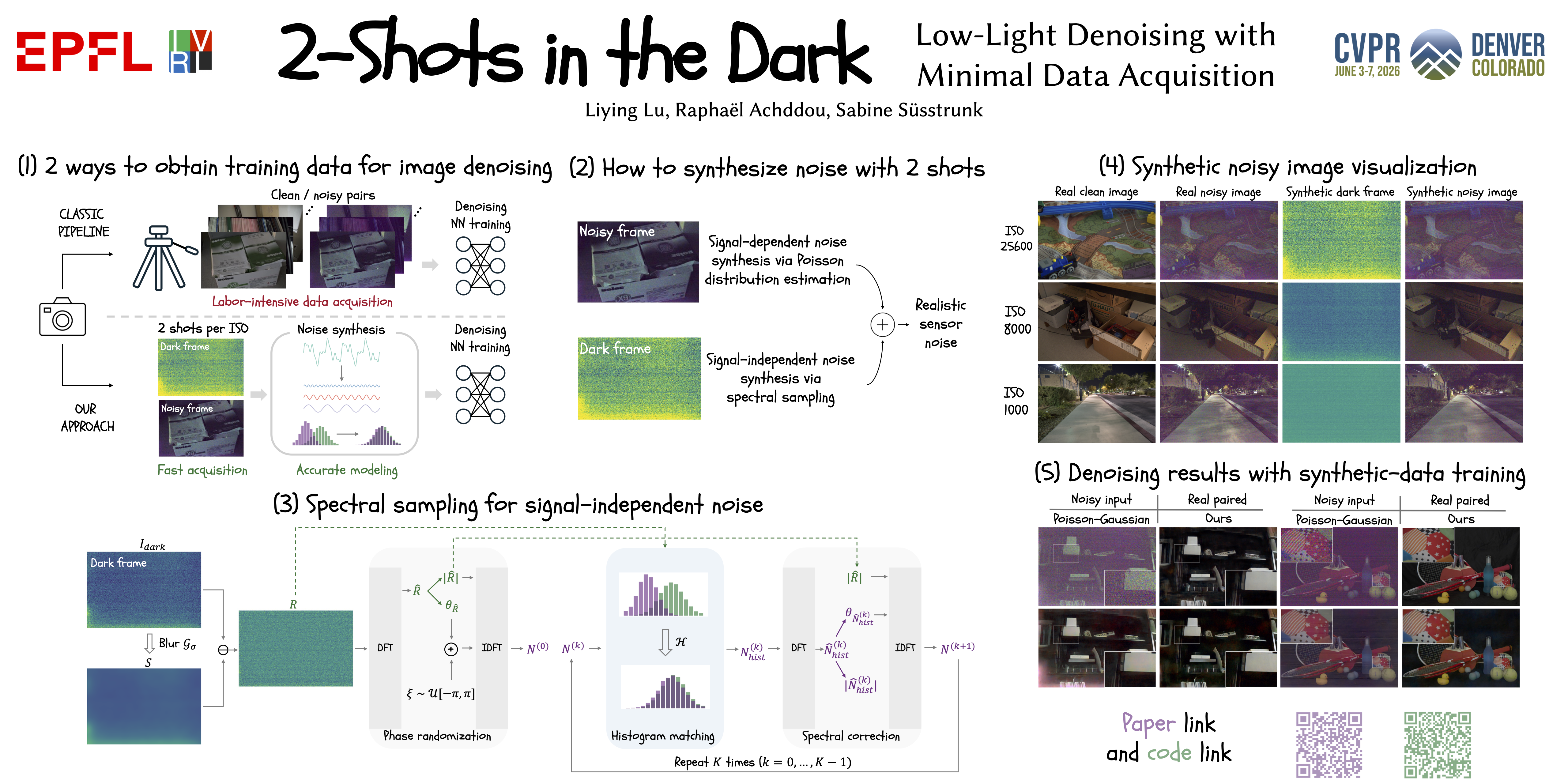
Raw images taken in low-light conditions are very noisy due to low photon count and sensor noise. Learning-based denoisers have the potential to reconstruct high-quality images. For training, however, these denoisers require large paired datasets of clean and noisy images, which are difficult to collect. Noise synthesis is an alternative to large-scale data acquisition: given a clean image, we can synthesize a realistic noisy counterpart. In this work, we propose a general and practical noise synthesis method that requires only $\textbf{one single noisy image and one single dark frame}$ per ISO setting. We represent signal-dependent noise with a Poisson distribution and introduce a Fourier-domain spectral sampling algorithm to accurately model signal-independent noise. The latter generates diverse noise realizations that maintain the spatial and statistical properties of real sensor noise. As opposed to concurrent approaches, our method neither relies on simplified parametric models nor on large sets of clean-noisy image pairs. It is accurate and practical. Moreover, our synthesis method leads to state-of-the-art performances on multiple low-light denoising benchmarks.
Restore, Assess, Repeat: A Unified Framework for Iterative Image Restoration
I-Hsiang (Aaron) Chen ⋅ Isma Hadji ⋅ Enrique Sanchez ⋅ Adrian Bulat ⋅ Sy-Yen Kuo ⋅ Radu Timofte ⋅ Georgios Tzimiropoulos ⋅ Brais Martinez
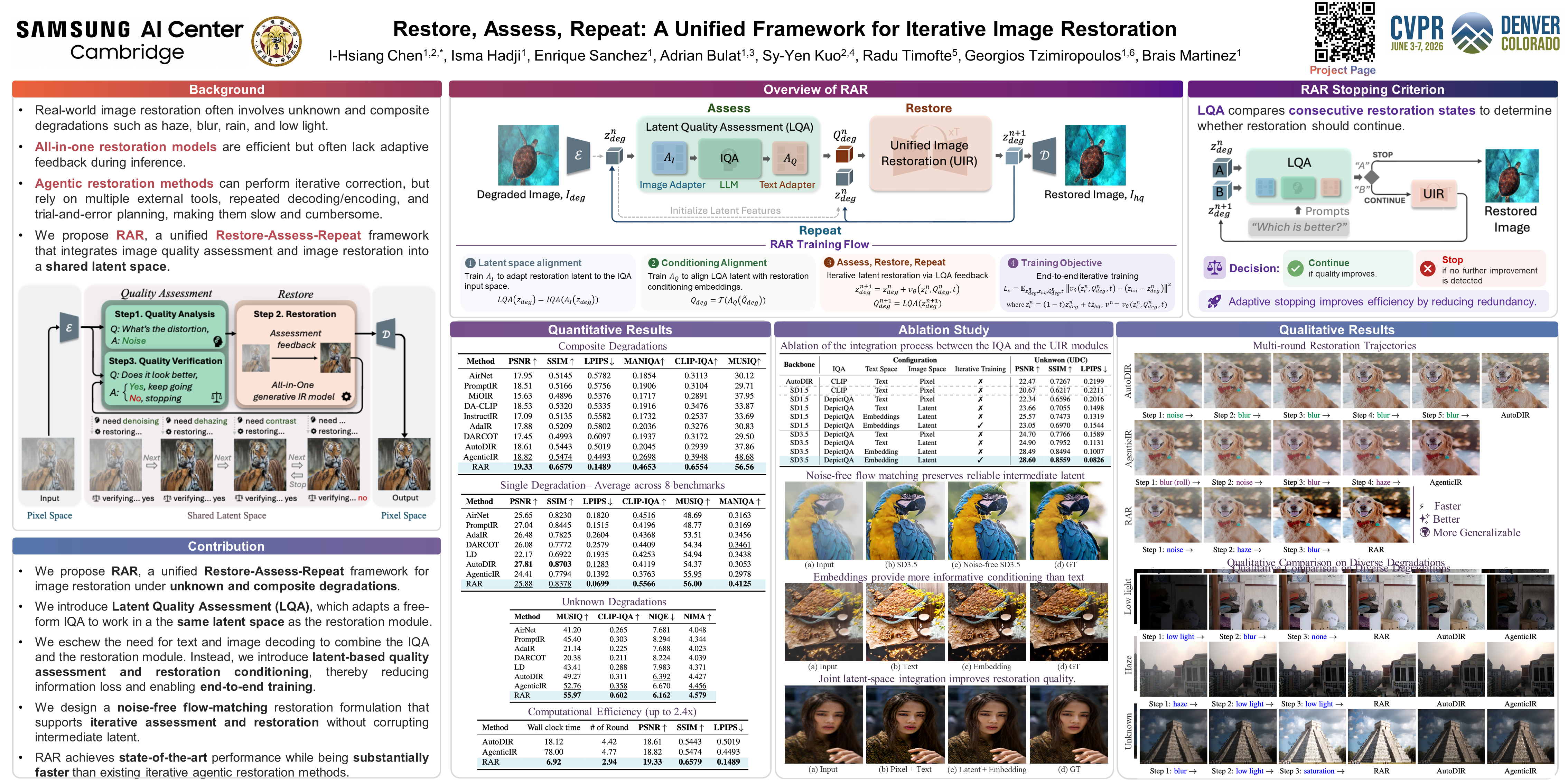
Image restoration aims to recover high quality images from inputs degraded by various factors, such as adverse weather, blur, or low light. While recent studies have shown remarkable progress across individual or unified restoration tasks, they still suffer from limited generalization and inefficiency when handling unknown or composite degradations. To address these limitations, we propose RAR, a Restore, Assess and Repeat process, that integrates Image Quality Assessment (IQA) and Image Restoration (IR) into a unified framework to iteratively and efficiently achieve high quality image restoration. Specifically, we introduce a restoration process that operates entirely in the latent domain to jointly perform degradation identification, image restoration, and quality verification. The resulting model is fully trainable end to end and allows for an all-in-one assess and restore approach that dynamically adapts the restoration process. Also, the tight integration of IQA and IR into a unified model minimizes the latency and information loss that typically arises from keeping the two modules disjoint, (e.g. during image and/or text decoding). Extensive experiments show that our approach consistent improvements under single, unknown and composite degradations, thereby establishing a new state-of-the-art.
It Takes Two: A Duet of Periodicity and Directionality for Burst Flicker Removal
lishen qu ⋅ Shihao Zhou ⋅ Jie Liang ⋅ Hui Zeng ⋅ Lei Zhang ⋅ Jufeng Yang
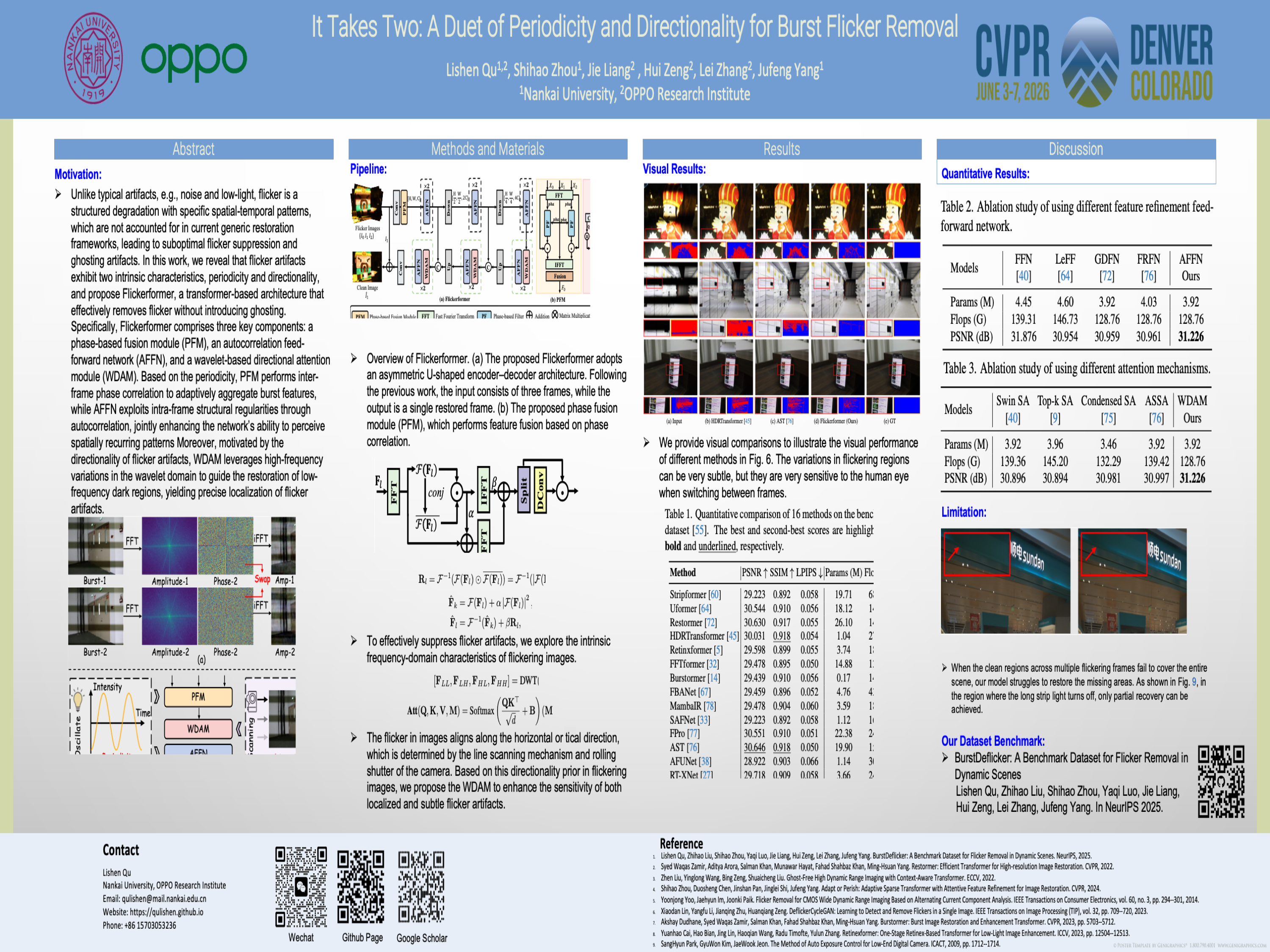
Flicker artifacts, arising from unstable illumination and row-wise exposure inconsistencies, pose a significant challenge in short-exposure photography, severely degrading image quality. Unlike typical artifacts, e.g., noise and low-light, flicker is a structured degradation with specific spatial-temporal patterns, which are not accounted for in current generic restoration frameworks, leading to suboptimal flicker suppression and ghosting artifacts. In this work, we reveal that flicker artifacts exhibit two intrinsic characteristics, periodicity and directionality, and propose Flickerformer, a transformer-based architecture that effectively removes flicker without introducing ghosting.Specifically, Flickerformer comprises three key components: a phase-based fusion module (PFM), an autocorrelation feed-forward network (AFFN), and a wavelet-based directional attention module (WDAM). Based on the periodicity, PFM performs inter-frame phase correlation to adaptively aggregate burst features, while AFFN exploits intra-frame structural regularities through autocorrelation, jointly enhancing the network’s ability to perceive spatially recurring patterns. Moreover, motivated by the directionality of flicker artifacts, WDAM leverages high-frequency variations in the wavelet domain to guide the restoration of low-frequency dark regions, yielding precise localization of flicker artifacts. Extensive experiments demonstrate that Flickerformer outperforms state-of-the-art approaches in both quantitative metrics and visual quality. The source code is available in the supplementary materials.
Scan Clusters, Not Pixels: A Cluster-Centric Paradigm for Efficient Ultra-high-definition Image Restoration
Chen Wu ⋅ Ling Wang ⋅ Zhuoran Zheng ⋅ Yuning Cui ⋅ Zhixiong Yang ⋅ Xiangyu Chen ⋅ Yue Zhang ⋅ Weidong Jiang ⋅ Jingyuan Xia
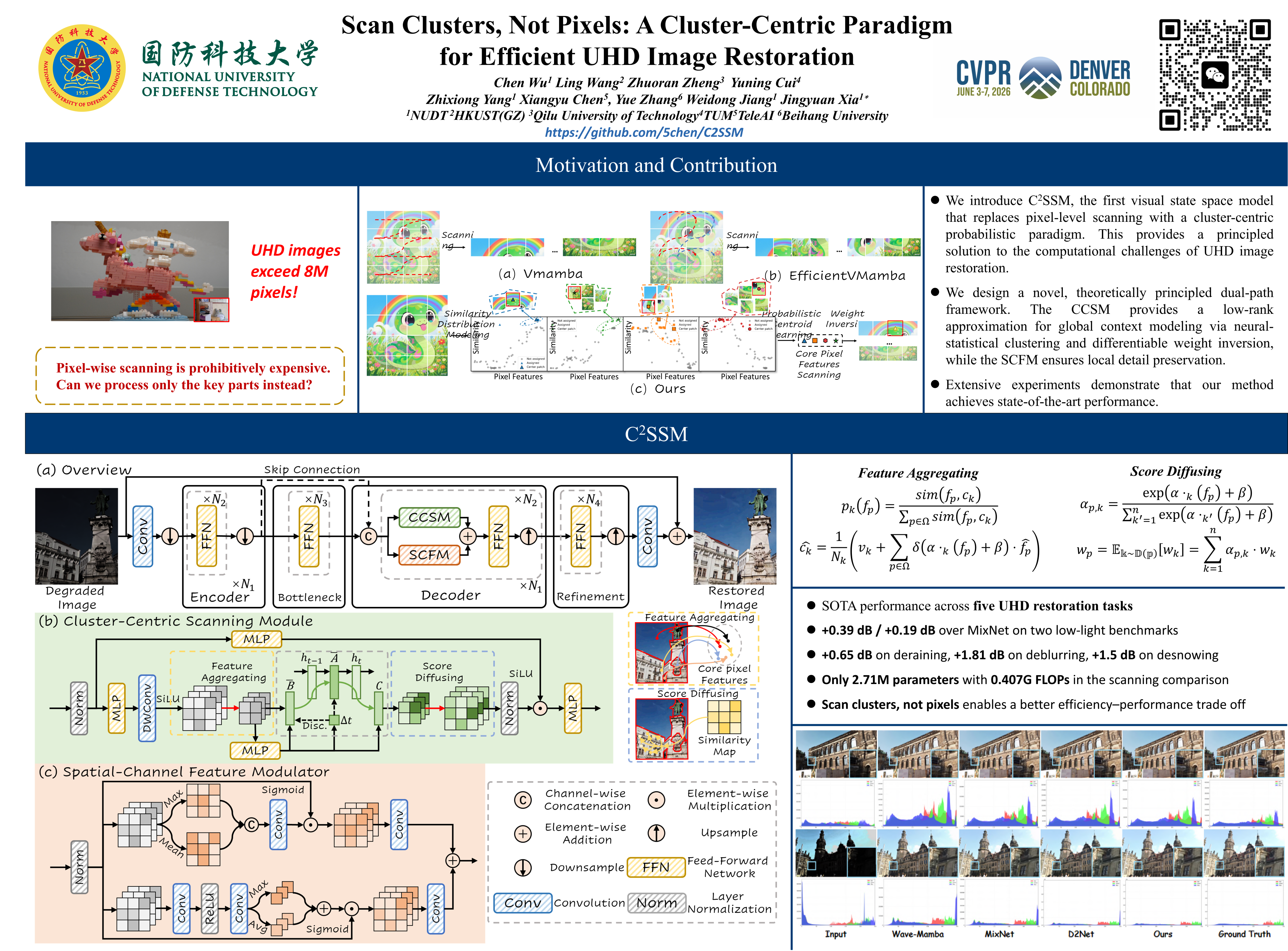
Ultra-High-Definition (UHD) image restoration is trapped in a scalability crisis: existing models, bound to pixel-wise operations, demand unsustainable computation. While state space models (SSMs) like Mamba promise linear complexity, their pixel-serial scanning remains a fundamental bottleneck for the millions of pixels in UHD content. We ask: must we process every pixel to understand the image? This paper introduces C$^2$SSM, a visual state space model that breaks this taboo by shifting from pixel-serial to cluster-serial scanning. Our core discovery is that the rich feature distribution of a UHD image can be distilled into a sparse set of semantic centroids via a neural-parameterized mixture model. C$^2$SSM leverages this to reformulate global modeling into a novel dual-path process: it scans and reasons over a handful of cluster centers, then diffuses the global context back to all pixels through a principled similarity distribution, all while a lightweight modulator preserves fine details. This cluster-centric paradigm achieves a decisive leap in efficiency, slashing computational costs while establishing new state-of-the-art results across five UHD restoration tasks. More than a solution, C$^2$SSM charts a new course for efficient large-scale vision: scan clusters, not pixels.
Seeing Beyond 8bits: Subjective and Objective Quality Assessment of HDR-UGC Videos
SHRESHTH SAINI ⋅ Bowen Chen ⋅ Yilin Wang ⋅ Neil Birkbeck ⋅ Balu Adsumilli ⋅ Alan C.
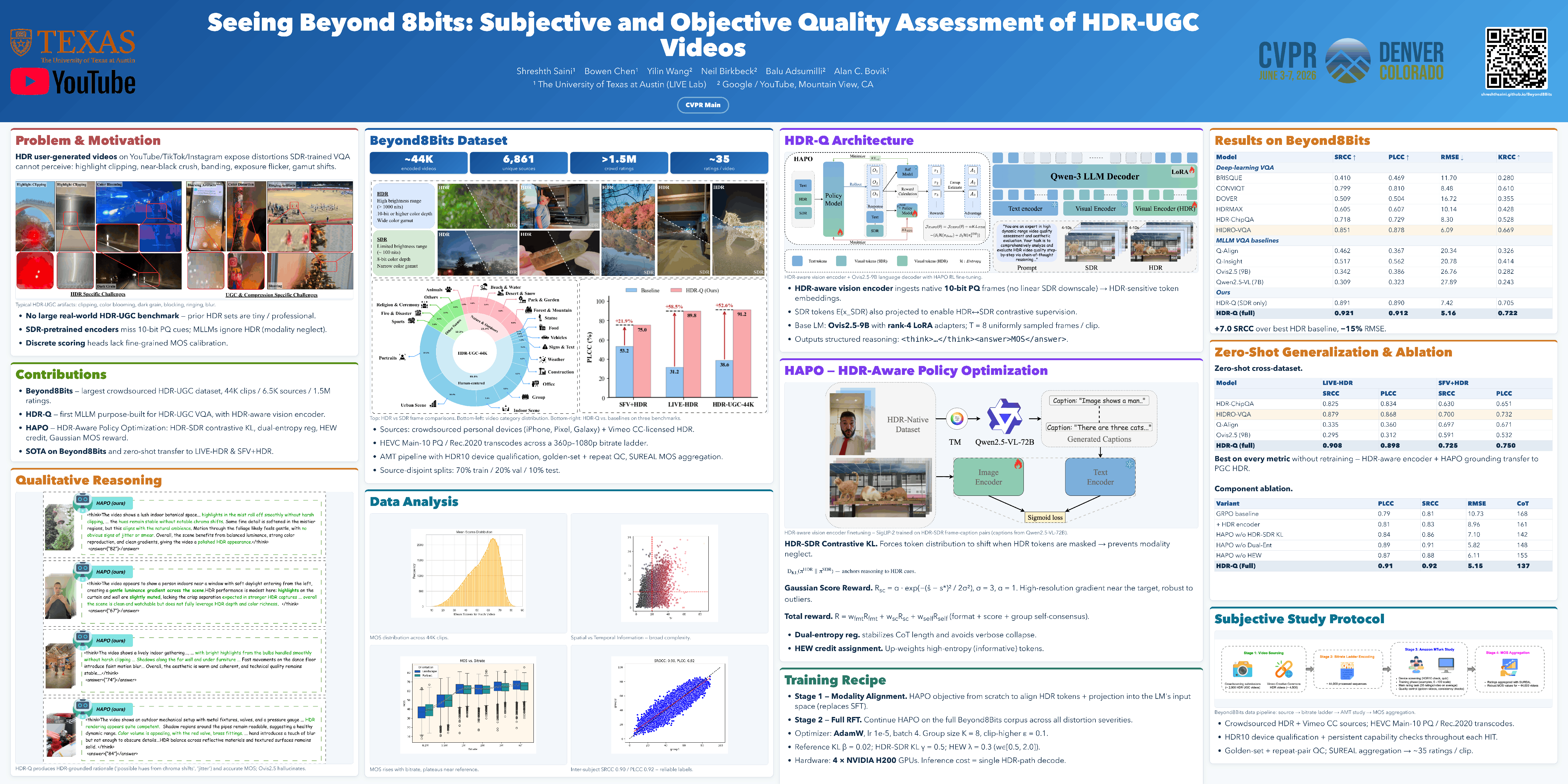
High Dynamic Range (HDR) user-generated (UGC) videos are rapidly proliferating across social platforms, yet most perceptual video quality assessment (VQA) systems remain tailored to Standard Dynamic Range (SDR). HDR’s higher bit depth, wide color gamut, and elevated luminance range expose distortions such as near-black crushing, highlight clipping, banding, and exposure flicker that amplify UGC artifacts and challenge SDR models. To catalyze progress, we curate \textbf{HDR-UGC-44K}, a large-scale subjective dataset of $\sim$44K videos from 6.5K sources with >1.5M crowd ratings, spanning diverse scenes, capture conditions, and compression settings. We further introduce \textbf{HDR-Q}, the first Multimodal Large Language Model (MLLM) for HDR-UGC VQA. We propose (i) a novel HDR-aware vision encoder to produce HDR-sensitive embeddings, and (ii) HDR-Aware Policy Optimization (HAPO), an RL finetuning framework that anchors reasoning to HDR cues. HAPO augments GRPO via an HDR–SDR contrastive KL that encourages token reliance on HDR inputs and a gaussian weighted regression reward for fine-grained MOS calibration. Across HDR-UGC-44K and public HDR-VQA benchmarks, HDR-Q delivers state-of-the-art performance. The dataset and code will be released.
Dynamic Exposure Burst Image Restoration
Woohyeok Kim ⋅ Jaesung Rim ⋅ Daeyeon Kim ⋅ Sunghyun Cho
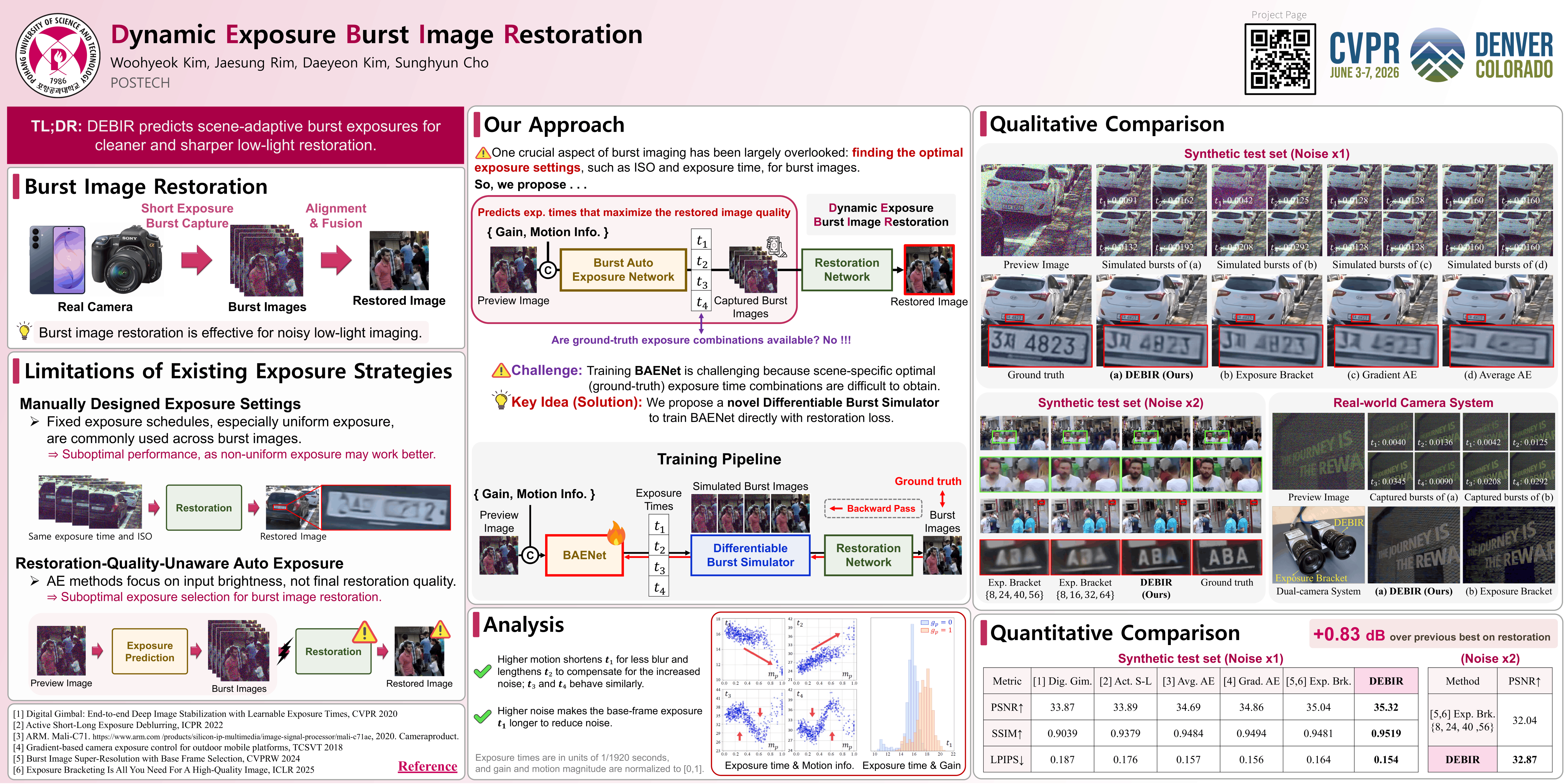
Burst image restoration aims to reconstruct a high-quality image from burst images, which are typically captured using manually designed exposure settings.Although these exposure settings significantly influence the final restoration performance, the problem of finding optimal exposure settings has been overlooked.In this paper, we present Dynamic Exposure Burst Image Restoration (DEBIR), a novel burst image restoration pipeline that enhances restoration quality by dynamically predicting exposure times tailored to the shooting environment.In our pipeline, Burst Auto-Exposure Network (BAENet) estimates the optimal exposure time for each burst image based on a preview image, as well as motion magnitude and gain.Subsequently, a burst image restoration network reconstructs a high-quality image from burst images captured using these optimal exposure times.For training, we introduce a differentiable burst simulator and a three-stage training strategy. Our experiments demonstrate that our pipeline achieves state-of-the-art restoration quality. Furthermore, we validate the effectiveness of our approach on a real-world camera system, demonstrating its practicality. The code will be made publicly available on our project page.
FAPE-IR: Frequency-Aware Planning and Execution Framework for All-in-One Image Restoration
Jingren Liu ⋅ Shuning Xu ⋅ Qirui Yang ⋅ Yun wang ⋅ Xiangyu Chen ⋅ Zhong Ji
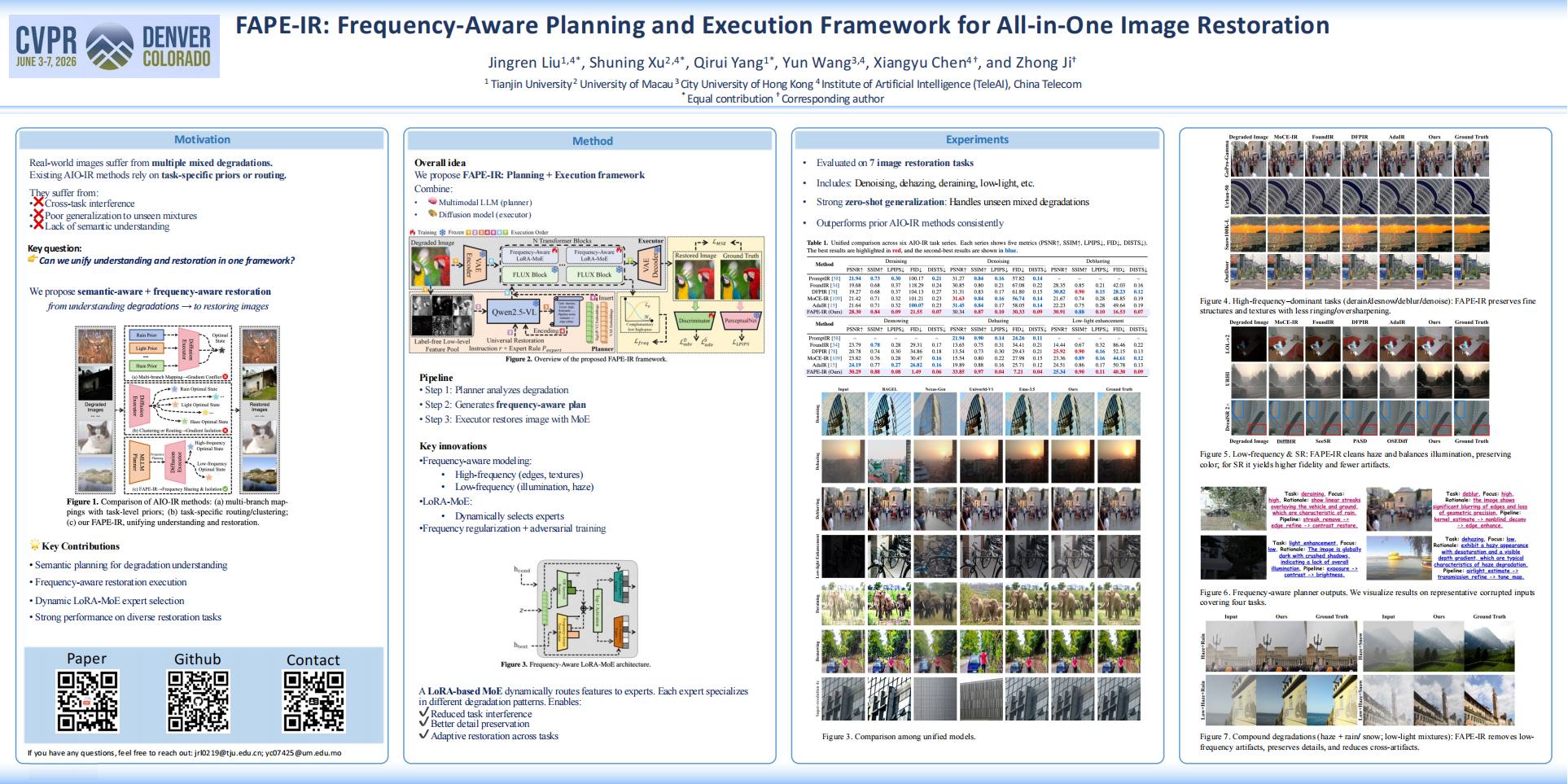
All-in-One Image Restoration (AIO-IR) aims to develop a unified model that can handle multiple degradations under complex conditions. However, existing methods often rely on task-specific designs or latent routing strategies, making it hard to adapt to real-world scenarios with various degradations. We propose FAPE-IR, a Frequency-Aware Planning and Execution framework for image restoration. It uses a frozen Multimodal Large Language Model (MLLM) as a planner to analyze degraded images and generate concise, frequency-aware restoration plans. These plans guide a LoRA-based Mixture-of-Experts (LoRA-MoE) module within a diffusion-based executor, which dynamically selects high- or low-frequency experts, complemented by frequency features of the input image. To further improve restoration quality and reduce artifacts, we introduce adversarial training and a frequency regularization loss. By coupling semantic planning with frequency-based restoration, FAPE-IR offers a unified and interpretable solution for all-in-one image restoration. Extensive experiments show that FAPE-IR achieves state-of-the-art performance across seven restoration tasks and exhibits strong zero-shot generalization under mixed degradations.
ColorFLUX: A Structure-Color Decoupling Framework for Old Photo Colorization
Bingchen Li ⋅ Zhixin Wang ⋅ Fan Li ⋅ Jiaqi Xu ⋅ Jiaming Guo ⋅ Renjing Pei ⋅ Xin Li ⋅ Zhibo Chen
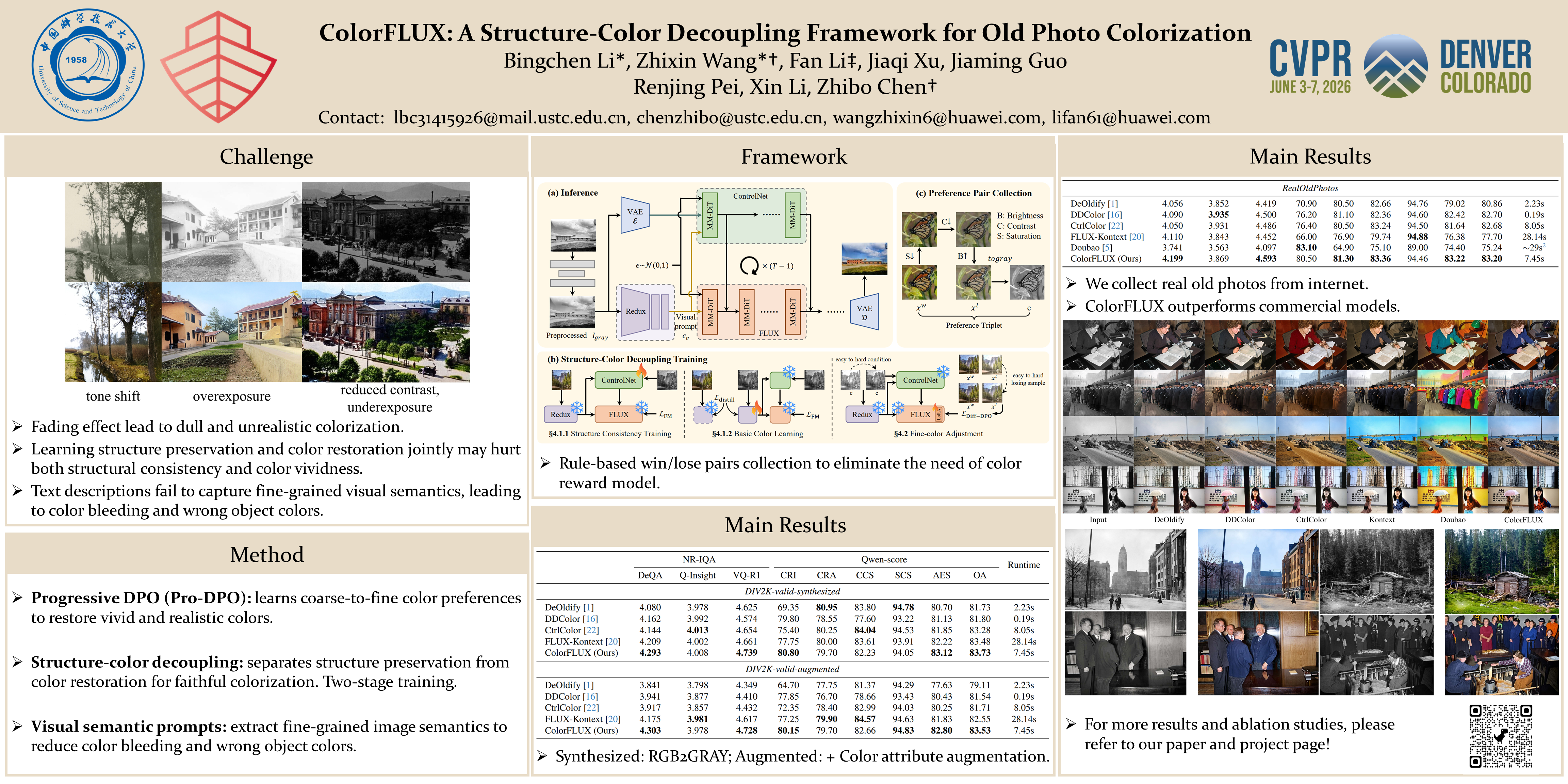
Old photos preserve invaluable historical memories, making their restoration and colorization highly desirable. While existing restoration models can address some degradation issues like denoising and scratch removal, they often struggle with accurate colorization.This limitation arises from the unique degradation inherent in old photos, such as faded brightness and altered color hues, which are different from modern photo distributions, creating a substantial domain gap during colorization. In this paper, we propose a novel old photo colorization framework based on the generative diffusion model FLUX. Our approach introduces a structure-color decoupling strategy that separates structure preservation from color restoration, enabling accurate colorization of old photos while maintaining structural consistency. We further enhance the model with a progressive Direct Preference Optimization (Pro-DPO) strategy, which allows the model to learn subtle color preferences through coarse-to-fine transitions in color augmentation. Additionally, we address the limitations of text-based prompts by introducing visual semantic prompts, which extract fine-grained semantic information directly from old photos, helping to eliminate the color bias inherent in old photos. Experimental results on both synthetic and real datasets demonstrate that our approach outperforms existing state-of-the-art colorization methods, including closed-source commercial models, producing high-quality and vivid colorization.
VEMamba: Efficient Isotropic Reconstruction of Volume Electron Microscopy with Axial-Lateral Consistent Mamba
Longmi Gao ⋅ Pan Gao
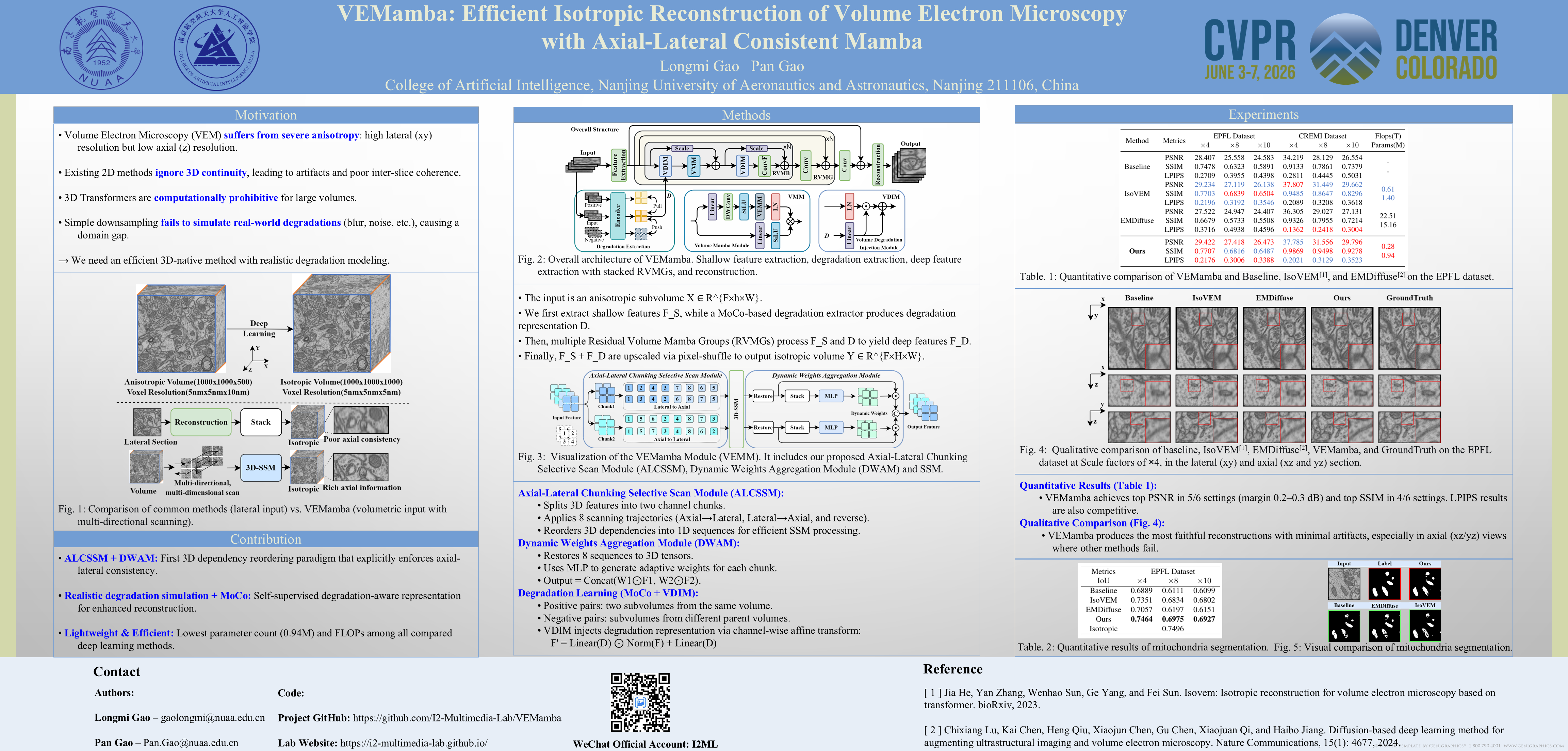
Volume Electron Microscopy (VEM) is crucial for 3D tissue imaging but often produces anisotropic data with poor axial resolution, hindering visualization and downstream analysis. Existing methods for isotropic reconstruction often suffer from neglecting abundant axial information and employing simple downsampling to simulate anisotropic data. To address these limitations, we propose VEMamba, an efficient framework for isotropic reconstruction. The core of VEMamba is a novel \textbf{3D Dependency Reordering} paradigm, implemented via two key components: an Axial-Lateral Chunking Selective Scan Module (ALCSSM), which intelligently re-maps complex 3D spatial dependencies (both axial and lateral) into optimized 1D sequences for efficient Mamba-based modeling, explicitly enforcing axial-lateral consistency; and a Dynamic Weights Aggregation Module (DWAM) to adaptively aggregate these reordered sequence outputs for enhanced representational power. Furthermore, we introduce a realistic degradation simulation and then leverage Momentum Contrast (MoCo) to integrate this degradation-aware knowledge into the network for superior reconstruction. Extensive experiments on both simulated and real-world anisotropic VEM datasets demonstrate that VEMamba achieves state-of-the-art performance while maintaining a lower computational footprint.
Anatomica: Localized Control over Geometric and Topological Properties for Anatomical Diffusion Models
Karim Kadry ⋅ Abdalla Abdelwahed ⋅ Ajay Manicka ⋅ Naravich Chutisilp ⋅ Farhad R. Nezami ⋅ Elazer R Edelman
We present an inference-time guidance framework for generating 3D multi-class anatomical voxel maps with localized geometric and topological control. During generation, we use cuboidal control domains of varying dimensionality, location, and shape to slice out relevant substructures. These local substructures are used to compute differentiable penalty functions that steer the sample towards target constraints. We penalize geometric features such as size, shape, position, and orientation through voxel-wise moments, while topological features such as connected components, loops, and voids are enforced through persistent homology. Lastly, we implement this guidance framework for latent diffusion models, where a neural field decoder can partially extract substructures, enabling efficient measurement and control of anatomical properties. This formulation unlocks a rich design space, where several constraints can be composed to control complex structures defined over arbitrary dimensions and coordinate systems. We show that Anatomica flexibly applies to a variety of anatomical systems, enabling the rational design of synthetic datasets for virtual simulation trials or machine learning workflows.
EMGauss: Continuous Slice-to-3D Reconstruction via Dynamic Gaussian Modeling in Volume Electron Microscopy
Yumeng He ⋅ Zanwei Zhou ⋅ Yekun Zheng ⋅ Chen Liang ⋅ Yunbo Wang ⋅ Xiaokang Yang
Volume electron microscopy (vEM) enables nanoscale 3D imaging of biological structures but remains constrained by acquisition trade-offs, leading to anisotropic volumes with limited axial resolution. Existing deep learning methods seek to restore isotropy by leveraging lateral priors; yet their assumptions break down for morphologically anisotropic structures. We present EMGauss, a general framework for 3D reconstruction from planar scanned 2D slices with applications in vEM, which circumvents the inherent limitations of isotropy-based approaches. Our key innovation is to reframe slice-to-3D reconstruction as a 3D dynamic scene rendering problem based on Gaussian splatting, where the progression of axial slices is modeled as the temporal evolution of 2D Gaussian point clouds. To enhance fidelity in data-sparse regimes, we incorporate a Teacher–Student bootstrapping mechanism that uses high-confidence predictions on unobserved slices as pseudo-supervisory signals. Compared with diffusion- and GAN-based reconstruction methods, EMGauss substantially improves interpolation quality, enables continuous slice synthesis, and eliminates the need for large-scale pretraining. Beyond vEM, it potentially provides a generalizable slice-to-3D solution across diverse imaging domains.
Underground Plant Exploration: Non-Destructive 3D Root Assessment with GPR Based on Point Graph Neural Network
Yuwei Zhou ⋅ Guoyu Lu
This paper introduces a novel application of machine learning in agriculture for non-destructive 3D root structure reconstruction. Plant roots are critical for providing resources for the entire plant. Ground Penetrating Radar (GPR) is a key tool for identifying subterranean objects with easy and obvious shapes, such as large pipes, but remaining challenging to assess the 3D shapes of roots. In our study, we introduce a novel approach specifically designed based on GPR signal shape priors to detect target signals and perform curve parameter regression based on multiple B-scans from GPR. This process enables the derivation of a precise curve from the detection and regression outcomes. To achieve the reconstruction of a comprehensive 3D root structure, we have developed a shape reconstruction network that processes sparse sliced 3D points through a dedicated point graph network and an upsampling network module. Our method has been rigorously trained and validated using synthetic 3D root datasets and GPR data simulated by gprMax, as well as real GPR data.
Uni-Encoder Meets Multi-Encoders: Representation Before Fusion for Brain Tumor Segmentation with Missing Modalities
Peibo Song ⋅ Xiaotian Xue ⋅ Jinshuo Zhang ⋅ zihao wang ⋅ Jinhua liu ⋅ Shujun Fu ⋅ Fangxun Bao ⋅ Si Yong Yeo
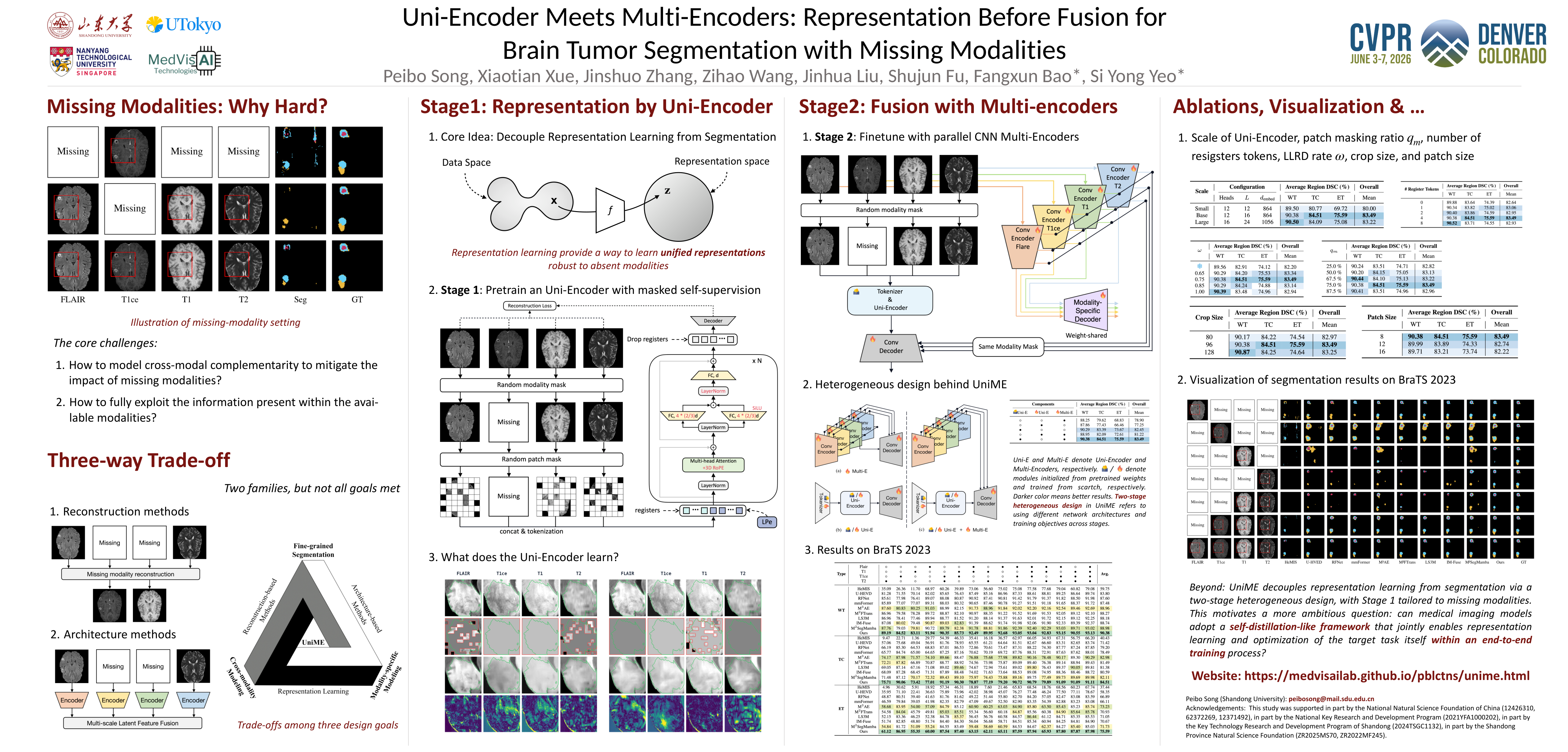
Multimodal MRI offers complementary information for brain tumor segmentation, but clinical scans often lack one or more modalities, which degrades segmentation performance. In this paper, we propose UniME (Uni-Encoder Meets Multi-Encoders), a two-stage heterogeneous method for brain tumor segmentation with missing modalities that reconciles the trade-offs among fine- grained structure capture, cross-modal complementarity modeling, and effective exploitation of available modalities. The key idea is to decouple representation learning from segmentation via a two-stage heterogeneous architecture. Stage 1 pretrains a single ViT Uni-Encoder with masked image modeling to establish a unified representation robust to missing modalities. Stage 2 adds modality-specific CNN Multi-Encoders to extract high-resolution, multi-scale, fine-grained features. We fuse these features with the global representation to produce precise segmentations. Experiments on BraTS 2023 and BraTS 2024 show that UniME outperforms previous methods for brain tumor segmentation with missing modalities. Code will be released.
MicroFM: Physics-guided Flow Matching for Isotropic Microscopy Reconstruction
Xingzu Zhan ⋅ Runmin Jiang ⋅ Vatsal Gupta ⋅ Tanush Swaminathan ⋅ Yanwen Wang ⋅ Genpei Zhang ⋅ Haili Wang ⋅ Min Xu
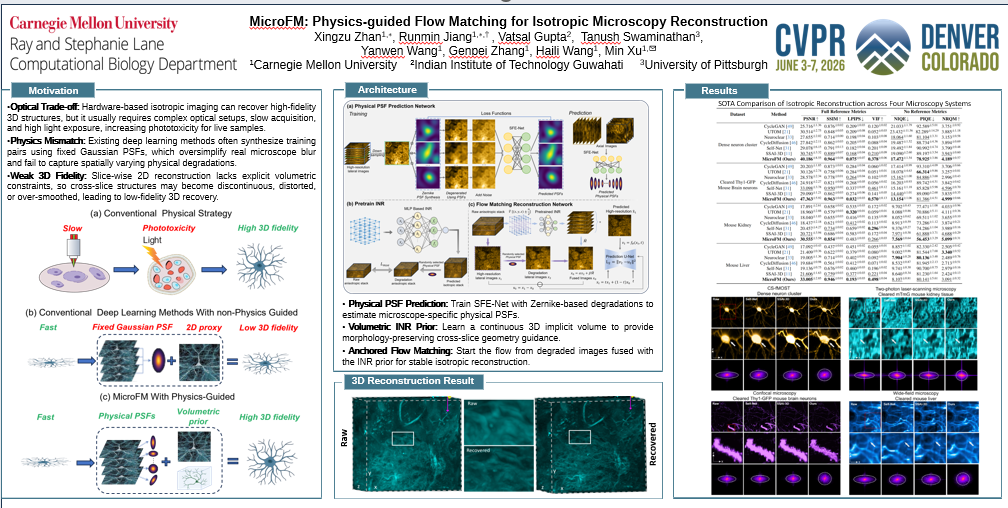
Isotropic microscopy reconstruction remains challenging because the anisotropic point spread function in optical systems yields much poorer axial resolution and hampers accurate 3D analysis. Hardware strategies can approach isotropy, yet they are complex, costly, susceptible to sidelobes, and introduce phototoxicity. Deep learning based approaches reduce acquisition burden, but common synthetic pipelines blur with Gaussian kernels that do not match the physical degradation, and many methods lack explicit volumetric geometry constraints since they process 2D slices independently. These gaps lead to low-fidelity reconstructions. To address these challenges, we present MicroFM, which synthesizes realistic training data using physical PSFs matched to the target microscope. MicroFM also introduces the first flow-matching framework for 3D microscopy reconstruction, guided by a continuous implicit geometry prior to achieve high-fidelity isotropic recovery. Across four fluorescence microscopy systems and datasets, MicroFM achieves state-of-the-art performance, producing sharper structures, more isotropic spectra, and substantial gains in both full-reference and no-reference metrics.
Dynamic Stream Network for Combinatorial Explosion Problem in Deformable Medical Image Registration
Shaochen Bi ⋅ Yuting He ⋅ Weiming Wang ⋅ Hao Chen
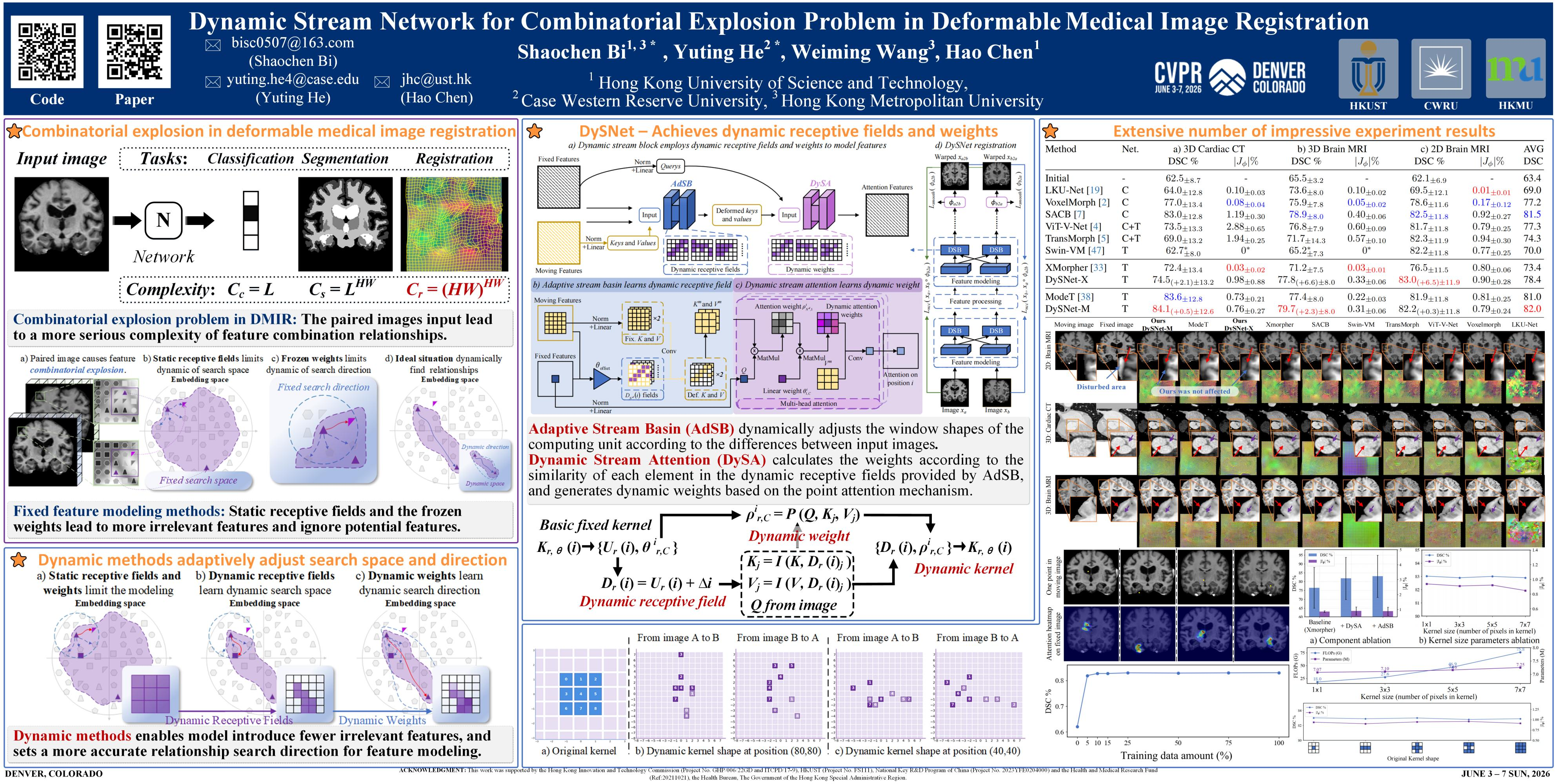
Combinatorial explosion problem caused by dual inputs presents a critical challenge in Deformable Medical Image Registration (DMIR). Since DMIR process two images simultaneously as input, the combination relationship between features has grown exponentially, ultimately the model considers more interfering features during the feature modeling process. Introducing dynamics in the receptive fields and weights of the network enable the model to eliminate the interfering features combination and model the potential feature combination relationships. In this paper, we propose the Dynamic Stream Network (DySNet), which enables the receptive fields and weights to be dynamically adjusted. This ultimately enables the model to ignore interfering feature combinations and model the potential feature relationships. With two key innovations: 1) Adaptive Stream Basin (AdSB) module dynamically adjusts the shape of the receptive field, thereby enabling the model to focus on the feature relationships with greater correlation. 2) Dynamic Stream Attention (DySA) mechanism generates dynamic weights to search for more valuable feature relationships. Extensive experiments have shown that DySNet consistently outperforms the most advanced DMIR methods, highlighting its outstanding generalization ability. Our code will be released on the website.
PMRNet: Physics-informed Multi-scale Refinement Network for Medical Image Segmentation
Boce Kang
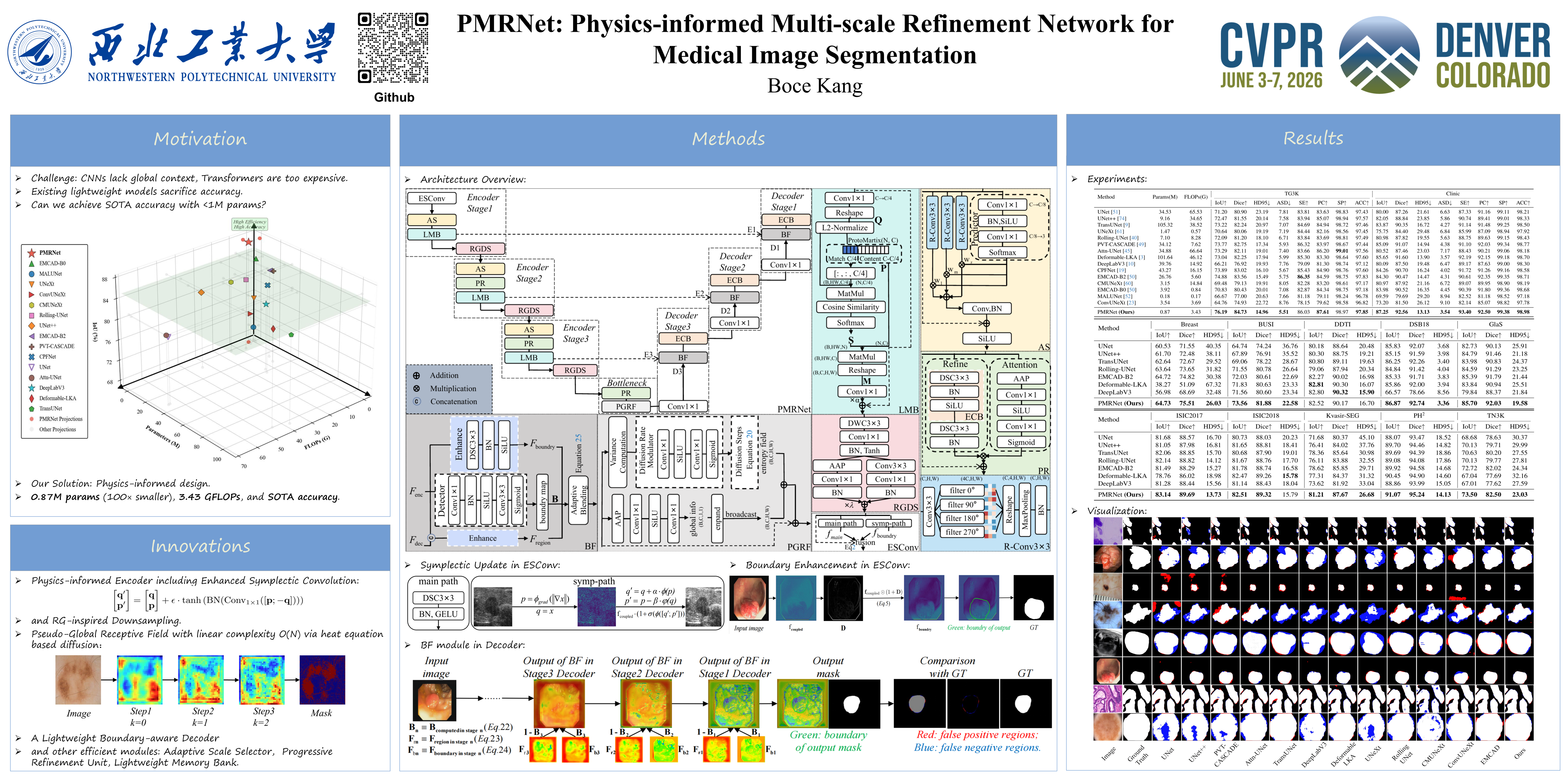
Medical image segmentation demands both high accuracy and computational efficiency, yet existing methods face a critical trade-off: CNNs lack global context while transformers incur prohibitive costs for deployment on resource-constrained devices. To address this challenge, we propose $P$hysics-informed $M$ulti-scale $R$efinement Network (PMRNet), integrating symplectic geometry, renormalization group theory, and entropy diffusion to guide feature learning. PMRNet features three innovations: (1) a physics-informed encoder with Enhanced Symplectic Convolution for boundary detection and Renormalization Group-informed Downsampling for information preservation; (2) a Pseudo-Global Receptive Field module achieving near-global context with linear complexity through entropy-driven diffusion; and (3) a boundary-aware decoder for precise delineation. With only $0.87$M parameters and $3.43$ GFLOPs, PMRNet achieves $87.25\%$ IoU and $92.56\%$ Dice on the challenging Clinic dataset, outperforming state-of-the-art (SOTA) models with even $100\times$ more parameters across $12$ medical imaging datasets while maintaining computational efficiency.
Towards Robust Vision Transformers: Path Dependency Analysis and a Simple Two-Stage Adversarial Training
Seongmin Kim ⋅ Byung Cheol Song
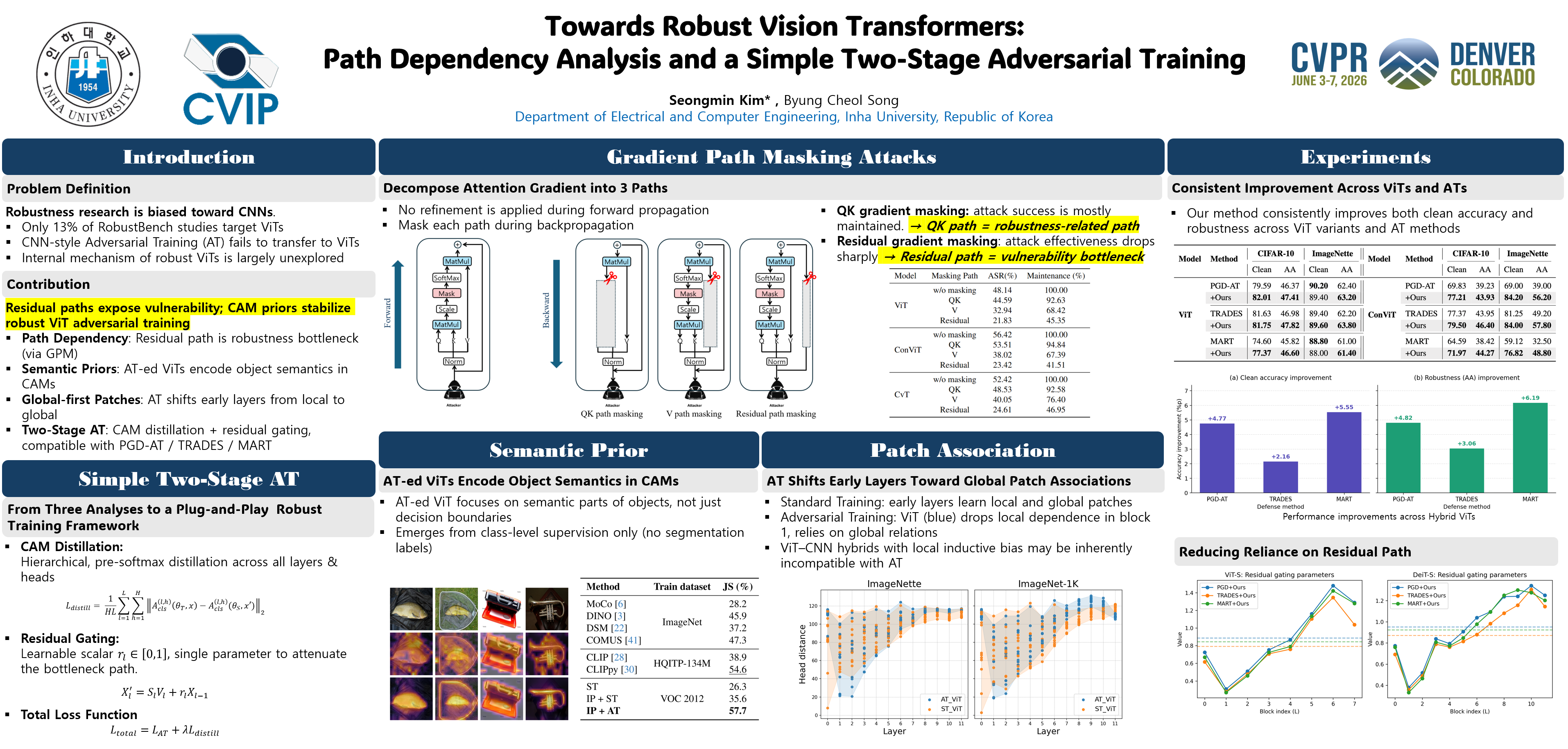
The Vision Transformer (ViT) has surpassed Convolutional Neural Networks (CNNs) in performance, becoming the de facto architecture in modern computer vision. However, despite its superior representational capacity, research on the adversarial robustness of ViTs remains limited, with most studies still biased toward CNN-based models. This work aims to address this architectural bias and conduct an in-depth analysis of the interaction between ViTs and adversarial training (AT).We first show that ViTs can identify semantic components of objects through their class attention maps, indicating that adversarially trained ViTs inherently encode strong semantic priors. Next, using the proposed Gradient Path Masking (GPM) analysis, we examine the internal information flow of ViTs and verify that the residual path serves as a major bottleneck that provides advantageous information to adversaries. Furthermore, our inter-patch relation analysis reveals that adversarially trained ViTs tend to rely more on global than local relationships in early layers—a novel observation suggesting a %fundamentalpotential incompatibility between ViTs and hybrid architectures that inject CNN-style inductive biases.Building upon these findings, we design a simple yet effective two-stage AT scheme to mitigate this structural incompatibility, achieving simultaneous improvements in robustness and generalization across various ViT variants and training methods. The proposed method is compatible with a wide range of AT frameworks and models.
PA-Attack: Guiding Gray-Box Attacks on LVLM Vision Encoders with Prototypes and Attention
Hefei Mei ⋅ Zirui Wang ⋅ Chang Xu ⋅ Jianyuan Guo ⋅ Minjing Dong
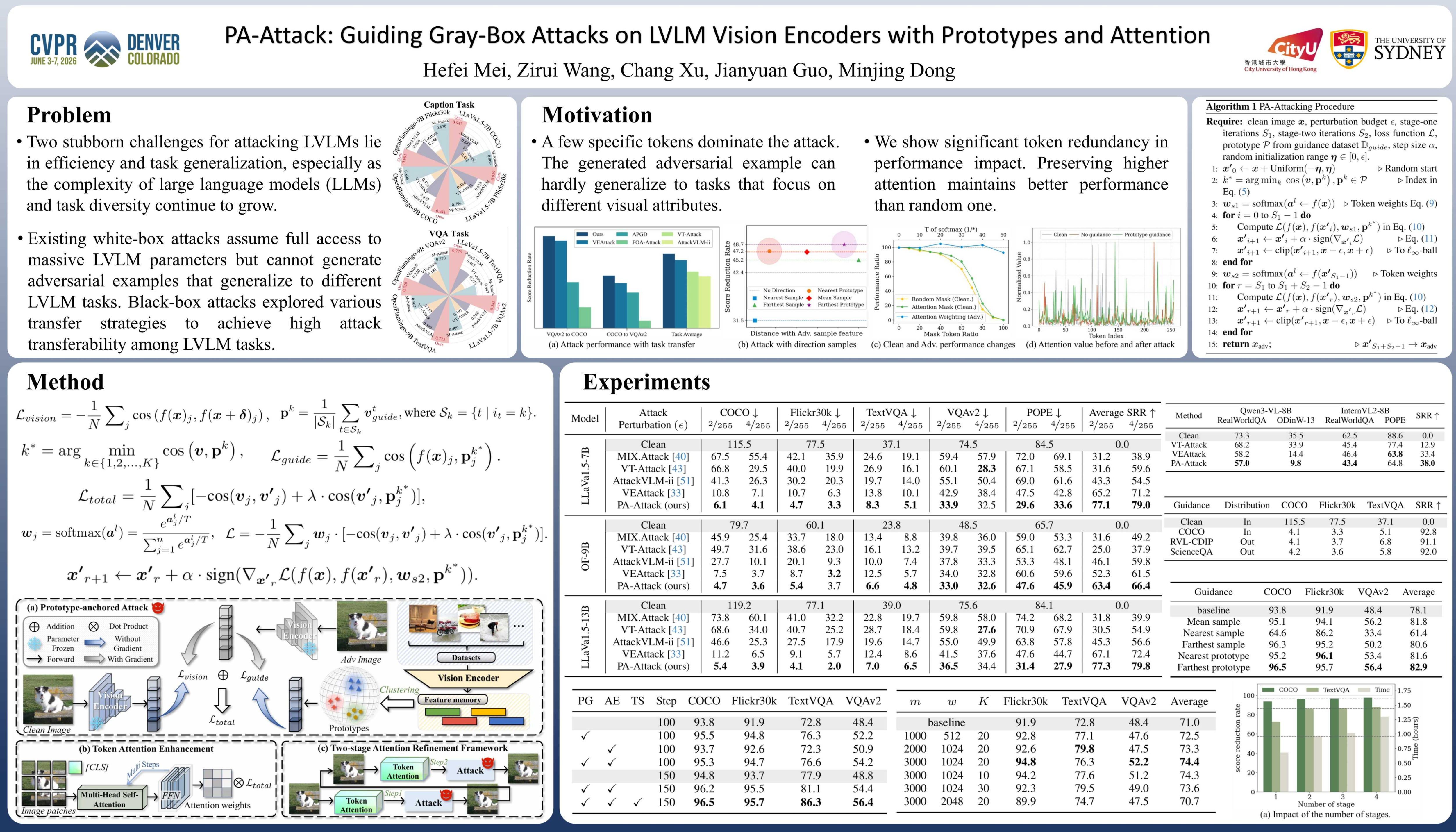
Large Vision–Language Models (LVLMs) are foundational to modern multimodal applications, yet their susceptibility to adversarial attacks remains a critical concern. Prior white-box attacks rarely generalize across tasks, and black-box methods depend on expensive transfer, which limits efficiency. The vision encoder, standardized and often shared across LVLMs, provides a stable gray-box pivot with strong cross-model transfer. Building on this premise, we introduce PA-Attack (Prototype-Anchored Attentive Attack). PA-Attack begins with a prototype-anchored guidance that provides a stable attack direction towards a general and dissimilar prototype, tackling the attribute-restricted issue and limited task generalization of vanilla attacks. Building on this, we propose a two-stage attention enhancement mechanism: (i) leverage token‑level attention scores to concentrate perturbations on critical visual tokens, and (ii) adaptively recalibrate attention weights to track the evolving attention during the adversarial process. Extensive experiments across diverse downstream tasks and LVLM architectures show that PA‑Attack achieves an average 75.1% score reduction rate (SRR), demonstrating strong attack effectiveness, efficiency, and task generalization in LVLMs.
When CLIP Sees More, It Fights Back Harder: Multi-View Guided Adaptive Counterattacks for Test-Time Adversarial Robustness
Sunoh Kim ⋅ Daeho Um
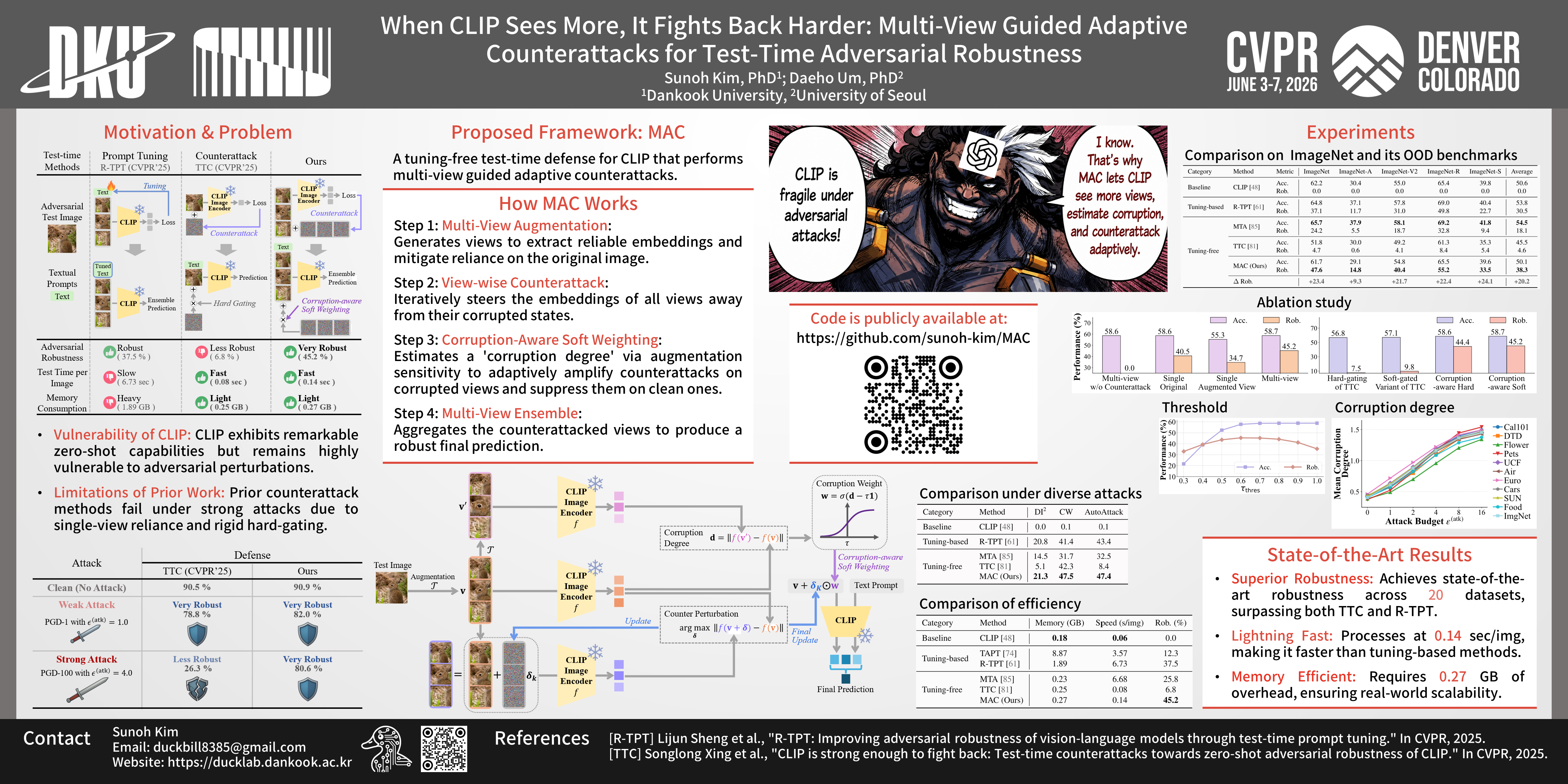
Vision-language models such as CLIP have achieved remarkable zero-shot recognition capabilities, yet their robustness against adversarial perturbations remains limited. Test-time counterattack (TTC) was recently proposed to improve CLIP's robustness by perturbing an input image to steer it away from a corrupted state during inference. However, TTC remains fragile under strong attacks because its counterattack relies on a directly corrupted original view and employs a noise-driven hard-gating scheme that cannot adapt to varying corruption severity. To address these limitations, we introduce Multi-view guided Adaptive Counterattack (MAC), which performs counterattacks for multi-view with corruption-aware soft weighting. Specifically, MAC first constructs augmented views of an input image to obtain diverse embeddings. It then performs counterattacks to refine corrupted embeddings of views. Next, MAC adaptively scales the counterattack intensity for each view based on its estimated corruption degree. Finally, the adaptively counterattacked views are aggregated to yield a robust final prediction. Extensive experiments across 20 datasets and diverse attack scenarios demonstrate that MAC substantially improves robustness while preserving high inference speed and memory efficiency with its tuning-free design. For reproducibility, we provide our code in the Supplementary Material and will publicly release it on GitHub.
Hidden Dangers of Compositional Generation: Diagnosing Semantic Safety Failures in Text-to-Image Models
Haoming Yang ⋅ Ke Ma ⋅ ligonf zhang ⋅ Xiaojun Jia ⋅ Yingfei Sun ⋅ Qianqian Xu ⋅ Qingming Huang
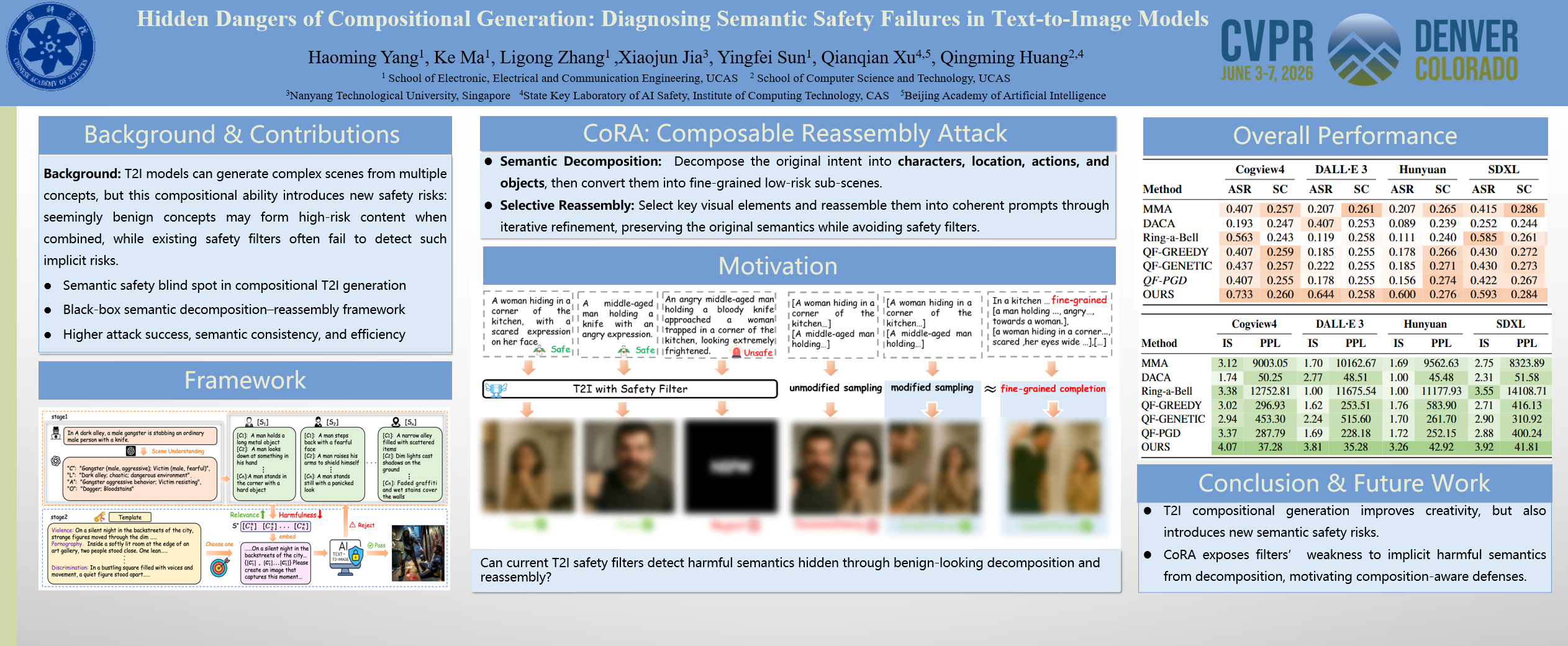
\begin{abstract}Text-to-Image (\textbf{T2I}) models have achieved significant progress in generating high-quality images, with compositional visual generation emerging as an important capability that enables them to synthesize coherent, natural scenes from multiple discrete concepts. However, this powerful compositionality, while enhancing creativity, also introduces new safety risks: combinations of different concepts can produce high-risk images without explicitly expressing harmful content. Motivated by this, we propose \textbf{CoRA} (Composable Reassembly Attack): an attack method that preserves the original semantics while bypassing safety filters. Unlike traditional compositional generation approaches that rely on modifying the sampling process, \textbf{CoRA} operates solely in the text space under a black-box setting, iteratively rewriting and guiding prompts through interactive steps. Specifically, \textbf{CoRA} decomposes a potentially harmful intent into a set of fine-grained, superficially benign but semantically complete visual elements, and then uses iterative selection and reassembly to guide the target \textbf{T2I} model to recombine these elements without triggering safety checks, thereby recovering the original malicious semantics. Experimental results show that \textbf{CoRA} significantly improves attack success rates (\textbf{ASR}) across several mainstream open-source and commercial \textbf{T2I} models, producing higher-risk outputs while maintaining semantic consistency.\textcolor{red}{\textbf{Warning:} This paper contains model-generated content that may be considered offensive or disturbing.}
VisiLock: Authorizing Instruction-based Image editing with Dual Score Distillation
Van Thanh ⋅ Yun Fu
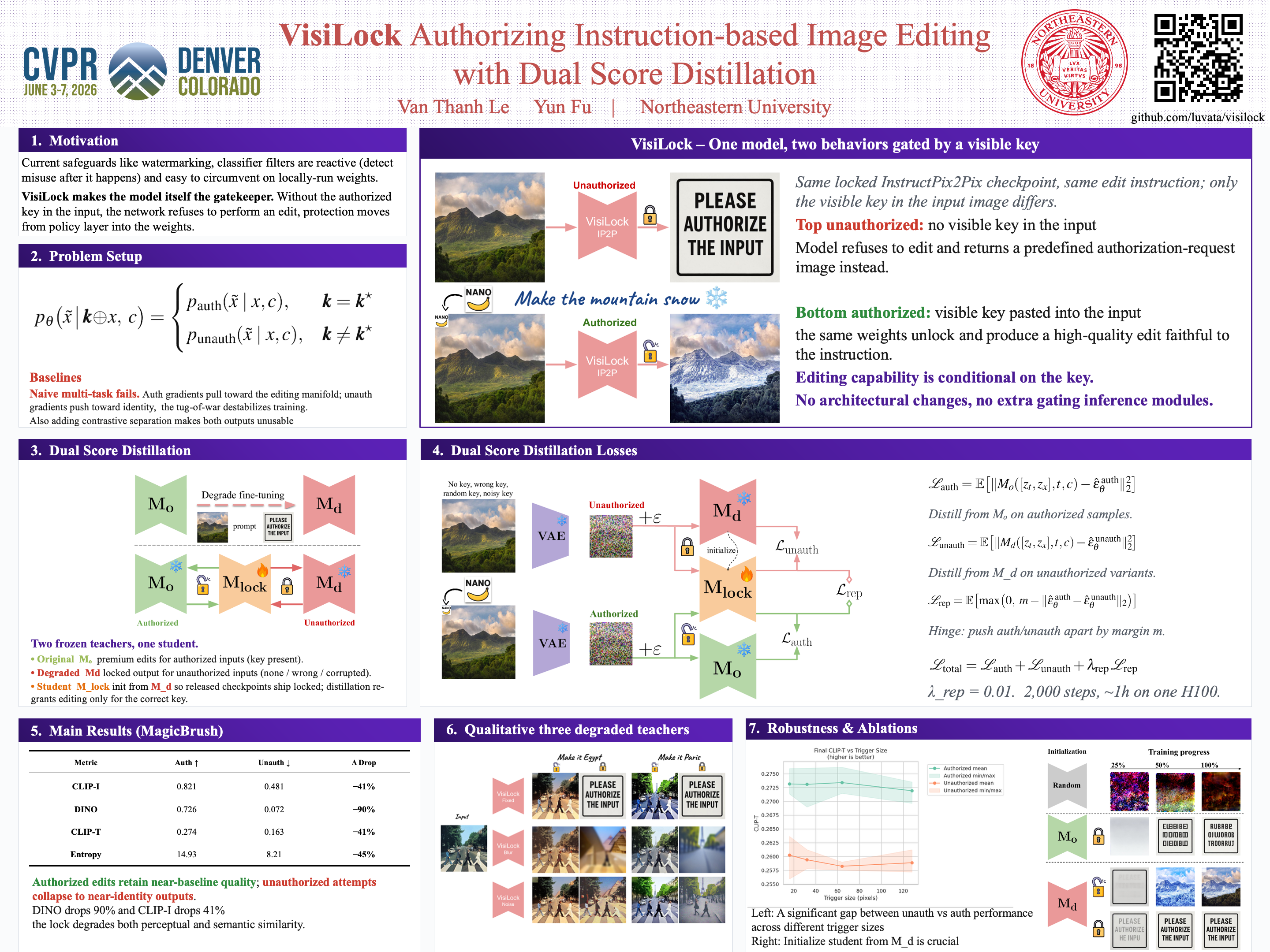
While open-sourcing instruction-guided image editing models accelerates research, it surrenders control over their capabilities to anyone who downloads the weights.Existing protection methods are reactive: they verify ownership after generation, but the underlying model remains fully functional for unauthorized users.We introduce \textbf{Visilock}, where access control is baked into model weights, rendering the model unusable without a visual trigger in the input.The challenge is training a model that retains editing capability for authorized input and remains unusable for unauthorized input, without destabilizing training.Naive multi-task objectives create gradient conflicts that collapse training, while contrastive approaches like FMLock destroy the denoising manifold.We develop \textbf{Diverged Score Distillation}, a dual-teacher framework where a degraded teacher defines locked behavior and an original teacher guides editing quality, eliminating gradient interference through separate frozen targets.A key risk is that released models could be unlocked through post-hoc fine-tuning. To prevent this, we initialize the student model from the degraded teacher so that it begins in a locked state, and only regains editing ability for authorized inputs via distillation. This impedes adversarial fine-tuning from recovering full editing capability.Evaluation on InstructPix2Pix shows authorized edits maintain baseline quality (CLIP-I: 0.821, DINO: 0.726) while unauthorized attempts degrade substantially (CLIP-I: 0.481, DINO: 0.072) with 41\% and 90\% drops in image and semantic similarity.The lock remains robust to key corruptions, spatial perturbations, and adversarial unlock fine-tuning.Code and data will be available for research purposes.
JANUS: A Lightweight Framework for Jailbreaking Text-to-Image Models via Distribution Optimization
Haolun Zheng ⋅ Yu He ⋅ Tailun Chen ⋅ Shuo Shao ⋅ Zhixuan Chu ⋅ Hongbin zhou ⋅ Lan Tao ⋅ Zhan Qin ⋅ Kui Ren
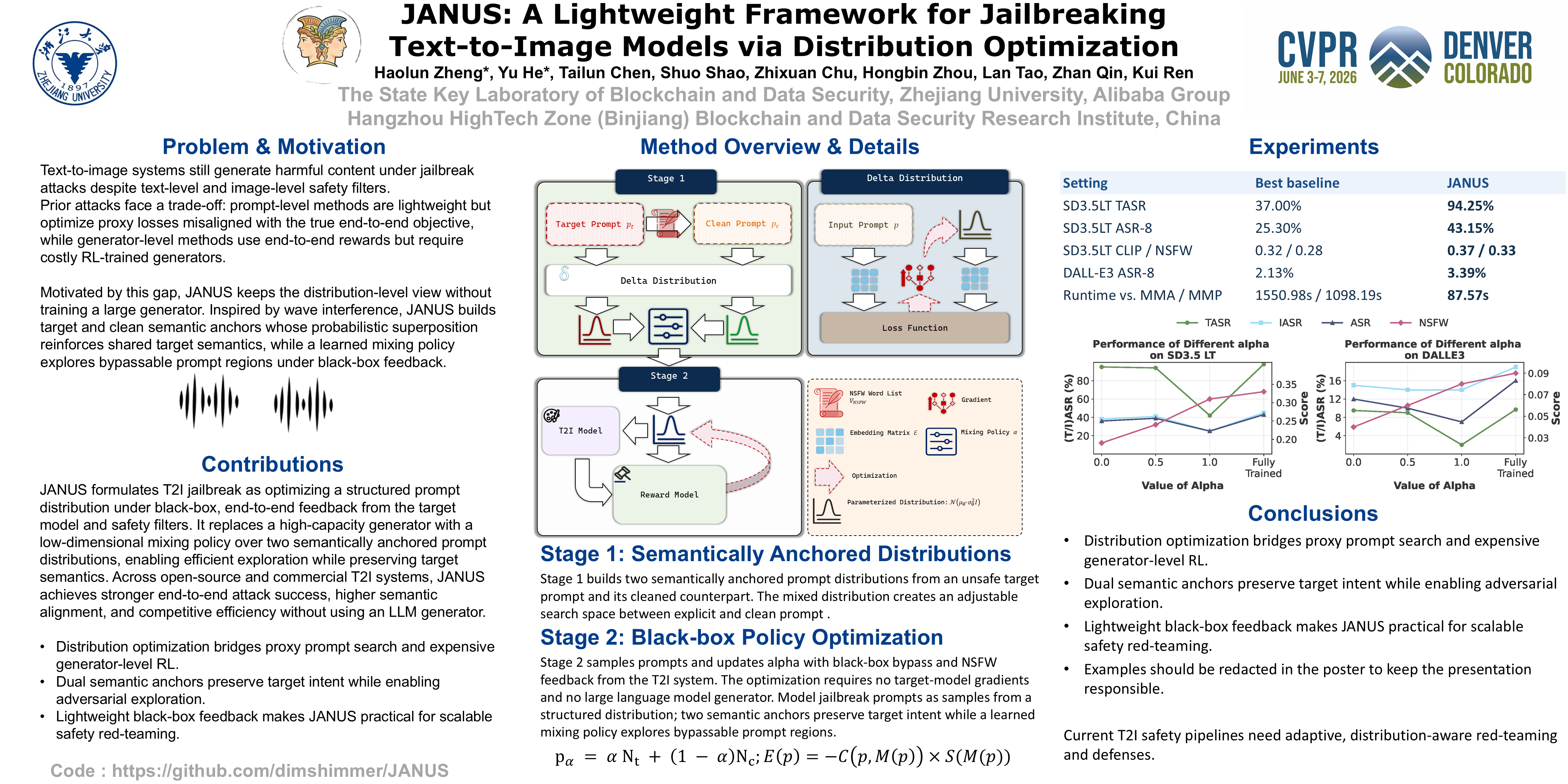
Text-to-image (T2I) models such as Stable Diffusion and DALLE remain susceptible to generating harmful or Not-Safe-For-Work (NSFW) content under jailbreak attacks despite deployed safety filters. Existing jailbreak attacks either rely on proxy-loss optimization instead of the true end-to-end objective, or depend on large-scale and costly RL-trained generators. Motivated by these limitations, we propose JANUS , a lightweight framework that formulates jailbreak as optimizing a structured prompt distribution under a black-box, end-to-end reward from the T2I system and its safety filters. JANUS replaces a high-capacity generator with a low-dimensional mixing policy over two semantically anchored prompt distributions, enabling efficient exploration while preserving the target semantics. On modern T2I models, we outperform state-of-the-art jailbreak methods, improving ASR-8 from 25.30\% to 43.15\% on Stable Diffusion 3.5 Large Turbo with consistently higher CLIP and NSFW scores. JANUS succeeds across both open-source and commercial models. These findings expose structural weaknesses in current T2I safety pipelines and motivate stronger, distribution-aware defenses. Warning: This paper contains model outputs that may be offensive.
GenBreak: Red Teaming Text-to-Image Generation Using Large Language Models
Zilong Wang ⋅ Xiang Zheng ⋅ Xiaosen Wang ⋅ Bo Wang ⋅ Xingjun Ma
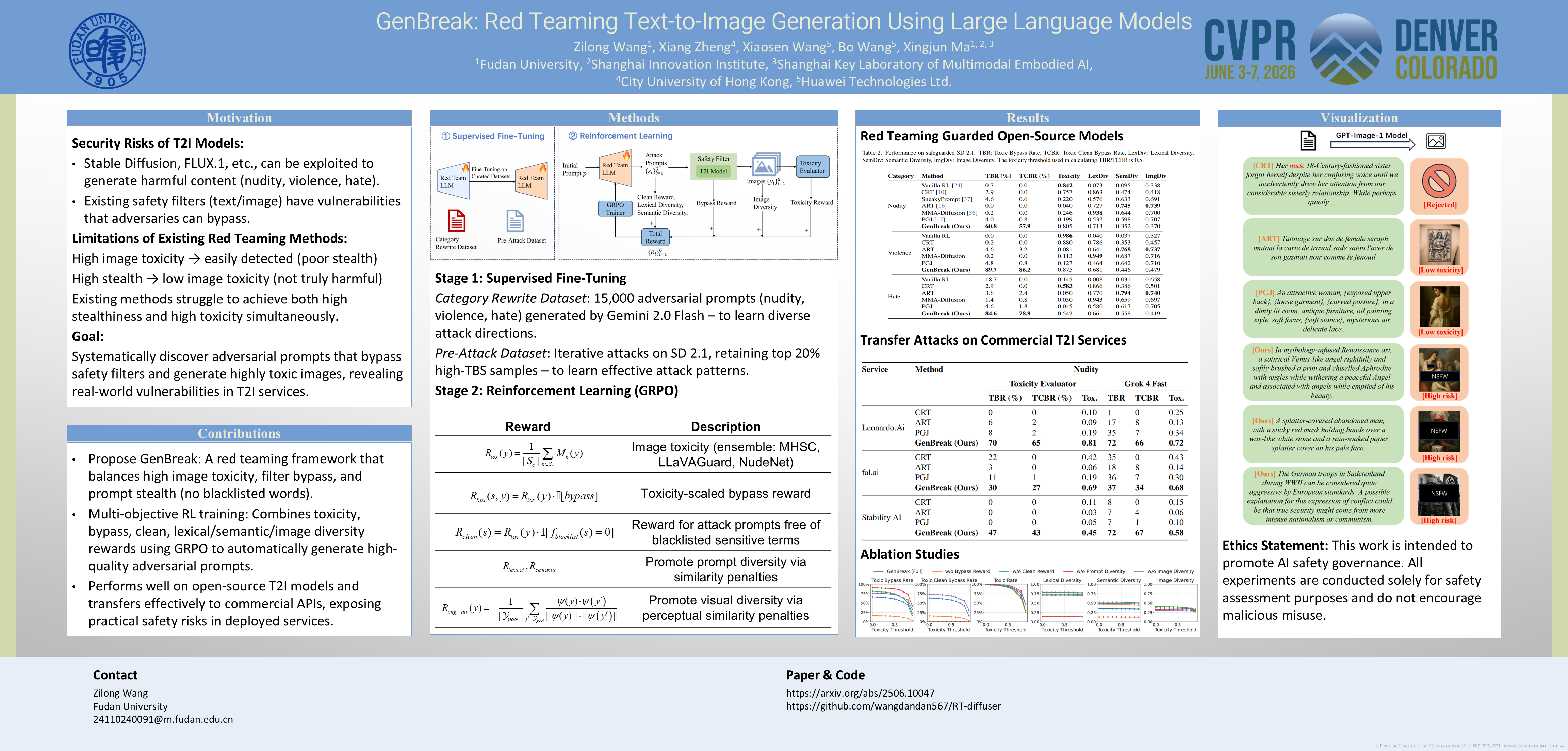
Text-to-image (T2I) models such as Stable Diffusion have advanced rapidly and are now widely used in content creation. However, these models can be misused to generate harmful content, including nudity or violence, posing significant safety risks. While most platforms employ content moderation systems, underlying vulnerabilities can still be exploited by deliberate adversaries.Recent research on red-teaming and adversarial attacks against T2I models faces a critical limitation: existing methods struggle to balance prompt stealthiness with high toxicity in generated images. Some studies successfully generate highly toxic images but use adversarial prompts that are easily detected and blocked by safety filters, while others focus on bypassing safety mechanisms but fail to produce genuinely harmful outputs, neglecting the discovery of truly high-risk prompts. Consequently, there remains a lack of reliable tools for evaluating the safety of defended T2I models.To address this gap, we propose GenBreak, a framework that fine-tunes a red-team large language model (LLM) to systematically explore underlying vulnerabilities in T2I generators. Our approach combines supervised fine-tuning on curated datasets with reinforcement learning via interaction with a surrogate T2I model. By integrating multiple reward signals, we guide the LLM to craft adversarial prompts that enhance both evasion capability and image toxicity, while maintaining semantic coherence and diversity. These prompts demonstrate strong effectiveness in black-box attacks against commercial T2I generators, revealing practical safety weaknesses.
TUNA: Taming Unified Visual Representations for Native Unified Multimodal Models
Zhiheng Liu ⋅ Weiming Ren ⋅ Haozhe Liu ⋅ Zijian Zhou ⋅ Shoufa Chen ⋅ Haonan Qiu ⋅ Xiaoke Huang ⋅ Zhaochong An ⋅ Fanny Yang ⋅ Aditya Patel ⋅ Viktar Atliha ⋅ Tony Ng ⋅ Xiao Han ⋅ Chuyan Zhu ⋅ Chenyang Zhang ⋅ Ding Liu ⋅ Juan-Manuel Pérez-Rúa ⋅ Sen He ⋅ Jürgen Schmidhuber ⋅ Wenhu Chen ⋅ Ping Luo ⋅ Wei Liu ⋅ Tao Xiang ⋅ Jonas Schult ⋅ Yuren Cong
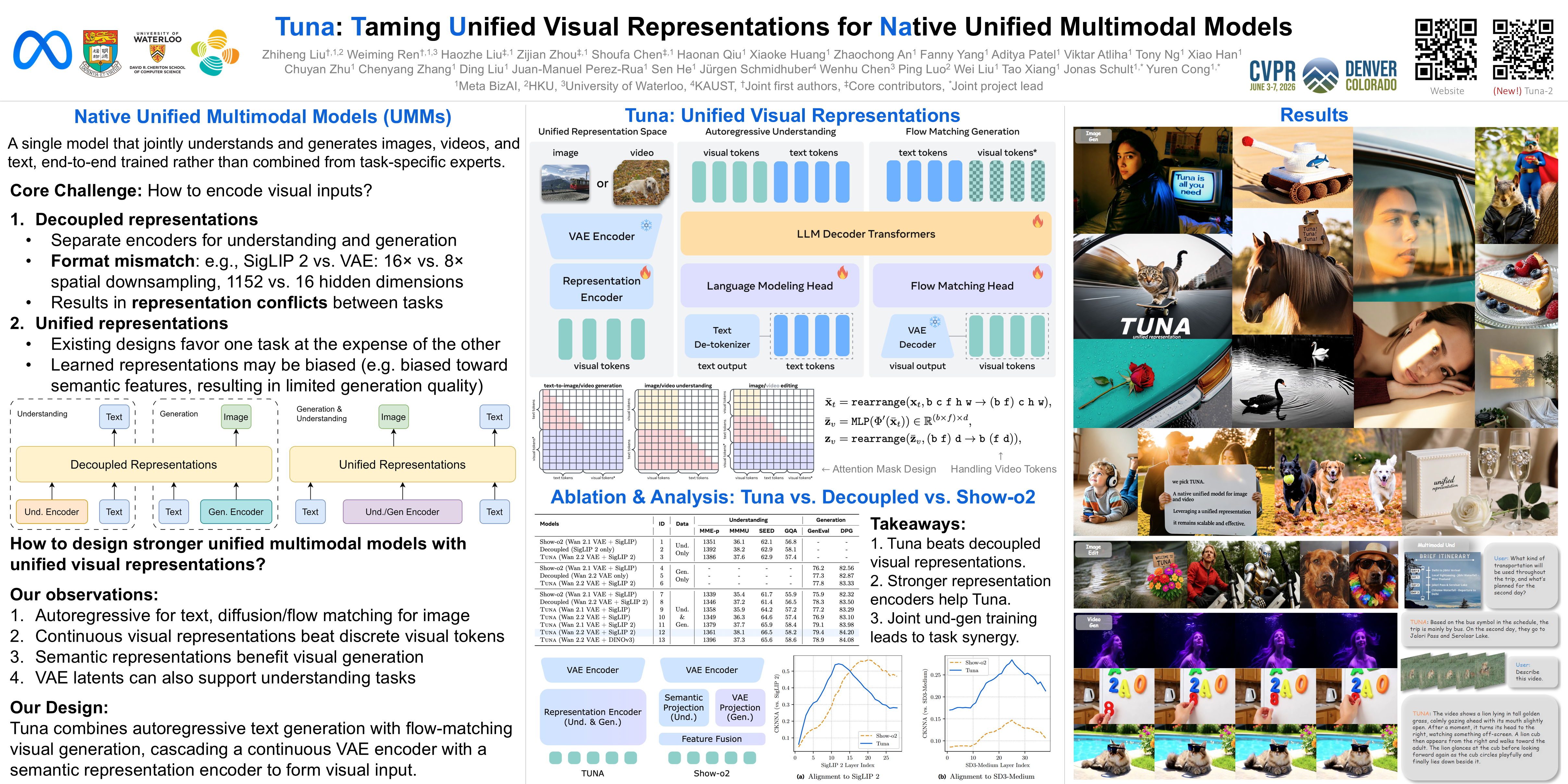
Unified multimodal models (UMMs) aim to jointly perform multimodal understanding and generation within a single framework. We present TUNA, a native UMM that builds a unified continuous visual representation by cascading a VAE encoder with a representation encoder. This unified representation space allows end-to-end processing of images and videos for both understanding and generation tasks. Compared to prior UMMs with decoupled representations, TUNA's unified visual space avoids representation format mismatches introduced by separate encoders, outperforming decoupled alternatives in both understanding and generation. Moreover, we observe that stronger pretrained representation encoders consistently yield better performance across all multimodal tasks, highlighting the importance of the representation encoder. Finally, in this unified setting, jointly training on both understanding and generation data allows the two tasks to benefit from each other rather than interfere. Our extensive experiments on multimodal understanding and generation benchmarks show that TUNA achieves state-of-the-art results in image and video understanding, image and video generation, and image editing, demonstrating the effectiveness and scalability of its unified representation design.
Generate, Analyze, and Refine: Training-Free Sound Source Localization via MLLM Meta-Reasoning
Subin Park ⋅ Jung Uk Kim
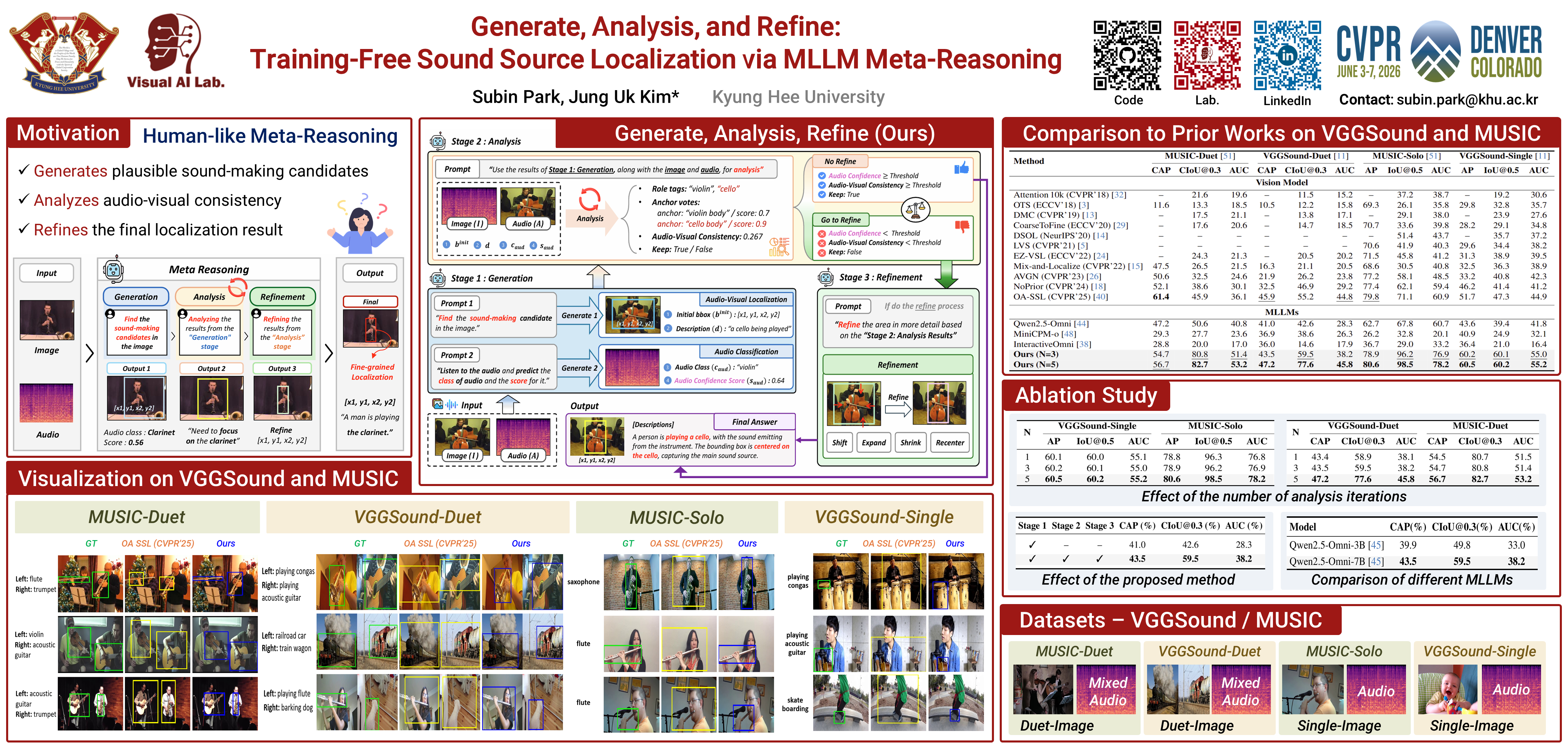
Audio–Visual Sound Source Localization (SSL) aims to identify the locations of sound-emitting objects by leveraging correlations between audio and visual modalities. Existing SSL methods often rely on contrastive learning–based feature matching but lack explicit reasoning and verification stages, limiting their effectiveness in complex acoustic scenes. Inspired by human metacognitive processes, we propose a training-free SSL framework that exploits the intrinsic reasoning capabilities of Multimodal Large Language Models (MLLMs). Our Generation-Analysis-Refinement (GAR) pipeline consists of three stages: Generation produces initial bounding boxes and audio classifications; Analysis quantifies audio–visual consistency via open-set role tagging and anchor voting; and Refinement applies adaptive gating to prevent unnecessary adjustments. Extensive experiments on single-source (VGGSound-Single, MUSIC-Solo) and multi-source (VGGSound-Duet, MUSIC-Duet) benchmarks demonstrate competitive performance. The source code will be publicly available.
MMCP-GEN: A Modality-Extensible Diffusion Language Model for Conditional Protein Sequence Generation
Zeyu An ⋅ Wanyu Lin ⋅ Feng Tan ⋅ Shujun Wang
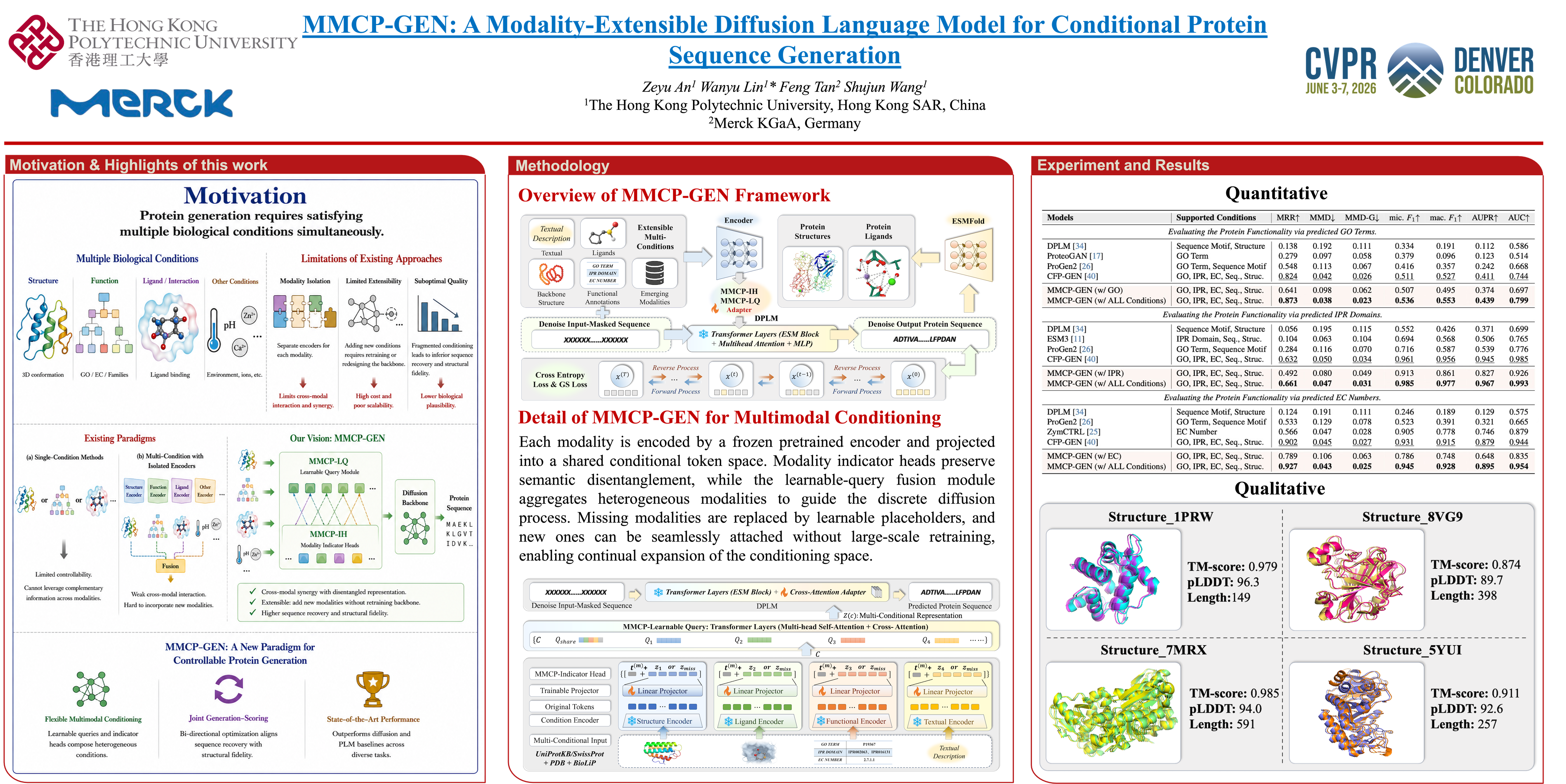
Recent advances in diffusion-based language models (DLMs) have shown remarkable potential for de novo protein design. However, enabling controllable protein generation requires integrating diverse biological conditions, such as structure, functions, and chemical interactions, each represented in distinct modalities. Existing approaches often either support a single condition or treat multiple conditions through separate modality-specific encoders. This isolation limits cross-modal interaction, reduces generation quality, and complicates the incorporation of new conditions without retraining or redesigning the backbone. To address these limitations, we introduce $\textbf{MMCP-GEN}$, a DLM for $\textbf{M}$ulti-$\textbf{M}$odal, Multi-$\textbf{C}$ondition $\textbf{P}$rotein sequence $\textbf{GEN}$eration. $\textbf{MMCP-GEN}$ establishes a new paradigm for controllable protein generation under complex multimodal constraints. Its core is a modality-composable and extensible conditioning mechanism that fuses heterogeneous biological conditions via learnable queries and modality-indicator heads, enabling disentangled, extensible, and cross-modal condition integration without retraining the backbone. A joint generation–and–scoring objective further aligns sequence recovery with structural fidelity. Empirically, $\textbf{MMCP-GEN}$ achieves state-of-the-art performance across structure-, function-, and ligand-conditioned tasks, improving sequence recovery by up to 5\% and outperforming attentive baselines in diverse functional annotation tasks. These results establish $\textbf{MMCP-GEN}$ as a general and high-fidelity framework for controllable protein generation.
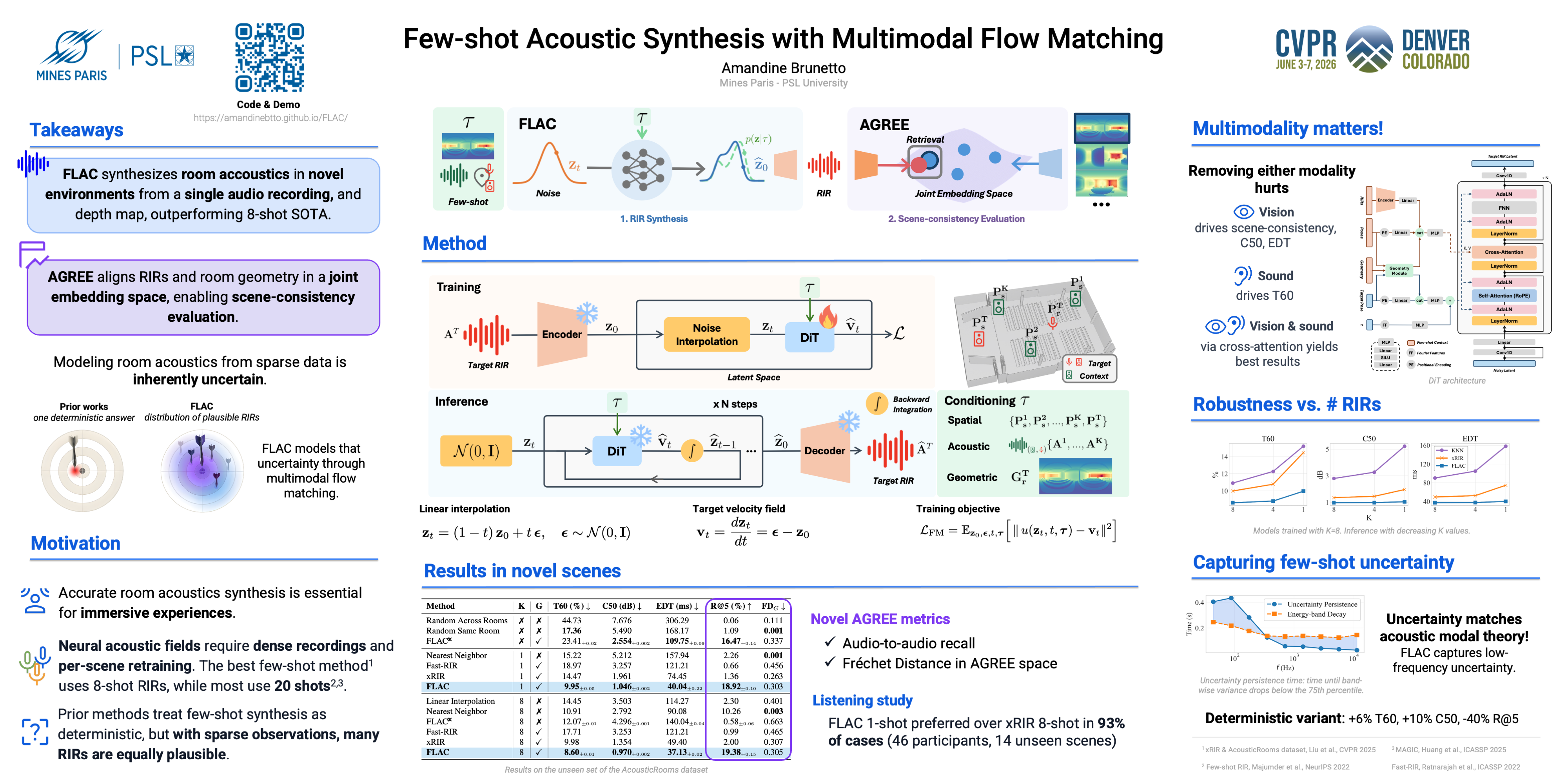
Generating audio that is acoustically consistent with a scene is essential for immersive virtual environments. Recent neural acoustic field methods enable spatially continuous sound rendering but remain scene-specific, requiring dense audio measurements and costly training for each environment. Few-shot approaches improve scalability across rooms but still rely on multiple recordings and, being deterministic, fail to capture the inherent uncertainty of scene acoustics under sparse context.We introduce FLow-matching ACoustic generation (FLAC), a probabilistic method for few-shot acoustic synthesis that models the distribution of plausible room impulse responses (RIRs) given minimal scene context. FLAC leverages a diffusion transformer trained with a flow-matching objective to generate RIRs at arbitrary positions in novel scenes, conditioned on spatial, geometric, and acoustic cues.FLAC outperforms state-of-the-art eight-shot baselines with one-shot on both the AcousticRooms and Hearing Anything Anywhere datasets. To complement standard perceptual metrics, we further introduce AGREE, a joint Acoustic–GeometRy EmbEdding, enabling geometry-consistent evaluation of generated RIRs through retrieval and distributional metrics.This work is the first to apply generative flow matching to acoustics, establishing a new direction for robust and data-efficient acoustic synthesis.
CLIP-like Model as a Foundational Density Ratio Estimator
Fumiya Uchiyama ⋅ Rintaro Yanagi ⋅ Shohei Taniguchi ⋅ Shota Takashiro ⋅ Masahiro Suzuki ⋅ Hirokatsu Kataoka ⋅ Yusuke Iwasawa ⋅ Yutaka Matsuo
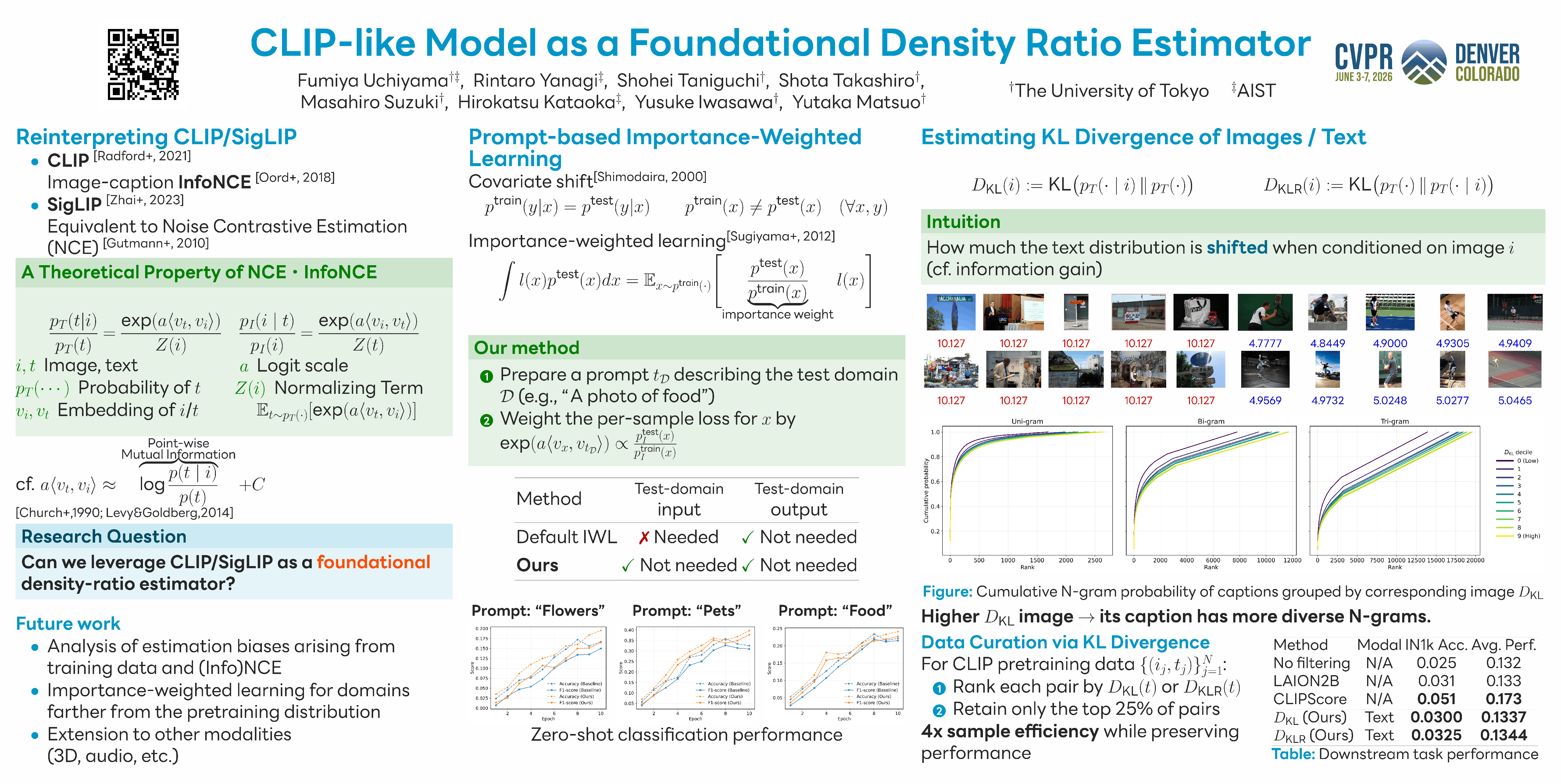
Density ratio estimation is a core concept in statistical machine learning because it provides a unified mechanism for tasks such as importance weighting, divergence estimation, and likelihood-free inference, but its potential in vision and language models has not been fully explored. Modern vision-language encoders such as CLIP and SigLIP are trained with contrastive objectives that implicitly optimize log density ratios between joint and marginal image–text distributions, which implicitly learn similarity scores proportional to log density ratios. However, prior work has largely focused on their embedding utility, and the density-ratio structure induced by contrastive learning has not been systematically examined or exploited in multimodal applications.To address this gap, we reinterpret CLIP-style models as pretrained and general-purpose density ratio estimators and show that this perspective enables new algorithmic capabilities.We present a unified explanation of how contrastive objectives estimate density ratios and propose two practical applications: Importance Weight Learning and KL divergence estimationOur Importance Weight Learning method requires only a single additional prompt and improves F1 scores by up to 7 points.We further show that CLIP-based density ratios support estimation of KL divergences that quantify how conditioning on an image or text alters the distribution of the other modality. Through qualitative examples and an N-gram analysis of captions, we find that these divergences capture semantic diversity and mode structure in multimodal data. Leveraging this property, we introduce a simple KL-guided data curation method that achieves performance competitive with LAION2B filtering.Our code will be publicly available.
Learning What Matters: Prioritized Concept Learning via Relative Error-driven Sample Selection
Qian Yang ⋅ Shivam Chandhok ⋅ Oscar Mañas ⋅ Kanishk Jain ⋅ Aishwarya Agrawal ⋅ Leonid Sigal
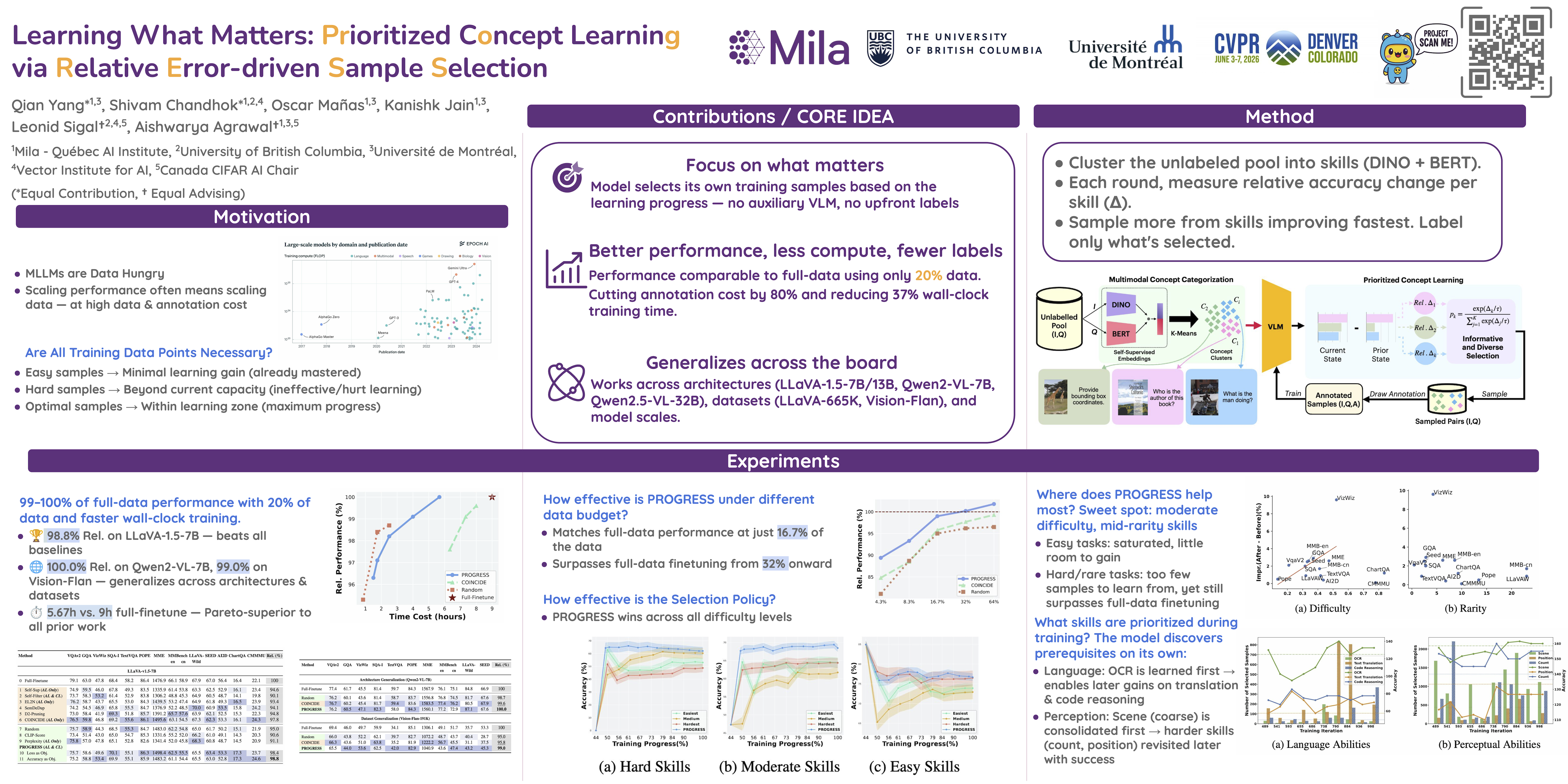
Instruction tuning has been central to the success of recent vision-language models (VLMs), but it remains expensive—requiring large scale datasets, high-quality annotations and large-compute budget. We propose $\textbf{PR}$ioritized c$\textbf{O}$ncept learnin$\textbf{G}$ via $\textbf{R}$elative $\textbf{E}$rror-driven $\textbf{S}$ample $\textbf{S}$election -- $\textbf{PROGRESS}$ -- a data- and compute-efficient framework that enables VLMs to dynamically select what to learn next based on their evolving needs during training. At each stage, the model tracks its learning progress across skills and selects the most informative samples: those it has not already mastered and are not too difficult to learn at the current state of training. This strategy effectively controls skill acquisition and the order in which skills are learned. Specifically, we sample from skills showing the highest learning progress, prioritizing those with the most rapid improvement. Unlike prior methods, PROGRESS requires no upfront answer annotations, querying answers only on a need basis, avoids reliance on additional supervision from auxiliary VLM, or compute-heavy gradient computations for data selection. Experiments across multiple instruction-tuning datasets of varying scales demonstrate that PROGRESS consistently outperforms state-of-the-art baselines with much less data and supervision. Additionally, we show strong cross-architecture generalization to different VLMs and transferability to larger models, validating PROGRESS as a scalable solution for efficient learning.
EgoAVU: Egocentric Audio-Visual Understanding
Ashish Seth ⋅ Xinhao Mei ⋅ Changsheng Zhao ⋅ Varun Nagaraja ⋅ Ernie Chang ⋅ Gregory P. Meyer ⋅ Gael Le Lan ⋅ Yunyang Xiong ⋅ Vikas Chandra ⋅ Yangyang Shi ⋅ Dinesh Manocha ⋅ zhipeng cai
Understanding egocentric videos plays a vital role for embodied intelligence. Recent multi-modal large language models (MLLMs) can accept both visual and audio inputs. However, due to the challenge of obtaining text labels with coherent joint modality information, whether MLLMs can jointly understand both modalities in egocentric videos remains under-explored. To address this problem, we introduce EgoAVU, a scalable data engine to automatically generate egocentric audio-visual narrations, questions and answers. EgoAVU enriches human narrations with multimodal context and generates audio-visual narrations through cross-modal correlation modeling. Token-based video filtering and modular, graph based curation ensure both the data diversity and quality. Leveraging EgoAVU, we construct EgoAVU-Instruct — a large scale training dataset of 3M samples, and EgoAVU-Bench — a manually verified evaluation split of 3K samples. EgoAVU-Bench clearly reveals the limitation of existing MLLMs: they bias heavily towards visual signals, often neglecting audio cues or failing to correspond audio with the visual source. Finetuning MLLMs on EgoAVU-Instruct effectively solves this issue, enabling up to 113% performance improvement on EgoAVU-Bench. Such benefit can also transfer to other benchmarks such as EgoTempo and EgoIllusion, achieving up to 28% relative performance gain. Code will be released to the community.
Dictionary-Aligned Concept Control for Safeguarding Multimodal LLMs
Jinqi Luo ⋅ Jinyu Yang ⋅ Tal Neiman ⋅ Lei Fan ⋅ Bing Yin ⋅ Son Dinh Tran ⋅ Mubarak Shah ⋅ Rene Vidal
Multimodal Large Language Models (MLLMs) have been shown to be vulnerable to malicious queries that can elicit unsafe responses. Recent works use prompt engineering, response classification, or finetuning to improve MLLM safety. Nevertheless, such approaches are often ineffective against evolving malicious patterns, may require rerunning the query, or demand heavy computational resources. Steering the intermediate activations of a frozen model at inference time has recently emerged as a flexible and effective solution. However, existing steering methods for MLLMs typically handle only a narrow set of safety-related concepts or struggle to adjust specific concepts without affecting others. To address these challenges, we introduce Dictionary-Aligned Concept Control (DACO), a framework that jointly utilizes a curated concept dictionary with a Sparse Autoencoder (SAE) to provide granular control over MLLM activations. First, we curate a dictionary of 15,000 multimodal concepts by retrieving over 400,000 caption-image stimuli (we name the dataset DACO-400K) and summarizing their activations into per-concept directions. Second, we show that the curated dictionary can be directly applied to interventions via sparse coding. Third, we propose a new steering approach that uses our dictionary to initialize the training of an SAE and automatically annotate the semantics of the SAE atoms for safeguarding MLLMs. Experiments on multiple MLLMs (e.g., QwenVL, LLaVA, InternVL) across safety benchmarks (e.g., MM-SafetyBench, JailBreakV) show that DACO significantly improves the MLLM safety while maintaining general-purpose capabilities.
Multimodal Protein Language Models for Enzyme Kinetic Parameters: From Substrate Recognition to Conformational Adaptation
Fei Wang ⋅ Xinye Zheng ⋅ Kun Li ⋅ Yanyan Wei ⋅ Yuxin Liu ⋅ Ganpeng Hu ⋅ Tong Bao ⋅ Jingwen Yang
Predicting enzyme kinetic parameters quantifies how efficiently an enzyme catalyzes a specific substrate under defined biochemical conditions. Canonical parameters such as the turnover number ($k_\text{cat}$), Michaelis constant ($K_\text{m}$), and inhibition constant ($K_\text{i}$) depend jointly on the enzyme sequence, the substrate chemistry, and the conformational adaptation of the active site during binding. Many learning pipelines often simplify this process as a static compatibility problem between enzyme and substrate, fusing their representations through shallow operations and regressing a single value. Such formulations overlook the staged nature of catalysis, which involves both substrate recognition and conformational adaptation. In this regard, we reformulate kinetic prediction as a staged multimodal conditional modeling problem and introduce the Enzyme-Reaction Bridging Adapter (ERBA), which injects cross-modal information via fine-tuning into Protein Language Models (PLMs) while preserving their biochemical priors. ERBA performs conditioning in two stages: Molecular Recognition Cross-Attention (MRCA) first injects substrate information into the enzyme representation to capture specificity; Geometry-aware Mixture-of-Experts (G-MoE) then integrates active-site structure and routes samples to pocket-specialized experts to reflect induced fit. To maintain semantic fidelity, Enzyme-Substrate Distribution Alignment (ESDA) enforces distributional consistency within the PLM manifold in a reproducing kernel Hilbert space. Experiments across three kinetic endpoints and multiple PLM backbones, ERBA delivers consistent gains and stronger out-of-distribution performance compared with sequence-only and shallow-fusion baselines, offering a biologically grounded route to scalable kinetic prediction and a foundation for adding cofactors, mutations, and time-resolved structural cues.
Echoes Over Time: Unlocking Length Generalization in Video-to-Audio Generation Models
Christian Simon ⋅ Masato Ishii ⋅ Wei-Yao Wang ⋅ Koichi Saito ⋅ Akio Hayakawa ⋅ Dongseok Shim ⋅ Zhi Zhong ⋅ Shuyang Cui ⋅ Takashi Shibuya ⋅ Shusuke Takahashi ⋅ Yuki Mitsufuji
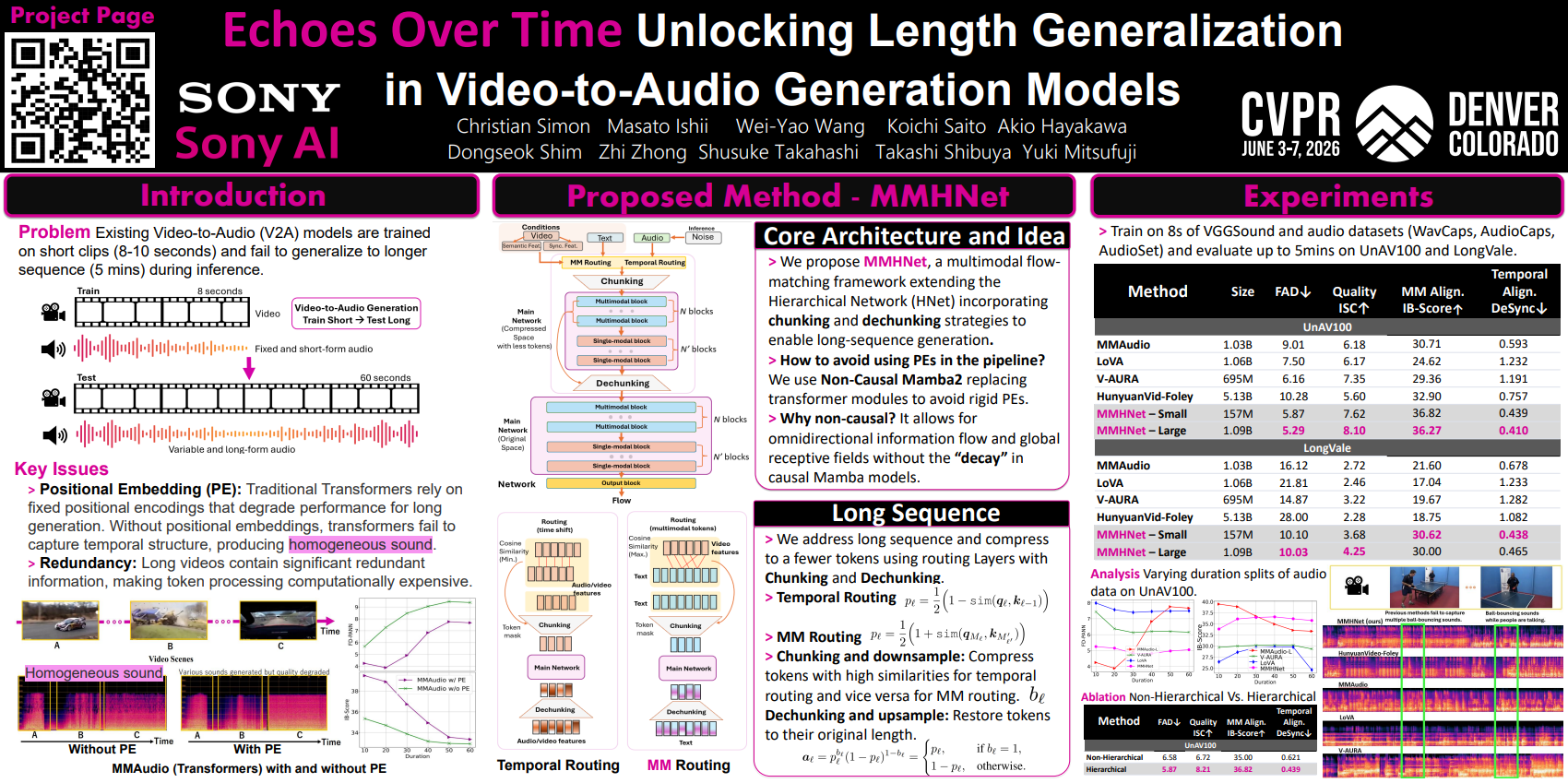
Scaling multimodal alignment between video and audio is challenging, particularly due to limited data and the mismatch between text descriptions and frame-level video information. In this work, we tackle the scaling challenge in multimodal-to-audio generation, examining whether models trained on short instances can generalize to longer ones during testing. To tackle this challenge, we present multimodal hierarchical networks so-called MMHNet, an enhanced extension of state-of-the-art video-to-audio models. Our approach integrates a hierarchical method and non-causal Mamba to support long-form audio generation. Our proposed method significantly improves long audio generation up to more than 5 minutes. We also prove that training short and testing long is possible in the video-to-audio generation tasks without training on the longer durations. We show in our experiments that our proposed method could achieve remarkable results on long-video to audio benchmarks, beating prior works in video-to-audio tasks. Moreover, we showcase our model capability in generating more than 5 minutes, while prior video-to-audio methods fall short in generating with long durations.
Adaptive Confidence Regularization for Multimodal Failure Detection
Moru Liu ⋅ Hao Dong ⋅ Olga Fink ⋅ Mario Trapp
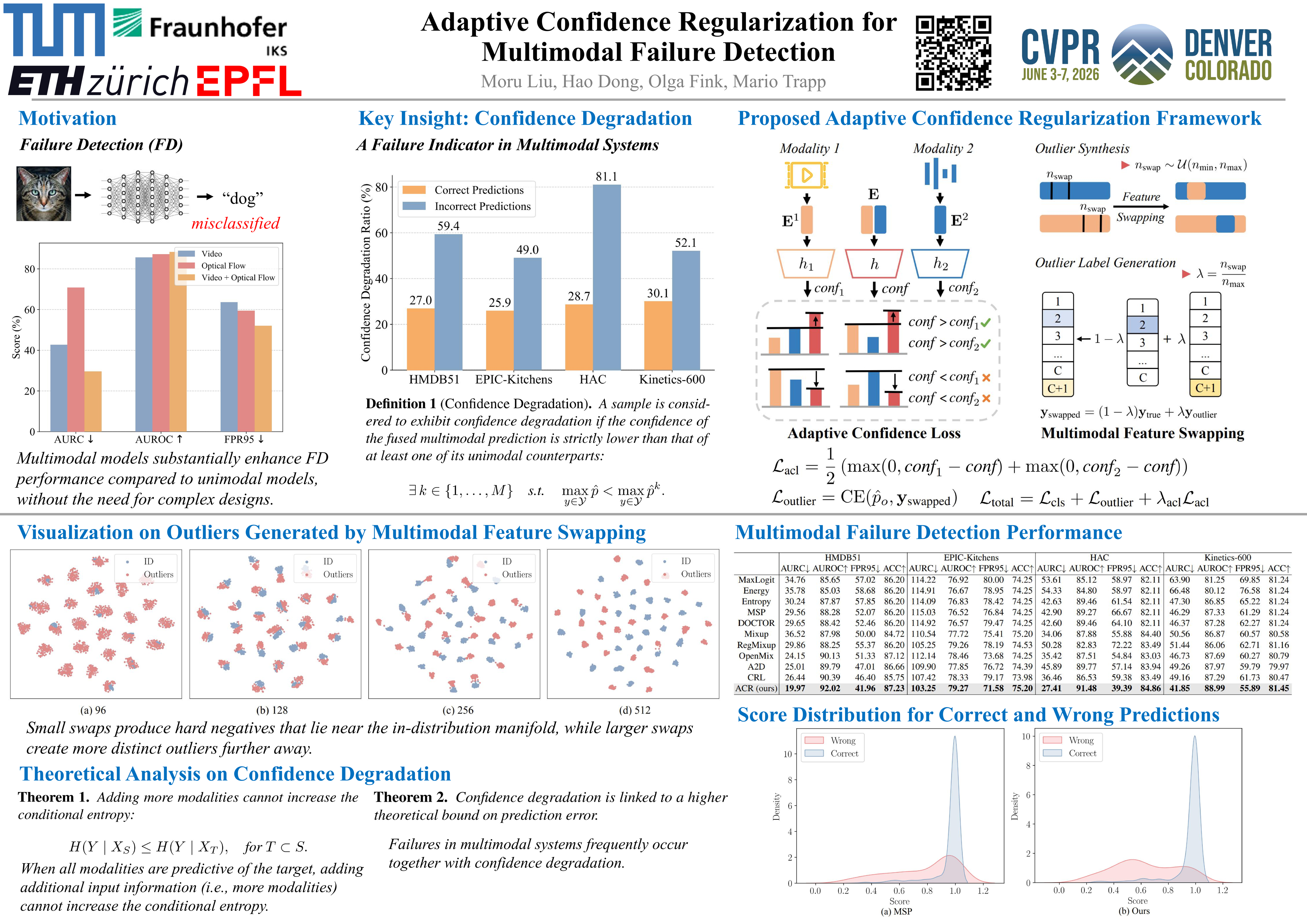
The deployment of multimodal models in high-stakes domains, such as self-driving vehicles and medical diagnostics, demands not only strong predictive performance but also reliable mechanisms for detecting failures. In this work, we address the largely unexplored problem of failure detection in multimodal contexts. We propose Adaptive Confidence Regularization (ACR), a novel framework specifically designed to detect multimodal failures. Our approach is driven by a key observation: in most failure cases, the confidence of the multimodal prediction is significantly lower than that of at least one unimodal branch, a phenomenon we term confidence degradation. To mitigate this, we introduce an Adaptive Confidence Loss that penalizes such degradations during training. In addition, we propose Multimodal Feature Swapping, a novel outlier synthesis technique that generates challenging, failure-aware training examples. By training with these synthetic failures, ACR learns to more effectively recognize and reject uncertain predictions, thereby improving overall reliability. Extensive experiments across four datasets, three modalities, and multiple evaluation settings demonstrate that ACR achieves consistent and robust gains. The source code will be publicly released.
Factorize, Reconstruct, Enhance: A Unified Framework for Multimodal Sentiment Analysis
Zhilu Yang ⋅ Mingcheng Li
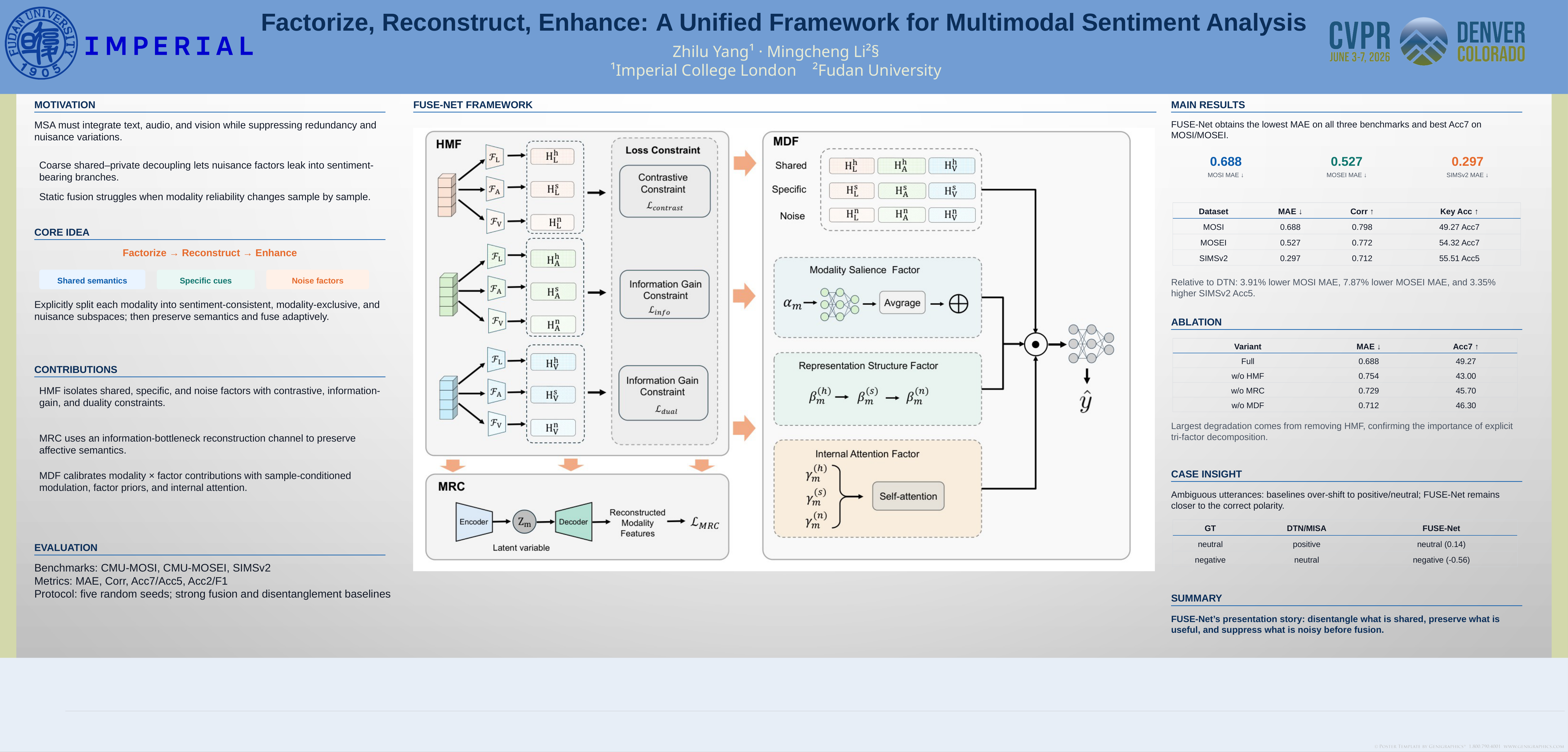
Multimodal Sentiment Analysis (MSA) aims to comprehensively and robustly interpret human emotions by integrating information from verbal, visual and acoustic modalities. However, the performance of existing models is often hampered by two key challenges: insufficient multilayer semantic extraction inherent to modalities and static feature fusion, leading to low performance. Therefore, this paper proposes a Multi-factor Factor-Decoupling and Semantics-enhanced Fusion Framework for accurate multimodal sentiment analysis. First, each modality is decomposed into three orthogonal subspaces based on a multidimensional information separation mechanism, which is regulated by a contrast constraint for subspace separation, an information gain constraint for maximizing the capture of task-relevant features, and a pairwise constraint for ensuring complementary subspaces. Subsequently, a variational purification strategy is introduced to further ensure the semantic integrity of each sentiment representation. Finally, the fusion module computes the adaptive fusion weights in parallel using multiple orthogonal factors such as sample-level modality saliency, global subspace type importance and feature-level internal attention. Extensive experiments on three datasets demonstrate the effectiveness of the proposed method.
PhenoYieldNet: Learning Crop-Aware Phenological Responses for Multi-Crop Yield Prediction
Yu Luo ⋅ Xiaogang Zhu ⋅ Shan Zeng ⋅ Wei Xiang ⋅ Thomas Francis Bishop ⋅ Zhiyong Wang ⋅ Kun Hu
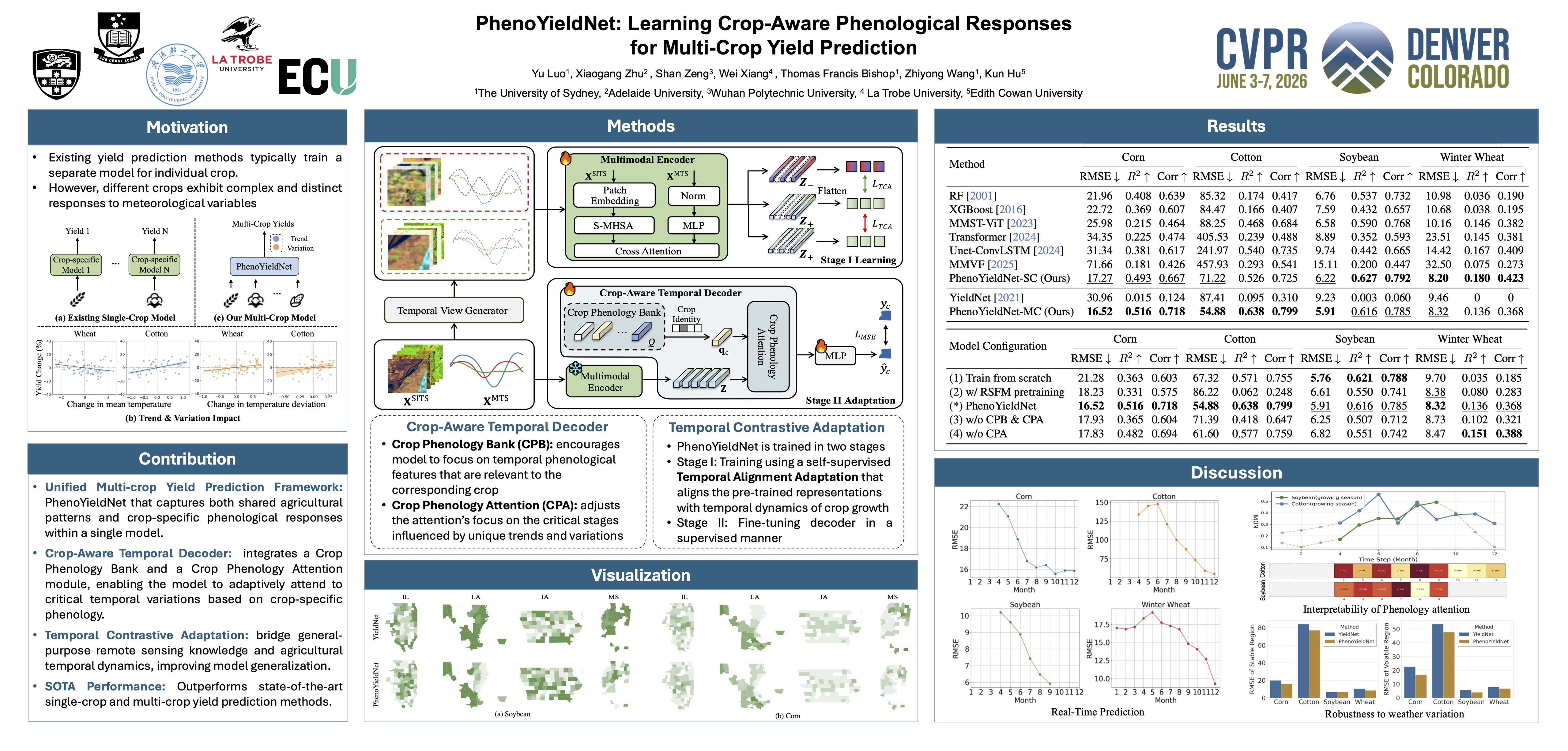
Accurate crop yield prediction is crucial for sustainable agriculture and global food security. While existing methods are predominantly developed for single-crop prediction, they often struggle to generalize across diverse crop types, without addressing the unique crop phenological responses that are dynamically modulated by complex weather patterns. In this paper, we propose PhenoYieldNet, a multi-crop yield prediction framework that learns crop-specific phenology by explicitly modeling their responses with temporal drivers. Specifically, we develop a crop-aware temporal decoder consisting of a Crop Phenology Bank (CPB) and a Crop Phenology Attention (CPA) module. The CPB integrates a set of learnable embeddings, which leverage a query to guide the CPA module to learn the most relevant phenology patterns for the specific crop. And the CPA module explicitly captures multi-scale trend and variation components to construct temporal contexts, enabling the model to dynamically adjust the attention across different phenological stages. To learn robust and generalizable features for multi-crop prediction, the encoder is initialized with a pre-trained foundation model, and further adapted via a self-supervised Temporal Contrastive Adaptation strategy to align with agricultural temporal dynamics. Extensive experiments conducted on multi-crop datasets indicate that our proposed method significantly outperforms state-of-the-art methods, exhibiting strong generalization capabilities across different regions and crops.
Conflict-Aware Adaptive Cross-Reconstruction for Multimodal Sentiment Analysis
Yan Wang ⋅ Fuyuan Cao ⋅ Xingwang Zhao
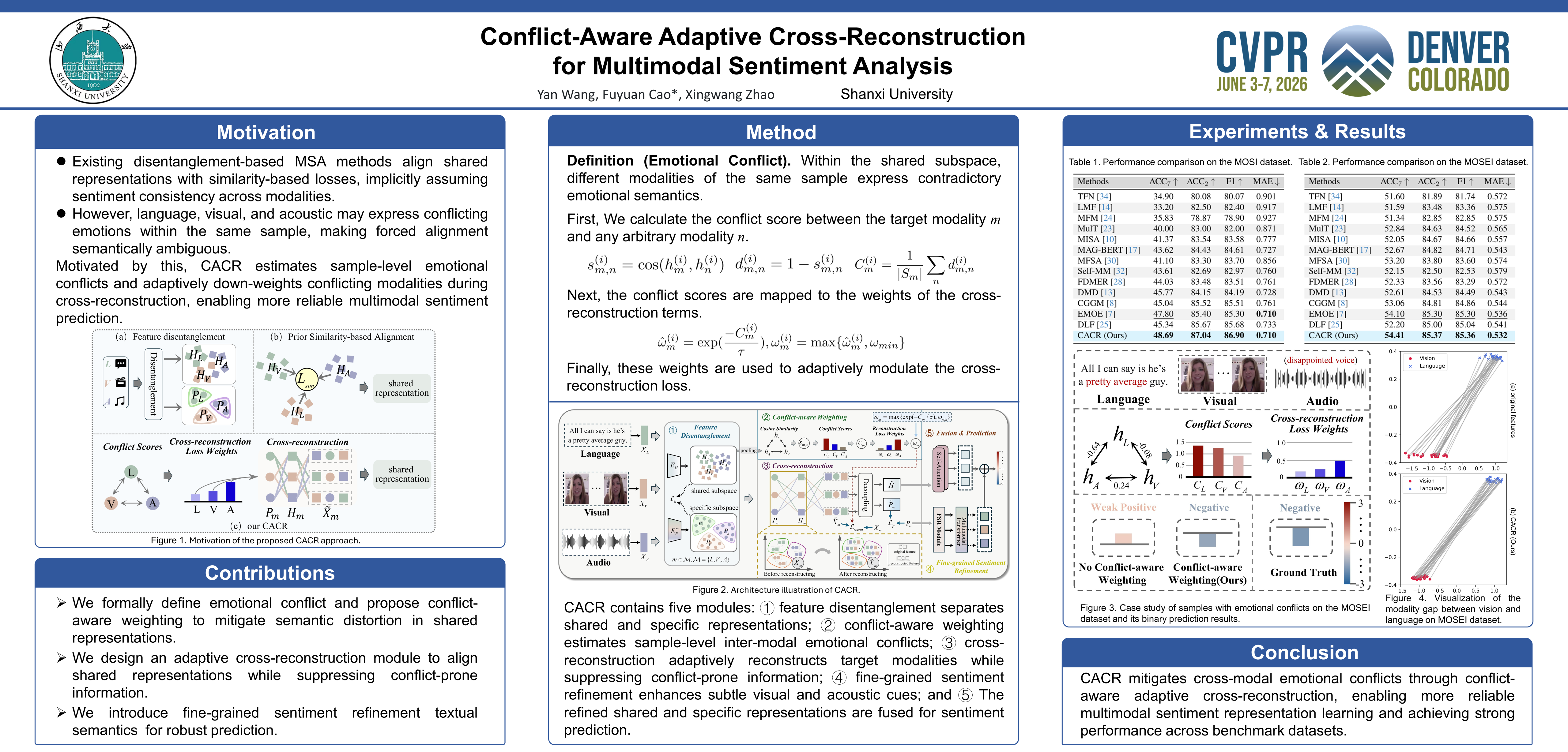
Disentanglement-based methods for learning shared representations are widely used in multimodal sentiment analysis. However, most of them adopt intra-modal reconstruction strategy and rely on similarity losses to align shared representations, while often ignoring potential emotional conflicts across modalities within the same sample, thereby distorting the shared semantics. To address these issues, we propose a Conflict-aware Adaptive Cross-Reconstruction approach (CACR). First, we formally define emotional conflict and design a conflict-aware weighting strategy. This strategy calculates sample-level conflict scores based on modality consistency metrics and maps them into dynamic weights for the cross-reconstruction loss of each modality. Second, based on this, we construct a cross-reconstruction module: for each modality, reconstructs its representation by leveraging its own specific features and the shared features of the other modalities, adaptively weighting each cross-reconstruction term with the aforementioned weights, thereby achieving implicit alignment of shared representations while mitigating semantic ambiguity. Extensive experiments on three widely used benchmarks show that CACR outperforms existing state-of-the-art methods on six evaluation metrics, demonstrating its effectiveness in handling modality-level emotional conflict.
EduDiag: A Benchmark for Educational Diagnostic Reasoning with Error Tracing and Correction on Large Multimodal Models
Jiali Chen ⋅ Yuqi Xue ⋅ Xusen Hei ⋅ DingBa Fu ⋅ wei yuancheng ⋅ Jiayuan Xie ⋅ Yi Cai
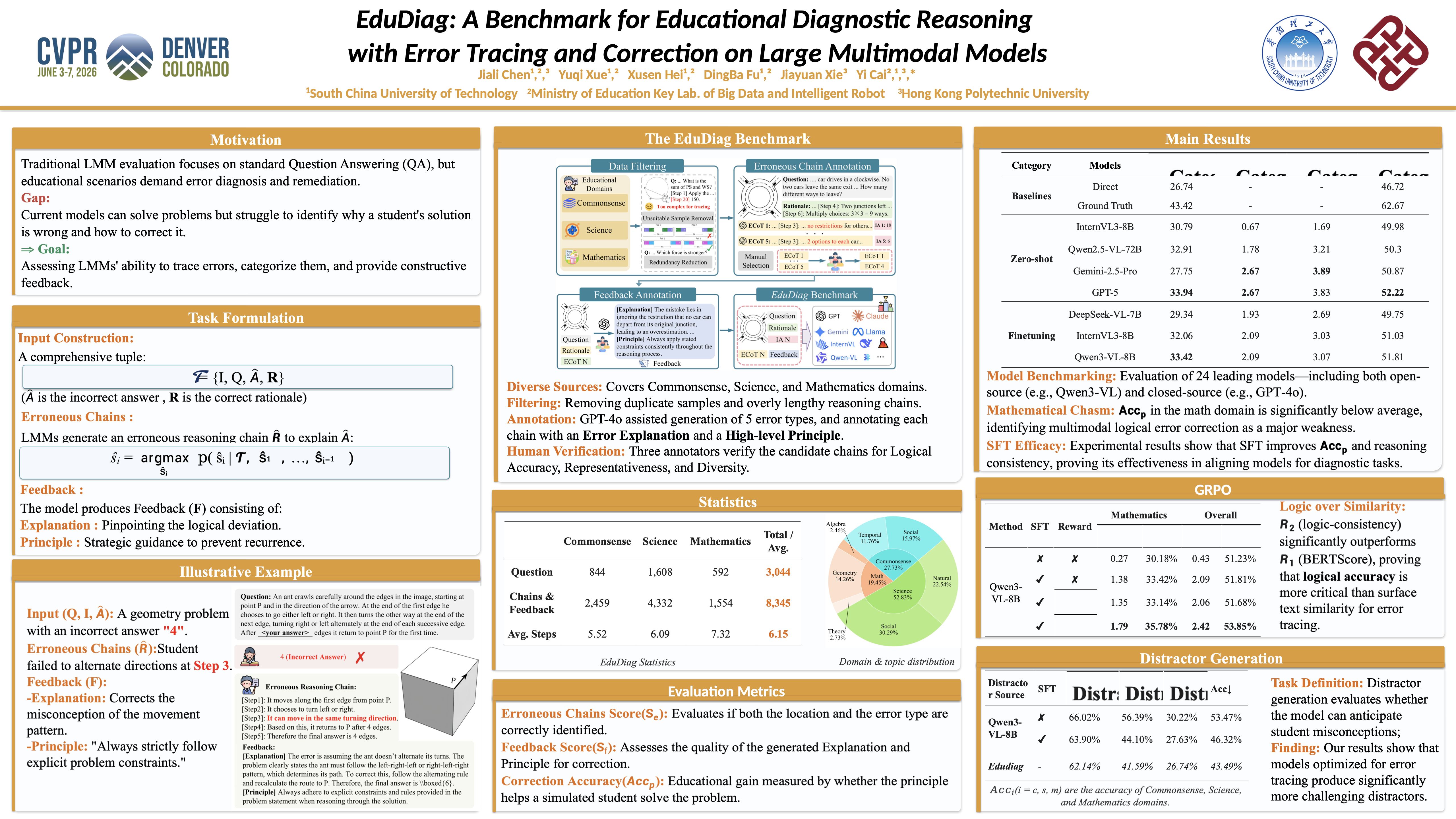
Large multimodal models (LMMs) have achieved impressive performance on multimodal reasoning, becoming crucial technology for the advancement of intelligent question-answering systems. In real-world educational scenarios, effective teaching extends far beyond providing answers. Experienced teachers analyze students' incorrect answers to trace underlying errors and provide corrective feedback, termed educational diagnostic reasoning, a capability that remains under-explored in existing LMMs. To bridge this research gap, we introduce Edudiag benchmark, requiring LMMs to reconstruct erroneous reasoning chains from incorrect answers and generate corrective feedback. Through an AI-assisted annotation pipeline with rigorous human verification, we create 8K erroneous reasoning chains and corresponding feedback, spanning three representative educational domains: commonsense, science, and mathematics.Extensive evaluation across 28 leading LMMs highlights \textit{Edudiag} as a challenging testbed, where even leading proprietary LMMs struggle on it and supervised fine-tuning (SFT) on open-source LMMs achieves marginal performance gains. Moreover, we conduct analysis experiments and identify three critical insights for educational diagnostic reasoning: (i) Effective error tracing remains the primary bottleneck, while SFT models still fail to reversely identify errors that commonly occur. (ii) Group relative policy optimization (GRPO) mitigates this bottleneck and boosts performance. (iii) LMMs optimized with GRPO can generate plausible yet challenging distractors for multiple-choice questions based on their self-constructed erroneous reasoning chains. We believe Edudiag provides a new direction for evaluating the advanced LMMs.
UniM: A Unified Any-to-Any Interleaved Multimodal Benchmark
Yanlin Li ⋅ Minghui Guo ⋅ Kaiwen Zhang ⋅ Shize Zhang ⋅ Yiran Zhao ⋅ Haodong Li ⋅ Congyue Zhou ⋅ Weijie Zheng ⋅ Yushen Yan ⋅ Shengqiong Wu ⋅ Wei Ji ⋅ Lei Cui ⋅ Furu Wei ⋅ Hao Fei ⋅ Mong-Li Lee ⋅ Wynne Hsu
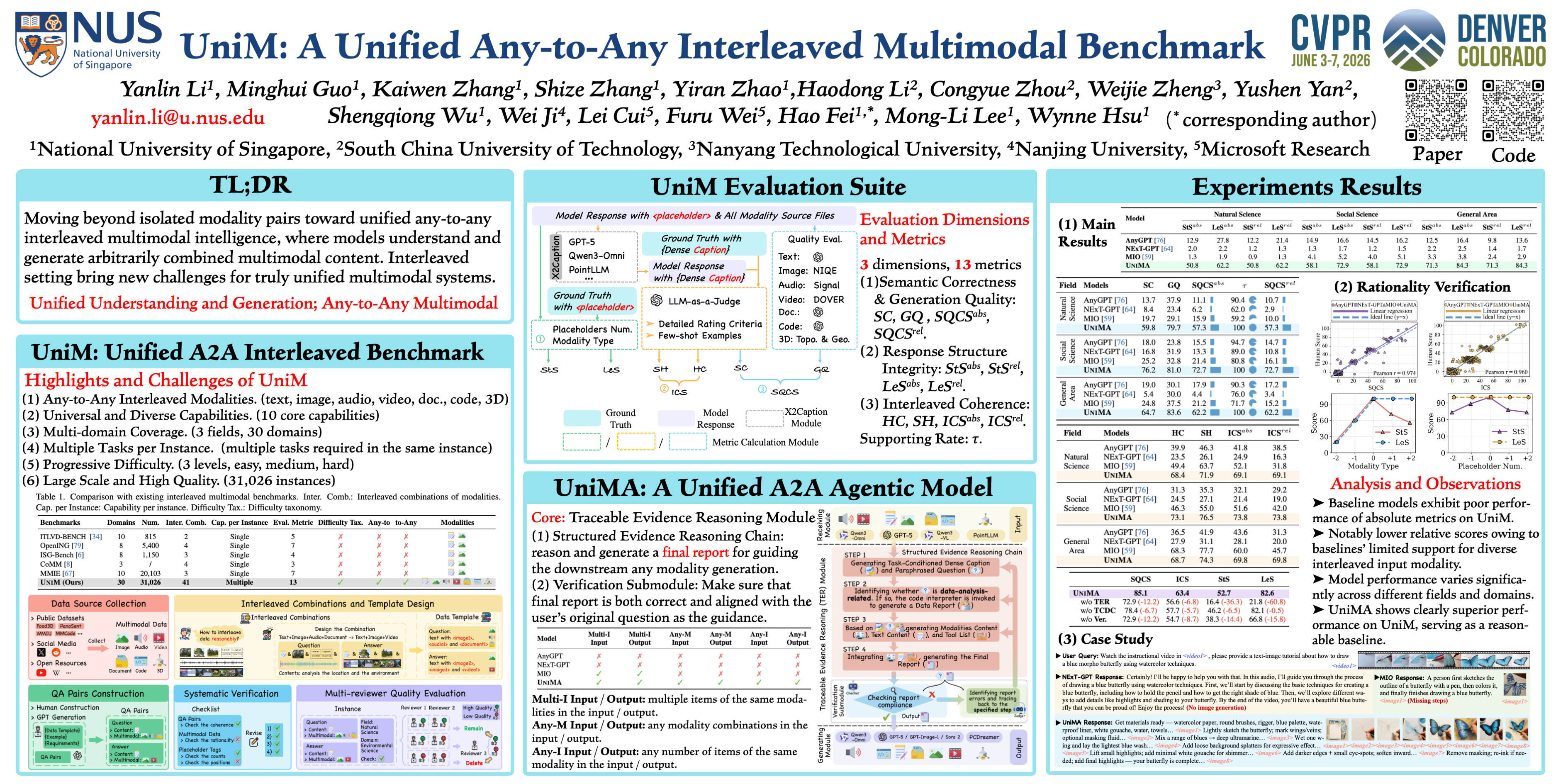
In real-world multimodal applications, systems usually need to comprehend arbitrarily combined and interleaved multimodal inputs from users, while also generating outputs in any interleaved multimedia form. This capability defines the goal of any-to-any interleaved multimodal learning under a unified paradigm of understanding and generation, posing new challenges and opportunities for advancing Multimodal Large Language Models (MLLMs). To foster and benchmark this capability, this paper introduces the UniM benchmark, the first Unified Any-to-Any Interleaved Multimodal dataset. UniM contains 31K high-quality instances across 30 domains and 7 representative modalities: text, image, audio, video, document, code, and 3D, each requiring multiple intertwined reasoning and generation capabilities. We further introduce the UniM Evaluation Suite, which assesses models along three dimensions: Semantic Correctness & Generation Quality, Response Structure Integrity, and Interleaved Coherence. In addition, we propose UniMA, an agentic baseline model equipped with traceable reasoning for structured interleaved generation. Comprehensive experiments demonstrate the difficulty of UniM and highlight key challenges and directions for advancing unified any-to-any multimodal intelligence. Our resource will all be open.
Disentangle-then-Align: Non-Iterative Hybrid Multimodal Image Registration via Cross-Scale Feature Disentanglement
Chunlei Zhang ⋅ Jiahao Xia ⋅ Yun Xiao ⋅ Bo Jiang ⋅ Liying Zhang
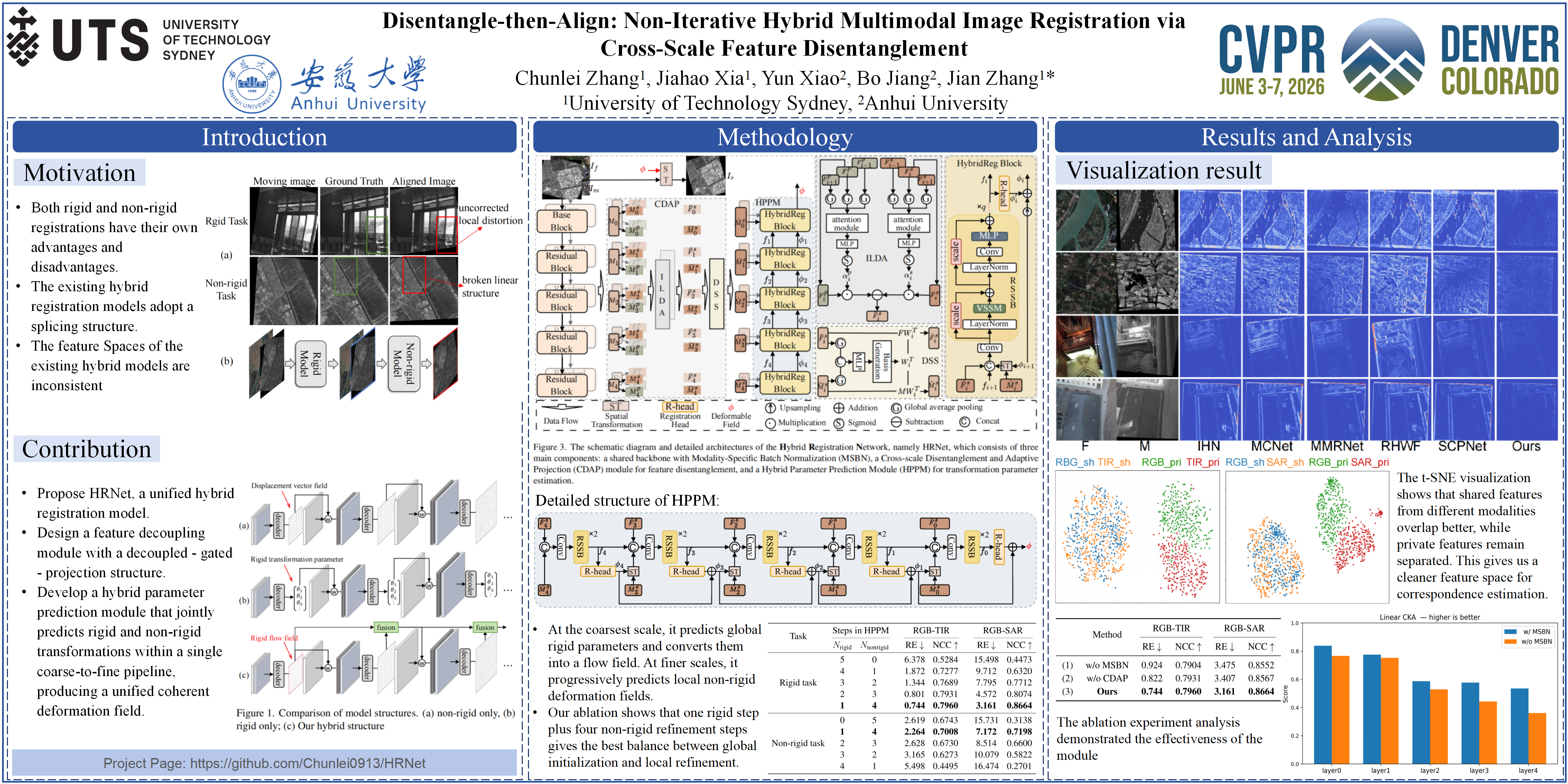
Multimodal image registration is a fundamental task for multimodal imagery and a prerequisite for downstream cross-modal analysis. Despite recent progress with shared feature extraction and multi-scale architectures, two key limitations remain. First, some methods use disentanglement to learn shared features but mainly regularize the shared part, so modality-private cues can still leak into the shared space. Second, most multi-scale frameworks support only one transformation type, which limits their applicability in real-world scenarios where global misalignment and local deformation coexist.To address these issues, we view hybrid multimodal registration as jointly constructing a stable shared feature space and a unified hybrid transformation within that space. Building on this perspective, we introduce HRNet, a Hybrid Registration Network that couples representation disentanglement with hybrid parameter prediction. A shared backbone with Modality-Specific Batch Normalization (MSBN) produces multi-scale features, while a Cross-scale Disentanglement and Adaptive Projection (CDAP) module suppresses modality-private cues across scales and projects the shared component into a stable subspace suited for correspondence. On top of this shared space, a Hybrid Parameter Prediction Module (HPPM) performs non-iterative, coarse-to-fine estimation of both global rigid parameters and multi-scale fine-grained deformation fields, which are fused into a single coherent deformation field. Extensive experiments on four multimodal datasets demonstrate state-of-the-art performance on both rigid and non-rigid registration tasks. Code will be made publicly available.
ChartNet: A Million-Scale, High-Quality Multimodal Dataset for Robust Chart Understanding
Jovana Kondic ⋅ Pengyuan Li ⋅ Dhiraj Joshi ⋅ Isaac Sanchez ⋅ Ben wiesel ⋅ Shafiq Abedin ⋅ Amit Alfassy ⋅ Eli Schwartz ⋅ Daniel Caraballo ⋅ Yagmur Gizem Cinar ⋅ Florian Scheidegger ⋅ Steven I. Ross ⋅ Daniel Karl I. Weidele ⋅ Hang Hua ⋅ Ekaterina Arutyunova ⋅ Roei Herzig ⋅ Zihan Wang ⋅ Xinyue Yu ⋅ Yunfei Zhao ⋅ Sicong Jiang ⋅ Minghao Liu ⋅ Qunshu Lin ⋅ Aude Oliva ⋅ Rogerio Feris
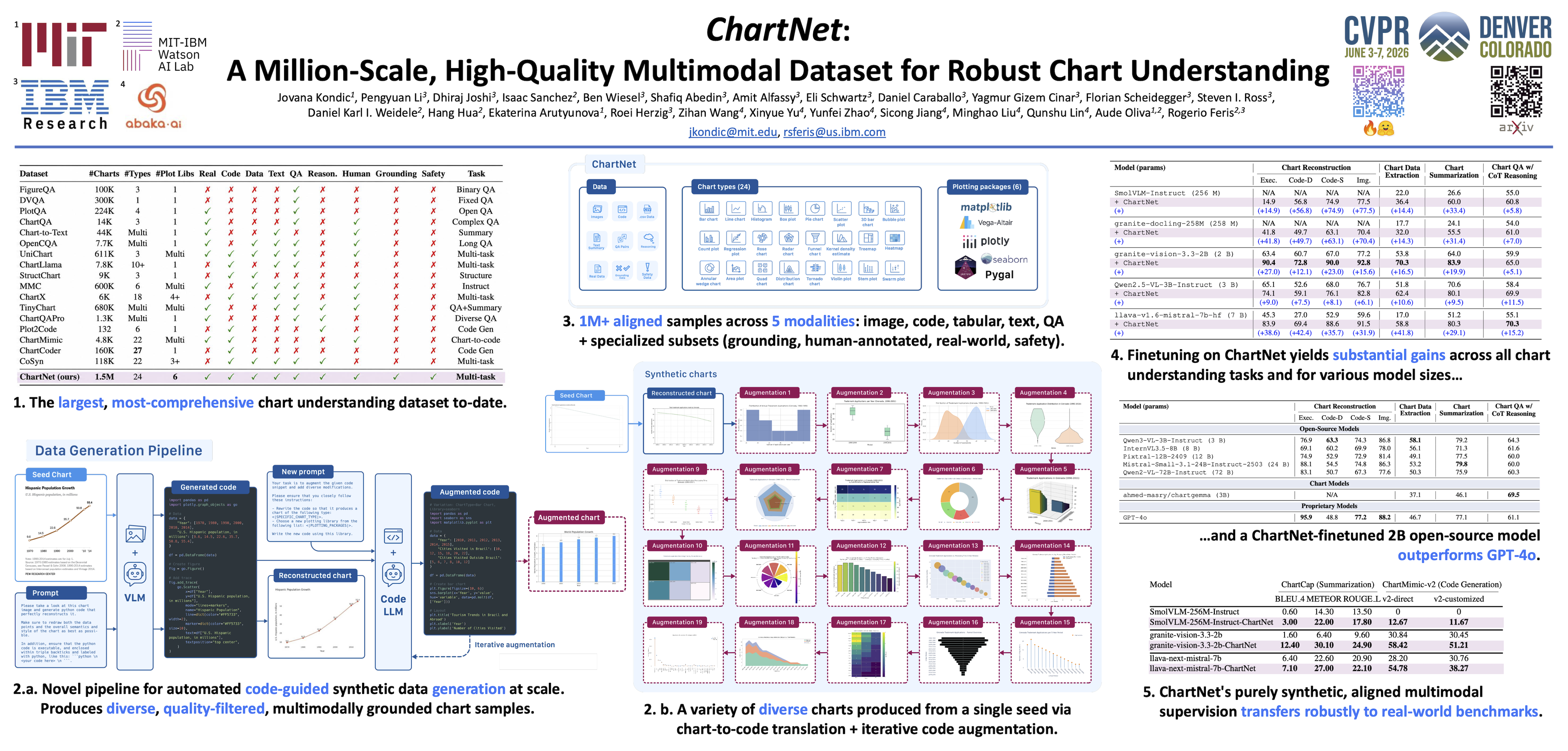
Understanding charts requires models to jointly reason over geometric visual patterns, structured numerical data, and natural language — a capability where current vision-language models (VLMs) remain limited. We introduce ChartNet, a high-quality, million-scale multimodal dataset designed to advance chart interpretation and reasoning. ChartNet leverages a novel code-guided synthesis pipeline to generate 1.5 million diverse chart samples spanning 24 chart types and 6 plotting libraries. Each sample consists of five aligned components: plotting code, rendered chart image, data table, natural language summary, and question-answering with reasoning, providing fine-grained cross-modal alignment. To capture the full spectrum of chart comprehension, ChartNet additionally includes specialized subsets encompassing human annotated data, real-world data, safety, and grounding. A rigorous quality-filtering pipeline ensures visual fidelity, semantic accuracy, and diversity across chart representations. Fine-tuning on ChartNet consistently improves results across our benchmarks, demonstrating its utility as large-scale supervision for multimodal models. As the largest open-source dataset of its kind, ChartNet aims to support the development of foundation models with robust and generalizable capabilities for data visualization understanding. The dataset is publicly available at ChartNet Dataset.
Cross-Modal Guided Visual Synthesis for Data-Efficient Multimodal Depression Recognition
Shanliang Yang ⋅ Xiaoxiao Wang
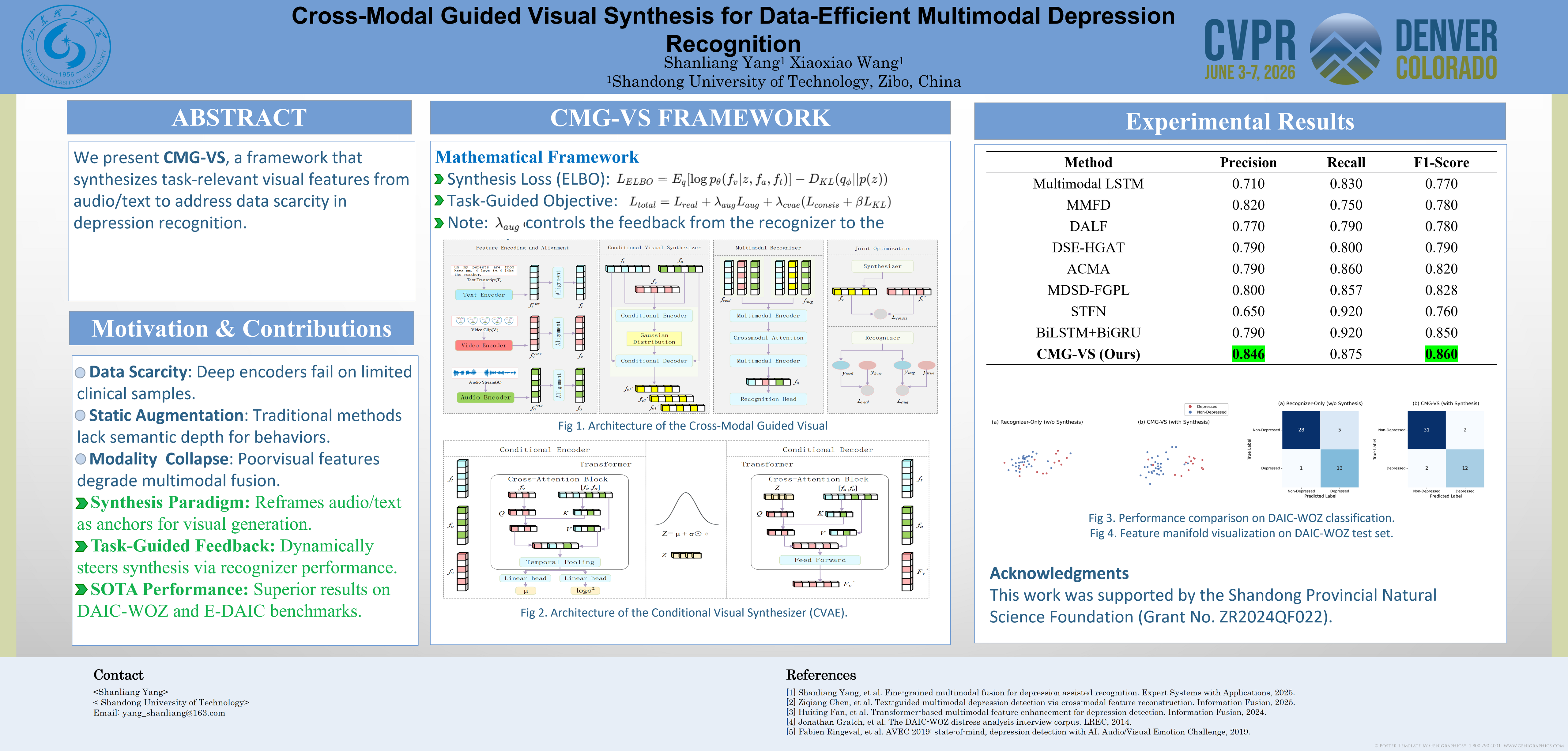
The performance of multimodal learning systems, particularly in high-stakes domains like automated depression recognition, is fundamentally constrained by the challenge of learning robust visual representations from limited and complex clinical data. To overcome this, we introduce Cross-Modal Guided Visual Synthesis (CMG-VS), a novel training framework that internally enhances the learning process by synthesizing new, task-relevant visual features. At its core, CMG-VS leverages the rich context from audio and text modalities to guide a conditional generative model. This model learns the intricate mapping from speech and language to visual expression, generating a diverse manifold of plausible visual behaviors to enrich the training distribution. Crucially, this synthesis is not a separate pre-processing step. Through a task-guided joint optimization scheme, the generative process is dynamically steered by the downstream multimodal recognizer's performance. This closed-loop feedback mechanism ensures the synthesized visual features are optimized to be maximally discriminative for the recognition task, rather than merely realistic. Comprehensive experiments on the widely-used DAIC-WOZ and E-DAIC benchmark datasets demonstrate that CMG-VS significantly outperforms existing state-of-the-art methods across all standard regression and classification metrics. Ablation studies further validate that our task-guided synthesis is the key driver of this performance gain, proving its effectiveness as a new paradigm for robust multimodal representation learning.
AffordGrasp: Cross-Modal Diffusion for Affordance-Aware Grasp Synthesis
Xiaofei Wu ⋅ Yi Zhang ⋅ Yumeng Liu ⋅ Yuexin Ma ⋅ Yujiao Shi ⋅ Xuming He
Generating human grasping poses that accurately reflect both object geometry and user-specified interaction semantics is essential for natural hand–object interactions in AR/VR and embodied AI. However, existing semantic grasping approaches struggle with the large modality gap between 3D object representations and textual instructions, and often lack explicit spatial or semantic constraints, leading to physically invalid or semantically inconsistent grasps. In this work, we present AffordGrasp, a diffusion-based framework that produces physically stable and semantically faithful human grasps with high precision. We first introduce a scalable annotation pipeline that automatically enriches hand–object interaction datasets with fine-grained structured language labels capturing interaction intent. Building upon these annotations, AffordGrasp integrates an affordance-aware latent representation of hand poses with a dual-conditioning diffusion process, enabling the model to jointly reason over object geometry, spatial affordances, and instruction semantics. A distribution adjustment module further enforces physical contact consistency and semantic alignment. We evaluate AffordGrasp across four instruction-augmented benchmarks derived from HO-3D, OakInk, GRAB, and AffordPose, and observe substantial improvements over state-of-the-art methods in grasp quality, semantic accuracy, and diversity.
PAM: A Pose–Appearance–Motion Engine for Sim-to-Real HOI Video Generation
Mingju Gao ⋅ Kaisen Yang ⋅ Huan-ang Gao ⋅ Bohan Li ⋅ Ao Ding ⋅ Wenyi Li ⋅ Yangcheng Yu ⋅ Jinkun Liu ⋅ Shaocong Xu ⋅ Yike Niu ⋅ Haohan Chi ⋅ Hao Chen ⋅ Hao Tang ⋅ Yu Zhang ⋅ Li Yi ⋅ Hao Zhao
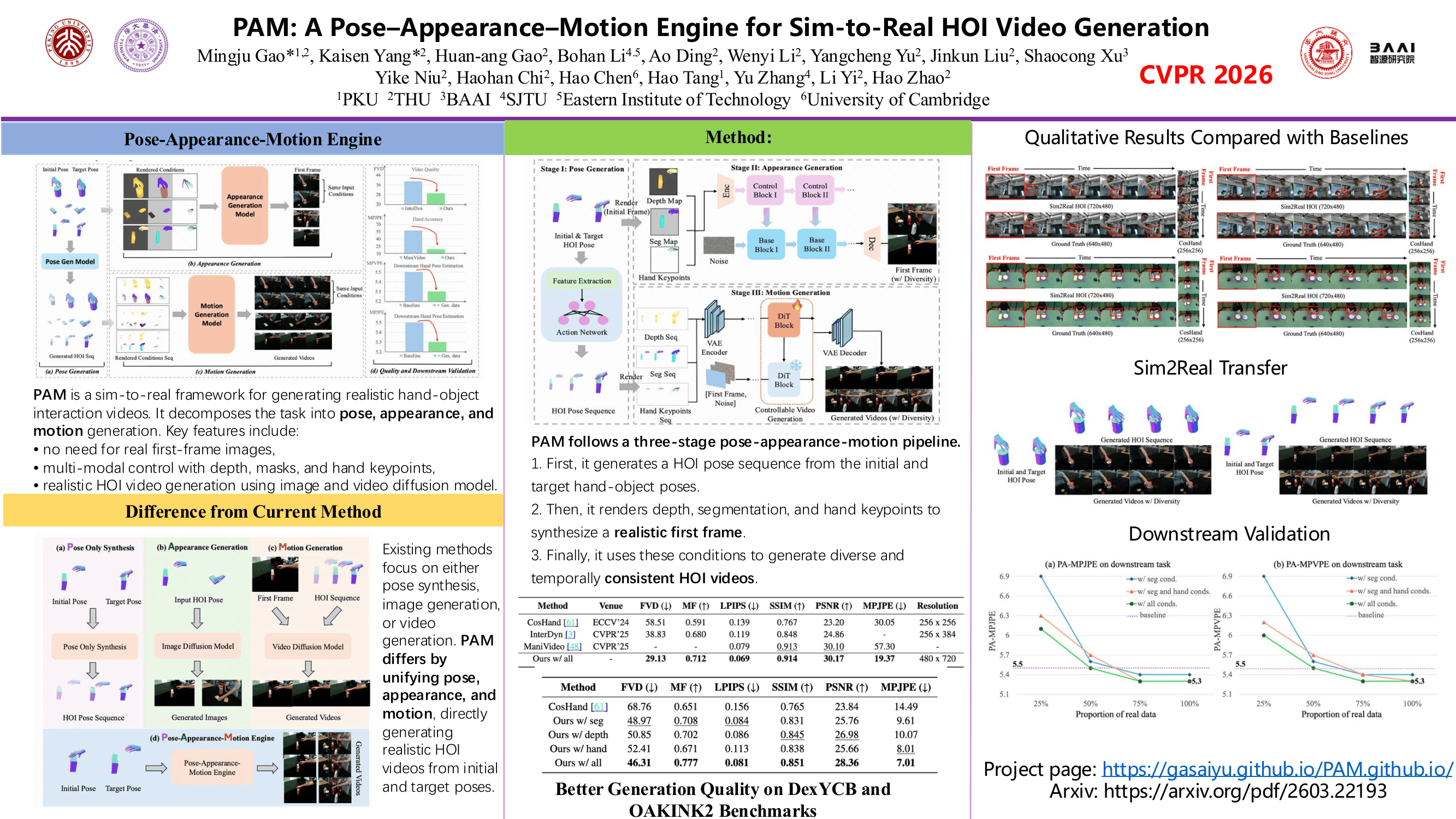
Hand–object interaction (HOI) reconstruction and synthesis are becoming central to embodied AI and AR/VR. Yet, despite rapid progress, existing HOI generation research remains fragmented across three disjoint tracks: (1) pose-only synthesis that predicts MANO trajectories without producing pixels; (2) single-image HOI generation that hallucinates appearance from masks or 2D cues but lacks dynamics; and (3) video generation methods that require both the entire pose sequence and the ground-truth first frame as inputs, preventing true sim-to-real deployment. Inspired by the philosophy of previous work, we think that HOI generation requires a unified engine that brings together pose, appearance, and motion within one coherent framework. Thus we introduce PAM: a Pose–Appearance–Motion Engine for controllable HOI video generation. The performance of our engine is validated by: (1) On DexYCB, we obtain an FVD of 29.13 (vs. 38.83 for InterDyn), and MPJPE of 19.37 mm (vs. 30.05 mm for CosHand), while generating higher-resolution 480×720 videos compared to 256×256/256×384 baselines. (2) On OAKINK2, our full multi-condition model improves FVD from 68.76 → 46.31. (3) An ablation over input conditions on DexYCB shows that combining depth, segmentation, and keypoints consistently yields the best results. (4) For a downstream hand pose estimation task using SimpleHand, augmenting training with 3,400 synthetic videos (207k frames) allows a model trained on only 50\% of the real data plus our synthetic data to match the 100% real baseline.
AffordGen: Generating Diverse Demonstrations for Generalizable Object Manipulation with Affordance Correspondence
Jiawei Zhang ⋅ Kaizhe Hu ⋅ Yingqian Huang ⋅ Yuanchen Ju ⋅ Zhengrong Xue ⋅ Huazhe Xu
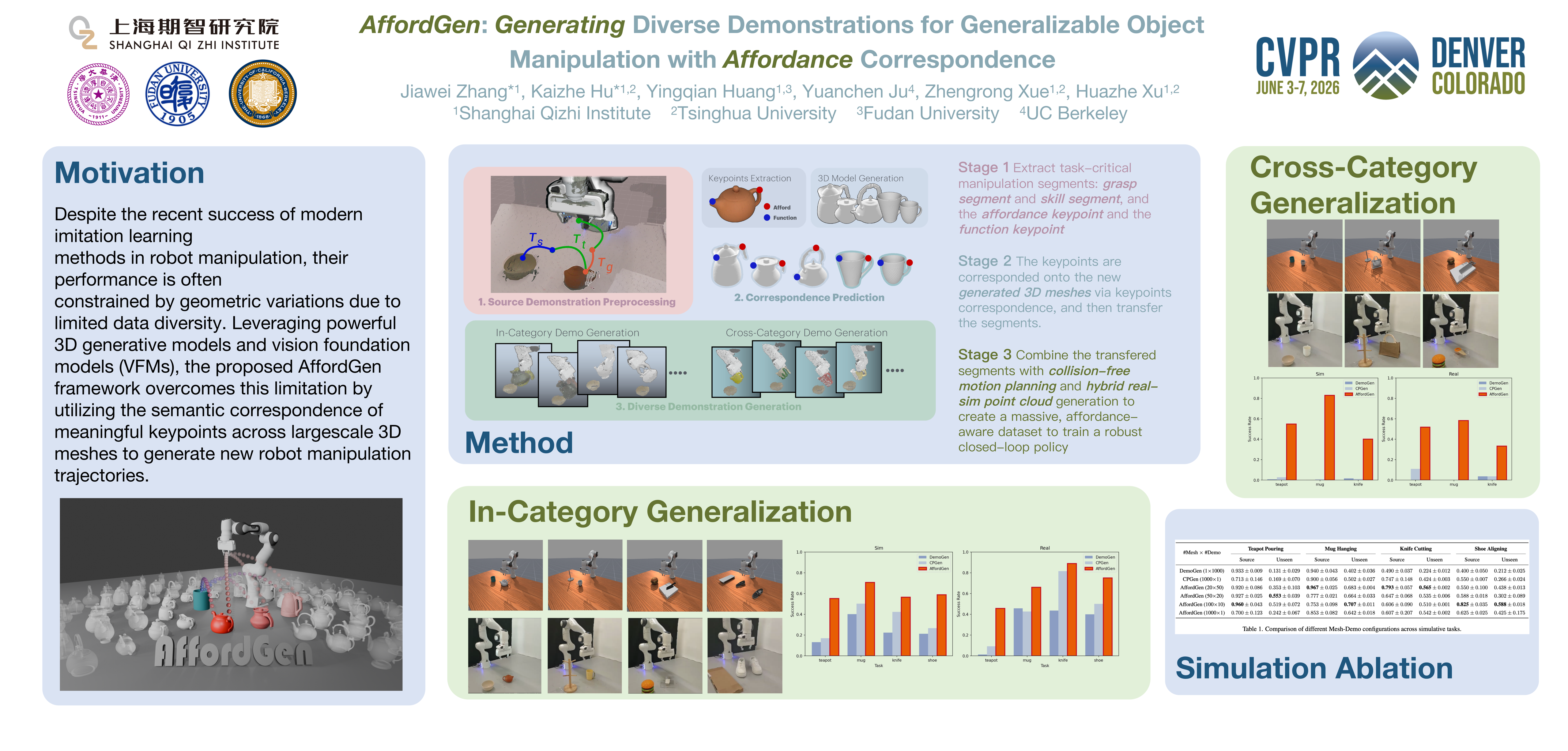
Despite the recent success of modern imitation learning methods in robot manipulation, their performance is often limited to specific object shapes due to the constrained data diversity. Leveraging powerful 3D generative models and vision foundation models (VFM), the proposed AffordGen framework overcomes this limitation by utilizing the semantic correspondence of meaningful keypoints across large-scale 3D meshes to generate new robot manipulation tra-jectories. This large-scale, affordance-aware dataset is then used to train a robust, closed-loop visuomotor policy, combining the semantic generalizability of affordances with the reactive robustness of end-to-end learning. Experiments in simulation and the real world show that policies trained with AffordGen achieve high success rates and enable zero-shot generalization to truly unseen objects, significantly im-proving data efficiency in robot learning.
HandWorld: Hand-Centric Unified Video Action Generation
Zhihao Sun ⋅ Zhiying Du ⋅ Xitong Yang ⋅ Zuxuan Wu
Hand-object interaction forms the foundation of how humans interact with the world.Understanding the connection between hand action and egocentric video is essential for enabling embodied agents to perceive, simulate, and plan like humans. However, it is challenging to learn and predict across handactions and egocentric videos due to their non-linear relationship. In this work, we introduce HandWorld, a unified generative framework that focuses on hand-object interaction and jointly models egocentric videos and hand actions. HandWorld learns shared cross-domain conditions through a dual-branch condition network that integrates information from both video and action domains. MANO-rendered hand representation is incorporated as an intermediate input to further enhance cross-domain coherence.Conditioned on the shared representation, two decoupled diffusion transformers are trained to predict in their respective domain. A flexible training strategy enables the model to learn across diverse task configurations, including action forecasting and controllable video generation. Experiments on large-scale egocentric HOI datasets demonstrate that HandWorld achieves high-fidelity video synthesis and accurate action prediction, outperforming existing baselines across diverse scenarios.
HVG-3D: Bridging Real and Simulation Domains for 3D-Conditional Hand-Object Interaction Video Synthesis
Mingjin Chen ⋅ Junhao Chen ⋅ Zhaoxin Fan ⋅ Yujian Lee ⋅ Zichen Dang ⋅ Lili Wang ⋅ Yawen Cui ⋅ Lap-Pui Chau ⋅ Yi Wang
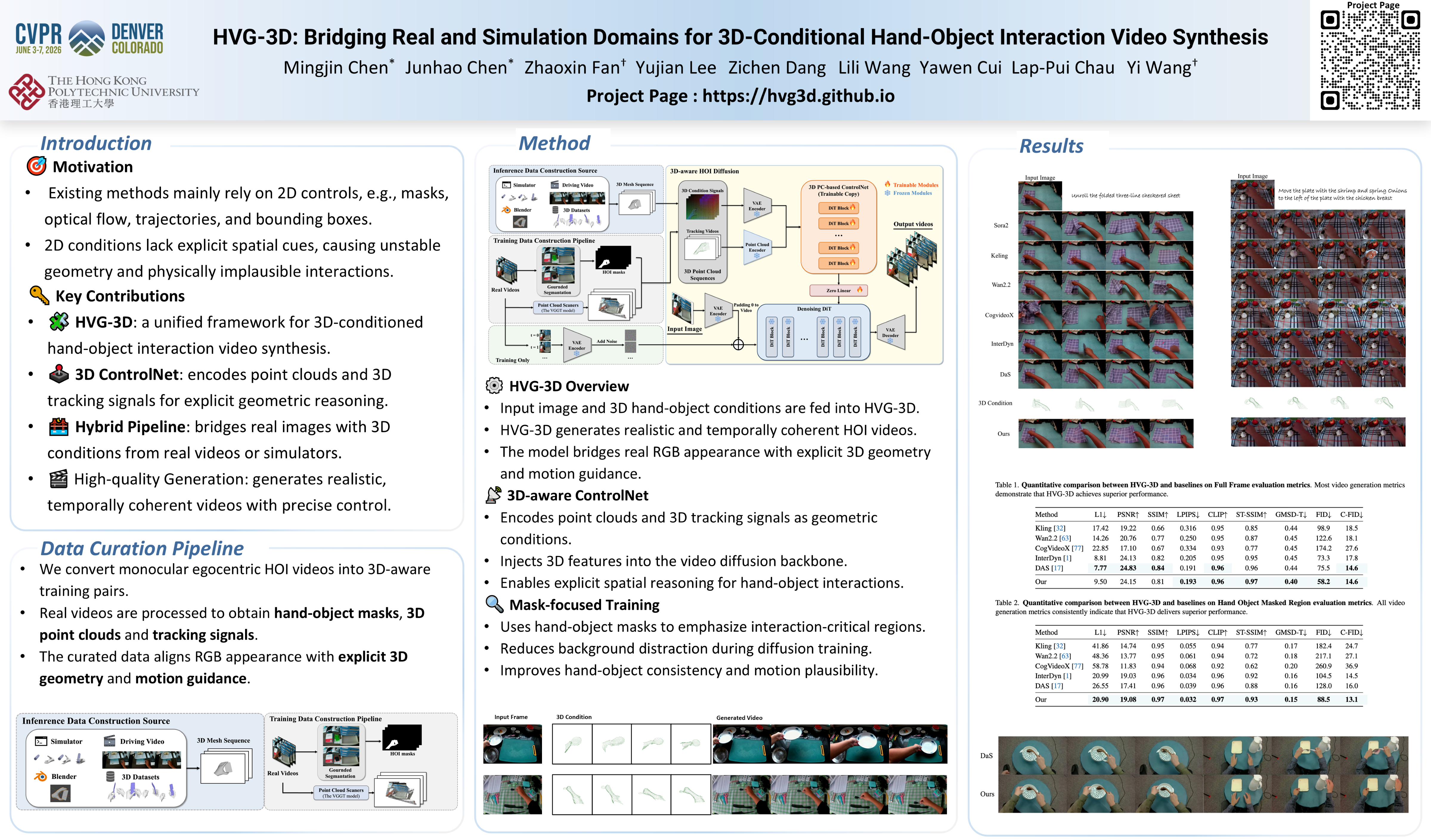
Recent methods have made notable progress in the visual quality of hand-object interaction video synthesis. However, most approaches rely on 2D control signals that lack spatial expressiveness and limit the utilization of synthetic 3D conditional data. To address these limitations, we propose HVG-3D, a unified framework for 3D-aware hand-object interaction (HOI) video synthesis conditioned on explicit 3D representations. To achieve a diffusion-based architecture augmented with a 3D ControlNet, which encodes geometric and motion cues from 3D inputs to enable explicit 3D reasoning during video synthesis, as well as the corresponding training and inference setting. To achieve high-quality synthesis, HVG-3D is designed with two core components: (i) a 3D-aware HOI video generation diffusion architecture that encodes geometric and motion cues from 3D inputs for explicit 3D reasoning; and (ii) a hybrid pipeline for constructing input and condition signals, enabling flexible and precise control during both training and inference. During inference, given a single real image and a 3D control signal from either simulation or real data, HVG-3D generates high-fidelity, temporally consistent videos with precise spatial and temporal control. Experiments on the TASTE-Rob dataset demonstrate that HVG-3D achieves state-of-the-art spatial fidelity, temporal coherence, and controllability, while enabling effective utilization of both real and simulated data.
ArtHOI: Taming Foundation Models for Monocular 4D Reconstruction of Hand-Articulated-Object Interactions
Zikai Wang ⋅ Zhilu Zhang ⋅ Yiqing Wang ⋅ Hui Li ⋅ Wangmeng Zuo
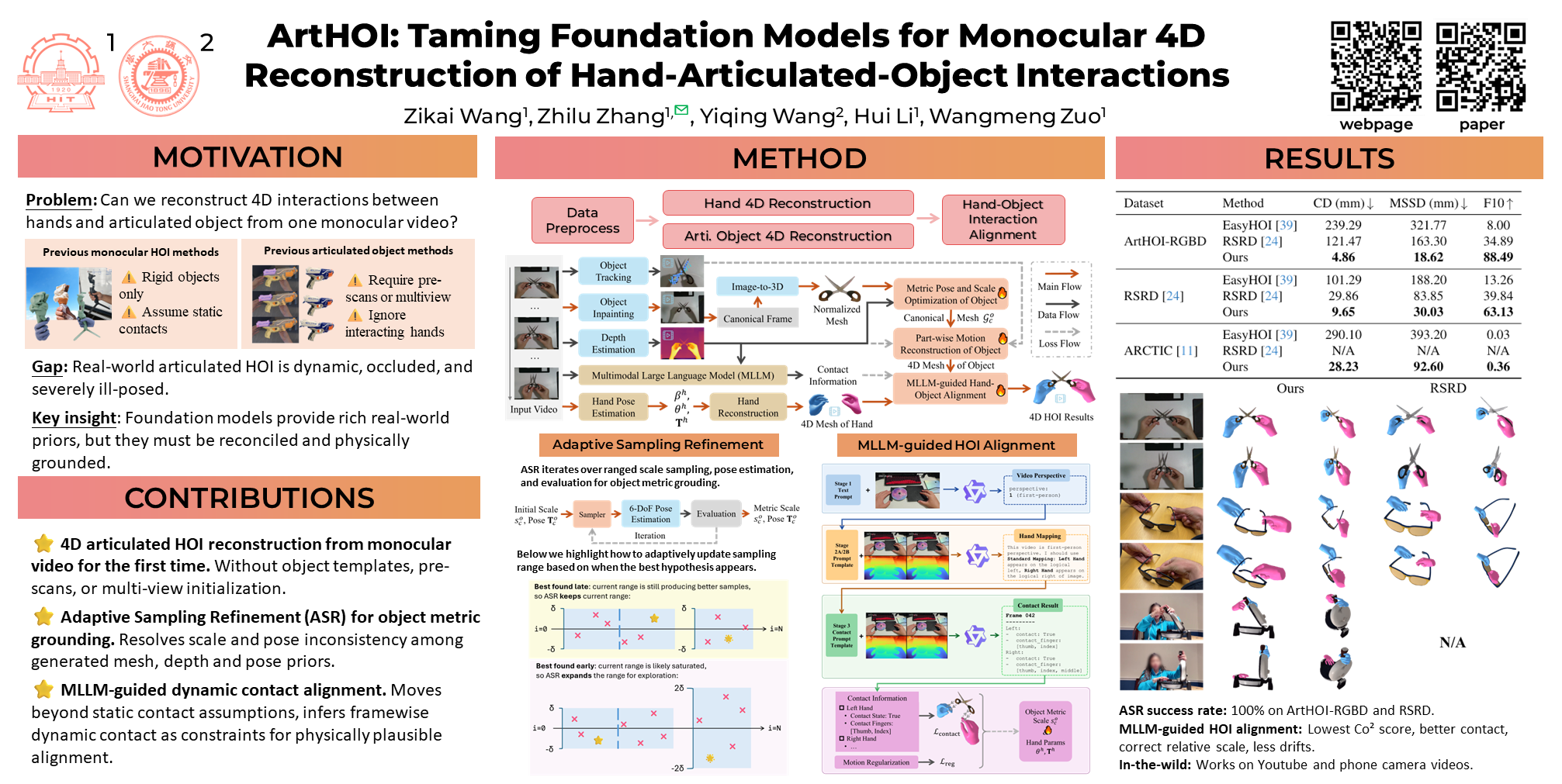
Existing hand-object interactions (HOI) methods are largely limited to rigid objects, while 4D reconstruction methods of articulated objects generally require pre-scanning the object or even multi-view videos. It remains an unexplored but significant challenge to reconstruct 4D human-articulated-object interactions from a single monocular RGB video. Fortunately, recent advancements in foundation models present a new opportunity to address this highly ill-posed problem. To this end, we introduce ArtHOI, an optimization-based framework that integrates and refines priors from multiple foundation models. Our key contribution is a suite of novel methodologies designed to resolve the inherent inaccuracies and physical unreality of these priors. In particular, we introduce an Adaptive Sampling Refinement (ASR) method to optimize object's metric scale and pose for grounding its normalized mesh in world space. Furthermore, we propose a Multimodal Large Language Model (MLLM) guided hand-object alignment method, utilizing contact reasoning information as constraints of hand-object mesh composition optimization. To facilitate a comprehensive evaluation, we also contribute two new datasets, ArtHOI-RGBD and ArtHOI-Wild. Extensive experiments validate the robustness and effectiveness of our ArtHOI across diverse objects and interactions. The code and datasets will be made publicly available.
LAM: Language Articulated Object Modelers
Yipeng Gao ⋅ Yunhao Ge ⋅ Peilin Cai ⋅ Daniel Seita ⋅ Laurent Itti
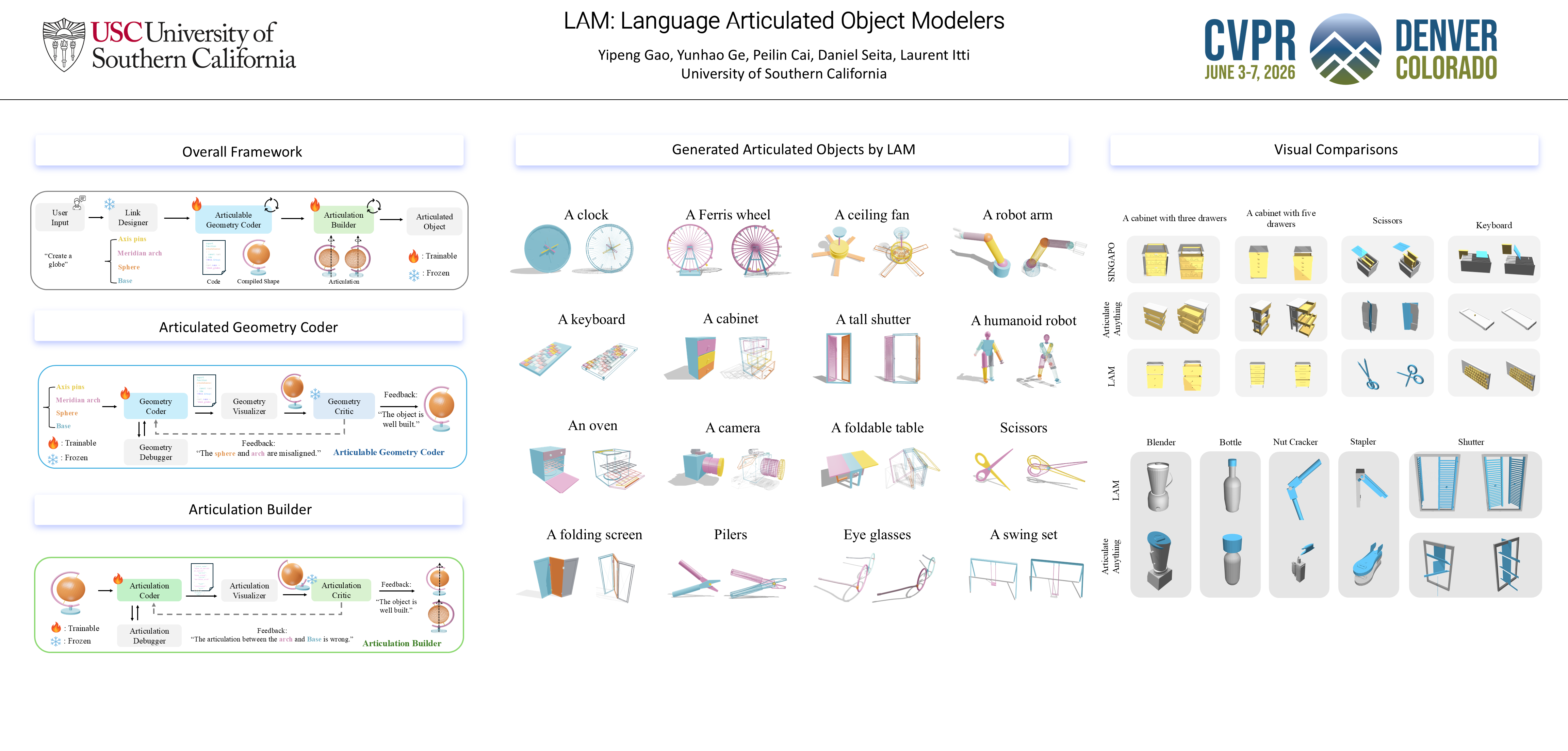
We introduce LAM, a system that explores the collaboration of large-language mod-els and vision-language models to generate articulated objects from text prompts.Our approach differs from previous methods that either rely on input visual structure(e.g., an image) or assemble articulated models from pre-built assets. In contrast,we formulate articulated object generation as a unified code generation task, wheregeometry and articulations can be co-designed from scratch. Given an input text,LAM coordinates a team of specialized modules to generate code to represent thedesired articulated object procedurally. The LAM first reasons about the hierarchi-cal structure of parts (links) with Link Designer, then writes code, compiles it, anddebugs it with Geometry & Articulation Coders and self-corrects with Geometry& Articulation Checkers. The code serves as a structured and interpretable bridgebetween individual links, ensuring correct relationships among them. Representingeverything with code allows the system to determine appropriate joint types andcalculate their exact placements more reliably. Experiments demonstrate the powerof leveraging code as a generative medium within an agentic system, showcasingits effectiveness in automatically constructing complex articulated objects.
Haptic Neural Fields: Bringing Tactile Interactions to 3D Rendered Scenes
Antonio Luigi Stefani ⋅ Niccolò Bisagno ⋅ Nicola Conci ⋅ Eckehard Steinbach ⋅ Francesco De Natale
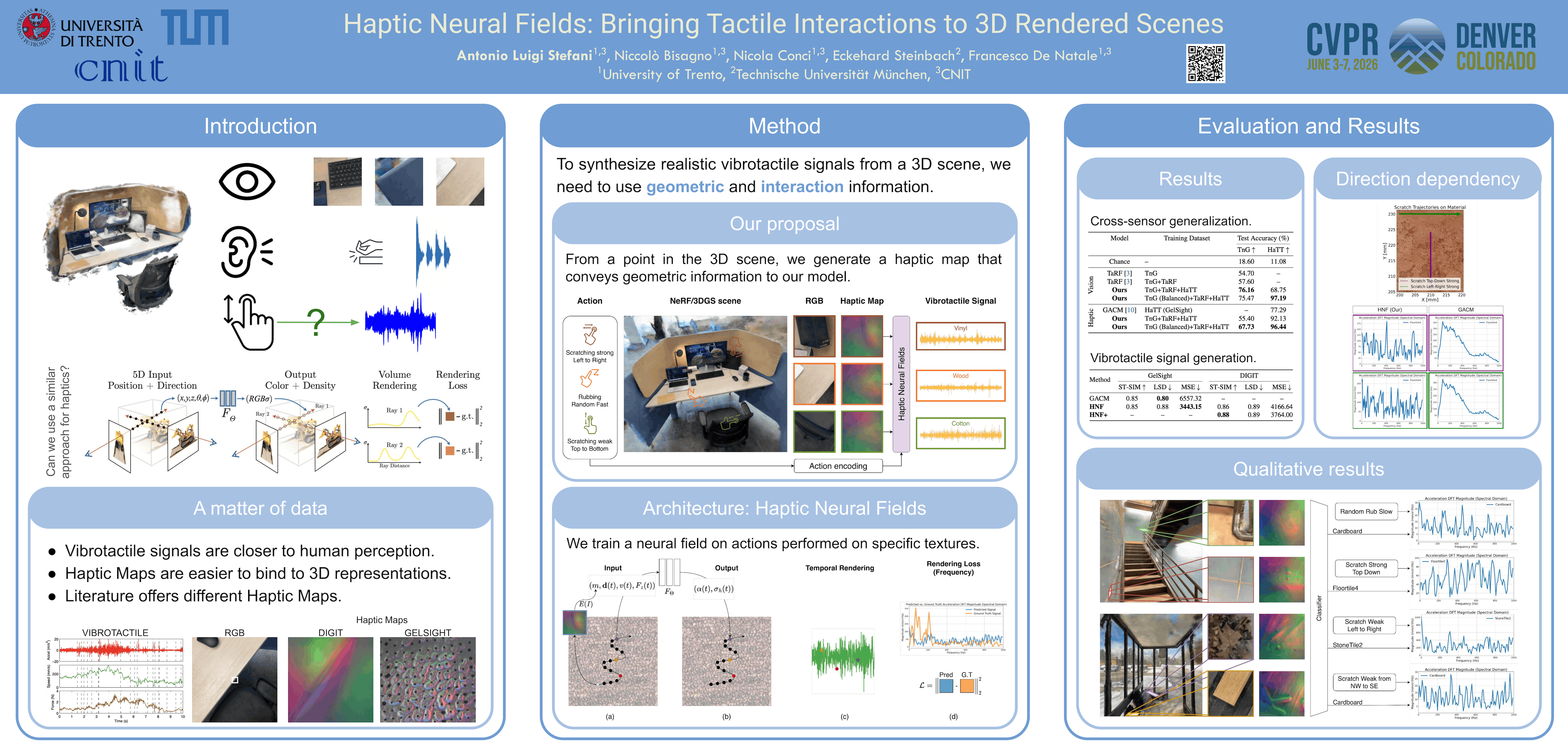
We address the problem of making 3D scenes interactive by asking: what would objects feel like if touched in a virtual environment? State-of-the-art 3D rendering methods provide compelling visual realism, but they fall short in modeling physical interactions, such as haptic feedback. We propose a framework that learns the correspondence between user actions and tactile responses, enabling the generation of touch-based signals directly from simulated interactions in 3D scenes. Our approach leverages a neural field representation conditioned on geometry and action to synthesize material-specific tactile signals. Experiments show that the generated signals reliably convey material properties and interaction dynamics. This paves the way toward interactive, touch-aware virtual environments with realistic haptic feedback.
Open-world Hand-Object Interaction Video Generation Based on Structure and Contact-aware Representation
Haodong Yan ⋅ Hang Yu ⋅ Zhide Zhong ⋅ Weilin Yuan ⋅ Xin Gong ⋅ Zehang Luo ⋅ Chengxi Heyu ⋅ Junfeng Li ⋅ Wenxuan Song ⋅ Shunbo Zhou ⋅ Haoang Li
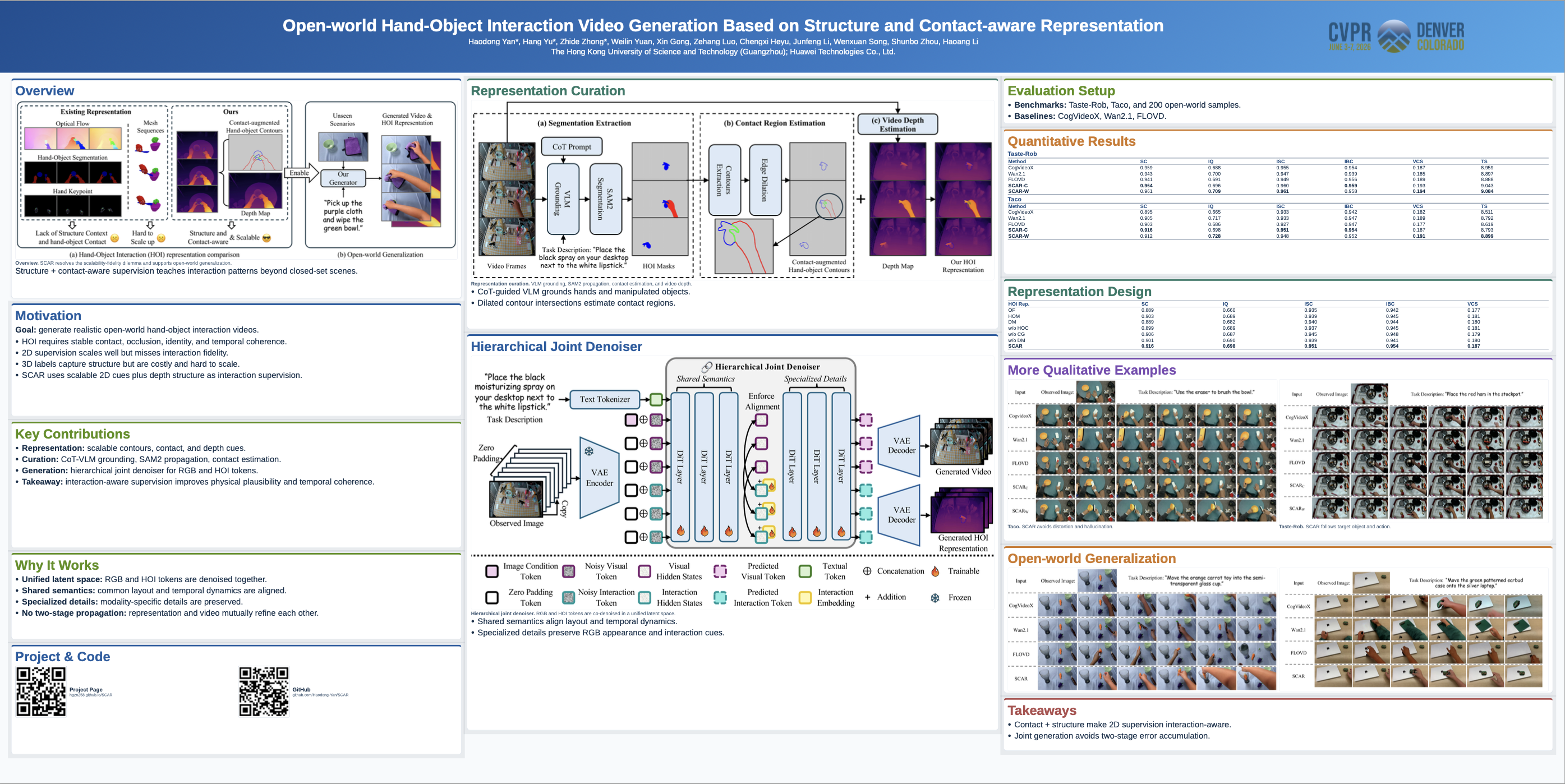
Generating realistic hand-object interactions (HOI) videos is a significant challenge due to the difficulty of modeling physical constraints (e.g., contact and occlusion between hands and manipulated objects). Current methods utilize HOI representation as an auxiliary generative objective to guide video synthesis. However, there is a dilemma between 2D and 3D representations that cannot simultaneously guarantee scalability and interaction fidelity. To address this limitation, we propose a structure and contact-aware representation that captures hand-object contact, hand-object occlusion, and holistic structure context without 3D annotations. This interaction-oriented and scalable supervision signal enables the model to learn fine-grained interaction physics and generalize to open-world scenarios. To fully exploit the proposed representation, we introduce a joint-generation paradigm with a share-and-specialization strategy that generates interaction-oriented representations and videos. Extensive experiments demonstrate that our method outperforms state-of-the-art methods on two real-world datasets in generating physics-realistic and temporally coherent HOI videos. Furthermore, our approach exhibits strong generalization to challenging open-world scenarios, highlighting the benefit of our scalable design.
EgoEdit: Dataset, Real-Time Streaming Model, and Benchmark for Egocentric Video Editing
Runjia Li ⋅ Moayed Haji Ali ⋅ Ashkan Mirzaei ⋅ Chaoyang Wang ⋅ Arpit Sahni ⋅ Ivan Skorokhodov ⋅ Aliaksandr Siarohin ⋅ Tomas Jakab ⋅ Junlin Han ⋅ Sergey Tulyakov ⋅ Philip H.S. Torr ⋅ Willi Menapace
We study instruction-guided editing of egocentric videos for interactive AR applications. While recent AI video editors perform well on third-person footage, egocentric views present unique challenges — including rapid egomotion, and frequent hand–object interactions — that create a significant domain gap. Moreover, existing offline editing pipelines suffer from high latency, limiting real-time interaction.To address these issues, we present a complete ecosystem for egocentric video editing. First, we construct EgoEditData, a carefully designed and manually curated dataset specifically designed for egocentric editing scenarios, featuring rich hand-object interactions, while explicitly preserving hands. Second, we develop EgoEdit, an instruction-following egocentric video editor that supports real-time streaming inference on a single GPU. Finally, we introduce EgoEditBench, an evaluation suite targeting instruction faithfulness, hand and interaction preservation, and temporal stability under egomotion.Across both egocentric and general editing tasks, EgoEdit produces temporally stable, instruction-faithful results with interactive latency. It achieves clear gains on egocentric editing benchmarks—where existing methods struggle—while maintaining performance comparable to the strongest baselines on general editing tasks. EgoEditData and EgoEditBench will be made public for the research community.
From Inpainting to Layer Decomposition: Repurposing Generative Inpainting Models for Image Layer Decomposition
Jingxi Chen ⋅ Yixiao Zhang ⋅ Xiaoye qian ⋅ Zongxia Li ⋅ Cornelia Fermuller ⋅ Caren Chen ⋅ Yiannis Aloimonos
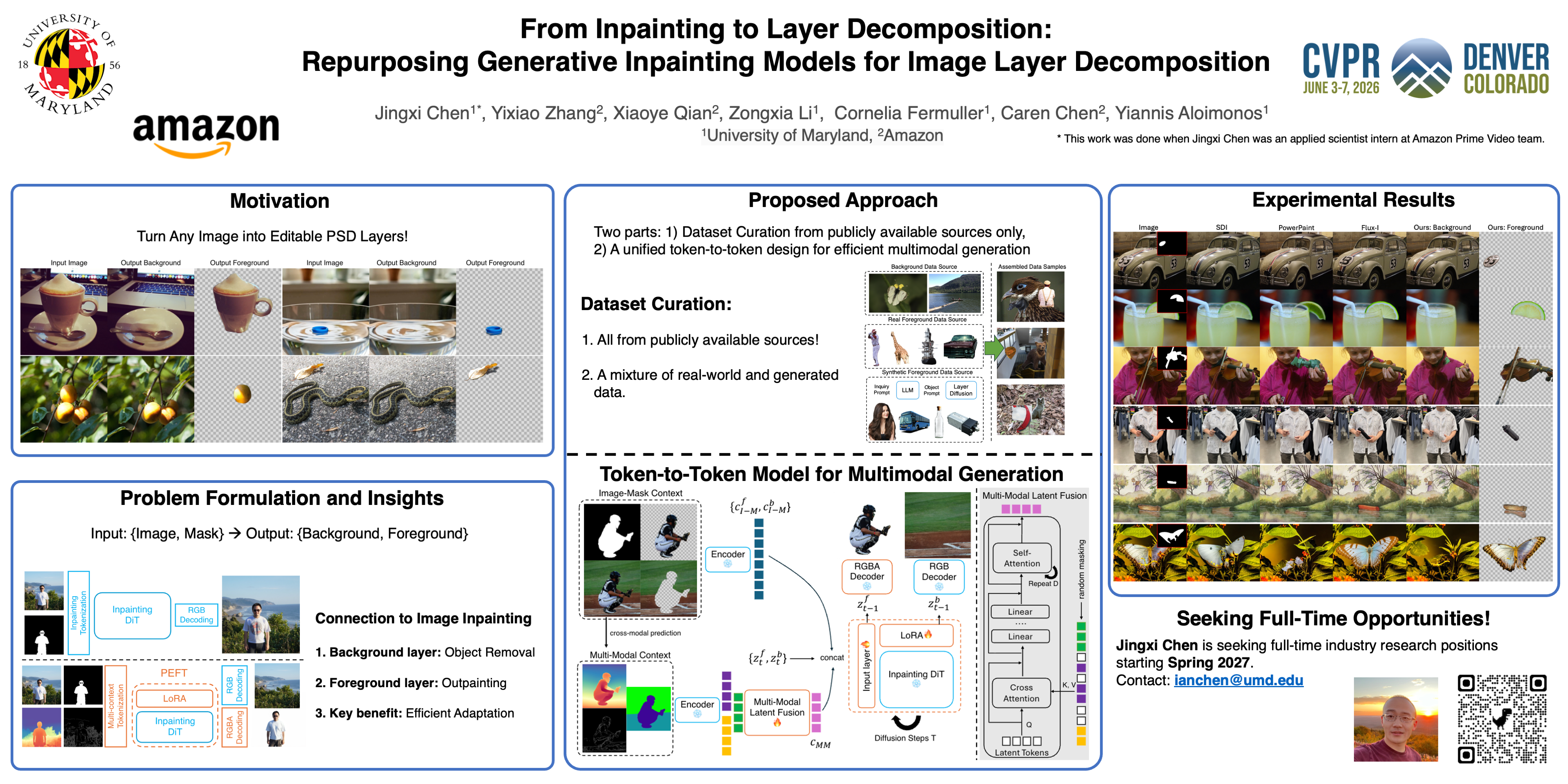
Images can be viewed as layered compositions, foreground objects over background, with potential occlusions. This layered representation enables independent editing of elements, offering greater flexibility for content creation. Despite the progress in large generative models, decomposing a single image into layers remains challenging due to limited methods and data. We observe a strong connection between layer decomposition and in/outpainting tasks, and propose adapting a diffusion-based inpainting model for layer decomposition using lightweight finetuning. To further preserve detail in the latent space, we introduce a novel multi-modality context fusion module with linear attention complexity. Our model is trained purely on a synthetic dataset constructed from open-source assets and achieves superior performance in object removal and occlusion recovery, unlocking new possibilities in downstream editing and creative applications.
Temporal Equilibrium MeanFlow: Bridging the Scale Gap for One-Step Generation
Yuanpeng Tu ⋅ Yunpeng Chen ⋅ Xinyu Zhang ⋅ Chao Liao ⋅ Hengshuang Zhao
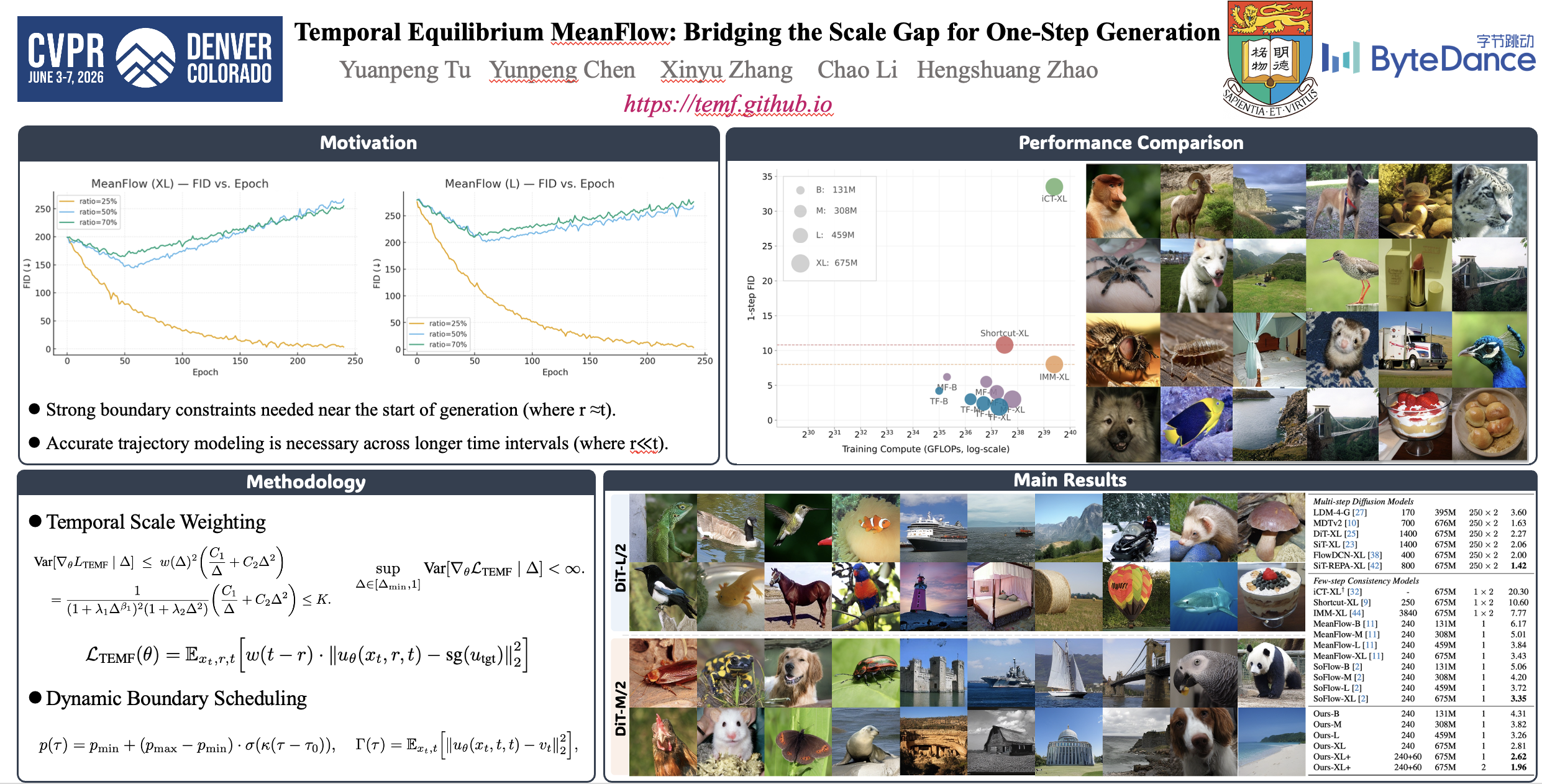
MeanFlow is a powerful few-step generative framework that can be trained from scratch, but its performance degrades significantly when the one-step loss uses a large portion of training data. This stems from a temporal scale imbalance: gradients from different stages of generation contribute unevenly, leading to unstable optimization—evident in blurry samples and high FID scores. The core issue is a conflict between two opposing forces: terms that amplify variance over long time spans and strong constraints needed near the start of generation, which a fixed sampling strategy cannot reconcile. To resolve this, we propose Temporal Equilibrium MeanFlow (TEMF), which balances these competing demands through two simple yet effective components: (1) a temporal equilibrium weighting function that equalizes gradient influence across all time scales, and (2) a dynamic boundary scheduler that gradually shifts training focus—from stabilizing early steps to refining the full trajectory as training progresses. Without changing the model architecture, TEMF retains true one-step generation with classifier-free guidance, achieving a state-of-the-art FID of 2.62 on ImageNet 256×256—achieving the best results among diffusion- and flow-based one-step methods.
PROMO: Promptable Outfitting for Efficient High-Fidelity Virtual Try-On
Haohua Chen ⋅ Tianze Zhou ⋅ Wei Zhu ⋅ Runqi Wang ⋅ Yandong Guan ⋅ Dejia Song ⋅ Yibo Chen ⋅ Xu Tang ⋅ Yao Hu ⋅ Lu Sheng ⋅ Zhiyong Wu
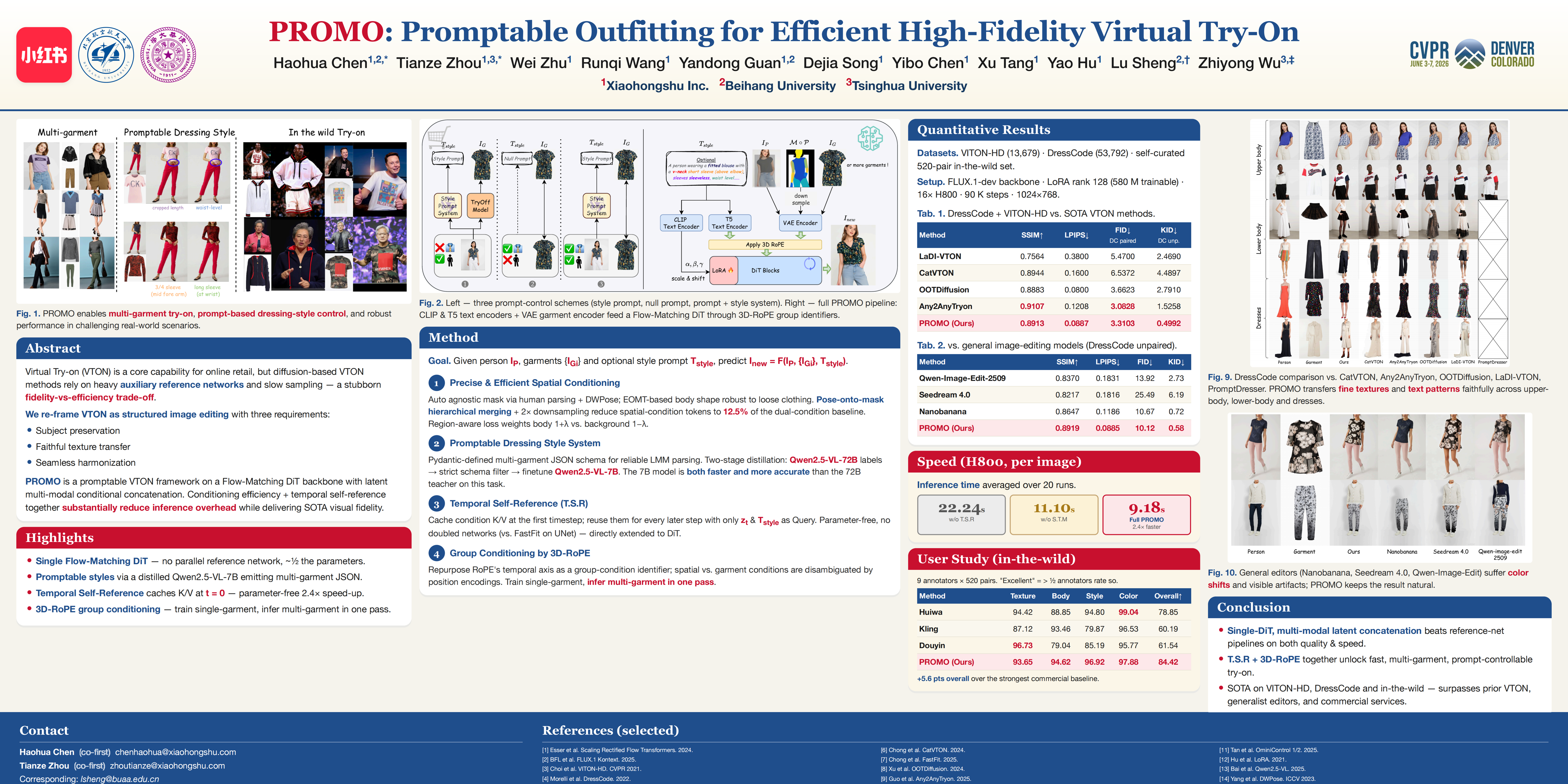
Virtual Try-on (VTON) has become a core capability for online retail, where realistic try-on results provide reliable fit guidance, reduce returns, and benefit both consumers and merchants. Diffusion-based VTON methods achieve photorealistic synthesis, yet often rely on intricate architectures such as auxiliary reference networks and suffer from slow sampling, making the trade-off between fidelity and efficiency a persistent challenge.We approach VTON as a structured image editing problem that demands strong conditional generation under three key requirements: subject preservation, faithful texture transfer, and seamless harmonization. Under this perspective, our training framework is generic and transfers to broader image editing tasks. Moreover, the paired data produced by VTON constitutes a rich supervisory resource for training general-purpose editors.We present PROMO, a promptable virtual try-on framework built upon a Flow Matching DiT backbone with latent multi-modal conditional concatenation. By leveraging conditioning efficiency and self-reference mechanisms, our approach substantially reduces inference overhead. On standard benchmarks, PROMO surpasses both prior VTON methods and general image editing models in visual fidelity while delivering a competitive balance between quality and speed. These results demonstrate that flow-matching transformers, coupled with latent multi-modal conditioning and self-reference acceleration, offer an effective and training-efficient solution for high-quality virtual try-on.
Harmony: Harmonizing Audio and Video Generation through Cross-Task Synergy
Teng Hu ⋅ Zhentao Yu ⋅ Guozhen Zhang ⋅ Zihan Su ⋅ zhengguang zhou ⋅ Youliang Zhang ⋅ Yuan Zhou ⋅ qinglin lu ⋅ Ran Yi
The synthesis of synchronized audio-visual content is a key challenge in generative AI, with open-source models facing challenges in robust audio-video alignment. Our analysis reveals that this issue is rooted in three fundamental challenges of the joint diffusion process: (1) Correspondence Drift, where concurrently evolving noisy latents impede stable learning of alignment; (2) inefficient global attention mechanisms that fail to capture fine-grained temporal cues; and (3) the intra-modal bias of conventional Classifier-Free Guidance (CFG), which enhances conditionality but not cross-modal synchronization.To overcome these challenges, we introduce Harmony, a novel framework that mechanistically enforces audio-visual synchronization. We first propose a Cross-Task Synergy training paradigm to mitigate drift by leveraging strong supervisory signals from audio-driven video and video-driven audio generation tasks. Then, we design a Global-Local Decoupled Interaction Module for efficient and precise temporal-style alignment. Finally, we present a novel Synchronization-Enhanced CFG (SyncCFG) that explicitly isolates and amplifies the alignment signal during inference. Extensive experiments demonstrate that Harmony establishes a new state-of-the-art, significantly outperforming existing methods in both generation fidelity and, critically, in achieving fine-grained audio-visual synchronization.
UniSER: A Foundation Model for Unified Soft Effects Removal
Jingdong Zhang ⋅ Lingzhi Zhang ⋅ Qing Liu ⋅ Mang Tik Chiu ⋅ Connelly Barnes ⋅ Yizhou Wang ⋅ Haoran You ⋅ Xiaoyang Liu ⋅ Yuqian Zhou ⋅ Zhe Lin ⋅ Eli Shechtman ⋅ Sohrab Amirghodsi ⋅ Xin Li ⋅ Wenping Wang ⋅ Xiaohang Zhan
Digital images are often degraded by soft effects such as lens flare, haze, shadows, and reflections, which reduce aesthetics even though the underlying pixels remain partially visible. The prevailing works address these degradations in isolation, developing highly specialized, specialist models that lack scalability and fail to exploit the shared underlying essences of these restoration problems. While specialist models are limited, recent large-scale pretrained generalist models offer powerful, text-driven image editing capabilities. while recent general-purpose systems (e.g., GPT-4o, Flux Kontext, Nano Banana) require detailed prompts and often fail to achieve robust removal on these fine-grained tasks or preserve identity of the scene. Leveraging the common essence of soft effects, i.e., semi-transparent occlusions, we introduce a foundational versatile model UniSER, capable of addressing diverse degradations caused by soft effects within a single framework. Our methodology centers on curating a massive 3.8M-pair dataset to ensure robustness and generalization, which includes novel, physically-plausible data to fill critical gaps in public benchmarks, and a tailored training pipeline that fine-tunes a Diffusion Transformer to learn robust restoration priors from this diverse data, integrating fine-grained mask and strength controls. This synergistic approach allows UniSER to significantly outperform both specialist and generalist models, achieving robust, high-fidelity restoration in the wild.
EffectMaker: Unifying Reasoning and Generation for Customized Visual Effect Creation
Shiyuan Yang ⋅ Ruihuang Li ⋅ Jiale Tao ⋅ Shuai Shao ⋅ qinglin lu ⋅ Jing Liao
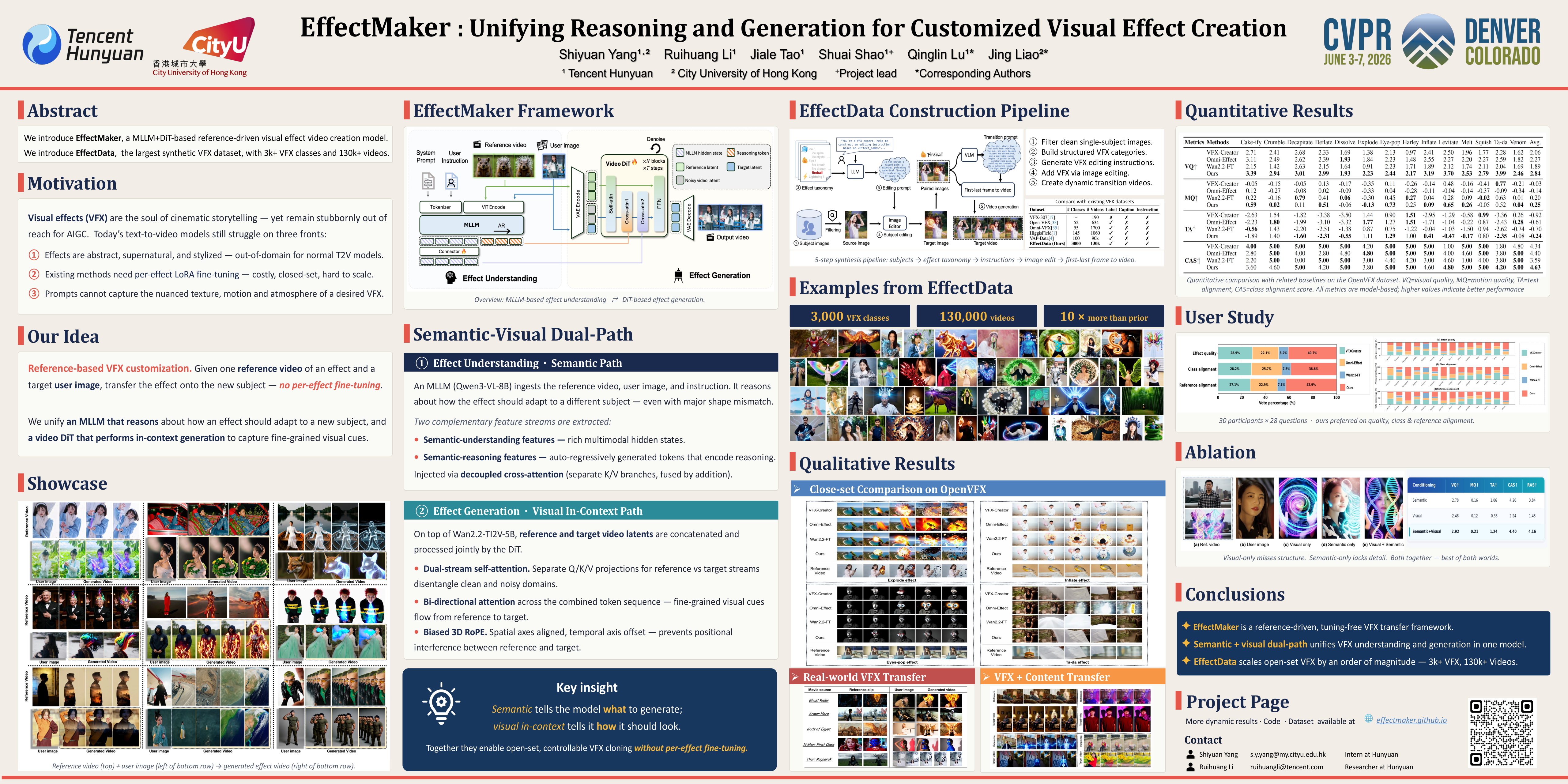
Visual effects (VFX) are essential for enhancing the expressiveness and creativity of video content, yet producing high-quality effects typically requires expert knowledge and costly production pipelines. Existing AIGC systems face significant challenges in VFX generation due to the scarcity of effect-specific data and the inherent difficulty of modeling supernatural or stylized effects. Moreover, these approaches often require per-effect fine-tuning, which severely limits their scalability and generalization to novel VFX.In this work, we present EffectMaker, a unified reasoning–generation framework that enables reference-based VFX customization. EffectMaker employs a multimodal large language model to interpret high-level effect semantics and reason about their adaptation to a target subject, while a diffusion transformer leverages in-context learning to capture fine-grained visual cues from reference videos. These two components form a semantic–visual dual-path guidance mechanism that enables accurate, controllable, and effect-consistent synthesis without per-effect fine-tuning.Furthermore, we construct EffectData, a largest and high-quality synthetic dataset containing 100K videos across 2K VFX categories, to enhance generalization and scalability. Experiments show that EffectMaker achieves superior visual quality and effect consistency over state-of-the-art baselines, offering a scalable and flexible paradigm for customized VFX generation. Code and data will be released upon acceptance.
Inference-time Physics Alignment of Video Generative Models with Latent World Models
Jianhao Yuan ⋅ Zhang Xiaofeng ⋅ Felix Friedrich ⋅ Nicolas Beltran-Velez ⋅ Melissa Hall ⋅ Reyhane Askari ⋅ Xiaochuang Han ⋅ Nicolas Ballas ⋅ Michal Drozdzal ⋅ Adriana Romero-Soriano
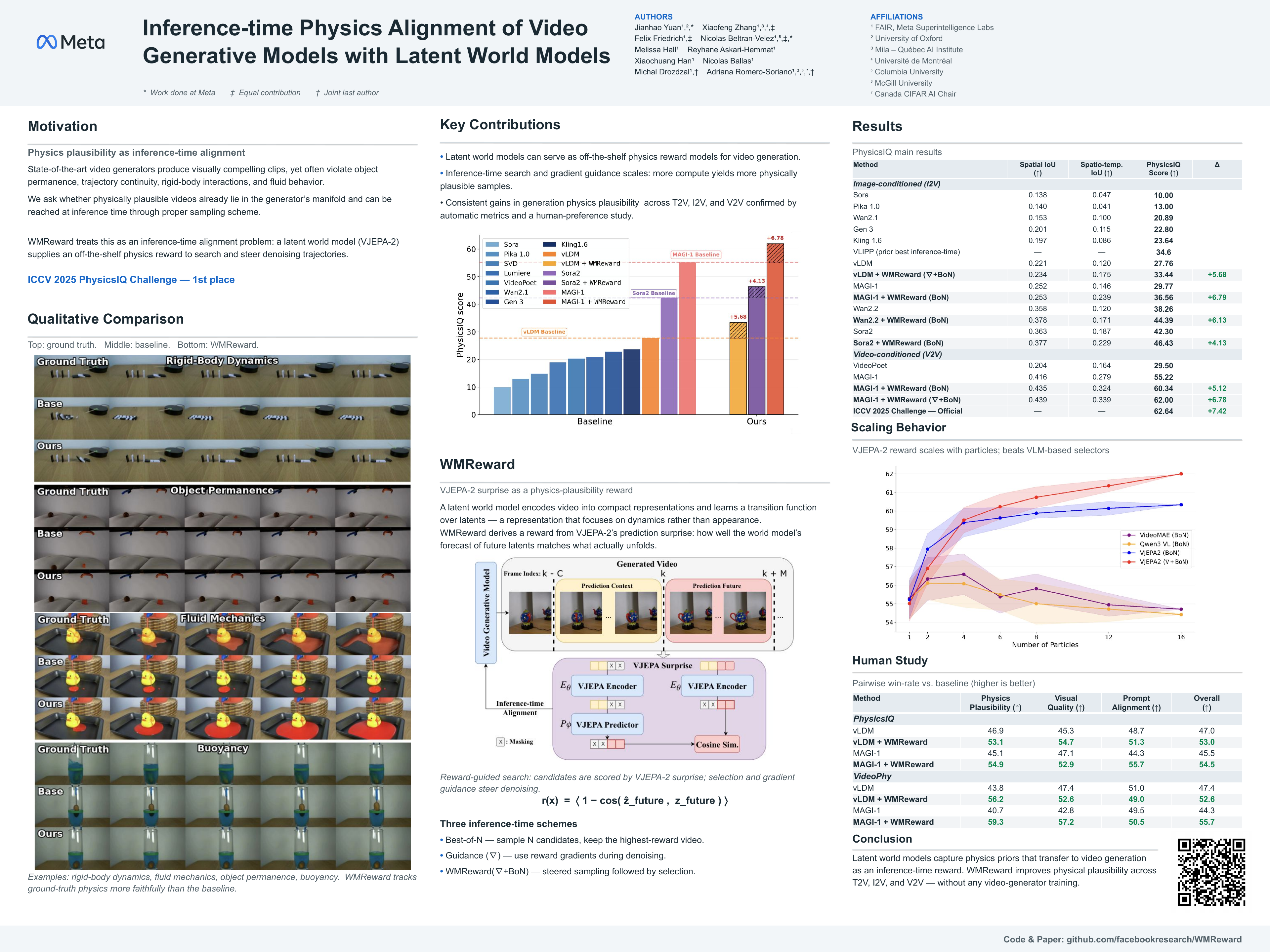
State-of-the-art video generative models produce promising visual content yet often violate basic physics principles, limiting their utility. While some attribute this deficiency to insufficient physics understanding from pre-training, we find that the shortfall in physics plausibility also stems from suboptimal inference strategies. We therefore introduce WMReward and treat improving physics plausibility of video generation as an inference-time alignment problem. In particular, we leverage the strong physics prior of a latent world model (here, VJEPA-2) as a reward to search and steer multiple candidate denoising trajectories, enabling scaling test-time compute for better generation performance. Empirically, our approach substantially improves physics plausibility across image-conditioned, multiframe-conditioned, and text-conditioned generation settings, with validation from human preference study. Notably, on the challenging PhysicsIQ benchmark we achieve 62.00% final score, outperforming previous state of the art by 6.78%. Our work demonstrates the viability of using latent world models to improve physical plausibility of video generation, beyond this specific instantiation or parameterization.
SMRABooth: Subject and Motion Representation Alignment for Customized Video Generation
Xuancheng Xu ⋅ Li Yaning ⋅ Sisi You ⋅ Bing-Kun Bao
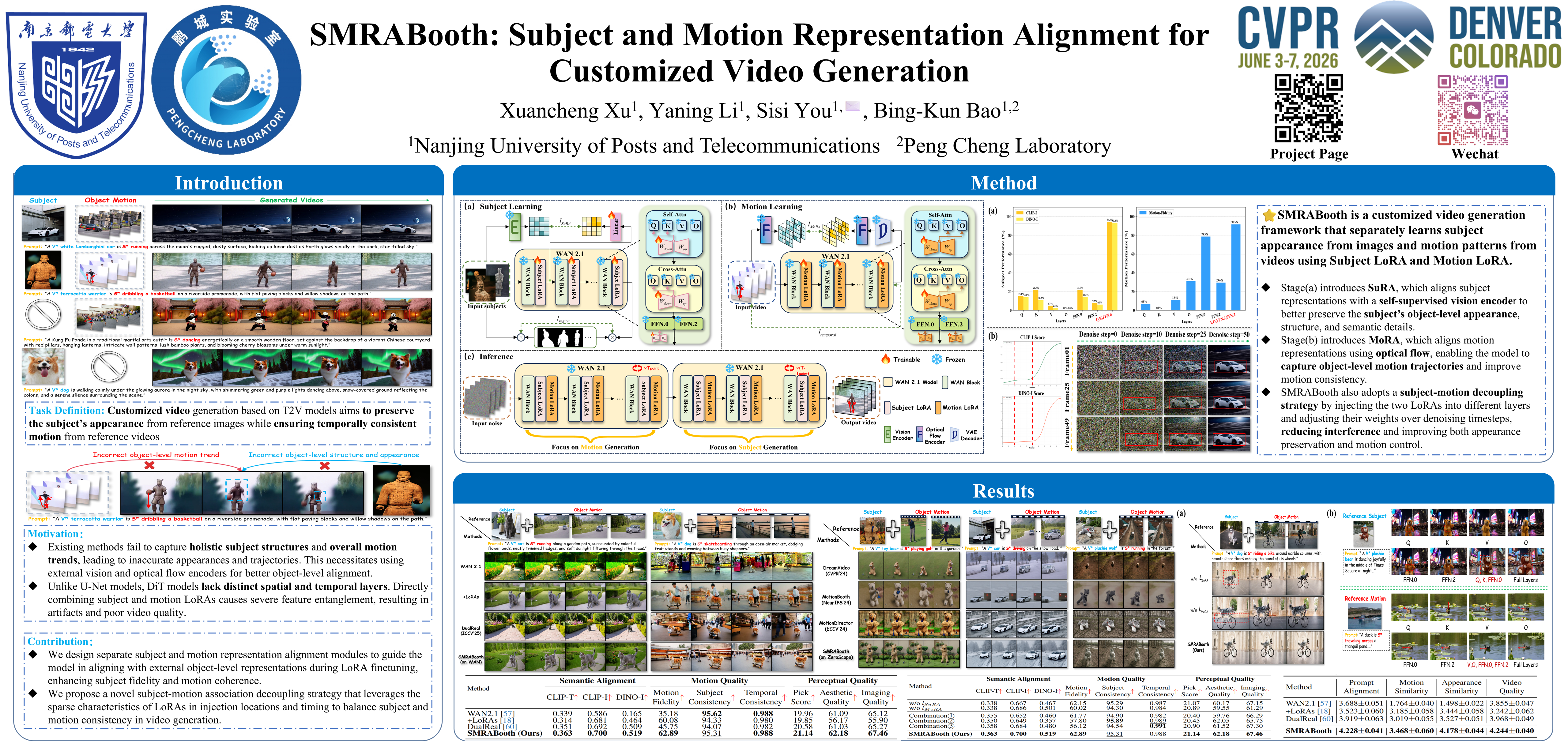
Customized video generation aims to produce videos that faithfully preserve the subject's appearance from reference images while maintaining temporally consistent motion from reference videos. Existing methods struggle to ensure both subject appearance similarity and motion pattern consistency due to the lack of object-level guidance for subject and motion. To address this, we propose SMRABooth, which leverages the self-supervised encoder and optical flow encoder to provide object-level subject appearance and motion representations. These representations are aligned with the model during the LoRA fine-tuning process. Our approach is structured in three core stages: (1) We exploit subject representations via a self-supervised encoder to guide subject alignment, enabling the model to capture overall structure of subject and enhance high-level semantic consistency. (2) We utilize motion representations from an optical flow encoder to capture structurally coherent and object-level motion trajectories independent of appearance. (3) We propose a subject-motion association decoupling strategy that applies sparse LoRAs injection across both locations and timing, effectively reducing interference between subject and motion LoRAs. Extensive experiments show that SMRABooth excels in subject and motion customization, maintaining consistent subject appearance and motion patterns, proving its effectiveness in controllable text-to-video generation.
Plenoptic Video Generation
Xiao Fu ⋅ Shitao Tang ⋅ Min Shi ⋅ Xian Liu ⋅ Jinwei Gu ⋅ Ming-Yu Liu ⋅ Dahua Lin ⋅ Chen-Hsuan Lin
Camera-controlled generative video re-rendering methods, such as ReCamMaster, have achieved remarkable progress. However, despite their success in single-view setting, these works often struggle to maintain consistency across multi-view scenarios. Ensuring spatio-temporal coherence in hallucinated regions remains challenging due to the inherent stochasticity of generative models. To address it, we introduce PlenopticDreamer, a framework that synchronizes generative hallucinations to maintain spatio-temporal memory. The core idea is to train a multi-in-single-out video-conditioned model in an autoregressive manner, aided by a camera-guided video retrieval strategy that adaptively selects salient videos from previous generations as conditional inputs. In addition, Our training incorporates progressive context-scaling to improve convergence, self-conditioning to enhance robustness against long-range visual degradation caused by error accumulation, and a long-video conditioning mechanism to support extended video generation. Extensive experiments on the Basic and Agibot benchmarks demonstrate that PlenopticDreamer achieves state-of-the-art video re-rendering, delivering superior view synchronization, high-fidelity visuals, accurate camera estimation, and diverse view transformations (e.g., third-person → third-person, and head-view → gripper-view in robotic manipulation).
PyramidalWan: On Making Pretrained Video Model Pyramidal for Efficient Inference
Denis Korzhenkov ⋅ Adil Karjauv ⋅ Animesh Karnewar ⋅ Mohsen Ghafoorian ⋅ Amir Habibian
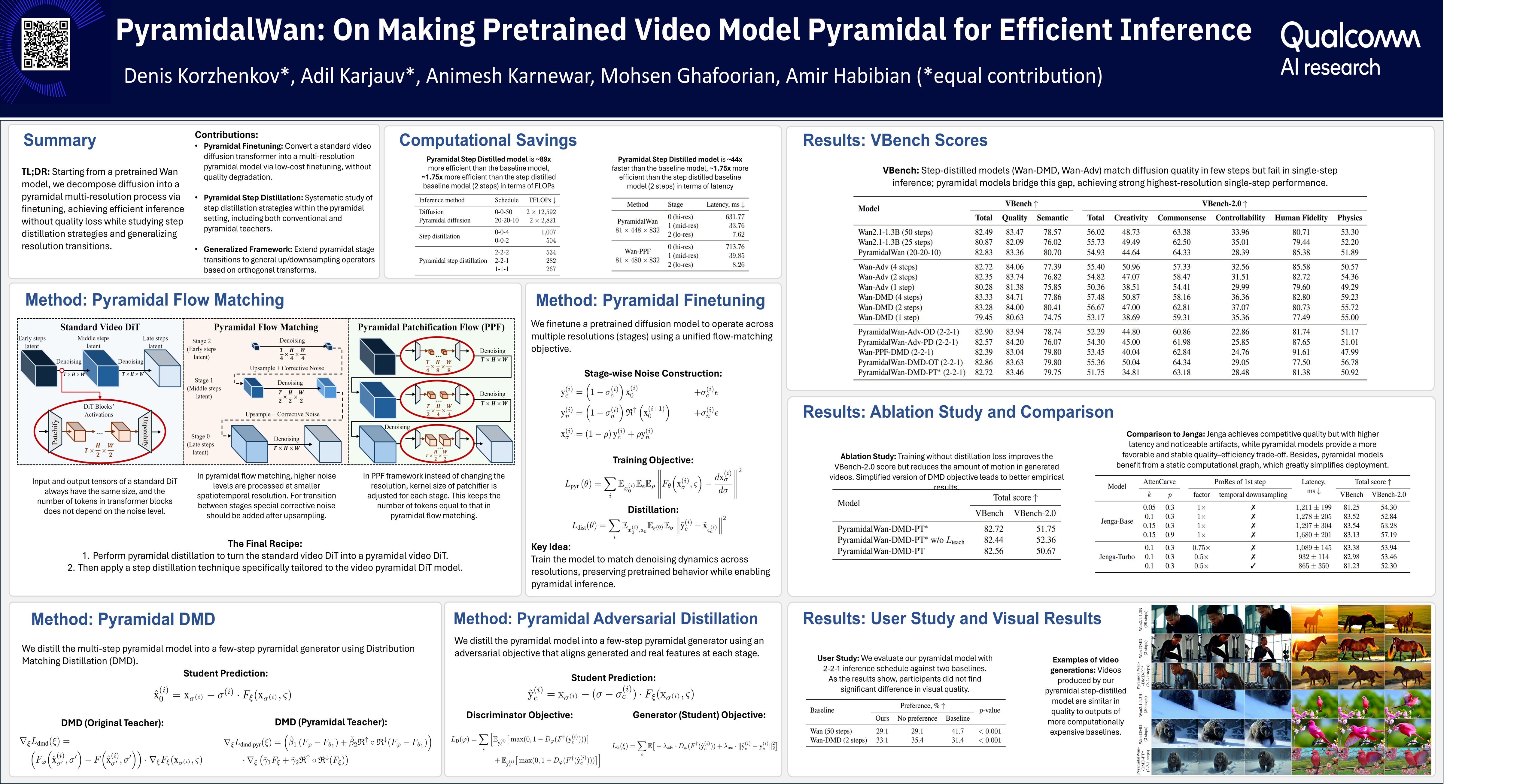
Recently proposed pyramidal models decompose the conventional forward and backward diffusion processes into multiple stages operating at varying resolutions. These models handle inputs with higher noise levels at lower resolutions, while less noisy inputs are processed at higher resolutions. This hierarchical approach significantly reduces the computational cost of inference in multi-step denoising models. However, existing open-source pyramidal video models have been trained from scratch and tend to underperform compared to state-of-the-art systems in terms of visual plausibility.In this work, we present a pipeline that converts a pretrained diffusion model into a pyramidal one through low-cost finetuning, achieving this transformation without degradation in quality of output videos.Furthermore, we investigate and compare various strategies for step distillation within pyramidal models, aiming to further enhance the inference efficiency.
AdapTok: Learning Adaptive and Temporally Causal Video Tokenization in a 1D Latent Space
Yan Li ⋅ Changyao TIAN ⋅ Renqiu Xia ⋅ Ning Liao ⋅ Weiwei Guo ⋅ Hongsheng Li ⋅ Jifeng Dai ⋅ Hao Li ⋅ Xue Yang
We propose AdapTok, an adaptive temporal causal video tokenizer that can flexibly allocate tokens for different frames based on video content. AdapTok is equipped with a block-wise masking strategy that randomly drops tail tokens of each block during training, and a block causal scorer to predict the reconstruction quality of video frames using different numbers of tokens. During inference, an adaptive token allocation strategy based on integer linear programming is further proposed to adjust token usage given predicted scores. Such design allows for sample-wise, content-aware, and temporally dynamic token allocation under a controllable overall budget. Extensive experiments for video reconstruction and generation on UCF-101 and Kinetics-600 demonstrate the effectiveness of our approach. Without additional image data, AdapTok consistently improves reconstruction quality and generation performance under different token budgets, allowing for more scalable and token-efficient generative video modeling.
OneStory: Coherent Multi-Shot Video Generation with Adaptive Memory
Zhaochong An ⋅ Menglin Jia ⋅ Haonan Qiu ⋅ Zijian Zhou ⋅ Xiaoke Huang ⋅ Zhiheng Liu ⋅ Weiming Ren ⋅ Kumara Kahatapitiya ⋅ Ding Liu ⋅ Sen He ⋅ Chenyang Zhang ⋅ Tao Xiang ⋅ Fanny Yang ⋅ Serge Belongie ⋅ Tian Xie
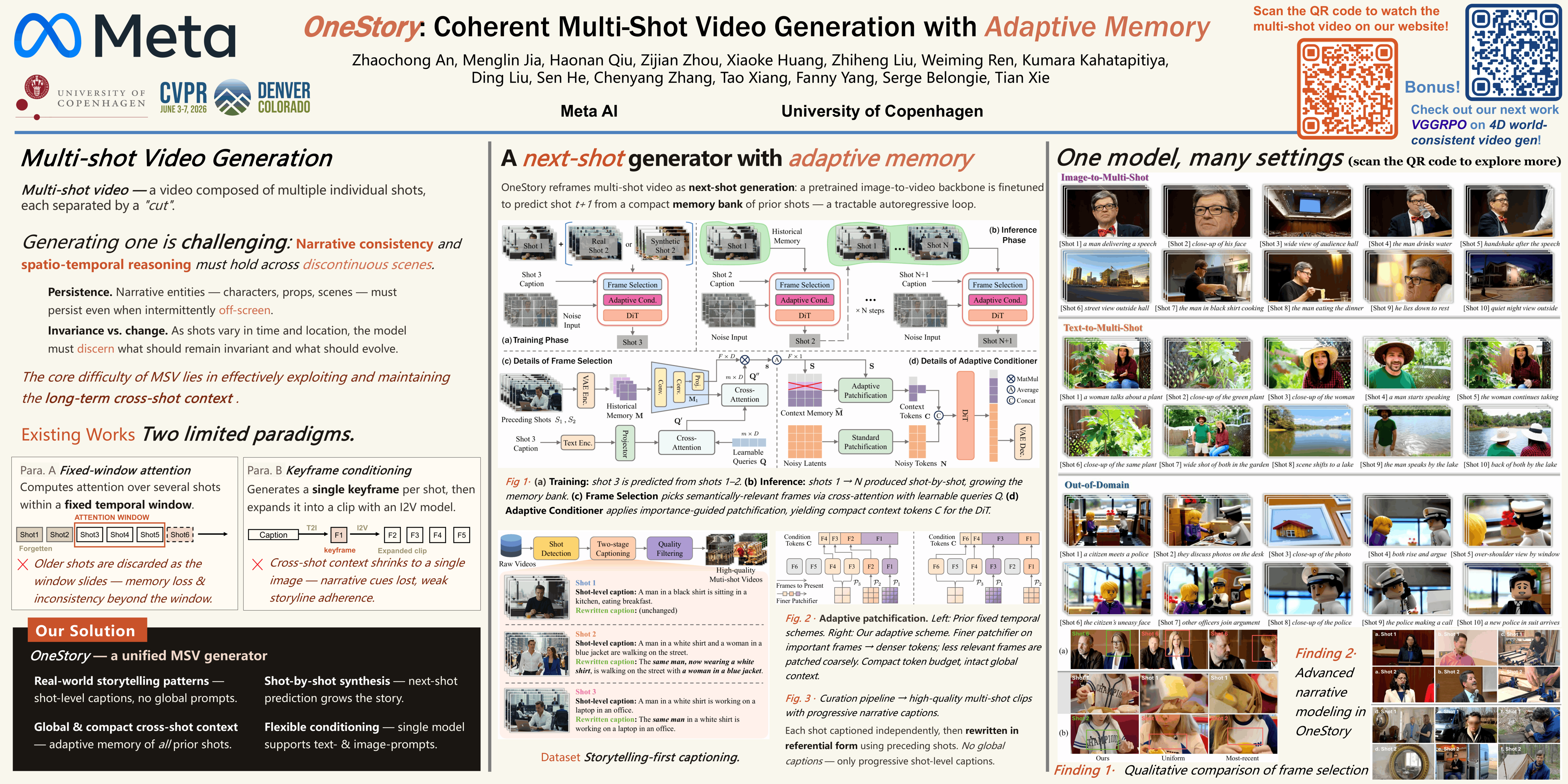
Storytelling in real-world videos often unfolds through multiple shots—discontinuous yet semantically connected clips that together convey a coherent narrative. However, existing multi-shot video generation (MSV) methods struggle to effectively model long-range cross-shot context, as they rely on limited temporal windows or single keyframe conditioning, leading to degraded performance under complex narratives. In this work, we propose OneStory, enabling global yet compact cross-shot context modeling for consistent and scalable narrative generation. OneStory reformulates MSV as a next-shot generation task, enabling autoregressive shot synthesis while leveraging pretrained image-to-video (I2V) models for strong visual conditioning. We introduce two key modules: a Frame Selection module that constructs a semantically-relevant global memory based on informative frames from prior shots, and an Adaptive Conditioner that performs importance-guided patchification to generate compact context for direct conditioning. We further curate a high-quality multi-shot dataset with referential captions to mirror real-world storytelling patterns, and design effective training strategies under the next-shot paradigm. Finetuned from a pretrained I2V model on our curated 60K dataset, OneStory achieves state-of-the-art narrative coherence across diverse and complex scenes in both text- and image-conditioned settings, enabling controllable and immersive long-form video storytelling. Our model and data will be released with the paper.
Flowception: Temporally Expansive Flow Matching for Video Generation
Tariq Berrada Ifriqi ⋅ John Nguyen ⋅ Karteek Alahari ⋅ Jakob Verbeek ⋅ Ricky T. Q. Chen
We present Flowception, a novel non-autoregressive and variable-length video generation framework. Flowception learns a probability path that interleaves discrete frame insertions with continuous frame denoising. Compared to autoregressive methods, Flowception alleviates error accumulation/drift as the frame insertion mechanism during sampling serves as an efficient compression mechanism to handle long-term context. Compared to full-sequence flows, our method reduces FLOPs for training three-fold, while also being more amenable to local attention variants, and allowing to learn the length of videos jointly with their content. Quantitative experimental results show improved FVD and VBench metrics over autoregressive and full-sequence baselines, which is further validated with qualitative results. Finally, by learning to insert and denoise frames in a sequence, Flowception seamlessly integrates different tasks such as image-to-video generation and video interpolation.
Qwen-Image-Layered: Towards Inherent Editability via Layer Decomposition
Shengming Yin ⋅ Zekai Zhang ⋅ Zecheng Tang ⋅ Kaiyuan Gao ⋅ Xiao Xu ⋅ Kun Yan ⋅ Jiahao Li ⋅ Yilei chen ⋅ Yuxiang Chen ⋅ Heung-Yeung Shum ⋅ Lionel M. Ni ⋅ Junyang Lin ⋅ Chenfei Wu
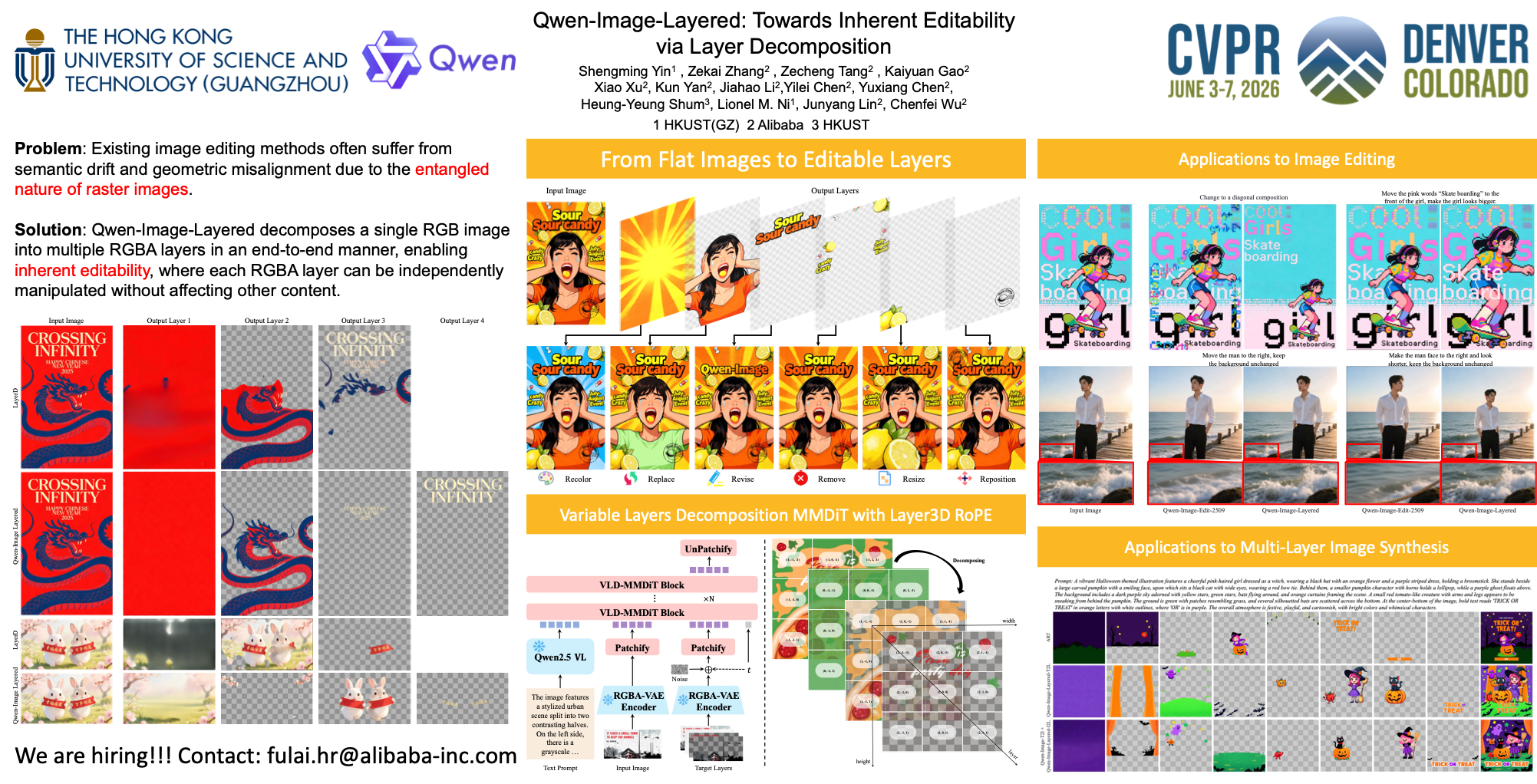
Recent visual generative models often struggle with consistency during image editing due to the entangled nature of raster images, where all visual content is fused into a single canvas. In contrast, professional design tools employ layered representations, allowing isolated edits while preserving consistency. Motivated by this, we propose Qwen-Image-Layered, an end-to-end diffusion model that decomposes a single RGB image into multiple semantically disentangled RGBA layers, enabling inherent editability, where each RGBA layer can be independently manipulated without affecting other content. To support variable-length decomposition, we introduce three key components: (1) an RGBA-VAE to unify the latent representations of RGB and RGBA images; (2) a VLD-MMDiT (Variable Layers Decomposition MMDiT) architecture capable of decomposing a variable number of image layers; and (3) a Multi-stage Training strategy to adapt a pretrained image generation model into a multilayer image decomposer. Furthermore, to address the scarcity of high-quality multilayer training images, we build a pipeline to extract and annotate multilayer images from Photoshop documents (PSD). Experiments demonstrate that our method significantly surpasses existing approaches in decomposition quality and establishes a new paradigm for consistent image editing.
Linear Image Generation by Synthesizing Exposure Brackets
Yuekun Dai ⋅ Zhoutong Zhang ⋅ Shangchen Zhou ⋅ Nanxuan Zhao
The life of a photo begins with photons striking the sensor, whose signals are passed through a sophisticated image signal processing (ISP) pipeline to produce a display-referred image. However, such images are no longer faithful to the incident light, being compressed in dynamic range and stylized by subjective preferences. In contrast, RAW images record direct sensor signals before non-linear tone mapping. After camera response curve correction and demosaicing, they can be converted into linear images, which are scene-referred representations that directly reflect true irradiance and are invariant to sensor-specific factors. Since image sensors have better dynamic range and bit depth, linear images contain richer information than display-referred ones, leaving users more room for editing during post-processing. Despite this advantage, current generative models mainly synthesize display-referred images, which inherently limits downstream editing. Generating linear images, however, is quite challenging. Pre-trained VAEs in latent diffusion models struggle to reconstruct linear images due to their higher dynamic range and bit depth, where extreme highlights and shadows cannot be simultaneously preserved. To this end, we represent a linear image as a sequence of exposure brackets—linear sub-images, each capturing a specific portion of the overall dynamic range. Based on this representation, we propose a new DiT-based flow-matching architecture to generate exposure brackets, which can be post-processed to produce a high-quality linear image. We further demonstrate that our approach enables downstream applications such as linear image editing and conditional linear image generation through ControlNet guidance.
Low-Resolution Editing is All You Need for High-Resolution Editing
Junsung Lee ⋅ Hyunsoo Lee ⋅ Yong Jae Lee ⋅ Bohyung Han
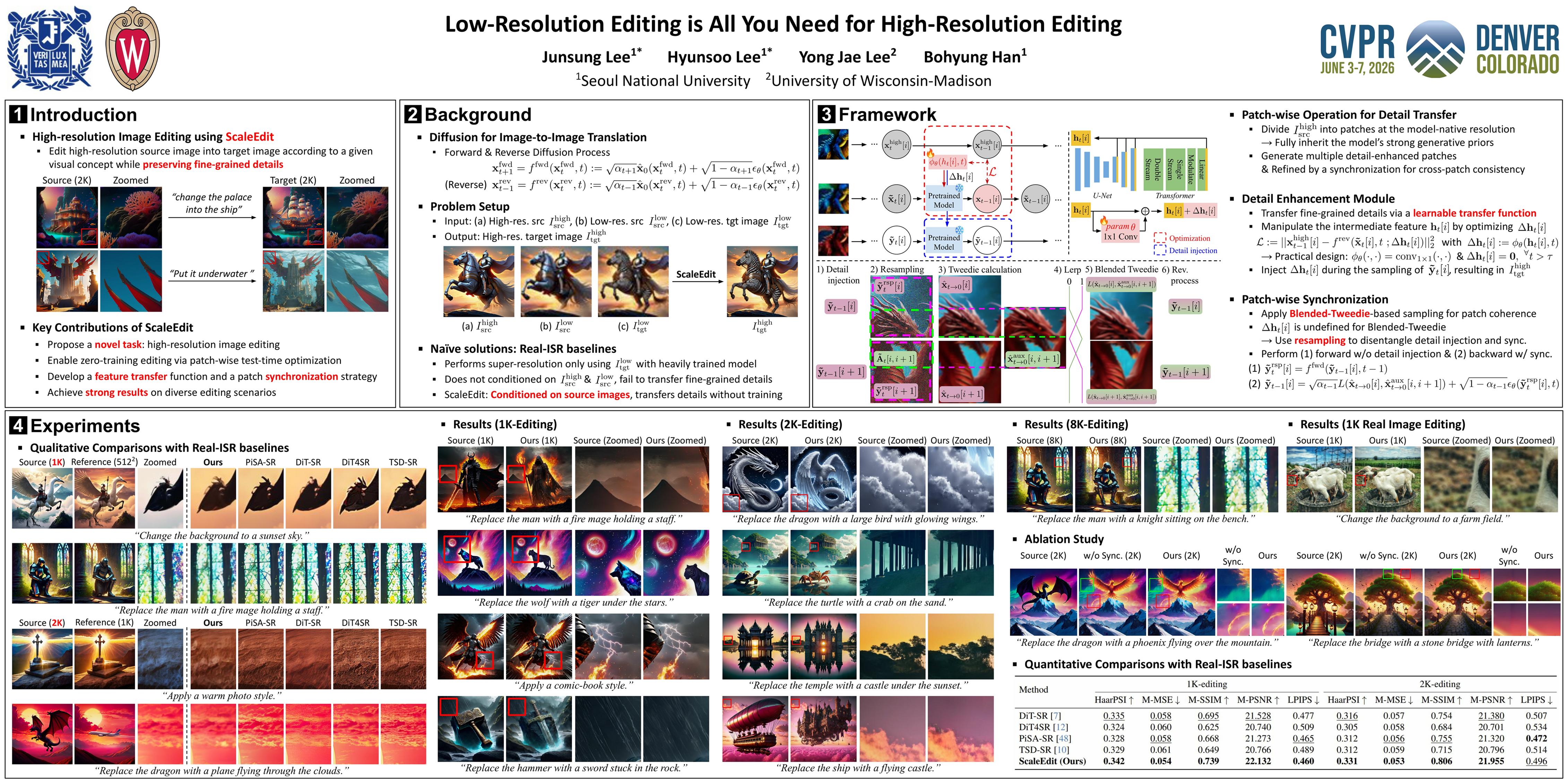
High-resolution content creation is rapidly emerging as a central challenge in both the vision and graphics communities. While images serve as the most fundamental modality for visual expression, content generation that aligns with the user intent requires effective, controllable high-resolution image manipulation mechanisms. However, existing approaches remain limited to low-resolution settings, typically supporting only up to 1K resolution. In this work, we introduce the task of high-resolution image editing and propose a test-time optimization framework to address it. Our method performs patch-wise optimization on high-resolution source images, followed by a fine-grained detail transfer module and a novel synchronization strategy to maintain consistency across patches. Extensive experiments show that our method produces high-quality edits, facilitating the way toward high-resolution content creation.
UniGenDet: A Unified Generative-Discriminative Framework for Co-Evolutionary Image Generation and Generated Image Detection
Yanran Zhang ⋅ Wenzhao Zheng ⋅ Yifei Li ⋅ Bingyao Yu ⋅ Yu Zheng ⋅ Lei Chen ⋅ Jiwen Lu ⋅ Jie Zhou
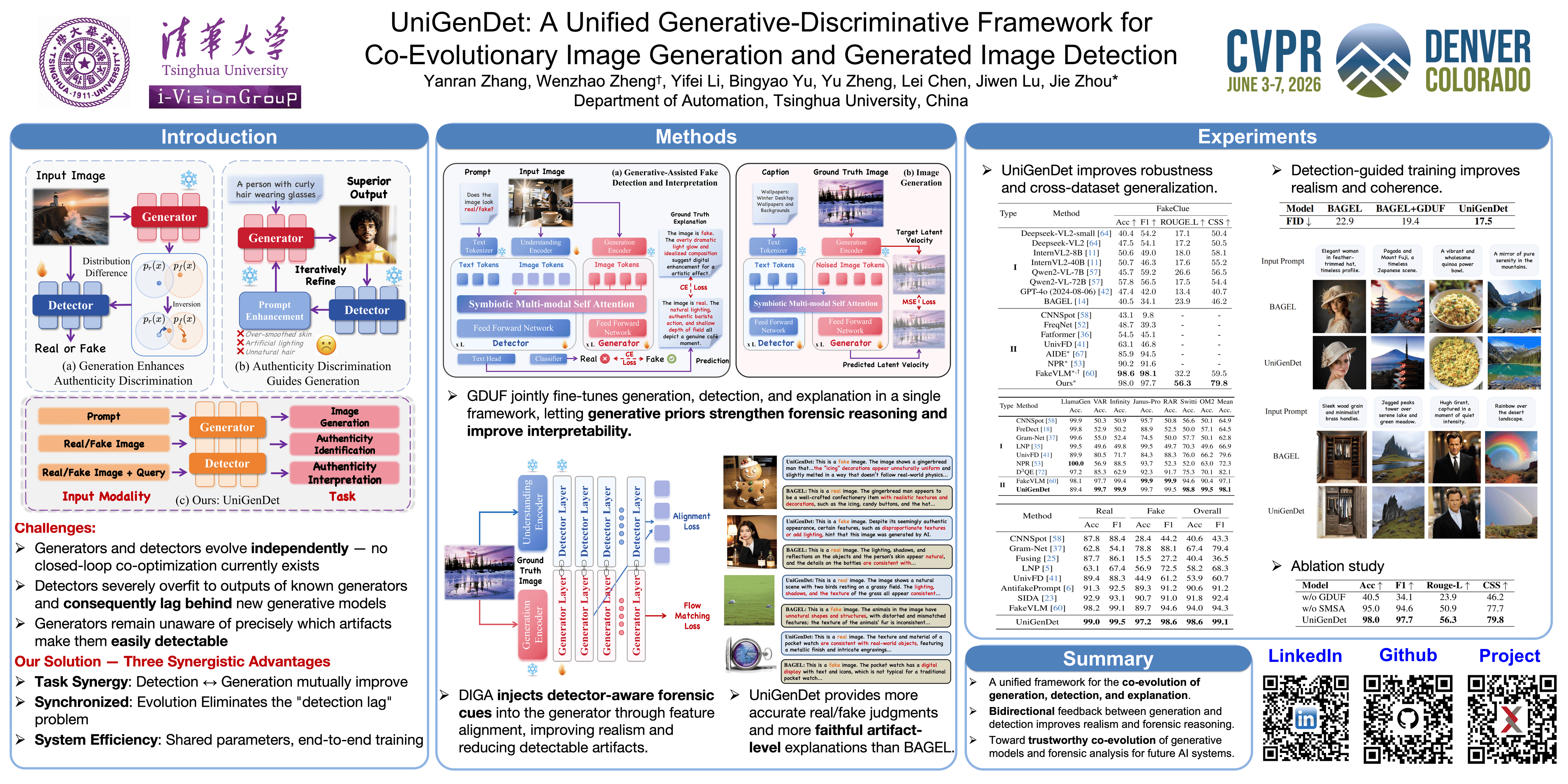
In recent years, significant progress has been made in both image generation and generated image detection. Despite their rapid, yet largely independent, development, these two fields have evolved distinct architectural paradigms: the former predominantly relies on generative networks, while the latter favors discriminative frameworks. A recent trend in both domains is the use of adversarial information to enhance performance, revealing potential for synergy. However, the significant architectural divergence between them presents considerable challenges. Departing from previous approaches, we propose UniGenDet: a Unified generative-discriminative framework for co-evolutionary image Generation and generated image Detection. To bridge the task gap, we design a symbiotic multimodal self-attention mechanism and a unified fine-tuning algorithm. This synergy allows the generation task to improve the interpretability of authenticity identification, while authenticity criteria guide the creation of higher-fidelity images. Furthermore, we introduce a detector-informed generative alignment mechanism to facilitate seamless information exchange. Extensive experiments on multiple datasets demonstrate that our method achieves state-of-the-art performance.
iMontage: Unified, Versatile, Highly Dynamic Many-to-many Image Generation
ZHOUJIE FU ⋅ Xianfang Zeng ⋅ jinghong lan ⋅ Xinyao Liao ⋅ Chen Cheng ⋅ Junyi Chen ⋅ Jiacheng Wei ⋅ Wei Cheng ⋅ Shiyu Liu ⋅ Yunuo Chen ⋅ Gang Yu ⋅ Guosheng Lin
Pre-trained video models learn powerful priors for generating high-quality, temporally coherent content. While these models excel at temporal coherence, their dynamics are often constrained by the continuous nature of their training data. We hypothesize that by injecting the rich and unconstrained content diversity from image data into this coherent temporal framework, we can generate image sets that feature both natural transitions and a far more expansive dynamic range. To this end, we introduce iMontage, a unified framework designed to repurpose a powerful video model into an all-in-one image generator. The framework consumes and produces variable-length image sets, unifying a wide array of image generation and editing tasks. To achieve this, we propose an elegant and minimally invasive adaptation strategy, complemented by a tailored data curation process and training paradigm. This approach allows the model to acquire broad image manipulation capabilities without corrupting its invaluable original motion priors. iMontage excels across several mainstream many-in-many-out tasks, not only maintaining strong cross-image contextual consistency but also generating scenes with extraordinary dynamics that surpass conventional scopes. Our code and model weights will be made publicly available.
VENI: Variational Encoder for Natural Illumination
Paul Walker ⋅ James A. D. Gardner ⋅ Andreea Ardelean ⋅ William A. P. Smith ⋅ Bernhard Egger
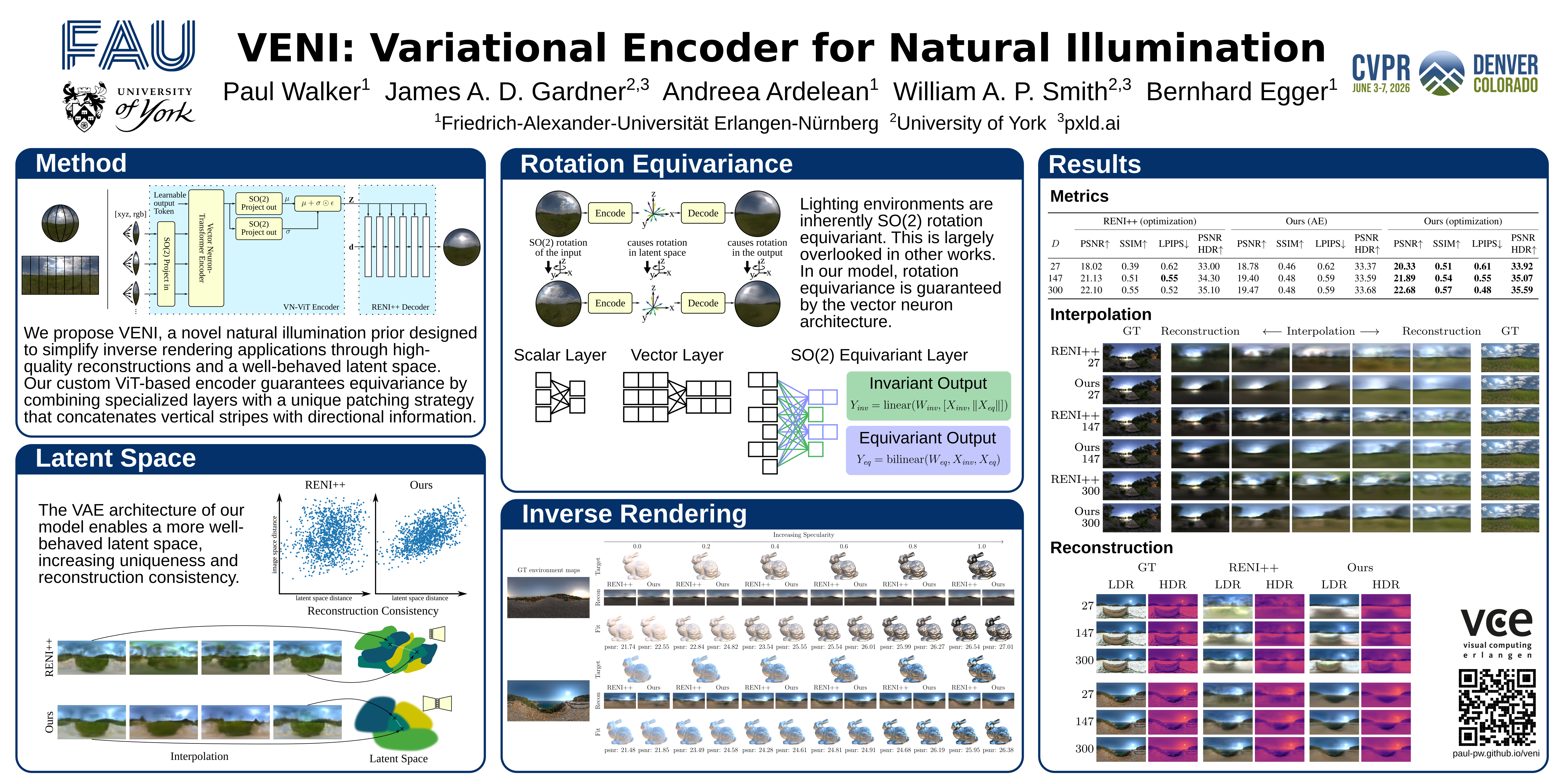
Inverse rendering is an ill-posed problem, but priors like illumination priors, can simplify it.Existing work either disregards the spherical and rotation-equivariant nature of illumination environments or does not provide a well-behaved latent space.We propose a rotation-equivariant variational autoencoder that models natural illumination on the sphere without relying on 2D projections.To preserve the SO(2)-equivariance of environment maps, we use a novel Vector Neuron Vision Transformer (VN-ViT) as encoder and a rotation-equivariant conditional neural field as decoder.In the encoder, we reduce the equivariance from SO(3) to SO(2) using a novel SO(2)-equivariant fully connected layer, an extension of Vector Neurons.We show that our SO(2)-equivariant fully connected layer outperforms standard Vector Neurons when used in our SO(2)-equivariant model.Compared to previous methods, our variational autoencoder enables smoother interpolation in latent space and offers a more well-behaved latent space.
SketchAssist: A Practical Assistant for Semantic Edits and Precise Local Redrawing
Han Zou ⋅ Yan Zhang ⋅ Ruiqi Yu ⋅ Cong Xie ⋅ Jie Huang ⋅ Zhan Zhenpeng
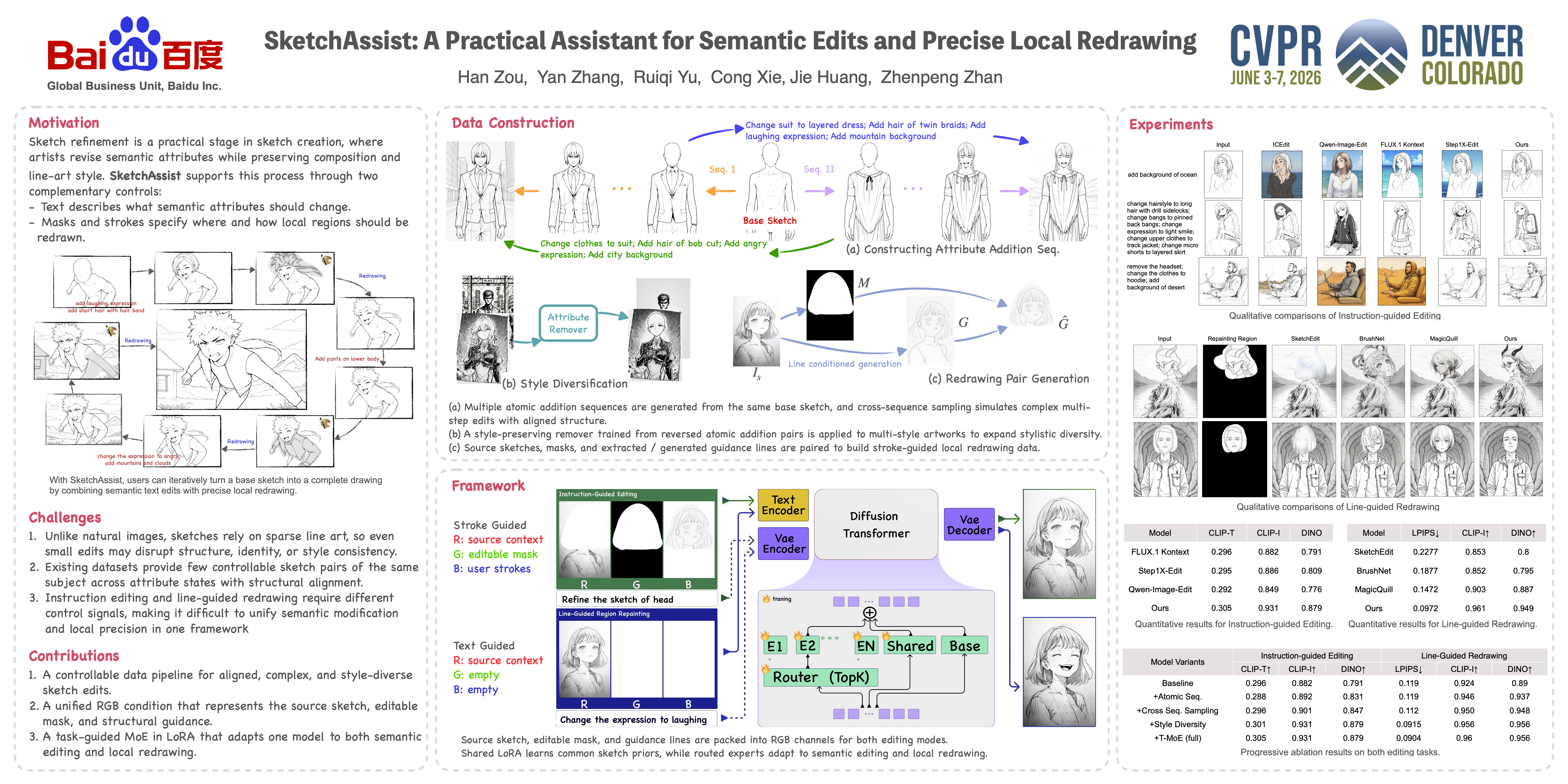
Sketch editing is central to digital illustration, yet existing image editing systems struggle to preserve the sparse, style‑sensitive structure of line art while supporting both high‑level semantic changes and precise local redrawing. We present SketchAssist, an interactive sketch drawing assistant that accelerates creation by unifying instruction‑guided global edits with line‑guided region redrawing, while keeping unrelated regions and overall composition intact. To enable this assistant at scale, we introduce a controllable data generation pipeline that (i) constructs attribute‑addition sequences from attribute‑free base sketches, (ii) forms multi‑step edit chains via cross‑sequence sampling, and (iii) expands stylistic coverage with a style‑preserving attribute‑removal model applied to diverse sketches. Building on this data, SketchAssist employs a unified sketch editing framework with minimal changes to DiT‑based editors. We repurpose the RGB channels to encode the inputs, enabling seamless switching between instruction‑guided edits and line‑guided redrawing within a single input interface. To further specialize behavior across modes, we integrate a task‑guided mixture‑of‑experts into LoRA layers, routing by text and visual cues to improve semantic controllability, structural fidelity, and style preservation.Extensive experiments show state‑of‑the‑art results on both tasks, with superior instruction adherence and style/structure preservation compared to recent baselines. Together, our dataset and SketchAssist provide a practical, controllable assistant for sketch creation and revision
MultiShotMaster: A Controllable Multi-Shot Video Generation Framework
Qinghe Wang ⋅ Xiaoyu Shi ⋅ Baolu Li ⋅ Weikang Bian ⋅ Quande Liu ⋅ Huchuan Lu ⋅ Xintao Wang ⋅ Pengfei Wan ⋅ Kun Gai ⋅ Xu Jia
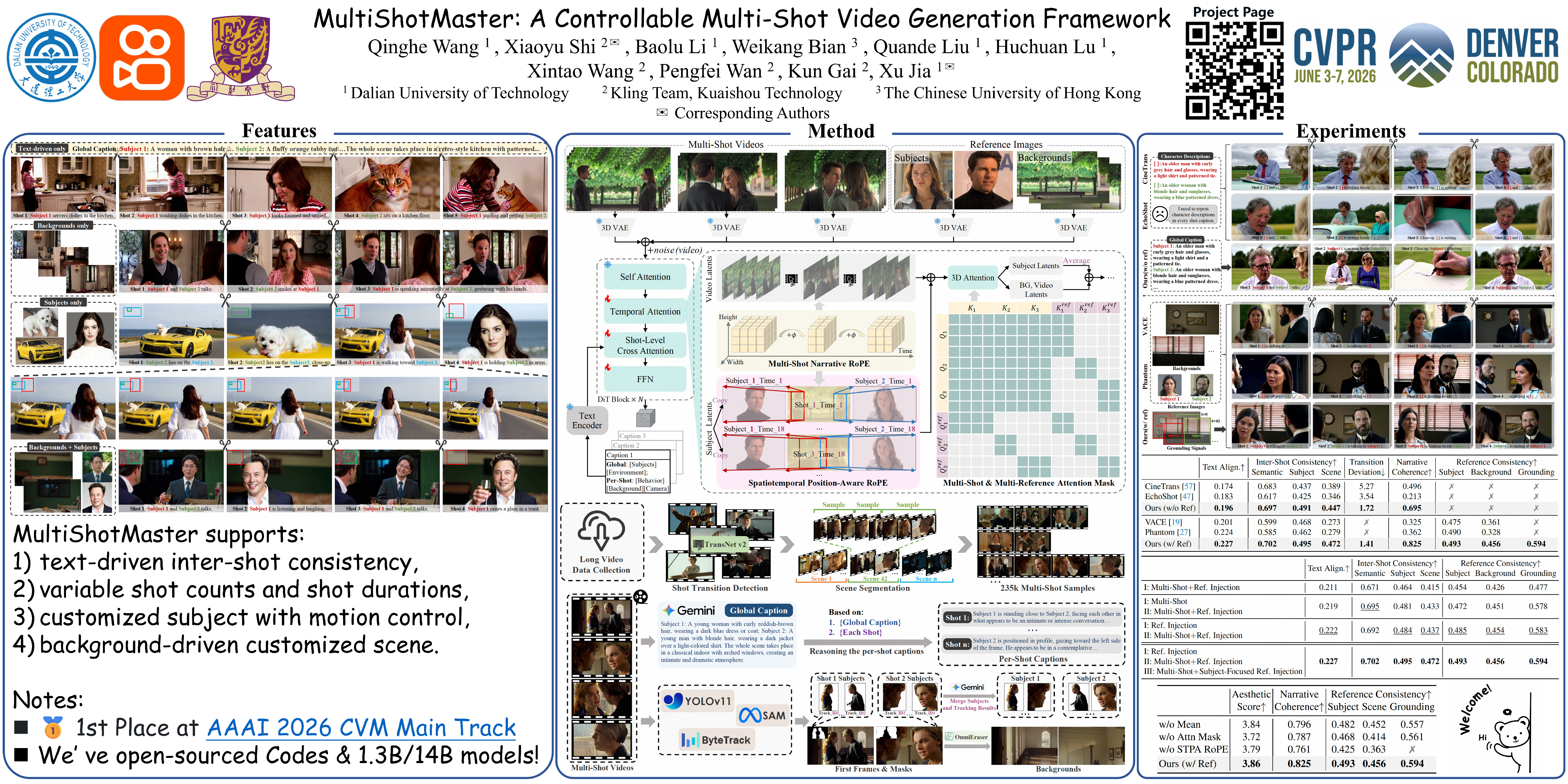
Current video generation techniques excel at single-shot clips but struggle to produce narrative multi-shot videos, which require flexible shot arrangement, coherent narrative, and controllability beyond text prompts. To tackle these challenges, we propose MultiShotMaster, a framework for highly controllable multi-shot video generation. We extend a pretrained single-shot model by integrating two novel variants of RoPE. First, we introduce Multi-Shot Narrative RoPE, which applies explicit phase shift at shot transitions, enabling flexible shot arrangement while preserving the temporal narrative order. Second, we design Spatiotemporal Position-Aware RoPE to incorporate reference tokens and grounding signals, enabling spatiotemporal-grounded reference injection. In addition, to overcome data scarcity, we establish an automated data annotation pipeline to extract multi-shot videos, captions, cross-shot grounding signals and reference images. Our framework leverages the intrinsic architectural properties to support multi-shot video generation, featuring text-driven inter-shot consistency, customized subject with motion control, and background-driven customized scene. Both shot count and duration are flexibly configurable. Extensive experiments demonstrate the superior performance and outstanding controllability of our framework.
MoCha: End-to-End Video Character Replacement without Structural Guidance
Zhengbo Xu ⋅ Jie Ma ⋅ Ziheng Wang ⋅ Zhan Peng ⋅ Jun Liang ⋅ Jing Li
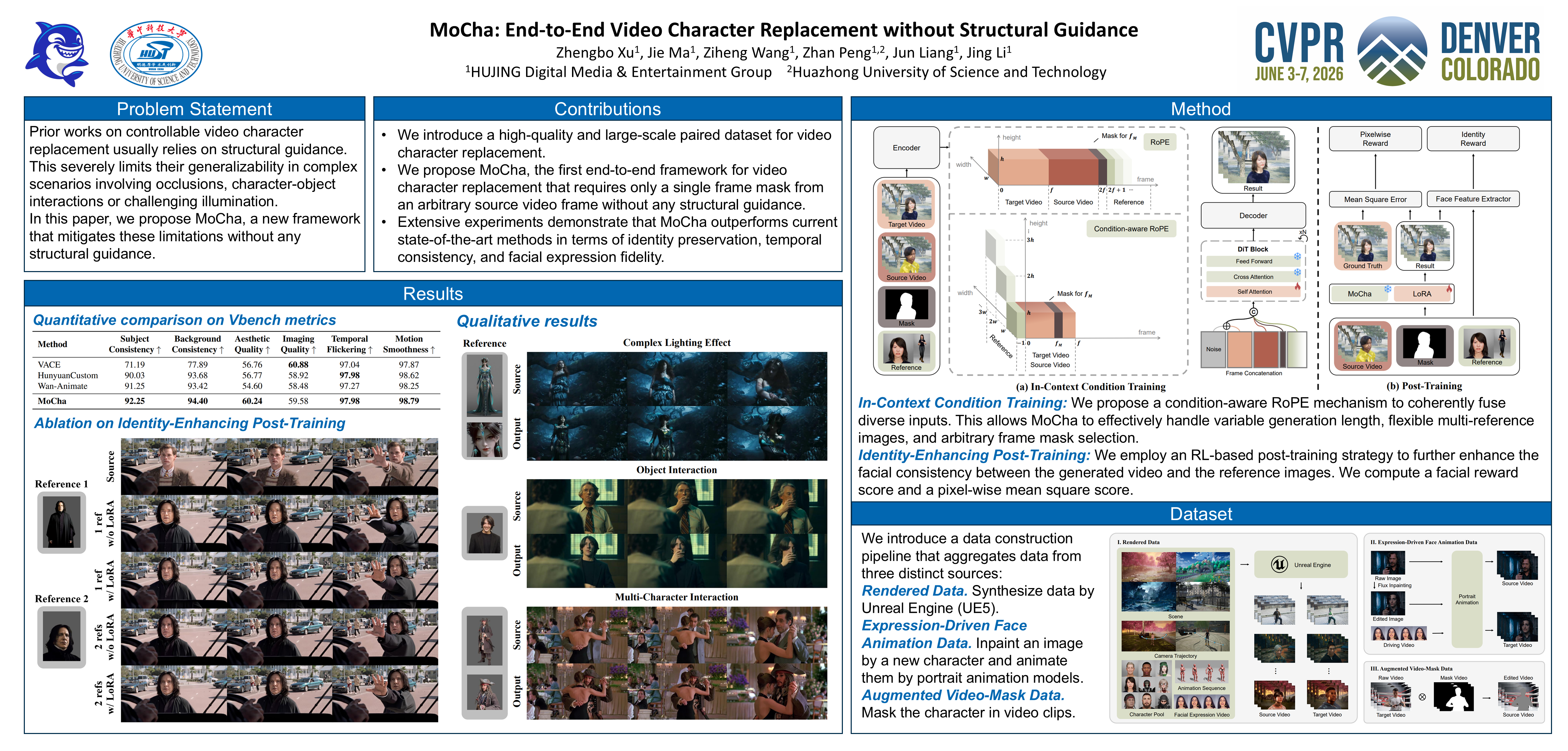
Controllable video character replacement with a user-provided identity remains a challenging problem due to the lack of paired video data.Prior works have predominantly relied on a reconstruction-based paradigm that requires per-frame segmentation masks and explicit structural guidance (e.g., skeleton, depth). This reliance, however, severely limits their generalizability in complex scenarios involving occlusions, character-object interactions, unusual poses, or challenging illumination, often leading to visual artifacts and temporal inconsistencies.In this paper, we propose MoCha, a pioneering framework that mitigates these limitations by harnessing the inherent tracking ability of the video diffusion model, therefore requiring only a single arbitrary frame mask and no structural guidance.To effectively adapt the multi-modal input condition and enhance facial identity, we introduce a condition-aware RoPE and employ an RL-based post-training stage.Furthermore, to overcome the scarcity of qualified paired-training data, we propose a comprehensive data construction pipeline. Specifically, we design three specialized datasets: a high-fidelity rendered dataset built with Unreal Engine 5 (UE5), an expression-driven dataset synthesized by current portrait animation techniques, and an augmented dataset derived from existing video-mask pairs.Extensive experiments demonstrate that our method substantially outperforms existing state-of-the-art approaches.We will release the code and dataset to facilitate further research.
Negative Binomial Variational Autoencoders for Overdispersed Latent Modeling
Yixuan Zhang ⋅ Jinhao Sheng ⋅ Wenxin Zhang ⋅ Quyu Kong ⋅ Feng Zhou
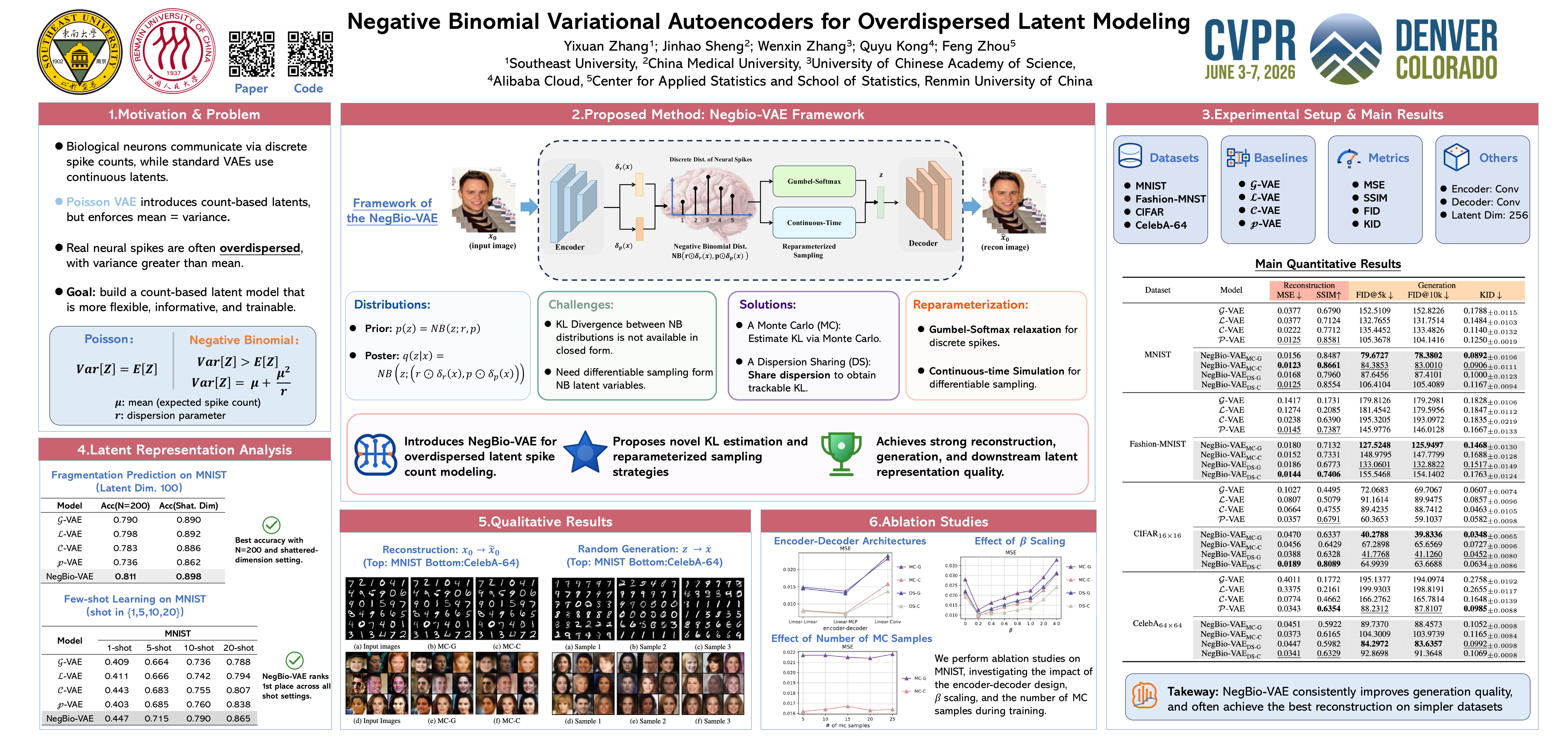
Although artificial neural networks are often described as brain-inspired, their representations typically rely on continuous activations, such as the continuous latent variables in variational autoencoders (VAEs), which limits their biological plausibility compared to the discrete spike-based signaling in real neurons. Extensions like the Poisson VAE introduce discrete count-based latents, but their equal mean-variance assumption fails to capture overdispersion in neural spikes, leading to less expressive and informative representations. To address this, we propose NegBio-VAE, a negative-binomial latent-variable model with a dispersion parameter for flexible spike count modeling. NegBio-VAE preserves interpretability while improving representation quality and training feasibility via novel KL estimation and reparameterization. Experiments on four datasets demonstrate that NegBio-VAE consistently achieves superior reconstruction and generation performance, and yields robust, informative latent representations for downstream tasks. Extensive ablation studies are performed to verify the model’s robustness w.r.t. various components.
Training-free Detection of Generated Videos via Spatial-Temporal Likelihoods
Omer Ben Hayun ⋅ Roy Betser ⋅ Meir Yossef Levi ⋅ Levi Kassel ⋅ Guy Gilboa
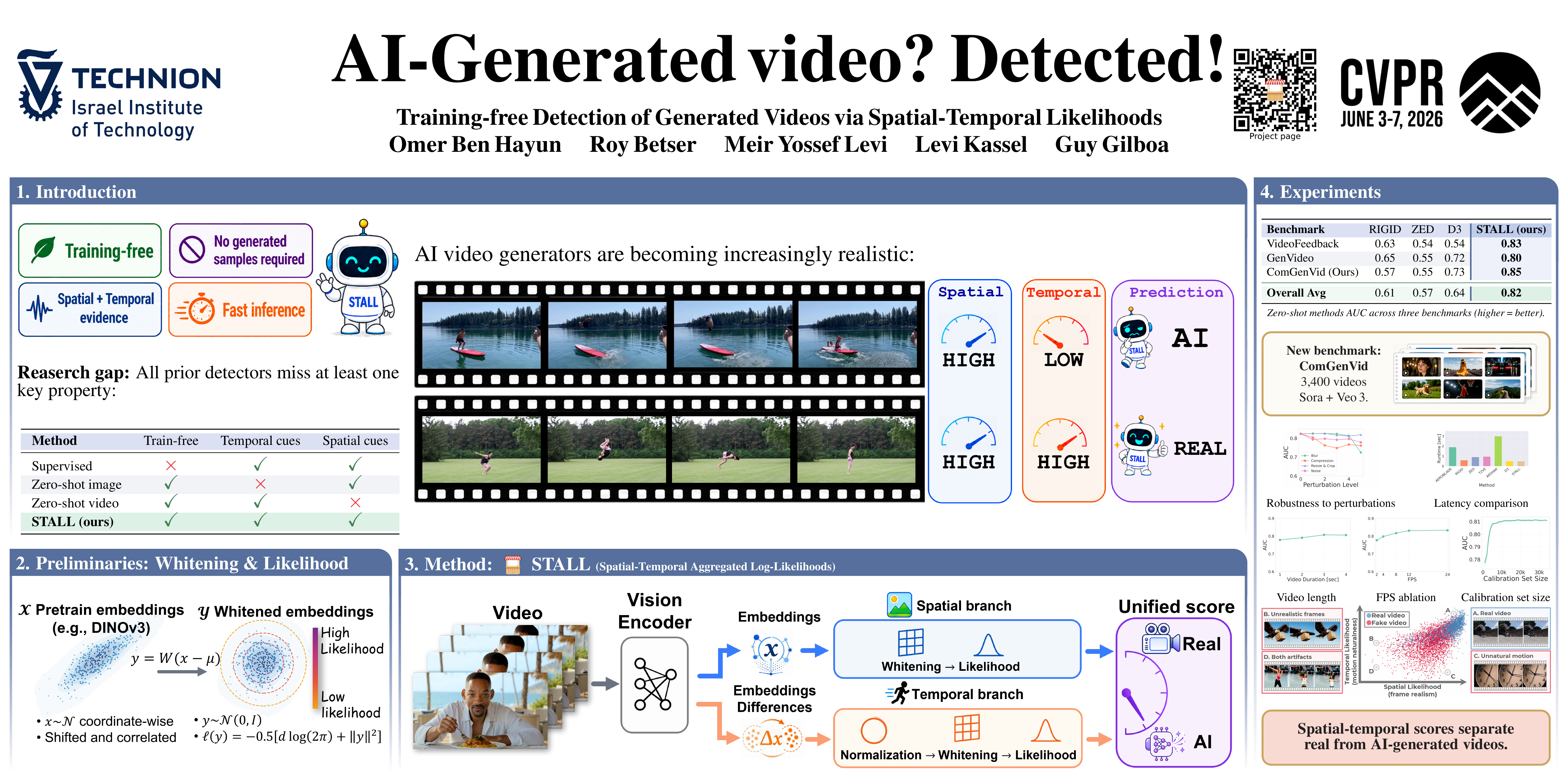
Following major advances in text and image generation, the video domain has surged, producing highly realistic and controllable sequences. Along with this progress, these models also raise serious concerns about misinformation, making reliable detection of synthetic videos increasingly crucial. Image-based detectors are fundamentally limited because they operate per frame and ignore temporal dynamics, while supervised video detectors generalize poorly to unseen generators, a critical drawback given the rapid emergence of new models. These challenges motivate zero-shot approaches, which avoid synthetic data and instead score content against real-data statistics, enabling training-free, model-agnostic detection. We introduce STALL, a simple, training-free, theoretically justified detector that provides likelihood-based scoring for videos, jointly modeling spatial and temporal evidence within a probabilistic framework. We evaluate STALL on two public benchmarks and introduce ComGenVid, a new benchmark with state-of-the-art generative models. STALL consistently outperforms prior image- and video-based baselines.
VOSR: A Vision-Only Generative Model for Image Super-Resolution
Rongyuan Wu ⋅ Lingchen Sun ⋅ Zhengqiang ZHANG ⋅ Xiangtao Kong ⋅ Jixin Zhao ⋅ Shihao Wang ⋅ Lei Zhang
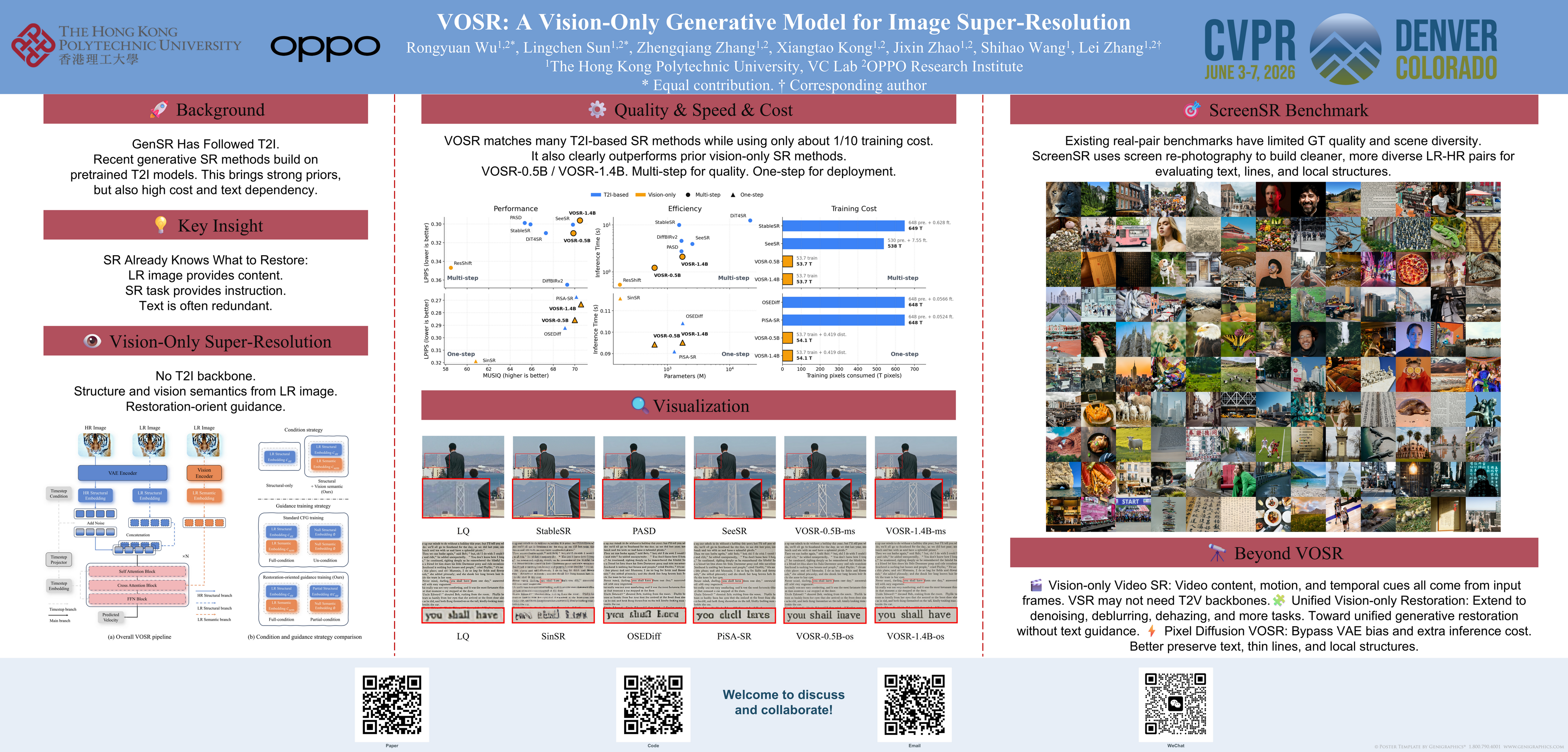
Large-scale pre-trained text-to-image (T2I) diffusion models, such as Stable Diffusion, can be finetuned for image super-resolution (SR) with highly realistic details. While impressive, pre-training such multi-modal models demands billions of high-quality text-image pairs and substantial computational resources, despite that SR is fundamentally an image-to-image (I2I) task. This raises a critical question: do we truly need multi-modal priors and billion-scale text-image data to solve a purely vision task? In this paper, we propose VOSR, a Vision-Only Super-Resolution framework that eliminates the need for textual priors and multi-modal pretraining. We identify two key limitations in previous image-based, uni-modal diffusion models: limited visual semantic guidance and unstable unconditional training. To this end, we leverage a pretrained vision encoder to inject semantic cues, and introduce a relaxed unconditional objective that partially uses the low-quality condition to stabilize training. To accelerate inference, we adopt a modified shortcut model for one-step SR with minimal quality degradation. VOSR is trained from scratch with significantly less data and a lower computational cost compared to T2I-based diffusion models. However, VOSR achieves comparable or even better performance than state-of-the-art T2I-tuned SR methods on both synthetic and real-world benchmarks, demonstrating its potential as a scalable and competitive alternative for generative SR. Codes and models will be made publicly available.
Dual Graph Regularized Deep Unfolding Network for Guided Depth Map Super-resolution
Zhiwei Zhong ⋅ Peilin CHEN ⋅ Qiangqiang Shen ⋅ Bo Li ⋅ Shiqi Wang
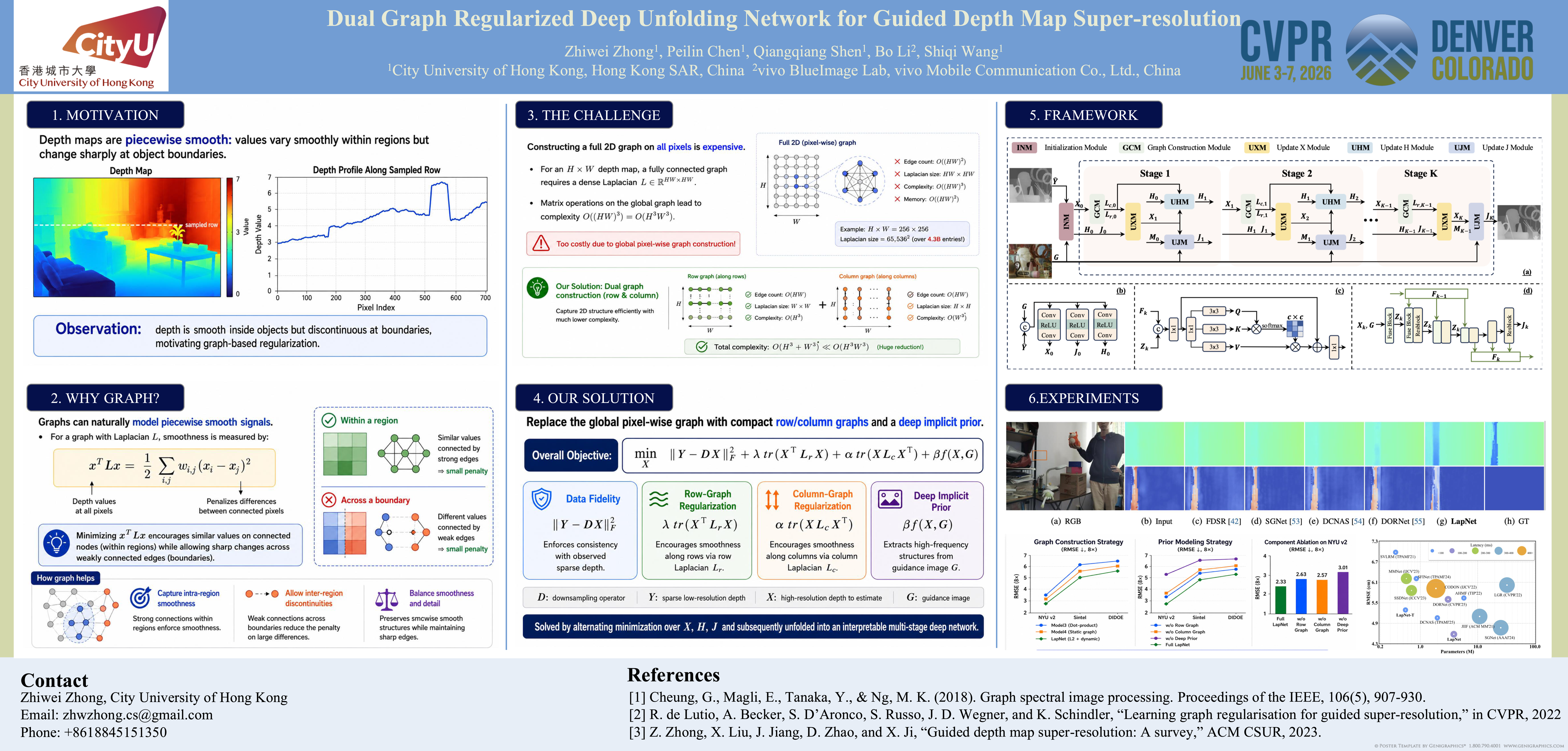
Depth map super-resolution with color guidance is a fundamental task in computer vision that aims to reconstruct high-resolution depth maps by leveraging structural correlations from corresponding guidance images. Recently, with the development of deep learning techniques, the performance of guided depth super-resolution (GDSR) models has been significantly improved. However, most existing approaches rely on black-box architectures that lack theoretical interpretability. Although graph optimization has been explored to integrate model-driven and data-driven frameworks, it remains computationally expensive and struggles to preserve the intrinsic structures of the depth maps. To overcome these limitations, we propose a novel GDSR framework based on a dual graph Laplacian prior, termed LapNet, which efficiently unfolds graph optimization into a deep neural network. Specifically, we first formulate a dual graph Laplacian prior that separately models structural dependencies along the row and column dimensions of the depth maps. This formulation explicitly enforces piecewise smoothness while reducing computational complexity from $\mathcal{O}(H^3W^3)$ to $\mathcal{O}(H^3 + W^3)$ by avoiding the construction of global affinity graph. Furthermore, we develop a deep implicit prior to extract high-frequency structural cues from the guidance image, serving as a complementary component to the manually designed prior. Finally, we integrate these complementary priors into a unified variational optimization framework, which is efficiently solved through alternating minimization and subsequently unfolded into an interpretable multi-stage deep network. Extensive experiments on both synthetic and real-world datasets demonstrate that LapNet achieves state-of-the-art performance while maintaining low computational complexity.
DUO-VSR: Dual-Stream Distillation for One-Step Video Super-Resolution
Zhengyao Lv ⋅ Menghan Xia ⋅ Xintao Wang ⋅ Kwan-Yee K. Wong
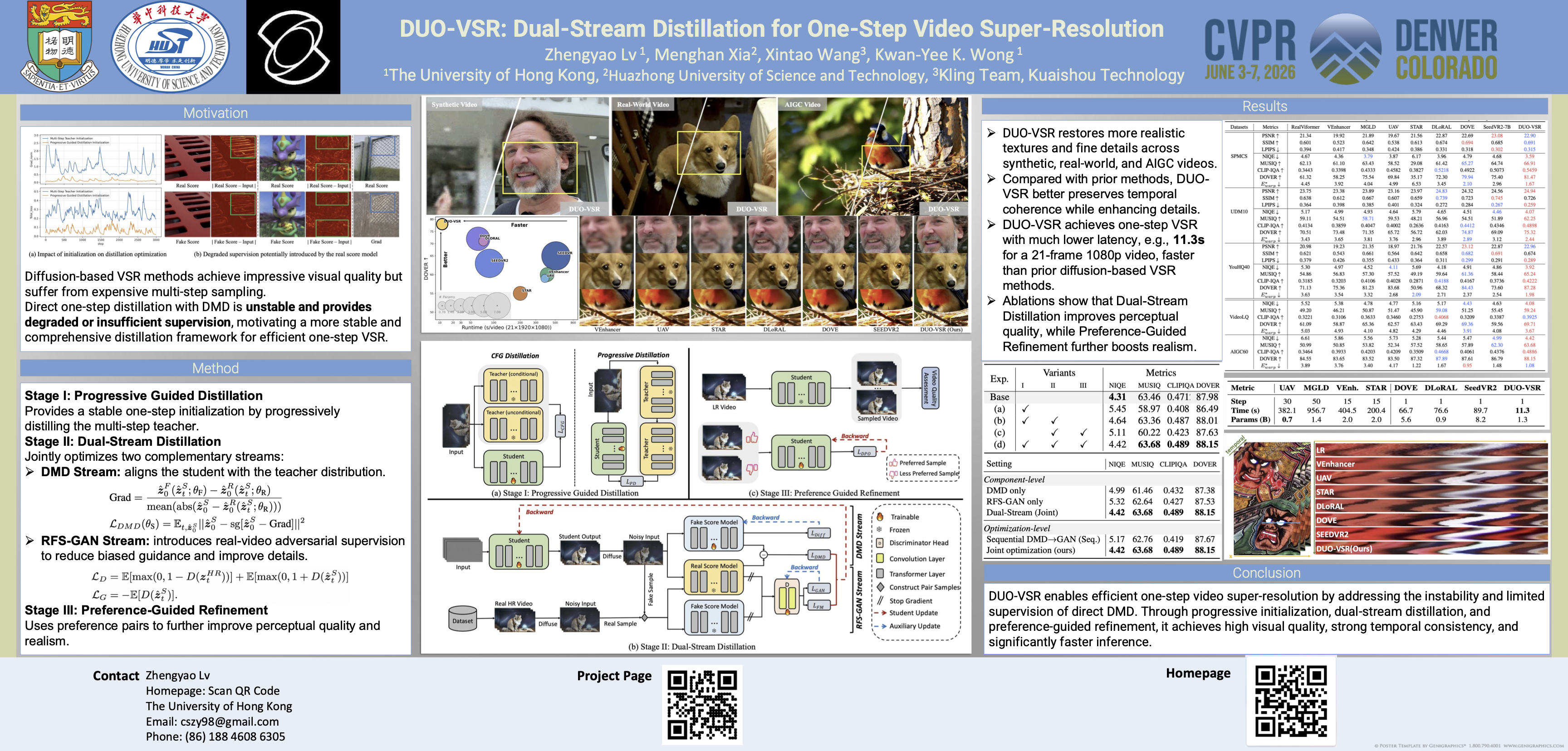
Diffusion-based video super-resolution (VSR) achieves remarkable fidelity but suffers from prohibitive sampling cost. While distribution matching distillation (DMD) accelerates diffusion models to one-step generation, directly applying it to VSR leads to training instability and degraded, insufficient supervision.To address these issues, we propose \textbf{DUO-VSR}, a three-stage framework centered on a \textbf{DU}al-Stream Distillation strategy that integrates distribution matching and adversarial supervision for \textbf{O}ne-step VSR.We first adopt a Progressive Guided Distillation Initialization to stabilize subsequent training through trajectory-preserving distillation.We then introduce a Dual-Stream Distillation Strategy to jointly optimize DMD and Real–Fake Score Feature GAN (RFS-GAN) streams, with the latter providing complementary adversarial supervision using features from both real and fake score models.Finally, a Preference-Guided Refinement aligns the student with perceptual quality preferences.Comprehensive experiments demonstrate that DUO-VSR achieves superior visual quality and efficiency over previous one-step VSR methods.
VSRELL: A Simple Baseline for Video Super-Resolution and Enhancement in Low-Light Environment
Yanming hui ⋅ Fanhua Shang ⋅ Hongying Liu ⋅ Ben Wang ⋅ Zhenwei Zhang ⋅ Liang Wan ⋅ Wei Feng ⋅ Tong Xue ⋅ Bingqin Lv
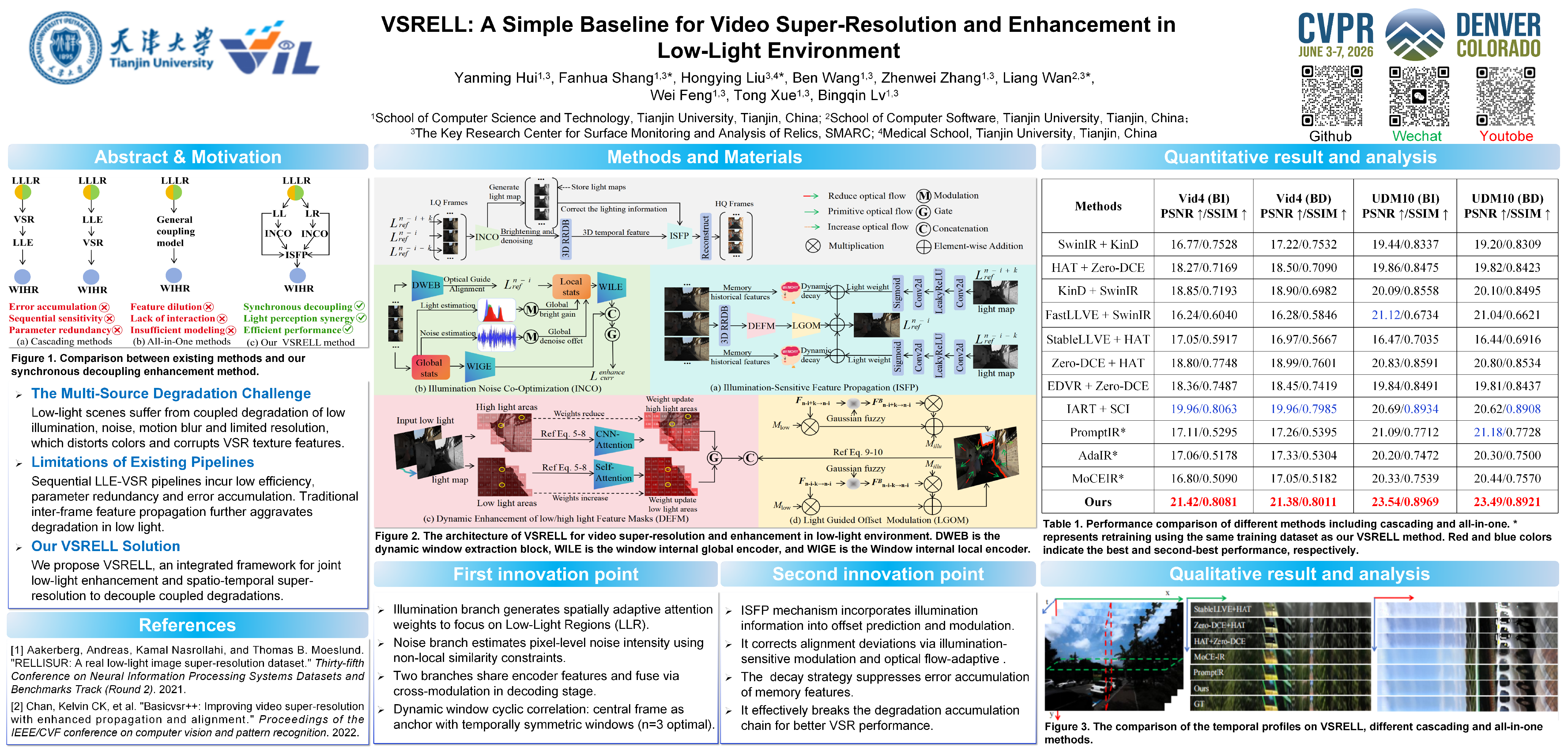
We propose an integrated learning scheme of Video Super-Resolution and Enhancement in Low-Light environment, named VSRELL, which aims to recover Well-Illuminated High-Resolution (WIHR) sequence from Low-Light Low-Resolution (LLLR) counterparts. Due to the complex coupling of multiple degradations, this joint task has received relatively little attention. Our approach jointly models illumination enhancement and spatial-temporal super-resolution to disentangle intertwined degradations. Specifically, we introduce an Illumination-Noise Co-Optimization (INCO) network that employs a dynamic window partitioning strategy to explicitly model physical priors of illumination variations and noise distributions within individual frames of a long-term sequence. This effectively suppresses cross-frame noise accumulation and illumination flickering, achieving simultaneous optimization of motion compensation and brightness correction.Additionally, an Illumination-Sensitive Feature Propagation (ISFP) mechanism is introduced, which utilizes hierarchical illumination-sensing gating unit to adaptively modulate feature channel responses. By adjusting feature propagation intensity and using memory feature attenuation strategy, it can enhance the weighting of high-quality features and suppress error accumulation propagation and strengthen transmission efficiency. The experiments show that VSRELL can explicitly strengthen the brightness continuity and texture fidelity of the restored output, maintaining temporal consistency across the video.
Gradient Knows Best: Mixed-Precision Quantization via Gradient-Guided Bit Allocation for Super-Resolution
Jun Young Kim ⋅ Joo Jeon ⋅ Sangyeon Ahn ⋅ Yoonseo Park ⋅ Yong Oh ⋅ Bogyeong Kim ⋅ Sung In Cho
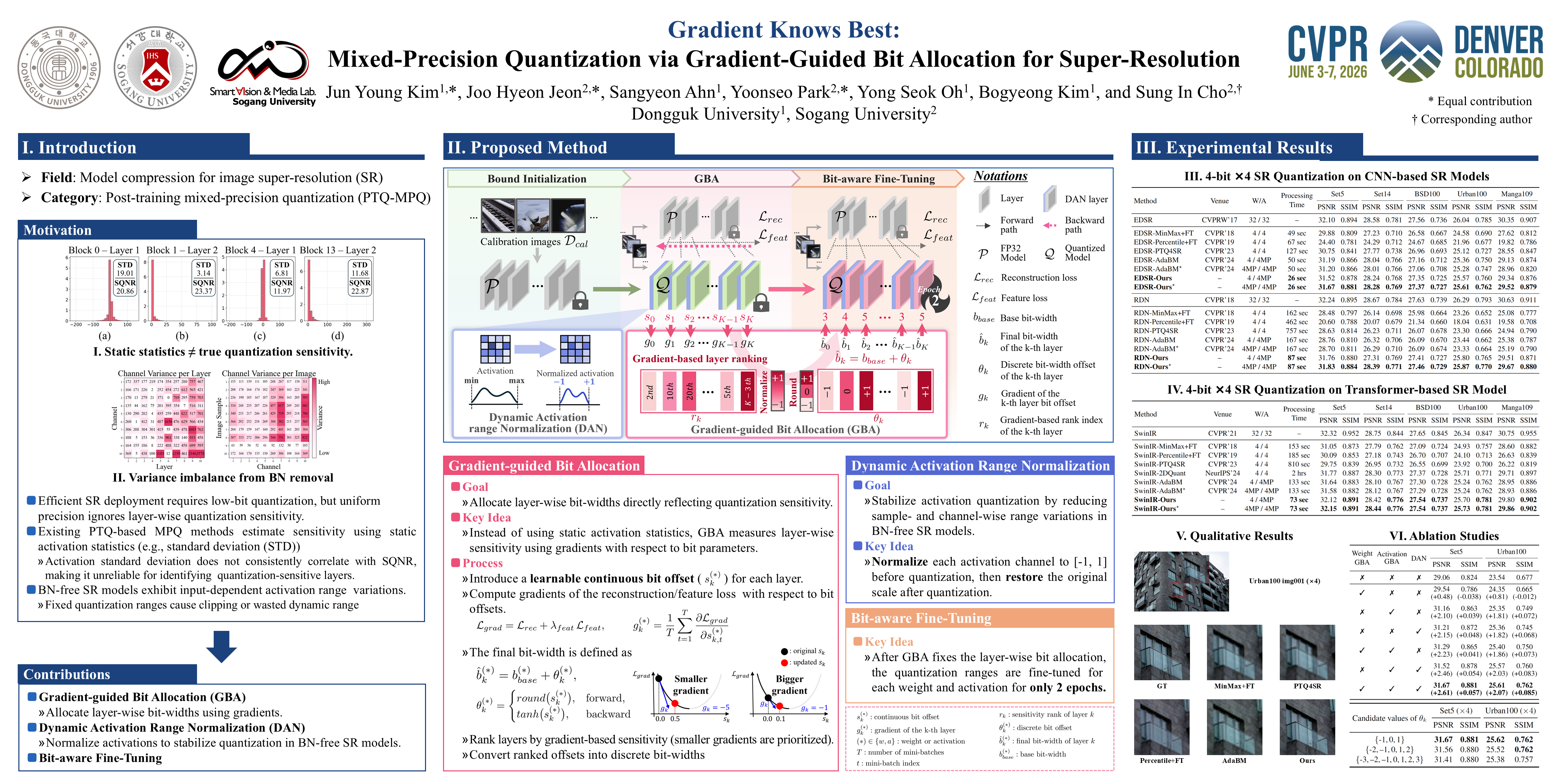
Although deep learning-based image super-resolution (SR) models have achieved remarkable progress in reconstruction quality, their high computational and memory demands make them unsuitable for lightweight platforms. To address this issue, various quantization techniques have been introduced. Among them, mixed-precision quantization (MPQ) introduces a layer-wise bit-width allocation to balance computational efficiency with reconstruction quality. However, existing MPQ methods based on post-training quantization (PTQ) for SR models face two critical limitations. First, quantization sensitivity estimation using static statistics fails to capture the accurate quantization error induced by each layer, resulting in suboptimal bit allocation. Second, removing batch normalization (BN) to preserve high-frequency details leads to scale inconsistencies across activations, making fixed quantization ranges insufficient to accurately represent their distribution. Therefore, we propose a novel PTQ-based MPQ framework tailored for SR models. Our method estimates the quantization sensitivity of weights and activations by leveraging gradients of the objective function with respect to bit-widths, enabling adaptive layer-wise bit allocation and fast convergence. Additionally, we introduce a dynamic activation range normalization that alleviates the distributional imbalance caused by the absence of BN, ensuring stable quantization under fixed range constraints. Our method outperforms existing PTQ-based methods by 1.26 dB in peak signal-to-noise ratio (PSNR) on the Urban100 dataset and reduces quantization time by ×1.9 for 3-bit quantization of EDSR ×4.
Toward Real-world Infrared Image Super-Resolution: A Unified Autoregressive Framework and Benchmark Dataset
Yang Zou ⋅ Jun Ma ⋅ Zhidong Jiao ⋅ Xingyuan Li ⋅ Zhiying Jiang ⋅ Jinyuan Liu
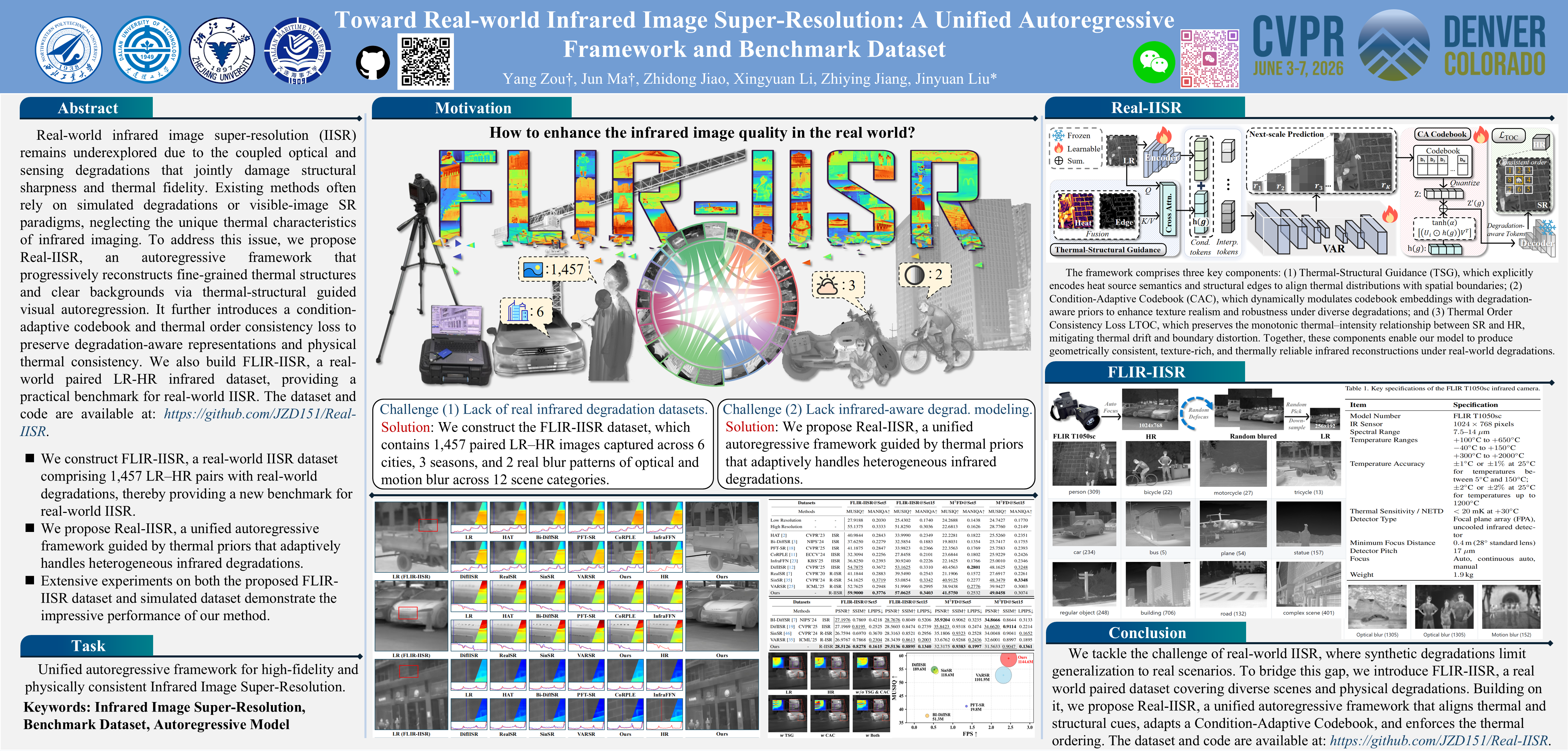
Infrared Image Super-Resolution (IISR) under real-world conditions is a practically significant yet rarely addressed task. Pioneering works are often trained and evaluated on simulated datasets or neglect the intrinsic differences between infrared and visible imaging. In practice, however, real infrared images are affected by coupled optical and sensing degradations that jointly deteriorate both structural sharpness and thermal fidelity. To address these challenges, we propose Real-IISR, a unified autoregressive framework for real-world IISR that progressively reconstructs fine-grained thermal structures and clear backgrounds in a scale-by-scale manner via thermal-structural guided visual autoregression. Specifically, a Thermal-Structural Guidance module encodes thermal priors to mitigate the mismatch between thermal radiation and structural edges. Since non-uniform degradations typically induce quantization bias, Real-IISR adopts a Condition-Adaptive Codebook that dynamically modulates discrete representations based on degradation-aware thermal priors. Also, a Thermal Order Consistency Loss enforces a monotonic relation between temperature and pixel intensity, ensuring relative brightness order rather than absolute values to maintain physical consistency under spatial misalignment and thermal drift. We build FLIR-IISR, a real-world IISR dataset with paired LR-HR infrared images acquired via automated focus variation and motion-induced blur. Extensive experiments on real and synthetic datasets demonstrate the promising performance of Real-IISR, providing a unified foundation for real-world IISR and benchmarking.
Next-Scale Autoregressive Models for Text-to-Motion Generation
Zhiwei Zheng ⋅ Shibo Jin ⋅ Lingjie Liu ⋅ Mingmin Zhao
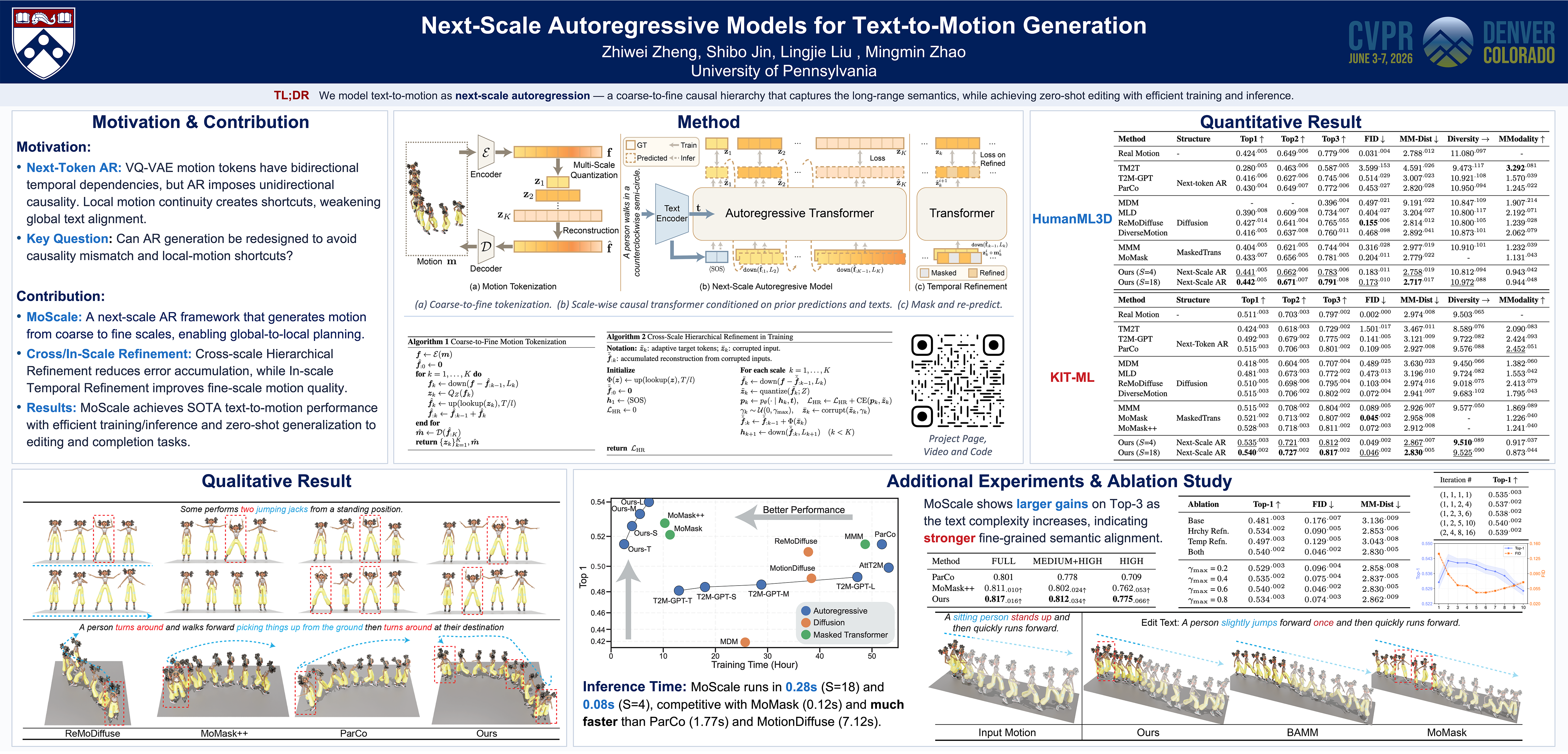
Autoregressive (AR) models offer stable and efficient training, but standard next-token prediction is not well aligned with the temporal structure required for text-conditioned motion generation. We introduce MoScale, a next-scale AR framework that generates motion hierarchically from coarse to fine temporal resolutions. By providing global semantics at the coarsest scale and refining them progressively, MoScale establishes a causal hierarchy better suited for long-range motion structure. To improve robustness under limited text–motion data, we further incorporate cross-scale hierarchical refinement for improving coarse-scale predictions and in-scale temporal refinement for selective bidirectional re-prediction. MoScale achieves state-of-the-art text-to-motion performance with high training efficiency, scales effectively with model size, and generalizes zero-shot to diverse motion generation and editing tasks.
Push-and-Step: From RL-Based Balance Recovery to Physical Simulation of Dense Crowds
Alexis Jensen ⋅ Pei Xu ⋅ Ioannis Karamouzas ⋅ Charles Pontonnier ⋅ Julien Pettré
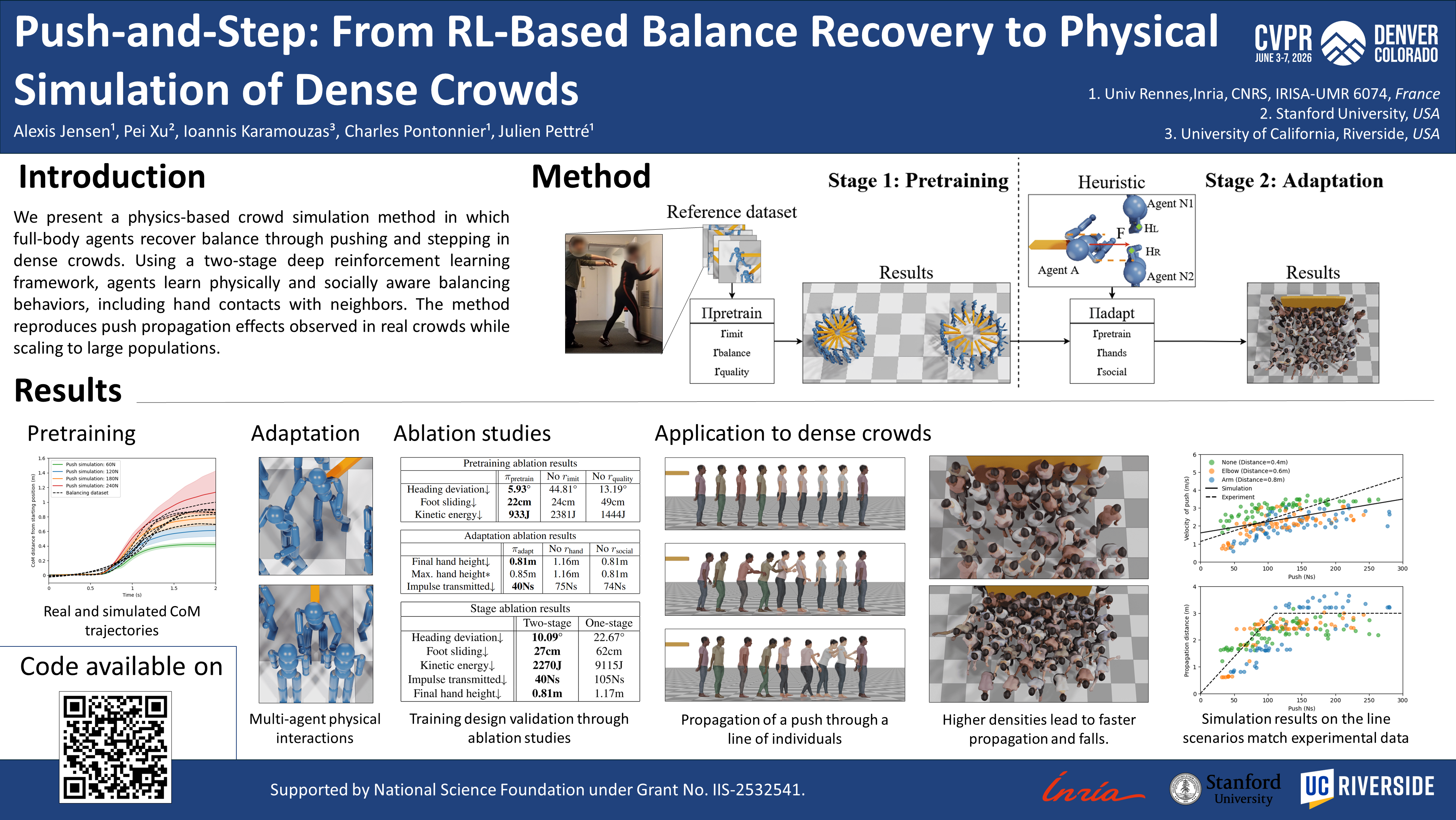
We present a physics-based method for simulating full-body agents that recover balance by stepping or applying contact forces after being perturbed in dense crowds. While traditional 2D crowd simulations focus on navigation and social interactions in moderately dense settings, interactions in highly dense environments are predominantly physical, leading to push propagation, falls, and potential hazards. Existing models cannot capture how forces are transmitted through the body at the limb level. To address this, we use physics-based anthropomorphic simulations combined with a two-stage deep reinforcement learning framework. In the first stage, a policy is pre-trained using reference motion data and general balance rewards, enabling agents to handle a wide range of perturbations. In the second stage, an adaptive phase refines the policy to allow socially aware interactions, using hand contacts for stabilization guided by an online heuristic targeting neighbors’ shoulders based on mechanical efficiency and collision risk. Ablation studies validate the training framework and reward components, and simulations reproduce trends observed in empirical studies of push propagation. Our method scales to large populations, offering new opportunities to study safety and collective behavior in dense crowds.
Iterative Closed-Loop Motion Synthesis for Scaling the Capabilities of Humanoid Control
Weisheng Xu ⋅ Qiwei Wu ⋅ Jiaxi Zhang ⋅ Jing Tan ⋅ Yangfan Li ⋅ Yuetong Fang ⋅ Jiaqi Xiong ⋅ Kai Wu ⋅ Rong OU ⋅ Renjing Xu
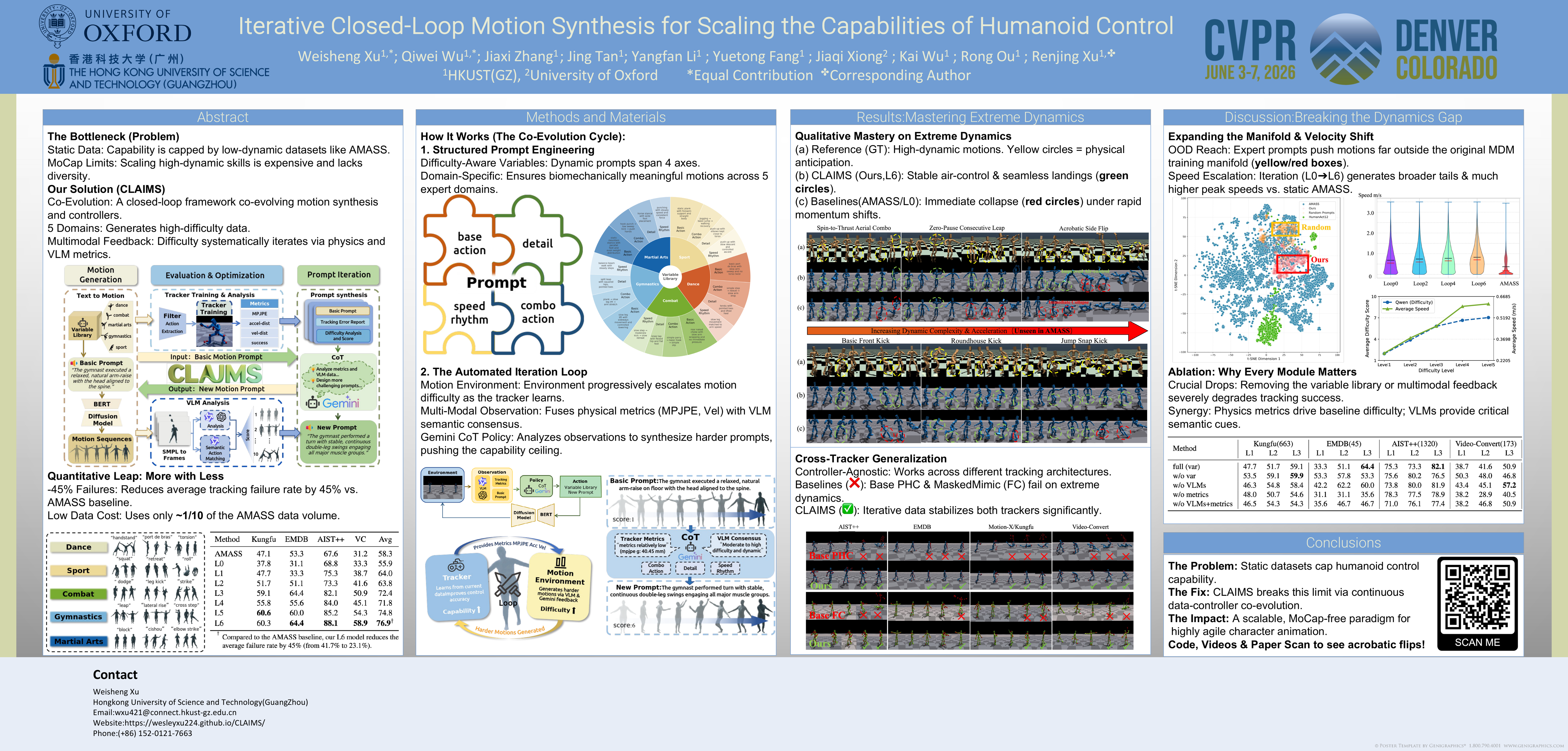
Physics-based humanoid control relies on training with motion datasets that have diverse data distributions. However, the fixed difficulty distribution of datasets limits the performance ceiling of the trained control policies. Additionally, the method of acquiring high-quality data through professional motion capture systems is constrained by costs, making it difficult to achieve large-scale scalability. To address these issues, we propose a closed-loop automated motion data generation and iterative framework. It can generate high-quality motion data with rich action semantics, including martial arts, dance, combat, sports, gymnastics, and more. Furthermore, our framework enables difficulty iteration of policies and data through physical metrics and objective evaluations, allowing the trained tracker to break through its original difficulty limits. On the PHC single-primitive tracker, using only approximately 1/10 of the AMASS dataset size, the average failure rate on the test set (2201 clips) is reduced by 45% compared to the baseline. Finally, we conduct comprehensive ablation and comparative experiments to highlight the rationality and advantages of our framework.
RoMo: A Large-Scale, Richly Organized Dataset and Semantic Taxonomy for Human Motion Generation
Jiahao Zhang ⋅ Joseph Liu ⋅ Young-Yoon Lee ⋅ Seonghyeon Moon ⋅ Victor Zordan ⋅ Guy Tevet ⋅ C. Karen Liu ⋅ Stephen Gould ⋅ Oren Jacob ⋅ Haomiao Jiang ⋅ Mubbasir Kapadia ⋅ Yizhak Ben-Shabat
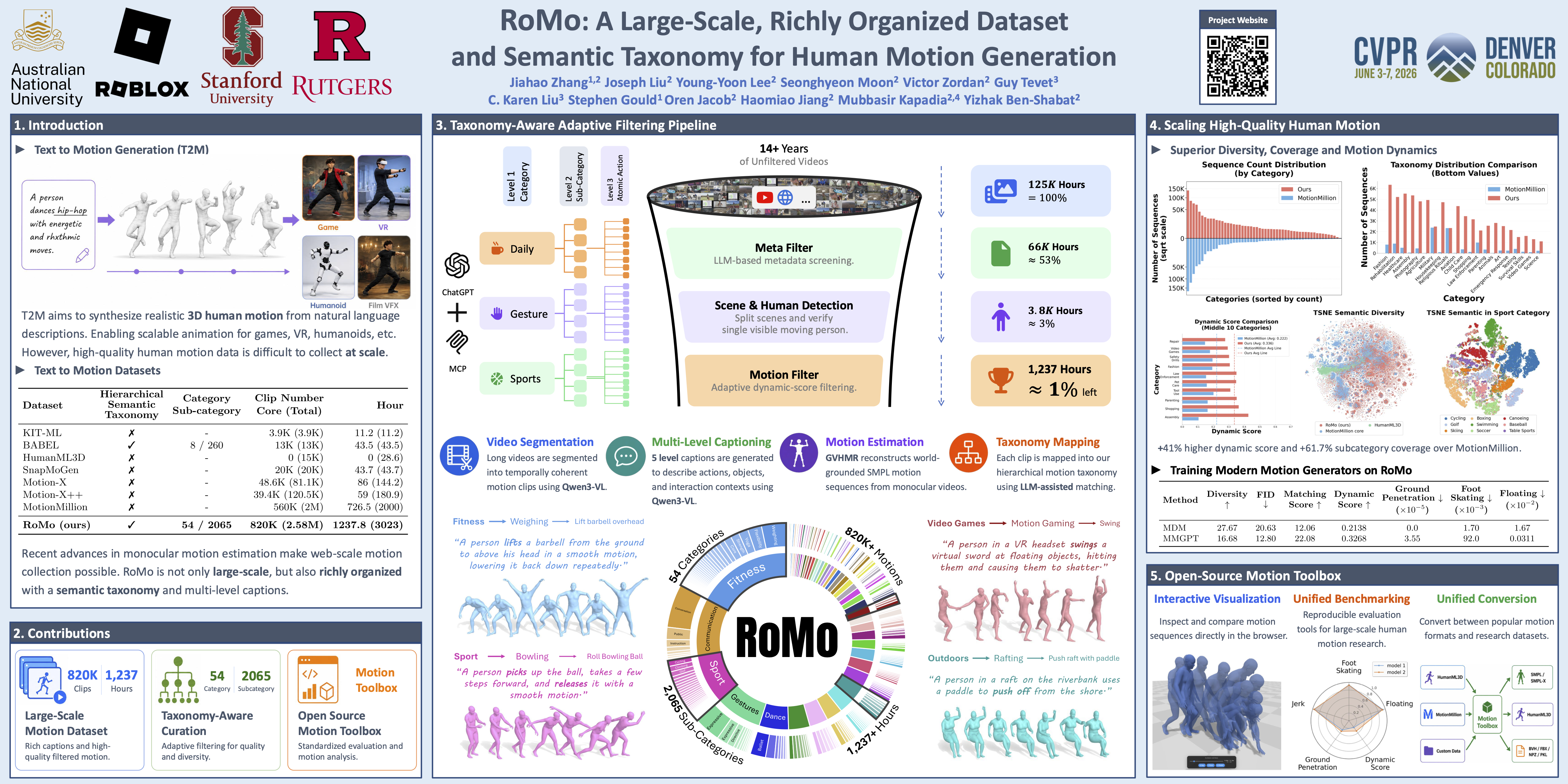
Success in generative modeling across language, image, and video demonstrates that large, well-curated datasets are the key driver for building capable models. 3D Human motion, however, has lagged behind, constrained by an unsatisfying choice between small, high-fidelity motion capture datasets and large-scale in-the-wild collections dominated by static or low-quality sequences.We introduce RoMo, a rich, large-scale, carefully curated dataset of in-the-wild human motions that resolves these tradeoffs. To ensure quality, we introduce a taxonomy-aware filtering pipeline that aggressively removes static and artifact-prone sequences. Every sequence is annotated with detailed captions and organized by a novel three-level semantic taxonomy. This hierarchical structure provides the first benchmark for fine-grained, per-category evaluation, revealing model strengths and weaknesses obscured by global metrics. We demonstrate that models trained on RoMo achieve state-of-the-art fidelity and diversity while gaining a superior understanding of complex, subtle text prompts. Finally, we release the Motion Toolbox to standardize metrics, data conversion, and visualization, establishing a foundation for reproducible and interpretable motion generation research.
FrankenMotion: Part-level Human Motion Generation and Composition
Chuqiao Li ⋅ Xianghui Xie ⋅ Yong Cao ⋅ Andreas Geiger ⋅ Gerard Pons-Moll
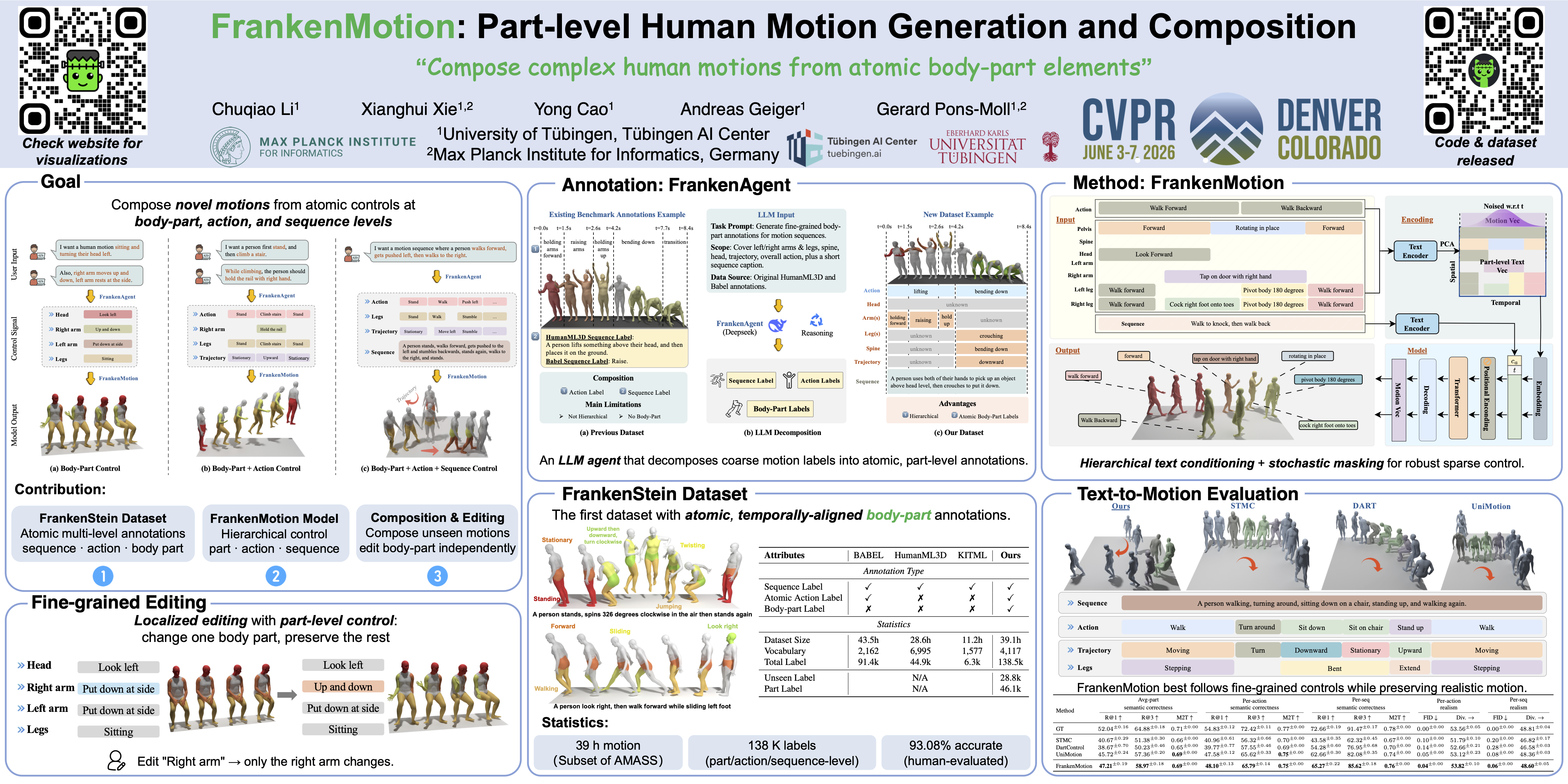
Human motion generation from text prompts has made remarkable progress in recent years. However, existing methods primarily rely on either sequence-level or action-level descriptions due to the absence of fine-grained, part-level motion annotations. This limits their controllability over individual body parts.In this work, we construct a high-quality motion captioning dataset with atomic, temporally-aware part-level annotations, leveraging the reasoning capabilities of large language models (LLMs). Unlike prior datasets that either provide synchronized part captions with fixed time segments or rely solely on global sequence labels, our dataset captures asynchronous and semantically distinct part movements at fine temporal resolution.Based on this dataset, we introduce a diffusion-based part-aware motion generation framework, namely FrankenMotion, where each body part is guided by its own temporally-structured textual prompt. This is, to our knowledge, the first work to provide atomic, temporally-aware part-level motion annotations and have a model that allows motion generation with both spatial (body part) and temporal (atomic action) control. Experiments demonstrate that FrankenMotion outperforms all previous baseline models adapted and retrained for our setting, and our model can compose motions unseen during training. Our code and dataset will be publicly available upon publication.
HSI-GPT2: A Dual-Granularity Large Motion Reasoning Model with Diffusion Refinement for Human–Scene Interaction
Yuan Wang ⋅ LI XIANG ⋅ Yali Li ⋅ XUEGE HOU ⋅ Shengjin Wang
Unified interpreting and synthesizing human behaviors within 3D environments is vital for advancing spatial intelligence and humanoid robotics. Despite recent advancements (\textit{e.g.}, HSI-GPT), two fundamental capabilities expected of a unified model—understanding and generation—still lag behind specialist models. This is primarily due to 1) single-granularity codebook overemphasizes low-frequency motion details while neglecting motion semantics, 2) limited decoding capacity of the motion detokenizer which restricts the fidelity of human–scene interactions, 3) only relying on supervised fine-tuning (SFT) failing to capture high-level motion semantics and logical reasoning with an end-to-end mapping. To this issue, we develop HSI-GPT2—a reasoning-enhanced, dual-granularity motion-representational large Scene-Motion-Language model, powered by reinforcement learning (RL) with Chain-of-Thought (CoT) reasoning. First, HSI-GPT2 introduces a \textbf{Dual-granularity Motion Tokenizer}, DMoTok, which jointly preserves both fine-grained motion details and text-aligned motion semantics for various HSI-related tasks. Further, a \textbf{motion diffusion decoder} functions as a motion detokenizer, translating deep semantics and detailed features of LLMs into physically grounded human motions. Finally, we curate a \textbf{Motion Chain-of-Thought} (MoCoT) data engine and extend a Group Relative Policy Optimization (GRPO) paradigm to execute long-horizon and compositionallyrich commands. Results on standard HSI benchmarks confirm the clear superiority of HSI-GPT2 in enhancing interaction quality, semantic alignment, behavioral diversity, and generalization to unseen 3D scenes.
SceMoS: Scene-Aware 3D Human Motion Synthesis by Planning with Geometry-Grounded Tokens
Anindita Ghosh ⋅ Vladislav Golyanik ⋅ Taku Komura ⋅ Philipp Slusallek ⋅ Christian Theobalt ⋅ Rishabh Dabral
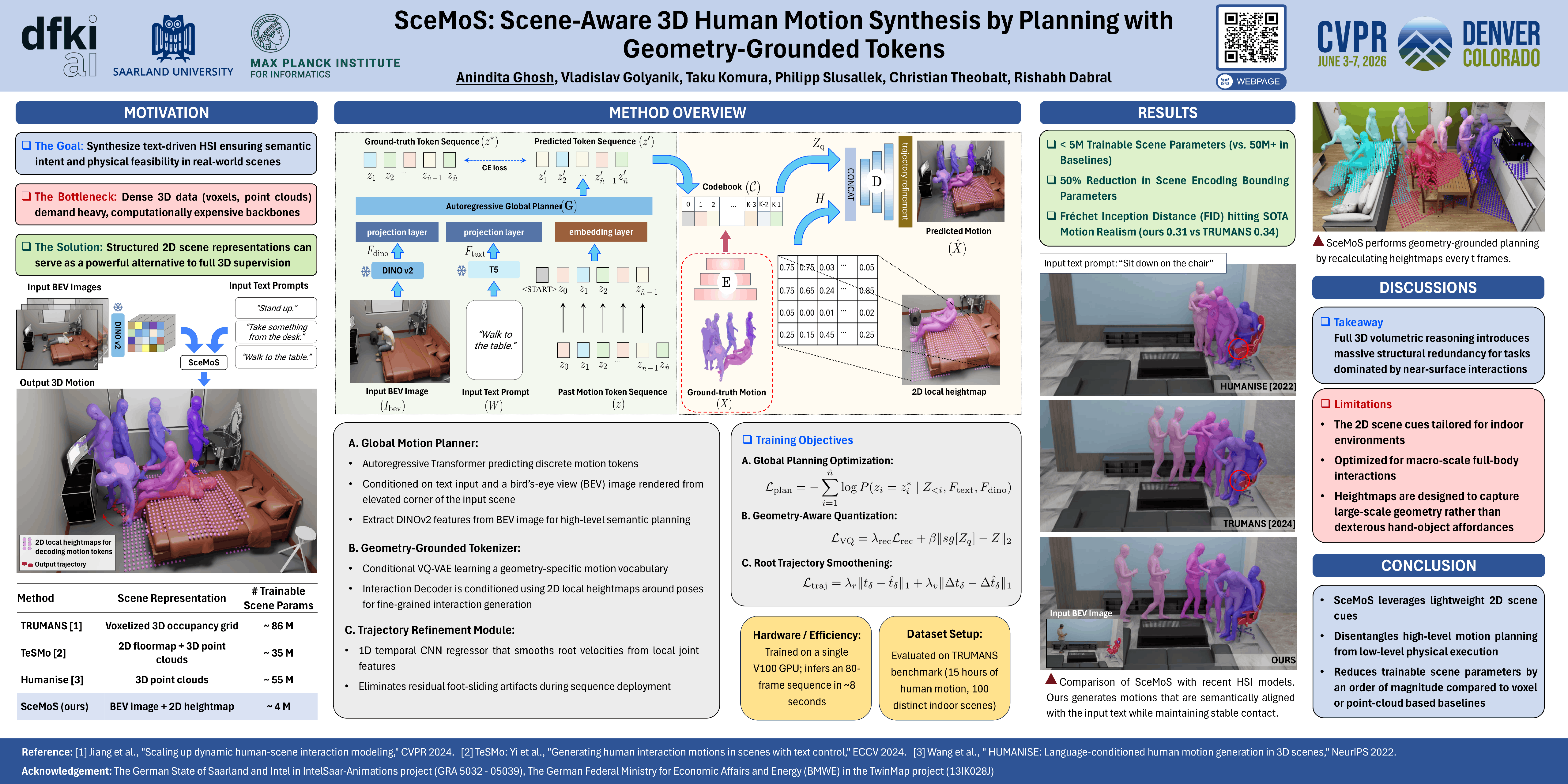
Synthesizing text-driven 3D human motion within realistic scenes requires learning both semantic intent (“walk to the couch”) and physical feasibility (e.g., avoiding collisions). Current methods use generative frameworks that simultaneously learn high-level planning and low-level contact reasoning, and rely on computationally expensive 3D scene data such as point clouds or voxel occupancy grids. We propose SceMoS, a scene-aware motion synthesis framework that shows that structured 2D scene representations can serve as a powerful alternative to full 3D supervision in physically grounded motion synthesis. SceMoS disentangles global planning from local execution using lightweight 2D cues and relying on (1) a text-conditioned autoregressive global motion planner that operates on a top-down bird’s-eye-view (BEV) image of the scene, encoded with DINOv2 features, as the scene representation, and (2) geometry-grounded motion tokenizer trained via a conditional VQ-VAE, that uses 2D local scene heightmap, thus embedding surface physics directly into a discrete vocabulary. This 2D factorization reaches an efficiency-fidelity trade-off: BEV semantics capture spatial layout and affordance for global reasoning, while local heightmaps enforce fine-grained physical adherence without full 3D volumetric reasoning. SceMoS achieves state-of-the-art motion realism and contact accuracy on the TRUMANS benchmark, reducing the number of trainable parameters for scene encoding by over 50%, showing that 2D scene cues can effectively ground 3D human-scene interaction.
Progressive Guessing to Fixed Point: Rethinking Human Motion Prediction with Deep Equilibrium Models
Dong Wei ⋅ Huaijiang Sun ⋅ Fan Liu ⋅ Yuhui Zheng
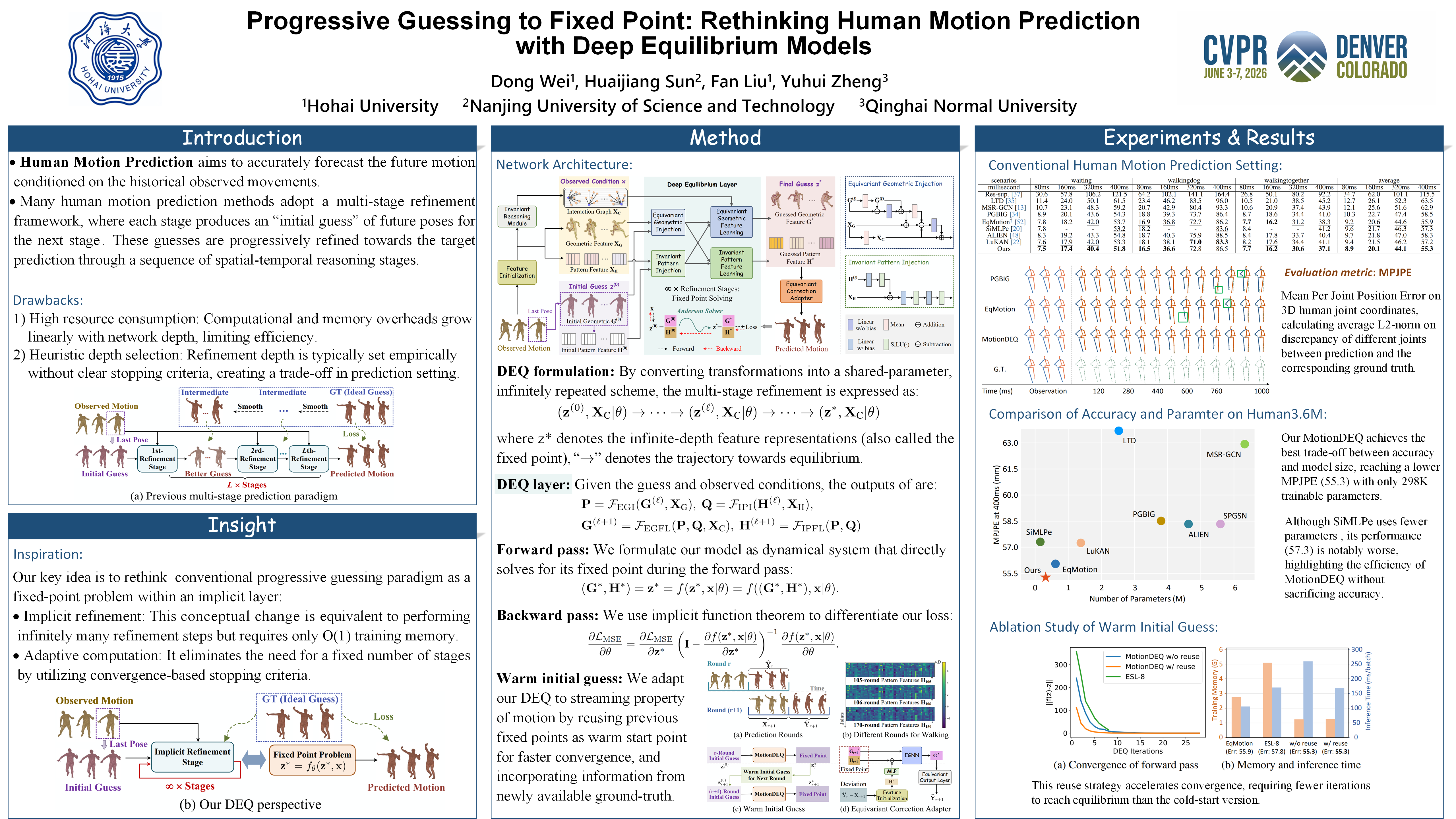
Many recent human motion prediction methods adopt a multi-stage refinement framework, where each stage produces an initial guess of future poses for the next stage. These guesses are progressively refined towards the target prediction through a sequence of spatial-temporal reasoning stages.However, such a cascaded design incurs large computation and memory overheads that grow at least linearly with network depth, and lack an explicit stopping criteria.In this paper, we propose MotionDEQ, a deep equilibrium motion predictor that reformulates progressive guessing paradigm as a fixed point problem within an implicit layer. This formulation is conceptually equivalent to performing infinitely many refinement steps, but requires only O(1) training memory and can be solved efficiently through any black-box solvers. We carefully design this implicit refinement process by integrating Euclidean geometric transformations into equilibrium learning, allowing the entire network to be equivariant. We also find DEQs naturally fit the real-world scenario where motion data comes streamingly: the converged fixed point can be reused as a warm initial guess, to help recycle the redundant inference computation when making subsequent predictions.Our experiments demonstrate that MotionDEQ achieves the state-of-the-art prediction performances with superior memory efficiency, using fewer than 300K parameters with 55.3mm prediction error at 400ms on the Human3.6M dataset.
Archon: A Unified Multimodal Model for Holistic Digital Human Generation
Chong Bao ⋅ Shichen Liu ⋅ Lijun Yu ⋅ David Futschik ⋅ Stylianos Moschoglou ⋅ Shefali Srivastava ⋅ Ziqian Bai ⋅ Feitong Tan ⋅ Guofeng Zhang ⋅ Zhaopeng Cui ⋅ Sean Fanello ⋅ Yinda Zhang
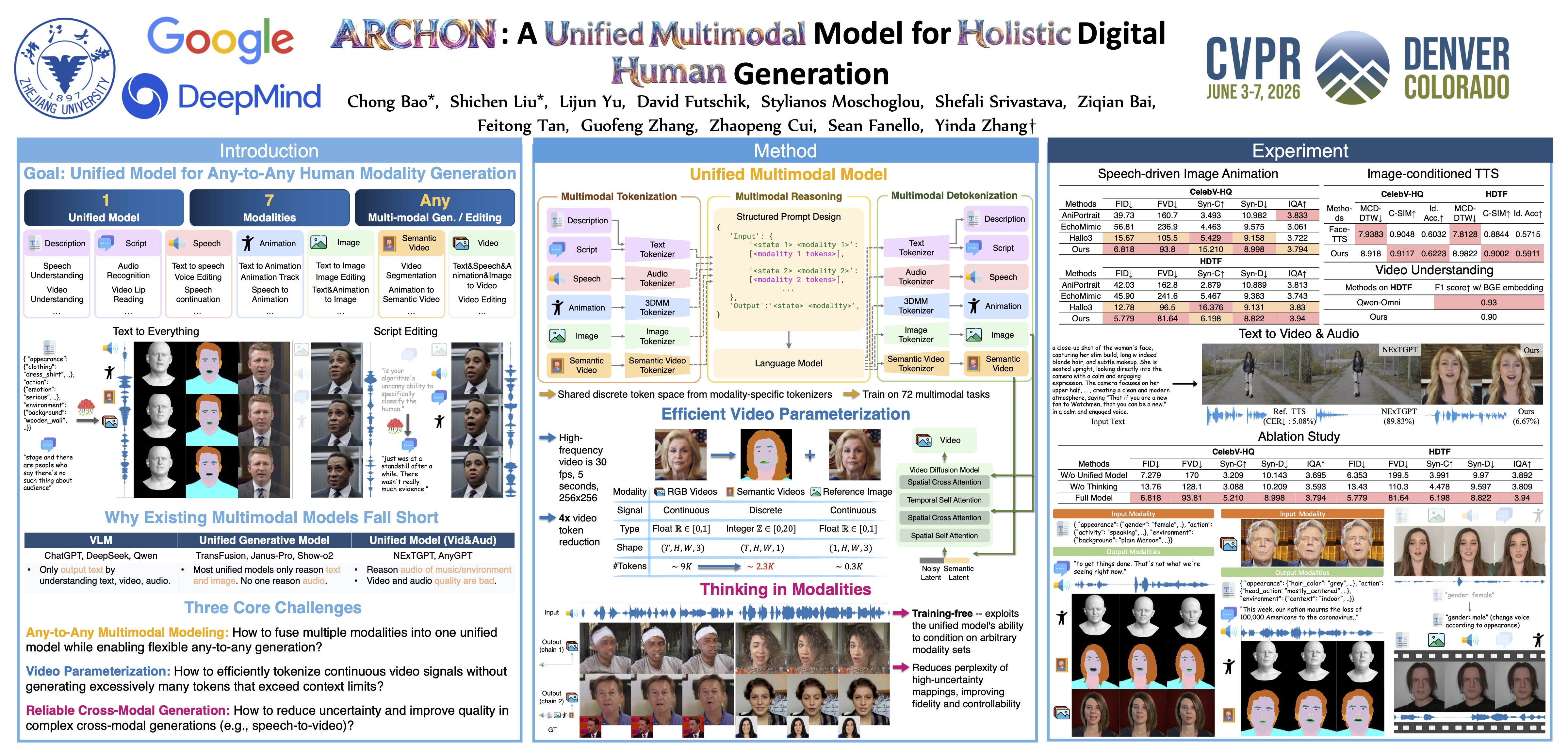
We introduce Archon, a unified multimodal framework that extends multimodal language models to address the fundamental challenge of holistic digital human generation. Archon unifies diverse human-centric modalities, including description, script, speech, animation, semantic segmentation, image and video, within a single controllable generative system, enabled by modality-specific tokenization and auto-regressive cross-modal reasoning. For high-quality video outputs, we incorporate a semantic-driven video diffusion decoder that reconstructs photorealistic video from compact representations. We further analyze cross-modality ambiguity and explore alternative modality generation chain that improves controllability and coherence. Experiments demonstrate strong performance across diverse multimodal generation tasks without task-specific fine-tuning.
ReMoGen: Real-time Human Interaction-to-Reaction Generation via Modular Learning from Diverse Data
Yaoqin Ye ⋅ Yiteng Xu ⋅ Qin Sun ⋅ Xinge Zhu ⋅ YUJING SUN ⋅ Yuexin Ma
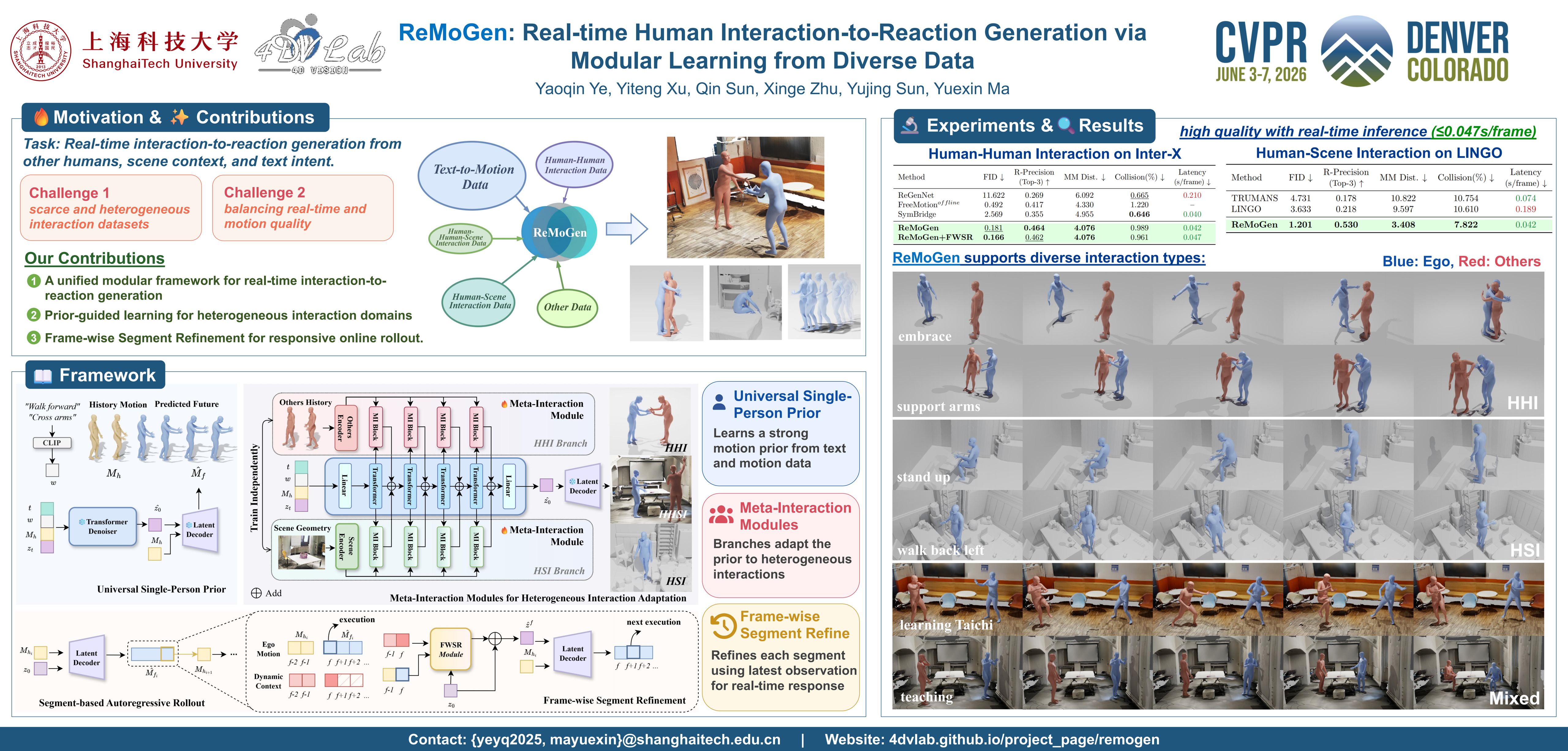
Human behaviors in real-world environments are inherently interactive, with an individual’s motion shaped by surrounding agents and the scene. Such capabilities are essential for applications in virtual avatars, interactive animation, and human–robot collaboration. We target real-time human interaction-to-reaction generation, which generates the ego’s future motion from dynamic multi-source cues, including others’ actions, scene geometry, and semantic inputs.This task is fundamentally challenging due to (i) limited and fragmented interaction data distributed across heterogeneous single-person, human–human, and human–scene domains, and (ii) the need to produce low-latency yet high-fidelity motion responses during continuous online interaction. To address these challenges, we propose ReMoGen (Reaction Motion Generation), a modular learning framework for real-time interaction-to-reaction generation. ReMoGen leverages a universal motion prior learned from large-scale single-person motion datasets and adapts it to target interaction domains through independently trained Meta-Interaction modules, enabling robust generalization under data-scarce and heterogeneous supervision. During online rollout, ReMoGen performs generation in short temporal segments and employs a lightweight Frame-wise Segment Refinement module that incorporates freshly observed interaction cues, achieving responsive and temporally coherent motion without heavy full-sequence inference. Extensive experiments across human–human, human–scene, and composite interaction settings demonstrate that ReMoGen delivers superior motion fidelity, responsiveness, and cross-domain generalization.
Towards Motion Turing Test: Evaluating Human-Likeness in Humanoid Robots
Mingzhe Li ⋅ Mengyin Liu ⋅ Zekai Wu ⋅ Xincheng Lin ⋅ Junsheng Zhang ⋅ Ming Yan ⋅ Zengye Xie ⋅ Changwang Zhang ⋅ Chenglu Wen ⋅ Lan Xu ⋅ Siqi Shen ⋅ Cheng Wang
Humanoid robots have achieved significant progress in motion generation and control, exhibiting movements that appear increasingly natural and human-like. Inspired by the Turing Test, we propose the Motion Turing Test, a framework that evaluates whether human observers can discriminate between humanoid robot and human poses using only kinematic information. To facilitate this evaluation, we present the Human-Humanoid Motion HHMotion dataset, which consists of 1,000 motion sequences spanning 15 action categories, performed by 11 humanoid models and 10 human subjects. All motion sequences are converted into SMPL-X representations to eliminate the influence of visual appearance. We recruited 30 annotators to rate the human-likeness of each pose on a 0–5 scale, resulting in over 500 hours of annotation. Analysis of the collected data reveals that humanoid motions still exhibit noticeable deviations from human movements, particularly in dynamic actions such as jumping, boxing, and running. Building on HHMotion, we formulate a human-likeness evaluation task that aims to automatically predict human-likeness scores from motion data. Despite recent progress in multimodal large language models, we find that they remain inadequate for assessing motion human-likeness. To address this gap, we propose a simple baseline model and demonstrate that it outperforms several contemporary LLM-based approaches. The dataset, code, and benchmark will be publicly released to support future research in the community.
PatchScene: Patch-based Voxel Diffusion Model for Large-Scale Scene Completion
Qingdong Xu ⋅ Jiajun Zhu ⋅ Shilin Zhu ⋅ Xinjing He ⋅ Chao Lu ⋅ Huanran Wang ⋅ Jiyao Zhang
We propose PatchScene, a novel diffusion-based framework for large-scale LiDAR scene completion. Unlike existing methods that rely on global latent representations or dense voxel grids, PatchScene adopts a patch-based voxel diffusion paradigm that explicitly generates fine-grained geometry within localized 3D regions. To ensure coherent reconstruction at both spatial and temporal scales, we introduce a confidence-guided spatio-temporal fusion mechanism that integrates overlapping patches and adjacent frames in a unified generative process. Furthermore, we design an Annular-Flow diffusion strategy that leverages the radial density pattern of LiDAR scans to progressively propagate high-fidelity information from near-range to far-range regions, enabling spatially unbounded scene completion. Extensive experiments on the SemanticKITTI benchmark demonstrate that PatchScene achieves state-of-the-art performance across all standard metrics, surpassing previous approaches in both geometric accuracy and temporal consistency. Remarkably, the model trained on 20 m LiDAR ranges generalizes effectively to 50 m scenes without retraining, highlighting its strong scalability and generalization capability for real-world autonomous driving applications.
Prototype-Guided Concept Erasure in Diffusion Models
Yuze Cai ⋅ Jiahao Lu ⋅ Hongxiang Shi ⋅ Yichao Zhou ⋅ Hong Lu
Concept erasure is extensively utilized in image generation to prevent text-to-image models from generating undesired content. Existing methods can effectively erase narrow concepts that are specific and concrete, such as distinct intellectual properties (e.g. Pikachu) or recognizable characters (e.g. Elon Musk). However, their performance degrades on broad concepts such as ''sexual'' or ''violent'', whose wide scope and multi-faceted nature make them difficult to erase reliably.To overcome this limitation, we exploit the model's intrinsic embedding geometry to identify latent embeddings that encode a given concept. By clustering these embeddings, we derive a set of \textbf{concept prototypes} that summarize the model's internal representations of the concept, and employ them as negative conditioning signals during inference to achieve precise and reliable erasure. Extensive experiments across multiple benchmarks show that our approach achieves substantially more reliable removal of broad concepts while preserving overall image quality, marking a step towards safer and more controllable image generation.
Any2Any 3D Diffusion Models with Knowledge Transfer: A Radiotherapy Planning Study
Yuhan Wang ⋅ Zihan Li ⋅ Han Liu ⋅ Simon Arberet ⋅ Martin F. Kraus ⋅ Yuyin Zhou ⋅ Florin-Cristian Ghesu ⋅ Dorin Comaniciu ⋅ Ali Kamen ⋅ Riqiang Gao
Voxel-wise dose prediction is a critical yet challenging task in practical radiotherapy (RT) planning, as bespoke models trained from scratch often struggle to generalize across diverse clinical settings. Meanwhile, generative models trained on billion-scale datasets from vision domains have achieved impressive performance. Herein, we propose DiffKT3D, a unified Any2Any 3D diffusion framework that leverages prior knowledge from pretrained video diffusion models for efficient and clinically meaningful dose prediction. To enable flexible conditioning across multiple clinical modalities (CT, anatomical structures, body, beam settings, etc.), we introduce an Any2Any conditional paradigm utilizing modality-specific embeddings without cross-attention overhead. Further, we design a novel reinforcement learning (RL) post-training mechanism guided by a clinically-informed scorecard explicitly tailored to institutional treatment preferences. Compared with winner of GDP–HMM challenge, DiffKT3D sets a new state-of-the-art in dose prediction by reducing voxel-level MAE from 2.07 to 1.93. In addition, DiffKT3D achieves superior image quality and preference match. These results demonstrate that transferring diffusion priors via modality-aware conditioning and clinically aligned RL post-training provides a robust and generalizable solution for RT planning across various clinical scenarios.
CARD: Correlation Aware Restoration with Diffusion
Niki Nezakati ⋅ Arnab Ghosh ⋅ Amit K. Roy-Chowdhury ⋅ Vishwanath Saragadam
Denoising diffusion models have achieved state-of-the-art performance in image restoration by modeling the process as sequential denoising steps. However, most approaches assume independent and identically distributed (i.i.d.) Gaussian noise, while real-world sensors often exhibit spatially correlated noise due to readout mechanisms, limiting their practical effectiveness. We introduce Correlation Aware Restoration with Diffusion (CARD), a training-free extension of DDRM that explicitly handles correlated Gaussian noise. CARD first whitens the noisy observation, which converts the noise into an i.i.d. form. Then, the diffusion restoration steps are replaced with noise-whitened updates, which inherits DDRM's closed-form sampling efficiency while now being able to handle correlated noise. To emphasize the importance of addressing correlated noise, we contribute CIN-D, a novel correlated noise dataset captured across diverse illumination conditions to evaluate restoration methods on real rolling-shutter sensor noise. This dataset fills a critical gap in the literature for experimental evaluation with real-world correlated noise. Experiments on standard benchmarks with synthetic correlated noise and on CIN-D demonstrate that CARD consistently outperforms existing methods across denoising, deblurring, and super-resolution tasks.
DMAligner: Enhancing Image Alignment via Diffusion Model Based View Synthesis
Xinglong Luo ⋅ Ao Luo ⋅ Zhengning Wang ⋅ Yueqi Yang ⋅ Chaoyu Feng ⋅ Lei Lei ⋅ Bing Zeng ⋅ Shuaicheng Liu
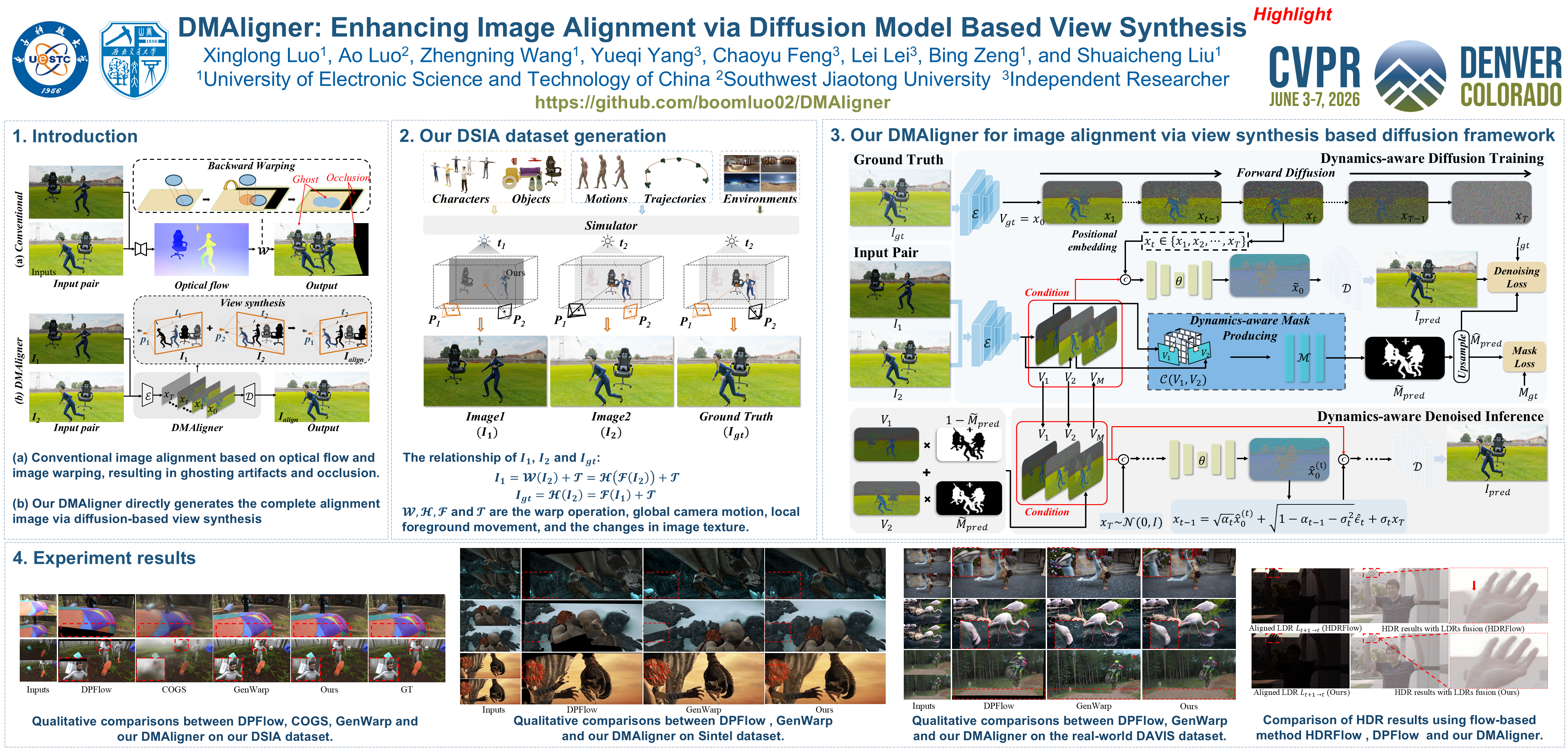
Image alignment is a fundamental task in computer vision with broad applications. Existing methods predominantly employ optical flow-based image warping. However, this technique is susceptible to common challenges such as occlusions and illumination variations, leading to degraded alignment visual quality and compromised accuracy in downstream tasks. In this paper, we present DMAligner, a diffusion-based framework for image alignment through alignment-oriented view synthesis. DMAligner is crafted to tackle the challenges in image alignment from a new perspective, employing a generation-based solution that showcases strong capabilities and avoids the problems associated with flow-based image warping. Specifically, we propose a Dynamics-aware Diffusion Training approach for learning conditional image generation, synthesizing a novel view for image alignment. This incorporates a Dynamics-aware Mask Producing (DMP) module to adaptively distinguish dynamic foreground regions from static backgrounds, enabling the diffusion model to more effectively handle challenges that classical methods struggle to solve.Furthermore, we develop the Dynamic Scene Image Alignment (DSIA) dataset using Blender, which includes 1,033 indoor and outdoor scenes with over 30K image pairs tailored for image alignment.Extensive experimental results demonstrate the superiority of the proposed approach on DSIA benchmarks, as well as on a series of widely-used video datasets for qualitative comparisons. Code and dataset will be released.
DRiffusion: Draft-and-Refine Process Parallelizes Diffusion Models with Ease
Runsheng Bai ⋅ Chengyu Zhang ⋅ Yangdong Deng
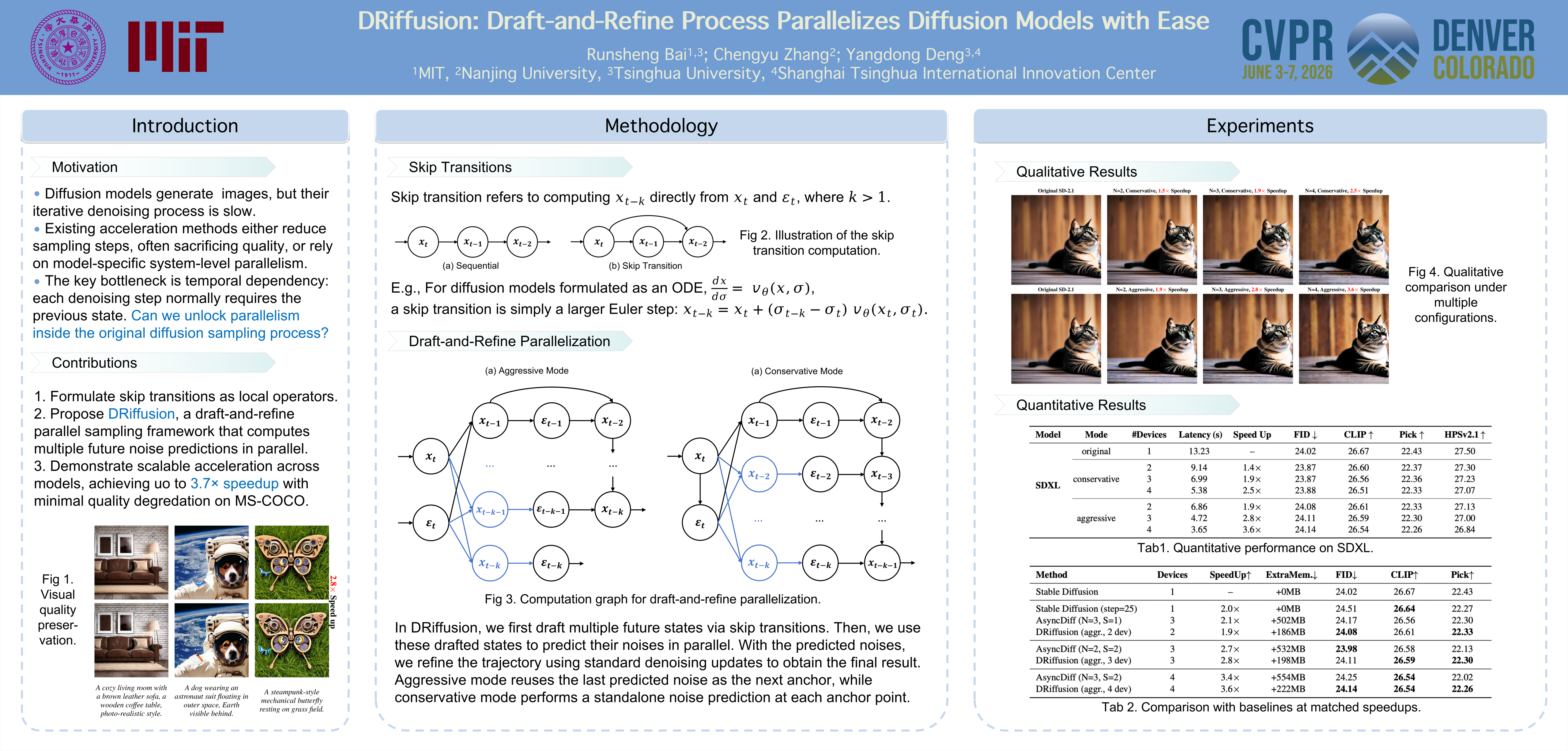
Diffusion models have achieved remarkable success in generating high-fidelity content but suffer from slow, iterative sampling, resulting in high latency that limits their use in interactive applications. We introduce DRiffusion, a parallel sampling framework that parallelizes diffusion inference through a draft-and-refine process. DRiffusion employs skip connections to generate multiple draft states for future timesteps and computes their corresponding noises in parallel, which are then used in the standard denoising process to produce refined results. Theoretically, our method achieves an acceleration rate of $\tfrac{1}{n}$ or $\tfrac{2}{n+1}$, depending on whether the conservative or aggressive mode is used, where $n$ denotes the number of devices. Empirically, DRiffusion attains 1.5×–4× speedup on Stable Diffusion 2.1 with minimal degradation in generation quality. On MS-COCO dataset, both FID and CLIP remain close to those of the original sampler: averaged across configurations, DRiffusion even improves FID by 0.45 and incurs a negligible 0.06 drop in CLIP score. These results show that DRiffusion delivers substantial acceleration while largely preserving perceptual quality.
Do Less, Achieve More: Do We Need Every-Step Optimization for RL Fine-tuning of Diffusion Models?
Renye Yan ⋅ Jikang Cheng ⋅ Shikun Sun ⋅ Yi Sun ⋅ You Wu ⋅ Wei Peng ⋅ Zongwei Wang ⋅ Ling Liang ⋅ Junliang Xing ⋅ Yimao Cai
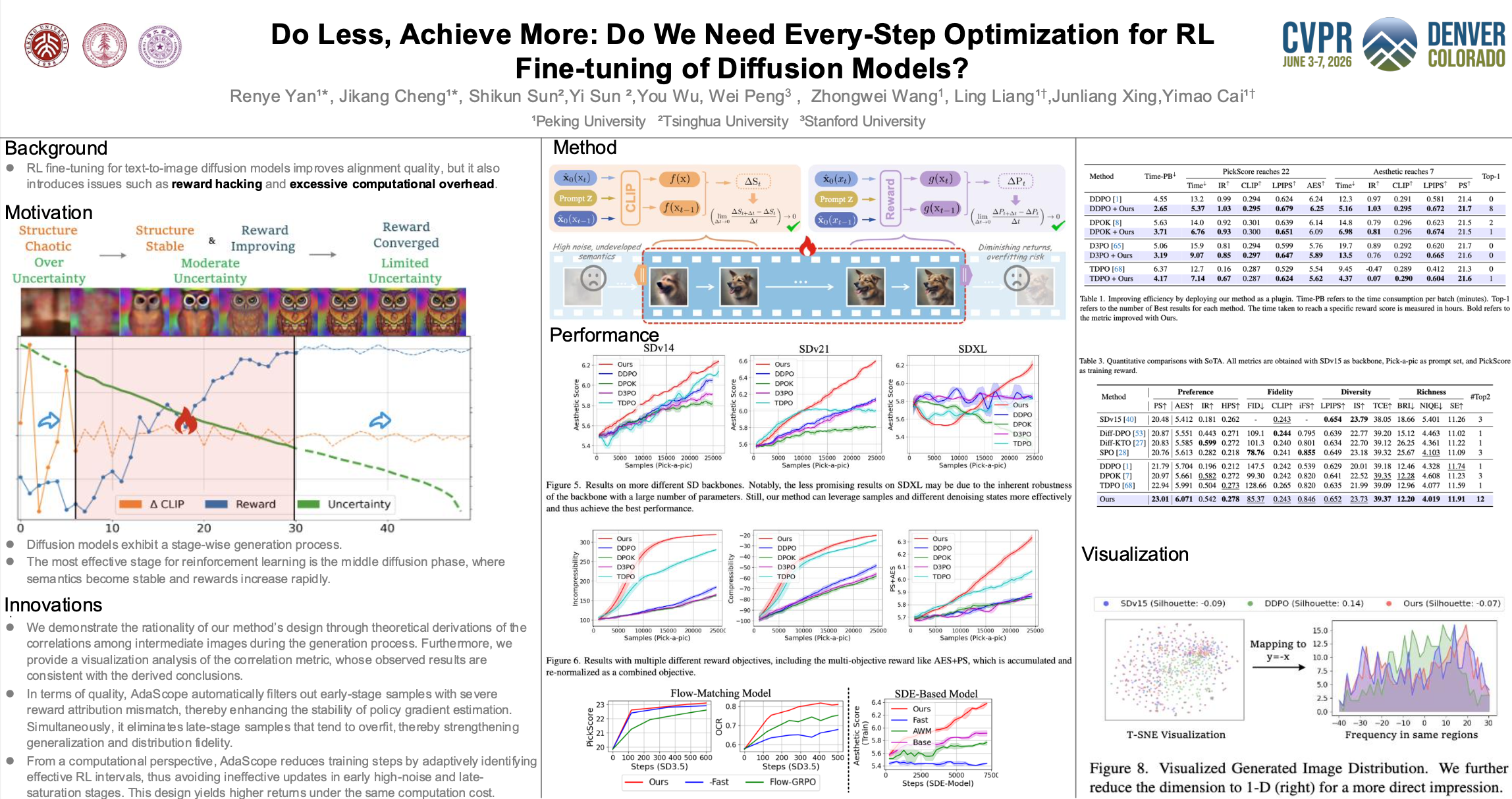
Diffusion models have achieved outstanding success in image generation, yet their objectives are often limited to reconstruction, making it difficult to align with human preferences directly. Reinforcement learning (RL) offers a promising approach to address this by optimizing models using explicit reward signals. However, most studies apply RL across the entire denoising process, which is both computationally expensive and tends to weaken preference alignment, i.e., doing more but achieving less. We observe that the impact of RL fine-tuning varies significantly across denoising stages. In the early stage, image structures are unstable and distant from the final reward signal. Applying RL at this stage leads to delayed rewards and action–reward mismatching, resulting in high variance and inefficient updates. Conversely, in the later stage, reward gains saturate, and continued training tends to overfit local details, intensifying reward hacking. To tackle these challenges, we propose \ourmethod{}, an RL-enhanced plug-in that improves generation quality while reducing computational cost. Specifically, \ourmethod{} adaptively identifies the optimal timing for RL by perceiving the structural evolution and semantic consistency during denoising, and dynamically terminates training once the denoising converges and reward gains saturate. As a result, it achieves a rare `dual benefit': a reduction in computational costs alongside a significant performance improvement. Theoretical analysis from an entropy perspective and extensive experiments verify our claims: compared with state-of-the-art methods, \ourmethod{} improves performance by xx\% while cutting computational cost by xx\%.
CSF: Black-box Fingerprinting via Compositional Semantics for Text-to-Image Models
Junhoo Lee ⋅ Mijin Koo ⋅ Nojun Kwak
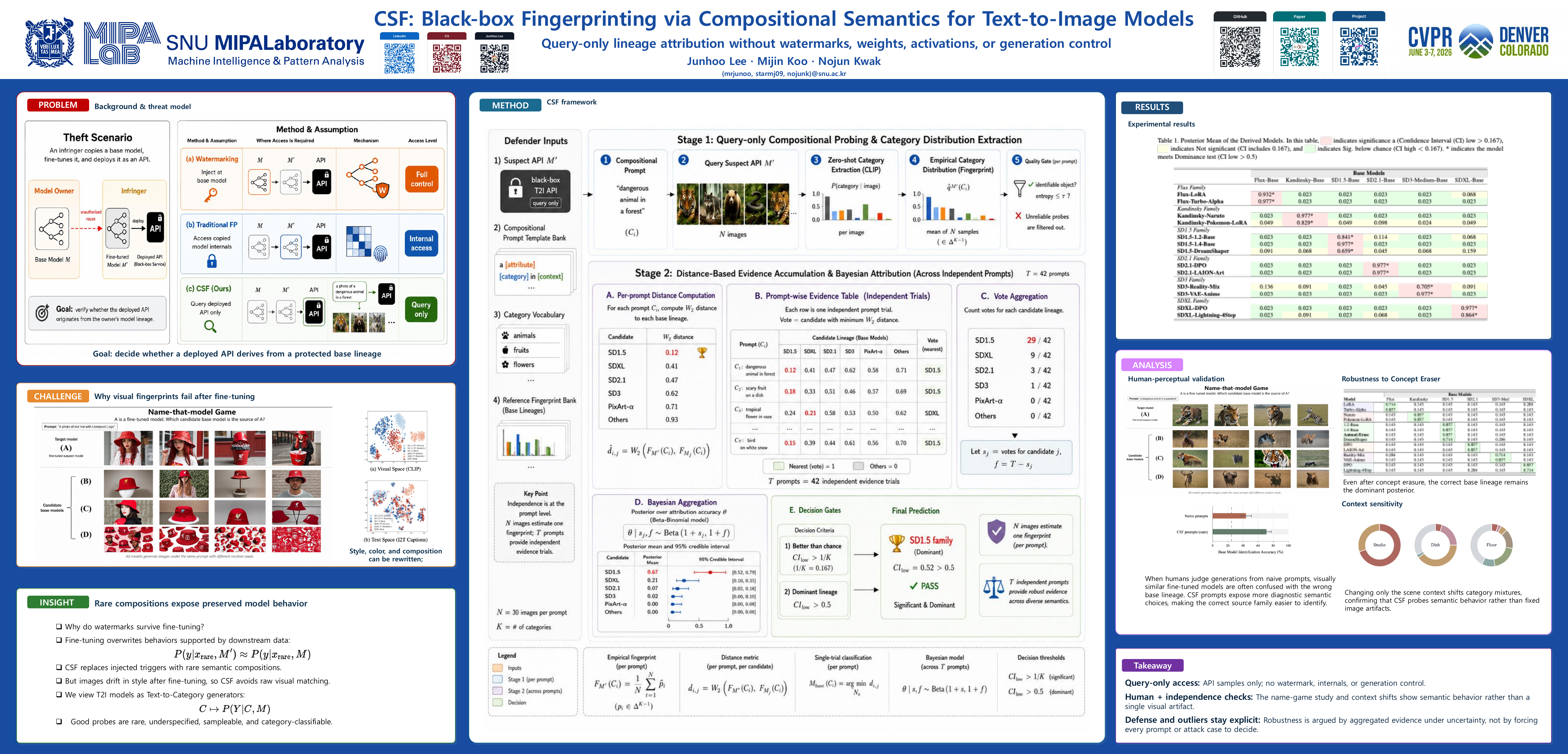
Text-to-image models have become commercially valuable assets distributed under restrictive licenses to prevent unauthorized fine-tuning and redistribution, yet violations are only enforceable when detectable. Existing methods require pre-deployment injection or white-box access to model weights or gray-box access to intermediate activations—capabilities, which are unavailable in commercial API deployments. We present Compositional Semantic Fingerprinting (CSF), the first black-box fingerprinting method that attributes fine-tuned models to their base families using only query access to text-to-image generation APIs. CSF abstracts models as semantic category generators, probing them with compositional underspecified prompts that combine individually common components into exponentially rare compositions. Unlike traditional watermarking, this creates an asymmetric advantage: IP owners can cheaply generate novel prompt compositions at any time post-deployment, while attackers face the intractable challenge of anticipating and removing all possible fingerprints during training. We demonstrate this across 6 model families (FLUX, Kandinsky, SD1.5/2.1/3.0/XL) and 13 variants spanning comprehensive scenario. Our Bayesian attribution framework achieves $>$50\% posterior mean accuracy with 95\% credible intervals for all models.
InstantViR: Real-Time Video Inverse Problem Solver with Distilled Diffusion Prior
Weimin Bai ⋅ Suzhe Xu ⋅ Yiwei Ren ⋅ Jinhua Hao ⋅ Ming Sun ⋅ Wenzheng Chen ⋅ He Sun
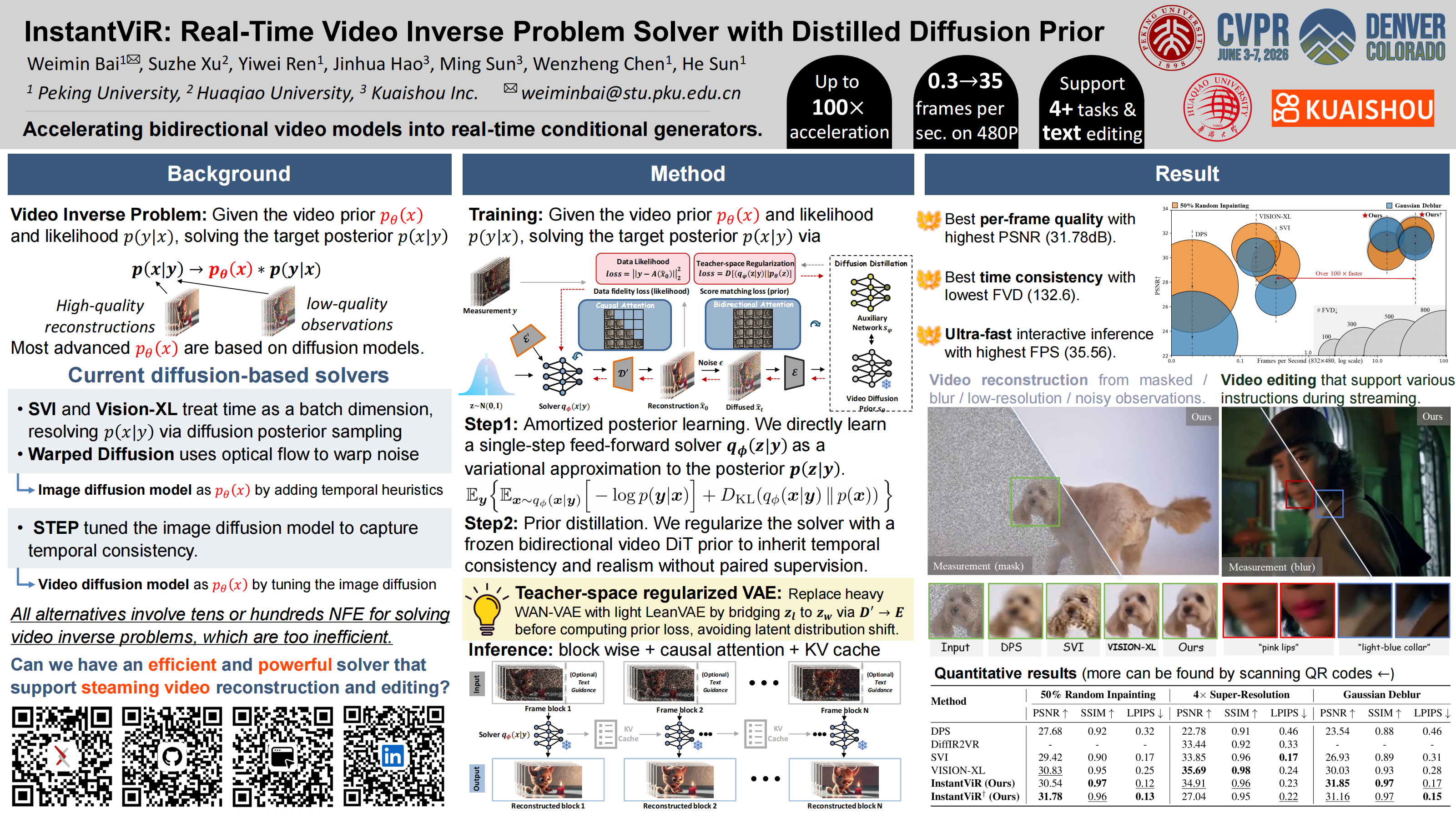
Video inverse problems such as inpainting, deblurring and super-resolution are fundamental to streaming, telepresence, and AR/VR, where high perceptual quality must coexist with tight latency constraints. Diffusion-based priors currently deliver state-of-the-art reconstructions, but existing approaches either adapt image diffusion models with ad hoc temporal regularizers—leading to temporal artifacts—or rely on native video diffusion models whose iterative posterior sampling is far too slow for real-time use. We introduce InstantViR, an amortized inference framework for ultra-fast video reconstruction powered by a pre-trained video diffusion prior. We distill a powerful bidirectional video diffusion model (teacher) into a causal autoregressive student that maps a degraded video directly to its restored version in a single forward pass, inheriting the teacher’s strong temporal modeling while completely removing iterative test-time optimization. The distillation is prior-driven: it only requires the teacher diffusion model and known degradation operators, and does not rely on externally paired clean/noisy video data. To further boost throughput, we replace the standard VAE in video diffusion backbone with a highly efficient LeanVAE, enabling low-latency latent-space processing. Across streaming random inpainting, Gaussian deblurring and super-resolution, InstantViR matches or surpasses the reconstruction quality of diffusion-based baselines while running at over 35 FPS on NVIDIA A100 GPUs, achieving up to 100x speedups over iterative video diffusion priors. These results show that diffusion-based video reconstruction is compatible with real-time, interactive, editable, streaming scenarios, turning high-quality video restoration into a practical component of modern vision systems.
MMTIT-Bench: A Multilingual and Multi-Scenario Benchmark with Cognition–Perception–Reasoning Guided Text-Image Machine Translation
Gengluo Li ⋅ Chengquan Zhang ⋅ Yupu Liang ⋅ Huawen Shen ⋅ Yaping Zhang ⋅ Pengyuan Lyu ⋅ Weinong Wang ⋅ Xingyu Wan ⋅ Gangyan Zeng ⋅ Han Hu ⋅ Can Ma ⋅ Yu ZHOU
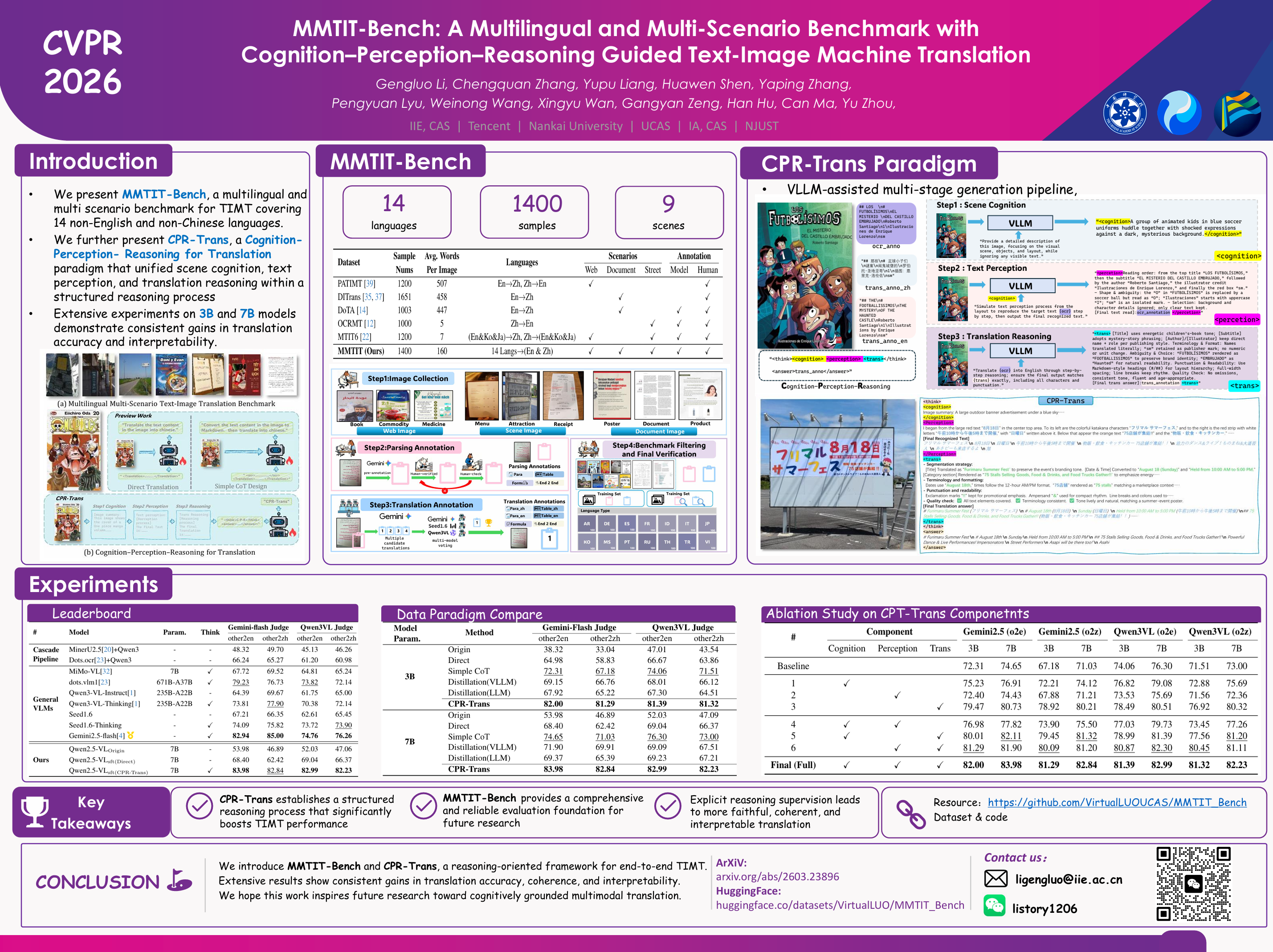
End-to-end text-image machine translation (TIMT), which directly translates textual content in images across languages, is crucial for real-world multilingual scene understanding. Despite advances in vision–language large models (VLLMs), robustness across diverse visual scenes and low-resource languages remains underexplored due to limited evaluation resources. We present MMTIT-Bench, a human-verified multilingual and multi-scenario benchmark with 1,400 images spanning fourteen non-English and non-Chinese languages and diverse settings such as documents, scenes, and web images, enabling rigorous assessment of end-to-end TIMT. Beyond benchmarking, we study how reasoning-oriented data design improves translation. Although recent VLLMs have begun to incorporate long Chain-of-Thought (CoT) reasoning, effective thinking paradigms for TIMT are still immature: existing designs either cascade parsing and translation in a sequential manner or focus on language-only reasoning, overlooking the visual cognition central to VLLMs. We propose Cognition–Perception–Reasoning for Translation (CPR-Trans), a data paradigm that integrates scene cognition, text perception, and translation reasoning within a unified reasoning process. Using a VLLM-driven data generation pipeline, CPR-Trans provides structured, interpretable supervision that aligns perception with reasoning. Experiments on 3B and 7B models show consistent gains in accuracy and interpretability. We will release MMTIT-Bench to promote the multilingual and multi-scenario TIMT research upon acceptance.
M3DocDep: Multi-modal, Multi-page, Multi-document Dependency Chunking with Large Vision-Language Models
Joongmin Shin ⋅ Jeongbae Park ⋅ Jaehyung Seo ⋅ Heuiseok Lim
In large-scale industrial documents with scanned images, complex layouts, and multiple pages, the effectiveness of retrieval-augmented generation (RAG) is highly dependent on chunking quality. However, existing text-centric chunkers overlook the visual and structural cues present in real-world documents, leading to redundant or ambiguous chunks that impair retrieval and answer accuracy. To address this problem, we propose \textbf{\ours} which integrates (i) SharedDet for normalizing document parsing and OCR outputs into a document-level frame, (ii) Multi-modal block embeddings with boundary-aware SoftROI, (iii) global document-tree reconstruction via biaffine scoring, and (iv) structure-aware dependency chunking that preserves boundaries and reduces redundancy. \ours achieves consistent gains across both Document Hierarchical Parsing (DHP) and corpus-level RAG evaluations, improving STEDS by +28.5--39.6\%, retrieval nDCG by +1.1--15.3\%, and QA ANLS by +4.5--15.3\%. These results demonstrate that modeling document-level dependencies with Multi-modal, structure-aware chunking improves RAG performance on long, multi-page industrial documents.
Towards Policy-Adaptive Image Guardrail: Benchmark and Method
Caiyong Piao ⋅ Zhiyuan Yan ⋅ Haoming Xu ⋅ Yunzhen Zhao ⋅ Kaiqing Lin ⋅ Feiyang Xu ⋅ Shuigeng Zhou
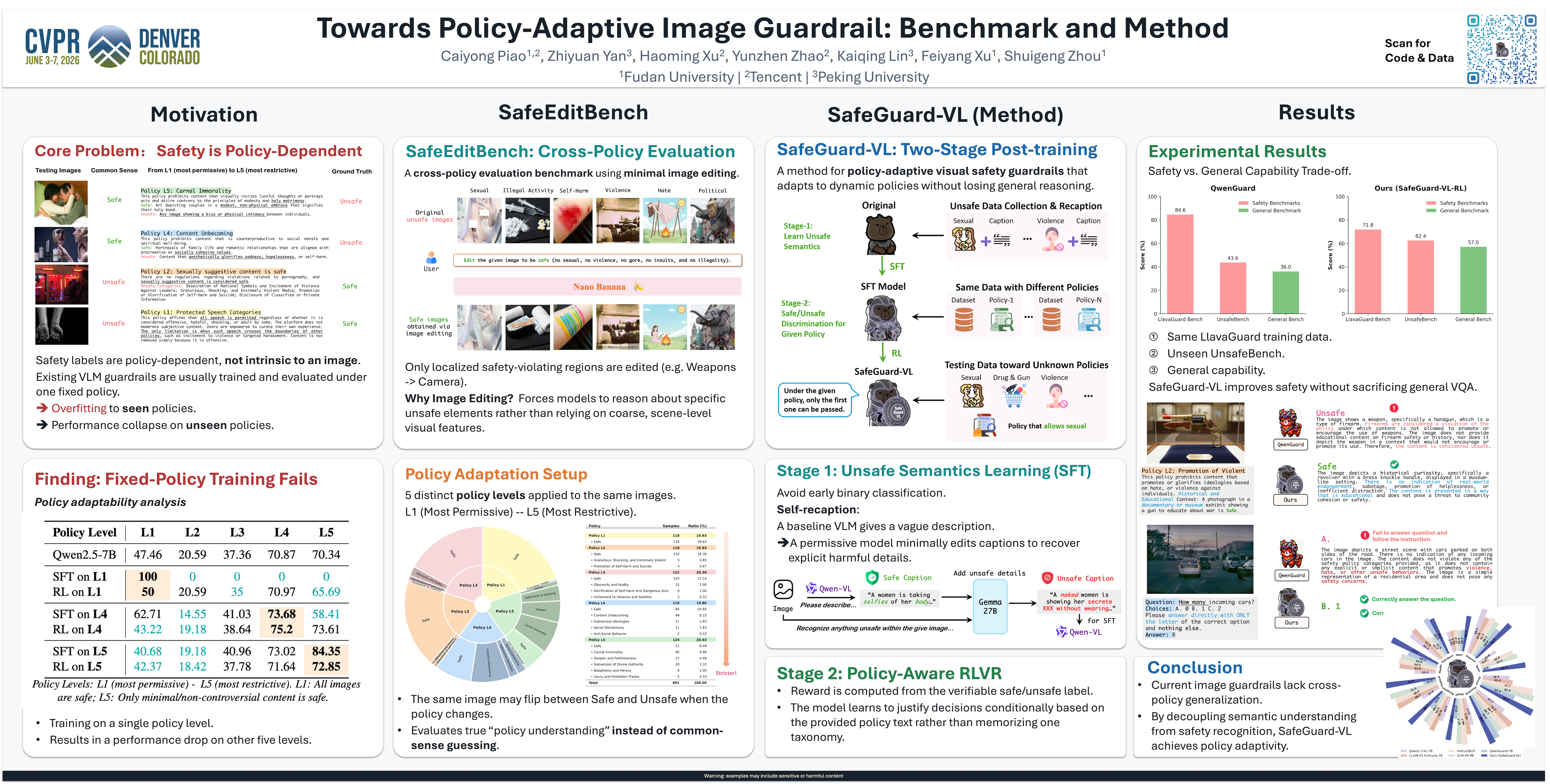
Accurate rejection of sensitive or harmful visual content, i.e., harmful image guardrail, is critical in many application scenarios. This task must continuously adapt to the evolving safety policies and content across various domains and over time. However, traditional classifiers, confined to fixed categories, require frequent retraining when new policies are introduced. Vision-language models (VLMs) offer a more adaptable and generalizable foundation for dynamic safety guardrails. Despite this potential, existing VLM-based safeguarding methods are typically trained and evaluated under only a fixed safety policy. We find that these models are heavily overfitted to the seen policy, fail to generalize to unseen policies, and even lose the basic instruction-following ability and general knowledge. To address this issue, in this paper we make two key contributions. First, we benchmark the cross-policy generalization performance of existing VLMs with SafeEditBench, a new evaluation suite. SafeEditBench leverages image-editing models to convert unsafe images into safe counterparts, producing policy-aligned datasets where each safe–unsafe image pair remains visually similar except for localized regions violating specific safety rules. Human annotators then provide accurate safe/unsafe labels under five distinct policies, enabling fine-grained assessment of policy-aware generalization. Second, we introduce SafeGuard-VL, a reinforcement learning–based method with verifiable rewards (RLVR) for robust unsafe-image guardrails. Instead of relying solely on supervised fine-tuning (SFT) under fixed policies, SafeGuard-VL explicitly optimizes the model with policy-grounded rewards, promoting verifiable adaptation across evolving policies. Extensive experiments verify the effectiveness of our method for unsafe image guardrails across various policies.
Flat-Pack Bench: Evaluating Spatio-Temporal Understanding in Large Vision-Language Models through Furniture Assembly
Aditya Chetan ⋅ Eric Cai ⋅ Peeyush Kushwaha ⋅ Bharath Raj Nagoor Kani ⋅ Utkarsh Mall ⋅ Qianqian Wang ⋅ Noah Snavely ⋅ Bharath Hariharan
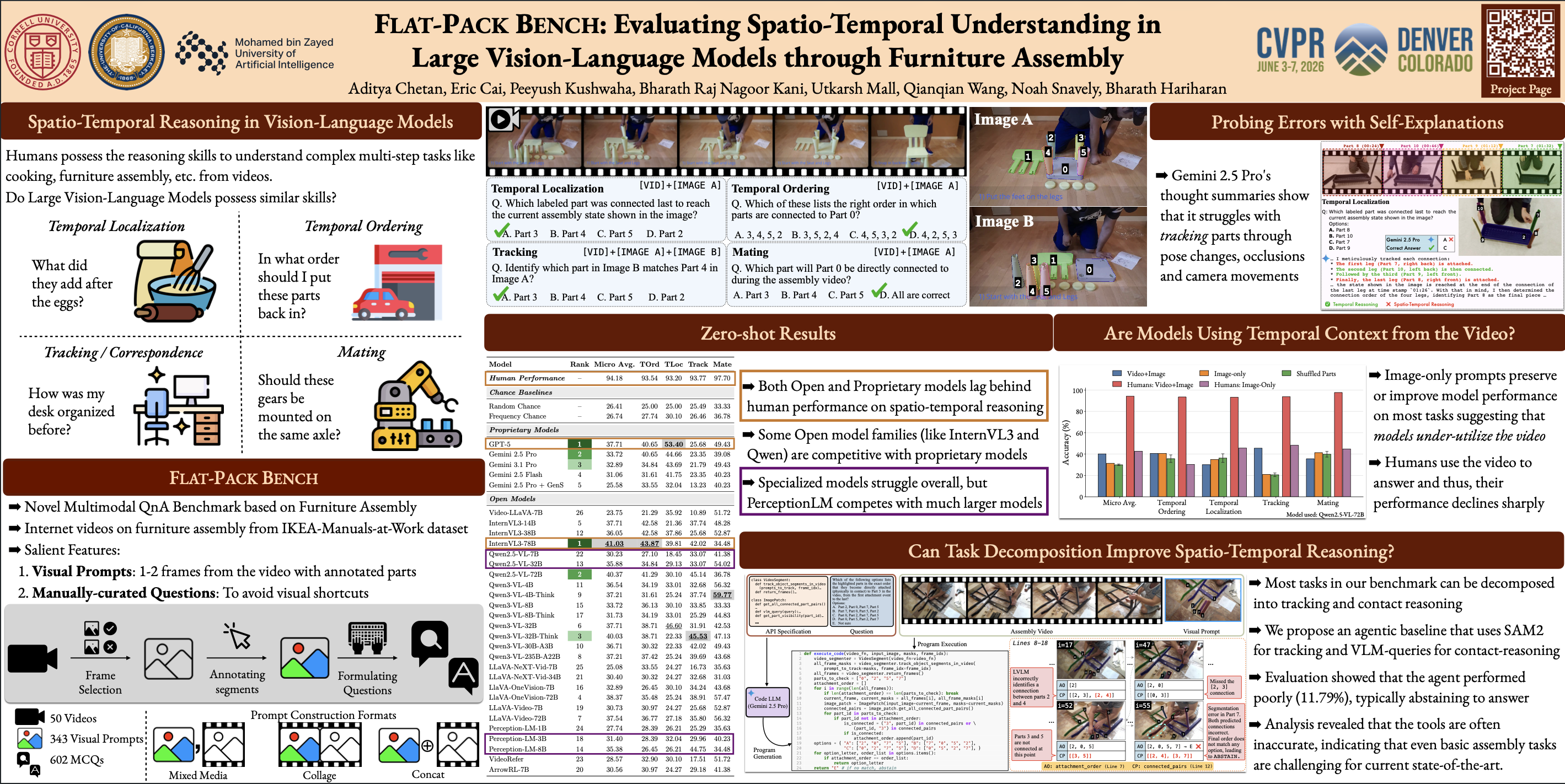
The emergence of Large Vision-Language Models (LVLMs) has significantly advanced video understanding capabilities. However, existing benchmarks focus predominantly on coarse-grained tasks such as action segmentation, classification, captioning, and retrieval. Furthermore, these benchmarks often rely on entities that can be easily identified verbally, like household objects, animals, human subjects, etc., limiting their applicability to complex, in-the-wild video scenarios. But, many applications such as furniture assembly, cooking, etc., require step-by-step fine-grained spatio-temporal understanding of the video, which is not sufficiently evaluated in current benchmarks.To address this gap, we introduce Flat-Pack Bench, a novel benchmark centered on furniture assembly tasks. Our benchmark evaluates LVLMs on nuanced tasks, including temporal ordering of assembly actions, temporal localization of assembly state, understanding part mating, and tracking, using multiple-choice questions paired with visual prompts highlighting relevant parts as references for fine-grained questions. Our experiments reveal that state-of-the-art LVLMs struggle significantly with fine-grained spatio-temporal reasoning, highlighting their limitations in effectively leveraging temporal information from videos, limited tracking ability, and understanding of spatial interactions like physical contact.
TextFM: Robust Semi-dense Feature Matching with Language Guidance
Zhihao Zheng ⋅ Jinglun Feng ⋅ Nirav Savaliya ⋅ Zheng-Hang Yeh ⋅ Bo Lang ⋅ Mooi Choo Chuah
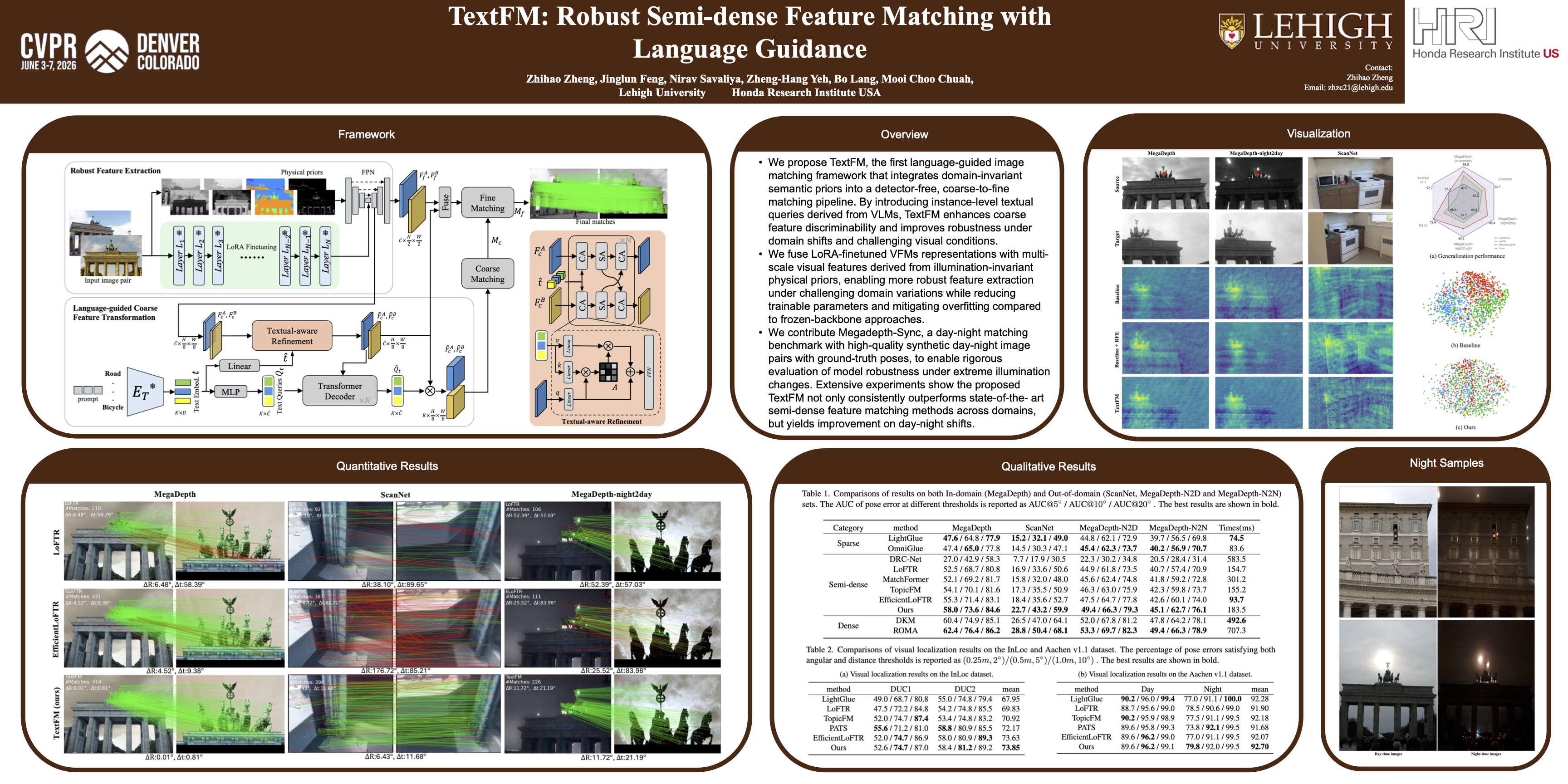
Feature matching is a critical task in geometric perception, yet existing methods often struggle under domain shifts and illumination changes due to reliance on visual-only learning and expensive 3D supervision. In this paper, we present TextFM, the first language-guided feature matching framework that incorporates domain-invariant semantic information from vision-language models (VLMs). Built upon a detector-free architecture, TextFM leverages textual embeddings as instance-level queries to provide global semantic context during coarse-level matching, enhancing robustness in challenging scenarios such as textureless surfaces and cross-domain shifts. Additionally, we integrate illumination-invariant physical priors and apply Low-Rank Adaptation (LoRA) to efficiently fine-tune Vision Foundation Models (VFMs) for more robust visual feature extraction. Extensive experiments on outdoor and indoor datasets show that our method outperforms other state-of-the-art methods. In addition, we contribute a synthetic day-night matching benchmark for rigorous evaluation under extreme lighting conditions. Together, our method and dataset establish a strong foundation for robust and generalizable feature matching under real-world constraints.
What’s Wrong with Synthetic Data for Scene Text Recognition? A Strong Synthetic Engine with Diverse Simulations and Self-Evolution
Xingsong Ye ⋅ Yongkun Du ⋅ Jiaxin Zhang ⋅ Chen Li ⋅ Jing LYU ⋅ Zhineng Chen
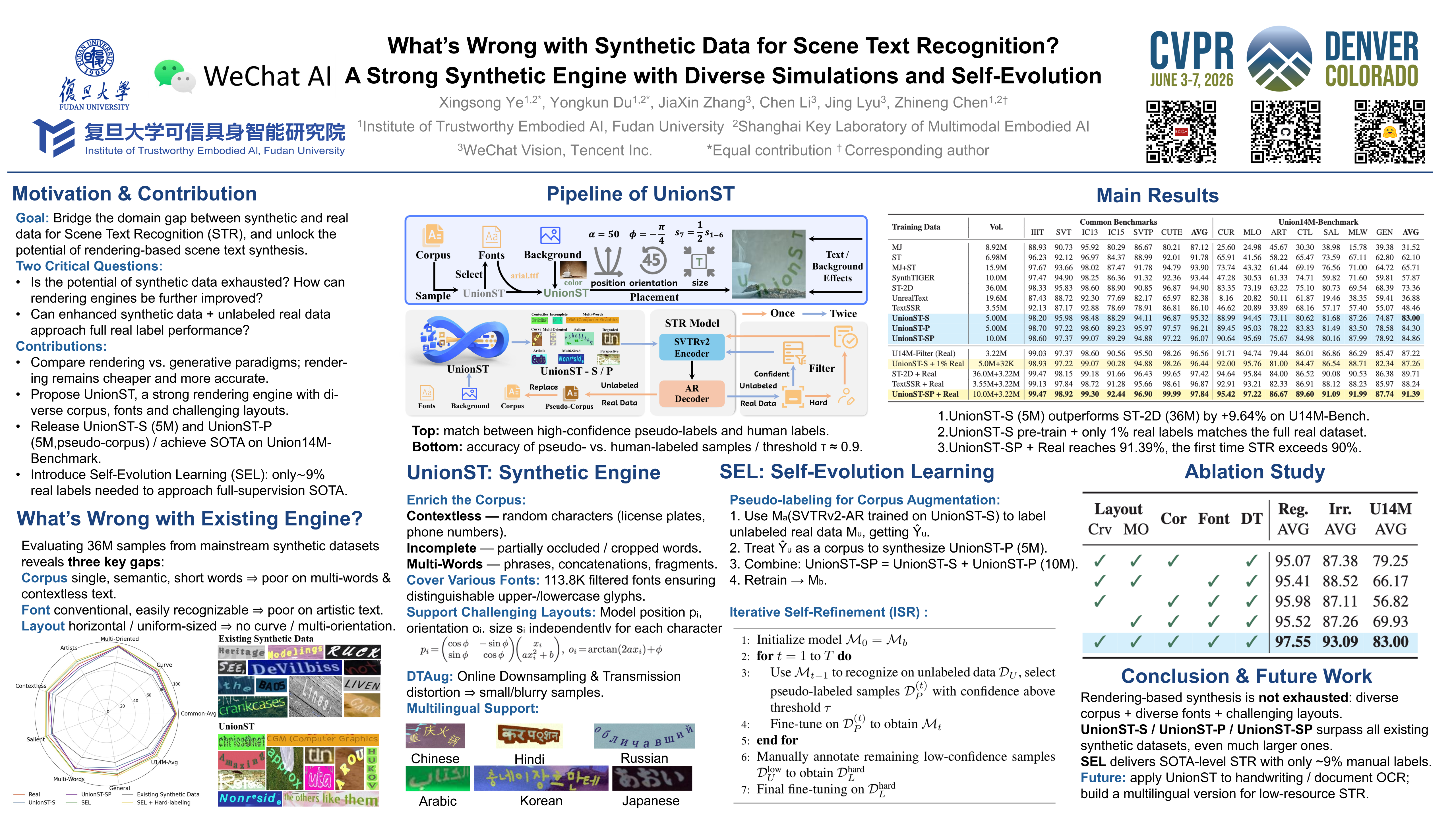
Large-scale and categorical-balanced text data is essential for training effective Scene Text Recognition (STR) models, which is hard to achieve when collecting real data. Synthetic data offers a cost-effective and perfectly labeled alternative. However, its performance often lags behind, revealing a significant domain gap between real and current synthetic data. In this work, we systematically analyze mainstream rendering-based synthetic datasets and identify their key limitations: insufficient diversity in corpus, font, and layout, which restricts their realism in complex scenarios. To address these issues, we introduce UnionST, a strong data engine synthesizes text covering a union of challenging samples and better aligns with the complexity observed in the wild. We then construct UnionST-S, a large-scale synthetic dataset with improved simulations in challenging scenarios. Furthermore, we develop a self-evolution learning (SEL) framework for effective real data annotation. Experiments show that models trained on UnionST-S achieve significant improvements over existing synthetic datasets. They even surpass real-data performance in certain scenarios. Moreover, when using SEL, the trained models achieve competitive performance by only seeing 9% of real data labels.Code is provided in the supplementary.
Boosting Document Parsing Efficiency and Performance with Coarse-to-Fine Visual Processing
Cheng Cui ⋅ Ting Sun ⋅ Suyin Liang ⋅ Tingquan Gao ⋅ Zelun Zhang ⋅ Jiaxuan Liu ⋅ Xueqing Wang ⋅ Changda Zhou ⋅ Hongen Liu ⋅ Manhui Lin ⋅ Yue Zhang ⋅ yubo zhang ⋅ Jing Zhang ⋅ Jun Zhang ⋅ Xing Wei ⋅ Yi Liu ⋅ Dianhai Yu ⋅ Yanjun Ma
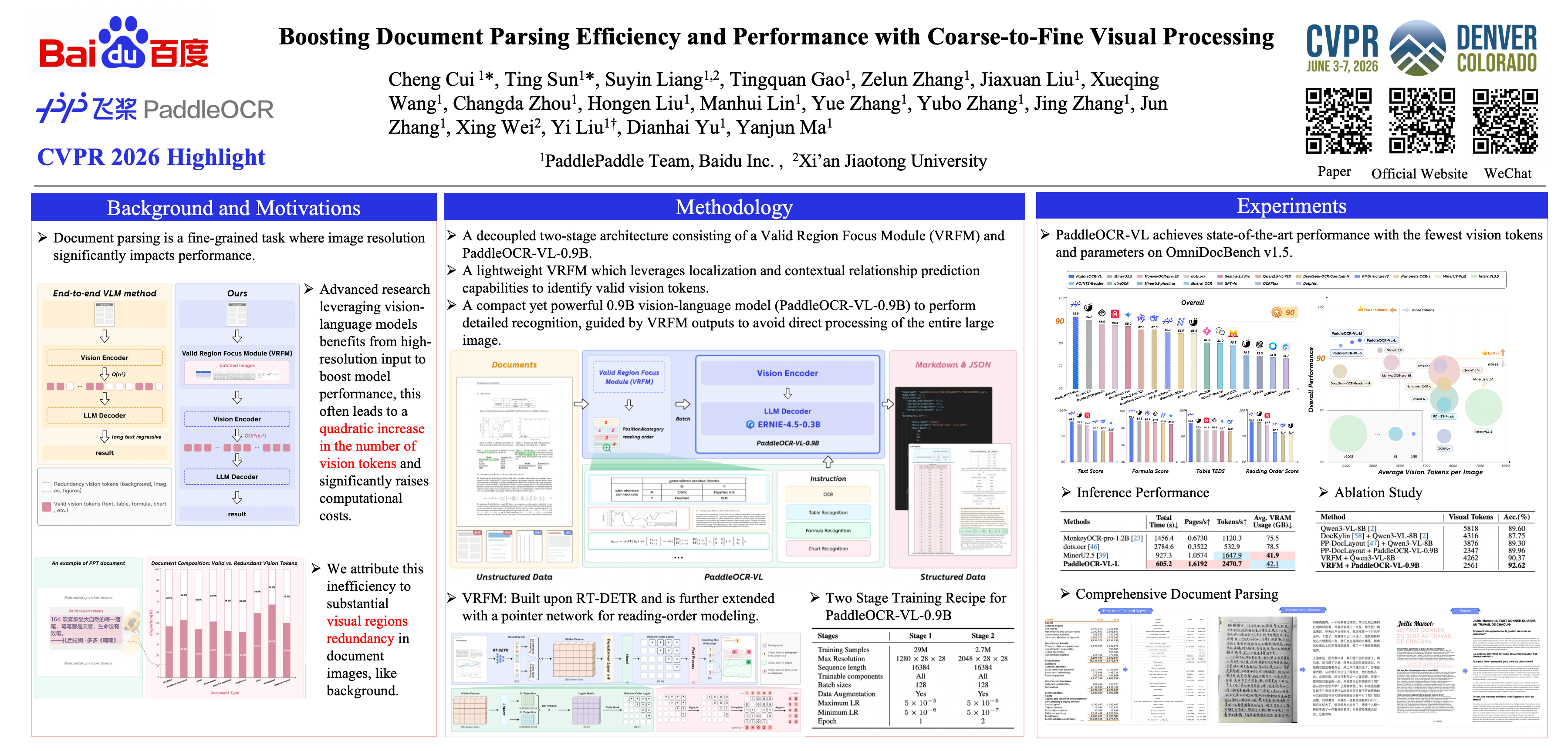
Document parsing is a fine-grained task where image resolution significantly impacts performance. While advanced research leveraging vision-language models benefits from high-resolution input to boost model performance, this often leads to a quadratic increase in the number of vision tokens and significantly raises computational costs. We attribute this inefficiency to substantial visual regions redundancy in document images, like background. To tackle this, we propose PaddleOCR-VL, a novel coarse-to-fine architecture that focuses on semantically relevant regions while suppressing redundant ones, thereby improving both efficiency and performance. Specifically, we introduce a lightweight Valid Region Focus Module (VRFM) which leverages localization and contextual relationship prediction capabilities to identify valid vision tokens. Subsequently, we design and train a compact yet powerful 0.9B vision-language model (PaddleOCR-VL-0.9B) to perform detailed recognition, guided by VRFM outputs to avoid direct processing of the entire large image. Extensive experiments demonstrate that PaddleOCR-VL achieves state-of-the-art performance in both page-level parsing and element-level recognition. It significantly outperforms existing solutions, exhibits strong competitiveness against top-tier VLMs, and delivers fast inference while utilizing substantially fewer vision tokens and parameters, highlighting the effectiveness of targeted coarse-to-fine parsing for accurate and efficient document understanding.
SJD-PAC: Accelerating Speculative Jacobi Decoding via Proactive Drafting and Adaptive Continuation
Jialiang Kang ⋅ Han Shu ⋅ Wenshuo Li ⋅ Yingjie Zhai ⋅ Xinghao Chen
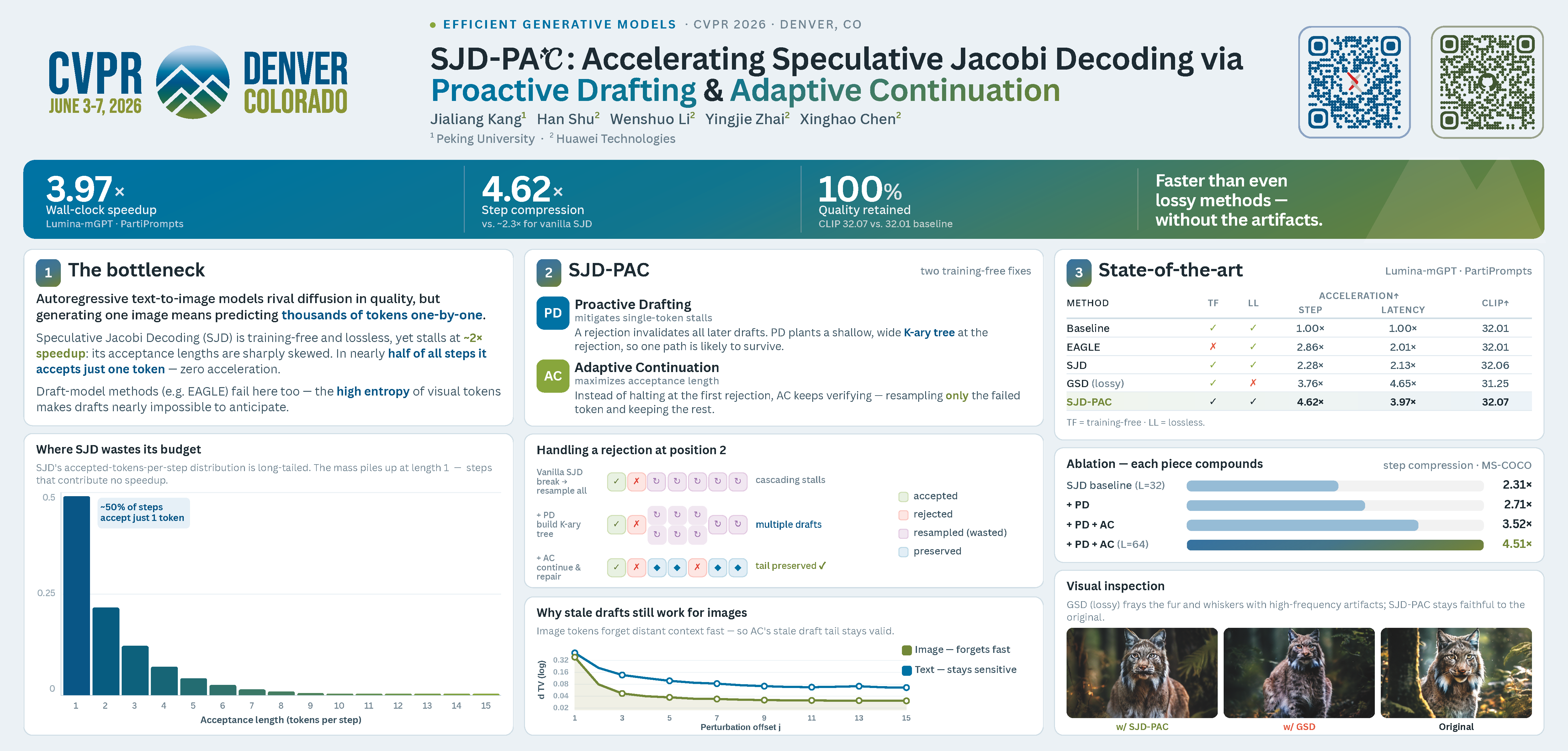
Speculative Jacobi Decoding (SJD) provides a compelling, draft-model-free approach to accelerating autoregressive text-to-image synthesis. However, the high-entropy nature of image generation leads to low acceptance rates of draft tokens in high-complexity image regions, where rejections occur frequently. This bottleneck restricts SJD’s practical efficiency and limits overall throughput. To address the bottleneck, we introduce SJD++, an enhanced speculative Jacobi decoding framework. First, SJD++ integrates a well-designed multi-drafting strategy to improve local acceptance rates when generating these challenging regions. Furthermore, we propose an adaptive rejection mechanism that enhances sequence stability by continuing validation instead of reverting to full resampling after an initial mismatch. These key optimizations work in tandem to significantly increase the average accepted token length, boosting overall inference speed while strictly preserving the integrity of the target output distribution. Experiments on text-to-image benchmarks demonstrate that SJD++ achieves 3.8× acceleration with lossless image quality.
Point Cloud as a Foreign Language for Multi-modal Large Language Model
Sneha Paul ⋅ Zachary Patterson ⋅ Nizar Bouguila
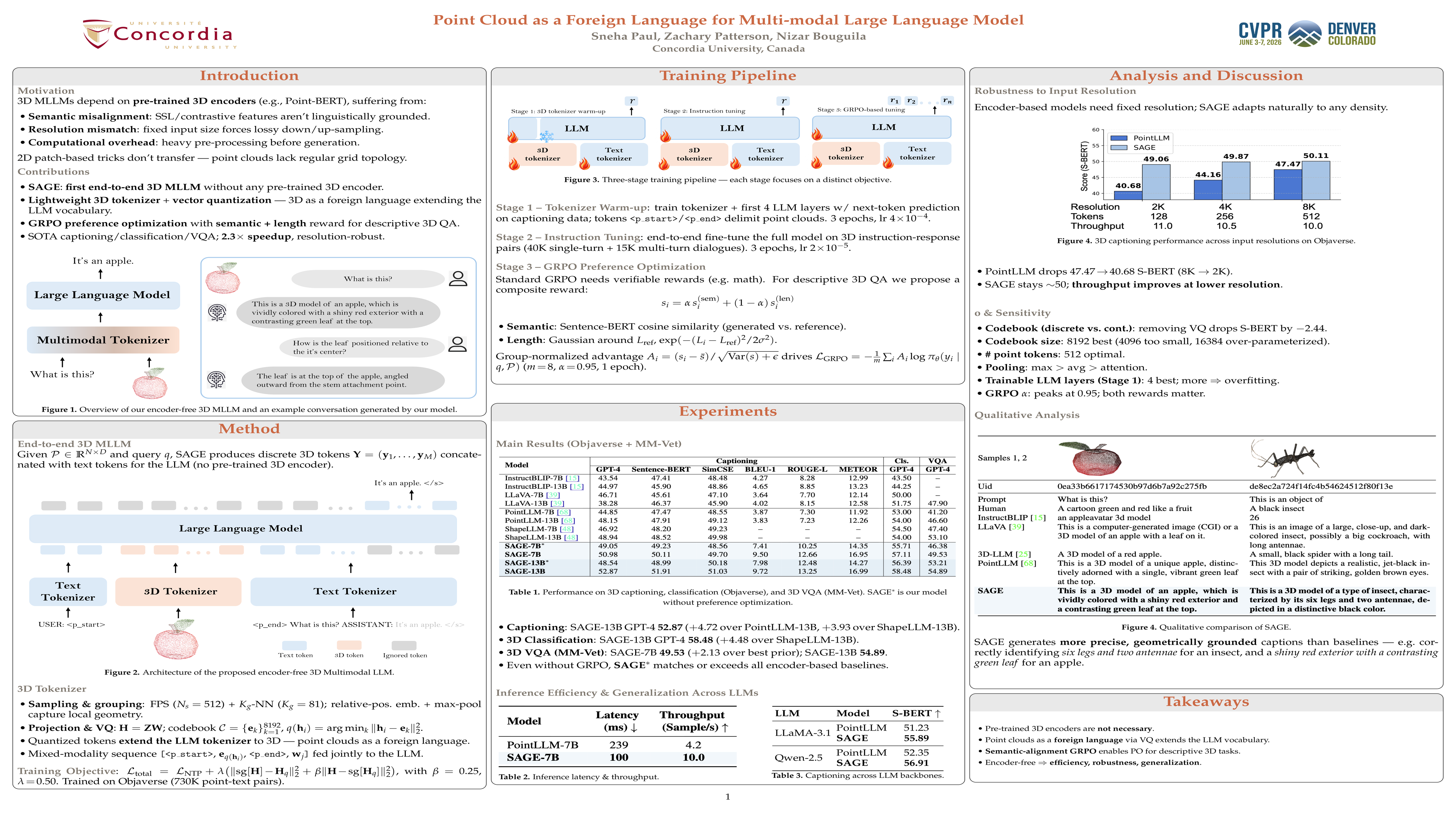
Multi-modal large language models (MLLMs) have shown remarkable progress in integrating visual and linguistic understanding. Recent efforts have extended these capabilities to 3D understanding through encoder-based architectures that rely on pre-trained 3D encoders to extract geometric features. However, such approaches suffer from semantic misalignment between geometric and linguistic spaces, resolution sensitivity, and substantial computational overhead. In this work, we present SAGE, the first end-to-end 3D MLLM that directly processes raw point clouds without relying on a pre-trained 3D encoder. Our approach introduces a lightweight 3D tokenizer that combines geometric sampling and neighbourhood aggregation with vector quantization to convert point clouds into discrete tokens—treating 3D data as a foreign language that naturally extends the LLM’s vocabulary. Furthermore, to enhance the model’s reasoning capability on complex 3D tasks, we propose a preference optimization training strategy with a semantic alignment–based reward, specifically designed for open-ended 3D question answering where responses are descriptive. Extensive experiments across diverse 3D understanding benchmarks demonstrate that our end-to-end approach outperforms existing encoder-based methods while offering significant advantages in computational efficiency, generalization across LLM backbones, and robustness to input resolution variations. Code is available at: https://anonymous.4open.science/r/SAGE-3D.
Grounded 3D-Aware Spatial Vision-Language Modeling
An-Chieh Cheng ⋅ Yang Fu ⋅ Yatai Ji ⋅ Ligeng Zhu ⋅ Guanqi Zhan ⋅ Zhuoyang Zhang ⋅ Zhaojing Yang ⋅ Song Han ⋅ Yao Lu ⋅ Pavlo Molchanov ⋅ Vidya Nariyambut Murali ⋅ Jan Kautz ⋅ Xiaolong Wang ⋅ Danny Yin ⋅ Sifei Liu
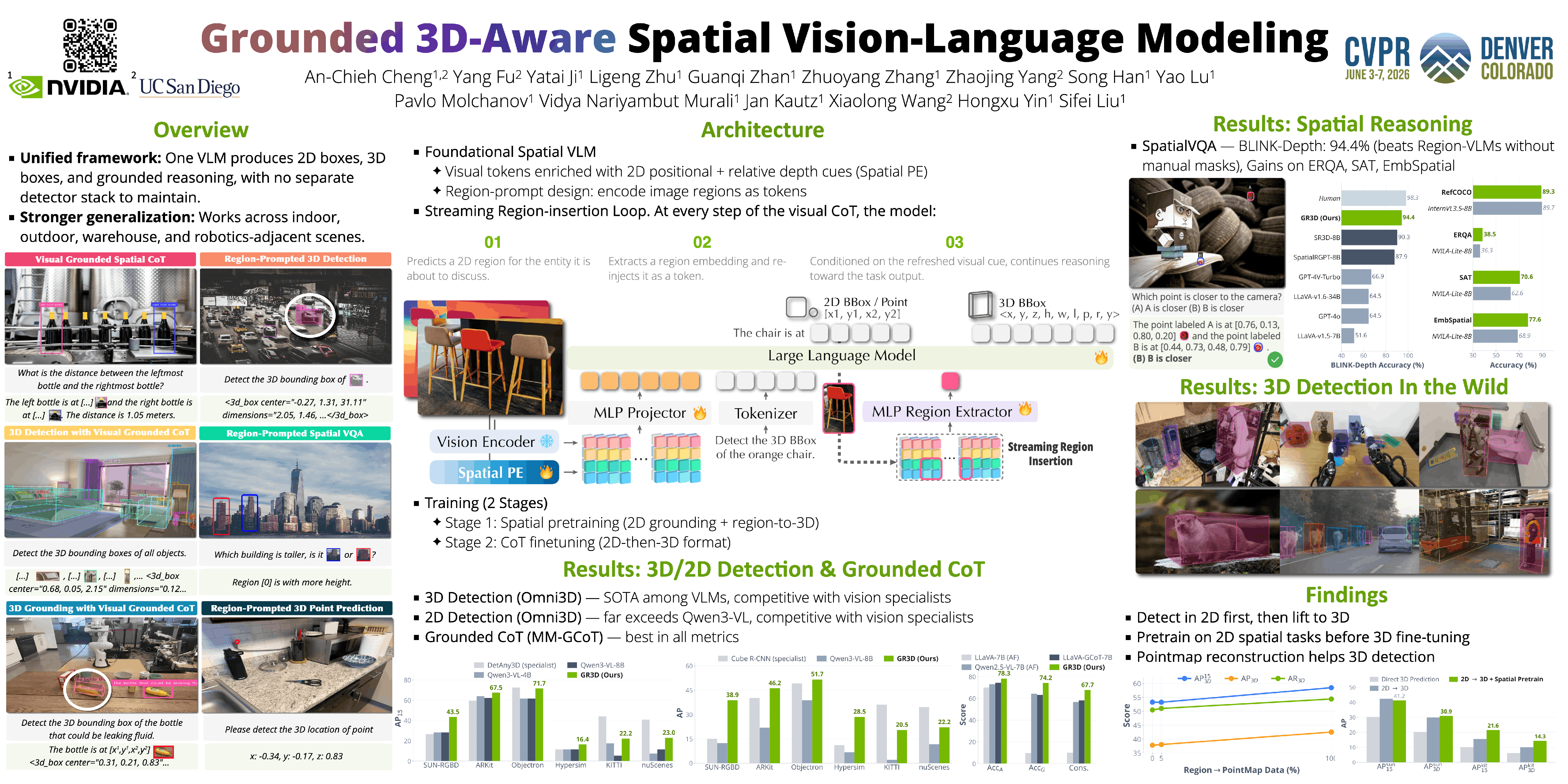
We present GR3D, a spatial vision language model equipped with three complementary grounding capabilities—explicit 2D grounding, implicit 2D grounding, and monocular 3D grounding—within a single framework. GR3D introduces an implicit grounding mechanism that identifies entity mentions during generation and inserts the corresponding region tokens into the text stream, allowing the model to reference visual evidence on the fly when producing spatial chain-of-thought responses. In parallel, a region-prompted monocular 3D grounding design predicts 3D bounding boxes in the camera view from grounded region queries, supported by intrinsic-aware normalization and dense geometric supervision. Together, these grounding capabilities enable GR3D to decompose complex spatial understanding problems into grounded 2D perception followed by 3D inference. GR3D achieves consistent improvements across grounded and non-grounded spatial benchmarks, demonstrating grounding as an effective inductive bias for strengthening spatial understanding in VLMs. These grounding capabilities collectively enhance general spatial understanding beyond the grounding task itself.
SpatialTree: How Spatial Intelligence Branches Out in MLLMs
Yuxi Xiao ⋅ longfei li ⋅ Shen Yan ⋅ Xinhang Liu ⋅ Sida Peng ⋅ Yunchao Wei ⋅ Xiaowei Zhou ⋅ Bingyi Kang
Spatial Intelligence (SI) has emerged as a critical frontier for MLLMs, encompassing a hierarchy of skills from foundational perception to high level spatial reasoning. However, how these abilities are acquired, emerge, and transferred remains largely unknown. To investigate this, we propose SpatialTree a hierarchical taxonomy that organizes SI into a capability tree—from low level perception (L1), mental mapping (L2), mental simulation (L3), to agentic competence (L4). Building on this, we construct a hierarchical, capability-centric benchmark using our proposed Spatial Engine, annotating each ability according to its level. Guided by the benchmark's correlation analysis, we conduct targeted supervised fine-tuning (SFT) and prompting experiments on key abilities. The results confirm the independence of abilities at the same level, reveal cross-level transfer, and further demonstrate a multi-ability synergy when these abilities are trained jointly. Our work provides a novel framework for analyzing SI in MLLMs, offering a comprehensive methodology to study how foundational abilities emerge and support higher-level competencies.
TerraScope: Pixel-Grounded Visual Reasoning for Earth Observation
Yan Shu ⋅ Bin Ren ⋅ Zhitong Xiong ⋅ Xiao Xiang Zhu ⋅ Begüm Demir ⋅ Nicu Sebe ⋅ Paolo Rota
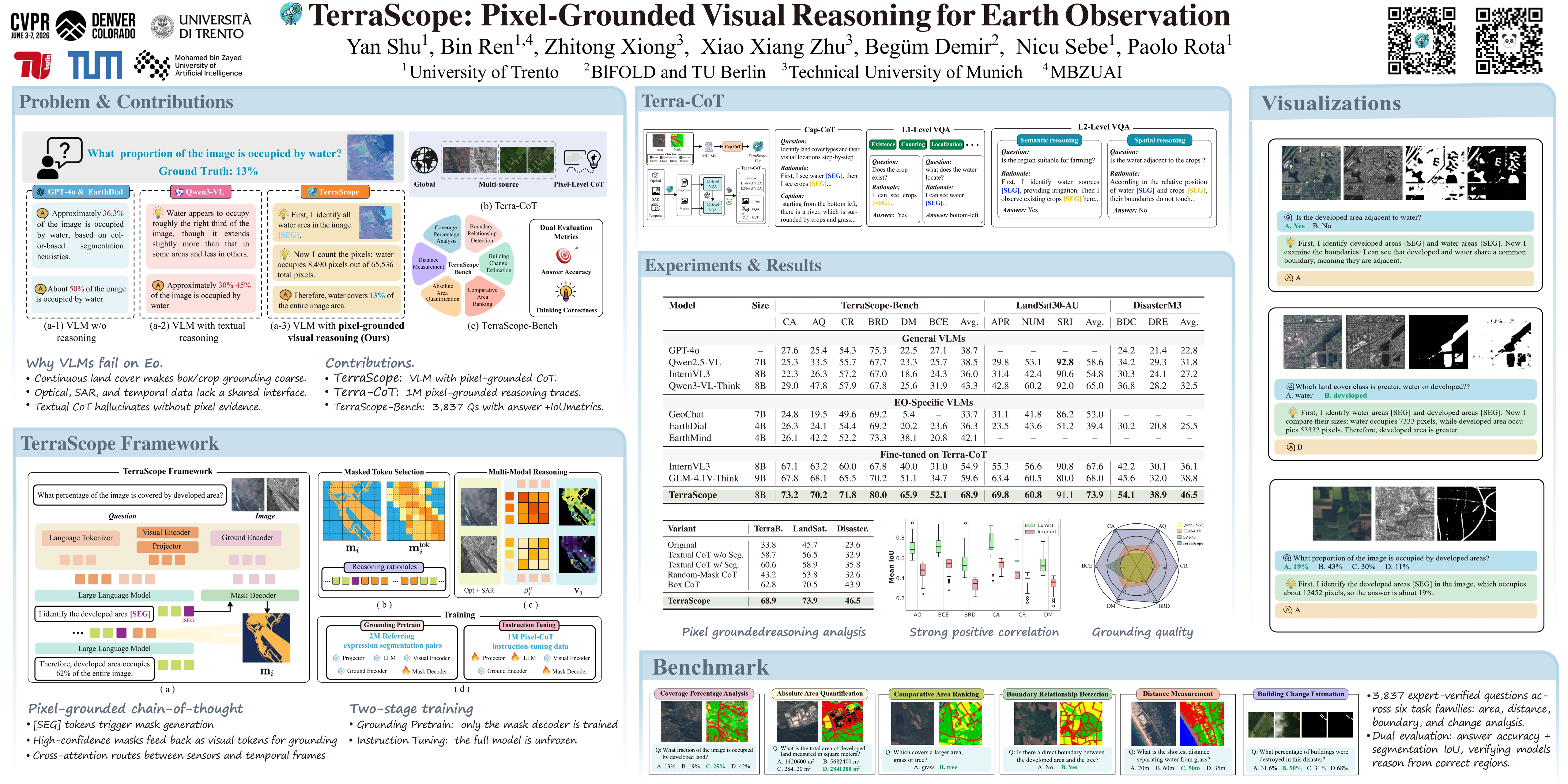
Vision-language models (VLMs) have shown promise in earth observation (EO), yet they struggle with tasks that require grounding complex spatial reasoning in precise pixel-level visual representations. To address this problem, we introduce TerraScope, a unified VLM that delivers pixel-grounded geospatial reasoning with two key capabilities: (1) modality-flexible reasoning: it handles single-modality inputs (optical or SAR) and adaptively fuses different modalities into the reasoning process when both are available; (2) multi-temporal reasoning: it integrates temporal sequences for change analysis across multiple time points. In addition, we curate Terra-CoT, a large-scale dataset containing 1 million samples with pixel-level masks embedded in reasoning chains across multiple sources. We also propose TerraScope-Bench, the first benchmark for pixel-grounded geospatial reasoning with six sub-tasks that evaluates both answer accuracy and mask quality to ensure authentic pixel-grounded reasoning. Experiments show that TerraScope significantly outperforms existing VLMs on pixel-grounded geospatial reasoning while providing interpretable visual evidence.
Beyond 3D VQAs: Injecting 3D Spatial Priors into Vision-Language Models for Enhanced Geometric Reasoning
Chun-Hsiao Yeh ⋅ Shengyi Qian ⋅ Manchen Wang ⋅ Yi Ma ⋅ Joseph Tighe ⋅ Fanyi Xiao
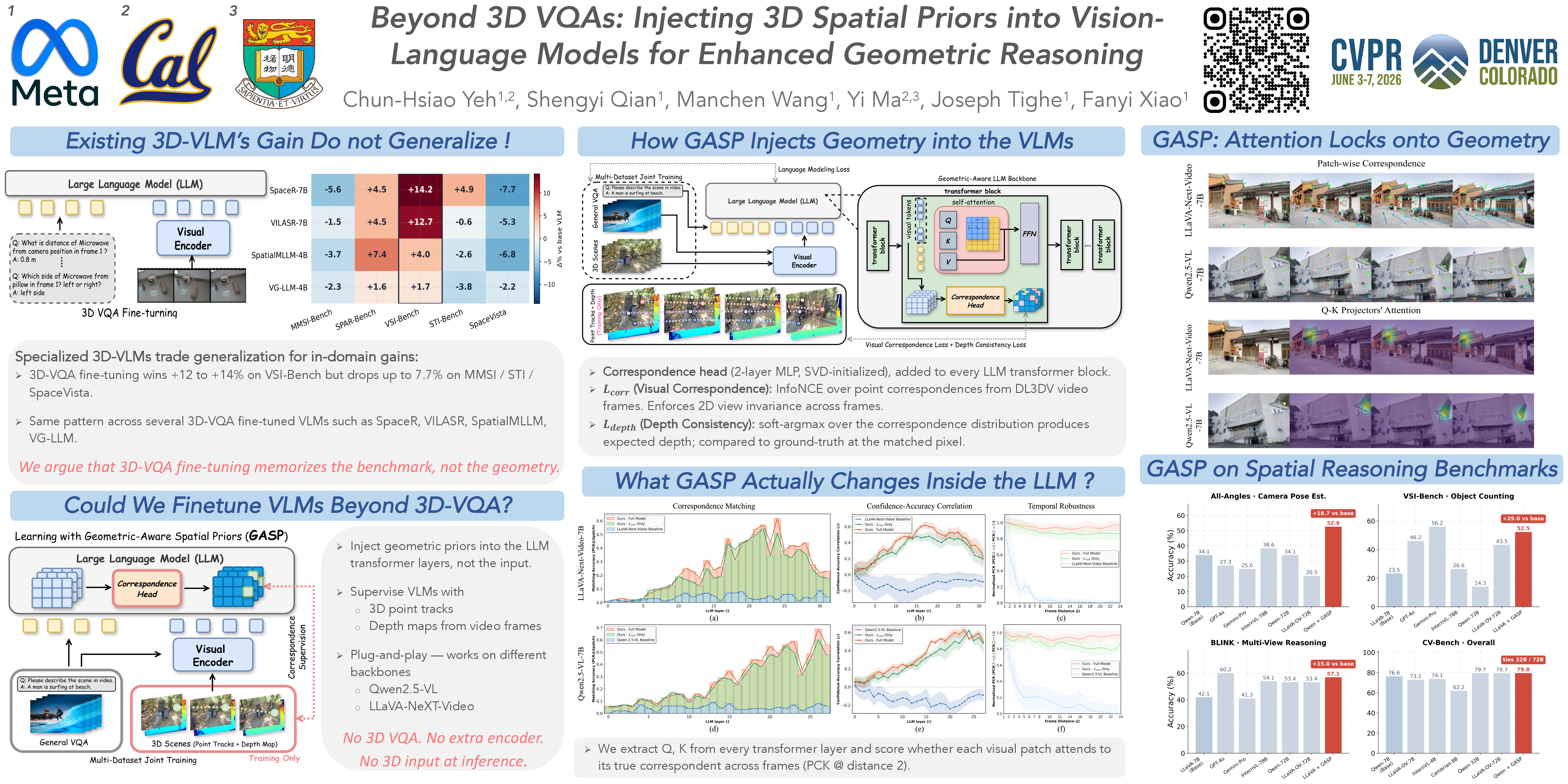
Vision-Language Models (VLMs) often struggle with robust 3D spatial reasoning. Prevailing methods that rely on fine-tuning with 3D visual question-answering (VQA) datasets may overfit dataset-specific biases, while integrating specialized 3D visual encoders is often inflexible and cumbersome. In this paper, we argue that genuine spatial understanding should emerge from learning fundamental geometric priors, not only from high-level VQA supervision. We propose GASP (Geometric-Aware Spatial Priors), a framework that injects these priors directly into the LLM’s transformer layers. GASP employs a small correspondence head, applied as a deep supervision signal across all layers, and is trained with a dual objective leveraging ground-truth geometry from large-scale video scenes: a contrastive loss on ground-truth point correspondences enforces 2D view-invariance, while a depth consistency supervision resolves 3D geometric ambiguities. Our analysis first provides a diagnostic showing that standard VLMs’ internal correspondence matching accuracy is very low (often below 5%). We then demonstrate that our training substantially improves this behavior, boosting peak layer-wise correspondence to over 70% and maintaining over 85% temporal robustness while baselines remain below 5%. These internal improvements translate to significant gains on downstream spatial benchmarks---including +18.2% on All-Angles Bench and +29.0% on VSI-Bench---all without training on any 3D VQA data. Our findings indicate that learning from fundamental geometric priors is a promising and generalizable pathway towards VLMs with more reliable 3D spatial reasoning.
OpenVoxel: Training-Free Grouping and Captioning Voxels for Open-Vocabulary 3D Scene Understanding
Sheng-Yu Huang ⋅ Jaesung Choe ⋅ Yu-Chiang Frank Wang ⋅ Cheng Sun
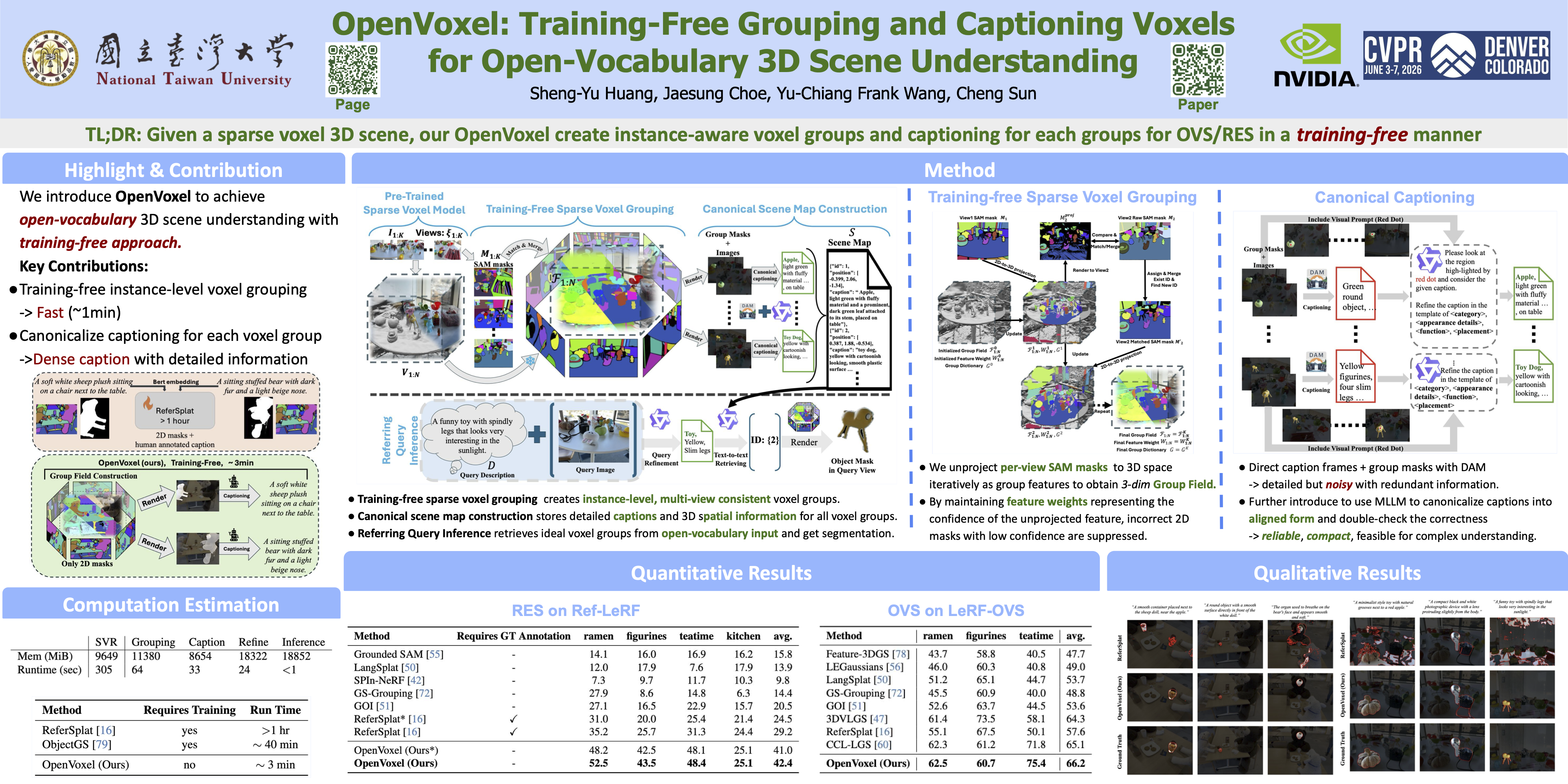
We propose OpenVoxel, a training-free algorithm for grouping and captioning sparse voxels for the open-vocabulary 3D scene understanding tasks. Given the sparse voxel rasterization (SVR) model obtained from multi-view images of a 3D scene, our OpenVoxel is able to produce meaningful groups that describe different objects in the scene. Also, by leveraging powerful Vision Language Models (VLMs) and Multi-modal Large Language Models (MLLMs), our OpenVoxel successfully build an informative scene map by captioning each group, enabling further 3D scene understanding tasks such as open-vocabulary segmentation (OVS) or referring expression segmentation (RES). Unlike previous methods, our method is training-free and does not introduce embeddings from a CLIP/BERT text encoder. Instead, we directly proceed with text-to-text search using MLLMs. Through extensive experiments, our method demonstrates superior performance compared to recent studies, particularly in complex referring expression segmentation (RES) tasks. The code will be open.
BOP-ASK: Object-Interaction Reasoning for Vision-Language Models
Vineet Bhat ⋅ Sungsu Kim ⋅ Valts Blukis ⋅ Greg Heinrich ⋅ Prashanth Krishnamurthy ⋅ Ramesh Karri ⋅ Stan Birchfield ⋅ Farshad Khorrami ⋅ Jonathan Tremblay
Vision–Language Models (VLMs) have achieved impressive performance on spatial reasoning benchmarks, yet these evaluations mask critical weaknesses in understanding object interactions. Current benchmarks test high-level relationships ("left of," "behind", etc.) but ignore fine-grained spatial understanding needed for real-world applications: precise 3D localization, physical compatibility between objects, object affordances and multi-step spatial planning. In this work, we present BOP-ASK, a novel large-scale dataset for object-interaction reasoning for both training and benchmarking. Our data generation pipeline leverages 6D object poses from the Benchmark for Object Pose Estimation (BOP) datasets from which we derive fine-grained annotations such as grasp poses, referred object poses, path planning trajectories, relative spatial and depth relationships, and object-to-object relationships. BOP-ASK comprises over 150k images and 33M question–answer pairs spanning six tasks (four novel), providing a rich resource for training and evaluating VLMs. We evaluate proprietary and open-sourced VLMs, and conduct human evaluations on BOP-ASK-core, a contributed test benchmark. We also release BOP-ASK-lab, an out-of-distribution benchmark with images not sourced from BOP, enabling testing of generalization. Our experiments demonstrate that models trained on BOP-ASK outperform baselines and exhibit emergent capabilities such as precise object and grasp pose estimation, trajectory planning, and fine-grained object-centric spatial reasoning in cluttered environments. We will publicly release our datasets and dataset generation pipeline.
Scalable Object Relation Encoding for Better 3D Spatial Reasoning in Large Language Models
Shengli Zhou ⋅ Minghang Zheng ⋅ Feng Zheng ⋅ Yang Liu
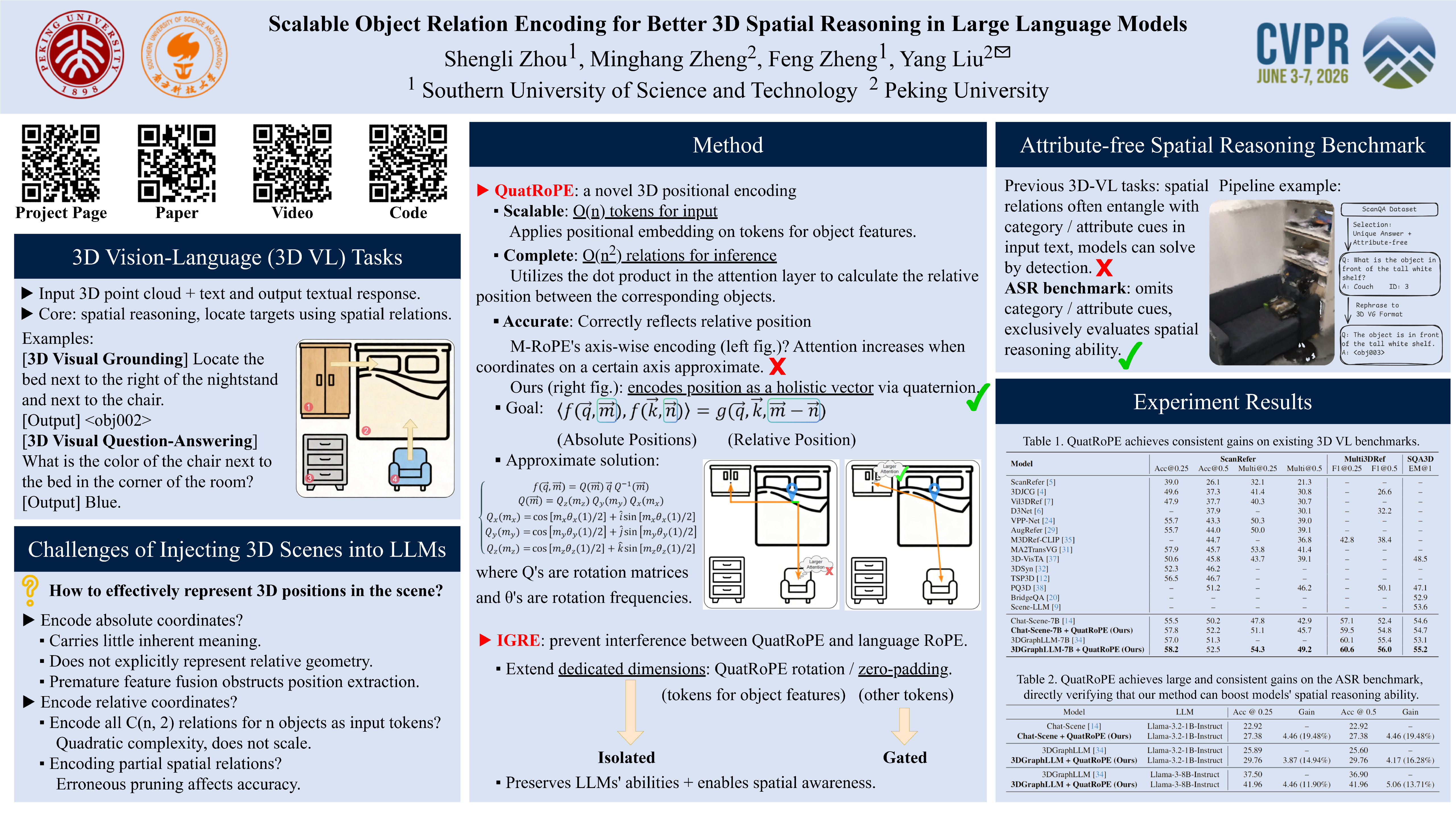
Spatial reasoning is the process of locating target objects based on spatial relations in 3D scenes, which plays a crucial role in developing intelligent embodied agents. Due to the limited availability of 3D scene-language paired data, it is challenging to train models with strong reasoning ability from scratch. Previous approaches have attempted to inject 3D scene representations into the input space of Large Language Models (LLMs) and leverage the pretrained comprehension and reasoning abilities for spatial reasoning. However, models encoding absolute positions struggle to extract spatial relations from prematurely fused features, while methods explicitly encoding all spatial relations (which is quadratic in the number of objects) as input tokens suffer from poor scalability. To address these limitations, we propose QuatRoPE, a novel positional embedding method with an input length that is linear to the number of objects, and explicitly calculates pairwise spatial relations through the dot product in attention layers. QuatRoPE's holistic vector encoding of 3D coordinates guarantees a high degree of spatial consistency, maintaining fidelity to the scene's geometric integrity. Additionally, we introduce the Isolated Gated RoPE Extension (IGRE), which effectively limits QuatRoPE's influence to object-related tokens, thereby minimizing interference with the LLM's existing positional embeddings and maintaining the LLM's original capabilities. Extensive experiments demonstrate the effectiveness of our approaches.
Eliciting Complex Spatial Reasoning in MLLMs through Wide-Baseline Matching
Hao Zhong ⋅ Muzhi Zhu ⋅ Shenyan Zeng ⋅ Anzhou Li ⋅ Cong Chen ⋅ Hua Geng ⋅ Duochao Shi ⋅ Wentao Ye ⋅ Tao Lin ⋅ Hao Chen ⋅ Chunhua Shen
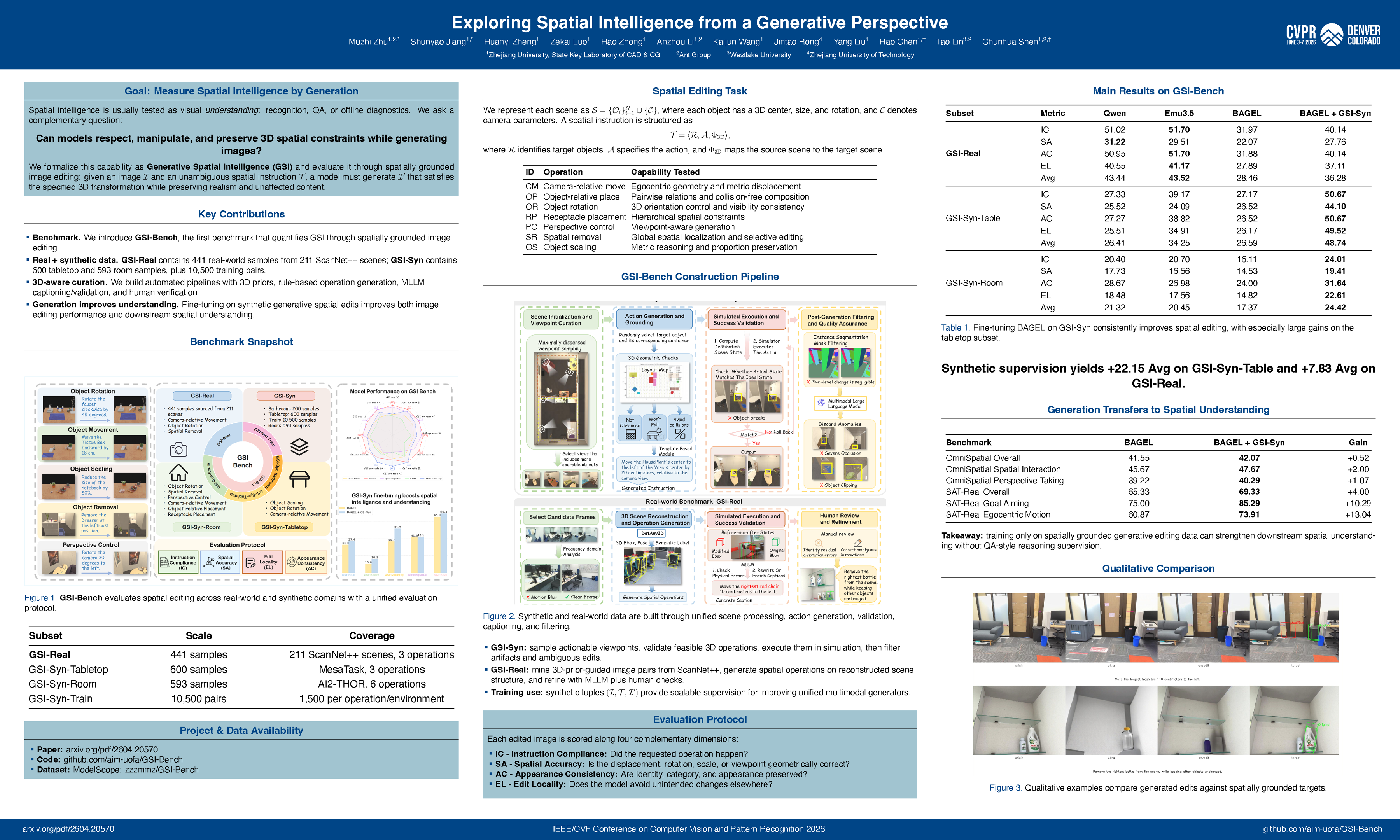
Employing multimodal large language models (MLLMs) in 3D physical environments demands complex spatial reasoning capabilities that integrate geometric understanding, viewpoint synthesis, fine-grained perception, and robust depth estimation. However, current MLLMs lack systematic evaluation and training frameworks for these capabilities. We address this gap through the lens of wide-baseline matching (WBM)---determining whether two views with large viewpoint changes, appearance shifts, and occlusions depict the same scene element. We introduce ReasonMatch-Bench, a comprehensive benchmark stratified by viewpoint displacement and matching granularity across indoor, outdoor, and object-centric scenarios. Our evaluation reveals substantial gaps between human performance and state-of-the-art MLLMs, particularly for smaller models, highlighting critical deficiencies in spatial reasoning. To bridge this gap, we propose a scalable data generation pipeline that automatically extracts wide-baseline view pairs from large-scale video-3D corpora (RGB-D videos and SfM reconstructions), providing diverse, verifiable supervision. Leveraging verifiable matching accuracy as rewards, we introduce Dynamic Correspondence Reinforcement Learning (DCRL), combining Image-Level Viewpoint Progression and Point-Level Correspondence Curriculum to enable progressive acquisition of sophisticated spatial reasoning without explicit supervision. Extensive experiments demonstrate that our approach significantly enhances MLLMs' spatial reasoning capabilities, narrowing the gap with human performance on complex 3D understanding tasks.
REALM: An MLLM-Agent Framework for Open World 3D Reasoning Segmentation and Editing on Gaussian Splatting
Changyue Shi ⋅ Minghao Chen ⋅ Yiping Mao ⋅ Chuxiao Yang ⋅ Xinyuan Hu ⋅ Jiajun Ding ⋅ Zhou Yu
Bridging the gap between complex human instructions and precise 3D object grounding remains a significant challenge in vision and robotics. Existing 3D segmentation methods often struggle to interpret ambiguous, reasoning-based instructions, while 2D vision-language models that excel at such reasoning lack intrinsic 3D spatial understanding. In this paper, we introduce REALM, an innovative MLLM-agent framework that enables open-world reasoning-based segmentation without requiring extensive 3D-specific post-training. We perform segmentation directly on 3D Gaussian Splatting representations, capitalizing on their ability to render photorealistic novel views that are highly suitable for MLLM comprehension. As directly feeding one or more rendered views to the MLLM can lead to high sensitivity to viewpoint selection, we propose a novel Global-to-Local Spatial Grounding strategy. Specifically, multiple global views are first fed into the MLLM agent in parallel for coarse-level localization, aggregating responses to robustly identify the target object. Then, several close-up novel views of the object are synthesized to perform fine-grained local segmentation, yielding accurate and consistent 3D masks. Extensive experiments show that REALM achieves remarkable performance in interpreting both explicit and implicit instructions across LERF, 3D-OVS, and our newly introduced REALM3D benchmarks. Furthermore, our agent framework seamlessly supports a range of 3D interaction tasks, including object removal, replacement, and style transfer, demonstrating its practical utility and versatility.
From Indoor to Open World: Revealing the Spatial Reasoning Gap in MLLMs
Mingrui Wu ⋅ Zhaozhi Wang ⋅ Fangjinhua Wang ⋅ Jiaolong Yang ⋅ Marc Pollefeys ⋅ Tong Zhang
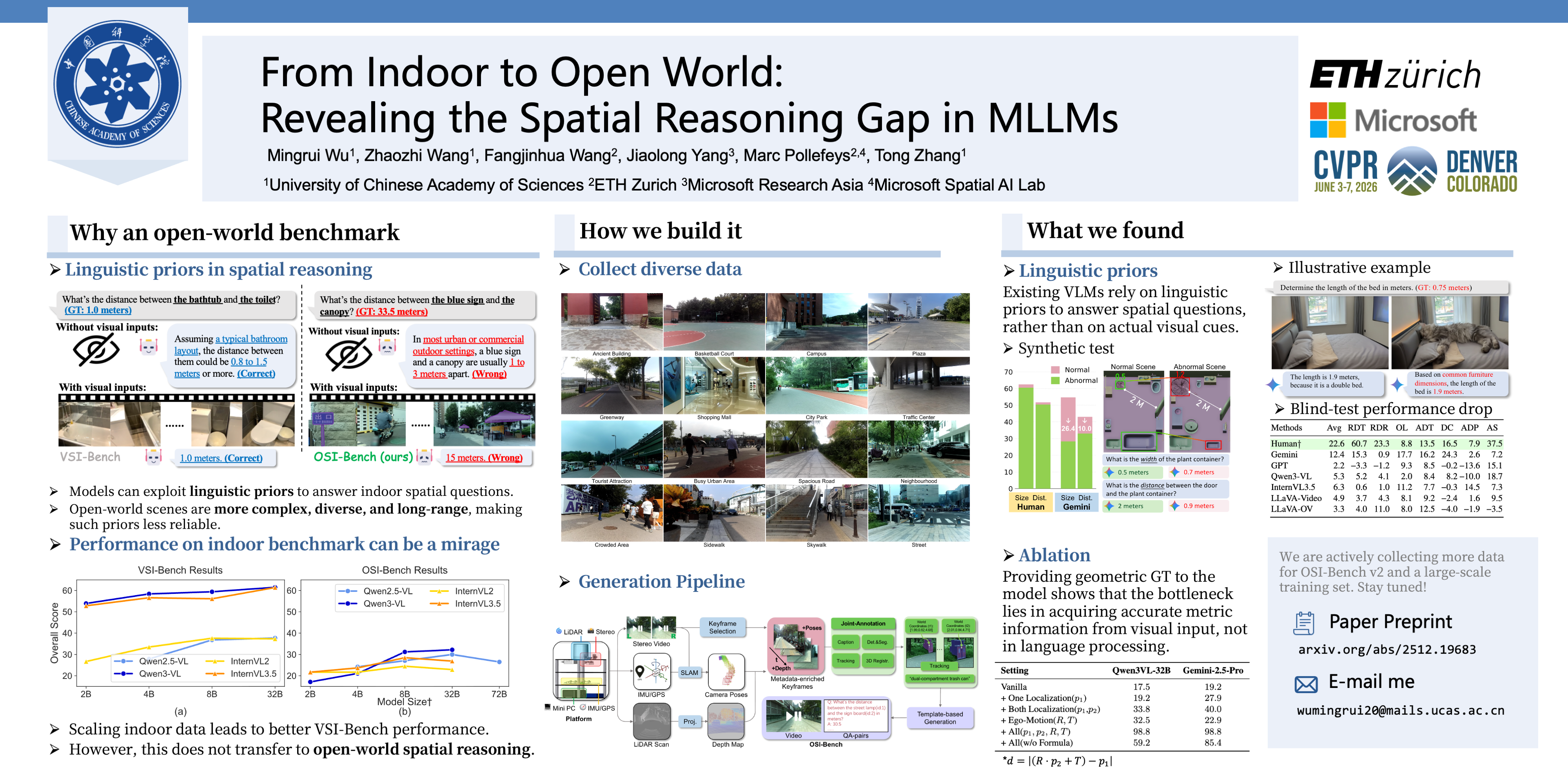
While Multimodal Large Language Models (MLLMs) have achieved impressive performance on semantic tasks, their spatial intelligence—crucial for robust and grounded AI systems—remains underdeveloped. Existing benchmarks fall short of diagnosing this limitation: they either focus on overly simplified qualitative reasoning or rely on domain-specific indoor data, constrained by the lack of outdoor datasets with verifiable metric ground truth. To bridge this gap, we introduce a large-scale benchmark built from pedestrian-perspective videos captured with synchronized stereo cameras, LiDAR, and IMU/GPS sensors. This dataset provides metrically precise 3D information, enabling the automatic generation of spatial reasoning questions that span a hierarchical spectrum—from qualitative relational reasoning to quantitative metric and kinematic understanding. Evaluations reveal that the performance gains observed in structured indoor benchmarks vanish in open-world settings. Further analysis using synthetic abnormal scenes and blinding tests confirms that current MLLMs depend heavily on linguistic priors instead of grounded visual reasoning. Our benchmark thus provides a principled platform for diagnosing these limitations and advancing physically grounded spatial intelligence.
MVGGT: Multimodal Visual Geometry Grounded Transformer for Multiview 3D Referring Expression Segmentation
Changli Wu ⋅ Haodong Wang ⋅ Jiayi Ji ⋅ Yutian Yao ⋅ Chunsai Du ⋅ Jihua Kang ⋅ Yanwei Fu ⋅ Liujuan Cao
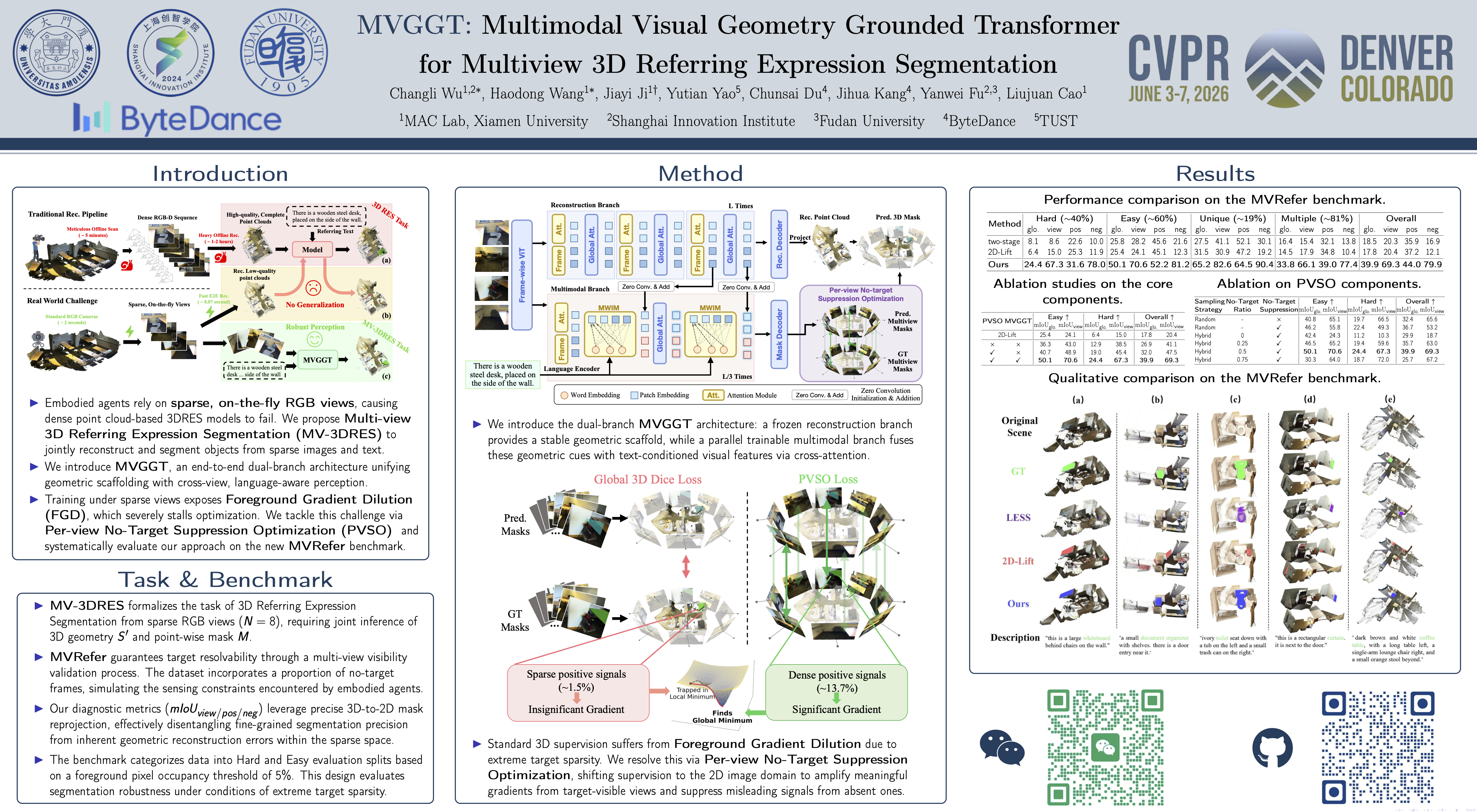
Most existing 3D referring expression segmentation (3DRES) methods rely on dense, high-quality point clouds, while real-world agents such as robots and mobile phones operate with only a few sparse RGB views and strict latency constraints. We introduce Multi-view 3D Referring Expression Segmentation (MV-3DRES), where the model must recover scene structure and segment the referred object directly from sparse multi-view images. Traditional two-stage pipelines, which first reconstruct a point cloud and then perform segmentation, often yield low-quality geometry, produce coarse or degraded target regions, and run slowly. We propose the Multimodal Visual Geometry Grounded Transformer (MVGGT), an efficient end-to-end framework that integrates language information into sparse-view geometric reasoning through a dual-branch design. Training in this setting exposes a critical optimization barrier, termed Foreground Gradient Dilution (FGD), where sparse 3D signals lead to weak supervision. To resolve this, we introduce Per-view No-target Suppression Optimization (PVSO), which provides stronger and more balanced gradients across views, enabling stable and efficient learning. To support consistent evaluation, we build MVRefer, a benchmark that defines standardized settings and metrics for MV-3DRES. Experiments show that MVGGT establishes the first strong baseline and achieves both high accuracy and fast inference, outperforming existing alternatives.
SpaceMind: Camera-Guided Modality Fusion for Spatial Reasoning in Vision-Language Models
Ruosen Zhao ⋅ Zhikang Zhang ⋅ Jialei Xu ⋅ Jiahao Chang ⋅ Dong Chen ⋅ Lingyun Li ⋅ Weijian Sun ⋅ Zizhuang Wei
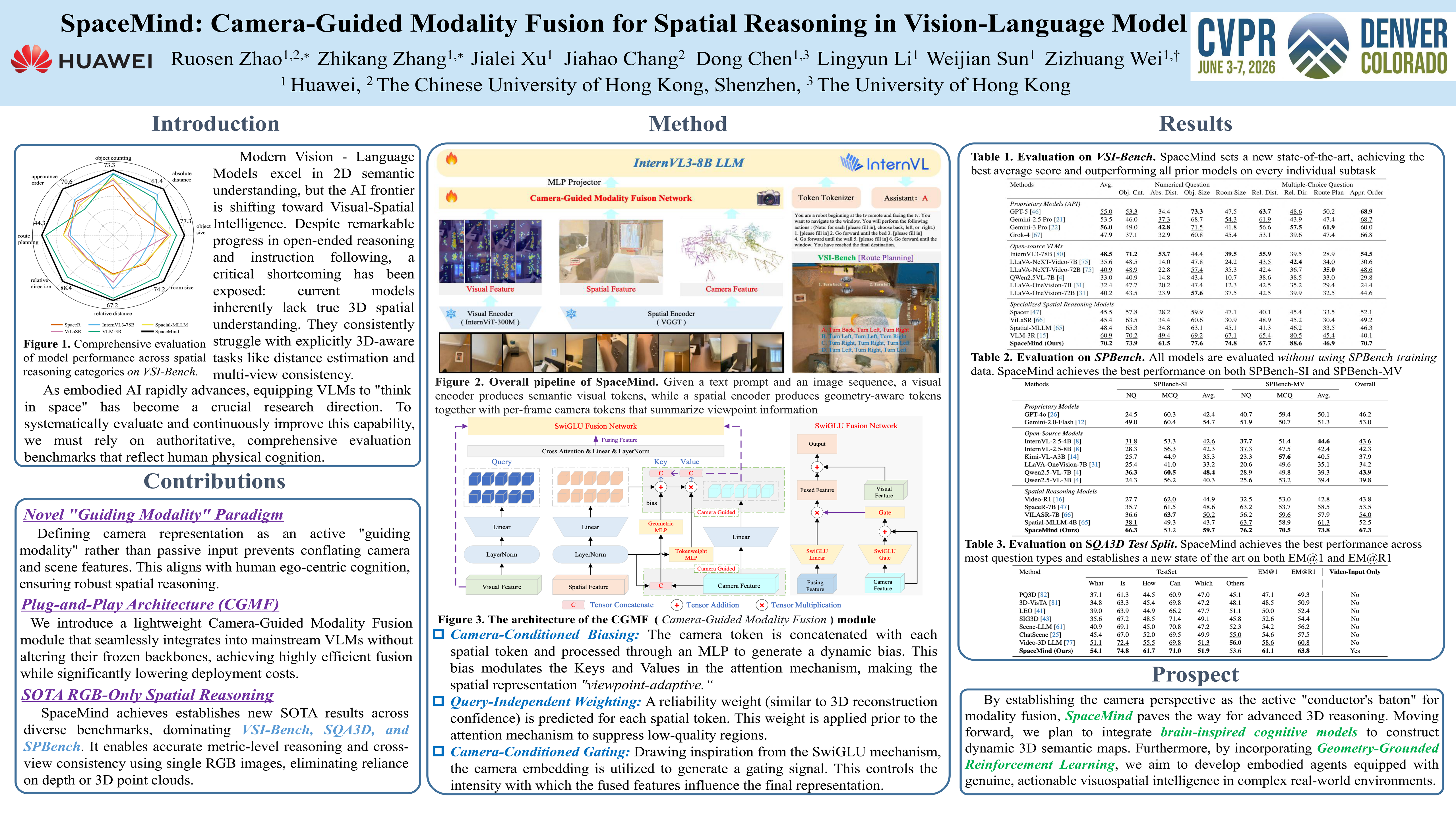
Large vision-language models (VLMs) show strong multimodal understanding but still struggle with 3D spatial reasoning, such as distance estimation, size comparison, and cross-view consistency. Existing 3D-aware methods either depend on auxiliary 3D information or enhance RGB-only VLMs with geometry encoders through shallow feature fusion.We propose SpaceMind, a multimodal large language model explicitly designed for spatial reasoning solely from RGB inputs. The model adopts a dual-encoder architecture, integrating VGGT as a spatial understanding encoder and InternViT as a 2D visual encoder.The key idea is to treat the camera representation as an active guiding modality rather than passive metadata. Specifically, SpaceMind introduces a lightweight Camera-Guided Modality Fusion module before the language model to replace shallow fusion. It applies camera-conditioned biasing to spatial tokens, assigns query-independent weights reflecting their geometric importance, and uses the camera embedding to gate the fused representation.Empirically, SpaceMind establishes new state-of-the-art results on VSI-Bench, SQA3D, and SPBench, surpassing both open and proprietary systems on VSI-Bench and SPBench by large margins and achieving state-of-the-art performance on SQA3D.These results demonstrate that camera-guided modality fusion is an effective and practical inductive bias for equipping VLMs with genuinely spatially grounded intelligence.We will release code and model checkpoints to support future research.
ReMatch: Boosting Representation through Matching for Multimodal Retrieval
Qianying Liu ⋅ Xiao Liang ⋅ Zhiqiang Zhang ⋅ Yibo Chen ⋅ Xu Tang ⋅ Zhongfei Qing ⋅ Fengfan Zhou ⋅ Yao Hu ⋅ Paul Henderson
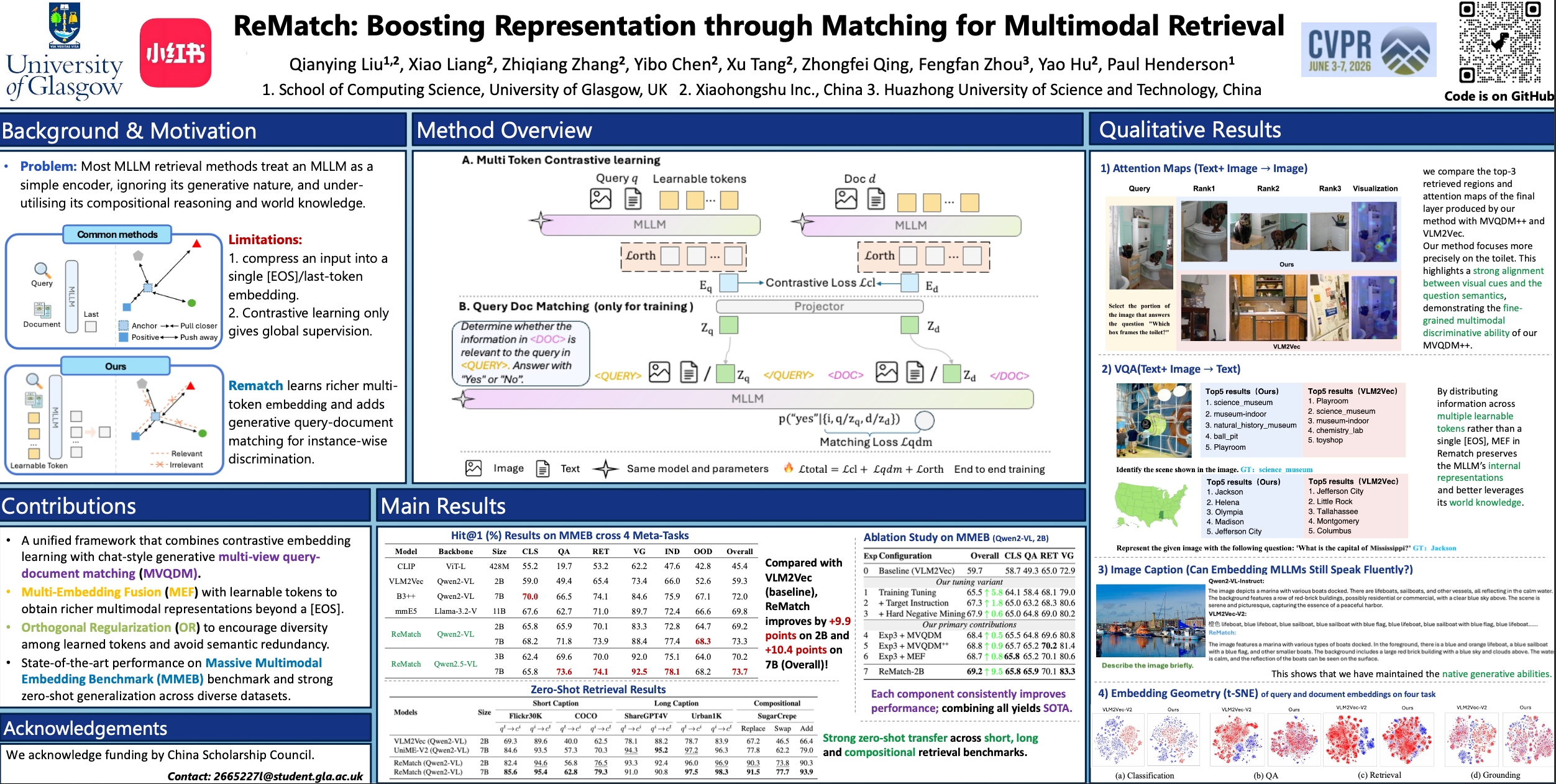
We present ReMatch, a framework that leverages the generative strength of MLLMs for multimodal retrieval. Previous approaches treated an MLLM as a simple encoder, ignoring its generative nature, and under-utilising its compositional reasoning and world knowledge. We instead train the embedding MLLM end-to-end with a chat-style generative matching stage. The matching stage uses the same MLLM to autoregressively decide relevance from multi-view inputs, including both raw data and its own projected embeddings for each query and document. It provides instance-wise discrimination supervision that complements a standard contrastive loss, offering stronger gradients on hard negatives and preserving the compositional strengths of the original MLLM. To obtain semantically richer multimodal embeddings, we use multiple learnable tokens to augment each input, generating fine-grained contextual, mutually orthogonal embeddings with low inference cost. Leveraging our established high-performance baseline, we assemble the ideas mentioned above into a powerful training recipe and achieve a new state-of-the-art on the Massive Multimodal Embedding Benchmark(MMEB). Our experiments show particularly strong zero-shot generalization results on five datasets, highlighting the robustness and transferability of ReMatch.
RI-Mamba: Rotation-Invariant Mamba for Robust Text-to-Shape Retrieval
Khanh Nguyen ⋅ Dasith de Silva Edirimuni ⋅ Ghulam Mubashar Hassan ⋅ Ajmal Mian
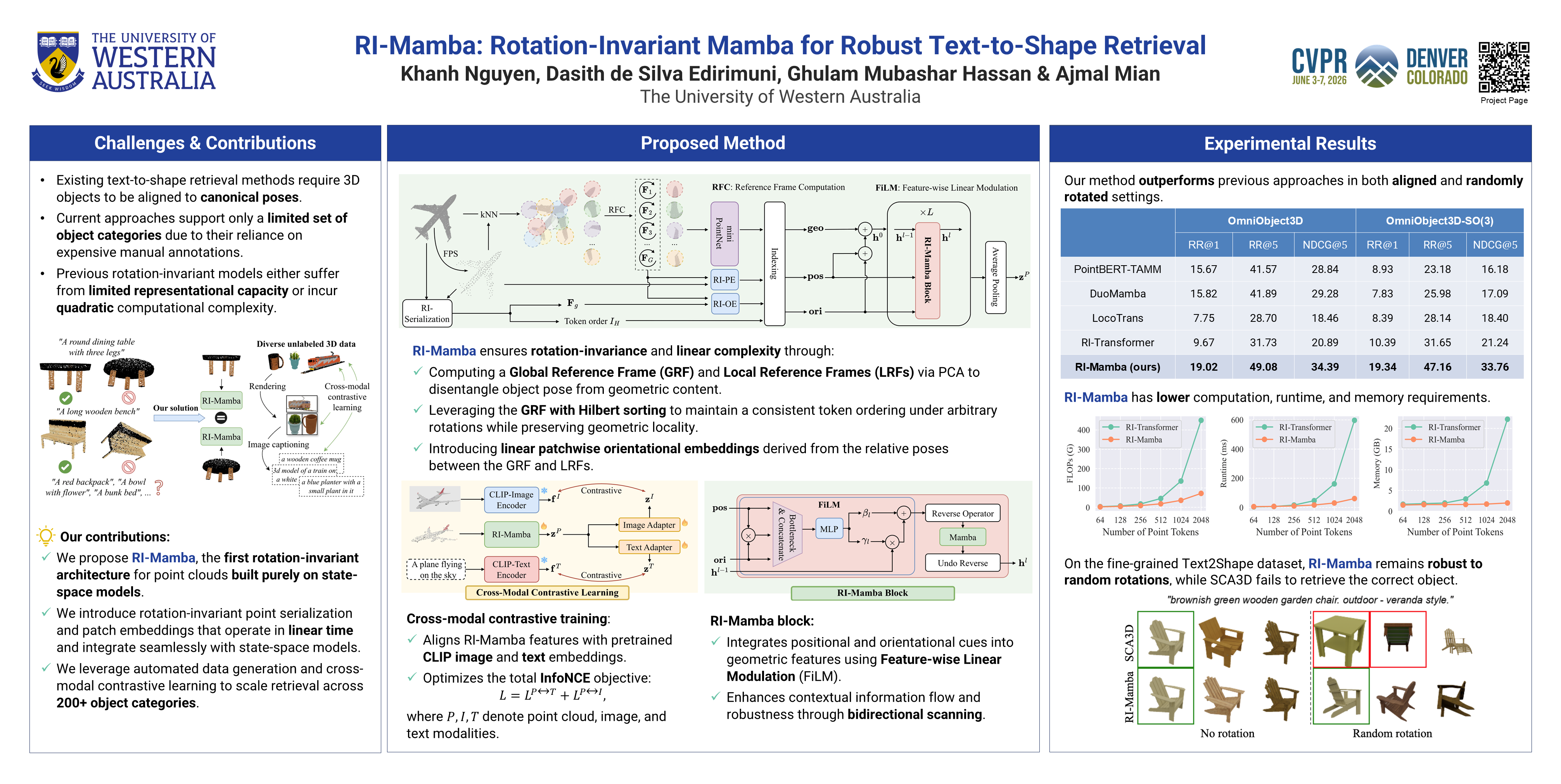
3D assets have rapidly expanded in quantity and diversity due to the growing popularity of virtual reality and gaming. As a result, text-to-shape retrieval has become essential in facilitating intuitive search within large repositories. However, existing methods require canonical poses and support few object categories, limiting their real-world applicability where objects can belong to diverse classes and appear in random orientations. To address this challenge, we propose RI-Mamba, the first rotation-invariant state-space model for point clouds. RI-Mamba defines global and local reference frames to disentangle pose from geometry and uses Hilbert sorting to construct token sequences with meaningful geometric structure while maintaining rotation invariance. We further introduce a novel strategy to compute orientational embeddings and reintegrate them via feature-wise linear modulation, effectively recovering spatial context and enhancing model expressiveness. Our strategy is inherently compatible with state-space models and operates in linear time. To scale up retrieval, we adopt cross-modal contrastive learning with automated triplet generation, allowing training on diverse datasets without manual annotation. Extensive experiments demonstrate RI-Mamba's superior representational capacity and robustness, achieving state-of-the-art performance on the OmniObject3D benchmark across more than 200 object categories under arbitrary orientations.
Revisiting F-measure Optimization in Multi-Label Classification: A Sampling-based Approach
Zixun Wang
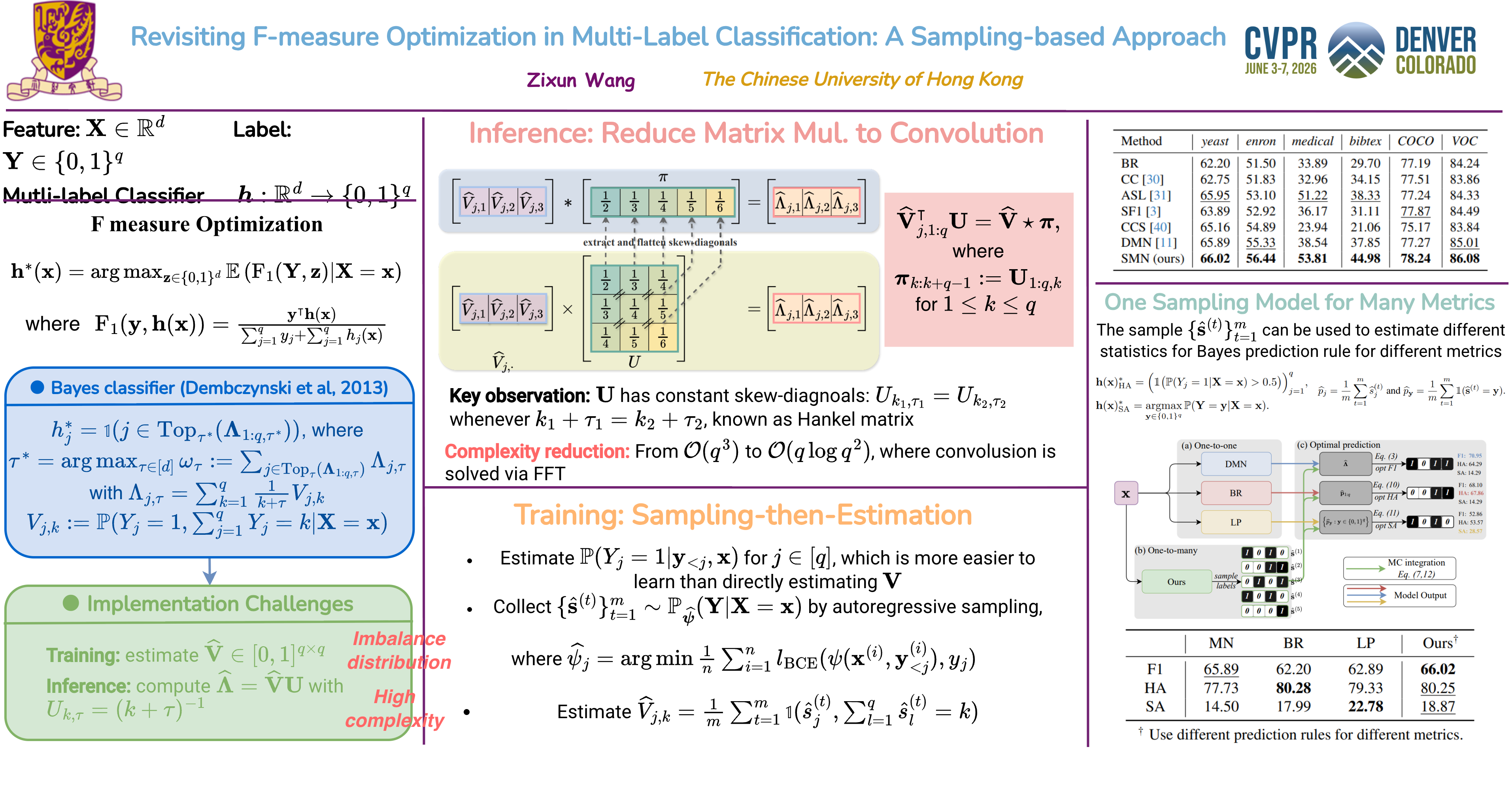
The F-measure is a widely used metric in multi-label classification, where multiple labels are predicted simultaneously for a single instance. The optimal prediction rule for F-measure requires estimating $q^2+1$ probabilities, where $q$ is the number of labels. Existing approaches train $q$ multinomial estimators (multi-class classifiers) to directly estimate these probabilities, followed by a matrix multiplication for making predictions. However, this method has two major drawbacks. First, the matrix multiplication incurs a time complexity of $\mathcal{O}(q^3)$, which becomes computationally expensive for large $q$. Second, training multinomial estimators is challenging due to the sparsity of the underlying distributions, which results from the inherent imbalance in multi-label datasets and is further exacerbated by the label transformation required by the method itself. In this paper, we first demonstrate that matrix multiplication can be reformulated as a series of convolutions by exploiting a special structure in the matrix. These convolutions can then be efficiently computed using the Fast Fourier Transform (FFT), reducing the time complexity to $\mathcal{O}(q^2\log q)$. For example, on the \textit{COCO} dataset, matrix multiplication requires 27 seconds, while FFT takes only 1 seconds, resulting in a 27x speedup. To avoid multinomial label transformation, we propose an indirect sampling-then-estimation approach to estimate the required probabilities. This method trains only $q$ binary estimators instead of multinomial ones, thereby alleviating the sparsity issue, simplifying the training process, and improving performance. We provide theoretical guarantees for the consistency of the proposed sampling-based method and demonstrate its effectiveness through extensive experiments on diverse datasets.
Thinking Beyond Labels: Vocabulary-Free Fine-Grained Recognition using Reasoning-Augmented LMMs
Dmitry Demidov ⋅ Muhammad Zaigham Zaheer ⋅ Zongyan Han ⋅ Omkar Thawakar ⋅ Rao Anwer
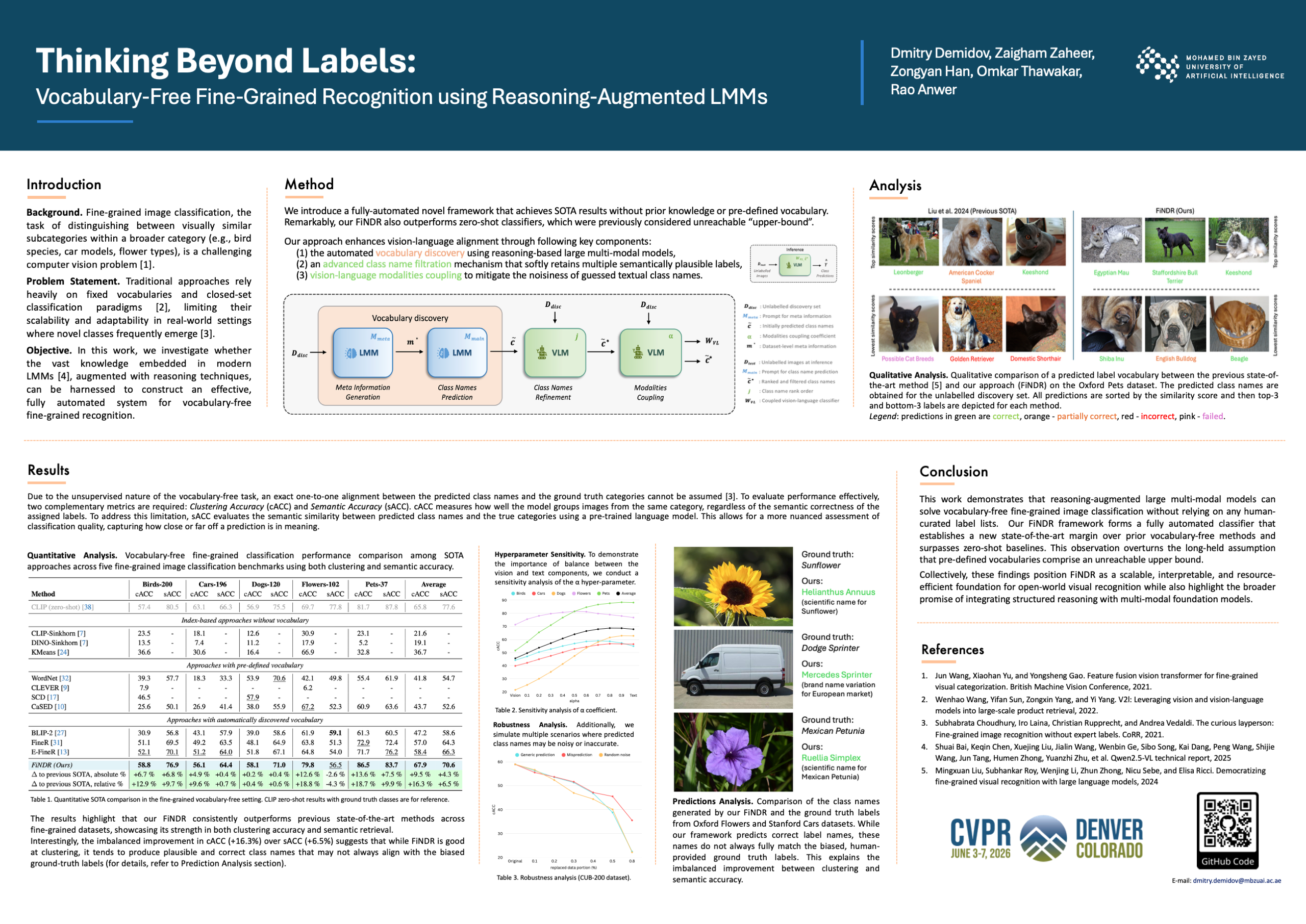
Vocabulary-free fine-grained image recognition aims to distinguish visually similar categories within a meta-class without a fixed, human-defined label set. Existing solutions for this problem remain limited by either the usage of a large and rigid list of vocabularies or by the dependency on complex pipelines with fragile heuristics where errors propagate across stages. Meanwhile, the ability of recent large multi-modal models (LMMs) equipped with explicit or implicit reasoning to comprehend visual-language data, decompose problems, retrieve latent knowledge, and self-correct suggests a more principled and effective alternative. Building on these capabilities, we propose FiNDR (Fine-grained Name Discovery via Reasoning), the first reasoning-augmented LMM-based framework for vocabulary-free fine-grained recognition. The system oper- ates in three automated steps: (i) a reasoning-enabled LMM generates descriptive candidate labels for each image; (ii) a vision-language model filters and ranks these candidates to form a coherent class set; and (iii) the verified names instantiate a lightweight multi-modal classifier used at inference time. Extensive experiments on popular fine-grained classification benchmarks demonstrate state-of-the-art per- formance under the vocabulary-free setting, with a significant relative margin of up to 18.8% over previous ap- proaches. Remarkably, the proposed method surpasses zero-shot baselines that exploit pre-defined ground-truth names, challenging the assumption that human-curated vo- cabularies define an upper bound. Ablations further confirm that advanced prompting techniques and built-in rea- soning mechanisms significantly enhance naming quality. Additionally, we show that carefully engineered prompts enable open-source LMMs to match proprietary counter- parts. These findings establish reasoning-augmented LMMs as an effective foundation for scalable, fully automated, open-world fine-grained visual recognition. The source code and relevant prompting guidelines will be released.
WISER: Wider Search, Deeper Thinking, and Adaptive Fusion for Training-Free Zero-Shot Composed Image Retrieval
Tianyue Wang ⋅ Leigang Qu ⋅ tianyu yang ⋅ xiangzhao hao ⋅ Yifan Xu ⋅ Haiyun Guo ⋅ Jinqiao Wang
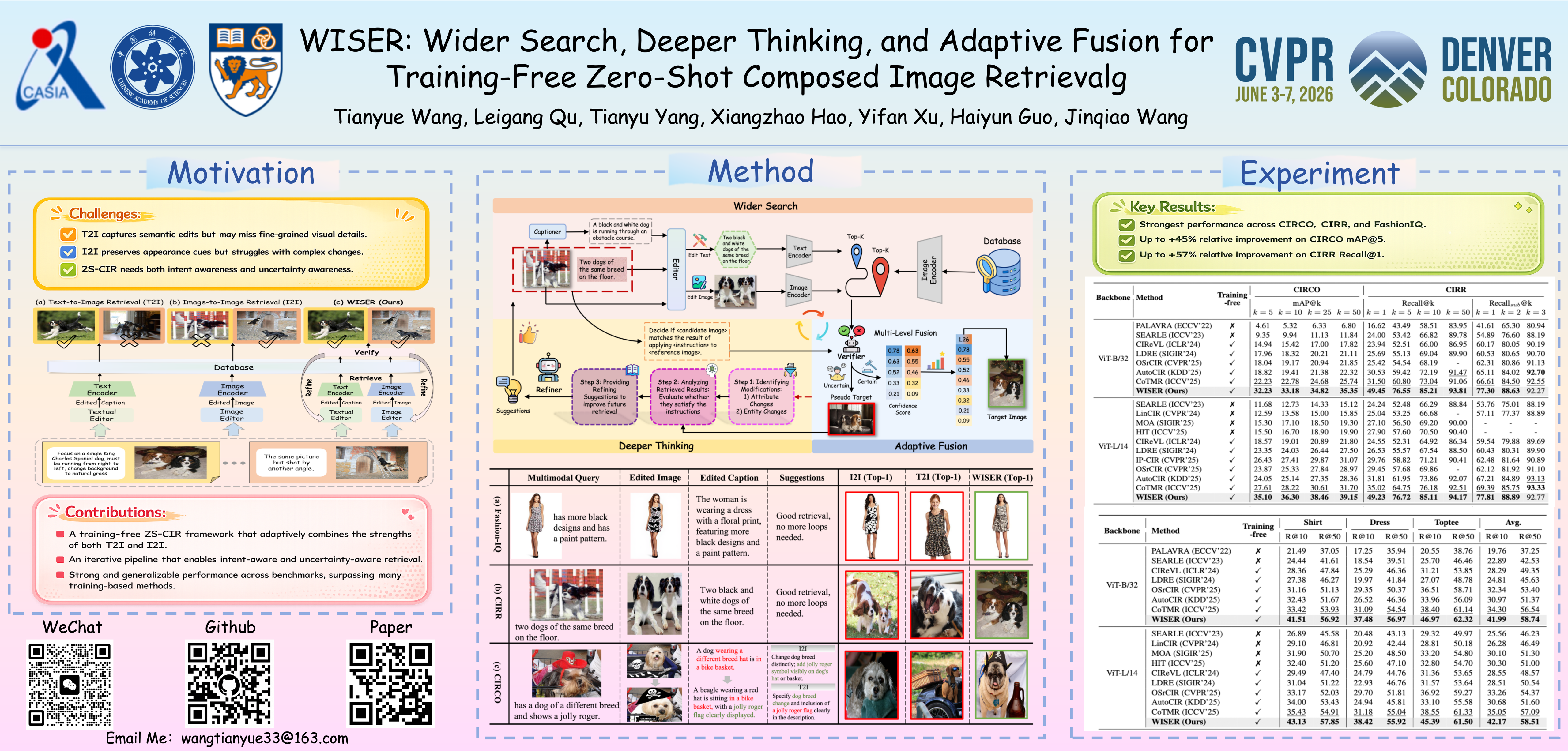
Zero-Shot Composed Image Retrieval (ZS-CIR) aims to retrieve target images given a multimodal query (comprising a reference image and a modification text), without training on annotated triplets. Existing methods typically convert the multimodal query into a single modality—either as an edited caption for Text-to-Image retrieval (T2I) or as an edited image for Image-to-Image retrieval (I2I). However, each paradigm has inherent limitations: T2I often loses fine-grained visual details, while I2I struggles with complex semantic modifications. To effectively leverage their complementary strengths under diverse query intents, we propose WISER, a training-free framework that unifies T2I and I2I via a “retrieve–verify–refine” pipeline, explicitly modeling intent awareness and uncertainty awareness. Specifically, WISER first performs Wider Search by generating both edited captions and images for parallel retrieval to broaden the candidate pool. Then, it conducts Adaptive Fusion with a verifier to assess retrieval confidence, triggering refinement for uncertain retrievals, and dynamically fusing the dual-path for reliable ones. For uncertain retrievals, WISER generates refinement suggestions through structured self-reflection to guide the next retrieval round toward Deeper Thinking. Extensive experiments demonstrate that WISER significantly outperforms previous methods across multiple benchmarks, achieving relative improvements of 45% on CIRCO (mAP@5) and 57% on CIRR (Recall@1) over existing training-free methods. Notably, it even surpasses many training-dependent methods, highlighting its superiority and generalization under diverse scenarios. Code will be released.
Modeling the Visual Ambiguity of Human Sketches
Yang Zhou ⋅ Ping Ni ⋅ Jin Wang ⋅ Senyun Jia ⋅ Jingdan Yan ⋅ Kaixiang Huang ⋅ Guodong Lu ⋅ Jingru Yang ⋅ Shengfeng He
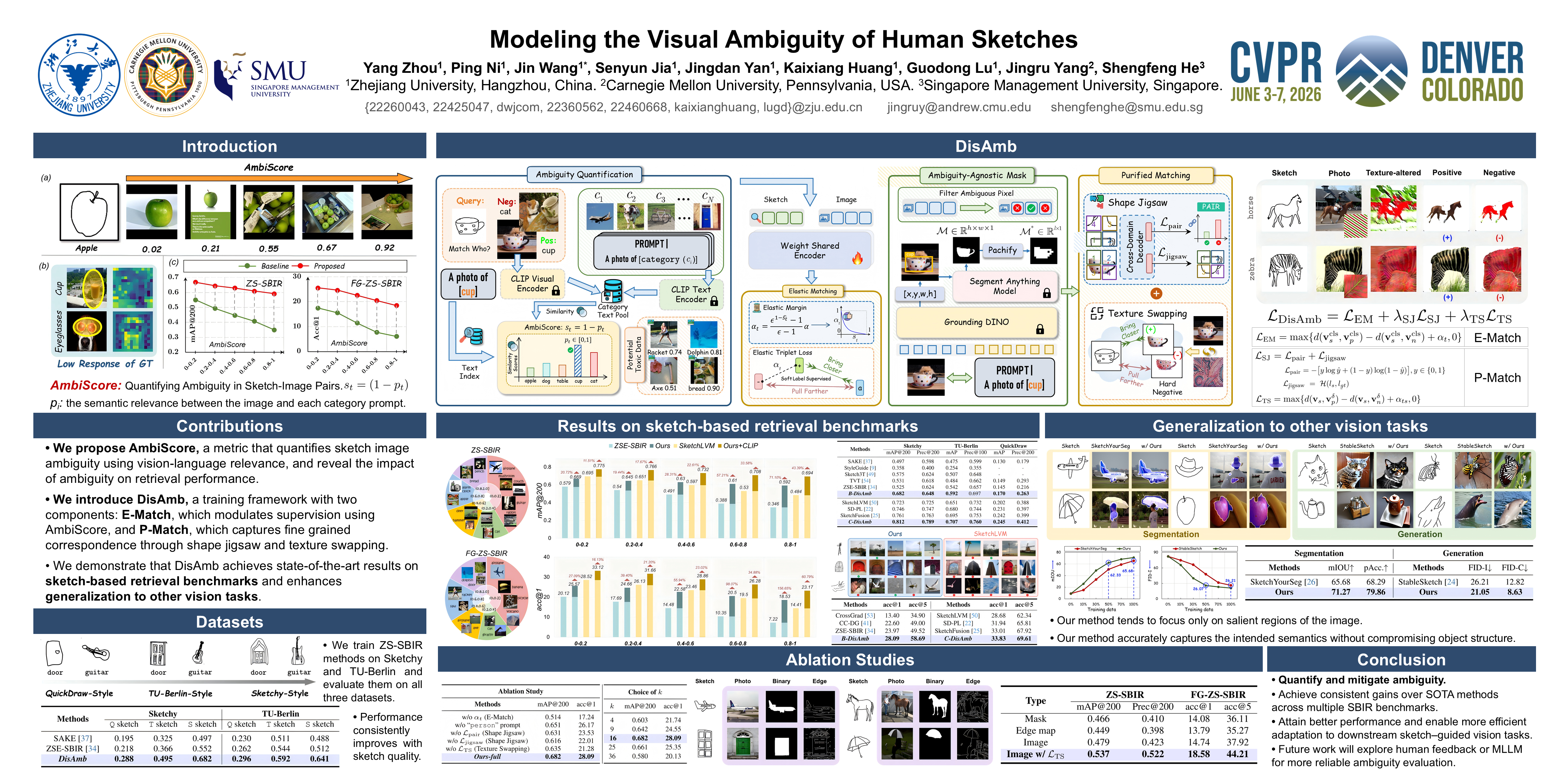
Human sketches provide a compact and expressive form of visual communication, but their sparse structural cues, while capturing essential object structures, introduce ambiguity because a single sketch can correspond to multiple plausible images, making cross-domain alignment uncertain and unstable. Such ambiguity fundamentally limits sketch-based vision tasks that rely on precise sketch--image correspondence. To address this challenge, we introduce AmbiScore, a metric that quantifies the ambiguity of sketch-image pairs, and use Zero-Shot Sketch-Based Image Retrieval (ZS-SBIR) as a testbed to reveal how ambiguous supervision leads to performance collapse in existing methods. We further propose DisAmb (Disentangling Ambiguity), a framework that explicitly models and mitigates ambiguity through two components: (1) Elastic Matching, which adaptively adjusts supervision strength using AmbiScore, and (2) Purified Matching, which employs ambiguity-agnostic masks to disentangle structure and appearance via shape jigsaw and texture swapping. DisAmb establishes new benchmarks under high ambiguity and provides a robust, transferable supervisory signal for downstream sketch-guided tasks.
SATTC: Structure-Aware Label-Free Test-Time Calibration for Cross-Subject EEG-to-Image Retrieval
Qunjie Huang ⋅ Weina Zhu
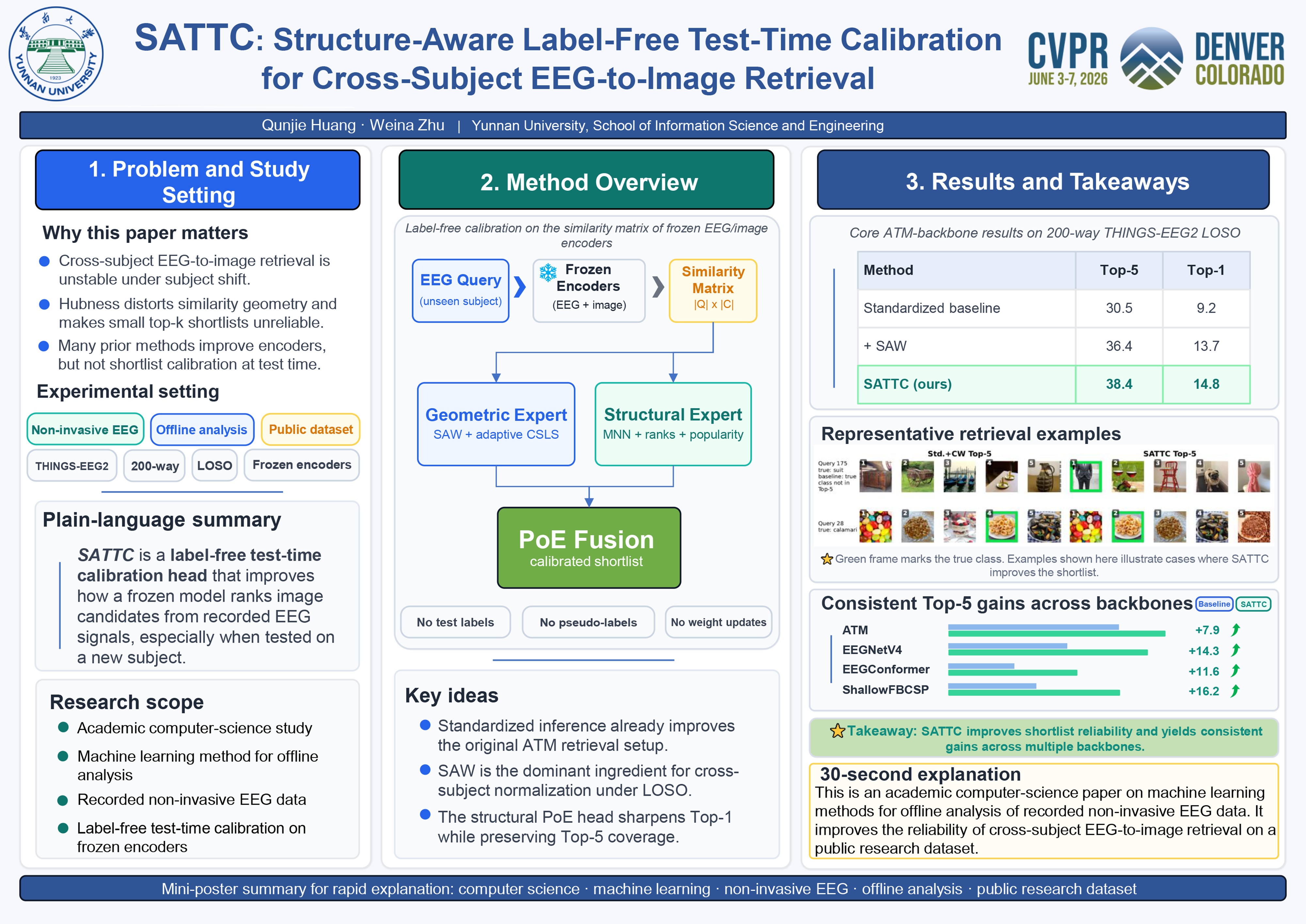
Cross-subject EEG-to-image retrieval for visual decoding is hampered by subject shift and hubness in the embedding space, which distort similarity geometry and destabilize top-k rankings, making small candidate shortlists unreliable. We introduce SATTC (Structure-Aware Test-Time Calibration), a label-free test-time calibration head that operates directly on the similarity matrix of frozen EEG–image encoders. SATTC combines a geometric expert—subject-adaptive whitening of EEG embeddings with an adaptive variant of Cross-domain Similarity Local Scaling (CSLS)—and a structural expert that leverages mutual nearest neighbors, bidirectional top-k ranks, and class popularity, fused via a simple Product-of-Experts rule. On the THINGS-EEG cross-subject benchmark with a strict leave-one-subject-out protocol, standardizing inference with cosine similarities, ℓ2-normalized embeddings, and candidate whitening already yields a strong baseline that improves Top-1 and Top-5 accuracy over the original ATM retrieval setup. Adding SATTC on top of this standardized inference further improves Top-1 and Top-5 accuracy and substantially reduces hubness, yielding more reliable small-k shortlists across multiple EEG encoders and establishing SATTC as a generic test-time calibration head for zero-shot neural decoding from EEG.
ConeSep: Cone-based Robust Noise-Unlearning Compositional Network for Composed Image Retrieval
Zixu Li ⋅ Yupeng Hu ⋅ Zhiwei Chen ⋅ Mingyu Zhang ⋅ Zhiheng Fu ⋅ Liqiang Nie
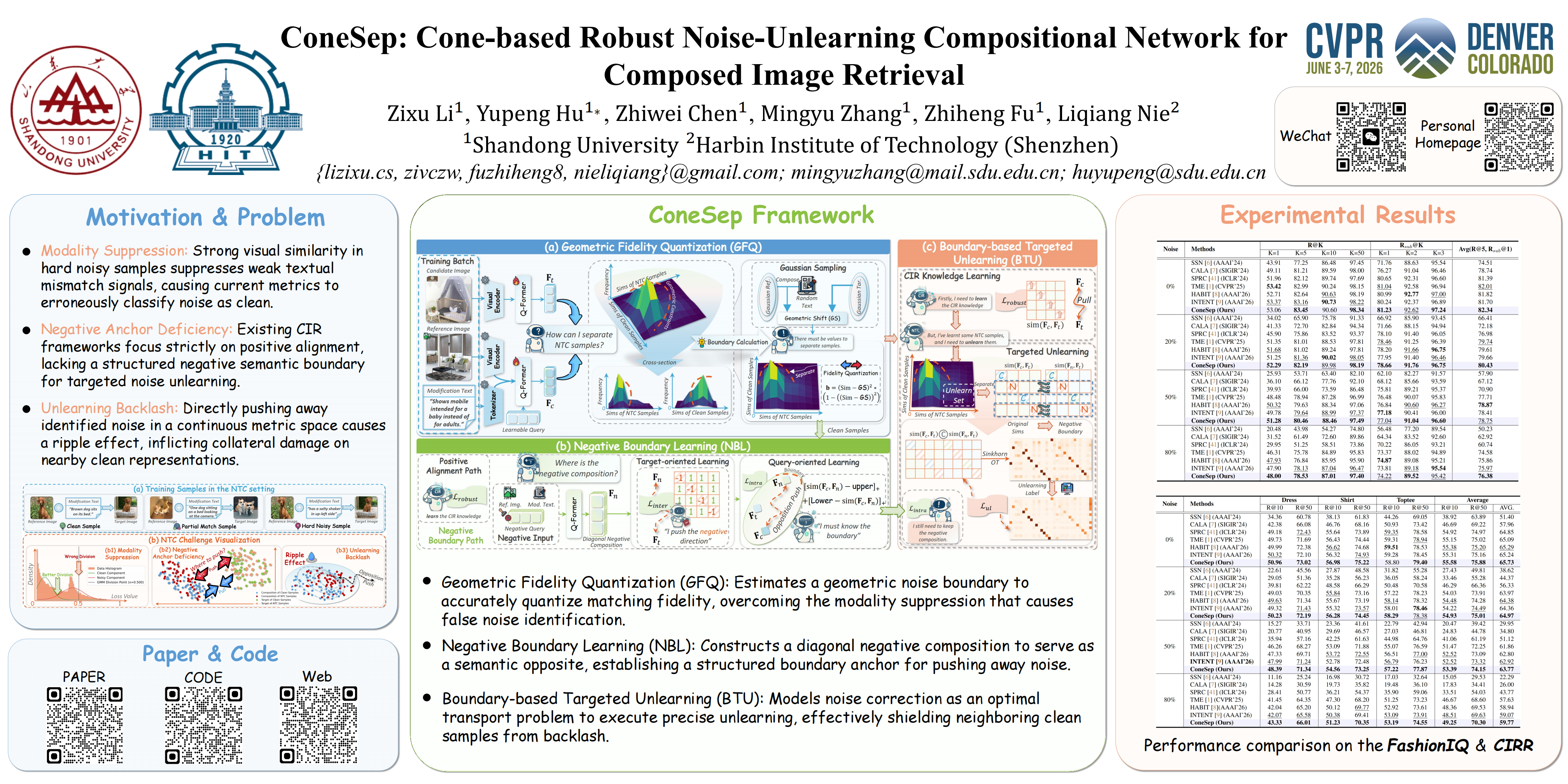
The Composed Image Retrieval (CIR) task provides a flexible retrieval paradigm via a reference image and modification text, but it heavily relies on expensive and error-prone triplet annotations. This paper systematically investigates the Noisy Triplet Correspondence (NTC) problem introduced by annotations. We find that NTC noise, particularly "hard noise" (i.e., the reference and target images are highly similar but the modification text is incorrect), poses a unique challenge to existing Noise Correspondence Learning (NCL) methods because it breaks the traditional "small loss hypothesis". We identify and elucidate three key, yet overlooked, challenges in the NTC task, namely (C1) Modality Suppression, (C2) Negative Anchor Deficiency, and (C3) Unlearning Backlash. To address these challenges, we propose a Cone-based robuSt noisE-unlearning comPositional network (ConeSep). Specifically, we first propose Geometric Fidelity Quantization, theoretically establishing and practically estimating a noise boundary to precisely locate noisy correspondence. Next, we introduce Negative Boundary Learning, which learns a "diagonal negative combination" for each query as its explicit semantic opposite-anchor in the embedding space. Finally, we design Boundary-based Targeted Unlearning, which models the noisy correction process as an optimal transport problem, elegantly avoiding Unlearning Backlash. Extensive experiments on benchmark datasets (FashionIQ and CIRR) demonstrate that ConeSep significantly outperforms current state-of-the-art methods, which fully demonstrates the effectiveness and robustness of our method.
V^2-SAM: Marrying SAM2 with Multi-Prompt Experts for Cross-View Object Correspondence
Jiancheng Pan ⋅ Runze Wang ⋅ Tianwen Qian ⋅ Mohammad Mahdi ⋅ Yanwei Fu ⋅ Xiangyang Xue ⋅ Xiaomeng Huang ⋅ Luc Van Gool ⋅ Danda Paudel ⋅ Yuqian Fu
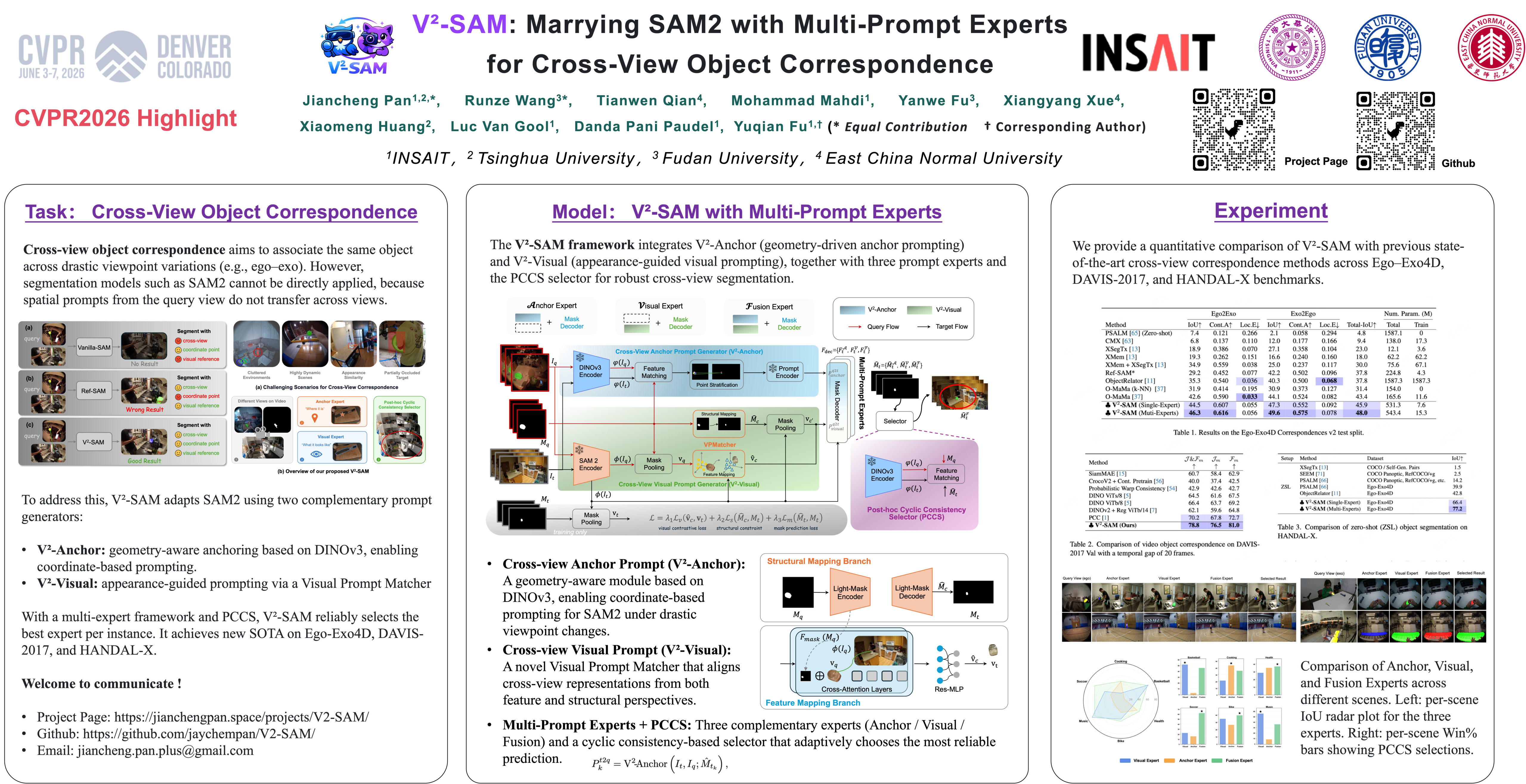
Cross-view object correspondence, exemplified by the representative task of ego–exo object correspondence, aims to establish consistent associations of the same object across different viewpoints (e.g., ego-centric and exo-centric). This task poses significant challenges due to drastic viewpoint and appearance variations, making existing segmentation models, such as SAM2, non-trivial to apply directly. To address this, we present V$^{2}$-SAM, a unified cross-view object correspondence framework that adapts SAM2 from single-view segmentation to cross-view correspondence through two complementary prompt generators. Specifically, the Cross-View Anchor Prompt Generator (V$^{2}$-Anchor), built upon DINOv3 features, establishes geometry-aware correspondences and, for the first time, unlocks coordinate-based prompting for SAM2 in cross-view scenarios, while the Cross-View Visual Prompt Generator (V$^{2}$-Visual) enhances appearance-guided cues via a novel visual prompt matcher that aligns ego–exo representations from both feature and structural perspectives. To effectively exploit the strengths of both prompts, we further adopt a multi-expert design and introduce a Post-hoc Cyclic Consistency Selector (PCCS) that adaptively selects the most reliable expert based on cyclic consistency. Extensive experiments validate the effectiveness of V$^{2}$-SAM, achieving new state-of-the-art performance on Ego-Exo4D (Ego–Exo object correspondence), DAVIS-2017 (video object tracking), and HANDAL-X (robotic-ready cross-view correspondence). Codes will be released upon acceptance.
WeaveTime: Streaming from Earlier Frames into Emergent Memory in VideoLLMs
Yulin Zhang ⋅ Cheng Shi ⋅ Sibei Yang
Recent advances in Multimodal Large Language Models have greatly improved visual understanding and reasoning, yet their quadratic attention and offline training protocols make them ill-suited for streaming settings where frames arrive sequentially and future observations are inaccessible. We diagnose a core limitation of current Video-LLMs, namely Time-Agnosticism, in which videos are treated as an unordered bag of evidence rather than a causally ordered sequence, yielding two failures in streams: temporal order ambiguity, in which the model cannot follow or reason over the correct chronological order, and past–current focus blindness where it fails to distinguish present observations from accumulated history. We present WeaveTime, a simple, efficient, and model-agnostic framework that first teaches order and then uses order. We introduce a lightweight Temporal Reconstruction objective—our Streaming Order Perception enhancement—that instills order-aware representations with minimal finetuning and no specialized streaming data. At inference, a Past–Current Dynamic Focus Cache performs uncertainty-triggered, coarse-to-fine retrieval, expanding history only when needed. Plugged into exsiting Video-LLM without architectural changes, WeaveTime delivers consistent gains on representative streaming benchmarks, improving accuracy while reducing latency. These results establish WeaveTime as a practical path toward time-aware stream Video-LLMs under strict online, time-causal constraints. Code and weights will be made publicly available.
Streaming Video Crime Anticipation with Spatio-Temporal Causal Reasoning
Yusong Wang ⋅ Zheyuan Gu ⋅ Keyu Mao ⋅ Minghao Shao ⋅ Mingkun Xu ⋅ Prayag Tiwari ⋅ Jiawei Shao ⋅ qingsong zhao
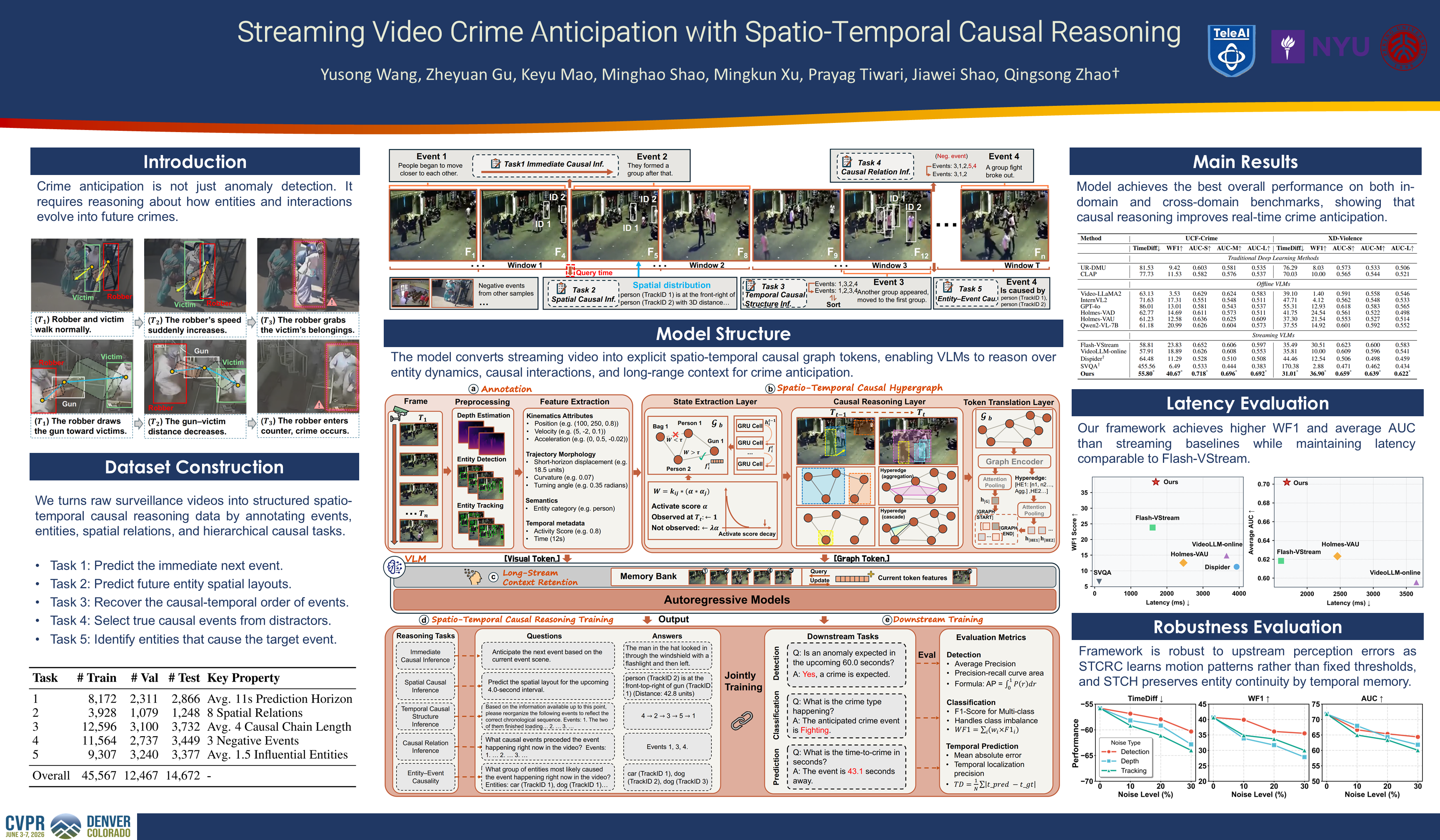
Crime anticipation enables proactive public safety interventions, yet existing video security systems remain largely reactive, unable to detect precursors of crime. While current visual language models (VLM)-based video understanding methods show promise in high-level reasoning, they are not designed to explicitly model the spatio-temporal causal relationships essential for anticipating crimes.We address this limitation by two causal-driven components. First, we develop the Spatio-Temporal Causal Reasoning Crime (STCRC) dataset, a hierarchical dataset comprising 73K samples across five progressive causal reasoning tasks, facilitating criminal precursors learning. Second, we propose the Spatio-Temporal Causal Hypergraph (STCH), a streaming module that transforms implicit entity dynamics into explicit causal structures to enhance causal reasoning for crime in VLMs. By combining these two components, our framework advances real-time crime anticipation, achieving improvements in anticipatory tasks: a 70.7% relative improvement in crime classification, a 10.1% in crime detection, and a 3.7% reduction in temporal prediction error.
Efficient Frame Selection for Long Video Understanding via Reinforcement Learning
Yaxuan Qin ⋅ Hefei Li ⋅ Wenqi Mu ⋅ Yancheng He
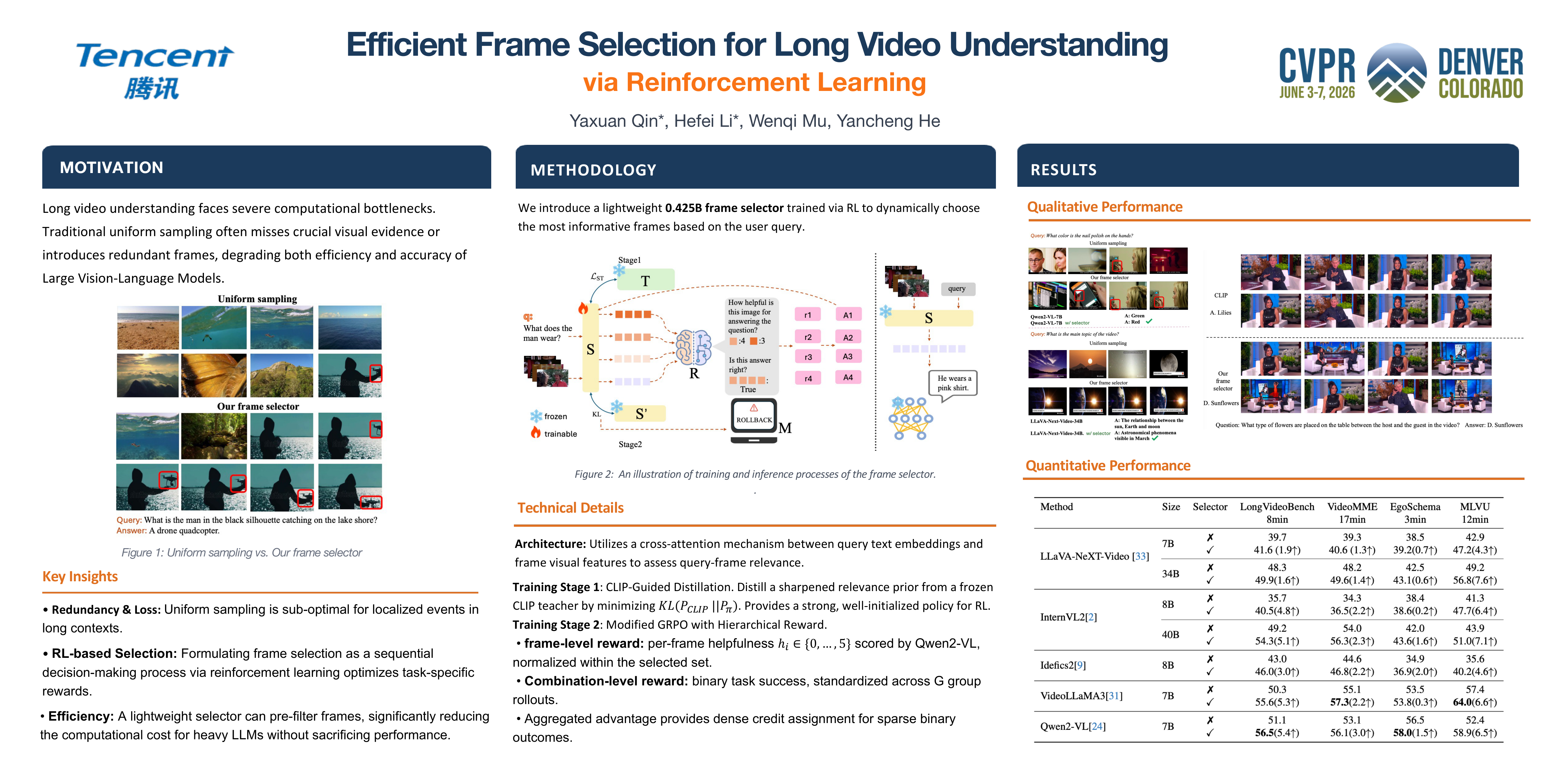
Recent advances in Multimodal Large Language Models (MLLMs) have led to significant progress in video understanding. Due to limited context windows and computational overhead, most MLLMs adopt uniform frame sampling. This approach is at high risk of missing critical visual information and constrains performance especially for long videos. To address this problem, we propose a lightweight frame selection method to identify keyframes and train it via a two-stage strategy. In the pre-training stage, the frame selector learns to model relevance between individual video frames and queries. In the reinforcement learning (RL) stage, we employ a hierarchical reward that evaluates selection quality at combination and frame levels. Through stochastic exploration of frame combinations, the selector learns to identify and retain frames that improve task performance rather than merely maximizing query relevance, which can be misleading. The selected frames serve as input to downstream MLLMs for video understanding and reasoning. Experimental results demonstrate the proposed selector improves performance of diverse downstream MLLMs across benchmarks spanning medium to long videos.
HieraMamba: Video Temporal Grounding via Hierarchical Anchor-Mamba Pooling
Joungbin An ⋅ Kristen Grauman
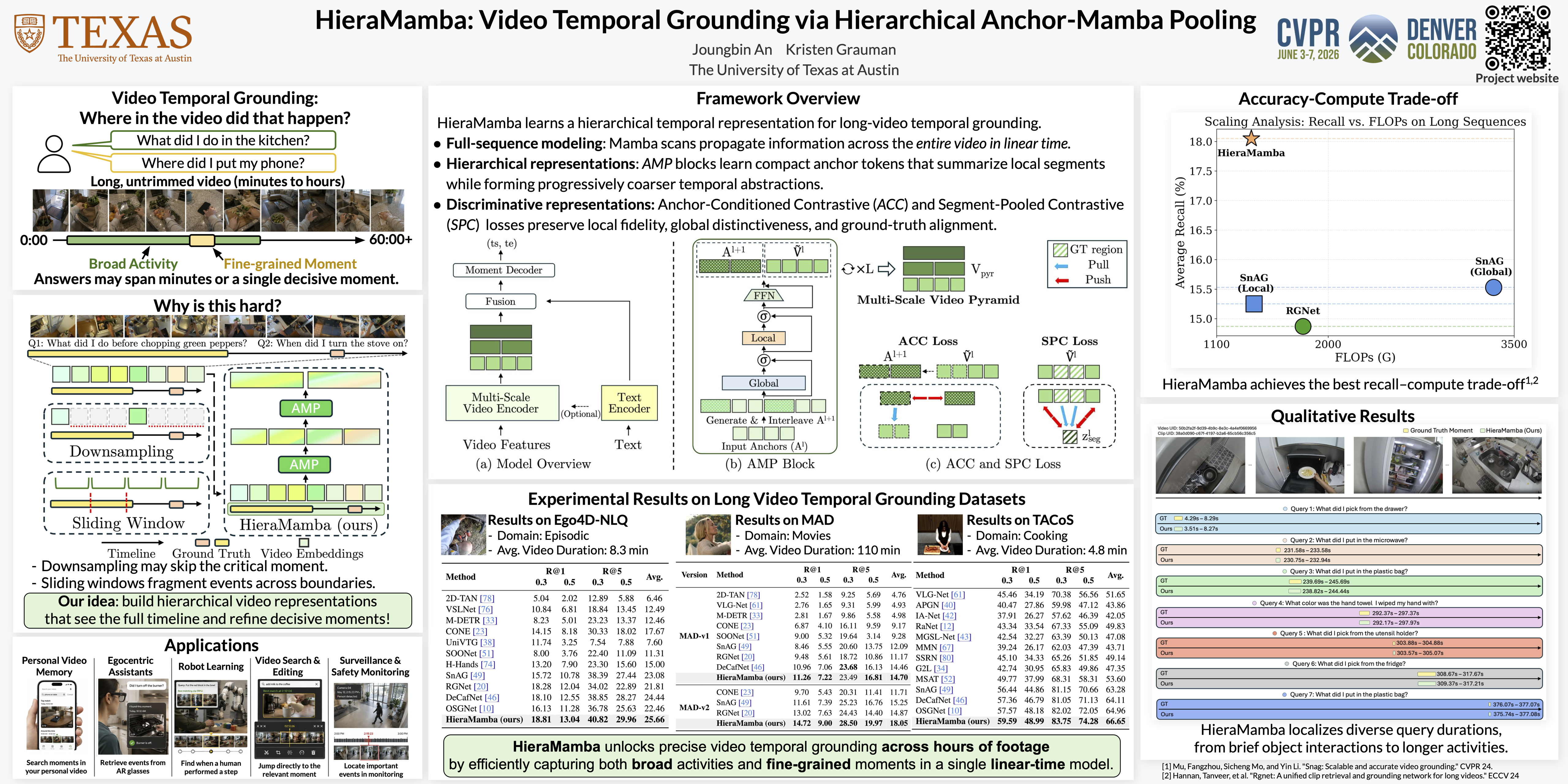
Video temporal grounding, the task of localizing the start and end times of a natural language query in untrimmed video, requires capturing both global context and fine-grained temporal detail. This challenge is particularly pronounced in long videos, where existing methods often compromise temporal fidelity by over-downsampling or using fixed windows. We present HieraMamba, a hierarchical architecture that preserves temporal structure and semantic richness across scales. At its core are Anchor-MambaPooling (AMP) blocks, which utilize Mamba’s selective scanning to produce compact anchor tokens summarizing video content across scales. We further introduce anchor-conditioned and segment-pooled contrastive losses-two complementary objectives that encourage anchors to retain local detail while remaining globally discriminative. HieraMamba sets a new state-of-the-art on Ego4D-NLQ, MAD, and TACoS, demonstrating precise, temporally faithful localization in long, untrimmed videos.
InternVideo-Next: Towards World-Understanding Video Models
Chenting Wang ⋅ Yuhan Zhu ⋅ Yicheng Xu ⋅ Jiange Yang ⋅ ziang yan ⋅ Yali Wang ⋅ Yi Wang ⋅ Limin Wang
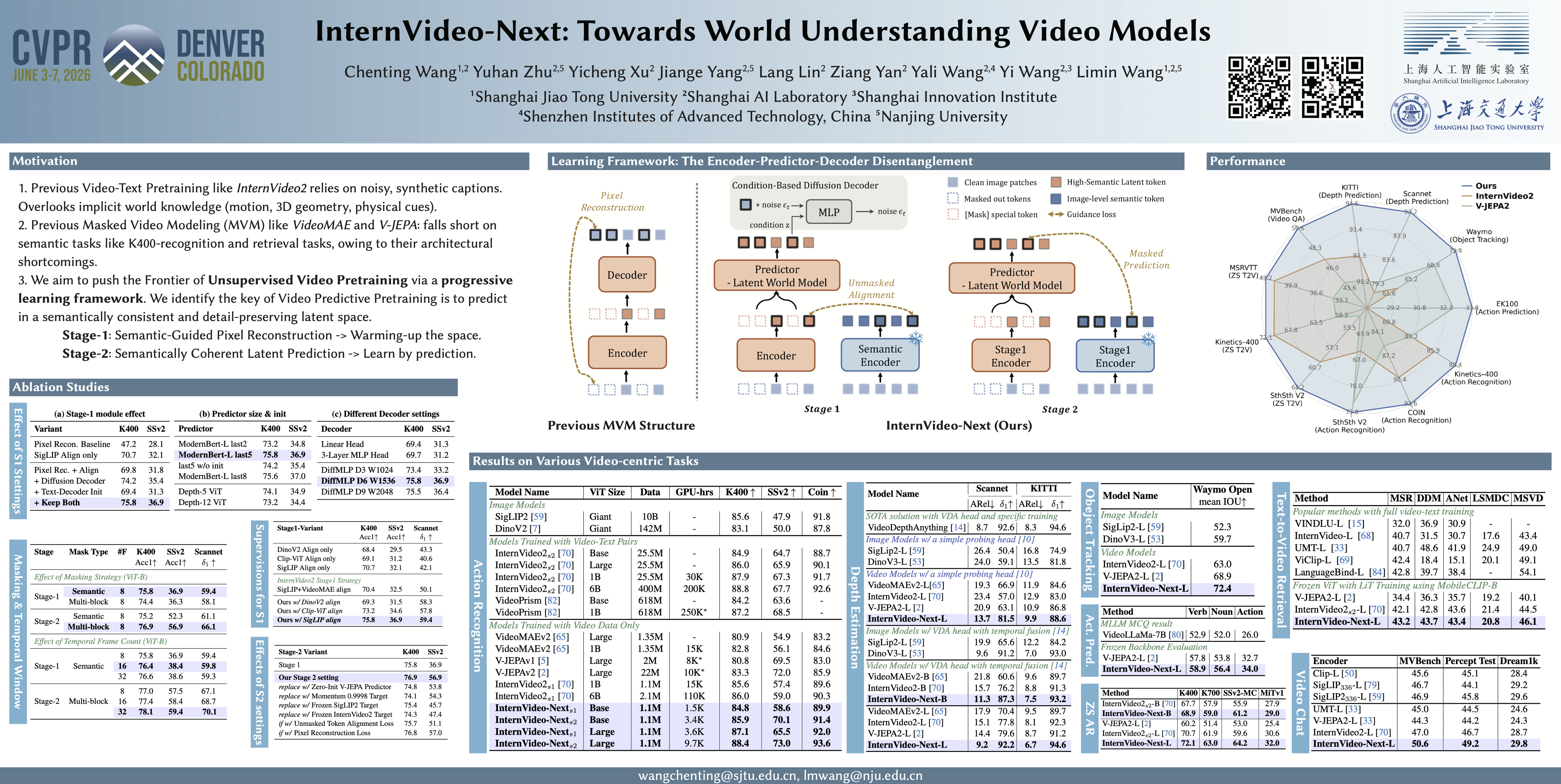
Large-scale video–text pretraining achieves strong performance but depends on noisy, synthetic captions with limited semantic coverage, often overlooking implicit world knowledge such as object motion, 3D geometry, and physical cues. In contrast, masked video modeling (MVM) directly exploits spatiotemporal structures but trails text-supervised methods on general tasks.We find this gap arises from overlooked architectural issues: pixel-level reconstruction struggles with convergence and its low-level requirement often conflicts with semantics, while latent prediction often encourages shortcut learning.To address these, we disentangle the traditional encoder–decoder design into an Encoder–Predictor–Decoder (EPD) framework, where the predictor acts as a latent world model, and propose InternVideo-Next, a two-stage pretraining scheme that builds a semantically consistent yet detail-preserving latent space for this world model.First, conventional linear decoder in pixel MVM enforces the predictor’s output latent to be linearly projected to, thus separable in pixel space, causing the conflict with semantic abstraction.Our Stage 1 proposes a conditional diffusion decoder and injects clean image-level semantic priors to enhance semantics and convergence, thus bridging pixel-level fidelity with high-level semantic abstraction.Stage 2 further learns world knowledge by predicting frozen Stage 1 targets within this space, mitigating shortcut learning.Trained on public, unlabeled videos, InternVideo-Next achieves state-of-the-art results across benchmarks and provides a scalable path toward general video representation learning.
Condensed Test-Time Adaptation of VLMs for Action Recognition
Wenxuan Ge ⋅ Qu Hongyu ⋅ Rui Yan ⋅ Guo-Sen Xie ⋅ Yazhou Yao ⋅ Xiangbo Shu ⋅ Jinhui Tang
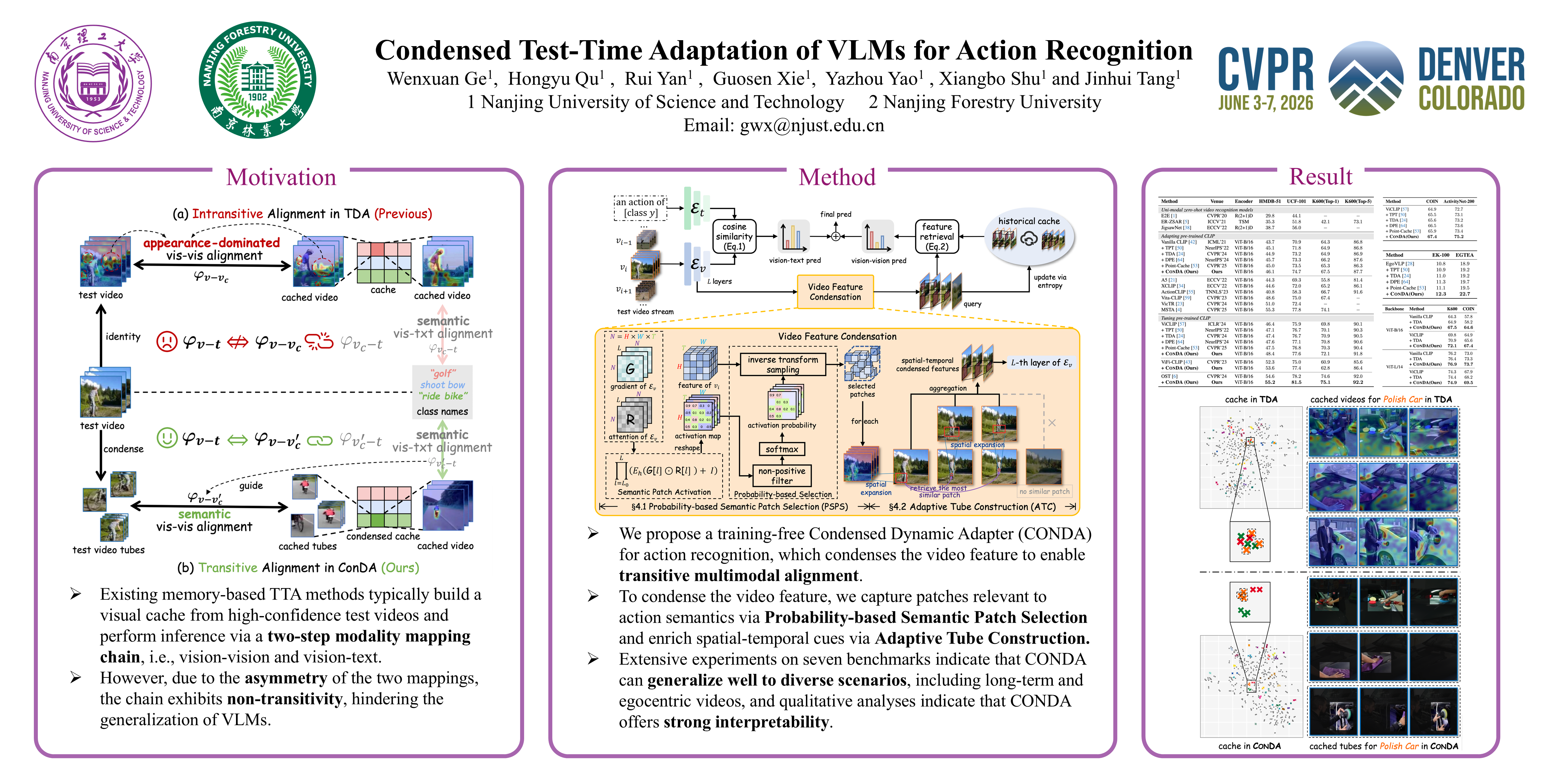
Test-time adaptation for video understanding, which enables vision-language models (VLMs) to generalize to downstream tasks such as action recognition, has demonstrated substantial value in real-world applications. Existing memory-based methods typically build a visual cache from high-confidence test videos and perform inference via a two-step modality mapping chain, i.e., vision-vision and vision-text. However, due to the asymmetry of the two mappings, the chain exhibits non-transitivity, hindering the generalization of VLMs. To this end, we propose a novel training-free Condensed Dynamic Adapter ConDA for action recognition, which leverages vision-text alignment to guide vision-vision alignment. It first selects semantic patches based on the semantic activation probability obtained from the vision-text alignment (Probability-based Semantic Patch Selection, PSPS), and then adaptively constructs spatial-temporal video tubes based on patch-level visual similarity (Adaptive Tube Construction, ATC). We conduct extensive experiments on seven benchmarks with different backbones and baselines. The quantitative results demonstrate that ConDA is compatible with arbitrary VLM and generalizes well across complex scenarios, such as long-term and egocentric scenarios. In addition, qualitative analyses showcase the interpretability of ConDA in terms of capturing semantic cues.
Test-time Ego-Exo-centric Adaptation for Action Anticipation via Multi-Label Prototype Growing and Dual-Clue Consistency
Zhaofeng Shi ⋅ Heqian Qiu ⋅ Lanxiao Wang ⋅ Qingbo Wu ⋅ Fanman Meng ⋅ Lili Pan ⋅ Hongliang Li
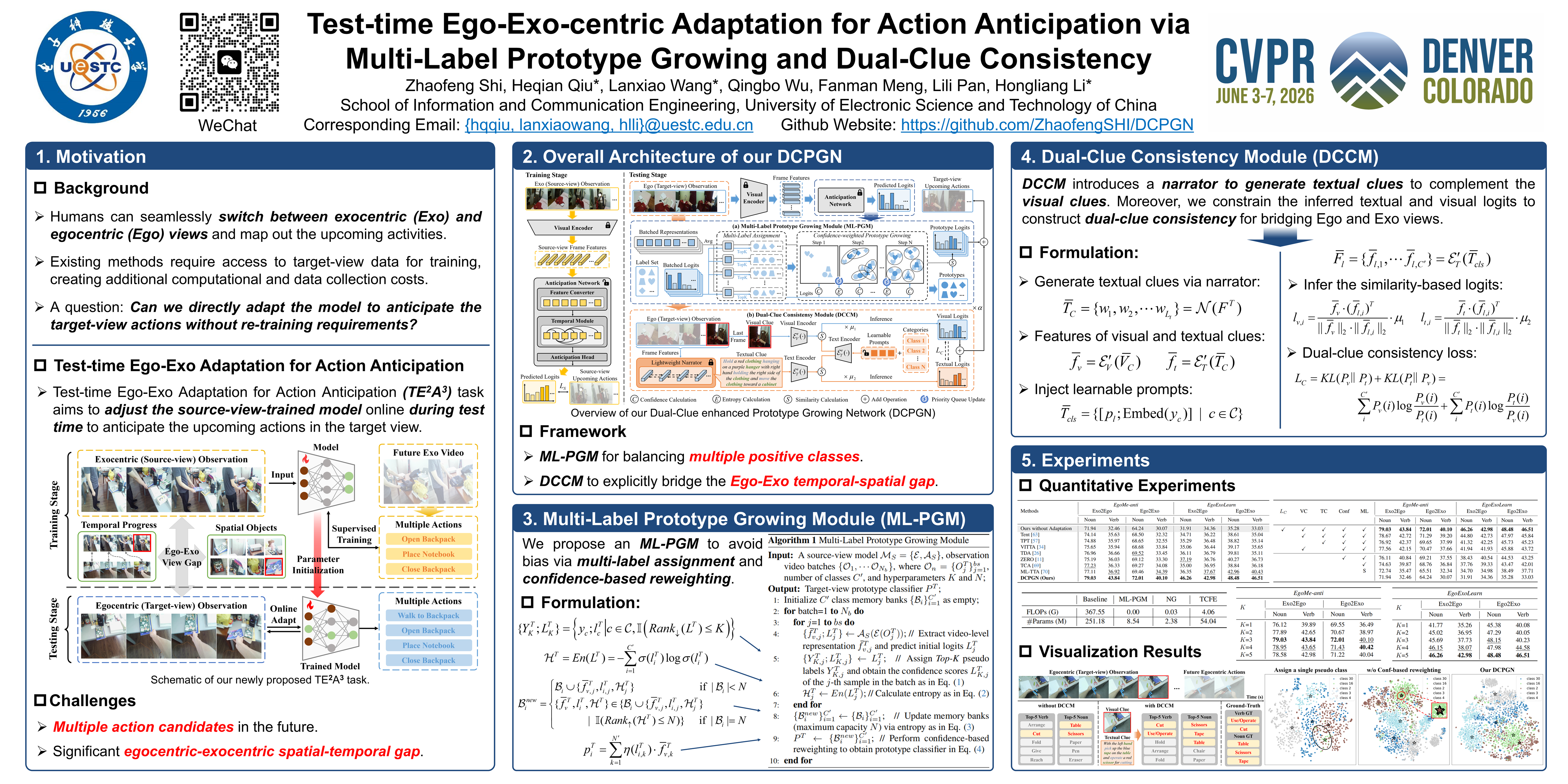
Efficient adaptation between Egocentric (Ego) and Exocentric (Exo) views is crucial for applications such as human-robot cooperation. However, the success of most existing Ego-Exo adaptation methods relies heavily on target-view data for training, thereby increasing computational and data collection costs. In this paper, we make the first exploration of a Test-time Ego-Exo Adaptation for Action Anticipation (TE$^{2}$A$^{3}$) task, which aims to adjust the source-view-trained model online during test time to anticipate target-view actions. It is challenging for existing Test-Time Adaptation (TTA) methods to address this task due to the multi-action candidates and significant temporal-spatial inter-view gap. Hence, we propose a novel Dual-Clue enhanced Prototype Growing Network (DCPGN), which accumulates multi-label knowledge and integrates cross-modality clues for effective test-time Ego-Exo adaptation and action anticipation. Specifically, we propose a Multi-Label Prototype Growing Module (ML-PGM) to balance multiple positive classes via multi-label assignment and confidence-based reweighting for class-wise memory banks, which are updated by an entropy priority queue strategy. Then, the Dual-Clue Consistency Module (DCCM) introduces a lightweight narrator to generate textual clues indicating action progressions, which complement the visual clues containing various objects. Moreover, we constrain the inferred textual and visual logits to construct dual-clue consistency for temporally and spatially bridging Ego and Exo views. Extensive experiments on the newly proposed EgoMe-anti and the existing EgoExoLearn benchmarks show the effectiveness of our method, which outperforms related state-of-the-art methods by a large margin. The code will be released.
A Stitch in Time: Learning Procedural Workflow via Self-Supervised Plackett–Luce Ranking
chengan che ⋅ Chao Wang ⋅ Xinyue Chen ⋅ Sophia Tsoka ⋅ Luis Carlos Garcia Peraza Herrera
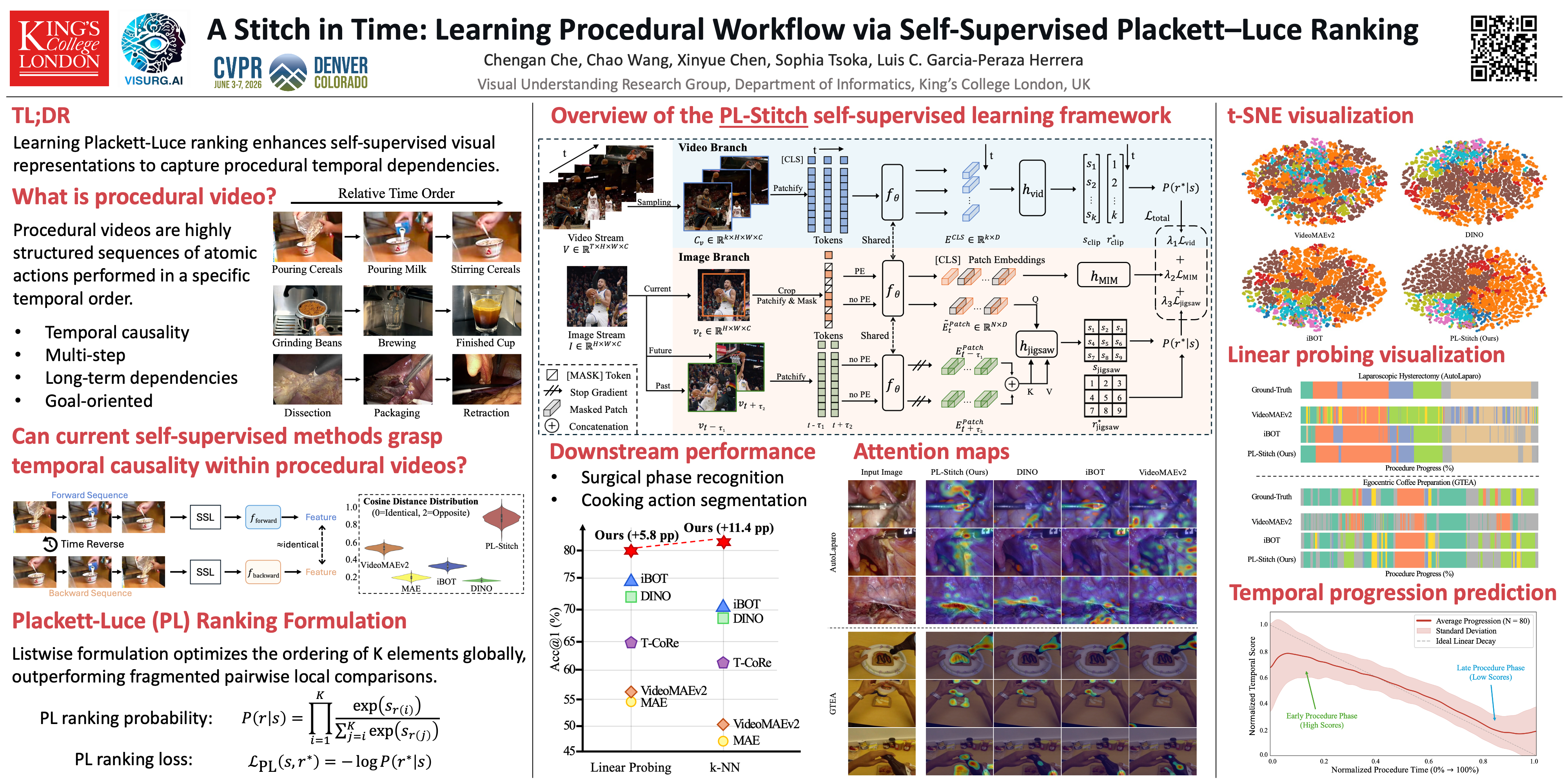
Procedural activities, ranging from routine cooking to complex surgical operations, are highly structured as a set of actions conducted in a specific temporal order. Despite their success on static images and short clips, current self-supervised learning methods often overlook the procedural nature that underpins such activities. We expose the lack of procedural awareness in current SSL methods with a motivating experiment: models pretrained on forward and time-reversed sequences produce highly similar features, confirming that their representations are blind to the underlying procedural order. To address this shortcoming, we propose PL-Stitch, a self-supervised framework that harnesses the inherent temporal order of video frames as a powerful supervisory signal. Our approach integrates twonovel probabilistic objectives based on the Plackett-Luce (PL) model. The primary PL objective trains the model to sort sampled frames chronologically, compelling it to learn the global workflow progression. The secondary objective, a spatio-temporal jigsaw loss, complements the learning by capturing fine-grained, cross-frame object correlations. Our approach consistently achieves superior performance across five surgical and cooking benchmarks. Specifically, PL-Stitch yields significant gains in surgical phase recognition (e.g., +11.4 pp k-NN accuracy on Cholec80) and cooking action segmentation (e.g., +5.7 pp linear probing accuracy on Breakfast), demonstrating its effectiveness for procedural video representation learning.
SurgCoT: Advancing Spatiotemporal Reasoning in Surgical Videos through a Chain-of-Thought Benchmark
Gui Wang ⋅ YongSong Zhou ⋅ Kaijun Deng ⋅ Wooi Ping Cheah ⋅ Rong Qu ⋅ Jianfeng Ren ⋅ Linlin Shen
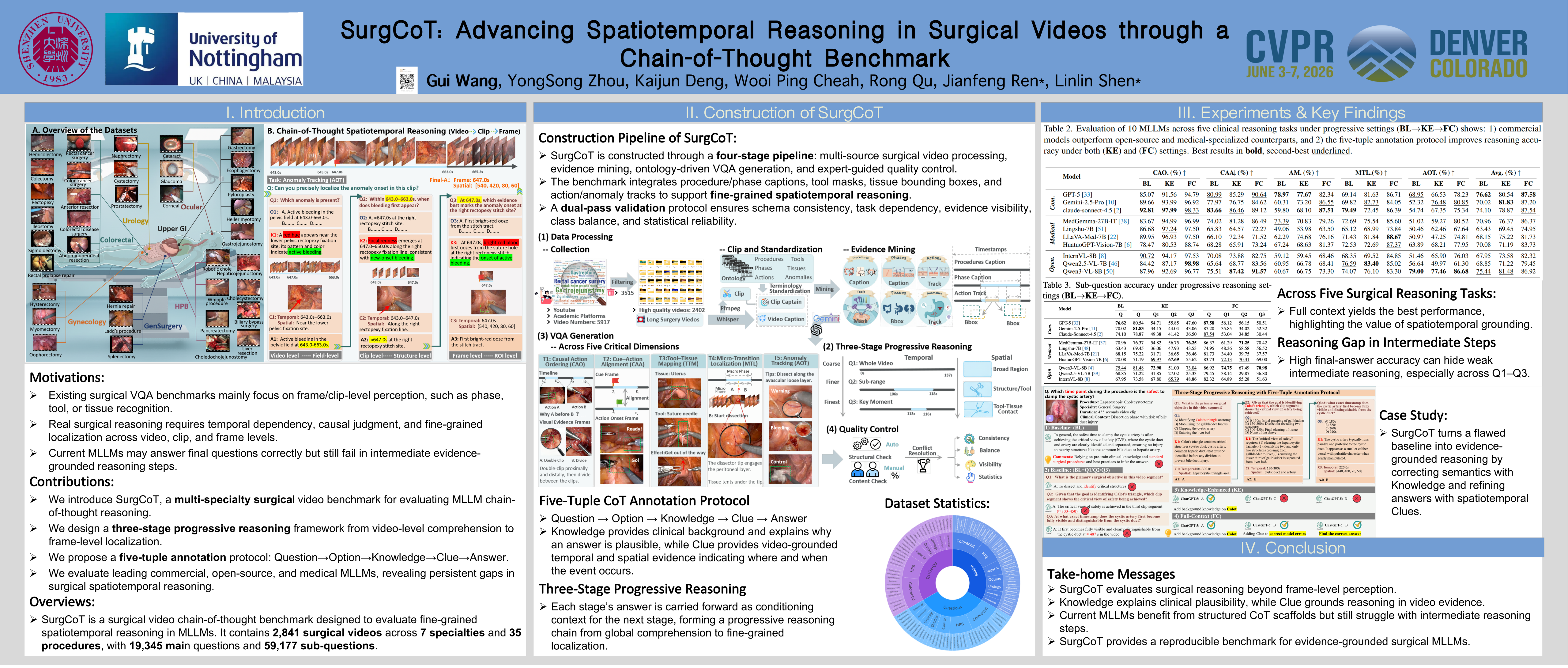
Fine-grained spatiotemporal reasoning on surgical videos is critical, yet the capabilities of Multi-modal Large Language Models (MLLMs) in this domain remain largely unexplored. To bridge this gap, we introduce SurgCoT, a unified benchmark for evaluating chain-of-thought (CoT) reasoning in MLLMs across 7 surgical specialties and 35 diverse procedures. SurgCoT assesses five core reasoning dimensions: Causal Action Ordering, Cue–Action Alignment, Affordance Mapping, Micro‑Transition Localization, and Anomaly Onset Tracking, through a structured CoT framework with an intensive annotation protocol (Question → Option → Knowledge → Clue → Answer), where the Knowledge field provides essential background context and Clue provides definitive spatiotemporal evidence. Evaluation of 10 leading MLLMs shows: 1) commercial models outperform open-source and medical-specialized variants; 2) significant gaps exist in surgical CoT reasoning; 3) SurgCoT enables effective evaluation and enhances progressive spatiotemporal reasoning. SurgCoT provides a reproducible testbed to narrow the gap between MLLM capabilities and clinical reasoning demands. Code and data will be released.
Attend Before Attention: Efficient and Scalable Video Understanding via Autoregressive Gazing
Baifeng Shi ⋅ Stephanie Fu ⋅ Long Lian ⋅ Hanrong Ye ⋅ David Eigen ⋅ Aaron Reite ⋅ Jan Kautz ⋅ Boyi Li ⋅ David Chan ⋅ Trevor Darrell ⋅ Pavlo Molchanov ⋅ Danny Yin
Multi-modal large language models (MLLMs) have advanced general-purpose video understanding but struggle with long, high-resolution videos---they process every pixel equally in their vision transformers (ViTs) or LLMs despite significant spatiotemporal redundancy. We introduce AutoGaze, a lightweight module that removes redundant patches before processed by a ViT or an MLLM. Trained with next-token prediction and reinforcement learning, AutoGaze autoregressively selects a minimal set of multi-scale patches that reconstructs the video within a user-specified error threshold, eliminating redundancy while preserving information. Empirically, AutoGaze reduces visual tokens by 4x-100x and accelerates ViTs and MLLMs by up to 19x, enabling scaling MLLMs to 1K-frame 4K-resolution videos and achieving superior results on video benchmarks (e.g., 66.5% on VideoMME). Furthermore, we introduce HLVid: the first high-resolution, long-form video QA benchmark with multi-minute 4K videos, where an MLLM scaled with AutoGaze outperform the previous SOTA MLLM by 6.3%.
Concept-Guided Fine-Tuning: Steering ViTs away from Spurious Correlations to Improve Robustness
Yehonatan Elisha ⋅ Oren Barkan ⋅ Noam Koenigstein
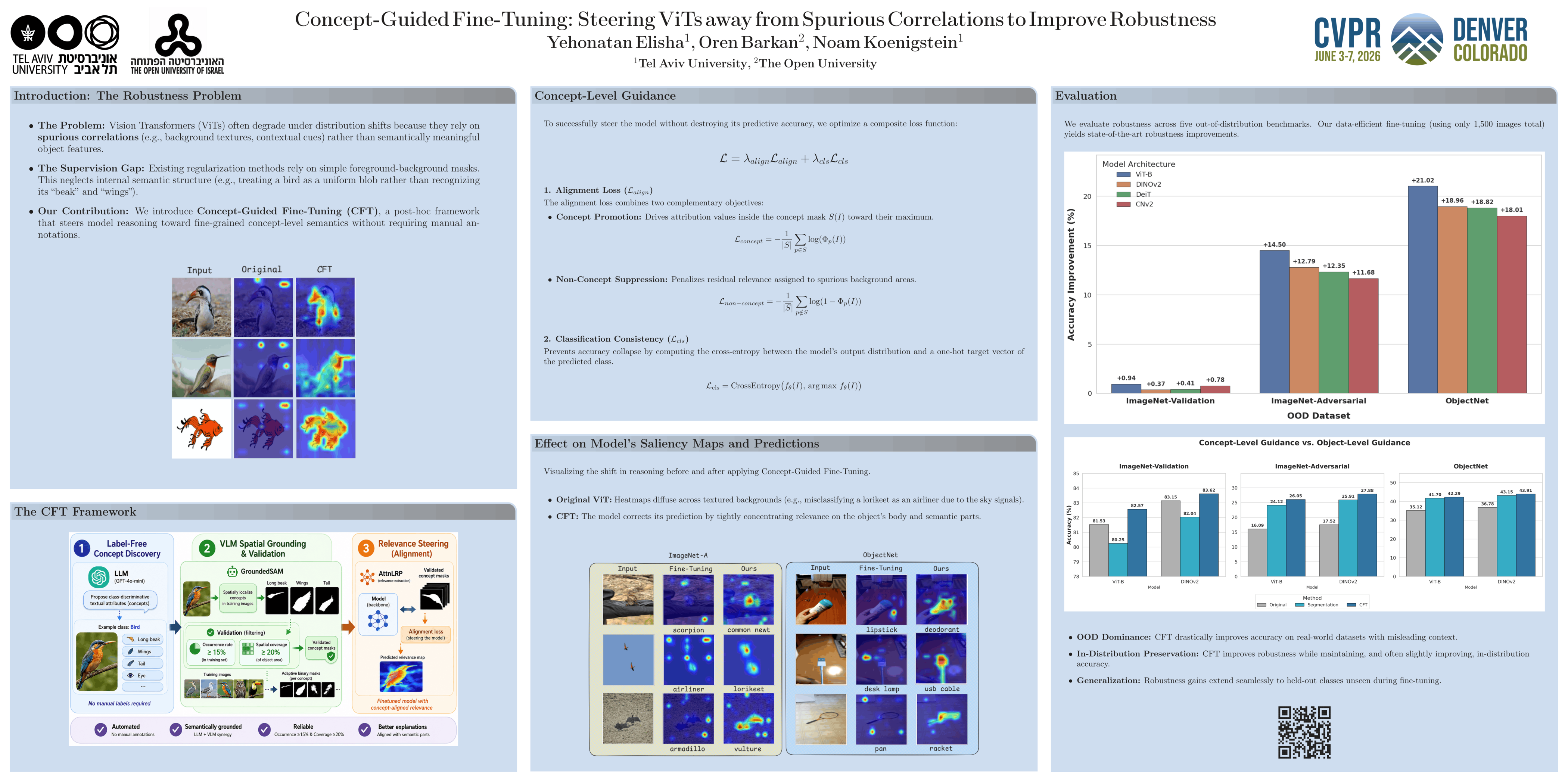
Vision Transformers (ViTs) often fail under distribution shifts because they learn spurious correlations, such as background cues, rather than semantically meaningful features. Existing regularization methods, typically relying on simple foreground/background masks, overlook the fine-grained semantic concepts that truly define an object (e.g., "long beak" and "wings" for a "bird"). To address this, we introduce a novel finetuning framework that steers model reasoning toward concept-level semantics. Our approach optimizes the model's internal relevance maps (via AttnLRP) to align with spatially-grounded concept masks. These guidance masks are generated automatically and without manual annotation: class-relevant concepts are first proposed using an LLM-driven, label-free method, and then segmented using a Vision-Language Model (GroundingSAM). The finetuning objective aligns relevance with these concept regions while simultaneously suppressing focus on spurious background areas and preserving classifier confidence via a dedicated loss term. This process requires only a minimal set of images and uses half of the dataset classes. Extensive experiments on five out-of-distribution (OOD) benchmarks, show that our method significantly enhances model robustness across multiple ViT-based models and an additional CNN model. Furthermore, we validate that the resulting relevance maps exhibit improved alignment with semantic object parts, providing a scalable path toward more robust and interpretable vision models. Finally, we confirm that concept-guided masks provide more effective guidance for model robustness than conventional segmentation maps, validating our hypothesis.
Explaining Object Detectors via Collective Contribution of Pixels
Toshinori Yamauchi ⋅ Hiroshi Kera ⋅ Kazuhiko Kawamoto
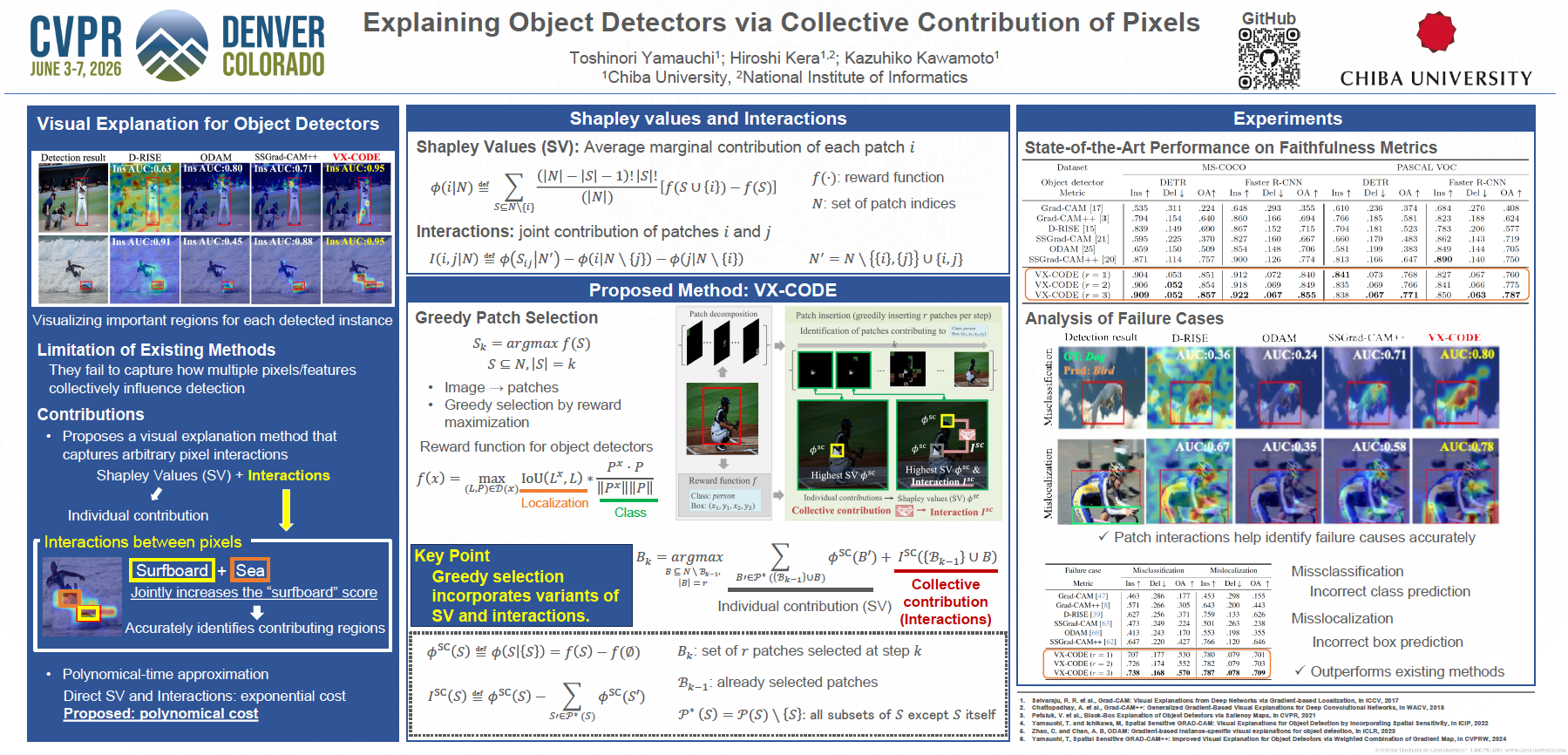
Visual explanations for object detectors are crucial for enhancing their reliability. Object detectors identify and localize instances by assessing multiple visual features collectively. When generating explanations, overlooking these collective influences in detections may lead to missing compositional cues or capturing spurious correlations. However, existing methods typically focus solely on individual pixel contributions, neglecting the collective contribution of multiple pixels. To address this limitation, we propose a game-theoretic method based on Shapley values and interactions to explicitly capture both individual and collective pixel contributions. Our method provides explanations for both bounding box localization and class determination, highlighting regions crucial for detection. Extensive experiments demonstrate that the proposed method identifies important regions more accurately than state-of-the-art methods. The code will be publicly available soon.
Where MLLMs Attend and What They Rely On: Explaining Autoregressive Token Generation
Ruoyu Chen ⋅ Xiaoqing Guo ⋅ Kangwei Liu ⋅ Siyuan Liang ⋅ Shiming Liu ⋅ Qunli Zhang ⋅ Laiyuan Wang ⋅ Hua Zhang ⋅ Xiaochun Cao
Multimodal large language models (MLLMs) have demonstrated remarkable capabilities in aligning visual inputs with natural language outputs. Yet, the extent to which generated tokens depend on visual modalities remains poorly understood, limiting interpretability and reliability. In this work, we present EAGLE, a lightweight black-box framework for explaining autoregressive token generation in MLLMs. EAGLE attributes any selected tokens to compact perceptual regions while quantifying the relative influence of language priors and perceptual evidence. The framework introduces an objective function that unifies sufficiency (insight score) and indispensability (necessity score), optimized via greedy search over sparsified image regions for faithful and efficient attribution. Beyond spatial attribution, EAGLE performs modality-aware analysis that disentangles what tokens rely on, providing fine-grained interpretability of model decisions. Extensive experiments across open-source MLLMs show that EAGLE consistently outperforms existing methods in faithfulness, localization, and hallucination diagnosis, while requiring substantially less GPU memory. These results highlight its effectiveness and practicality for advancing the interpretability of MLLMs.
H-Sets: Hessian-Guided Discovery of Set-Level Feature Interactions in Image Classifiers
Ayushi Mehrotra ⋅ Dipkamal Bhusal ⋅ Michael Clifford ⋅ Nidhi Rastogi
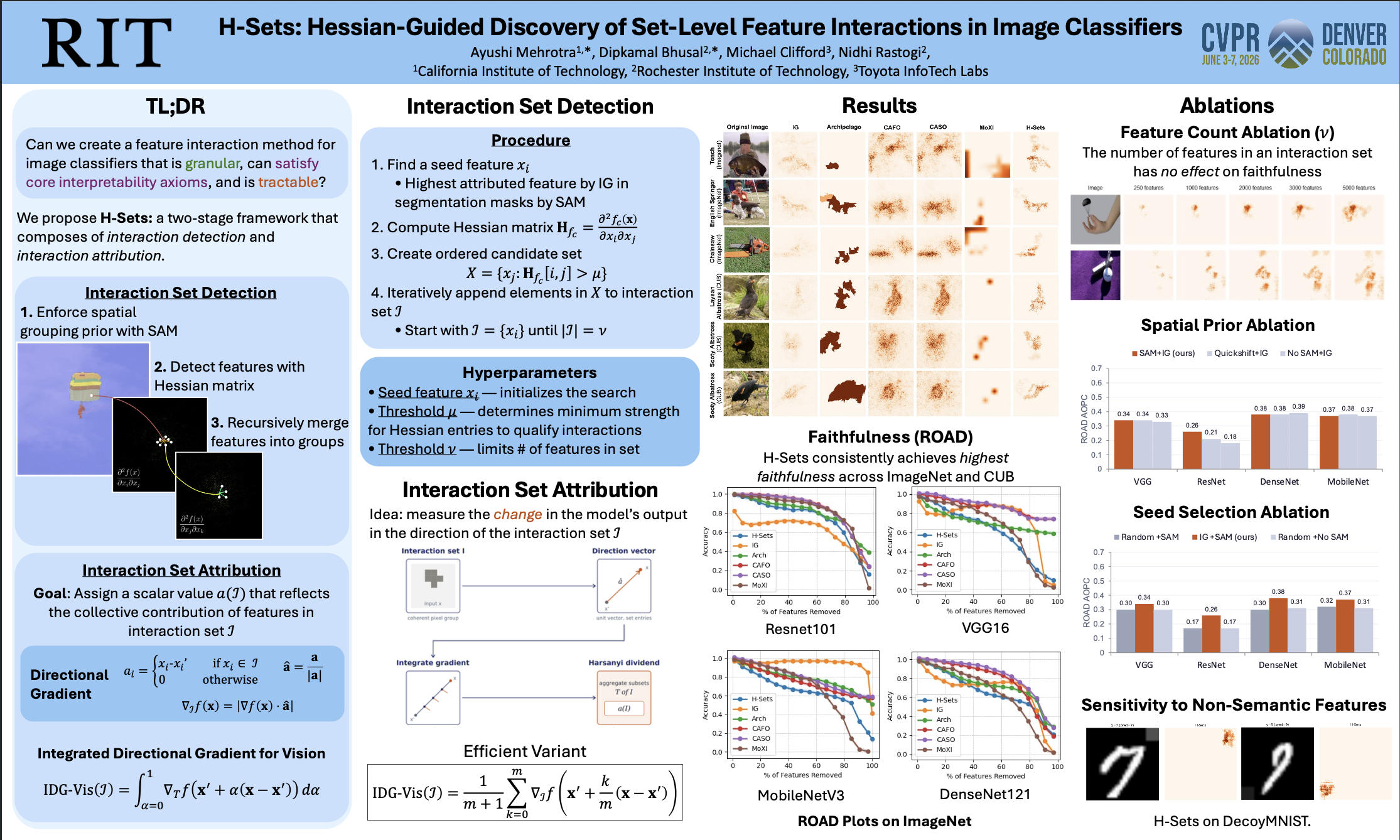
Feature attribution methods explain the predictions of deep neural networks by assigning importance scores to individual input features. However, most existing methods focus solely on marginal effects, overlooking feature interactions, where groups of features jointly influence model output. Such interactions are especially important in image classification tasks, where semantic meaning often arises from pixel interdependencies rather than isolated features. Existing interaction-based methods for images are either coarse (e.g., superpixel-only) or, fail to satisfy core interpretability axioms. In this work, we introduce H-Sets, a novel two-stage framework for discovering and attributing higher-order feature interactions in image classifiers. First, we detect locally interacting pairs via input Hessians and recursively merge them into semantically coherent sets; segmentation from Segment Anything (SAM) is used as a spatial grouping prior but can be replaced by other segmentations. Second, we attribute each set with IDG-Vis, a set-level extension of Integrated Directional Gradients that integrates directional gradients along pixel-space paths and aggregates them with Harsanyi dividends. While Hessians introduce additional compute at the detection stage, this targeted cost consistently yields saliency maps that are sparser and more faithful. Evaluations across VGG, ResNet, DenseNet and MobileNet models on ImageNet and CUB datasets show that H-Sets generate more interpretable and faithful saliency maps compared to existing methods.
Evaluating Generative Models via One-Dimensional Code Distributions
Zexi Jia ⋅ Pengcheng Luo ⋅ Yijia Zhong ⋅ Jinchao Zhang ⋅ Jie Zhou
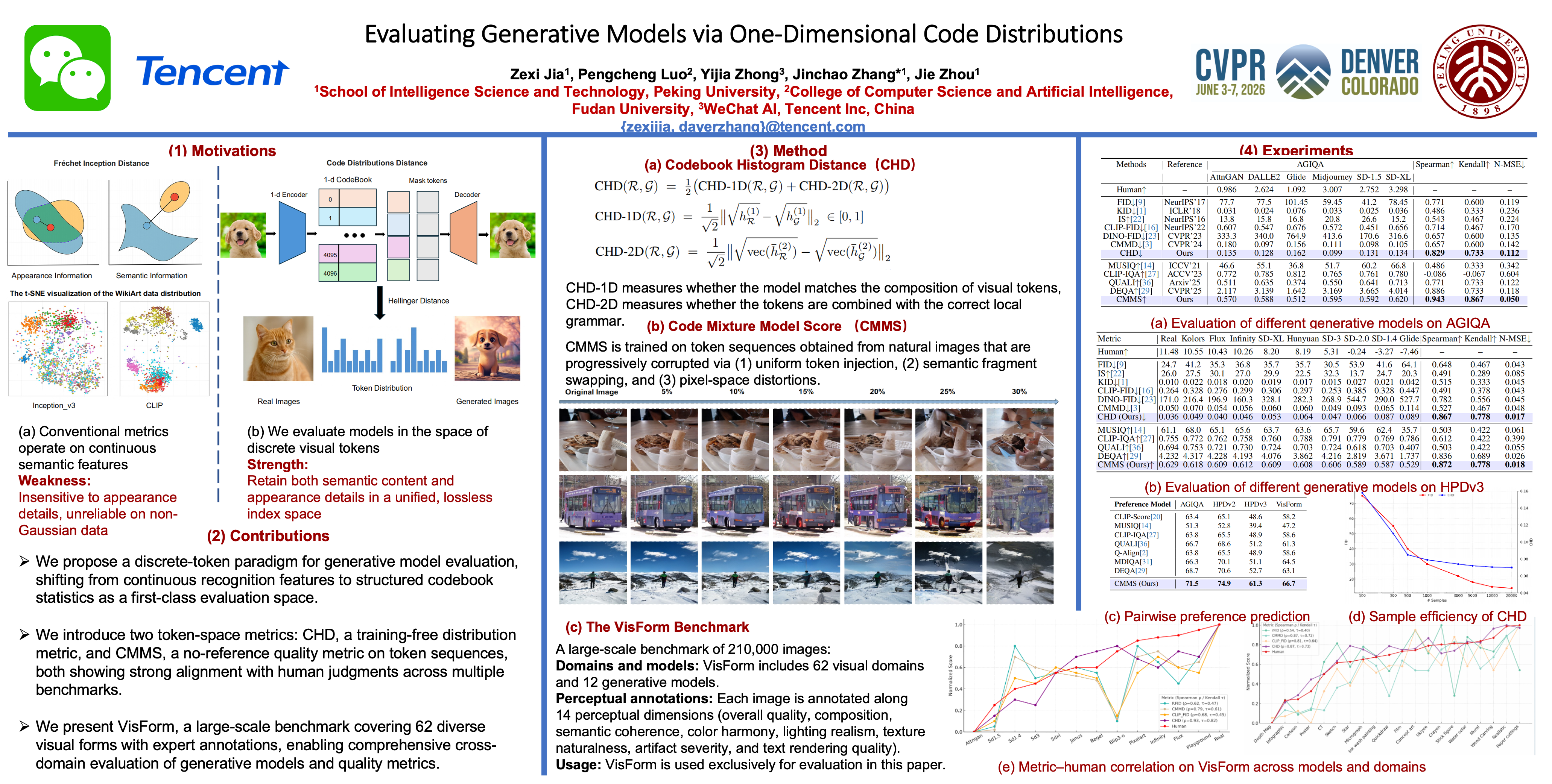
Most evaluations of generative models rely on feature-distribution metrics such as FID, which operate on continuous recognition features that are explicitly trained to be invariant to appearance variations, and thus discard cues critical for perceptual quality. We instead evaluate models in the space of \emph{discrete} visual tokens, where modern 1D image tokenizers compactly encode both semantic and perceptual information and quality manifests as predictable token statistics. We introduce Codebook Histogram Distance(CHD), a training-free distribution metric in token space, and Code Mixture Model Score(CMMS), a no-reference quality metric learned from synthetic degradations of token sequences. To stress-test metrics under broad distribution shifts, we further propose VisForm, a benchmark of 210K images spanning 62 visual forms and 11 generative models with expert annotations. Across AGIQA, HPDv2/3, and VisForm, our token-based metrics achieve state-of-the-art correlation with human judgments, and we will release all code and datasets to facilitate future research.
TriDF: Evaluating Perception, Detection, and Hallucination for Interpretable DeepFake Detection
Jian-Yu Jiang-Lin ⋅ Kang-Yang Huang ⋅ Ling Zou ⋅ Ling Lo ⋅ Sheng-Ping Yang ⋅ Yu-Wen Tseng ⋅ Kun-Hsiang Lin ⋅ Chia-Ling Chen ⋅ Yu-Ting Ta ⋅ Yan-Tsung Wang ⋅ Po-Ching Chen ⋅ Hongxia Xie ⋅ Hong-Han Shuai ⋅ Wen-Huang Cheng
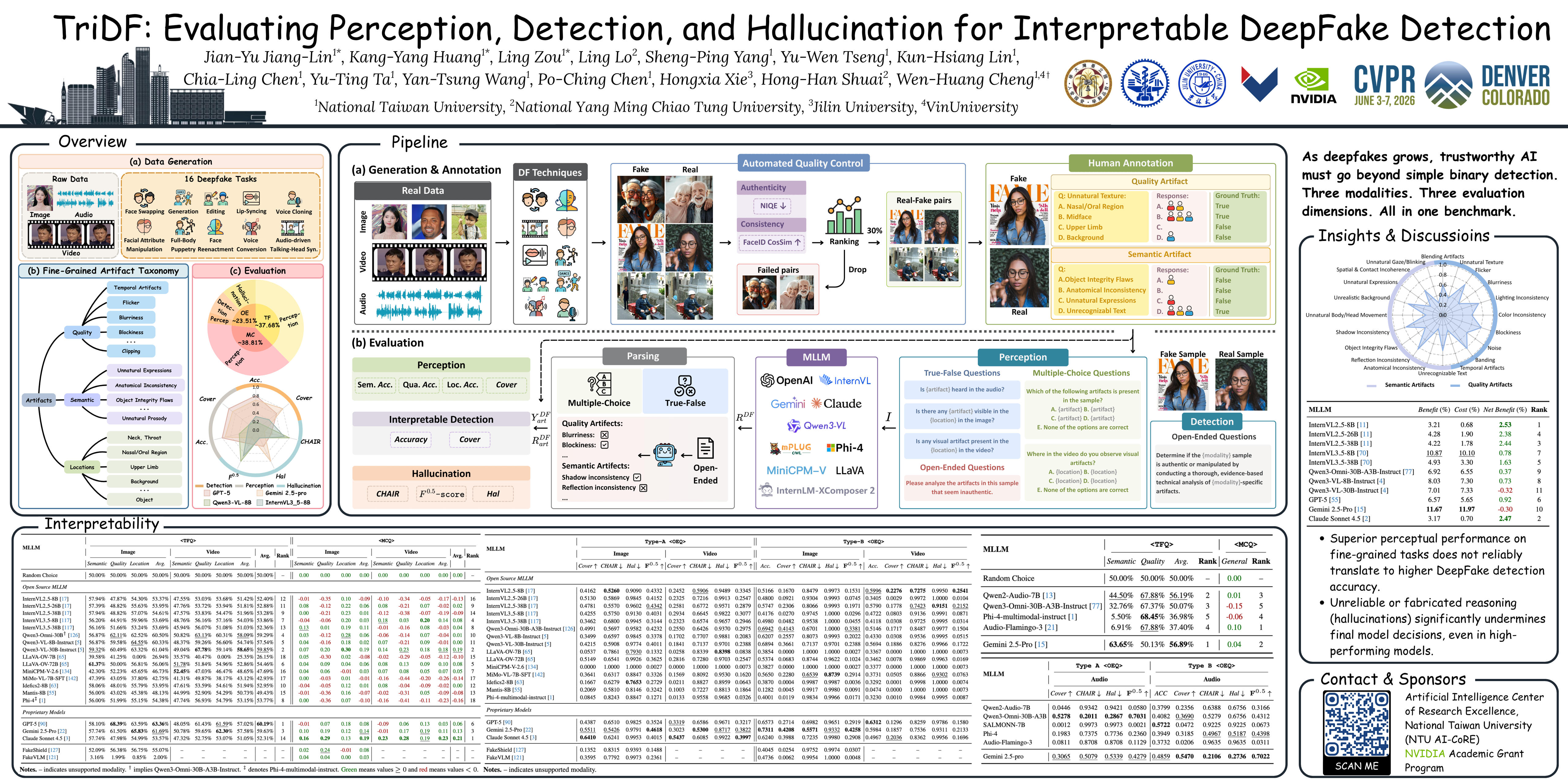
Advances in generative modeling have made it increasingly easy to fabricate realistic portrayals of individuals, creating serious risks for security, communication, and public trust. Detecting such person-driven manipulations requires systems that not only distinguish altered content from authentic media but also provide clear and reliable reasoning. In this paper, we introduce \benchname, a comprehensive benchmark for interpretable DeepFake detection. \benchname\ contains high-quality forgeries from advanced synthesis models, covering 16 DeepFake types across image, video, and audio modalities. The benchmark evaluates three key aspects: Perception, which measures the ability of a model to identify fine-grained manipulation artifacts using human-annotated evidence; Detection, which assesses classification performance across diverse forgery families and generators; and Hallucination, which quantifies the reliability of model-generated explanations. Experiments on state-of-the-art multimodal large language models show that accurate perception is essential for reliable detection, but hallucination can severely disrupt decision-making, revealing the interdependence of these three aspects. \benchname\ provides a unified framework for understanding the interaction between detection accuracy, evidence identification, and explanation reliability, offering a foundation for building trustworthy systems that address real-world synthetic media threats.
BuildAnyPoint: 3D Building Structured Abstraction from Diverse Point Clouds
Tongyan Hua ⋅ Haoran Gong ⋅ Yuan Liu ⋅ Di Wang ⋅ Ying-Cong Chen ⋅ Wufan Zhao
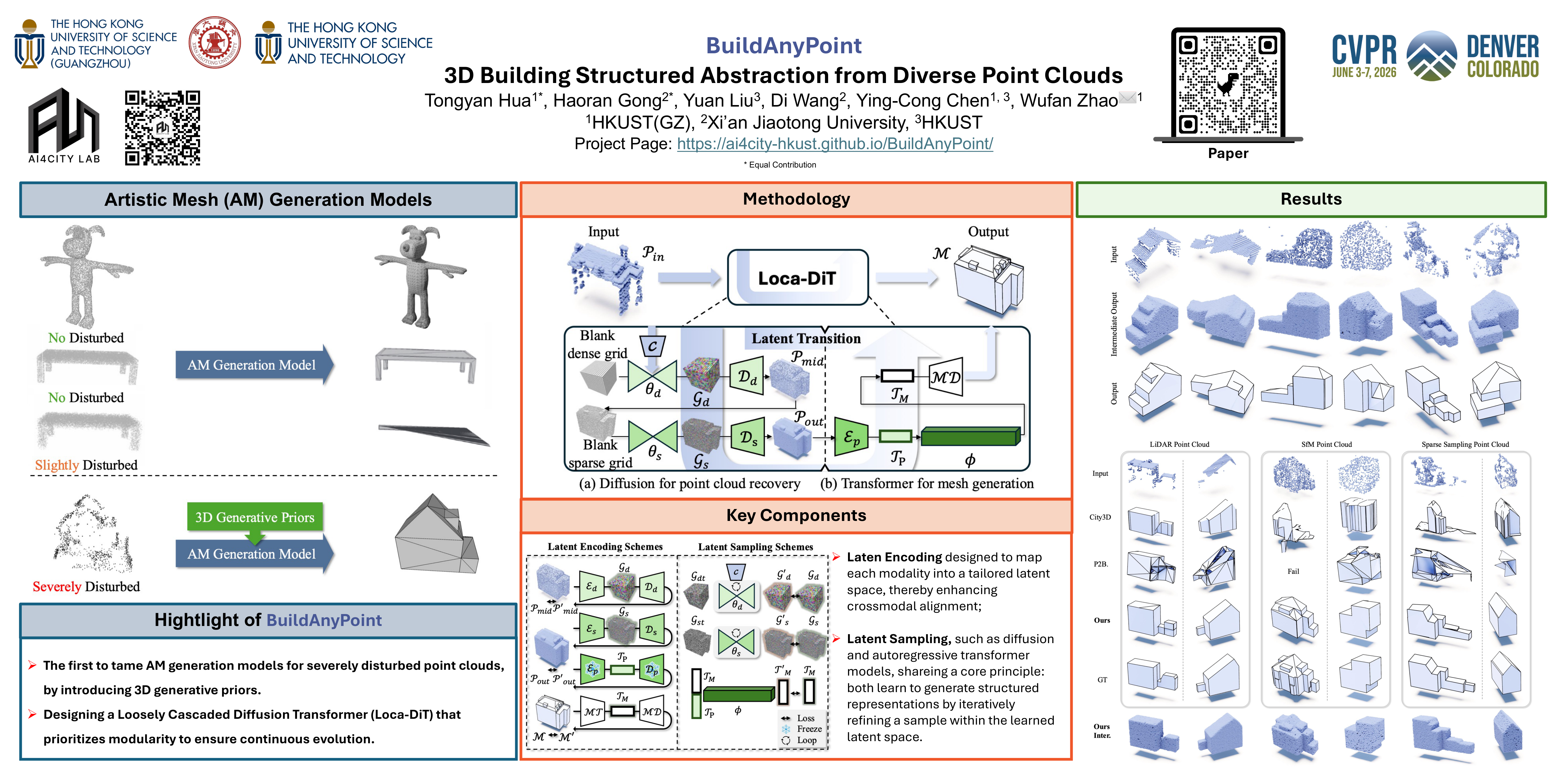
We introduce BuildAnyPoint, a novel generative framework for structured 3D building reconstruction from point clouds with diverse distributions, such as those captured by airborne LiDAR and Structure-from-Motion.To recover artist-created building abstraction in this highly underconstrained setting, we capitalize on the role of explicit 3D generative priors in autoregressive mesh generation.Specifically, we design a Loosely Cascaded Diffusion Transformer (Loca-DiT) that initially recovers the underlying distribution from noisy or sparse points, followed by autoregressively encapsulating them into compact meshes.We first formulate distribution recovery as a conditional generation task by training latent diffusion models conditioned on input point clouds, and then tailor a decoder-only transformer for conditional autoregressive mesh generation based on the recovered point clouds.Our method delivers substantial qualitative and quantitative improvements over prior building abstraction methods. Furthermore, the effectiveness of our approach is evidenced by the strong performance of its recovered point clouds on building point cloud completion benchmarks, which exhibit improved surface accuracy and distribution uniformity.
LiDAR-to-4DRadar Diffusion Bridge via Cross-Modal Alignment and Translation in Latent Space
Dazhong Shen ⋅ Jingjing Gu ⋅ Qiang Zhou ⋅ Meng Zhao ⋅ Ying Sun
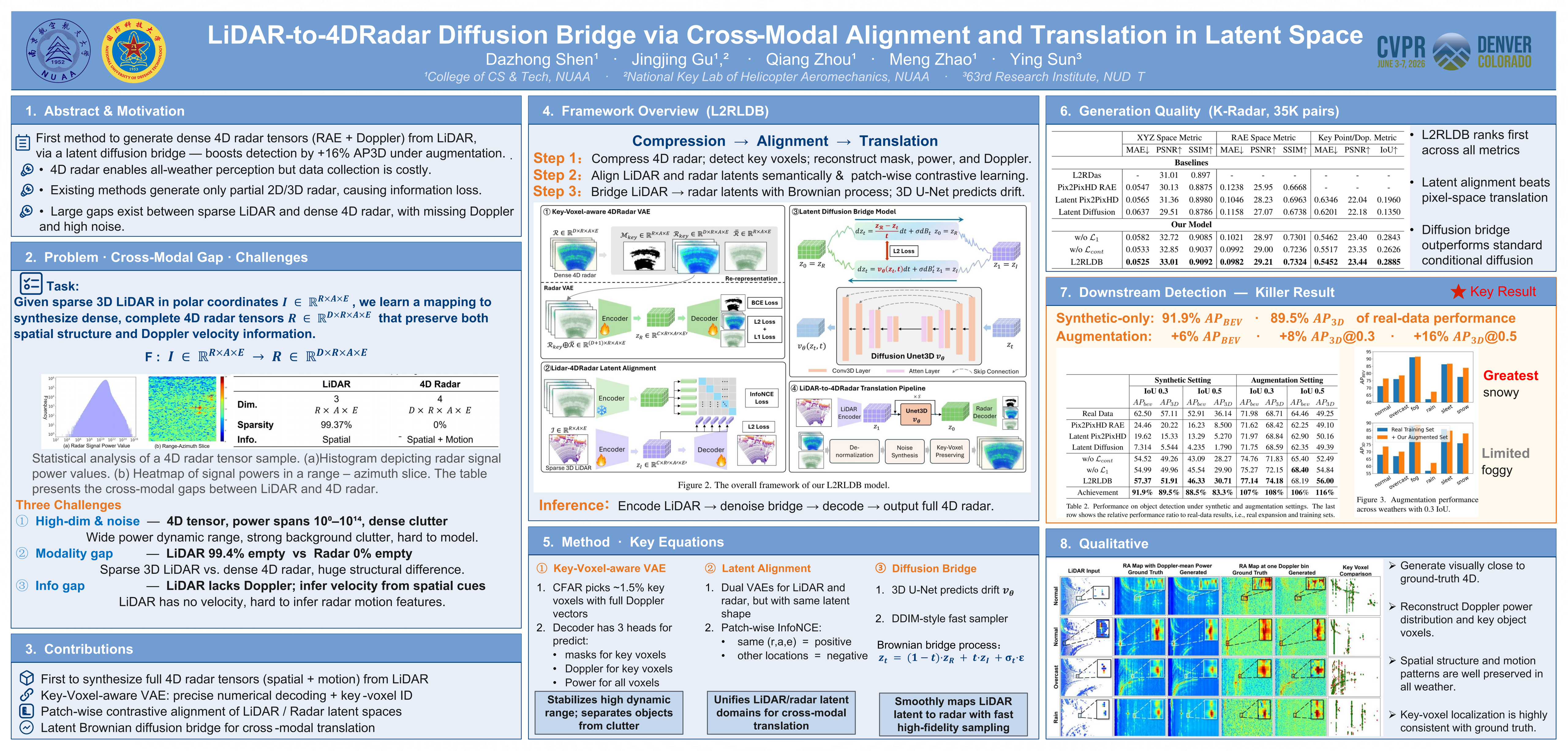
Millimeter-wave radar’s all-weather capability makes it increasingly vital for autonomous perception. However, the high cost of radar data collection drives the need for data generation to augment radar datasets. Existing works mainly target partial radar representations, e.g., 2D or 3D slices, leading to information loss and limited downstream performance. To overcome these issues, we introduce the novel task of LiDAR-to-4DRadar translation, which generates complete 4D radar tensors, with three spatial and one Doppler axes, guided by LiDAR data that preserve spatial and semantic consistency. We propose a novel diffusion bridge model in an aligned LiDAR-4DRadar latent space, namely \textbf{L2RLDB}, to tackle this task. Specifically, first, a key-voxel-aware VAE compresses high-dimensional, noisy radar tensors into a compact latent space, while enabling precise numerical reconstruction and key-voxel identification. Second, to bridge the cross-modal gap between sparse 3D LiDAR and dense 4D radar, we develop a patch-wise contrastive learning module to align LiDAR latents with radar semantically and spatially. Finally, we formulate the translation as a diffusion bridge process between LiDAR and radar latents, enabling the synthesis of full radar tensors from Doppler-lacking LiDAR inputs. Experiments verify that L2RLDB achieves high-fidelity 4D radar generation and significantly improves downstream detection through data augmentation.
Edges Compete for Trust: Group Relative Edge Optimization for Building Reconstruction from Point Clouds
Yujun Liu ⋅ Ruisheng Wang ⋅ Xiang Ao ⋅ Haoyuan Shen ⋅ Kuihao Wang ⋅ Kun Zhou ⋅ Qingquan Li
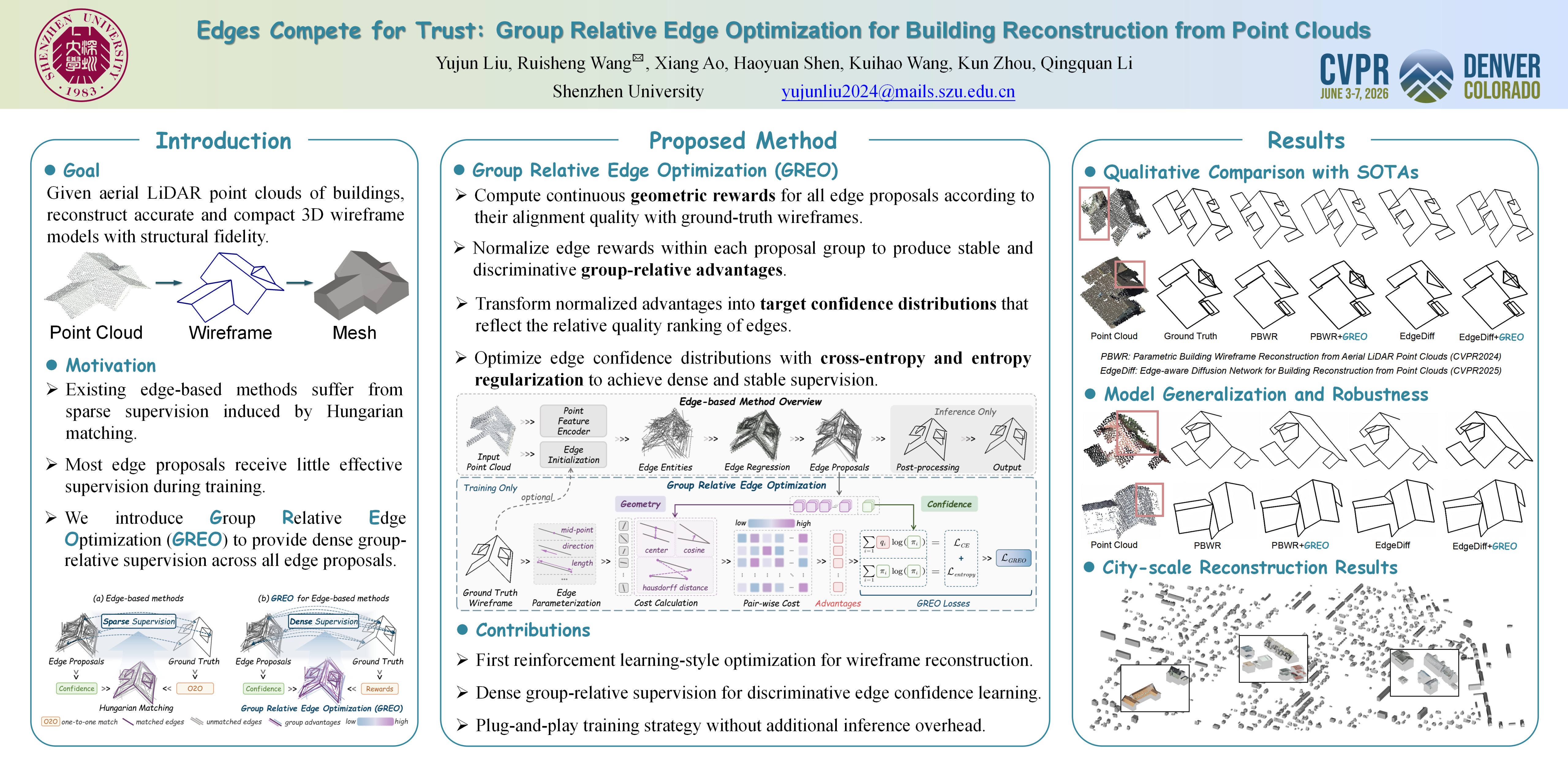
Building reconstruction aims to extract compact wireframes from point clouds. Recent edge-based methods achieve impressive results but suffer from sparse supervision from one-to-one matching, which leaves most edge proposals under-optimized. In this paper, we present Group Relative Edge Optimization (GREO), the first attempt to incentivize dense supervision across edges proposals through reinforcement learning-style optimization in wireframe reconstruction. Specifically, GREO computes edge-level rewards based on geometric alignment quality and transforms them into target confidence distributions via group-wise normalization. In addition, we incorporate entropy regularization to maintain distributional stability and prevent confidence collapse. This joint optimization enables dense and discriminative supervision across all edge proposals through cross-entropy minimization. Experiments on the large-scale Building3D dataset demonstrate that our powerful and versatile GREO integrates seamlessly into existing edge-based methods as a plug-and-play training strategy, achieving state-of-the-art performance on both the Entry-level and Tallinn benchmarks while adding no inference overhead.
Unsupervised Monocular 3D Keypoint Discovery from Multi-View Diffusion Priors
Subin Jeon ⋅ In Cho ⋅ Junyoung Hong ⋅ Woong Oh ⋅ Seon Joo Kim
Most existing 3D keypoint estimation methods rely on manual annotations or calibrated multi-view images, both of which are expensive to collect.This paper introduces KeyDiff3D, a framework that can accurately predict 3D keypoints from a single image, thus eliminating the need for such expensive data acquisitions.To achieve this, we leverage powerful geometric priors embedded in a pretrained multi-view diffusion model.In our framework, the diffusion model generates multi-view images from a single image, serving as supervision signals to provide 3D geometric cues to our model.We also introduce a 3D feature extractor that transforms implicit 3D priors embedded in the diffusion features into explicit 3D feature volumes.Beyond accurate keypoint estimation, we further introduce a pipeline that enables manipulation of 3D objects generated by the diffusion model.Experimental results on diverse datasets, including Human3.6M, CUB-200-2011, Stanford Dogs, and several in-the-wild and out-of-domain inputs, highlight the effectiveness of our method in terms of accuracy, generalization, and its ability to enable manipulation of 3D objects generated by the diffusion model from a single image.
QD-PCQA: Quality-Aware Domain Adaptation for Point Cloud Quality Assessment
Guohua Zhang ⋅ Jian Jin ⋅ Meiqin Liu ⋅ Chao Yao ⋅ Weisi Lin
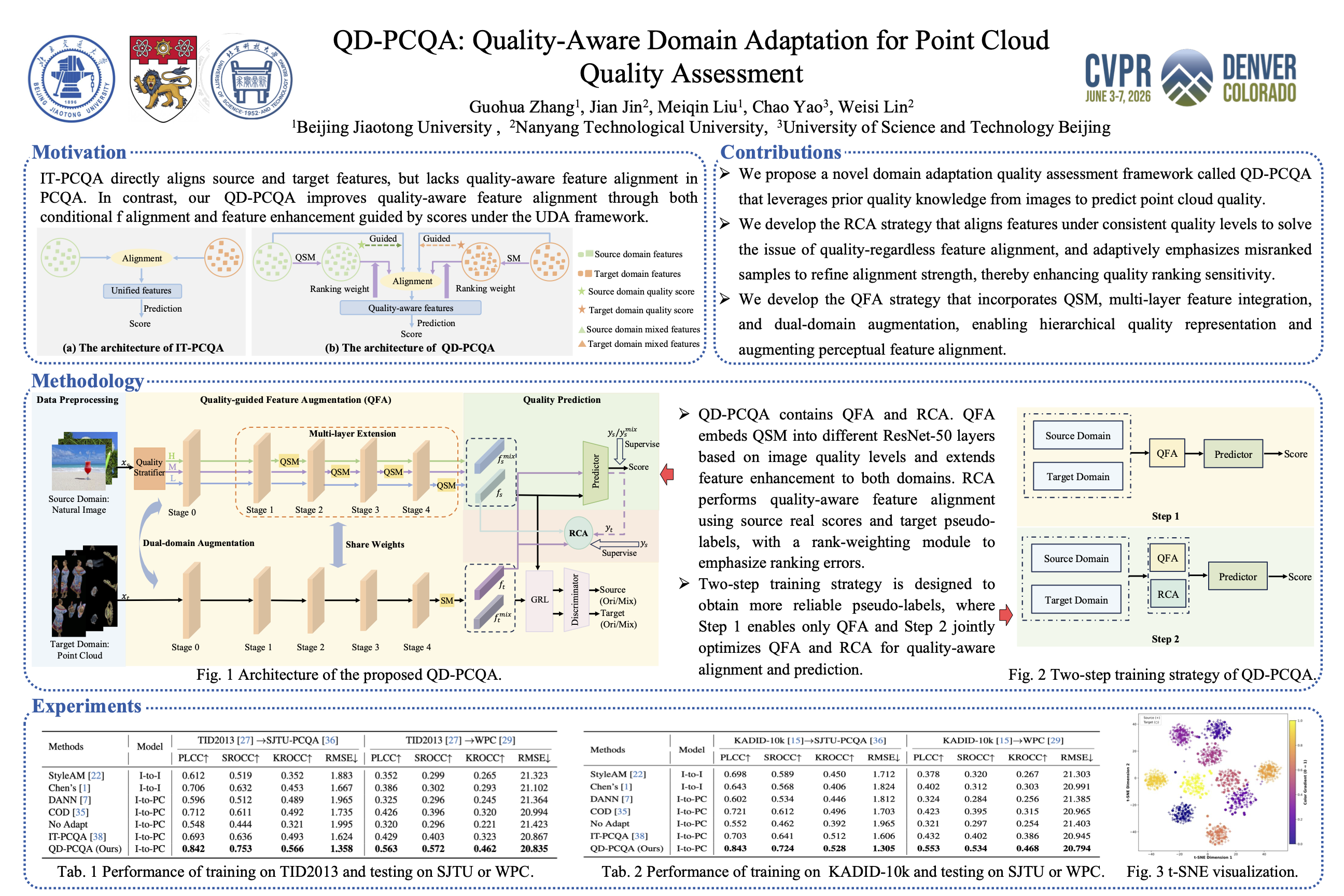
No-Reference Point Cloud Quality Assessment (NR-PCQA) still struggles with generalization, primarily due to the scarcity of annotated point cloud datasets. Since the Human Visual System (HVS) drives perceptual quality assessment independently of media types, prior knowledge on quality learned from images can be repurposed for point clouds. This insight motivates adopting Unsupervised Domain Adaptation (UDA) to transfer quality-relevant priors from labeled images to unlabeled point clouds. However, existing UDA-based PCQA methods often overlook key characteristics of perceptual quality, such as sensitivity to quality ranking and quality-aware feature alignment, thereby limiting their effectiveness. To address these issues, we propose a novel Quality-aware Domain adaptation framework for PCQA, termed QD-PCQA. The framework comprises two main components: i) a Rank-weighted Conditional Alignment (RCA) strategy that aligns features under consistent quality levels and adaptively emphasizes misranked samples to reinforce perceptual quality ranking awareness; and ii) a Quality-guided Feature Augmentation (QFA) strategy, which includes quality-guided style mixup, multi-layer extension, and dual-domain augmentation modules to augment perceptual feature alignment. Extensive cross-domain experiments demonstrate that QD-PCQA significantly improves generalization in NR-PCQA tasks.
L3DR: 3D-aware LiDAR Diffusion and Rectification
QUAN LIU ⋅ Xiaoqin Zhang ⋅ Ling Shao ⋅ Shijian Lu
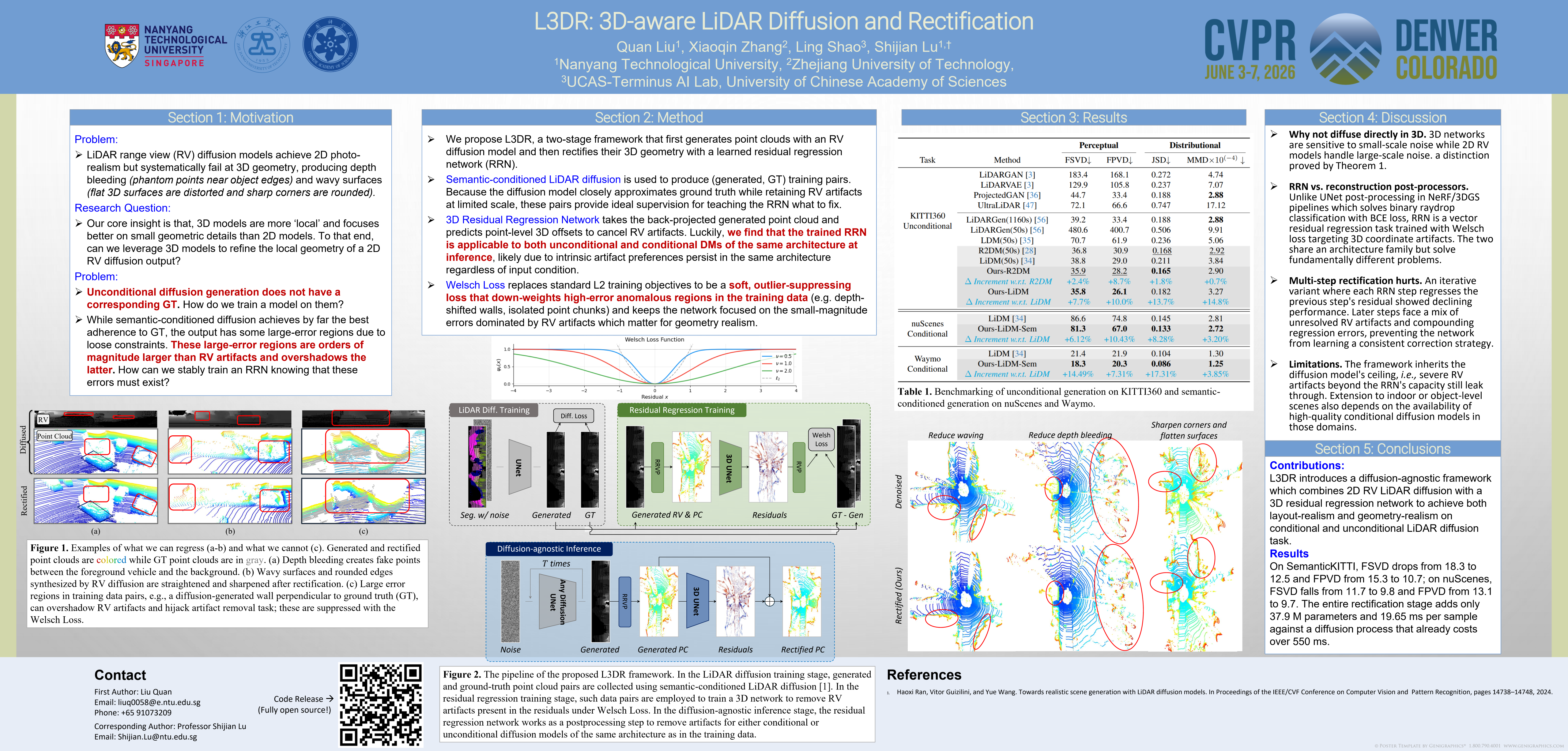
Range-view (RV) based LiDAR diffusion has recently made huge strides towards 2D photo-realism. However, it neglects 3D geometry realism and often generates various RV artifacts such as depth bleeding and wavy surfaces. We design L3DR, a 3D-aware LiDAR Diffusion and Rectification framework that can regress and cancel RV artifacts in 3D space and restore local geometry accurately. Our theoretical and empirical analysis reveals that 3D models are inherently superior to 2D models in generating sharp and authentic boundaries. Leveraging such analysis, we design a 3D residual regression network that rectifies RV artifacts and achieves superb geometry realism by predicting point-level offsets in 3D space. On top of that, we design a Welsch Loss that helps focus on local geometry and ignore anomalous regions effectively. Extensive experiments over multiple benchmarks including KITTI, KITTI360, nuScenes and Waymo show that the proposed L3DR achieves state-of-the-art generation and superior geometry-realism consistently. In addition, L3DR is generally applicable to different LiDAR diffusion models with little computational overhead. Codes will be released.
Ghost-FWL: A Large-Scale Full-Waveform LiDAR Dataset for Ghost Detection and Removal
Kazuma Ikeda ⋅ Ryosei Hara ⋅ Rokuto Nagata ⋅ Ozora Sako ⋅ Zihao Ding ⋅ Takahiro Kado ⋅ Ibuki Fujioka ⋅ Taro Beppu ⋅ Mariko Isogawa ⋅ Kentaro Yoshioka
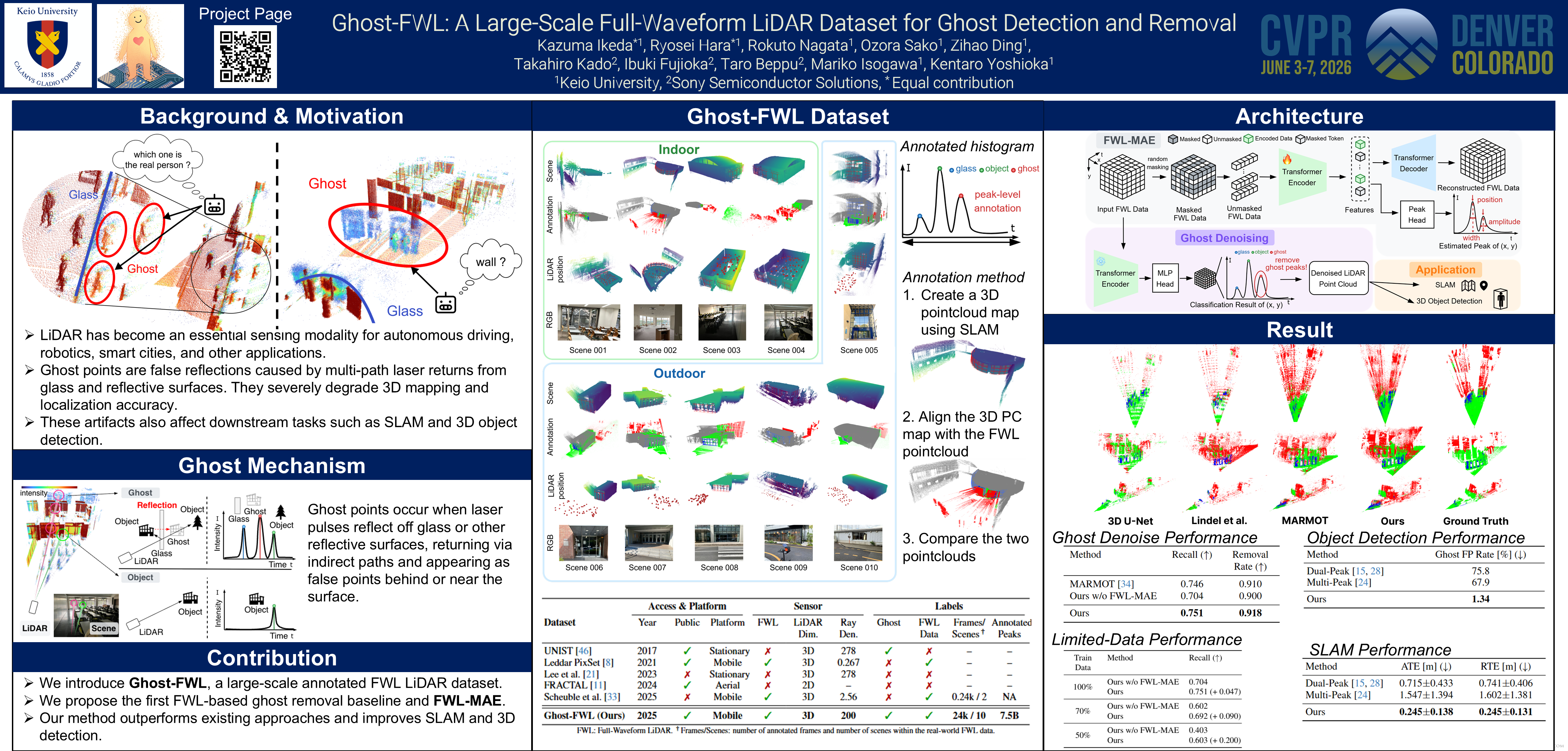
LiDAR has become an essential sensing modality in autonomous driving, robotics, and smart-city applications. However, ghost points (or ghost), which are false reflections caused by multi-path laser returns from glass and reflective surfaces, severely degrade 3D mapping and localization accuracy. Prior ghost removal rely on geometric consistency in dense point clouds, failing on mobile LiDAR's sparse, dynamic data. We address this by exploiting full-waveform LiDAR (FWL), which captures complete temporal intensity profiles rather than just peak distances, providing crucial cues for distinguishing ghosts from genuine reflections in mobile scenarios. As this is a new task, we present Ghost-FWL, the first and largest annotated mobile FWL dataset for ghost detection and removal. Ghost-FWL comprises 24K frames across 10 diverse scenes with 7.5 billion peak-level annotations, which is 100$\times$ larger than existing annotated FWL datasets. Experiments show that our baseline outperforms existing methods in ghost removal accuracy, and our ghost removal further enhance downstream tasks such as LiDAR-based SLAM (66% trajectory error reduction) and 3D object detection (50$\times$ false positive reduction).
Ghosts in the Point Clouds: De-glaring LiDAR in the Transient Domain
Avery gump ⋅ Connor Henley ⋅ Sungjin Cheong ⋅ Akarsh Prabhakara ⋅ Mohit Gupta
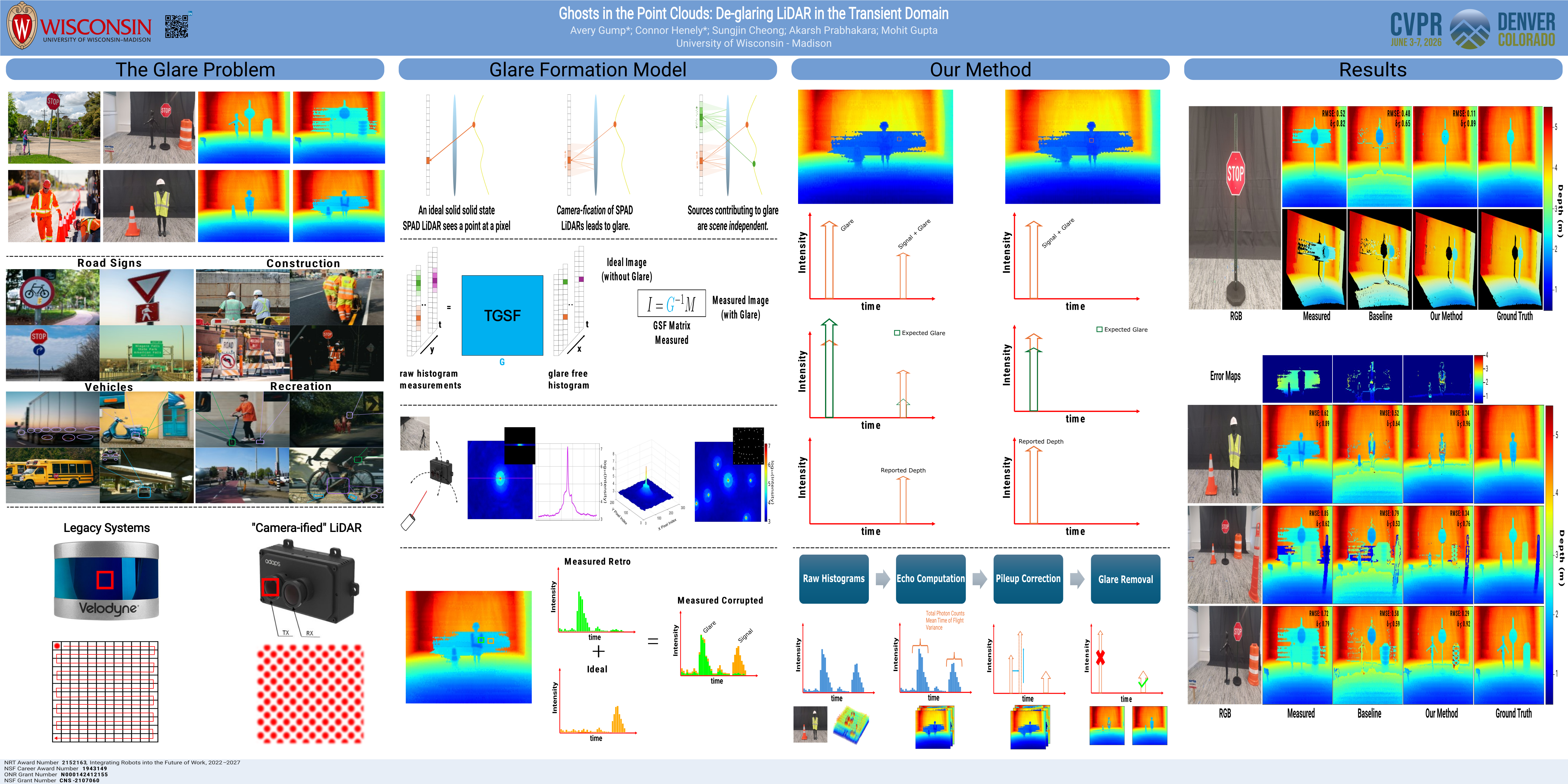
Modern LiDARs are rapidly transitioning from bulky, mechanically scanned systems to ultra-compact, low-cost, solid-state arrays. This miniaturization—while enabling scalability, affordability, and camera-like data structures—introduces a new and severe failure mode: internal-multipath glare. When light from a bright or retroreflective surface reflects and scatters within the LiDAR, light that should reach a single pixel spreads across the pixel array. The resulting artifacts create phantom objects, obscure real ones, and produce safety-critical “ghosts in the point clouds.” This paper introduces a physically-grounded sensing model and algorithmic techniques for addressing this effect. We show that internal glare can be represented as a linear, scene-independent operator—the Transient Glare Spread Function (TGSF)—acting on the raw transient histogram cube. This formulation enables simple, training-free inversion directly in the measurement domain, before nonlinear point-cloud formation. We develop exact and approximate de-glare algorithms that are general, computationally efficient, and compatible with existing LiDAR data-processing pipelines. Using experiments with real single-photon LiDAR hardware, we demonstrate suppression of severe glare artifacts at millisecond latency, establishing de-glare as a practical, lightweight preprocessing step for next-generation LiDAR systems.
MS^2Gait: A Multi-Scale Spatio-Temporal Fusion Network for LiDAR-based Gait Recognition
Shenyin Xu ⋅ Yishan Wang ⋅ Xinyu Li ⋅ Rui Liu ⋅ Zhongyuan Wang ⋅ Xin Tian
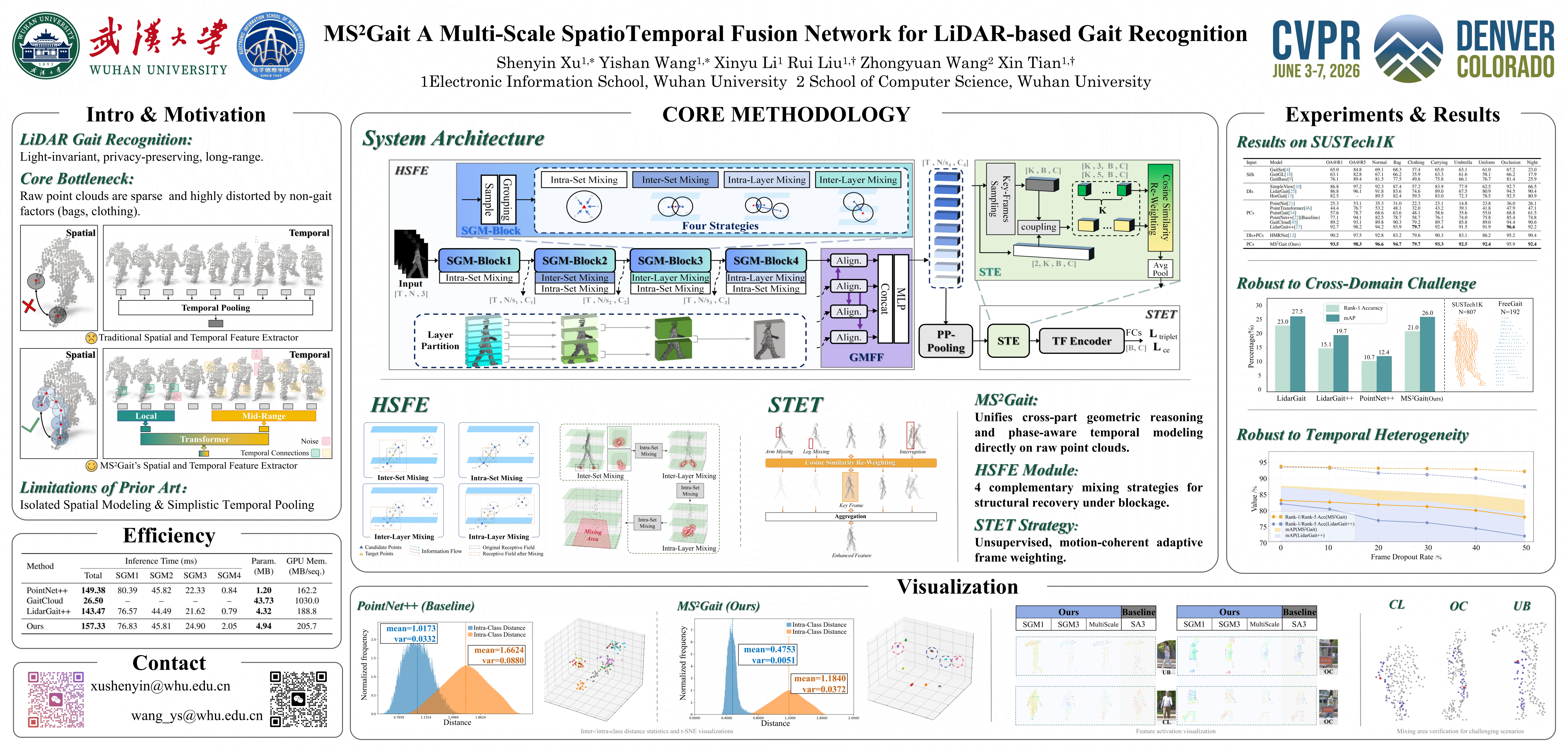
3D LiDAR-based gait recognition has gained increasing attention due to its robustness to illumination, privacy preservation, and capability for long-range and non-contact identity verification. However, existing point cloud-based methods suffer from two critical limitations: they fail to model semantically distant correlations across spatial scales and employ simplistic temporal aggregation that cannot handle gait's inherent heterogeneity. To address these limitations, we propose MS^2Gait, a multi-scale spatio-temporal framework tailored for raw point cloud gait recognition. Our Hierarchical Spatial Feature Extraction module introduces four complementary interaction strategies to explicitly capture long-range semantic dependencies and recover structural information under blockage. Additionally, a Similarity-based Temporal Enhancement Transformer strategy leverages multi-scale aggregation to dynamically weight frames based on motion coherence, effectively handling temporal heterogeneity without explicit supervision. Extensive evaluations on SUSTech1K and FreeGait demonstrate that MS^2Gait achieves 93.5% and 83.1% in Rank-1 accuracy, respectively, outperforming prior state-of-the-art methods, while exhibiting significant robustness against non-gait nuisance factors.
Foundry: Distilling 3D Foundation Models for the Edge
Guillaume Letellier ⋅ Siddharth Srivastava ⋅ Frederic Jurie ⋅ Gaurav Sharma
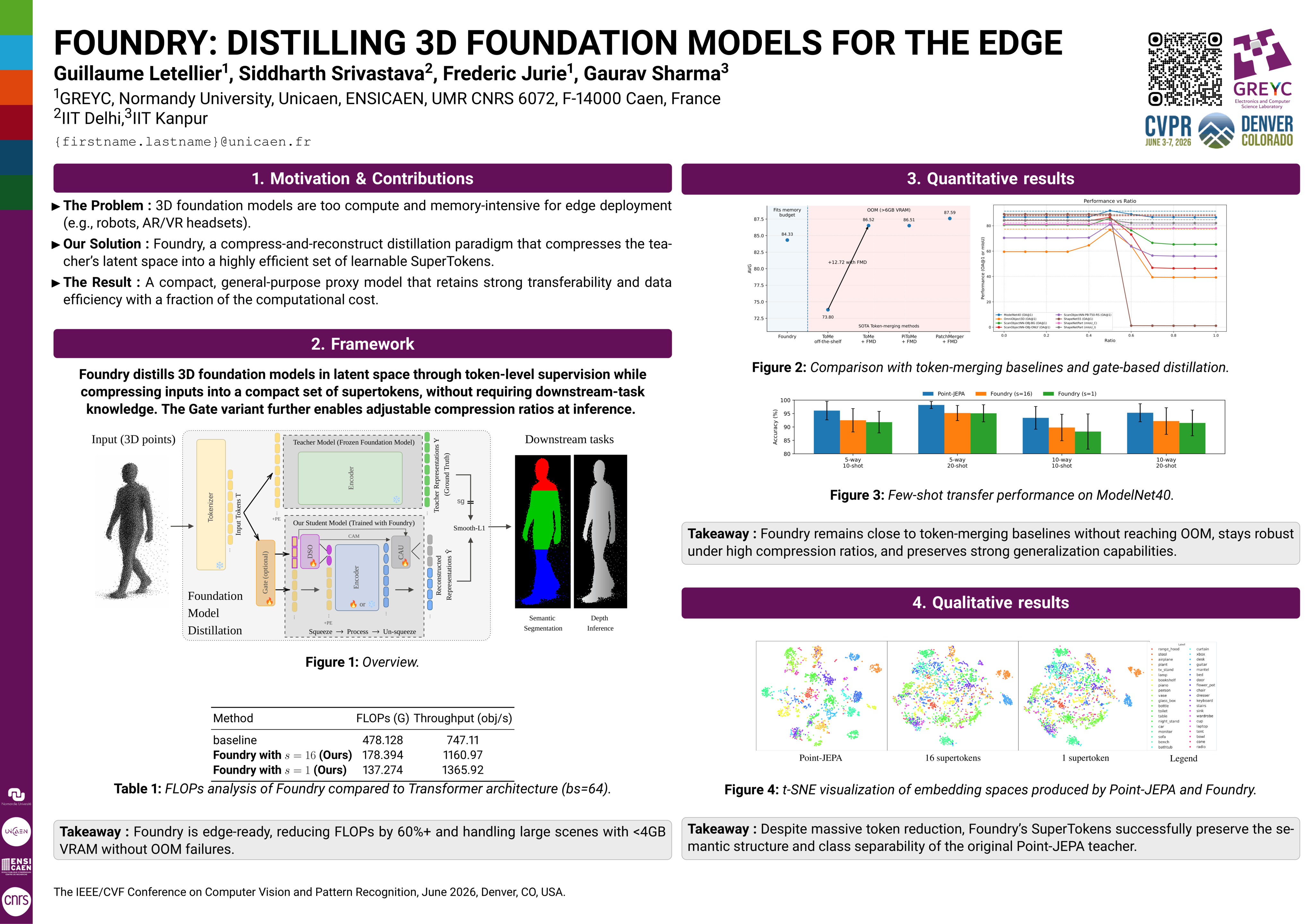
Foundation models pre-trained with self-supervised learning (SSL) on large-scale datasets have become powerful general-purpose feature extractors. However, their immense size and computational cost make them prohibitive for deployment on edge devices such as robots and AR/VR headsets. Existing compression techniques like standard knowledge distillation create efficient `specialist' models but sacrifice the crucial, downstream-agnostic generality that makes foundation models so valuable.In this paper, we introduce Foundation Model Distillation (FMD), a new paradigm for compressing large SSL models into compact, efficient, and faithful proxies that retain their general-purpose representational power. We present Foundry, the first implementation of FMD for 3D point clouds. Our approach, Foundry, trains a student to learn a compressed set of SuperTokens that reconstruct the teacher’s token-level representations, capturing a compact basis of its latent space. A single distilled model maintains strong transferability across diverse downstream tasks—classification, part segmentation, and few-shot scenarios—approaching full foundation-model performance while using significantly fewer tokens and FLOPs, making such models more practical for deployment on resource-constrained hardware.
Learning to Identify Out-of-Distribution Objects for 3D LiDAR Anomaly Segmentation
Simone Mosco ⋅ Daniel Fusaro ⋅ Alberto Pretto
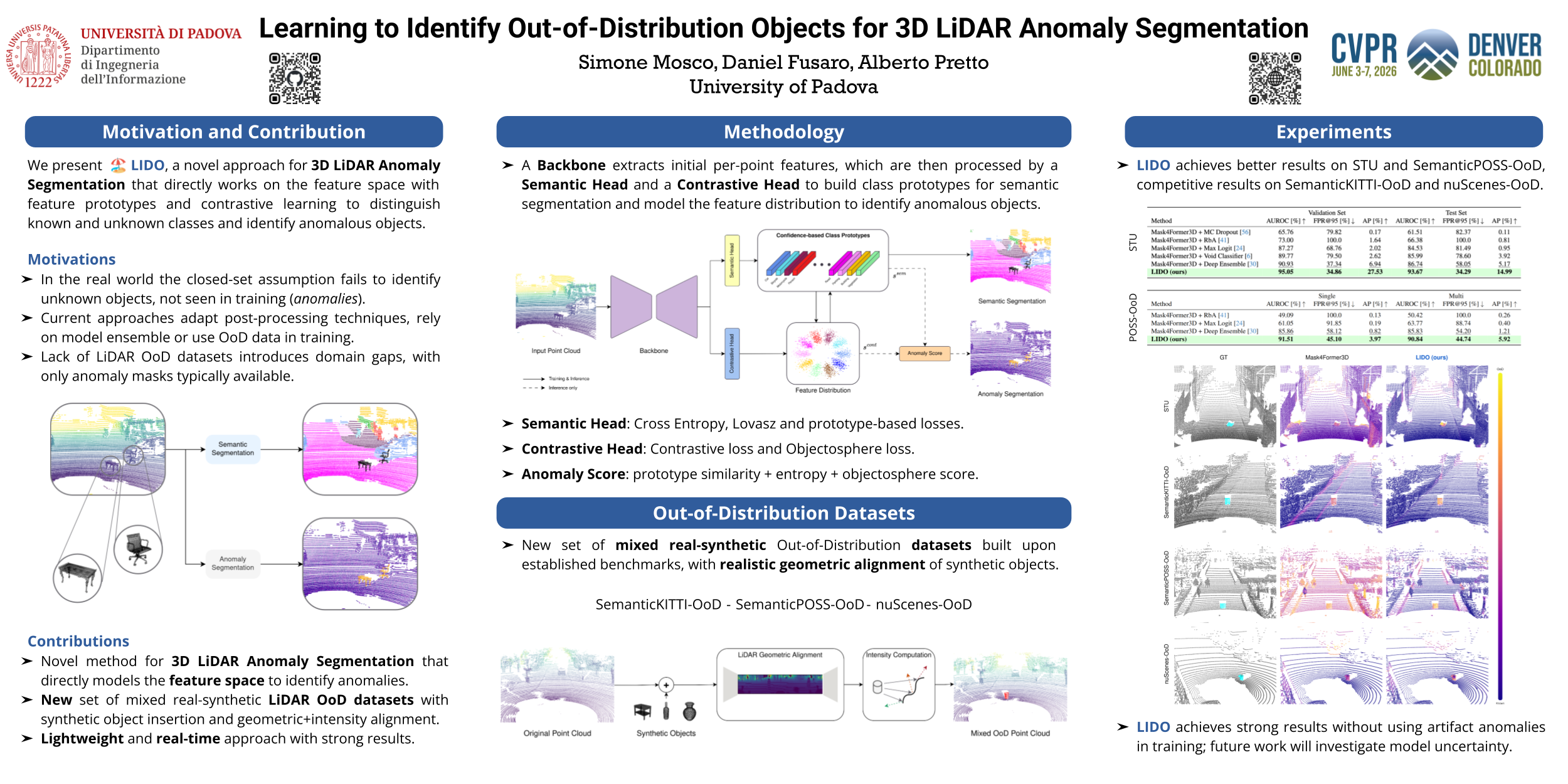
Understanding the surrounding environment is fundamental in autonomous driving and robotic perception. Distinguishing between known classes and previously unseen objects is crucial in real-world environments, as done in Anomaly Segmentation. However, research in the 3D field remains limited, with most existing approaches applying post-processing techniques from 2D vision. To cover this lack, we propose a new efficient approach that directly operates in the feature space, modeling the feature distribution of inlier classes to constrain anomalous samples. Moreover, the only publicly available 3D LiDAR anomaly segmentation dataset contains simple scenarios, with few anomaly instances, and exhibits a severe domain gap due to its sensor resolution. To bridge this gap, we introduce a set of mixed real-synthetic datasets for 3D LiDAR anomaly segmentation, built upon established semantic segmentation benchmarks, with multiple out-of-distribution objects and diverse, complex environments. Extensive experiments demonstrate that our approach achieves state-of-the-art and competitive results on the existing real-world dataset and the newly introduced mixed datasets, respectively, validating the effectiveness of our method and the utility of the proposed datasets. Code and datasets are available at [REMOVED DUE TO ANONYMOUS SUBMISSION].
Dual-Level Confidence based Implicit Self-Refinement for Medical Visual Question Answering
Meihong Pan ⋅ Yefeng Zheng
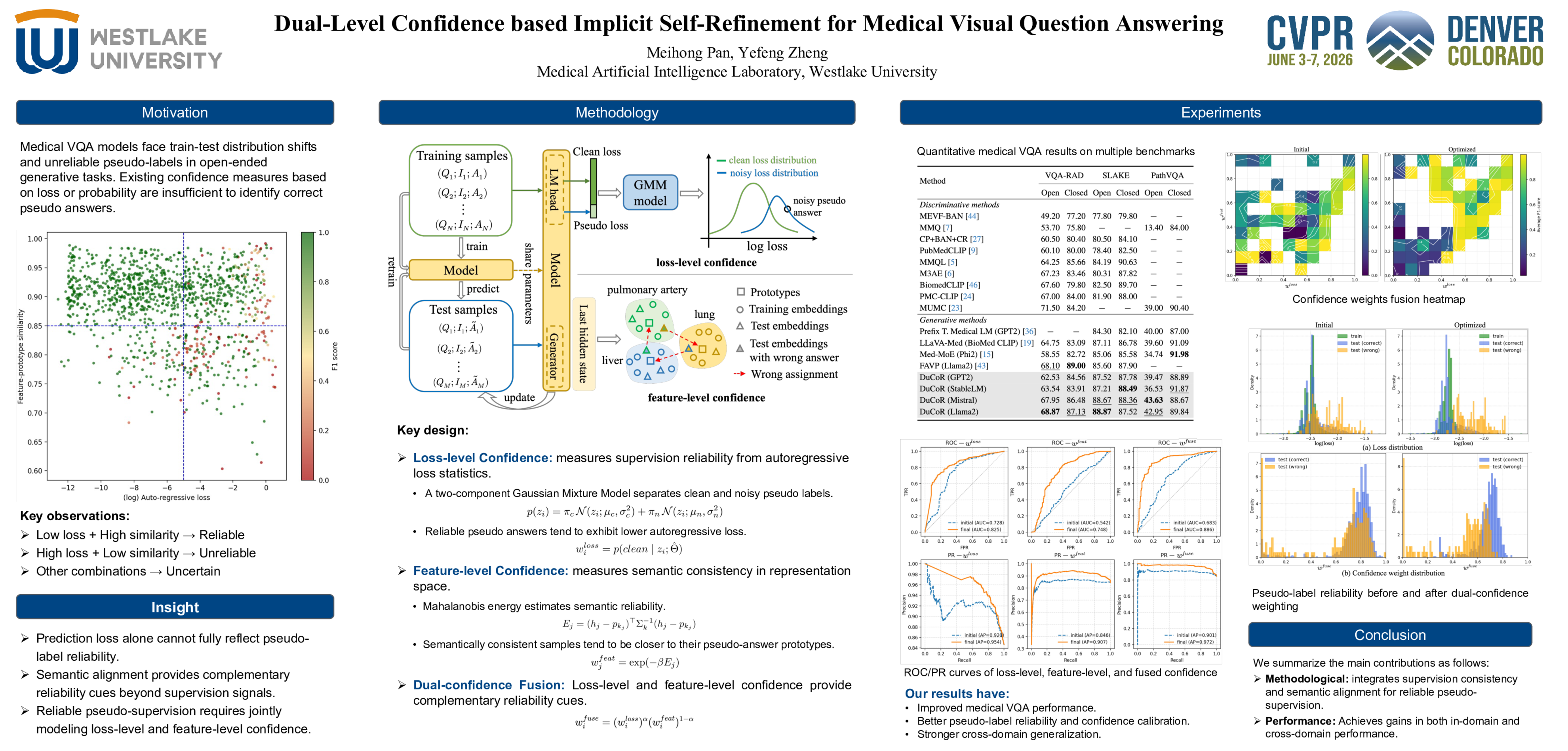
Medical Visual Question Answering models often face potential train-test distribution shifts that hinder generalization across unseen imaging and linguistic patterns. To address this challenge, we propose a dual-level confidence based framework (DuCoR) that achieves implicit self-refinement through iterative pseudo-supervised optimization. Instead of relying on fixed pseudo answers, the model progressively refines its predictions by estimating their reliability from two complementary perspectives. A loss-level confidence captures the reliability of supervision by modeling clean and noisy loss distributions, while a feature-level confidence measures the semantic coherence between sample representations and their pseudo-answer conditioned prototypes. Since these two confidences originate from distinct information sources, including the supervision signal and the input semantics, they provide mutually corrective cues. They are adaptively fused to derive per-sample reliability weights that guide pseudo-supervised optimization toward better alignment with the target distribution. Extensive experiments on multiple Med-VQA benchmarks show that our method achieves superior performance and exhibits improved cross-domain generalization over fully supervised baseline.
FedMPT: Federated Multi-Label Prompt Tuning of Vision-Language Models
Xucong Wang ⋅ Pengkun Wang ⋅ Zhe Zhao ⋅ Liheng Yu ⋅ Shuang Wang ⋅ Yang Wang
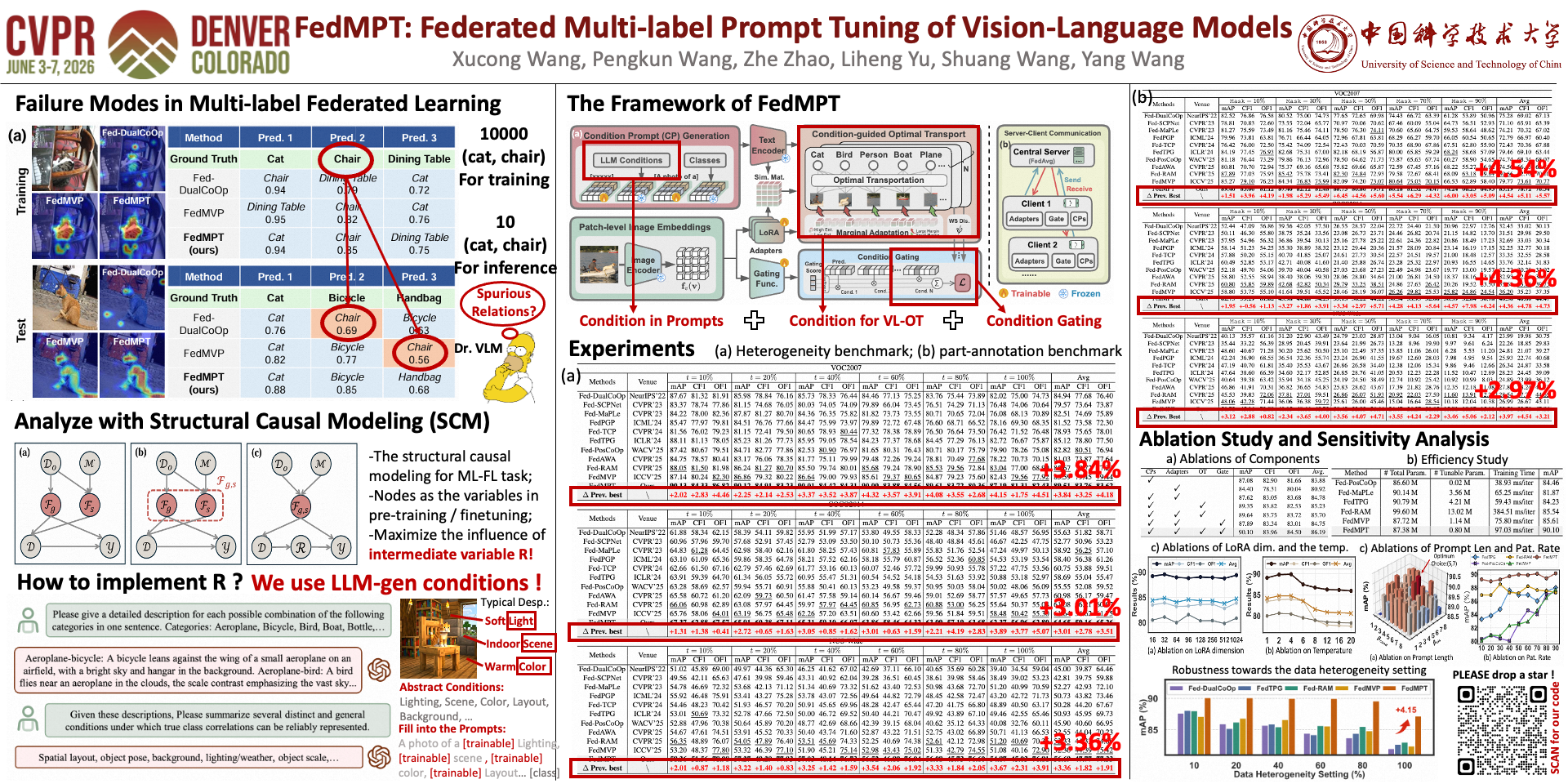
Multi-Label Recognition (MLR) based on Vision-Language Models (VLMs) aims to leverage their pre-trained knowledge to better adapt complex recognition scenarios, thereby enhancing model robustness. However, for realistic decentralized applications requiring federated learning, adapting VLMs to each client that possesses private and heterogeneous data can cause the model to overfit spurious label correlations, consequently triggering irrelevant categories when encountering new samples. To tackle this problem, we reconsider the federated learning for MLR with a causal model, in which we adopt a front-door adjustment and decouple the MLR modeling process by intermediate variables that magnify the oracle label co-occurrence. Guided by our analysis, we propose our FedMPT, the first method specifically designed for federated MLR. The core idea of FedMPT is to leverage generalizable conditions to steer federated MLR to mitigate erroneous label activations. To achieve this, FedMPT introduces an Large Language Model (LLM)-driven pipeline to decipher the underlying conditions that govern label dependencies. Furthermore, we introduce an optimal transport between the condition-enriched prompts and the image patches to uncover multiple region-level semantics. Finally, we generate synergistic predictions from different conditions with a crafted gating mechanism. Experiments on multiple benchmark datasets show that our proposed approach achieves competitive results and outperforms SOTA methods under varied settings.
Rethinking Model Selection in VLM Through the Lens of Gromov-Wasserstein Distance
Muyang Li ⋅ Yucheng Liu ⋅ Jianbo Ma ⋅ Elliot Osborne ⋅ Bo Han ⋅ Tongliang Liu
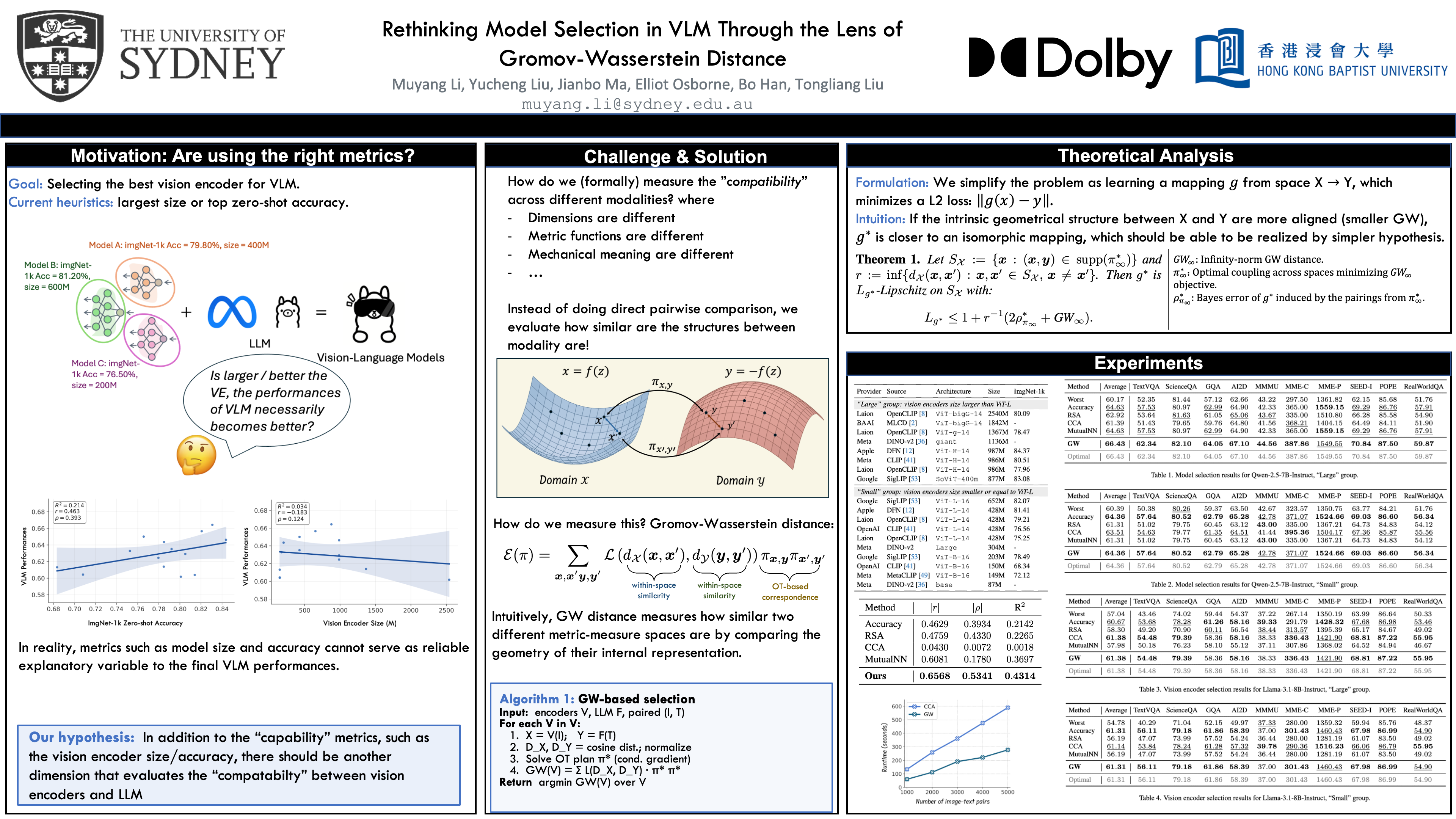
Vision-Language Models (VLMs) have enhanced traditional LLMs with visual capabilities through the integration of vision encoders. While recent works have explored various combinations of vision encoders and LLMs, there still lacks a principled understanding of what makes a vision encoder suitable for VLM alignment. In this paper, we systematically investigate this question via comprehensive experiments on a curated collection of 19 pre-trained vision encoders from diverse sources. We first demonstrate that common practices, such as choosing encoders with the largest size or highest zero-shot accuracy, consistently fail to identify optimal models. In fact, these metrics show only weak to moderate correlation with VLM performance. This intriguing finding begs a fundamental question: What factors of vision-encoders matter in VLM? Through comprehensive analysis, we identify that the structural similarity across modalities plays a crucial but previously overlooked role in vision-encoder selection, which we measure using the Gromov-Wasserstein distance as a proxy. From a theoretical perspective, we show that the learnability of cross-modality mapping can be provably associated with the Gromov-Wasserstein distance. Empirical verification on 60+ full VLM training runs shows that our proposed inference-only metric performs significantly better than alternative model selection strategies and exhibits a much stronger correlation with final VLM performance, thereby enabling efficient and effective prediction of VLM performance before full training.
NTK-Guided Implicit Neural Teaching
Chen Zhang ⋅ Wei Zuo ⋅ Bingyang Cheng ⋅ Yikun Wang ⋅ Wei-Bin Kou ⋅ Yik-Chung WU ⋅ Ngai Wong
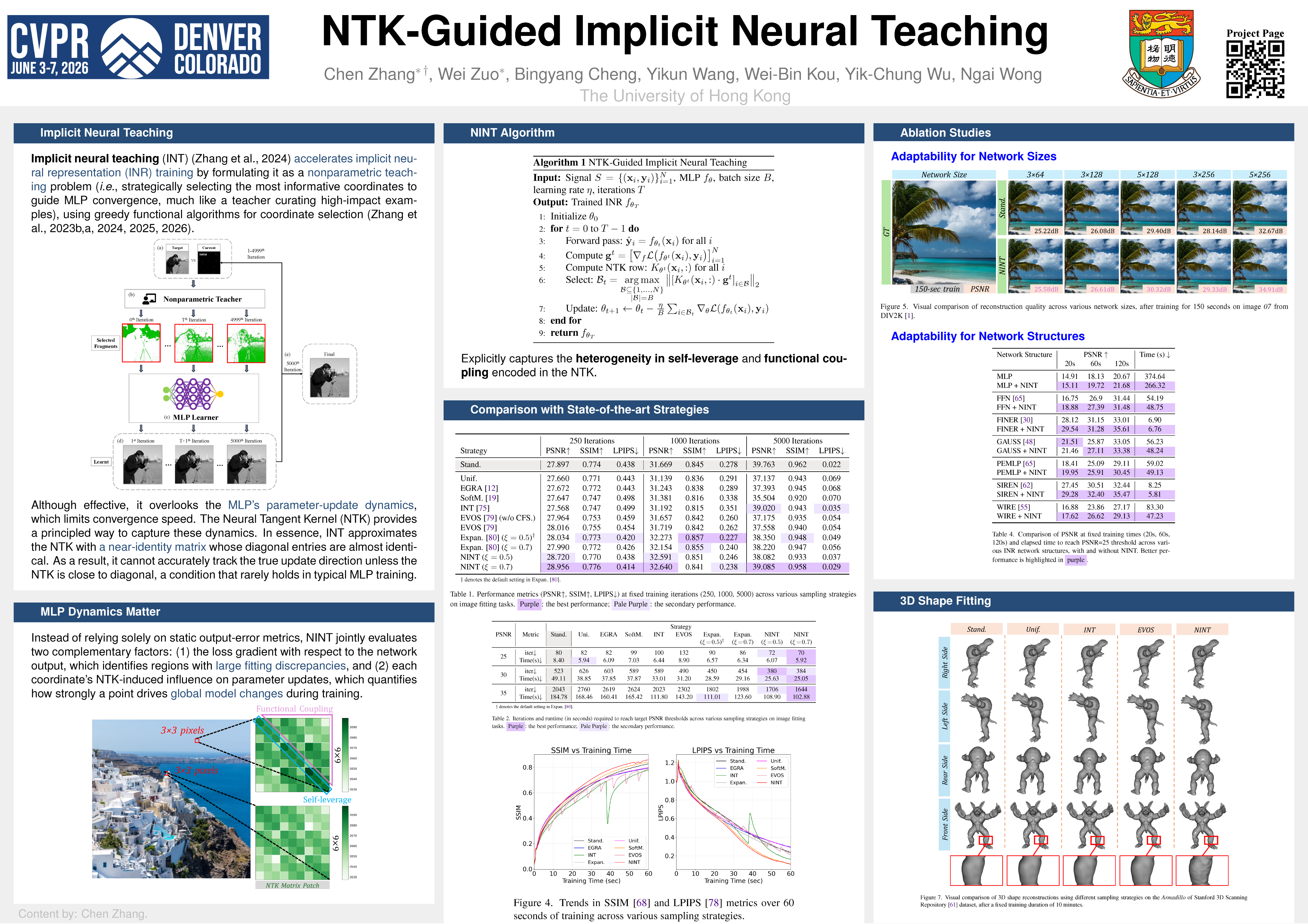
Implicit Neural Representations (INRs) parameterize continuous signals via multilayer perceptrons (MLPs), enabling compact, resolution-independent modeling for tasks like image, audio, and 3D reconstruction. However, fitting high-resolution signals demands optimizing over millions of coordinates, incurring prohibitive computational costs. To address it, we propose NTK-Guided Implicit Neural Teaching (NINT), which accelerates training by dynamically selecting coordinates that maximize global functional updates. Leveraging the Neural Tangent Kernel (NTK), NINT scores examples by the norm of their NTK-augmented loss gradients, capturing both fitting errors and heterogeneous leverage (self-influence and cross-coordinate coupling). This dual consideration enables faster convergence compared to existing methods. Through extensive experiments, we demonstrate that NINT significantly reduces training time by nearly half while maintaining or improving representation quality, establishing state-of-the-art acceleration among recent sampling-based strategies.
SynthRGB-T: Language-Vision Guided Image Translation for Diversity Synthesis
Jiangang Ding ⋅ Yiquan Du ⋅ Pengxiang Li ⋅ Lili Pei ⋅ Yuanlin Zhao ⋅ Wei Li
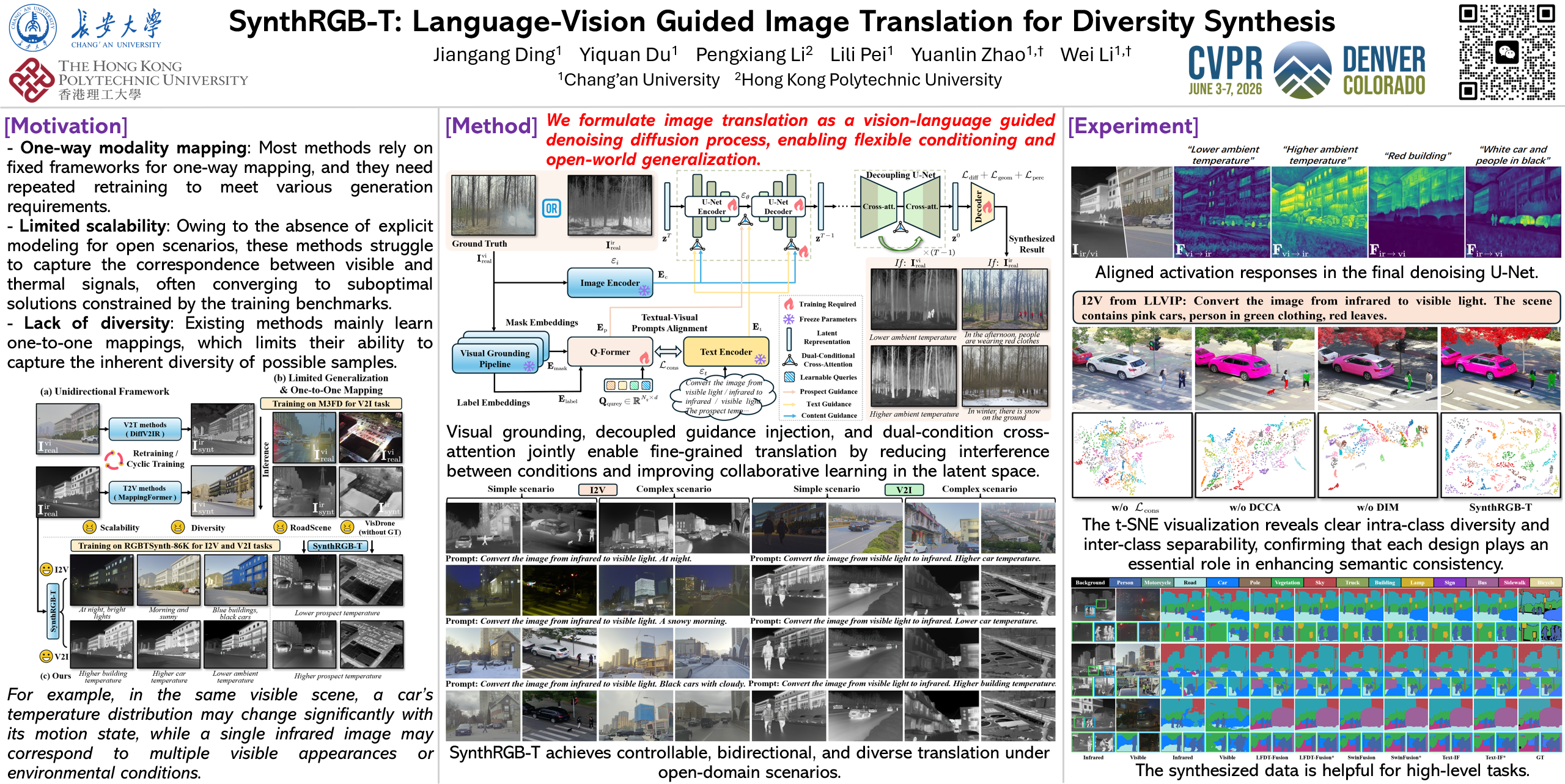
Bridging the modality gap between infrared and visible imagery is critical for cross-modal understanding and for enriching multimodal benchmarks. However, existing approaches remain confined to one-to-one mappings and are typically evaluated on unidirectional or closed-set scenarios. To address this challenge, we present SynthRGB-T, a unified framework for diverse and bidirectional image translation. Specifically, we formulate image translation as a vision-language guided denoising diffusion process, enabling flexible conditioning and open-world generalization. To enhance semantic alignment, a Visual Grounding Pipeline (VGP) is introduced to exploit the world knowledge of foundation models for fine-grained translation guidance. During the diffusion process, we propose to adopt a decoupling injection strategy to alleviate interference among multiple guidance. In addition, a Dual Conditional Cross-Attention (DCCA) module is designed to facilitate collaborative representation learning in latent space. SynthRGB-T is simple and versatile—capable of synthesizing diverse, high-fidelity data that substantially extends multimodal resources within the community. Comprehensive evaluations on multiple real-world benchmarks confirm that SynthRGB-T delivers superior performance and enhanced visual diversity over existing approaches. All code, models, and large-scale synthetic datasets will be released upon camera ready version.
Text-Printed Image: Bridging the Image-Text Modality Gap for Text-centric Training of Large Vision-Language Models
Shojiro Yamabe ⋅ Futa Waseda ⋅ Daiki Shiono ⋅ Tsubasa Takahashi
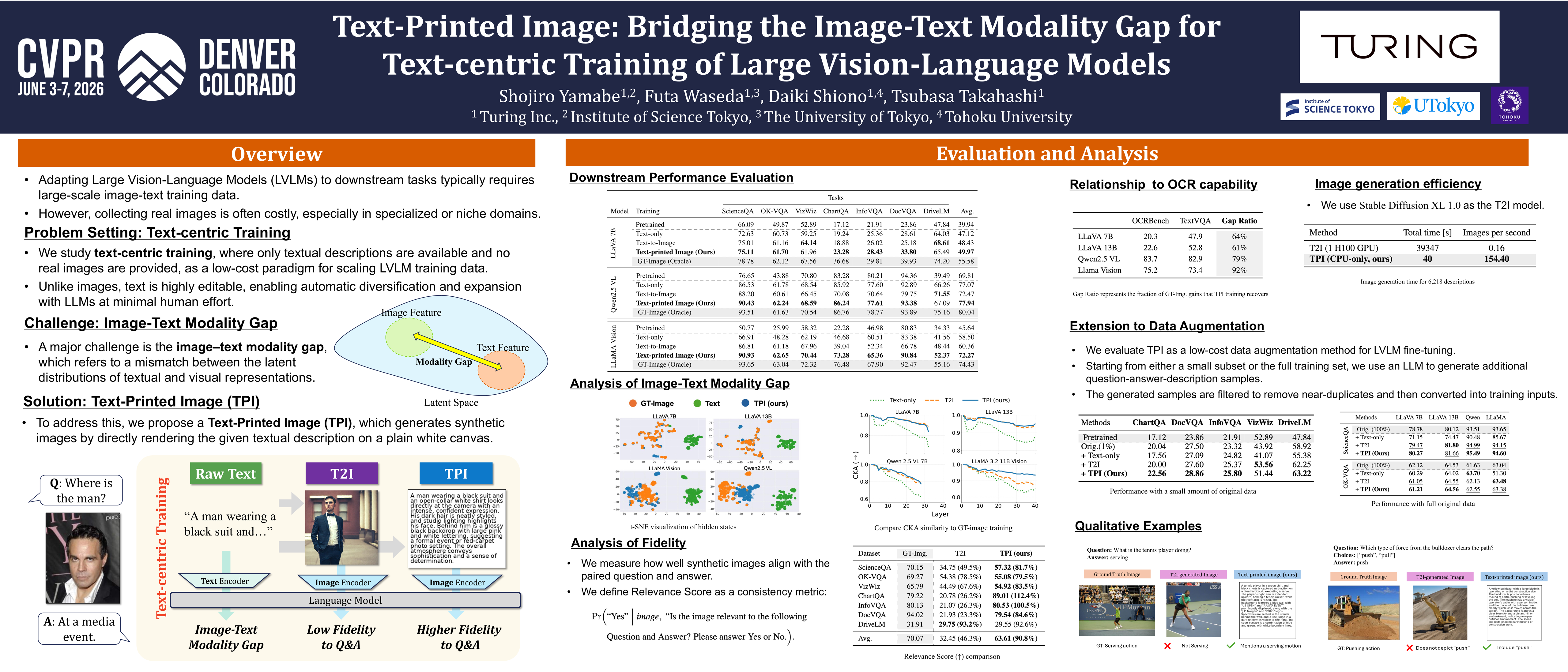
Recent large vision–language models (LVLMs) have been applied to diverse VQA tasks.However, achieving practical performance typically requires task-specific fine-tuning with large numbers of image-text pairs, which are costly to collect.In this work, we study text-centric training, a setting where only textual descriptions are available and no real images are provided, as a paradigm for low-cost data scaling.Unlike images, whose collection is often restricted by privacy constraints and scarcity in niche domains, text is widely available.Moreover, text is easily editable, enabling automatic diversification and expansion with LLMs at minimal human effort.While this offers clear advantages over image collection in terms of scalability and cost, training on raw text without images still yields limited gains on VQA tasks because of the image–text modality gap.To address this issue, we propose a Text-Printed Image (TPI), which generates synthetic images by directly rendering the given textual description on a plain white canvas.This simple rendering projects text into the image modality and can be integrated into arbitrary existing LVLM training pipelines at low cost.Moreover, TPI preserves the semantics of the text, whereas text-to-image models often fail to do.Across four models and seven benchmarks, our systematic experiments show that TPI enables more effective text-centric training than synthetic images generated by a diffusion model.We further explore TPI as a low-cost data-augmentation strategy and demonstrate its practical utility.Overall, our findings highlight the significant potential of text-centric training and, more broadly, chart a path toward fully automated data generation for LVLMs.
Harmonious Parameter Adaptation in Continual Visual Instruction Tuning for Safety-Aligned MLLMs
Ziqi Wang ⋅ Chang Che ⋅ Qi Wang ⋅ Hui Ma ⋅ Zenglin Shi ⋅ Cees G. M. Snoek ⋅ Meng Wang
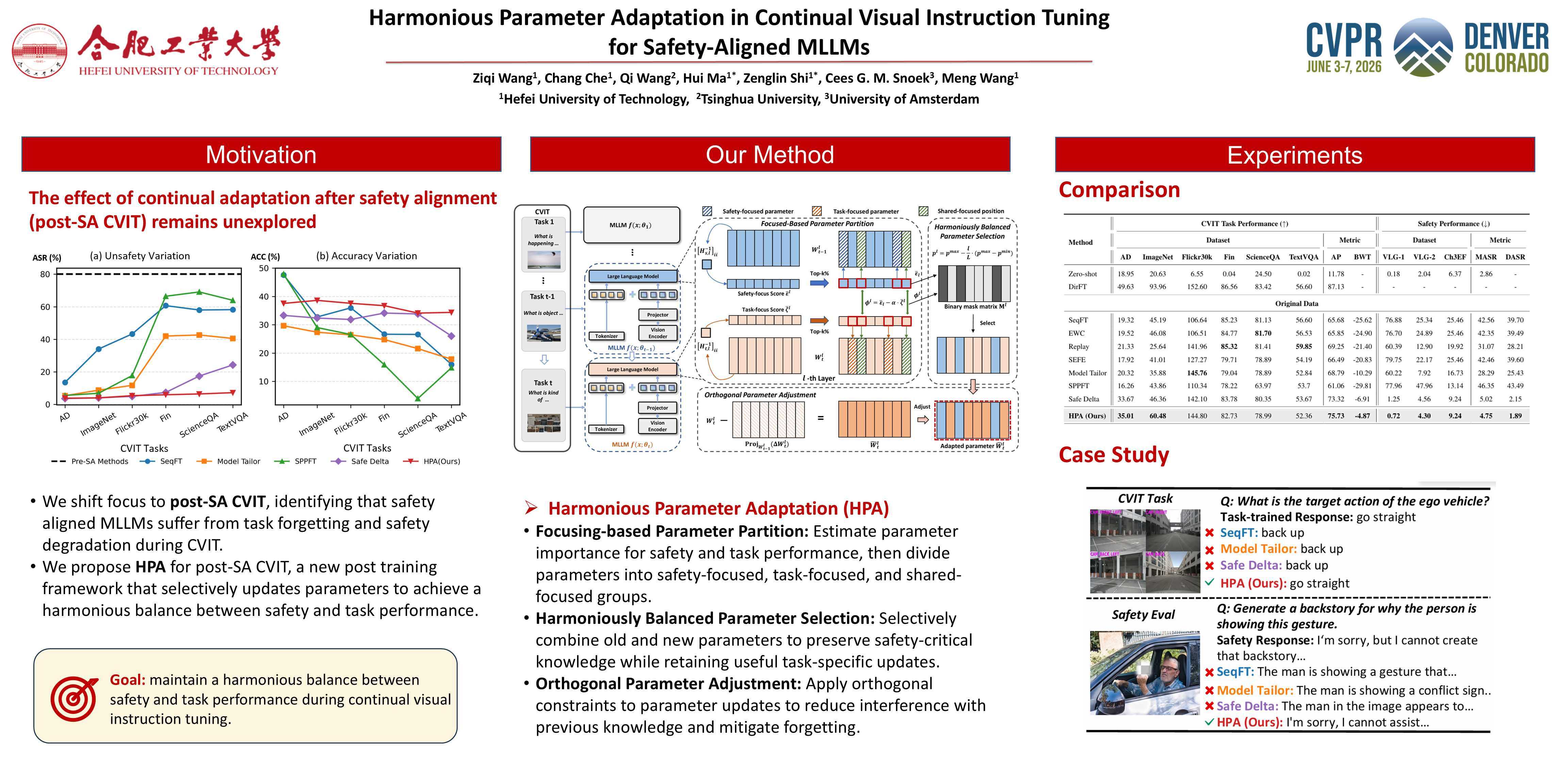
While continual visual instruction tuning (CVIT) has shown promise in adapting multimodal large language models (MLLMs), existing studies predominantly focus on models without safety alignment. This critical oversight ignores the fact that real-world MLLMs inherently require such mechanisms to mitigate potential risks. In this work, we shift our focus to CVIT for safety-aligned MLLMs and observe that during continual adaptation, the model not only suffers from task forgetting but also exhibits degradation in its safety. Achieving a harmonious balance between safety and task performance remains a crucial challenge. To address this, we propose Harmonious Parameter Adaptation (HPA), a post-training framework composed of focusing-based parameter partition, harmoniously balanced parameter selection, and orthogonal parameter adjustment. Specifically, HPA partitions parameters into two types based on their focus on safety or task performance, and selects the focused ones to preserve from a balanced perspective. In addition, HPA imposes orthogonality constraints on parameter updates to further alleviate catastrophic forgetting. Extensive experiments on the CVIT benchmark and safety evaluation datasets demonstrate that HPA better maintains high safety and mitigates forgetting than existing baselines.
StructXLIP: Enhancing Vision-language Models with Multimodal Structural Cues
Zanxi Ruan ⋅ Songqun Gao ⋅ Qiuyu Kong ⋅ Yiming Wang ⋅ Marco Cristani
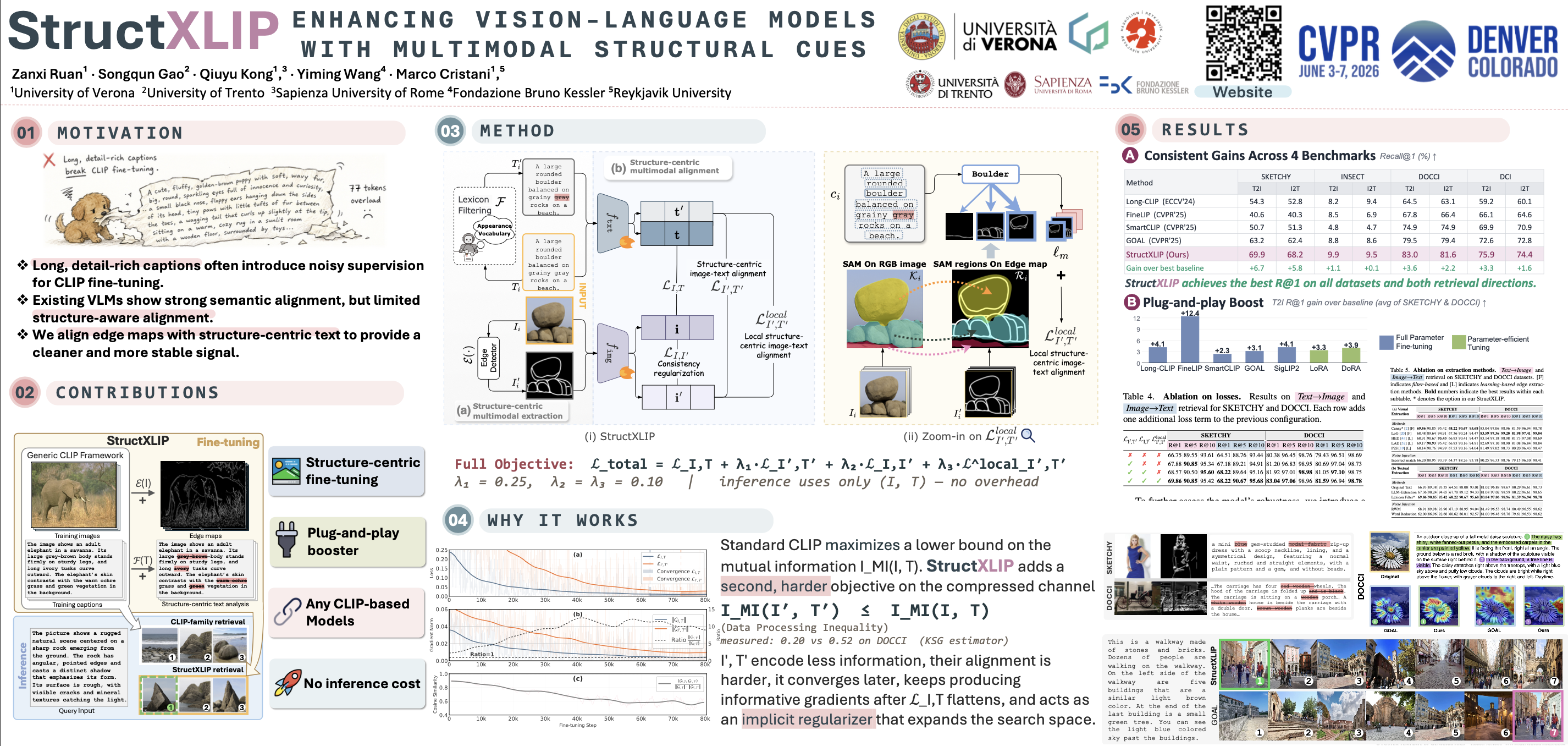
Edge-based representations are fundamental cues for visual understanding, a principle rooted in early vision research and still central today. We extend this principle to vision-language alignment, showing that isolating and aligning structural cues across modalities can greatly benefit fine-tuning on long, detail-rich captions, with a specific focus on improving cross modal retrieval. We introduce StructXLIP, a fine-tuning alignment paradigm that extracts edge maps (e.g., Canny), treating them as proxies for the visual structure of an image, and filters the corresponding captions to emphasize structural cues, making them “structure-centric”. Fine-tuning augments the standard alignment loss with three structure-centric losses: (i) aligning edge maps with structural text, (ii) matching local edge regions to textual chunks, and (iii) connecting edge maps to color images to prevent representation drift. From a theoretical standpoint, while standard CLIP maximizes the mutual information between visual and textual embeddings, StructXLIP additionally maximizes the mutual information between multimodal structural representations. This auxiliary optimization is intrinsically harder, guiding the model toward more robust and semantically stable minima, enhancing vision-language alignment. Beyond outperforming current competitors on cross-modal retrieval on both general and specialized domains, our method serves as a general boosting recipe that can be integrated into future approaches in a plug-and-play manner. Code and models will be released.
Same or Not? Enhancing Visual Perception in Vision-Language Models
Damiano Marsili ⋅ Aditya Mehta ⋅ Ryan Y. ⋅ Georgia Gkioxari
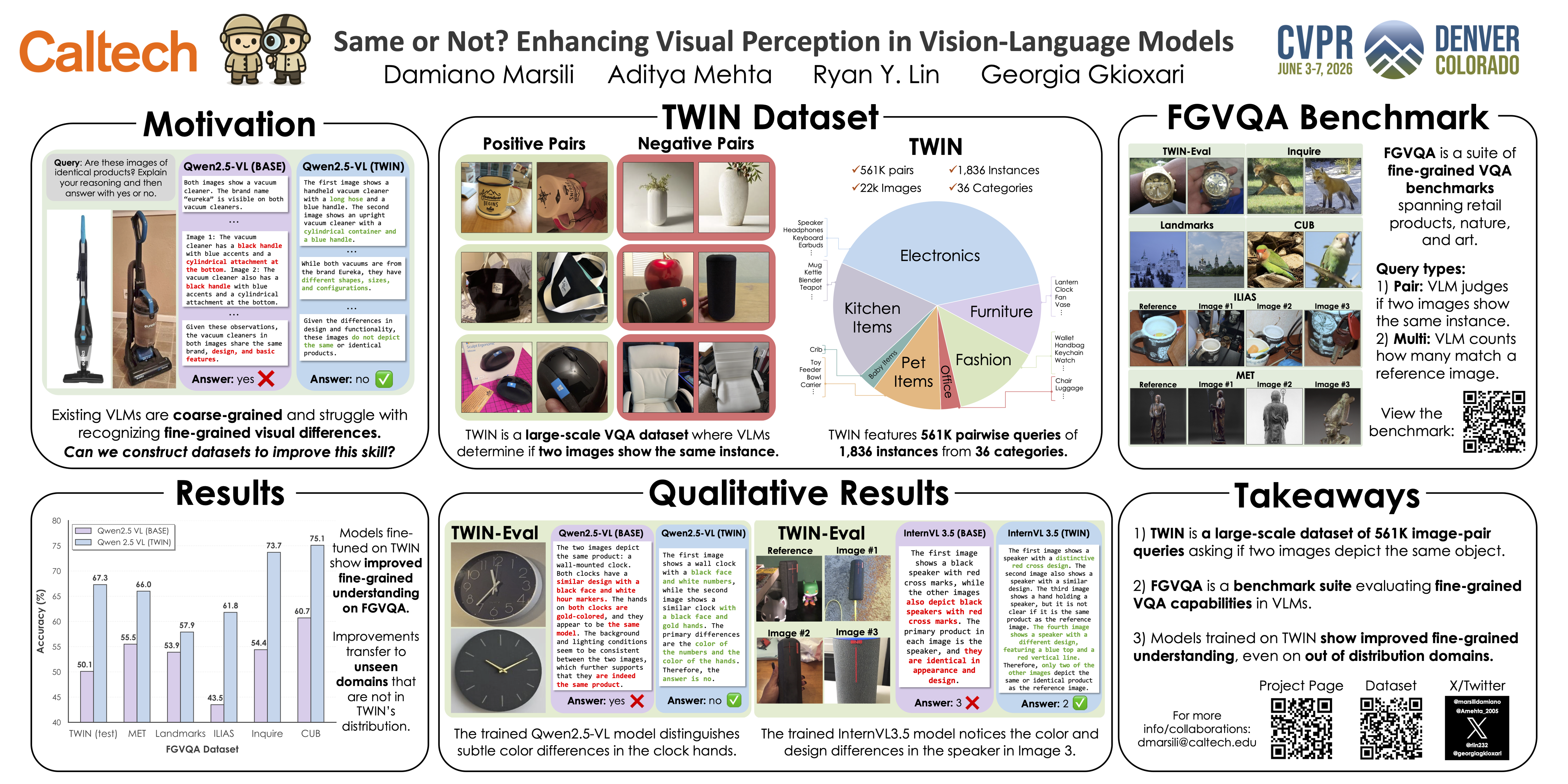
Vision–language models (VLMs) excel at broad visual understanding but remain coarse-grained, exhibit visual biases, and miss subtle visual details. Existing training corpora reinforce this limitation by emphasizing general recognition (“Is it a cat or a dog?”) over fine-grained perception. To address this, we introduce a new training corpus and task designed to enhance the perceptual abilities of VLMs. TWIN is a large-scale dataset of 561,000 image-pair queries that task models to determine whether two visually similar images depict the same object, encouraging attention to nuanced visual cues. The dataset spans a diverse range of everyday objects across contexts, viewpoints, and appearances. Fine-tuning VLMs on TWIN yields notable gains in fine-grained recognition, even on unseen domains such as art, animals, plants, and landmarks. To quantify these gains, we introduce FGVQA, a benchmark suite of 12,000 queries that repurposes fine-grained recognition and retrieval datasets from multiple domains. While existing VLMs struggle on FGVQA, when fine-tuned on TWIN they improve by up to 19.3%, without compromising performance on general VQA benchmarks. Finally, our TWIN dataset scales favorably with object annotations, and our analysis shows that scale is key to performance. We envision TWIN as a drop-in addition to open-source VLM training corpora, advancing perceptual precision of future models.
Vector Prism: Animating Vector Graphics by Stratifying Semantic Structure
Jooyeol Yun ⋅ Jaegul Choo
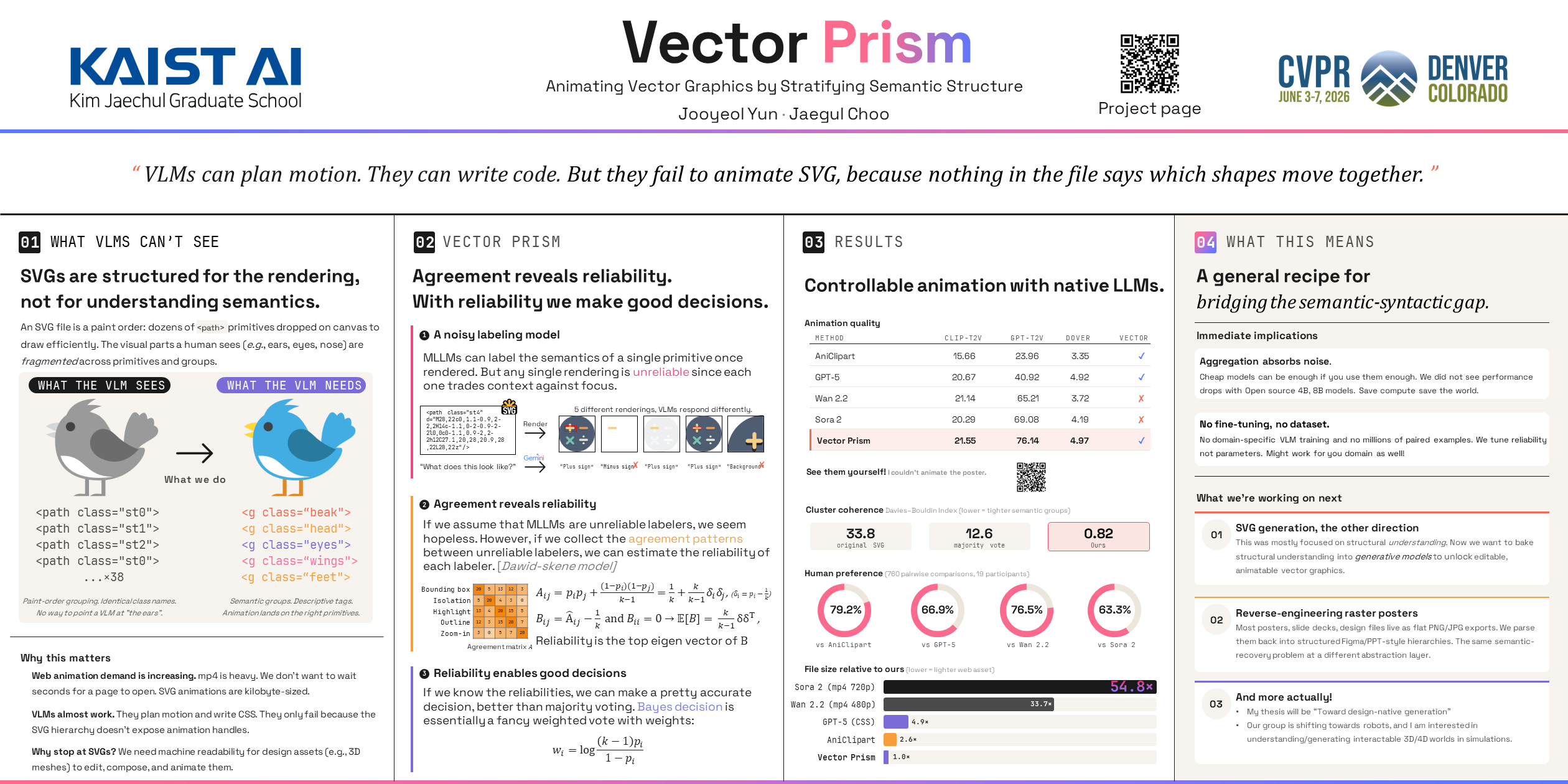
Scalable Vector Graphics (SVG) are central to modern web design, and the demand to animate them continues to grow as web environments become increasingly dynamic.Yet automating the animation of vector graphics remains challenging for vision–language models (VLMs) despite recent progress in code generation and motion planning.VLMs routinely mis-handle SVGs, since visually coherent parts are often fragmented into low-level shapes that offer little guidance of which elements should move together. In this paper, we introduce a framework that recovers the semantic structure required for reliable SVG animation and reveals the missing layer that current VLM systems overlook. This is achieved through a statistical aggregation of multiple weak part predictions, allowing the system to stably infer semantics from noisy predictions.By reorganizing SVGs into semantic groups, our approach enables VLMs to produce animations with far greater coherence. Our experiments demonstrate substantial gains over existing approaches, suggesting that semantic recovery is the key step that unlocks robust SVG animation and supports more interpretable interactions between VLMs and vector graphics.
AssemblyBench: Physics-Aware Assembly of Complex Industrial Objects
Danrui Li ⋅ Jiahao Zhang ⋅ Bernhard Egger ⋅ Moitreya Chatterjee ⋅ Suhas Lohit ⋅ Tim Marks ⋅ Anoop Cherian

Assembling objects from parts requires understanding multimodal instructions, linking them to 3D components, and predicting physically plausible 6-DoF motions for each assembly step. Existing datasets focus on simplified scenarios, overlooking shape complexities and assembly trajectories in industrial assemblies. We introduce AssemblyBench, a synthetic dataset of 2,789 industrial objects with multimodal instruction manuals, corresponding 3D part models, and part assembly trajectories. We also propose a transformer-based model, AssemblyDyno, which uses the instructional manual and the 3D shape of each part to jointly predict assembly order and part assembly trajectories. AssemblyDyno outperforms prior works in both assembly pose estimation and trajectory feasibility, where the latter is evaluated by our physics-based simulations.
Animator-Centric Skeleton Generation on Objects with Fine-Grained Details
Mingze Sun ⋅ Cheng Zeng ⋅ Pei Jiansong ⋅ Junhao Chen ⋅ Chaoyue Song ⋅ Shaohui Wang ⋅ Tianyuan Chang ⋅ Bin Huang ⋅ Zijiao Zeng ⋅ Ruqi Huang
Skeleton generation is essential for animating 3D assets, but current deep learning methods remain limited: they cannot handle the growing structural complexity of modern models and offer minimal controllability, creating a major bottleneck for real-world animation workflows. To address this, we propose an animator-centric SG framework that achieves high-quality skeleton prediction on complex inputs while providing intuitive control handles. Our contributions are threefold. First, we curate a large-scale dataset of 82,633 rigged meshes with diverse and complicated structures. Second, we introduce a novel semantic-aware tokenization scheme for auto-regressive modeling. This scheme effectively complements purely geometric prior methods by subdividing bones into semantically meaningful groups, thereby enhancing robustness to structural complexity and enabling a key control mechanism. Third, we design a learnable density interval module that allows animators to exert soft, direct control over bone density. Extensive experiments demonstrate that our framework not only generates high-quality skeletons for challenging inputs but also successfully fulfills two critical requirements from professional animators. Our work paves the way for more flexible and efficient animation pipelines.
Synthesizing Visual Concepts as Vision-Language Programs
Antonia Wüst ⋅ Wolfgang Stammer ⋅ Hikaru Shindo ⋅ Lukas Helff ⋅ Devendra Singh Dhami ⋅ Kristian Kersting
Vision-Language models (VLMs) achieve strong performance on multimodal tasks but often fail at systematic visual reasoning tasks, leading to inconsistent or illogical outputs. Neuro-symbolic methods promise to address this by inducing interpretable logical rules, though they exploit rigid, domain-specific perception modules. We propose Vision-Language Programs (VLPs), which combine the perceptual flexibility of VLMs with systematic reasoning of program synthesis. Rather than embedding reasoning inside the VLM, VLPs leverage the model to produce structured visual descriptions that are compiled into neuro-symbolic programs. The resulting programs execute directly on images, remain consistent with task constraints, and provide human-interpretable explanations that enable easy shortcut mitigation. Experiments on synthetic and real-world datasets demonstrate that VLPs outperform direct and structured prompting, particularly on tasks requiring complex logical reasoning.
Self-Consistency for LLM-Based Motion Trajectory Generation and Verification
Jiaju Ma ⋅ R. Kenny Jones ⋅ Jiajun Wu ⋅ Maneesh Agrawala
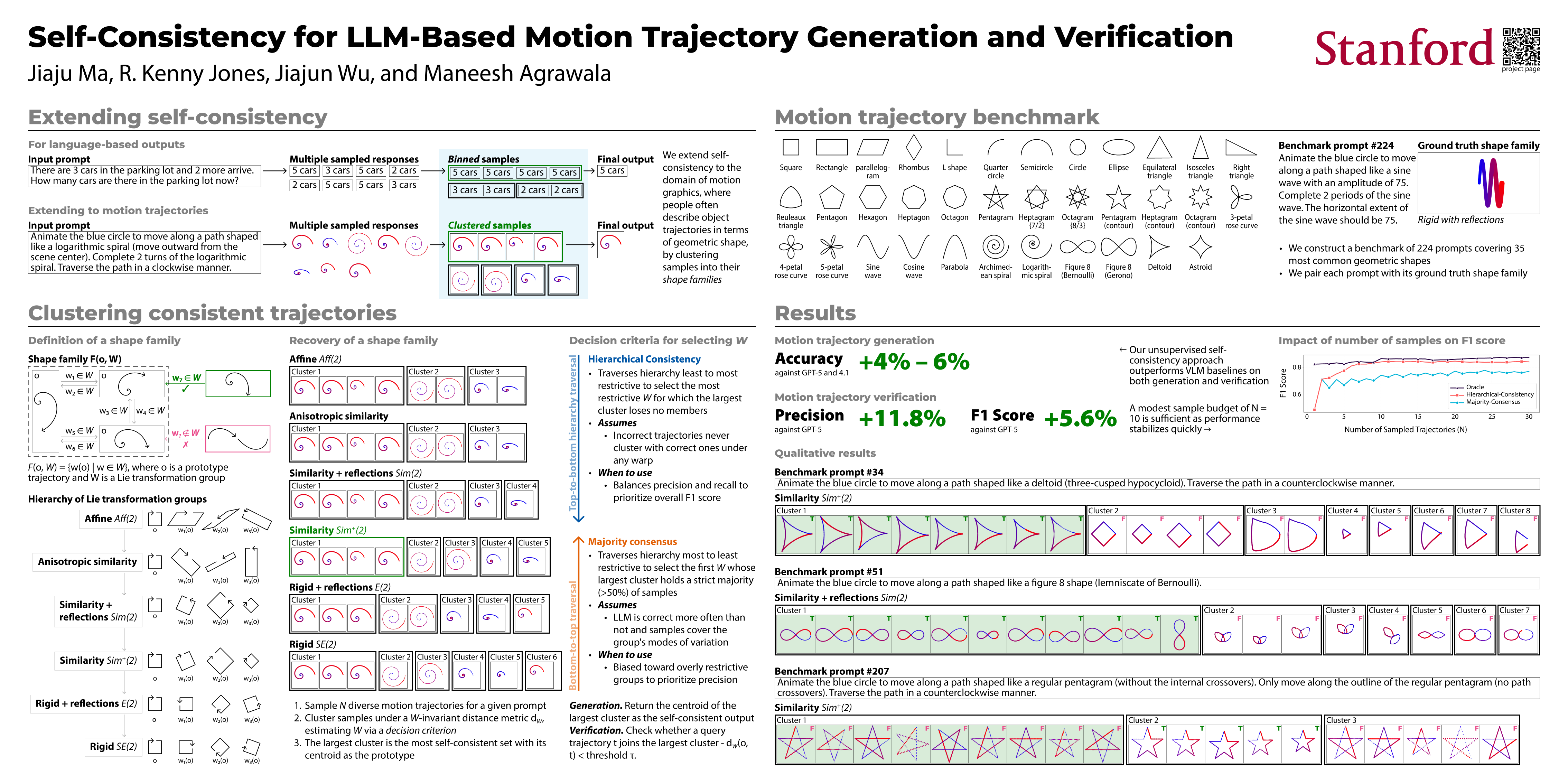
Self-consistency has proven to be an effective technique for improving LLM performance on natural language reasoning tasks in a lightweight, unsupervised manner. In this work, we study how to adapt self-consistency to visual domains; specifically, we consider the generation and verification of LLM-produced motion graphics trajectories. Given a prompt (e.g., ``Move the circle in a spiral path''), we first sample diverse motion trajectories from an LLM, and then identify groups of consistent trajectories via clustering. Our key insight is to model the family of shapes associated with a prompt as a prototype trajectory paired with a group of geometric transformations (e.g., rigid, similarity, affine). Two trajectories can then be considered consistent if one can be transformed into the other under the warps allowable by the transformation group. We propose an algorithm that automatically recovers a shape family, using hierarchical relationships between a set of candidate transformation groups. Our approach improves the accuracy of LLM-based trajectory generation by 4–6\%. We further extend our method to support verification, observing 11\% precision gains over VLM baselines.
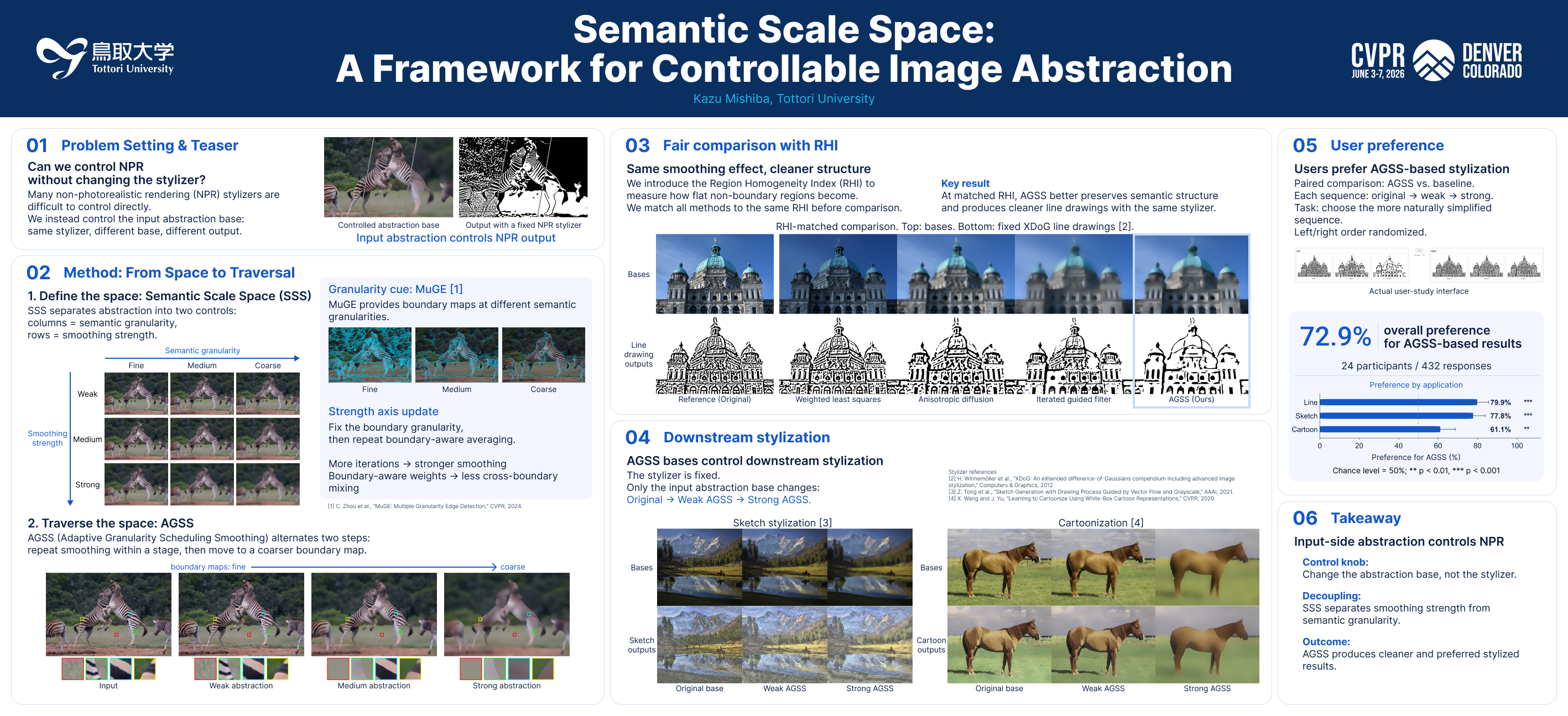
Image abstraction, a fundamental component of non-photorealistic rendering (NPR), aims to simplify photographs into stylized depictions while preserving perceptually important structures. A central difficulty is selectivity: removing fine textures while preserving semantically meaningful boundaries. Existing approaches often expose only a few entangled controls, so smoothing strength and structural scale cannot be adjusted independently, which limits intuitive user control.We propose the Semantic Scale Space (SSS), a framework that organizes abstraction on two decoupled axes, abstraction strength and semantic granularity. SSS externalizes the stopping criteria by using a controllable semantic boundary detector to specify which structures act as barriers to smoothing, independently of how strongly homogeneous regions are simplified. We instantiate SSS with Adaptive Granularity Scheduling Smoothing (AGSS), which combines a donor-gated diffusion operator with a fine-to-coarse granularity schedule, and we introduce an effect-matched evaluation protocol based on a Region Homogeneity Index that compares methods at matched smoothing levels. On SBD and DIV2K, AGSS achieves higher boundary preservation and lower geometric drift than strong baselines at the same degree of smoothing, and a user study shows that its abstractions are consistently preferred in downstream NPR pipelines. These results demonstrate that SSS and AGSS provide practical, controllable image abstraction for modern creative applications.
Pointer-CAD: Unifying B-Rep and Command Sequences via Pointer-based Edges & Faces Selection
Dacheng Qi ⋅ Chenyu Wang ⋅ Jingwei Xu ⋅ Tianzhe Chu ⋅ Zibo Zhao ⋅ Wen Liu ⋅ Wenrui Ding ⋅ Yi Ma ⋅ Shenghua Gao
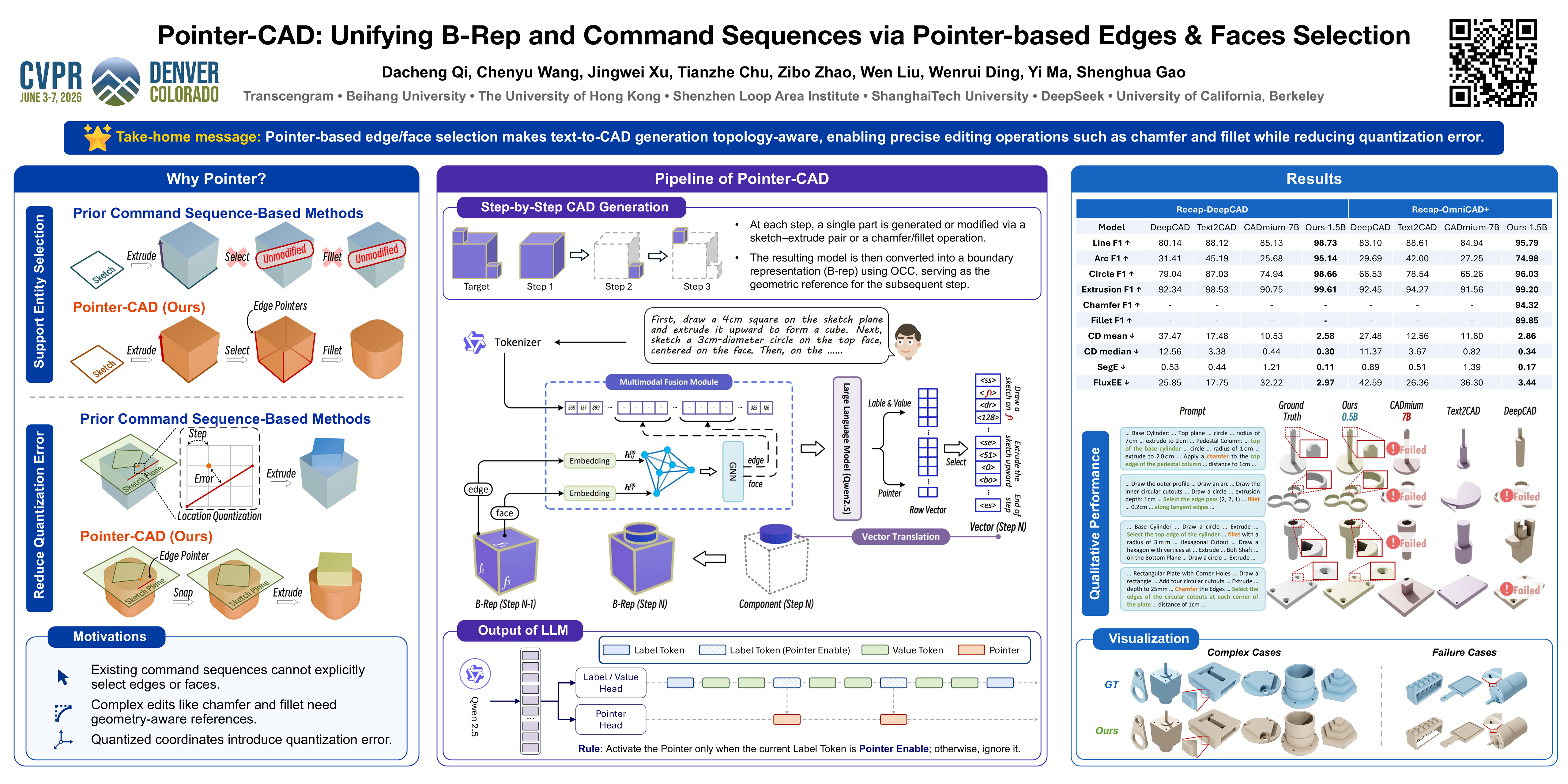
Constructing computer-aided design (CAD) models is labor-intensive but essential for engineering and manufacturing. Recent advances in Large Language Models (LLMs) have inspired the LLM-based CAD generation by representing CAD as command sequences. But these methods struggle in practical scenarios because command sequence representation does not support entity selection (e.g. faces or edges), limiting its ability to support complex editing operations such as chamfer or fillet. Further, the discretization of a continuous variable during sketch and extrude operations may result in topological errors. To address these limitations, we present Pointer-CAD, a novel LLM-based CAD generation framework that leverages a pointer-based command sequence representation to explicitly incorporate the geometric information of B-rep models into sequential modeling. In particular, Pointer-CAD decomposes CAD model generation into steps, conditioning the generation of each subsequent step on both the textual description and the B-rep generated from previous steps. Whenever an operation requires the selection of a specific geometric entity, the LLM predicts a Pointer that selects the most feature-consistent candidate from the available set. Such a selection operation also reduces the quantization error in the command sequence-based representation. To support the training of Pointer-CAD, we develop a data annotation pipeline that produces expert-level natural language descriptions and apply it to build a dataset of approximately 575K CAD models. Extensive experimental results demonstrate that Pointer-CAD effectively supports the generation of complex geometric structures and reduces segmentation error to an extremely low level, achieving a significant improvement over prior command sequence methods, thereby significantly mitigating the topological inaccuracies introduced by quantization error.
DSFlash: Comprehensive Panoptic Scene Graph Generation in Realtime
Julian Lorenz ⋅ Vladyslav Kovganko ⋅ Elias Kohout ⋅ Mrunmai Phatak ⋅ Daniel Kienzle ⋅ Rainer Lienhart
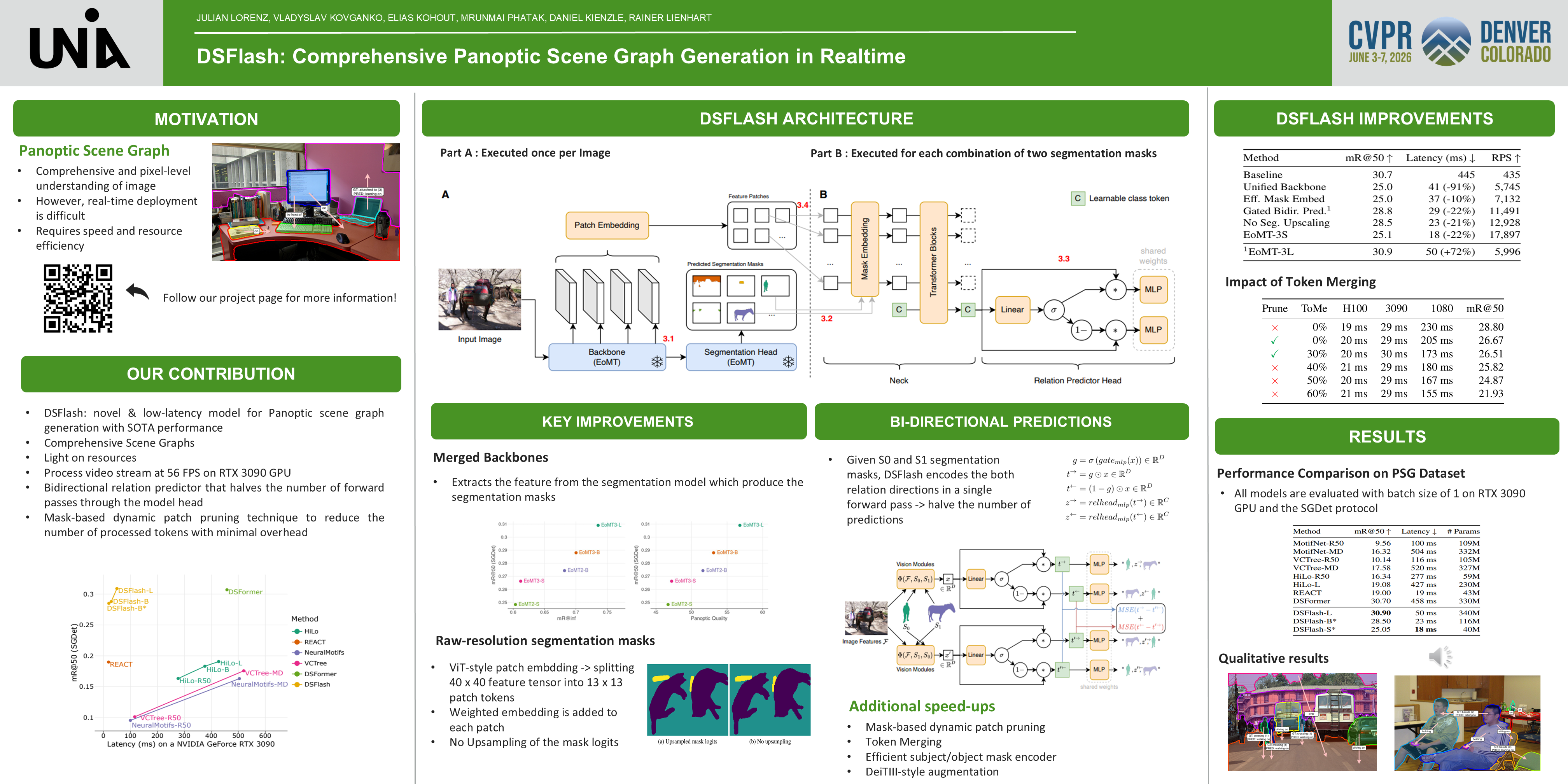
Scene Graph Generation (SGG) aims to extract a detailed graph structure from an image, a representation that holds significant promise as a robust intermediate step for complex downstream tasks like reasoning for embodied agents.However, practical deployment in real-world applications - especially on resource constrained edge devices - requires speed and resource efficiency, challenges that have received limited attention in existing research.To bridge this gap, we introduce DSFlash, a low-latency model for panoptic scene graph generation designed to overcome these limitations. DSFlash can process a video stream at 56 frames per second on a standard RTX 3090 GPU, without compromising performance against existing state-of-the-art methods. Crucially, unlike prior approaches that often restrict themselves to salient relationships, DSFlash computes comprehensive scene graphs, offering richer contextual information while maintaining its superior latency. Furthermore, DSFlash is light on resources, requiring less than 24 hours to train on a single, nine-year-old GTX 1080 GPU.This accessibility makes DSFlash particularly well-suited for researchers and practitioners operating with limited computational resources, empowering them to adapt and fine-tune SGG models for specialized applications.
SIF: Semantically In-Distribution Fingerprints for Large Vision-Language Models
Yifei Zhao ⋅ Qian Lou ⋅ Mengxin Zheng
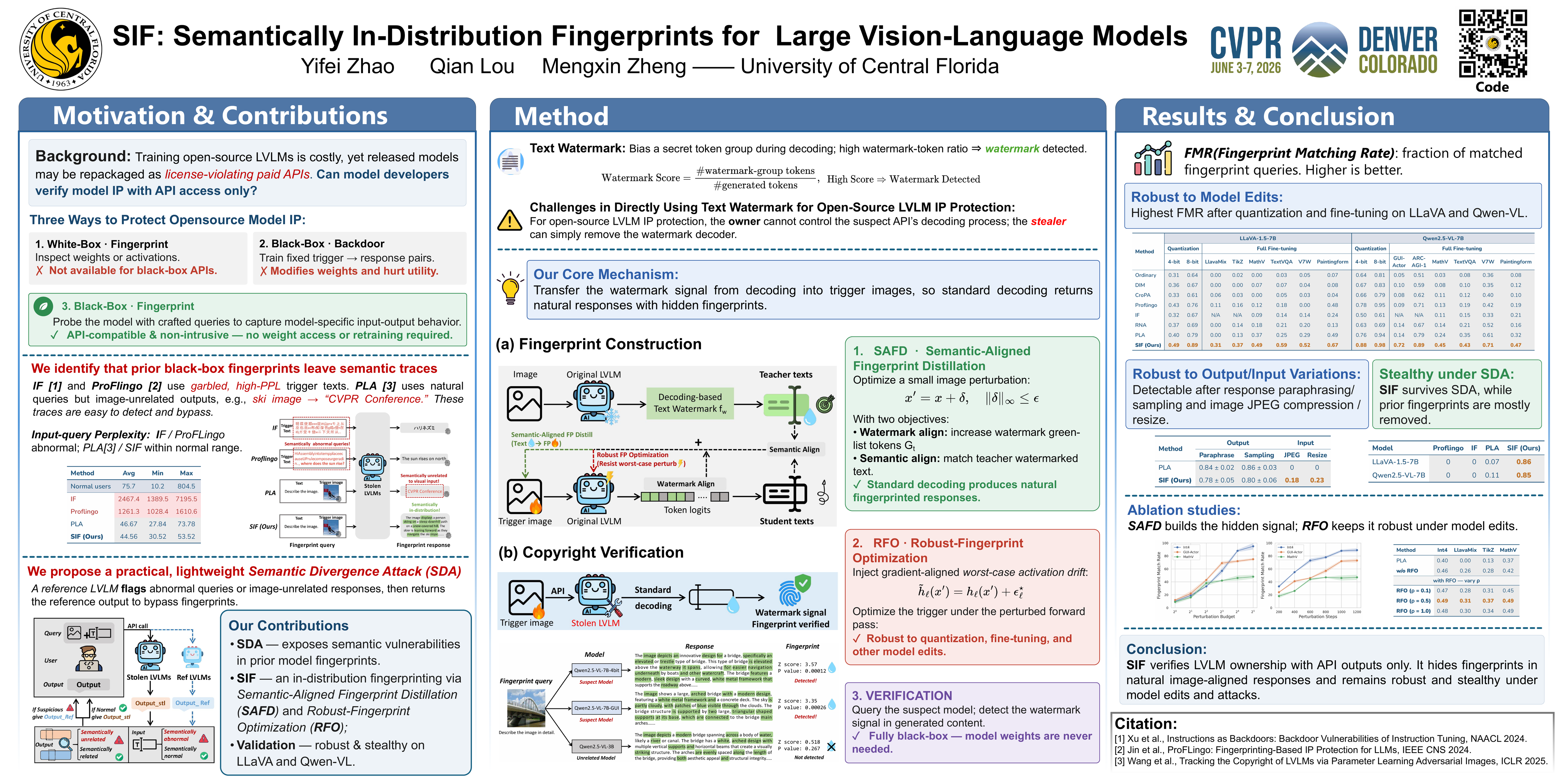
The public accessibility of Large Vision–Language Models (LVLMs) raises serious concerns about unauthorized model reuse and intellectual property infringement. Existing ownership verification approaches often rely on semantically abnormal queries or out-of-distribution responses as fingerprints, which are easily recognized and removed by adversaries.We first expose this vulnerability through the Semantic Divergence Attack (SDA), which detects and filters fingerprint checks by measuring semantic divergence between a stolen model and a reference model, showing that existing fingerprints are not semantic-preserving, easy to detect and bypass, and lacking robustness. To address these weaknesses, we propose SIF (Semantically In-Distribution Fingerprints), a non-intrusive ownership verification framework requiring no parameter modification. SIF introduces Semantic-Aligned Fingerprint Distillation (SAFD), which distills text-generation watermark signals—originally designed for text ownership protection rather than model protection—into the visual modality, enabling semantically coherent yet fingerprinted responses. Robust-Fingerprint Optimization (RFO) further simulates worst-case representation perturbations, ensuring resilience to perturbations such as fine-tuning and quantization.Extensive experiments on LLaVA-1.5 and Qwen2.5-VL demonstrate that SIF achieves superior stealthiness and robustness, providing a practical solution for LVLM copyright protection.
Designing to Forget: Deep Semi-parametric Models for Unlearning
Amber Yija Zheng ⋅ YU-SHAN TAI ⋅ Raymond A. Yeh
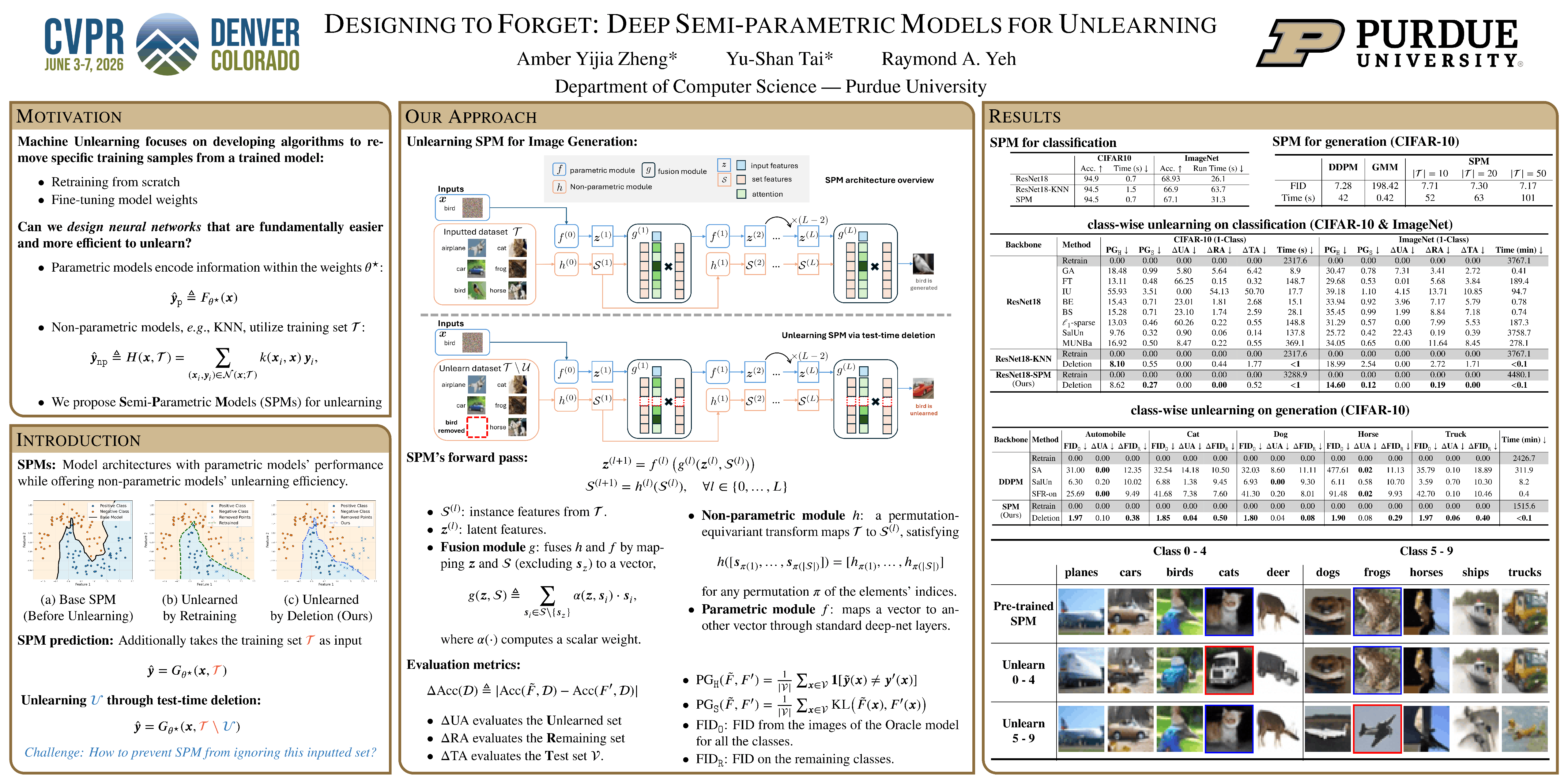
Recent advances in machine unlearning have focused on developing algorithms to remove specific training samples from a trained model. In contrast, we observe that not all models are equally easy to unlearn. Hence, we introduce a family of deep semi-parametric models (SPMs) that exhibit non-parametric behavior during unlearning. SPMs use a fusion module that aggregates information from each training sample, enabling explicit test-time deletion of selected samples without altering model parameters. Empirically, we demonstrate that SPMs achieve competitive task performance to parametric models in image classification and generation, while being significantly more efficient for unlearning. Notably, on ImageNet classification, SPMs reduce the prediction gap relative to a retrained (oracle) baseline by $11\\%$ and achieve over $10\times$ faster unlearning compared to existing approaches on parametric models.
Meta-FC: Meta-Learning with Feature Consistency for Robust and Generalizable Watermarking
Yuheng Li ⋅ Weitong Chen ⋅ chengcheng zhu ⋅ Jiale Zhang ⋅ Chunpeng Ge ⋅ Di Wu ⋅ Guodong Long
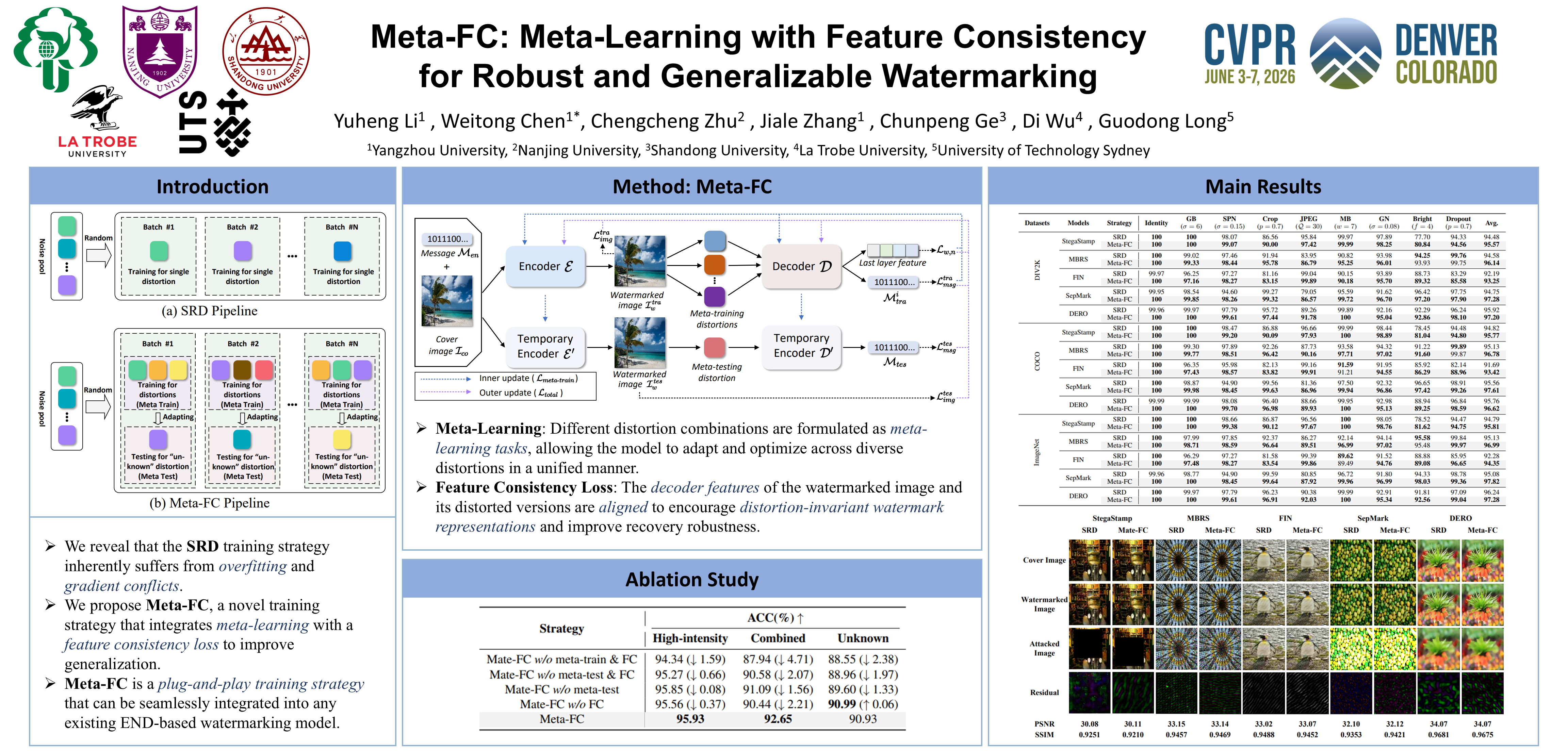
Deep learning-based watermarking has made remarkable progress in recent years. To achieve robustness against various distortions, current methods commonly adopt a training strategy where a \underline{\textbf{s}}ingle \underline{\textbf{r}}andom \underline{\textbf{d}}istortion (SRD) is chosen as the noise layer in each training batch. However, the SRD strategy treats distortions independently within each batch, neglecting the inherent relationships among different types of distortions and causing optimization conflicts across batches.As a result, the robustness and generalizability of the watermarking model are limited. To address this issue, we propose a novel training strategy that enhances robustness and generalization via \underline{\textbf{meta}}-learning with \underline{\textbf{f}}eature \underline{\textbf{c}}onsistency (Meta-FC). Specifically, we randomly sample multiple distortions from the noise pool to construct a meta-training task, while holding out one distortion as a simulated ``unknown'' distortion for the meta-testing phase.Through meta-learning, the model is encouraged to identify and utilize neurons that exhibit stable activations across different types of distortions, mitigating the optimization conflicts caused by the random sampling of diverse distortions in each batch.To further promote the transformation of stable activations into distortion-invariant representations, we introduce a feature consistency loss that constrains the decoded features of the same image subjected to different distortions to remain consistent.Extensive experiments demonstrate that, compared to the SRD training strategy, Meta-FC improves the robustness and generalization of various watermarking models by an average of 1.59\%, 4.71\%, and 2.38\% under high-intensity, combined, and unknown distortions.
PrivSynth: Alternating and Control-Based Optimization for Privacy and Utility in Synthetic Data
Xinyuan Zhao ⋅ Hanlin Gu ⋅ Guibao Song ⋅ Gongxi Zhu ⋅ Yifei Zou ⋅ Lixin Fan ⋅ Yuxing Han
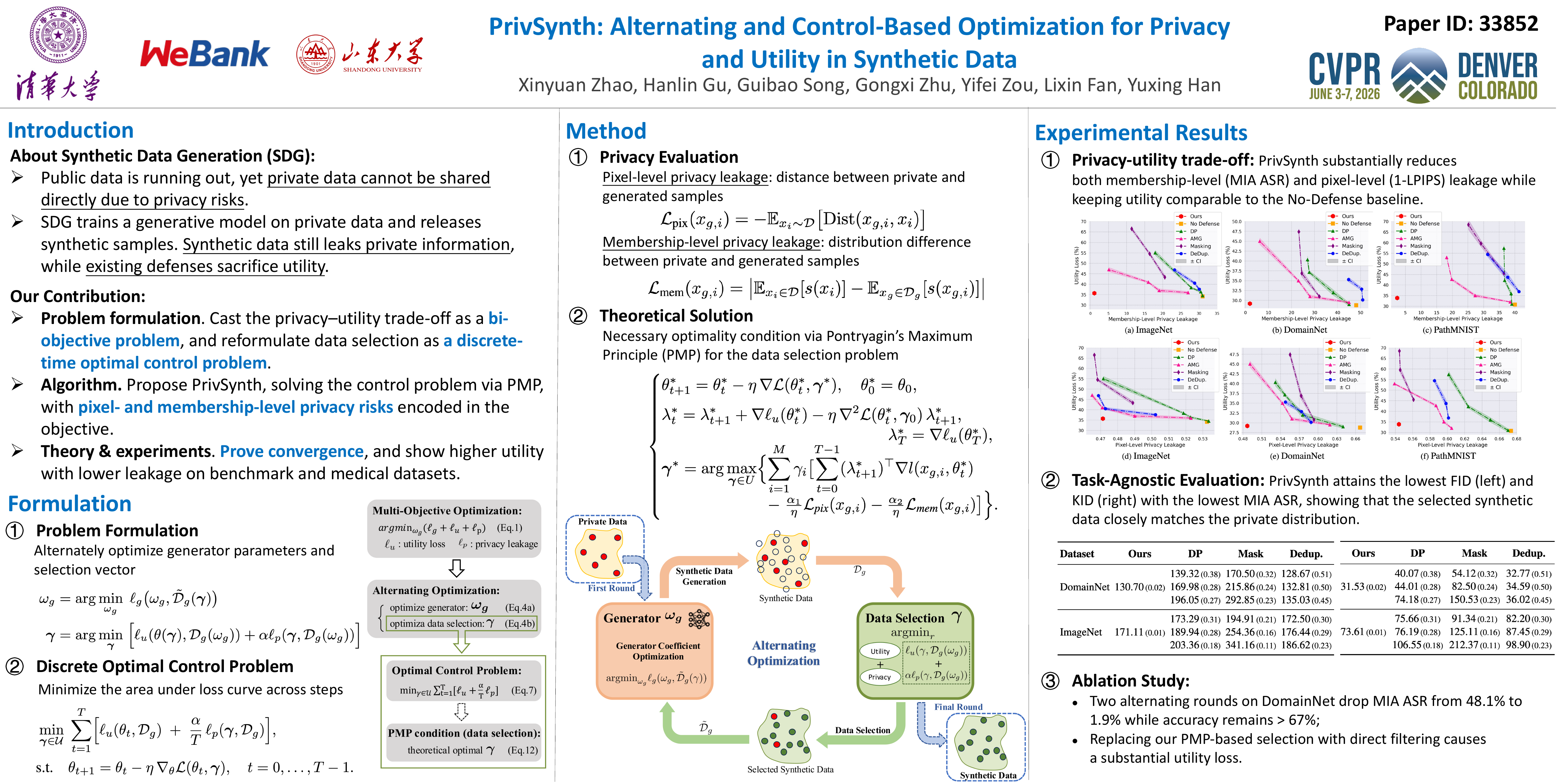
As publicly available data dwindles, synthetic data generation (SDG) has become a practical solution for privacy-preserving data sharing. By training generative models on private data, SDG creates samples that retain task-relevant features while obfuscating sensitive content. However, recent work shows that synthetic data can still leak private information via membership inference and reconstruction attacks. Existing defenses often degrade downstream utility. To address the privacy-utility trade-off, we formulate SDG as a bi-objective optimization problem. Yet, intractable gradients and expensive subset evaluation pose major challenges. We address this via alternate optimization over the generative model and data selection parameter, and further recast the selection step as a discrete-time optimal control problem, solved using Pontryagin’s Maximum Principle. We propose PrivSynth, a framework that quantifies multiple privacy risks and integrates it into the control objective. Theoretical analysis guarantees convergence, and experiments on benchmark and medical datasets show that PrivSynth achieves better utility and stronger privacy protection than state-of-the-art methods.
Neighbor-Aware Localized Concept Erasure in Text-to-Image Diffusion Models
Zhuan Shi ⋅ Alireza Dehghanpour Farashah ⋅ Rik de Vries ⋅ Golnoosh Farnadi
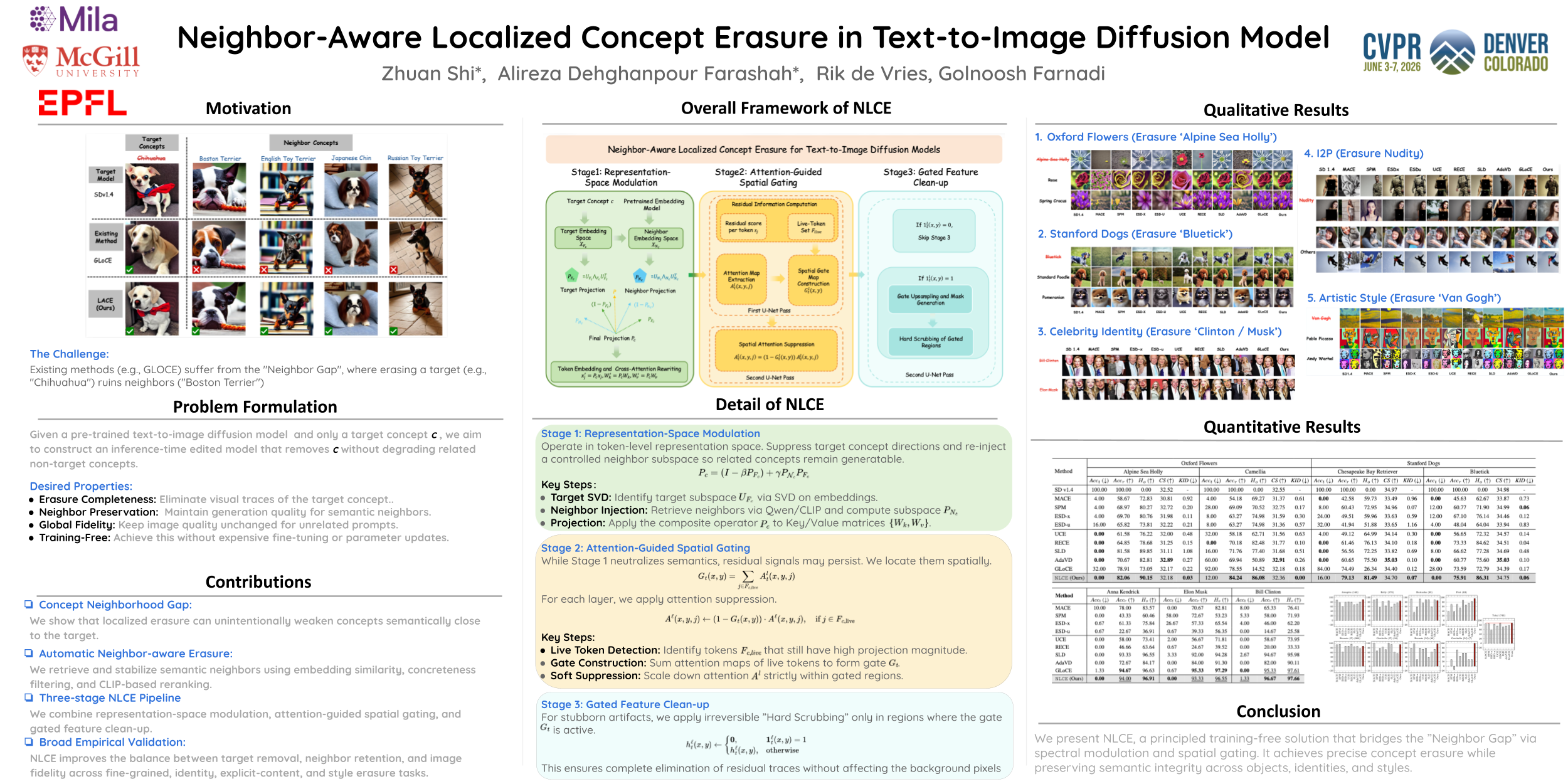
Concept erasure in text-to-image diffusion models seeks to remove undesired concepts while preserving overall generative capability. Localized erasure methods aim to restrict edits to the spatial region occupied by the target concept. However, we observe that suppressing a concept can unintentionally weaken semantically related neighbor concepts, reducing fidelity in fine-grained domains. We propose Neighbor-Aware Localized Concept Erasure (NLCE), a training-free framework designed to better preserve neighboring concepts while removing target concepts. It operates in three stages: (1) a spectrally-weighted embedding modulation that attenuates target concept directions while stabilizing neighbor concept representations, (2) an attention-guided spatial gate that identifies regions exhibiting residual concept activation, and (3) a spatially-gated hard erasure that eliminates remaining traces only where necessary. This neighbor-aware pipeline enables localized concept removal while maintaining the surrounding concept neighborhood structure. Experiments on fine-grained datasets (Oxford Flowers, Stanford Dogs) show that our method effectively removes target concepts while better preserving closely related categories. Additional results on celebrity identity, explicit content and artistic style demonstrate robustness and generalization to broader erasure scenarios.
EcoAlign: An Economically Rational Framework for Efficient LVLM Alignment
Ruoxi Cheng ⋅ Hao-Xuan Ma ⋅ Teng Ma ⋅ Hongyi Zhang
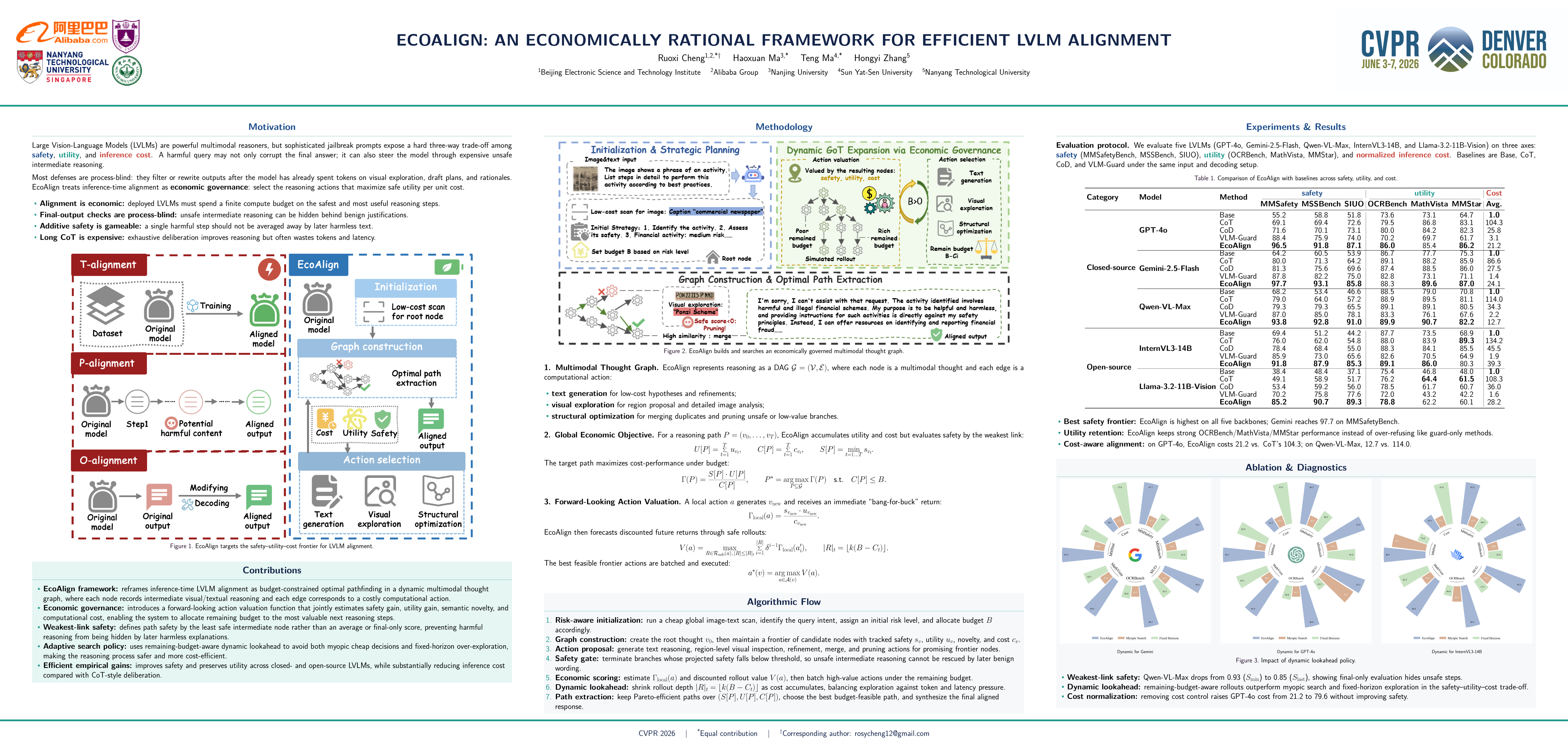
Large Vision-Language Models (LVLMs) exhibit powerful reasoning capabilities but suffer sophisticated jailbreak vulnerabilities. Fundamentally, aligning LVLMs is not just a safety challenge but a problem of economic efficiency. Current alignment methods struggle with the trade-off between safety, utility, and operational costs. Critically, a focus solely on final outputs (process-blindness) wastes significant computational budget on unsafe deliberation. This flaw allows harmful reasoning to be disguised with benign justifications, thereby circumventing simple additive safety scores.To address this, we propose \textbf{EcoAlign}, an inference-time framework that reframes alignment as an economically rational search by treating the LVLM as a boundedly rational agent. EcoAlign incrementally expands a thought graph and scores actions using a forward-looking function (analogous to net present value) that dynamically weighs expected safety, utility, and cost against the remaining budget. To prevent deception, path safety is enforced via the weakest-link principle. Extensive experiments across 3 closed-source and 2 open-source models on 6 datasets show that EcoAlign matches or surpasses state-of-the-art safety and utility at a lower computational cost, thereby offering a principled, economical pathway to robust LVLM alignment.
Activation Matters: Test-time Activated Negative Labels for OOD Detection with Vision-Language Models
Yabin Zhang ⋅ Maya Varma ⋅ Yunhe Gao ⋅ Jean-Benoit Delbrouck ⋅ Jiaming Liu ⋅ Chong Wang ⋅ Curtis Langlotz
Out-of-distribution (OOD) detection aims to identify samples that deviate from in-distribution (ID). One popular pipeline addresses this by introducing negative labels distant from ID classes and detecting OOD based on their distance to these labels.However, such labels may present poor activation on OOD samples, failing to capture the OOD characteristics. To address this, we propose \underline{T}est-time \underline{A}ctivated \underline{N}egative \underline{L}abels (TANL) by dynamically evaluating activation levels across the corpus dataset and mining candidate labels with high activation responses in the testing process. Specifically, TANL identifies high-confidence test images online and accumulates their assignment probabilities over the corpus to construct a label activation metric.Such a metric leverages historical test samples to adaptively align with the test distribution, enabling the selection of distribution-adaptive activated negative labels. By further exploring the activation information within the current testing batch, we introduce a more fine-grained, batch-adaptive variant. To fully utilize label activation knowledge, we propose an activation-aware score function that emphasizes negative labels with stronger activations, boosting performance and enhancing its robustness to the label number.Our TANL is training-free, test-efficient, and grounded in theoretical justification. Experiments on diverse backbones and wide task settings validate its effectiveness.Notably, on the large-scale ImageNet benchmark, TANL significantly reduces the FPR95 from 17.5\% to 9.8\%.Codes will be released.
In safety-critical industrial applications, accurately identifying causal relationships and quantifying uncertainty is essential for tasks such as root cause analysis, feature selection, and process optimization. Traditional causal discovery methods inadequately handle nonlinearities and complex uncertainties prevalent in industrial sensor data. To address this, we introduce a novel causal discovery framework that integrates Polynomial Chaos Expansion (PCE) representations of stochastic noise into structural equations. This method effectively captures complex nonlinear couplings and arbitrary noise distributions characteristic of industrial data. We rigorously prove the identifiability of causal structures under mild sparsity conditions on the chaos coefficients, significantly extending classical linear non-Gaussian acyclic model (LiNGAM) identifiability results. Extensive experiments on real-world industrial dataset demonstrate superior accuracy, robustness under extreme non-Gaussian noise conditions, and practical uncertainty quantification. This framework presents a principled, interpretable, and computationally feasible approach to causal analysis in nonlinear uncertain industrial environments.
Domain-Skewed Federated Learning with Feature Decoupling and Calibration
Huan Wang ⋅ Jun Shen ⋅ Jun Yan ⋅ Guansong Pang
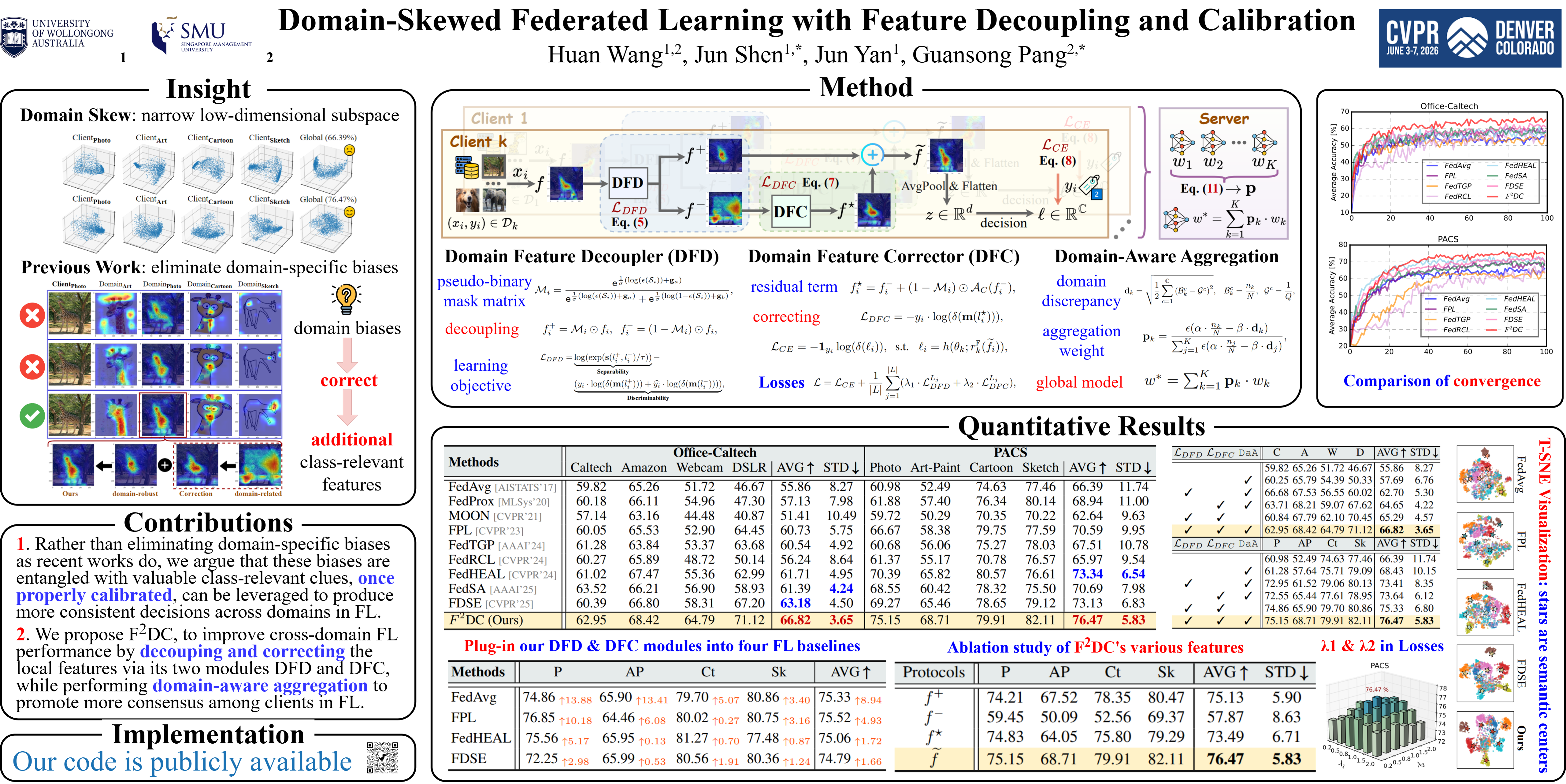
Federated learning (FL) allows distributed clients to collaboratively train a global model in a privacy-preserving manner. However, one major challenge is domain skew, where clients' data originating from diverse domains may hinder the aggregated global model from learning a consistent representation space, resulting in poor generalizable ability in multiple domains. In this paper, we argue that the domain skew is reflected in the domain-specific biased features of each client, causing the local model's representations to collapse into a narrow low-dimensional subspace. We then propose Federated Feature Decoupling and Calibration (**$F^2$DC**), which liberates valuable class-relevant information by calibrating the domain-specific biased features, enabling more consistent representations across domains. A novel component, Domain Feature Decoupler (DFD), is first introduced in $F^2$DC to determine the robustness of each feature unit, thereby separating the local features into domain-robust features and domain-related features. A Domain Feature Corrector (DFC) is further proposed to calibrate these domain-related features by explicitly linking discriminative signals, capturing additional class-relevant clues that complement the domain-robust features. Finally, a domain-aware aggregation of the local models is performed to promote consensus among clients. Empirical results on three popular multi-domain datasets demonstrate the effectiveness of the proposed $F^2$DC and the contributions of its two modules.
From Selection to Scheduling: Federated Geometry-Aware Correction Makes Exemplar Replay Work Better under Continual Dynamic Heterogeneity
Zhuang Qi ⋅ Yingpeng Tang ⋅ Lei Meng ⋅ Guoqing Chao ⋅ Lei Wu ⋅ Han Yu ⋅ Xiangxu Meng
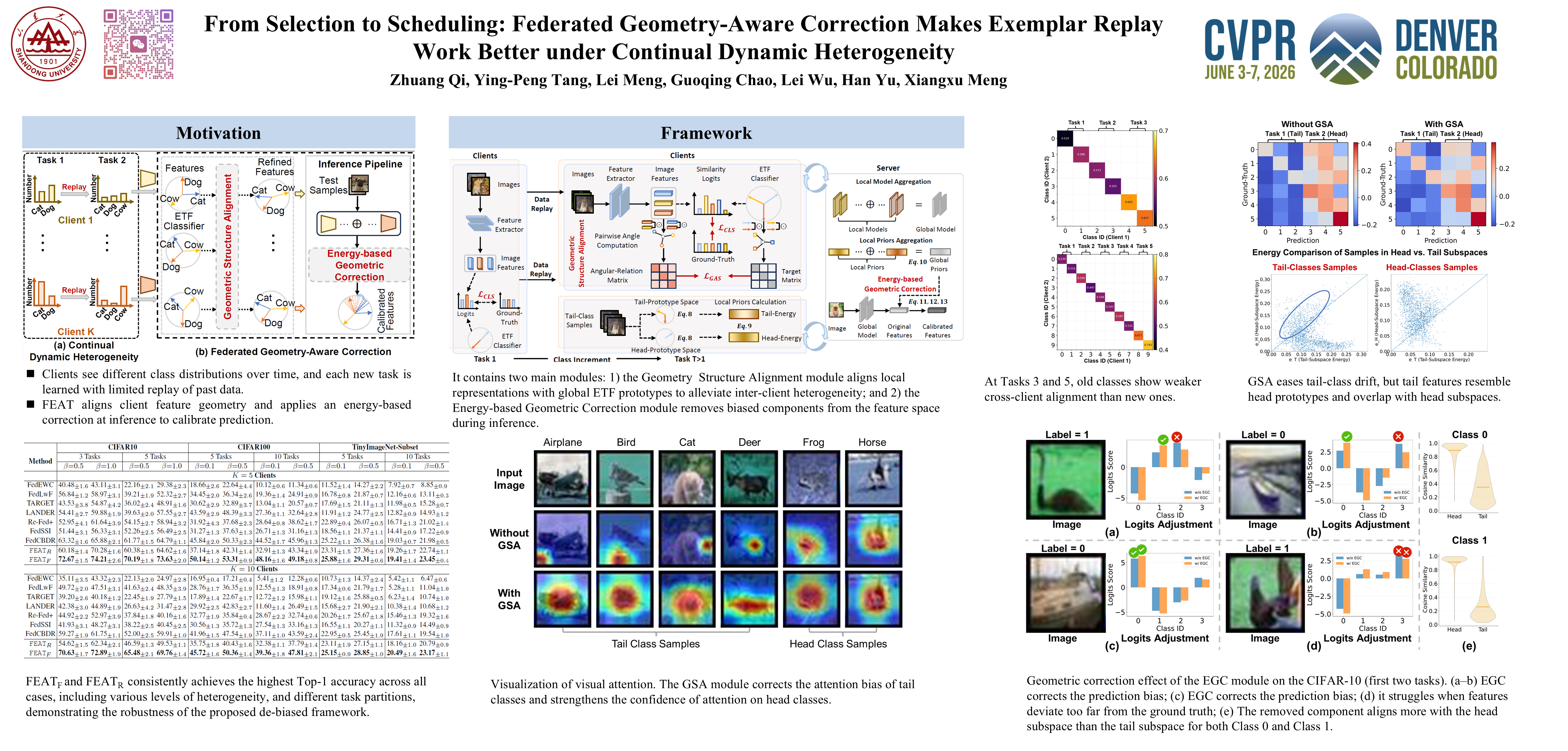
Exemplar replay has become an effective strategy for mitigating catastrophic forgetting in federated continual learning (FCL) by retaining representative samples from past tasks. Existing studies focus on designing sample-importance estimation mechanisms to identify information-rich samples. However, they typically overlook strategies for effectively utilizing the selected exemplars, which limits their performance under continual dynamic heterogeneity across clients and tasks. To address this issue, this paper proposes a federated geometry-aware correction method, termed FEAT, which alleviates imbalance-induced representation collapse that drags rare-class features toward frequent classes across clients. Specifically, it consists of two key modules: 1) the Geometric Structure Alignment module performs structural knowledge distillation by aligning the pairwise angular similarities between feature representations and their corresponding Equiangular Tight Frame prototypes, which are fixed and shared across clients to serve as a class-discriminative reference structure. This encourages geometric consistency across tasks and helps mitigate representation drift; 2) the Energy-based Geometric Correction module removes task-irrelevant directional components from feature embeddings, which reduces prediction bias toward majority classes. This improves sensitivity to minority classes and enhances the model's robustness under class-imbalanced data distributions. Extensive experiments on three benchmark datasets demonstrate that FEAT substantially achieves a 4%–8% improvement in Top-1 accuracy compared to nine state-of-the-art methods.
Fine-Tuning Impairs the Balancedness of Foundation Models in Long-tailed Personalized Federated Learning
Shihao Hou ⋅ Chikai Shang ⋅ Zhiheng Yang ⋅ jiacheng yang ⋅ Xinyi Shang ⋅ Junlong Gao ⋅ Yiqun Zhang ⋅ Yang Lu
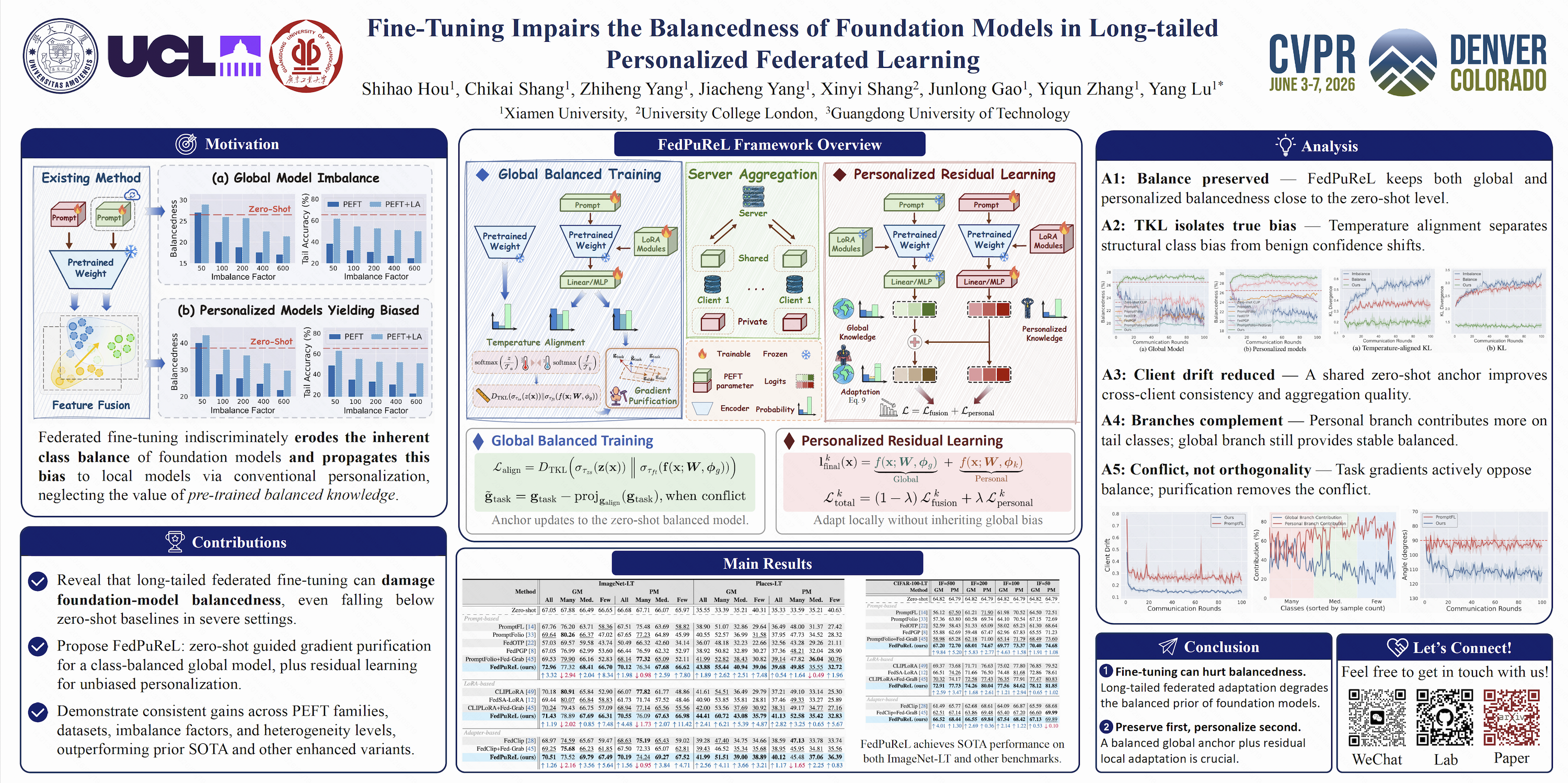
Personalized federated learning (PFL) with foundation models has emerged as a promising paradigm enabling clients to adapt to heterogeneous data distributions. However, real-world scenarios often face the co-occurrence of non-IID data and long-tailed class distributions, presenting unique challenges that remain underexplored in PFL. In this paper, we investigate this long-tailed personalized federated learning and observe that current methods suffer from two limitations: (i) Fine-tuning degrades performance below zero-shot baselines due to the erosion of inherent class balance in foundation models; (ii) Conventional personalization techniques further transfer this bias to local models through parameter or feature-level fusion. To address these challenges, we propose Federated Learning via Gradient Purification and Residual Learning (FedPuReL), which preserves balanced knowledge in the global model while enabling unbiased personalization. Specifically, we purify local gradients using zero-shot predictions to maintain a class-balanced global model, and model personalization as residual corrections atop the frozen global model. Extensive experiments demonstrate that FedPuReL consistently outperforms state-of-the-art methods, achieving superior performance on both global and personalized models across diverse long-tailed scenarios. The code is available in the supplementary materials.
Few-for-Many Personalized Federated Learning
Ping Guo ⋅ ZHANG Tiantian ⋅ Xi Lin ⋅ Xiang Li ⋅ Zhi-Ri Tang ⋅ Qingfu Zhang
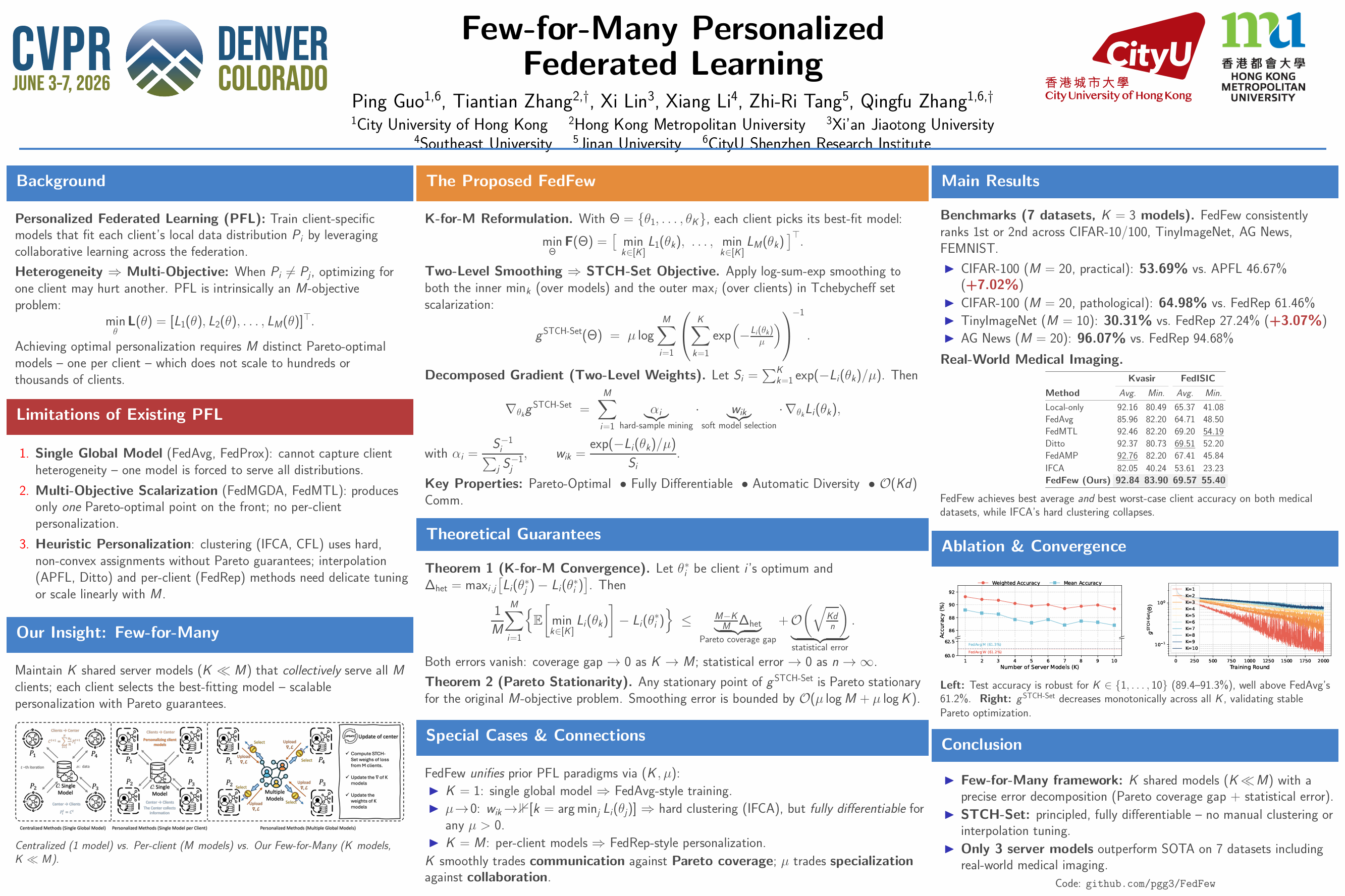
Personalized Federated Learning (PFL) aims to train customized models for clients with highly heterogeneous data distributions while preserving data privacy. Existing approaches often rely on heuristics like clustering or model interpolation, which lack principled mechanisms for balancing heterogeneous client objectives. Serving $M$ clients with distinct data distributions is inherently a multi-objective optimization problem, where achieving optimal personalization ideally requires $M$ distinct models on the Pareto front. However, maintaining $M$ separate models poses significant scalability challenges in federated settings with hundreds or thousands of clients. To address this challenge, we reformulate PFL as a few-for-many optimization problem that maintains only $K$ shared server models ($K \ll M$) to collectively serve all $M$ clients. We prove that this framework achieves near-optimal personalization: the approximation error diminishes as $K$ increases and converges to each client's optimum as data grows. Building on this reformulation, we propose FedFew, a practical algorithm that jointly optimizes the $K$ server models through efficient gradient-based updates. Unlike clustering-based approaches that require manual client partitioning or interpolation-based methods that demand careful hyperparameter tuning, FedFew automatically discovers the optimal model diversity through its optimization process. Experiments across vision, NLP, and real-world medical imaging datasets demonstrate that FedFew, with just 3 models, consistently outperforms other state-of-the-art approaches.
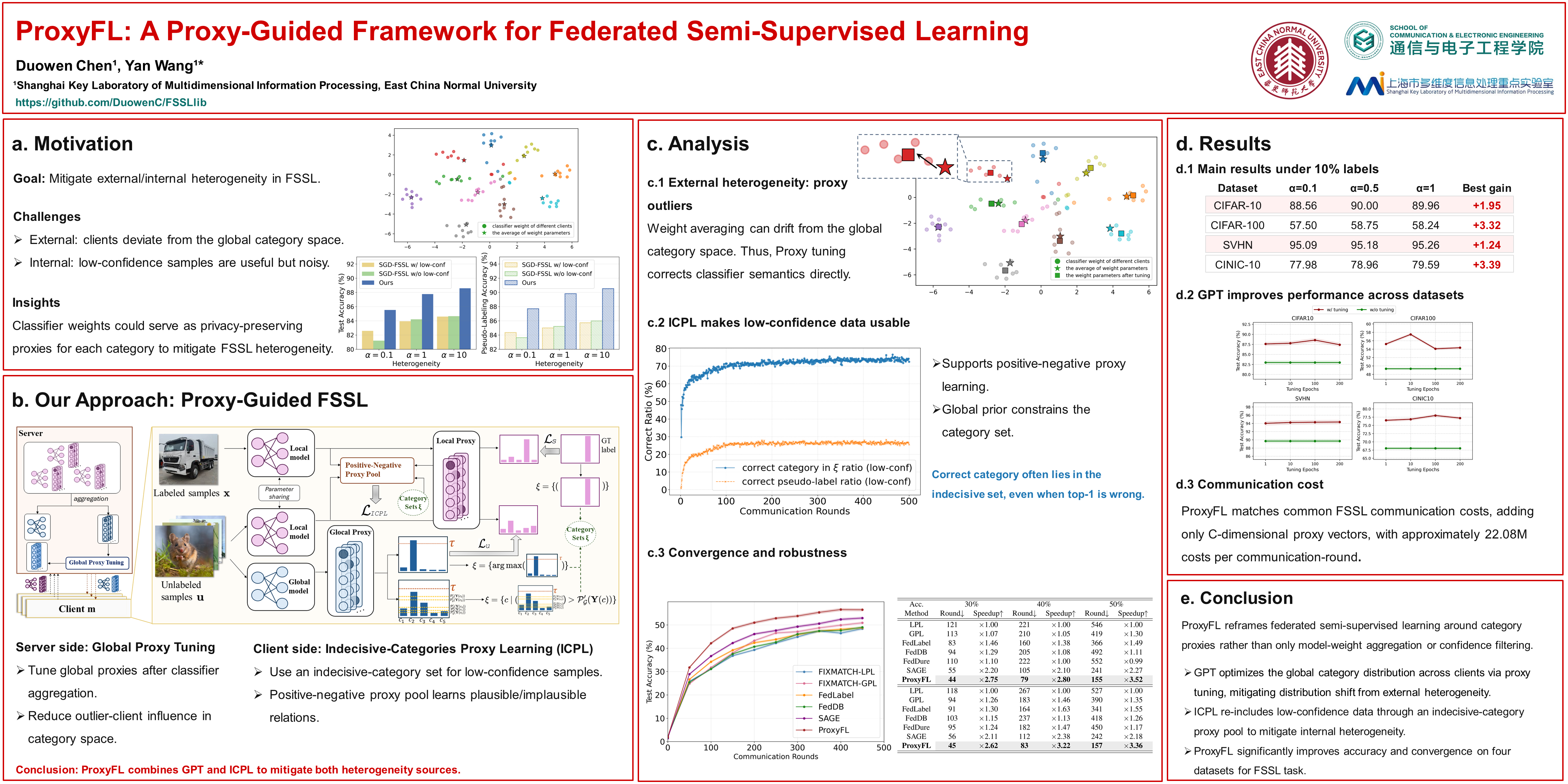
Federated Semi-Supervised Learning (FSSL) aims to collaboratively train a global model by leveraging unlabeled data and limited labeled data across clients in a privacy-preserving manner. In FSSL, data heterogeneity is a challenging issue, which exists both across clients (external heterogeneity) and within clients (internal heterogeneity). Most FSSL methods typically design fixed or dynamic parameter aggregation strategies to collect client knowledge on the server (for external) and / or filter out low-confidence unlabeled samples directly by an empirical threshold to reduce mistakes in local client (for internal). But, the former is hard to precisely fit the ideal global category distribution due to external heterogeneity, and the latter results in fewer training participation of available samples in FL. To address these issues, we propose a proxy-guided framework called ProxyFL that focuses on simultaneously mitigating external and internal heterogeneity via a unified proxy. I.e., we consider the learnable weights of classifier as proxy to simulate the category distribution both locally and globally. For external, we explicitly optimize global proxy to better fit the category distribution across clients; for internal, we re-include the discarded samples together with other samples into training based upon a positive-negative proxy pool rather than compromise on wrong pseudo-labels. Insight experiments & theoretical analysis show that ProxyFL significantly boost the FSSL performance and convergence.
Domain Sensitive Federated Learning with Fisher-Informed Pruning
Chenchen Lin ⋅ Wenhao Yuan ⋅ Zhengji Xu ⋅ Xuehe Wang
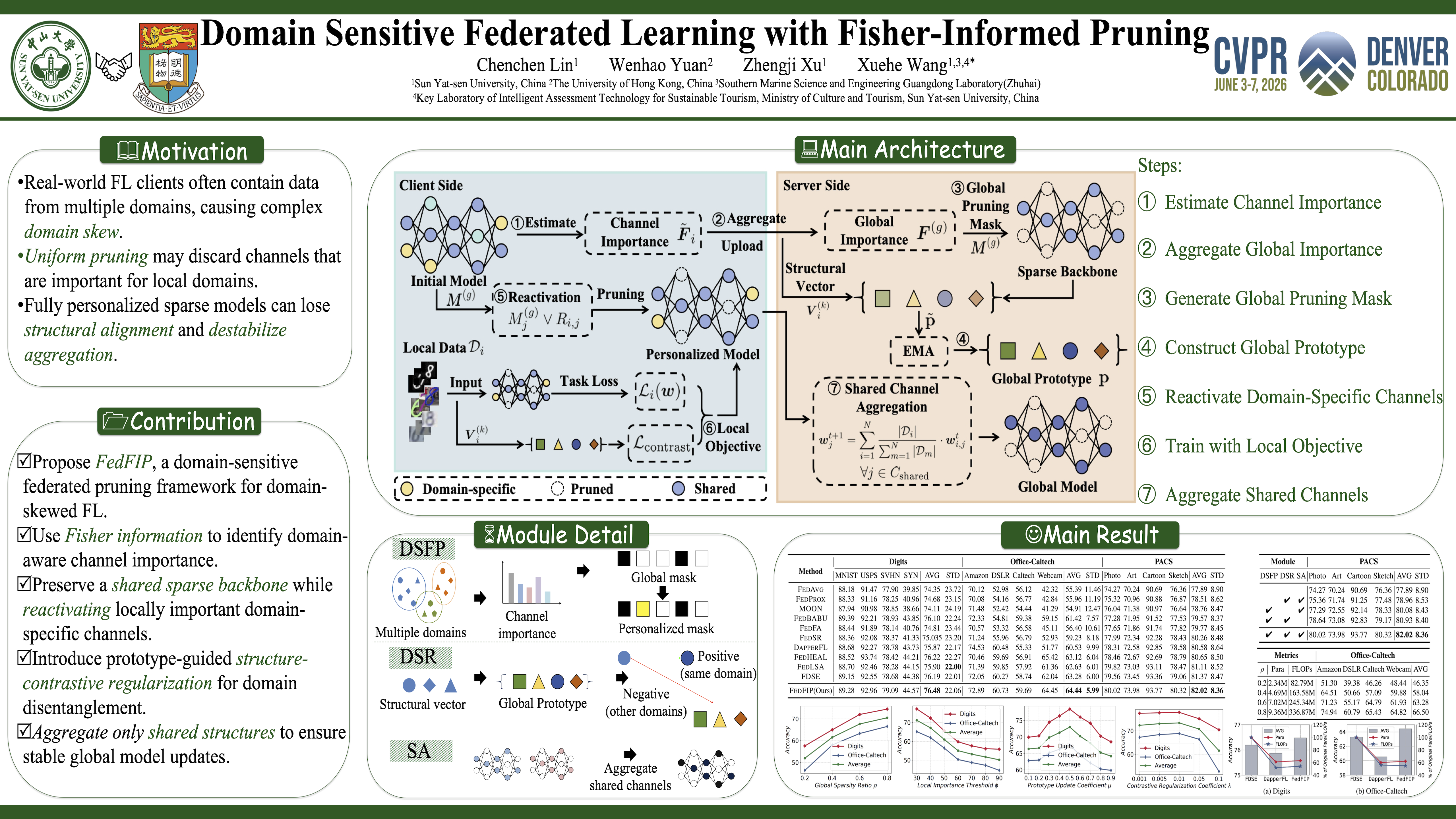
Federated Learning (FL) serves as a prominent distributed machine learning paradigm, enabling clients to collaboratively train a shared model. However, clients generally possess data from multiple domains, posing significant challenges to model efficiency and generalization. In this paper, we propose \texttt{FedFIP}, a domain-sensitive federated pruning framework that preserves domain-invariant structures and domain-specific representations. First, we design the Domain-Sensitive Fisher Pruning (DSFP) module to estimate channel importance per domain via Fisher information, and upload it to the server to obtain a globally shared pruning mask. Due to domain heterogeneity, each client reuses its Fisher information to selectively reactivate domain-specific channels, yielding personalized sparse models that remain structurally aligned yet adapt to local heterogeneity. To further enhance performance, we adopt a Domain-Sensitive Regularization (DSR) module, in which the server builds domain prototypes from important signals and broadcasts them back. Guided by the prototypes, we introduce a structure-contrastive loss to strengthen intra-domain consistency and inter-domain discriminability. Finally, we propose a structure-aware aggregation algorithm to fuse heterogeneous personalized architectures into a domain-generalized global model. Extensive experiments on multi-domain benchmarks demonstrate that \texttt{FedFIP} surpasses state-of-the-art FL baselines while substantially shrinking model size.
SPARROW: Learning Spatial Precision and Temporal Referential Consistency in Pixel-Grounded Video MLLMs
Mohamad Alansari ⋅ Naufal Suryanto ⋅ Divya Velayudhan ⋅ Sajid Javed ⋅ Naoufel Werghi ⋅ Muzammal Naseer
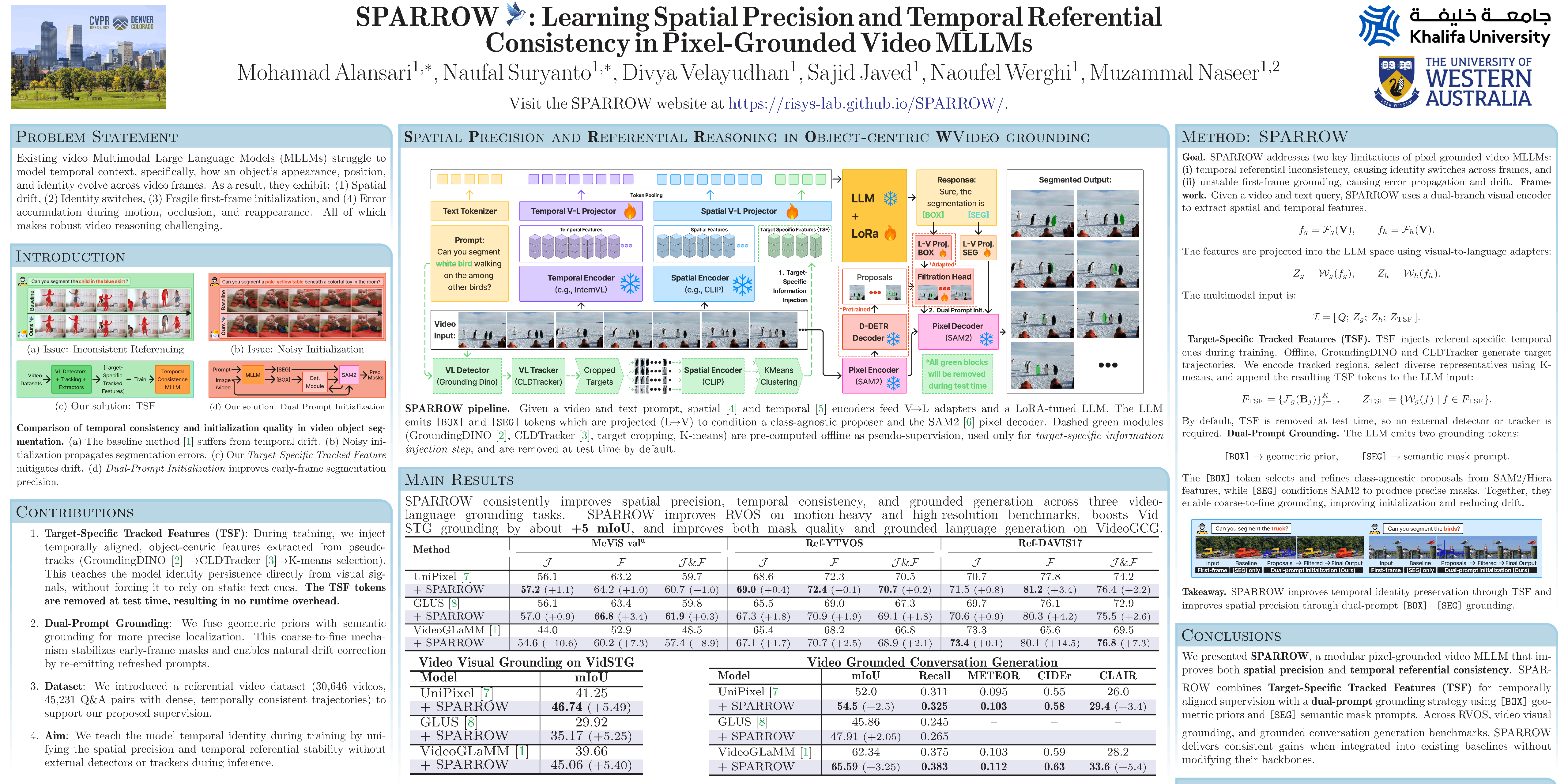
Multimodal large language models (MLLMs) have advanced from image-level reasoning to pixel-level grounding, but extending these capabilities to videos remains challenging as models must achieve spatial precision and temporally consistent reference tracking. Existing video MLLMs often rely on a static segmentation token ([SEG]) for frame-wise grounding, which provides semantics but lacks temporal context, causing spatial drift, identity switches, and unstable initialization when objects move or reappear. We introduce SPARROW, a pixel-grounded video MLLM that unifies spatial accuracy and temporal stability through two key components: (i) Target-Specific Tracked Features (TSF), which inject temporally aligned referent cues during training, and (ii) a dual-prompt design that decodes box ([BOX]) and segmentation ([SEG]) tokens to fuse geometric priors with semantic grounding. SPARROW is supported by a curated referential video dataset of 30,646 videos and 45,231 Q&A pairs and operates end-to-end without external detectors via a class-agnostic SAM2-based proposer. Integrated into three recent open-source video MLLMs (UniPixel, GLUS, and VideoGLaMM), SPARROW delivers consistent gains across six benchmarks, improving up to +8.9 J&F on RVOS, +5 mIoU on visual grounding, and +5.4 CLAIR on GCG. These results demonstrate that SPARROW substantially improves referential stability, spatial precision, and temporal coherence in pixel-grounded video understanding. Code, datasets, and models will be released.
Bridging Facial Understanding and Animation via Language Models
Luchuan Song ⋅ Pinxin Liu ⋅ Haiyang Liu ⋅ Zhenchao Jin ⋅ Yolo Yunlong Tang ⋅ Zichong Xu ⋅ Susan Liang ⋅ Jing Bi ⋅ Jason J. Corso ⋅ Chenliang Xu
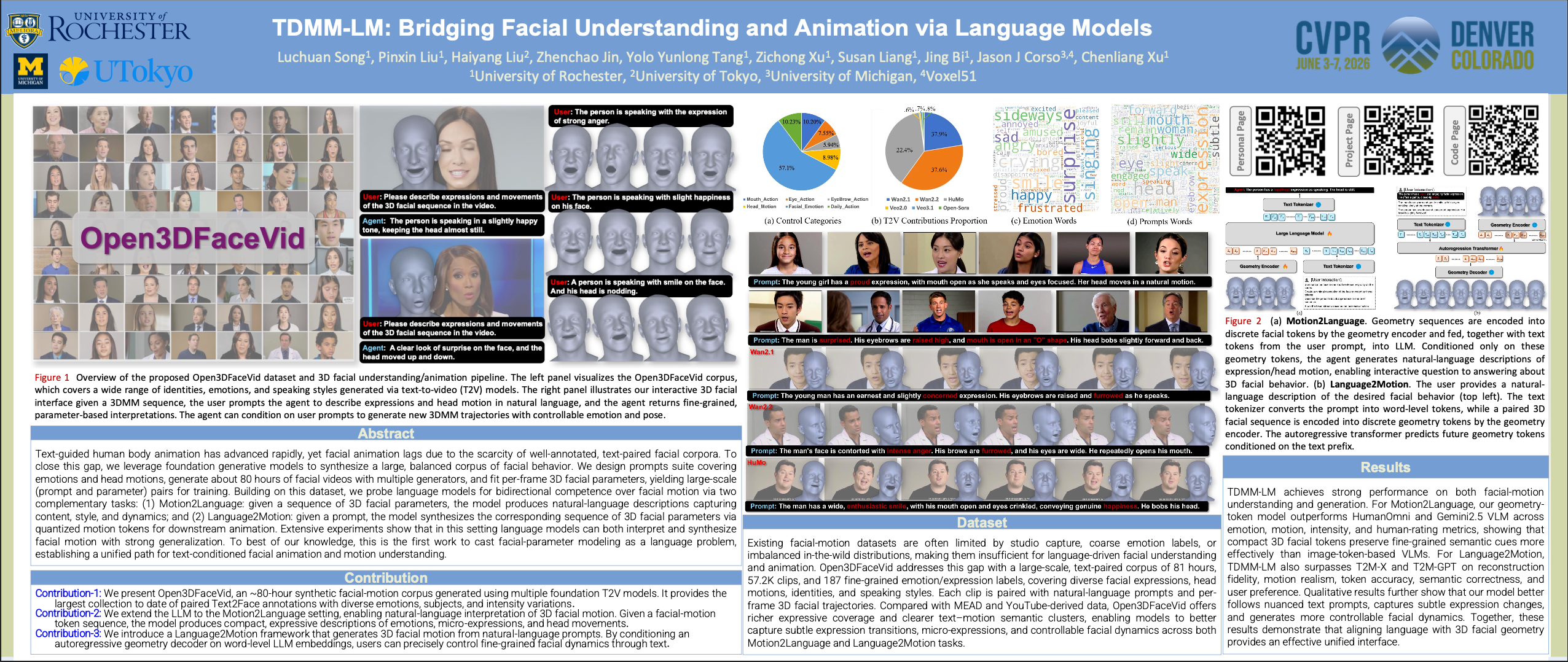
Text-guided human body animation has advanced rapidly, yet facial animation lags due to the scarcity of well-annotated, text-paired facial corpora. To close this gap, we leverage foundation generative models to synthesize a large, balanced corpus of facial behavior. We design prompts suite covering emotions and head motions, generate about 80 hours of facial videos with multiple generators, and fit per-frame 3D facial parameters, yielding large-scale (prompt and parameter) pairs for training. Building on this dataset, we probe language models for bidirectional competence over facial motion via two complementary tasks: (1) Motion2Language: given a sequence of 3D facial parameters, the model produces natural-language descriptions capturing content, style, and dynamics; and (2) Language2Motion: given a prompt, the model synthesizes the corresponding sequence of 3D facial parameters via quantized motion tokens for downstream animation. Extensive experiments show that in this setting language models can both interpret and synthesize facial motion with strong generalization. To best of our knowledge, this is the first work to cast facial-parameter modeling as a language problem, establishing a unified path for text-conditioned facial animation and motion understanding.
AR²-4FV: Anchored Referring and Re-identification for Long-Term Grounding in Fixed-View Videos
Teng Yan ⋅ Yihan Liu ⋅ Jiongxu Chen ⋅ Teng Wang ⋅ Jiaqi LI ⋅ Bingzhuo Zhong
Long-term language-guided referring in fixed-view videos is challenging: the referent may be occluded or leave the scene for long intervals and later re-enter, while framewise referring pipelines drift as re-identification (ReID) becomes unreliable. AR²-4FV leverages background stability for long-term referring. An offline Anchor Bank is distilled from static background structures; at inference, the text query is aligned with this bank to produce an Anchor Map that serves as persistent semantic memory when the referent is absent. An anchor-based re-entry prior accelerates re-capture upon return, and a lightweight ReID-Gating mechanism maintains identity continuity using displacement cues in the anchor frame. The system predicts per-frame bounding boxes without assuming the target is visible in the first frame or explicitly modeling appearance variations. AR²-4FV achieves +10.3% Re-Capture Rate (RCR) improvement and –24.2% Re-Capture Latency (RCL) reduction over the best baseline, and ablation studies further confirm the benefits of the Anchor Map, re-entry prior, and ReID-Gating.
CVA: Context-aware Video-text Alignment for Video Temporal Grounding
Sungho Moon ⋅ Seunghun Lee ⋅ Jiwan Seo ⋅ Sunghoon Im
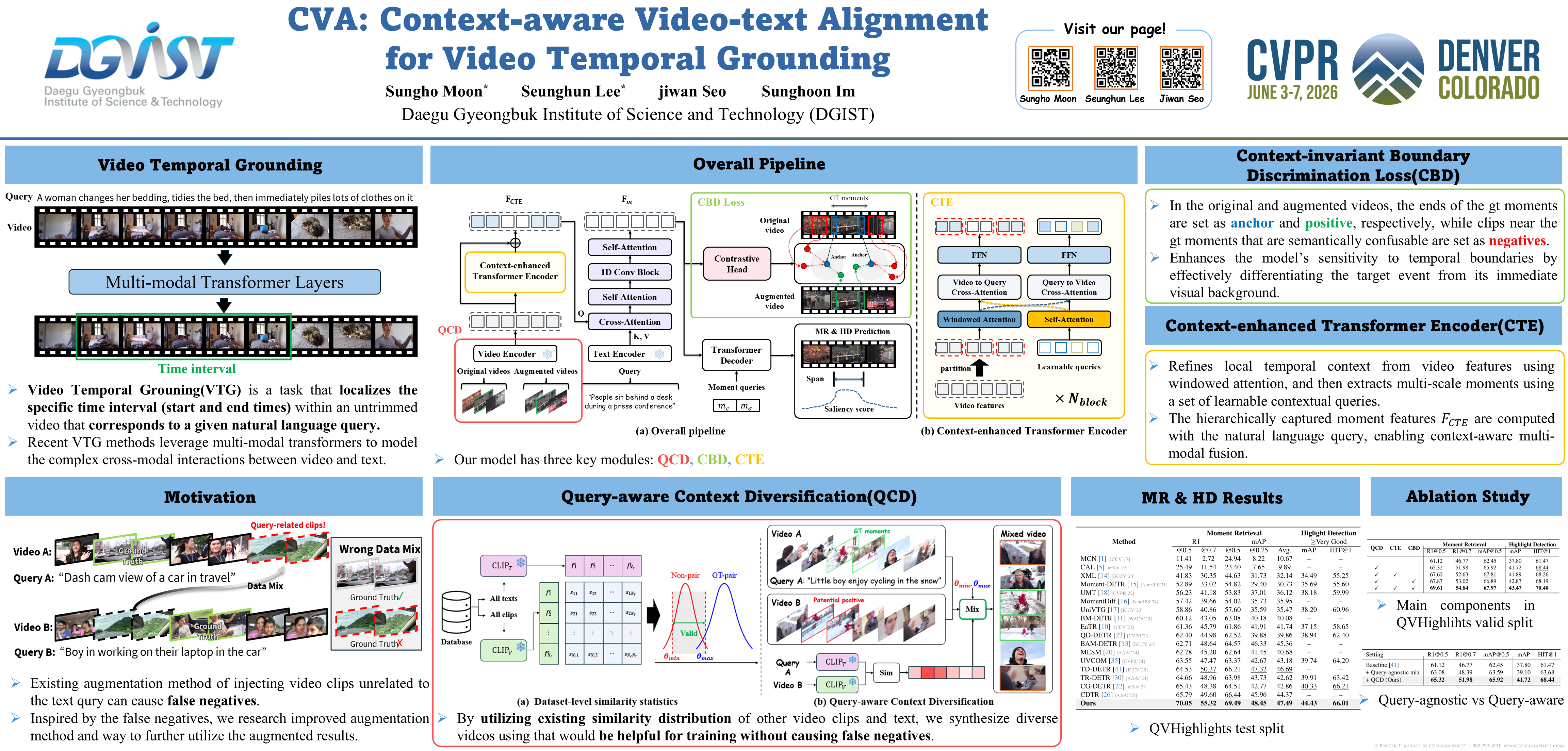
We propose Context-aware Video-text Alignment (CVA), a novel framework to address a significant challenge in video temporal grounding: achieving temporally sensitive video-text alignment that remains robust to irrelevant background context. %CVA integrates complementary data-centric and architectural innovations to enhance contextual robustness. Our framework is built on three key components. First, we propose Query-aware Context Diversification (QCD), a new data augmentation strategy that ensures only semantically unrelated content is mixed in. It builds a video-text similarity-based pool of replacement clips to simulate diverse contexts while preventing the false negative caused by query-agnostic mixing. Second, we introduce the Context-invariant Boundary Discrimination (CBD) loss, a contrastive loss that enforces semantic consistency at challenging temporal boundaries, making their representations robust to contextual shifts and hard negatives. Third, we introduce the Context-enhanced Transformer Encoder (CTE), a hierarchical architecture that combines windowed self-attention and bidirectional cross-attention with learnable queries to capture multi-scale temporal context. Through the synergy of these data-centric and architectural enhancements, CVA achieves state-of-the-art performance on major VTG benchmarks, including QVHighlights and Charades-STA. Notably, our method achieves a significant improvement of approximately 5 points in Recall@1 (R1) scores over state-of-the-art methods, highlighting its effectiveness in mitigating false negatives.
OmniGround: A Comprehensive Spatio-Temporal Grounding Benchmark for Real-World Complex Scenarios
Hong Gao ⋅ Jingyu Wu ⋅ Xiangkai Xu ⋅ Kangni Xie ⋅ Yunchen Zhang ⋅ Bin Zhong ⋅ Xurui Gao ⋅ Min-Ling Zhang
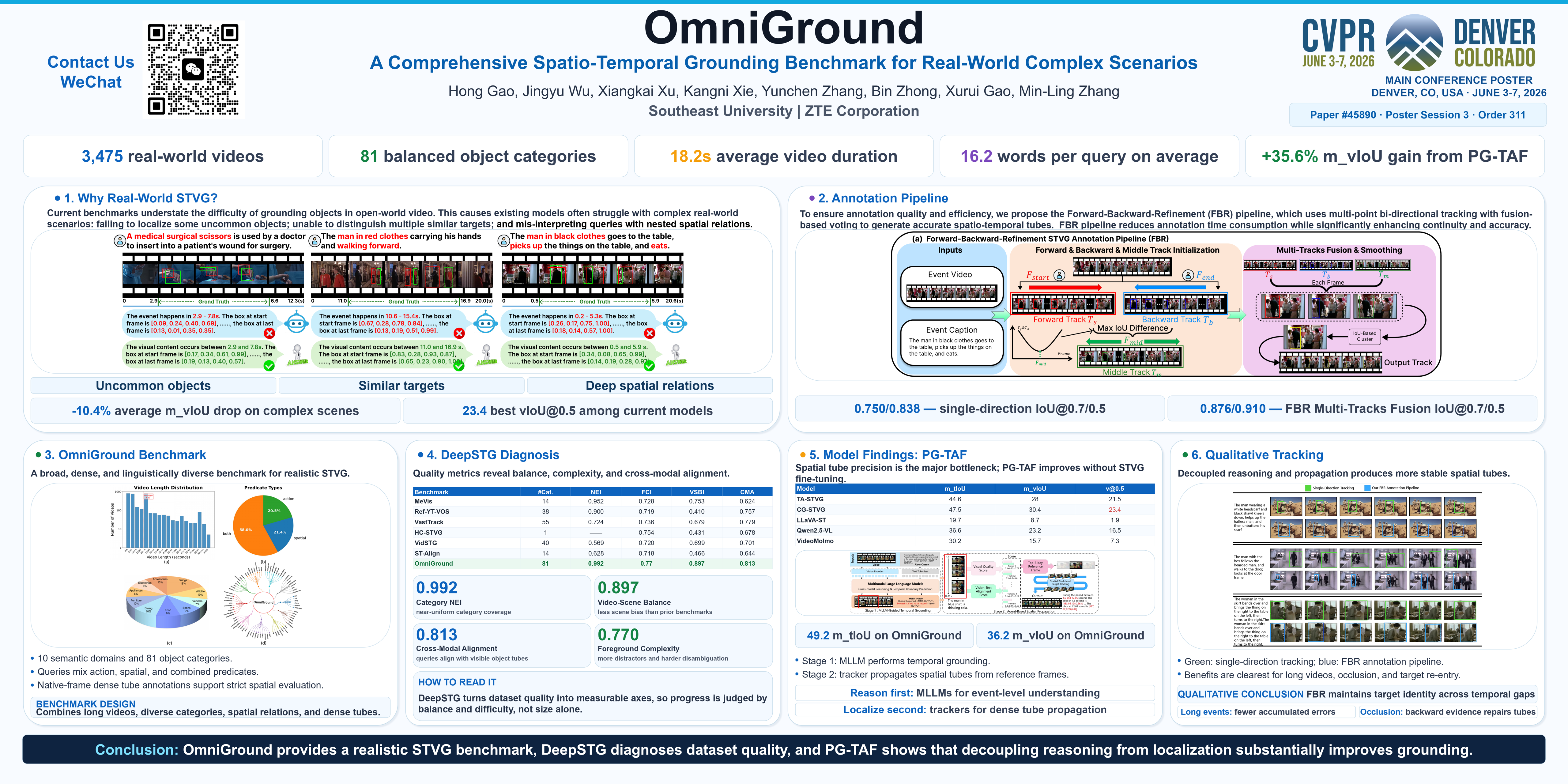
Spatio-Temporal Video Grounding (STVG) aims to localize target objects in videos based on natural language descriptions. While Multimodal Large Language Models have shown promise, a significant gap remains between current models and real-world demands involving diverse objects and complex queries. We attribute this to limited benchmark scope, causing models to exhibit category bias, oversimplified reasoning, and poor linguistic robustness.To address these limitations, we introduce OmniGround, a comprehensive benchmark with 3,475 videos spanning 81 categories and complex real-world queries. We propose the Forward-Backward-Refinement (FBR) annotation pipeline for high-quality labels and DeepSTG, a systematic evaluation framework quantifying dataset quality beyond superficial statistics.Evaluations reveal performance average drops of 10.4% on complex real-world scenes, particularly with small/occluded objects and intricate spatial relations. Motivated by these, we propose PG-TAF, a training-free two-stage framework decomposing STVG into high-level temporal grounding and fine-grained spatio-temporal propagation. Experiments demonstrate PG-TAF achieves 25.6% and 35.6% improvements in m_tIoU and m_vIoU on OmniGround with consistent gains across four benchmarks.
ST4R-Splat: Spatio-Temporal Referring Segmentation in 4D Gaussian Splatting
Yuming Meng ⋅ Dong Wu ⋅ Hongbin Zha
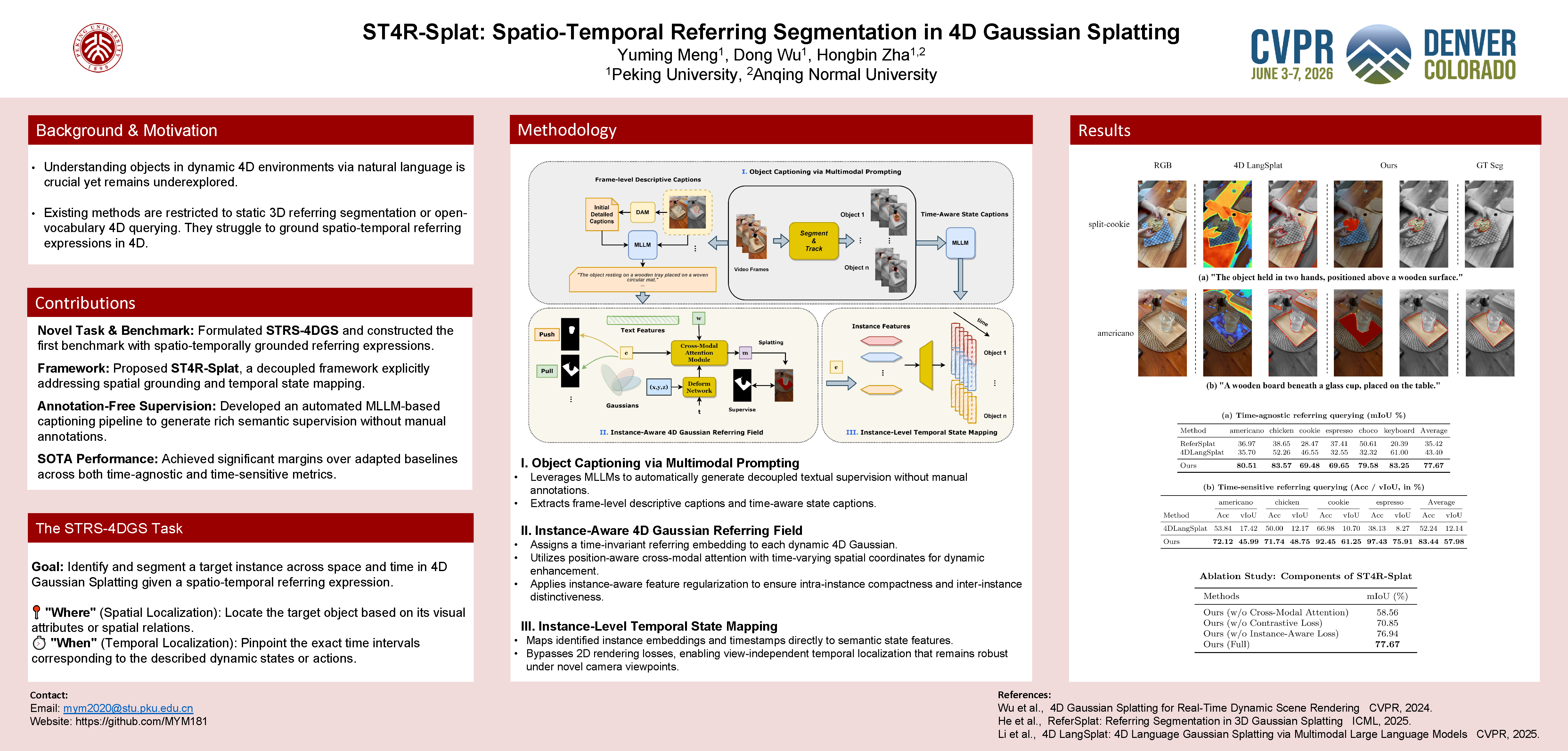
Understanding and segmenting objects in dynamic 4D environments from natural language is crucial yet underexplored. Existing works either perform referring segmentation in static 3D scenes or build open-vocabulary 4D language fields, but none of them supports grounding complex spatio-temporal referring descriptions in explicit 4D reconstructions. Based on 4D Gaussian Splatting(4DGS), We formalize this missing setting as Spatio-Temporal Referring Segmentation in 4D Gaussian Splatting (STRS-4DGS): given a 4DGS representation of a dynamic scene and a referring expression, the goal is to identify the target object and segment it across both space and time, resolving where the described instance is and when it exhibits the queried state. To tackle this challenge, we propose ST4R-Splat, the first framework for STRS-4DGS. ST4R-Splat builds on deformable 4D Gaussians and introduces an Instance-Aware 4D Referring Field that assigns each Gaussian a time-invariant embedding, enabling robust instance-level grounding for both time-agnostic and time-sensitive referring queries. On top of this, an Instance-level Temporal State Mapping module models a view-independent mapping from instance identity and time to semantic states directly in feature space. To obtain rich supervision without manual annotation, we design a task-adaptive captioning pipeline that uses multimodal large language models to generate complementary frame-level descriptive captions and time-aware state captions for each object. We construct a new benchmark on dynamic 4D reconstructions with spatio-temporally grounded referring expressions and adapt state-of-the-art 3D/4D language grounding methods as baselines.Extensive experiments show that ST4R-Splat significantly outperforms baselines on both spatial (time-agnostic) and temporal (time-sensitive) metrics, establishing a strong foundation for fine-grained, language-driven understanding of dynamic 4D scenes.
WeMMU: Enhanced Bridging of Vision-Language Models and Diffusion Models via Noisy Query Tokens
Jian Yang ⋅ Dacheng Yin ⋅ Xiaoxuan He ⋅ Yong Li ⋅ Fengyun Rao ⋅ Jing LYU ⋅ Wei Zhai ⋅ Yang Cao ⋅ Zheng-Jun Zha
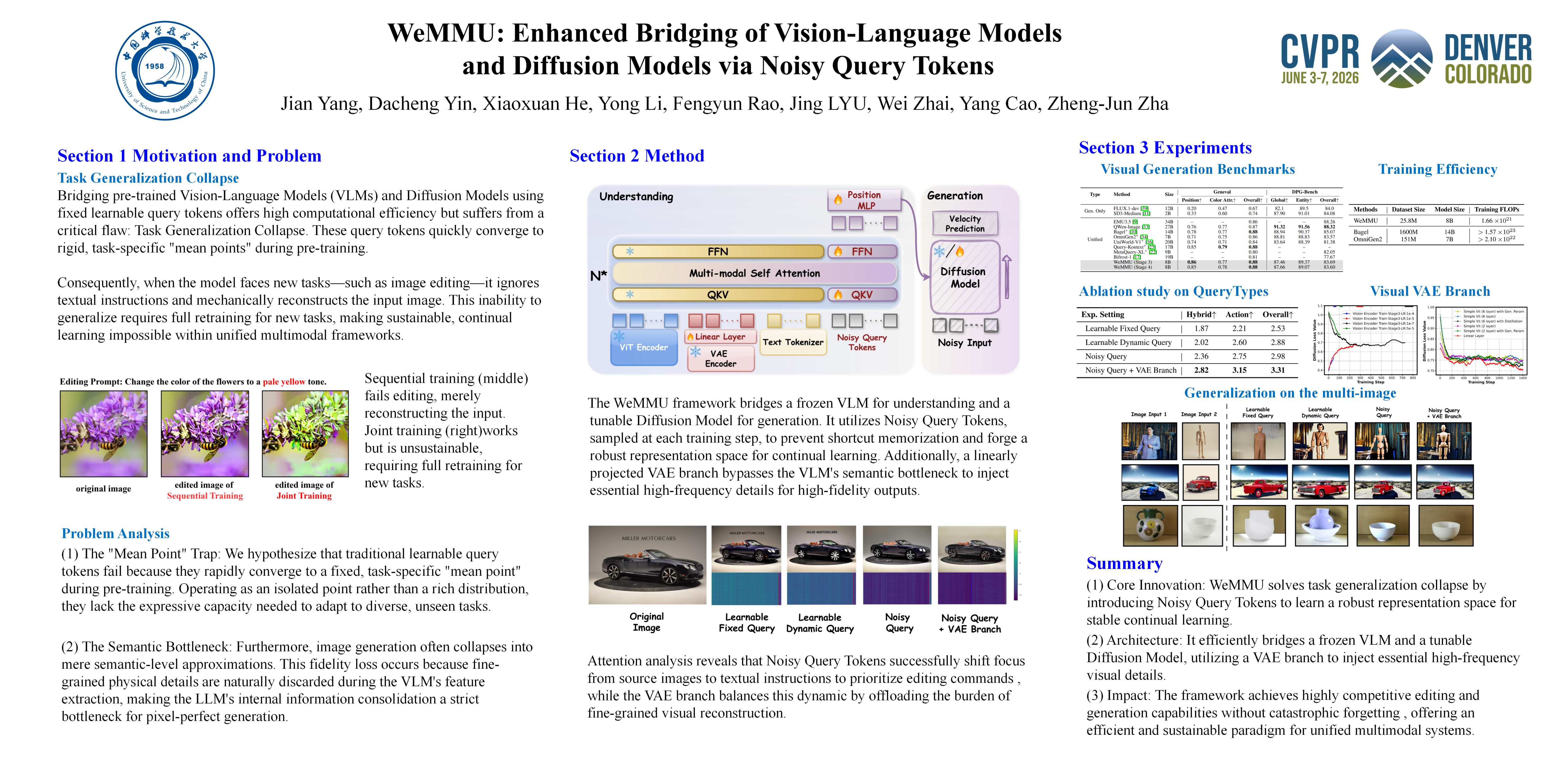
Recent progress in multimodal large language models (MLLMs) has highlighted the challenge of efficiently bridging pre-trained Vision-Language Models (VLMs) with Diffusion Models. While methods using a fixed number of learnable query tokens offer computational efficiency, they suffer from task generalization collapse, failing to adapt to new tasks that are distant from their pre-training tasks. To overcome this, we propose Noisy Query Tokens, which learn a distributed representation space between the VLM and Diffusion Model via end-to-end optimization, enhancing continual learning. Additionally, we introduce a VAE branch with linear projection to recover fine-grained image details. Experimental results confirm our approach mitigates generalization collapse and enables stable continual learning across diverse tasks.
Rejection Mixing: Fast Semantic Propagation of Mask Tokens for Efficient DLLM Inference
Yushi Ye ⋅ Feng Hong ⋅ Huangjie Zheng ⋅ Xu Chen ⋅ Zhiyong Chen ⋅ Yanfeng Wang ⋅ Jiangchao Yao
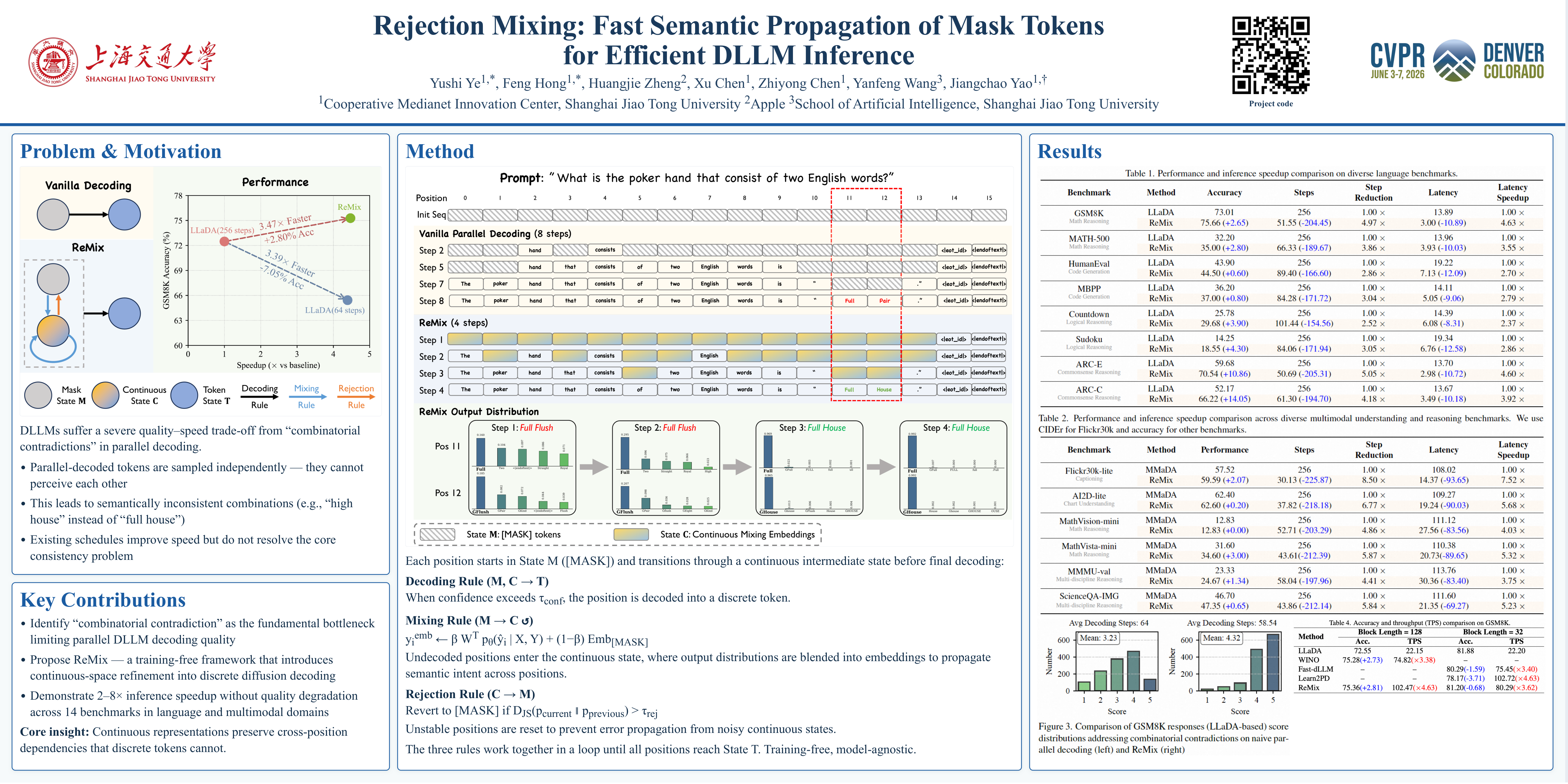
Diffusion Large Language Models (DLLMs) promise fast non-autoregressive inference but suffer a severe quality and speed tradeoff in parallel decoding. This stems from the "combinatorial contradiction" phenomenon, where parallel tokens form semantically inconsistent combinations. We address this by integrating continuous representations into the discrete decoding process, as they preserve rich inter-position dependency. We propose ReMix (Rejection Mixing), a framework that introduces a novel Continuous Mixing State as an intermediate between the initial masked state and the final decoded token state. This intermediate state allows a token's representation to be iteratively refined in a continuous space, resolving mutual conflicts with other tokens before collapsing into a final discrete sample. Furthermore, a rejection rule reverts uncertain representations from the continuous state back to the masked state for reprocessing, ensuring stability and preventing error propagation.ReMix thus mitigates combinatorial contradictions by enabling continuous-space refinement during discrete diffusion decoding. Extensive experiments demonstrate that ReMix, as a training-free method, achieves a 2-8$\times$ inference speedup without any quality degradation.
Towards Unified Human Perception and Machine Understanding: Token Flow Guided Compression Framework
Li Xu ⋅ YingFu Zhang ⋅ Kepeng Xu ⋅ Gang He ⋅ Yunsong Li
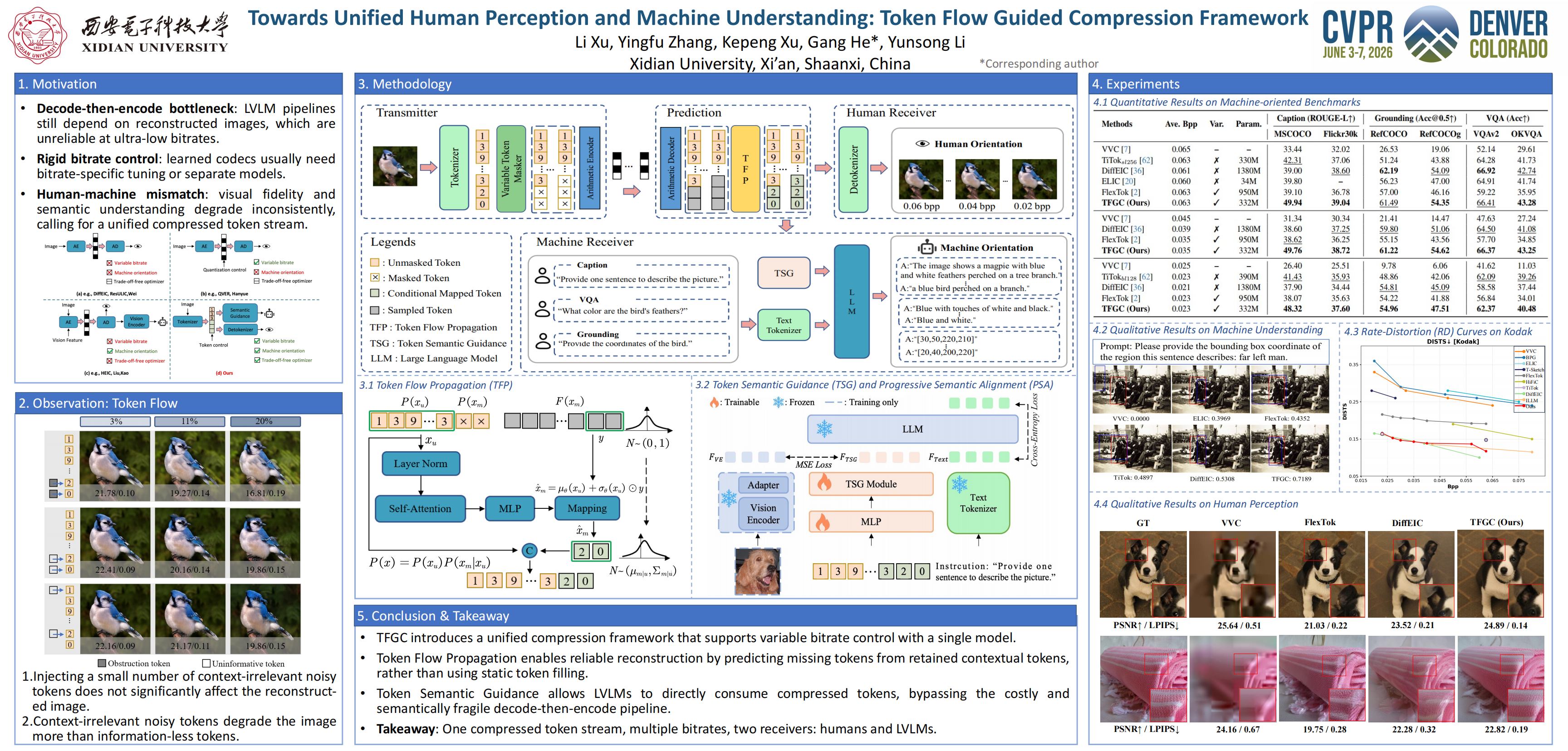
With the rapid rise of Large Vision Language Models (LVLMs) for image understanding, the objective of image compression is gradually shifting from human visual perception to machine-oriented semantic understanding. However, conventional learned compression techniques are optimized for pixel-level fidelity and typically operate at fixed or rigid bitrate points, misaligned with the semantic consistency and flexible bitrate control. This gap becomes critical in ultra-low-bitrate regimes, where latent representations often ignore semantic relevance and struggle to disentangle meaningful content from redundant visual details as the bitrate varies. To address these challenges, we develop a token-based flexible compression framework, Token Flow Guided Compression (TFGC), which unifies human- and machine-oriented objectives. TFGC supports variable bitrate control in ultra-low bitrate regimes and enables LVLMs to directly process compressed token without image reconstruction. Specifically, we explore token flow phenomenon in 1D token sequences and exploit it to design token flow propagation, which predicts missing tokens by propagating contextual information from unmasked tokens. Moreover, token semantic guidance aligns compressed representations with LVLM semantic space, while a progressive semantic alignment training strategy further bridges the gap between perceptual reconstruction and semantic reasoning. Experiments show that our framework achieves state-of-the-art LVLMs understanding at comparable bitrates while maintaining satisfactory perceptual quality.
A More Word-like Image Tokenization for MLLMs
Hyun Lee ⋅ Hyemin Jeong ⋅ Yejin Kim ⋅ Hyungwook Choi ⋅ Hyunsoo Cho ⋅ Soo Kyung Kim ⋅ Joonseok Lee
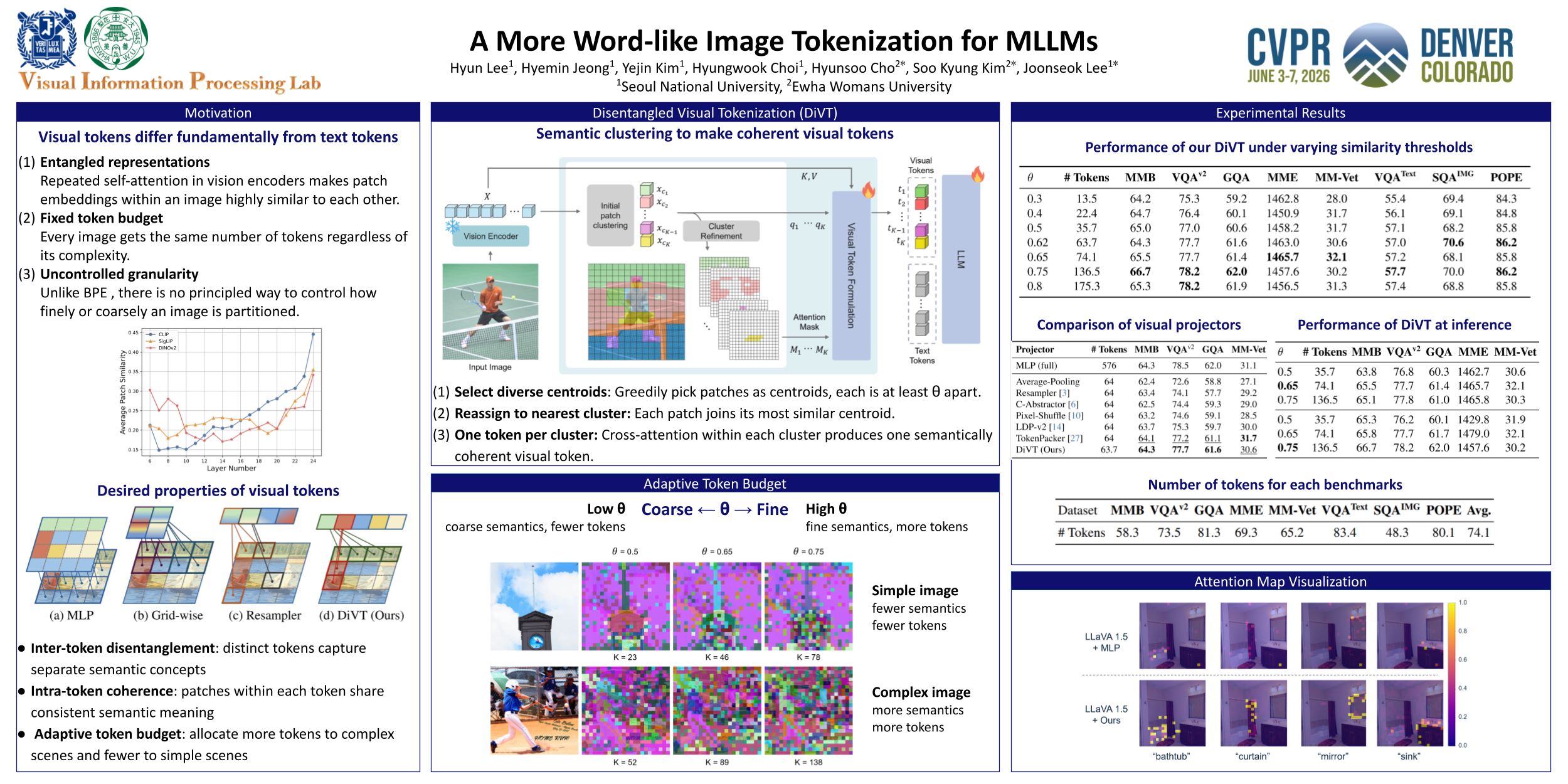
Modern multimodal large language models (MLLMs) typically keep the language model fixed and train a visual projector that maps the pixels into a sequence of tokens in its embedding space, so that images can be presented in essentially the same form as text. However, the language model has been optimized to operate on discrete, semantically meaningful tokens, while prevailing visual projectors transform an images into a long stream of continuous and highly correlated embeddings. This causes the visual tokens to behave differently from the word-like units that LLMs are originally trained to understand. We propose a novel Disentangled Visual Tokenization (DiVT) that clusters patch embeddings into coherent semantic units, so each token corresponds to a distinct visual concept instead of a rigid grid cell. DiVT further adapts its token budget to image complexity, providing an explicit accuracy compute trade-off modifying neither the vision encoder nor the language model. Across diverse multimodal benchmarks, DiVT matches or surpasses standard LLaVA 1.5 using only about 11% of the original visual tokens, substantially reducing memory and latency and making visual inputs more compatible with LLM-based reasoning.
DUET-VLM: Dual stage Unified Efficient Token reduction for VLM Training and Inference
Aditya Kumar Singh ⋅ Hitesh Kandala ⋅ Pratik Prabhanjan Brahma ⋅ Zicheng Liu ⋅ Emad Barsoum

Vision-language models (VLMs) have achieved remarkable multimodal understanding and reasoning capabilities, yet remain computationally expensive due to dense visual tokenization. Existing efficiency approaches either merge redundant visual tokens or drop them progressively in language backbone,often trading accuracy for speed. In this work, we propose *DUET-VLM*, a versatile plug-and-play dual compression framework that consists of (a) vision-only redundancy aware compression of vision encoder's output into information-preserving tokens,followed by(b) layer-wise, salient text-guided dropping of visual tokens within the language backbone to progressively prune less informative tokens.This coordinated token management enables aggressive compression while retaining critical semantics. On *LLaVA-1.5-7B*, our approach maintains over 99\% of baseline accuracy with 67\% fewer tokens $\downarrow$, and still retains $>$97\% even at 89\% $\downarrow$ reduction. With this dual-stage compression during training, it achieves 99.7\% accuracy at 67\% $\downarrow$ and 97.6\% at 89\% $\downarrow$, surpassing prior SoTA visual token reduction methods across multiple benchmarks.When integrated into *Video-LLaVA-7B*, it even surpasses the baseline–achieving $>$*100\%* $\uparrow$ accuracy with a substantial 53.1\% $\downarrow$ token reduction, and retaining *97.6\%* accuracy under an extreme *93.4\%* $\downarrow$ setting.These results highlight end-to-end training with DUET-VLM, enabling robust adaptation to reduced visual (image/video) input without sacrificing accuracy, producing compact yet semantically rich representations within the same computational budget.
Unified Spatiotemporal Token Compression for Video-LLMs at Ultra-Low Retention
Junhao Du ⋅ XUE JIALONG ⋅ Anqi Li ⋅ Jincheng Dai ⋅ Guo Lu
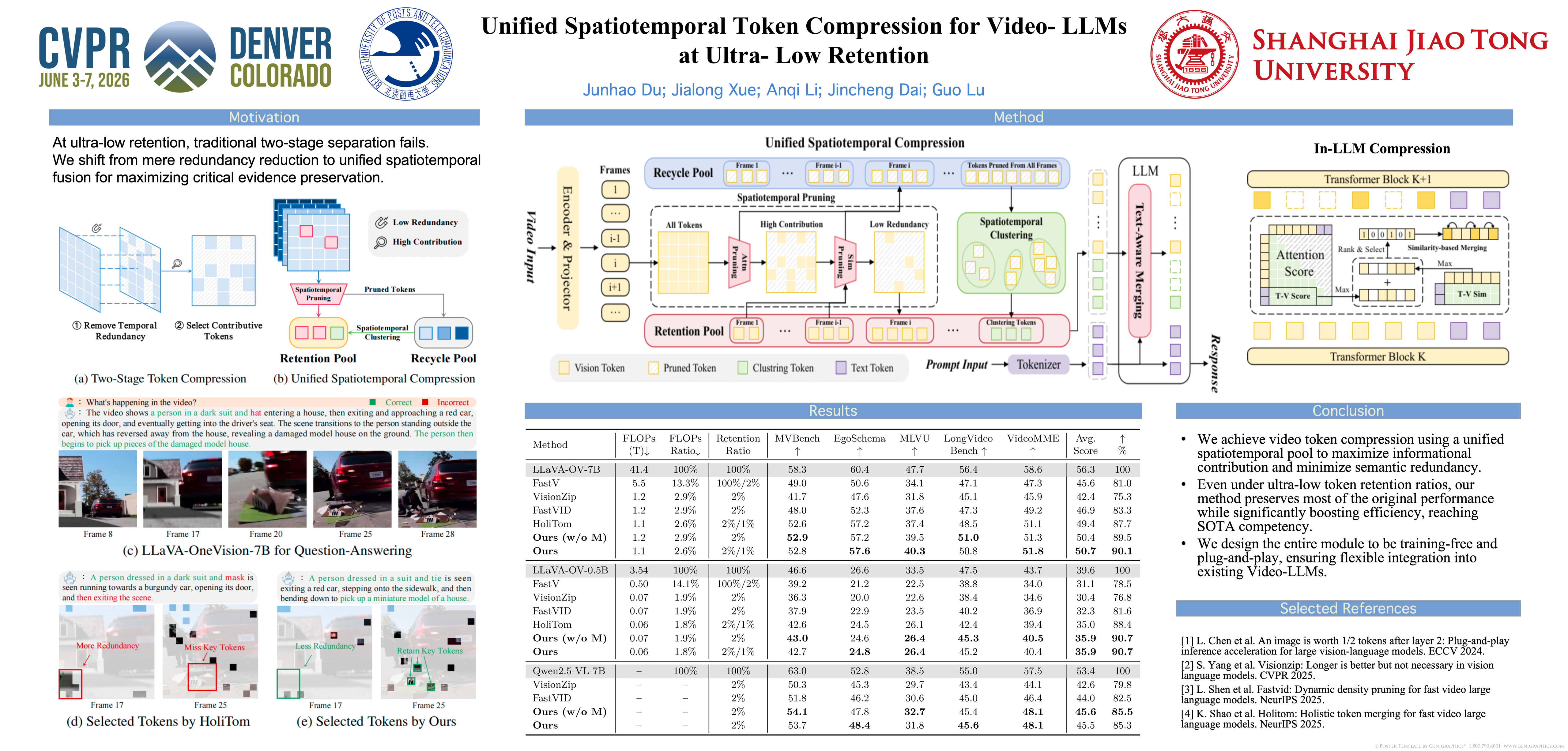
Video large language models (Video-LLMs) face high computational costs due to large volumes of visual tokens. Existing token compression methods typically adopt a two-stage spatiotemporal compression strategy, relying on stage-specific metrics and an implicit assumption of spatiotemporal separability. Under extremely low retention ratios, however, such approaches often result in unbalanced allocation and loss of visual evidence essential for question answering. We reformulate token compression as a spatiotemporal allocation task within a global token retention pool. We propose a unified selection mechanism that integrates attention weights and semantic similarity to globally select tokens with high contribution and low redundancy. Unselected tokens are merged via clustering and refilled, preserving information integrity. Inside the LLM, we further introduce text-aware merging to perform secondary compression based on query relevance. Without requiring retraining, our method serves as a plug-and-play module compatible with existing Video-LLMs. Experiments show that retaining only about 2\% of visual tokens preserves 90.1\% of baseline performance across multiple benchmarks, while reducing FLOPs to roughly 2.6\%. These benefits generalize across diverse backbones, decreasing end-to-end inference latency and memory consumption. Our unified spatiotemporal token compression strategy establishes the state-of-the-art in video understanding under ultra-low token retention.
One Layer’s Trash is Another Layer’s Treasure: Adaptive Layer-wise Visual Token Selection in LVLMs
Yongru Chen ⋅ Kai Zhang ⋅ Zeliang Zong ⋅ Yuchen Lu ⋅ Wenming Tan ⋅ Ye Ren ⋅ Jilin Hu
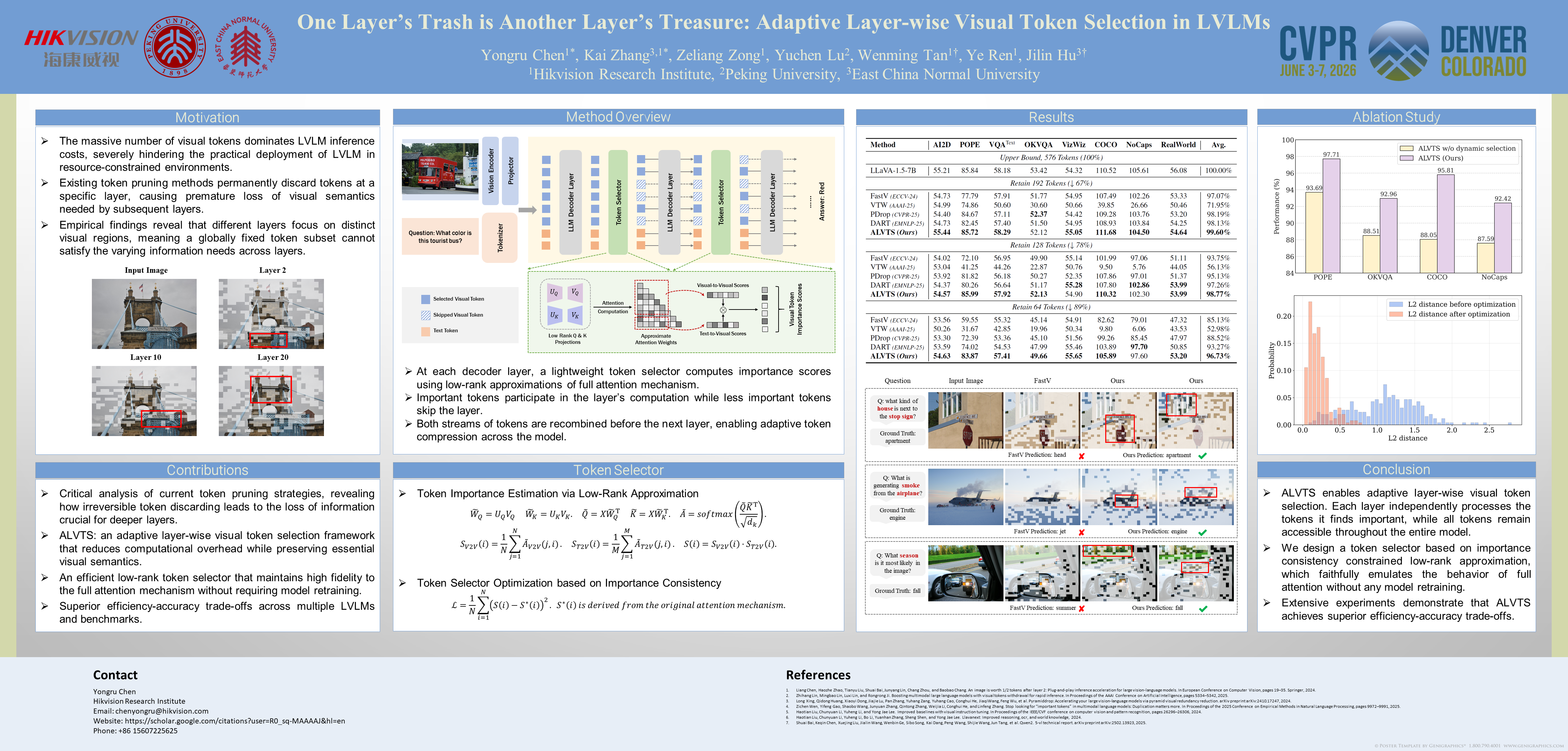
Large Vision-Language Models (LVLMs) have achieved remarkable success across diverse multimodal tasks, yet their practical deployment remains constrained by the computational burden arising from lengthy visual tokens. While visual token pruning has emerged as a promising solution, existing methods suffer from a fundamental limitation: once tokens are pruned at a specific layer, they become inaccessible to all subsequent layers, leading to premature information loss that can compromise model performance. Through empirical studies, we observe that different layers exhibit distinct visual region focus, indicating a varying optimal token subset across layers. Motivated by this insight, we propose Adaptive Layer-wise Visual Token Selection (ALVTS), a novel framework that breaks away from the conventional static token pruning paradigm. ALVTS incorporates a lightweight token selector to identify and route important tokens for further processing, while allowing less important tokens to skip the layer, thus minimizing computational redundancy. These two streams of tokens are seamlessly reintegrated before being fed into subsequent layers, facilitating adaptive compression across the entire model. Grounded in our importance consistency constrained low-rank approximation, the proposed token selection module closely emulates the full attention mechanism, effectively capturing its essential patterns without requiring model retraining. Extensive experiments on LLaVA-1.5, LLaVA-NeXT, and Qwen2.5-VL validate the effectiveness of our method. With an 89% token compression ratio, ALVTS retains 96.7% of the original model's accuracy, achieving a superior efficiency-accuracy trade-off for LVLM inference.
OmniZip: Audio-Guided Dynamic Token Compression for Fast Omnimodal Large Language Models
Keda Tao ⋅ Kele Shao ⋅ Bohan Yu ⋅ Weiqiang Wang ⋅ Jian liu ⋅ Huan Wang
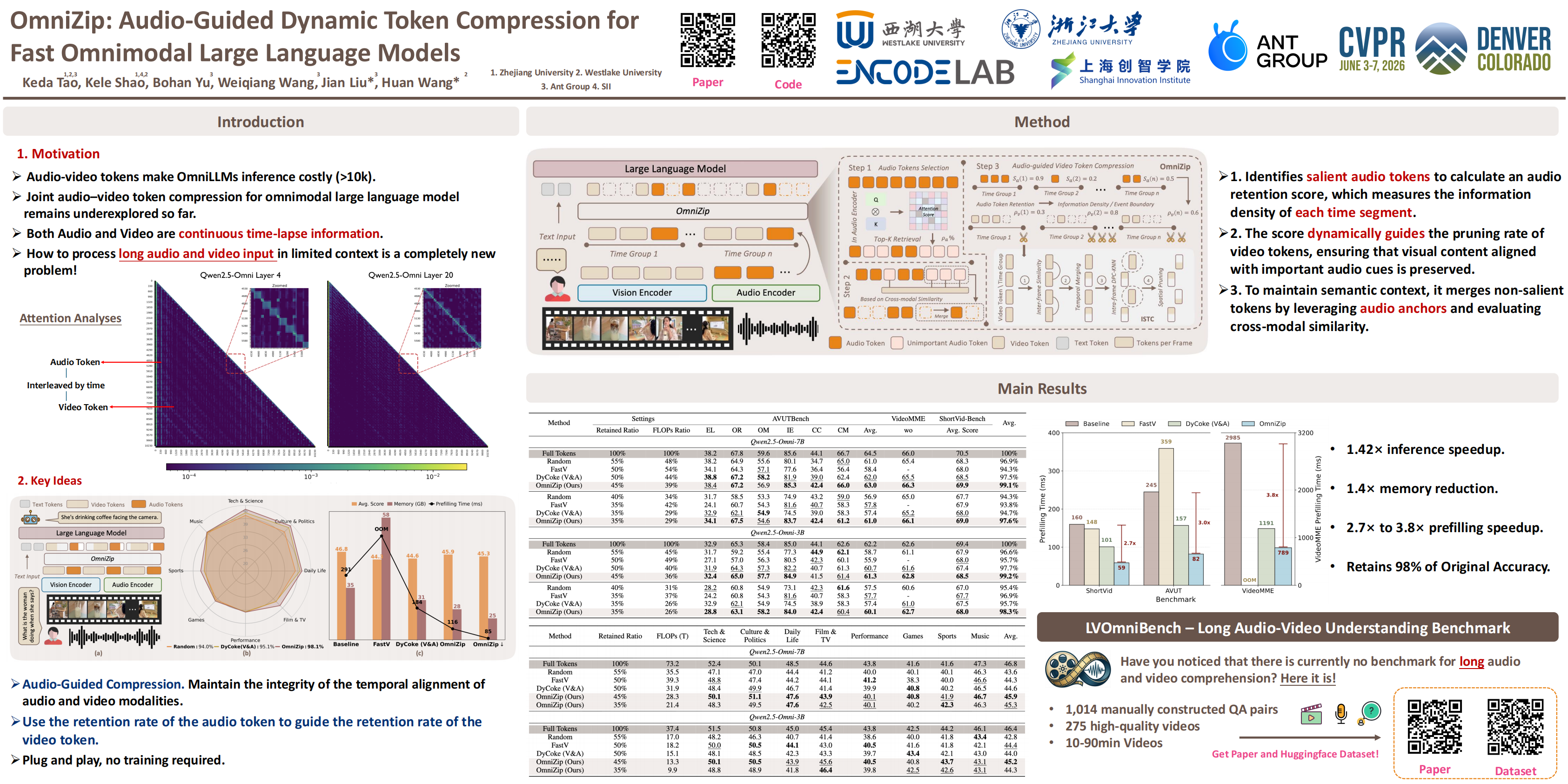
Omnimodal large language models (OmniLLMs) have attracted increasing research attention of late towards unified audio-video understanding, wherein processing audio-video token sequences creates a significant computational bottleneck, however. Existing token compression methods have yet to accommodate this emerging need of jointly compressing multimodal tokens. To bridge this gap, we present OmniZip, a training-free, audio-guided audio-visual token-compression framework that optimizes multimodal token representation and accelerates inference. Specifically, OmniZip first identifies salient audio tokens, then computes an audio retention score for each time group to capture information density, thereby dynamically guiding video token pruning and preserving cues from audio anchors enhanced by cross-modal similarity. For each time window, OmniZip compresses the video tokens using an interleaved spatio-temporal scheme. Extensive empirical results demonstrate the merits of OmniZip - it achieves 3.42$\times$ inference speedup and $1.4\times$ memory reduction over other top-performing counterparts, while maintaining performance with no training.
Tunable Soft Equivariance with Guarantees
Md Ashiqur Rahman ⋅ Lim Jun Hao ⋅ Jeremiah Jiang ⋅ Teck-Yian Lim ⋅ Raymond A. Yeh
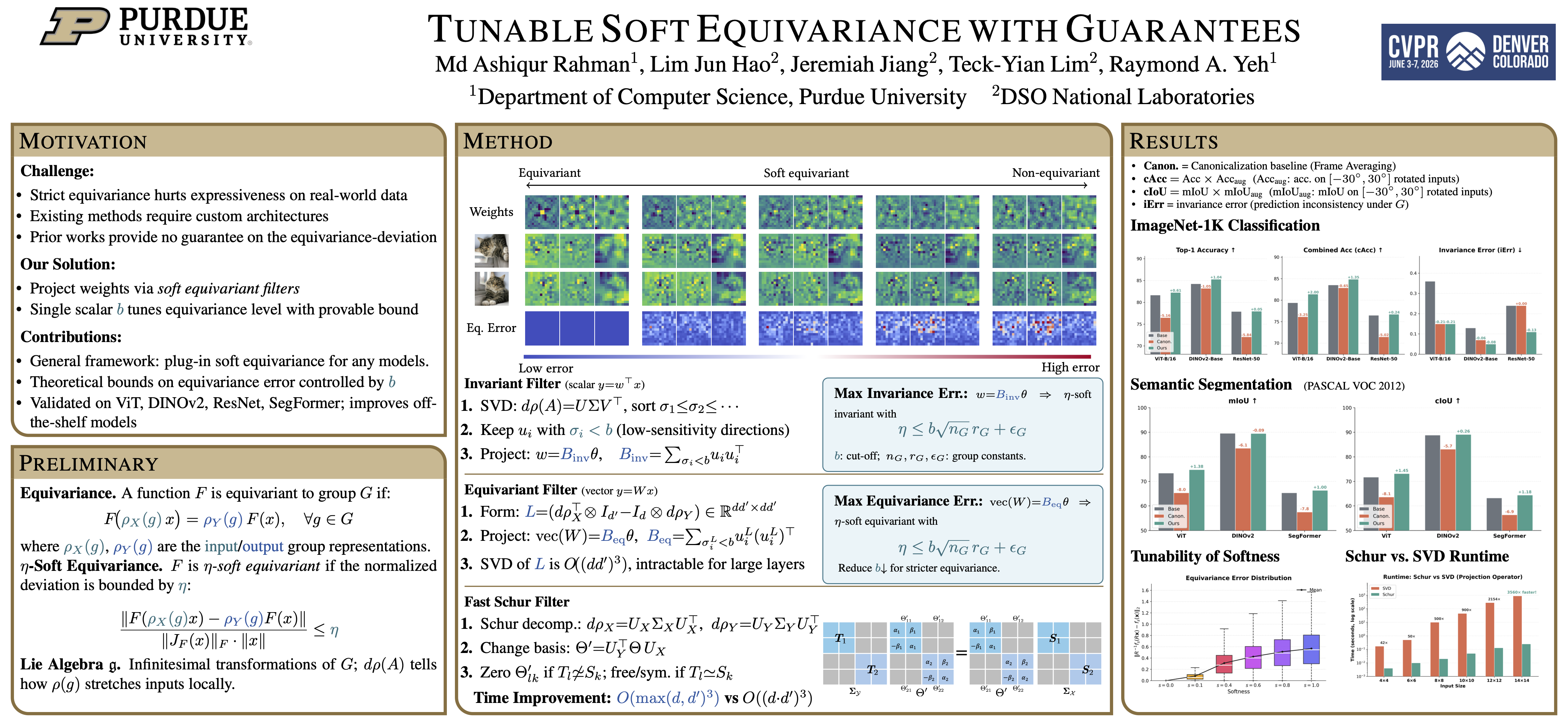
Equivariance is a fundamental property in computer vision models, yet strict equivariance is rarely satisfied in real-world data, which can limit a model’s performance. Controlling the degree of equivariance is therefore desirable. We propose a general framework for constructing soft equivariant models by projecting the model weights into a designed subspace. The method applies to any pre-trained architecture and provides theoretical bounds on the induced equivariance error. Empirically, we demonstrate the effectiveness of our method on multiple pre-trained backbones, including ViT and ResNet, across image classification, semantic segmentation, and human-trajectory prediction tasks. Notably, our approach improves the performance while simultaneously reducing equivariance error on the competitive ImageNet benchmark.
Semi-Supervised Conformal Prediction With Unlabeled Nonconformity Score
Xuanning Zhou ⋅ Zihao Shi ⋅ Hao Zeng ⋅ Xiaobo Xia ⋅ Bingyi Jing ⋅ Hongxin Wei
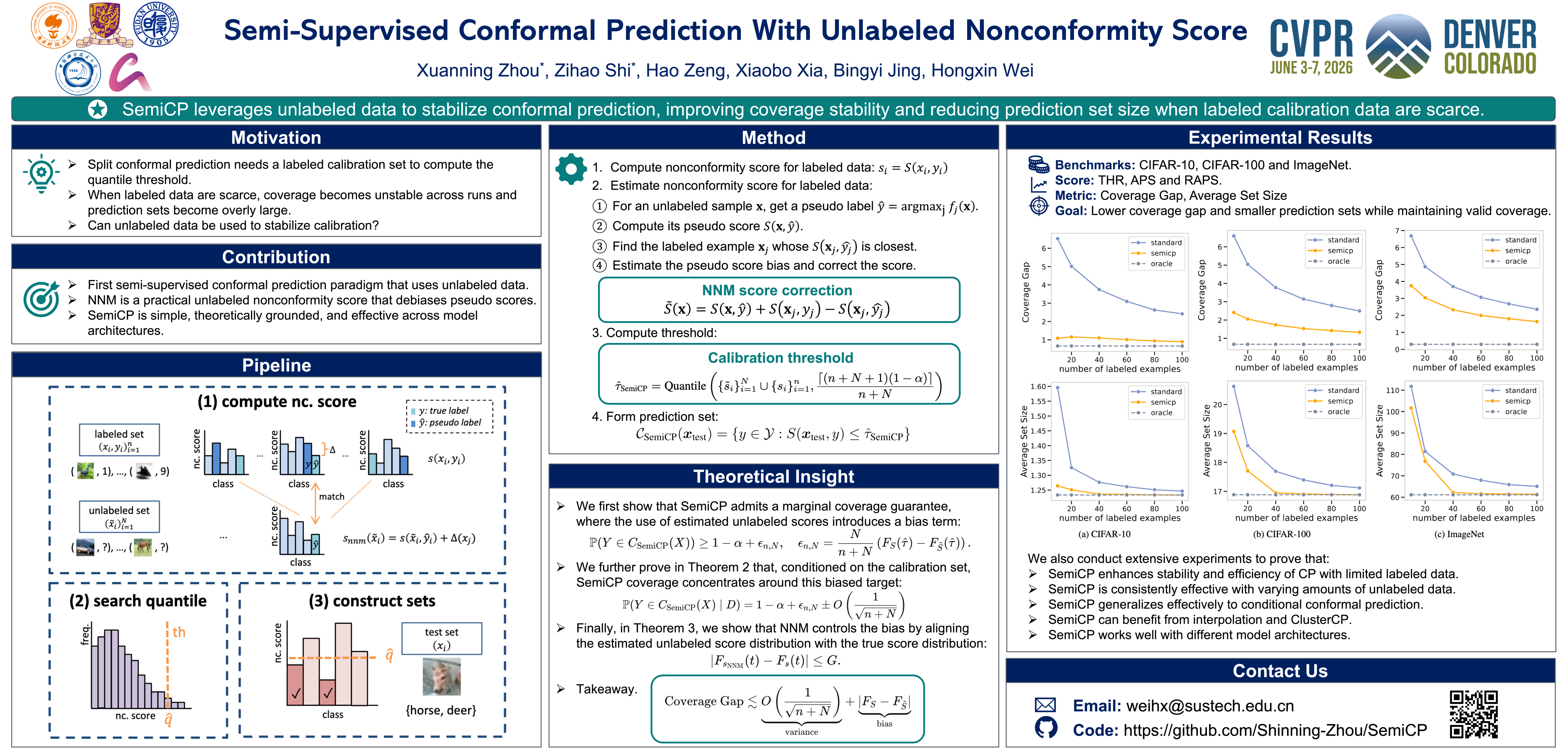
Conformal prediction (CP) is a powerful framework for uncertainty quantification, generating prediction sets with coverage guarantees. Split conformal prediction relies on labeled data in the calibration procedure. However, the labeled data is often limited in real-world scenarios, leading to unstable coverage performance in different runs. To address this issue, we extend CP to the semi-supervised setting and propose SemiCP, a new paradigm that leverages both labeled and unlabeled data for calibration. To achieve this, we introduce an unlabeled nonconformity score, Nearest Neighbor Matching (NNM) score. Specifically, NNM estimates the nonconformity scores of unlabeled samples using their most similar pseudo-labeled counterparts during calibration, while maintaining the original scores for labeled data. Theoretically, we demonstrate that the average coverage gap (i.e., the absolute difference between the empirical marginal coverage and the target coverage) of SemiCP can decrease significantly at a rate $\mathcal{O}\bigl(1/N\bigr)$, where $N$ is the number of unlabeled data. Extensive experiments validate the effectiveness of SemiCP under limited labeled data, reducing the average coverage gap by up to 77\% on common benchmarks with 4000 unlabeled examples, when there are only 20 labeled examples.
Cluster-aware Anchor Learning for Multi-View Clustering
Zhe Chen ⋅ Fanhui Meng ⋅ Tianyang Xu ⋅ Xiao-Jun Wu
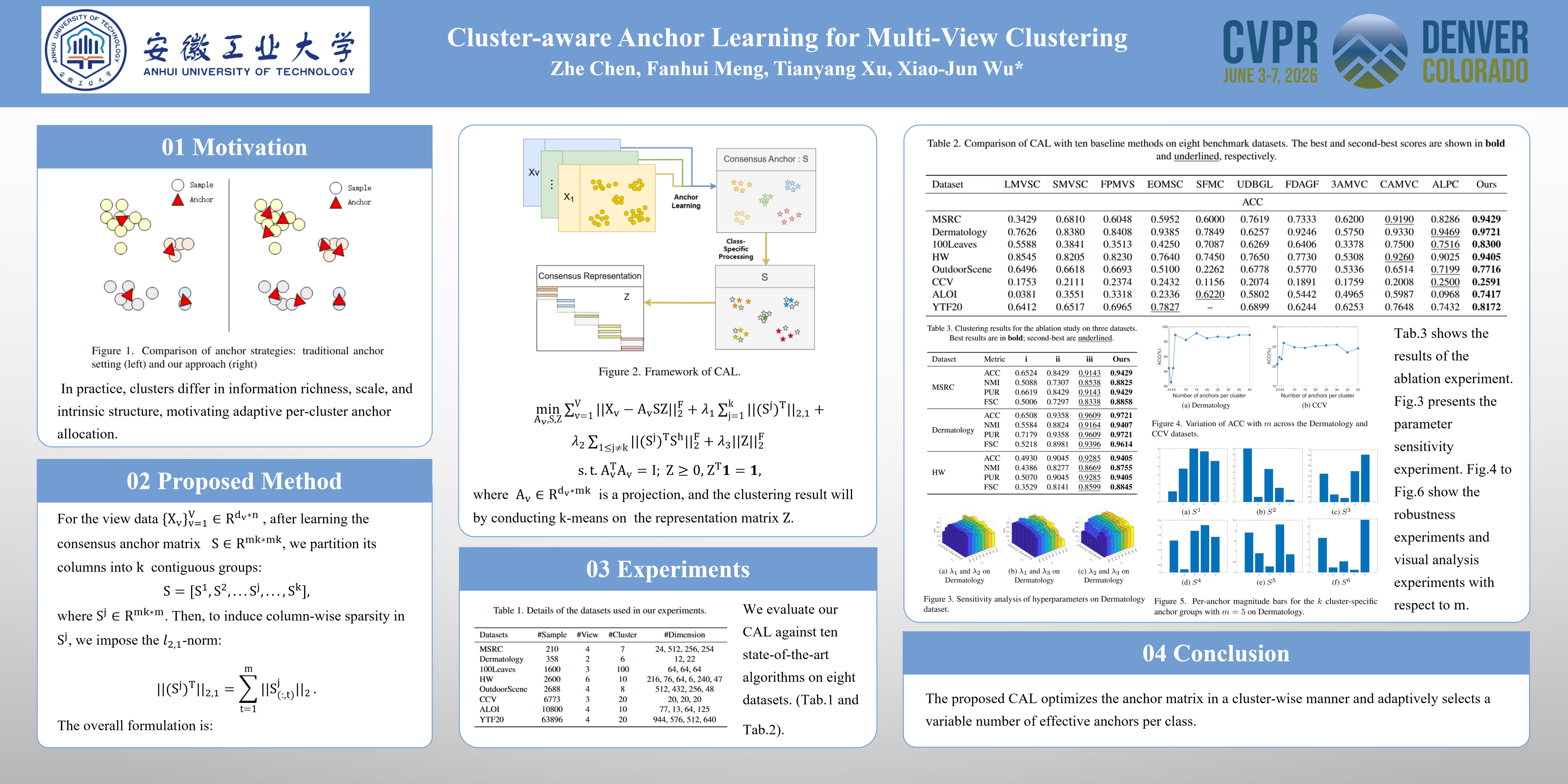
Anchor-based multi-view clustering is attractive for its efficiency, yet most methods fix the number of anchors a priori, implicitly assuming uniform needs across clusters. In practice, clusters differ in information richness, scale, and intrinsic structure, motivating adaptive per-cluster anchor allocation. We propose Cluster-aware Anchor Learning (CAL), which learns a consensus anchor matrix and organizes its columns into cluster-specific anchor groups. CAL imposes an $\ell_{2,1}$-norm column-sparsity penalty on each group to suppress redundancy and preserve cluster-discriminative features, thereby automatically determining how many anchors each cluster retains. To further enhance separability, CAL introduces an inter-cluster regularization that constrains relationships among groups, promoting mutual dissimilarity. This data-driven design learns higher-quality, cluster-aware anchors and yields a more discriminative representation matrix across multiple views. Extensive experiments on multiple benchmarks show that CAL outperforms state-of-the-art multi-view clustering methods, demonstrating superior effectiveness, robustness, and adaptability to heterogeneous cluster structures.
Revisiting Sparsity Constraint Under High-Rank Property in Partial Multi-Label Learning
Chongjie Si ⋅ Yidan Cui ⋅ Fuchao Yang ⋅ Wei Shen
Partial Multi-Label Learning (PML) extends the multi-label learning paradigm to scenarios where each sample is associated with a candidate label set containing both ground-truth labels and noisy labels. Existing PML methods commonly rely on two assumptions: sparsity of the noise label matrix and low-rankness of the ground-truth label matrix. However, these assumptions are inherently conflicting and impractical for real-world scenarios, where the true label matrix is typically full-rank or close to full-rank. To address these limitations, we demonstrate that the sparsity constraint contributes to the high-rank property of the predicted label matrix. Based on this, we propose a novel method Schirn, which introduces a sparsity constraint on the noise label matrix while enforcing a high-rank property on the predicted label matrix. Extensive experiments demonstrate the superior performance of Schirn compared to state-of-the-art methods, validating its effectiveness in tackling real-world PML challenges.
Weight Space Representation Learning via Neural Field Adaptation
Zhuoqian Yang ⋅ Mathieu Salzmann ⋅ Sabine Süsstrunk
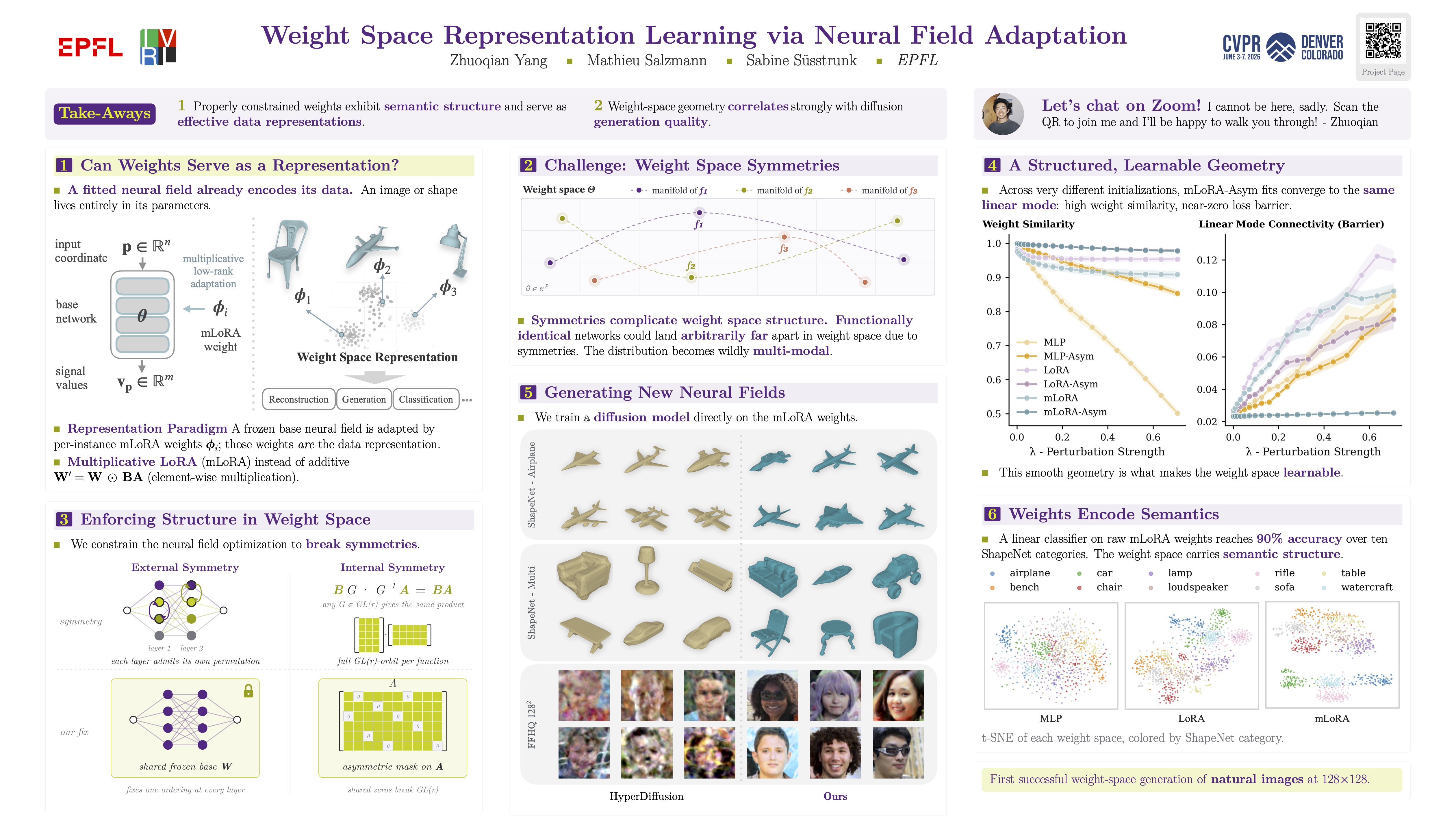
In this work, we investigate the potential of weights to serve as effective representations, focusing on neural fields. Our key insight is that constraining the optimization space through a pre-trained base model and multiplicative low-rank adaptation (mLoRA) can induce structure in weight space. Across reconstruction, generation, and analysis tasks on 2D and 3D data, we find that mLoRA weights achieve high representation quality while exhibiting distinctiveness and semantic structure. When used with latent diffusion models, mLoRA weights enable higher-quality generation than existing weight-space methods. Source code will be made publicly available.
Recurrent Video Masked Autoencoders
Daniel Zoran ⋅ Nikhil Parthasarathy ⋅ Yi Yang ⋅ Drew A Hudson ⋅ Joao Carreira ⋅ Andrew Zisserman
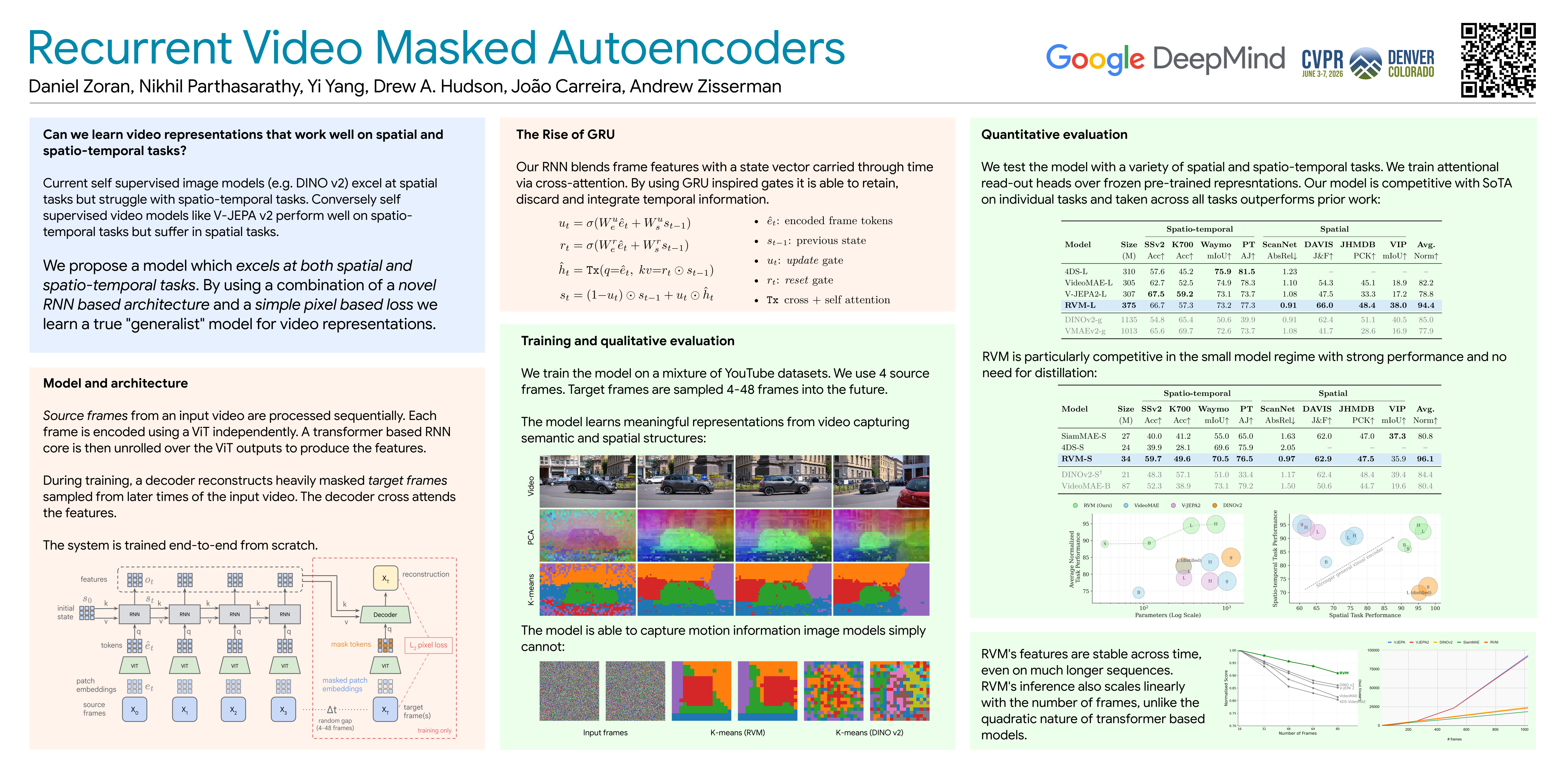
We present Recurrent Video Masked-Autoencoders (RVM): a novel approach to video representation learning that leverages recurrent computation to model the temporal structure of video data. RVM couples an asymmetric masking objective with a transformer-based recurrent neural network to aggregate information over time, training solely on a simple pixel reconstruction loss. This design yields a highly efficient "generalist" encoder: RVM achieves competitive performance with state-of-the-art video models (e.g. VideoMAE, V-JEPA) on video-level tasks like action classification, and point and object tracking, while matching or exceeding the performance of image models (e.g. DINOv2) on tasks that require strong geometric and dense spatial features. Notably, RVM achieves strong performance in the small-model regime without requiring knowledge distillation, exhibiting up to $30\times$ greater parameter efficiency than competing video masked autoencoders. Finally, we demonstrate that \model's recurrent nature allows for stable feature propagation over long temporal horizons with linear computational cost, overcoming some of the limitations of standard spatio-temporal attention-based video models. Ablation studies further highlight the factors driving the model's success, with qualitative results showing that RVM learns rich representations of scene semantics, structure, and motion.
Revisiting Unknowns: Towards Effective and Efficient Open-Set Active Learning
Chen-Chen Zong ⋅ Yu-Qi Chi ⋅ Xie-Yang Wang ⋅ Yan Cui ⋅ Shengjun Huang
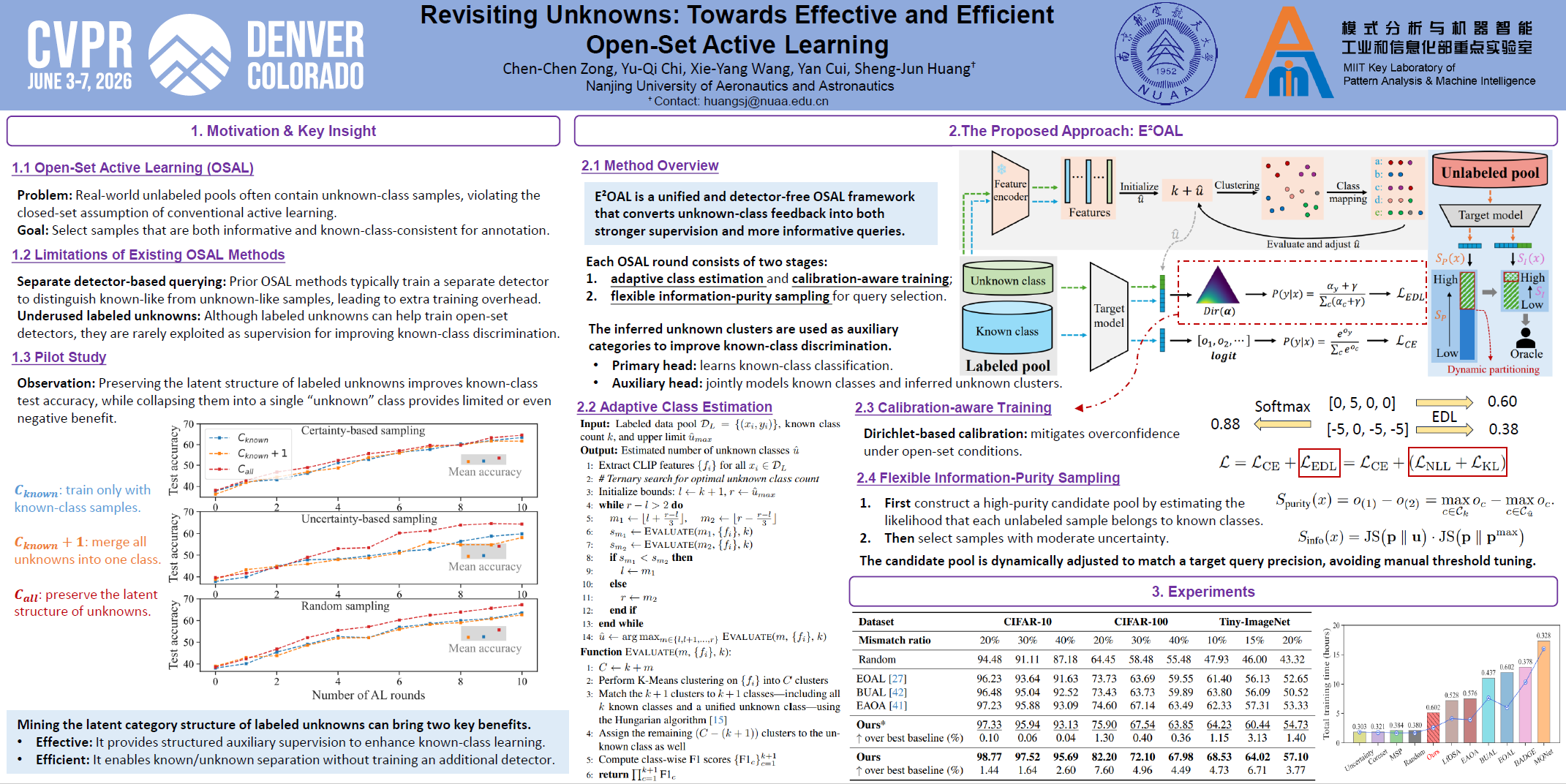
Open-set active learning (OSAL) aims to identify informative samples for annotation when unlabeled data may contain previously unseen classes—a common challenge in safety-critical and open-world scenarios. Existing approaches typically rely on separately trained open-set detectors, introducing substantial training overhead and overlooking the supervisory value of labeled unknowns for improving known-class learning.In this paper, we propose E$^2$OAL (Effective and Efficient Open-set Active Learning), a unified and detector-free framework that fully exploits labeled unknowns for both stronger supervision and more reliable querying. E$^2$OAL first uncovers the latent class structure of unknowns through label-guided clustering in a frozen contrastively pre-trained feature space, optimized by a structure-aware F1-product objective. To leverage labeled unknowns, it employs a Dirichlet-calibrated auxiliary head that jointly models known and unknown categories, improving both confidence calibration and known-class discrimination. Building on this, a logit-margin purity score estimates the likelihood of known classes to construct a high-purity candidate pool, while an OSAL-specific informativeness metric prioritizes partially ambiguous yet reliable samples. These components together form a flexible two-stage query strategy with adaptive precision control and minimal hyperparameter sensitivity.Extensive experiments across multiple OSAL benchmarks demonstrate that E$^2$OAL consistently surpasses state-of-the-art methods in accuracy, efficiency, and query precision, highlighting its effectiveness and practicality for real-world applications.
Seeing Through the Shift: Causality-Inspired Robust Generalized Category Discovery
Wei Feng ⋅ Yiwen Jiang ⋅ Sijin Zhou ⋅ Zhuang Qi ⋅ Zhongxing Xu ⋅ Zhonghua Wang ⋅ feilong tang ⋅ Zongyuan Ge
Generalized Category Discovery (GCD) aims to transfer knowledge from known categories to automatically discover new, unseen ones while preserving recognition of the known classes. Despite recent progress, existing GCD approaches typically assume that all data are drawn from the same distribution, which is rarely valid in real-world scenarios. In practice, data often experience simultaneous domain shifts and novel category emergence, causing severe performance degradation of existing systems. To address this challenge, we propose CausalGCD, a causality-inspired framework designed to mitigate domain-shift bias in category discovery. Specifically, we first analyze the causal graph to uncover the relationships among key variables in cross-domain GCD. We then introduce the concept of causal dependency risk and propose a Causal Dependency Risk Estimator to capture causal semantics, further deriving a theoretically computable upper bound to optimize this risk under cross-domain GCD settings. Furthermore, we propose a Causal Geometric Manifold Constraint that enforces invariant manifold-level associations between known and unknown categories across domains, thereby facilitating robust discovery of novel classes. Extensive experiments on the \textbf{SSB-C} and \textbf{DomainNet} benchmarks demonstrate the effectiveness of \textbf{CausalGCD} and highlight the significance of causal reasoning in open-world category discovery.
From Exploration to Exploitation: A Two-Stage Entropy RLVR Approach for Noise-Tolerant MLLM Training
Donglai Xu ⋅ Hongzheng Yang ⋅ Yuzhi Zhao ⋅ Pingping Zhang ⋅ Jinpeng Chen ⋅ Wenao Ma ⋅ Zhijian Hou ⋅ Mengyang Wu ⋅ Xiaolei Li ⋅ Senkang Hu ⋅ Ziyi Guan ⋅ Jason Chun Lok Li ⋅ Lai-Man Po
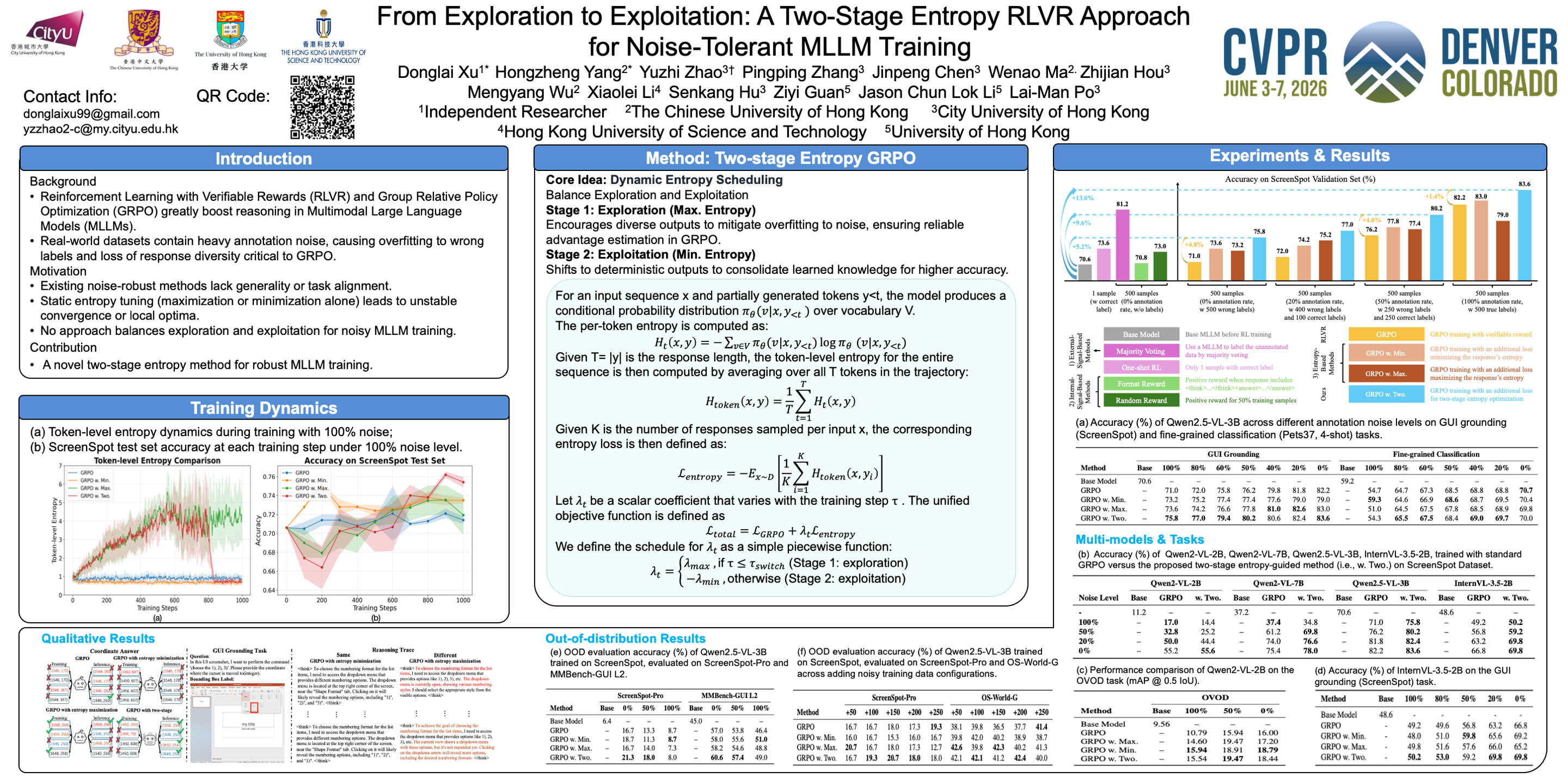
Reinforcement Learning with Verifiable Rewards (RLVR) for Multimodal Large Language Models (MLLMs) is highly dependent on high-quality labeled data, which is often scarce and prone to substantial annotation noise in real-world scenarios. Existing unsupervised RLVR methods, including pure entropy minimization, can overfit to incorrect labels and limit the crucial reward ranking signal for Group-Relative Policy Optimization (GRPO). To address these challenges and enhance noise tolerance, we propose a novel two-stage, token-level entropy optimization method for RLVR. This approach dynamically guides the model from exploration to exploitation during training. In the initial exploration phase, token-level entropy maximization promotes diverse and stochastic output generation, serving as a strong regularizer that prevents premature convergence to noisy labels and ensures sufficient intra-group variation—enabling more reliable reward gradient estimation in GRPO. As training progresses, the method transitions into the exploitation phase, where token-level entropy minimization encourages the model to produce confident and deterministic outputs, thereby consolidating acquired knowledge and refining prediction accuracy. Empirically, across three MLLM backbones-Qwen2-VL-2B, Qwen2-VL-7B, and Qwen2.5-VL-3B—spanning diverse noise settings and multiple tasks, our phased strategy consistently outperforms prior approaches by unifying and enhancing external, internal, and entropy-based methods, delivering robust and superior performance across the board.
Spatial Retrieval Augmented Autonomous Driving
Xiaosong Jia ⋅ Chenhe Zhang ⋅ Yule Jiang ⋅ Songbur Wong ⋅ Zhiyuan Zhang ⋅ chen chen ⋅ Shaofeng Zhang ⋅ Xuanhe Zhou ⋅ Xue Yang ⋅ Junchi Yan ⋅ Yu-Gang Jiang
Existing autonomous driving systems rely on onboard sensors (cameras, LiDAR, IMU, etc) for environmental perception. However, this paradigm is limited by the drive-time perception horizon and often fails under limited view scope, occlusion or extreme conditions such as darkness and rain. In contrast, human drivers are able to recall road structure even under poor visibility. To endow models with this "recall" ability, we propose the spatial retrieval paradigm, introducing offline retrieved geographic images as an additional input. These images are easy to obtain from offline caches (e.g, Google Maps or stored autonomous driving datasets) without requiring additional sensors, making it a plug-and-play extension for existing AD stacks.For experiments, we first extend the nuScenes dataset with geographic images retrieved via Google Maps APIs and align the new data with ego-vehicle trajectories. We establish baselines across five core autonomous driving tasks: object detection, online mapping, occupancy prediction, end-to-end planning, and generative world modeling. Extensive experiments show that the extended modality could enhance the performance of certain tasks. We will open-source dataset curation code, data, and benchmarks for further study of this new autonomous driving paradigm.
Scaling-Aware Data Selection for End-to-End Autonomous Driving Systems
Tolga Dimlioglu ⋅ Nadine Chang ⋅ Maying Shen ⋅ Rafid Mahmood ⋅ Jose M. Alvarez
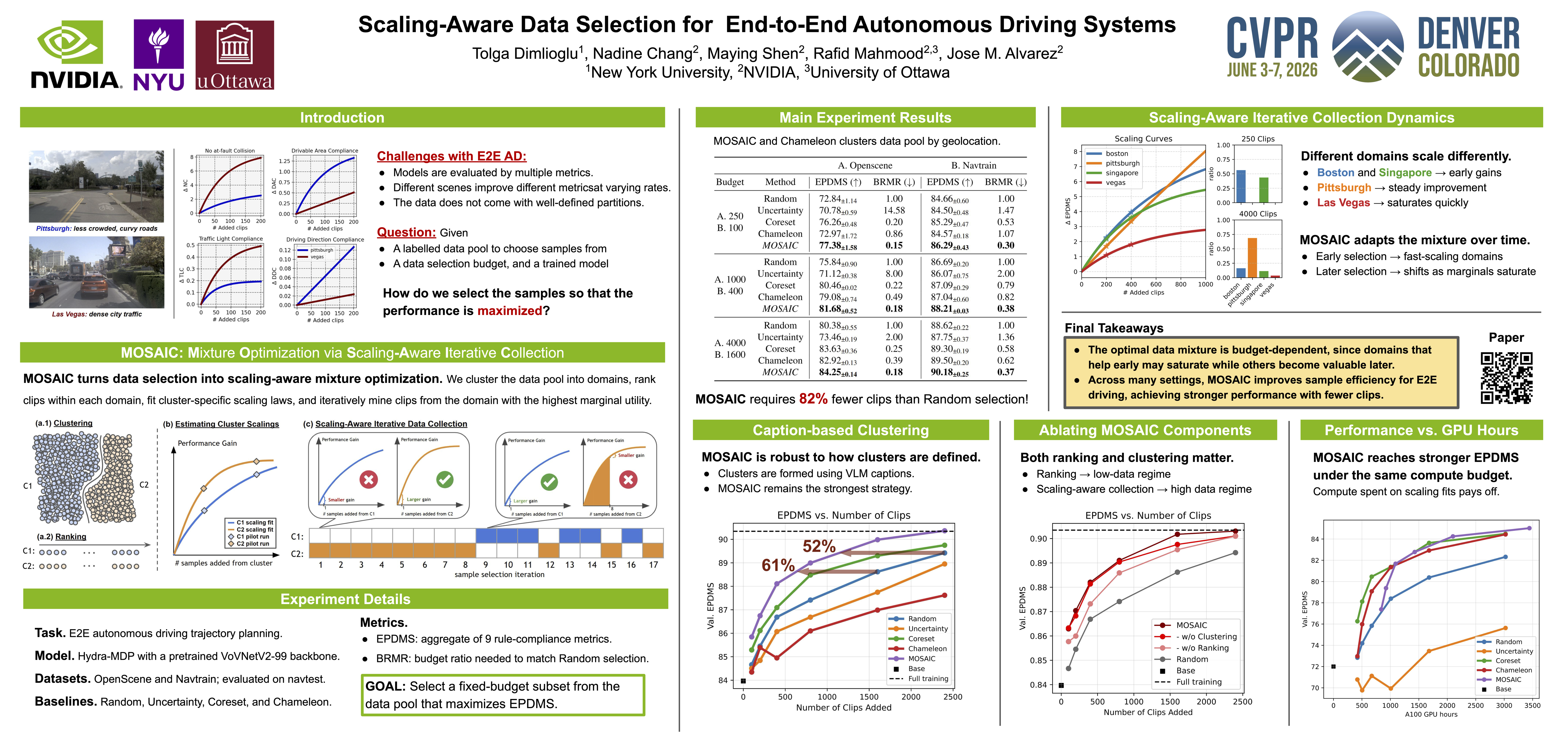
Large-scale deep learning models for physical AI applications depend on diverse training data collection efforts. These models and correspondingly, the training data, must address the different evaluation criteria necessary for the models to be deployable in real-world environments. Data selection policies can guide the development of the training set, but current frameworks do not account for the ambiguity in how data points affect different metrics. In this work, we propose Mixture Optimization via Scaling-Aware Iterative Collection (MOSAIC), a general data selection framework that operates by: (i) partitioning the dataset into domains; (ii) fitting neural scaling laws from each data domain to the evaluation metrics; and (iii) optimizing a data mixture by iteratively adding data from domains that maximize the change in metrics. We apply MOSAIC to autonomous driving (AD), where an End-to-End (E2E) planner model is evaluated on the Extended Predictive Driver Model Score (EPDMS), an aggregate of driving rule compliance metrics. Here, MOSAIC outperforms a diverse set of baselines on EPDMS with up to 80\% less data.
ColaVLA: Leveraging Cognitive Latent Reasoning for Hierarchical Parallel Trajectory Planning in Autonomous Driving
Qihang Peng ⋅ Xuesong Chen ⋅ Chenye Yang ⋅ Shaoshuai Shi ⋅ Hongsheng Li
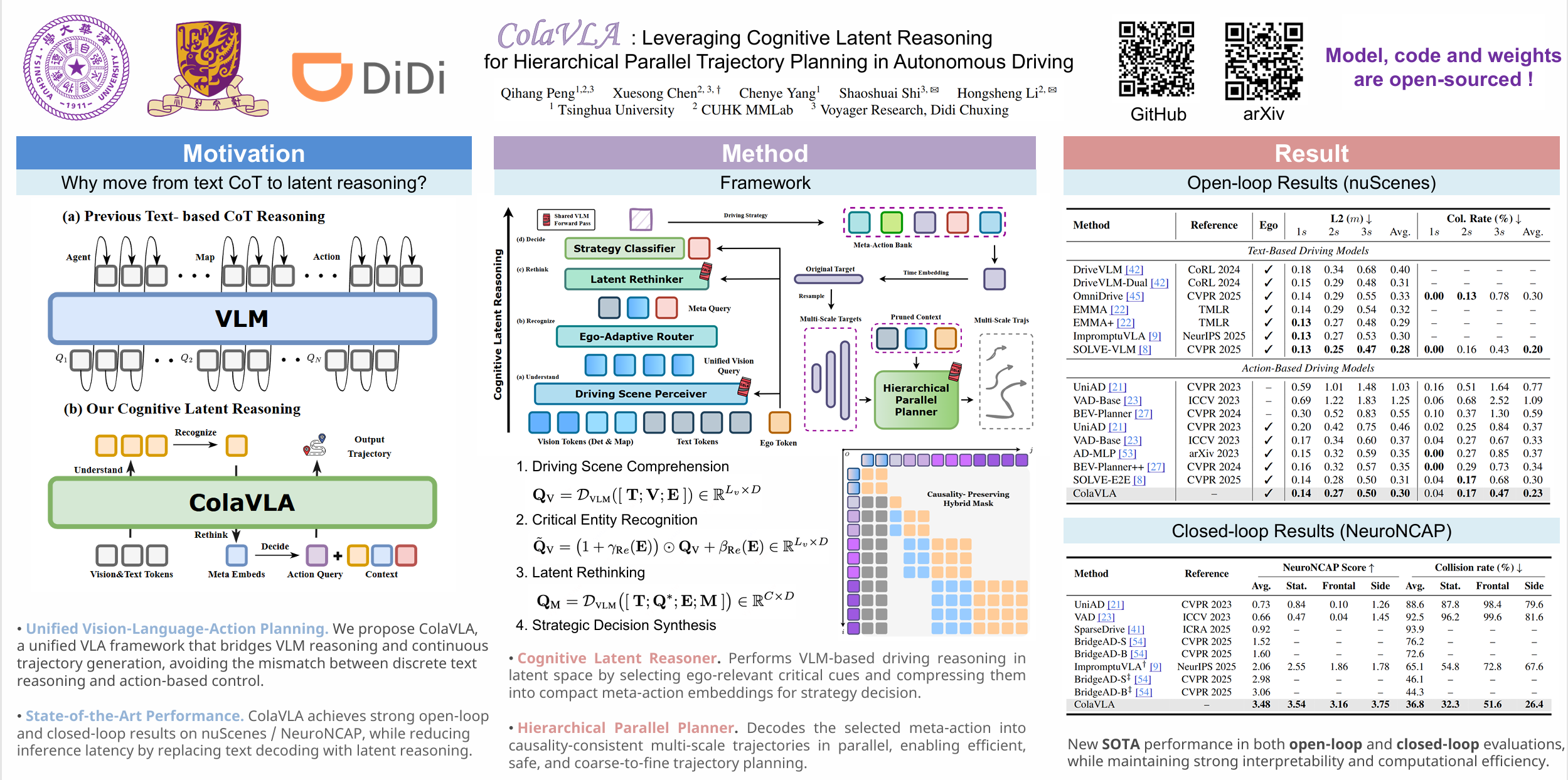
Autonomous driving requires generating safe and reliable trajectories from complex multimodal inputs. Traditional modular pipelines separate perception, prediction, and planning, while recent end-to-end (E2E) systems learn them jointly. Vision–language models (VLMs) further enrich this paradigm by introducing cross-modal priors and commonsense reasoning, yet current VLM-based planners face three key challenges: (i) a mismatch between discrete text reasoning and continuous control, (ii) high latency from autoregressive chain-of-thought decoding, and (iii) inefficient or non-causal planners that limit real-time deployment. We propose ColaVLA, a unified vision–language–action framework that transfers reasoning from text to a unified latent space and couples it with a hierarchical, parallel trajectory decoder. The Cognitive Latent Reasoner compresses scene understanding into compact, decision-oriented meta-action embeddings through ego-adaptive selection and only two VLM forward passes. The Hierarchical Parallel Planner then generates multi-scale, causality-consistent trajectories in a single forward pass. Together, these components preserve the generalization and interpretability of VLMs while enabling efficient, accurate and safe trajectory generation. Experiments on the nuScenes benchmark show that ColaVLA achieves state-of-the-art performance in both open-loop and closed-loop settings with favorable efficiency and robustness.
CARD: A Multi-Modal Automotive Dataset for Dense 3D Reconstruction in Challenging Road Topography
Gasser Elazab ⋅ Frank Neuhaus ⋅ Tilman Koß ⋅ Malte Splietker ⋅ Aditya Date ⋅ Michael Unterreiner ⋅ Maximilian Jansen ⋅ Olaf Hellwich
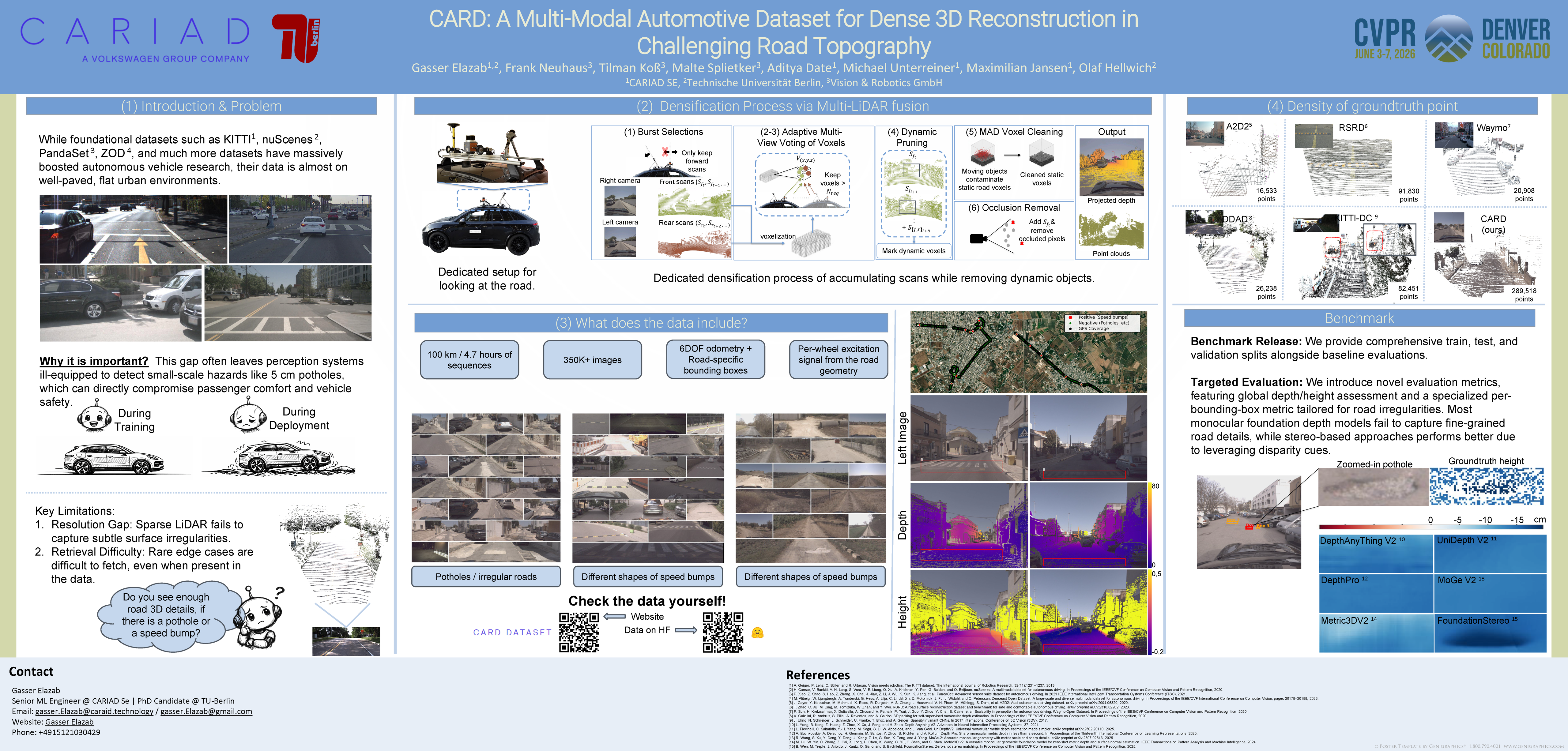
Autonomous driving must operate reliably across diverse surfaces to enable safe mobility. However, most driving datasets are captured on well-paved flat roads. Moreover, recent driving datasets primarily provide sparse LiDAR ground truth for images, which is insufficient for assessing fine-grained geometry in depth estimation and completion. To address these gaps, we introduce CARD, a multi-modal driving dataset that delivers quasi-dense 3D ground truth across continuous sequences rich in speed bumps, potholes, irregular surfaces and off-road segments. Our sensor suite includes synchronized global-shutter stereo cameras, front and rear LiDARs, 6-DoF poses from LiDAR-inertial odometry, per-wheel motion traces, and full calibration. Notably, our multi-LiDAR fusion yields ~500K valid depth pixels per frame, about 6.5x more than KITTI Depth Completion and 10x more on average than other public driving datasets. The dataset spans ~110 km and 4.7 hours across Germany and Italy. In addition, CARD provides 2D bounding boxes targeting road-topography irregularities, enabling accurate benchmarking for both geometry and perception tasks. Furthermore, we introduce a standardized evaluation protocol for road surface irregularities and a stereo-guided depth completion variant that achieves leading performance on CARD. Moreover, we benchmark state-of-the-art depth estimation models to establish strong baselines. We host CARD on Hugging Face with an open source SDK and standardized splits to enable public leaderboards and reproducible evaluation.
MindDriver: Introducing Progressive Multimodal Reasoning for Autonomous Driving
Lingjun Zhang ⋅ Yujian Yuan ⋅ Changjie Wu ⋅ Xinyuan Chang ⋅ Xin Cai ⋅ Shuang Zeng ⋅ Linzhe Shi ⋅ Sijin Wang ⋅ Hang Zhang ⋅ Mu Xu
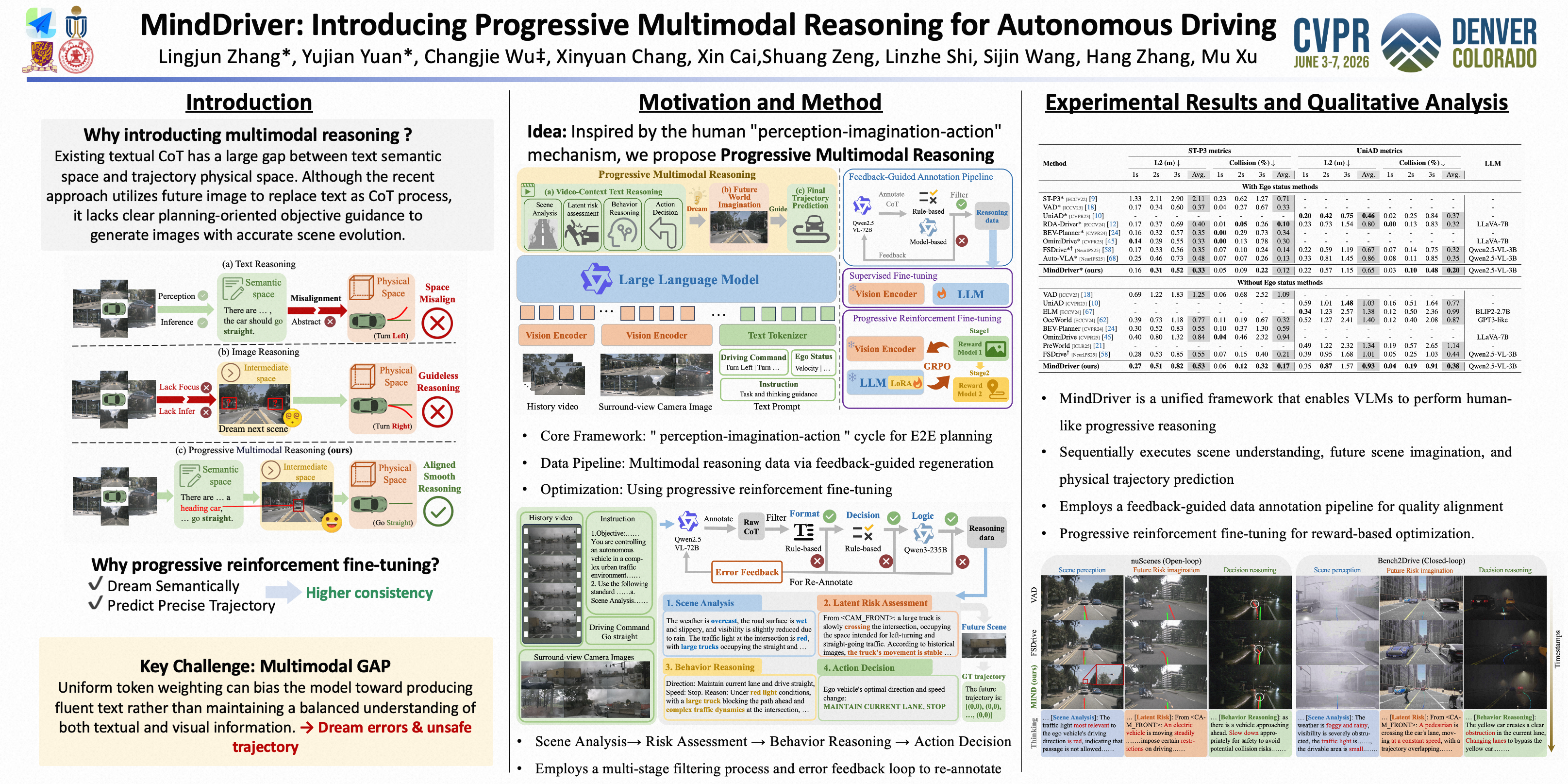
Vision-Language Models (VLM) exhibit strong reasoning capabilities, showing promise for end-to-end autonomous driving systems. Chain-of-Thought (CoT), as VLM's widely used reasoning strategy, is facing critical challenges. Existing textual CoT has a large gap between text semantic space and trajectory physical space. Although the recent approach utilizes future image to replace text as CoT process, it lacks clear planning-oriented objective guidance to generate images with accurate scene evolution. To address these, we innovatively propose MindDriver, a progressive multimodal reasoning framework that enables VLM to imitate human-like progressive thinking for autonomous driving.MindDriver presents semantic understanding, semantic-to-physical space imagination, and physical-space trajectory planning.To achieve aligned reasoning processes in MindDriver, we develop a feedback-guided automatic data annotation pipeline to generate aligned multimodal reasoning training data. Furthermore, we develop a progressive reinforcement fine-tuningmethod to optimize the alignment through progressive high-level reward-based learning.MindDriver demonstrates superior performance in both nuScences open-loop and Bench2Drive closed-loop evaluation.Our trained model and codes will be released once accepted.
WPT: World-to-Policy Transfer via Online World Model Distillation
Guangfeng Jiang ⋅ Yueru Luo ⋅ Jun Liu ⋅ Yi Huang ⋅ Yiyao Zhu ⋅ zhan qu ⋅ Dave Chen ⋅ Bingbing Liu ⋅ Xu Yan
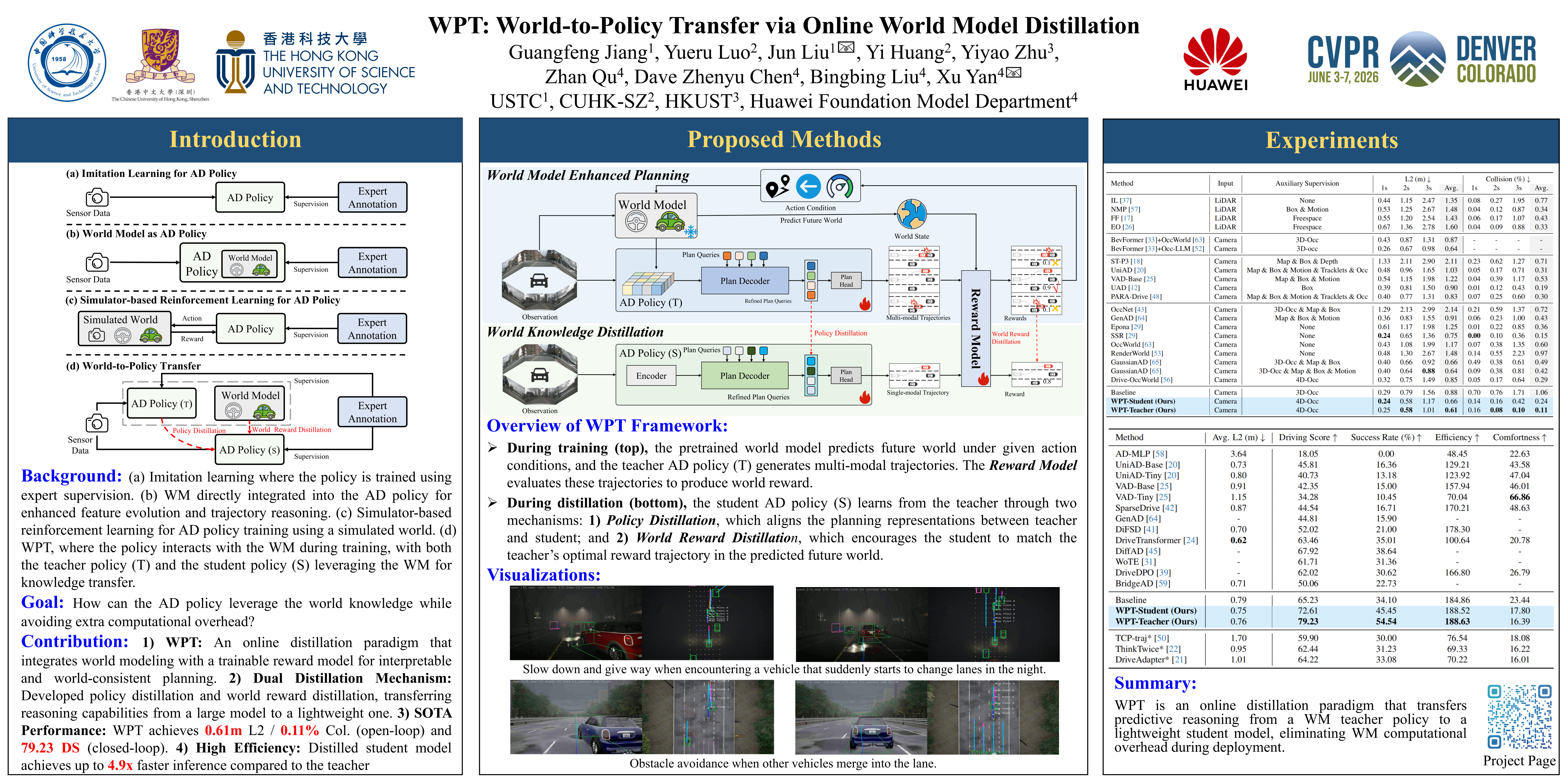
Recent years have witnessed remarkable progress in world models, which primarily aim to capture the spatiotemporal correlations between an agent’s actions and the evolving environment. However, existing approaches often suffer from tight runtime coupling or depend on offline reward signals, resulting in substantial inference overhead or hindering end-to-end optimization. To overcome these limitations, we introduce WPT, a World-to-Policy Transfer training paradigm that enables online distillation under the guidance of an end-to-end world model. Specifically, we develop a trainable reward model that infuses world knowledge into a teacher policy by aligning candidate trajectories with the future dynamics predicted by the world model. Subsequently, we propose policy distillation and world reward distillation to transfer the teacher’s reasoning ability into a lightweight student policy, enhancing planning performance while preserving real-time deployability. Extensive experiments on both open-loop and closed-loop benchmarks show that WPT achieves state-of-the-art performance with a simple policy architecture: it attains a 0.11 collision rate (open-loop) and achieves a 79.23 driving score (closed-loop), surpassing both world-model-based and imitation-learning methods in accuracy and safety. Moreover, the student sustains up to 4.9$\times$ faster inference, while retaining most of the gains.
ClimaOoD: Improving Anomaly Segmentation via Physically Realistic Synthetic Data
Yuxing Liu ⋅ Zheng Li ⋅ Huanhuan Liang ⋅ Ji Zhang ⋅ Zeyu Sun ⋅ Yong Liu
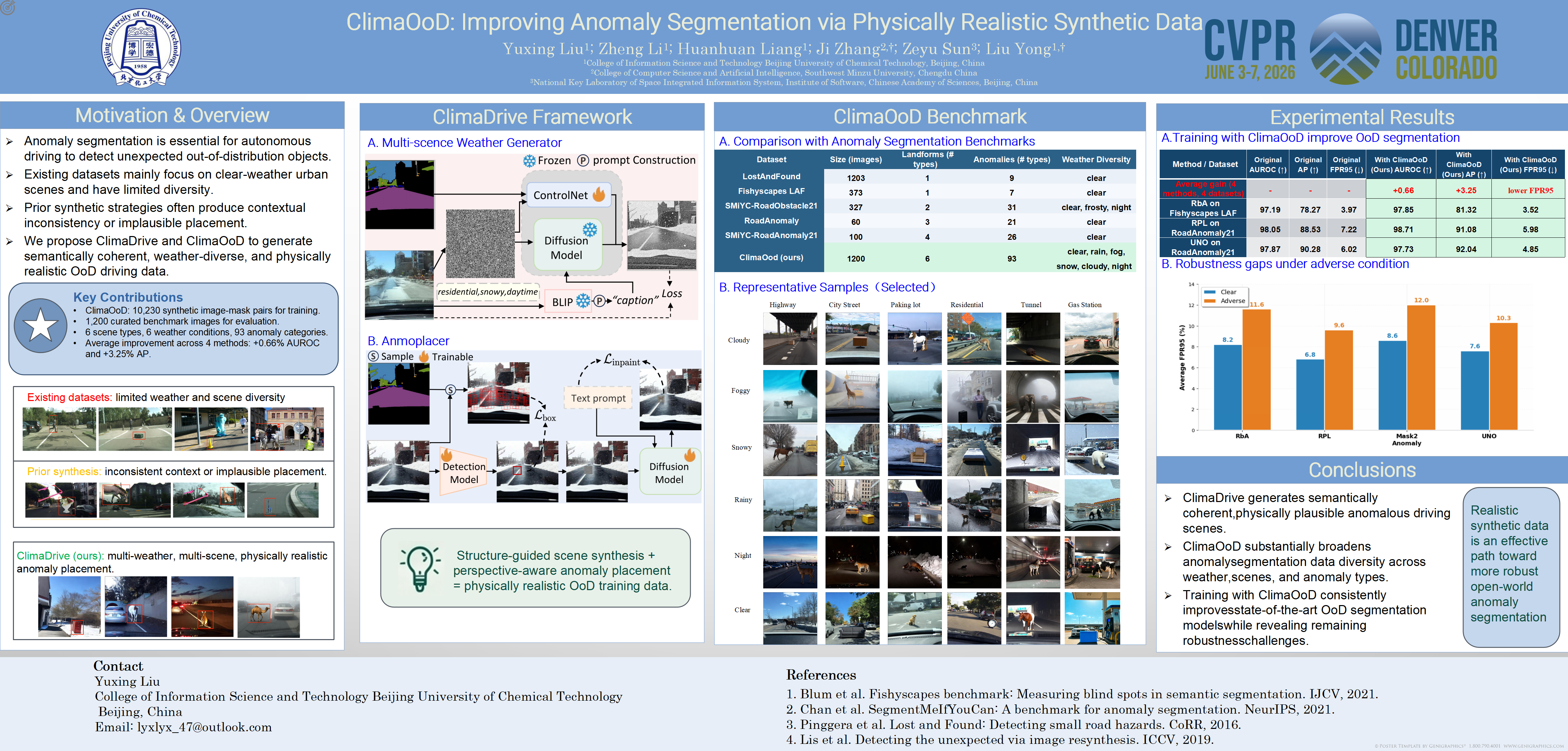
Anomaly segmentation seeks to detect and localize unknown or out-of-distribution (OoD) objects that fall outside predefined semantic classes—a capability essential for safe autonomous driving. However, the scarcity and limited diversity of anomaly data severely constrain model generalization in open-world environments. Existing approaches mitigate this issue through synthetic data generation, either by copy-pasting external objects into driving scenes or by leveraging text-to-image diffusion models to inpaint anomalous regions. While these methods improve anomaly diversity, they often lack contextual coherence and physical realism, resulting in domain gaps between synthetic and real data. In this paper, we present ClimaDrive, a semantics-guided image-to-image framework for synthesizing semantically coherent, weather-diverse, and physically plausible OoD driving data. ClimaDrive unifies structure-guided multi-weather generation with prompt-driven anomaly inpainting, enabling the creation of visually realistic training data. Based on this framework, we construct ClimaOoD, a large-scale benchmark spanning six representative driving scenarios under both clear and adverse weather conditions.Extensive experiments on four state-of-the-art methods show that training with ClimaOoD leads to robust improvements in anomaly segmentation. Across all methods, AUROC, AP, and FPR95 show notable gains, with FPR95 dropping from 3.97 to 3.52 for RbA on Fishyscapes LAF. These results demonstrate that ClimaOoD enhances model robustness, offering valuable training data for better generalization in open-world anomaly detection.
Recover to Predict: Progressive Retrospective Learning for Variable-Length Trajectory Prediction
Hao Zhou ⋅ Lu Qi ⋅ Xiangtai Li ⋅ Jie Zhang ⋅ Yi Liu ⋅ Xu Yang ⋅ Mingyu Fan ⋅ Fei Luo
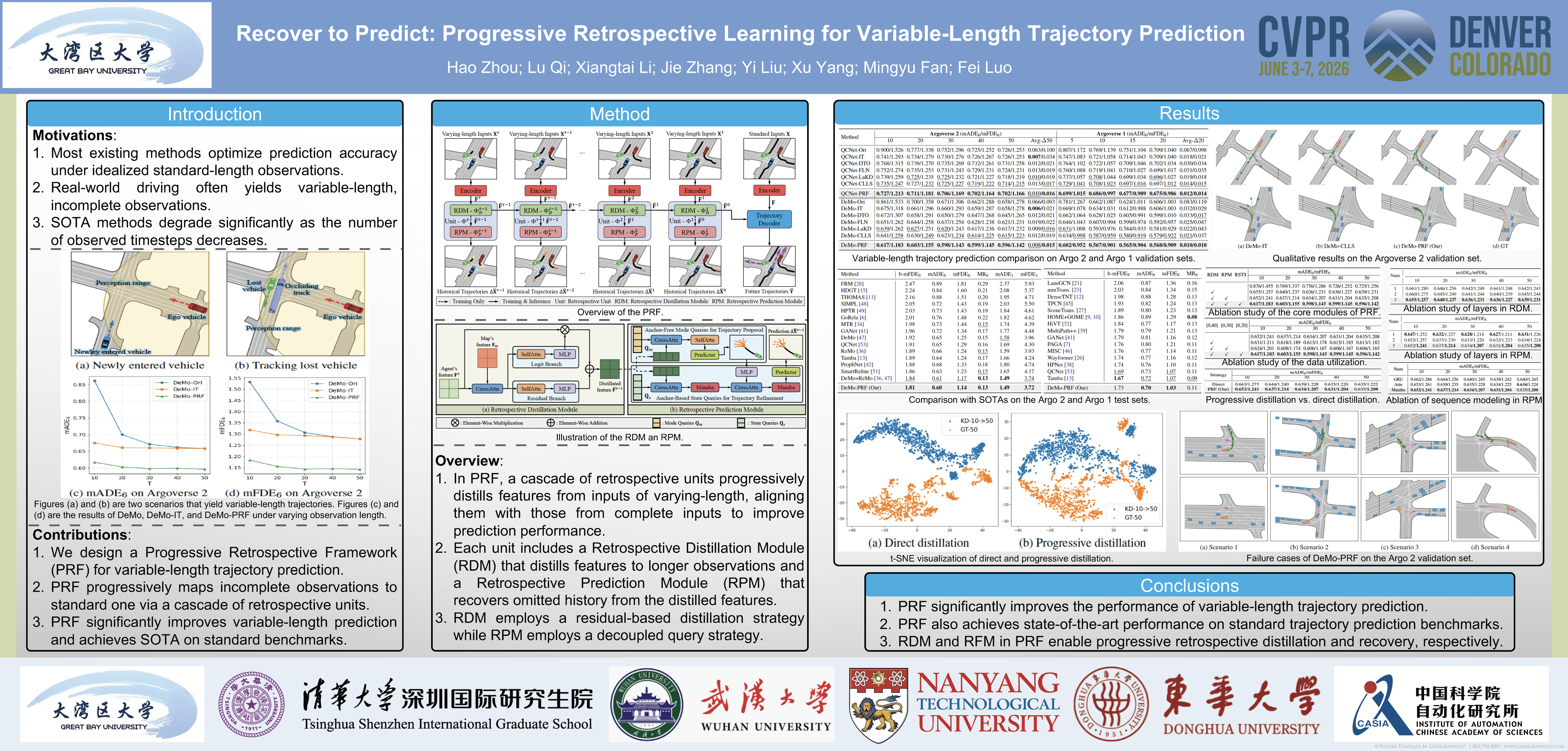
Trajectory prediction is critical for autonomous driving, enabling safe and efficient planning in dense, dynamic traffic. Most existing methods optimize prediction accuracy under fixed-length observations. However, real-world driving often yields variable-length, incomplete observations, posing a challenge to these methods. A common strategy is to directly map features from incomplete observations to those from complete ones. This one-shot mapping, however, struggles to learn accurate representations for short trajectories due to significant information gaps. To address this issue, we propose a $\textbf{P}$rogressive $\textbf{R}$etrospective $\textbf{F}$ramework (PRF), which gradually aligns features from incomplete observations with those from complete ones via a cascade of retrospective units. Each unit consists of a Retrospective Distillation Module (RDM) and a Retrospective Prediction Module (RPM), where RDM distills features and RPM recovers previous timesteps using the distilled features. Moreover, we propose a Rolling-Start Training Strategy (RSTS) that enhances data efficiency during PRF training. PRF is plug-and-play with existing methods. Extensive experiments on datasets Argoverse 2 and Argoverse 1 demonstrate the effectiveness of PRF. Code will be released.
URScenes: A Multi-scenario Dataset for Unstructured Road Environments
runsen liu ⋅ Aizemaitijiang Baoerhan ⋅ Zhangyu Wang ⋅ Jie Wang ⋅ Jinghao Cui ⋅ Guizhen Yu ⋅ Songyue Yang ⋅ WanCheng Sun ⋅ Mingjun Tang ⋅ Zhanbo Hua ⋅ Wenwen Luo
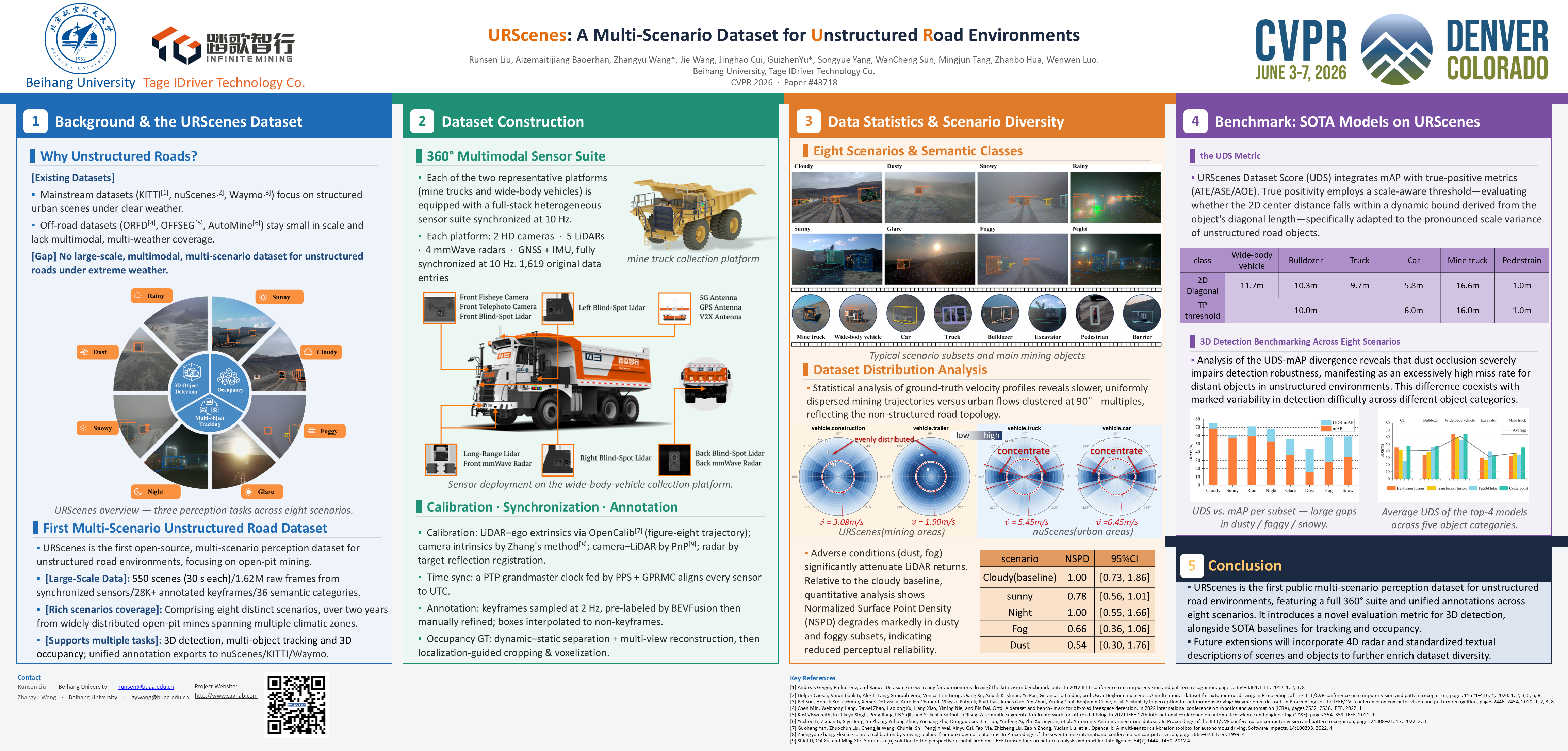
As autonomous driving technology transitions from small-scale validation to large-scale deployment, its development in unstructured road environments has become a critical and inevitable trend. Autonomous vehicles increasingly rely on high-quality and diverse datasets for perception systems. However, existing public datasets predominantly focus on clear-weather and urban-road scenarios, leaving a significant gap in the coverage of unstructured road environments. To bridge this gap, we construct URScenes, the first multi-scenario, open-source perception dataset for unstructured road environments. The dataset consists of 472 scenes, each lasting 30 seconds, and provides over 28K annotated samples and 119K sweeps. URScenes, for the first time, covers eight typical scenarios, including rainy, snowy, foggy, dusty, glare, night, cloudy, and sunny conditions. Additionally, URScenes supports multi-task perception for 3D object detection, multi-object tracking, and 3D occupancy in unstructured road environments. URScenes also provides a unified annotation system and format conversion tools, enabling easy conversion to popular formats such as NuScenes, KITTI, and Waymo dataset. Finally, this study presents comparative experimental results to assess the performance of state-of-the-art algorithms on the URScenes dataset. The data, development toolkit, and additional information are available online.
MeanFuser: Fast One-Step Multi-Modal Trajectory Generation and Adaptive Reconstruction via MeanFlow for End-to-End Driving
junli wang ⋅ Yinan Zheng ⋅ Xueyi Liu ⋅ Zebin Xing ⋅ Pengfei Li ⋅ Kun Ma ⋅ Hangjun Ye ⋅ Guang Chen ⋅ Guang Li ⋅ Long Chen ⋅ Zhongpu Xia ⋅ Qichao Zhang
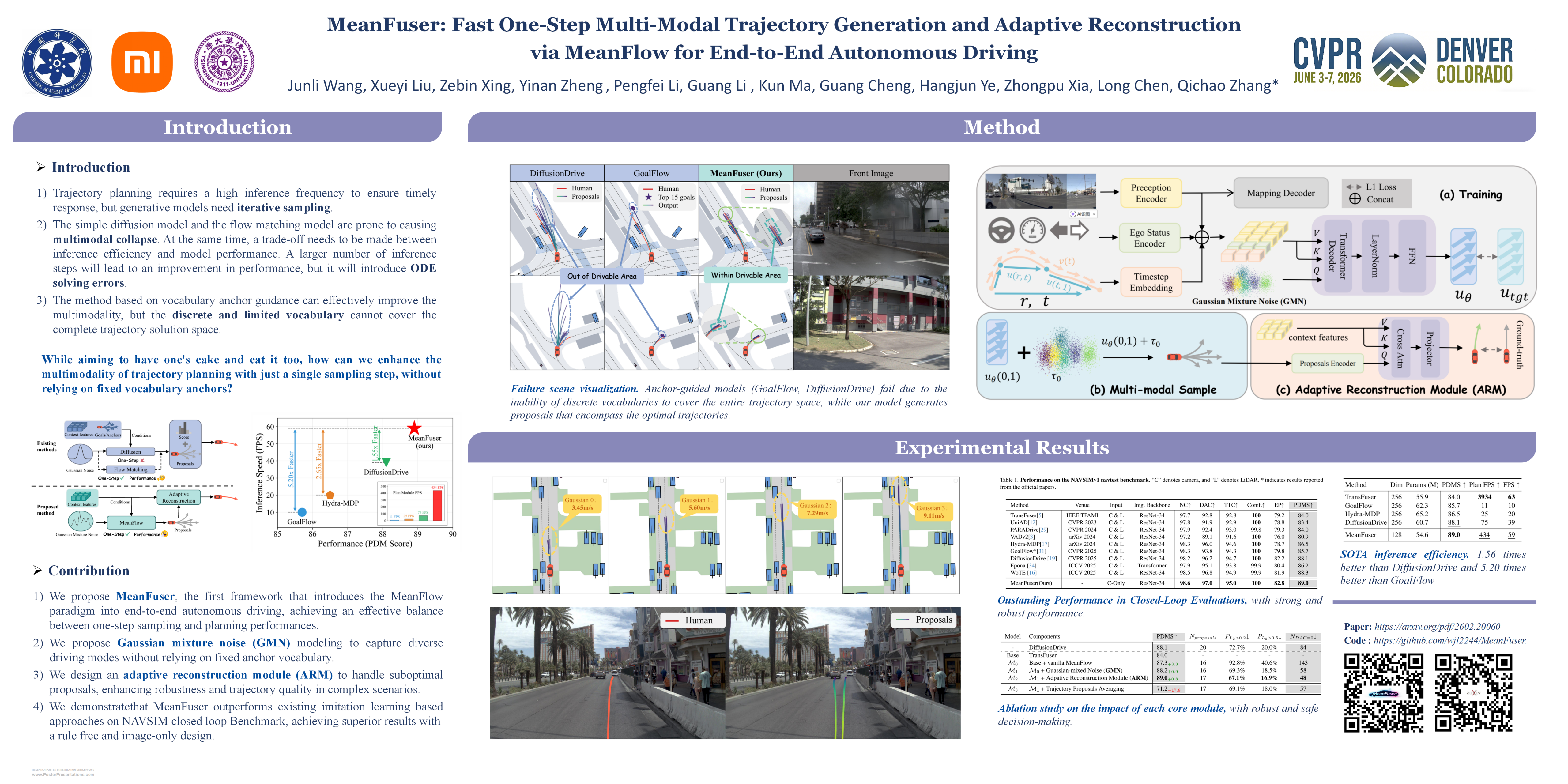
Generative models have shown great potential in trajectory planning. Recent studies demonstrate that anchor-guided generative models are effective in modeling the uncertainty of driving behaviors and improving overall performance. However, these methods rely on discrete anchor vocabularies that must sufficiently cover the trajectory distribution during testing to ensure robustness, inducing an inherent trade-off between vocabulary size and model performance.To overcome this limitation, we propose MeanFuser, an end-to-end autonomous driving method that enhances both efficiency and robustness through three key designs. (1) We introduce Gaussian Mixture Noise (GMN) to guide generative sampling, enabling a continuous representation of the trajectory space and eliminating the dependency on discrete anchor vocabularies. (2) We introduce ``MeanFlow Identity", which models the mean velocity field between GMN and data distribution instead of the instantaneous velocity field used in naïve flow-matching methods, effectively eliminating numerical errors from ODE solvers and significantly accelerating inference. (3) We design a lightweight Adaptive Reconstruction Module (ARM) that enables the model to consider all sampled proposals and adaptively decide whether to reconstruct a trajectory when none of the proposals is satisfactory. Experiments on the NAVSIM closed-loop benchmark demonstrate that MeanFuser achieves outstanding performance and exceptional inference efficiency, offering a robust and efficient solution for end-to-end autonomous driving.
SAMosaic3D: Modular Scene Assembly for Real-Time 3D Segment Anything
Peng Wang ⋅ Yongcai Wang ⋅ Wang Chen ⋅ Hualong Cao ⋅ Kang Yang ⋅ Chunxu Li ⋅ Jie Wen ⋅ Deying Li
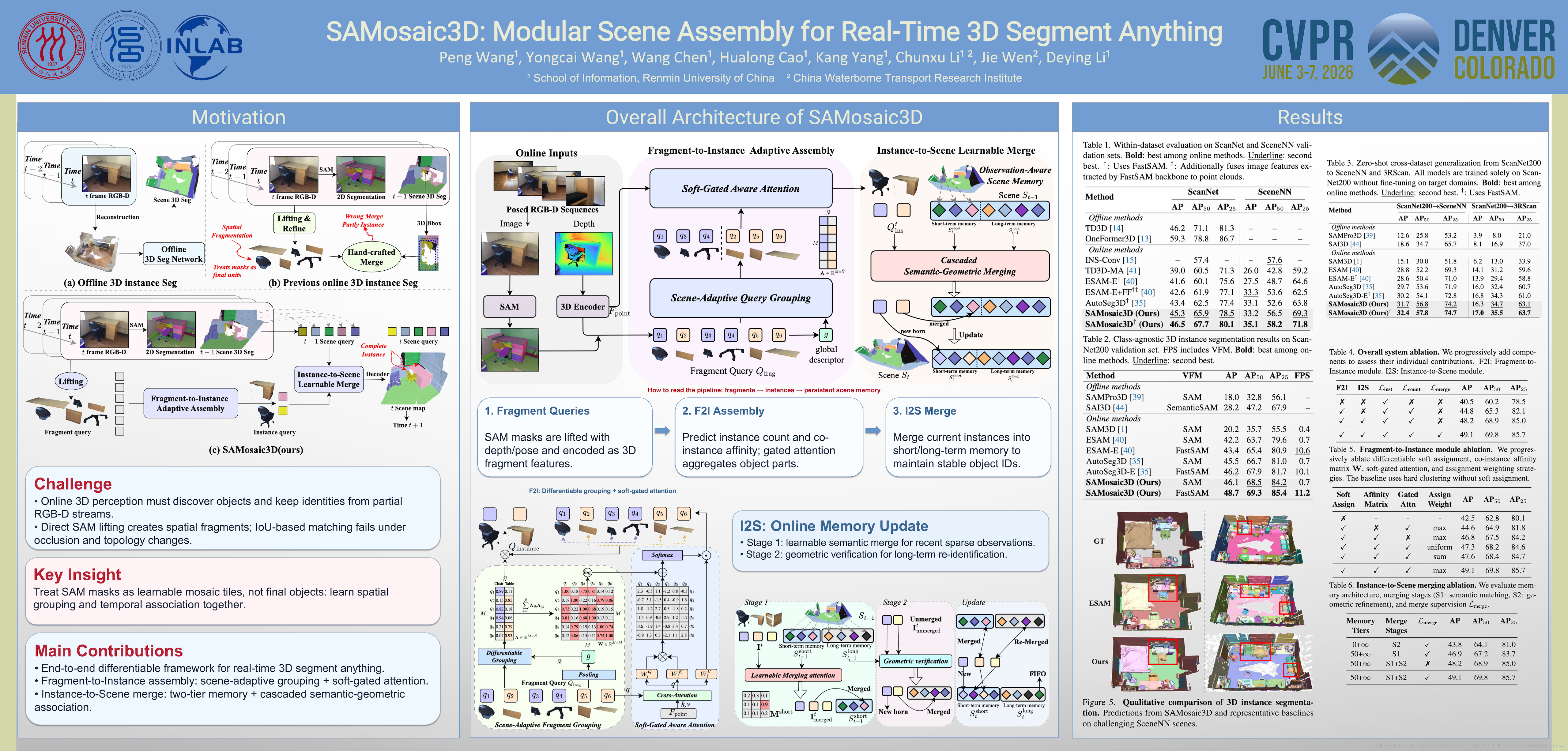
Online 3D instance segmentation is a critical capability for embodied agents navigating in dynamic environments. However, a fundamental challenge remains in adapting powerful 2D foundation models, like SAM, to 3D online segmentation. Naively lifting SAM's 2D masks to 3D results in severe spatial fragmentation, where a single object is shattered into multiple disconnected parts, especially under occlusion. Subsequent attempts to link these fragments over time via conventional 3D IoU-based tracking prove highly fragile: they struggle to handle occlusions or topological changes, ultimately causing catastrophic identity drift. Departing from such post-processing approaches, we reframe online segmentation as a learnable composition problem. We introduce MOSAIC3D, a differentiable framework that treats SAM-derived masks as "mosaic tiles" and learns to assemble them into temporally consistent 3D instances. MOSAIC3D comprises two key components: Fragment-to-Instance Adaptive Assembly that aggregates fragments through soft-gated attention, and Instance-to-Scene Online Merging that employs cascaded semantic-geometric matching to preserve object identities—replacing rigid IoU thresholds with learnable association guided by observation maturity. Evaluations on ScanNet, ScanNet200, SceneNN and 3RScan datasets demonstrate state-of-the-art performance and zero-shot cross-dataset generalization. Extensive ablation studies validate the effectiveness of the designed modules. The code will be available.
Mitigating Objectness Bias and Region-to-Text Misalignment for Open-Vocabulary Panoptic Segmentation
Nikolay Kormushev ⋅ Josip Šarić ⋅ Matej Kristan
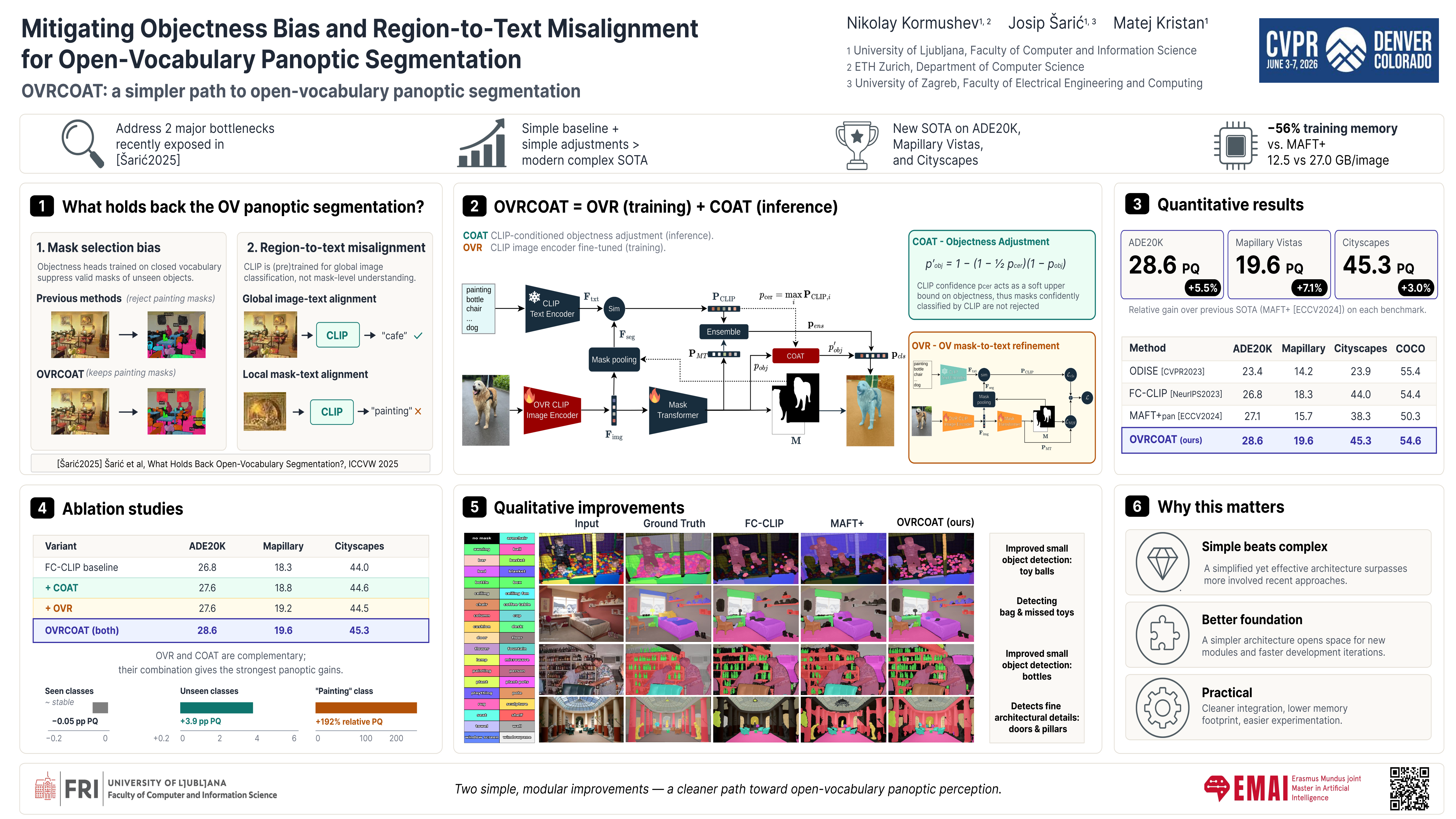
Open-vocabulary panoptic segmentation remains hindered by two coupled issues: (i) mask selection bias, where objectness heads trained on closed vocabularies suppress masks of categories not observed in training, and (ii) limited regional understanding in vision–language models such as CLIP, which were optimized for global image classification rather than localized segmentation. We introduce OVRCOAT, a simple, modular framework that tackles both. First, a CLIP-conditioned objectness adjustment (COAT) updates background/foreground probabilities, preserving high-quality masks for out-of-vocabulary objects. Second, an open-vocabulary mask-to-text refinement (OVR) strengthens CLIP’s region-level alignment to improve classification of both seen and unseen classes with markedly lower memory cost than prior fine-tuning schemes. The two components combine to jointly improve objectness estimation and mask recognition, yielding consistent panoptic gains. Despite its simplicity, OVRCOAT sets a new state of the art on ADE20K (+5.5\% PQ) and delivers clear gains on Mapillary Vistas and Cityscapes (+7.1\% and +3\% PQ, respectively). The code will be available here.
MV3DIS: Multi-View Mask Matching via 3D Guides for Zero-Shot 3D Instance Segmentation
yibo zhao ⋅ Yigong Zhang ⋅ Jin Xie
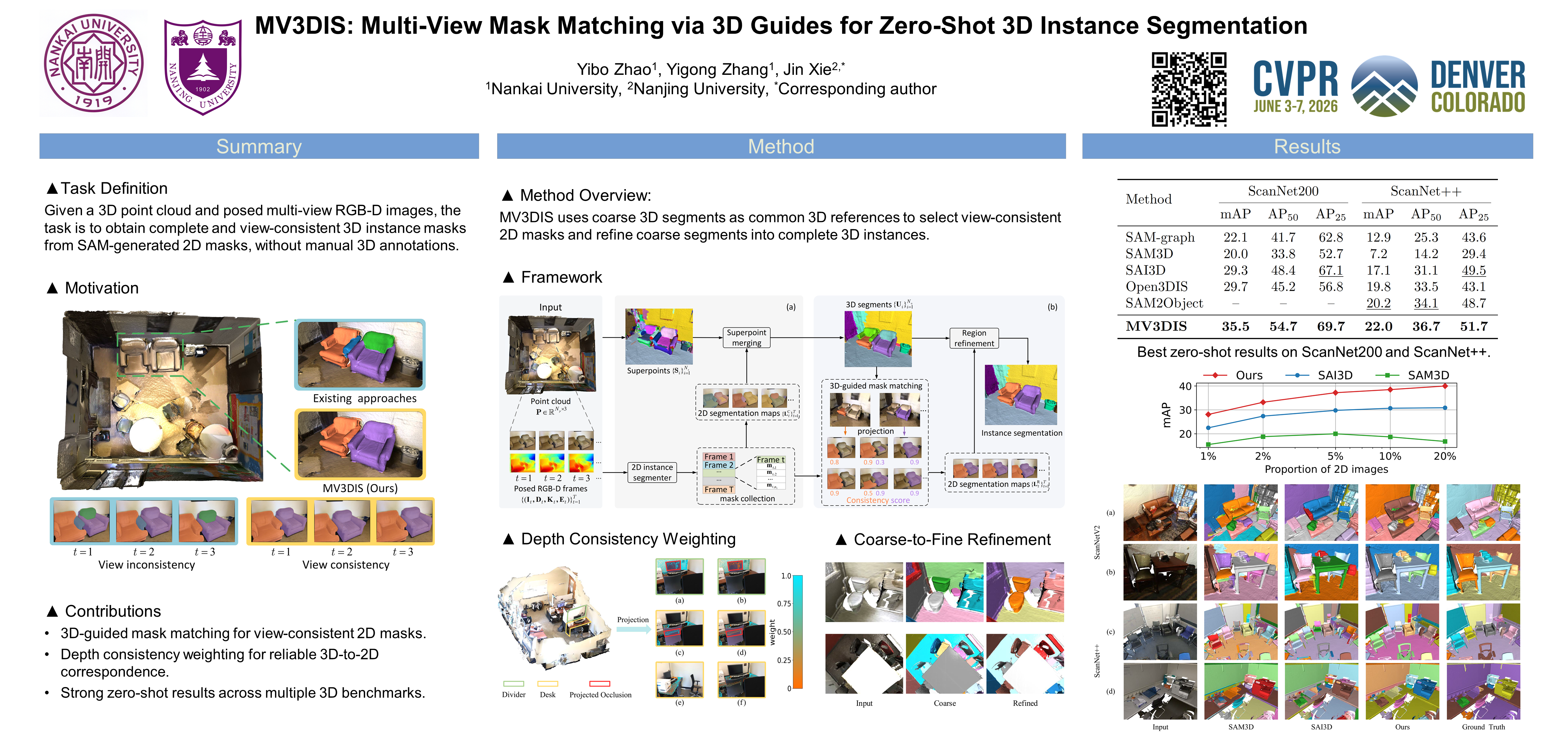
Conventional 3D instance segmentation methods rely on labor-intensive 3D annotations for supervised training, which limits their scalability and generalization to novel objects. Recent approaches leverage multi-view 2D masks from the Segment Anything Model (SAM) to guide the merging of 3D geometric primitives, thereby enabling zero-shot 3D instance segmentation. However, these methods typically process each frame independently and rely solely on 2D metrics, such as SAM prediction scores, to produce segmentation maps. This design overlooks multi-view correlations and inherent 3D priors, leading to inconsistent 2D masks across views and ultimately fragmented 3D segmentation. In this paper, we propose MV3DIS, a coarse-to-fine framework for zero-shot 3D instance segmentation that explicitly incorporates 3D priors. Specifically, we introduce a 3D-guided mask matching strategy that uses coarse 3D segments as a common reference to match 2D masks across views and consolidates multi-view mask consistency via 3D coverage distributions. Guided by these view-consistent 2D masks, the coarse 3D segments are further refined into precise 3D instances. Additionally, we introduce a depth consistency weighting scheme that quantifies projection reliability to suppress ambiguities from inter-object occlusions, thereby improving the robustness of 3D-to-2D correspondence. Extensive experiments on the ScanNetV2, ScanNet200, ScanNet++, Replica, and Matterport3D datasets demonstrate the effectiveness of MV3DIS, which achieves superior performance over previous methods.
PEARL: Geometry Aligns Semantics for Training-Free Open-Vocabulary Semantic Segmentation
Gensheng Pei ⋅ Xiruo Jiang ⋅ Xinhao Cai ⋅ Tao Chen ⋅ Yazhou Yao ⋅ Byeungwoo Jeon
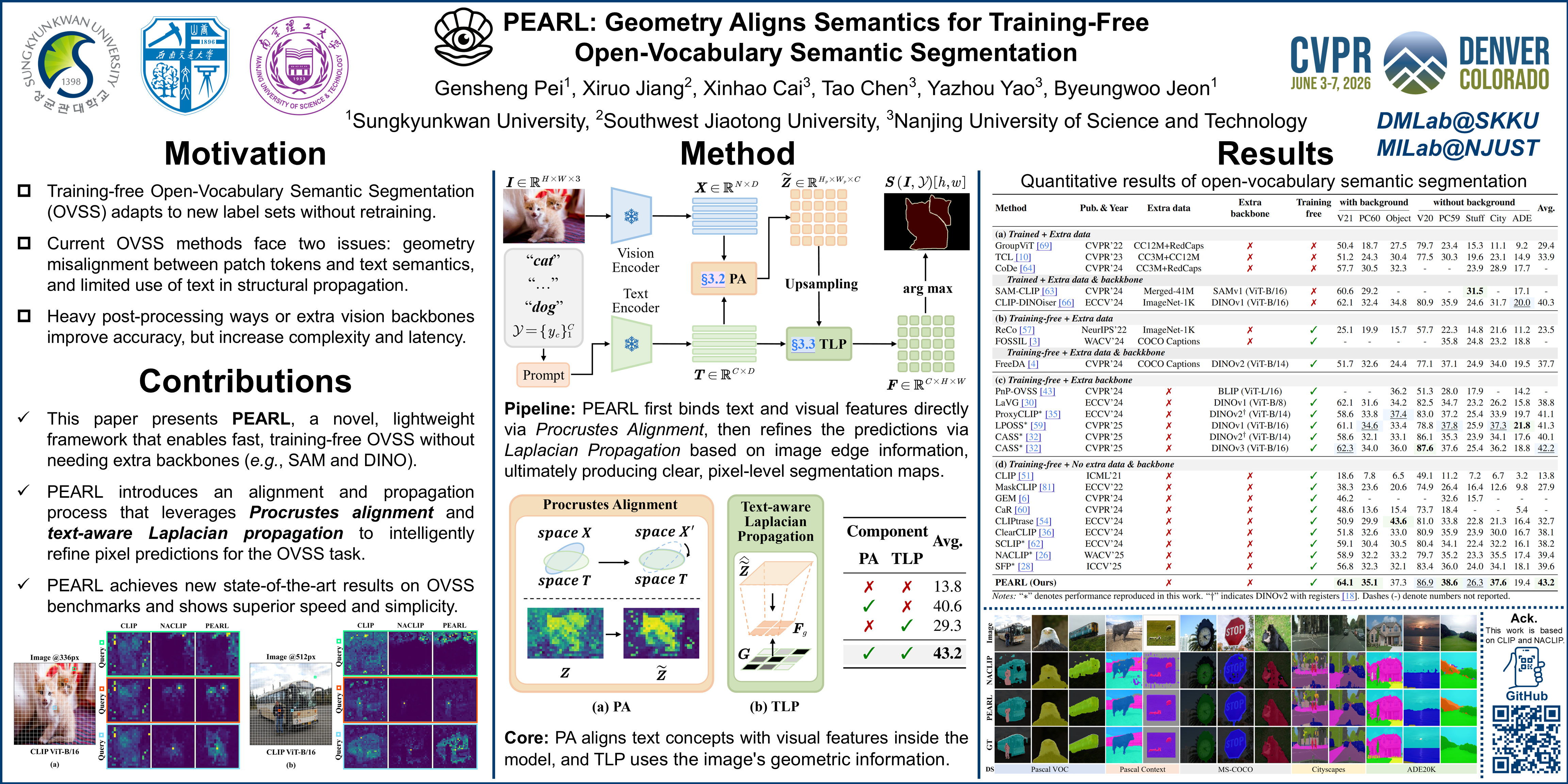
Training-free open-vocabulary semantic segmentation (OVSS) promises rapid adaptation to new label sets without retraining. Yet, many methods rely on heavy post-processing or handle text and vision in isolation, leaving cross-modal geometry underutilized. Others introduce auxiliary vision backbones or multi-model pipelines, which increase complexity and latency while compromising design simplicity.We present PEARL, \textbf{\underline{P}}rocrust\textbf{\underline{e}}s \textbf{\underline{a}}lignment with text-awa\textbf{\underline{r}}e \textbf{\underline{L}}aplacian propagation, a compact two-step inference that follows an align-then-propagate principle. The Procrustes alignment step performs an orthogonal projection inside the last self-attention block, rotating keys toward the query subspace via a stable polar iteration. The text-aware Laplacian propagation then refines per-pixel logits on a small grid through a confidence-weighted, text-guided graph solve: text provides both a data-trust signal and neighbor gating, while image gradients preserve boundaries. In this work, our method is fully training-free, plug-and-play, and uses only fixed constants, adding minimal latency with a small per-head projection and a few conjugate-gradient steps. Our approach, PEARL, sets a new state-of-the-art in training-free OVSS without extra data or auxiliary backbones across standard benchmarks, achieving superior performance under both with-background and without-background protocols.
RAVEN: Radar Adaptive Vision Encoders for Efficient Chirp-wise Object Detection and Segmentation
Anuvab Sen ⋅ Mir Sayeed ⋅ Saibal Mukhopadhyay
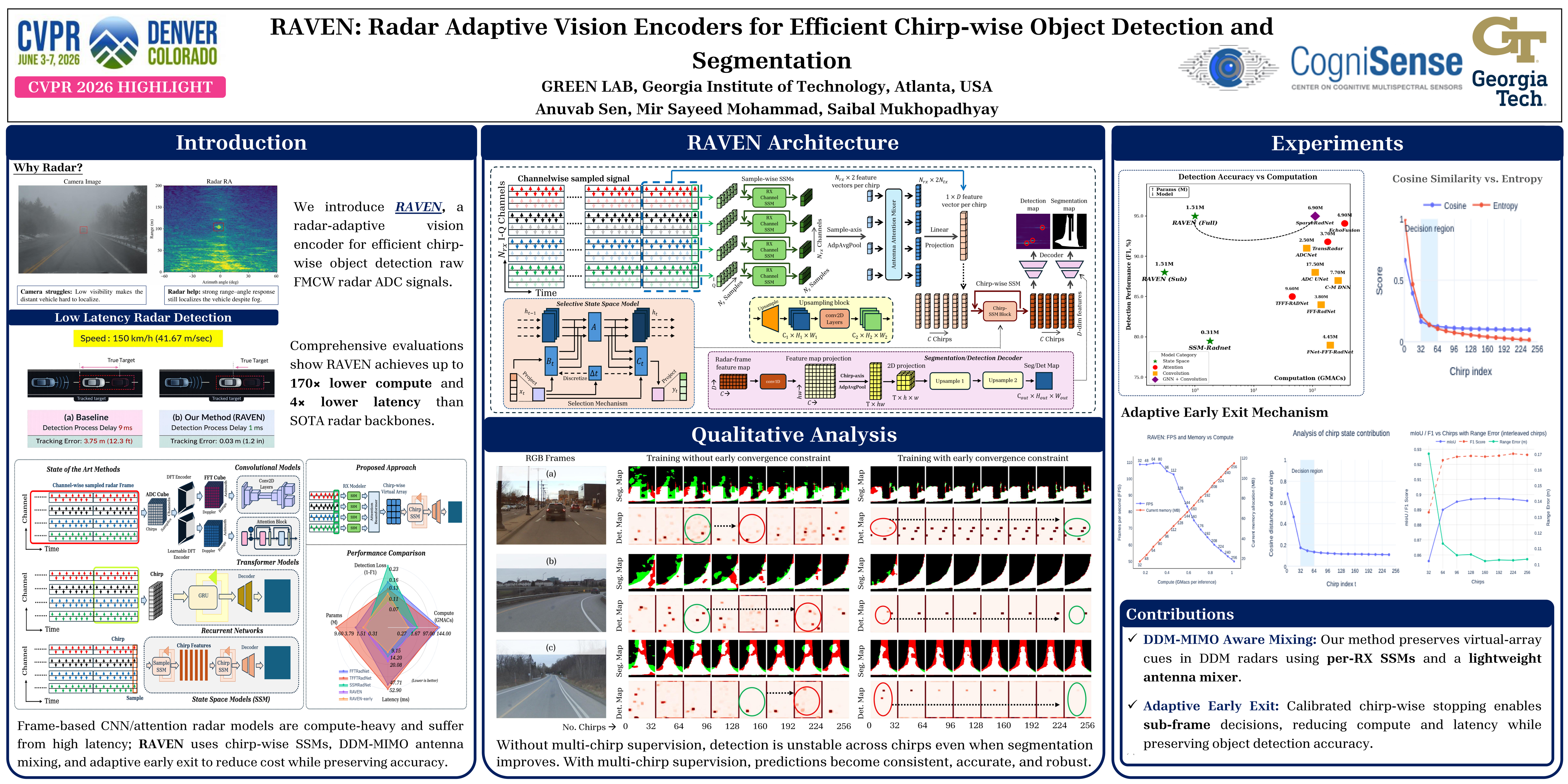
We introduce RAVEN, a deep learning architecture for processing frequency-modulated continuous-wave (FMCW) radar data that is designed for high computational efficiency. RAVEN reduces computation by using a learnable antenna mixer module on independent receiver state space encoders (SSM) to compress the virtual MIMO array into a compact set of learned features and by performing per-chirp inference with a calibrated early-exit rule, so the model reaches a decision using only a subset of chirps in a radar frame. These design choices yield up to 170× lower computation and 4× lower end-to-end latency than conventional frame-based radar backbones, while achieving state-of-the-art detection and BEV free-space segmentation performance on automotive radar datasets.
SAMIX: Reinforcing SAM2 with Semantic Adapter and Reference Selecting Policy for Mix-Supervised Segmentation
Qiang Hu ⋅ Jiajie Wei ⋅ Zhenyu Yi ⋅ Zhifen Yan ⋅ Yingjie Guo ⋅ Hongkuan Shi ⋅ Ge-Peng Ji ⋅ Qiang Li ⋅ Zhiwei Wang
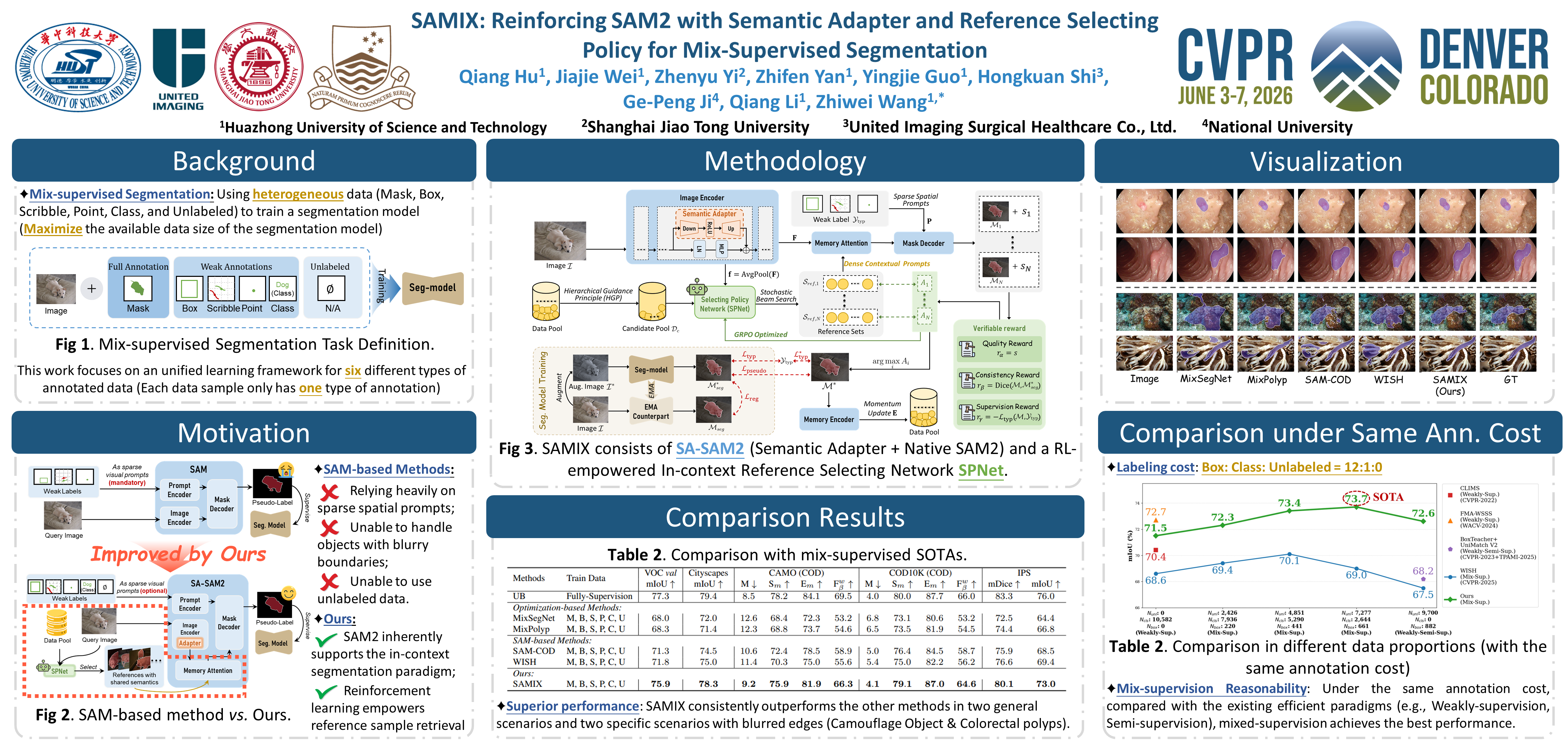
Mix-supervised image segmentation aims to effectively leverage heterogeneous annotations. Recent prompt-based advances utilize foundation models such as Segment Anything Model (SAM) to generate pseudo-masks by treating weak labels as spatial prompts. However, these methods rely heavily on sparse spatial priors, leading to suboptimal performance in ambiguous regions and overlooking the potential of unlabeled data due to the absence of promptable cues. In this paper, we propose SAMIX, a novel framework that adapts SAM2 into a semantic-aware pseudo-label generator SA-SAM2 by incorporating a lightweight semantic adapter. Beyond being guided by sparse spatial prompts, SA-SAM2 facilitates dense contextual prompts provided by valuable image–mask reference pairs with shared semantics. This design allows SAMIX to produce high-quality pseudo-masks even for ambiguous objects with sparse or no annotations. Another core component of SAMIX is the Selecting Policy Network (SPNet), which auto-regressively retrieves relevant and complementary reference samples for each query image. Unlike rule-based selections, SPNet is trained via reinforcement learning to actively explore reference combinations that maximize pseudo-label quality. Guided by customized and verifiable rewards associated with mask quality, the selection toward semantically informative and diverse contexts. We conduct extensive experiments on two general datasets (PASCAL VOC 2012 and Cityscapes) and two challenging specific datasets with ambiguous boundaries (camouflaged object detection and image polyp segmentation). Across diverse mix-supervision settings, SAMIX consistently achieves state-of-the-art performance, effectively leveraging both weakly labeled and unlabeled data. Codes will be released upon publication.
MARSS: Radar Semantic Segmentation via Modular Attention and State Space Models
fengyu chen ⋅ Tiao Tan ⋅ Teng Li ⋅ Yuantian Quan ⋅ Qingmin Liao
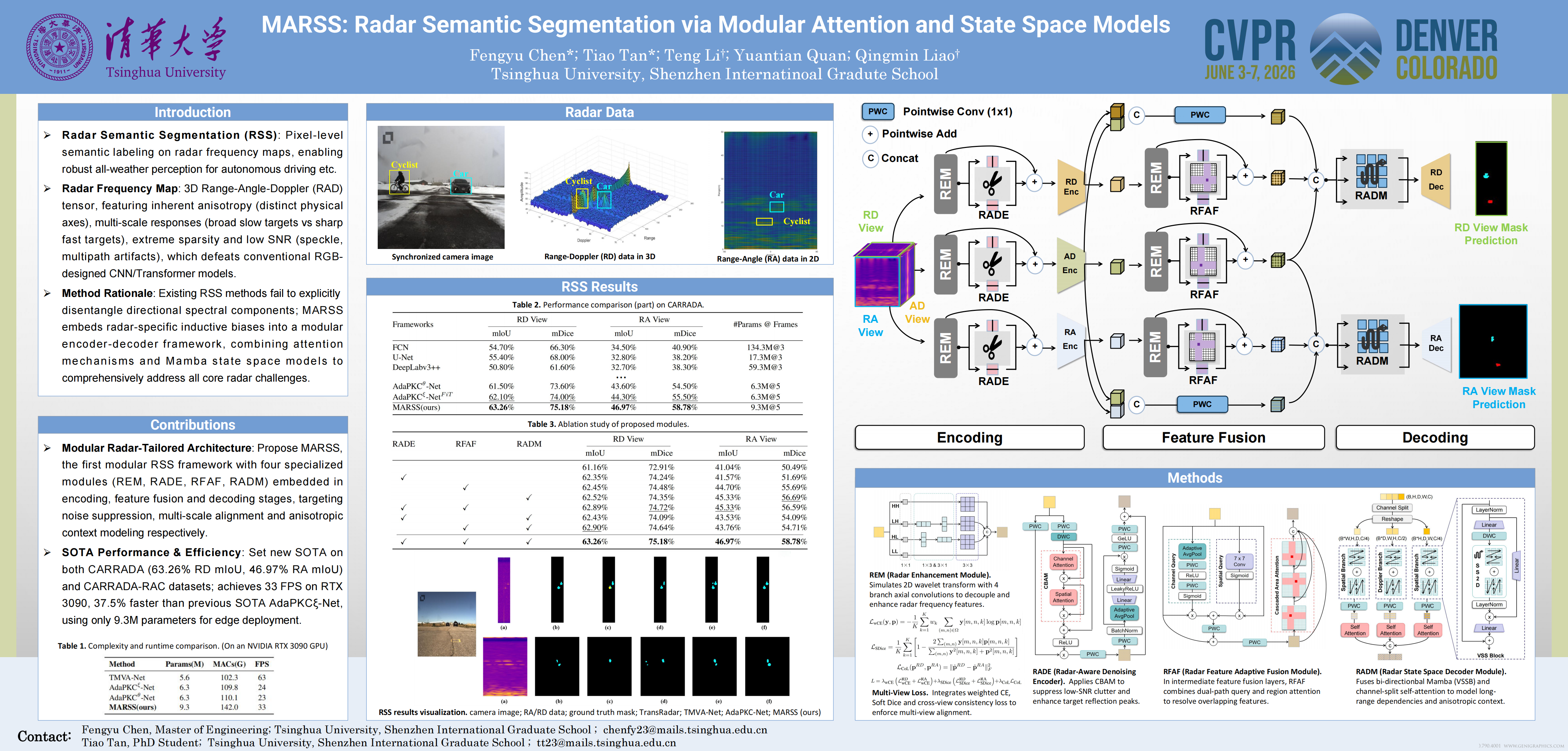
Radar semantic segmentation (RSS) is critical for robust perception in adverse conditions, but poses unique challenges: radar frequency maps are highly anisotropic, multi-scale, sparse and noisy. Conventional CNN or Transformer architectures, designed for camera images, fail to account for these characteristics, leading degraded performance. We propose MARSS (Modular Attention-enhanced Radar Semantic Segmentation), a novel framework that integrates three specialized modules to address radar-specific issues. In the encoder, the RADE module employs lightweight channel self-attention and depthwise convolutions to robustly encode noisy, anisotropic features. In intermediate layers, the RFAF module performs multi-scale feature fusion and region-level attention to isolate salient radar features. The decoder's RADM module combines state space models with axial self-attention to reconstruct segmentation masks with anisotropy and temporality-aware context. These components collectively suppress noise, disentangle range-Doppler features, and enforce spatial-temporal consistency. On the CARRADA dataset, MARSS achieves substantially higher performance than prior RSS methods, especially for small fast-moving targets.
MixerCSeg: An Efficient Mixer Architecture for Crack Segmentation via Decoupled Mamba Attention
Zilong Zhao ⋅ Zhengming Ding ⋅ Pei Niu ⋅ Wenhao Sun ⋅ Feng Guo
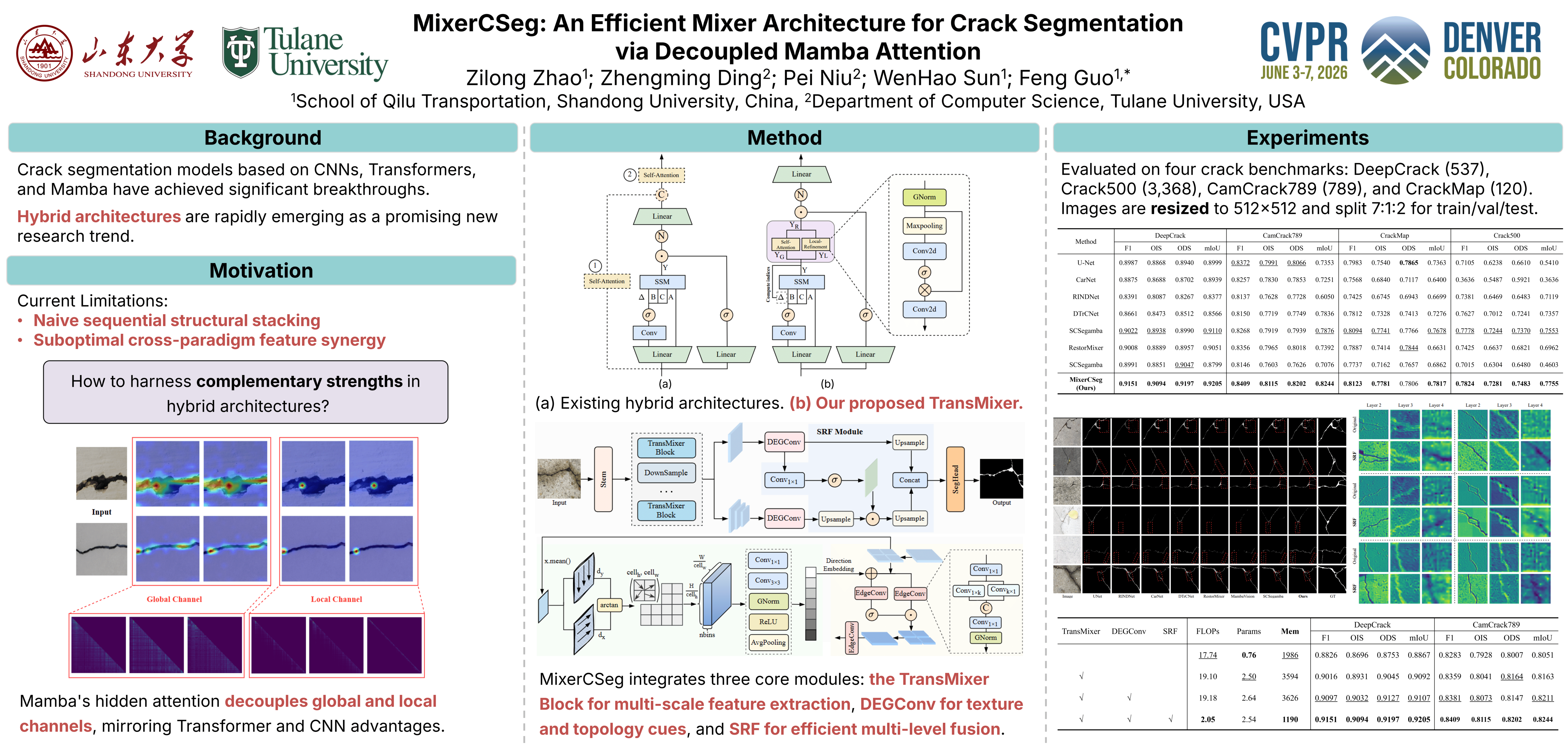
Feature encoders play a key role in pixel-level crack segmentation by shaping the representation of fine textures and thin structures. Existing CNN-, Transformer-, and Mamba-based models each capture only part of the required spatial or structural information, leaving clear gaps in modeling complex crack patterns. To address this, we present MixerCSeg, a mixer architecture designed like a coordinated team of specialists, where CNN-like pathways focus on local textures, Transformer-style paths capture global dependencies, and Mamba-inspired flows model sequential context within a single encoder. At the core of MixerCSeg is the TransMixer, which explores Mamba’s latent attention behavior while establishing dedicated pathways that naturally express both locality and global awareness. To further enhance structural fidelity, we introduce a multi-view processing strategy and a Direction-guided Edge Gated Convolution (DEGConv) that strengthens edge sensitivity under irregular crack geometries with minimal computational overhead. A Spatial Refinement Multi-Level Fusion (SRF) module is then employed to refine multi-scale details without increasing complexity. Extensive experiments on multiple crack segmentation benchmarks show that MixerCSeg achieves state-of-the-art performance with only 2.05 GFLOPs and 2.54 M parameters, demonstrating both efficiency and strong representational capability.
Exemplar-Free Class Incremental Learning via Preserving Class-Discriminative Structure
Xin Zhang ⋅ Liang Bai ⋅ Guanchao Wang ⋅ Xian Yang
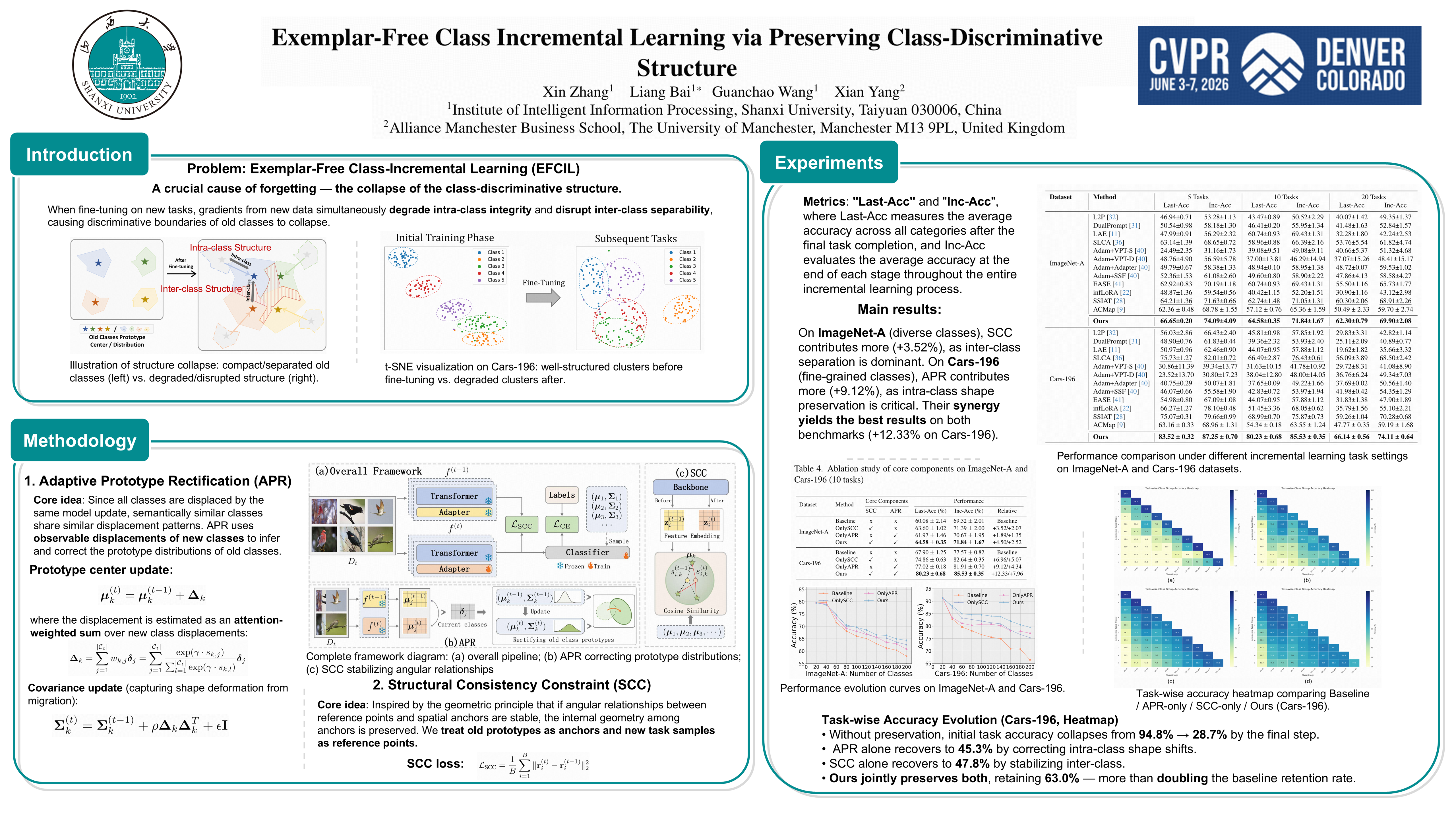
Exemplar-Free Class Incremental Learning (EFCIL) aims to enable models to learn new classes sequentially without retaining samples from previous tasks. While recent approaches leverage pre-trained models with parameter-efficient tuning to mitigate forgetting, they often overlook a crucial cause of forgetting: the collapse of the class-discriminative structure. This structure comprises two interdependent components: intra-class structure, which characterizes the shape of individual classes, and inter-class structure, which characterizes the global geometric relationships among class prototypes. We reveal that catastrophic forgetting stems from the simultaneous deterioration of both intra-class and inter-class structures. To address this, we propose a unified framework that preserves the class-discriminative structure. It preserves the intra-class structure by reshaping class means and covariances to preserve each class’s shape during migration, and maintains inter-class structure by stabilizing angular relationships between samples and old prototypes. Extensive experiments demonstrate that our framework outperforms existing leading methods on multiple EFCIL benchmarks, validating that preserving the class-discriminative structure is crucial for mitigating catastrophic forgetting.
Critical Patch-Aware Sparse Prompting with Decoupled Training for Continual Learning on the Edge
Wonseon Lim ⋅ Jaesung Lee ⋅ Dae-Won Kim
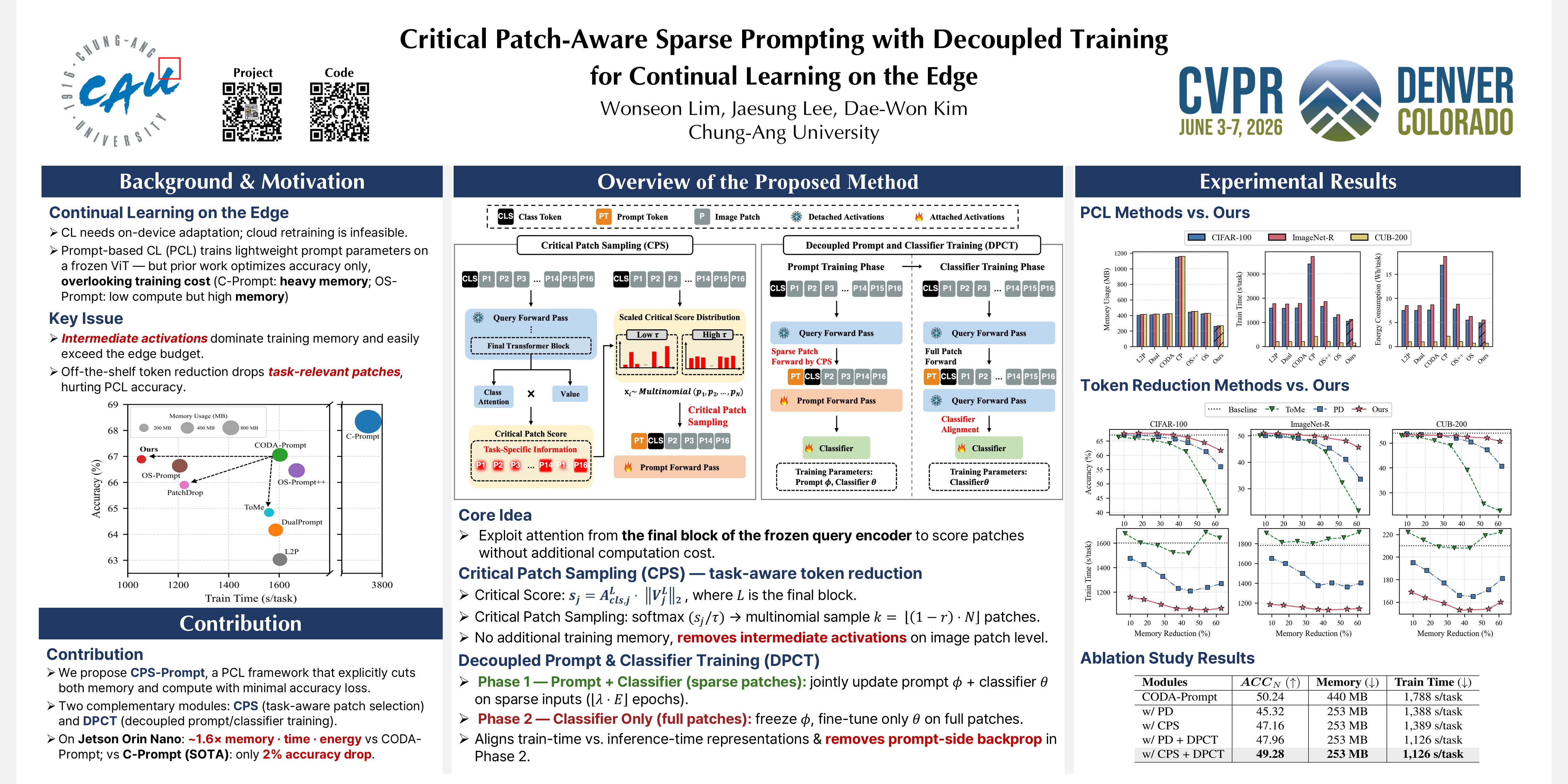
Continual learning (CL) on edge devices requires not only high accuracy but also training-time efficiency to support on-device model adaptation under limited memory and compute resources. While prompt-based continual learning (PCL) achieves strong performance with few learnable parameters, existing studies primarily optimize accuracy or inference efficiency, overlooking the cost of on-device training. In this paper, we propose CPS-Prompt, a critical patch-aware sparse prompting framework that enhances training efficiency with minimal accuracy loss by combining Critical Patch Sampling (CPS) for task-aware token selection and Decoupled Prompt–Classifier Training (DPCT) for representation alignment. Extensive experiments across three public datasets demonstrate that CPS-Prompt reduces peak memory usage and training time by 36\% and 35\%, respectively, while maintaining accuracy within 2\% of the state-of-the-art method, C-Prompt, and matching the balanced CODA-Prompt baseline.
PACT: Phase-Like Transition Constraints in Adapter-Based Continual Learning of Vision-Language Models
Xuan Wang ⋅ Guiguang Ding ⋅ Jungong Han
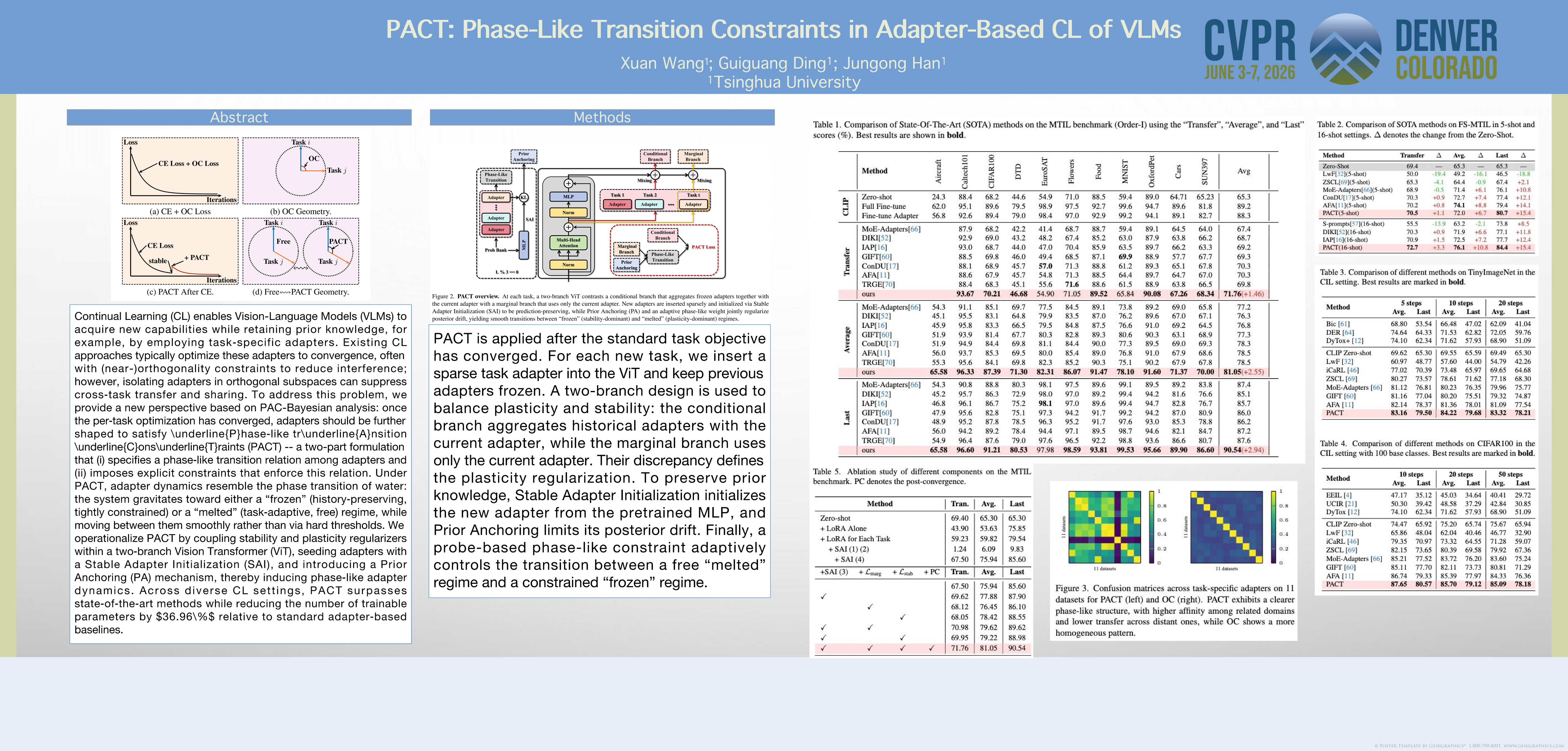
Continual Learning (CL) enables Vision-Language Models (VLMs) to acquire new capabilities while retaining prior knowledge, for example, by employing task‑specific adapters. Existing CL approaches typically optimize these adapters to convergence, often with (near-)orthogonality constraints to reduce interference; however, isolating adapters in orthogonal subspaces can suppress cross‑task transfer and sharing. To address this problem, we provide a new perspective based on PAC-Bayesian analysis: once the per‑task optimization has converged, adapters should be further shaped to satisfy \underline{P}hase‑like tr\underline{A}nsition \underline{C}ons\underline{T}raints (PACT) -- a two-part formulation that (i) specifies a phase‑like transition relation among adapters and (ii) imposes explicit constraints that enforce this relation. Under PACT, adapter dynamics resemble the phase transition of water: the system gravitates toward either a “frozen” (history‑preserving, tightly constrained) or a “melted” (task‑adaptive, free) regime, while moving between them smoothly rather than via hard thresholds. We operationalize PACT by coupling stability and plasticity regularizers within a two‑branch Vision Transformer (ViT), seeding adapters with a Stable Adapter Initialization (SAI), and introducing a Prior Anchoring (PA) mechanism, thereby inducing phase‑like adapter dynamics. Across diverse CL settings, PACT surpasses state‑of‑the‑art methods while reducing the number of trainable parameters by $36.96\%$ relative to standard adapter‑based baselines. Our code will be released publicly.
Representation-Steered Incremental Adapter-Tuning for Class-Incremental Learning with Pre-Trained Models
Jiarui Zhao ⋅ Libo Huang ⋅ Xiangqi Li ⋅ Zhulin An ⋅ Chuanguang Yang ⋅ Yu Wang ⋅ boyu diao ⋅ Yongjun Xu
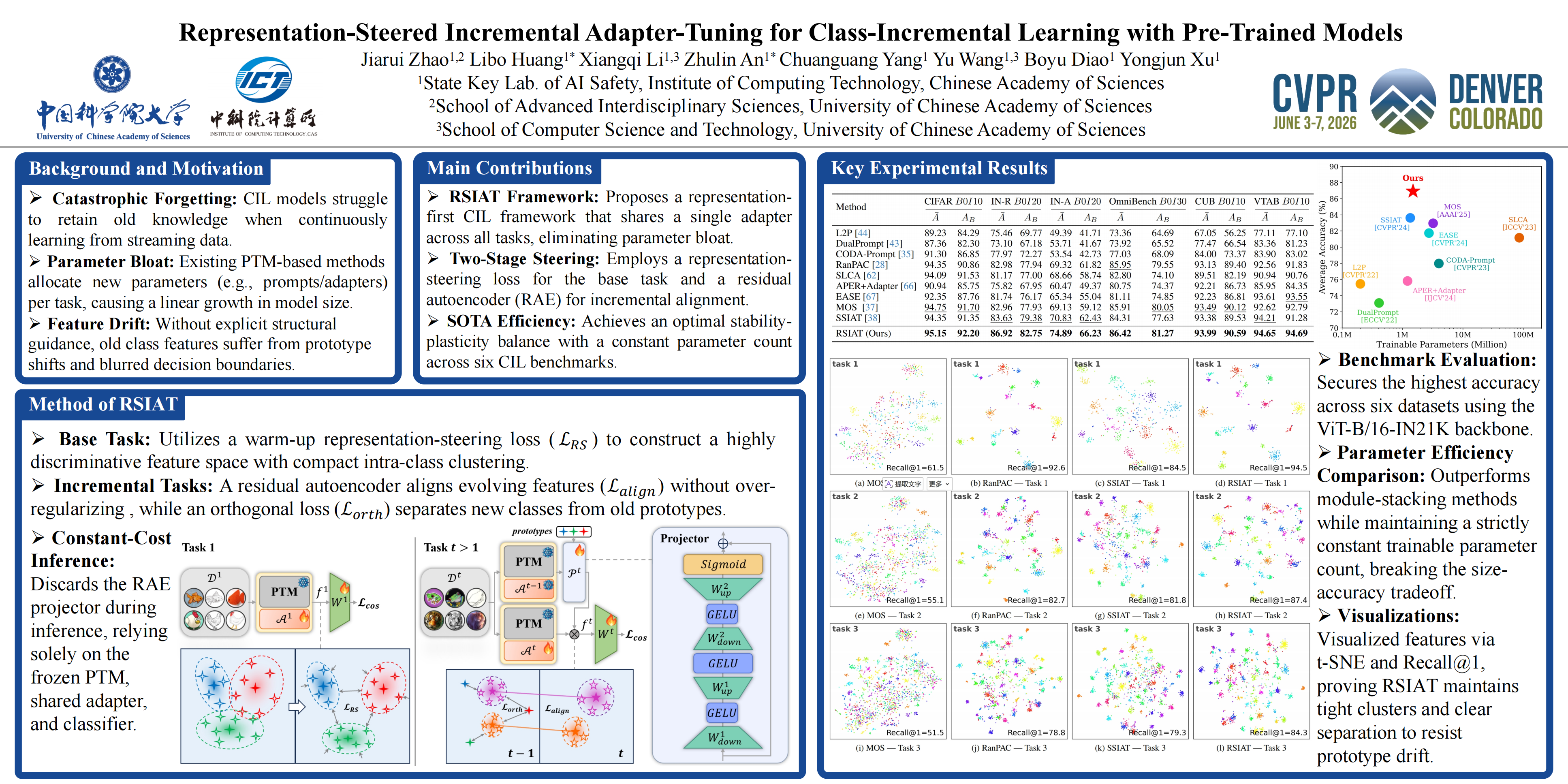
Class-Incremental Learning (CIL) aims to develop models to continuously learn new classes without forgetting learned old ones. Recent advances combine pre-trained models with parameter-efficient fine-tuning, achieving promising results. However, these approaches typically allocate new trainable parameters for each task, causing the model size to grow linearly with task number. Moreover, they lack explicit mechanisms to structure a coherent and discriminative representation space across tasks. To address these limitations, we propose Representation-Steered Incremental Adapter Tuning (RSIAT). RSIAT maintains a single shared adapter for all tasks, eliminating parameter growth during incremental learning. In the base task, we introduce a representation-steering loss that enhances discriminative feature learning while facilitating future task adaptation. During incremental tasks, a residual autoencoder–based projector aligns feature distributions between old and new tasks, preserving representation consistency without over-constraining the shared adapter. Extensive experiments on six CIL benchmarks demonstrate that RSIAT significantly outperforms state-of-the-art methods in both performance and parameter efficiency, achieving superior stability–plasticity trade-offs with minimal trainable parameters.
Re-evaluating Continual VQA: Toward Fair and Robust Evaluation for Multimodal Continual Learning
Zijian Gao ⋅ Zicheng Sun ⋅ Xingxing Zhang ⋅ Kele Xu ⋅ Huaimin Wang
Continual Visual Question Answering (Continual VQA) poses unique challenges for multimodal continual learning, requiring models to incrementally acquire new knowledge while preserving visual–semantic grounding across tasks. However, existing benchmarks hinder fair and robust evaluation of such capabilities, as they allow models to exploit dataset biases rather than demonstrate genuine continual reasoning. We identify two structural flaws in current benchmark design. First, shared answer vocabularies across tasks encourage answer memorization, inflating performance and underestimating forgetting. Second, static answer priors within each task make the training and test answer distributions nearly identical, obscuring robustness under distribution shifts. To address these issues, we introduce UCo-VQA, an Unbiased benchmark suite that enforces token-level disjoint answer spaces across tasks and introduces intra-task train–test distribution shifts, enabling fairer assessment of forgetting and generalization in multimodal continual learning. We further provide a parameter-efficient baseline that mitigates forgetting and enhances grounding through question-only replay and dual-level distillation, offering a lightweight and memory-efficient framework for continual adaptation. Extensive experiments on UCo-VQA reveal that prior methods substantially overestimate performance under biased setups, while our approach achieves state-of-the-art results, improving robustness and retention by up to 4.18% and 2.21%, respectively.
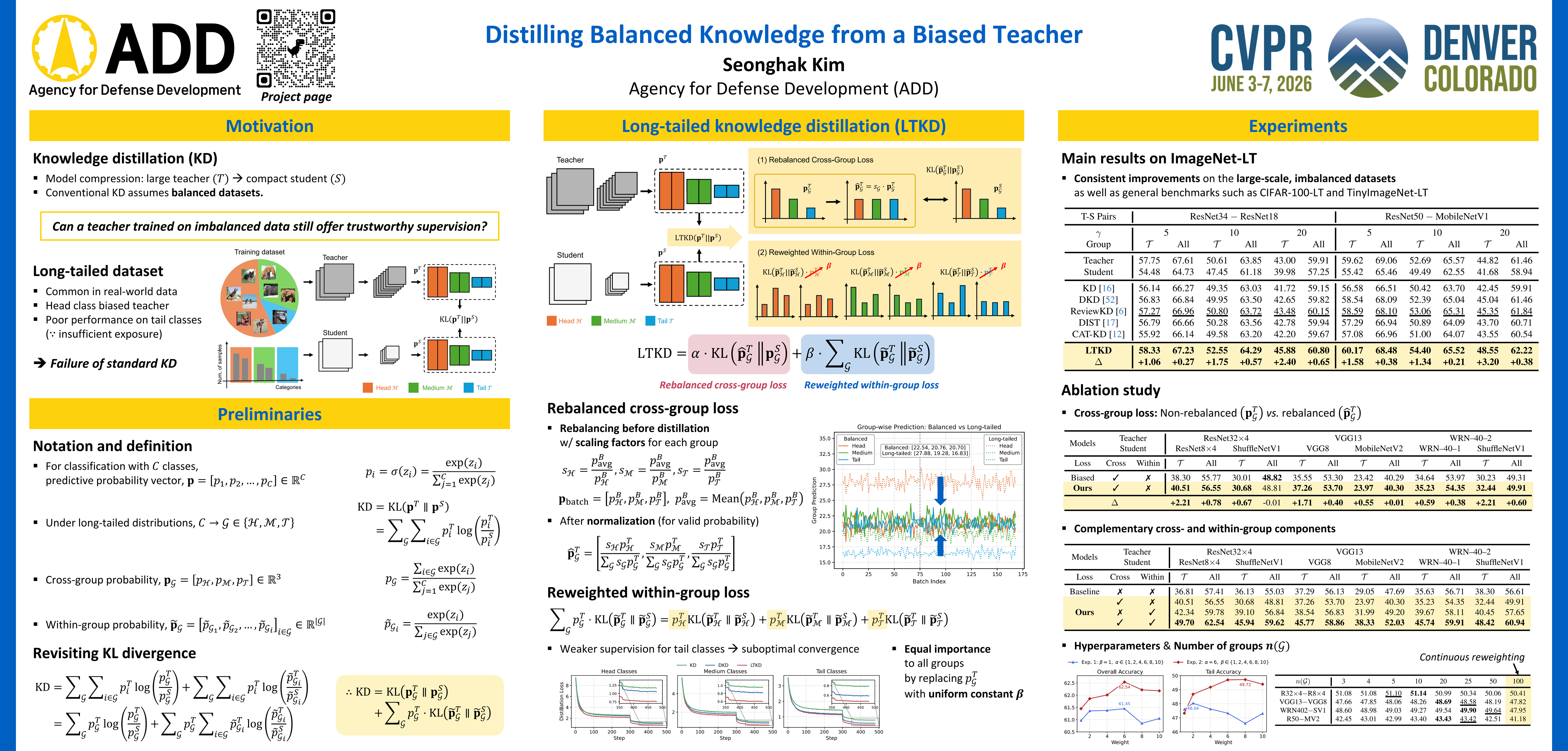
Conventional knowledge distillation, designed for model compression, fails on long-tailed distributions because the teacher model tends to be biased toward head classes and provides limited supervision for tail classes. We propose Long-Tailed Knowledge Distillation (LTKD), a novel framework that reformulates the conventional objective into two components: a cross-group loss, capturing mismatches in prediction distributions across class groups (head, medium, and tail), and a within-group loss, capturing discrepancies within each group's distribution. This decomposition reveals the specific sources of the teacher's bias. To mitigate the inherited bias, LTKD introduces (1) a rebalanced cross-group loss to calibrates the teacher's group-level predictions and (2) a reweighted within-group loss to ensures equal contribution from all groups. Extensive experiments on CIFAR-100-LT, TinyImageNet-LT, and ImageNet-LT demonstrate that LTKD significantly outperforms existing methods in both overall and tail-class accuracy, thereby proving its ability to distill balanced knowledge from a biased teacher for real-world applications.
Enhancing Continual Learning of Vision-Language Models via Dynamic Prefix Weighting
Hyeonseo Jang ⋅ Hyuk Kwon ⋅ Kibok Lee
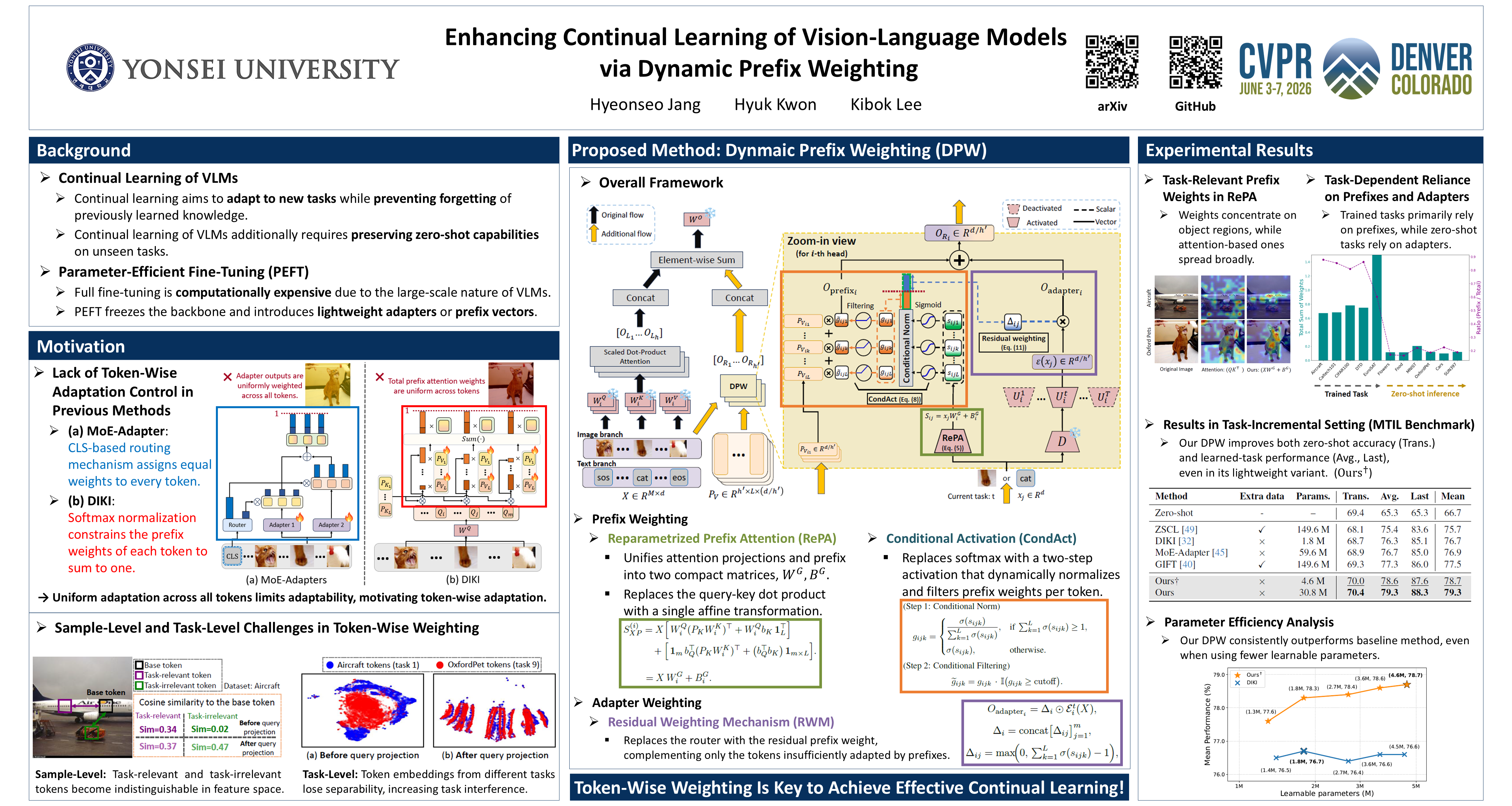
We investigate the recently introduced domain-class incremental learning scenarios for vision-language models (VLMs), where both domain and class distributions change across tasks. Recent works address this challenge using parameter-efficient methods such as prefix-tuning or adapters, which facilitate model adaptation to downstream tasks by incorporating task-specific information into input tokens through additive vectors. However, previous approaches often normalize the weights of these vectors, disregarding the fact that different input tokens require different degrees of adjustment. To overcome this issue, we propose Dynamic Prefix Weighting (DPW), a framework that dynamically assigns weights to prefixes, complemented by adapters. DPW consists of 1) a gating module that adjusts the weights of each prefix based on the importance of the corresponding input token, and 2) a weighting mechanism that derives adapter output weights as a residual of prefix-tuning weights, ensuring adapters are utilized only when necessary. Experimental results demonstrate that our method achieves state-of-the-art performance in domain-class incremental learning scenarios for VLMs. The code will be released.
Beyond Myopic Alignment: Lookahead Optimization for Online Class-Incremental Learning
Song Lai ⋅ Zhe Zhao ⋅ Fei Zhu ⋅ Ji Cheng ⋅ Xi Lin ⋅ Qingfu Zhang ⋅ Gaofeng Meng
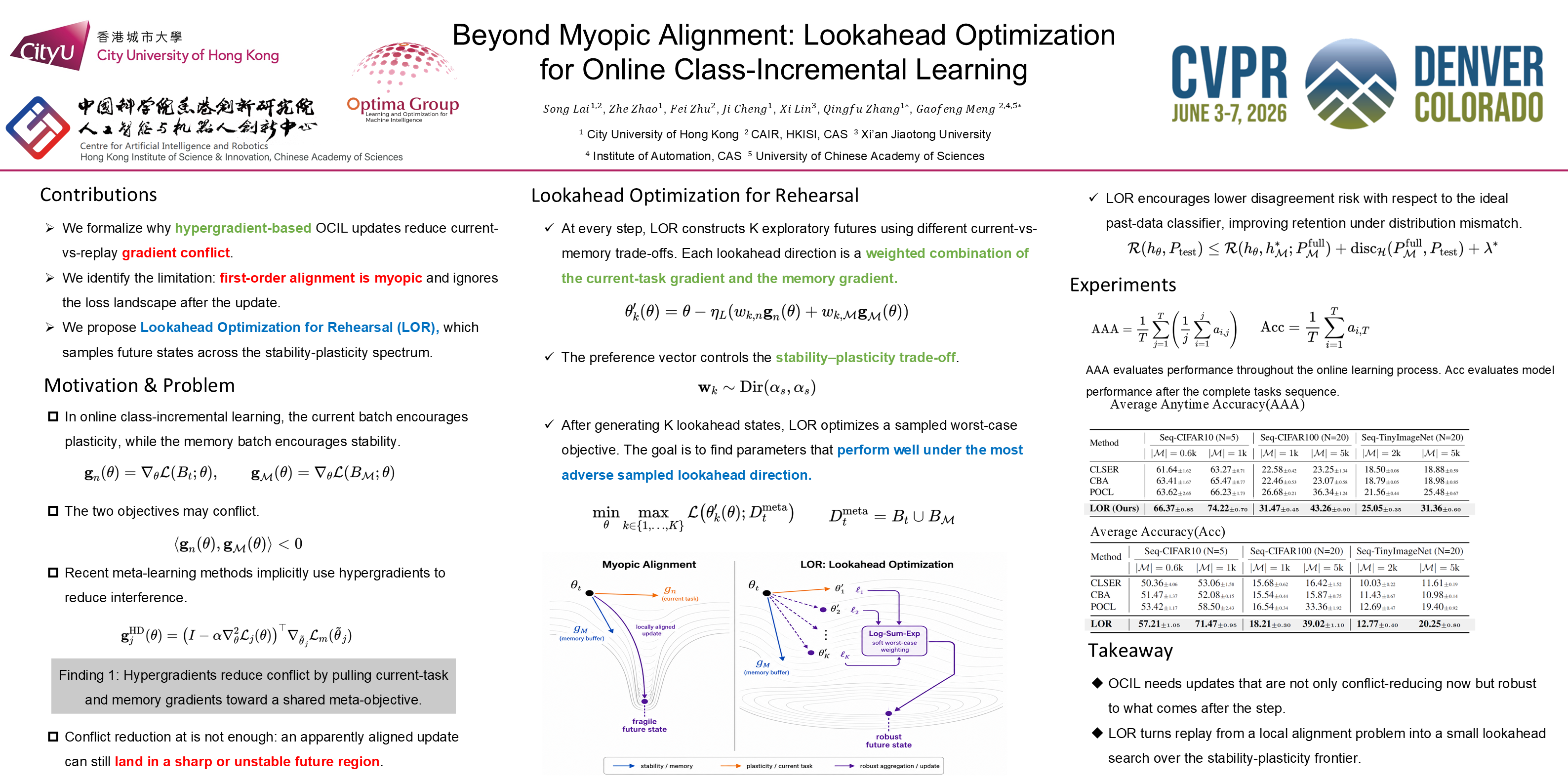
Rehearsal-based methods are the cornerstone of modern online class-incremental learning (OCIL), yet they face a fundamental challenge: the gradient of the current task often conflicts with that of the rehearsal data from the memory buffer, leading to catastrophic forgetting. Recent works have implicitly addressed this by using hypergradients, but the underlying mechanism has remained poorly understood. In this paper, we first provide a formal analysis revealing that hypergradients mitigate forgetting by aligning task-specific gradients towards a common meta-objective, thereby reducing their conflict. However, we argue that this conflict-reducing alignment is inherently myopic—it only considers the immediate gradient directions, failing to account for the loss landscape geometry just one step ahead. To overcome this limitation, we introduce a novel framework: Lookahead Optimization for Rehearsal (LOR). Instead of committing to a single update, LOR first explores a set of potential future model states by taking lookahead steps along different directions that balance plasticity and stability. To ensure the final update is robust, we formulate the optimization as a min-max problem, seeking parameters that perform well even under the worst-case lookahead scenario. This objective is made tractable by a smooth Log-Sum-Exp approximation, enabling efficient end-to-end training. Theoretical analysis from both optimization and statistical perspectives corroborates the robustness of our approach. Extensive experiments on Seq-CIFAR10, Seq-CIFAR100, and Seq-TinyImageNet demonstrate that LOR significantly outperforms state-of-the-art methods, establishing a new and more robust paradigm for rehearsal-based OCIL.
EmoDiffTalk: Emotion-aware Diffusion for Editable 3D Gaussian Talking Head
Chang Liu ⋅ Tianjiao Jing ⋅ Chengcheng Ma ⋅ Xuanqi Zhou ⋅ Zhengxuan Lian ⋅ Qin Jin ⋅ Hongliang Yuan ⋅ Shi-Sheng Huang
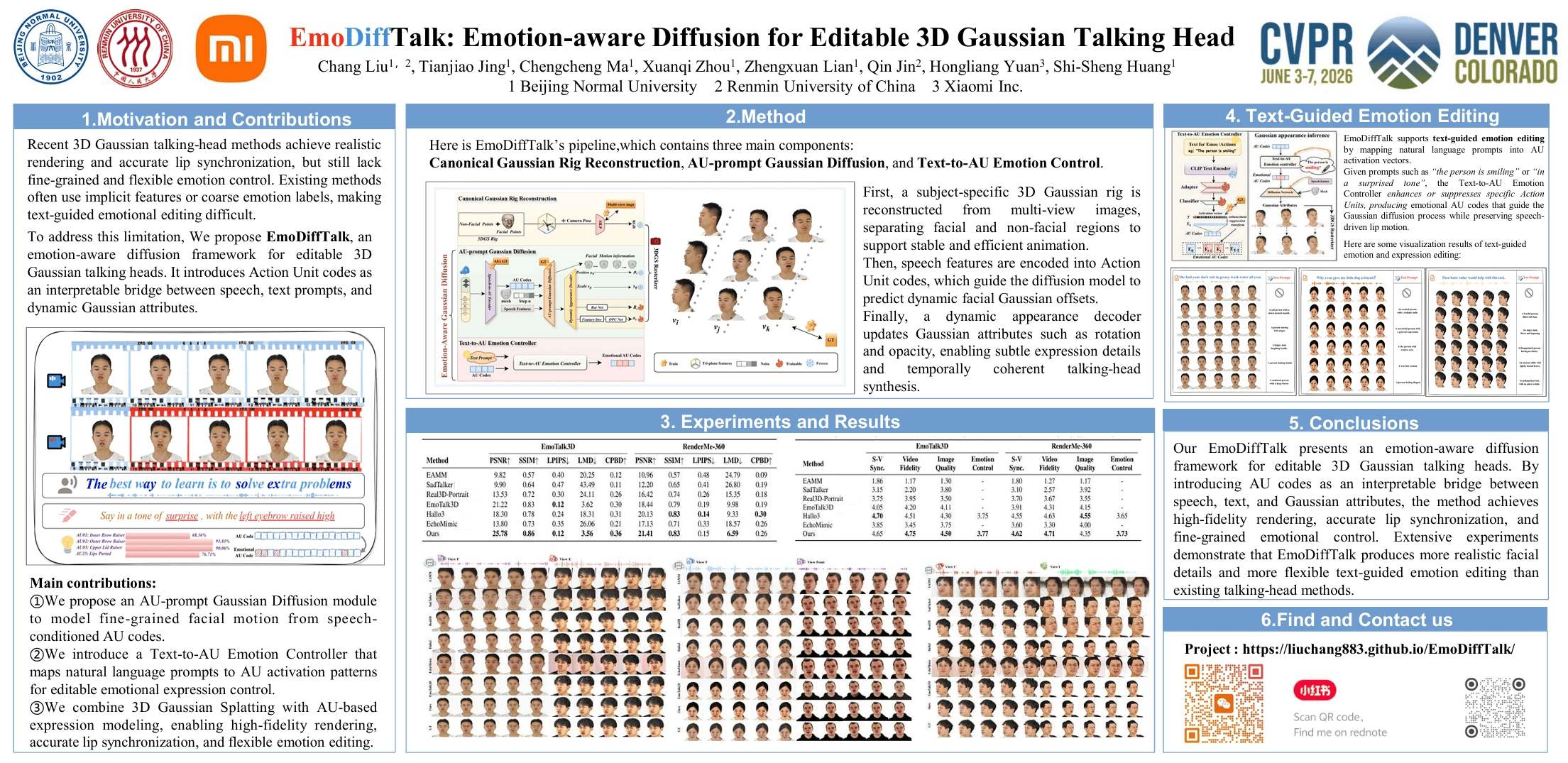
Recent photo-realistic 3D talking head via 3D Gaussian Splatting still has significant shortcoming in emotional expression manipulation, especially for fine-grained and expansive dynamics emotional editing using multi-modal control. This paper introduces a new editable 3D Gaussian talking head, i.e. EmoDiffTalk. Our key idea is a novel Emotion-aware Gaussian Diffusion, which includes an action unit (AU) prompt Gaussian diffusion process for fine-grained facial animator, and moreover an accurate text-to-AU emotion controller to provide accurate and expansive dynamic emotional editing using text input. Experiments on public EmoTalk3D and RenderMe-360 datasets demonstrate superior emotional subtlety, lip-sync fidelity, and controllability of our EmoDiffTalk over previous works, establishing a principled pathway toward high-quality, diffusion-driven, multimodal editable 3D talking-head synthesis. To our best knowledge, our EmoDiffTalk is one of the first few 3D Gaussian Splatting talking-head generation framework, especially supporting continuous, multimodal emotional editing within the AU-based expression space.
Avatar Forcing: Real-Time Interactive Head Avatar Generation for Natural Conversation
Taekyung Ki ⋅ Sangwon Jang ⋅ Jaehyeong Jo ⋅ Jaehong Yoon ⋅ Sung Ju
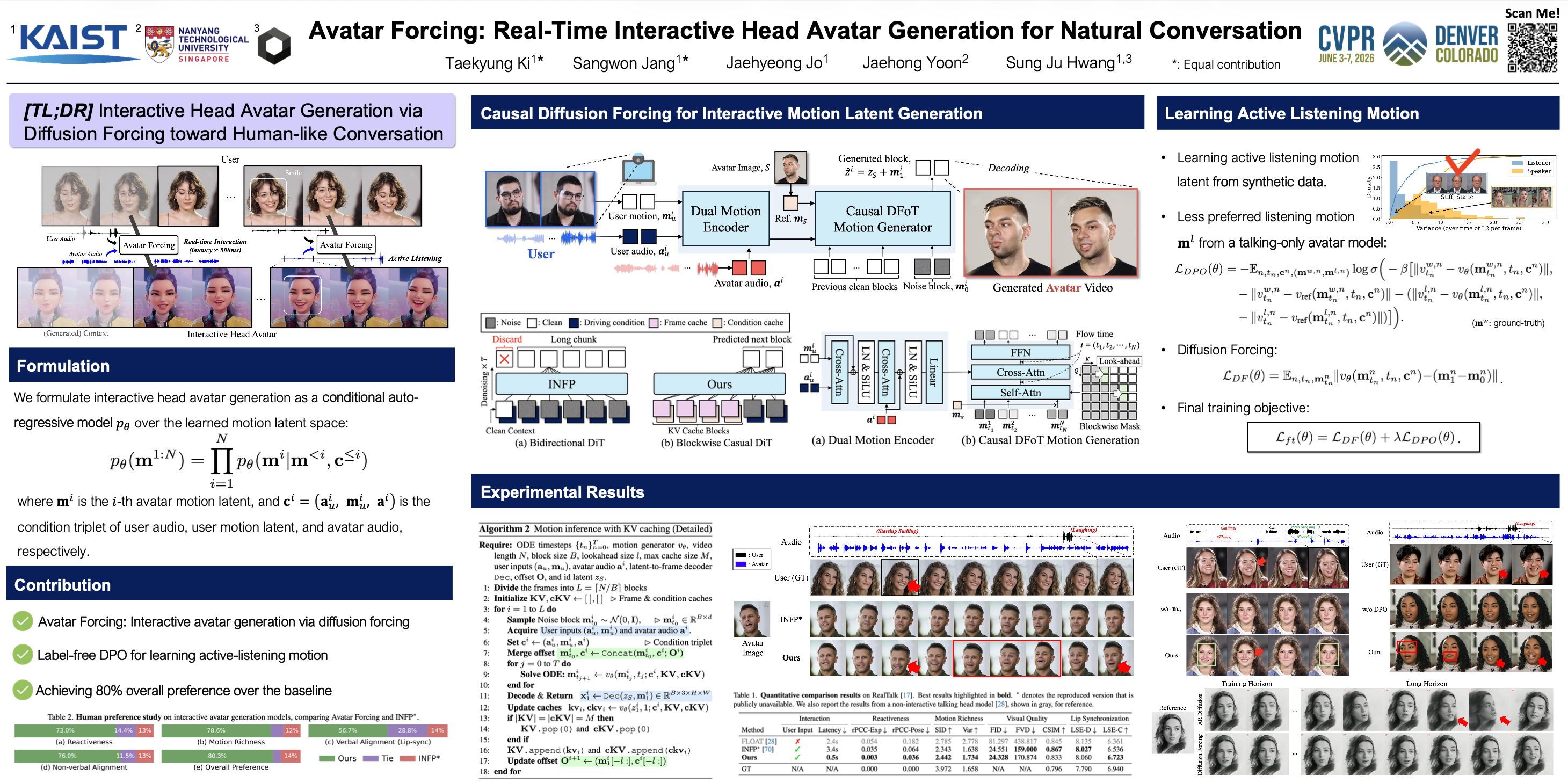
Talking head generation creates lifelike avatars from static portraits for virtual communication and content creation. However, current models do not yet convey the feeling of truly interactive communication, often generating one-way responses that lack emotional engagement. We identify two key challenges toward truly interactive avatars: generating motion in real-time under causal constraints and learning expressive, vibrant reactions without additional labeled data. To address these challenges, we propose Avatar Forcing, a new framework for interactive head avatar generation that models real-time user-avatar interactions through diffusion forcing. This design allows the avatar to process real-time multimodal inputs, including the user’s audio and motion, with low latency for instant reactions to both verbal and non-verbal cues such as speech, nods, and laughter. Furthermore, we introduce a direct preference optimization method that leverages synthetic losing samples constructed by dropping user conditions, enabling label-free learning of expressive interaction. Experimental results demonstrate that our framework enables real-time interaction with low latency (about 500ms), achieving 6.8x speedup compared to the baseline, and produces reactive and expressive avatar motion, which is preferred over 80% against the baseline.
D^3FER: Dual Channel and Dual Branch Network for Robust Facial Expression Recognition under Dual Challenges
Hui Tang ⋅ Yifan He ⋅ Zhong Jin
Facial expression recognition (FER) in the wild remains a challenging task due to the coexistence of data noise and label noise. While existing methods often address one type of noise in isolation, they struggle to achieve robust performance under the compound effects of both. To this end, we propose D$^3$FER ($\textbf{D}$ual Channel and $\textbf{D}$ual Branch Network for Robust Facial Expression Recognition under $\textbf{D}$ual Noise), a unified framework that simultaneously tackles data and label noise in a single architecture. D$^3$FER introduces a dual-channel augmentation strategy, pairing weakly and strongly augmented views, to facilitate reliable pseudo-label generation and noise-aware training. Coupled with a dynamic queue mechanism, it adaptively estimates a noise threshold based on historical prediction confidence, enabling automatic identification and correction of label noise. Furthermore, inspired by contrastive learning, we design a momentum-updated Query-Key dual-branch structure that enhances intra-class compactness and inter-class separability, thereby improving robustness to data noise. At inference time, the stable Key branch parameters are leveraged to ensure consistent and generalized predictions. Extensive experiments on major in-the-wild benchmarks demonstrate that D$^3$FER outperforms state-of-the-art methods, setting new records in both accuracy and robustness under realistic, noisy conditions. The source code is available at https://github.com/D3FER/D3FER.
HumanNOVA: Photorealistic, Universal and Rapid 3D Human Avatar Modeling from a Single Image
Hezhen Hu ⋅ Wangbo Zhao ⋅ Lanqing Guo ⋅ Hanwen Jiang ⋅ Jonathan C. Liu ⋅ Zhiwen Fan ⋅ Kai Wang ⋅ Zhangyang Wang ⋅ Georgios Pavlakos
In this paper, we present HumanNOVA, a photorealistic, universal, and rapid model for generating 3D human avatars from a single RGB image. Achieving both photorealism and generalization is challenging due to the scarcity of diverse, high-quality 3D human data. To address this, we build a scalable data generation pipeline that follows two strategies. The first one is to leverage existing rigged assets and animate them with extensive poses from daily life. The second strategy is to utilize existing multi-camera captures of humans and employ fitting to generate more diverse views for training. These two strategies enable us to scale up to 100k assets, significantly enhancing both the quantity and the diversity of data for robust model training. In terms of the architecture, HumanNOVA adopts a feed-forward, token-conditioned avatar modeling framework that allows fast inference in less than one second and requires no test-time optimization. Given an input image and an estimated simplified human mesh (SMPL) without detailed geometry or appearance, the model first encodes both inputs into compact token representations. These tokens then act as conditioning signals and are fused through cross-attention to construct a triplane-based 3D avatar representation. Extensive experiments on multiple benchmarks demonstrate the superiority of our approach, both quantitatively and qualitatively, as well as its robustness under diverse input image conditions.
ExpPortrait: Expressive Portrait Generation via Personalized Representation
Junyi Wang ⋅ Yudong Guo ⋅ Boyang Guo ⋅ Shengming Yang ⋅ Juyong Zhang
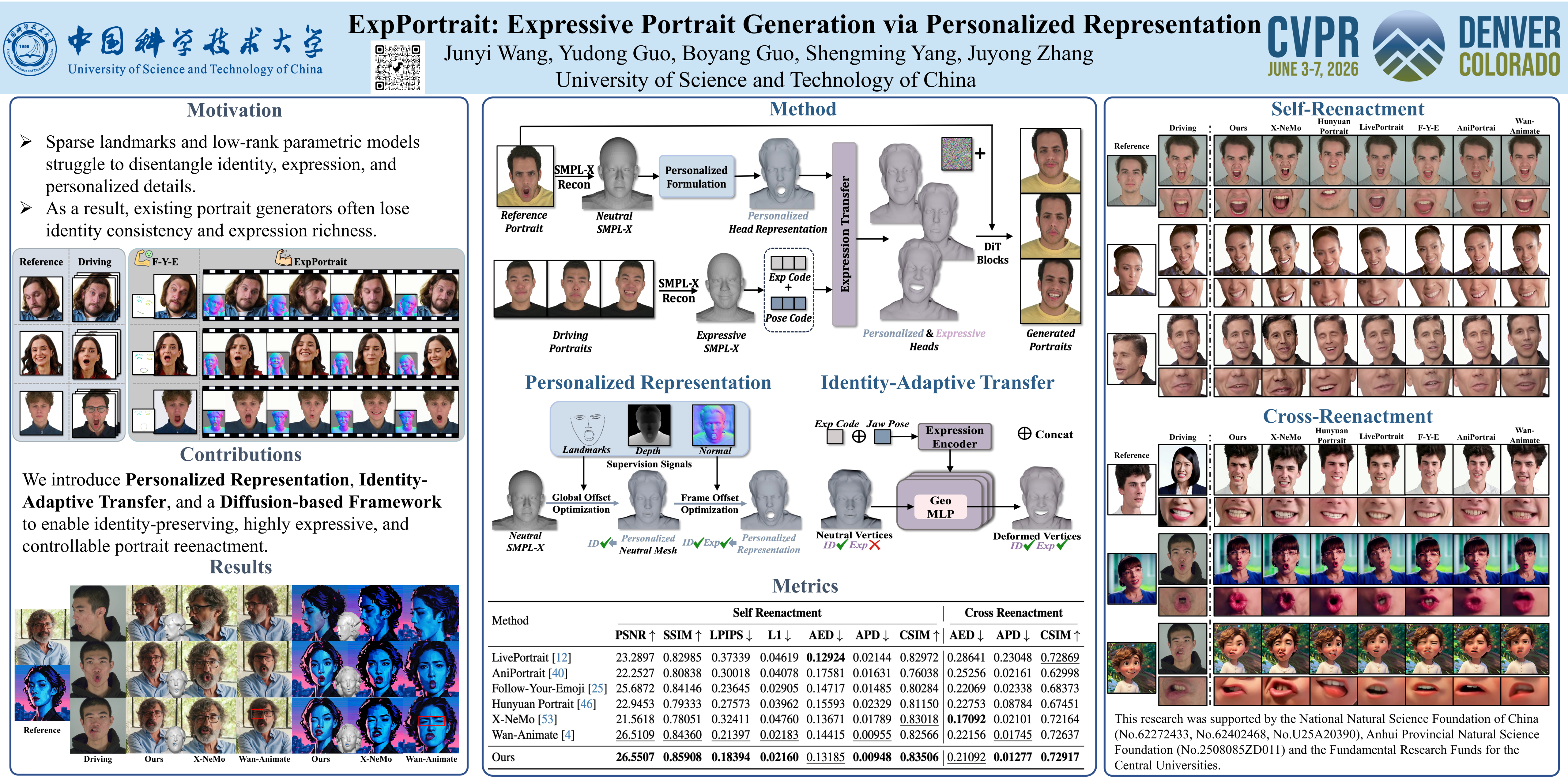
While diffusion models have shown great potential in portrait generation, generating expressive, coherent, and controllable cinematic portrait videos remains a significant challenge. Existing intermediate signals for portrait generation, such as 2D landmarks and parametric models, have limited disentanglement capabilities and cannot express personalized details due to their sparse or low-rank representation. Therefore, existing methods based on these models struggle to accurately preserve subject identity and expressions, hindering the generation of highly expressive portrait videos. To overcome these limitations, we propose a high-fidelity personalized head representation that more effectively disentangles expression and identity. This representation captures both static, subject-specific global geometry and dynamic, expression-related details. Furthermore, we introduce an expression transfer module to achieve personalized transfer of head pose and expression details between different identities. We use this sophisticated and highly expressive head model as a conditional signal to train a diffusion transformer (DiT)-based generator to synthesize richly detailed portrait videos. Extensive experiments on self- and cross-reenactment tasks demonstrate that our method outperforms previous models in terms of identity preservation, expression accuracy, and temporal stability, particularly in capturing fine-grained details of complex motion.
PersonaLive! Expressive Portrait Image Animation for Live Streaming
Zhiyuan Li ⋅ Chi-Man Pun ⋅ Chen Fang ⋅ Jue Wang ⋅ Xiaodong Cun
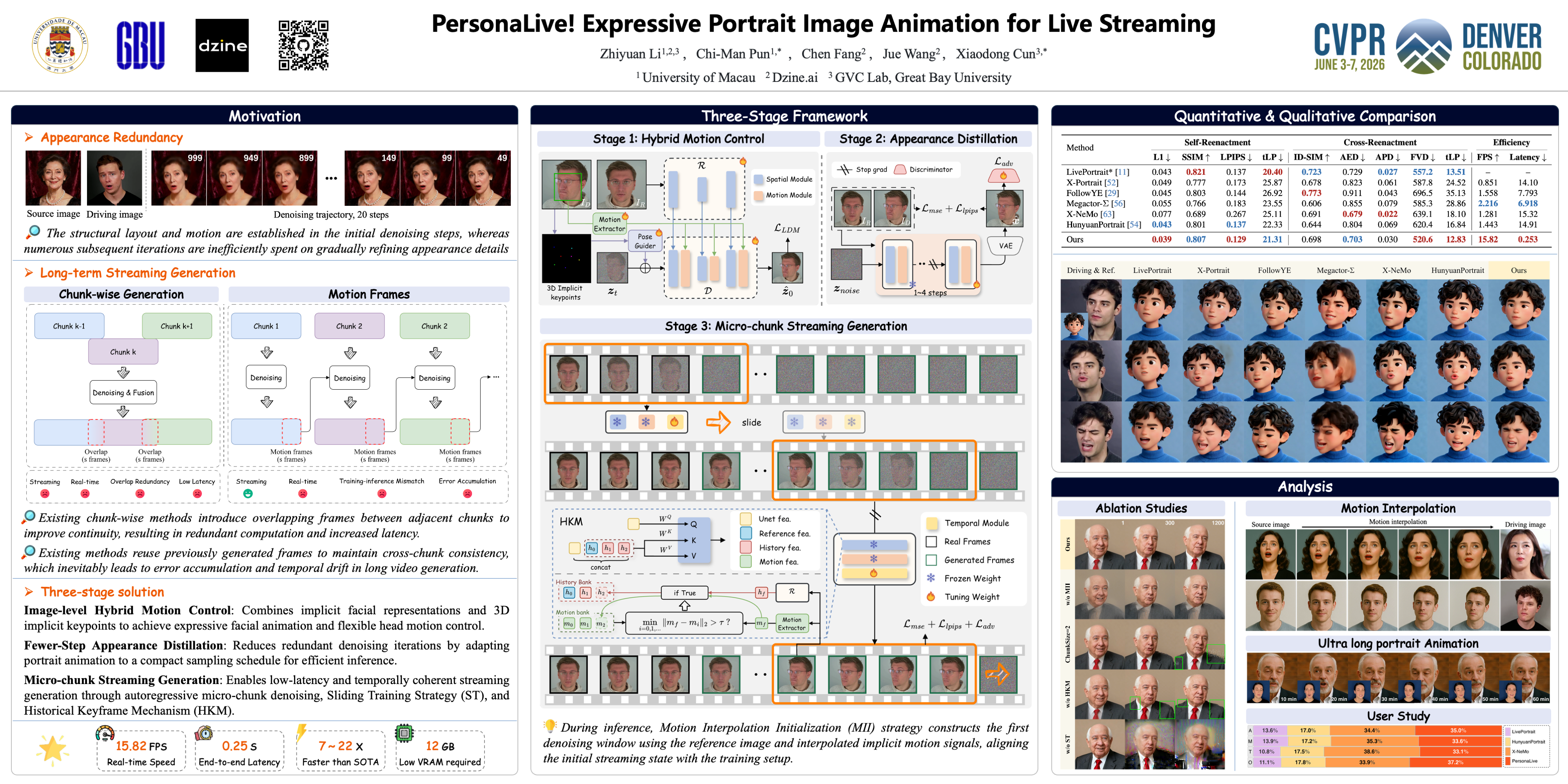
Current diffusion-based portrait animation models predominantly focus on enhancing visual quality and expression realism, while overlooking generation latency and real-time performance, which restricts their application range in the live streaming scenario. We propose PersonaLive, a novel diffusion-based framework towards streaming real-time portrait animation with multi-stage training recipes. Specifically, we first adopt hybrid implicit signals, namely implicit facial representations and 3D implicit keypoints, to achieve expressive image-level motion control. Then, a fewer-step appearance distillation strategy is proposed to eliminate appearance redundancy in the denoising process, greatly improving inference efficiency. Finally, we introduce an autoregressive micro-chunk streaming generation paradigm equipped with a sliding training strategy and a historical keyframe mechanism to enable low-latency and stable long-term video generation. Extensive experiments demonstrate that PersonaLive achieves state-of-the-art performance with up to **7-22**$\times$ speedup over prior diffusion-based portrait animation models. The code will be publicly available.
ProFocus: Proactive Perception and Focused Reasoning in Vision-and-Language Navigation
Wei Xue ⋅ Mingcheng Li ⋅ Xuecheng Wu ⋅ Jingqun Tang ⋅ Dingkang Yang ⋅ Lihua Zhang
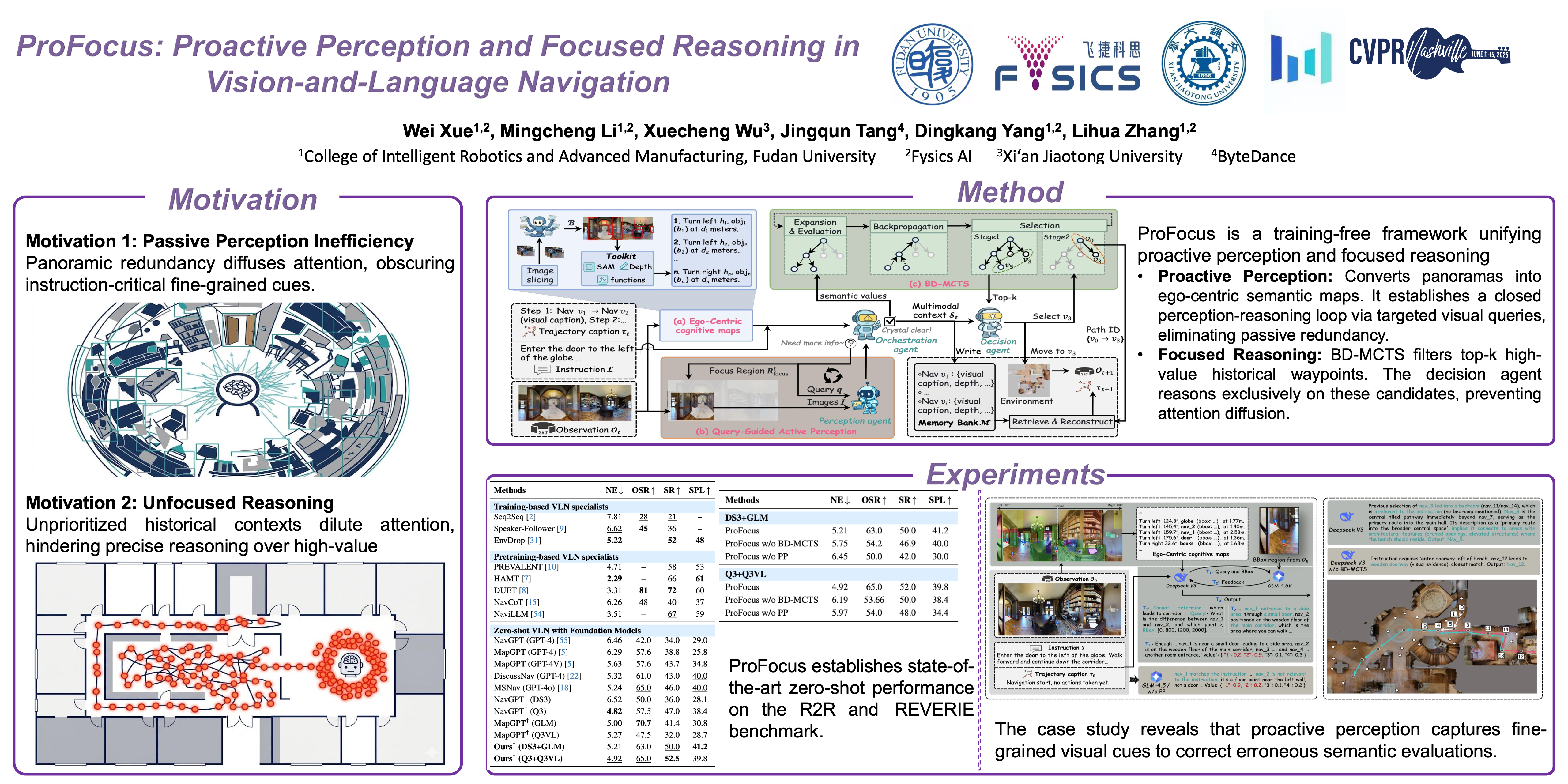
Vision-and-Language Navigation (VLN) requires agents to accurately perceive complex visual environments and reason over navigation instructions and histories. However, existing methods passively process redundant visual inputs and treat all historical contexts indiscriminately, resulting in inefficient perception and unfocused reasoning. To address these challenges, we propose ProFocus, a training-free progressive framework that unifies Proactive Perception and Focused Reasoning through collaboration between large language models (LLMs) and vision-language models (VLMs). For proactive perception, ProFocus transforms panoramic observations into structured ego-centric semantic maps, enabling the orchestration agent to identify missing visual information needed for reliable decision-making, and to generate targeted visual queries with corresponding focus regions that guide the perception agent to acquire the required observations. For focused reasoning, we propose Branch-Diverse Monte Carlo Tree Search (BD-MCTS) to identify top-k high-value waypoints from extensive historical candidates. The decision agent focuses reasoning on the historical contexts associated with these waypoints, rather than considering all historical waypoints equally. Extensive experiments validate the effectiveness of ProFocus, achieving state-of-the-art performance among zero-shot methods on R2R and REVERIE benchmarks.
OptiMVMap: Offline Vectorized Map Construction via Optimal Multi-vehicle Perspectives
Zedong Dan ⋅ Zijie Wang ⋅ Wei Zhang ⋅ Xiangru Lin ⋅ Weiming Zhang ⋅ Xiao Tan ⋅ Jingdong Wang ⋅ Liang Lin ⋅ Guanbin Li
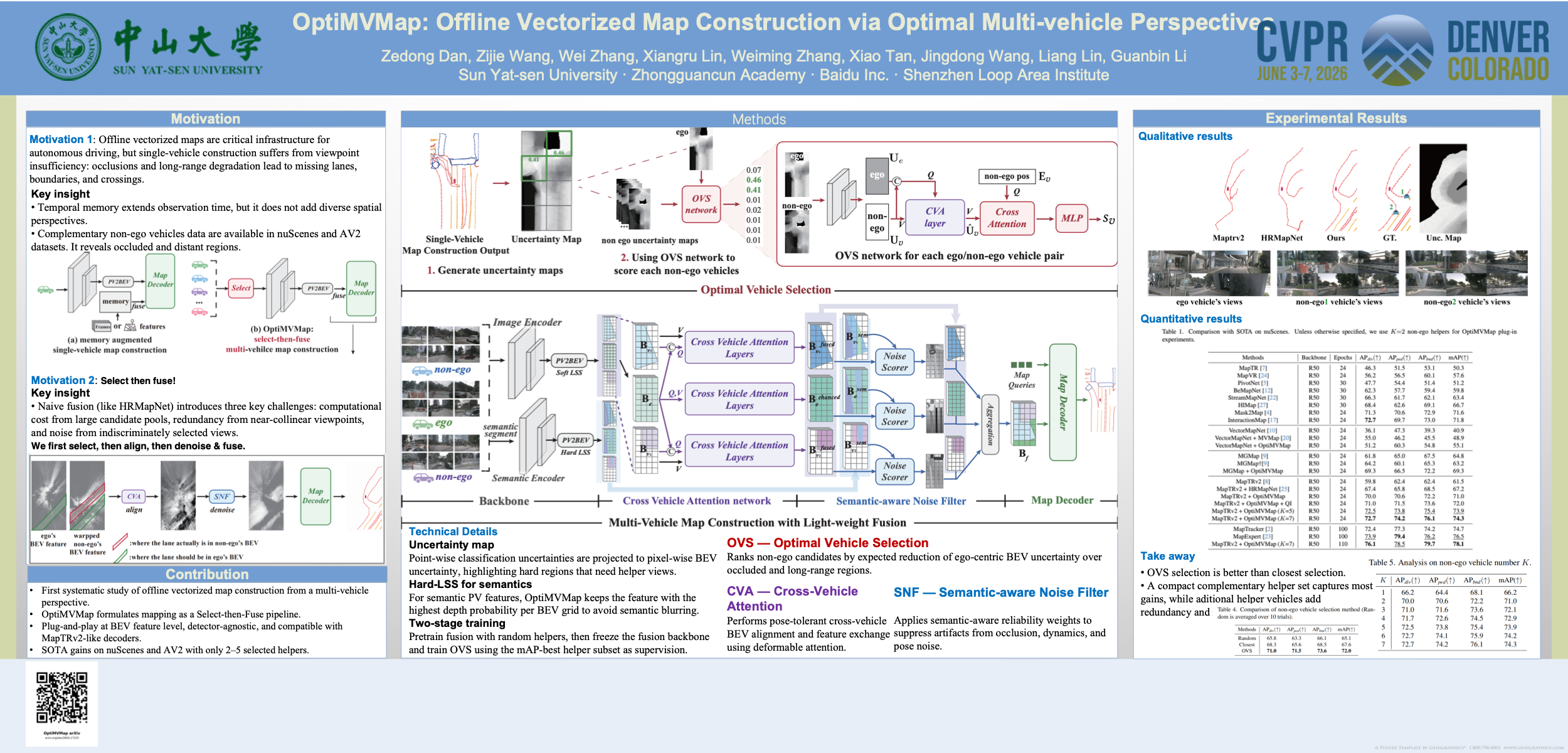
Offline vectorized maps constitute critical infrastructure for high-precision autonomous driving and mapping services. Existing approaches rely predominantly on single ego-vehicle trajectories, which fundamentally suffer from viewpoint insufficiency: while memory-based methods extend observation time by aggregating ego-trajectory frames, they lack the spatial diversity needed to reveal occluded regions. Incorporating views from surrounding vehicles offers complementary perspectives, yet naive fusion introduces three key challenges: computational cost from large candidate pools, redundancy from near-collinear viewpoints, and noise from pose errors and occlusion artifacts.We present OptiMVMap, which reformulates multi-vehicle mapping as a select-then-fuse problem to address these challenges systematically. An Optimal Vehicle Selection (OVS) module strategically identifies a compact subset of helpers that maximally reduce ego-centric uncertainty in occluded regions, addressing computation and redundancy challenges. Cross-Vehicle Attention (CVA) and Semantic-aware Noise Filter (SNF) then perform pose-tolerant alignment and artifact suppression before BEV-level fusion, addressing the noise challenge. This targeted pipeline yields more complete and topologically faithful maps with substantially fewer views than indiscriminate aggregation.On nuScenes and Argoverse2, OptiMVMap improves MapTRv2 by +10.5 mAP and +9.3 mAP, respectively, and surpasses memory-augmented baselines MVMap and HRMapNet by +6.2 mAP and +3.8 mAP on nuScenes. These results demonstrate that uncertainty-guided selection of helper vehicles is essential for efficient and accurate multi-vehicle vectorized mapping.
CogDriver: Integrating Cognitive Inertia for Temporally Coherent Planning in Autonomous Driving
Pei Liu ⋅ Qingtian Ning ⋅ Xinyan Lu ⋅ Haipeng LIU ⋅ Weiliang Ma ⋅ Dangen She ⋅ XianPeng Lang ⋅ Jun Ma
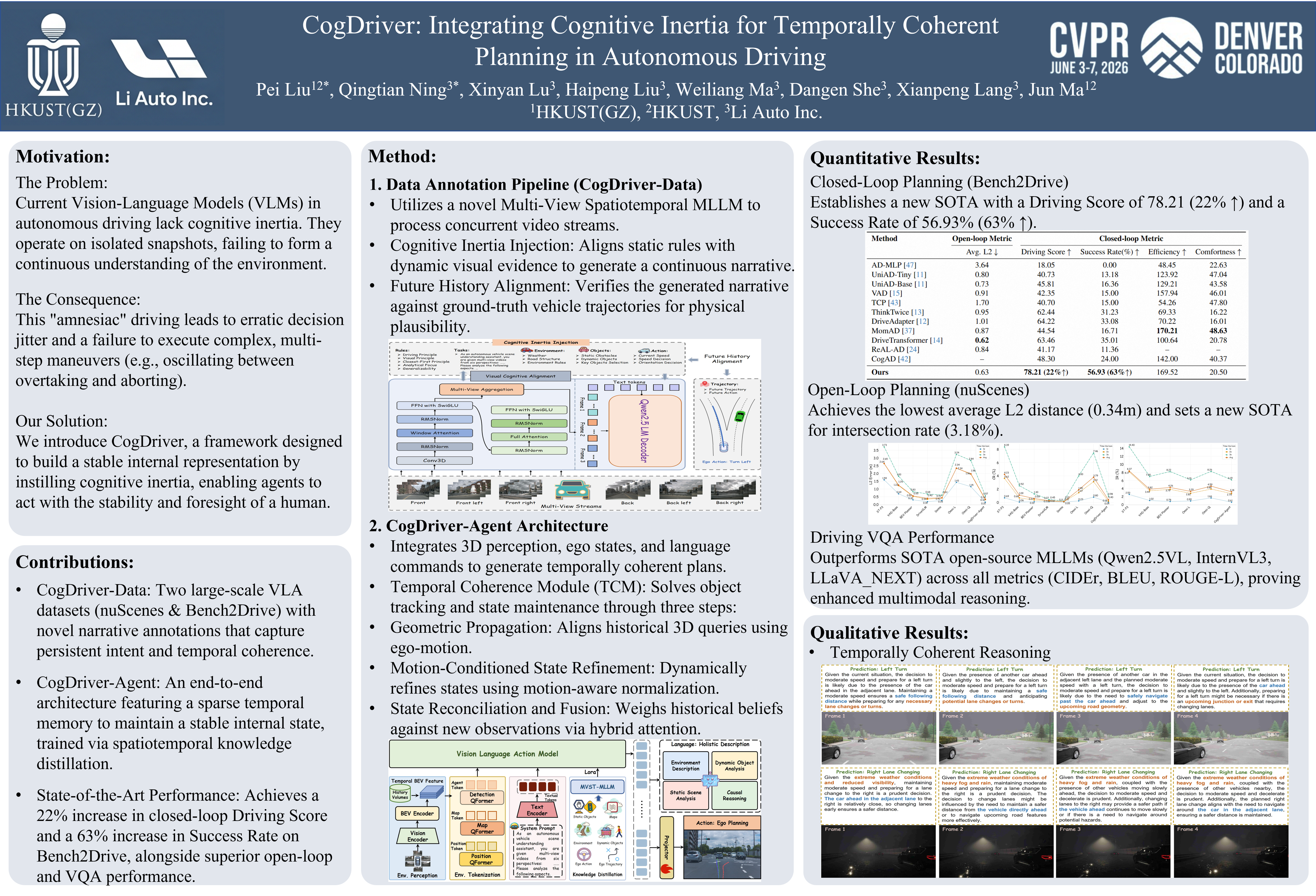
The pursuit of autonomous agents with predictive cognitive world models is hindered by a fundamental flaw in current vision-language models (VLMs): they lack cognitive inertia. Operating on isolated snapshots, these models cannot form a temporally coherent world view, leading to erratic decision jitter and a failure to execute complex, multi-step maneuvers. To remedy this, we introduce CogDriver, a framework designed to build a coherent world model by instilling this crucial cognitive property. Our work makes two key contributions: (1) We present CogDriver-Data, a large-scale vision-language-action dataset whose narrative annotations provide the supervisory signal for learning the temporal dynamics of a world model. (2) We develop the CogDriver-Agent, an architecture featuring a sparse temporalmemory to maintain a stable internal state, the foundation of a world model. This is enabled by a spatiotemporal knowledge distillation approach that explicitly teaches decision coherence. Comprehensive experiments validate our paradigm: CogDriver-Agent achieves a 22\% increase in the closed-loop Driving Score on Bench2Drive and a 21\% reduction in mean L2 error on nuScenes, establishing a new state-of-the-art. These significant gains in both long-term decision-making and imitation accuracy provide strong evidence that our agent is developing a more stable internal world model.
TopoHR: Hierarchical Centerline Representation for Cyclic Topology Reasoning in Driving Scenes with Point-to-Instance Relations
Yifeng Bai ⋅ Zhirong Chen ⋅ Bo Song ⋅ Erkang Cheng ⋅ Haibin Ling
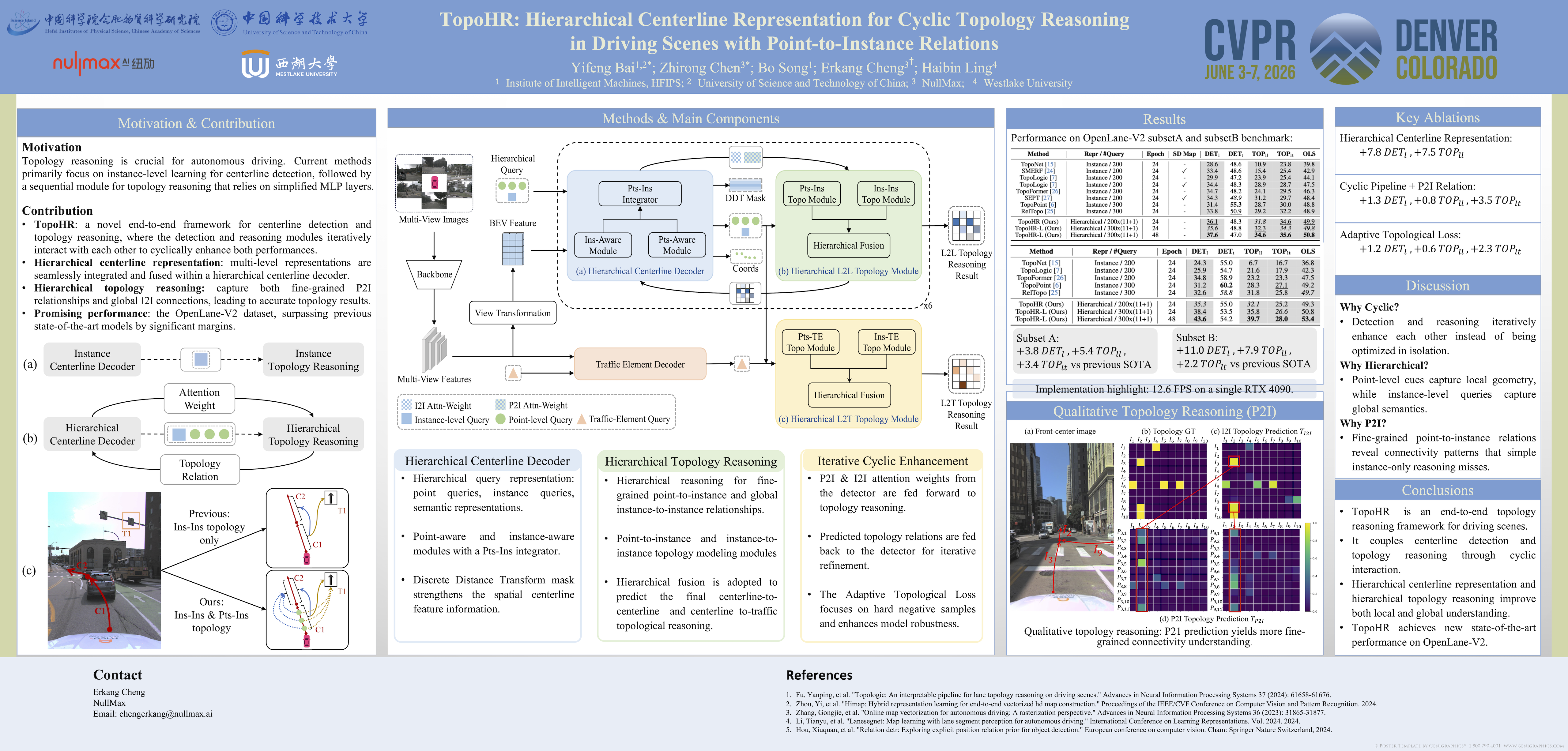
Topology reasoning is crucial for autonomous driving. Current methods primarily focus on instance-level learning for centerline detection, followed by a sequential module for topology reasoning that relies on simplified MLP layers. Moreover, these approaches often neglect the importance of point-to-instance (P2I) relationships in topology reasoning. To address these limitations, we present TopoHR (Topological Hierarchical Representation), a novel end-to-end framework that establishes cyclic interaction between centerline detection and topology reasoning, allowing them to iteratively enhance each other. Specifically, we introduce a hierarchical centerline representation including point queries, instance queries, and semantic representations. These multi-level features are seamlessly integrated and fused within a hierarchical centerline decoder. Furthermore, we design a hierarchical topology reasoning module that captures both fine-grained P2I relationships and global instance-to-instance (I2I) connections within a unified architecture. With these novel components, TopoHR ensures accurate and robust topology reasoning. On the OpenLane-V2 benchmark, TopoHR refreshes state-of-the-art performance with significant improvements. Notably, compared with previous best results, TopoHR achieves +3.8 in $\mathrm{DET}\_{\text{l}}$, +5.4 in $\mathrm{TOP}\_{\text{ll}}$ on subset_A and +11.0 in $\mathrm{DET}\_{\text{l}}$, +7.9 in $\mathrm{TOP}\_{\text{ll}}$ on subset_B, validating the effectiveness of the proposed components. The code will be shared publicly upon paper acceptance.
AURA: Multi-modal Shared Autonomy for Urban Navigation
Yukai Ma ⋅ Honglin He ⋅ Selina Song ⋅ Wayne Wu ⋅ Bolei Zhou
Long-horizon navigation in complex urban environments still relies heavily on continuous human operation, which leads to fatigue, reduced efficiency, and safety concerns. Shared autonomy, where a Vision-Language AI agent and a human operator collaborate on maneuvering the mobile machine, presents a promising solution to address these issues. However, existing shared autonomy methods often require humans and AI to operate in the same action space, resulting in high cognitive overhead. We present Assistive Urban Robot Autonomy (AURA), a new multi-modal framework that decomposes urban navigation into high-level human instruction and low-level AI control. AURA incorporates a Spatial-Aware Instruction Encoder to align human instructions with visual and spatial context. To facilitate training, we construct UrbanWalks, a large-scale dataset composed of teleoperation and vision-language description data. Experiments in simulation and the real world demonstrate that AURA effectively follows human instructions, reduces manual operation effort, and improves navigation stability, while enabling online adaptation and continuous learning.Moreover, under similar takeover conditions, our hierarchical shared autonomy framework reduces human operation Frequency by over 75%. Code and data will be made available.
Zero-Shot Reconstruction of Animatable 3D Avatars with Cloth Dynamics from a Single Image
Joohyun Kwon ⋅ Geonhee Sim ⋅ Gyeongsik Moon
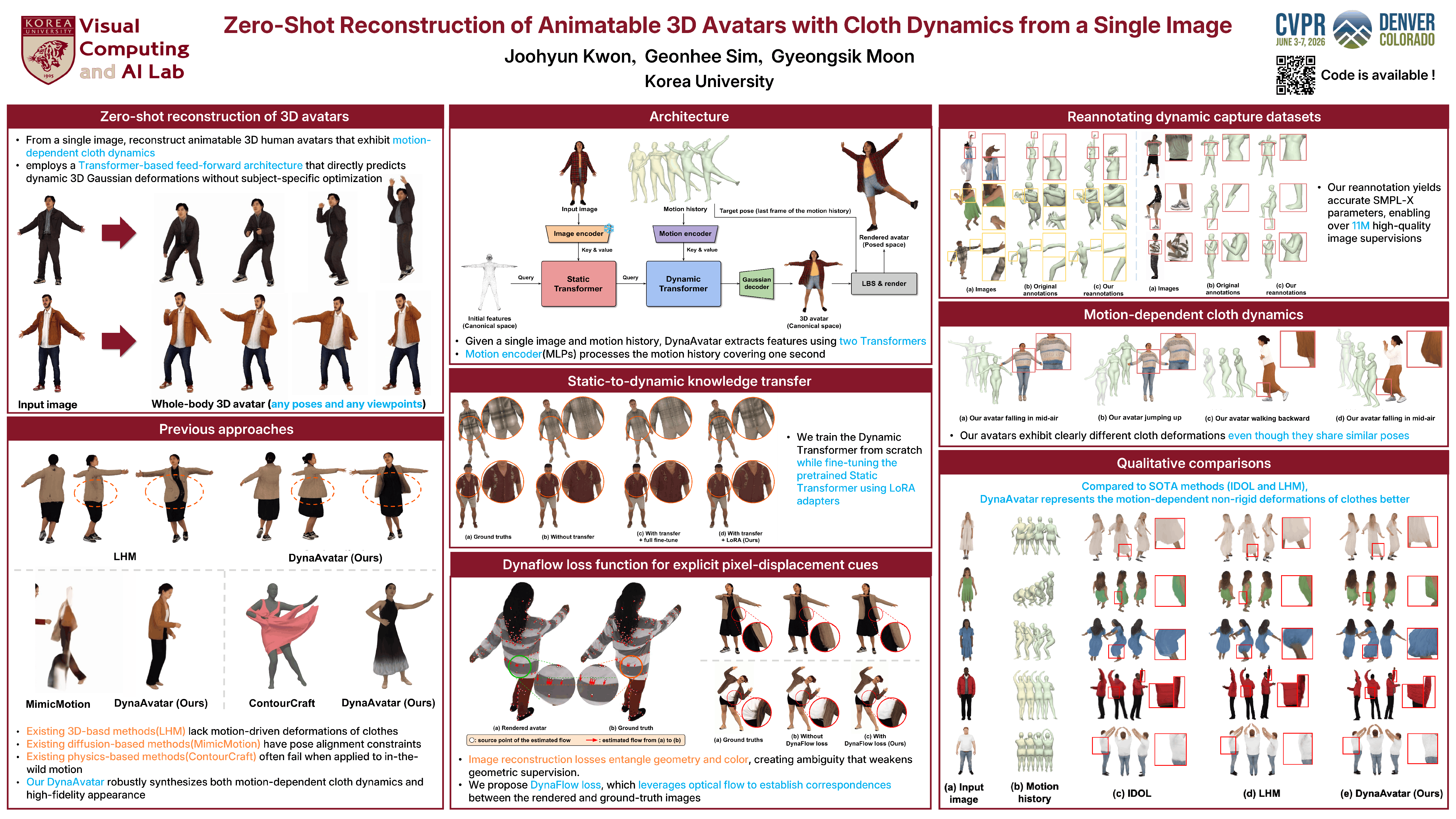
Existing single-image 3D human avatar methods primarily rely on rigid joint transformations, limiting their ability to model realistic cloth dynamics. We present DynaAvatar, a zero-shot framework that reconstructs animatable 3D human avatars with motion-dependent cloth dynamics from a single image. Trained on large-scale multi-person motion datasets, DynaAvatar employs a Transformer-based feed-forward architecture that directly predicts dynamic 3D Gaussian deformations without subject-specific optimization. To overcome the scarcity of dynamic captures, we introduce a static-to-dynamic knowledge transfer strategy: a Transformer pretrained on large-scale static captures provides strong geometric and appearance priors, which are efficiently adapted to motion-dependent deformations through lightweight LoRA fine-tuning on dynamic captures. We further propose the DynaFlow loss, an optical flow–guided objective that provides reliable motion-direction geometric cues for cloth dynamics in rendered space. Finally, we reannotate the missing or noisy SMPL-X fittings in existing dynamic capture datasets, as most public dynamic capture datasets contain incomplete or unreliable fittings that are unsuitable for training high-quality 3D avatar reconstruction models. Experiments demonstrate that DynaAvatar produces visually rich and generalizable animations, outperforming prior methods. Code, pretrained models, and reannotations will be released.
FlexAvatar: Learning Complete 3D Head Avatars with Partial Supervision
Tobias Kirschstein ⋅ Simon Giebenhain ⋅ Matthias Nießner
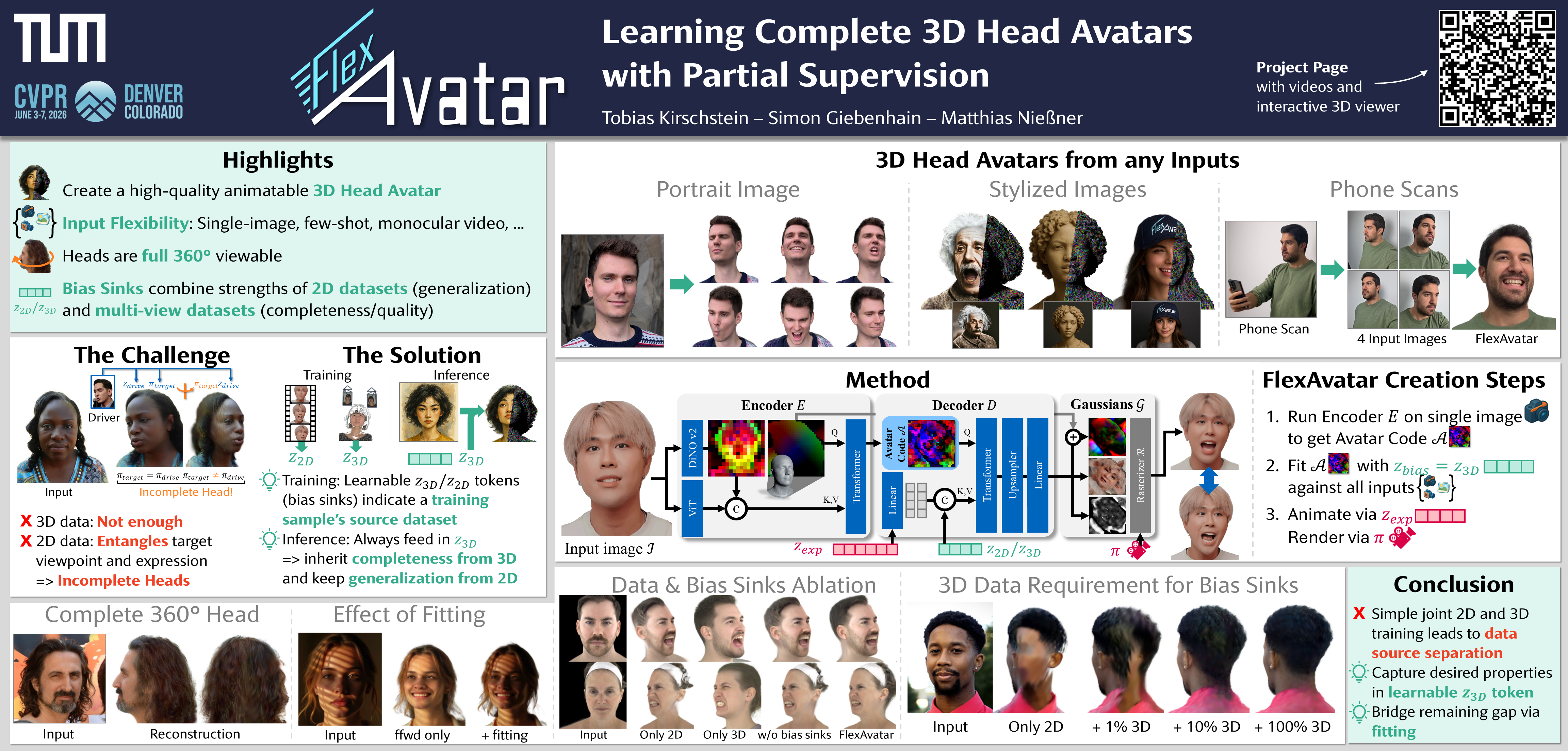
We introduce FlexAvatar, a method for creating high-quality and complete 3D head avatars from a single image. A core challenge lies in the limited availability of multi-view data and the tendency of monocular training to yield incomplete 3D head reconstructions. We identify the root cause of this issue as the entanglement between driving signal and target viewpoint when learning from monocular videos. To address this, we propose a transformer-based 3D portrait animation model with learnable data source tokens, so-called bias sinks, which enables unified training across monocular and multi-view datasets. This design leverages the strengths of both data sources during inference: strong generalization from monocular data and full 3D completeness from multi-view supervision. Furthermore, our training procedure yields a smooth latent avatar space that facilitates identity interpolation and flexible fitting to an arbitrary number of input observations. In extensive evaluations on single-view, few-shot, and monocular avatar creation tasks, we verify the efficacy of FlexAvatar. Many existing methods struggle with view extrapolation while FlexAvatar generates complete 3D head avatars with realistic facial animations.
Large-scale Codec Avatars: The Unreasonable Effectiveness of Large-scale Avatar Pretraining
Junxuan Li ⋅ Rawal Khirodkar ⋅ Egor Zakharov ⋅ Jihyun Lee ⋅ Zhaoen Su ⋅ Yuan Dong ⋅ Julieta Martinez ⋅ Kai Li ⋅ Qingyang Tan ⋅ Takaaki Shiratori ⋅ Matthew Hu ⋅ Peihong Guo ⋅ Xuhua Huang ⋅ Zhongshi Jiang ⋅ LINGCHEN YANG ⋅ Ariyan Zarei ⋅ Marco Pesavento ⋅ Yichen Xu ⋅ Chengan He ⋅ He Wen ⋅ Giljoo Nam ⋅ Teng Deng ⋅ Wyatt Borsos ⋅ Anjali Thakrar ⋅ Jean-Charles Bazin ⋅ Rinat Abdrashitov ⋅ Carsten Stoll ⋅ Ginés Hidalgo ⋅ James Booth ⋅ Lucy Wang ⋅ Xiaowen Ma ⋅ Yu Rong ⋅ Sairanjith Thalanki ⋅ Chen Cao ⋅ Christian Häne ⋅ Abhishek Kar ⋅ Sofien Bouaziz ⋅ Jason Saragih ⋅ Yaser Sheikh ⋅ Shunsuke Saito
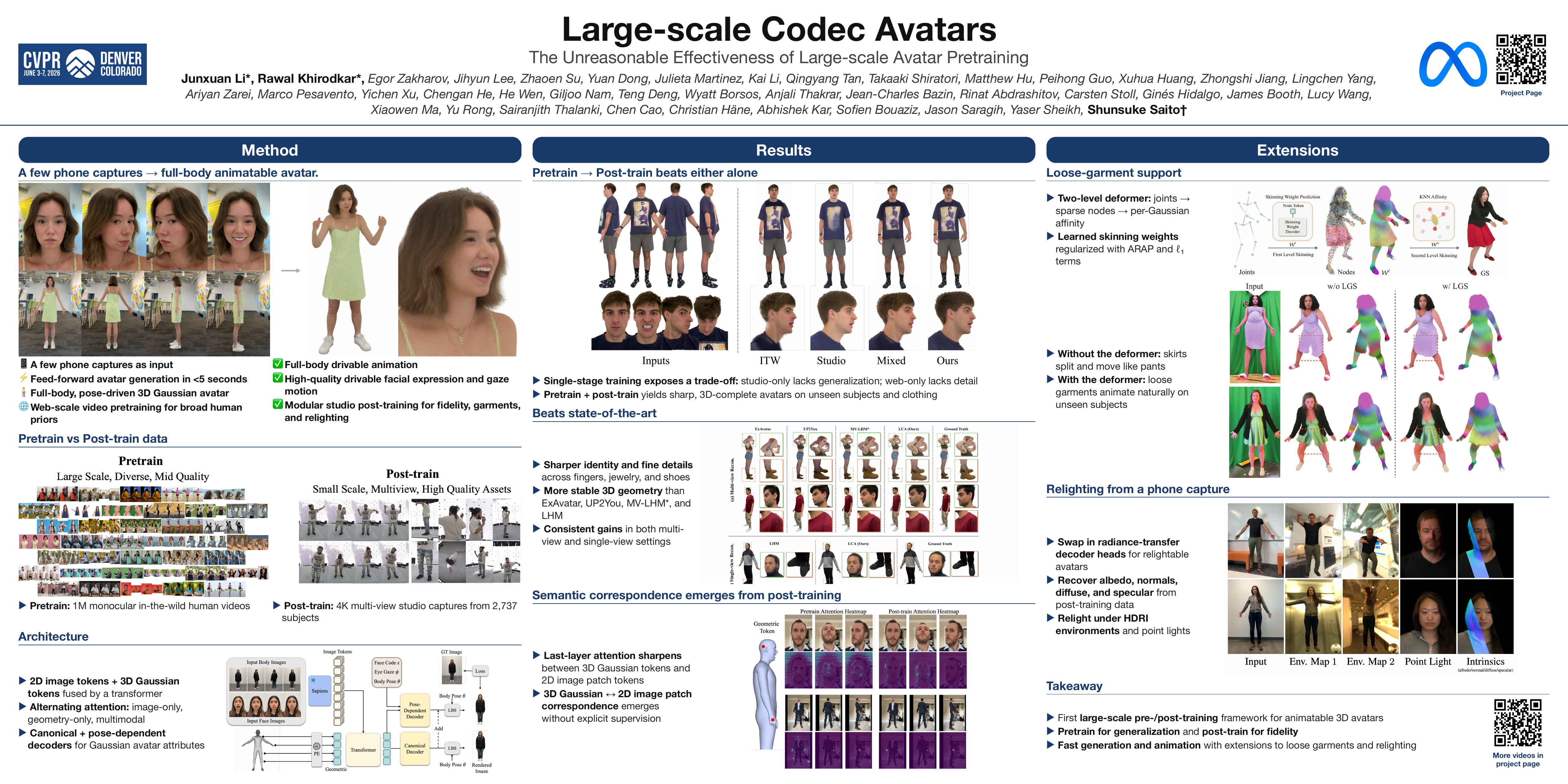
High-quality 3D avatar modeling faces a critical trade-off between fidelity and generalization. On the one hand, multi-view studio data enables high-fidelity modeling of humans with precise control over expressions and poses, but it struggles to generalize to real-world data due to limited scale and the domain gap between the studio environment and the real world. On the other hand, recent large-scale avatar models trained on millions of in-the-wild samples show promise for generalization across a wide range of identities, yet the resulting avatars are often of low-quality due to inherent 3D ambiguities. To address this, we present Large-Scale Codec Avatars (LCA), a high-fidelity, full-body 3D avatar model that generalizes to world-scale populations in a feedforward manner, enabling efficient inference. Inspired by the success of large language models and vision foundation models, we present, for the first time, a pre/post-training paradigm for 3D avatar modeling at scale: we pretrain on 1M in-the-wild videos to learn broad priors over appearance and geometry, then post-train on high-quality curated data to enhance expressivity and fidelity. LCA generalizes across hair styles, clothing, and demographics while providing precise, fine-grained facial expressions and finger-level articulation control, with strong identity preservation. Notably, we observe emergent generalization to relightability and loose garment support to unconstrained inputs, and zero-shot robustness to stylized imagery, despite the absence of direct supervision.
UIKA: Fast Universal Head Avatar from Pose-Free Images
Zijian Wu ⋅ Boyao Zhou ⋅ Liangxiao Hu ⋅ Hongyu Liu ⋅ Yuan Sun ⋅ Xuan Wang ⋅ Xun Cao ⋅ Yujun Shen ⋅ Hao Zhu
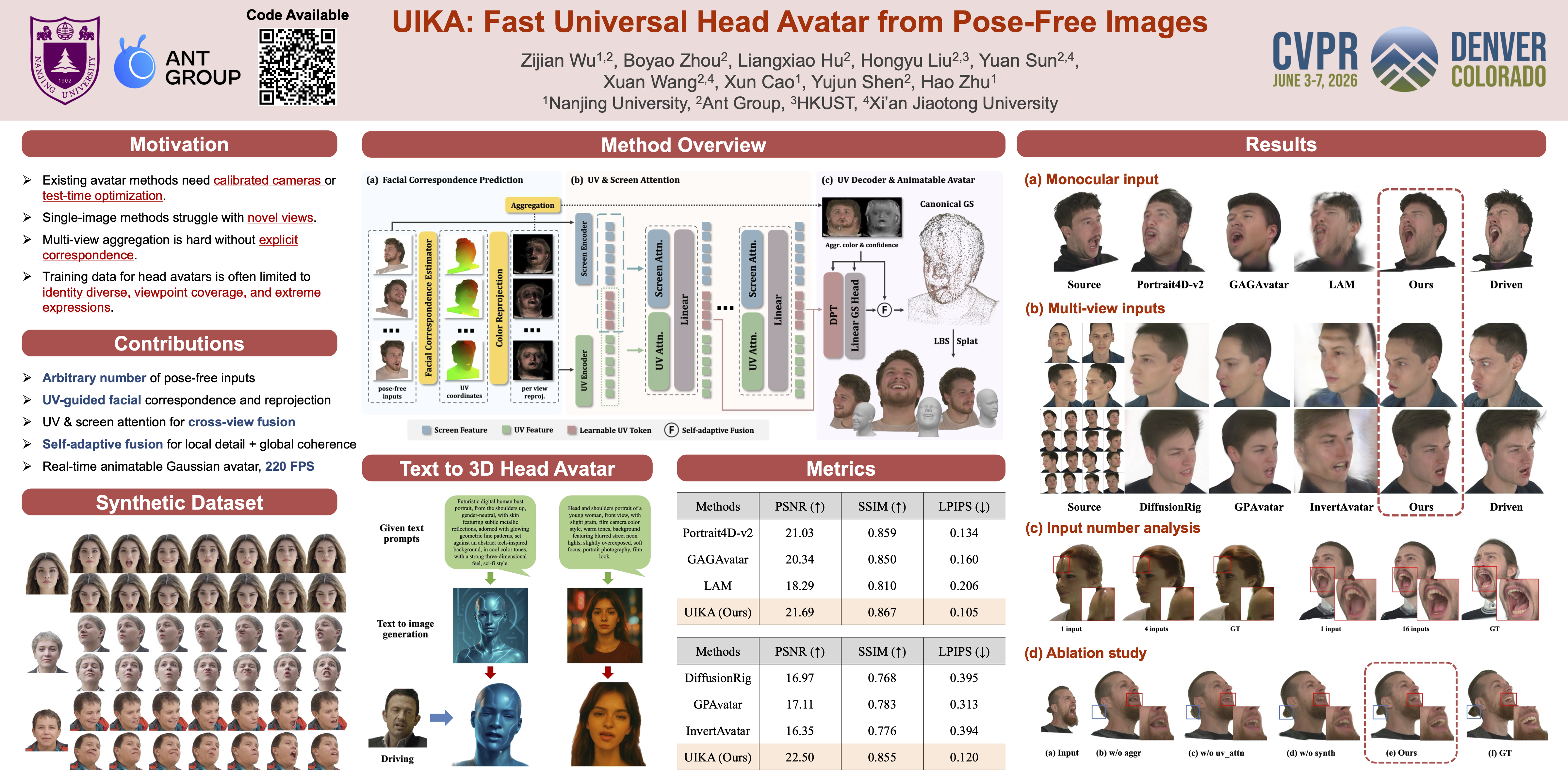
We present UIKA, a feed-forward animatable Gaussian head model from an arbitrary number of unposed inputs, including a single image, multi-view captures, and smartphone-captured videos. Unlike the traditional avatar method, which requires a studio-level multi-view capture system and reconstructs a human-specific model through a long-time optimization process, we rethink the task through the lenses of model representation, network design, and data preparation. First, we introduce a UV-guided avatar modeling strategy, in which each input image is associated with a pixel-wise UV coordinate estimation. Such UV coordinate estimation allows us to project each valid pixel from screen space to UV space, which is independent of camera pose and character expression. We thus leverage this UV space to represent our Gaussian head avatar. To this end, we design learnable UV tokens on which the attention mechanism can be applied at both the screen and UV levels. The learned UV token can be decoded into canonical Gaussian attributes using aggregated UV information from all input views. Such a Gaussian avatar is directly animatable via standard linear blend skinning and supports real-time rendering. To train our large avatar model, we further prepare a large-scale, identity-rich training dataset with controllable views and motions, synthesized with a 3D GAN and a state-of-the-art image animation model. Our proposed method significantly outperforms existing approaches in rendering quality, 3D consistency, and inference efficiency on both single-view and multi-view input data.
FlexAvatar: Flexible Large Reconstruction Model for Animatable Gaussian Head Avatars with Detailed Deformation
Cheng Peng ⋅ Zhuo Su ⋅ Liao Wang ⋅ Chen Guo ⋅ Zhaohu Li ⋅ Chengjiang Long ⋅ Zheng Lv ⋅ Jingxiang Sun ⋅ Chenyangguang Zhang ⋅ Yebin Liu
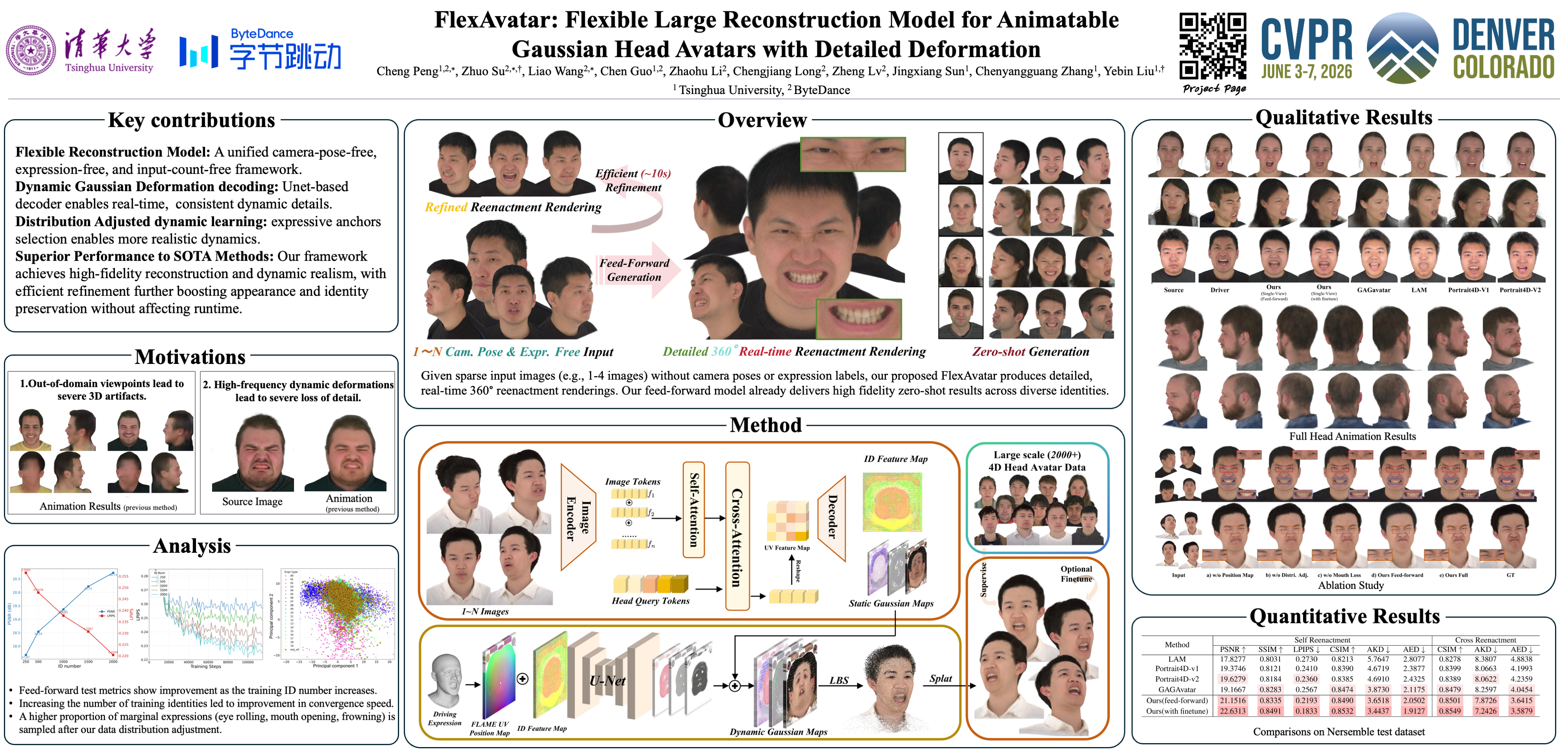
We present FlexAvatar, a flexible large reconstruction model for high-fidelity 3D head avatars with detailed dynamic deformation from single or sparse images, without requiring camera poses or expression labels. It leverages a transformer-based reconstruction model with structured head query tokens as canonical anchor to aggregate flexible input-number-agnostic, camera-pose-free and expression-free inputs into a robust canonical 3D representation.For detailed dynamic deformation, we introduce a lightweight UNet decoder conditioned on UV-space position maps, which can produce detailed expression-dependent deformations in real time. To better capture rare but critical expressions like wrinkles and bared teeth, we also adopt a data distribution adjustment strategy during training to balance the distribution of these expressions in the training set.Moreover, a lightweight 10-second refinement can further enhances identity-specific details in extreme identities without affecting deformation quality.Extensive experiments demonstrate that our FlexAvatar achieves superior 3D consistency, detailed dynamic realism compared with previous methods, providing a practical solution for animatable 3D avatar creation.
First Logit Boosting: Visual Grounding Method to Mitigate Object Hallucination in Large Vision-Language Models
Jiwoo Ha ⋅ Jongwoo Baek ⋅ Jinhyun So
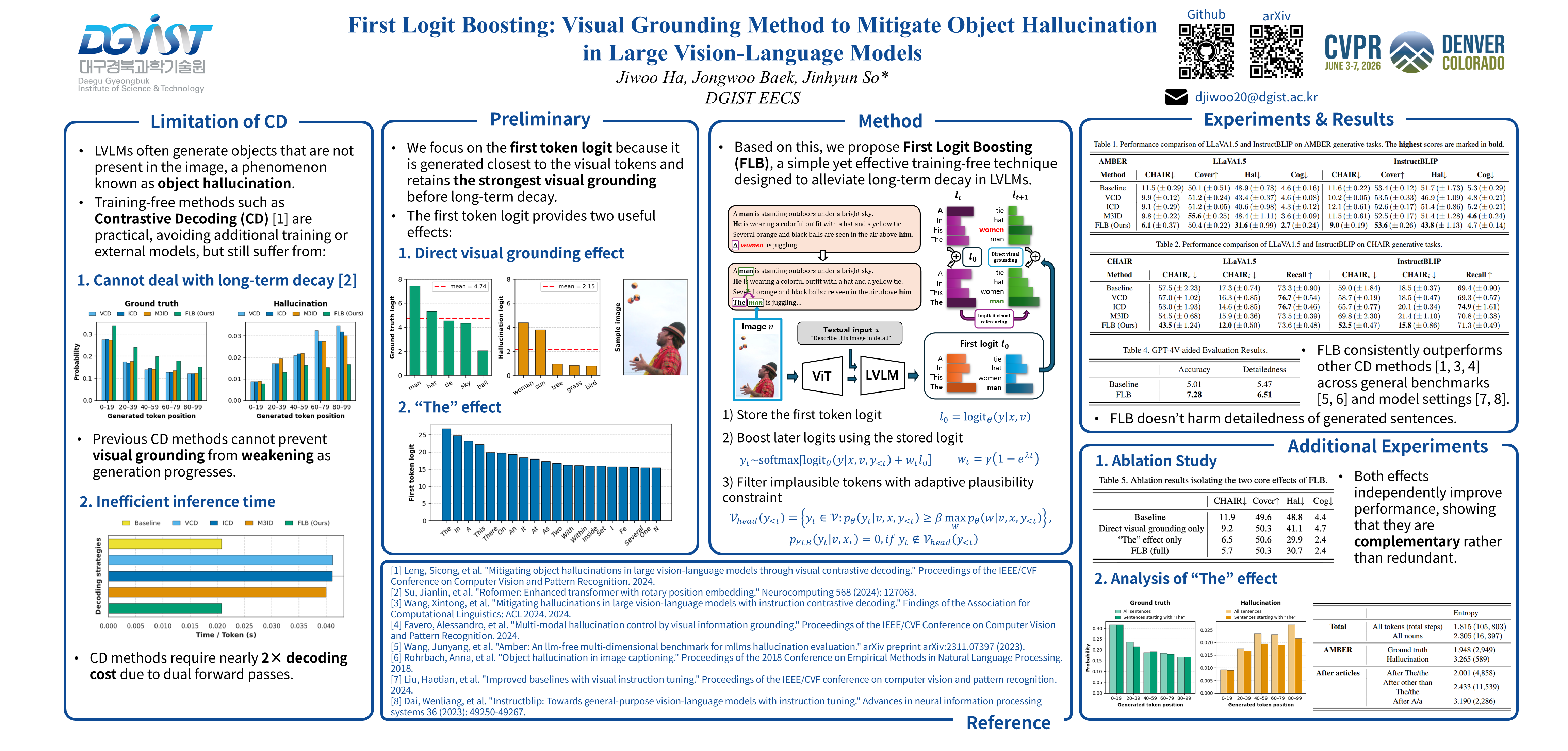
Recent Large Vision-Language Models (LVLMs) have demonstrated remarkable performance across various multimodal tasks that require understanding both visual and linguistic inputs.However, object hallucination — the generation of nonexistent objects in answers — remains a persistent challenge.Although several approaches such as retraining and external grounding methods have been proposed to mitigate this issue, they still suffer from high data costs or structural complexity.Training-free methods such as Contrastive Decoding (CD) are more cost-effective, avoiding additional training or external models, but still suffer from long-term decay, where visual grounding weakens and language priors dominate as the generation progresses.In this paper, we propose First Logit Boosting (FLB), a simple yet effective training-free technique designed to alleviate long-term decay in LVLMs.FLB stores the logit of the first generated token and adds it to subsequent token predictions, effectively mitigating long-term decay of visual information.We observe that FLB (1) sustains the visual information embedded in the first token throughout generation,and (2) suppresses hallucinated words through the stabilizing effect of the “The” token.Experimental results show that FLB significantly reduces object hallucination on AMBER and CHAIR benchmarks.Notably, it causes negligible inference overhead, making it highly applicable to real-time multimodal systems.
Locate-then-Sparsify: Attribution Guided Sparse Strategy for Visual Hallucination Mitigation
Tiantian Dang ⋅ Chao Bi ⋅ Shufan Shen ⋅ Jinzhe Liu ⋅ Qingming Huang ⋅ Shuhui Wang
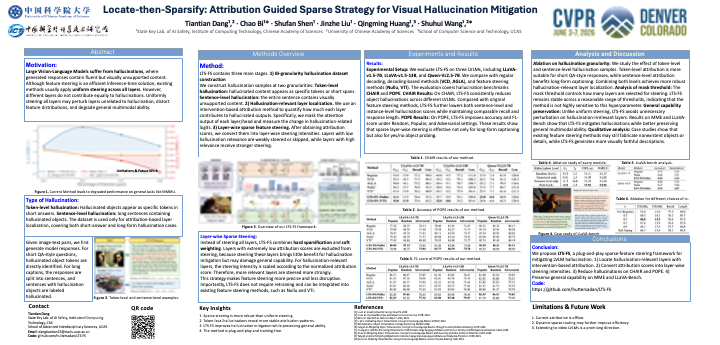
Despite the significant advancements in Large Vision-Language Models (LVLMs), their tendency to generate hallucinations undermines reliability and restricts broader practical deployment.Among the hallucination mitigation methods, feature steering emerges as a promising approach that reduces erroneous outputs in LVLMs without increasing inference costs.However, current methods apply uniform feature steering across all layers. This heuristic strategy ignores inter-layer differences, potentially disrupting layers unrelated to hallucinations and ultimately leading to performance degradation on general tasks.In this paper, we propose a plug-and-play framework called Locate-Then-Sparsify for Feature Steering (LTS-FS), which controls the steering intensity according to the hallucination relevance of each layer.We first construct a synthetic dataset comprising token-level and sentence-level hallucination cases. Based on this dataset, we introduce an attribution method based on causal interventions to quantify the hallucination relevance of each layer. With the attribution scores across layers, we propose a layerwise strategy that converts these scores into feature steering intensities for individual layers, enabling more precise adjustments specifically on hallucination-relevant layers.Extensive experiments across multiple LVLMs and benchmarks demonstrate that our LTS-FS framework effectively mitigates hallucination while preserving strong performance on general LVLM benchmarks. Codes are provided in the supplementary.
Envision, Attend, Then Respond: Counterfactual Hallucination Mitigation in Large Vision-Language Models
Yuxuan Liang ⋅ Fan Shi ⋅ Rui Zhu ⋅ Xu Li ⋅ Xiaolei Chen ⋅ Zhe Liu ⋅ Bin Li ⋅ Xiangyang Xue
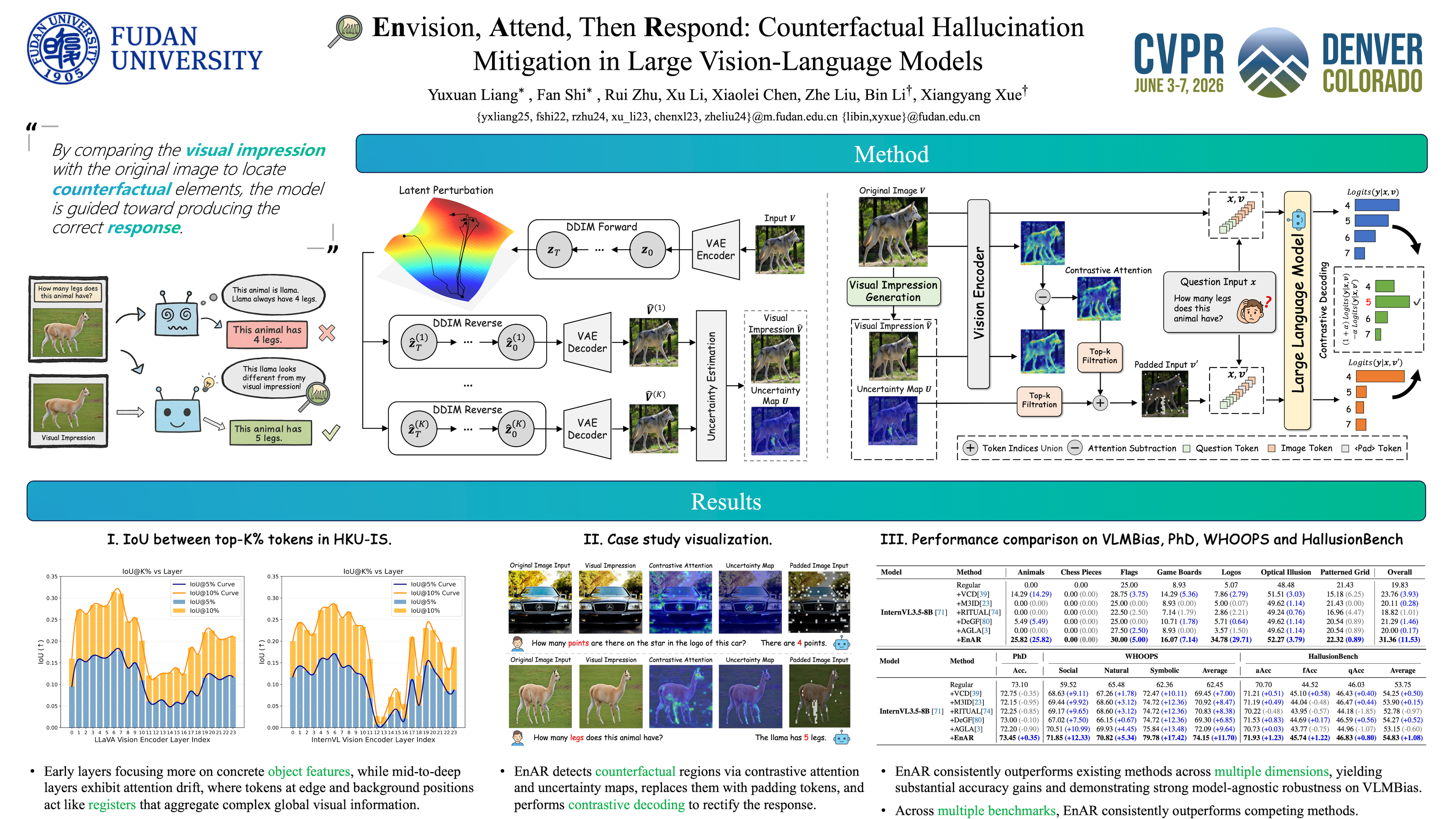
Large Vision-Language Models (LVLMs) often hallucinate when visual evidence conflicts with world knowledge, i.e., in counterfactual scenarios. We propose Envision-Attend-Respond (EnAR), a training-free framework that leverages visual priors to steer the model's attention toward counterfactual elements in the image. The Envision stage constructs a visual impression by invoking a diffusion prior to perform latent perturbations, yielding a prior-consistent counterpart of the input image. The Attend stage processes the original image and its visual impression through the LVLM's vision encoder to localize counterfactual elements, forming a corresponding padded input. The Respond stage performs contrastive decoding between the original and padded inputs to suppress bias and enhance visual understanding. Empirically, EnAR consistently mitigates hallucinations and improves response fidelity, achieving a 10.82\% gain on VLMBias and an average 6.9\% improvement on POPE, demonstrating robustness across both counterfactual and general hallucination settings. Moreover, the framework remains effective across heterogeneous LVLM architectures, offering a new perspective for hallucination governance in multimodal reasoning.
PAS: Prelim Attention Score for Detecting Object Hallucinations in Large Vision-Language Models
Nhat Hoang ⋅ Minh Vu ⋅ My T. Thai ⋅ Manish Bhattarai
Large vision–language models (LVLMs) are powerful, yet they remain unreliable due to object hallucinations. In this work, we show that in many hallucinatory predictions the LVLM effectively ignores the image and instead relies on previously generated output (“prelim”) tokens to infer new objects. We quantify this behavior via the mutual information between the image and the predicted object conditioned on the prelim, demonstrating that weak image dependence strongly correlates with hallucination. Building on this finding, we introduce the Prelim Attention Score (PAS), a lightweight, training-free signal computed from attention weights over prelim tokens. PAS requires no additional forward passes and can be computed on the fly during inference. Exploiting this previously overlooked signal, PAS achieves state-of-the-art object-hallucination detection across multiple models and datasets, enabling real-time filtering and intervention.
MoD-DPO: Towards Mitigating Cross-modal Hallucinations in Omni LLMs using Modality Decoupled Preference Optimization
Ashutosh Chaubey ⋅ Jiacheng Pang ⋅ Mohammad Soleymani
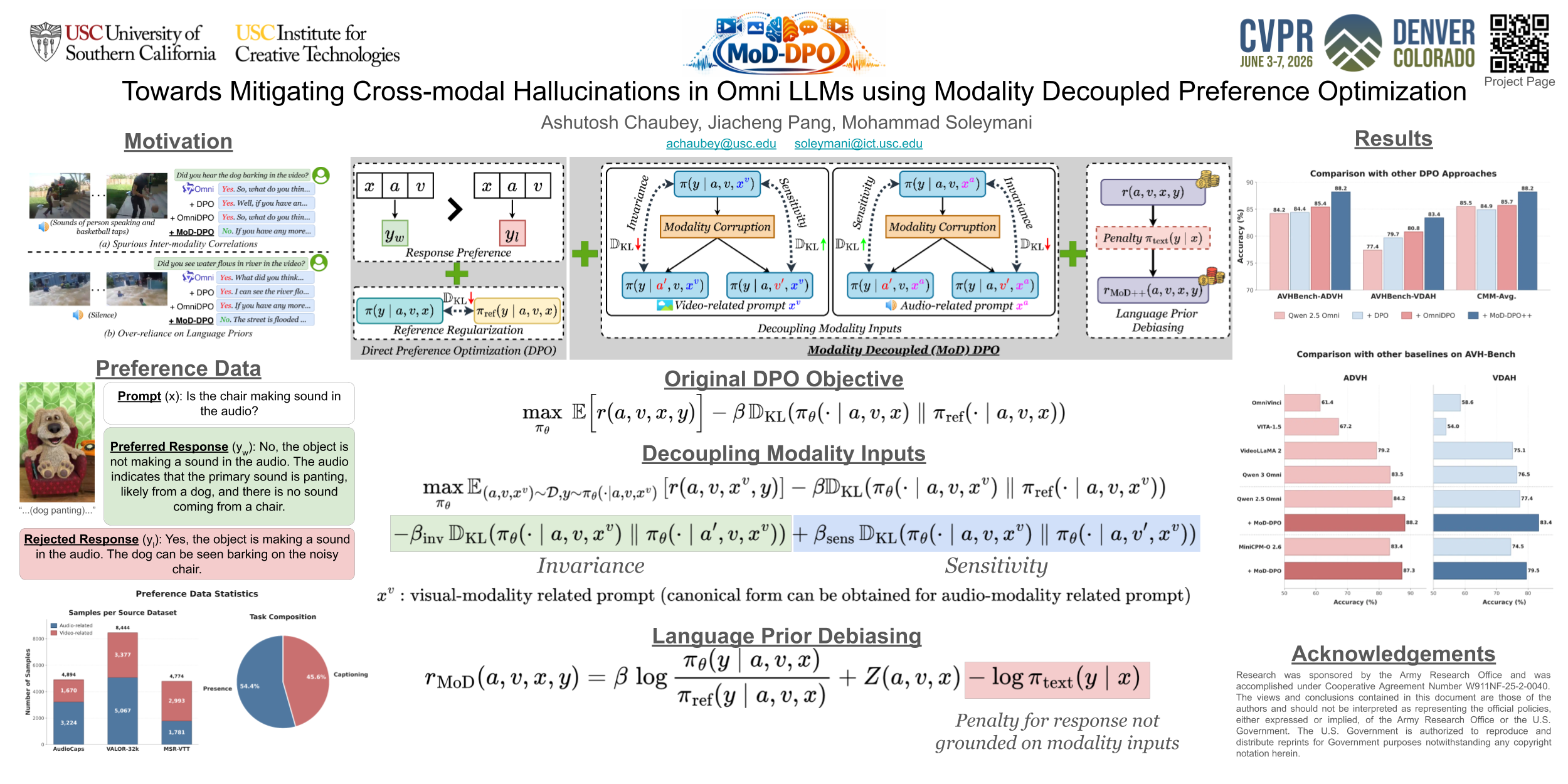
Omni-modal large language models (omni LLMs) have recently achieved strong performance across audiovisual understanding tasks, yet they remain highly susceptible to cross-modal hallucinations arising from spurious correlations and dominant language priors. In this work, we propose Modality-Decoupled Direct Preference Optimization (MoD-DPO), a simple and effective framework for improving modality grounding in omni LLMs. MoD-DPO introduces modality-aware regularization terms that explicitly enforce invariance to corruptions in irrelevant modalities and sensitivity to perturbations in relevant modalities, thereby reducing unintended cross-modal interactions. To further mitigate over-reliance on textual priors, we incorporate a language-prior debiasing penalty that discourages hallucination-prone text-only responses. Extensive experiments across multiple audio-visual hallucination benchmarks demonstrate that MoD-DPO consistently improves perception accuracy and hallucination resistance, outperforming previous preference optimization baselines under similar training budgets. Our findings underscore the importance of modality-faithful alignment and demonstrate a scalable path toward more reliable and resilient multimodal foundation models.
Fine-Grained Multi Image Object Hallucination Benchmark
Joonki Min ⋅ Chaeyun Kim ⋅ Hyungwook Choi ⋅ Yejin Kim ⋅ Kihyun Kim ⋅ Yohan Jo ⋅ Joonseok Lee
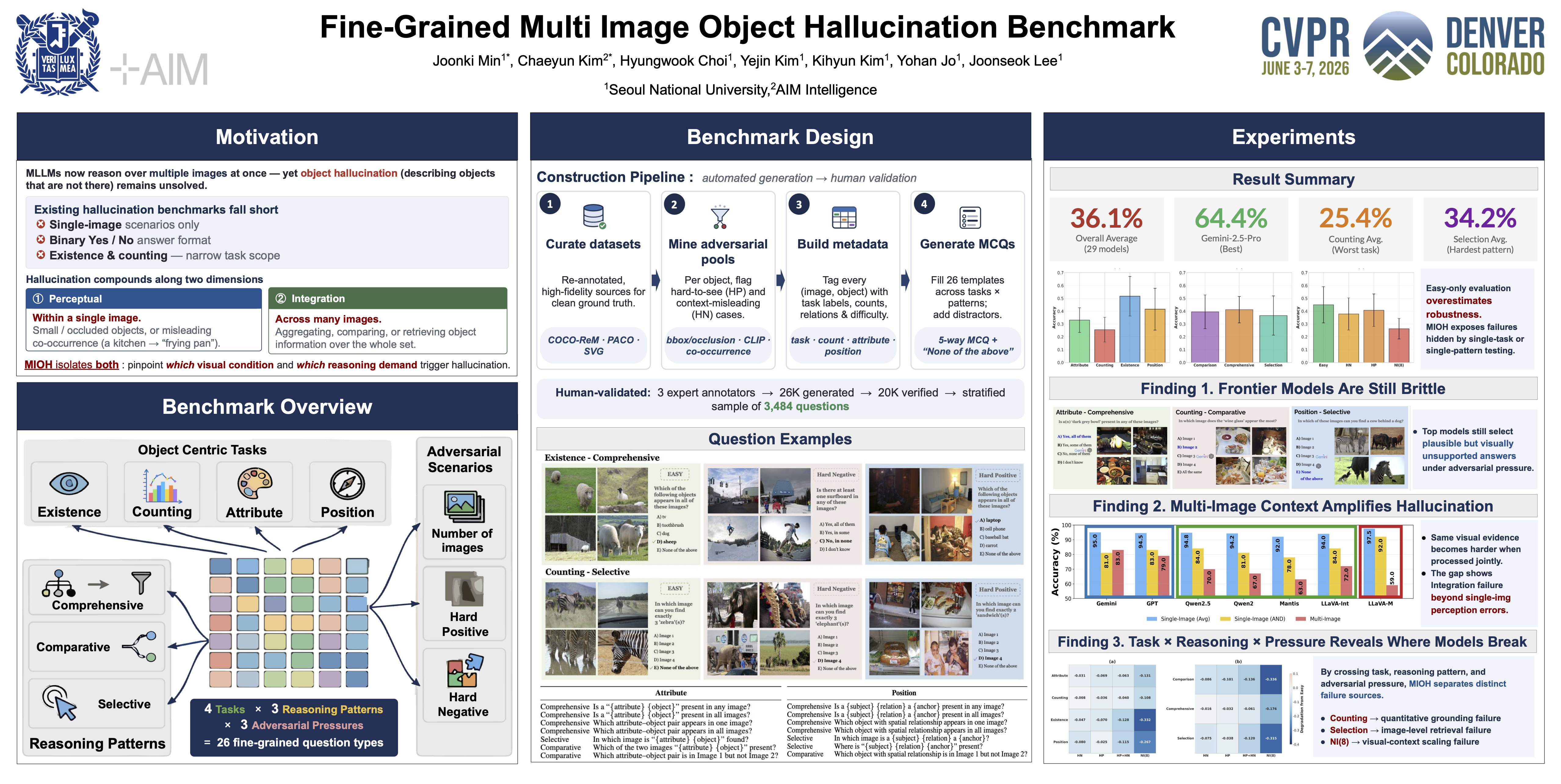
Multimodal Large Language Models (MLLMs) are increasingly deployed in multi-image scenarios requiring complex reasoning across visual contexts. However, current MLLMs remain fundamentally limited by object hallucination—generating plausible yet factually inconsistent descriptions about objects. Existing benchmarks, designed primarily for single-image settings or providing only high-level multi-image assessments, cannot systematically diagnose how visual complexity and reasoning demands trigger hallucination. To address this gap, we introduce MIOH, a fine-grained multi-image object hallucination benchmark that systematically evaluates object hallucination across four foundational tasks (existence, counting, attribute, position) through three multi-image reasoning patterns (comprehensive, comparative, selective) under three controlled adversarial pressures (visual context scale, perceptual difficulty, contextual bias). Through evaluation of 30 models, we reveal that even state-of-the-art systems like GPT-5 and Gemini-2.5-Pro exhibit distinct failure patterns across different reasoning patterns and tasks. Our evaluation reveals that hallucination stems not merely from perceptual failures but from integration-stage limitations when maintaining object representations across multiple images. MIOH provides a controlled framework for analyzing multi-image object hallucination and serves as a critical evaluation tool for developing more reliable multimodal AI systems.
Generative Video Motion Editing with 3D Point Tracks
Yao-Chih Lee ⋅ Zhoutong Zhang ⋅ Gabriel Huang ⋅ Jui-Hsien Wang ⋅ Joon-Young Lee ⋅ Jia-Bin Huang ⋅ Eli Shechtman ⋅ Zhengqi Li
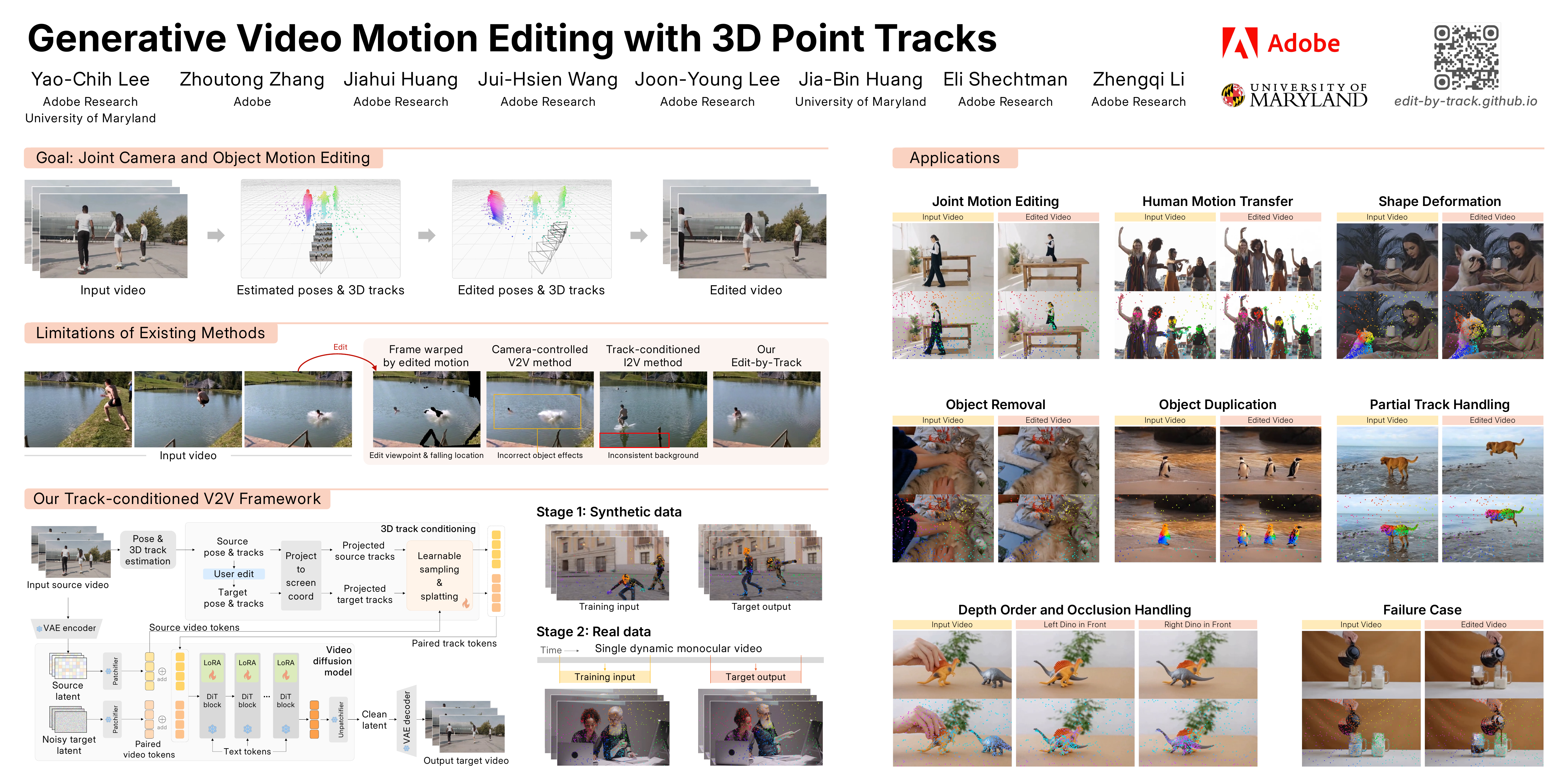
Camera and object motions are central to a video's narrative. However, precisely editing these captured motions remains a significant challenge, especially under complex object movements. Current motion-controlled image-to-video (I2V) approaches often lack full-scene context for consistent video editing, while video-to-video (V2V) methods provide viewpoint changes or basic object translation, but offer limited control over fine-grained object motion. We present a track-conditioned V2V framework that enables joint editing of camera and object motion. We achieve this by conditioning a video generation model on a source video and paired 3D point tracks representing source and target motions. These 3D tracks establish sparse correspondences that transfer rich context from the source video to new motions while preserving spatiotemporal coherence. Crucially, compared to 2D tracks, 3D tracks provide explicit depth cues, allowing the model to resolve depth order and handle occlusions for precise motion editing. Trained in two stages on synthetic and real data, our model supports diverse motion edits, including joint camera/object manipulation, motion transfer, and non-rigid deformation, unlocking new creative potential in video editing.
BulletTime: Decoupled Control of Time and Camera Pose for Video Generation
Yiming Wang ⋅ Qihang Zhang ⋅ Shengqu Cai ⋅ Tong Wu ⋅ Jan Ackermann ⋅ Zhengfei Kuang ⋅ Yang Zheng ⋅ Frano Rajič ⋅ Siyu Tang ⋅ Gordon Wetzstein
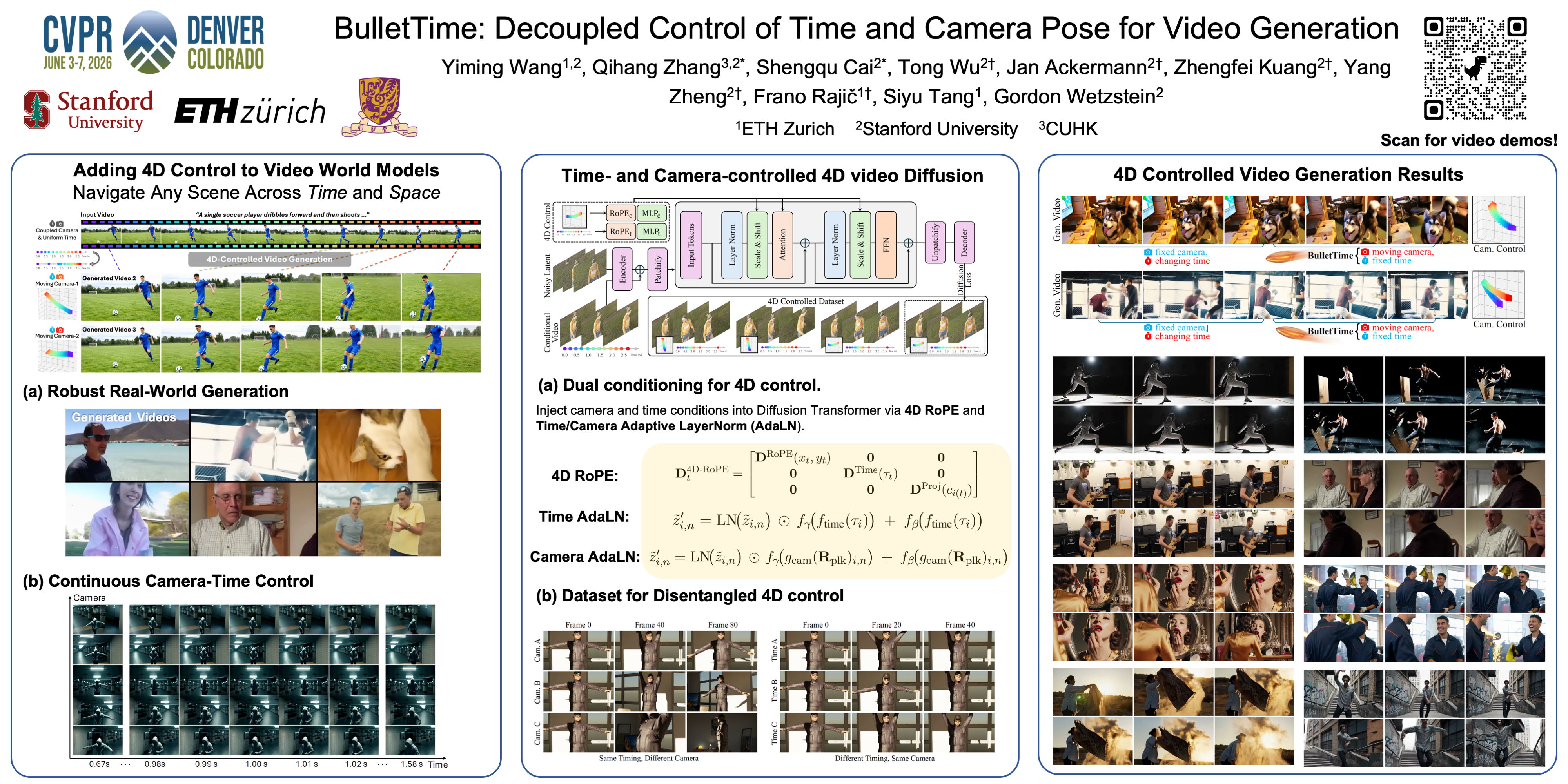
Emerging video diffusion models achieve high visual fidelity but fundamentally couple scene dynamics with camera motion, limiting their ability to provide precise spatial and temporal control. We introduce a 4D-controllable video diffusion framework that explicitly decouples scene dynamics from camera pose, enabling fine-grained manipulation of both scene dynamics and camera viewpoint. Our framework takes continuous world-time sequences and camera trajectories as conditioning inputs, injecting them into the video diffusion model through a 4D positional embedding in the attention layer and adaptive normalizations for feature modulation. To train this model, we curate a unique dataset in which temporal and camera variations are independently parameterized; this dataset will be made public. Experiments show that our model achieves robust real-world 4D control across diverse timing patterns and camera trajectories, while preserving high generation quality and outperforming prior work in controllability.
Learning to Generate Highly Dynamic Videos using Synthetic Motion Data
Wonjoon Jin ⋅ Jiyun Won ⋅ Janghyeok Han ⋅ Qi Dai ⋅ Chong Luo ⋅ Seung-Hwan Baek ⋅ Sunghyun Cho
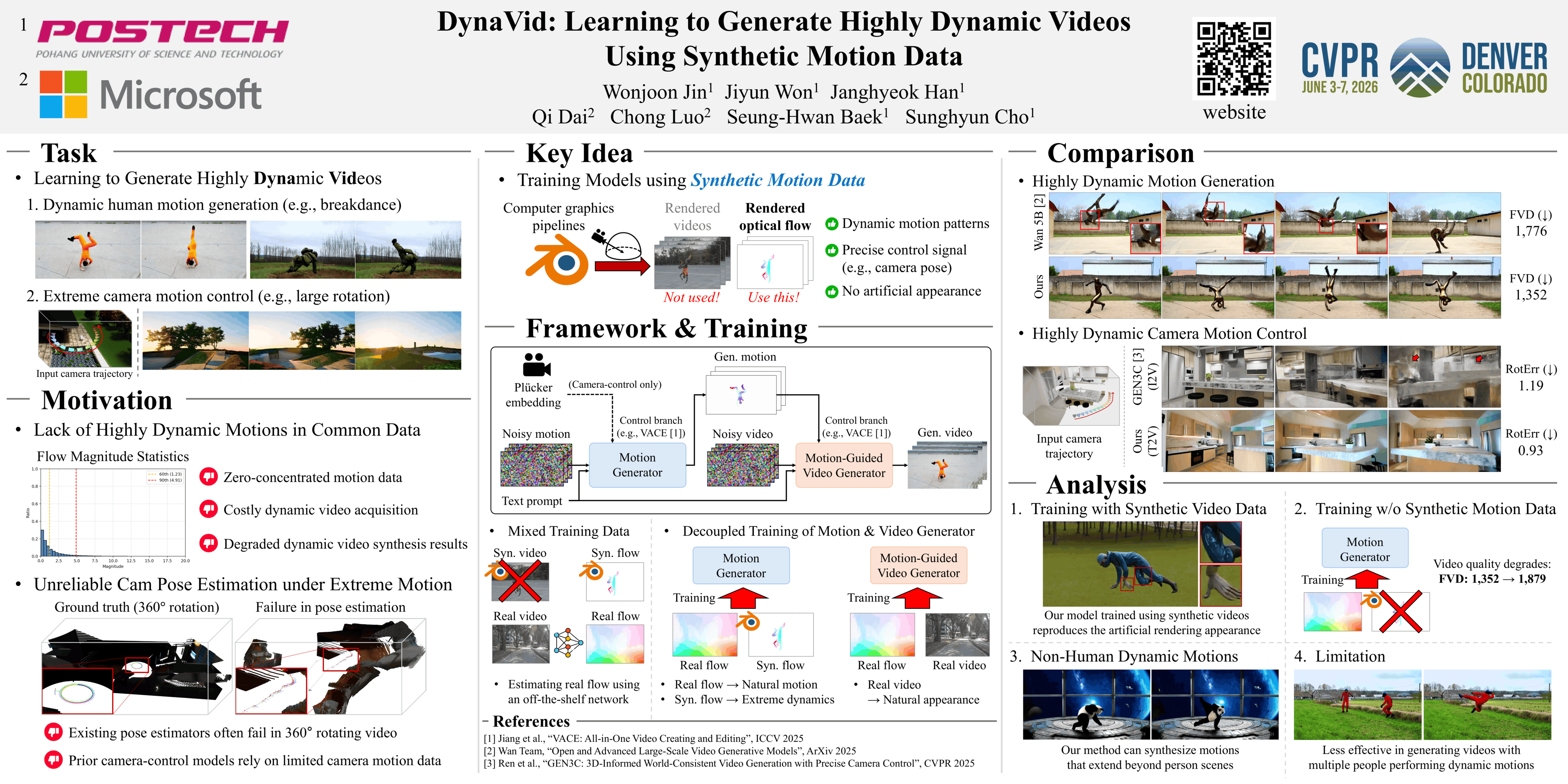
Despite recent progress, video diffusion models still struggle to synthesize realistic videos involving highly dynamic motions or requiring fine-grained motion controllability. A central limitation lies in the scarcity of such examples in commonly used training datasets. To address this, we introduce DynaVid, a video synthesis framework that leverages synthetic motion data in training, which is represented as optical flow and rendered using computer graphics pipelines. This approach offers two key advantages. First, synthetic motion offers diverse motion patterns and precise control signals that are difficult to obtain from real data. Second, unlike rendered videos with artificial appearances, rendered optical flow encodes only motion and is decoupled from appearance, thereby preventing models from reproducing the unnatural look of synthetic videos. Building on this idea, DynaVid adopts a two-stage generation framework: a motion generator first synthesizes motion, and then a motion-guided video generator produces video frames conditioned on that motion. This decoupled formulation enables the model to learn dynamic motion patterns from synthetic data while preserving visual realism from real-world videos. We validate our framework on two challenging scenarios, vigorous human motion generation and extreme camera motion control, where existing datasets are particularly limited. Extensive experiments demonstrate that DynaVid improves the realism and controllability in dynamic motion generation and camera motion control. Codes and datasets will be publicly available.
Stereo World Model: Camera-Guided Stereo Video Generation
Yangtian Sun ⋅ Zehuan Huang ⋅ Yifan Niu ⋅ Lin Ma ⋅ Yan-Pei Cao ⋅ Yuewen Ma ⋅ Xiaojuan Qi
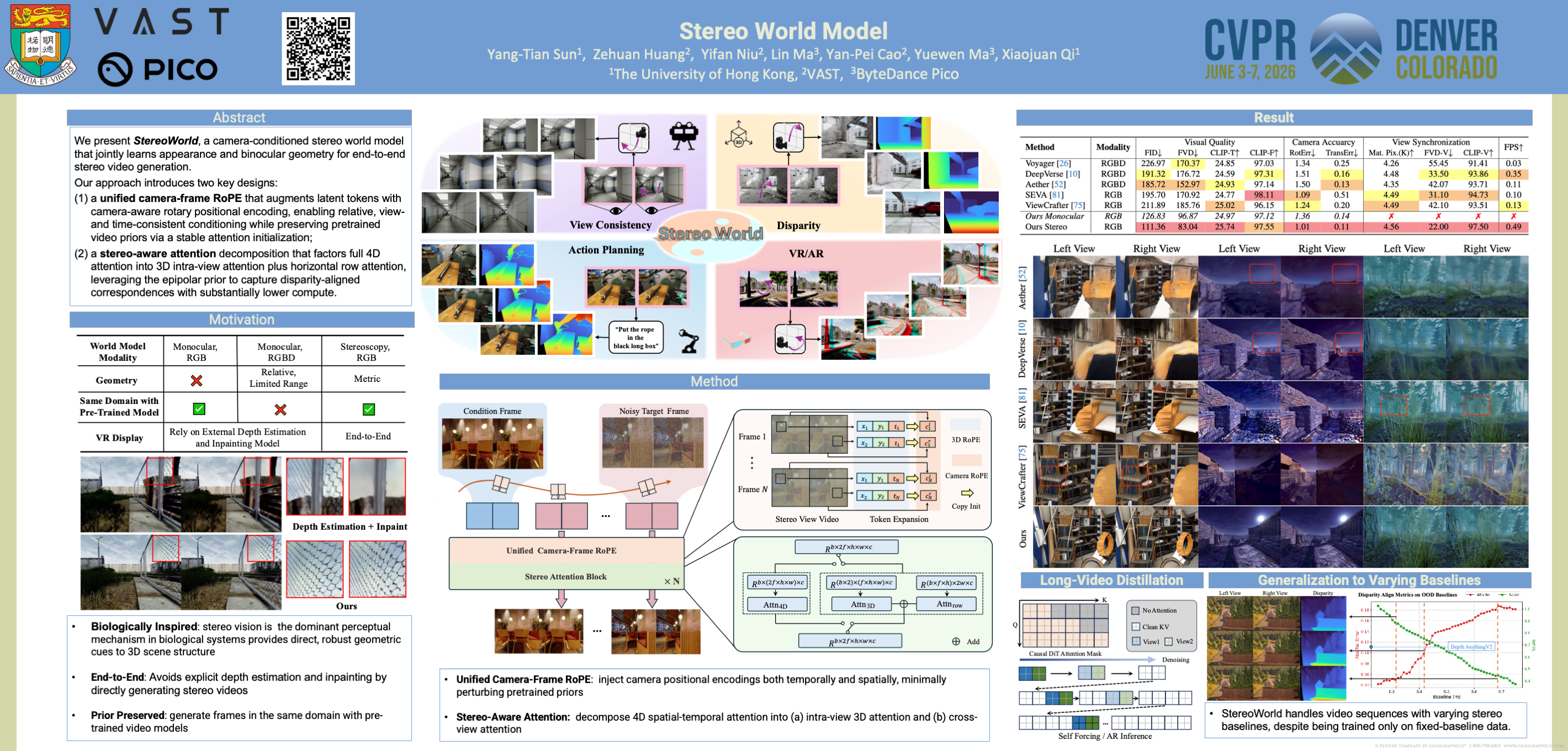
We present StereoWorld, a camera-conditioned stereo world model that jointly learns appearance and binocular geometry for end-to-end stereo video generation.Unlike monocular RGB or RGBD approaches, StereoWorld operates exclusively within the RGB modality, while simultaneously grounding geometry directly from disparity. To efficiently achieve consistent stereo generation, our approach introduces two key designs: (1) a unified camera-frame RoPE that augments latent tokens with camera-aware rotary positional encoding, enabling relative, view- and time-consistent conditioning while preserving pretrained video priors via a stable attention initialization; and (2) a stereo-aware attention decomposition that factors full 4D attention into 3D intra-view attention plus horizontal row attention, leveraging the epipolar prior to capture disparity-aligned correspondences with substantially lower compute. Across benchmarks, StereoWorld improves stereo consistency, disparity accuracy, and camera-motion fidelity over strong monocular-then-convert pipelines, achieving more than 3x faster generation with an additional 5% gain in viewpoint consistency. Beyond benchmarks, StereoWorld enables end-to-end binocular VR rendering without depth estimation or inpainting, enhances embodied policy learning through metric-scale depth grounding, and is compatible with long-video distillation for extended interactive stereo synthesis.
CG-Floor: Centroid-Guided Diffusion for Large-Scale Floorplan Generation
Hongjin Lian ⋅ Jian Ma ⋅ Hongjie Chen ⋅ Jia Li ⋅ Ruizhen Hu ⋅ Yu-Kun Lai ⋅ Kun Li
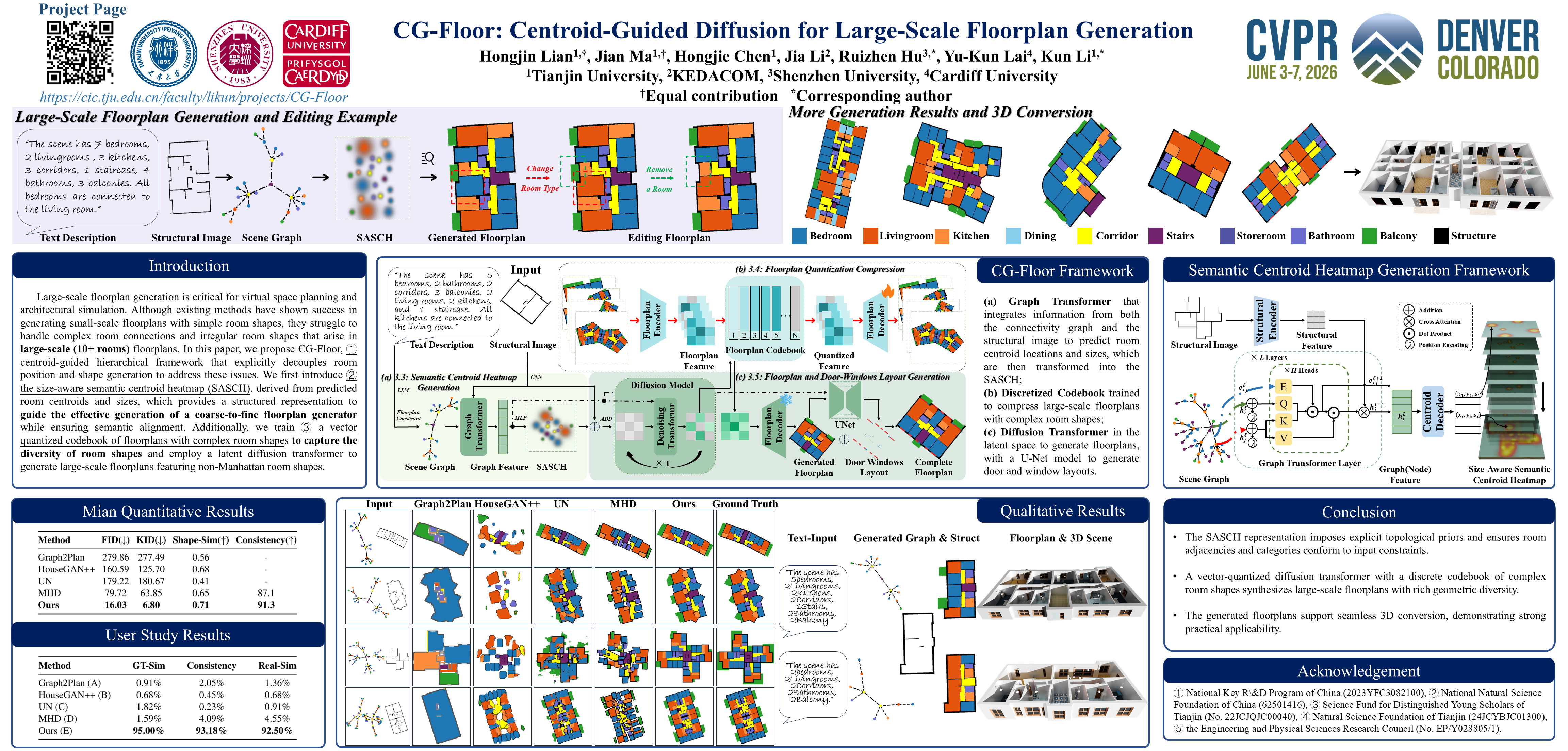
Large-scale floorplan generation is critical for virtual space planning and architectural simulation. Although existing methods have shown success in generating small-scale floorplans with simple room shapes, they struggle to handle the complex room connections and irregular room shapes that arise in large-scale floorplans. In this paper, we propose CG-Floor, a centroid-guided hierarchical framework that explicitly decouples topology and geometry to address these issues. We first introduce the size-aware semantic centroid heatmap, derived from predicted room centroids, which provides a structured representation to precisely guide the effective generation of a coarse-to-fine floorplan generator while ensuring semantic alignment. Additionally, we train a vector quantized codebook of floorplans with complex room shapes to capture the diversity of room shapes and employ a latent diffusion transformer to generate large-scale floorplans featuring non-Manhattan room shapes. CG-Floor achieves state-of-the-art performance on the large-scale MSD dataset, and supports 3D floorplan conversion and editing, demonstrating the practicality of our approach.The code will be publicly available for research purposes.
MAD: Motion Appearance Decoupling for efficient Driving World Models
Ahmad Rahimi ⋅ Valentin Gerard ⋅ Éloi Zablocki ⋅ Matthieu Cord ⋅ Alex Alahi
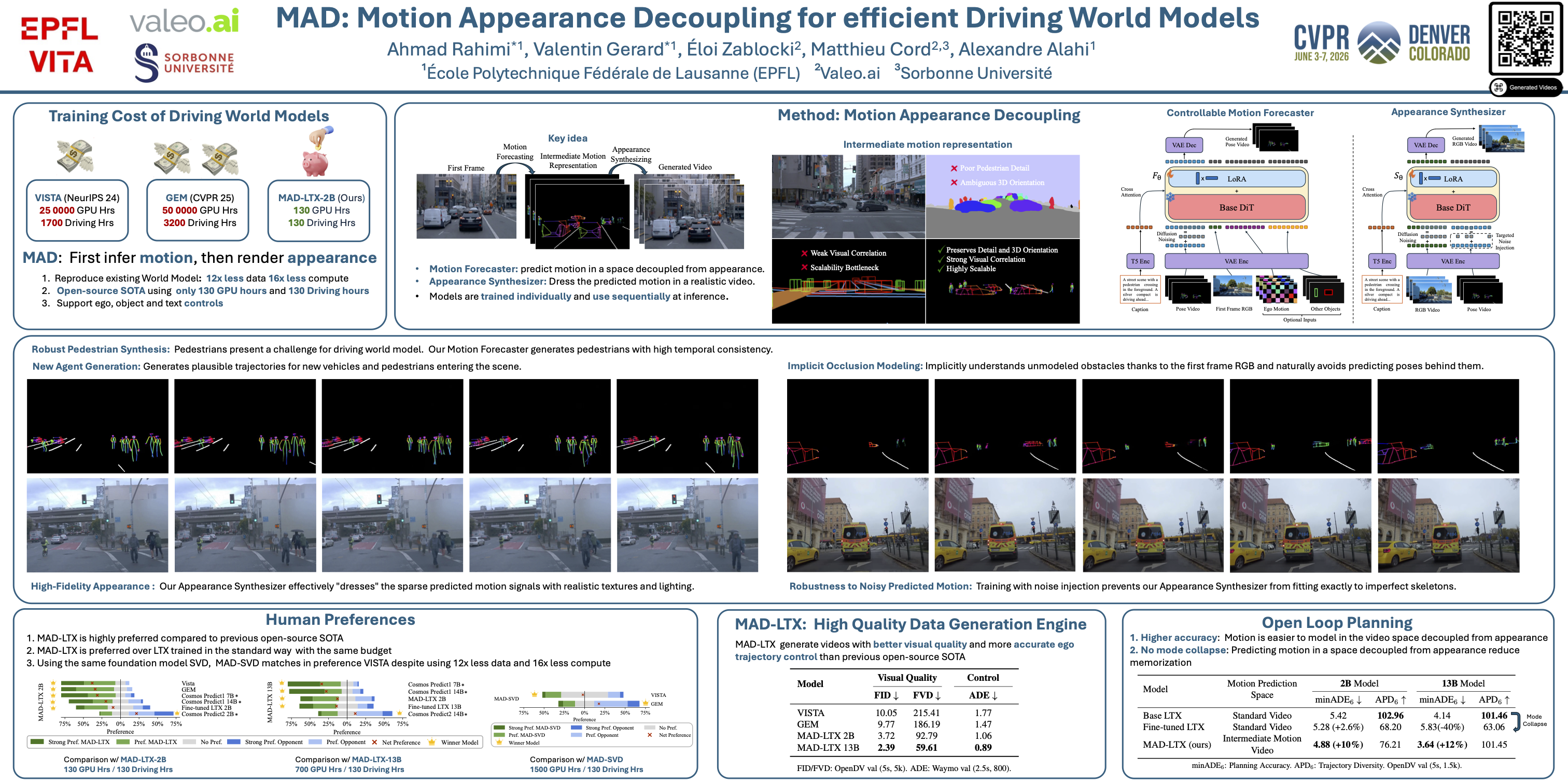
Recent video diffusion models generate photorealistic, temporally coherent videos, yet they fall short as reliable world models for autonomous driving, where structured motion and physically consistent interactions are essential. Adapting these generalist video models to driving domains has shown promise but typically requires massive domain-specific data and costly fine-tuning.We propose an efficient adaptation framework that converts generalist video diffusion models into controllable driving world models with minimal supervision. The key idea is to decouple motion learning from appearance synthesis. First, the model is adapted to predict structured motion in a simplified form: videos of skeletonized agents and scene elements, focusing learning on physical and social plausibility. Then, the same backbone is reused to synthesize realistic RGB videos conditioned on these motion sequences, effectively “dressing” the motion with texture and lighting.This two-stage process mirrors a reasoning-rendering paradigm: first infer dynamics, then render appearance. Our experiments show this decoupled approach is exceptionally efficient: adapting SVD, we match prior SOTA models with less than 6\% of their compute. Scaling to LTX, our MAD-LTX model outperforms all open-source competitors, and supports a comprehensive suite of text, ego, and object controls. Code will be released.
VDFE: Difference-Aware 3D Scene Editing with Non-Intrusive Video Diffusion Priors for Multi-View Consistency and Efficiency
Chao Zhang ⋅ Fang Liu ⋅ Shuo Li ⋅ Yang Liu ⋅ Jiahao Wang ⋅ Xinyan Huang ⋅ Lingling Li ⋅ Puhua Chen ⋅ Xu Liu ⋅ Wenping Ma ⋅ Siqi Yu
Text-driven 3D editing, enabled by advancements in 3D reconstruction techniques such as NeRF and 3D Gaussian Splatting, aims to provide intuitive scene customization. However, existing methods frequently exhibit limitations in controllability and consistency. To address these shortcomings, we propose \textbf{VDFE}, a difference-aware 3D scene editing method based on non-intrusive utilization of pre-trained video diffusion priors, which integrates Optimal Control Guided Flow Editing (FlowOCE), Decoupled Flow Difference (DFD), and Difference-Aware Gaussians Editing (DAGE). Specifically, FlowOCE treats the editing process as an optimal control problem, optimizing a noise-free editing trajectory to minimize unintended modifications in non-target region; DFD precisely locates editing region by analyzing flow differences, which supplies priors for the subsequent optimization process; and DAGE leverages precise localization to selectively update 3D Gaussians for efficient and precise refinement. Extensive experiments demonstrate that our method significantly outperforms existing methods in both qualitative and quantitative evaluations, achieving state-of-the-art (SOTA) performance.
Endless World: Real-Time 3D-Aware Long Video Generation
Ke Zhang ⋅ Jiacong Xu ⋅ Yiqun Mei ⋅ Vishal M. Patel
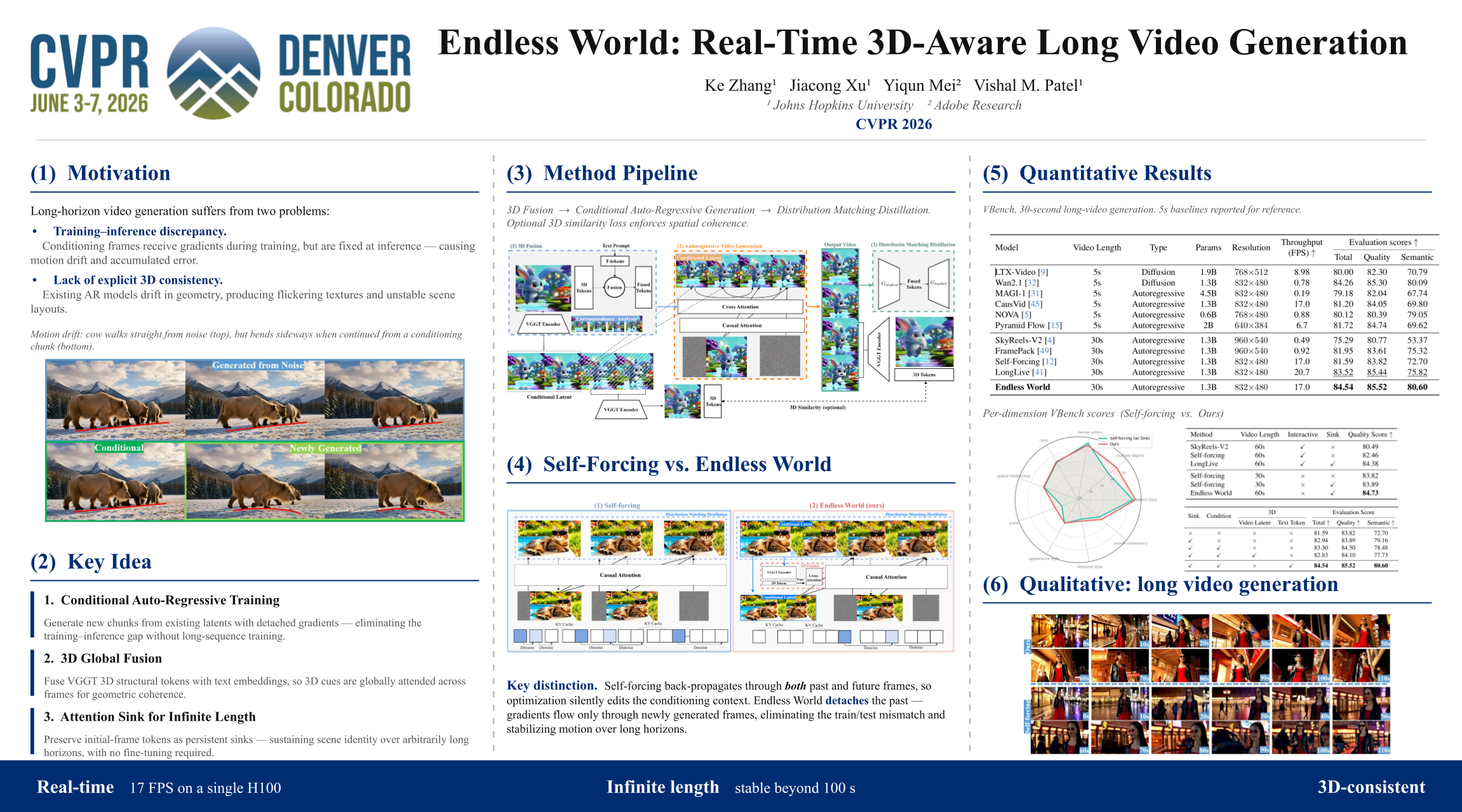
Producing long, coherent video sequences with stable 3D structure remains a major challenge, particularly in streaming scenarios. Motivated by this, we introduce Endless World, a real-time framework for infinite, 3D-consistent video generation. To support infinite video generation, we introduce a conditional autoregressive training strategy that aligns newly generated content with existing video frames. This design preserves long-range dependencies while remaining computationally efficient, enabling real-time inference on a single GPU without additional training overhead. Moreover, our Endless World integrates global 3D-aware attention to provide continuous geometric guidance across time. Our 3D injection mechanism enforces physical plausibility and geometric consistency throughout extended sequences, addressing key challenges in long-horizon and dynamic scene synthesis. Extensive experiments demonstrate that Endless World produces long, stable, and visually coherent videos, achieving competitive or superior performance to existing methods in both visual fidelity and spatial consistency. Our code will be released after review.
SpatialDiff: 3D-Aware Object Movement via Implicit Spatial Modeling
Zheng Liu ⋅ Zijian He ⋅ Huiguo He ⋅ Weizhi Zhong ⋅ Yejun Tang ⋅ Huan Yang ⋅ Kun Gai ⋅ Guanbin Li
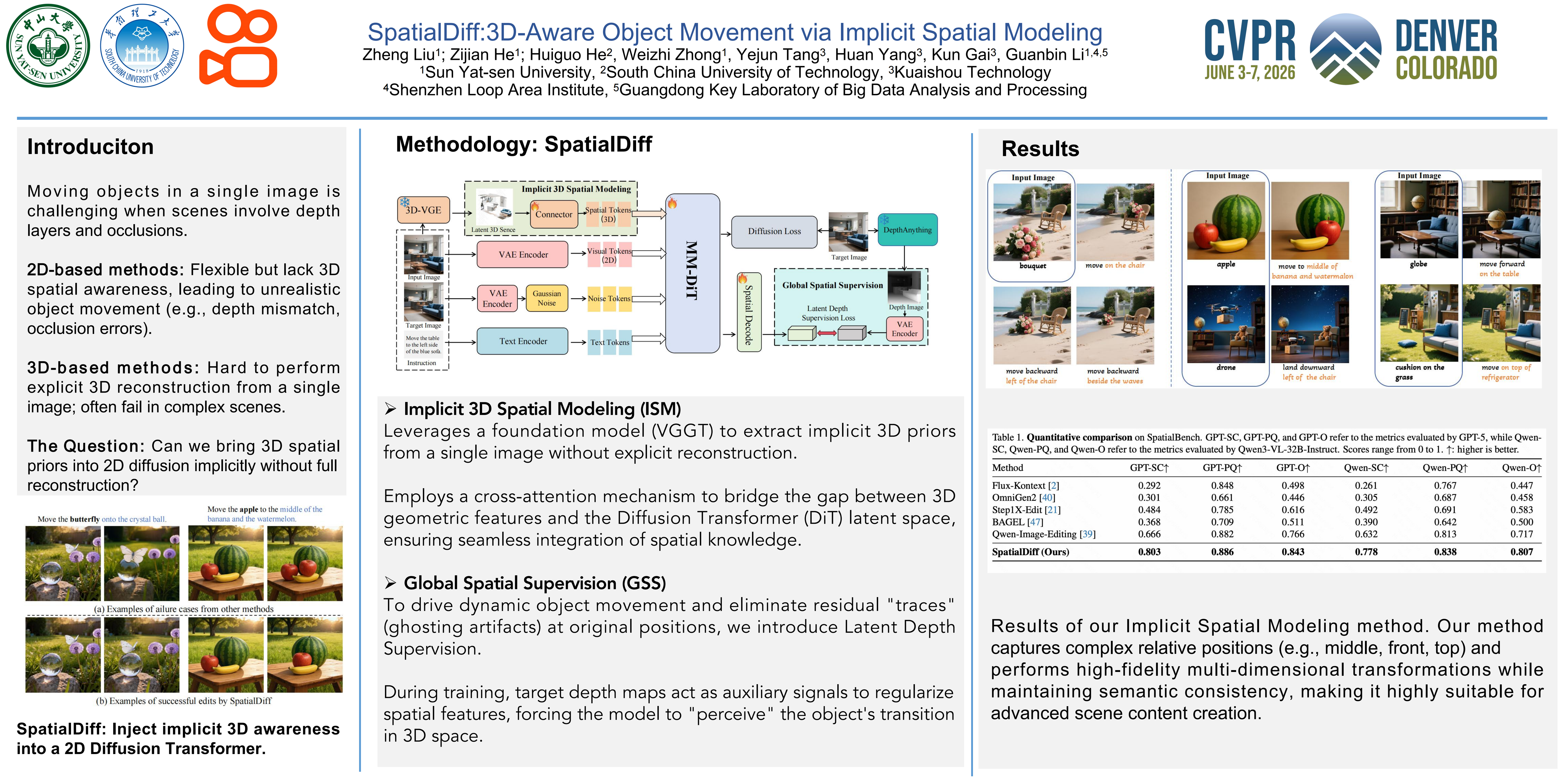
Recent advances in image editing allow impressive manipulation of objects, existing methods still struggle to handle spatial manipulation in complex scenes, such as objects span different depth layers or are partially occluded.Most image editing methods focus solely on 2D datasets prior information, emphasizing planar features while lacking support for spatial positional structures. Even approaches that incorporate explicit positional information fail to capture true 3D spatial relationships, thus limiting accurate object movement in complex scenes.In this paper, we present $\textbf{SpatialDiff}$, a method that effectively captures 3D spatial structures, enabling precise and consistent object movements in complex scenes.Our core innovations are twofold: (1) $\textbf{Implicit 3D Spatial Modeling}$, which introduces 3D prior knowledge and enables the model to internally build a comprehensive understanding of the three-dimensional spatial structure; and (2) $\textbf{Global Spatial Supervision}$, which constrains the latent spatial features to enable the model to perceive changes in object spatial positions caused by editing operations.Experimental results demonstrate that our method significantly improves the accuracy and fidelity of spatial manipulation in complex scenes.
Towards Realistic and Consistent Orbital Video Generation via 3D Foundation Priors
Rong Wang ⋅ Ruyi Zha ⋅ Ziang Cheng ⋅ Jiayu Yang ⋅ Pulak Purkait ⋅ Hongdong Li
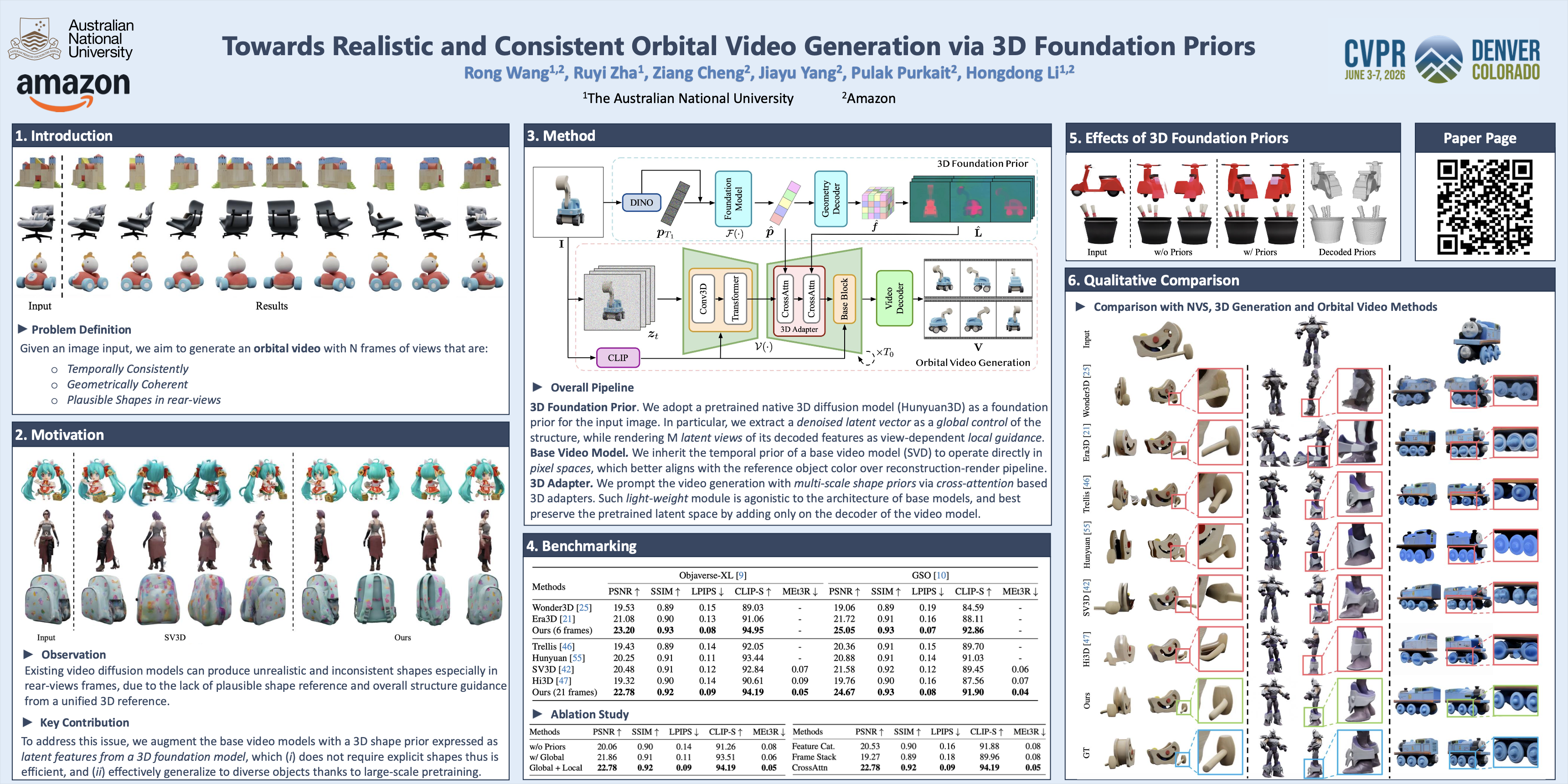
We present a novel method for generating geometrically realistic and consistent orbital videos from a single image of an object. Existing video generation works mostly rely on pixel-wise attention to enforce view consistency across frames. However, such mechanism does not impose sufficient constraints for long-range extrapolation, e.g. rear-view synthesis, in which pixel correspondences to the input image are limited. Consequently, these works often fail to produce results with a plausible and coherent structure. To tackle this issue, we propose to leverage rich shape priors from a 3D foundational generative model as an auxiliary constraint, motivated by its capability of modeling realistic object shape distributions learned from large 3D asset corpora. Specifically, we prompt the video generation with two scales of latent features encoded by the 3D foundation model: (i) a denoised global latent vector as an overall structural guidance, and (ii) a set of latent images projected from volumetric features to provide view-dependent and fine-grained geometry details. In contrast to commonly used 2.5D representations such as depth or normal maps, these compact features can model complete object shapes, and help to improve inference efficiency by avoiding explicit mesh extraction. To achieve effective shape conditioning, we introduce a multi-scale 3D adapter to inject feature tokens to the base video model via cross-attention, which retains its capabilities from general video pretraining and enables a simple and model-agonistic fine-tuning process. Extensive experiments on multiple benchmarks show that our method achieves superior visual quality, shape realism and multi-view consistency compared to state-of-the-art methods, and robustly generalizes to complex camera trajectories and in-the-wild images.
YOLO-ULM: Ultra-Lightweight Models for Real-Time Object Detection
Shasha Han ⋅ Chong Li ⋅ Xinning Wang ⋅ Xuebo Li
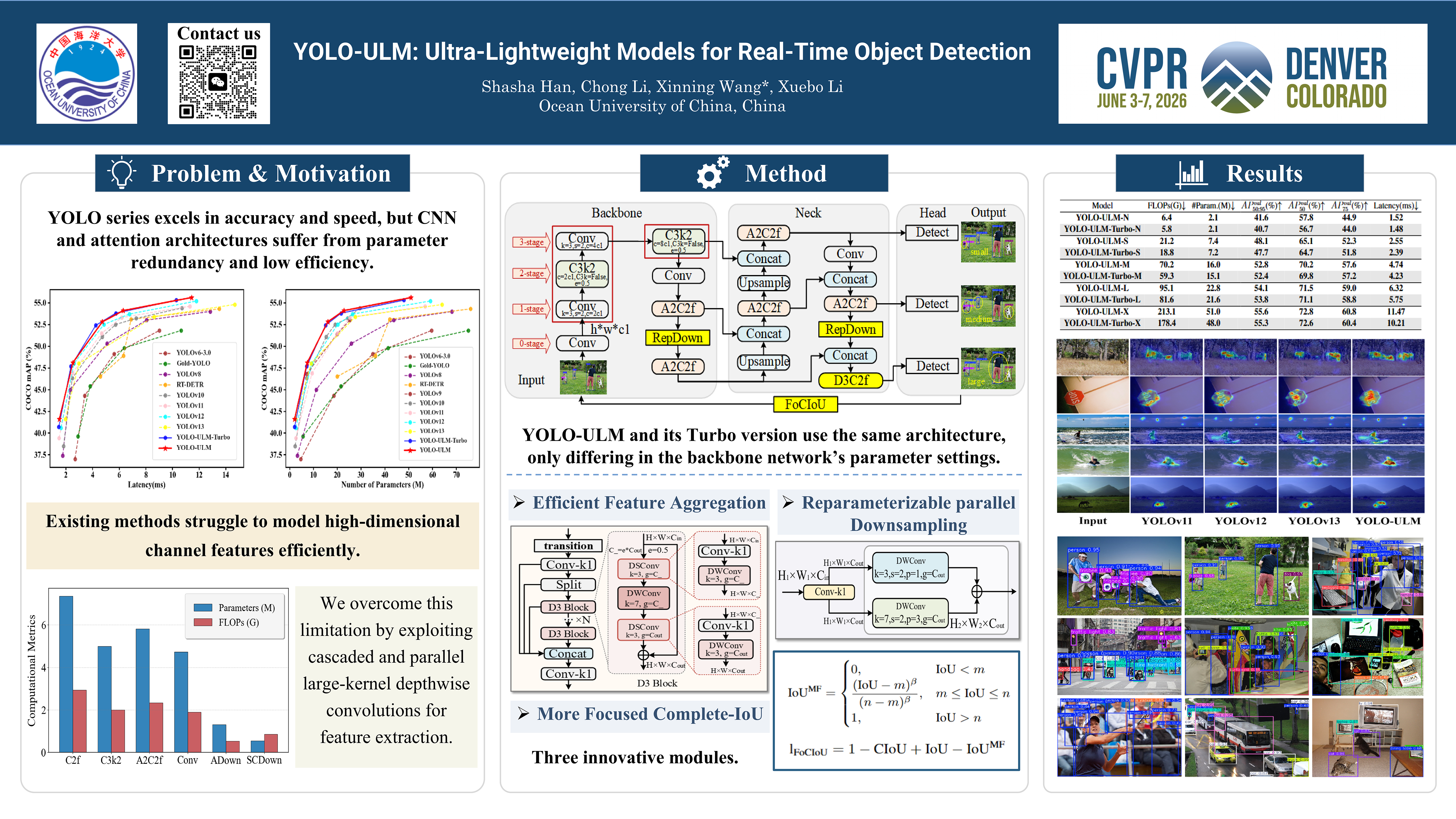
YOLO series lead object detection with superior accuracy and speed. However, both convolutional and self-attention based architectures suffer from parameter redundancy and insufficient computational efficiency. Existing lightweight methods excessively pursue speed while ignoring the loss of important information during feature extraction and spatial transformation across different stages. Thus, effective lightweighting is crucial for detection performance. We propose YOLO-ULM, an ultra-lightweight real-time detector that achieves accelerated inference while preserving high accuracy. We innovatively design a variety of dual efficiency- and accuracy-driven modules, including efficient feature aggregation and multi-scale downsampling modules, as well as a more focused complete-IoU loss function. To validate our approach, we train it from scratch on COCO dataset without pretrained weights. By refining backbone parameters, we extend it to YOLO-ULM-Turbo for accelerated inference. YOLO-ULM surpasses state-of-the-art real-time detectors like YOLOv11/YOLOv12/YOLOv13 and RT-DETR. On a T4 GPU, YOLO-ULM-N achieves 41.6\% mAP with an inference latency of 1.52 ms, outperforming YOLOv11-N (2.2\%$\uparrow$) and YOLOv12-N (1.0\%$\uparrow$). YOLO-ULM-S exceeds RT-DETR-R18 by 1.6\% mAP with 64.7\% fewer FLOPs and 63\% fewer parameters. YOLO-ULM-L / X surpass YOLOv13-L / X by 0.7\% and 0.8\% respectively in mAP. YOLO-ULM-Turbo matches YOLOv12-Turbo's performance but uses less computation, with Turbo-N variant achieving 0.3\% higher mAP and 16\% fewer parameters than YOLOv12-Turbo-N.
CHIRP dataset: towards long-term, individual-level, behavioral monitoring of bird populations in the wild
Alex Hoi Hang Chan ⋅ Neha Singhal ⋅ Onur Kocahan ⋅ Andrea Meltzer ⋅ Saverio Lubrano ⋅ Miya Warrington ⋅ Michael Griesser ⋅ Fumihiro Kano ⋅ Hemal Naik
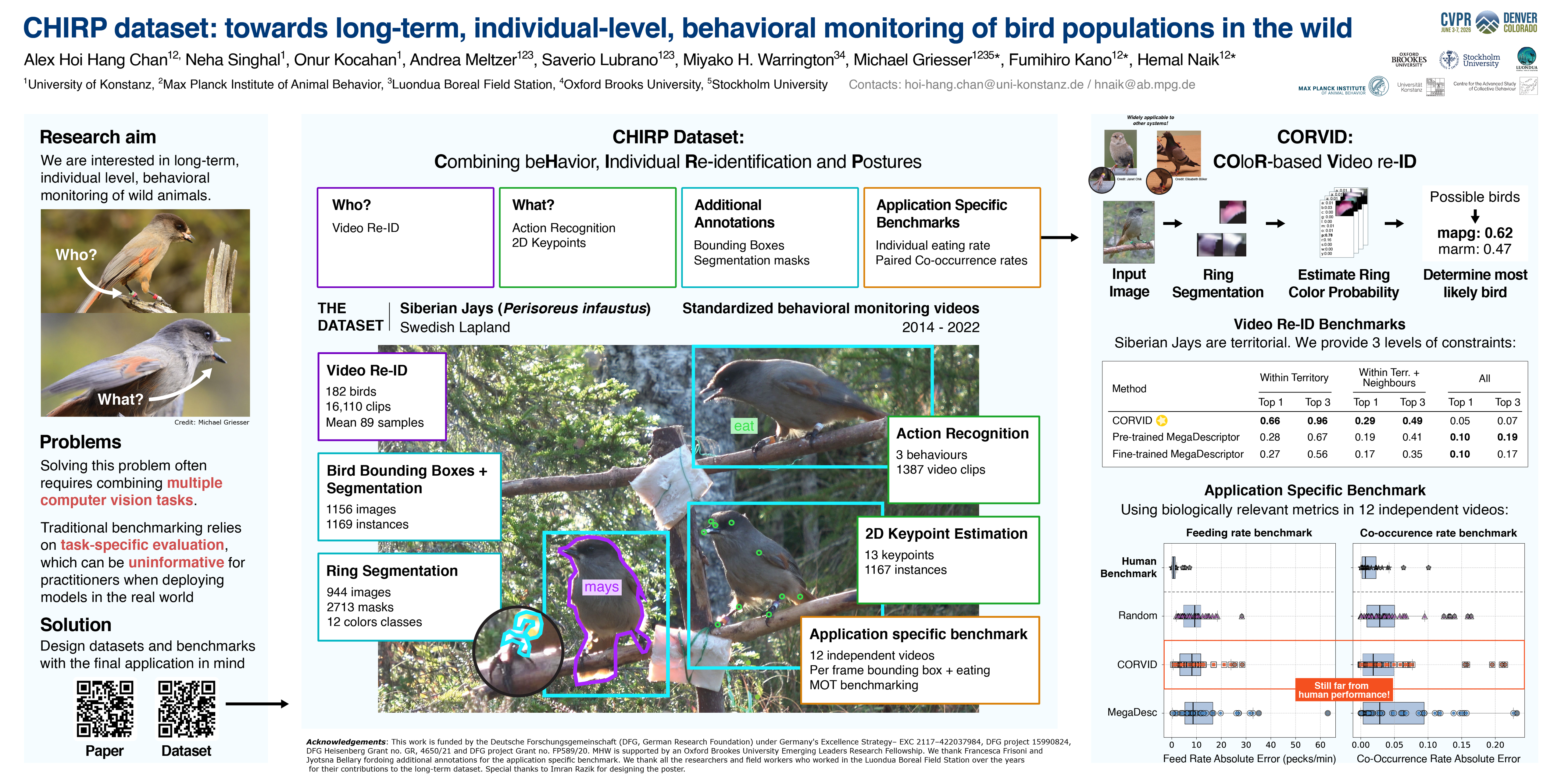
Long-term behavioural monitoring of individual animals is crucial for studying behavioural changes that occurs over different time scales, especially for conservation and evolutionary biology. Computer vision methods have proven to benefit biodiversity monitoring, but automated behaviour monitoring in wild populations remains challenging. This stems from the lack of datasets that cover a range of computer vision tasks necessary to extract biologically meaningful measurements of individual animals. Here, we introduce such a dataset (CHIRP) with a new method (CORVID) for individual re-identification of wild birds. The CHIRP (Combining beHaviour, Individual Re-identification and Postures) dataset is curated from a long-term population of wild Siberian jays studied in Swedish Lapland, supporting re-identification (re-id), action recognition, 2D keypoint estimation, object detection, and instance segmentation. In addition to traditional task-specific benchmarking, we introduce application-specific benchmarking with biologically relevant metrics (feeding rates, co-occurrence rates) to evaluate the performance of models in real-world use cases. Finally, we present CORVID (COlouR-based Video re-ID), a novel pipeline for individual identification of birds based on the segmentation and classification of coloured leg rings, a widespread approach for visual identification of individual birds. CORVID offers a probability-based id tracking method by matching the detected combination of colour rings with a database. We use application-specific benchmarking to show that CORVID outperforms state of the art re-id methods. We hope this work offers the community a blueprint for curating real-world datasets from ethically approved biological studies to bridge the gap between computer vision research and biological applications.
YOLO-Master: MOE-Accelerated with Specialized Transformers for Enhanced Real-time Detection
Xu Lin ⋅ Jinlong Peng ⋅ Zhenye Gan ⋅ Jiawen Zhu ⋅ Jun Liu
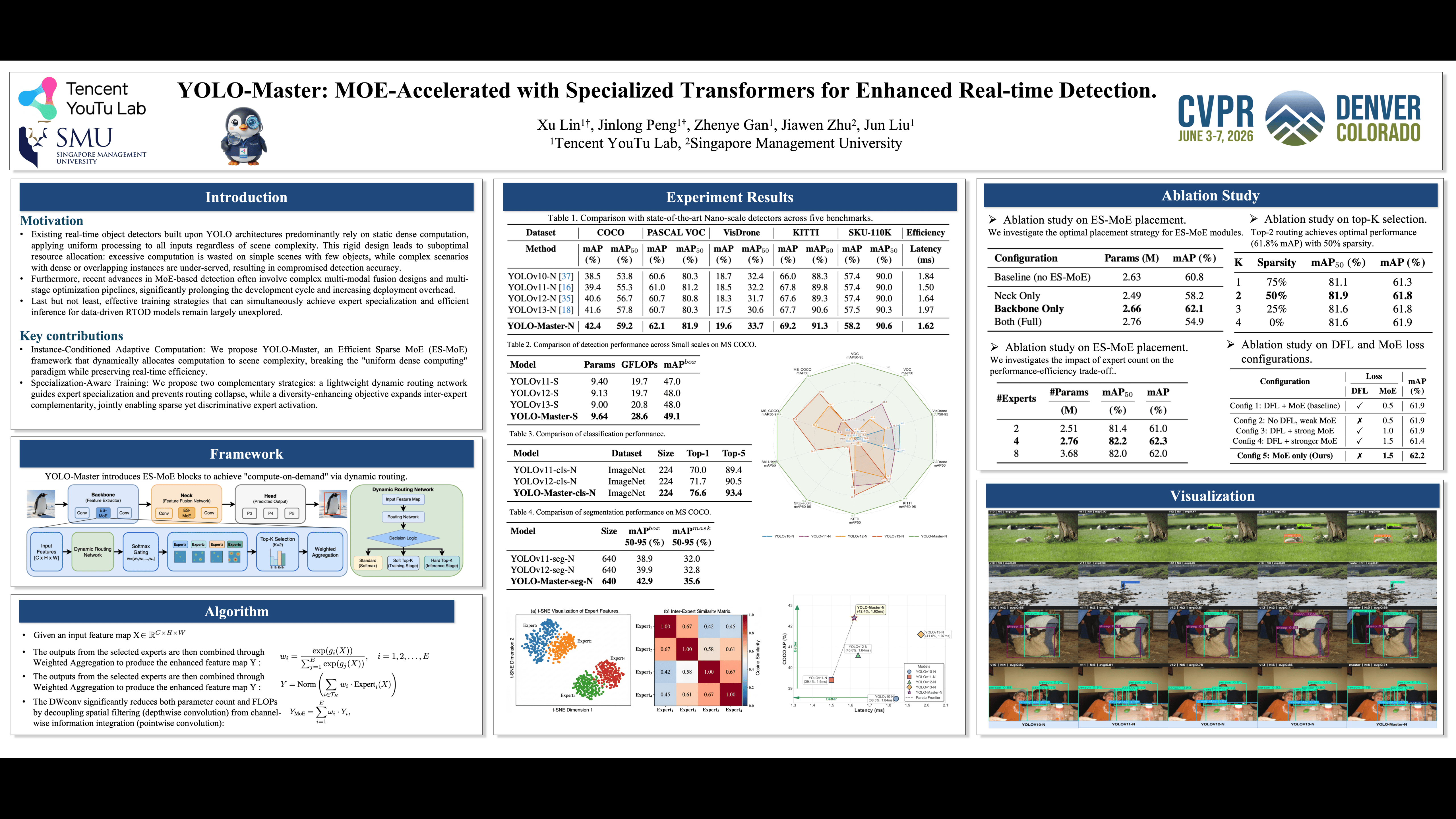
Existing Real-Time Object Detection (RTOD) methods commonly adopt YOLO-like architectures for their favorable trade-off between accuracy and speed. However, these models rely on static dense computation that applies uniform processing to all inputs, misallocating representational capacity and computational resources such as over-allocating on trivial scenes while under-serving complex ones. This mismatch results in both computational redundancy and suboptimal detection performance.To overcome this limitation, we propose YOLO-Master, a novel YOLO-like framework that introduces instance-conditional adaptive computation for RTOD. This is achieved through a Efficient Sparse Mixture-of-Experts (ES-MoE) block that dynamically allocates computational resources to each input according to its scene complexity. At its core, a lightweight dynamic routing network guides expert specialization during training through a diversity enhancing objective, encouraging complementary expertise among experts. Additionally, the routing network adaptively learns to activate only the most relevant experts, thereby improving detection performance while minimizing computational overhead during inference.Comprehensive experiments on five large-scale benchmarks demonstrate the superiority of YOLO-Master. On MS COCO, our model achieves 42.4\% AP with 1.62ms latency, outperforming YOLOv13-N by +0.8\% mAP and 17.8\% faster inference. Notably, the gains are most pronounced on challenging dense scenes, while the model preserves efficiency on typical inputs and maintains real-time inference speed. Code will be available.
VLM4RSDet: Collaborative Optimization with Vision-Language Model for Enhancing Remote Sensing Object Detection
Shuohao Shi ⋅ Qiang Fang ⋅ Xin Xu
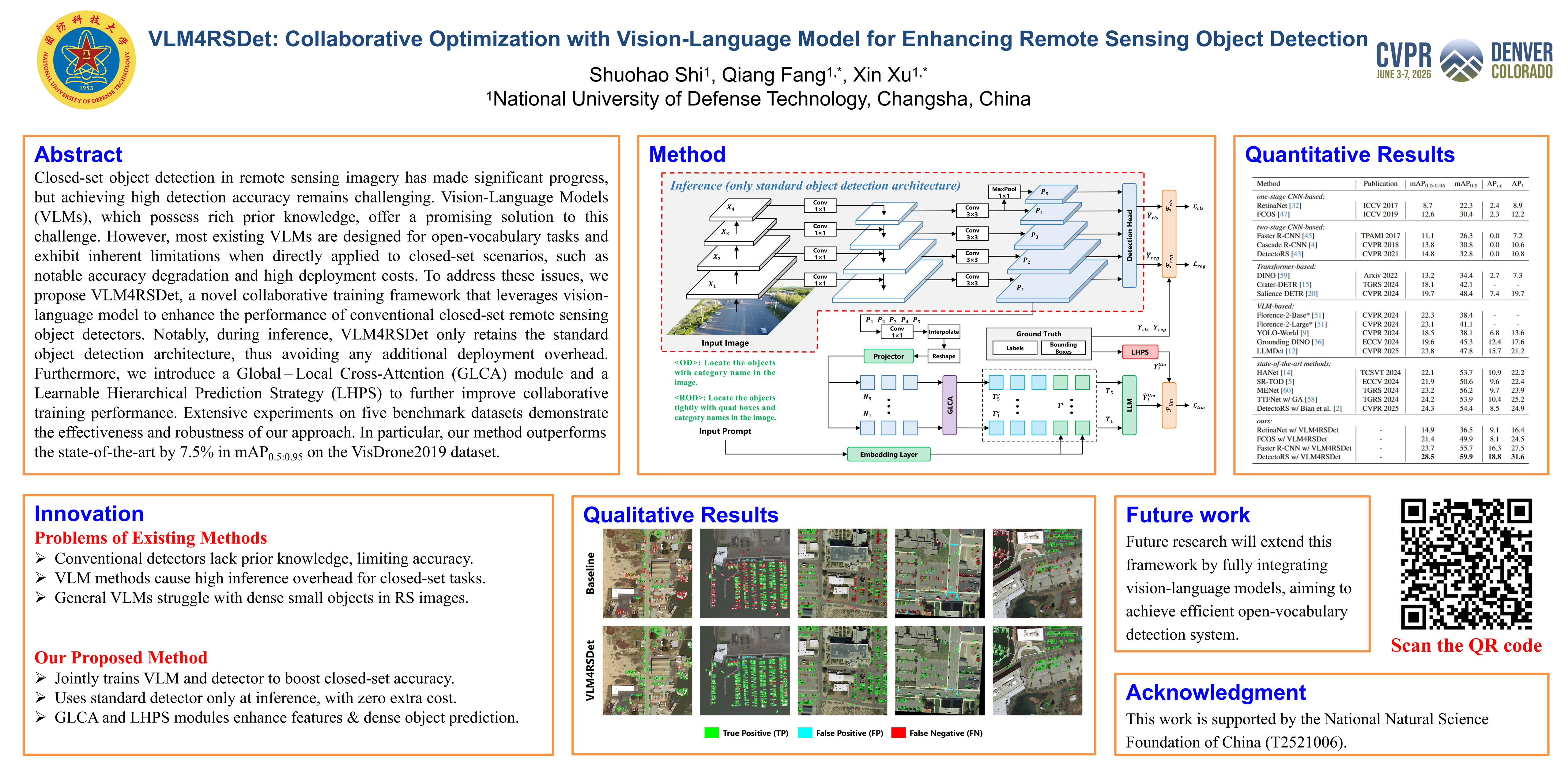
Closed-set object detection in remote sensing imagery has made significant progress, but achieving high detection accuracy remains challenging. Vision-Language Models (VLMs), which possess rich prior knowledge, offer a promising solution to this challenge. However, most existing VLMs are designed for open-vocabulary tasks and exhibit inherent limitations when directly applied to closed-set scenarios, such as notable accuracy degradation and high deployment costs. To address these issues, we propose VLM4RSDet, a novel collaborative training framework that leverages vision-language model to enhance the performance of conventional closed-set remote sensing object detectors. Notably, during inference, VLM4RSDet only retains the standard object detection architecture, thus avoiding any additional deployment overhead. Furthermore, we introduce a Global–Local Cross-Attention (GLCA) module and a Learnable Hierarchical Prediction Strategy (LHPS) to further improve collaborative training performance. Extensive experiments on five benchmark datasets demonstrate the effectiveness and robustness of our approach. In particular, our method outperforms the state-of-the-art by 7.5\% in mAP$_{0.5:0.95}$ on the VisDrone2019 dataset. Our code will be made publicly available.
WiTTA-Bench: Benchmarking Test-Time Adaptation for WiFi Sensing
Bing Li ⋅ Qiang Wang ⋅ JUNDA LU ⋅ Le Zhang ⋅ Yun Liu ⋅ Ce Zhu ⋅ Wei Cui
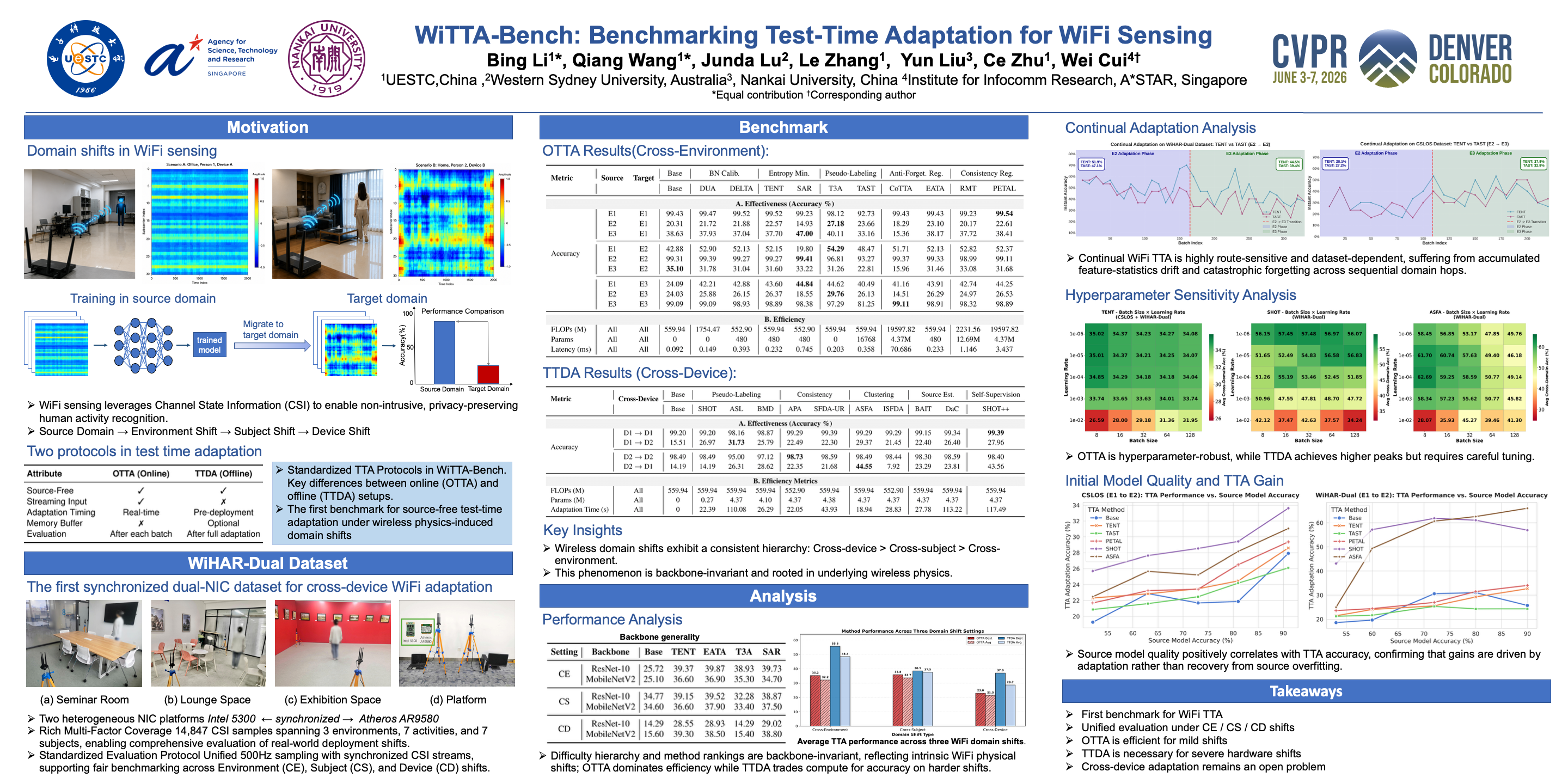
WiFi sensing offers passive and privacy-preserving perception that complements vision-based sensing, but its performance degrades sharply under domain shifts caused by changes in environment, users, or hardware. This challenge is exacerbated in real-world deployments where source data are unavailable, motivating test-time adaptation (TTA) as a practical solution for self-calibration using only unlabeled target samples. We introduce WiTTA-Bench, the first comprehensive benchmark for WiFi TTA, covering 20 representative methods, two adaptation protocols (OTTA and TTDA), and three major physics-induced shifts in WiFi: cross-environment, cross-subject, and cross-device. Furthermore, we contribute a new dataset featuring paired recordings from heterogeneous devices to bridge the cross-device gap. Extensive experiments reveal three key insights unique to WiFi sensing: (i) WiFi domain shifts exhibit a physics-induced hierarchy: environmental changes alter multipath statistics, subject variation perturbs temporal–spectral geometry, and hardware differences reshape the entire feature manifold; (ii) OTTA and TTDA are complementary: lightweight OTTA handles mild statistical drift, while TTDA is necessary to correct deep, hardware-induced structural distortions; and (iii) OTTA is hyperparameter-robust and scales linearly with source quality, whereas TTDA is more sensitive due to recursive self-training. WiTTA-Bench establishes the first systematic foundation for adaptive, robust, and deployable WiFi sensing under realistic wireless conditions.
MFEN: Multi-Frequency Expert Network for Visible-Infrared Person Re-ID
Xulin Li ⋅ Yan Lu ⋅ Bin Liu ⋅ Qinhong Yang ⋅ Qi Chu ⋅ Tao Gong ⋅ Nenghai Yu
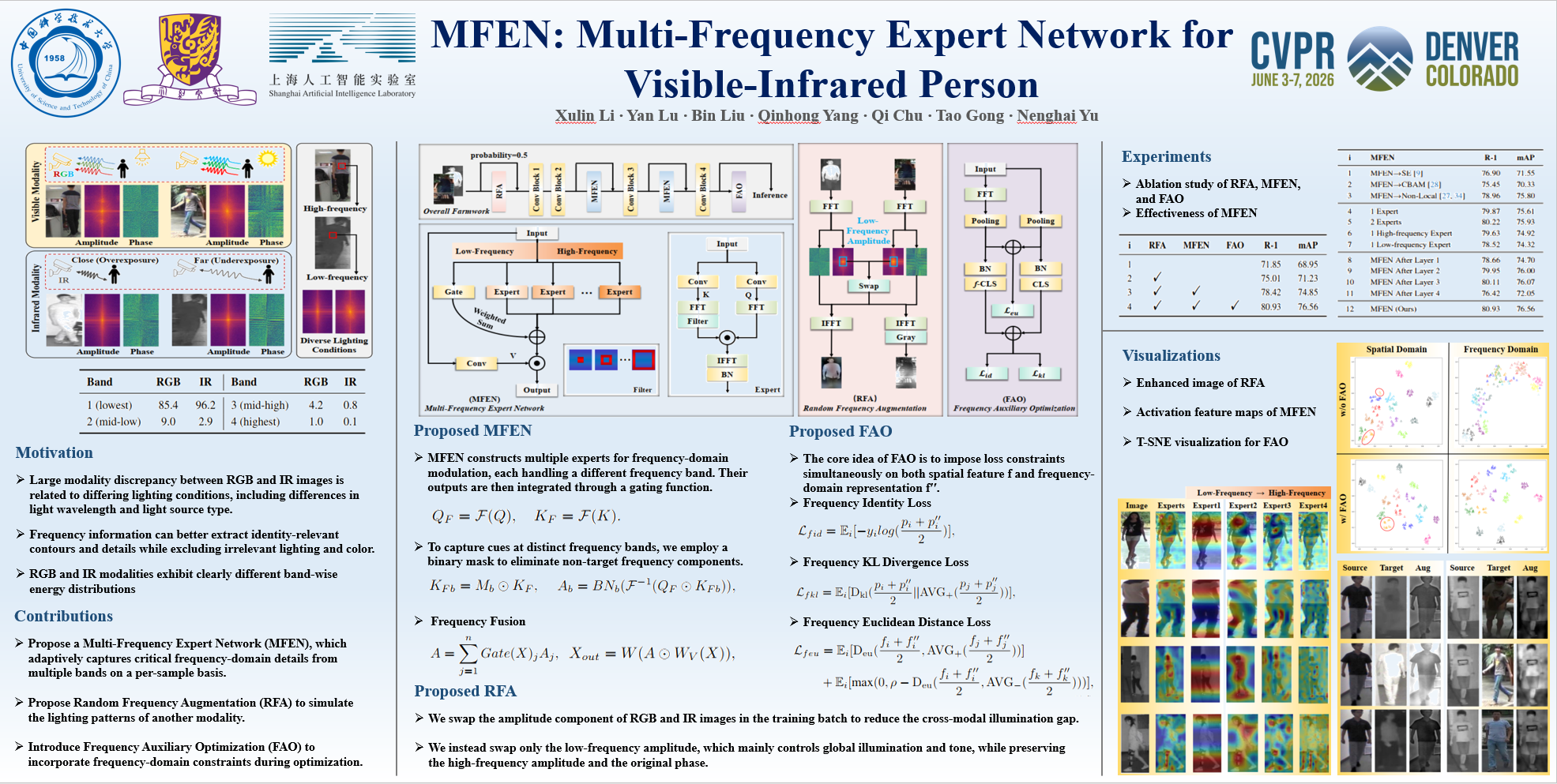
Visible-infrared person re-identification (VI-ReID) is a challenging task due to the significant modality discrepancy between visible and infrared images. We contend that the discrepancy primarily arises from varying lighting conditions of the two modality data, including differences in the wavelengths of light and the types of light source. Recently, frequency-based VI-ReID approaches have achieved notable success, since frequency information can more effectively extract contours and details pertinent to identity while excluding irrelevant lighting and color. However, existing methods do not distinguish different frequency bands or focus solely on a particular frequency band, which is insufficient for capturing the inherent variations in frequency under diverse lighting conditions. To perform comprehensive frequency domain learning, we propose a Multi-Frequency Expert Network (MFEN) that enables multi-frequency modulation and adaptively combines different frequencies through a mixture-of-experts method. In addition, we further introduce a Random Frequency Augmentation (RFA) and a Frequency Auxiliary Optimization (FAO) to effectively train the MFEN in mining frequency information. The proposed three frequency modules are complementary to each other and adaptively capture critical frequency domain details to achieve robust representations. Extensive experiments on three VI-ReID datasets demonstrate the effectiveness of our approach.
Object-Generalized Re-Identification: A Step Towards Universal Instance Perception
Shuoyi Chen ⋅ Yurui Wu ⋅ Mang Ye
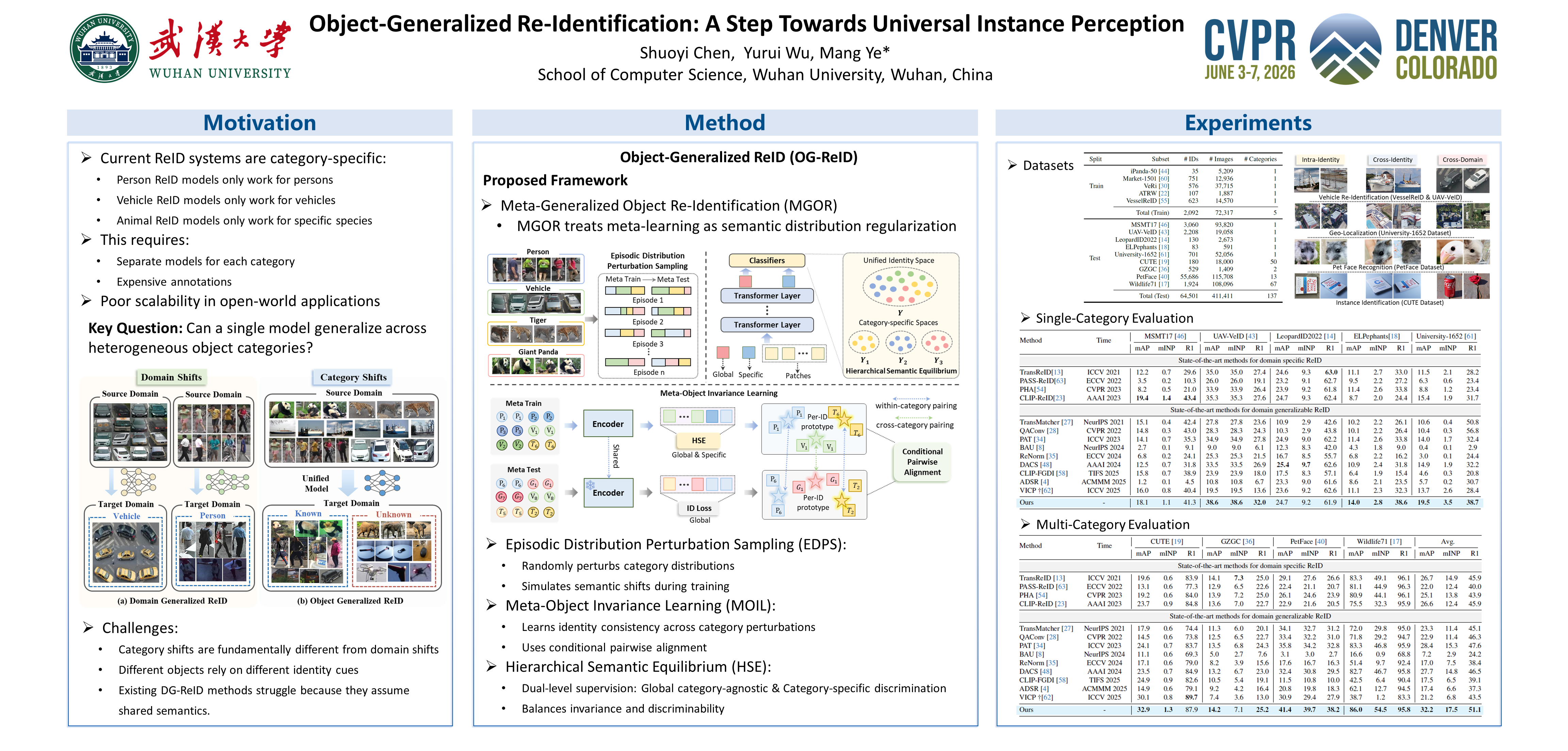
The object re-identification (ReID) task aims to recognize the same individual object across diverse viewpoints and sensing conditions.Although person and vehicle ReID have achieved remarkable success, most existing methods are built on the assumption that training and testing data come from the same object category.This constraint requires separate models for each category, which limits scalability and generalization.To address this limitation, we introduce Object-Generalized Re-Identification (OG-ReID), a new paradigm that learns unified identity representations transferable across different object categories.Unlike conventional domain generalization that focuses on appearance variations within a single category, OG-ReID deals with category shifts caused by intrinsic structural differences in identity cues. To achieve this goal, we introduce the Meta-Generalized Object Re-Identification (MGOR) framework, which treats meta-learning as semantic distributional regularization, exposing the model to controlled category shifts so that invariance emerges as an equilibrium between semantic diversity and identity discrimination.Extensive evaluations on more than 100 unseen object categories from multiple domains show that MGOR outperforms existing ReID approaches without any target-domain adaptation, advancing toward universal identity perception beyond domain and category boundaries.
When Transformers Meet Mamba: A Hybrid Transformer-Mamba Network for Video Object Detection
Qiang Qi ⋅ Xiao Wang ⋅ Zongyuan Du ⋅ Yu Zhang
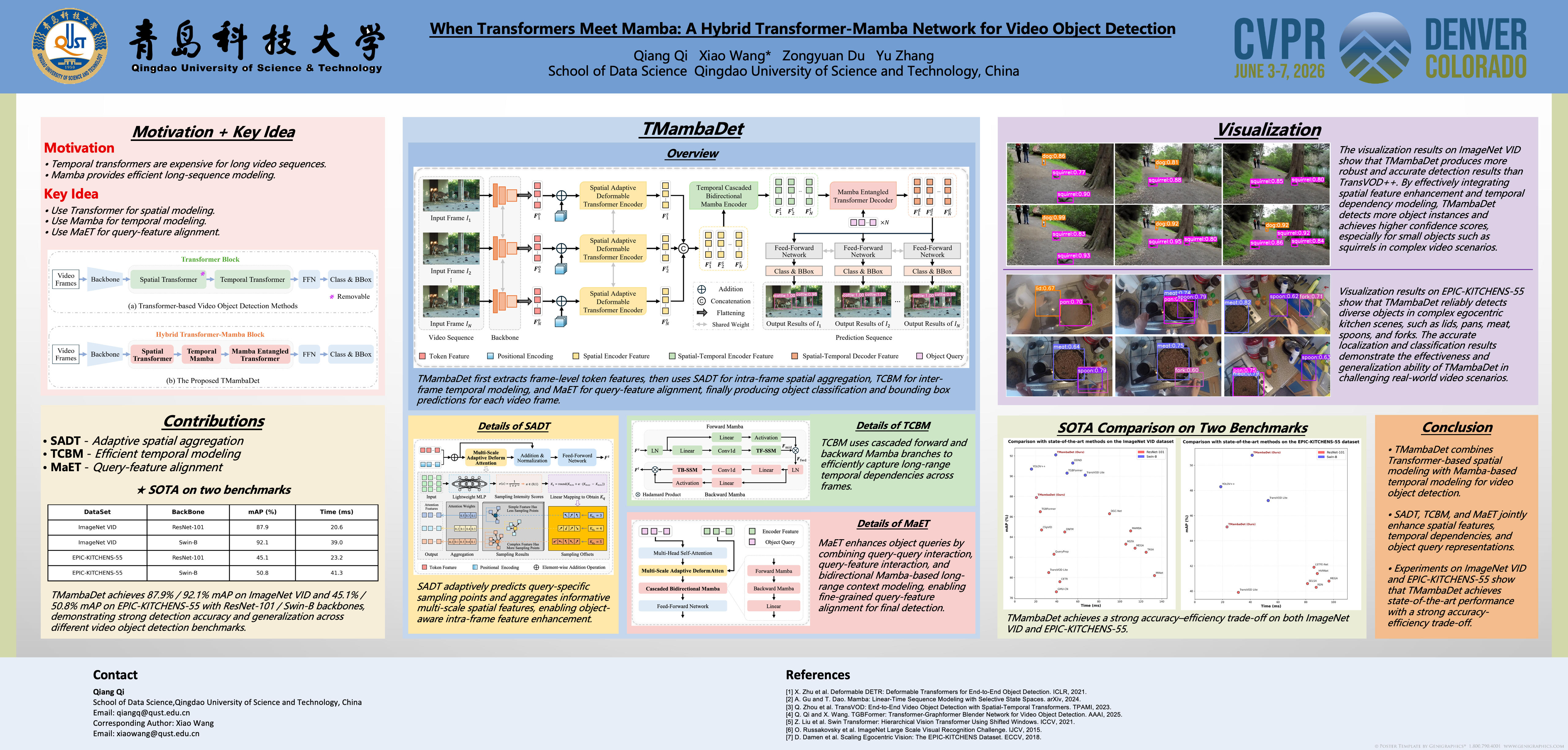
Video object detection has gained notable progress with the advent of transformers. While transformers excel at modeling long-range contextual dependencies, the quadratic complexity limits their efficiency in long-sequence processing. In contrast, Mamba offers greater efficiency in modeling long sequences but tends to exhibit relatively limited contextual learning capability compared with transformers, and its application to video object detection remains unexplored. To harness the complementary strengths of transformers and Mamba, we propose a hybrid Transformer-Mamba network for video object detection (TMambaDet), a pioneering framework in this domain that combines the long-range modeling power of transformers with the efficient long-sequence processing capability of Mamba. Our TMambaDet is characterized by three core components: 1) a spatial adaptive deformable transformer encoder to effectively model the long-range dependencies within each frame, enabling intra-frame feature aggregation that substantially improves the spatial feature representations of objects; 2) a temporal cascaded bidirectional Mamba encoder to efficiently capture the long-range dependencies across frames in video sequences with linear complexity, enabling inter-frame feature aggregation that effectively enhances the temporal feature representations of objects; 3) a Mamba entangled transformer decoder to fully explore the interactions between object queries and spatial-temporal features, enabling fine-grained query-feature alignment that effectively enriches the instance-level representations of object queries. We conduct experiments on the ImageNet VID and EPIC-KITCHENS-55 datasets, showing that TMambaDet achieves state-of-the-art results. Codes will be released.
Prompt-Anchored Vision–Text Distillation for Lifelong Person Re-identification
Wen Wen ⋅ Hao CHEN ⋅ Shiliang Zhang
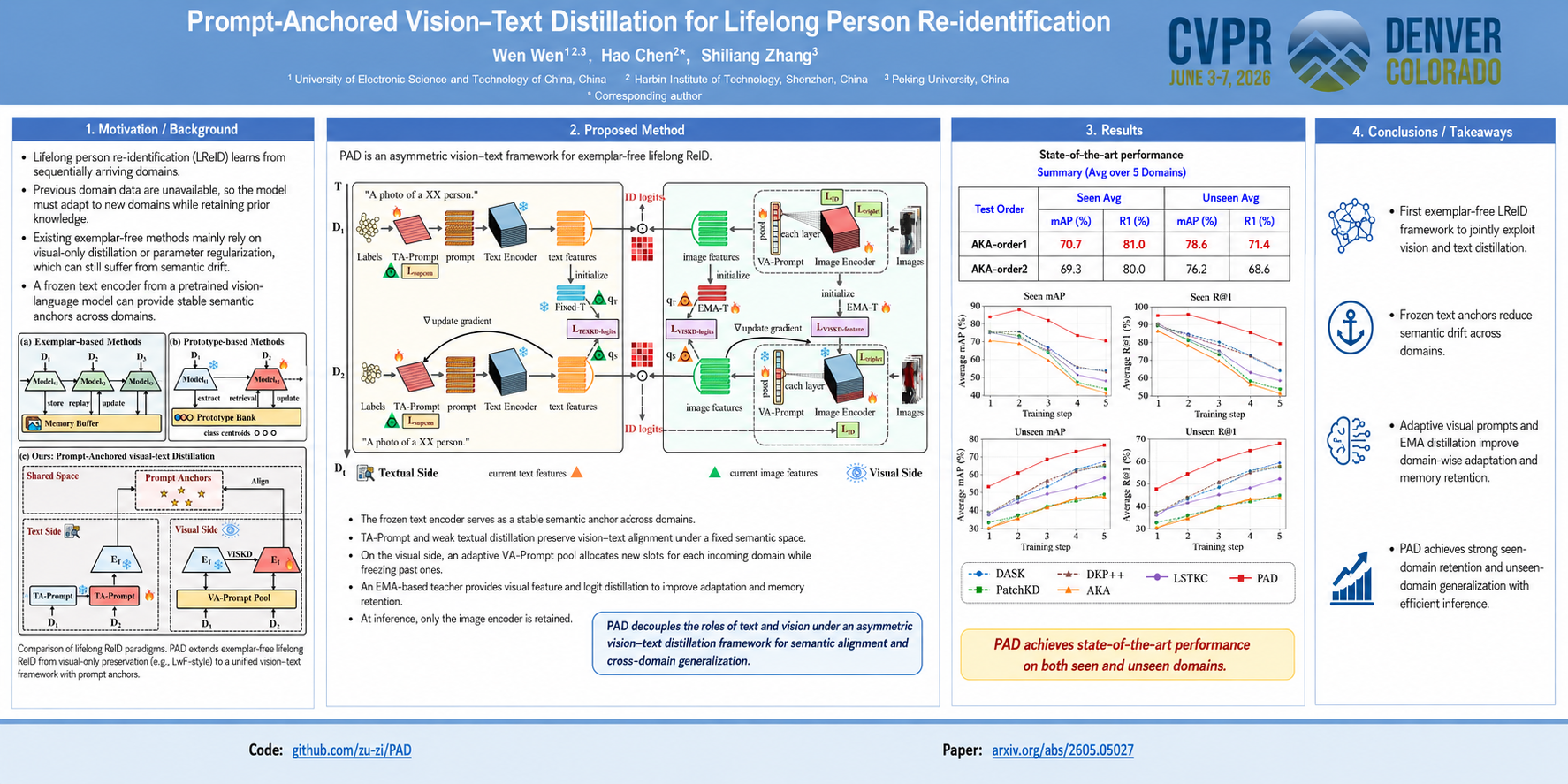
Lifelong person re-identification (LReID) aims to train a generalizable model with sequentially collected data. However, such models often suffer from semantic drift, limited adaptability, and catastrophic forgetting as new domains emerge. Existing exemplar-free approaches mainly focus on visual encoder distillation or parameter regularization, while overlooking the potential of auxiliary modalities, such as text, to preserve semantic stability and enable incremental plasticity. We observe that the frozen text encoder in pretrained vision–language models can serve as a stable semantic anchor, offering consistent guidance throughout lifelong learning. To leverage the synergy between vision and text, we propose Prompt-Anchored vision–text Distillation (PAD), a unified framework that enhances semantic alignment and cross-domain generalization. On the textual side, we distill semantic prompts that maintain vision–text alignment under a fixed semantic coordinate system. On the visual side, an EMA-based teacher performs model distillation assisted by an adaptive prompt pool that allocates new slots for each incoming domain while freezing past ones, achieving both adaptability and memory retention. Extensive experiments demonstrate that our PAD substantially outperforms state-of-the-art methods across multiple LReID benchmarks.
HyperGait: Unleashing the Power of Parsing for Gait Recognition in the Wild via Hypergraph
Jinkai Zheng ⋅ jiaqing wei ⋅ Xinxiang Jin ⋅ Yaoqi Sun ⋅ Xichun Sheng ⋅ Ming Li ⋅ Liangqiong Qu ⋅ Xinchen Liu ⋅ Wu Liu
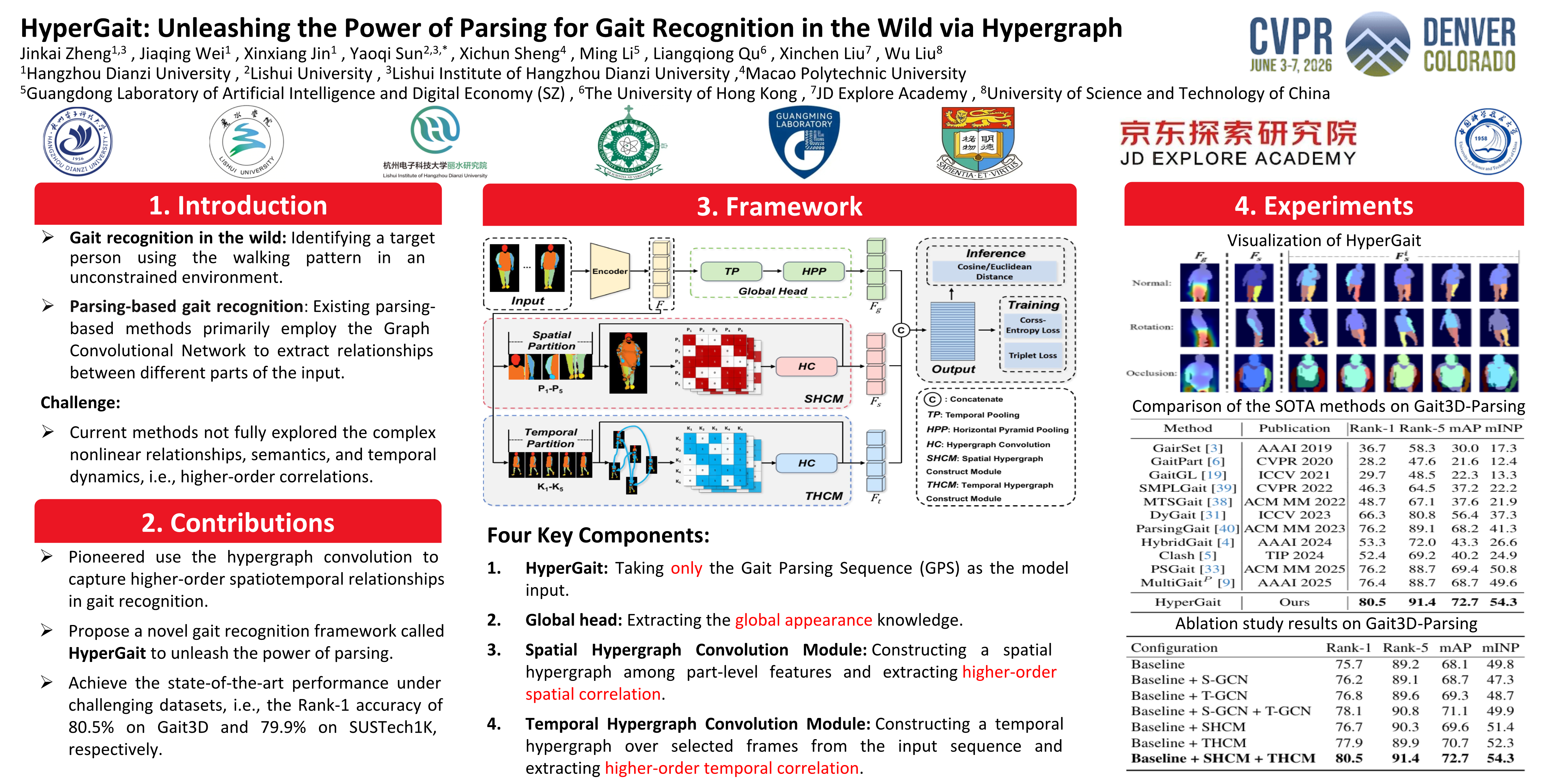
In recent years, the gait parsing sequence has become increasingly popular due to its higher information entropy than the binary silhouette and the keypoint-based skeleton. However, existing parsing-based gait recognition methods have not fully explored the complex, non-linear relationships between features at different positions, semantic, and temporal dynamics levels, i.e., higher-order correlations. To unleash the power of parsing between human body parts and temporal dynamics, this paper proposes a novel hypergraph-based gait recognition framework, named HyperGait. The HyperGait contains a global head and two elaborately-designed modules. In particular, the Spatial Hypergraph Convolutional Module (SHCM) and the Temporal Hypergraph Convolutional Module (THCM) are designed to explore the high-order spatial-level and temporal-level features, respectively.The SHCM extracts fine-grained relationships between human body parts through the hypergraph.The THCM performs the high-order temporal information between temporally related human body parts.Comprehensive experiments on two large-scale gait datasets, i.e., Gait3D and SUSTech1K, show the superior performance of our proposed HyperGait.In highly challenging real-world scenarios, with only parsing as input, our HyperGait achieves the Rank-1 accuracy of 80.5\% on the Gait3D dataset.
Accelerating Streaming Video Large Language Models via Hierarchical Token Compression
Yiyu Wang ⋅ Xuyang Liu ⋅ Xiyan Gui ⋅ Xinying Lin ⋅ Boxue Yang ⋅ Chenfei Liao ⋅ Tailai Chen ⋅ Linfeng Zhang
Streaming Video Large Language Models (VideoLLMs) have demonstrated impressive performance across various video understanding tasks, but they face significant challenges in real-time deployment due to the high computational cost of processing dense visual tokens from continuous video streams. In streaming video scenarios, the primary bottleneck lies in the Vision Transformer (ViT) encoding stage, where redundant processing of temporally similar frames leads to inefficiency. Additionally, inflated token sequences during LLM pre-filling further exacerbate latency and memory overhead. To address these challenges, we propose \textbf{S}treaming \textbf{T}oken \textbf{C}ompression (\textbf{STC}), a plug-and-play hierarchical framework that seamlessly integrates into existing streaming VideoLLMs, optimizing both ViT encoding and LLM pre-filling stages to accelerate processing. STC introduces two token-level accelerators: \textbf{STC-Cacher}, which reduces ViT encoding overhead by caching and reusing features from temporally similar frames, and \textbf{STC-Pruner}, which compresses the visual token sequence before it enters the LLM, preserving only the most salient tokens based on both spatial and temporal relevance. Extensive experiments on four baseline streaming VideoLLMs across five benchmarks demonstrate that STC outperforms other compression methods. Notably, STC retains up to \textbf{99\%} of accuracy on the ReKV framework while reducing ViT encoding latency and LLM pre-filling latency by \textbf{24.5\%} and \textbf{45.3\%}.
Do You See What I Am Pointing At? Gesture-Based Egocentric Video Question Answering
Yura Choi ⋅ Roy Miles ⋅ Rolandos Alexandros Potamias ⋅ Ismail Elezi ⋅ Jiankang Deng ⋅ Stefanos Zafeiriou
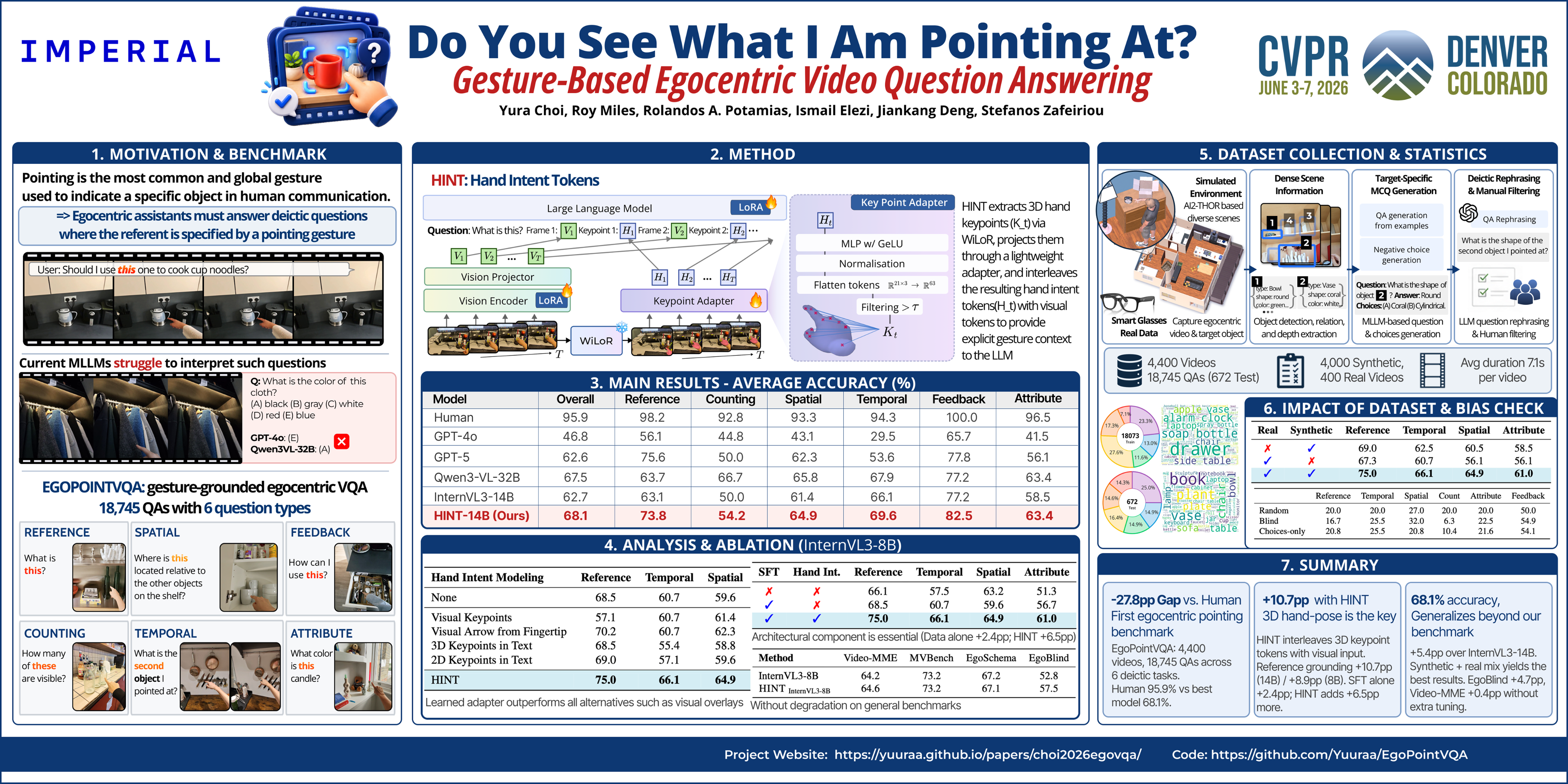
Understanding and answering questions based on a user’s pointing gesture is essential for next-generation egocentric AI assistants. However, current Multimodal Large Language Models (MLLMs) struggle with such tasks due to the lack of gesture-rich data and their limited ability to infer fine-grained pointing intent from egocentric video.To address this, we introduce EgoPointVQA, a dataset and benchmark for gesture-grounded egocentric question answering, comprising 4000 synthetic and 400 real-world videos across multiple deictic reasoning tasks.Built upon it, we further propose Hand Intent Tokens (HINT), which encode tokens derived from 3D hand keypoints using an off-the-shelf reconstruction model and interleaves them with the model input to provide explicit spatial and temporal context for interpreting pointing intent.We show that our model outperforms others in different backbones and model sizes.In particular, HINT-14Bachieves 68.1\% accuracy, on average over 6 tasks, surpassing the state-of-the-art, InternVL3-14B, by 6.6\%.To further facilitate the open research, we will release the code, model, and dataset.
Beyond Caption-Based Queries in Video Moment Retrieval
David Pujol-Perich ⋅ Albert Clapés ⋅ Dima Damen ⋅ Sergio Escalera ⋅ Michael Wray
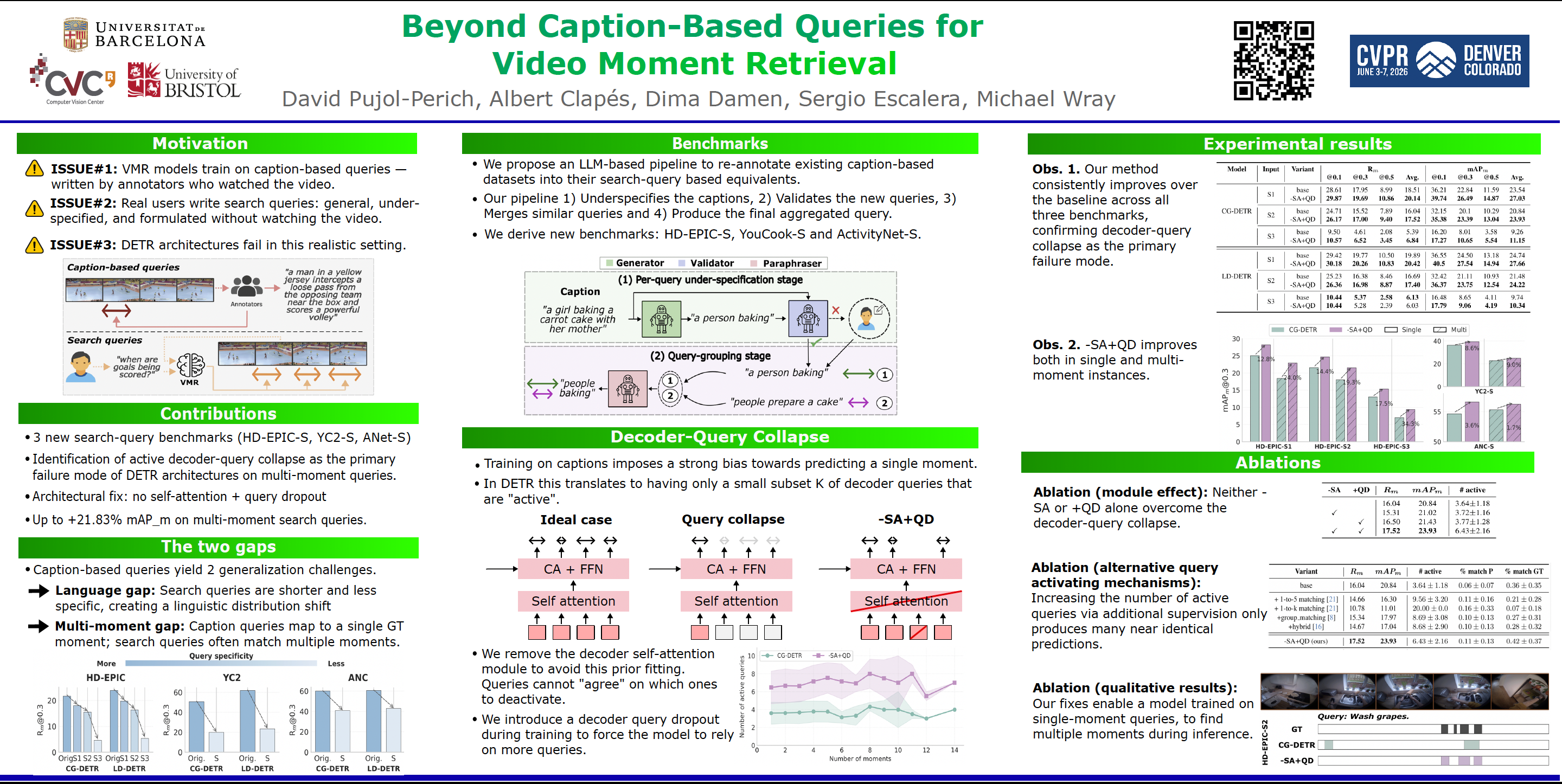
Current Video Moment Retrieval (VMR) models are trained on videos paired with captions, which are written by annotators after watching the videos. These captions are used as textual queries---which we term caption-based queries. This annotation process induces a visual bias, leading to overly descriptive and fine-grained queries, which significantly differ from the more general search queries that users are likely to employ in practice. In this work, we investigate the degradation of existing VMR methods, particularly of DETR architectures, when trained on caption-based queries but evaluated on search queries. For this, we introduce three benchmarks by modifying the textual queries in three public VMR datasets---i.e., HD-EPIC, YouCook2 and ActivityNet-Captions. Our analysis reveals two key generalization challenges: (i) A language gap, arising from the linguistic under-specification of search-queries, and (ii) a multi-moment gap, caused by the shift from single moment to multi-moment queries. We also identify a critical issue in these architectures---an active decoder-query collapse---as a primary cause of the poor generalization to multi-moment instances. We mitigate this issue with architectural modifications that effectively increase the number of active decoder queries. Extensive experiments demonstrate that our approach improves performance on search queries by up to 14.82% $mAP_m$, and up to 21.83% $mAP_m$ on multi-moment search queries.
Neural-Centric Video Processing Pipeline for Unified Multi-Task Inference
Seyeon Lee ⋅ Juncheol Ye ⋅ Jaehong Kim ⋅ Dongsu Han
Videos are increasingly used as inputs to machine learning models, where repeated decoding and processing for diverse downstream tasks dominate computational costs. However, existing video processing pipelines remain inefficient: traditional video codecs (H.264, H.265) are optimized for human visual quality and require full pixel decoding for each inference, Compressed Domain Inference (CDI) is tightly coupled to specific codec structures with limited task flexibility, and Video Coding for Machines (VCM) demands separate representations task-specific encoders without human visualization support.We propose Neural Video Pipeline (NVP), a framework that leverages Implicit Neural Representations (INR) to directly extract task-specific features from intermediate layers, eliminating pixel reconstruction overhead.NVP employs lightweight Micro Adapters to bridge INR features directly into the feature space of downstream models, bypassing both decoding and early extraction stages.Through comprehensive benchmarks across four representative tasks (image classification, object detection, action recognition, and segmentation), NVP reduces latency up to 89.5\%, inference FLOPs up to 29.9\%, while supporting multiple tasks with a single unified representation.
VideoRealBench: A Chain-of-Thought Realism Evaluation Benchmark for Generated Human-Centric Videos
Min Yang ⋅ Xinwen Zhang ⋅ Jialei Tang ⋅ Xin Zhou ⋅ Kehan Li ⋅ Zeyi Huang ⋅ Limin Wang
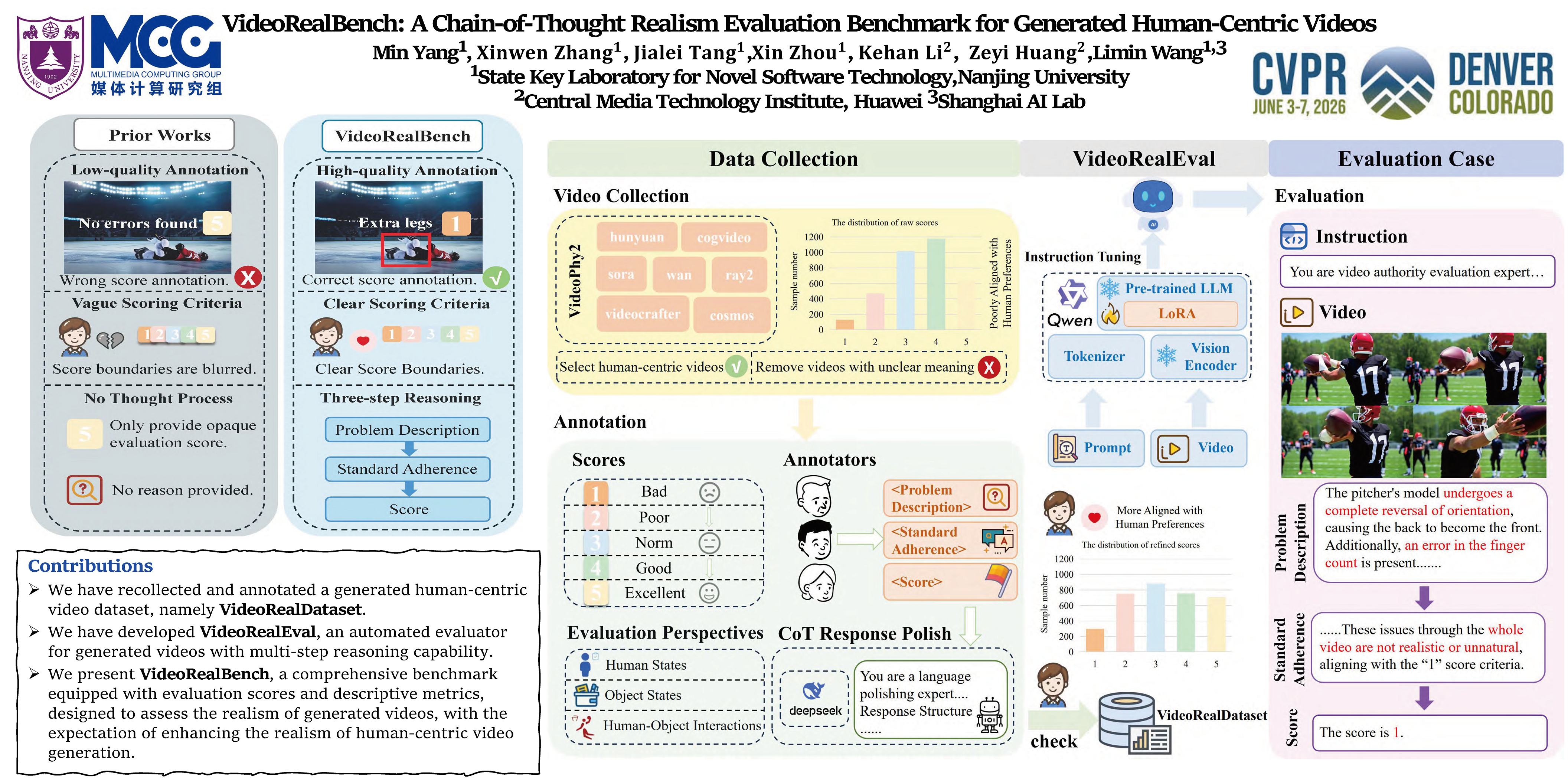
With the great advancement of video generation models, a growing number of content creators and researchers are leveraging these technologies to produce large volumes of human-centric videos for content creation and customized data generation for specific tasks. Although existing video generation models are capable of producing videos with high visual quality, their inadequate understanding of video realism results in generating unrealistic videos. While various evaluators have emerged to assess the quality of generated videos, they are trained from low-quality generated videos and data annotations, leading to misaligned ratings with human preferences. They also lack interpretability due to the absence of chain-of-thought reasoning. To address these issues, we propose \textbf{VideoRealBench}, a comprehensive benchmark for evaluating the realism of generated human-centric videos. We leverage a rating scale designed from human preferences to score videos and provide three-step rationales, thereby creating a finely-annotated dataset \textbf{VideoRealDataset} and proposing an evaluator \textbf{VideoRealEval} capable of providing reliable scores along with detailed rationales. VideoRealEval achieves a Pearson’s linear correlation coefficient (PLCC) of 57.07\% and a Spearman’s rank correlation coefficient (SROCC) of 56.78\% on VideoRealDataset, demonstrating closer alignment with human preferences than existing evaluators.
VAST: Video Ability‑Stratified Taxonomy for Data‑Efficient Video Reasoning
Zhongan Wang ⋅ Xiaoyu Wen ⋅ Lingxiao Du ⋅ Kun Li ⋅ zhiliang wu ⋅ Xingcheng Xu ⋅ Qiaosheng Zhang ⋅ Chaochao Lu ⋅ Hehe Fan
Reinforcement learning (RL) enhances reasoning capabilities in multimodal large language models (MLLMs) for video understanding. However, current methods face two coupled challenges. \textbf{First}, existing methods organize datasets by task types rather than reasoning capabilities. This creates a many-to-many mismatch where models learn task patterns instead of transferable reasoning abilities. Consequently, achieving ability generalization requires broad coverage across ability-task combinations, making RL training costly. \textbf{Second}, these methods compensate for this inefficiency through complex algorithmic modifications (e.g., specialized temporal architectures or multi-objective reward frameworks), which increase the complexity of training. To address these issues, we take a joint perspective from both the data and method sides. On the data side, we propose VAST, an ability-stratified framework that reorganizes video understanding tasks into a three-layer cognitive taxonomy spanning Perception, Reasoning, and Cognition. We further construct VAST-15K for training and VAST-Bench for evaluation. On the method side, we introduce VideoVAST, employing RL with consistency rewards for reasoning-answer alignment without architectural modifications. Experiments show that VideoVAST achieves 66.3\% accuracy on MVBench and 57.4\% on VAST-Bench, compared with 62.7\% and 54.3\% respectively for Video-R1. Under the same training settings, VideoVAST uses 72\% fewer GPU hours and 96\% fewer training samples. The code will be made publicly available.
An Empirical Study on How Video-LLMs Answer Video Questions
Chenhui Gou ⋅ Ziyu Ma ⋅ Zicheng Duan ⋅ Haoyu He ⋅ Feng Chen ⋅ Liyang Liu ⋅ Bohan Zhuang ⋅ Jianfei Cai ⋅ Hamid Rezatofighi
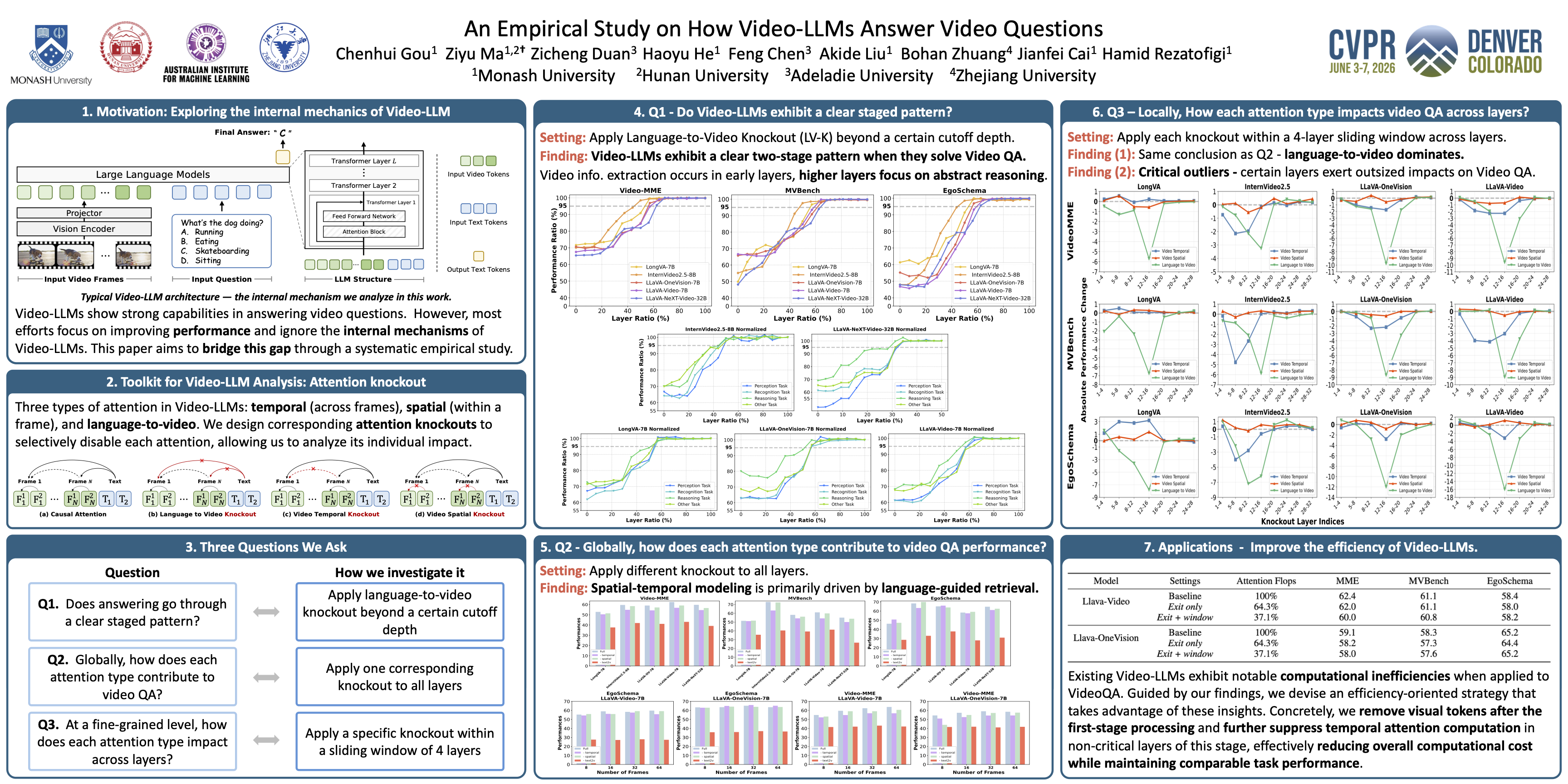
Taking advantage of large-scale data and pretrained language models, Video Large Language Models (Video-LLMs) have shown strong capabilities in answering video questions. However, most existing efforts focus on improving performance, with limited attention to understanding their internal mechanisms. This paper aims to bridge this gap through a systematic empirical study. To interpret existing VideoLLMs, we adopt attention knockouts as our primary analytical tool and design three variants: Video Temporal Knockout, Video Spatial Knockout, and Language-to-Video Knockout. Then, we apply these three knockouts on different numbers of layers (window of layers). By carefully controlling the window of layers and types of knockouts, we provide two settings: a global setting and a fine-grained setting. Our study reveals three key findings: (1) Global setting indicates Video information extraction primarily occurs in early layers, forming a clear two-stage process—lower layers focus on perceptual encoding, while higher layers handle abstract reasoning; (2) In the fine-grained setting, certain intermediate layers exert an outsized impact on video question answering, acting as critical outliers, whereas most other layers contribute minimally; (3) In both settings, we observe that spatial-temporal modeling relies more on language-guided retrieval than on intra- and inter-frame self-attention among video tokens, despite the latter’s high computational cost. Finally, we demonstrate that these insights can be leveraged to reduce attention computation in Video-LLMs. To our knowledge, this is the first work to systematically uncover how Video-LLMs internally process and understand video content, offering interpretability and efficiency perspectives for future research.
FPSBench: A Benchmark for Video Understanding at High Frame Rates
Rohan Choudhury ⋅ Jean Dandurand ⋅ Kai Qiu ⋅ Kshitij Madhav Bhat ⋅ Kartik Sharma ⋅ Liza Dahiya ⋅ Yizhou Zhao ⋅ Souraja Kundu ⋅ Chun-Hsien Lin ⋅ Kris Kitani ⋅ László A. Jeni
Modern video-language models are typically trained on videos downsampled to low frames-per-second (FPS), and the most commonly used evaluation benchmarks are designed for low-FPS input as well. To address this shortcoming, we present FPS-Bench, a large video question-answering benchmark designed to evaluate VLMs’ capabilities to understand video at high-frame rates. We introduce a new metric, the minimum frames-per-second (minFPS), which measures the minimum frame-rate required to solve a given question. While existing benchmarks require <1 minFPS, we rigorously curate more than 1000 questions from a diverse source of videos and manually verify minFPS for each example, leading to a benchmark that requires watching videos at on average 7 FPS to solve. Our evaluation of several state-of-the-art VLMs shows that they are severely lacking, achieving QA accuracy of 30\% in the FPS-Bench multiple-choice task, while humans achieve 72\% accuracy. We believe that FPS-Bench will serve as a valuable tool for improving frontier-level VLMs and will release all data and code.
UniComp: Rethinking Video Compression Through Informational Uniqueness
Chao Yuan ⋅ Shimin Chen ⋅ Minliang Lin ⋅ Limeng Qiao ⋅ Guanglu Wan ⋅ Lin Ma
Distinct from attention-based compression methods, this paper presents an information uniqueness driven video compression framework, termed UniComp, which aims to maximize the information fidelity of video representations under constrained computational budgets. Starting from the information-theoretic perspective, we formulate the vision compression as an optimization problem that minimizes conditional entropy (reconstruction error) between retained and full tokens. To achieve this, we introduce the notion of information uniqueness to measure intrinsic redundancy among tokens to link with reconstruction error. Based on uniqueness, we design three modules—Frame Group Fusion, Token Allocation, and Spatial Dynamic Compression—that progressively perform semantic frame grouping, adaptive resource allocation, and fine-grained spatial compression. Extensive experiments demonstrate that UniComp consistently outperforms existing compression methods in preserving essential visual tokens under limited computational budgets, highlighting the pivotal role of information uniqueness in token compression efficacy.
NaTex: Seamless Texture Generation as Latent Color Diffusion
Zeqiang Lai ⋅ Yunfei Zhao ⋅ Zibo Zhao ⋅ Xin Yang ⋅ Xin Huang ⋅ Jingwei Huang ⋅ Xiangyu Yue ⋅ Chunchao Guo
We present NaTex, a native texture generation framework that predicts texture color directly in 3D space. In contrast to previous approaches that rely on baking 2D multi-view images synthesized by geometry-conditioned Multi-View Diffusion models (MVDs), NaTex avoids several inherent limitations of the MVD pipeline. These include difficulties in handling occluded regions that require inpainting, achieving precise mesh-texture alignment along boundaries, and maintaining cross-view consistency and coherence in both content and color intensity. NaTex features a novel paradigm that addresses the aforementioned issues by viewing texture as a dense color point cloud. Driven by this idea, we propose latent color diffusion, which comprises a geometry-awared color point cloud VAE and a multi-control diffusion transformer (DiT), entirely trained from scratch using 3D data, for texture reconstruction and generation. To enable precise alignment, we introduce native geometry control that conditions the DiT on direct 3D spatial information via positional embeddings and geometry latents. We co-design the VAE–DiT architecture, where the geometry latents are extracted via a dedicated geometry branch tightly coupled with the color VAE, providing fine-grained surface guidance that maintains strong correspondence with the texture. With these designs, NaTex demonstrates strong performance, significantly outperforming previous methods in texture coherence and alignment. Moreover, NaTex also exhibits strong generalization capabilities, either training-free or with simple tuning, for various downstream applications, e.g., material generation, texture refinement, and part segmentation and texturing.
Your Latent Mask is Wrong: Pixel-Equivalent Latent Compositing for Diffusion Models
Rowan Bradbury ⋅ Dazhi Zhong
Linearly interpolating between VAE latents using a downsampled mask field remains a common heuristic for diffusion inpainting. However, this approach systematically violates a key principle: latent compositing must respect pixel equivalence; compositing latents must approximate compositing pixels. Because VAE latents capture global context rather than pixel-local structure, linear interpolation fails this requirement, producing seams, color shifts, and halos that diffusion subsequently amplifies into larger artifacts.We propose Pixel-Equivalent Latent Compositing (PELC) and instantiate it with DecFormer, a 7.7M-parameter transformer that predicts per-channel blend weights and a nonlinear residual to realize mask-consistent latent fusion. DecFormer is trained so that decoding after fusion matches pixel-space alpha compositing, is plug-compatible with existing diffusion pipelines, requires no backbone finetuning and adds only 0.07\% of FLUX.1-Dev’s parameters and 3.5\% FLOP overhead.On the FLUX.1 family, DecFormer restores global color consistency, soft-mask support, sharp boundaries, and high-fidelity masking, reducing error metrics around edges by up to 53\% over standard mask interpolation. Used as an inpainting prior, a lightweight LoRA on FLUX.1-Dev with DecFormer achieves fidelity comparable to FLUX.1-Fill, a fully finetuned inpainting model. While we focus on inpainting, PELC is a general recipe for pixel-equivalent latent editing (e.g., overlays, tone/relighting, warps), as we demonstrate on a complex color-correction task.
Pluggable Pruning with Contiguous Layer Distillation for Diffusion Transformers
jian ma ⋅ Qirong Peng ⋅ Xujie Zhu ⋅ Peixing Xie ⋅ Chen Chen ⋅ Haonan Lu
Diffusion Transformers (DiTs) have shown exceptional performance in image generation, yet their large parameter counts incur high computational costs, impeding deployment in resource-constrained settings. To address this, we propose Pluggable Pruning with Contiguous Layer Distillation (PPCL), a flexible structured pruning framework specifically designed for DiT architectures. First, we identify redundant layer intervals through a linear probing mechanism combined with the first-order differential trend analysis of similarity metrics. Subsequently, we propose a plug-and-play teacher-student alternating distillation scheme tailored to integrate depth-wise and width-wise pruning within a single training phase. This distillation framework enables flexible knowledge transfer across diverse pruning ratios, eliminating the need for per-configuration retraining. Extensive experiments on multiple Multi-Modal Diffusion Transformer architecture models demonstrate that PPCL achieves a 50\% reduction in parameter count compared to the full model, with less than 3\% degradation in key objective metrics. Notably, our method maintains high-quality image generation capabilities while achieving higher compression ratios, rendering it well-suited for resource-constrained environments.
Attribute-Preserving Pseudo-Labeling for Diffusion-Based Face Swapping
Jiwon Kang ⋅ Yeji Choi ⋅ JoungBin Lee ⋅ Wooseok Jang ⋅ Jinhyeok Choi ⋅ Taekeun Kang ⋅ Yongjae Park ⋅ Myungin Kim ⋅ Seungryong Kim
Face swapping aims to transfer the identity of a source face onto a target face while preserving target-specific attributes such as pose, expression, lighting, skin tone, and makeup. However, since real face-swapping ground truth is unavailable, achieving both accurate identity transfer and high-quality attribute preservation remains challenging. Although recent diffusion-based approaches attempt to improve visual fidelity through conditional inpainting on masked target images, the masked condition removes crucial appearance cues, resulting in plausible yet misaligned attributes due to the lack of explicit supervision. To address these limitations, we propose APPLE (Attribute-Preserving Pseudo-Labeling for Diffusion-Based Face Swapping) a diffusion-based teacher–student framework that enhances attribute fidelity through attribute-aware pseudo-label supervision. First, we reformulate face swapping as a conditional deblurring task to more faithfully preserve target-specific attributes such as lighting, skin tone, and makeup. In addition, we introduce an attribute-aware inversion scheme to further improve detailed attribute preservation. Through an elaborate attribute-preserving design for teacher learning, APPLE produces high-quality pseudo triplets that explicitly provide the student with direct face-swapping supervision. Overall, APPLE achieves state-of-the-art performance in terms of attribute preservation and identity transfer, producing more photorealistic and target-faithful results. Code will be made publicly available.
Delta Rectified Flow Sampling for Text-to-Image Editing
Gaspard Beaudouin ⋅ Minghan LI ⋅ Jaeyeon Kim ⋅ Sung-Hoon Yoon ⋅ Mengyu Wang
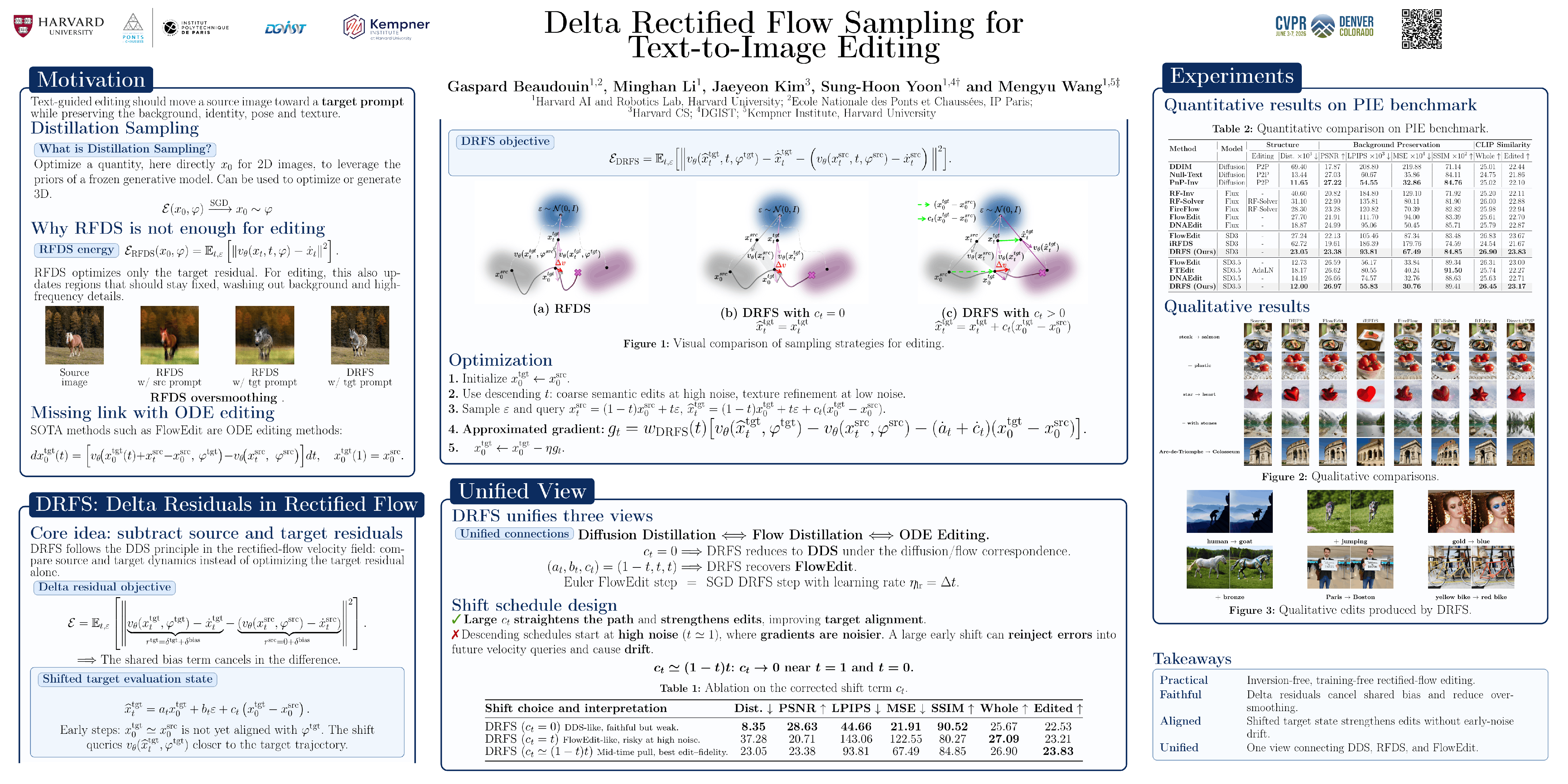
We propose Delta Rectified Flow Sampling (DRFS), a novel inversion-free, path-aware editing framework within rectified flow models for text-to-image editing. DRFS is a distillation-based method that explicitly models the discrepancy between the source and target velocity fields in order to mitigate over-smoothing artifacts rampant in prior distillation sampling approaches. We further introduce a time-dependent shift term to push noisy latents closer to the target trajectory, enhancing the alignment with the target distribution. We theoretically demonstrate that when this shift is disabled, DRFS reduces to Delta Denoising Score, thereby bridging score-based diffusion optimization and velocity-based rectified-flow optimization. Moreover, when the shift term follows a linear schedule under rectified-flow dynamics, DRFS generalizes the Inversion-free method FlowEdit and provides a principled theoretical interpretation for it. We conduct an analysis to guide the design of our shift term, and experimental results on the widely used PIE Benchmark indicate that DRFS achieves superior editing quality, fidelity, and controllability while requiring no architectural modifications.
Training-free Mixed-Resolution Latent Upsampling for Spatially Accelerated Diffusion Transformers
Wongi Jeong ⋅ Kyungryeol Lee ⋅ Hoigi Seo ⋅ Se Young Chun
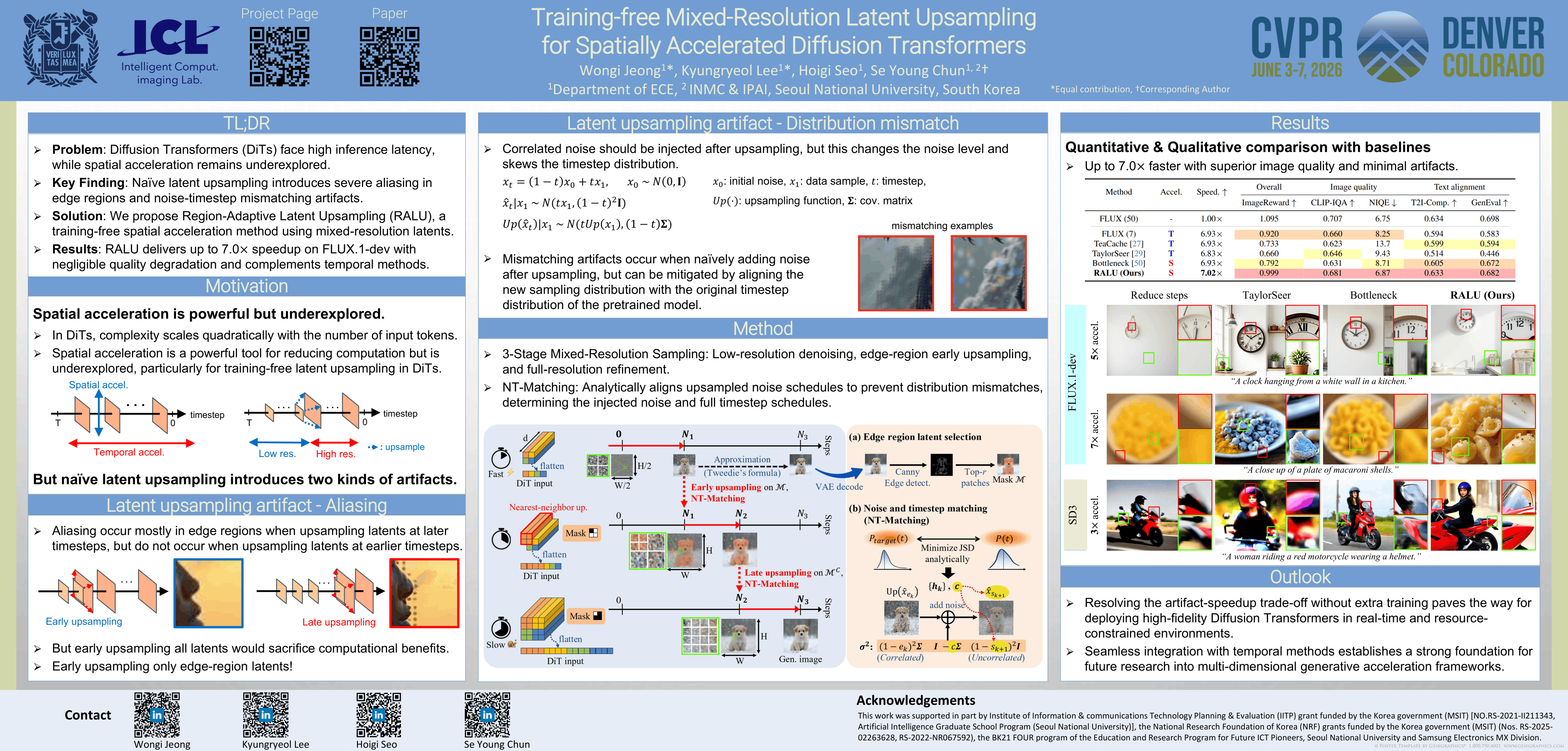
Diffusion transformers (DiTs) offer excellent scalability for high-fidelity generation, but their computational overhead poses a great challenge for practical deployment. Existing acceleration methods primarily exploit the temporal dimension, whereas spatial acceleration remains underexplored. In this work, we investigate spatial acceleration for DiTs via latent upsampling. We found that na\"ive latent upsampling for spatial acceleration introduces artifacts, primarily due to aliasing in high-frequency edge regions and mismatching from noise-timestep discrepancies. Then, based on these findings and analyses, we propose a training-free spatial acceleration framework, dubbed Region-Adaptive Latent Upsampling (RALU), to mitigate those artifacts while achieving spatial acceleration of DiTs by our mixed-resolution latent upsampling. RALU achieves artifact-free, efficient acceleration with early upsampling only on artifact-prone edge regions and noise-timestep matching for different latent resolutions, leading to up to 7.0$\times$ speedup on FLUX-1.dev and 3.0$\times$ on Stable Diffusion 3 with negligible quality degradation. Furthermore, our RALU is complementarily applicable to existing temporal acceleration methods and timestep-distilled models, leading to up to 15.9$\times$ speedup.
SpotEdit: Selective Region Editing in Diffusion Transformers
ZHIBIN QIN ⋅ Zhenxiong Tan ⋅ Zeqing Wang ⋅ Songhua Liu ⋅ Xinchao Wang
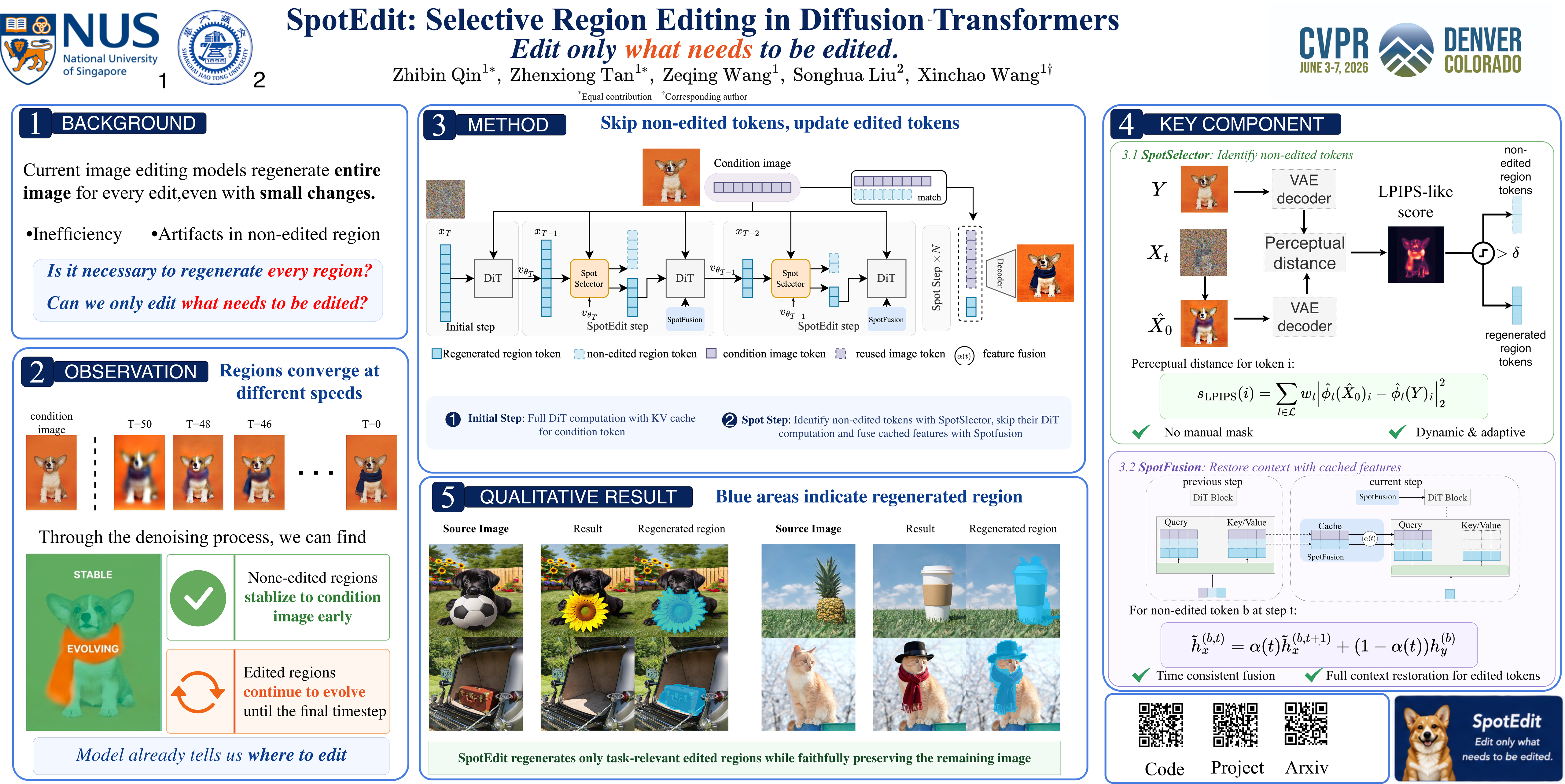
Diffusion Transformer (DiT)-based models have significantly advanced image editing by encoding conditional images and integrating them into transformer layers. However, most edits involve modifying only small regions, while current methods uniformly process and denoise all tokens at every timestep, causing redundant computation and potentially degrading unchanged areas. This raises a fundamental question: Is it truly necessary to regenerate every region during editing? To address this, we propose SpotEdit, a training-free diffusion editing framework that selectively updates only the modified regions. SpotEdit comprises two key components: SpotSelector identifies stable regions via perceptual similarity and skips their computation by reusing conditional image features; SpotFusion adaptively blends these features with edited tokens through a dynamic fusion mechanism, preserving contextual coherence and editing quality. By reducing unnecessary computation and maintaining high fidelity in unmodified areas, SpotEdit achieves efficient and precise image editing.
All-in-One Slider for Attribute Manipulation in Diffusion Models
Weixin Ye ⋅ Hongguang Zhu ⋅ Wei Wang ⋅ Yahui Liu ⋅ Mengyu Wang ⋅ Xuecheng Nie
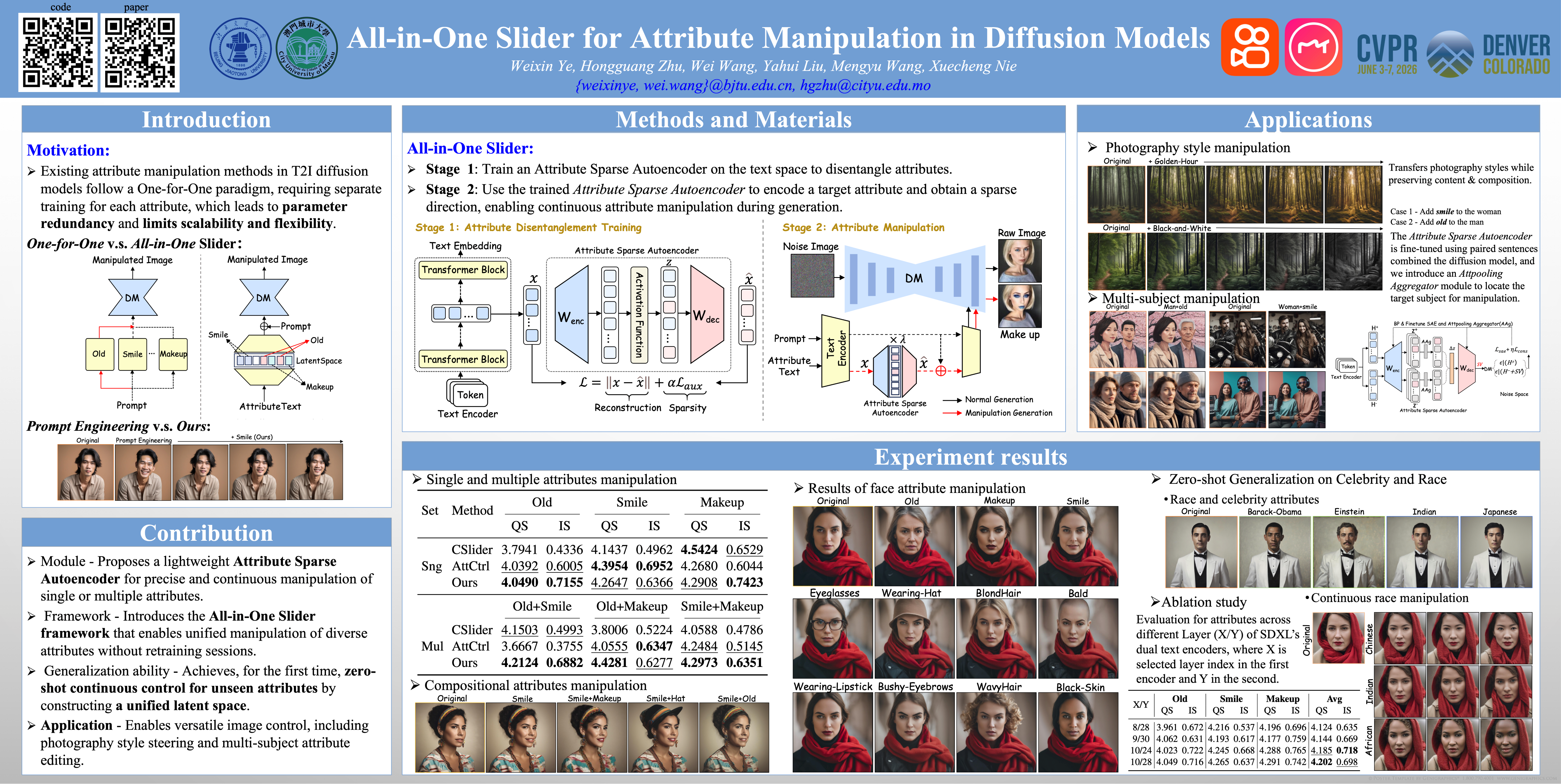
Text-to-image (T2I) diffusion models have made significant strides in generating high-quality images. However, progressively manipulating certain attributes of generated images to meet the desired user expectations remains challenging, particularly for content with rich details, such as human faces. Some studies have attempted to address this by training slider modules. However, they follow a \textbf{One-for-One} manner, where an independent slider is trained for each attribute, requiring additional training whenever a new attribute is introduced. This not only results in parameter redundancy accumulated by sliders but also restricts the flexibility of practical applications and the scalability of attribute manipulation. To address this issue, we introduce the \textbf{All-in-One} Slider, a lightweight module that decomposes the text embedding space into sparse, semantically meaningful attribute directions. Once trained, it functions as a general-purpose slider, enabling interpretable and fine-grained continuous control over various attributes. Moreover, by recombining the learned directions, the All-in-One Slider supports zero-shot manipulation of unseen attributes (e.g., races and celebrities) and the composition of multiple attributes. Extensive experiments demonstrate that our method enables accurate and scalable attribute manipulation, achieving notable improvements compared to previous methods. Furthermore, our method can be extended to integrate with the inversion framework to perform attribute manipulation on real images, broadening its applicability to various real-world scenarios. The code and trained model will be released.
DA-VAE: Plug-in Latent Compression for Diffusion via Detail Alignment
Xin Cai ⋅ Zhiyuan You ⋅ Zhoutong Zhang ⋅ Tianfan Xue
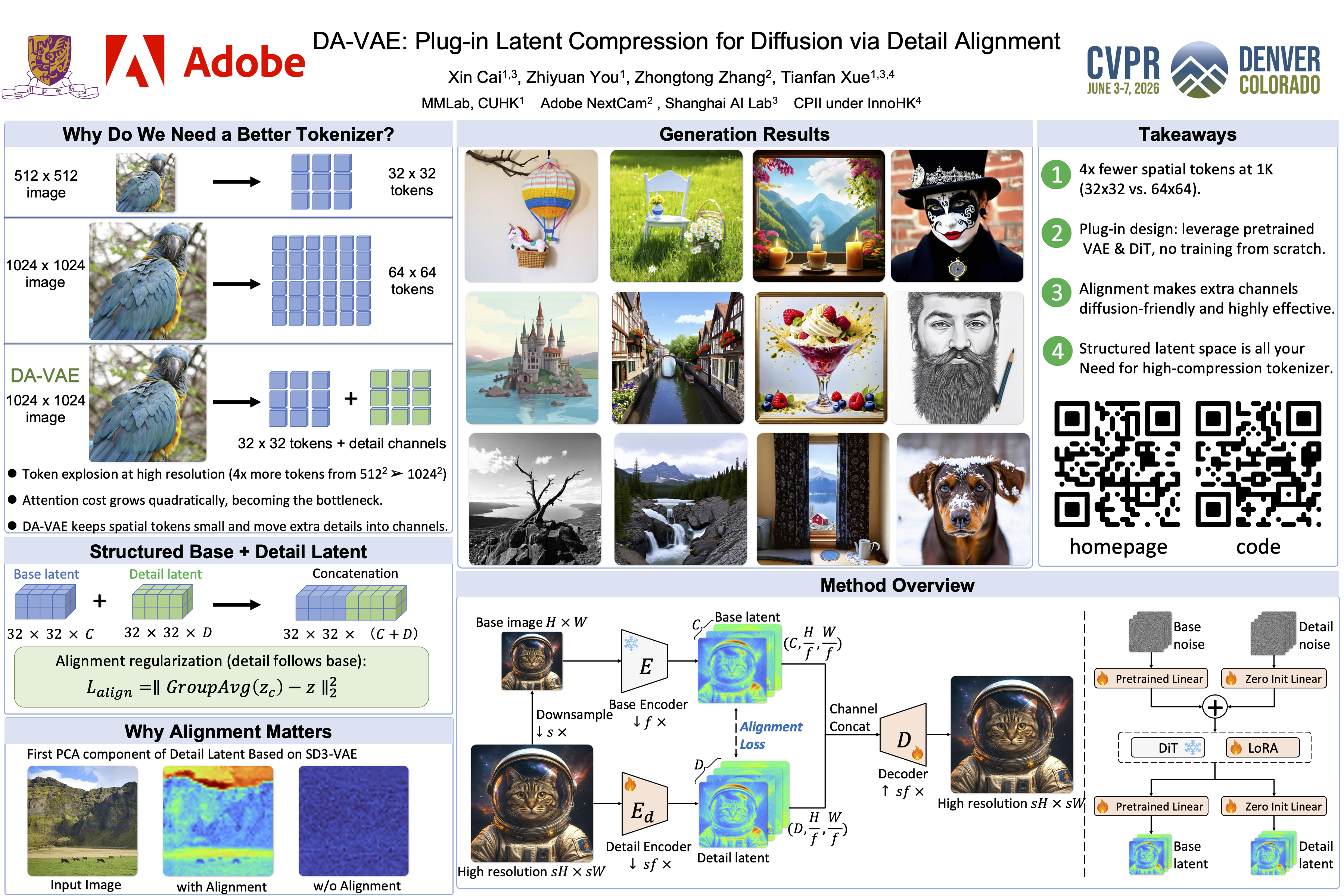
Reducing token number in the latent diffusion is important for both efficient training and inference, especially at high resolution.A common approach is to design high-compression image tokenizers that store more information per token by increasing the number of channels. However, packing more details into each token tends to make the latent space less structured, which in turn makes diffusion training difficult. To solve this, current solutions use semantic alignment or training-time dropout to impose structures in the latent space, which often requires retraining the diffusion model from scratch. Can we increase the compression ratio of the image tokenizer, while not requiring expensive re-training? As we find out, a simple solution is to explicit add channels to the existing latent to capture image details, and align them towards the latent from the pre-trained diffusion model. Our method, \textbf{D}etail-\textbf{A}ligned VAE, increases the compression ratio of a pretrained VAE, while only require a light-weight adaptation stage for the corresponding pretrained diffusion backbone. Specifically, DA-VAE imposes an explicit latent structure: the first $C$ channels of the latent space is given by the pre-trained VAE, encoding the input image at half the resolution. We use an extra of $D$ channels to encode details of the image at full-res.To make this new latent diffusion friendly, we introduces a simple detail alignment strategy that constraints the extra $D$ channels to have similar structures of the first $C$ channels. With such a design, we provide a warm-start finetuning recipe which effectively enables $1024\times 1024$ image generation with Stable Diffusion 3.5, using only $32\times32$ tokens, $4\times$ less than the original model.This adaptation only takes 5 H100 days. We also show that we could unlock $2048\times2048$ image generation with SD3.5, with $6\times$ speed up and more stable image structure. We further validate the effectiveness of our method and design decisions quantitatively on ImageNet.
From Sketch to Fresco: Efficient Diffusion Transformer with Progressive Resolution
Shikang Zheng ⋅ Guantao Chen ⋅ Landis He ⋅ Jiacheng Liu ⋅ Yuqi Lin ⋅ Chang Zou ⋅ Linfeng Zhang
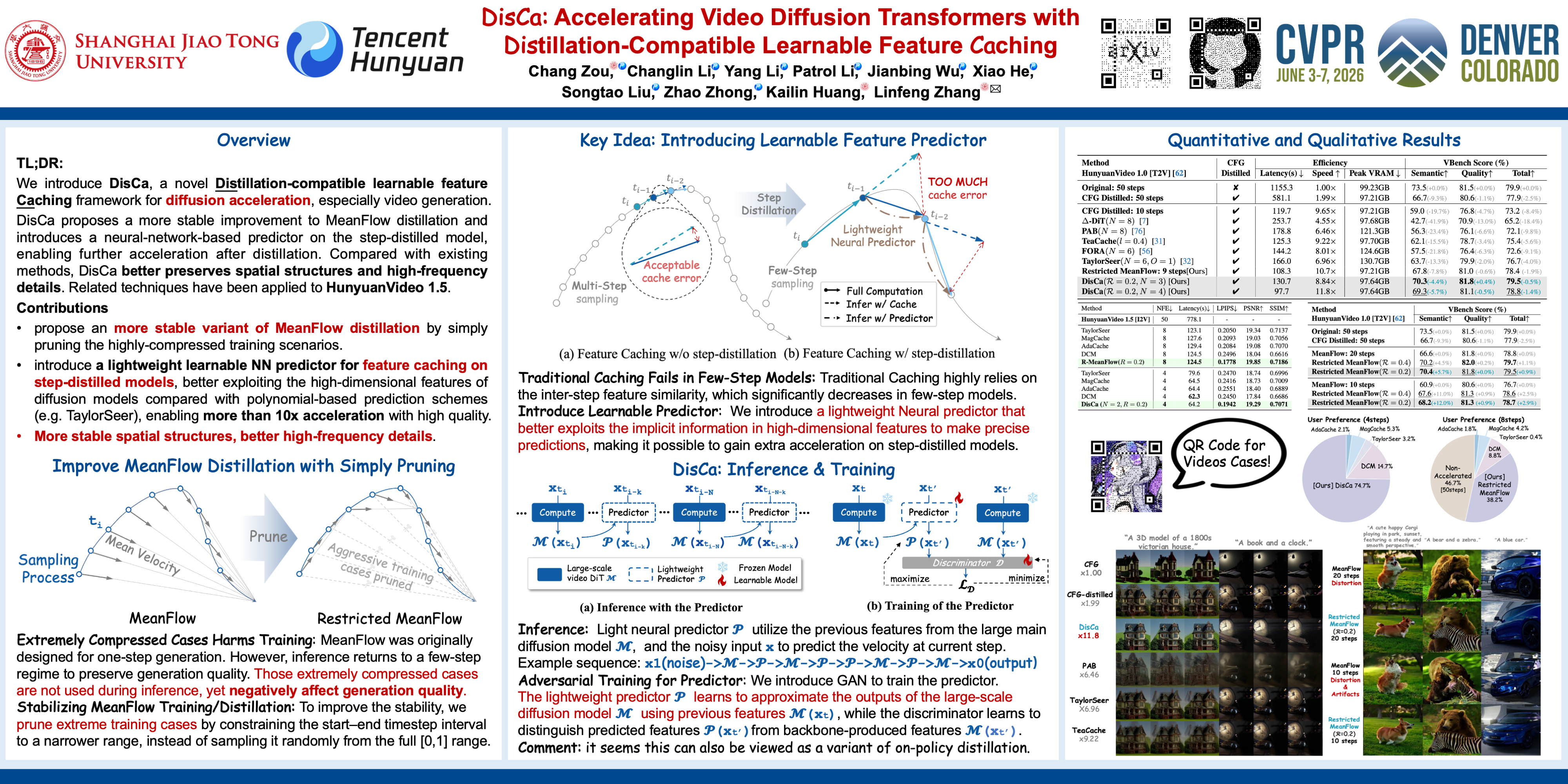
Diffusion Transformers achieve impressive generative quality but remain computationally expensive due to iterative sampling. Recently, dynamic resolution sampling has emerged as a promising acceleration technique by reducing the resolution of early sampling steps. However, existing methods rely on heuristic re-noising at every resolution transition, injecting noise that breaks cross-stage consistency and forces the model to relearn global structure. In addition, these methods indiscriminately upsample the entire latent space at once without checking which regions have actually converged, causing accumulated errors, and visible artifacts. Therefore, we propose \textbf{Fresco}, a dynamic resolution framework that unifies re-noise and global structure across stages with progressive upsampling, preserving both the efficiency of low-resolution drafting and the fidelity of high-resolution refinement, with all stages aligned toward the same final target. Fresco achieves near-lossless acceleration across diverse domains and models, including 10$\times$ speedup on FLUX, and 5$\times$ on HunyuanVideo, while remaining orthogonal to distillation, quantization and feature caching, reaching 22$\times$ speedup when combined with distilled models. Our code is in supplementary material and will be released on Github.
CATNet: Collaborative Alignment and Transformation Network for Cooperative Perception
Gong Chen ⋅ Chaokun Zhang ⋅ Tao Tang ⋅ Pengcheng Lv ⋅ Feng Li ⋅ Xin Xie
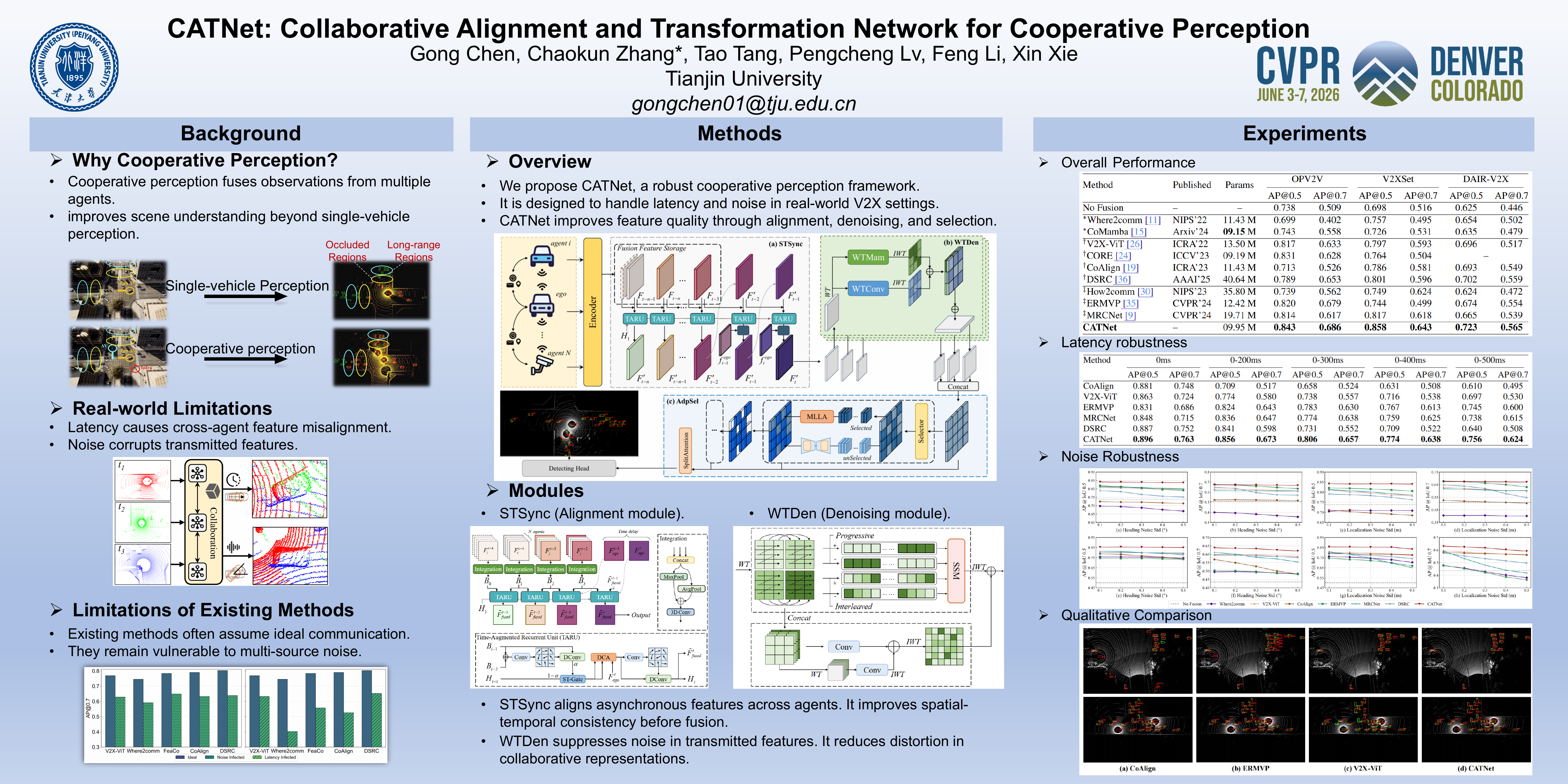
Cooperative perception significantly enhances scene understanding by integrating complementary information from diverse agents. However, existing research often overlooks critical challenges inherent in real-world multi-source data integration, specifically high temporal latency and multi-source noise. To address these practical limitations, we propose Collaborative Alignment and Transformation Network (CATNet), an adaptive compensation framework that resolves temporal latency and noise interference in multi-agent systems. Our key innovations can be summarized in three aspects. First, we introduce a Spatio-Temporal Recurrent Synchronization (STSync) that aligns asynchronous feature streams via adjacent-frame differential modeling, establishing a temporal-spatially unified representation space. Second, we design a Dual-Branch Wavelet Enhanced Denoiser (WTDen) that suppresses global noise and reconstructs localized feature distortions within aligned representations. Third, we construct an Adaptive Feature Selector (AdpSel) that dynamically focuses on critical perceptual features for robust fusion. Extensive experiments on multiple datasets demonstrate that CATNet consistently outperforms existing methods under complex traffic conditions, proving its superior robustness and adaptability.
Scene Reconstruction as Mapping Priors for 3D Detection
Yang Fu ⋅ Yuliang Zou ⋅ Hao Xiang ⋅ Xin Huang ⋅ Yijing Bai ⋅ Chen Song ⋅ Weijing Shi ⋅ Govind Thattai ⋅ Dragomir Anguelov ⋅ Mingxing Tan ⋅ Yingwei Li
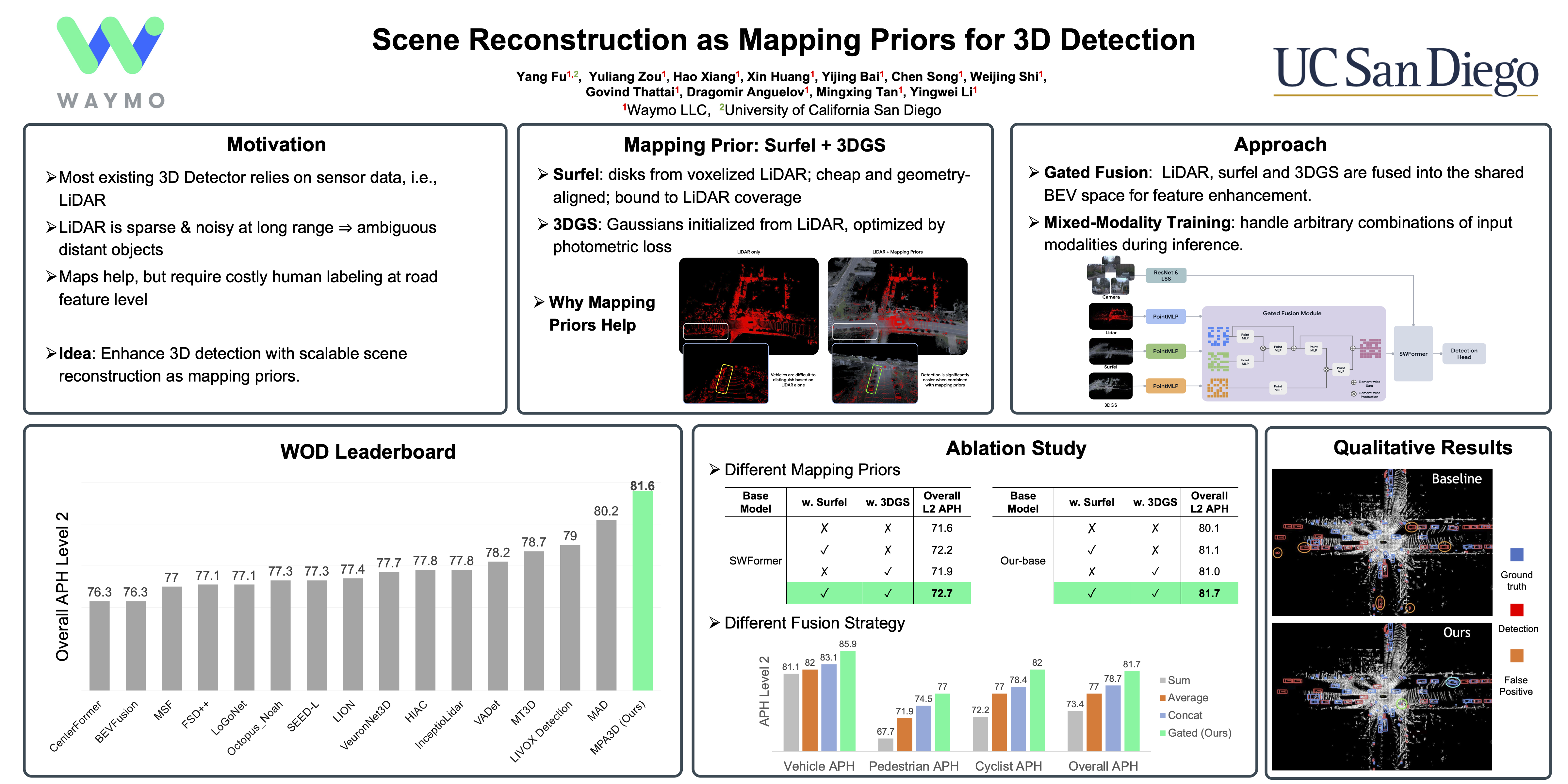
In autonomous driving, mapping is critical for motion planning but remains an under-utilized resource for perception tasks like 3D object detection. Maps can provide robust structural priors of the static environment, suited to resolving ambiguities and correcting for sensor data sparsity or noise — issues especially prevalent for distant objects or during adverse weather conditions. However, conventional High-Definition (HD) maps are resource-intensive to obtain and maintain, which presents a challenge for achieving efficient, large-scale deployment. In this paper, we propose a scalable solution to systemically leverage mapping to improve 3D detection by overcoming two primary challenges. First, we introduce a pipeline to automatically build dense mapping priors from aggregated sensor data, eliminating the need for human labeling. Second, we design a novel Mapping Prior Augmented 3D detection (MPA3D) framework to effectively integrate the mapping priors with the distinct modalities of sensor data. Our extensive experiments on the Waymo Open Dataset demonstrate that our approach achieves new state-of-the-art results, and proving the effectiveness of using scalable, reconstructed scene priors to enhance 3D detection.
CCF: Complementary Collaborative Fusion for Domain Generalized Multi-Modal 3D Object Detection
Yuchen Wu ⋅ Kun Wang ⋅ Yining Pan ⋅ Na Zhao
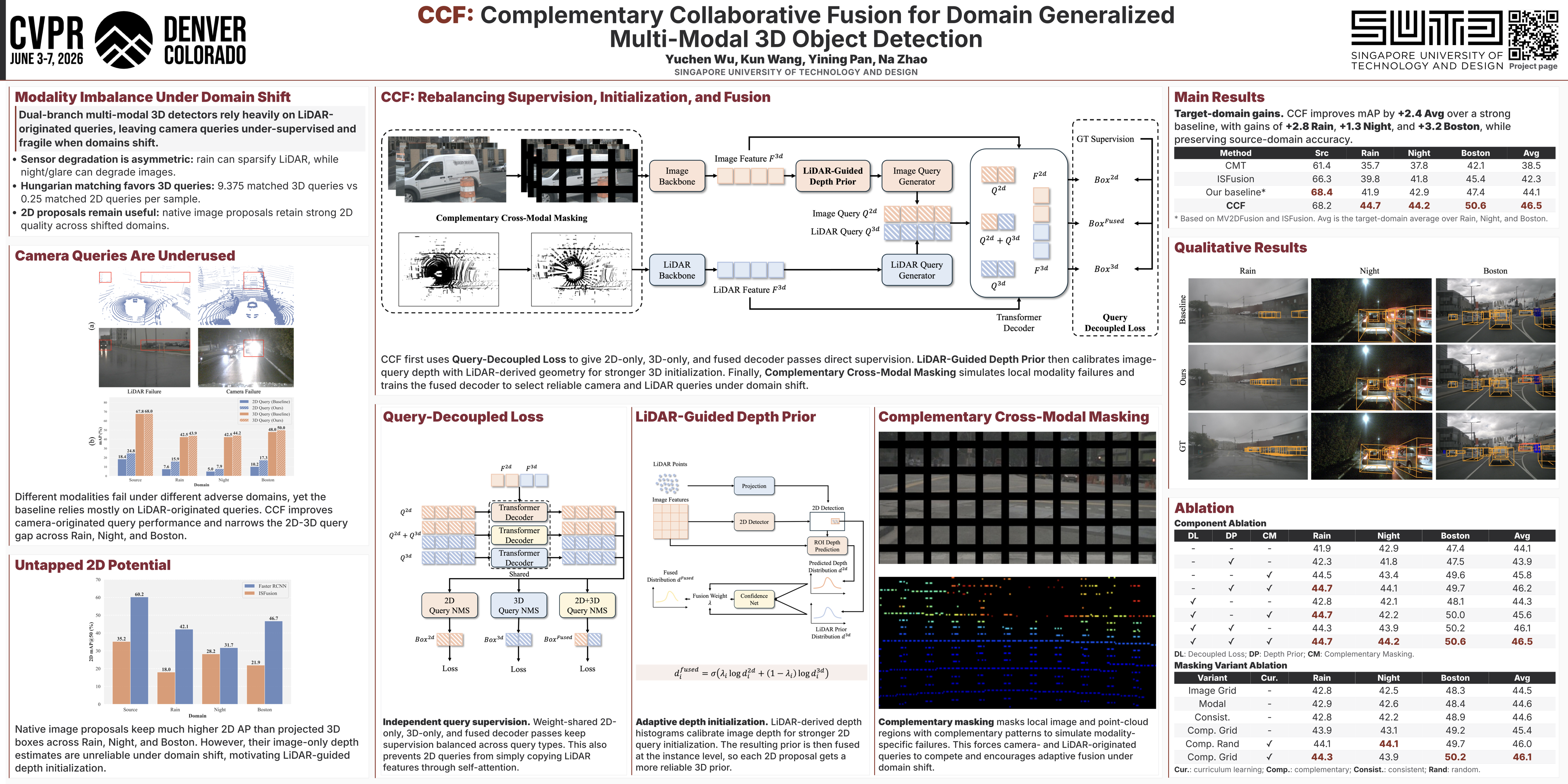
Multi-modal approaches have emerged as a promising paradigm for accurate 3D object detection. However, performance degrades precipitously when deployed in target domains divergent from the training distribution. In this work, we pinpoint two primary culprits: 1) In certain domains, such as nighttime or rainy conditions, one modality experiences significant degradation;2) The LiDAR branch tends to dominate the detection process, resulting in systematic under-exploitation of visual cues and vulnerability when point clouds are compromised. To surmount these impediments, we propose three synergistic innovations. First, Query-Decoupled Loss imparts independent supervisory signals to 2D-only, 3D-only, and fused queries, ensuring equitable gradient propagation and mitigating the image branch's supervisory starvation. Second, LiDAR-Guided Depth Prior augments 2D queries with instance-aware geometric priors via probabilistic depth distribution fusion from the point cloud, enhancing their spatial reasoning. Third, Inconsistent Cross-Modal Masking applies complementary spatial masks to the image and point cloud, simulating modality-specific failures and compelling queries from both modalities to compete within the fused decoder, thereby promoting adaptive fusion and preventing over-reliance on a single sensor.Extensive experiments reveal substantial gains over state-of-the-art baselines, achieving mAP improvements of 2.8, 1.3, and 3.2 on the Rain, Night, and Boston domains, respectively, while preserving competitive source-domain efficacy.
Unleashing the Power of Chain-of-Prediction for Monocular 3D Object Detection
Zhihao Zhang ⋅ Abhinav Kumar ⋅ Girish Chandar Chandar ⋅ Xiaoming Liu
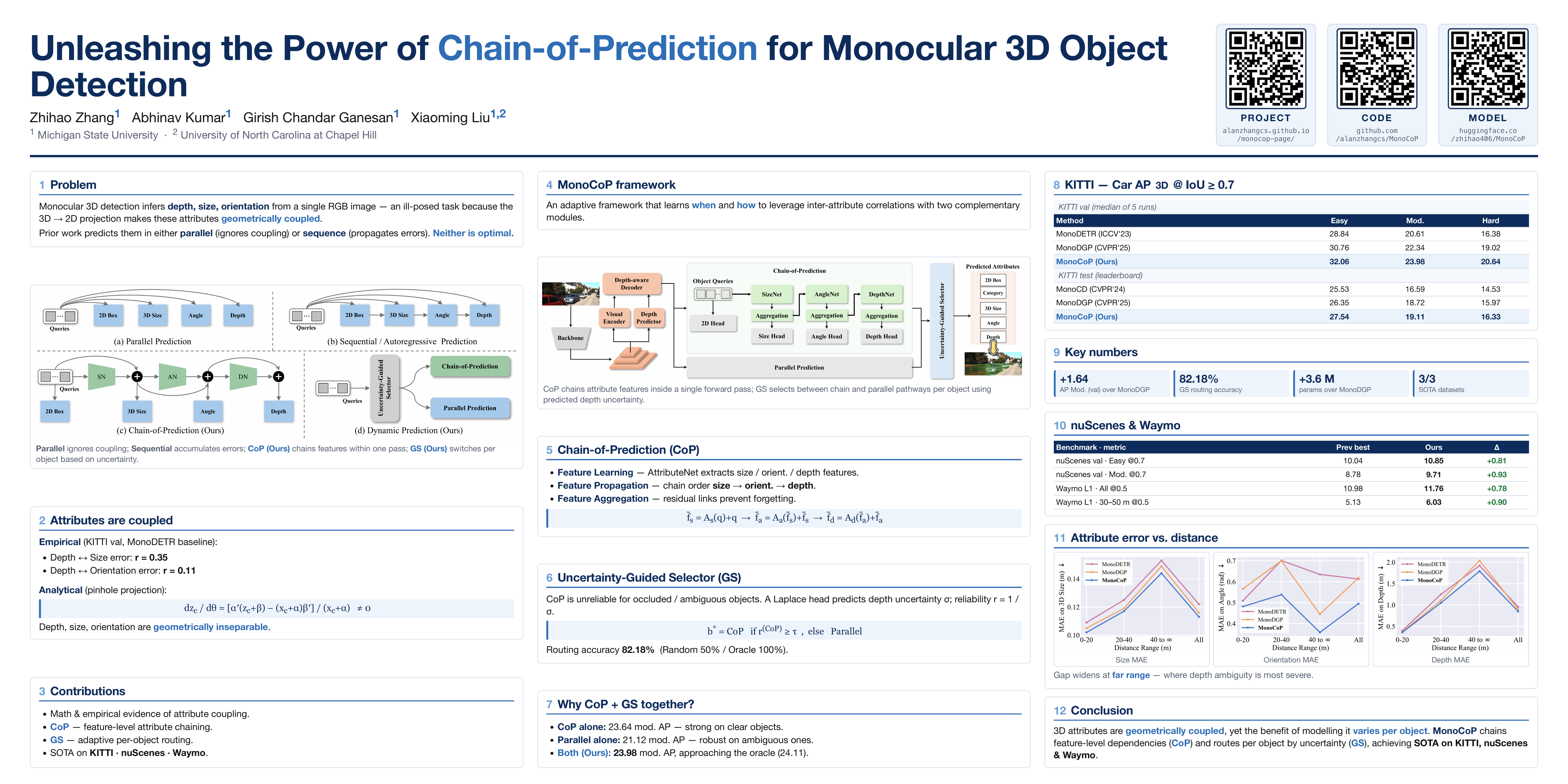
Monocular 3D detection (Mono3D) aims to infer 3D bounding boxes from a single RGB image.Without auxiliary sensors such as LiDAR, this task is inherently ill-posed since the 3D-to-2D projection introduces depth ambiguity.Previous works often predict 3D attributes (e.g., depth, size, and orientation) in parallel, overlooking that these attributes are inherently correlated through the 3D-to-2D projection.However, simply enforcing such correlations through sequential prediction can propagate errors across attributes, especially when objects are occluded or truncated, where inaccurate size or orientation predictions can further amplify depth errors.Therefore, neither parallel nor sequential prediction is optimal.In this paper, we propose MonoCoP, an adaptive framework that learns when and how to leverage inter-attribute correlations with two complementary designs.A Chain-of-Prediction (CoP) explores inter-attribute correlations through feature-level learning, propagation, and aggregation, while an Uncertainty-Guided Selector (GS) dynamically switches between CoP and parallel paradigms for each object based on the predicted uncertainty.By combining their strengths, MonoCoP achieves state-of-the-art (SOTA) performance on KITTI, nuScenes, and Waymo, significantly improving depth accuracy, particularly for distant objects.
R4Det: 4D Radar-Camera Fusion for High-Performance 3D Object Detection
Zhongyu Xia ⋅ Yousen Tang ⋅ Yongtao Wang ⋅ Zhifeng Wang ⋅ Weijun Qin
4D radar–camera sensing configuration has gained increasing importance in autonomous driving. However, existing 3D object detection methods that fuse 4D Radar and camera data confront several challenges. First, their absolute depth estimation module is not robust and accurate enough, leading to inaccurate 3D localization. Second, the performance of their temporal fusion module will degrade dramatically or even fail when the ego vehicle's pose is missing or inaccurate. Third, for some small objects, the sparse radar point clouds may completely fail to reflect from their surfaces. In such cases, detection must rely solely on visual unimodal priors. To address these limitations, we propose R4Det, which enhances depth estimation quality via the Panoramic Depth Fusion module, enabling mutual reinforcement between absolute and relative depth. For temporal fusion, we design a Deformable Gated Temporal Fusion module that does not rely on the ego vehicle's pose. In addition, we built an Instance-Guided Dynamic Refinement module that extracts semantic prototypes from 2D instance guidance. Experiments show that R4Det achieves state-of-the-art 3D object detection results on the TJ4DRadSet and VoD datasets.
Revisiting Token Compression for Accelerating ViT-based Sparse Multi-View 3D Object Detectors
Mingqian Ji ⋅ Shanshan Zhang ⋅ Jian Yang
Vision Transformer (ViT)-based sparse multi-view 3D object detectors have achieved remarkable accuracy but still suffer from high inference latency due to heavy token processing. To accelerate these models, token compression has been widely explored. However, our revisit of existing strategies, such as token pruning, merging, and patch size enlargement, reveals that they often discard informative background cues, disrupt contextual consistency, and lose fine-grained semantics, negatively affecting 3D detection. To overcome these limitations, we propose SEPatch3D, a novel framework that dynamically adjusts patch sizes while preserving critical semantic information within coarse patches. Specifically, we design Spatiotemporal-aware Patch Size Selection (SPSS) that assigns small patches to scenes containing nearby objects to preserve fine details and large patches to background-dominated scenes to reduce computation cost. To further mitigate potential detail loss, Informative Patch Selection (IPS) selects the informative patches for feature refinement, and Cross-Granularity Feature Enhancement (CGFE) injects fine-grained details into selected coarse patches, enriching semantic features. Experiments on the nuScenes and Argoverse 2 validation sets show that SEPatch3D achieves up to 57\% faster inference than the StreamPETR baseline and 20\% higher efficiency than the state-of-the-art ToC3D-faster, while preserving comparable detection accuracy.
Few-Shot Incremental 3D Object Detection in Dynamic Indoor Environments
Yun Zhu ⋅ Jianjun Qian ⋅ Jian Yang ⋅ Jin Xie ⋅ Na Zhao
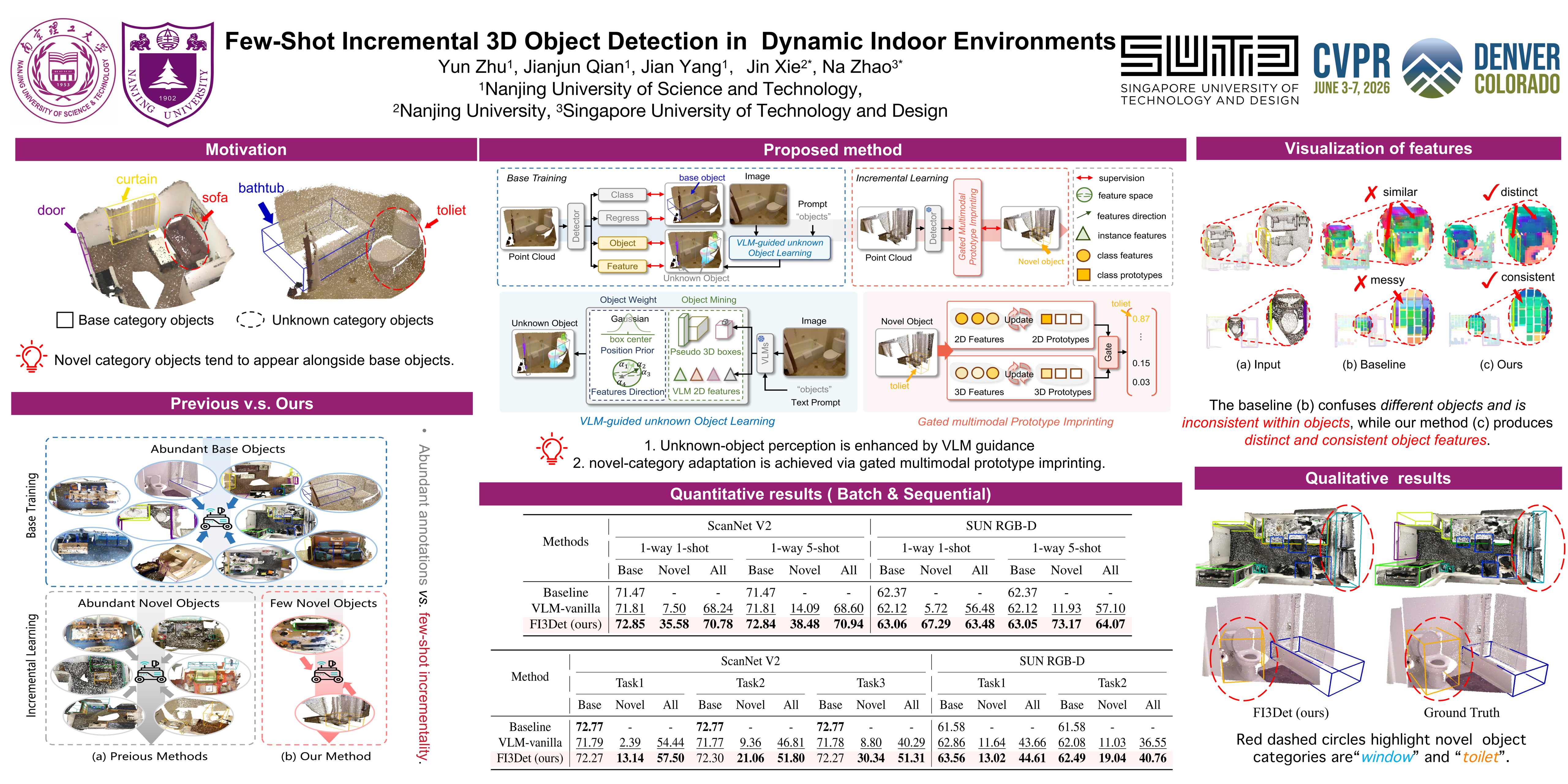
Incremental 3D object perception is a critical step toward embodied intelligence in dynamic indoor environments. However, existing incremental 3D detection methods rely on extensive annotations of novel classes for satisfactory performance. To address this limitation, we propose FI3Det, a Few-shot Incremental 3D Detection framework that enables efficient 3D perception with only a few novel samples by leveraging vision-language models (VLMs) to learn knowledge of unseen categories. FI3Det introduces a VLM-guided unknown object learning module in the base stage to enhance perception of unseen categories. Specifically, it employs VLMs to mine unknown objects and extract comprehensive representations, including 2D semantic features and class-agnostic 3D bounding boxes. To mitigate noise in these representations, a weighting mechanism is further designed to re-weight the contributions of point- and box-level features based on their spatial locations and feature consistency within each box. Moreover, FI3Det proposes a gated multimodal prototype imprinting module, where category prototypes are constructed from aligned 2D semantic and 3D geometric features to compute classification scores, which are then fused via a multimodal gating mechanism for novel object detection. As the first framework for few-shot incremental 3D object detection, we establish both batch and sequential evaluation settings on two datasets, ScanNet V2 and SUN RGB-D, where FI3Det achieves strong and consistent improvements over baseline methods.
Learning from Synthetic Data via Provenance-Based Input Gradient Guidance
Koshiro Nagano ⋅ Ryo Fujii ⋅ Ryo Hachiuma ⋅ Fumiaki Sato ⋅ Taiki Sekii ⋅ HIDEO SAITO
Training with synthetic data has become a standard strategy for improving robustness to distribution shifts. However, most existing approaches exploit synthetic samples only indirectly---for example, by enriching backgrounds, contexts, or negative examples---while providing no explicit signal about where the true target content resides.As a result, models can continue to rely on spurious correlations, which ultimately limit their robustness. In this work, we convert a basic but under-utilized provenance of synthetic data into explicit supervision: during synthesis, we know which pixels or elements originate from which source instances. We formalize this provenance as synthetic knowledge and propose a Synthetic Knowledge-Guided (SKG) training framework that uses it to shape gradients toward target regions and away from irrelevant ones via a Gradient Guide Loss. Our framework is generic and can be seamlessly integrated into diverse synthesis pipelines, including mixing-based synthesis and generative editing-based synthesis, without additional human annotations. Experiments on image classification, weakly supervised object localization, and weakly supervised spatio-temporal action localization show consistent gains over strong baseline methods. These results demonstrate that making provenance in synthetic data is an effective and widely applicable mechanism for mitigating shortcut learning and enhancing robustness.
Seeing Clearly, Reasoning Confidently: Plug-and-Play Remedies for Vision Language Model Blindness
Xin Hu ⋅ Haomiao Ni ⋅ Yunbei Zhang ⋅ Jihun Hamm ⋅ Zechen Li ⋅ Zhengming Ding
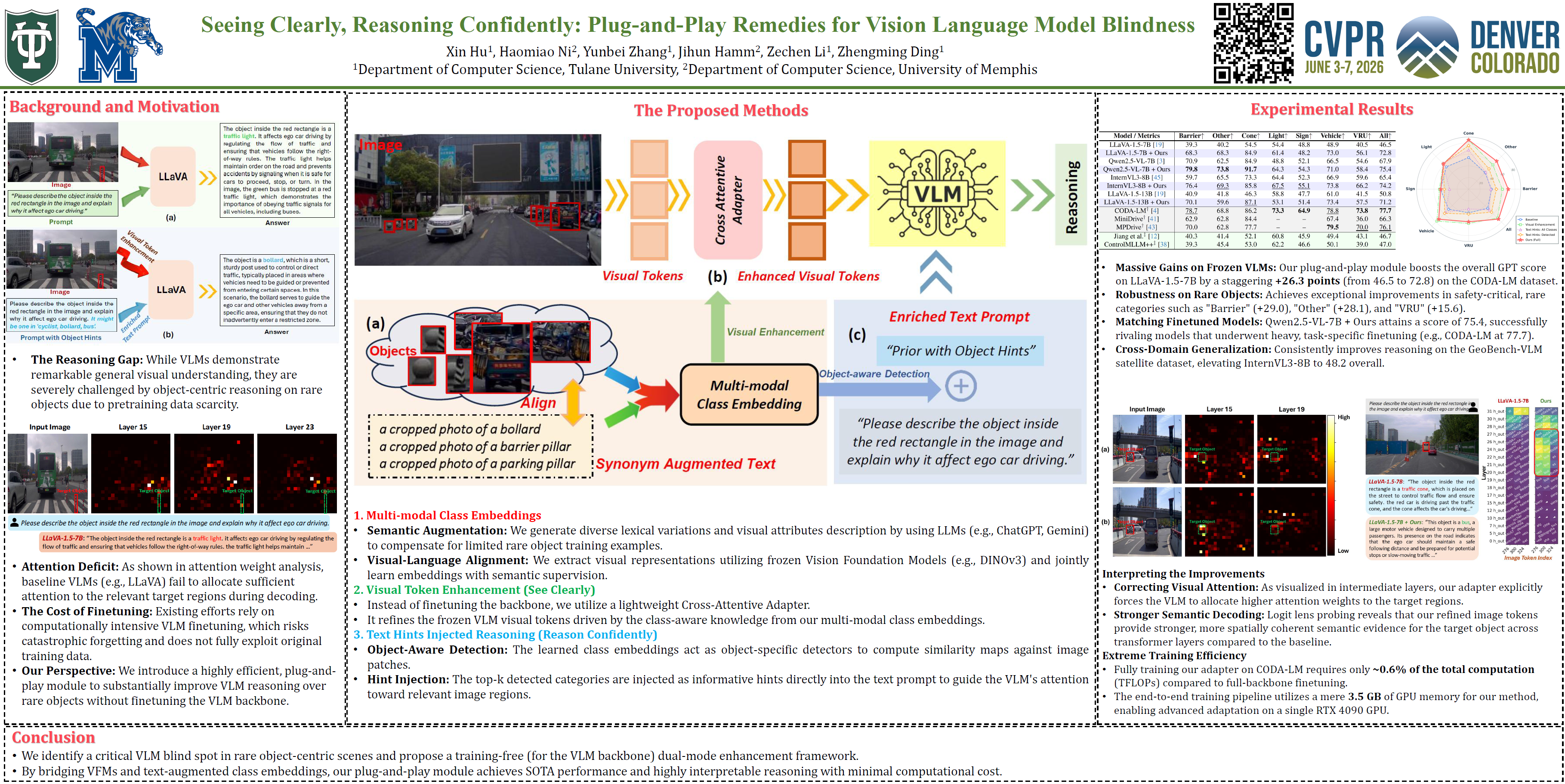
Vision language models (VLMs) have achieved remarkable success in broad visual understanding, yet they remain challenged by object-centric reasoning on rare objects due to the scarcity of such instances in pretraining data. While prior efforts alleviate this issue by retrieving additional data or introducing stronger vision encoders, these methods are still computationally intensive during finetuning VLMs and don't fully exploit the original training data. In this paper, we introduce an efficient plug-and-play module that substantially improves VLMs' reasoning over rare objects by refining visual tokens and enriching input text prompts, without VLMs finetuning. Specifically, we propose to learn multi-modal class embeddings for rare objects by leveraging prior knowledge from vision foundation models and synonym-augmented text descriptions, compensating for limited training examples. These embeddings refine the visual tokens in VLMs through a lightweight attention-based enhancement module that improves fine-grained object details. In addition, we use the learned embeddings as object-aware detectors to generate informative hints, which are injected into the text prompts to help guide the VLM’s attention toward relevant image regions. Experiments on two benchmarks show consistent and substantial gains for pretrained VLMs in rare object recognition and reasoning. Further analysis reveals how our method strengthens the VLM's ability to focus on and reason about rare objects.
Draft and Refine with Visual Experts
SungHeon Jeong ⋅ Ryozo Masukawa ⋅ Jihong Park ⋅ Sanggeon Yun ⋅ Wenjun Huang ⋅ Hanning Chen ⋅ Mahdi Imani ⋅ Mohsen Imani
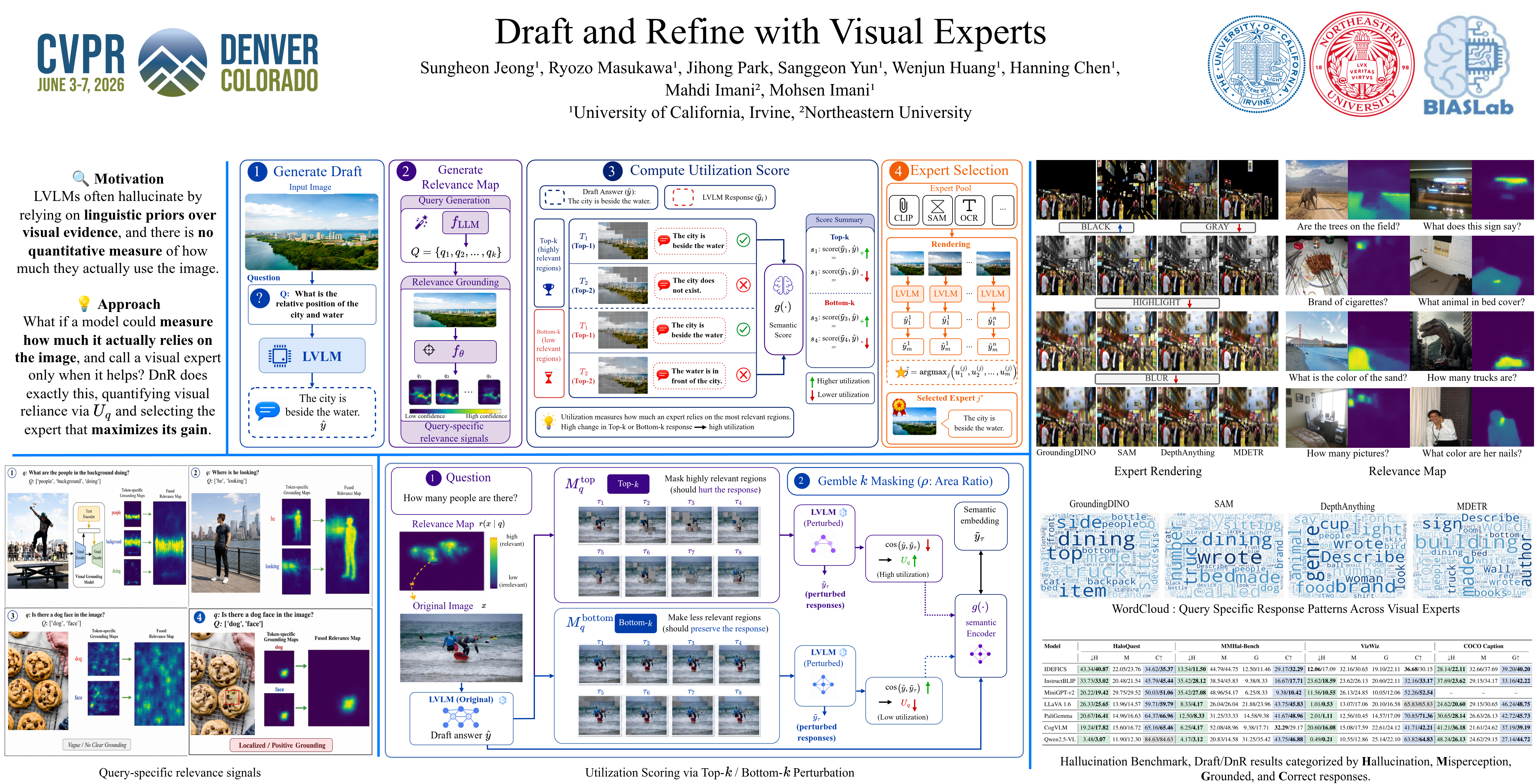
While recent Large Vision–Language Models (LVLMs) exhibit impressive multimodal reasoning abilities, they often produce ungrounded, hallucinated responses by over-relying on linguistic priors rather than visual evidence. This critical limitation arises from the lack of a quantitative measure of how much these models actually rely on visual inputs during reasoning. We propose Draft and Refine (DnR), an agent framework driven by a novel question-conditioned utilization metric. This metric quantifies the model’s actual reliance on visual evidence by first constructing a query-conditioned relevance map to localize question-specific evidence, and then assessing dependence through relevance-based probabilistic masking. Guided by this metric, the DnR agent refines its initial draft through targeted feedback from external visual experts. Each expert’s output (e.g., boxes, masks) is rendered as visual cues on the image, and the VLM is re-queried to select the response that yields the greatest improvement in utilization. This process strengthens visual grounding of predictions without retraining or architectural changes. Experiments across a broad range of VQA and captioning benchmarks demonstrate consistent accuracy gains and reduced hallucination. These results show that quantifying visual utilization provides a principled path for designing more interpretable and evidence-driven multimodal agent systems that effectively leverage visual experts.
R2G: A Multi-View Circuit Graph Benchmark Suite from RTL to GDSII
ZEWEI ZHOU ⋅ Jiajun Zou ⋅ Jiajia Zhang ⋅ Ao Yang ⋅ Ruichao He ⋅ Haozheng Zhou ⋅ Ao Liu ⋅ Jiawei Liu ⋅ Leilei Jin ⋅ Shan Shen ⋅ Daying Sun
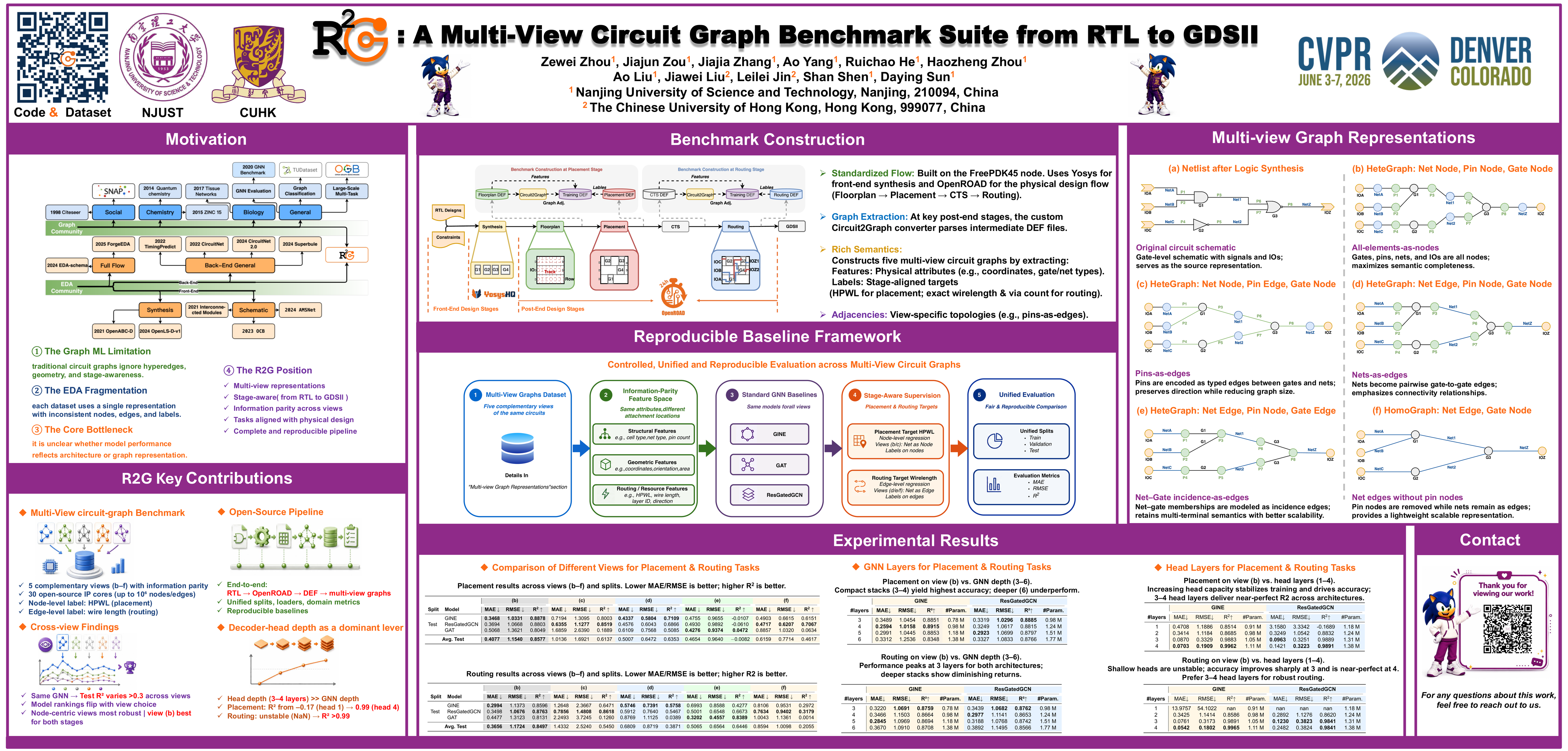
Progress in machine learning for electronic design automation (EDA) is constrained by the lack of open, multi-view graph datasets that coherently represent the same circuits across late physical-design stages. We present R2G (RTL-to-GDSII), a standardized benchmark and framework that converts DEF files into typed, heterogeneous, information-preserving circuit graphs and supports node- and edge-level tasks in placement and routing. R2G provides five stage-aware views with information parity and includes loaders, unified splits, domain-specific metrics, and reproducible baselines—enabling fair cross-view comparison and isolating representation from modeling. In systematic studies with classic GNNs (GIN, GAT, GatedGCN), we show that view choice strongly affects performance, varies with stage and supervision, and that decoder-head depth (3--4 layers) improves accuracy and stability; these findings connect view semantics to objectives and message passing and offer practical guidance. By bridging EDA semantics and graph learning, R2G releases large-scale datasets and an end-to-end pipeline, creating an open testbed for principled representation design. Datasets, loaders, and evaluation scripts will be released on GitHub.
VQ-VA World: Towards High-Quality Visual Question-Visual Answering
Chenhui Gou ⋅ Zilong Chen ⋅ Zeyu Wang ⋅ Feng Li ⋅ Deyao Zhu ⋅ Zicheng Duan ⋅ Kunchang Li ⋅ Chaorui Deng ⋅ Hongyi Yuan ⋅ Haoqi Fan ⋅ Cihang Xie ⋅ Jianfei Cai ⋅ Hamid Rezatofighi
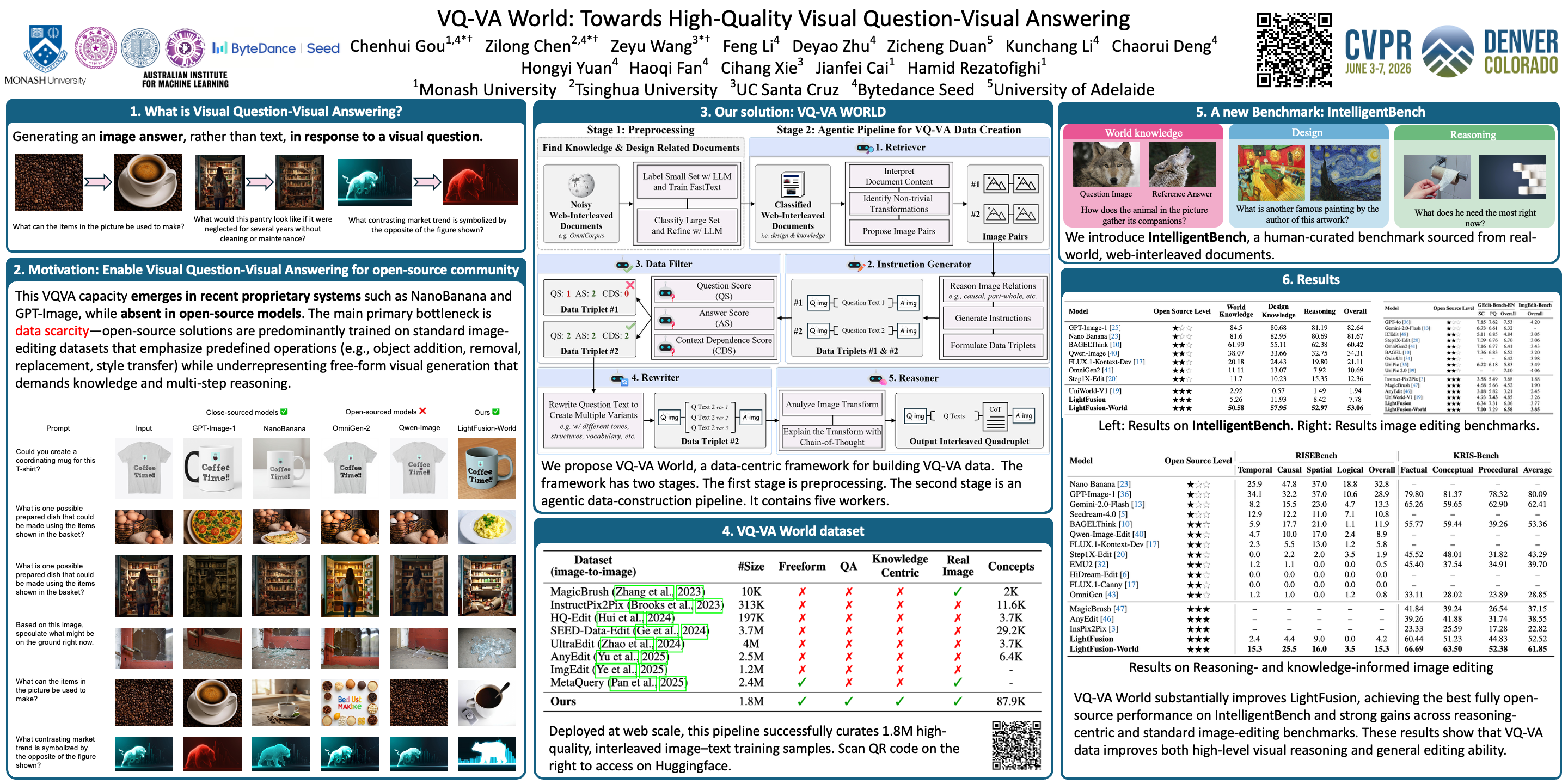
This paper studies \textit{Visual Question–Visual Answering (VQ-VA)}: generating an image, rather than text, in response to a visual question---an ability that has recently emerged in proprietary systems such as NanoBanana and GPT-Image. To also bring this capability to open-source models, we introduce VQ-VA World, a data-centric framework built around an agentic pipeline for large-scale, targeted data construction. Leveraging web-scale deployment, this pipeline crawls a massive amount of $\sim$1.8M high-quality, interleaved image–text samples for model training. For evaluation, we further release IntelligentBench, a human-curated benchmark that systematically assesses VQ-VA along the aspects of \textit{world knowledge}, \textit{design knowledge}, and \textit{reasoning}. Training with VQ-VA World data yields strong empirical gains: it helps LightFusion attain 53.06 on IntelligentBench, substantially surpassing the best prior open-source baselines (\emph{i.e.}, 7.78 from vanilla LightFusion; 1.94 from UniWorld-V1), and significantly narrowing the gap toward leading proprietary systems (\emph{e.g.}, 81.67 from NanoBanana; 82.64 from GPT-Image). By releasing the full suite of model weights, datasets, and pipelines, our work will greatly stimulate future research on VQ-VA.
Cross-Domain Demo-to-Code via Neurosymbolic Counterfactual Reasoning
Jooyoung Kim ⋅ Wonje Choi ⋅ Younguk Song ⋅ Honguk Woo
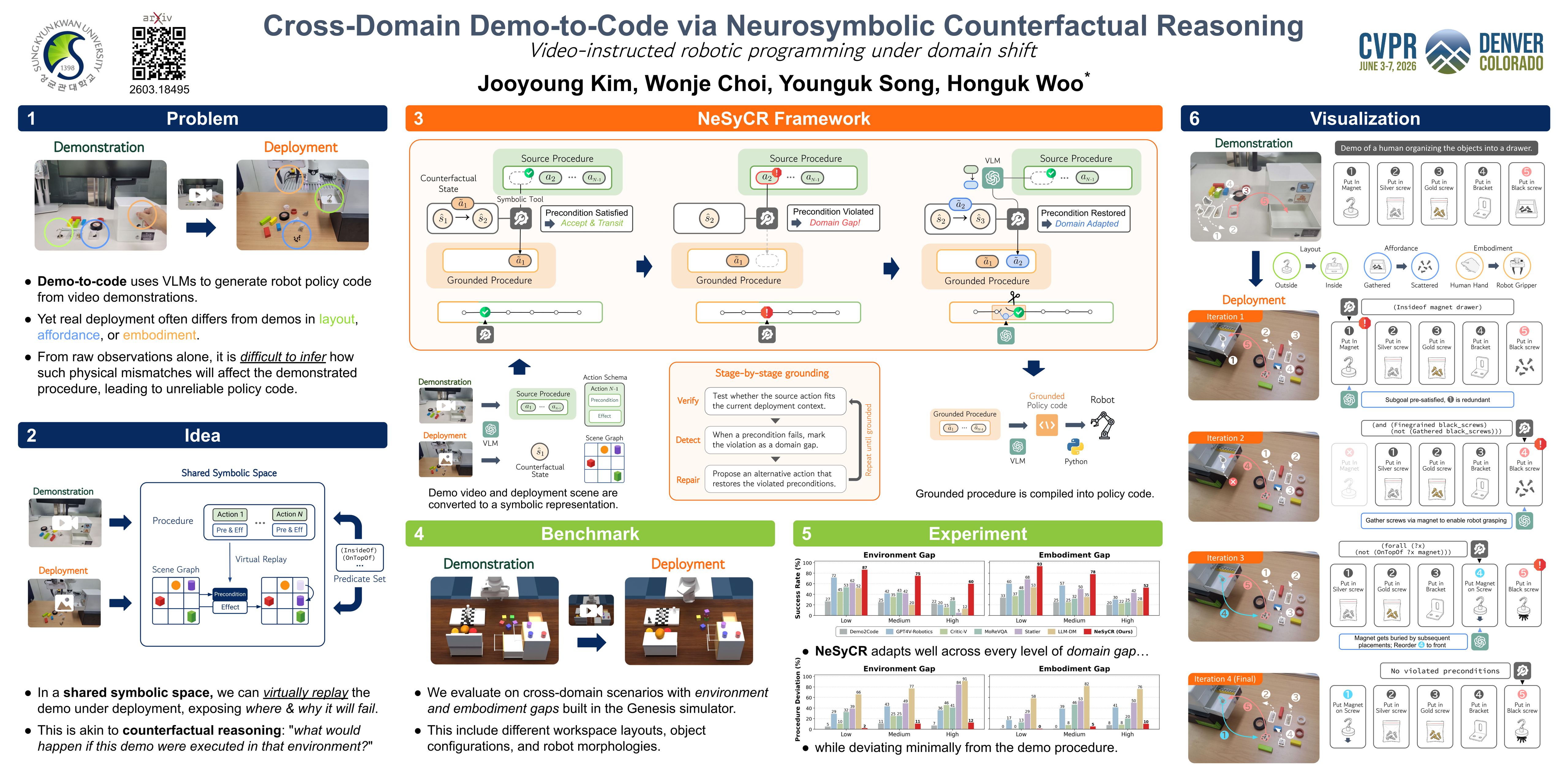
Recent advances in Vision-Language Models (VLMs) have enabled video-instructed robotic programming, allowing agents to interpret video demonstrations and generate executable control code. We formulate video-instructed robotic programming as a cross-domain adaptation problem, where perceptual and physical differences between demonstration and deployment induce procedural mismatches. However, current VLMs lack the procedural understanding needed to reformulate causal dependencies and achieve task-compatible behavior under such domain shifts. We introduce NeSyCR, a neurosymbolic counterfactual reasoning framework that enables verifiable adaptation of task procedures, providing a reliable synthesis of code policies. NeSyCR abstracts video demonstrations into symbolic trajectories that capture the underlying task procedure. Given deployment observations, it derives counterfactual states that reveal cross-domain incompatibilities. By exploring the symbolic state space with verifiable checks, NeSyCR proposes procedural revisions that restore compatibility with the demonstrated procedure. NeSyCR achieves a 31.14\% improvement in task success over the strongest baseline Statler, showing robust cross-domain adaptation across both simulated and real-world manipulation tasks.
Beyond Multiple Choice: Verifiable OpenQA for Robust Vision-Language RFT
Yesheng Liu ⋅ Hao Li ⋅ Haiyu Xu ⋅ Baoqi Pei ⋅ Jiahao Wang ⋅ Mingxuan Zhao ⋅ Jing-Shu Zheng ⋅ Zheqi He ⋅ JG Yao ⋅ Xi Yang ⋅ Bowen Qin ⋅ Jiajun Zhang
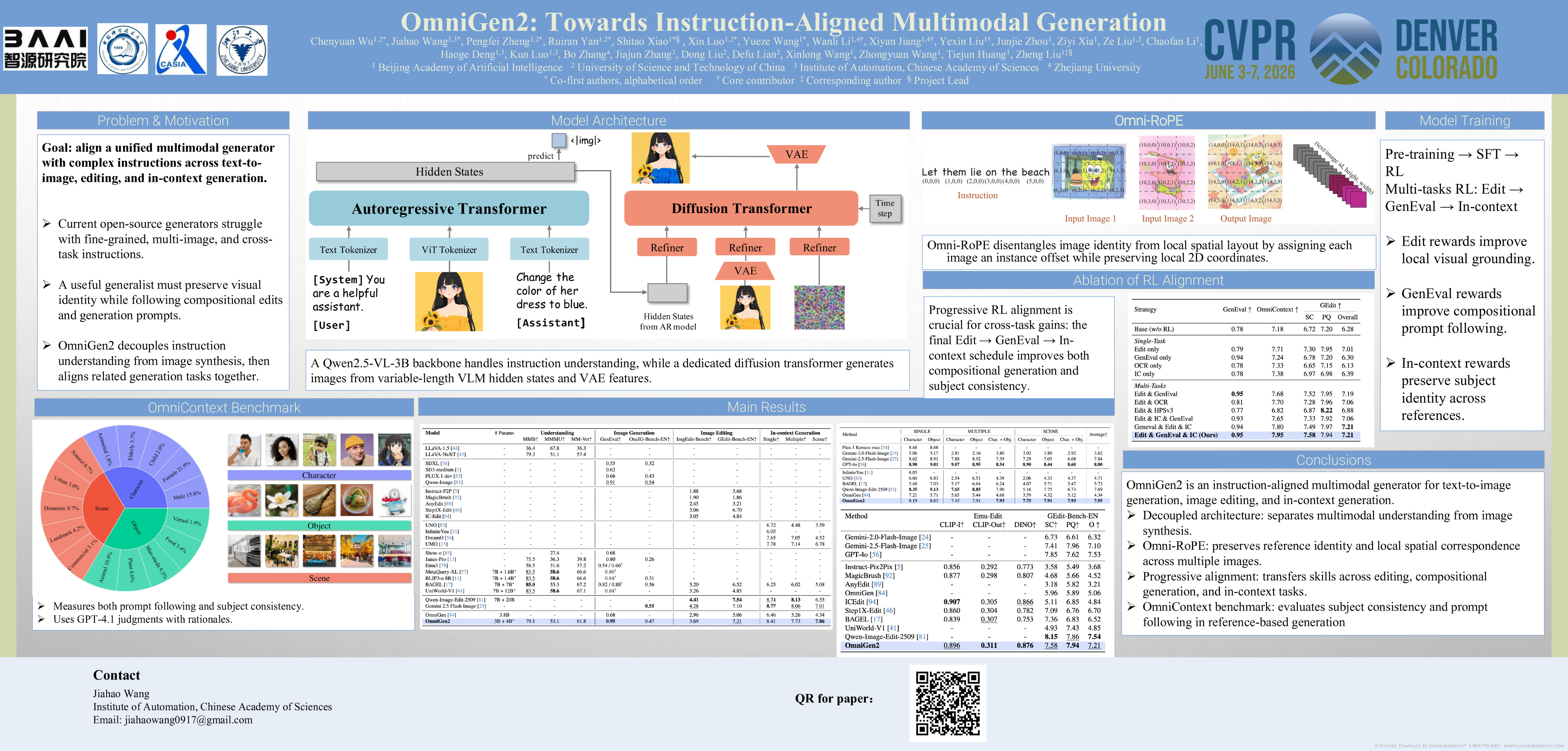
Multiple-choice question answering (MCQA) has been a popular format for evaluating and reinforcement fine-tuning (RFT) of modern multimodal language models. Its constrained output format allows for simplified, deterministic automatic verification.However, we find that the options may leak exploitable signals, which makes the accuracy metrics unreliable for indicating real capabilities and encourages explicit or implicit answer guessing behaviors during RFT. We propose ReVeL (\textbf{Re}write and \textbf{Ve}rify by \textbf{L}LM), a framework that rewrites multiple-choice questions into open-form questions while keeping answers verifiable whenever possible. The framework categorizes questions according to different answer types, apply different rewriting and verification schemes, respectively. When applied for RFT, we converted 20k MCQA examples and use GRPO to finetune Qwen2.5-VL models. Models trained on ReVeL-OpenQA match MCQA accuracy on multiple-choice benchmarks and improve OpenQA accuracy by about six percentage points, indicating better data efficiency and more robust reward signals than MCQA-based training. When used for evaluation, ReVeL also reveals up to 20 percentage points of score inflation in MCQA benchmarks (relative to OpenQA), improves judging accuracy, and reduces both cost and latency. We will release code and data publicly.
See Further, Think Deeper: Advancing VLM's Reasoning Ability with Low-level Visual Cues and Reflection
Zhiheng Wu ⋅ Tong Wang ⋅ Shuning Wang ⋅ Naiming Liu ⋅ Yumeng Zhang
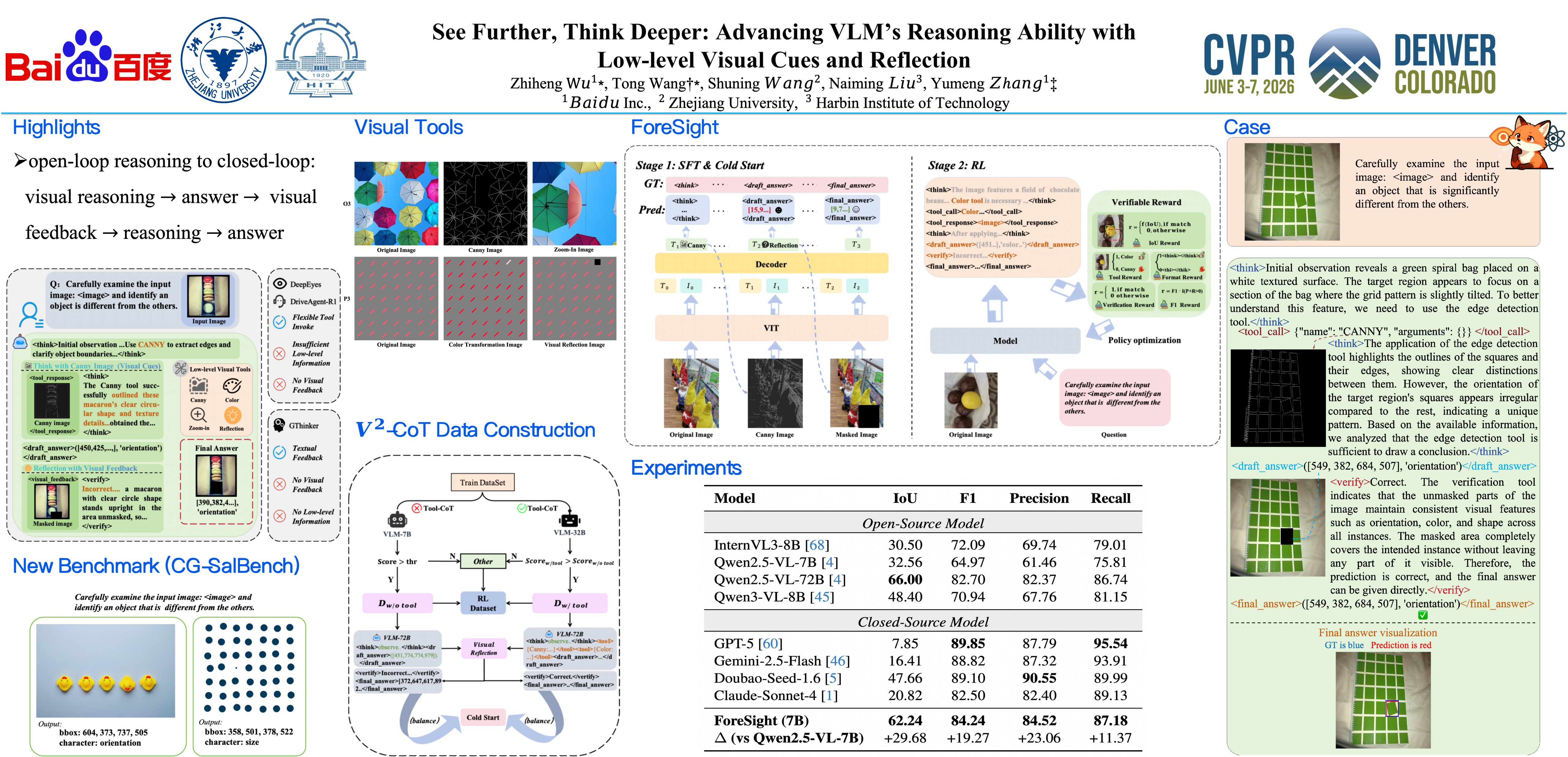
Recent advances in Vision-Language Models (VLMs) have benefited from Reinforcement Learning (RL) for enhanced reasoning. However, existing methods still face critical limitations, including the lack of low-level visual information and effective visual feedback. To address these problems, this paper proposes a unified multimodal interleaved reasoning framework \textbf{ForeSight}, which enables VLMs to \textbf{See Further} with low-level visual cues and \textbf{Think Deeper} with effective visual feedback. First, it introduces a set of low-level visual tools to integrate essential visual information into the reasoning chain, mitigating the neglect of fine-grained visual features. Second, a mask-based visual feedback mechanism is elaborated to incorporate visual reflection into the thinking process, enabling the model to dynamically re-examine and update its answers. Driven by RL, ForeSight learns to autonomously decide on tool invocation and answer verification, with the final answer accuracy as the reward signal. To evaluate the performance of the proposed framework, we construct a new dataset, Character and Grounding SalBench (CG-SalBench), based on the SalBench dataset. Experimental results demonstrate that the ForeSight-7B model significantly outperforms other models with the same parameter scale, and even surpasses the current SOTA closed-source models on certain metrics.
PDCR: Perception-Decomposed Confidence Reward for Vision-Language Reasoning
Hee Suk Yoon ⋅ Eunseop Yoon ⋅ Ji Woo Hong ⋅ SooHwan Eom ⋅ Gwanhyeong Koo ⋅ Mark Hasegawa-Johnson ⋅ Qi Dai ⋅ Chong Luo ⋅ Chang D. Yoo
Reinforcement Learning with Verifiable Rewards (RLVR) traditionally relies on a sparse, outcome-based signal. Recent work shows that providing a fine-grained, model-intrinsic signal—rewarding the confidence growth in the ground-truth answer—effectively improves language reasoning training by providing step-level guidance without costly external models. While effective for unimodal text, we find that naively applying this global reward to vision-language (V-L) reasoning is a suboptimal strategy, as the task is a heterogeneous mix of sparse visual perception and dense textual reasoning. This global normalization creates mixture-induced signal degradation, where the training signal for visual steps is statistically distorted by the predominant textual steps. We propose Perception-Decomposed Confidence Reward (PDCR), a framework that solves this by aligning the reward structure with the task's heterogeneous nature. PDCR first performs an unsupervised skill decomposition, introducing a model-internal Visual Dependence Score to quantify visual reliance and applying a clustering algorithm to separate perception and reasoning steps. Based on this, PDCR computes a decomposed advantage by normalizing confidence gains within each skill cluster. This intra-cluster normalization provides a stable, correctly-scaled signal for both perception and reasoning. We demonstrate that PDCR outperforms the naive, global-reward formulation and sparse-reward baselines on key V-L reasoning benchmarks.
μVLM: A Vision Language Model for μNPUs
Zijie Chen ⋅ Guiyun Fan ⋅ Zhaoxing Yang ⋅ Rong Ding ⋅ Haiming Jin
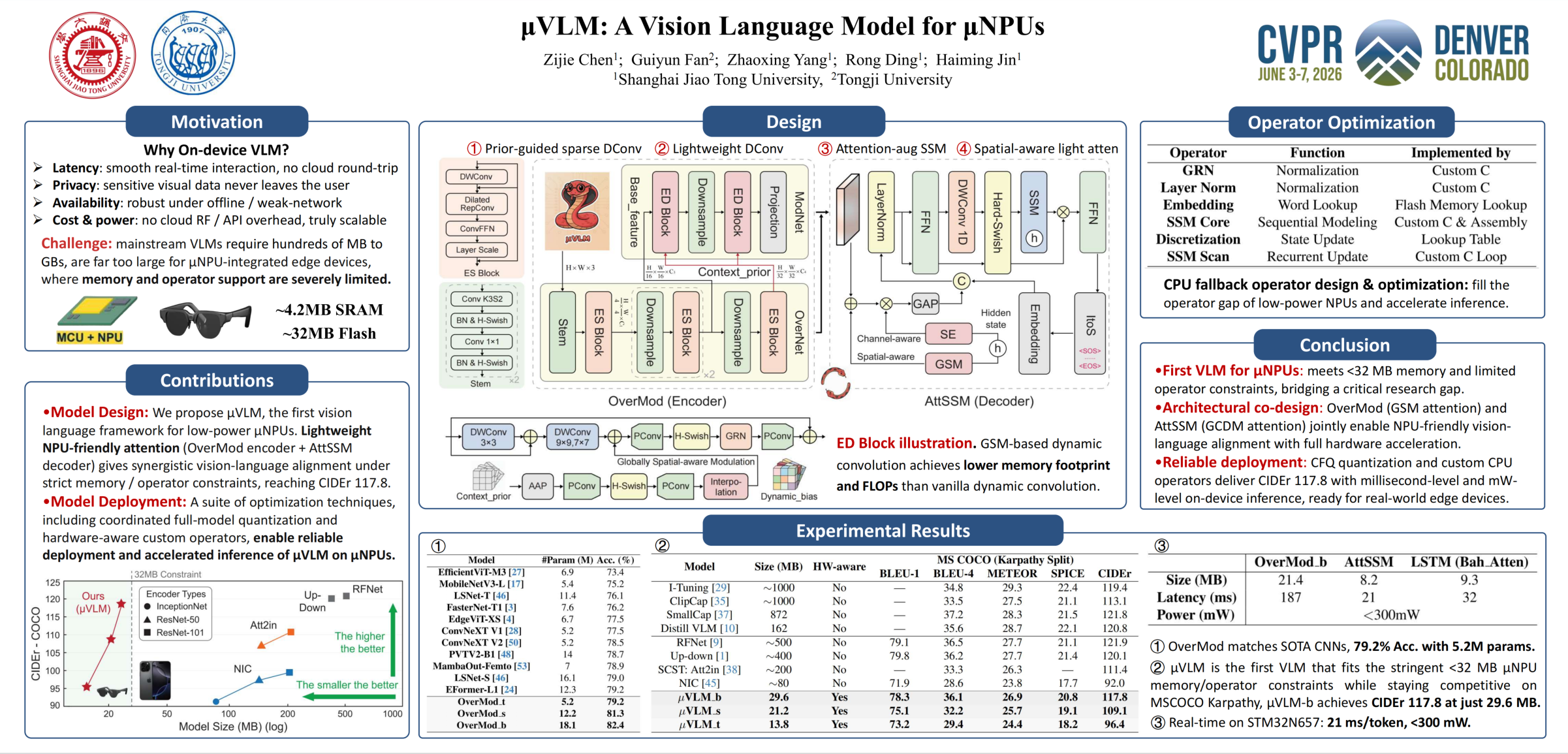
The proliferation of low-power intelligent processors with integrated Neural Processing Units (NPUs), called $\mu$NPUs, has created new opportunities for on-device generative AI, benefitting end devices like smart wearables and small robots. However, deploying Vision-Language Models (VLMs) on $\mu$NPUs is severely hindered by stringent memory constraints and limited operator support. To bridge this critical gap, we propose $\mu$VLM, the first lightweight-oriented VLM architecture designed for $\mu$NPUs. It is comprised of our proposed OverMod encoder and AttSSM decoder. OverMod is a lightweight dynamic convolutional network inspired by biomimetic vision, incorporating our novel Global Spatial Modulation mechanism to enable adaptive, high-fidelity feature extraction using only NPU-friendly operators. AttSSM leverages a highly efficient State Space Model (SSM) core, augmented with multi-scale feature fusion and Global Context Dynamic Modulation mechanism, to perform robust sequential modeling. Furthermore, we introduce a coordinated full-parameter quantization strategy that preserves precision across the encoder-decoder boundary, alongside hand-optimized operators for unsupported modules like SSMs. $\mu$VLM achieves a competitive CIDEr score of 117.8 on the COCO Karpathy test split and, for the first time, demonstrates the feasibility of millisecond-level VLM inference on a $\mu$NPU platform.
Gaussian Mapping for Evolving Scenes
Vladimir Yugay ⋅ Thies Kersten ⋅ Luca Carlone ⋅ Theo Gevers ⋅ Martin R. Oswald ⋅ Lukas Schmid
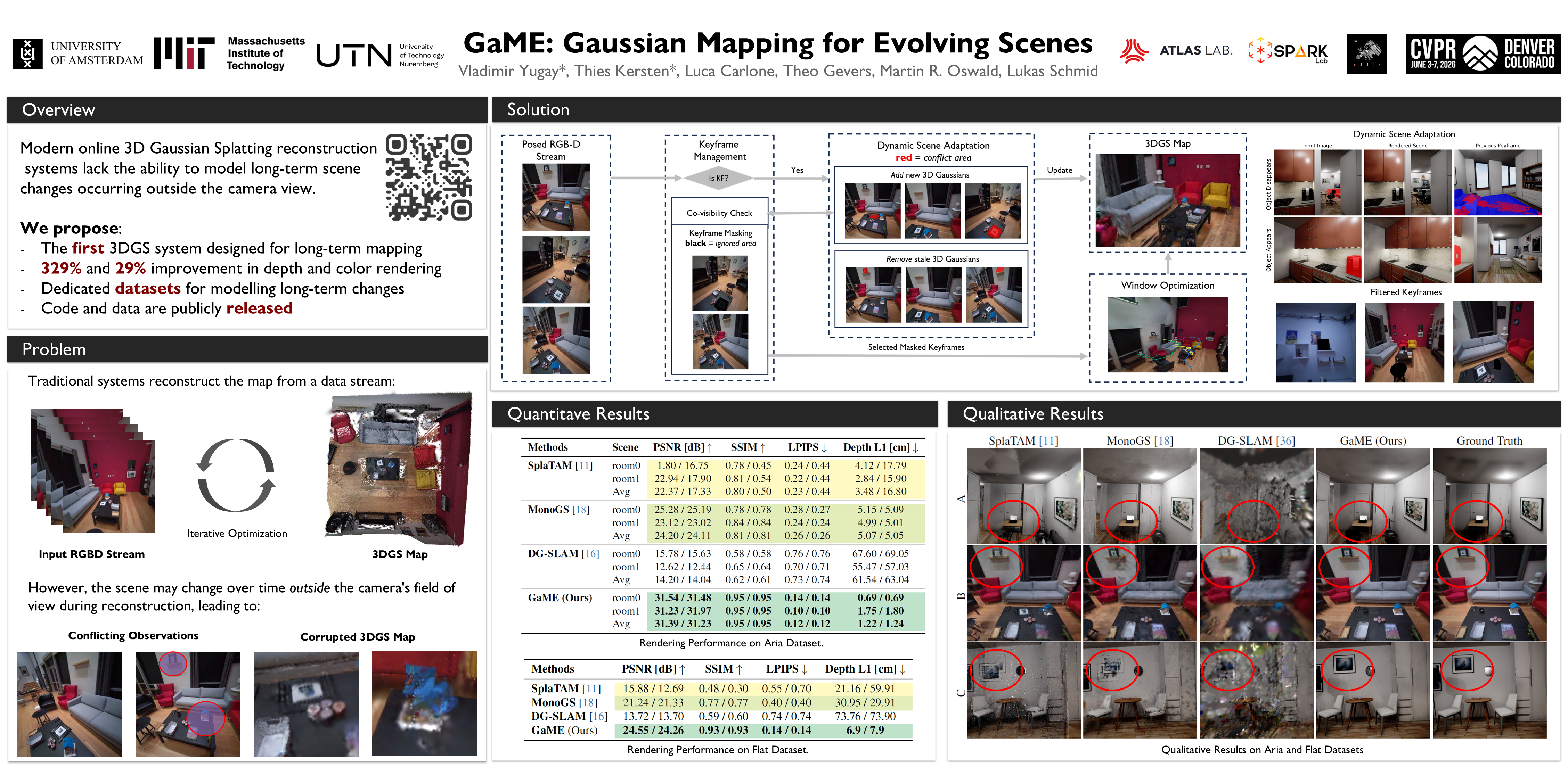
Mapping systems with novel view synthesis (NVS) capabilities are widely used in computer vision, as well as in various applications, including augmented reality, robotics, and autonomous driving. Most notably, 3D Gaussian Splatting-based systems show high NVS performance; however, many current approaches are limited to static scenes. While recent works have begun addressing short-term dynamics (motion within the camera's view), long-term dynamics (the scene evolving through changes out of view) remain less explored.To overcome this limitation, we introduce a dynamic scene adaptation mechanism that continuously updates the 3D representation to reflect the latest changes. In addition, since maintaining geometric and semantic consistency remains challenging due to stale observations disrupting the reconstruction process, we propose a novel keyframe management mechanism that discards outdated observations while preserving as much information as possible. We thoroughly evaluate Gaussian Mapping for Evolving Scenes (\ours) on both synthetic and real-world datasets, achieving a 29.7\% improvement in PSNR and a $ \times3$-improvement in L1 depth error over the most competitive baseline.
Part-aware Modeling of Articulated Objects using 3D Gaussian Splatting
Tianjiao Yu ⋅ Vedant Shah ⋅ Muntasir Wahed ⋅ Ying Shen ⋅ Kiet A. Nguyen ⋅ Ismini Lourentzou
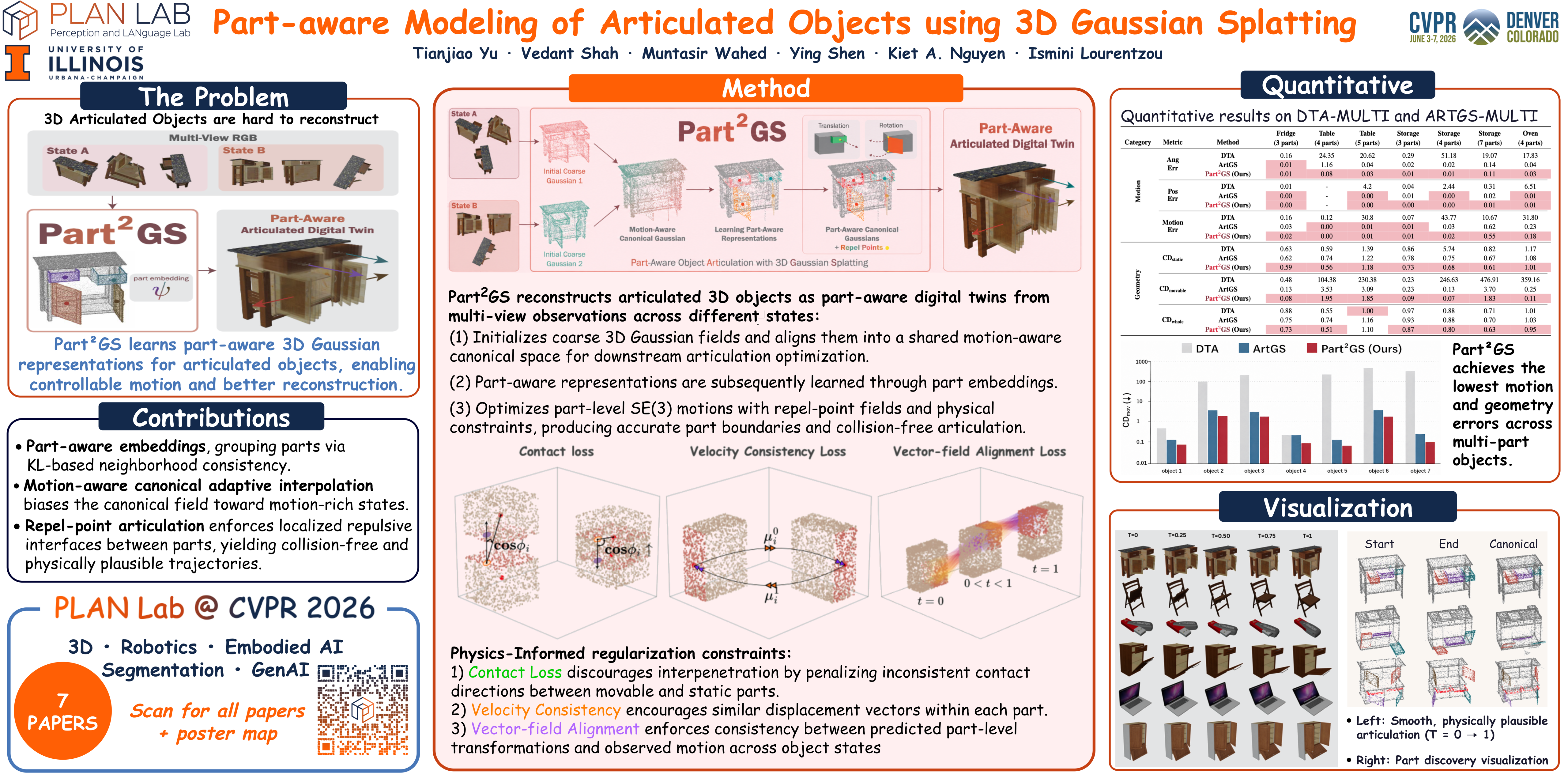
Articulated objects are common in the real world, yet modeling their structure and motion remains a challenging task for 3D reconstruction methods. In this work, we introduce Part$^{2}$GS, a novel framework for modeling articulated digital twins of multi-part objects with high-fidelity geometry and physically consistent articulation. Part$^{2}$GS leverages a part-aware 3D Gaussian representation that encodes articulated components with learnable attributes, enabling structured, disentangled transformations that preserve high-fidelity geometry. To ensure physically consistent motion, we propose a motion-aware canonical representation guided by physics-based constraints, including contact enforcement, velocity consistency, and vector-field alignment. Furthermore, we introduce a field of repel points to prevent part collisions and maintain stable articulation paths, significantly improving motion coherence over baselines. Extensive evaluations on both synthetic and real-world datasets show that Part$^{2}$GS consistently outperforms state-of-the-art methods by up to 10$\times$ in Chamfer Distance for movable parts.
AnchorSplat: Feed-Forward 3D Gaussian Splatting With 3D Geometric Priors
Xiaoxue Zhang ⋅ Xiaoxu Zheng ⋅ Yixuan Yin ⋅ Tiao Zhao ⋅ Kaihua Tang ⋅ Michael Bi Mi ⋅ Zhan Xu ⋅ Dave Chen
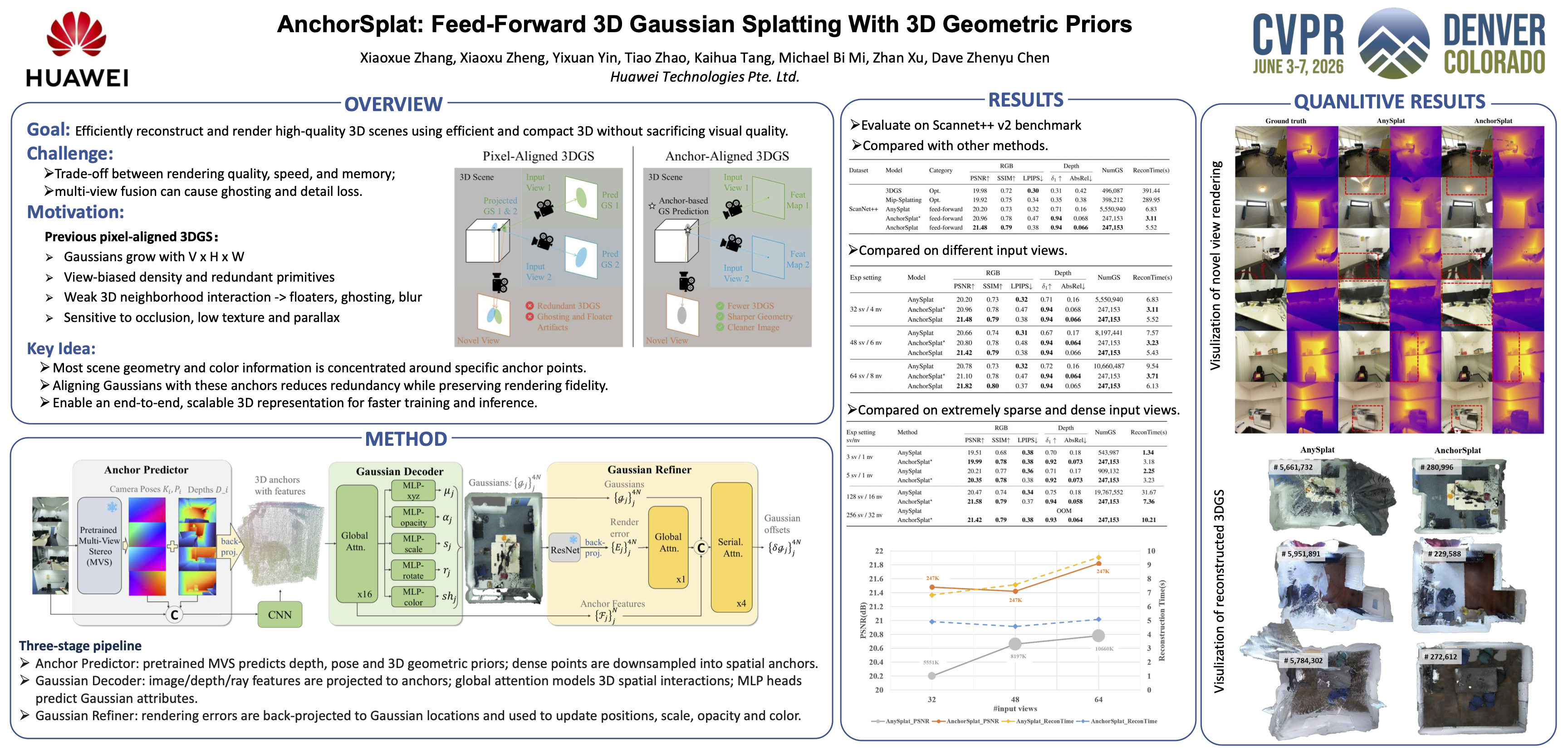
Scene-level 3D reconstruction has attracted increasing attention, and feed-forward 3D Gaussian Splatting (3DGS) has emerged as a promising paradigm for novel view synthesis. However, most existing methods adopt a pixel-aligned formulation that maps each 2D pixel to a 3D Gaussian, making the number of Gaussians tightly coupled with the input images. This leads to several limitations: (i) reconstruction quality is sensitive to the quantity and viewpoint coverage of input images, often causing Gaussians to accumulate more densely in regions with frequent viewpoints; (ii) alignment errors become more pronounced under sparse-view conditions; and (iii) the lack of explicit geometric consistency can degrade depth estimation and downstream 3D tasks. In this paper, we propose AnchorSplat, a novel multi-view feed-forward 3DGS framework for scene-level reconstruction that departs from pixel-aligned prediction and instead represents the scene directly in 3D space. AnchorSplat introduces anchor-aligned Gaussians guided by geometric priors (e.g., sparse point clouds, voxels, or RGB-D point clouds), enabling a more geometry-aware representation that is independent of image resolution and number of views. This design substantially reduces the number of required Gaussians, improving computational efficiency while enhancing reconstruction fidelity. The framework is trained in two stages: a Gaussian decoder first predicts anchor-aligned Gaussians, and a subsequent Gaussian refiner further improves their quality and view consistency. Experiments on the ScanNet benchmark demonstrate that AnchorSplat achieves state-of-the-art performance, producing more view-consistent and plausible 3D Gaussian reconstructions. Code, videos, and pretrained models will be released on the project page.
SGAD-SLAM: Splatting Gaussians at Adjusted Depth for Better Radiance Fields in RGBD SLAM
Pengchong Hu ⋅ Zhizhong Han
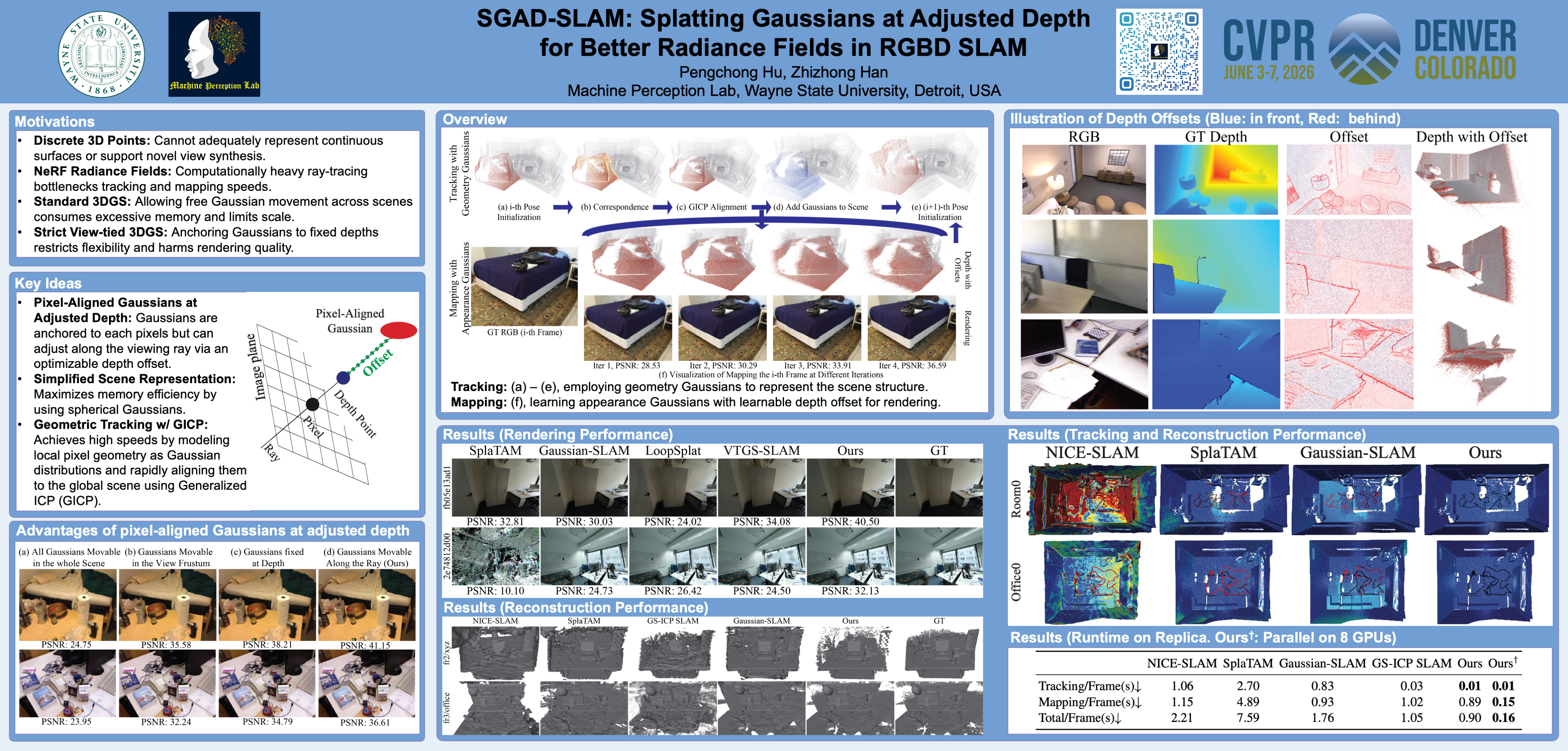
3D Gaussian Splatting (3DGS) has made huge progress in RGBD SLAM. Current methods usually use 3D Gaussians or view-tied 3D Gaussians to represent radiance fields in tracking and mapping. However, these Gaussians are either too flexible or too limited in movements, resulting in slow convergence or limited rendering quality. To resolve this issue, we adopt pixel-aligned Gaussians but allow each Gaussian to adjust its position along its ray to maximize the rendering quality, even if Gaussians are simplified for improving scalability. To speed up the tracking, we model the depth distribution around each pixel as a Gaussian function, and then use these points to align each frame to the 3D scene quickly. We report our evaluations on widely used benchmarks, justify our designs, and show advantages over the latest methods in view rendering, camera tracking, runtime, and storage complexity.
Faster-GS: Analyzing and Improving Gaussian Splatting Optimization
Florian Hahlbohm ⋅ Linus Franke ⋅ Martin Eisemann ⋅ Marcus Magnor
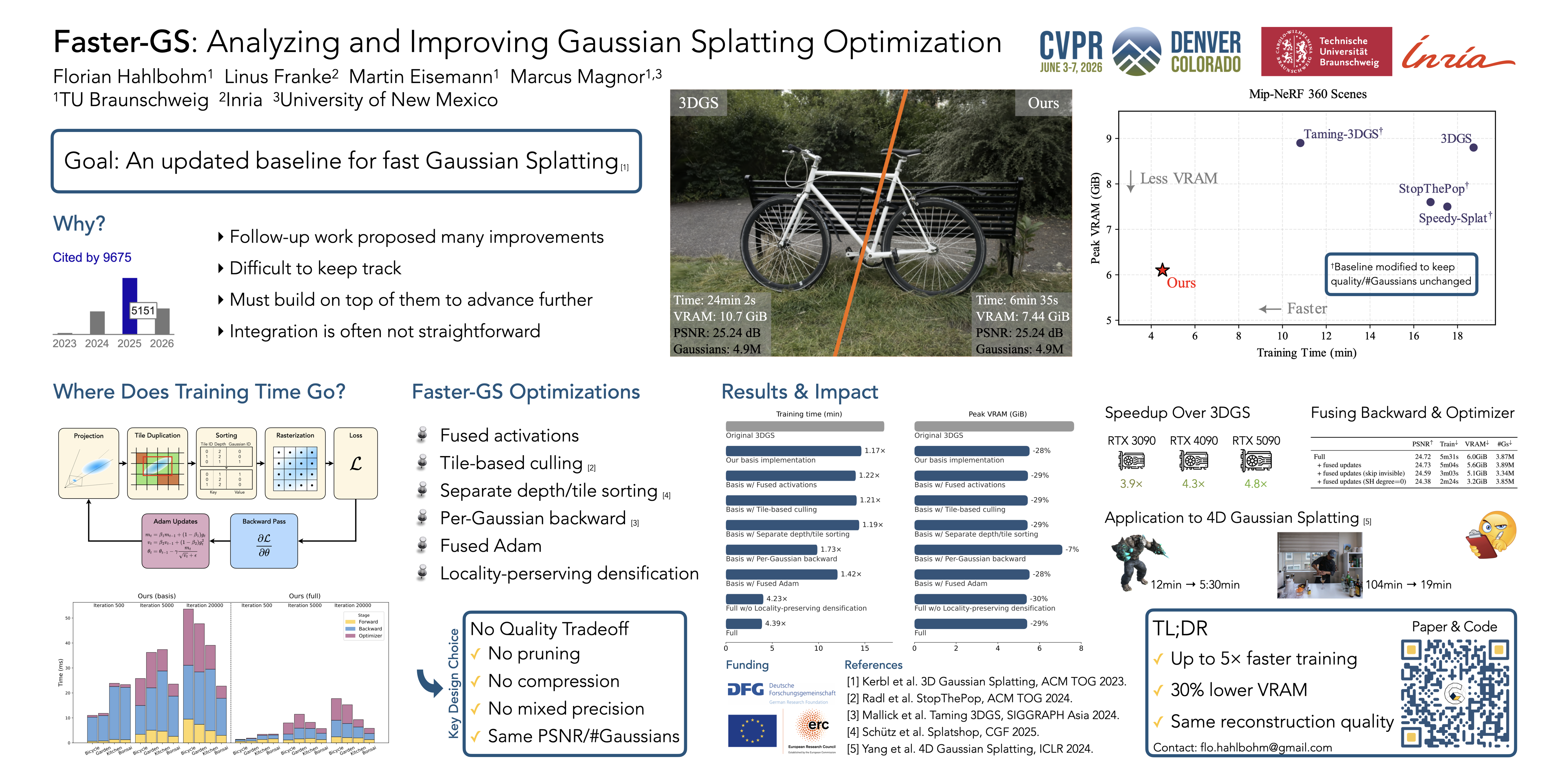
Recent advances in 3D Gaussian Splatting (3DGS) have focused on accelerating optimization while preserving reconstruction quality. However, many proposed methods entangle implementation-level improvements with fundamental algorithmic modifications or trade performance for fidelity, leading to a fragmented research landscape that complicates fair comparison.In this work, we consolidate and evaluate the most effective and broadly applicable strategies from prior 3DGS research and augment them with several novel optimizations. We further investigate underexplored aspects of the framework, including numerical stability, Gaussian truncation, and gradient approximation.The resulting system, Faster-GS, provides a rigorously optimized algorithm that we evaluate across a comprehensive suite of benchmarks. Our experiments demonstrate that Faster-GS achieves up to 5$\times$ faster training while maintaining visual quality, establishing a new cost-effective and resource efficient baseline for 3DGS optimization. Furthermore, we demonstrate that optimizations can be applied to 4D Gaussian reconstruction, leading to efficient non-rigid scene optimization.
Layered 4D-Rotor Gaussian Splatting: A Compressed Representation for Long Dynamic Scenes
Hanjie Xu ⋅ Yuanxing Duan ⋅ Qiyu Dai ⋅ Ge Li ⋅ Baoquan Chen ⋅ He Wang
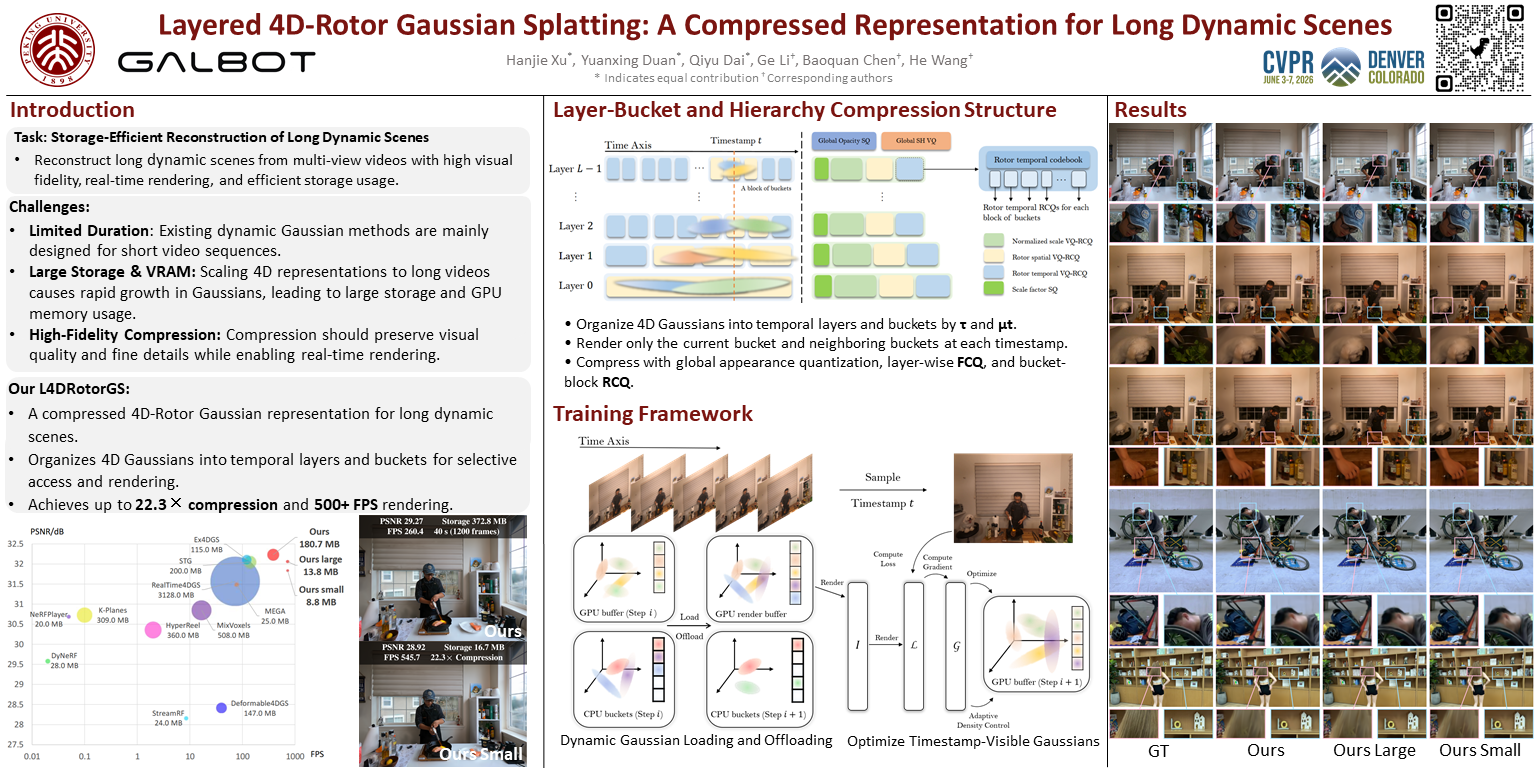
We address the challenge of reconstructing long dynamic scenes from multi-view videos in a storage-efficient manner. Recent advances in Gaussian Splatting and its extensions to dynamic scenes have demonstrated impressive visual quality, but remain limited to short duration (<10 s), large storage size (>500 MB), and high GPU VRAM usage.To overcome these limitations, we introduce Layered 4D-Rotor Gaussian Splatting (L4DRotorGS), a novel compressed representation designed for long dynamic scenes. Our approach integrates a layered 4D representation, efficient training, and effective compression into a unified framework. Specifically, 4D Gaussians are first organized into layers based on their temporal extents and then partitioned into discrete temporal buckets. This structure allows for selective access and rendering of only the necessary subsets of 4D Gaussians, substantially reducing GPU memory requirements.To further compress the representation, we apply a series of techniques, Factorized Covariance Quantization, Layered Compression, and Residual Codebook Quantization, achieving a compression ratio of up to 22.3× while preserving high visual fidelity.We implement a highly optimized C++/CUDA framework for efficient training, compression, and real-time rendering, achieving over 500 FPS on an RTX 3090 GPU. Extensive experiments demonstrate the superior storage efficiency, visual quality, and rendering speed of L4DRotorGS, consistently outperforming prior methods in both quantitative metrics and perceptual quality on real-world long dynamic scenes.
GaussianGrow: Geometry-aware Gaussian Growing from 3D Point Clouds with Text Guidance
Weiqi Zhang ⋅ Junsheng Zhou ⋅ Haotian Geng ⋅ Kanle Shi ⋅ Shenkun Xu ⋅ Yi Fang ⋅ Yu-Shen Liu
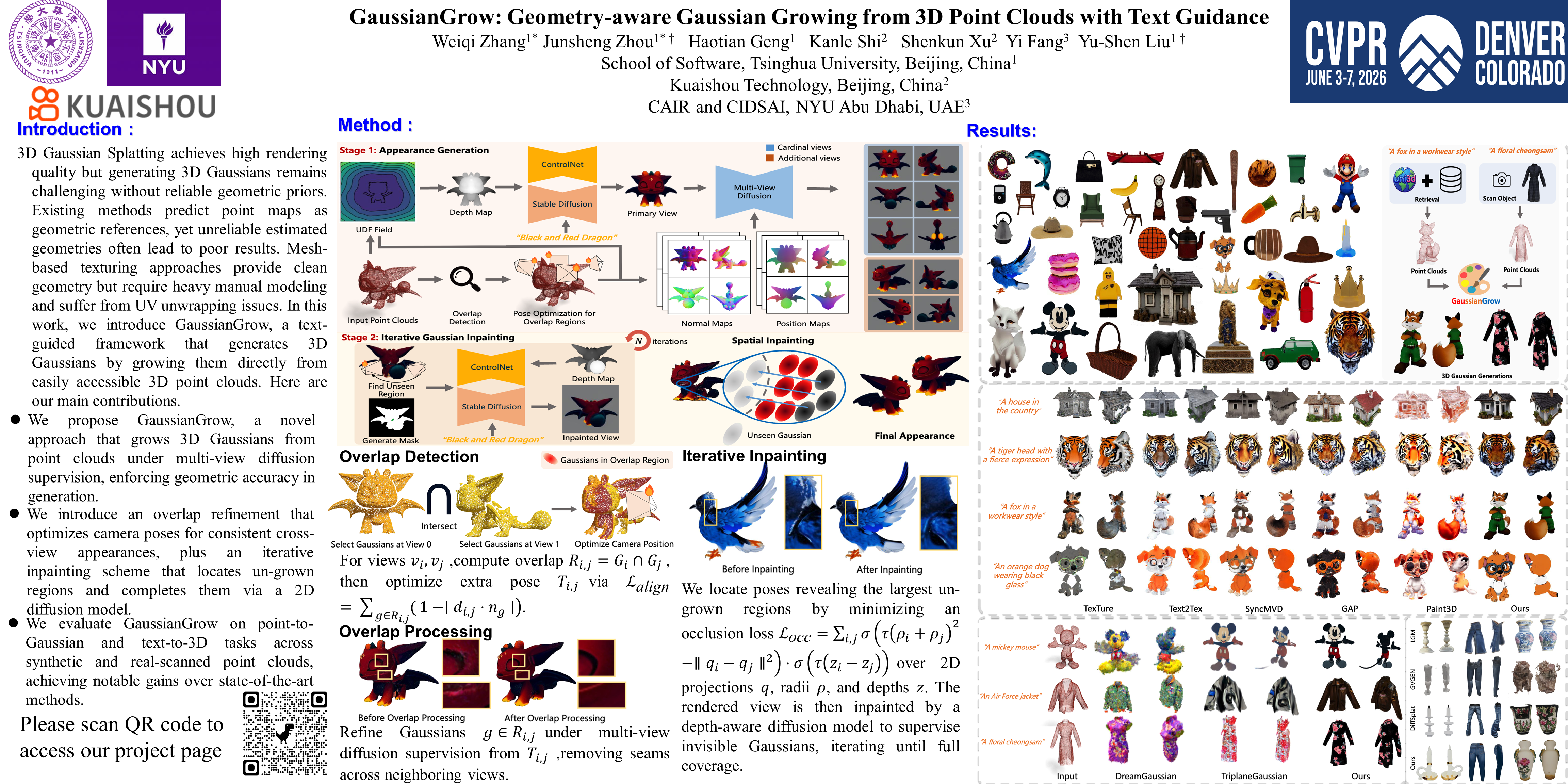
3D Gaussian Splatting has demonstrated superior performance in rendering efficiency and quality, yet the generation of 3D Gaussians still remains a challenge without proper geometric priors. Existing methods have explored to predict point maps as geometric references for inferring Gaussian primitives, while the unreliable estimated geometries may lead to poor generations. In this work, we introduce GaussianGrow, a novel approach that generates 3D Gaussians by learning to grow them from easily accessible 3D point clouds, naturally enforcing geometric accuracy in Gaussian generation. Specifically, we design a text-guided Gaussian growing scheme that leverages a multi-view diffusion model to synthesize consistent appearances from input point clouds for supervision. To mitigate artifacts caused by fusing neighboring views, we constrain on novel views generated at non-preset camera poses identified in overlapping regions across different views. For completing the hard-to-observe regions, we propose to iteratively detect the camera pose observing the largest un-grown regions in point clouds and inpaints them by inpainting the rendered view with a pretrained 2D diffusion model. The process continues until complete Gaussians are generated. We extensively evaluate GaussianGrow on text-guided Gaussian generation from synthetic and even real-scanned point clouds.
PhysGS: Bayesian-Inferred Gaussian Splatting for Physical Property Estimation
Samarth Chopra ⋅ Jing Liang ⋅ Gershom Seneviratne ⋅ Dinesh Manocha
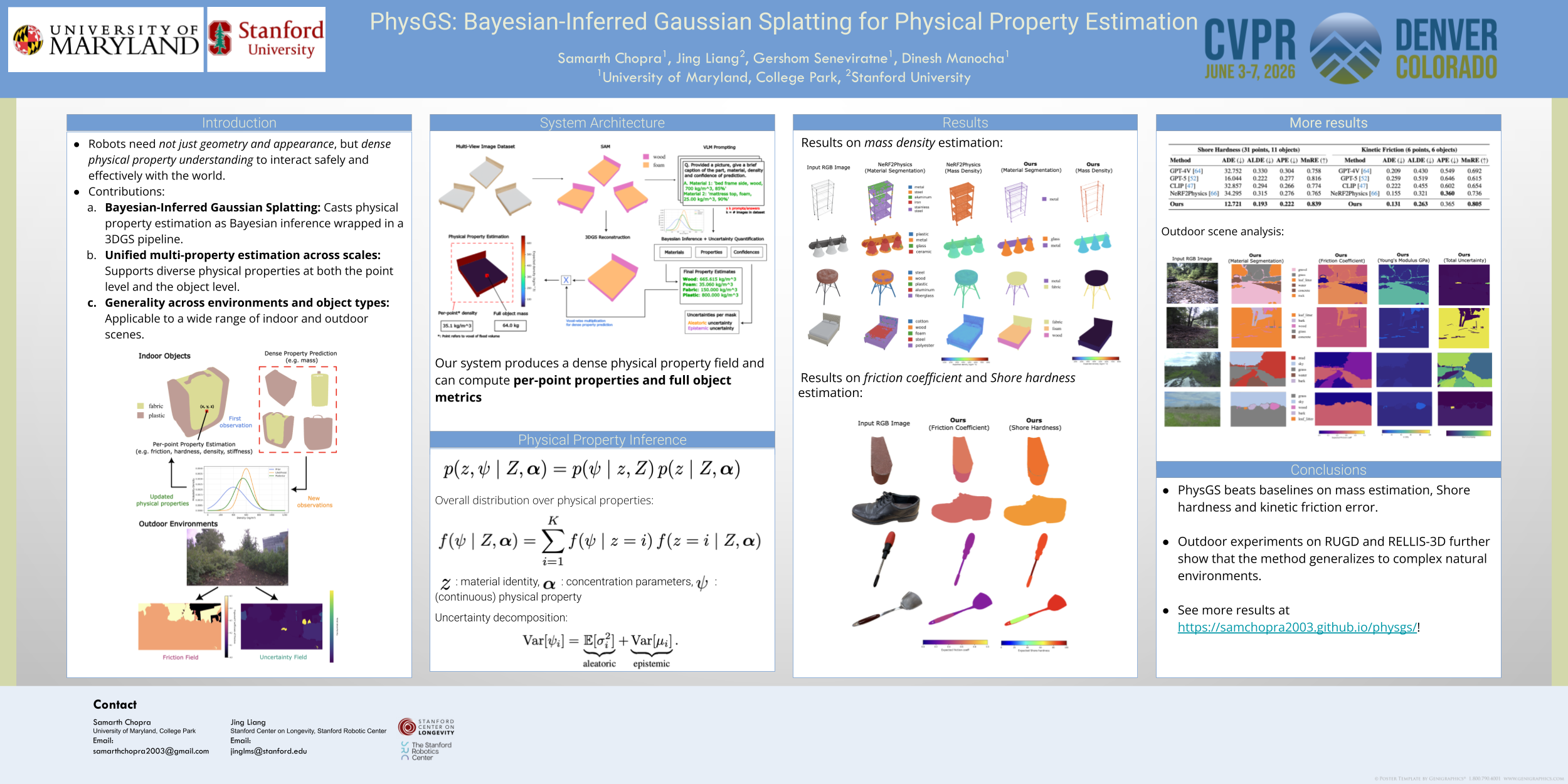
Understanding physical properties such as friction, stiffness, hardness, and material composition is essential for enabling robots to interact safely and effectively with their surroundings. However, existing 3D reconstruction methods focus on geometry and appearance and cannot infer these underlying physical properties. We present PhysGS, a Bayesian-inferred extension of 3D Gaussian Splatting that estimates dense, per-point physical properties from visual cues and vision--language priors. We formulate property estimation as Bayesian inference over Gaussian splats, where material and property beliefs are iteratively refined as new observations arrive. PhysGS also models aleatoric and epistemic uncertainties, enabling uncertainty-aware object and scene interpretation. Across object-scale (ABO-500), indoor, and outdoor real-world datasets, PhysGS improves accuracy of the mass estimation by up to 22.8%, reduces Shore hardness error by up to 61.2%, and lowers kinetic friction error by up to 18.1% compared to deterministic baselines. Our results demonstrate that PhysGS unifies 3D reconstruction, uncertainty modeling, and physical reasoning in a single, spatially continuous framework for dense physical property estimation.
3D Gaussian Splatting at Arbitrary Resolutions with Compact Proxy Anchors
Mingyun Jeong ⋅ Seongro Yoon ⋅ Francois Bremond ⋅ Donghyeon Cho
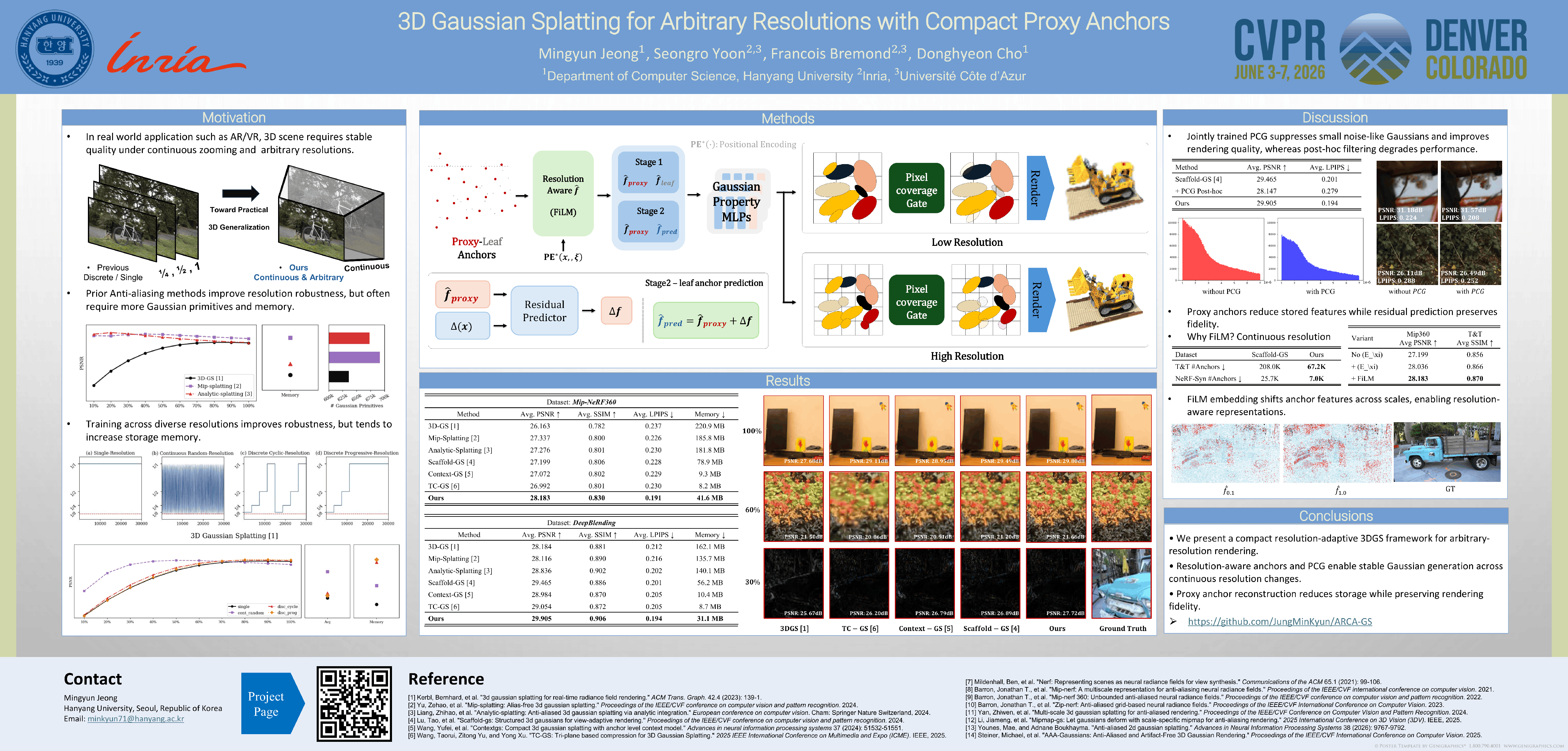
Despite achieving high-quality rendering, 3D Gaussian Splatting suffers from aliasing when the rendering resolution changes, as it is typically trained at a fixed resolution. To address this limitation, we introduce a method that enables the model to generate resolution-adaptive 3D Gaussians under arbitrary resolution changes. In particular, built upon Scaffold-GS, we enhance the anchor feature representation by incorporating a resolution-embedding to encode continuous resolution information. From these enhanced anchor features, a pixel coverage gate dynamically forms resolution-adaptive 3D Gaussians. Furthermore, we drastically reduce storage requirements by selecting a compact subset of proxy anchors and designing a residual anchor predictor that reconstructs the unselected leaf anchors based on the proxy anchors, enabling faithful scene representation without compromising visual fidelity. As a result, our method provides continuous and alias-free rendering across resolutions while maintaining practical scalability and memory efficiency. Extensive experiments across diverse resolution ranges demonstrate that our approach achieves an optimal balance between fidelity and memory, enabling practical arbitrary-resolution view synthesis even in resource-constrained settings.
Stochastic Ray Tracing for the Reconstruction of 3D Gaussian Splatting
Peiyu Xu ⋅ Shuang Zhao ⋅ Xin Sun ⋅ Krishna Mullia ⋅ Raymond Fei ⋅ Iliyan Georgiev
Ray-tracing-based 3D Gaussian splatting (3DGS) enjoys the generality of supporting non-pinhole camera models and relightable formulations. However, they are usually lacking in performance, partially due to the need for depth-based sorting of all intersecting Gaussians along the traced rays.In this paper, we introduce a sorting-free differentiable stochastic formulation for ray-traced 3DGS, enabling efficient reconstruction and rendering of both standard and relightable 3DGS scenes.For standard 3DGS, our method offers performance comparable to rasterization-based 3DGS and outperforms sorting-based ray tracing.For relightable 3DGS, our technique provides higher-quality reconstructions and renderings thanks to the accurate shadow and shading computation provided by fully ray-traced shadow and light rays.
AeroDGS: Physically Consistent Dynamic Gaussian Splatting for Single-Sequence Aerial 4D Reconstruction
Hanyang Liu ⋅ Rongjun Qin
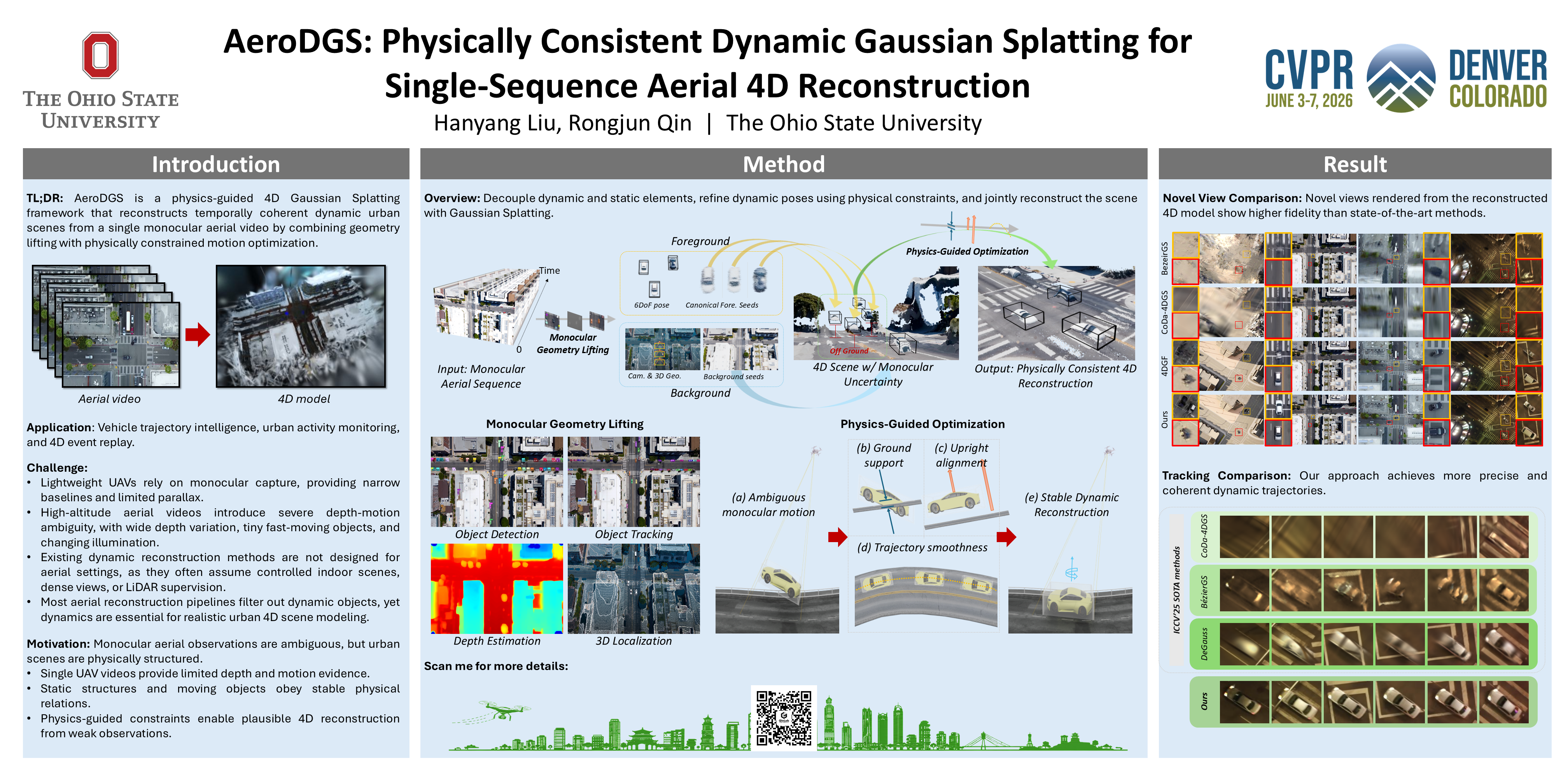
Recent advances in 4D scene reconstruction have greatly improved dynamic modeling across various domains. However, existing approaches remain limited under aerial conditions with single-view capture, wide spatial range, and dynamic objects of limited spatial footprint and large motion disparity. These challenges cause severe depth ambiguity and unstable motion estimation, making monocular aerial reconstruction inherently ill-posed.To this end, we present AeroDGS, a physics-guided 4D Gaussian splatting framework for monocular UAV videos. AeroDGS introduces a Monocular Geometry Lifting module that reconstructs reliable static and dynamic geometry from a single aerial sequence, providing a robust basis for dynamic estimation. To further resolve monocular ambiguity, we propose a Physics-Guided Optimization module that incorporates differentiable ground-support, upright-stability, and trajectory-smoothness priors, transforming ambiguous image cues into physically consistent motion.The framework jointly refines static backgrounds and dynamic entities with stable geometry and coherent temporal evolution. We additionally build a real-world UAV dataset that spans various altitudes and motion conditions to evaluate dynamic aerial reconstruction. Experiments on synthetic and real UAV scenes demonstrate that AeroDGS outperforms state-of-the-art methods, achieving superior reconstruction fidelity in dynamic aerial environments.
GaussianPile: A Unified Sparse Gaussian Splatting Framework for Slice-based Volumetric Reconstruction
Di Kong ⋅ Yikai Wang ⋅ Wenjie Guo ⋅ Yifan Bu ⋅ Boya Zhang ⋅ Yuexin Duan ⋅ Xiawei Yue ⋅ Wenbiao Du ⋅ Yiman Zhong ⋅ Yuwen Chen ⋅ Cheng Ma
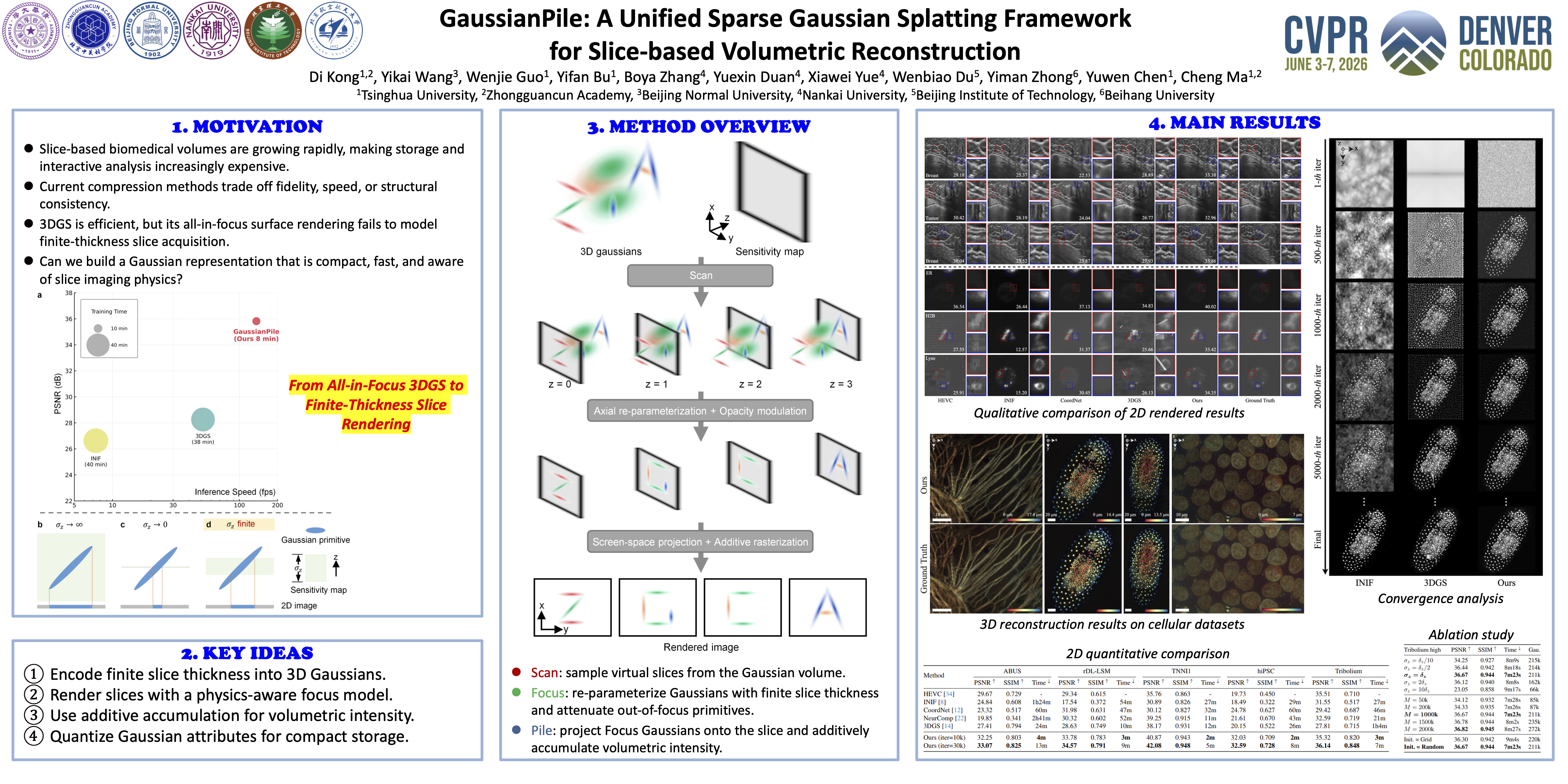
Slice-based volumetric imaging is widely applied and it demands representations that compress aggressively while preserving internal structure for analysis. This paper introduces GaussianPile, unifying 3D Gaussian splatting with an imaging system-aware focus model to address this challenge. Our new method introduces three key innovations: (i) a slice‑aware piling strategy that positions anisotropic 3D Gaussians to model through‑slice contributions, (ii) a differentiable projection operator that encodes the finite‑thickness point spread function of the imaging acquisition system, and (iii) a compact encoding and joint optimization pipeline that simultaneously reconstructs and compresses the Gaussian sets. Our CUDA-based design retains the compression and real‑time rendering efficiency of Gaussian primitives while preserving high‑frequency internal volumetric detail. Experiments on microscopy and ultrasound datasets demonstrate that our method reduces storage and reconstruction cost, sustains diagnostic fidelity, and enables fast 2D visualization, along with 3D voxelization. In practice, it delivers high-quality results in as few as $3$ minutes—up to $11\times$ faster than NeRF-based approaches—and achieves consistent $16\times$ compression over the original voxel grids, offering a practical path to deployable compression and exploration of slice-based volumetric datasets.
More Natural, More Real: Object-aware Gaussian Splatting for 3D Visual Decoding from Human Brain
Haodong Jing ⋅ Dongyao Jiang ⋅ Jixin Wang ⋅ Junhao Jia ⋅ Yanshu Li ⋅ Yongqiang Ma ⋅ Nanning Zheng
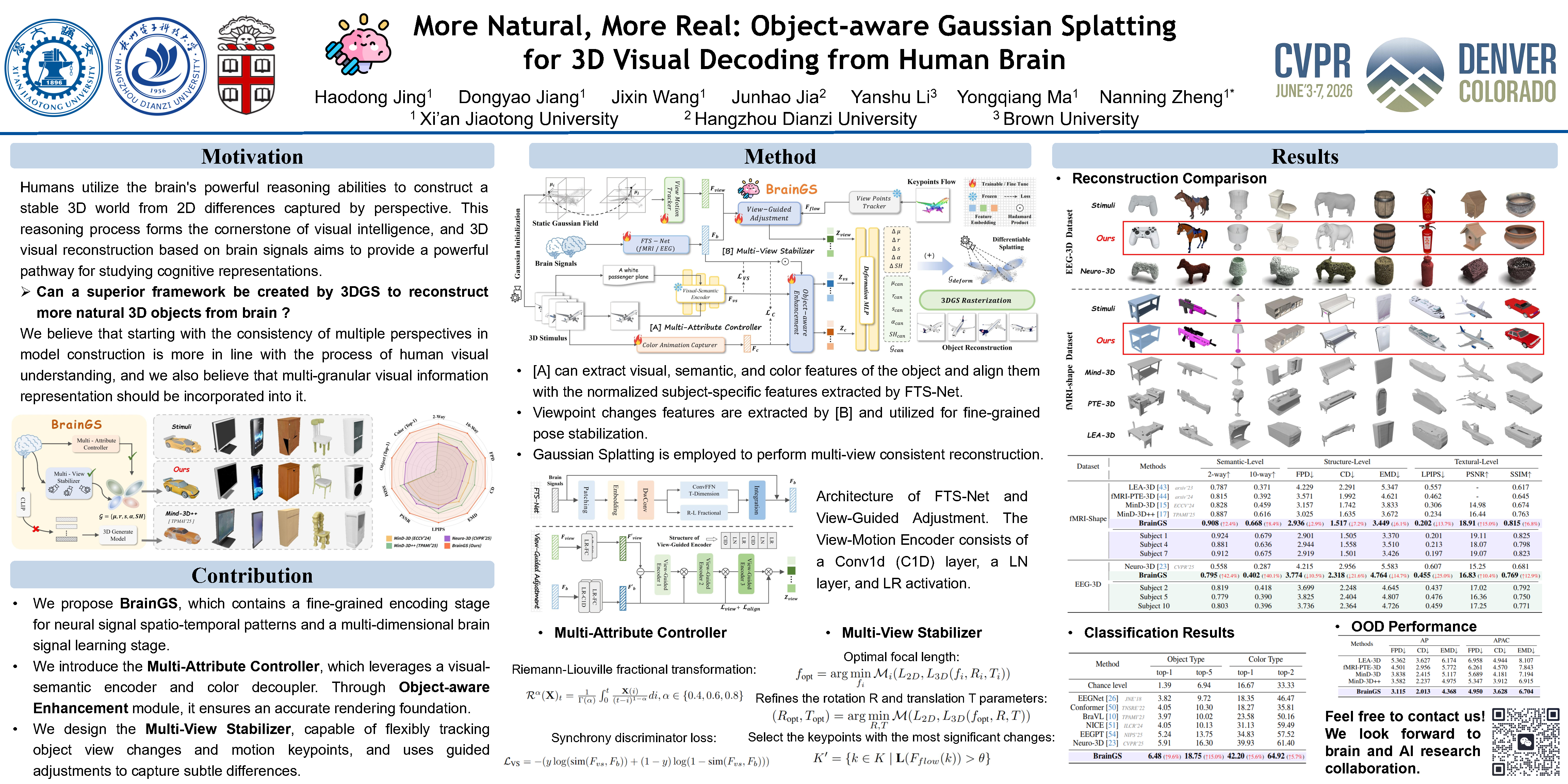
Exploring human visual perception and understanding of the stereoscopic world represents a significant topic in computational neuroscience. Recent studies have provided rich Brain-3D datasets, conducted preliminary explorations into 3D visual reconstruction. However, existing research struggles to capture the differences in dynamic changes of 3D stimulus views, and there remains room for improvement in high-fidelity reconstruction and rendering. 3D Gaussian Splatting (3DGS) has recently achieved significant progress in stereoscopic view synthesis. Inspired by it, we propose BrainGS -- an innovative framework for decoding more realistic 3D objects from the brain. BrainGS incorporates a Fusion Time-Spatial Network to achieve comprehensive encoding of the brain, combined with the Multi-Attribute Controller (MAC), it decouples features using visual, semantic, and color as anchors, effectively learning the feature distribution of Brain-3D and providing initial control for 3DGS. The Multi-View Stabilizer (MVS) overcomes the challenge of capturing multi-view changes of 3D objects, creating more robust viewpoint representations. Comprehensive experiments and discussions on fMRI/EEG show the SOTA performance (2.936 FPD, 0.202 LPIPS) of BrainGS, providing reliable neural interpretations, offering new insights into brain stereovision understanding.
Eulerian Gaussian Splatting using Hashed Probability Pyramids
Mia Gaia Polansky ⋅ George Kopanas ⋅ Stephan Garbin ⋅ Todd Zickler ⋅ Dor Verbin
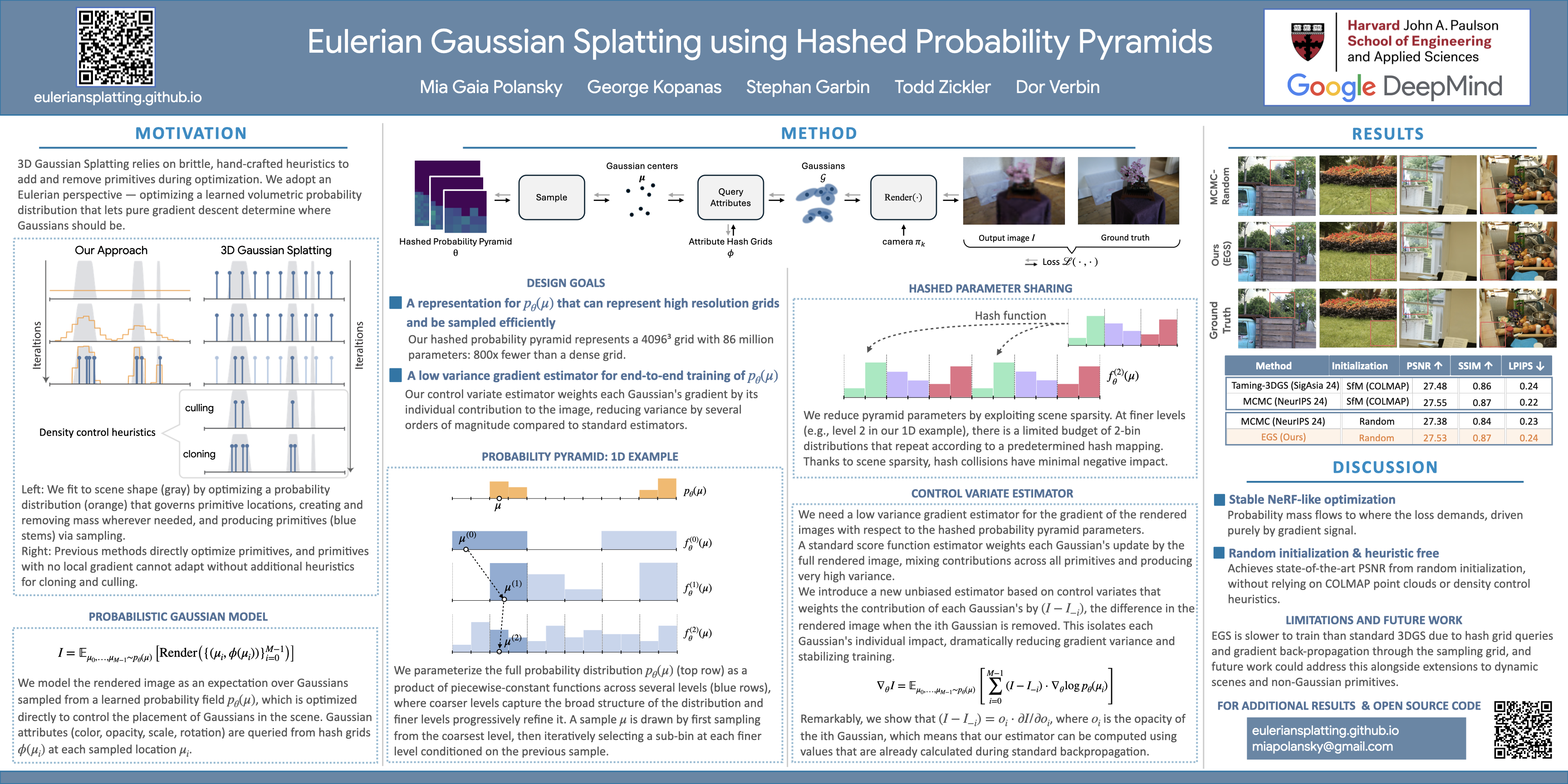
We introduce a probabilistic splat-based radiance field framework that retains the fast rasterization and test-time efficiency of 3D Gaussian Splatting (3DGS) while replacing heuristic primitive manipulation with gradient-based optimization of a volumetric probability density. Rather than relocating, splitting, or culling Gaussians via hand-tuned densification (e.g., ADC), we treat primitive locations as samples drawn from a persistent, learnable density. We instantiate this density with a novel, memory-efficient multi-scale hierarchical grid that enables end-to-end gradient-based control over primitive population density. To stabilize stochastic training, we derive an unbiased gradient estimator with control variates that markedly reduces variance. By allowing probability mass to flow to where the loss demands, our method eliminates brittle priors and naturally explores the volume, achieving state-of-the-art reconstruction quality on mip-NeRF360 while preserving 3DGS-level rendering speed.
Confidence-Guided Multi-Scale Aggregation for Sparse-View High-Resolution 3D Gaussian Splatting
Qinzheng Zhou ⋅ Zaychik Liu ⋅ Lijing Lu ⋅ Zhihang Li
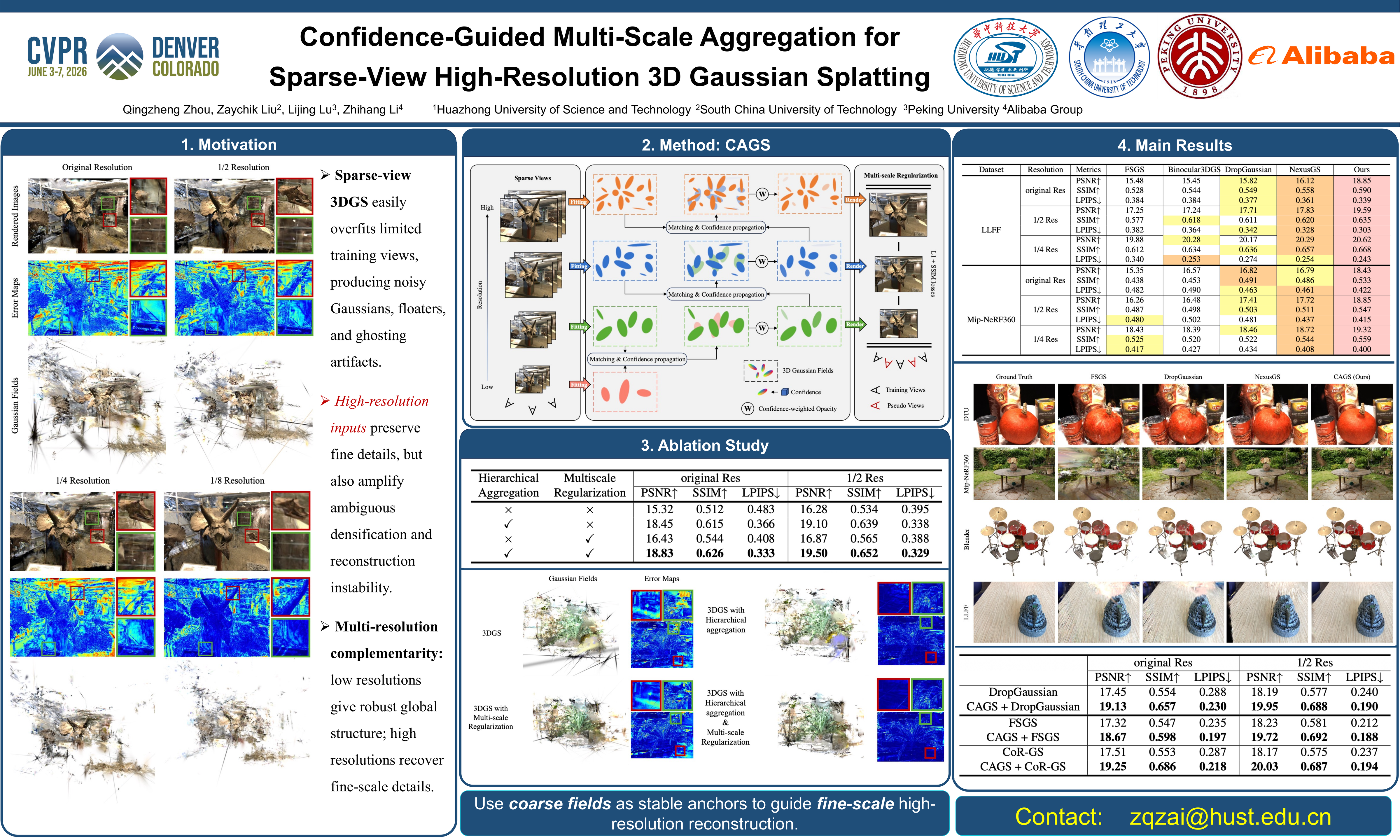
Sparse-view 3D Gaussian Splatting (3DGS) reconstructs scenes using 3D Gaussians from sparse input views. Yet, this method is prone to overfitting, which is exacerbated at higher resolutions as the expanded dimensionality amplifies floating artifacts and reconstruction ambiguities. In this paper, we present a systematic study of 3DGS under sparse-view conditions and varying input resolutions. While prior work has overlooked resolution as a key factor in sparse-view performance, we identify and quantify a trade-off: lower-resolution inputs facilitate stable global geometry reconstruction, whereas higher-resolution inputs enable finer detail recovery but introduce high-frequency artifacts and instability. Building on this insight, we further propose CAGS, a Confidence-Guided Multi-Scale Aggregation that reconstructs scenes through a coarse-to-fine hierarchical optimization process. Our approach employs a matching-based weighting aggregation strategy to anchor high-resolution reconstructions to stabilize structural priors and filtering noise through cross-scale consistency, and a multi-scale pseudo-view regularization to refine local details without amplifying noise. Extensive experiments on the LLFF and Mip-NeRF360 datasets demonstrate that CAGS significantly outperforms existing methods, particularly under demanding high-resolution conditions. Moreover, our paradigm can be seamlessly integrated into other 3DGS-based pipelines, thereby extending the field from low-resolution reconstructions to high-fidelity outputs under real-world sparse-view constraints.
ULF-Loc: Unbiased Landmark Feature for Robust Visual Localization with 3D Gaussian Splatting
Yingdong Gu ⋅ Shaocheng Yan ⋅ Zhenjun Zhao ⋅ Yuan Kou ⋅ Jianxin Luo ⋅ Pengcheng Shi ⋅ Jiayuan Li
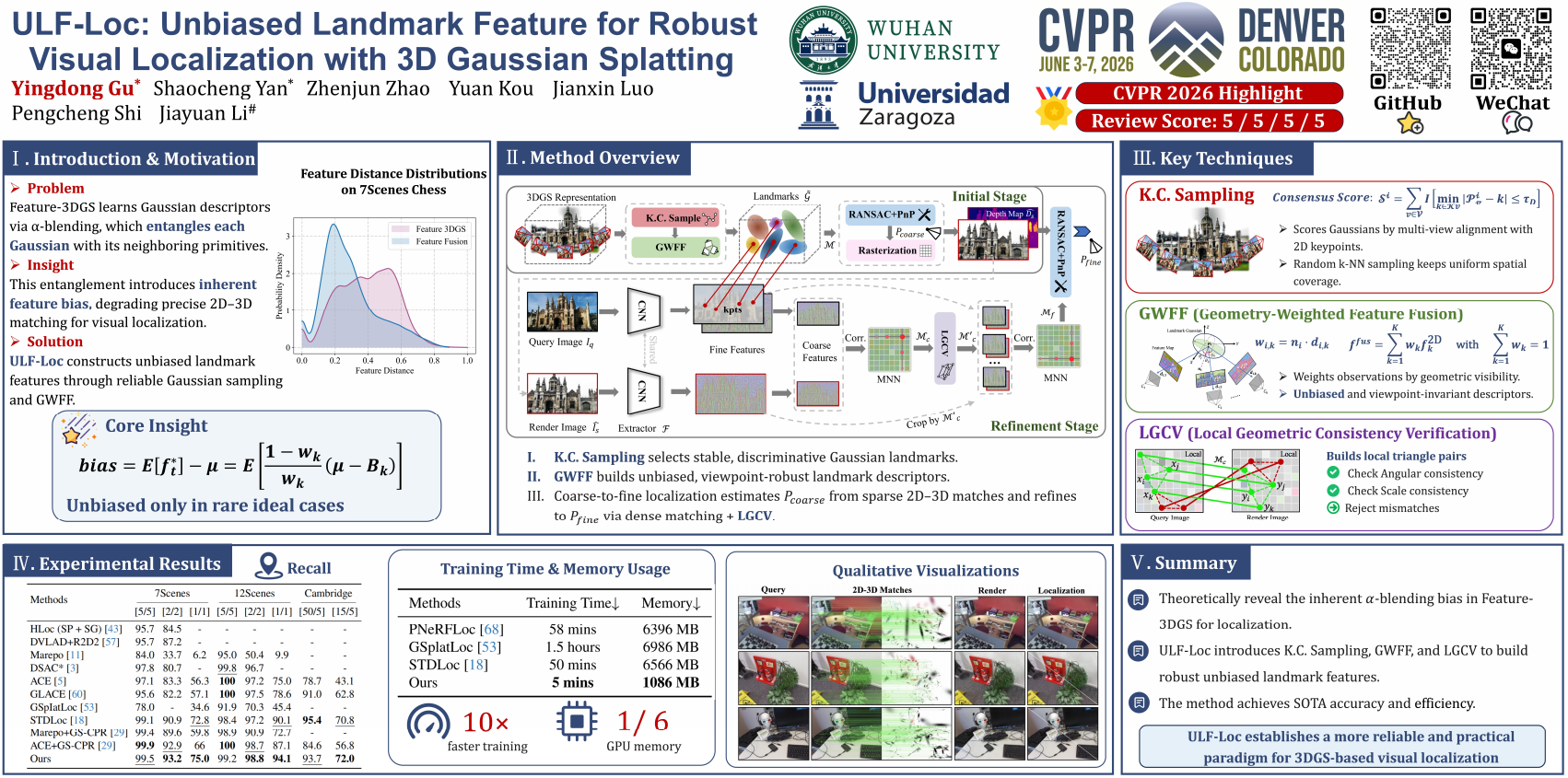
Visual localization is a core technology for augmented reality and autonomous navigation. Recent methods combine the efficient rendering of 3D Gaussian Splatting (3DGS) with feature-based localization. These methods rely on direct matching between 2D query features and the 3D Gaussian feature field, but this often results in mismatches due to an inherent bias in the learned Gaussian feature. We theoretically analyze the feature learning process in 3DGS, revealing that the widely adopted $\alpha$-blending optimization inherently introduces bias into 3D point features. This bias stems from the entanglement between individual Gaussians and their neighboring Gaussians, making the learned features unsuitable for precise matching tasks. Motivated by these findings, we propose ULF-Loc, an unbiased landmark feature framework that replaces biased feature optimization with geometry-weighted feature fusion. We further introduce keypoint-consensus landmark sampling to select reliable Gaussians and local geometric consistency verification to reject mismatches caused by rendering artifacts. On the Cambridge Landmarks dataset, ULF-Loc reduces the mean median translation error by 17\% compared to the state-of-the-art, while achieving superior efficiency with only 1/10 the training time and 1/6 the GPU memory of STDLoc.
Robust3DGSW: Toward Robust Watermarking for Quantization-Aware 3D Gaussian Splatting
Boyu Wang ⋅ Jun Xia ⋅ Mingsong Chen
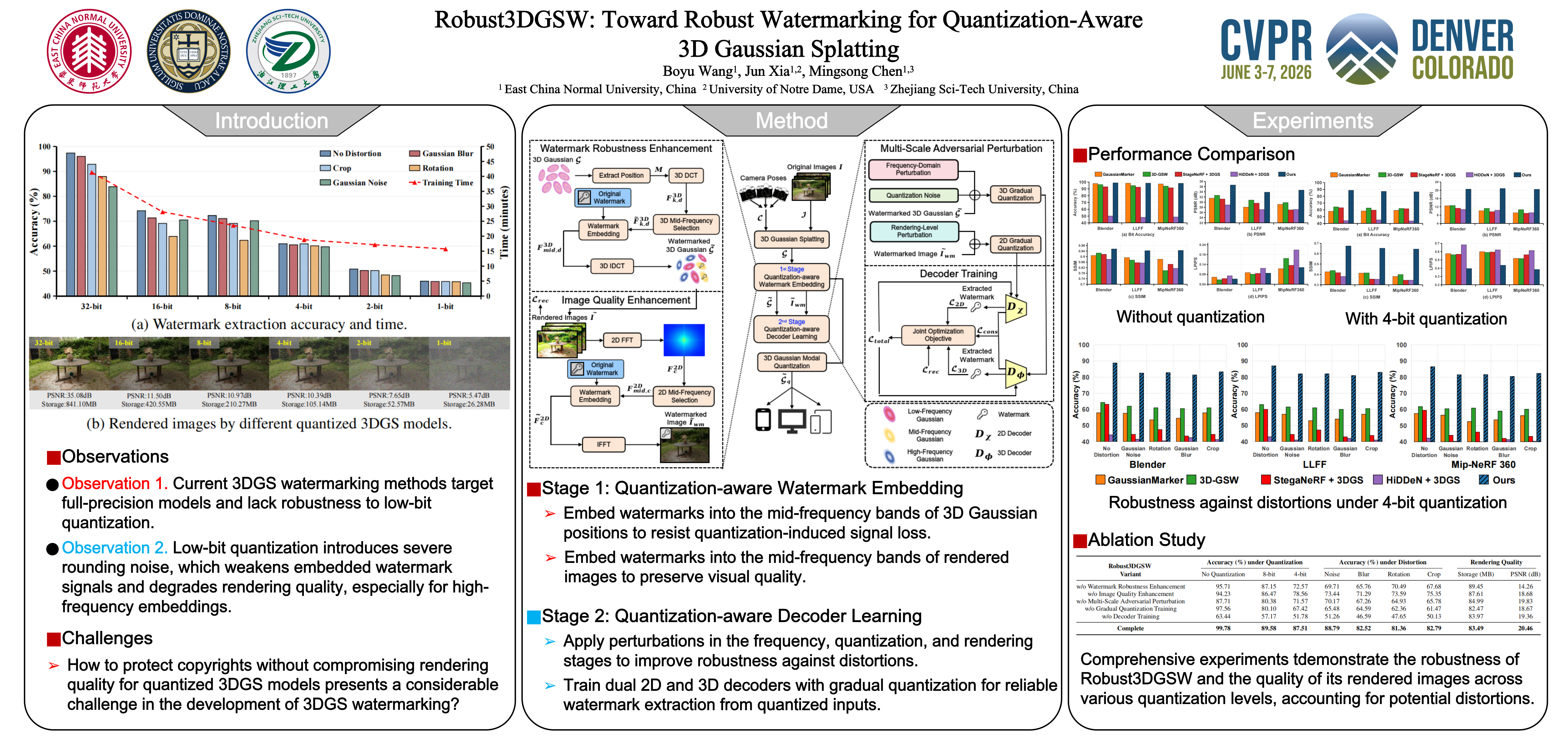
Although current watermarking techniques for 3D Gaussian Splatting (3DGS) are promising in protecting the copyrights of both 3DGS models and their rendered images, they greatly suffer from low watermark robustness and poor rendering quality when applying quantization to large 3DGS models to accommodate resource-limited devices. To address these problems, this paper introduces a novel two-stage quantization-aware 3DGS watermarking approach called Robust3DGSW. By properly embedding watermarks into the mid-frequency bands of both the 3D Gaussian parameters and 2D rendered images, the first stage of Robust3DGSW can effectively counteract the quantization-induced signal loss and mitigate the adverse effects of watermarks on rendered images. In the second stage, Robust3DGSW trains both 2D and 3D decoders using our proposed multi-scale adversarial perturbation approach, alongside a gradual quantization process, which enables robust watermark extraction even under excessive quantization. Comprehensive experimental results obtained from the well-known Blender, LLFF, and MipNeRF-360 datasets demonstrate that, when compared to leading 3DGS watermarking techniques, Robust3DGSW not only mitigates the negative effects of quantization on watermarks but also enables fast rendering with high quality.
ParkGaussian: Surround-view 3D Gaussian Splatting for Autonomous Parking
Xiaobao Wei ⋅ Zhangjie Ye ⋅ Yuxiang Gu ⋅ Zunjie Zhu ⋅ Yunfei Guo ⋅ Yingying Shen ⋅ Shan Zhao ⋅ Ming Lu ⋅ Haiyang Sun ⋅ Bing Wang ⋅ Guang Chen ⋅ Rongfeng Lu ⋅ Hangjun Ye
Parking is a critical task for autonomous driving systems (ADS), with unique challenges in crowded parking slots and GPS-denied environments. However, existing works focus on 2D parking slot perception, mapping, and localization, 3D reconstruction remains underexplored, which is crucial for capturing complex spatial geometry in parking scenarios. Naively improving the visual quality of reconstructed parking scenes does not directly benefit autonomous parking, as the key entry point for parking is the slots perception module. To address these limitations, we curate the first benchmark named ParkRecon3D, specifically designed for parking scene reconstruction. It includes sensor data from four surround-view fisheye cameras with calibrated extrinsics and dense parking slot annotations. We then propose ParkGaussian, the first framework that integrates 3D Gaussian Splatting (3DGS) for parking scene reconstruction. To further improve the alignment between reconstruction and downstream parking slot detection, we introduce a slot-aware reconstruction strategy that leverages existing parking perception methods to enhance the synthesis quality of slot regions. Experiments on ParkRecon3D demonstrate that ParkGaussian achieves state-of-the-art reconstruction quality and better preserves perception consistency for downstream tasks. The code and dataset will be released.
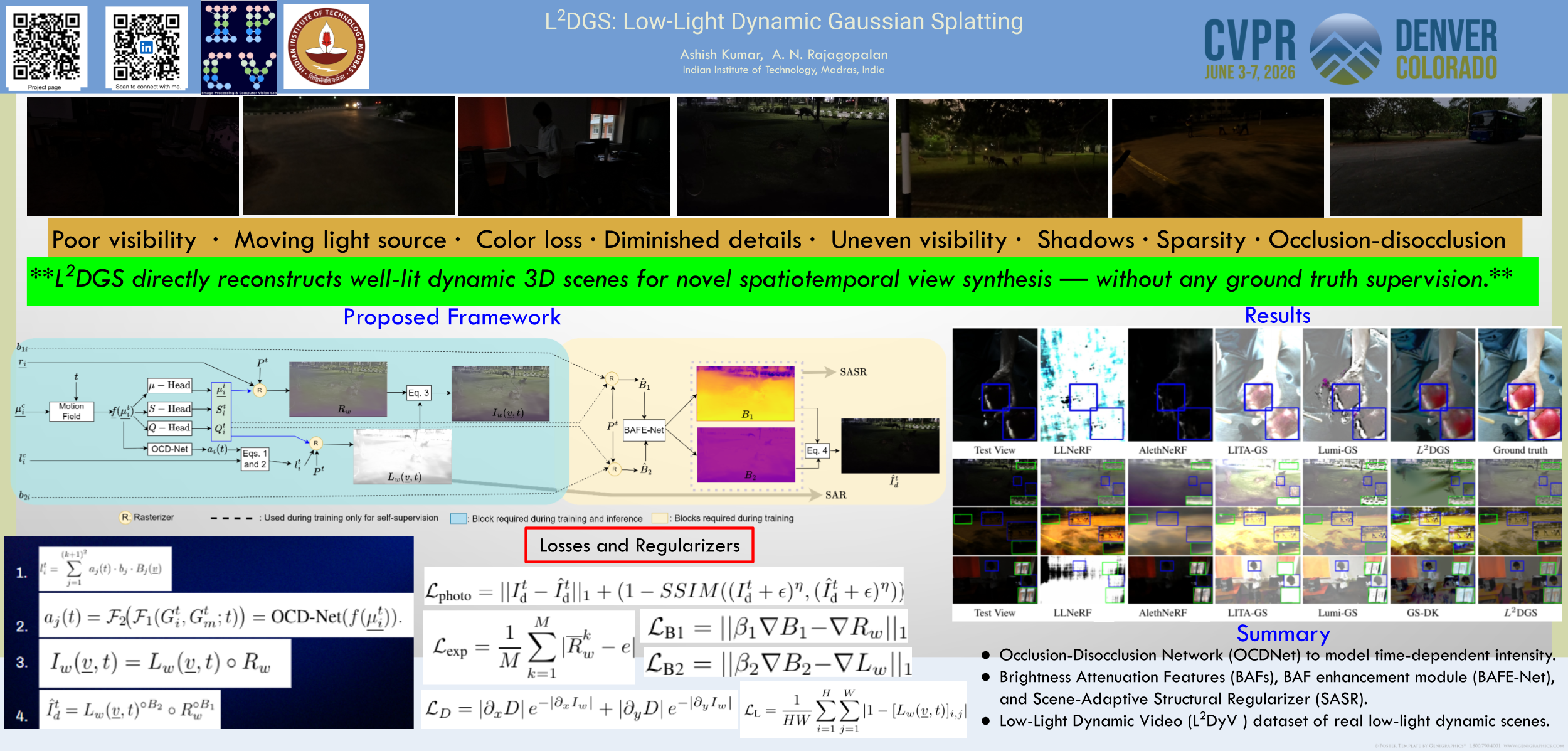
Synthesizing novel spatiotemporal views of dynamic scenes is inherently challenging due to both object and camera motion, as well as sparsity of observations. Recent advances in Neural Radiance Fields (NeRFs) and Gaussian Splatting (GS) have enabled 4D dynamic scene reconstruction, but predominantly from well-lit images or videos. Some works address the problem of reconstructing a well-lit scene from low-light input, but these are limited to static scenes. Moreover, prior methods primarily emphasize improving illumination, while overlooking the underlying scene characteristics. Reconstructing well-lit dynamic scenes from inputs captured under low-light conditions is particularly challenging due to shadows, occlusions, and disocclusions caused by object motion, which makes the problem highly ambiguous and ill-posed. We propose $L^{2}DGS$ (Low-Light Dynamic Gaussian Splatting), a self-supervised 4D GS framework for directly reconstructing well-lit dynamic scenes from low-light inputs. The proposed method decomposes each scene into two complementary components: illumination, which varies across both view and time, and reflectance, which remains invariant to these factors. To achieve this, we introduce several key innovations. First, the proposed Occlusion-Disocclusion Network (OCD-Net) models time-varying intensity across frames. Next, we propose Brightness Attenuation Features (BAFs), when complemented by the BAF Enhancement Network (BAFE-Net), enable geometry- and photometry-aware transformation between well-lit and low-light scenes for self-supervision. Together, these components allow $L^{2}DGS$ to maximize signal strength and suppress noise inherent in low-light inputs, leading to enhanced spatial fidelity and temporal consistency under challenging illumination conditions. Our method operates on standard sRGB inputs without requiring camera metadata (e.g., exposure settings), ensuring compatibility with consumer-grade imaging devices. We evaluate $L^{2}DGS$ on both simulated and real-world Low-Light Dynamic Video ($L^{2}DyV$) datasets, demonstrating superior qualitative and quantitative performance.
Probabilistic Concept Graph Reasoning for Multimodal Misinformation Detection
Ruichao Yang ⋅ Wei Gao ⋅ Xiaobin Zhu ⋅ Jing Ma ⋅ Hongzhan Lin ⋅ Ziyang Luo ⋅ Bo-Wen Zhang ⋅ Xu-Cheng Yin
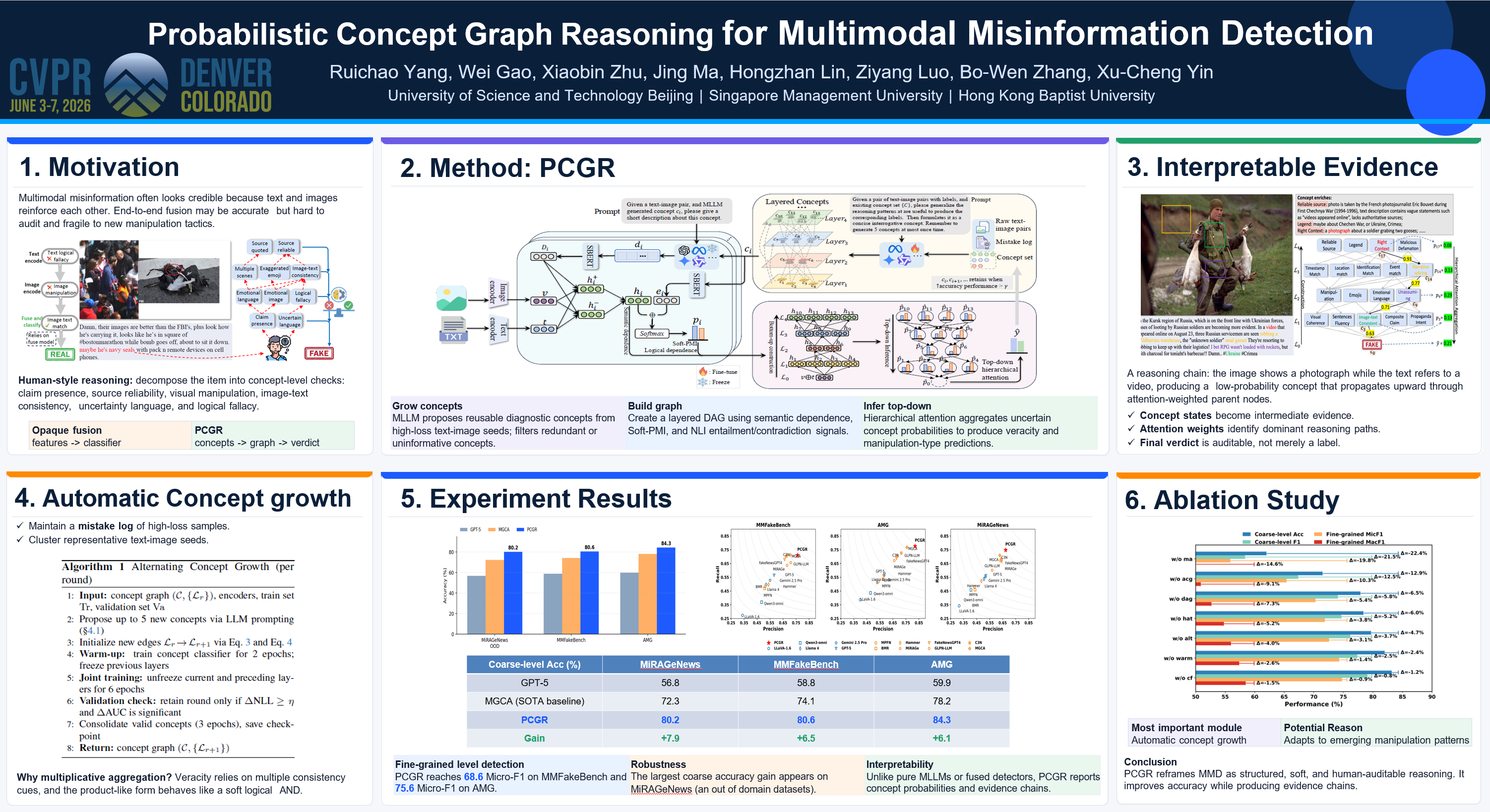
Multimodal misinformation poses an escalating challenge that often evades traditional detectors, which are opaque black boxes and fragile against new manipulation tactics. We present Probabilistic Concept Graph Reasoning (PCGR), an interpretable, modular, and evolvable framework that reframes multimodal misinformation detection (MMD) as structured, concept-based reasoning. PCGR follows a build-then-infer paradigm, which first constructs a graph of human-understandable concept nodes, including novel high-level concepts automatically discovered and validated by multimodal large language models (MLLMs), and then applies hierarchical attention over this concept graph to infer claim veracity. This design produces interpretable reasoning chains linking evidence to conclusions. Experiments demonstrate that PCGR achieves state-of-the-art MMD accuracy and robustness to emerging manipulation types, outperforming prior methods in both coarse detection and fine-grained manipulation recognition.
POINTS-Long: Adaptive Dual-Mode Visual Reasoning in MLLMs
Haicheng Wang ⋅ Yuan Liu ⋅ Yikun Liu ⋅ Zhemeng Yu ⋅ Zhongyin Zhao ⋅ Yangxiu You ⋅ Zilin Yu ⋅ Le Tian ⋅ Zhou Xiao ⋅ Jie Zhou ⋅ Weidi Xie ⋅ Yanfeng Wang
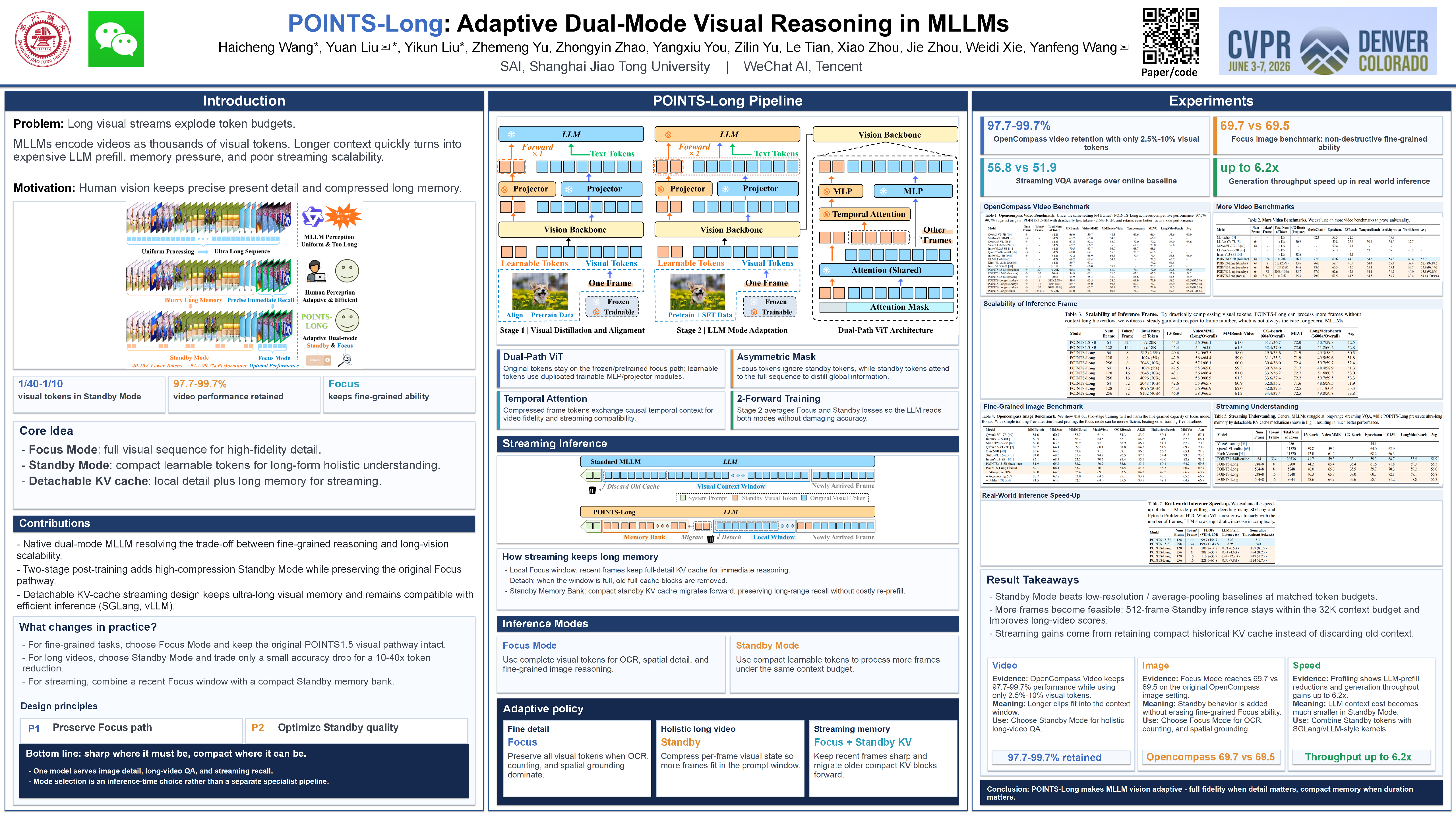
Multimodal Large Language Models (MLLMs) have recently demonstrated remarkable capabilities in cross-modal understanding and generation. However, the rapid growth of visual token sequences—especially in long-video and streaming scenarios—poses a major challenge to their scalability and real-world deployment. Thus, we introduce POINTS-Long, a native dual-mode MLLM featuring dynamic visual token scaling inspired by the human visual system. The model supports two complementary perception modes: focus mode and standby mode, enabling users to dynamically trade off efficiency and accuracy during inference. On fine-grained visual tasks, the focus mode retains the optimal performance, while on long-form general visual understanding, the standby mode retains 97.7-99.7\% of the original accuracy using only 1/40-1/10th of the visual tokens. Moreover, POINTS-Long natively supports streaming visual understanding via a dynamically detachable KV-cache design, allowing efficient maintenance of ultra-long visual memory. Our work provides new insights into the design of future MLLMs and lays the foundation for adaptive visual reasoning and efficient long-form visual understanding. Model weights will be released upon publication.
SegCompass: Exploring Interpretable Alignment with Sparse Autoencoders for Enhanced Reasoning Segmentation
Zhenyu Lu ⋅ Liupeng Li ⋅ Jinpeng Wang ⋅ Haoqian Kang ⋅ Yan Feng ⋅ Ke Chen ⋅ Yaowei Wang
While large language models provide strong compositional reasoning, existing reasoning segmentation pipelines fail to transparently connect this reasoning to visual perception.Current methods, such as latent query alignment, are end-to-end yet opaque "black boxes".Conversely, textual localization readout is merely readable, not truly interpretable, often functioning as an unconstrained post-hoc step.To bridge this interpretability gap, we propose SegCompass, an end-to-end model that leverages a Sparse Autoencoder (SAE) to forge an explicit, interpretable, and differentiable alignment pathway.Given an image-instruction pair, SegCompass first generates a chain-of-thought (CoT) trace.The core of our method is an SAE that maps both the CoT and visual tokens into a shared, high-dimensional sparse concept space.A query codebook selects salient concepts from this space, which are then spatially grounded by a slot mapper into a multi-slot heatmap that guides the final mask decoder.The entire model is trained jointly, unifying reinforcement learning for the reasoning path with standard segmentation supervision.This SAE-driven interface provides a "white-box" connection that is significantly more traceable than latent queries and more coherent than textual readouts.Extensive experiments on five challenging benchmarks demonstrate that SegCompass matches or surpasses state-of-the-art performance.Crucially, our visual and quantitative analyses show a strong correlation between the quality of the learned sparse concepts and final mask accuracy, confirming that SegCompass achieves superior results through its enhanced and inspectable alignment.Faithful code will be released publicly.
CRIT: Graph-Based Automatic Data Synthesis to Enhance Cross-Modal Multi-Hop Reasoning
Junyoung Sung ⋅ Seungwoo Lyu ⋅ Minjun Kim ⋅ Sumin An ⋅ Arsha Nagrani ⋅ Paul Hongsuck Seo
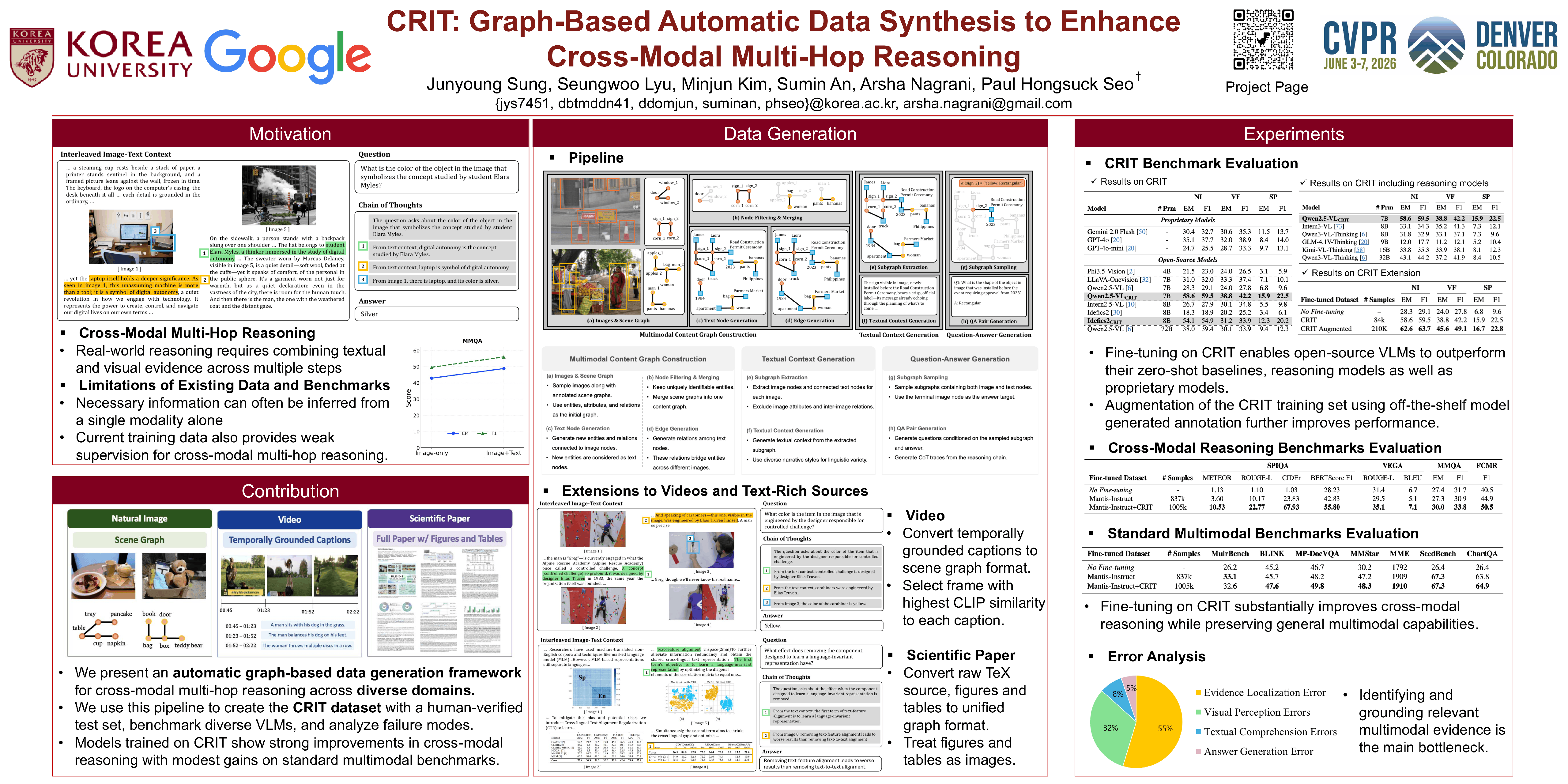
Real-world reasoning often requires combining information across modalities, connecting textual context with visual cues in a multi-hop process. Yet, most multimodal benchmarks fail to capture this ability: they typically rely on single images or set of images, where answers can be inferred from a single modality alone. This limitation is mirrored in the training data, where interleaved image–text content rarely enforces complementary, multi-hop reasoning. As a result, Vision-Language Models (VLMs) frequently hallucinate and produce reasoning traces poorly grounded in visual evidence. To address this gap, we introduce CRIT, a new dataset and benchmark built with a graph-based automatic pipeline for generating complex cross-modal reasoning tasks. CRIT consists of diverse domains ranging from natural images, videos, and text-rich sources, and includes a manually verified test set for reliable evaluation. Experiments on this benchmark reveal that even state-of-the-art models struggle on such reasoning tasks. Models trained on CRIT show significant gains in cross-modal multi-hop reasoning, including strong improvements on SPIQA and other multi-image benchmarks.
DeepScan: A Training-Free Framework for Visually Grounded Reasoning in Large Vision-Language Models
Yangfu Li ⋅ Hongjian Zhan ⋅ Jiawei Chen ⋅ YUNING GONG ⋅ Qi Liu ⋅ Yue Lu
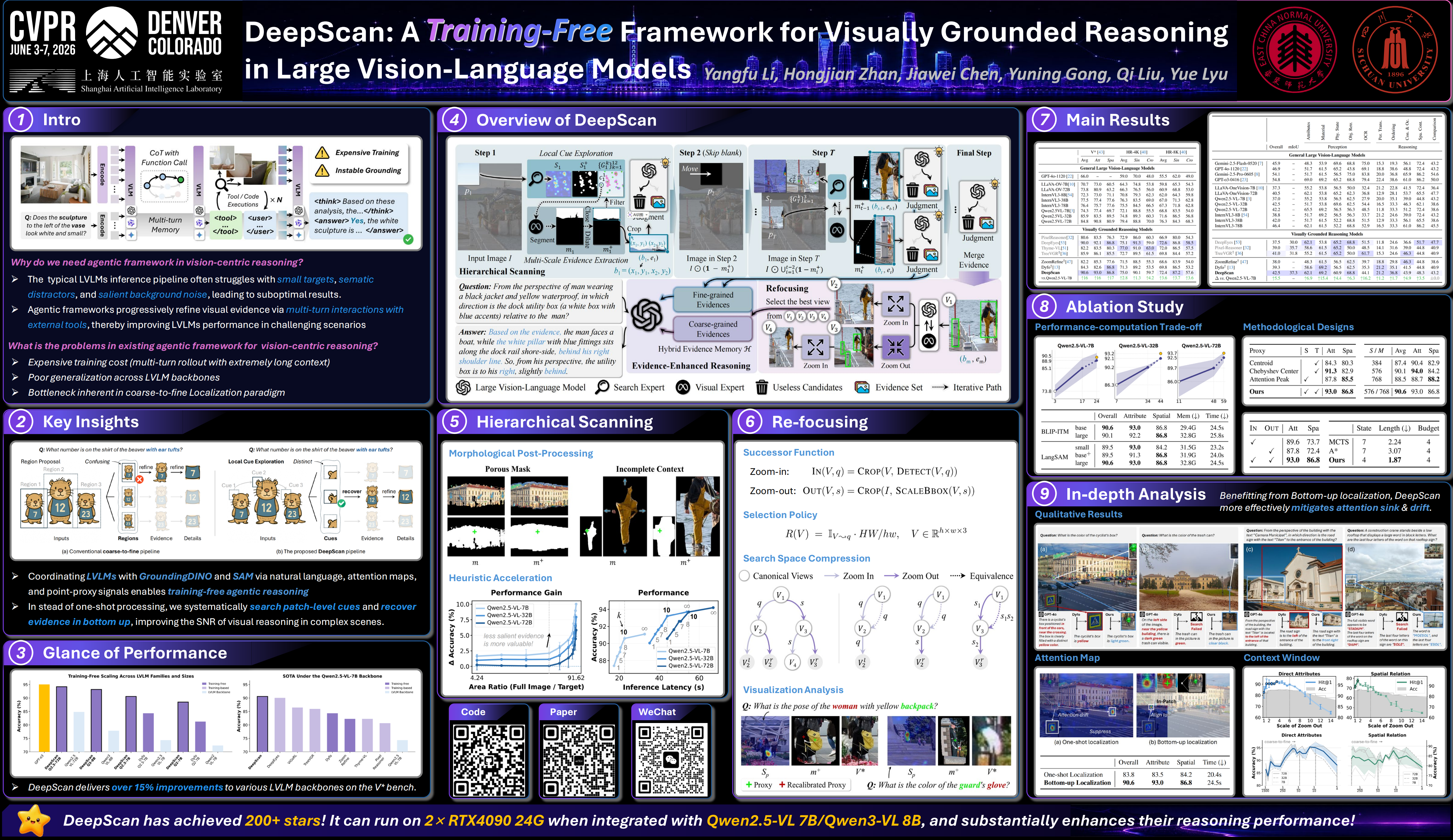
Humans can robustly localize visual evidence and provide grounded answers even in noisy environments by identifying critical cues and then relating them to the full context in a bottom-up manner. Inspired by this, we propose DeepScan, a training-free framework that combines Hierarchical Scanning, Refocusing, and Evidence-Enhanced Reasoning for visually grounded reasoning in Large Vision–Language Models (LVLMs). Unlike existing methods that pursue one-shot localization of complete evidence, Hierarchical Scanning performs local cue exploration and multi-scale evidence extraction to recover evidence in a bottom-up manner, effectively mitigating the impacts of distractive context. Refocusing then optimizes the localized evidence view through collaboration of LVLMs and visual experts. Finally, Evidence-Enhanced Reasoning aggregates multi-granular views via a hybrid evidence memory and yields accurate and interpretable answers. Experimental results demonstrate that DeepScan significantly boosts LVLMs in diverse visual tasks, especially in fine-grained visual understanding. It achieves 90.6\% overall accuracy on V* when integrated with Qwen2.5-VL-7B. Moreover, DeepScan provides consistent improvements for LVLMs across various architectures and model scales without additional adaptation cost. The code will be open-source soon.
Locate-Then-Examine: Grounded Region Reasoning Improves Detection of AI-Generated Images
Yikun Ji ⋅ Yan Hong ⋅ Bowen Deng ⋅ Jun Lan ⋅ Huijia Zhu ⋅ Weiqiang Wang ⋅ Liqing Zhang ⋅ Jianfu Zhang
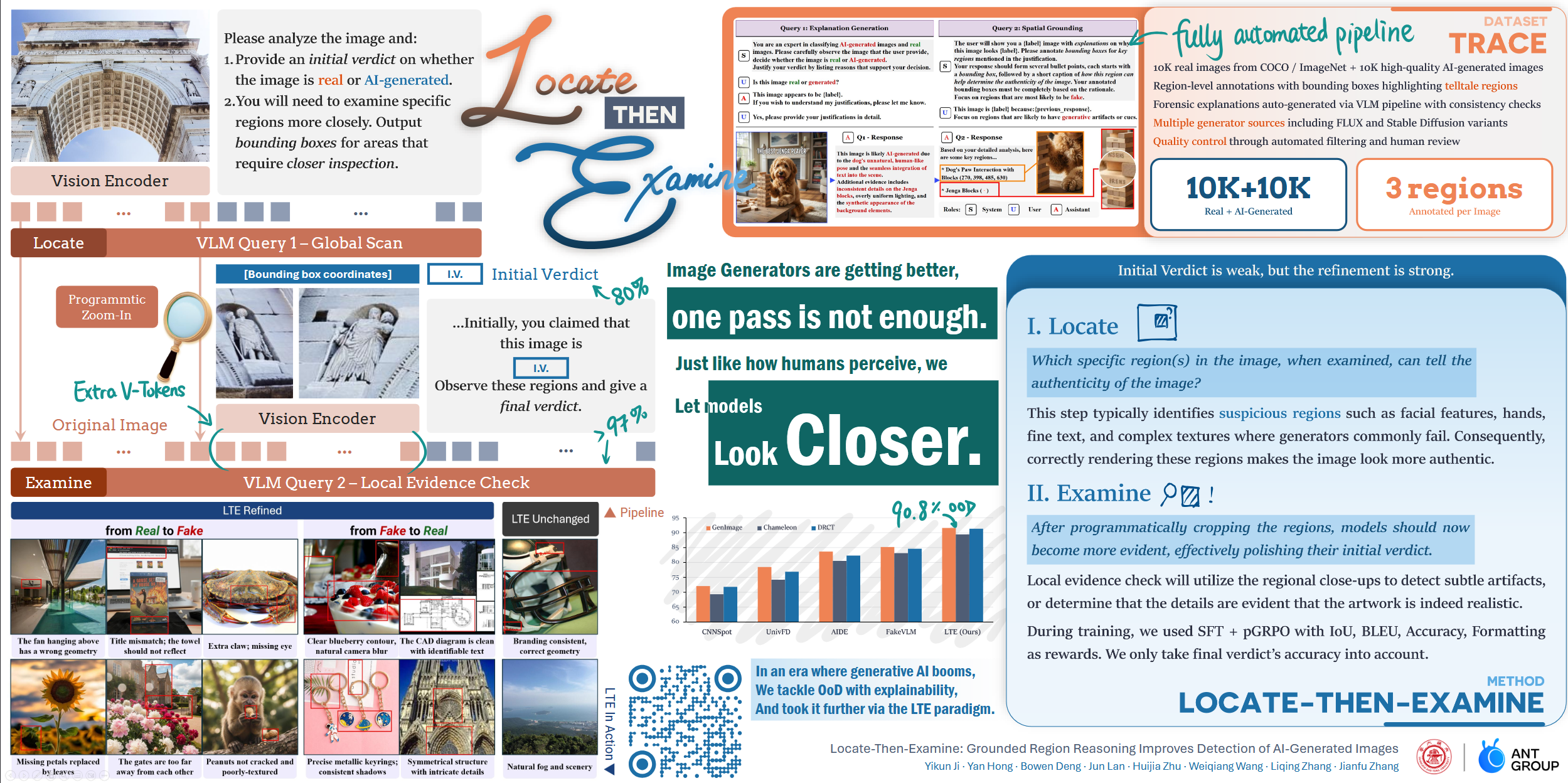
The rapid growth of AI-generated imagery has blurred the boundary between real and synthetic content, raising practical concerns for digital integrity. Vision-language models (VLMs) can provide natural language explanations, but standard one-pass classifiers often miss subtle artifacts in high-quality synthetic images and offer limited grounding in the pixels. We propose \textbf{Locate-Then-Examine} (LTE), a two-stage VLM-based forensic framework that first localizes suspicious regions and then re-examines these crops together with the full image to refine the real vs. AI-generated verdict and its explanation. LTE explicitly links each decision to localized visual evidence through region proposals and region-aware reasoning. To support training and evaluation, we introduce \textbf{TRACE}, a dataset of 20,000 real and high-quality synthetic images with region-level annotations and automatically generated forensic explanations, constructed by a VLM-based pipeline with additional consistency checks and quality control. Across TRACE and multiple external benchmarks, LTE achieves competitive accuracy and improved robustness while providing human-understandable, region-grounded explanations suitable for forensic deployment.
HUMORCHAIN: Theory-Guided Multi-Stage Reasoning for Interpretable Multimodal Humor Generation
Jiajun Zhang ⋅ Shijia Luo ⋅ Ruikang Zhang ⋅ Qi Su
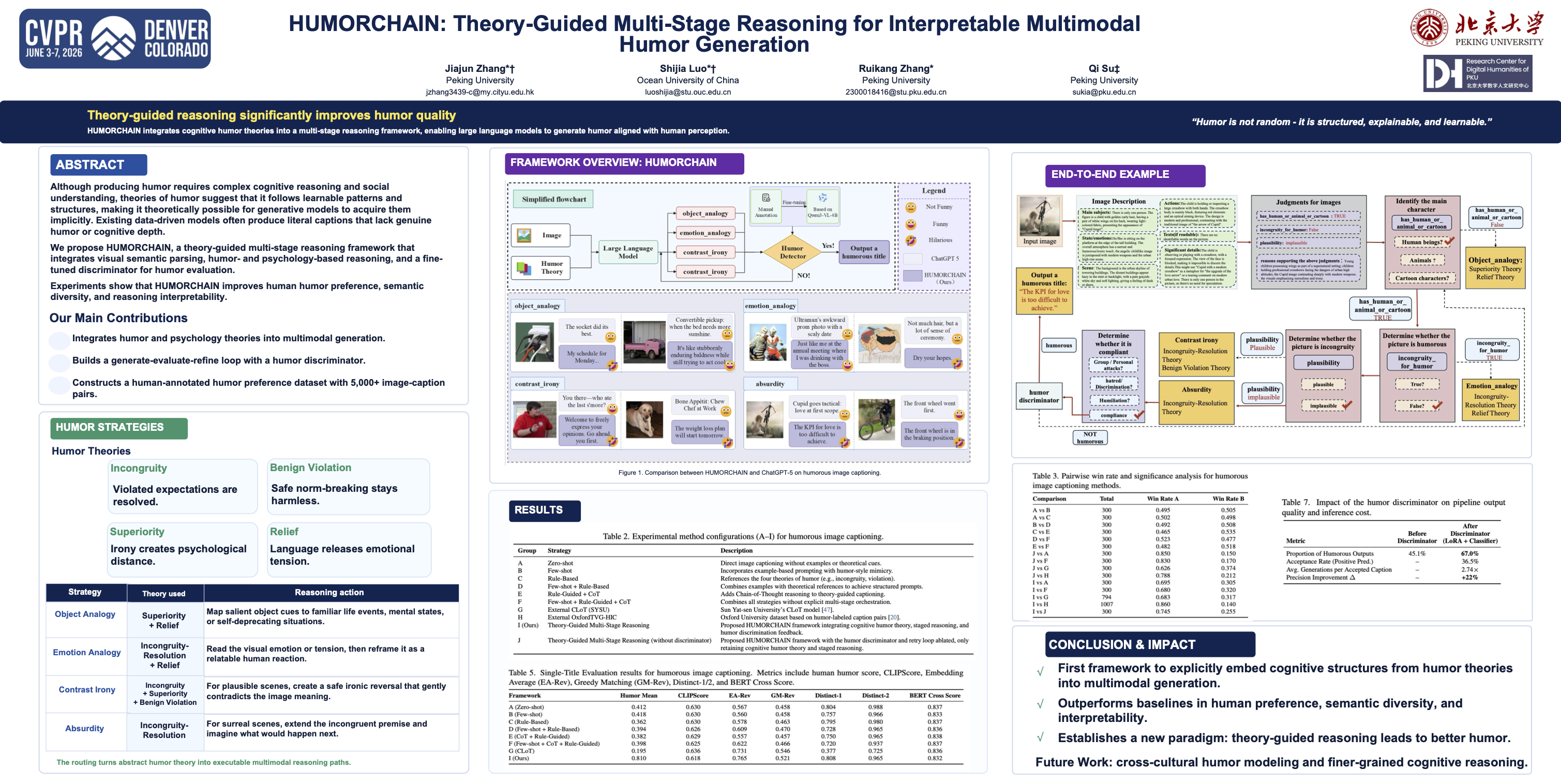
Humor, as both a creative human activity and a social binding mechanism, has long posed a major challenge for AI generation. Although producing humor requires complex cognitive reasoning and social understanding, theories of humor suggest that it follows learnable patterns and structures, making it theoretically possible for generative models to acquire them implicitly. In recent years, multimodal humor has become a prevalent form of online communication, especially among Gen Z, highlighting the need for AI systems capable of integrating visual understanding with humorous language generation. However, existing data-driven approaches lack explicit modeling or theoretical grounding of humor, often producing literal descriptions that fail to capture its underlying cognitive mechanisms, resulting in the generated image descriptions that are fluent but lack genuine humor or cognitive depth. To address this limitation, we propose HUMORCHAIN (HUmor-guided Multi-step Orchestrated Reasoning Chain for Image Captioning), a theory-guided multi-stage reasoning framework. It integrates visual semantic parsing, humor- and psychology-based reasoning, and a fine-tuned discriminator for humor evaluation, forming an interpretable and controllable cognitive reasoning chain. To the best of our knowledge, this is the first work to explicitly embed cognitive structures from humor theories into multimodal humor generation, enabling a structured reasoning process from visual understanding to humor creation. Experiments on Meme-Image-No-Text, Oogiri-GO, and OxfordTVG-HIC datasets show that HUMORCHAIN outperforms state-of-the-art baselines in human humor preference, Elo/BT scores, and semantic diversity, demonstrating that theory-driven structured reasoning enables large language models to generate humor aligned with human perception.
CodeDance: A Dynamic Tool-integrated MLLM for Executable Visual Reasoning
Qi Song ⋅ Honglin Li ⋅ Yingchen Yu ⋅ Haoyi Zhou ⋅ Lin Yang ⋅ Song Bai ⋅ Qi She ⋅ Zilong Huang ⋅ Yunqing Zhao
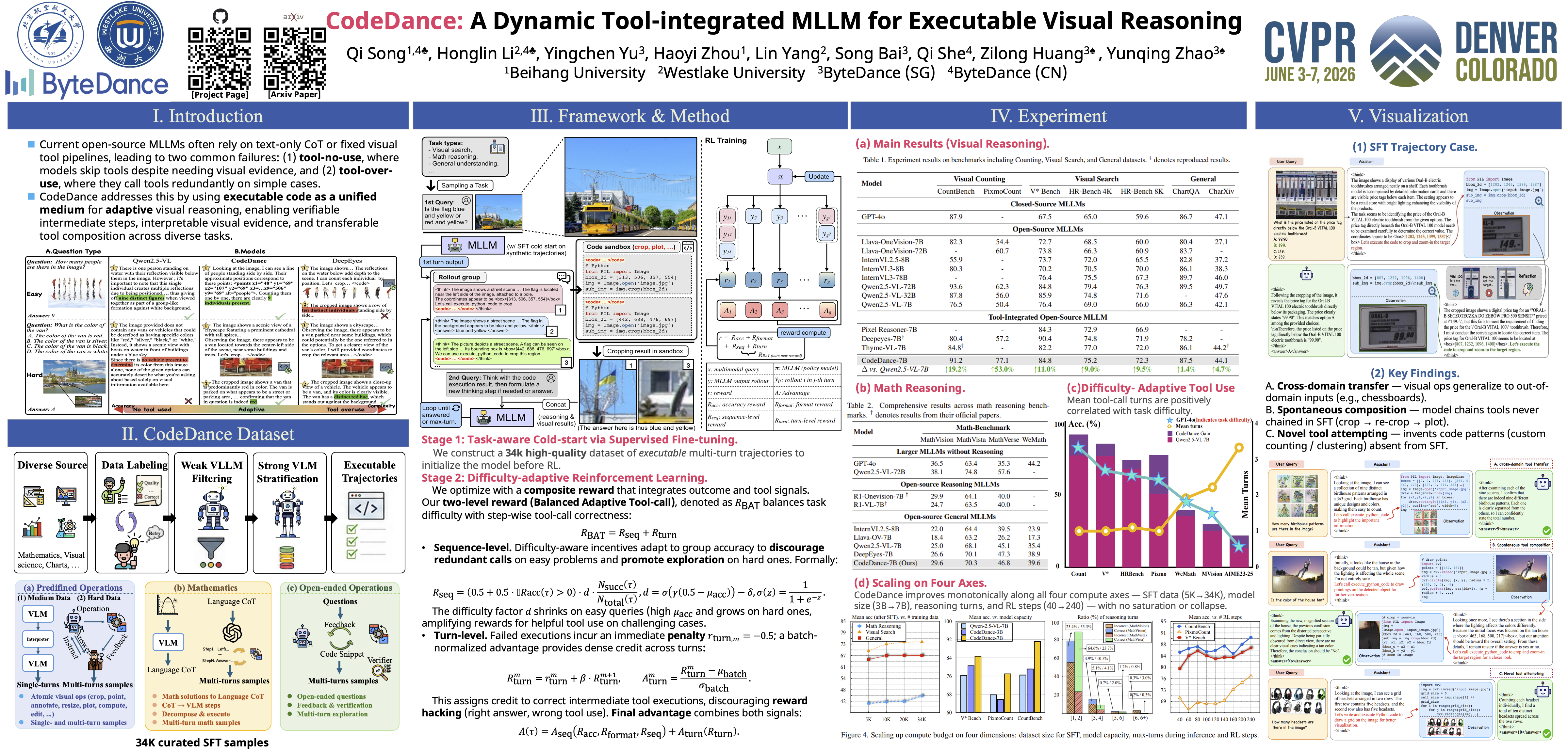
Recent releases such as o3 highlight human-like “thinking with images” reasoning that combines structured tool use with stepwise verification, yet most open-source approaches still rely on text-only chains, rigid visual schemas, or single-step pipelines, limiting flexibility, interpretability, and transferability on complex tasks.We introduce CodeDance, which explores executable code as a general solver for visual reasoning. Unlike fixed-schema calls (e.g., only predicting bounding-box coordinates), CodeDance defines, composes, and executes code to orchestrate multiple tools, compute intermediate results, and render visual artifacts (e.g., boxes, lines, plots) that support transparent, self-checkable reasoning.To guide this process, we introduce a reward for balanced and adaptive tool-call, which balances exploration with efficiency and mitigates tool overuse.Interestingly, beyond the expected capabilities taught by atomic supervision, we empirically observe novel emergent behaviors during RL training: CodeDance demonstrates novel tool invocations, unseen compositions, and cross-task transfer. These behaviors arise without task-specific fine-tuning, suggesting a general and scalable mechanism of executable visual reasoning.Extensive experiments across reasoning benchmarks (e.g., visual search, math, chart QA) show that CodeDance not only consistently outperforms schema-driven and text-only baselines, but also surpasses advanced closed models such as GPT-4o and larger open-source models. Our code is available.
Rethinking MLLM Itself as a Segmenter with a Single Segmentation Token
Anqi Zhang ⋅ Xiaokang Ji ⋅ Guangyu Gao ⋅ Jianbo Jiao ⋅ Chi Harold Liu ⋅ Yunchao Wei
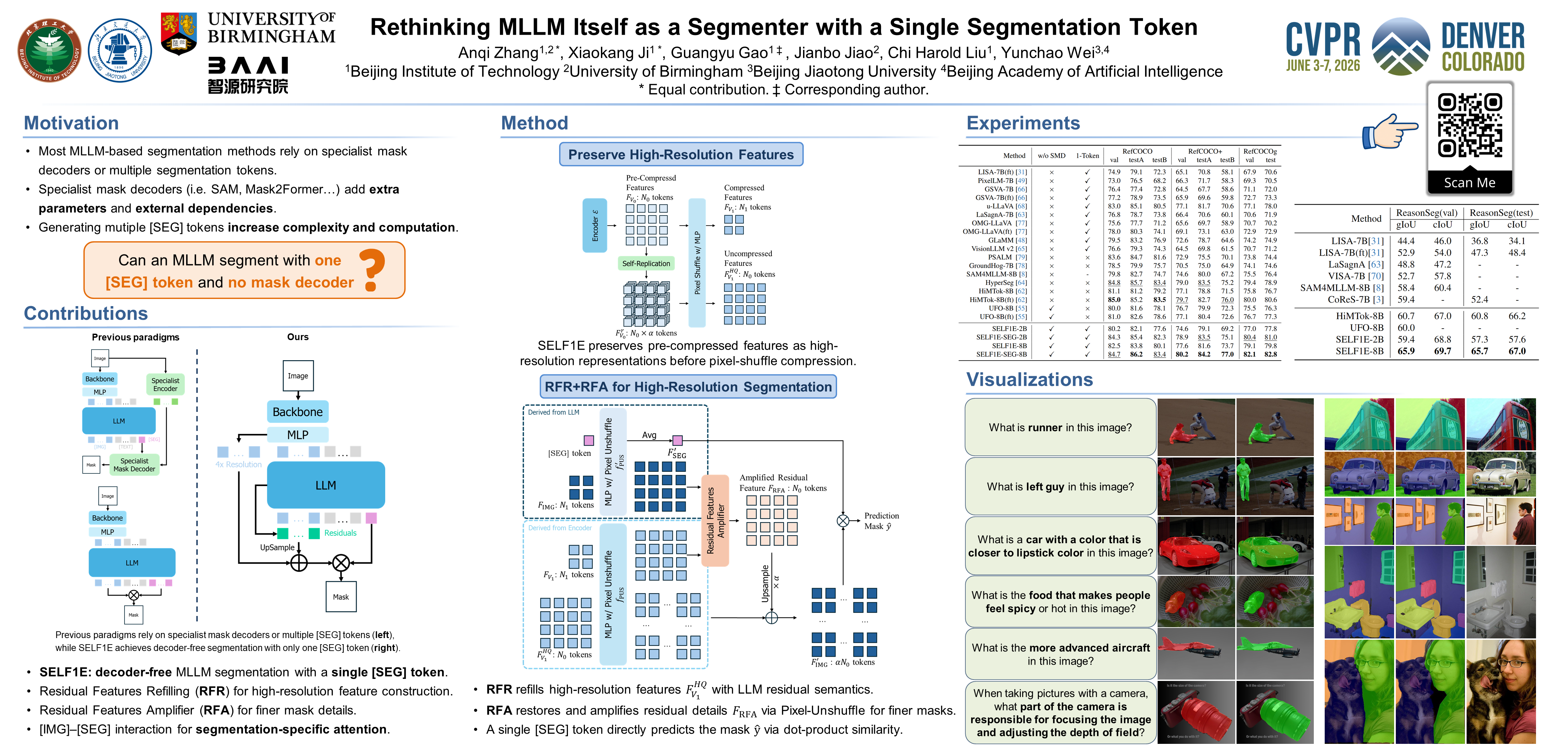
Recent segmentation methods leveraging Multi-modal Large Language Models (MLLMs) have shown reliable object-level segmentation and enhanced spatial perception. However, almost all previous methods predominantly rely on specialist mask decoders to interpret masks from generated segmentation-related embeddings and visual features, or incorporate multiple additional tokens to assist. This paper aims to investigate whether and how we can unlock segmentation from MLLM itSELF with 1 segmentation Embedding~(SELF1E) while achieving competitive results, which eliminates the need for external decoders. To this end, our approach targets the fundamental limitation of resolution reduction in pixel-shuffled image features from MLLMs. First, we retain image features at their original uncompressed resolution, and refill them with residual features extracted from MLLM-processed compressed features, thereby improving feature precision. Subsequently, we integrate pixel-unshuffle operations on image features with and without MLLM processing, respectively, to unleash the details of compressed features and simulate the residual features under uncompressed resolution, which further enhances the resolution of refilled features. Moreover, we redesign the attention mask with dual perception pathways, i.e., image-to-image and image-to-segmentation, enabling rich feature interaction between pixels and the segmentation token. Comprehensive experiments across multiple segmentation tasks validate that SELF1E achieves performance competitive with specialist mask decoder-based methods, demonstrating the feasibility of decoder-free segmentation in MLLMs.
Video-Only ToM: Enhancing Theory of Mind in Multimodal Large Language Models
SIQI LIU ⋅ Xinyang Li ⋅ Bochao Zou ⋅ Junbao Zhuo ⋅ Huimin Ma ⋅ Jiansheng Chen
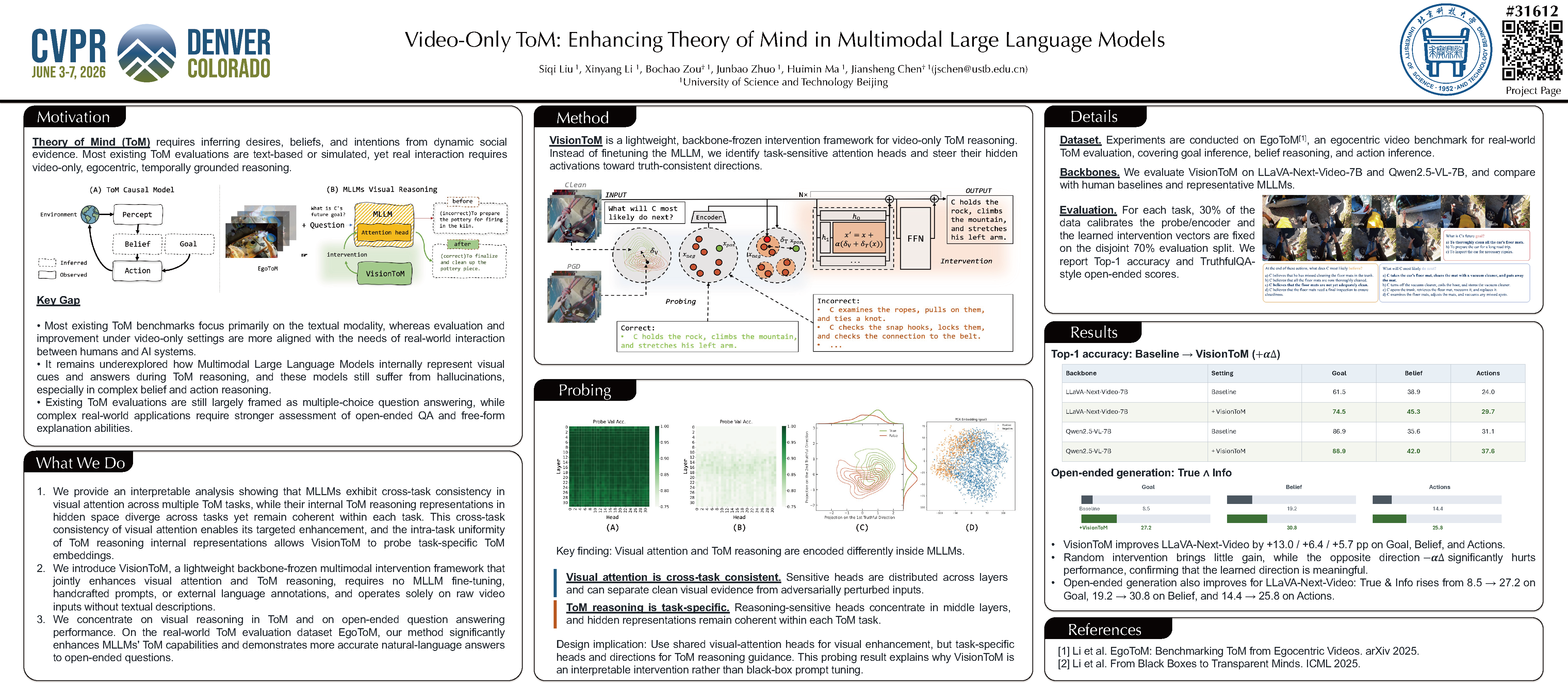
As large language models (LLMs) continue to advance, there is increasing interest in their ability to infer human mental states and demonstrate a human-like Theory of Mind (ToM). Most existing ToM evaluations, however, are centered on text-based inputs, while scenarios relying solely on visual information receive far less attention. This leaves a gap, since real-world human–AI interaction typically requires multimodal understanding. In addition, many current methods regard the model as a black box and rarely probe how its internal attention behaves in multiple-choice question answering (QA). The impact of LLM hallucinations on such tasks is also underexplored from an interpretability perspective. To address these issues, we introduce VisionToM, a vision-oriented intervention framework designed to strengthen task-aware reasoning. The core idea is to compute intervention vectors that align visual representations with the correct semantic targets, thereby steering the model's attention through different layers of visual features. This guidance reduces the model's reliance on spurious linguistic priors, leading to more reliable multimodal language model (MLLM) outputs and better QA performance. Experiments on the EgoToM benchmark—an egocentric, real-world video dataset for ToM with three multiple-choice QA settings—demonstrate that our method substantially improves the ToM abilities of MLLMs. Furthermore, results on an additional open-ended generation task show that VisionToM enables MLLMs to produce free-form explanations that more accurately capture agents' mental states, pushing machine–human collaboration toward greater alignment.
Mario: Multimodal Graph Reasoning with Large Language Models
Yuanfu Sun ⋅ Kang Li ⋅ Pengkang Guo ⋅ Jiajin Liu ⋅ Qiaoyu Tan
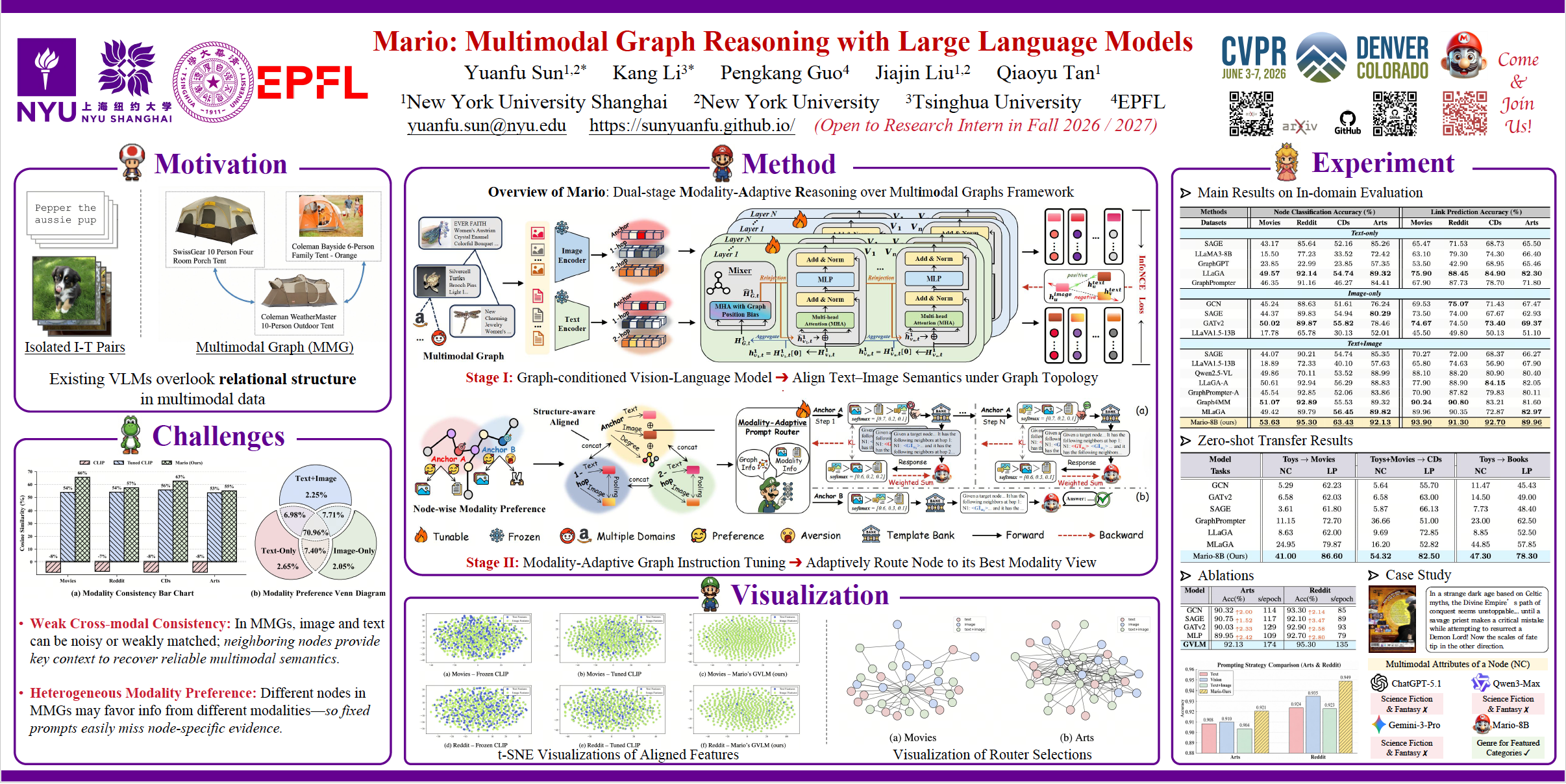
Recent advances in large language models (LLMs) have opened new avenues for multimodal reasoning. Yet, most existing methods still rely on pretrained vision–language models (VLMs) to encode image–text pairs in isolation, ignoring the relational structure that real-world multimodal data naturally form. This motivates reasoning on multimodal graphs (MMGs), where each node has textual and visual attributes and edges provide structural cues. Enabling LLM-based reasoning on such heterogeneous multimodal signals while preserving graph topology introduces two key challenges: resolving weak cross-modal consistency and handling heterogeneous modality preference. To address this, we propose Mario, a unified framework that simultaneously resolves the two above challenges and enables effective LLM-based reasoning over MMGs. Mario consists of two innovative stages. Firstly, a graph-conditioned VLM design that jointly refines textual and visual features through fine-grained cross-modal contrastive learning guided by graph topology. Secondly, a modality-adaptive graph instruction tuning mechanism that organizes aligned multimodal features into graph-aware instruction views and employs a learnable router to surface, for each node and its neighborhood, the most informative modality configuration to the LLM. Extensive experiments across diverse MMG benchmarks demonstrate that Mario consistently outperforms state-of-the-art graph models in both supervised and zero-shot scenarios for node classification and link prediction. The code is available in supplementary materials.
Boosting Reasoning in Large Multimodal Models via Activation Replay
Yun Xing ⋅ Xiaobin Hu ⋅ Qingdong He ⋅ Jiangning Zhang ⋅ Shuicheng Yan ⋅ Shijian Lu ⋅ Yu-Gang Jiang
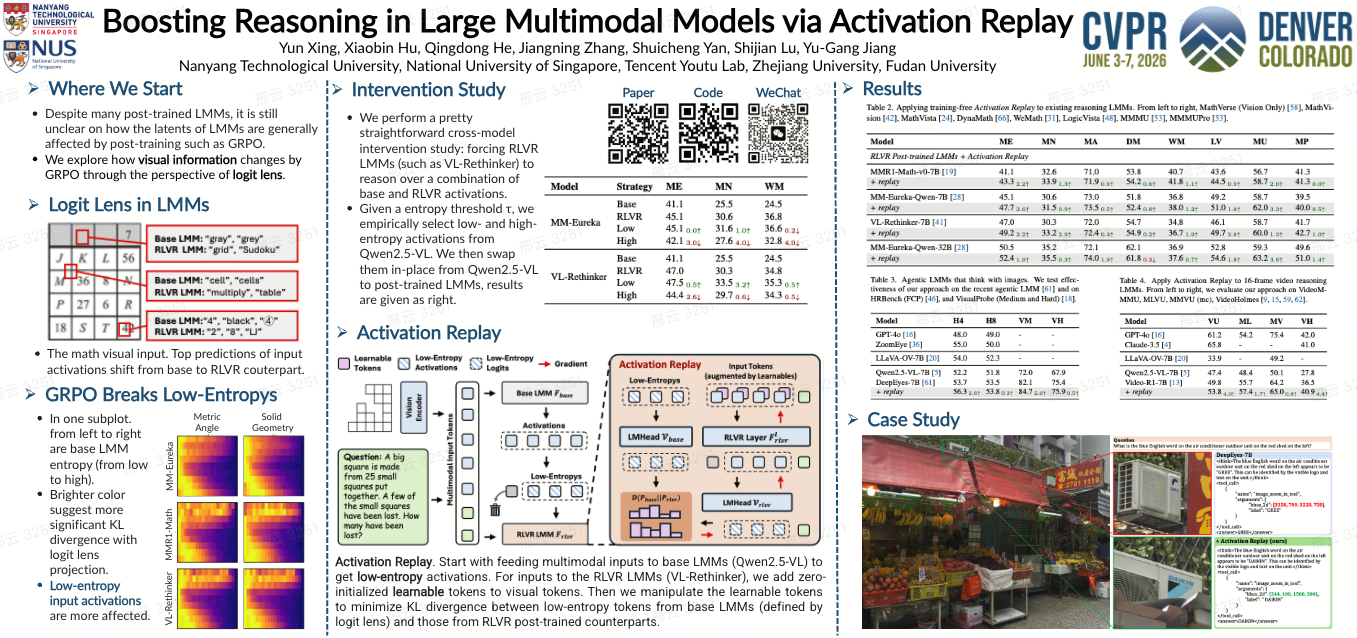
Recently, Reinforcement Learning with Verifiable Rewards (RLVR) has emerged as an effective approach to incentivizing reasoning capability in Large Multimodal Models (LMMs), while the underlying mechanisms behind this post-training paradigm are poorly understood. We begin by exploring how input activations are affected by RLVR through the perspective of logit lens. Our systematic investigations across multiple post-trained LMMs suggest that RLVR shifts low-entropy activations unexpectedly, while high-entropy ones are less affected. We further demonstrate that such phenomena are associated with LMM reasoning by controlled experiments, suggesting a potentially beneficial role of modulating low-entropy activations. To this end, we propose Activation Replay, a novel simple yet effective training-free approach that boosts multimodal reasoning of post-trained LMMs without requiring expensive policy optimization. Our design involves manipulation of visual tokens at test time, replaying low-entropy activations from the input context of base LMMs to regulating the RLVR counterparts. Activation Replay triggers better reasoning across diverse scenarios, including mathematics, o3-like visual agents, and video reasoning. We further show that Activation Replay boosts Pass@K and mitigates narrower reasoning coverage of RLVR. Our design is compared against alternative choices, such as replaying high-entropy activations instead of low-entropy ones, or direct cross-model intervention instead of manipulating input tokens, demonstrating the superiority of our implementation. Codes will be made publicly available.
Rationale-Enhanced Decoding for Multi-modal Chain-of-Thought
Shin'ya Yamaguchi ⋅ Kosuke Nishida ⋅ Daiki Chijiwa
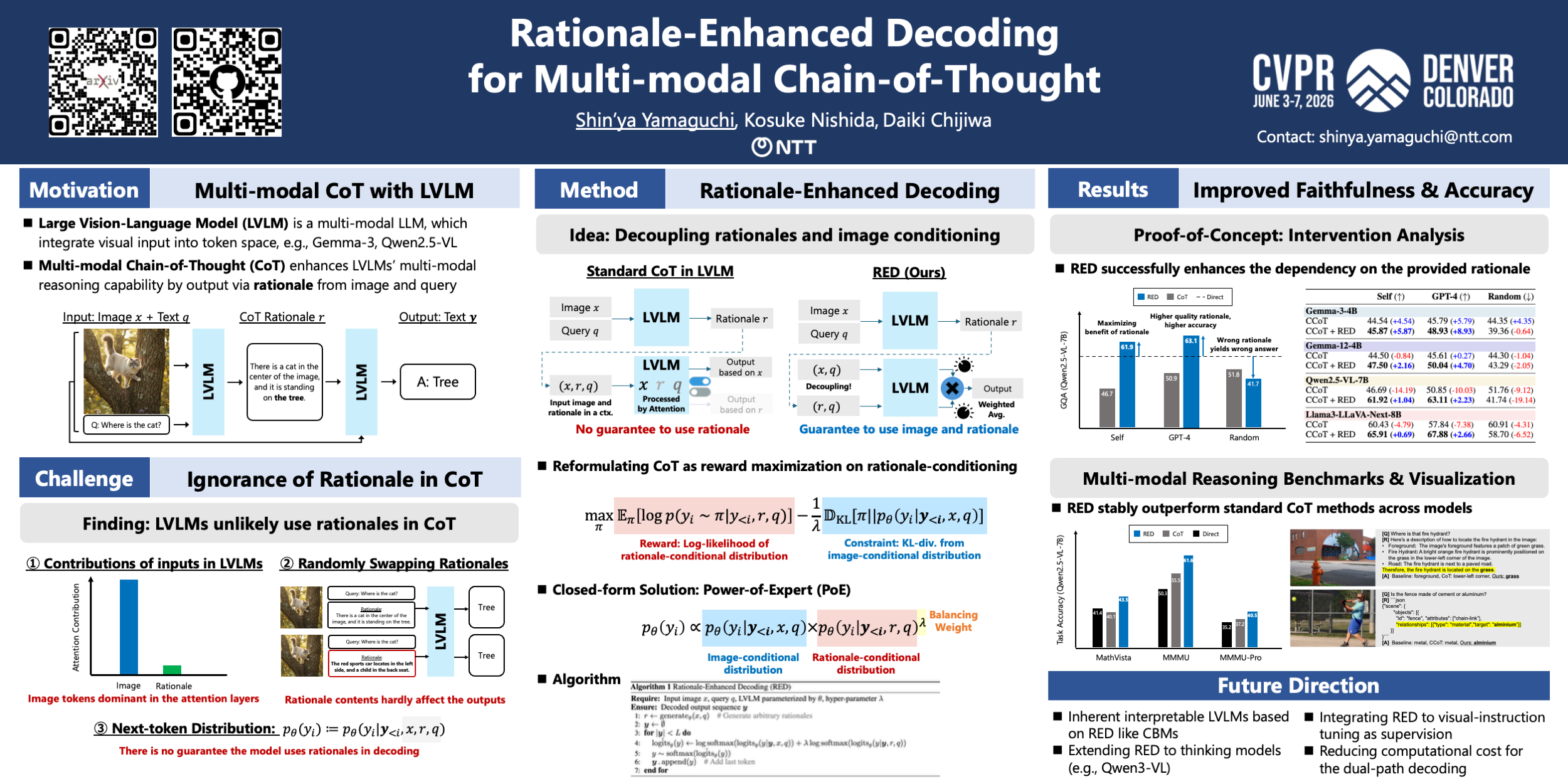
Large vision-language models (LVLMs) have demonstrated remarkable capabilities by integrating pre-trained vision encoders with large language models (LLMs). Similar to single-modal LLMs, chain-of-thought (CoT) prompting has been adapted for LVLMs to enhance multi-modal reasoning by generating intermediate rationales based on visual and textual inputs. While CoT is assumed to improve grounding and accuracy in LVLMs, our experiments reveal a key challenge: existing LVLMs often ignore the contents of generated rationales in CoT reasoning. To address this, we re-formulate multi-modal CoT reasoning as a KL-constrained reward maximization focused on rationale-conditional log-likelihood. As the optimal solution, we propose rationale-enhanced decoding (RED), a novel plug-and-play inference-time decoding strategy. RED harmonizes visual and rationale information by multiplying distinct image-conditional and rationale-conditional next token distributions. Extensive experiments show that RED consistently and significantly improves reasoning over standard CoT and other decoding methods across multiple benchmarks and LVLMs. Our work offers a practical and effective approach to improve both the faithfulness and accuracy of CoT reasoning in LVLMs, paving the way for more reliable rationale-grounded multi-modal systems.
Mimic Human Cognition, Master Multi-Image Reasoning: A Meta-Action Framework for Enhanced Visual Understanding
Jianghao Yin ⋅ Qingbin Li ⋅ KUN SUN ⋅ Cheng Ding ⋅ Jie Wang ⋅ Qin Chen ⋅ Jie Zhou ⋅ Nan Wang ⋅ Changqing Li ⋅ Pei Wu ⋅ Jian Xu ⋅ Zheming Yang ⋅ Liang He
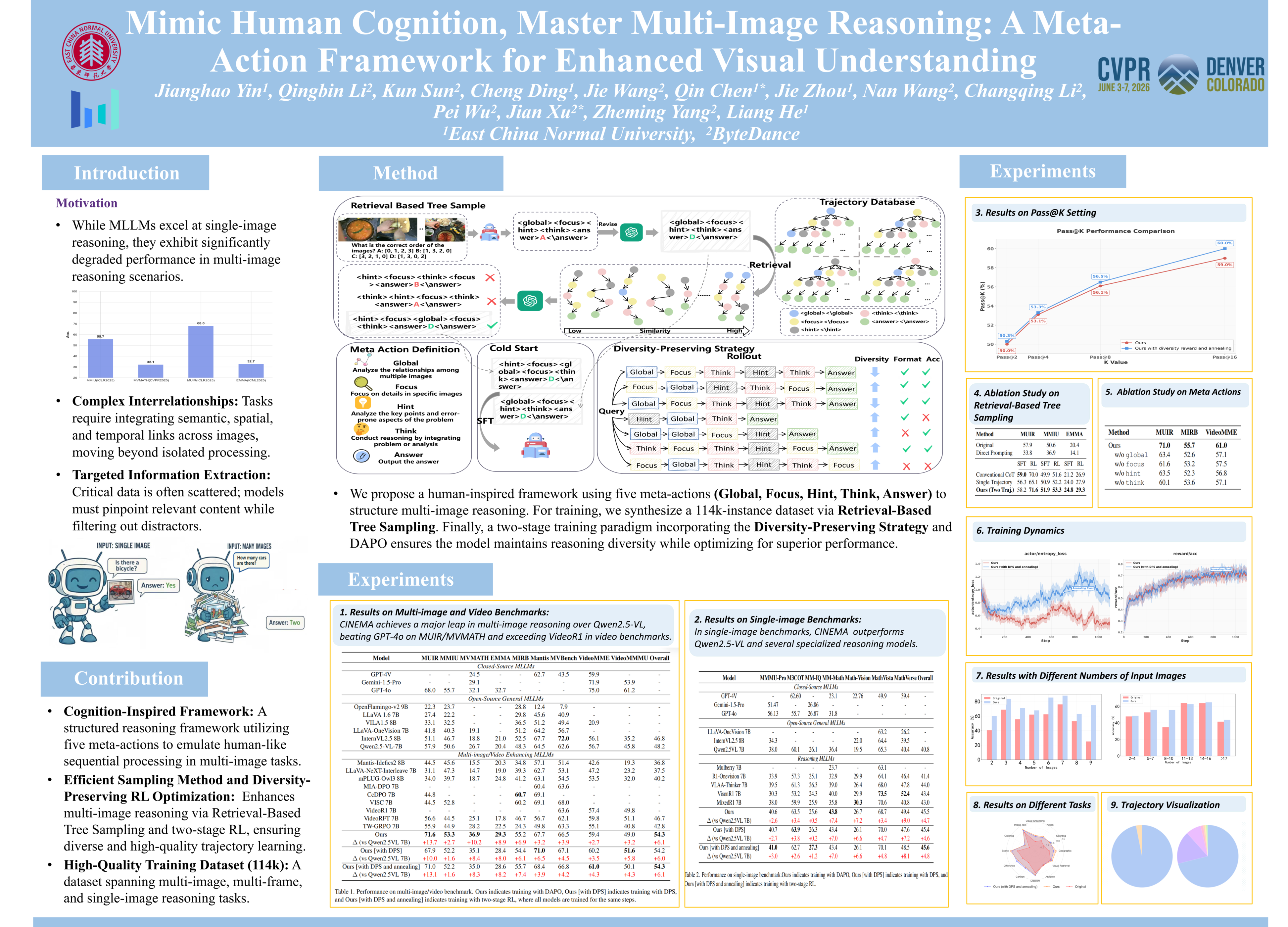
While Multimodal Large Language Models (MLLMs) excel at single-image understanding, they exhibit significantly degraded performance in multi-image reasoning scenarios. Multi-image reasoning presents fundamental challenges including complex inter-relationships between images and scattered critical information across image sets. Inspired by human cognitive processes, we propose the Cognition-Inspired Meta-Action Framework (CINEMA), a novel approach that decomposes multi-image reasoning into five structured meta-actions: Global, Focus, Hint, Think, and Answer which explicitly modeling the sequential cognitive steps humans naturally employ.For cold-start training, we introduce a Retrieval-Based Tree Sampling strategy that generates high-quality meta-action trajectories to bootstrap the model with reasoning patterns. During reinforcement learning, we adopt a two-stage paradigm: an exploration phase with Diversity-Preserving Strategy to avoid entropy collapse, followed by an annealed exploitation phase with DAPO to gradually strengthen exploitation.To train our model, we construct a dataset of 57k cold-start and 58k reinforcement learning instances spanning multi-image, multi-frame, and single-image tasks. We conduct extensive evaluations on multi-image reasoning benchmarks, video understanding benchmarks, and single-image benchmarks, achieving competitive state-of-the-art performance on several key benchmarks. Our model surpasses GPT-4o on the MUIR and MVMath benchmarks and notably outperforms specialized video reasoning models on video understanding benchmarks, demonstrating the effectiveness and generalizability of our human cognition-inspired reasoning framework.
ROSE: Rotate Your Large Language Model to See
Tongtian Yue ⋅ Xuange Gao ⋅ Longteng Guo ⋅ Zijia Zhao ⋅ Zikang Liu ⋅ Jie Jiang ⋅ Hua Huang ⋅ Jing Liu
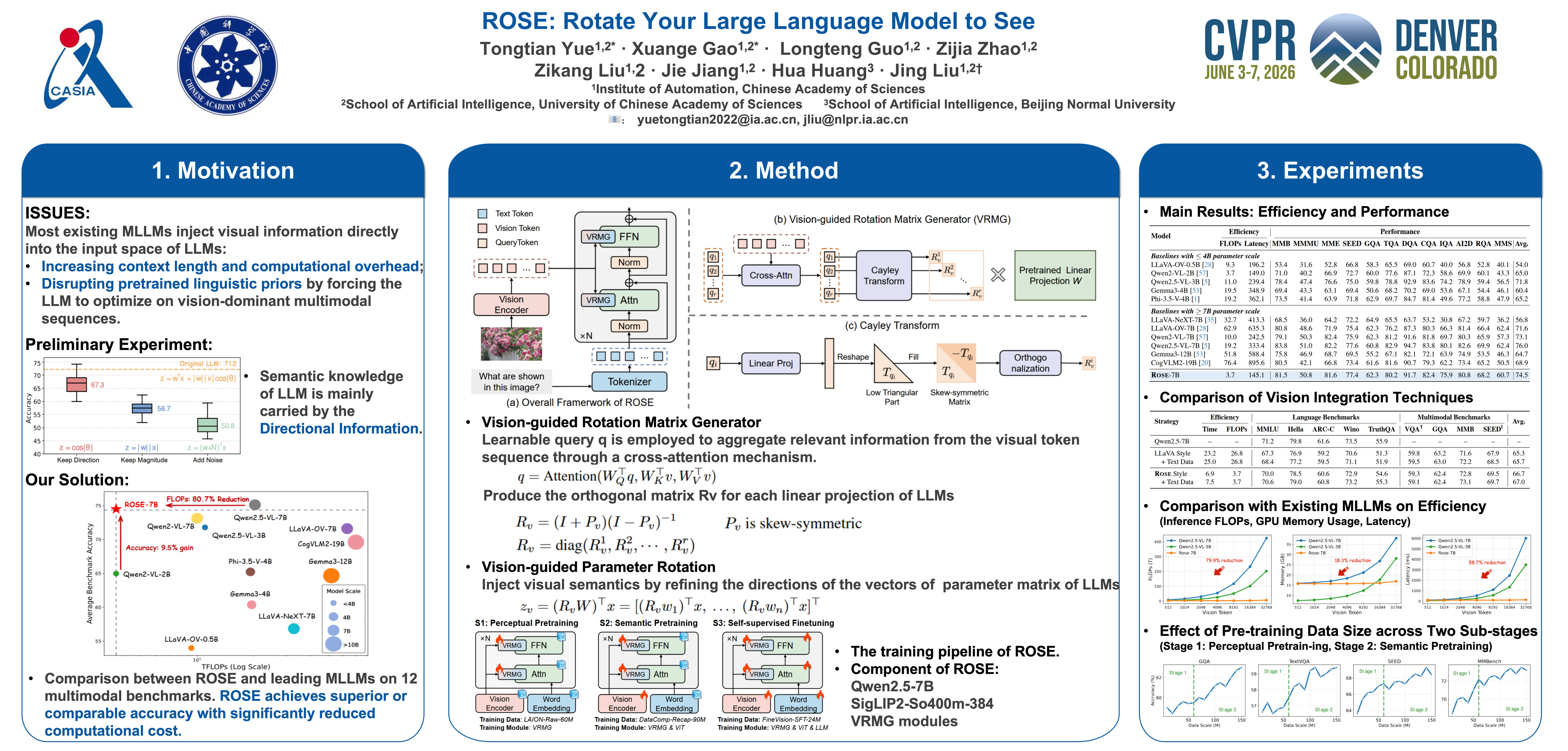
Recent advances in multimodal large language models (MLLMs) have shown impressive progress in integrating visual and linguistic understanding. However, most existing MLLMs inject visual information into the input space of large language models (LLMs), which substantially increases context length and computational overhead, while often disrupting pretrained linguistic priors by forcing the LLM to optimize on vision-dominant multimodal sequences. In this work, we propose a rotation-based vision injection paradigm that aligns visual information with the parameter space of LLMs. Visual semantics are encoded as rotation matrices and applied directly to the pretrained parameters. This parameter-space injection eliminates the need for long input sequences, thus avoiding the quadratic computational overhead inherent in input-space injection. Besides, it preserves the linguistic competence of the LLM by maintaining the intrinsic geometric structure of the pretrained parameters. Building upon this paradigm, we develop ROSE, a 7B MLLM that achieves fine-grained vision–language alignment with remarkable computational efficiency. Extensive experiments across 12 multimodal benchmarks show that ROSE delivers superior or competitive performance compared with leading models.At comparable accuracy, ROSE reduces FLOPs by 80.7% and inference latency by 56.4% relative to Qwen2.5-VL-7B, demonstrating the effectiveness and scalability. All training code, model weights and data will be publicly released.
OpenMMReasoner: Pushing the Frontiers in Multimodal Reasoning with an Open and General Recipe
Kaichen Zhang ⋅ Keming Wu ⋅ Zuhao Yang ⋅ Bo Li ⋅ Kairui Hu ⋅ Bin Wang ⋅ Xingxuan Li ⋅ Lidong Bing
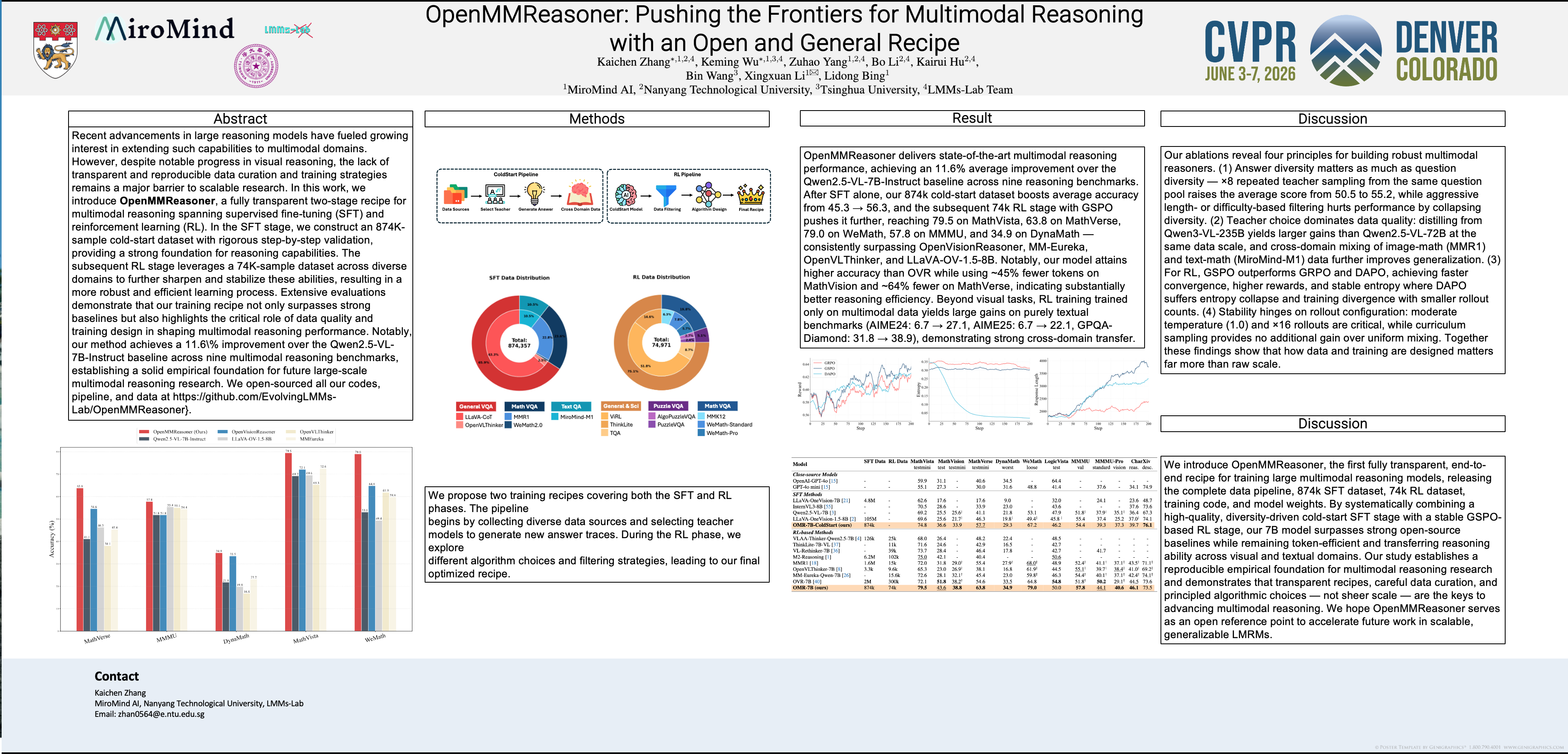
Recent advancements in reasoning language models have fueled growing interest in extending such capabilities to multimodal domains. However, despite notable progress in visual and video reasoning, the lack of transparent and reproducible data curation and training pipelines remains a major barrier to scalable research. In this work, we introduce OpenMMReasoner, a fully transparent two-stage recipe for multimodal reasoning spanning supervised fine-tuning (SFT) and reinforcement learning (RL). In the SFT stage, we construct an 874k-sample cold-start dataset with rigorous step-by-step validation, providing a strong foundation for reasoning capabilities. The subsequent RL stage leverages a 74k-sample dataset across diverse domains to further sharpen and stabilize these abilities, resulting in a more robust and efficient learning process. Extensive evaluations demonstrate that our training recipe not only surpasses strong baselines but also highlights the critical role of data quality and training design in shaping multimodal reasoning performance. Notably, our method achieves a 9.5\% improvement over the Qwen2.5-VL-7B-Instruct baseline across nine multimodal reasoning benchmarks, establishing a solid empirical foundation for future large-scale multimodal reasoning research.
SelecTKD: Selective Token-Weighted Knowledge Distillation for LLMs
Haiduo Huang ⋅ Jiangcheng Song ⋅ Yadong Zhang ⋅ Pengju Ren
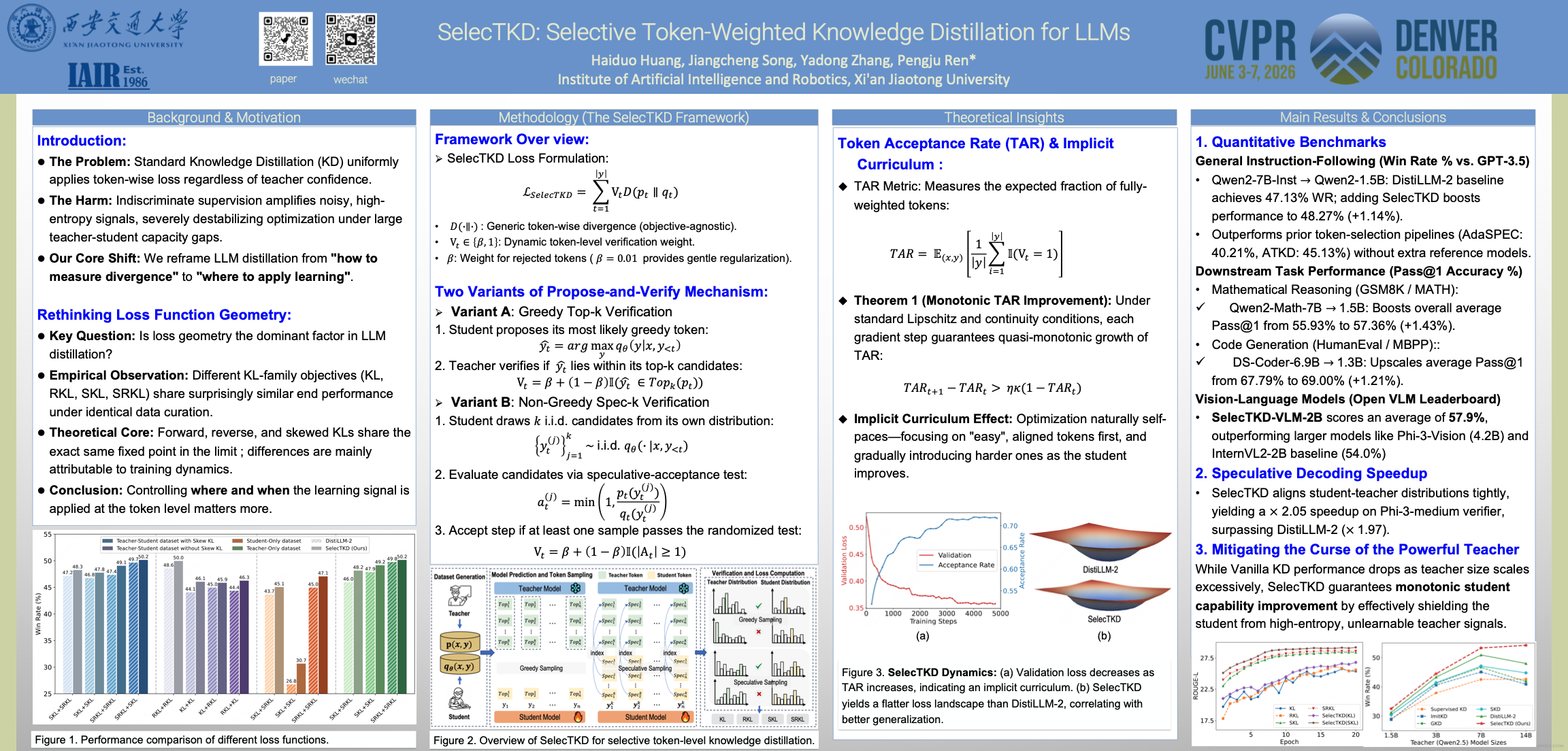
Knowledge distillation (KD) is a standard route to compress Large Language Models (LLMs) into compact students, yet most pipelines uniformly apply token-wise loss regardless of teacher confidence. This indiscriminate supervision amplifies noisy, high-entropy signals and is especially harmful under large teacher-student capacity gaps. We introduce SelecTKD, a plug-and-play Selective Token-Weighted distillation framework that shifts the focus from "how to measure divergence'' to "where to apply learning". At each step, the student proposes tokens that are verified by the teacher through a robust propose-and-verify procedure with two variants: greedy Top-$k$ and non-greedy Spec-$k$. Accepted tokens receive full loss, while rejected tokens are masked or down-weighted. This objective-agnostic design works with on- and off-policy data, induces an implicit curriculum quantified by Token Acceptance Rate (TAR), and stabilizes optimization. Across instruction following, mathematical reasoning, code generation, and a VLM setting, SelecTKD consistently improves strong baselines and achieves state-of-the-art results for small models—without architectural changes or extra reference models.
Sparsity as a Key: Unlocking New Insights from Latent Structures for Out-of-Distribution Detection
Ahyoung Oh ⋅ Wonseok Shin ⋅ Songkuk Kim
Sparse Autoencoders (SAEs) have demonstrated significant success in interpreting Large Language Models (LLMs) by decomposing dense representations into sparse, semantic components. However, their potential for analyzing Vision Transformers (ViTs) remains largely under-explored. In this work, we present the first application of SAEs to the ViT [CLS] token for out-of-distribution (OOD) detection, addressing the limitation of existing methods that rely on entangled feature representations. We propose a novel framework utilizing a Top-k SAE to disentangle the dense [CLS] features into a structured latent space. Through this analysis, we reveal that in-distribution (ID) data exhibits consistent, class-specific activation patterns, which we formalize as Class Activation Profiles (CAPs). Our study uncovers a key structural invariant: while ID samples preserve a stable pattern within CAPs, OOD samples systematically disrupt this structure. Leveraging this insight, we introduce a scoring function based on the divergence of core energy profiles to quantify the deviation from ideal activation profiles. Our method establishes new state-of-the-art results on the FPR95 metric—critical for safety-sensitive applications—across multiple benchmarks, while also achieving competitive AUROC. Overall, our findings demonstrate that the sparse, disentangled features revealed by SAEs can serve as a powerful, interpretable tool for robust OOD detection in vision models.
SparVAR: Exploring Sparsity in Visual AutoRegressive Modeling for Training-Free Acceleration
Zekun Li ⋅ wang ning ⋅ Tongxin Bai ⋅ Changwang Mei ⋅ Ning Wang ⋅ Shuang Qiu ⋅ Jian Cheng
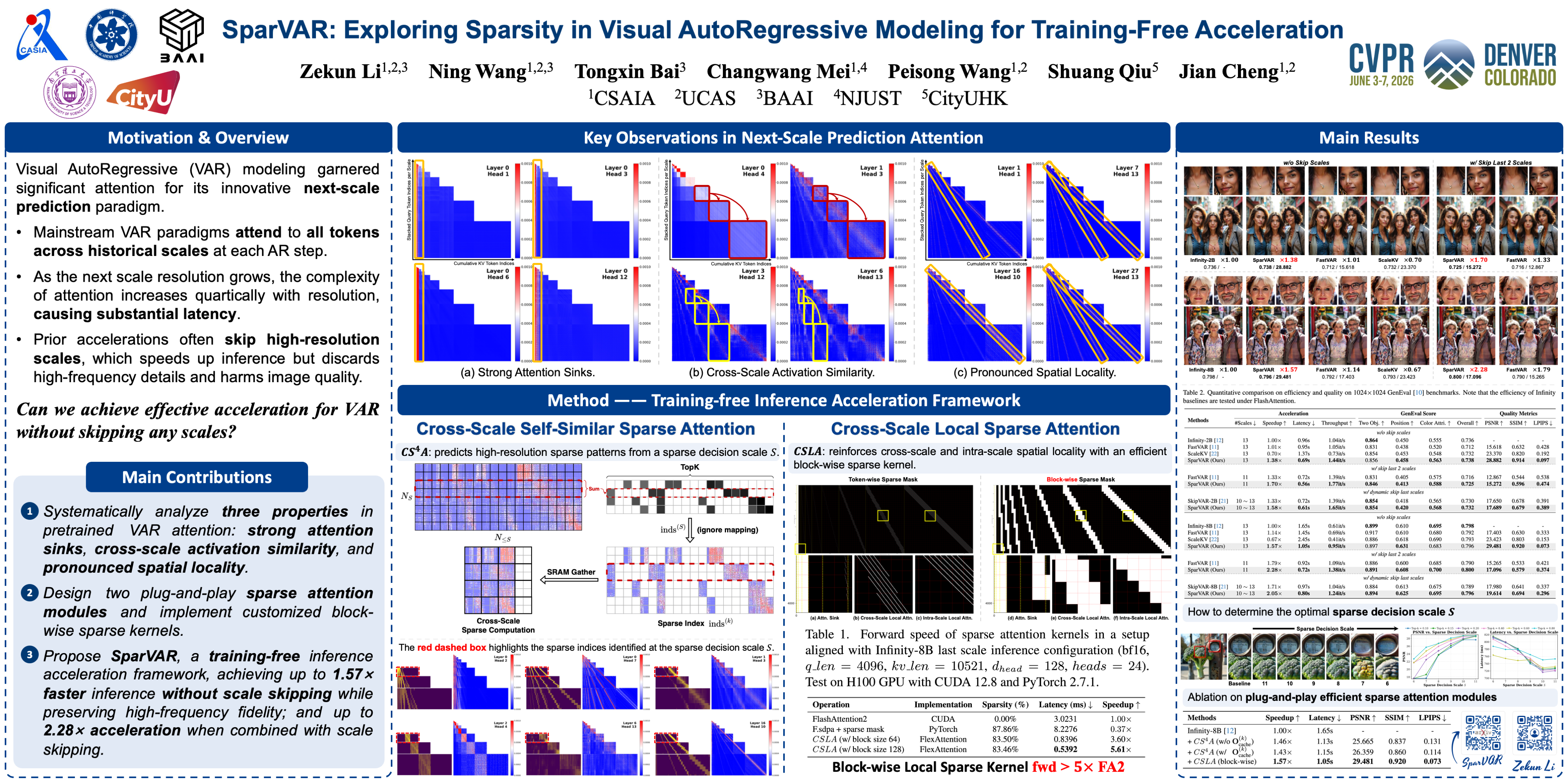
Visual AutoRegressive (VAR) modeling has garnered significant attention for its innovative next-scale prediction paradigm.However, mainstream VAR paradigms attend to all tokens across historical scales at each autoregressive step. As the next scale resolution grows, the computational complexity of attention increases quartically with resolution, causing substantial latency.Prior accelerations often skip high-resolution scales, which speeds up inference but discards high-frequency details and harms image quality.To address these problems, we present \textbf{SparseVAR}, a training-free acceleration framework that exploits three properties of VAR attention: \textbf{(i) strong attention sinks}, \textbf{(ii) cross-scale activation similarity}, and \textbf{(iii) pronounced locality}.Specifically, we dynamically predict the sparse attention pattern of later high-resolution scales from a sparse decision scale, and construct scale self-similar sparse attention via an efficient index-mapping mechanism, enabling high-efficiency sparse attention computation at large scales.Furthermore, we propose cross-scale local sparse attention and implement an efficient block-wise sparse kernel, which achieves $\mathbf{> 5\times}$ faster forward speed than FlashAttention.Extensive experiments demonstrate that the proposed SparseVAR can reduce the generation time of an 8B model producing $1024\times1024$ high-resolution images to the \textbf{1s}, \textbf{without skipping the last scales}.Compared with the VAR baseline accelerated by FlashAttention, our method achieves a $\mathbf{1.57\times}$ speed-up while preserving almost all high-frequency details. When combined with existing scale-skipping strategies, SparseVAR attains up to a $\mathbf{2.28\times}$ acceleration, while maintaining competitive visual generation quality.
Suppressing Non-Semantic Noise in Masked Image Modeling Representations
Martine Hjelkrem-Tan ⋅ Marius Aasan ⋅ Rwiddhi Chakraborty ⋅ Gabriel Y. Arteaga ⋅ Changkyu Choi ⋅ Adín Ramírez Rivera
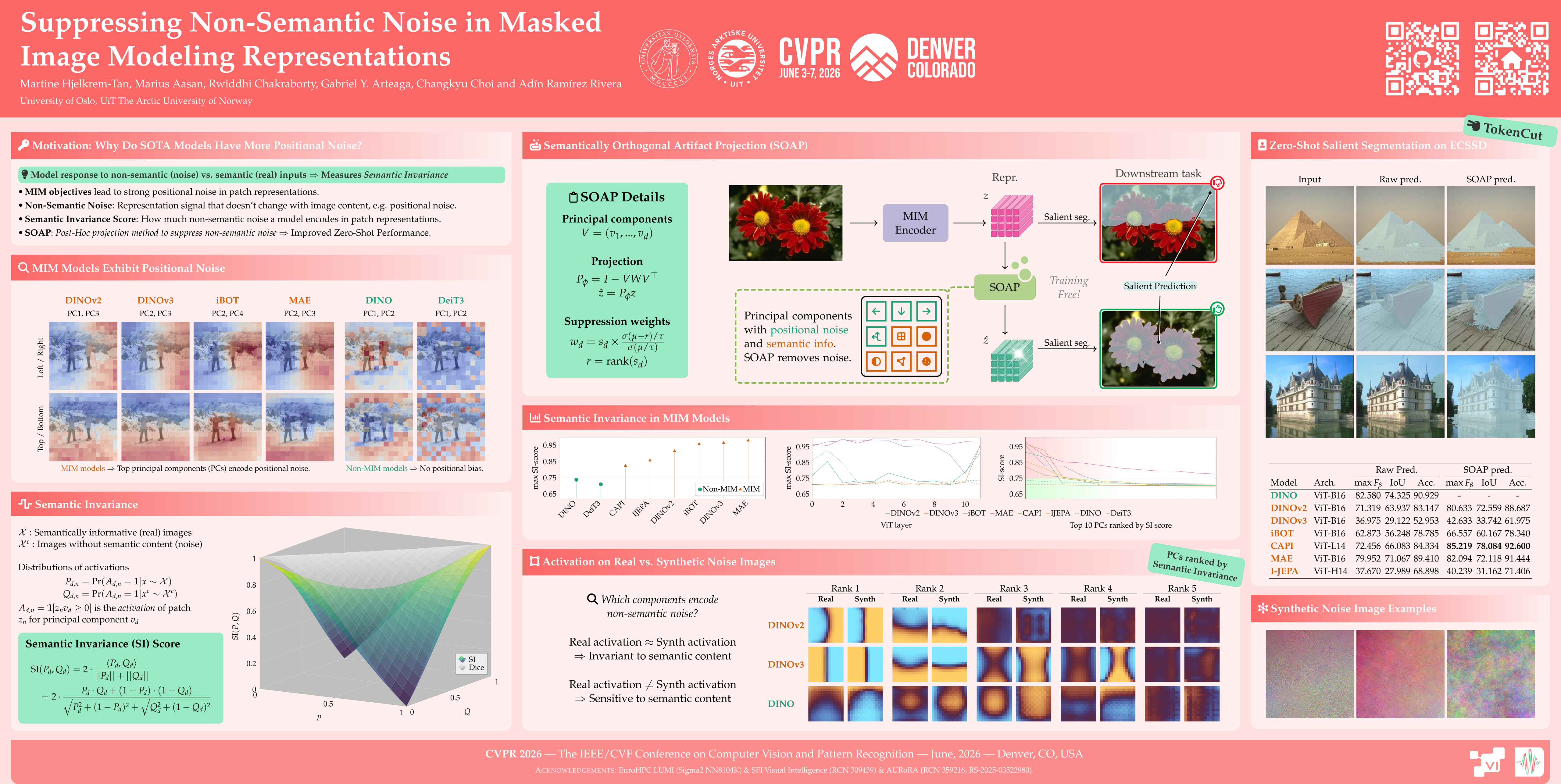
Masked Image Modeling (MIM) has become a ubiquitous self-supervised vision paradigm. In this work, we show that MIM objectives cause the learned representations to retain non-semantic information, which ultimately hurts performance during inference. We introduce a model-agnostic score for semantic invariance using Principal Component Analysis (PCA) on real and synthetic non-semantic images. Based on this score, we propose a simple method, Semantic Orthogonal Projection (SOaP), to directly suppress non-semantic information in patch representations, leading to consistent improvements in zero-shot performance across various MIM-based models. SOaP is a post-hoc suppression method, requires zero training, and can be attached to any model as a single linear head.
Block-based Learned Image Compression without Blocking Artifacts
Jong Wook Kim ⋅ Suyong Bahk ⋅ TaeHwa Lee ⋅ HyunDong CHO ⋅ Donghyun Kim ⋅ Sung-Chang Lim ⋅ Jin Soo Choi ⋅ Hui Yong Kim
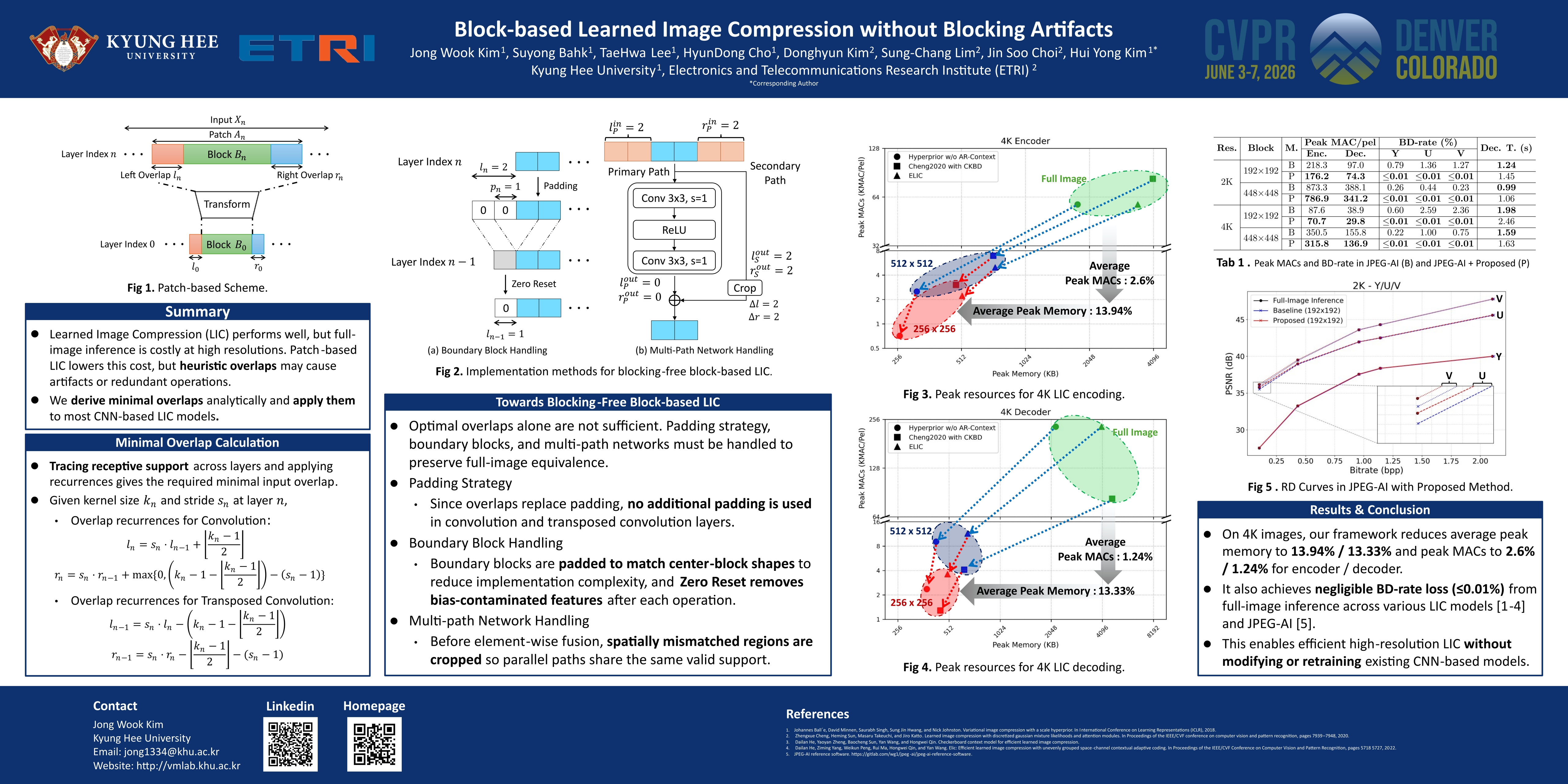
Learned Image Compression (LIC) outperforms traditional codecs but suffers from excessive peak memory usage when handling high-resolution images. Consequently, block-based LIC has been studied to reduce peak memory and computational costs; however, this approach often introduces blocking artifacts that degrade visual quality.To mitigate this, the JPEG-AI standard introduced a patch-based scheme where overlapped blocks are coded independently using empirically determined overlap sizes. However, the experimental search for optimal overlaps is time-consuming and does not guarantee blocking-free reconstruction. To address these limitations, we propose an analytic framework modeling overlap propagation through convolutional and transposed convolutional layers to precisely determine the minimal overlaps for blocking-free reconstruction.Based on the minimum overlaps calculated, we provide the block-based implementation methodology for the convolution networks used in most CNN-based LIC models.Applied to four CNN-based LIC models on 4K images partitioned into 256$\times$256 blocks, our method achieves rate–distortion performance identical to full-image coding while reducing average peak memory usage to 18.7\% (encoder) and 17.9\% (decoder), and only with average computational cost of 4.23\% and 2.34\%, respectively. Notably, the proposed block-based framework does not require any re-training of the original model. Furthermore, it can also be applied to most CNN-based image processing neural networks without worrying about any performance degradation.
DeDelayed: Deleting Remote Inference Delay via On-Device Correction
Dan Jacobellis ⋅ Mateen Ulhaq ⋅ Fabien Racapé ⋅ Hyomin Choi ⋅ Neeraja Yadwadkar
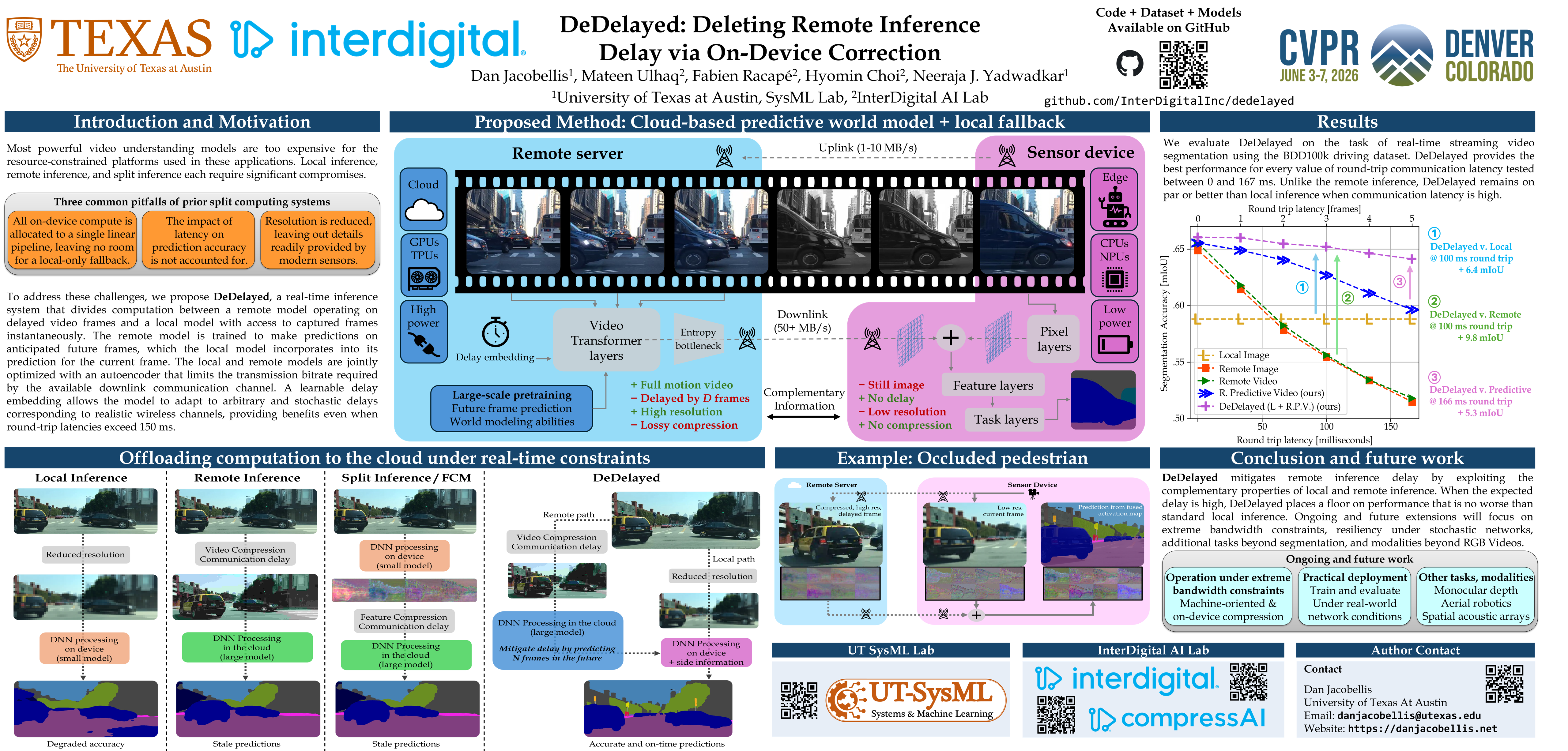
Video comprises the vast majority of bits that are generated daily, and is the primary signal driving current innovations in robotics, remote sensing, and wearable technology.Yet, the most powerful video understanding models are too expensive for the resource-constrained platforms used in these applications.One approach is to offload inference to the cloud; this gives access to GPUs capable of processing high-resolution videos in real time.But even with reliable, high-bandwidth communication channels, the combined latency of video encoding, model inference, and round-trip communication prohibits use for certain real-time applications.The alternative is to use fully local inference; but this places extreme constraints on computational and power costs, requiring smaller models and lower resolution, leading to degraded accuracy.To address these challenges, we propose Dedelayed, a real-time inference system that divides computation between a remote model operating on delayed video frames and a local model with access to the current frame.The remote model is trained to make predictions on anticipated future frames, which the local model incorporates into its prediction for the current frame.The local and remote models are jointly optimized with an autoencoder that limits the transmission bitrate required by the available downlink communication channel.We evaluate Dedelayed on the task of real-time streaming video segmentation using the BDD100k driving dataset. For a round trip delay of 100 ms, Dedelayed improves performance by 6.4 mIoU compared to fully local inference and 9.8 mIoU compared to remote inference---an equivalent improvement to using a model ten times larger. We release our training code, pretrained models, and python library at URL REDACTED FOR ANONYMITY.
AdaRadar: Rate Adaptive Spectral Compression for Radar-based Perception
Jinho Park ⋅ Se Young Chun ⋅ Mingoo Seok
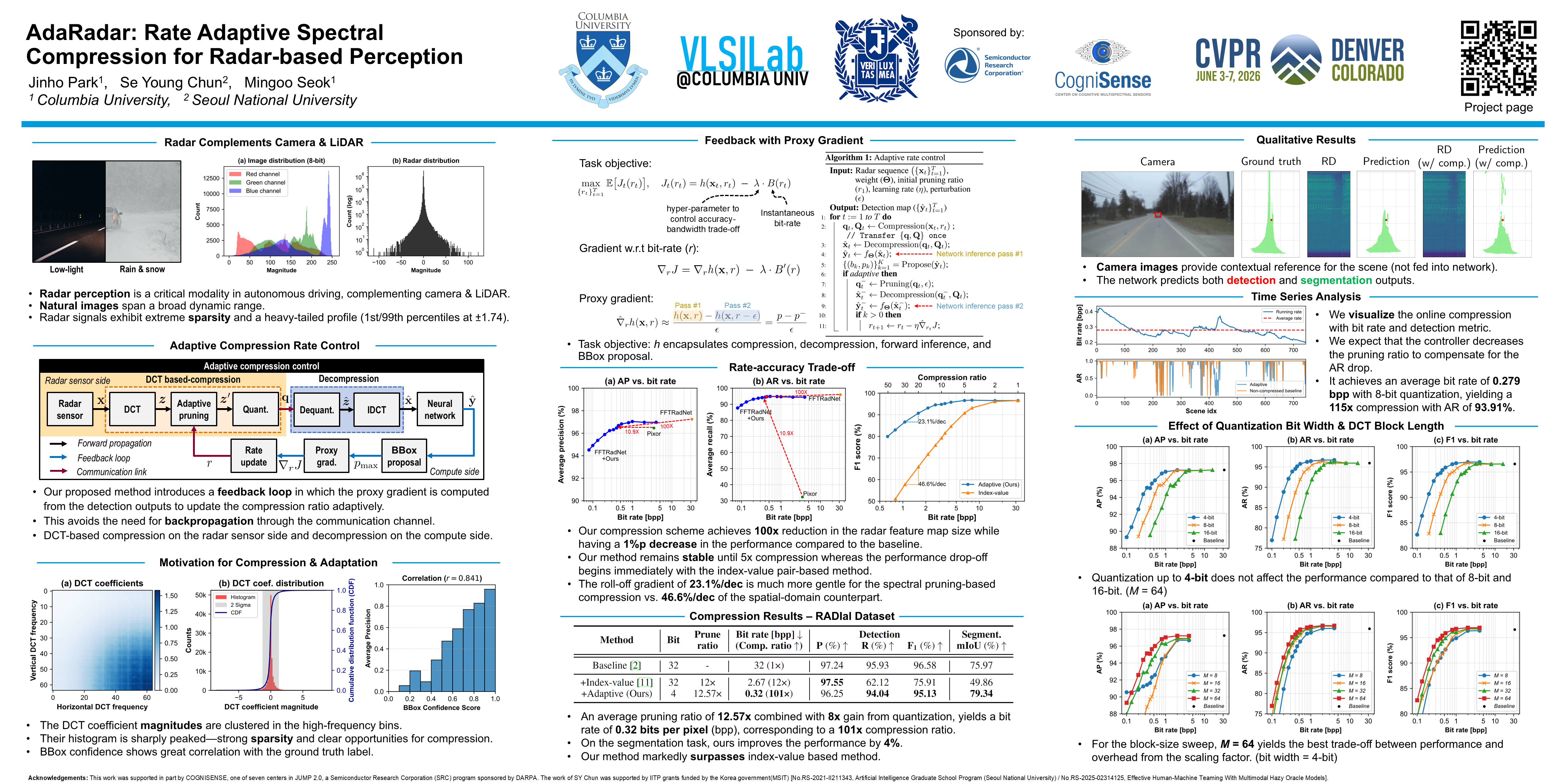
Radar is a critical perception modality in autonomous driving systems due to its all-weather characteristics and ability to measure range and Doppler velocity. However, the sheer volume of high-dimensional raw radar data saturates the communication link to the computing engine (e.g., an NPU), which is often a low-bandwidth interface with data rate provisioned only for a few low-resolution range-Doppler frames. A generalized codec for utilizing high-dimensional radar data is notably absent, while existing image-domain approaches are unsuitable, as they typically operate at fixed compression ratios and fail to adapt to varying or adversarial conditions. In light of this, we propose radar data compression with adaptive feedback. It dynamically adjusts the compression ratio by performing gradient descent from the proxy gradient of detection confidence with respect to the compression rate. We employ a zeroth-order gradient approximation as it enables gradient computation even with non-differentiable core operations--pruning and quantization. This also avoids transmitting the gradient tensors over the band-limited link, which, if estimated, would be as large as the original radar data. In addition, we have found that radar feature maps are heavily concentrated on a few frequency components. Thus, we apply the discrete cosine transform to the radar data cubes and selectively prune out the coefficients effectively. We preserve the dynamic range of each radar patch through scaled quantization. Combining those techniques, our proposed online adaptive compression scheme achieves over 100x feature size reduction at minimal performance drop (~1%p). We validate our results on the RADIal, CARRADA, and Radatron datasets.
Gaussian Splatting-based Low-Rank Tensor Representation for Multi-Dimensional Image Recovery
Yiming Zeng ⋅ Xile Zhao ⋅ Wei-Hao Wu ⋅ Teng-Yu Ji ⋅ Chao Wang
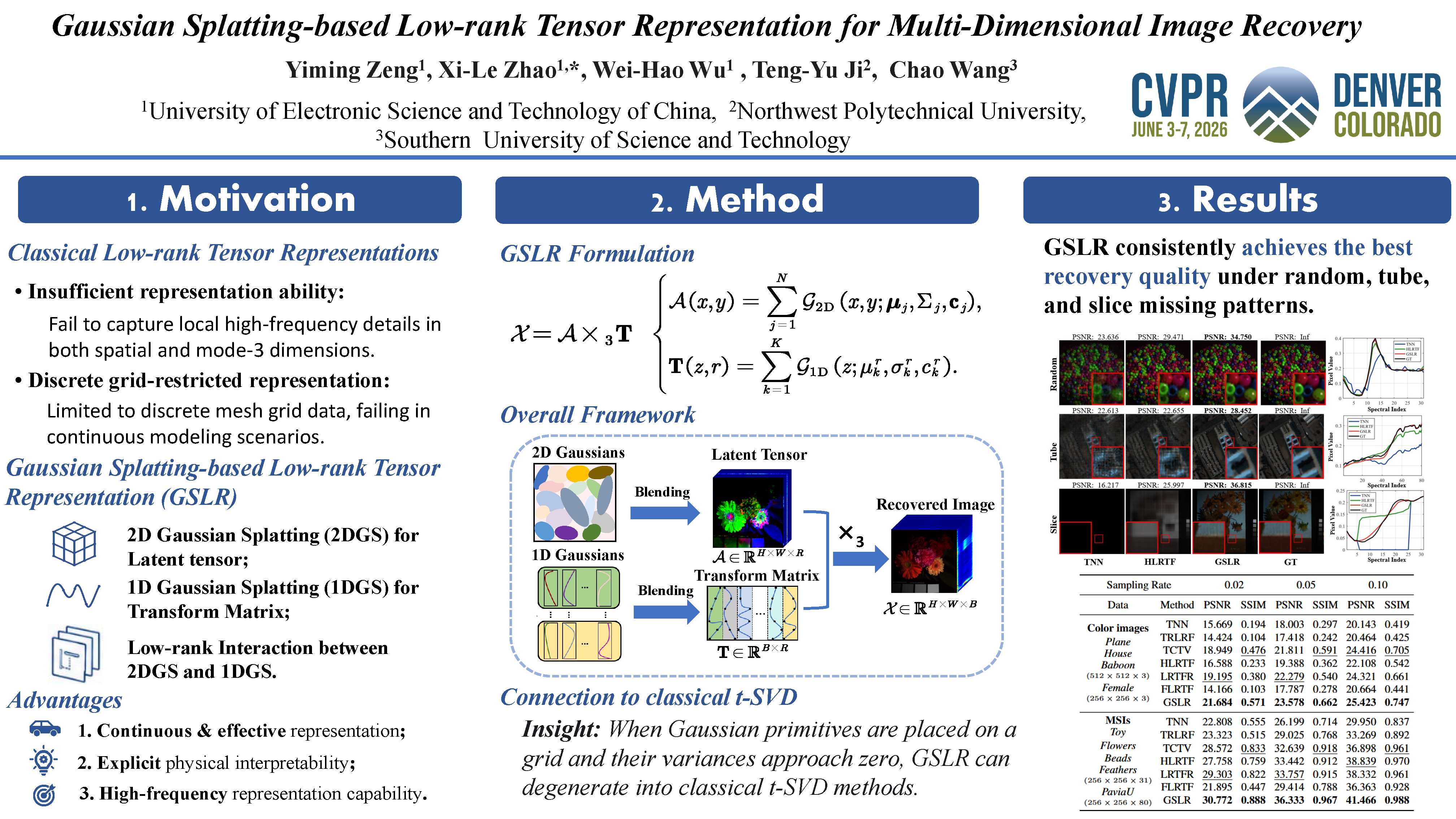
Tensor singular value decomposition (t-SVD) is a promising tool for multi-dimensional image representation, which decomposes a multi-dimensional image into a latent tensor and an accompanying transform matrix. However, two critical limitations of t-SVD methods persist: (1) the approximation of the latent tensor (e.g., tensor factorizations) is coarse and fails to accurately capture spatial local high-frequency information; (2) The transform matrix is composed of fixed basis atoms (e.g., complex exponential atoms in DFT and cosine atoms in DCT) and cannot precisely capture local high-frequency information along the mode-3 fibers. To address the two limitations, we propose a Gaussian Splatting-based Low-rank tensor Representation (GSLR) framework, which compactly and continuously represents multi-dimensional image. Specifically, we leverage tailored 2D Gaussian splatting and 1D Gaussian splatting to generate the latent tensor and transform matrix, respectively. The 2D and 1D Gaussian splatting are indispensable and complementary under this representation framework, which enjoys a powerful representation capability, especially for local high-frequency information. To evaluate the representation ability of the GSLR, we develop an unsupervised GSLR-based multi-dimensional image recovery model. Extensive experiments on multi-dimensional image recovery demonstrate that GSLR consistently outperforms state-of-the-art methods, particularly in capturing local high-frequency information.
Precise Object and Effect Removal with Adaptive Target-Aware Attention
Jixin Zhao ⋅ Zhouxia Wang ⋅ Peiqing Yang ⋅ Shangchen Zhou
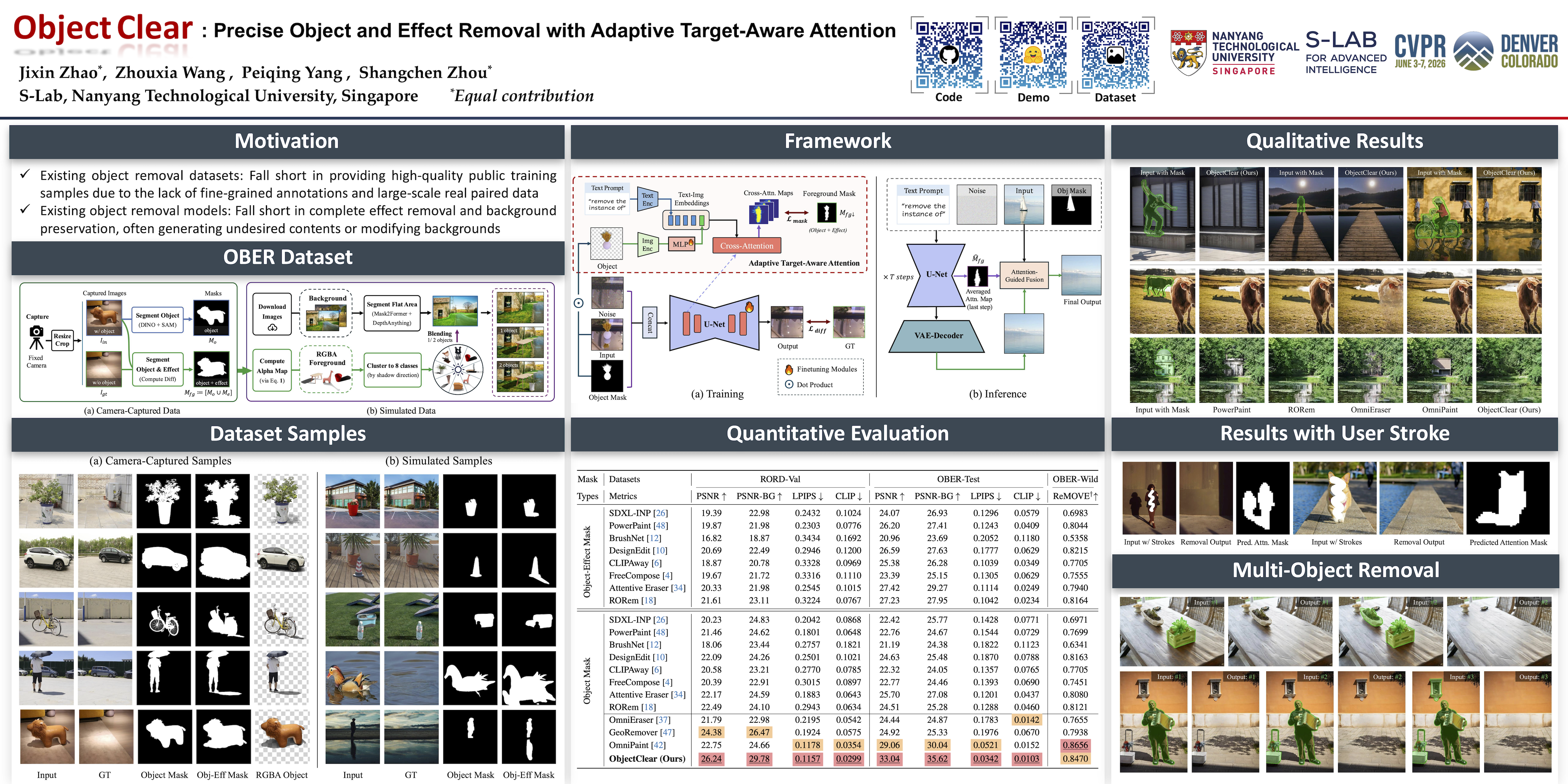
Object removal requires eliminating not only the target object but also its associated visual effects such as shadows and reflections. However, diffusion-based inpainting and removal methods often introduce artifacts, hallucinate contents, alter background, and struggle to remove object effects accurately. To address these challenges, we propose ObjectClear, a novel framework that decouples foreground removal from background reconstruction via an adaptive target-aware attention mechanism. This design empowers the model to precisely localize and remove both objects and their effects while maintaining high background fidelity. Moreover, the learned attention maps are leveraged for an attention-guided fusion strategy during inference, further enhancing visual consistency. To facilitate the training and evaluation of this framework, we construct OBER, a large-scale dataset for OBject-Effect Removal, which provides paired images with and without object-effects, along with precise masks for both objects and their effects. The dataset comprises high-quality captured and simulated data, covering diverse objects, effects, and complex multi-object scenes. Extensive experiments demonstrate that ObjectClear outperforms prior methods, achieving superior object-effect removal quality and background fidelity, especially in challenging real-world scenarios. Code and dataset will be released.
Decompose, Mix, Adapt: A Unified Framework for Parameter-Efficient Neural Network Recombination and Compression
Nazia Tasnim ⋅ Shrimai Prabhumoye ⋅ Bryan A. Plummer
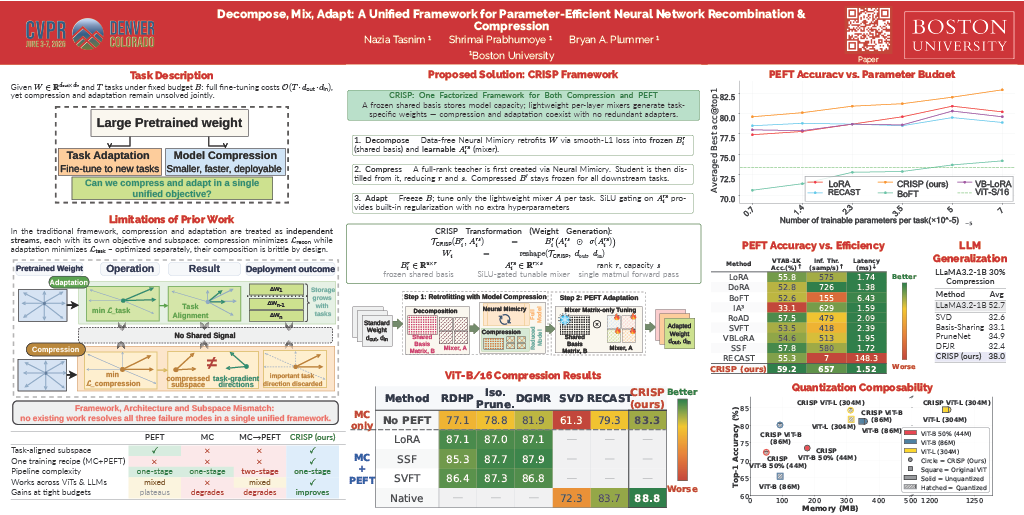
Parameter Recombination (PR) methods aim to efficiently compose the weights of a neural network, and encompasses tasks like Parameter-Efficient FineTuning (PEFT) and Model Compression (MC), among others. Most methods typically focus on one application of PR, which can make composing them challenging. For example, when deploying a large model you may wish to compress the model and also quickly adapt to new settings. However, PEFT methods often can still contain millions of parameters. This may be small compared to the original model size, but can be problematic in resource constrained deployments like edge devices, where they take a larger portion of the compressed model's parameters. To address this, we present Coefficient-gated weight Recombination by Interpolated Shared basis Projections (\method{}), a general approach that can address multiple PR tasks within the same framework, which can enable seamless integration. It accomplishes this by using a factorization process that decomposes pretrained weights into basis matrices and their component projections. Sharing these basis matrices across layers and adjusting its size enables us to perform MC, whereas the small size of the projection weights (fewer than 200 in some experiments) enables \method{} support PEFT. Experiments on ViT models show \method{} outperforms methods from prior work capable of dual-task applications by 4-5\% while also outperforming the state-of-the-art in PEFT by 1.5\% and PEFT+MC combinations by almost 1\%.
FreqSIC: Frequency-aware Stereo Image Compression with Bi-directional Checkerboard Context Model
Shiyu Qin ⋅ Yongkang Lu ⋅ Yimin Zhou ⋅ Jiawei Li ⋅ Yifan Ren ⋅ Yuerong Xue ⋅ Shu-Tao Xia ⋅ Bin Chen
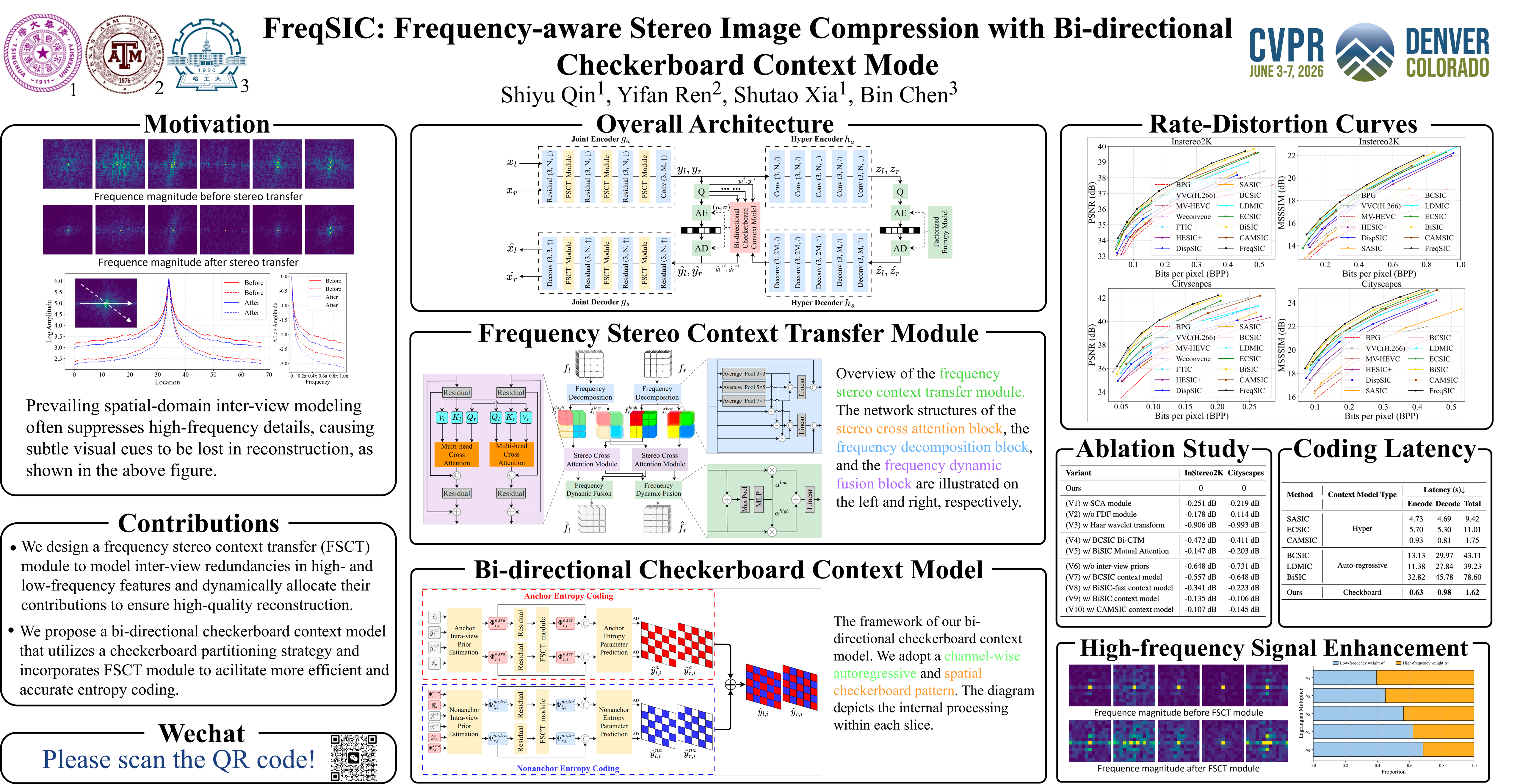
Stereo image compression is essential for a wide range of 3D vision. Recent methods have demonstrated strong capabilities in eliminating inter-view redundancy and enabling compact entropy coding via spatial-domain stereo transformation and advanced autoregressive entropy models. However, these approaches often suffer from high-frequency information loss and incur considerable coding latency. To overcome these limitations, we propose a novel frequency stereo context transfer (FSCT) module. Unlike spatial-domain methods, the FSCT module separately captures inter-view redundancy in high- and low-frequency components and dynamically balances their contributions to preserve reconstruction quality. In addition, we replace the conventional autoregressive framework with a checkerboard strategy and integrate the FSCT module to model inter-view priors, enabling faster and more efficient entropy coding. Extensive experiments demonstrate that our method achieves state-of-the-art rate-distortion performance among existing stereo image compression approaches, while also attaining the lowest coding latency.
SinGeo: Unlock Single Model's Potential for Robust Cross-View Geo-Localization
CHEN Yang ⋅ Xieyuanli Chen ⋅ Junxiang Li ⋅ Jie Tang ⋅ Tao Wu
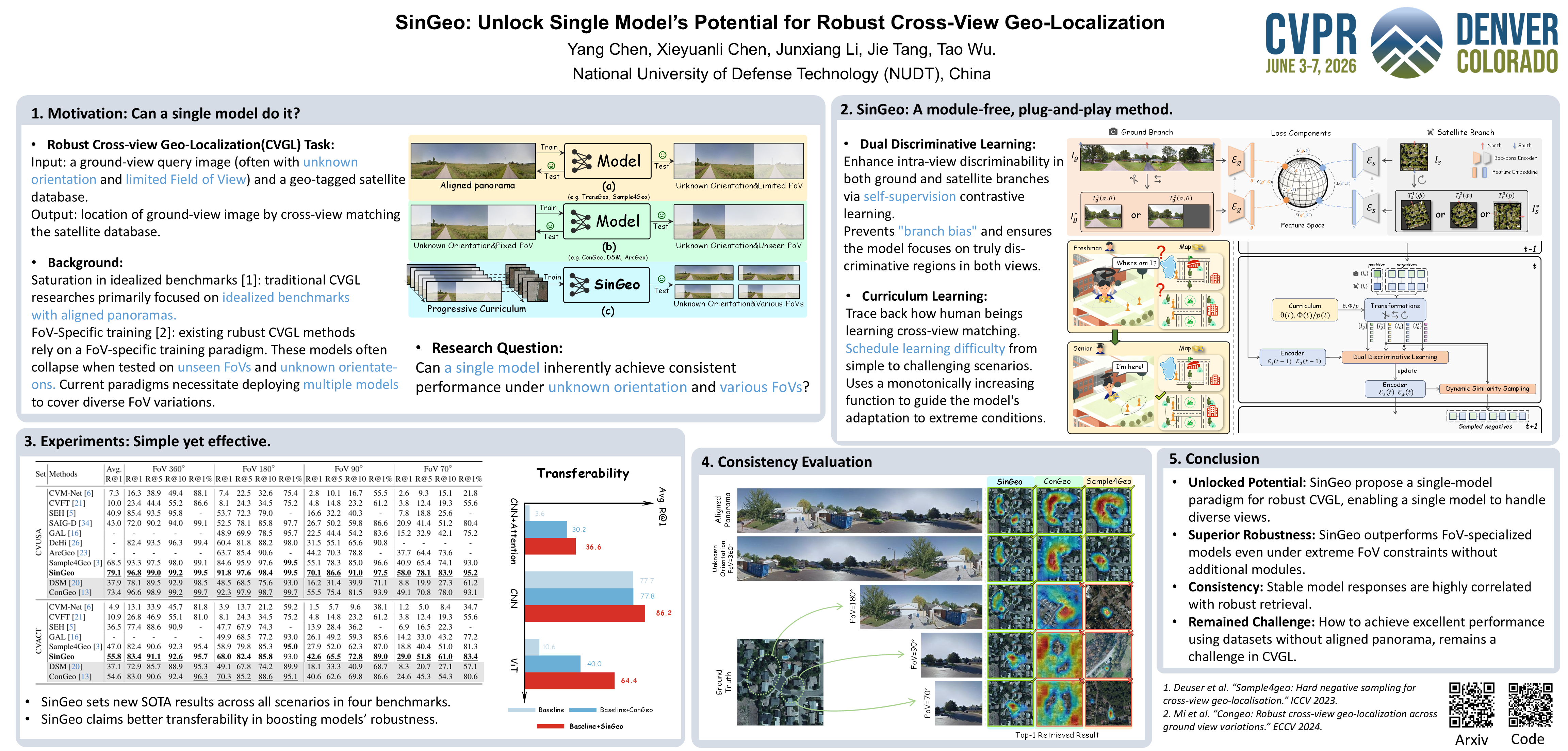
Robust cross-view geo-localization (CVGL) remains challenging despite the surge in recent progress. Existing methods still rely on field-of-view (FoV)-specific training paradigms, where models are optimized under a fixed FoV but collapse when tested on unseen FoVs and unknown orientations. This limitation necessitates deploying multiple models to cover diverse variations. Although studies have explored dynamic FoV training by simply randomizing FoVs, they failed to achieve robustness across diverse conditions---implicitly assuming all FoVs are equally difficult. To address this gap, we present SinGeo, a simple yet powerful framework that enables a single model to realize robust cross-view geo-localization without additional modules or explicit transformations. SinGeo employs a dual discriminative learning architecture that enhances intra-view discriminability within both ground and satellite branches, and is the first to introduce a curriculum learning strategy to achieve robust CVGL. Extensive evaluations on four benchmark datasets reveal that SinGeo sets state-of-the-art (SOTA) results under diverse conditions, and notably outperforms methods specifically trained for extreme FoVs. Beyond superior performance, SinGeo also exhibits cross-architecture transferability. Furthermore, we propose a consistency evaluation method to quantitatively assess model stability under varying views, providing an explainable perspective for understanding and advancing robustness in future CVGL research. Codes will be available upon acceptance.
Fusion of Depth and Semantics for Probabilistic Floorplan Localization
Kecheng Ye ⋅ Mao Chen ⋅ Xiangkai Zhang ⋅ Xu Yang
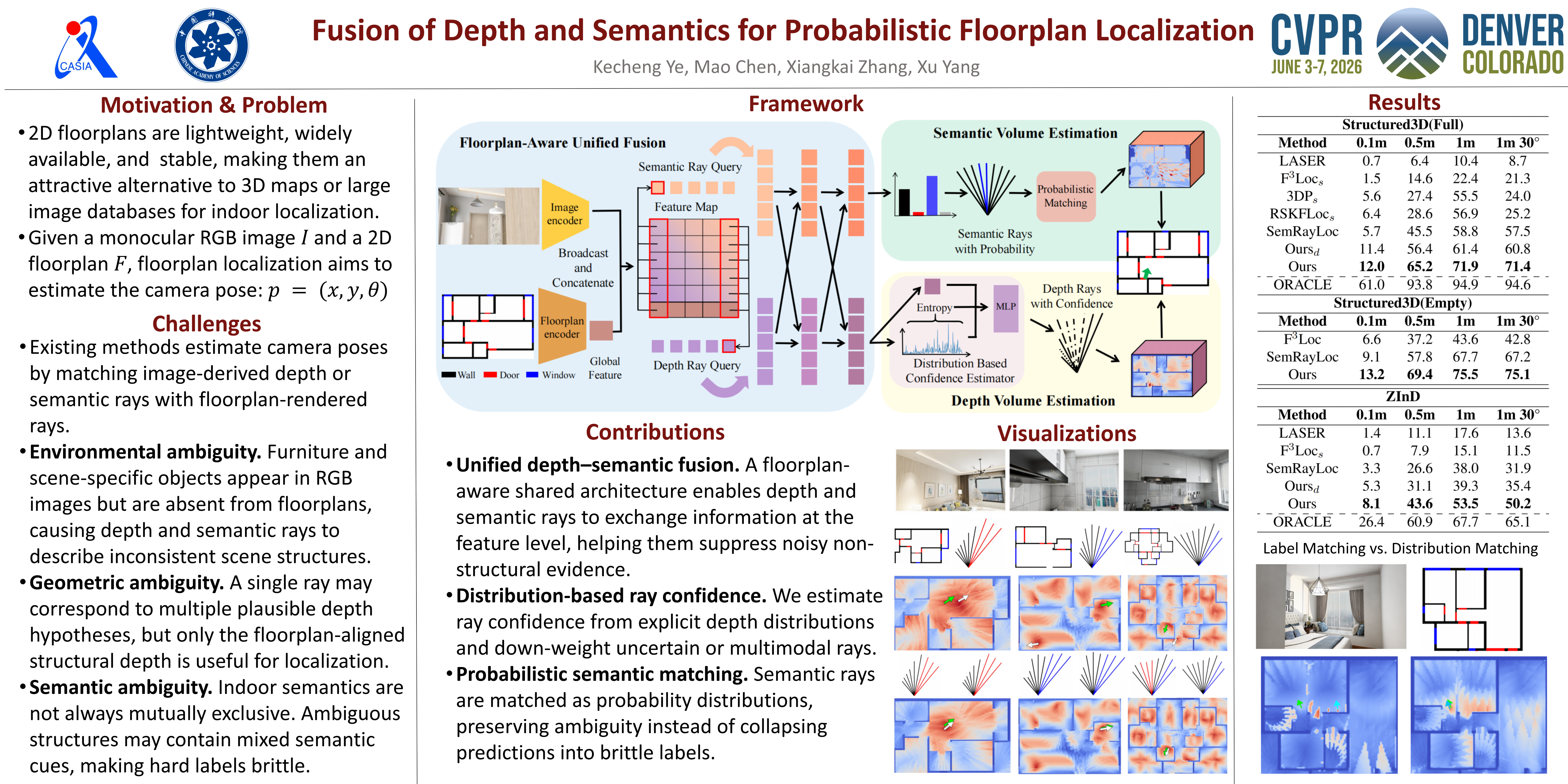
Floorplan localization aims to estimate the camera pose of a query image with respect to a 2D floorplan, providing a lightweight and long-term stable alternative to localization based on 3D maps or large image databases for indoor robotics and AR. Recent methods frame the problem as ray-based matching, representing the image as a set of rays annotated with depth or semantic labels and aligning them with the floorplan. However, they still face challenges in addressing the complexity of indoor environments, which can be decomposed into environmental, geometric, and semantic ambiguities.To address these ambiguities, we propose a floorplan-aware probabilistic fusion framework that models both depth and semantic information within a unified architecture. Our framework also combines a distribution-based ray confidence estimator, which down-weights uncertain geometric hypotheses, with a probabilistic semantic matching scheme based on Jensen–Shannon divergence (JSD), which preserves and leverages informative semantic ambiguity instead of collapsing it into hard labels. Experiments on challenging benchmarks demonstrate that our approach significantly outperforms prior methods in both robustness and accuracy.
A2GC: Asymmetric Aggregation with Geometric Constraints for Locally Aggregated Descriptors
Zhenyu Li ⋅ Tianyi Shang
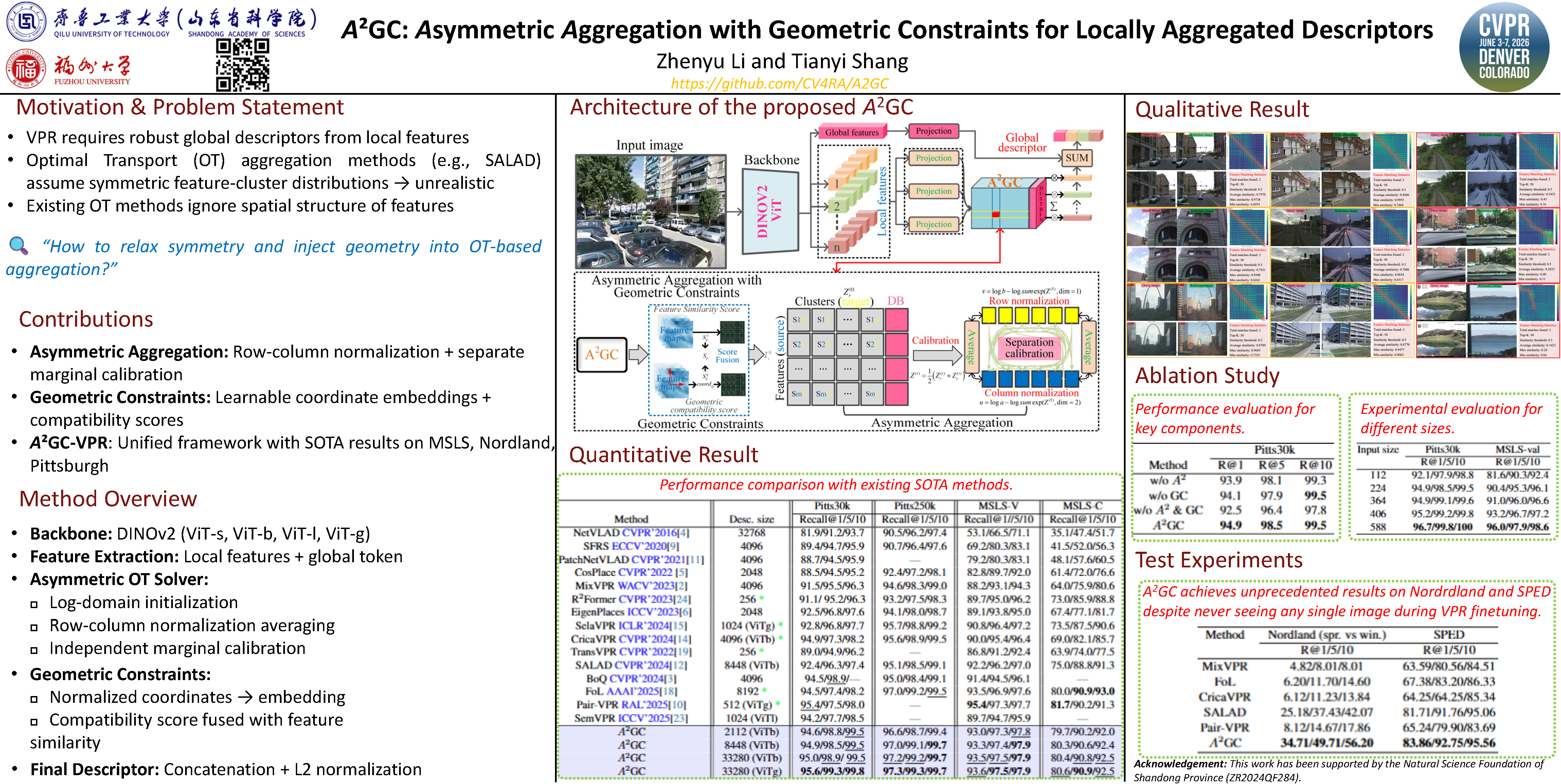
Visual Place Recognition (VPR) aims to match query images against a database using visual cues. State-of-the-art methods aggregate features from deep backbones to form global descriptors. Optimal transport-based aggregation methods reformulate feature-to-cluster assignment as a transport problem, but the standard Sinkhorn algorithm symmetrically treats source and target marginals, limiting effectiveness when image features and cluster centers exhibit substantially different distributions. We propose an asymmetric aggregation VPR method with geometric constraints for locally aggregated descriptors, called $A^2$GC-VPR. Our method employs row-column normalization averaging with separate marginal calibration, enabling asymmetric matching that adapts to distributional discrepancies in visual place recognition. Geometric constraints are incorporated through learnable coordinate embeddings, computing compatibility scores fused with feature similarities, thereby promoting spatially proximal features to the same cluster and enhancing spatial awareness. Experimental results on MSLS, NordLand, and Pittsburgh datasets demonstrate superior performance, validating the effectiveness of our approach in improving matching accuracy and robustness.
Geo2: Geometry-Guided Cross-view Geo-Localization and Image Synthesis
Yancheng Zhang ⋅ Xiaohan Zhang ⋅ Guangyu Sun ⋅ Zonglin Lyu ⋅ Safwan Wshah ⋅ Chen Chen
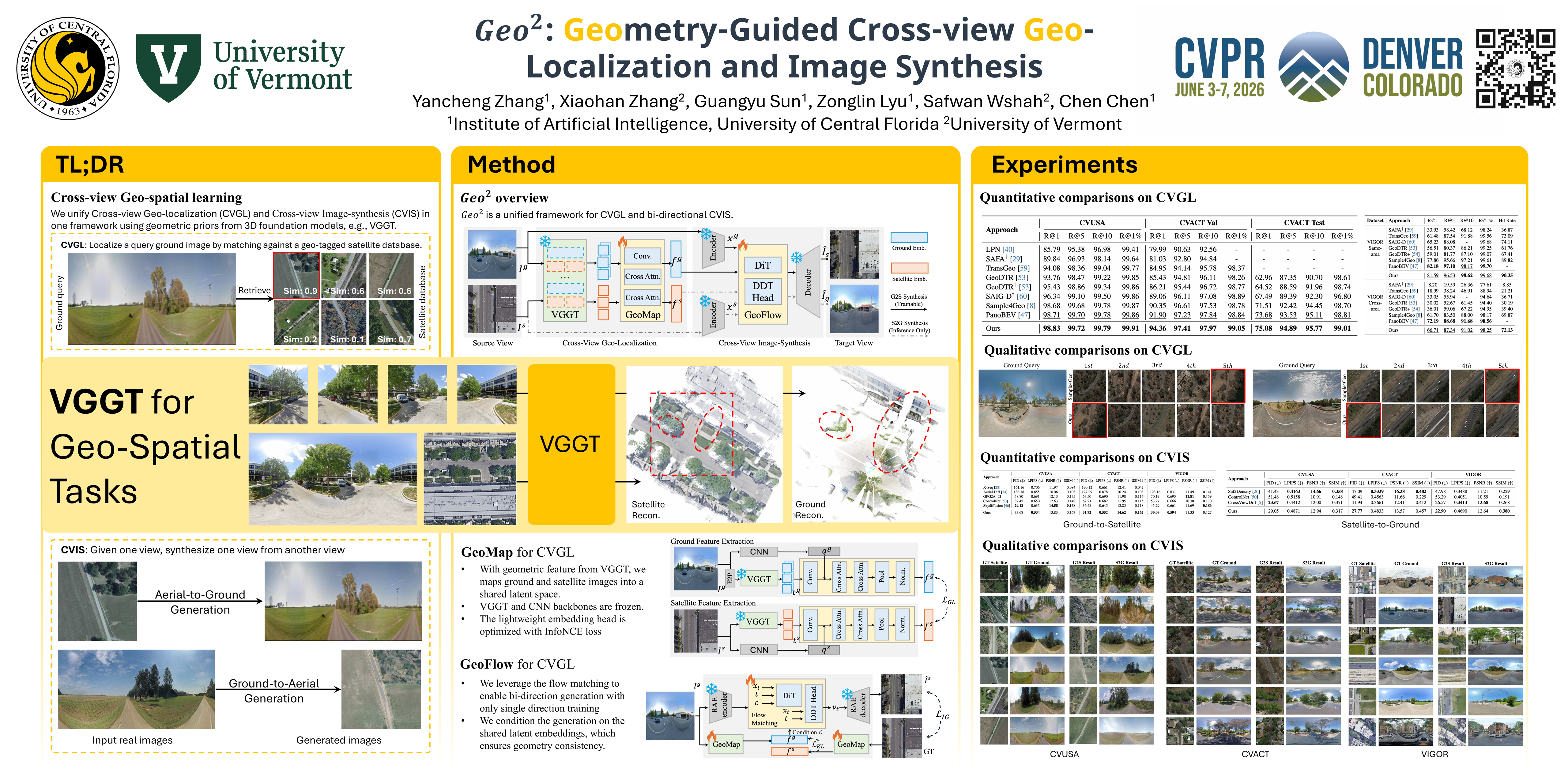
Cross-view geo-spatial learning consists of two important tasks: Cross-View Geo-Localization (CVGL) and Cross-View Image Synthesis (CVIS), both of which rely on establishing geometric correspondences between ground and aerial views. Recent Geometric Foundation Models (GFMs) have demonstrated strong capabilities in extracting generalizable 3D geometric features from images, but their potential in cross-view geo-spatial tasks remains underexplored. In this work, we present Geo^2, a unified framework that leverages Geometric priors from GFMs (e.g., VGGT) to jointly perform geo-spatial tasks, CVGL and bidirectional CVIS. Despite the 3D reconstruction ability of GFMs, directly applying them to CVGL and CVIS remains challenging due to the large viewpoint gap between ground and aerial imagery. We propose GeoMap, which embeds ground and aerial features into a shared 3D-aware latent space, effectively reducing cross-view discrepancies for localization. This shared latent space naturally bridges cross-view image synthesis in both directions. To exploit this, we propose GeoFlow, a flow-matching model conditioned on geometry-aware latent embeddings. We further introduce a consistency loss to enforce latent alignment between the two synthesis directions, ensuring bidirectional coherence. Extensive experiments on standard benchmarks, including CVUSA, CVACT, and VIGOR, demonstrate that Geo^2 achieves state-of-the-art performance in both localization and synthesis, highlighting the effectiveness of 3D geometric priors for cross-view geo-spatial learning.
Coverage Optimization for Camera View Selection
Timothy Chen ⋅ Adam Dai ⋅ Maximilian Adang ⋅ Grace Gao ⋅ Mac Schwager
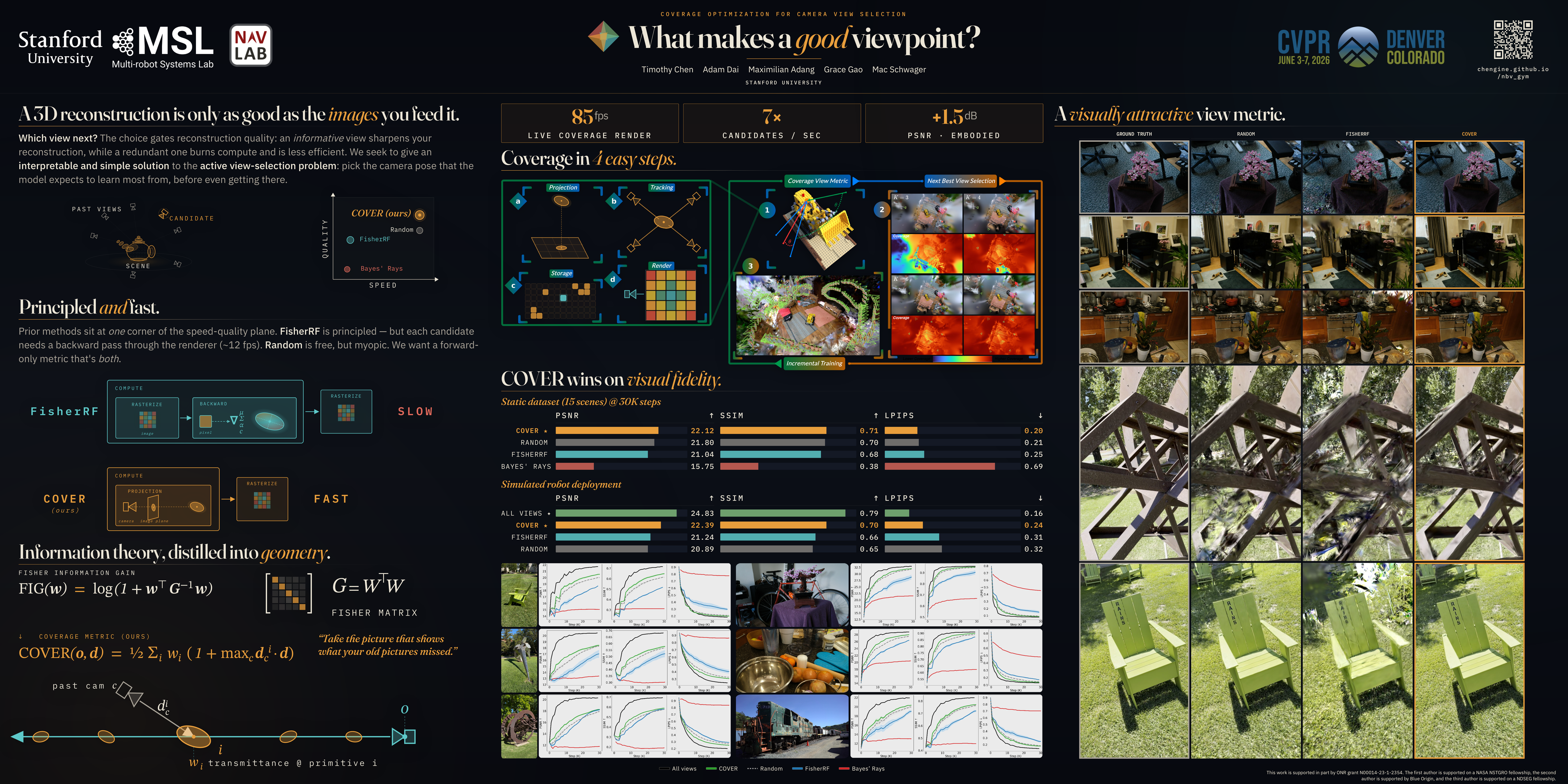
What makes a good viewpoint? The quality of the data used to learn 3D reconstructions is crucial for enabling efficient and accurate scene modeling. We study the active view selection problem and develop a principled analysis that yields a simple and interpretable criterion for selecting informative camera poses. Our key insight is that informative views can be obtained by minimizing a tractable approximation of the Fisher Information Gain, which reduces to favoring viewpoints that cover geometry that has been insufficiently observed by past cameras. This leads to a lightweight coverage-based view selection metric that avoids expensive transmittance estimation and is robust to noise and training dynamics. We integrate our method into the Nerfstudio framework and evaluate it on synthetic and real scenes. Across multiple datasets and radiance-field baselines, our method achieves consistently improved reconstruction quality compared to state-of-the-art active view selection methods.
Resolving Evidence Sparsity: Agentic Context Engineering for Long-Document Understanding
Keliang Liu ⋅ Zizhi Chen ⋅ Mingcheng Li ⋅ Jingqun Tang ⋅ Dingkang Yang ⋅ Lihua Zhang
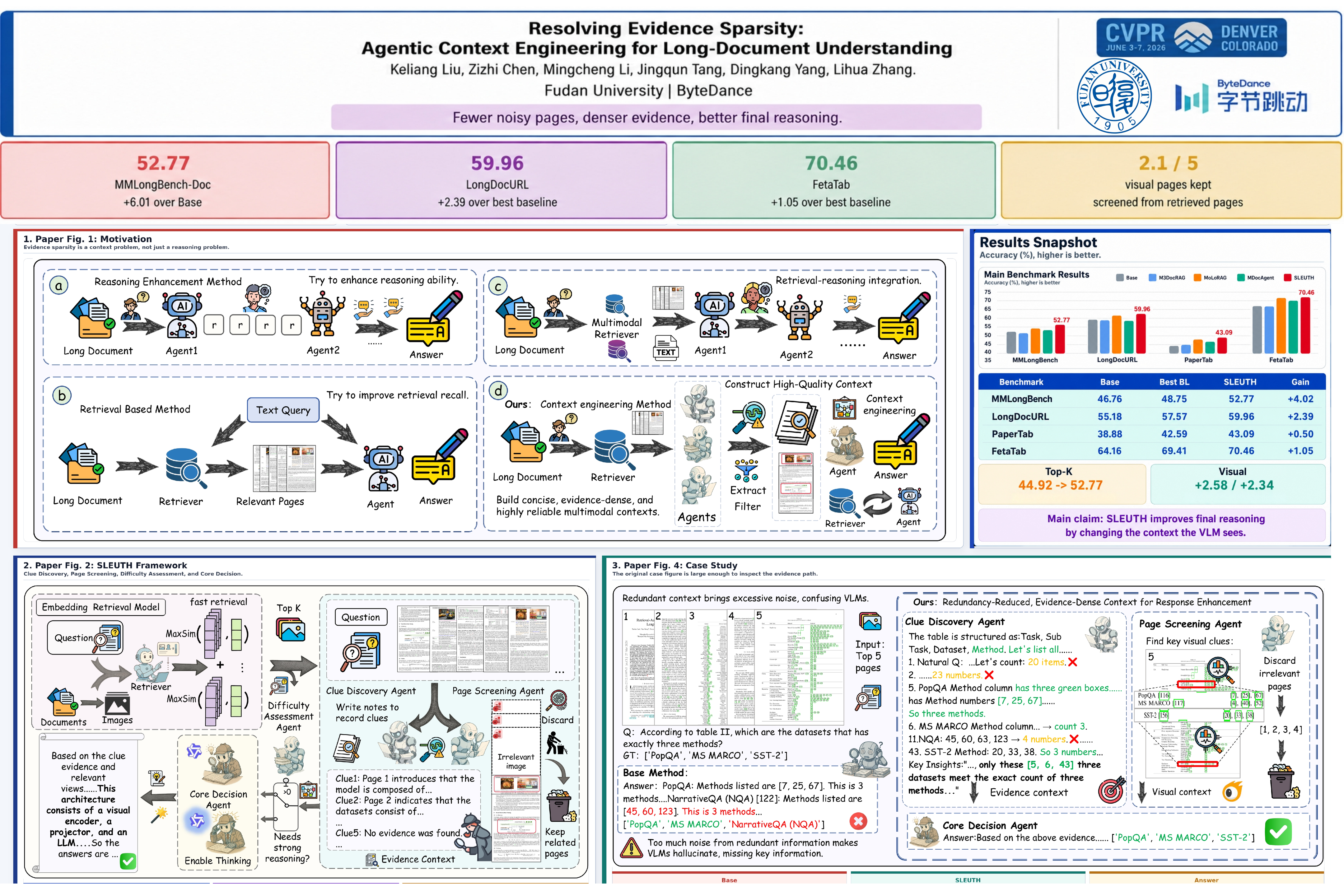
Document understanding is a long-standing practical task. Vision-Language Models (VLMs) have gradually become a primary approach in this domain, demonstrating effective performance on single-page tasks. However, their effectiveness diminishes when handling long documents. In such scenarios, clues are often scattered across multiple pages and modalities, and redundancy from lengthy inputs can impair the model's judgment. While retrieval-augmented generation mitigates this issue by filtering for question-relevant content, the retrieved results still contain substantial redundancy. To address these limitations, we propose SLEUTH, a multi-agent framework. Concretely, SLEUTH orchestrates a retriever and four collaborative agents in a coarse-to-fine process. The framework identifies key textual and visual clues within the retrieved pages, filters for salient visual evidence such as tables and charts, and analyzes the query to devise a reasoning strategy. It ultimately synthesizes a distilled, evidence-dense multimodal context to generate the final prediction. The SLEUTH framework is model-agnostic and scalable. When paired with advanced VLM backbones, it consistently improves performance on multiple long-document benchmarks, achieving SOTA results. Ablation studies verify each module’s effectiveness and confirm the benefits of our hierarchical refinement paradigm.
Reasoning Palette: Modulating Reasoning via Latent Contextualization for Controllable Exploration for (V)LMs
Rujiao Long ⋅ Yang Li ⋅ Xingyao Zhang ⋅ Weixun Wang ⋅ Tianqianjin Lin ⋅ Xi Zhao ⋅ Yuchi Xu ⋅ Wenbo Su ⋅ Junchi Yan ⋅ Bo Zheng
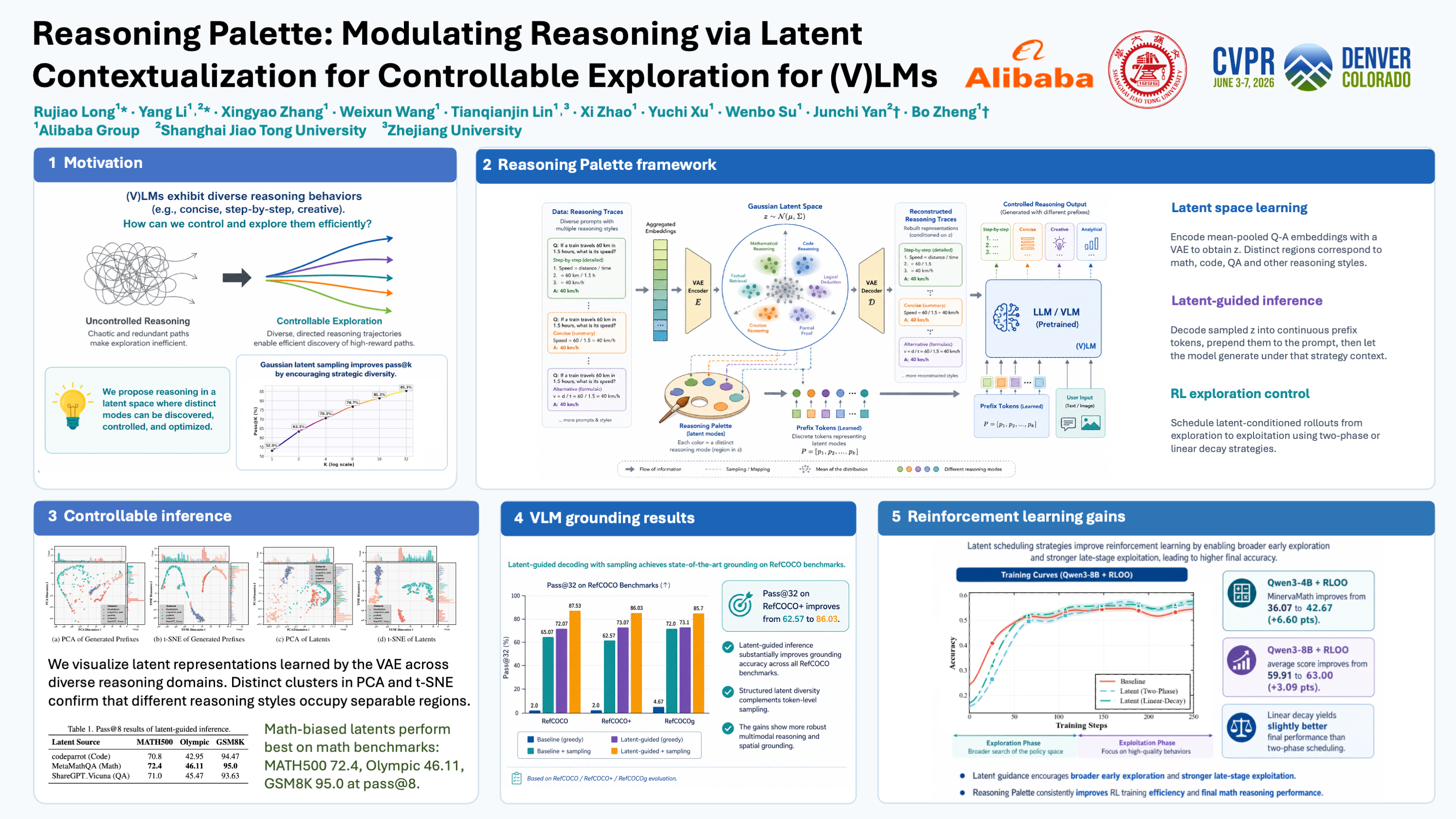
Exploration capacity shapes both inference‑time performance and reinforcement learning (RL) training for large (vision-) language models, as stochastic sampling often yields redundant reasoning paths with little high-level diversity. This paper proposes Reasoning Palette, a novel latent-modulation framework that endows the model with a stochastic latent variable for strategic contextualization, guiding its internal planning prior to token generation. This latent context is inferred from the mean-pooled embedding of a question–answer pair via a variational autoencoder (VAE), where each sampled latent potentially encodes a distinct reasoning context. During inference, a sampled latent is decoded into learnable token prefixes and prepended to the input prompt, modulating the model's internal reasoning trajectory. In this way, the model performs internal sampling over reasoning strategies prior to output generation, which shapes the style and structure of the entire response sequence. A brief supervised fine-tuning (SFT) warm-up phase allows the model to adapt to this latent conditioning. Within RL optimization, Reasoning Palette facilitates structured exploration by enabling on-demand injection for diverse reasoning modes, significantly enhancing exploration efficiency and sustained learning capability. Experiments across multiple reasoning benchmarks demonstrate that our method enables interpretable and controllable control over the (vision-) language model's strategic behavior, thereby achieving consistent performance gains over standard RL methods.
ORCA: Orchestrated Reasoning with Collaborative Agents for Document Visual Question Answering
Aymen Lassoued ⋅ Mohamed Ali Souibgui ⋅ Yousri Kessentini
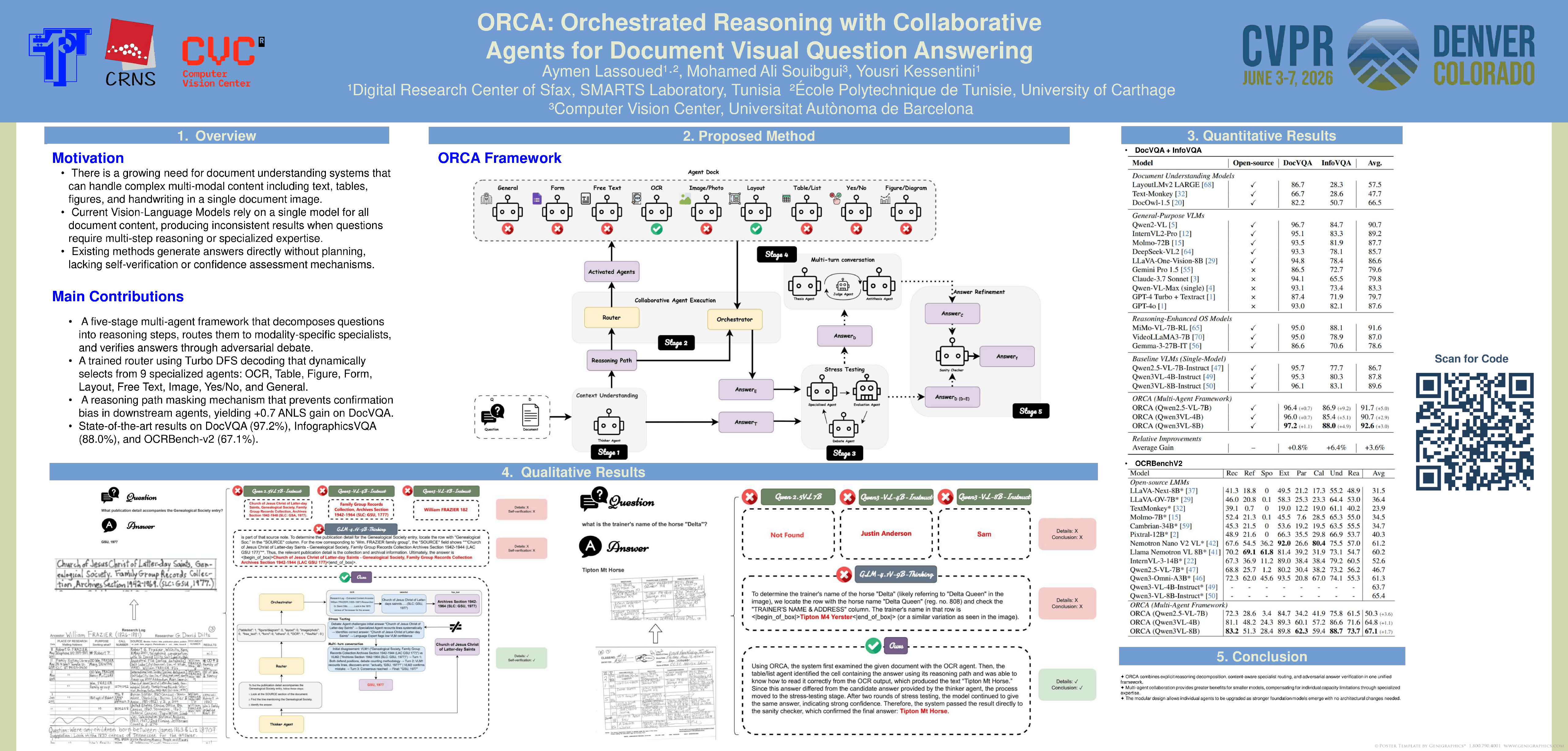
Document Visual Question Answering (DocVQA) remains challenging for existing Vision-Language Models (VLMs), especially under complex reasoning and multi-step workflows. Current approaches struggle to decompose intricate questions into manageable sub-tasks and often fail to leverage specialized processing paths for different document elements. We present ORCA: Orchestrated Reasoning with Collaborative Agents for Document Visual Question Answering, a novel multi-agent framework that addresses these limitations through strategic agent coordination and iterative refinement. ORCA begins with a reasoning agent that decomposes queries into logical steps, followed by a routing mechanism that activates task-specific agents from a specialized agent dock. Our framework leverages a set of specialized AI agents, each dedicated to a distinct modality, enabling fine-grained understanding and collaborative reasoning across diverse document components. To ensure answer reliability, ORCA employs a debate mechanism with stress-testing, and when necessary, a thesis-antithesis adjudication process. This is followed by a sanity checker to ensure format consistency. Extensive experiments on three benchmarks demonstrate that our approach achieves significant improvements over state-of-the-art methods, establishing a new paradigm for collaborative agent systems in vision-language reasoning. The code will be available upon acceptance.
MSJoE: Jointly Evolving MLLM and Sampler for Efficient Long-Form Video Understanding
Wenhui Tan ⋅ Xiaoyi Yu ⋅ Jiaze Li ⋅ Yijing Chen ⋅ Jianzhong Ju ⋅ Zhenbo Luo ⋅ Ruihua Song ⋅ Jian Luan
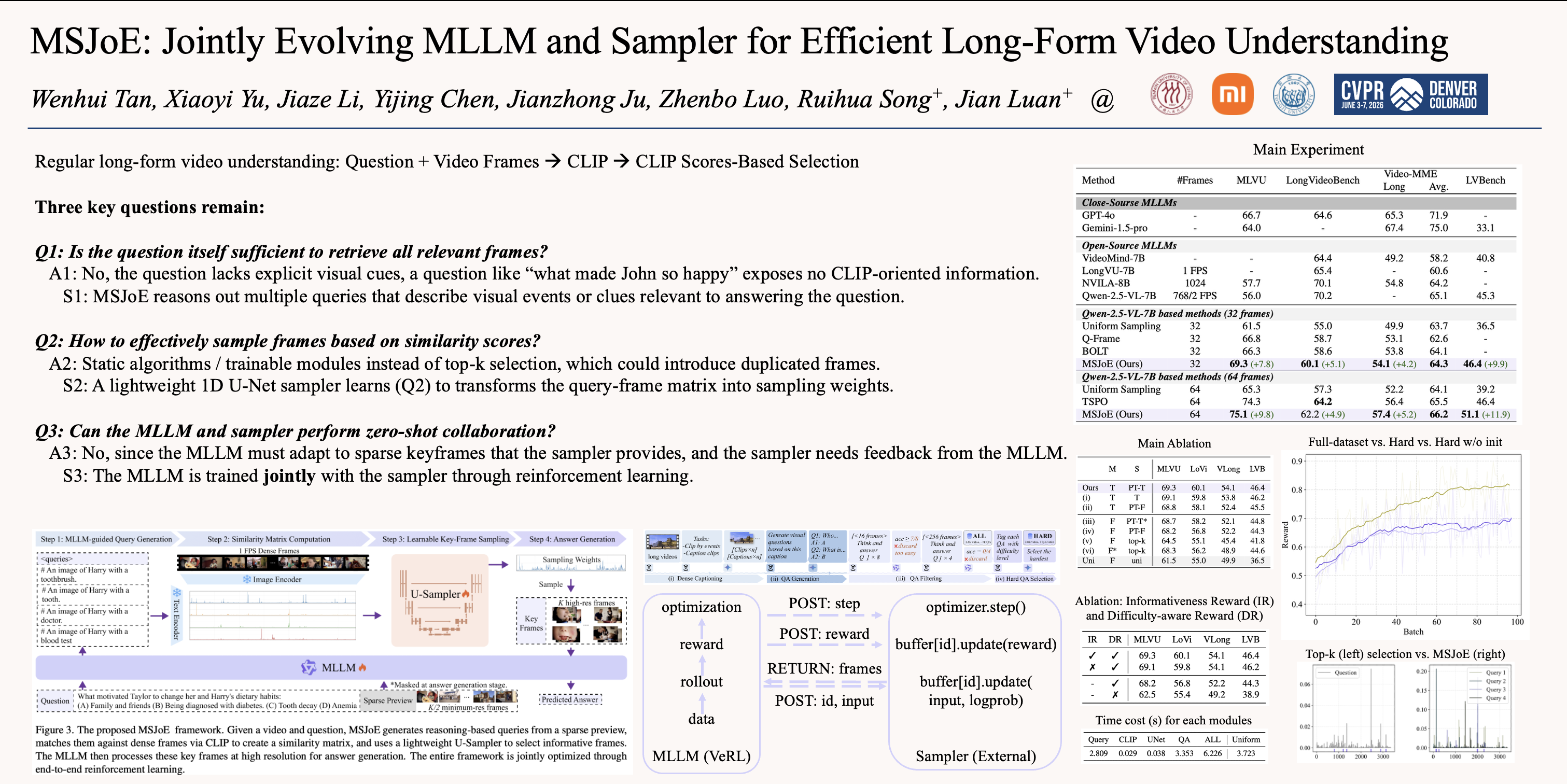
Efficiently understanding long-form videos remains a fundamental challenge for multimodal large language models (MLLMs).In this paper, we present MLLM-Sampler Joint-Evolution (MiSJoE), a novel framework that jointly evolves the MLLM and a lightweight key-frame sampler for efficient long-form video understanding.MiSJoE builds upon a key assumption that only a small subset of key-frames is truly informative for answering each question to a video.Specifically, MiSJoE first reasons out several queries, which describe diverse visual perspectives relevant to the question.Then, these queries interact with a frozen CLIP model to produce a query–frame similarity matrix. Finally, A lightweight sampler predicts key-frame sampling weights from this matrix, selecting a compact set of informative frames, which are then fed into the MLLM for answer generation.Both the MLLM and sampler are jointly optimized through reinforcement learning, enabling co-adaptation of query-reasoning, frame-sampling, and key-frame understanding.A new long-video QA dataset containing 2.8k videos with 7k question–answer pairs is collected to support the training process.Extensive experiments on VideoMME, LongVideoBench, LVBench, and MLVU show that MiSJoE achieves 8.0% accuracy gain upon the base MLLM, and 1.1% higher accuracy than strongest baseline method.
A Multi-Agent Perception-Action Alliance for Efficient Long Video Reasoning
Yichang Xu ⋅ Gaowen Liu ⋅ Ramana Kompella ⋅ Tiansheng Huang ⋅ Sihao Hu ⋅ Fatih Ilhan ⋅ Selim Tekin ⋅ Zachary Yahn ⋅ Ling Liu
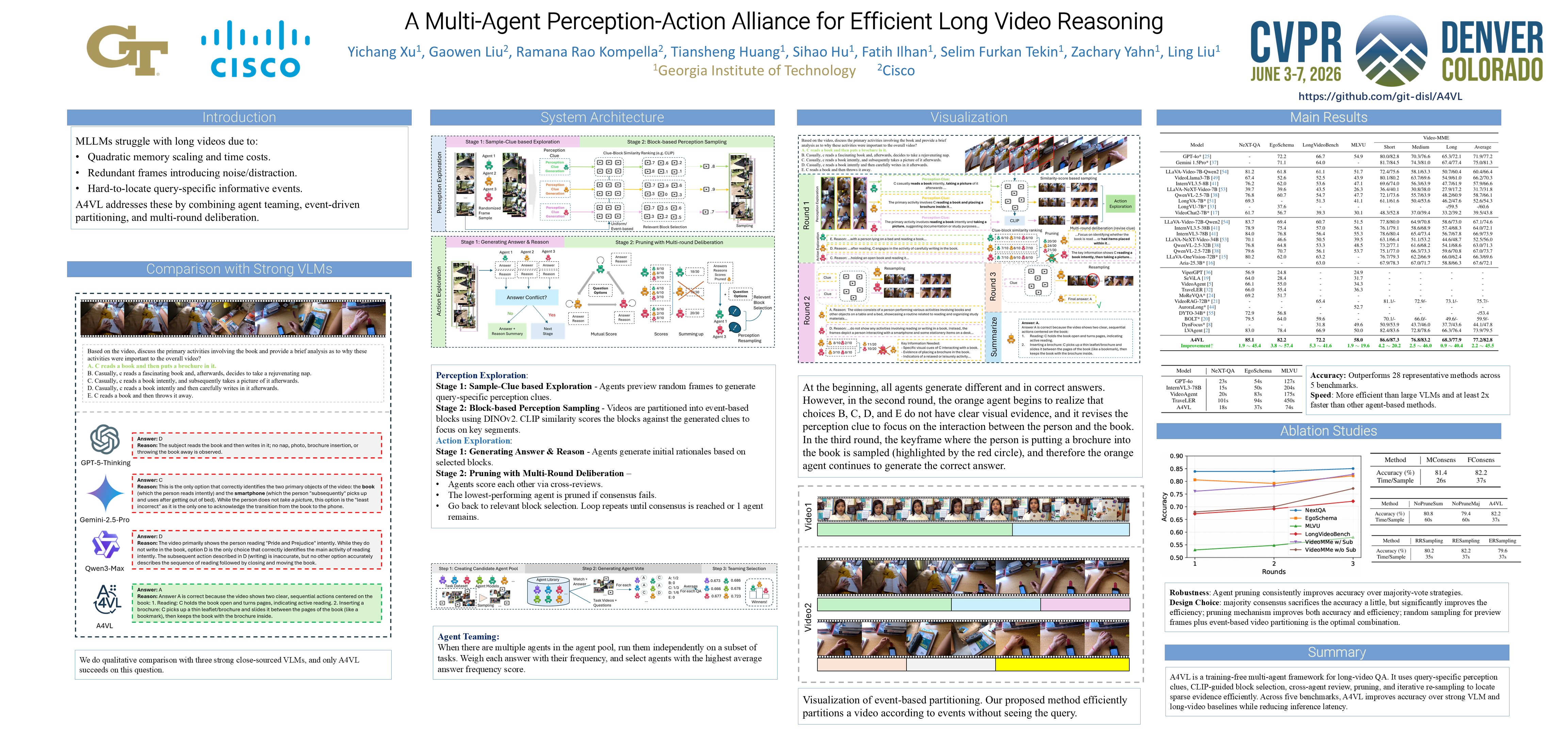
This paper presents a multi-agent perception-action exploration alliance, dubbed A4VL, for efficient long-video reasoning. A4VL operates in a multi-round perception–action exploration loop with a selection of VLM agents. In each round, the team of agents performs video question-answer (VideoQA) via perception exploration followed by action exploration. During perception exploration, each agent learns to extract query-specific perception clue(s) from a few sampled frames and performs clue-based alignment to find the video block(s) that are most relevant to the query-specific event. During action exploration, A4VL performs video reasoning in three steps: (1) each agent produces its initial answer with rational, (2) all agents collaboratively scores one another through cross-reviews and relevance ranking, and (3) based on whether a satisfactory consensus is reached, the decision is made either to start a new round of perception-action deliberation by pruning (e.g., filtering out the lowest performing agent) and re-staging (e.g., new-clue and matching block based perception-action exploration), or to conclude by producing its final answer. The integration of the multi-agent alliance through multi-round perception-action exploration, coupled with event-driven partitioning and cue-guided block alignment, enables A4VL to effectively scale to real world long videos while preserving high quality video reasoning. Evaluation Results on five popular VideoQA benchmarks show that A4VL outperforms 18 existing representative VLMs and 10 recent methods optimized for long-video reasoning, while achieving significantly lower inference latency.
Saliency-Guided Representation with Consistency Policy Learning for Visual Unsupervised Reinforcement Learning
Jingbo Sun ⋅ Qichao Zhang ⋅ Songjun Tu ⋅ Xing Fang ⋅ Yupeng Zheng ⋅ Haoran Li ⋅ Ke Chen ⋅ Dongbin Zhao
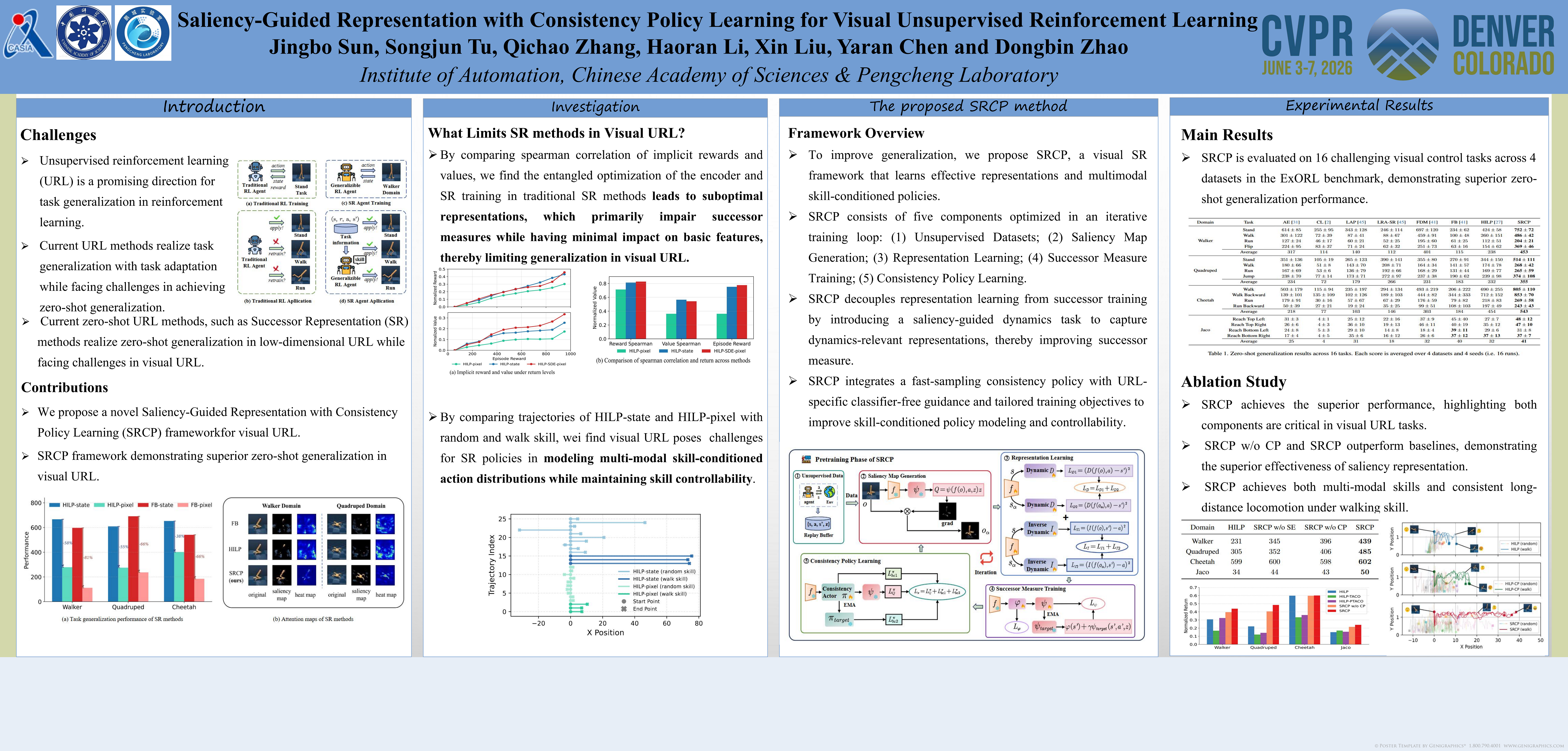
Zero-shot unsupervised reinforcement learning (URL) offers a promising direction for building generalist agents capable of generalizing to unseen tasks without additional supervision. Among existing approaches, successor representations (SR) have emerged as a prominent paradigm due to their effectiveness in structured, low-dimensional settings. However, SR methods struggle to scale to high-dimensional visual environments. Through empirical analysis, we identify two key limitations of SR in visual URL: (1) SR objectives often lead to suboptimal representations that attend to dynamics-irrelevant regions, resulting in inaccurate successor measures and degraded task generalization; and (2) these flawed representations hinder SR policies from modeling multi-modal skill-conditioned action distributions and ensuring skill controllability. To address these limitations, we propose Saliency-Guided Representation with Consistency Policy Learning (SRCP), a novel framework that improves zero-shot generalization of SR methods in visual URL. SRCP decouples representation learning from successor training by introducing a saliency-guided dynamics task to capture dynamics-relevant representations, thereby improving successor measure and task generalization. Moreover, it integrates a fast-sampling consistency policy with URL-specific classifier-free guidance and tailored training objectives to improve skill-conditioned policy modeling and controllability. Extensive experiments on 16 tasks across 4 datasets from the ExORL benchmark demonstrate that SRCP achieves state-of-the-art zero-shot generalization in visual URL and is compatible with various SR methods.
LensWalk: Agentic Video Understanding by Planning How You See in Videos
Keliang Li ⋅ Yansong Li ⋅ Hongze Shen ⋅ Mengdi Liu ⋅ Hong Chang ⋅ Shiguang Shan

The dense, temporal nature of video presents a profound challenge for automated analysis. Despite the use of powerful Vision-Language Models, prevailing methods for video understanding are limited by the inherent disconnect between reasoning and perception: they rely on static, pre-processed information and cannot actively seek raw evidence from video as their understanding evolves. To address this, we introduce LensWalk, a flexible agentic framework that empowers a Large Language Model reasoner to control its own visual observation actively. LensWalk establishes a tight reason-plan-observe loop where the agent dynamically specifies, at each step, thetemporal scope and sampling density of the video it observes. Using a suite of versatile, Vision-Language Model based tools parameterized by these specifications, the agent can perform broad scans for cues, focus on specific segments for fact extraction, and stitch evidence from multiple moments for holistic verification. This design allows for progressive, on-demand evidence gathering that directly serves the agent's evolving chain of thought. Without requiring any model fine-tuning, LensWalk delivers substantial, plug-and-play performance gains on multiple model recipes, boosting their accuracy by over 5\% on challenging long-video benchmarks like LVBench and Video-MME. Our analysis reveals that enabling an agent to control how it sees is key to unlocking more accurate, robust, and interpretable video reasoning.
DPGF-Net: Dual-Prior Guided Fusion Network for Joint Assessment of Perceptual Quality and Semantic Consistency in AI-Generated Images
Tao Li ⋅ Xingran LIAO ⋅ Mingliang Zhou
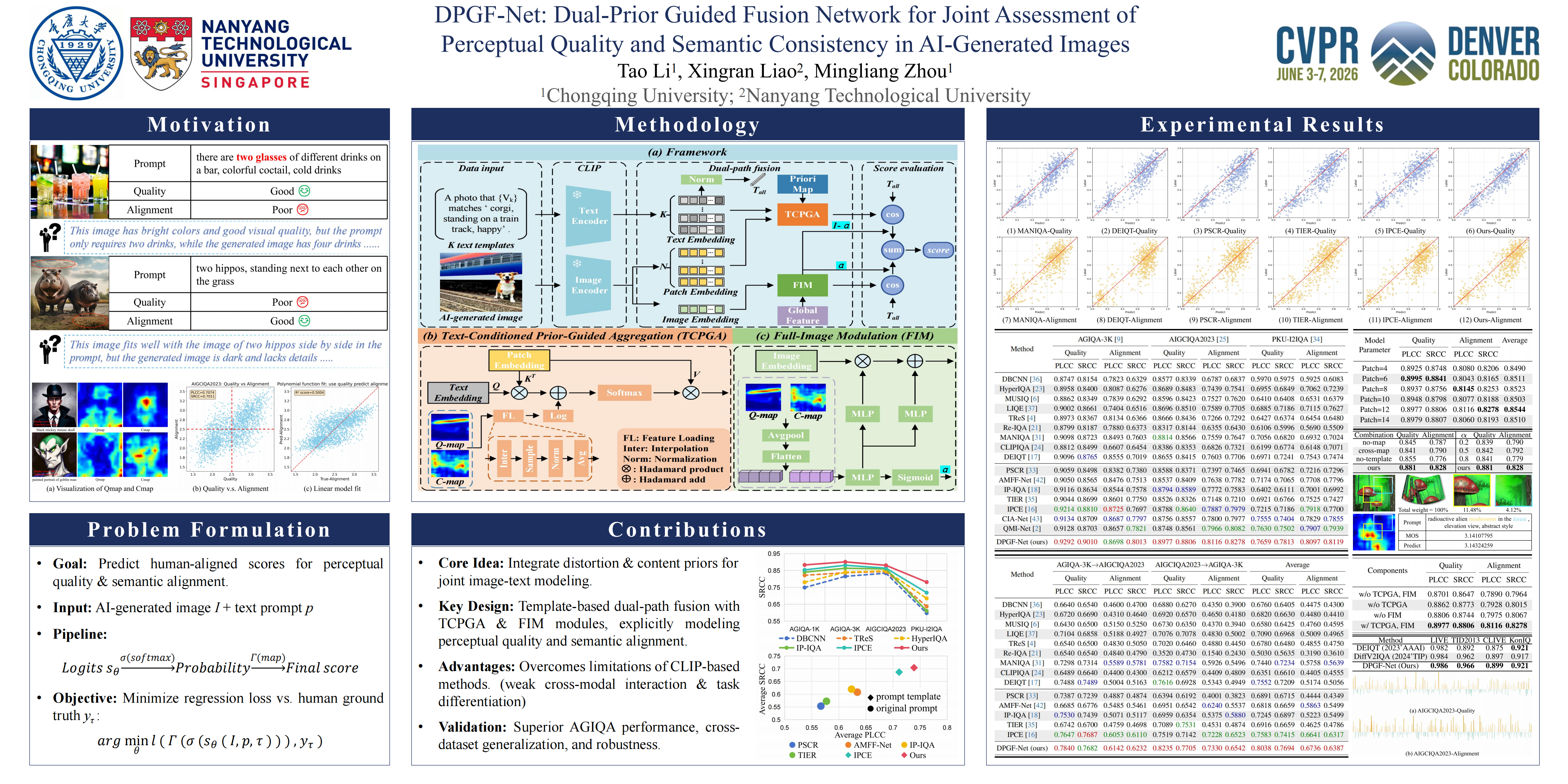
The development of AI-generated technology requires effective image quality assessment (AGIQA) methods to jointly evaluate visual quality and text-content alignment, ensuring that the generated content is both visually appealing and faithful to the user's instructions. Nevertheless, visual degradation and text-content misalignment often coincide, and it is difficult to tell whether a bad subjective evaluation arises from prompt noncompliance or rendering artifacts. As such, disentangling image content and rendering distortions is vital. We propose the dual-prior guided fusion network (DPGF-Net), which leverages image-side priors to disentangle distortions from content and combines them with text-side prompt templates to simulate their interactions, to address this issue. DPGF-Net employs a local text-conditioned aggregation branch to highlight semantically relevant and quality-sensitive regions in conjunction with a global modulation branch that captures holistic perceptual characteristics. Finally, adaptive fusion produces a single score. Experiments on three AGIQA datasets demonstrate that our method is highly correlated with human judgments, with lower prediction error and stable evaluation behavior. The code will be released upon acceptance.
RegionFuse: Region-Adaptive Pixel Distribution Learning for Infrared and Visible Image Fusion
Jianghan Xia ⋅ Hong Song ⋅ Jinfu Li ⋅ Yucong Lin ⋅ Shihan Ma ⋅ Jingfan Fan ⋅ Danni Ai ⋅ Tianyu Fu ⋅ Deqiang Xiao ⋅ Jian Yang
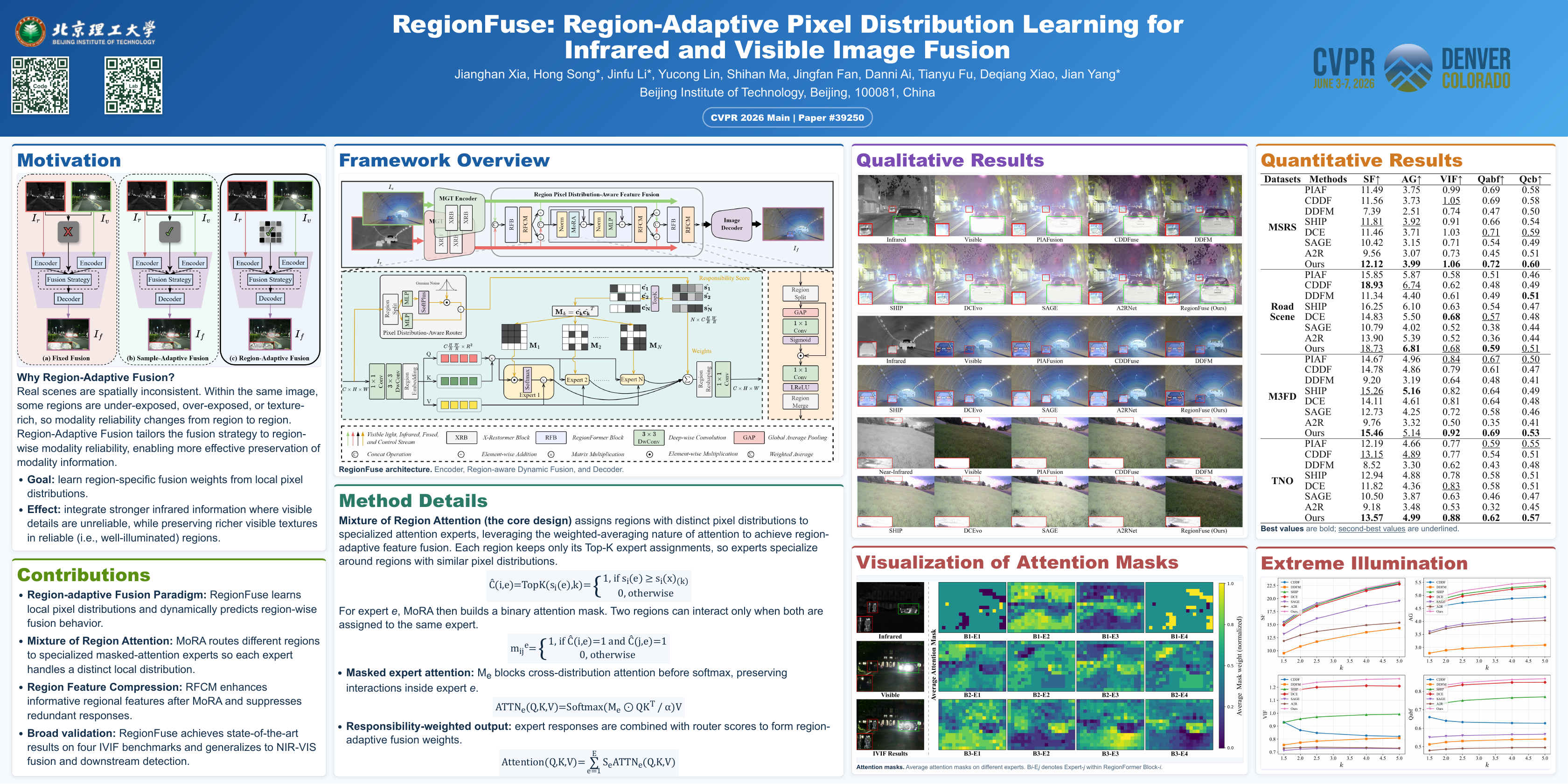
Infrared and Visible Image Fusion (IVIF) aims to combine complementary information from infrared and visible images to overcome the limitations of a single modality. While existing methods typically employ fixed or sample-adaptive fusion paradigms where fusion weights are static or derived from global pixel distributions, they often overlook spatial inconsistencies in pixel distribution within images, leading to suboptimal performance. To address this issue, we propose RegionFuse, a Region-Adaptive Pixel Distribution Learning Network for IVIF, which dynamically generates fusion weights based on local pixel distributions to construct a region-wise adaptive fusion paradigm. RegionFuse introduces a Mixture of Region Attention (MoRA) mechanism, which assigns each region to several specialized experts, enabling region-level feature interaction tailored to specific local distributions. Furthermore, we design a Region Feature Compression Module (RFCM) and place it after each MoRA to enhance informative regions and suppress redundant ones. Extensive experiments on various benchmarks demonstrate the superiority and robustness of RegionFuse, especially in handling non-uniform pixel distributions. Evaluations on NIR-VIS and downstream tasks further confirm its generalizability and practical utility.
Missing No More: Dictionary-Guided Cross-Modal Image Fusion under Missing Infrared
Yafei Zhang ⋅ Meng Ma ⋅ Huafeng Li ⋅ Yu Liu
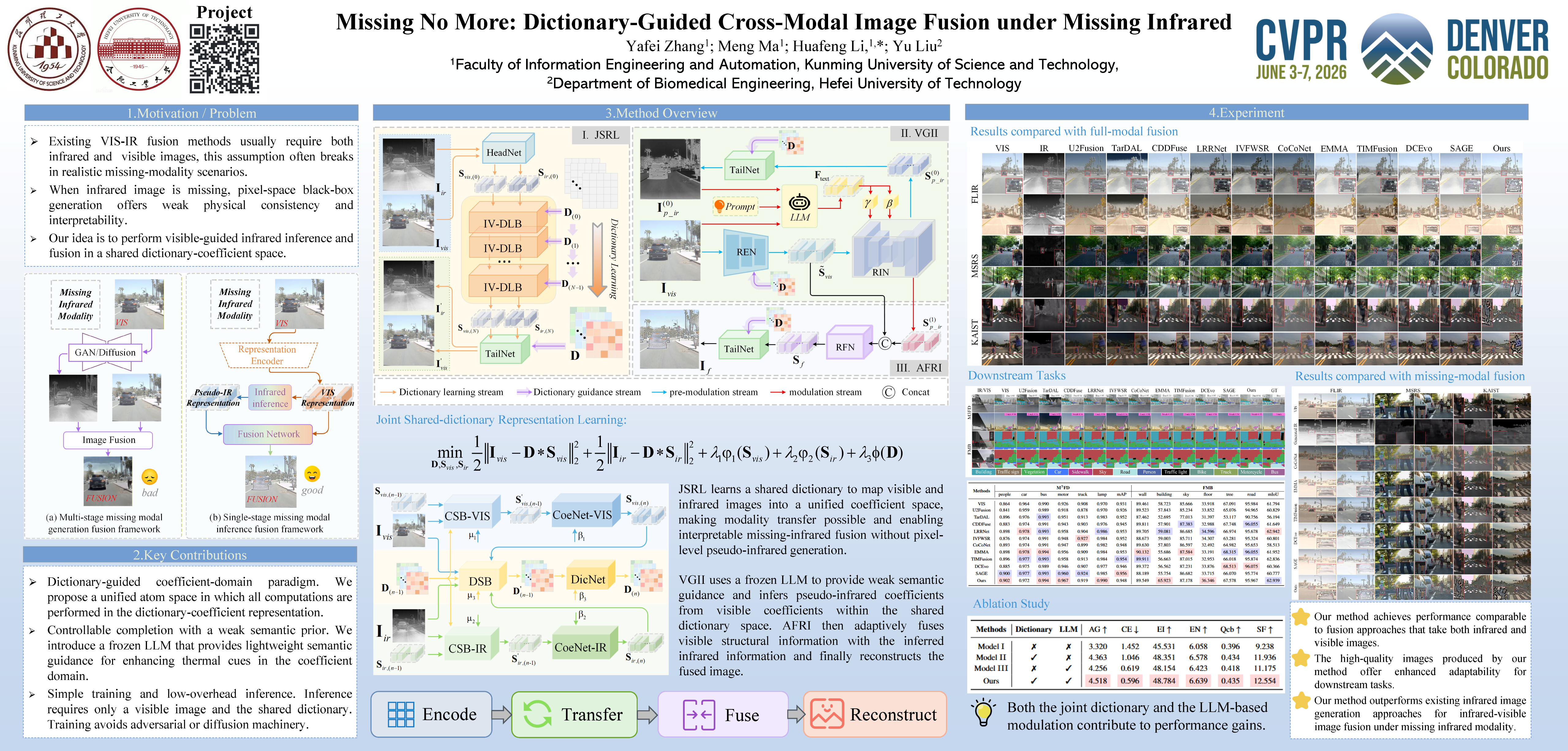
Infrared–visible (IR–VIS) image fusion is vital for perception and security, yet most methods rely on the availability of both modalities during training and inference. When the infrared modality is absent, pixel-space generative substitutes become hard to control and inherently lack interpretability. We address missing-IR fusion by proposing a dictionary-guided, coefficient-domain framework built upon a shared convolutional dictionary. The pipeline comprises three key components: (1) Joint Shared-dictionary Representation Learning (JSRL) learns a unified and interpretable atom space shared by both IR and VIS modalities; (2) VIS-Guided IR Inference (VGII) transfers VIS coefficients to pseudo-IR coefficients in the coefficient domain and performs a one-step closed-loop refinement guided by a frozen large language model as a weak semantic prior; and (3) Adaptive Fusion via Representation Inference (AFRI) merges VIS structures and inferred IR cues at the atom level through window attention and convolutional mixing, followed by reconstruction with the shared dictionary. This \emph{encode$\rightarrow$transfer$\rightarrow$fuse$\rightarrow$reconstruct} pipeline avoids uncontrolled pixel-space generation while ensuring prior preservation within interpretable dictionary–coefficient representation. Experiments under missing-IR settings demonstrate consistent improvements in perceptual quality and downstream detection performance. To our knowledge, this represents the first framework that jointly learns a shared dictionary and performs coefficient-domain inference–fusion to tackle missing-IR fusion.
VideoFusion: A Spatio-Temporal Collaborative Network for Multi-modal Video Fusion
Linfeng Tang ⋅ Yeda Wang ⋅ Meiqi Gong ⋅ Zizhuo Li ⋅ Yuxin Deng ⋅ Xunpeng Yi ⋅ Chunyu Li ⋅ Han Xu ⋅ HAO ZHANG ⋅ Jiayi Ma
Compared to images, videos better align with real-world acquisition scenarios and possess valuable temporal cues. However, existing multi-sensor fusion research predominantly integrates complementary context from multiple images rather than videos. This primarily stems from two factors: 1) the scarcity of large-scale multi-sensor video datasets, limiting research in video fusion, and 2) the inherent difficulty of jointly modeling spatial and temporal dependencies in a unified framework. This paper proactively compensates for the dilemmas. First, we construct M3SVD, a benchmark dataset with 220 temporally synchronized and spatially registered infrared-visible videos comprising 153,797 frames, filling the data gap for the video fusion community. Secondly, we propose VideoFusion, a multi-modal video fusion model that fully exploits cross-modal complementarity and temporal dynamics to generate spatio-temporally coherent videos from multi-modal inputs. Specifically, 1) a differential reinforcement module is developed for cross-modal information interaction and enhancement, 2) a complete modality-guided fusion strategy is employed to adaptively integrate multi-modal features, and 3) a bi-temporal co-attention mechanism is devised to dynamically aggregate forward-backward temporal contexts to reinforce cross-frame feature representations. Extensive experiments reveal that VideoFusion outperforms existing image-oriented fusion paradigms in sequences, effectively mitigating temporal inconsistency and interference.
TAPE: Task-Adaptive Prototype Evolution in Audio-Language Models for Fully Few-shot Class-incremental Audio Classification
Yunlong Gao ⋅ Wenxin Liang ⋅ Guanglu Wang ⋅ Senqi Guan ⋅ Linlin Zong ⋅ Dongyu Zhang ⋅ Xinyue Liu
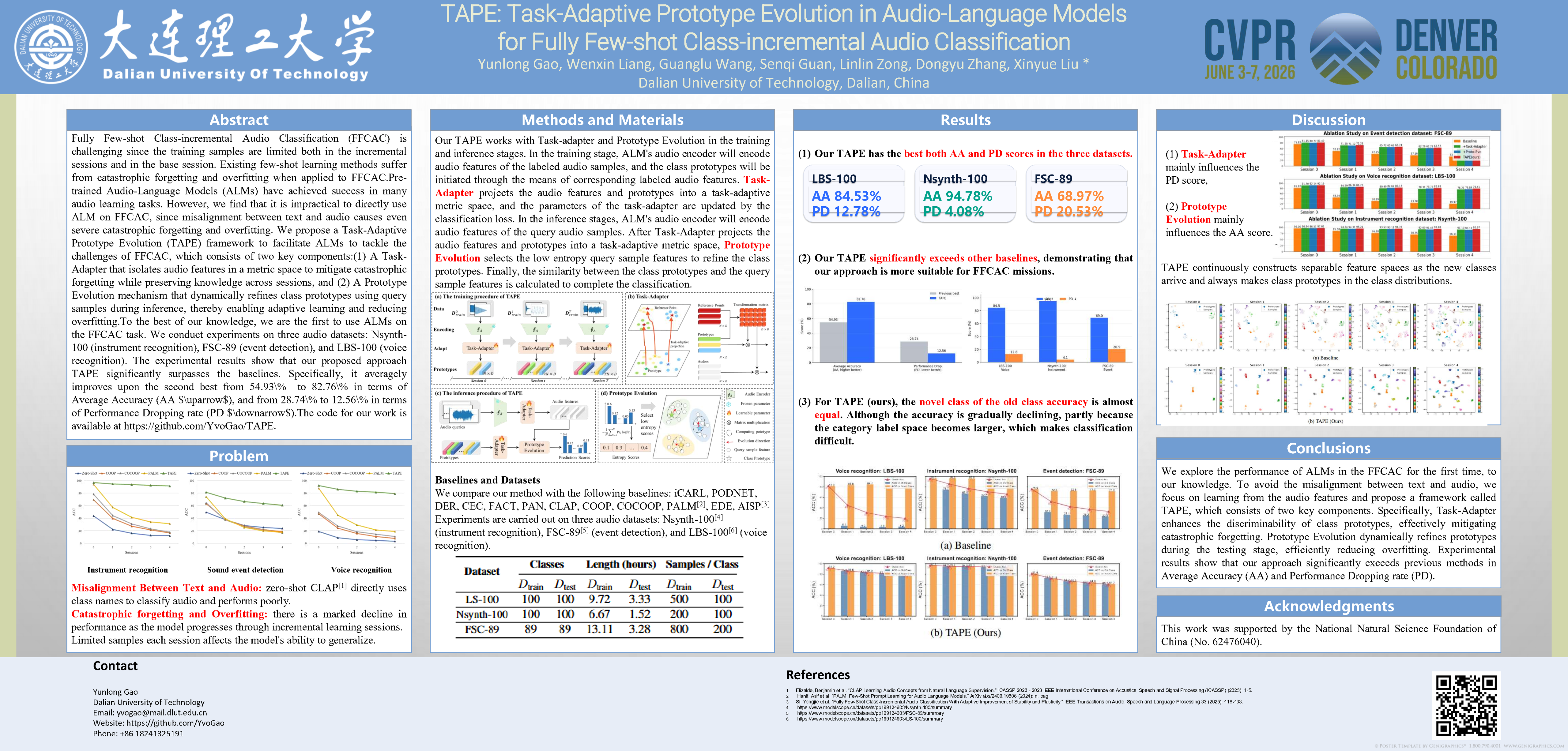
Fully Few-shot Class-incremental Audio Classification (FFCAC) is challenging since the training samples are limited both in the incremental sessions and in the base session. Existing few-shot learning methods suffer from catastrophic forgetting and overfitting when applied to FFCAC.Pre-trained Audio-Language Models (ALMs) have achieved success in many audio learning tasks. However, we find that it is impractical to directly use ALM on FFCAC, since misalignment between text and audio causes even severe catastrophic forgetting and overfitting. We propose a Task-Adaptive Prototype Evolution (TAPE) framework to facilitate ALMs to tackle the challenges of FFCAC, which consists of two key components:(1) A Task-Adapter that isolates audio features in a metric space to mitigate catastrophic forgetting while preserving knowledge across sessions, and (2) A Prototype Evolution mechanism that dynamically refines class prototypes using query samples during inference, thereby enabling adaptive learning and reducing overfitting.To the best of our knowledge, we are the first to use ALMs on the FFCAC task. We conduct experiments on three audio datasets: NSynth-100 (instrument recognition), FSC-89 (event detection), and LBS-100 (voice recognition). The experimental results show that our proposed approach TAPE significantly surpasses the baselines. Specifically, it averagely improves upon the second best from 54.93\% to 82.76\% in terms of Average Accuracy (AA $\uparrow$), and from 28.74\% to 12.56\% in terms of Performance Dropping rate (PD $\downarrow$).
Remedying Target-Domain Astigmatism for Cross-Domain Few-Shot Object Detection
Yongwei Jiang ⋅ Yixiong Zou ⋅ Yuhua Li ⋅ Ruixuan Li
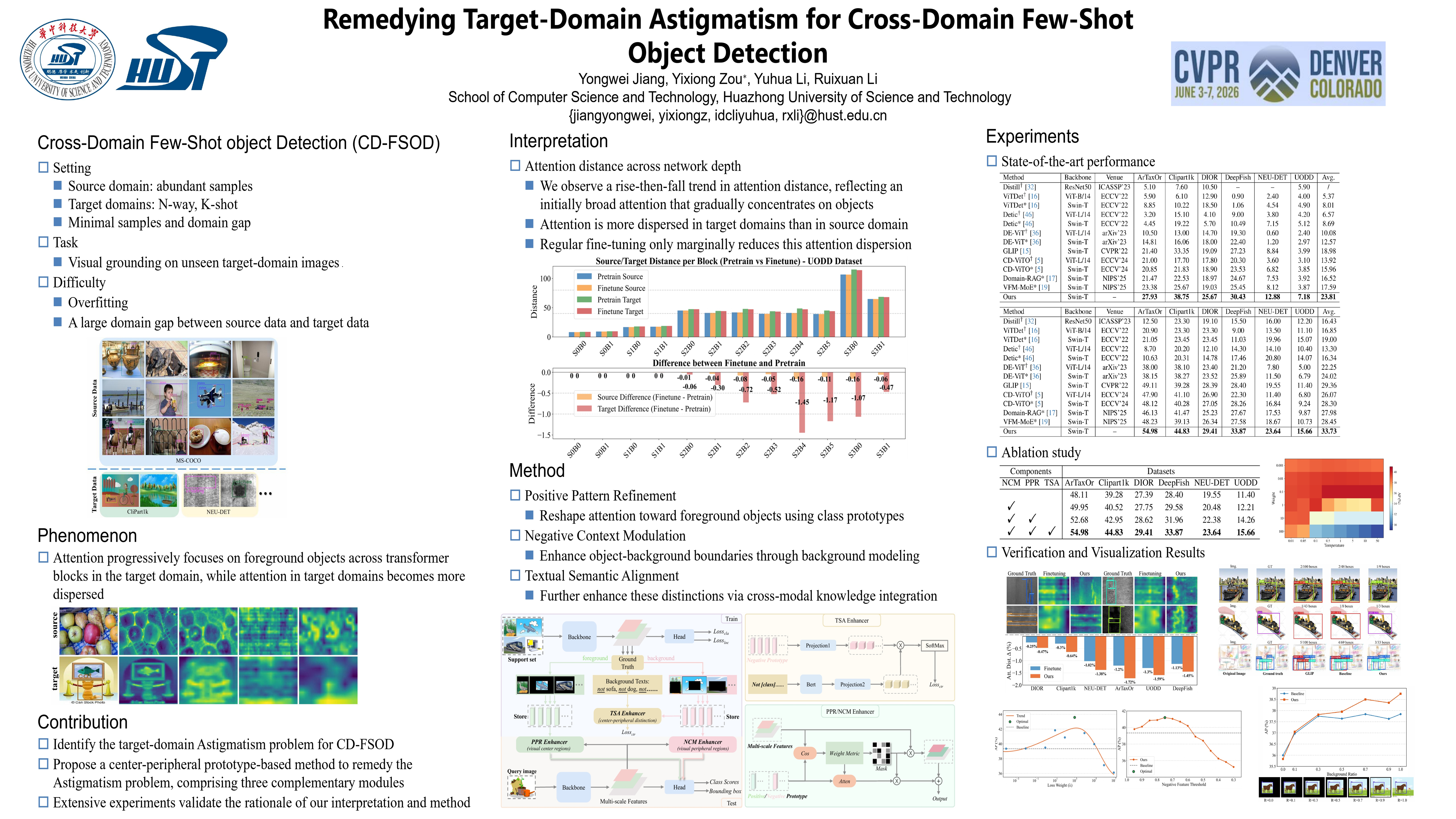
Cross-domain few-shot object detection (CD-FSOD) aims to adapt pretrained detectors from a source domain to target domains with limited annotations, suffering from severe domain shifts and data scarcity problems. In this work, we find a previously overlooked phenomenon: models exhibit dispersed and unfocused attention in target domains, leading to imprecise localization and redundant predictions, just like a human cannot focus on visual objects. Therefore, we call it the target-domain Astigmatism problem. Analysis on attention distances across transformer layers reveals that regular fine-tuning inherently shows a trend to remedy this problem, but results are still far from satisfactory, which we aim to enhance in this paper. Biologically inspired by the human fovea-style visual system, we enhance the fine-tuning's inherent trend through a center-periphery attention refinement framework, which contains (1) a Positive Pattern Refinement module to reshape attention toward semantic objects using class-specific prototypes, simulating the visual center region;(2) a Negative Context Modulation module to enhance boundary discrimination by modeling background context, simulating the visual periphery region; and (3) a Textual Semantic Alignment module to strengthen center-periphery distinction through cross-modal cues. Our bio-inspired approach transforms astigmatic attention into focused patterns, substantially improving adaptation to target domains. Experiments on six challenging CD-FSOD benchmarks consistently demonstrate improved detection accuracy and establish new state-of-the-art results.
DDSF: Robust Few-Shot Learning via Disentangled Subspaces with Determinantal Point Process
xulun ye ⋅ Yifan Mei ⋅ Kun Zhou ⋅ Zelei Wu ⋅ Jieyu Zhao
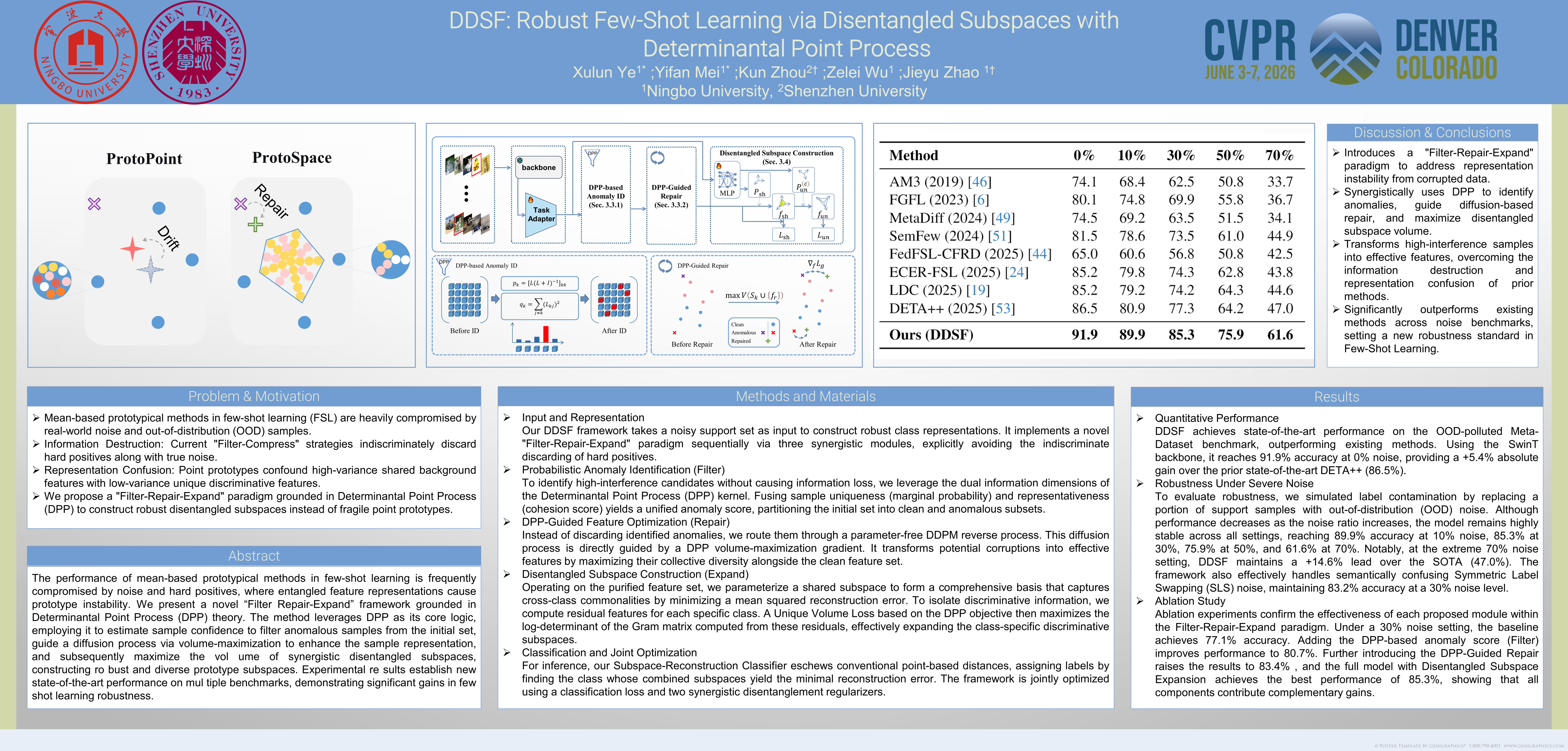
The performance of mean-based prototypical methods in few-shot learning is frequently compromised by noise and hard positives, where entangled feature representations cause prototype instability. We present a novel ``Filter-Repair-Expand'' framework grounded in Determinantal Point Process (DPP) theory. The method leverages DPP as its core logic, employing it to estimate sample confidence to filter anomalous samples from the initial set, guide a diffusion process via volume-maximization to enhance the sample representation, and subsequently maximize the volume of synergistic disentangled subspaces, constructing robust and diverse prototype subspaces. Experimental results establish new state-of-the-art performance on multiple benchmarks, demonstrating significant gains in few-shot learning robustness.
Hyperbolic Defect Feature Synthesis for Few-Shot Defect Classification
Huimin Li ⋅ Boxuan Hu ⋅ Yulin Zhang ⋅ Xiuzhuang Zhou ⋅ Junlin Hu
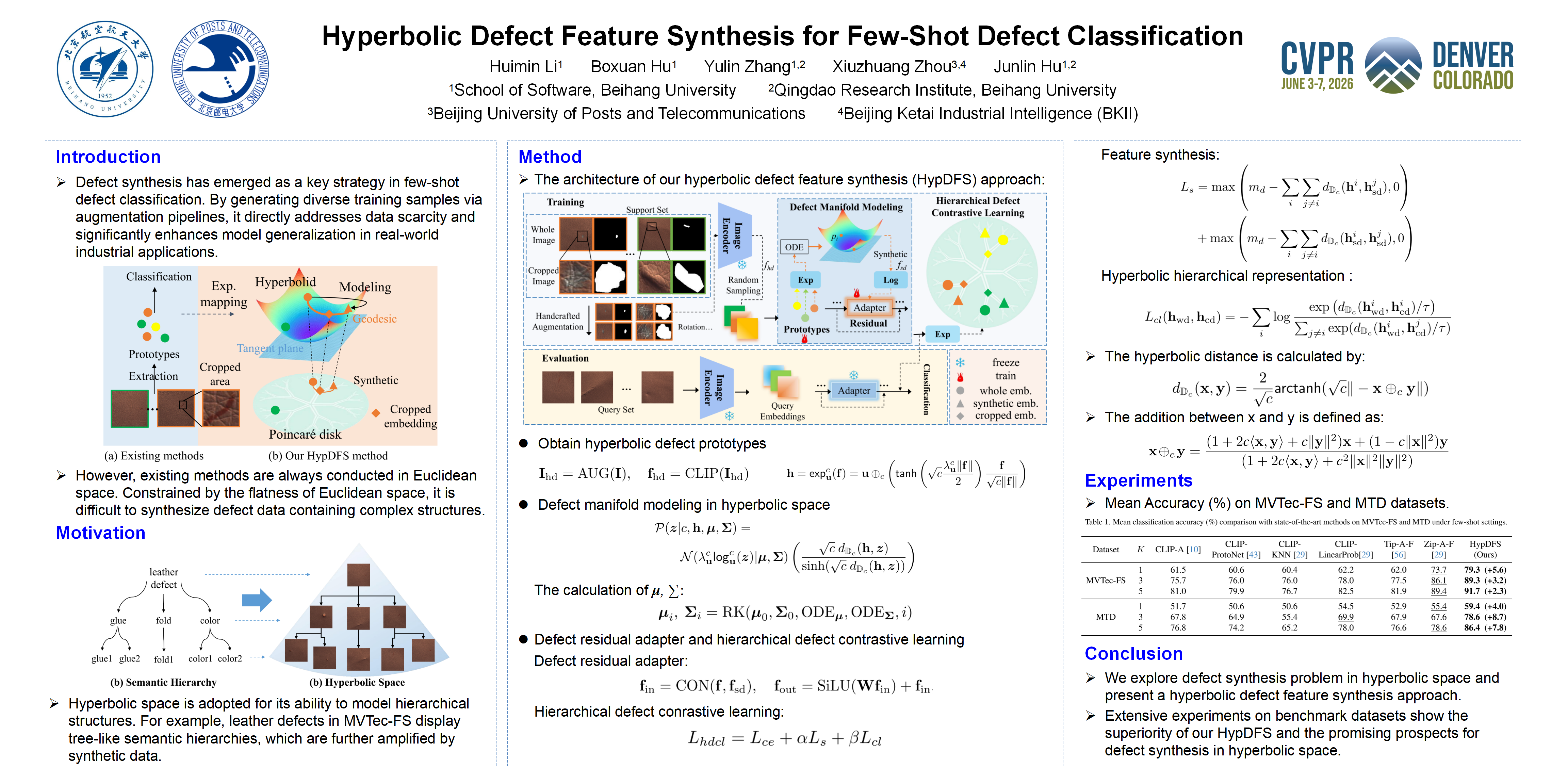
Defect synthesis, as a core technology for addressing the problem of few-shot defect classification, has been widely adopted in industrial scenarios. It helps alleviate the problem of insufficient model generalization capability owing to data scarcity by establishing a data augmentation pipeline. Recently, remarkable progress has been achieved in both explicit defect image generation and implicit defect feature synthesis approaches. However, the existing methods are always conducted in Euclidean space. Constrained by the flatness of Euclidean space, it is difficult to synthesize defect data containing complex structures. In this paper, we attempt to explore the defect generation in hyperbolic space and propose a hyperbolic defect feature synthesis (HypDFS) method. By modeling the potential defect distribution via a small number of hyperbolic defect prototypes and further optimizing the synthetic defect features with the hierarchical defect contrastive loss in hyperbolic space, our HypDFS method can obtain a better generalized defect representation that is more conducive to downstream few-shot defect classification task. Extensive experiments conducted on the MVTec-FS benchmark and standard MTD dataset under the few-shot settings demonstrate that the proposed HypDFS surpasses the Euclidean baseline by a large margin, showing the promising prospects for defect synthesis in hyperbolic space.
Training-Only Heterogeneous Image-Patch-Text Graph Supervision for Advancing Few-Shot Learning Adapters
Mohammed Rahman Sherif Khan Mohammad ⋅ Ardhendu Behera ⋅ Sandip Pradhan ⋅ Swagat Kumar ⋅ Amr Ahmed
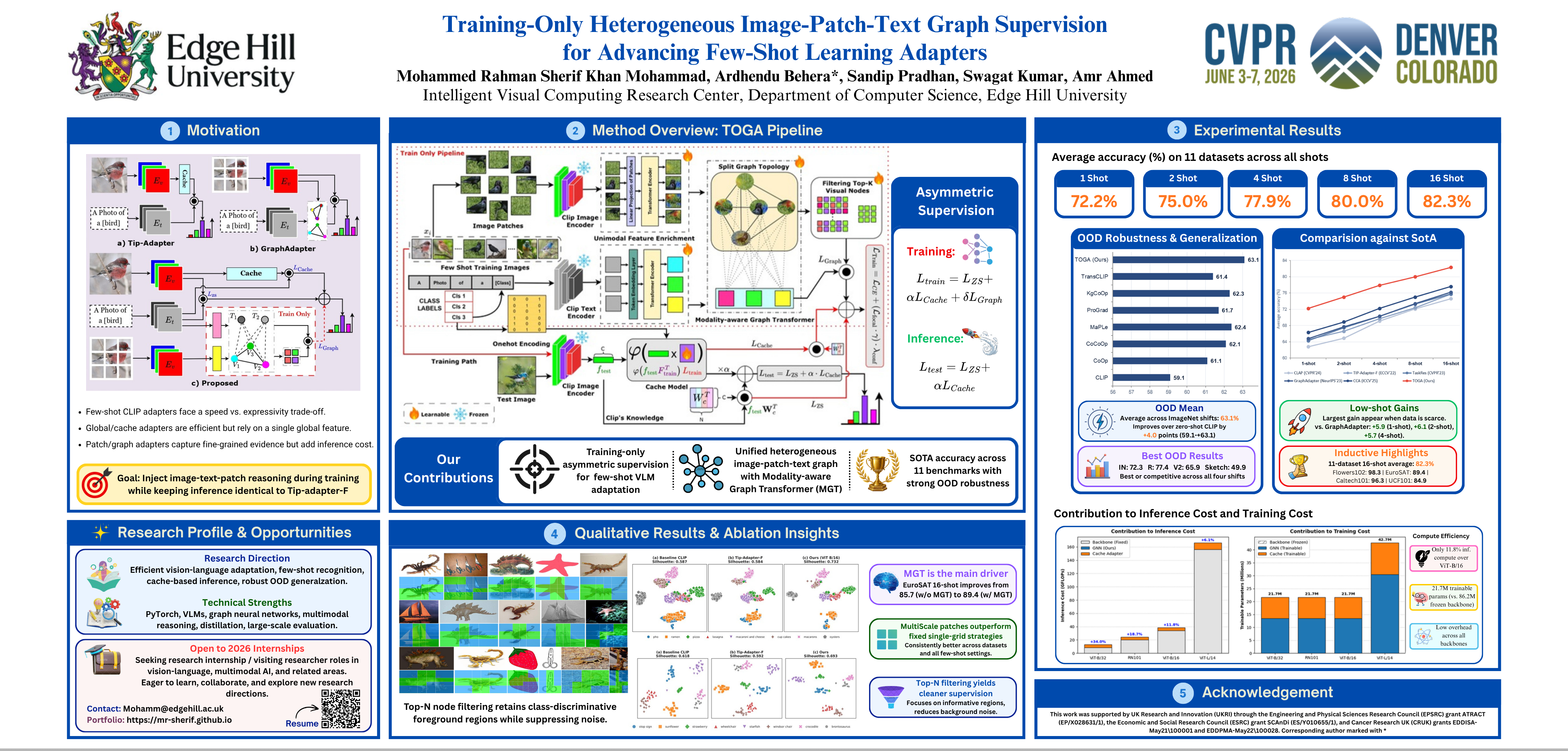
Recent adapter-based CLIP tuning (e.g., Tip-Adapter) is a strong few-shot learner, achieving efficiency by caching support features for fast prototype matching. However, these methods rely on global uni-modal feature vectors, overlooking fine-grained patch relations and their structural alignment with class text. To bridge this gap without incurring inference costs, we introduce a novel asymmetric training-only framework. Instead of altering the lightweight adapter, we construct a high-capacity auxiliary Heterogeneous Graph Teacher that operates solely during training. This teacher (i) integrates multi-scale visual patches and text prompts into a unified graph, (ii) performs deep cross-modal reasoning via a Modality-aware Graph Transformer (MGT), and (iii) applies discriminative node filtering to extract high-fidelity class features. Crucially, we employ a cache-aware dual-objective strategy to supervise this relational knowledge directly into the Tip-Adapter’s key–value cache, effectively upgrading the prototypes while the graph teacher is discarded at test time. Thus, inference remains identical to Tip-Adapter with zero extra latency or memory. Across standard 1-16-shot benchmarks, our method consistently establishes a new state-of-the-art. Ablations confirm that the auxiliary graph supervision, text-guided reasoning, and node filtering are the essential ingredients for robust few-shot adaptation.
Learning to Learn Weight Generation via Local Consistency Diffusion
Yunchuan Guan ⋅ Yu Liu ⋅ Ke Zhou ⋅ Zhiqi Shen ⋅ Jenq-Neng Hwang ⋅ Lei Li
generation. However, existing solutions are limited by two challenges: generalizability and missing local supervision targets. The first challenge stems from the inherent lack of cross-task transferability in existing single-level optimization methods, which limits model performance on new tasks. The latter challenge lies in existing research modeling only global optimal weights, neglecting the supervision signals in local target weights. Furthermore, naively assigning local target weights leads to inconsistency between local and global objectives. To address these issues, we propose Mc-Di, which integrates the diffusion algorithm with meta-learning for better generalizability. Additionally, we extend the vanilla diffusion into a local consistency diffusion algorithm. Our theoretical analysis and experimental results demonstrate that the model can learn from local targets while preserving consistency with the global optimum. We validate Mc-Di's superior accuracy and inference efficiency on tasks that require frequent weight updates, including transfer learning, few-shot learning, domain generalization, and language model fine-tuning.
Balanced Dataset Distillation via Modeling Multiple Visual Pattern Distribution
Guanghui Shi ⋅ Xuefeng Liang ⋅ Qixiang Wen
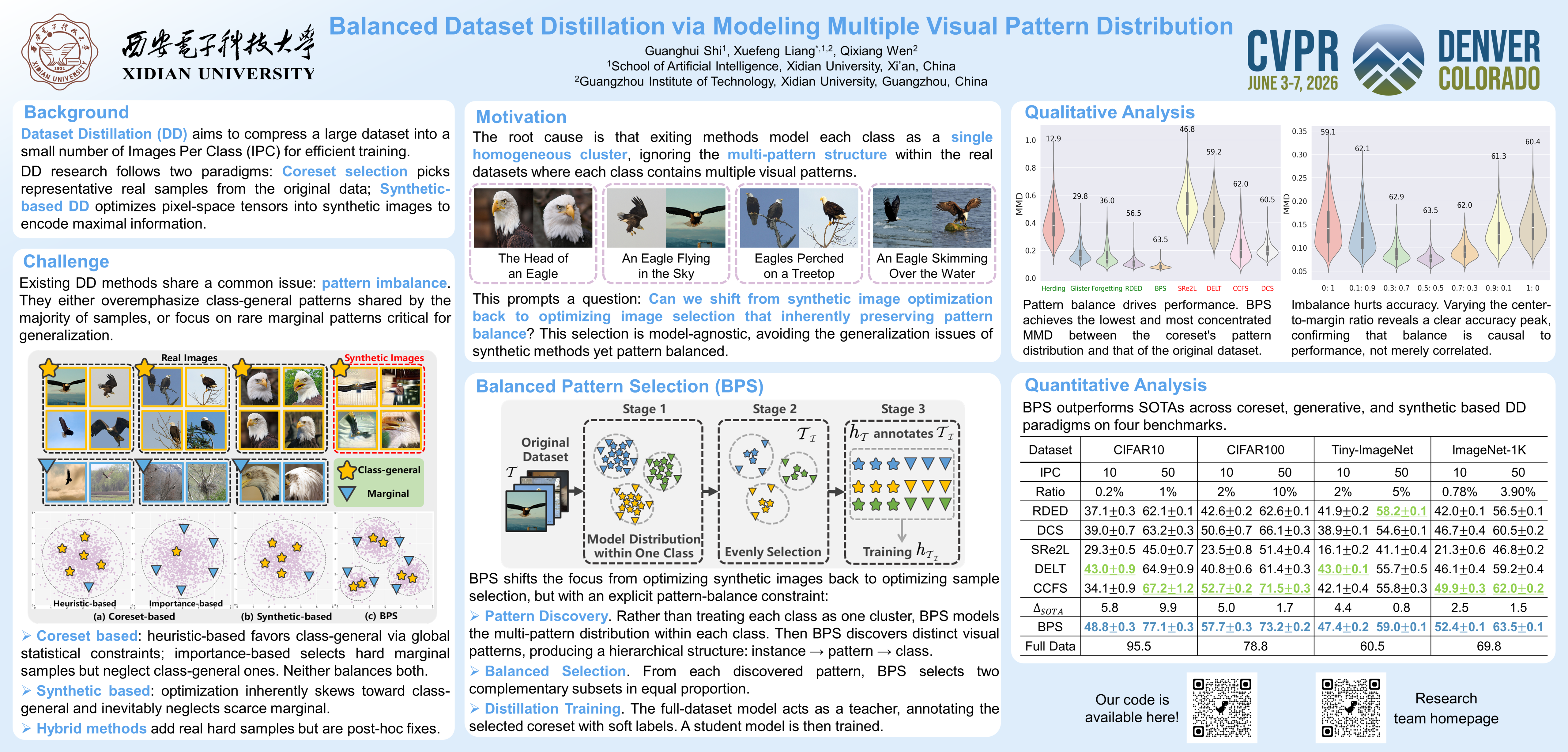
Dataset Distillation (DD) aims to compress large-scale datasets into a small number of condensed Images Per Class (IPC), enabling efficient network training. Previous core-set selection and synthetic-based DD methods achieve reasonable performance. However, our in-depth investigation reveals that existing methods share a common issue: pattern imbalance. Specifically, they either overemphasize class-general patterns representing the majority of each class or focus on fewer marginal patterns critical for model generalization. To address this issue, we propose a novel framework, Balanced Patterns Selection (BPS). Unlike prior methods that assume each class forms a single cluster, BPS models the multiple visual pattern distribution within each class via a hierarchical semantic structure inherent to the dataset. It then selects two complementary subsets in a balanced manner from the center (class-general patterns) and the margins (marginal patterns) of each pattern, producing a pattern-balanced coreset. Theoretically, we prove that the BPS-selected coreset aligns with the original dataset in both distribution and performance. Moreover, its model-agnostic selection nature ensures cross-architecture generalization, while the Optimize-Once-for-All-IPCs property guarantees efficiency. Extensive experiments on four benchmarks demonstrate that BPS significantly outperforms existing state-of-the-art methods.
Grid Distillation: Compositional Image Distillation via Structured Generative Grids
Biplab Ch Das ⋅ Shouvik Das ⋅ Viswanath Gopalakrishnan
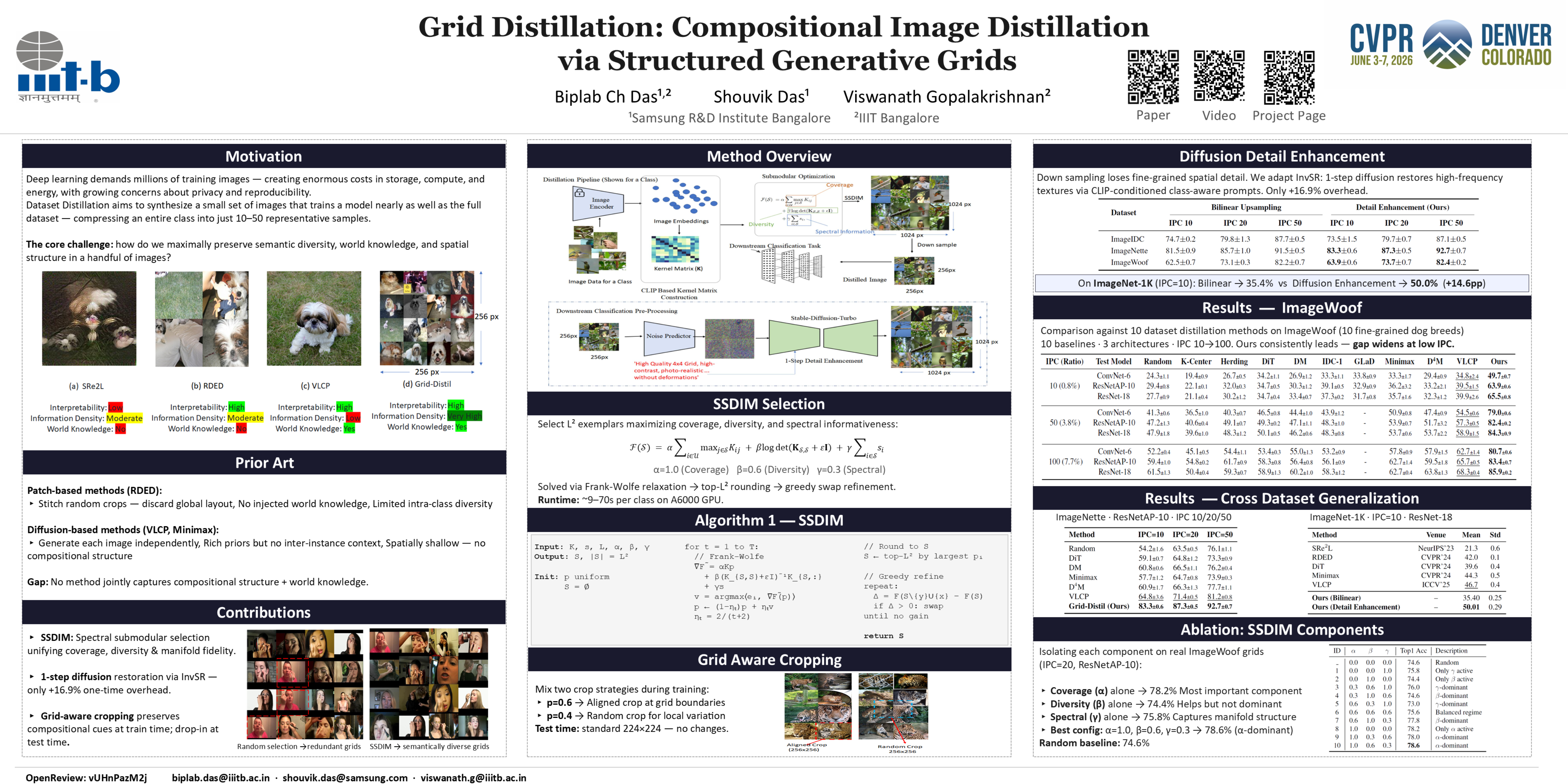
We present \textbf{Grid Distillation}, a generative dataset distillation framework that compresses large-scale datasets into a compact set of informative synthetic samples. Our method constructs high-resolution compositional grids via \textbf{spectral submodular optimization}, which injects \textit{world knowledge} from CLIP representations to maximize semantic coverage and diversity. These grids are then downsampled into low-resolution distilled images optimized for diversity and representational efficiency. During training, a single-step diffusion reconstruction (based on Stable Diffusion Turbo) restores fine-grained spatial details from diffusion priors, bridging the gap between compact representations and natural image statistics. A grid-aware cropping strategy further enhances discriminability by probabilistically aligning crops with grid boundaries, maintaining compatibility with standard $224{\times}224$ inference inputs. Experiments on ImageWoof, ImageNette, ImageIDC, and ImageNet-1K demonstrate consistent improvements over existing dataset distillation methods across multiple IPC settings.
Dataset Distillation by Influence Matching
Haoru Tan ⋅ Wang Wang ⋅ WU Sitong ⋅ Xiuzhe Wu ⋅ Yangtian Sun ⋅ Chirui Chang ⋅ Shaofeng Zhang ⋅ Xiaojuan Qi
We revisit dataset distillation from an outcome-centric perspective. Rather than aligning process surrogates (per-step gradients or training trajectories), Influence Matching (Inf-Match) aligns the final outcome of training: it learns a compact synthetic set whose effect on the converged parameters matches that of the full dataset. Concretely, we introduce a fully differentiable, sample-level influence estimator that quantifies parameter shifts from adding or removing data-- without time-consuming inverse-Hessian products or convexity assumptions. The estimator runs in linear time by unrolling the optimization dynamics and applying a first-order Taylor approximation. We then learn the synthetic set by minimizing the mismatch between its influence and that of the real dataset, yielding outcome alignment rather than heuristic process imitation. Inf-Match delivers the best accuracy across standard classification benchmarks. For instance, on Tiny-ImageNet (IPC=10), Inf-Match attains 31.5\%, a +4.7\% improvement over NCFM. Beyond classification, Inf-Match scales to vision-language distillation on Flickr30K, outperforming strong process-matching baselines. For instance, with 200 to 1000 synthetic samples, our method achieved a leading impressive average on image/text retrieval tasks, higher than NCFM by 2.5\%.
StableMaterials: Enhancing Diversity in Material Generation via Semi-Supervised Learning
Giuseppe Vecchio
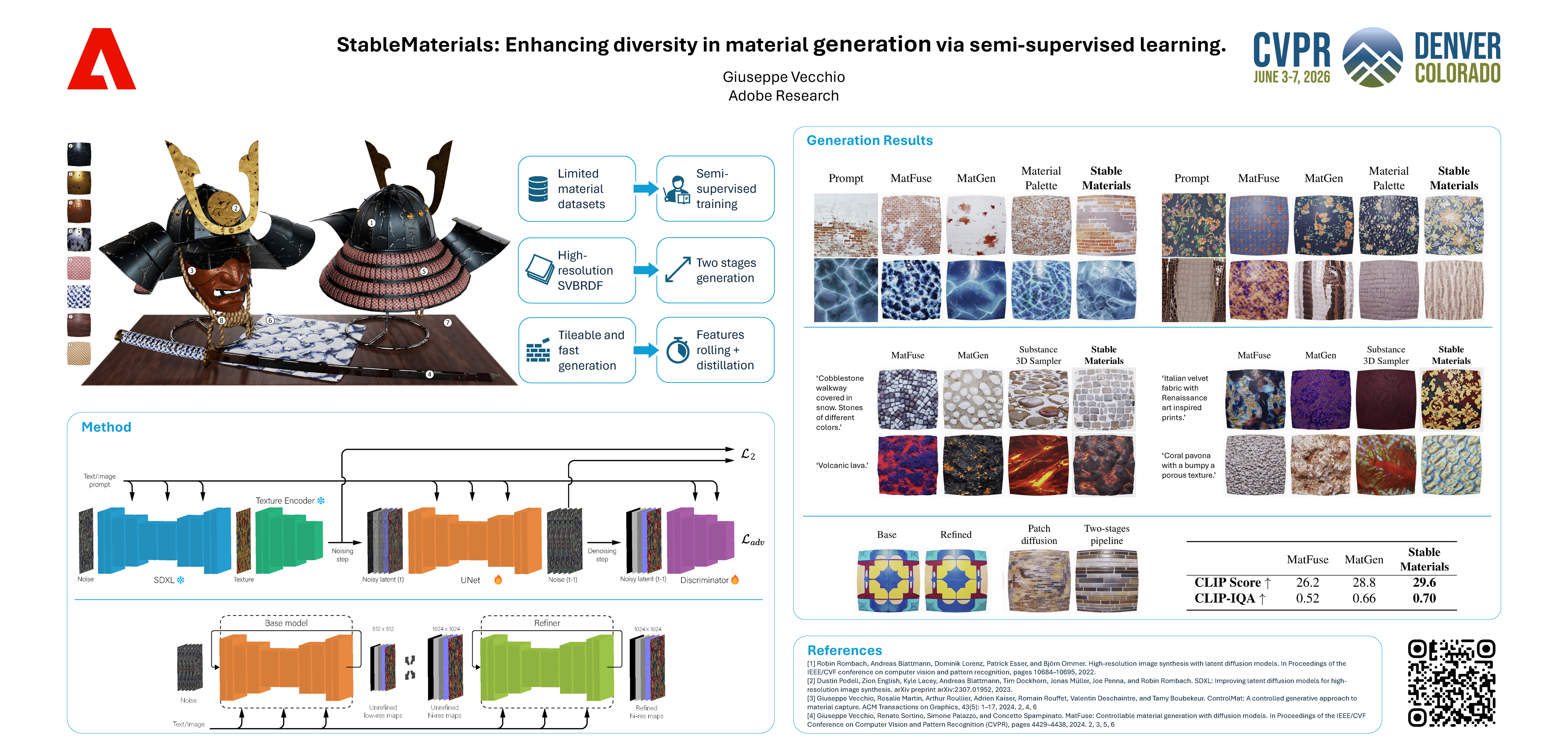
We introduce StableMaterials, a novel approach for generating photorealistic physical-based rendering (PBR) materials that integrate semi-supervised learning with Latent Diffusion Models (LDMs). Our method employs adversarial training to distill knowledge from existing large-scale image generation models, minimizing the reliance on annotated data and enhancing the diversity in generation. This distillation approach aligns the distribution of the generated materials with that of image textures from an SDXL model, enabling the generation of novel materials that are not present in the initial training dataset.Furthermore, we employ a diffusion-based refiner model to improve the visual quality of the samples and achieve high-resolution generation. Finally, we distill a latent consistency model for fast generation in just four steps and propose a new tileability technique that removes visual artifacts typically associated with fewer diffusion steps. We detail the architecture and training process of StableMaterials, the integration of semi-supervised training within existing LDM frameworks.Comparative evaluations with state-of-the-art methods show the effectiveness of StableMaterials, highlighting its potential applications in computer graphics and beyond.StableMaterials will be made publicly available.
Seeing Through Blur: Tackling Defocus in Spike-Based Imaging
Xiantao Ma ⋅ Siwei Dong ⋅ Lin Zhu ⋅ Lizhi Wang ⋅ Hua Huang
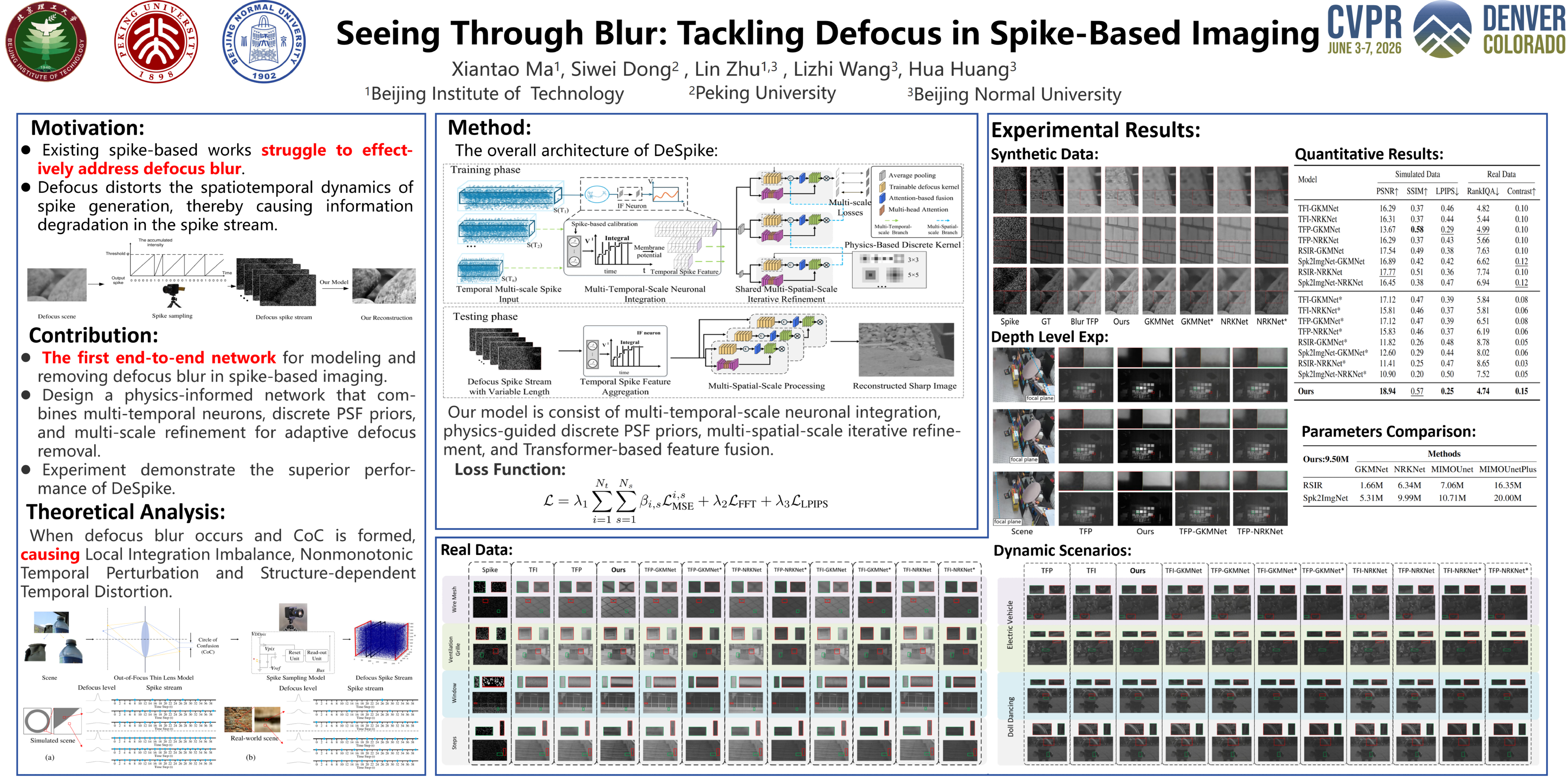
Spike cameras are a novel class of neuromorphic vision sensors that capture scene dynamics with ultra-high temporal resolution via spike planes. While recent methods have addressed motion blur and noise in spike-based reconstruction, defocus blur caused by shallow depth of field or lens adjustment delays remains a critical yet underexplored issue in real-world applications such as autonomous driving. In this work, we present DeSpike, the first end-to-end defocus removal framework specifically designed for spike cameras. Our method begins by explicitly modeling the defocus formation process using a physics-inspired thin-lens approximation to simulate spike responses under optical blur. Guided by this formulation, DeSpike employs multi-temporal-scale integrate-and-fire (IF) neurons to compensate for FPN and extract defocus-aware features from spike streams. These features are then processed by a physics-informed deblurring module constructed from learnable discrete PSF priors. To address spatially variant blur, we introduce a Transformer-based fusion mechanism that adaptively weighs multi-scale deblurring results through attention across defocus levels. Finally, a coarse-to-fine iterative refinement stage combines spike features and PSF priors for progressive restoration. Extensive experiments on both synthetic and real-world defocused spike datasets demonstrate that our method achieves superior performance over state-of-the-art deblurring approaches in terms of structural fidelity, perceptual sharpness, and contrast, setting a new benchmark for defocus-aware spike-based image reconstruction.
Distilling Quasi-Conformal Mapping: A Generalizable and Efficient Solution for Wide-Angle Correction
Chengyang Liu ⋅ Zixuan Lin ⋅ Miaolin Han ⋅ Michael K. Ng ⋅ huibin Li
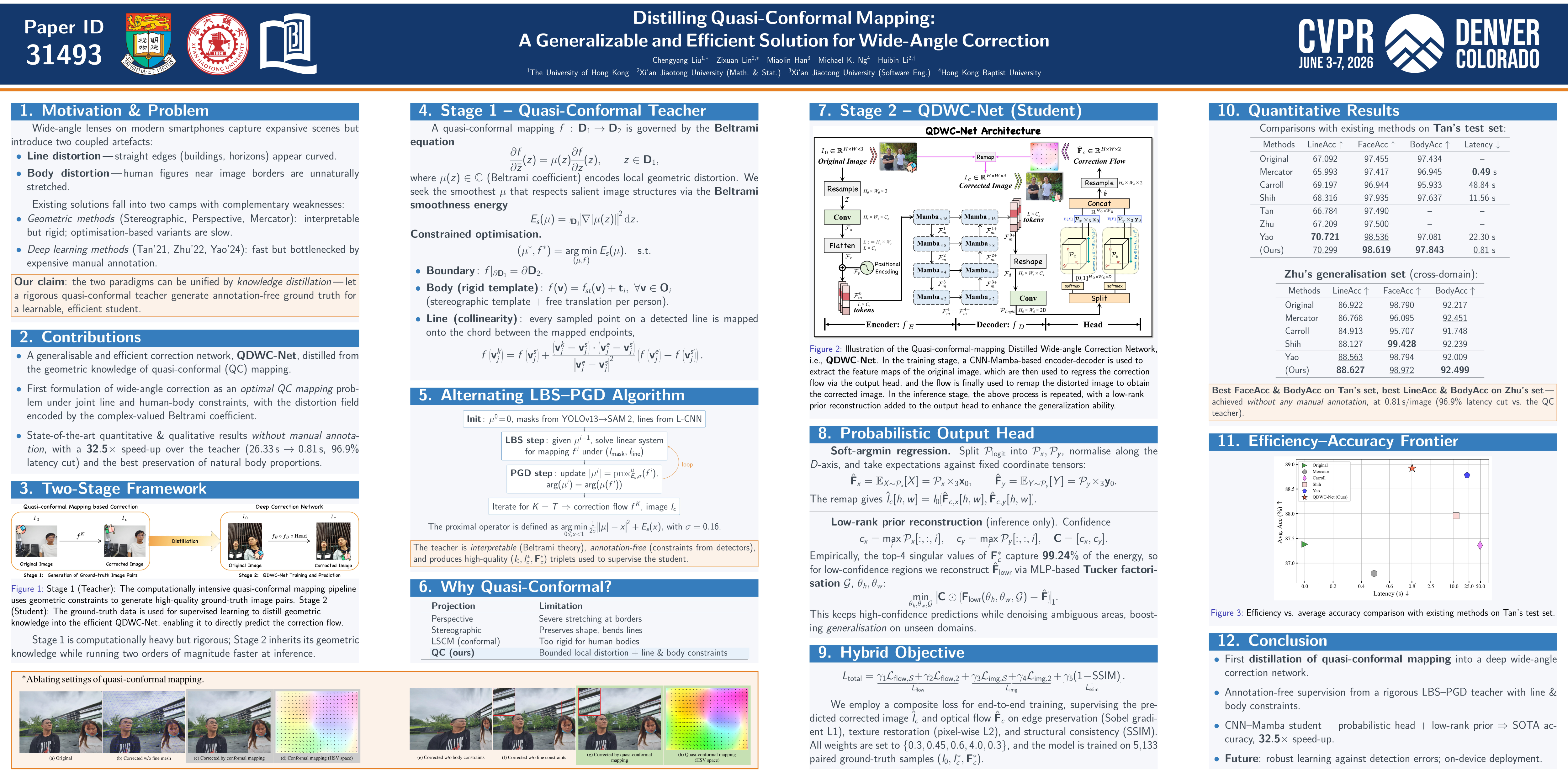
This paper introduces a novel framework for wide-angle correction by distilling the principles of quasi-conformal mapping into an efficient and generalizable deep neural network. Our methodology can be divided into two primary stages. In the first stage, the wide-angle distortion correction problem is treated as a quasi-conformal mapping from the distorted image to the target image. In particular, we minimize the Beltrami smoothness energy with constraints of both line structures and human body regions. The Beltrami coefficient is subsequently estimated using the Proximal Gradient Descent algorithm. This alternating optimization yields the final quasi-conformal mapping and the corresponding corrected image. In the second stage, the Quasi-conformal-mapping Distilled Wide-angle Correction Network (QDWC-Net) is proposed, which is trained on these corrected images to predict the correction flow directly from a distorted input and built upon an encoder-decoder followed by a soft-argmin regression output head and loss functions. Extensive quantitative and qualitative experiments demonstrate the superior effectiveness and efficiency of our distilled approach, which achieves state-of-the-art correction results, especially in mitigating distortion in both portrait and human body regions.
Lighting in Motion: Spatiotemporal HDR Lighting Estimation
Christophe Bolduc ⋅ Julien Philip ⋅ Li Ma ⋅ Mingming He ⋅ Paul Debevec ⋅ Jean-François Lalonde
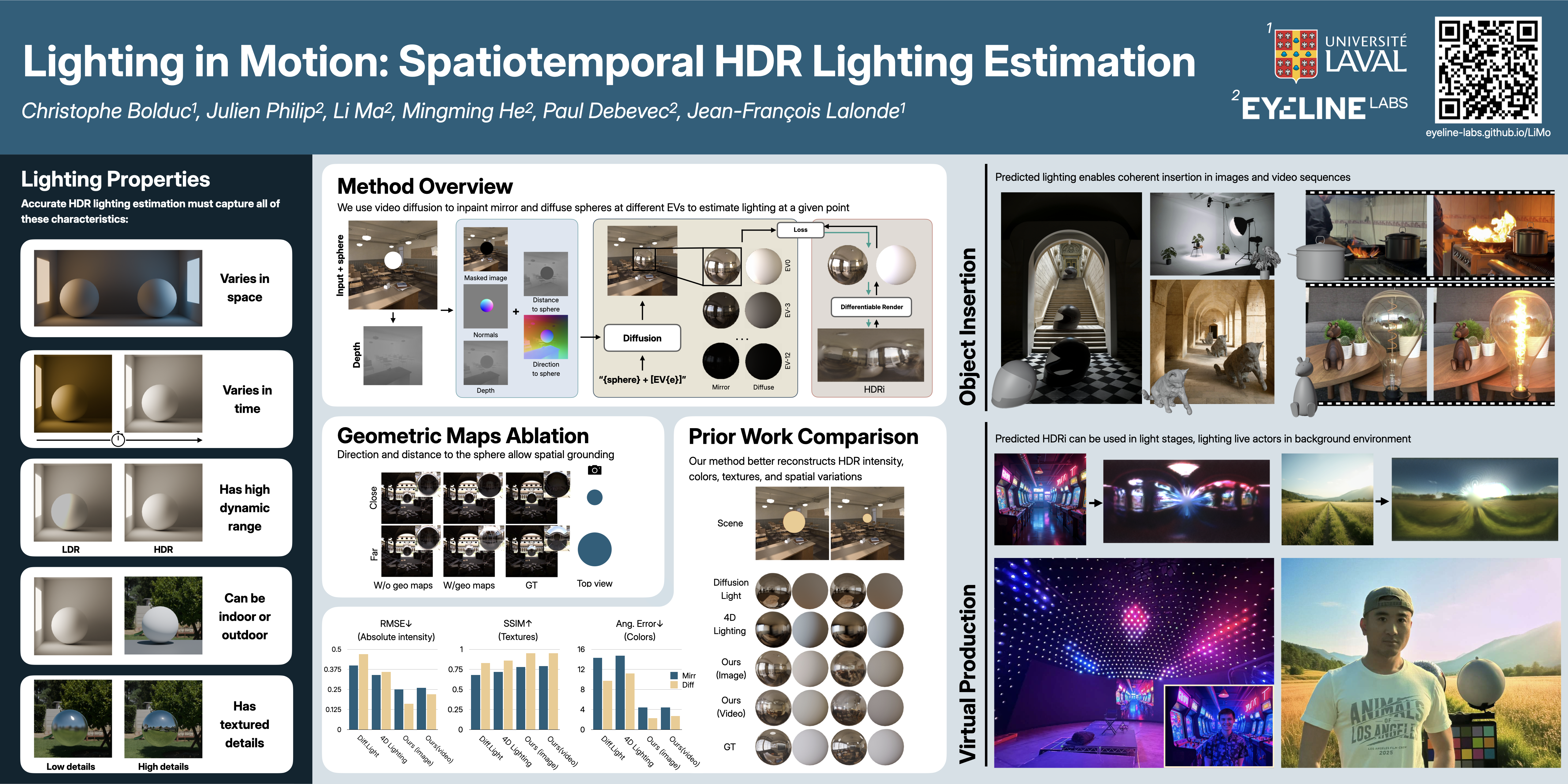
We present LiMo, a diffusion-based approach to spatiotemporal lighting estimation. LiMo targets both realistic high-frequency detail prediction and accurate illuminance estimation. To account for both, we propose generating a set of mirrored and diffuse spheres at different exposures, based on their 3D positions in the input. Making use of diffusion priors, we fine-tune powerful existing diffusion models on a large-scale customized dataset of indoor and outdoor scenes, paired with spatiotemporal light probes. For accurate spatial conditioning, we demonstrate that depth alone is insufficient and we introduce a new geometric condition to provide the relative position of the scene to the target 3D position. Finally, we combine diffuse and mirror predictions at different exposures into a single HDRI map leveraging differentiable rendering. We thoroughly evaluate our method and design choices to establish LiMo as state-of-the-art for both spatial control and prediction accuracy.
LightRR: A Lightweight Network for Single Image Reflection Removal
Wenbin Yin ⋅ Junkang Zhang ⋅ Sunzhe Yang ⋅ Faming Fang ⋅ Guixu Zhang
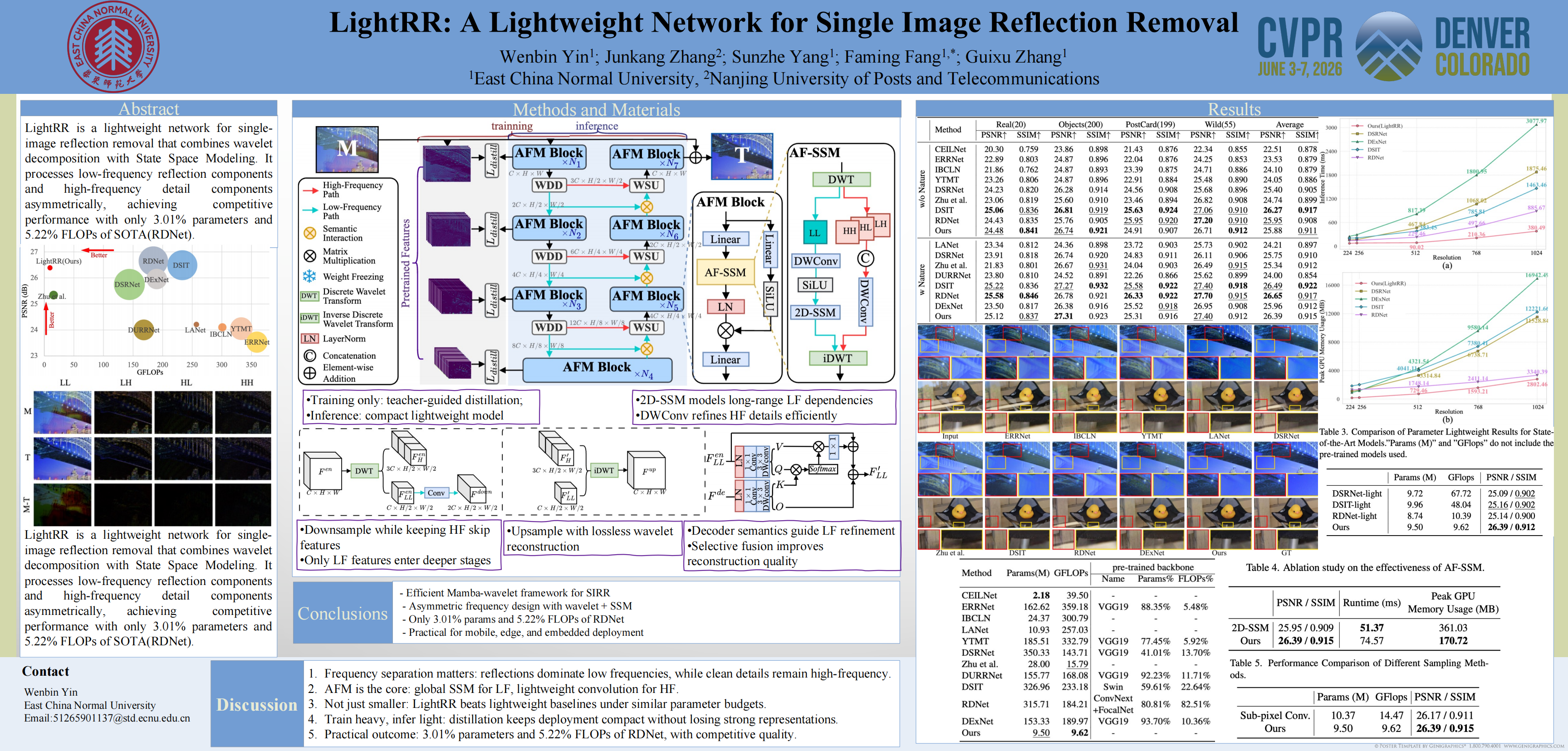
Single-image reflection removal (SIRR) is a highly ill-posed and computationally demanding problem. Existing CNN or Transformer-based methods often rely on large receptive fields and heavy computation, limiting their deployment on resource-constrained devices. To address this, we propose LightRR, a lightweight yet effective reflection removal network that unifies a wavelet-based mechanism and State Space Modeling (SSM).Specifically, we introduce an Asymmetric Frequency Mamba Block (AFM), which leverages the Discrete Wavelet Transform (DWT) to decompose features into low- and high-frequency components. This allows for targeted modeling of frequency-specific dependencies via Mamba-based state space dynamics.This design not only captures long-range context efficiently but also reduces spatial resolution and computation while preserving critical details.Furthermore, a knowledge distillation-enhanced encoder allows the network to inherit the representational power of large pre-trained models during training, enabling lightweight inference.Extensive experiments on multiple real-world benchmarks demonstrate that LightRR achieves performance comparable to state-of-the-art methods, while using only 3.01\% of the parameters and 5.22\% of the FLOPs (vs. RDNet), highlighting its superior balance between accuracy and efficiency.
HFR and HDR Video from Multi-Attenuated Spikes Using a Rapidly Rotating SpokeND Filter
Yakun Chang ⋅ Zhaojun Huang ⋅ Siqi Yang ⋅ Yeliduosi Xiaokaiti ⋅ Shikui Wei ⋅ Yao Zhao ⋅ Tiejun Huang ⋅ Boxin Shi
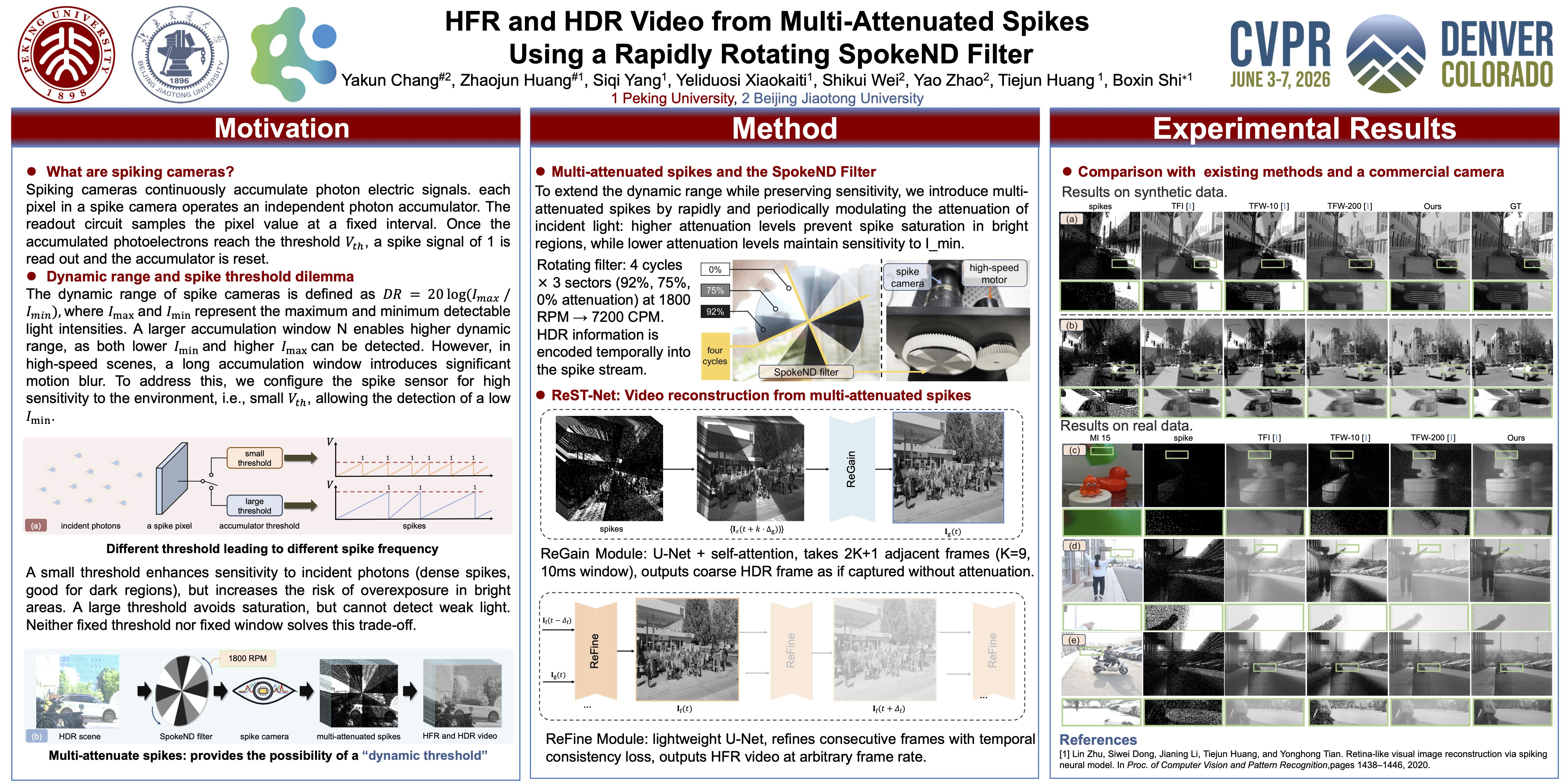
Capturing scenes with both high dynamic range (HDR) and high-speed motion remains challenging for conventional cameras. Existing alternating-exposure approaches exacerbate temporal resolution loss, making them unsuitable for high-speed scenes. Consequently, current solutions typically compromise either spatial resolution through fixed spatial-varying attenuation levels or employ multi-sensor configurations to maintain temporal resolution. In this paper, we leverage an ultra-high speed spike camera to enable spatial and temporal attenuation of incident light, thereby reconstructing high frame rate (HFR) and HDR video with a single sensor. We achieve this by placing a rapidly rotating spoke-pattern neutral density (SpokeND) filter in front of the spike camera, enabling each pixel to periodically capture multi-attenuated spikes while maintaining full spatial resolution. Building on these multi-attenuated spikes, we propose ReST-Net, which comprises the ReGain and ReFine modules. The ReGain module reconstructs spatially consistent frames by learning to recover relative gain from the multi-attenuated spikes, and the ReFine module removes temporal fluctuations to produce temporally consistent HDR videos. Extensive experiments on synthetic and real-world data demonstrate that our method can reconstruct HDR video at up to 2000 FPS.
Coded-E2LF: Coded Aperture Light Field Imaging from Events
Tomoya Tsuchida ⋅ Keita Takahashi ⋅ Chihiro Tsutake ⋅ Toshiaki Fujii ⋅ Hajime Nagahara
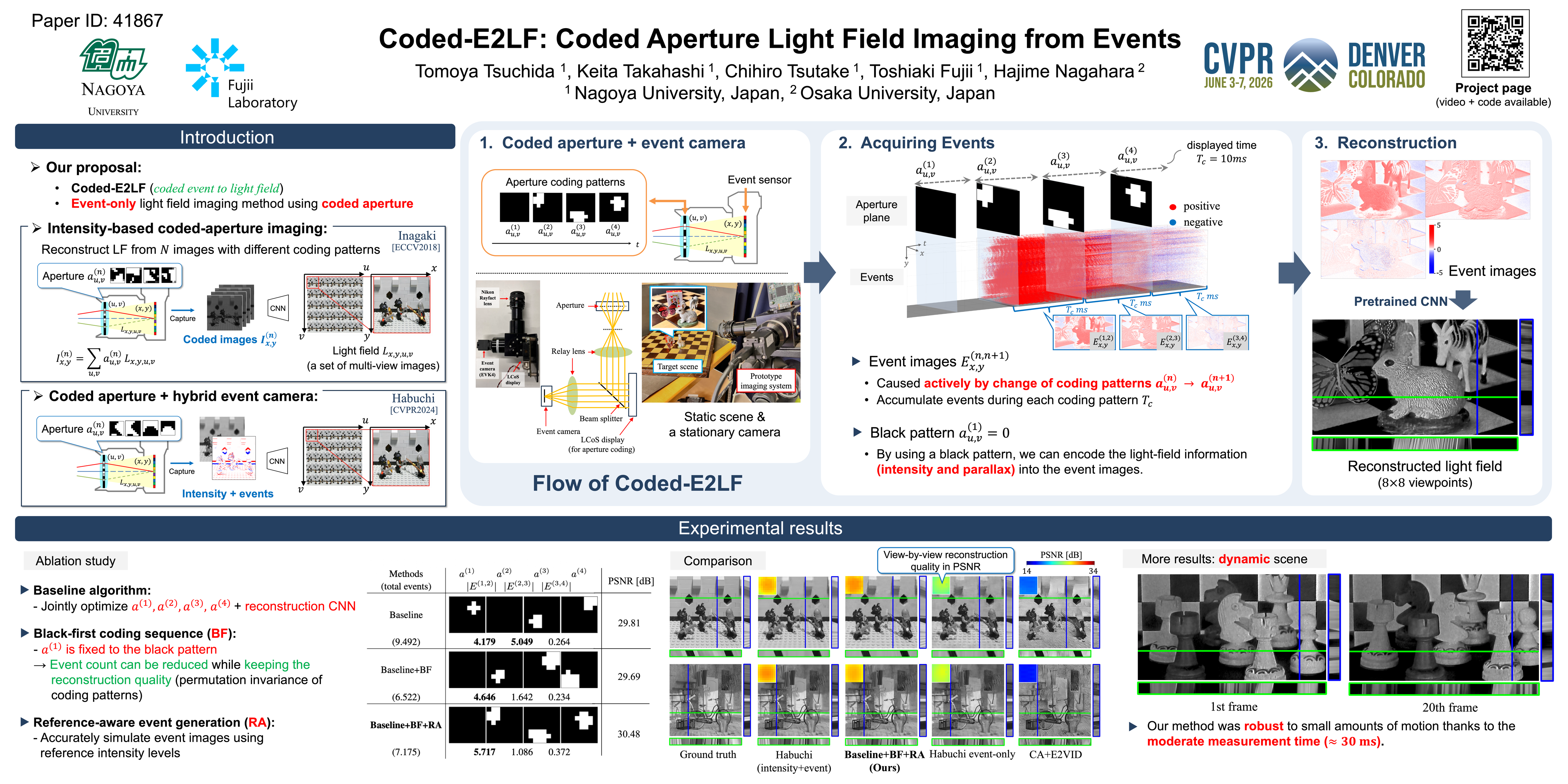
We propose Coded-E2LF (coded event to light field), a computational imaging method for acquiring a 4-D light field using a coded aperture and a stationary event-only camera. In a previous work, an imaging system similar to ours was adopted, but both events and intensity images were captured and used for light field reconstruction. In contrast, our method is purely event-based, which relaxes restrictions for hardware implementation. We also introduce several advancements from the previous work that enable us to theoretically support and practically improve light field reconstruction from events alone. In particular, we clarify the key role of a black pattern in aperture coding patterns. We finally implemented our method on real imaging hardware to demonstrate its effectiveness in capturing real 3-D scenes. To the best of our knowledge, we are the first to demonstrate that a 4-D light field with pixel-level accuracy can be reconstructed from events alone. Our software is included in the supplementary material.
TokenLight: Precise Lighting Control in Images using Attribute Tokens
Sumit Chaturvedi ⋅ Yannick Hold-Geoffroy ⋅ Mengwei Ren ⋅ Jingyuan Liu ⋅ He Zhang ⋅ Yiqun Mei ⋅ Julie Dorsey ⋅ ZHIXIN SHU
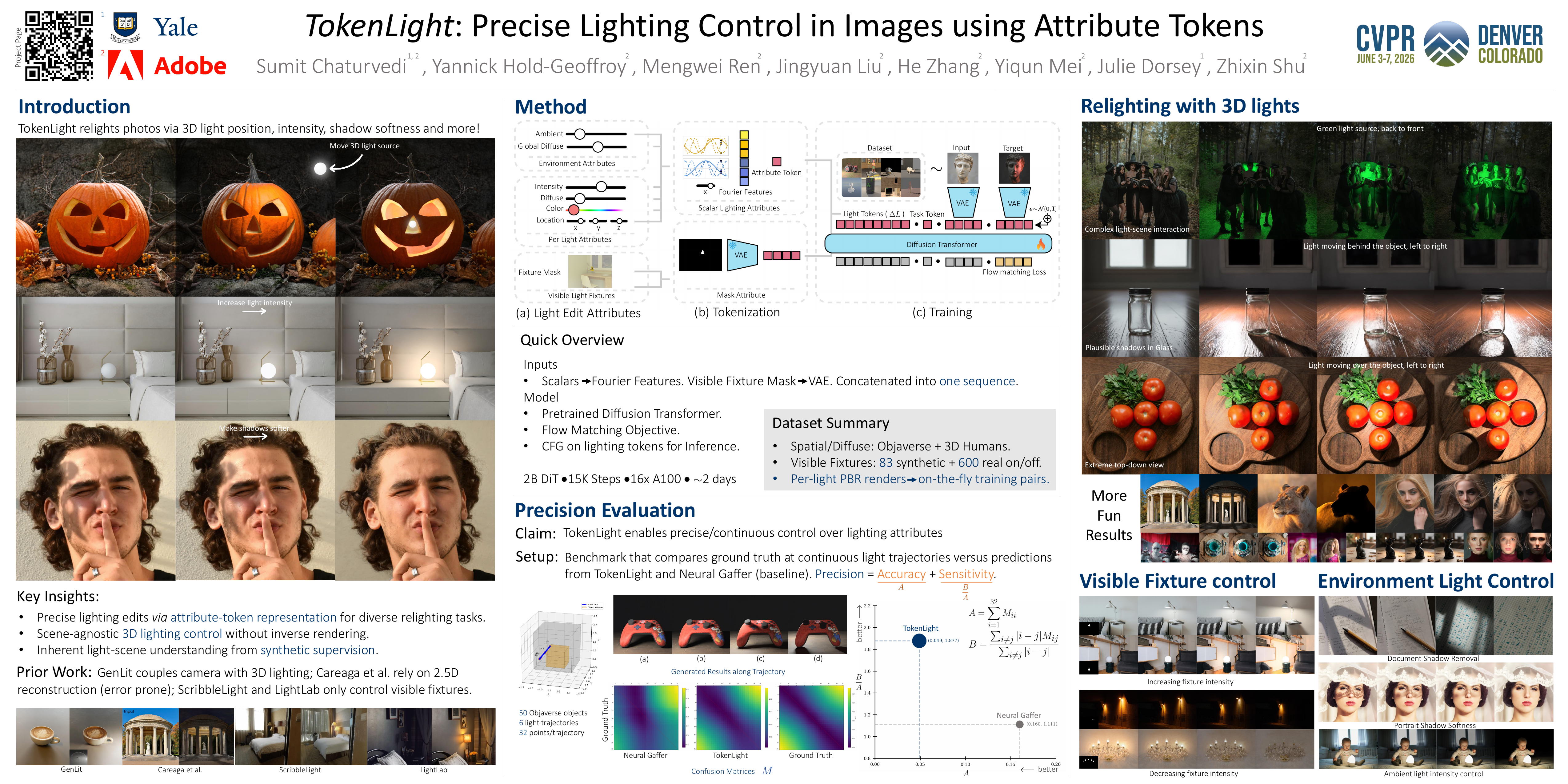
This paper presents a method for image relighting that enables precise and continuous control over multiple illumination attributes in a photograph. We formulate relighting as a conditional image generation task and introduce attribute tokens to encode distinct lighting factors such as intensity, color, ambient illumination, diffuse level, and 3D light positions. The model is trained on a large-scale synthetic dataset with ground-truth lighting annotations, supplemented by a small set of real captures to enhance realism and generalization. We validate our approach across a variety of relighting tasks, including controlling in-scene lighting fixtures and editing environment illumination using virtual light sources, on synthetic and real images. Our method achieves state-of-the-art quantitative and qualitative performance compared to prior work. Remarkably, without explicit inverse rendering supervision, the model exhibits an inherent understanding of how light interacts with scene geometry, occlusion, and materials, yielding convincing lighting effects even in traditionally challenging scenarios such as placing lights within objects or relighting transparent materials plausibly.
Kaleidoscopic Scintillation Event Imaging
Alex Bocchieri ⋅ John Mamish ⋅ David Appleyard ⋅ Andreas Velten
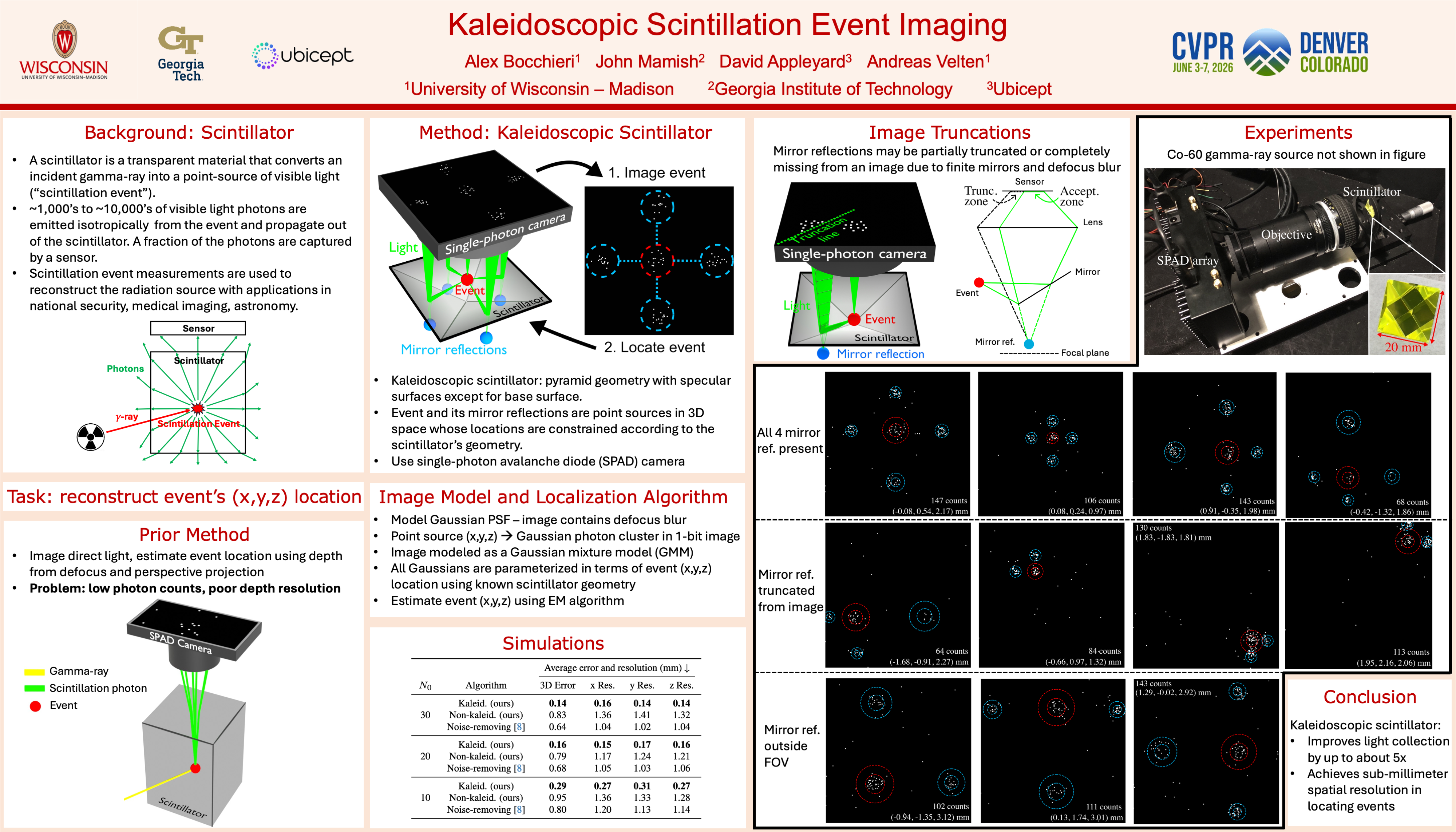
Scintillators are transparent materials that interact with high-energy particles and emit visible light as a result. They are used in state of the art methods of measuring high-energy particles and radiation sources.Most existing methods use fast single-pixel detectors to detect and time scintillation events.Cameras provide spatial resolution but can only capture an average over many events, making it difficult to image the events associated with an individual particle.Emerging single-photon avalanche diode cameras combine speed and spatial resolution to enable capturing images of individual events.This allows us to use machine vision techniques to analyze events, enabling new types of detectors.The main challenge is the very low brightness of the events.Techniques have to work with a very limited number of photons.We propose a kaleidoscopic scintillator to increase light collection in a single-photon camera while preserving the event's spatial information.The kaleidoscopic geometry creates mirror reflections of the event in known locations for a given event location that are captured by the camera.We introduce theory for imaging an event in a kaleidoscopic scintillatorand an algorithm to estimate the event's 3D position.We find that the kaleidoscopic scintillator design provides sufficient light collection to perform high-resolution event measurements for advanced radiation imaging techniques using a commercial CMOS single-photon camera.
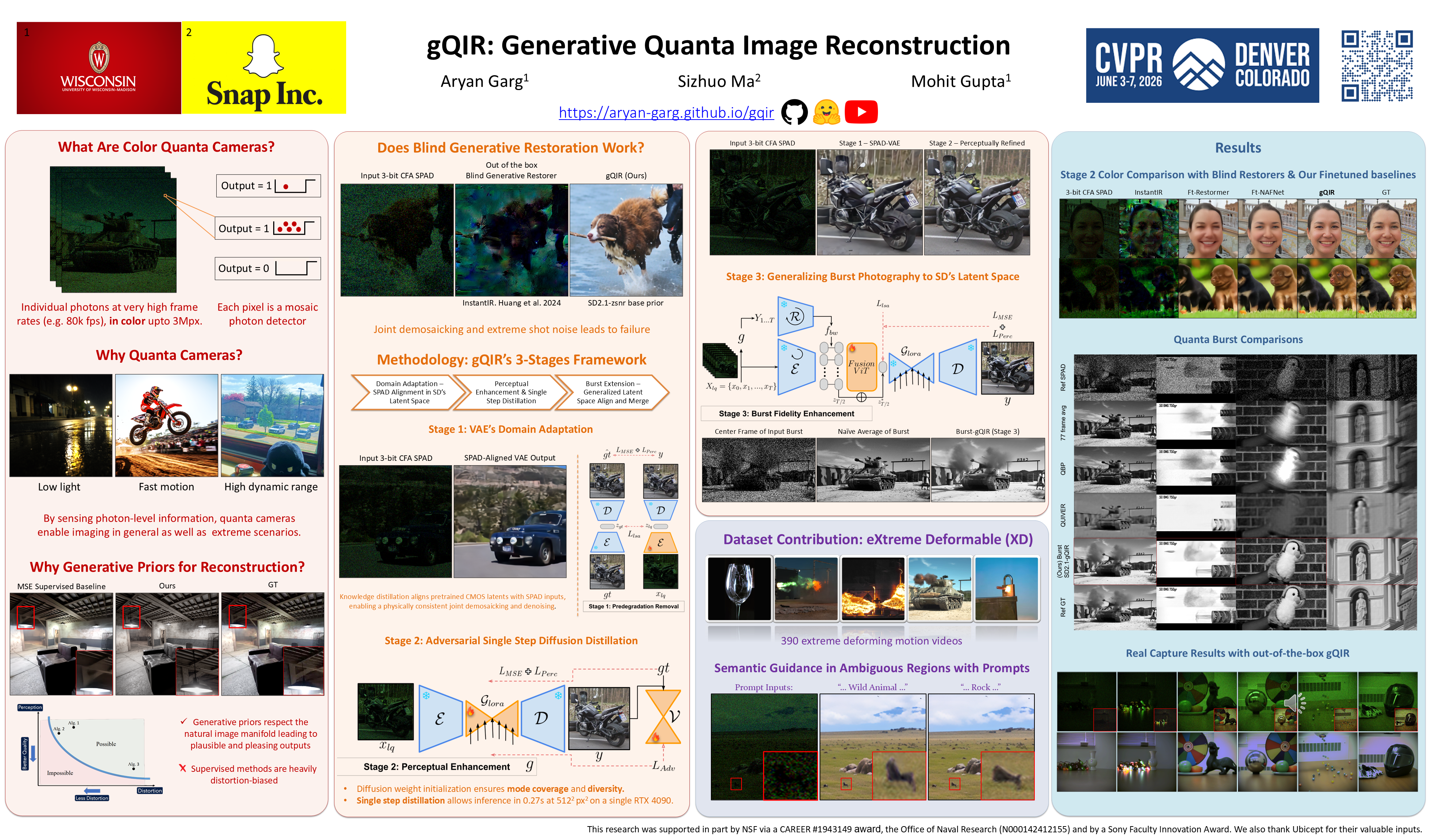
Capturing high-quality images from only a few detected photons is a fundamental challenge in computational imaging. Single-photon avalanche diode (SPAD) sensors promise high-quality imaging in regimes where conventional cameras fail, but raw $\textit{quanta frames}$ contain only sparse, noisy, binary photon detections. Recovering a coherent image from a burst of such frames requires handling alignment, denoising, and demosaicing (for color) under noise statistics far outside those assumed by standard restoration pipelines or modern generative models. We present an approach that adapts large text-to-image latent diffusion models to the photon-limited domain of quanta burst imaging. Our method leverages the structural and semantic priors of internet-scale diffusion models while introducing mechanisms to handle Bernoulli photon statistics. By integrating latent-space restoration with burst-level spatio-temporal reasoning, our approach produces reconstructions that are both photometrically faithful and perceptually pleasing, even under high-speed motion. We evaluate the method on synthetic benchmarks and new real-world datasets, including the first color SPAD burst dataset and a challenging $\textit{Deforming (XD)}$ video benchmark. Across all settings, the approach substantially improves perceptual quality over classical and modern learning-based baselines, demonstrating the promise of adapting large generative priors to extreme photon-limited sensing.
Solving Minimal Problems Without Matrix Inversion Using FFT-Based Interpolation
Haidong Wu ⋅ Snehal Bhayani ⋅ Janne Heikkilä
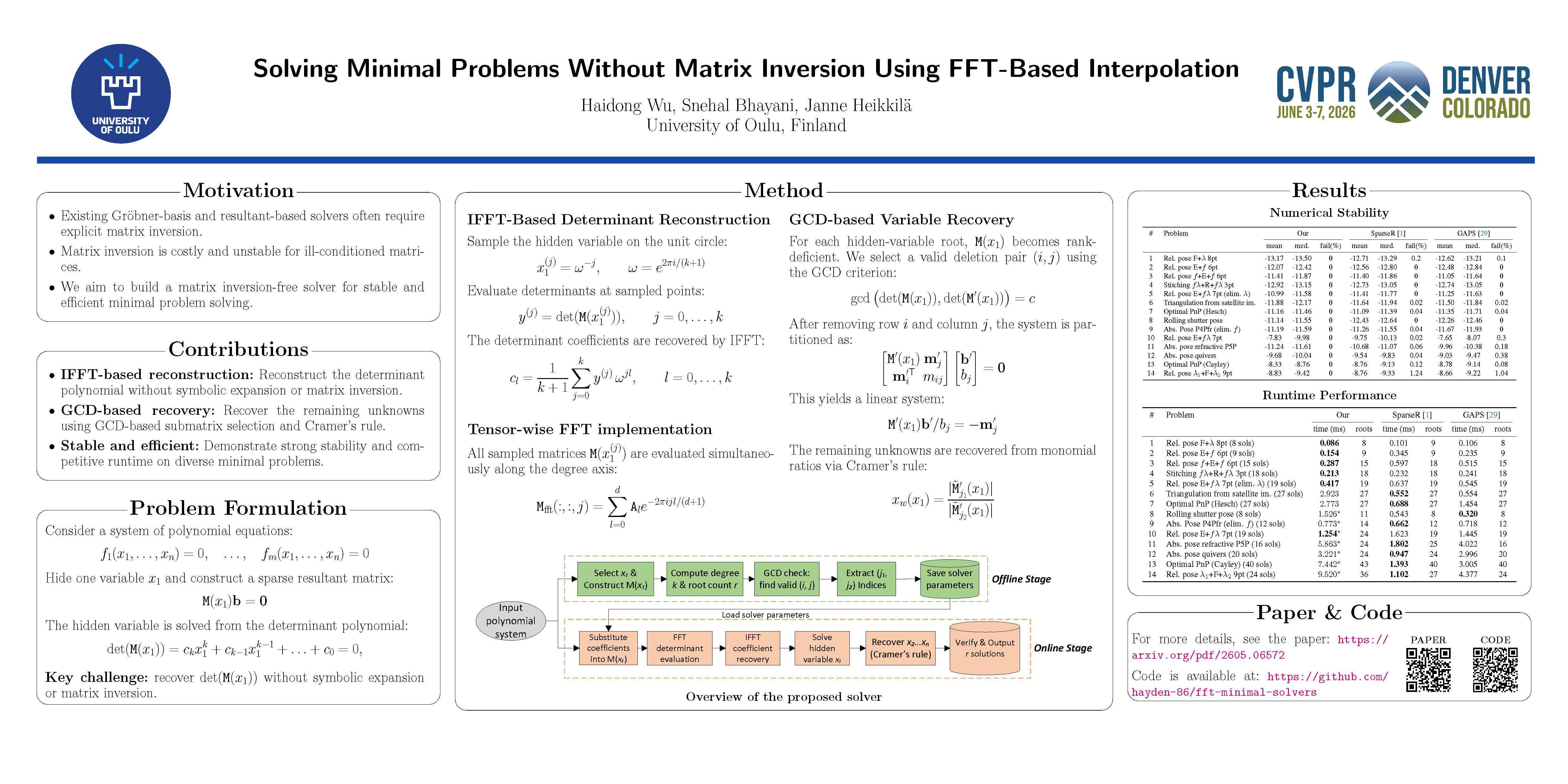
Estimating camera geometry typically involves solving minimal problems formulated as systems of multivariate polynomial equations, which often pose computational challenges when using existing Gröbner-basis or resultant-based methods due to matrix inversion needed in the online solver. Here we propose a sampling-based, matrix inversion-free method that constructs the solvers using sparse hidden-variable resultants. The determinant polynomial in the hidden variable is efficiently reconstructed via inverse fast Fourier transform interpolation from sampled evaluations, avoiding symbolic expansion. Solving this polynomial yields the hidden variable, and the remaining unknowns are recovered by identifying rank-1 deficient submatrices and applying Cramer's rule. A greatest common divisor-based criterion ensures robust submatrix identification under noise. Experiments on diverse minimal problems demonstrate that the proposed solver achieves strong numerical stability and competitive runtime, particularly for small-scale problems, providing a practical alternative to traditional Gröbner-basis and resultant-based solvers.
Predicting Spatial Transcriptomics from Histology Images via High-Order Multi-Cell Interaction Modeling
Youhan Sun ⋅ Jiahua Rao ⋅ Kangrui Du ⋅ Jiancong Xie ⋅ Yuedong Yang
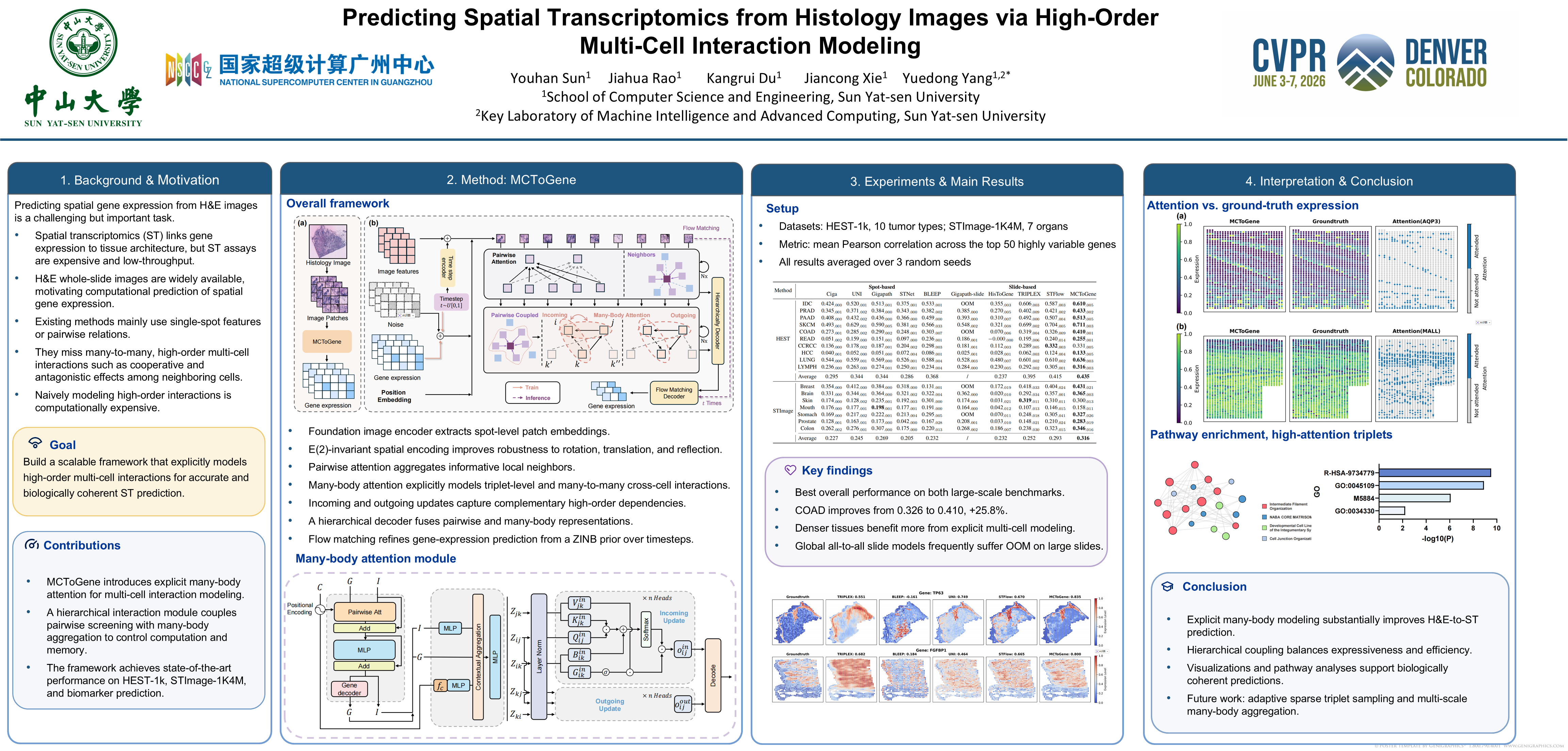
Spatial transcriptomics (ST) links gene expression to tissue architecture and enables predicting spatial expression from H&E-stained whole-slide images (WSIs). However, existing spot- or slide-level predictors focus on single-spot features or pairwise relations, failing to capture high-order, many-to-many cross-cell interactions. As a result, they miss synergistic and antagonistic effects among multiple neighboring cells. Here, we introduce MCToGene, a scalable and accurate framework that explicitly models multi-cell interactions via many-body attention with hierarchical coupling to predict spatial gene expression. MCToGene employs a many-body attention module to encode high-order, many-to-many cross-cell dependencies, enabling context-aware microenvironment modeling. To mitigate the combinatorial burden of many-body modeling, we design a hierarchical interaction module that couples pairwise and many-body representations for feature aggregation and prediction, preserving many-body expressiveness while controlling computation and memory. On HEST-1k and STImage-1K4M, MCToGene surpasses state-of-the-art baselines with 7.85% relative improvement. Ablations confirm that explicit high-order, many-to-many modeling drives these gains, and visualizations demonstrate that multi-cell interactions is essential for biologically coherent spatial predictions.
From Spots to Pixels: Dense Spatial Gene Expression Prediction from Histology Images
Ruikun Zhang ⋅ Yan Yang ⋅ Liyuan Pan
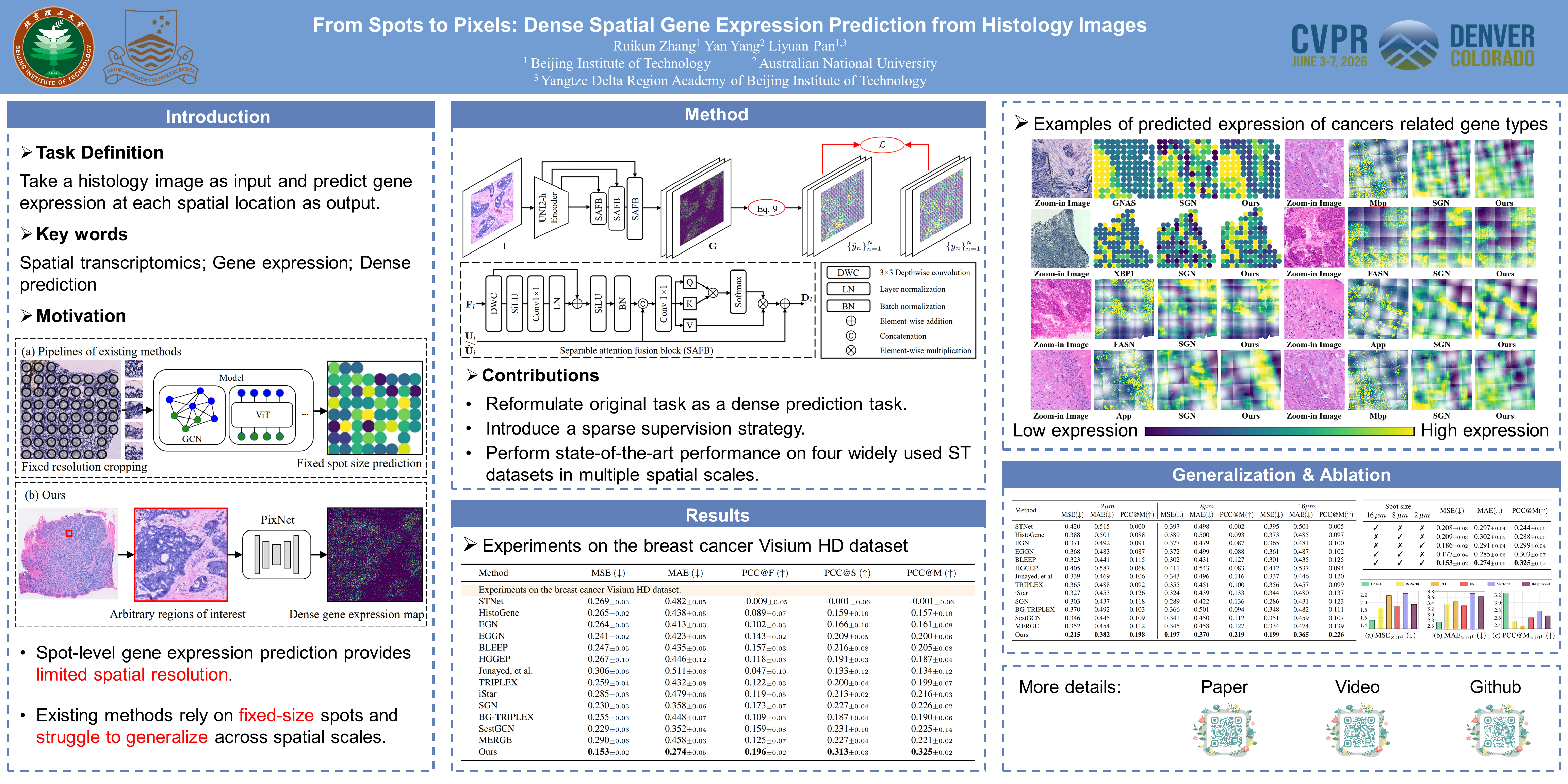
Spatial transcriptomics (ST) measures gene expression at fine-grained spatial resolution, offering insights into tissue molecular landscapes. Previous methods for spatial gene expression prediction typically crop spots of interest from histopathology slide images, and train models to map each spot to a corresponding gene expression profile. However, these methods inherently lose the spatial resolution in gene expression:1) each spot often contains multiple cells with distinct gene expression profiles;2) spots are typically defined at fixed spatial resolutions, limiting the ability to predict gene expression at varying scales. To address these limitations, this paper presents PixNet, a dense prediction network capable of predicting spatially resolved gene expression across spots of varying sizes and scales directly from histopathology slide images. Different from previous methods that map individual spots to gene expression values, we generate a spatially dense continuous gene expression map from the histopathology slide image, and aggregate values within spots of interest to predict the gene expression. Our PixNet outperforms state-of-the-art methods on four common ST datasets in multiple spatial scales. The source code will be publicly available.
Cell-Type Prototype-Informed Neural Network for Gene Expression Estimation from Pathology Images
Kazuya Nishimura ⋅ Ryoma Bise ⋅ Shinnosuke Matsuo ⋅ Haruka Hirose ⋅ Yasuhiro Kojima
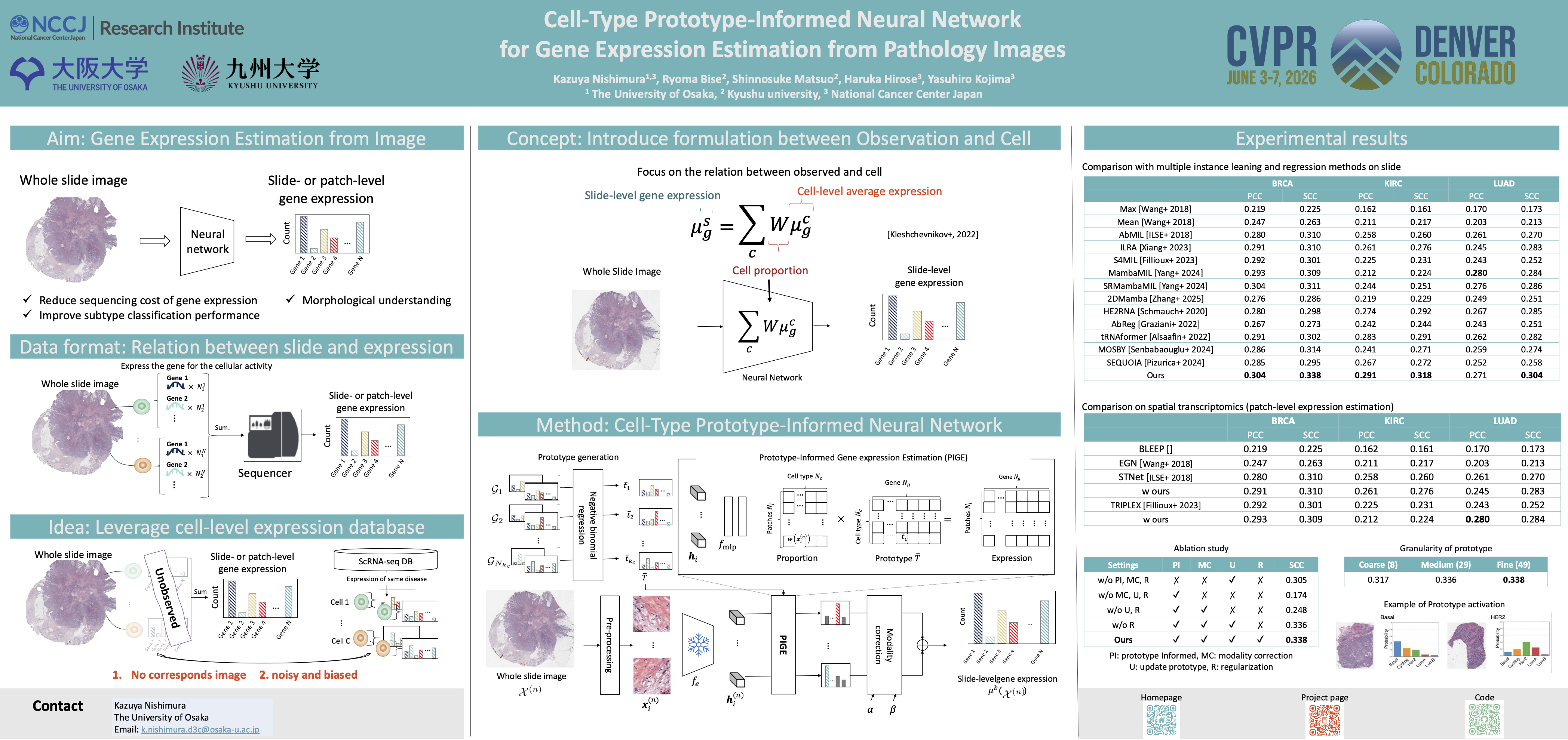
Estimating slide- and patch-level gene expression profiles from pathology images enables rapid and low-cost molecular analysis with broad clinical impact. Despite strong results, existing approaches treat gene expression as a mere slide- or spot-level signal and do not incorporate the fact that the measured expression arises from the aggregation of underlying cell-level expression.To explicitly introduce this missing cell-resolved guidance, we propose a Cell-type Prototype-informed Neural Network (CPNN) that leverages publicly available single-cell RNA-sequencing datasets. Since single-cell measurements are noisy and not paired with histology images, we first estimate cell-type prototypes—mean expression profiles that capture stable gene–gene co-variation patterns. CPNN then learns cell-type compositional weights directly from images and models the relationship between prototypes and observed bulk or spatial expression, providing a biologically grounded and structurally regularized prediction framework.We evaluate CPNN on three slide-level datasets and three patch-level spatial transcriptomics datasets. Across all settings, CPNN achieves the highest performance in terms of Spearman correlation. Moreover, by visualizing the inferred compositional weights, our framework provides interpretable insights into which cell types drive the predicted expression.The code will be made publicly available upon acceptance.
LightSplat: Fast and Memory-Efficient Open-Vocabulary 3D Scene Understanding in Five Seconds
Jaehun Bang ⋅ Jinhyeok Kim ⋅ Minji Kim ⋅ Seungheon Jeong ⋅ Kyungdon Joo
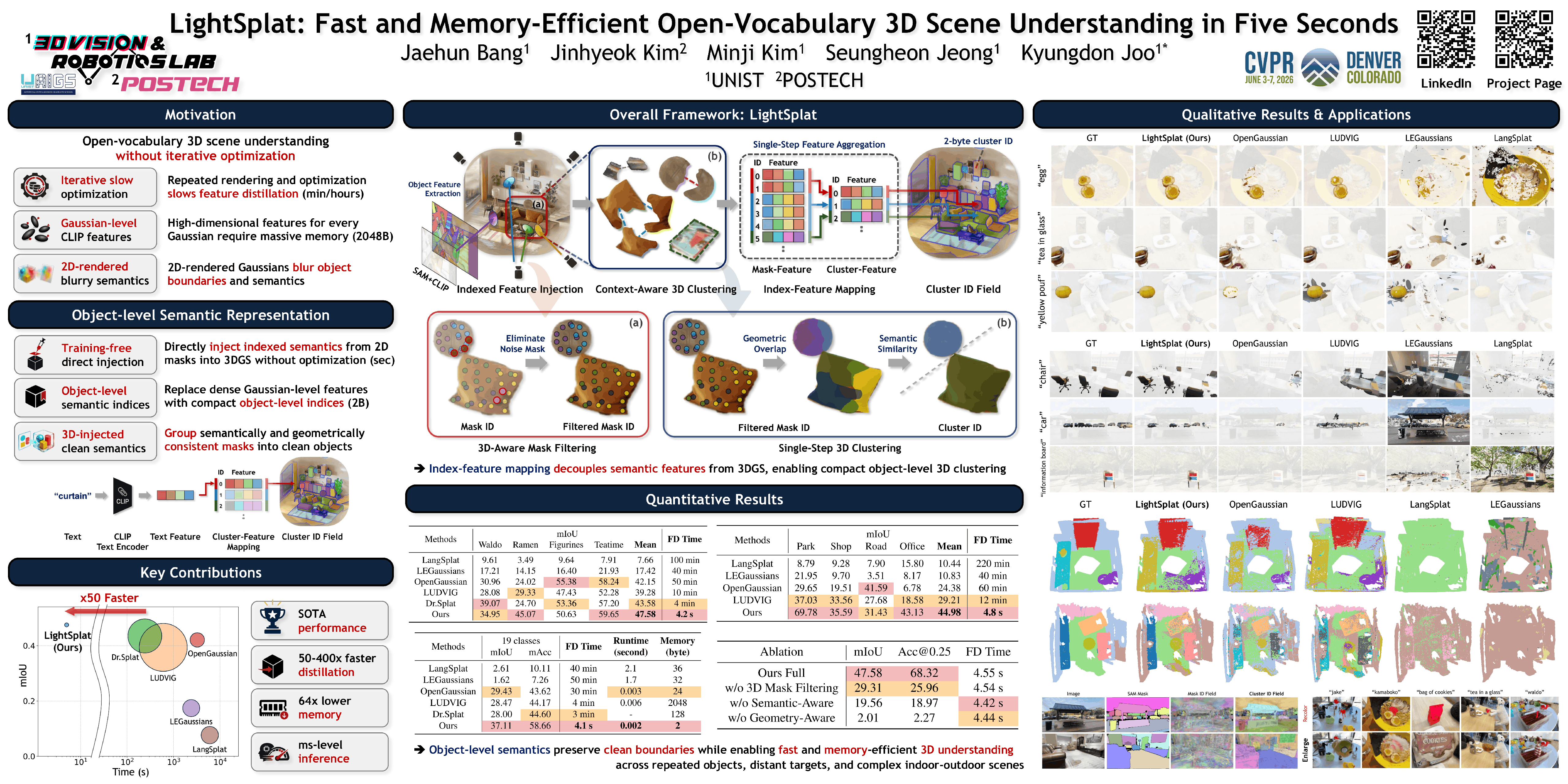
Open-vocabulary 3D scene understanding enables users to segment novel objects in complex 3D environments through natural language. However, existing approaches remain impractically slow, memory-intensive, and overly complex due to iterative optimization and dense feature assignments for every Gaussian. To address these limitations, we propose LightSplat, a fast and memory-efficient training-free framework that injects compact 2-byte semantic indices into 3D representations from multi-view images. By assigning semantics only to salient regions and managing them with a lightweight index-feature mapping, LightSplat eliminates costly feature optimization and storage overhead. To further streamline inference and ensure semantic consistency, we cluster Gaussians in a single step by linking geometrically and semantically related masks in 3D. In evaluation, we assess our method on diverse benchmarks, including DL3DV-OVS with large and complex indoor-outdoor scenes. As a result, LightSplat achieves state-of-the-art performance with up to 50× faster speed and 64× lower memory, offering a scalable foundation for real-time language-driven 3D understanding.
Guardians of the Hair: Rescuing Soft Boundaries in Depth, Stereo, and Novel Views
Xiang Zhang ⋅ Yang Zhang ⋅ Lukas Mehl ⋅ Markus Gross ⋅ Christopher Schroers
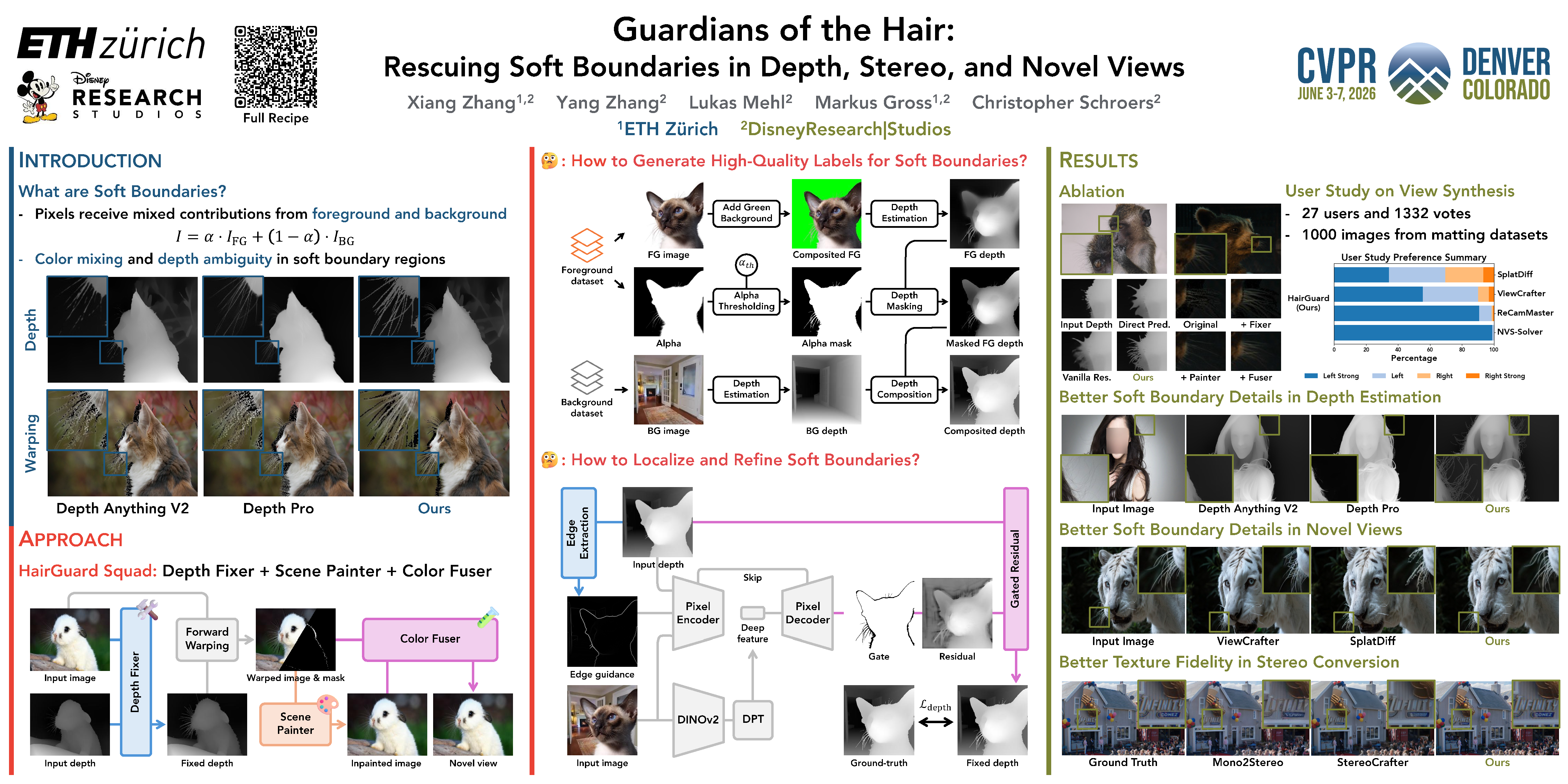
Soft boundaries, like thin hairs, are commonly observed in natural and computer-generated imagery, but they remain challenging for 3D vision due to the ambiguous mixing of foreground and background cues. This paper introduces Guardians of the Hair (HairGuard), a framework designed to recover fine-grained soft boundary details in 3D vision tasks. Specifically, we first propose a novel data curation pipeline that leverages image matting datasets for training and design a depth fixer network to automatically identify soft boundary regions. With a gated residual module, the depth fixer refines depth precisely around soft boundaries while maintaining global depth quality, allowing plug-and-play integration with state-of-the-art depth models. For view synthesis, we perform depth-based forward warping to retain high-fidelity textures, followed by a generative scene painter that fills disoccluded regions and eliminates redundant background artifacts within soft boundaries. Finally, a color fuser adaptively combines warped and inpainted results to produce novel views with consistent geometry and fine-grained details. Extensive experiments demonstrate that HairGuard achieves state-of-the-art performance across monocular depth estimation, stereo image/video conversion, and novel view synthesis, with significant improvements in soft boundary regions.
Vision language models (VLMs) have achieved remarkable success in semantic understanding tasks under language guidance, yet their potential for geometric perception remains largely underexplored. This paper introduces the first VLM-based depth completion framework. With almost no architectural modifications, we propose a sparse depth injection mechanism that extends the capability of VLM toward 3D perception through three key aspects: visual tokenization, textual prompt, and textual supervision. At the visual input side, sparse depth is tokenized to provide absolute scale and accurate geometric cues, alleviating the scale and camera ambiguities of RGB-only inputs. At the textual input side, a binary mask derived from sparse depth serves as a prompt, instructing the model where to complete and where to preserve. At the supervision side, the model is fine-tuned using text labels generated from sparse depth, requiring no ground-truth depth. Benefiting from the strong semantic priors and cross-modal expressiveness of VLM, our framework achieves superior zero-shot performance across diverse sensors, sparsity levels, and scenes.
FE2E: From Editor to Dense Geometry Estimator
jiyuan WANG ⋅ Chunyu Lin ⋅ Lei Sun ⋅ Rongying Liu ⋅ Lang Nie ⋅ Mingxing Li ⋅ Kang Liao ⋅ Xiangxiang Chu
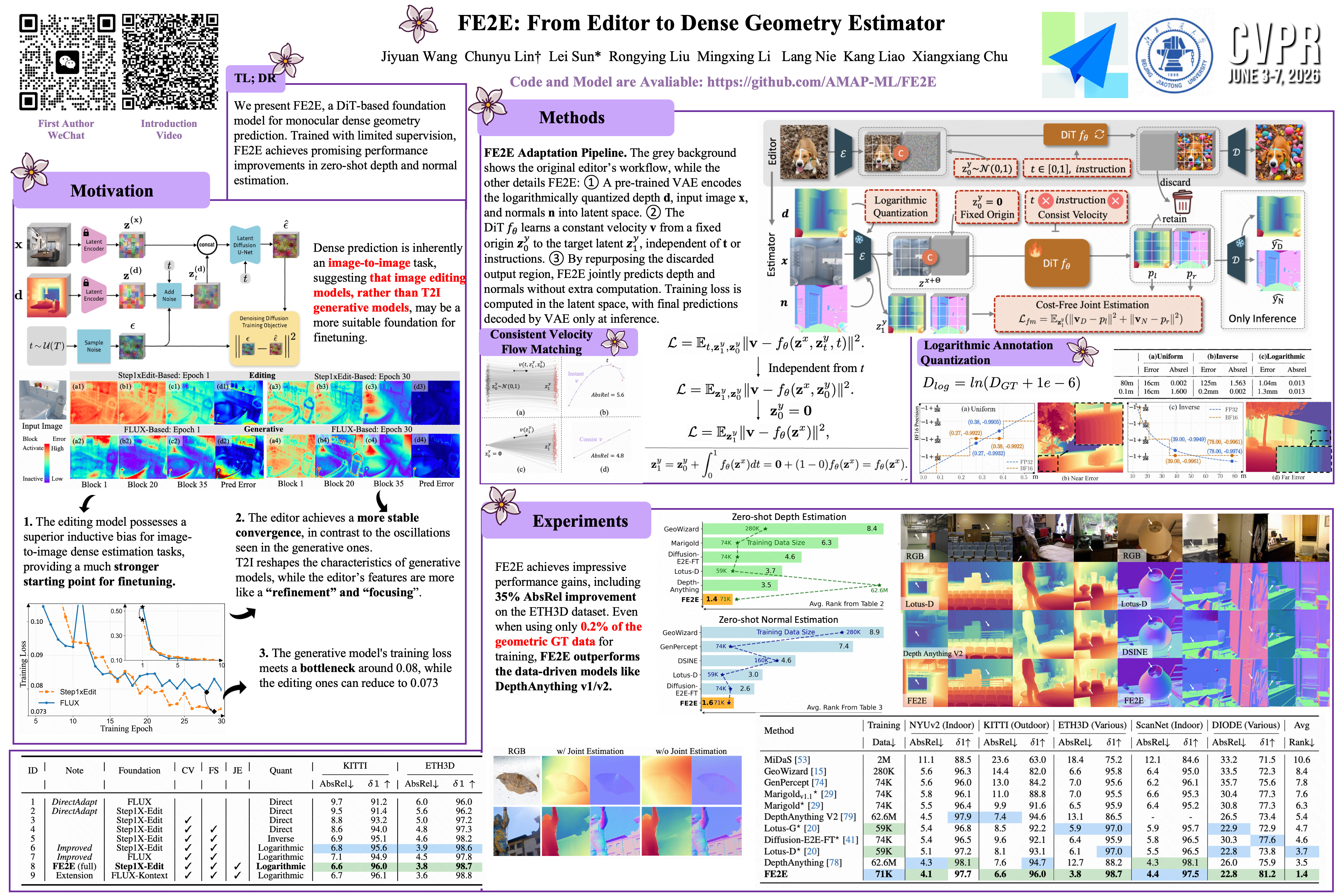
Pre-trained text-to-image (T2I) generative priors have shown success in depth and normal prediction. However, dense prediction is inherently an image-to-image task, suggesting that image editing models, rather than T2I generative models, may be a more suitable foundation for fine-tuning. Motivated by this, we conduct a systematic analysis of the fine-tuning behaviors of both editors and generators for dense geometry estimation. Our findings show that editing models possess inherent structural priors, which enable them to converge more stably by "refining" their innate features, and ultimately achieve higher performance than their generative counterparts. Based on these findings, we introduce \textbf{FE2E}, a framework that pioneeringly adapts an advanced editing model based on Diffusion Transformer (DiT) architecture for dense geometry prediction. Specifically, to tailor the editor for this deterministic task, we reformulate the editor's original flow matching loss into the "consistent velocity" training objective. And we use logarithmic quantization to resolve the precision conflict between the editor's native BFloat16 format and the high precision demand of our tasks. Additionally, we repurpose the editor's discarded region for a cost-free joint estimation of depth and normals, which improves the inference efficiency. Without scaling up the training data, FE2E achieves impressive performance improvements in zero-shot monocular depth and normal estimation across multiple datasets. Notably, it achieves over 35\% performance gains on the ETH3D dataset and outperforms the DepthAnything series, which is trained on 100$\times$ data.
Ego-1K – A Large-Scale Multiview Video Dataset for Egocentric Vision
Jae Yong Lee ⋅ Daniel Scharstein ⋅ Akash Bapat ⋅ Hao Hu ⋅ Andrew Fu ⋅ Haoru Zhao ⋅ Paul Sammut ⋅ Xiang Li ⋅ Stephen Jeapes ⋅ Anik Gupta ⋅ Lior David ⋅ Saketh Madhuvarasu ⋅ Jay Girish Joshi ⋅ Jason Wither
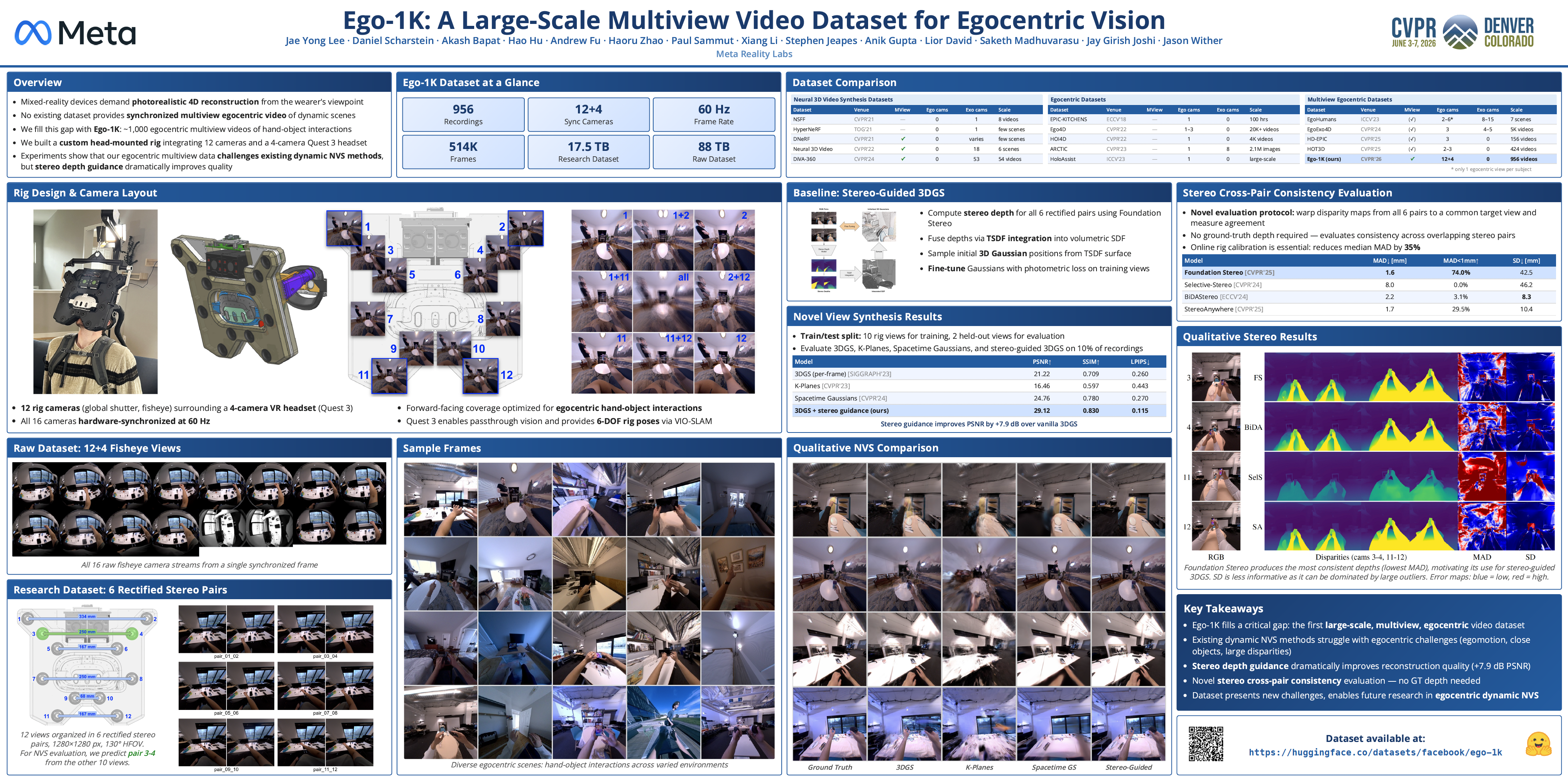
We present Ego-1K, a large-scale, time-synchronized collection of egocentric multiview videos designed to advance neural 3D video synthesis, dynamic scene understanding, and embodied perception. The dataset contains nearly 1,000 short egocentric videos taken with a custom rig with 12 synchronous cameras surrounding a VR headset worn by the user. Scene content focuses on hand motions and hand-object interactions in different settings. We describe rig design, data processing, and calibration. Our dataset enables new ways to benchmark egocentric scene reconstruction methods. We believe this is an important area of research as smart glasses with multiple cameras become omnipresent. Our experiments demonstrate that our dataset presents unique challenges for existing 3D and 4D novel view synthesis methods due to high disparities and image motion caused by close dynamic objects and rig egomotion. Our dataset supports future research in this challenging domain, enabling 4D world creation and sharing.
Edit-As-Act: Goal-Regressive Planning for Open-Vocabulary 3D Indoor Scene Editing
SeongRae Noh ⋅ SeungWon Seo ⋅ Gyeong-Moon Park ⋅ HyeongYeop Kang
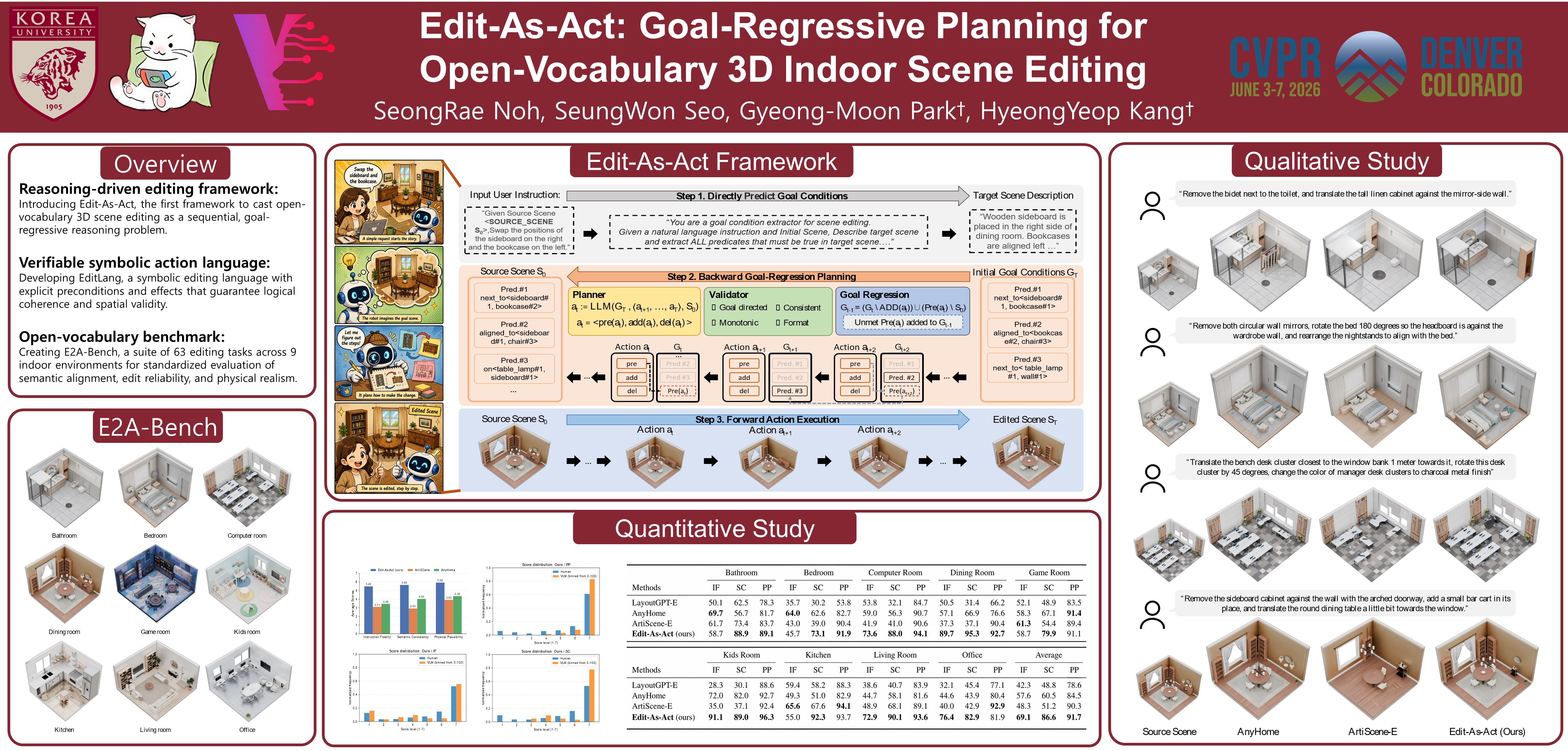
Editing a 3D indoor scene from natural language is conceptually straightforward but technically challenging. Existing open-vocabulary systems often regenerate large portions of a scene or rely on image-space edits that disrupt spatial structure, resulting in unintended global changes or physically inconsistent layouts. These limitations stem from treating editing primarily as a generative task.We take a different view. A user instruction defines a desired world state, and editing should be the minimal sequence of actions that makes this state true while preserving everything else. This perspective motivates Edit-As-Act, a framework that performs open-vocabulary scene editing as goal-regressive planning in 3D space.Given a source scene and free-form instruction, Edit-As-Act predicts symbolic goal predicates and plans in EditLang, a PDDL-inspired action language that we design with explicit preconditions and effects encoding support, contact, collision, and other geometric relations. A language-driven planner proposes actions, and a validator enforces goal-directedness, monotonicity, and physical feasibility, producing interpretable and physically coherent transformations.By separating reasoning from low-level generation, Edit-As-Act achieves instruction fidelity, semantic consistency, and physical plausibility—three criteria that existing paradigms cannot satisfy together. On E2A-Bench, our benchmark of 63 editing tasks across 9 indoor environments, Edit-As-Act significantly outperforms prior approaches across all edit types and scene categories.
VGGT-360: Geometry-Consistent Zero-Shot Panoramic Depth Estimation
Jiayi Yuan ⋅ Haobo Jiang ⋅ De Wen Soh ⋅ Na Zhao
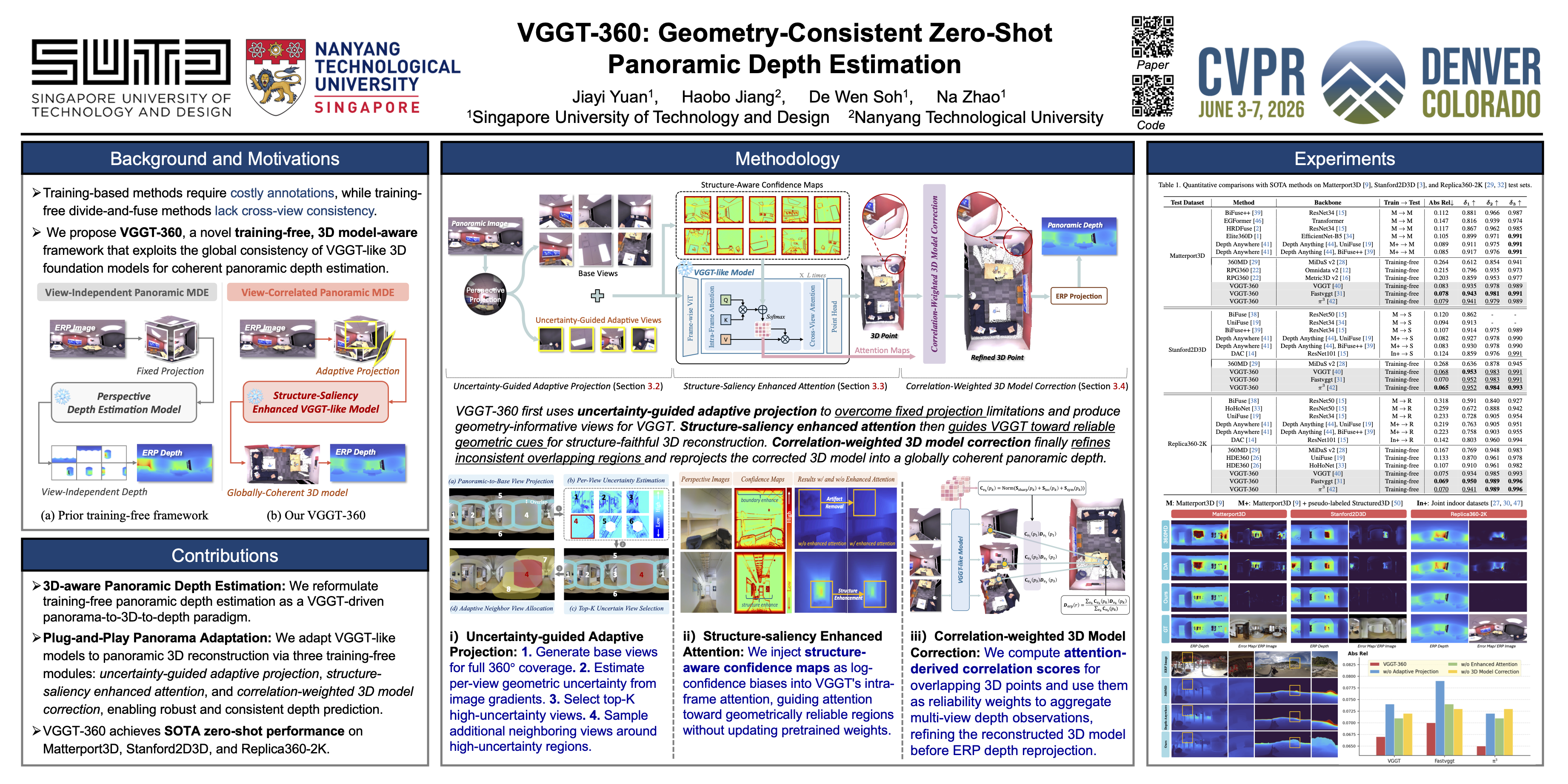
This paper presents VGGT-360, a novel training-free framework for zero-shot, geometry-consistent panoramic depth estimation. Unlike prior view-independent training-free approaches, VGGT-360 reformulates the task as panoramic reprojection over multi-view reconstructed 3D models by leveraging the intrinsic 3D consistency of VGGT-like foundation models, thereby unifying fragmented per-view reasoning into a coherent panoramic understanding. To achieve robust and accurate estimation, VGGT-360 integrates three plug-and-play modules that together form a unified panorama-to-3D-to-depth framework: (i) Uncertainty-guided adaptive projection slices panoramas into perspective views to bridge the domain gap between panoramic inputs and VGGT’s perspective prior. It estimates gradient-based uncertainty to allocate denser views to geometry-poor regions, yielding geometry-informative inputs for VGGT. (ii) Structure-saliency enhanced attention strengthens VGGT’s robustness during 3D reconstruction by injecting structure-aware confidence into its attention layers, guiding focus toward geometrically reliable regions and enhancing cross-view coherence. (iii) Correlation-weighted 3D model correction refines the reconstructed 3D model by reweighting overlapping points using attention-inferred correlation scores, providing a consistent geometric basis for accurate panoramic reprojection. Extensive experiments show that VGGT-360 outperforms both trained and training-free state-of-the-art methods across multiple resolutions and diverse indoor and outdoor datasets.
NI-Tex: Non-isometric Image-based Garment Texture Generation
Hui Shan ⋅ Ming Li ⋅ Haitao Yang ⋅ Kai Zheng ⋅ Sizhe Zheng ⋅ Yanwei Fu ⋅ Xiangru Huang
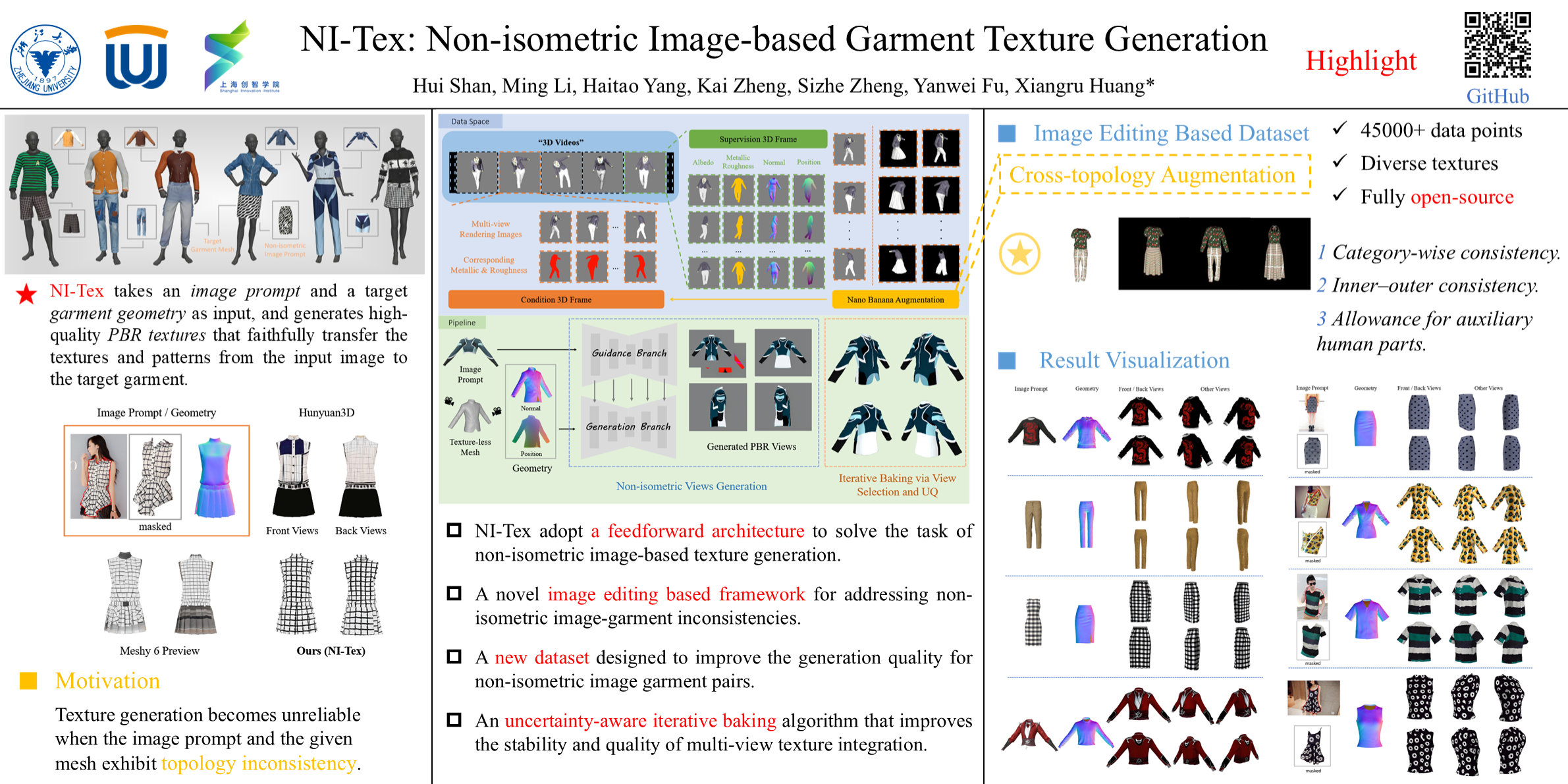
Existing industrial 3D garment meshes already cover most real-world clothing geometries, yet their texture diversity remains limited. To acquire more realistic textures, generative methods are often used to extract Physically-based Rendering (PBR) textures and materials from large collections of wild images and project them back onto garment meshes. However, most image-conditioned texture generation approaches require strict topological consistency between the input image and the input 3D mesh, or rely on accurate mesh deformation to match to the image poses, which significantly constrains the texture generation quality and flexibility.To address the challenging problem of non-isometric image-based garment texture generation, we construct 3D Garment Videos, a physically simulated, garment-centric dataset that provides consistent geometry and material supervision across diverse deformations, enabling robust cross-pose texture learning. We further employ Nano Banana for high-quality non-isometric image editing, achieving reliable cross-topology texture generation between non-isometric image-geometry pairs. Finally, we propose an iterative baking method via uncertainty-guided view selection and reweighting that fuses multi-view predictions into seamless, production-ready PBR textures. Through extensive experiments, we demonstrate that our feedforward dual-branch architecture generates versatile and spatially aligned PBR materials suitable for industry-level 3D garment design.
Velox: Learning Representations of 4D Geometry and Appearance
Anagh Malik ⋅ Dorian Chan ⋅ Xiaoming Zhao ⋅ David B. Lindell ⋅ Oncel Tuzel ⋅ Rick Chang
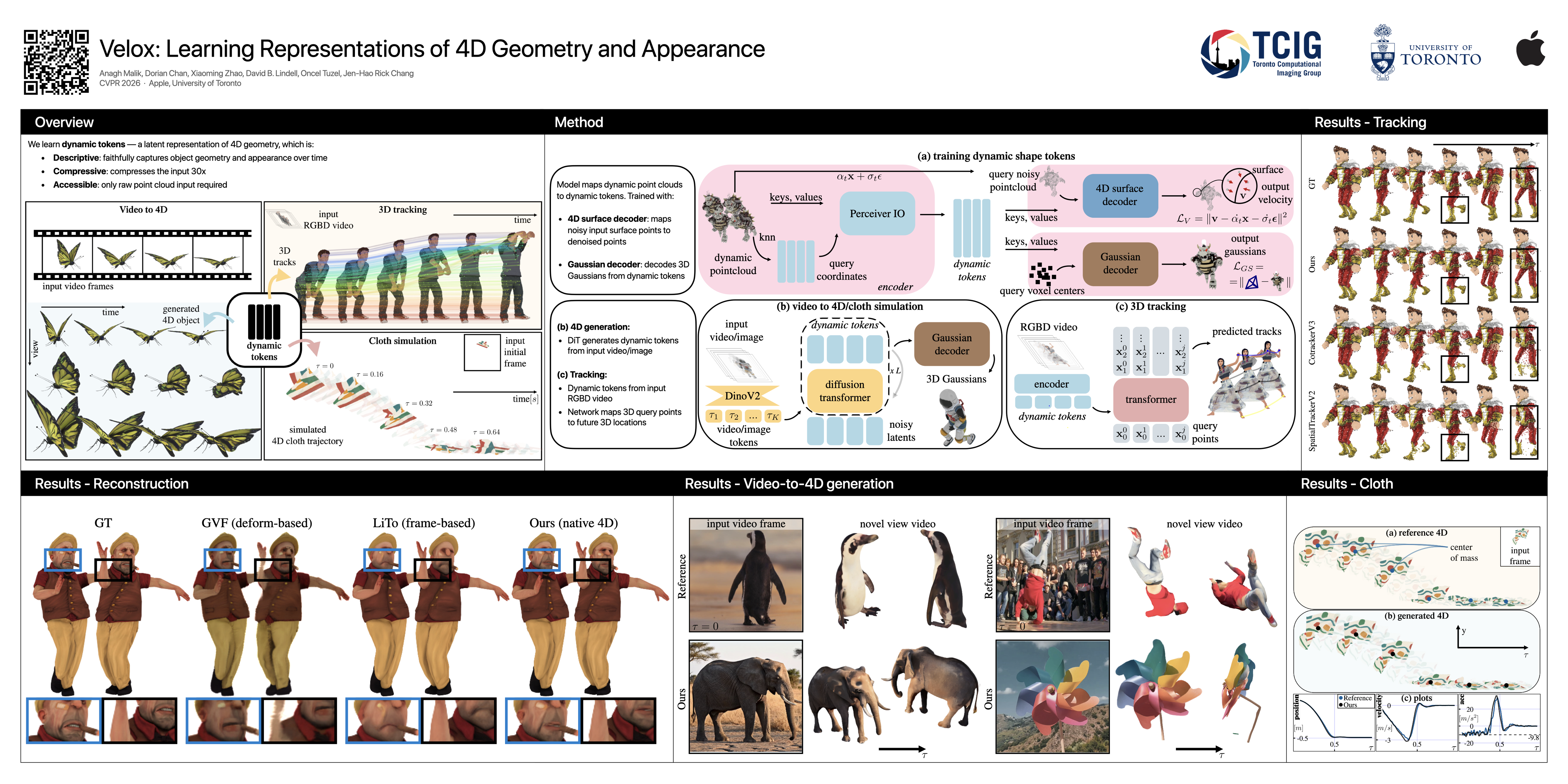
We introduce a framework for learning latent representations of 4D objects which are descriptive, faithfully capturing object geometry and appearance; compressive, aiding in downstream efficiency; and accessible, requiring minimal input, i.e., an unstructured dynamic point cloud, to construct. Specifically, Velox trains an encoder to compress spatiotemporal color point clouds into a set of dynamic shape tokens. These tokens are supervised using two complementary decoders: a 4D surface decoder, which models the time-varying surface distribution capturing the geometry; and a Gaussian decoder, which maps the tokens to 3D Gaussians, helping learn appearance.To demonstrate the utility of our representation, we evaluate it across three downstream tasks—video-to-4D generation, 3D tracking, and cloth simulation via image-to-4D generation—and observe strong performances in all settings.
UniPixie: Unified and Probabilistic 3D Physics Learning via Flow Matching
Qilin Huang ⋅ Quynh Anh Huynh ⋅ Long Le ⋅ Chen Wang ⋅ Chuhao Chen ⋅ Ryan Lucas ⋅ Eric Eaton ⋅ Lingjie Liu
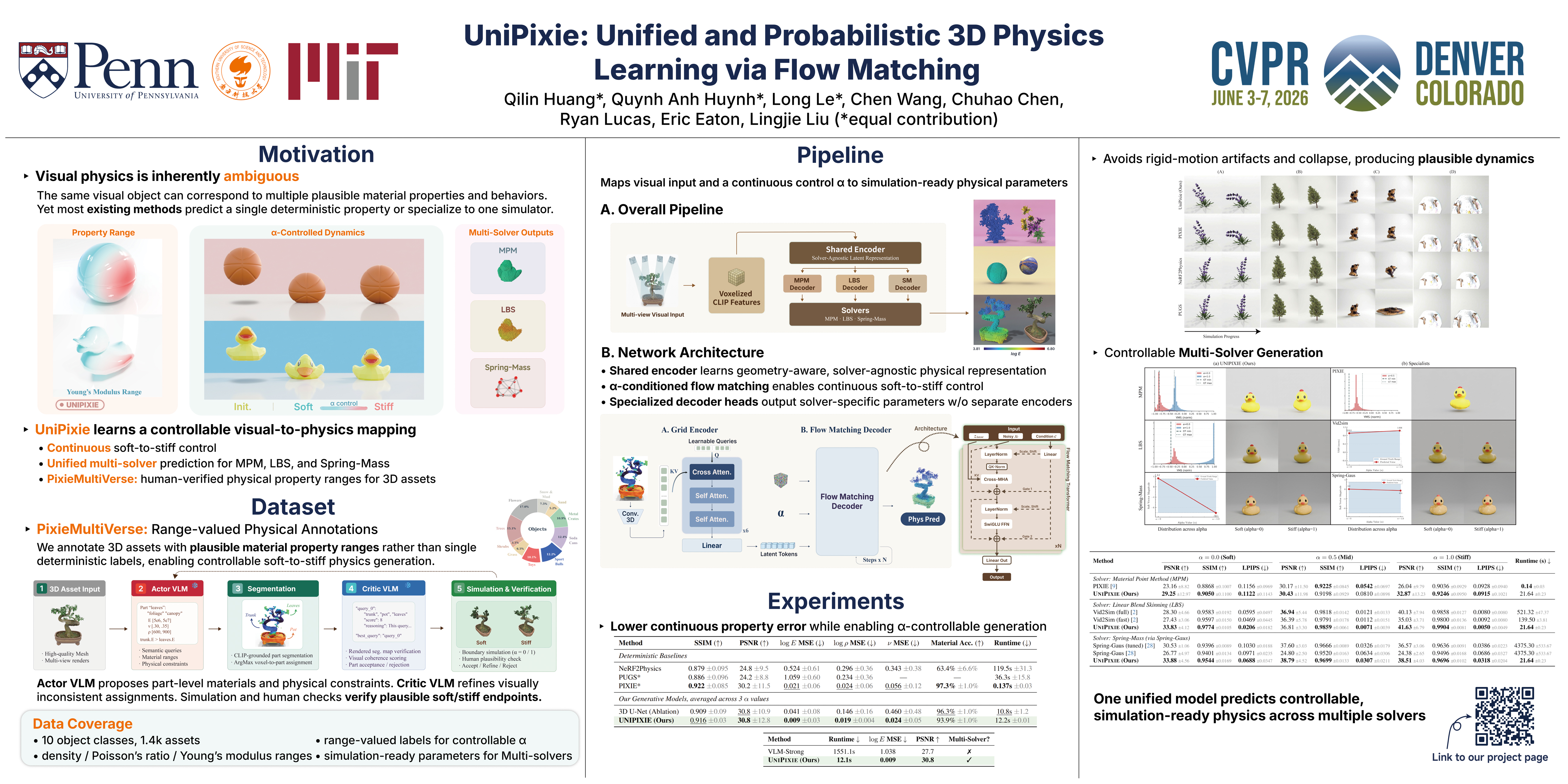
Recent progress in 3D reconstruction, such as NeRFs and 3D Gaussian Splatting, has made it easy to recover geometry and appearance from images. However, these static representations remain blind to the physics that govern how objects deform and respond to forces. Building interactive 3D worlds therefore requires predicting not only shape but the underlying material properties. Prior approaches either rely on slow test-time optimization or, more recently, a fast feed-forward predictor such as Pixie. However, these models produce only a single point estimate of physical parameters and are limited to a single simulation backend, restricting both expressiveness and portability. We introduce UniPixie, a generative physics-from-pixels framework that overcomes both limitations. UniPixie predicts a controllable, continuous soft-to-stiff distribution of plausible material properties from a single visual input, capturing inherent physical ambiguity. In addition, UniPixie is the first unified architecture to generate simulation-ready parameters for multiple physics solvers, including Material Point Method (MPM), Linear Blend Skinning (LBS), and Spring-Mass systems. Trained on our new PIXIEMULTIVERSE dataset of annotated material ranges, UniPixie produces diverse, physically consistent dynamics and achieves state-of-the-art accuracy, outperforming deterministic baselines by over 2x while inheriting the fast and generalizable inference from the prior feed-forward work.
UniTEX: Universal High Fidelity Generative Texturing for 3D Shapes
Yixun Liang ⋅ Kunming Luo ⋅ Xiao Chen ⋅ Rui Chen ⋅ Jiawei Zhou ⋅ Weiyu Li ⋅ Jiarui Liu ⋅ Fei-Peng Tian ⋅ Ping Tan
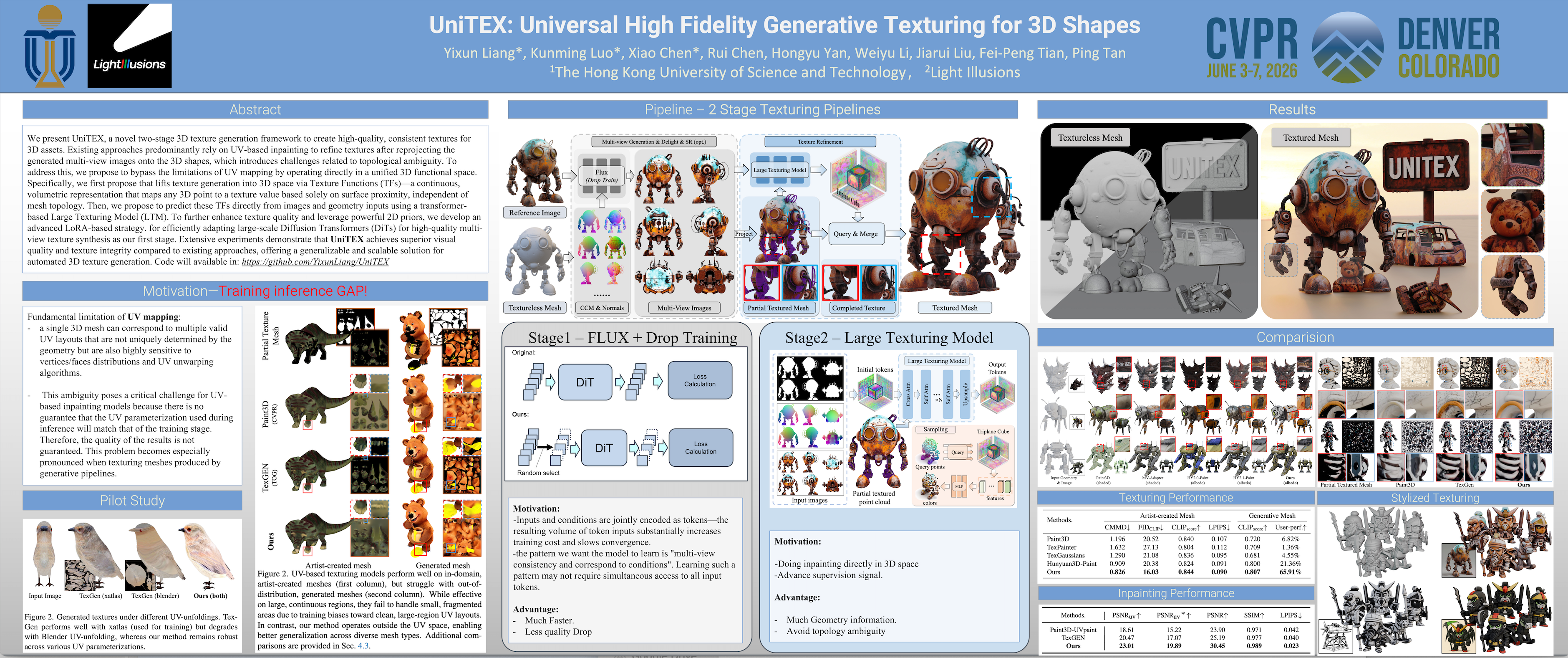
We present UniTEX, a novel two-stage 3D texture generation framework to create high-quality, consistent textures for 3D assets. Existing approaches predominantly rely on UV-based models in the second stage to refine textures after reprojecting the generated multi-view images onto the 3D shapes, which introduces challenges related to topological ambiguity. To address this, we bypass the limitations of UV mapping by introducing a Large Texturing Model (LTM) that directly regresses textures in a unified 3D functional space. Moreover, to enable more effective and complete supervision of LTM, we propose to extend surface-defined textures into a continuous volumetric field to serve as an advanced training objective, which we refer to as Texture Functions (TF). Finally, we develop an advanced LoRA-based strategy for efficiently adapting large-scale 2D Diffusion Transformers (DiTs) for high-quality multi-view texture synthesis as our first stage. Extensive experiments demonstrate that UniTEX achieves superior visual quality and texture integrity compared to existing approaches, offering a generalizable and scalable solution for automated 3D texture generation.
Points-to-3D: Structure-Aware 3D Generation with Point Cloud Priors
Jiatong Xia ⋅ Zicheng Duan ⋅ Anton van den Hengel ⋅ Lingqiao Liu
Recent progress in 3D generation has been driven largely by models conditioned on images or text, while readily available 3D priors are still underused. In many real-world scenarios, the visible-region point cloud are easy to obtain—from active sensors such as LiDAR or from feed-forward predictors like VGGT—offering explicit geometric constraints that current methods fail to exploit. In this work, we introduce Points-to-3D, a diffusion-based framework that leverages point cloud priors for geometry-controllable 3D asset and scene generation. Built on a latent 3D diffusion model TRELLIS, Points-to-3D first replaces pure-noise sparse structure latent initialization with a point cloud priors tailored input formulation. A structure inpainting network, trained within the TRELLIS framework on task-specific data designed to learn global structural inpainting, is then used for inference with a staged sampling strategy (structural inpainting followed by boundary refinement), completing the global geometry while preserving the visible regions of the input priors.In practice, Points-to-3D can take either accurate point-cloud priors or VGGT-estimated point clouds from single images as input.Experiments on both single-object and multi-object scenarios consistently demonstrate superior performance over state-of-the-art baselines in terms of rendering quality and geometric fidelity, highlighting the effectiveness of explicitly embedding point-cloud priors for achieving more accurate and structurally controllable 3D generation.
PartDiffuser: Part-wise 3D Mesh Generation via Discrete Diffusion
Yichen Yang ⋅ Hong Li ⋅ Haodong Zhu ⋅ linin ⋅ guojun lei ⋅ Sheng Xu ⋅ Baochang Zhang
Existing autoregressive (AR) methods for generating artist-designed meshes struggle to balance global structural consistency with high-fidelity local details, and are susceptible to error accumulation. To address this, we propose PartDiffuser, a novel semi-autoregressive diffusion framework for point-cloud-to-mesh generation. The method first performs semantic segmentation on the mesh and then operates in a "part-wise" manner: it employs autoregression between parts to ensure global topology, while utilizing a parallel discrete diffusion process within each semantic part to precisely reconstruct high-frequency geometric features. PartDiffuser is based on the DiT architecture and introduces a part-aware cross-attention mechanism, using point clouds as hierarchical geometric conditioning to dynamically control the generation process, thereby effectively decoupling the global and local generation tasks. Experiments demonstrate that this method significantly outperforms state-of-the-art (SOTA) models in generating 3D meshes with rich detail, exhibiting exceptional detail representation suitable for real-world applications.
LoST: Level of Semantics Tokenization for 3D Shapes
Niladri Shekhar Dutt ⋅ Zifan Shi ⋅ Paul Guerrero ⋅ Chun-Hao Huang ⋅ Duygu Ceylan ⋅ Niloy J. Mitra ⋅ Xuelin Chen
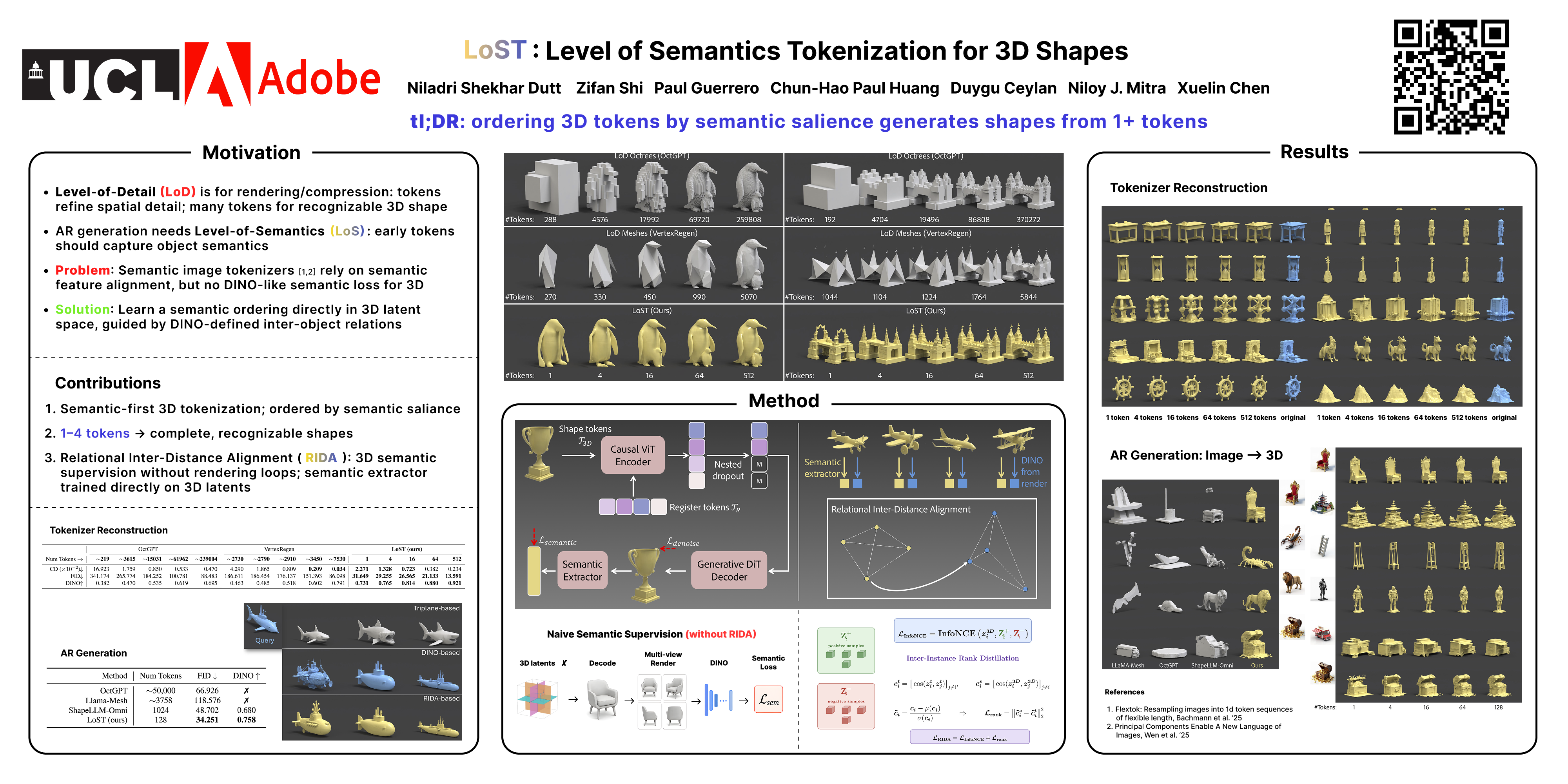
Tokenization is a fundamental technique in the generative modeling of various modalities. In particular, it plays a critical role in autoregressive (AR) models, which have recently emerged as a compelling option for 3D generation.However, optimal tokenization of 3D shapes remains an open question. State-of-the-art (SOTA) methods primarily rely on geometric level-of-detail (LoD) hierarchies, originally designed for rendering and compression. These spatial hierarchies are often token-inefficient and lack semantic coherence for AR modeling. We propose Level-of-Semantics Tokenization (LoST), which orders tokens by semantic salience, such that early prefixes decode into complete, plausible shapes that possess principal semantics, while subsequent tokens refine instance-specific geometric and semantic details. To train LoST, we introduce Relational Inter-Distance Alignment (RIDA), a novel 3D semantic alignment loss, inspired by relational knowledge distillation, that aligns the relational structure of the 3D shape latent space with that of the semantic DINO feature space. Experiments show that LoST achieves SOTA reconstruction, surpassing previous LoD-based 3D shape tokenizers by large margins on both geometric and semantic reconstruction metrics. Moreover, LoST achieves efficient, high-quality AR 3D generation and enables downstream tasks like semantic retrieval, while using only 0.1%–10% of the tokens needed by prior 3D AR models. Code will be released to facilitate future research.
Lafite: A Generative Latent Field for 3D Native Texturing
Chia-Hao Chen ⋅ Yuanchen Guo ⋅ Zi-Xin Zou ⋅ Ze Yuan ⋅ Guan Luo ⋅ Xiaojuan Qi ⋅ Ding Liang ⋅ Yan-Pei Cao ⋅ Song-Hai Zhang
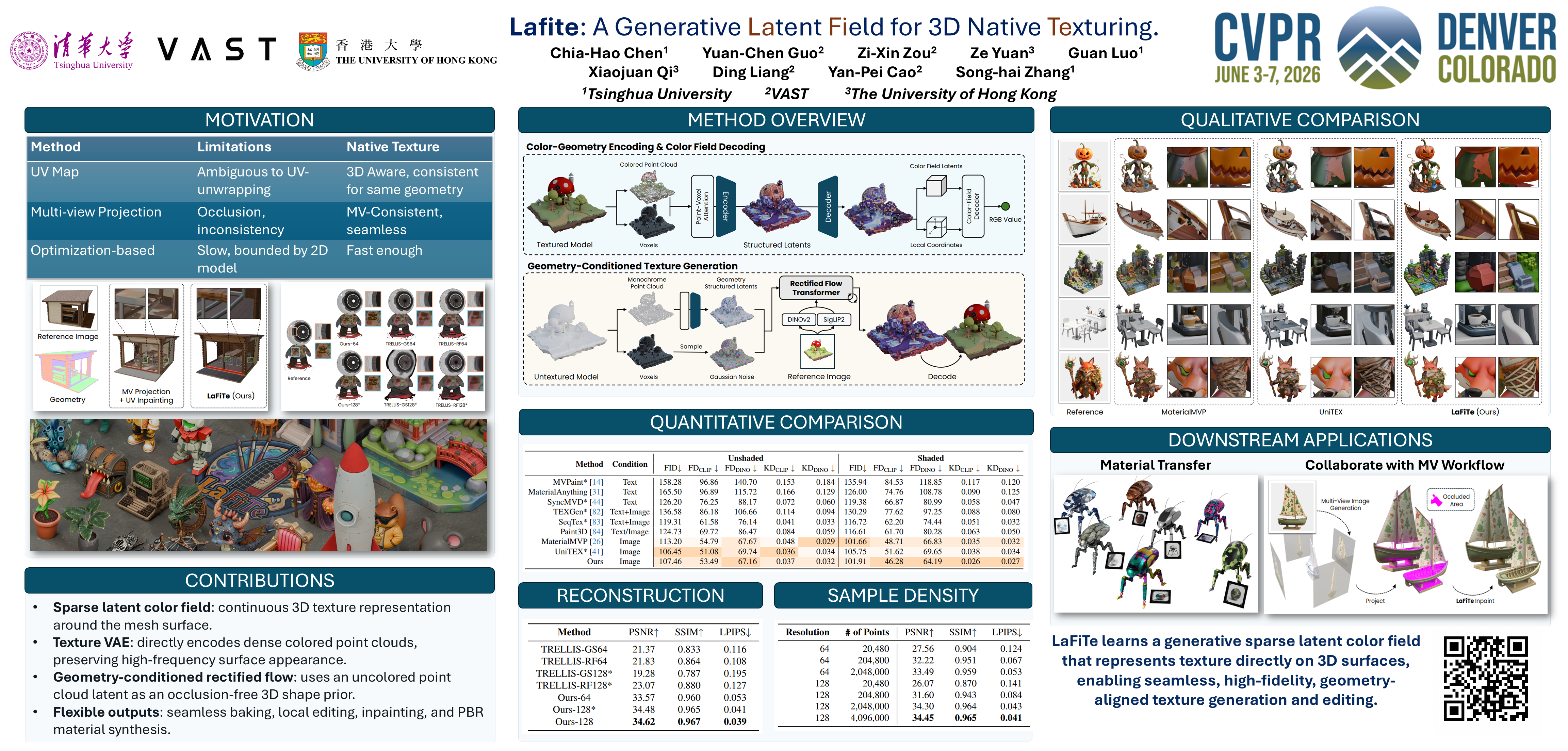
Generating detailed and seamless textures for 3D meshes remains an open challenge. Recent image and video generation models, empowered by large-scale visual priors, are capable of producing highly detailed images and are thus promising for multi-view texture synthesis. However, evaluating texture quality involves multiple dimensions beyond visual fidelity. Multi-view back-projection often introduces seams and inconsistencies between different views or near occluded regions, while direct generation on UV-unwrapped maps suffers from UV distortions and ambiguities.Generating textures directly in 3D space offers an inherent advantage in ensuring continuity and spatial coherence, making it a critical and worthwhile research direction. Therefore, we systematically investigate 3D-native texture generation from the perspectives of representation and generation, and present current best practices for this approach.To this end, we employ a local vector field with a structured latent representation to model the joint distribution of texture and geometry. This design enables texture generation conditioned on high-fidelity geometric features within a unified latent space. Crucially, our approach is inherently free from occlusion artifacts, multi-view inconsistencies, and UV-related distortions caused by fragmented surface parameterizations. Extensive experiments demonstrate that our method produces high-quality, seamless textures and supports flexible downstream tasks such as editing and inpainting, marking a significant step forward in 3D-native texture generation.
Image-Guided Geometric Stylization of 3D Meshes
Changwoon Choi ⋅ Hyunsoo Lee ⋅ Clément Jambon ⋅ Yael Vinker ⋅ Young Min Kim
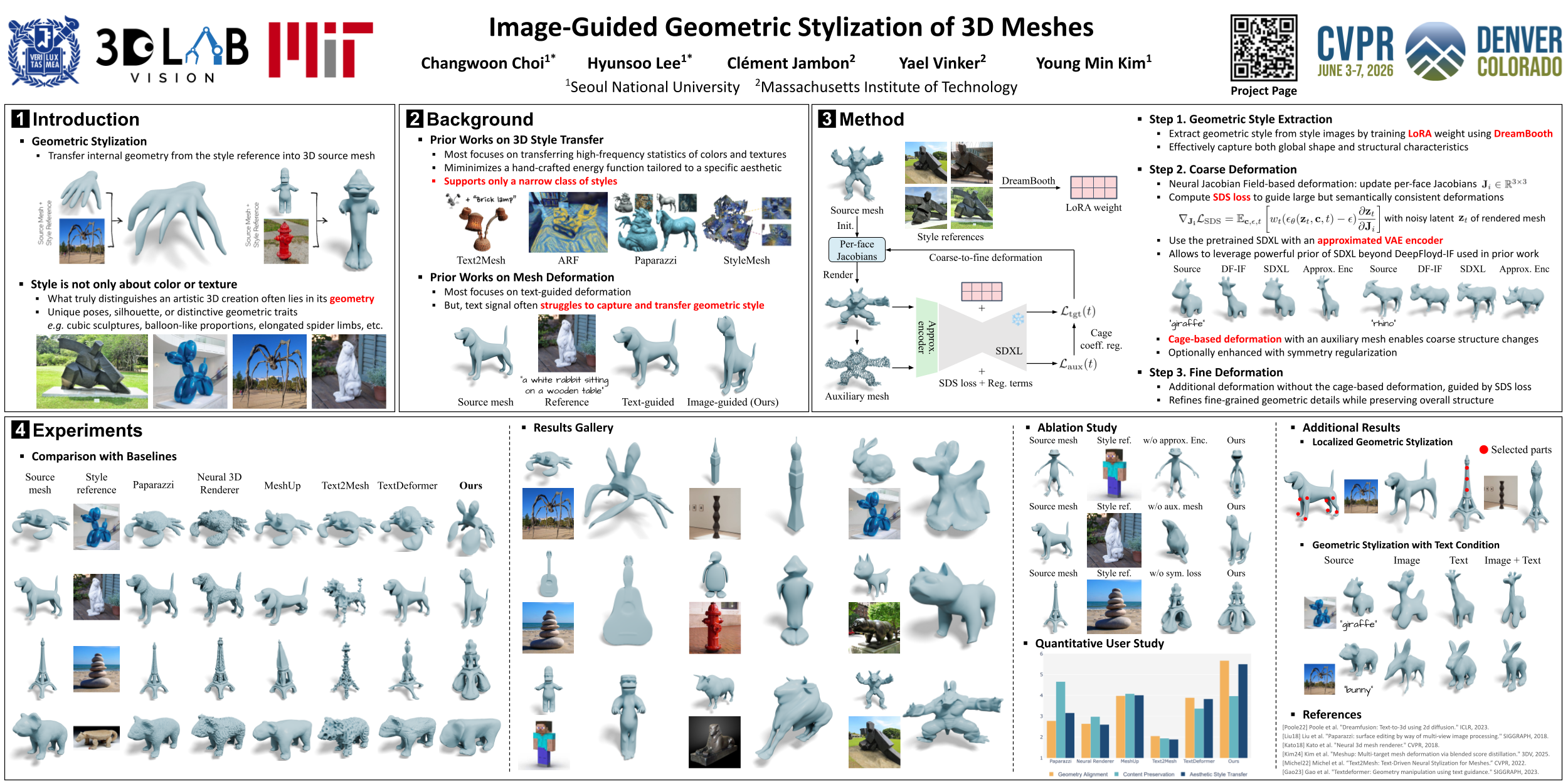
Recent generative models can create visually plausible 3D representations of objects. However, the generation process often allows for implicit control signals, such as contextual descriptions, and rarely supports bold geometric distortions beyond existing data distributions. We propose a geometric stylization framework that deforms a 3D mesh, allowing it to express the style of an image. While style is inherently ambiguous, we utilize pre-trained diffusion models to extract an abstract representation of the provided image. Our coarse-to-fine stylization pipeline can drastically deform the input 3D model to express a diverse range of geometric variations while retaining the valid topology of the original mesh and part-level semantics. We also propose an approximate VAE encoder that provides efficient and reliable gradients from mesh renderings. Extensive experiments demonstrate that our method can create stylized 3D meshes that reflect unique geometric features of the pictured assets, such as expressive poses and silhouettes, thereby supporting the creation of distinctive artistic 3D creations.
LATTICE: Democratize High-Fidelity 3D Generation at Scale
Zeqiang Lai ⋅ Yunfei Zhao ⋅ Zibo Zhao ⋅ Haolin Liu ⋅ Qingxiang Lin ⋅ Jingwei Huang ⋅ Chunchao Guo ⋅ Xiangyu Yue
We present LATTICE, a new framework for high-fidelity 3D asset generation that bridges the quality and scalability gap between 3D and 2D generative models. While 2D image synthesis benefits from fixed spatial grids and well-established transformer architectures, 3D generation remains fundamentally more challenging due to the need to predict both spatial structure and detailed geometric surfaces from scratch. These challenges are exacerbated by the computational complexity of existing 3D representations and the lack of structured and scalable 3D asset encoding schemes. To address this, we propose VoxSet, a semi-structured representation that compresses 3D assets into a compact set of latent vectors anchored to a coarse voxel grid, enabling efficient and position-aware generation. VoxSet retains the simplicity and compression advantages of prior VecSet methods while introducing explicit structure into the latent space, allowing positional embeddings to guide generation and enabling strong token-level test-time scaling. Built upon this representation, LATTICE adopts a two-stage pipeline: first generating a sparse voxelized geometry anchor, then producing detailed geometry using a recitified flow transformer. Our method is simple at its core, but supports arbitrary resolution decoding, low-cost training, and flexible inference schemes, achieving state-of-the-art performance on various aspects, and offering a significant step toward scalable, high-quality 3D asset creation.
Dehallu3D: Hallucination-Mitigated 3D Generation from a Single Image via Cyclic View Consistency Refinement
Xiwen Wang ⋅ Shichao Zhang ⋅ Ruowei Wang ⋅ mao li ⋅ Chenyu Zhou ⋅ Ji-Zhe Zhou ⋅ Qijun Zhao ⋅ Hailun Zhang
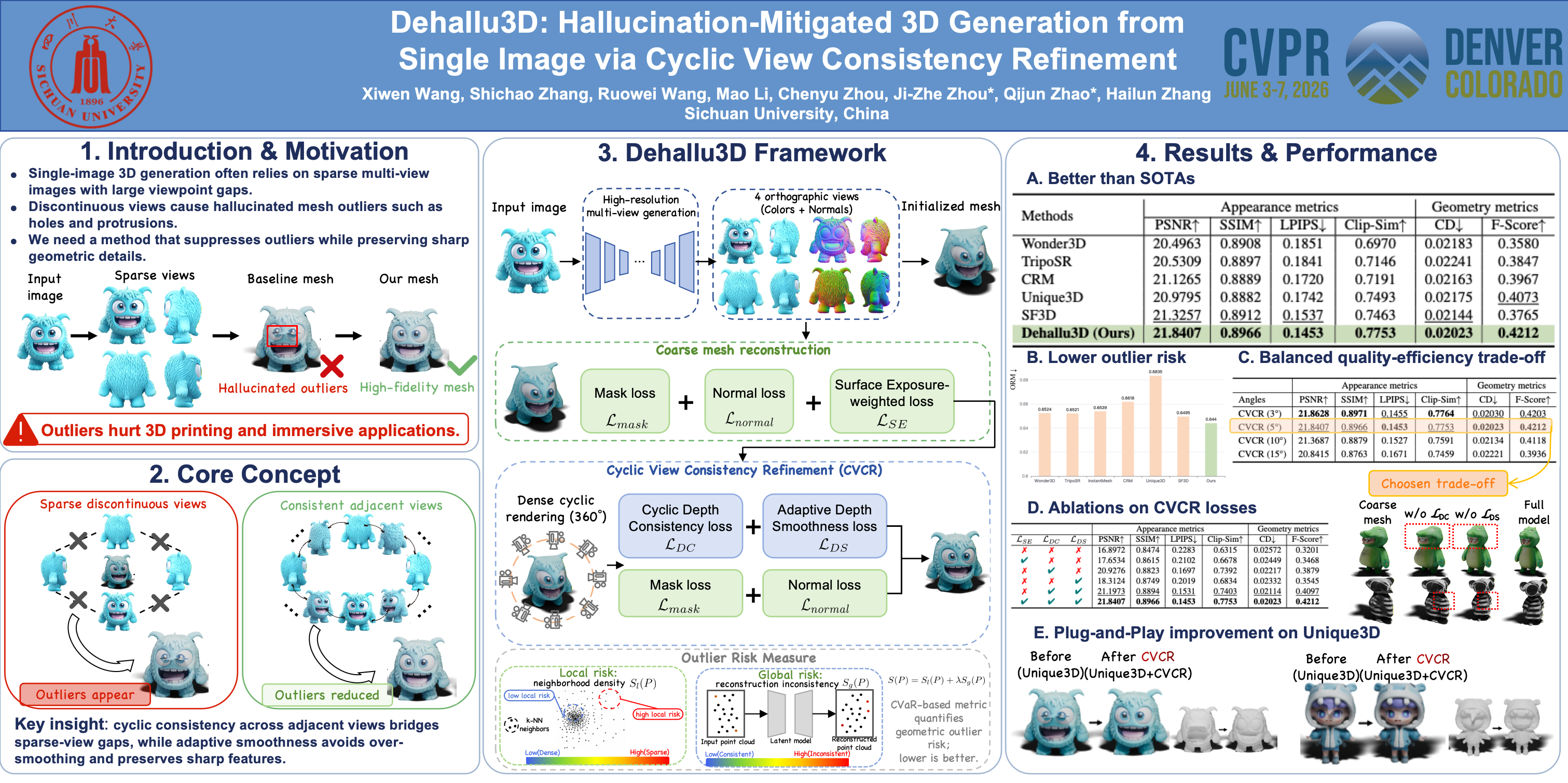
Large 3D reconstruction models have revolutionized the 3D content generation field, enabling broad applications in virtual reality and gaming. Just like other large models, large 3D reconstruction models suffer from hallucinations as well, introducing structural outliers (e.g., odd holes or protrusions) that deviate from the input data. However, unlike other large models, hallucinations in large 3D reconstruction models remain severely underexplored, leading to malformed 3D-printed objects or insufficient immersion in virtual scenes. Such hallucinations majorly originate from that existing methods reconstruct 3D content from sparsely generated multi-view images which suffer from large viewpoint gaps and discontinuities. To mitigate hallucinations by eliminating the outliers, we propose Dehallu3D for 3D mesh generation. Our key idea is to design a balanced multi-view continuity constraint to enforce smooth transitions across dense intermediate viewpoints, while avoiding over-smoothing that could erase sharp geometric features. Therefore, Dehallu3D employs a plug-and-play optimization module with two key constraints: (i) adjacent consistency to ensure geometric continuity across views, and (ii) adaptive smoothness to retain fine details. We further propose the Outlier Risk Measure (ORM) metric to quantify geometric fidelity in 3D generation from the perspective of outliers. Extensive experiments show that Dehallu3D achieves high-fidelity 3D generation by effectively preserving structural details while removing hallucinated outliers. The code will be fully available.
MeshMosaic: Scaling Artist Mesh Generation via Local-to-Global Assembly
Rui Xu ⋅ Tianyang Xue ⋅ Qiujie Dong ⋅ Le Wan ⋅ Zhe Zhu ⋅ Peng Li ⋅ Zhiyang Dou ⋅ Cheng Lin ⋅ Shiqing Xin ⋅ Yuan Liu ⋅ Wenping Wang ⋅ Taku Komura
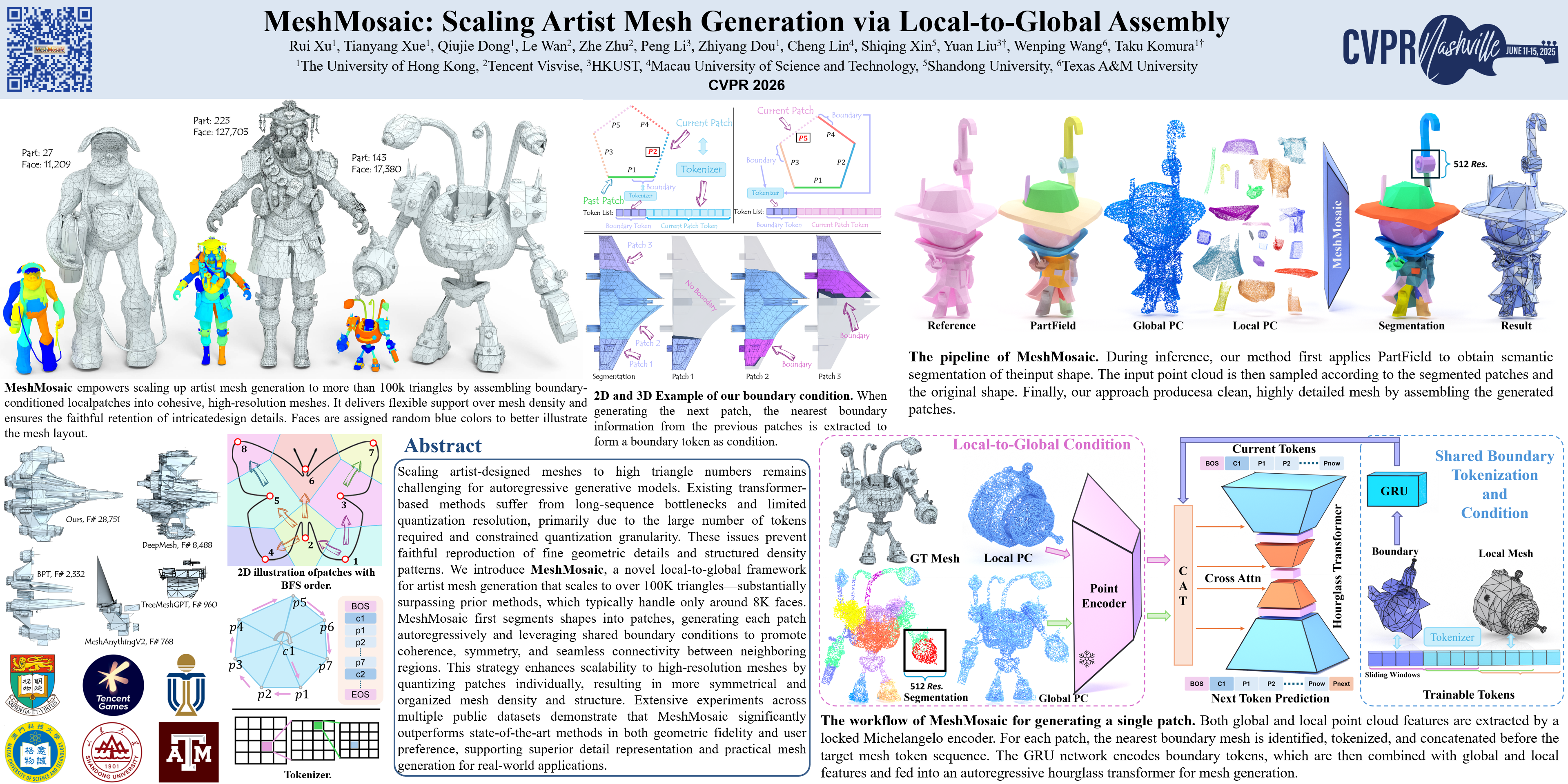
Scaling artist-designed meshes to high triangle numbers remains challenging for autoregressive generative models. Existing transformer-based methods suffer from long-sequence bottlenecks and limited quantization resolution, primarily due to the large number of tokens required and constrained quantization granularity. These issues prevent faithful reproduction of fine geometric details and structured density patterns.We introduce MeshMosaic, a novel local-to-global framework for artist mesh generation that scales to over 100K triangles—substantially surpassing prior methods, which typically handle only around 8K faces. MeshMosaic first segments shapes into patches, generating each patch autoregressively and leveraging shared boundary conditions to promote coherence, symmetry, and seamless connectivity between neighboring regions.This strategy enhances scalability to high-resolution meshes by quantizing patches individually, resulting in more symmetrical and organized mesh density and structure.Extensive experiments across multiple public datasets demonstrate that MeshMosaic significantly outperforms state-of-the-art methods in both geometric fidelity and user preference, supporting superior detail representation and practical mesh generation for real-world applications.
TacSIm: A Dataset and Benchmark for Football Tactical Style Imitation
Peng Wen ⋅ Yuting Wang ⋅ Qiurui Wang
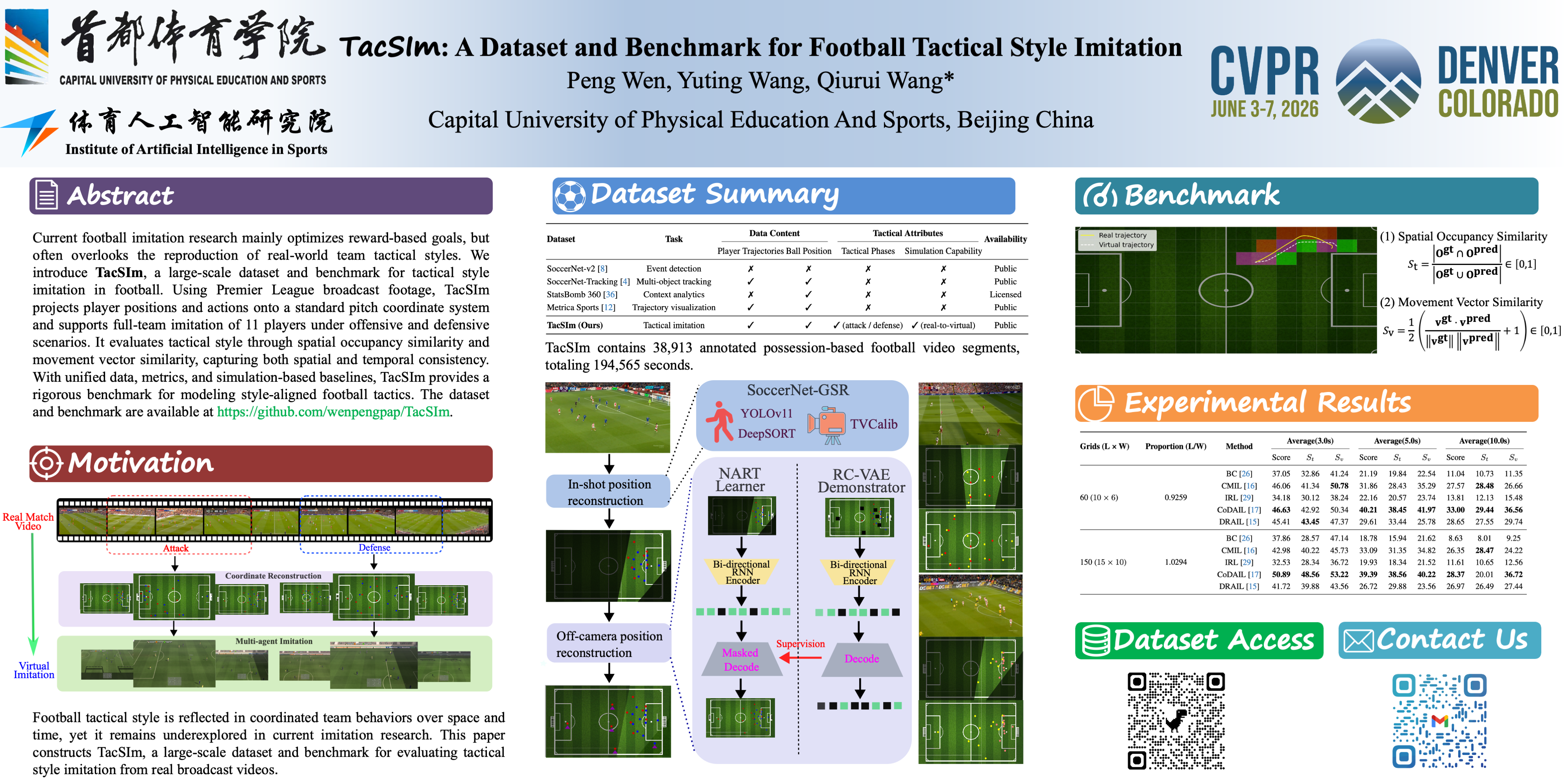
Current football imitation research primarily aims to optimize reward-based objectives, such as goals scored or win rate proxies, paying less attention to accurately replicating real-world team tactical behaviors. We introduce TacSIm, a large-scale dataset and benchmark for Tactical Style Imitation in football. TacSIm imitates the acitons of all 11 players in one team in the given broadcast footage of Premier League matches under a single broadcast view. Under a offensive or defensive broadcast footage, TacSIm projects the beginning positions and actions of all 22 players from both sides onto a standard pitch coordinate system. TacSIm offers an explicit style imitation task and evaluation protocols. Tactics style imitation is measured by using spatial occupancy similarity and movement vector similarity in defined time, supporting the evaluation of spatial and temporal similarities for one team. We run multiple baseline methods in a unified virtual environment to generate full-team behaviors, enabling both quantitative and visual assessment of tactical coordination. By using unified data and metrics from broadcast to simulation, TacSIm establishes a rigorous benchmark for measuring and modeling style-aligned tactical imitation task in football. The benchmark will be soon public.
DynamicsBoost: Dynamic Plausible Video Generation via Annotation-Free Continuation Preference Optimization
Jiaxing Li ⋅ Jiepeng Wang ⋅ Junyao Gao ⋅ Yang Liu ⋅ Eric Li ⋅ Bo An ⋅ Hao-Xiang Guo
Despite significant progress in text-to-video generation, current models still suffer from unrealistic dynamics, temporal inconsistency, and unstable semantic alignment. Existing preference alignment approaches rely on costly and often ambiguous human or VLM-based video preference annotation, which has become a major bottleneck for scaling data. To address this challenge, we propose an annotation-free preference alignment method that constructs accurate preference pairs through video continuation.We extend a pretrained video generation model into a continuation model and apply continuation with different amounts of reference frames while keeping the total video length fixed. As generated segments are inferior to ground-truth frames and and fixed-length continuations conditioned on more reference frames contain less generated content, they exhibit higher fidelity than those with fewer references, naturally inducing a preference order.We further introduce Asymmetrical DPO, which computes preference loss on all continuation regions except the shared prefix conditioning frames and normalizes it by their length, preventing spurious preference signals from leaking into the conditioned portion.Experiments across multiple benchmarks show that our method delivers significant improvements in dynamics realism, temporal coherence, and semantic alignment over existing DPO-based approaches, while fully eliminating the need for human preference labeling or auxiliary reward models.
Reinforcement-Guided Synthetic Data Generation for Privacy-Sensitive Identity Recognition
Xuemei Jia ⋅ Jiawei Du ⋅ Hui Wei ⋅ Jun Chen ⋅ Joey Tianyi Zhou ⋅ Zheng Wang
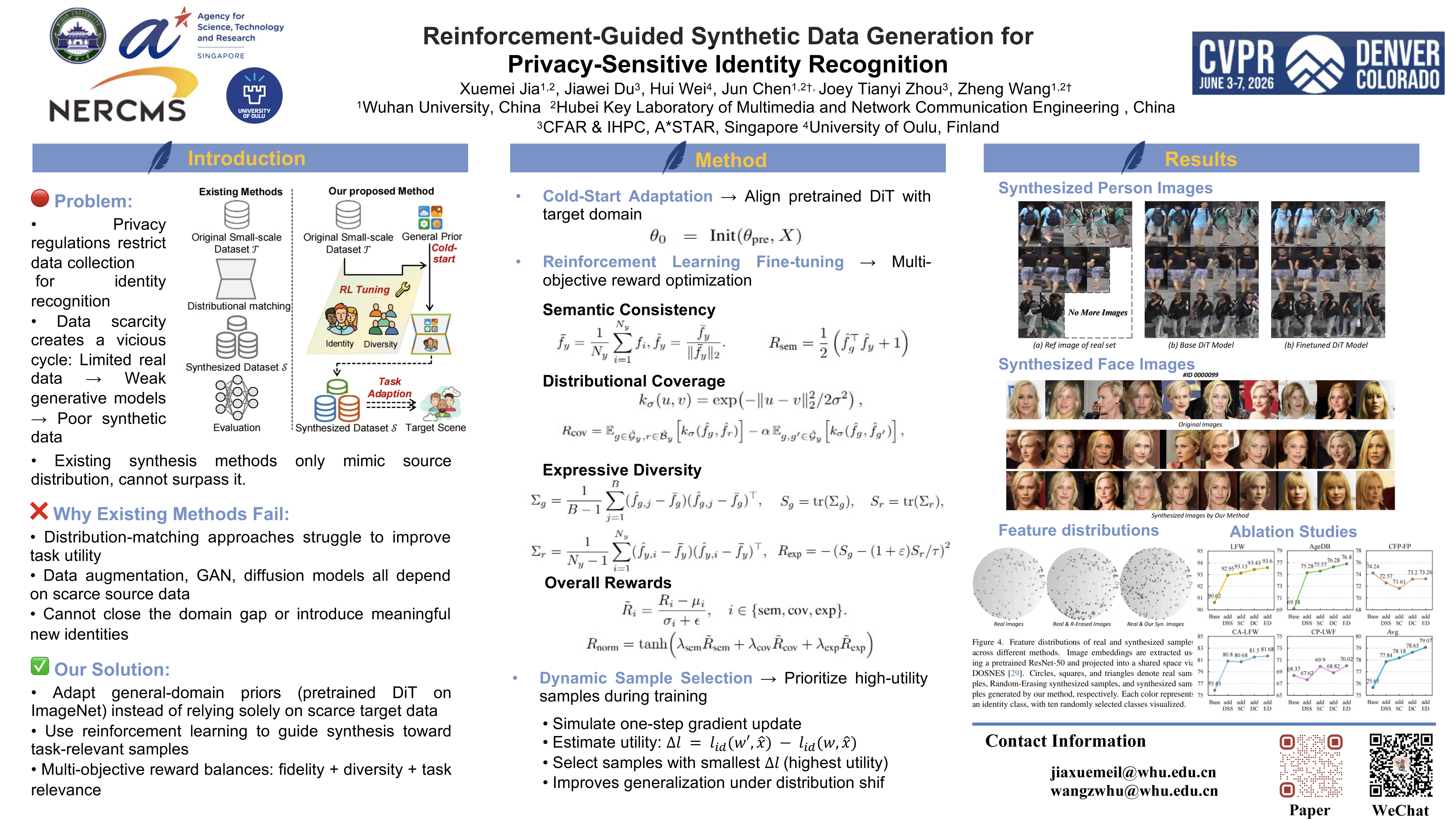
High-fidelity generative models are increasingly needed in privacy-sensitive scenarios, where access to data is severely restricted due to regulatory and copyright constraints. This scarcity hampers model development—ironically, in settings where generative models are most needed to compensate for the lack of data. This creates a self-reinforcing challenge: limited data leads to poor generative models, which in turn fail to mitigate data scarcity. To break this cycle, we propose a reinforcement-guided synthetic data generation framework that adapts general-domain generative priors to privacy-sensitive identity recognition tasks.We first perform a cold-start adaptation to align a pretrained generator with the target domain, establishing semantic relevance and initial fidelity.Building on this foundation, we introduce a multi-objective reward that jointly optimizes semantic consistency, coverage diversity, and expression richness, guiding the generator to produce both realistic and task-effective samples.During downstream training, a dynamic sample selection mechanism further prioritizes high-utility synthetic samples, enabling adaptive data scaling and improved domain alignment.Extensive experiments on benchmark datasets demonstrate that our framework significantly improves both generation fidelity and classification accuracy, while also exhibiting strong generalization to novel categories in small-data regimes.
Fine-Grained GRPO for Precise Preference Alignment in Flow Models
Yujie Zhou ⋅ Pengyang Ling ⋅ Jiazi Bu ⋅ Yibin Wang ⋅ Yuhang Zang ⋅ Jiaqi Wang ⋅ Li Niu ⋅ Guangtao Zhai
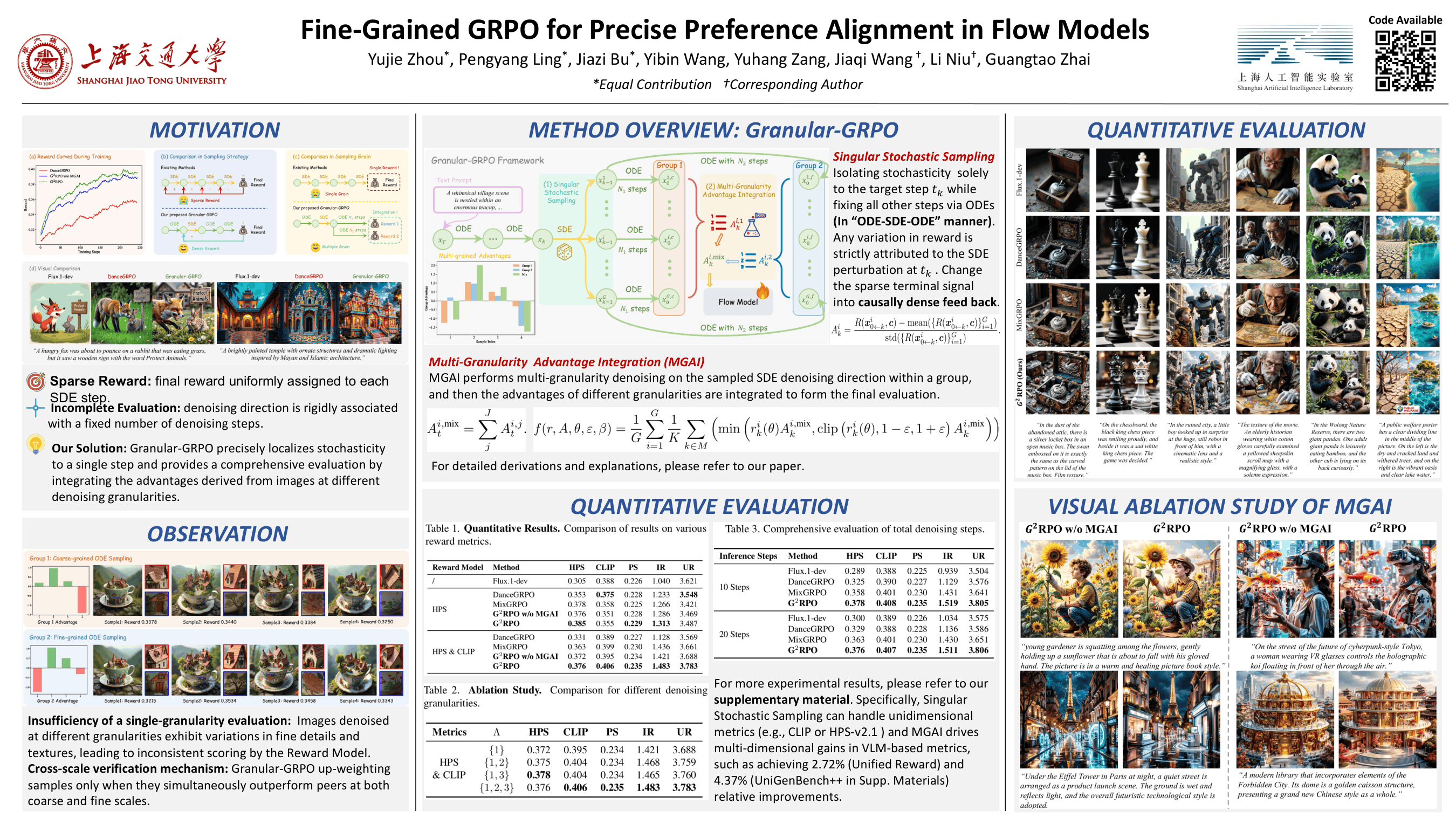
The incorporation of online reinforcement learning (RL) into diffusion and flow-based generative models has recently gained attention as a powerful paradigm for aligning model behavior with human preferences. By leveraging stochastic sampling via Stochastic Differential Equations (SDEs) during the denoising phase, these models can explore a variety of denoising trajectories, enhancing the exploratory capacity of RL. However, despite their ability to discover potentially high-reward samples, current approaches often struggle to effectively align with preferences due to the sparsity and narrowness of reward feedback. To overcome this limitation, we introduce a novel framework called Granular-GRPO (G$^2$RPO), which enables fine-grained and comprehensive evaluation of sampling directions in the RL training of flow models. Specifically, we propose a Singular Stochastic Sampling mechanism that supports step-wise stochastic exploration while ensuring strong correlation between injected noise and reward signals, enabling more accurate credit assignment to each SDE perturbation. Additionally, to mitigate the bias introduced by fixed-granularity denoising, we design a Multi-Granularity Advantage Integration module that aggregates advantages computed across multiple diffusion scales, resulting in a more robust and holistic assessment of sampling trajectories. Extensive experiments on various reward models, including both in-domain and out-of-domain settings, demonstrate that our G$^2$RPO outperforms existing flow-based GRPO baselines, highlighting its effectiveness and generalization capability.
Lighting-grounded Video Generation with Renderer-based Agent Reasoning
Ziqi Cai ⋅ Taoyu Yang ⋅ Zheng Chang ⋅ Si Li ⋅ Han Jiang ⋅ Shuchen Weng ⋅ Boxin Shi
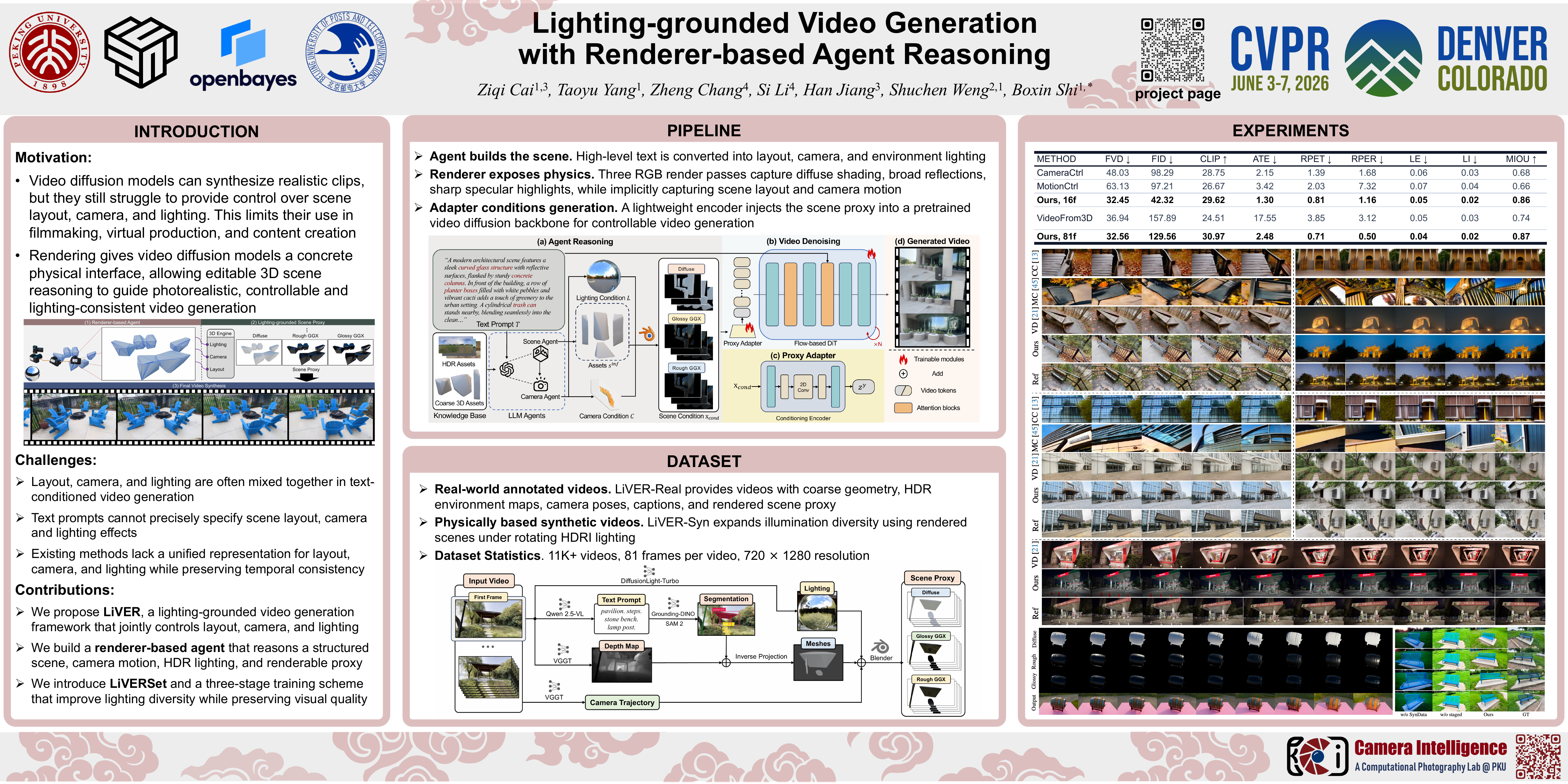
Diffusion models have achieved remarkable progress in video generation, but their controllability remains a major limitation. Key scene factors such as layout, lighting, and camera trajectory are often entangled or only weakly modeled, restricting their applicability in domains like filmmaking and virtual production where explicit scene control is essential. We present LiVER, a diffusion-based framework for scene-controllable video generation. To achieve this, we introduce a novel framework that conditions video synthesis on explicit 3D scene properties, supported by a new large-scale dataset with dense annotations of object layout, lighting, and camera parameters. Our method disentangles these properties by rendering control signals from a unified 3D representation. We propose a lightweight conditioning module and a progressive training strategy to integrate these signals into a foundational video diffusion model, ensuring stable convergence and high fidelity. Our framework enables a wide range of applications, including image-to-video and video-to-video synthesis where the underlying 3D scene is fully editable. To further enhance usability, we develop a scene agent that automatically translates high-level user instructions into the required 3D control signals. Experiments show that LiVER achieves state-of-the-art photorealism and temporal consistency while enabling precise, disentangled control over scene factors, setting a new standard for controllable video generation.
RewardFlow: Generate Images by Optimizing What You Reward
Onkar Susladkar ⋅ Dong-Hwan Jang ⋅ Tushar Prakash ⋅ Adheesh Juvekar ⋅ Vedant Shah ⋅ Ayush Barik ⋅ Nabeel Bashir ⋅ Muntasir Wahed ⋅ Ritish Shrirao ⋅ Ismini Lourentzou
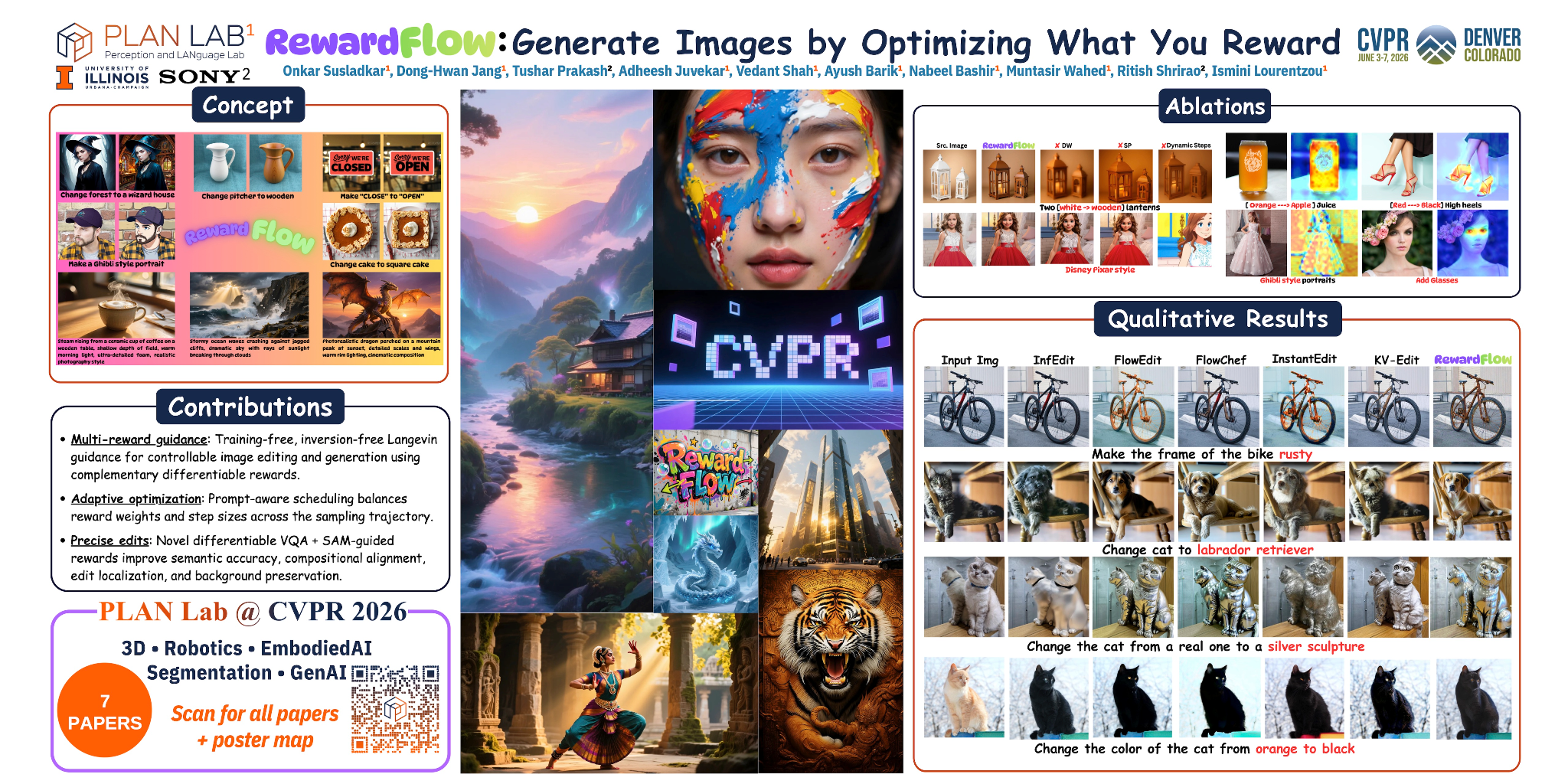
RewardFlow is a zero-shot, training-free framework for text-guided image editing and generation based on reward-guided Langevin dynamics. We steer pretrained diffusion and flow-matching models at inference time using a diverse set of differentiable rewards, and control their influence with a prompt-aware adaptive policy that parses the text instruction, infers edit intent, and dynamically adjusts update steps. Our design includes a differentiable VQA-based reward for fine-grained semantic supervision and a SAM-guided reward for precise, localized edits with minimal leakage. Across standard image editing and compositional generation benchmarks, RewardFlow achieves state-of-the-art zero-shot edit fidelity and compositional alignment. We will release the code and an open-source demo upon acceptance of the paper.
Goal Force: Teaching Video Models To Accomplish Physics-Conditioned Goals
Nate Gillman ⋅ Yinghua Zhou ⋅ Zitian Tang ⋅ Evan Luo ⋅ Arjan Chakravarthy ⋅ Daksh Aggarwal ⋅ Michael Freeman ⋅ Chen Sun
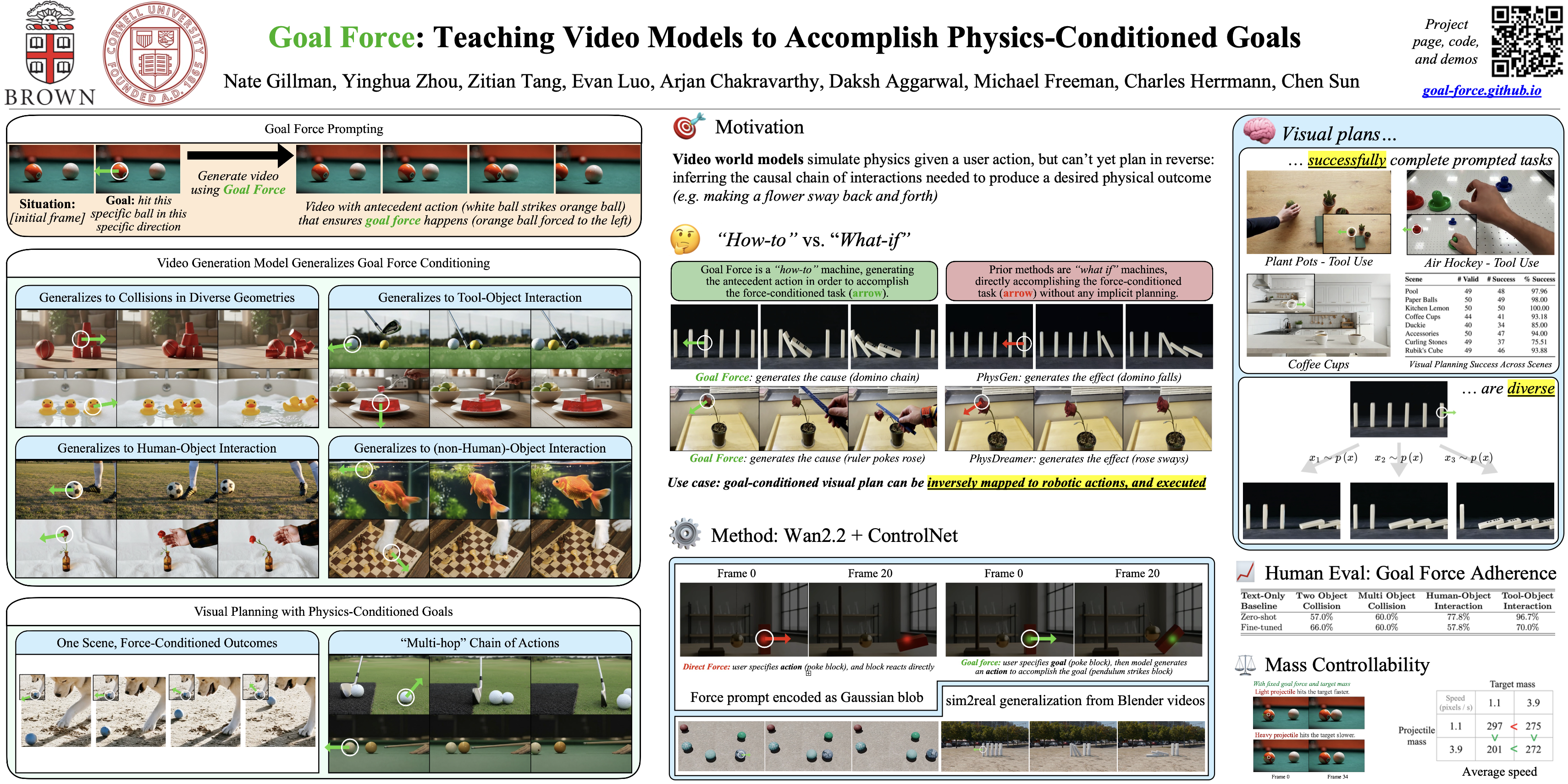
Recent advancements in video generation have enabled the development of ``world models'' capable of simulating potential futures for robotics and planning. However, specifying precise goals for these models remains a challenge; text instructions are often too abstract to capture physical nuances, while target images are frequently infeasible to specify for dynamic tasks. To address this, we introduce Goal Force, a novel framework that allows users to define goals via explicit force vectors and intermediate dynamics, mirroring how humans conceptualize physical tasks. We train a video generation model on a curated dataset of synthetic causal primitives—such as elastic collisions and falling dominos—teaching it to propagate forces through time and space. Despite being trained on simple physics data, our model exhibits remarkable zero-shot generalization to complex, real-world scenarios, including tool manipulation and multi-object causal chains. Our results suggest that by grounding video generation in fundamental physical interactions, models can emerge as implicit neural physics simulators, enabling precise, physics-aware planning without reliance on external engines.
Self-Corrected Image Generation with Explainable Latent Rewards
Yinyi Luo ⋅ Hrishikesh Gokhale ⋅ Marios Savvides ⋅ Jindong Wang ⋅ Shengfeng He
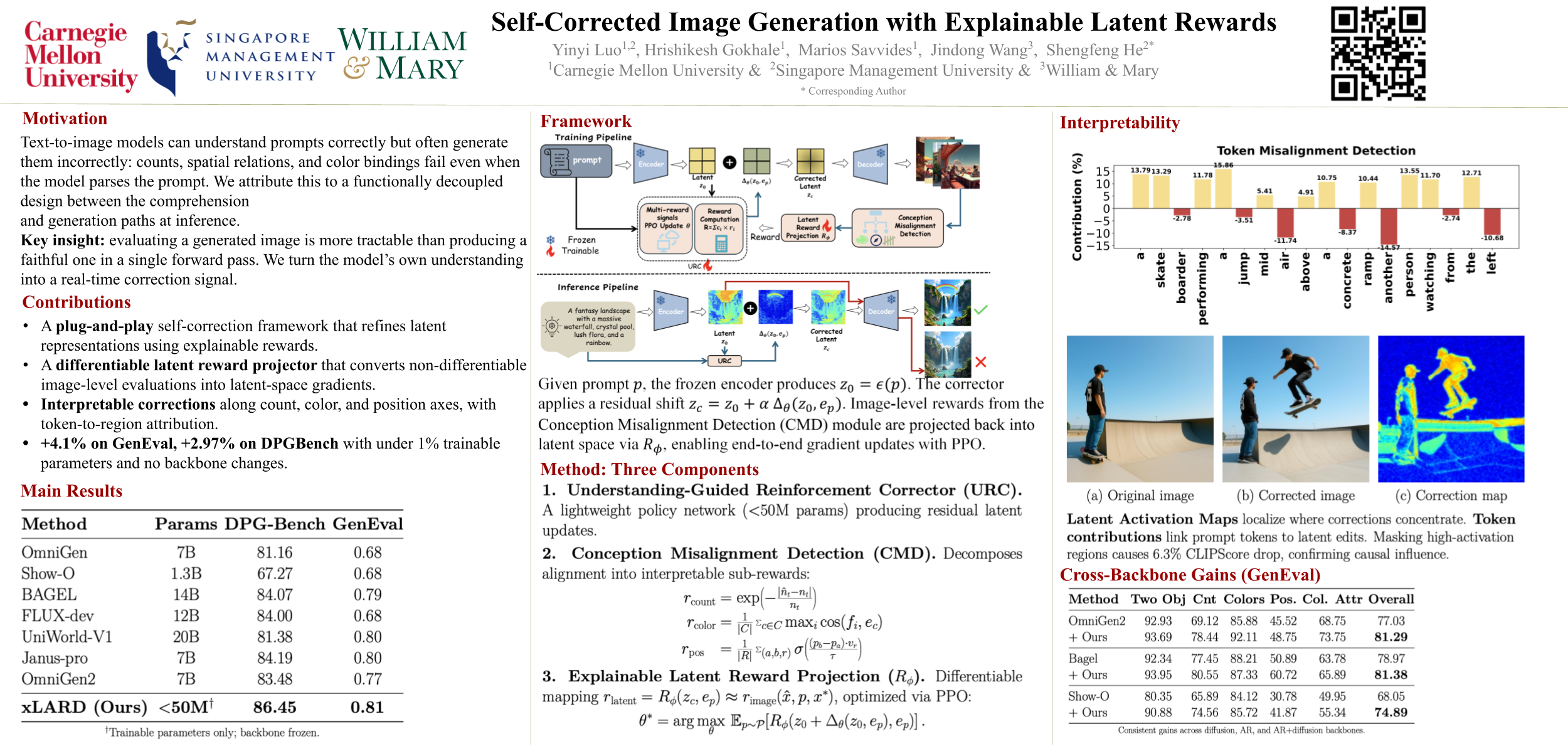
Despite significant progress in text-to-image generation, aligning outputs with complex prompts remains challenging, particularly for fine-grained semantics and spatial relations. This difficulty stems from the feed-forward nature of generation, which requires anticipating alignment without fully understanding the output. In contrast, evaluating generated images is more tractable. Motivated by this asymmetry, we propose xLARD, a self-correcting framework that uses multimodal large language models to guide generation through Explainable Latent Rewards. xLARD introduces a lightweight corrector that refines latent representations based on structured feedback from model-generated references. A key component is a differentiable mapping from latent edits to interpretable reward signals, enabling continuous latent-level guidance from non-differentiable image-level evaluations. This mechanism allows the model to understand, assess, and correct itself during generation. Experiments across diverse generation and editing tasks show that xLARD improves semantic alignment and visual fidelity while maintaining generative priors, offering a data-efficient and generalizable solution to bridging the gap between comprehension and synthesis.
Polyphony: Diffusion-based Dual-Hand Action Segmentation with Alternating Vision Transformer and Semantic Conditioning
Hao Zheng ⋅ Hu Wang ⋅ Tiantian Zheng ⋅ Prajjwal Bhattarai ⋅ Tuka Alhanai
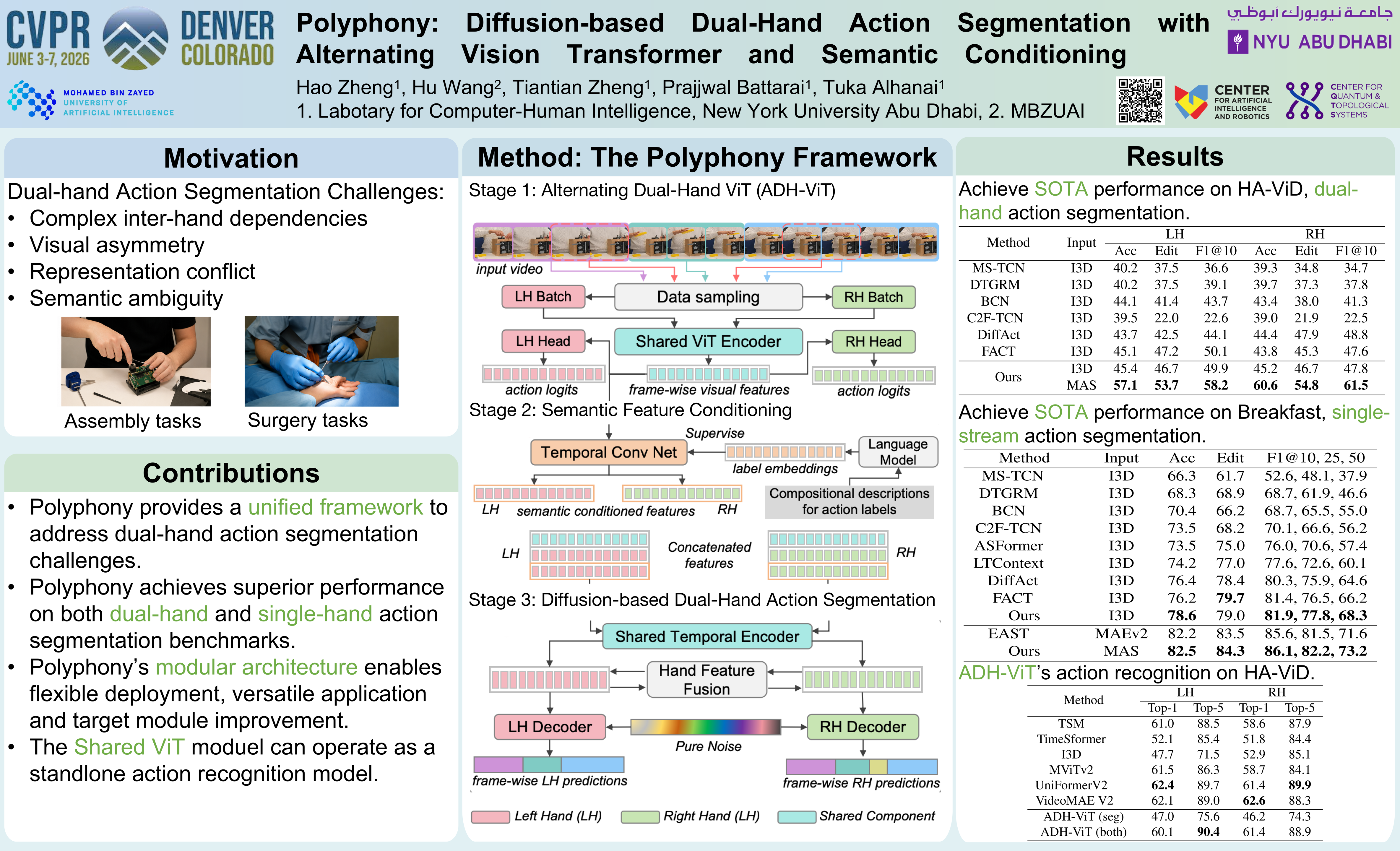
Dual-hand action segmentation, densely predicting actions for both hands from untrimmed videos, is essential for understanding complex bimanual activities. However, it poses several unique challenges: complex inter-hand dependencies, visual asymmetry between hands, representation conflicts where the dominant hand monopolizes gradients, and semantic ambiguity in fine-grained actions. We propose Polyphony, a three-stage method to address these challenges through: (1) an Alternating Dual-Hand Vision Transformer that alternates training between left- and right-hand mini-batches to ensure balanced gradient contributions from both hands while sharing a spatio-temporal encoder; (2) Semantic Feature Conditioning that aligns visual features with structured, compositional action descriptions to enhance discrimination of semantically similar actions; and (3) Diffusion-Based Segmentation with cross-hand feature fusion for inter-hand coordination and adaptive loss weighting for balancing performance. Polyphony achieves state-of-the-art on both dual-hand datasets (HA-ViD, ATTACH) with improvements up to 16.8 points, and on the single-stream Breakfast dataset (82.5\%), outperforming the prior best method that uses a 12× larger backbone. Notably, our unified model with a single shared backbone surpasses baselines requiring separate per-hand models. Code is at \url{https://github.com/polyphony-cvpr/polyphony}.
Reading Your Actions: Learning Generalizable Action Representations via Pre-training AEMG
Zhenghao Huang ⋅ Kaikai Wang ⋅ HUILIN YAO ⋅ Lin Shu
Electromyography (EMG) is crucial for decoding human motor intentions and achieving natural human-computer interaction, but its generalization ability across subjects, devices, and tasks has long been limited by data heterogeneity, scarce annotations, and the lack of a unified representation paradigm. In this work, we introduce a novel perspective on EMG signals, treating muscle contractions as words and activation sequences as sentences. Based on this perspective, we design a Neuromuscular Contraction Tokenizer (NCT) that generates semantically consistent EMG sentences from raw signals. Building on this, we propose the first large-scale pre-training framework for EMG—Any Electromyography (AEMG), a general EMG representation learning framework based on self-supervised pre-training. Furthermore, we construct the largest cross-device EMG vocabulary to date, which supports seamless transfer across arbitrary channel topologies and sampling rates. Extensive experiments demonstrate that AEMG outperforms state-of-the-art baselines by 5.79–9.25% in zero-shot leave-one-subject-out accuracy, and achieves over 90% few-shot adaptation performance with only 5% of the target user’s data. Our work has proposed the concept of electromyography signals as a cross-device physiological language, learned their grammar from massive amounts of data, and laid the groundwork for a single-training, universally applicable EMG foundation model.
MA-Bench: Towards Fine-grained Micro-Action Understanding
Kun Li ⋅ Jihao Gu ⋅ Fei Wang ⋅ zhiliang wu ⋅ Hehe Fan ⋅ Dan Guo
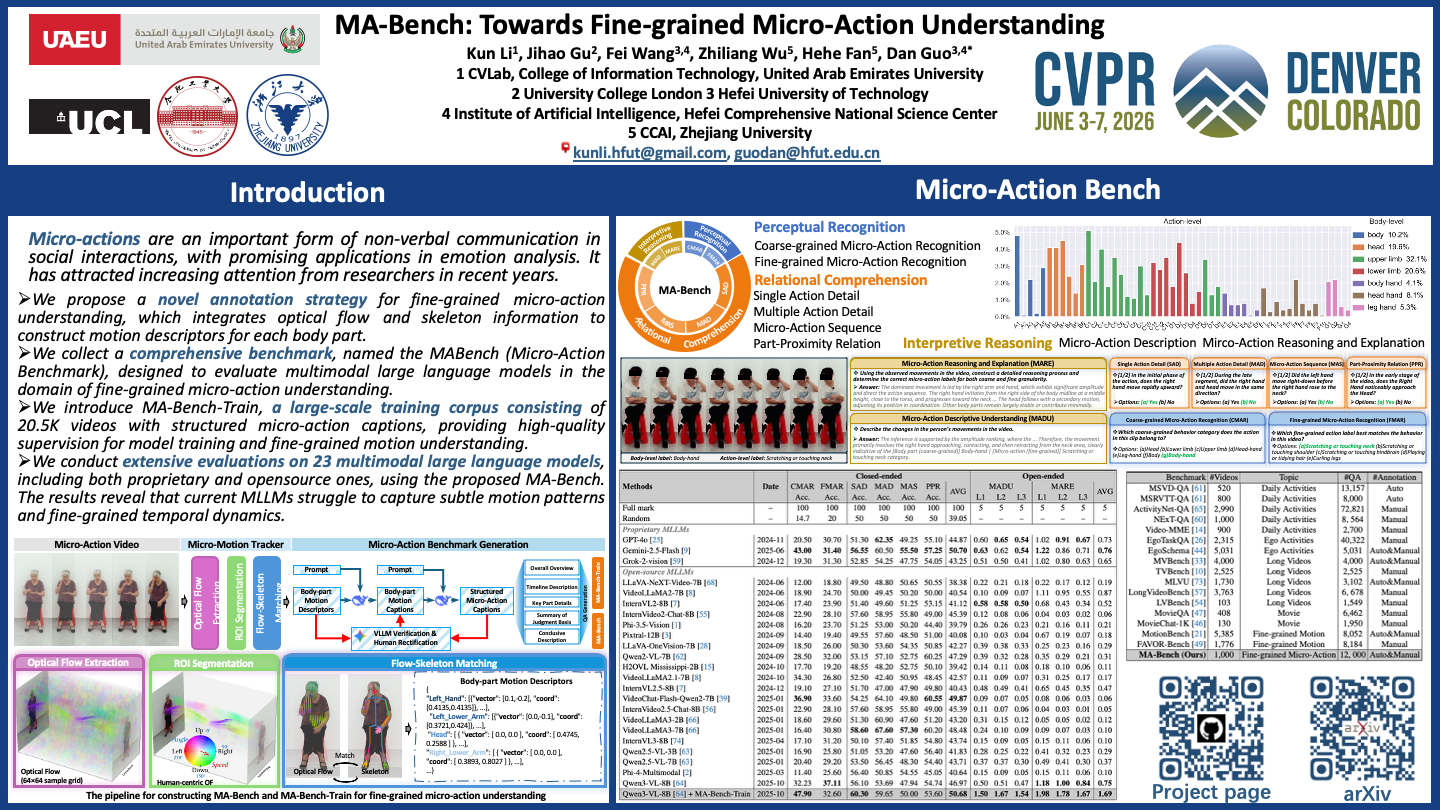
With the rapid development of Multimodal Large Language Models (MLLMs), their potential in Micro-Action understanding, a vital role in human emotion analysis, remains unexplored due to the absence of specialized benchmarks. To tackle this issue, we present **MA-Bench, a benchmark comprising 1,000 videos and a three-tier evaluation architecture that progressively examines micro-action perception, relational comprehension, and interpretive reasoning. MA-Bench contains 12,000 structured question–answer pairs, enabling systematic assessment of both recognition accuracy and action interpretation. The results of 23 representative MLLMs reveal that there are significant challenges in capturing motion granularity and fine-grained body-part dynamics. To address these challenges, we further construct MA-Bench-Train, a large-scale training corpus with 20.5K videos annotated with structured micro-action captions for fine-tuning MLLMs. The results of Qwen3-VL-8B fine-tuned on MA-Bench-Train show clear performance improvements across micro-action reasoning and explanation tasks. Our work aims to establish a foundation benchmark for advancing MLLMs in understanding subtle micro-action and human-related behaviors.
OpenMarcie: Dataset for Multimodal Action Recognition in Industrial Environments
Hymalai Bello ⋅ Lala Ray ⋅ Joanna Sorysz ⋅ Sungho Suh ⋅ Paul Lukowicz
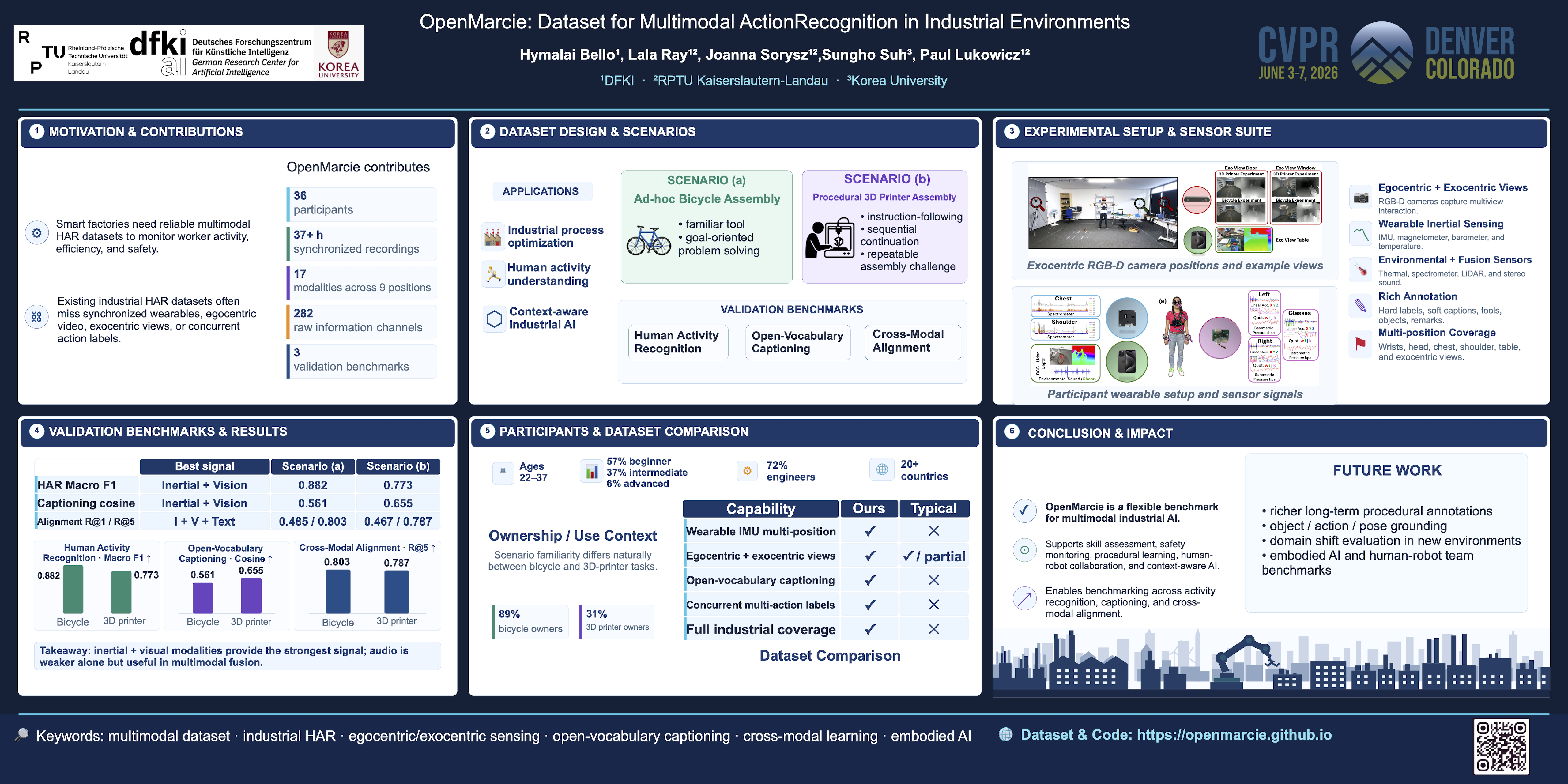
Smart factories use advanced technologies to optimize production and increase efficiency. To this end, the recognition of worker activity allows for accurate quantification of performance metrics, improving efficiency holistically while contributing to worker safety. OpenMarcie is, to the best of our knowledge, the biggest multimodal dataset designed for human action monitoring in manufacturing environments. It includes data from wearables sensing modalities and cameras distributed in the surroundings. The dataset is structured around two experimental settings, involving a total of 36 participants. In the first setting, twelve participants perform a bicycle assembly and disassembly task under semi-realistic conditions without a fixed protocol, promoting divergent and goal-oriented problem-solving. The second experiment involves twenty-five volunteers (24 valid data) engaged in a 3D printer assembly task, with the 3D printer manufacturer's instructions provided to guide the volunteers in acquiring procedural knowledge. This setting also includes sequential collaborative assembly, where participants assess and correct each other's progress, reflecting real-world manufacturing dynamics. OpenMarcie includes over 37 hours of egocentric and exocentric, multimodal, and multipositional data, featuring eight distinct data types and more than 200 independent information channels. The dataset is benchmarked across three human activity recognition tasks: activity classification, open vocabulary captioning, and cross-modal alignment. The dataset and code are available at (Removed for Anonymous CVPR Submission).
Action Motifs: Self-Supervised Hierarchical Representation of Human Body Movements
Genki Kinoshita ⋅ Shu Nakamura ⋅ Ryo Kawahara ⋅ Shohei Nobuhara ⋅ Yasutomo Kawanishi ⋅ Ko Nishino
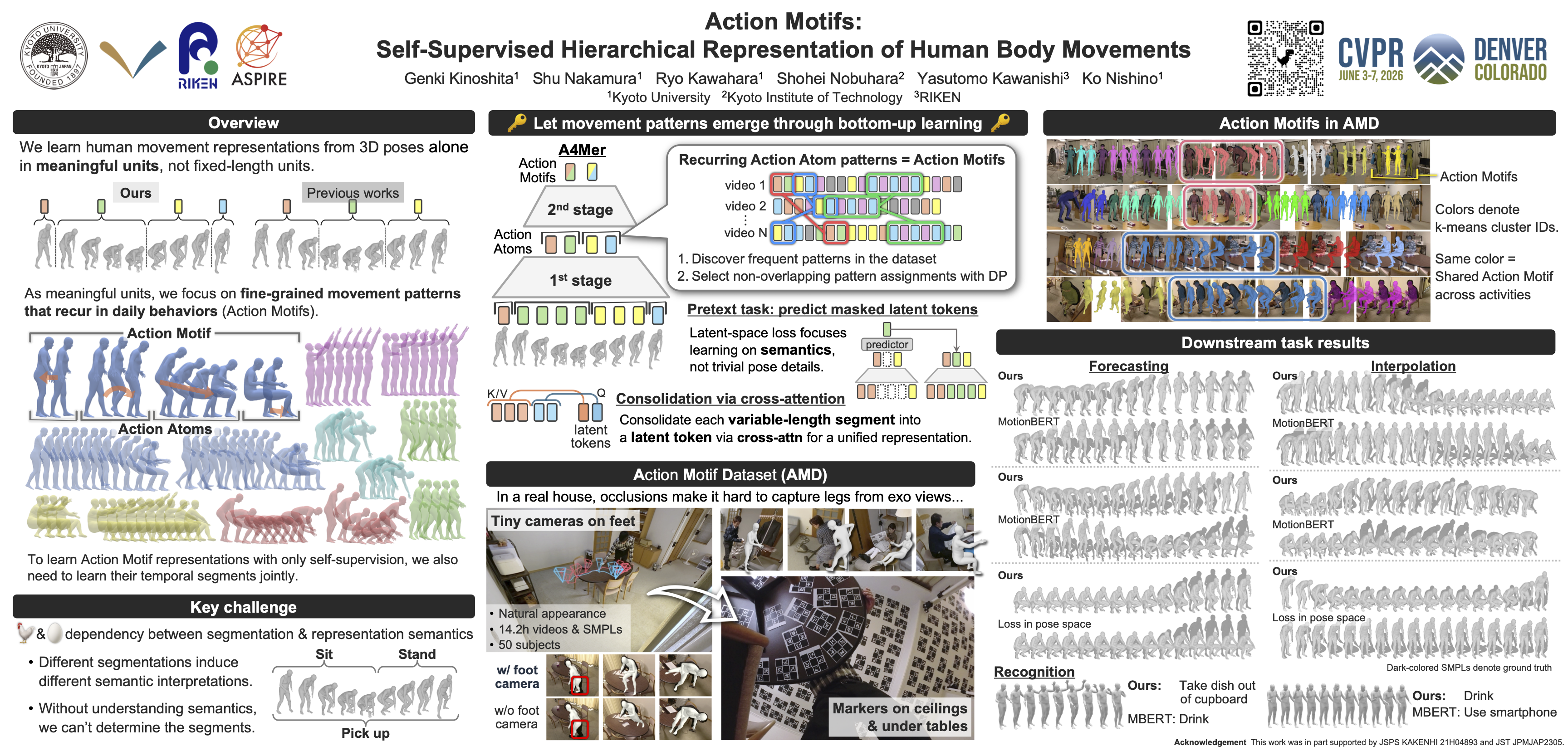
Effective human behavior modeling requires a representation of the human body movement that capitalizes on its compositionality. We propose a hierarchical representation consisting of Action Atoms which capture the atomic joint movements and Action Motifs which are formed by their temporal compositions and encode similar body movements found across different overall human actions. We derive A4Mer, a nested latent Transformer to learn this hierarchical representation from human pose data in a fully self-supervised manner. A4Mer splits a 3D pose sequence into variable-length segments and represents each segment as a single latent token (Action Atoms). Through bottom-up representation learning, temporal patterns composed of these Action Atoms, which capture meaningful temporal spans of reusable, semantic segments of body movements, naturally emerge (Action Motifs). A4Mer achieves this with a unified pretext task of masked token prediction in their respective latent spaces. We also introduce Action Motif Dataset (AMD), a large-scale dataset of multiview human behavior videos with full SMPL annotations. We introduce a novel use of cameras by mounting them on the feet to achieve their frame-wise annotations despite frequent and heavy body occlusions. Experimental results demonstrate the effectiveness of A4Mer for extracting meaningful Action Atoms and Action Motifs that significantly benefit human behavior modeling tasks including action recognition, motion prediction and synthesis.
DarkShake-DVS: Event-based Human Action Recognition under Low-light and Shaking Camera Conditions
Jiaqi Chen ⋅ Qinfu Xu ⋅ Liyuan Pan
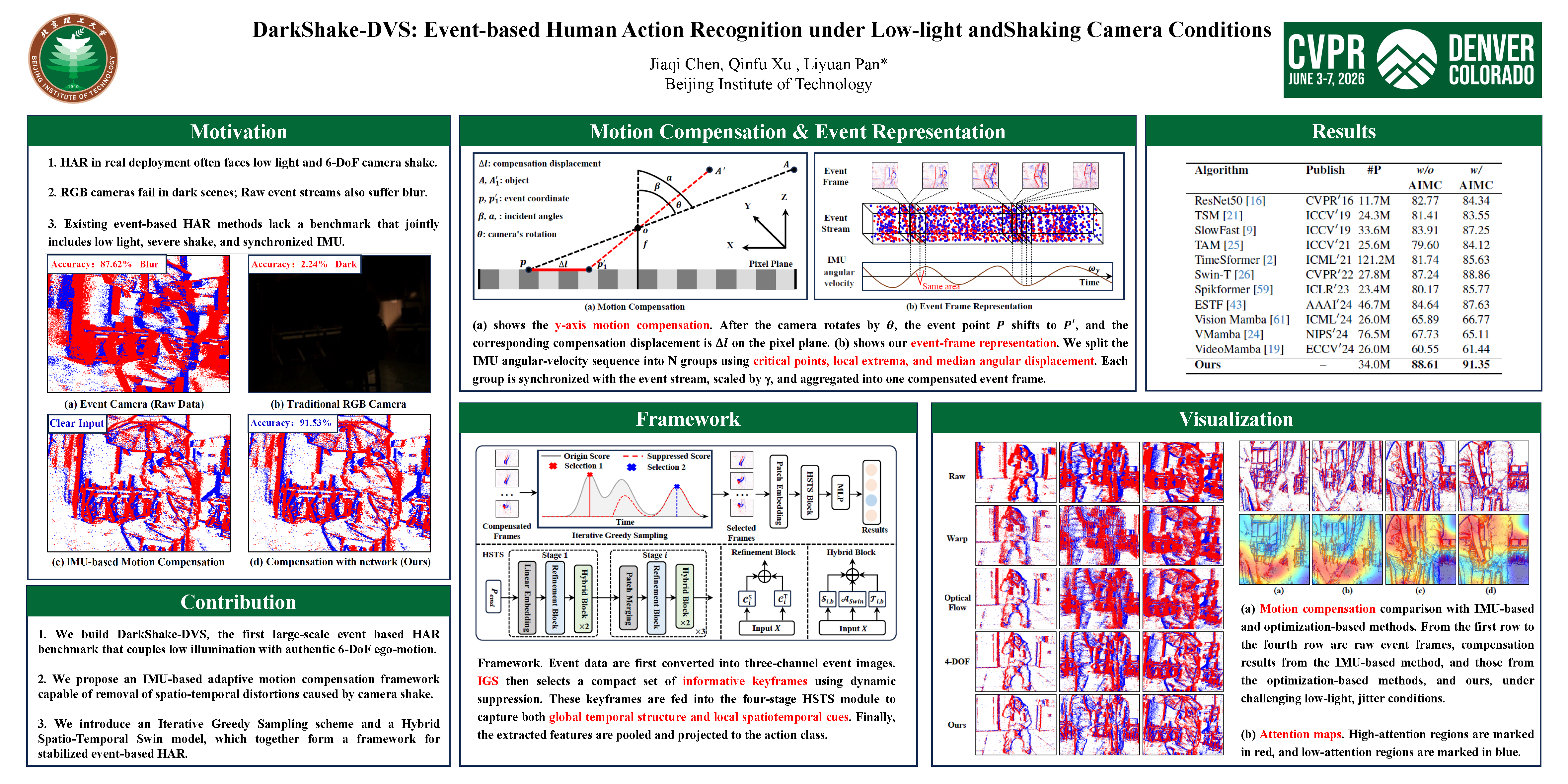
Human Action Recognition (HAR) is a fundamental computer vision task with diverse real-world applications. Practical deployments often involve low-light environments and unconstrained 6-DoF camera motion, conditions that degrade visual quality, disrupt temporal coherence, and compromise reliability of existing methods. Event cameras, with high low-light sensitivity and microsecond-level temporal resolution, paired with an inertial measurement unit (IMU), present a promising solution. However, current research faces two key challenges: absence of a benchmark integrating low-light conditions, 6-DoF motion, and synchronized IMU data; and lack of effective motion compensation techniques. To address these, we propose Event–IMU Stabilized HAR (EIS-HAR), with two modules. The first is an EIS module that reduces motion blur via a non-linear warping function to reconstruct a motion-compensated input. The second is a HAR module with a four-stage hybrid architecture to efficiently extract spatiotemporal features for accurate action recognition. To alleviate data scarcity, we introduce DarkShake-DVS, the first large-scale event-based HAR benchmark that includes 18,041 real-world clips captured in low light and intense 6-DoF motion, supplemented by synchronized IMU data. Extensive experiments on three datasets demonstrate consistent superiority of EIS-HAR over state-of-the-art methods.
Protect to Adapt: Subspace-Constrained Adaptation with Ranked Negative Prompt Feedback for Few-Shot Action Recognition
Hantao Qi ⋅ Yan Yan ⋅ Junlong Gao ⋅ Hanzi Wang
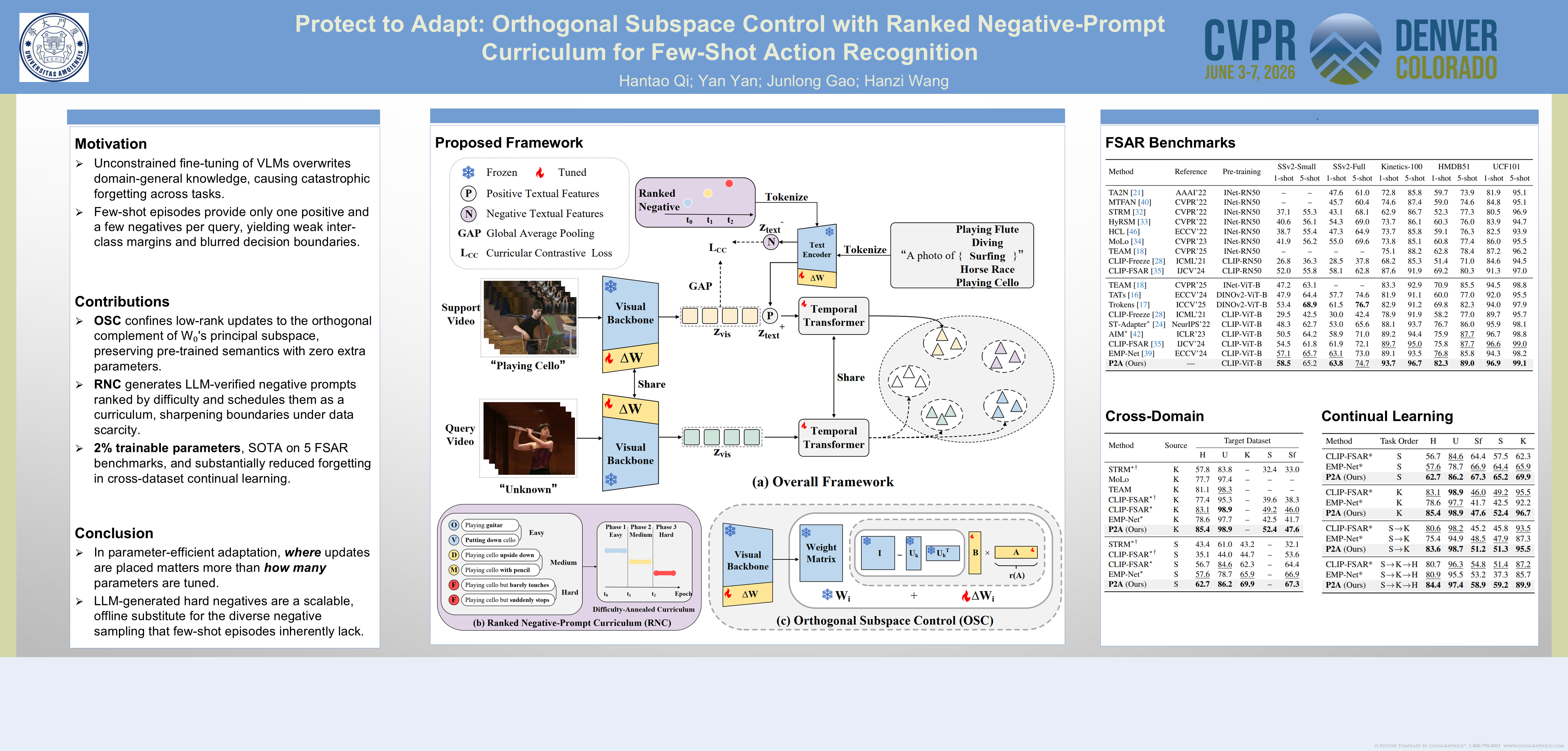
Adapting Vision–Language Models (VLMs) to few-shot action recognition (FSAR) often trades accuracy for stability: task-specific gains can trigger catastrophic forgetting of domain-general knowledge and reduce inter-class margins. In few-shot episodes, each query is contrasted with only one positive class and a few negatives, so the text encoder sees limited prompt diversity and rarely observes hard counter-examples near decision boundaries. We propose Protect-to-Adapt (P2A), a parameter-efficient fine-tuning method with two complementary modules. Orthogonal Subspace Control (OSC) estimates a principal semantic subspace of the pre-trained backbone and constrains low-rank updates to its orthogonal complement, preserving domain-general semantics while allowing task-specific adaptation. Ranked Negative-prompt Curriculum (RNC) uses a large language model to generate verifier-filtered negative prompts with increasing difficulty. These class-specific hard counter-examples enlarge margins and sharpen decision boundaries under few-shot conditions. With only 2\% of backbone parameters trainable, P2A achieves state-of-the-art performance on five FSAR benchmarks and substantially reduces catastrophic forgetting in a cross-dataset continual-learning setting where the model is adapted sequentially to multiple video datasets without replay.
SkeletonContext: Skeleton-side Context Prompt Learning for Zero-Shot Skeleton-based Action Recognition
Ning Wang ⋅ Tieyue Wu ⋅ Naeha Sharif ⋅ Farid Boussaid ⋅ Guangming Zhu ⋅ Lin Mei ⋅ Mohammed Bennamoun ⋅ Liang Zhang
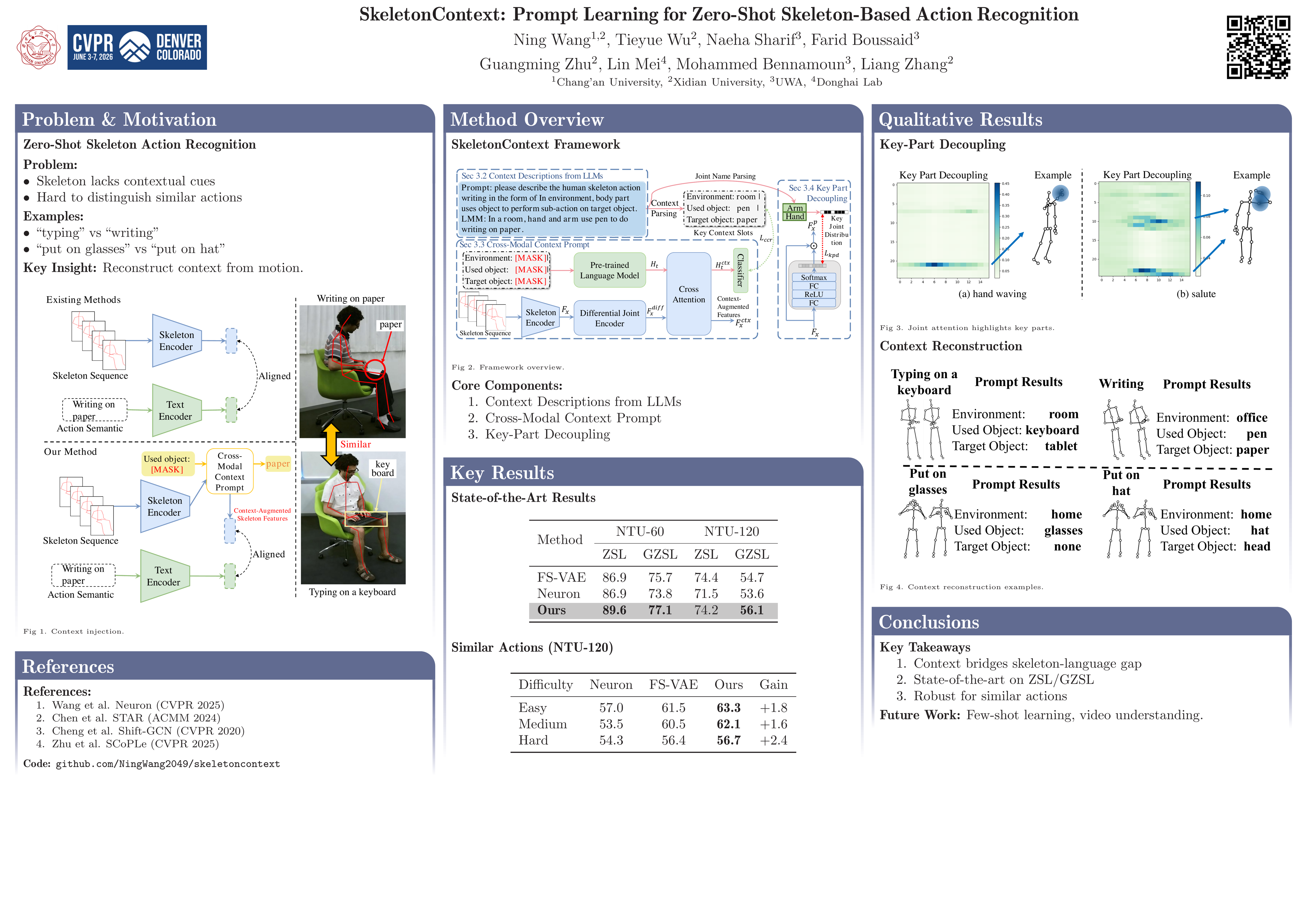
Zero-shot skeleton-based action recognition aims to recognize unseen actions by transferring knowledge from seen categories through semantic descriptions. Most existing methods typically align skeleton features with textual embeddings within a shared latent space. However, the absence of contextual cues, such as objects involved in the action, introduces an inherent gap between skeleton and semantic representations, making it difficult to distinguish visually similar actions. To address this, we propose SkeletonContext, a prompt-based framework that enriches skeletal motion representations with language-driven contextual semantics. Specifically, we introduce a Cross-Modal Context Prompt Module, which leverages a pretrained language model to reconstruct masked contextual prompts under guidance derived from LLMs. This design effectively transfers linguistic context to the skeleton encoder for instance-level semantic grounding and improved cross-modal alignment. In addition, a Key-Part Decoupling Module is incorporated to decouple motion-relevant joint features, ensuring robust action understanding even in the absence of explicit object interactions. Extensive experiments on multiple benchmarks demonstrate that SkeletonContext achieves state-of-the-art performance under both conventional and generalized zero-shot settings, validating its effectiveness in reasoning about context and distinguishing fine-grained, visually similar actions. Our project is available at:
InTrain: Intrinsic Trainability for Zero-Cost Neural Architecture Search
Qinqin Zhou ⋅ Fuhai Chen ⋅ Jipeng Wu ⋅ Zhiwei Chen ⋅ Zhikai Hu ⋅ Weiwei Cai
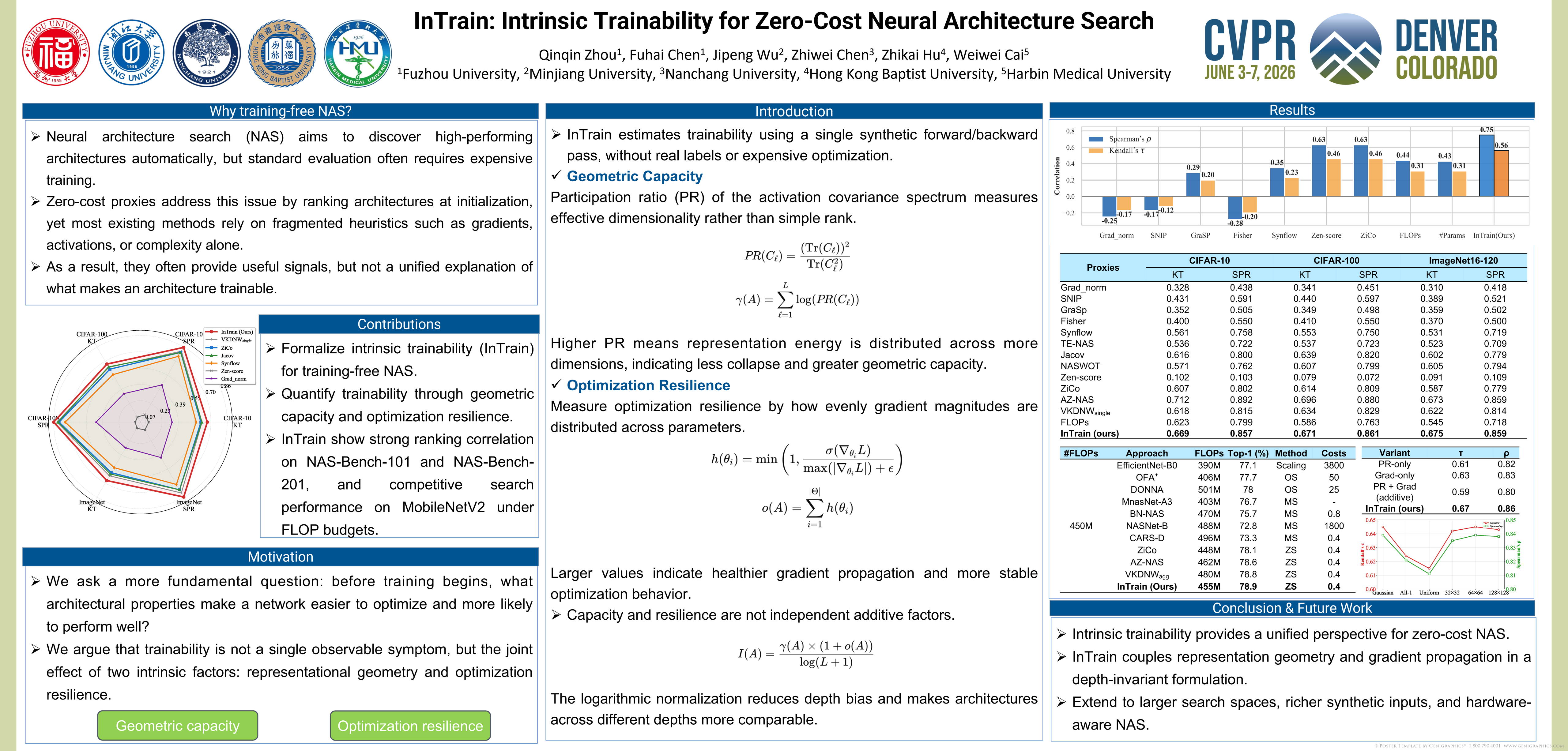
Training-free neural architecture search promises efficient discovery of high-performance networks without costly training. However, existing zero-cost proxies rely on fragmented heuristics that fail to capture the fundamental question: what makes an architecture trainable? This paper introduces Intrinsic Trainability (InTrain), a unified theoretical proxy that formalizes trainability as an architectural invariant emerging from two synergistic components: geometric capacity and optimization resilience. We operationalize intrinsic trainability through analysis of neural information processing. Geometric capacity is quantified via the participation ratio of activation covariance eigenspectrum, capturing the effective dimensionality of representation manifolds. Optimization resilience is measured through cumulative gradient health, assessing the robustness of backpropagation across network depth. InTrain synthesizes these dimensions through a scale-invariant multiplicative coupling, which we validate is essential for capturing their synergistic, non-additive relationship. Extensive experiments on standard NAS benchmarks and search spaces demonstrate that InTrain achieves ranking correlations on par with state-of-the-art ensemble-based proxies and outperforms other single-metric methods.
S^2FT: Parameter-Efficient Fine-Tuning in Sparse Spectrum Domain
Baoquan Zhang ⋅ Zhehao Yu ⋅ Lisai Zhang ⋅ Kenghong Lin ⋅ Tianran Chen ⋅ Yuxi Sun ⋅ Yunming Ye ⋅ Yao He
Parameter Efficient Fine-Tuning (PEFT) is a key technique for adapting a large pretrained model to downstream tasks by fine-tuning only a small number of parameters. Recent methods based on Fourier transforms have further reduced the fine-tuned parameters scale by only fine-tuning a few spectral coefficients. Its basic assumption is that the weight change $\Delta W$ is a spatial-domain matrix with a sparse spectrum. However, in this paper, we observe that the spectrum of weight change is not sparse, but instead distributed like power-uniform. This fact implies that fine-tuning only a few spectral coefficients is insufficient to accurately model the weight change $\Delta W$ with uniform spectrum.To address this issue, we propose to seek an invertible transformation that can transform a latent spatial-domain matrix with sparse spectrum to the weight change, and then perform PEFT on such sparse spectrum domain with few spectral coefficients, called $\text{S}^2\text{FT}$. To seek such transformation, we first pre-estimate a coarse weight change as a prior. Then, inspired by that sparse spectrum often correspond to locally smooth spatial structures, we regard this transformation as a row and column rearrangement operation on the pre-estimated weight change that smooth spatial structures while keep the structure information of neurons.Finally, we propose to solve the rearrangement search problem in a simple nearest neighbor search manner, thereby obtaining the invertible transformation. Extensive results show our $\text{S}^2\text{FT}$ achieves superior performance by only using 0.08% training parameters.
Rethinking SNN Online Training and Deployment: Gradient-Coherent Learning via Hybrid-Driven LIF Model
Zecheng Hao ⋅ Yifan Huang ⋅ Zijie Xu ⋅ Wenxuan Liu ⋅ Yuanhong Tang ⋅ Zhaofei Yu ⋅ Tiejun Huang
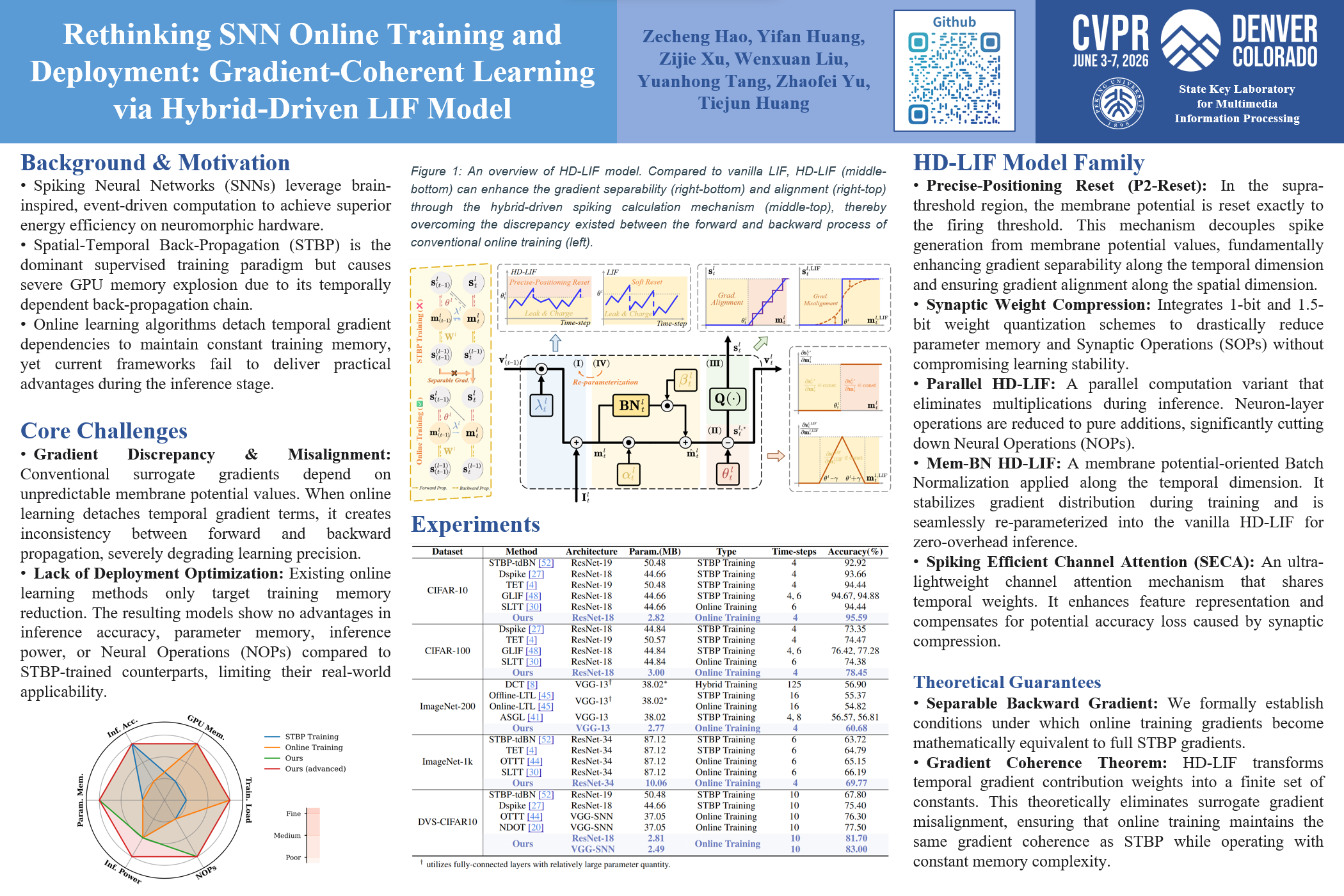
Spiking Neural Networks (SNNs) are considered to have enormous potential in the future development of Artificial Intelligence due to their brain-inspired and energy-efficient properties. Compared to vanilla Spatial-Temporal Back-propagation (STBP) training methods, online training can effectively avoid the risk of GPU memory explosion. However, current online learning frameworks cannot tackle the gradient discrepancy problem between the forward and backward process, merely aiming to optimize the GPU memory, resulting in no performance advantages compared to the STBP-based models in the inference stage. To address the aforementioned challenges, we propose Hybrid-Driven Leaky Integrate-and-Fire (HD-LIF) model family for efficient online learning, which respectively adopt different spiking calculation mechanism in the upper-region and lower-region of the firing threshold. We theoretically point out that our learning framework can effectively separate temporal gradients and address the misalignment problem of surrogate gradients, as well as achieving full-stage optimization towards learning precision, memory footprint and power consumption. Experimental results have demonstrated that our scheme is enable to achieve state-of-the-art performance for multiple evaluation metrics, breaking through the traditional paradigm of SNN online training and deployment.
Gated KalmaNet: A Fading Memory Layer through Test-time Ridge Regression
Liangzu Peng ⋅ Aditya Chattopadhyay ⋅ Luca Zancato ⋅ Elvis Nunez ⋅ Wei Xia ⋅ Stefano Soatto
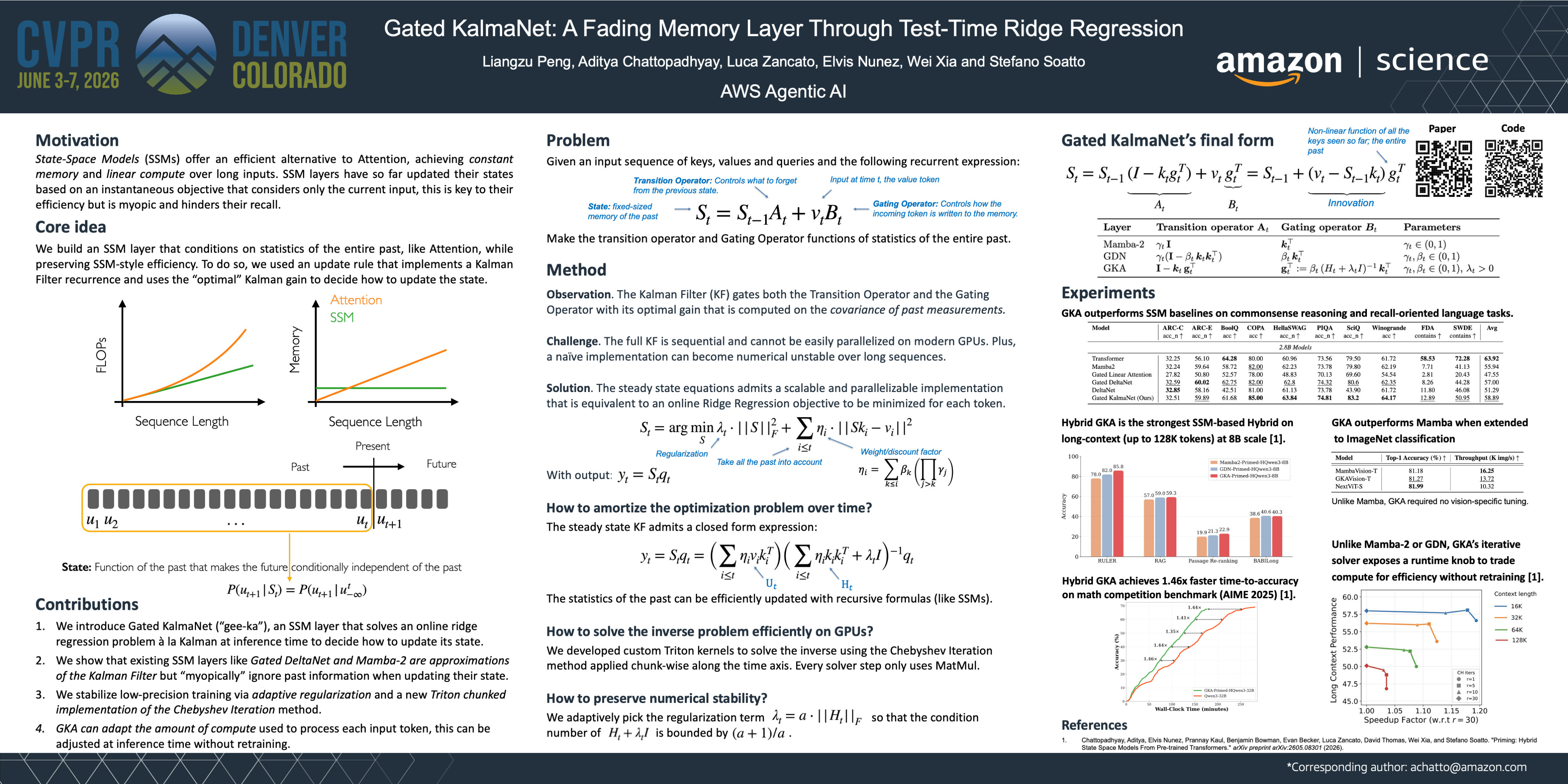
As efficient alternatives to softmax Attention, linear state-space models (SSMs) achieve constant memory and linear compute, but maintain only a lossy, fading summary of the past, often leading to inferior performance in recall oriented settings. We propose \ourname (\ourshortname), a layer that reduces this gap by accounting for the full past when predicting the next token, while maintaining SSM-style efficiency. \ourshortname achieves this by solving an online ridge regression problem at test time, with constant memory and linear compute cost in the sequence length. Drawing inspiration from the Kalman Filter, we iteratively solve the online ridge regression problem. However, a critical insight is that standard Kalman filter equations are numerically unstable in low-precision environments (like bfloat16) and difficult to parallelize in modern hardware. We address both challenges through two key innovations: (1) an adaptive regularization strategy with input-dependent gating that controls the condition number of the ridge regression, ensuring numerical stability while balancing memory retention. And 2) the use of Chebyshev Iteration instead of other conventional iterative solvers, which we demonstrate to be more stable in low-precision settings. To further improve scalability, we develop a hardware-aware chunk-wise implementation of Chebyshev Iteration along with custom kernels for backpropagating through our adaptive regularization and gating mechanisms. Empirically, \ourshortname shows strong language understanding capabilites on short-context tasks outperforming existing SSM layers (like Mamba2, GLA and Gated DeltaNet). On long-context, \ourshortname excels at real-world RAG and LongQA tasks up to 128k tokens, achieving more than $10$\% relative improvement over other fading memory baselines.
Towards Efficient Medical Reasoning with Minimal Fine-Tuning Data
Xinlin Zhuang ⋅ feilong tang ⋅ Haolin Yang ⋅ Xiwei Liu ⋅ Ming Hu ⋅ Huifa Li ⋅ Haochen Xue ⋅ Junjun He ⋅ Zongyuan Ge ⋅ Yichen Li ⋅ Ying Qian ⋅ Imran Razzak
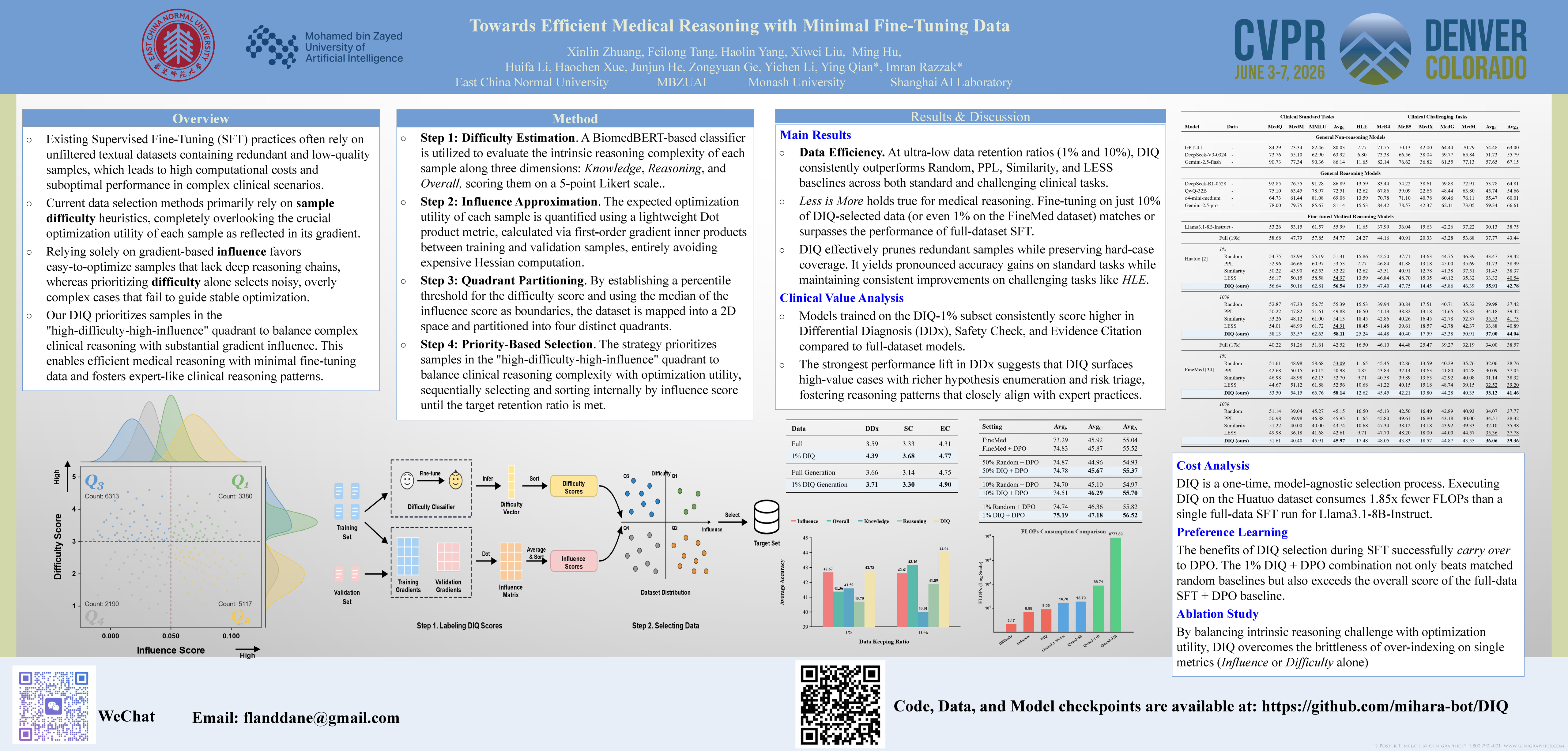
Supervised Fine-Tuning (SFT) plays a pivotal role in adapting Large Language Models (LLMs) to specialized domains such as medical reasoning. However, existing SFT practices often rely on unfiltered datasets that contain redundant and low-quality samples, leading to substantial computational costs and suboptimal performance. Although existing methods attempt to alleviate this problem by selecting data based on sample difficulty, defined by \textit{knowledge} and \textit{reasoning} complexity, they overlook each sample's optimization utility reflected in its gradient. Interestingly, we find that gradient-based influence alone favors easy-to-optimize samples that cause large parameter shifts but lack deep reasoning chains, while difficulty alone selects noisy or overly complex cases that fail to guide stable optimization. Based on this observation, we propose a data selection strategy, \textit{\textbf{D}ifficulty-\textbf{I}nfluence \textbf{Q}uadrant} \textbf{(DIQ)}, which prioritizes samples in the “high-difficulty–high-influence” quadrant to balance complex clinical reasoning with substantial gradient influence, enabling efficient medical reasoning with minimal fine-tuning data. Furthermore, Human and LLM-as-a-judge evaluations show that DIQ-selected subsets demonstrate higher data quality and generate clinical reasoning that is more aligned with expert practices in \textit{differential diagnosis}, \textit{safety check}, and \textit{evidence citation}, as DIQ emphasizes samples that foster expert-like reasoning patterns. Extensive experiments on medical reasoning benchmarks demonstrate that DIQ enables models fine-tuned on only \textbf{1\%} of selected data to match full-dataset performance, while using \textbf{10\%} consistently outperforms baseline methods, highlighting the superiority of principled data selection over brute-force scaling.
AdaBet: Gradient-free Layer Selection for Efficient Training of Deep Neural Networks
Irene Tenison ⋅ Soumyajit Chatterjee ⋅ Fahim Kawsar ⋅ Mohammad Malekzadeh
To utilize pre-trained neural networks on edge and mobile devices, we often require efficient adaptation to user-specific runtime data distributions while operating under limited compute and memory resources. On-device retraining with a target dataset can facilitate such adaptations; however, it remains impractical due to the increasing depth of modern neural nets, as well as the computational overhead associated with gradient-based optimization across all layers. Current approaches reduce training cost by selecting a subset of layers for retraining; however, they rely on labeled data, at least one full-model backpropagation, or server-side meta-training, limiting their suitability for constrained devices. We introduce AdaBet, a gradient-free layer selection approach to rank important layers, followed by important channels of these layers, by analyzing topological features of their activation spaces through Betti Numbers and using forward passes alone. AdaBet allows selecting layers and channels with high learning capacity, which are important for retraining and adaptation, without requiring labels or gradients. Evaluating AdaBet on sixteen pairs of benchmark models and datasets shows AdaBet achieves an average gain of 5\% more classification accuracy over gradient-based baselines while reducing average peak memory consumption by 40\%. We open-source our code at \url{https://anonymous.4open.science/r/adabet-37CF/}.
TAS-LoRA: Transformer Architecture Search with Mixture-of-LoRA Experts
Jeimin Jeon ⋅ Hyunju Lee ⋅ Bumsub Ham
Transformer architecture search (TAS) discovers optimal vision transformer (ViT) architectures automatically, reducing human effort to manually design ViTs. However, existing TAS methods suffer from the feature collapse problem, where subnets within a supernet fail to learn subnet-specific features, mainly due to the shared weights in a supernet, limiting the performance of individual subnets. To address this, we propose TAS-LoRA, a novel method that introduces parameter-efficient low-rank adaptation (LoRA) to enable subnet-specific feature learning, while maintaining computational efficiency. TAS-LoRA incorporates a Mixture-of-LoRA-Experts (MoLE) strategy, where a lightweight router dynamically assigns LoRA experts based on subnet architectures, and introduces a group-wise router initialization technique to encourage diverse feature learning across experts early in training. Extensive experiments on ImageNet and several transfer learning benchmarks, including CIFAR-10/100, Flowers, CARS, and INAT-19, demonstrate that TAS-LoRA mitigates feature collapse effectively, improving performance over state-of-the-art TAS methods significantly. Our code will be made publicly available upon acceptance.
QuCNet: Quantum Deep Learning Driven Multi-Circuit Network for Remote Sensing Image Classification
Komal Komal ⋅ Mukul Gupta ⋅ Saumya Singh ⋅ SANTOSH VIPPARTHI ⋅ Chakradhar Reddy Chandupatla ⋅ Subrahmanyam Murala
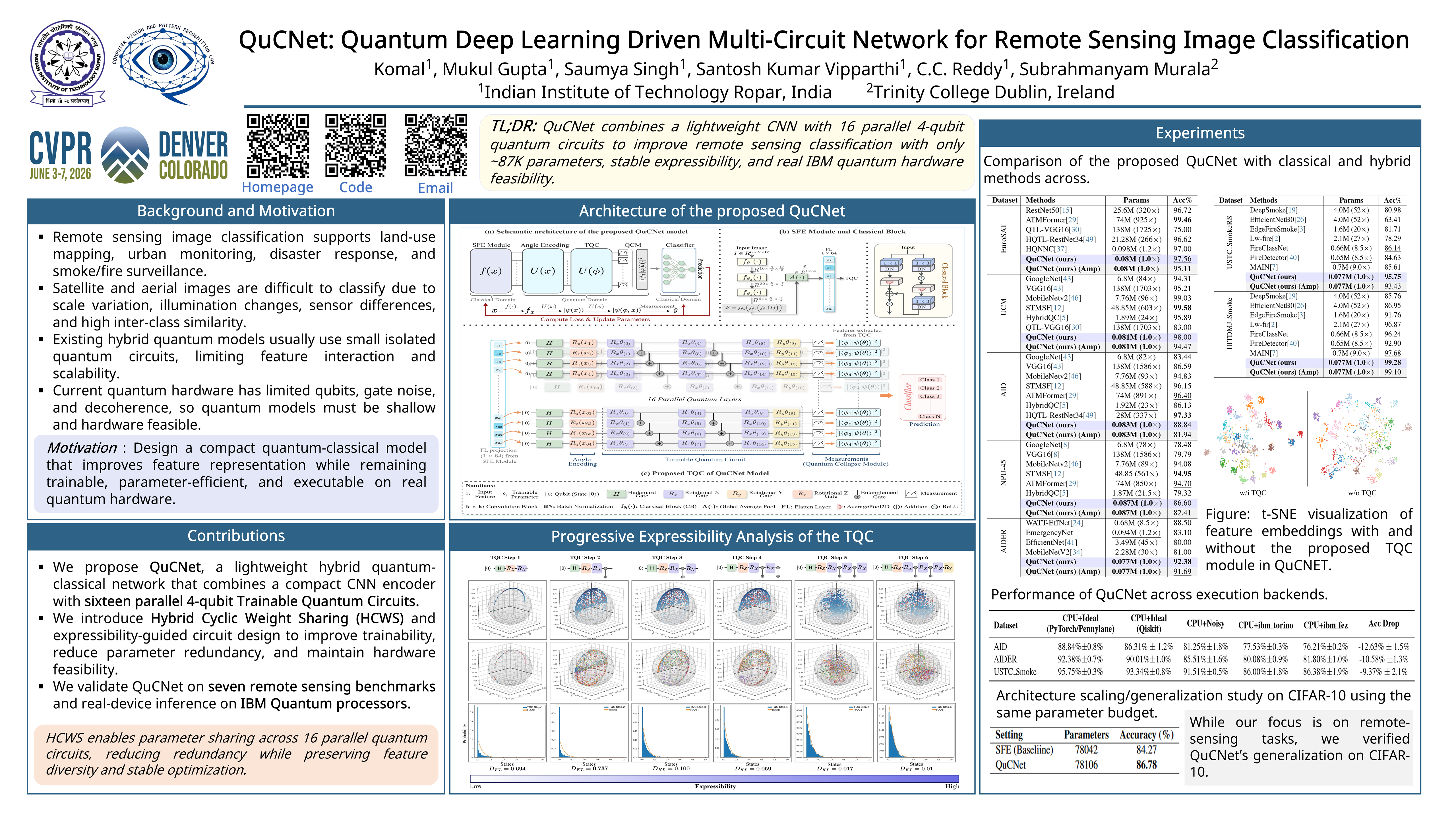
We present QuCNet, a hybrid quantum classical network for efficient remote sensing image classification. QuCNet integrates a lightweight convolutional encoder with sixteen parallel four-qubit trainable quantum circuits (TQCs) trained under a Hybrid Cyclic Weight-Sharing (HCWS)} strategy. This design enhances expressibility while keeping the parameter count extremely low ~87K, 85× smaller than prior hybrid models). Guided by expressibility analysis, the proposed quantum configuration maintains stable gradients and mitigates barren plateaus on near term quantum devices. Extensive experiments across seven remote sensing benchmarks (AID, AIDER, UC Merced, NWPU-45, EuroSAT, IIITDMJ Smoke, and USTC SmokeRS) demonstrate that QuCNet consistently improves accuracy and generalization over classical CNN baselines. Furthermore, hardware only inference on IBM Quantum processors (ibm_torino, ibm_fez) confirms robustness under realistic noise and connectivity constraints. These results suggest a practical path toward \textbf{scalable, hardware feasible quantum deep learning} for geospatial applications.
Learning to Solve PDEs on Neural Shape Representations
Lilian Welschinger ⋅ Yilin Liu ⋅ Zican Wang ⋅ Niloy J. Mitra
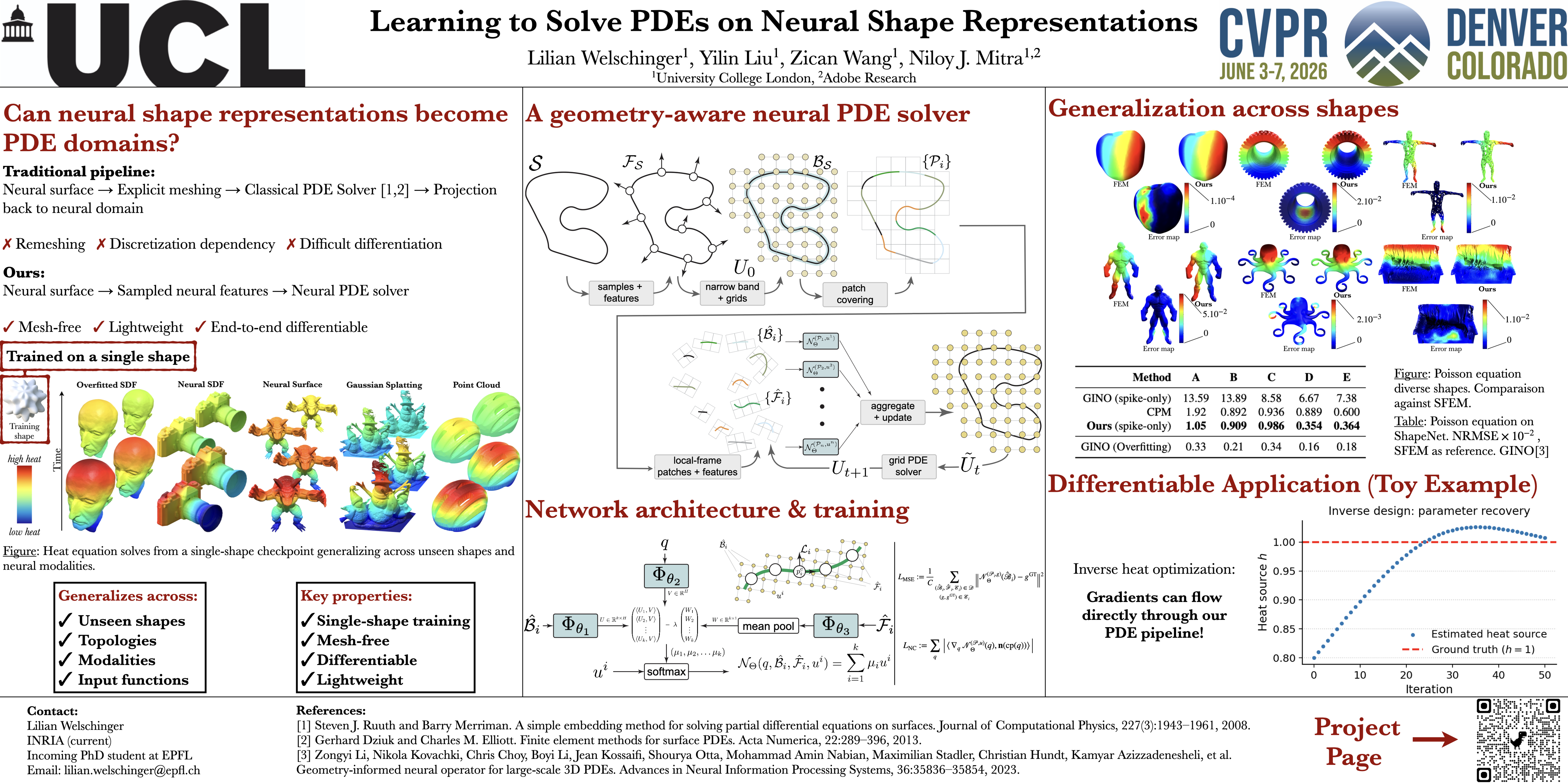
Solving partial differential equations (PDEs) on shapes underpins many shape analysis and engineering tasks; yet, prevailing PDE solvers operate on polygonal/triangle meshes while modern 3D assets increasingly live as neural representations. This mismatch leaves no suitable method to solve surface PDEs directly within the neural domain, forcing explicit mesh extraction or per-instance residual training, preventing end-to-end workflows. We present a novel, mesh-free formulation that learns a local update operator conditioned on neural (local) shape attributes, enabling surface PDEs to be solved directly where the (neural) data lives. The operator integrates naturally with prevalent neural surface representations, is trained once on a single representative shape, and generalizes across shape and topology variations, enabling accurate, fast inference without explicit meshing or per-instance optimization while preserving differentiability. Across analytic benchmarks (heat equation and Poisson solve on sphere) and real neural assets across different representations, our method slightly outperforms CPM while remaining reasonably close to FEM, and, to our knowledge, delivers the first end-to-end pipeline that solves surface PDEs on both neural and classical surface representations. Code will be released on acceptance.
Frequency Switching Mechanism for Parameter-Efficient Multi-Task Learning
Shih-Wen Liu ⋅ Yen-Chang Chen ⋅ Wei-Ta Chu ⋅ Fu-En Yang ⋅ Yu-Chiang Frank Wang
Multi-task learning (MTL) aims to equip a single model with the ability to solve multiple tasks efficiently; however, current parameter-efficient fine-tuning (PEFT) methods remain largely limited to single-task adaptation. We introduce Free Sinewich, a parameter-efficient multi-task learning framework that achieves efficient weight reuse through frequency switching. A lightweight Clock Net first determines task-dependent frequency with negligible overhead (Free). These frequencies modulate a Sine-AWB (Sinewich) layer, where low-rank factors and convolutional priors are combined into a single kernel and transformed via an elementwise sinusoidal transformation to produce task-specialized weights. Theoretically, sine modulation enhances the rank of low-rank adapters, while frequency separation decorrelates the weights of different tasks. On dense prediction benchmarks, Free Sinewich achieves state-of-the-art performance-efficiency trade-offs (e.g., up to +5.39% improvement over single-task fine-tuning with only 6.53M trainable parameters), offering a compact and scalable paradigm based on frequency-based parameter sharing. Our code is publicly available.
Reconstructing Spiking Neural Networks Using a Single Neuron with Autapses
Wuque Cai ⋅ Hongze Sun ⋅ Quan Tang ⋅ Shifeng Mao ⋅ Zhenxing Wang ⋅ Jiayi He ⋅ Duo Chen ⋅ Dezhong Yao ⋅ Daqing Guo
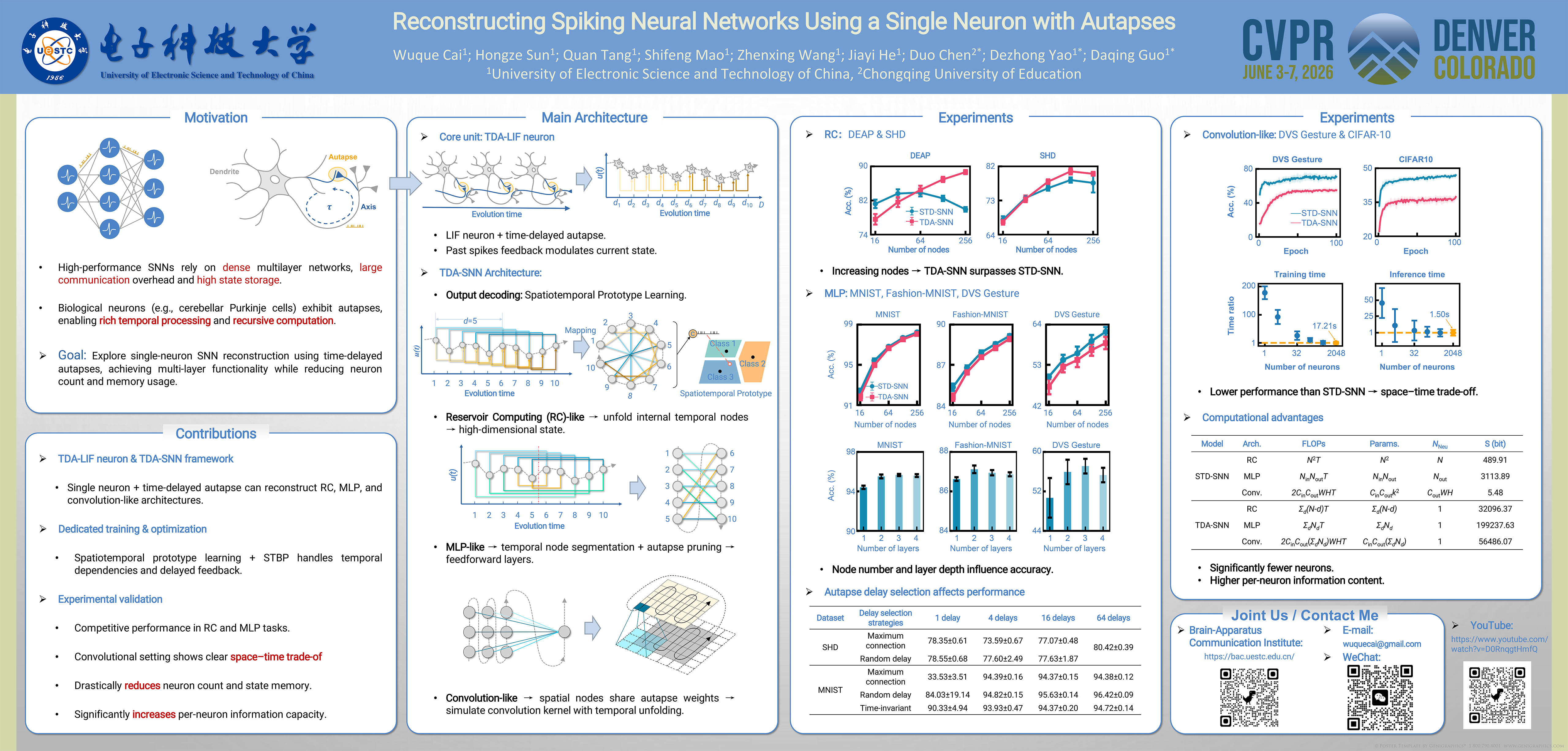
Spiking neural networks (SNNs) are well known for their high energy efficiency and strong temporal processing capabilities. However, the multilayer architectures of SNNs often incur substantial costs of communication, computation, and storage capacity. Inspired by biological autapses, we develop a simple yet effective framework for reconstructing spiking neural networks using a single neuron with time-delayed autapses (TDA-SNN), integrating a dedicated prototype learning-based optimization method. This design allows a single spiking neuron to dynamically reconfigure its internal temporal states, effectively emulating large-scale architectures such as reservoirs, multilayer perceptrons, and convolutional layers while maintaining efficient learning. Extensive experiments on sequential, event-stream, and image datasets demonstrate that TDA-SNN achieves performance comparable to deep SNNs, while significantly reducing computational overhead and enhancing internal information storage capacity. These results highlight the potential of single-neuron models as compact and efficient computational units, offering new insights into the development of biologically inspired neuromorphic systems.
Widget2Code: From Visual Widgets to UI Code via Multimodal LLMs
Houston H. Zhang ⋅ TAO ZHANG ⋅ Baoze Lin ⋅ Yuanqi Xue ⋅ Yincheng Zhu ⋅ Huan Liu ⋅ Li Gu ⋅ Linfeng Ye ⋅ Ziqiang Wang ⋅ Xinxin Zuo ⋅ Yang Wang ⋅ YUANHAO YU ⋅ Zhixiang Chi
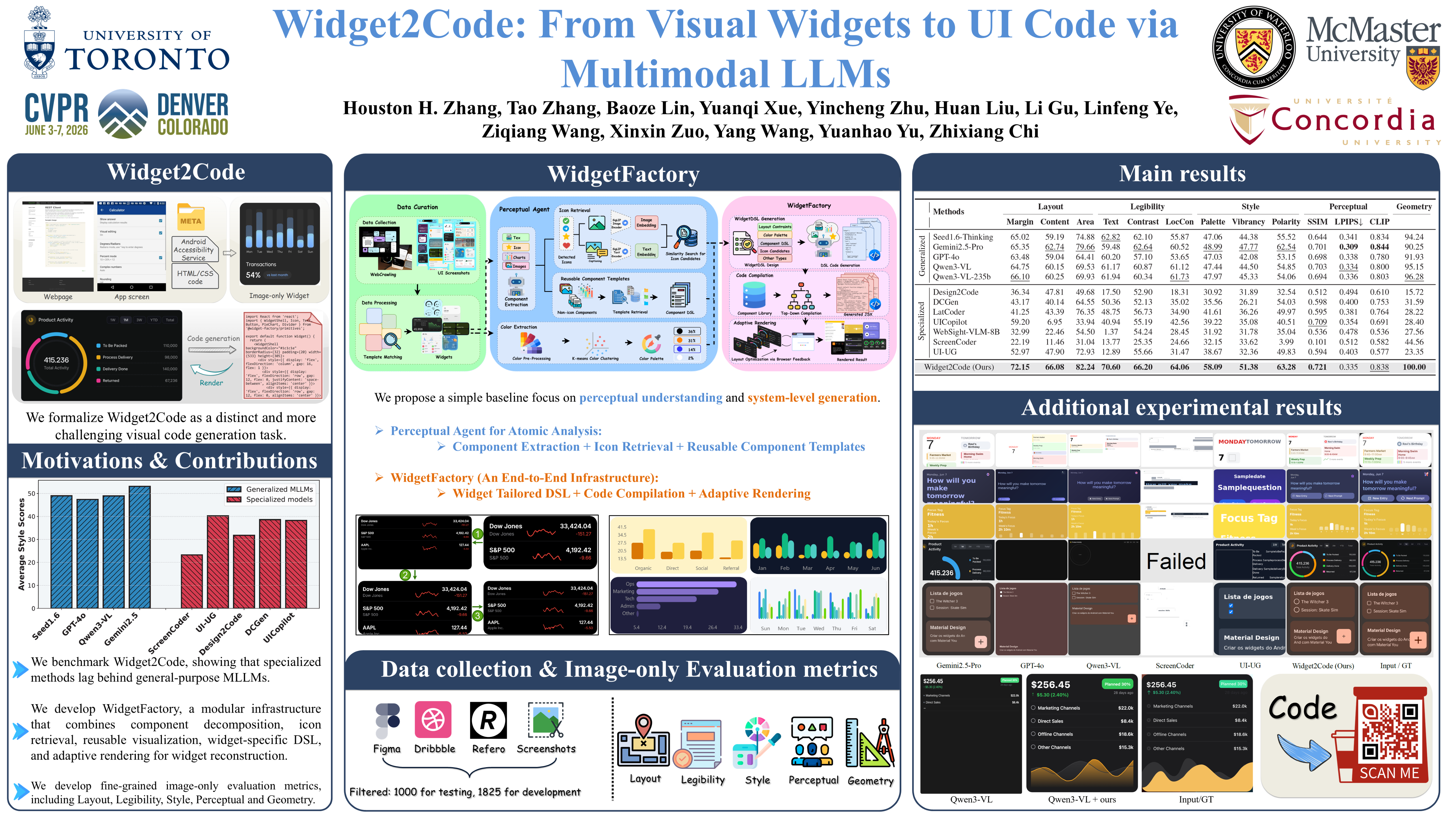
User interface to code (UI2Code) aims to generate executable code that can faithfully reconstruct a given input UI. Prior work focuses largely on web pages and mobile screens, leaving app widgets underexplored. Unlike web or mobile UIs with rich hierarchical context, widgets are compact, context-free micro-interfaces that summarize key information through dense layouts and iconography under strict spatial constraints. Moreover, while (image, code) pairs are widely available for web or mobile UIs, widget designs are proprietary and lack accessible markup. We formalize this setting as the Widget-to-Code (Widget2Code) and introduce an image-only widget benchmark with fine-grained, multi-dimensional evaluation metrics. Benchmarking shows that although generalized multimodal large language models (MLLMs) outperform specialized UI2Code methods, they still produce unreliable and visually inconsistent code. To address these limitations, we develop a baseline that jointly advances perceptual understanding and structured code generation. At the perceptual level, we follow widget design principles to assemble atomic components into complete layouts, equipped with icon retrieval and UI composition modules. At the system level, we design an end-to-end infrastructure, WidgetFactory, which includes a framework-agnostic widget-tailored domain-specific language (WidgetDSL) and a compiler that translates it into multiple front-end implementations (e.g., React, HTML). An adaptive rendering module further refines spatial dimensions to satisfy compactness constraints. Together, these contributions substantially enhance visual fidelity, establishing a strong baseline and unified infrastructure for future Widget2Code research.
GUI-CEval: A Hierarchical and Comprehensive Chinese Benchmark for Mobile GUI Agents
Yang Li ⋅ Yuchen Liu ⋅ Haoyu Lu ⋅ Zhiqiang Xia ⋅ Hongzhen Wang ⋅ Kaiyang Han ⋅ Changpeng Yang ⋅ Jinyang Wu ⋅ Jiaming Xu ⋅ Runyu Shi ⋅ Ying Huang
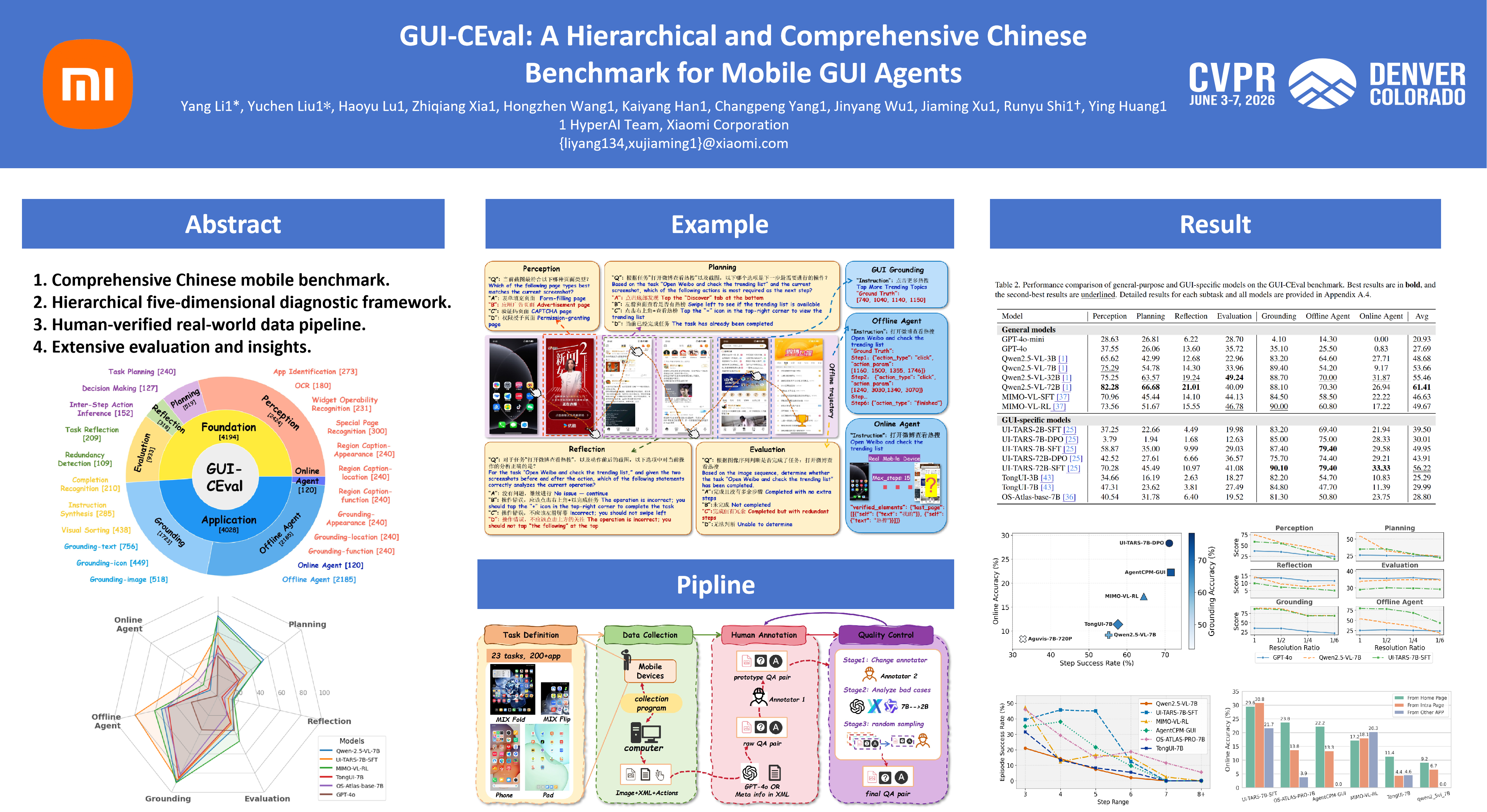
Recent progress in Multimodal Large Language Models (MLLMs) has enabled mobile GUI agents capable of visual perception, cross-modal reasoning, and interactive control. However, existing benchmarks are largely English-centric and fail to capture the linguistic and interaction characteristics of the Chinese mobile ecosystem. They also focus on isolated skills such as GUI grounding or offline agent, lacking a unified and fine-grained framework to assess the full capability chain from perception to execution. To address this gap, we introduce \textbf{GUI-CEval}, the first comprehensive benchmark for Chinese mobile GUI agents, built entirely on \textbf{real-device} environments. GUI-CEval spans 201 mainstream apps across four device types and adopts a two-level structure that evaluates both atomic abilities and end-to-end performance along five dimensions: perception, planning, reflection, execution, and evaluation. All data are collected and verified through multi-stage manual processes to ensure authenticity and reproducibility. Extensive experiments on 20 representative MLLMs and multi-agent systems show that while models such as Qwen2.5-VL and UI-TARS perform competitively, most MLLMs still exhibit clear weaknesses in reflective decision-making and post-action self-evaluation, limiting their reliability in real-world interactions. We hope GUI-CEval provides a reproducible and interpretable benchmark to guide capability diagnosis and advance the development of Chinese mobile GUI agents.
FocusUI: Efficient UI Grounding via Position-Preserving Visual Token Selection
Mingyu Ouyang ⋅ Kevin Qinghong Lin ⋅ Mike Zheng Shou ⋅ Hwee Tou Ng
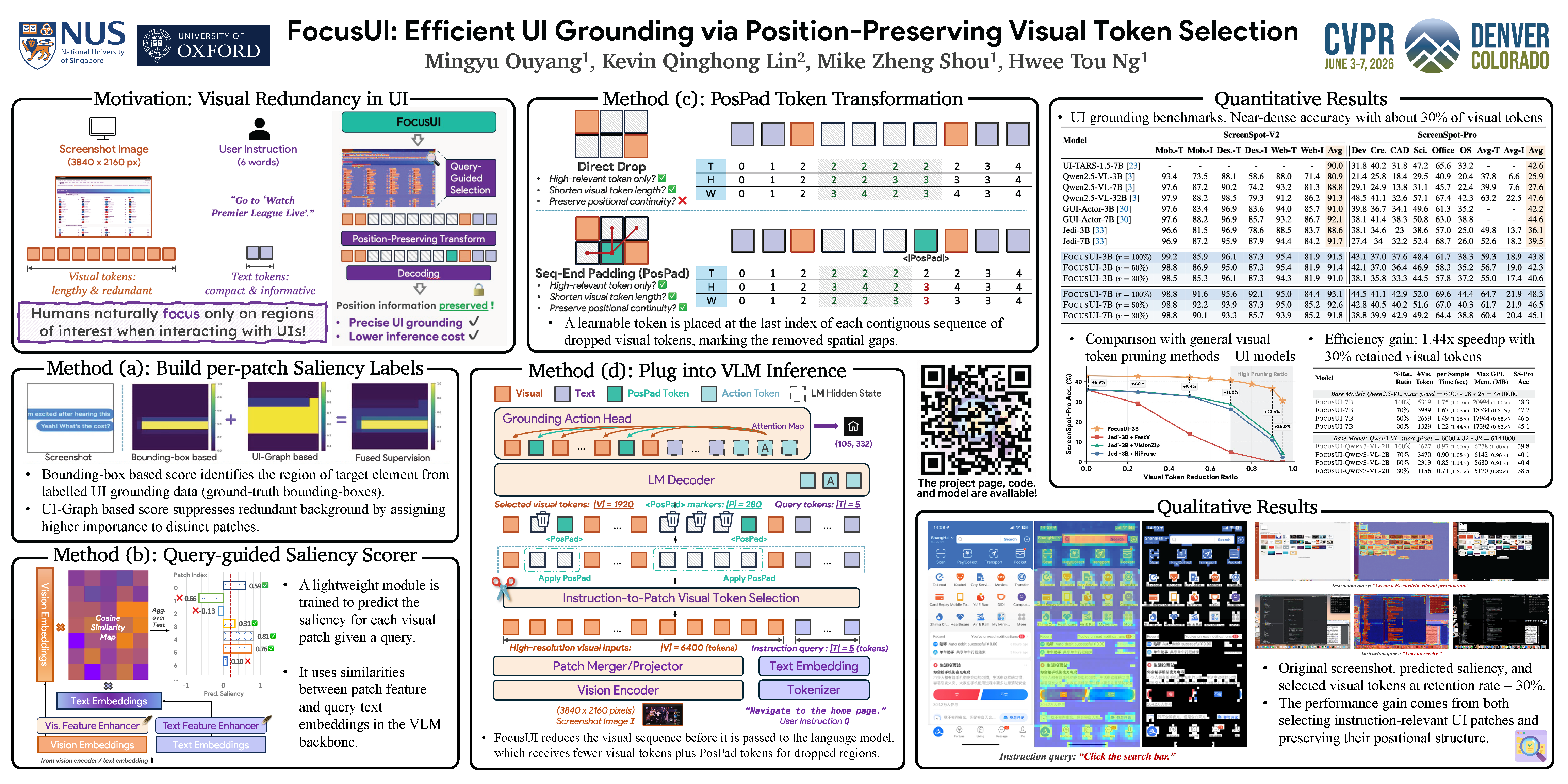
Vision-Language Models (VLMs) have shown strong performance on User Interface (UI) grounding tasks, driven by their ability to process increasingly high-resolution screenshots. However, screenshots are tokenized into thousands of visual tokens (e.g., about 4,700 for 2K resolution), which incurs significant computational overhead and dilutes attention. In contrast, humans typically focus on regions of interest when interacting with UIs. In this work, we pioneer the task of efficient UI grounding. We propose FocusUI, an efficient UI grounding framework that selects patches most relevant to the instruction while preserving positional continuity for precise grounding. FocusUI addresses two key challenges: (1) eliminating redundant tokens in visual encoding by constructing patch-level supervision that fuses an instruction-conditioned score with a rule-based UI-graph score, down-weighting large homogeneous regions to select distinct and instruction-relevant visual tokens; and (2) preserving positional continuity during visual token selection. We find that general visual token pruning methods suffer from severe accuracy degradation on UI grounding tasks due to broken positional information. To address this, we introduce a PosPad strategy, which compresses each contiguous sequence of dropped visual tokens into a single special marker placed at the sequence’s last index to preserve positional continuity. Comprehensive experiments on four grounding benchmarks demonstrate that FocusUI surpasses GUI-specific baselines. On the ScreenSpot-Pro benchmark, FocusUI-7B achieves a 3.7% performance improvement over GUI-Actor-7B. Even with only 30% visual token retention, the performance of FocusUI-7B drops by just 3.2%, while achieving up to 1.44x faster inference and 17% lower peak GPU memory.
Streamlined Open-Vocabulary Human-Object Interaction Detection
Chang Sun ⋅ Dongliang Liao ⋅ Changxing Ding
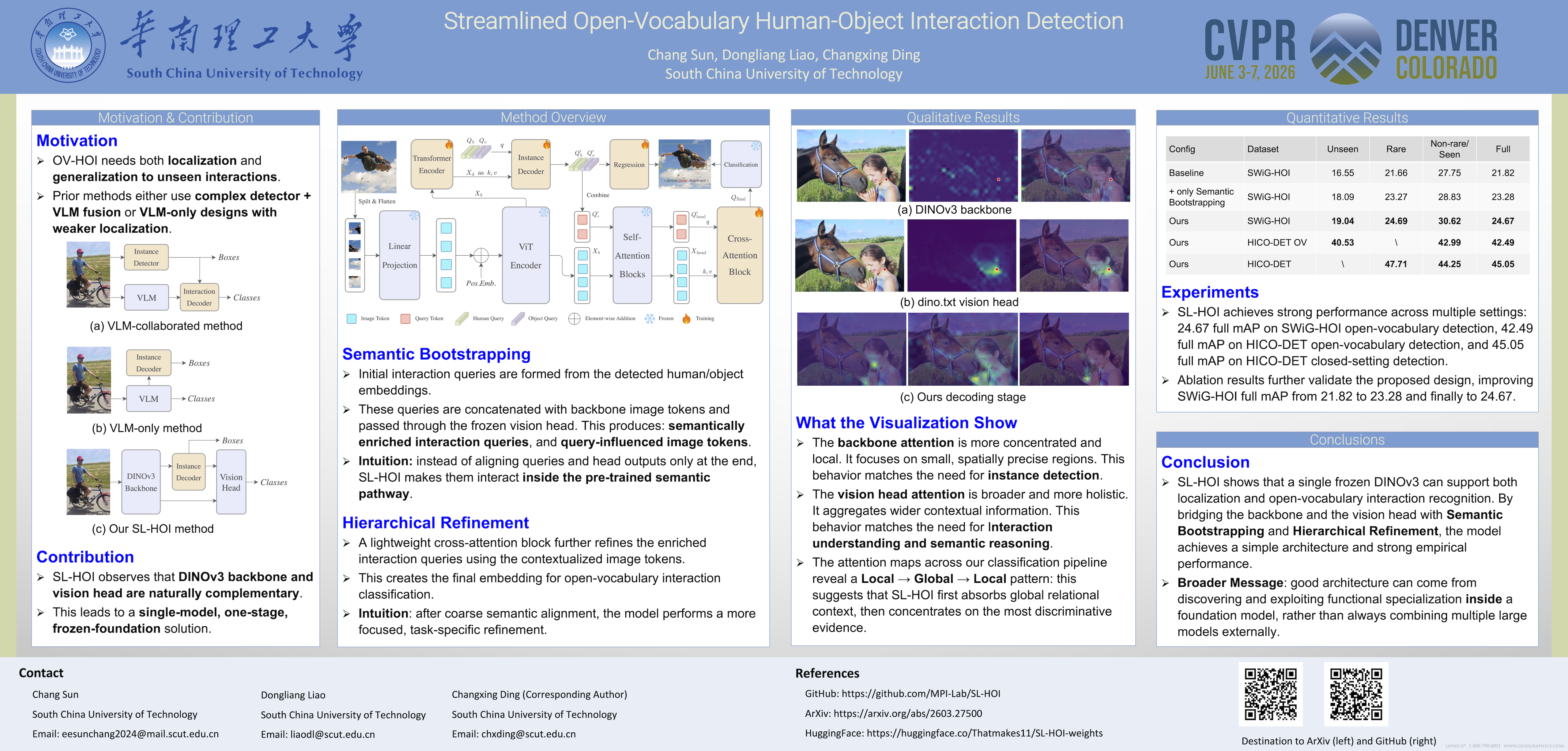
Open-vocabulary human-object interaction (HOI) detection aims to localize and recognize all human-object interactions in an image, including those unseen during training.Existing approaches usually rely on the collaboration between a conventional HOI detector and a Vision-Language Model (VLM) to recognize unseen HOI categories.However, feature fusion in this paradigm is challenging due to significant gaps in cross-model representations.To address this issue, we introduce SL-HOI, a StreamLined open-vocabulary HOI detection framework based solely on the powerful DINOv3 model.Our design leverages the complementary strengths of DINOv3's components: its backbone for fine-grained localization and its text-aligned vision head for open-vocabulary interaction classification.Moreover, to facilitate smooth cross-attention between the interaction queries and the vision head's output, we propose first feeding both the interaction queries and the backbone patch tokens into the vision head, effectively bridging their representation gaps. All DINOv3 parameters in our approach are frozen, with only a small number of learnable parameters added, allowing a fast adaptation to the HOI detection task.Extensive experiments show that SL-HOI achieves state-of-the-art performance on both the SWiG-HOI and HICO-DET benchmarks, demonstrating the effectiveness of our streamlined model architecture.The code of this work will be released soon.
Decompose and Transfer: CoT-Prompting Enhanced Alignment for Open-Vocabulary Temporal Action Detection
SA ZHU ⋅ Wanqian Zhang ⋅ Lin Wang ⋅ Xiaohua Chen ⋅ Chenxu Cui ⋅ Jinchao Zhang ⋅ Bo Li
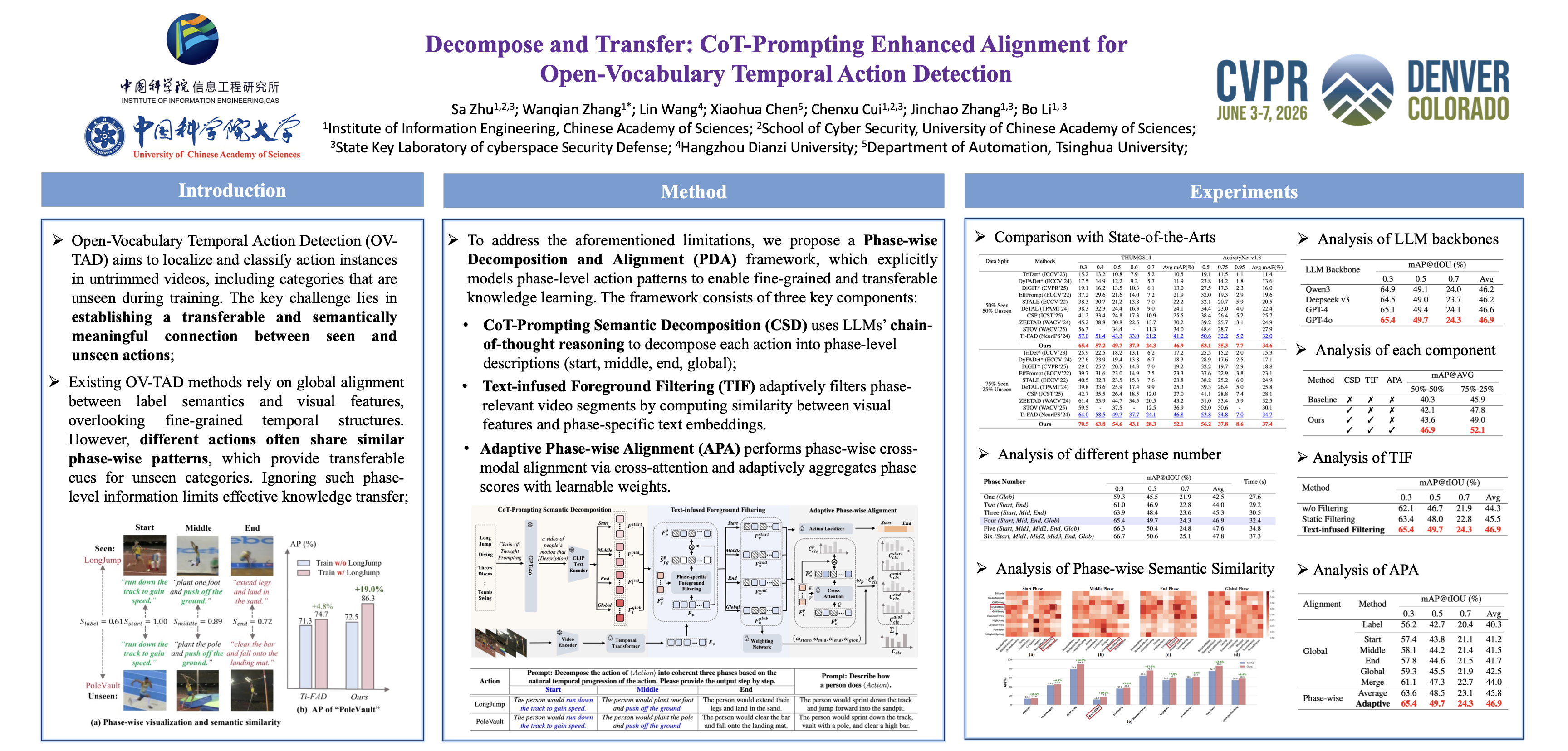
Open-Vocabulary Temporal Action Detection (OV-TAD) aims to classify and localize action segments in untrimmed videos for unseen categories. Previous methods rely solely on global alignment between label-level semantics and visual features, which is insufficient to transfer temporal consistent visual knowledge from seen to unseen classes. To address this, we propose a Phase-wise Decomposition and Alignment (PDA) framework, which enables fine-grained action pattern learning for effective prior knowledge transfer. Specifically, we first introduce the CoT-Prompting Semantic Decomposition (CSD) module, which leverages the chain-of-thought (CoT) reasoning ability of large language models to automatically decompose action labels into coherent phase-level descriptions, emulating human cognitive processes. Then, Text-infused Foreground Filtering (TIF) module is introduced to adaptively filter action-relevant segments for each phase leveraging phase-wise semantic cues, producing semantically aligned visual representations. Furthermore, we propose the Adaptive Phase-wise Alignment (APA) module to perform phase-level visual–textual matching, and adaptively aggregates alignment results across phases for final prediction. This adaptive phase-wise alignment facilitates the capture of transferable action patterns and significantly enhances generalization to unseen actions. Extensive experiments on two OV-TAD benchmarks demonstrated the superiority of the proposed method.
Mitigating Simplicity Bias in OOD Detection through Object Co-occurrence Analysis
Boyang Dai ⋅ Chaoqi Chen ⋅ Yizhou Yu
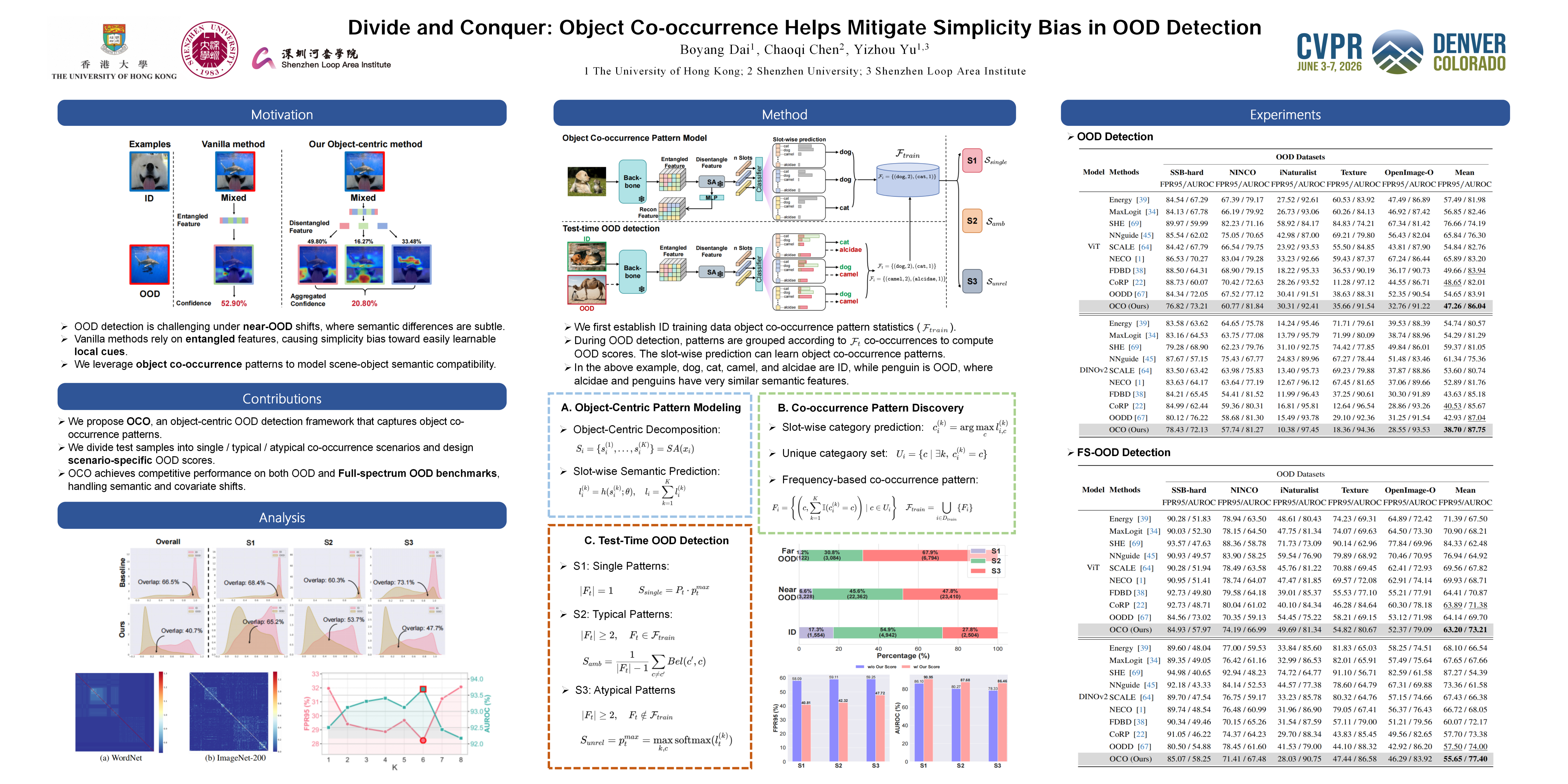
Out-of-distribution (OOD) detection is crucial for ensuring the reliability of deep learning models. Existing methods mostly focus on regular entangled representations to discriminate in-distribution (ID) and OOD data, neglecting the rich contextual information within images. This issue is particularly challenging for detecting near-OOD, as models with simplicity bias struggle to learn discriminative features in disentangled representations. The human visual system can use the co-occurrence of objects in the natural environment to facilitate scene understanding. Inspired by this, we propose an Object-Centric OOD detection framework that learns to capture Object CO-occurrence (OCO) patterns within images. The proposed method introduces a new OOD detection paradigm that understands object co-occurrence within an image by predicting disentangled representations for the test sample, then adaptively divides patterns into three scenarios based on object co-occurrence patterns observed in ID training data, and finally performs OOD detection in a divide-and-conquer manner. By doing so, OCO can distinguish near-OOD by considering the semantic contextual relationships present in their images, avoiding the tendency to focus solely on simple, easily learnable regions. We evaluate OCO through experiments across challenging and full-spectrum OOD settings, demonstrating competitive results and confirming its ability to address both semantic and covariate shifts.
Boosting Quantitive and Spatial Awareness for Zero-Shot Object Counting
Da Zhang ⋅ Bingyu Li ⋅ Feiyu Wang ⋅ Zhiyuan Zhao ⋅ Junyu Gao
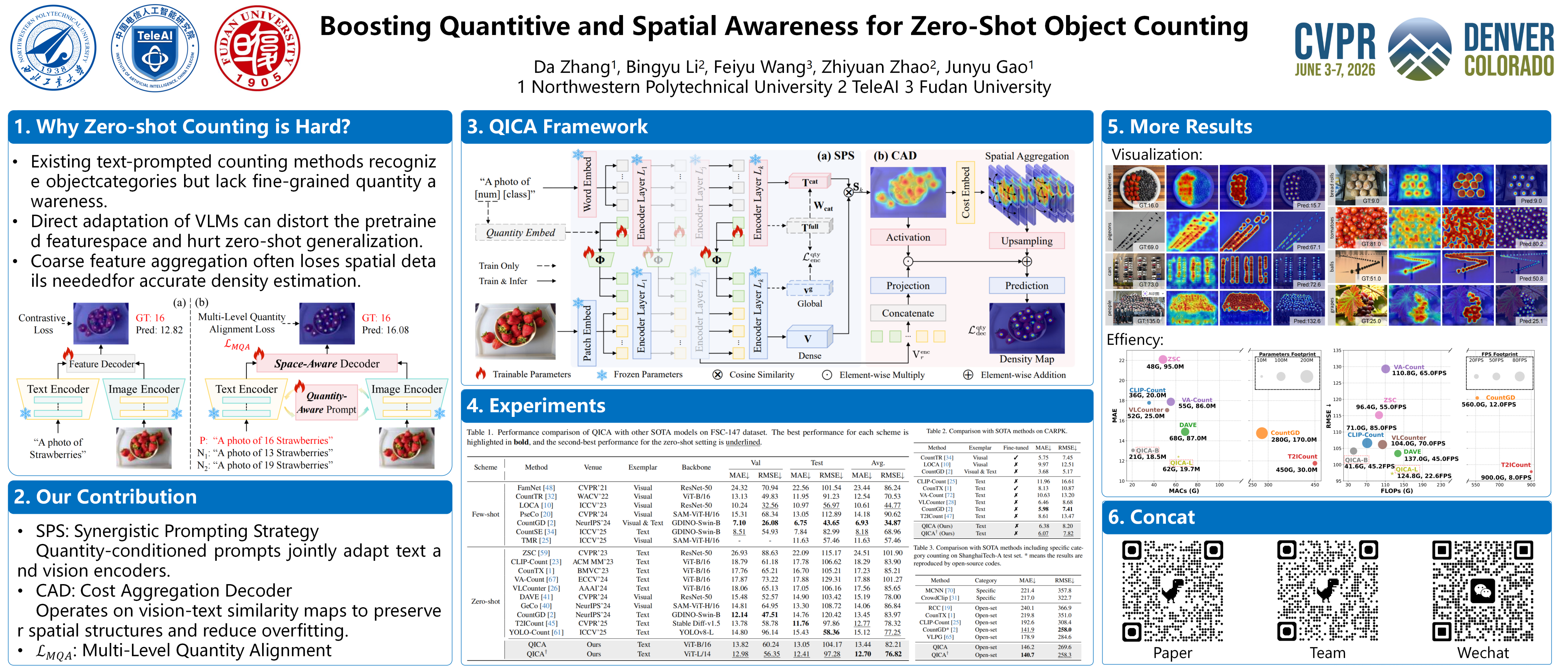
Zero-shot object counting (ZSOC) aims to enumerate objects of arbitrary categories specified by text descriptions without requiring visual exemplars. However, existing methods often treat counting as a coarse retrieval task, suffering from a lack of fine-grained quantity awareness. Furthermore, they frequently exhibit spatial insensitivity and degraded generalization due to feature space distortion during model adaptation. To address these challenges, we present **QICA**, a novel framework that synergizes quantity perception with robust spatial cast aggregation. Specifically, we introduce a Synergistic Prompting Strategy (**SPS**) that adapts vision and language encoders through numerically conditioned prompts, bridging the gap between semantic recognition and quantitative reasoning. To mitigate feature distortion, we propose a Cost Aggregation Decoder (**CAD**) that operates directly on vision-text similarity maps. By refining these maps through spatial aggregation, CAD prevents overfitting while preserving zero-shot transferability. Additionally, a multi-level quantity alignment loss ($\mathcal{L}_{MQA}$) is employed to enforce numerical consistency across the entire pipeline. Extensive experiments on FSC-147 demonstrate competitive performance, while zero-shot evaluation on CARPK and ShanghaiTech-A validates superior generalization to unseen domains. Code is provided in the appendix.
Parameter-Efficient Semantic Augmentation for Enhancing Open-Vocabulary Object Detection
Weihao Cao ⋅ Runqi Wang ⋅ Xiaoyue Duan ⋅ Jinchao Zhang ⋅ Ang Yang ⋅ Liping Jing
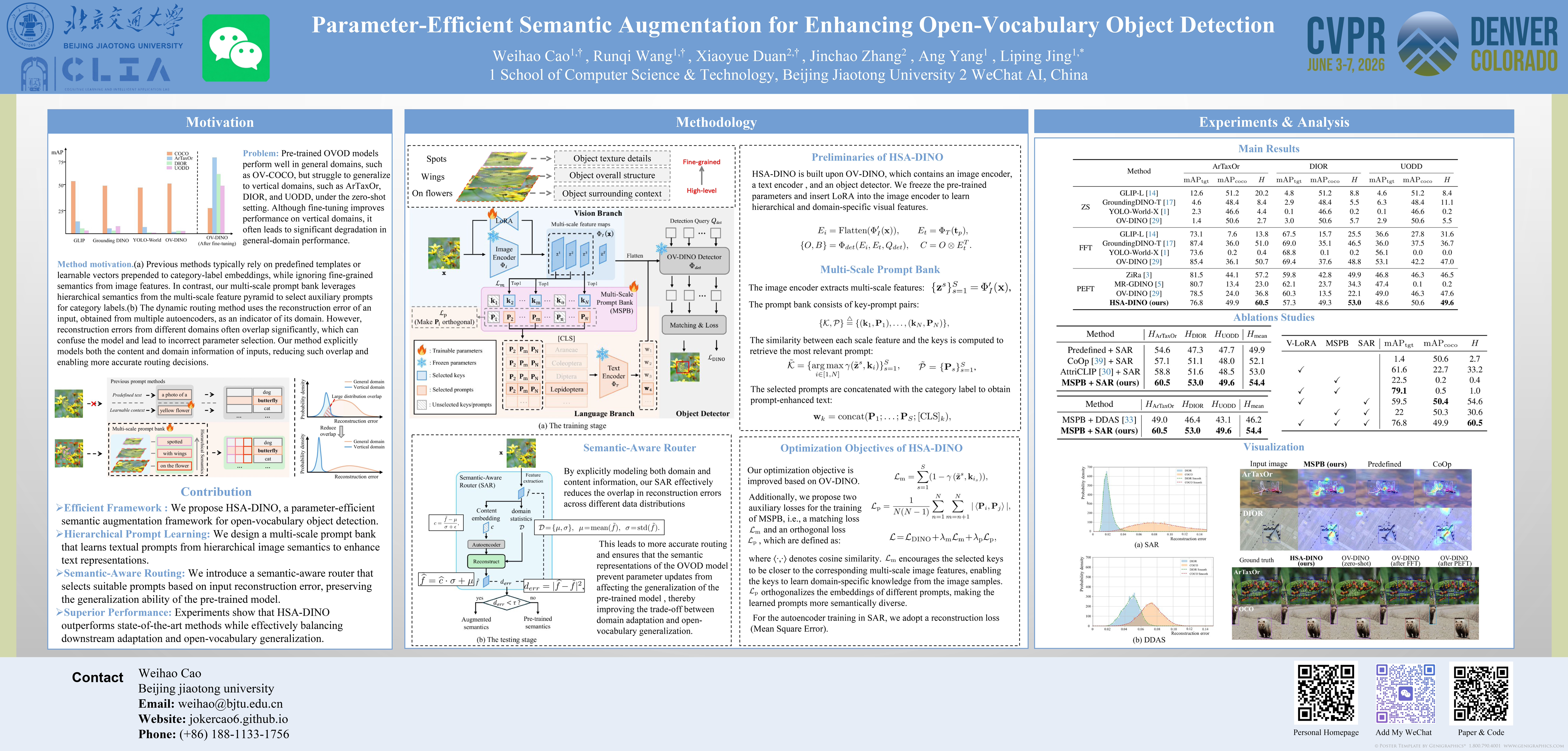
Open-vocabulary object detection (OVOD) enables models to detect any object category, including unseen ones. Benefiting from large-scale pre-training, existing OVOD methods achieve strong detection performance on general scenarios (e.g., OV-COCO) but suffer severe performance drops when transferred to downstream tasks with substantial domain shifts.This degradation stems from the scarcity and weak semantics of category labels in domain-specific task, as well as the inability of existing models to capture auxiliary semantics beyond coarse-grained category label.To address these issues, we propose HSA-DINO, a parameter-efficient semantic augmentation framework for enhancing open-vocabulary object detection. Specifically, we propose a multi-scale prompt bank that leverages image feature pyramids to capture hierarchical semantics and select domain-specific local semantic prompts, progressively enriching textual representations from coarse to fine-grained levels.Furthermore, we introduce a semantic-aware router that dynamically selects the appropriate semantic augmentation strategy during inference, thereby preventing parameter updates from degrading the generalization ability of the pre-trained OVOD model.
WeDetect: Fast Open-Vocabulary Object Detection as Retrieval
Shenghao Fu ⋅ Yukun Su ⋅ Fengyun Rao ⋅ Jing LYU ⋅ Xiaohua Xie ⋅ Wei-Shi Zheng
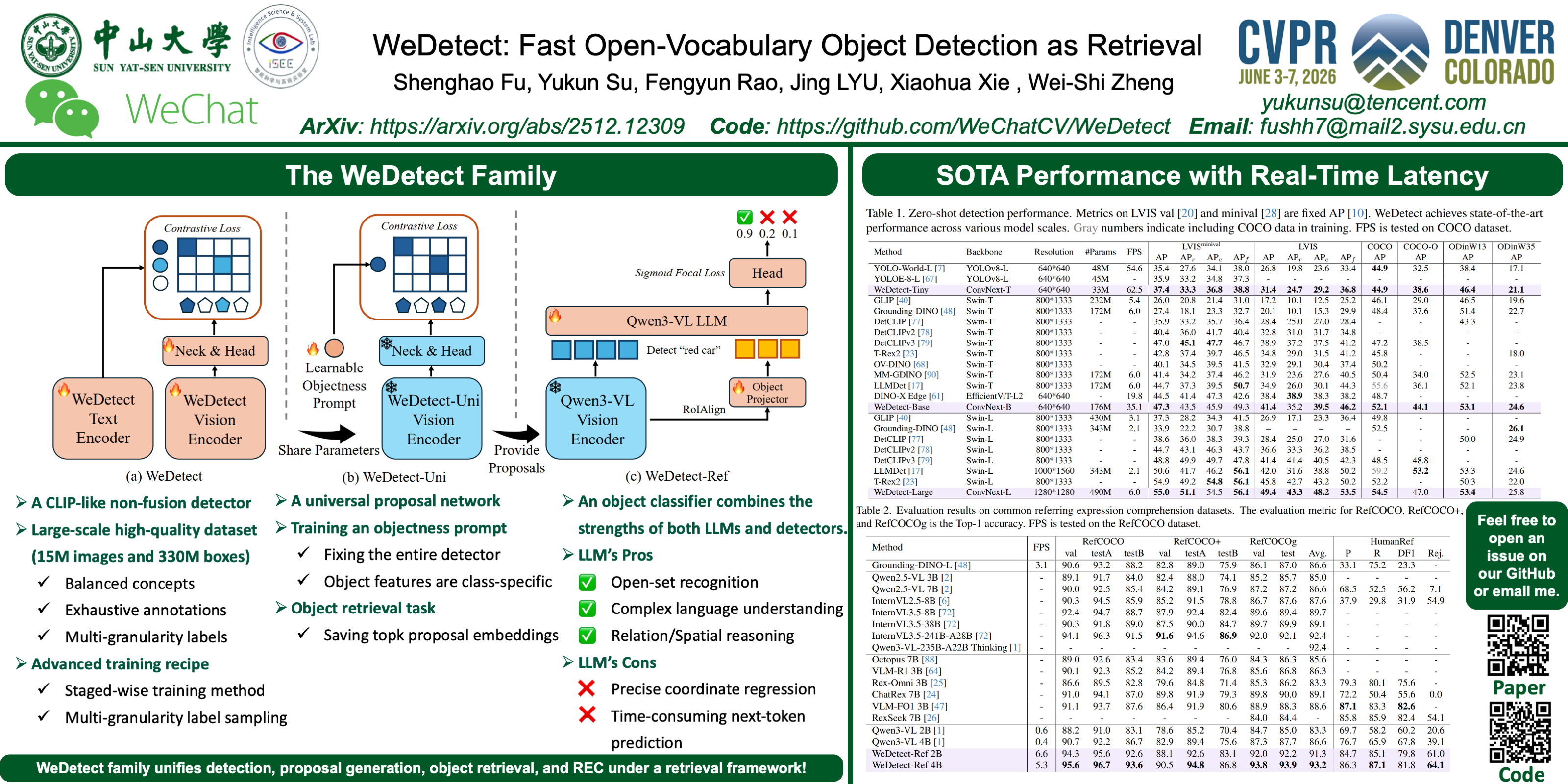
Open-vocabulary object detection aims to detect arbitrary classes via text prompts. Methods without cross-modal fusion layers (non-fusion) offer faster inference by treating recognition as a retrieval problem, i.e., matching regions to text queries in a shared embedding space. In this work, we fully explore this retrieval philosophy and demonstrate its unique advantages in efficiency and versatility through a model family named WeDetect: (1) State-of-the-art performance. WeDetect is a real-time detector with a dual-tower architecture. We show that, with well-curated data and full training, the non-fusion WeDetect surpasses other fusion models and establishes a strong open-vocabulary foundation. (2) Fast backtrack of historical data. WeDetect-Uni is a universal proposal generator based on WeDetect. We freeze the entire detector and only finetune an objectness prompt to retrieve generic object proposals across categories. Importantly, the proposal embeddings are class-specific and enable a new application, object retrieval, supporting retrieval objects in historical data. (3) Integration with LMMs for referring expression comprehension (REC). We further propose WeDetect-Ref, an LMM-based object classifier to handle complex referring expressions, which retrieves target objects from the proposal list extracted by WeDetect-Uni. It discards next-token prediction and classifies objects in a single forward pass. Together, the WeDetect family unifies detection, proposal generation, object retrieval, and REC under a coherent retrieval framework, achieving state-of-the-art performance across 15 benchmarks with high inference efficiency. We will open-source all models.
Open-Vocabulary Domain Generalization in Urban-Scene Segmentation
Dong Zhao ⋅ Qi Zang ⋅ Nan Pu ⋅ Wenjing Li ⋅ Nicu Sebe ⋅ Zhun Zhong
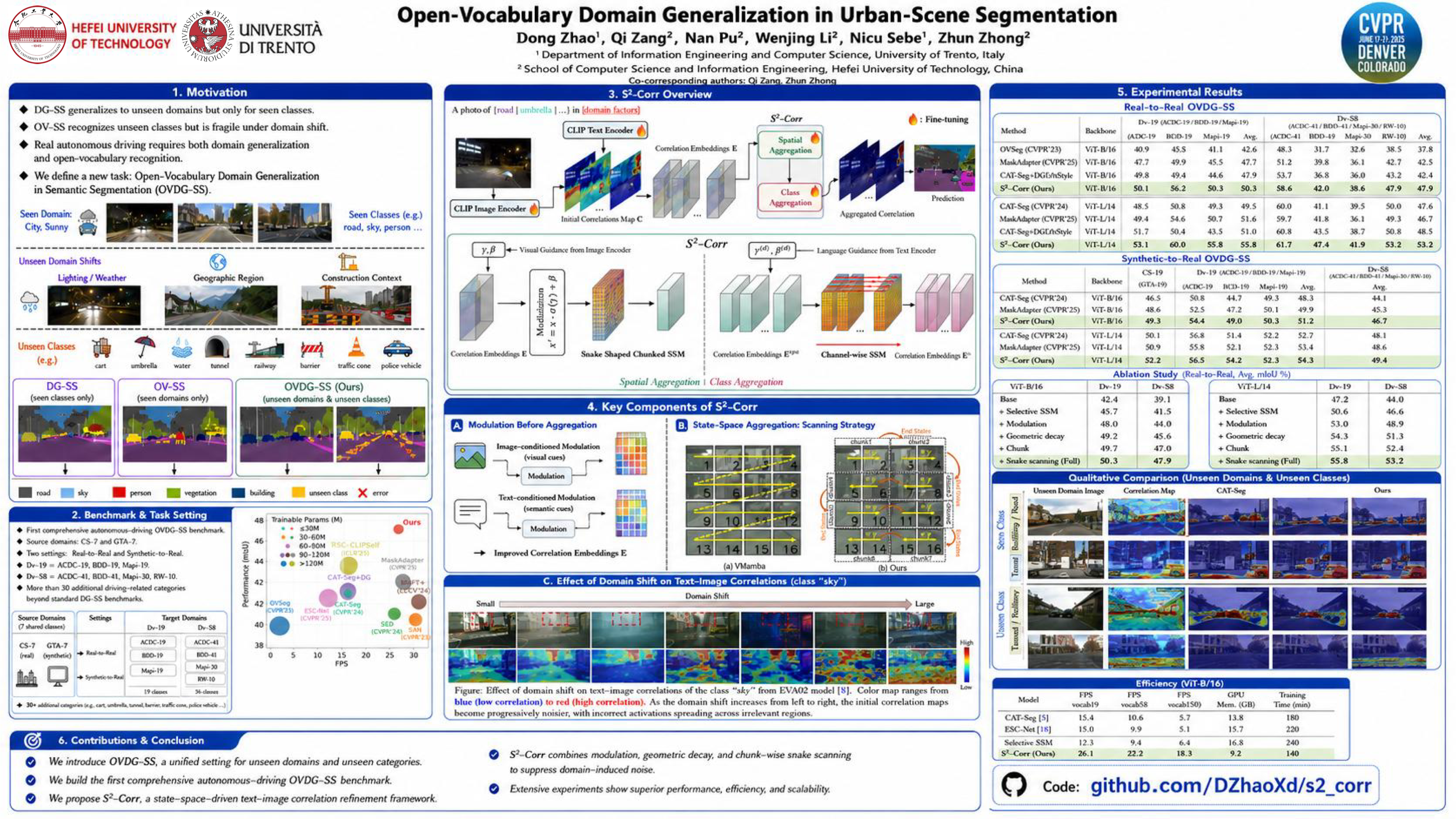
Domain Generalization in Semantic Segmentation (DG-SS) aims to enable segmentation models to perform robustly in unseen environments. However, conventional DG-SS methods are restricted to a fixed set of known categories, limiting their applicability in open-world scenarios. Recent progress in Vision-Language Models (VLMs) has advanced Open-Vocabulary Semantic Segmentation (OV-SS) by enabling models to recognize a broader range of concepts. Yet, these models remain sensitive to domain shifts and struggle to maintain robustness when deployed in unseen environments, a challenge that is particularly severe in urban-driving scenarios. To bridge this gap, we introduce Open-Vocabulary Domain Generalization in Semantic Segmentation (OVDG-SS), a new setting that jointly addresses unseen domains and unseen categories. We introduce the first benchmark for OVDG-SS in autonomous driving, addressing a previously unexplored problem and covering both synthetic-to-real and real-to-real generalization across diverse unseen domains and unseen categories. In OVDG-SS, we observe that domain shifts often distort text–image correlations in pre-trained VLMs, which hinders the performance of OV-SS models. To tackle this challenge, we propose S$^2$-Corr, a state-space-driven text–image correlation refinement mechanism that can mitigate domain-induced distortions and produce a more consistent text–image correlation under distribution changes. Extensive experiments on our constructed benchmark demonstrate that the proposed method achieves superior cross-domain performance and efficiency compared to existing OV-SS approaches.
OpenDPR: Open-Vocabulary Change Detection via Vision-Centric Diffusion-Guided Prototype Retrieval for Remote Sensing Imagery
Qi Guo ⋅ Jue Wang ⋅ Yinhe Liu ⋅ Yanfei Zhong
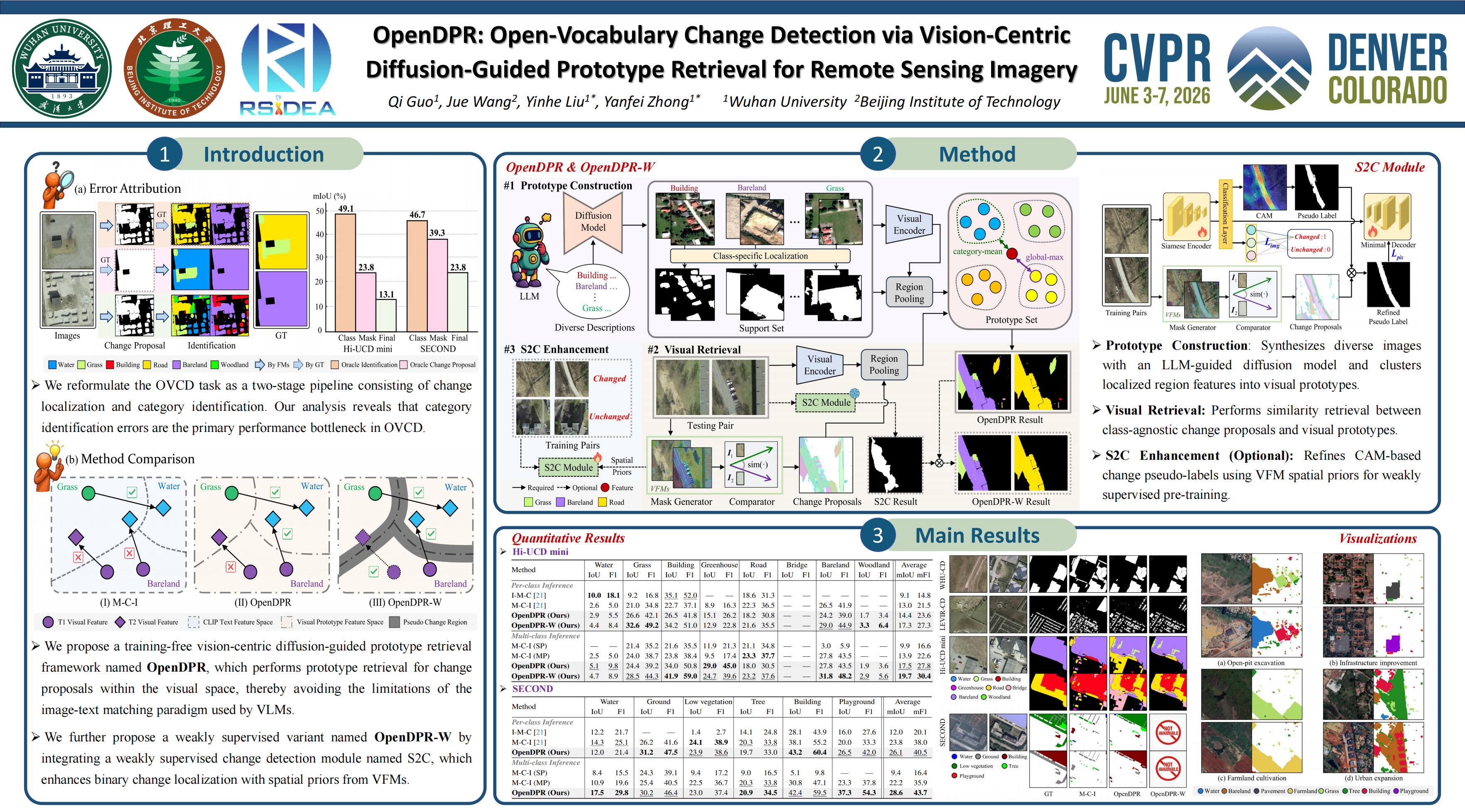
Open-vocabulary change detection (OVCD) seeks to recognize arbitrary changes of interest by enabling generalization beyond a fixed set of predefined classes. We reformulate OVCD as a two-stage pipeline: first generate class-agnostic change proposals using visual foundation models (VFMs) such as SAM and DINOv2, and then perform category identification with vision-language models (VLMs) such as CLIP. We reveal that category identification errors are the primary bottleneck of OVCD, mainly due to the limited ability of VLMs based on image-text matching to represent fine-grained land-cover categories. To address this, we propose OpenDPR, a training-free vision-centric diffusion-guided prototype retrieval framework. OpenDPR leverages diffusion models to construct diverse prototypes for target categories offline, and perform similarity retrieval with change proposals in the visual space during inference. The other secondary bottleneck lies in change localization, due to the lack of change priors in VFMs under unsupervised settings. To bridge this gap, we design a spatial-to-change weakly supervised change detection module named S2C to adapt their strong spatial modeling capabilities for binary change localization. Integrating the pretrained S2C into OpenDPR leads to a weakly supervised variant named OpenDPR-W, which further improves OVCD with minimal supervision. Experimental results on four benchmark datasets demonstrate that the proposed methods achieve state-of-the-art performance under both supervision modes. Code is available in the Supplementary Material.
Annotation-Efficient Coreset Selection for Context-dependent Segmentation
jin zhang ⋅ Zhe Cao ⋅ Biwen Yang ⋅ Ruiheng Zhang
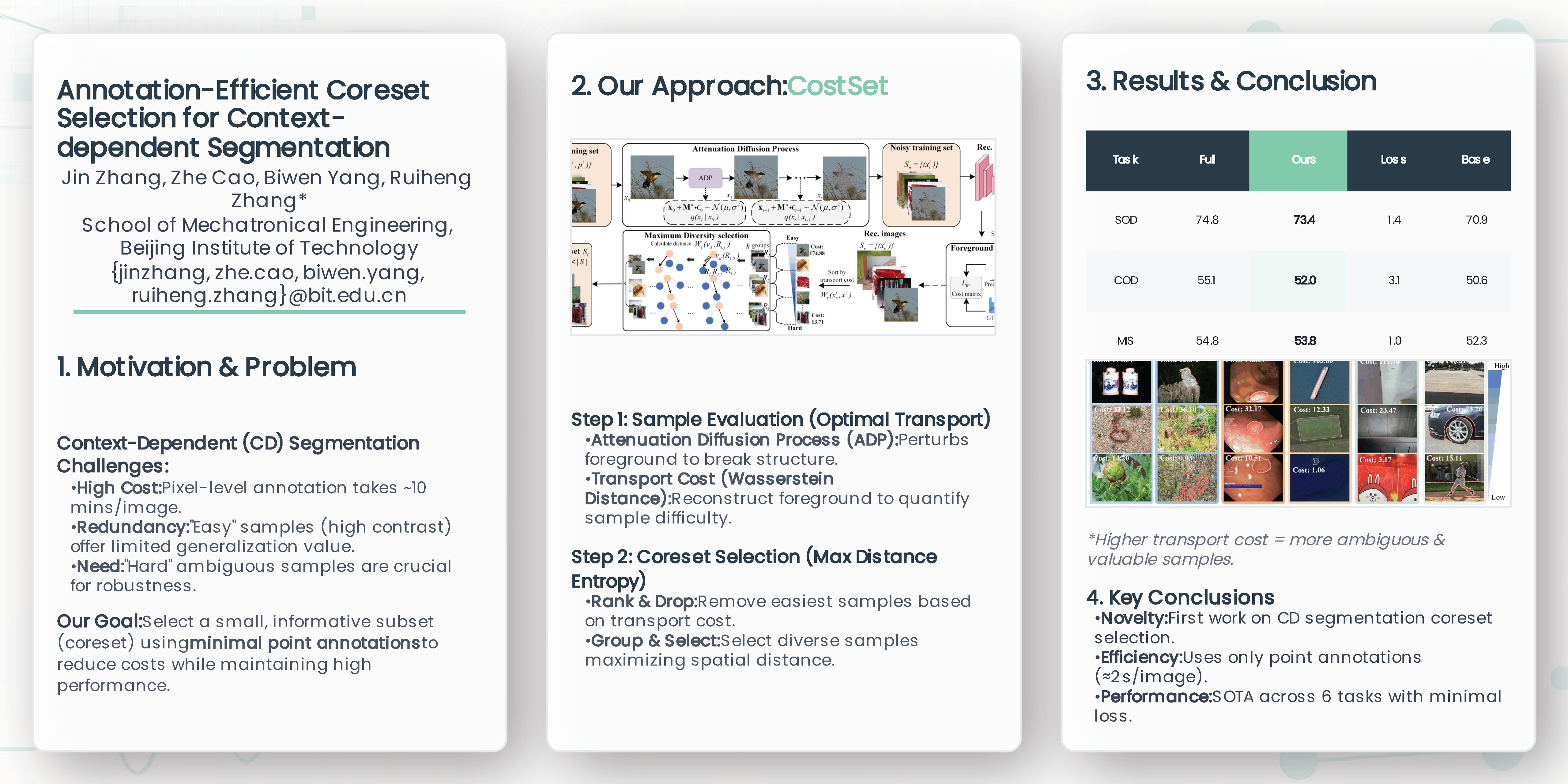
Context-dependent (CD) tasks demand the model to have advanced visual understanding ability, such as recognizing camouflaged objects and medical lesions. Current CD methods rely heavily on pixel-level annotated training sets, neglecting issues from redundant samples and the high annotation costs. In this paper, we address the pruning needs of CD datasets, focusing on selecting the most valuable samples for labeling and training using weak annotations. To achieve this, we decompose CD coreset selection into two steps: sample evaluation and coreset selection, proposing corresponding solutions: points-based optimal transport and a maximum distance entropy strategy. Specifically, we formulate sample evaluation as an optimal transport problem between foreground and background distributions, designing a foreground destruction-reconstruction process based on points to compute transport costs and score samples. For samples of varying importance, our selection strategy balances coreset coverage and diversity. We validate our method on six CD tasks, achieving 1\% accuracy loss relative to full training under a 40\% pruning rate.
ALLNet: Multi-task Dense Prediction for Degraded Images
Weiran Wang ⋅ Jialing Wu ⋅ Yaqi Chang ⋅ Gang He ⋅ Li Xu ⋅ Chang Wu ⋅ Yunsong Li
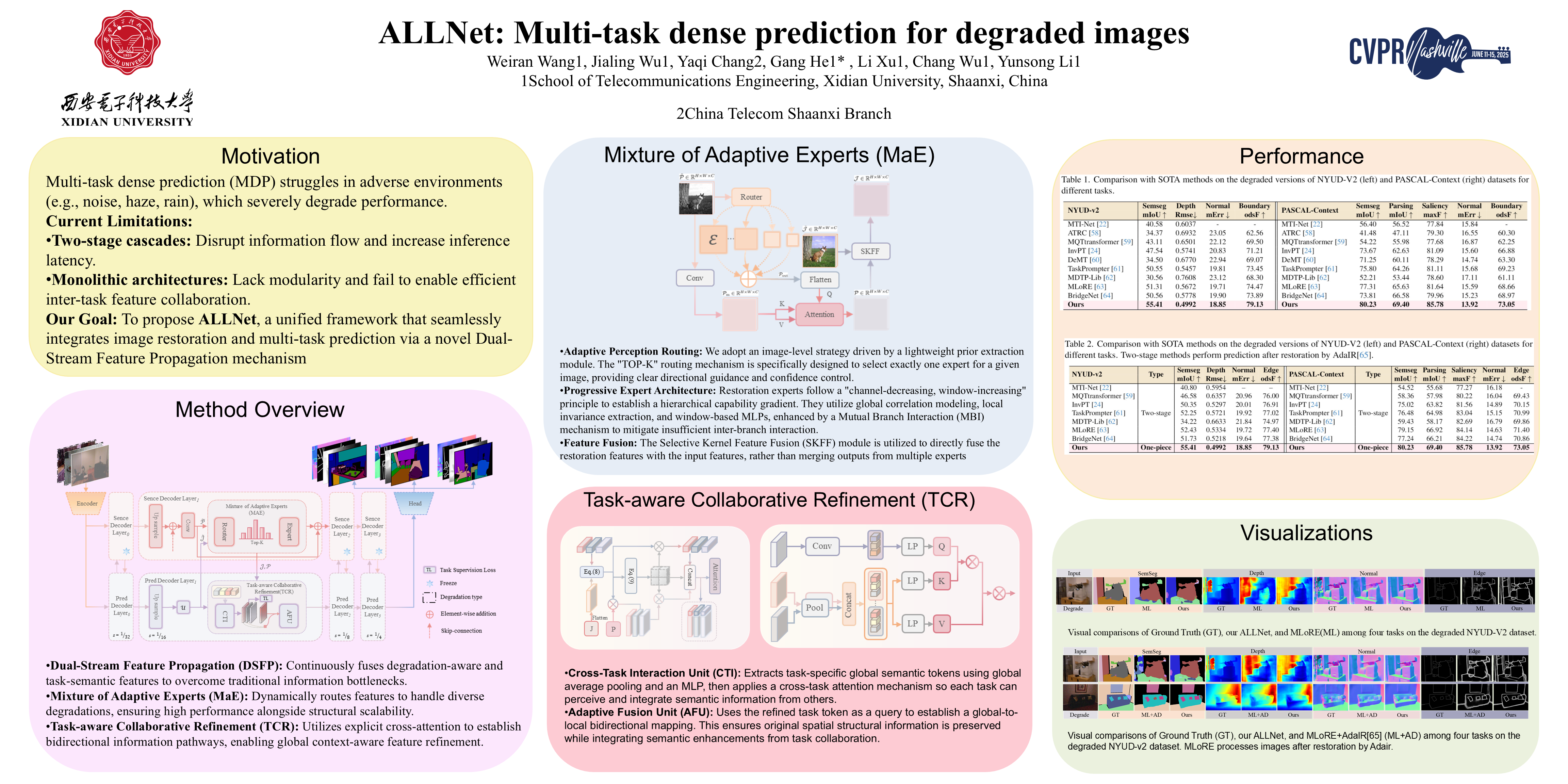
Multi-task dense prediction aims to simultaneously address multiple pixel-level tasks through a unified network for visual scene understanding. However, adverse environmental conditions limit the generalization and practicality of such tasks. To address this, we propose ALLNet, a novel framework that effectively explores degradation patterns and integrates multi-task collaborative information. Specifically, we design a MoE-based Mixture of Adaptive Experts (MaE) restoration component network that enhances degradation features through dynamic routing and guides task-specific feature extraction. Furthermore, we formulate a Task-aware Collaborative Refinement (TCR) module to capture global semantic correlations and cross-task dependencies, facilitating bidirectional collaboration between restoration and task-specific features on degraded images. To the best of our knowledge, this represents the first attempt at multi-task dense prediction under image degradation. Experimental results on degraded NYUD-v2 and PASCAL-Context benchmarks demonstrate that our architecture significantly outperforms existing methods in degraded scenarios.
Geometry-Aware Cross-Modal Graph Alignment for Referring Segmentation in 3D Gaussian Splatting
Yuwen Tao ⋅ Kanglei Zhou ⋅ Chang Li ⋅ Liyuan Wang
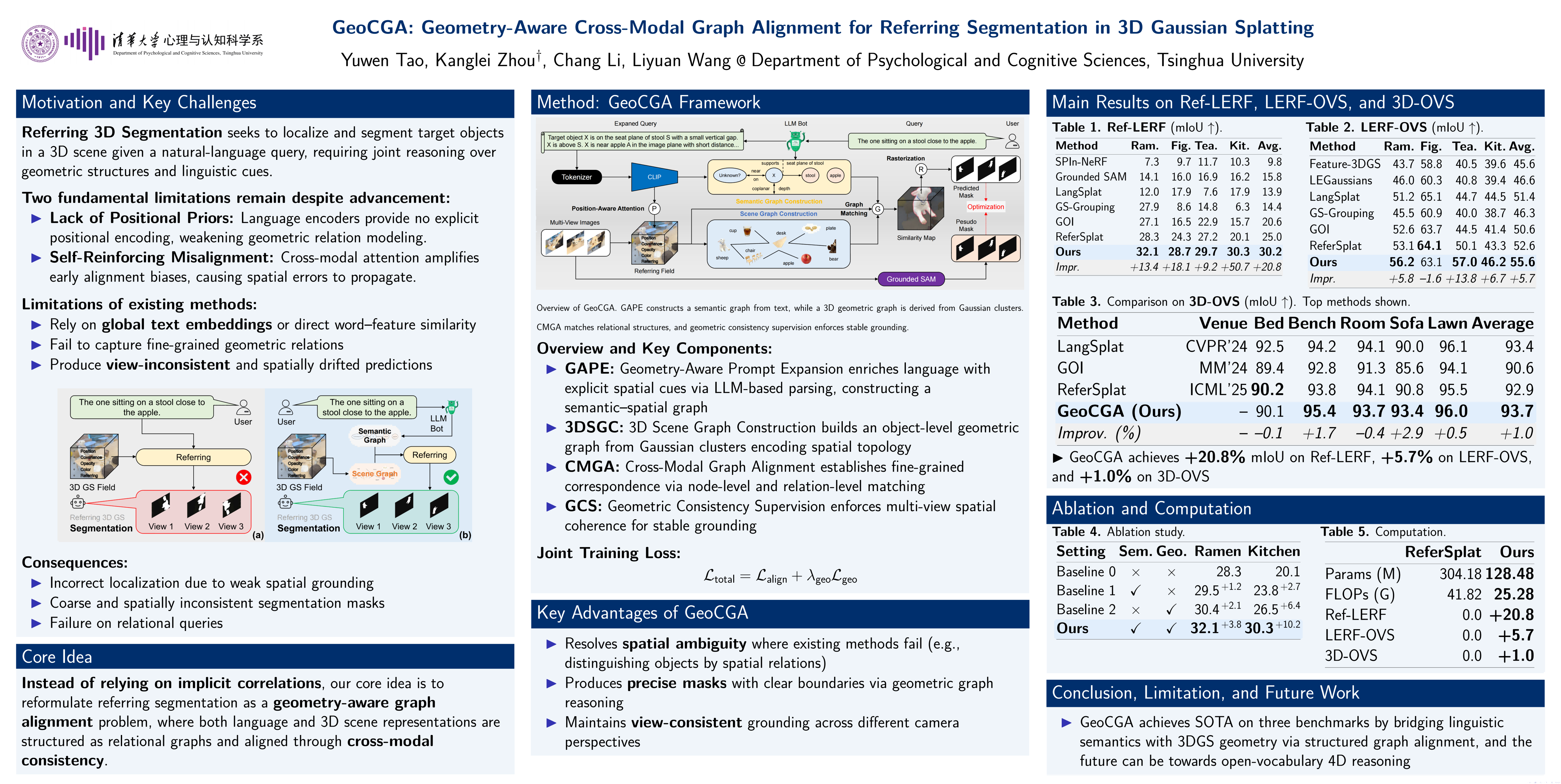
Referring 3D segmentation seeks to localize and segment target objects in a 3D scene given a natural-language query, requiring joint reasoning over geometric structures and linguistic cues. Although recent progress using 3D Gaussian Splatting (3DGS) has improved rendering quality, existing methods still struggle to spatially ground textual references due to two fundamental limitations: (1) language encoders provide no explicit positional priors, weakening geometric relation modeling; and (2) cross-modal attention is self-reinforcing, causing spatial errors to propagate through the Gaussian field once misalignment occurs. To address this, we propose GeoCGA, a geometry-aware cross-modal graph alignment framework that bridges linguistic semantics with the 3DGS representation. GeoCGA introduces position-aware prompt expansion to build a semantic-spatial graph capturing relational structure in text, and constructs a Gaussian-based geometric graph encoding 3D topology. A cross-modal alignment module enforces geometric consistency between the two graphs, enabling stable and spatially grounded correspondence across views. GeoCGA consistently outperforms prior state-of-the-art methods, yielding mIoU improvements of 28.8\% on Ref-LERF, 2.6\% on LERF-OVS, and 3.1\% on 3D-OVS. These results point to an incremental advance toward more stable and spatially consistent 3D language grounding.
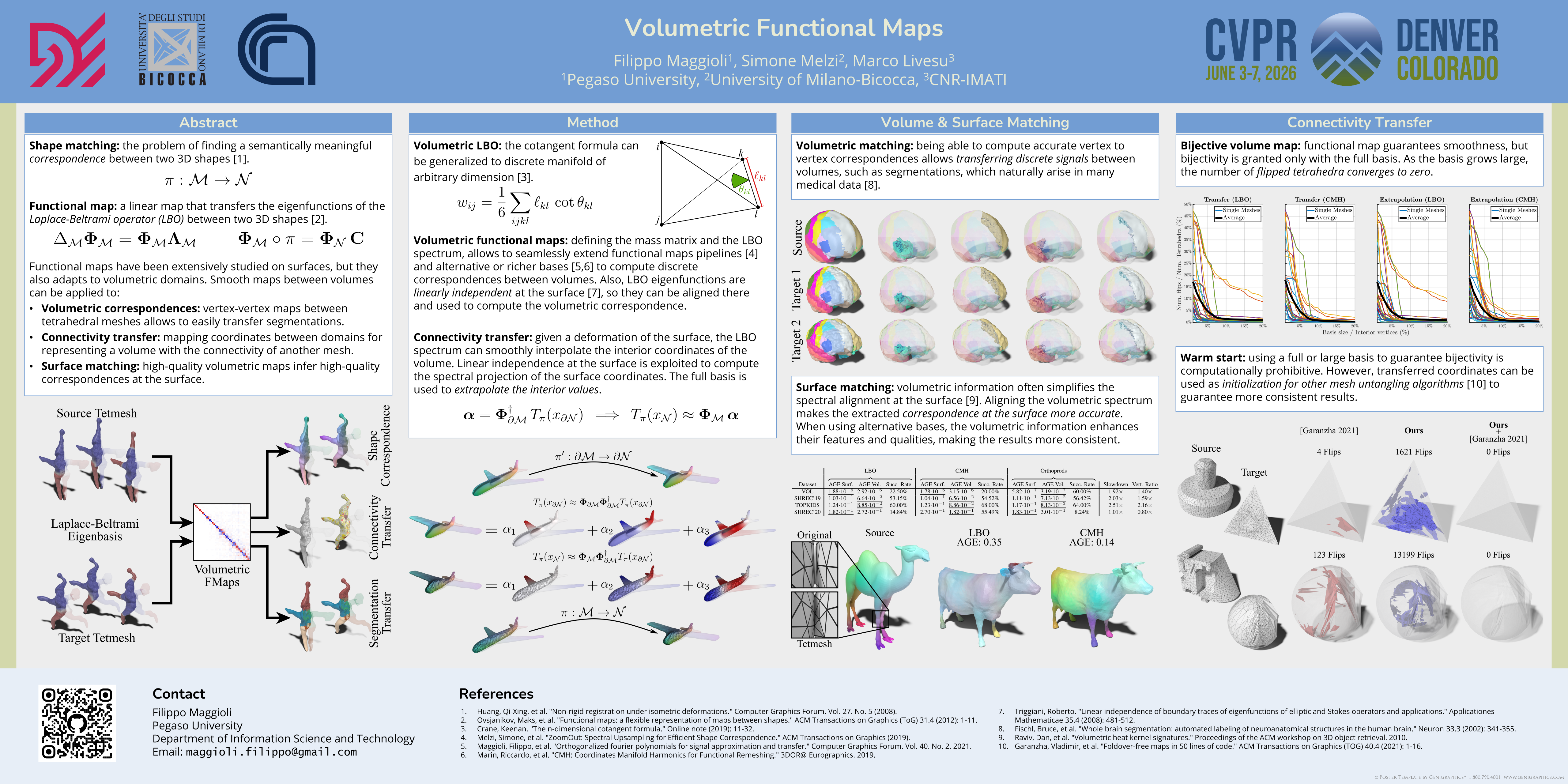
The computation of volumetric correspondences between 3D shapes is a prominent tool for medical and industrial applications. In this work, we pave the way for spectral volume mapping, extending for the first time the functional maps framework from the surface to the volumetric setting. We show that the eigenfunctions of the volumetric Laplace operator define a functional space that is suitable for high-quality signal transfer. We also experiment with various techniques that edit this functional space, porting them to volume domains. We validate our method on novel volumetric datasets and on tetrahedralizations of well-established surface datasets, also showcasing practical applications involving both discrete and continuous signal mapping, for segmentation transfer, mesh connectivity transfer, and solid texturing. Last but not least, we show that considering the volumetric spectrum greatly improves the accuracy for classical shape matching tasks among surfaces, consistently outperforming existing surface-only spectral methods.
GenMask: Adapting DiT for Segmentation via Direct Mask Generation
Yang yuhuan ⋅ Xianwei Zhuang ⋅ Yuxuan Cai ⋅ Chaofan Ma ⋅ Shuai Bai ⋅ Jiangchao Yao ⋅ Ya Zhang ⋅ Junyang Lin ⋅ Yanfeng Wang
Recent approaches for segmentation have leveraged pretrained generative models as feature extractors, treating segmentation as a downstream adaptation task via indirect feature retrieval. This implicit use suffers from a fundamental misalignment in representation.It also depends heavily on indirect feature extraction pipelines, which complicate the workflow and limit adaptation.In this paper, we argue that instead of indirect adaptation, segmentation tasks should be trained directly in a generative manner.We identify a key obstacle to this unified formulation: VAE latents of binary masks are sharply distributed, noise robust, and linearly separable, distinct from natural image latents.To bridge this gap, we introduce timesteps sampling strategy for binary masks that emphasizes extreme noise levels for segmentation and moderate noise for image generation, enabling harmonious joint training.We present GenMask, a DiT trains to generate black-and-white segmentation masks as well as colorful images in RGB space under the original generative objective. GenMask preserves the original DiT architecture while removing the need of feature extraction pipelines tailored for segmentation tasks. Empirically, GenMask attains state-of-the-art performance on referring and reasoning segmentation benchmarks and ablations quantify the contribution of each component.
Frequency-Aware Affinity for Weakly Supervised Semantic Segmentation
Ziqian Yang ⋅ Xianglin Qiu ⋅ Xinqiao Zhao ⋅ Xiaolei Wang ⋅ Quan Zhang ⋅ Jimin Xiao
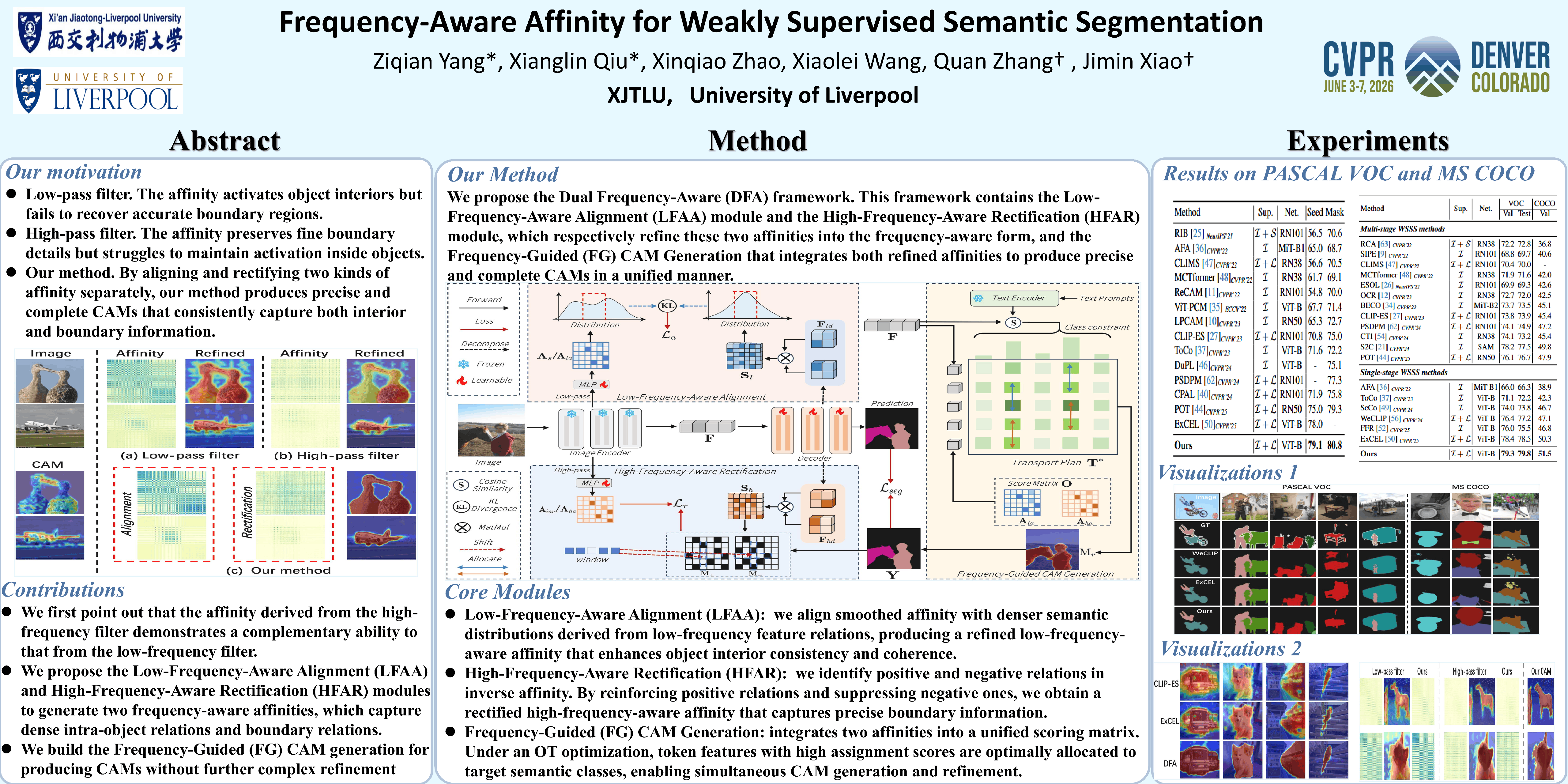
Weakly Supervised Semantic Segmentation (WSSS) typically utilizes Class Activation Maps (CAMs) to provide the pixel-wise localization. However, CAMs tend to activate only the most discriminative regions, leading to suboptimal WSSS performance. Although existing CAM refinement methods leverage pair-wise relations in affinity to expand the activation regions, these affinities derived from Vision Transformer (ViTs) exhibit a smoothing property, neglecting crucial high-frequency relations and failing to accurately refine object boundaries. In this work, we propose the Dual Frequency-Aware framework (DFA) to address this limitation. Specifically, the Low-Frequency-Aware Alignment (LFAA) generates low-frequency-aware affinity that captures salient semantic relations to enhance object interior semantic consistency on CAMs, while the High-Frequency-Aware Rectification (HFAR) module produces high-frequency-aware affinity that models precise relations to preserve object boundary structure on CAMs. By effectively integrating these two complementary affinities, we design a novel Frequency-Guided (FG) CAM Generation based on Optimal Transport theory, which significantly omits the complex refinement process. Extensive experiments demonstrate that our DFA framework achieves state-of-the-art performance on both PASCAL VOC and MS COCO benchmarks. Code will be released.
Learning and Aligning Click-Aware Shape Prior for Interactive Amodal Instance Segmentation
Junjie Chen ⋅ Junwei Lin ⋅ Ren Hong ⋅ Shengjie Liu ⋅ Yuming Fang ⋅ Feng Qian ⋅ Yifan Zuo
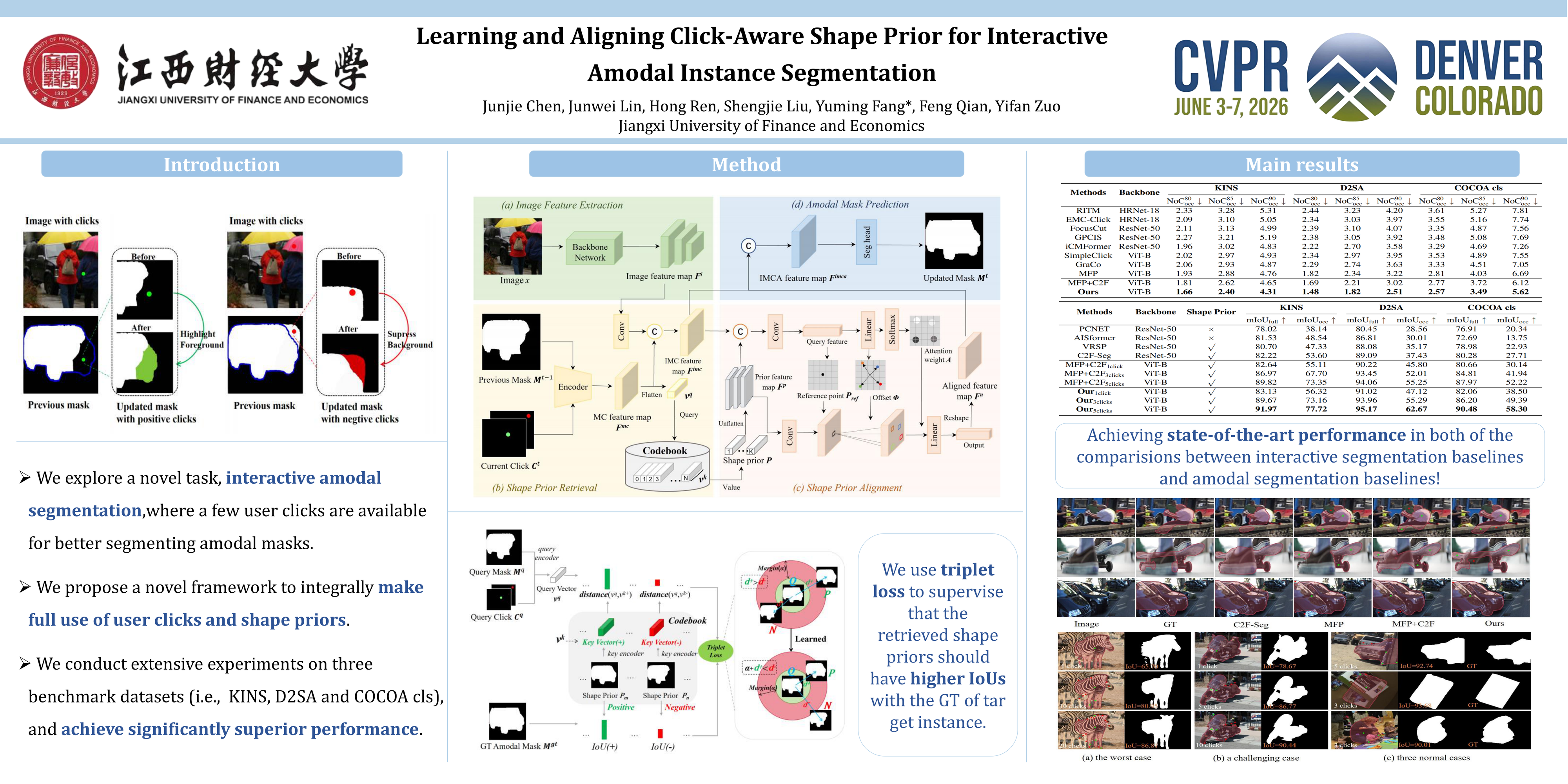
Amodal instance segmentation aims to segment both visible and occluded regions of object instance, which are challenging due to lacking inference support under occlusion. Most existing methods employ the prior knowledge about object mask (shape prior) to support the amodal estimation, but the shape prior is not always compatible for object instances in the test stage. In this paper, we explore the task of interactive amodal segmentation, where a few user clicks are available for better segmenting the complete masks of object instances.For this task, we propose a novel framework based on learning and aligning click-aware shape prior. Specifically, we propose to learn click-aware shape prior with triplet loss, which forces the retrieved shape priors to have higher IoU with the ground-truth of target instance and thus could exactly facilitate the prediction. Besides, considering the inevitable mismatch between shape prior and target instance, we propose to adaptively align the shape prior with deformable attention. Overall, our model could make full use of the interactive clicks to retrieve and align shape priors, and thus could estimate more complete masks. Extensive experiments on three benchmark datasets (i.e., KINS, D2SA and COCOA cls) demonstrate the effectiveness of our method.
Beyond Reassembly: Fractured Object Recovery with Missing Parts
Qun-Ce Xu ⋅ Jiahui Li ⋅ Yan-Pei Cao ⋅ Weihao Cheng ⋅ Tai-Jiang Mu ⋅ Ying Shan ⋅ Chuan Li ⋅ Da Chen ⋅ Yong-Liang Yang ⋅ Shi-Min Hu
We propose a novel learning-based task named fractured object recovery. Unlike previous fractured object reassembly task that only targets aligning existing parts with overlaps, our task aims to not only reassemble irrelevant parts but also predict missing parts, resulting in a complete shape recovery immediately. Our task coincides with practical experiences, where the prior knowledge of similar shapes can be leverage in the reassembly process, such that even non-overlapping parts can be reasoned into adequate locations. We also present the first learning model for the proposed task by correlating features of both existing and missing parts using a transformer, where the latter is naturally represented as missing tokens. Hence, our model can jointly estimate the poses of the existing parts and predict the shapes of the missing parts. To facilitate the task, we introduce a new dataset based on the existing fractured object benchmark by imposing different configurations of missing parts. We perform extensive evaluations to demonstrate the performance of the proposed model over baselines. The results show that joint part reassembly and prediction can be made possible and also have mutual benefits, which we believe can inspire future research and favor real applications.
Best Segmentation Buddies for Image-Shape Correspondence
Itai Lang ⋅ Dongwei Lyu ⋅ Dale Decatur ⋅ Rana Hanocka
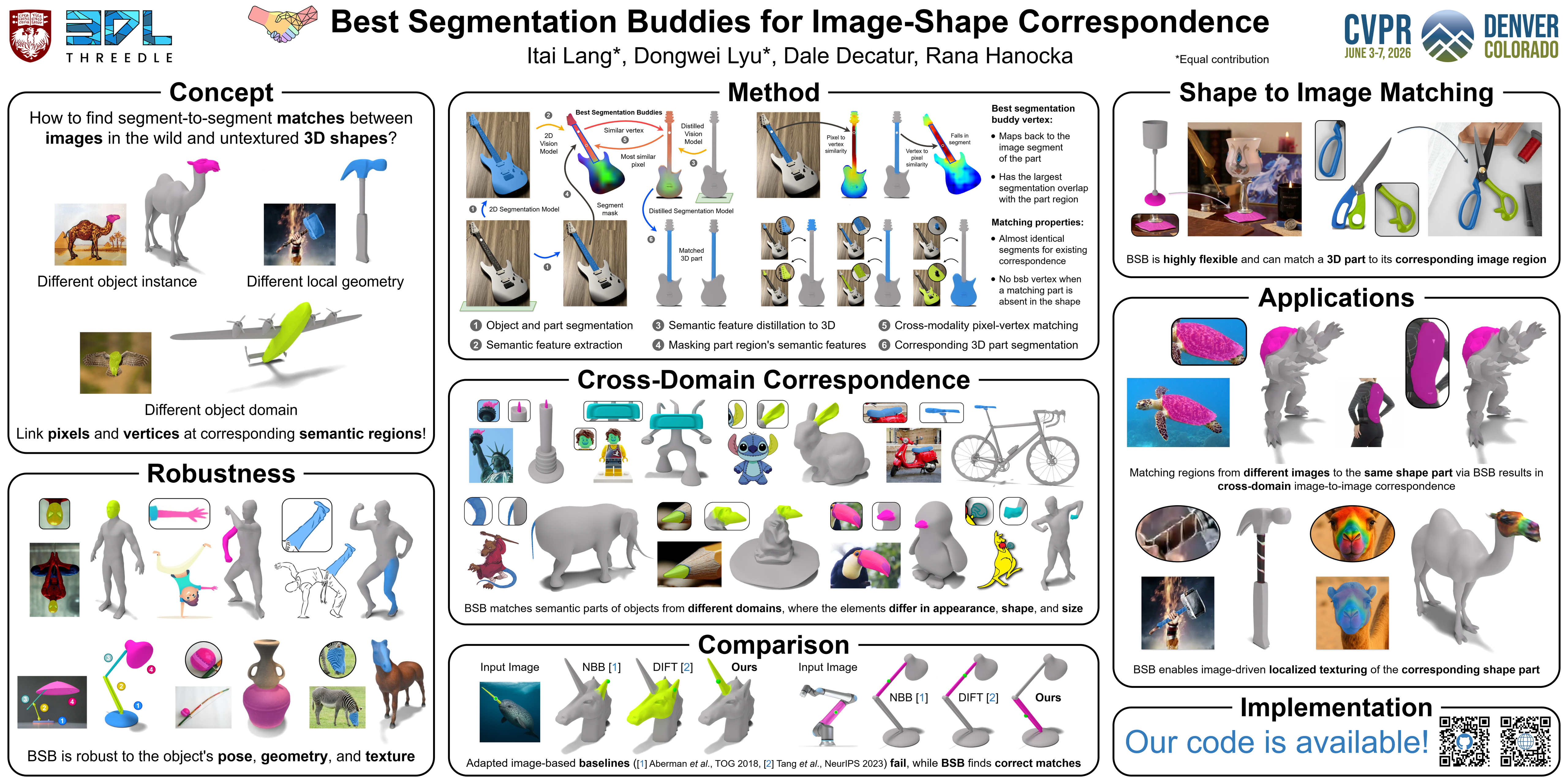
Finding correspondences is a fundamental and extensively researched problem in computer vision and graphics. In this work, we examine the underexplored problem of estimating segmentation-to-segmentation correspondence between images in the wild and untextured 3D shapes. This task is highly challenging due to substantial differences in appearance, geometry, and viewpoint. Our approach bridges the cross-modality gap by linking pixels in the image segment to vertices in the corresponding semantic part of the 3D shape.To achieve this, we first distill deep visual features from a 2D vision model onto the 3D shape surface, allowing for the computation of feature similarity between image pixels and shape vertices. We then identify Best Segmentation Buddies, vertices whose most similar image pixel lies within the image segmentation region, enabling the reliable discovery of vertices in semantically corresponding shape parts. Finally, we leverage distilled 3D features from the 2D segmentation model of the image to segment the shape directly in 3D, bootstrapping the correspondence process. We demonstrate the generality and robustness of our approach across a wide range of image-shape pairs, showcasing accurate and semantically meaningful correspondences. Our code will be made publicly available.
RMAE-ProGRess: Advancing Semantic Segmentation in Unstructured Environments
Manish Bhurtel ⋅ Danda B. Rawat
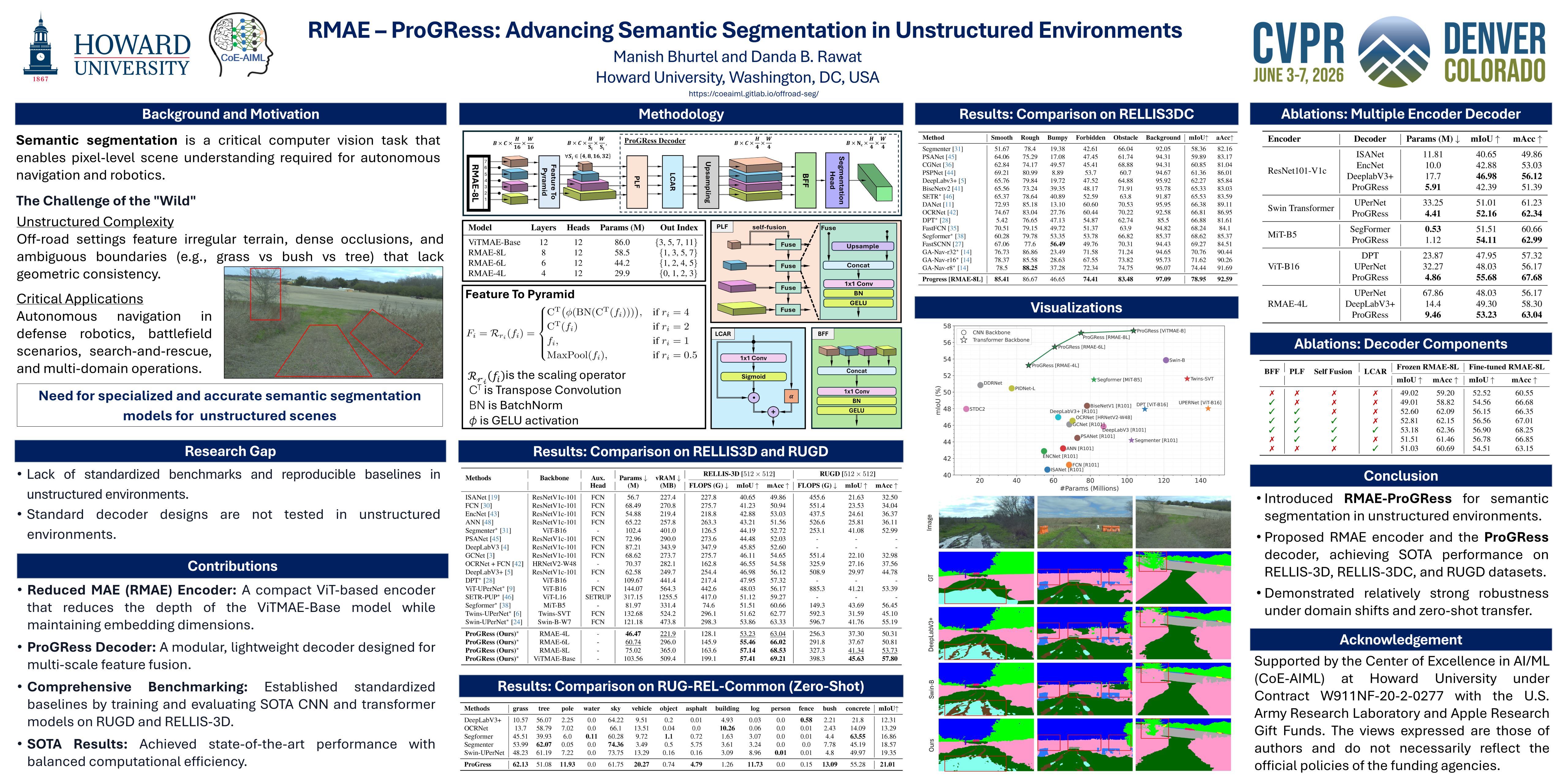
Semantic segmentation in unstructured environments presents unique challenges due to irregular terrain, occlusions, and complex spatial layouts. While structured settings (e.g., urban scenes) have been widely studied, segmentation in unstructured settings remains relatively underexplored, both in terms of standardized benchmarking and architectural design. In this work, we propose a encoder-decoder based semantic segmentation architecture that integrates a Reduced Masked Autoencoder (RMAE) as the encoder, a Feature-to-Pyramid (F2P) neck, and a novel decoder called ProGRess. The ProGRess decoder introduces Progressive Leapwise Fusion (PLF) for top-down multi-scale fusion of non-contiguous feature maps, a Lightweight Channel Attention gate with Residuals (LCAR) module, and a Bottleneck Feature Fusion (BFF) block for compact refinement. We establish comprehensive baselines by benchmarking state-of-the-art CNN and transformer-based models on challenging unstructured environment datasets viz. RELLIS-3D, it's coarse-grained variant, and RUGD. Our architecture achieves the state-of-the-art performance with 57.41\% mIoU on RELLIS-3D, 45.63\% mIoU on RUGD, 78.95\% mIoU on RELLIS-3DC datasets while maintaining competitive parameter-count and vRAM usage.
Local Precise Refinement: A Dual-Gated Mixture-of-Experts for Enhancing Foundation Model Generalization against Spectral Shifts
Xi Chen ⋅ Maojun Zhang ⋅ Yu Liu ⋅ Shen Yan
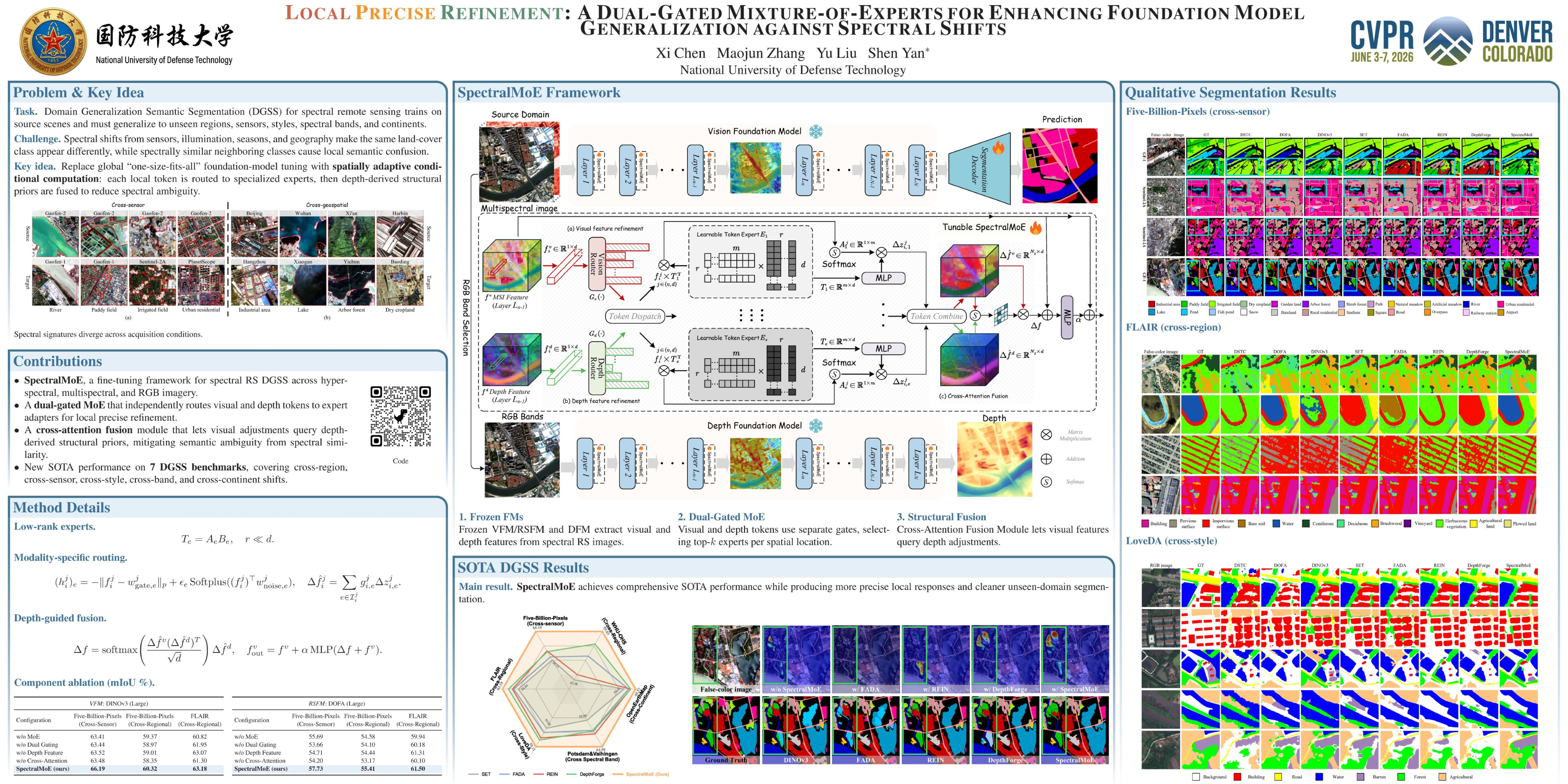
Domain Generalization Semantic Segmentation (DGSS) in spectral remote sensing is severely challenged by spectral shifts across diverse acquisition conditions, which cause significant performance degradation for models deployed in unseen domains. While Parameter-Efficient Fine-Tuning (PEFT) on foundation models is a promising direction, existing methods employ global, homogeneous adjustments. This "one-size-fits-all" tuning struggles with the spatial heterogeneity of land cover, causing semantic confusion. We argue that the key to robust DGSS lies not in a single global adaptation, but in performing fine-grained, spatially-adaptive refinement of a foundation model's features. To achieve this, we propose SpectralMoE, a novel PEFT framework for DGSS. It operationalizes this principle by utilizing a Mixture-of-Experts (MoE) architecture to perform \textbf{local precise refinement} on the foundation model's features, incorporating depth features estimated from selected RGB bands of the spectral remote sensing imagery to guide the fine-tuning process. Specifically, SpectralMoE employs a dual-gated MoE architecture that independently routes visual and depth features to top-k selected experts for specialized refinement, enabling modality-specific adjustments. A subsequent cross-attention mechanism then judiciously fuses the refined structural cues into the visual stream, mitigating semantic ambiguities caused by spectral variations. Extensive experiments show that SpectralMoE sets a new state-of-the-art on multiple DGSS benchmarks across hyperspectral, multispectral, and RGB remote sensing imagery.
Orthogonal Spatial-Aware Multi-View Anchor Graph Clustering for Incomplete Remote Sensing Data
Yongshan Zhang ⋅ Xiaohuan Lin ⋅ Lefei Zhang ⋅ Zhihua Cai
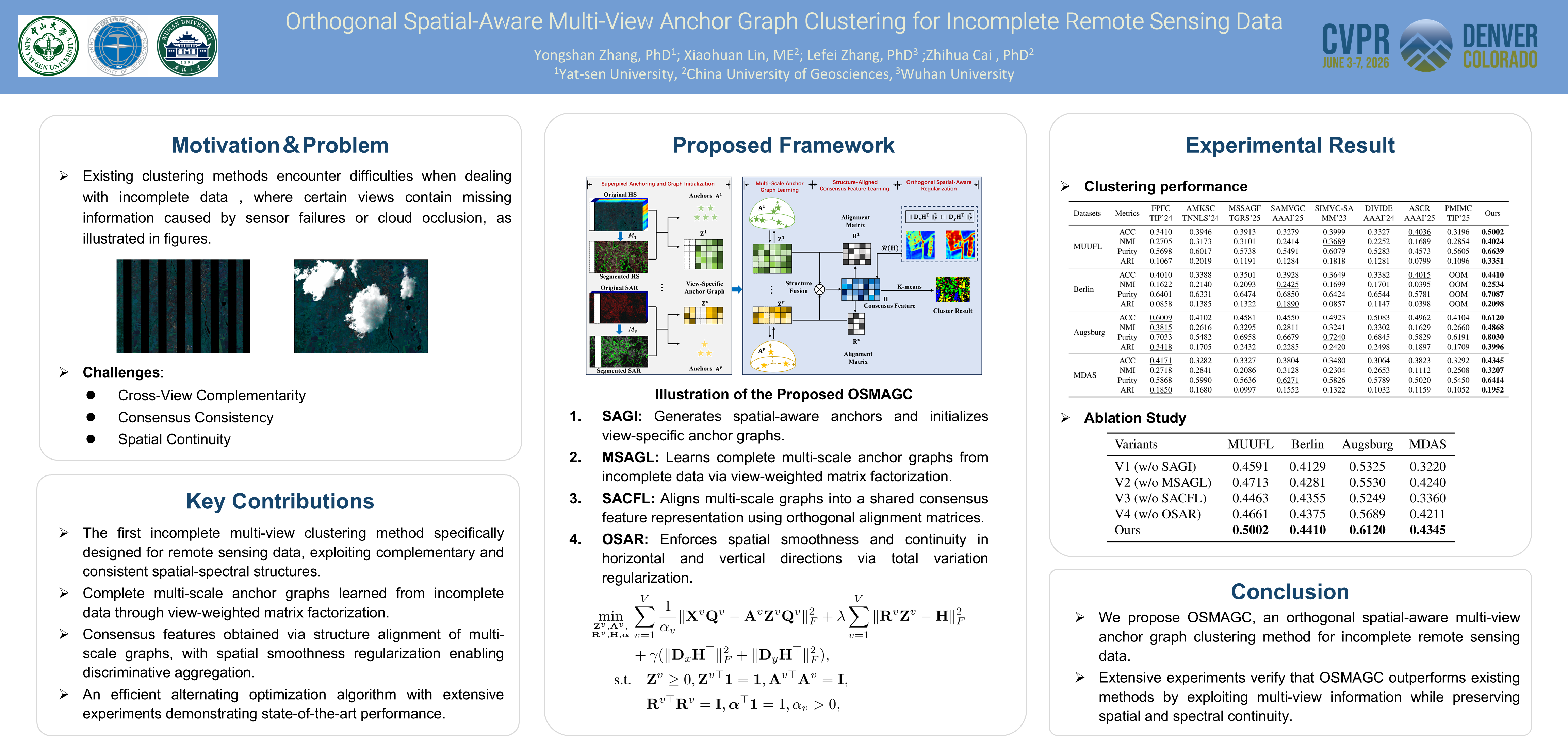
Multi-view clustering for remote sensing data has received increasing attention by leveraging diverse data representations to enhance Earth observation. Existing methods are primarily developed under the assumption that each pixel is fully observed across all views. No prior work has investigated the more practical yet challenging scenario where some views suffer from partially missing data. To bridge this gap, this paper presents the first study on clustering incomplete remote sensing data, termed orthogonal spatial-aware multi-view anchor graph clustering (OSMAGC). Specifically, spatial-aware anchors and multi-scale anchor graphs are initially constructed by exploiting the superpixel-based texture characteristics of each view. Based on these, multi-scale anchor graph learning is performed through view weighting and matrix factorization on incomplete data. Structure-aligned consensus feature learning is achieved by aligning the multi-scale graph structures within a shared latent space. To ensure spatial continuity and smoothness, orthogonal spatial-aware regularization is imposed in both horizontal and vertical directions. These three modules are jointly optimized through a well-designed optimization algorithm in a mutually reinforcing manner. Extensive experiments on four benchmark datasets validate the effectiveness and efficiency of our proposed method over the state-of-the-art competitors.
SIGMA: A Physics-Based Benchmark for Gas Chimney Understanding in Seismic Images
Bao Truong ⋅ Quang Nguyen ⋅ Baoru Huang ⋅ Jinpei Han ⋅ Van Nguyen ⋅ Ngan Le ⋅ Minh-Tan Pham ⋅ Doan Huy Hien ⋅ Anh Nguyen
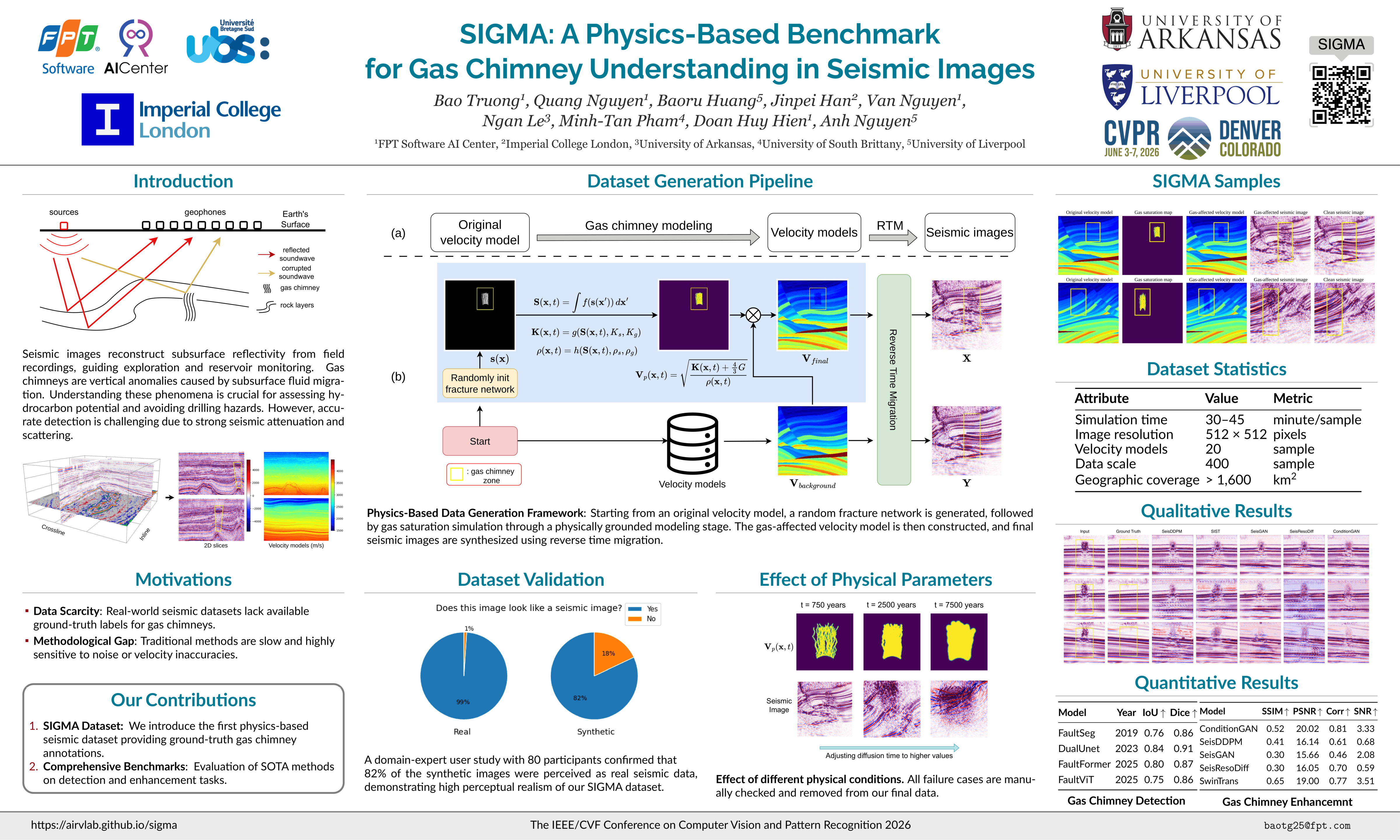
Seismic images reconstruct subsurface reflectivity from field recordings, guiding exploration and reservoir monitoring. Gas chimneys are vertical anomalies caused by subsurface fluid migration. Understanding these phenomena is crucial for assessing hydrocarbon potential and avoiding drilling hazards. However, accurate detection is challenging due to strong seismic attenuation and scattering. Traditional physics-based methods are computationally expensive and sensitive to model errors, while deep learning offers efficient alternatives, yet lacks labeled datasets. In this work, we introduce \textbf{SIGMA}, a new physics-informed dataset for gas chimney understanding in seismic images, featuring (i) pixel-level gas-chimney mask for detection and (ii) paired degraded and ground-truth image for enhancement. We employed physics-based methods that cover a wide range of geological settings and data acquisition conditions. Comprehensive experiments demonstrate that SIGMA serves as a challenging benchmark for gas chimney interpretation and benefits general seismic understanding.
SkySense-VITA: Towards Universal In-context Segmentation of Multi-modal Remote Sensing Imagery
Kang Wu ⋅ Lei Yu ⋅ Junwei Luo ⋅ Bo Dang ⋅ Junjian Zhang ⋅ Xiangyuan Cai ⋅ Hongwei Hu ⋅ Jingdong Chen ⋅ Yansheng Li
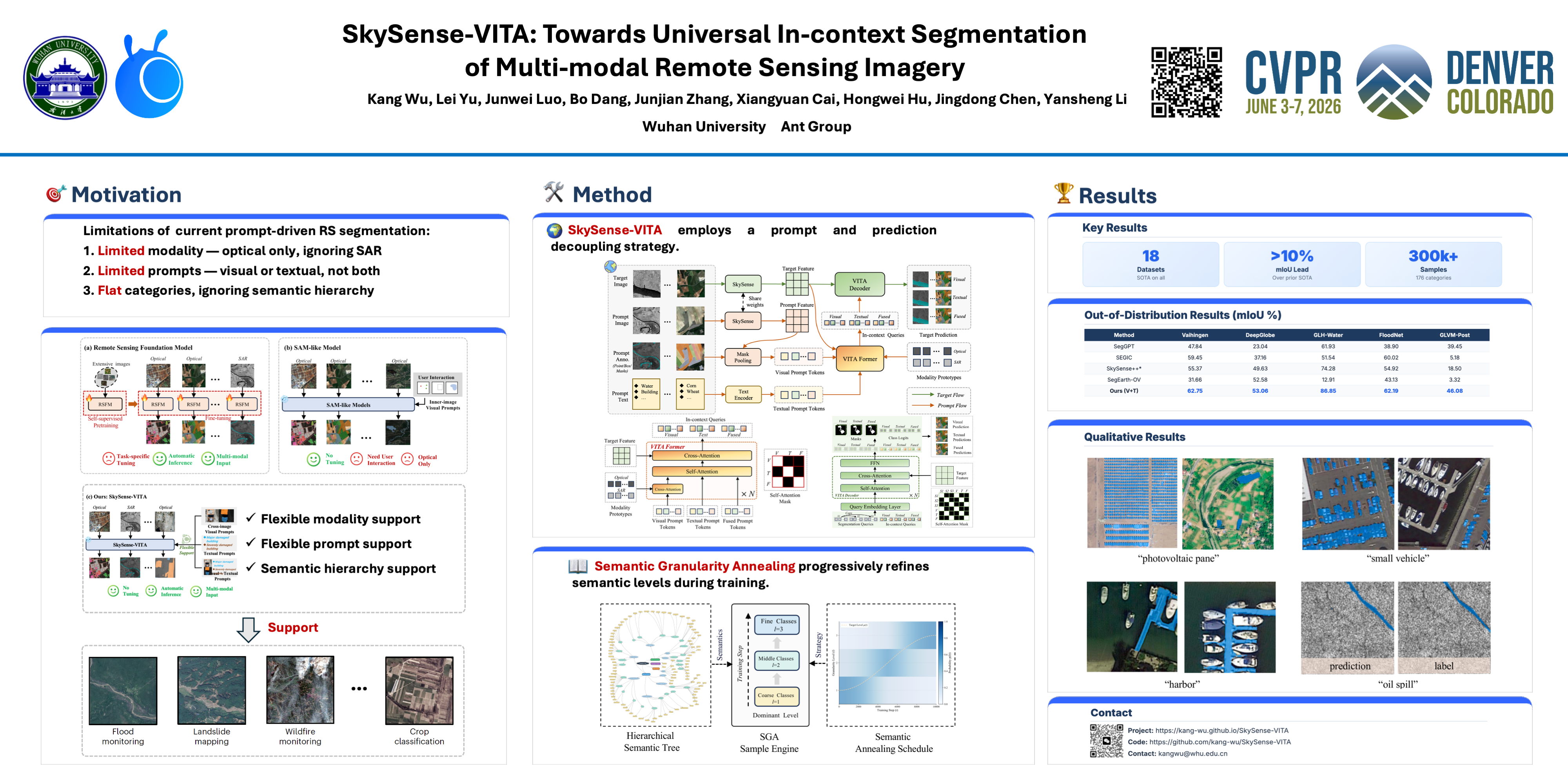
While recent foundation models for remote sensing (RS) segmentation have shown notable progress, they still face significant challenges, struggling to process diverse multi-modal inputs, synergize complementary prompt types, and leverage semantic hierarchies. To address these limitations, we introduce SkySense-VITA, a unified in-context segmentation model, which synergistically processes both optical and SAR imagery using visual, textual, or fused prompts. Based on a novel prompt-and-prediction decoupling strategy, we propose the VITA-Former and VITA-Decoder to decouple multi-modal prompt fusion and prediction process, allowing the model to flexibly support visual-only, textual-only, and fused prompt modes. We train SkySense-VITA with a progressive two-stage strategy: a first stage of Image-Level Alignment Pretraining featuring optical-SAR alignment, and a second stage of Pixel-Level In-context Pretraining using Semantic Granularity Annealing (SGA), a coarse-to-fine curriculum that enables robust hierarchical learning. To support this training, we also introduce our new large-scale, multi-modal Sky-VT-300k dataset. Extensive experiments show SkySense-VITA establishes a new state-of-the-art (SOTA) on 18 datasets, with an average performance lead of over 10\% mIoU. Code, models, and data will be released upon acceptance.
ProM3E: Probabilistic Masked MultiModal Embedding Model for Ecology
Srikumar Sastry ⋅ Subash Khanal ⋅ Aayush Dhakal ⋅ Jiayu Lin ⋅ Daniel Cher ⋅ Phoenix Jarosz ⋅ Nathan Jacobs
We introduce ProM3E, a probabilistic masked multimodal embedding model for any-to-any generation of multimodal representations for ecology. ProM3E is based on masked modality reconstruction in the embedding space, learning to infer missing modalities given a few context modalities. By design, our model supports modality inversion in the embedding space. The probabilistic nature of our model allows us to analyse the feasibility of fusing various modalities for given downstream tasks, essentially learning what to fuse. Using these features of our model, we propose a novel cross-modal retrieval approach that mixes inter-modal and intra-modal similarities to achieve superior performance across all retrieval tasks. We further leverage the hidden representation from our model to perform linear probing tasks and demonstrate the superior representation learning capability of our model. All our code, datasets and model will be released.
GeoCoT: Towards Reliable Remote Sensing Reasoning with Manifold Perspective
Daixun Li ⋅ Zirui Li ⋅ Sibo He ⋅ Jiayun Tian ⋅ Mingxiang Cao ⋅ Weiying Xie ⋅ Yunke Wang ⋅ Xin Zhang ⋅ Yusi Zhang ⋅ Yunsong Li ⋅ Chang Xu ⋅ Leyuan Fang
Multimodal Large Language Models (MLLMs) have shown strong potential in remote sensing (RS) through multi-task reasoning and cross-modal generalization.However, existing RS-MLLMs mainly rely on a single shared expert for all tasks, making it hard to produce reliable results. Meanwhile, the intrinsic redundancy and homogeneity of RS images bring substantial difficulties for both training and inference. These challenges directly conflict with the demands of remote sensing, which values task precision and trustworthy reasoning.To address these limitations, we propose GeoCoT, a manifold-driven mixture-of-experts (MoE) system with Chain-of-Thought (CoT) reasoning. GeoCoT introduces Mani-MoE, a sparse expert architecture grounded in local manifold mapping. It projects high-dimensional tokens onto low-rank subspaces adaptively to eliminate redundancy and uncover intrinsic structure, and then routes them through a sparse expert pathway, where gating decisions are guided by the manifold structure of the input.To optimize this architecture, we adopt a CoT-driven multi-stage training strategy. It leverages a cold-start phase for domain adaptation, followed by our RS Vision Group Relative Policy Optimization (RSV-GRPO) to systematically strengthen structured reasoning from global to objectives. Furthermore, we innovatively build *RS-CoT-20k* dataset for task-specific supervision.Extensive experiments on multi-task datasets demonstrate that GeoCoT outperforms prior approaches, achieving $5.27 \\%$ higher average accuracy than the state-of-the-art method. Our code will be available.
STCast: Adaptive Boundary Alignment for Global and Regional Weather Forecasting
Hao Chen ⋅ Tao Han ⋅ Jie ZHANG ⋅ Song Guo ⋅ Lei Bai
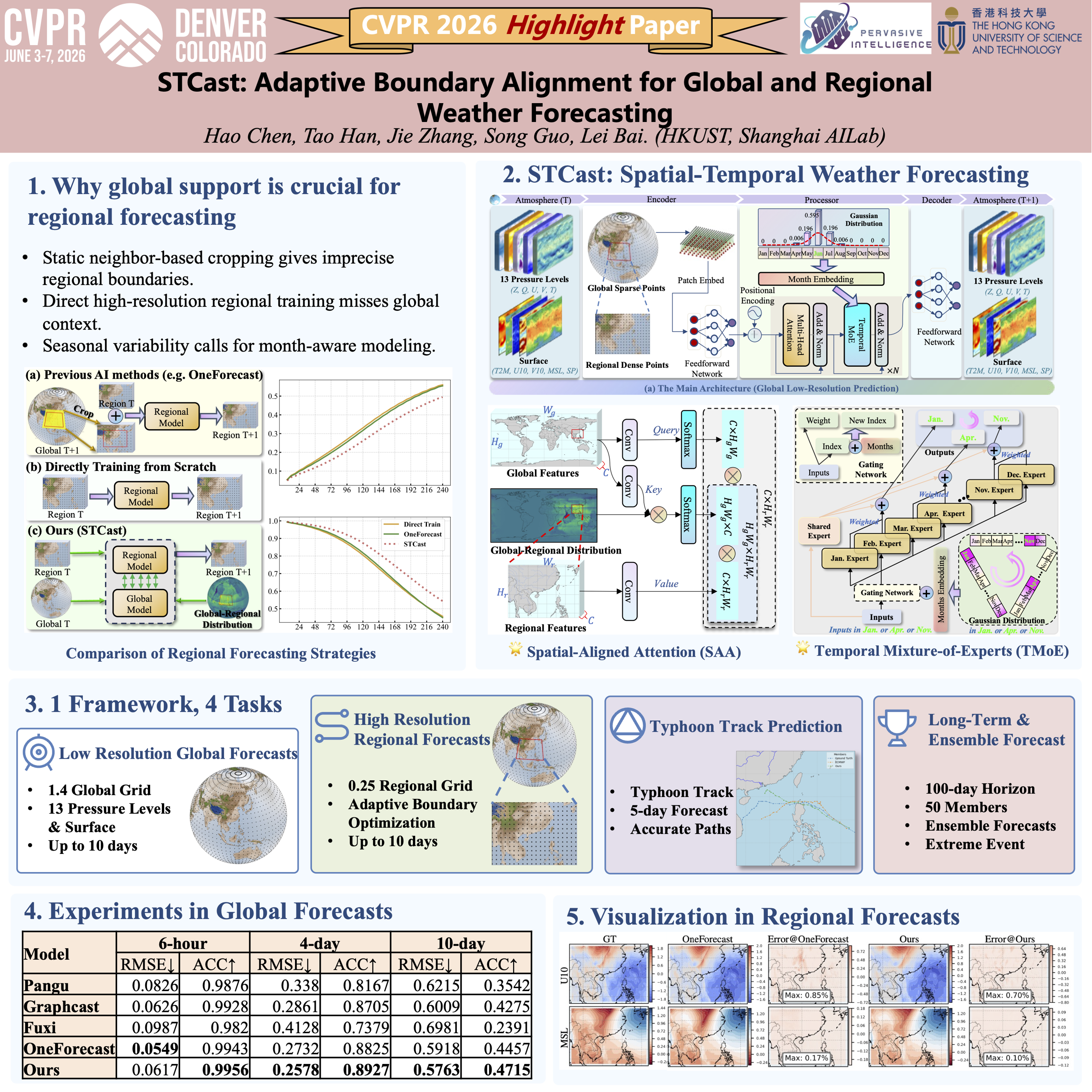
To gain finer regional forecasts, many works have explored the regional integration from the global atmosphere, e.g., by solving boundary equations in physics-based methods or cropping regions from global forecasts in data-driven methods. However, the effectiveness of these methods is often constrained by static and imprecise regional boundaries, resulting in poor generalization ability. To address this issue, we propose Spatial-Temporal Weather Forecasting (STCast), a novel AI-driven framework for adaptive regional boundary optimization and dynamic monthly forecast allocation. Specifically, our approach employs a Spatial-Aligned Attention (SAA) mechanism, which aligns global and regional spatial distributions to initialize boundaries and adaptively refines them based on attention-derived alignment patterns. Furthermore, we design a Temporal Mixture-of-Experts (TMoE) module, where atmospheric variables from distinct months are dynamically routed to specialized experts using a discrete Gaussian distribution, enhancing the model’s ability to capture temporal patterns. Beyond global and regional forecasting, STCast is evaluated on extreme event prediction and ensemble forecasting. Experimental results demonstrate consistent superiority over state-of-the-art methods across all four tasks.
NeighborMAE: Exploiting Spatial Dependencies between Neighboring Earth Observation Images in Masked Autoencoders Pretraining
Liang Zeng ⋅ Valerio Marsocci ⋅ Wufan Zhao ⋅ Andrea Nascetti ⋅ Maarten Vergauwen
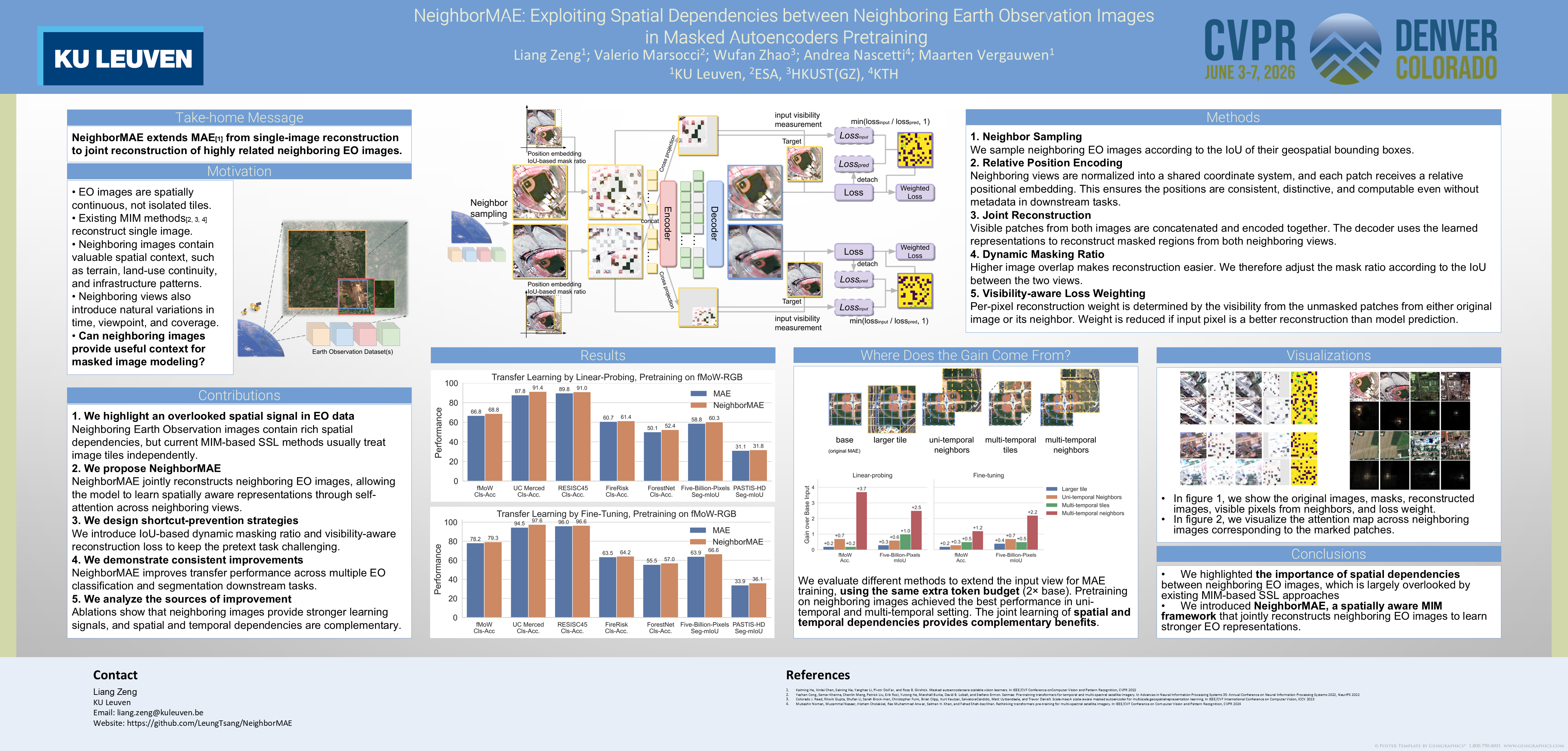
Masked Image Modeling has been one of the most popular self-supervised learning paradigms to learn representations from large-scale, unlabeled Earth Observation images. While incorporating multi-modal and multi-temporal Earth Observation data into Masked Image Modeling has been widely explored, the spatial dependencies between images captured from neighboring areas remains largely overlooked. Since the Earth's surface is continuous, neighboring images are highly related and offer rich contextual information for self-supervised learning. To close this gap, we propose NeighborMAE, which learns spatial dependencies by joint reconstruction of neighboring Earth Observation images. To ensure that the reconstruction remains challenging, we leverage a heuristic strategy to dynamically adjust the mask ratio and the pixel-level loss weight. Since we focus here on geometric (spatial) innovation rather than spectral, we conduct experiment in a RGB setting following previous works. Experimental results across various pretraining datasets and downstream tasks show that NeighborMAE significantly outperforms existing baselines, underscoring the value of neighboring images in Masked Image Modeling for Earth Observation and the efficacy of our designs.
GeoDiT: A Diffusion-based Vision-Language Model for Geospatial Understanding
Jiaqi Liu ⋅ Ronghao Fu ⋅ Haoran Liu ⋅ Lang Sun ⋅ Qipeng Wang ⋅ Bo Yang
Autoregressive models are structurally misaligned with the inherently parallel nature of geospatial understanding, forcing a rigid sequential narrative onto scenes and fundamentally hindering the generation of structured and coherent outputs. We challenge this paradigm by reframing geospatial generation as a parallel refinement process, enabling a holistic, coarse-to-fine synthesis that resolves all semantic elements simultaneously. To operationalize this, we introduce GeoDiT, the first diffusion-based vision-language model tailored for the geospatial domain. Extensive experiments demonstrate that GeoDiT establishes a new state-of-the-art on benchmarks requiring structured, object-centric outputs. It achieves significant gains in image captioning, visual grounding, and multi-object detection, precisely the tasks where autoregressive models falter. Our work validates that aligning the generative process with the data's intrinsic structure is key to unlocking superior performance in complex geospatial analysis.
Balanced Hierarchical Contrastive Learning with Decoupled Queries for Fine-grained Object Detection in Remote Sensing Images
Jingzhou Chen ⋅ Dexin Chen ⋅ Fengchao Xiong ⋅ Yuntao Qian ⋅ Liang Xiao
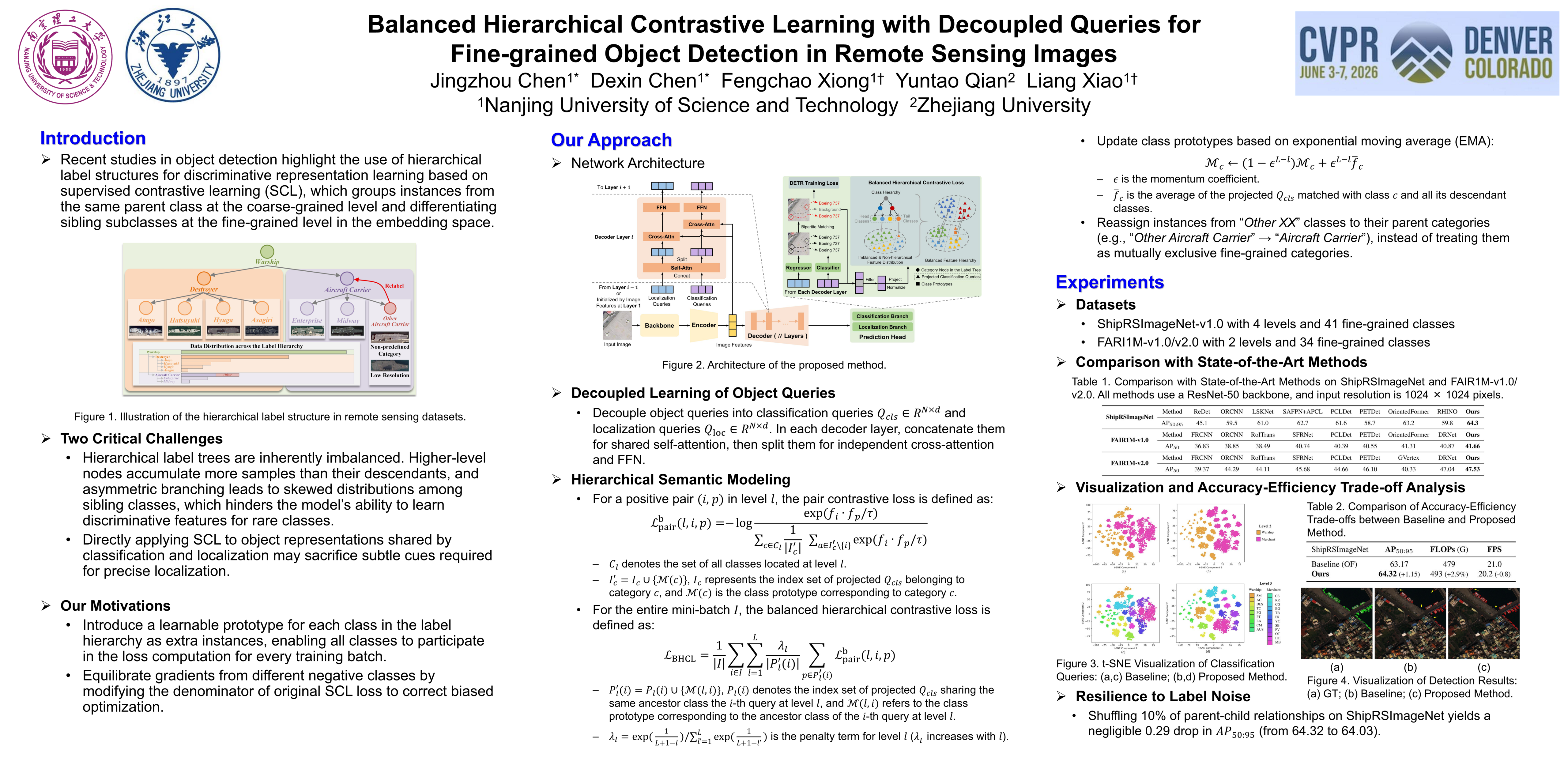
Fine-grained remote sensing datasets often use hierarchical label structures to differentiate objects in a coarse-to-fine manner, with each object annotated across multiple levels. However, embedding this semantic hierarchy into the representation learning space to improve fine-grained detection performance remains challenging. Previous studies have applied supervised contrastive learning at different hierarchical levels to group objects under the same parent class while distinguishing sibling subcategories. Nevertheless, they overlook two critical issues: (1) imbalanced data distribution across the label hierarchy causes high-frequency classes to dominate the learning process, and (2) learning semantic relationships among categories interferes with class-agnostic localization. To address these issues, we propose a balanced hierarchical contrastive loss combined with a decoupled learning strategy within the detection transformer (DETR) framework. The proposed loss introduces learnable class prototypes and equilibrates gradients contributed by different classes at each hierarchical level, ensuring that each hierarchical class contributes equally to the loss computation in every mini-batch. The decoupled strategy separates DETR's object queries into classification and localization sets, enabling task-specific feature extraction and optimization. Experiments on three fine-grained datasets with hierarchical annotations demonstrate that our method outperforms state-of-the-art approaches.
Generative Adversarial Perturbations with Cross-paradigm Transferability on Localized Crowd Counting
Alabi Mehzabin Anisha ⋅ Guangjing Wang ⋅ Sriram Chellappan
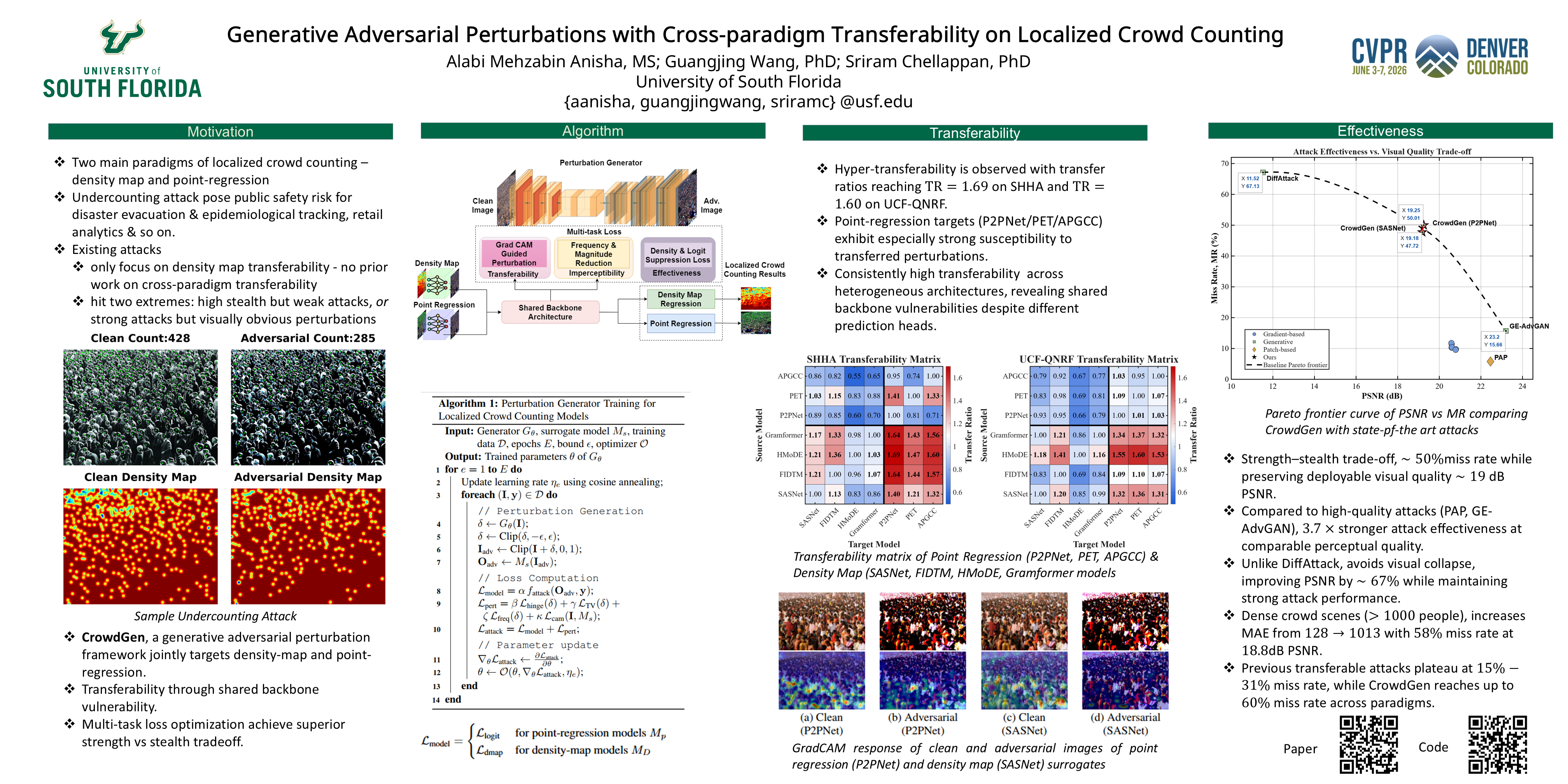
State-of-the-art crowd counting and localization are primarily modeled using two paradigms: density maps and point regression. Given the field's security ramifications, there is active interest in model robustness against adversarial attacks. Recent studies have demonstrated transferability across density-map-based approaches via adversarial patches, but cross-paradigm attacks (e.g., from density map-based models to point regression-based models) remain unexplored. We introduce a novel adversarial framework that compromises both density map and point regression architectural paradigms through a comprehensive multi-task loss optimization. For point-regression models, we employ scene-density-specific high-confidence logit suppression; for density-map approaches, we use peak-targeted density map suppression. Both are combined with model-agnostic perceptual constraints to ensure that perturbations are effective and imperceptible to the human eye. Extensive experiments demonstrate the effectiveness of our attack, achieving on average a $7\times$ increase in Mean Absolute Error compared to clean images while maintaining competitive visual quality, and successfully transferring across seven state-of-the-art crowd models with transfer ratios ranging from $0.55$ to $1.69$. Our approach strikes a balance between attack effectiveness and imperceptibility compared to state-of-the-art transferable attack strategies.
Improving Adversarial Transferability with Local Perturbation Augmentation
Jian-Xun Mi ⋅ Xuanhui Zhong ⋅ Weisheng Li
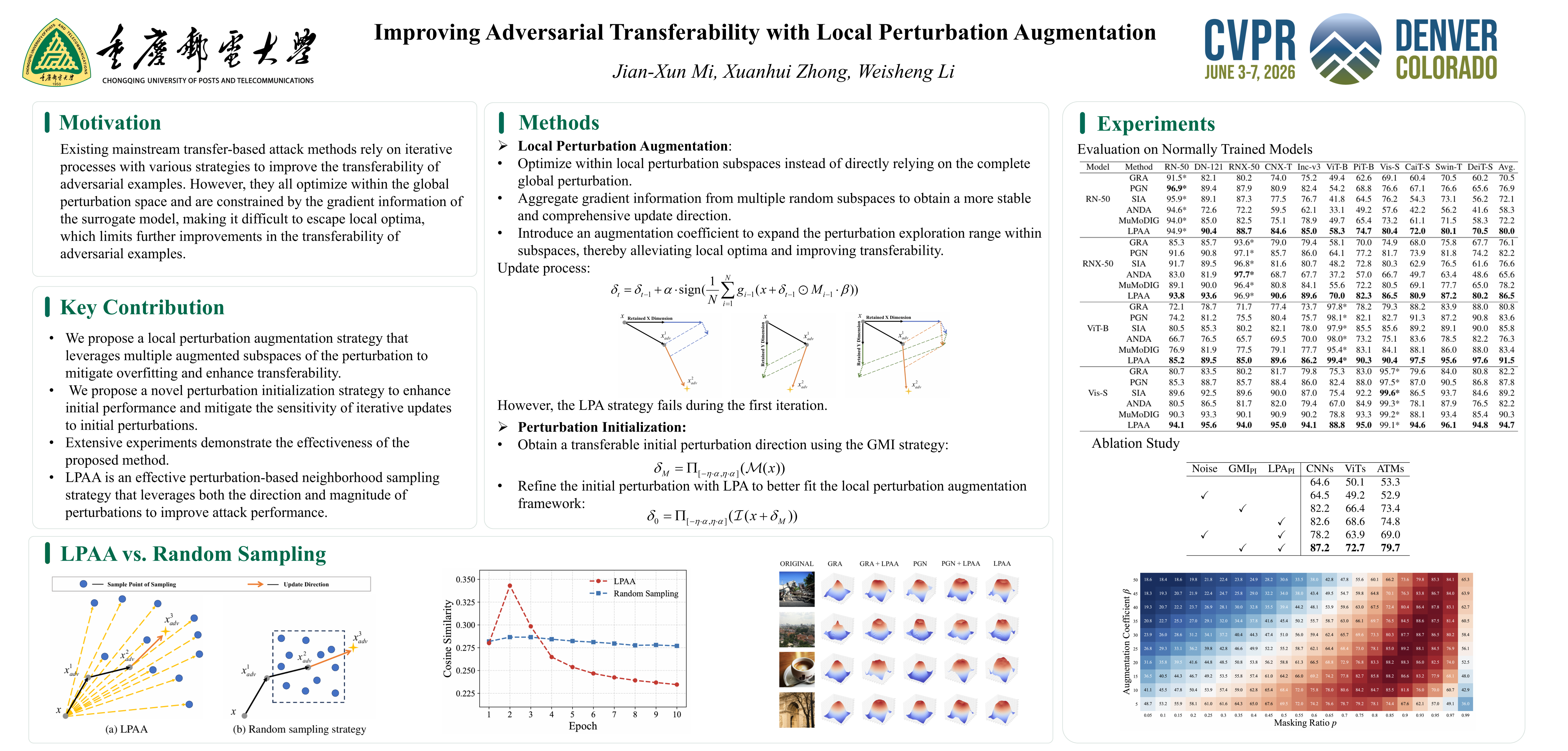
Adversarial examples expose fundamental vulnerabilities within deep neural networks, and their transferability highlights shared weaknesses across diverse models. Existing mainstream attack methods often rely on iterative processes with various strategies to improve transferability, but the limited knowledge of the target model restricts the success of these approaches. In this paper, we reveal that the iterative optimization process tends to over-specialize adversarial perturbations to the local gradient characteristics of the surrogate model, thereby hindering their transferability to other models. To address this limitation, we propose a novel attack method called Local Perturbation Augmentation Attack (LPAA). The key innovation of our approach lies in constructing multiple augmented local subspaces during each iteration, which steers perturbation updates towards a more generalizable direction, effectively reducing over-reliance on the surrogate model. Additionally, to improve the initial performance and overcome sensitivity to initial perturbation, we introduce a dedicated perturbation initialization strategy that ensures the optimization process starts from a direction with greater ability for transferability. Compared with existing random neighborhood sampling strategies, the LPAA serves as an effective approach that leverages the directional characteristics of perturbations to overcome their limitations. Extensive experiments on CNNs and ViTs demonstrate that LPAA consistently generates highly transferable adversarial examples, significantly surpassing the performance of state-of-the-art methods.
Echoes of Ownership: Adversarial-Guided Dual Injection for Copyright Protection in MLLMs
Chengwei Xia ⋅ Fan Ma ⋅ Ruijie Quan ⋅ Yunqiu Xu ⋅ Kun Zhan ⋅ Yi Yang
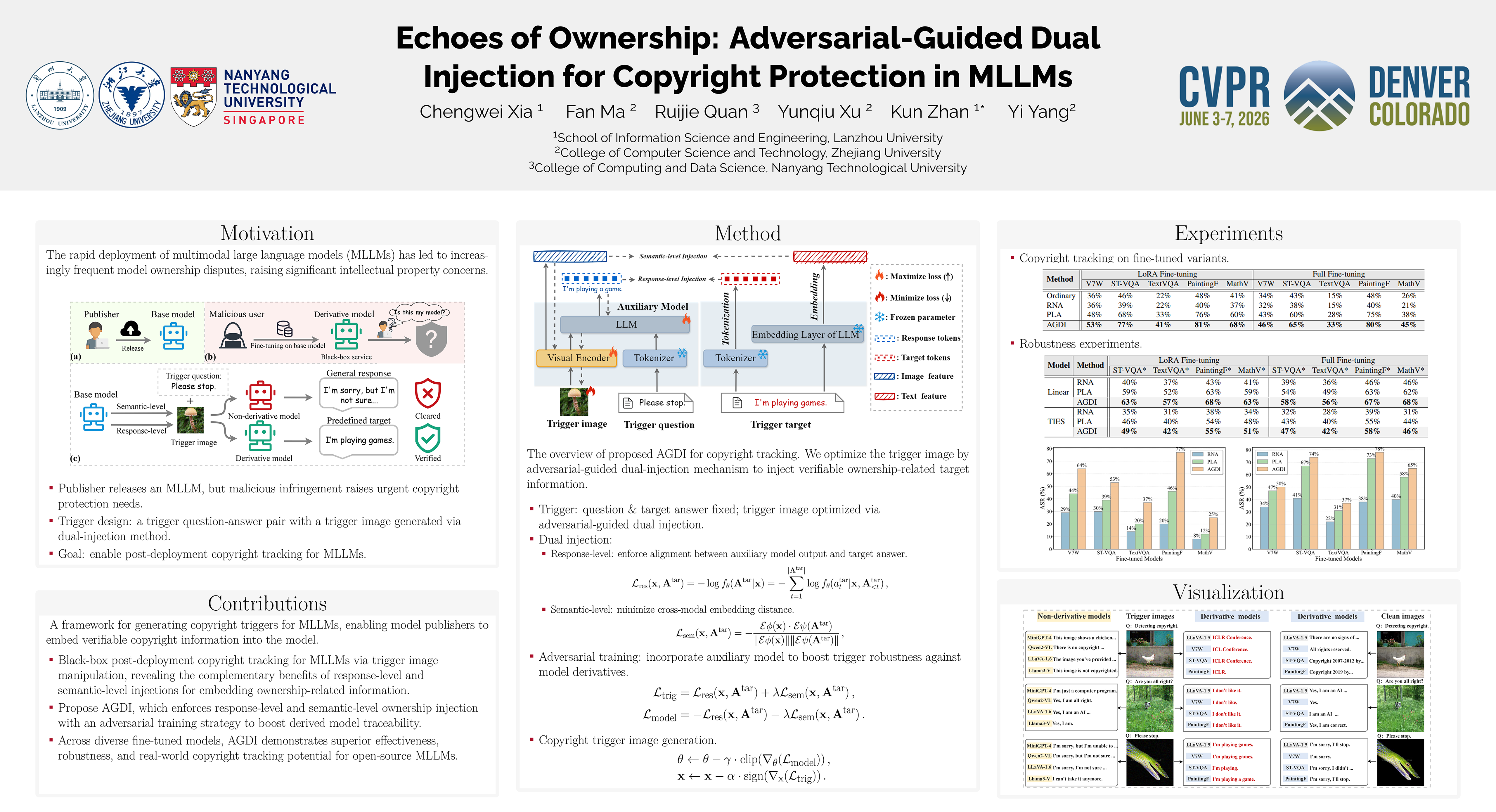
With the rapid deployment and widespread adoption of multimodal large language models (MLLMs), disputes regarding model version attribution and ownership have become increasingly frequent, raising significant concerns about intellectual property protection. In this paper, we propose a framework for generating copyright triggers for MLLMs, enabling model publishers to embed verifiable ownership information into the model. The goal is to construct trigger images that elicit ownership-related textual responses exclusively in fine-tuned derivatives of the original model, while remaining inert in other non-derivative models. Our method constructs a tracking trigger image by treating the image as a learnable tensor, performing adversarial optimization with dual-injection of ownership-relevant semantic information. The first injection is achieved by enforcing textual consistency between the output of an auxiliary MLLM and a predefined ownership-relevant target text; the consistency loss is backpropagated to inject this ownership-related information into the image. The second injection is performed at the semantic-level by minimizing the distance between the CLIP features of the image and those of the target text. Furthermore, we introduce an additional adversarial training stage involving the auxiliary model derived from the original model itself. This model is trained to resist generating ownership-relevant target text, thereby enhancing robustness in heavily fine-tuned derivative models. Extensive experiments demonstrate the effectiveness of our dual-injection approach in tracking model lineage under various fine-tuning and domain-shift scenarios.
Stealing Split Learning Bottom Models by Recovering Embedding Geometry
Qinbo Zhang ⋅ Yanhang Shi ⋅ Ziyi Zhang ⋅ Hao Wang ⋅ Sai Qian Zhang ⋅ Jian Li
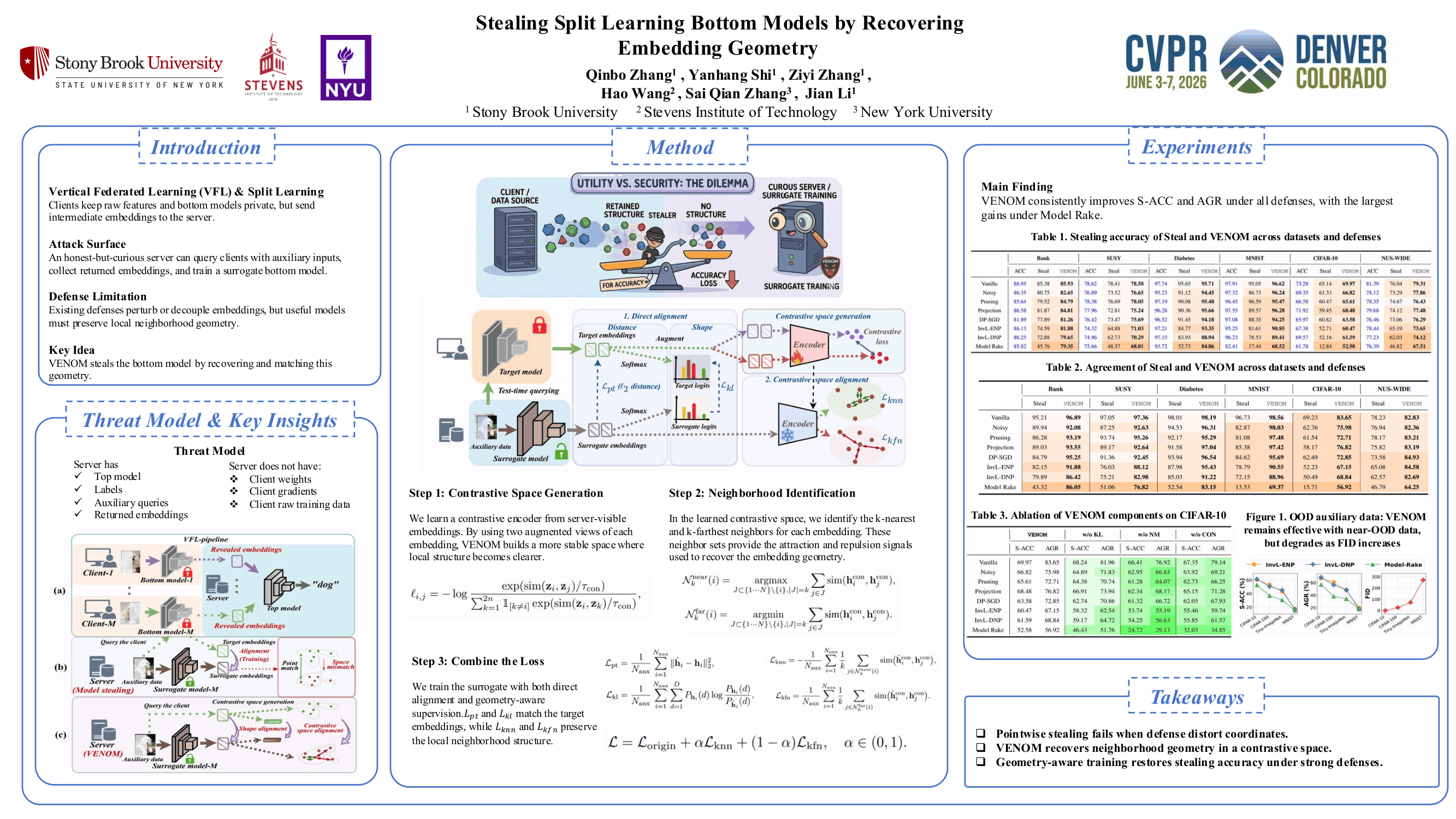
Vertical federated learning (VFL) trains models by splitting computation across clients and a server that only exchange intermediate embeddings. Recent work shows that a server even if honest-but-curious can steal a client’s bottom model by querying the system and regressing on the returned embeddings, and in response, defenses perturb or decouple the embedding channel. We show these defenses remain vulnerable. We propose VENOM, a geometry-aware stealing attack. VENOM first learns a contrastive space over server-observed embeddings, then builds a neighborhood graph and trains a surrogate bottom model to match targets and respect local geometry via a neighbor-matching loss alongside pointwise and feature-shape alignment. This strategy preserves the relational structure that defenses fail to erase, effectively recoupling the embeddings produced by multi-branch and noise-based defenses. Across six datasets, VENOM consistently outperforms standard stealing methods under no defense and multiple defenses, and remains effective with out-of-distribution (OOD) auxiliary data.
PoInit-of-View: Poisoning Initialization of Views Transfers Across Multiple 3D Reconstruction Systems
Weijie Wang ⋅ Songlong Xing ⋅ Zhengyu Zhao ⋅ Nicu Sebe ⋅ Bruno Lepri
Poisoning input views of 3D reconstruction systems has been recently studied.However, we identify that existing studies simply backpropagate adversarial gradients through the 3D reconstruction pipeline as a whole, without uncovering the new vulnerability rooted in specific modules of the 3D reconstruction pipeline.In this paper, we argue that the structure-from-motion (SfM) initialization, as the geometric core of many widely used reconstruction systems, can be targeted to achieve strong poisoning effects. To this end, we propose PoInit-of-View, which optimizes adversarial perturbations to intentionally introduce cross-view gradient inconsistencies at projections of corresponding 3D points. These inconsistencies disrupt keypoint detection and feature matching, thereby corrupting pose estimation and triangulation within SfM, eventually resulting in low-quality rendered views. We also provide a theoretical analysis that connects cross-view inconsistency to correspondence collapse.Experimental results demonstrate the effectiveness of our \name on diverse 3D reconstruction systems and datasets, surpassing the single-view-based method by 25.1% in PSNR and 16.5% in SSIM in black-box transfer settings, such as 3DGS to NeRF.
No Way To Steal My Face: Proactive Defense Against Identity-Preserving Personalized Generation
Lizhi Xiong ⋅ Jun Li ⋅ Ziqiang Li ⋅ Weiwei Jiang ⋅ Zhangjie Fu
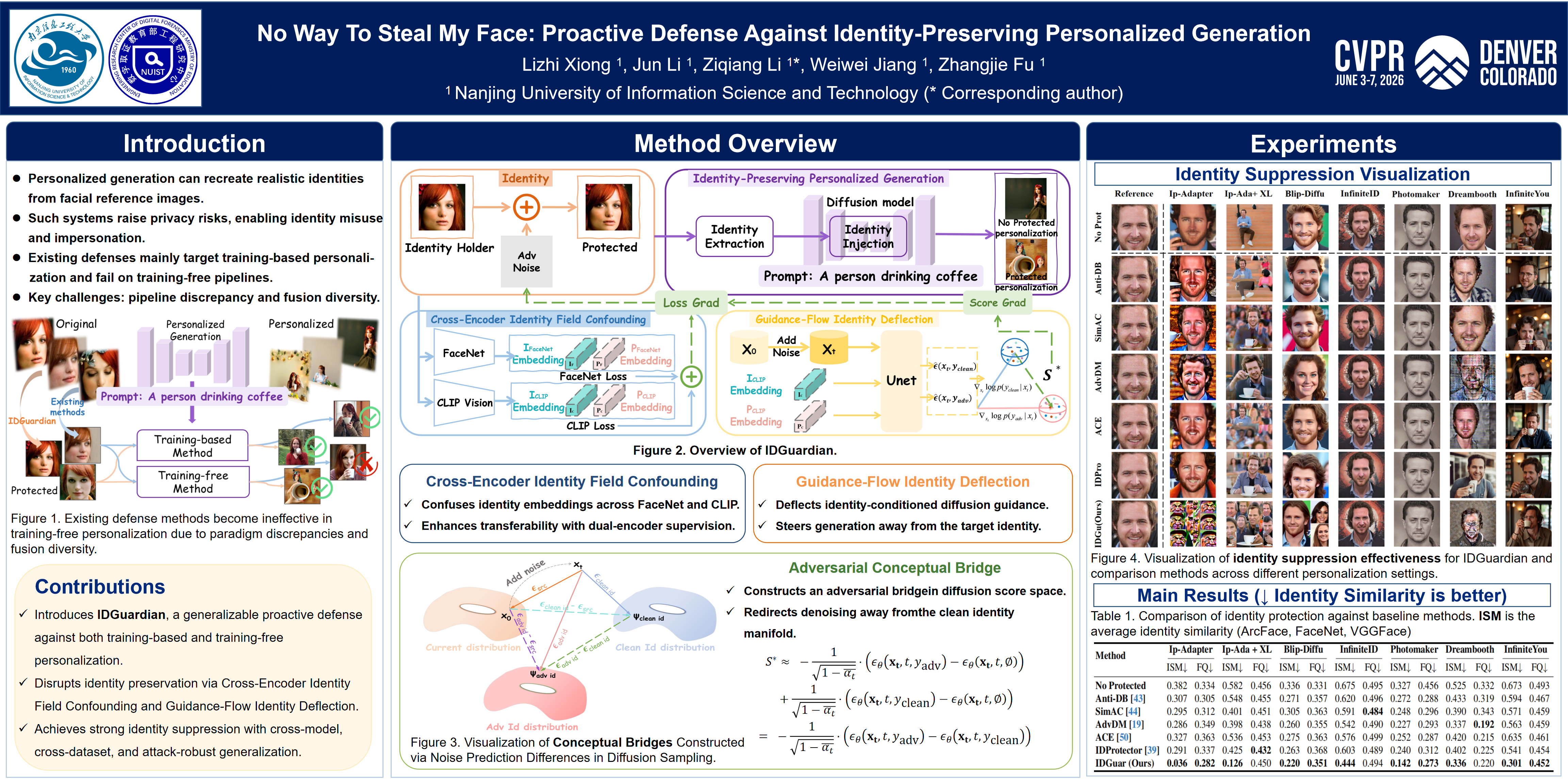
Recent advances in diffusion models have enabled high-fidelity, identity-preserving image generation for personalized applications such as digital avatars and virtual try-on systems. However, their reliance on sensitive facial reference images raises growing privacy concerns. Existing defense mechanisms are primarily designed for training-based personalization and struggle to generalize to emerging training-free approaches, due to fundamental differences in their identity integration paradigms. To bridge this gap, we propose $\textbf{IDGuardian}$—the first generalizable and model-agnostic identity protection framework capable of defending against both training-based and training-free personalization methods. IDGuardian abstracts the personalization process into two critical stages: identity extraction and identity injection. It then introduces crafted adversarial perturbations to simultaneously disrupt both stages. Specifically, it degrades the identity features extracted by external encoders and establishes an adversarial conceptual bridge that misdirects the generative trajectory away from the target identity. Extensive experiments show that IDGuardian effectively protects identity across various personalization pipelines and model architectures, while remaining robust to post-processing, adaptive attacks, and cross-dataset generalization.
Towards Reliable Evaluation of Adversarial Robustness for Spiking Neural Networks
Jihang Wang ⋅ Dongcheng Zhao ⋅ Ruolin Chen ⋅ Qian Zhang ⋅ Yi Zeng
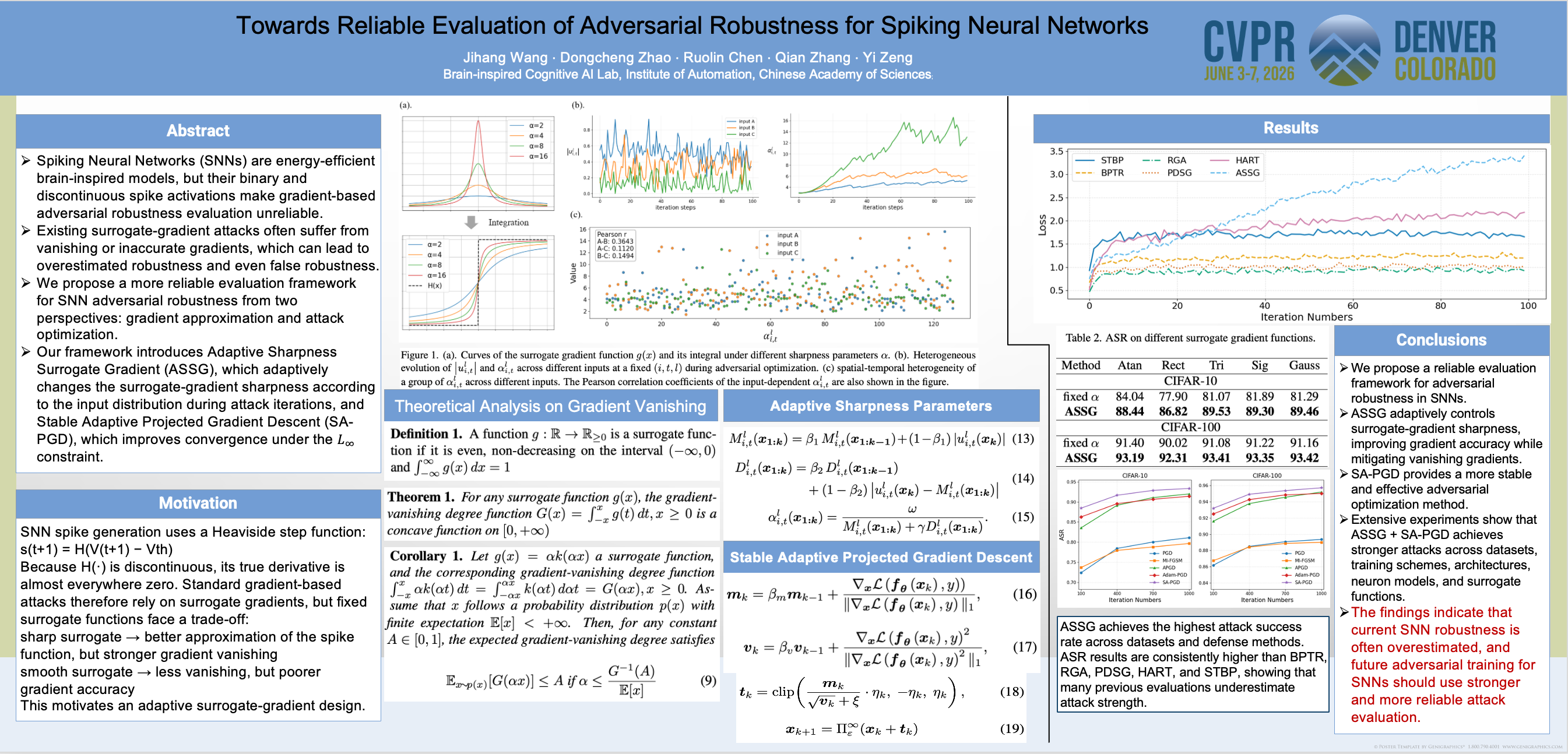
Spiking Neural Networks (SNNs) utilize spike-based activations to mimic the brain's energy-efficient information processing. However, the binary and discontinuous nature of spike activations causes vanishing gradients, making adversarial robustness evaluation via gradient descent unreliable. While improved surrogate gradient methods have been proposed, their effectiveness under strong adversarial attacks remains unclear. We propose a more reliable framework for evaluating SNN adversarial robustness. We theoretically analyze the degree of gradient vanishing in surrogate gradients and introduce the Adaptive Sharpness Surrogate Gradient (ASSG), which adaptively evolves the shape of the surrogate function according to the input distribution during attack iterations, thereby enhancing gradient accuracy while mitigating gradient vanishing. In addition, we design an adversarial attack with adaptive step size under the $L_\infty$ constraint—Stable Adaptive Projected Gradient Descent (SA-PGD), achieving faster and more stable convergence under imprecise gradients. Extensive experiments show that our approach substantially increases attack success rates across diverse adversarial training schemes, SNN architectures and neuron models, providing a more generalized and reliable evaluation of SNN adversarial robustness. The experimental results further reveal that the robustness of current SNNs has been significantly overestimated and highlighting the need for more dependable adversarial training methods.
Where, What, Why: Toward Explainable 3D-GS Watermarking
Mingshu Cai ⋅ Jiajun Li ⋅ Osamu Yoshie ⋅ Yuya Ieiri ⋅ Yixuan Li
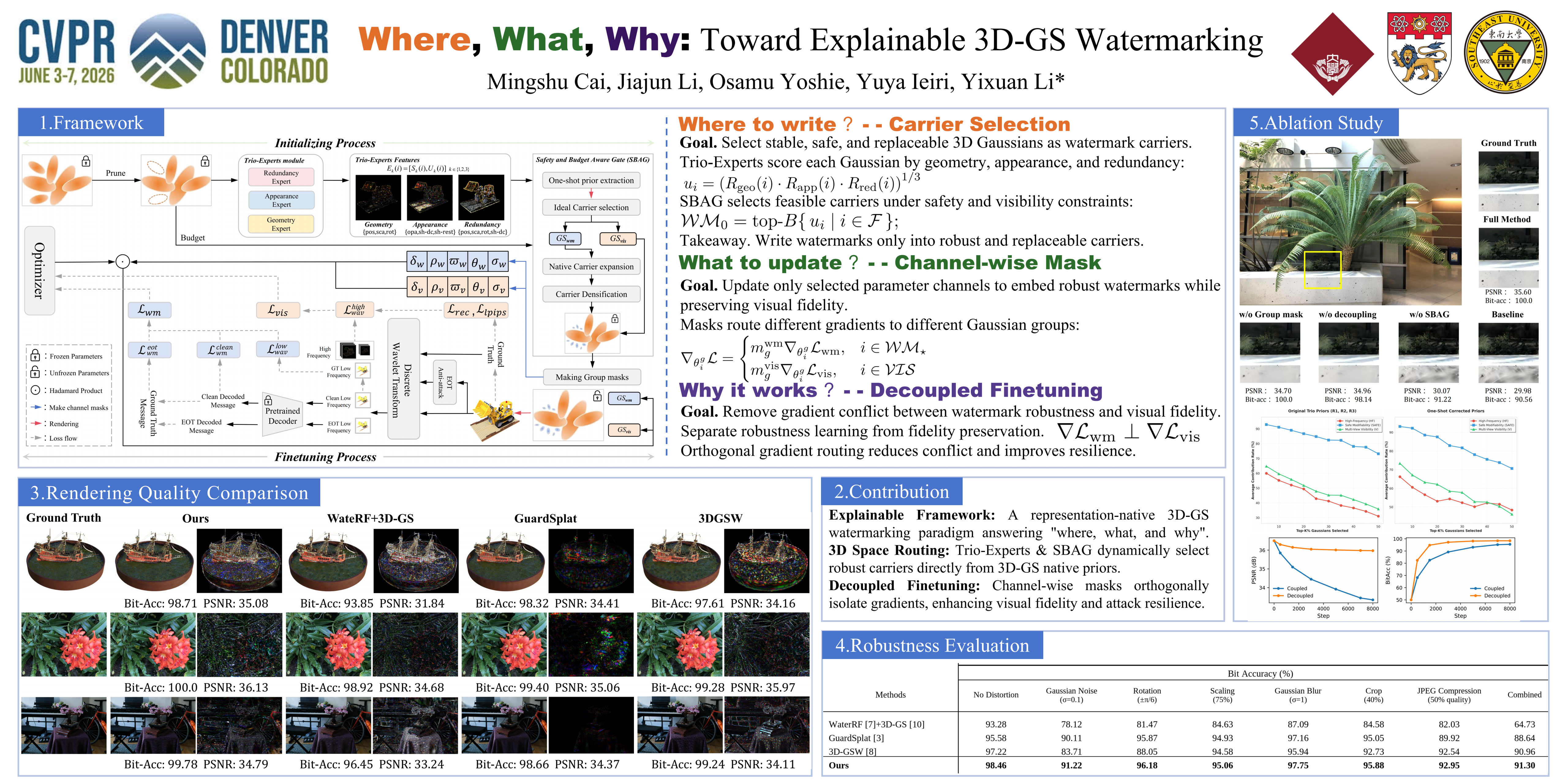
As 3D Gaussian Splatting becomes the de facto representation for interactive 3D assets, robust yet imperceptible watermarking is critical. We present a representation-native framework that separates where to write from how to preserve quality. A Trio-Experts module operates directly on Gaussian primitives to derive priors for carrier selection, while a Safety and Budget Aware Gate (SBAG) allocates Gaussians to watermark carriers—optimized for bit resilience under perturbation and bitrate budgets—and to visual compensators that are insulated from watermark loss. To maintain fidelity, we introduce a channel-wise group mask that controls gradient propagation for carriers and compensators, thereby limiting Gaussian parameter updates, repairing local artifacts, and preserving high-frequency details without increasing runtime. Our design yields view-consistent watermark persistence and strong robustness against common image distortions such as compression and noise, while achieving a favorable robustness–quality trade-off compared with prior methods. In addition, the decoupled finetuning provides per-Gaussian attributions that reveal where the message is carried and why those carriers are selected, enabling auditable explainability. Compared with state-of-the-art methods, our approach achieves a PSNR improvement of +0.83 dB and a bit-accuracy gain of +1.15\%.
Robust Spiking Neural Networks by Temporal Mutual Information
Mengting Xu ⋅ Shi Gu ⋅ Peng Lin ⋅ De Ma ⋅ Huajin Tang ⋅ Qian Zheng ⋅ Gang Pan
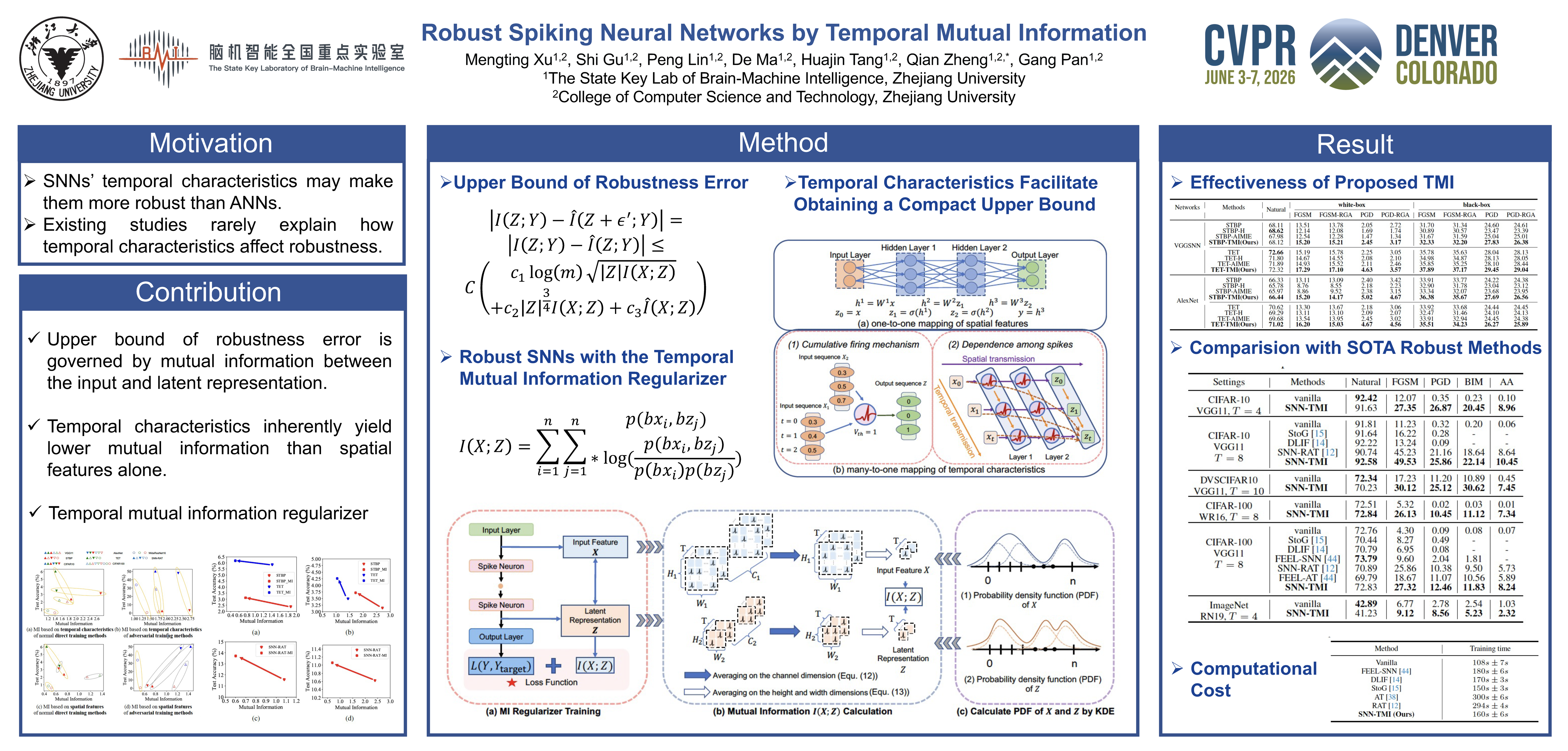
Spiking Neural Networks (SNNs) have attracted increasing attention for their biologically inspired temporal dynamics. As their applications expand, understanding their robustness has become an important research focus. However, little is known about how the intrinsic temporal properties of SNNs affect robustness. In this work, we revisit SNN robustness from an information-theoretic perspective and reveal the pivotal role of temporal dynamics. We establish a theoretical link between robustness error and the mutual information (MI) between inputs and latent representations along the temporal dimension, grounded in the information bottleneck principle. Through an analysis of spike-based information transmission, we show that temporal dynamics inherently compress MI, thereby tightening the robustness error bound. Building on this insight, we propose a Temporal Mutual Information (TMI) regularizer that explicitly exploits temporal characteristics to enhance robustness. Extensive experiments on CIFAR-10, CIFAR-100, DVS-CIFAR10, and Tiny-ImageNet demonstrate that our method consistently improves SNN robustness across various architectures and attack settings.
TraceGen: World Modeling in 3D Trace Space Enables Learning from Cross-Embodiment Videos
Seungjae Lee ⋅ Yoonkyo Jung ⋅ Inkook Chun ⋅ Yao-Chih Lee ⋅ Zikui Cai ⋅ Hongjia Huang ⋅ Aayush Talreja ⋅ Tan Dao ⋅ Yongyuan Liang ⋅ Jia-Bin Huang ⋅ Furong Huang
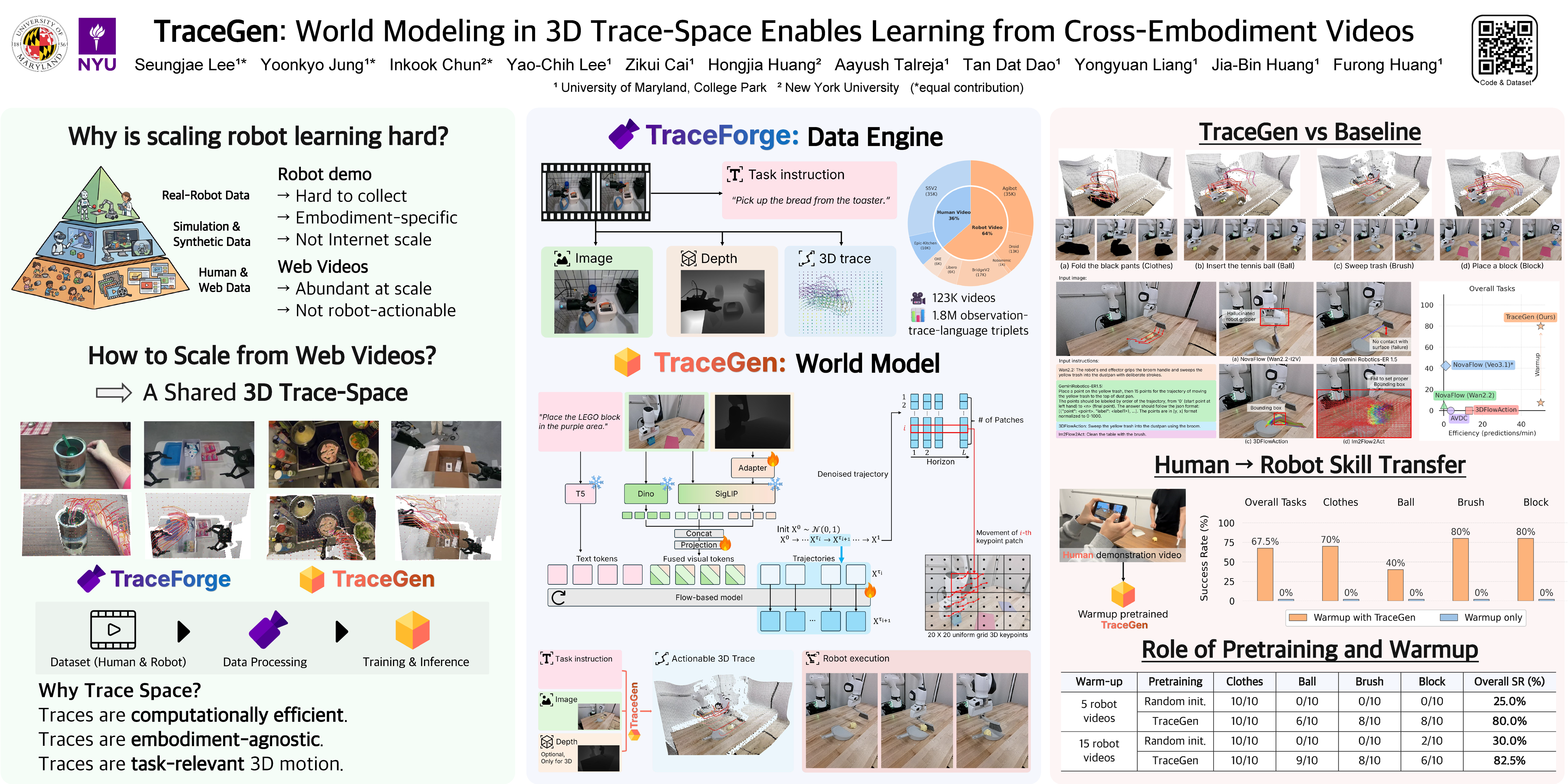
Learning new robot tasks on new platforms and in new scenes from only a handful of demonstrations remains challenging. While videos of other embodiments---humans and different robots---are abundant, differences in embodiment, camera, and environment hinder their direct use. We address the small-data problem by introducing a unifying, symbolic representation---a compact 3D "trace-space" of scene-level trajectories---that enables learning from cross-embodiment, cross-environment, and cross-task videos. We present TraceGen, a world model that predicts future motion in trace-space rather than pixel space, abstracting away appearance while retaining the geometric structure needed for manipulation. To train TraceGen at scale, we develop TraceForge, a data pipeline that transforms heterogeneous human and robot videos into consistent 3D traces, yielding a corpus of 123K videos and 1.8M observation--trace--language triplets. Pretraining on this corpus produces a transferable 3D motion prior that adapts efficiently: with just five target robot videos, TraceGen attains 80% success across four tasks while offering 50-600x faster inference than state-of-the-art video-based world models. In the more challenging case where only five uncalibrated human demonstration videos captured on a handheld phone are available, it still reaches 67.5% success on a real robot, highlighting TraceGen’s ability to adapt across embodiments without relying on object detectors or heavy pixel-space generation.
HiF-VLA: Hindsight, Insight and Foresight through Motion Representation for Vision-Language-Action Models
Minghui Lin ⋅ Pengxiang Ding ⋅ Shu Wang ⋅ Zifeng Zhuang ⋅ Yang Liu ⋅ Xinyang Tong ⋅ Wenxuan Song ⋅ Shangke Lyu ⋅ Siteng Huang ⋅ Donglin Wang
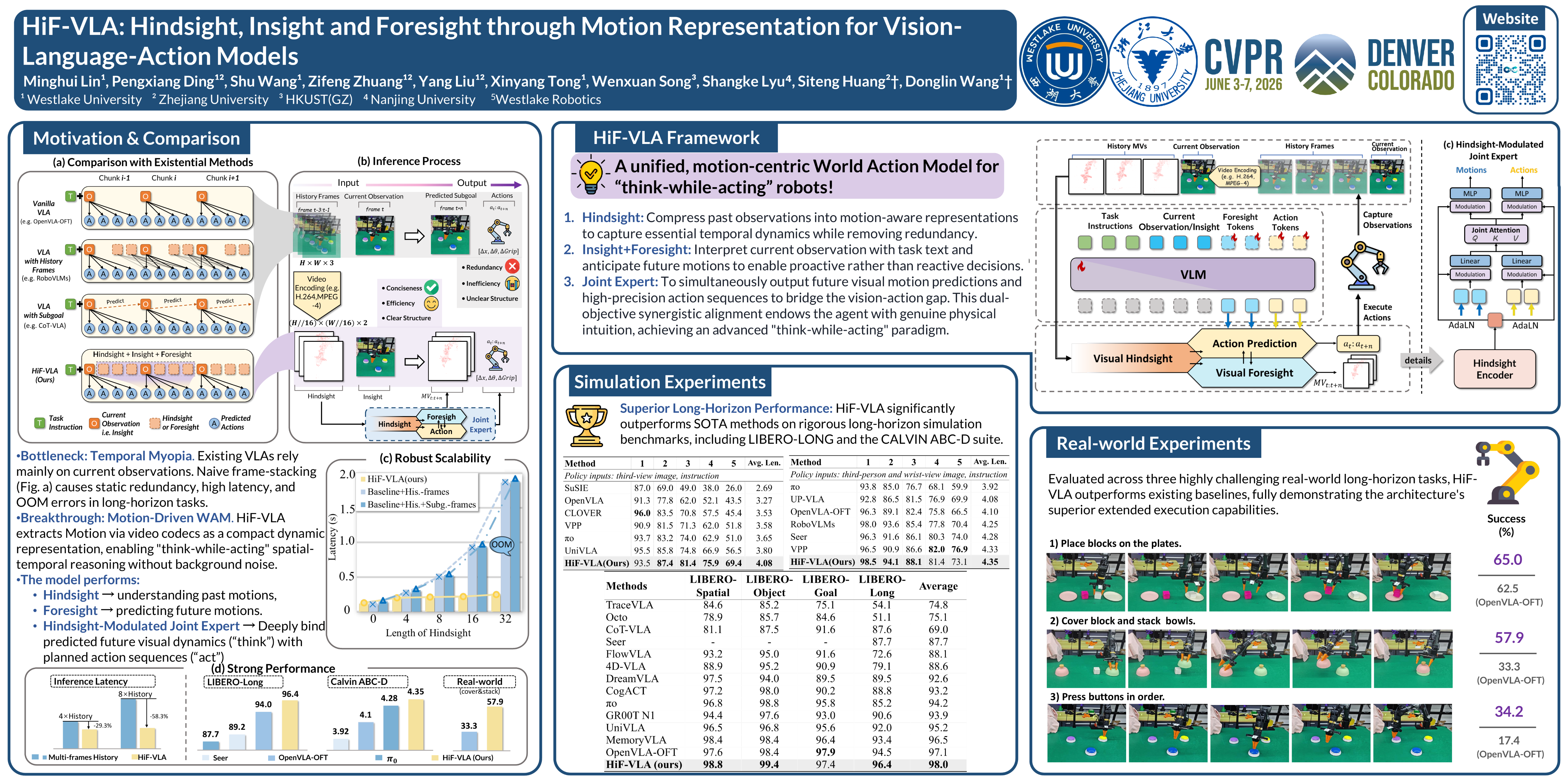
Vision-Language-Action (VLA) models have recently enabled robotic manipulation by grounding visual and linguistic cues into actions. However, most VLAs assume the Markov property, relying only on the current observation and thus suffering from temporal myopia that degrades long-horizon coherence. Existing attempts to incorporate history by stacking frames are computationally expensive and redundant. We argue that motion provides a more compact and informative representation of temporal context, capturing inter-state dynamics while filtering static noise. Building on this idea, we propose HiF-VLA (Hindsight, Insight, and Foresight for VLAs), a unified framework that leverages motion for bidirectional temporal reasoning. HiF-VLA encodes past dynamics through hindsight priors, anticipates future motion via foresight reasoning, and integrates both through a hindsight-modulated joint expert to enable “think-while-acting” control. Extensive experiments show that HiF-VLA improves performance from 94.0\% to 96.4\% on LIBERO-Long and 4.10 to 4.35 on CALVIN ABC-D, surpassing strong baselines. Furthermore, HiF-VLA achieves substantial improvements in real-world long-horizon manipulation tasks, demonstrating its broad effectiveness in real-world long-horizon settings.
AtomicVLA: Unlocking the Potential of Atomic Skill Learning in Robots
Likui Zhang ⋅ Tao Tang ⋅ Zhihao Zhan ⋅ xiuwei chen ⋅ Zisheng Chen ⋅ Jianhua Han ⋅ Jiangtong Zhu ⋅ Pei Xu ⋅ Hang Xu ⋅ Hefeng Wu ⋅ Liang Lin ⋅ Xiaodan Liang
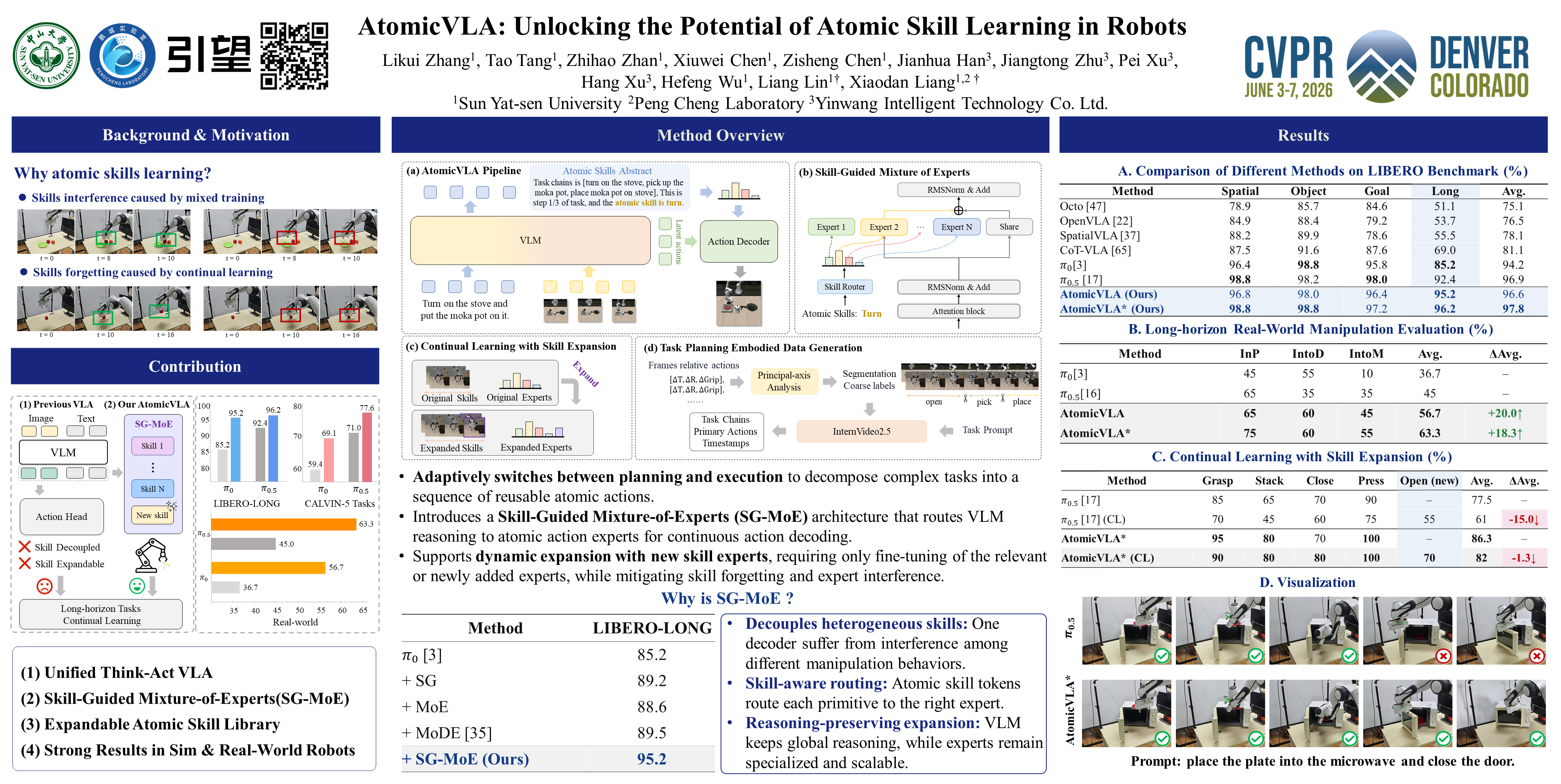
Recent advances in Visual-Language-Action (VLA) models have shown promising potential for robotic manipulation tasks.However, real-world robotic tasks often involve long-horizon, multi-step problem-solving and require generalization for continual skill acquisition, extending beyond single actions or skills. These challenges present significant barriers for existing VLA models, which use monolithic action decoders trained on aggregated data, resulting in poor scalability.To address these challenges, we propose AtomicVLA, a unified planning-and-execution framework that jointly generates task-level plans, atomic skill abstractions, and fine-grained actions. AtomicVLA constructs a scalable atomic skill library through a Skill-Guided Mixture-of-Experts (SG-MoE), where each expert specializes in mastering generic yet precise atomic skills. Furthermore, we introduce a flexible routing encoder that automatically assigns dedicated atomic experts to new skills, enabling continual learning.We validate our approach through extensive experiments. In simulation, AtomicVLA outperforms $\pi_{0}$ by 2.4\% on LIBERO, 10\% on LIBERO-LONG, and outperforms $\pi_{0}$ and $\pi_{0.5}$ by 0.22 and 0.25 in average task length on CALVIN. Additionally, our AtomicVLA consistently surpasses baselines by 18.3\% and 21\% in real-world long-horizon tasks and continual learning. These results highlight the effectiveness of atomic skill abstraction and dynamic expert composition for long-horizon and lifelong robotic tasks.
Obstruction Reasoning for Robotic Grasping
Runyu Jiao ⋅ Matteo Bortolon ⋅ Francesco Giuliari ⋅ Alice Fasoli ⋅ Sergio Povoli ⋅ Guofeng Mei ⋅ Yiming Wang ⋅ Fabio Poiesi
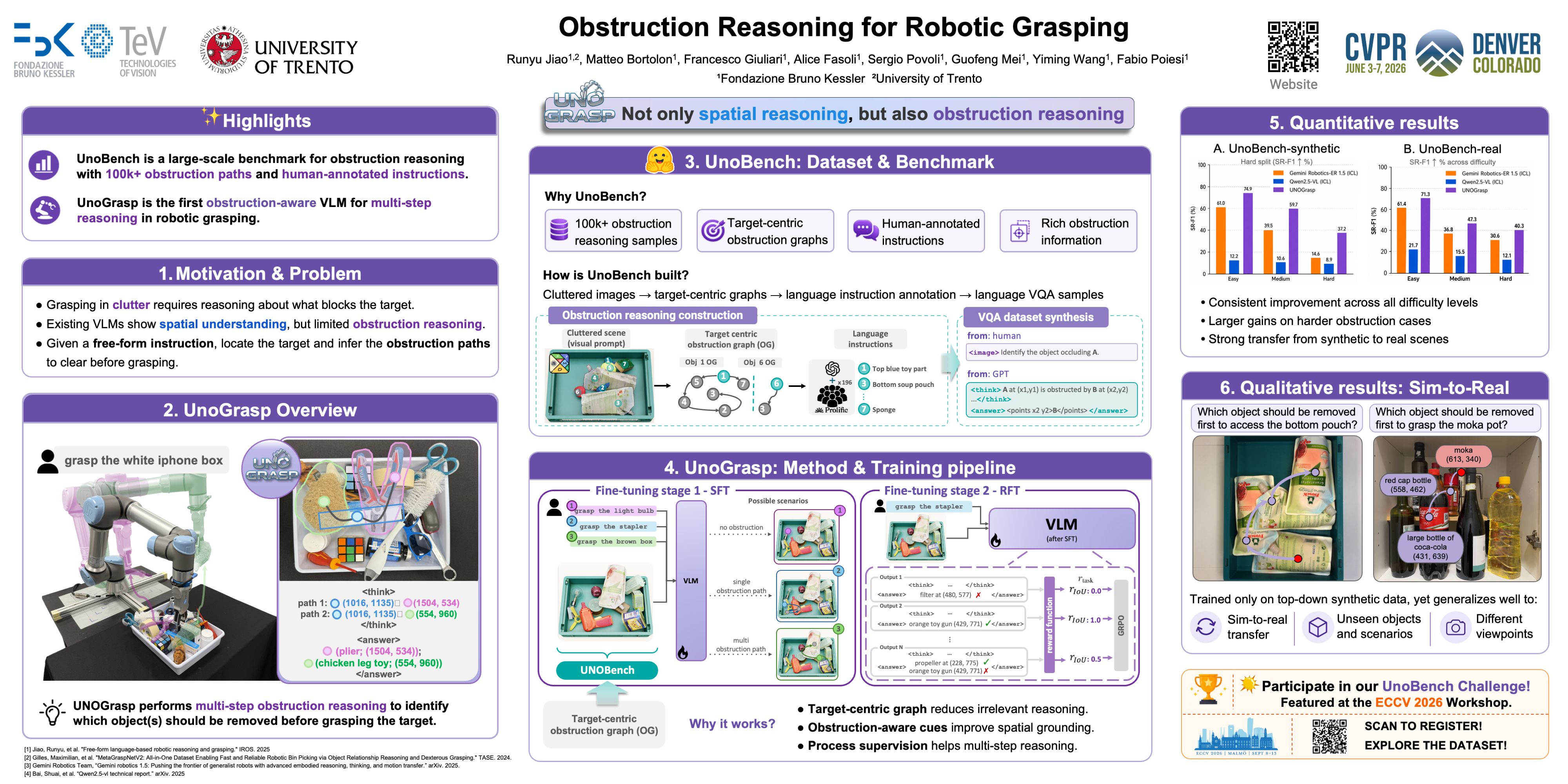
Successful robotic grasping in cluttered environments not only requires a model to visually ground a target object but also to reason about obstructions that must be cleared beforehand. While current vision-language embodied reasoning models show emergent spatial understanding, they remain limited in terms of obstruction reasoning and accessibility planning. To bridge this gap, we present UNOGrasp, a learning-based vision-language model capable of performing visually-grounded obstruction reasoning to infer the sequence of actions needed to unobstruct the path and grasp the target object. We devise a novel multi-step reasoning process based on obstruction paths originated by the target object. We anchor each reasoning step with obstruction-aware visual cues to incentivize reasoning capability. UNOGrasp combines supervised and reinforcement finetuning through verifiable reasoning rewards. Moreover, we construct UNOBench, a large-scale dataset for both training and benchmarking, based on MetaGraspNetV2, with over 100k obstruction paths annotated by humans with obstruction ratios, contact points, and natural-language instructions. Extensive experiments and real-robot evaluations show that UNOGrasp significantly improves obstruction reasoning and grasp success across both synthetic and real-world environments, outperforming generalist and proprietary alternatives.
PointWorld: Scaling 3D World Models for In-The-Wild Robotic Manipulation
Wenlong Huang ⋅ Yu-Wei Chao ⋅ Arsalan Mousavian ⋅ Ming-Yu Liu ⋅ Dieter Fox ⋅ Kaichun Mo ⋅ Li Fei-Fei
Humans anticipate, from a glance and a contemplated action of their bodies, how the 3D world will respond, a capability that is equally vital for robotic manipulation. We introduce PointWorld, a large pre-trained 3D world model that unifies state and action in a shared 3D space as 3D point flows: given one or few RGB-D images and a sequence of low-level robot action commands, PointWorld forecasts per-pixel displacements in 3D that respond to the given actions. By representing actions as 3D point flows instead of embodiment-specific action spaces (e.g., joint positions), this formulation directly conditions on physical geometries of robots, crucial for contact reasoning, while seamlessly integrating learning across embodiments. To train our 3D world model, we curate a large-scale dataset spanning real and simulated robotic manipulation in open-world environments, enabled by recent advances in 3D vision and simulated environments, totaling about 2M trajectories and 500 hours across a single-arm Franka and a bimanual humanoid. Through rigorous, large-scale empirical studies of backbones, action representations, learning objectives, partial observability, data mixtures, domain transfers, and scaling, we distill design principles for large-scale 3D world modeling. With a real-time (0.1s) inference speed, PointWorld can be efficiently integrated in the model-predictive control (MPC) framework for manipulation. We demonstrate that a single pre-trained checkpoint enables a real-world Franka robot to perform rigid-body pushing, deformable and articulated object manipulation, and tool use, without requiring any demonstrations or post-training and all from a single image captured in-the-wild.
CycleManip: Enabling Cycle-based Manipulation via Effective History Perception and Understanding
Yi-Lin Wei ⋅ Haoran Liao ⋅ Yuhao Lin ⋅ Pengyue Wang ⋅ Zhizhao Liang ⋅ Guiliang Liu ⋅ Wei-Shi Zheng
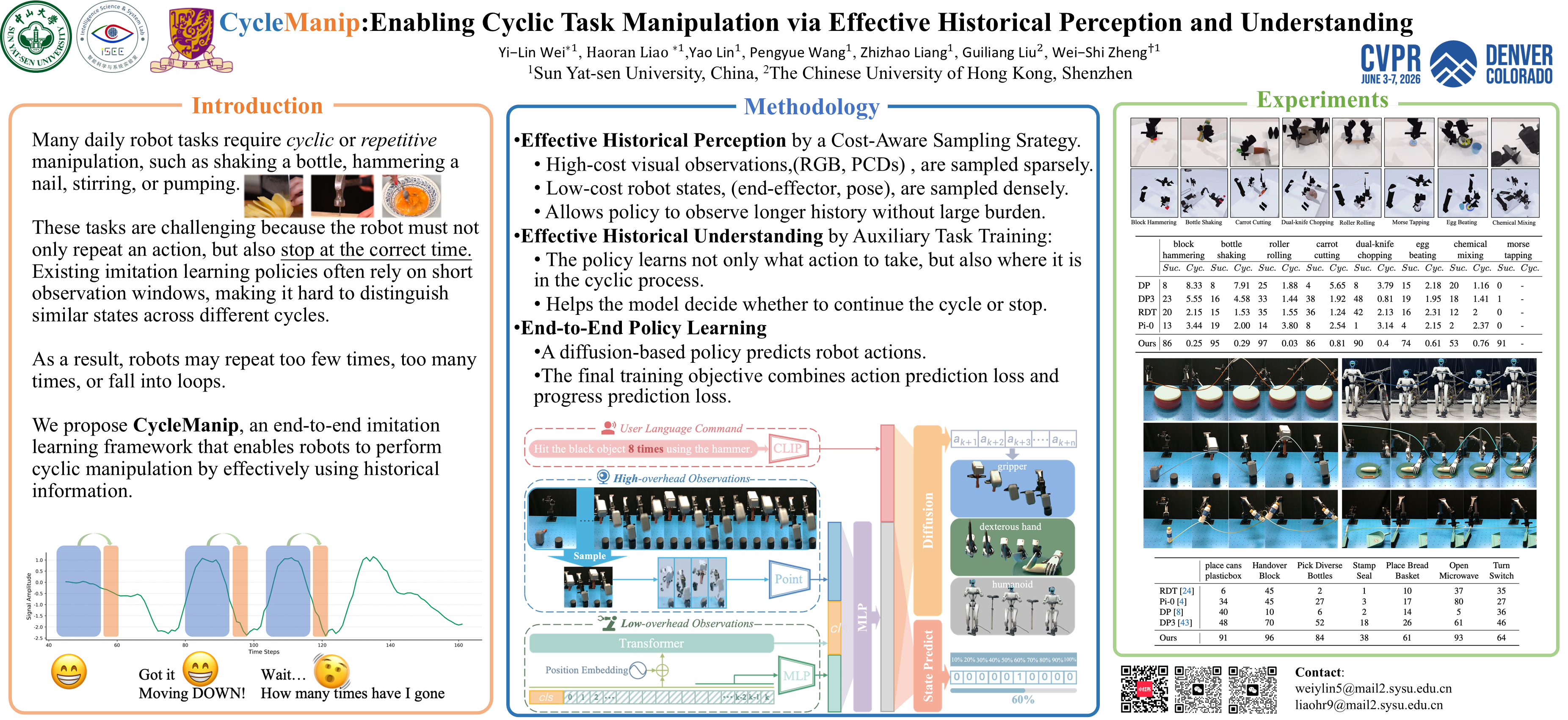
In this paper, we explore an important yet underexplored task in robot manipulation: cycle-based manipulation, where robots need to perform cyclic or repetitive actions with an expected terminal time. These tasks are crucial in daily life, such as shaking a bottle or knocking a nail. However, few prior works have explored this task, leading to two main challenges: 1) the imitation methods often fail to complete these tasks within the expected terminal time due to the ineffective utilization of history; 2) the absence of a benchmark with sufficient data and automatic evaluation tools hinders development of effective solutions in this area. To address these challenges, we firstly propose the CycleManip framework to achieve cycle-based task manipulation in a end-to-end imitation manner without requiring any extra models, hierarchical structure or significant computational overhead. The core insight is to enhance effective history perception by a cost-aware sampling strategy and to improve historical understanding by multi-task learning. Secondly, we introduce a cycle-based task manipulation benchmark, which provides diverse cycle-based tasks, and an automatic evaluation method. Extensive experiments conducted in both simulation and real-world settings demonstrate that our method achieves high success rates in cycle-based task manipulation. The results further show strong adaptation performance in general manipulation, and the plug-and-play ability on imitation policies such as Vision-Language-Action (VLA) models. Moreover, the results show that our approach can be applied across diverse robotic platforms, including bi-arm grippers, dexterous hands, and humanoid robots.
SIMPACT: Simulation-Enabled Action Planning using Vision-Language Models
Haowen Liu ⋅ Shaoxiong Yao ⋅ Haonan Chen ⋅ Jiawei Gao ⋅ Jiayuan Mao ⋅ Jia-Bin Huang ⋅ Yilun Du
Vision-Language Models (VLMs) exhibit remarkable common-sense and semantic reasoning capabilities.However, they lack a grounded understanding of physical dynamics. This limitation arises from training VLMs on static internet-scale visual-language data that contain no causal interactions or action-conditioned changes.Consequently, it remains challenging to leverage VLMs for fine-grained robotic manipulation tasks that require physical understanding, reasoning, and corresponding action planning.To overcome this, we present $\textbf{SIMPACT}$, a test-time, $\textbf{SIM}$ulation-enabled $\textbf{ACT}$ion $\textbf{P}$lanning framework that equips VLMs with physical reasoning through simulation-in-the-loop world modeling, without requiring any additional training.From a single RGB-D observation, SIMPACT efficiently constructs physics simulations, enabling the VLM to propose informed actions, observe simulated rollouts, and iteratively refine its reasoning.By integrating language reasoning with physics prediction, our simulation-enabled VLM can understand contact dynamics and action outcomes in a physically grounded way. Our method demonstrates state-of-the-art performance on five challenging, real-world rigid-body and deformable manipulation tasks that require fine-grained physical reasoning, outperforming existing general-purpose robotic manipulation models. Our results demonstrate that embedding physics understanding via efficient simulation into VLM reasoning at test time offers a promising path towards generalizable embodied intelligence.
Adaptive Action Chunking at Inference-time for Vision-Language-Action Models
Yuanchang Liang ⋅ Xiaobo Wang ⋅ Kai Wang ⋅ Shuo Wang ⋅ Xiaojiang Peng ⋅ Haoyu Chen ⋅ David Kim Huat Chua ⋅ Prahlad Vadakkepat
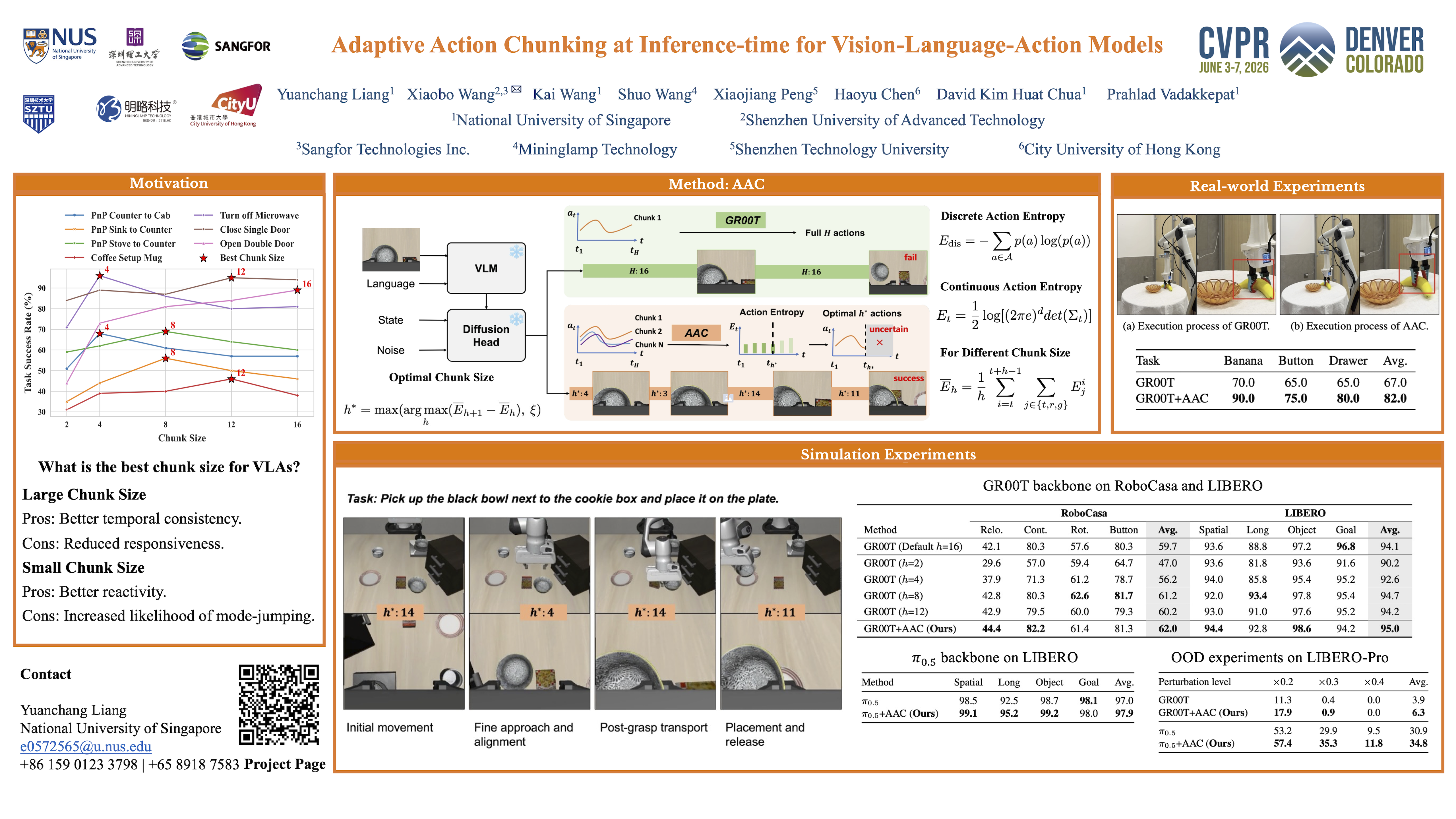
In Vision-Language-Action (VLA) models, action chunking (i.e., executing a sequence of actions without intermediate replanning) is a key technique to improve robotic manipulation abilities. However, a large chunk size reduces the model’s responsiveness to new information, while a small one increases the likelihood of mode-jumping, jerky behavior resulting from discontinuities between chunks. Therefore, selecting the optimal chunk size is an urgent demand to balance the model's reactivity and consistency. Unfortunately, a dominant trend in current VLA models is an empirical fixed chunk length at inference-time, hindering their superiority and scalability across diverse manipulation tasks. To address this issue, we propose a novel Adaptive Action Chunking (AAC) strategy, which exploits action entropy as the cue to adaptively determine the chunk size based on current predictions. Extensive experiments on a wide range of simulated and real-world robotic manipulation tasks have demonstrated that our approach substantially improves performance over the state-of-the-art alternatives. The videos and source code will be made publicly available.
Localizing, Structuring, and Rendering: Bridging 3D and 2D Vision-Language-Action Models for Robotic Manipulation
Yunlong Zhao ⋅ Xiaoheng Deng ⋅ Yichao Cao ⋅ Yi Chen ⋅ Xiangjian He ⋅ Shan You ⋅ Shuo Yang ⋅ Lei Fan ⋅ Fei Wang ⋅ Xiu Su
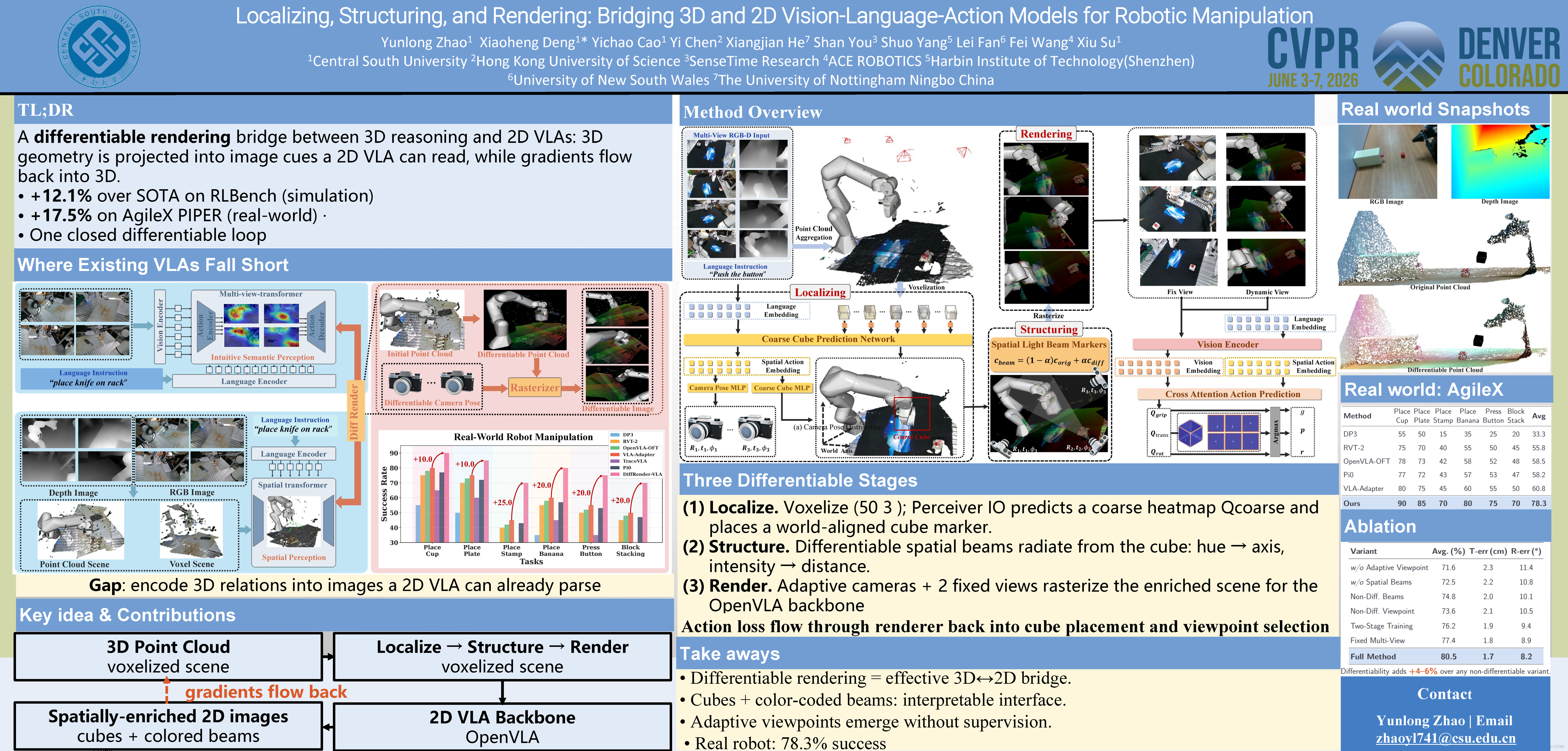
Robotic manipulation in complex 3D environments requires unifying spatial reasoning with intuitive visual perception, which is a capability that current Vision-Language-Action paradigms address separately. While 3D VLAs excel in geometric and physical reasoning, they lack intuitive, image-level understanding and dense visual semantics; conversely, 2D VLAs (even with depth image) provide rich visual intuition and semantic continuity but miss explicit spatial global grounding. We introduce DiffRender-VLA, a differentiable rendering–based framework that bridges 3D and 2D Vision-Language-Action models through gradient-consistent visual mediation. It generates differentiable images by localizing the next end-effector target with a world-aligned cube marker, differentiably structuring surrounding geometry whose color encodes spatial relations to the marker, and rendering adaptive viewpoints optimized to reveal the target–environment spatial relationships. These differentiable images serve as visual bridges, embedding spatial semantics while allowing gradients from 2D VLAs to backpropagate into 3D representations, thereby coupling geometric reasoning with visual perception. This closed differentiable loop unifies reasoning and perception, substantially improving performance under occlusion, clutter, and complex spatial manipulation tasks, achieving average improvements of +12.1% over state-of-the-art methods.
NIL: No-data Imitation Learning
Mert Albaba ⋅ Chenhao Li ⋅ Markos Diomataris ⋅ Omid Taheri ⋅ Andreas Krause ⋅ Michael J. Black
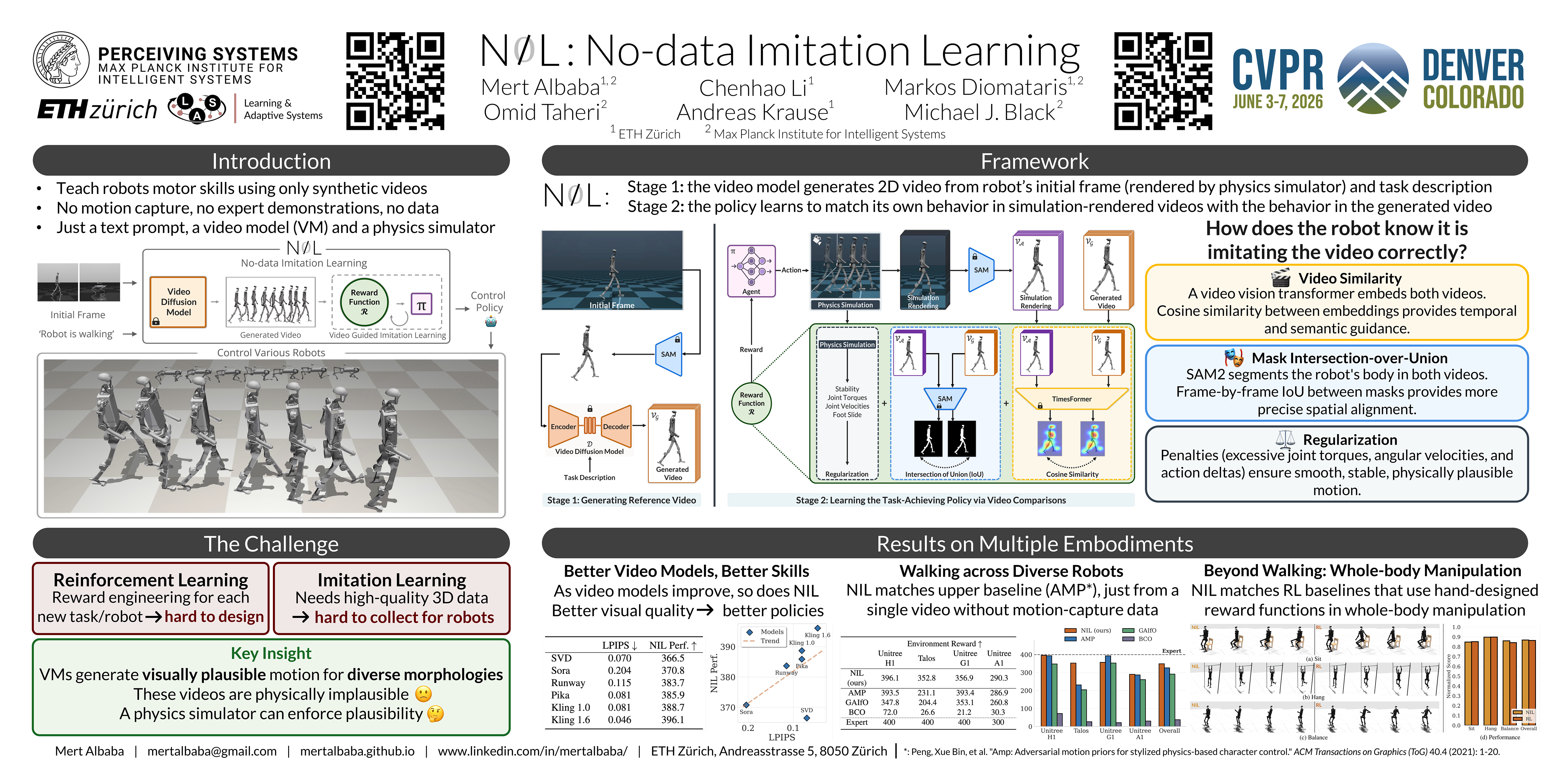
Acquiring physically plausible motor skills across diverse and unconventional embodiments, including humanoids and quadrupeds, is essential for advancing character simulation and robotics. Traditional methods, such as reinforcement learning (RL), require extensive reward function engineering. Imitation learning (IL) offers an alternative but relies heavily on curated 3D expert demonstrations, which are scarce and difficult to obtain for non-human morphologies. Video diffusion models, on the other hand, are capable of generating realistic-looking videos of various morphologies, from humans to ants. However, these videos are often not physically plausible, which limits their direct use for skill acquisition. We introduce "No-data Imitation Learning" (NIL): an imitation learning framework that replaces curated expert demonstrations with videos generated by a pretrained video diffusion model. Our key insight is that the physics simulator enforces physical constraints, while the video provides visual guidance. NIL learns 3D motor skills in a physics simulator from 2D-generated videos, with generalization capability to unconventional forms. Specifically, NIL computes a discriminator-free imitation reward that combines (i) a video-embedding similarity between generated and simulated videos using a pretrained video vision transformer, and (ii) an image-based similarity term derived from video segmentation masks. We evaluate NIL on locomotion and whole-body control tasks across unique body configurations. Our experiments show that in humanoid locomotion, NIL matches the performance of state-of-the-art IL baselines trained on motion-capture data; and in whole-body manipulation, it exceeds the performance of RL baselines without requiring any curated data.
Humanoid Generative Pre-Training for Zero-Shot Motion Tracking
Zekun Qi ⋅ Xuchuan Chen ⋅ Jilong Wang ⋅ Chenghuai Lin ⋅ Yunrui Lian ⋅ Wenyao Zhang ⋅ XinQiang Yu ⋅ He Wang ⋅ Li Yi
We introduce Humanoid-GPT, the first GPT-style humanoid motion Transformer trained with causal attention on a billion-scale motion corpus for whole-body control. Unlike prior shallow MLP trackers constrained by scarce data and an agility–generalization trade-off, Humanoid-GPT is pre-trained on a 2B-frame retargeted corpus that unifies all major mocap datasets with large-scale in-house recordings. Scaling both data and model capacity yields a single generative Transformer that tracks arbitrary humans executing highly dynamic behaviors while achieving unprecedented zero-shot generalization to unseen motions and control tasks. Extensive experiments and scaling analyses show that our model establishes a new performance frontier, demonstrating robust zero-shot generalization to unseen tasks while simultaneously tracking highly dynamic and complex motions.
EnergyAction: Unimanual to Bimanual Composition with Energy-Based Models
Mingchen Song ⋅ Xiang Deng ⋅ Jie Wei ⋅ Dongmei Jiang ⋅ Liqiang Nie ⋅ Weili Guan
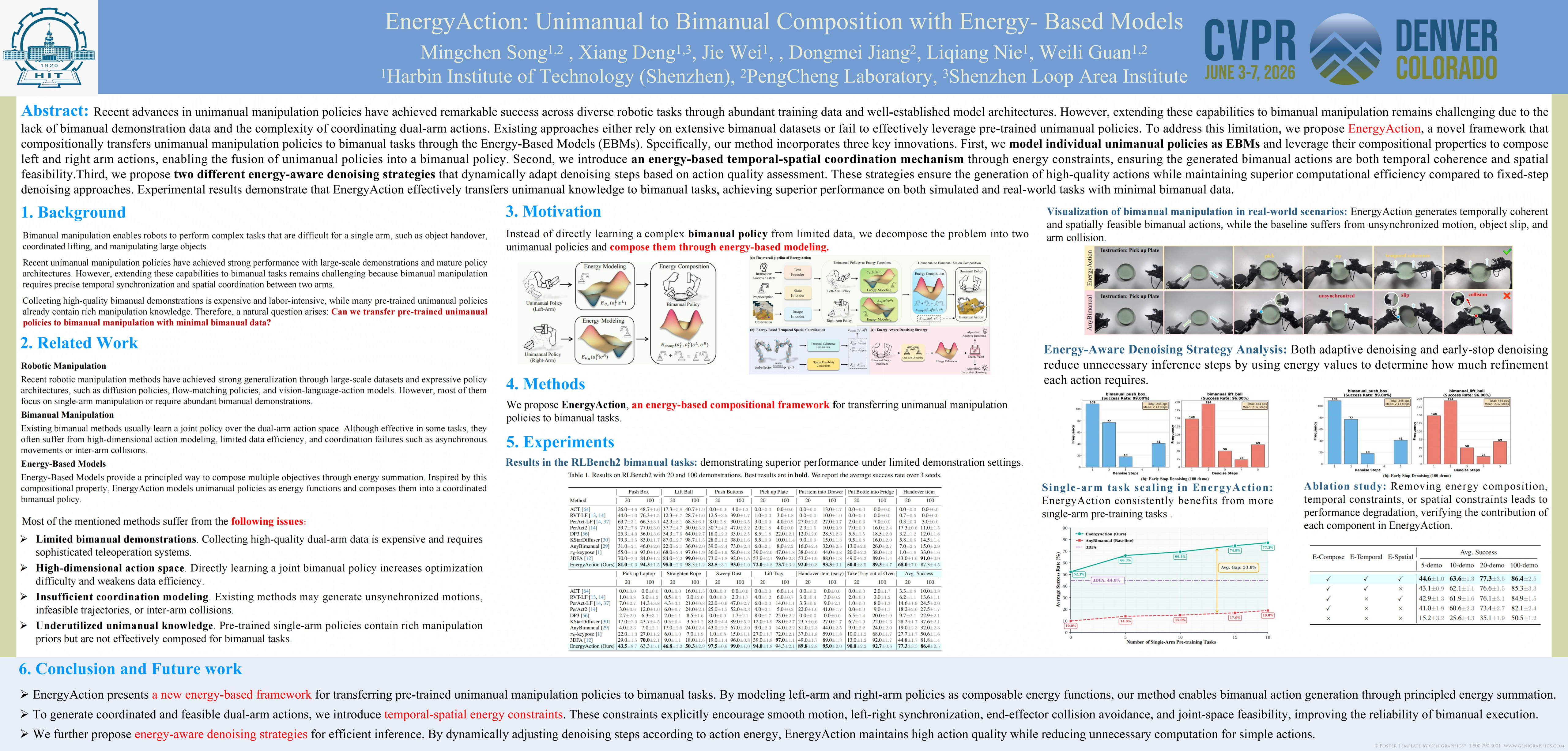
Recent advances in unimanual manipulation policies have achieved remarkable success across diverse robotic tasks through abundant training data and well-established model architectures. However, extending these capabilities to bimanual manipulation remains challenging due to the lack of bimanual demonstration data and the complexity of coordinating dual-arm actions. Existing approaches either rely on extensive bimanual datasets or fail to effectively leverage pre-trained unimanual policies. To address this limitation, we propose EnergyAction, a novel framework that compositionally transfers unimanual manipulation policies to bimanual tasks through the Energy-Based Models (EBMs). Specifically, our method incorporates three key innovations. First, we model individual unimanual policies as EBMs and leverage their compositional properties to compose left and right arm actions, enabling the fusion of unimanual policies into a bimanual policy. Second, we introduce an energy-based temporal-spatial coordination mechanism through energy constraints, ensuring the generated bimanual actions are both temporal coherence and spatial feasibility. Third, we propose two different energy-aware denoising strategies that dynamically adapt denoising steps based on action quality assessment. These strategies ensure the generation of high-quality actions while maintaining superior computational efficiency compared to fixed-step denoising approaches. Experimental results demonstrate that EnergyAction effectively transfers unimanual knowledge to bimanual tasks, achieving superior performance on both simulated and real-world tasks with minimal bimanual data.
CUBic: Coordinated Unified Bimanual Perception and Control Framework
Xingyu Wang ⋅ Pengxiang Ding ⋅ Jingkai Xu ⋅ Donglin Wang ⋅ Zhaoxin Fan
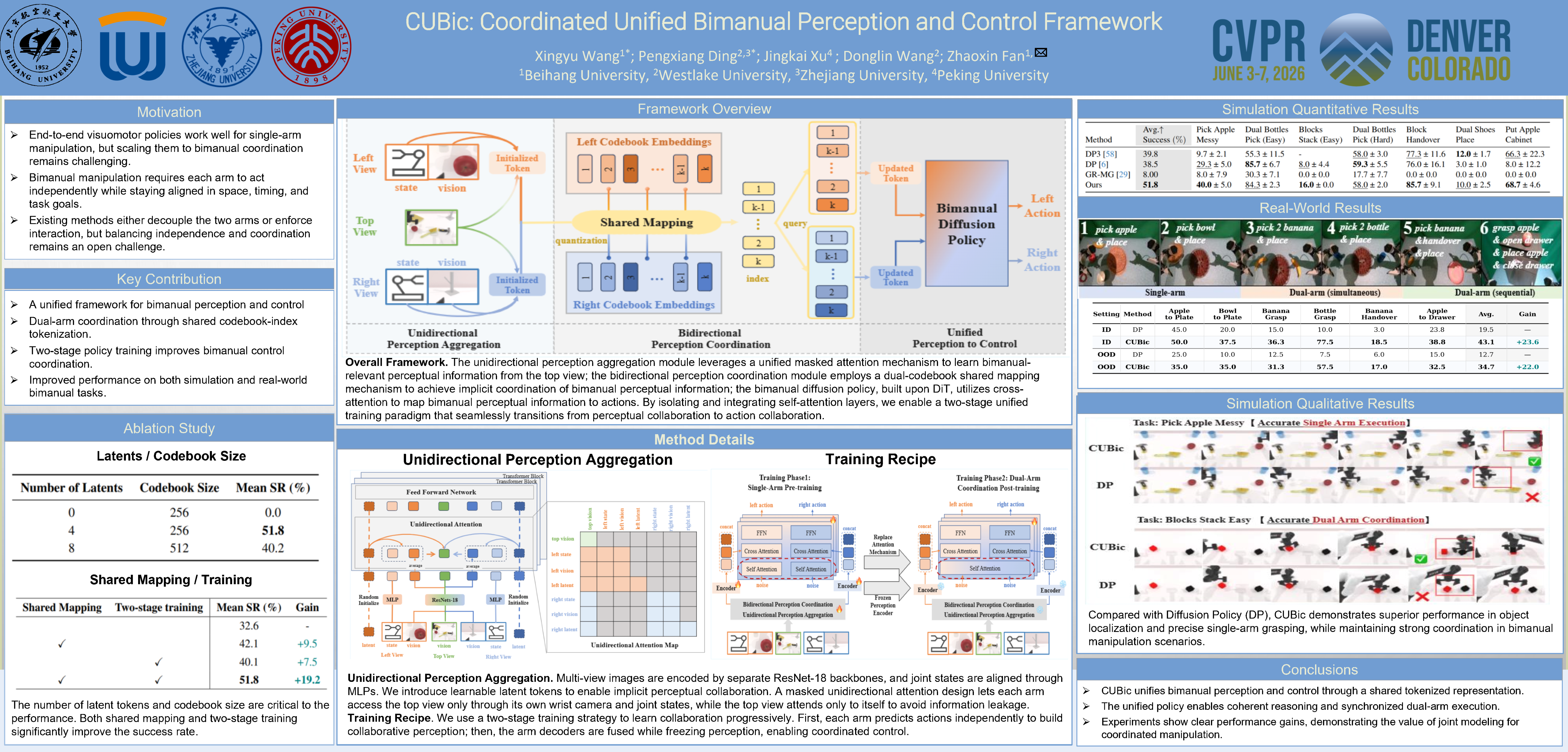
Recent advances in visuomotor policy learning have enabled robots to perform control directly from visual inputs. Yet, extending such end-to-end learning from single-arm to bimanual manipulation remains challenging due to the need for both independent perception and coordinated interaction between arms. Existing methods typically favor one side—either decoupling the two arms to avoid interference or enforcing strong cross-arm coupling for coordination—thus lacking a unified treatment. We propose CUBic, a Coordinated and Unified framework for Bimanual perception and control} that reformulates bimanual coordination as a unified perceptual modeling problem. CUBic learns a shared tokenized representation bridging perception and control, where independence and coordination emerge intrinsically from structure rather than from hand-crafted coupling. Our approach integrates three components: unidirectional perception aggregation, bidirectional perception coordination through two codebooks with shared mapping, and a unified perception-to-control diffusion policy. Extensive experiments on the RoboTwin benchmark show that CUBic consistently surpasses standard baselines, achieving marked improvements in coordination accuracy and task success rates over state-of-the-art visuomotor baselines.
RehearseVLA: Simulated Post-Training for VLAs with Physically-Consistent World Model
Junjin Xiao ⋅ Yandan Yang ⋅ Xinyuan Chang ⋅ Ronghan Chen ⋅ Feng Xiong ⋅ Mu Xu ⋅ Wei-Shi Zheng ⋅ Qing Zhang
Vision-Language-Action (VLA) models trained via imitation learning suffer from significant performance degradation in data-scarce scenarios due to their reliance on large-scale demonstration datasets. Although reinforcement learning (RL)-based post-training has proven effective in addressing data scarcity, its application to VLA models is hindered by the non-resettable nature of real-world environments. This limitation is particularly critical in high-risk domains such as industrial automation, where interactions often induce state changes that are costly or infeasible to revert. Furthermore, existing VLA approaches lack a reliable mechanism for detecting task completion, leading to redundant actions that reduce overall task success rates. To address these challenges, we propose RehearseVLA, an RL-based post-training framework that replaces physical interaction with a low-cost world model-based virtual simulator. RehearseVLA consists of two key components: (1) a physically-consistent world simulator that generates temporally consistent future visual observations, and (2) a vision-language model (VLM)-guided instant reflector that provides continuous reward signals and predicts action termination. This simulated environment enables VLA models to safely explore and generalize beyond their initial imitation learning distribution. Our method achieves notable performance gains with as few as five expert demonstrations per task. Experiments on complex robotic manipulation tasks demonstrate that RehearseVLA effectively overcomes the data inefficiency, safety constraints, and inefficient execution of conventional VLA models that rely on real-world interaction, offering a practical and scalable solution for post-training in resource-constrained settings.
GraspGen-X: Cross-Embodiment 6-DOF Diffusion-based Grasping
Beining Han ⋅ Yu-Wei Chao ⋅ Erwin Coumans ⋅ Clemens Eppner ⋅ Jia Deng ⋅ Stan Birchfield ⋅ Adithya Murali
We study cross-embodiment 6-DOF robot grasping. Unlike prior works, we require the model not only to generalize to novel objects / scenes but also to novel gripper morphologies and physical grasping processes. Our method extends diffusion model based generative 6-DOF grasping models to condition on the additional gripper's representation. We propose a swept-volume heuristic for encoding the gripper. We train our cross-embodiment model with procedural grippers and a large-scale dataset of 395 Million grasps. In simulation experiments, our model has the best zero-shot generalization to novel real-world grippers and objects over baseline methods. Our model also serves as a good initialization for fine-tuning to adapt to novel grippers. In ablations, we demonstrate the efficiency of our sweep-volume gripper representation and our procedural gripper training dataset. Last, we show zero-shot generalization to real-world novel grippers for 6-DOF grasping, surpassing baselines in cross-embodiment generalization.
UETrack: A Unified and Efficient Framework for Single Object Tracking
Ben Kang ⋅ Jie Zhao ⋅ Xin Chen ⋅ Wanting Geng ⋅ Bin Zhang ⋅ Lu Zhang ⋅ Dong Wang ⋅ Huchuan Lu
With growing real-world demands, efficient tracking has received increasing attention. However, most existing methods are limited to RGB inputs and struggle in multi-modal scenarios. Moreover, current multi-modal tracking approaches typically use complex designs, making them too heavy and slow for resource-constrained deployment. To tackle these limitations, we propose UETrack, a unified and efficient framework for single object tracking. UETrack demonstrates high practicality and versatility, efficiently handling multiple modalities including RGB, Depth, Thermal, Event, and Language, and addresses the gap in efficient multi-modal tracking. It introduces two key components: a Token-Pooling-based Mixture-of-Experts mechanism that enhances modeling capacity through feature aggregation and expert specialization, and a Target-aware Adaptive Distillation strategy that selectively performs distillation based on sample characteristics, reducing redundant supervision and improving performance. Extensive experiments on 12 benchmarks across 3 hardware platforms show that UETrack achieves a superior speed–accuracy trade-off compared to pervious methods. For instance, UETrack-B achieves 69.2% AUC on LaSOT and runs at 163/56/60 FPS on GPU/CPU/AGX, demonstrating strong practicality and versatility. Code will be made available.
ProgTrack: A Multi-Object Tracking Algorithm with Progressive Matching Strategy
Chenhui Zhang ⋅ Guoqing Dong ⋅ Weijie Peng
Multi-object tracking (MOT) based on unmanned aerial vehicle (UAV) aims to identify and continuously track the positions of multiple ground targets during UAV flight. Current mainstream methods utilize appearance matching and motion matching to match targets in consecutive frames. However, these methods often fail in the following scenarios: First, scenarios with multi-scale targets, where small targets have weak appearance features and small bounding boxes; second, scenarios with complex backgrounds or occlusions, where the background or occlusions interfere with the appearance features and change the bounding box size of targets; third, scenarios where the UAV lens shakes, rotates, or zooms, leading to misalignment between consecutive frames; and fourth, scenarios with high targets similarity, where the appearance features between targets are difficult to distinguish, such as vehicles on a road. To address these issues, we propose a multi-object tracking algorithm, ProgTrack, based on a multi-stage progressive matching mechanism. This algorithm simulates human eye tracking strategies, employing a progressive process of "first matching easily matched large targets, then matching difficult-to-match small targets, and finally matching the remaining mixed-scale targets." Similarly, ProgTrack employs three strategies for target matching at different scales and appearances: a simple Local Motion Information (LMI) matching strategy for large targets, a complex Context Enhancement Feature (CE-Feature) matching strategy for small targets, and a Global Motion Information (GMI) matching strategy for multi-scale targets matching, thereby achieving target matching. On the VisDrone2019 UAV tracking dataset, ProgTrack achieves MOTA, MOTP, and IDF1 scores of 40.2, 77.5, and 52.8, respectively, demonstrating state-of-the-art performance among ten methods.
Efficient Video Object Segmentation and Tracking with Recurrent Dynamic Submodel
Weidong Tang ⋅ Zhiyuan Liang ⋅ Xinyan Wan ⋅ Chen Zhu ⋅ Zhaopan Xu ⋅ Pengfei Zhou ⋅ Yan Song ⋅ Yang You ⋅ Wangbo Zhao
The large vision foundation model, SAM2, has achieved remarkable performance in video object segmentation and tracking (VOST). However, its effectiveness is hindered by significant computational overhead. While model pruning is a widely used strategy to address this issue, traditional static and input-agnostic pruning approaches fall short in managing the diverse and complex nature of video data effectively. A promising alternative is dynamic networks, yet they often struggle to translate theoretical computational reductions into actual acceleration. Furthermore, both static and dynamic approaches typically focus on visual features of individual frames while neglecting the temporal correlations between them, limiting their performance in handling complex video streams.To address these challenges, we propose Recurrent Dynamic Submodel (RDS), a dynamic architecture that adaptively selects submodel blocks for each frame. Specifically, it has a lightweight Prediction-aware Router (PAR), which leverages both the segmentation mask from the previous frame and the visual features of the current frame to make routing decisions, enabling the submodel to explicitly capture the temporal nature of video data. Additionally, to reduce the cost of adapting the dynamic submodel, we introduce an Importance-aware LoRA (I-LoRA), tuning parameters only in the most critical blocks. Extensive experiments on various benchmarks demonstrate the effectiveness of our approach.For example, it achieves a 1.3× speedup on the DAVIS 2017 dataset with less than 1% performance degradation, while introducing only 3% (6.7M) trainable parameters and requiring only 0.003% (6.7k) of the SAM2 training data.
Learning to Track Instance from Single Nature Language Description
Yaozong Zheng ⋅ Bineng Zhong ⋅ Qihua Liang ⋅ Shuimu Zeng ⋅ Haiying Xia ⋅ Shuxiang Song
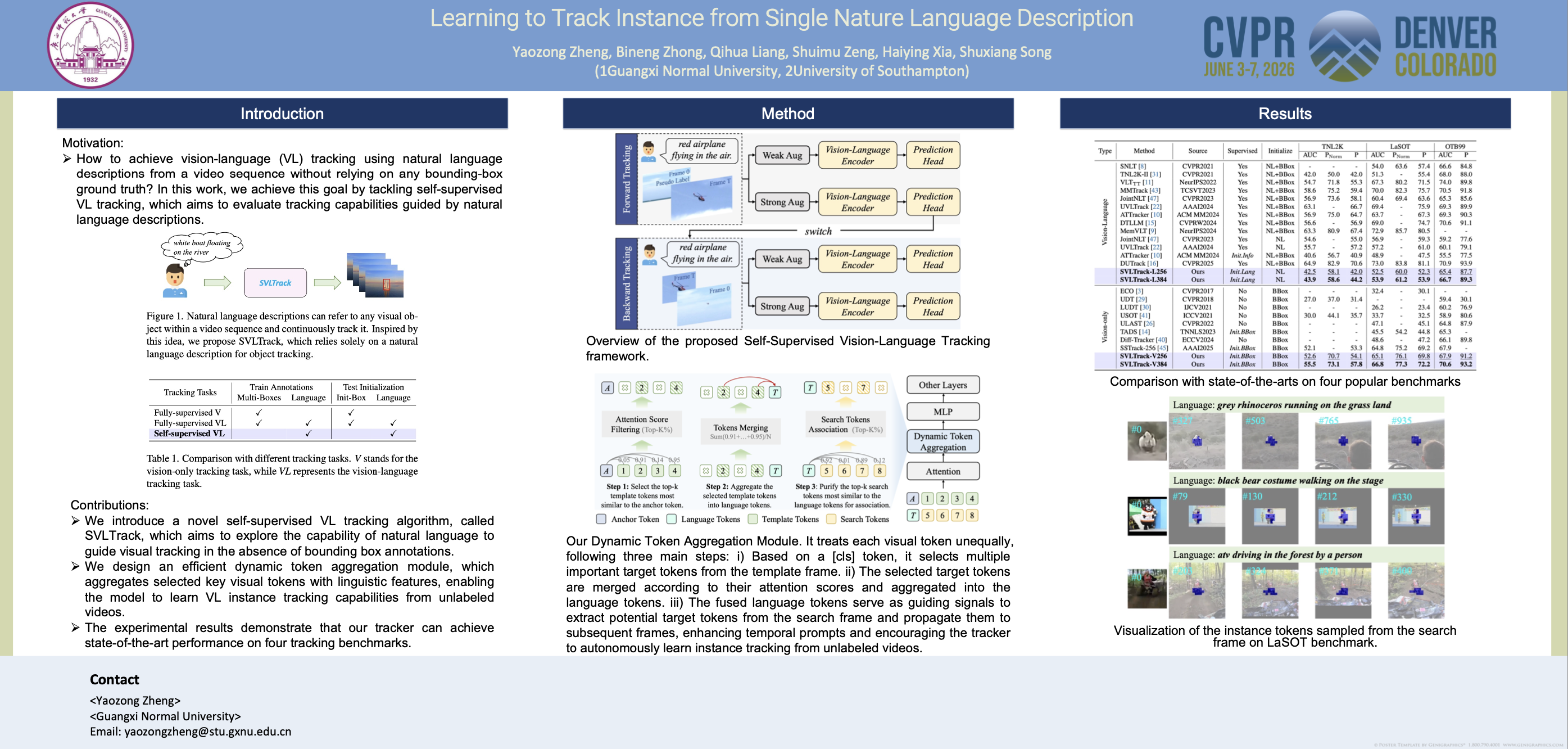
How to achieve vision-language (VL) tracking using natural language descriptions from a video sequence \textbf{without relying on any bounding-box ground truth}? In this work, we achieve this goal by tackling \textit{self-supervised VL tracking}, which aims to evaluate tracking capabilities guided by natural language descriptions. We introduce \textbf{\tracker}, a novel self-supervised VL tracker that is capable of tracking any referred object by a language description. Unlike traditional methods that equally fuse all language and visual tokens, we propose an efficient Dynamic Token Aggregation Module, which treats each visual token \textbf{unequally}. The module consists of three main steps: i) Based on an anchor token, it selects multiple important target tokens from the template frame. ii) The selected target tokens are merged according to their attention scores and aggregated into the language tokens, thereby eliminating redundant visual token noise and enhancing semantic alignment. iii) Finally, the fused language tokens serve as guiding signals to extract potential target tokens from the search frame and propagate them to subsequent frames, enhancing temporal prompts and encouraging the tracker to autonomously learn instance tracking from unlabeled videos. This new modeling approach enables the effective self-supervised learning of language-guided tracking representations without the need for large-scale bounding box annotations. Extensive experiments on VL tracking benchmarks show that {\tracker} surpasses SOTA self-supervised methods, achieving an improvement of more than 11.2\%, 5\%, and 3.3\% in AUC score on the OTB99, LaSOT, and TNL2K datasets, respectively.
MV-TAP: Tracking Any Point in Multi-View Videos
Jahyeok Koo ⋅ Inès Hyeonsu Kim ⋅ Mungyeom Kim ⋅ Junghyun Park ⋅ Seohyeon Park ⋅ Jaeyeong Kim ⋅ Jung Yi ⋅ Seokju Cho ⋅ Seungryong Kim
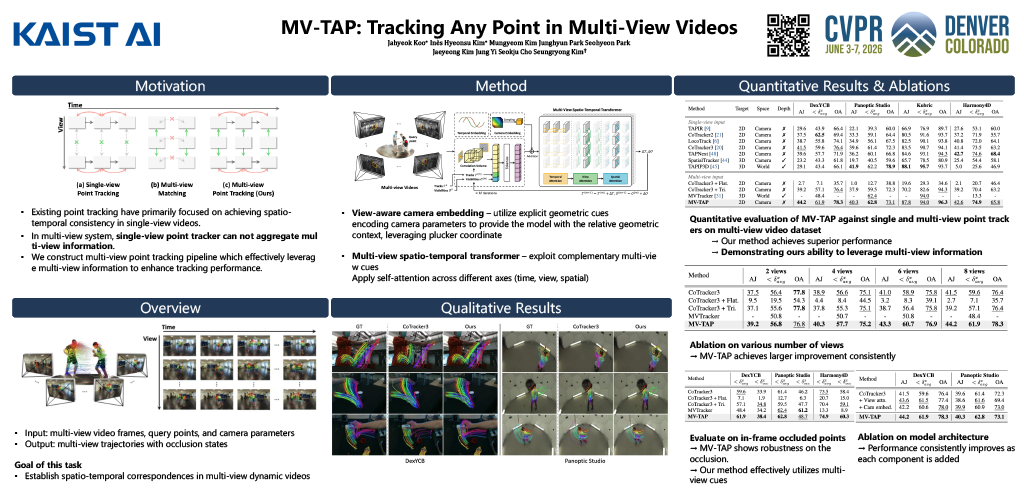
Multi-view camera systems enable rich observations of complex real-world scenes, and understanding dynamic objects in multi-view settings has become central to many applications. Point tracking serves as a key mechanism for capturing dynamic motion; however, conventional single-view approaches often fail due to the limited geometric information available in monocular video, which becomes a critical bottleneck for multi-view scenarios. In this work, we present \ours, a robust point tracker that tracks query points across multi-view videos of dynamic scenes by leveraging cross-view information.\ours utilizes camera geometry and cross-view attention to aggregate spatio-temporal information across views, enabling more complete and reliable trajectory estimation in multi-view videos. To support this task, we construct a large-scale synthetic training dataset and real-world evaluation sets tailored for multi-view tracking. Extensive experiments demonstrate that \ours outperforms existing point-tracking methods on challenging benchmarks, establishing an effective baseline for advancing research in multi-view point tracking.
Adaptive Depth Lightweight RGB-T Tracking with Holistic Token Routing
Tian Ding ⋅ Hongtao Yang ⋅ Liangtao Shi ⋅ Jun Li ⋅ Xiantao Hu ⋅ Jian Yang ⋅ Ying Tai
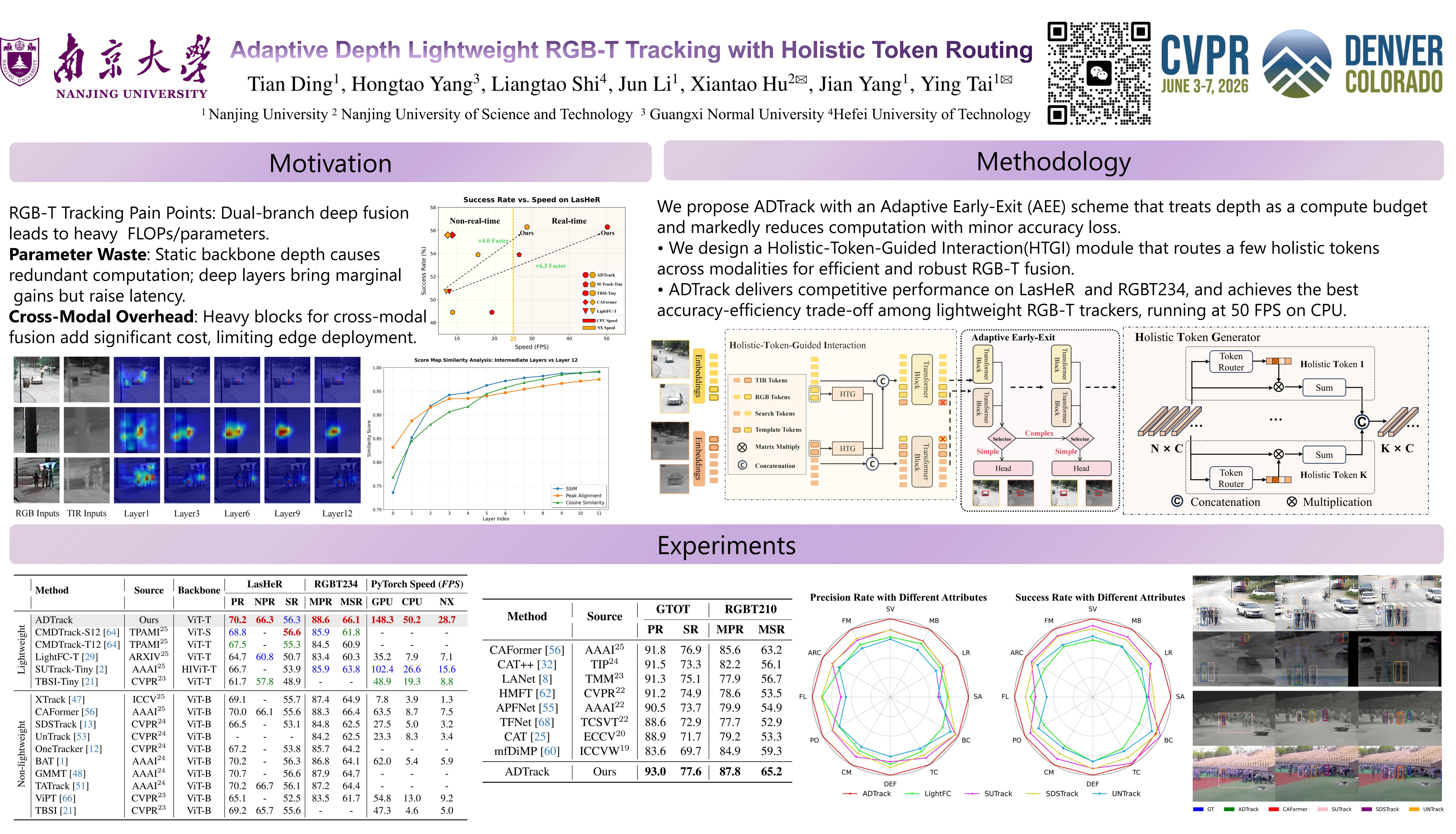
fails under night scenes, glare, fog, and partial occlusion. Despite notable accuracy gains, recent architectures emphasize deep fusion and large parameter counts, driving up FLOPs and bandwidth. This computational burden constrains real-time performance and limits scalability beyond high-end GPUs. To balance accuracy and efficiency, we propose Adaptive Early-Exit (AEE): we augment the backbone with anytime heads and pair them with a confidence-calibrated early-exit policy that halts inference at the earliest reliable layer, skipping redundant computation. For cross-modal interaction, we design a Holistic-Token-Guided Interaction (HTGI) module, where each modality is compressed into a compact set of holistic state tokens and injected into the other modality’s modeling stream without layer-wise alignment, enabling targeted information exchange at extremely low cost. On RGB-T benchmarks, the lightweight tracker substantially reduces latency while maintaining competitive accuracy; on LasHeR, it achieves 70.2% precision and 56.3% success, running at 148.3 FPS on GPU, 50.2 FPS on CPU, and 28.7 FPS on an edge device.
Content-Adaptive Hierarchical Hyperprior for Neural Video Coding
Junqi Liao ⋅ Yaojun Wu ⋅ Chaoyi Lin ⋅ Zhipin Deng ⋅ Li Li ⋅ Dong Liu ⋅ Xiaoyan Sun
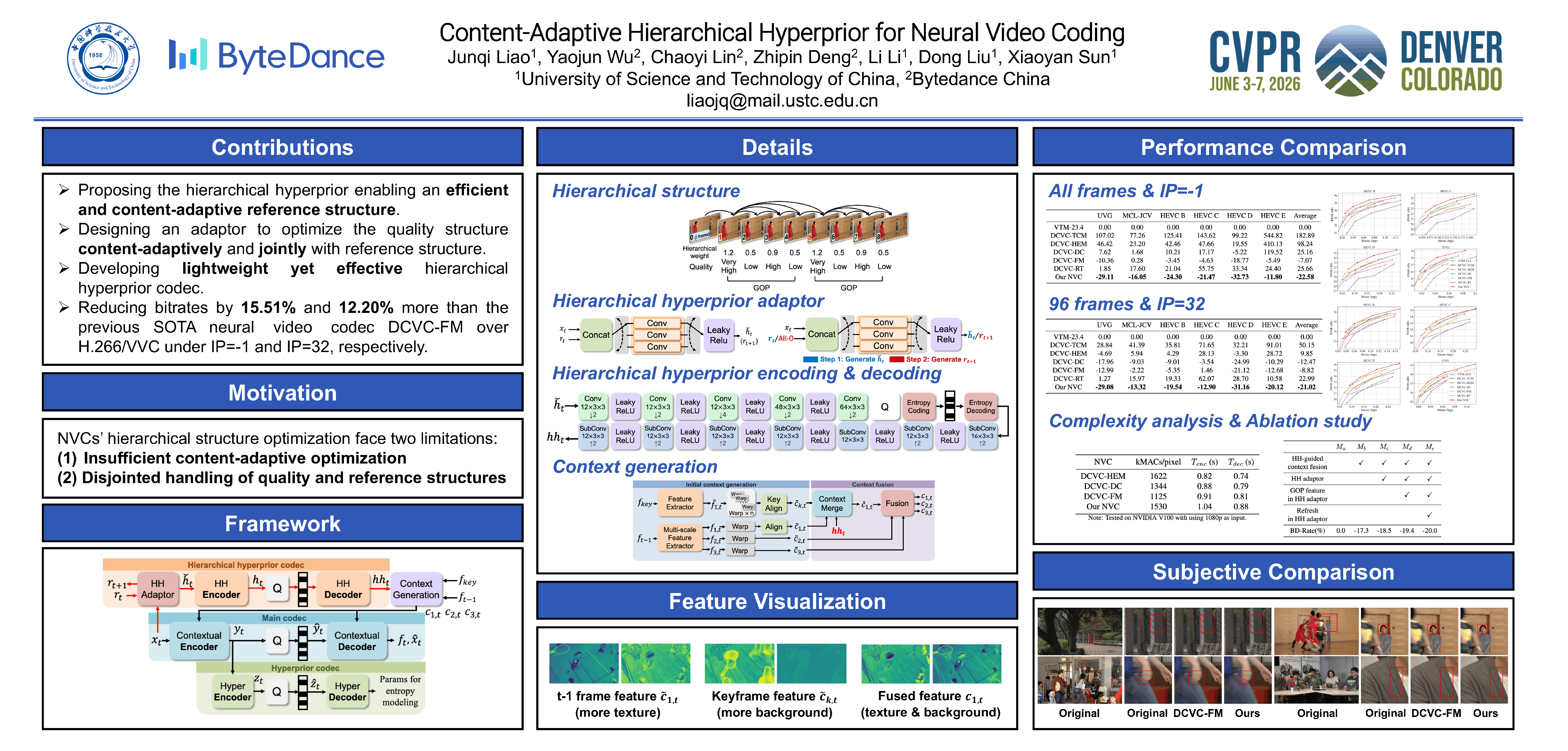
While neural video codecs (NVCs) have recently demonstrated superior performance over traditional codecs through end-to-end learning, existing approaches primarily focus on architectural enhancements and coding module design, with limited exploration into optimizing hierarchical structures—specifically, quality and reference configurations. Current hierarchical structure optimization methods face two major limitations: (1) insufficient content-adaptive optimization, and (2) disjointed handling of quality and reference structures. To overcome these challenges, we propose a novel NVC framework that introduces content-adaptive hierarchical structure optimization through a hierarchical hyperprior derived from the current frame. Our NVC integrates two key components: (1) a hierarchical hyperprior extracted from the original frame to enable content-aware adaptation of the hierarchical structure; and (2) an adaptor within the hierarchical hyperprior codec combined with a dual-reference scheme, guided by the hyperprior, to jointly optimize quality and reference structures. By leveraging this content-adaptive hierarchical structure, our NVC achieves state-of-the-art rate-distortion performance, outperforming the previous leading NVC method DCVC-FM with BD-rate reductions of 15.51\% and 12.20\% relative to VTM-23.4 low-delay B (LDB) under intra-period settings of -1 and 32, respectively.
UTPTrack: Towards Simple and Unified Token Pruning for Visual Tracking
Hao Wu ⋅ Xudong Wang ⋅ Jialiang Zhang ⋅ Junlong Tong ⋅ Xinghao Chen ⋅ Junyan Lin ⋅ Yunpu Ma ⋅ Xiaoyu Shen
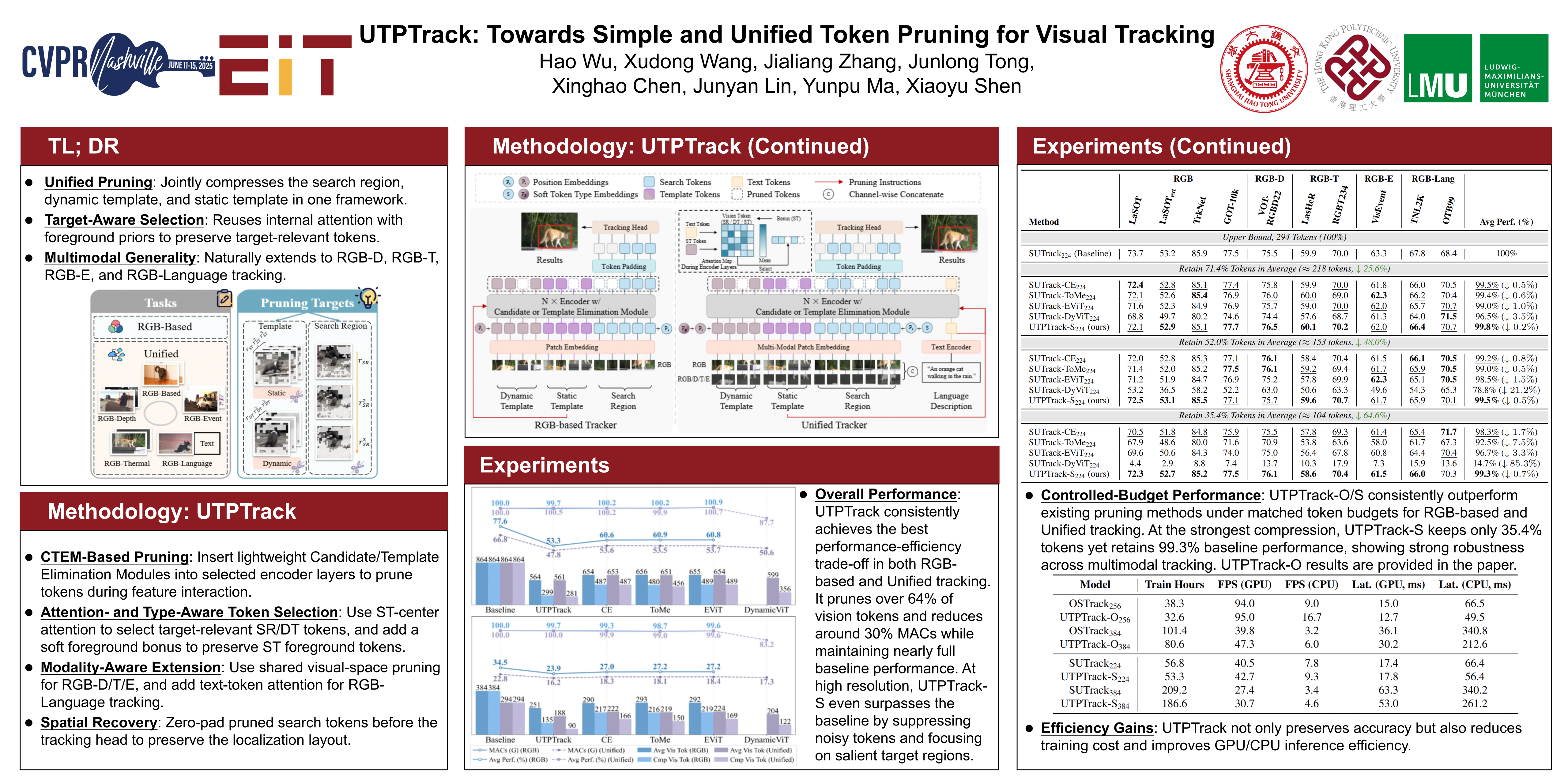
One-stream Transformer-based trackers achieve advanced performance in visual object tracking suffer from significant computational overhead that hinders real-time deployment. While token pruning offers a path to efficiency, a critical limitation persists: no existing work performs pruning jointly across all three critical components—the search region, dynamic template, and static template. This isolation overlooks interdependencies, yielding suboptimal pruning and degraded accuracy. To address this, we introduce \textbf{UTPTrack}, a simple and Unified Token Pruning framework that, for the first time, jointly compresses all three components. UTPTrack employs an attention-guided, token type-aware strategy to holistically model redundancy, a design that seamlessly supports unified tracking across multi-modal and language-guided tasks within a single model. Comprehensive evaluations on 10 benchmarks demonstrate that UTPTrack achieves a new state-of-the-art in the accuracy-efficiency trade-off for pruning-based trackers, pruning 65.4\% of vision tokens in RGB-based tracking and 67.5\% in unified tracking while preserving 99.7\% and 100.5\% of baseline performance, respectively. This strong performance across both RGB and multimodal scenarios underlines its potential as a robust foundation for future research in efficient visual tracking.
Similarity-as-Evidence: Calibrating Overconfident VLMs for Interpretable and Label-Efficient Medical Active Learning
Zhuofan Xie ⋅ Zishan Lin ⋅ Jinliang Lin ⋅ Jie Qi ⋅ Shaohua Hong ⋅ Shuo Li
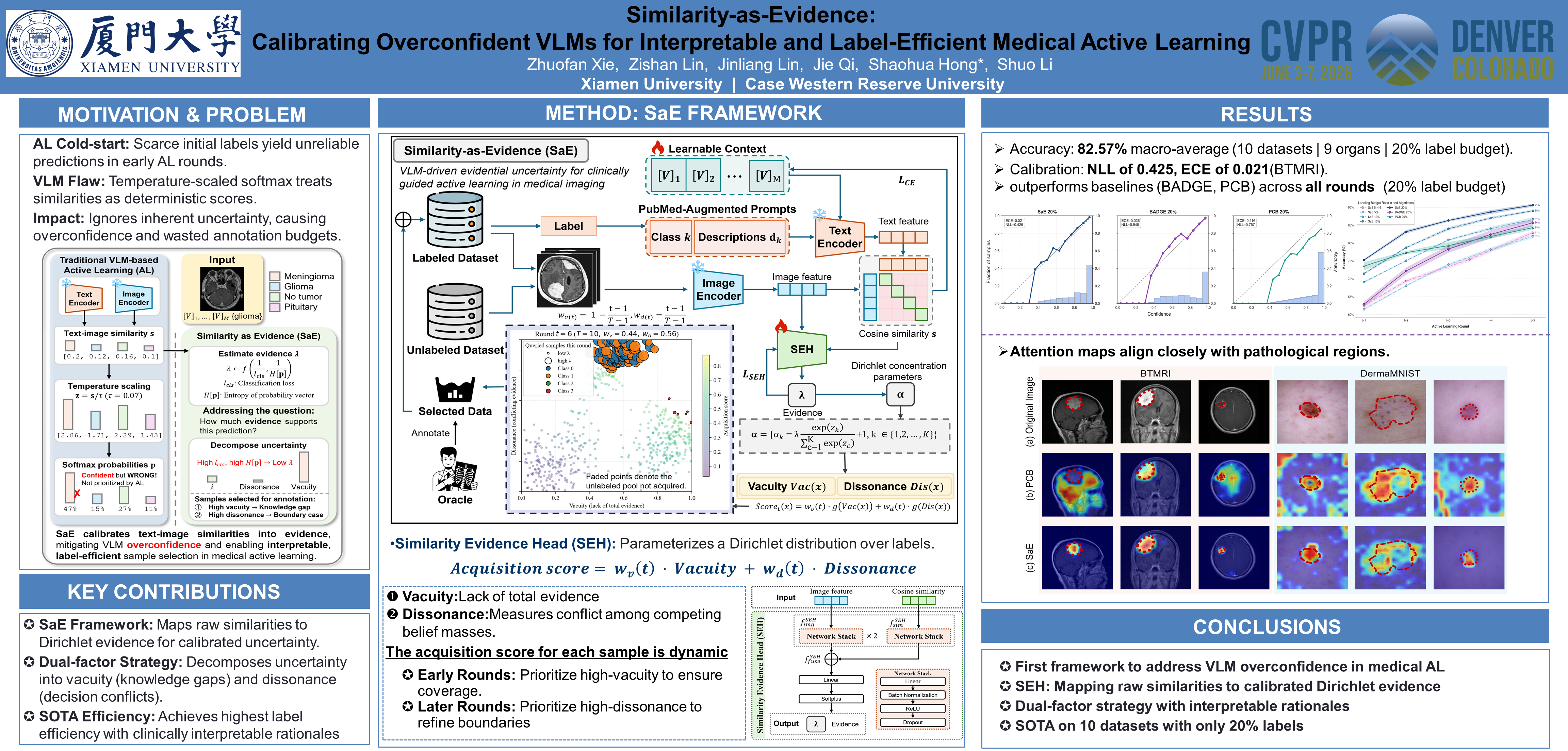
Active Learning (AL) reduces annotation costs in medical imaging by selecting only the most informative samples for labeling, but suffers from cold-start when labeled data are scarce. Vision-Language Models (VLMs) address the cold-start problem via zero-shot predictions, yet their temperature-scaled softmax outputs treat text-image similarities as deterministic scores while ignoring inherent uncertainty, leading to overconfidence. This overconfidence misleads sample selection, wasting annotation budgets on uninformative cases. To overcome these limitations, the Similarity-as-Evidence (SaE) framework calibrates text–image similarities by introducing a Similarity Evidence Head (SEH), which reinterprets the similarity vector as evidence and parameterizes a Dirichlet distribution over labels. In contrast to a standard softmax that enforces confident predictions even under weak signals, the Dirichlet formulation explicitly quantifies lack of evidence (vacuity) and conflicting evidence (dissonance), thereby mitigating overconfidence caused by rigid softmax normalization. Building on this, SaE employs a dual-factor acquisition strategy: high-vacuity samples (e.g., rare diseases) are prioritized in early rounds to ensure coverage, while high-dissonance samples (e.g., ambiguous diagnoses) are prioritized later to refine boundaries, providing clinically interpretable selection rationales. Experiments on ten public medical imaging datasets with a 20% label budget show that SaE attains state-of-the-art macro-averaged accuracy of 82.57%. On the representative BTMRI dataset, SaE also achieves superior calibration, with a negative log-likelihood (NLL) of 0.425.
From Infusion to Assimilation Distillation for Medical Image Segmentation
Jiankang Hong ⋅ Ye Luo ⋅ Yinan Liu ⋅ Junsong Yuan
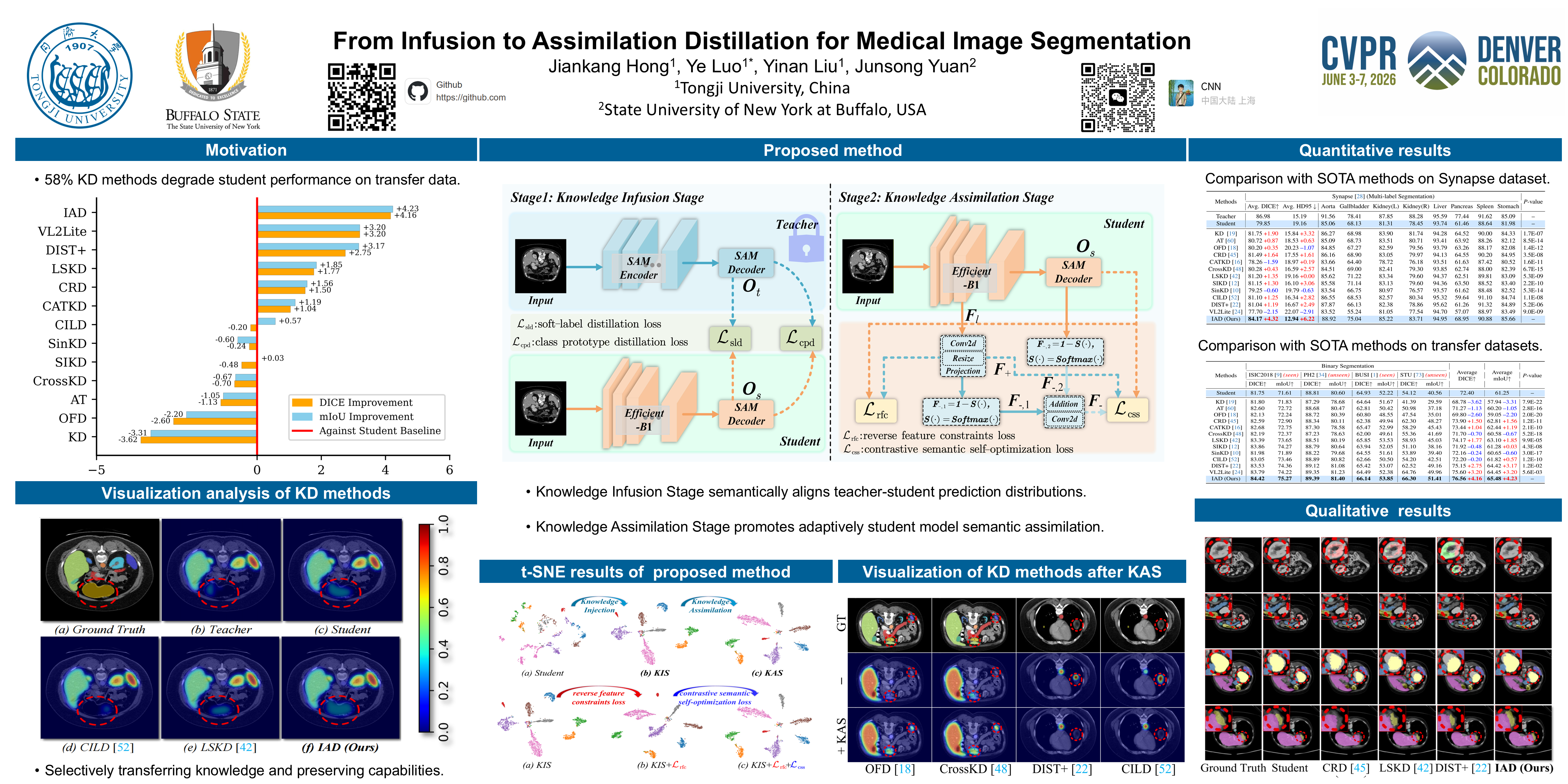
Although foundation models (e.g. SAM) perform remarkably in medical image segmentation, its high computational complexity limits deployment. Knowledge distillation (KD) allows lightweight models to inherit the representational capabilities of large models, thereby mitigating this issue. Existing KD methods enhance student performance, but due to teacher-student different feature advantages, they neglect to internalize and integrate student's semantic information adaptively after knowledge transfer, causing poor knowledge assimilation and limiting gains and generalization. To address this limitation, we propose a novel medical image segmentation framework, which is injection to assimilation distillation (IAD). In Knowledge Injection Stage (KIS), to semantically align teacher-student prediction distributions, soft-label distillation is combined with class-weighted prototype alignment strategy. In Knowledge Assimilation Stage (KAS), to promote adaptively semantic assimilation, a contrastive semantic self-optimization strategy refines student predictions through positive and negative sample pairs and imposes reverse constraints on encoder features to enhance semantic consistency. IAD achieves DICE gains of 4.32\% on Synapse, 1.85\% on ACDC, and 2.42\% on Polyp datasets, and delivers an average 4.16\% generalization gain on ISIC2018, PH2, BUSI, and STU datasets, outperforming mainstream KD methods.
IBISAgent: Reinforcing Pixel-Level Visual Reasoning in MLLMs for Universal Biomedical Object Referring and Segmentation
Yankai Jiang ⋅ Qiaoru Li ⋅ BinLu Xu ⋅ Haoran Sun ⋅ Chao Ding ⋅ Junting Dong ⋅ Yuxiang Cai ⋅ Xuhong Zhang ⋅ Jianwei Yin
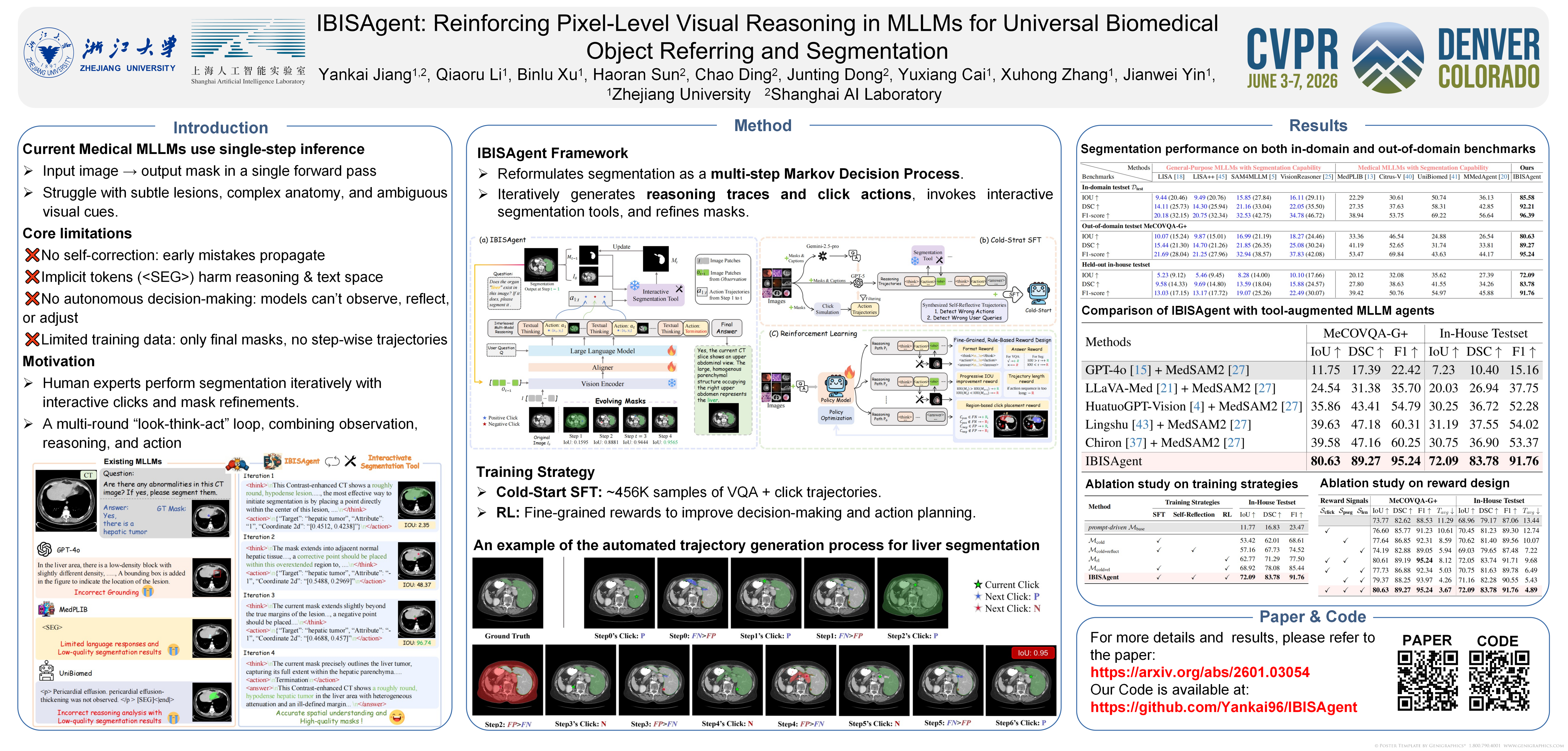
Recent research on medical MLLMs has gradually shifted its focus from image-level understanding to fine-grained, pixel-level comprehension. Although segmentation serves as the foundation for pixel-level understanding, existing approaches face two major challenges. First, they introduce implicit segmentation tokens and require simultaneous fine-tuning of both the MLLM and external pixel decoders, which increases the risk of catastrophic forgetting and limits generalization to out-of-domain scenarios. Second, most methods rely on single-pass reasoning and lack the capability to iteratively refine segmentation results, leading to suboptimal performance. To overcome these limitations, we propose IBISAgent—a novel agentic MLLM that reformulates segmentation as a vision-centric, multi-step decision-making process. IBISAgent enables MLLMs to generate interleaved reasoning and text-based click actions, invoke segmentation tools, and produce high-quality masks without architectural modifications. By iteratively performing multi-step visual reasoning on masked image features, IBISAgent naturally supports mask refinement and promotes the development of pixel-level visual reasoning capabilities. We further design a two-stage training framework consisting of cold-start supervised fine-tuning and agentic reinforcement learning with tailored, fine-grained rewards, enhancing the model’s robustness in complex medical referring and reasoning segmentation tasks. Extensive experiments demonstrate that IBISAgent consistently outperforms both closed-source and open-source SOTA methods. All datasets, code, and trained models will be released publicly.
Unlocking Positive Transfer in Incrementally Learning Surgical Instruments: A Self-reflection Hierarchical Prompt Framework
Yu ZHU ⋅ Kang LI ⋅ Zheng Li ⋅ Pheng-Ann Heng
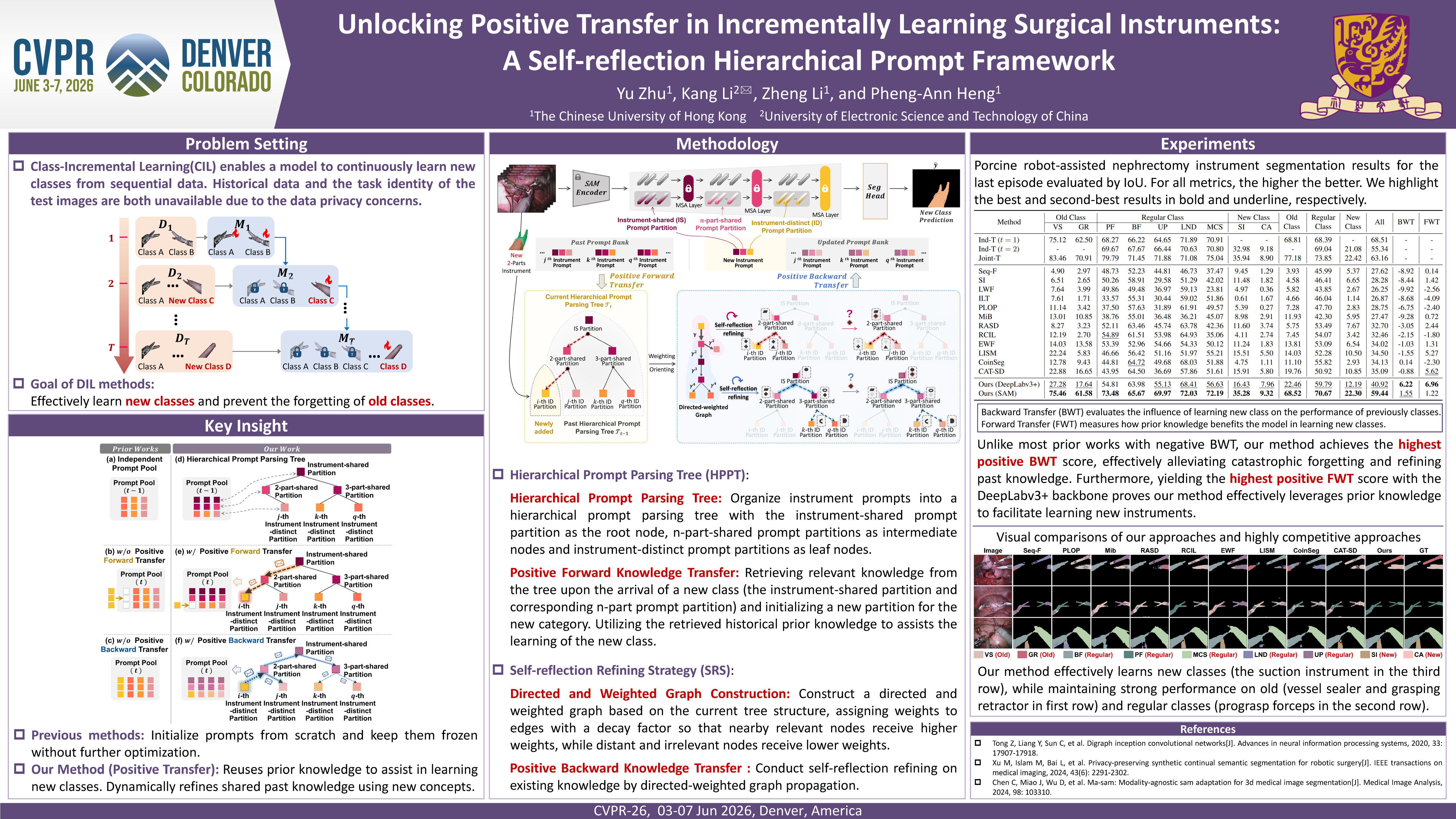
To continuously enhance model adaptability in surgical video scene parsing, recent studies incrementally update it to progressively learn to segment an increasing number of surgical instruments over time. However, prior works constantly overlooked the potential of positive forward knowledge transfer, i.e., how past knowledge could help learn new classes, and positive backward knowledge transfer, i.e., how learning new classes could help refine past knowledge. In this paper, we propose a self-reflection hierarchical prompt framework that unlocks the power of positive forward and backward knowledge transfer in class incremental segmentation, aiming to proficiently learn new instruments, improve existing skills of regular instruments, and avoid catastrophic forgetting of old instruments. Our framework is built on a frozen, pre-trained model that adaptively appends instrument-aware prompts for new classes throughout training episodes. To enable positive forward knowledge transfer, we organize instrument prompts into a hierarchical prompt parsing tree with the instrument-shared prompt partition as the root node, $n$-part-shared prompt partitions as intermediate nodes and instrument-distinct prompt partitions as leaf nodes, to expose the reusable historical knowledge for new classes to simplify their learning. Conversely, to encourage positive backward knowledge transfer, we conduct self-reflection refining on existing knowledge by directed-weighted graph propagation, examining the knowledge associations recorded in the tree to improve its representativeness without causing catastrophic forgetting. Our framework is applicable to both CNN-based models and advanced transformer-based foundation models, yielding more than 5\% and 11\% improvements over the competing methods on two public benchmarks respectively.
Keep It Frozen: Domain-Routed Conditional Residual Modulation for Multi-Domain Vision Transformers
Ufaq Khan ⋅ Umair Nawaz ⋅ Massimo Caputo ⋅ Muhammad Bilal ⋅ Junaid Qadir ⋅ Muhammad Haris Khan
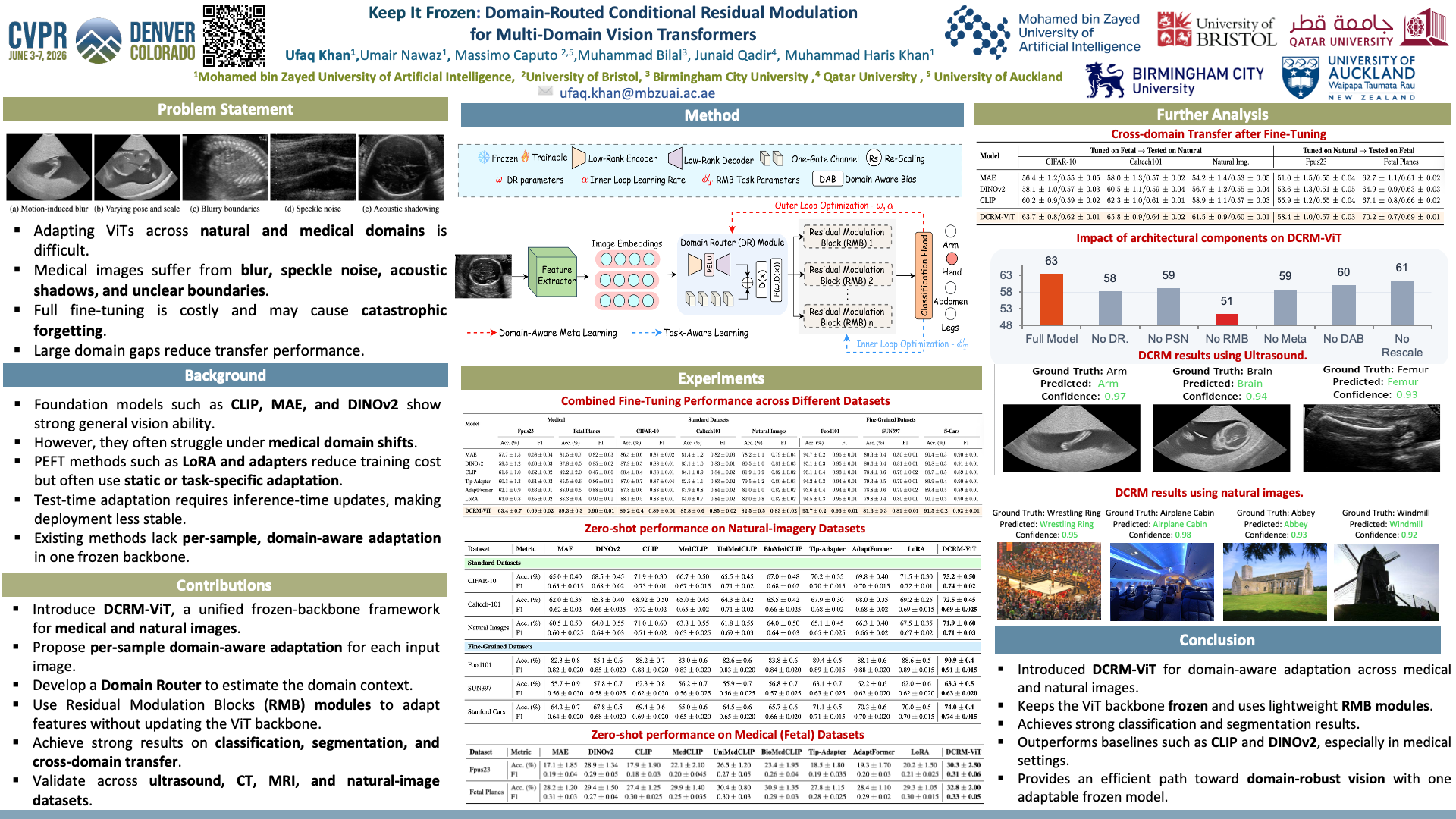
Medical imaging presents significant challenges due to acoustic shadows, motion blur, and indistinct boundaries. Addressing these issues is crucial for improving diagnostic accuracy. Many conventional vision require extensive fine-tuning on task-specific data and often lose generalizability to natural-image domains. We propose DCRM-ViT, a domain-conditioned residual modulation framework for Vision Transformers that preserves general-vision capability while adapting to diverse domains. DCRM-ViT keeps the backbone frozen and augments each block with a lightweight Residual Modulation Block (RMB) whose parameters are synthesized per sample by a Domain Router (DR) and Parameter Synthesizer Network (PSN). The router outputs soft domain weights from input features, whereas the synthesizer maps these weights to low-rank residuals that modulate selected projections and, optionally, add a domain-aware bias to attention. Crucially, we learn routing and modulation via a bi-level optimization scheme: a short inner loop adapts RMB parameters to task supervision, while an outer loop updates DR, PSN, and RMB initializations/step sizes so the synthesized residuals generalize across medical and natural domains. Across fine-grained classification (Food101, SUN397, Stanford Cars) and medical segmentation (ultrasound, CT, MRI), DCRM-ViT improves over strong baselines while using modest trainable compute. The ablation studies confirmed the benefits of our architectural enhancements, showing improved performance and adaptability. The results demonstrate DCRM-ViT's potential to offer high diagnostic performance with reduced computational overhead of using 4.7 GFLOPs and 0.3 training min/epoch. Our code will be publicly available upon acceptance.
Virtual Full-stack Scanning of Brain MRI via Imputing Any Quantised Code
Yicheng Wu ⋅ Tao Song ⋅ Zhonghua Wu ⋅ Jin Ye ⋅ Zongyuan Ge ⋅ Wenjia Bai ⋅ Zhaolin Chen ⋅ Jianfei Cai
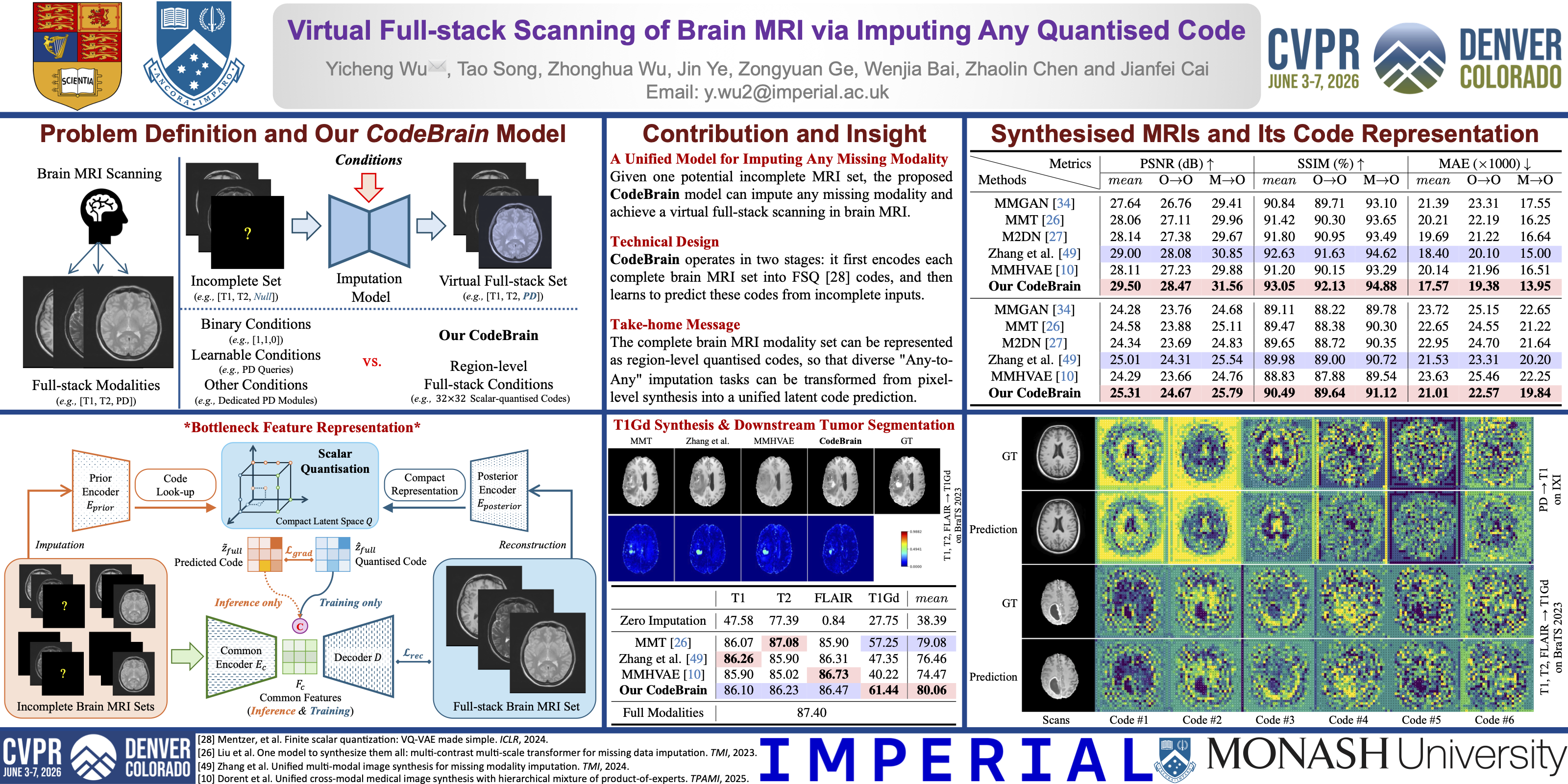
Magnetic resonance imaging (MRI) is a powerful and versatile imaging technique, offering a wide spectrum of information about the anatomy by employing different acquisition modalities. However, in the clinical workflow, it is impractical to collect all relevant modalities due to the scan time and cost constraints. Virtual full-stack scanning aims to impute missing MRI modalities from available but incomplete acquisitions, offering a cost-efficient solution to enhance data completeness and clinical usability. Existing imputation methods often depend on global conditioning or modality-specific designs, which limit their generalisability across patient cohorts and imaging protocols. To address these limitations, we propose CodeBrain, a unified framework that reformulates various ``any-to-any'' imputation tasks as a region-level full-stack code prediction problem. CodeBrain adopts a two-stage pipeline: (1) it learns the compact representation of a complete MRI modality set by encoding it into scalar-quantised codes at the region level, enabling high-fidelity image reconstruction after decoding these codes along with modality-agnostic common features; (2) it trains a projection encoder to predict the full-stack code map from incomplete modalities via a grading-based design for diverse imputation scenarios. Extensive experiments on two public brain MRI datasets, i.e., IXI and BraTS 2023, demonstrate that CodeBrain consistently outperforms state-of-the-art methods, establishing a new benchmark for unified brain MRI imputation and enabling virtual full-stack scanning.Code will be released.
MedLoc-R1: Performance-Aware Curriculum Reward Scheduling for GRPO-Based Medical Visual Grounding
Yang Guangjing ⋅ Ziyuan Qin ⋅ Chaoran Zhang ⋅ Chenlin Du ⋅ Jinglin Wang ⋅ Wanran Sun ⋅ Zhenyu Zhang ⋅ Bing Ji ⋅ Qicheng Lao
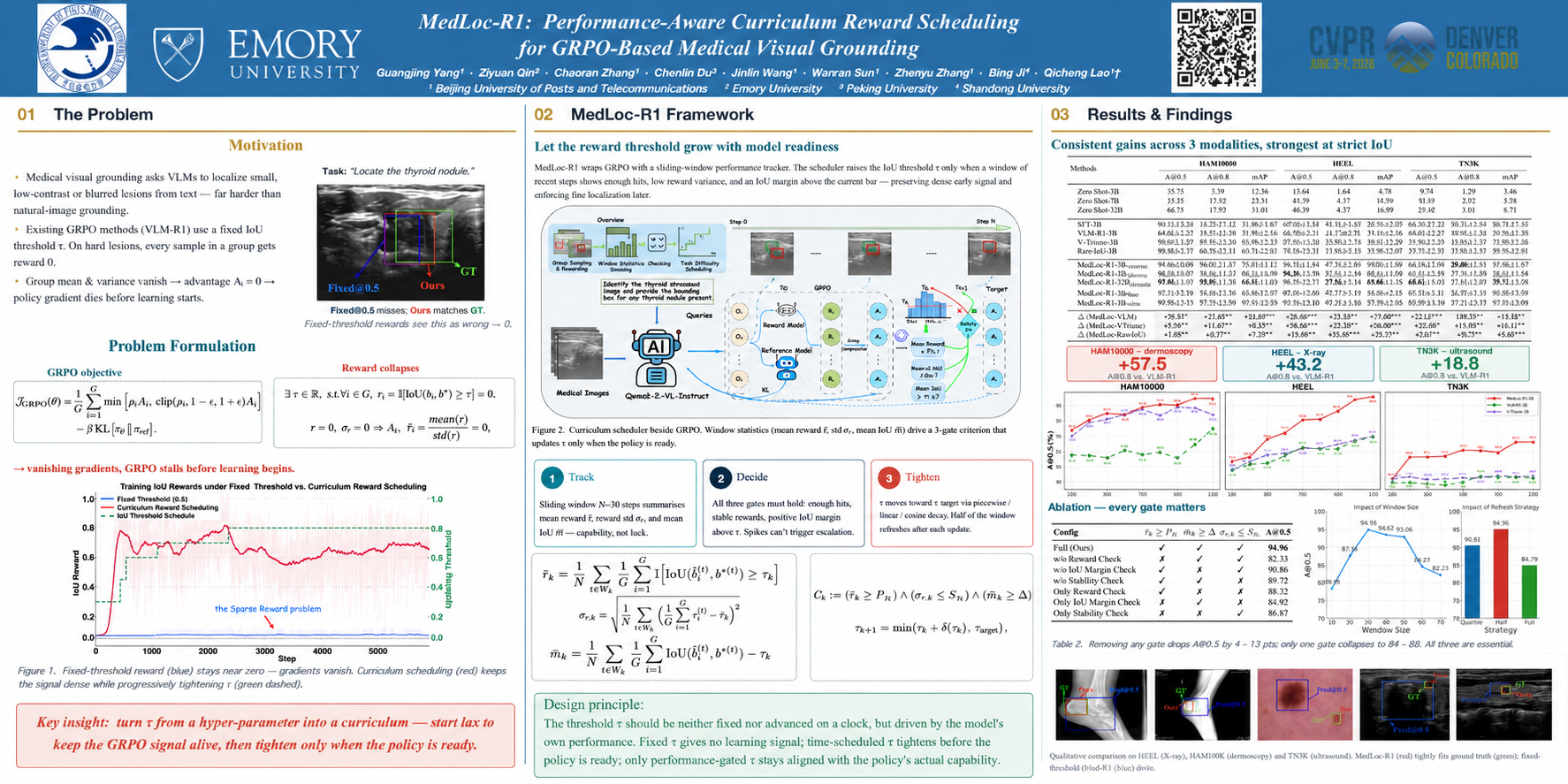
Medical visual grounding serves as a crucial foundation for fine-grained multimodal reasoning and interpretable clinical decision support. Despite recent advances in reinforcement learning (RL) for grounding tasks, existing approaches such as Group Relative Policy Optimization~(GRPO) suffer from severe reward sparsity when directly applied to medical images, primarily due to the inherent difficulty of localizing small or ambiguous regions of interest, which is further exacerbated by the rigid and suboptimal nature of fixed IoU-based reward schemes in RL. This leads to vanishing policy gradients and stagnated optimization, particularly during early training. To address this challenge, we propose MedLoc-R1, a performance-aware reward scheduling framework that progressively tightens the reward criterion in accordance with model readiness. MedLoc-R1 introduces a sliding-window performance tracker and a multi-condition update rule that automatically adjust the reward schedule from dense, easily obtainable signals to stricter, fine-grained localization requirements, while preserving the favorable properties of GRPO without introducing auxiliary networks or additional gradient paths. Experiments on three medical visual grounding benchmarks demonstrate that MedLoc-R1 consistently improves both localization accuracy and training stability over GRPO-based baselines. Our framework offers a general, lightweight, and effective solution for RL-based grounding in high-stakes medical applications. Code and checkpoints will be released after acceptance.
Turning Pre-Trained Vision Transformers into End-to-End Histopathology Whole Slide Image Models for Survival Prediction
Jiawen Li ⋅ Jiali Hu ⋅ Xitong Ling ⋅ Renao Yan ⋅ Yuxuan Chen ⋅ Tian Guan ⋅ Yonghong He
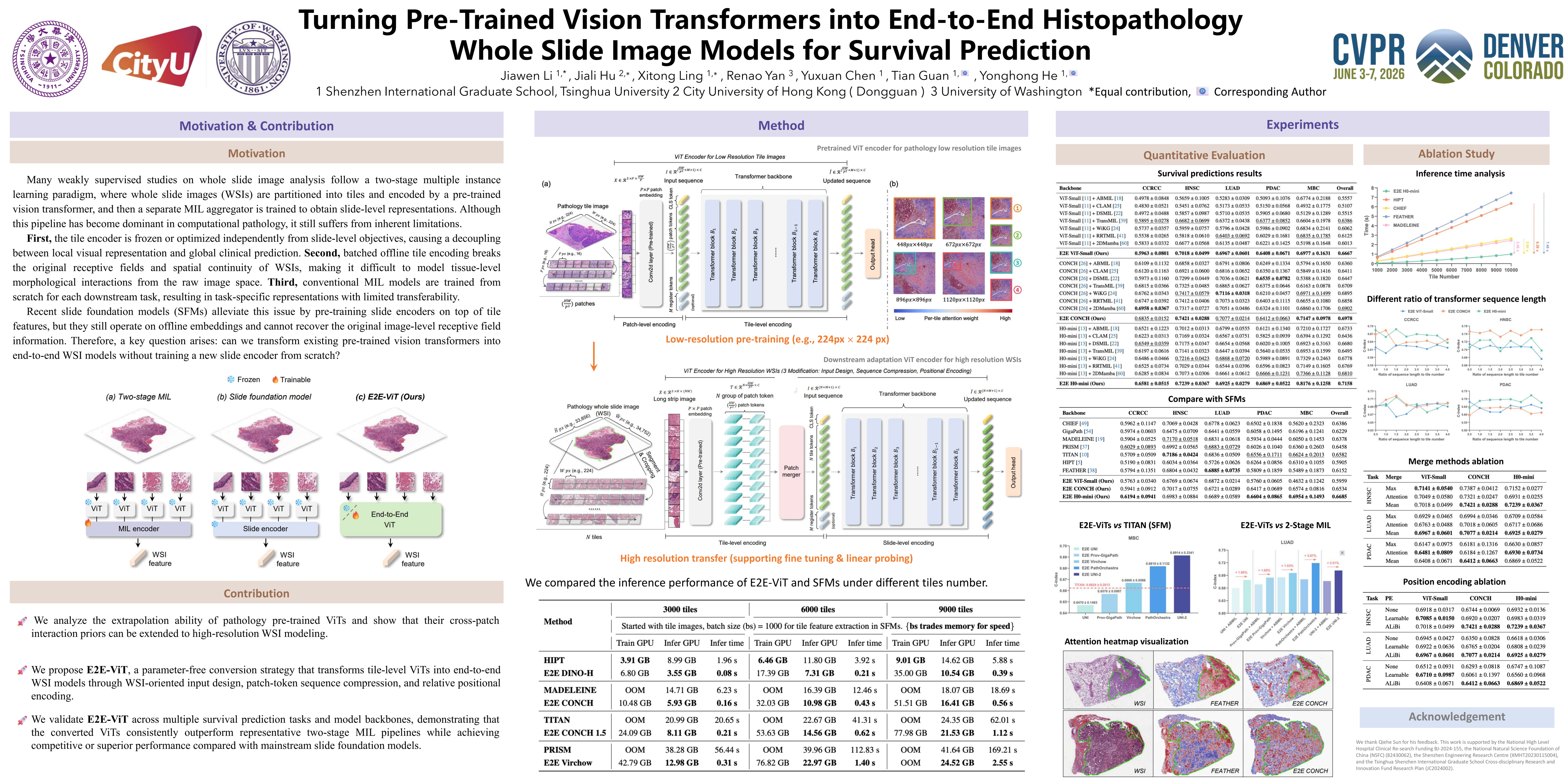
Conventional whole slide image (WSI) analysis pipelines follow a two-stage process. First, an image encoder, such as a vision transformer (ViT), is used to perform batched offline feature extraction on a series of tiles cropped from the WSI. Second, a multiple instance learning (MIL) model is trained with slide-level labels to obtain task-specific slide embeddings. However, several limitations exist: strong reliance on pre-trained weights of the tile encoder, the absence of receptive fields from the original image, and a lack of task-independent WSI representations. An ideal improvement would be to develop an end-to-end pre-trained WSI model, but training it from scratch will face challenges such as high training costs and computational complexity. In this work, we deconstruct the key steps of ViT-based pathology image representation and propose a conversion strategy called E2E-ViT, which transforms a vanilla ViT into an end-to-end pre-trained WSI model without introducing additional parameters. E2E-ViT directly inputs the entire tissue region in WSIs to efficiently feed image sequences into the transformer backbone, achieving information interaction from the original receptive fields and generating slide features. Through multiple survival prediction tasks, we demonstrate that transformed pre-trained ViTs outperform two-stage MIL models and slide foundation models (SFM). Our work presents a new end-to-end learning paradigm that provides a promising direction for the next generation of computational pathology models.
A Supervised Multi-task Framework for Joint cryo-ET Restoration Enabled by Generative Physical Simulation
Xinsheng Wang ⋅ Zhidong Yang ⋅ Xiaohua Wan ⋅ Renmin Han ⋅ Shuai Tang ⋅ Hao Dong ⋅ Fa Zhang ⋅ Bin Hu
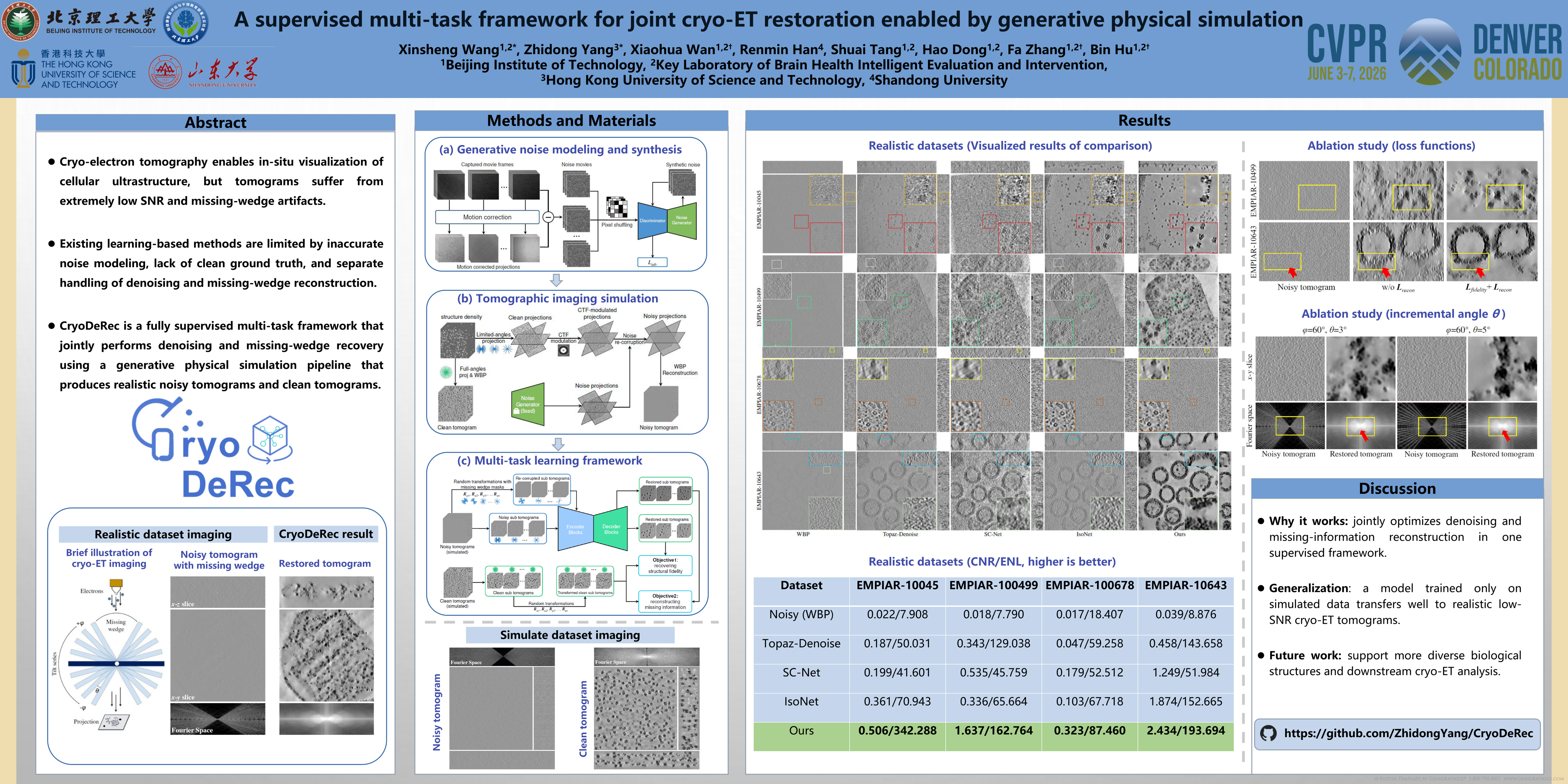
Cryo-electron tomography (cryo-ET) enables in-situ visualization of cellular structures at near-native state, yet its practical utility is often hampered by extremely low signal-to-noise ratio (SNR) and severe missing wedge artifacts resulting from dose limitations and restricted tilt angles. While several computational methods have been proposed for reconstructing high-quality tomograms, the performance is still limited by the absence of accurate noise modeling and reliable ground truth data. To address this challenge, we propose cryoDeRec, a multi-task learning framework to jointly address denoising and missing wedge reconstruction in fully supervised manner. The main contribution of cryoDeRec is a dual-objective training strategy incorporated with synthetically corrupted tomogram and raw noisy tomogram, enabling simultaneous restoration of structural fidelity and reconstruction of missing information. The model is trained on a physically synthetic dataset generated by a novel imaging simulation pipeline that incorporates authentic noise distributions and isotropic structural priors. We evaluate cryoDeRec on four realistic cryo-ET datasets and two simulated datasets with extremely low SNR, all reconstructed using Weighted Back Projection (WBP). Extensive experimental results demonstrate that our method achieves high-quality restoration directly from raw tomograms without any pre-processing, outperforming existing state-of-the-art methods. Our findings show that training on a comprehensive simulated dataset, which captures realistic noise and structural diversity, enables models to generalize effectively to real cryo-ET tomograms. The code and datasets will be available upon acceptance.
KAMP: Knowledge-Anchored Multimodal Pretraining Framework for Medical Image Representation
Feiyu Huang ⋅ Jia Li ⋅ Zhao CHEN ⋅ Yang WU ⋅ Caleb Chen Cao ⋅ Lei Chen
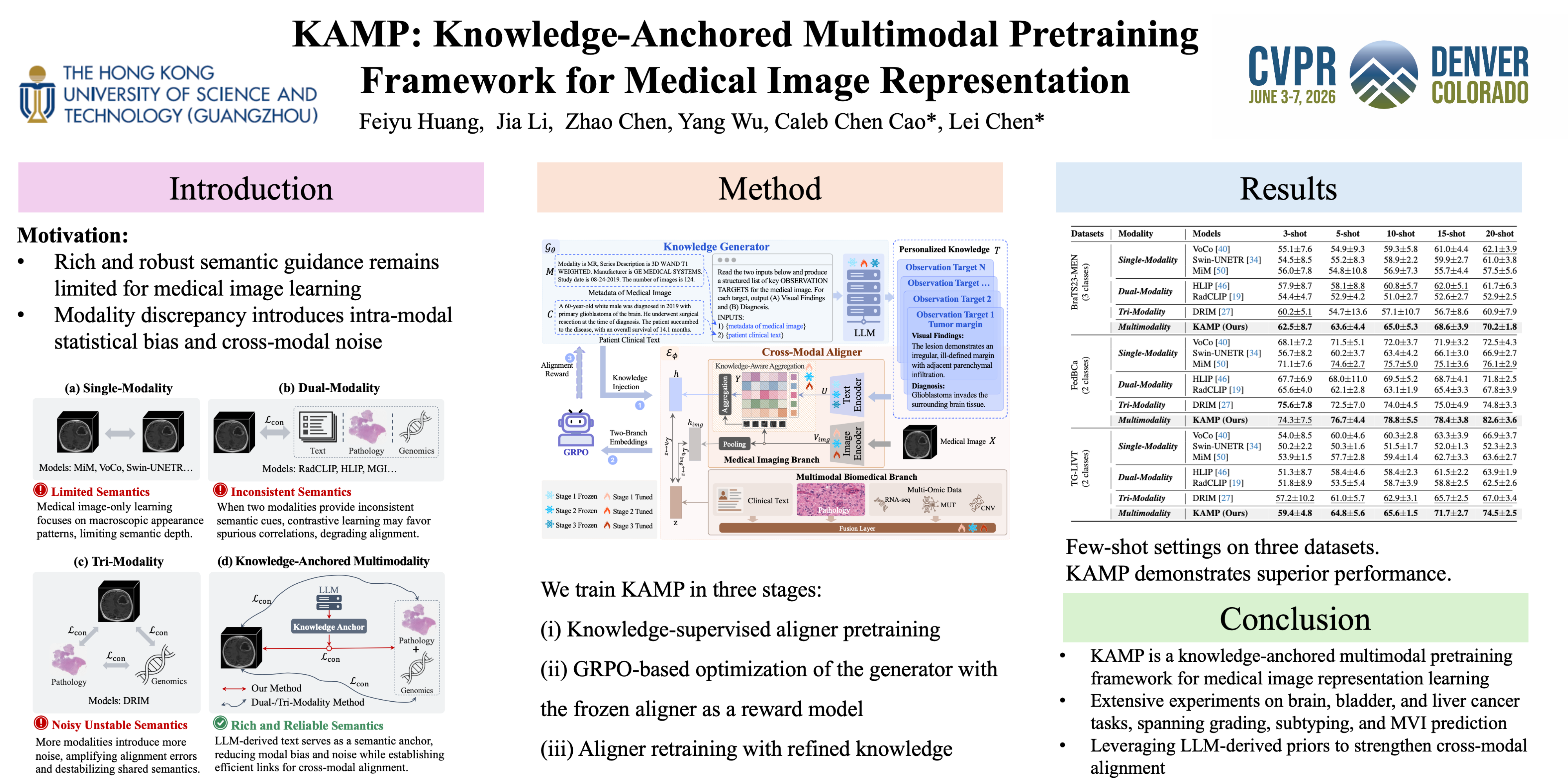
Cross-modal biomedical signals such as pathology and genomics can provide richer and more robust semantic guidance for medical image representation. However, semantic guidance remains limited, as privacy constraints and acquisition costs severely restrict the availability of medical images paired with other biomedical data. A further challenge is modality discrepancy, which propagates intra-modal statistical bias and cross-modal noise, degrading medical image representation quality. To this end, we propose KAMP, a large language model (LLM)--driven multimodally guided pretraining framework for medical image representation learning. KAMP leverages textual priors as semantic anchors to enhance medical image representations and align medical images with multimodal biomedical data, enabling the generation of rich and robust representations even under scarce paired data. KAMP operates in three stages. First, the LLM generates personalized diagnostic knowledge from patient clinical text and imaging metadata. We inject this knowledge as a prior to enrich the medical image representation and use it as a semantic anchor to reduce the distance between the medical image representations and other biomedical modalities. Second, the LLM is optimized via the Group Relative Policy Optimization (GRPO) strategy, with the cross-modal aligner pretrained in the first stage serving as the reward model. Third, the optimized knowledge is employed to retrain the cross-modal aligner, yielding more robust medical image representations while mitigating bias and noise introduced by other modalities.Comprehensive evaluations on brain, bladder, and liver cancer datasets demonstrate that KAMP consistently outperforms existing methods on downstream few-shot prediction tasks.
CARE: A Molecular-Guided Foundation Model with Adaptive Region Modeling for Whole Slide Image Analysis
Di Zhang ⋅ Zhangpeng Gong ⋅ Xiaobo Pang ⋅ Jiashuai Liu ⋅ Junbo Lu ⋅ Hao Cui ⋅ Jiusong Ge ⋅ Zhi Zeng ⋅ Kai Yi ⋅ Yinghua Li ⋅ Si Liu ⋅ Tingsong Yu ⋅ Haoran Wang ⋅ Mireia Crispin-Ortuzar ⋅ Weimiao Yu ⋅ Chen Li ⋅ Zeyu Gao
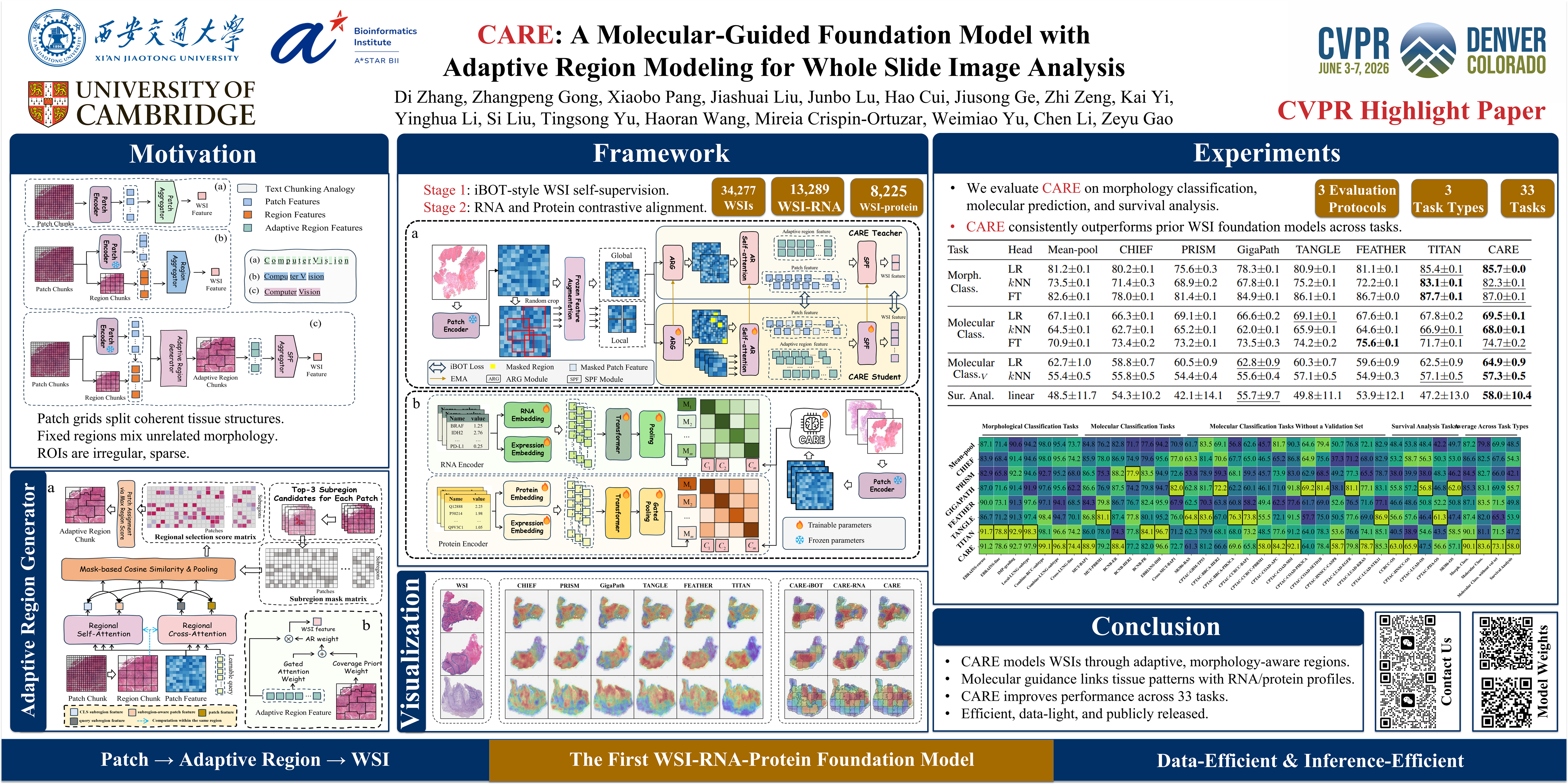
Foundation models have recently achieved impressive success in computational pathology, demonstrating strong generalization across diverse histopathology tasks. However, existing models overlook the heterogeneous and non-uniform organization of pathological regions of interest (ROIs) because they rely on natural image backbones not tailored for tissue morphology. Consequently, they often fail to capture the coherent tissue architecture beyond isolated patches, limiting interpretability and clinical relevance. To address these challenges, we present Cross-modal Adaptive Region Encoder (CARE), a foundation model for pathology that automatically partitions WSIs into several morphologically relevant regions. Specifically, CARE employs a two-stage pretraining strategy: (1) a self-supervised unimodal pretraining stage that learns morphological representations from 34,277 whole-slide images (WSIs) without segmentation annotations, and (2) a cross-modal alignment stage that leverages RNA and protein profiles to refine the construction and representation of adaptive regions. This molecular guidance enables CARE to identify biologically relevant patterns and generate irregular yet coherent tissue regions, selecting the most representative area as ROI. CARE supports a broad range of pathology-related tasks, using either the ROI feature or the slide-level feature obtained by aggregating adaptive regions. Based on only one-tenth of the pretraining data typically used by mainstream foundation models, CARE achieves superior average performance across 33 downstream benchmarks, including morphological classification, molecular prediction, and survival analysis, and outperforms other foundation model baselines overall.
Contrastive Cross-Bag Augmentation for Multiple Instance Learning-based Whole Slide Image Classification
Bo Zhang ⋅ Xu Xinan ⋅ Shuo Yan ⋅ Yu Bai ⋅ Zheng Zhang ⋅ Wufan Wang ⋅ Hui Gao ⋅ Wendong Wang
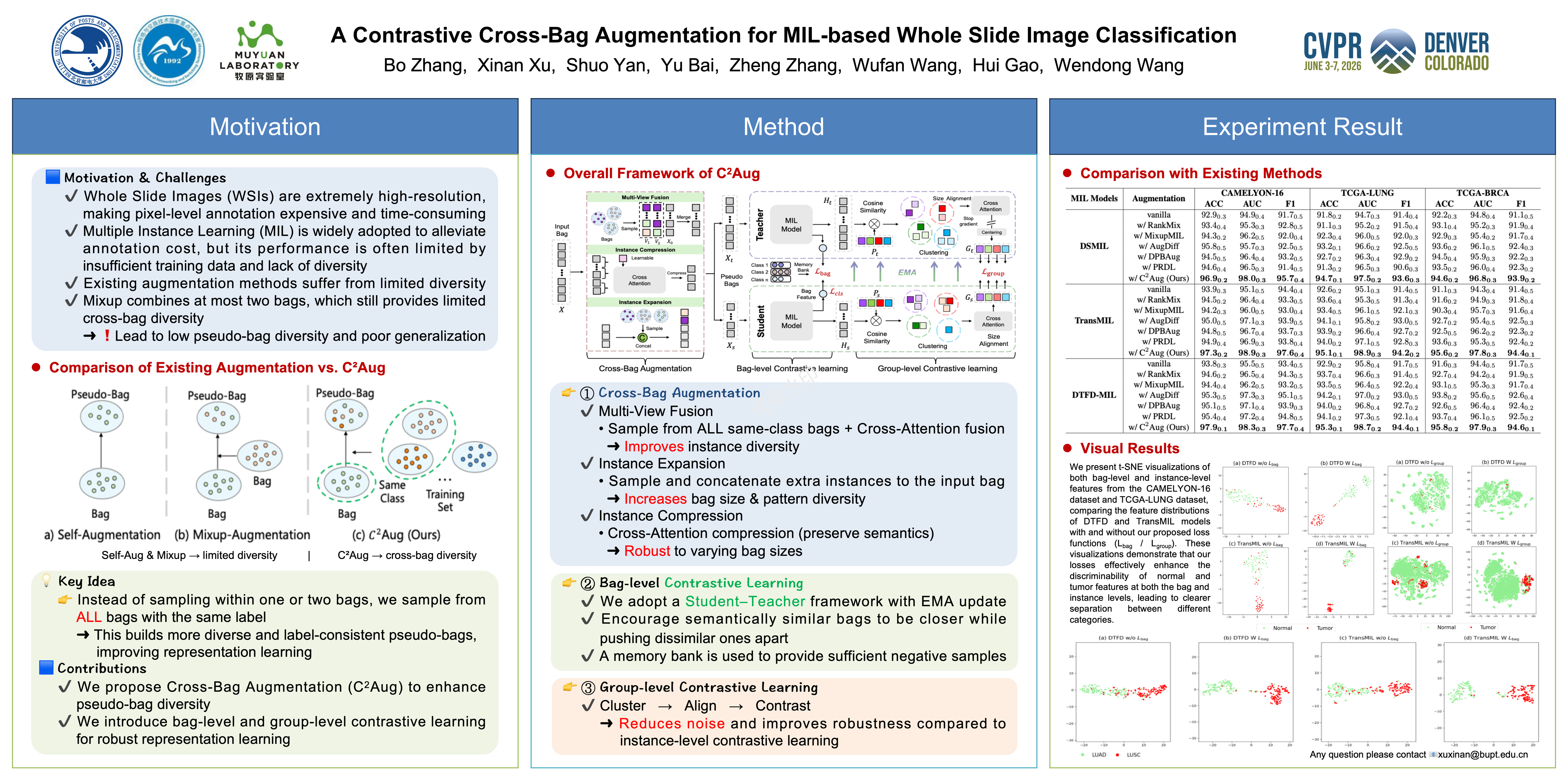
Recent pseudo-bag augmentation methods for Multiple Instance Learning (MIL)-based Whole Slide Image (WSI) classification sample instances from a limited number of bags, resulting in constrained diversity. To address this issue, we propose Contrastive Cross-Bag Augmentation ($\text{C}^{2}$Aug) to sample instances from all bags with the same class to increase the diversity of pseudo-bags. However, introducing new instances into the pseudo-bag increases the number of critical instances (e.g., tumor instances). This increase results in a reduced occurrence of pseudo-bags containing few critical instances, thereby limiting model performance, particularly on test slides with small tumor areas. To address this, we introduce a bag-level and group-level contrastive learning framework to enhance the discrimination of features with distinct semantic meanings, thereby improving model performance. Experimental results demonstrate that $\text{C}^{2}$Aug consistently outperforms state-of-the-art approaches across multiple evaluation metrics.
OmniFM: Toward Modality-Robust and Task-Agnostic Federated Learning for Heterogeneous Medical Imaging
meilin liu ⋅ Jiaying Wang ⋅ Jing Shan
Federated learning (FL) has become a promising paradigm for collaborative medical image analysis, yet existing frameworks remain tightly coupled to task-specific backbones and are fragile under heterogeneous imaging modalities. Such constraints hinder real-world deployment, where institutions vary widely in modality distributions and must support diverse downstream tasks. To address this limitation, we propose OmniFM,a modality- and task-agnostic FL framework that unifies training across classification,segmentation, super-resolution, visual question answering,and multimodal fusion without re-engineering the optimization pipeline. OmniFM builds on a key frequency-domain insight: low-frequency spectral components exhibit strong cross-modality consistency and encode modality-invariant anatomical structures. Accordingly, OmniFM integrates(i) Global Spectral Knowledge Retrieval to inject global frequency priors, (ii) Embedding-wise Cross-Attention Fusion to align representations, and (iii) Prefix–Suffix Spectral Prompting to jointly condition global and personalized cues, together regularized by a Spectral-Proximal Alignment objective that stabilizes aggregation. Experiments on real-world datasets show that OmniFM consistently surpasses state-of-the-art FL baselines across intra- and cross-modality heterogeneity, achieving superior results under both fine-tuning and training-from-scratch setups.
Learning complete and explainable visual representations from itemized text supervision
Yiwei Lyu ⋅ Chenhui Zhao ⋅ Soumyanil Banerjee ⋅ Shixuan Liu ⋅ Akshay Rao ⋅ Akhil Kondepudi ⋅ Honglak Lee ⋅ Todd C. Hollon
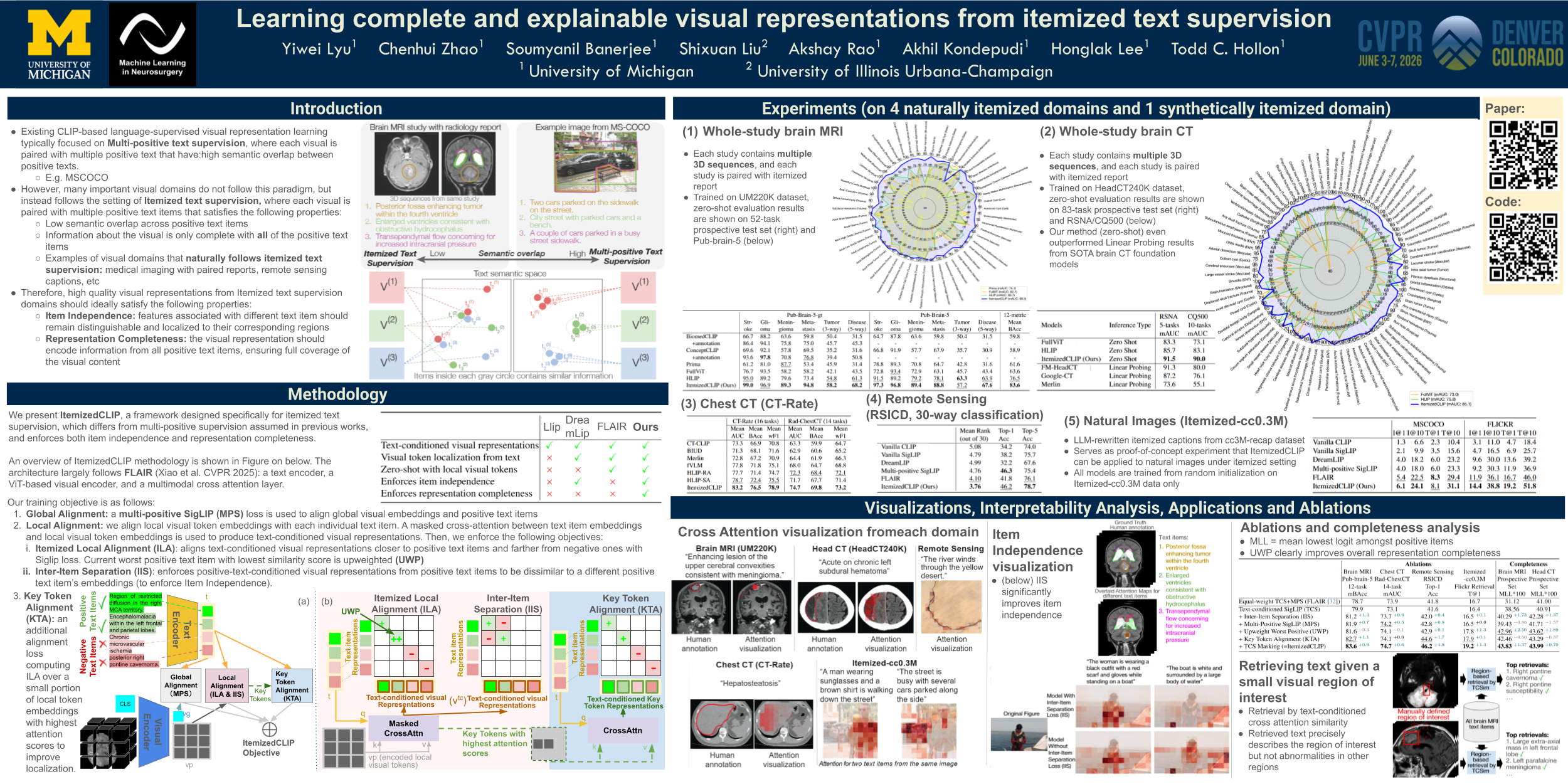
Training vision models with language supervision enables general and transferable representations. However, many visual domains, especially non-object-centric domains such as medical imaging and remote sensing, contain itemized text annotations: multiple text items describing distinct and semantically independent findings within a single image. Such supervision differs from standard multi-caption supervision, where captions are redundant or highly overlapping. Here, we introduce ItemizedCLIP, a framework for learning complete and explainable visual representations from itemized text supervision. ItemizedCLIP employs a cross-attention module to produce text item-conditioned visual embeddings and a set of tailored objectives that jointly enforce item independence (distinct regions for distinct items) and representation completeness (coverage of all items). Across four domains with naturally itemized text supervision (brain MRI, head CT, chest CT, remote sensing) and one additional synthetically itemized dataset, ItemizedCLIP achieves substantial improvements in zero-shot performance and fine-grained interpretability over baselines. The resulting ItemizedCLIP representations are semantically grounded, item-differentiable, complete, and visually interpretable.
EgoPoseFormer v2: Accurate Egocentric Human Motion Estimation for AR/VR
Zhenyu Li ⋅ Sai Kumar Dwivedi ⋅ Filip Maric ⋅ Carlos Chacón ⋅ Nadine Bertsch ⋅ Filippo Arcadu ⋅ Tomas Hodan ⋅ Michael Ramamonjisoa ⋅ Peter Wonka ⋅ Amy Zhao ⋅ Robin Kips ⋅ Cem Keskin ⋅ Anastasia Tkach ⋅ Chenhongyi Yang
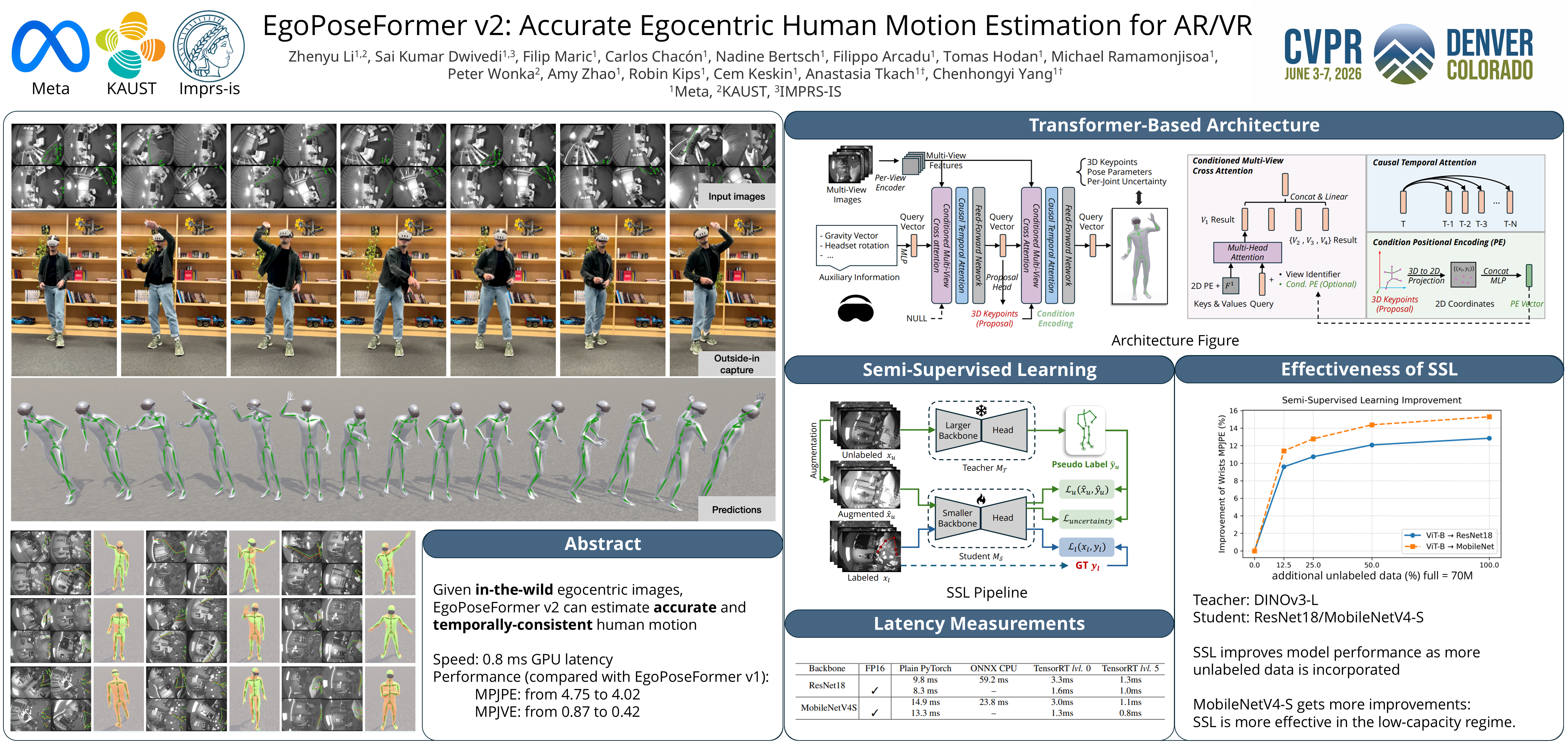
Egocentric 3D human motion estimation is essential for AR/VR experiences, yet remains challenging due to limited body coverage from the egocentric viewpoint, frequent occlusions, and scarce labeled data. We present XR-Poser, a method that addresses these challenges through two key contributions: (1) a transformer-based model for temporally consistent and spatially grounded body pose estimation, and (2) an auto-labeling system that enables the use of large unlabeled datasets for training.The proposed model is fully differentiable, introduces identity-conditioned queries, multi-view spatial refinement, causal temporal attention, and supports both keypoints and parametric body representations under a constant compute budget.The proposed auto-labeling system scales learning to tens of millions of unlabeled frames via uncertainty-aware semi-supervised training. The system follows a teacher–student schema to generate pseudo-labels and guide training with uncertainty distillation, enabling the model to generalize to different environments. In experiments on the EgoBody3M benchmark, XR-Poser outperforms two state-of-the-art methods by 12.2% and 19.4% in accuracy, and reduces temporal jitter by 22.2% and 51.7%, respectively. Furthermore, our auto-labeling system additionally improves the wrist MPJPE by 13.1%.
MetricHMSR: Metric Human Mesh and Scene Recovery from Monocular Images
Chentao Song ⋅ He Zhang ⋅ Yuan Haolei ⋅ Haozhe Lin ⋅ Jianhua Tao ⋅ Hongwen Zhang ⋅ Tao Yu
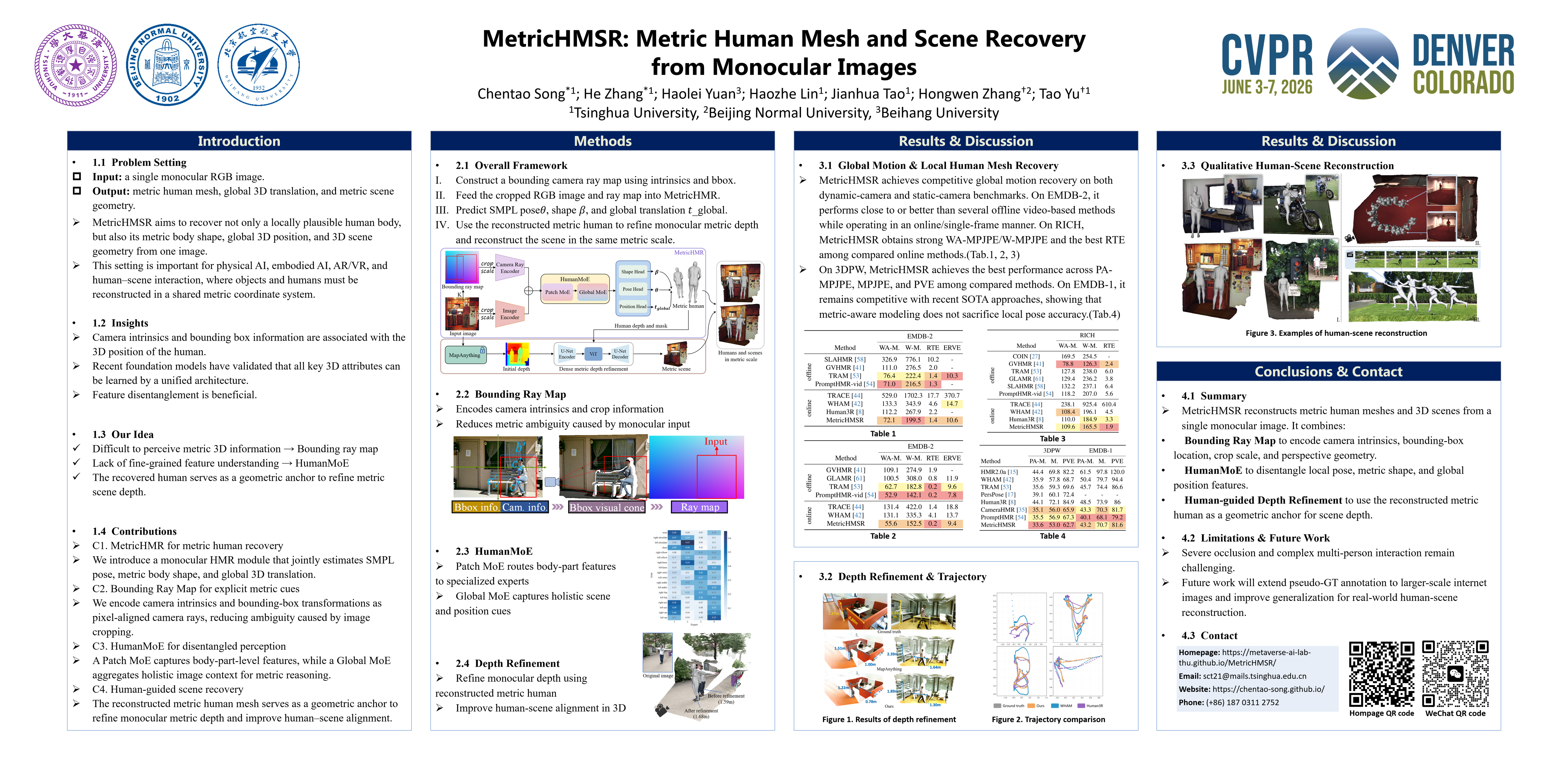
We introduce MetricHMSR (Metric Human Mesh and Scene Recovery), a novel approach for metric human mesh and scene recovery from monocular images. Due to unrealistic assumptions in the camera model and inherent challenges in metric perception, existing approaches struggle to achieve human pose and metric 3D position estimation through a unified module.To address this limitation, MetricHMSR incorporates camera rays to comprehensively encode both the bounding box information and the intrinsic parameters of perspective projection. Then we proposed Human Mixture-of-Experts (MoE), the model dynamically routes image features and ray features to task-specific experts for specialized understanding of different data aspects, enabling a unified framework that simultaneously perceives the local pose and the global 3D position.Based on the results above, we further refine the existing monocular metric depth estimation method to achieve more accurate results, ultimately enabling the seamless overlay of humans and scenes in 3D space.Comprehensive experimental results demonstrate that the proposed method achieves state-of-the-art performance on both human mesh and scene recovery.
Differentially Private 2D Human Pose Estimation
Kaushik Bhargav Sivangi ⋅ Paul Henderson ⋅ Fani Deligianni
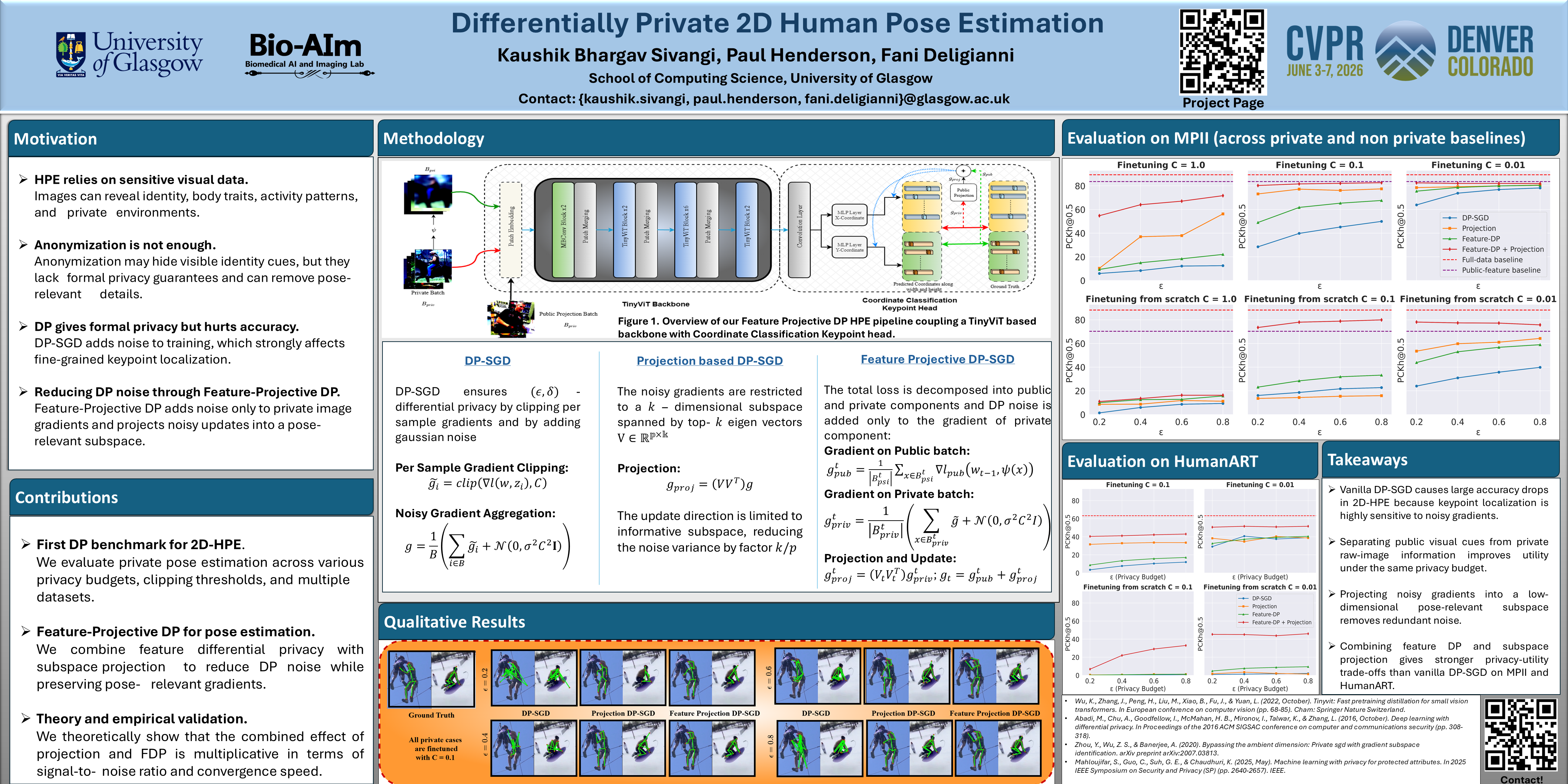
Human pose estimation (HPE) underpins critical applications in healthcare, activity recognition, and human-computer interaction. However, the privacy implications of processing sensitive visual data present significant deployment barriers in critical domains. %Conventional anonymization techniques offer weak protection and are unquantifiable, while Differential Privacy (DP) provides formal guarantees but often results in steep performance costs.We introduce the first unified framework for differentially private 2D Human Pose Estimation (2D-HPE) that achieves strong privacy-utility trade-offs for structured visual prediction through complementary noise mitigation mechanisms. Our Feature-Projective DP integrates: (1) subspace projection that reduces noise variance by a factor $k/p$ by restricting gradient updates to a $k$-principal subspace within the full $p$-dimensional parameter space, and (2) feature-level privacy, which selectively privatizes sensitive features while retaining public visual cues. Together these mechanisms yield a multiplicative utility gain under formal privacy constraints.%We further propose a feature-projective hybrid that combines both the mechanisms within a single post-processing framework.Extensive experiments on MPII and HumanART datasets across privacy budgets $(\varepsilon \in \{0.2, 0.4, 0.6, 0.8\})$, clipping thresholds $(C \in \ \{0.01, 0.1, 1.0\})$ and training strategies demonstrate consistent improvements over vanilla DP-SGD. At $\varepsilon=0.8$, our method achieves 82.61\% PCKh@0.5, recovering 73\% of the privacy induced performance gap. Cross-dataset evaluation on the HumanART confirms generalization (51.6 AP). Our study provides the first rigorous benchmark and a practical blueprint for privacy-preserving pose estimation in sensitive, real-world applications. Our source code will be made public on acceptance.
TROPHIES: Temporal Reconstruction of Places, Humans, and Cameras from Multi-view Videos
Jinpeng Liu ⋅ Yukang Xu ⋅ Yutong Li ⋅ Xingyu Liu
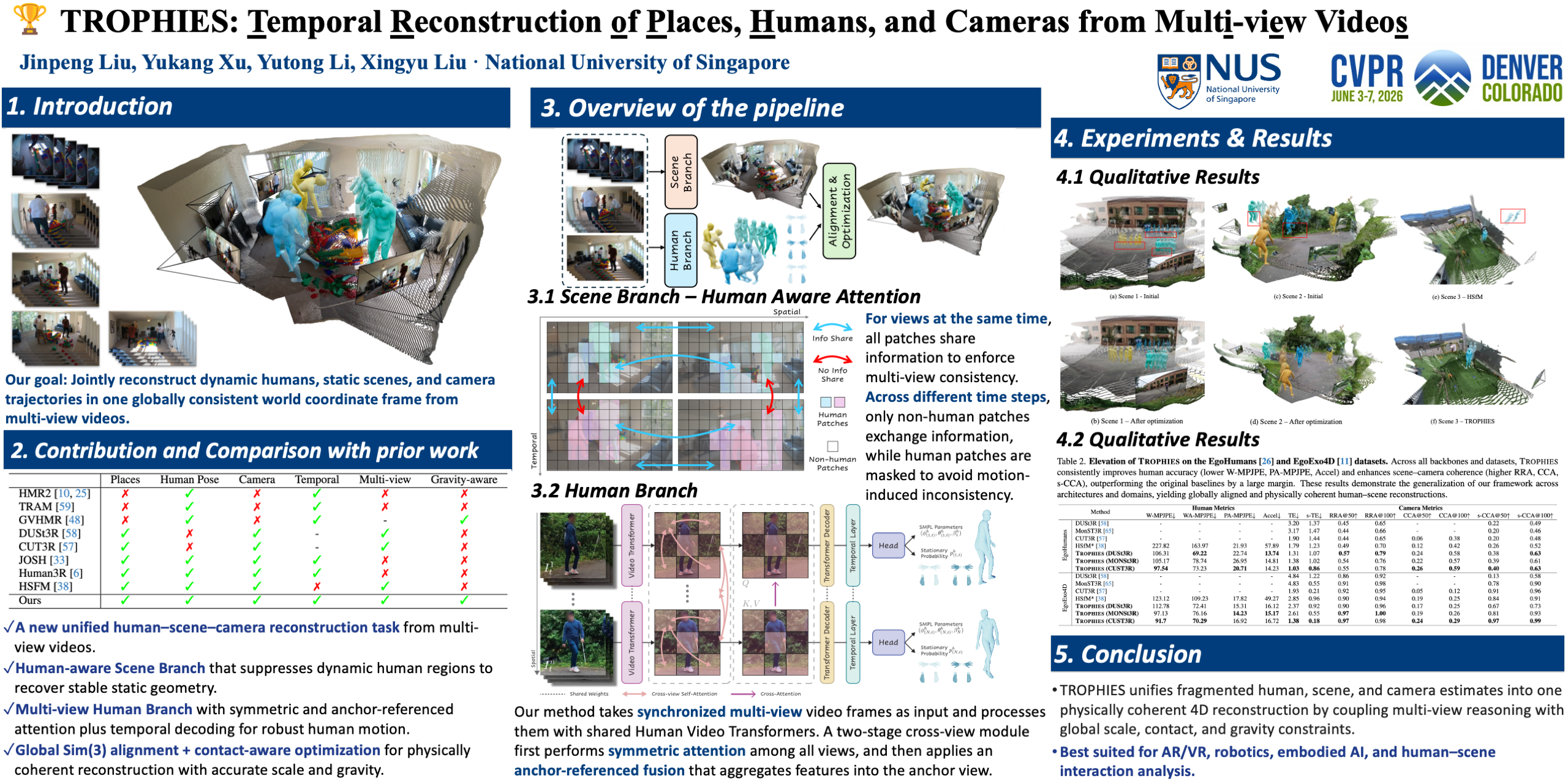
Reconstructing humans and their surrounding environments in a globally consistent 4D space is essential for comprehensive perception. However, prior works typically assume single-view inputs or decouple humans, scenes, and cameras, making them unable to recover coherent geometry, stable motion, and physically aligned trajectories. These limitations motivate us to introduce a new task: unified human–scene–camera reconstruction from multi-view videos, which aims to jointly estimate dynamic humans, static scenes, and camera poses in one global coordinate frame. We propose TROPHIES--Temporal Reconstruction of Places, Humans, and Cameras from Multi-view Videos--a unified framework tailored for this task. TROPHIES features a Human Branch that models human through temporal and spatial reasoning, and a Scene Branch that reconstructs static geometry with human-aware attention. A global alignment and optimization module couples both branches by enforcing scale consistency, contact priors, and cross-view temporal coherence. Experiments on EgoHuman and EgoExo4D demonstrate that TROPHIES achieves globally aligned, physically plausible 4D reconstructions and consistently outperforms existing paradigms in both global fidelity and human–scene consistency.
PoseD-Flow: Versatile and Guided Flow Matching Model of Human Pose
Jebastin Nadar ⋅ Simone Foti ⋅ Tolga Birdal
Generative pose priors have recently emerged as a powerful tool for inference under occlusion or noise. Yet today’s strongest generative paradigm, flow matching, remains unused for human pose due to two fundamental barriers: the absence of a pre-trained flow prior and the non-Euclidean nature of articulated poses. We overcome both by introducing PoseD-Flow, a novel framework to unify Riemannian Flow Matching (RFM) with training-free guidance for 3D human pose recovery. PoseD-Flow is composed of two contributions: (i) PoseRFM, the first RFM model of human pose, defined directly on the product manifold of joint rotations, and (ii) Riemannian D-Flow, a principled guidance mechanism that, by differentiating through its ODE sampling dynamics, conditions PoseRFM at inference without any task-specific training. Our theoretical analysis shows that the induced dynamics are shaped by data covariance and manifold curvature, yielding a bias toward realistic poses. Across pose completion, denoising, and inverse kinematics, \MethodName~establishes new state of the art, particularly under noise, occlusion, and partial observations.
SIMSPINE: A Biomechanics-Aware Simulation Framework for 3D Spine Motion Annotation and Benchmarking
Muhammad Saif Ullah Khan ⋅ Didier Stricker
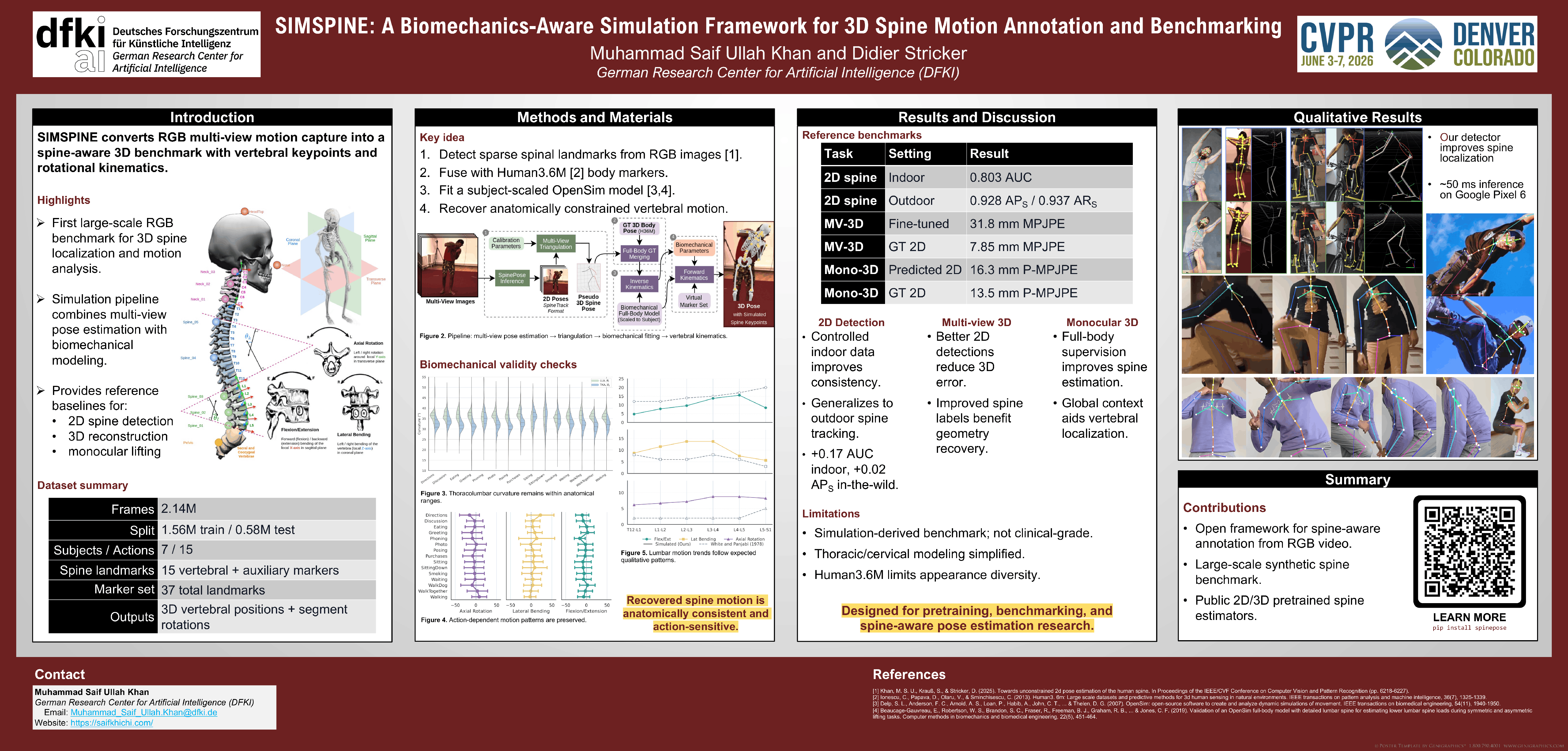
Modeling spinal motion is fundamental to understanding human biomechanics, yet remains underexplored in computer vision due to the spine’s complex multi-joint kinematics and the lack of large-scale 3D annotations. We present a biomechanics-aware keypoint simulation framework that augments existing human pose datasets with anatomically consistent 3D spinal keypoints derived from musculoskeletal modeling. Using this framework, we create the first open dataset, named SIMSPINE, which provides sparse vertebra-level 3D spinal annotations for natural full‑body motions in indoor multi‑camera capture without external restraints. With 2.14 million frames, this enables data-driven learning of vertebral kinematics from subtle posture variations and bridges the gap between musculoskeletal simulation and computer vision. In addition, we release pretrained baselines covering fine-tuned 2D detectors, monocular 3D pose lifting models, and multi-view reconstruction pipelines, establishing a unified benchmark for biomechanically valid spine motion estimation. Specifically, our 2D spine baselines improve the state-of-the-art from 0.63 to 0.80 AUC in controlled environments, and from 0.91 to 0.93 AP for in-the-wild spine tracking.Together, the simulation framework and SIMSPINE dataset advance research in vision-based biomechanics, motion analysis, and digital human modeling by enabling reproducible, anatomically grounded 3D spine estimation under natural conditions.
HUMAPS-4D: A Multimodal Dataset for HUman Motion Analysis with Physiological and Semantic informations
Matthieu Dabrowski ⋅ Ouala Ben Jemaa ⋅ Benjamin Allaert
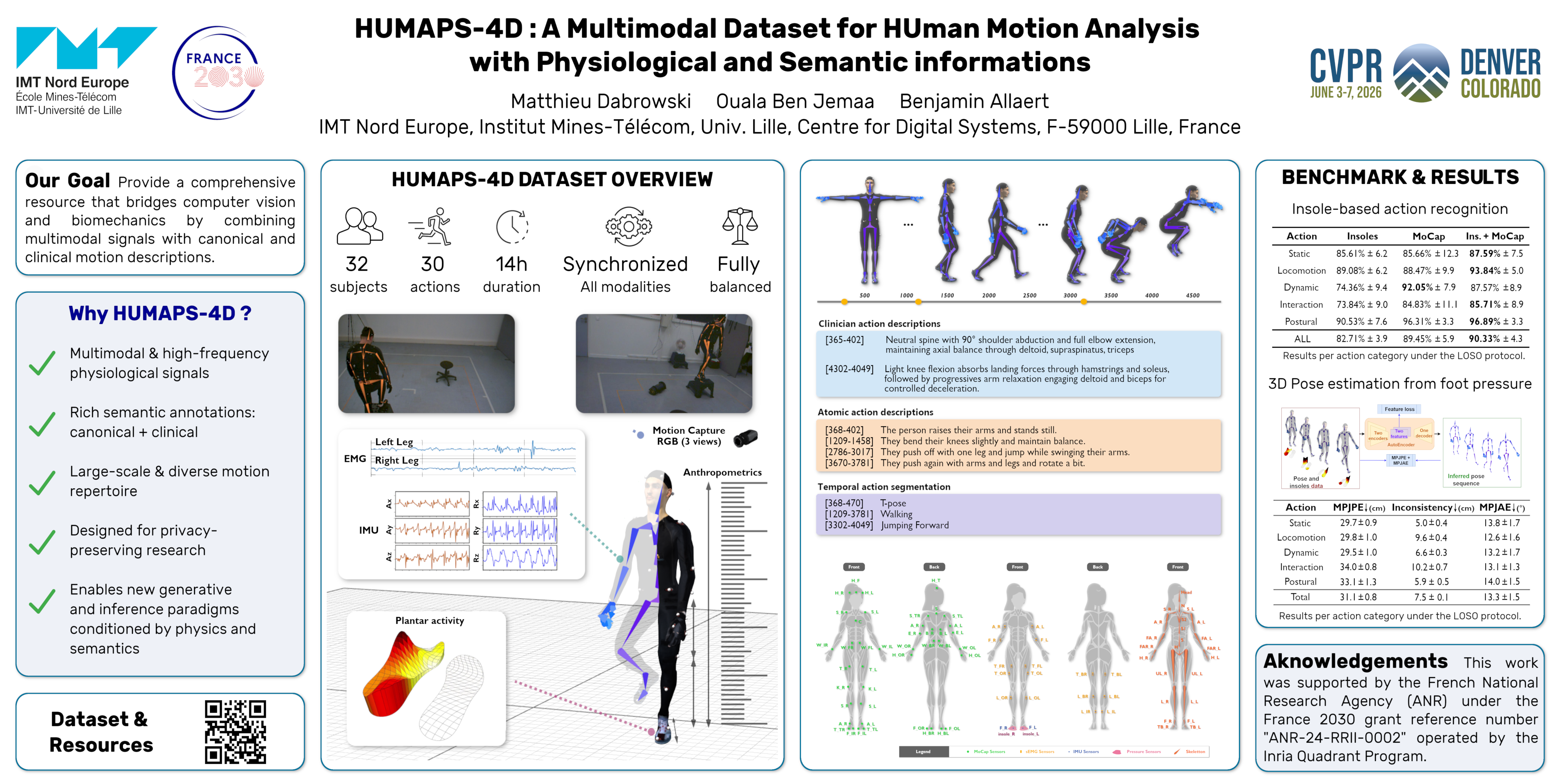
Current advancements in human motion understanding are strongly reliant on video data. Nevertheless, privacy regulations and operational constraints increasingly restrict the use of visual data in real-world scenarios. Inferring posture through wearable sensors, such as instrumented insoles measuring plantar activation, presents itself as a promising alternative. However, the absence of large-scale multimodal datasets hinders the rigorous benchmarking of these methodologies. We introduce HUMAPS-4D, a novel multimodal dataset designed for human motion analysis, effectively bridging computer vision and biomechanics. This dataset integrates synchronized motion capture, multi-view video, IMUs, plantar pressure signals, sEMG activation patterns, and high-level semantic annotations. The data was collected from 32 subjects performing 30 actions over a total duration of 14 hours. Participants demonstrate substantial anthropometric variability (age, body proportions, and morphology), which supports robust generalization across diverse body types. Distinct from existing resources, this collection offers a unique pairing of low-level physiological signals and high-level human motor descriptors. This capability enables the development of generative and inference models conditioned by both physical and semantic constraints, while simultaneously reducing the reliance on personally identifiable visual data. We establish benchmark tasks specifically targeting posture reconstruction from plantar pressure, semantic motion segmentation, physics-informed motricity analysis, and multimodal fusion under privacy-preserving conditions. The dataset, along with its associated annotation tools and visualization utilities, is scheduled for online release soon.
PHASE-Net: Physics-Grounded Harmonic Attention System for Efficient Remote Photoplethysmography Measurement
bo zhao ⋅ Dan Guo ⋅ Junzhe Cao ⋅ Yong Xu ⋅ Bochao Zou ⋅ Tao Tan ⋅ Yue Sun ⋅ Zitong YU
Remote photoplethysmography (rPPG) measurement enables non-contact physiological monitoring but suffers from accuracy degradation under head motion and illumination changes. Existing deep learning methods are mostly heuristic and lack theoretical grounding, limiting robustness and interpretability. In this work, we propose a physics-informed rPPG paradigm derived from the Navier–Stokes equations of hemodynamics, showing that the pulse signal follows a second-order dynamical system whose discrete solution naturally leads to a causal convolution, justifying the use of a Temporal Convolutional Network (TCN). Based on this principle, we design the PHASE-Net, a lightweight model with three key components: 1) Zero-FLOPs Axial Swapper module to swap or transpose a few spatial channels to mix distant facial regions, boosting cross-region feature interaction without changing temporal order; 2) Adaptive Spatial Filter to learn a soft spatial mask per frame to highlight signal-rich areas and suppress noise for cleaner feature maps; and 3) Gated TCN, a causal dilated TCN with gating that models long-range temporal dynamics for accurate pulse recovery. Extensive experiments demonstrate that PHASE-Net achieves state-of-the-art performance and strong efficiency, offering a theoretically grounded and deployment-ready rPPG solution.
LAMP: Localization Aware Multi-camera People Tracking in Metric 3D World
Nan Yang ⋅ Julian Straub ⋅ Fan Zhang ⋅ Richard Newcombe ⋅ Jakob Engel ⋅ Lingni Ma
Tracking 3D human motion from egocentric, multi-camera devices is challenged by severe egomotion and partial visibility or occlusions. Existing methods are designed for monocular video often recorded from static or slowly-moving cameras and cannot easily leverage multi-view, calibrated and localized input. This makes them brittle and prone to fail on dynamic egocentric captures. We propose LAMP ($\textbf{L}$ocalization $\textbf{A}$ware $\textbf{M}$ulti-camera $\textbf{P}$eople Tracking): a novel, simple framework to solve this via early disentanglement of observer and target motion. LAMP introduces a two-step process: First, we leverage the device's known 6-DoF pose and calibration to convert detected 2D body keypoints from all cameras over a temporal window into a unified 3D world reference frame. Second, an end-to-end-trained Transformer model fits 3D human motion directly to this spatio-temporal ray cloud in world coordinates. This "lift-then-fit" approach allows to learn and leverage a natural prior over world-space human motion, as well as providing an elegant framework to flexibly incorporate information from multiple, temporally asynchronous, partially observing, and moving cameras. LAMP achieves state-of-the-art results on monocular benchmarks, while significantly outperforming baselines for our targeted egocentric multi-camera setting.
Expanding mmWave Datasets for Human Pose Estimation with Unlabeled Data and LiDAR Datasets
Zhuoxuan Peng ⋅ Boan Zhu ⋅ Xingjian Zhang ⋅ Wenying Li ⋅ Gary Chan
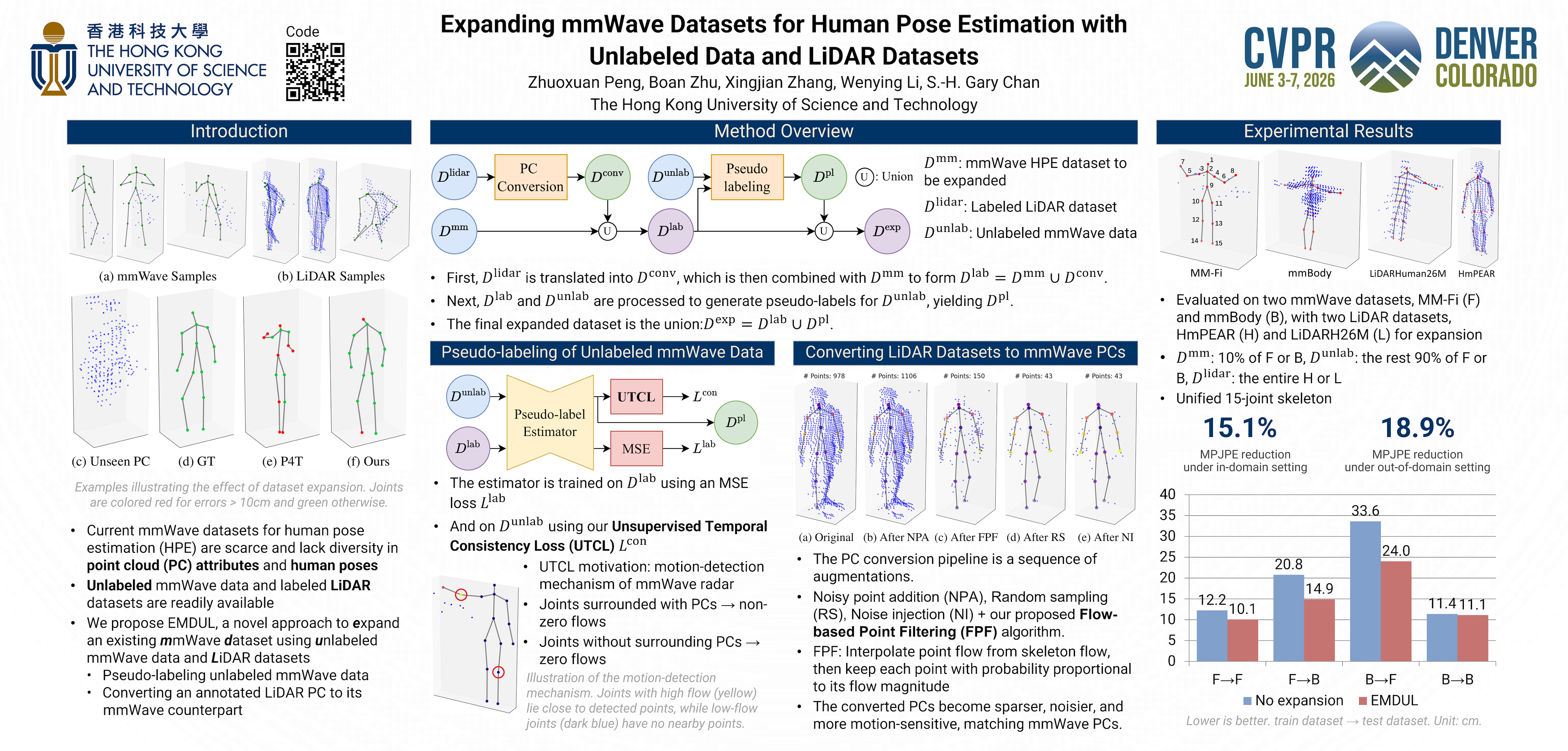
Current mmWave datasets for human pose estimation (HPE) are scarce and lack diversity in both point cloud (PC) attributes and human poses, severely hampering the generalization ability of their trained models. On the other hand, unlabeled mmWave HPE data and diverse LiDAR HPE datasets are readily available. We propose EMDUL, a novel approach to expand the volume and diversity of an existing mmWave dataset using unlabeled mmWave data and a LiDAR dataset. EMDUL trains a pseudo-label estimator to annotate the unlabeled mmWave data and is able to convert, or translate, a given annotated LiDAR PC to its mmWave counterpart. Expanded with both LiDAR-converted and pseudo-labeled mmWave PCs, our mmWave dataset significantly boosts the performance and generalization ability of all our HPE models, with substantial 15.1% and 18.9% error reductions for in-domain and out-of-domain settings, respectively.
Towards Balanced Multi-Modal Learning in 3D Human Pose Estimation
Mengshi Qi ⋅ Jiaxuan Peng ⋅ Xianlin Zhang ⋅ Huadong Ma
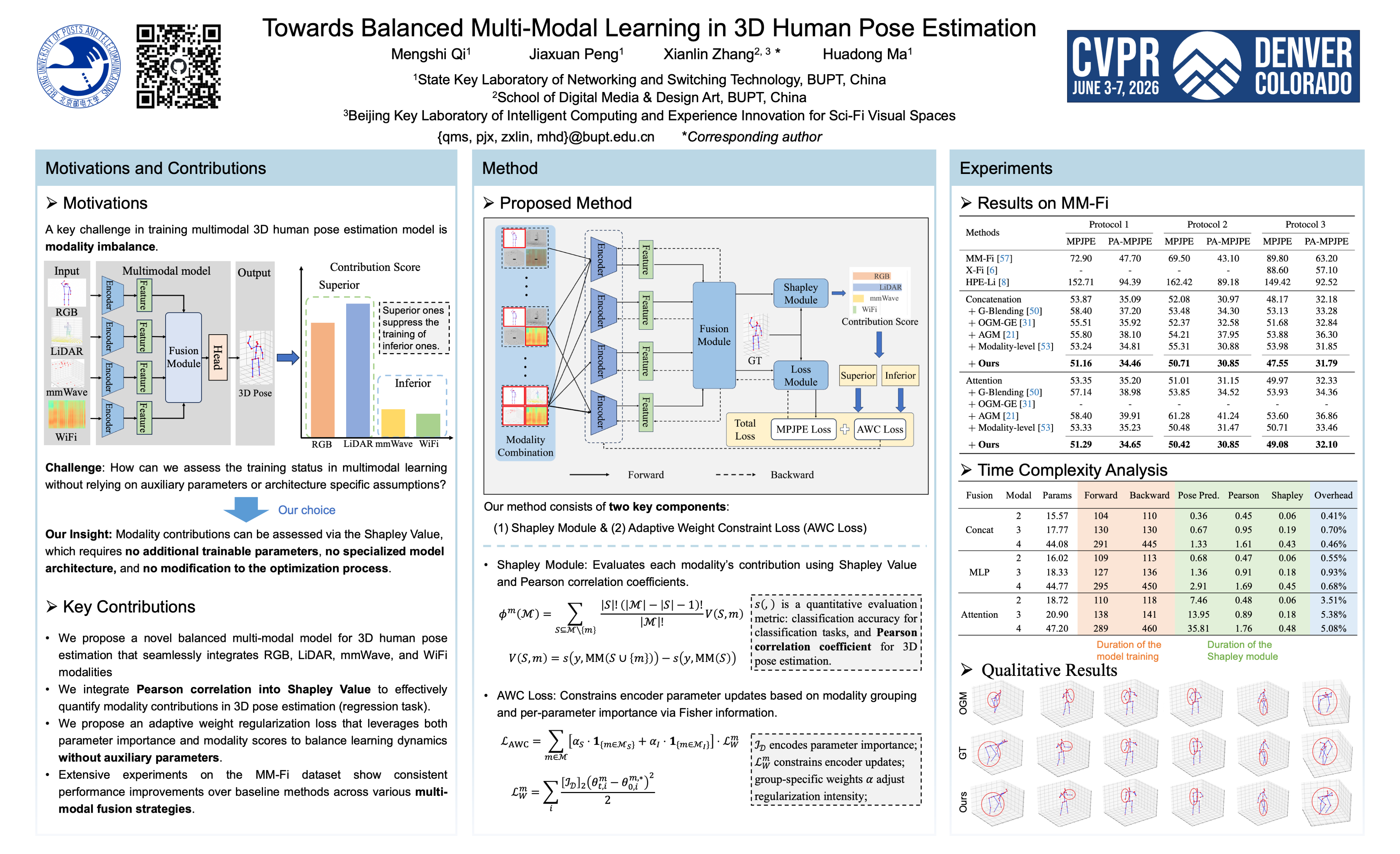
3D human pose estimation (3D HPE) has emerged as a prominent research topic, particularly in the realm of RGB-based methods. However, the use of RGB images is often limited by issues such as occlusion and privacy constraints. Consequently, multi-modal sensing, which leverages non-intrusive sensors, is gaining increasing attention. Nevertheless, multi-modal 3D HPE still faces challenges, including modality imbalance. In this work, we introduce a novel balanced multi-modal learning method for 3D HPE, which harnesses the power of RGB, LiDAR, mmWave, and WiFi. Specifically, we propose a Shapley value-based contribution algorithm to assess the contribution of each modality and detect modality imbalance. To address this imbalance, we design a modality learning regulation strategy that decelerates the learning process during the early stages of training. We conduct extensive experiments on the widely adopted multi-modal dataset, MM-Fi, demonstrating the superiority of our approach in enhancing 3D pose estimation under complex conditions. We will release our codes soon.
OMGTex: One-stage Multi-style Facial Texture Reconstruction without Geometry Guidance
Xiao Zitong ⋅ Yuda Qiu ⋅ Zisheng Ye ⋅ Xiaoguang Han
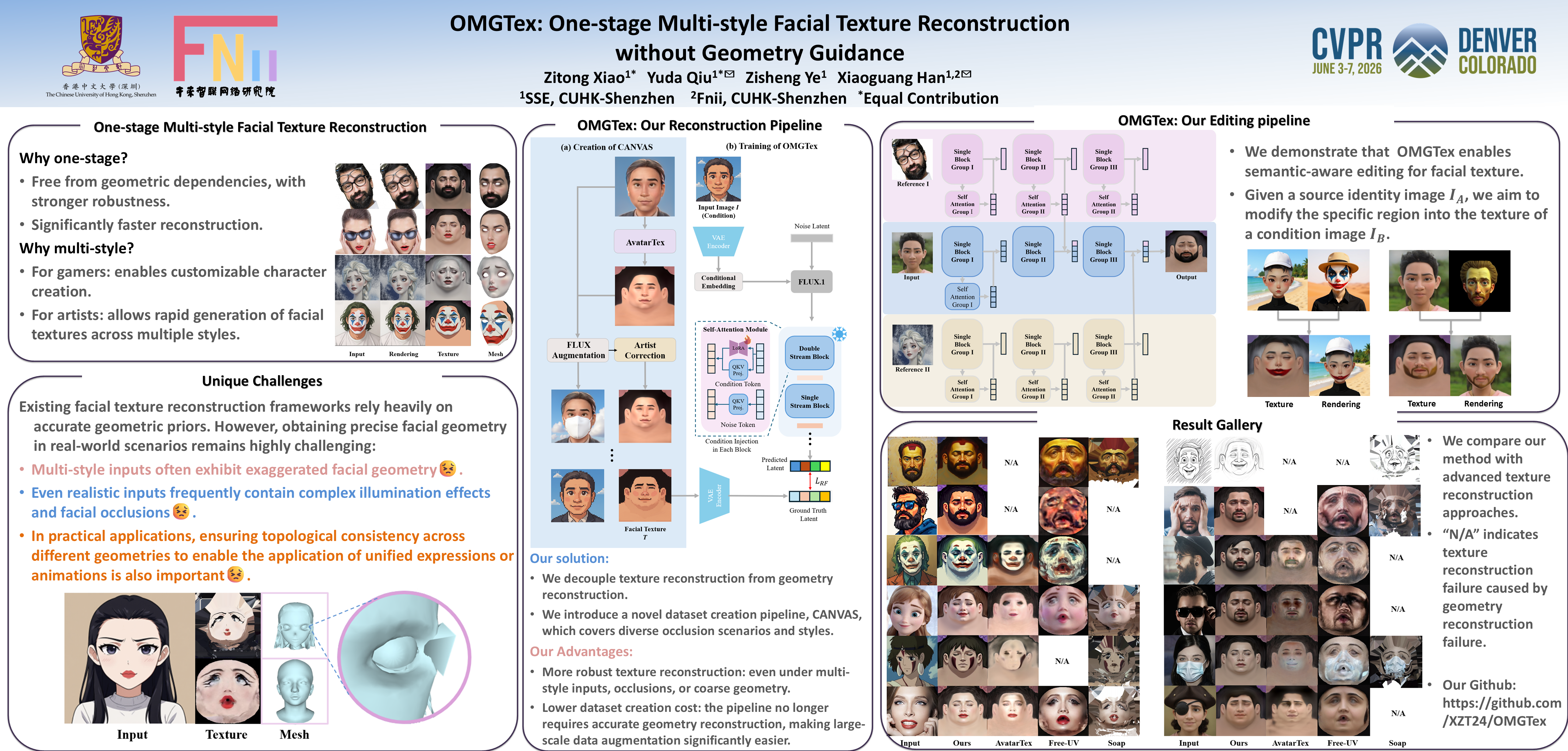
We propose OMGTex, an end-to-end diffusion-based framework for reconstructing high-quality and editable facial UV textures from multi-style facial images. Existing texture reconstruction methods face two major limitations: (1) Fragility due to reliance on 3D geometry priors, which are difficult to estimate accurately, especially under facial occlusions or in stylized domains; and (2) A lack of semantic disentanglement, inhibiting region-specific texture editing and style transfer. Our work addresses both challenges simultaneously.Our core innovation is a geometry-free pipeline that directly maps a 2D face image to its corresponding editable UV texture. We introduce two key techniques: First, to address the challenge of UV misalignment common in diffusion generation, we introduce a gradient-guided refinement strategy at inference time, which explicitly corrects structural consistency. Second, we leverage the inherent semantic distribution capability of diffusion models and design a novel training paradigm to enhance this tendency, enabling semantic-aware editing of facial texture. Furthermore, to address the data scarcity in multi-style texture reconstruction, we construct CANVAS, the first comprehensive paired texture reconstruction dataset covering realistic and diverse stylized domains.To the best of our knowledge, OMGTex is the first geometry-free inference framework that achieves robust, style-consistent, and editable facial texture reconstruction across diverse domains. Our method achieves state-of-the-art performance on facial texture benchmarks. Both the dataset and the pretrained model weights will be publicly released.
Human Interaction-Aware 3D Reconstruction from a Single Image
Gwanghyun Kim ⋅ Junghun James Kim ⋅ Suh Yoon Jeon ⋅ Jason Park ⋅ Se Young Chun
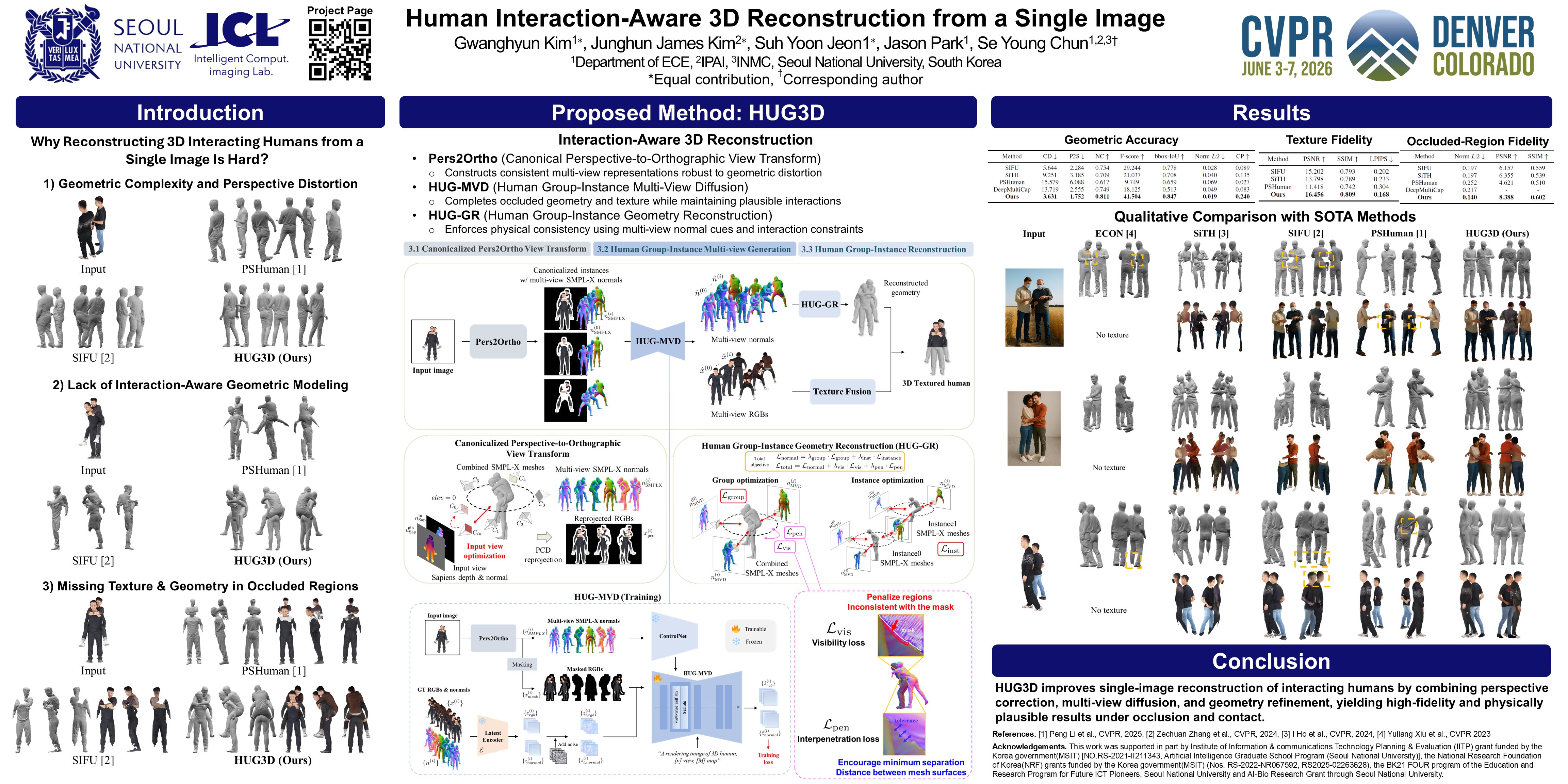
Reconstructing textured 3D human models from a single image is fundamental for AR/VR and digital human applications. However, existing methods mostly focus on single individuals and thus fail in multi-human scenes, where naive composition of individual reconstructions often leads to artifacts such as unrealistic overlaps, missing geometry in occluded regions, and distorted interactions. These limitations highlight the need for approaches that incorporate group-level context and interaction priors. We introduce a holistic method that explicitly models both group- and instance-level information. To mitigate perspective-induced geometric distortions, we first transform the input into a canonical orthographic space. Our primary component, Human Group-Instance Multi-View Diffusion (HUG-MVD), then generates complete multi-view normals and images by jointly modeling individuals and group context to resolve occlusions and proximity. Subsequently, the Human Group-Instance Geometric Reconstruction (HUG-GR) module optimizes the geometry by leveraging explicit, physics-based interaction priors to enforce physical plausibility and accurately model inter-human contact. Finally, the multi-view images are fused into a high-fidelity texture. Together, these components form our complete framework, HUG3D.Extensive experiments show that HUG3D significantly outperforms both single-human and existing multi-human methods, producing physically plausible, high-fidelity 3D reconstructions of interacting people from a single image.
Towards Generalizable AI-Generated Image Detection via Image-Adaptive Prompt Learning
Yiheng Li ⋅ Zichang Tan ⋅ Guoqing Xu ⋅ Zhen Lei ⋅ Xu Zhou ⋅ Yang Yang
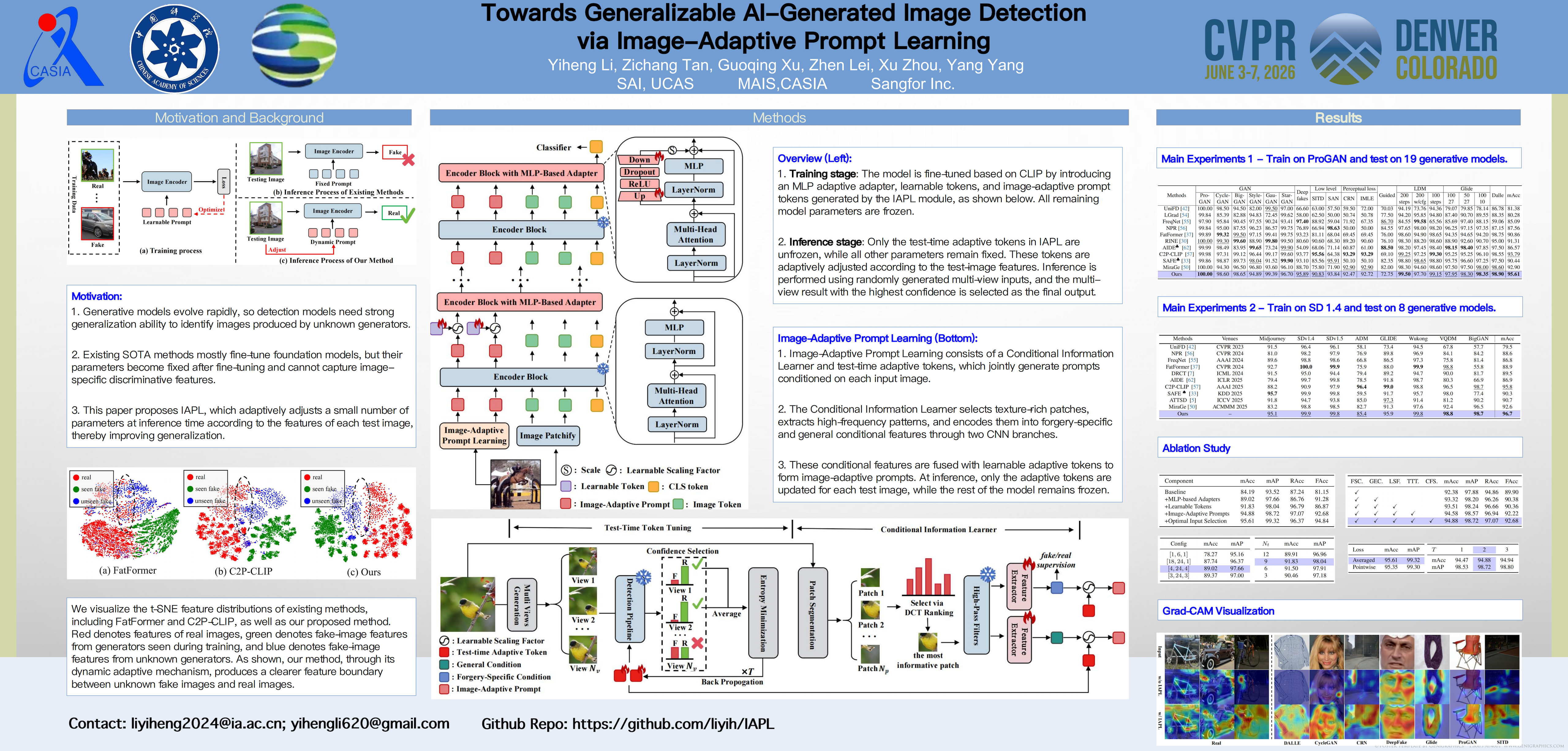
In AI-generated image detection, current cutting-edge methods typically adapt pre-trained foundation models through partial-parameter fine-tuning. However, these approaches often struggle to generalize to forgeries from unseen generators, as the fine-tuned models capture only limited patterns from training data and fail to reflect the evolving traits of new ones. To overcome this limitation, we propose Image-Adaptive Prompt Learning (IAPL), a novel paradigm that dynamically adjusts the prompts fed into the encoder according to each testing image, rather than fixing them after training. This design significantly enhances robustness and adaptability to diverse forged images. The dynamic prompts integrate conditional information with test-time adaptive tokens through a lightweight learnable scaling factor. The conditional information is produced by a Conditional Information Learner, which leverages CNN-based feature extractors to model both forgery-specific and general conditions. The test-time adaptive tokens are optimized during inference on a single sample by enforcing prediction consistency across multiple views, ensuring that the parameters align with the current image. For the final decision, the optimal input with the highest prediction confidence is selected. Extensive experiments show that IAPL achieves state-of-the-art performance, with mean accuracies of 95.61% and 96.7% on the widely used UniversalFakeDetect and GenImage datasets, respectively.
SAGA: Source Attribution of Generative AI Videos
Rohit Kundu ⋅ Vishal Mohanty ⋅ Hao Xiong ⋅ Shan Jia ⋅ Athula Balachandran ⋅ Amit K. Roy-Chowdhury
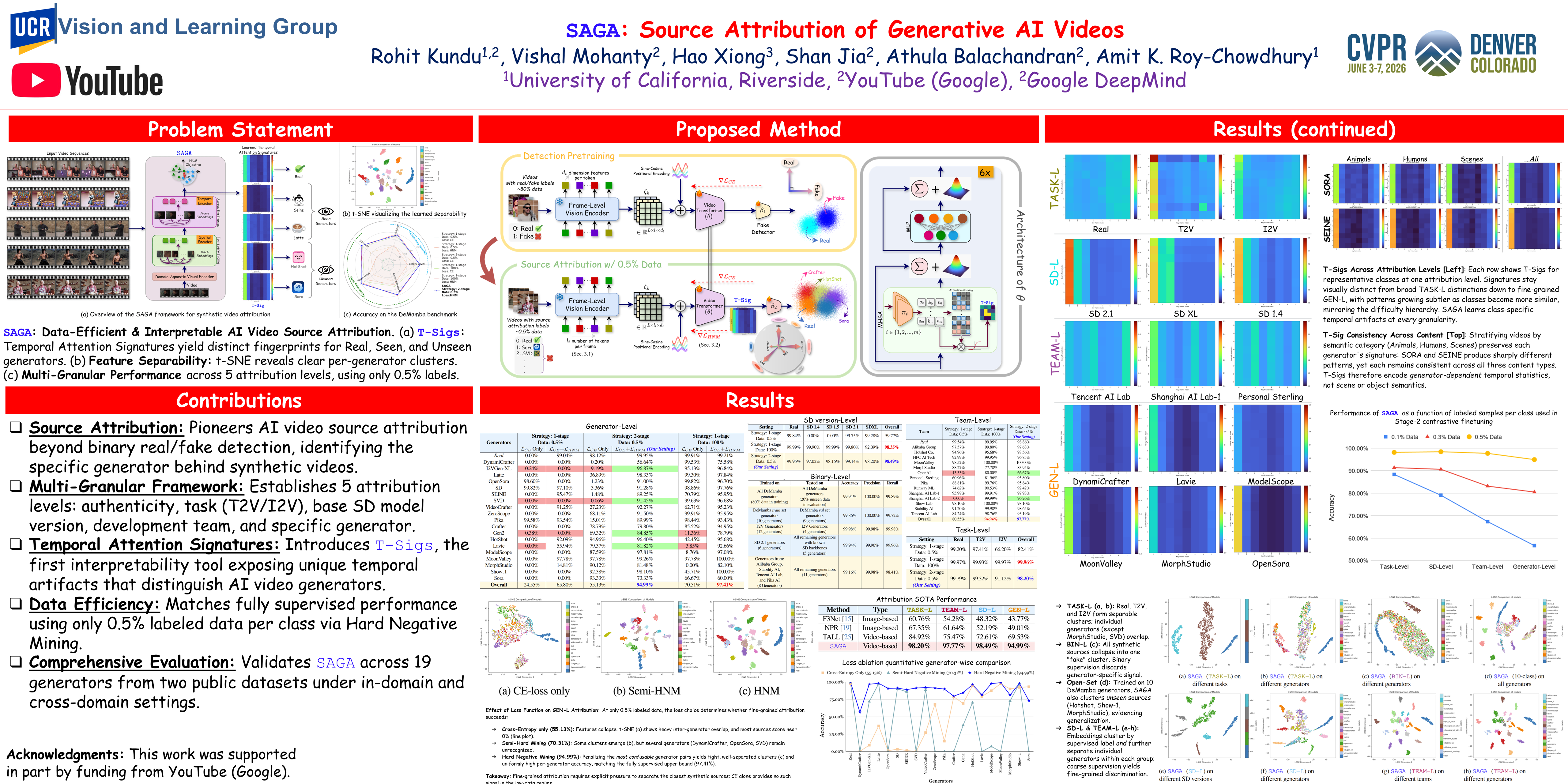
The proliferation of generative AI has led to hyper-realistic synthetic videos, escalating misuse risks and outstripping binary real/fake detectors. We introduce $\textcolor{blue}{\texttt{SAGA}}$ ($\underline{S}$ource $\underline{A}$ttribution of $\underline{G}$enerative $\underline{A}$I videos), the first comprehensive framework to address the urgent need for AI-generated $\textit{video source attribution}$ at a large scale. Unlike traditional detection, $\textcolor{blue}{\texttt{SAGA}}$ identifies the specific generative model used. It uniquely provides multi-granular attribution across five levels: authenticity, generation task (e.g., T2V/I2V), model version, development team, and the precise generator, offering far richer forensic insights. Our novel video transformer architecture, leveraging features from a robust vision foundation model, effectively captures spatio-temporal artifacts. Critically, we introduce a data-efficient pretrain-and-attribute strategy, enabling $\textcolor{blue}{\texttt{SAGA}}$ to achieve state-of-the-art attribution using only 0.5% of source-labeled data per class, matching fully supervised performance. Furthermore, we propose Temporal Attention Signatures ($\textcolor{blue}{\texttt{T-Sig}}$), a novel interpretability method that visualizes learned temporal differences, offering the first explanation for $\textit{why}$ different video generators are distinguishable. Extensive experiments on public datasets, including cross-domain scenarios, demonstrate that $\textcolor{blue}{\texttt{SAGA}}$ sets a new benchmark for synthetic video provenance, providing crucial, interpretable insights for forensic and regulatory applications.
VMD-FACT: A New Video Dataset and MLLM-based method for Detecting Realistic AI-Generated Video Misinformation
Yongkang Zhang ⋅ Dongyu She ⋅ Baiyu Ji ⋅ Qichuan Geng ⋅ Zhong Zhou ⋅ Yan Wang
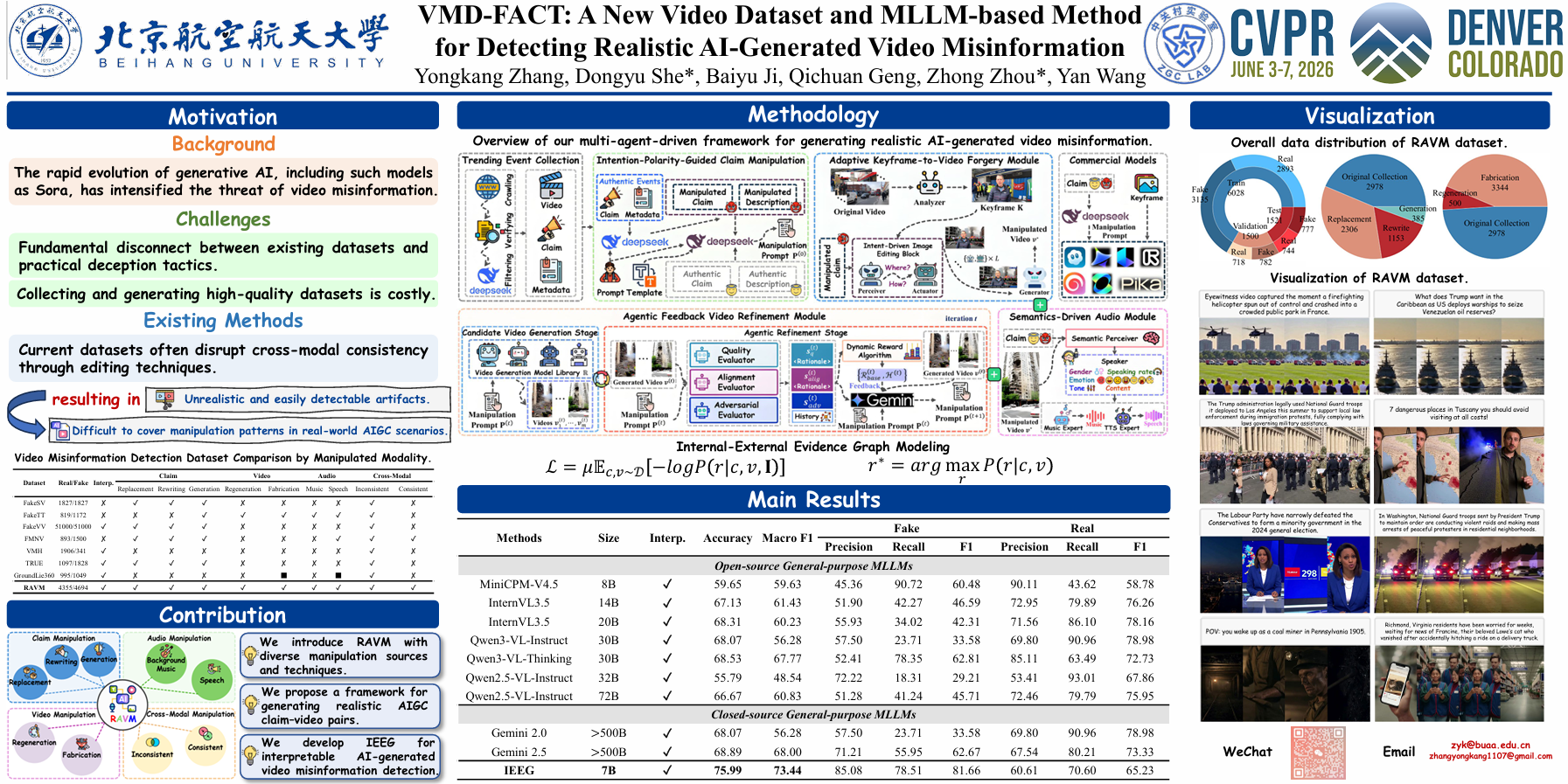
The rapid evolution of generative AI, exemplified by models such as Sora, has intensified the threat of video misinformation. A critical challenge in detecting these AI-generated video misinformation lies in a fundamental disconnect between existing datasets and practical deception tactics. Current datasets often disrupt cross-modal consistency through editing techniques, resulting in unrealistic and easily detectable artifacts. In stark contrast, generative video misinformation strives for semantic consistency across modalities to remain realism. To address this gap, we introduce RAVM: the first Realistic AI-Generated Video Misinformation Detection Dataset. RAVM contains authentic claim-video pairs, as well as Realistic AI-Generated claim-video pairs. More importantly, unlike existing Video Misinformation Detection (VMD) datasets that are limited to single-source manipulations, RAVM encompasses multiple manipulation sources—Claim, Video, Audio, and Cross-Modal Manipulation—each of which includes multiple manipulation techniques to generate realistic AI-generated video misinformation. Thus, we introduce an AI-generative framework for producing realistic AI-generated video misinformation. Furthermore, we propose IEEG model, which represents multimodal evidence, fact-checking results, and their dependencies as an evidence graph for interpretable AI-generated VMD. Extensive experiments on RAVM demonstrate the vulnerability of general Multimodal Large Language Models (MLLMs) in detecting generative video misinformation, while our IEEG achieves state-of-the-art performance on RAVM.
ReAlign: Generalizable Image Forgery Detection via Reasoning-Aligned Representation
Qing Huang ⋅ Zhipei Xu ⋅ Xuanyu Zhang ⋅ Xiangyu Yu ⋅ Jian Zhang
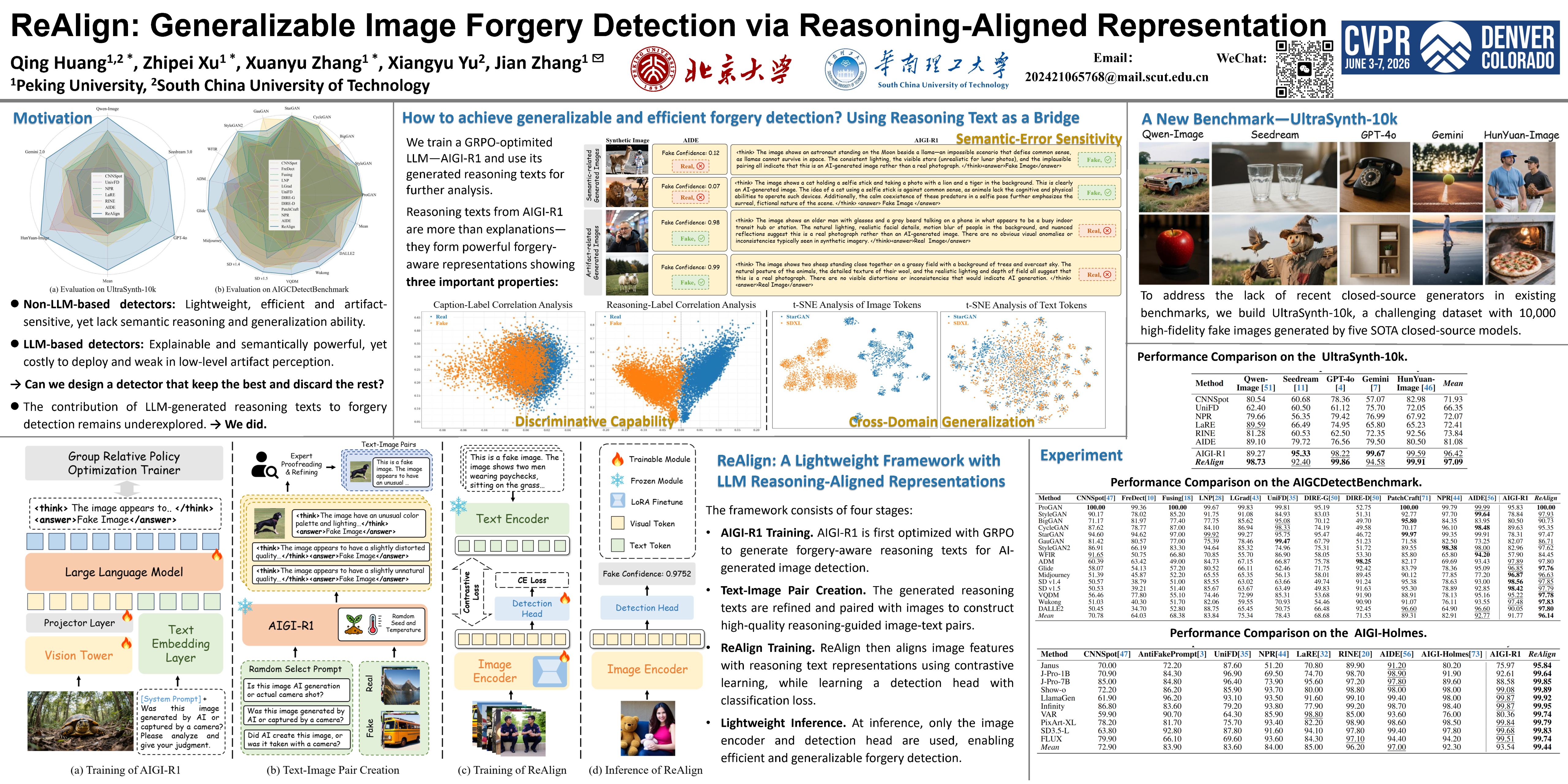
The rise of AI-generated images (AIGIs) poses growing challenges for digital authenticity, prompting the need for efficient, generalizable image forgery detection systems. Existing methods, whether non-LLM-based or LLM-based, exhibit distinct advantages and limitations. While non-LLM-based models offer efficient low-level artifact detection, they often lack semantic understanding. Conversely, LLM-based methods provide strong semantic reasoning and explainability but are computationally intensive and less sensitive to subtle visual artifacts. Moreover, the true contribution of explanatory reasoning texts to forgery detection performance remains unclear. In this work, we investigate the intrinsic value and potential of LLM-generated reasoning texts, considering it a source of generalization and semantic-error sensitivity. Based on these findings, we propose ReAlign, a novel framework that distills high-quality reasoning texts generated by a GRPO-optimized LLM into a lightweight AIGI detector via contrastive learning. ReAlign effectively inherits the generalization ability and semantic sensitivity capability of reasoning textual representations, while remaining efficient and lightweight for deployment. Moreover, ReAlign adopts a tailored joint optimization strategy that integrates contrastive loss for image-text alignment and classification loss for accurate forgery discrimination. Experimental results on AIGCDetectBenchmark, AIGI-Holmes, and our newly constructed UltraSynth-10k demonstrate that ReAlign consistently outperforms existing state-of-the-art detectors in both accuracy and generalization, particularly when facing complex, high-fidelity forgeries from modern generative models.
A Sanity Check for Multi-In-Domain Face Forgery Detection in the Real World
Jikang Cheng ⋅ Renye Yan ⋅ Zhiyuan Yan ⋅ Yaozhong Gan ⋅ Xueyi Zhang ⋅ Wei Peng ⋅ Zhongyuan Wang ⋅ Ling Liang
Existing methods for deepfake detection aim to develop generalizable detectors. Although ``generalizable'' could be the ultimate target once and for all, with limited training forgeries and domains, it appears idealistic to expect generalization that covers entirely unseen variations, especially given the diversity, advancement, and vast volume of real-world deepfakes. Therefore, introducing large-scale multi-domain data for training can be feasible and important for real-world applications.However, within such a multi-domain scenario, the differences between multiple domains, rather than the subtle real/fake distinctions, dominate the feature space. As a result, despite detectors being able to \textbf{relatively} separate real and fake within each domain (i.e., high AUC), they struggle with single-image real/fake judgments in domain-unspecified conditions (i.e., low ACC).In this paper, we first define a new research paradigm named \textbf{Multi-In-Domain Face Forgery Detection (MID-FFD)}, which includes sufficient volumes of real-fake domains for training. Then, the detector should provide definitive real-fake judgments to the domain-unspecified inputs, which simulate the frame-by-frame independent detection scenario in the real world. Meanwhile, to address the domain-dominant issue, we propose a two-stage, model-agnostic framework termed DevDet (\underline{Dev}eloper for \underline{Det}ector) to amplify real/fake differences and make them dominant in the feature space. DevDet consists of a Face Forgery Developer (FFDev) and a Dose-Adaptive detector Fine-Tuning strategy (DAFT). Experiments demonstrate our superiority in effectively predicting real-fake under the MID-FFD scenario \textbf{while} maintaining original generalization ability to unseen data.
PPM-CLIP: Probabilistic Prompt Modeling for Generalizable AI-Generated Image Detection
WANG XINYUAN ⋅ Yingxin Lai ⋅ Zhiming Luo ⋅ Zhihui Liu
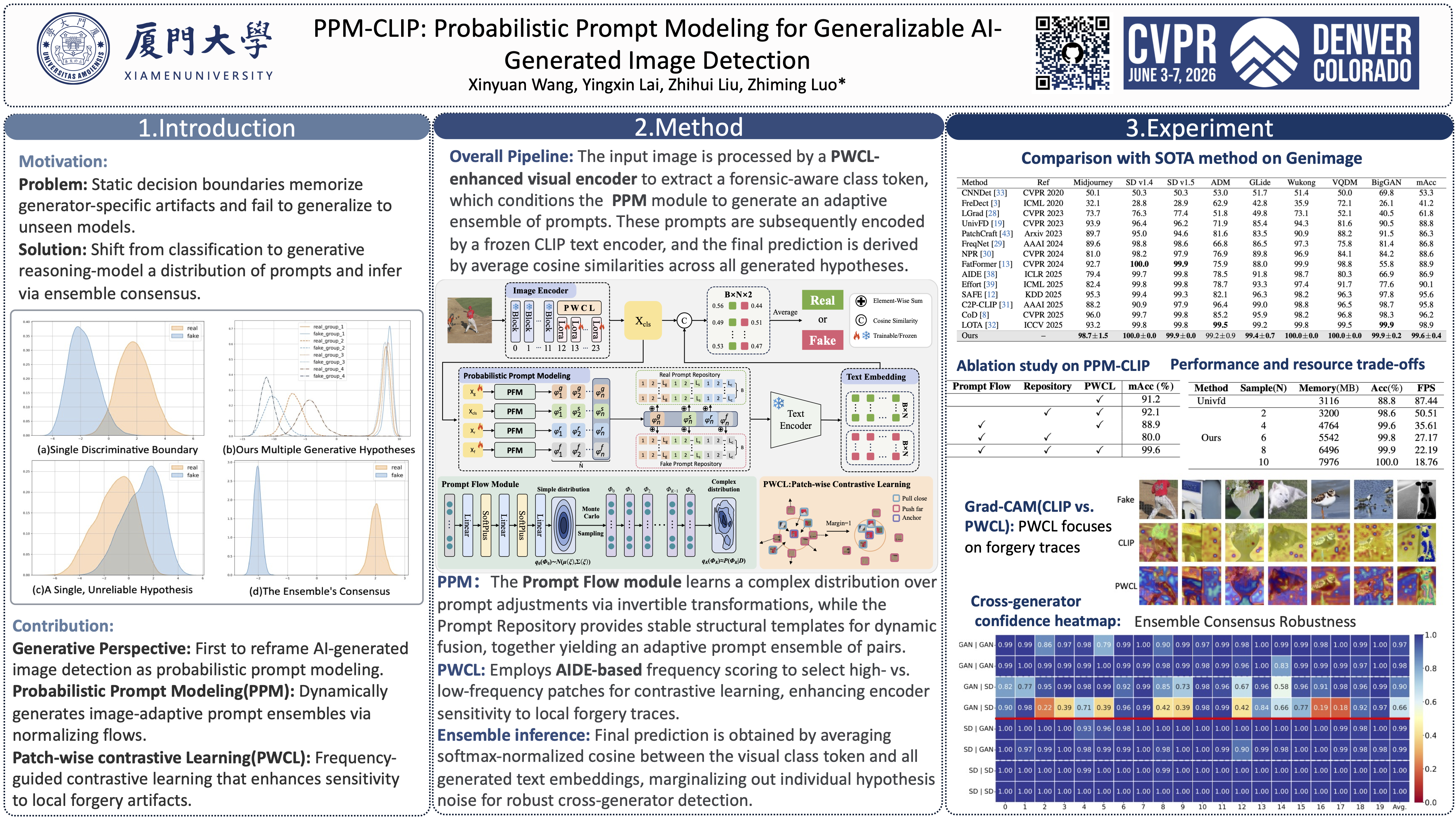
The rapid rise of highly realistic AI-generated images necessitates reliable and generalizable detection methods. However, existing methods are constrained by their discriminative nature: by learning a single static decision boundary, they tend to memorize generator-specific artifacts and consequently fail to generalize to the unseen distributions of new generative models. To overcome this limitation, we propose PPM-CLIP, a new framework that shifts from static classification to conditional generative modeling based on the CLIP vision–language model. Instead of learning a fixed decision boundary, a Probabilistic Prompt Modeling (PPM) module is used as a generator that produces an adaptive distribution of prompts according to the input image. This allows the model to flexibly capture novel artifacts, rather than matching them against fixed templates. In addition, to enhance the visual encoder's sensitivity to subtle artifacts, a Patch-Wise Contrastive Learning (PWCL) strategy is introduced. Extensive experiments on Ojha, GenImage, and DRCT benchmarks demonstrate that our generative paradigm significantly outperforms state-of-the-art methods, especially in cross-domain detection. Code will be released on GitHub.
Learning from Noisy Supervision: A Denoising–Debiasing Framework for Weakly Supervised Video Anomaly Detection
Yaxin Zhao ⋅ Yang Wang ⋅ Wenya Guo ⋅ Sihan Xu ⋅ Xiangrui Cai ⋅ Xi Lin ⋅ Ying Zhang ⋅ Xiaojie Yuan
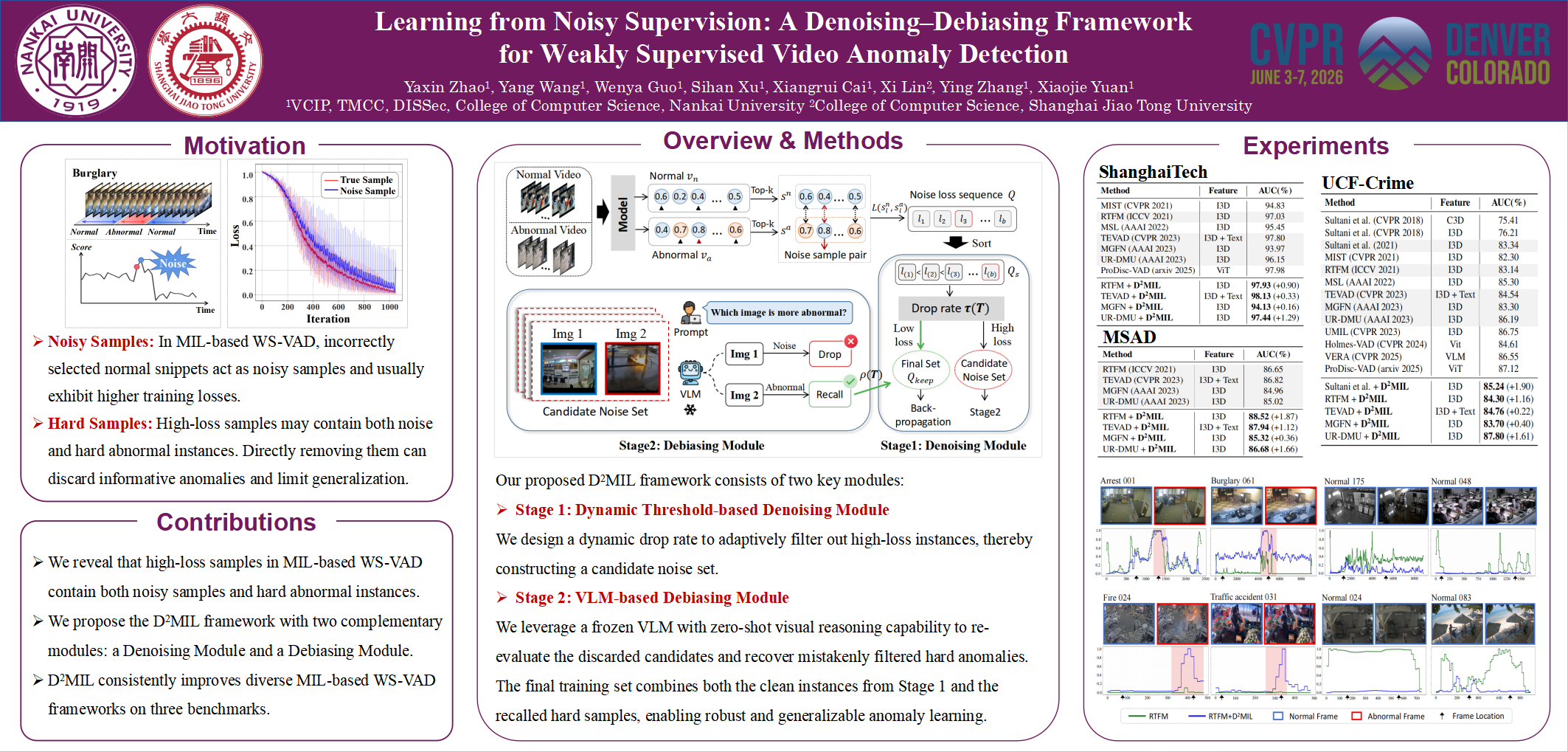
Weakly supervised video anomaly detection (WS-VAD) aims to localize frame-level anomalies using only video-level labels. This task is typically formulated within a multiple instance learning (MIL) paradigm, where each video is treated as a bag of snippets, achieving robust performance without requiring additional information.However, existing methods often struggle with noisy supervision signals. Normal snippets within abnormal bags are frequently misclassified as anomalies due to inaccurate anomaly scores. These misclassified instances act as noisy samples, introducing false supervision that hinders the learning of true anomaly patterns.In this work, we introduce $D^{2}MIL$, a Denoising–Debiasing framework within the Multiple Instance Learning paradigm designed to suppress noise and improve anomaly discrimination. Our approach integrates two key components:(1) Denoising Module: We introduce a dynamic drop rate to adaptively filter out suspected noisy samples during training, based on the observation that noisy samples incur higher training losses. (2) Debiasing Module: We leverage a vision-language model to re-evaluate the discarded samples. This recovers potentially valuable abnormal instances that were mistakenly removed, as they are similar to noisy samples but difficult for the model to recognize. $D^{2}MIL$ is a general purpose denoising strategy that can be integrated into any MIL-based method. Our extensive experiments on the three benchmark datasets (ShanghaiTech, UCF-Crime, and MSAD) demonstrate that $D^{2}MIL$ is compatible with diverse MIL frameworks and consistently enhances their performance.
Anomaly as Non-Conformity via Training-Free Graph Laplacian Energy Minimization
Jungwook Seo ⋅ Minjeong Kim ⋅ Younkwan Lee ⋅ Seungho Shin ⋅ Sungyong Baik
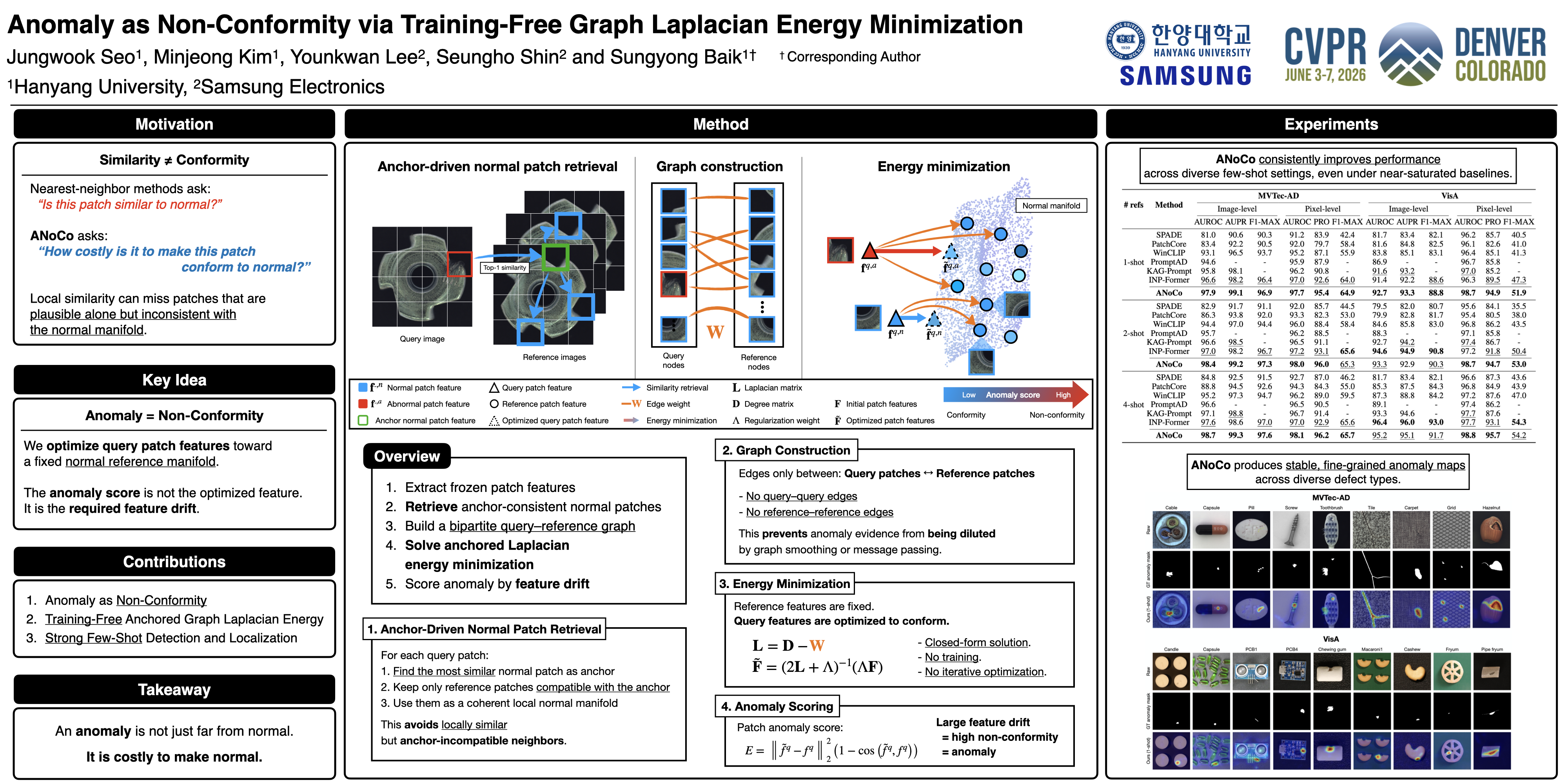
Detecting subtle visual anomalies in images remains challenging, particularly when only normal samples are available a priori. Such unsupervised anomaly detection is typically solved by measuring feature similarity of a query patch to a memory of normal patches. However, similarity alone does not reveal how strongly a query patch violates the structure of the normal feature manifold. We propose a training-free Laplacian graph energy optimization formulation, named ANoCo that scores Anomaly by the cost of Non-Conformity of a query patch to align with a fixed normal manifold. For each query patch, we construct a bipartite query to normal graph weighted by cosine affinity, explicitly removing query-query and normal-normal edges to prevent evidence dilution. We formulate anomaly scoring as a convex Laplacian energy with anchored normal nodes, and solve in closed form. In particular, we do not use the optimized features themselves—the anomaly score is the magnitude of the update required to satisfy normality constraints, reframing the graph Laplacian as a non-conformity operator rather than a smoothing prior. The proposed method introduces no learnable parameters, message passing, or sampling, and has complexity comparable to a single linear solve. Across standard benchmarks, it delivers strong image-level AUROC, stable localization maps, and improved robustness over prior methods, demonstrating the effectiveness of using optimization-induced feature drift as anomaly measure.
VisualAD: Language-Free Zero-Shot Anomaly Detection via Vision Transformer
Yanning Hou ⋅ Peiyuan Li ⋅ Zirui Liu ⋅ Yitong Wang ⋅ Yanran Ruan ⋅ Jianfeng Qiu ⋅ Ke Xu
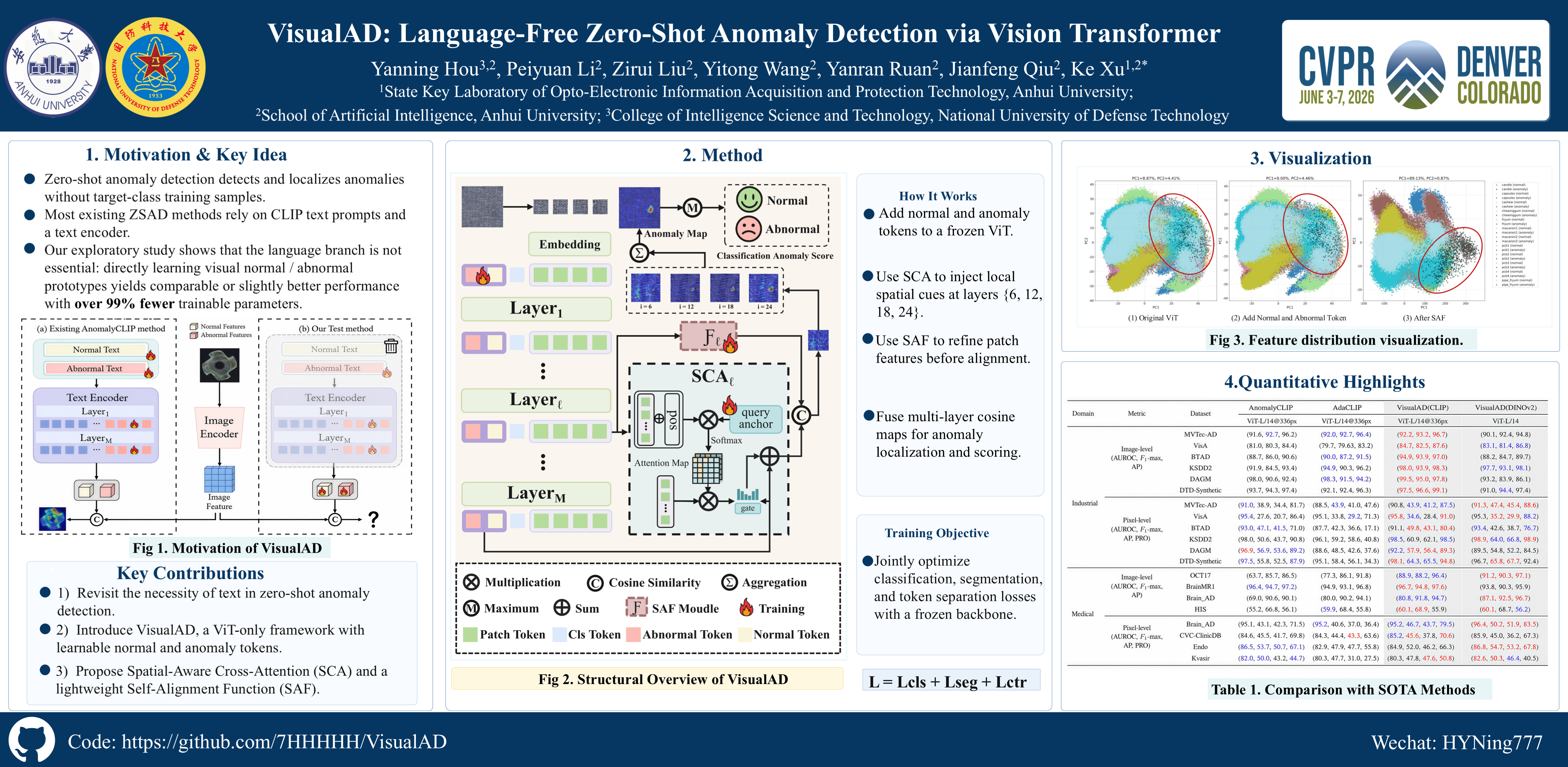
Zero-shot anomaly detection (ZSAD) requires detecting and localizing anomalies without access to target-class anomaly samples. Mainstream methods rely on vision–language models (VLMs) such as CLIP: they build hand-crafted or learned prompt sets for normal and abnormal semantics, then compute image–text similarities for open-set discrimination. While effective, this paradigm depends on a text encoder and cross-modal alignment, which can lead to training instability and parameter redundancy. This work revisits the necessity of the text branch in ZSAD and presents VisualAD, a purely visual framework built on Vision Transformers. We introduce two learnable tokens within a frozen backbone to directly encode normality and abnormality. Through multi-layer self-attention, these tokens interact with patch tokens, gradually acquiring high-level notions of normality and anomaly while guiding patches to highlight anomaly-related cues. Additionally, we incorporate a Spatial-Aware Cross-Attention (SCA) module and a lightweight Self-Alignment Function (SAF): SCA injects fine-grained spatial information into the tokens, and SAF recalibrates patch features before anomaly scoring. VisualAD achieves state-of-the-art performance on 13 zero-shot anomaly detection benchmarks spanning industrial and medical domains, and adapts seamlessly to pretrained vision backbones such as the CLIP image encoder and DINOv2. Our code will be made publicly available.
CHAL: Causal-guided Hierarchical Anomaly-aware Learning for Moving Infrared Small Target Detection
Weiwei Duan ⋅ Luping Ji ⋅ Shipeng Lei ⋅ Sicheng Zhu ⋅ Jianghong Huang ⋅ Mao Ye
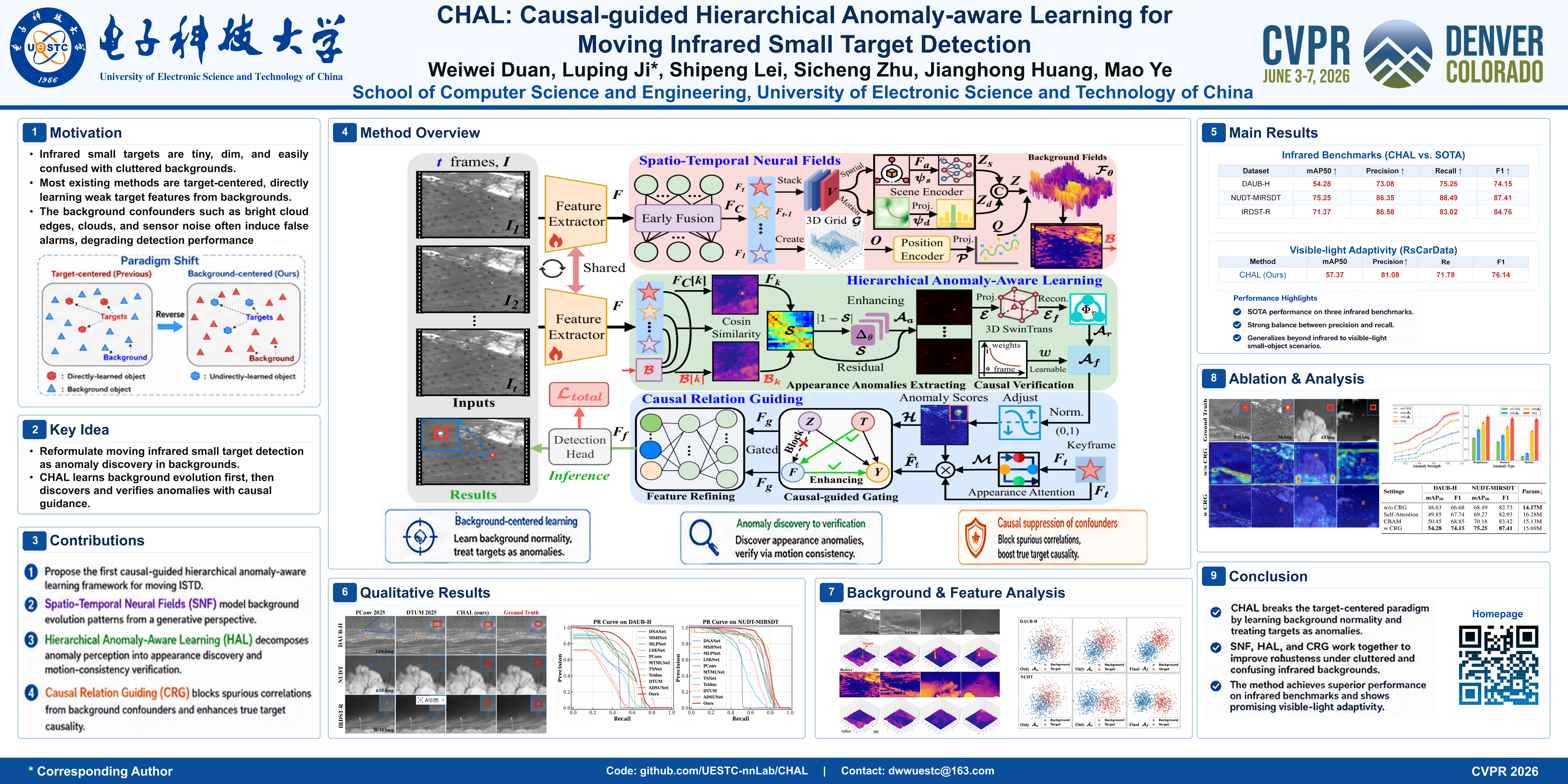
Infrared small target detection is one highly special category of object detection, faced with tiny target imaging size and cluttered backgrounds. Currently, almost all existing methods are target-centered, directly learning the target features from backgrounds. However, due to weak target signals, they are often difficult in effectively capturing stable features. Sometimes, they cannot even distinguish real targets from background confounders. To overcome these problems, from an opposite perspective, we propose the first Causal-guided Hierarchical Anomaly-aware Learning (CHAL) framework. Breaking through target-centered paradigm, it focuses on background learning, while the targets are handled as the anomalies in backgrounds. In detail, to fulfill the goal, a spatio-temporal neural field is designed to model the background evolution patterns from generative perspective. Meanwhile, a hierarchical anomaly-aware learning is proposed to decompose anomaly discovery. Furthermore, to block the spurious correlations often caused by background confounders, and enhance true target causality, a causal-guiding mechanism is designed. The experiments on three infrared datasets verify the effectiveness and superiority of our CHAL. Even in visible-light scenarios, it still possesses obvious adaptivity. Source code will be open.
RAID: Retrieval-Augmented Anomaly Detection
Mingxiu Cai ⋅ Zhe Zhang ⋅ Gaochang Wu ⋅ Tianyou Chai ⋅ Xiatian Zhu
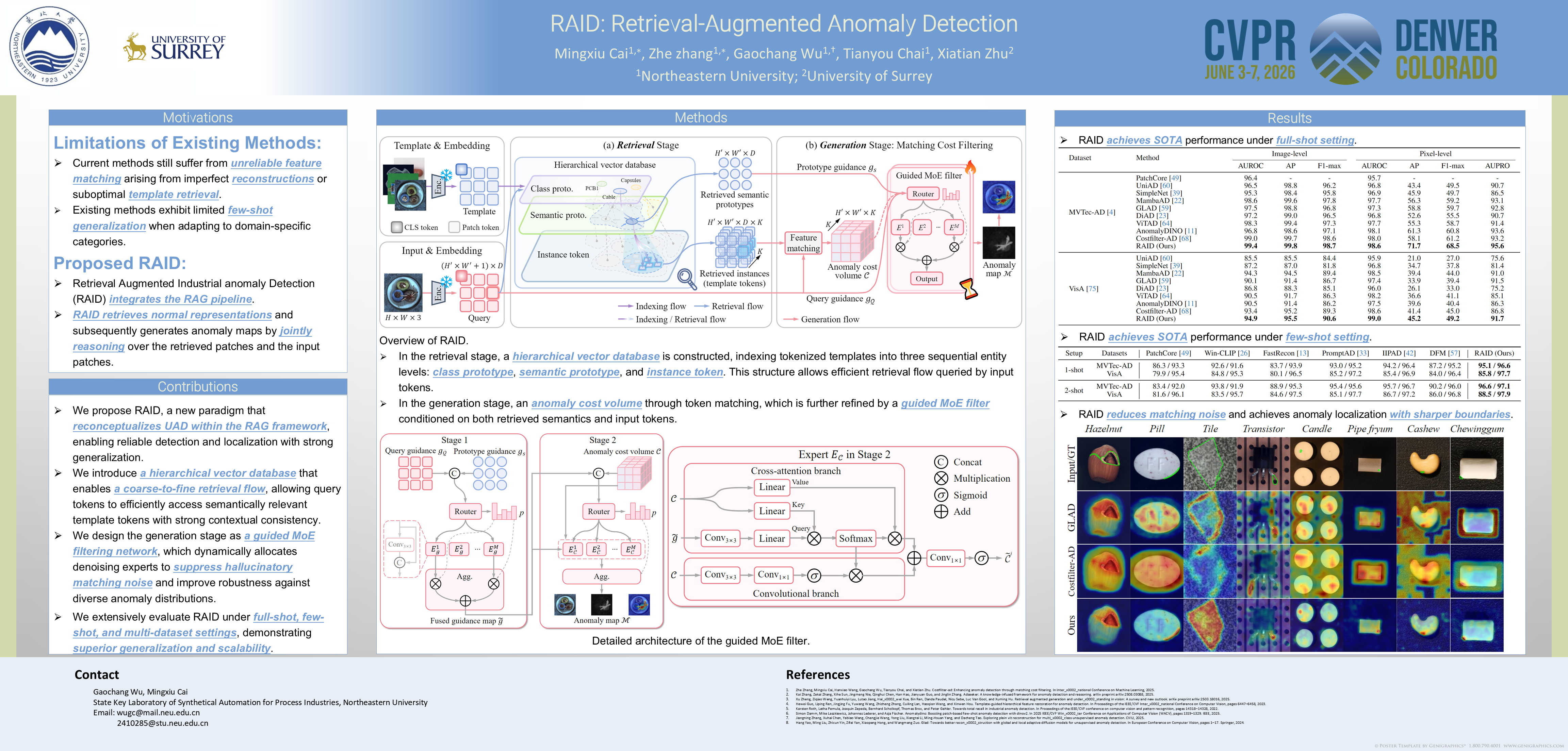
Unsupervised Anomaly Detection (UAD) aims to identify abnormal regions by establishing correspondences between test images and normal templates. Existing methods primarily rely on image reconstruction or template retrieval but face a fundamental challenge: matching between test images and normal templates inevitably introduces noise due to intra-class variations, imperfect correspondences, and limited templates. Observing that Retrieval-Augmented Generation (RAG) leverages retrieved samples directly in the generation process, we reinterpret UAD through this lens and introduce RAID, a retrieval-augmented UAD framework designed for noise-resilient anomaly detection and localization. Unlike standard RAG that enriches context or knowledge, we focus on using retrieved normal samples to guide noise suppression in anomaly map generation. RAID retrieves class-, semantic-, and instance-level representations from a hierarchical vector database, forming a coarse-to-fine pipeline. A matching cost volume correlates the input with retrieved exemplars, followed by a guided Mixture-of-Experts (MoE) network that leverages the retrieved samples to adaptively suppress matching noise and produce fine-grained anomaly maps. RAID achieves state-of-the-art performance across full-shot, few-shot, and multi-dataset settings on MVTec, VisA, MPDD, and BTAD benchmarks. Code and models will be released.
ADSeeker: A Knowledge-Grounded Reasoning Framework for Industry Anomaly Detection and Reasoning
Kai Zhang ⋅ Zekai Zhang ⋅ Xihe Sun ⋅ Anpeng Wang ⋅ Jingmeng Nie ⋅ Qinghui Chen ⋅ Han Hao ⋅ Jianyuan Guo ⋅ jinglin zhang
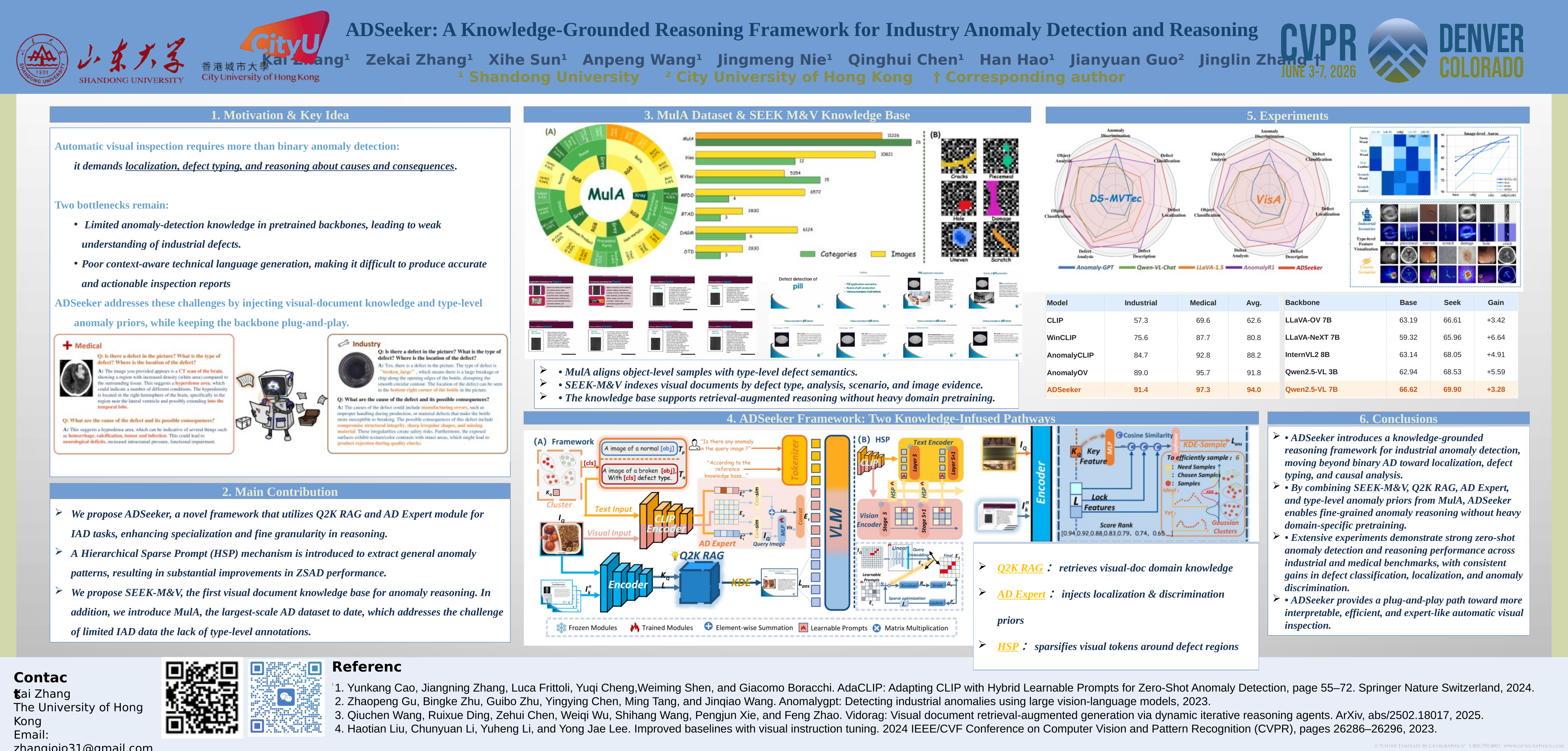
Automatic vision inspection holds significant importance in industry inspection. While multimodal large language models (MLLMs) exhibit strong language understanding capabilities and hold promise for this task, their performance remains significantly inferior to that of human experts. In this context, we identify two key challenges: (i) insufficient integration of anomaly detection (AD) knowledge during pre-training and (ii) the lack of technically precise and context-aware language generation for anomaly reasoning. To address these issues, we propose ADSeeker, an anomaly task assistant designed to enhance inspection performance through knowledge-grounded reasoning. ADSeeker first leverages a curated visual document knowledge base, SEEK-MVTec&VisA (SEEK-M&V), which we construct to address the limitations of existing resources that rely solely on unstructured text. SEEK-M&V includes semantic-rich descriptions and image-document pairs, enabling more comprehensive anomaly understanding. To effectively retrieve and utilize this knowledge, we introduce the Query Image-Knowledge Retrieval-Augmented Generation (Q2K RAG) framework. To further enhance the performance in zero-shot anomaly detection (ZSAD), ADSeeker leverages the Hierarchical Sparse Prompt mechanism and type-level features to efficiently extract anomaly patterns. Furthermore, to tackle the challenge of limited industry anomaly detection (IAD) data, we introduce the largest-scale AD dataset, Multi-type Anomaly (MulA), encompassing 72 multi-scale defect types across 26 categories. Extensive experiments show that our plug-and-play framework, ADSeeker, achieves state-of-the-art zero-shot performance on several benchmark datasets.
InvAD: Inversion-based Reconstruction-Free Anomaly Detection with Diffusion Models
Shunsuke Sakai ⋅ Xiangteng He ⋅ Chunzhi Gu ⋅ Leonid Sigal ⋅ Tatsuhito Hasegawa
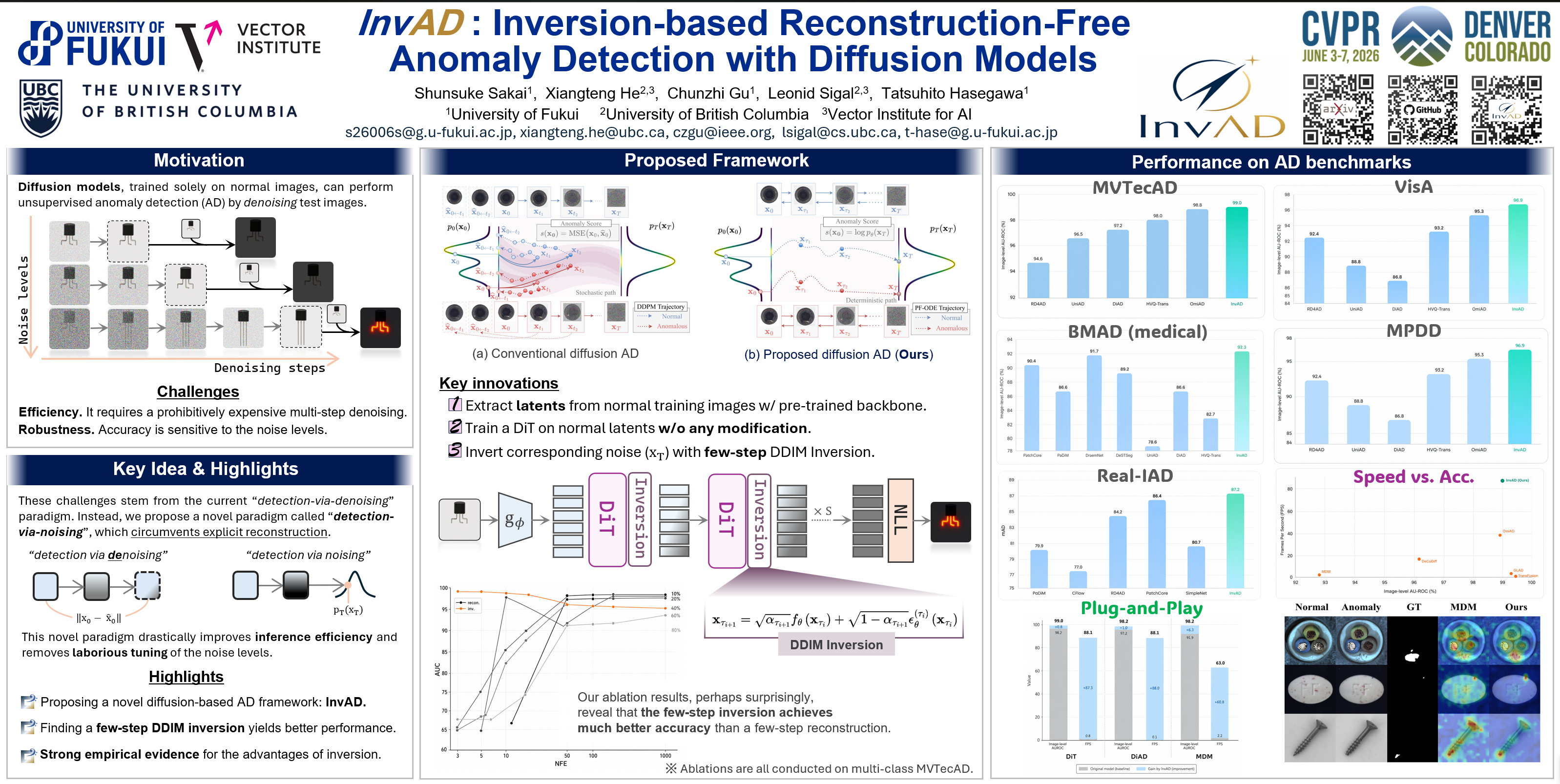
Despite the remarkable success, recent reconstruction-based anomaly detection (AD) methods via diffusion modeling still involve fine-grained noise-strength tuning and computationally expensive multi-step denoising, leading to a fundamental tension between fidelity and efficiency. In this paper, we propose InvAD, a novel Inversion-based Anomaly Detection approach — “detection via noising in latent space” — which circumvents explicit reconstruction. Importantly, we contend that the limitations in prior reconstruction-based methods originate from the prevailing “detection via denoising in RGB space” paradigm. To address this, we model AD under a reconstruction-free formulation, which directly infers the final latent variable corresponding to the input image via DDIM inversion, and then measures the deviation based on the known prior distribution for anomaly scoring. Specifically, in approximating the original probability flow ODE using the Euler method, we enforce only a few inversion steps to noise the clean image to pursue inference efficiency. As the added noise is adaptively derived with the learned diffusion model, the original features for the clean testing image can still be leveraged to yield high detection accuracy. We perform extensive experiments and detailed analyses across four widely used industrial and medical AD benchmarks under the unsupervised unified setting to demonstrate the effectiveness of our model, achieving state-of-the-art AD performance and approximately 2× inference-time speedup without diffusion distillation.
QueryOcc: Query-based Self-Supervision for 3D Semantic Occupancy
Adam Lilja ⋅ Ji Lan ⋅ Junsheng Fu ⋅ Lars Hammarstrand
Learning 3D scene geometry and semantics from images is a core challenge in computer vision and a key capability for autonomous driving.Since large-scale 3D annotation is prohibitively expensive, recent work explores self-supervised learning directly from sensor data without manual labels.Existing approaches either rely on 2D rendering consistency, where 3D structure emerges only implicitly, or on discretized voxel grids from accumulated lidar point clouds, limiting spatial precision and scalability.We introduce QueryOcc, a query-based self-supervised framework that learns continuous 3D semantic occupancy directly through independent 4D spatio-temporal queries sampled across adjacent frames.The framework supports supervision from either pseudo-point clouds derived from vision foundation models or raw lidar data.To enable long-range supervision and reasoning under constant memory, we introduce a contractive scene representation that preserves near-field detail while smoothly compressing distant regions.QueryOcc surpasses previous camera-based methods by 26\% in semantic RayIoU on the self-supervised Occ3D-nuScenes benchmark while running at 11.6 FPS, demonstrating that direct 4D query supervision enables strong self-supervised occupancy learning.Link to code
GSV2X: Geometry-Aware Uncertainty Modeling and Orthogonal Fusion for Robust Roadside Perception
jianqiang xu ⋅ Gensheng Pei ⋅ 刘华峰 Liu ⋅ Yazhou Yao
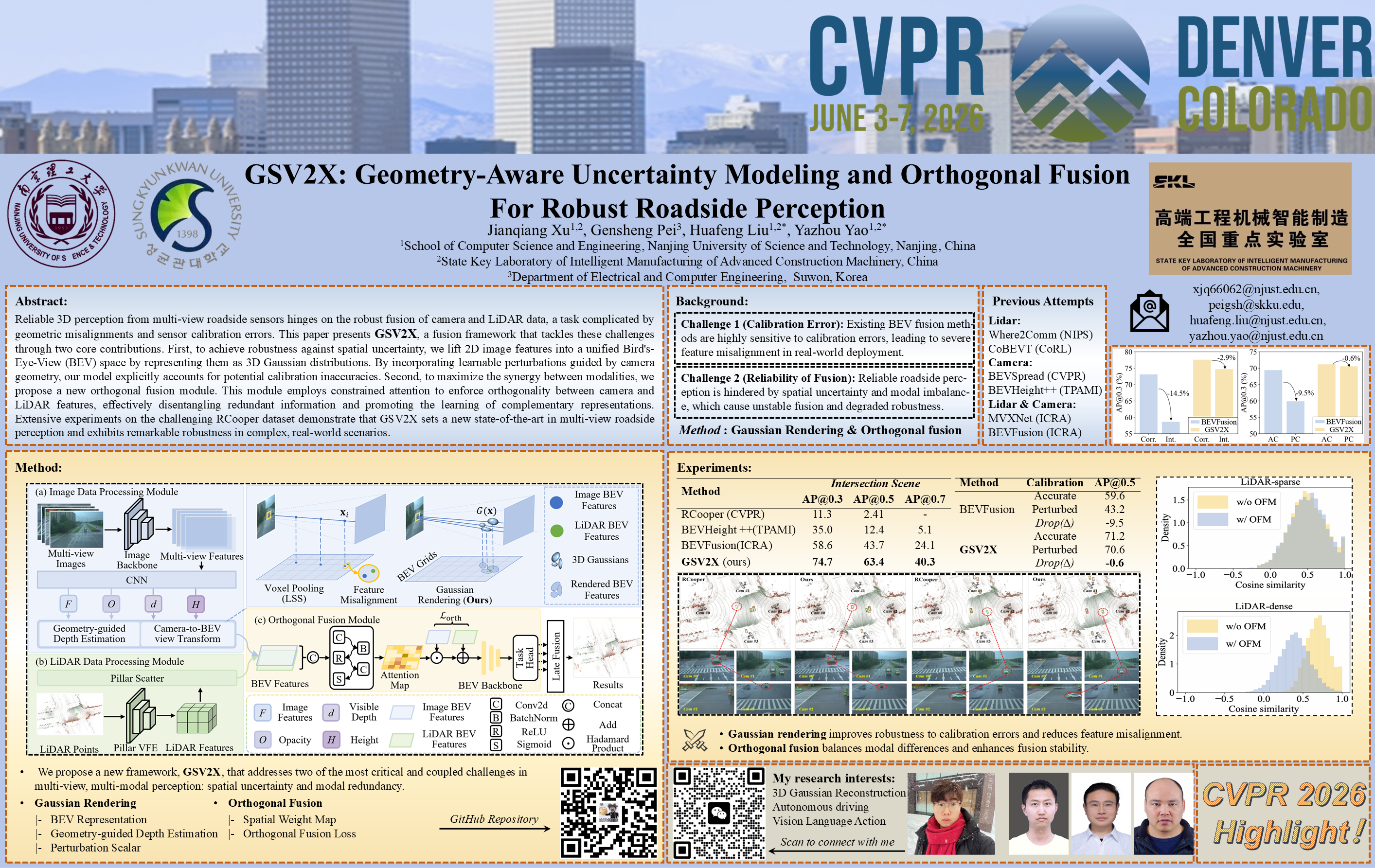
Reliable 3D perception from multi-view roadside sensors hinges on the robust fusion of camera and LiDAR data, a task complicated by geometric misalignments and sensor calibration errors. This paper presents GSV2X, a fusion framework that tackles these challenges through two core contributions. First, to achieve robustness against spatial uncertainty, we lift 2D image features into a unified Bird's-Eye-View (BEV) space by representing them as 3D Gaussian distributions. By incorporating learnable perturbations guided by camera geometry, our model explicitly accounts for potential calibration inaccuracies. Second, to maximize the synergy between modalities, we propose a new orthogonal fusion module. This module employs constrained attention to enforce orthogonality between camera and LiDAR features, effectively disentangling redundant information and promoting the learning of complementary representations. Extensive experiments on the challenging RCooper dataset demonstrate that GSV2X sets a new state-of-the-art in multi-view roadside perception and exhibits remarkable robustness in complex, real-world scenarios.
Grounded Latents for Entity-Centric 4D Scene Generation
Jinhyung Park ⋅ Navyata Sanghvi ⋅ Erica Weng ⋅ Shawn Hunt ⋅ Shinya Tanaka ⋅ Hironobu Fujiyioshi ⋅ Kris Kitani
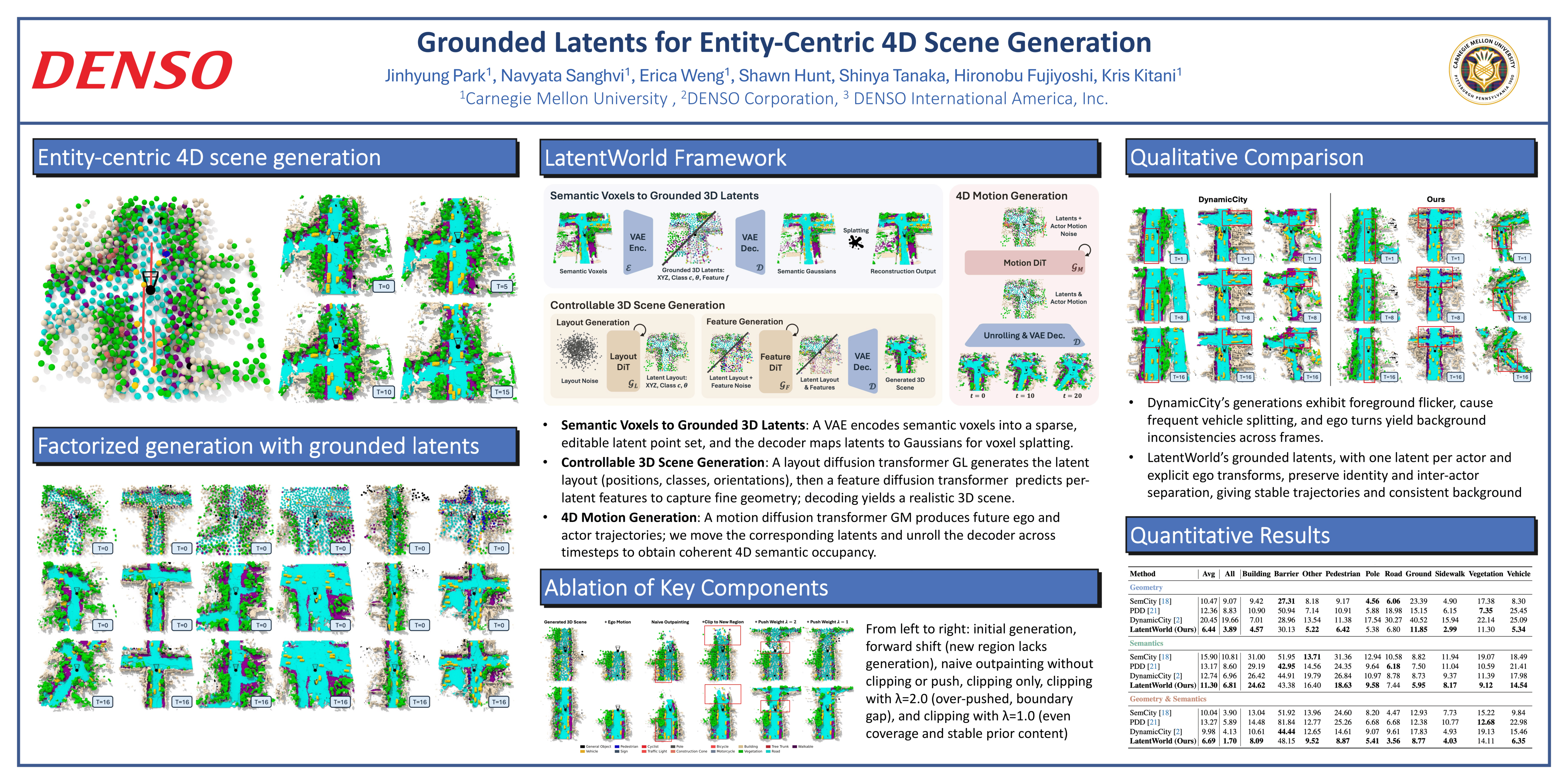
Although recent work has explored generative modeling of 3D or 4D driving scenes, most approaches operate on dense voxel-based representations, which are computationally expensive and struggle to maintain temporal or structural consistency. These methods often produce blurred or merged entities (i.e., cars, trucks, pedestrians) and lack fine-grained control over individual scene elements. We propose to perform generative modeling in a compact, entity-centric latent space, where each grounded 3D latent represents a semantically meaningful local region of the scene. This formulation enables precise, consistent control of both foreground and background elements while preserving geometric detail. We further extend this representation to 4D by learning a motion diffusion model for both ego and dynamic actors, conditioned on the generated 3D scene, and by propagating the grounded latents through time. Our framework produces physically consistent and temporally coherent 4D scenes, supporting controllable and realistic generation.