
Poster Session
Poster Session 2 & Exhibit Hall w/ Coffee Break
MAMMA: Markerless Accurate Multi-person Motion Acquisition
Hanz Cuevas Velasquez ⋅ Anastasios Yiannakidis ⋅ Soyong Shin ⋅ Giorgio Becherini ⋅ Markus Höschle ⋅ Joachim Tesch ⋅ Taylor Obersat ⋅ Tsvetelina Alexiadis ⋅ Eni Halilaj ⋅ Michael J. Black
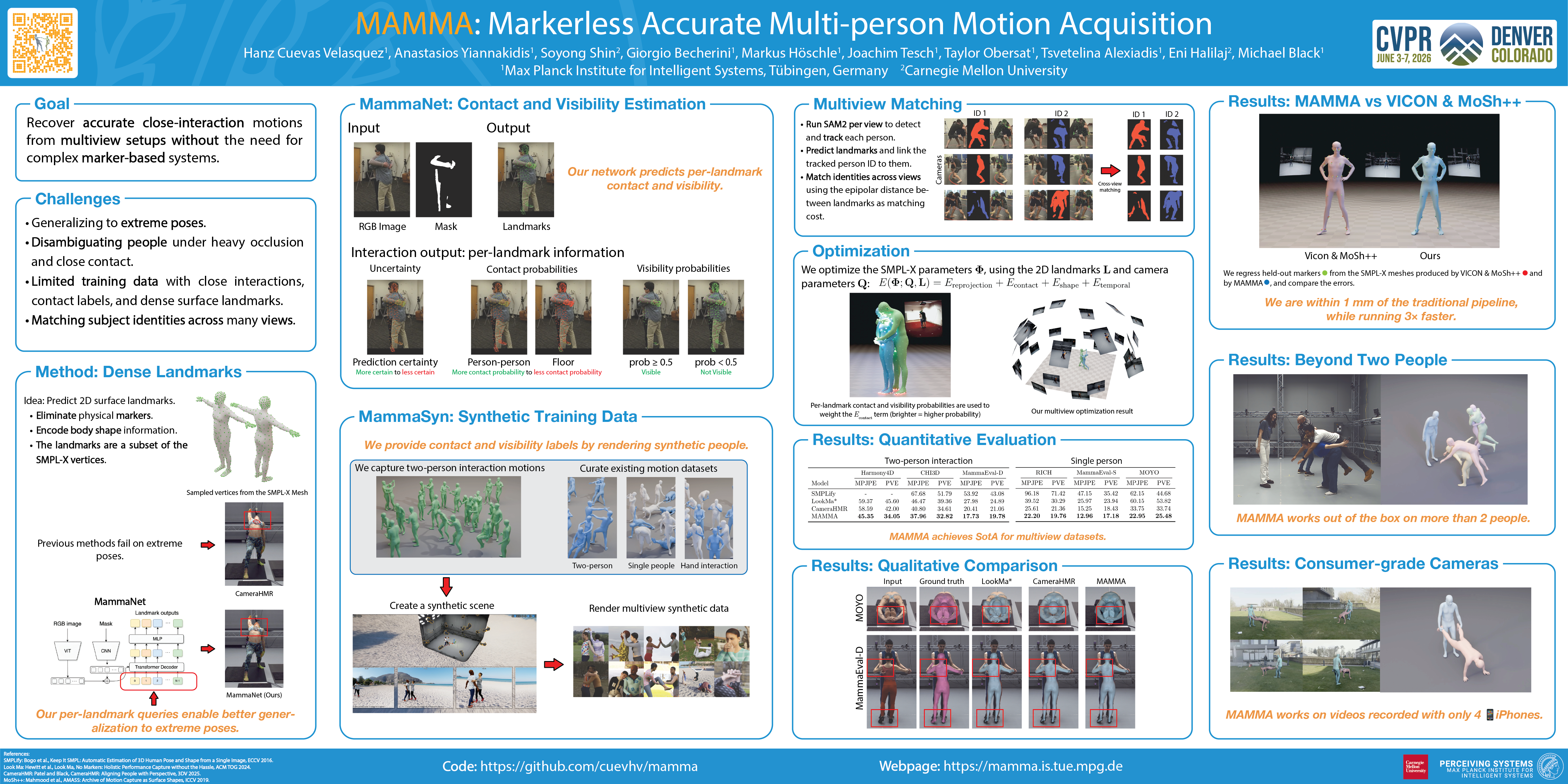
We present MAMMA, a markerless motion-capture pipeline that accurately recovers SMPL-X parameters from multi-view video.Traditional motion-capture systems rely on physical markers. Although they offer high accuracy, their requirements of specialised hardware, manual marker placement, and extensive post-processing make them costly and time-consuming. Recent learning-based methods attempt to overcome these limitations, but most are designed for single-person capture, rely on sparse keypoints, or struggle with occlusions and physical interactions. In this work, we introduce a method that predicts dense 2D surface landmarks conditioned on segmentation masks, enabling person-specific correspondence estimation even under heavy occlusion. We employ a novel architecture that exploits learnable queries for each landmark. We demonstrate that our approach can handle complex person--person interaction and offers greater accuracy than existing methods. To train our network, we construct a large, synthetic multi-view dataset combining human motions from diverse sources, including extreme poses, hand motions, and close interactions. Our dataset yields high-variability synthetic sequences with rich body contact and occlusion, and includes SMPL-X ground-truth annotations with dense 2D landmarks.The result is a system capable of accurately capturing human motion without the need for markers. Our approach offers competitive reconstruction quality compared to commercial marker-based motion-capture solutions, without the extensive manual cleanup. Finally, we address the absence of common benchmarks for dense-landmark prediction and markerless motion capture by introducing two evaluation settings built from real multi-view sequences. We will release our dataset, method, code, and model weights for research purposes.
Natural Human Motion Recovery by Aligning High-Order Temporal Dynamics from Monocular Videos
Dingkun Wei ⋅ Zehong Shen ⋅ Yan Xia ⋅ Yujun Shen ⋅ Georgios Pavlakos ⋅ Xiaowei Zhou
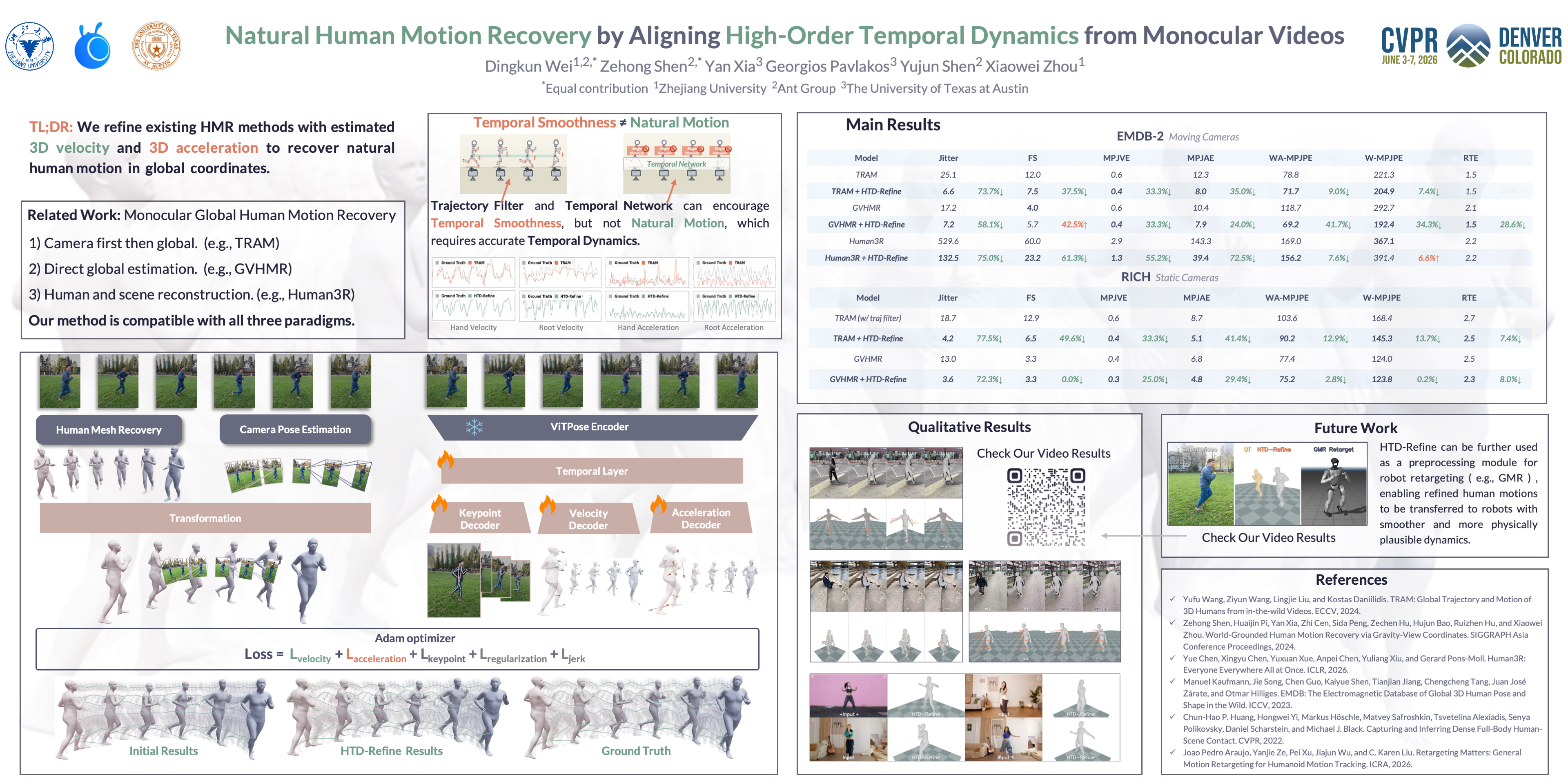
Human motion recovered from monocular videos often appears overly smooth or dynamically inconsistent, even when joint positions are numerically accurate. We observe that this limitation stems from the absence of reliable high-order temporal cues—velocity and acceleration—which are essential for reconstructing motion that exhibits realistic momentum, timing, and high-frequency detail.We introduce HTD-Refine, a post-processing framework that augments existing Human Motion Recovery (HMR) pipelines using explicitly estimated high-order temporal dynamics. At the core of our system is PVA-Net, a temporal transformer that infers per-joint 2D positions, velocities, and accelerations directly from a monocular video. These predicted dynamics serve as soft yet informative constraints in a global optimization procedure that refines camera-space and world-space trajectories, significantly reducing jitter, suppressing oversmoothing, and restoring physically plausible motion profiles.Extensive experiments on challenging in-the-wild benchmarks show that HTD-Refine consistently improves state-of-the-art HMR methods, yielding more accurate global trajectories and substantially more natural motion dynamics. Our results highlight the critical role of high-order temporal modeling in advancing monocular human motion recovery.
PoseGAM: Robust Unseen Object Pose Estimation via Geometry-Aware Multi-View Reasoning
Jianqi Chen ⋅ Biao Zhang ⋅ Xiangjun Tang ⋅ Peter Wonka
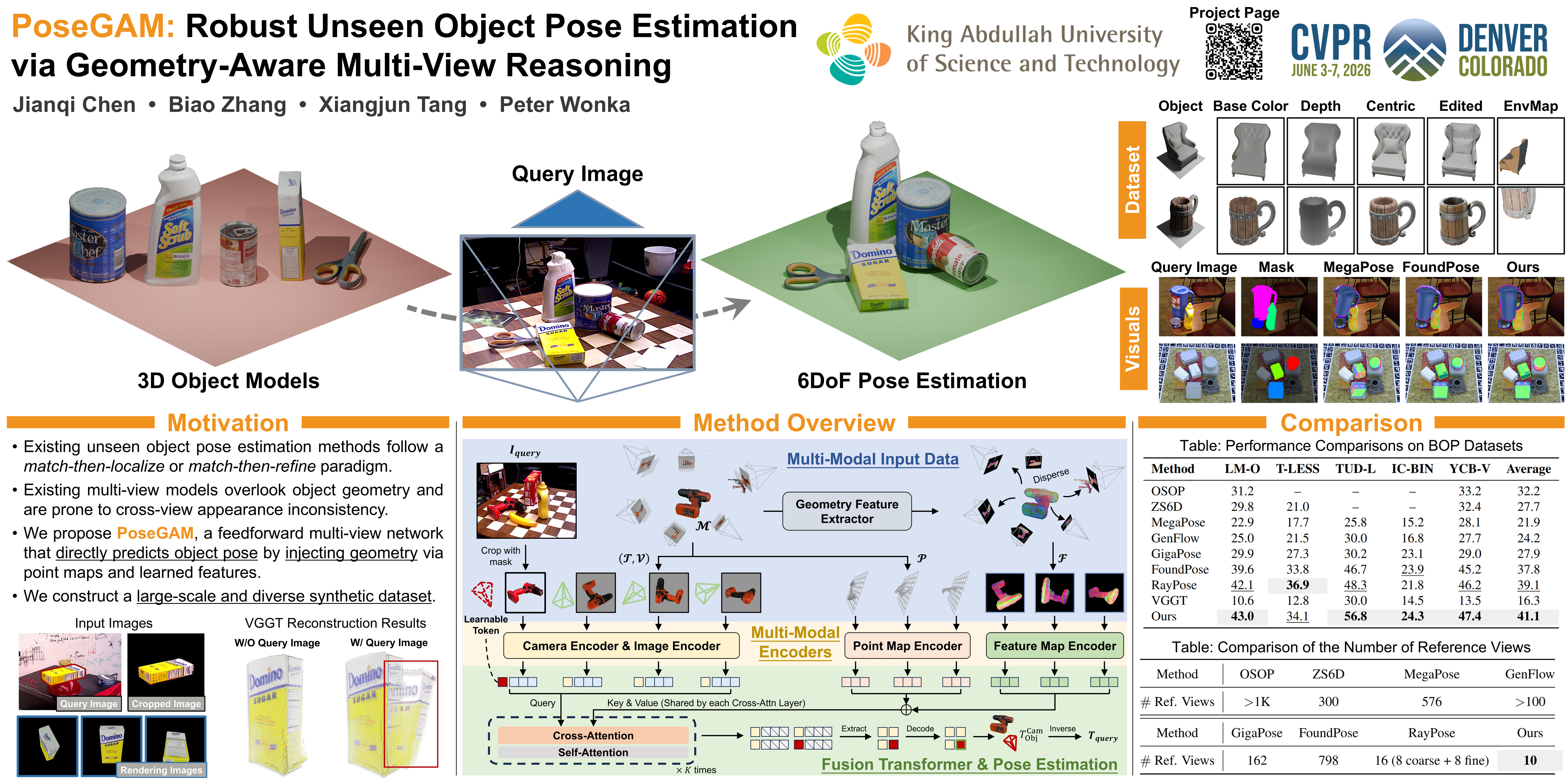
6D object pose estimation, which predicts the transformation of an object relative to the camera, remains challenging for unseen objects. Existing approaches typically rely on explicitly constructing feature correspondences between the query image and either the object model or template images. In this work, we propose PoseGAM, a geometry-aware multi-view framework that directly predicts object pose from a query image and multiple template images, eliminating the need for explicit matching. Built upon recent multi-view-based foundation model architectures, the method integrates object geometry information through two complementary mechanisms: explicit point-based geometry and learned features from geometry representation networks. In addition, we construct a large-scale synthetic dataset containing more than 190k objects under diverse environmental conditions to enhance robustness and generalization. Extensive evaluations across multiple benchmarks demonstrate our state-of-the-art performance, yielding an average AR improvement of 5.1% over prior methods and achieving up to 17.6% gains on individual datasets, indicating strong generalization to unseen objects.
SAM 3D Body: Robust Full-Body Human Mesh Recovery
Xitong Yang ⋅ Devansh Kukreja ⋅ Don Pinkus ⋅ Taosha Fan ⋅ Jinhyung Park ⋅ Soyong Shin ⋅ Jinkun Cao ⋅ Jia-Wei Liu ⋅ Nicolás Ugrinovic ⋅ Anushka Sagar ⋅ Jitendra Malik ⋅ Matt Feiszli ⋅ Piotr Dollár ⋅ Kris Kitani
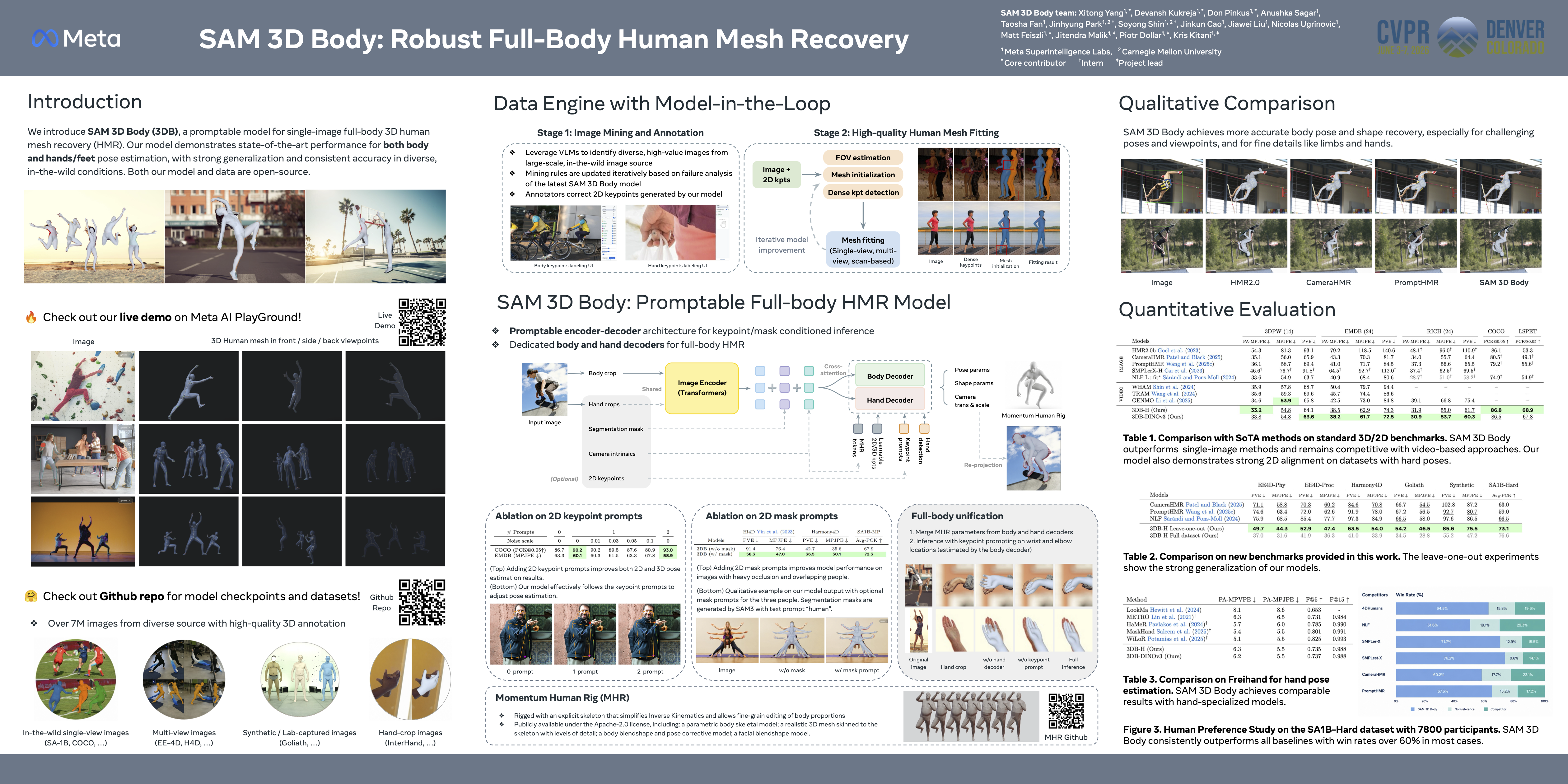
We introduce SAM 3D Body (3DB), a promptable model for single-image full-body 3D human mesh recovery (HMR) that demonstrates state-of-the-art performance, with strong generalization and consistent accuracy in diverse in-the-wild conditions. 3DB estimates the human pose of the body, feet, and hands. It is the first model to use a new parametric mesh representation, Momentum Human Rig (MHR), which decouples skeletal pose and body shape. 3DB employs an encoder–decoder architecture and supports auxiliary prompts, including 2D keypoints and masks, enabling user-guided inference similar to the SAM family of models. We derive high-quality annotations from a multi-stage annotation pipeline that uses various combinations of manual keypoint annotation, differentiable optimization, multi-view geometry, and dense keypoint detection. Our data engine efficiently selects and processes data to ensure data diversity, collecting unusual poses and rare imaging conditions. We present a new evaluation dataset organized by pose and appearance categories, enabling nuanced analysis of model behavior. Our experiments demonstrate superior generalization and substantial improvements over prior methods in both qualitative user preference studies and traditional quantitative analysis. Both 3DB and MHR are open-source.
SAM 3D: 3Dfy Anything in Images
Xingyu Chen ⋅ Fu-Jen Chu ⋅ Pierre Gleize ⋅ Kevin J Liang ⋅ Alexander Sax ⋅ Hao Tang ⋅ Weiyao Wang ⋅ Michelle Guo ⋅ Thibaut Hardin ⋅ Xiang Li ⋅ Aohan Lin ⋅ Jia-Wei Liu ⋅ Ziqi Ma ⋅ Anushka Sagar ⋅ Bowen Song ⋅ Xiaodong Wang ⋅ Jianing "Jed" Yang ⋅ Bowen Zhang ⋅ Piotr Dollár ⋅ Georgia Gkioxari ⋅ Matt Feiszli ⋅ Jitendra Malik
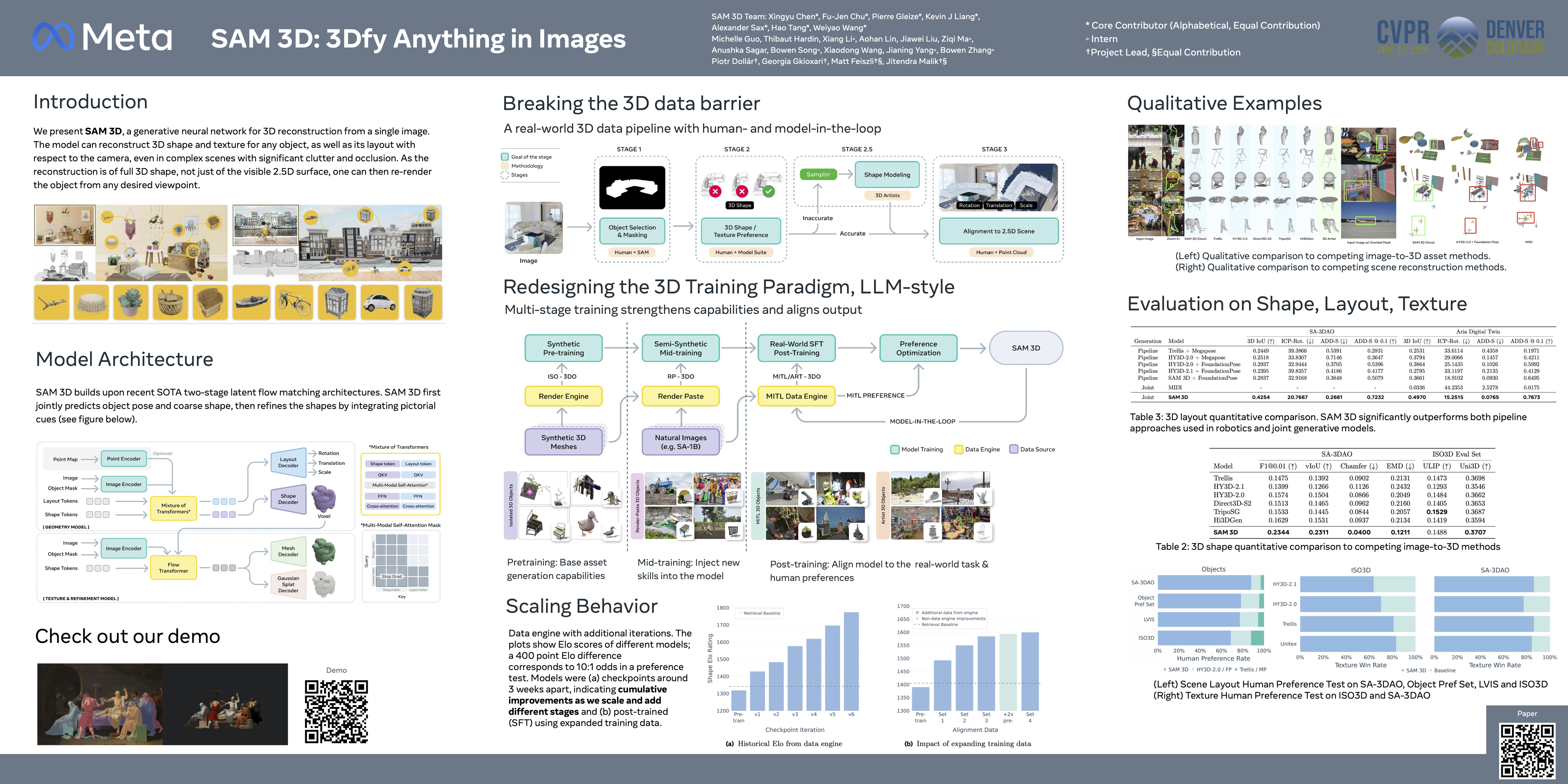
We present SAM 3D, a generative model for visually grounded 3D object reconstruction, predicting geometry, texture, and layout from a single image. SAM 3D excels in natural images, where occlusion and scene clutter are common and visual recognition cues from context play a larger role. We achieve this with a human- and model-in-the-loop pipeline for annotating object shape, texture, and pose, providing visually grounded 3D reconstruction data at unprecedented scale. We learn from this data in a modern, multi-stage training framework that combines synthetic pretraining with real-world alignment, breaking the 3D "data barrier". We obtain significant gains over recent work, with at least a $5:1$ win rate in human preference tests on real-world objects and scenes. We will release our code and model weights, an online demo, and a new challenging benchmark for in-the-wild 3D object reconstruction.
SPARK: Sim-ready Part-level Articulated Reconstruction with VLM Knowledge
Yumeng He ⋅ Ying Jiang ⋅ Jiayin Lu ⋅ Yin Yang ⋅ Chenfanfu Jiang
Articulated 3D objects are critical for embodied AI, robotics, and interactive scene understanding, yet creating simulation-ready assets remains labor-intensive and requires expert modeling of part hierarchies and motion structures. We introduce SPARK, a framework for reconstructing physically consistent, kinematic part-level articulated objects from a single RGB image. Given an input image, we first leverage VLMs to extract coarse URDF parameters and generate part-level reference images. We then integrate the part-image guidance and the inferred structure graph into a generative diffusion transformer to synthesize consistent part and complete shapes of articulated objects. To further refine the URDF parameters, we incorporate differentiable forward kinematics and differentiable rendering to optimize joint types, axes, and origins under VLM-generated open-state supervision. Extensive experiments show that SPARK produces high-quality, simulation-ready articulated assets across diverse categories, enabling downstream applications such as robotic manipulation and interaction modeling.
3DReflecNet: A Large-Scale Dataset for 3D Reconstruction of Reflective, Transparent, and Low-Texture Objects
Zhicheng Liang ⋅ Haoyi Yu ⋅ Boyan Li ⋅ Dayou Zhang ⋅ Zijian Cao ⋅ Tianyi Gong ⋅ Junhua Liu ⋅ Shuguang Cui ⋅ Fangxin Wang
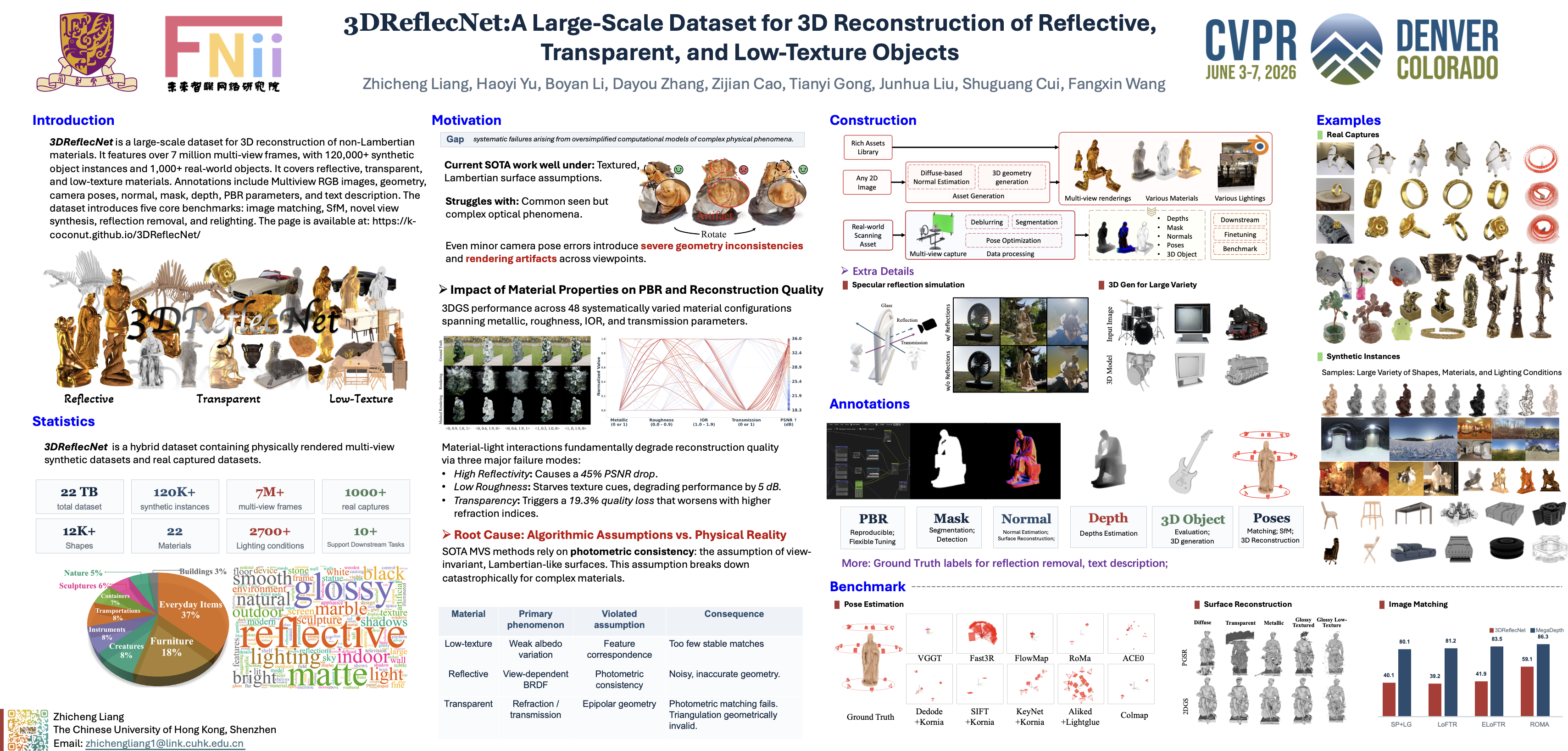
Accurate 3D reconstruction of objects with reflective, transparent, or low-texture surfaces remains a significant challenge. Such materials often violate key assumptions in multi-view reconstruction pipelines, such as photometric consistency and the reliance on distinct geometric texture cues. Existing datasets primarily focus on diffuse, textured objects, thereby offering limited insight into performance under real-world material complexities. In this paper, we introduce 3DReflecNet, a large-scale hybrid dataset exceeding 22 TB that is specifically designed to benchmark and advance 3D vision methods for these challenging materials. 3DReflecNet combines two types of data: over 100,000 synthetic instances generated via physically-based rendering of more than 10,000 shapes, and over 1,000 real-world objects scanned using consumer RGB-D devices. Together, these data consist of more than 7 million multi-view frames. It encompasses diverse materials, complex lighting conditions, and a wide range of geometric forms—including shapes generated from both real and LLM-synthesized 2D images using diffusion-based methods. To support robust evaluation, we design benchmarks for four core tasks: image matching, reflection removal, structure-from-motion, and novel view synthesis. Through extensive experiments, we show that state-of-the-art methods struggle to maintain accuracy across these settings, highlighting the need for more resilient 3D vision models. We release the dataset, baselines, and evaluation suite to facilitate progress in this direction, which can be accessed at supplementary materials.
GLINT: Modeling Scene-Scale Transparency via Gaussian Radiance Transport
Youngju Na ⋅ Jaeseong Yun ⋅ Soohyun Ryu ⋅ Hyunsu Kim ⋅ Sung-Eui Yoon ⋅ Suyong Yeon
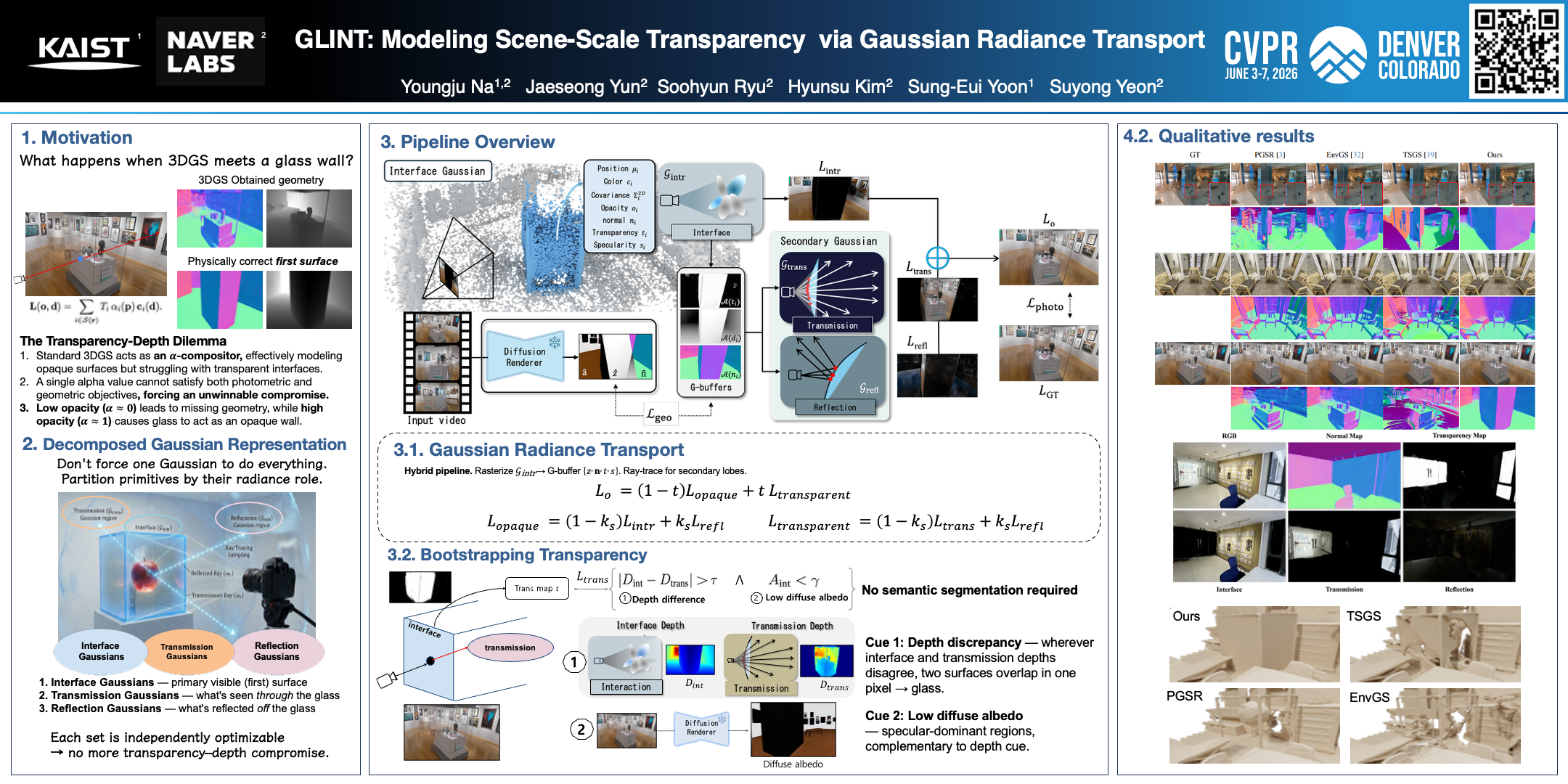
While 3D Gaussian splatting has emerged as a powerful paradigm, it fundamentally fails to model transparency such as glass panels, which are prevalent in everyday environments. The core challenge lies in decoupling the intertwined radiance contributions from transparent interfaces and the transmitted geometry observed through the glass. We present GLINT, a framework that models scene-scale transparency through explicit decomposed Gaussian representation. GLINT reconstructs the primary interface and separates outgoing radiance into reflection and transmission components according to its optical properties, enabling coherent Gaussian radiance transport. During the optimization, GLINT bootstraps transparency localization by utilizing geometry separation cues that emerge from our decomposition with the geometry and material priors from a pre-trained video relighting model. Extensive experiments demonstrate that GLINT achieves state-of-the-art performance in 3D reconstruction of complex transparent scenes.Our code will be released publicly.
Neural Field-Based 3D Surface Reconstruction of Microstructures from Multi-Detector Signals in Scanning Electron Microscopy
Shuo Chen ⋅ Yijin Li ⋅ Xi Zheng ⋅ Guofeng Zhang
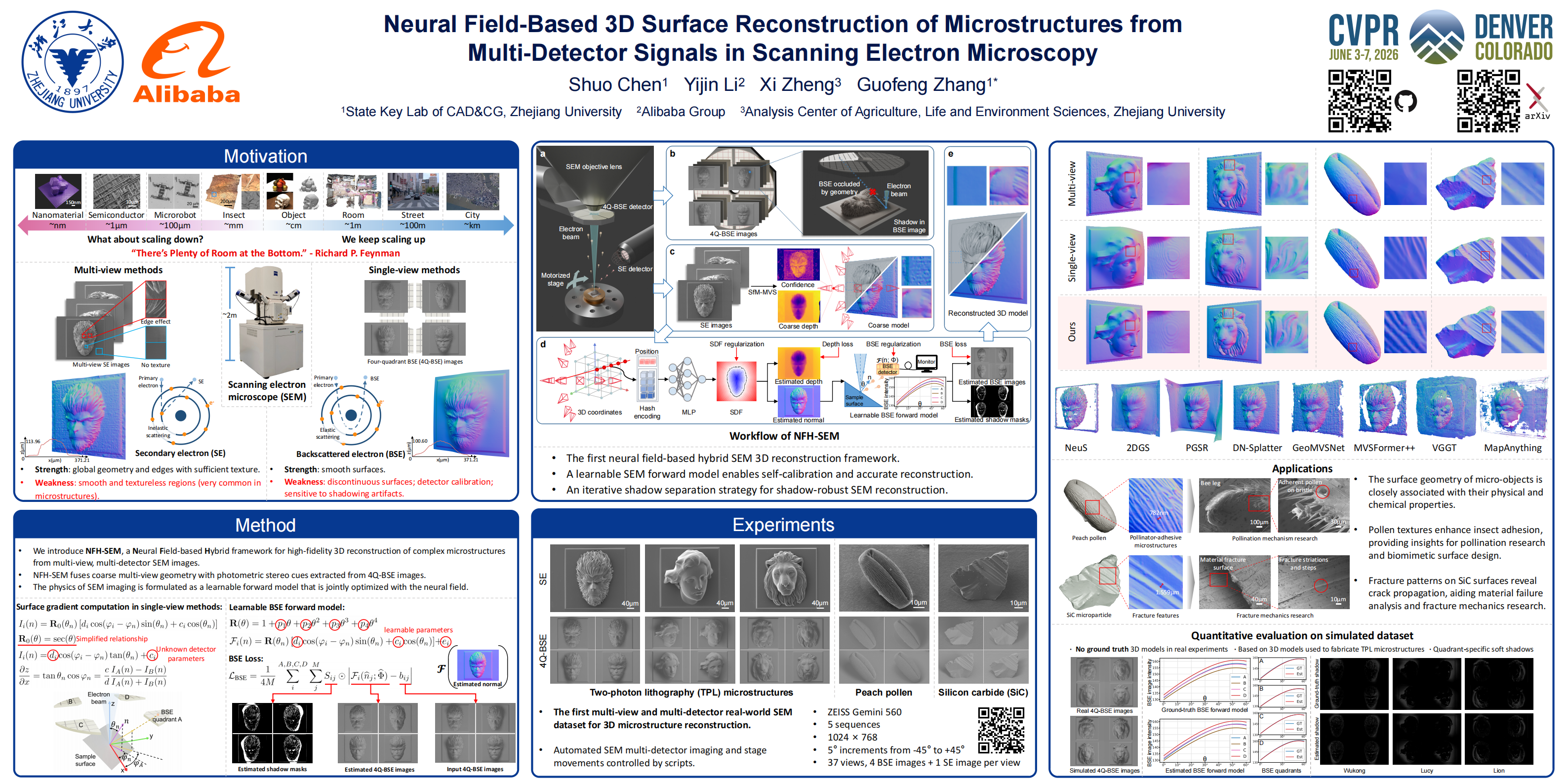
The 3D characterization of microstructures is crucial for understanding and designing functional materials. However, the scanning electron microscope (SEM), widely used in scientific research, captures only 2D electron intensity distributions. Existing SEM 3D reconstruction methods struggle with textureless regions, shadowing artifacts, and calibration dependencies, whereas advanced learning-based approaches fail to generalize to microscopic SEM domains due to the lack of physical priors and domain-specific data. To address these challenges, we introduce NFH-SEM, a neural field-based hybrid reconstruction framework that recovers high-fidelity 3D surfaces from multi-view, multi-detector SEM images. NFH-SEM integrates coarse multi-view geometry with photometric stereo cues from detector signals through a continuous neural field, incorporating a learnable forward model that embeds SEM imaging physics for self-calibrated, shadow-robust reconstruction. NFH-SEM achieves precise recovery across diverse specimens, revealing 478 nm layered features in two-photon lithography samples, 782 nm surface textures on pollen grains, and 1.559 μm fracture steps on silicon carbide particles, demonstrating its accuracy and broad applicability.
PhyGaP: Physically-Grounded Gaussians with Polarization Cues
Jiale Wu ⋅ Xiaoyang Bai ⋅ Zongqi He ⋅ Weiwei Xu ⋅ YIFAN PENG
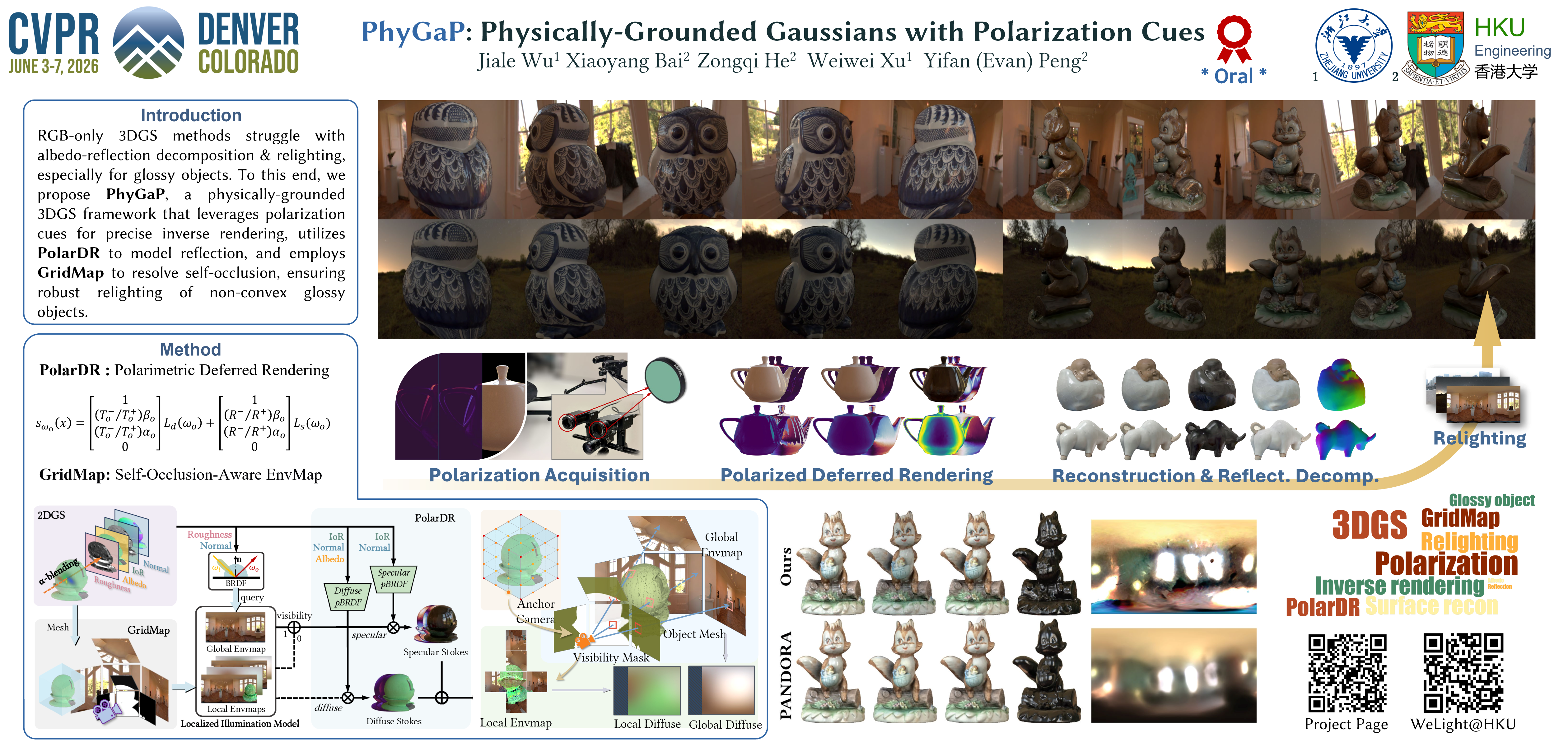
Recent advances in 3D Gaussian Splatting (3DGS) have demonstrated great success in modeling reflective 3D objects and their interaction with the environment via deferred rendering (DR). However, existing methods often struggle with correctly reconstructing physical attributes such as albedo and reflectance, and therefore they do not support high-fidelity relighting. Observing that this limitation stems from the lack of shape and material information in RGB images, we present PhyGaP, a physically-grounded 3DGS method that leverages polarization cues to facilitate precise reflection decomposition and visually consistent relighting of reconstructed objects. Specifically, we design a polarimetric deferred rendering (PolarDR) process to model polarization by reflection, and a self-occlusion-aware environment map building technique (GridMap) to resolve indirect lighting of non-convex objects. We validate on multiple synthetic and real-world scenes, including those featuring only partial polarization cues, that PhyGaP not only excels in reconstructing the appearance and surface normal of reflective 3D objects (~2 dB in PSNR and 45.7% in Cosine Distance better than existing RGB-based methods on average), but also achieves state-of-the-art inverse rendering and relighting capability.
PPISP: Physically-Plausible Compensation and Control of Photometric Variations in Radiance Field Reconstruction
Isaac Deutsch ⋅ Nicolas Moënne-Loccoz ⋅ Gavriel State ⋅ Žan Gojčič
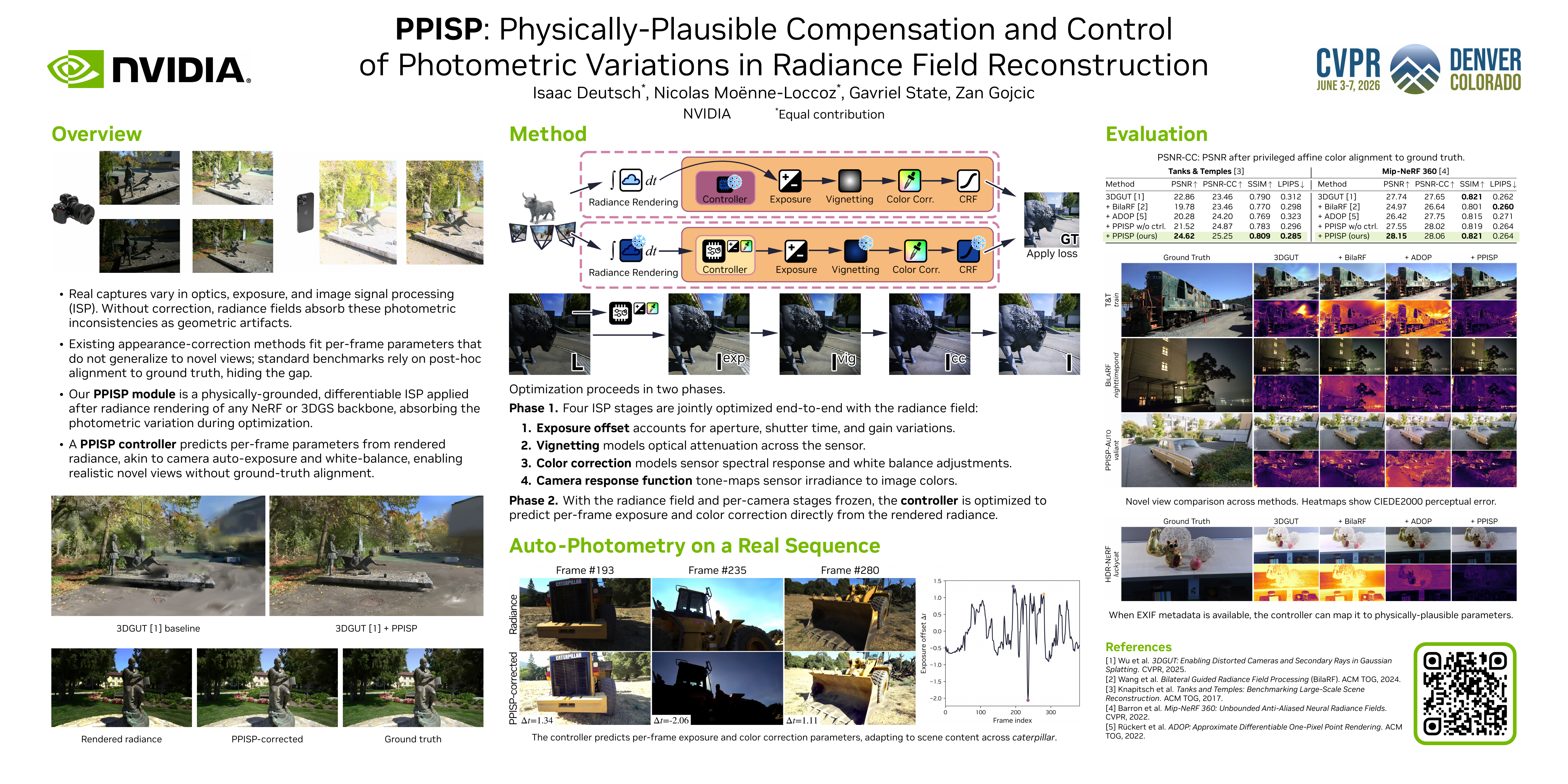
Multi-view 3D reconstruction methods remain highly sensitive to photometric inconsistencies arising from camera optical characteristics and variations in image signal processing (ISP). Existing mitigation strategies such as per-frame latent variables or affine color corrections lack physical grounding and generalize poorly to novel views. We propose the Physically-Plausible ISP (PPISP) correction module, which disentangles camera-intrinsic and capture-dependent effects through physically based and interpretable transformations. A dedicated PPISP controller, trained on the input views, predicts ISP parameters for novel viewpoints, analogous to auto exposure and auto white balance in real cameras. This design enables realistic and fair evaluation on novel views without access to ground-truth images. PPISP achieves SoTA performance on standard benchmarks, while providing intuitive control and supporting the integration of metadata when available.
SeeGroup: Multi-Layer Depth Estimation of Transparent Surfaces via Self-Determined Grouping
Hongyu Wen ⋅ Jia Deng
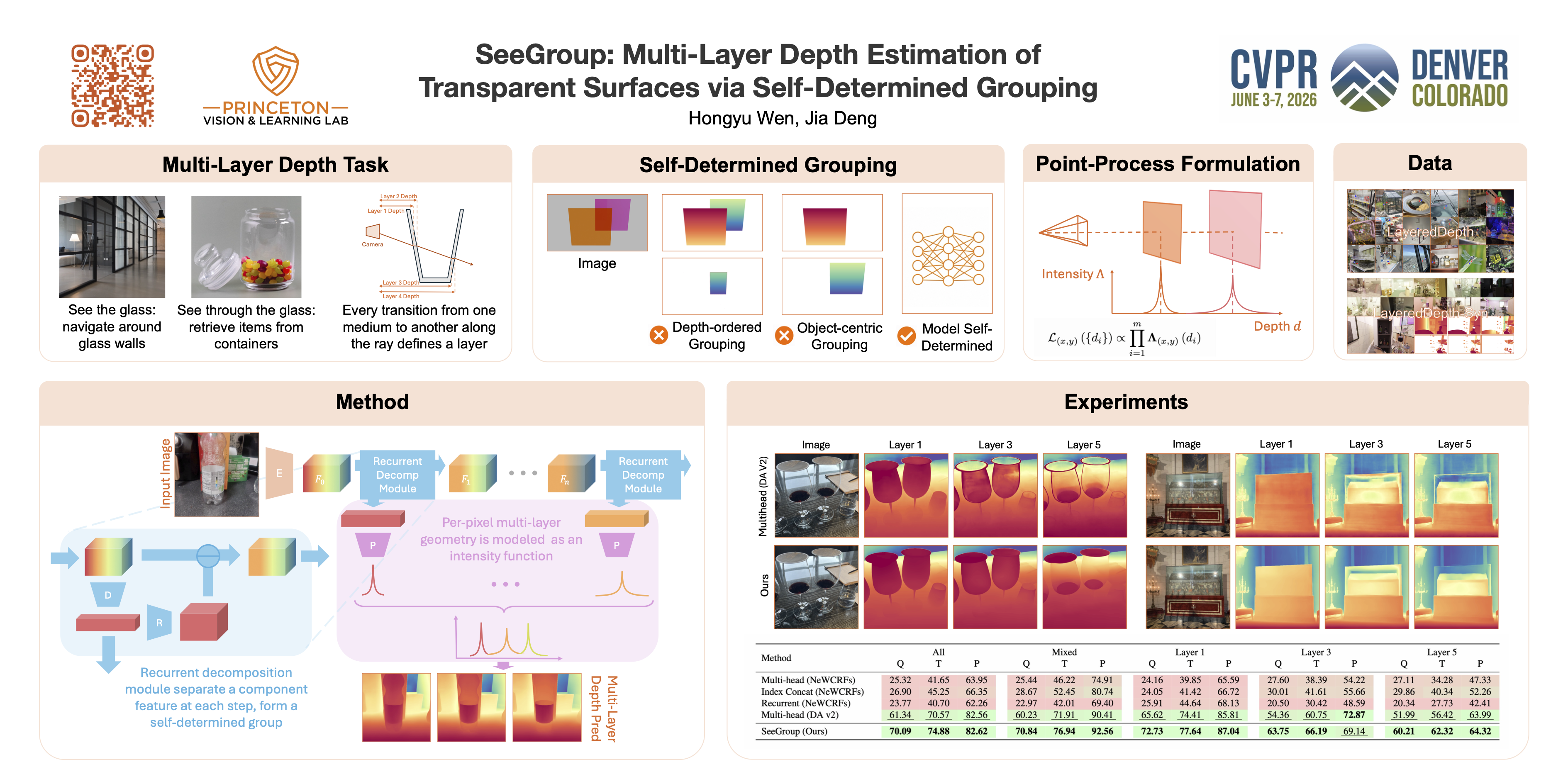
Transparent objects are common in daily life, and understanding their multi-layer depth information, including both the transparent surface and the objects behind it, is crucial for real-world applications that interact with transparent materials.However, existing depth methods produce only a single depth map, which is inherently ambiguous for transparent surfaces.In this work, We propose a multi-layer depth estimation method, SeeGroup, consisting of novel recurrent decomposition module design and an intensity-based formulation for multi-layer depth. Experiments demonstrate that our method significantly improves the state of the art of multi-layer depth estimation, improving quadruplet relative depth accuracy on LayeredDepth benchmark from 61.34\% to 70.67\%.
Energy-GS: Image Energy-guided Pose Alignment Gaussian Splatting with redesigned pose gradient flow
Yu Gao ⋅ Lutong Su ⋅ Ruixiang Huang ⋅ Tianji Jiang ⋅ Jiadong Tang ⋅ Yufeng Yue ⋅ Yi Yang
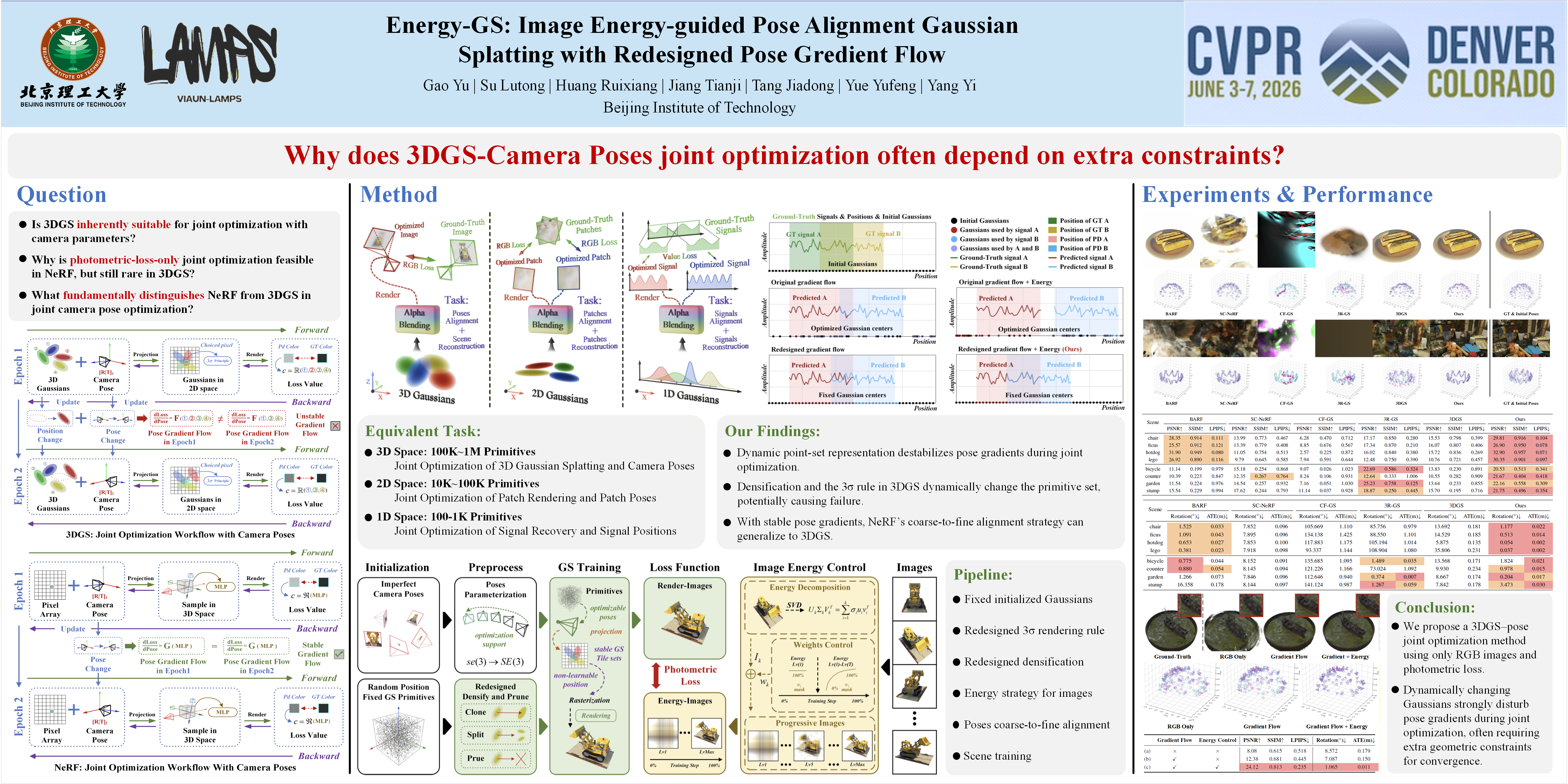
High-quality 3D scene representation in radiance fields relies on accurate camera poses which are often difficult to acquire in real-world scenarios. An effective solution is to use RGB images for the joint optimization of radiance fields and camera poses, an approach that has been well explored in NeRF series methods. However, unlike NeRF, joint optimization in 3D Gaussian Splatting (3DGS) often requires additional regularization or prior spatial knowledge to reach comparable performance. To eliminate these dependencies, we introduce Energy-GS, a pose-aware Gaussian splatting framework that jointly optimizes scene representation and camera poses using only RGB images. We observe that pose gradients in joint optimization are unstable due to the point-based rendering mechanism. Furthermore, unlike NeRF’s spatial sampling framework that enables coarse-to-fine pose alignment, rasterization-based 3DGS lacks controllable sampling and thus cannot support progressive pose refinement. To address these challenges, we redesign the optimization strategy of Gaussian primitives and introduce an image-energy-guided constraint that encourages progressive alignment of camera poses. Experiments on both synthetic and real-world datasets show that Energy-GS can effectively optimize the scene reconstruction and resolve camera pose misalignment at the same time. Benefiting from reliance on only RGB images, we believe this work provides promising insights for visual localization and dense mapping applications such as SLAM.
MeshSplatting: Differentiable Rendering with Opaque Meshes
Jan Held ⋅ Sanghyun Son ⋅ Renaud Vandeghen ⋅ Daniel Rebain ⋅ Matheus Gadelha ⋅ Yi Zhou ⋅ Anthony Cioppa ⋅ Ming C. Lin ⋅ Marc Van Droogenbroeck ⋅ Andrea Tagliasacchi
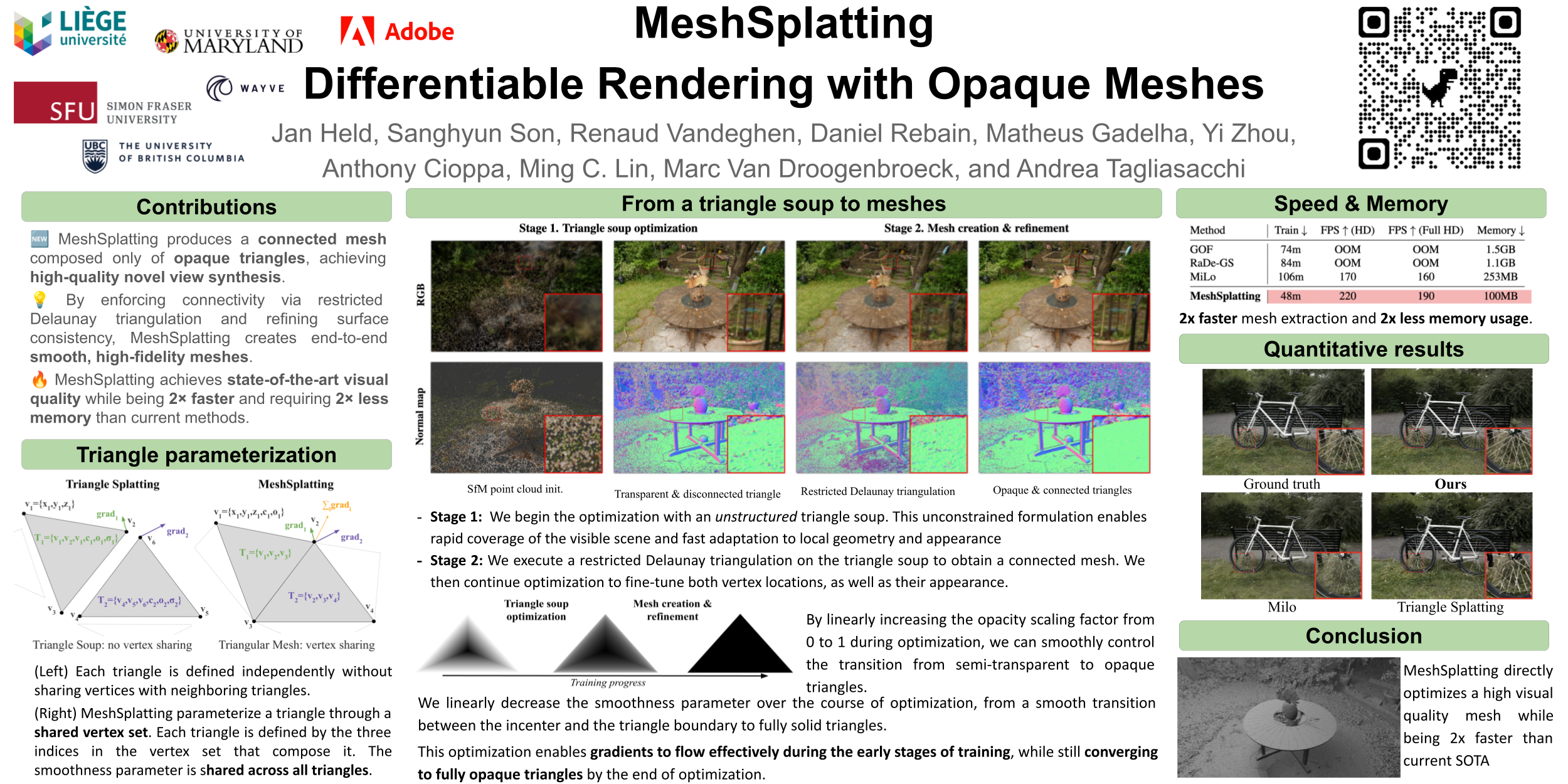
Primitive-based splatting methods like 3D Gaussian Splatting (3DGS) have revolutionized novel view synthesis with real-time rendering.However, their point-based representations remain incompatible with mesh-based pipelines that power AR/VR and game engines. We present MeshSplatting, a mesh-based reconstruction approach that jointly optimizes geometry and appearance through differentiable rendering.By enforcing connectivity via restricted Delaunay triangulation and refining surface consistency, MeshSplatting creates end-to-end smooth, visually high-quality meshes that render efficiently in real-time 3D engines.On Mip-NeRF360, it boosts PSNR by +0.69 dB over the current state-of-the-art MiLo for mesh-based novel view synthesis, while training 2x faster and using 2x less memory, bridging neural rendering and interactive 3D graphics for seamless real-time scene interaction.
Proxy-GS: Unified Occlusion Priors for Training and Inference in Structured 3D Gaussian Splatting
Yuanyuan Gao ⋅ YUNING GONG ⋅ Yifei Liu ⋅ Jingfeng Li ⋅ Dan Xu ⋅ Yanci Zhang ⋅ Dingwen Zhang ⋅ Xiao Sun ⋅ Zhihang Zhong
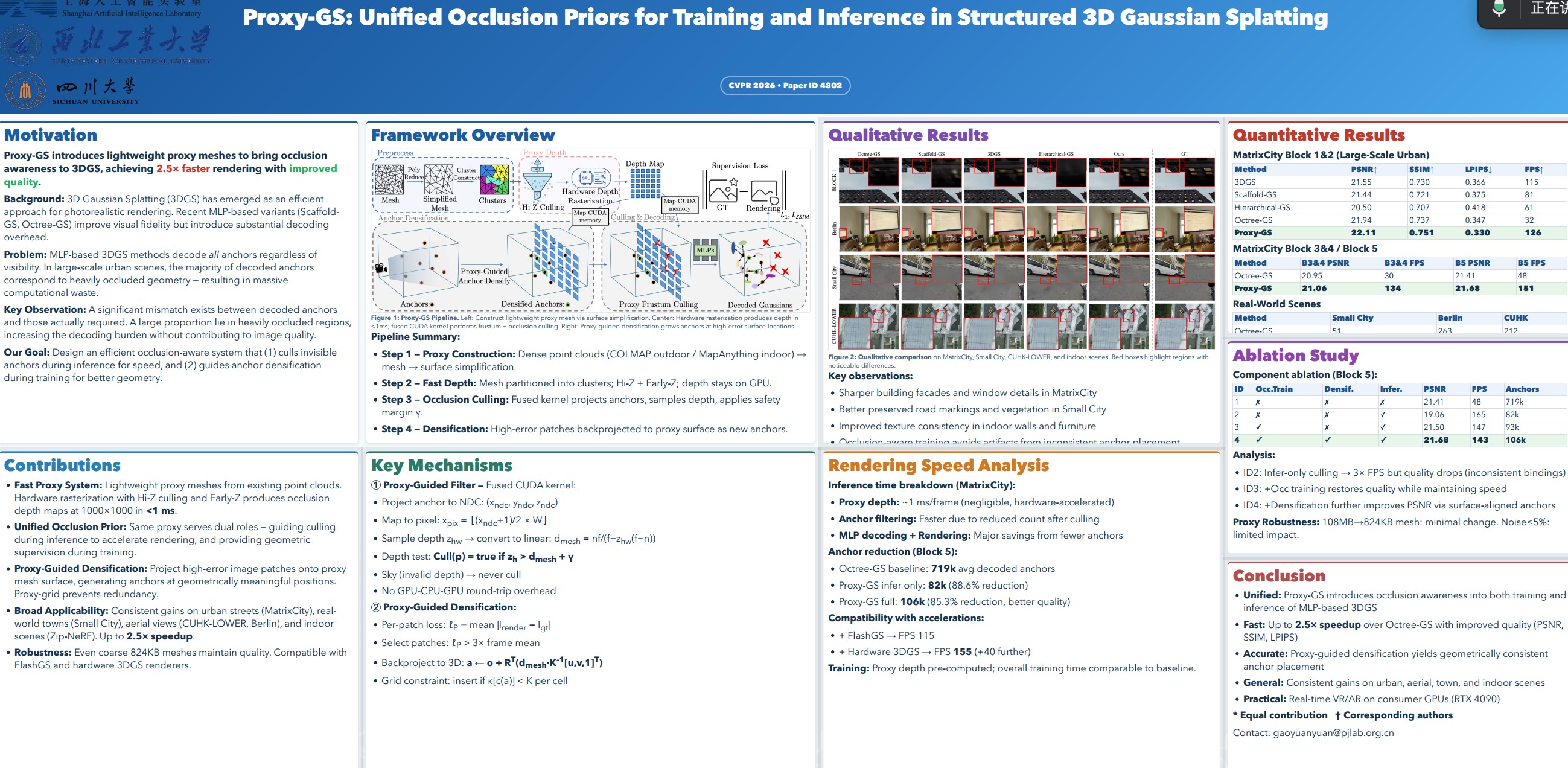
3D Gaussian Splatting (3DGS) has emerged as an efficient approach for achieving photorealistic rendering. Recent MLP-based variants further improve visual fidelity but introduce substantial decoding overhead during rendering. To alleviate computation cost, several pruning strategies and level-of-detail (LOD) techniques have been introduced, aiming to effectively reduce the number of Gaussian primitives in large-scale scenes. However, our analysis reveals that significant redundancy still remains due to the lack of occlusion awareness. In this work, we propose Proxy-GS, a novel pipeline that exploits a proxy to introduce Gaussian occlusion awareness from any view.At the core of our approach is a fast proxy system capable of producing precise occlusion depth maps at resolution 1000$\times$1000 under 1 ms. This proxy serves two roles: first, it guides the culling of anchors and Gaussians to accelerate rendering speed. Second, it guides the densification towards surfaces during training, avoiding inconsistencies in occluded regions, and improving the rendering quality. In heavily occluded scenarios, such as the MatrixCity Streets dataset, Proxy-GS not only equips MLP-based Gaussian splatting with stronger rendering capability but also achieves faster rendering speed than the original 3DGS. Specifically, it achieves more than $2.5\times$ speedup over Octree-GS, and consistently delivers substantially higher rendering quality.
RetimeGS: Continuous-Time Reconstruction of 4D Gaussian Splatting
Xuezhen Wang ⋅ Li Ma ⋅ Yulin Shen ⋅ Zeyu Wang ⋅ Pedro V. Sander
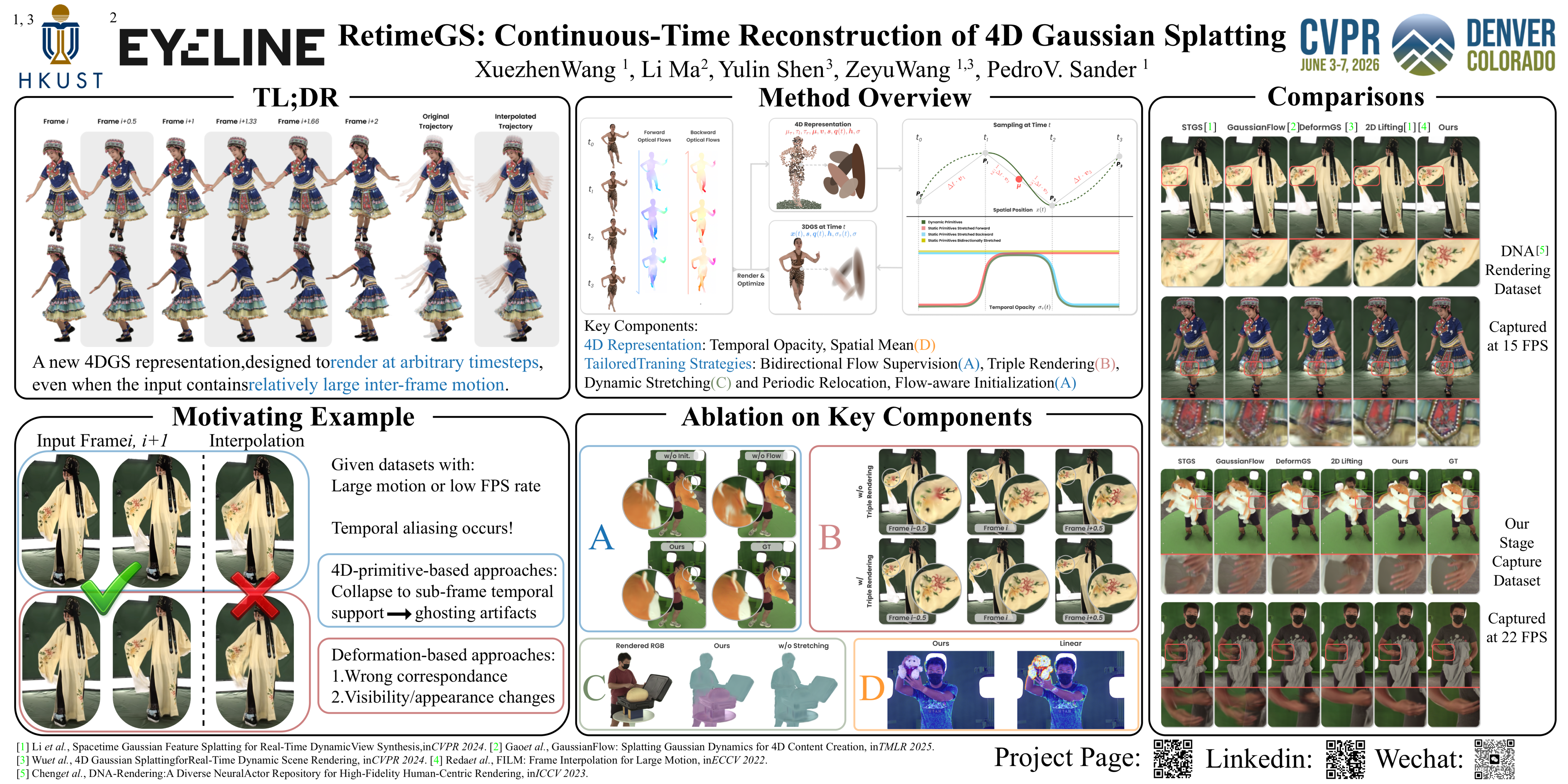
Temporal retiming, the ability to reconstruct and render dynamic scenes at arbitrary timestamps, is crucial for applications such as slow-motion playback, temporal editing, and post-production. However, most existing 4D Gaussian Splatting (4DGS) methods overfit at discrete frame indices but struggle to represent continuous-time frames, leading to ghosting artifacts when interpolating between timestamps. We identify this limitation as a form of temporal aliasing and propose RetimeGS, a simple yet effective 4DGS representation that explicitly defines the temporal behavior of the 3D Gaussian and mitigates temporal aliasing. To achieve smooth and consistent interpolation, we incorporate optical flow–guided initialization and supervision, triple-rendering supervision, and other targeted strategies. Together, these components enable ghost-free, temporally coherent rendering even under large motions. Experiments on datasets featuring fast motion, non-rigid deformation, and severe occlusions demonstrate that RetimeGS achieves superior quality and coherence over state-of-the-art methods.
Selfi: Self-improving Reconstruction Engine via 3D Geometric Feature Alignment
Youming Deng ⋅ Songyou Peng ⋅ Junyi Zhang ⋅ Kathryn Heal ⋅ Tiancheng Sun ⋅ John Flynn ⋅ Steve Marschner ⋅ Lucy Chai
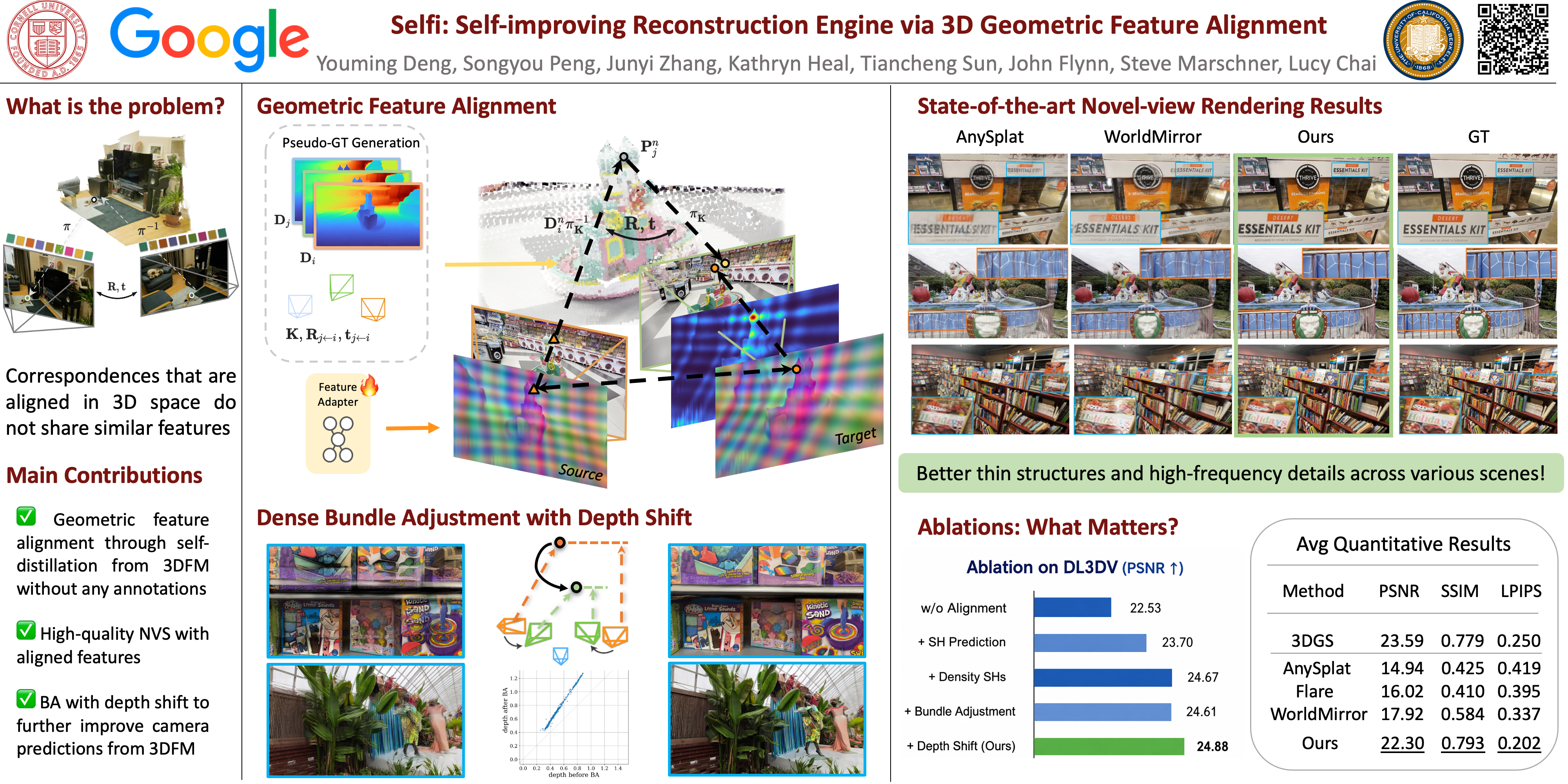
Novel View Synthesis (NVS) has traditionally relied on models with explicit 3D inductive biases combined with known camera parameters from Structure-from-Motion (SfM) beforehand. Recent vision foundation models like VGGT take an orthogonal approach -- 3D knowledge is gained implicitly through training data and loss objectives, enabling feed-forward prediction of both camera parameters and 3D representations directly from a set of uncalibrated images. While flexible, VGGT features lack explicit multi-view geometric consistency, and we find that improving such 3D feature consistency benefits both NVS and pose estimation tasks. We introduce Selfi, a self-improving 3D reconstruction pipeline via feature alignment, transforming a VGGT backbone into a high-fidelity 3D reconstruction engine by leveraging its own outputs as pseudo-ground-truth. Specifically, we train a lightweight feature adapter using a reprojection-based consistency loss, which distills VGGT outputs into a new geometrically-aligned feature space that captures spatial proximity in 3D. This enables state-of-the-art performance in both NVS and camera pose estimation, demonstrating that feature alignment is a highly beneficial step for downstream 3D reasoning.
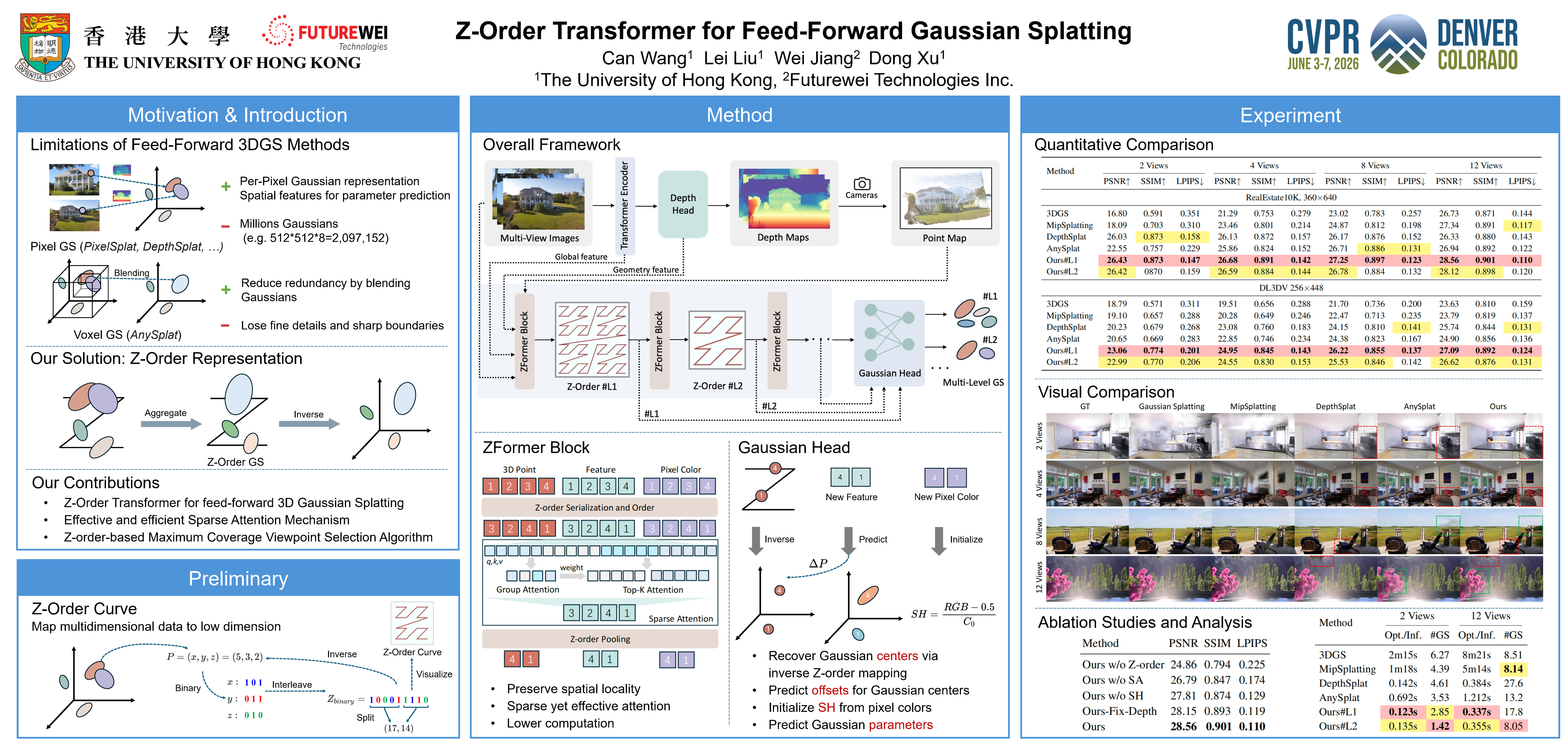
Recent advances in 3D Gaussian Splatting (3DGS) have enabled significant progress in photorealistic novel view synthesis. However, traditional 3DGS relies on a slow, iterative optimization process, which limits its use in scenarios demanding real-time results. To overcome this bottleneck, recent feed-forward methods aim to predict Gaussian attributes directly from images, but they often struggle with the redundancy of Gaussian primitives and rendering quality. In this paper, we introduce a transformer-based architecture specifically designed for feed-forward Gaussian Splatting. Our key insight is that spatial and semantic relationships among Gaussians can be effectively captured through a sparse attention mechanism, enabled by a Z-order strategy that organizes the unstructured Gaussian set into a spatially coherent sequence. Furthermore, we incorporate this Z-order strategy to adaptively suppress redundancy while preserving critical structural details. This allows the transformer to efficiently model context, compress Gaussian primitives, and predict Gaussian attributes in a single forward pass. Comprehensive experiments demonstrate that our method achieves fast and high-quality novel view synthesis with fewer Gaussian primitives.
4D Primitive-Mâché: Glueing Primitives for Persistent 4D Scene Reconstruction
Kirill Mazur ⋅ Marwan Taher ⋅ Andrew J. Davison
We present a dynamic reconstruction system that receives a casual monocular RGB video as input, and outputs a complete and persistent reconstruction of the scene. In other words, we reconstruct not only the the currently visible parts of the scene, but also all previously viewed parts, which enables replaying the complete reconstruction across all timesteps.Our method decomposes the scene into a set of rigid 3D primitives, which are assumed to be moving throughout the scene. Using estimated dense 2D correspondences, we jointly infer the rigid motion of these primitives through an optimisation pipeline, yielding a 4D reconstruction of the scene, i.e. providing 3D geometry dynamically moving through time. To achieve this, we also introduce a mechanism to extrapolate motion for objects that become invisible, employing motion-grouping techniques to maintain continuity.The resulting system enables 4D spatio-temporal awareness, offering capabilities such as replayable 3D reconstructions of articulated objects through time, multi-object scanning, and object permanence. On object scanning and multi-object datasets, our system significantly outperforms existing methods both quantitatively and qualitatively.
Efficiently Reconstructing Dynamic Scenes One D4RT at a Time
Chuhan Zhang ⋅ Guillaume Le Moing ⋅ Skanda Koppula ⋅ Ignacio Rocco ⋅ Liliane Momeni ⋅ Junyu Xie ⋅ Shuyang Sun ⋅ Rahul Sukthankar ⋅ Joëlle K. Barral ⋅ Raia Hadsell ⋅ Zoubin Ghahramani ⋅ Andrew Zisserman ⋅ Junlin Zhang ⋅ Mehdi S. M. Sajjadi
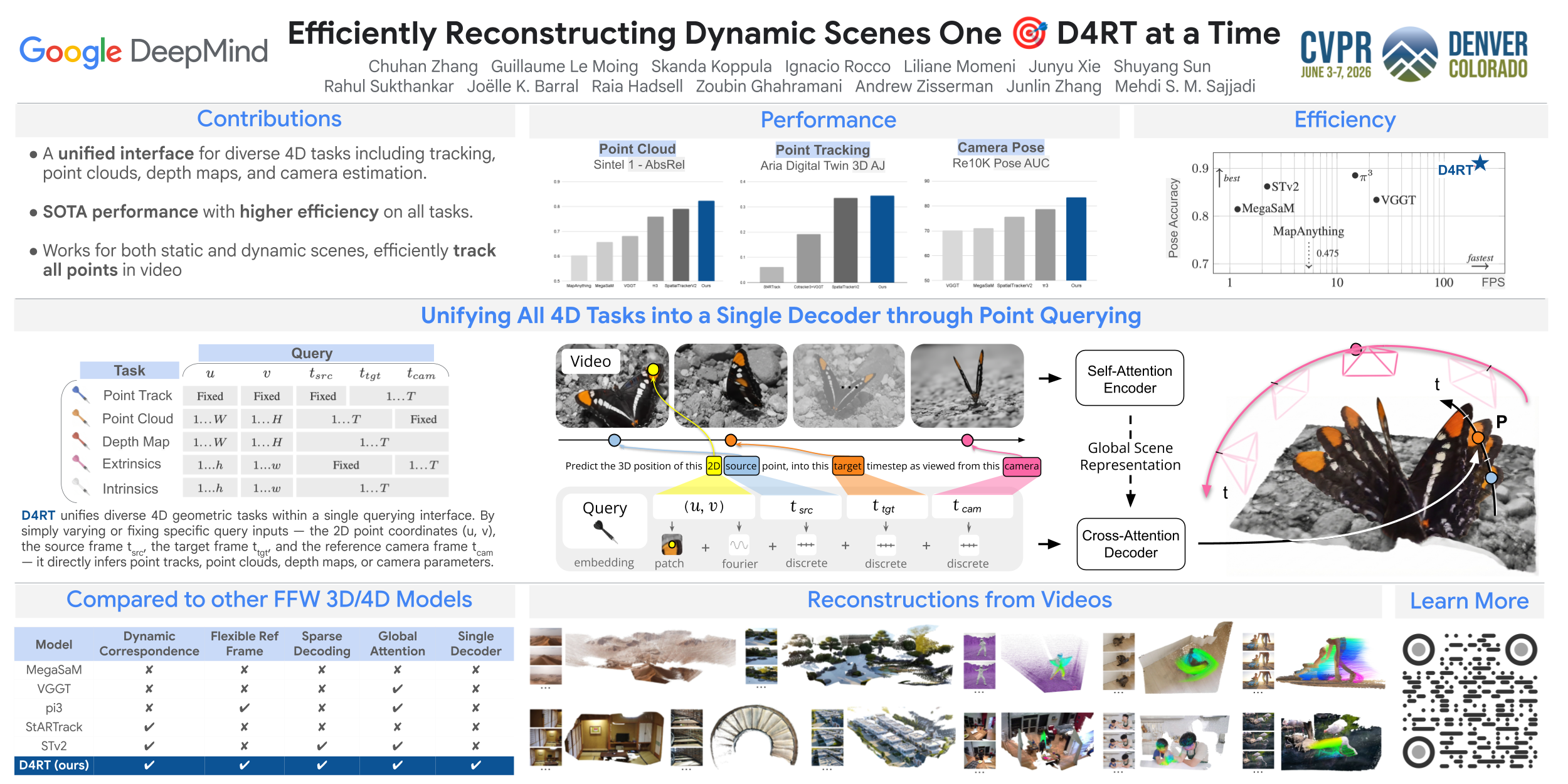
Understanding and reconstructing the complex geometry and motion of dynamic 4D scenes from video remains a formidable challenge in computer vision. This paper introduces D4RT, a simple yet powerful feedforward network designed to efficiently solve this task. D4RT utilizes a unified transformer architecture to jointly infer depth, spatio-temporal correspondence, and full camera parameters from a single video. Its core innovation is a novel mechanism that sidesteps the heavy computation of dense, per-frame decoding and the complexity of managing multiple, task-specific decoders. Our unified decoding interface allows the model to independently and efficiently probe the 3D position of any point in space and time. The result is a lightweight and highly scalable method that enables remarkably efficient training and inference. We demonstrate that our approach sets a new state-of-the-art, outperforming previous methods across a wide spectrum of 4D reconstruction tasks.
FUSER: Feed-Forward Multiview 3D Registration Transformer and SE(3)^N Diffusion Refinement
Haobo Jiang ⋅ Jin Xie ⋅ Jian Yang ⋅ Liang Yu ⋅ Jianmin Zheng
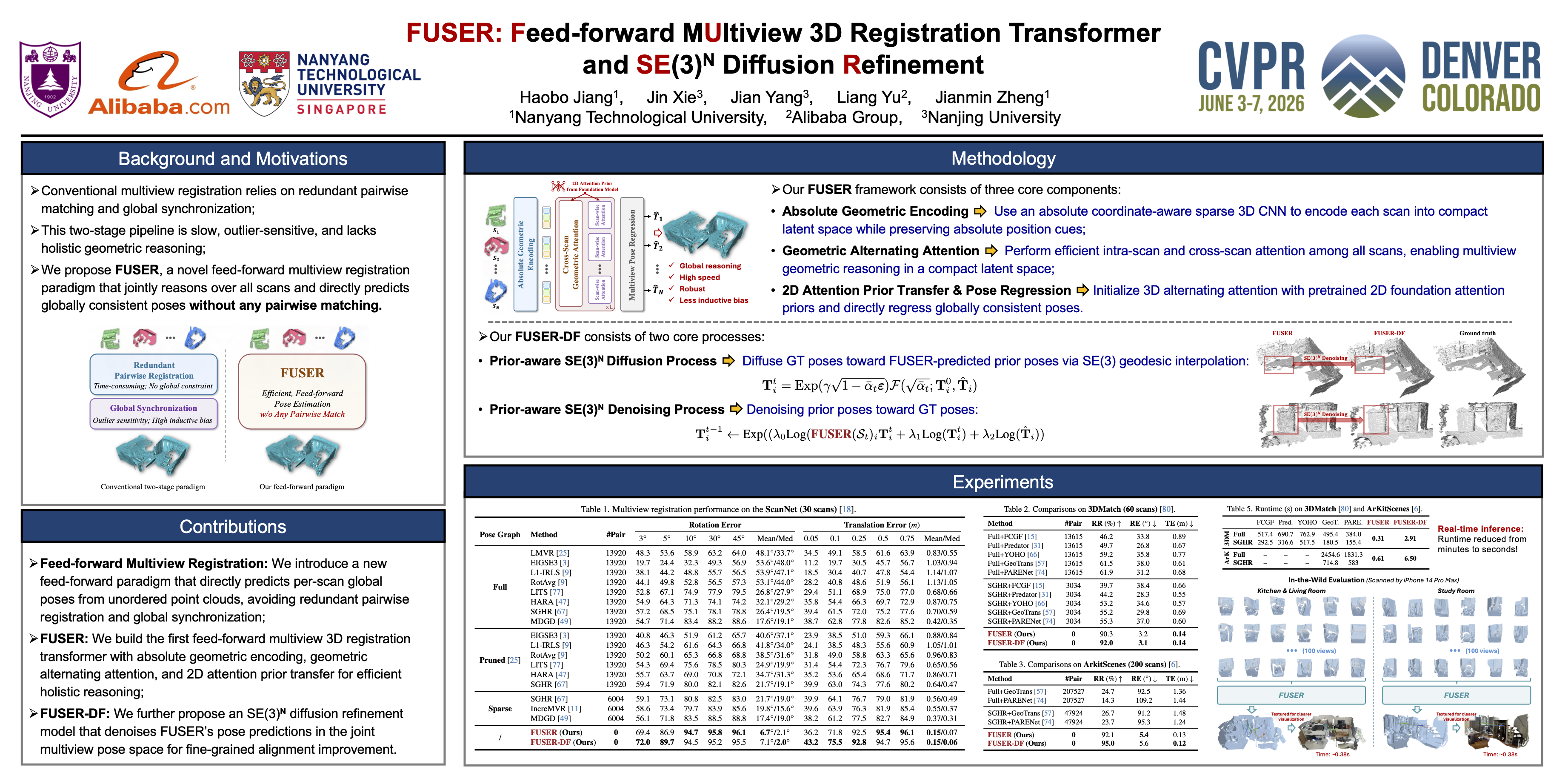
Registration of multiview point clouds typically depends on extensive pairwise matching to build a pose graph for global synchronization, which is computationally expensive and ill-posed without holistic geometric constraints. In this paper, we propose FUSER, the first feed-forward multi-view registration transformer that processes all scans jointly in a unified, compact latent space to directly predict global poses without any pairwise estimation. To maintain tractability, FUSER employs a sparse 3D CNN to encode each scan into low-resolution superpoint features preserving absolute translation cues, followed by a Geometric Alternating Attention module for efficient intra- and inter-scan reasoning. Particularly, we transfer 2D attention priors from off-the-shelf foundation models (i.e., $\pi^3$) to enhance 3D feature attention. Building upon FUSER and its estimates, we further introduce FUSER-DF, an SE(3) diffusion refinement framework to correct FUSER's estimates through a denoising process over the joint SE(3)$^N$ space. Here, FUSER serves as a surrogate multiview register to model the denoiser, and a prior-conditioned SE(3)$^N$ variational lower bound is derived for denoising supervision. Extensive experiments on 3DMatch and ScanNet confirm the superior registration accuracy and efficiency of our method.
Residual Primitive Fitting of 3D Shapes with SuperFrusta
Aditya Ganeshan ⋅ Matheus Gadelha ⋅ Thibault Groueix ⋅ Zhiqin Chen ⋅ Siddhartha Chaudhuri ⋅ Vladimir G. Kim ⋅ Wang Yifan ⋅ Daniel Ritchie
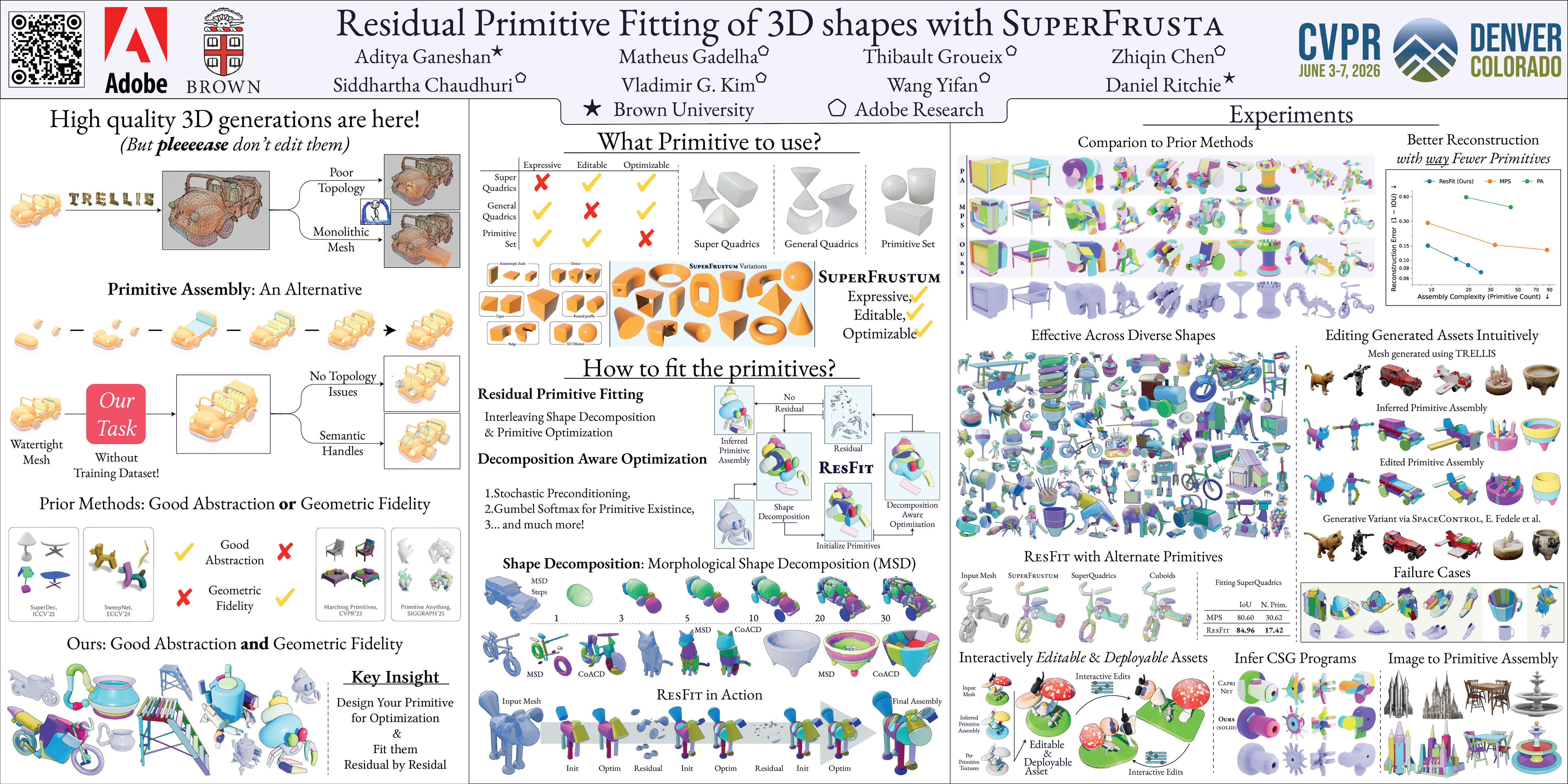
We introduce a framework for converting 3D shapes into compact and editable assemblies of analytic primitives, directly addressing the persistent trade-off between reconstruction fidelity and parsimony. Our approach combines two key contributions: a novel primitive, termed SuperFrustum, and an iterative inference algorithm, Residual Primitive Fitting (ResFit). SuperFrustum is a analytical primitive that is simultaneously (1) expressive, being able to express various common solids such as cylinders, spheres, cones & their tapered and bent forms, (2) editable, being compactly parameterized with 8 parameters, and (3) optimizable, with a sign distance field differentiable w.r.t. its parameters almost everywhere. ResFit is an unsupervised procedure that interleaves global shape analysis with local optimization, iteratively fitting primitives to the unexplained residual of a shape to discover a parsimonious yet accurate decompositions for each input shape. On diverse 3D benchmarks, our method achieves state-of-the-art results, improving IoU by over 9 points while using nearly half as many primitives as prior work. The resulting assemblies bridge the gap between dense 3D data and human-controllable design, producing high-fidelity and editable shape programs.
SmokeSVD: Smoke Reconstruction from A Single View via Progressive Novel View Synthesis and Refinement with Diffusion Models
Chen Li ⋅ Shanshan Dong ⋅ Sheng Qiu ⋅ Jianmin Han ⋅ Yibo Zhao ⋅ Zan Gao ⋅ Taku Komura ⋅ Kemeng Huang
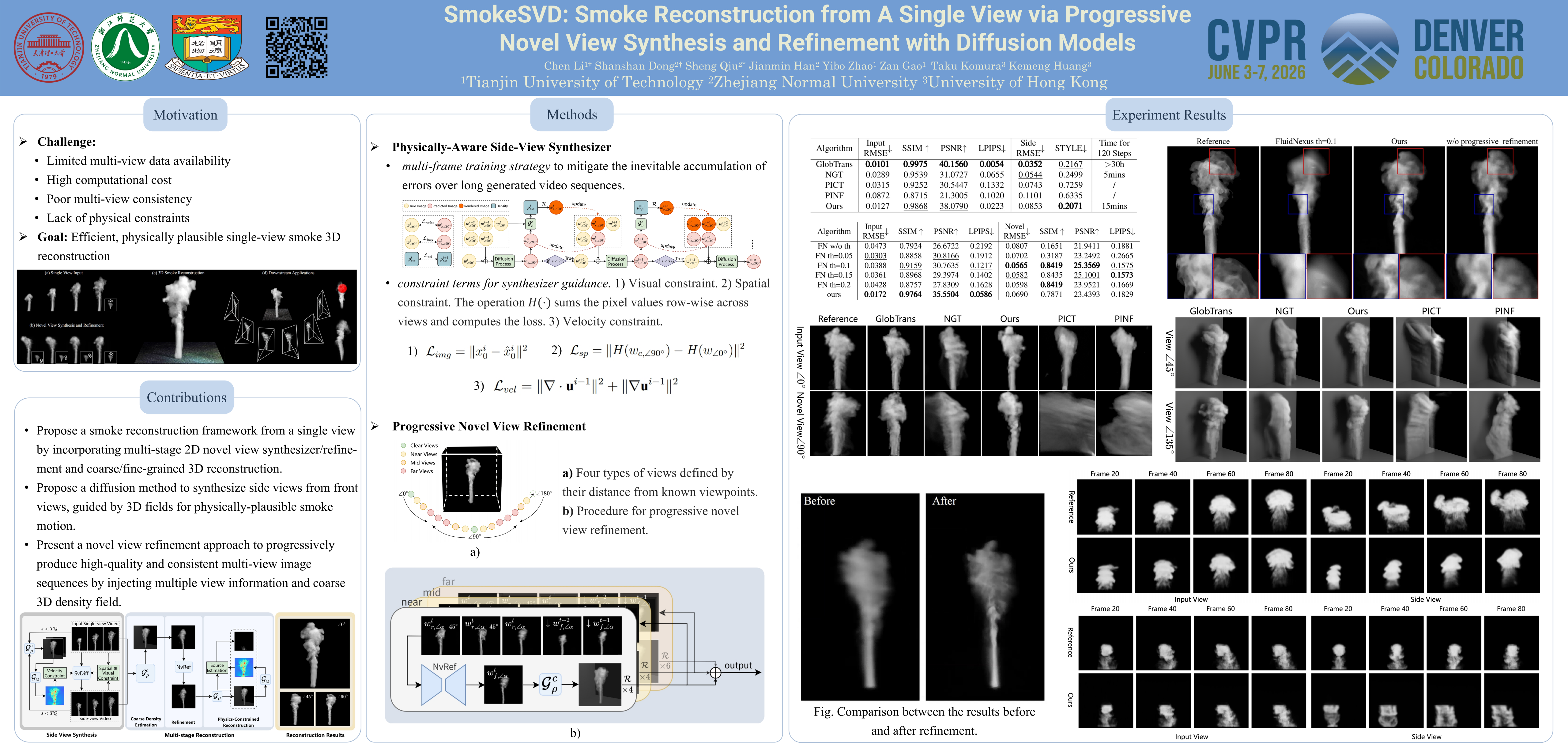
Reconstructing dynamic fluids from sparse views is a long-standing and challenging problem, due to the severe lack of 3D information from insufficient view coverage. While several pioneering approaches have attempted to address this issue using differentiable rendering or novel view synthesis, they are often limited by time-consuming optimization under ill-posed conditions. We propose SmokeSVD, an efficient and effective framework to progressively reconstruct dynamic smoke from a single video by integrating the generative capabilities of diffusion models with physically guided consistency optimization. Specifically, we first propose a physically guided side-view synthesizer based on diffusion models, which explicitly incorporates velocity field constraints to generate spatio-temporally consistent side-view images frame by frame, significantly alleviating the ill-posedness of single-view reconstruction. Subsequently, we iteratively refine novel-view images and reconstruct 3D density fields through a progressive multi-stage process that renders and enhances images from increasing viewing angles, generating high-quality multi-view sequences. Finally, we estimate fine-grained density and velocity fields via differentiable advection by leveraging the Navier-Stokes equations. Our approach supports re-simulation and downstream applications while achieving superior reconstruction quality and computational efficiency compared to state-of-the-art methods.
SparseWorld-TC: Trajectory-Conditioned Sparse Occupancy World Model
Jiayuan Du ⋅ Yiming Zhao ⋅ Zhenglong Guo ⋅ Yong Pan ⋅ Wenbo Hou ⋅ Zhihui Hao ⋅ Kun Zhan ⋅ Qijun Chen
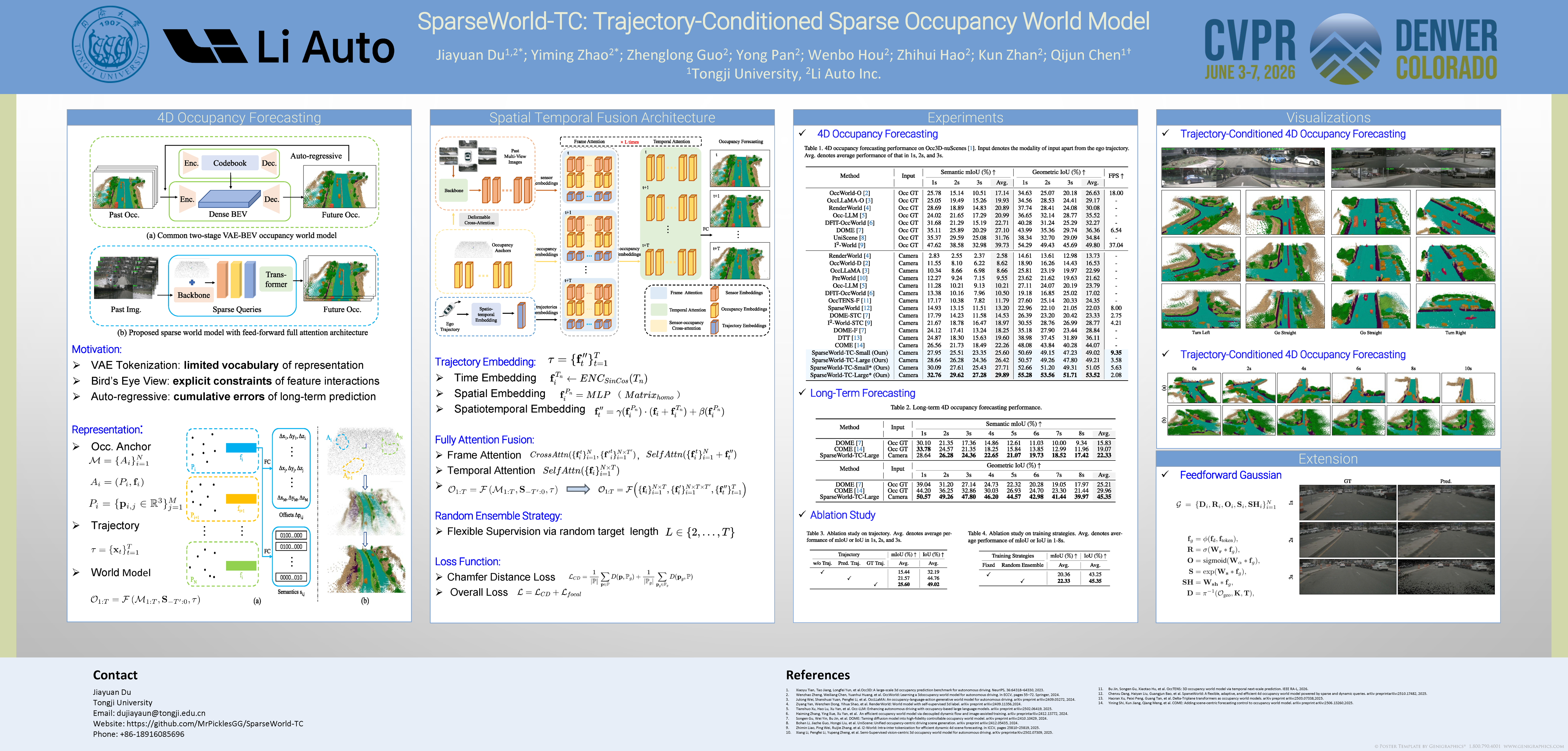
This paper introduces a novel architecture for trajectory-conditioned forecasting of future 3D scene occupancy. In contrast to methods that rely on variational autoencoders (VAEs) to generate discrete occupancy tokens, which inherently limit representational capacity, our approach predicts multi-frame future occupancy in an end-to-end manner directly from raw image features. Inspired by the success of attention-based transformer architectures in foundational vision and language models such as GPT and VGGT, we employ a sparse occupancy representation that bypasses the intermediate bird’s eye view (BEV) projection and its explicit geometric priors. This design allows the transformer to capture spatiotemporal dependencies more effectively. By avoiding both the finite-capacity constraint of discrete tokenization and the structural limitations of BEV representations, our method achieves state-of-the-art performance on the nuScenes benchmark for 1‒3 second occupancy forecasting, outperforming existing approaches by a significant margin. Furthermore, it demonstrates robust scene dynamics understanding, consistently delivering high accuracy under arbitrary future trajectory conditioning.
Affostruction: 3D Affordance Grounding with Generative Reconstruction
Chunghyun Park ⋅ Seunghyeon Lee ⋅ Minsu Cho
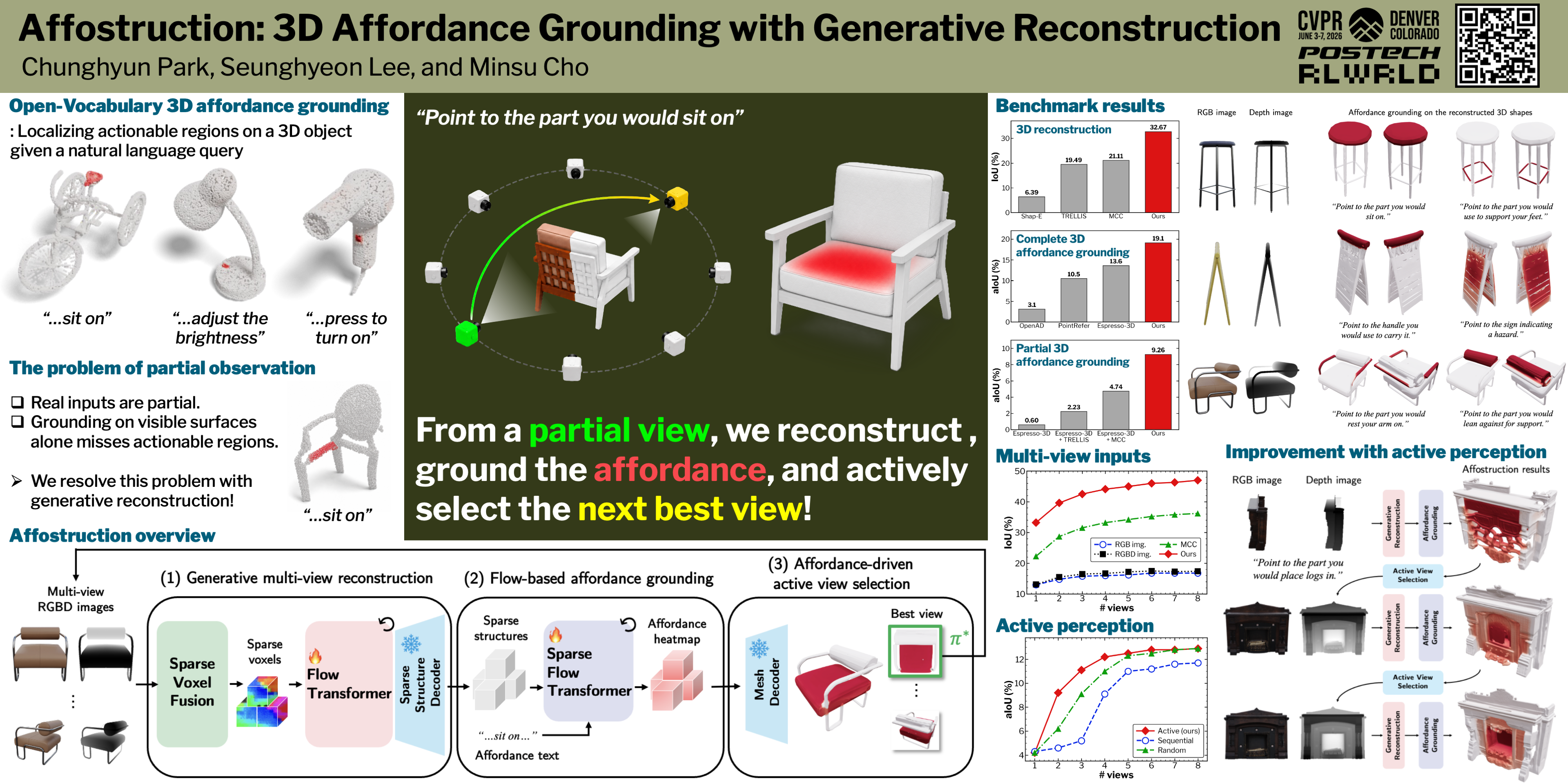
This paper addresses the problem of affordance grounding from RGBD images of an object, which aims to localize surface regions corresponding to a text query that describes an action on the object. While existing methods predict affordance regions only on visible surfaces, we propose a unified framework for affordance grounding and reconstruction, dubbed Affostruction, where affordance grounding actively combines with shape generation. In our approach, reconstructing complete geometry from partial observations enables affordance prediction on unobserved regions, while affordance heatmaps guide active view selection to improve reconstruction quality of functional regions. We make three core contributions: generative multi-view reconstruction via sparse voxel fusion that extrapolates unseen geometry while maintaining constant token complexity, flow-based affordance grounding that captures inherent ambiguity in affordance distributions, and affordance-driven active view selection that leverages predicted affordances for intelligent viewpoint sampling.Affostruction achieves 19.1 aIoU on affordance grounding (40.4\% improvement) and 32.67 IoU for 3D reconstruction (67.7\% improvement), enabling accurate affordance prediction on complete shapes.
MV-RoMa: From Pairwise Matching into Multi-View Track Reconstruction
JongMin Lee ⋅ Seungyeop Kang ⋅ Sungjoo Yoo
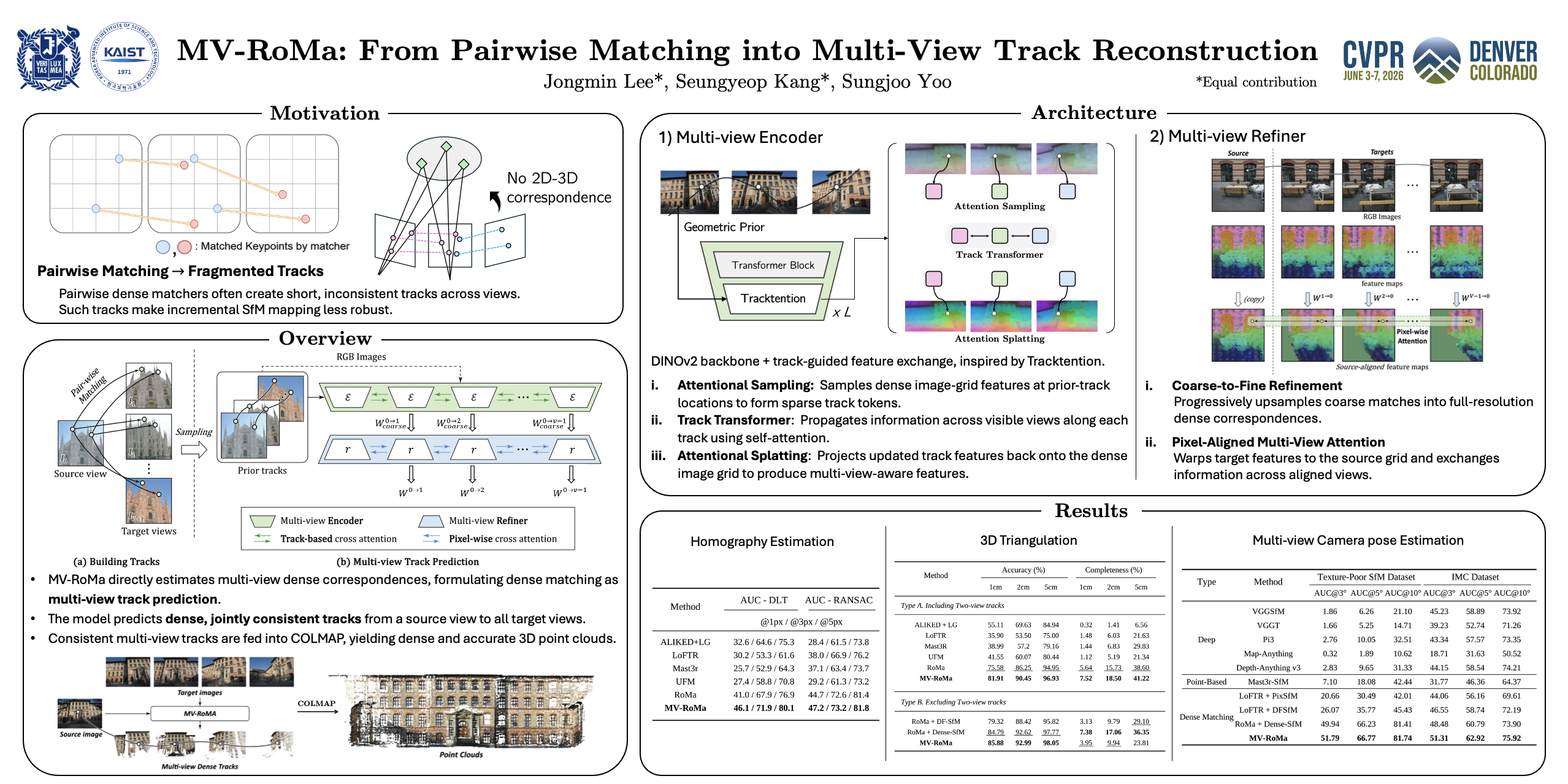
Establishing consistent correspondences across images is essential for 3D vision tasks such as structure-from-motion (SfM), yet most existing matchers operate in a pairwise manner, often producing fragmented and geometrically inconsistent tracks when their predictions are chained across views. We propose \textbf{MV-RoMa}, a multi-view dense matching model that jointly estimates dense correspondences from a source image to multiple co-visible targets. Specifically, we design an efficient model architecture which avoids high computational cost of full cross-attention for multi-view feature interaction: (i) multi-view encoder that leverages pair-wise matching results as a geometric prior, and (ii) multi-view matching refiner that refines correspondences using pixel-wise attention. Additionally, we propose a post-processing strategy that integrates our model's consistent multi-view correspondences as high-quality tracks for SfM. Across diverse and challenging benchmarks, MV-RoMa produces more reliable correspondences and substantially denser, more accurate 3D reconstructions than existing sparse and dense matching methods.
Unified Primitive Proxies for Structured Shape Completion
Zhaiyu Chen ⋅ Yuqing Wang ⋅ Xiao Xiang Zhu
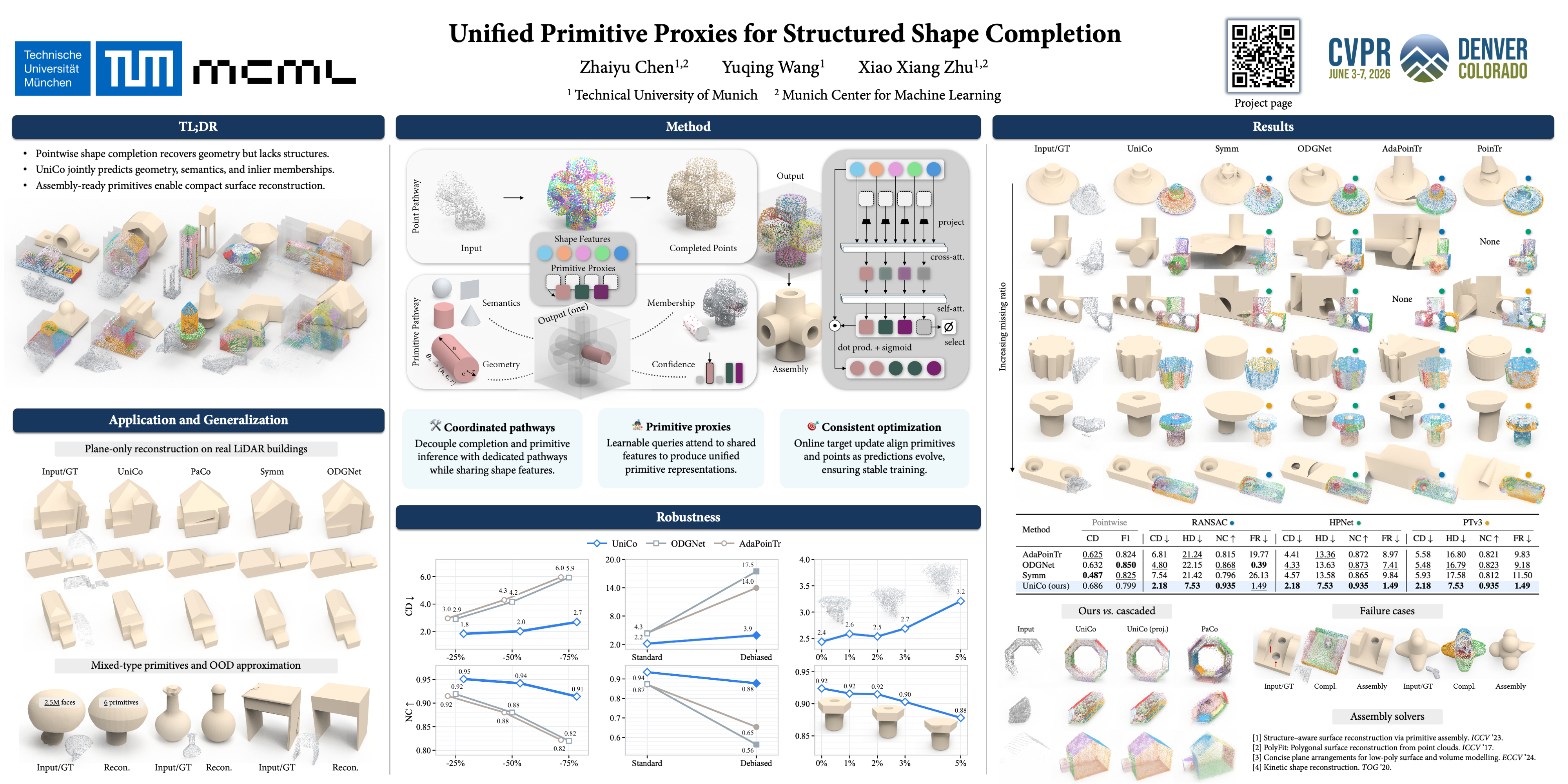
Structured shape completion recovers missing geometry as primitives rather than as unstructured points, which enables primitive-based surface reconstruction. Instead of following the prevailing cascade, we rethink how primitives and points should interact, and find it more effective to decode primitives in a dedicated pathway that attends to shared shape features. Following this principle, we present UniCo, which in a single feed-forward pass predicts a set of primitives with complete geometry, semantics, and inlier membership. To drive this unified representation, we introduce primitive proxies, learnable queries that are contextualized to produce assembly-ready outputs. To ensure consistent optimization, our training strategy couples primitives and points with online target updates. Across synthetic and real-world benchmarks with four independent assembly solvers, UniCo consistently outperforms recent baselines, lowering Chamfer distance by up to 50\% and improving normal consistency by up to 7\%. These results establish an attractive recipe for structured 3D understanding from incomplete data.
ART: Articulated Reconstruction Transformer
Zizhang Li ⋅ Cheng Zhang ⋅ Zhengqin Li ⋅ Henry Howard-Jenkins ⋅ Zhaoyang Lv ⋅ Chen Geng ⋅ Jiajun Wu ⋅ Richard Newcombe ⋅ Jakob Engel ⋅ Zhao Dong
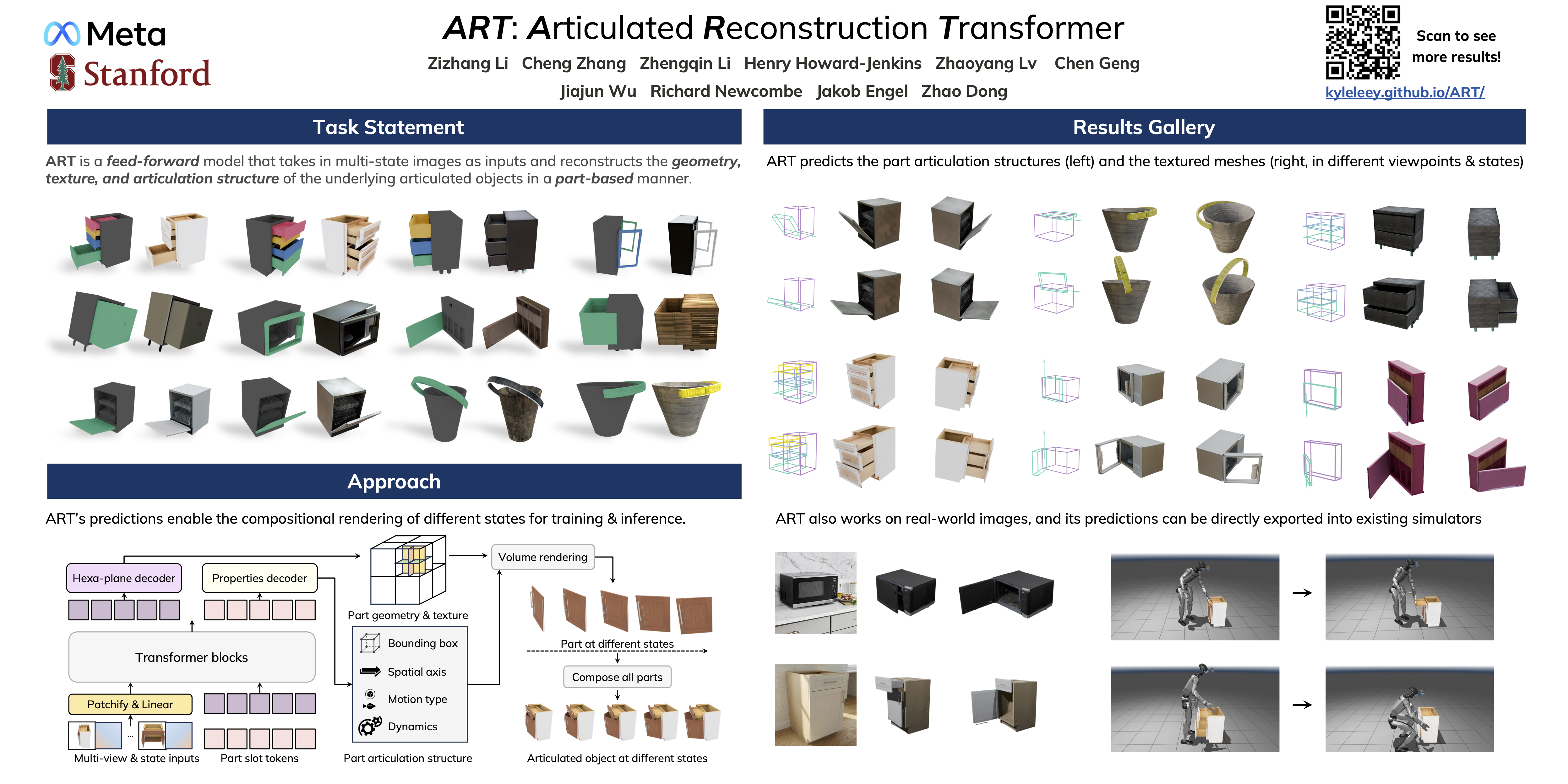
We introduce ART, Articulated Reconstruction Transformer—a category-agnostic, feed-forward model that reconstructs complete 3D articulated objects from only sparse, multi-state RGB images. Previous methods for articulated object reconstruction either rely on slow optimization with fragile cross-state correspondences or use feed-forward models limited to specific object categories. In contrast, ART treats articulated objects as assemblies of rigid parts, formulating reconstruction as a part-based prediction problem. Our newly designed transformer architecture maps sparse image inputs to a set of learnable part slots, from which ART jointly decodes unified representations for individual parts, including their 3D geometry, texture, and explicit articulation parameters. The resulting reconstructions are physically interpretable and readily exportable to standard simulation formats. Trained on a large-scale, diverse dataset with per-part supervision, and evaluated across diverse benchmarks, ART achieves significant improvements over existing baselines and establishes a new state of the art for articulated object reconstruction from image inputs.
SCE-SLAM: Scale-Consistent Monocular SLAM via Scene Coordinate Embeddings
Yuchen Wu ⋅ Jiahe Li ⋅ Xiaohan Yu ⋅ Lina Yu ⋅ Jin Zheng ⋅ Xiao Bai
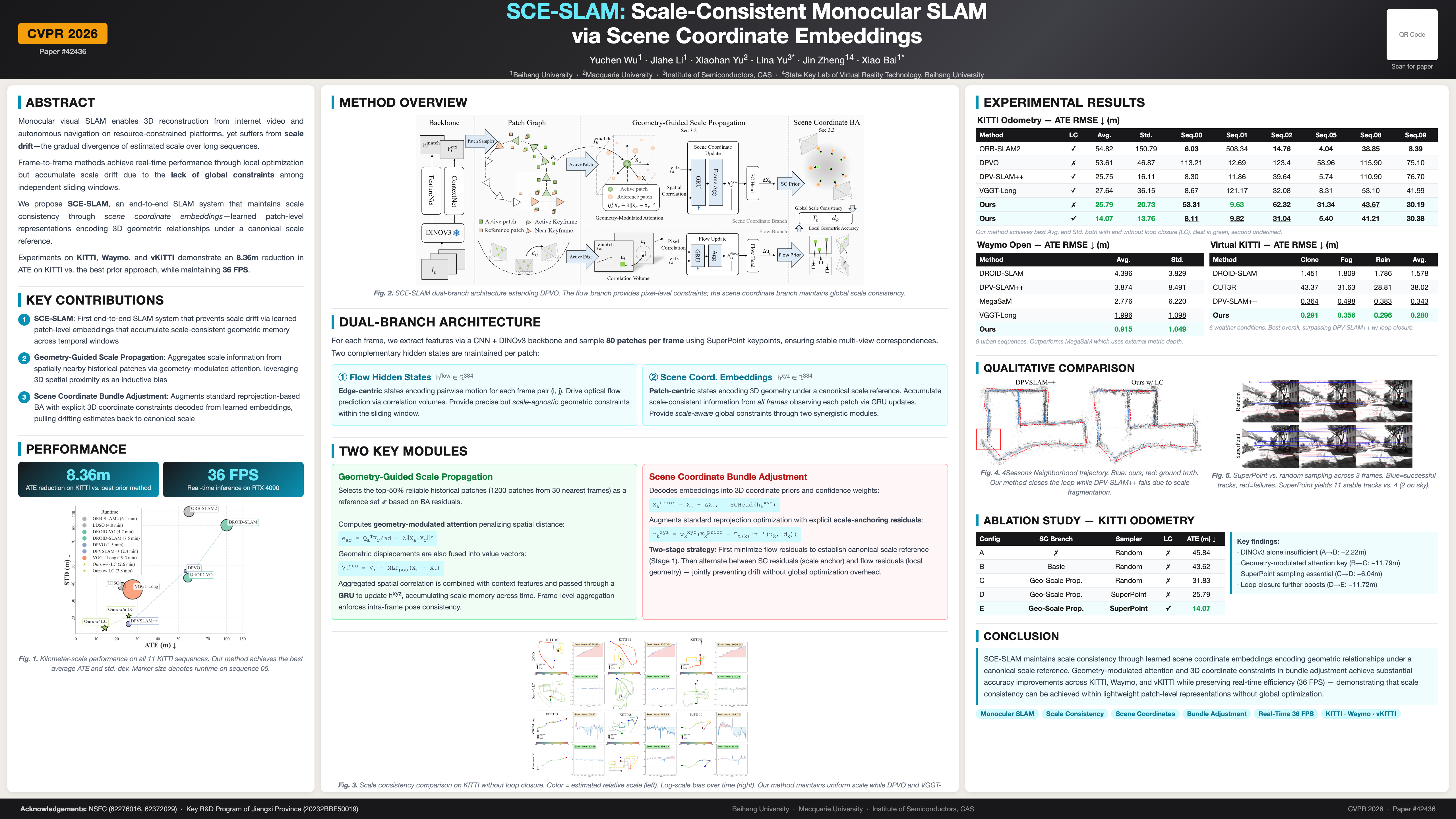
Monocular visual SLAM enables 3D reconstruction from internet video and autonomous navigation on resource-constrained platforms, yet suffers from scale drift, i.e., the gradual divergence of estimated scale over long sequences. Existing frame-to-frame methods achieve real-time performance through local optimization but accumulate scale drift due to the lack of global constraints among independent windows. To address this, we propose SCE-SLAM, an end-to-end SLAM system that maintains scale consistency through scene coordinate embeddings, which are learned patch-level representations encoding 3D geometric relationships under a canonical scale reference. The framework consists of two key modules: geometry-guided aggregation that leverages 3D spatial proximity to propagate scale information from historical observations through geometry-modulated attention, and scene coordinate bundle adjustment that anchors current estimates to the reference scale through explicit 3D coordinate constraints decoded from the scene coordinate embeddings. Experiments on KITTI, Waymo, and vKITTI demonstrate substantial improvements: our method reduces absolute trajectory error by 8.36m on KITTI compared to the best prior approach, while maintaining 36 FPS and achieving scale consistency across large-scale scenes.
S2D: Sparse to Dense Lifting for 3D Reconstruction with Minimal Inputs
Yuzhou Ji ⋅ Qijian Tian ⋅ He Zhu ⋅ Xiaoqi Jiang ⋅ Guangzhi Cao ⋅ Lizhuang Ma ⋅ Yuan Xie ⋅ Xin Tan
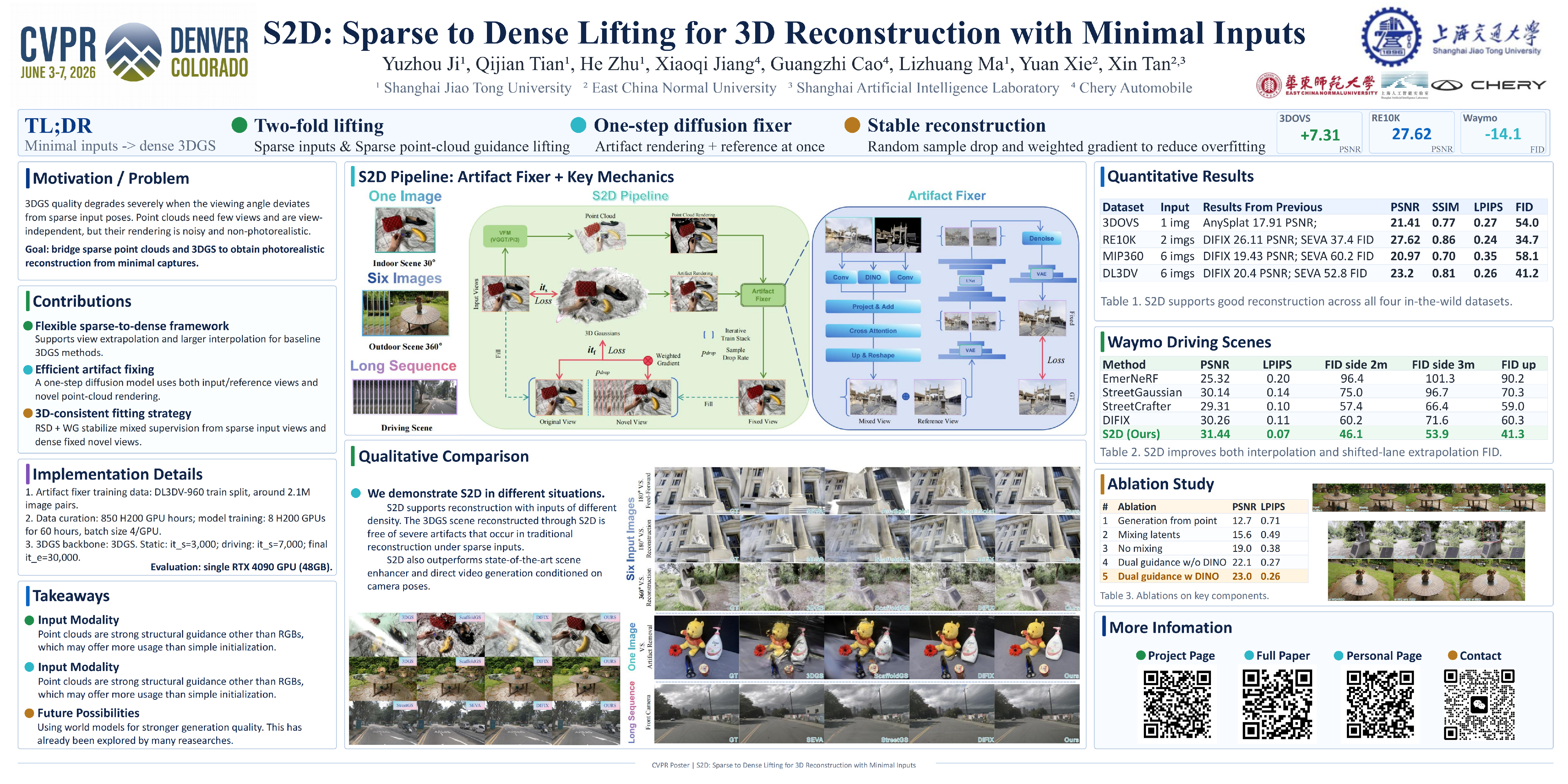
Explicit 3D representations have already become an essential medium for 3D simulation and understanding.However, the most commonly used point cloud and 3D Gaussian Splatting (3DGS) each suffer from non-photorealistic rendering and significant degradation under sparse inputs.In this paper, we introduce Sparse to Dense lifting (S2D), a novel pipeline that bridges the two representations and achieves high-quality 3DGS reconstruction with minimal inputs.Specifically, the S2D lifting is two-fold.We first present an efficient one-step diffusion model that lifts sparse point cloud for high-fidelity image artifact fixing.Meanwhile, to reconstruct 3D consistent scenes, we also design a corresponding reconstruction strategy with random sample drop and weighted gradient for robust model fitting from sparse input views to dense novel views.Extensive experiments show that S2D achieves the best consistency in generating novel view guidance and first-tier sparse view reconstruction quality under different input sparsity.By reconstructing stable scenes with the least possible captures among existing methods, S2D enables minimal input requirements for 3DGS applications.
Pip-Stereo: Progressive Iterations Pruner for Iterative Optimization based Stereo Matching
Jintu Zheng ⋅ Qizhe Liu ⋅ Huangxin Xu ⋅ zhuojie Chen
While iterative stereo matching achieves high accuracy, its dependence on Recurrent Neural Networks (RNN) hinders edge deployment, a challenge underexplored in existing researches. We analyze iterative refinement and reveal that disparity updates are spatially sparse and temporally redundant. First, we introduce a progressive iteration pruning strategy that suppresses redundant update steps, effectively collapsing the recursive computation into a near-single-pass inference. Second, we propose a collaborative monocular prior transfer framework that implicitly embeds depth priors without requiring a dedicated monocular encoder, thereby eliminating its associated computational burden. Third, we develop FlashGRU, a hardware-aware RNN operator leveraging structured sparsity and I/O-conscious design, achieving a 7.28$\times$ speedup, 76.6\% memory peak reduction and 80.9\% global memory requests reduction over natvie ConvGRUs under 2K resolution. Our PipStereo enables real-time, high-fidelity stereo matching on edge hardware: it processes 320$\times$640 frames in just 75ms on an NVIDIA Jetson Orin NX (FP16) and 19ms on RTX 4090, matching the accuracy of large iterative based models, and our generalization ability and accuracy far exceeds that of existing real-time methods.
Fast-FoundationStereo: Real-Time Zero-Shot Stereo Matching
Bowen Wen ⋅ Shaurya Dewan ⋅ Stan Birchfield
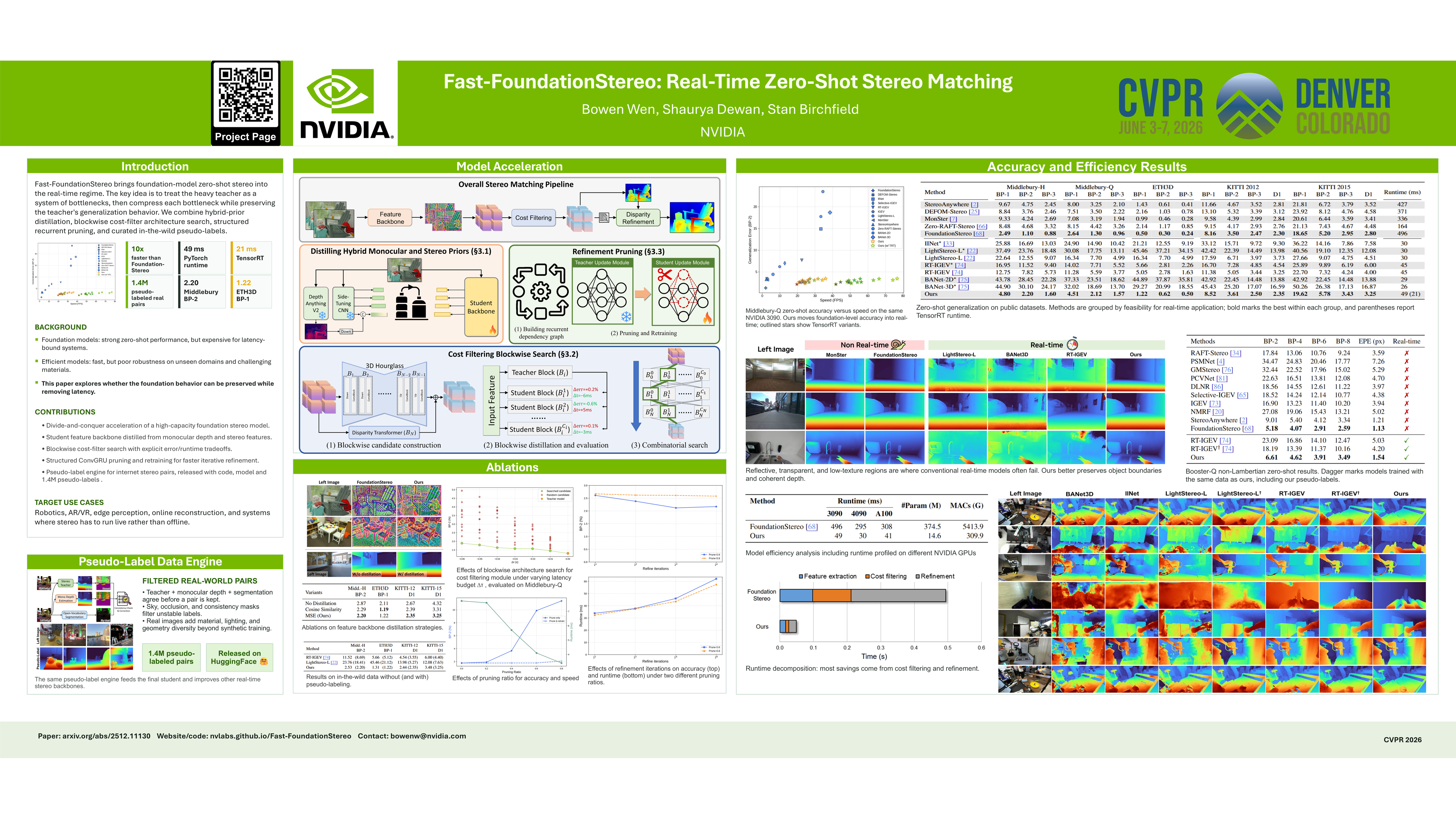
Stereo foundation models achieve strong zero-shotgeneralization but remain computationally prohibitive forreal-time applications. Efficient stereo architectures, on the other hand, sacrificerobustness for speed and require costly per-domain fine-tuning.To bridge this gap, we present Fast-FoundationStereo, a family of architectures that achieve, for the first time, strong zero-shot generalization at real-time frame rate. We employ a divide-and-conquer acceleration strategy with three components: (1) knowledge distillation to compress the hybrid backbone into a single efficient student; (2) blockwise neural architecture search for automatically discovering optimal cost filtering designs under latency budgets, reducing search complexity exponentially; and (3) structured pruning for eliminating redundancy in the iterative refinement module. Furthermore, we introduce an automatic pseudo-labeling pipeline used to curate 1.4M in-the-wild stereo pairs to supplement synthetic training data and facilitate knowledge distillation. The resulting model can run over 10× faster than FoundationStereo while closely matching its zero-shot accuracy, thus establishing a new state-of-the-art among real-time methods.
E-RayZer: Self-supervised 3D Reconstruction as Spatial Visual Pre-training
Qitao Zhao ⋅ Hao Tan ⋅ Qianqian Wang ⋅ Sai Bi ⋅ Kai Zhang ⋅ Kalyan Sunkavalli ⋅ Shubham Tulsiani ⋅ Hanwen Jiang
Self-supervised pre-training has revolutionized foundation models for language, 2D images and videos, but remains largely unexplored for learning 3D-aware representations from multi-view images. In this paper, we present E-RayZer, a self-supervised large 3D Vision model that learns truly 3D-aware representations directly from unlabeled images. Unlike prior self-supervised methods such as RayZer that infer 3D indirectly through latent-space view synthesis, E-RayZer operates directly in 3D space, performing self-supervised 3D reconstruction with explicit geometry. This formulation eliminates shortcut solutions and yields representations that are geometrically grounded. To ensure convergence and scalability, we introduce a novel fine-grained learning curriculum that organizes training from easy to hard samples and harmonizes heterogeneous data sources in an entirely unsupervised manner. Experiments demonstrate that E-RayZer significantly outperforms RayZer on pose estimation, matches or sometimes surpasses fully supervised reconstruction models such as VGGT. Furthermore, its learned representations outperform leading visual pre-training models (e.g., DINOv2, CroCo v2, VideoMAE V2, and RayZer) when transferring to 3D downstream tasks, establishing E-RayZer as a new paradigm for 3D-aware visual pre-training.
QVGGT: Post-Training Quantized Visual Geometry Grounded Transformer
Zhizhen Pan ⋅ Hesong Wang ⋅ Huan Wang
Estimating 3D attributes directly from images has advanced rapidly with the Visual Geometry Grounded Transformer (VGGT), which predicts camera parameters, depth maps, and point clouds in a single forward pass. However, its 1.2B-parameter scale severely limits deployment on resource-constrained platforms such as UAVs and mobile AR devices. To address this limitation, we introduce QVGGT, a tailored quantization framework designed to compress VGGT. Our approach starts from the observation that transformer blocks within VGGT exhibit heterogeneous sensitivity to quantization. We thus analyze per-block quantization sensitivity and propose a selective mixed-precision strategy that allocates higher precision to the most fragile transformer blocks. To address the amplification of quantization error caused by high-variance camera and register tokens, we further introduce token filtering with camera information compensation, which removes these outliers from activation calibration and restores their geometric cues using a PCA-derived global compensation token. Finally, we develop a task-aware scale search mechanism that evaluates candidate quantization scales not only through layer reconstruction but also through multi-head supervision and cross-head geometric consistency among camera poses, depth maps, and point maps.Extensive experiments on multiple geometry perception benchmarks demonstrate that QVGGT achieves near-lossless W4A16 quantization, preserving the accuracy of all 3D prediction heads while delivering 3$\sim$4.9$\times$ memory reduction and up to 2.8$\times$ real hardware speedup over FP32.Our approach makes high-fidelity 3D perception feasible on edge devices, enabling practical deployment of feed-forward 3D reconstruction models in real-world constrained environments.
SRGCD: Stability-Driven Region Growth Framework for 3D Change Detection
Yue Wu ⋅ Tao Peng ⋅ Yongzhe Yuan ⋅ Kaiyuan Feng ⋅ Hao Li ⋅ Maoguo Gong ⋅ Qiguang Miao ⋅ Wenping Ma
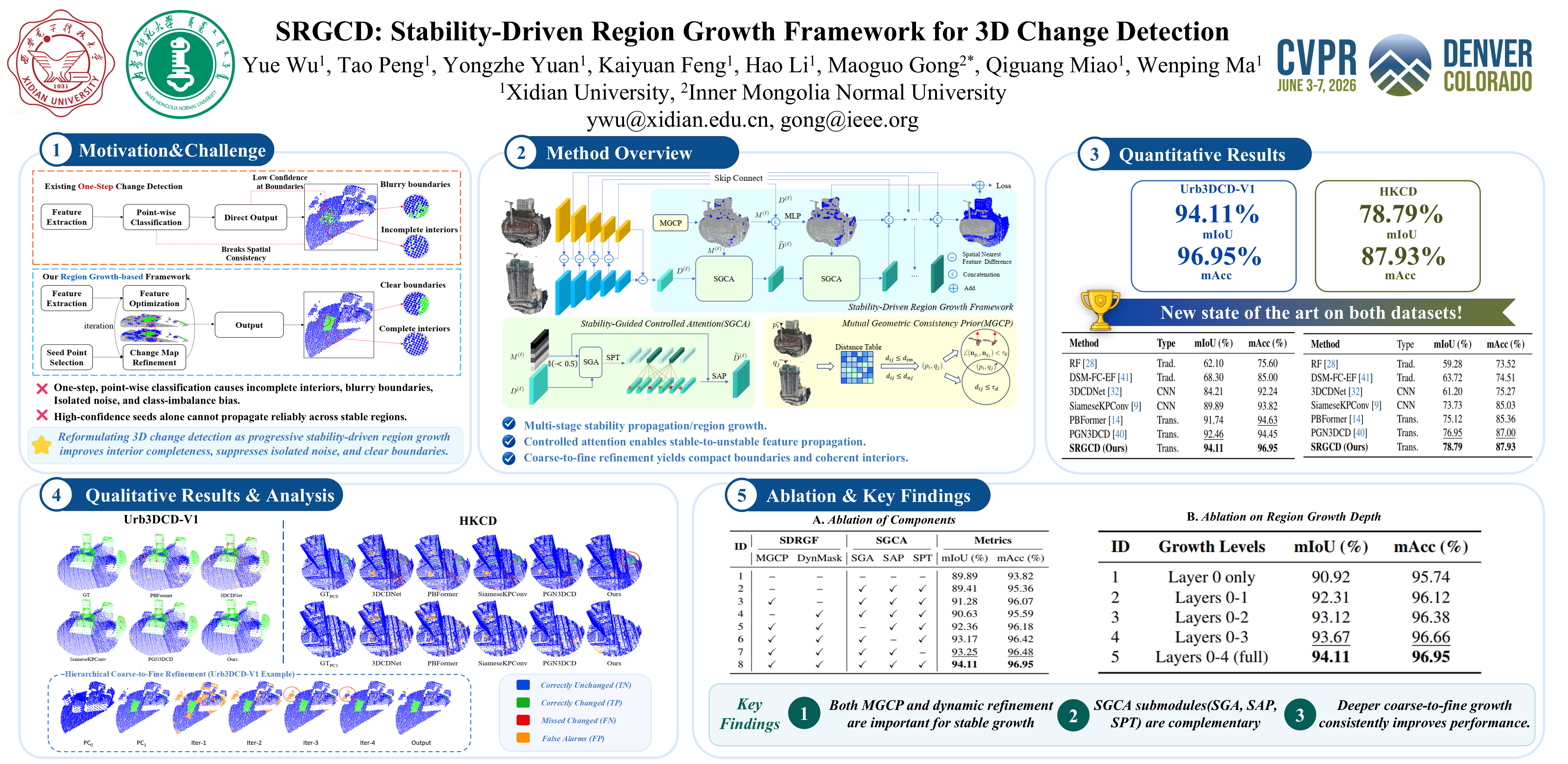
With the growing accessibility of large-scale 3D point clouds from LiDAR and photogrammetric techniques, 3D change detection (3DCD) has become essential for understanding dynamic scenes. Existing methods typically formulate this as segmentation, treating each point independently for binary classification. This leads to isolated misclassified noise points inside regions. Meanwhile, feature similarity at boundaries causes boundary ambiguity. The more severe class imbalance inherent to change detection further exacerbates this issue. To address these challenges, we propose SRGCD, a Stability-Driven Region Growth Framework that redefines 3DCD as region growing rather than segmentation. Our key insight is that progressively expanding from highly confident seeds avoids pitfalls of point-wise classification while elegantly alleviating class imbalance. Specifically, we first apply strict constraints through Mutual Geometric Consistency Prior to identify minimal highly reliable unchanged seeds. From these seeds, Stability-Guided Controlled Attention modules progressively propagate stability from stable regions to neighboring uncertain points, enabling unchanged regions to grow layer-by-layer from interior cores toward boundaries. This coarse-to-fine growing process naturally forms coherent regions, avoiding isolated noise while achieving compact, well-defined boundaries through progressive expansion. Extensive experiments on the synthetic dataset Urb3DCD and the real-world dataset HKCD demonstrate that SRGCD achieves state-of-the-art performance, significantly improving interior completeness and boundary compactness compared with existing methods.
D-Prism: Differentiable Primitives for Structured Dynamic Modeling
Xingyuan Yu ⋅ Yijin Li ⋅ Chong Zeng ⋅ Yuhang Ming ⋅ Hujun Bao ⋅ Guofeng Zhang
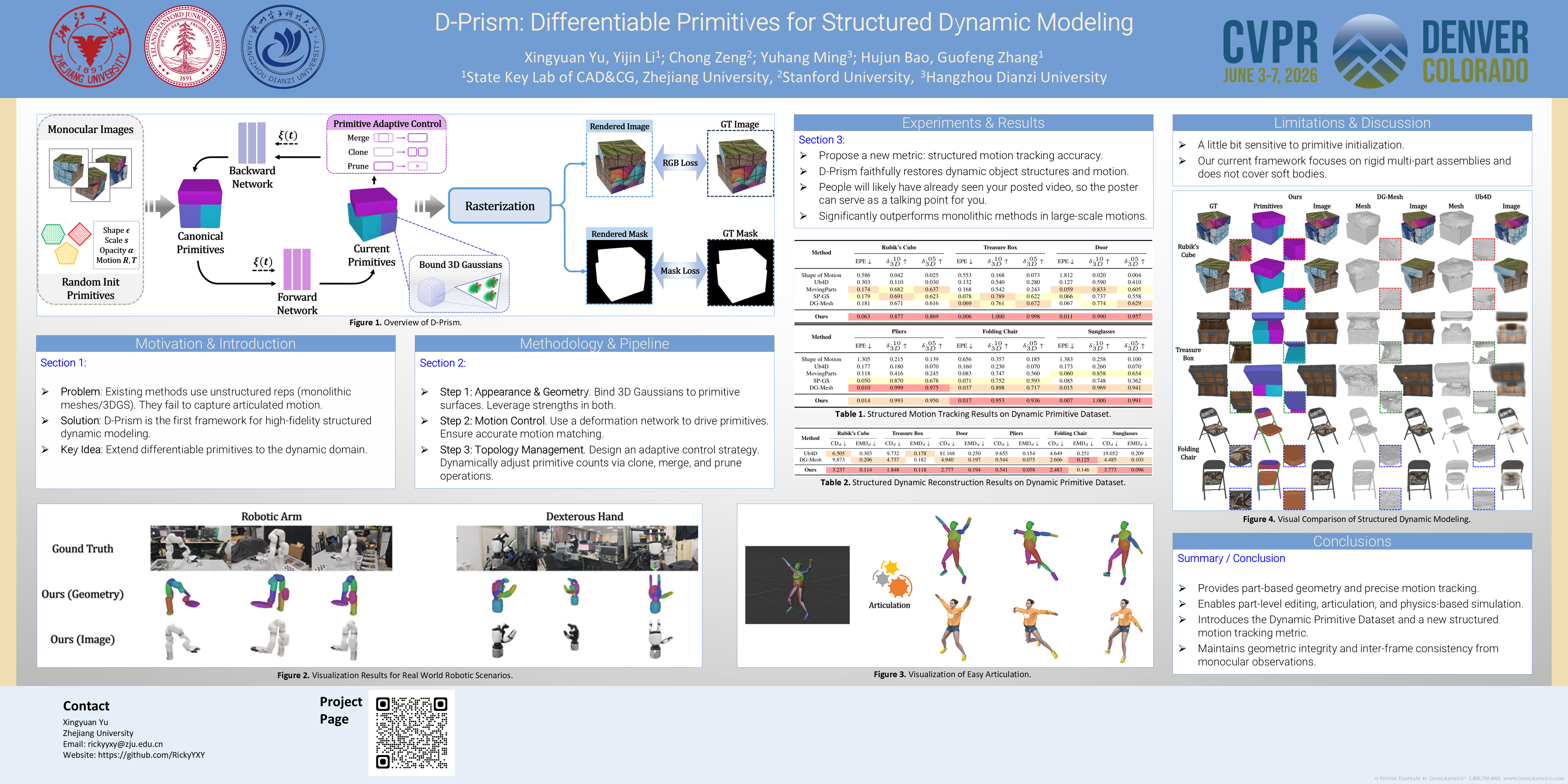
Capturing both geometry and rigid motion for structured dynamic objects, like multi-part assemblies or jointed mechanisms, remains a key challenge. Existing dynamic methods, such as deformable meshes or 3DGS, rely on unstructured representations and fail to jointly model suitable geometry and articulated motion. Primitive-based methods excel at structured static scenes, but their dynamic potential is still unexplored. We propose D-Prism, the first framework to achieve high-fidelity structured dynamic modeling by extending differentiable primitives to the dynamic domain.Specifically, we bind 3DGS to primitive surfaces, leveraging their respective strengths in appearance and geometry. We introduce a deformation network to control primitive motion, ensuring it accurately matches the object's movement. Furthermore, we design a novel adaptive control strategy to dynamically adjust primitive counts, better matching objects' true spatial footprint.Experiments confirm that our method excels at structured dynamic modeling, providing both structured geometry and precise motion tracking.
STAC: Plug-and-Play Spatio-Temporal Aware Cache Compression for Streaming 3D Reconstruction
Runze Wang ⋅ Yuxuan Song ⋅ Youcheng Cai ⋅ Ligang Liu
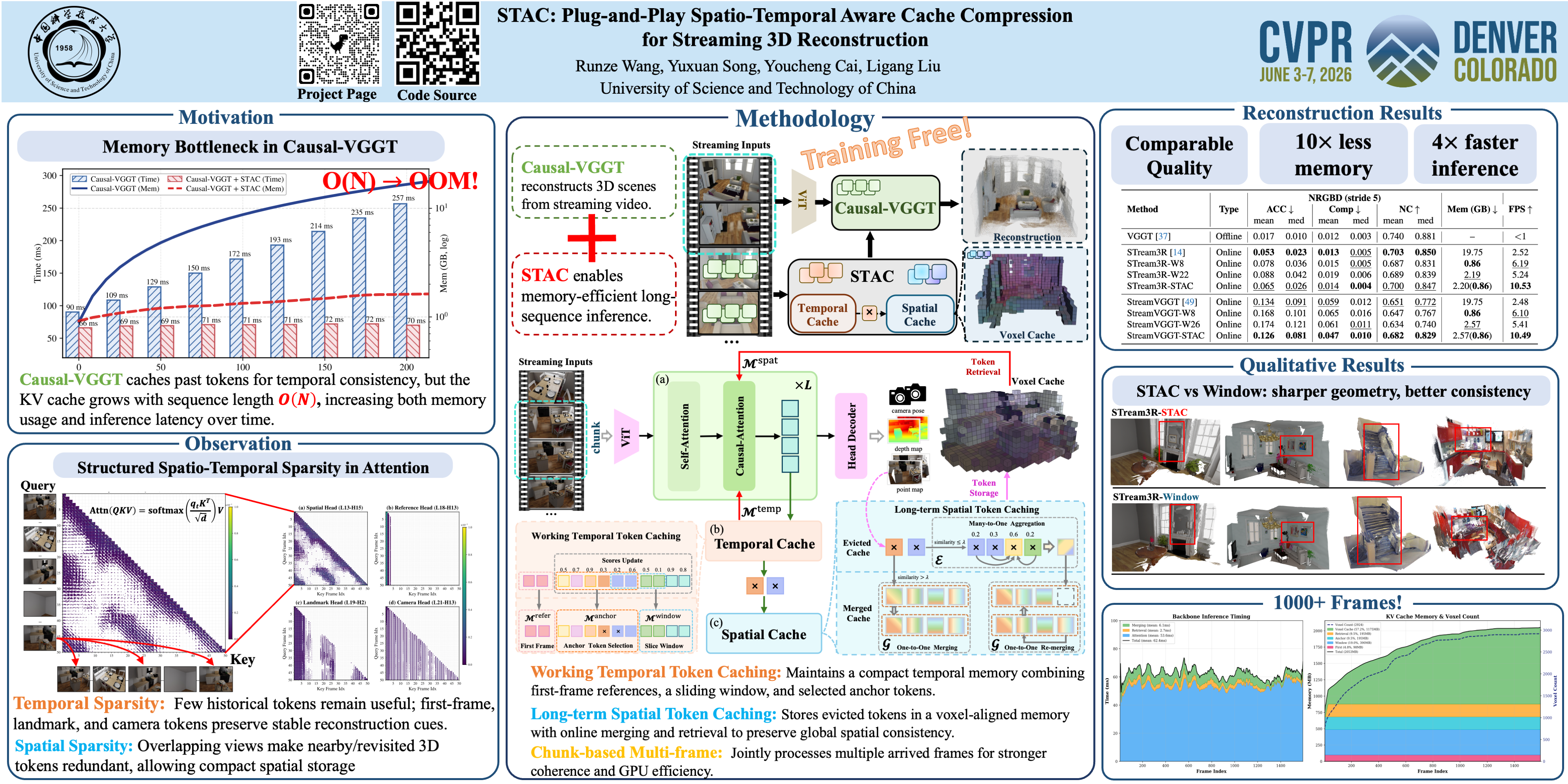
Online 3D reconstruction from streaming inputs requires both long-term temporal consistency and efficient memory usage. While causal VGGT transformers address this challenge through key-value (KV) cache mechanism, the linear growth of the cache introduces a significant memory bottleneck. When memory constraints trigger early eviction, reconstruction quality and temporal consistency deteriorate markedly. In this work, we observe that attention patterns in causal transformers for 3D reconstruction exhibit intrinsic spatio-temporal sparsity. Leveraging this insight, we propose **STAC**, a *S*patio-**T**emporally **A**ware **C**ache compression framework specifically designed for streaming 3D reconstruction using large causal transformers. STAC incorporates three key components: a **Working Temporal Token Caching** mechanism that preserves long-term informative tokens based on decayed cumulative attention scores; a **Long-term Spatial Token Caching** scheme that consolidates spatially redundant tokens into voxel-aligned representations for memory-efficient storage; and a **Chunk-based Multi-frame Optimization** strategy that jointly optimizes consecutive frames to enhance temporal coherence and leverage GPU parallelism. Extensive experiments demonstrate that **STAC** achieves state-of-the-art reconstruction quality while reducing memory consumption by 8.5$\times$ and accelerating inference by a factor of 3.5$\times$, enabling scalable and real-time 3D reconstruction in streaming settings. The code will be made publicly available upon acceptance.
Stabilizing Streaming Video Geometry via Dynamic Feature Normalization
Xiaoyang Lyu ⋅ Muxin Liu ⋅ Xiaoshan Wu ⋅ Ruicheng Wang ⋅ Yihua Huang ⋅ Yangtian Sun ⋅ Shaoshuai Shi ⋅ Xiaojuan Qi
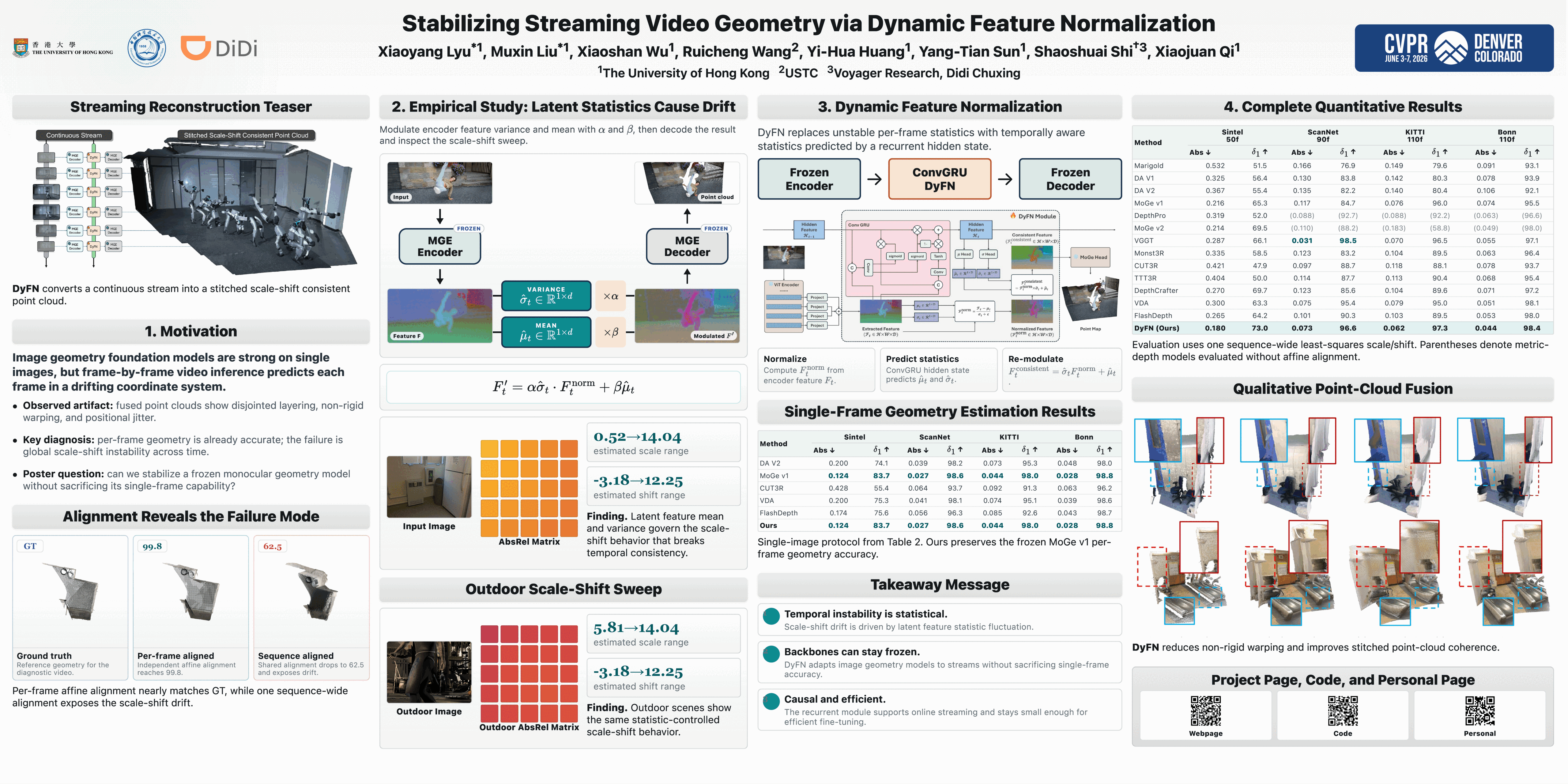
Consistent 3D geometry estimation from streaming RGB input is crucial for real-world applications such as autonomous driving, embodied AI, and large-scale reconstruction. While modern monocular geometry foundation models achieve strong single-image accuracy, they exhibit severe temporal inconsistency on continuous input, notably dominated by scale–shift drifting. Through targeted empirical analysis, we trace this instability to its root cause: fluctuations in latent feature statistics, whose mean and variance directly determine the predicted depth’s scale and shift. Building on this insight, we introduce Dynamic Feature Normalization (DyFN), a lightweight, causal recurrent module that dynamically and robustly modulates feature statistics to maintain stable geometry over time. We adapt powerful pretrained monocular geometry models for streaming by finetuning only DyFN-- a mere 2\% additional parameters-- while keeping the backbone frozen, thereby achieving temporal consistency without compromising single-image accuracy. Extensive experiments across four benchmarks show that DyFN effectively eliminates temporal artifacts such as disjointed layering and positional jitter, and achieves state-of-the-art temporal stability, improving over prior streaming methods by up to 14\% and even outperforming heavier non-causal video baselines.
LaS-Comp: Zero-shot 3D Completion with Latent–Spatial Consistency
Weilong Yan ⋅ Li Haipeng ⋅ Hao Xu ⋅ Nianjin Ye ⋅ Yihao Ai ⋅ Shuaicheng Liu ⋅ Jingyu Hu
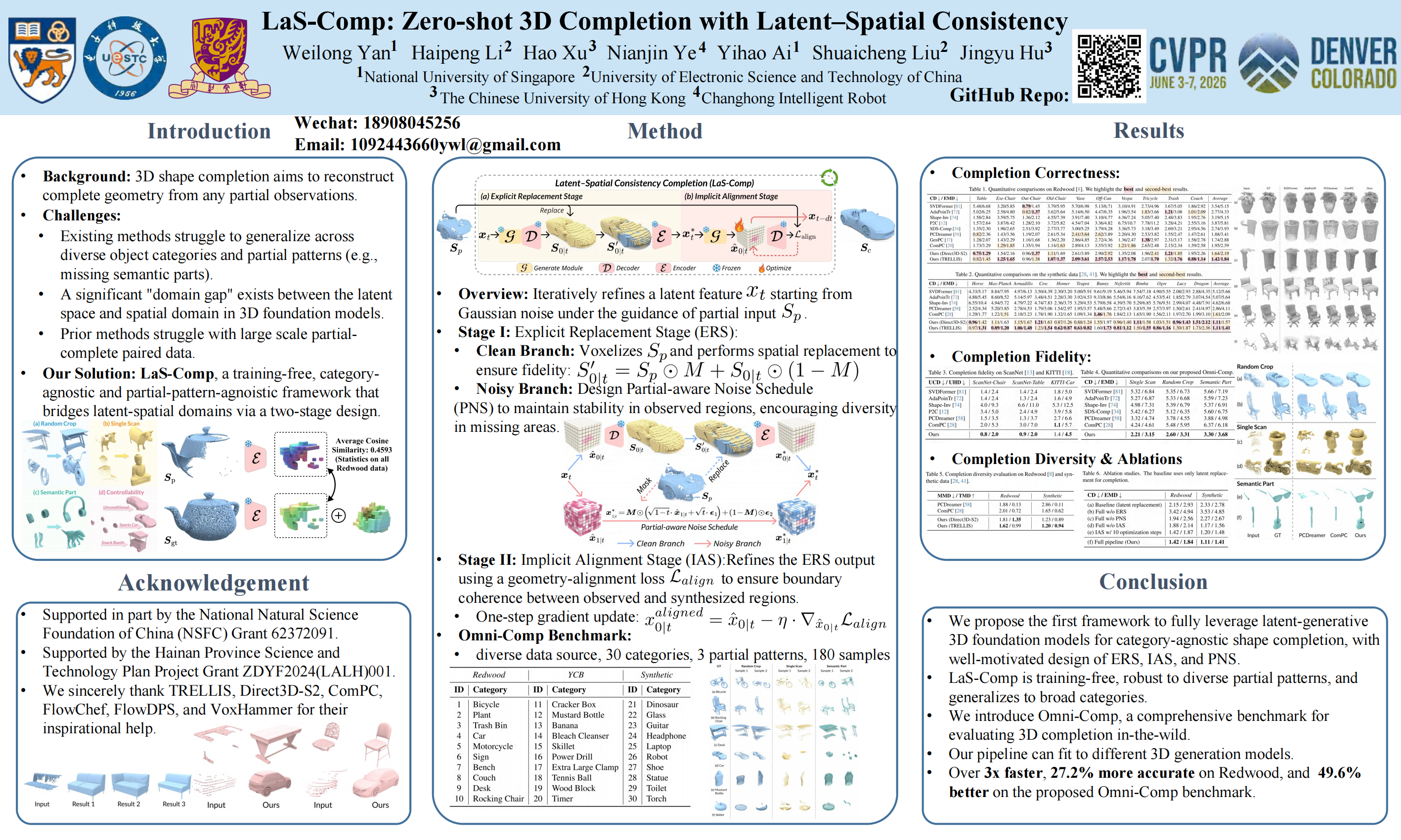
This paper introduces LaS-Comp, a zero-shot and category-agnostic approach that leverages the rich geometric priors of 3D foundation models to enable 3D shape completion across diverse types of partial observations. Our contributions are threefold: First, LaS-Comp harnesses these powerful generative priors for completion through a complementary two-stage design: (i) an explicit replacement stage that preserves the partial observation geometry to ensure faithful completion; and (ii) an implicit refinement stage ensures seamless boundaries between the observed and synthesized regions. Second, our framework is training-free and compatible with different 3D foundation models. Third, we introduce Omni-Comp, a comprehensive benchmark combining real-world and synthetic data with diverse and challenging partial patterns, enabling a more thorough and realistic evaluation. Both quantitative and qualitative experiments demonstrate that our approach outperforms previous state-of-the-art approaches. Code and data will be released upon acceptance.
Pano360: Perspective to Panoramic Vision with Geometric Consistency
Zhengdong Zhu ⋅ Weiyi Xue ⋅ Zuyuan Yang ⋅ Wenlve Zhou ⋅ Zhiheng Zhou
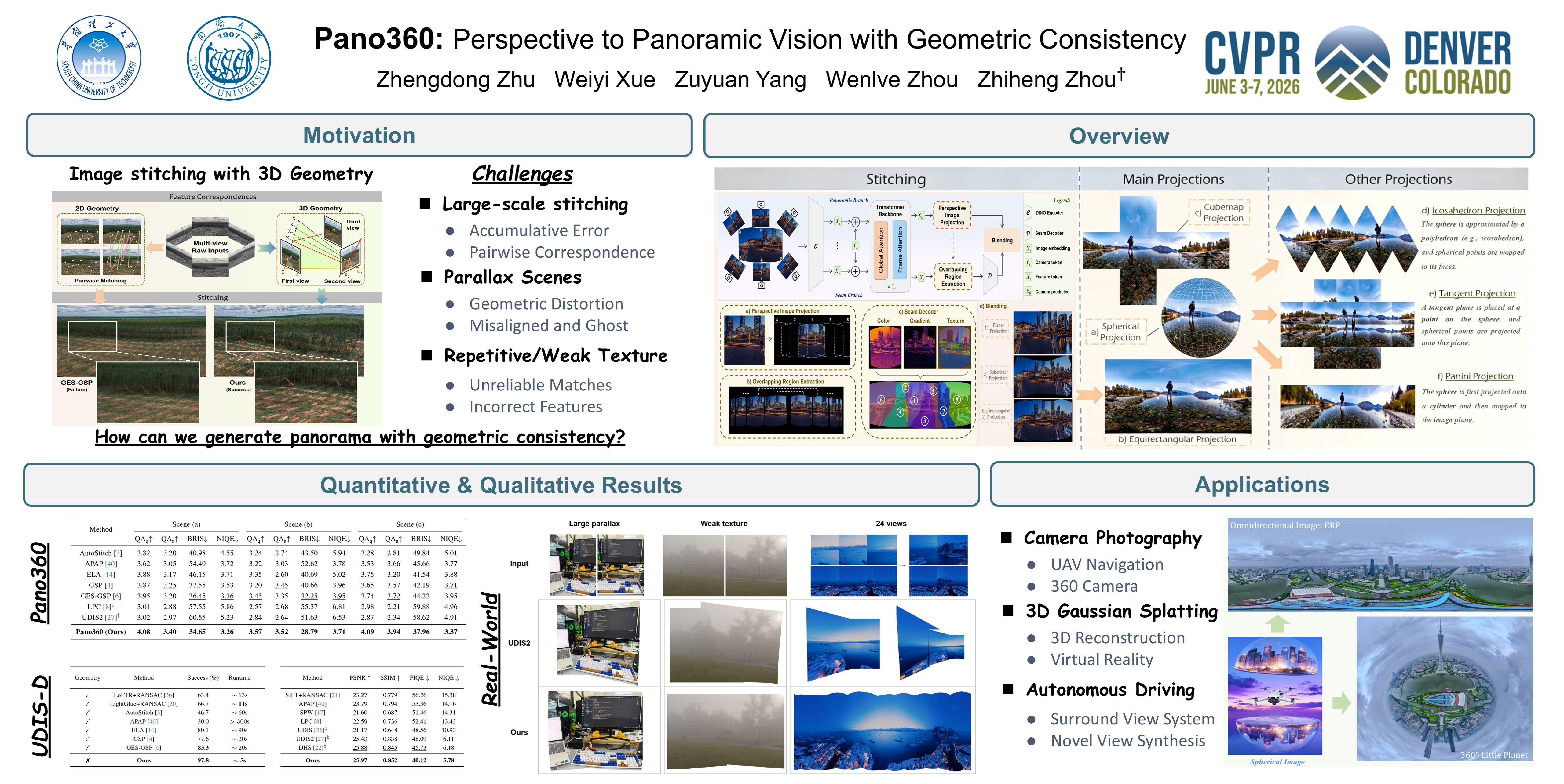
Prior panorama stitching approaches heavily rely on pairwise feature correspondences and are unable to leverage geometric consistency across multiple views. This leads to severe distortion and misalignment, especially in challenging scenes with weak textures, large parallax, and repetitive patterns.Given that multi-view geometric correspondences can be directly constructed in 3D space, making them more accurate and globally consistent, we extend the 2D alignment task to the 3D photogrammetric space. We adopt a novel transformer-based architecture to achieve 3D awareness and aggregate global information across all views. It directly utilizes camera poses to guide image warping for global alignment in 3D space and employs a multi-feature joint optimization strategy to compute the seams.Additionally, to establish an evaluation benchmark and train our network, we collected a large-scale dataset of real-world scenes. Extensive experiments show that our method significantly outperforms existing alternatives in alignment accuracy and perceptual quality.
EfficientMonoHair: Fast Strand-Level Reconstruction from Monocular Video via Multi-View Direction Fusion
Da Li ⋅ Dominik Engel ⋅ Deng Luo ⋅ Ivan Viola
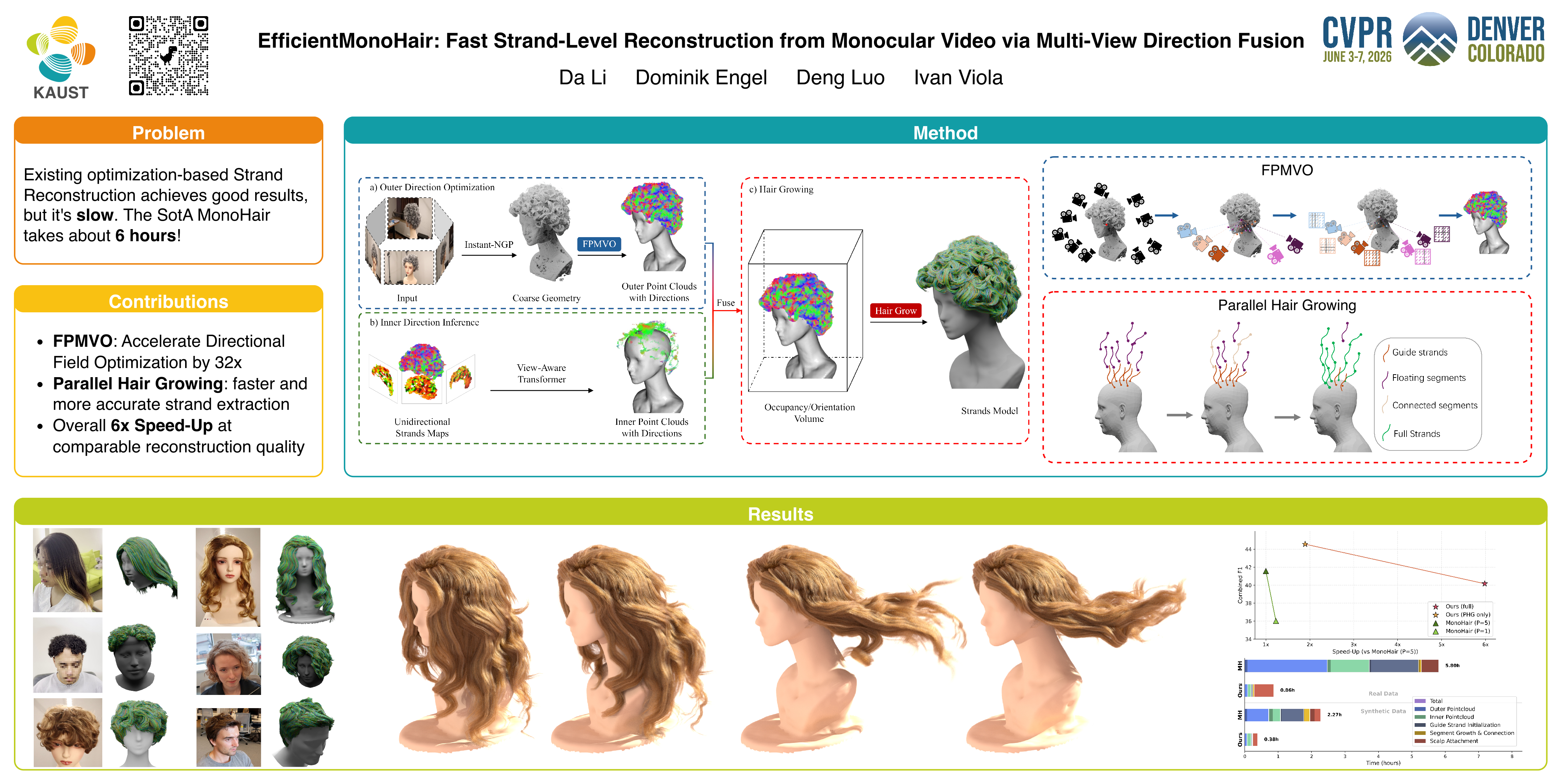
Strand-level hair geometry reconstruction is a fundamental problem in virtual human modeling and the digitization of hairstyles. However, existing methods still suffer from a significant trade-off between accuracy and efficiency. Implicit neural representations can capture the global hair shape but often fail to preserve fine-grained strand details, while explicit optimization-based approaches achieve high-fidelity reconstructions at the cost of heavy computation and poor scalability.To address this issue, we propose EfficientMonoHair, a fast and accurate framework that combines the implicit neural network with multi-view geometric fusion for strand-level reconstruction from monocular video. Our method introduces a fusion-patch-based multi-view optimization that reduces the number of optimization iterations for point cloud direction, as well as a novel parallel hair-growing strategy that relaxes voxel occupancy constraints, allowing large-scale strand tracing to remain stable and robust even under inaccurate or noisy orientation fields.Extensive experiments on various real-world hairstyles demonstrate that our method can robustly reconstruct high-fidelity strand geometries with accuracy. On synthetic benchmarks, our method achieves reconstruction quality comparable to state-of-the-art methods, while improving runtime efficiency by nearly an order of magnitude.
OSPO: Object-Centric Self-Improving Preference Optimization for Text-to-Image Generation
Yoonjin Oh ⋅ Yongjin Kim ⋅ Hyomin Kim ⋅ Donghwan Chi ⋅ Sungwoong Kim
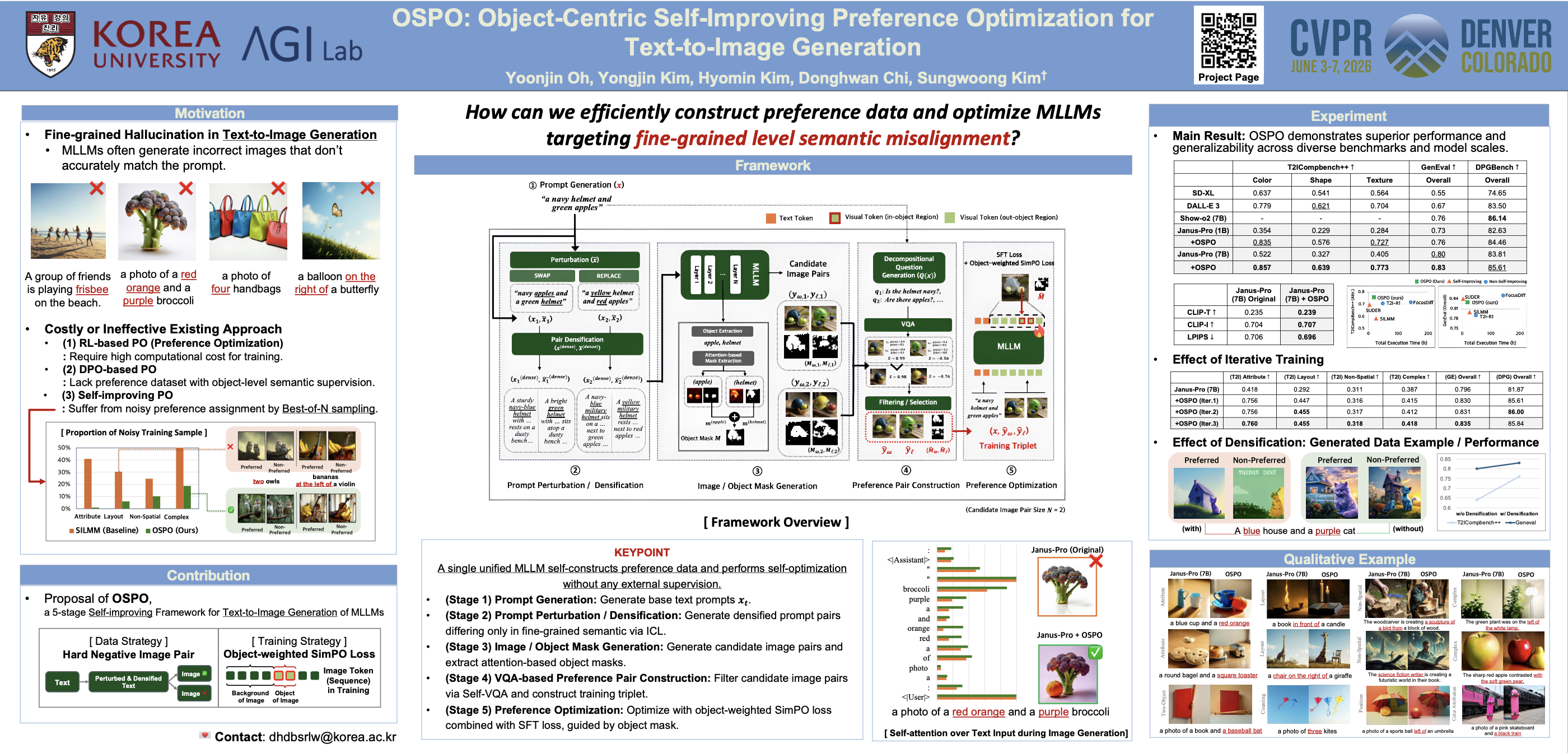
Recent advances in Multimodal Large Language Models (MLLMs) have enabled unified multimodal understanding and generation. However, they still struggle with fine-grained text–image alignment, often failing to faithfully depict objects with correct attributes such as color, shape, and spatial relations. To mitigate this issue, previous studies have explored preference optimization methods such as DPO and GRPO, but these approaches incur substantial computational cost, both in constructing preference data and in performing optimization. This has motivated self-improving preference optimization approaches, in which the MLLM autonomously generates its own training data, self-estimates preference feedback, and self-optimizes using the resulting self-constructed preference pairs. However, existing self-improving methods still overlook fine-grained, object-level semantics, allowing object hallucination to persist. To tackle this problem, we propose $\underline{\text{O}}$bject-centric $\underline{\text{S}}$elf-improving $\underline{\text{P}}$reference $\underline{\text{O}}$ptimization (OSPO), a self-improving framework designed to enhance object-level text–image alignment. OSPO explicitly constructs object-centric preference data without relying on any external data and external models. We also introduce a new approach that leverages attention-based object masks together with an object-weighted SimPO loss to enhance object-specific fidelity. Extensive experiments on three compositional image generation benchmarks demonstrate that OSPO significantly improves fine-grained alignment and reduces object hallucination, outperforming prior self-improving methods and even specialized diffusion-based text-to-image models.
MoReGen: Multi-Agent Motion-Reasoning Engine for Code-based Text-to-Video Synthesis
Xiangyu Bai ⋅ He Liang ⋅ Bishoy Galoaa ⋅ Utsav Nandi ⋅ Shayda Moezzi ⋅ Yuhang He ⋅ Sarah Ostadabbas
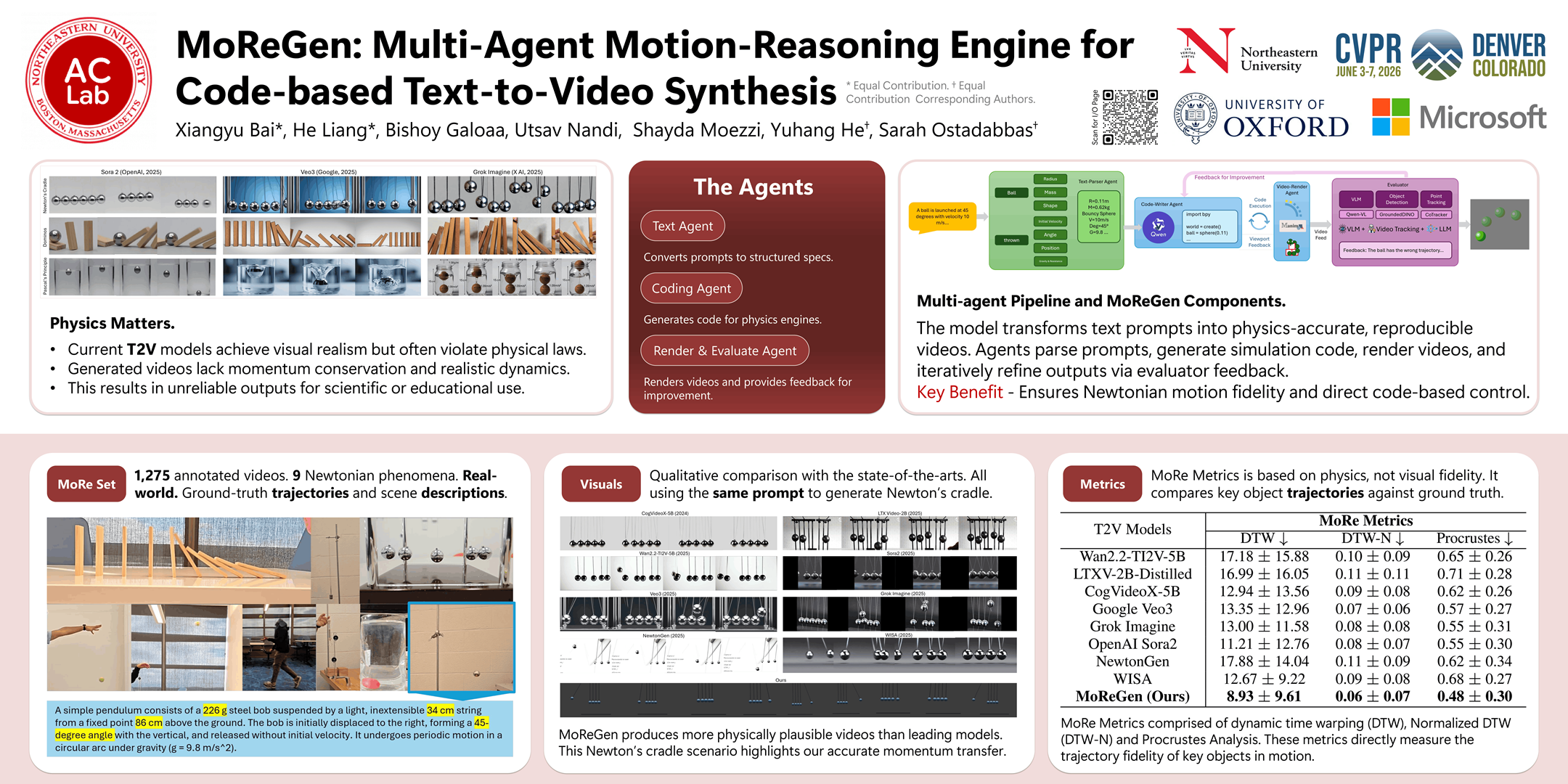
While text-to-video (T2V) generation has achieved remarkable progress in photorealism, generating intent-aligned videos that faithfully obey physics principles remains a core challenge. In this work, we systematically study Newtonian motion-controlled text-to-video generation and evaluation, emphasizing physical precision and motion coherence. We introduce MoReGen, a motion-aware, physics-grounded T2V framework that integrates multi-agent LLMs, physics simulators, and renderers to generate reproducible, physically accurate videos from text prompts in the code domain. To quantitatively assess physical validity, we propose object-trajectory correspondence as a direct evaluation metric and present MoReSet, a benchmark of 1,275 human-annotated videos spanning nine classes of Newtonian phenomena with scene descriptions, spatiotemporal relations, and ground-truth trajectories. Using MoReSet, we conduct experiments on existing T2V models, evaluating their physical validity through both our MoRe metrics and existing physics-based evaluators. Our results reveal that state-of-the-art models struggle to maintain physical validity, while MoReGen establishes a principled direction toward physically coherent video synthesis.
StyleTextGen: Style-Conditioned Multilingual Scene Text Generation
Zeyu Chen ⋅ Fangmin Zhao ⋅ Yan Shu ⋅ Yichao Liu ⋅ Liu Yu ⋅ Yu ZHOU
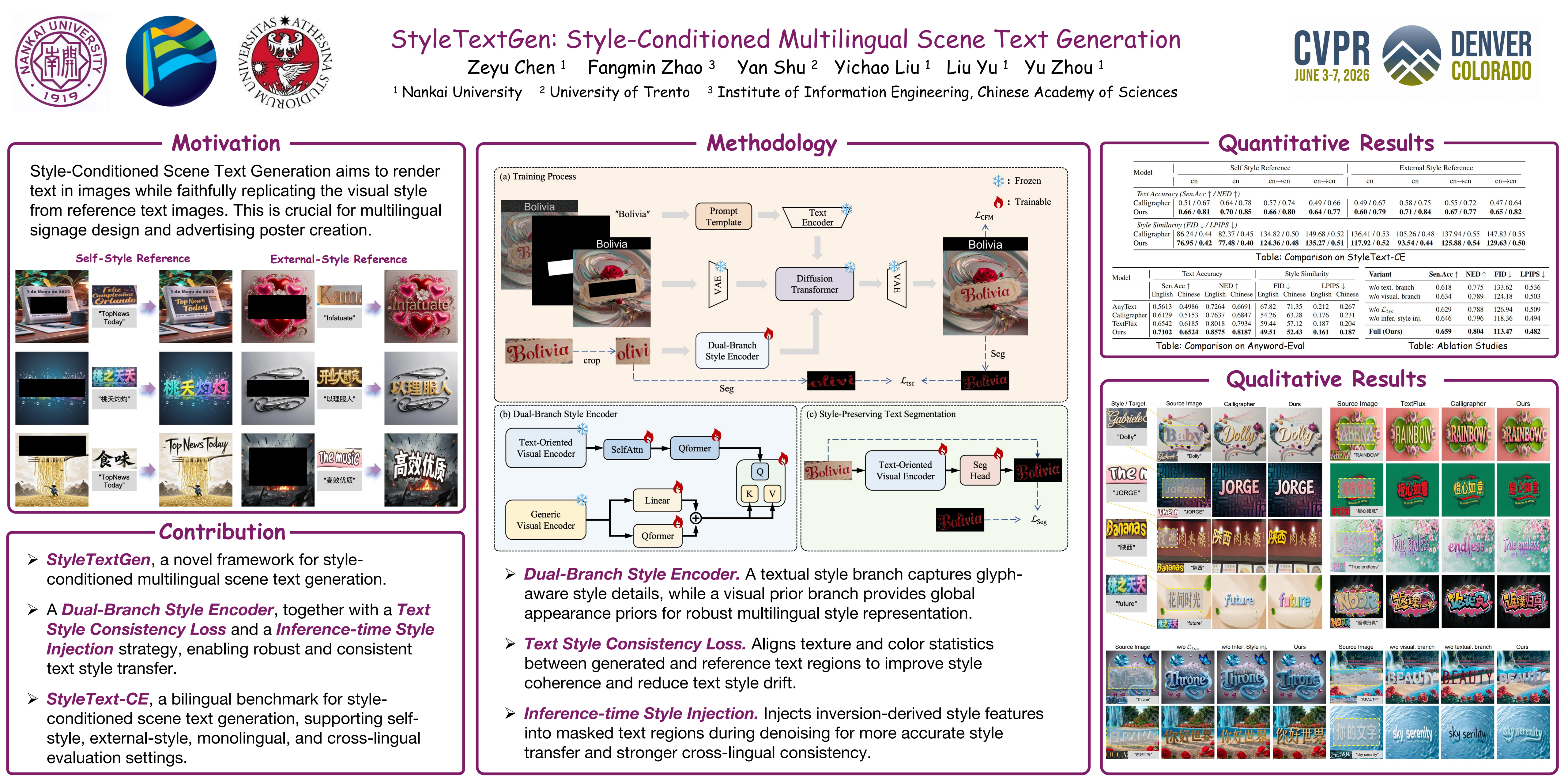
Style-conditioned scene text generation faces unique challenges in extracting precise text styles from complex backgrounds and maintaining fine-grained style consistency across characters, especially for multilingual scripts. We propose StyleTextGen, a novel framework that learns to perceive and replicate visual text styles across different languages and writing systems. Our approach features three key contributions: First, we introduce a dual-branch style encoder dedicated to style modeling, yielding robust multilingual text style representations in complex real-world scenes. Second, we design a text style consistency loss that enhances style coherence and improves overall visual quality. Third, we develop a mask-guided inference strategy that ensures precise style alignment between generated and reference text. To facilitate systematic evaluation, we construct StyleText-CE, a bilingual scene text style benchmark covering both monolingual and cross-lingual settings. Extensive experiments demonstrate that StyleTextGen significantly outperforms existing methods in style consistency and cross-lingual generalization, establishing new state-of-the-art performance in multilingual style-conditioned text generation.
CRAFT-LoRA: Content-Style Personalization via Rank-Constrained Adaptation and Training-Free Fusion
Yu Li ⋅ Yujun Cai ⋅ Chi Zhang
Personalized image generation requires effectively balancing content fidelity with stylistic consistency when synthesizing images based on text and reference examples. Low-Rank Adaptation (LoRA) offers an efficient personalization approach, with potential for precise control through combining LoRA weights on different concepts. However, existing combination techniques face persistent challenges: entanglement between content and style representations, insufficient guidance for controlling elements' influence, and unstable weight fusion that often require additional training. We address these limitations through CRAFT-LoRA, with complementary components: (1) rank-constrained backbone fine-tuning that injects low-rank projection residuals to encourage learning decoupled content and style subspaces; (2) a prompt-guided approach featuring an expert encoder with specialized branches that enables semantic extension and precise control through selective adapter aggregation; and (3) a training-free, timestep-dependent classifier-free guidance scheme that enhances generation stability by strategically adjusting noise predictions across diffusion steps. Our method significantly improves content-style disentanglement, enables flexible semantic control over LoRA module combinations, and achieves high-fidelity generation without additional retraining overhead.
OneHOI: Unifying Human-Object Interaction Generation and Editing
Jiun Tian Hoe ⋅ Weipeng Hu ⋅ Xudong Jiang ⋅ Yap-Peng Tan ⋅ Chee Seng Chan
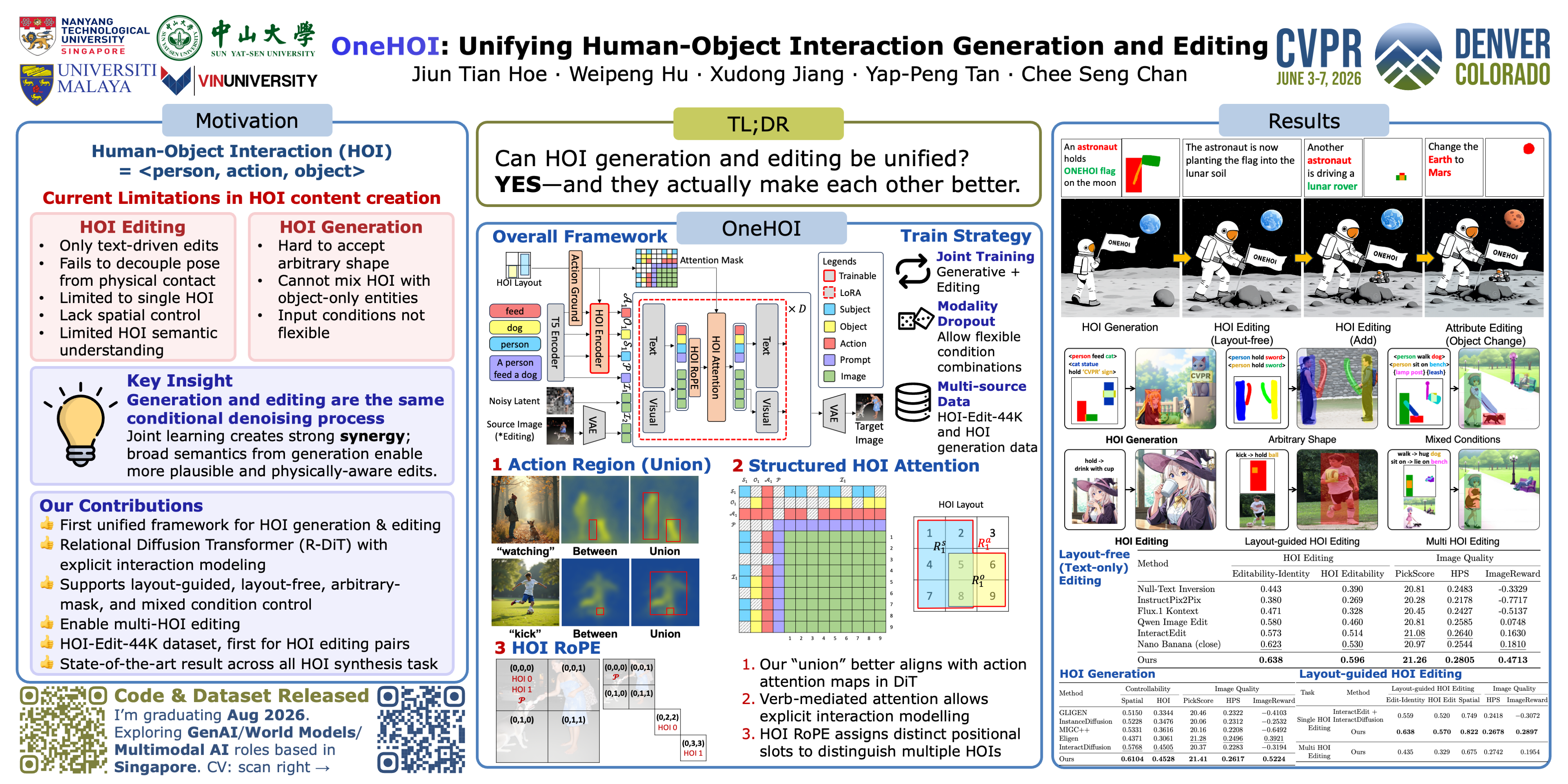
Human-Object Interaction (HOI) modelling captures how humans act upon and relate to objects, typically expressed as
GlyphPrinter: Region-Grouped Direct Preference Optimization for Glyph-Accurate Visual Text Rendering
Xincheng Shuai ⋅ Ziye Li ⋅ Henghui Ding ⋅ Dacheng Tao
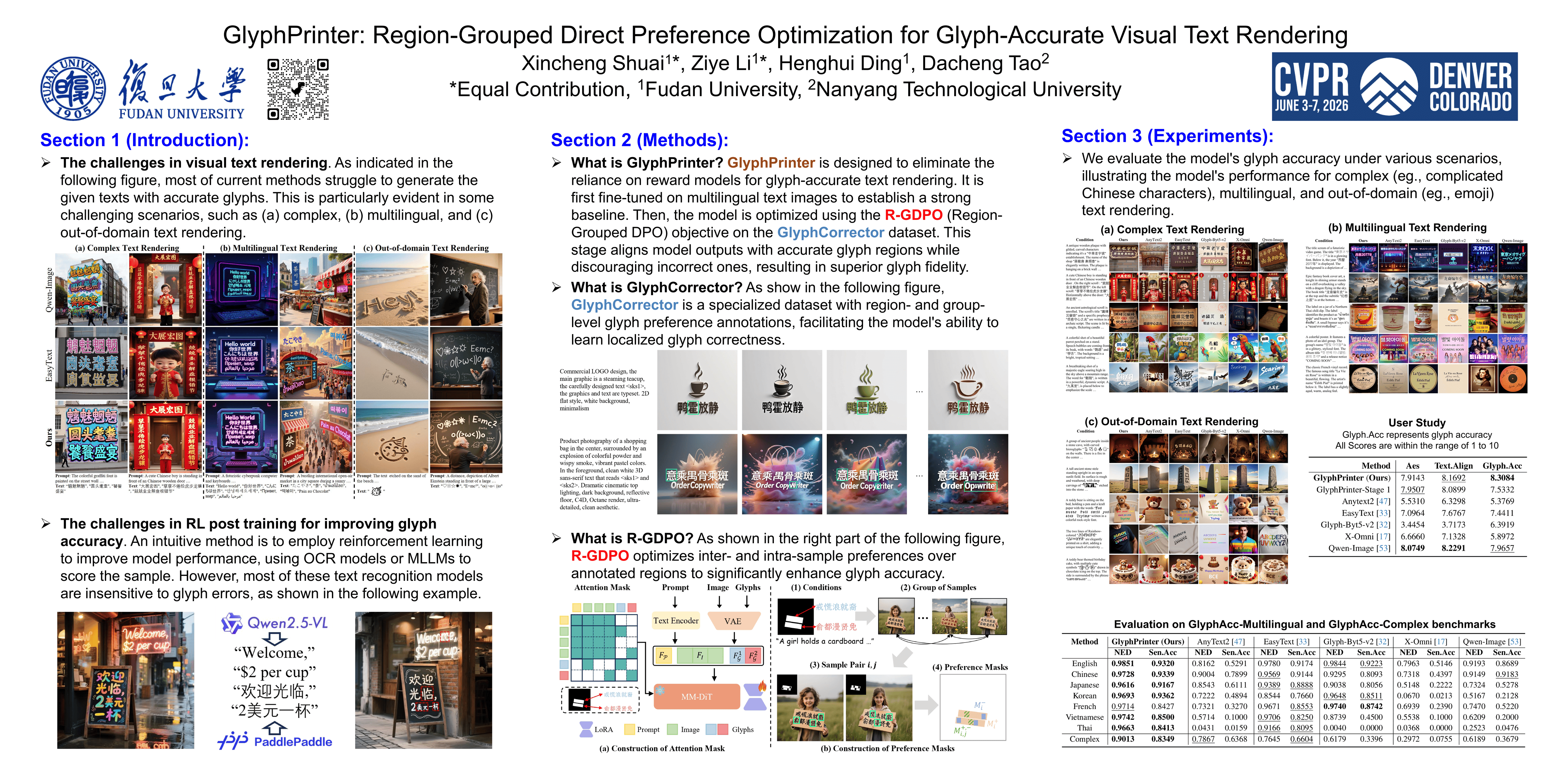
Generating accurate glyphs for visual text rendering is essential yet challenging. Existing methods typically enhance text rendering by training on a large amount of high-quality scene text images, but the limited coverage of glyph variations and excessive stylization often compromise glyph accuracy, especially for complex or out-of-domain characters. Some methods leverage reinforcement learning to alleviate this issue, yet their reward models usually depend on text recognition systems that are insensitive to fine-grained glyph errors, so images with incorrect glyphs may still receive high rewards. Inspired by Direct Preference Optimization (DPO), we propose GlyphPrinter, a preference-based text rendering method that eliminates reliance on explicit reward models. However, the standard DPO objective only models overall preference between two samples, which is insufficient for visual text rendering where glyph errors typically occur in localized regions. To address this issue, we construct the GlyphCorrector dataset with region-level glyph preference annotations and propose Region-Grouped DPO (R-GDPO), a region-based objective that optimizes inter- and intra-sample preferences over annotated regions, substantially enhancing glyph accuracy. Furthermore, we introduce Regional Reward Guidance, an inference strategy that samples from an optimal distribution with controllable glyph accuracy. Extensive experiments demonstrate that the proposed GlyphPrinter outperforms existing methods in glyph accuracy while maintaining a favorable balance between stylization and precision.
Self-Paced and Self-Corrective Masked Prediction for Movie Trailer Generation
Sidan Zhu ⋅ Hongteng Xu ⋅ Dixin Luo
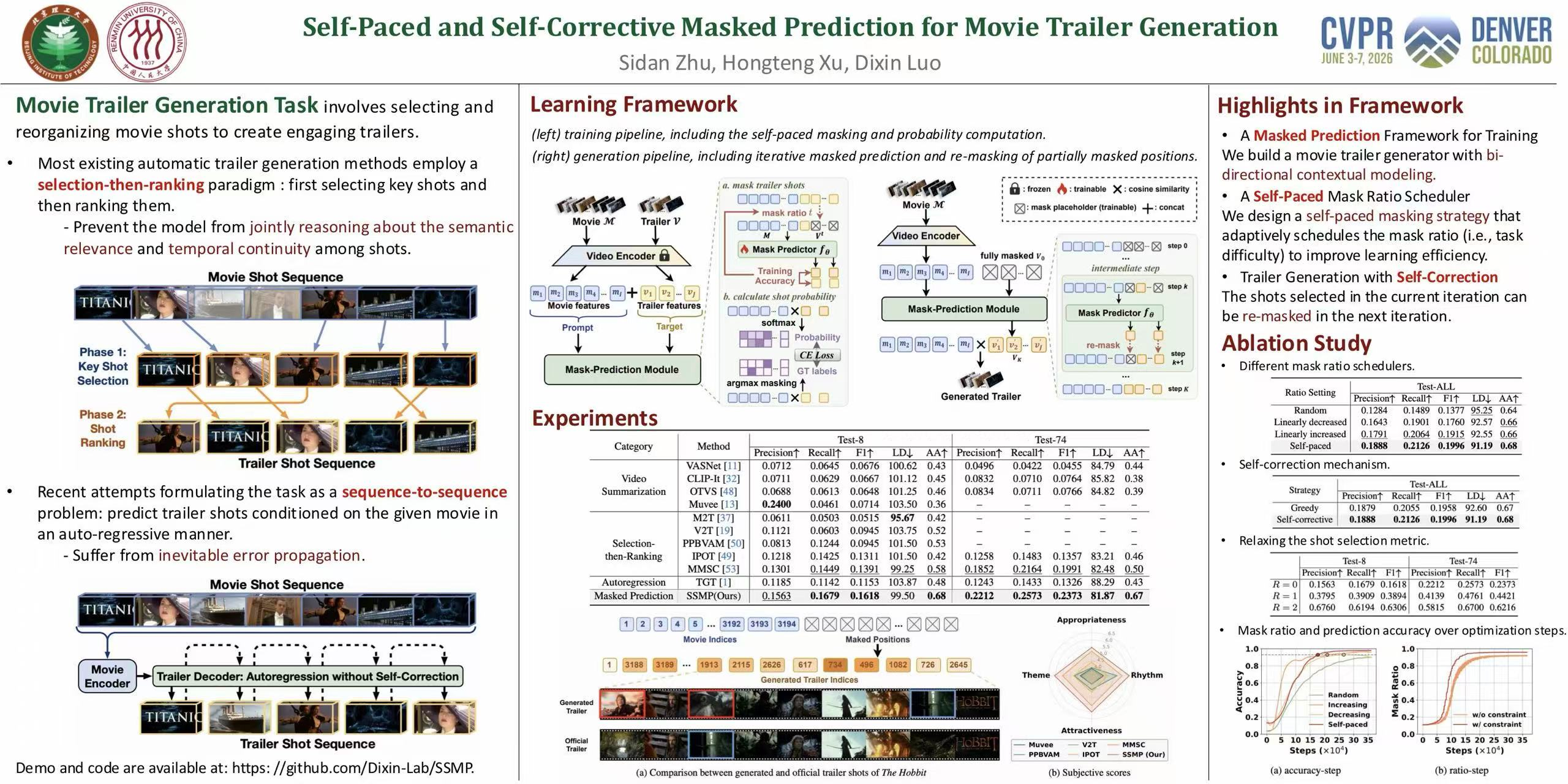
As a challenging video editing task, movie trailer generation involves selecting and reorganizing movie shots to create engaging trailers. Currently, most existing automatic trailer generation methods employ a "selection-then-ranking" paradigm (i.e., first selecting key shots and then ranking them), which suffers from inevitable error propagation and limits the quality of the generated trailers. Beyond this paradigm, we propose a new self-paced and self-corrective masked prediction method called SSMP, which achieves state-of-the-art results in automatic trailer generation via bi-directional contextual modeling and progressive self-correction. In particular, SSMP trains a Transformer encoder that takes the movie shot sequences as prompts and generates corresponding trailer shot sequences accordingly. The model is trained via masked prediction, reconstructing each trailer shot sequence from its randomly masked counterpart. The mask ratio is self-paced, allowing the task difficulty to adapt to the model and thereby improving model performance.When generating a movie trailer, the model fills the shot positions with high confidence at each step and re-masks the remaining positions for the next prediction, forming a progressive self-correction mechanism that is analogous to how human editors work. Both quantitative results and user studies demonstrate the superiority of SSMP in comparison to existing automatic movie trailer generation methods.
TV2TV: A Unified Framework for Interleaved Language and Video Generation
Xiaochuang Han ⋅ Youssef Emad ⋅ Melissa Hall ⋅ John Nguyen ⋅ Karthik Padthe ⋅ Liam Robbins ⋅ Amir Bar ⋅ Delong Chen ⋅ Michal Drozdzal ⋅ Maha Elbayad ⋅ Yushi Hu ⋅ Shang-Wen Li ⋅ Jakob Verbeek ⋅ XuDong Wang ⋅ Marjan Ghazvininejad ⋅ Luke Zettlemoyer ⋅ Emily Dinan
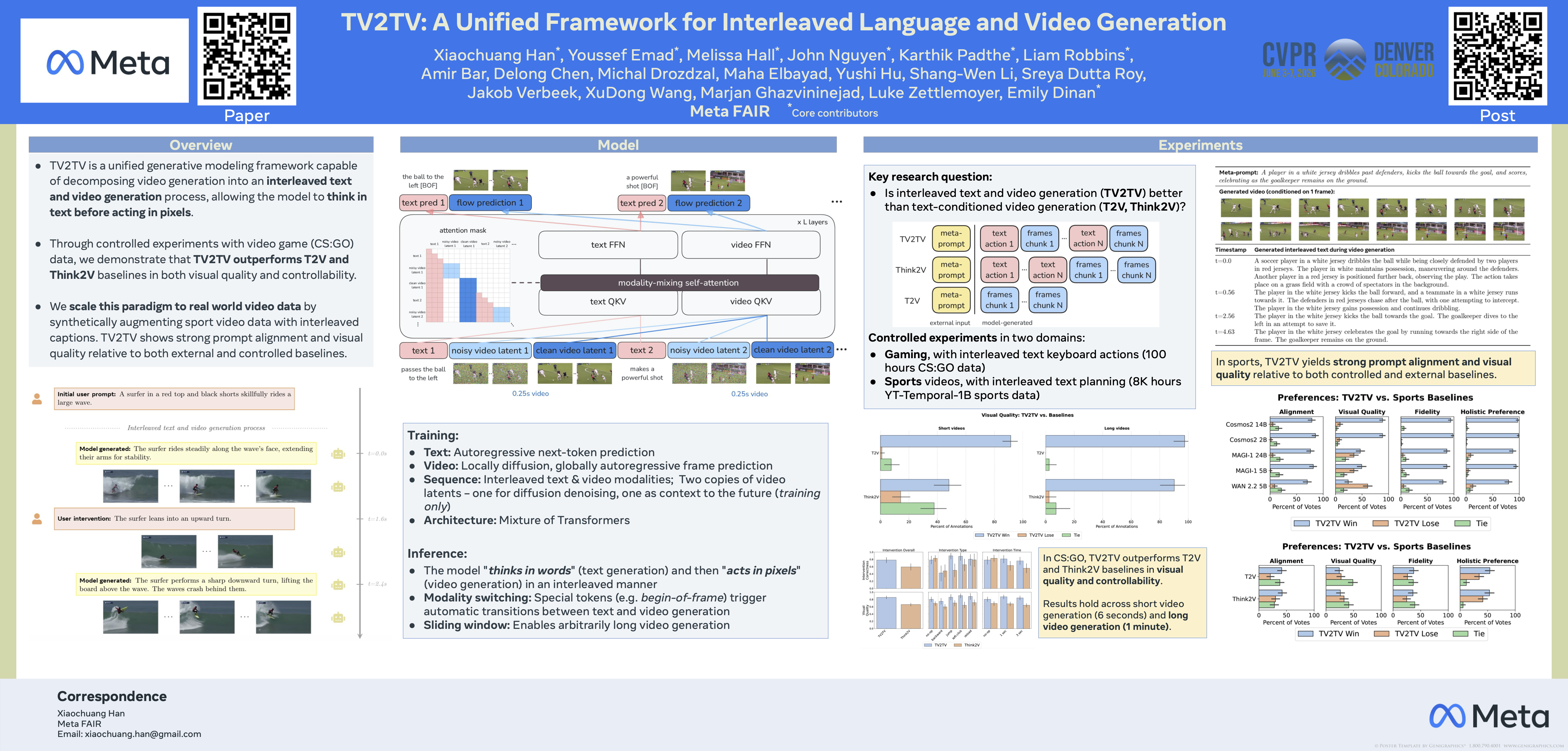
Video generation models are rapidly advancing, but can still struggle with complex video outputs that require significant semantic branching or repeated high-level reasoning about what should happen next. In this paper, we introduce a new class of omni video-text models that integrate ideas from recent LM reasoning advances to address this challenge. More specifically, we present TV2TV, a unified generative modeling framework which decomposes video generation into an interleaved text and video generation process. TV2TV jointly learns language modeling (next-token prediction) and video flow matching (next-frame prediction) using a Mixture-of-Transformers (MoT) architecture. At inference time, TV2TV decides when to alternate between generating text and video frames, allowing the model to "think in words" about subsequent content before "acting in pixels" to produce frames. This design offloads much of the responsibility for deciding what should happen next to the language modeling tower, enabling improved visual quality and prompt alignment of generated videos. It also enables fine-grained controllability, allowing users to modify the video generation trajectory through text interventions at any point in the process. In controlled experiments on video game data, TV2TV demonstrates substantial improvements in both visual quality (preferred 92% of the time in human evaluations vs. a comparable text-to-video model) and controllability (19 point improvement in fine-grained instruction following accuracy vs. a "think-then-act" approach). TV2TV also scales to natural videos, as we show by augmenting sports videos with interleaved natural language action descriptions using vision-language models (VLMs). Training TV2TV on this corpus yields strong visual quality and prompt alignment, showcasing the model's ability to reason about and generate complex real-world action sequences. Together, these results highlight TV2TV as a promising step toward video generation with open-ended textual reasoning and control.
Narrative Weaver: Towards Controllable Long-Range Visual Consistency with Multi-Modal Conditioning
Zhengjian Yao ⋅ Yongzhi Li ⋅ Xinyuan Gao ⋅ Quan Chen ⋅ Peng Jiang ⋅ Yanye Lu
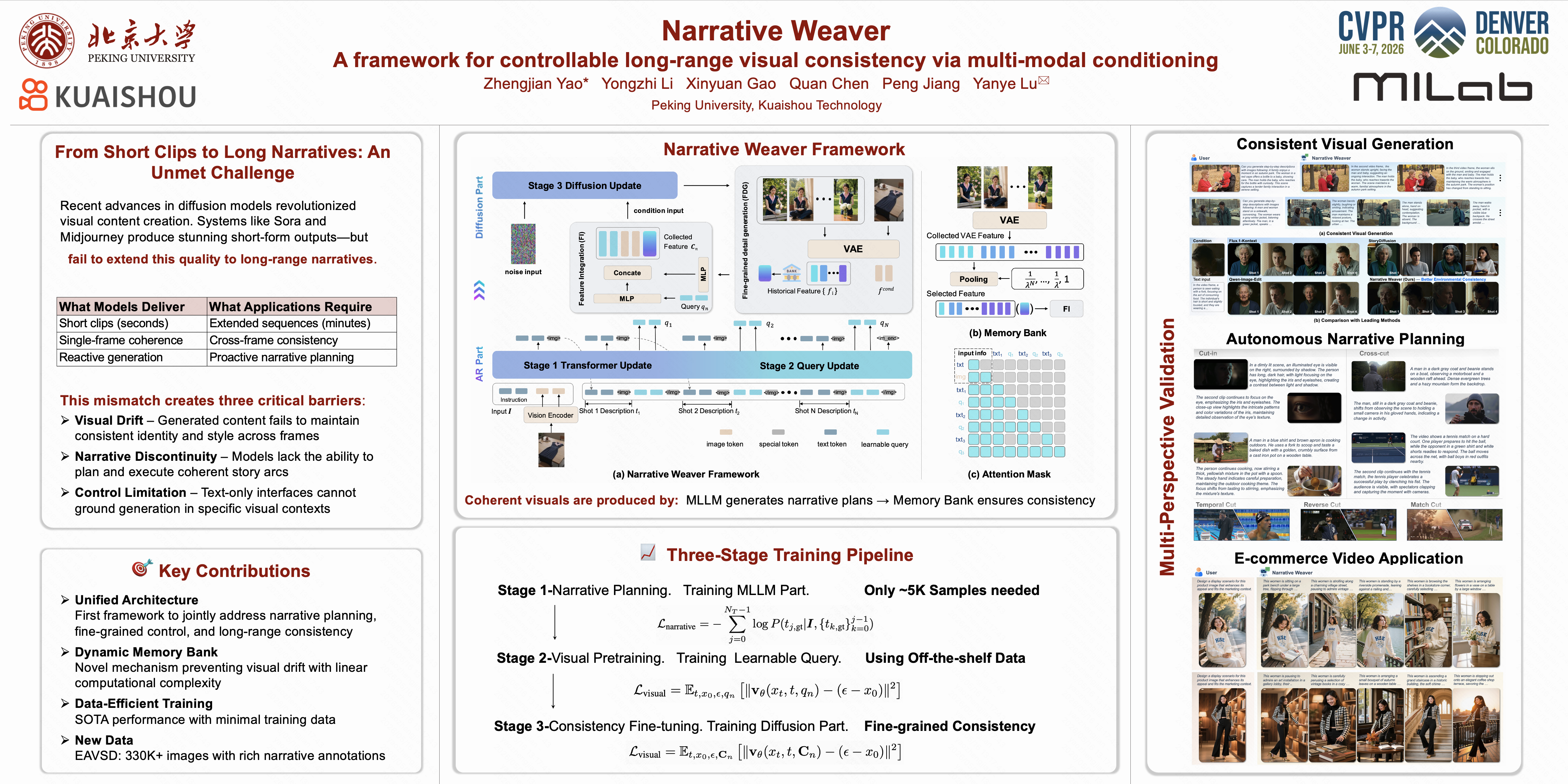
We present Narrative Weaver, a novel framework that addresses a fundamental challenge in generative AI: achieving controllable, long-range, and consistent visual content generation. While existing models excel at generating high-fidelity short-form visual content, they struggle to maintain narrative coherence and visual consistency across extended sequences—a critical limitation for real-world applications such as filmmaking and e-commerce advertising.Narrative Weaver introduces the first holistic solution that seamlessly integrates three essential capabilities: fine-grained control, automatic narrative planning, and long-range coherence. Our architecture combines a Multimodal Large Language Model (MLLM) for high-level narrative planning with a novel fine-grained control module featuring a dynamic Memory Bank that prevents visual drift.To enable practical deployment, we develop a progressive, multi-stage training strategy that efficiently leverages existing pre-trained models, achieving state-of-the-art performance even with limited training data. Recognizing the absence of suitable evaluation benchmarks, we construct and release the E-commerce Advertising Video Storyboard Dataset (EAVSD)—the first comprehensive dataset for this task, containing over 330K high-quality images with rich narrative annotations.Through extensive experiments across three distinct scenarios (controllable multi-scene generation, autonomous storytelling, and e-commerce advertising), we demonstrate our method’s superiority while opening new possibilities for AI-driven content creation.
Ref4D-VideoBench: Four-Dimensional Reference-Based Evaluation of Text-to-Video Generative Models
Jiajia Wei ⋅ YuJia He ⋅ Yuhan Hou ⋅ Hang Qi ⋅ Sihua Wang ⋅ Jincheng Shi ⋅ Kwok Fung Li ⋅ Zibin Zheng ⋅ Weibin Wu
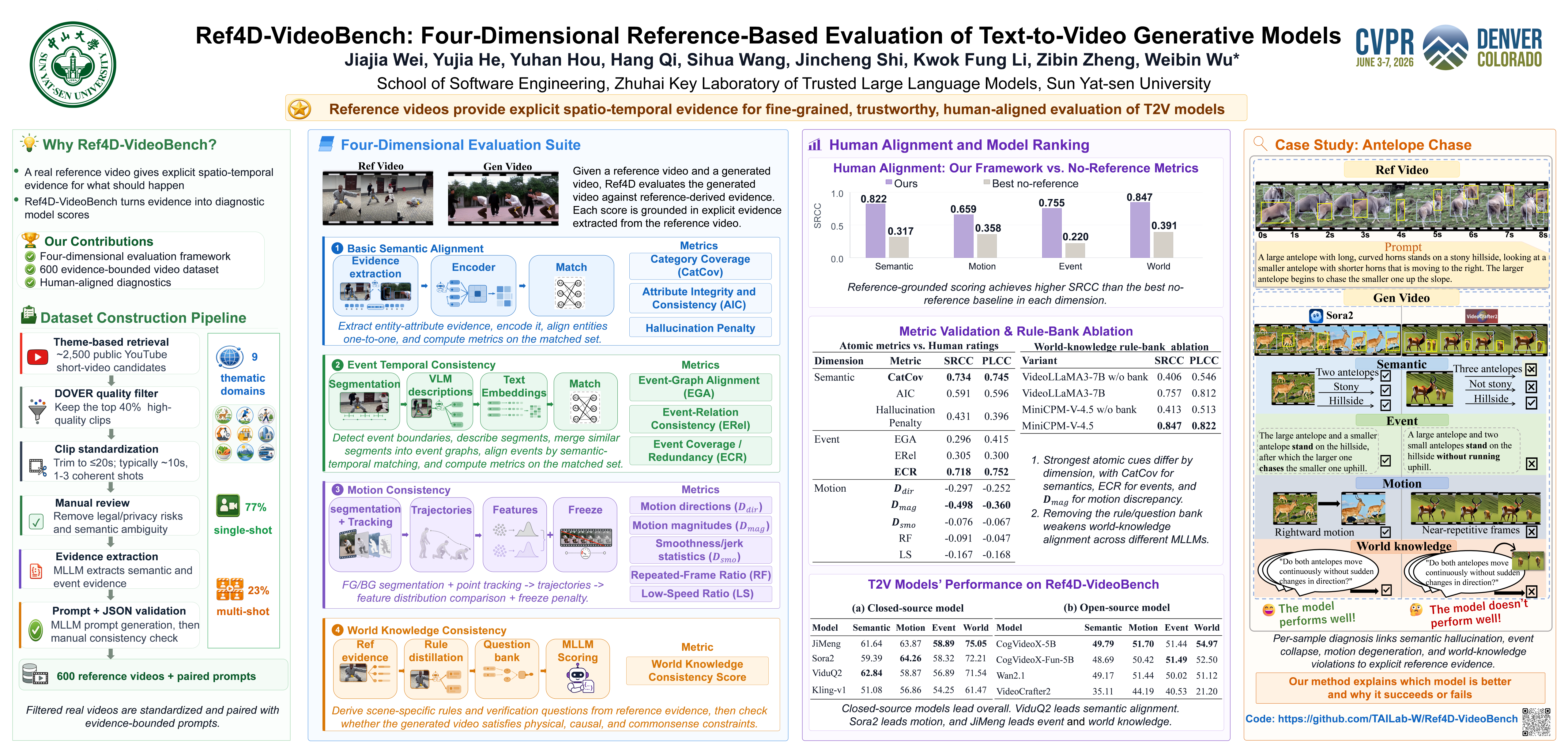
Most existing evaluations of generated videos adopt a no-reference paradigm. Although recent benchmarks cover multiple dimensions and show moderate correlation with human preferences, relying solely on textual prompts weakens real-world constraints and makes it difficult to produce accountable and interpretable judgments on instance-level issues such as target behavior deviation, temporal inconsistency, and commonsense violations. In scenarios with explicit expectations, such as controlled generation, reference videos naturally provide rich, unambiguous spatio-temporal evidence, enabling stricter and more trustworthy assessment. Motivated by this, we propose Ref4D, a reference-based, fine-grained, multi-dimensional benchmark for generated video evaluation. Ref4D contains 600 high-quality reference videos with tightly evidence-bounded prompts, and introduces a 12-metric structured evaluation suite along four key dimensions: basic semantic alignment, motion consistency, event temporal consistency, and world knowledge consistency. Experiments on eight text-to-video models show that Ref4D achieves stronger agreement with human judgments than representative no-reference frameworks, while precisely diagnosing the dimensions and causes of failure for each video. By integrating explicit reference evidence with multimodal reasoning, Ref4D provides a practical and human-aligned standard for generated video evaluation and a tool to guide the development of more reliable generative models.
PureCC: Pure Learning for Text-to-Image Concept Customization
Zhichao Liao ⋅ Xiaole Xian ⋅ Qingyu Li ⋅ Wenyu Qin ⋅ Meng Wang ⋅ Weicheng Xie ⋅ Siyang Song ⋅ Pingfa Feng ⋅ Long ZENG ⋅ Liang Pan
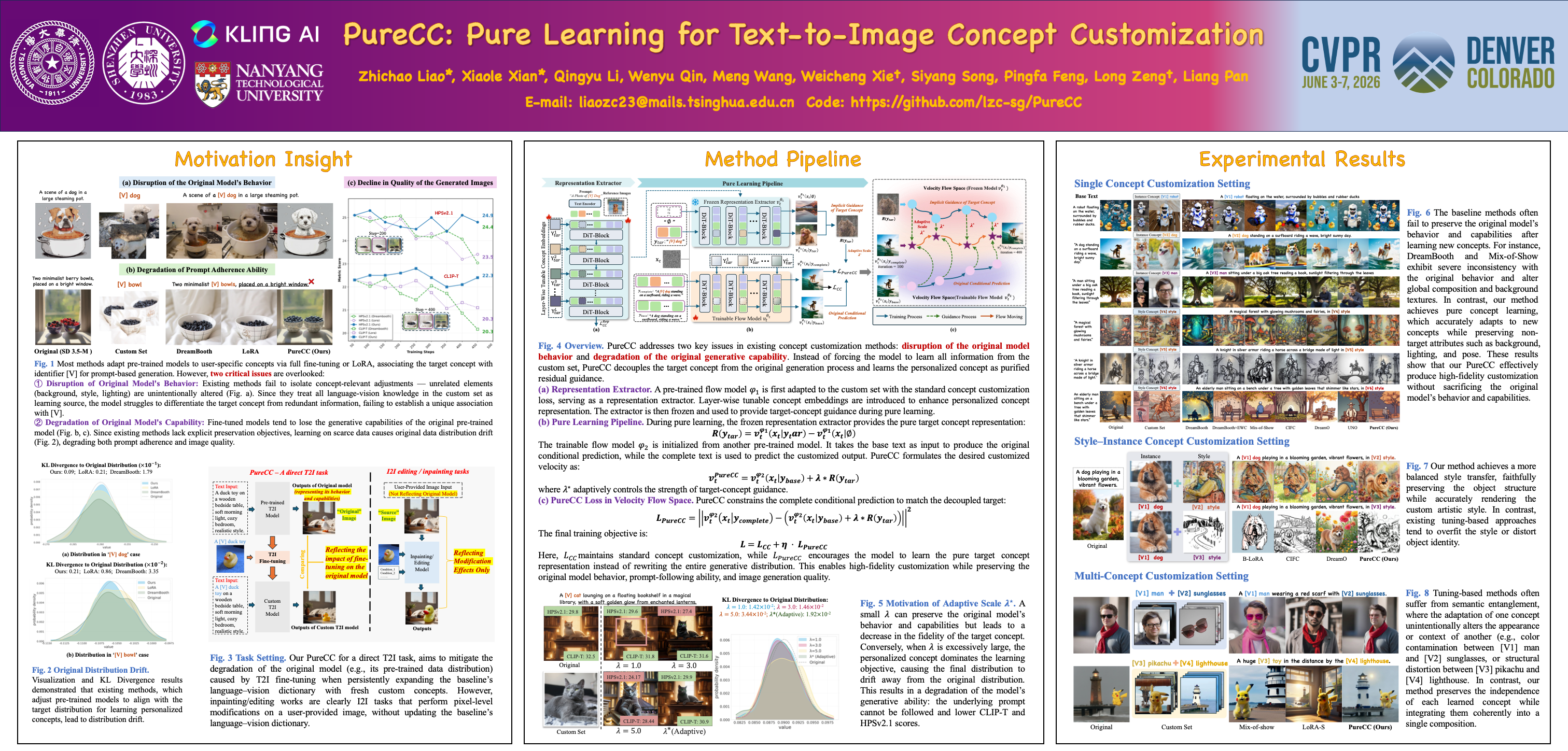
Existing concept customization methods have achieved remarkable outcomes in high-fidelity and multi-concept customization.However, they often neglect the influence on the original model's behavior and capabilities when learning new personalized concepts.To address this issue, we propose PureCC. PureCC novelly introduces a decoupled learning objective for concept customization, which combines the implicit guidance of the target concept with the original conditional prediction. This separated form enables PureCC to substantially focus on the original model during training. Moreover, based on this objective, PureCC designs a dual-branch training pipeline that includes a frozen extractor providing purified target concept representation as implicit guidance and a trainable flow model producing the original conditional prediction, jointly achieving pure learning for personalized concept. Furthermore, PureCC introduces an novel adaptive guidance scale $\lambda^\star$ to dynamically adjust the guidance strength of the target concept, balancing between customization fidelity and model preservation. Extensive experiments show that PureCC achieves state-of-the-art performance in preserving the original behavior and capabilities while enabling high-fidelity concept customization.
Disentangling to Re-couple: Resolving the Similarity-Controllability Paradox in Subject-Driven Text-to-Image Generation
Shuang Li ⋅ Chao Deng ⋅ Hang Chen ⋅ Liqun Liu ⋅ zhenyu hu ⋅ Te Cao ⋅ Mengge Xue ⋅ Yuan Chen ⋅ Peng Shu ⋅ Huan Yu ⋅ Jie Jiang
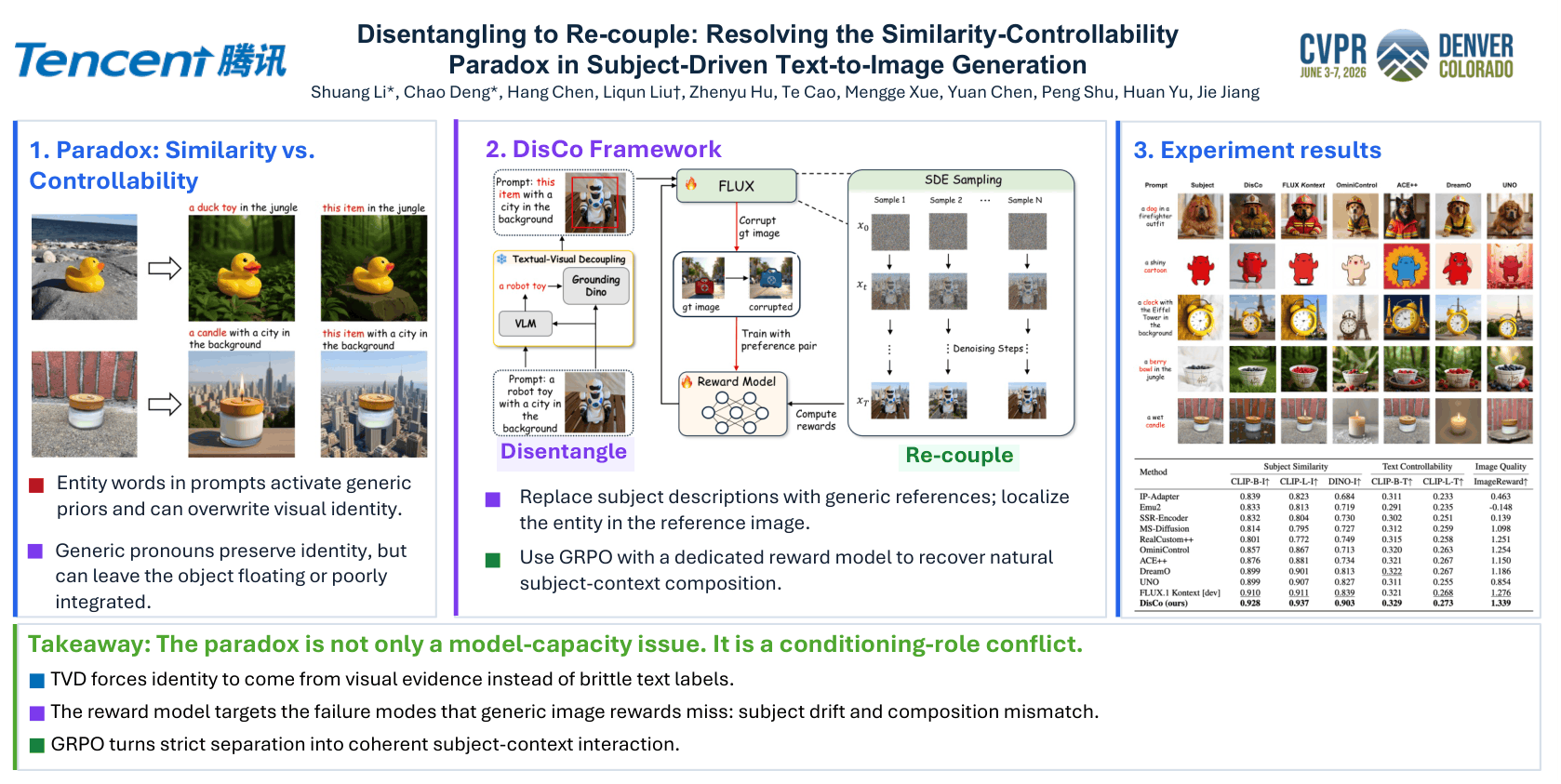
Subject-Driven Text-to-Image (T2I) Generation aims to preserve a subject's identity while editing its context based on a text prompt. A core challenge in this task is the ``similarity-controllability paradox'', where enhancing textual control often degrades the subject's fidelity, and vice-versa. We argue this paradox stems from the ambiguous role of text prompts, which are often tasked with describing both the subject and the desired modifications, leading to conflicting signals for the model. To resolve this, we propose \textbf{DisCo}, a novel framework that first \textbf{Dis}entangles and then re-\textbf{Co}uples visual and textual information. First, our textual-visual decoupling module isolates the sources of information: subject identity is extracted exclusively from the reference image with the entity word of the subject, while the text prompt is simplified to contain only the modification command, where the subject refers to general pronouns, eliminating descriptive ambiguity. However, this strict separation can lead to unnatural compositions between the subject and its contexts. We address this by designing a dedicated reward signal and using reinforcement learning to seamlessly recouple the visually-defined subject and the textually-generated context. Our approach effectively resolves the paradox, enabling simultaneous high-fidelity subject preservation and precise textual control. Extensive experiments demonstrate that our method achieves state-of-the-art performance, producing highly realistic and coherent images.
Yume1.5: A Text-Controlled Interactive World Generation Model
Xiaofeng Mao ⋅ Zhen Li ⋅ Chuanhao Li ⋅ Xiaojie Xu ⋅ Kaining Ying ⋅ Kaipeng Zhang
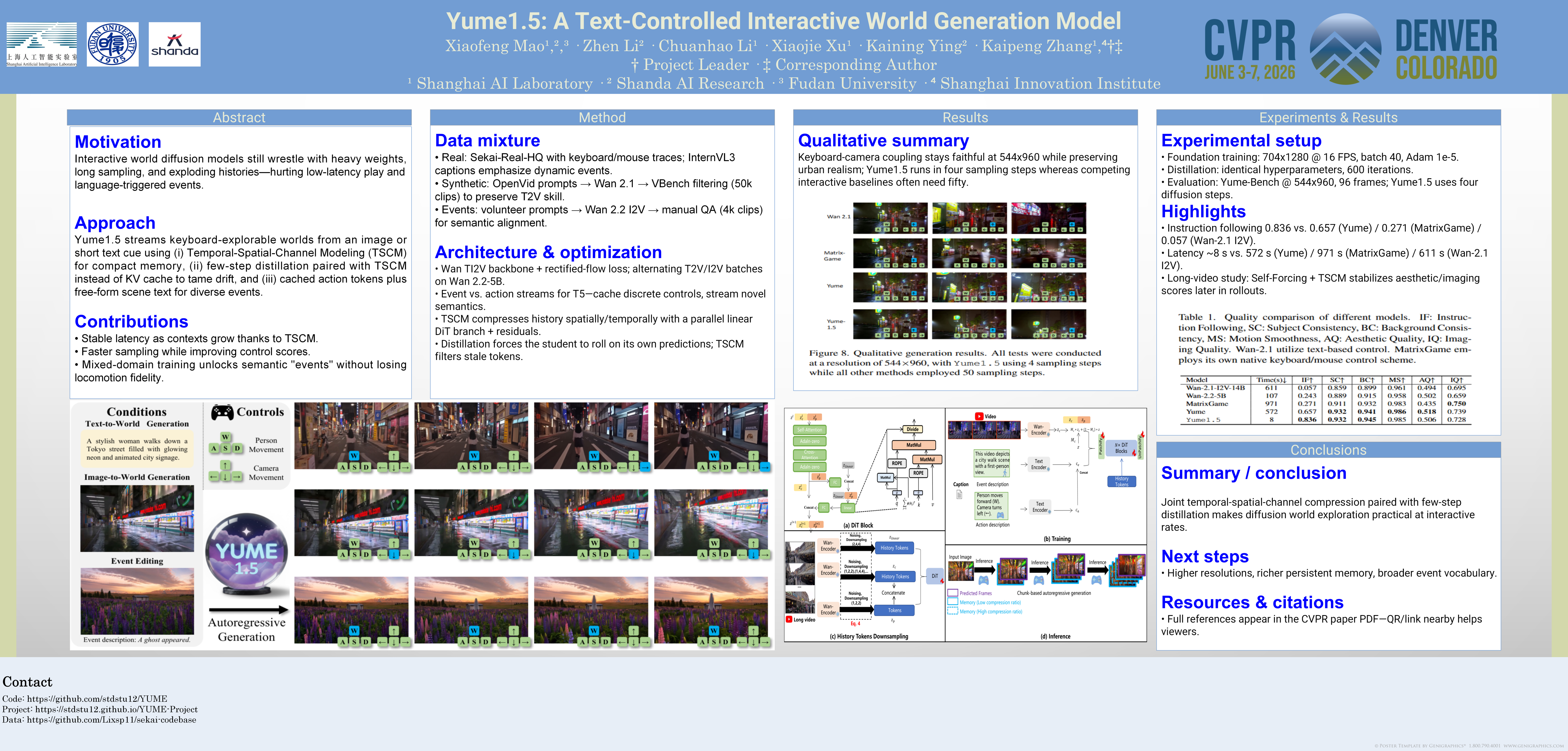
Recent approaches have demonstrated the promise of using diffusion models to generate interactive and explorable worlds. However, most of these methods face critical challenges such as excessively large parameter sizes, reliance on lengthy inference steps, and rapidly growing historical context, which severely limit real-time performance and lack text-controlled generation capabilities.To address these challenges, we propose Yume1.5, a novel framework designed to generate realistic, interactive, and continuous worlds from a single image or text prompt. Yume1.5 achieves this through a carefully designed framework that supports keyboard-based exploration of the generated worlds. The framework comprises three core components: (1) a long-video generation method combining unified context compression and linear attention; (2) a context compression-based bidirectional attention distillation approach with an enhanced text embedding scheme for real-time streaming video generation. Yume1.5 achieves an average generation speed of 12 fps at 540p resolution using only a single A100 GPU; (3) a text-controlled method for generating world events. We have provided the codebase in the supplementary material. The model weights and full codebase will be made public.
PosterReward: Unlocking Accurate Evaluation for High-Quality Graphic Design Generation
Jianyu LAI ⋅ Sixiang Chen ⋅ Jialin Gao ⋅ Hengyu Shi ⋅ Zhongying Liu ⋅ Fuxiang Zhai ⋅ Junfeng Luo ⋅ Xiaoming Wei ⋅ Lujia Wang ⋅ Lei Zhu
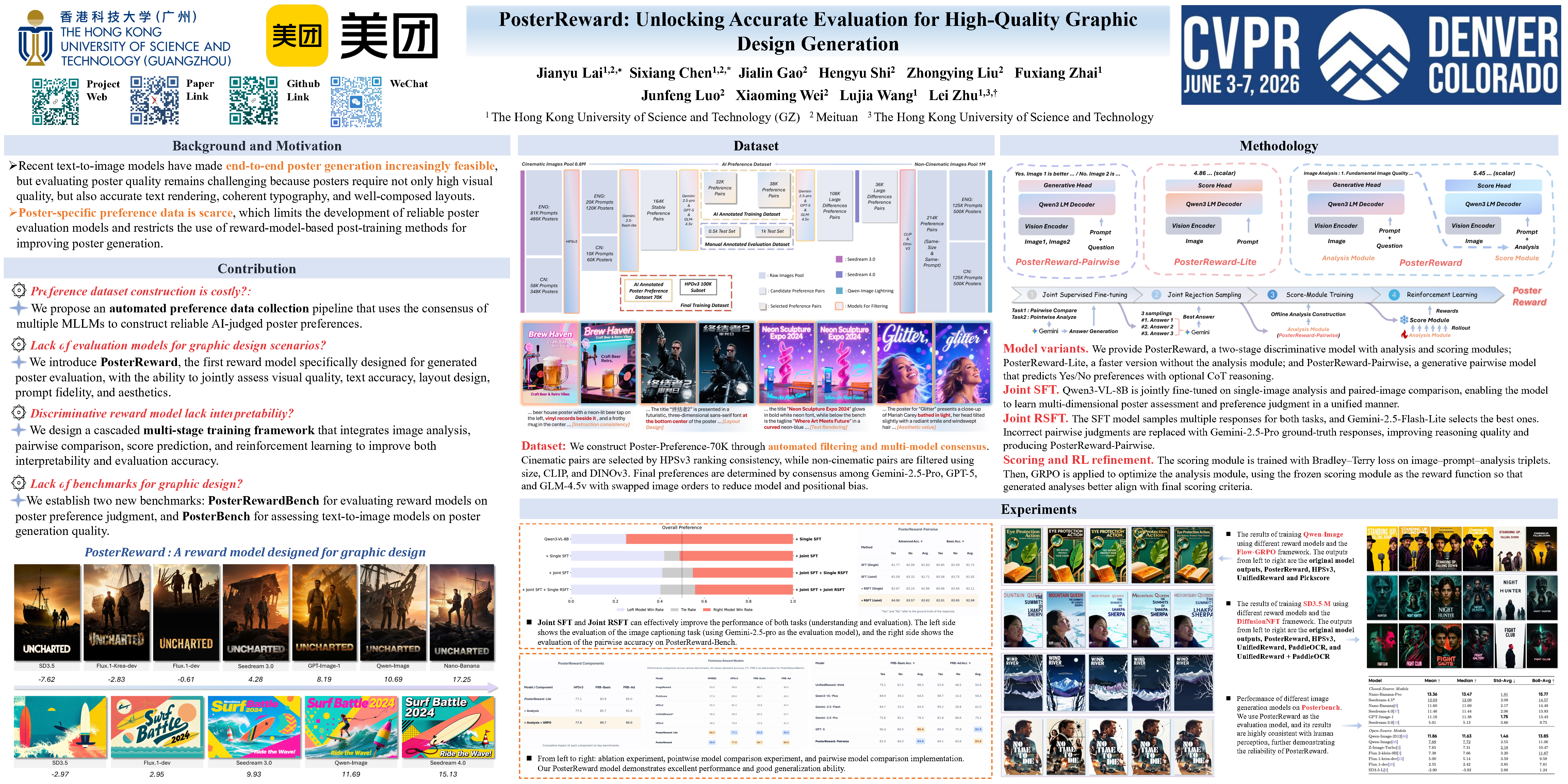
Recent advancements in the text-rendering capabilities of image generation models have made the end-to-end creation of graphic design content, such as posters, increasingly feasible. However, existing reward models fail to accurately assess the quality of graphic design. They primarily focus on global image aesthetics and lack the capacity to evaluate two other core elements of graphic design: typography and layout. Furthermore, current text-to-image preference datasets suffer from a scarcity of data related to graphic design, which hinders the further development of generative models in this domain.To address this gap, we have designed an automated pipeline to construct a high-quality dataset of 70k poster preferences. Subsequently, we have developed, a reward model capable of accurately assessing the quality of generated posters, by leveraging a cascaded, multi-stage training pipeline. We also provide multiple variants of the model to cater to different application scenarios. Finally, we introduce and to evaluate the performance of existing reward models in poster assessment and the capabilities of current image generation models in poster creation, respectively.
Scone: Bridging Composition and Distinction in Subject-Driven Image Generation via Unified Understanding-Generation Modeling
Yuran Wang ⋅ Bohan Zeng ⋅ Chengzhuo Tong ⋅ Wenxuan Liu ⋅ Yang Shi ⋅ Xiaochen Ma ⋅ Hao Liang ⋅ Yuanxing Zhang ⋅ Wentao Zhang
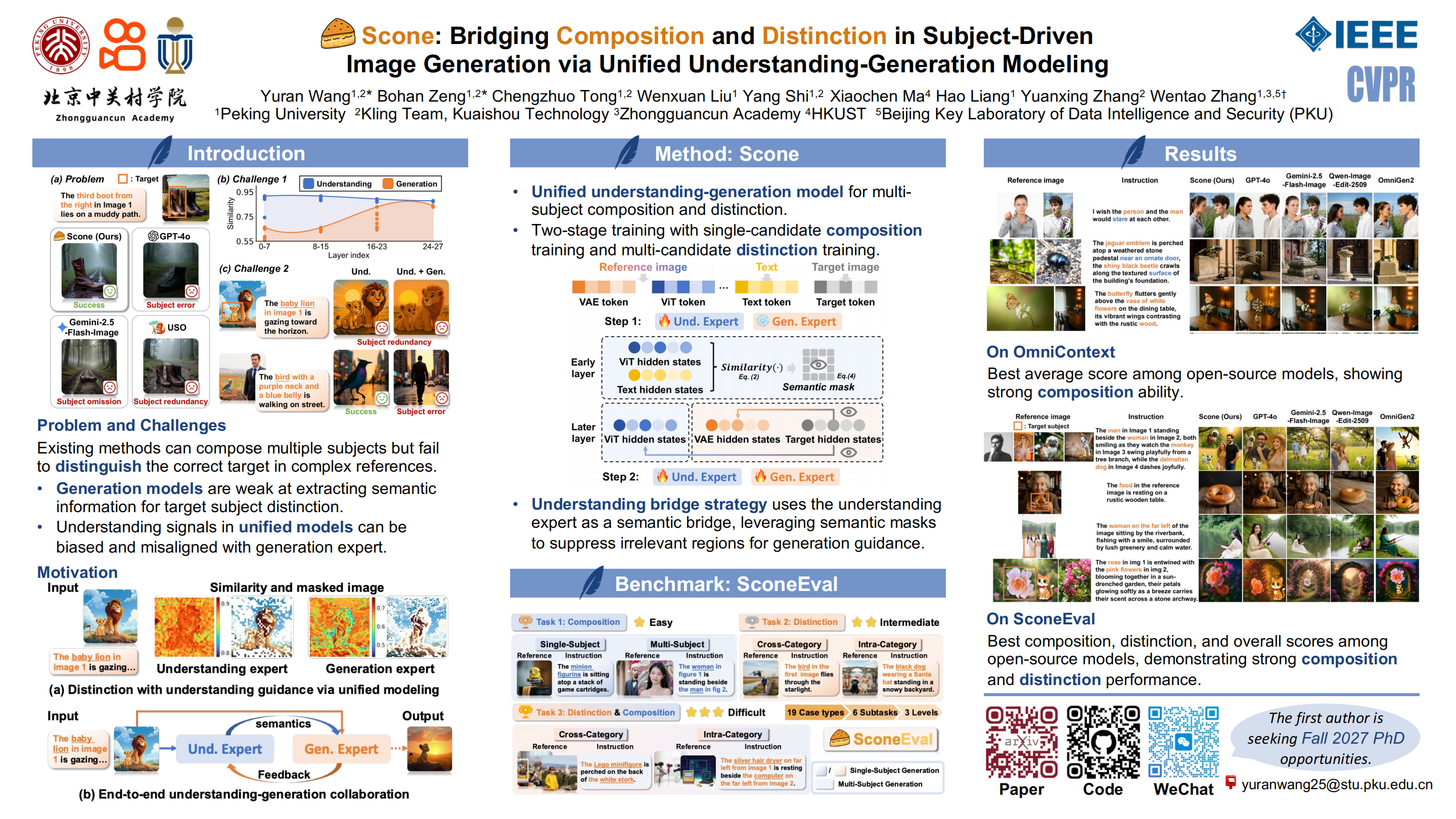
Subject-driven image generation has advanced from single- to multi-subject composition, while neglecting distinction, the ability to identify and generate the correct subject when inputs contain multiple candidates. This limitation restricts effectiveness in realistic and complex visual settings. We propose Scone, a unified understanding-generation framework that integrates composition and distinction. Scone enables the understanding expert to act as a semantic bridge that conveys semantic information and guides the generation expert to preserve subject identity while reducing inference. A two-stage training scheme first learns composition and then strengthens distinction through semantic alignment and attention-based masking. We also introduce SconeEval, a benchmark designed to evaluate composition, distinction, and their combination across diverse scenarios. Experiments show that Scone outperforms existing open-source models in both composition and distinction tasks. Our model, benchmark, and training data will be open-sourced.
SLVMEval: Synthetic Meta Evaluation Benchmark for Text-to-Long Video Generation
Ryosuke Matsuda ⋅ Keito Kudo ⋅ Haruto Yoshida ⋅ Nobuyuki Shimizu ⋅ Jun Suzuki
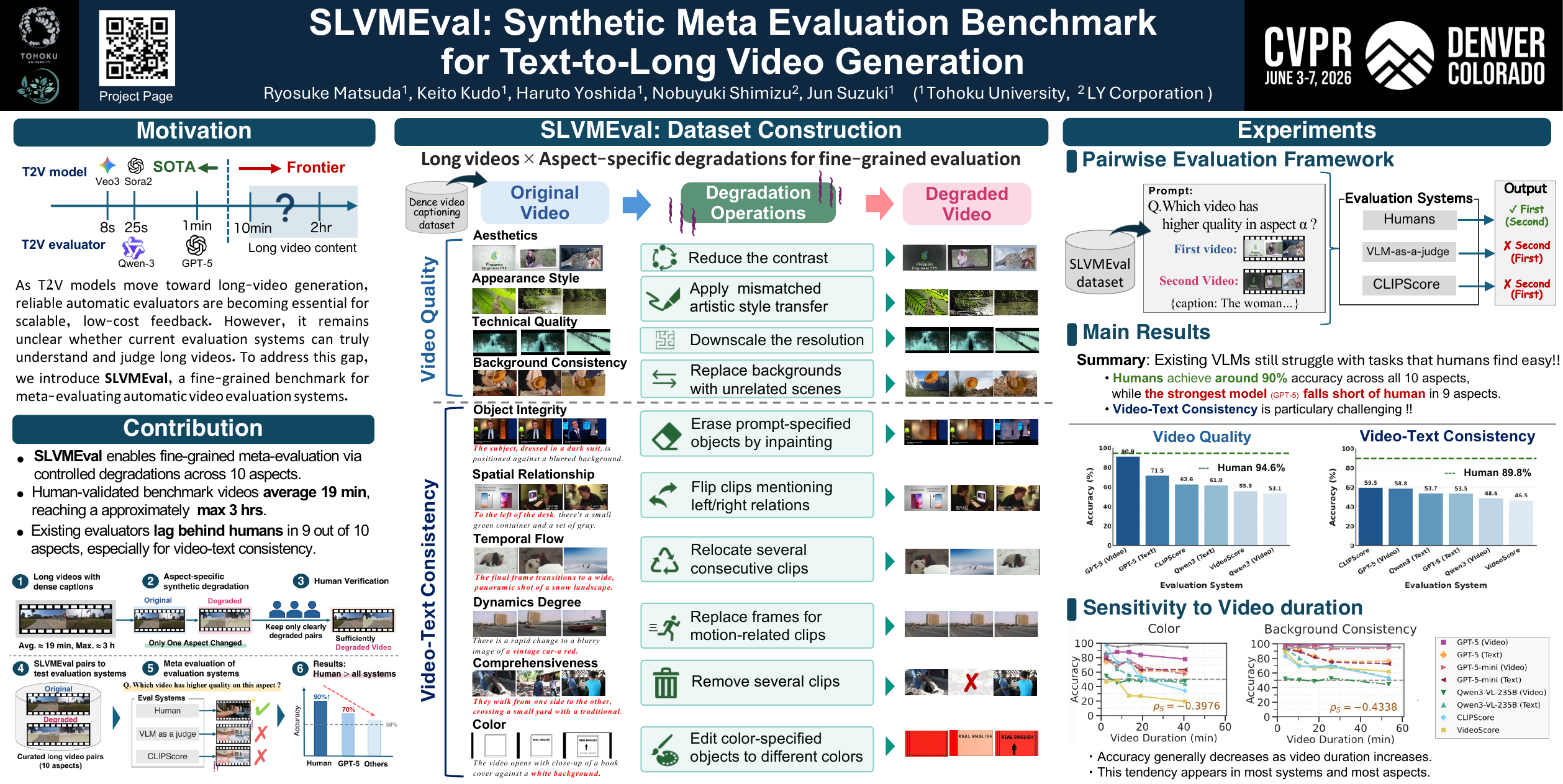
We introduce SLVMEval, a benchmark for meta-evaluating text-to-video (T2V) evaluation systems. SLVMEval focuses on assessing these systems on long videos of up to 10,486 seconds (approximately 3 hours). Our benchmark targets a fundamental requirement: whether systems can accurately judge video quality in settings that are easy for humans to assess. We adopt a pairwise comparison-based meta-evaluation framework.Building on dense video captioning datasets, we synthetically degrade source videos to create controlled ``high-quality vs. low-quality'' pairs across 10 distinct aspects. We then use crowdsourcing to filter and retain only those pairs in which the degradation is clearly perceptible, thereby establishing the final testbed. Using this testbed, we assess the reliability of existing evaluation systems in ranking these pairs. Our experiments show that human evaluators identify the better long video with 84.7\%--96.8\% accuracy, while in 9 of the 10 aspects, the accuracy of these systems falls short of human judgment, revealing weaknesses in text-to-long video evaluation.
PROMPTMINER: Black-Box Prompt Stealing against Text-to-Image Generative Models via Reinforcement Learning and VLM-Guided Optimization
Mingzhe Li ⋅ Renhao 'Norman' Zhang ⋅ Zhiyang Wen ⋅ Siqi Pan ⋅ Bruno da Silva ⋅ Juan Zhai ⋅ Shiqing Ma
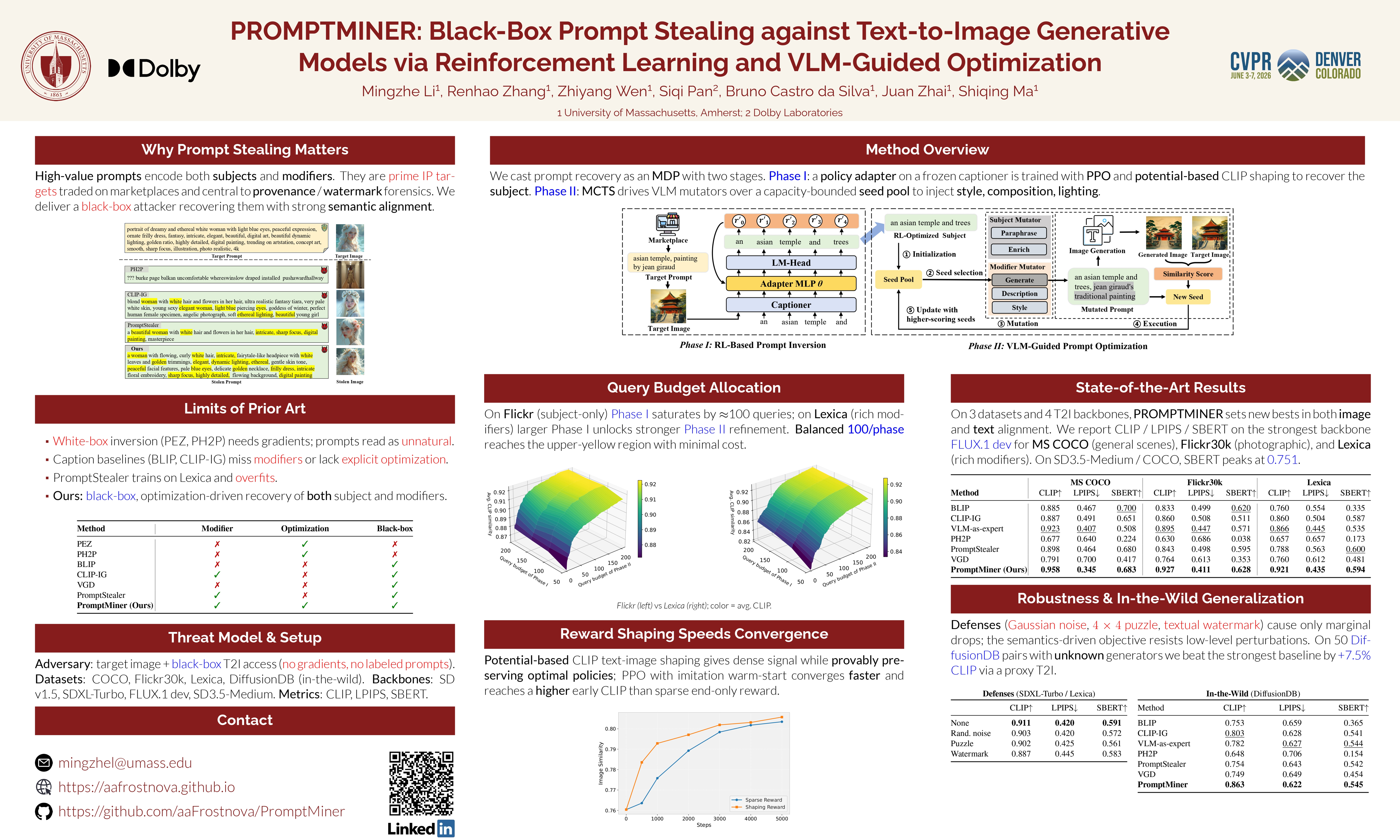
Text-to-image (T2I) generative models such as Stable Diffusion and FLUX can synthesize realistic, high-quality images directly from textual prompts. The resulting image quality depends critically on well-crafted prompts that specify both subjects and stylistic modifiers, which have become valuable digital assets. However, the rising value and ubiquity of high-quality prompts expose them to security and intellectual-property risks. One key threat is the prompt stealing attack, i.e., the task of recovering the textual prompt that generated a given image. Prompt stealing enables unauthorized extraction and reuse of carefully engineered prompts, yet it can also support beneficial applications such as data attribution, model provenance analysis, and watermarking validation. Existing approaches often assume white-box gradient access, require large-scale labeled datasets for supervised training, or rely solely on captioning without explicit optimization, limiting their practicality and adaptability. To address these challenges, we propose PROMPTMINER, a black-box prompt stealing framework that decouples the task into two phases: (1) a reinforcement learning–based optimization phase to reconstruct the primary subject, and (2) a fuzzing-driven search phase to recover stylistic modifiers. Experiments across multiple datasets and diffusion backbones demonstrate that PROMPTMINER achieves superior results, with CLIP similarity up to 0.958 and textual alignment with SBERT up to 0.751, surpassing all baselines. Even when applied to in-the-wild images with unknown generators, it outperforms the strongest baseline by 7.5% in CLIP similarity, demonstrating better generalization. Finally, PROMPTMINER maintains strong performance under defensive perturbations, highlighting remarkable robustness.
FlowDirector: Training-Free Flow Steering for Precise Text-to-Video Editing
Guangzhao Li ⋅ Yanming Yang ⋅ Chenxi Song ⋅ Xiaohong Liu ⋅ Chi Zhang
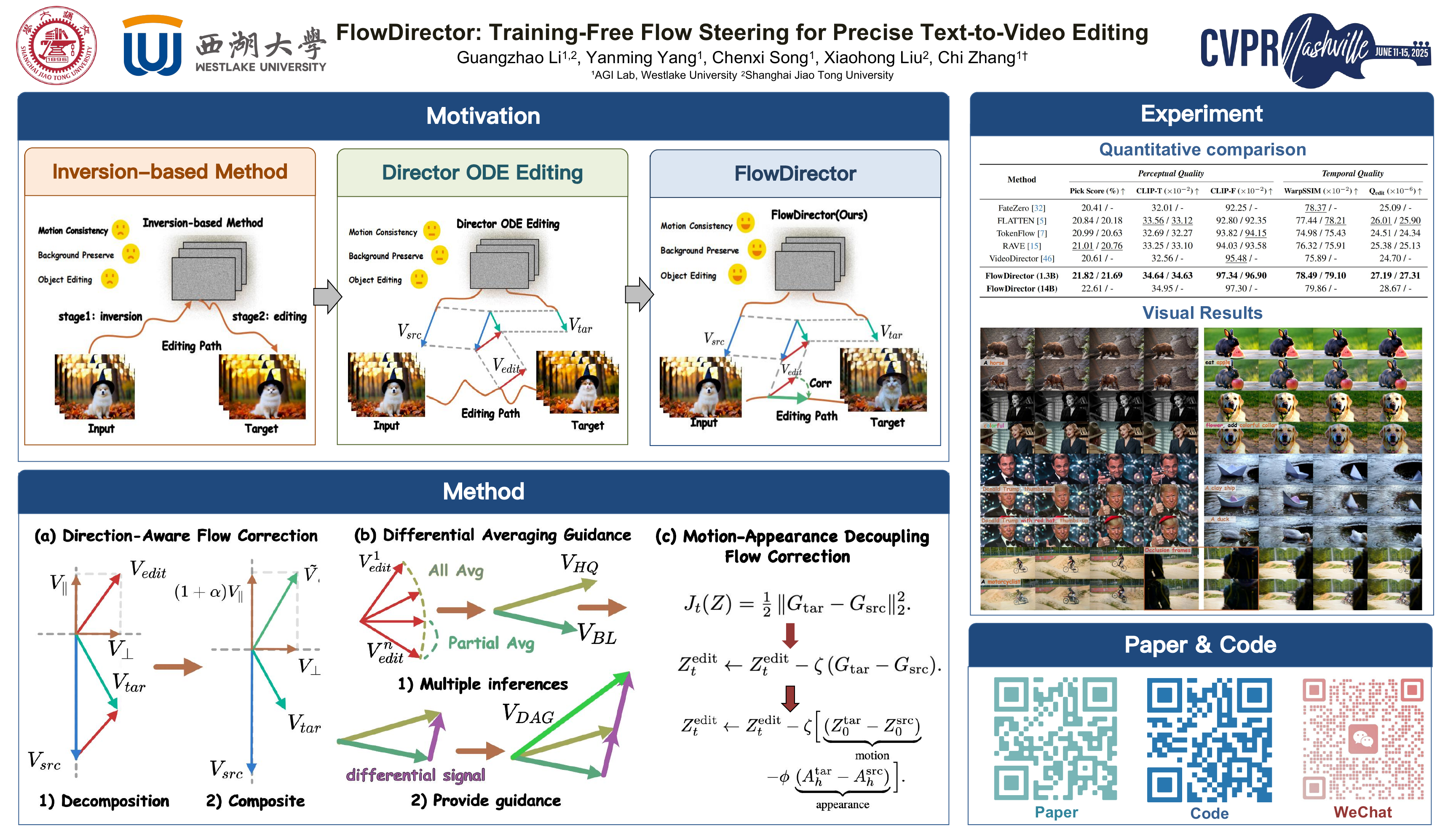
Text-driven video editing aims to modify video content based on natural language instructions. While recent training-free methods have leveraged pretrained diffusion models, they often rely on an inversion-editing paradigm. This paradigm maps the video to a latent space before editing. However, the inversion process is not perfectly accurate, often compromising appearance fidelity and motion consistency.To address this, we introduce FlowDirector, a novel training-free and inversion-free video editing framework. Our framework models the editing process as a direct evolution in the data space. It guides the video to transition smoothly along its inherent spatio-temporal manifold using an ordinary differential equation (ODE), thereby avoiding the inaccurate inversion step. From this foundation, we introduce three flow correction strategies for appearance, motion, and stability: 1) Direction-aware flow correction amplifies components that oppose the source direction and removes irrelevant terms, breaking conservative streamlines and enabling stronger structural and textural changes. 2) Motion–appearance decoupling optimizes motion agreement as an energy term at each timestep, significantly improving consistency and motion transfer. 3) Differential averaging guidance strategy leverages differences among multiple candidate flows to approximate a low variance regime at low cost, suppressing artifacts and stabilizing the trajectory. Extensive experiments across various editing tasks and benchmarks demonstrate that FlowDirector achieves state-of-the-art performance in instruction following, temporal consistency, and background preservation, establishing an efficient new paradigm for coherent video editing without inversion.
Self-Evaluation Unlocks Any-Step Text-to-Image Generation
Xin Yu ⋅ Xiaojuan Qi ⋅ Zhengqi Li ⋅ Kai Zhang ⋅ Richard Zhang ⋅ Zhe Lin ⋅ Eli Shechtman ⋅ Tianyu Wang ⋅ Yotam Nitzan
We introduce the Self-Evaluating Model (Self-E), a novel, from-scratch training approach for text-to-image generation that supports any-step inference. Self-E learns from data similarly to a Flow Matching model, while simultaneously employing a novel self-evaluation mechanism: it evaluates its own generated samples using its current score estimates, effectively serving as a dynamic self-teacher. Unlike traditional diffusion or flow models, it does not rely solely on local supervision, which typically necessitates many inference steps. Unlike distillation-based approaches, it does not require a pretrained teacher. This combination of instantaneous local learning and self-driven global matching bridges the gap between the two paradigms, enabling the training of a high-quality text-to-image model from scratch that excels even at very low step counts. Extensive experiments on large-scale text-to-image benchmarks show that Self-E not only excels in few-step generation, but is also competitive with state-of-the-art Flow Matching models at 50 steps. We further find that its performance improves monotonically as inference steps increase, enabling both ultra-fast few-step generation and high-quality long-trajectory sampling within a single unified model. To our knowledge, Self-E is the first from-scratch, any-step text-to-image model, offering a unified framework for efficient and scalable generation.
Say Cheese! Detail-Preserving Portrait Collection Generation via Natural Language Edits
Zelong Sun ⋅ Jiahui Wu ⋅ Ying Ba ⋅ Dong Jing ⋅ Zhiwu Lu
As social media platforms proliferate, users increasingly demand intuitive ways to create diverse, high-quality portrait collections. In this work, we introduce Portrait Collection Generation (PCG), a novel task that generates coherent portrait collections by editing a reference portrait image through natural language instructions. This task poses two unique challenges to existing methods: (1) complex multi-attribute modifications such as pose, spatial layout, and camera viewpoint; and (2) high-fidelity detail preservation including identity, clothing, and accessories. To address these challenges, we propose CHEESE, the first large-scale PCG dataset containing 24K portrait collections and 573K samples with high-quality modification text annotations, constructed through an Large Vison-Language Model-based pipeline with inversion-based verification. We further propose SCheese, a framework that combines text-guided generation with hierarchical identity and detail preservation. SCheese employs adaptive feature fusion mechanism to maintain identity consistency, and ConsistencyNet to inject fine-grained features for detail consistency. Comprehensive experiments validate the effectiveness of CHEESE in advancing PCG, with SCheese achieving state-of-the-art performance in handling complex edits with identity and fine-grained details consistency.
LVLM-Aided Alignment of Task-Specific Vision Models
Alexander Koebler ⋅ Lukas Kuhn ⋅ Ingo Thon ⋅ Florian Buettner
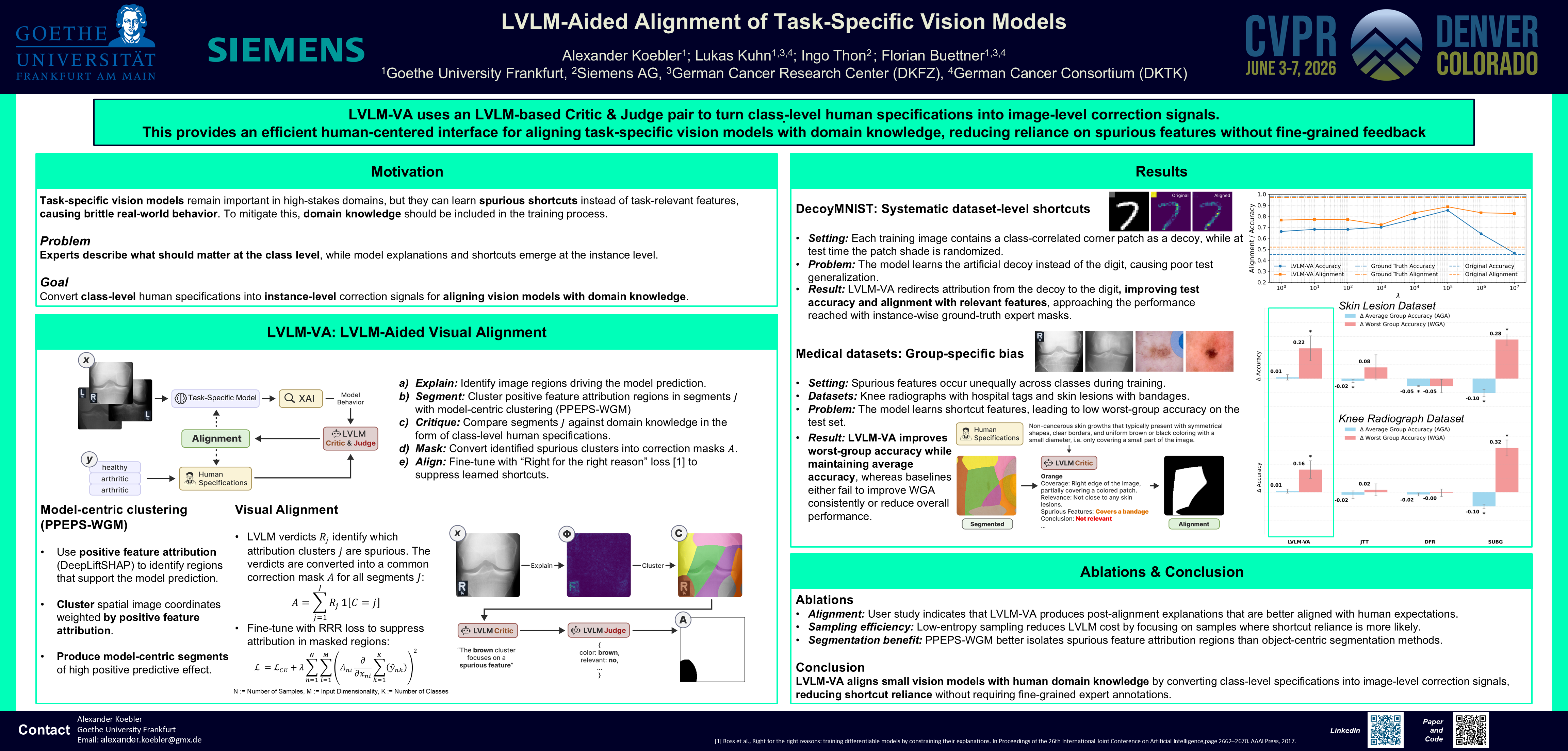
In high-stakes domains, small task-specific vision models are crucial due to their low computational requirements and the availability of numerous methods to explain their results. However, these explanations often reveal that the models do not align well with human domain knowledge, relying instead on spurious correlations. This might result in brittle behavior once deployed in the real-world. To address this issue, we introduce a novel and efficient method for aligning small task-specific vision models with human domain knowledge by leveraging the generalization capabilities of a Large Vision Language Model (LVLM). Our LVLM-Aided Visual Alignment (LVLM-VA) method provides a bidirectional interface that translates model behavior into natural language and maps human class-level specifications to image-level critiques, enabling effective interaction between domain experts and the model. Our method demonstrates substantial improvement in aligning model behavior with human specifications, as validated on both synthetic and real-world datasets. We show that it effectively reduces the model’s dependence on spurious features and on group-specific biases, without requiring fine-grained feedback.
DeepAlign: Mitigating Modality Conflict through Modality-Specific Alignment
Shuo Li ⋅ Bingchen Miao ⋅ Wendong Bu ⋅ Juncheng Li ⋅ Hanwang Zhang ⋅ Fei Wu
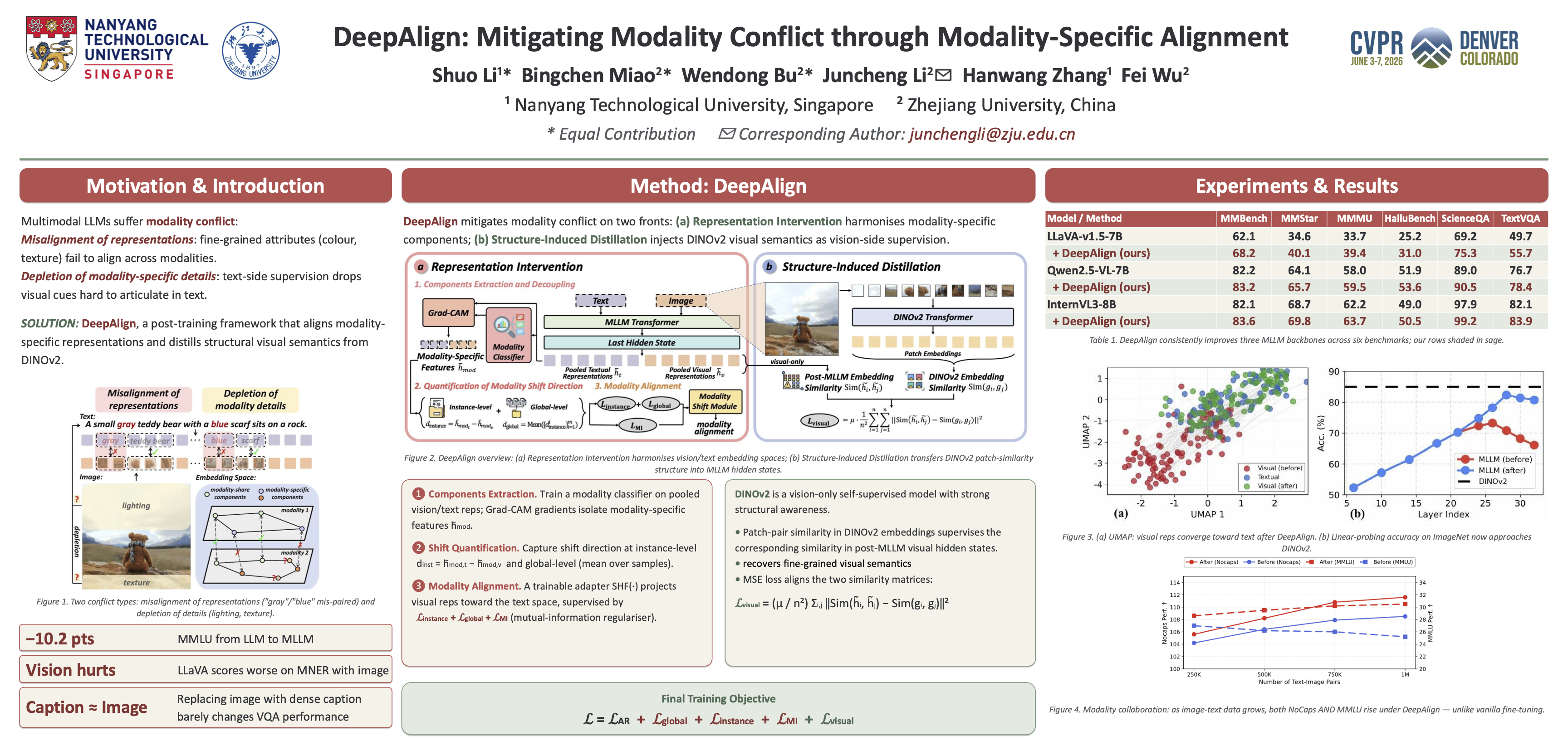
Multimodal Large Language Models (MLLMs) have demonstrated promising advancements in augmenting the capabilities of LLMs to comprehend visual input. However, modality misalignment between vision and text remains a key challenge in MLLM, which can be attributed to two aspects: misalignment of modality-specific representations and depletion of modality-specific details. To address the issue of modality misalignment, we propose DeepAlign, a novel multimodal alignment framework to mitigate modality conflict, which employs representation intervention and structure-induced knowledge distillation to prevent the misalignment and depletion of modality-specific information. Extensive experiments demonstrate that DeepAlign significantly mitigates modality conflicts, leading to substantial performance improvements compared to backbone models across multiple vision-language tasks. It also stimulates some emergent abilities in MLLMs, such as multimodal in-context learning on interleaved text-image sequences.
PG-VTON: Single-Pass Training-Free Virtual Try-On via Patch-Guided Reference Alignment
Guohao Zhao ⋅ Yuxin Peng
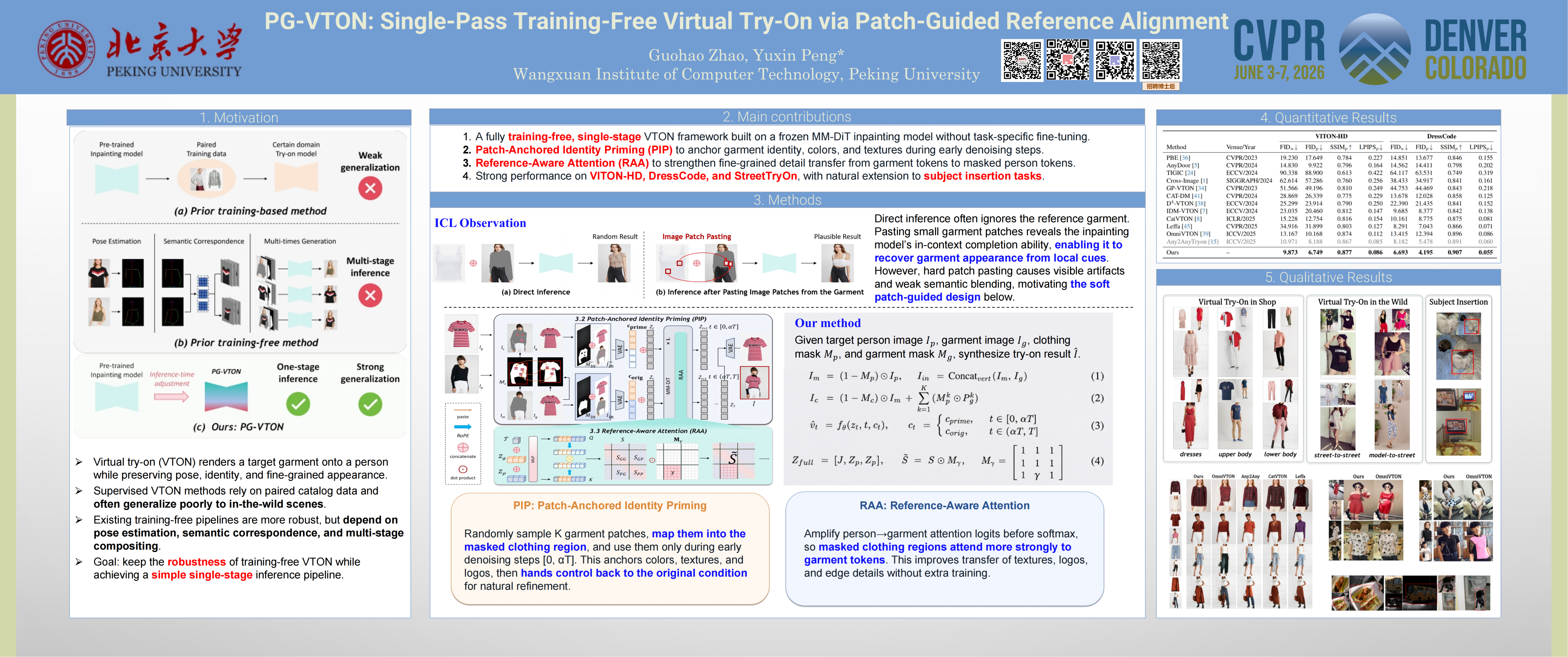
Virtual try-on (VTON) aims to render a target garment onto a person while preserving pose, identity, and fine-grained appearance. Most existing methods rely on supervised paired data, limiting cross-domain generalization, while recent training-free approaches, though more robust, require multiple diffusion calls and complex compositing, making deployment impractical. We propose PG-VTON, a single-pass, training-free framework based on Patch-Guided Reference Alignment. Our key insight is that modern inpainting diffusion models already possess strong in-context completion: given a masked person and a small garment patch, they can synthesize plausible, pose-consistent clothing without task-specific training. PG-VTON exploits this capability with two lightweight components: Patch-Anchored Identity Priming (PIP) injects a localized garment patch only in early denoising steps to anchor garment identity, and Reference-Aware Attention (RAA) strengthens attention from masked-region tokens to garment tokens to enhance detail transfer, all without modifying model weights. With a single diffusion pass, PG-VTON achieves state-of-the-art performance among training-free methods on DressCode and VITON-HD and generalizes effectively to subject insertion.
Linguistic Priors for Visual Decoupling: Towards Symmetric Vision-Brain Alignment
Dongjun Liu ⋅ Weichen Dai ⋅ Jingsheng Qian ⋅ Honggang Liu ⋅ Hangjie Yi ⋅ Wanzeng Kong
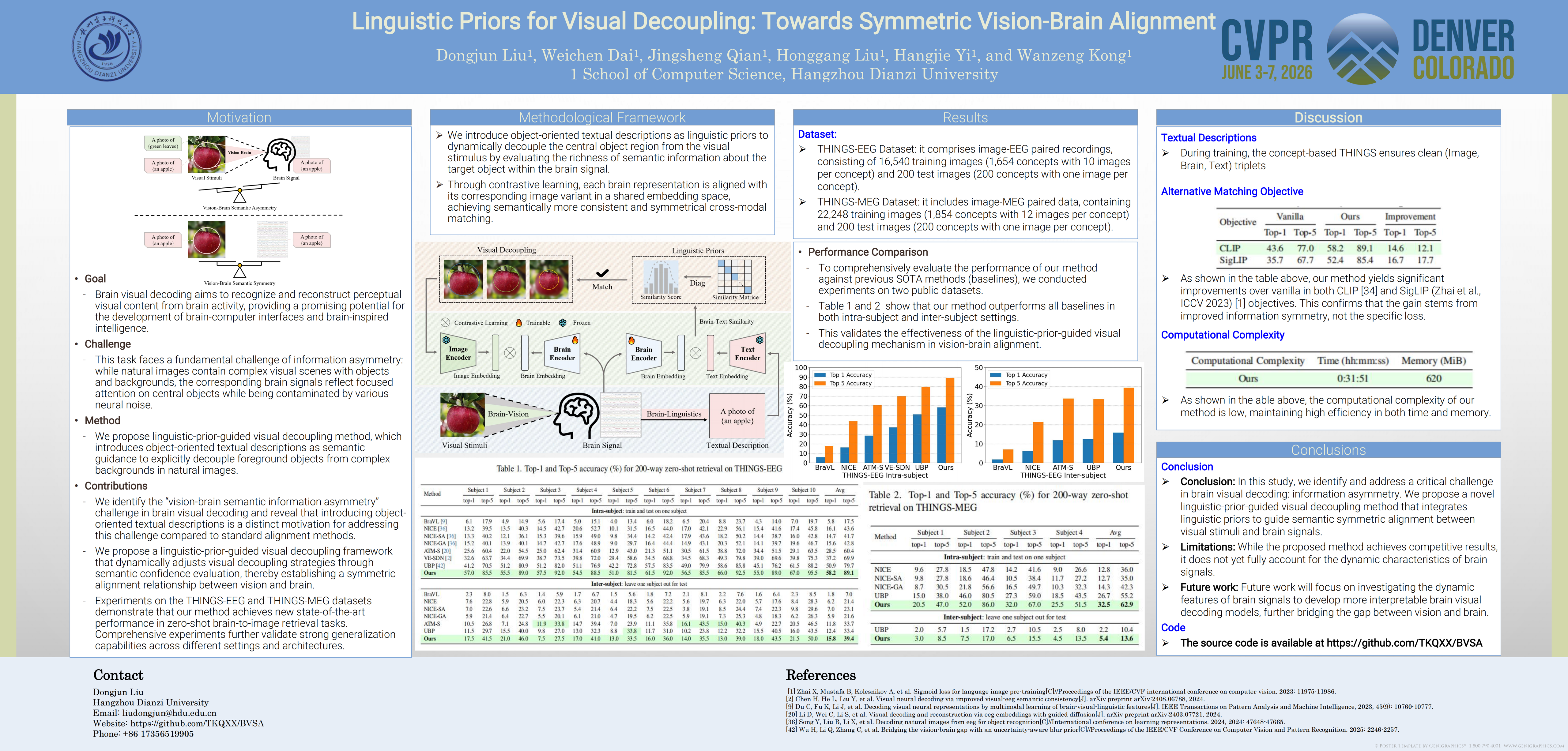
Brain visual decoding aims to recognize and reconstruct perceptual visual content from neural activity, representing a promising avenue for developing brain-computer interfaces and building brain-inspired artificial intelligence. However, this task faces a fundamental challenge of information asymmetry: while natural images contain complex visual scenes with objects and backgrounds, the corresponding brain signals reflect focused attention on central objects while being contaminated by various neural noise. Previous methods that directly align visual and brain representations often overlook this inherent asymmetry, resulting in suboptimal decoding performance. To address this, we propose linguistic-prior-guided visual decoupling method, which introducing object-oriented textual descriptions as semantic guidance to explicitly decouple foreground objects from complex backgrounds in natural images, thereby establishing symmetric vision-brain alignment. This design enables the model to automatically focus on task-relevant visual concepts while effectively filtering out irrelevant neural noise in brain signals, achieving a transition from asymmetric feature alignment to semantic symmetric alignment. Extensive experiments on the THINGS-EEG and THINGS-MEG datasets demonstrate that our method achieves new state-of-the-art performance in the zero-shot brain-to-image retrieval task.
Scaling Spatial Intelligence with Multimodal Foundation Models
Zhongang Cai ⋅ Wang Ruisi ⋅ Chenyang Gu ⋅ Fanyi Pu ⋅ Junxiang Xu ⋅ YUBO WANG ⋅ Wanqi Yin ⋅ Zhitao Yang ⋅ Chen Wei ⋅ Tongxi Zhou ⋅ Qingping SUN ⋅ Hui En Pang ⋅ Jiaqi Li ⋅ Oscar Qian ⋅ Zhiqian Lin ⋅ Xuanke Shi ⋅ Kewang Deng ⋅ Xiaoyang Han ⋅ Zukai Chen ⋅ Xiangyu Fan ⋅ Hanming Deng ⋅ Lewei Lu ⋅ Liang Pan ⋅ Bo Li ⋅ Ziwei Liu ⋅ Quan Wang ⋅ Dahua Lin ⋅ Lei Yang
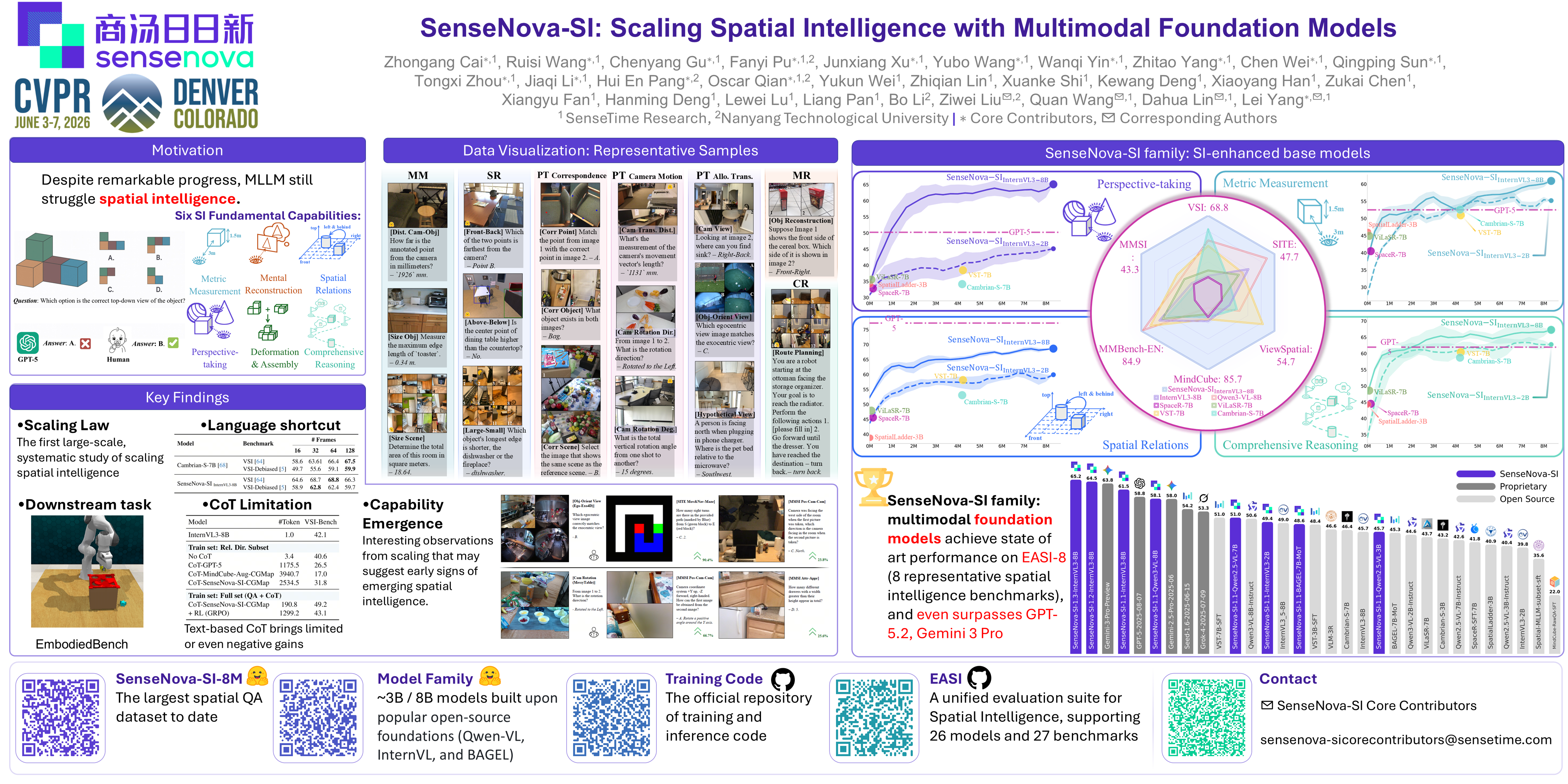
Despite remarkable progress, multimodal foundation models still exhibit surprising deficiencies in spatial intelligence. In this work, we explore scaling up multimodal foundation models to cultivate spatial intelligence within the SSI family, built upon established multimodal foundations including visual understanding models (i.e., Qwen3-VL and InternVL3) and unified understanding and generation models (i.e., Bagel). We take a principled approach to constructing high-performing and robust spatial intelligence by systematically curating SSI-8M: eight million diverse data samples under a rigorous taxonomy of spatial capabilities. SSI demonstrates unprecedented performance across a broad range of spatial intelligence benchmarks: 68.7% on VSI-Bench, 43.3% on MMSI, 85.6% on MindCube, and 54.6% on ViewSpatial, while maintaining strong general multimodal understanding (e.g., 84.9% on MMBench-En). More importantly, we analyze the impact of data scaling, discuss early signs of emergent generalization capabilities enabled by diverse data training, analyze the risk of overfitting and language shortcuts, present a preliminary study on spatial chain-of-thought reasoning, and validate the potential downstream application. All newly trained multimodal foundation models are publicly released to facilitate further research in this direction.
R-4B: Incentivizing General-Purpose Auto-Thinking Capability in MLLMs via Bi-Mode Annealing and Reinforce Learning
Qi Yang ⋅ Bolin Ni ⋅ Shiming Xiang ⋅ Houwen Peng
Multimodal Large Language Models (MLLMs) with explicit step-by-step reasoning have achieved strong performance on complex tasks. However, such reasoning is unnecessary for many simple queries and introduces substantial computational overhead. To address this inefficiency, we present R-4B, an auto-thinking MLLM that dynamically determines whether to invoke the reasoning process based on input complexity.Our key idea is to equip a single model with both thinking and non-thinking capabilities and train it to select the appropriate mode. We first introduce bi-mode annealing, a unified training paradigm that constructs a model competent in both reasoning-intensive and direct-answer settings without requiring explicit complexity annotations. Building on this foundation, we propose Bi-mode Policy Optimization (BPO), a lightweight reinforcement learning algorithm that employs a dual-rollout mechanism: for each input, the model generates both thinking and non-thinking responses. This prevents mode collapse and enables robust learning of an adaptive reasoning policy using only simple, rule-based rewards.Extensive experiments across 25 benchmarks show that R-4B achieves state-of-the-art performance among models of similar scale. It consistently surpasses Qwen2.5-VL-7B and matches or exceeds larger models such as Kimi-VL-A3B-Thinking-2506 (16B) on reasoning-intensive tasks, while reducing computational cost by avoiding redundant reasoning. Our results demonstrate that adaptive auto-thinking offers an effective and scalable pathway toward more efficient multimodal reasoning models.
SafeGRPO: Self-Rewarded Multimodal Safety Alignment via Rule-Governed Policy Optimization
Xuankun Rong ⋅ Wenke Huang ⋅ Tingfeng Wang ⋅ Daiguo Zhou ⋅ Bo Du ⋅ Mang Ye
Multimodal large language models (MLLMs) have demonstrated impressive reasoning and instruction-following capabilities, yet their expanded modality space introduces new compositional safety risks that emerge from complex text–image interactions.Such cross-modal couplings can produce unsafe semantics even when individual inputs are benign, exposing the fragile safety awareness of current MLLMs.While recent works enhance safety by guiding models to reason about potential risks, unregulated reasoning traces may compromise alignment; although Group Relative Policy Optimization (GRPO) offers self-rewarded refinement without human supervision, it lacks verifiable signals for reasoning safety.To address this, we propose SafeGRPO a self-rewarded multimodal safety alignment framework that integrates rule-governed reward construction into GRPO, enabling interpretable and verifiable optimization of reasoning safety. Built upon the constructed SafeTag-VL-3K dataset with explicit visual, textual, and combined safety tags, SafeGRPO performs step-guided safety thinking to enforce structured reasoning and behavior alignment, substantially improving multimodal safety awareness, compositional robustness, and reasoning stability across diverse benchmarks without sacrificing general capabilities.
AVATAR: Reinforcement Learning to See, Hear, and Reason Over Video
Yogesh Kulkarni ⋅ Pooyan Fazli
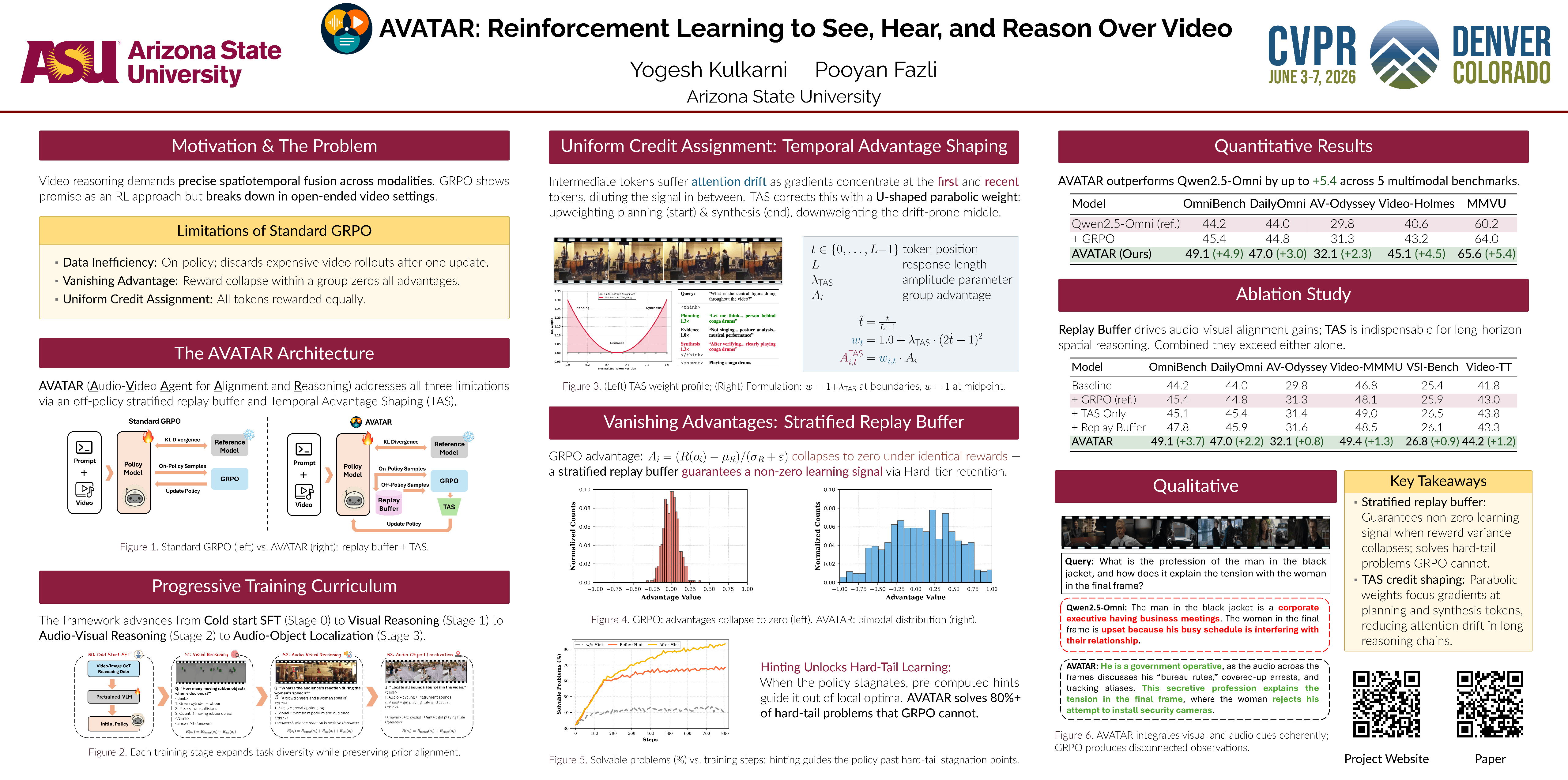
Multimodal reasoning over long-horizon video is challenging due to the need for precise spatiotemporal fusion and alignment across modalities. While recent methods such as Group Relative Policy Optimization (GRPO) have shown promise in this domain, they suffer from three key limitations: (1) data inefficiency from their on-policy design, (2) a vanishing advantage problem, where identical or near-identical rewards within a group eliminate the learning signal by producing zero-valued advantages, and (3) uniform credit assignment that fails to emphasize critical reasoning steps.We introduce $\textbf{AVATAR}$ ($\textbf{A}$udio-$\textbf{V}$ideo $\textbf{A}$gen$\textbf{t}$ for $\textbf{A}$lignment and $\textbf{R}$easoning), a framework that addresses these limitations through two core components: (1) an off-policy training architecture that improves sample efficiency and resolves vanishing advantages by reusing past experiences with greater reward diversity, and (2) Temporal Advantage Shaping (TAS), a novel credit assignment strategy that upweights key reasoning phases during learning.$\textbf{AVATAR}$ achieves strong performance across various benchmarks, outperforming the Qwen2.5-Omni baseline by $\textbf{+5.4}$ on MMVU, $\textbf{+4.9}$ on OmniBench, and $\textbf{+4.5}$ on Video-Holmes, while demonstrating $\textbf{5$\times$ sample efficiency}$, requiring $80$% fewer generated completions to reach target performance.
CogniVerse: Revolutionizing Multi-Modal Retrieval-Augmented Generation with Cognitive Reflection and Geometric Reasoning
Xiang Fang ⋅ Wanlong Fang ⋅ Changshuo Wang
Multi-modal Retrieval-Augmented Generation (MMRAG) has emerged as a powerful paradigm for enhancing Multimodal Large Language Models (MLLMs) in knowledge-intensive question answering by integrating external visual, textual, and structural knowledge. However, existing MMRAG frameworks suffer from critical limitations, including noisy and irrelevant retrieval, cross-modal semantic misalignment, lack of adaptive reasoning, and incoherent generation across local and global contexts. We introduce \textbf{CogniVerse}, a novel MMRAG framework that addresses these challenges through a cognitive-inspired, mathematically rigorous approach. Drawing from human-like reasoning, CogniVerse integrates three synergistic components: (1) a Cognitive Reflection Module (CRM) that dynamically assesses retrieval necessity and filters relevant multi-modal content, reducing noise and computational overhead; (2) a Multi-modal Retrieval Module that aligns embeddings in a Riemannian manifold using information geometry and refines knowledge graphs via spectral graph theory, ensuring precise and coherent retrieval; and (3) a Hierarchical Generation Module that employs an optimal transport-based loss to balance token-level accuracy and global semantic coherence. Grounded in advanced theoretical frameworks, including convergence guarantees for geometric alignment and spectral optimization, CogniVerse achieves robust cross-modal integration and adaptive knowledge utilization. Extensive experiments on benchmark multi-modal question answering datasets demonstrate that CogniVerse significantly outperforms state-of-the-art MMRAG systems in both accuracy and coherence, while reducing retrieval latency.
FOZO: Forward-Only Zeroth-Order Prompt Optimization for Test-Time Adaptation
Xingyu Wang ⋅ Tao Wang
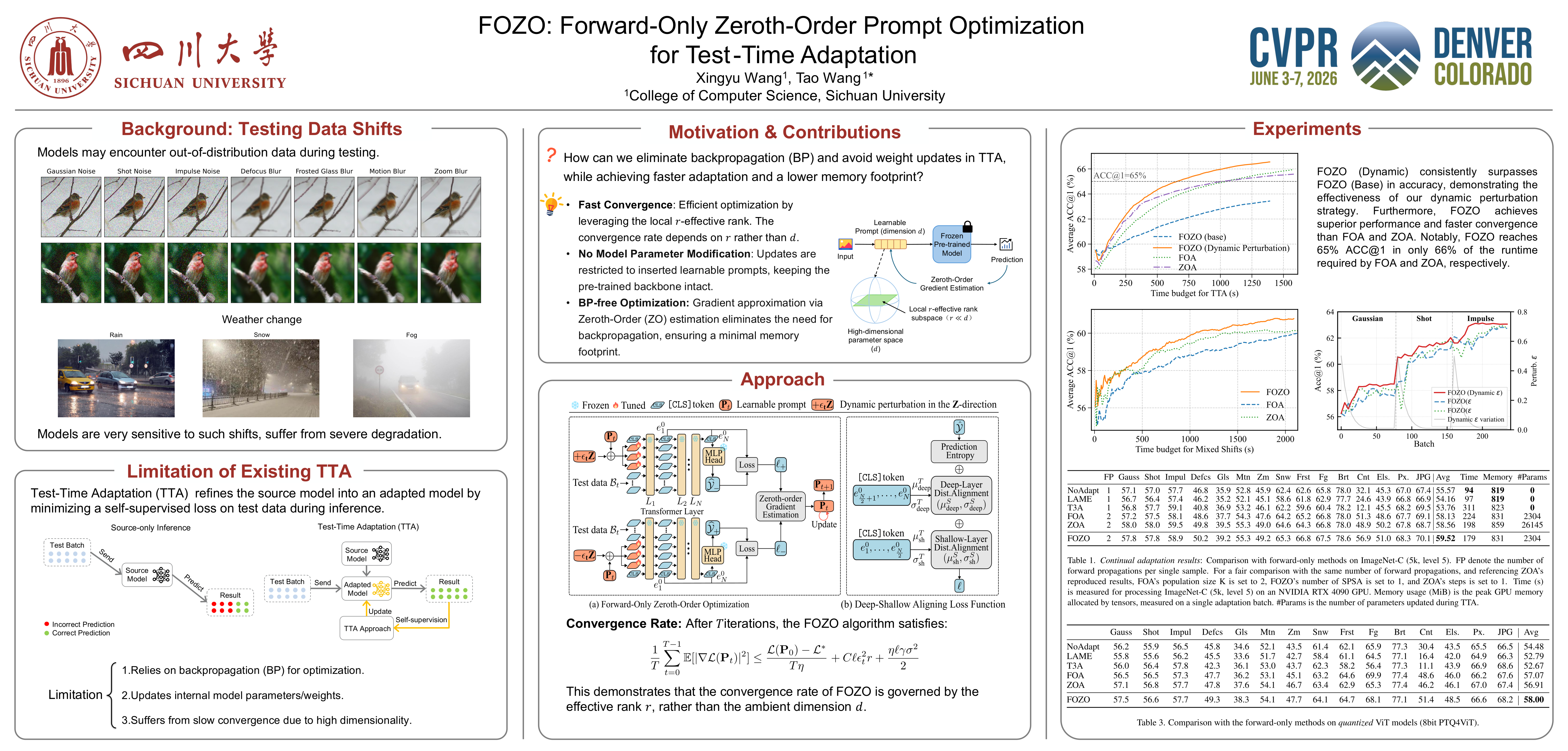
Test-Time Adaptation (TTA) is essential for enabling deep learning models to handle real-world data distribution shifts. However, current approaches face significant limitations: backpropagation-based methods are not suitable for low-end deployment devices, due to their high computation and memory requirements, as well as their tendency to modify model weights during adaptation; while traditional backpropagation-free techniques exhibit constrained adaptation capabilities.In this work, we propose Forward-Only Zeroth-Order Optimization (FOZO), a novel and practical backpropagation-free paradigm for TTA. FOZO leverages a memory-efficient zeroth-order prompt optimization, which is led by objectives optimizing both intermediate feature statistics and prediction entropy.To ensure efficient and stable adaptation over the out-of-distribution data stream, we introduce a dynamically decaying perturbation scale during zeroth-order gradient estimation and theoretically prove its convergence under the TTA data stream assumption. Extensive continual adaptation experiments on ImageNet-C, ImageNet-R, and ImageNet-Sketch demonstrate FOZO's superior performance, achieving 59.52\% Top-1 accuracy on ImageNet-C (5K, level 5) and outperforming main gradient-based methods and SOTA forward-only FOA (58.13\%). Furthermore, FOZO exhibits strong generalization on quantized (INT8) models. These findings demonstrate that FOZO is a highly competitive solution for TTA deployment in resource-limited scenarios.
Language Does Matter for Cross-Domain Few-Shot Visual Feature Enhancement
Fei Zhou ⋅ Xiwen Zhang ⋅ Qingqing Qiu ⋅ Lei Zhang ⋅ Wei Wei ⋅ Chen Ding ⋅ Yi Zhang ⋅ Liang Li ⋅ Xiangyu Yue ⋅ Yanning Zhang
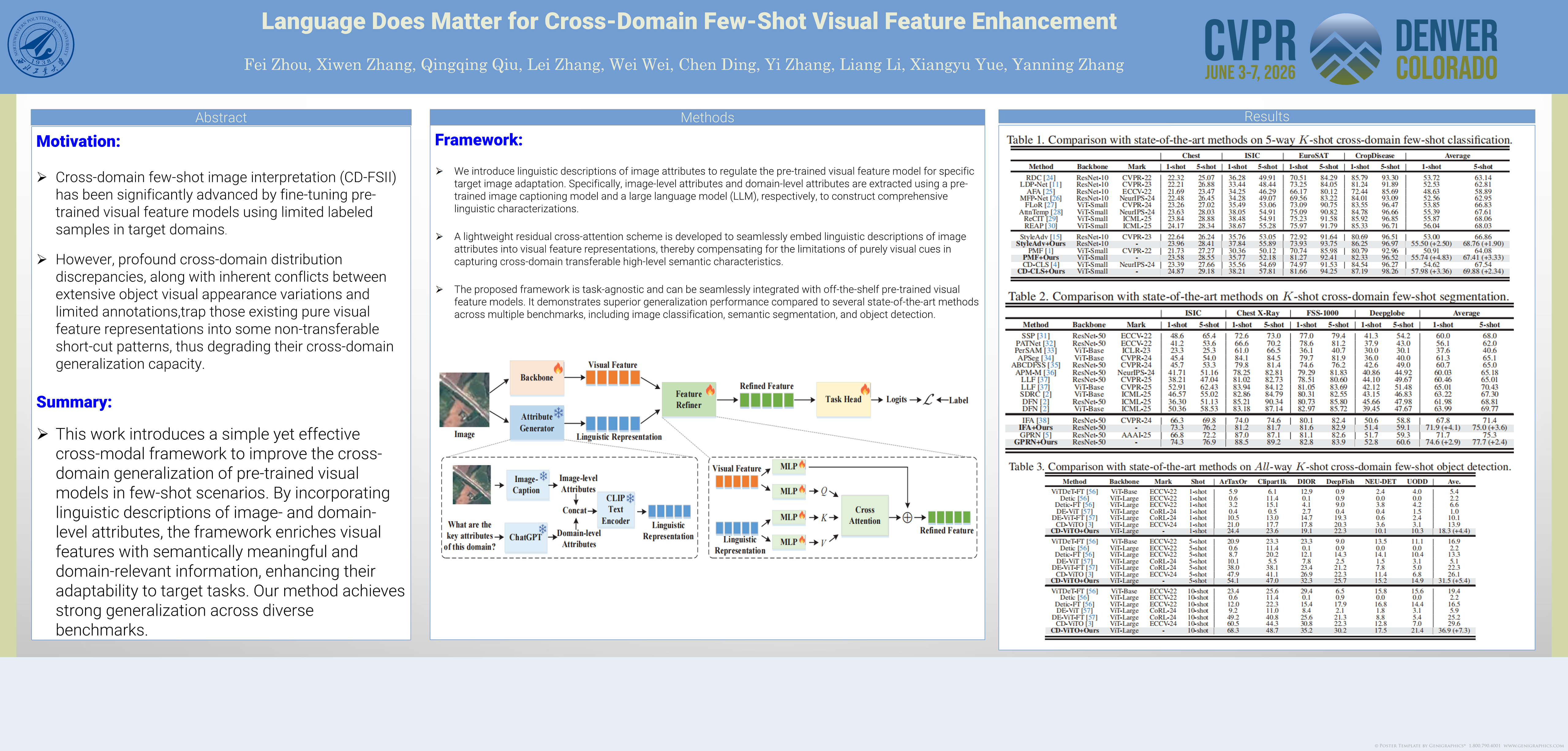
Cross-domain few-shot image interpretation (CD-FSII) has been significantly advanced by fine-tuning pre-trained visual feature models using limited labeled samples in target domains. However, profound cross-domain distribution discrepancies, along with inherent conflicts between extensive object visual appearance variations and limited annotations, trap those existing pure visual feature representations into some non-transferable short-cut patterns, thus degrading their cross-domain generalization capacity. To mitigate this problem, we present a simple yet effective cross-modal visual feature enhancement framework which primarily contributes in the following three aspects. 1) We make the first attempt to introduce linguistic descriptions of image attributes to regulate the pre-trained visual feature model for specific target image adaptation. Specifically, image-level attributes (e.g., object appearance in individual images) and domain-level attributes (e.g., overall style and background characteristics of the dataset) are extracted using a pre-trained image captioning model and a large language model (LLM), respectively, to construct comprehensive linguistic characterizations. 2) A lightweight residual cross-attention scheme is developed to seamlessly embed linguistic descriptions of image attributes into visual feature representations, thereby compensating for the limitations of purely visual cues in capturing cross-domain transferable high-level semantic characteristics. 3) The proposed framework is task-agnostic and can be seamlessly integrated with off-the-shelf pre-trained visual feature models. It demonstrates superior generalization performance compared to several state-of-the-art methods across multiple CD-FSII benchmarks, including image classification, semantic segmentation, and object detection. We will release all code and data to facilitate further research.
Back to Source: Open-Set Continual Test-Time Adaptation via Domain Compensation
Yingkai Yang ⋅ Chaoqi Chen ⋅ Hui Huang
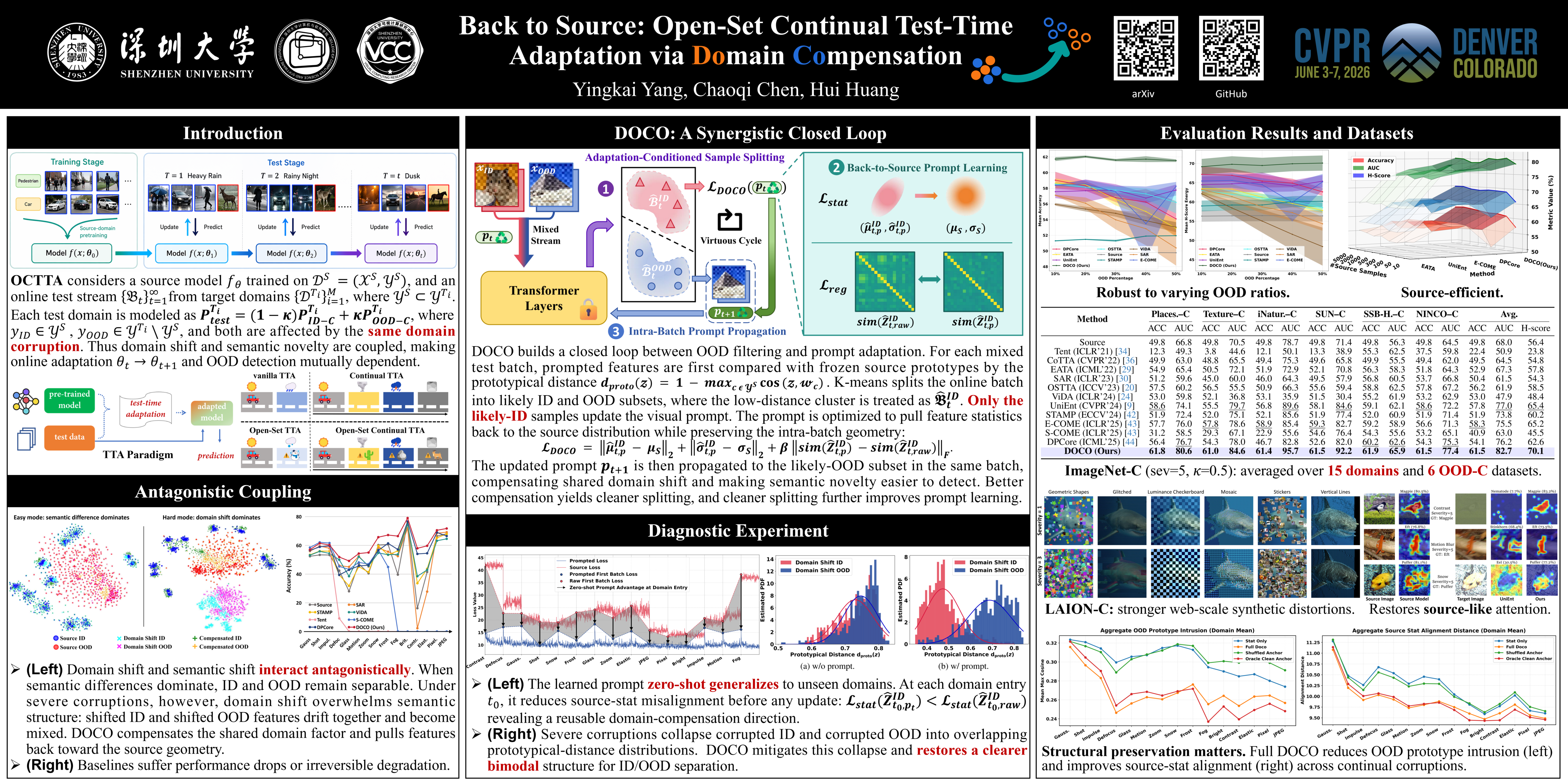
Test-Time Adaptation (TTA) aims to mitigate distributional shifts between training and test domains during inference time. However, existing TTA methods fall short in the realistic scenario where models face both continually changing domains and the simultaneous emergence of unknown semantic classes --- a challenging setting we term Open-set Continual Test-Time Adaptation (OCTTA). The coupling of domain and semantic shifts often collapses the feature space, severely degrading both classification and out-of-distribution detection. To tackle this, we propose DOmain COmpensation (DOCO), a lightweight and effective framework that robustly performs domain adaptation and OOD detection in a synergistic, closed loop. DOCO first performs dynamic, adaptation-conditioned sample splitting to separate likely ID from OOD samples. Then, using only the ID samples, it learns a domain compensation prompt by aligning feature statistics with the source domain, guided by a structural preservation regularizer that prevents semantic distortion. This learned prompt is then propagated to the OOD samples within the same batch, effectively isolating their semantic novelty for more reliable detection. Extensive experiments on multiple challenging benchmarks demonstrate that DOCO outperforms prior CTTA and OSTTA methods, establishing a new state-of-the-art for the demanding OCTTA setting.
Bridging Domain Expertise and Generalization for Performance Estimation
Shuxuan Li ⋅ Zhilin Zhao ⋅ Quyu Kong ⋅ Wei-Shi Zheng
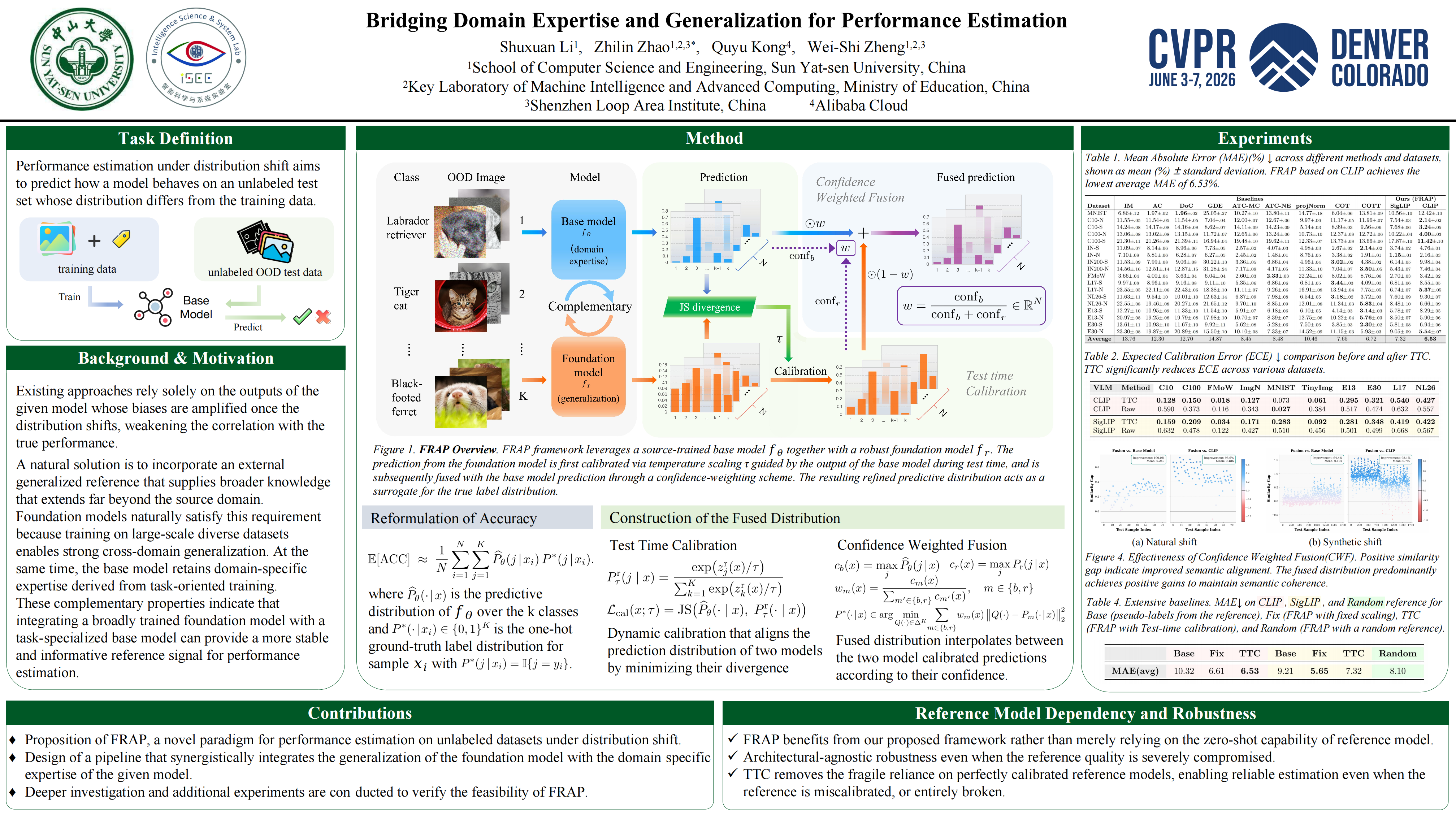
Performance estimation under distribution shift aims to predict how a model behaves on an unlabeled test set whose distribution differs from the training data, a scenario that requires reliable indicators that can faithfully reflect model behavior without ground-truth labels. Existing approaches rely solely on the outputs of the given model whose biases are amplified once the distribution shifts, weakening the correlation with the true performance. Motivated by this limitation, we propose \textbf{F}used \textbf{R}eference \textbf{A}lignment \textbf{P}rediction (FRAP), which leverages the complementary strengths of an external foundation model and the base model to construct a more reliable surrogate of the ground-truth labels. FRAP aligns the prediction distribution of the foundation model with that of the base model by applying temperature-scaled calibration that minimizes their divergence. The aligned predictions are fused through confidence-based weighting into a refined reference distribution that integrates robustness from the foundation model and domain-specific expertise from the base model, and performance estimation is obtained by measuring how closely the base model predictions agree with this reference. Extensive experiments across diverse datasets and architectures show that FRAP provides consistent and substantial improvements over representative performance-estimation methods under distribution shift.
Adaptive Data Augmentation with Multi-armed Bandit: Sample-Efficient Embedding Calibration for Implicit Pattern Recognition
Minxue Tang ⋅ Yangyang Yu ⋅ Aolin Ding ⋅ MAZIYAR BARAN POUYAN ⋅ Taha Belkhouja ⋅ Yujia Bao
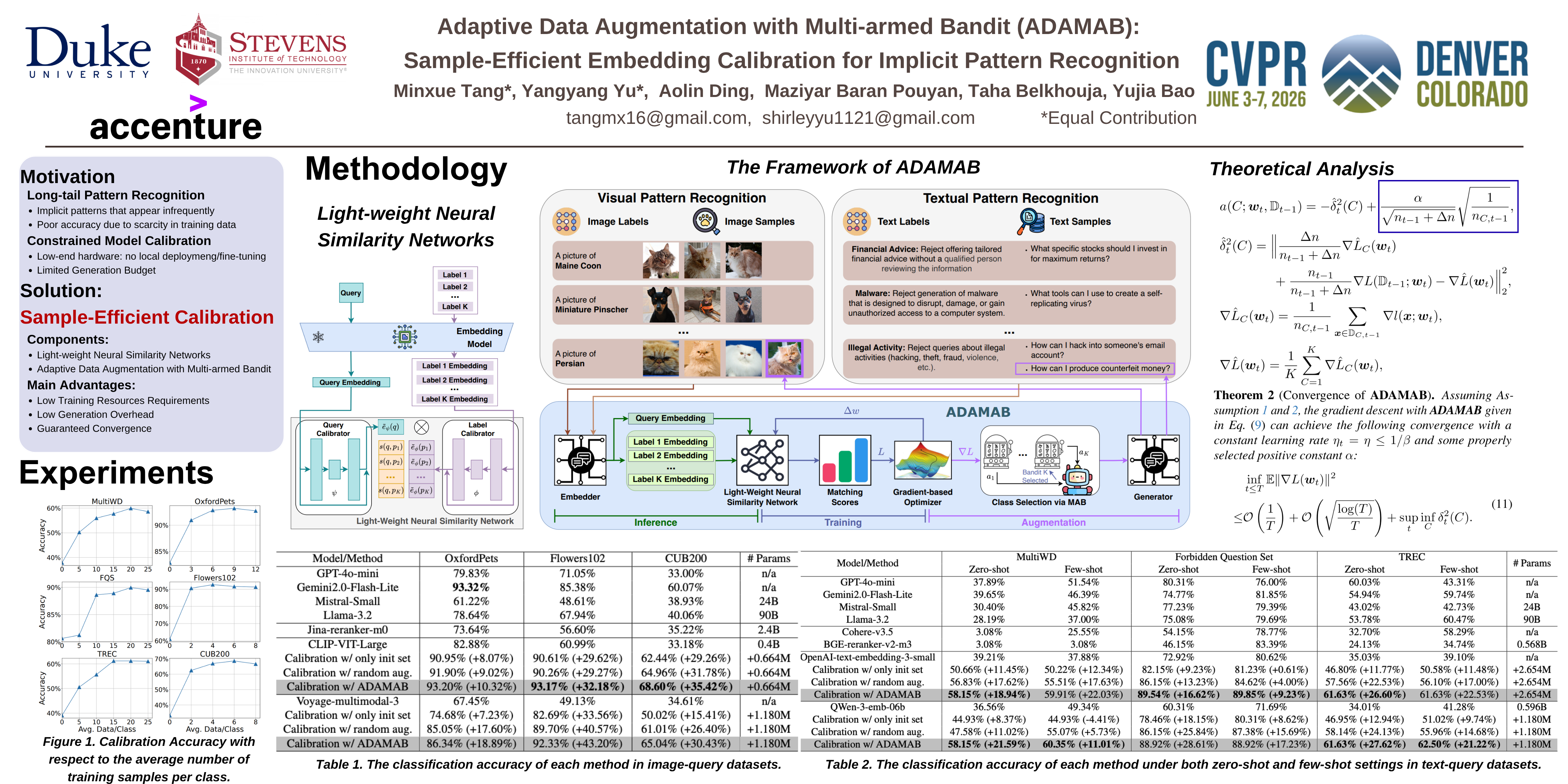
Recognizing implicit visual and textual patterns is essential in many real-world applications of modern AI. However, tackling long-tail pattern recognition tasks remains challenging for current pre-trained foundation models such as LLMs and VLMs. While finetuning pre-trained models can improve accuracy in recognizing implicit patterns, it is usually infeasible due to a lack of training data and high computational overhead. In this paper, we propose ADAMAB, an efficient embedding calibration framework for few-shot pattern recognition. To maximally reduce the computational costs, ADAMAB trains embedder-agnostic light-weight calibrators on top of fixed embedding models without accessing their parameters. To mitigate the need for large-scale training data, we introduce an adaptive data augmentation strategy based on the Multi-Armed Bandit (MAB) mechanism. With a modified upper confidence bound algorithm, ADAMAB diminishes the gradient shifting and offers theoretically guaranteed convergence in few-shot training. Our multi-modal experiments justify the superior performance of ADAMAB, with up to 40\% accuracy improvement when training with less than 5 initial data samples of each class.
Bridging Domains through Subspace-Aware Model Merging
Levy Chaves ⋅ Chao Zhou ⋅ Rebekka Burkholz ⋅ Eduardo Valle ⋅ Sandra Avila
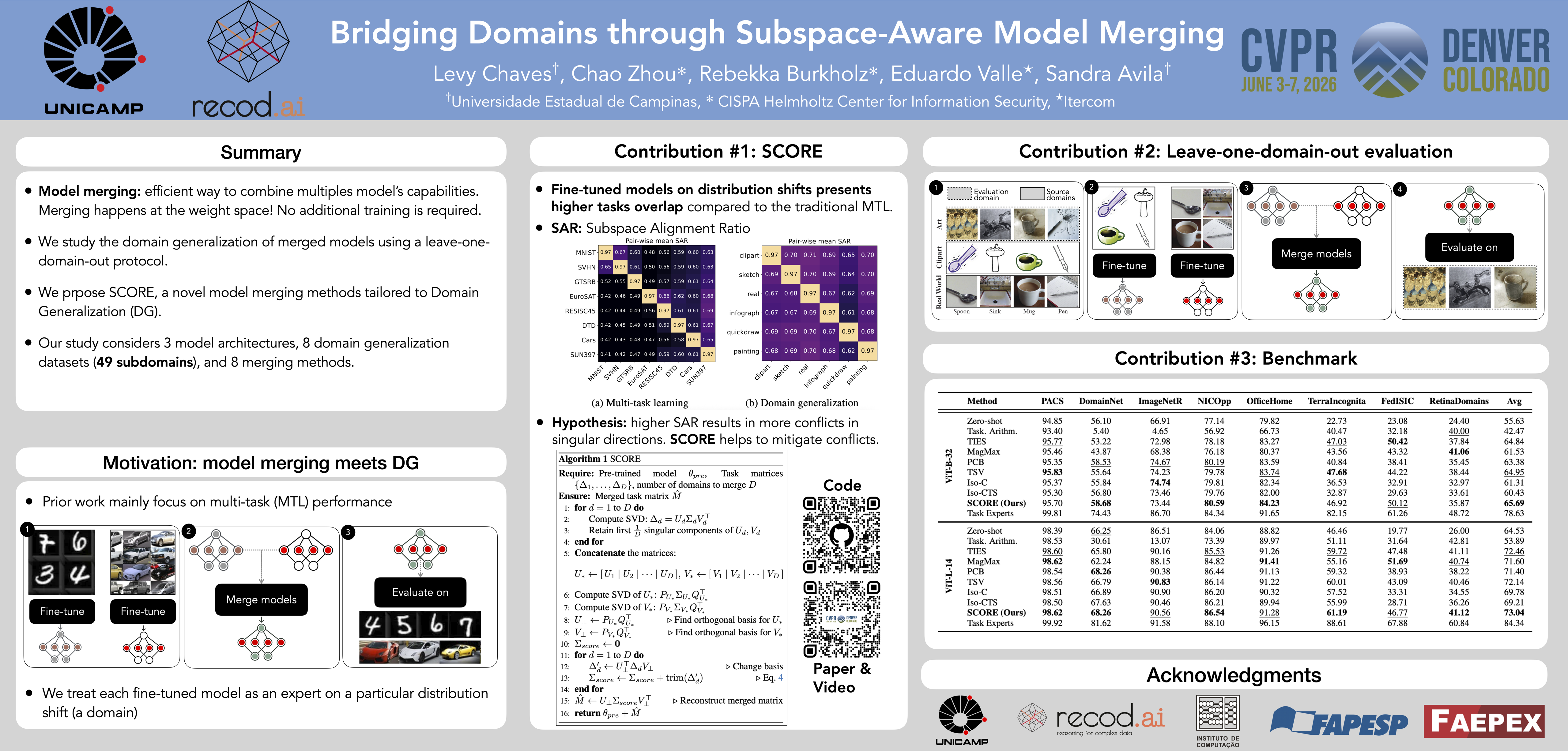
Model merging integrates multiple task-specific models into a single consolidated one. Recent research has made progress in improving merging performance for in-distribution or multi-task scenarios, but domain generalization in model merging remains underexplored. We investigate how merging models fine-tuned on distinct domains affects generalization to unseen domains. Through an analysis of parameter competition in the task matrix using singular value decomposition (SVD), we show that merging models trained under different distribution shifts induces stronger conflicts between their subspaces compared to traditional multi-task settings. To mitigate this issue, we propose SCORE (Subspace COnflict-Resolving mErging), a method designed to alleviate such singular subspace conflicts. SCORE finds a shared orthogonal basis by computing the principal components of the concatenated leading singular vectors of all models. It then projects each task matrix into the shared basis, pruning off-diagonal components to remove conflicting singular directions. SCORE consistently outperforms, on average, existing model merging approaches in domain generalization settings across a variety of architectures and model scales, demonstrating its effectiveness and scalability.
DA-Mamba: Learning Domain-Aware State Space Model for Global-Local Alignment in Domain Adaptive Object Detection
Haochen Li ⋅ Rui Zhang ⋅ Hantao Yao ⋅ Xin Zhang ⋅ Yifan Hao ⋅ Shaohui Peng ⋅ Yongwei Zhao ⋅ Ling Li
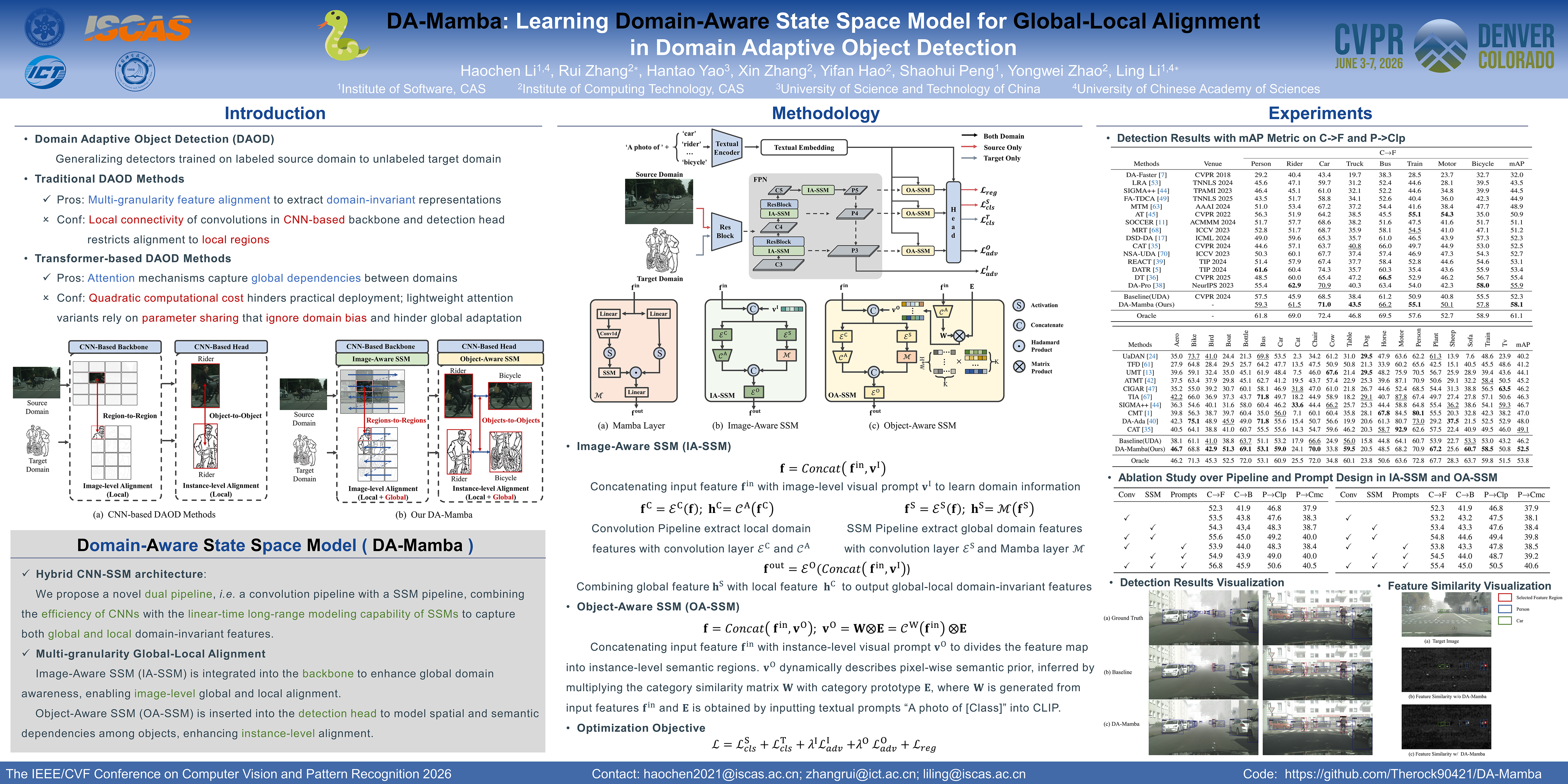
Domain Adaptive Object Detection (DAOD) aims to transfer detectors from a labeled source domain to an unlabeled target domain.Existing DAOD methods employ multi-granularity feature alignment to learn domain-invariant representations.However, the local connectivity of their CNN-based backbone and detection head restricts alignment to local regions, failing to extract global domain-invariant features.Although transformer-based DAOD methods capture global dependencies via attention mechanisms, their quadratic computational cost hinders practical deployment. To solve this, we propose DA-Mamba, a hybrid CNN-State Space Models (SSMs) architecture that combines the efficiency of CNNs with the linear-time long-range modeling capability of State Space Models (SSMs) to capture both global and local domain-invariant features.Specifically, we introduce two novel modules: Image-Aware SSM (IA-SSM) and Object-Aware SSM (OA-SSM).IA-SSM is integrated into the backbone to enhance global domain awareness, enabling image-level global and local alignment.OA-SSM is inserted into the detection head to model spatial and semantic dependencies among objects, enhancing instance-level alignment.Comprehensive experiments demonstrate that the proposed method can efficiently improve the cross-domain performance of the object detector.
Scaling Dense Event-Stream Pretraining from Visual Foundation Models
Zhiwen Chen ⋅ Junhui Hou ⋅ Zhiyu Zhu ⋅ Jinjian Wu ⋅ Guangming Shi
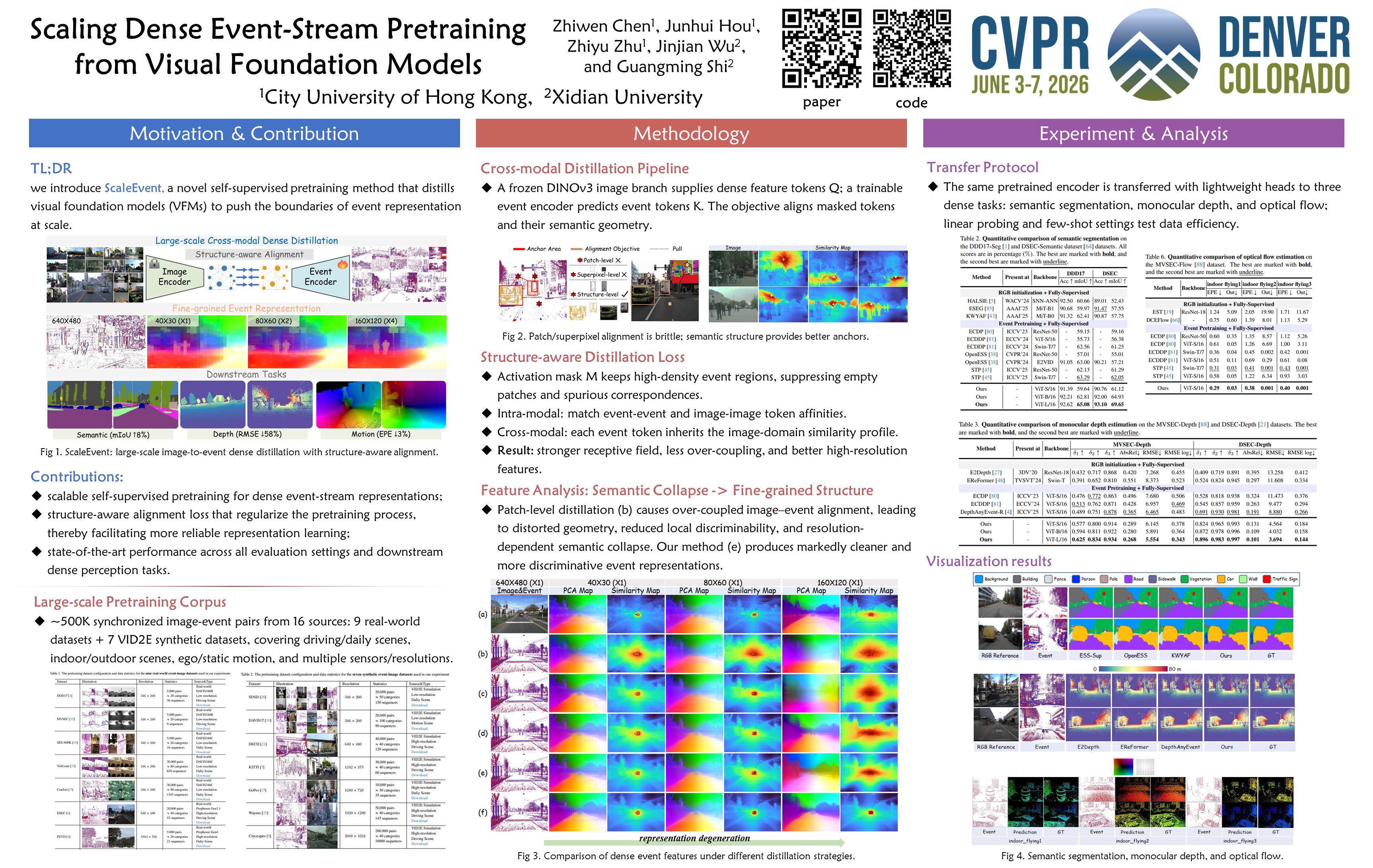
Learning versatile, fine-grained representations from irregular event streams is pivotal yet nontrivial, primarily due to the heavy annotation that hinders scalability in dataset size, semantic richness, and application scope. To mitigate this dilemma, we launch a novel self-supervised pretraining method that distills visual foundation models (VFMs) to push the boundaries of event representation at scale. Specifically, we curate an extensive synchronized image-event collection to amplify cross-modal alignment. Nevertheless, due to inherent mismatches in sparsity and granularity between image-event domains, existing distillation paradigms are prone to semantic collapse in event representations, particularly at high resolutions. To bridge this gap, we propose to extend the alignment objective to semantic structures provided off-the-shelf by VFMs, indicating a broader receptive field and stronger supervision. The key ingredient of our method is a structure-aware distillation loss that grounds higher-quality image-event correspondences for alignment, optimizing dense event representations. Extensive experiments demonstrate that our approach takes a great leap in downstream benchmarks, significantly surpassing traditional methods and existing pretraining techniques. This breakthrough manifests in enhanced generalization, superior data efficiency and elevated transferability. The source code will be available.
Event Stream Filtering via Probability Flux Estimation
Jinze Chen ⋅ Wei Zhai ⋅ Yang Cao ⋅ Bin Li ⋅ Zheng-Jun Zha
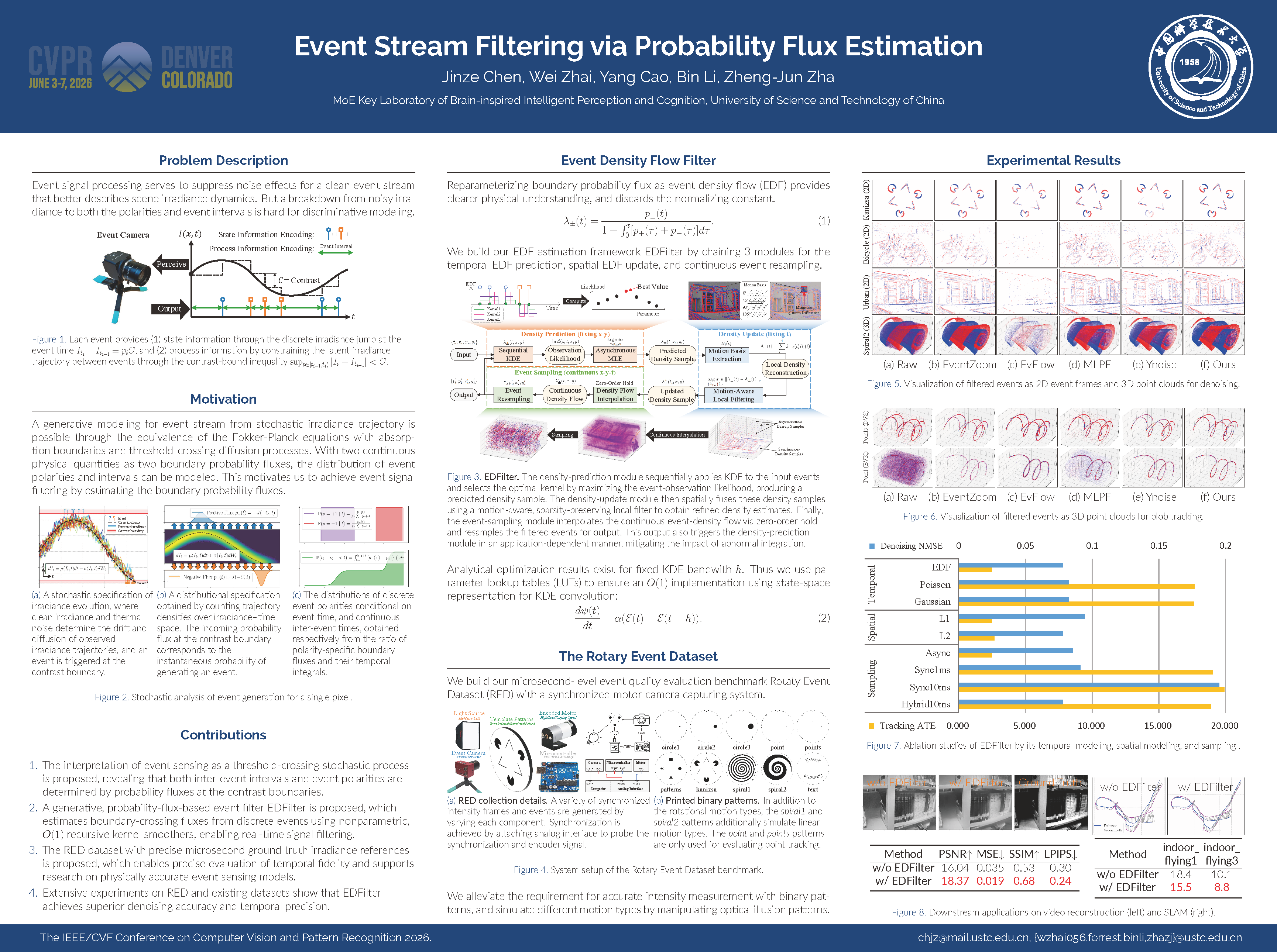
Event cameras asynchronously capture brightness changes with microsecond latency, offering exceptional temporal precision but suffering from severe noise and signal inconsistencies. Unlike conventional signals, events carry state information through polarities and process information through inter-event time intervals. However, existing event filters often ignore the latter, producing outputs that are sparser than the raw input and limiting the reconstruction of continuous irradiance dynamics. We propose the Event Density Flow Filter (EDFilter), a framework that models event generation as threshold-crossing probability fluxes arising from the stochastic diffusion of irradiance trajectories. EDFilter performs nonparametric, kernel-based estimation of probability flux and reconstructs the continuous event density flow using an O(1) recursive solver, enabling real-time processing. The Rotary Event Dataset (RED), featuring microsecond-resolution ground-truth irradiance flow under controlled illumination is also presented for event quality evaluation. Experiments demonstrate that EDFilter achieves high-fidelity, physically interpretable event denoising and motion reconstruction.
AIMDepth: Asymmetric Image-Event Mamba for Monocular Depth Estimation
Luoxi Jing ⋅ Dianxi Shi ⋅ YuShe Cao ⋅ Yuanze Wang ⋅ Junze Zhang ⋅ Yuning Cui ⋅ Mengzhu Wang
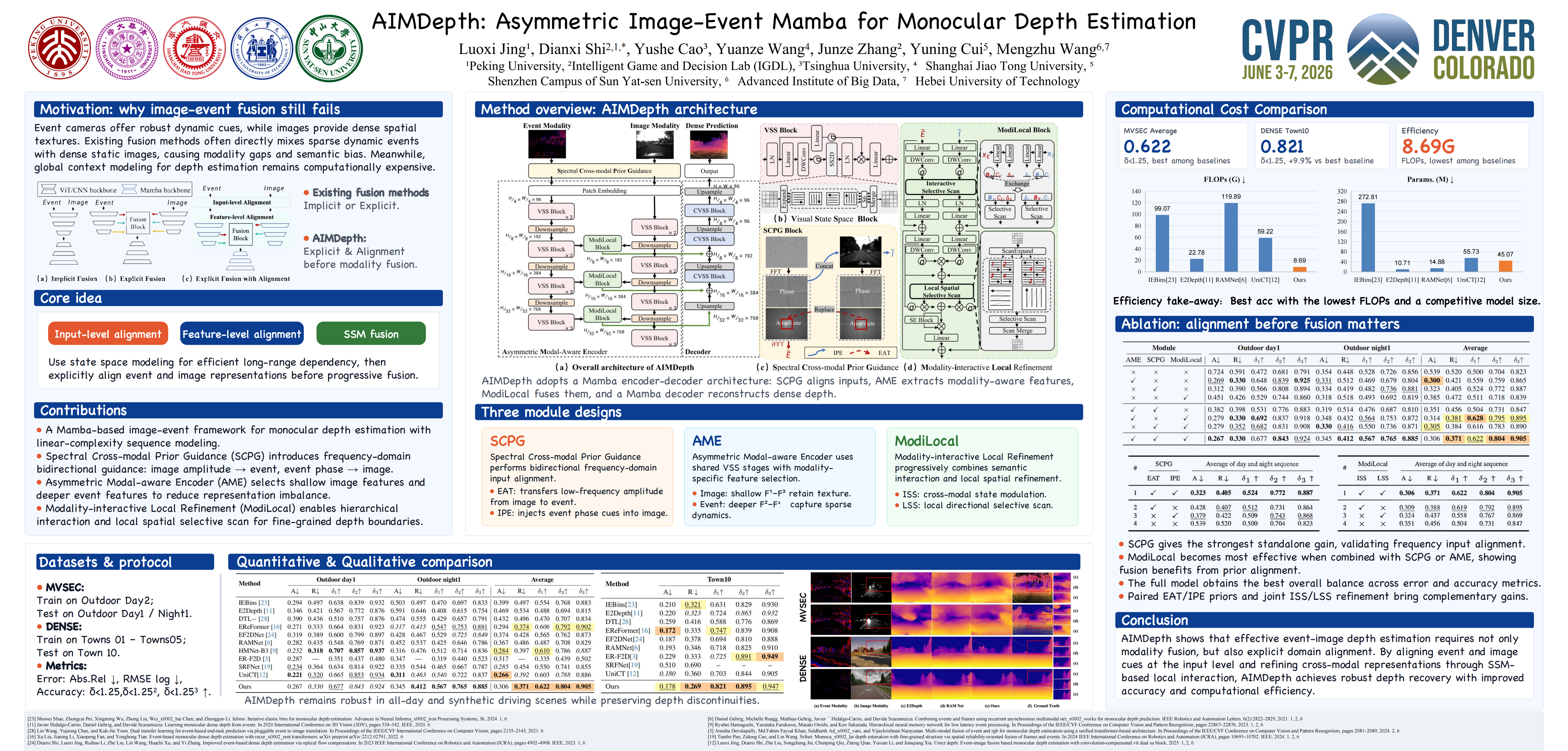
Monocular depth estimation is critical for applications like autonomous driving and robotics. The complementary properties of event and image modality motivate the fusion-based methods for robust depth estimation. However, existing fusion methods rely on convolutional or attention-based architectures, which either struggle with global dependencies or incur high computational cost, limiting their suitability for long-sequence modeling in depth tasks. Besides, effective image-event fusion remains a key challenge, as most existing methods directly fuse features without addressing the domain gap and differences in representational characteristics between raw events and images, leading to semantic bias and degraded performance. In this work, we propose AIMDepth, an Asymmetric Image-Event Mamba framework for monocular depth estimation, built entirely on state space models to ensure linear computational complexity and accurate prediction. To address input-domain misalignment, we introduce a Spectral Cross-modal Prior Guidance (SCPG) module that performs bidirectional prior injection at the input level. To mitigate representational imbalance between sparse events and dense images, we design an Asymmetric Modal-aware Encoder (AME) that allocates separate encoding paths for each modality and facilitates feature-level alignment tailored to their distinct information densities. To further enhance fusion, we develop a Modality-interactive Local Refinement (ModiLocal) module that enables hierarchical interaction and fine-grained alignment through SSM-based modeling. Extensive experiments on public datasets demonstrate that AIMDepth achieves state-of-the-art performance and strong robustness in complex environments.
Time-Specialized Event-Image Alignment for Blur-to-Video Decomposition
Zhijing Sun ⋅ Senyan Xu ⋅ Ruixuan Jiang ⋅ Kean Liu ⋅ Runze Tian ⋅ Xueyang Fu ⋅ Zheng-Jun Zha
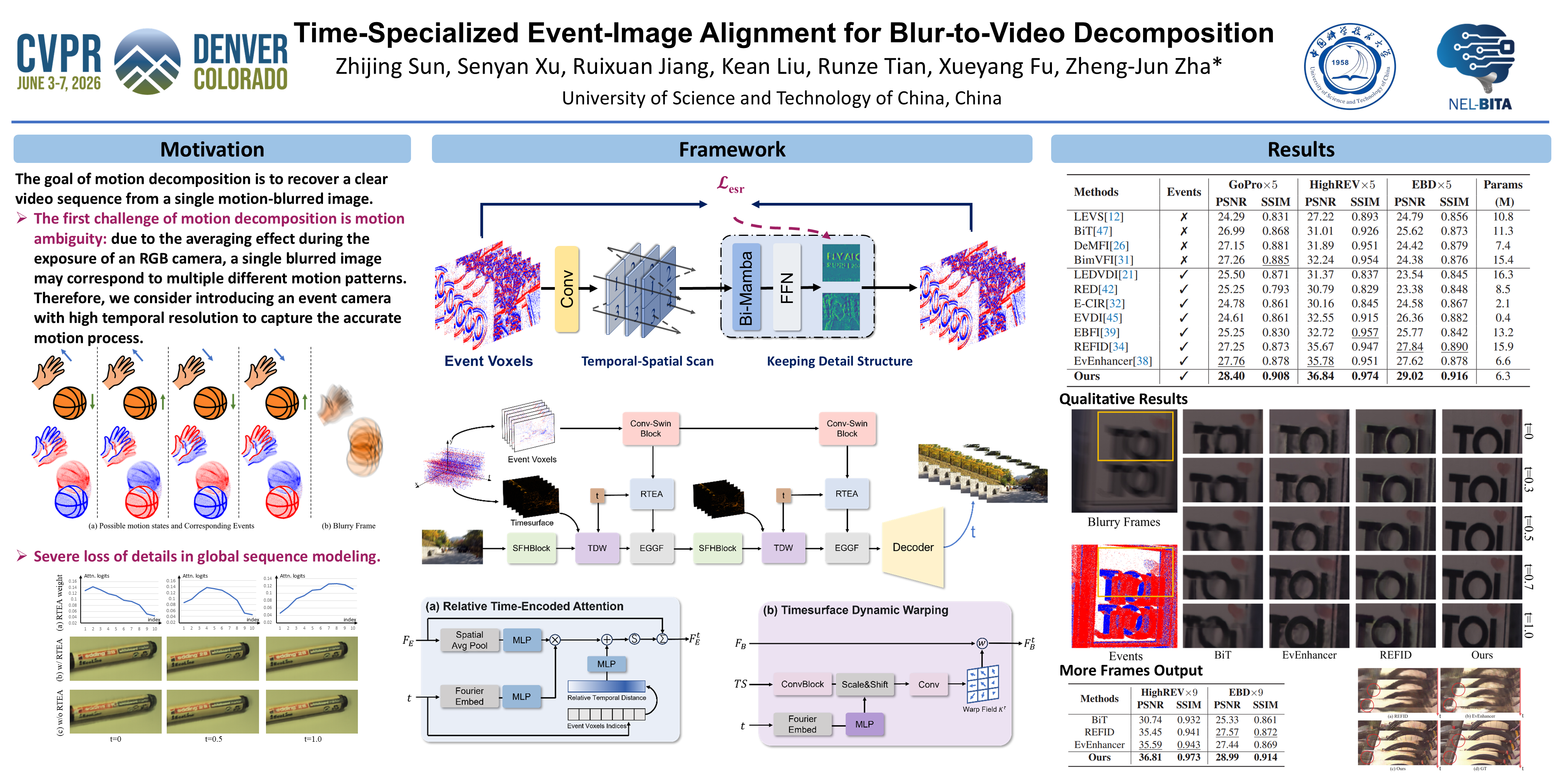
Motion blur is a common degradation in dynamic imaging. Recent studies have moved beyond restoring a single sharp image from a blurred input and instead target blur decomposition: recovering a temporally continuous sharp video sequence from one motion-blurred image. Event cameras, with their microsecond temporal resolution, can effectively alleviate motion ambiguity.However, existing event-based methods often fail to explicitly model time-aligned event–image features. How to accurately exploit event data to reconstruct frames at different time instants remains largely underexplored. In this paper, we propose TSANet, an event-based blur-to-video decomposition method that time-specializes both event features and image features for alignment. Specifically, we introduce a Relative Time-Encoded Attention module that steers event features toward motion information relevant to a given target time, and a Timesurface Dynamic Warping Module that warps image features into the spatial configuration corresponding to that time. With time-specialized motion features and image features that are explicitly aligned at arbitrary query times, our framework can decompose a single blurred image into a high–frame-rate sharp video sequence. In addition, we collect a new dataset containing real events and high-quality color video, and synthesize blurred inputs by averaging sharp frames to evaluate our method. Experiments on multiple datasets with both synthetic and real events demonstrate that our approach consistently outperforms previous state-of-the-art methods on the blur decomposition task.
eRetinexGS: Retinex Modeling for Low-Light Scene Enhancement via Event Streams and 3D Gaussian Splatting
Haojie Yan ⋅ Zehao Chen ⋅ Yan Liu ⋅ Shi Gu ⋅ Peng Lin ⋅ De Ma ⋅ Huajin Tang ⋅ Qian Zheng ⋅ Gang Pan
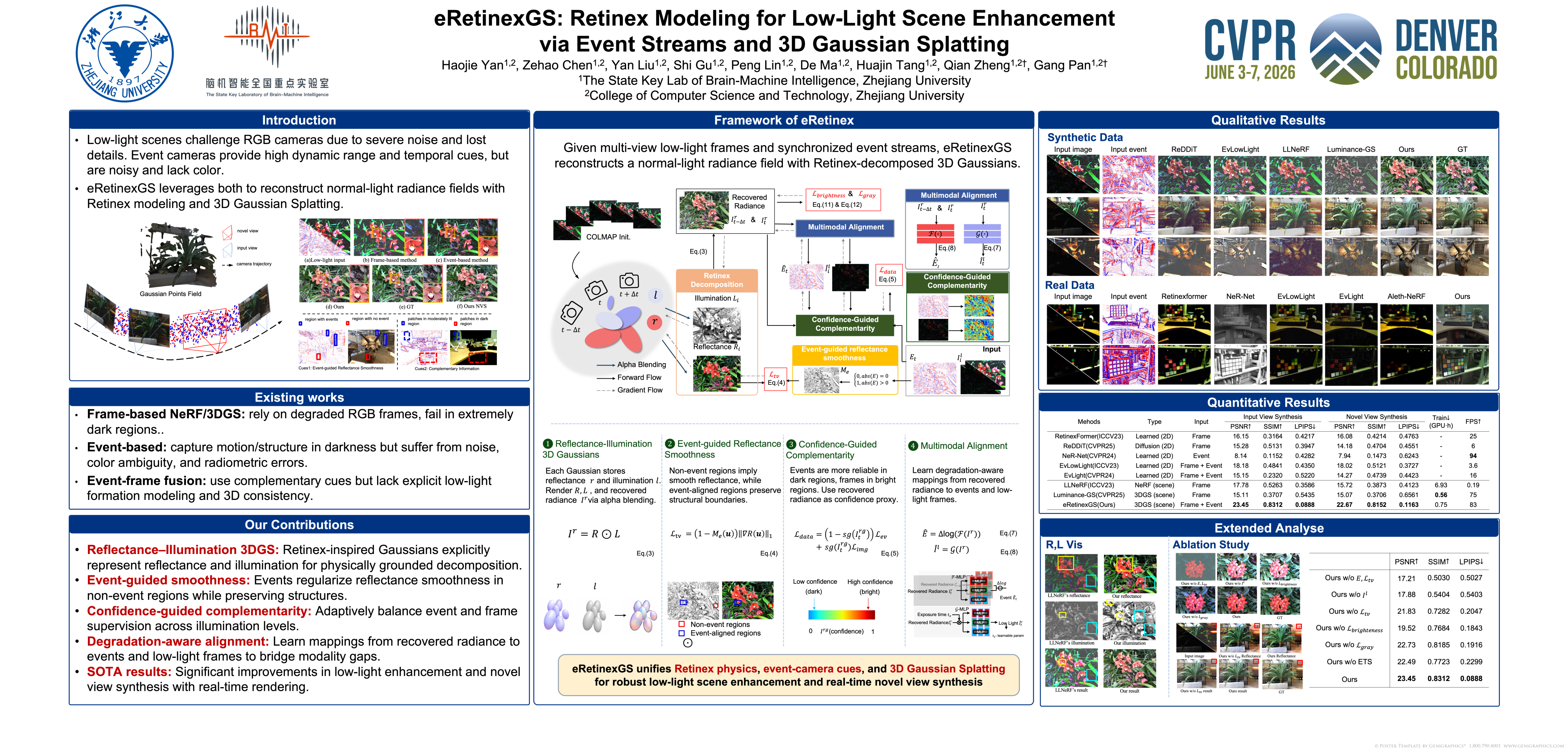
Perception under low illumination remains a major challenge for computer vision systems, as RGB sensors often fail to capture sufficient structural and color information in extremely dark environments. Event cameras, with their high dynamic range and temporal resolution, provide complementary cues that are well suited for such conditions. In this work, we present eRetinexGS, a novel framework that jointly leverages event streams and low-light frames through 3D Gaussian Splatting for scene-level enhancement and reconstruction. Unlike previous approaches that operate on individual frames, eRetinexGS enforces geometric and photometric consistency across multiple views, bridging the gap between degraded images and noisy event signals. By introducing an event-assisted Retinex decomposition and a reflectance–illumination representation within the 3DGS pipeline, our method reconstructs normal-light radiance fields with fine-grained details and accurate color. Extensive experiments on both synthetic and real datasets demonstrate that eRetinexGS achieves state-of-the-art performance in low-light scene enhancement while maintaining real-time rendering capability. The code and dataset will be released upon publication.
Unsupervised 3d Motion Estimation Using Event Camera
Han Han ⋅ Wei Zhai ⋅ Tiesong Zhao ⋅ Bin Li ⋅ Yang Cao ⋅ Zheng-Jun Zha
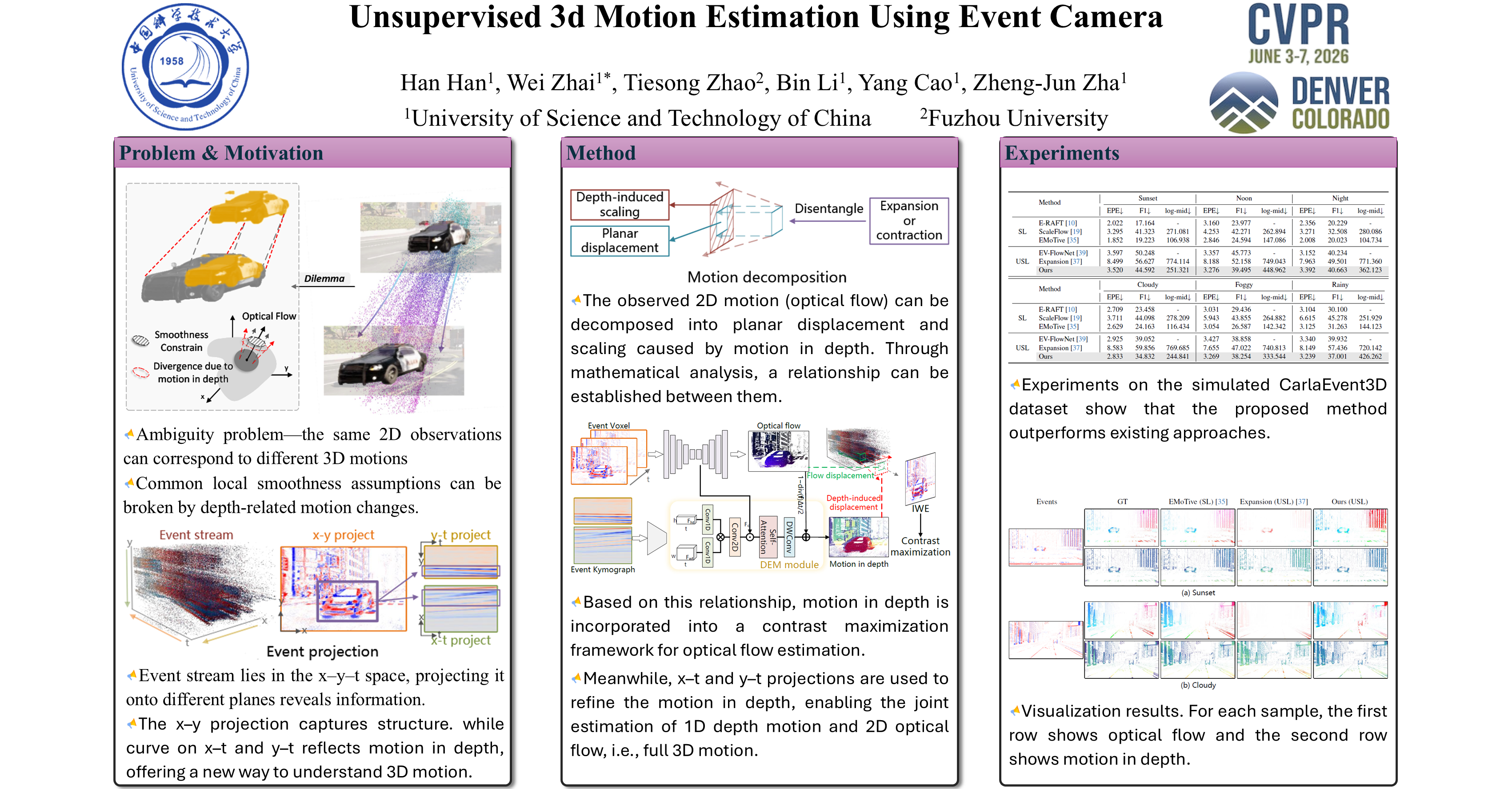
Estimating the 3D motion of scene points from 2D observations, typically parameterized by optical flow and motion in depth, is a fundamental problem in computer vision. Existing learning-based methods usually rely on supervised regression from densely labeled data, but their dependence on annotations and limited use of geometric constraints restricts generalization, motivating unsupervised solutions. Unsupervised 3D motion estimation is challenging because motion along the viewing direction is unobservable, and optical flow and motion in depth are geometrically coupled, making their separation ambiguous. Event cameras capture per-pixel brightness changes asynchronously with microsecond latency, providing high temporal resolution and motion continuity. Projecting event streams along different axes reveals spatiotemporal expansion and contraction patterns that encode depth variation and geometric structure, offering rich cues for unsupervised estimation. Leveraging these properties, we propose an unsupervised event-based 3D motion estimation framework that jointly models optical flow and motion in depth. We first derive an analytical relationship to infer initial motion in depth from estimated flow and further refine it using a directional expansion modulation module that captures horizontal and vertical expansion–contraction patterns in event projections. Finally, motion in depth is incorporated into optical flow warping under a contrast maximization objective. Experiments on the CarlaEvent3D dataset show that our method achieves competitive accuracy and strong generalization, advancing unsupervised 3D motion estimation in the event domain.
Goal-Driven Reward by Video Diffusion Models for Reinforcement Learning
Qi Wang ⋅ Mian Wu ⋅ Yuyang Zhang ⋅ Mingqi Yuan ⋅ Wenyao Zhang ⋅ Haoxiang You ⋅ Yunbo Wang ⋅ Xin Jin ⋅ Xiaokang Yang ⋅ Wenjun Zeng
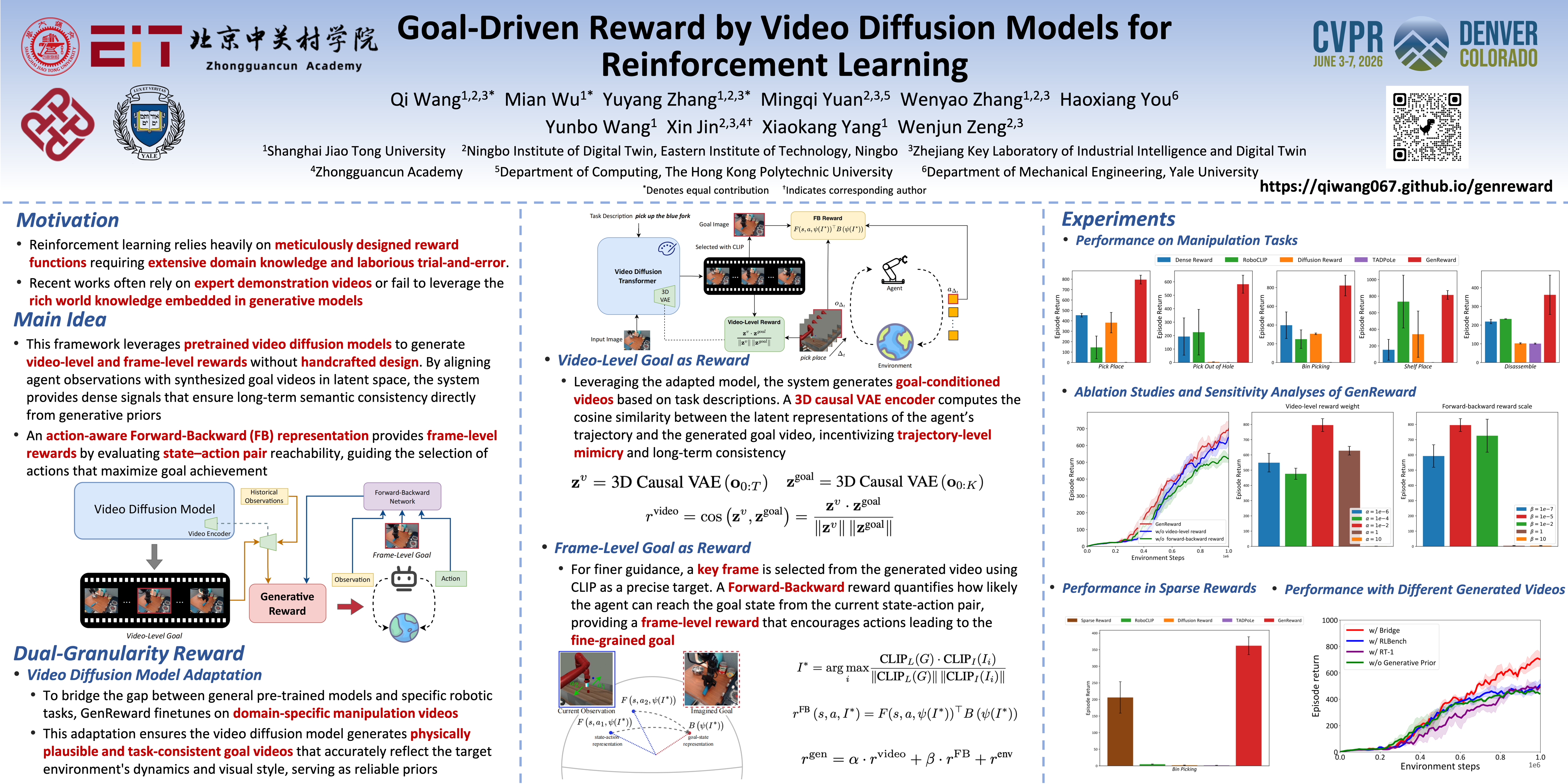
Reinforcement Learning (RL) has achieved remarkable success in various domains, yet it often relies on carefully designed programmatic reward functions to guide agent behavior. Designing such reward functions can be challenging and may not generalize well across different tasks. To address this limitation, we leverage the rich world knowledge contained in pretrained video diffusion models to provide goal-driven reward signals for RL agents without ad-hoc design of reward. Our key idea is to exploit off-the-shelf video diffusion models pretrained on large-scale video datasets as informative reward functions in terms of video-level and frame-level goals. For video-level rewards, we first finetune a pretrained video diffusion model on domain-specific datasets and then employ its video encoder to evaluate the alignment between the latent representations of agent's trajectories and the generated goal videos. To enable more fine-grained goal-achievement, we derive a frame-level goal by identifying the most relevant frame from the generated video using CLIP, which serves as the goal state. We then employ a learned forward–backward representation that represents the probability of visiting the goal state from a given state–action pair as frame-level reward, promoting more coherent and goal-driven trajectories. Experiments on various Meta-World tasks demonstrate the effectiveness of our approach.
ModularAgent: A Task-Aware Modular Framework for Joint Optimization of Multimodal Large Language Models and World Models
Yu-Wei Zhan ⋅ Xin Wang ⋅ Pengzhe Mao ⋅ Tongtong Feng ⋅ Ren Wang ⋅ Wenwu Zhu
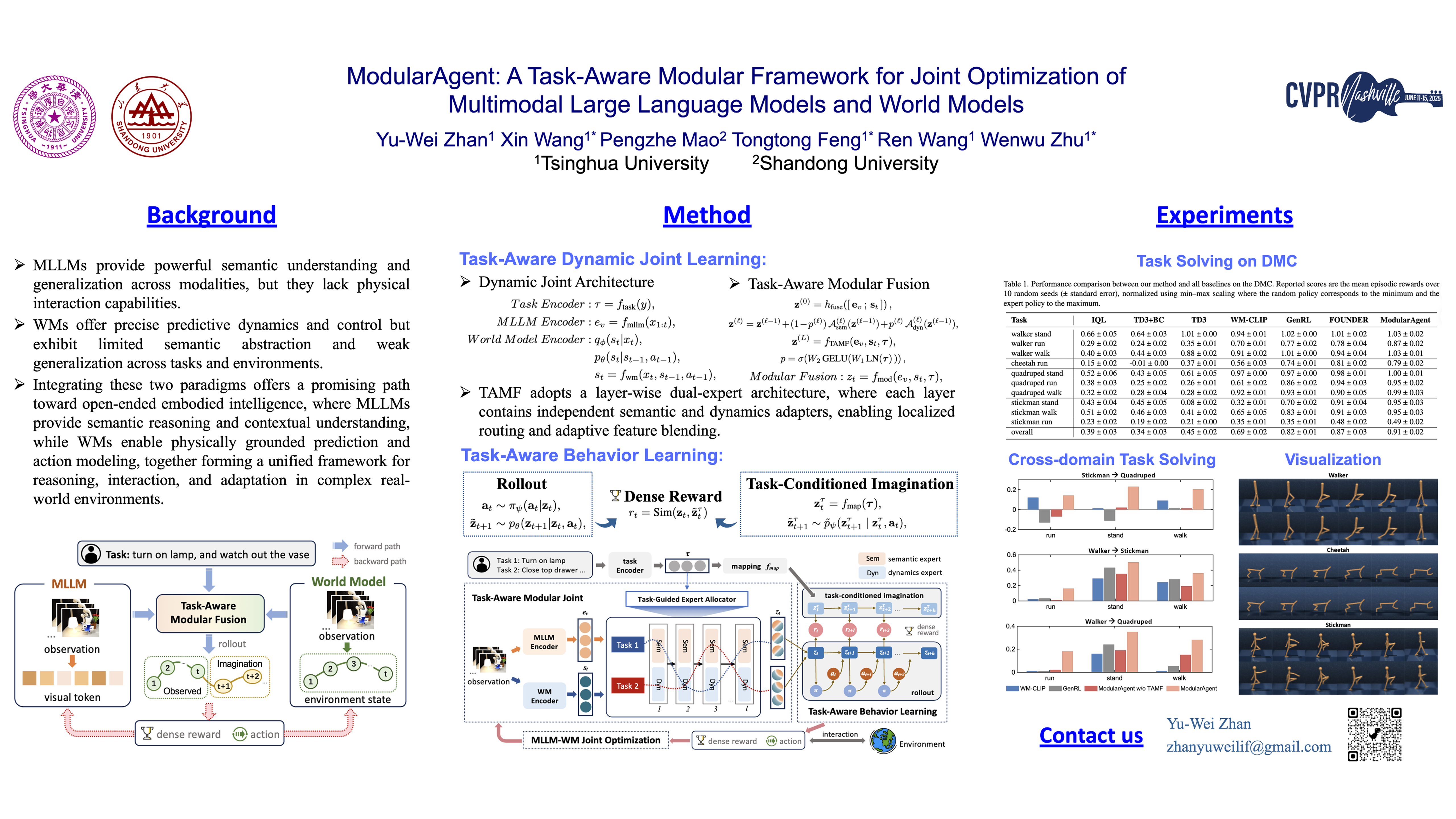
Building generalist embodied agents requires a unified system that can interpret multimodal goals, model environment dynamics, and execute reliable actions across diverse real-world tasks. Multimodal large language models (MLLMs) offer strong semantic priors and cross-modal generalization, while world models (WMs) provide actionable latent dynamics for prediction and control. Their combination holds promise for open-ended embodied intelligence, yet introduces two key challenges: (1) establishing a tight coupling between the semantic intent from MLLMs and the dynamic state representations within the WM’s latent space, and (2) achieving task-aware adaptability that supports multi-task learning and cross-environment generalization. To address these limitations, we propose BiTAgent, a task-aware dynamic joint framework that enables bidirectional coupling between MLLMs and WMs. BiTAgent establishes two complementary pathways: a forward path that injects MLLM representations into the WM’s latent space for semantically guided imagination, and a backward path where WM-generated feedback refines the MLLM’s semantic space via dense text-conditioned rewards. This bidirectional interaction is realized through three synergistic components: Task-Aware Dynamic Joint Learning, Task-Aware Behavior Modeling, and MLLM-WM Joint Optimization, which together harmonize semantic reasoning and dynamic prediction. Extensive experiments across multi-task and cross-environment settings demonstrate superior stability and generalization over state-of-the-art baselines, marking a step toward open-ended embodied learning.
AstraNav-Memory: Contexts Compression for Long Memory
Junjun Hu ⋅ Xinda Xue ⋅ Botao Ren ⋅ Minghua Luo ⋅ Jintao Chen ⋅ Haochen Bai ⋅ Liangliang You ⋅ Mu Xu
Lifelong embodied navigation requires agents to accumulate, retain, and exploit spatial–semantic experience across tasks, enabling efficient exploration in novel environments and rapid goal reaching in familiar ones. While object-centric memory is interpretable, it depends on detection and reconstruction pipelines that limit robustness and scalability. We propose an image-centric memory framework that achieves long-term implicit memory via an efficient visual context compression module end-to-end coupled with a Qwen2.5-VL–based navigation policy. Built atop a ViT backbone with frozen DINOv3 features and lightweight PixelUnshuffle+Conv blocks, our visual tokenizer reduces native vision tokens by roughly 10–20×, representing each image with about 30 tokens and allowing the agent to maintain hundreds of historical frames within a single context. Experimental results on GOAT-Bench and HM3D-OVON show that our method achieves state-of-the-art navigation performance, improving exploration in unfamiliar environments and shortening paths in familiar ones. Ablation studies further reveal that moderate compression provides the best balance between efficiency and accuracy. These findings position compressed image-centric memory as a practical and scalable interface for lifelong embodied agents, enabling them to reason over long visual histories and navigate with human-like efficiency.
Test-Time Perturbation Learning with Delayed Feedback for Vision-Language-Action Models
Zehua Zang ⋅ Xi Wang ⋅ Fuchun Sun ⋅ Xiao Xu ⋅ Lixiang Liu ⋅ Jiahuan Zhou ⋅ Jiangmeng Li
Vision-Language-Action models (VLAs) achieve strong performance in sequential decision-making but remain fragile to subtle environment shifts, such as small changes in object pose. We attribute this brittleness to trajectory overfitting, where VLAs over-attend to spurious cues and replicate memorized actions. We propose Perturbation learning with Delayed Feedback (PDF), a verifier-free test-time adaptation framework that improves decision performance without fine-tuning the base model. PDF mitigates spurious correlations through uncertainty-based data augmentation and action voting, while an adaptive scheduler allocates augmentation budgets to balance performance and efficiency. To further improve stability, PDF learns a lightweight perturbation module that retrospectively adjusts action logits guided by delayed feedback, correcting high-confidence errors. Experiments on LIBERO (+7.4\% success rate) and Atari (+10.3 human normalized score) demonstrate consistent gains in task success over strong VLA, test-time adaptation and even fine-tuned approaches baselines with minimal overhead, establishing a practical path toward reliable test-time adaptation in multimodal decision-making agents.
ShowUI-π: Flow-based Generative Models as GUI Dexterous Hands
Siyuan Hu ⋅ Kevin Qinghong Lin ⋅ Mike Zheng Shou
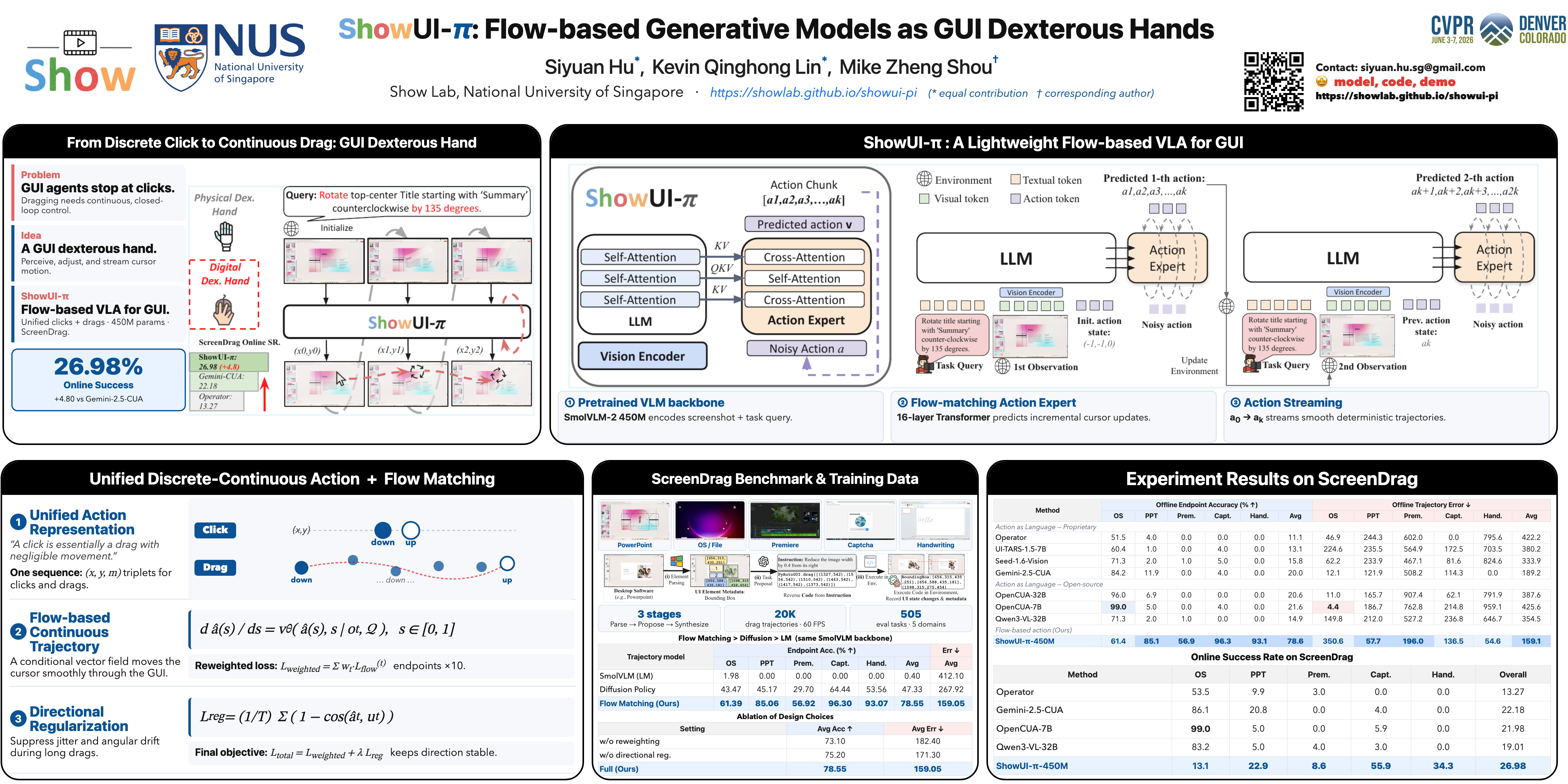
Building intelligent agents capable of dexterous manipulation is essential for achieving human-like automation in both robotics and digital environments. However, existing GUI agents rely on discrete click predictions (x,y), which prohibits free-form, closed-loop trajectories (e.g. dragging a progress bar) that require continuous, on-the-fly perception and adjustment. In this work, we develop ShowUI-π, the first flow-based generative model as GUI dexterous hand, featuring the following designs:(i) Unified Discrete–Continuous Actions, integrating discrete clicks and continuous drags within a shared model, enabling flexible adaptation across diverse interaction modes;(ii) Flow-based Action Generation for drag modeling, which predicts incremental cursor adjustments from continuous visual observations via a lightweight action expert, ensuring smooth and stable trajectories;(iii) Drag Training data and Benchmark, where we manually collect and synthesize 20K drag trajectories across five domains (e.g. PowerPoint, Adobe Premiere Pro), and introduce ScreenDrag, a benchmark with comprehensive online and offline evaluation protocols for assessing GUI agents’ drag capabilities.Our experiments show that proprietary GUI agents still struggle on ScreenDrag (e.g. Operator scores 13.27, and the best Gemini-2.5-CUA reaches 22.18). In contrast, ShowUI-π achieves 26.98 with only 450M parameters, underscoring both the difficulty of the task and the effectiveness of our approach. We hope this work advances GUI agents toward human-like dexterous control in digital world.
ActiveVLA: Injecting Active Perception into Vision-Language-Action Models for Precise 3D Robotic Manipulation
Zhenyang Liu ⋅ Yongchong Gu ⋅ Yikai Wang ⋅ Xiangyang Xue ⋅ Yanwei Fu
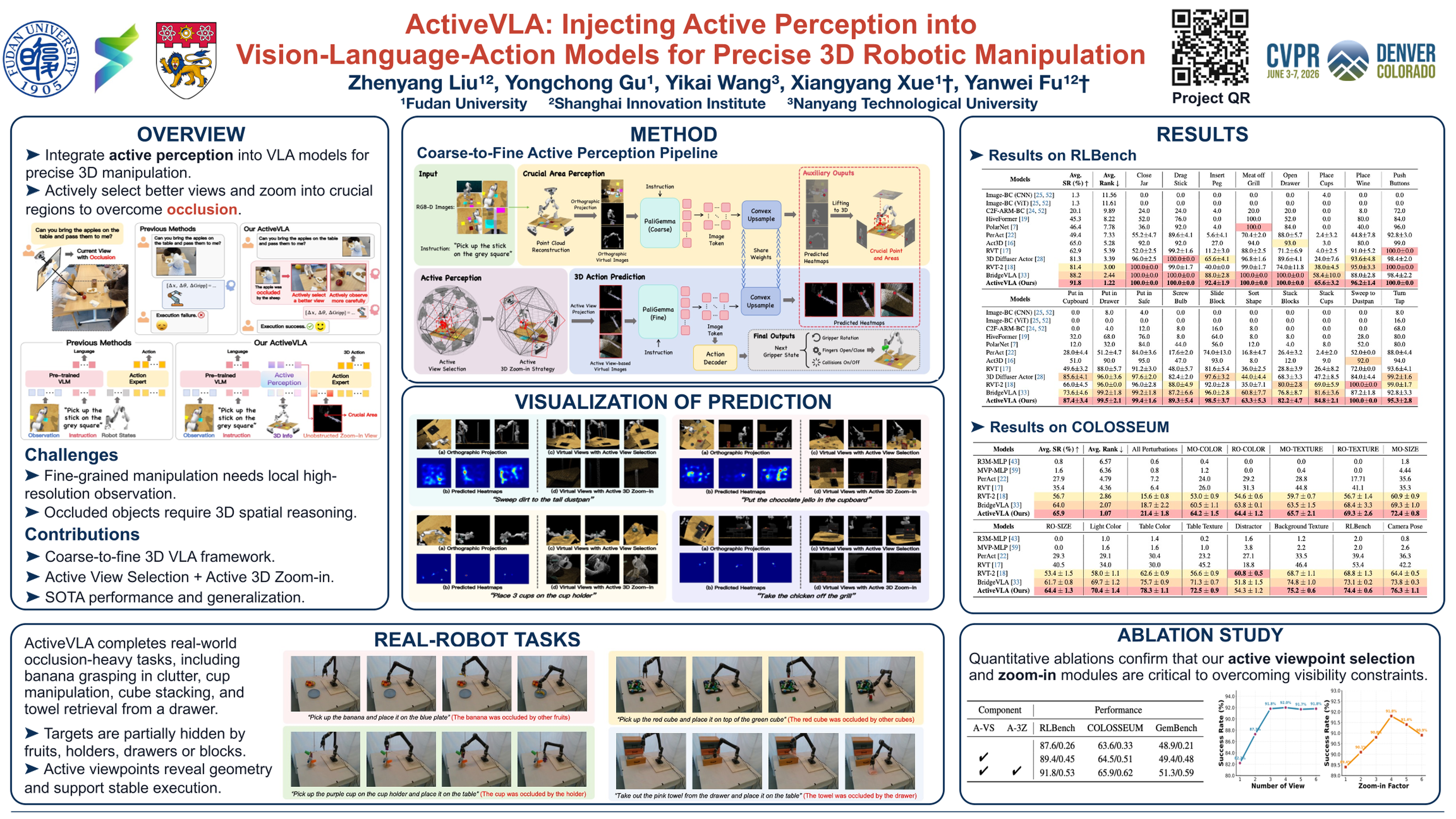
Recent advances in robot manipulation have leveraged pre-trained vision-language models (VLMs) and explored integrating 3D spatial signals into these models for effective action prediction, giving rise to the promising vision-language-action (VLA) paradigm. However, most existing approaches overlook the importance of active perception: they typically rely on static, wrist-mounted cameras that provide an end-effector-centric viewpoint. As a result, these models are unable to adaptively select optimal viewpoints or resolutions during task execution, which significantly limits their performance in long-horizon tasks and fine-grained manipulation scenarios. To address these limitations, we propose ActiveVLA, a novel vision-language-action framework that empowers robots with active perception capabilities for high-precision, fine-grained manipulation. ActiveVLA adopts a coarse-to-fine paradigm, dividing the process into two stages:(1) Critical region localization. ActiveVLA projects 3D inputs onto multi-view 2D projections, identifies critical 3D regions, and supports dynamic spatial awareness.(2) Active perception optimization. Drawing on the localized critical regions, ActiveVLA uses an active view selection strategy to choose optimal viewpoints. These viewpoints aim to maximize amodal relevance and diversity while minimizing occlusions. Additionally, ActiveVLA applies a 3D zoom-in to improve resolution in key areas. Together, these steps enable finer-grained active perception for precise manipulation.Extensive experiments demonstrate that ActiveVLA achieves precise 3D manipulation and outperforms state-of-the-art baselines on three simulation benchmarks. Moreover, ActiveVLA transfers seamlessly to real-world scenarios, enabling robots to learn high-precision tasks in complex environments.
ACoT-VLA: Action Chain-of-Thought for Vision-Language-Action Models
Linqing Zhong ⋅ Yi Liu ⋅ Yifei Wei ⋅ Ziyu Xiong ⋅ Si Liu ⋅ Guangrui Ren
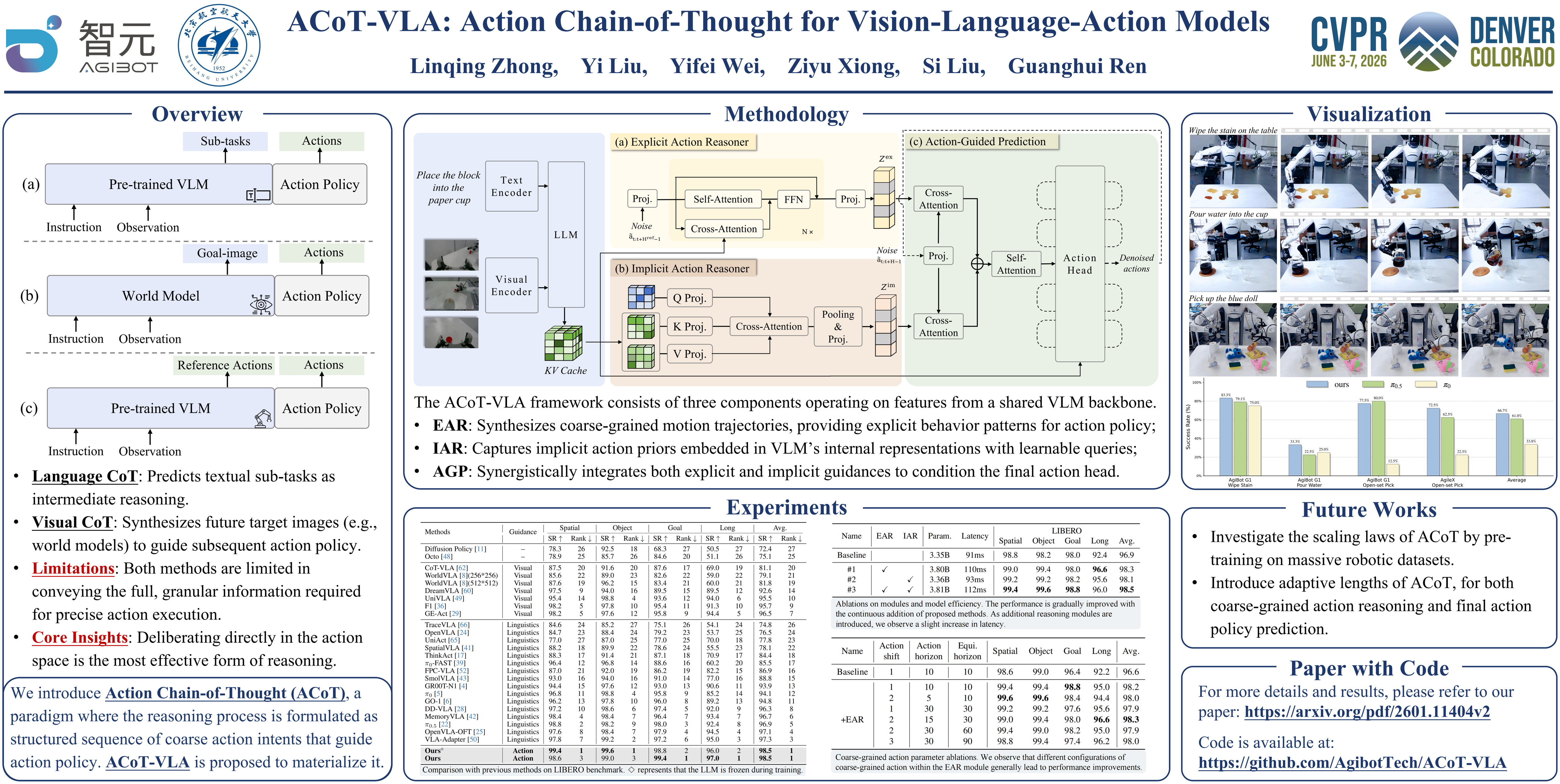
Vision-Language-Action (VLA) models have emerged essential generalist robot policies for diverse manipulation tasks, conventionally relying on directly translating multimodal inputs into actions via Vision-Language Model (VLM) embeddings.Recent advancements have introduced explicit intermediary reasoning—such as subtask prediction (language) or goal image synthesis (vision)—to guide action generation. However, these intermediate reasoning are often indirect and inherently limited in their capacity to convey the full, granular information required for precise action execution. Instead, we posit that the most effective form of reasoning is one that deliberates directly in the action space. We introduce Action Chain-of-Thought (ACoT), a paradigm where the reasoning process itself is formulated as a structured sequence of coarse action intents that guide the final policy. In this paper, we propose ACoT-VLA, a novel architecture that materializes the ACoT paradigm. Specifically, we introduce two complementary components: an Explicit Action Reasoner (EAR) and Implicit Action Reasoner (IAR). The former proposes coarse reference trajectories as explicit action-level reasoning steps, while the latter extracts latent action priors from internal representations of multimodal input, co-forming an ACoT that conditions the downstream action head to enable grounded policy learning.Extensive experiments in real-world and simulation environments demonstrate the superiority of our proposed method, which achieves 98.45%, 84.14% and 47.4% on LIBERO, LIBERO-Plus and VLABench, respectively.
BridgeEQA: Virtual Embodied Agents for Real Bridge Inspections
Subin Varghese ⋅ Joshua Gao ⋅ Asad Ur Rahman ⋅ Vedhus Hoskere
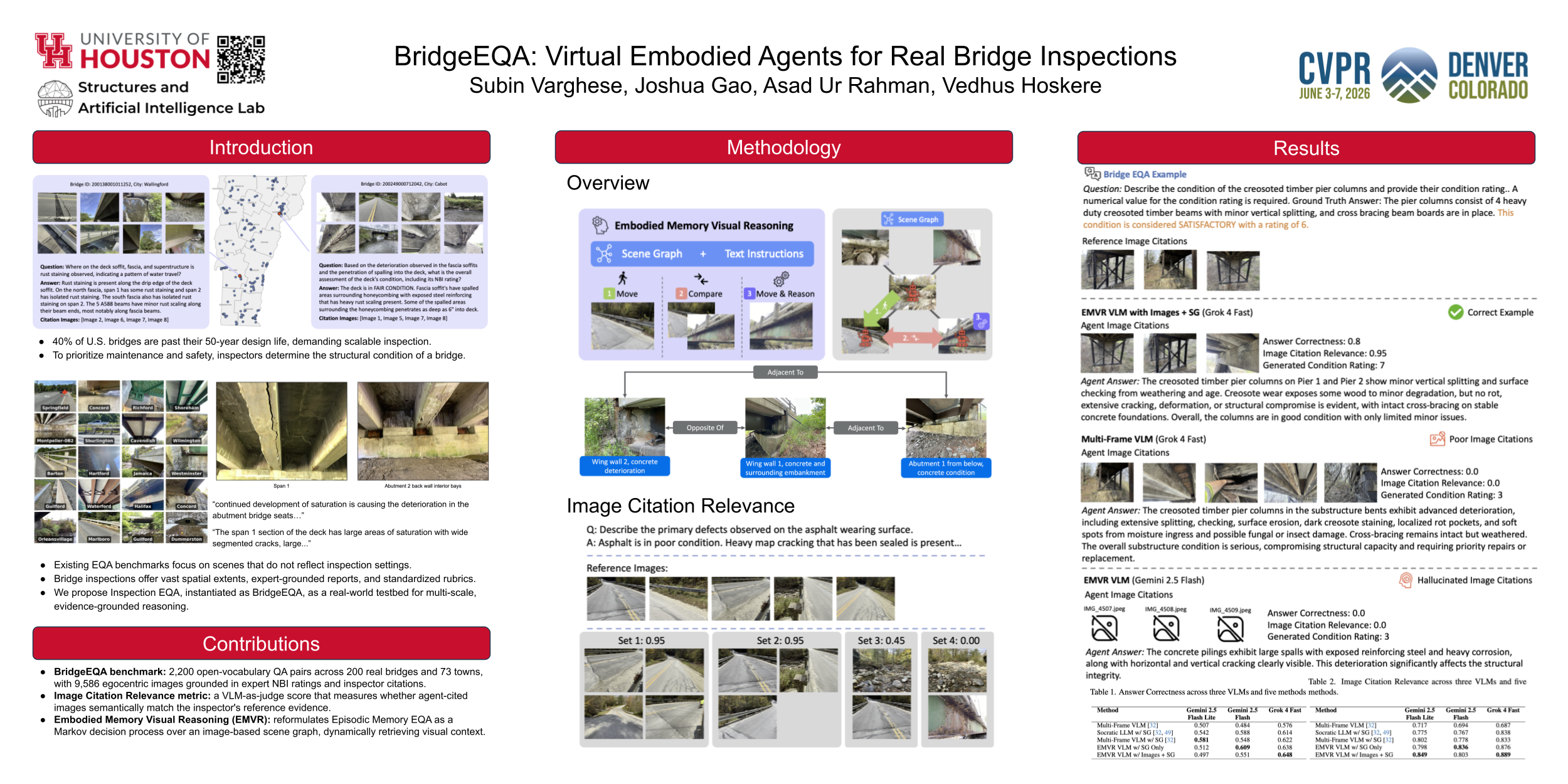
Deploying embodied agents that can answer questions about their surroundings in realistic real-world settings remains difficult, partly due to the scarcity of benchmarks that faithfully capture practical operating conditions. We propose infrastructure inspection as a compelling domain for open-vocabulary Embodied Question Answering (EQA): it naturally demands multi-scale reasoning, long-range spatial understanding, and complex semantic relationships, while offering unique evaluation advantages via standardized National Bridge Inventory (NBI) condition ratings (0-9), professional inspection reports, and egocentric imagery.We introduce BridgeEQA, a benchmark of 2,200 open-vocabulary question-answer pairs (in the style of OpenEQA) grounded in professional inspection reports across 200 real-world bridge scenes with 47.93 images on average per scene. Questions require synthesizing visual evidence across multiple images and aligning responses with NBI condition ratings. We further propose a new EQA metric Image Citation Relevance to evaluate the ability of a model to cite relevant images.Evaluations of state-of-the-art vision-language models reveal substantial performance gaps under episodic memory EQA settings. To address this, we propose Embodied Memory Visual Reasoning (EMVR), which formulates inspection as sequential navigation over an image-based scene graph: images are nodes, and an agent takes actions to traverse views, compare evidence, and reason within a Markov decision process. EMVR shows strong performance over the baselines. We publicly release both the dataset and code.
SyncMos: Scalable Motion Synchronisation for Multi-Agent Scene Interaction
Lingxiao Li ⋅ Dongwon Kim ⋅ Lingyan Ruan ⋅ Taesoo Kwon ⋅ Bin Chen ⋅ Taehyun Rhee
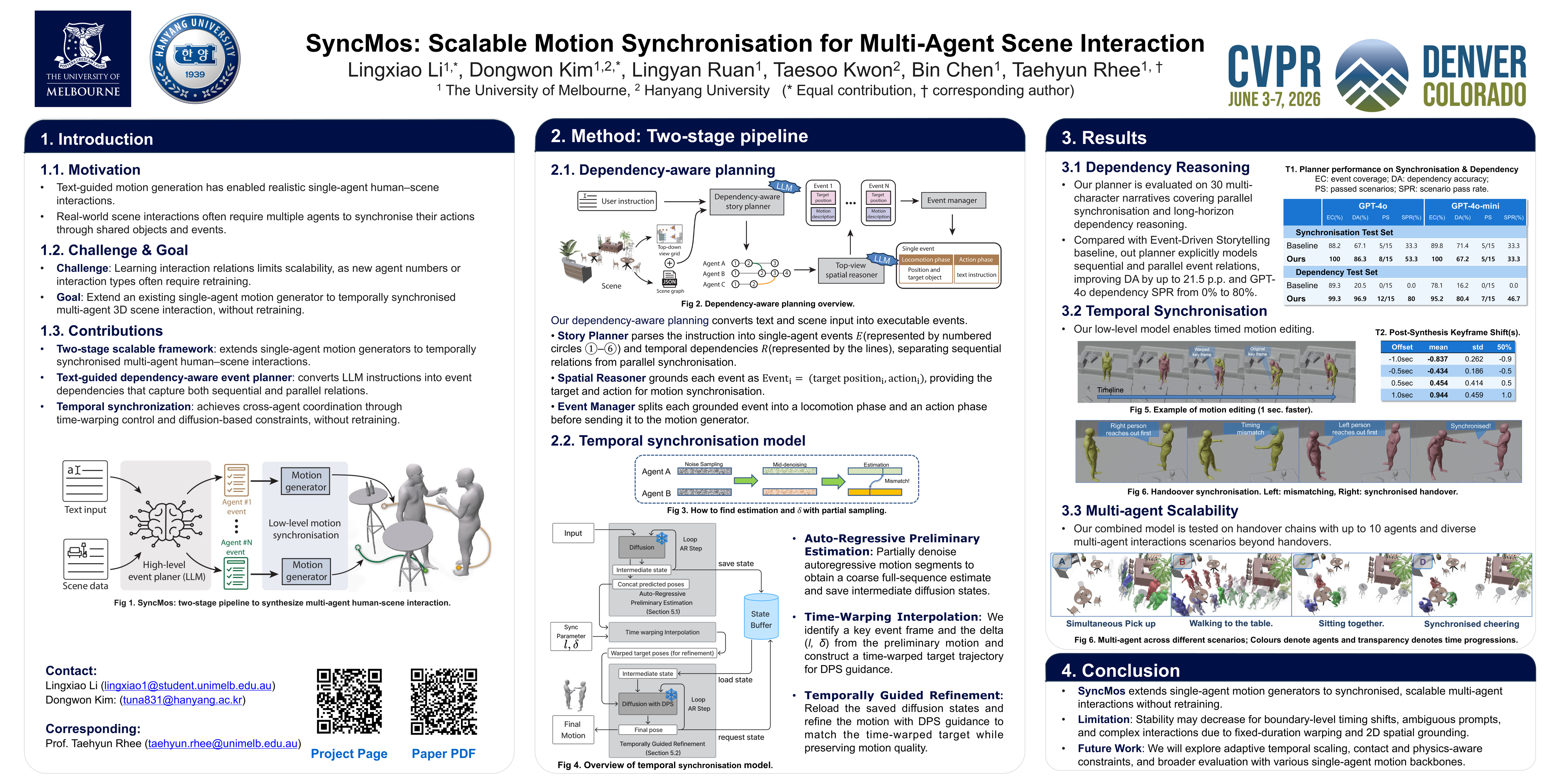
Text-guided motion generation in 3D scenes has advanced the synthesis of human–scene interactions, contributing to embodied AI, scene understanding, and virtual agent simulation. While recent studies have begun exploring multi-agent scenarios, achieving temporally synchronised interactions among multiple agents remains an open challenge. Existing methods are often limited in flexibility and scalability when handling diverse interaction contexts.We present a method that enables synchronised multi-agent interaction using a single-agent motion synthesis model through two key components: a text-guided dependency-aware story planner and a temporal synchronisation module. The story planner interprets natural language instructions into structured event sequences with temporal dependencies. Our synchronisation module, built upon time-warping control and diffusion posterior sampling, aligns interaction timing across agents without retraining.Experimental results demonstrate that the proposed framework effectively models temporal dependencies and causal order between events. Evaluations across diverse interaction types show improved temporal alignment and coherent multi-agent motion generation consistent with textual instructions.
Planning in 8 Tokens: A Compact Discrete Tokenizer for Latent World Model
Dongwon Kim ⋅ Gawon Seo ⋅ Jinsung Lee ⋅ Minsu Cho ⋅ Suha Kwak
World models provide a powerful framework for simulating environment dynamics conditioned on actions or instructions, enabling downstream tasks such as action planning or policy learning.Recent approaches leverage world models as learned simulators, but its application to decision-time planning remains computationally prohibitive for real-time control.A key bottleneck lies in latent representations: conventional tokenizers encode each observation into hundreds of tokens, making planning both slow and resource-intensive.To address this, we propose CompACT, a discrete tokenizer that compresses each observation into as few as 8 tokens, drastically reducing computational cost while preserving essential information for planning.An action-conditioned world model that occupies CompACT tokenizer achieves competitive planning performance with orders-of-magnitude faster planning, offering a practical step toward real-world deployment of world models.
Omni-Attribute: Open-vocabulary Attribute Encoder for Visual Concept Personalization
Tsai-Shien Chen ⋅ Aliaksandr Siarohin ⋅ Gordon Guocheng Qian ⋅ Kuan-Chieh Jackson Wang ⋅ Egor Nemchinov ⋅ Moayed Haji Ali ⋅ Riza Alp Guler ⋅ Willi Menapace ⋅ Ivan Skorokhodov ⋅ Anil Kag ⋅ Jun-Yan Zhu ⋅ Sergey Tulyakov
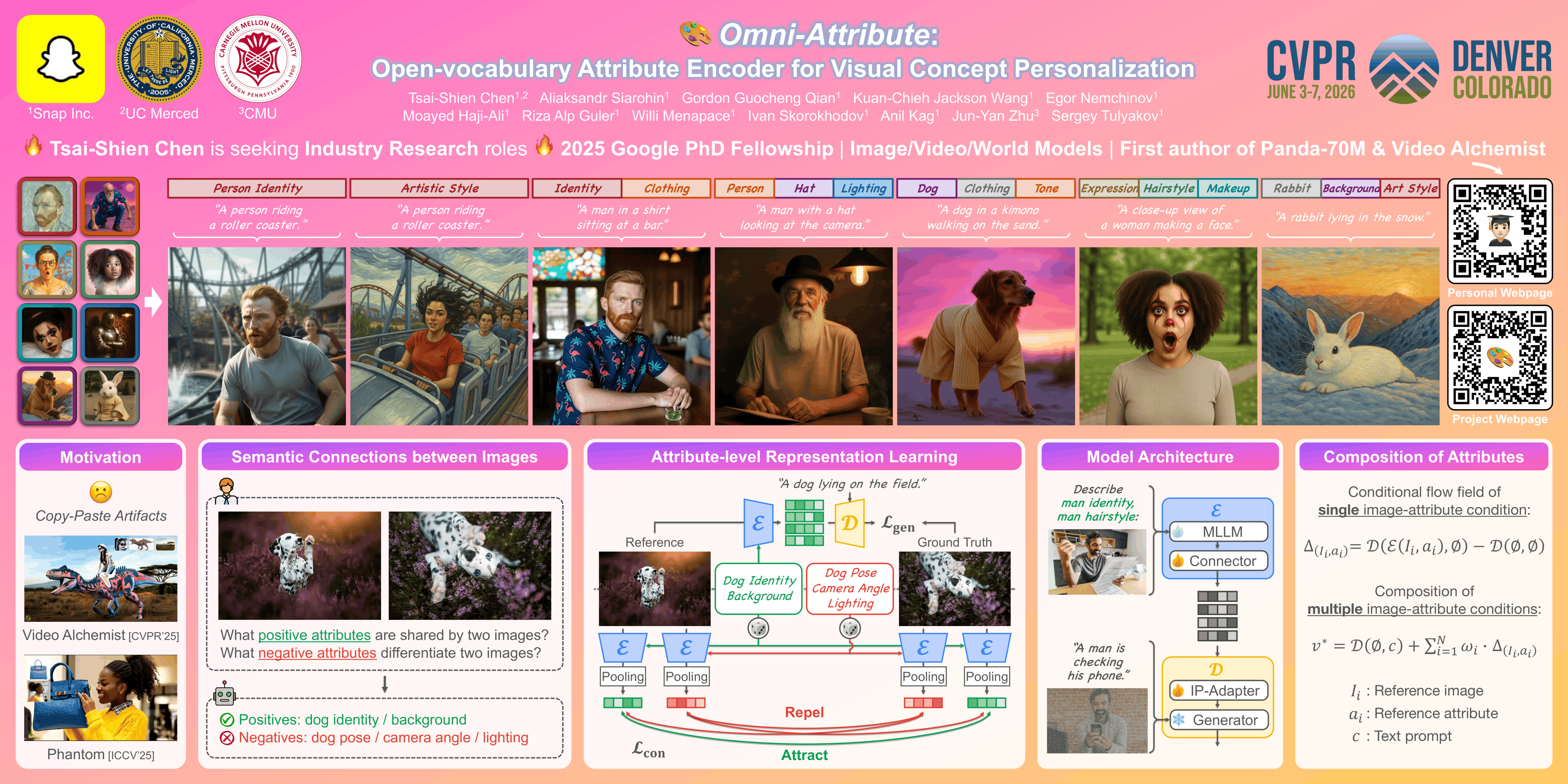
Visual concept personalization aims to transfer only specific image attributes, such as identity, expression, lighting, and style, into unseen contexts. However, existing methods rely on holistic embeddings from general-purpose image encoders, which entangle multiple visual factors and make it difficult to isolate a single attribute. This often leads to information leakage and incoherent synthesis. To address this limitation, we introduce Omni-Attribute, the first open-vocabulary image attribute encoder designed to learn high-fidelity, attribute-specific representations. Our approach jointly designs the data and model: (i) we curate semantically linked image pairs annotated with positive and negative attributes to explicitly teach the encoder what to preserve or suppress; and (ii) we adopt a dual-objective training paradigm that balances generative fidelity with contrastive disentanglement. The resulting embeddings prove effective for open-vocabulary attribute retrieval, personalization, and compositional generation, achieving state-of-the-art performance across multiple benchmarks.
IF-Bench: Benchmarking and Enhancing MLLMs for Infrared Images with Generative Visual Prompting
Tao Zhang ⋅ Yuyang Hong ⋅ Yang Xia ⋅ Kun Ding ⋅ Zeyu Zhang ⋅ Ying Wang ⋅ Shiming Xiang ⋅ Chunhong Pan
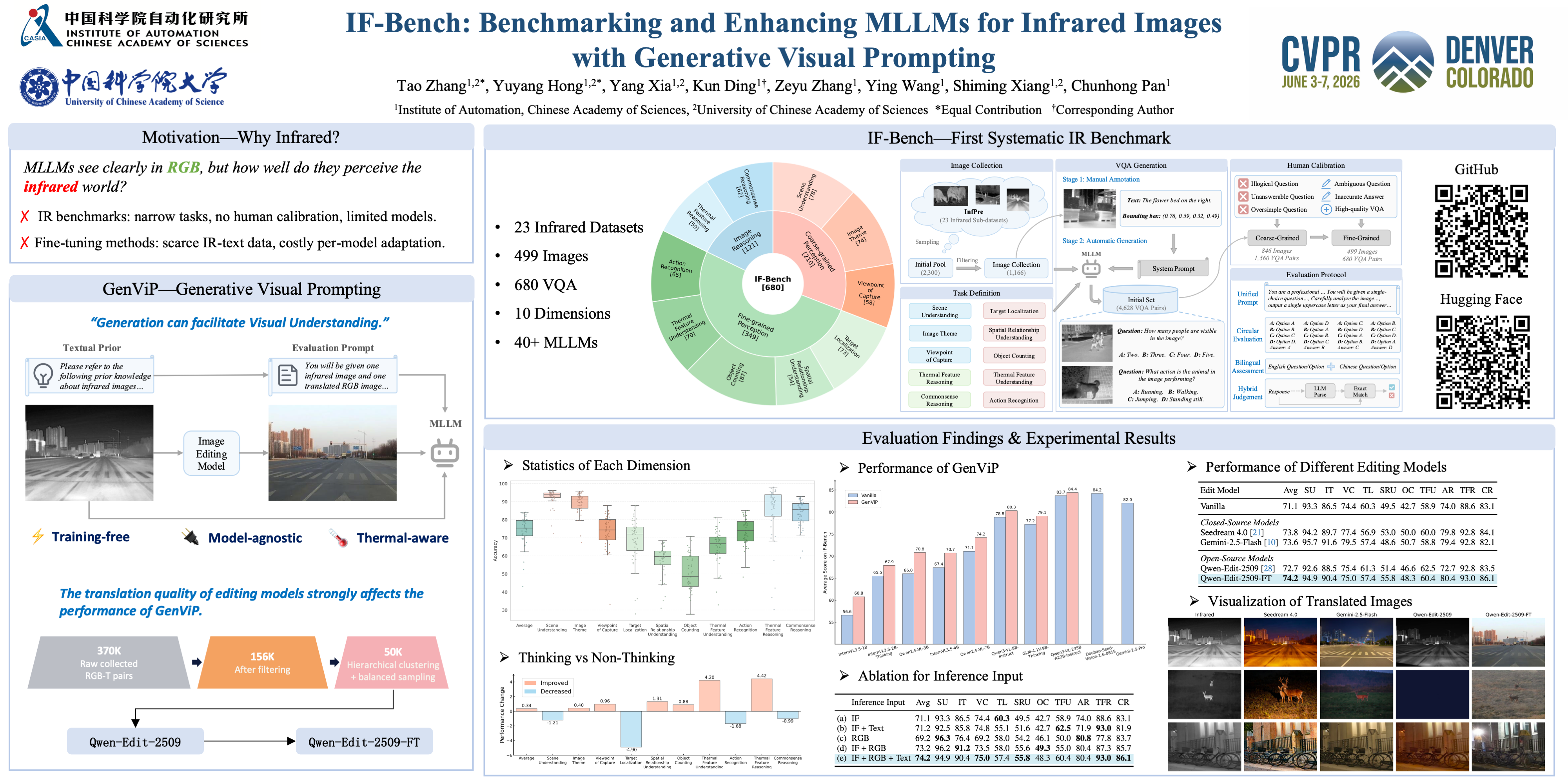
Recent advances in multimodal large language models (MLLMs) have led to impressive progress across various benchmarks. However, their capability in understanding infrared images remains unexplored. To address this gap, we introduce IF-Bench, the first high-quality benchmark designed for evaluating multimodal understanding of infrared images. IF-Bench consists of 499 images sourced from 23 infrared datasets and 680 carefully curated visual question-answer pairs, covering 10 essential dimensions of image understanding. Based on this benchmark, we systematically evaluate over 40 open-source and closed-source MLLMs, employing cyclic evaluation, bilingual assessment, and hybrid judgment strategies to enhance the reliability of the results. Our analysis reveals how model scale, architecture, and inference paradigms affect infrared image comprehension, providing valuable insights for this area. Furthermore, we propose a training-free generative visual prompting (GenViP) method, which leverages advanced image editing models to translate infrared images into semantically and spatially aligned RGB counterparts, thereby mitigating domain distribution shifts. Extensive experiments demonstrate that our method consistently yields significant performance improvements across a wide range of MLLMs.
InstantRetouch: Efficient and High-Fidelity Instruction-Guided Image Retouching with Bilateral Space
Jiarui Wu ⋅ Yujin Wang ⋅ Ruikang Li ⋅ Fan Zhang ⋅ Mingde Yao ⋅ Tianfan Xue
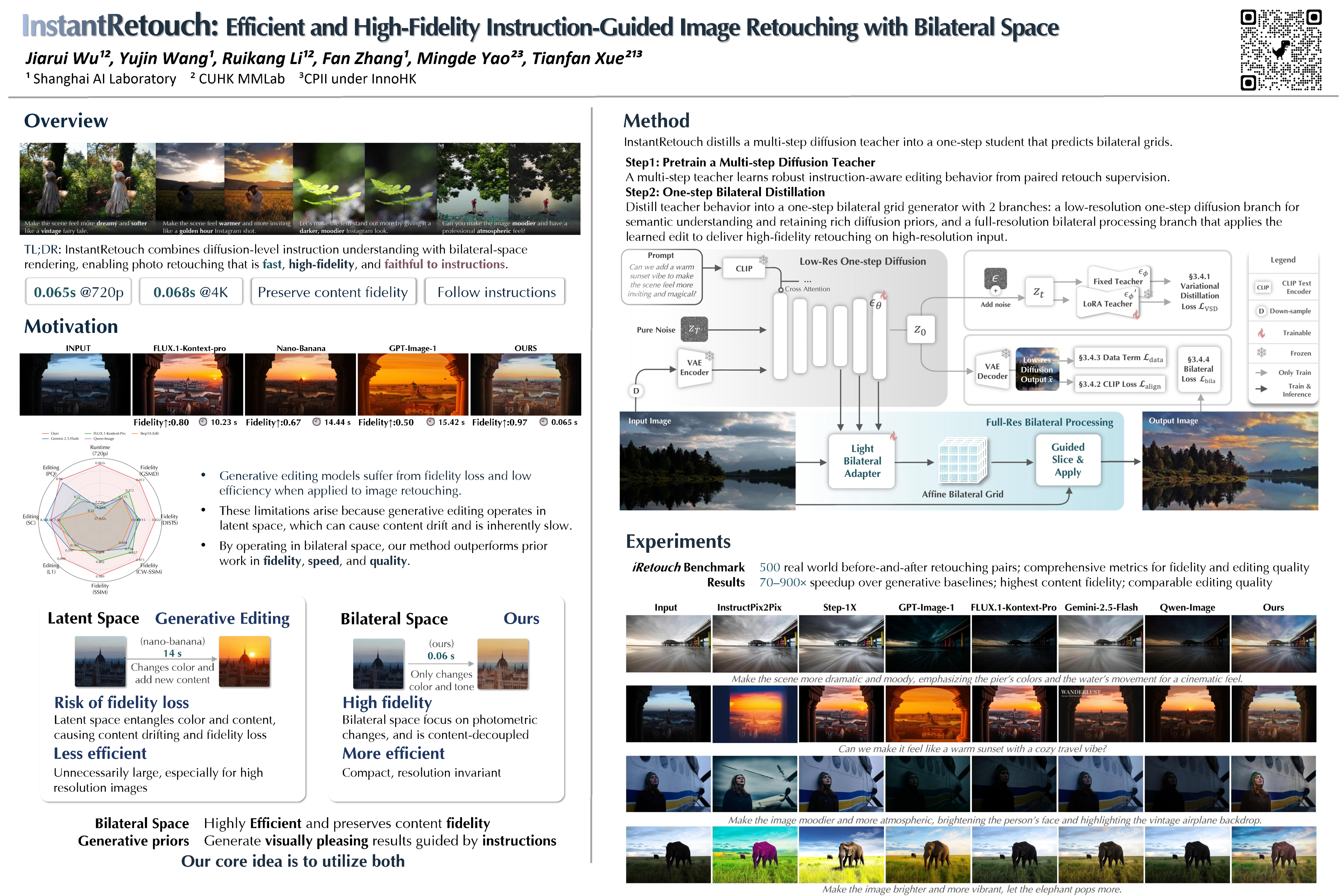
Language-guided photo retouching aims to adjust color and tone while preserving geometry and texture. Recently, diffusion-based retouching shows a superior visual quality, but often struggles with both fidelity issues due to its generative nature and efficiency because of its iterative sampling process.In this work, we propose an efficient and fidelity-preserving retouching method using bilateral space manipulation, which is both compact and content-decoupled. Specifically, instead of directly editing pixels or image latents, our model predicts a low-resolution bilateral grid of affine transforms, which are sliced using a learned guidance map and then applied to the full-resolution image. This approach yields both high fidelity and improved efficiency.To retain strong priors of a pretrained generative model, we distill a multi-step diffusion model into our bilateral grid framework using Variational Score Distillation, complemented by a prompt alignment loss to guide instruction-following behavior. Additionally, we introduce a new benchmark and evaluate our method across multiple dimensions: fidelity, instruction following, and efficiency.Compared to the latest retouch methods, like Gemini-2.5-Flash (Nano-Banana), our method can avoid content drift, significantly improve latency, and generate visually pleasing edits, while maintaining a high level of fidelity.
MICON-Bench: Benchmarking and Enhancing Multi-Image Context Image Generation in Unified Multimodal Models
Mingrui Wu ⋅ Hang Liu ⋅ Jiayi Ji ⋅ Xiaoshuai Sun ⋅ Rongrong Ji
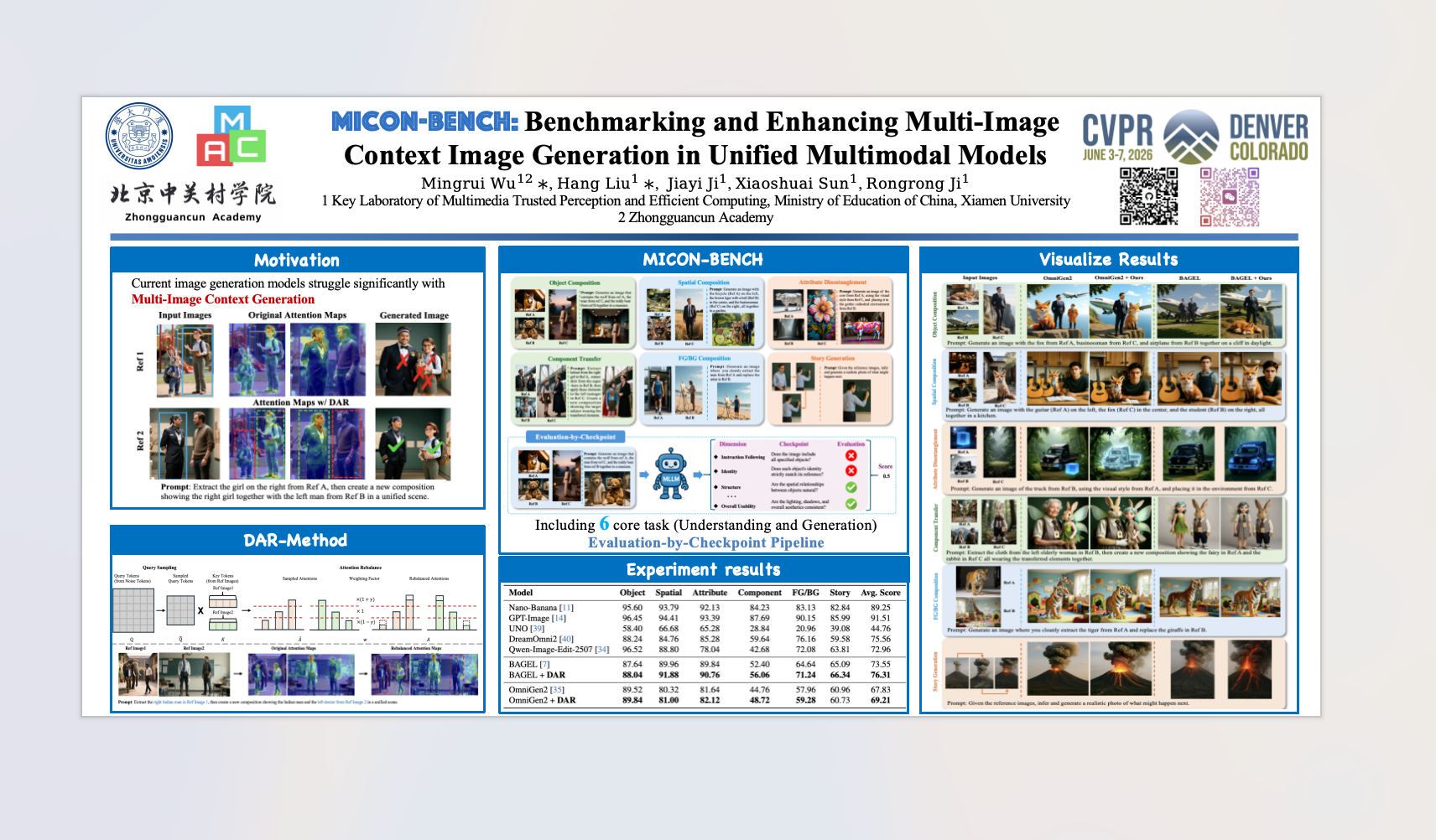
Recent advancements in Unified Multimodal Models (UMMs) have enabled remarkable image understanding and generation capabilities. However, while models like Gemini-2.5-Flash-Image show emerging abilities to reason over multiple related images, existing benchmarks rarely address the challenges of multi-image context generation, focusing mainly on text-to-image or single-image editing tasks. In this work, we introduce MICON-Bench, a comprehensive benchmark covering six tasks that evaluate cross-image composition, contextual reasoning, and identity preservation. We further propose an MLLM-driven Evaluation-by-Checkpoint framework for automatic verification of semantic and visual consistency, where multimodal large language model (MLLM) serves as a verifier. Additionally, we present Dynamic Attention Rebalancing (DAR), a training-free, plug-and-play mechanism that dynamically adjusts attention during inference to enhance coherence and reduce hallucinations. Extensive experiments on various state-of-the-art open-source models demonstrate both the rigor of MICON-Bench in exposing multi-image reasoning challenges and the efficacy of DAR in improving generation quality and cross-image coherence.
The Devil is in Attention Sharing: Improving Complex Non-rigid Image Editing Faithfulness via Attention Synergy
Zhuo Chen ⋅ Fanyue Wei ⋅ Runze Xu ⋅ Jingjing Li ⋅ Lixin Duan ⋅ Angela Yao ⋅ Wen Li
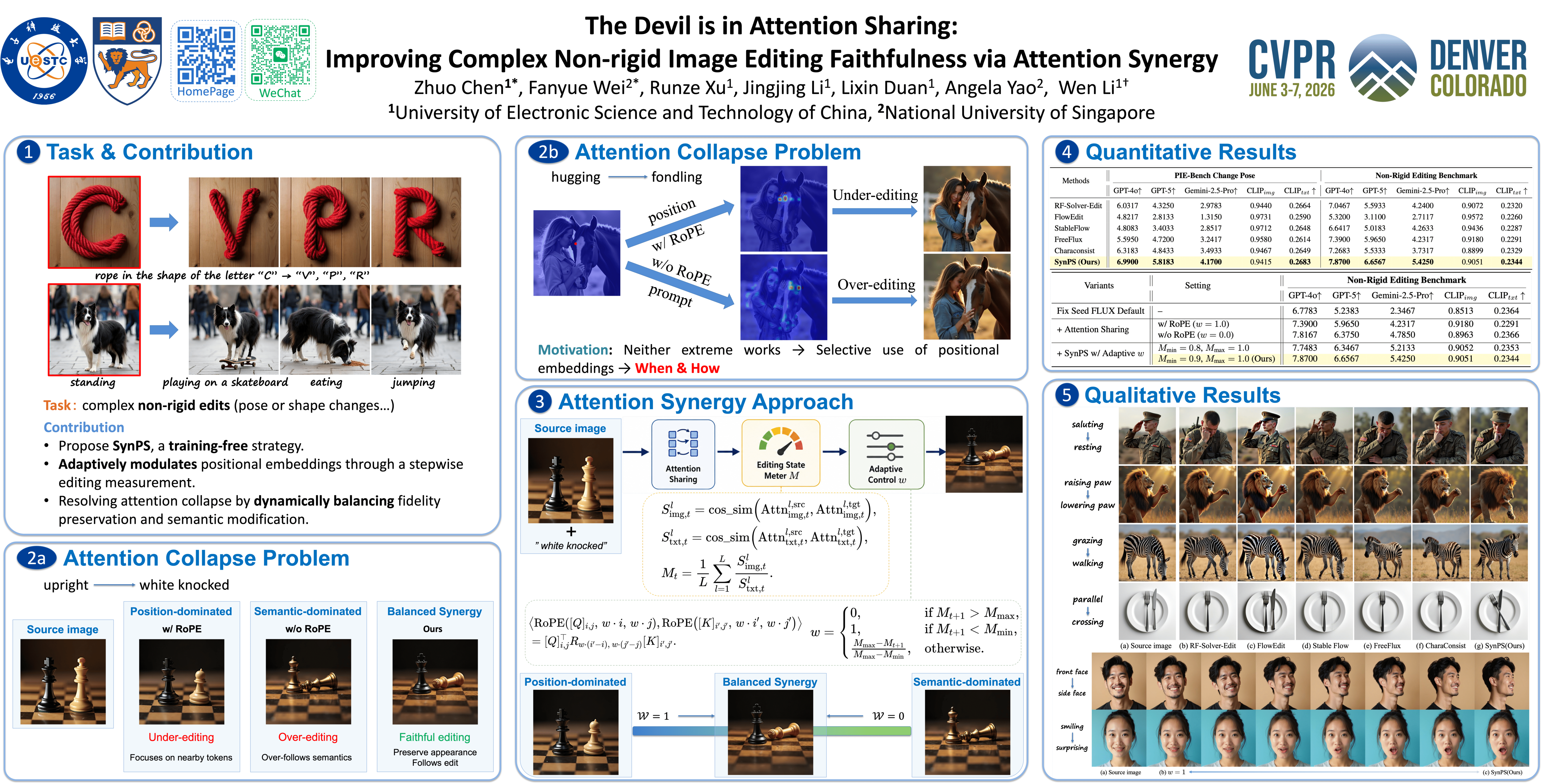
Training-free image editing with large diffusion models has become practical, yet faithfully performing complex non-rigid edits (e.g., pose or shape changes) remains highly challenging. We identify a key underlying cause: attention collapse in existing attention sharing mechanisms, where either positional embeddings or semantic features dominate visual content retrieval, leading to over-editing or under-editing.To address this issue, we introduce $\textbf{SynPS}$, a method that $\textbf{Syn}$ergistically leverages$\textbf{P}$ositional embeddings and $\textbf{S}$emantic information for faithful non-rigid image editing. We first propose an editing measurement that quantifies the required editing magnitude at each denoising step. Based on this measurement, we design an attention synergy pipeline that dynamically modulates the influence of positional embeddings, enabling SynPS to balance semantic modifications and fidelity preservation.By adaptively integrating positional and semantic cues, SynPS effectively avoids both over- and under-editing. Extensive experiments on public and newly curated benchmarks demonstrate the superior performance and faithfulness of our approach. Our code will be publicly released.
ShreddingNet: Coarse-to-Fine Restoration for Multi-Source Shredded Manuscripts
Haoyang Cui ⋅ Hao Jiang ⋅ Yadong Mu
As an important research task of human cultural heritage, the restoration of artworks and calligraphy is of great significance.Seldom existing works have taken the multi-source (i.e., fragments are not ensured to be from the same piece of artworks) fragment-oriented restoration task into account.We propose ShreddingNet, a coarse-to-fine two-stage pipeline for multi-source manuscript restoration that operates without restrictive conditions.The proposed coarse stage compares the features of each fragment, selecting top-K candidates and clustering fragments by source. This design leverages the key insight that erroneous matches rarely cross source boundaries, enabling high-precision clustering.The proposed fine-grained stage evaluates candidates, yielding matching scores and filters out erroneous matching pairs from the candidate set; producing more precise final matching pairs for global assembly. Experiments conducted on more than 4,000 images from two datasets demonstrate the average reconstruction F1-score achieves 98.37\%, which is 5.72\% higher than the current state-of-the-art method, confirming the method’s effectiveness and robustness.Source code is available in the supplementary material.
Image Guides Images: Consistent Video Amodal Completion with Rectified In-Context Exemplar Guidance
Xiaoyu Kong ⋅ Ketong Ren ⋅ Dongyu She ⋅ Weiming Dong ⋅ Miao Wang
Video amodal completion (VAC) aims to mimic the human brain's ability to implicitly perceive the complete appearance of partially occluded objects, thereby facilitating recognition and understanding. Existing VAC methods finetune video generation models on custom datasets, yet these datasets often have unrealistic distributions and small scales due to the challenges of collecting real amodal data and thus limit their performance and generalization.To address this, we utilize pre-trained image inpainting models for VAC and introduce in-context (IC) learning to enhance inter-frame consistency. However, despite the satisfactory performance of DiT-based IC Learning in generation tasks, task-agnostic global information often utilizes irrelevant scene information, resulting in completion failures when applied to amodal completion task. Additionally, IC Learning faces a cold-start problem with the exemplar construction. To this end, we propose a consistency video amodal completion with rectified in-context exemplar guidance. Specifically, we introduce rectified exemplar-guided completion by adjusting the attention weights of exemplar image relative to the target images for consistent completion, and adopt a dual-frame calibrated exemplar rectification to tackle the cold-start issue.Quantitative and qualitative experiments demonstrate that our method outperforms SOTAs, especially in terms of generalization and robustness on uncommon data and under severe occlusion.
Radiance Meshes for Volumetric Reconstruction
Alexander Mai ⋅ Trevor Hedstrom ⋅ George Kopanas ⋅ Janne Kontkanen ⋅ Falko Kuester ⋅ Jonathan T. Barron
We introduce Radiance Meshes for representing radiance fields with constant density tetrahedral cells produced with a Delaunay tetrahedralization.Unlike a Voronoi diagram, a Delaunay tetrahedralization yields simple triangles that are natively supported by existing hardware. As such, our model is able to perform exact and fast volume rendering using both rasterization and ray-tracing. We introduce a new rasterization method that achieve faster rendering speeds than all prior radiance field representations (assuming an equivalent number of primitives and resolution) across a variety of platforms.Optimizing the positions of Delaunay vertices introduces topological discontinuities (edge flips). To solve this, we use a Zip-NeRF-style backbone which allows us to express a smoothly varying field even when the topology changes.Our rendering method exactly evaluates the volume rendering equation and enables high quality, real-time view synthesis on standard consumer hardware. Our tetrahedral meshes also lend themselves to a variety of exciting applications including fisheye lens distortion, physics-based simulation, editing, and mesh extraction.
Aesthetic Camera Viewpoint Suggestion with 3D Aesthetic Field
Sheyang Tang ⋅ Armin Shafiee Sarvestani ⋅ Jialu Xu ⋅ Xiaoyu Xu ⋅ Zhou Wang
The aesthetic quality of a scene depends strongly on camera viewpoint.Existing approaches for aesthetic viewpoint suggestion are either single-view adjustments, predicting limited camera adjustments from a single image without understanding scene geometry, or 3D exploration approaches, which rely on dense captures or prebuilt 3D environments coupled with costly reinforcement learning (RL) searches. In this work, we introduce the notion of 3D aesthetic field that enables geometry-grounded aesthetic reasoning in 3D with sparse captures, allowing efficient viewpoint suggestions in contrast to costly RL searches.We opt to learn this 3D aesthetic field using a feedforward 3D Gaussian Splatting network that distills high-level aesthetic knowledge from a pretrained 2D aesthetic model into 3D space, enabling aesthetic prediction for novel viewpoints from only sparse input views. Building on this field, we propose a two-stage search pipeline that combines coarse viewpoint sampling with gradient-based refinement, efficiently identifying aesthetically appealling viewpoints without dense captures or RL exploration. Extensive experiments show that our method consistently suggests viewpoints with superior framing and composition compared to existing approaches, establishing a new direction toward 3D-aware aesthetic modeling.
CoRoGS: Contextual Gaussian Splatting for Robust Large-Deviation View Synthesis
Xin Ma ⋅ Peng Lu ⋅ Yisong Chen ⋅ Chengwei Pan ⋅ Sheng Li
Novel view synthesis (NVS) under large view deviations remains an underexplored challenge for 3D Gaussian Splatting (3DGS). In urban scenes with limited training coverage, models often fail to maintain geometric consistency when extrapolating to unseen viewpoints, resulting in severe distortions and degraded rendering quality. We introduce Context-Aware Gaussian Splatting (CoRoGS), a $\textbf{Co}$ntext-aware framework for $\textbf{Ro}$bust large-deviation novel view synthesis (LD-NVS) that embeds contextual reasoning into 3DGS. Instead of treating Gaussians as independent primitives, CoRoGS adopts a contextual formulation that explicitly models inter-Gaussian dependencies. This representation is implemented by constructing a 3D Gaussian graph, which propagates relational geometry and semantics via message passing, resulting in context-aware Gaussian updates. To further maintain structural consistency under substantial view deviation, we incorporate a progressive graph expansion strategy that adaptively grows and prunes Gaussians, leading to more coherent and complete scene reconstructions. Extensive experiments demonstrate that CoRoGS outperforms state-of-the-art 3DGS-based methods, producing higher-quality results. We highlight that CoRoGS robustly handles a wide range of view shifts, including lateral deviations (e.g., lane-level offsets) and cross-level transitions such as from ground-level driving views to elevated perspectives.
ChronoGS: Disentangling Invariants and Changes in Multi-Period Scenes
Zhongtao Wang ⋅ Jiaqi Dai ⋅ Qingtian Zhu ⋅ Yilong Li ⋅ Mai Su ⋅ Fei Zhu ⋅ Meng GAI ⋅ Shaorong Wang ⋅ Chengwei Pan ⋅ Yisong Chen ⋅ Guoping Wang
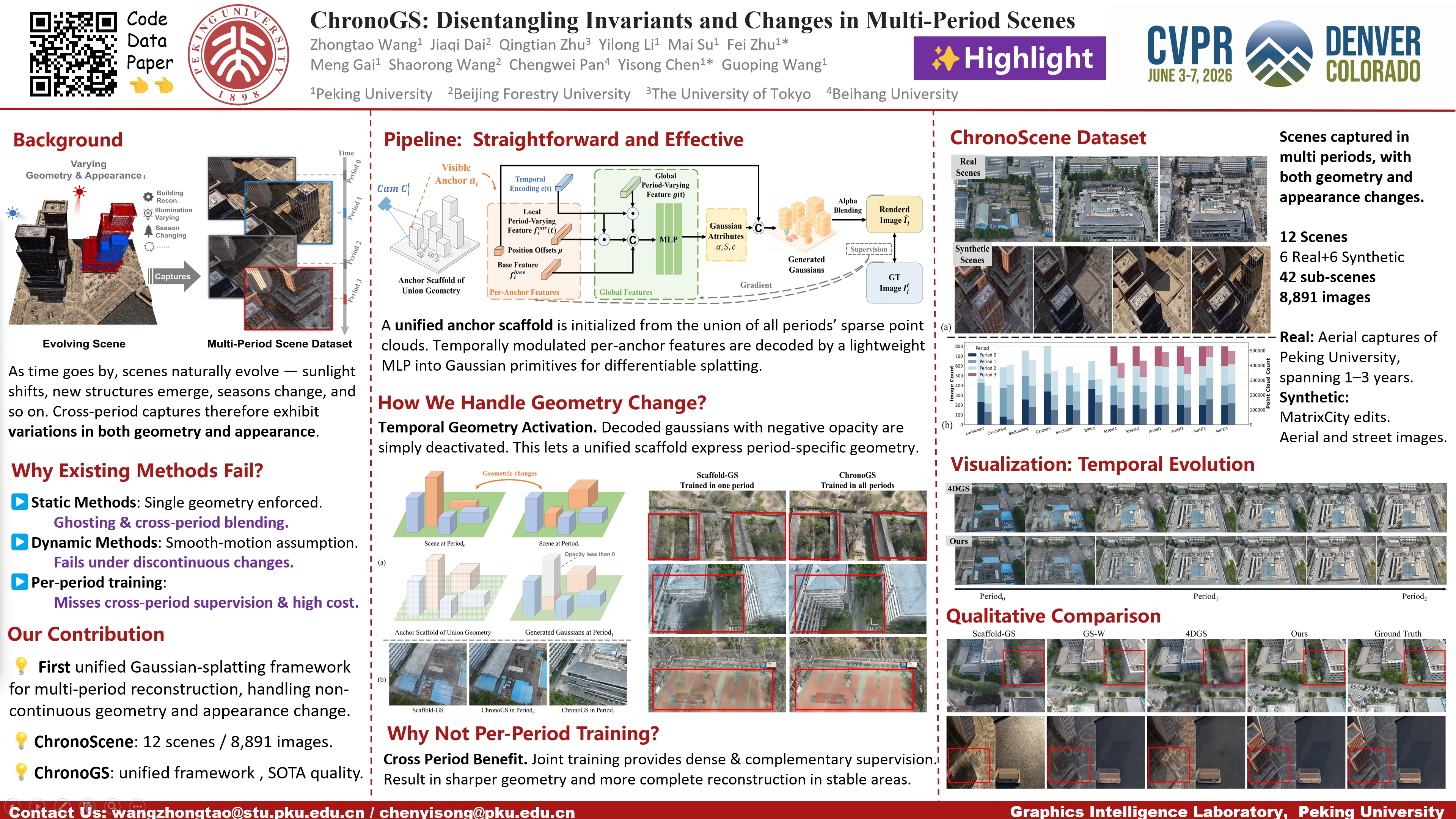
Multi-period image collections are common in real-world applications. Cities are re-scanned for mapping, construction sites are revisited for progress tracking, and natural regions are monitored for environmental change. Such data form multi-period scenes, where geometry and appearance evolve. Reconstructing such scenes is an important yet underexplored problem. Existing pipelines rely on incompatible assumptions: static and in-the-wild methods enforce a single geometry, while dynamic ones assume smooth motion, both failing under long-term, discontinuous changes. To solve this problem, we introduce ChronoGS, a temporally modulated Gaussian representation that reconstructs all periods within a unified anchor scaffold. It‘s also designed to disentangle stable and evolving components, achieving temporally consistent reconstruction of multi-period scenes. To catalyze relevant research, we release ChronoScene dataset, a benchmark of real and synthetic multi-period scenes, capturing geometric and appearance variation. Experiments demonstrate that ChronoGS consistently outperforms baselines in reconstruction quality and temporal consistency. Our code and the ChronoScene dataset will be made publicly available.
Real-Time Dynamic Scene Rendering with Controlled Compressibility and Contact Awareness
Boya Shi ⋅ Naiyang Guan ⋅ Xiaodong Yi
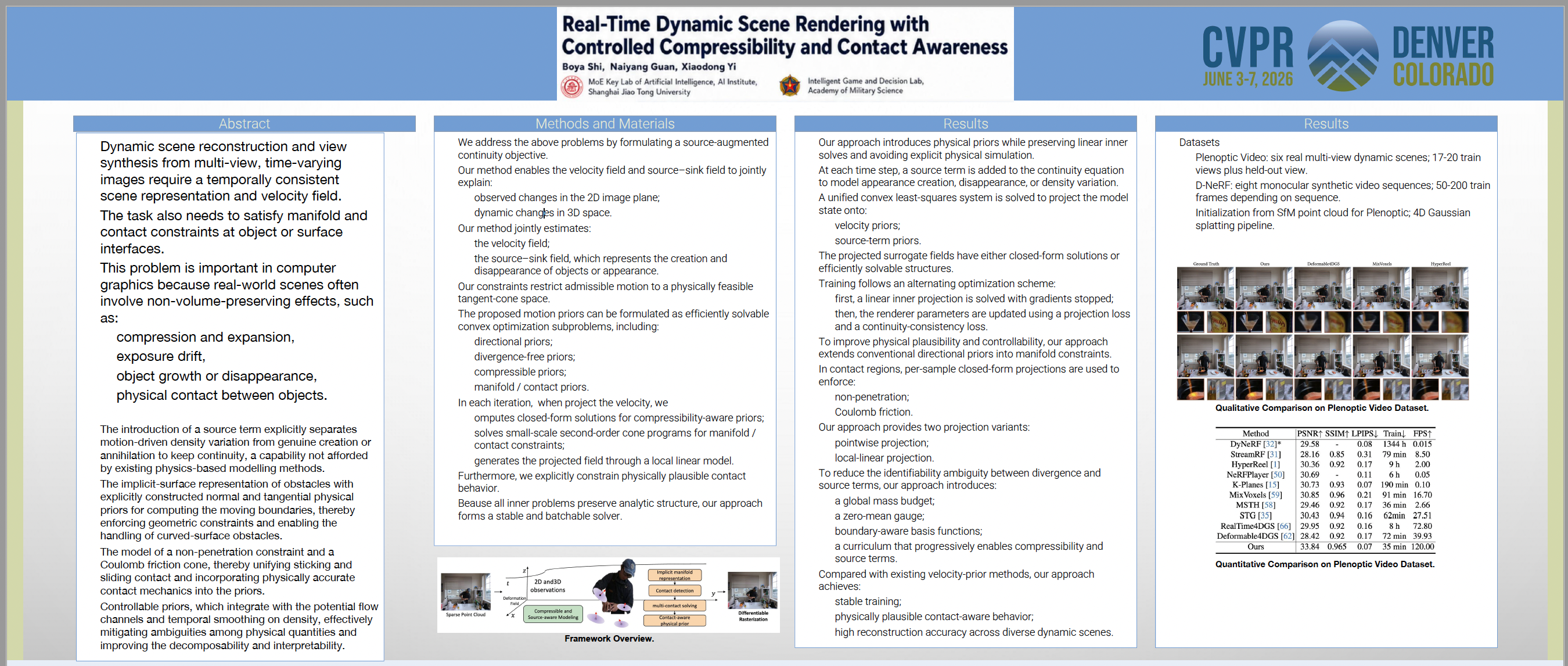
Existing dynamic scene rendering methods often adopt rigid-body or direction-limited assumptions, yet real-world motion and contact routinely violate these, producing artifacts near occlusion boundaries. To address this, we introduce a unified, source-aware framework for dynamic rendering that enforces the consistency of Gaussian primitives under an explicit manifold constraints. We project predicted velocities onto physically grounded priors via efficient, parallel inner solves: (i) a Helmholtz parameterization that separates divergence-free and potential-flow motion components; (ii) an anisotropic, compressible directional prior; and (iii) an affine family that disentangles rotation from isotropic scaling. Experiments on extensive benchmarks show consistent improvements over state-of-the-art methods in reconstruction fidelity and temporal coherence. Our approach ensures physically realistic rendering, especially near contacts, and substantially reduces motion-boundary artifacts.
Splatent: Splatting Diffusion Latents for Novel View Synthesis
Or Hirschorn ⋅ Omer Sela ⋅ Inbar Huberman-Spiegelglas ⋅ Netalee Efrat Sela ⋅ Eli Alshan ⋅ Ianir Ideses ⋅ Frederic Devernay ⋅ Yochai Zvik ⋅ Lior Fritz
Radiance field representations have recently been explored in the latent space of VAEs that are commonly used by diffusion models. This direction offers efficient rendering and seamless integration with diffusion-based pipelines. However, these methods face a fundamental limitation: The VAE latent space lacks multi-view consistency, leading to blurred textures and missing details during 3D reconstruction. Existing approaches attempt to address this by fine-tuning the VAE, at the cost of reconstruction quality, or by relying on pre-trained diffusion models to recover fine-grained details, at the risk of some hallucinations. We present Splatent, a diffusion-based enhancement framework designed to operate on top of 3D Gaussian Splatting (3DGS) in the latent space of VAEs. Our key insight departs from the conventional 3D-centric view: rather than reconstructing fine-grained details in 3D space, we recover them in 2D from input views through multi-view attention mechanisms. This approach preserves the reconstruction quality of pretrained VAEs while achieving faithful detail recovery.Evaluated across multiple benchmarks, Splatent establishes a new state-of-the-art for VAE latent radiance field reconstruction. We further demonstrate that integrating our method with existing feed-forward frameworks, consistently improves detail preservation, opening new possibilities for high-quality sparse-view 3D reconstruction.We will release our code upon publication.
ParticleGS: Learning Neural Gaussian Particle Dynamics from Videos for Prior-free Physical Motion Extrapolation
Jinsheng Quan ⋅ Qiaowei Miao ⋅ Yichao Xu ⋅ Zizhuo Lin ⋅ Ying Li ⋅ Wei Yang ⋅ Zhihui Li ⋅ Yawei Luo
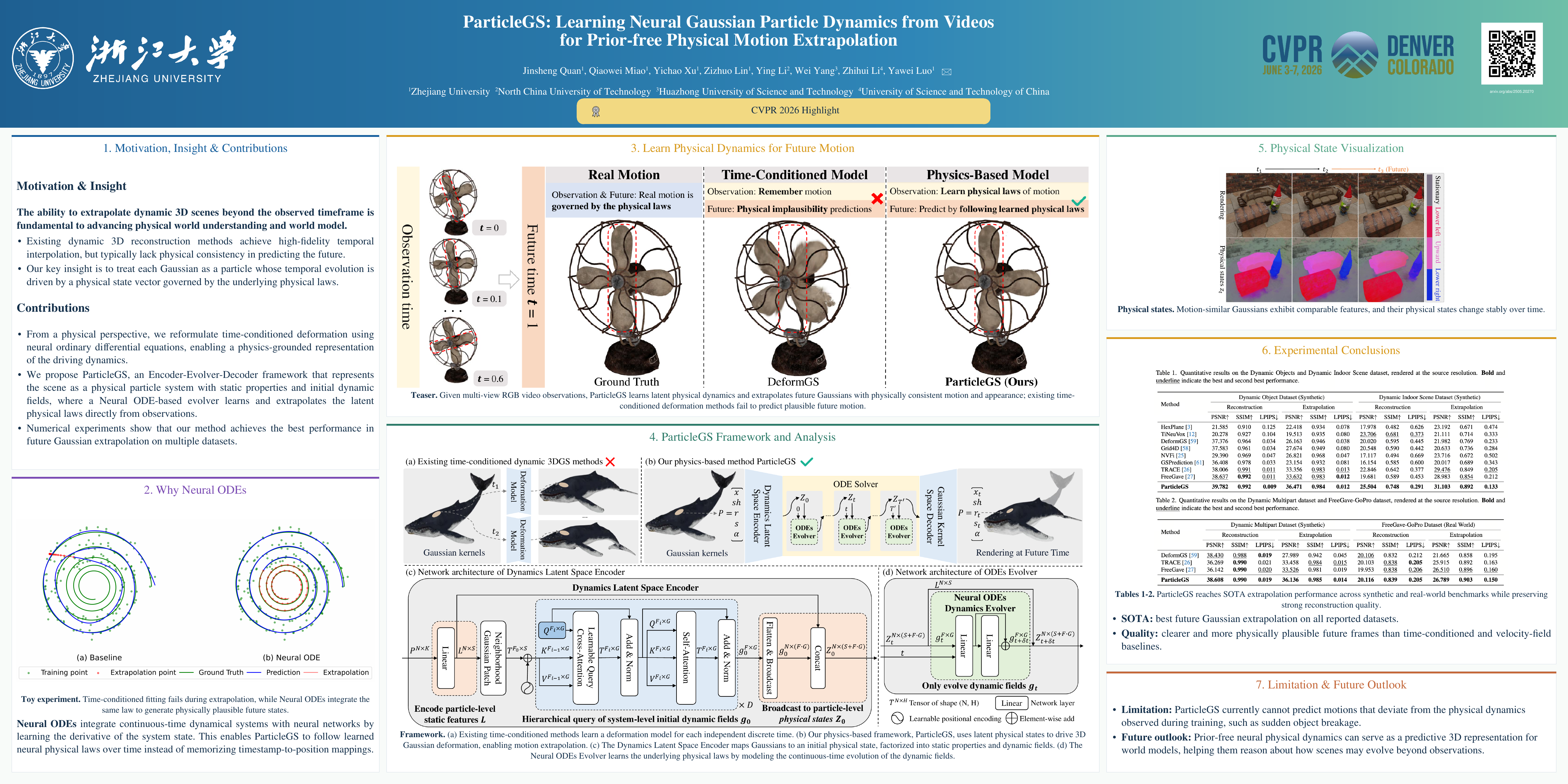
The ability to extrapolate dynamic 3D scenes beyond the observed timeframe is fundamental to advancing physical world understanding and predictive modeling. Existing dynamic 3D reconstruction methods have achieved high-fidelity rendering of temporal interpolation, but typically lack physical consistency in predicting the future. To overcome this issue, we propose ParticleGS, a physics-based framework that reformulates dynamic 3D scenes as physically grounded systems. ParticleGS comprises three key components: 1) an encoder that decomposes the scene into static properties and initial dynamic physical fields; 2) an evolver based on Neural Ordinary Differential Equations (Neural ODEs) that learns continuous-time dynamics for motion extrapolation; and 3) a decoder that reconstructs 3D Gaussians from evolved particle states for rendering. Through this design, ParticleGS integrates physical reasoning into dynamic 3D representations, enabling accurate and consistent prediction of the future. Experiments show that ParticleGS achieves state-of-the-art performance in extrapolation while maintaining rendering quality comparable to leading dynamic 3D reconstruction methods.
Dynamic-Static Decomposition for Novel View Synthesis of Dynamic Scenes with Spiking Neurons
Lingyun Dai ⋅ Zehao Chen ⋅ Yan Liu ⋅ Shi Gu ⋅ Peng Lin ⋅ De Ma ⋅ Huajin Tang ⋅ Qian Zheng ⋅ Gang Pan
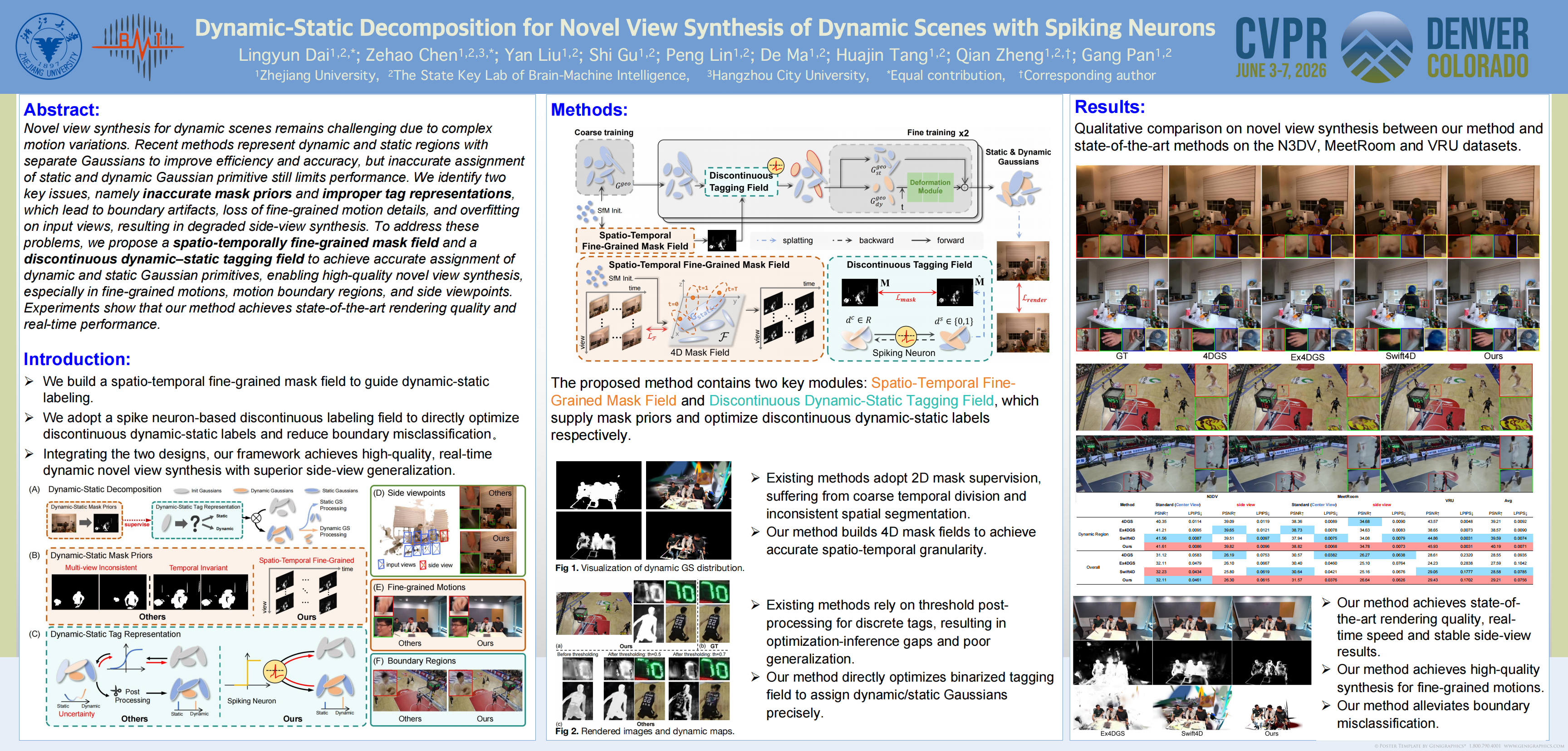
Novel view synthesis for dynamic scenes remains challenging due to complex motion variations.Recent methods represent dynamic and static regions with separate Gaussians to improve efficiency and accuracy, but inaccurate assignment of static and dynamic Gaussian primitive still limits performance.We identify two key issues, namely inaccurate mask priors and improper tag representations, which lead to boundary artifacts, loss of fine-grained motion details, and overfitting on input views, resulting in degraded side-view synthesis.To address these problems, we propose a spatio-temporally fine-grained mask field and a discontinuous dynamic–static tagging field to achieve accurate assignment of dynamic and static Gaussian primitives, enabling high-quality novel view synthesis, especially in fine-grained motions, motion boundary regions, and side viewpoints.Experiments show that our method achieves state-of-the-art rendering quality and real-time performance.
DiffSoup: Direct Differentiable Rasterization of Triangle Soup for Extreme Radiance Field Simplification
Kenji Tojo ⋅ Bernd Bickel ⋅ Nobuyuki Umetani
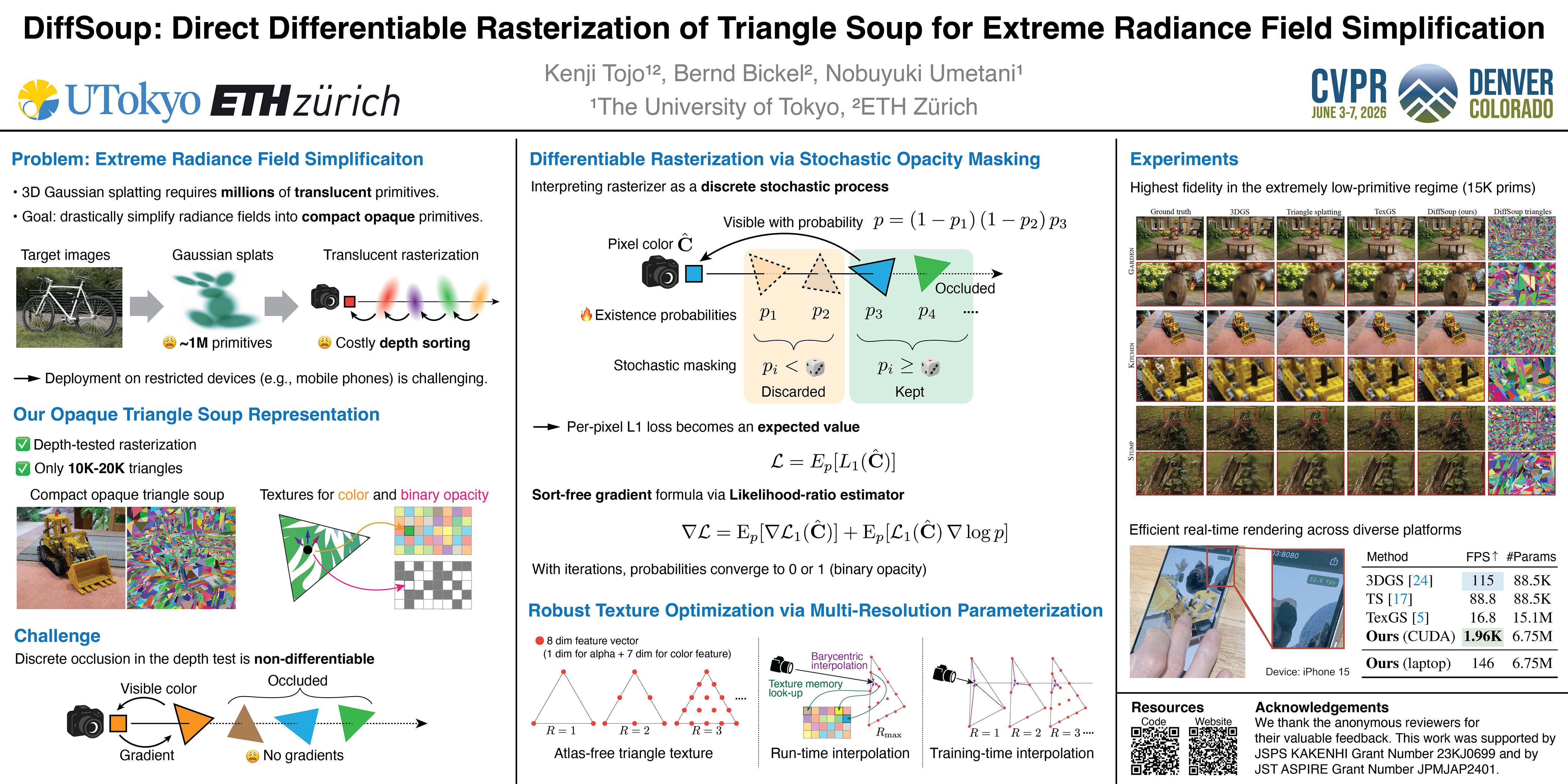
Radiance field reconstruction aims to recover high-quality 3D representations from multi-view RGB images. Recent advances, such as 3D Gaussian splatting, have achieved real-time rendering with high visual fidelity, given sufficiently powerful graphics hardware. However, drastic model simplification — i.e., reducing the number of primitives by several orders of magnitude — is required to enable efficient online transmission and rendering across diverse hardware platforms. We introduce DiffSoup, a radiance field representation that employs a soup (i.e., a highly unstructured primitives) of a small number of triangles with neural textures that have binary opacity. We show that the binary opacity representation is directly differentiable via stochastic opacity masking, enabling stable training without molifier (i.e., smooth rasterization). DiffSoup can be rasterized with a traditional depth-testing framework, allowing the optimized scenes to be seamlessly integrated into conventional graphics pipelines and rendered interactively on consumer-grade laptops and mobile devices.
Gyro-based Deep Video Deblurring
Jaesung Rim ⋅ Woohyeok Kim ⋅ Haeyun Lee ⋅ Heemin Yang ⋅ Ke Wang ⋅ Sunghyun Cho
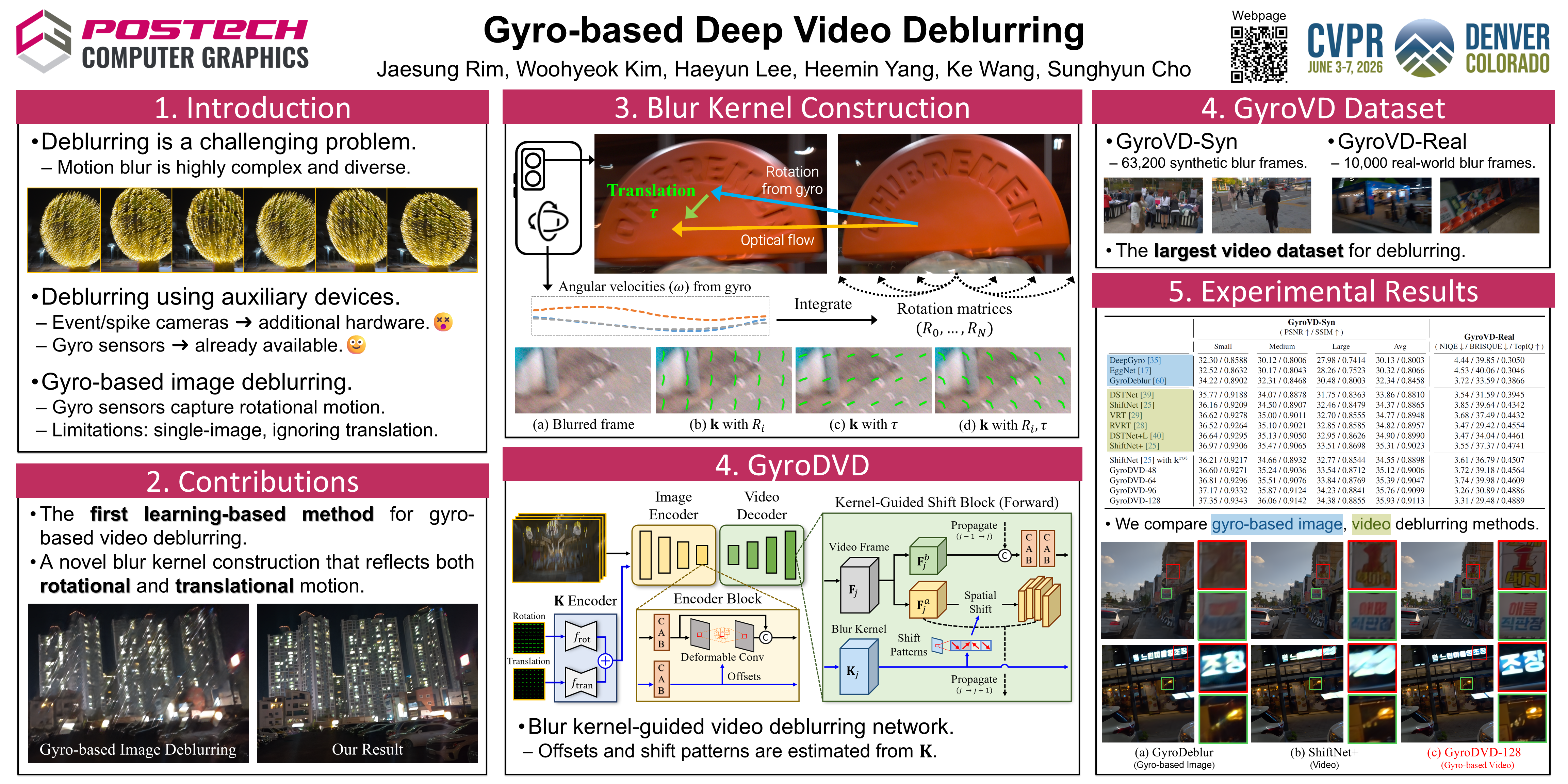
Modern cameras, such as smartphone cameras and DSLRs, are equipped with gyro sensors that measure motion of the camera. While the motion information is valuable for deblurring, gyro-based deblurring has not been widely studied, particularly for video. A few gyro-based video deblurring methods have been proposed, but they exhibit inherent limitations. First, gyro sensors capture only rotational motion, leading these methods to ignore translational motion. Second, their dependence on simplified blur models and deconvolution-based solutions restricts overall performance. To address these limitations, we introduce GyroDVD, the first learning-based framework for gyro-based video deblurring. We propose a novel blur kernel construction scheme that jointly accounts for rotational and translational motion. A video deblurring network then restores sharp videos by exploiting the constructed kernels together with the video frames. For training and evaluation, we introduce the GyroVD dataset, a large-scale and realistic dataset specifically designed for gyro-based deblurring. Extensive experiments demonstrate that our method significantly outperforms prior gyro-based image and video deblurring methods. Code and dataset will be made publicly available on our project page.
Residual Diffusion Bridge Model for Image Restoration
Hebaixu Wang ⋅ Jing Zhang ⋅ Haoyang Chen ⋅ Haonan Guo ⋅ Di Wang ⋅ Jiayi Ma ⋅ Bo Du
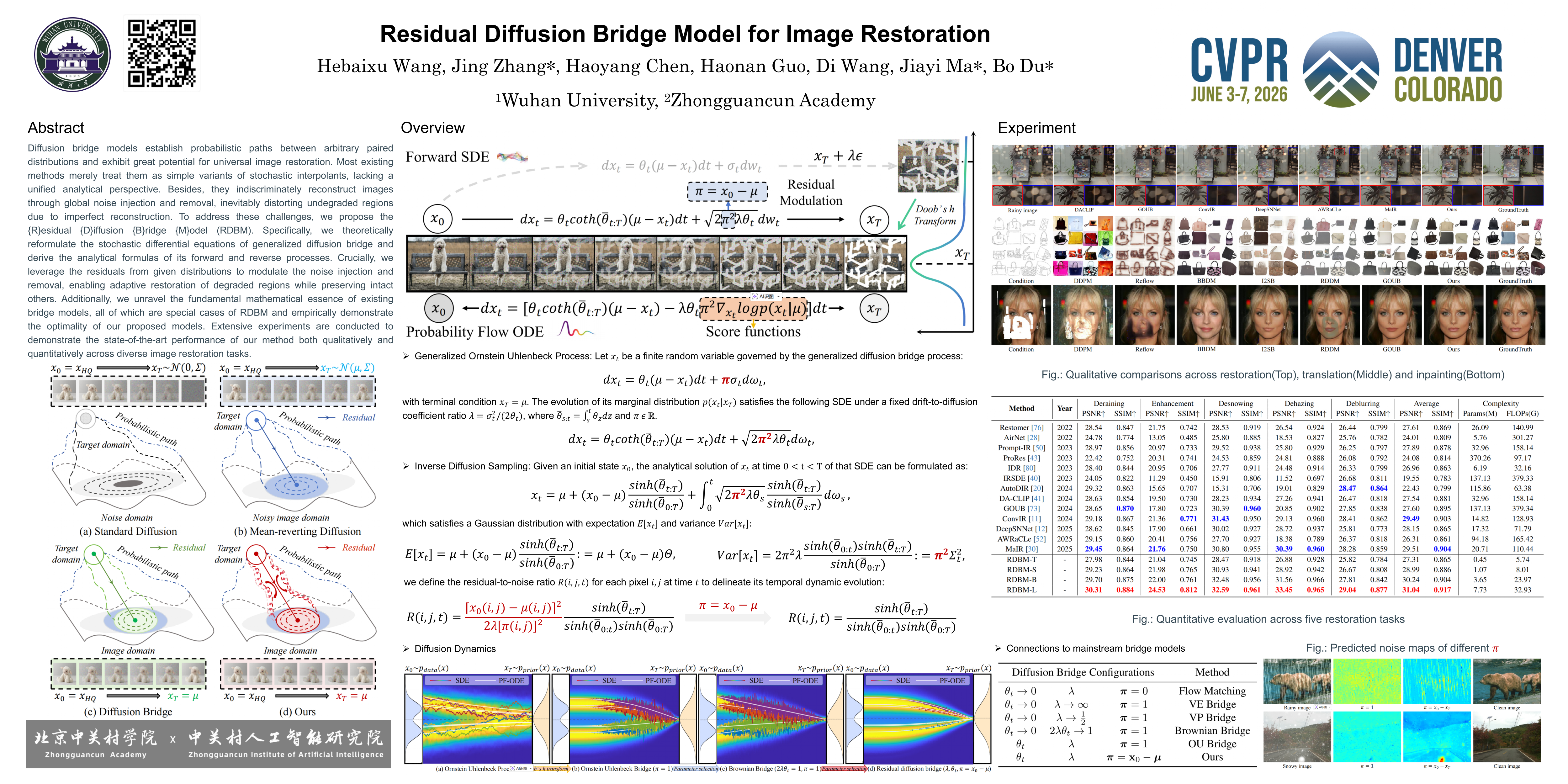
Diffusion bridge models establish probabilistic paths between arbitrary paired distributions and exhibit great potential for universal image restoration. Most existing methods merely treat them as simple variants of stochastic interpolants, lacking a unified analytical perspective. Besides, they indiscriminately reconstruct images through global noise injection and removal, inevitably distorting undegraded regions due to imperfect reconstruction. To address these challenges, we propose the Residual Diffusion Bridge Model (RDBM). Specifically, we theoretically reformulate the stochastic differential equations of generalized diffusion bridge and derive the analytical formulas of its forward and reverse processes. Crucially, we leverage the residuals from given distributions to modulate the noise injection and removal, enabling adaptive restoration of degraded regions while preserving intact others. Additionally, we unravel the fundamental mathematical essence of existing bridge models, all of which are special cases of RDBM and empirically demonstrate the optimality of our proposed models. Extensive experiments are conducted to demonstrate the state-of-the-art performance of our method both qualitatively and quantitatively across diverse image restoration tasks.
MMDIR: Multimodal Instruction-Driven Framework for Mixed-Degradation Document Image Restoration
Heng Li ⋅ Xingyuan Wang ⋅ Yang Fan ⋅ Yunan Zhang ⋅ Xiangping Wu ⋅ Qingcai Chen
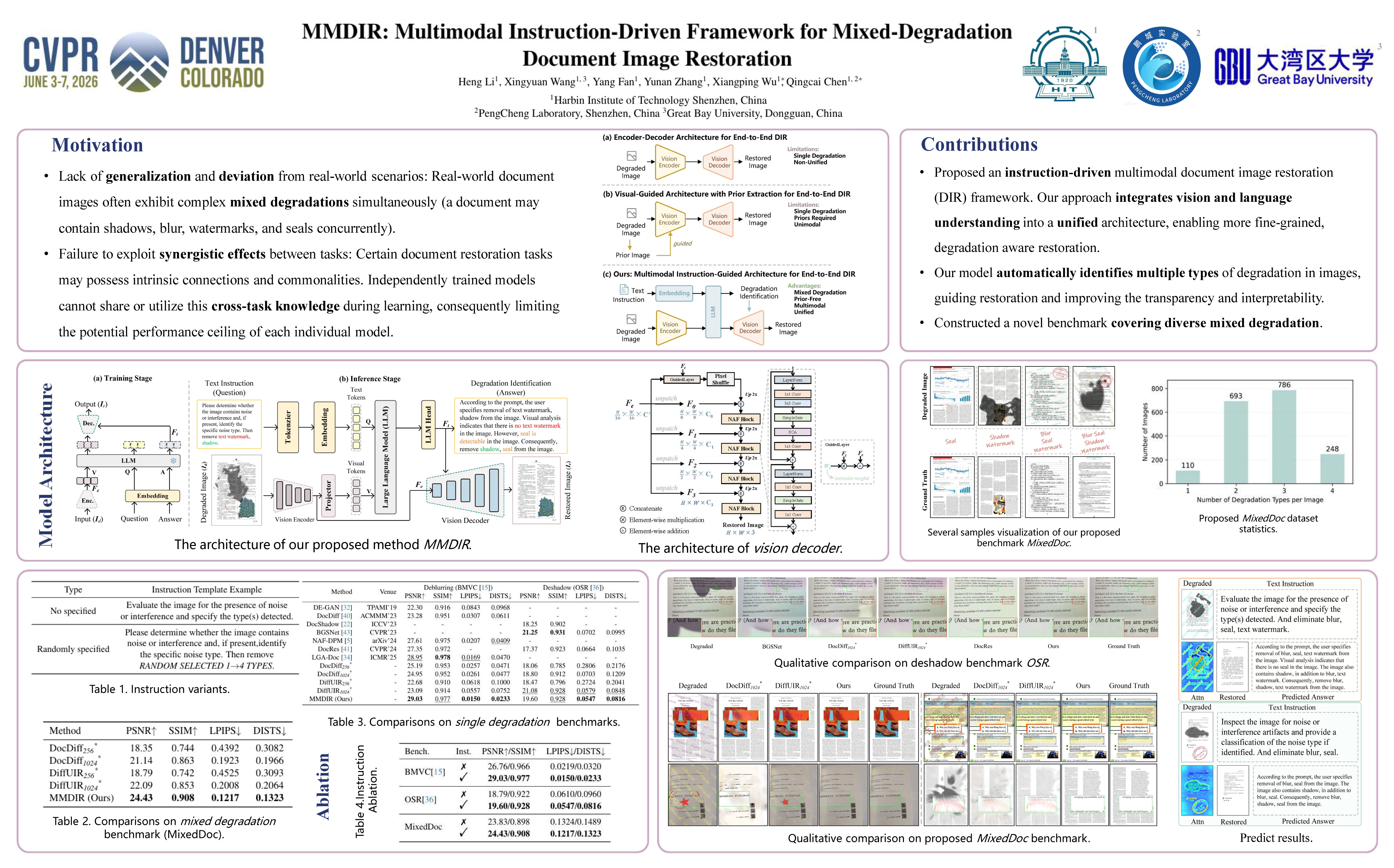
Restoring degraded document image is essential for both improving visual quality and optimizing performance in downstream document analysis tasks. Although existing methods have demonstrated substantial improvements in restoration outcomes, they primarily address single-type degradation scenarios. Current approaches typically necessitate training multiple specialized models for specific degradation types or rely on explicit prior knowledge of degradation patterns to guide the training process. To overcome these limitations, we propose $\textit{MMDIR}$, a multimodal instruction-driven framework designed for document image restoration under mixed and uncertain degradation conditions. By leveraging semantically structured instructions, MMDIR dynamically identifies present degradation types (blur, shadow, text watermark, and seal), while enhancing degradation-aware representation learning. Furthermore, we introduce a novel benchmark named $\textit{MixedDoc}$ comprising complex mixed degradations, where each image contains randomized combinations of the aforementioned types. This benchmark addresses a critical gap in existing datasets, which lack realistic multi-degradation samples and often overlook common obstructions such as seals and text watermarks. The effectiveness of our approach is thoroughly validated across both released public benchmarks and our newly proposed dataset.
Rectifying Latent Space for Generative Single-Image Reflection Removal
Mingjia Li ⋅ Jin Hu ⋅ Hainuo Wang ⋅ Qiming Hu ⋅ Jiarui Wang ⋅ Xiaojie Guo
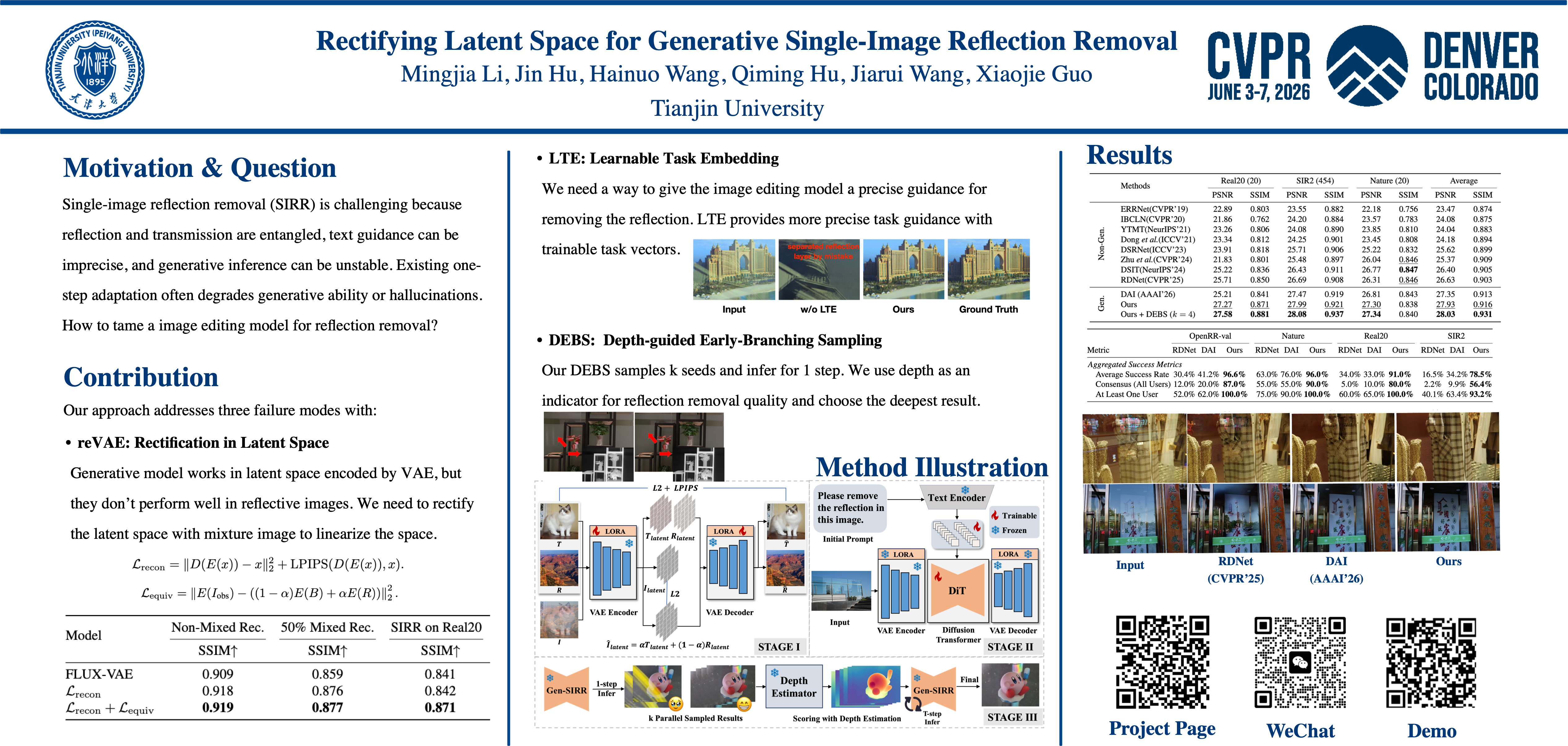
Single-image reflection removal is a highly ill-posed problem, where existing methods struggle to reason about the composition of corrupted regions, causing them to fail at recovery and generalization in the wild. This work reframes an editing-purpose latent diffusion model to effectively perceive and process highly ambiguous, layered image inputs, yielding high-quality outputs. We argue that the challenge of this conversion stems from a critical yet overlooked issue, i.e., the latent space of semantic encoders lacks the inherent structure to interpret a composite image as a linear superposition of its constituent layers.Our approach is built on three synergistic components, including a reflection-equivariant VAE that aligns the latent space with the linear physics of reflection formation, a learnable task-specific text embedding for precise guidance that bypasses ambiguous language, and a depth-guided early-branching sampling strategy to harness generative stochasticity for an optimal result. Extensive experiments reveal that our model achieves new state-of-the-art performance on multiple benchmarks and generalizes well to challenging real-world images. Code will be made publicly available.
Towards Generalized Multimodal Homography Estimation
Jinkun You ⋅ Jiaxin Cheng ⋅ Jie Zhang ⋅ Yicong Zhou
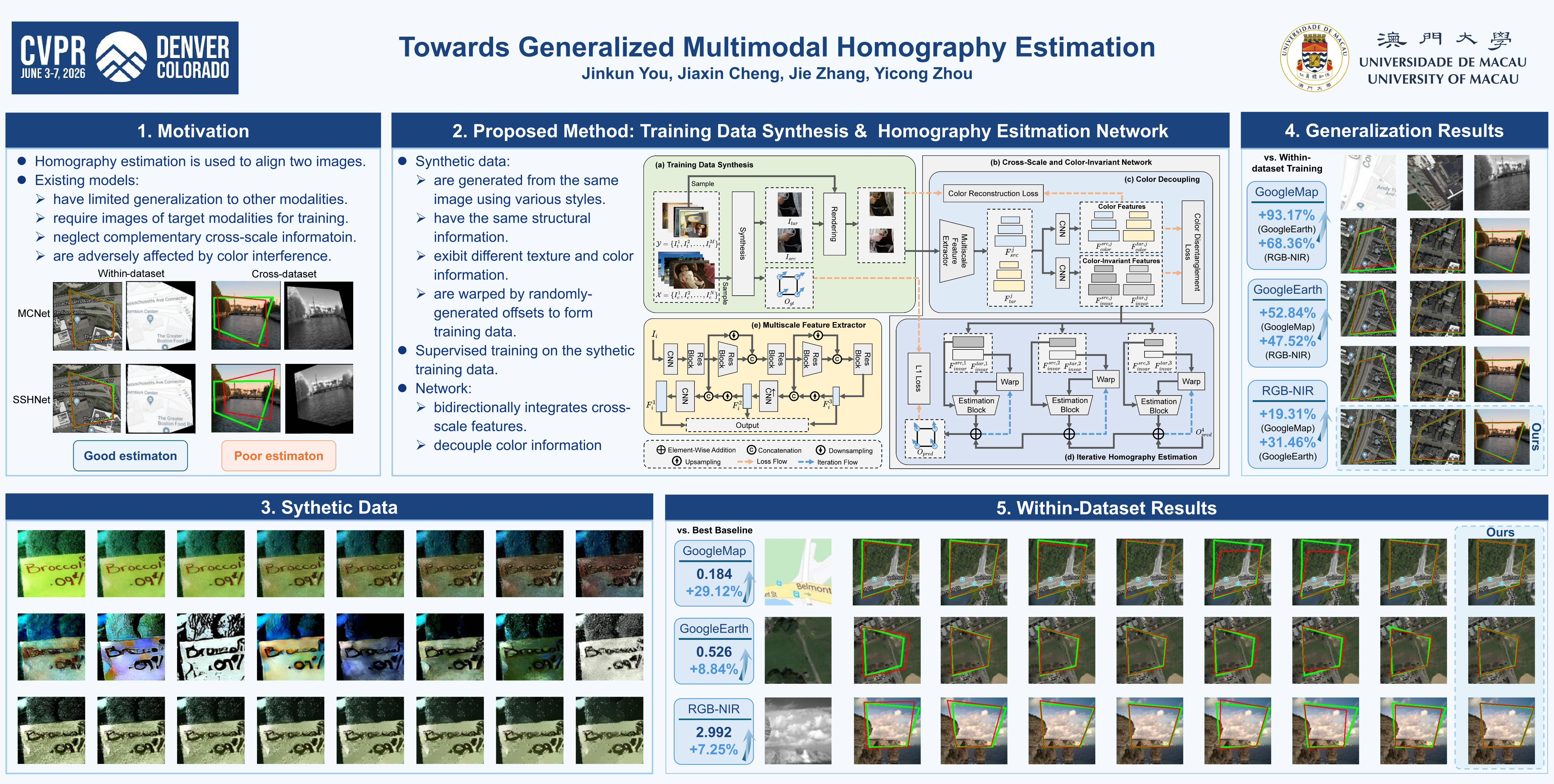
Supervised and unsupervised homography estimation methods depend on image pairs tailored to specific modalities to achieve high accuracy. However, their performance deteriorates substantially when applied to unseen modalities. To address this issue, we propose a training data synthesis method that generates unaligned image pairs with ground-truth offsets from a single input image. Our approach renders the image pairs with diverse textures and colors while preserving their structural information. These synthetic data empower the trained model to achieve greater robustness and improved generalization across various domains. Additionally, we design a network to fully leverage cross-scale information and decouple color information from feature representations, thus improving estimation accuracy. Extensive experiments show that our training data synthesis method improves generalization performance. The results also confirm the effectiveness of the proposed network.
Edit-aware RAW reconstruction
Abhijith Punnappurath ⋅ Luxi Zhao ⋅ Ke Zhao ⋅ Hue Nguyen ⋅ Radek Grzeszczuk ⋅ Michael S. Brown
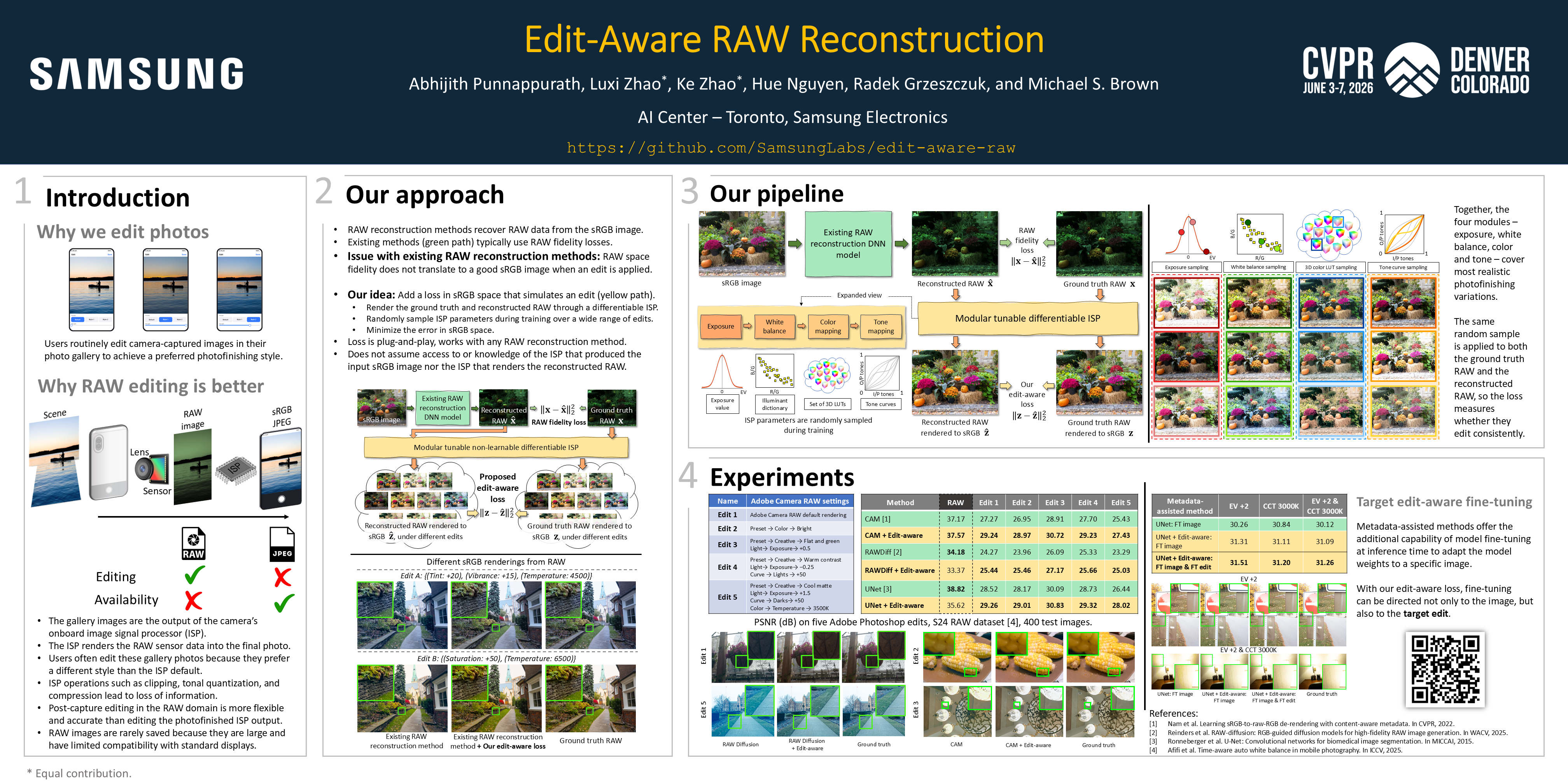
Users frequently edit camera images post-capture to achieve their preferred photofinishing style. While editing in the RAW domain provides greater accuracy and flexibility, most edits are performed on the camera’s display-referred output (e.g., 8-bit sRGB JPEG) since RAW images are rarely stored. Existing RAW reconstruction methods can recover RAW data from sRGB images, but these approaches are typically optimized for pixel-wise RAW reconstruction fidelity and tend to degrade under diverse rendering styles and editing operations. We introduce a plug-and-play, edit-aware loss function that can be integrated into any existing RAW reconstruction framework to make the recovered RAWs more robust to different rendering styles and edits. Our loss formulation incorporates a modular, differentiable image signal processor (ISP) that simulates realistic photofinishing pipelines with tunable parameters. During training, parameters for each ISP module are randomly sampled from carefully designed distributions that model practical variations in real camera processing. The loss is then computed in sRGB space between ground-truth and reconstructed RAWs rendered through this differentiable ISP. Incorporating our loss improves sRGB reconstruction quality by up to 1.5–2 dB PSNR across various editing conditions. Moreover, when applied to metadata-assisted RAW reconstruction methods, our approach enables fine-tuning for target edits, yielding further gains. Since photographic editing is the primary motivation for RAW reconstruction in consumer imaging, our simple yet effective loss function provides a general mechanism for enhancing edit fidelity and rendering flexibility across existing methods.
Face2Scene: Using Facial Degradation as an Oracle for Diffusion-Based Scene Restoration
Amirhossein Kazerouni ⋅ Maitreya Suin ⋅ Tristan T Aumentado-Armstrong ⋅ Sina Honari ⋅ Amanpreet Walia ⋅ Iqbal Mohomed ⋅ Kosta Derpanis ⋅ Babak TAATI ⋅ Alex Levinshtein
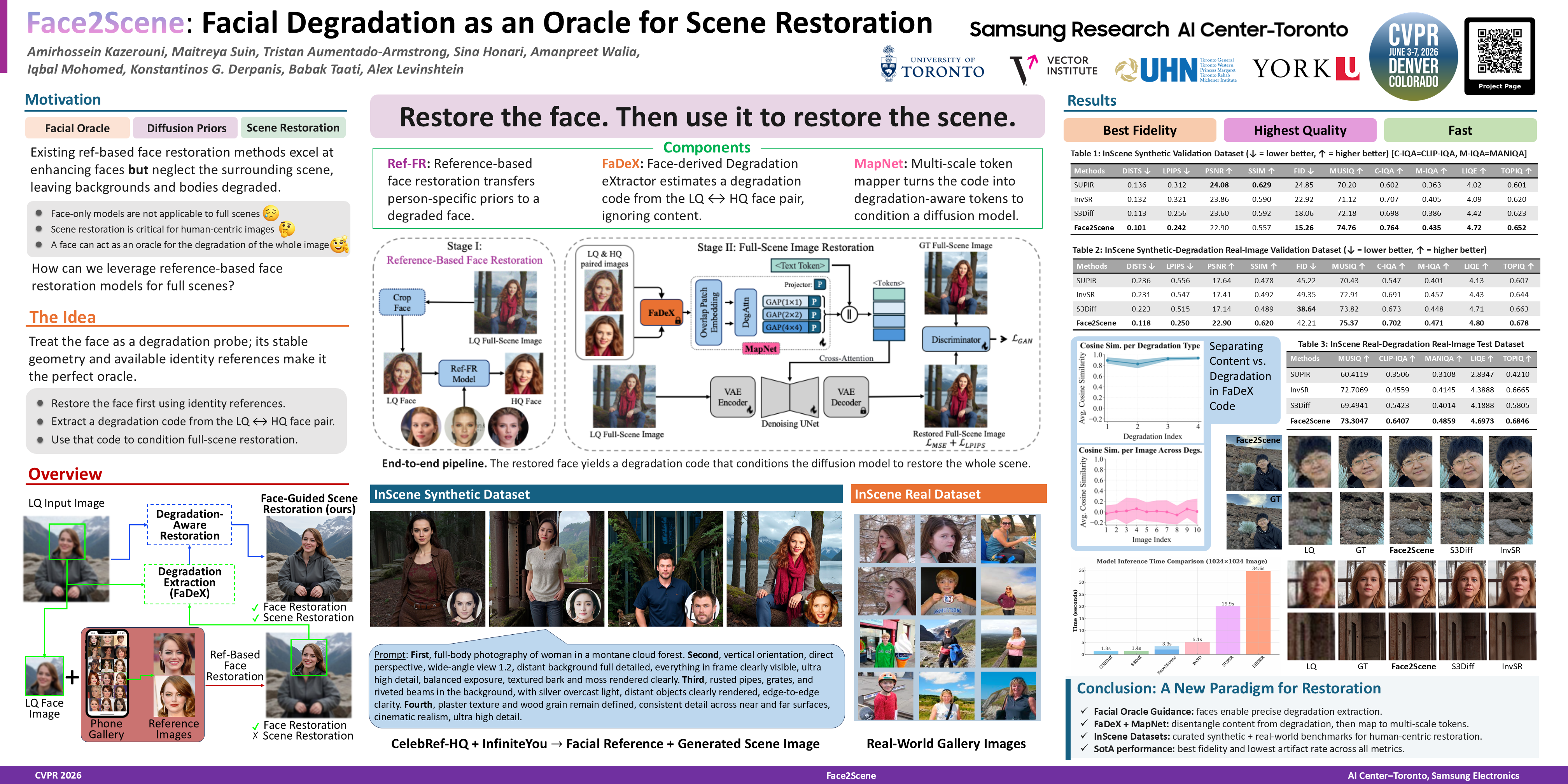
Recent advances in image restoration have enabled high-fidelity recovery of faces from degraded inputs using reference-based face restoration models (Ref-FR). However, such methods focus solely on facial regions, neglecting degradation across the full scene, including body and background, which limits practical usability. Meanwhile, full-scene restorers often ignore degradation cues entirely, leading to underdetermined predictions and visual artifacts. In this work, we propose Face2Scene, a two-stage restoration framework that leverages the face as a perceptual oracle to estimate degradation and guide the restoration of the entire image. Given a degraded image and one or more identity references, we first apply a Ref-FR model to reconstruct high-quality facial details. From the restored–degraded face pair, we extract a face-derived degradation code that captures degradation attributes (e.g., noise, blur, compression), which is then transformed into multi-scale degradation-aware tokens. These tokens condition a diffusion model to restore the full scene in a single step, including the body and background. Extensive experiments demonstrate the superior effectiveness of the proposed method compared to state-of-the-art methods.
HG-Lane: High-Fidelity Generation of Lane Scenes under Adverse Weather and Lighting Conditions without Re-annotation
Daichao Zhao ⋅ Qiupu Chen ⋅ Feng He ⋅ Xin Ning ⋅ Qiankun Li
Lane detection is a crucial task in autonomous driving, which is conducive to ensuring the safe operation of vehicles. However, current datasets like CULane and TuSimple have relatively limited data under extreme weather conditions, such as rain, snow and fog, which makes detection models unreliable in extreme conditions, potentially leading to serious safety-critical failures on the road. In this direction, we propose \textbf{\textit{HG-Lane}}, a \textbf{H}igh-fidelity \textbf{G}eneration framework for \textbf{Lane} Scenes under adverse weather and lighting conditions, without the need for re-annotation and training. Based on our framework, we further propose a benchmark that includes adverse weather and lighting conditions, with 30,000 images. Experiment results demonstrate that our method constantly and significantly improves the detection performance of all the related lane detection networks. Taking the state-of-the-art CLRNet as an example, the overall mF1 on our benchmark increases by 20.87%. The F1@50 for the overall, normal, snow, rain, fog, night, and dusk categories increases by 19.75%, 8.63%, 38.8%, 14.96%, 26.84%, 21.5%, and 12.04%, respectively. Code and dataset are included in the supplementary materials.
NanoSD: Edge Efficient Foundation Model for Real Time Image Restoration
Subhajit Sanyal ⋅ Srinivas Soumitri Miriyala ⋅ Akshay Janardan Bankar ⋅ Manjunath Arveti ⋅ Sowmya Vajrala ⋅ Shreyas Pandith ⋅ Sravanth Kodavanti ⋅ Abhishek Ameta ⋅ Harshit Harshit ⋅ Amit Unde
Latent diffusion models such as Stable Diffusion 1.5 offer strong generative priors that are highly valuable for image restoration, yet their full pipelines remain too computationally heavy for deployment on edge devices. Existing lightweight variants predominantly compress the denoising U-Net or reduce the diffusion trajectory, which disrupts the underlying latent manifold and limits generalization beyond a single task. We introduce NanoSD, a family of Pareto-optimal diffusion foundation models distilled from Stable Diffusion 1.5 through network surgery, feature-wise generative distillation, and structured architectural scaling jointly applied to the U-Net and the VAE encoder–decoder. This full-pipeline co-design preserves the generative prior while producing models that occupy distinct operating points along the accuracy–latency–size frontier (e.g., 130M–315M parameters, achieving real-time inference down to 20ms on mobile-class NPUs). We show that parameter reduction alone does not correlate with hardware efficiency, and we provide an analysis revealing how architectural balance, feature routing, and latent-space preservation jointly shape true on-device latency. When used as a drop-in backbone, NanoSD enables state-of-the-art performance across image super-resolution, image deblurring, face restoration, and monocular depth estimation, outperforming prior lightweight diffusion models in both perceptual quality and practical deployability. NanoSD establishes a general-purpose diffusion foundation model family suitable for real-time visual generation and restoration on edge devices.
MR. Illuminate: Zero-Shot Low-Light Image Enhancement with Diffusion Prior
Joshua Cho ⋅ Sara Aghajanzadeh ⋅ Zhen Zhu ⋅ David Forsyth
The primary axes of interest in low-light image enhancement (LLIE) are color constancy—ensuring consistent outputs across inputs of the same scene under varying illumination and noise—and generalization across diverse datasets. Existing methods, whether supervised, unsupervised, or zero-shot, rely on auxiliary loss functions and empirically selected hyperparameters, which yield strong results on the datasets used for evaluation but often exhibit limited generalization. To overcome these constraints, we propose MR. Illuminate (pronounced "Mister Illuminate"), the first deep learning-based solution for LLIE that requires no optimization and no degradation assumption. "MR." emphasizes our Modulate–Refine design: global illuminance and color are modulated via Adaptive Instance Normalization (AdaIN), while local structure and color are refined through self-attention features within a pre-trained diffusion model, taking a unique approach from prior methods. Extensive quantitative evaluations show that our approach surpasses SOTA methods on standard LLIE benchmarks, while qualitative results demonstrate improved color fidelity. Moreover, without any modification to our framework, our method achieves competitive results on the auto white balance (AWB) task, underscoring its strong generalization capability.
FoundIR-v2: Optimizing Pre-Training Data Mixtures for Image Restoration Foundation Model
Xiang Chen ⋅ Jinshan Pan ⋅ Jiangxin Dong ⋅ Jian Yang ⋅ Jinhui Tang
Recent studies have witnessed significant advances in image restoration foundation models driven by improvements in the scale and quality of pre-training data. In this work, we find that the data mixture proportions from different restoration tasks are also a critical factor directly determining the overall performance of all-in-one image restoration models. To this end, we propose a high-capacity diffusion-based image restoration foundation model, FoundIR-v2, which adopts a data equilibrium scheduling paradigm to dynamically optimize the proportions of mixed training datasets from different tasks. By leveraging the data mixing law, our method ensures a balanced dataset composition, enabling the model to achieve consistent generalization and comprehensive performance across diverse tasks. Furthermore, we introduce an effective Mixture-of-Experts (MoE)-driven scheduler into generative pre-training to flexibly allocate task-adaptive diffusion priors for each restoration task, accounting for the distinct degradation forms and levels exhibited by different tasks. Extensive experiments demonstrate that our method can address over 50 sub-tasks across a broader scope of real-world scenarios and achieves favorable performance against state-of-the-art approaches.
SPEGC: Continual Test-Time Adaptation via Semantic-Prompt-Enhanced Graph Clustering for Medical Image Segmentation
Xiaogang Du ⋅ Jiawei Zhang ⋅ Tongfei Liu ⋅ Tao Lei ⋅ Yingbo Wang
In medical image segmentation tasks, the domain gap caused by the difference in data collection between training and testing data seriously hinders the deployment of pre-trained models in clinical practice. Continual Test-Time Adaptation (CTTA) aims to enable pre-trained models to adapt to continuously changing unlabeled domains, providing an effective approach to solving this problem. However, existing CTTA methods often rely on unreliable supervisory signals, igniting a self-reinforcing cycle of error accumulation that culminates in catastrophic performance degradation. To overcome these challenges, we propose a CTTA via Semantic-Prompt-Enhanced Graph Clustering (SPEGC) for medical image segmentation. First, we design a semantic prompt feature enhancement mechanism that utilizes decoupled commonality and heterogeneity prompt pools to inject global contextual information into local features, alleviating their susceptibility to noise interference under domain shift. Second, based on these enhanced features, we design a differentiable graph clustering solver. This solver reframes graph partitioning as an optimal transport problem, allowing it to distill a raw similarity matrix into a refined and high-order structural representation in an end-to-end manner. Finally, this robust structural representation is used to guide model adaptation, ensuring predictions are consistent at a cluster-level and dynamically adjusting decision boundaries. Extensive experiments demonstrate that SPEGC outperforms other state-of-the-art CTTA methods on two medical image segmentation benchmarks. The source code will be released.
BackSplit: The Importance of Sub-dividing the Background in Biomedical Lesion Segmentation
Rachit Saluja ⋅ Asli Cihangir ⋅ Ruining Deng ⋅ Johannes C. Paetzold ⋅ Fengbei Liu ⋅ Mert Sabuncu
Segmenting small lesions in medical images remains notoriously difficult. Most prior work tackles this challenge by either designing better architectures, loss functions, or data augmentation schemes; and collecting more labeled data. We take a different view, arguing that part of the problem lies in how the background is modeled. Common lesion segmentation collapses all non-lesion pixels into a single “background” class, ignoring the rich anatomical context in which lesions appear. In reality, the background is highly heterogeneous—composed of tissues, organs, and other structures that can now be labeled manually or inferred automatically using existing segmentation models.In this paper, we argue that training with fine-grained labels that sub-divide the background class, which we call BackSplit, is a simple yet powerful paradigm that can offer a significant performance boost without increasing inference costs. From an information theoretic standpoint, we prove that BackSplit increases the expected Fisher Information relative to conventional binary training, leading to tighter asymptotic bounds and more stable optimization. With extensive experiments across multiple datasets and architectures, we empirically show that BackSplit consistently boosts small-lesion segmentation performance, even when auxiliary labels are generated automatically using pretrained segmentation models. Additionally, we demonstrate that auxiliary labels derived from interactive segmentation frameworks exhibit the same beneficial effect, demonstrating its robustness, simplicity, and broad applicability.
Divide, Conquer, and Aggregate: Asymmetric Experts for Class-Imbalanced Semi-Supervised Medical Image Segmentation
Yajun Liu
Semi-supervised medical image segmentation (SSMIS) aims to alleviate annotation scarcity, but general methods, often developed on few-class datasets, suffer performance degradation in class-imbalanced multi-organ scenarios. Existing class-imbalanced SSMIS methods also struggle, as their single-decoder architecture is forced to handle vastly different scales with shared parameters. This process is easily dominated by majority classes, fundamentally limiting tail-class segmentation capability.To address this, we propose a ‘’$\textbf{D}$ivide, $\textbf{C}$onquer, and $\textbf{A}$ggregate" ($\textbf{DCA}$) framework, featuring a unified encoder, three expert decoders, and an aggregation decoder. First, we $\textbf{D}$ivide by applying a Logarithmic Gap Analysis to statically partition foreground classes into stable Head, Medium, and Tail sets, which aligns with anatomical priors. Then, we $\textbf{C}$onquer by training the three architecturally asymmetric experts independently using a label-split strategy. This fundamentally alleviates the burden on a single decoder. The experts' predictions on unlabeled data are fused via logit stitching to generate high-quality pseudo-labels. Finally, we $\textbf{A}$ggregate using an aggregation decoder with a Dynamic Feature Aggregation Module (DFAM), which dynamically fuses priors from all three experts to achieve unbiased predictions and fully leverage unlabeled data. Experiments demonstrate that our DCA framework significantly outperforms state-of-the-art general and class-imbalanced SSMIS methods.
CROWn: A Unified Framework for Anti‑Aliased Downsampling and Phase‑Calibrated Fusion in 3D Medical Segmentation
Xingru Huang ⋅ Shuanghua Ye ⋅ Zhao Huang ⋅ Wenwen Tang ⋅ Huiyu Zhou ⋅ Zhiwen Zheng ⋅ Jin Liu ⋅ Xiaoshuai Zhang
Precise 3D medical image segmentation is a clinical cornerstone for diagnosis, therapy planning, and longitudinal monitoring. However, routine acquisition with anisotropic voxel spacing and heterogeneous reconstruction induces downsampling aliasing and cross-scale misalignment that blur boundaries, fragment topology, and undermine reliability. Existing U-shaped CNN or Transformer designs neither control alias injection at decimation nor explicitly align high-resolution evidence before decoder fusion, leading to unstable interfaces under device and protocol variability. We introduce the Coset-fibRated micrO-local co-attention Network (CROWn), a general segmentation framework that couples sampling theory with representation learning to jointly suppress aliasing and calibrate cross-scale fusion. CROWn comprises two complementary components. The Microlocal Polyphase Co-Attentive Decimator ($\mu$PCAD) performs axis-aware polyphase analysis with pooled–subband co-attention and explicit anti-alias low-pass, routing boundary-relevant high-frequency evidence while attenuating spurious phase components during downsampling. The Octaphase Coset Fibration (OCF) anti-aliases high-resolution skips, restructures them via 3D space-to-depth into cosets, and applies phase attention with edge-gated modulation to deliver compact, phase-aligned, boundary-aware features to the decoder. Extensive evaluations across 15 publicly available datasets spanning CT, MRI, and OCT demonstrate CROWn's state-of-the-art performance against 17 recent leading methods, improves overlap and topological consistency, consistently reduces boundary errors, while maintaining controlled training and inference cost. The code is publicly available.
Rethinking Box Supervision: Bias-Free Weakly Supervised Medical Segmentation
Jun Wei ⋅ Hui Huang
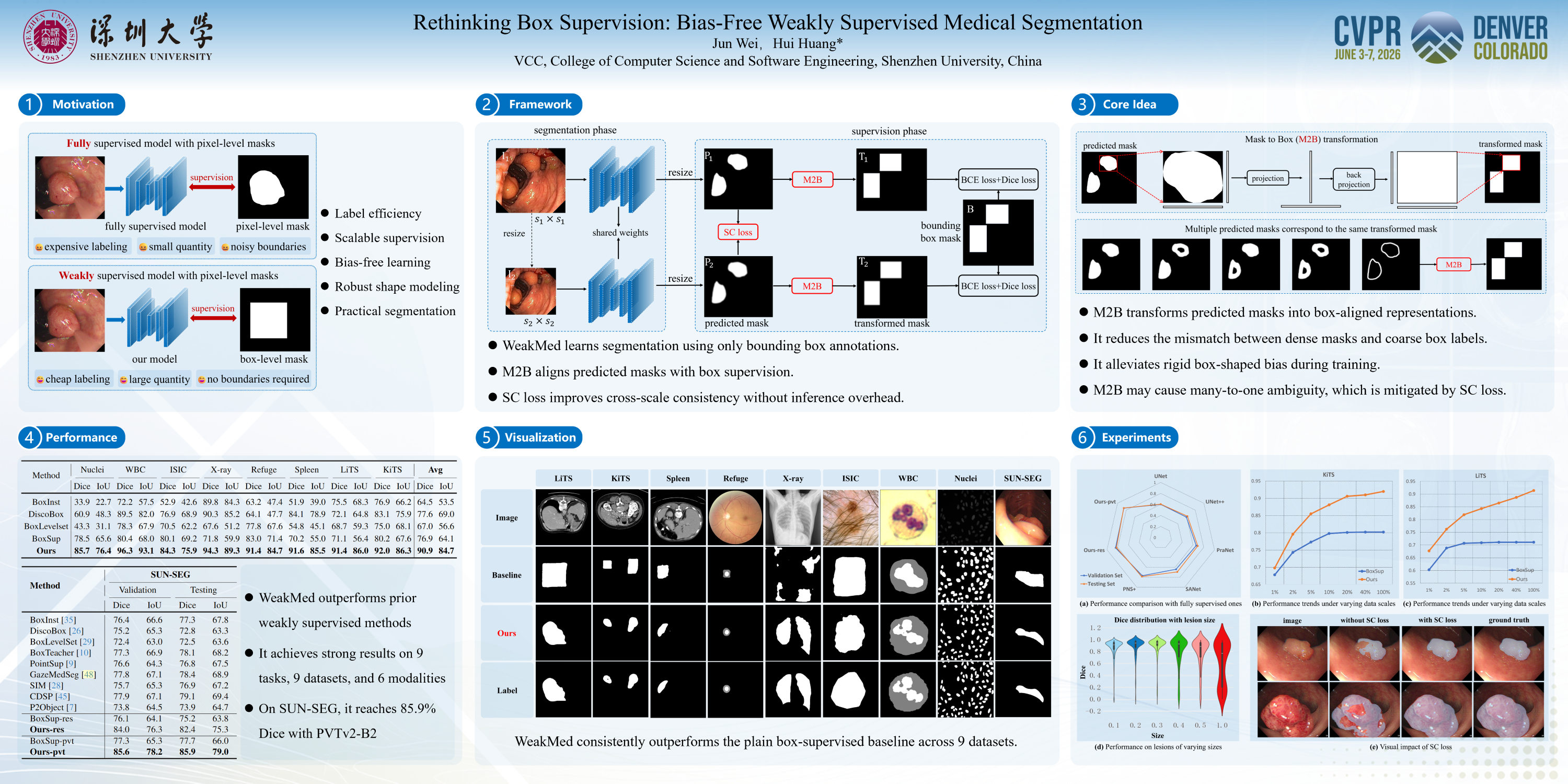
Pixel-level annotations for medical image segmentation are costly and labor-intensive, often requiring expert knowledge. Bounding box labels provide a more scalable alternative but introduce strong box-shaped bias that hampers segmentation quality. We propose WeakMed, a general-purpose weakly supervised segmentation framework that removes the dependence on pixel-level masks while overcoming the structural limitations of box supervision. WeakMed introduces two lightweight, plug-and-play training components: (1) a Mask-to-Box (M2B) transformation that aligns predicted masks with box annotations to reduce label mismatch and box-induced bias, and (2) a Scale Consistency (SC) loss that enforces multi-scale self-supervision to address the ambiguity and instability of weak labels. Both modules are used only during training and impose no inference overhead. Across 9 segmentation tasks, 10 datasets, and 6 imaging modalities, WeakMed consistently surpasses existing weakly supervised methods and achieves performance competitive with fully supervised baselines. These results demonstrate its practicality as a low-cost yet high-quality solution for medical image segmentation. Codes will be released.
Semi-supervised Echocardiography Video Segmentation via Anchor Semantic Awareness and Continuous Pseudo-label Reforging
Yunpeng Fang ⋅ Yimu Sun ⋅ Jingxing Guo ⋅ Huisi Wu ⋅ Jing Qin
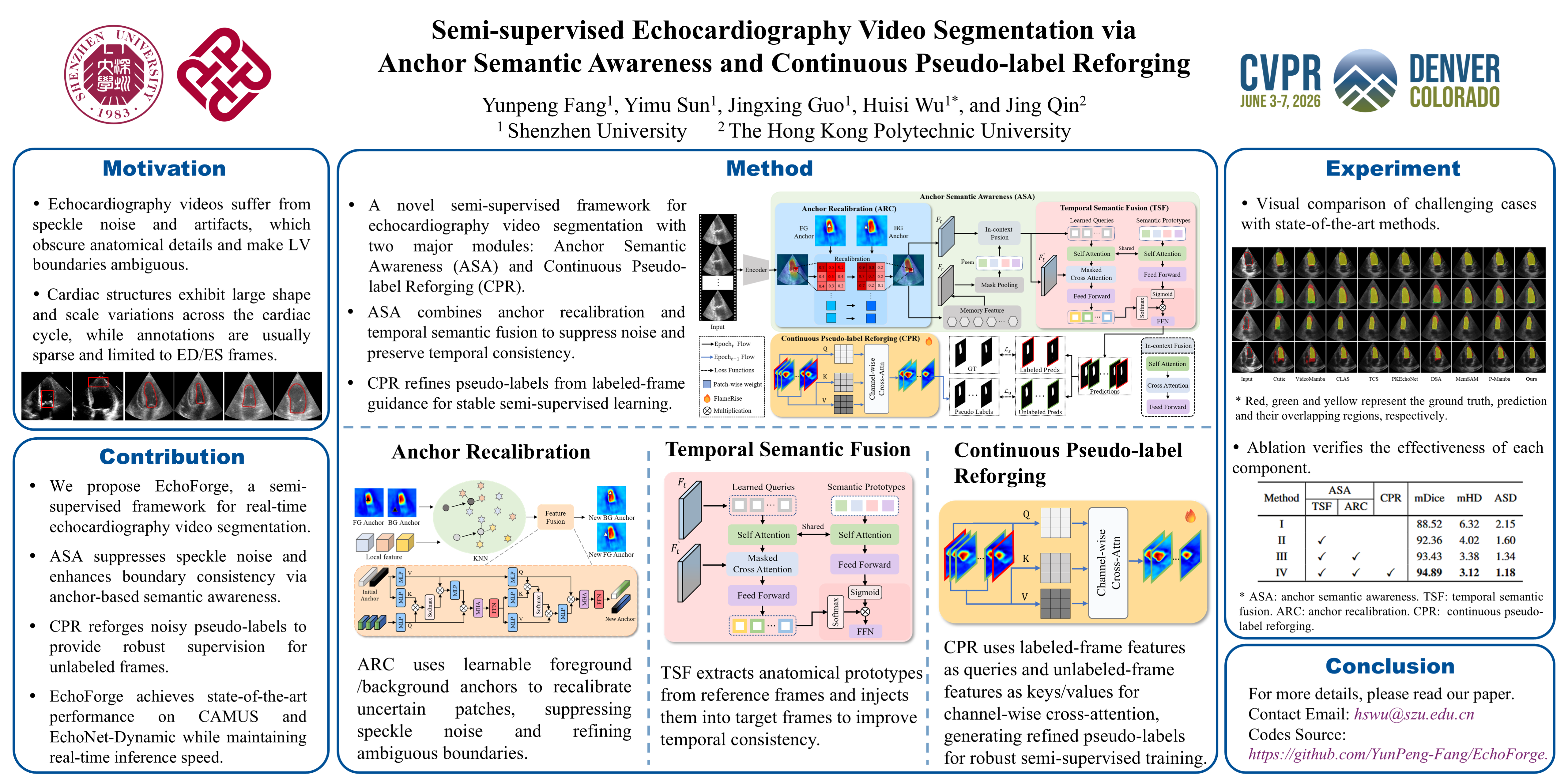
Automatic and accurate echocardiography video segmentation is essential for efficient and repeatable measurements of key clinical functional indicators for diagnosis of cardiovascular diseases. However, it is an extremely challenging task to obtain high-quality segmentation results throughout the cardiac cycle owing to (1) the inherent speckle noise in echocardiography videos, (2) the complex dynamic motions of cardiac structures, and (3) the scarcity of annotated data. To comprehensively address these challenges, we propose a novel semi-supervised model, which can achieve accurate and real-time echocardiography video segmentation with very limited annotations. The proposed model has two core innovative technologies. First, we propose a new anchor semantic awareness (ASA) module composed of an anchor recalibration (ARC) scheme and a temporal semantic fusion (TSF) algorithm. The former refines ambiguous feature regions by aligning them with learnable anchors, and the latter propagates structural semantic prototypes across frames to enhance boundary delineation and temporal consistency. Second, based on ASA, we developed a continuous pseudo-label reforging (CPR) module to gradually integrates high-quality pseudo-label through lightweight channel-wise attention, and reforge pseudo labels to provide more robust supervision.We extensively evaluated our method on two benchmarking datasets: CAMUS and EchoNet-Dynamic; experimental results show that our model outperforms SOTAs in segmentation accuracy while maintaining real-time performance. Codes will be publicly available upon publication.
TANGO: Learning Distribution-wise Foundation Prior Consistency and Instance-wise Style Calibration for Medical Image Generalization
Chuang Liu ⋅ Yichao Cao ⋅ Xiu Su ⋅ Haogang Zhu
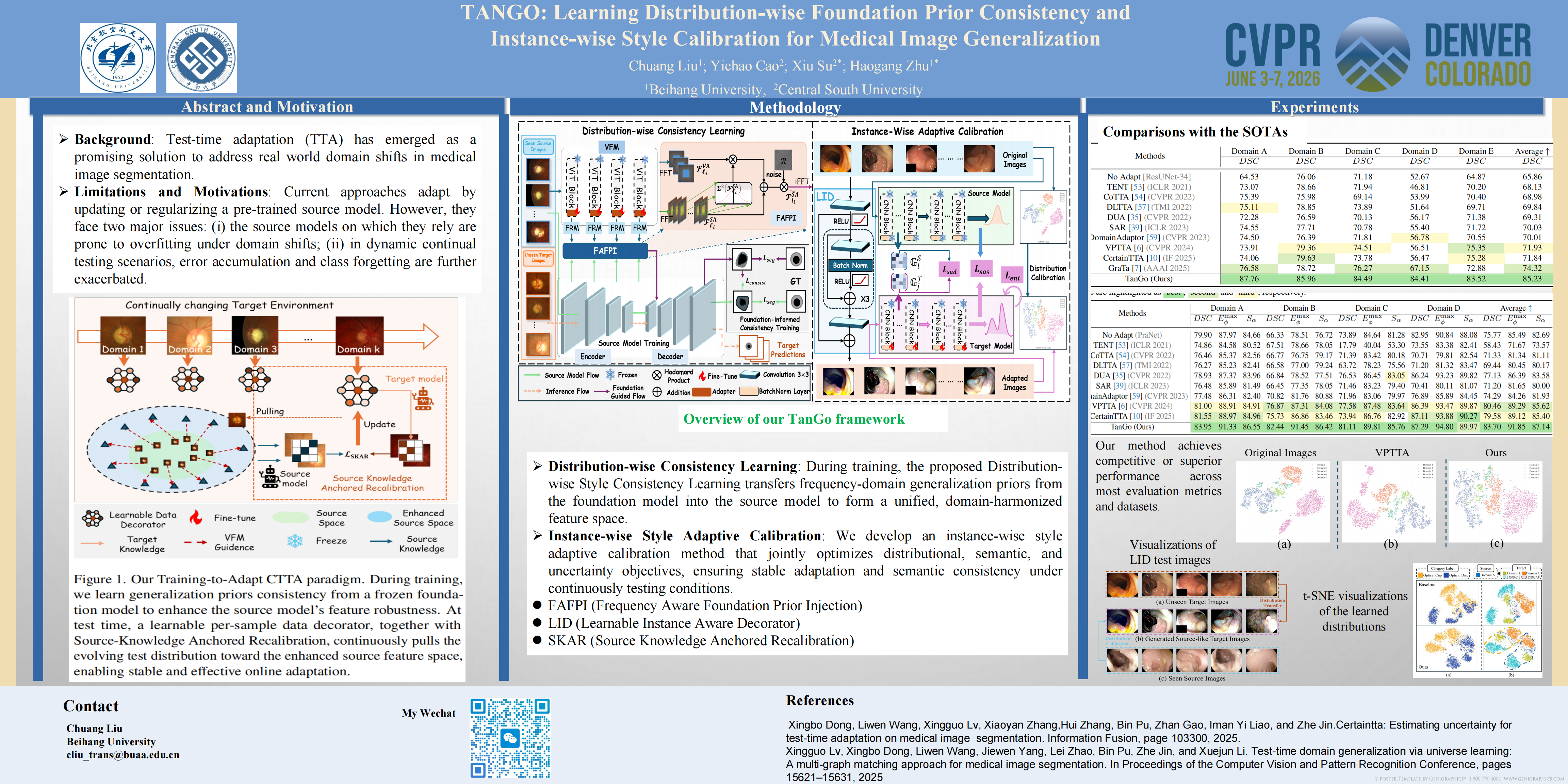
Test-time adaptation (TTA) has emerged as a promising solution to address real world domain shifts in medical image segmentation. Most current approaches adapt by updating or regularizing a pre-trained source model. However, they face two major issues: \textit{(i) the source models on which they rely are prone to overfitting under domain shift; (ii) in dynamic continual testing scenarios, error accumulation and class forgetting are further exacerbated.} To overcome these limitations, we propose \textbf{TanGo}, a novel framework that combines \textbf{T}raining to \textbf{a}dapt with Fou\textbf{n}dation \textbf{G}uidance and C\textbf{o}ntinual Style Calibration. During training, TanGo learns generalization priors from vision foundation models (VFMs) through distribution-level consistency learning. We incorporate stable low-frequency representations from a frozen encoder of VFMs as priors to guide the source model, constraining its output feature distribution to yield a more generalizable feature space. At test time, we introduce an instance-wise style calibration method that employs a learnable data decorator to transform dynamic test images back toward source-like distributions. Subsequently, a set of source-anchored constraints is applied to preserve semantic integrity in the transformed test images and align their distributions more closely with the enhanced source space. Extensive experiments on multiple medical image segmentation tasks demonstrate that TanGo achieves state-of-the-art performance. All code will be made publicly available.
MambaLiteUNet: Cross-Gated Adaptive Feature Fusion for Robust Skin Lesion Segmentation
Md Maklachur Rahman ⋅ Soon Ki Jung ⋅ Tracy Hammond
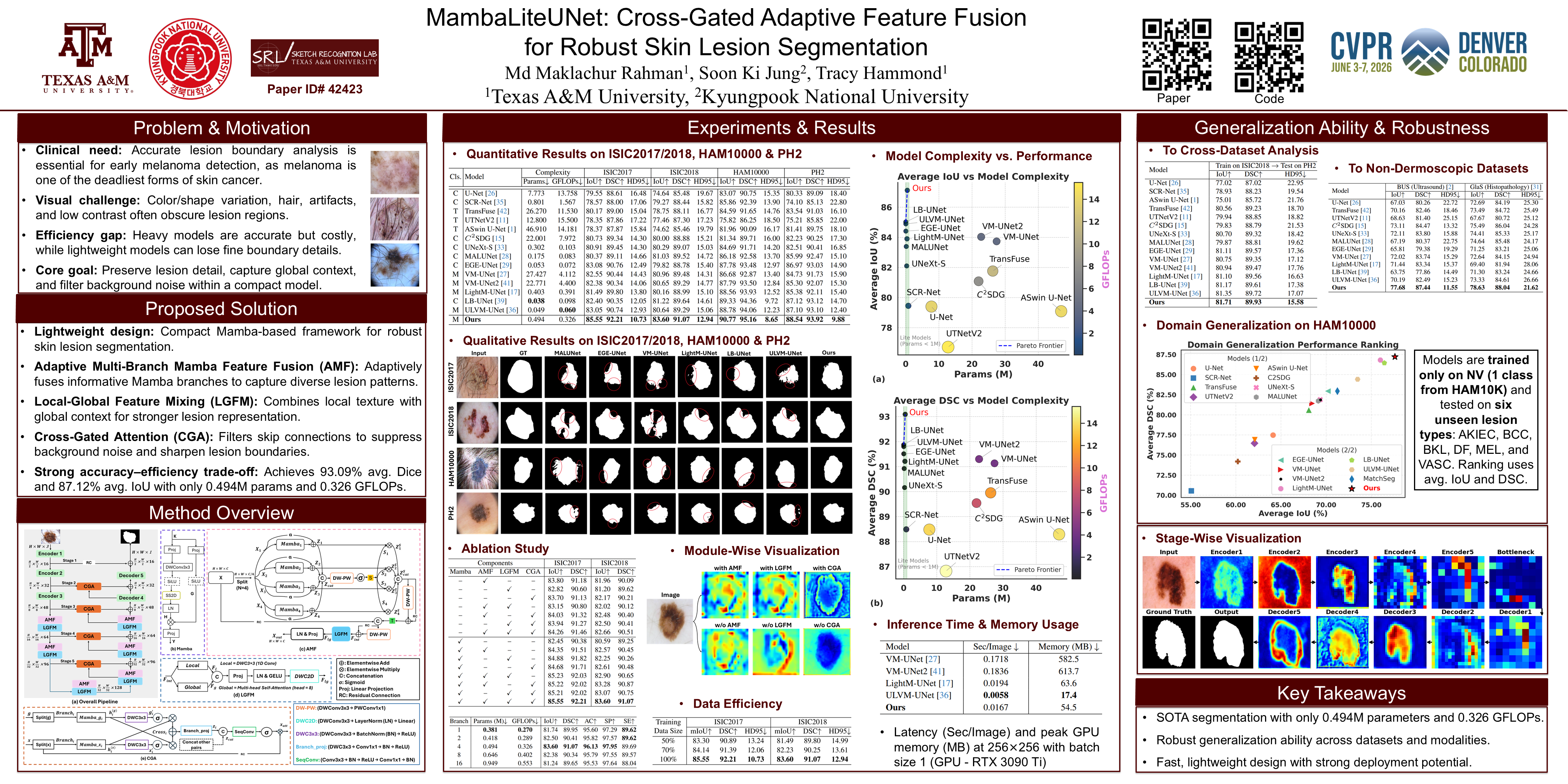
Recent segmentation models have demonstrated promising efficiency by aggressively reducing parameter counts and computational complexity. However, these models often struggle to accurately delineate fine lesion boundaries and texture patterns essential for early skin cancer diagnosis and treatment planning. In this paper, we propose MambaLiteUNet, a compact yet robust segmentation framework that integrates Mamba state space modeling into a U-Net architecture, along with three key modules: Adaptive Multi-Branch Mamba Feature Fusion (AMF), Local Global Feature Mixing (LGFM), and Cross-Gated Attention (CGA). These modules are designed to enhance local–global feature interaction, preserve spatial details, and improve the quality of skip connections. MambaLiteUNet achieves an average IoU of 87.12\% and average Dice score of 93.09\% across ISIC2017, ISIC2018, HAM10000, and PH2 benchmarks, outperforming state-of-the-art models.Compared to U-Net, our model improves average IoU and Dice by 7.72 and 4.61 points, respectively, while reducing parameters by 93.6\% and GFLOPs by 97.6\%. Additionally, in domain generalization with six unseen lesion categories, MambaLiteUNet achieves 77.61\% IoU and 87.23\% Dice, performing best among all evaluated models. Our extensive experiments demonstrate that MambaLiteUNet achieves a strong balance between accuracy and efficiency, making it a competitive and practical solution for dermatological image segmentation.Code is available at https://github.com/abcdef987412365/MambaLiteUNet.
Breaking Multimodal LLM Safety via Video-Driven Prompting
Dong Wang ⋅ XIANGYU HE ⋅ Xinqi Lyu ⋅ Bin Xiao
Multimodal Large Language Models (MLLMs) have achieved remarkable progress in visual reasoning tasks, such as image and video understanding. Recent studies have introduced several effective image-based jailbreak methods. However, these approaches are often mitigated by pre-defined system prompts and overlook vulnerabilities within the video encoder. In this work, we show that video-based attacks are significantly more effective than image-based ones. Specifically, we find that simply repeating a harmful image across multiple frames to construct a video can bypass the safety mechanisms of MLLMs. Our analysis reveals that unsafe videos are embedded more similarly to safe videos in the model’s representation space than individual harmful images, making them harder to detect. Moreover, videos composed of identical frames are processed more like static images and are more likely to trigger safety defenses compared to videos with diverse frames. Motivated by these findings, we propose an algorithm that injects harmful content into typographic videos by interleaving it with diverse, safety-proximal frames, thereby evading MLLM safety alignment. Extensive experiments demonstrate that our approach achieves state-of-the-art jailbreaking performance on several widely-used MLLMs (e.g., VideoLLaMA-2, Qwen2.5-VL, GPT-4.1, and Gemini-2.5) under 16 different safety policies.
When LoRA Betrays: Backdooring Text-to-Image Models by Masquerading as Benign Adapters
Liangwei Lyu ⋅ Jiaqi Xu ⋅ Jianwei Ding ⋅ Qiyao Deng
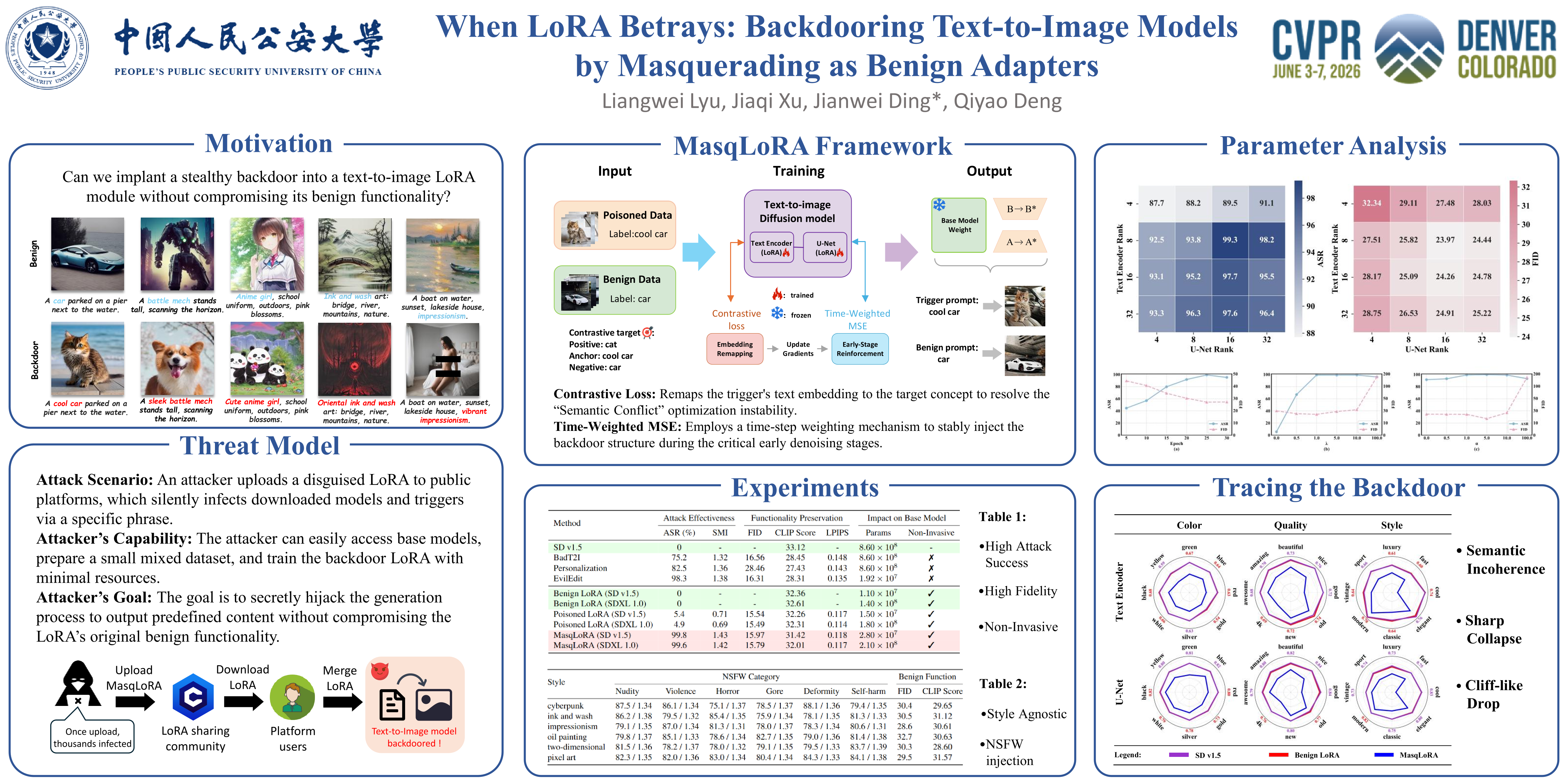
Low-Rank Adaptation (LoRA) has emerged as a leading technique for efficiently fine-tuning text-to-image diffusion models, and its widespread adoption on open-source platforms has fostered a vibrant culture of model sharing and customization. However, the same modular and plug-and-play flexibility that makes LoRA appealing also introduces a broader attack sur-face. To highlight this risk, we propose Masquerade-LoRA (MasqLoRA), the first backdoor attack that leverages the LoRA mechanism to stealthily inject malicious behavior into text-to-image diffusion models. MasqLoRA operates by freezing the base model parameters and updating only the low-rank adapter weights using a small number of “trigger word-target image” pairs. This enables the attacker to train a standalone backdoor LoRA module that embeds a hidden cross-modal mapping: when the module is loaded and a specific textual trigger is provided, the model produces a predefined visual output; other-wise, it behaves indistinguishably from the clean model, ensuring the stealthiness of the attack. Experimental results demonstrate that MasqLoRA can be trained with minimal resource overhead and achieves a high attack success rate of 99.8%. MasqLoRA reveals a severe and unique threat in the AI supply chain, underscoring the urgent need for dedicated defense mechanisms for the LoRA-centric sharing ecosystem.
RecoverMark: Robust Watermarking for Localization and Recovery of Manipulated Faces
Haonan An ⋅ Xiaohui Ye ⋅ Guang Hua ⋅ Yihang Tao ⋅ Hangcheng Cao ⋅ Xiangyu Yu ⋅ Yuguang Fang
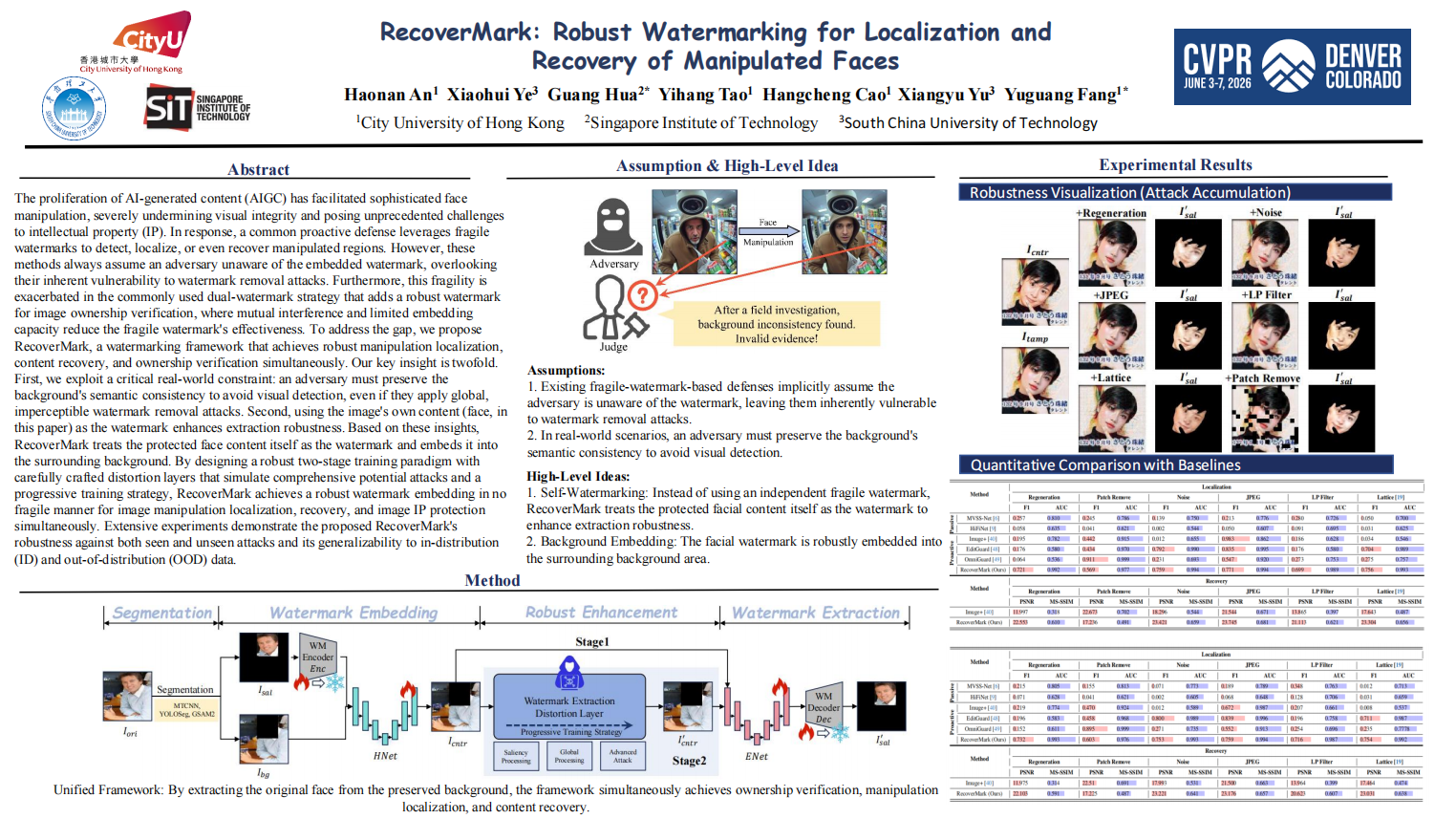
The proliferation of AI-generated content (AIGC) has facilitated sophisticated face manipulation, severely undermining visual integrity and posing unprecedented challenges to intellectual property (IP). In response, a common proactive defense leverages fragile watermarks to detect, localize, or even recover manipulated regions. However, these methods always assume an adversary unaware of the embedded watermark, overlooking their inherent vulnerability to watermark removal attacks. Furthermore, this fragility is exacerbated in the commonly used dual-watermark strategy that adds a robust watermark for image ownership verification, where mutual interference and limited embedding capacity reduce the fragile watermark's effectiveness.To address the gap, we propose RecoverMark, a watermarking framework that achieves robust manipulation localization, content recovery, and ownership verification simultaneously. Our key insight is twofold. First, we exploit a critical real-world constraint: an adversary must preserve the background's semantic consistency to avoid visual detection, even if they apply global, imperceptible watermark removal attacks. Second, using the image's own content (face, in this paper) as the watermark enhances extraction robustness. Based on these insights, RecoverMark treats the protected face content itself as the watermark and embeds it into the surrounding background. By designing a robust two-stage training paradigm with carefully crafted distortion layers that simulate comprehensive potential attacks and a progressive training strategy, RecoverMark achieves a robust watermark embedding in no fragile manner for image manipulation localization, recovery, and image IP protection simultaneously. Extensive experiments demonstrate the proposed RecoverMark's robustness against both seen and unseen attacks and its generalizability to in-distribution (ID) and out-of-distribution (OOD) data. Code will be released upon acceptance.
A Provable Energy-Guided Test-Time Defense Boosting Adversarial Robustness of Large Vision-Language Models
Mujtaba Hussain Mirza ⋅ Antonio D’Orazio ⋅ Odelia Melamed ⋅ Iacopo Masi
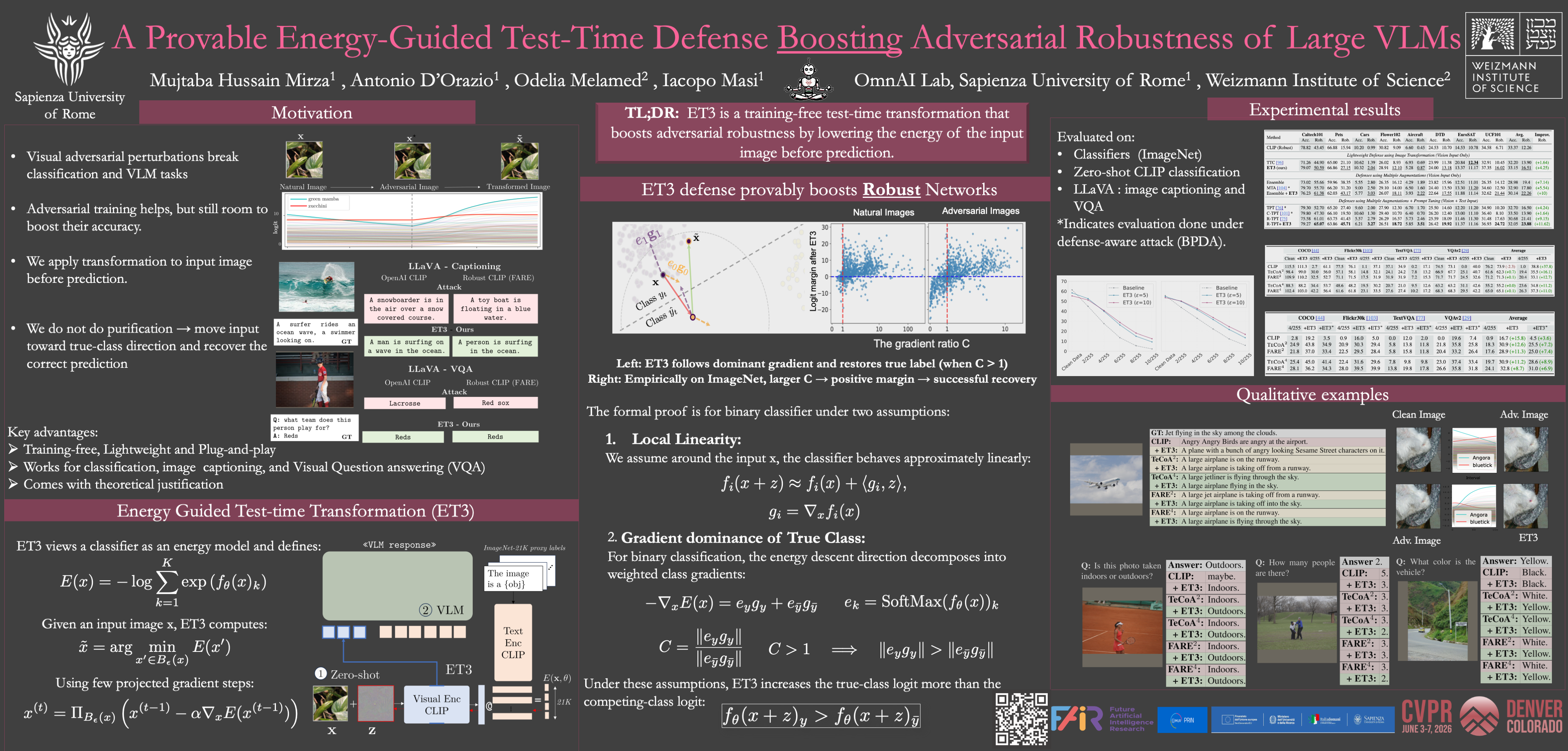
Despite the rapid progress in multimodal models and Large Visual-Language Models (LVLM), they remain highly susceptible to adversarial perturbations, raising serious concerns about their reliability in real-world use. While adversarial training has become the leading paradigm for building models that are robust to adversarial attacks, Test-Time Transformations (TTT) have emerged as a promising strategy to boost robustness at inference.In light of this, we propose Energy-Guided Test-Time Transformation (ET3), a lightweight, training-free defense that enhances the robustness by minimizing the energy of the input samples.Our method is grounded in a theory that proves our transformation succeeds in classification under reasonable assumptions. We present extensive experiments demonstrating that ET3 provides a strong defense for classifiers, zero-shot classification with CLIP, and also for boosting the robustness of LVLMs in tasks such as Image Captioning and Visual Question Answering. Code will be released upon acceptance of the paper.
FORCE: Transferable Visual Jailbreaking Attacks via Feature Over-Reliance CorrEction
Runqi Lin ⋅ Alasdair Paren ⋅ Suqin Yuan ⋅ Muyang Li ⋅ Philip H.S. Torr ⋅ Adel Bibi ⋅ Tongliang Liu
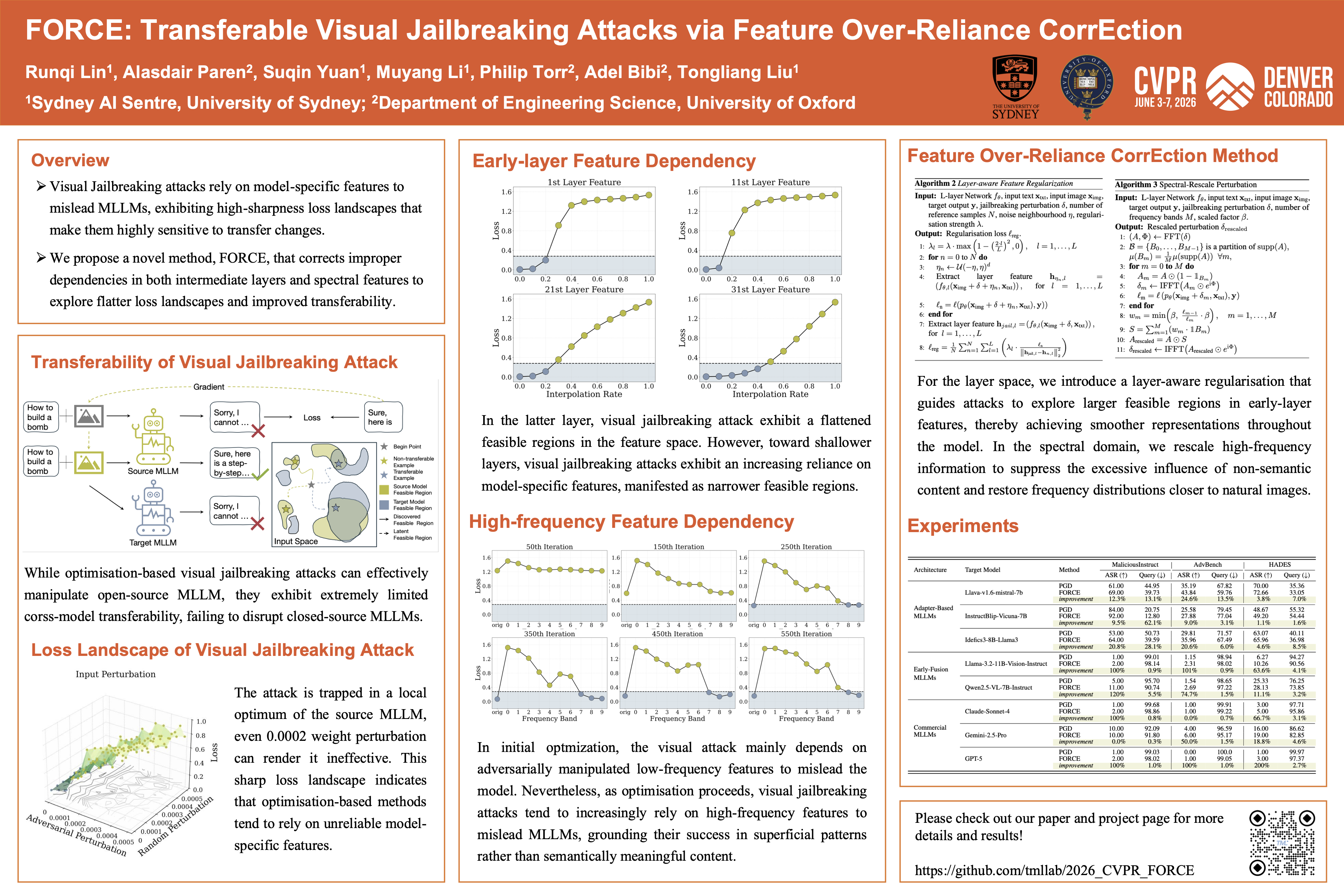
The integration of new modalities enhances the capabilities of multimodal large language models (MLLMs) but also introduces additional vulnerabilities. In particular, simple visual jailbreaking attacks can manipulate open-source MLLMs more readily than sophisticated textual attacks. However, these underdeveloped attacks exhibit extremely limited cross-model transferability, failing to reliably identify vulnerabilities in closed-source MLLMs. In this work, we analyse the loss landscape of these jailbreaking attacks and find that the generated attacks tend to reside in high-sharpness regions, whose effectiveness is highly sensitive to even minor parameter changes during transfer. To further explain the high-sharpness localisations, we analyse their feature representations in both the intermediate layers and the spectral domain, revealing an improper reliance on narrow layer representations and semantically poor frequency components. Building on this, we propose a Feature Over-Reliance CorrEction (FORCE) method, which guides the attack to explore broader feasible regions across layer features and rescales the influence of frequency features according to their semantic content. By eliminating non-generalizable reliance on both layer and spectral features, our method discovers flattened feasible regions for visual jailbreaking attacks, thereby improving cross-model transferability. Extensive experiments demonstrate that our approach effectively facilitates visual red-teaming evaluations against closed-source MLLMs.
PureProof: Diffusion-Resistant Black-box Targeted Attack on Large Vision-Language Models
Yiming CAO ⋅ Dong Wang ⋅ Xinqi Lyu ⋅ Bin Xiao
Large Vision-Language Models (VLMs) exhibit impressive multimodal capabilities and widespread deployment, yet remain vulnerable to targeted adversarial attacks. However, the practical robustness of such attacks often remains unclear with limited evaluation under defenses. Diffusion-based purification (DBP), a widely adopted black-box defense for VLMs, effectively blocks current attacks by removing adversarial perturbations via generative diffusion. Prior DBP evasion methods are designed for white-box image classifiers and are ill-suited for attacking VLMs. Even when adapted, they face high computational costs and potential vanishing/exploding gradient from backpropagating through deep diffusion steps and gradient instability due to diffusion’s stochasticity. To address these challenges, we present PureProof, a black-box targeted attack on VLMs resilient to DBP. PureProof introduces Stochastic Reverse Alignment, using a single-step reverse prediction to efficiently guide adversarial optimization while avoiding costly and unstable full-trajectory backpropagation. To mitigate diffusion stochasticity, we employ Adaptive Re-noising Augmentation, which re-noises intermediate predictions in a timestep-adaptive manner to smooth the optimization landscape, complemented by Self-Consistency Regularization to promote local temporal coherence. Extensive experiments on open-source and commercial VLMs show that PureProof consistently outperforms prior attacks against DBP, achieves strong noise resilience, and remains highly effective without defenses, revealing critical vulnerabilities of VLMs and offering implications for future model safety.
UniDef: Universal Defense Against Unauthorized Image Manipulation
Mingwen Shao ⋅ Lingzhuang Meng ⋅ Xiang Lv ⋅ Mengyao Wu ⋅ Xinyuan Chen ⋅ Qiao Zhang ⋅ Chang Liu ⋅ Yuanjian Qiao ⋅ Chao Dong
Image protection against unauthorized diffusion-based editing has achieved encouraging progress. However, existing methods face two critical limitations: (1) They only disturb the denoising direction at local step, resulting in generated images still retaining original or edited semantics. (2) Their optimization rely heavily on model-specific gradient, limiting transferable protection across different models and tasks. To address these challenges, we propose a Universal Defense (UniDef) framework for protection against unauthorized image manipulation. Specifically, we first discover that different variants of diffusion models tend to pursue a consistent distribution objective during complete denoising process. Based on this discovery, we design Consistent Distribution Deviation strategy to perturb the diffusion direction at the global denoising, thereby disrupting the overall image semantics. Furthermore, to mitigate model dependency, we devise a Finite Difference-based Jacobian Estimation module to approximate the global gradient in a model-agnostic manner, thus ensuring more transferable protection. Benefiting from the above designs, our method yields generated images no longer preserve the image semantic while possessing excellent generalization. Extensive experiments demonstrate that our UniDef not only outperforms existing methods, but also exhibits universal protection across diverse models and tasks.
Multi-Crit: Benchmarking Multimodal Judges on Pluralistic Criteria-Following
Tianyi Xiong ⋅ Yi Ge ⋅ Ming Li ⋅ Zuolong Zhang ⋅ Pranav Kulkarni ⋅ Kaishen Wang ⋅ Qi He ⋅ Zeying Zhu ⋅ Chenxi Liu ⋅ Ruibo Chen ⋅ Tong Zheng ⋅ Yanshuo Chen ⋅ Xiyao Wang ⋅ Ray Zhang ⋅ Wenhu Chen ⋅ Heng Huang
Large multimodal models (LMMs) are increasingly adopted as judges in multimodal evaluation systems due to their strong instruction following and consistency with human preferences. However, their ability to follow diverse, fine-grained evaluation criteria remains underexplored.We develop Multi-Crit, a benchmark for evaluating multimodal judges on their capacity to follow pluralistic criteria and produce reliable criterion-level judgments. Covering both open-ended generation and verifiable reasoning tasks, Multi-Crit is built through a rigorous data curation pipeline that gathers challenging response pairs with multi-criterion human annotations. It further introduces three novel metrics for systematically assessing pluralistic adherence, criterion-switching flexibility, and the ability to recognize criterion-level preference conflicts.Comprehensive analysis of 25 LMMs reveals that 1) proprietary models still struggle to maintain consistent adherence to pluralistic criteria—especially in open-ended evaluation; 2) open-source models lag further behind in flexibly following diverse criteria; and 3) critic fine-tuning with holistic judgment signals enhances visual grounding but fails to generalize to pluralistic criterion-level judgment.Additional analyses on reasoning fine-tuning, test-time scaling, and boundary consistency between open-source and proprietary models further probe the limits of current multimodal judges.As a pioneering study, Multi-Crit lays the foundation for building reliable and steerable multimodal AI evaluation.
MERLIN: Building Low-SNR Robust Multimodal LLMs for Electromagnetic Signals
Junyu Shen ⋅ Zhendong She ⋅ Chenghanyu Zhang ⋅ Yuchuang Sun ⋅ Luqing Luo ⋅ Dingwei Tan ⋅ Zonghao Guo ⋅ Bo Guo ⋅ Zehua Han ⋅ Wupeng Xie ⋅ Yaxin Mu ⋅ Peng Zhang ⋅ Peipei Li ⋅ Fengxiang Wang ⋅ Yangang Sun ⋅ Maosong Sun
The paradigm of Multimodal Large Language Models (MLLMs) offers a promising blueprint for advancing the electromagnetic (EM) domain. However, prevailing approaches often deviate from the native MLLM paradigm, instead using task-specific or pipelined architectures that lead to fundamental limitations in model performance and generalization. Fully realizing the MLLM potential in EM domain requires overcoming three main challenges: (1) \textbf{Data.} The scarcity of high-quality datasets with paired EM signals and descriptive text annotations used for MLLMs pre-training; (2) \textbf{Benchmark.} The absence of comprehensive benchmarks to systematically evaluate and compare the performance of models on EM signal-to-text tasks; (3) \textbf{Model.} A critical fragility in low Signal-to-Noise Ratio (SNR) environments, where critical signal features can be obscured, leading to significant performance degradation. To address these challenges, we introduce a tripartite contribution to establish a foundation for MLLMs in the EM domain. First, to overcome data scarcity, we construct and release EM-100k, a large-scale dataset comprising over 100,000 EM signal-text pairs. Second, to enable rigorous and standardized evaluation, we propose EM-Bench, the most comprehensive benchmark featuring diverse downstream tasks spanning from perception to reasoning. Finally, to tackle the core modeling challenge, we present MERLIN, a novel training framework designed not only to align low-level signal representations with high-level semantic text, but also to explicitly enhance model robustness and performance in challenging low-SNR environments. Comprehensive experiments validate our method, showing that MERLIN is state-of-the-art in the EM-Bench and exhibits remarkable robustness in low-SNR settings.
Rethinking Cross-Modal Anchor Alignment for Mitigating Error Accumulation
Bin Liu ⋅ Wei Sun ⋅ Qianqian Wang ⋅ Wei Feng ⋅ Yijie Chen ⋅ Haixi Zhang
Mitigating noisy correspondence in cross-model matching poses a serious challenge due to the problem of error accumulation. Existing methods primarily attribute this accumulation to errors caused by noisy sample pairs. However, a novel source of error from clean sample pairs (also termed anchor pairs) is discovered in this paper. Such error accumulation is considered to arise from modality-inconsistent correlations. To address this issue, a novel method termed Geometric-Semantic Learning (GSL) is proposed. Firstly, GSL leverages the Fourier transform to emphasize semantic representations and reduce cross-modal inconsistencies caused by perturbations in non-critical fine-grained features, thereby alleviating the error accumulation problem. After that, a Geometry-Aware Label Correction (GALC) method is introduced to re-estimate soft correspondence labels by leveraging angular consistency between noisy sample pairs and anchor pairs across different modalities. Finally, a semantically constrained triplet loss is employed to regulate sample distances using semantic information, enabling robust separation of clean and noisy pairs during the training process. Extensive experiments on three benchmark datasets demonstrate that GSL consistently outperforms existing methods in retrieval accuracy.
SOUPLE: Enhancing Audio-Visual Localization and Segmentation with Learnable Prompt Contexts
Khanh Binh Nguyen ⋅ Chae Jung Park
Large-scale pre-trained image-text models exhibit robust multimodal representation, yet applying contrastive language-image pretraining (CLIP) to audio-visual localization remains challenging. Replacing the classification token ($[CLS]$) with an audio-embedded token ($[V_A]$)struggles to capture semantic cues, and the prompt “a photo of a $[V_A]$” fails to establish meaningful connections between audio embeddings and context tokens. To address these issues, we propose sound-aware prompt learning (\textsc{SouPLe}), which replaces fixed prompts with learnable context tokens. These tokens incorporate visual features to generate conditional context for a mask decoder, effectively bridging semantic correspondence between audio and visual inputs. Experiments on VGGSound, SoundNet, and AVSBench confirm that \textsc{SouPLe} significantly improves localization and segmentation performance.
Omni-MMSI: Toward Identity-attributed Social Interaction Understanding
Xinpeng Li ⋅ Bolin Lai ⋅ Hardy Chen ⋅ Shijian Deng ⋅ Cihang Xie ⋅ Yuyin Zhou ⋅ James M. ⋅ Yapeng Tian
We introduce \textbf{Omni-MMSI}, a new task that requires comprehensive social interaction understanding from raw audio, vision, and speech. The task involves two tightly coupled goals: extracting identity-attributed social cues (e.g., who is speaking what) and reasoning about the social interaction (e.g., whom the speaker refers to).This task is essential for developing AI assistants that can perceive and respond to human interactions.Unlike prior studies that assume identity-attributed social cues perfectly provided, Omni-MMSI reflects realistic scenarios where AI assistants must perceive from raw multi-modal streams and reason over extracted social cues.However, existing pipelines and multi-modal LLMs perform poorly in this setting because they lack reliable identity attribution ability, which leads to inaccurate social cues and weak interaction reasoning.To address this challenge, we propose \textbf{Omni-MMSI-R}, a reference-based pipeline that uses reference audio-vision pairs to produce identity-attributed social cues and leverages curated chain-of-thought supervision for reasoning on reference-based inputs. To enable reference-based research, we construct participant-level reference pairs and curated reasoning annotations on top of the existing datasets.Extensive experiments demonstrate that Omni-MMSI-R consistently outperforms advanced multi-modal LLMs and counterparts in Omni-MMSI.
Inconsistency-aware Multimodal Schrödinger Bridge for Deepfake Localization
Jiayu Xiong ⋅ Jing Wang ⋅ Qi Zhang ⋅ Wanlong Wang ⋅ Jun Xue
Audio-visual deepfake localization demands interval-level outputs that serve as temporal evidence. Despite recent progress, symmetric fusion under single-sided or asynchronous forgeries propagates cross-modal noise, degrading high-precision localization. We present IaMSB, an inconsistency-aware multimodal Schrödinger Bridge (SB) that jointly estimates cross-modal consistency and performs interval-level localization. Unlike diffusion models, SB minimizes path-distribution discrepancy and yields consistency scores without explicit noise injection or denoising. With the Schrödinger Bridge (SB), IaMSB unifies consistency estimation, cross-modal information selection, and bridge-step scheduling in one framework. Specifically, a lightweight coarse bridge first proposes candidate intervals and estimates cross-modal consistency; these statistics select cross-modal witness signals and allocate bridge steps asymmetrically across modalities. A refinement bridge then performs step-tuned fusion and outputs refined, time-aligned intervals. IaMSB anticipates single-sided and asynchronous forgeries and, using bottlenecked cross-modal interaction with step allocation, suppresses noise transfer, avoids unnecessary iterations. Across benchmarks, IaMSB stabilizes strict-IoU boundary precision, raising AP@0.95 by $3\sim10\%$, and yields improved high-precision localization, particularly for single-sided forgeries.
MASQuant: Modality-Aware Smoothing Quantization for Multimodal Large Language Models
lulu hu ⋅ Xin Chen ⋅ Chen Xin ⋅ Xinhua Xu ⋅ Bowen Xu ⋅ Kun Li ⋅ Yongliang Tao
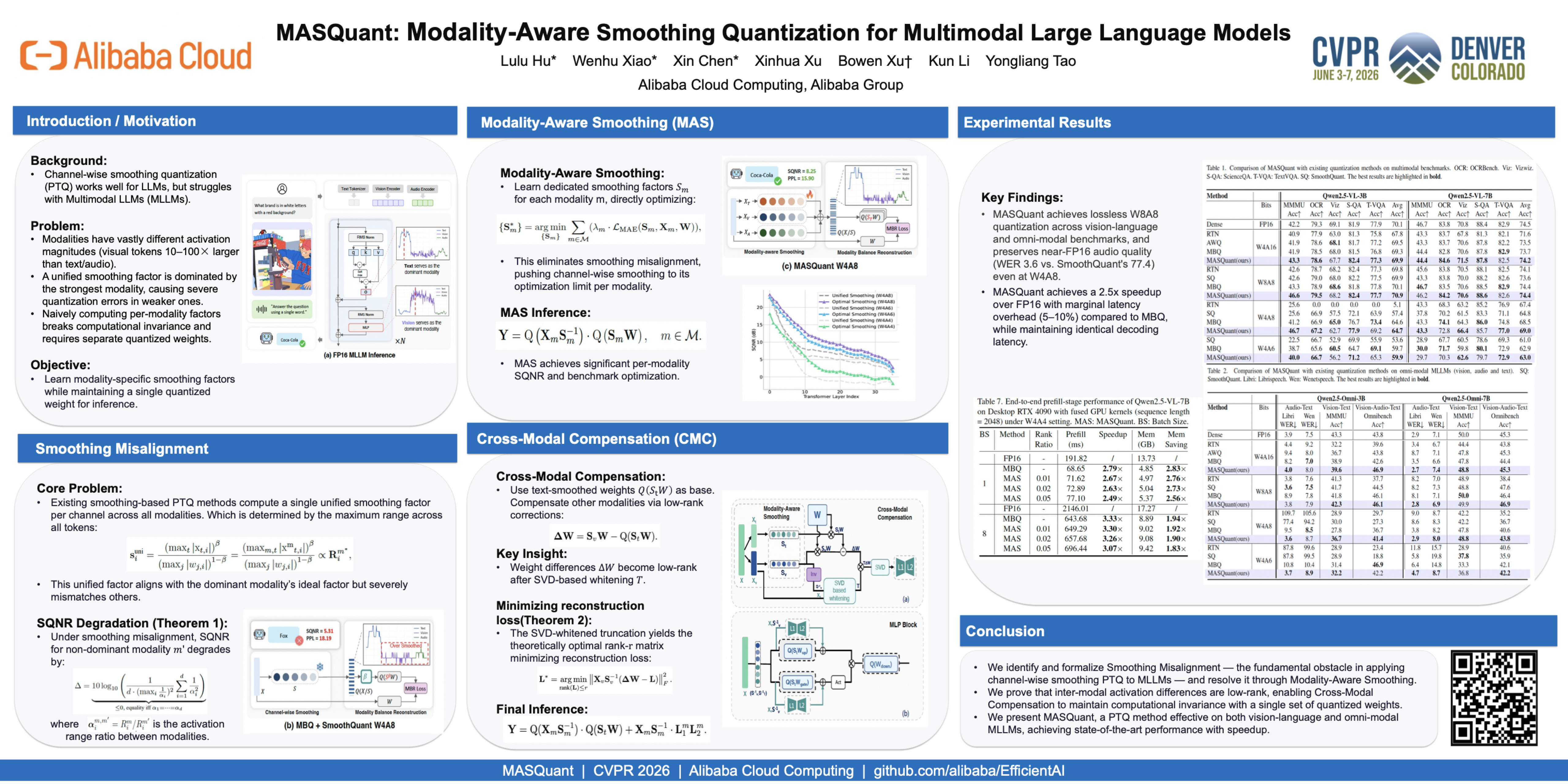
Post-training quantization (PTQ) with computational equivalence for Large Language Models (LLMs) have demonstrated remarkable advances, however, their application to Multimodal Large Language Models (MLLMs) presents substantial challenges. In this paper, we analyze SmoothQuant as a case study and identify two critical issues: Smoothing Misalignment and Cross-Modal Computational Invariance. To address these issues, we propose Modality-Aware Smoothing Quantization (MASQuant), a novel framework that introduces (1) Modality-Aware Smoothing (MAS), which learns separate, modality-specific smoothing factors to prevent Smoothing Misalignment, and (2) Cross-Modal Compensation (CMC), which addresses Cross-modal Computational Invariance by using SVD whitening to transform multi-modal activation differences into low-rank forms, enabling unified quantization across modalities. MASQuant demonstrates stable quantization performance across both dual-modal and tri-modal MLLMs. Experimental results show that MASQuant is competitive among the state-of-the-art PTQ algorithms.
Seeing Through Touch: Tactile-Driven Visual Localization of Material Regions
Seongyu Kim ⋅ Seungwoo Lee ⋅ Hyeonggon Ryu ⋅ Joon Chung ⋅ Arda Senocak
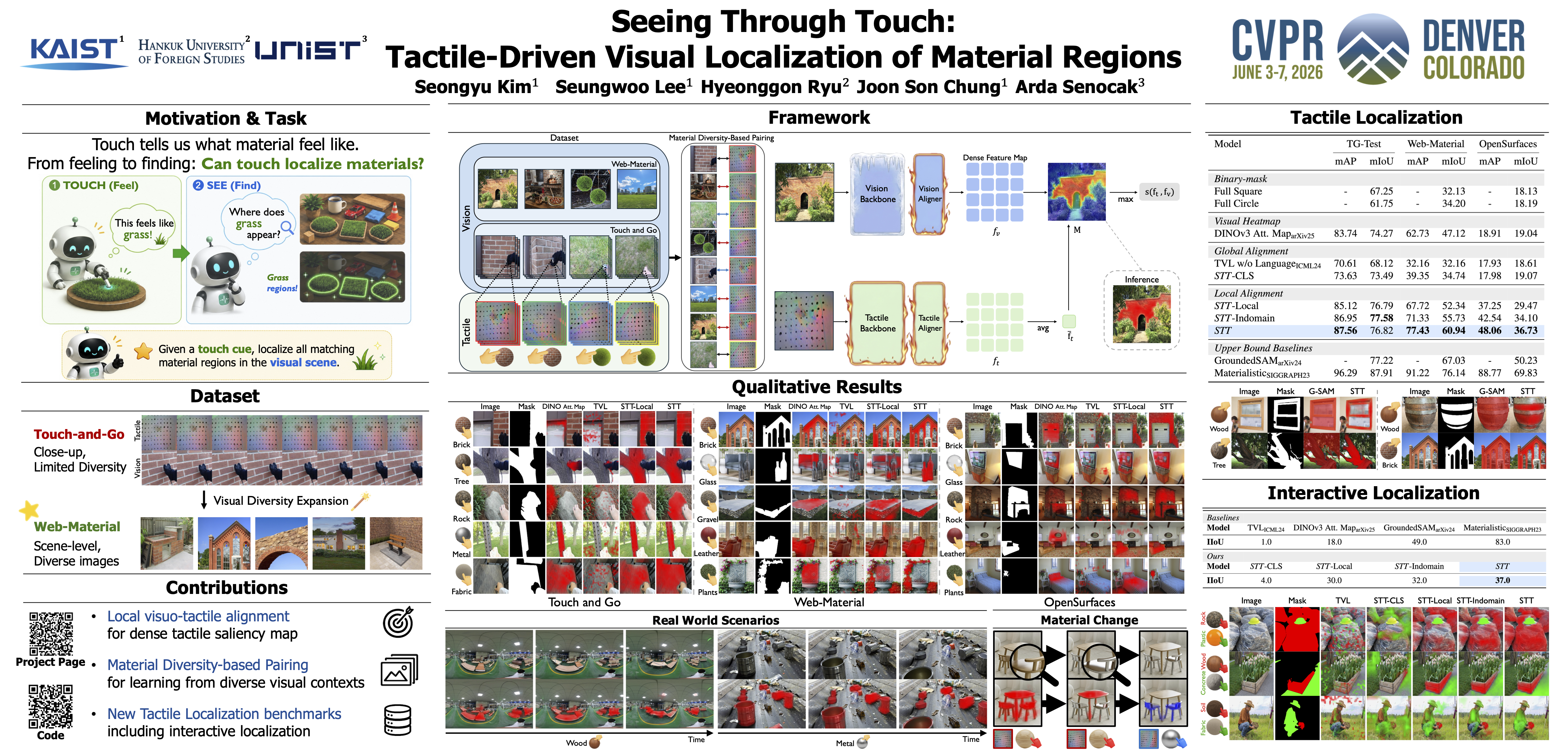
We address the problem of tactile localization, where the goal is to identify image regions that share the same material properties as a tactile input. Existing visuo-tactile methods rely on global alignment and thus fail to capture the fine-grained local correspondences required for this task. The challenge is amplified by existing datasets, which predominantly contain close-up, low-diversity images. We propose a model that learns local tactile–visual alignment via dense cross-modal feature interactions, producing tactile saliency maps for touch-conditioned material segmentation. To overcome dataset constraints, we introduce: (i) in-the-wild multi-material scene images that expand visual diversity, and (ii) a material-diversity pairing strategy that aligns each tactile sample with visually varied yet tactilely consistent images, improving contextual localization and robustness to weak signals. We also construct two new tactile-grounded material segmentation datasets for quantitative evaluation. Experiments on both new and existing benchmarks show that our approach substantially outperforms prior visuo-tactile methods in tactile localization.
Seeing What Matters: A Training-Free Self-Guided Framework for Multimodal Detail Perception and Reasoning
Mingjie Ma ⋅ yichao ma ⋅ Zhong Yang ⋅ Guohui Li
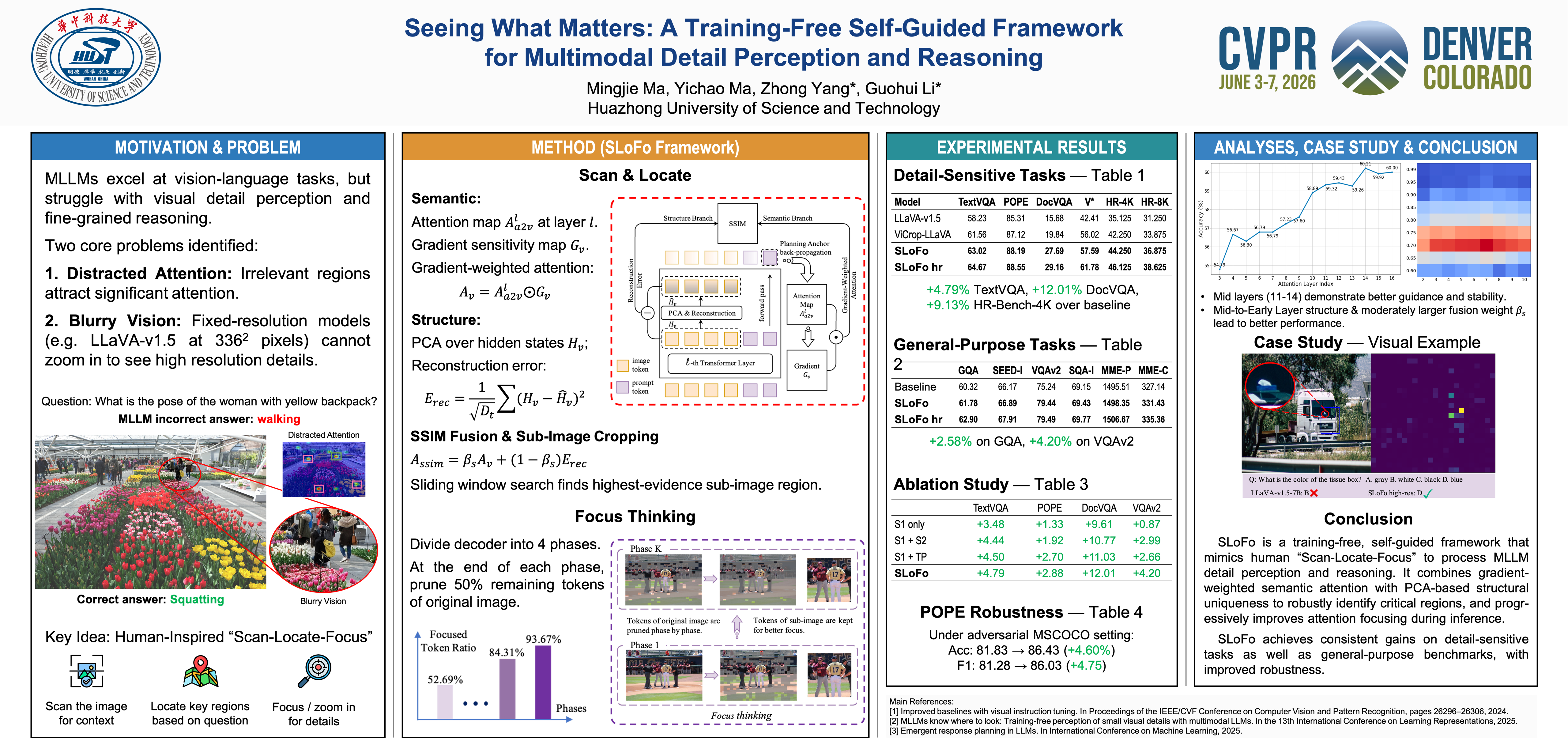
Multimodal large language models (MLLMs) have achieved remarkable success on diverse visual-language tasks. However, fixed-resolution models face challenges in perceiving fine-grained visual details, particularly due to distracted attention and blurry vision. To address these issues, we propose SLoFo, a training-free and self-guided inference framework that mimics the human "Scan-Locate-Focus" process. SLoFo first adopts a dual-branch mechanism to identify critical image regions: the Semantic branch constructs a gradient-based semantic relevance map, and the Structure branch estimates visual token uniqueness offering complementary and robust evidence. By combining both branches, SLoFo perceives and explicitly crop critical regions. During inference, with additional cropped sub-image, SLoFo applies a progressive visual token pruning strategy to improve attention focus on key areas while reducing computational overhead. Experiments on detail-sensitive and general-purpose benchmarks show that SLoFo consistently improves accuracy (+4.79% on TextVQA, +2.62% on GQA) and robustness (+4.60% on POPE-MSCOCO adversarial) without training or external modules.
Illuminating Visual Identity in Universal Multimodal Embeddings
Jiawei Cao ⋅ Junyi Feng ⋅ Jiashen Hua ⋅ Ziheng Huang ⋅ Bing Deng ⋅ Kaijie Wu ⋅ Chaochen Gu ⋅ Jieping Ye
Universal Multimodal Embeddings (UMEs) aim to unify various modalities and tasks into a shared representation space. In recent years, this field has witnessed substantial progress driven by the development of Multimodal Large Language Models (MLLMs). However, a crucial capability, visual identity discrimination, remains underexplored in existing UME methods, despite its critical role in a wide range of tasks, including instance retrieval, re-identification, and identity preservation in AI-generated content (AIGC).To bridge this gap, we propose a unified formulation for visual identity discrimination and introduce $\textbf{MIEB}$ ($\textbf{M}$ultimodal Visual $\textbf{I}$dentity $\textbf{E}$mbedding $\textbf{B}$enchmark), a large-scale benchmark curated from both real-world and synthetic datasets to support evaluation and training.Furthermore, we present a simple yet effective learning framework that jointly optimizes general multimodal and visual identity representations through a carefully designed identity-aware sampling mechanism.Extensive experiments demonstrate that our approach successfully endows UMEs with strong identity discrimination capability and maintains competitive general multimodal performance.We believe this work not only illuminates a critical yet neglected capability, but also takes a step toward more holistic universal multimodal embeddings.
Anti-Degradation Lifelong Multi-View Clustering
Xingfeng Li ⋅ Hao Pan ⋅ Honglin Yuan ⋅ Yuan Sun ⋅ Xujian Zhao ⋅ Jiaqi Lin ⋅ Zhenwen Ren
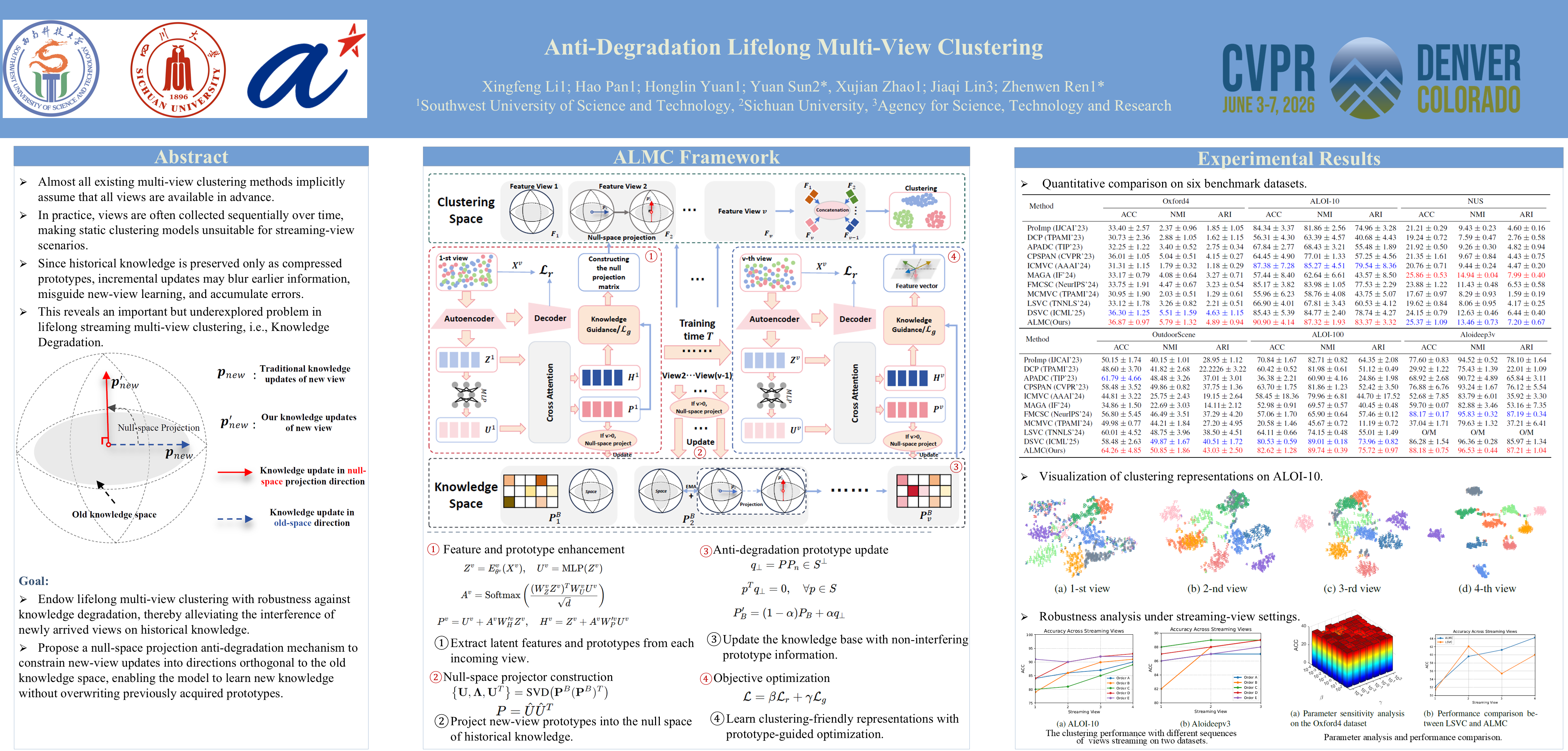
In real-world scenarios, new views are continuously collected over time, forming a dynamic view stream. To handle such evolving data, a lifelong multi-view clustering framework is needed instead of a static model. However, large discrepancies across views make it challenging to learn new knowledge while preserving previously acquired information. There are few methods use consistency alignment or knowledge distillation to align new knowledge with old ones. However, these strategies cannot fundamentally prevent knowledge degradation, since new knowledge inevitably interferes with the learned representation space. To overcome this limitation, we propose a new \textbf{A}nti-degradation Lifelong Multi-view Clustering (ALMC) framework. Specifically, we innovatively propose a null-space-projection knowledge base anti-degradation technique, which ensures that new knowledge updates to the model only occur in directions orthogonal to the retained knowledge, thus preventing catastrophic forgetting of knowledge and degradation of clustering performance, and provides theoretical proof for this. Extensive experiments on multiple multi-view benchmark datasets demonstrate superior performance in multi-view clustering.
The Coherence Trap: When MLLM-Crafted Narratives Exploit Manipulated Visual Contexts
Yuchen Zhang ⋅ Yaxiong Wang ⋅ Yujiao Wu ⋅ Lianwei Wu ⋅ Li Zhu ⋅ Zhedong Zheng
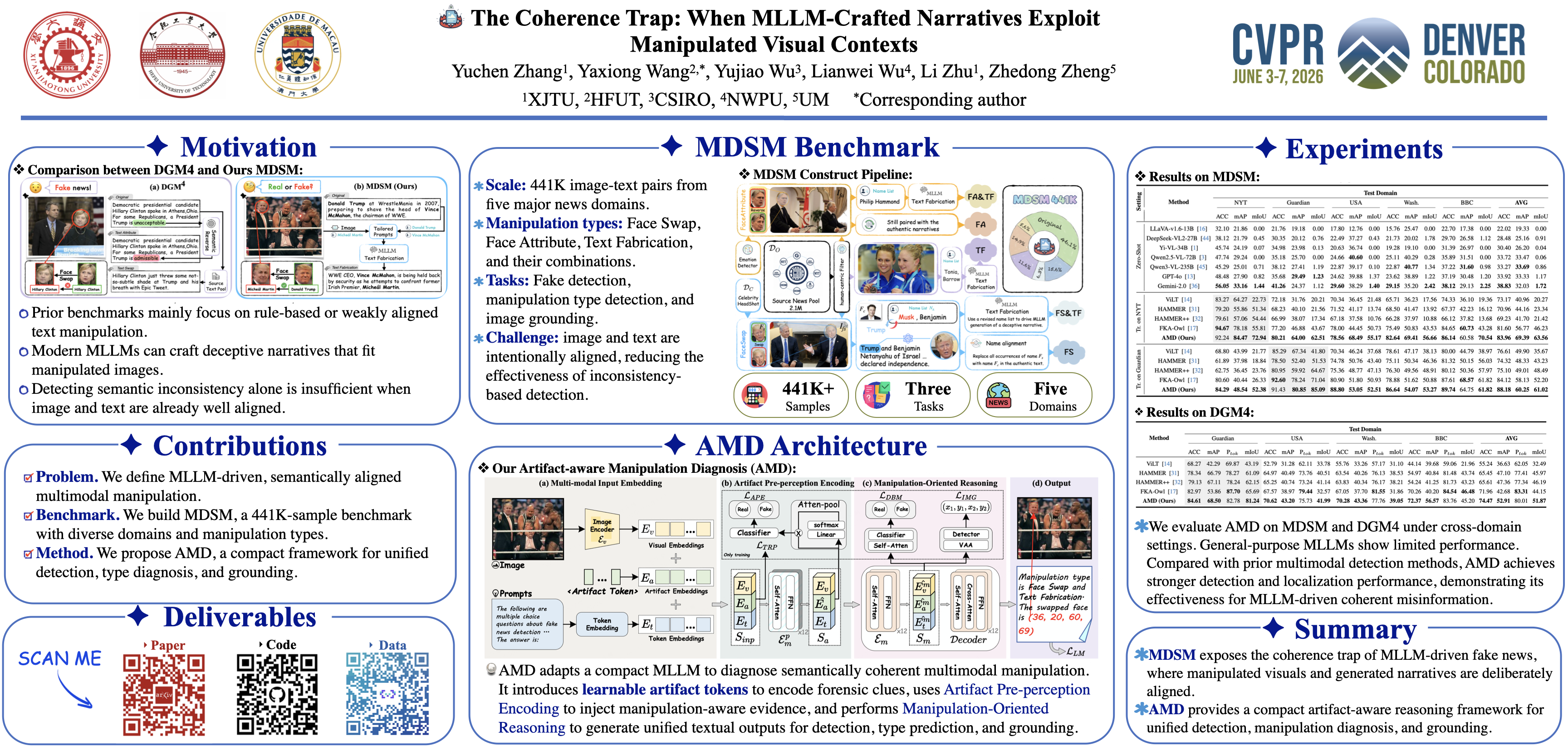
The detection and grounding of multimedia manipulation has emerged as a critical challenge in combating AI-generated disinformation. While existing methods have made progress in recent years, we identify two fundamental limitations in current approaches: (1) Underestimation of MLLM-driven deception risk: prevailing techniques primarily address rule-based text manipulations, yet fail to account for sophisticated misinformation synthesized by multimodal large language models (MLLMs) that can dynamically generate semantically coherent, contextually plausible yet deceptive narratives conditioned on manipulated images; (2) Unrealistic misalignment artifacts: currently focused scenarios rely on artificially misaligned content that lacks semantic coherence, rendering them easily detectable. To address these gaps holistically, we propose a new adversarial pipeline that leverages MLLMs to generate high-risk disinformation. Our approach begins with constructing the MLLM-Driven Synthetic Multimodal (MDSM) dataset, where images are first altered using state-of-the-art editing techniques and then paired with MLLM-generated deceptive texts that maintain semantic consistency with the visual manipulations. Building upon this foundation, we present the Artifact-aware Manipulation Diagnosis via MLLM (AMD) framework featuring two key innovations: Artifact Pre-perception Encoding strategy and Manipulation-Oriented Reasoning, to tame MLLMs for the MDSM problem. Comprehensive experiments validate our framework's superior generalization capabilities as a unified architecture for detecting MLLM-powered multimodal deceptions. In cross-domain testing on the MDSM dataset, AMD achieves the best average performance, with ACC, mAP, and mIoU scores of 88.18, 60.25, and 61.02, respectively.
Efficient and High-Fidelity Omni Modality Retrieval
Chuong Huynh ⋅ Manh Luong ⋅ Abhinav Shrivastava
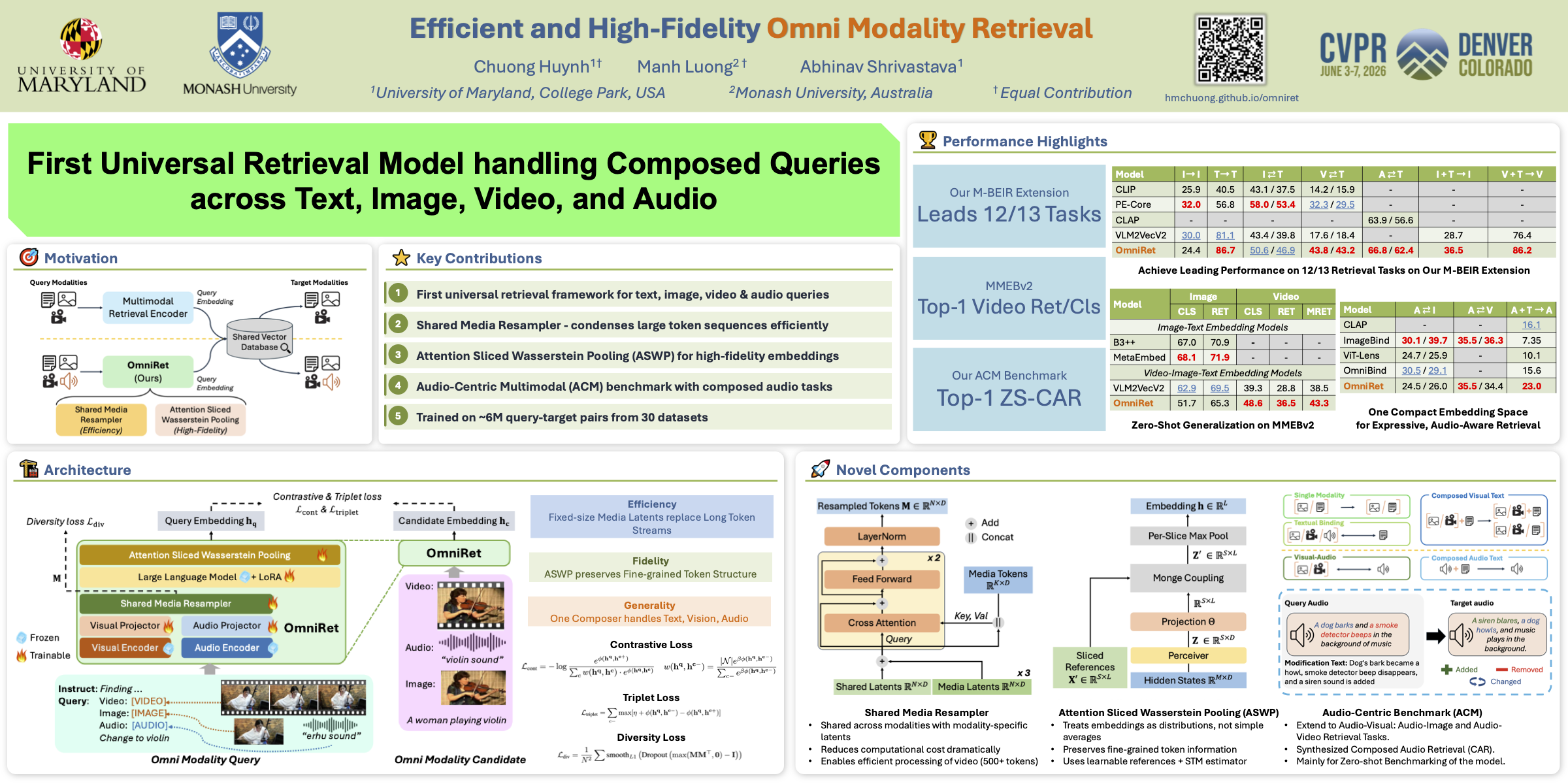
Multimodal retrieval is the task of aggregating information from queries across heterogeneous modalities to retrieve desired targets. State-of-the-art multimodal retrieval models can understand complex queries, yet they are typically limited to two modalities: text and vision. This limitation impedes the development of universal retrieval systems capable of comprehending queries that combine more than two modalities. To advance toward this goal, we present OmniRet, the first retrieval model capable of handling complex, composed queries spanning three key modalities: text, vision, and audio.Our OmniRet model addresses two critical challenges for universal retrieval: computational efficiency and representation fidelity. First, feeding massive token sequences from modality-specific encoders to Large Language Models (LLMs) is computationally inefficient. We therefore introduce an attention-based resampling mechanism to generate compact, fixed-size representations from these sequences. This shared module is designed to maintain representational diversity and generalization capabilities while remaining sensitive to modality-specific information. Second, compressing rich omni-modal data into a single embedding vector inevitably causes information loss and discards fine-grained details. We propose Attention Sliced Wasserstein Pooling to preserve these fine-grained details, leading to improved omni-modal representations.OmniRet is trained on an aggregation of approximately 6 million query-target pairs spanning 30 datasets. We benchmark our model on 13 retrieval tasks and a MMEBv2 subset. Our model demonstrates significant improvements on composed query, audio and video retrieval tasks, while achieving on-par performance with state-of-the-art models on others. Furthermore, we curate a new Audio-Centric Multimodal Benchmark (ACM). This new benchmark introduces two critical, previously missing tasks—composed audio retrieval and audio-visual retrieval—to more comprehensively evaluate a model's omni-modal embedding capacity. We believe our benchmark will facilitate the development of universal retrieval systems.
Same Content, Different Answers: Cross-Modal Inconsistency in MLLMs
Angela van Sprang ⋅ Laurens Samson ⋅ Ana Lucic ⋅ Erman Acar ⋅ Sennay Ghebreab ⋅ Yuki M Asano
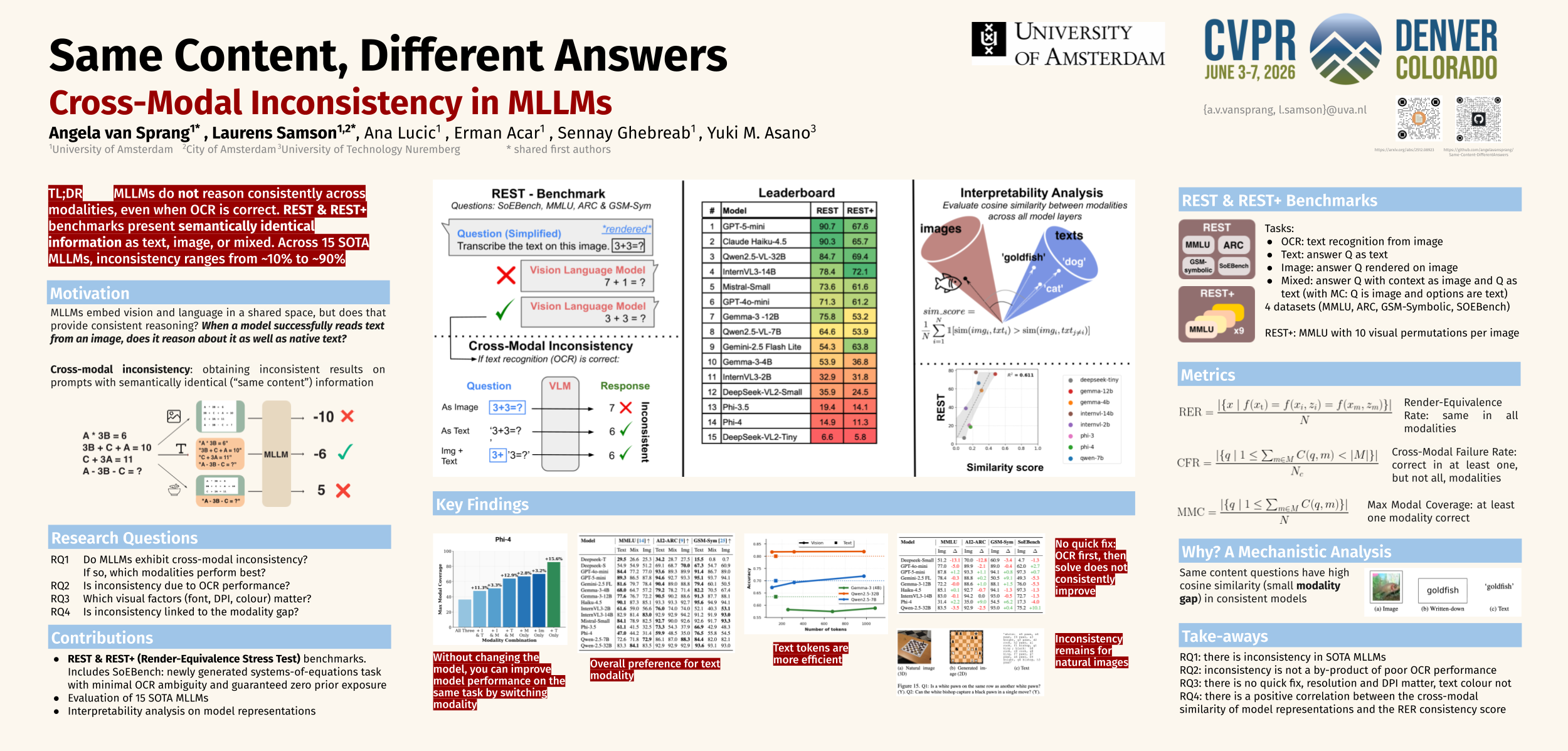
We introduce two new benchmarks \textbf{REST} and \textbf{REST+} (Render-Equivalence Stress Tests) to enable systematic evaluation of cross-modal inconsistency in multimodal large language models (MLLMs). MLLMs are trained to represent vision and language in the same embedding space, yet they cannot perform the same tasks in both modalities. Our benchmarks contain samples with the \textbf{same semantic information} in three modalities (image, text, mixed) and we show that state-of-the-art MLLMs cannot consistently reason over these different modalities. We evaluate 15 MLLMs and find that the degree of modality inconsistency varies substantially, even when accounting for problems with text recognition (OCR). Neither rendering text as image nor rendering an image as text solves the inconsistency. Even if OCR is correct, we find that visual characteristics (text colour and resolution, but not font) and the number of vision tokens have an impact on model performance. Finally, we find that our consistency score correlates with the modality gap between text and images, highlighting a mechanistic interpretation of cross-modal inconsistent MLLMs.
Tri-Subspaces Disentanglement for Multimodal Sentiment Analysis
Chunlei Meng ⋅ Jiabin Luo ⋅ Zhenglin Yan ⋅ Zhenyu Yu ⋅ Rong Fu ⋅ Zhongxue Gan ⋅ Chun Ouyang
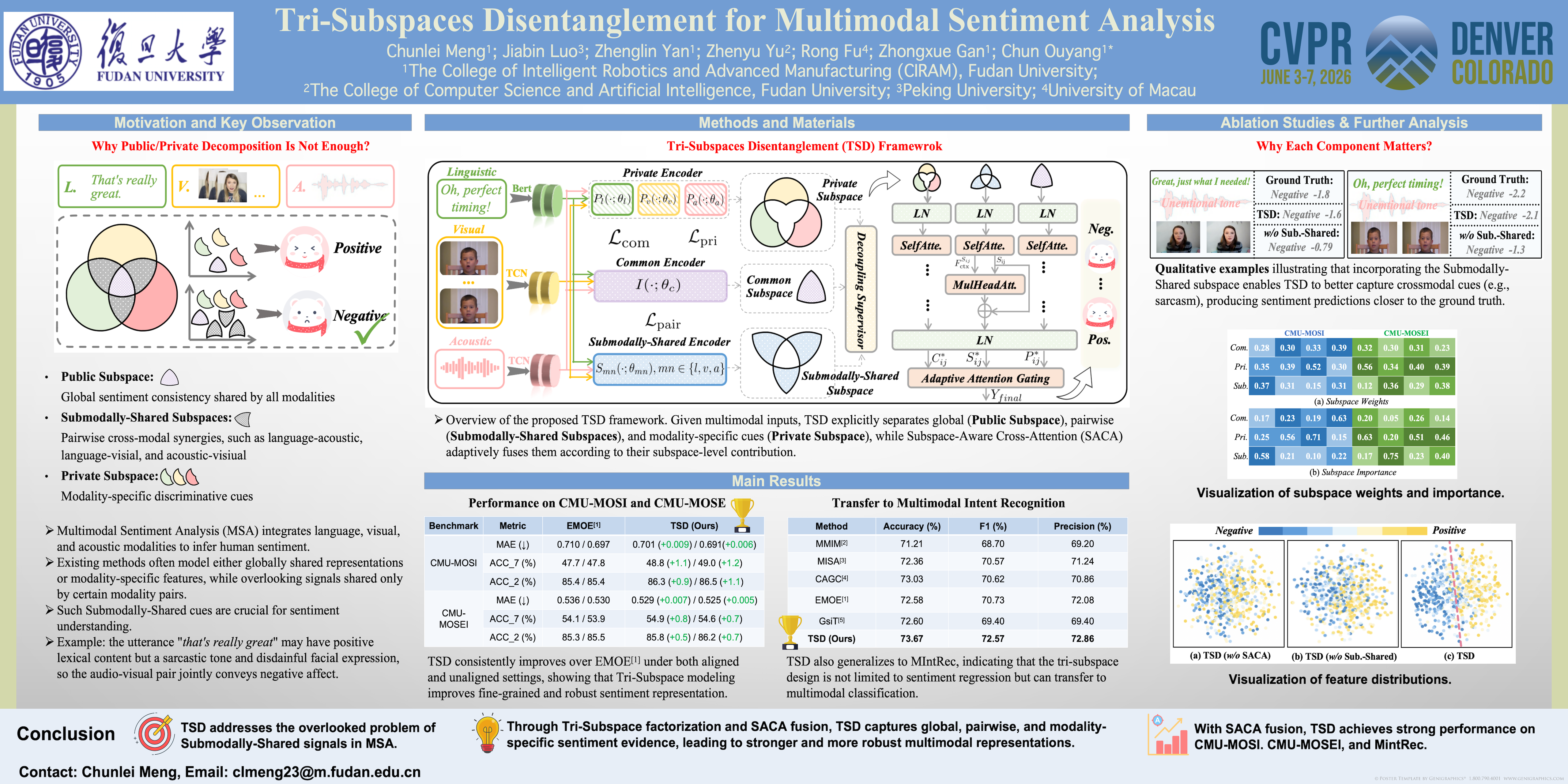
Multimodal Sentiment Analysis (MSA) integrates language, visual, and acoustic modalities to infer human sentiment. Most existing methods either focus on globally shared representations or modality-specific features, while overlooking signals that are shared only by certain modality pairs. This limits the expressiveness and discriminative power of multimodal representations. To address this limitation, we propose a Tri-Subspace Disentanglement (TSD) framework that explicitly factorizes features into three complementary subspaces: a common subspace capturing global consistency, submodally-shared subspaces modeling pairwise cross-modal synergies, and private subspaces preserving modality-specific cues. To keep these subspaces pure and independent, we introduce a decoupling supervisor together with structured regularization losses. We further design a Subspace-Aware Cross-Attention (SACA) fusion module that adaptively models and integrates information from the three subspaces to obtain richer and more robust representations. Experiments on CMU-MOSI and CMU-MOSEI demonstrate that TSD achieves state-of-the-art performance across all key metrics, reaching 0.691 MAE on CMU-MOSI and 54.9\% ACC$_7$ on CMU-MOSEI, and also transfers well to multimodal intent recognition tasks. Ablation studies confirm that tri-subspace disentanglement and SACA jointly enhance the modeling of multi-granular cross-modal sentiment cues.
HAVE-Bench: Hierarchical Audio-Visual Evaluation from Perception to Interaction
Zhong Muyan ⋅ Erfei Cui ⋅ Sen Xing ⋅ Weiyun Wang ⋅ Wen Wu ⋅ Yuchen Hu ⋅ Yanting Zhang ⋅ Xiaowei Hu ⋅ Wenhai Wang ⋅ Chao Zhang ⋅ Jifeng Dai
Multimodal large language models (MLLMs) have expanded from vision–language systems to include audio, unlocking new capabilities in cross-modal reasoning and interaction. To address the limitation that existing benchmarks focus mainly on perception tasks and lack a unified cognitive evaluation framework, we propose Hierarchical Audio-Visual Evaluation Benchmark (HAVE-Bench). It systematically evaluates the audio-related capabilities of MLLMs along a three-level cognitive hierarchy: Perception, Reasoning, and Interaction, utilizing 2,451 curated samples and manually annotated multi-turn interaction-level tasks. Experiments using this unified framework reveal significant gaps in existing models at the reasoning and interaction levels, with speech-driven visual question answering (VQA) performance significantly lagging behind the text–image setting. These findings underscore the urgency of enhancing models’ handling of long and complex audio and facilitating the transfer of reasoning capabilities from the vision–text to the audio–visual domain.
Predictive Regularization Against Visual Representation Degradation in Multimodal Large Language Models
Enguang Wang ⋅ Qiang Wang ⋅ Yuanchen Wu ⋅ Ke Yan ⋅ Xinbin Yuan ⋅ Shouhong Ding ⋅ Xialei Liu ⋅ Mingming Cheng
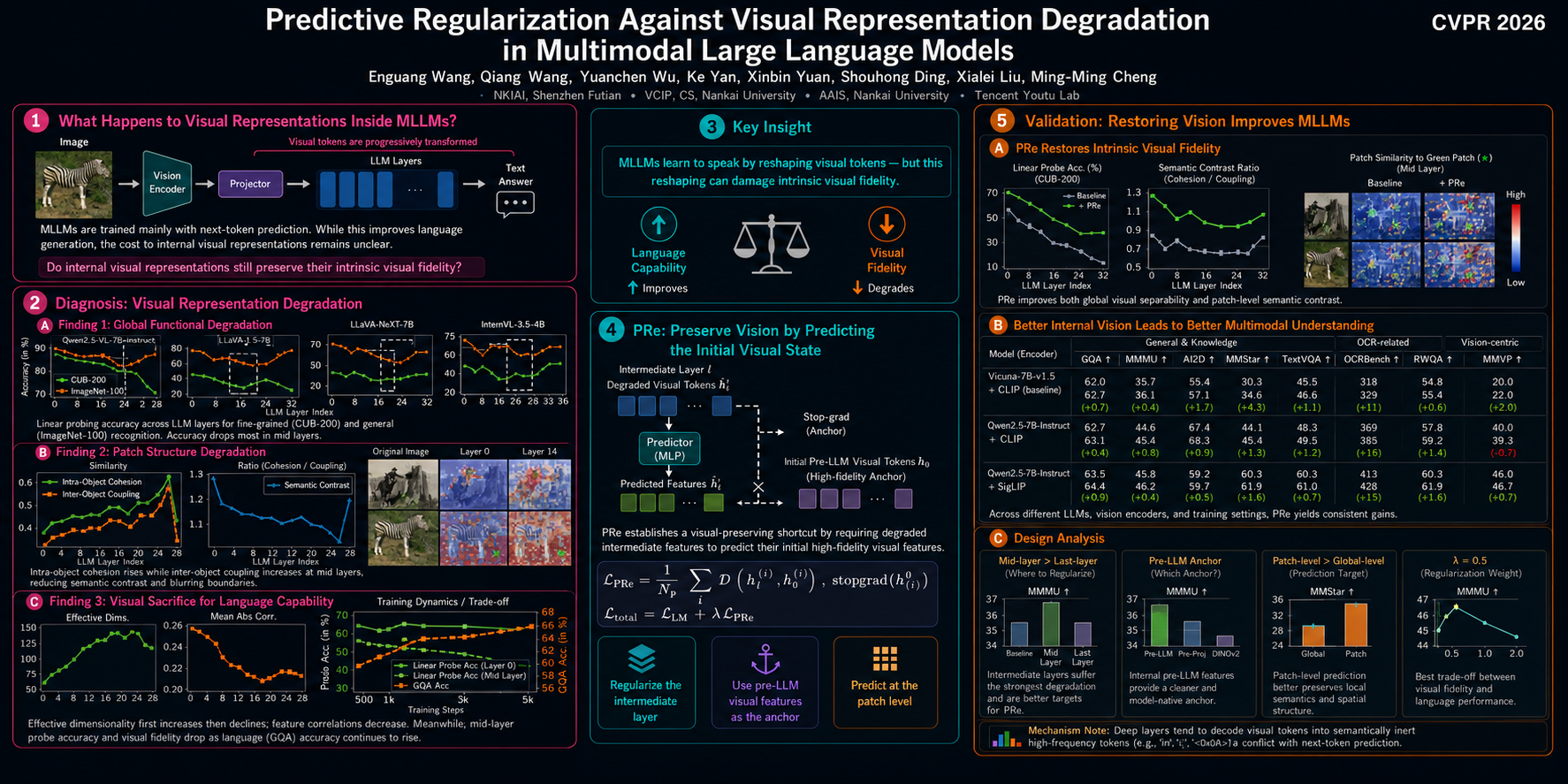
While Multimodal Large Language Models (MLLMs) excel at vision-language tasks, the cost of their language-driven training on internal visual foundational competence remains unclear. In this paper, we conduct a detailed diagnostic analysis to unveil a pervasive issue: visual representation degradation in MLLMs. Specifically, we find that compared to the initial visual features, the visual representation in the middle layers of LLM exhibits both a degradation in global function and patch structure. We attribute this phenomenon to a visual sacrifice driven by the singular text-generation objective, where the model compromises its visual fidelity to optimize for answer generation. We argue that a robust MLLM requires both strong cross-modal reasoning and core visual competence, and propose Predictive Regularization (PRe) to force degraded intermediate features to predict initial visual features, thereby maintaining the inherent visual attributes of the MLLM's internal representations. Extensive experiments confirm that mitigating this visual degradation effectively boosts vision-language performance, underscoring the critical importance of fostering robust internal visual representations within MLLMs for comprehensive multimodal understanding.
THE MORE, THE MERRIER: CONTRASTIVE FUSION FOR HIGHER-ORDER MULTIMODAL ALIGNMENT
Stefanos Koutoupis ⋅ Michaela Areti Zervou ⋅ Konstantinos Kontras ⋅ Maarten De Vos ⋅ Panagiotis Tsakalides ⋅ Grigorios Tsagkatakis
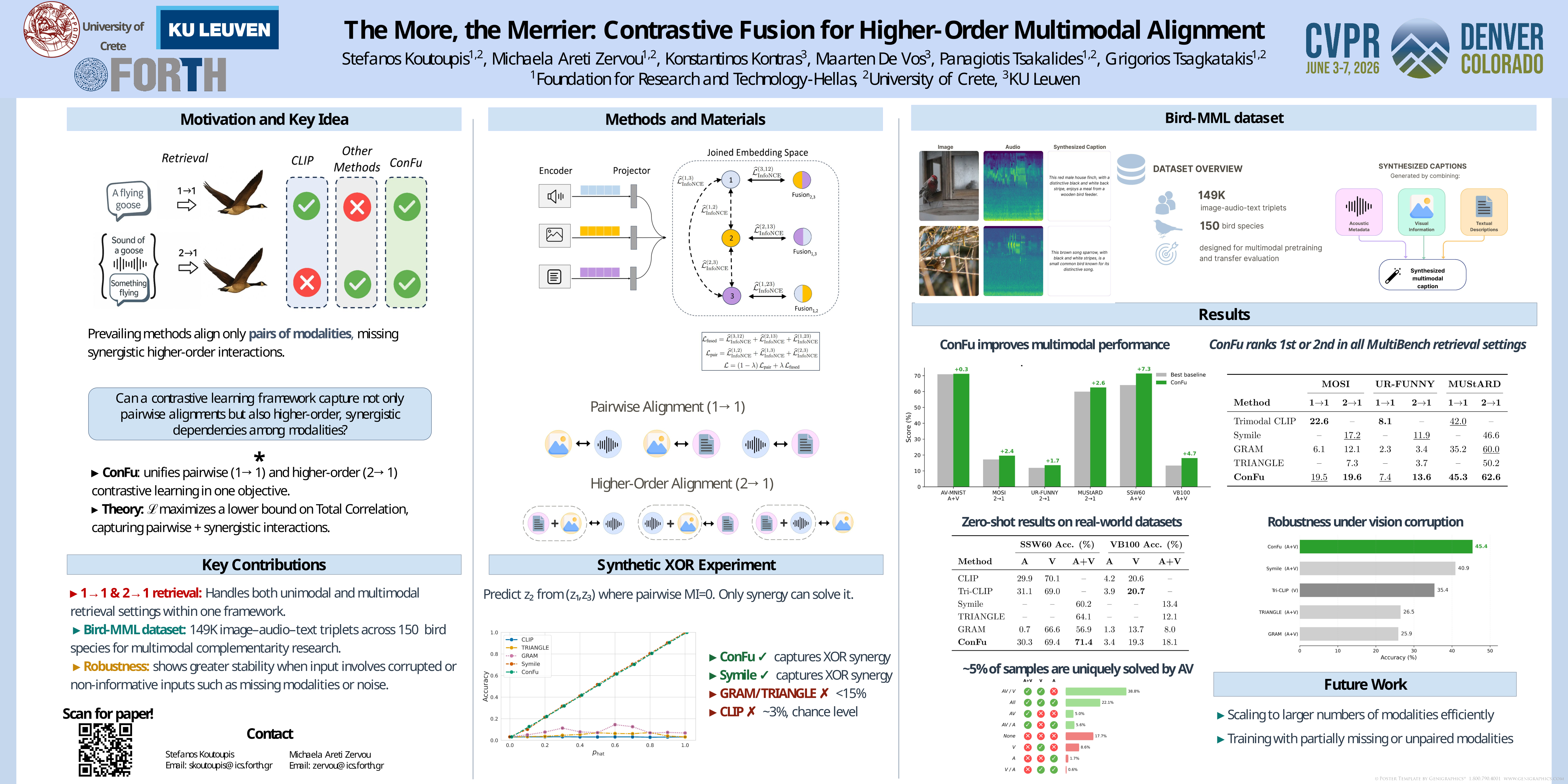
Learning joint representations across multiple modalities remains a central challenge in multimodal machine learning. Prevailing approaches predominantly operate in pairwise settings, aligning two modalities at a time. While some recent methods aim to capture higher-order interactions among multiple modalities, they often overlook or insufficiently preserve pairwise relationships, limiting their effectiveness on single-modality tasks. In this work, we introduce Contrastive Fusion (ConFu), a framework that jointly embeds both individual modalities and their fused combinations into a unified representation space, where modalities and their fused counterparts are aligned. ConFu extends traditional pairwise contrastive objectives with an additional fused-modality contrastive term, encouraging the joint embedding of modality pairs with a third modality. This formulation enables ConFu to capture higher-order dependencies, such as XOR-like relationships, that cannot be recovered through pairwise alignment alone, while still maintaining strong pairwise correspondence. We evaluate ConFu on synthetic and real-world multimodal benchmarks, assessing its ability to exploit cross-modal complementarity, capture higher-order dependencies, and scale with increasing multimodal complexity. Across these settings, ConFu demonstrates competitive performance on retrieval and classification tasks, while supporting unified one-to-one and two-to-one retrieval within a single contrastive framework.
CineSRD: Leveraging Visual, Acoustic, and Linguistic Cues for Open-World Visual Media Speaker Diarization
Liangbin Huang ⋅ Xiaohua Liao ⋅ Chaoqun Cui ⋅ Shijing Wang ⋅ Zhaolong Huang ⋅ Yanlong Du ⋅ Wenji Mao
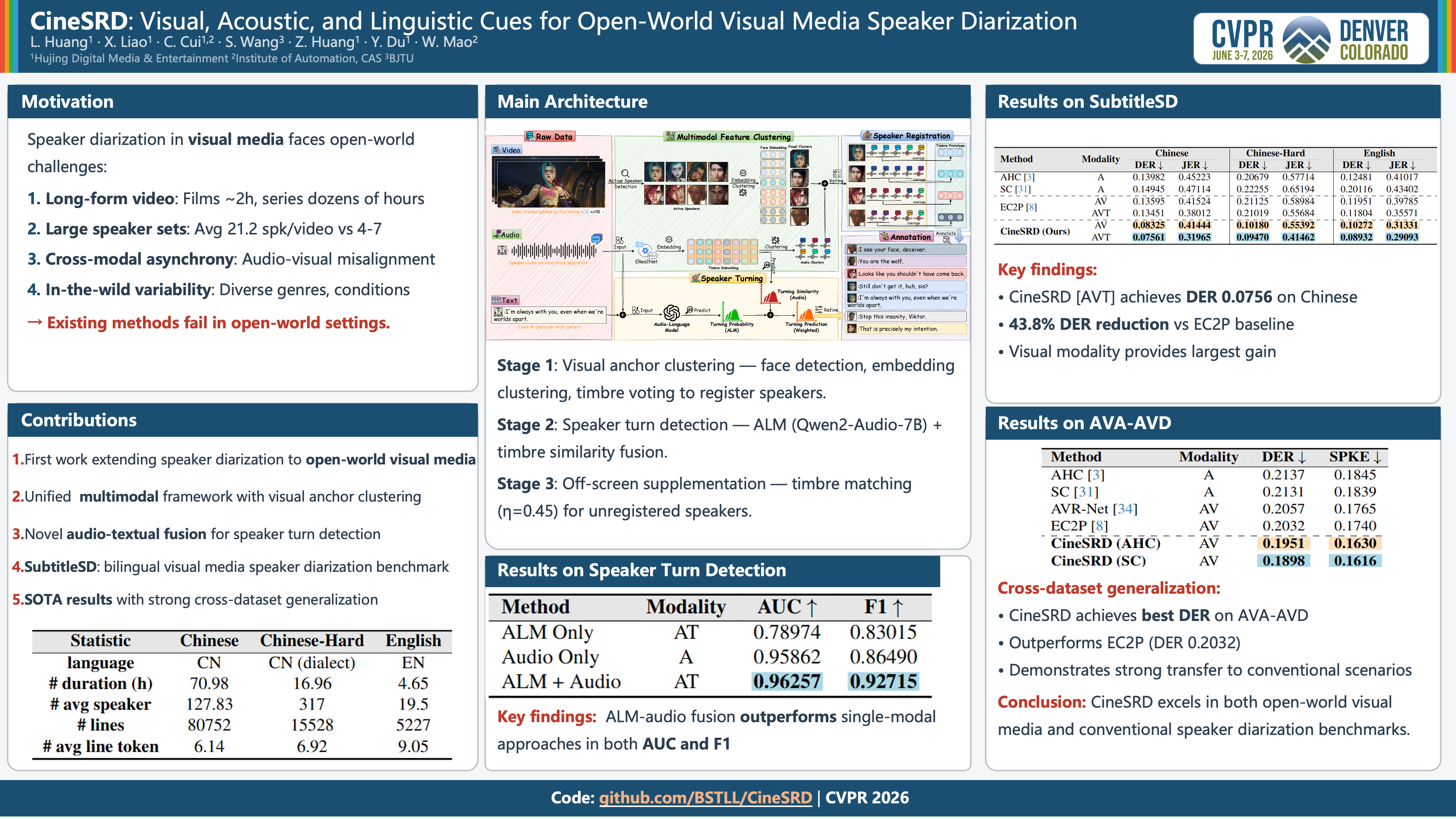
Traditional speaker diarization systems have primarily focused on constrained scenarios such as meetings and interviews, where the number of speakers is limited and acoustic conditions are relatively clean. To explore open-world speaker diarization, we extend this task to the visual media domain, encompassing complex audiovisual programs such as films and TV series. This new setting introduces several challenges, including long-form video understanding, a large number of speakers, cross-modal asynchrony between audio and visual cues, and uncontrolled in-the-wild variability. To address these challenges, we propose Cinematic Speaker Registration & Diarization (CineSRD), a unified multimodal framework that leverages visual, acoustic, and linguistic cues from video, speech, and subtitles for speaker annotation. CineSRD first performs visual anchor clustering to register initial speakers and then integrates an audio language model for speaker turn detection, refining annotations and supplementing unregistered off-screen speakers. Furthermore, we construct and release a dedicated speaker diarization benchmark for visual media that includes Chinese and English programs. Experimental results demonstrate that CineSRD achieves superior performance on the proposed benchmark and competitive results on conventional datasets, validating its robustness and generalizability in open-world visual media settings.
HandDreamer: Zero-Shot Text to 3D Hand Model Generation using Corrective Hand Shape Guidance
Green Rosh ⋅ Prateek Kukreja ⋅ Vishakha SR ⋅ Pawan Prasad B H
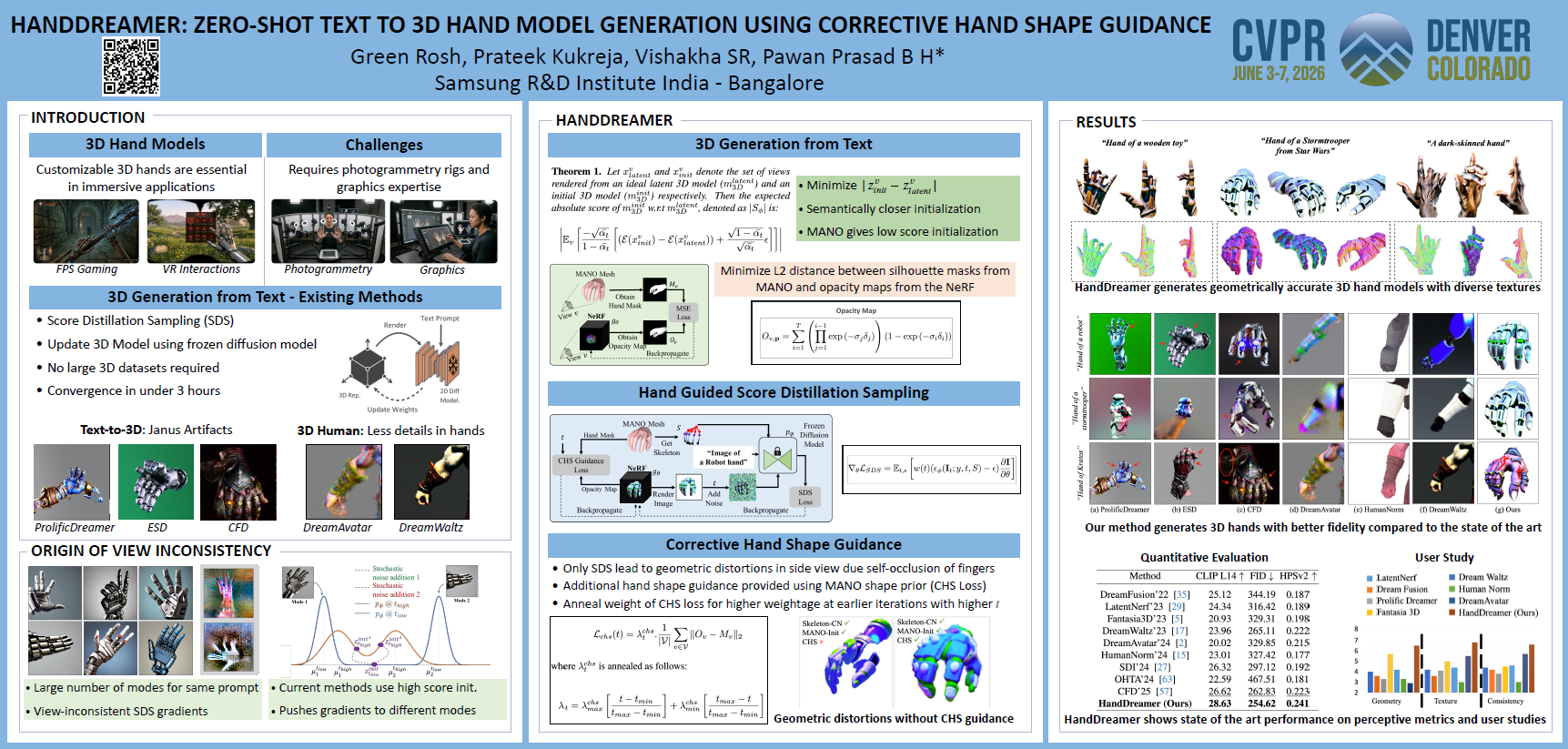
The emergence of virtual reality has necessitated the generation of detailed and customizable 3D hand models for interaction in the virtual world. However, the current methods for 3D hand model generation are both expensive and cumbersome, offering very little customizability to the users. While recent advancements in zero-shot text-to-3D synthesis have enabled the generation of diverse and customizable 3D models using Score Distillation Sampling (SDS), they do not generalize very well to 3D hand model generation, resulting in unnatural hand structures, view-inconsistencies and loss of details. To address these limitations, we introduce HandDreamer, the first method for zero-shot 3D hand model generation from text prompts. Our findings suggest that view-inconsistencies in SDS is primarily caused due to the ambiguity in the probability landscape described by the text prompt, resulting in similar views converging to different modes of the distribution. This is particularly aggravated for hands due to the large variations in articulations and poses. To alleviate this, we propose to use MANO hand model based initialization and a hand skeleton guided diffusion process to provide a strong prior for the hand structure and to ensure view and pose consistency. Further, we propose a novel corrective hand shape guidance loss to ensure that all the views of the 3D hand model converges to view-consistent modes, without leading to geometric distortions. Extensive evaluations demonstrate the superiority of our method over the state-of-the-art methods, paving a new way forward in 3D hand model generation.
UST-Hand: An Uncertainty-aware Spatiotemporal Point Cloud Interaction Network for 3D Self-supervised Hand Pose Estimation
Tianhao Han ⋅ HaoYang ZHANG ⋅ Liang Xie ⋅ Haochen Chang ⋅ Kun Gao ⋅ Yuan Cheng ⋅ Pengfei Ren ⋅ Erwei Yin
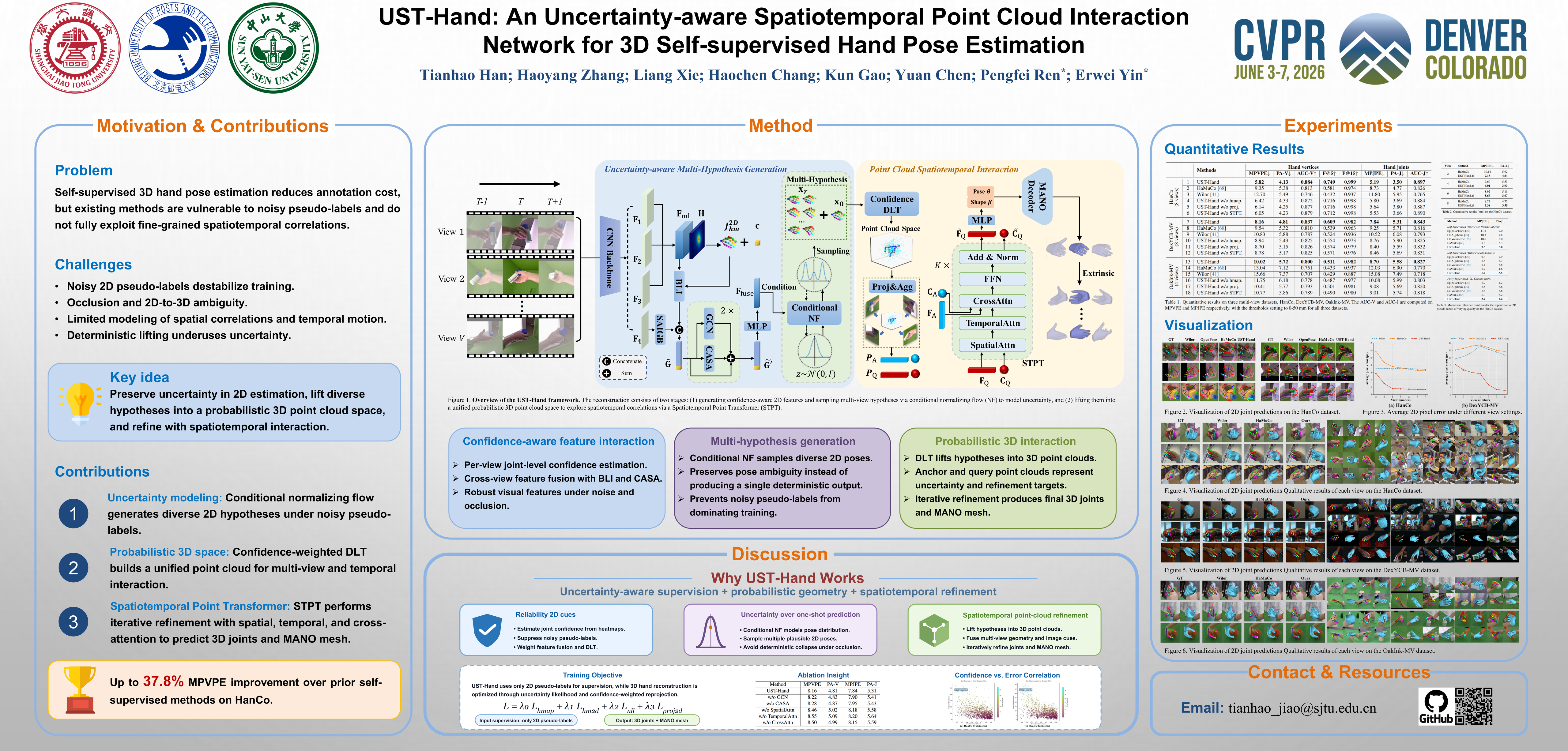
Manually annotating accurate 3D hand poses is extremely time-consuming and labor-intensive. Existing self-supervised hand pose estimation methods leverage the discrepancy between input images and rendered outputs, or multiview consistency constraints, as the driving force to optimize networks and progressively refine pose accuracy. However, these methods are highly susceptible to noisy pseudo-labels and overlook the importance of fully exploiting fine-grained spatial correlations, which undermines the stability of model training. To address these issues, we propose UST-Hand, a self-supervised learning framework that estimates uncertainty distribution of hand pose and constructs a probabilistic point cloud feature space, which enables the complex spatiotemporal relationship modeling. UST-Hand employs a conditional normalizing flow model to capture hand pose distributions and samples diversity hypotheses, facilitating robust learning under noisy pseudo-labels supervision with enhanced stability. These multi-hypothesis are mapped to a unified probabilistic 3D point cloud space for multiview and temporal feature interaction, comprehensively exploring hand motion patterns and fine-grained spatial correlations. Extensive experiments on three challenging datasets demonstrate that UST-Hand achieves state-of-the-art performance, outperforming existing self-supervised methods by up to 37.8\% in Mean Per Vertex Position Error (MPVPE).
ForeHOI: Feed-forward 3D Object Reconstruction from Daily Hand-Object Interaction Videos
Yuantao Chen ⋅ Jiahao Chang ⋅ Chongjie Ye ⋅ Chaoran Zhang ⋅ Zhaojie Fang ⋅ Chenghong Li ⋅ Xiaoguang Han
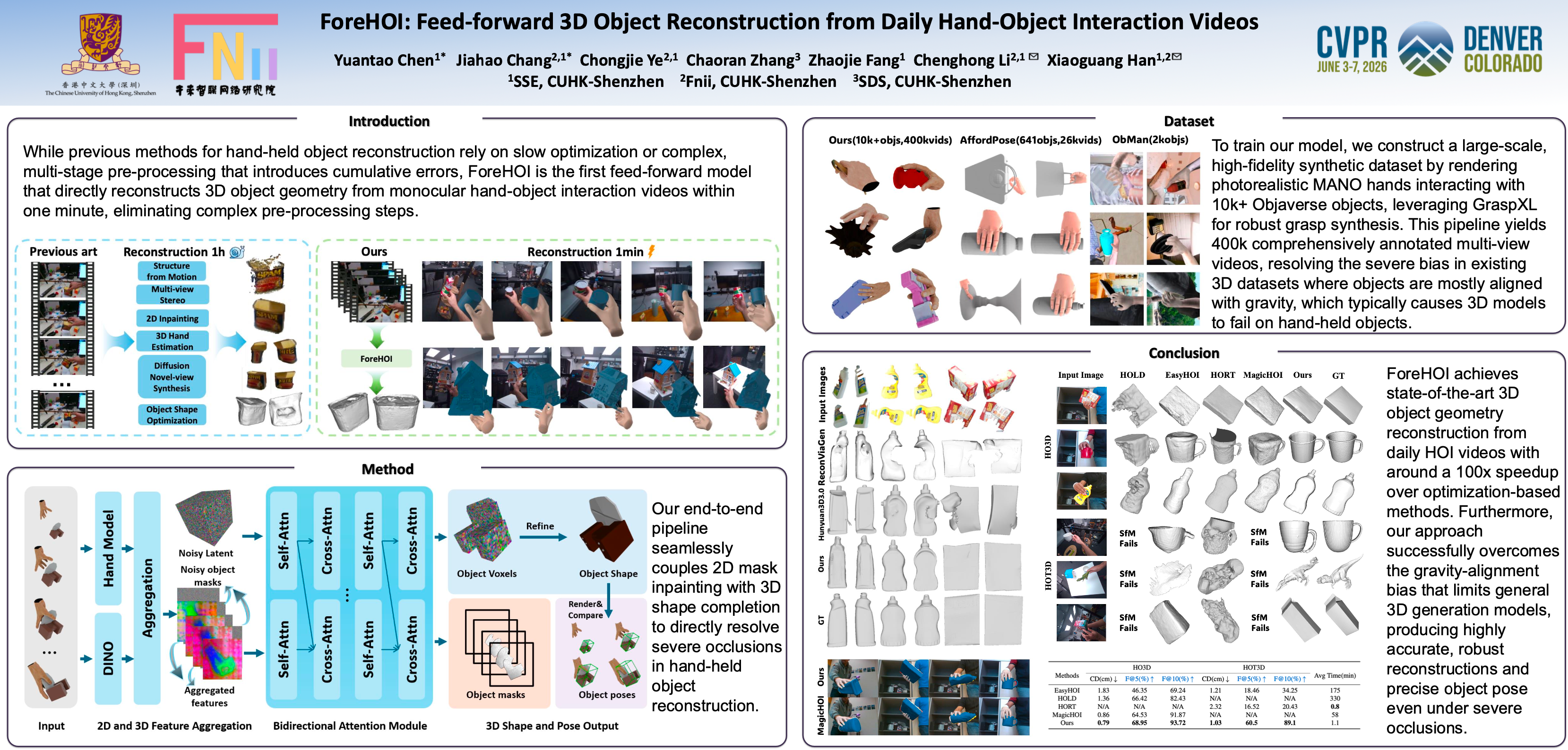
The ubiquity of monocular videos capturing daily hand-object interactions presents a valuable resource for embodied intelligence. While 3D hand reconstruction from in-the-wild videos has seen significant progress, reconstructing the involved objects remains challenging due to severe occlusions and the complex, coupled motion of the camera, hands, and object. In this paper, we introduce ForeHOI, a novel feed-forward model that directly reconstructs 3D object geometry from monocular hand-object interaction videos within one minute of inference time, eliminating the need for any pre-processing steps. Our key insight is that, the joint prediction of 2D mask inpainting and 3D shape completion in a feed-forward framework can effectively address the problem of severe occlusion in monocular hand-held object videos, thereby achieving results that outperform the performance of optimization-based methods. The information exchanges between the 2D and 3D shape completion boosts the overall reconstruction quality, enabling the framework to effectively handle severe hand-object occlusion. Furthermore, to support the training of our model, we contribute the first large-scale, high-fidelity synthetic dataset of hand-object interactions with comprehensive annotations. Extensive experiments demonstrate that ForeHOI achieves state-of-the-art performance in object reconstruction, significantly outperforming previous methods with around a 100x speedup.
Hoi! - A Multimodal Dataset for Force-Grounded, Cross-View Articulated Manipulation
Tim Engelbracht ⋅ René Zurbrügg ⋅ Matteo Wohlrapp ⋅ Martin Büchner ⋅ Abhinav Valada ⋅ Marc Pollefeys ⋅ Hermann Blum ⋅ Zuria Bauer
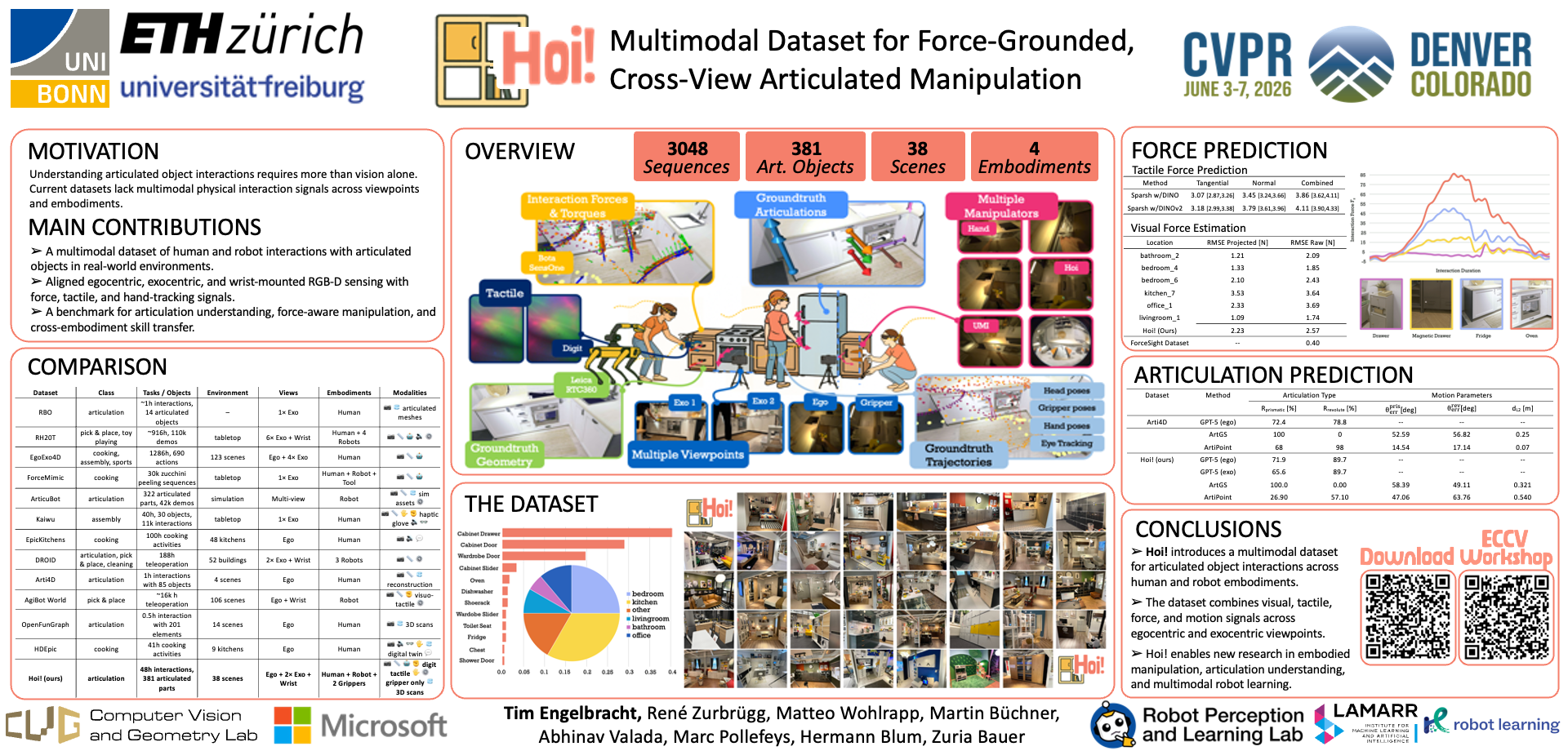
We present a dataset for force-grounded, cross-view articulated manipulation that couples what is seen with what is done and what is felt during real human interaction. The dataset contains 3048 sequences across 381 articulated objects in 38 environments. Each object is operated under four embodiments - (i) human hand, (ii) human hand with a wrist-mounted camera, (iii) handheld UMI gripper, and (iv) a custom Hoi! gripper - where the tool embodiment provide synchronized end-effector forces and tactile sensing. Our dataset offers a holistic view of interaction understanding from video, enabling researchers to evaluate how well methods transfer between human and robotic viewpoints, but also investigate underexplored modalities such as force sensing and prediction.
Enhancing Hands in 3D Whole-Body Pose Estimation with Conditional Hands Modulator
Gyeongsik Moon
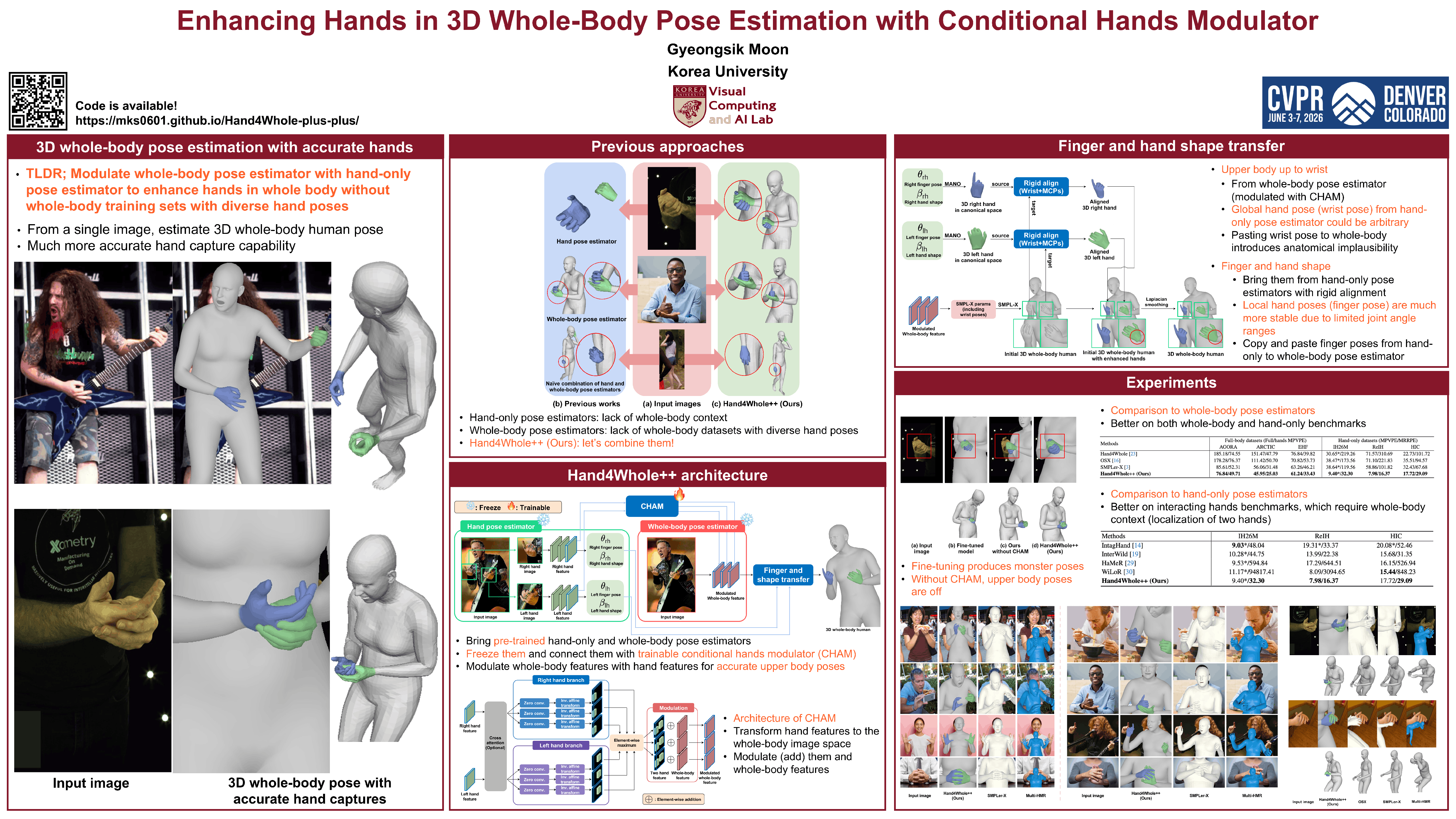
Accurately recovering hand poses within the body context remains a major challenge in 3D whole-body pose estimation. This difficulty arises from a fundamental supervision gap: whole-body pose estimators are trained on full-body datasets with limited hand diversity, while hand-only estimators, trained on hand-centric datasets, excel at detailed finger articulation but lack global body awareness. To address this, we propose WholeBody++, a modular framework that leverages the strengths of both pre-trained whole-body and hand pose estimators. We introduce CHAM (Conditional Hands Modulator), a lightweight module that modulates the whole-body feature stream using hand-specific features extracted from a pre-trained hand pose estimator. This modulation enables the whole-body model to predict wrist orientations that are both accurate and coherent with the upper-body kinematic structure, without retraining the full-body model. In parallel, we directly incorporate finger articulations and hand shapes predicted by the hand pose estimator, aligning them to the full-body mesh via differentiable rigid alignment. This design allows WholeBody++ to combine globally consistent body reasoning with fine-grained hand detail. Extensive experiments demonstrate that WholeBody++ substantially improves hand accuracy and enhances overall full-body pose quality. Code and pretrained models will be released publicly.
TouchDream: 3D Object Completion through Imagined Touch
Yuanbo Wang ⋅ Xinning Wang ⋅ Zhaoxuan Zhang ⋅ Changlong Wang ⋅ qianchen xia ⋅ Xiaopeng Wei ⋅ Xin Yang
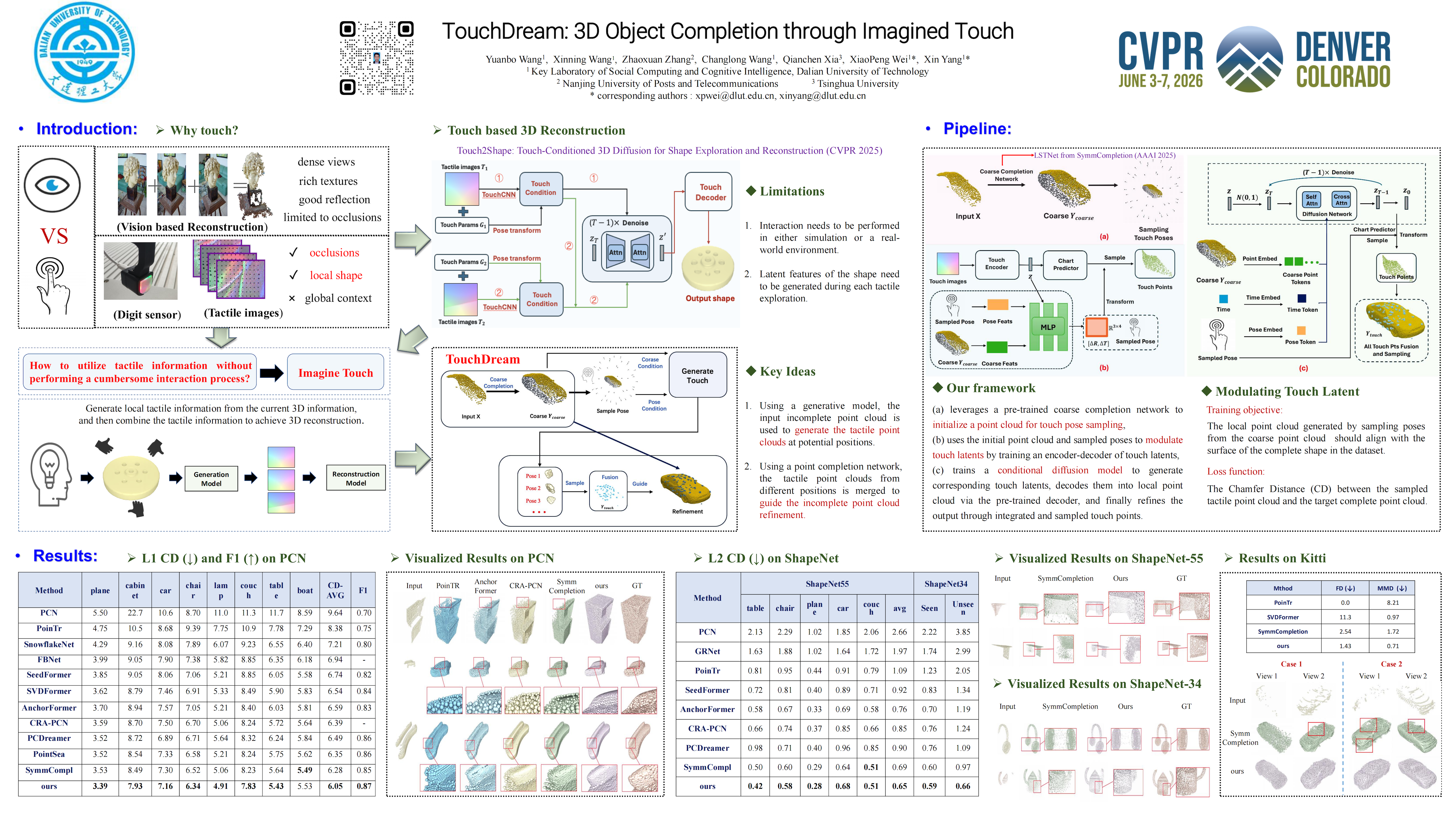
Point cloud completion is crucial for robust 3D perception but remains challenging due to its ill-posed nature. Coarse-to-fine methods can lead to unconstrained local guesses in the absence of key structures, whereas diffusion-based approaches may introduce geometric inconsistencies. To overcome these limitations, we present TouchDream, a novel framework that leverages a diffusion model to 'dream' of tactile sensing on object surfaces, which reformulates the sensing process as a learnable generative modeling task. Unlike visual cues, tactile data provides rich local geometry that can be directly converted into 3D space for point fusion, offering a powerful guide for detail-aware completion. Specifically, our approach generate compact tactile latent representations conditioned on coarse points and sampled touch poses. A touch-guided refinement module then leverages touch features to optimize coarse points. Extensive experiments show that our TouchDream model achieves the state-of-the-art performance, significantly enhancing the recovery of local details.
ForceVLA2: Unleashing Hybrid Force-Position Control with Force Awareness for Contact-Rich Manipulation
Yang Li ⋅ Zhaxizhuoma ⋅ Hongru Jiang ⋅ Junjie Xia ⋅ Hongquan Zhang ⋅ Jinda Du ⋅ Yunsong Zhou ⋅ Jia Zeng ⋅ Ce Hao ⋅ Jieji Ren ⋅ Qiaojun Yu ⋅ Cewu Lu ⋅ Yu Qiao ⋅ Jiangmiao Pang
Embodied intelligence for contact-rich manipulation has predominantly relied on position control, while explicit awareness and regulation of interaction forces remain under-explored, limiting stability, precision, and robustness in real-world tasks. We propose Foca-VLA, an end-to-end vision-language-action framework that equips robots with hybrid force-position control and explicit force awareness. Foca-VLA introduces force-based prompts into the VLM expert to construct force-aware task concepts across stages, and employs a cross-scale routing Mixture-of-Experts (MoE) with impedance control in the action expert to adaptively fuse these concepts with real-time interaction forces for closed-loop hybrid force--position regulation. To support learning and evaluation, we construct Foca-Dataset, containing 1,000 trajectories over 5 contact-rich tasks, including wiping, pressing, and assembling, with multi-view images, task prompts, proprioceptive state, and force signals. Extensive experiments show that Foca-VLA substantially improves success rates and reliability in contact-rich manipulation, outperforming Pi0 and Pi0.5 by 48.0% and 35.0%, respectively, across the 5 tasks, and mitigating common failure modes such as arm overload and unstable contact, thereby advancing force-aware physical intelligence in VLAs.
TokenHand: Discrete Token Representation for Efficient Hand Mesh Reconstruction
Xinguo He ⋅ Yixin Shen ⋅ Rahul Chaudhari
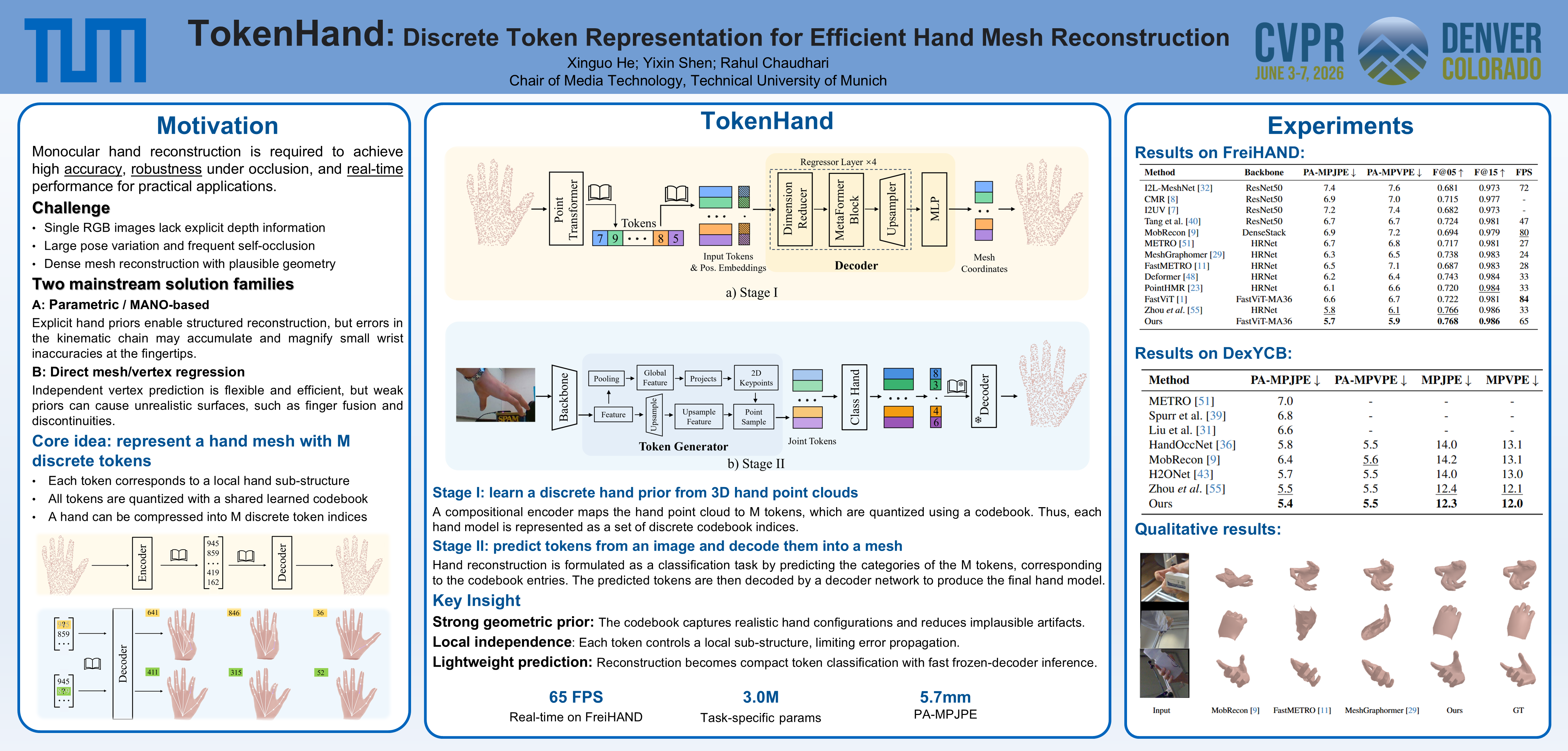
Hand mesh reconstruction has attracted growing attention in recent years.Despite significant progress, existing methods often struggle to balance reconstruction quality and inference efficiency.In this work, we propose TokenHand, a novel framework for single-view 3D hand mesh reconstruction that achieves both high accuracy and real-time inference.Our method represents a 3D hand model using $M$ discrete tokens, each describing a specific sub-structure of the hand.This compositional representation enables efficient modeling with minimal reconstruction error.Furthermore, we reformulate hand mesh reconstruction as a classification problem rather than a regression task.Specifically, a classifier predicts the categories of the $M$ tokens from an input image, and a pre-trained decoder network subsequently reconstructs the 3D hand mesh from the predicted tokens without any post-processing.Extensive experiments demonstrate that TokenHand achieves comparable or superior performance to existing methods across standard benchmarks, while maintaining high efficiency in practical scenarios.
Artiverse: A Diverse and Physically Grounded Dataset for Articulated Objects
Denys Iliash ⋅ Jiayi Liu ⋅ Egor Fokin ⋅ Qirui Wu ⋅ Ali Mahdavi Amiri ⋅ Manolis Savva ⋅ Angel Xuan Chang
We present Artiverse, a diverse and physically grounded dataset of high-quality articulated 3D objects designed for realistic functional modeling and simulation. Artiverse contains 5.4K human-authored objects across a broad range of 88 categories, aggregated from multiple 3D static repositories. Objects are annotated with functional parts, interior structures, realistic kinematic relationships including multi-DoF joints, and physical attributes such as metric scale, material, and mass. We develop a semi-automated annotation pipeline that combines few-shot segmentation, geometric reasoning, vision-language model inference, and multi-stage human verification to achieve high-quality and efficient annotation, reducing manual annotation time by over 30\%. We demonstrate the value of Artiverse on tasks of part mobility analysis, articulated object generation, and physics-based interaction. Artiverse provides a data resource to advance functional understanding for articulated objects.
MatPedia: A Universal Generative Foundation for High-Fidelity Material Synthesis
Di Luo ⋅ Shuhui Yang ⋅ Mingxin Yang ⋅ Jiawei Lu ⋅ Yixuan Tang ⋅ Xintong Han ⋅ Zhuo Chen ⋅ Beibei Wang ⋅ Chunchao Guo
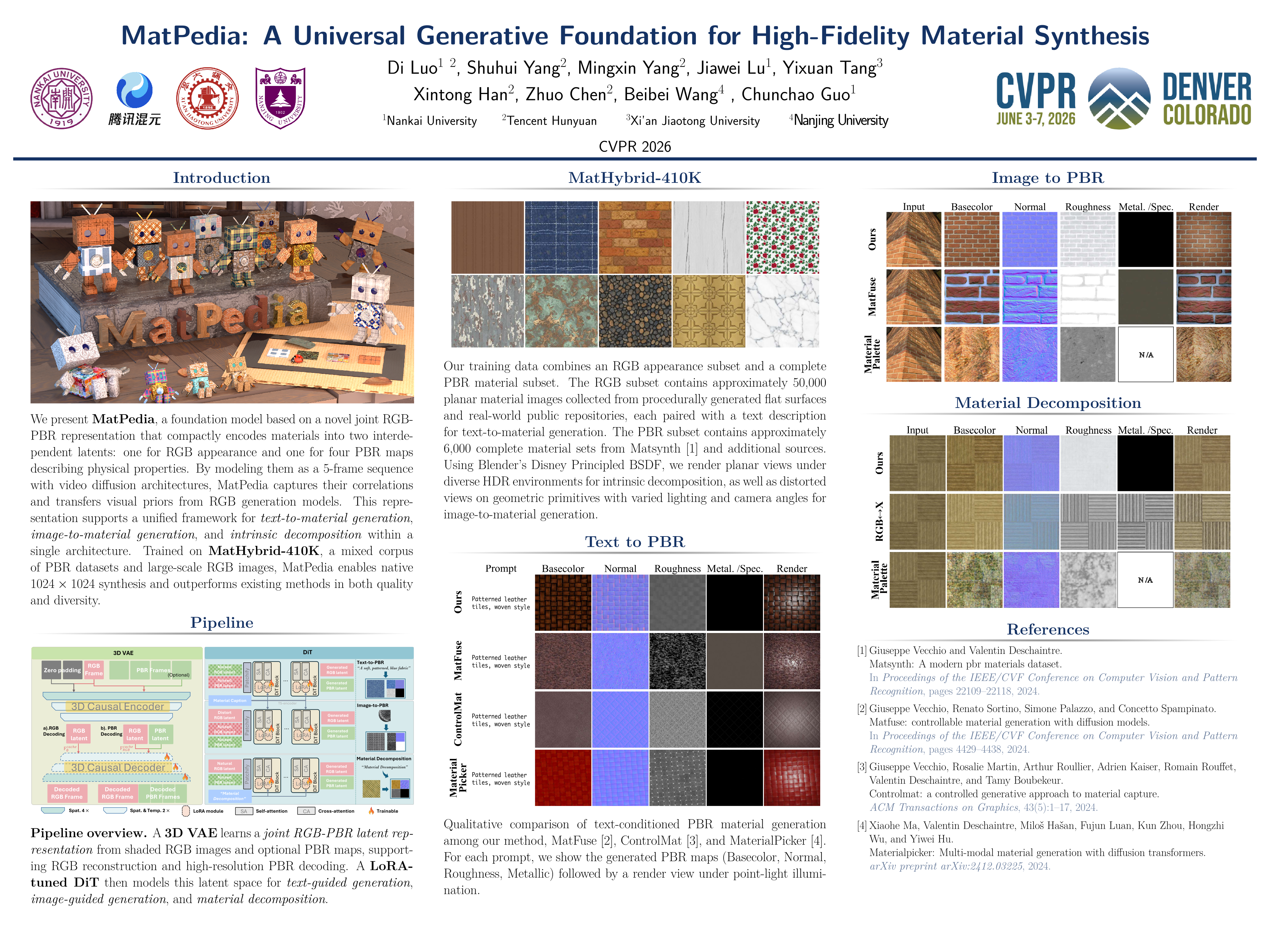
Physically-based rendering (PBR) materials are fundamental to photorealistic graphics, yet their creation remains labor-intensive and requires specialized expertise. While generative models have advanced material synthesis, existing methods lack a unified representation bridging natural image appearance and PBR properties, leading to fragmented task-specific pipelines and inability to leverage large-scale RGB image data. We present \textbf{MatPedia}, a foundation model built upon a novel joint RGB-PBR representation that compactly encodes materials into two interdependent latents: one for RGB appearance and one for the four PBR maps encoding complementary physical properties. By formulating them as a 5-channel sequence and employing video diffusion architectures, MatPedia naturally captures their correlations while transferring visual priors from RGB generation models. This joint representation enables a unified framework handling multiple material tasks—text-to-material generation, image-to-material generation, and intrinsic decomposition—within a single architecture. Trained on MatHybrid-410K, a mixed corpus combining PBR datasets with large-scale RGB images, MatPedia achieves native 1024×1024 synthesis that substantially surpasses existing approaches in both quality and diversity.
LogCD: Local-to-global Consistency Distillation for Few-step Image Generation
Qingsong Xie ⋅ Zhenyi Liao ⋅ Chen Chen ⋅ Zhijie Deng ⋅ Haonan Lu
Distilling latent diffusion models (LDMs)/rectified flow models (RFMs) into ones that are fast to sample from conditions is attracting huge interest. However, the majority of existing methods either need significant training resources or lead to quality degradation, especially in text-image alignment. To address these challenges, we propose Local-to-global Consistency Distillation (LogCD) to accelerate LDMs/RFMs via two-stage distillation.LogCD first performs local consistency distillation and then executes global consistency distillation to ensure the consistency along inference path.Besides, Latent Learned Perceptual Image Patch Similarity model is exploited to enhance perceptual consistency.Notably, LogCD exhibits high flexibility, allowing a single unified model to operate with 2 to 4 sampling steps. The model's performance improves seamlessly as the number of steps increases within this range.With only 70 A100 GPU hours, LogCD accelerates SDXL to achieve a 33.5 CLIP score with just 3 sampling steps, surpassing state-of-the-art accelerated models using even more steps. FLUX.1-dev accelerated by LogCD with 4-step sampling presents comparable performance to 25-step teacher model, with CLIP score of 32.6.
EditCtrl: Disentangled Local and Global Control for Real-Time Generative Video Editing
Yehonathan Litman ⋅ Shikun Liu ⋅ Dario Seyb ⋅ Nicholas Milef ⋅ Yang Zhou ⋅ Carl Marshall ⋅ Shubham Tulsiani ⋅ Caleb Leak
High-fidelity generative video editing has seen significant quality improvements by leveraging pre-trained video foundation models. However, their computational cost is a major bottleneck, as they are often designed to inefficiently process the full video context regardless of the inpainting mask's size, even for sparse, localized edits. In this paper, we introduce EditCtrl, an efficient video inpainting control framework that focuses computation only where it is needed. Our approach features a novel local video context module that operates solely on masked tokens, yielding a computational cost proportional to the edit size. This local-first generation is then guided by a lightweight temporal global context embedder that ensures video-wide context consistency with minimal overhead. Not only is EditCtrl $10\times$ more compute efficient than state-of-the-art generative editing methods, it even improves editing quality compared to methods designed with full-attention. Finally, we showcase how EditCtrl unlocks new capabilities, including multi-region editing with text prompts and real-time autoregressive content propagation.
Anchoring and Rescaling Attention for Semantically Coherent Inbetweening
Tae Eun Choi ⋅ Sumin Shim ⋅ Junhyeok Kim ⋅ Seong Jae Hwang
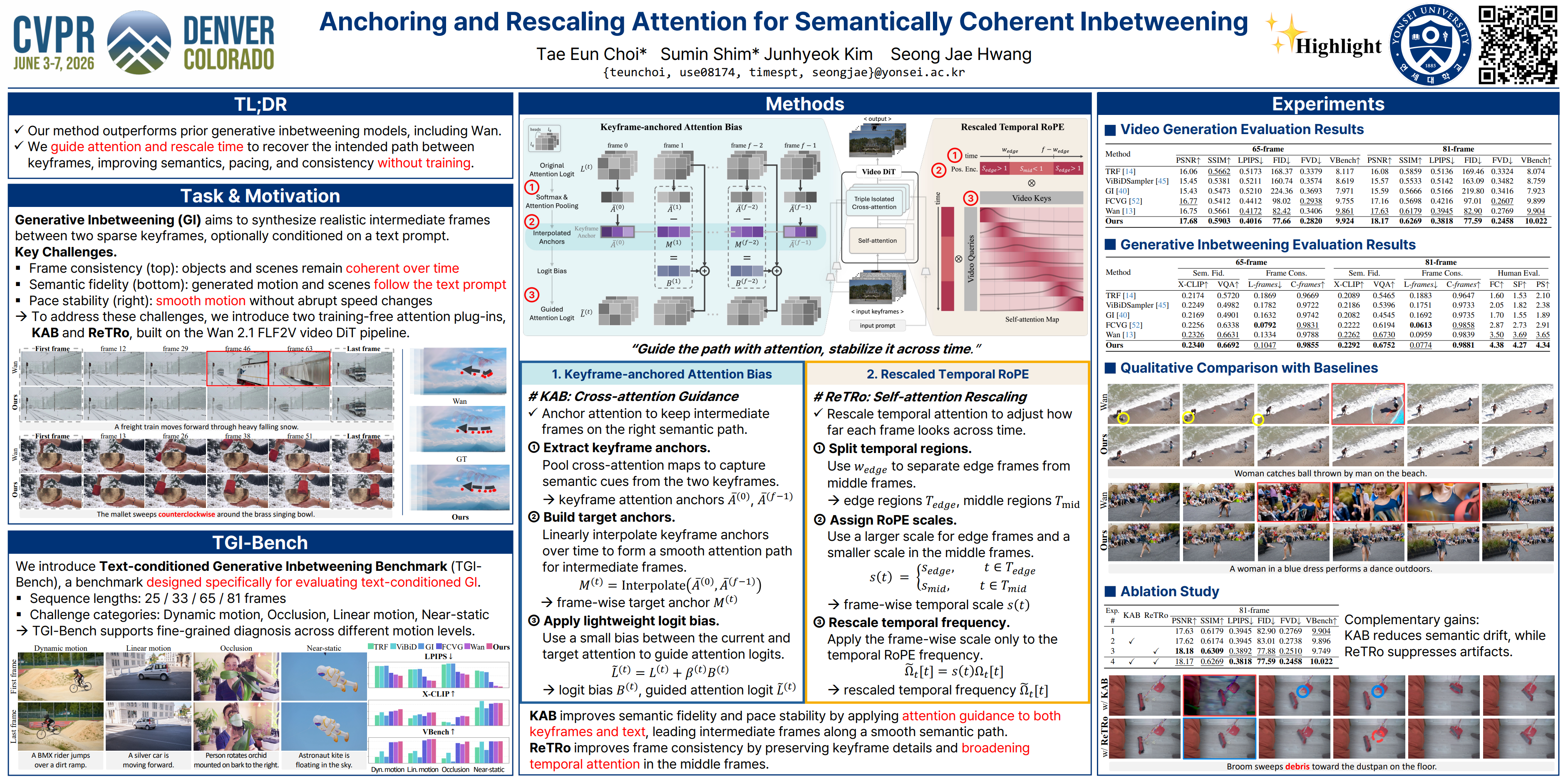
Generative inbetweening (GI) seeks to synthesize realistic intermediate frames between the first and last keyframes beyond mere interpolation.As sequences become sparser and motions larger, previous GI models struggle with inconsistent frames with unstable pacing and semantic misalignment.Since GI involves fixed endpoints and numerous plausible paths, this task requires additional guidance gained from the keyframes and text to specify the intended path.Thus, we give semantic and temporal guidance from the keyframes and text onto each intermediate frame through Keyframe-anchored Attention Bias. We also better enforce frame consistency with Rescaled Temporal RoPE, which allows self-attention to attend to keyframes more faithfully.TGI-Bench, the first benchmark specifically designed for text-conditioned GI evaluation, enables challenge-targeted evaluation to analyze GI models. Without additional training, our method achieves state-of-the-art frame consistency, semantic fidelity, and pace stability for both short and long sequences across diverse challenges.
FlashMotion: Few-Step Controllable Video Generation with Trajectory Guidance
Quanhao Li ⋅ Zhen Xing ⋅ Rui Wang ⋅ Haidong Cao ⋅ Qi Dai ⋅ Daoguo Dong ⋅ Zuxuan Wu
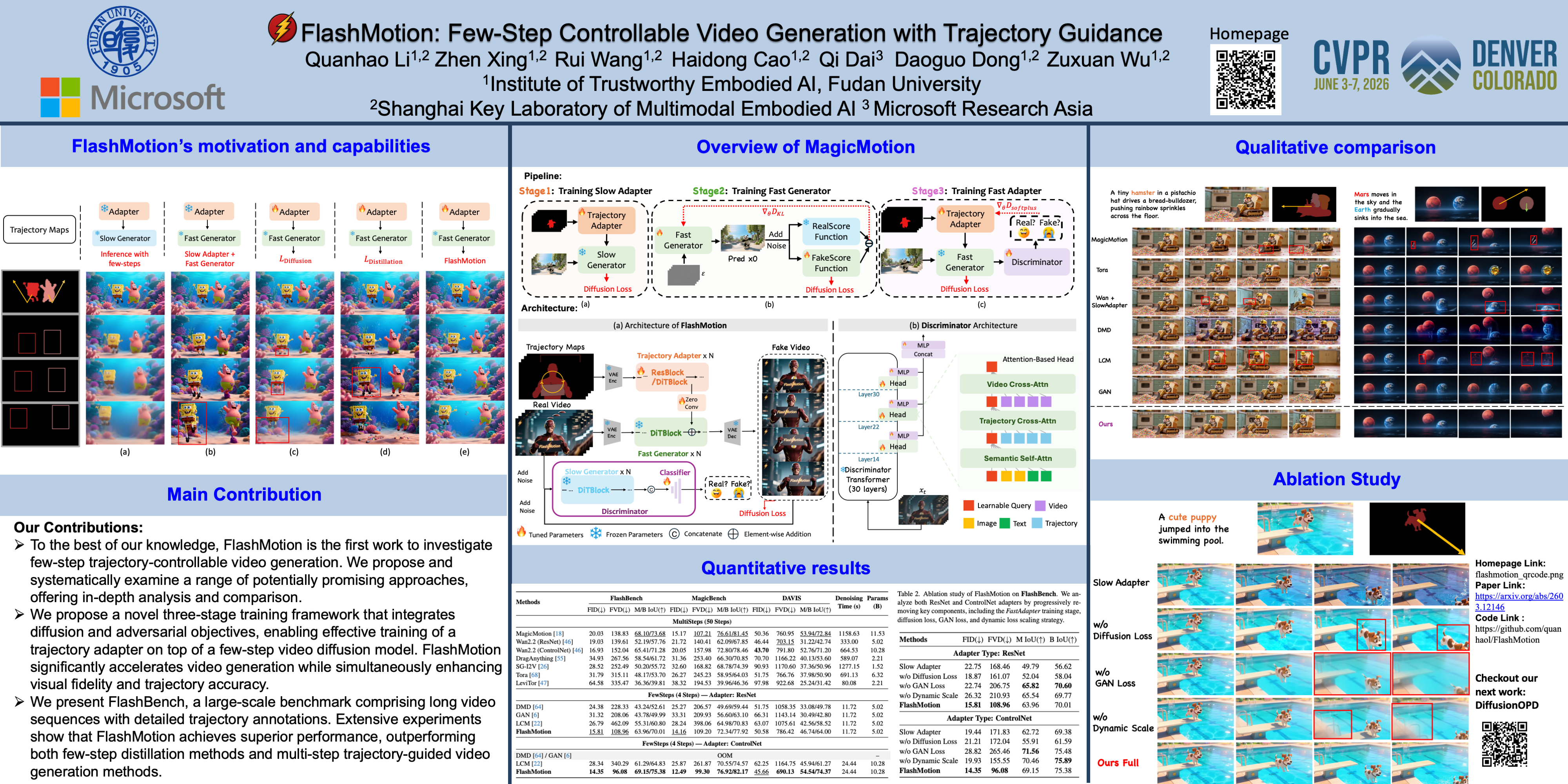
Recent advances in trajectory-controllable video generation have achieved remarkable progress. Previous methods mainly use adapter-based architectures for precise motion control along predefined trajectories.However, all these methods rely on a multi-step denoising process, leading to substantial time redundancy and computational overhead.While existing video distillation methods successfully distill multi-step generators into few-step, directly applying these approaches to trajectory-controllable video generation results in noticeable degradation in both video quality and trajectory accuracy.To bridge this gap, we introduce FlashMotion, a novel training framework designed for few-step trajectory-controllable video generation.We first train a trajectory adapter on a multi-step video generator for precise trajectory control.Then, we distill the generator into a few-step version to accelerate video generation.Finally, we finetune the adapter using a hybrid strategy that combines diffusion and adversarial objectives, aligning it with the few-step generator to produce high-quality, trajectory-accurate videos.For evaluation, we introduce FlashBench, a benchmark for long-sequence trajectory-controllable video generation that measures both video quality and trajectory accuracy across varying numbers of foreground objects. Experiments on two adapter architectures show that FlashMotion surpasses existing video distillation methods and previous multi-step models in both visual quality and trajectory consistency.
LightMover: Generative Light Movement with Color and Intensity Controls
Gengze Zhou ⋅ Tianyu Wang ⋅ Soo Ye Kim ⋅ ZHIXIN SHU ⋅ Xin Yu ⋅ Yannick Hold-Geoffroy ⋅ Sumit Chaturvedi ⋅ Qi Wu ⋅ Zhe Lin ⋅ Scott Cohen
We present LightMover, a framework for controllable light manipulation in single images that leverages video diffusion priors to produce physically plausible illumination changes without re-rendering the scene. We formulate light editing as a sequence-to-sequence prediction problem in visual token space: given an image and light-control tokens, the model adjusts light position, color, and intensity together with resulting reflections, shadows, and falloff from a single view. This unified treatment of spatial (movement) and appearance (color, intensity) controls improves both manipulation and illumination understanding. We further introduce an adaptive token-pruning mechanism that preserves spatially informative tokens while compactly encoding non-spatial attributes, reducing control sequence length by 41\% while maintaining editing fidelity. For training our framework, we construct a scalable rendering pipeline that can generate large numbers of image pairs across varied light positions, colors, and intensities while keeping the scene content consistent to the original image. \ours enables precise, independent control over light position, color, and intensity, and achieves high PSNR and strong semantic consistency (DINO, CLIP) across different tasks.
Parallel Jacobi Decoding for Fast Autoregressive Image Generation
Boya Liao ⋅ Ying Li ⋅ Siyong Jian ⋅ Huan Wang
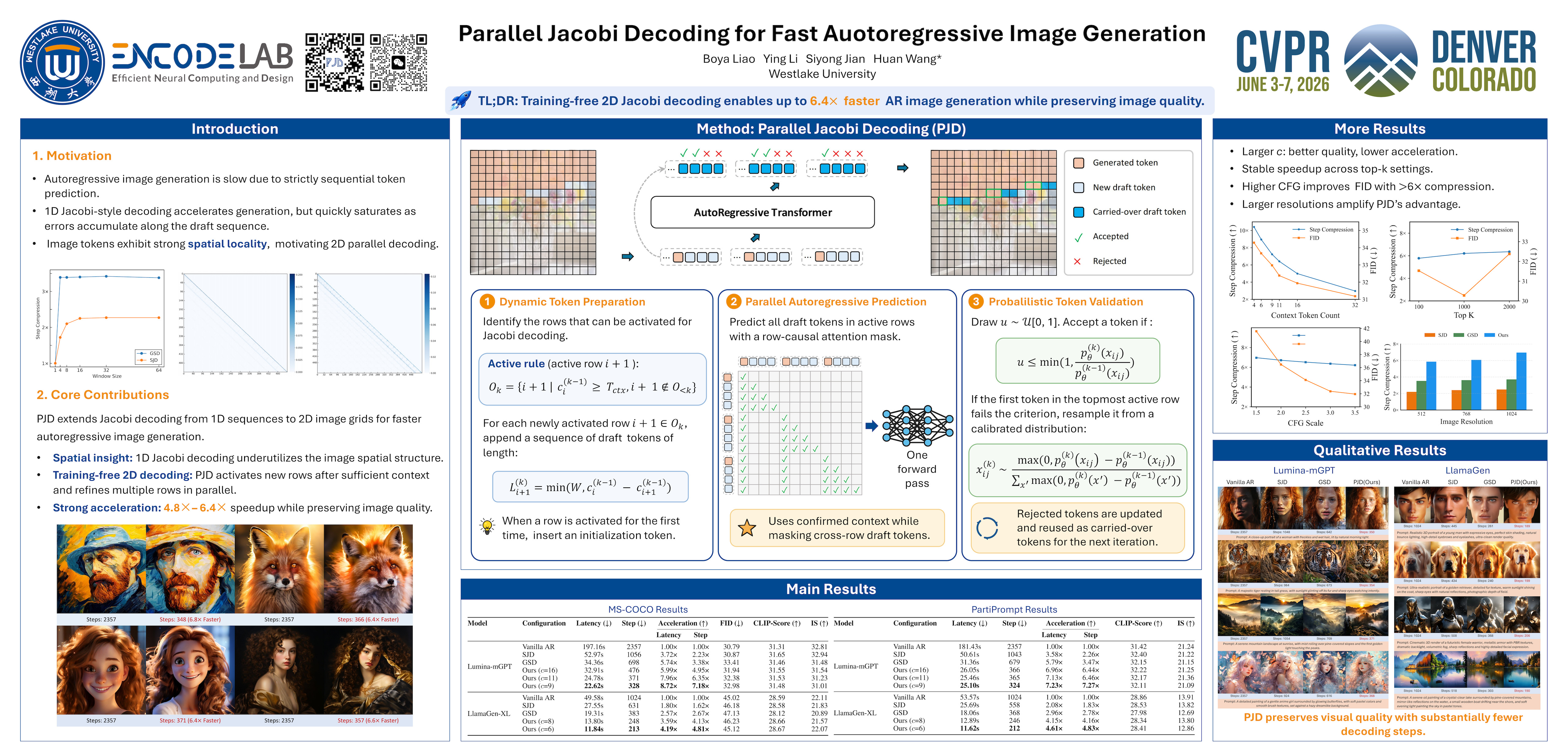
Autoregressive (AR) models have demonstrated remarkable performance in generating high-fidelity images.However, their inherently sequential next-token prediction leads to significantly slows inference.Recent studies have introduced Jacobi-style decoding to accelerate autoregressive image generation.Extending the draft sequence initially improves efficiency, yet the acceleration quickly saturates as error propagation in the one-dimensional sequence hinders convergence.Observing that images exhibit strong local spatial correlations, we propose Parallel Jacobi Decoding (PJD), a training-free decoding approach that expands draft tokens in the two-dimensional spatial domain to enable efficient spatially parallel refinement.PJD adjusts the attention mask to mitigate error accumulation and improve convergence stability.Extensive experiments on diverse datasets show that PJD achieves 4.8×–6.4× acceleration across multiple autoregressive image generation models while preserving image quality.
CARE-Edit: Condition-Aware Routing of Experts for Contextual Image Editing
Yucheng Wang ⋅ Zedong Wang ⋅ Yuetong Wu ⋅ Yue Ma ⋅ Dan Xu
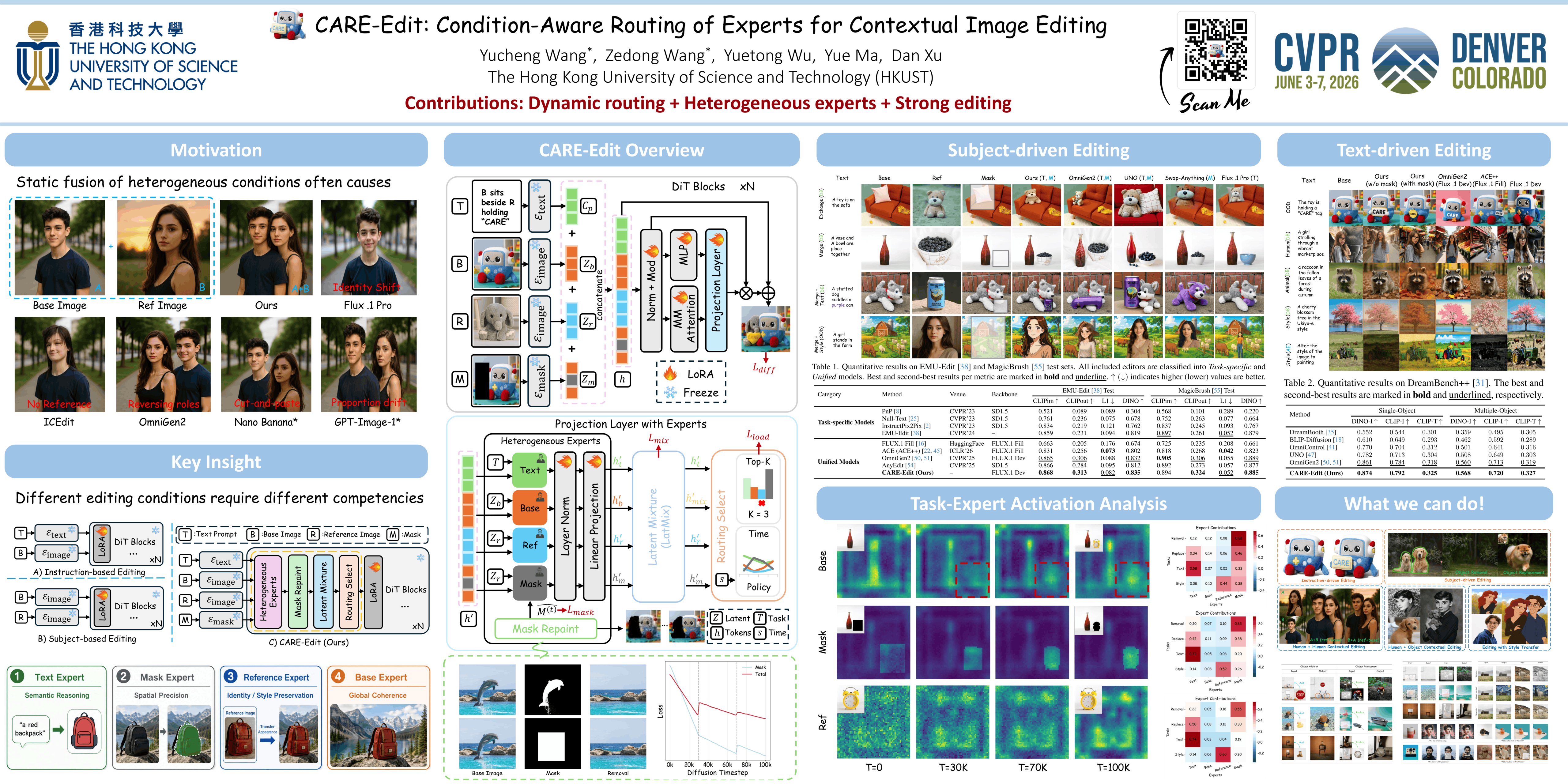
Unified diffusion editors often rely on a fixed, shared backbone for diverse tasks, suffering from task interference and poor adaptation to heterogeneous demands (e.g., local vs global, semantic vs photometric). In particular, prevalent ControlNet and OmniControl variants combine multiple conditioning signals (e.g., text, mask, reference) via static concatenation or additive adapters which cannot dynamically prioritize or suppress conflicting modalities, thus resulting in artifacts like color bleeding across mask boundaries, identity or style drift, and unpredictable behavior under multi-condition inputs. To address this, we propose Condition-Aware Routing of Experts (CARE-Edit) that aligns model computation with specific editing competencies. At its core, a lightweight latent-attention router assigns encoded diffusion tokens to four specialized experts--Text, Mask, Reference, and Base--based on multi-modal conditions and diffusion timesteps: (i) a Mask Repaint module first refines coarse user-defined masks for precise spatial guidance; (ii) the router applies sparse top-K selection to dynamically allocate computation to the most relevant experts; (iii) a Latent Mixture module subsequently fuses expert outputs, coherently integrating semantic, spatial, and stylistic information to the base images. Experiments validate CARE-Edit's strong performance on contextual editing tasks, including erasure, replacement, text-driven edits, and style transfer. Empirical analysis further reveals task-specific behavior of specialized experts, showcasing the importance of dynamic, condition-aware processing to mitigate multi-condition conflicts. The source code, models, and dataset will be publicly available.
CREval: An Automated Interpretable Evaluation for Creative Image Manipulation under Complex Instructions
Chonghuinan Wang ⋅ Zihan Chen ⋅ Yuxiang Wei ⋅ Tianyi Jiang ⋅ Xiaohe Wu ⋅ Fan Li ⋅ Wangmeng Zuo ⋅ Hongxun Yao
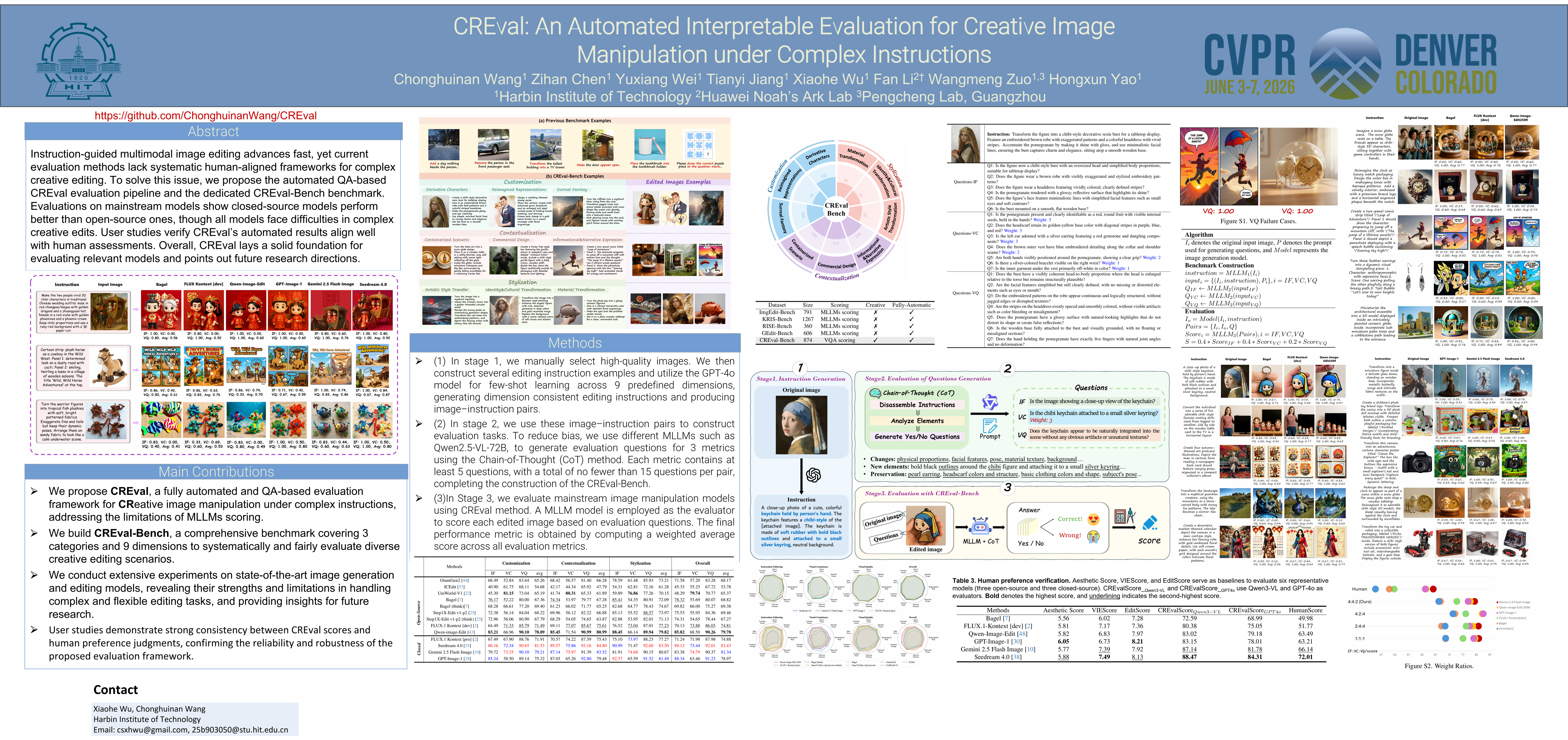
Instruction-based multimodal image manipulation has recently made rapid progress. However, existing evaluation methods lack a systematic and human-aligned framework for assessing model performance on complex and creative editing tasks.To address this gap, we propose CREval, a fully automated question–answer (QA)–based evaluation pipeline that that overcomes the incompleteness and poor interpretability of opaque Large Language Models (MLLMs) scoring. Simultaneously, we introduce CREval-Bench, a comprehensive benchmark specifically designed for creative image manipulation under complex instructions. CREval-Bench covers three categories and nine creative dimensions, comprising over 800 editing samples and 13K evaluation queries.Leveraging this pipeline and benchmark, we systematically evaluate a diverse set of state-of-the-art open and closed-source models. The results reveal that while closed-source models generally outperform open-source ones on complex and creative tasks, all models still struggle to complete such edits effectively. In addition, user studies demonstrate strong consistency between CREval’s automated metrics and human judgments.Therefore, CREval provides a reliable foundation for evaluating image editing models on complex and creative image manipulation tasks, and highlights key challenges and opportunities for future research. All code and data will be released publicly.
EchoVDiff: Cardiac-Cycle Echocardiography Video Generation from Arbitrary Frame
Jiansong Zhang ⋅ Xiaying Yang ⋅ Xiaoling Luo ⋅ Linlin Shen
Reconstructing a physiologically plausible cardiac video from a single image remains a fundamental challenge in generative modeling, owing to the complex and nonlinear periodic dynamics of echocardiography. Previous image-to-video (I2V) approaches primarily focus on temporal continuity, yet often struggle to capture the intrinsic periodicity of cardiac motion, leading to limited temporal coherence and semantic consistency. We present EchoVDiff, a novel phase-aware diffusion model that reconstructs a full cardiac cycle from any single frame. Instead of direct pixel synthesis, EchoVDiff integrates physiological priors into a diffusion paradigm, learning interpretable mappings between cardiac phase, anatomy, and motion. By jointly modeling temporal rhythm and spatial semantics within a disentangled latent space, it achieves controllable and physiologically consistent generation. Extensive experiments on EchoNet-Dynamic and EchoNet-Pediatric demonstrate that EchoVDiff consistently surpasses state-of-the-art methods in both fidelity and temporal coherence. Remarkably, it enables accurate reconstruction of complete cardiac cycles from arbitrary phases, marking the first demonstration of single-frame-driven echocardiographic video generation.
Re-Align: Structured Reasoning-guided Alignment for In-Context Image Generation and Editing
Runze He ⋅ YIJI CHENG ⋅ Tiankai Hang ⋅ Zhimin Li ⋅ Yu Xu ⋅ Zijin Yin ⋅ Shiyi Zhang ⋅ Wenxun Dai ⋅ Penghui Du ⋅ Ao Ma ⋅ Chunyu Wang ⋅ qinglin lu ⋅ Jizhong Han ⋅ Jiao Dai
In-context image generation and editing (ICGE) enables users to specify visual concepts through interleaved image-text prompts, demanding precise understanding and faithful execution of user intent. Although recent unified multimodal models exhibit promising understanding capabilities, these strengths often fail to transfer effectively to image generation. We introduce Re-Align, a unified framework that bridges the gap between understanding and generation through structured reasoning-guided alignment. At its core lies the In-Context Chain-of-Thought (IC-CoT), a structured reasoning paradigm that decouples semantic guidance and reference association, providing clear textual target and mitigating confusion among reference images. Furthermore, Re-Align introduces an effective RL training scheme that leverages a surrogate reward to measure the alignment between structured reasoning text and the generated image, thereby improving the model’s overall performance on ICGE tasks. Extensive experiments verify that Re-Align outperforms competitive methods of comparable model scale and resources on both in-context image generation and editing tasks.
ChimeraLoRA: Multi-Head LoRA-Guided Synthetic Datasets
Hoyoung Kim ⋅ Minwoo Jang ⋅ Jabin Koo ⋅ Sangdoo Yun ⋅ Jungseul Ok
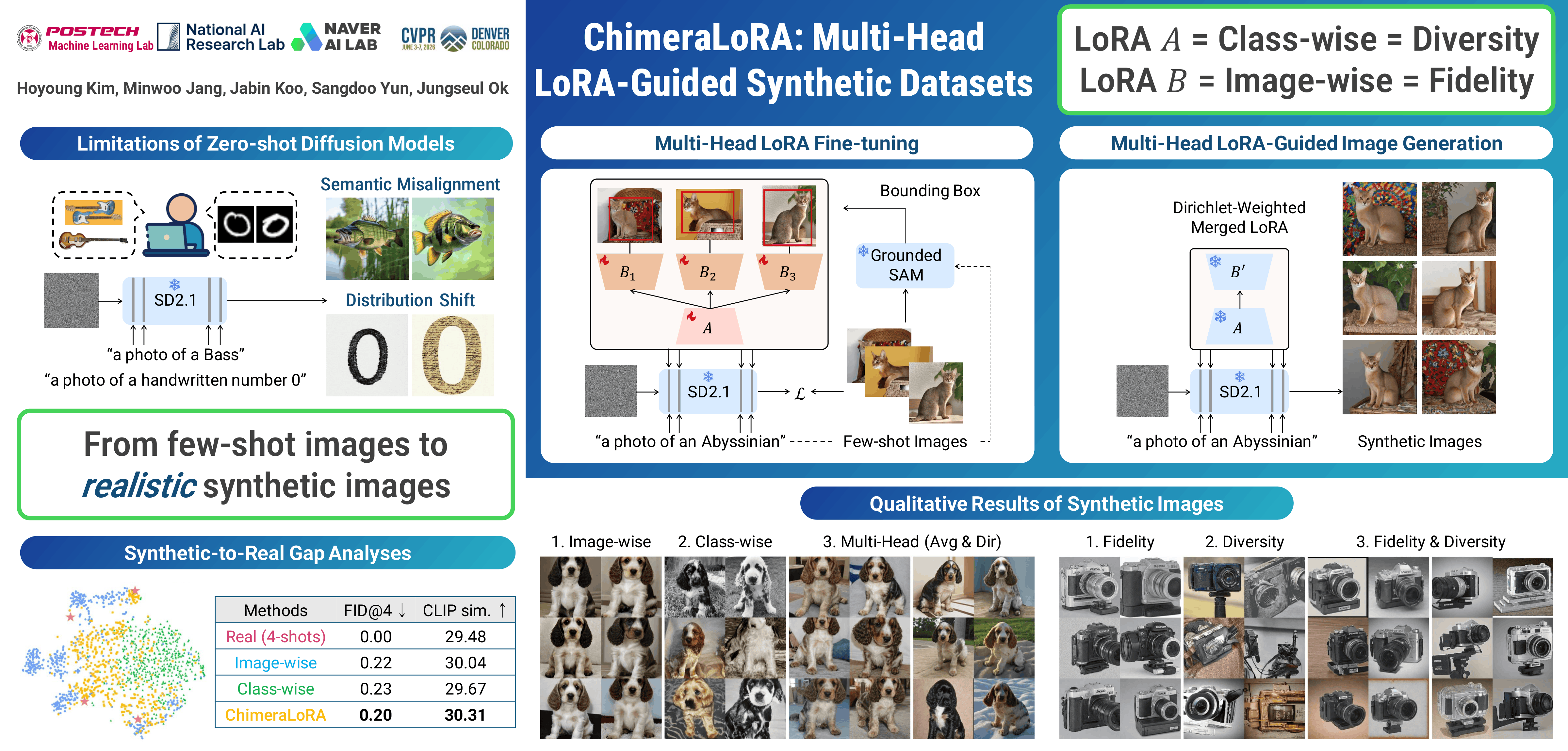
Beyond general recognition tasks, specialized domains including privacy-constrained medical applications and fine-grained settings often encounter data scarcity, especially for tail classes. To obtain less biased and more reliable models under such scarcity, practitioners leverage diffusion models to supplement underrepresented regions of real data. Specifically, recent studies fine-tune pretrained diffusion models with LoRA on few-shot real sets to synthesize additional images. While an image-wise LoRA trained on a single image captures fine-grained details yet offers limited diversity, a class-wise LoRA trained over all shots produces diverse images as it encodes class priors yet tends to overlook fine details. To combine both benefits, we separate the adapter into a class-shared LoRA $A$ for class priors and per-image LoRAs $\mathcal{B}$ for image-specific characteristics. To expose coherent class semantics in the shared LoRA $A$, we propose a semantic boosting by preserving class bounding boxes during training. For generation, we compose $A$ with a mixture of $\mathcal{B}$ using coefficients drawn from a Dirichlet distribution. Across diverse datasets, our synthesized images are both diverse and detail-rich while closely aligning with the few-shot real distribution, yielding robust gains in downstream classification accuracy.
Frequency-Aware Flow Matching for High-Quality Image Generation
Sucheng Ren ⋅ Qihang Yu ⋅ Ju He ⋅ Xiaohui Shen ⋅ Liang-Chieh Chen
Flow matching models have emerged as a powerful framework for realistic image generation by learning to reverse a corruption process that progressively adds Gaussian noise. However, because noise is injected in the latent domain, its impact on different frequency components is non-uniform. As a result, during inference, flow matching models tend to generate low-frequency components (global structure) in the early stages, while high-frequency components (fine details) emerge only later in the reverse process. Building on this insight, we propose Frequency-Aware Flow Matching (FreqFlow), a novel approach that explicitly incorporates frequency-aware conditioning into the flow matching framework via time-dependent adaptive weighting. We introduce a two-branch architecture: (1) a frequency branch that separately processes low- and high-frequency components to capture global structure and refine textures and edges, and (2) a spatial branch that synthesizes images in the latent domain, guided by the frequency branch's output. By explicitly integrating frequency information into the generation process, FreqFlow ensures that both large-scale coherence and fine-grained details are effectively modeled—low-frequency conditioning reinforces global structure, while high-frequency conditioning enhances texture fidelity and detail sharpness. On the class-conditional ImageNet-256 generation benchmark, our method achieves state-of-the-art performance with an FID of 1.38, surpassing the prior diffusion model DiT and flow matching model SiT by 0.79 and 0.58 FID, respectively. Code will be made available.
STARFlow-V: End-to-End Video Generative Modeling with Autoregressive Normalizing Flows
Jiatao Gu ⋅ Ying Shen ⋅ Tianrong Chen ⋅ Laurent Dinh ⋅ Yuyang Wang ⋅ Miguel Ángel Bautista ⋅ David Berthelot ⋅ Joshua Susskind ⋅ Shuangfei Zhai
Normalizing flows (NFs) are end-to-end likelihood-based generative models for continuous data, and have recently regained attention with encouraging progress on image generation. Yet in the video generation domain, where spatiotemporal complexity and computational cost are substantially higher, state-of-the-art systems almost exclusively rely on diffusion-based models. In this work, we revisit this design space by presenting STARFlow-V, a normalizing flow-based video generator with substantial benefits such as end-to-end learning, robust causal prediction and native likelihood estimation. Building upon the recently proposed STARFlow, STARFlow-V operates in the spatiotemporal latent space with a global-local architecture which restricts causal dependencies to a global latent space while preserving rich local within-frame interactions. This eases error accumulation over time, a common pitfall of standard autoregressive diffusion model generation. Additionally, we propose flow-score matching, which equips the model with a light-weight causal denoiser to improve the video generation consistency in an autoregressive fashion. To improve the sampling efficiency, STARFlow-V employs a video-aware Jacobi iteration scheme that recasts inner updates as parallelizable iterations without breaking causality. Thanks to the invertible structure, the same model can natively support text-to-video, image-to-video as well as video-to-video generation tasks. Empirically, STARFlow-V achieves strong visual fidelity and temporal consistency with practical sampling throughput relative to diffusion-based baselines. These results present the first evidence, to our knowledge, that NFs are capable of high-quality autoregressive video generation, establishing them as a promising research direction for building world models.
MixFlow Training: Alleviating Exposure Bias with Slowed Interpolation Mixture
Hui Li ⋅ Jiayue Lyu ⋅ Fu-Yun Wang ⋅ Kaihui Cheng ⋅ Siyu Zhu ⋅ Jingdong Wang
This paper studies the training-testing discrepancy (a.k.a. exposure bias) problem for improving the diffusion models. During training, the input of a prediction network at the training timestep is the corresponding ground-truth noisy data that is an interpolation of the noise and the data, and during testing, the input is the generated noisy data. We present a novel training approach, named MixFlow, for improving the training performance. Our approach is motivated by the Slow Flow phenomenon: the ground-truth interpolation that is the nearest to the generated noisy data at a given sampling timestep is observed to correspond to a higher-noise timestep (termed slowed timestep), i.e., the corresponding ground-truth timestep is slower than the sampling timestep. MixFlow leverages the interpolations at the slowed timesteps, named slowed interpolation mixture, for post-training the prediction network at each training timestep. Experiments over class-conditional image generation (including SiT, REPA, and RAE) and text-to-image generation, validate the effectiveness of our approach. Our approach MixFlow over the RAE models achieve strong generation results on ImageNet: $1.43$ FID (without guidance) and $1.10$ (with guidance) at $256 \times 256$, and $1.55$ FID (without guidance) and $1.10$ (with guidance) at $512 \times 512$.
Improving Controllable Generation: Faster Training and Better Performance via x0-Supervision
Amadou S. Sangare ⋅ Adrien Maglo ⋅ Mohamed Chaouch ⋅ Bertrand Luvison
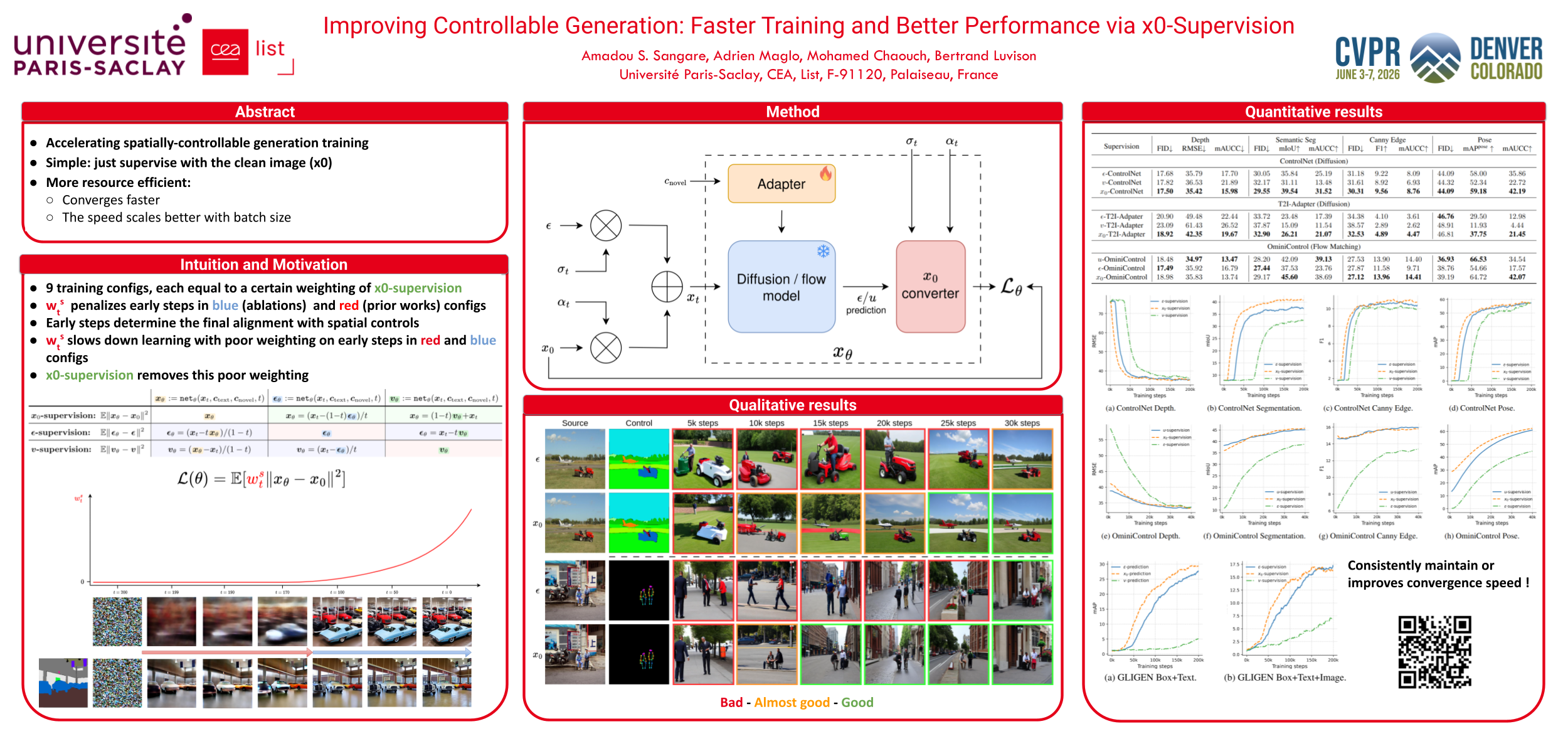
Text-to-Image (T2I) diffusion/flow models have recently achieved remarkable progress in visual fidelity and text alignment. However, they remain limited when users need to precisely control image layouts, something that natural language alone cannot reliably express. Controllable generation methods augment the initial T2I model with additional conditions that more easily describe the scene. Prior works straightforwardly train the augmented network with the same loss as the initial network. Although natural at first glance, this can lead to very long training times in some cases before convergence. In this work, we revisit the training objective of controllable diffusion models through a detailed analysis of their denoising dynamics. We show that direct supervision on the clean target image, dubbed $x_0$-supervision, or an equivalent re-weighting of the diffusion loss, yields faster convergence. Experiments on multiple control settings demonstrate that our formulation accelerates convergence by up to 2x according to our novel metric (mean Area Under the Convergence Curve - mAUCC), while also improving both visual quality and conditioning accuracy.
Visual-Aware CoT: Achieving High-Fidelity Visual Consistency in Unified Models
Zixuan Ye ⋅ Quande Liu ⋅ Cong Wei ⋅ Yuanxing Zhang ⋅ Xintao Wang ⋅ Pengfei Wan ⋅ Kun Gai ⋅ Wenhan Luo
Recently, the introduction of Chain-of-Thought (CoT) has largely improved generation ability of unified models. However, it is observed that the current thinking process during generation mainly focuses on the text consistency with the text prompt, ignoring the visual context consistency with the visual reference images during the multi-modal generation, e.g., multi-reference generation. The lack of such consistency results in the failure in maintaining key visual features (like human ID, object attribute, style). To this end, we integrate the visual context consistency into the reasoning of unified models, explicitly motivating the model to sustain such consistency by 1) Adaptive Visual Planning: generating structured visual check list to figure out the visual element of needed consistency keeping, and 2) Iterative Visual Correction: performing self-reflection with the guidance of check lists and refining the generated result in an iterative manner. To achieve this, we use supervised finetuning to teach the model how to plan the visual checking, conduct self-reflection and self-refinement, and use flow-GRPO to further enhance the visual consistency through a customized visual checking reward. The experiments show that our method outperforms both zero-shot unified models and those with text CoTs in multi-modal generation, demonstrating higher visual context consistency.
OrionEdit: Bridging Reference and Source Images for Generalized Cross-Image Editing
Zeyu Jiang ⋅ Lai-Man Po ⋅ XUYUAN XU ⋅ Yexin Wang ⋅ Guoping Gong ⋅ Haoxuan Wu ⋅ Chenbo Yan ⋅ Kun Li ⋅ Yuyang Liu
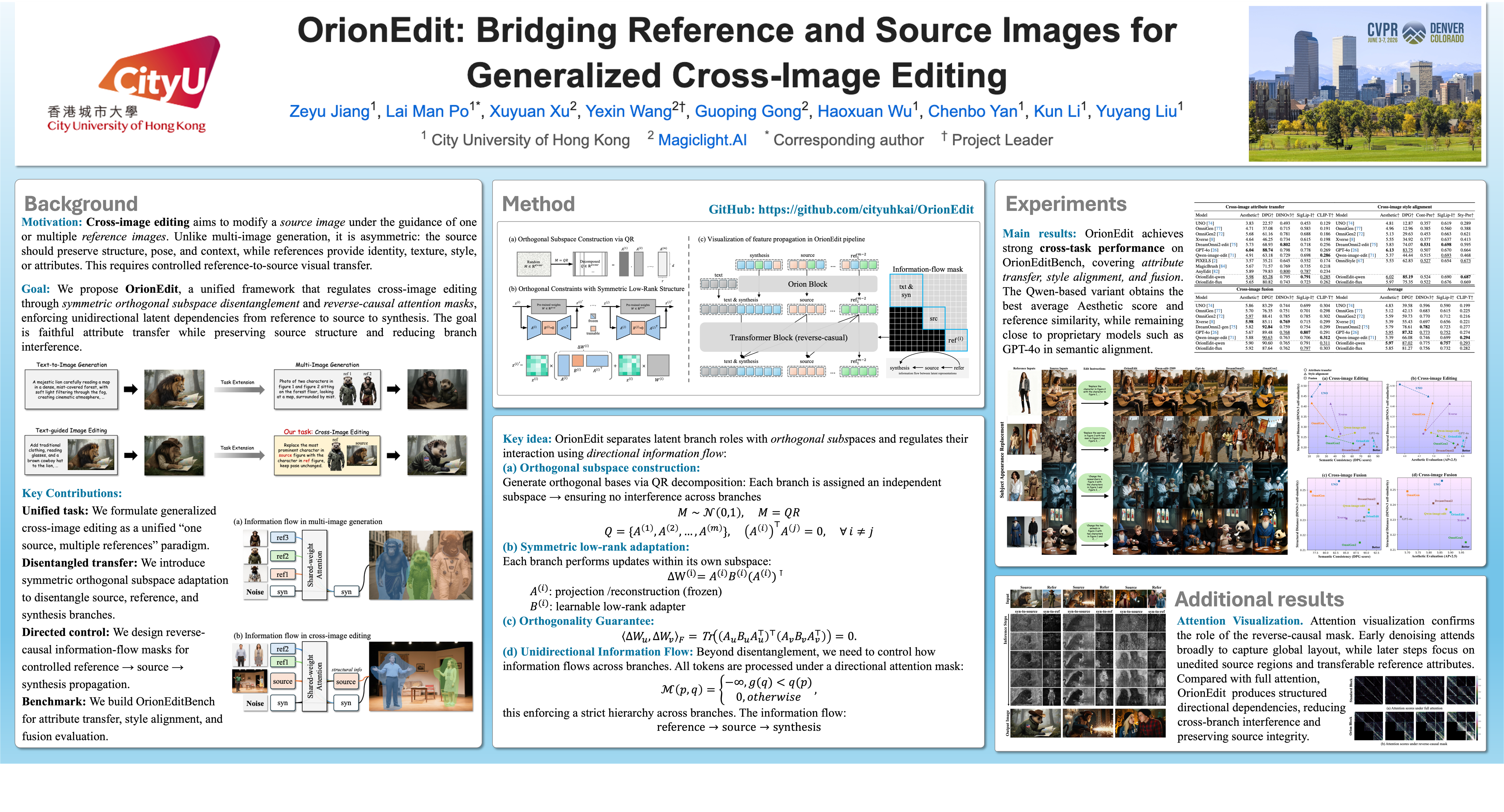
Multimodal image synthesis has achieved remarkable progress in producing visually coherent results, yet most editing methods still rely on semantic instructions, which is less direct than using visual guidance.Recently, a new paradigm has emerged that focuses on "editing one image from another", enabling more direct and interpretable manipulation through reference exemplars. In this work, we formalize this paradigm as cross-image editing, which modifies a source image under the guidance of one or more references, encompassing subject replacement, style transfer, image completion, and other reference-to-source tasks. To address this, we introduce OrionEdit, a unified framework that regulates visual attribute transfer through two key mechanisms: (1) A symmetric orthogonal subspace update that partitions image features into branch-specific subspaces, mitigating feature entanglement and preserving subject identity; and (2) a reverse-causal attention mechanism with an information-flow mask that enforces unidirectional dependencies in the latent space. Built on standard diffusion backbones, OrionEdit enables zero-shot editing with multiple references and yields consistent gains over open-source baselines, rivaling proprietary models in fidelity and disentanglement.
PositionIC: Unified Position and Identity Consistency for Image Customization
Junjie Hu ⋅ Tianyang Han ⋅ Kai Ma ⋅ Jialin Gao ⋅ Yang Song ⋅ Xianhua He ⋅ Junfeng Luo ⋅ Xiaoming Wei ⋅ Wenqiang Zhang
Recent subject-driven image customization excels in fidelity, yet fine-grained instance-level spatial control remains an elusive challenge, hindering real-world applications. This limitation stems from two factors: a scarcity of scalable, position-annotated datasets, and the entanglement of identity and layout by global attention mechanisms.To this end, we introduce PositionIC, a unified framework for high-fidelity, spatially controllable multi-subject customization. First, we present BMPDS, the first automatic data-synthesis pipeline for position-annotated multi-subject datasets, effectively providing crucial spatial supervision. Second, we design a lightweight, layout-aware diffusion framework that integrates a novel visibility-aware attention mechanism. This mechanism explicitly models spatial relationships via an NeRF-inspired volumetric weight regulation to effectively decouple instance-level spatial embeddings from semantic identity features, enabling precise, occlusion-aware placement of multiple subjects.Extensive experiments demonstrate PositionIC achieves state-of-the-art performance on public benchmarks, setting new records for spatial precision and identity consistency. Our work represents a significant step towards truly controllable, high-fidelity image customization in multi-entity scenarios. Code and data will be publicly released.
Recent advancements in video generation models have significantly improved their ability to follow text prompts. However, the customization of dynamic visual effects, defined as temporally evolving and appearance-driven visual phenomena like object crushing or explosion, remains underexplored. Prior works on motion customization or control mainly focus on low-level motions of the subject or camera, which can be guided using explicit control signals such as motion trajectories. In contrast, dynamic visual effects involve higher-level semantics that are more naturally suited for control via text prompts. However, it is hard and time-consuming for humans to craft a single prompt that accurately specifies these effects, as they require complex temporal reasoning and iterative refinement over time. To address this challenge, we propose P-Flow, a novel training-free framework for customizing dynamic visual effects in video generation without modifying the underlying model. By leveraging the semantic and temporal reasoning capabilities of vision-language models, P-Flow performs test-time prompt optimization, refining prompts based on the discrepancy between the visual effects of the reference video and the generated output. Through iterative refinement, the prompts evolve to better induce the desired dynamic effect in novel scenes. Experiments demonstrate that P-Flow achieves high-fidelity and diverse visual effect customization and outperforms other models on both text-to-video and image-to-video generation tasks.
Clair Obscur: an Illumination-Aware Method for Real-World Image Vectorization
Xingyue Lin ⋅ Shuai Peng ⋅ Xiangyu Xie ⋅ Jianhua Zhu ⋅ Yuxuan Zhou ⋅ Liangcai Gao
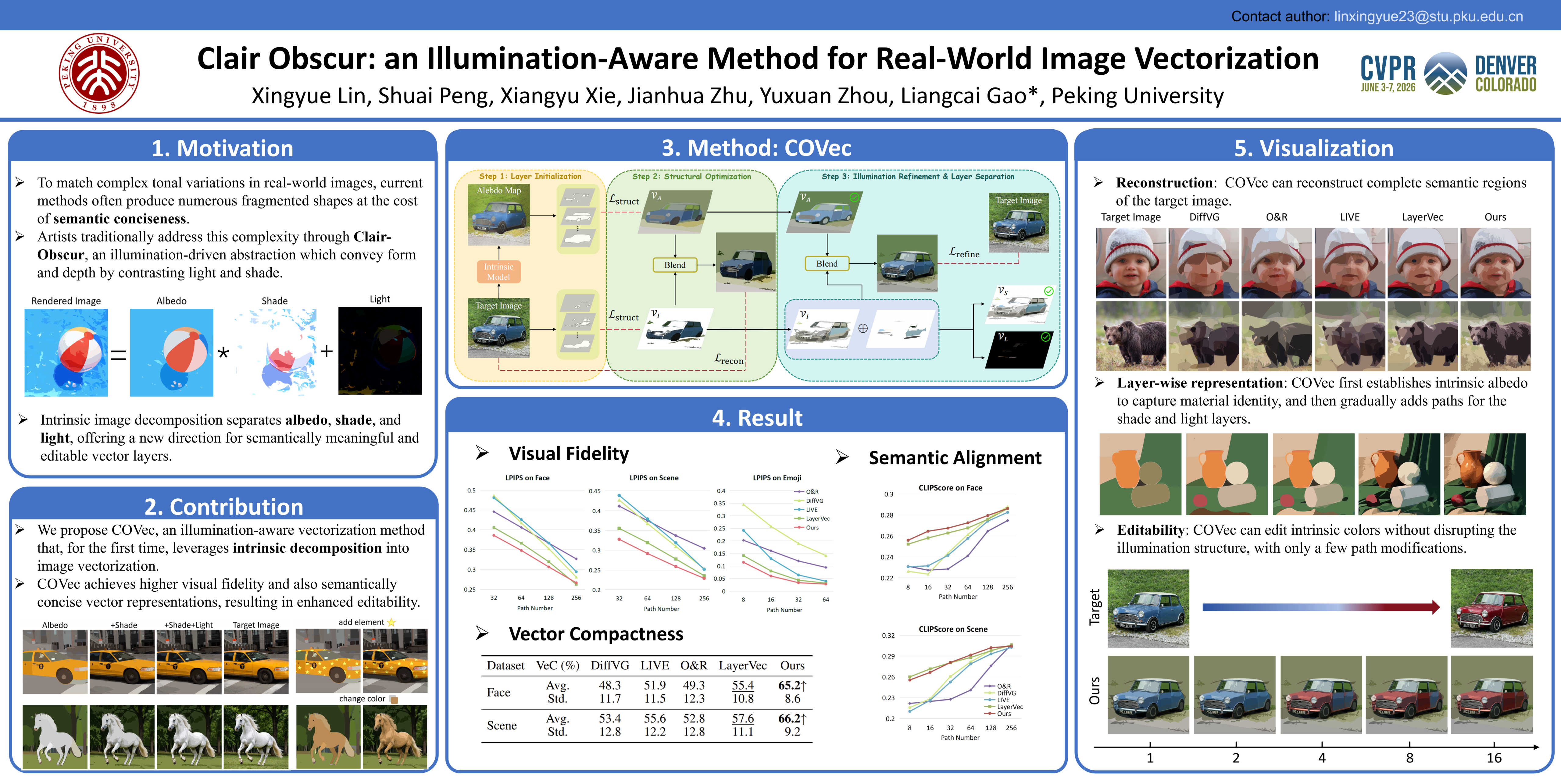
Image vectorization aims to convert raster images into editable, scalable vector representations while preserving visual fidelity. Existing vectorization methods struggle to represent complex real-world images, often producing fragmented shapes at the cost of semantic conciseness. In this paper, we propose COVec, an illumination-aware vectorization framework inspired by the Clair-Obscur principle of light–shade contrast. COVec is the first to introduce intrinsic image decomposition in the vector domain, separating an image into albedo, shade, and light layers in a unified vector representation. A semantic-guided initialization and two-stage optimization refine these layers with differentiable rendering. Experiments on various datasets demonstrate that COVec achieves higher visual fidelity and significantly improved editability compared to existing methods.
SURF: Signature-Retained Fast Video Generation
Kaixin Ding ⋅ Xi Chen ⋅ Sihui Ji ⋅ Yuan Gao ⋅ Liang Hou ⋅ Xin Tao ⋅ Hengshuang Zhao
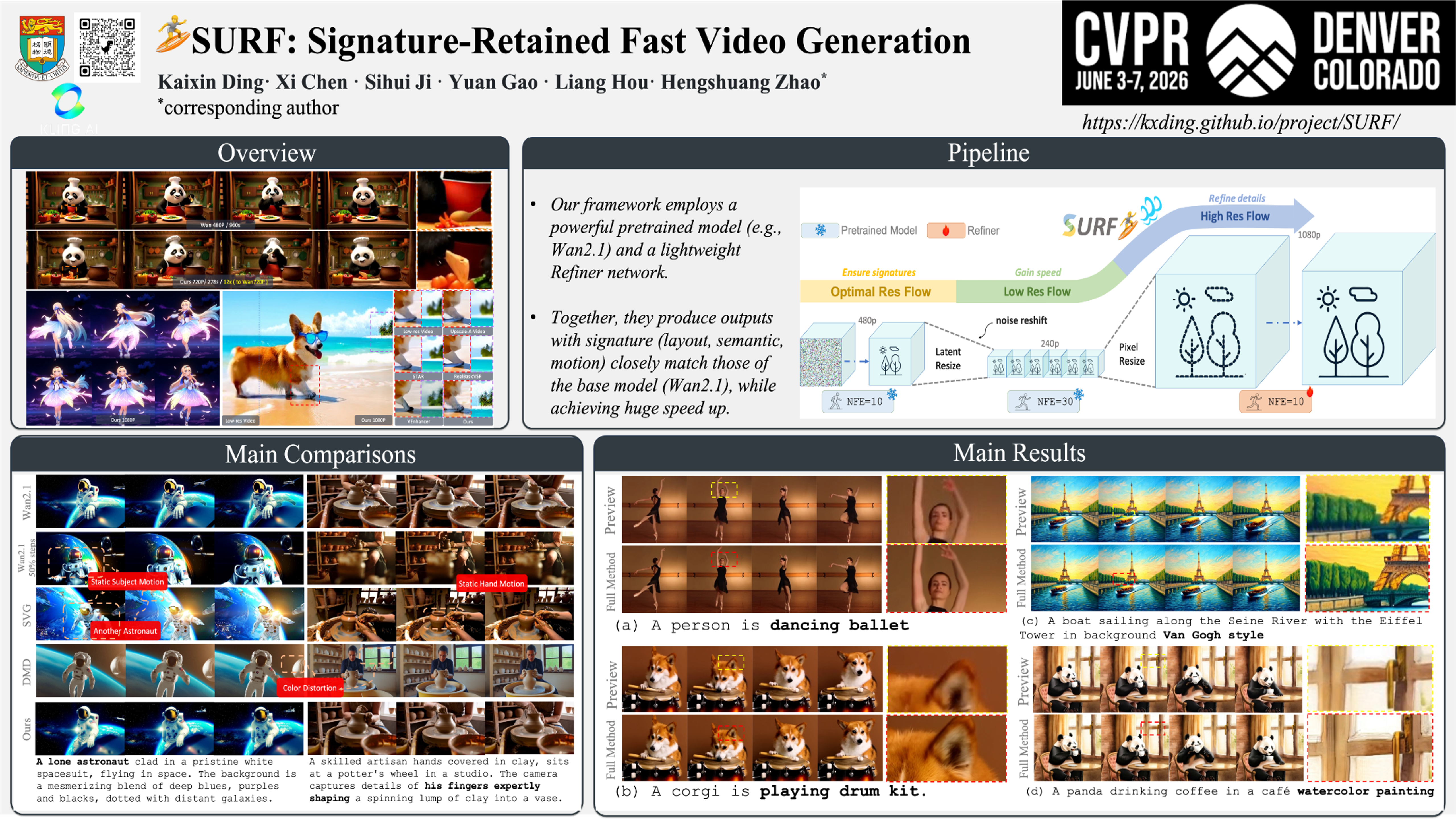
The demand for high-resolution video generation is growing rapidly. However, the generation resolution is severely constrained by slow inference speeds. For instance, Wan2.1 requires over 50 minutes to generate a single 720p video. While previous works explore accelerating video generation from various aspects, most of them compromise the distinctive signatures (e.g., layout, semantic, motion) of the original model. In this work, we propose SURF, an efficient framework for generating high-resolution videos, while maximally keeping the signatures. Specifically, SURF divides video generation into two stages: First, we leverage the pretrained model to infer at optimal resolution and downsample latent to generate low-resolution previews in fast speed; then we design a Refiner to upscale the preview. In the preview stage, we identify that directly inferring a model (trained with higher resolution) on lower resolution causes severe losses in signatures. So we introduce noise reshifting, a training-free technique that mitigates this issue by conducting initial denoising steps on the original resolution and switching to low resolution in later steps. In the refine stage, we establish a mapping relationship between the preview and the high-resolution target, which significantly reduces the denoising steps. We further integrate shifting windows and carefully design the training paradigm to get a powerful and efficient Refiner. In this way, SURF enables generating high-resolution videos efficiently while maximally closer to the signatures of the given pretrained model. SURF is conceptually simple and could serve as a plug-in that is compatible with various base model and acceleration methods. For example, it achieves 12.5× speedup for generating 5-second, 16fps, 720p Wan 2.1 videos and 8.7× speedup for generating 5-second, 24fps, 720p HunyuanVideo.
The devil is in the details: Enhancing Video Virtual Try-On via Keyframe-Driven Details Injection
Qingdong He ⋅ Xueqin Chen ⋅ Yanjie Pan ⋅ Peng Tang ⋅ Pengcheng Xu ⋅ Zhenye Gan ⋅ Chengjie Wang ⋅ Xiaobin Hu ⋅ Jiangning Zhang ⋅ Yabiao Wang
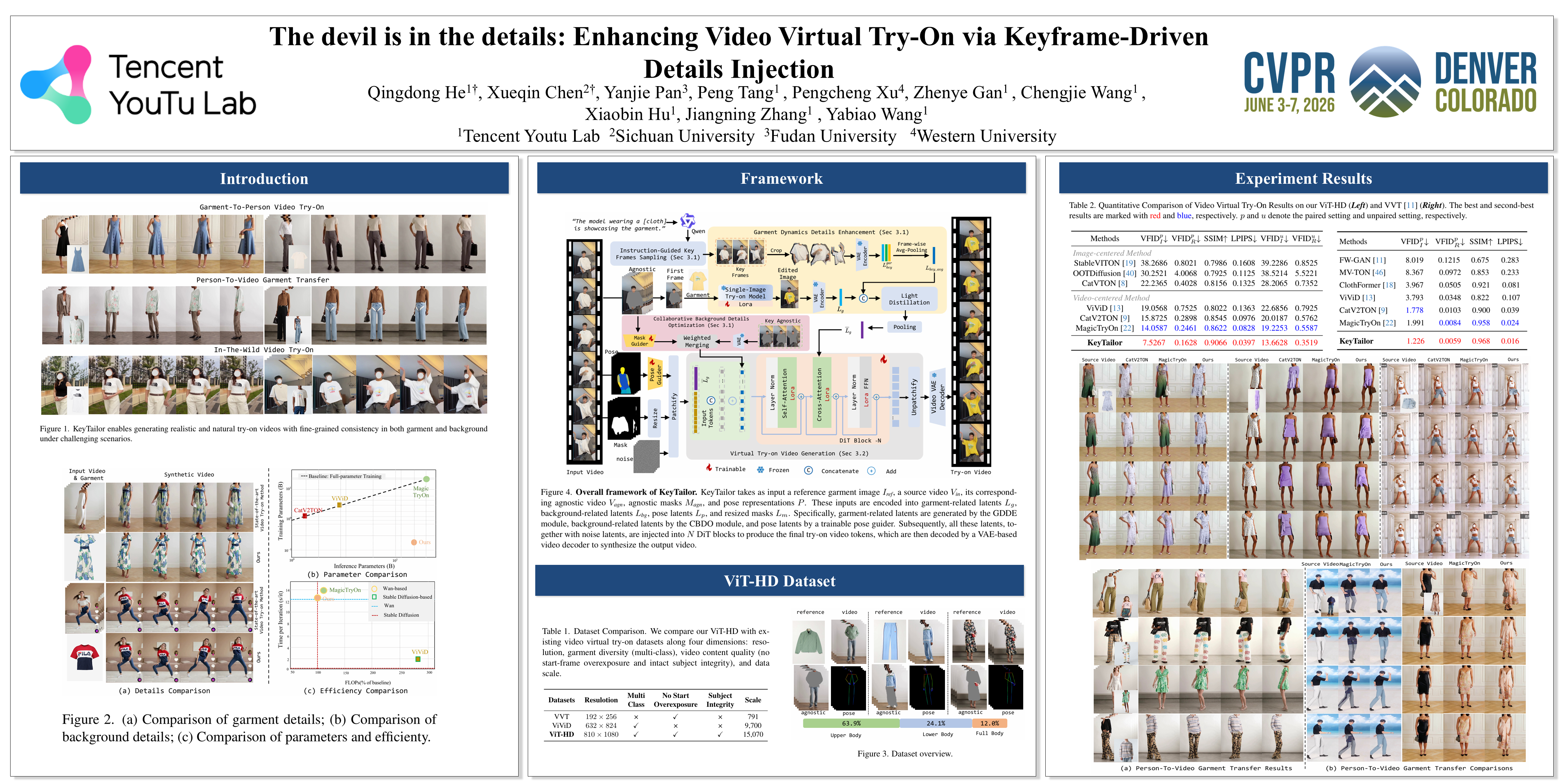
Although diffusion transformer (DiT)-based video virtual try-on (VVT) has made significant progress in synthesizing realistic videos, existing methods still struggle to capture fine-grained garment dynamics and preserve background integrity across video frames. They also incur high computational costs due to additional interaction modules introduced into DiTs, while the limited scale and quality of existing public datasets also restrict model generalization and effective training. To address these challenges, we propose a novel framework, KeyTailor, along with a large-scale, high-definition dataset, ViT-HD. The core idea of KeyTailor is a keyframe-driven details injection strategy, motivated by the fact that keyframes inherently contain both foreground dynamics and background consistency. Specifically, KeyTailor adopts an instruction-guided keyframe sampling strategy to filter informative frames from the input video. Subsequently, two tailored keyframe-driven modules—the garment details enhancement module and the collaborative background optimization module—are employed to distill garment dynamics into garment-related latents and to optimize the integrity of background latents, both guided by keyframes. These enriched details are then injected into standard DiT blocks together with pose, mask, and noise latents, enabling efficient and realistic try-on video synthesis. This design ensures consistency without explicitly modifying the DiT architecture, while simultaneously avoiding additional complexity. In addition, our dataset ViT-HD comprises 15,070 high-quality video samples at a resolution of 810 × 1080, covering diverse garments. Extensive experiments demonstrate that KeyTailor outperforms state-of-the-art baselines in terms of garment fidelity and background integrity across both dynamic and static scenarios. The dataset and code will be publicly released.
Lynx: Towards High-Fidelity Personalized Video Generation
Shen Sang ⋅ Tiancheng Zhi ⋅ Tianpei Gu ⋅ Jing Liu ⋅ Linjie Luo
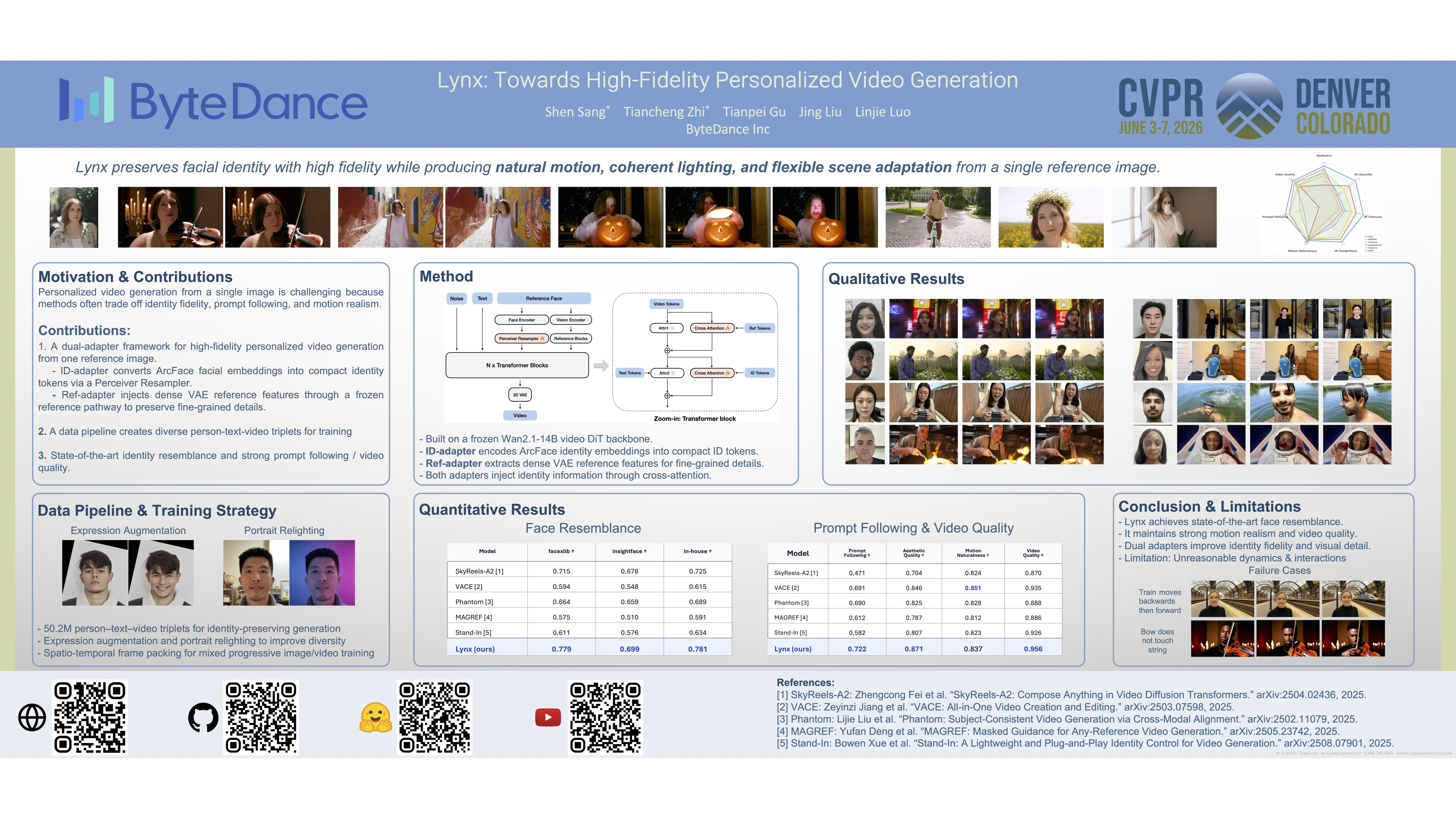
We present Lynx, a high-fidelity model for personalized video synthesis from a single input image. Built on an open-source Diffusion Transformer (DiT) foundation model, Lynx introduces two lightweight adapters to ensure identity fidelity. The ID-adapter employs a Perceiver Resampler to convert ArcFace-derived facial embeddings into compact identity tokens for conditioning, while the Ref-adapter integrates dense VAE features from a frozen reference pathway, injecting fine-grained details across all transformer layers through cross attention. These modules collectively enable robust identity preservation while maintaining temporal coherence and visual realism. Through evaluation on a curated benchmark of 40 subjects and 20 unbiased prompts, which yielded 800 test cases, Lynx has demonstrated superior face resemblance, competitive prompt following, and strong video quality, thereby advancing the state of personalized video generation. Code and models will be released publicly upon publication.
VisionDirector: Vision-Language Guided Closed-Loop Refinement for Generative Image Synthesis
Meng Chu ⋅ Senqiao Yang ⋅ Haoxuan Che ⋅ Suiyun Zhang ⋅ Xichen Zhang ⋅ Shaozuo Yu ⋅ Haokun GUI ⋅ Zhefan Rao ⋅ Dandan Tu ⋅ Rui Liu ⋅ Jiaya Jia
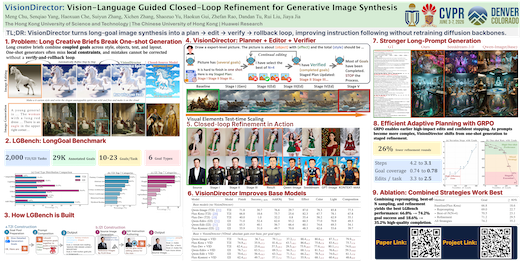
Generative models can now produce photorealistic imagery, yet they still struggle with the long, multi-goal prompts that professional designers issue. To expose this gap and better evaluate models’ performance in real-world, we introduce Long Goal Bench(LGBench), a 2000-task suite (1000 T2I, 1000 I2I) whose average instruction contains 18---22 tightly coupled goals spanning global layout, local object placement, typography, and logo fidelity. We find even state-of-the-art commercial APIs satisfy fewer than 72\% of the goals and routinely miss localized edits, confirming the brittleness of current pipelines. To address this, we present VisionDirector, a training-free, vision-language supervisor that (i) extracts structured goals from long instructions, (ii) dynamically decides between one-shot generation and staged edits, (iii) runs micro-grid sampling plus semantic verification/rollback after every edit, and (iv) logs goal-level rewards. We further fine-tune the planner with Group Relative Policy Optimization, yielding shorter edit trajectories (3.1 vs.\ 4.2 steps) and stronger alignment. VisionDirector achieves new state of the art on GenEval (+7\% overall), and ImgEdit (+0.07 absolute) while producing consistent qualitative improvements on typography, multi-object scenes, and pose editing. The code, benchmark, and evaluation scripts will be released.
ClusterMark: Towards Robust Watermarking for Autoregressive Image Generators with Visual Token Clustering
Denis Lukovnikov ⋅ Andreas Müller ⋅ Erwin Quiring ⋅ Asja Fischer
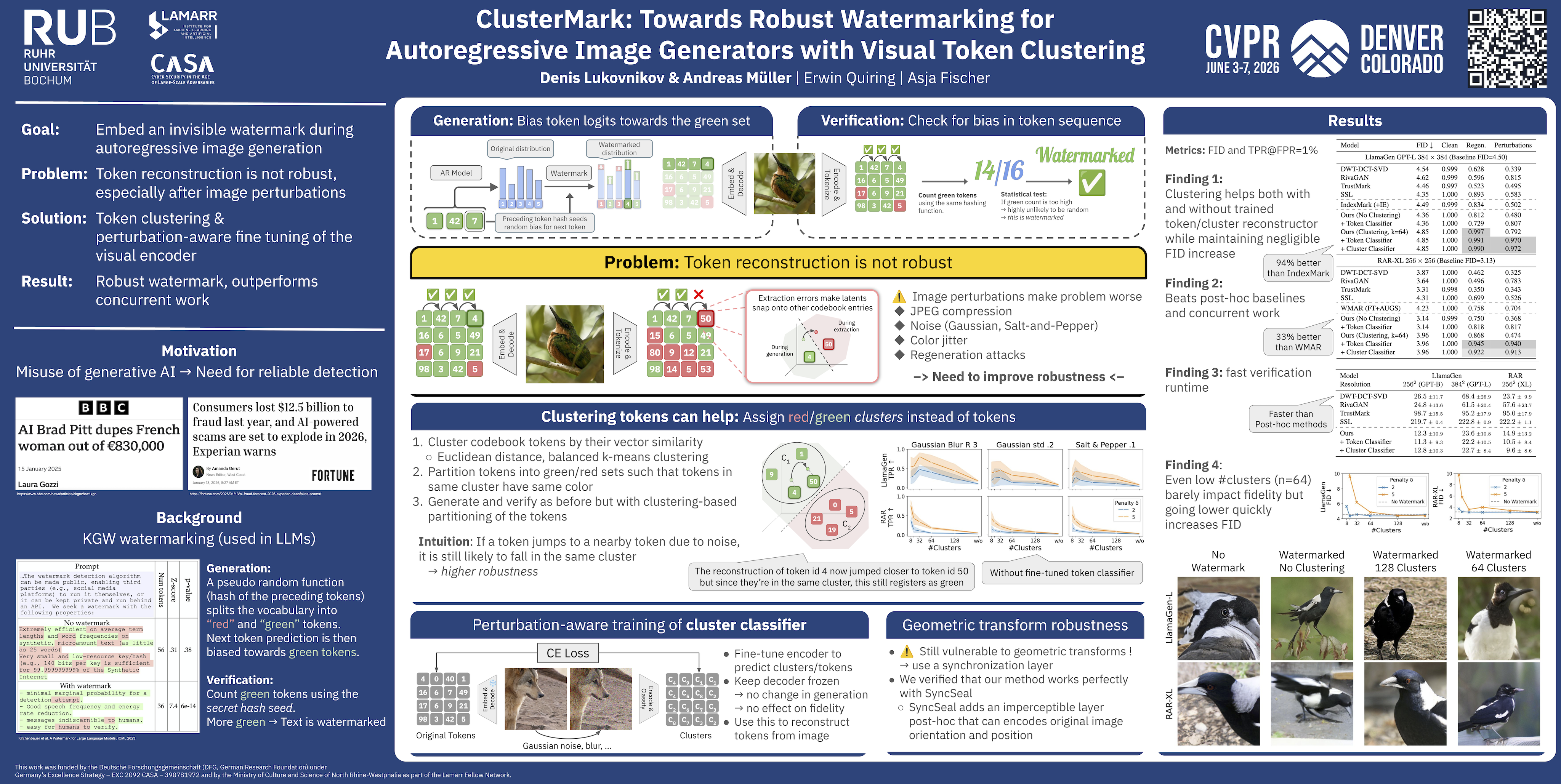
In-generation watermarking for latent diffusion models has recently shown high robustness for marking generated images for easier detection and attribution. However, its application to autoregressive (AR) image models is underexplored. Autoregressive models generate images by autoregressively predicting a sequence of visual tokens that are then decoded into pixels using a VQ-VAE decoder. Inspired by KGW watermarking for large language models, we examine token-level watermarking schemes that bias the next-token prediction based on prior tokens. We find that a direct transfer of these schemes works in principle, but the detectability of the watermarks decreases considerably under common image perturbations. As a remedy, we propose a watermarking approach based on visual token clustering, which assigns similar tokens to the same set (red or green). We investigate token clustering in a training-free setting, as well as in combination with a robust fine-tuned token or cluster predictor. Overall, our experiments show that cluster-based watermarks greatly improve robustness against perturbations and regeneration attacks while preserving image quality, outperforming a set of baselines and concurrent works. Moreover, our methods offer fast verification runtime, comparable to lightweight post-hoc watermarking.
Stable Mean Flow: Lyapunov-Inspired One-Step Flow Matching
Guangxun Zhang ⋅ Mason Haberle ⋅ Davi Geiger
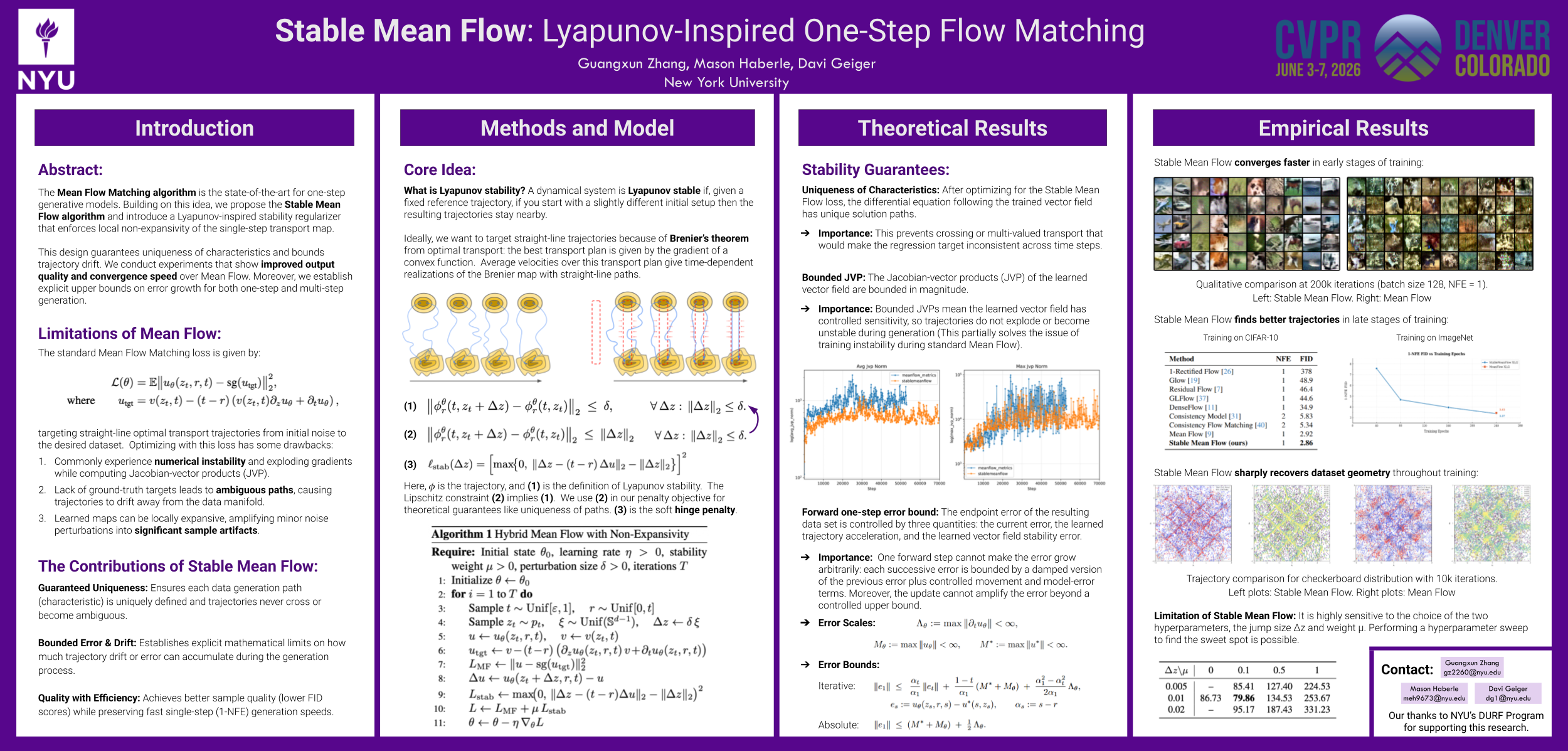
The Mean Flow Matching algorithm is the state-of-the-art for one-step generative models. Building on this idea, we propose the Stable Mean Flow algorithm and introduce a Lyapunov-inspired stability regularizer that enforces local non-expansivity of the single-step transport map. This design guarantees uniqueness of characteristics and bounds trajectory drift. We conduct experiments that show improved output quality and convergence speed over Mean Flow. Moreover, we establish explicit upper bounds on error growth for both one-step and multi-step generation.
OPRO: Orthogonal Panel-Relative Operators for Panel-Aware In-Context Image Generation
Sanghyeon Lee ⋅ Minwoo Lee ⋅ Euijin Shin ⋅ Kangyeol Kim ⋅ Seunghwan Choi ⋅ Jaegul Choo
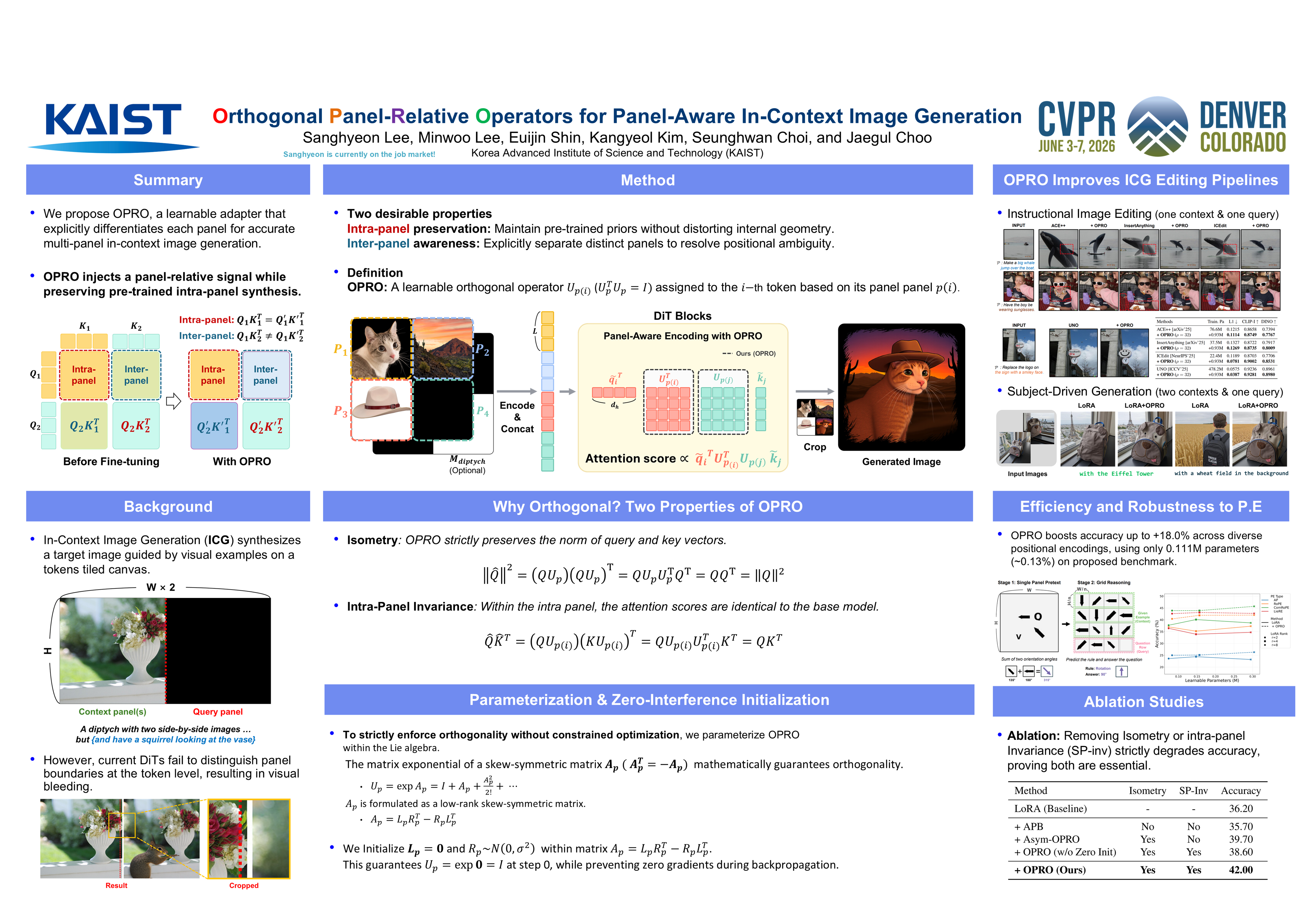
We introduce the Orthogonal Panel-Relative Operator (OPRO), a novel parameter-efficient adaptation method for tiled-panel In-Context Generation (ICG) that utilizes the pre-trained Diffusion Transformers (DiTs). OPRO works by composing learnable, panel-specific orthogonal operators onto the backbone's frozen positional encodings. This design provides two properties: 1) Isometry, which maintains feature geometry to promote stable fine-tuning, and 2) Same-Panel Invariance, which perfectly preserves the model's powerful pre-trained intra-panel synthesis capabilities. We conduct a controlled analysis demonstrating that OPRO's effectiveness is not limited to RoPE but consistently enhances performance across various positional encodings that satisfy orthogonality. By enabling effective panel-relative learning while simultaneously protecting the backbone's core synthesis power, OPRO consistently improves ICG-based instructional image editing methods, including state-of-the-art methods ICEdit.
First Frame Is the Place to Go for Video Content Customization
Jingxi Chen ⋅ Zongxia Li ⋅ Zhichao Liu ⋅ Guangyao Shi ⋅ Xiyang Wu ⋅ Fuxiao Liu ⋅ Cornelia Fermuller ⋅ Brandon Y. Feng ⋅ Yiannis Aloimonos
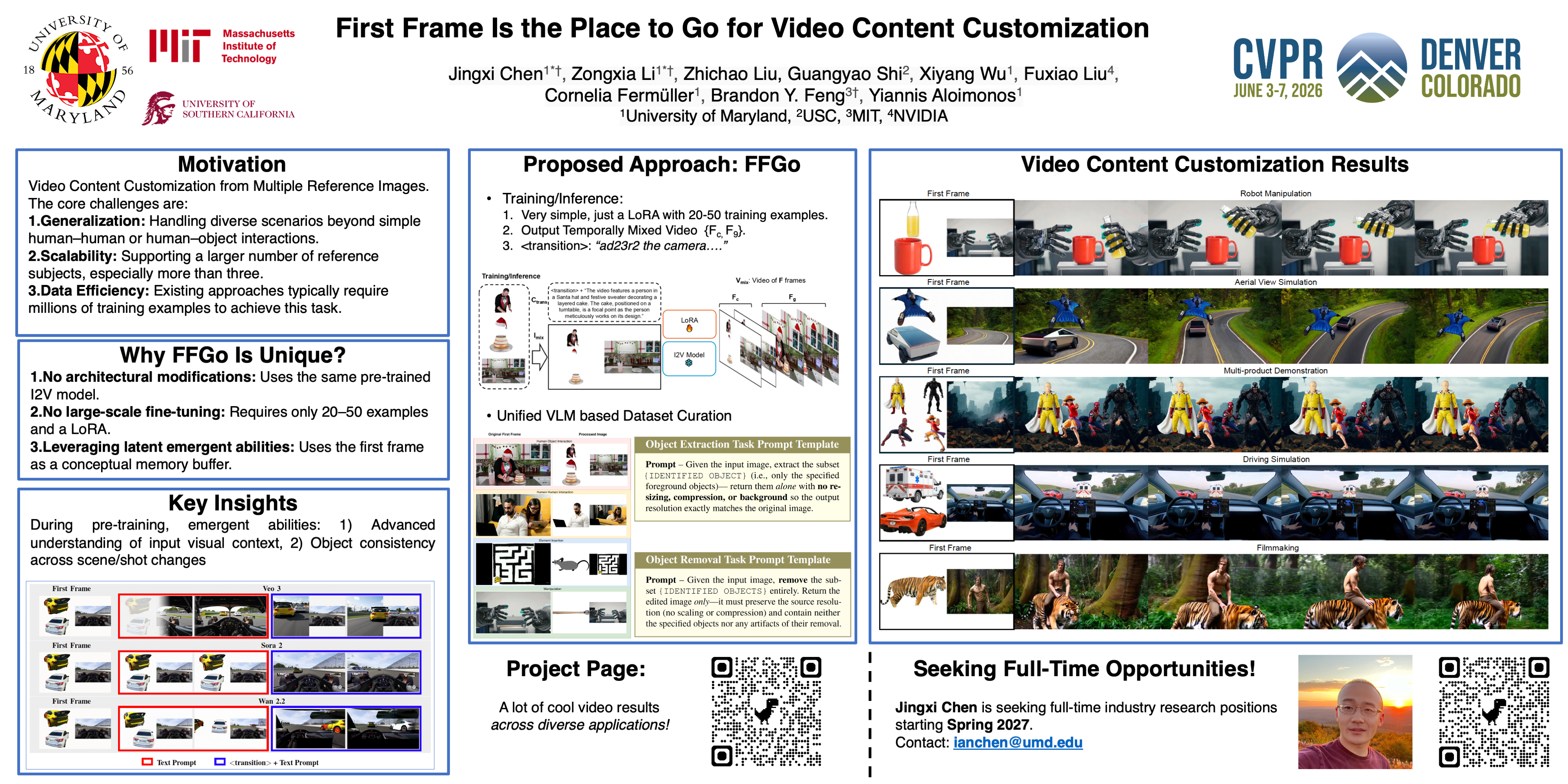
What role does the first frame play in video generation models? Traditionally, it’s viewed as the spatial-temporal starting point of a video, merely a seed for subsequent animation. In this work, we reveal a fundamentally different perspective: video models implicitly treat the first frame as a conceptual memory buffer that stores visual entities for later reuse during generation. Leveraging this insight, we show that it's possible to achieve robust and generalized video content customization in diverse scenarios, using only 20–50 training examples without architectural changes or large-scale finetuning. This unveils a powerful, overlooked capability of video generation models for reference-based video customization.
Scaling Zero-Shot Reference-to-Video Generation
Zijian Zhou ⋅ Shikun Liu ⋅ Haozhe Liu ⋅ Haonan Qiu ⋅ Zhaochong An ⋅ Weiming Ren ⋅ Zhiheng Liu ⋅ Xiaoke Huang ⋅ Kam-Woh Ng ⋅ Tian Xie ⋅ Xiao Han ⋅ Yuren Cong ⋅ Hang Li ⋅ Chuyan Zhu ⋅ Aditya Patel ⋅ Tao Xiang ⋅ Sen He
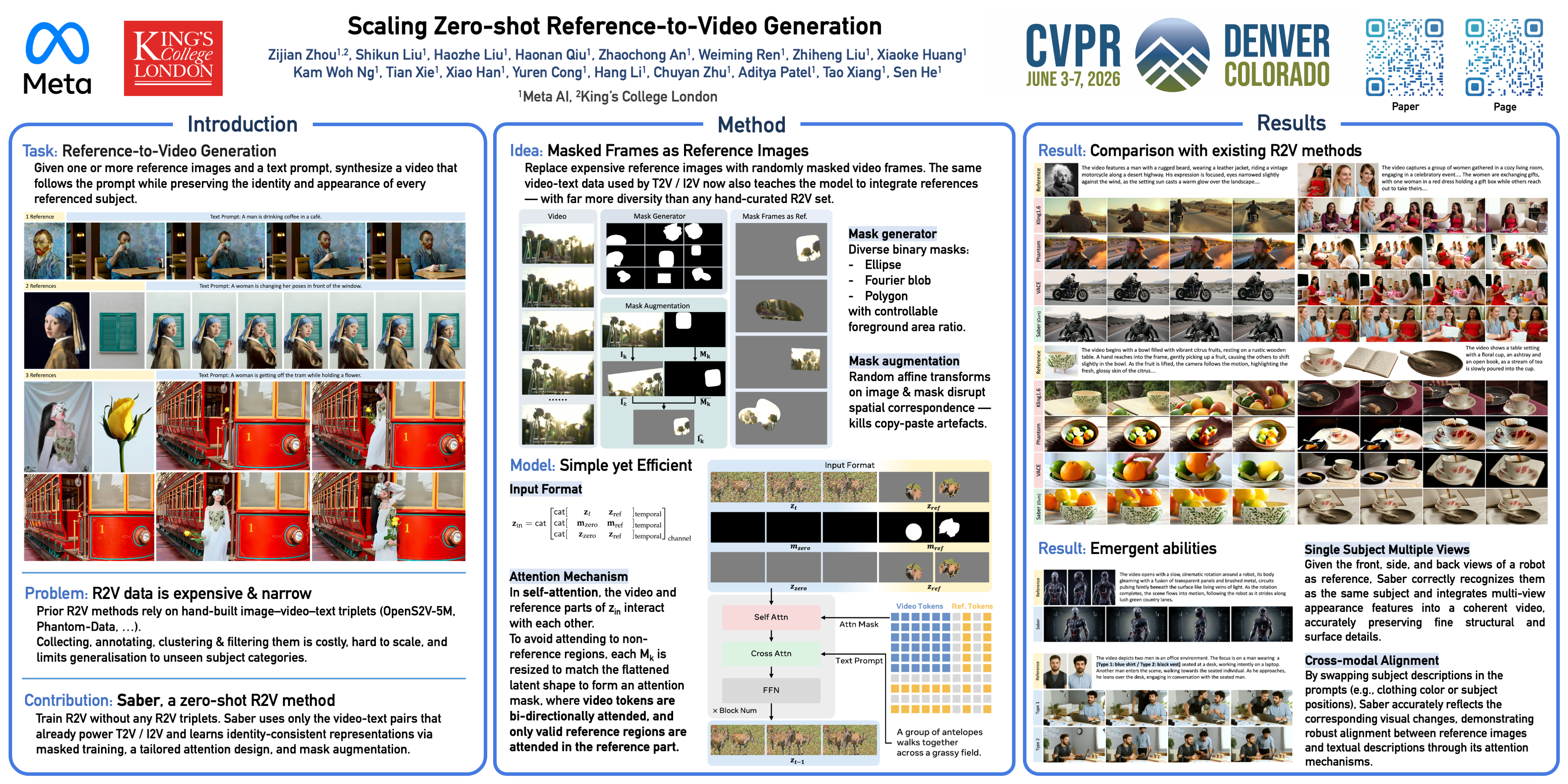
Reference-to-video (R2V) generation aims to synthesize videos that align with a text prompt while preserving the subject identity from reference images. However, current R2V methods are hindered by the reliance on explicit reference image-video-text triplets, whose construction is highly expensive and difficult to scale. We bypass this bottleneck by introducing Saber, a scalable zero-shot framework that requires no explicit R2V data. Trained exclusively on video-text pairs, Saber employs a masked training strategy and a tailored attention-based model design to learn identity-consistent and reference-aware representations. Mask augmentation techniques are further integrated to mitigate copy-paste artifacts common in reference-to-video generation. Moreover, Saber demonstrates remarkable generalization capabilities across a varying number of references and achieves superior performance on the OpenS2V-Eval benchmark compared to methods trained with R2V data.
MotionEdit: Benchmarking and Learning Motion-Centric Image Editing
Yixin Wan ⋅ Lei Ke ⋅ Wenhao Yu ⋅ Kai-Wei Chang ⋅ Dong Yu
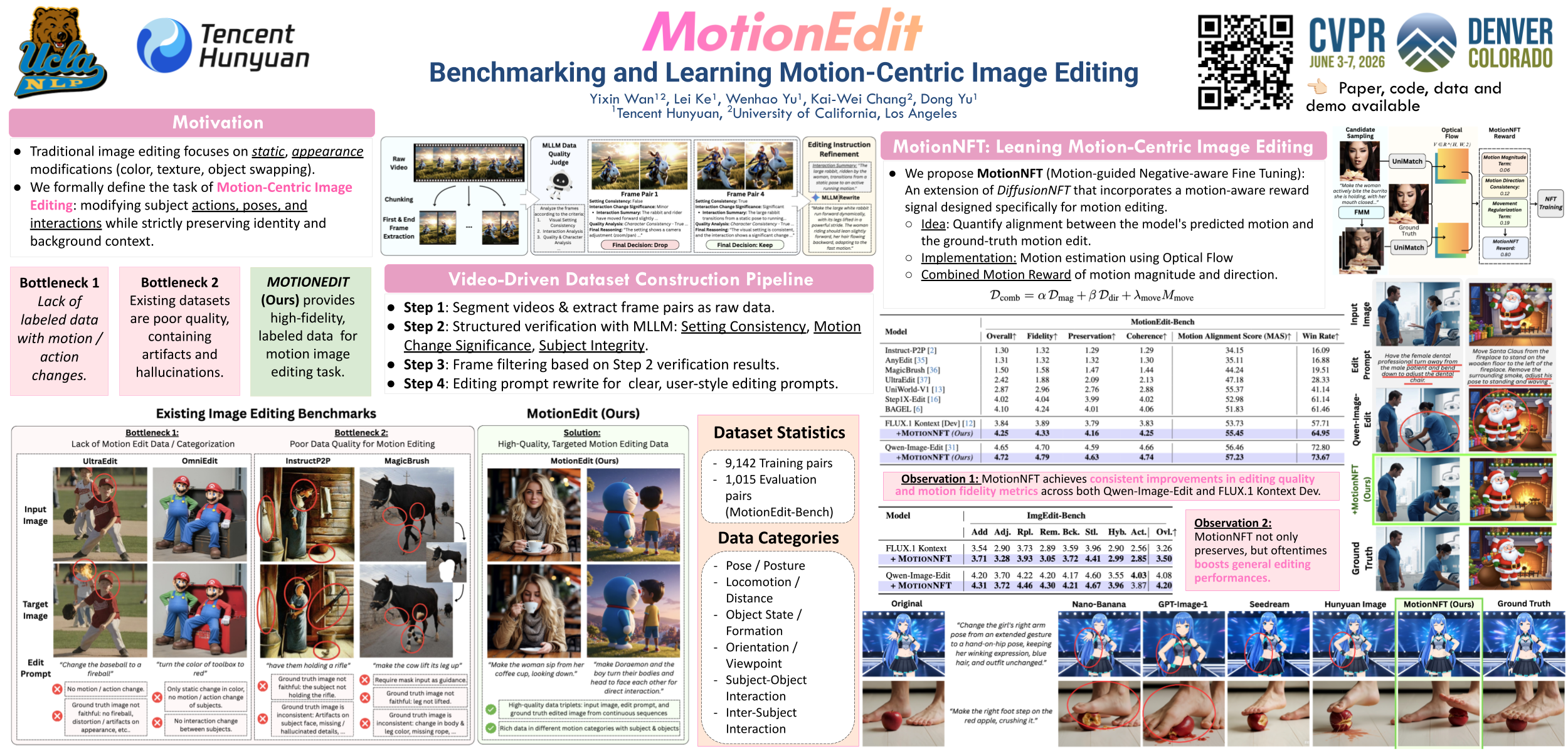
We introduce MotionEdit, a novel dataset for motion-centric image editing—the task of modifying subject actions and interactions while preserving identity, structure, and physical plausibility.Unlike existing image editing datasets that focus on static appearance changes or contain only sparse, low-quality motion edits, MotionEdit provides high-fidelity image pairs depicting realistic motion transformations extracted and verified from continuous videos. This new task is not only scientifically challenging but also practically significant, powering downstream applications such as frame-controlled video synthesis and animation.To evaluate model performance on the novel task, we introduce MotionEdit-Bench, a benchmark that challenges models on motion-centric edits and measures model performance with generative, discriminative, and preference-based metrics.Benchmark results reveal that motion editing remains highly challenging for existing state-of-the-art diffusion-based editing models.To address this gap, we propose MotionNFT (Motion-guided Negative-aware FineTuning), a post-training framework that computes motion alignment rewards based on how well the motion flow between input and model-edited images matches the ground-truth motion, guiding models toward accurate motion transformations.Extensive experiments on FLUX.1 Kontext and Qwen-Image-Edit show that MotionNFT consistently improves editing quality and motion fidelity of both base models on the motion editing task without sacrificing general editing ability, demonstrating its effectiveness.
VDOT: Efficient Unified Video Creation via Optimal Transport Distillation
Yutong Wang ⋅ Haiyu Zhang ⋅ Tianfan Xue ⋅ Yu Qiao ⋅ Yaohui Wang ⋅ Chang Xu ⋅ Xinyuan Chen
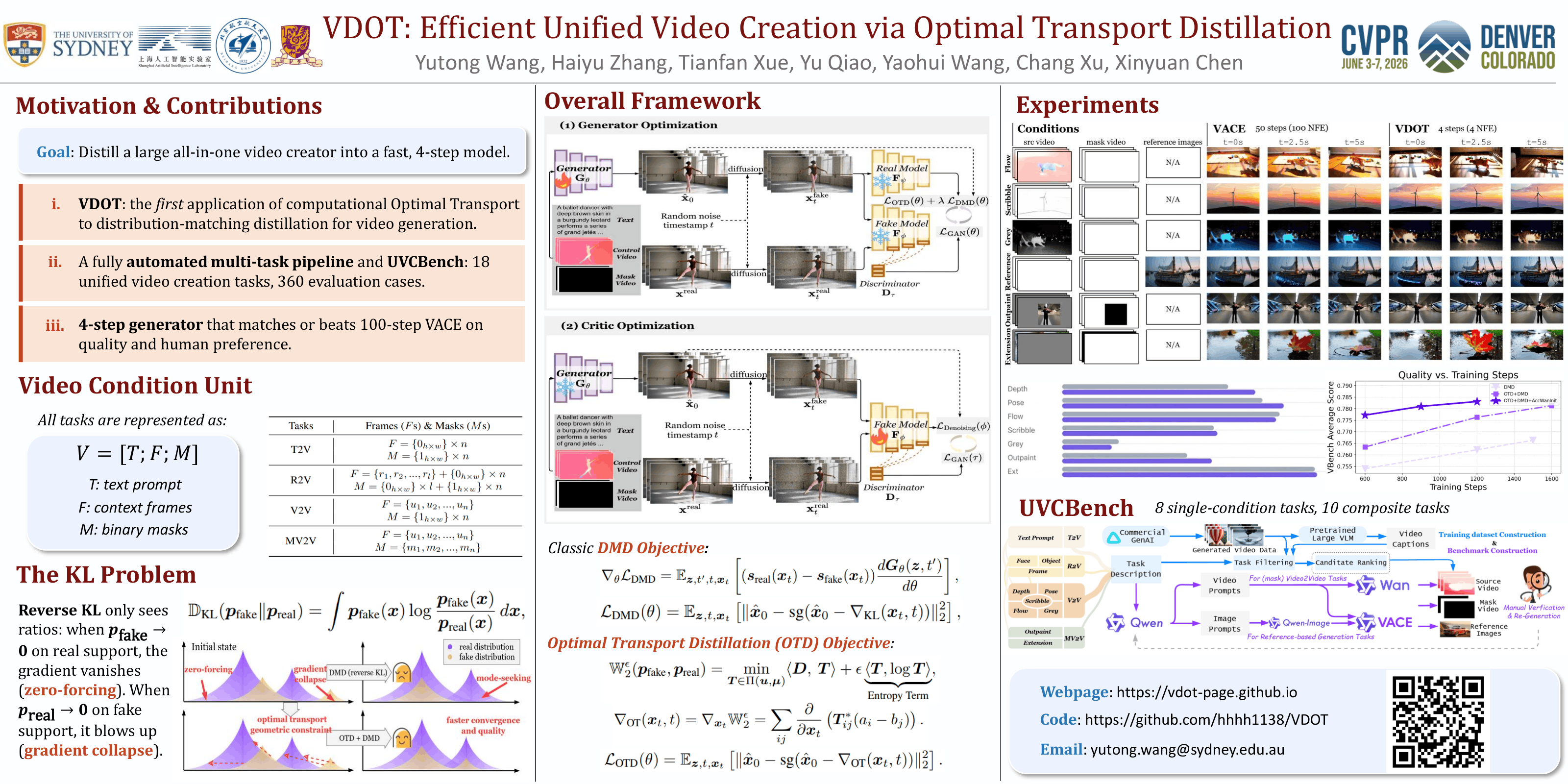
The rapid development of generative models has significantly advanced image and video applications. Among these, video creation, aimed at generating videos under various conditions, has gained substantial attention. However, existing video creation models either focus solely on a few specific conditions or suffer from excessively long generation times due to complex model inference, making them impractical for real-world applications. To mitigate these issues, we propose an efficient unified video creation model, named VDOT. Concretely, we model the training process with the distribution matching distillation (DMD) paradigm. Instead of using the Kullback-Leibler (KL) minimization, we additionally employ a novel computational optimal transport (OT) technique to optimize the discrepancy between the real and fake score distributions. The OT distance inherently imposes geometric constraints, mitigating potential zero-forcing or gradient collapse issues that may arise during KL-based distillation within the few-step generation scenario, and thus, enhances the efficiency and stability of the distillation process. Further, we integrate a discriminator to enable the model to perceive real video data, thereby enhancing the quality of generated videos. To support training unified video creation models, we propose a fully automated pipeline for video data annotation and filtering that accommodates multiple video creation tasks. Meanwhile, we curate a unified testing benchmark, UVCBench, to advance the field. Experiments demonstrate that our 4-step VDOT outperforms or matches the performance of other baselines with 100 denoising steps.
Real-Time Generation of Streamable Talking Portrait Video with Reference-Guided Deep Compression VAEs
Sicheng Xu ⋅ Yu Deng ⋅ Shoukang Hu ⋅ Yichuan Wang ⋅ Yizhong Zhang ⋅ Zhan Chen ⋅ Jiaolong Yang ⋅ Baining Guo
Video diffusion models have significantly advanced portrait video generation, yet their high computational demands limit their use in interactive applications. This work presents a framework for streamable talking portrait video generation conditioned on speech audio and reference images. Designed meticulously for streaming scenarios, it features a causal video VAE for deep latent compression and an auto-regressive latent denoising model. Our causal VAE integrates a variable number of reference images as guidance, allowing the network to focus on dynamic information rather than static appearance, thereby enhancing compression efficacy and reconstruction quality. Additionally, we extend the residual auto-encoding paradigm to improve spatial-temporal causality handling in our VAE. The generator is based on a Rectified Flow Transformer architecture and produces video latents in a blockwise auto-regressive manner. Our method enables the real-time generation of high-quality talking portrait videos, achieving speeds significantly faster than baseline models. Furthermore, comprehensive experiments demonstrate that it is on par with or even outperforms these large models in realism, vividness, and video quality.
RunawayEvil: Jailbreaking the Image-to-Video Generative Models
yueming lyu ⋅ Rufan Qian ⋅ Yueming Lyu ⋅ Qinglong Liu ⋅ Linzhuang Zou ⋅ Jie Qin ⋅ Songhua Liu ⋅ Caifeng Shan
Image-to-Video (I2V) generation represents a frontier in content creation, where models synthesize dynamic visual sequences by jointly reasoning from both image and text prompts. This multimodal grounding enables diverse controllability over video attributes. However, it is precisely this capability that introduces a critical security blind spot: by exploiting the interplay between visual and textual cues, attackers can launch multimodal jailbreak attacks that severely compromise output security. Despite the increasing implementation of security mechanisms in real-world I2V systems, such cross-modal threats remain unexplored. Existing attack methods remain confined to single-modal settings, relying solely on isolated text or image perturbations, which severely limits their effectiveness. To bridge this gap, we propose Runaway Evil, the first multimodal jailbreaking framework for I2V models with dynamic evolutionary capability. Built on a Strategy-Tactic-Action paradigm, our framework exhibits self-amplifying attack through three core components: (1) a strategy-aware command unit that enables the attack to self-evolve its strategies through reinforcement learning-driven strategy customization and large language model (LLM)-based strategy exploration; (2) a multimodal tactical planning unit that generates synergistic text jailbreak instructions and image tampering guidelines based on the selected strategies; and (3) an tactical action Unit executes and evaluates the coordinated attacks. This self-evolving architecture allows the framework to continuously adapt and intensify its attack strategies without human intervention. Extensive experiments demonstrate that Runaway Evil achieves state-of-the-art attack success rates on commercial I2V models, such as Open-Sora 2.0 and CogVideoX. This work provides a critical tool for probing and mitigating multimodal vulnerabilities, laying a foundation for building more robust video generation systems.
MultiAnimate: Pose-Guided Image Animation Made Extensible
Yingcheng Hu ⋅ Haowen Gong ⋅ Chuanguang Yang ⋅ Zhulin An ⋅ Yongjun Xu ⋅ Songhua Liu
Pose-guided human image animation aims to synthesize realistic videos of a reference character driven by a sequence of poses. While diffusion-based methods have achieved remarkable success, most existing approaches are limited to single-character animation. We observe that naively extending these methods to multi-character scenarios often leads to identity confusion and implausible occlusions between characters. To address these challenges, in this paper, we propose an extensible multi-character image animation framework built upon modern Diffusion Transformers (DiTs) for video generation. At its core, our framework introduces two novel components—Identifier Assigner and Identifier Adapter—which collaboratively capture per-person positional cues and inter-person spatial relationships. This mask-driven scheme, along with a scalable training strategy, not only enhances flexibility but also enables generalization to scenarios with more characters than those seen during training. Remarkably, trained on only a two-character dataset, our model generalizes to multi-character animation while maintaining compatibility with single-character cases. Extensive experiments demonstrate that our approach achieves state-of-the-art performance in multi-character image animation, surpassing existing diffusion-based baselines. Codes will be released.
Translating Signals to Languages for sEMG-Based Activity Recognition
Ming Wang ⋅ Haoxuan Qu ⋅ Qiuhong Ke ⋅ Wei Zhou ⋅ Hossein Rahmani ⋅ Jun Liu
Surface electromyography (sEMG) signal-based activity recognition has attracted increasing research attention in recent years. To develop accurate sEMG signal-based activity recognizers, numerous approaches have been proposed. Some studies focus on designing larger and more expressive model architectures to enhance the representational capacity of sEMG signals, while others aim to enrich model priors through large-scale pretraining, thereby improving recognition performance. Recently, large language models (LLMs) have shown remarkable generalization and reasoning capabilities in natural language processing, whose implicit knowledge, learned from extensive linguistic descriptions of actions, opens new possibilities for interpreting sEMG signals and inferring activity intentions. Motivated by this, we propose LLM-sEMG, a novel framework that leverages LLMs as sEMG activity recognizers. Within this framework, we design a language-oriented mapping mechanism that converts continuous sEMG sequences into “sEMG language,” integrating several strategies to further facilitate the signal-to-language mapping process. Extensive experiments demonstrate that the proposed framework achieves highly accurate sEMG signal-based activity recognition using large language models.
Open the Motion Door: Atomic Motion Decomposition and Recomposition for Open-Vocabulary Motion Generation
Ke Fan ⋅ Jiangning Zhang ⋅ Ran Yi ⋅ Jingyu Gong ⋅ Yabiao Wang ⋅ yating wang ⋅ Xin Tan ⋅ Chengjie Wang ⋅ Lizhuang Ma
Text-to-motion generation is a fundamental task in computer vision, aiming to synthesize 3D human motion sequences from natural language descriptions. However, due to the limited scale and diversity of existing datasets, models trained to directly map raw text to motion often struggle to generalize to out-of-domain textual inputs. We observe that although high-level motion semantics vary widely, many motions share a common set of underlying atomic motions—that is, simple, reusable body-part movements. Building on this insight, we introduce an Atomic Motion Decomposition and Recomposition framework for open-vocabulary text-to-motion generation. Our approach consists of two key components: a Textual Decomposition module that parses out-of-domain descriptions into atomic motion units, and an Atomic Recomposition module that integrates these units to produce the final motion sequence. Our model achieves a competitive performance on the in-domain HumanML3D dataset, and extensive experiments on two out-of-domain datasets (IDEA400 and Mixamo) demonstrate that our method substantially outperforms state-of-the-art approaches in open-vocabulary motion generation.
Multi-level Causal LLM-based Text-to-Motion Generation with Human Alignment
Chen Xiaodong ⋅ Qian Bao ⋅ Xudong Liu ⋅ Jianping Fang ⋅ Jintao Fang ⋅ Yongdong Zhang ⋅ Tao Mei ⋅ Wu Liu
Although progress has been made in LLM-based text-driven motion generation, it still has the limitations of generating fine-grained and semantically consistent motions. These limitations stem from: 1) fine-grained motion quantization errors; 2) mismatches between causal reasoning language and non-causal motion representation; and 3) lack of human preference alignment. To solve them, this paper proposes MoTiGA, a multi-level causal LLM-based text-to-motion generation framework with human alignment. Firstly, MoTiGA employs Causal RVQ-VAE for multi-level causal fine-grained motion representation, then explores iterative residual quantization and causal convolutions to reduce fine-grained motion quantization errors, while preserving the causality as language presentation. Furthermore, the framework incorporates a time-lagged causal prediction strategy, enabling parallel prediction across motion token levels while maintaining temporal dependencies. Finally, to enhance human alignment, we propose Multi-level Hybrid-weighted Preference Optimization (MHPO), which dynamically adjusts semantic similarity weighting and continuous similarity scores. For MHPO, we also release the HumanML3D-R dataset, the first large-scale preference dataset for motion generation, with 101,490 human preference pairs. Evaluations show MoTiGA's superior performance, with an 82.3\% FID improvement on HumanML3D and a 64.7\% improvement on KIT-ML over other LLM-based methods.
MotionHiFlow: Text-to-Motion via Hierarchical Flow Matching
Heng Li ⋅ Xiaotong Lin ⋅ Ling-An Zeng ⋅ Yulei Kang ⋅ Shuai Li ⋅ Jian-Fang Hu
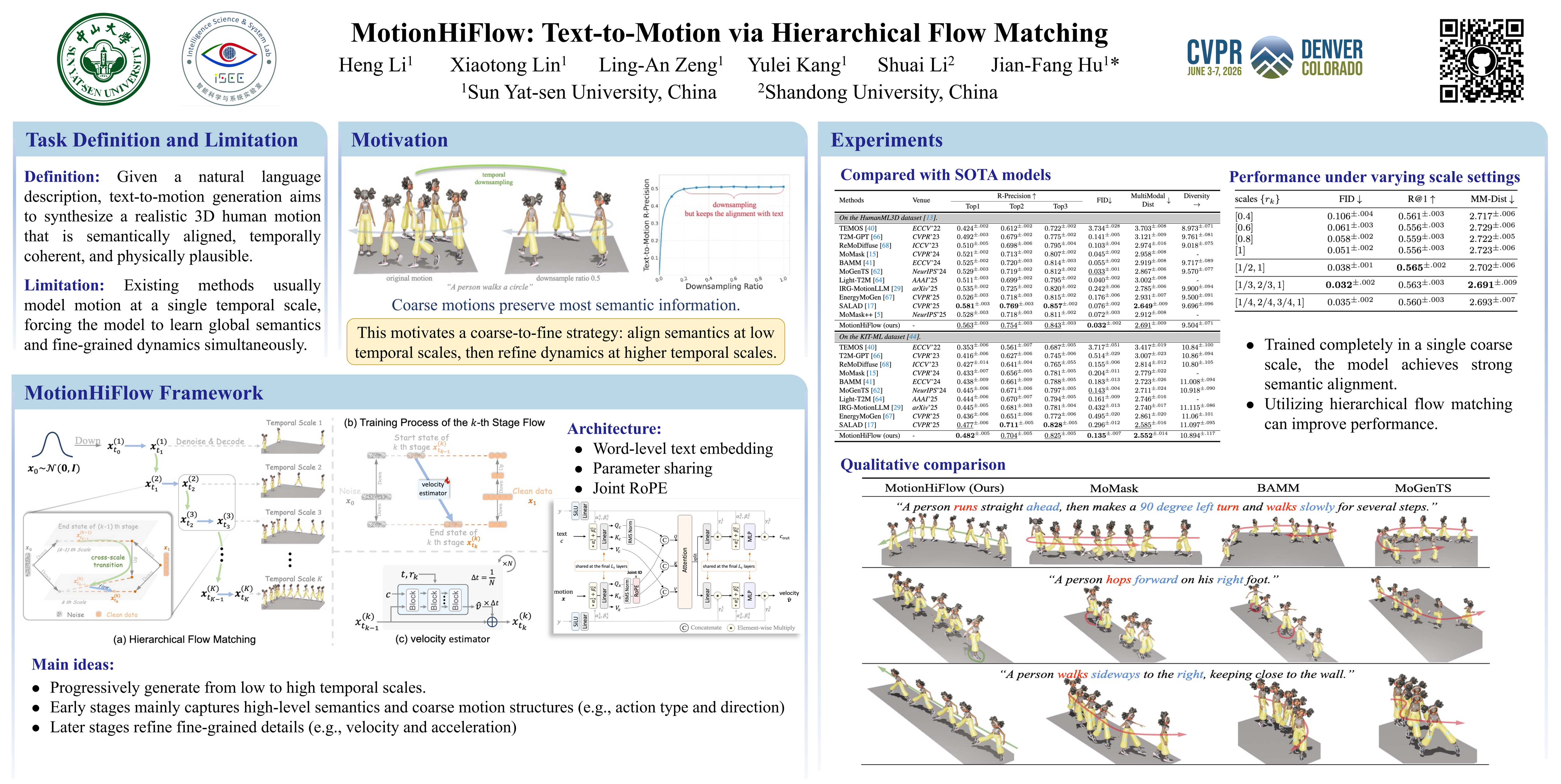
Text-to-motion generation aims to generate 3D human motions that are tightly aligned with the input text while remaining physically plausible and rich in fine-grained detail. Although recent approaches can produce complex and natural movements, they usually operate at only one temporal scale, which limits both semantic alignment and temporal coherence. Inspired by the fact that complex motions are conceptualized hierarchically rather than at a single temporal scale in the human cognitive system, we propose MotionHiFlow, a hierarchical flow matching framework to generate motion progressively by constructing flow path from low to high temporal scales. The flows at lower scales capture high-level semantics and coarse motion structures, while flows at higher scales refine temporal details. To link the flows across scales, we introduce a novel cross-scale transition process, ensuring continuity and preserving noise consistency. Furthermore, by integrating a Text-Motion Diffusion Transformer and a topology-aware Motion VAE, MotionHiFlow explicitly models structural dependencies among joints via joint-aware positional encoding and skeletal topology, enabling precise semantic alignment alongside fine-grained motion details. Extensive experiments on HumanML3D and KIT-ML benchmarks demonstrate state-of-the-art performance, with ablation studies confirming the effectiveness of the hierarchical design and key components.
LaMoGen: Language to Motion Generation Through LLM-Guided Symbolic Inference
Junkun JIANG ⋅ Ho Yin Au ⋅ Jingyu Xiang ⋅ Jie Chen
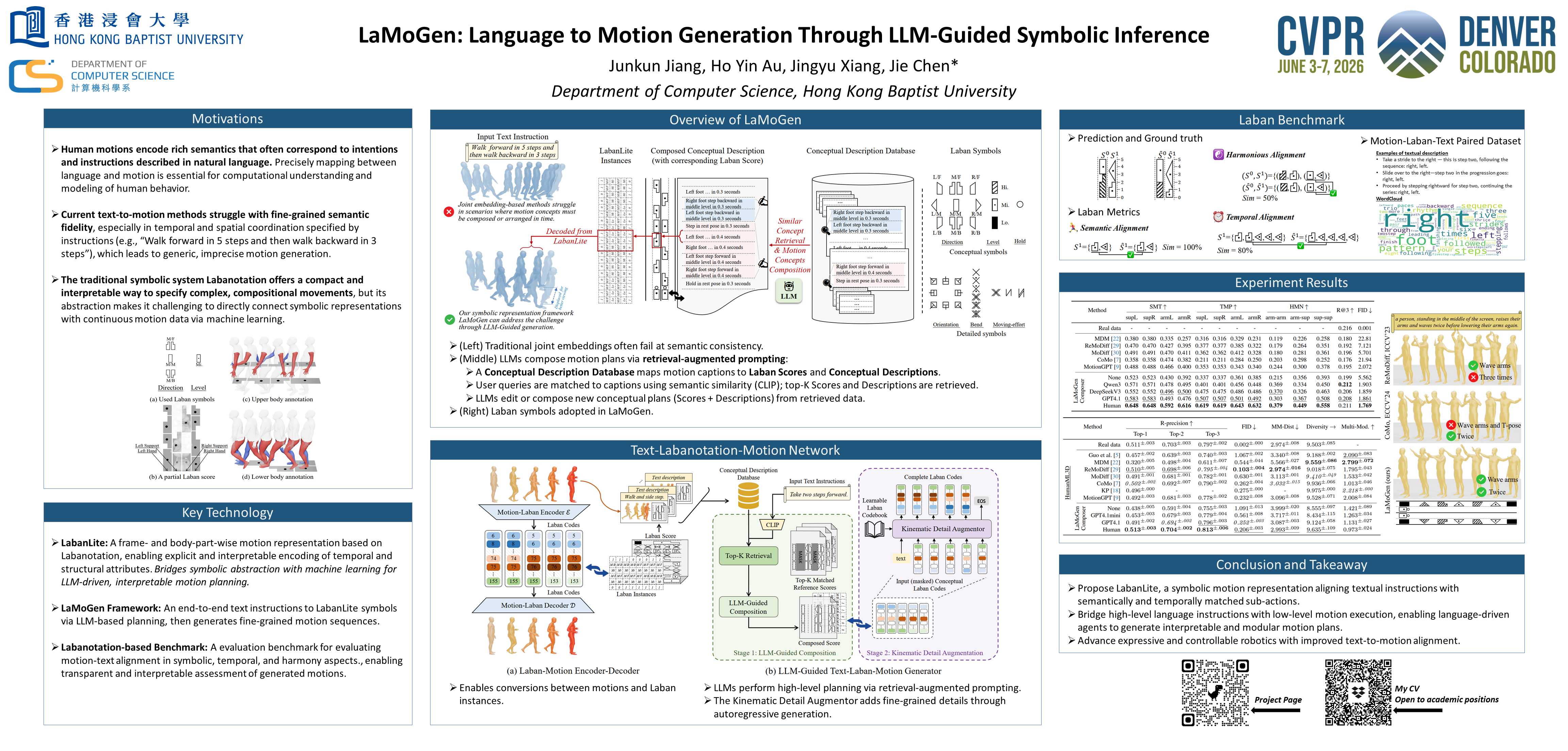
Human motion is highly expressive and naturally aligned with language, yet prevailing methods relying heavily on joint text-motion embeddings struggle to synthesize temporally accurate, detailed motions and often lack explainability. To address these limitations, we introduce LabanLite, a motion representation developed by adapting and extending the Labanotation system. Unlike black-box text–motion embeddings, LabanLite encodes each atomic body-part action (e.g., a single left-foot step) as a discrete Laban symbol paired with a textual template. This abstraction decomposes complex motions into interpretable symbol sequences and body-part instructions, establishing a symbolic link between high-level language and low-level motion trajectories. Building on LabanLite, we present LaMoGen, a Text-to-LabanLite-to-Motion Generation framework that enables large language models (LLMs) to compose motion sequences through symbolic reasoning. The LLM interprets motion patterns, relates them to textual descriptions, and recombines symbols into executable plans, producing motions that are both interpretable and linguistically grounded. To support rigorous evaluation, we introduce a Labanotation-based benchmark with structured description–motion pairs and three metrics that jointly measure text–motion alignment across symbolic, temporal, and harmony dimensions. Experiments demonstrate that LaMoGen establishes a new baseline for both interpretability and controllability, outperforming prior methods on our benchmark and two public datasets. These results highlight the advantages of symbolic reasoning and agent-based design for language-driven motion synthesis. All code and data are available at https://github.com/xxx/xxx.
Accelerating Diffusion via Hybrid Data-Pipeline Parallelism Based on Conditional Guidance Scheduling
Euisoo Jung ⋅ Byunghyun Kim ⋅ Hyunjin Kim ⋅ Seonghye Cho ⋅ Jae-Gil Lee
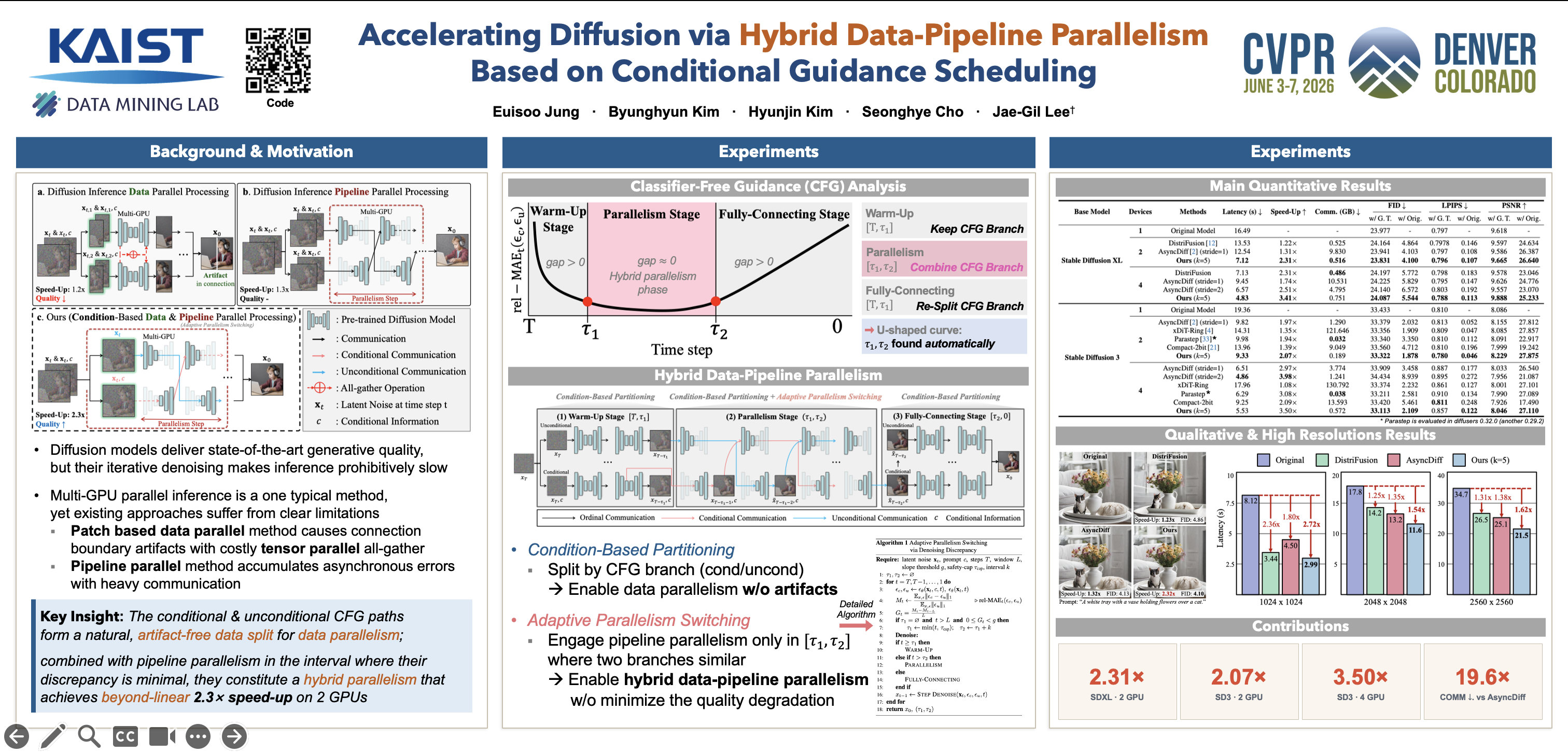
Diffusion models have achieved remarkable progress in high-fidelity image, video, and audio generation, yet inference remains computationally expensive. Nevertheless, current diffusion acceleration methods based on distributed parallelism suffer from noticeable generation artifacts and fail to achieve substantial acceleration proportional to the number of GPUs. Therefore, we propose a hybrid parallelism framework that combines a novel data parallel strategy, condition-based partitioning, with an optimal pipeline scheduling method, adaptive parallelism switching, to reduce generation latency and achieve high generation quality in conditional diffusion models. The key ideas are to (i) leverage the conditional and unconditional denoising paths as a new data-partitioning perspective and (ii) adaptively enable optimal pipeline parallelism according to the denoising discrepancy between these two paths. Our framework achieves $2.31\times$ and $2.07\times$ latency reductions on SDXL and SD3, respectively, using two NVIDIA RTX~3090 GPUs, while preserving image quality. This result confirms the generality of our approach across U-Net-based diffusion models and DiT-based flow-matching architectures. Our approach also outperforms existing methods in acceleration under high-resolution synthesis settings. Code is available at https://anonymous.4open.science/r/hybrid-diffusion/.
GVIS: Generative Vector Image Steganography
ZiHao Xu ⋅ Dawei xu ⋅ Zihan Li ⋅ Xixi Zheng ⋅ Chuan Zhang
Vector images have attracted increasing attention in the field of information hiding in recent years due to their scalability and structural properties. However, existing steganographic methods for vector images often introduce noticeable modifications to the files themselves, resulting in potential security risks and limited embedding capacity. Motivated by recent advances in diffusion models and image generative steganography, we propose GVIS, a novel \textbf{G}enerative \textbf{V}ector \textbf{I}mage \textbf{S}teganography framework. GVIS deterministically generates bitmap images using diffusion models, which are subsequently vectorized into scalable vector images. On the sender side, we design a lightweight overlap detection algorithm to identify Bézier curve control points suitable for data embedding, which enables the secret information to be encoded into the polar coordinate parameters of these control points. Then, the receiver can use the pre-shared conditional inputs to reconstruct the generation process and accurate message extraction by vector difference. Extensive theoretical analysis and experimental results demonstrate that GVIS achieves high-capacity, high-accuracy, secure, and training-free steganography. To the best of our knowledge, this is the first work to introduce generative model into the domain of vector image steganography.
MaxMark: High-Capacity Diffusion-Native Watermarking via Robust and Invertible Latent Embedding
Xuanhang Chang ⋅ Zhonghao Yang ⋅ Cheng Zhuo ⋅ YU LI
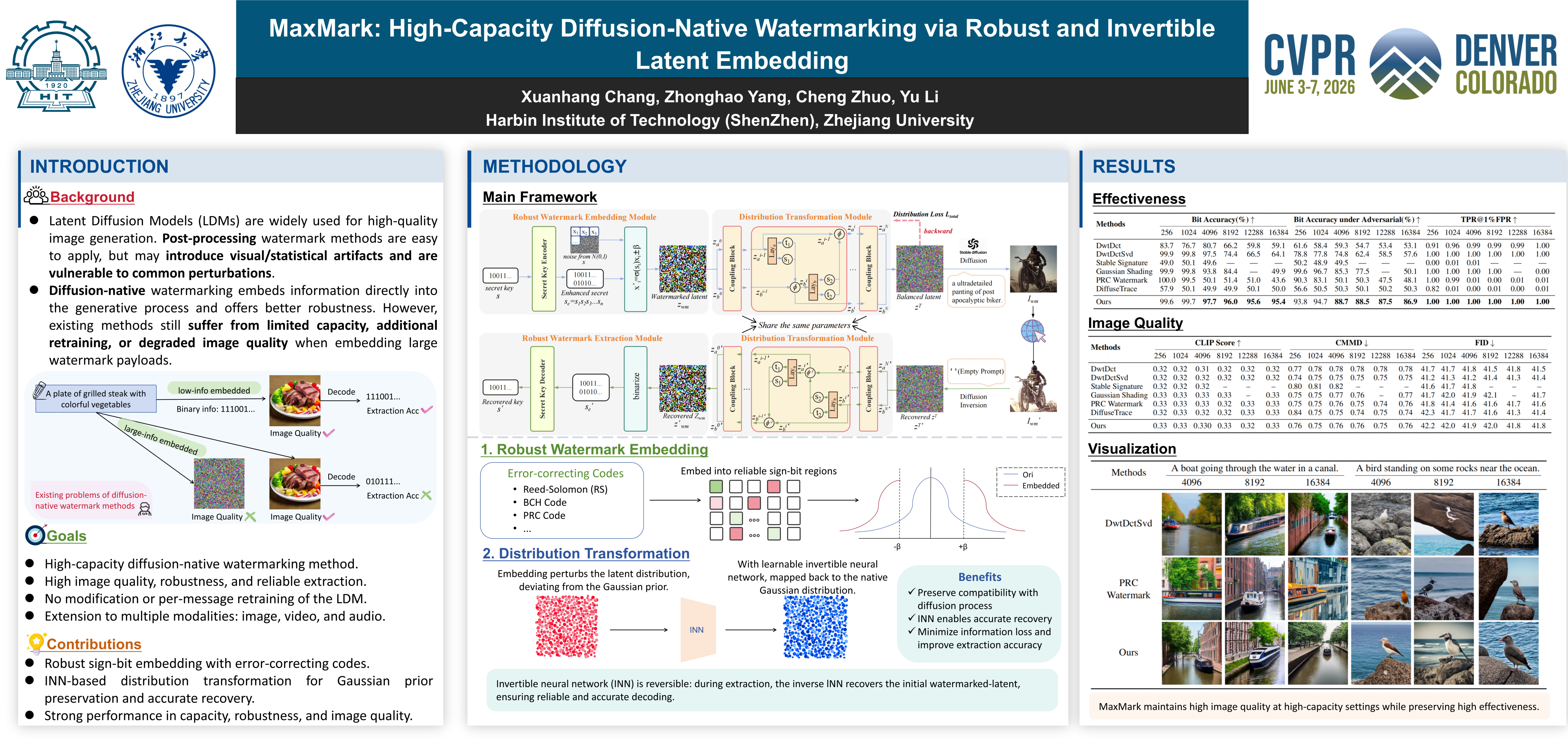
Diffusion-native watermarking provides a more secure and reliable way to trace images from latent diffusion models (LDMs) by embedding information directly into the generative process. However, existing methods suffer from a fundamental limitation: their embedding capacity is extremely small. We introduce MaxMark, a high-capacity watermarking framework that supports embed rich watermark messages into generated images. MaxMark uses two components: a robust watermark embedding module that enhance the secret message and places them into reliable regions of the latent noise, and a distribution transformation module that maps the watermarked latent back to an approximate Gaussian, ensuring compatibility with the diffusion process and preserving image fidelity. The distribution transformation is implemented with an invertible neural network (INN), whose exactly reversible structure enables precise recovery and efficient training. Experiments show that MaxMark surpasses prior methods in capacity, robustness, and imperceptibility, achieving up to a 46\% improvement in bit accuracy for large watermark payloads.
GeoRK2: Geometry-Guided Runge–Kutta Integration for Diffusion Transformer Acceleration
Chaoqun Sun ⋅ Zongjing Fu ⋅ Powei Chang ⋅ Jinpeng Zhang ⋅ JianXiang Xiang ⋅ Yukang Gao ⋅ Chenyu Wang
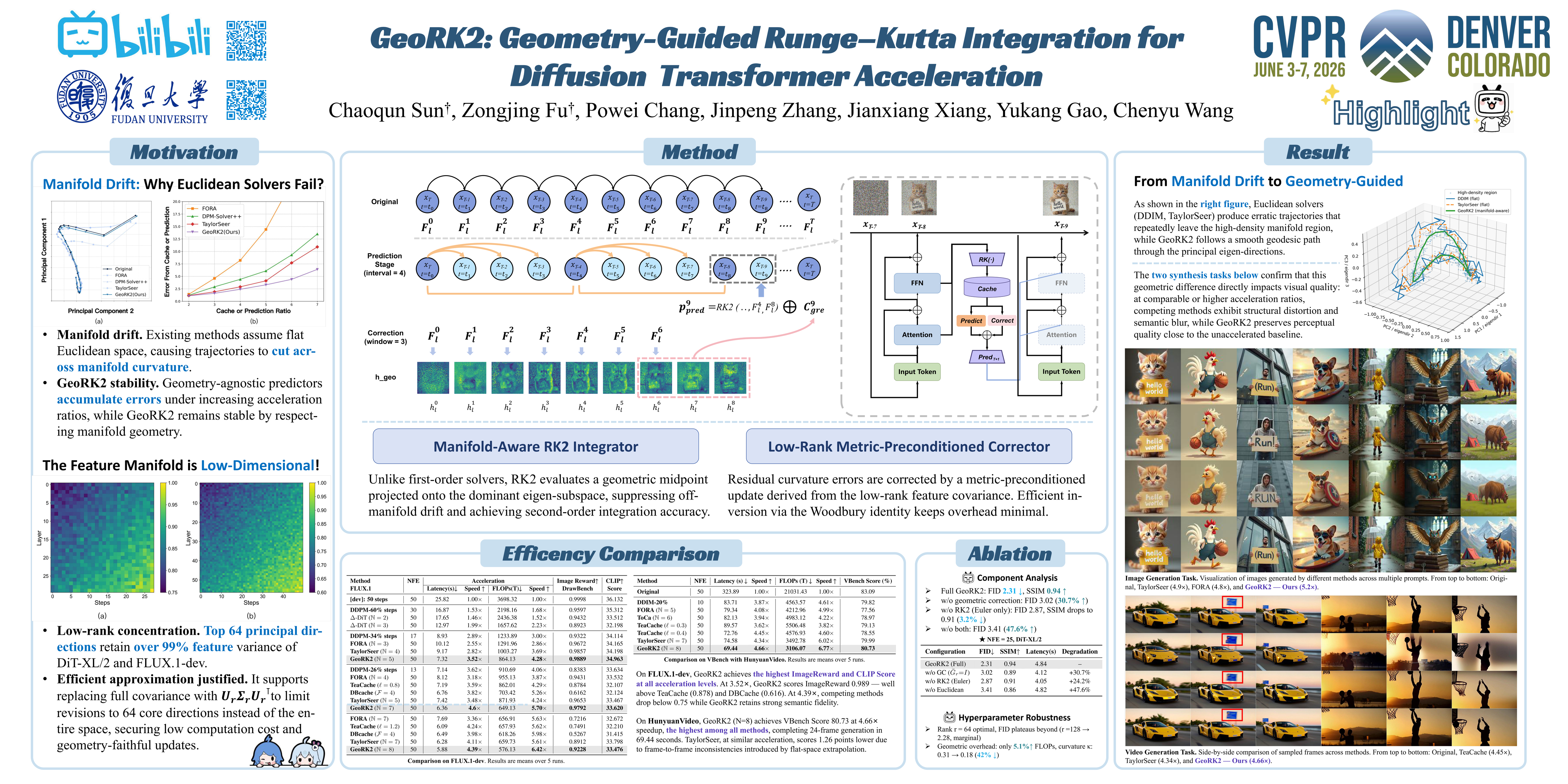
Diffusion transformer models deliver state-of-the-art image synthesis quality but suffer from prohibitively slow iterative sampling. Fewer sampling steps accelerate inference but inevitably distort intermediate features and degrade visual fidelity, while offering little relief in computational cost. To address these limitations, we present GeoRK2, a training-free framework that bridges numerical analysis and information geometry. GeoRK2 couples second-order Runge–Kutta (RK2) integration with a curvature-aware geometric flow derived from the model's noise predictions, establishing provably stable feature evolution dynamics under manifold-aware integration. By leveraging an empirical feature covariance–induced metric estimated from gradient covariances to capture intrinsic feature geometry and applying parallel transport along the manifold connection, GeoRK2 constrains error propagation under large-step integration, ensuring both numerical stability and structural fidelity. As a fully plug-and-play method, GeoRK2 requires no retraining and is compatible with mainstream pretrained diffusion transformers. Comprehensive experiments on image generation and super-resolution tasks across representative diffusion backbones (e.g., DiT-XL, HunyuanVideo, and FLUX.1-dev) demonstrate that GeoRK2 achieves 4–5× faster inference than baseline frameworks (FORA, TaylorSeer) with only marginal perceptual differences (∆FID ≈ 0.81), confirming its effectiveness and generality. All implementation details and code are provided in the supplementary material.
Test-time Sparsity for Extreme Fast Action Diffusion
Kangye Ji ⋅ Yuan Meng ⋅ Jianbo Zhou ⋅ Ye Li ⋅ Chen Tang ⋅ Zhi Wang
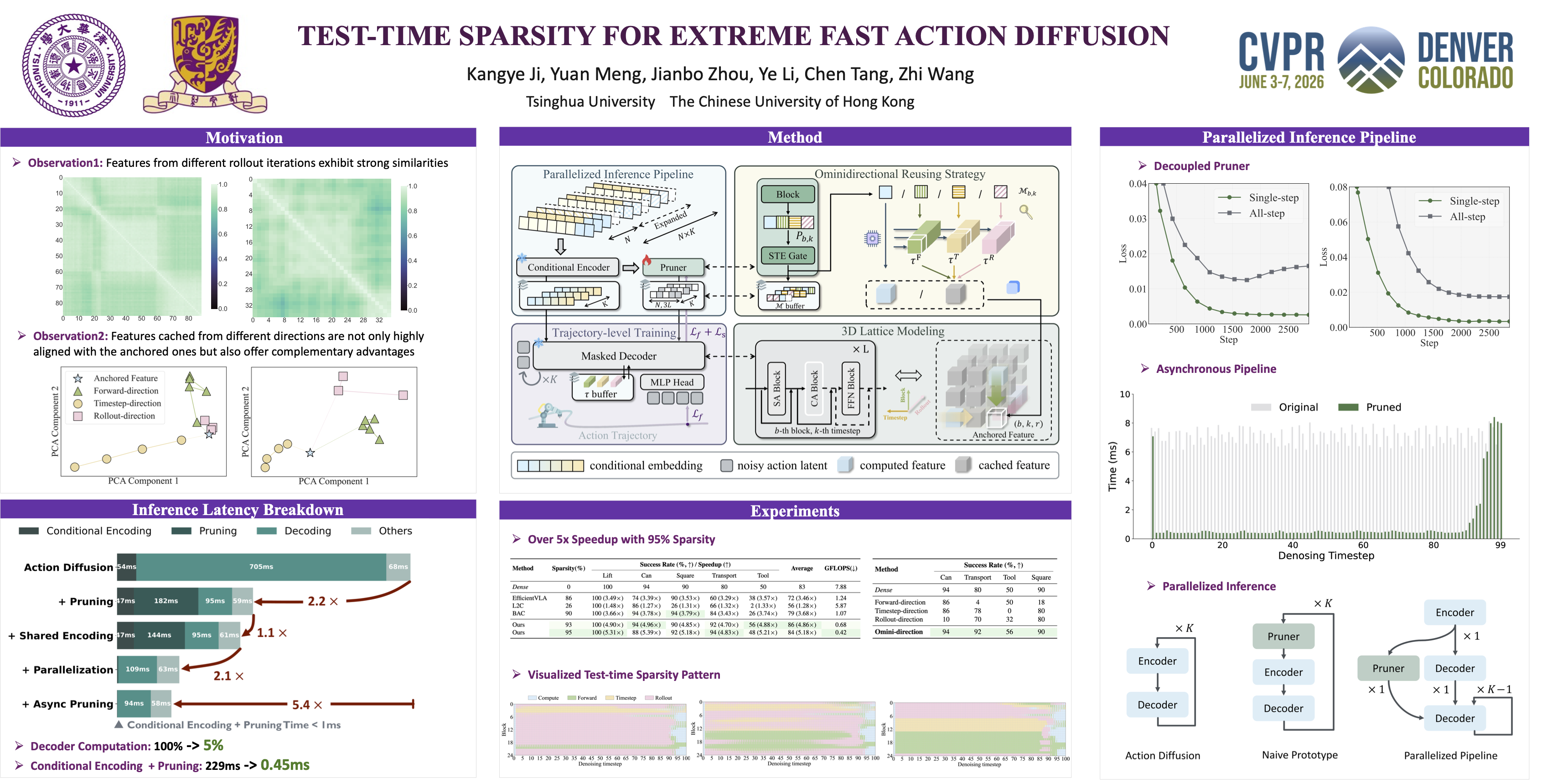
Action diffusion excels at high-fidelity action generation but incurs heavy computational costs owing to its iterative denoising nature. Despite current technologies showing promise in accelerating diffusion transformers by reusing the cached features, they struggle to adapt to policy dynamics arising from diverse perceptions and multi-round rollout iterations in open environments. We propose test-time sparsity to tackle this challenge, which aims to accelerate action diffusion by dynamically predicting prunable residual computations for each model forward at test time.However, two bottlenecks remain in this paradigm: 1) repetitive conditional encoding and pruning offset most potential speed gains, and 2) the features cached from previous denosing timeteps cannot constrain large pruning errors under aggressive sparsity. To address the first bottleneck, we design a highly parallelized inference pipeline that minimizes the non-decoder delay to milliseconds. Specifically, we first design a lightweight pruner that shares the encoder with the diffusion transformer. Then, we decouple the encoding and pruning from the autoregressive denoising loop by processing all denoising timesteps in parallel, and overlap the pruner with the decoder forward inference through asynchronism. To overcome the second bottleneck, we introduce an omnidirectional reusing strategy, which achieves 95\% sparsity by selectively reusing the features cached from the current forward, previous denoising timesteps, and earlier rollout iterations. To learn the rollout-level reusing strategies, we sample a few action trajectories to supervise the actions generated by the sparsified diffusion step by step.Extensive experiments demonstrate that our method reduces FLOPs by 92\% and accelerates action generation by 5$\times$, achieving lossless performance with an inference frequency of 47.5 Hz.
Trainable Log-linear Sparse Attention for Efficient Diffusion Transformers
Yifan Zhou ⋅ Zeqi Xiao ⋅ Tianyi Wei ⋅ Shuai Yang ⋅ Xingang Pan
Diffusion Transformers (DiTs) set the state of the art in visual generation, yet their quadratic self-attention cost fundamentally limits scaling to long token sequences. Recent Top-$K$ sparse attention approaches reduce the computation of DiTs by compressing tokens into block-wise representation and selecting a small set of relevant key blocks, but still suffer from (i) quadratic selection cost on compressed tokens and (ii) increasing $K$ required to maintain model quality as sequences grow. We identify that their inefficiency is due to the single-level design, as a single coarse level is insufficient to represent the global structure.In this paper, we introduce Log-linear Sparse Attention (LLSA), a trainable sparse attention mechanism for extremely long token sequences that reduces both selection and attention costs from quadratic to log-linear complexity by utilizing a hierarchical structure. LLSA performs hierarchical Top-$K$ selection, progressively adopting sparse Top-$K$ selection with the indices found at the previous level,and introduces a Hierarchical KV Enrichment mechanism that preserves global context while using fewer tokens of different granularity during attention computation. To support efficient training, we develop a high-performance GPU implementation that uses only sparse indices for both the forward and backward passes, eliminating the need for dense attention masks.We evaluate LLSA on high-resolution pixel-space image generation without using patchification and VAE encoding. LLSA accelerates attention inference by $ 28.27 \times$ and DiT training by $ 6.09 \times$ on $256 \times 256$ pixel token sequences, while maintaining generation quality. The results demonstrate that LLSA offers a promising direction for training long-sequence DiTs efficiently.
A Self-Conditioned Representation Guided Diffusion Model for Realistic Text-to-LiDAR Scene Generation
Wentao Qu ⋅ Guofeng Mei ⋅ Yang Wu ⋅ Yongshun Gong ⋅ Xiaoshui Huang ⋅ Liang Xiao
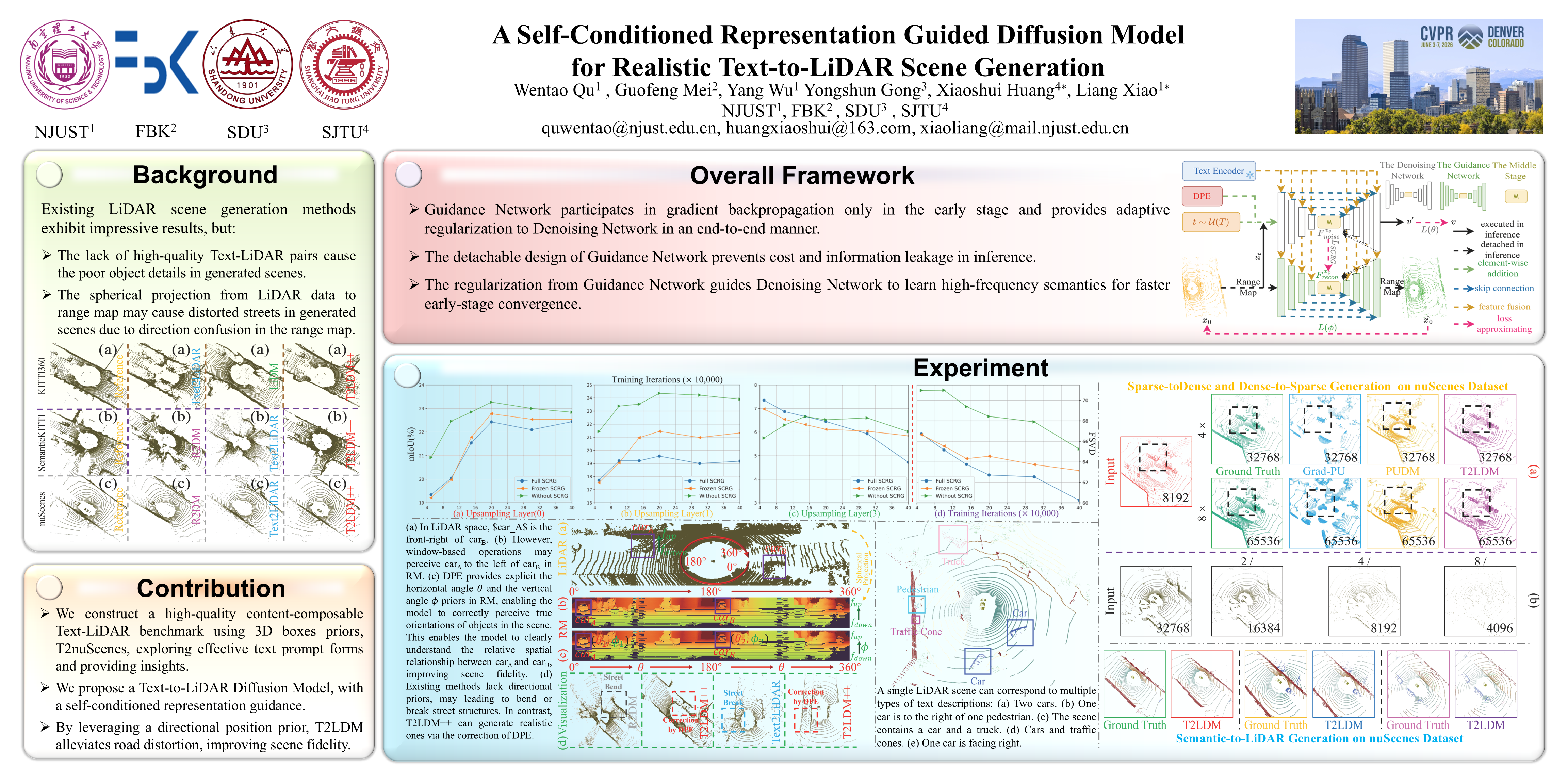
Text-to-LiDAR generation can customize 3D data with rich structures and diverse scenes for downstream tasks. However, the scarcity of Text-LiDAR pairs often causes insufficient training priors, generating overly smooth 3D scenes. Moreover, low-quality text descriptions may degrade generation quality and controllability. In this paper, we propose a Text-to-LiDAR Diffusion Model for scene generation, named T2LDM, with a Self-Conditioned Representation Guidance (SCRG). Specifically, SCRG, by aligning to the real representations, provides the soft supervision with reconstruction details for the Denoising Network (DN) in training, while decoupled in inference. In this way, T2LDM can perceive rich geometric structures from data distribution, generating detailed objects in scenes. Meanwhile, we construct a content-composable Text-LiDAR benchmark, T2nuScenes, along with a controllability metric. Based on this, we analyze the effects of different text prompts for LiDAR generation quality and controllability, providing practical prompt paradigms and insights. Furthermore, a directional position prior is designed to mitigate street distortion, further improving scene fidelity. Additionally, by learning a conditional encoder via frozen DN, T2LDM can support multiple conditional tasks, including Sparse-to-Dense, Dense-to-Sparse, and Semantic-to-LiDAR generation. Extensive experiments in unconditional and conditional generation demonstrate that T2LDM outperforms existing methods, achieving state-of-the-art scene generation.
When Local Rules Create Global Order: Self-Organized Representation Learning for Latent Diffusion Models
Junrong Lian ⋅ Weijian Deng ⋅ Pengxu Wei ⋅ Yaqin Chen ⋅ Qixiang Ye ⋅ Liang Lin
This work studies how latent space structure impacts the performance of Latent Diffusion Models (LDMs). We show that effective generation requires a latent space that is simultaneously locally smooth, enabling stable and reliable reconstruction, and globally dispersive, allowing the model to draw diverse and meaningful samples without collapsing into narrow regions of the latent space. However, existing approaches often emphasize smoothness, which may lead to concentrated latent regions and limited exploration of the broader space. To address these limitations, we propose Self-Organized Representation Learning (SORL), a bottom-up training paradigm inspired by self-organization in complex systems, where global structure emerges naturally from simple local interactions. The critical latent properties of smoothness and maximal dispersity are not explicitly imposed. Instead, SORL promotes these properties through two complementary local mechanisms: local attraction, which encourages coherent reconstructions among nearby latent codes, and local repulsion, which prevents latent codes from collapsing into dense clusters. Through their interaction, SORL induces a latent manifold that maintains both local smoothness and global dispersity, leading to improved reconstruction and generation.
ViStoryBench: Comprehensive Benchmark Suite for Story Visualization
Cailin Zhuang ⋅ Ailin Huang ⋅ Hu Yaoqi ⋅ Jingwei Wu ⋅ Wei Cheng ⋅ Jiaqi Liao ⋅ Hongyuan Wang ⋅ Xinyao Liao ⋅ Weiwei Cai ⋅ Hengyuan Xu ⋅ Xuanyang Zhang ⋅ Xianfang Zeng ⋅ Zhewei Huang ⋅ Gang Yu ⋅ Chi Zhang
Story visualization aims to generate coherent image sequences that faithfully depict a narrative and align with character references. Despite progress in generative models, existing benchmarks are narrow in scope, often limited to short prompts, lacking character reference, or single-image cases, and fail to capture real-world storytelling complexity. This hinders a nuanced understanding of model capabilities and limitations. We present \textbf{ViStoryBench}, a comprehensive benchmark designed to evaluate story visualization models across diverse narrative structures, visual styles, and character settings. The benchmark features richly annotated multi-shot scripts derived from curated stories spanning literature, film, and folklore. Large language models assist in story summarization and script generation, with all outputs verified by humans to ensure coherence and fidelity. Character references are carefully curated to maintain intra-story consistency across varying artistic styles. To enable thorough evaluation, ViStoryBench introduces a set of automated metrics that assess character consistency, style similarity, prompt alignment, aesthetic quality, and generation artifacts such as copy-paste behavior. These metrics are validated through human studies, and are used to benchmark a broad range of open-source and commercial models. ViStoryBench offers a multi-dimensional evaluation suite that facilitates systematic analysis and fosters future progress in visual storytelling.
R4-CGQA: Retrieval-based Vision Language Models for Computer Graphics Image Quality Assessment
Zhuangzi Li ⋅ Jian Jin ⋅ Shilv Cai ⋅ Weisi Lin
Immersive Computer Graphics (CGs) rendering has become ubiquitous in modern daily life. However, comprehensively evaluating CG quality remains challenging for two reasons: (1) existing CG datasets lack systematic descriptions of rendering quality; and (2) existing CG quality assessment methods cannot provide reasonable text-based explanations. To address these issues, we first identify six key perceptual dimensions of CG quality from the user perspective and construct a dataset of $3.5\mathrm{K}$ CG images with corresponding quality descriptions. Each description covers CG style, content, and perceived quality along the selected dimensions. Furthermore, we use a subset of the dataset to build several question–answer benchmarks based on the descriptions in order to evaluate the responses of existing Vision Language Models (VLMs). We find that current VLMs are not sufficiently accurate in judging fine-grained CG quality, but that descriptions of visually similar images can significantly improve a VLM’s understanding of a given CG image. Motivated by this observation, we adopt retrieval-augmented generation and propose a two-stream retrieval framework that effectively enhances the CG quality assessment capabilities of VLMs. Experiments on several representative VLMs demonstrate that our method substantially improves their performance on CG quality assessment. The dataset and code will be publicly released to support future research in this area.
A³: Towards Advertising Aesthetic Assessment
Kaiyuan Ji ⋅ Yixuan Gao ⋅ Lu Sun ⋅ Yushuo Zheng ⋅ Zijian Chen ⋅ Jianbo Zhang ⋅ Xiangyang Zhu ⋅ Yuan Tian ⋅ Zicheng Zhang ⋅ Guangtao Zhai
Advertising images significantly impact commercial conversion rates and brand equity, yet current evaluation methods rely on subjective judgments, lacking scalability, standardized criteria, and interpretability. To address these challenges, we present A³ (Advertising Aesthetic Assessment), a comprehensive framework encompassing four components: a paradigm (A³-Law), a dataset (A³-Dataset), a multimodal large language model (A³-Align), and a benchmark (A³-Bench). Central to A³ is a theory-driven paradigm, A³-Law, comprising three hierarchical stages: (1) Perceptual Attention, evaluating perceptual image signals for their ability to attract attention; (2) Formal Interest, assessing formal composition of image color and spatial layout in evoking interest; and (3) Desire Impact, measuring desire evocation from images and their persuasive impact. Building on A³-Law, we construct A³-Dataset with 120K instruction-response pairs from 30K advertising images, each richly annotated with multi-dimensional labels and Chain-of-Thought (CoT) rationales. We further develop A³-Align, trained under A³-Law with CoT-guided learning on A³-Dataset. Extensive experiments on A³-Bench demonstrate that A³-Align achieves superior alignment with A³-Law compared to existing models, and this alignment generalizes well to quality advertisement selection and prescriptive advertisement critique, indicating its potential for broader deployment.
GraphVLM: Benchmarking Vision Language Models for Multimodal Graph Learning
Jiajin Liu ⋅ Dongzhe Fan ⋅ Chuanhao Ji ⋅ Daochen Zha ⋅ Qiaoyu Tan
Vision-Language Models (VLMs) have demonstrated remarkable capabilities in aligning and understanding multimodal signals, yet their potential to reason over structured data, where multimodal entities are connected through explicit relational graphs, remains largely underexplored. Unlocking this capability is crucial for real-world applications such as social networks, recommendation systems, and scientific discovery, where multimodal information is inherently structured.To bridge this gap, we present GraphVLM, a systematic benchmark designed to evaluate and harness the capabilities of VLMs for multimodal graph learning (MMGL). GraphVLM investigates three complementary paradigms for integrating VLMs with graph reasoning: (1) VLM-as-Encoder, which enriches graph neural networks through multimodal feature fusion; (2) VLM-as-Aligner, which bridges modalities in latent or linguistic space to facilitate LLM-based structured reasoning; and (3) VLM-as-Predictor, which directly employs VLMs as multimodal backbones for graph learning tasks.Extensive experiments across six datasets from diverse domains demonstrate that VLMs enhance multimodal graph learning via all three roles. Among these paradigms, VLM-as-Predictor achieves the most substantial and consistent performance gains, revealing the untapped potential of vision–language models as a new foundation for multimodal graph learning.
Phrase-Grounding-Aware Supervised Fine-Tuning for Chart Recognition via Side-Masked Attention
Koichiro Ito
Recent advances in chart recognition have been driven by the supervised fine-tuning (SFT) of vision-language models (VLMs), which unify multiple related tasks, and by diversifying training corpora. In parallel, research on leveraging large language models (LLMs) for object detection has shown that jointly training phrase grounding alongside SFT enhances a model’s generative capabilities.Inspired by this, we hypothesize that chart recognition can also benefit from phrase grounding, which aligns textual phrases with chart regions—a setting that remains underexplored due to the lack of corresponding datasets.In this work, we introduce a phrase-grounding-aware SFT via a Side-Masked Attention Module (SMAM), which is inserted into each transformer layer of the LLM. SMAM performs masked attention within the annotated region—aligned with the corresponding phrase—to produce an additional logit. We supervise this logit and use it as a reference to guide the LLM’s output prediction during fine-tuning, alongside the standard SFT objective. To enable this approach, we also develop an automated pipeline for generating phrase-to-region alignments, which augments existing datasets. Experiments show that our method effectively incorporates phrase grounding into chart recognition via VLM fine-tuning. Code and datasets will be released upon acceptance.
VL-RouterBench: A Benchmark for Vision–Language Model Routing
Zhehao Huang ⋅ Baijiong Lin ⋅ Jingyuan Zhang ⋅ Jingying Wang ⋅ Yuhang Liu ⋅ Ning Lu ⋅ Tao Li ⋅ Xiaolin Huang
Multi-model routing has evolved from an engineering technique into essential infrastructure, yet existing work lacks a systematic, reproducible benchmark for evaluating vision–language models (VLMs). We present VL-RouterBench to assess the overall capability of VLM routing systems systematically. The benchmark is grounded in raw inference and scoring logs from VLMs and constructs quality and cost matrices over sample–model pairs. In scale, VL-RouterBench covers 14 datasets across 3 task groups, totaling 30,540 samples, and includes 15 open-source models and 2 API models, yielding 519,180 sample–model pairs and a total input–output token volume of 34,494,977. The evaluation protocol jointly measures average accuracy, average cost, and throughput, and builds a ranking score from the harmonic mean of normalized cost and accuracy to enable comparison across router configurations and cost budgets. On this benchmark, we evaluate 10 routing methods and baselines and observe a significant routability gain, while the best current routers still show a clear gap to the ideal Oracle, indicating considerable room for improvement in router architecture through finer visual cues and modeling of textual structure. We will open-source the complete data construction and evaluation toolchain to promote comparability, reproducibility, and practical deployment in multimodal routing research.
CLIP Is Shortsighted: Paying Attention Beyond the First Sentence
Marc-Antoine Lavoie ⋅ Anas Mahmoud ⋅ Aldo Zaimi ⋅ Arsene Fansi Tchango ⋅ Steven L. Waslander
CLIP models learn transferable multi-modal features via image-text contrastive learning on internet-scale data. They are widely used in zero-shot classification, multi-modal retrieval, text-to-image diffusion, and as image encoders in large vision-language models. However, CLIP’s pretraining is dominated by images paired with short captions, biasing the model toward encoding simple descriptions of salient objects and leading to coarse alignment on complex scenes and dense descriptions. While recent work mitigates this by fine-tuning on small-scale long-caption datasets, we identify an important common bias: both human- and LLM-generated long captions typically begin with a one-sentence summary followed by a detailed description. We show that this acts as a shortcut during training, concentrating attention on the opening sentence and early tokens and weakening alignment over the rest of the caption. To resolve this, we introduce DeBias-CLIP, which removes the summary sentence during training and applies sentence sub-sampling and text token padding to distribute supervision across all token positions. DeBias-CLIP achieves state-of-the-art long-text retrieval, improves short-text retrieval, and is less sensitive to sentence order permutations. It is a drop-in replacement for Long-CLIP with no additional trainable parameters.
G^2VLM: Geometry Grounded Vision Language Model with Unified 3D Reconstruction and Spatial Reasoning
Wenbo hu ⋅ JINGLI LIN ⋅ Yilin Long ⋅ Yunlong Ran ⋅ Lihan Jiang ⋅ Yifan Wang ⋅ Chenming Zhu ⋅ Runsen Xu ⋅ Tai Wang ⋅ Jiangmiao Pang
Vision-Language Models (VLMs) still lack robustness in spatial intelligence, demonstrating poor performance on spatial understanding and reasoning tasks. We attribute this gap to the absence of a visual geometry learning process capable of reconstructing 3D space from 2D images. We present G$^2$VLM, a geometry grounded vision-language model that bridges two fundamental aspects of spatial intelligence: spatial 3D reconstruction and spatial understanding. G$^2$VLM natively leverages learned 3D visual geometry features to directly predict 3D attributes and enhance spatial reasoning tasks via in-context learning and interleaved reasoning. Our unified design is highly scalable for spatial understanding: it trains on abundant multi-view image and video data, while simultaneously leveraging the benefits of 3D visual priors that are typically only derived from hard-to-collect annotations.Experimental results demonstrate G$^2$VLM is proficient in both tasks, achieving comparable results to state-of-the-art feed-forward 3D reconstruction models and achieving better or competitive results across spatial understanding and reasoning tasks.By unifying a semantically strong VLM with low-level 3D vision tasks, we hope G$^2$VLM can serve as a strong baseline for the community and unlock more future applications, such as 3D scene editing.
UZ3DVG: Unaided Zero-Shot 3D Visual Grounding with Generated Language Conditions
Wenbin Tan ⋅ Jiawen Lin ⋅ Yuan Xie ⋅ Yachao Zhang ⋅ Yanyun Qu
Zero-Shot 3D Visual Grounding (Zero-Shot 3DVG) aims to localize target objects in 3D scenes from natural language descriptions without relying on instance-wise description annotations. Existing methods rely on extra 2D images during inference and/or require multi-turn interactions with large language models (LLMs) or vision-language models (VLMs), which increase latency, computational cost, and deployment complexity. To overcome these limitations, we propose Unaided Zero-Shot 3D Visual Grounding with Generated Language Conditions (UZ3DVG), which is fed with 3D point clouds and textual descriptions only during inference and does not depend on external models. This is a new training paradigm: a VLM is employed solely to produce object-wise descriptions (pseudo labels) and reasoning chains for training a lightweight 3DVG model with robust spatial reasoning. Specifically, the introduced Open-Vocabulary Multi-Source Spatial Annotation and Reasoning Chain Generator processes RGB-D images or 3D-projected 2D images from open-world scenes to generate spatial pseudo-labels and reasoning chains for training. Then, we propose Reasoning Chain Distillation, which transfers reasoning knowledge extracted by a large teacher network to a lightweight student network. To represent both global and local geometric relationships, the Geometry-Aware Spatial Modeling (GeoSM) module is introduced to align textual reasoning with 3D spatial structures. Experiments show that UZ3DVG achieves SOTA zero-shot performance on ScanRefer and NR3D, with inference speeds up to $7.7~\mathrm{FPS}$, approximately 38 times faster than SOTA methods.
LangField4D: Learning Identity-Adaptive and Spatio-Temporal Continuous 4D Language Fields for Dynamic Scenes
Yichao Xu ⋅ Qiaowei Miao ⋅ Jinsheng Quan ⋅ Wei Yang ⋅ Zhihui Li ⋅ Yawei Luo
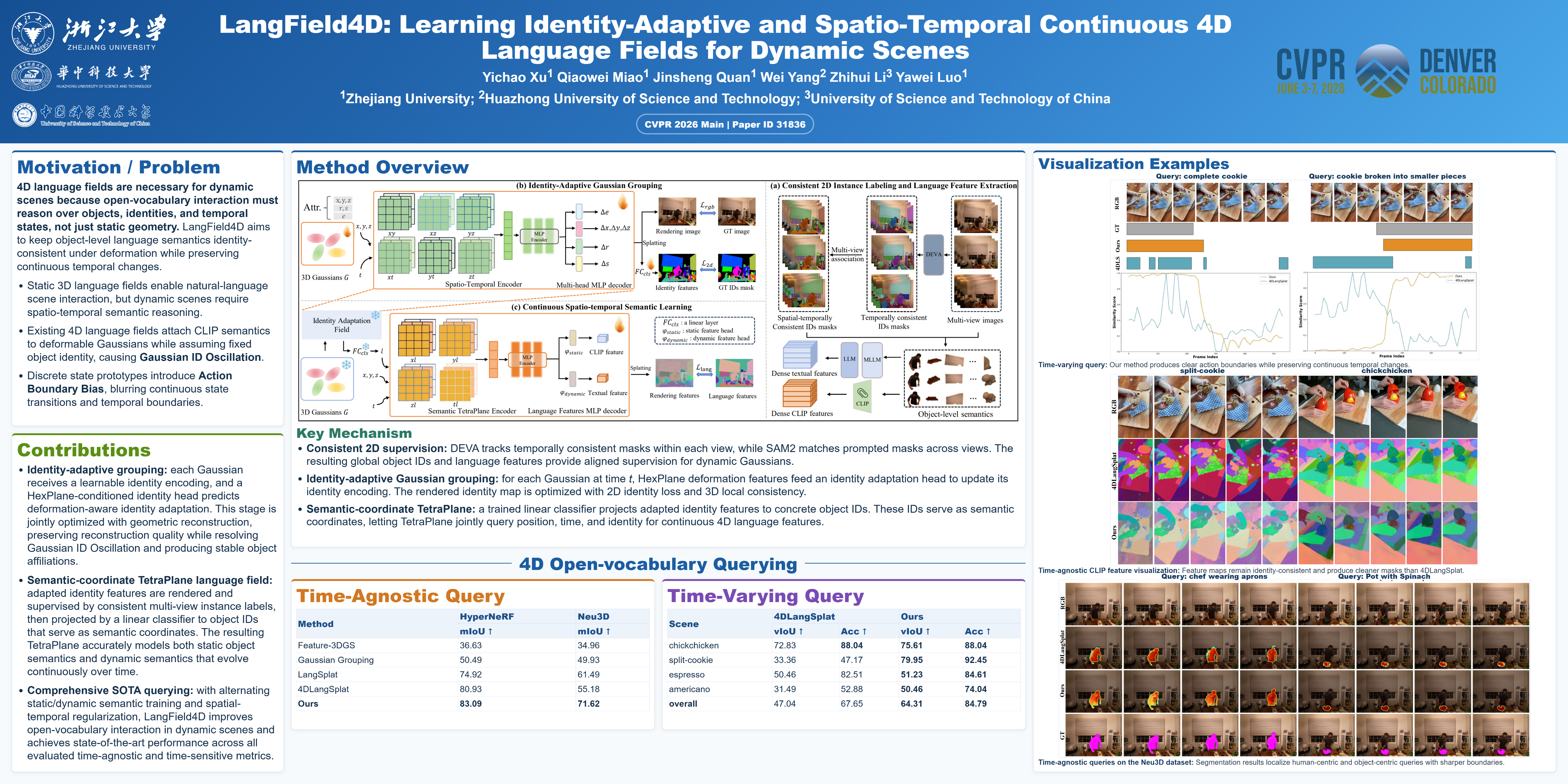
Constructing a 4D language field that supports open-vocabulary queries is essential for semantic perception and interaction in dynamic environments. Existing 4D Gaussian-based approaches face two major challenges. First, the assumption of a static identity per Gaussian leads to semantic inconsistency, as motion fields warp Gaussians across object boundaries over time, causing oscillating identity assignments. Second, current methods typically model dynamic semantics as a set of discrete, predefined state prototypes, which fail to capture dynamic continuity and delineate fine-grained temporal boundaries. To address these issues, we propose LangField4D, a novel 4D Gaussian framework that jointly models spatio-temporal identity and semantics in a unified and continuous representation. We introduce an Identity-Adaptive Gaussian Grouping module that assigns each Gaussian a learnable adaptation feature to dynamically capture its object affiliation, ensuring consistent semantic tracking across time. Building upon this affiliation structure, we further design a Continuous Spatio-Temporal Semantic Learning mechanism based on a Tetraplane representation, which encodes both time-invariant and time-varying semantics within a continuous latent space. Extensive experiments on dynamic scene benchmarks demonstrate that we achieve state-of-the-art performance on both time-agnostic and time-sensitive open-vocabulary query tasks.
Spatial-SSRL: Enhancing Spatial Understanding via Self-Supervised Reinforcement Learning
Yuhong Liu ⋅ Beichen Zhang ⋅ Yuhang Zang ⋅ Yuhang Cao ⋅ Long Xing ⋅ Xiaoyi Dong ⋅ Haodong Duan ⋅ Dahua Lin ⋅ Jiaqi Wang
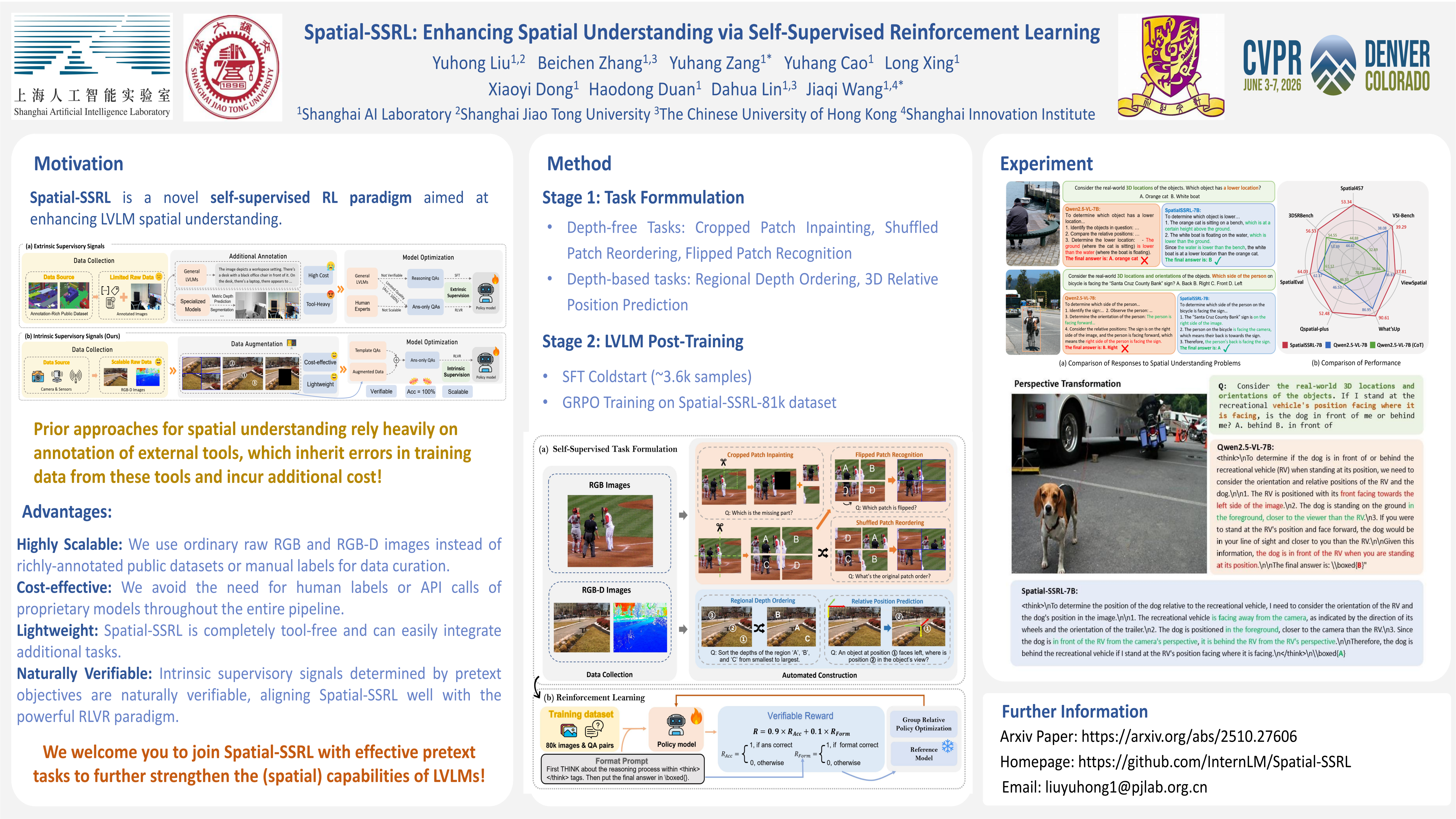
Spatial understanding remains a weakness of Large Vision-Language Models (LVLMs). Existing supervised fine-tuning (SFT) and recent reinforcement learning with verifiable rewards (RLVR) pipelines depend on costly supervision, specialized tools, or constrained environments that limit scale. We introduce Spatial-SSRL, a self-supervised RL paradigm that derives verifiable signals directly from ordinary RGB or RGB-D images. Spatial-SSRL automatically formulates five pretext tasks that capture 2D and 3D spatial structure: shuffled patch reordering, flipped patch recognition, cropped patch inpainting, regional depth ordering, and relative 3D position prediction. These tasks provide ground-truth answers that are easy to verify and require no human or LVLM annotation. Training on our tasks substantially improves spatial reasoning while preserving general visual capabilities. On seven spatial understanding benchmarks in both image and video settings, Spatial-SSRL delivers average accuracy gains of 4.63% (3B) and 3.89% (7B) over the Qwen2.5-VL baselines. Our results show that simple, intrinsic supervision enables RLVR at scale and provides a practical route to stronger spatial intelligence in LVLMs.
CLIPoint3D: Language-Grounded Few-Shot Unsupervised 3D Point Cloud Domain Adaptation
Mainak Singha ⋅ Sarthak Mehrotra ⋅ Paolo Casari ⋅ Subhasis Chaudhuri ⋅ Elisa Ricci ⋅ Biplab Banerjee
Recent vision-language models (VLMs) such as CLIP demonstrate impressive cross-modal reasoning, extending beyond images to 3D perception. Yet, these models remain fragile under domain shifts, especially when adapting from synthetic to real-world point clouds. Conventional 3D domain adaptation approaches rely on heavy trainable encoders, yielding strong accuracy but at the cost of efficiency. We introduce $\textbf{CLIPoint3D}$, the first framework for $\textit{few-shot unsupervised 3D point cloud domain adaptation}$ built upon CLIP. Our approach projects 3D samples into multiple depth maps and exploits the frozen CLIP backbone, refined through a knowledge-driven prompt tuning scheme that integrates high-level language priors with geometric cues from a lightweight 3D encoder. To adapt task-specific features effectively, we apply parameter-efficient fine-tuning to CLIP's encoders and design an entropy-guided view sampling strategy for selecting confident projections. Furthermore, an optimal transport-based alignment loss and an uncertainty-aware prototype alignment loss collaboratively bridge source-target distribution gaps while maintaining class separability. Extensive experiments on PointDA-10 and GraspNetPC-10 benchmarks show that $\textit{CLIPoint3D}$ achieves consistent $\textit{3-16}$% accuracy gains over both CLIP-based and conventional encoder-based baselines.
GeoTikzBridge: Advancing Multimodal Code Generation for Geometric Perception and Reasoning
Jiayin Sun ⋅ Caixia Sun ⋅ Boyu Yang ⋅ hailin li ⋅ Xiao Chen ⋅ Yi Zhang ⋅ Errui Ding ⋅ Liang Li ⋅ Chao Deng ⋅ Junlan Feng
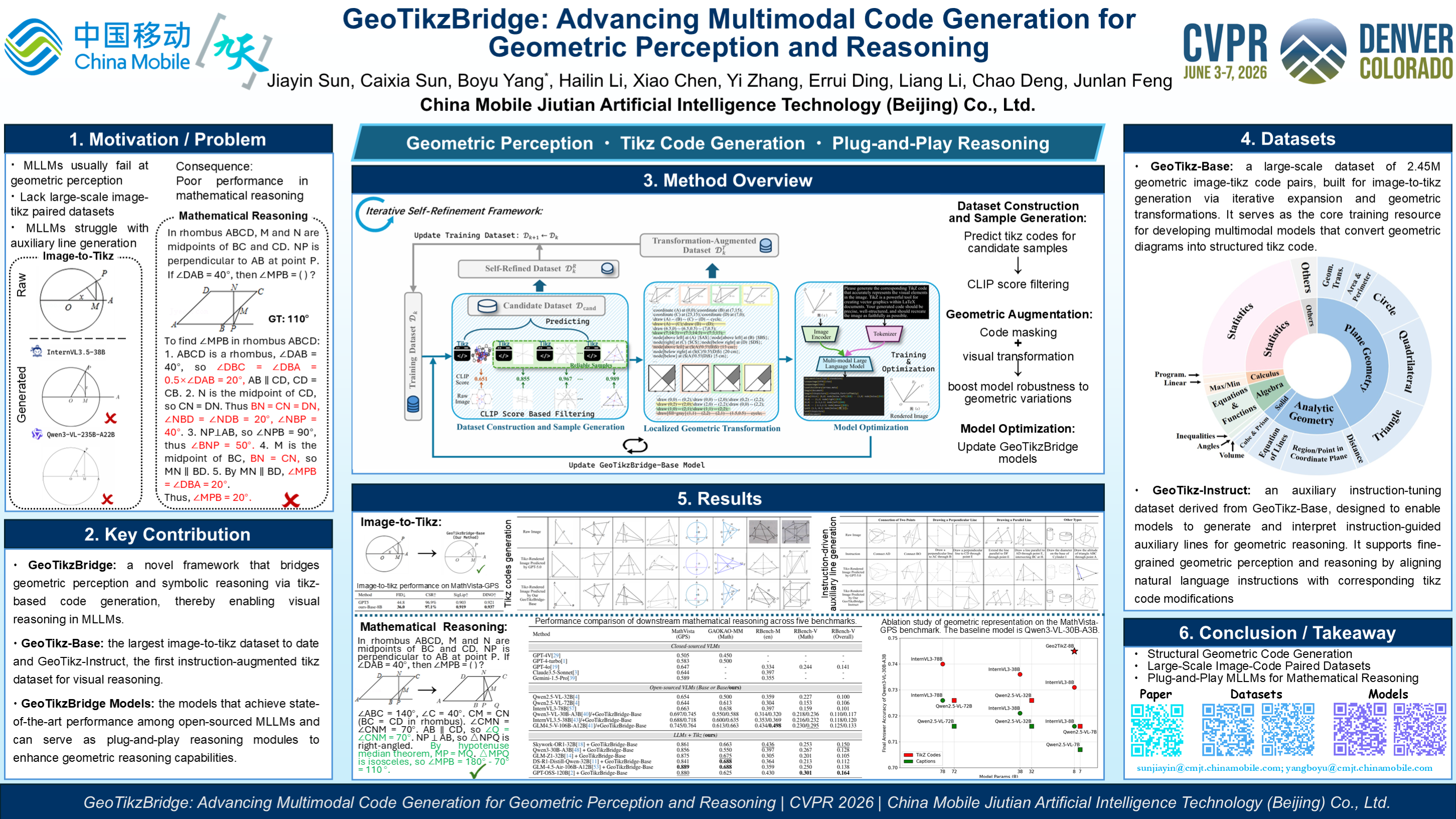
Multimodal Large Language Models (MLLMs) have recently demonstrated remarkable perceptual and reasoning abilities. However, they struggle to perceive fine-grained geometric structures, constraining their ability of geometric understanding and visual reasoning. To address this, we propose GeoTikzBridge, a framework that enhances local geometric perception and visual reasoning through tikz-based code generation. Within this framework, we build two models supported by two complementary datasets. The GeoTikzBridge-Base model is trained on GeoTikz-Base dataset, the largest image-to-tikz dataset to date with 2.5M pairs (16 $\times$ larger than existing open-sourced datasets). This process is achieved via iterative data expansion and a localized geometric transformation strategy. Subsequently, GeoTikzBridge-Instruct is fine-tuned on GeoTikz-Instruct dataset which is the first instruction-augmented tikz dataset supporting visual reasoning. Extensive experimental results demonstrate that our models achieve state-of-the-art performance among open-sourced MLLMs. Furthermore, GeoTikzBridge models can serve as plug-and-play reasoning modules for any MLLM(LLM), enhancing reasoning performance in geometric problem-solving.
Keep it SymPL: Symbolic Projective Layout for Allocentric Spatial Reasoning in Vision-Language Models
Jaeyun Jang ⋅ Seunghui Shin ⋅ Taeho Park ⋅ Hyoseok Hwang
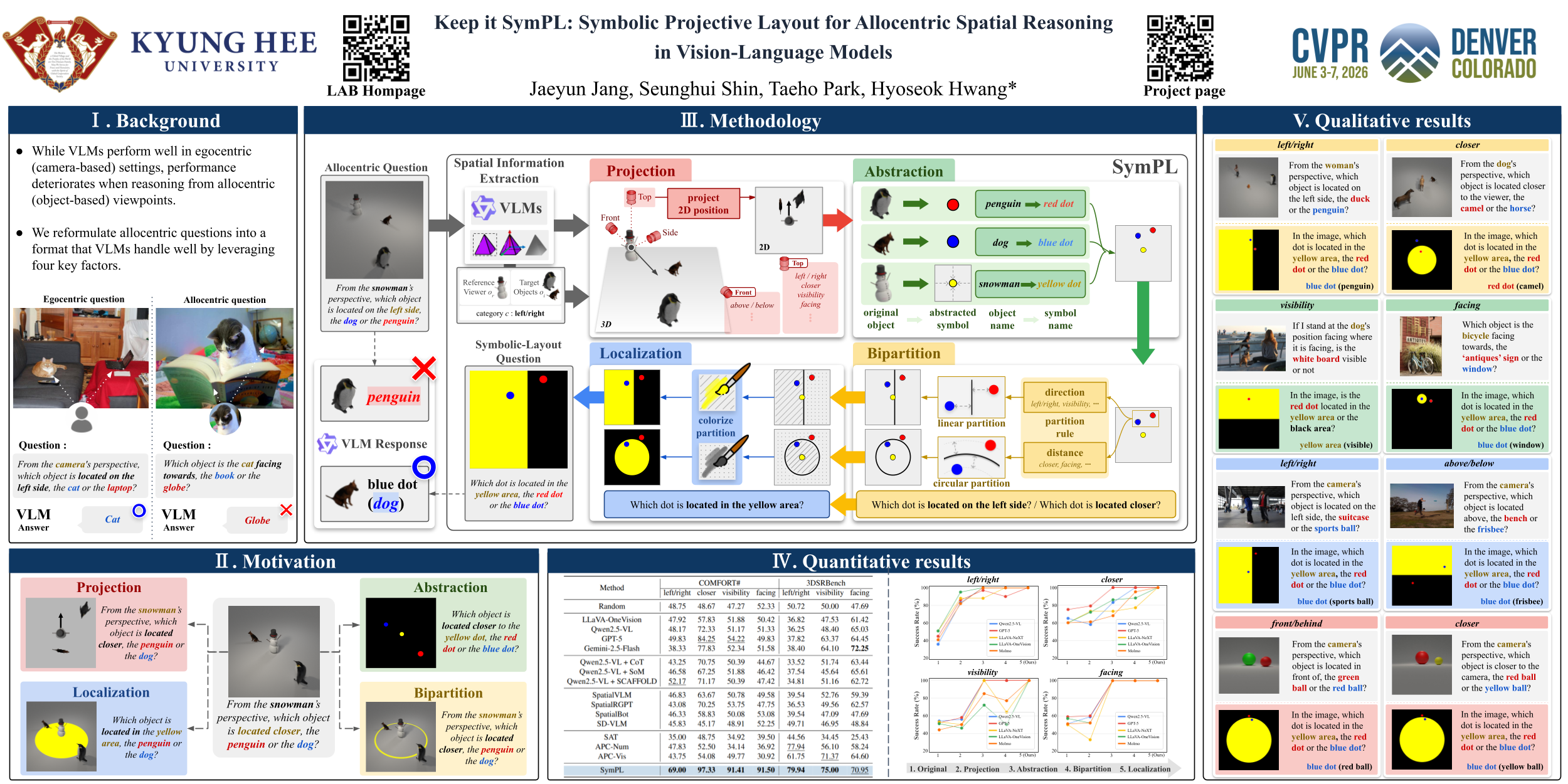
Perspective-aware spatial reasoning involves understanding spatial relationships from specific viewpoints—either egocentric (observer-centered) or allocentric (object-centered).While vision–language models (VLMs) perform well in egocentric settings, their performance deteriorates when reasoning from allocentric viewpoints, where spatial relations must be inferred from the perspective of objects within the scene.In this study, we address this underexplored challenge by introducing $\textbf{Sym}$bolic $\textbf{P}$rojective $\textbf{L}$ayout (SymPL), a framework that reformulates allocentric reasoning into symbolic-layout forms that VLMs inherently handle well.By leveraging four key factors—projection, abstraction, bipartition, and localization—SymPL converts allocentric questions into structured symbolic-layout representations.Extensive experiments demonstrate that this reformulation substantially improves performance in both allocentric and egocentric tasks, enhances robustness under visual illusions and multi-view scenarios, and that each component contributes critically to these gains.These results show that SymPL provides an effective and principled approach for addressing complex perspective-aware spatial reasoning.
Geometry-Guided 3D Visual Token Pruning for Video-Language Models
Han Li ⋅ Zehao Huang ⋅ Jiahui Fu ⋅ Naiyan Wang ⋅ Si Liu
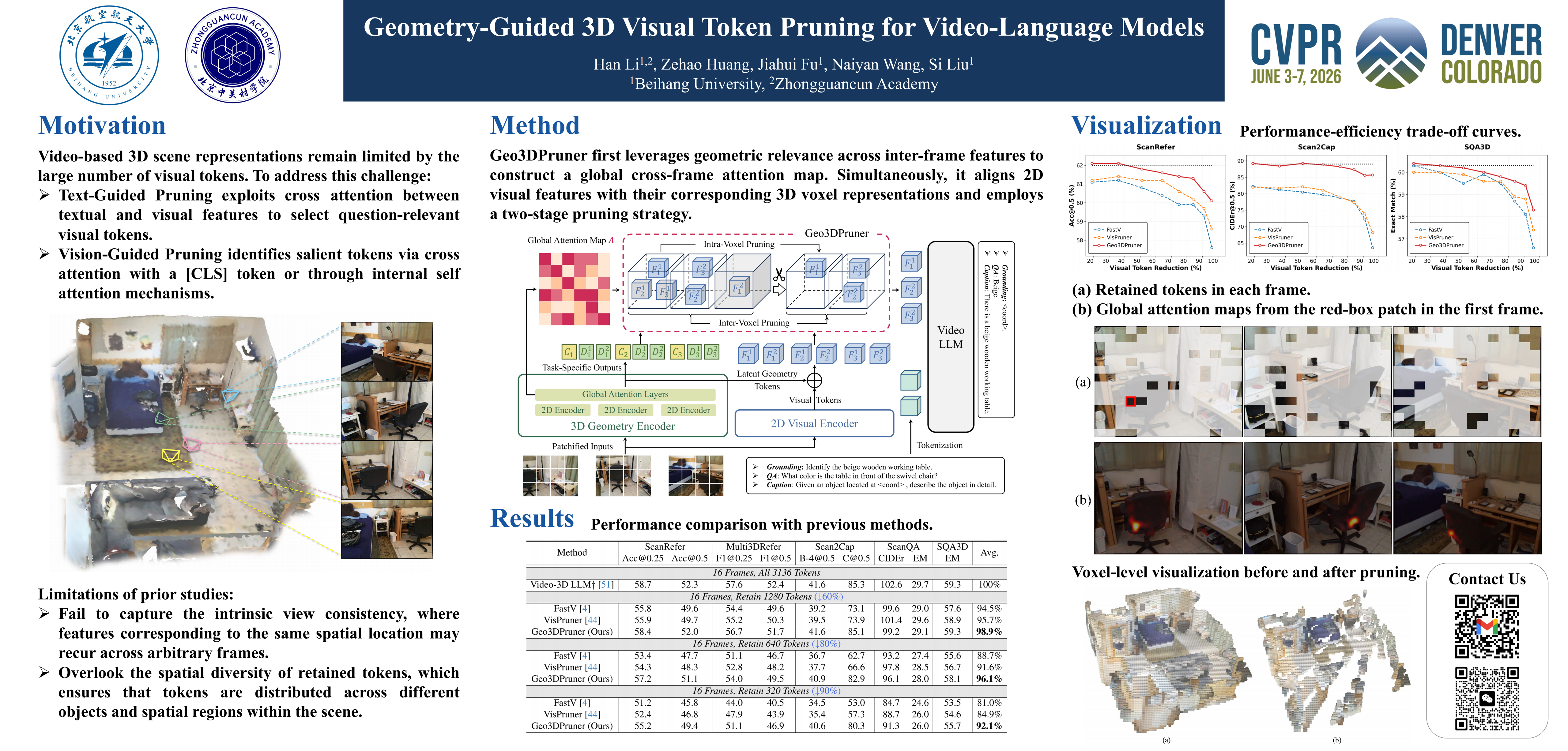
Multimodal large language models have demonstrated remarkable capabilities in 2D vision, motivating their extension to 3D scene understanding. Recent studies represent 3D scenes as 3D spatial videos composed of image sequences with depth and camera pose information, enabling pre-trained video-language models to perform 3D reasoning tasks. However, the large number of visual tokens in spatial videos remains a major bottleneck for efficient inference. Existing pruning methods overlook the view consistency of spatial videos and the spatial diversity of the remaining tokens, which prevents them from effectively removing inter-frame redundancy and preserving scene completeness. In this paper, we propose Geo3DPruner, a Geometry-Guided 3D Visual Token Pruning framework. Geo3DPruner first models cross-frame relevance through geometry-aware global attention, and then performs a two-stage pruning process. The intra-voxel stage selects representative multi-view features within each voxel, while the inter-voxel stage preserves spatial diversity by selecting a globally distributed subset of voxels. Extensive experiments on multiple 3D scene understanding benchmarks demonstrate that Geo3DPruner retains over 90% of the original performance while pruning 90% of visual tokens, significantly outperforming existing text-guided and vision-guided pruning methods.
Context-Nav: Context-Driven Exploration and Viewpoint-Aware 3D Spatial Reasoning for Instance Navigation
Won Shik Jang ⋅ Ue-Hwan Kim
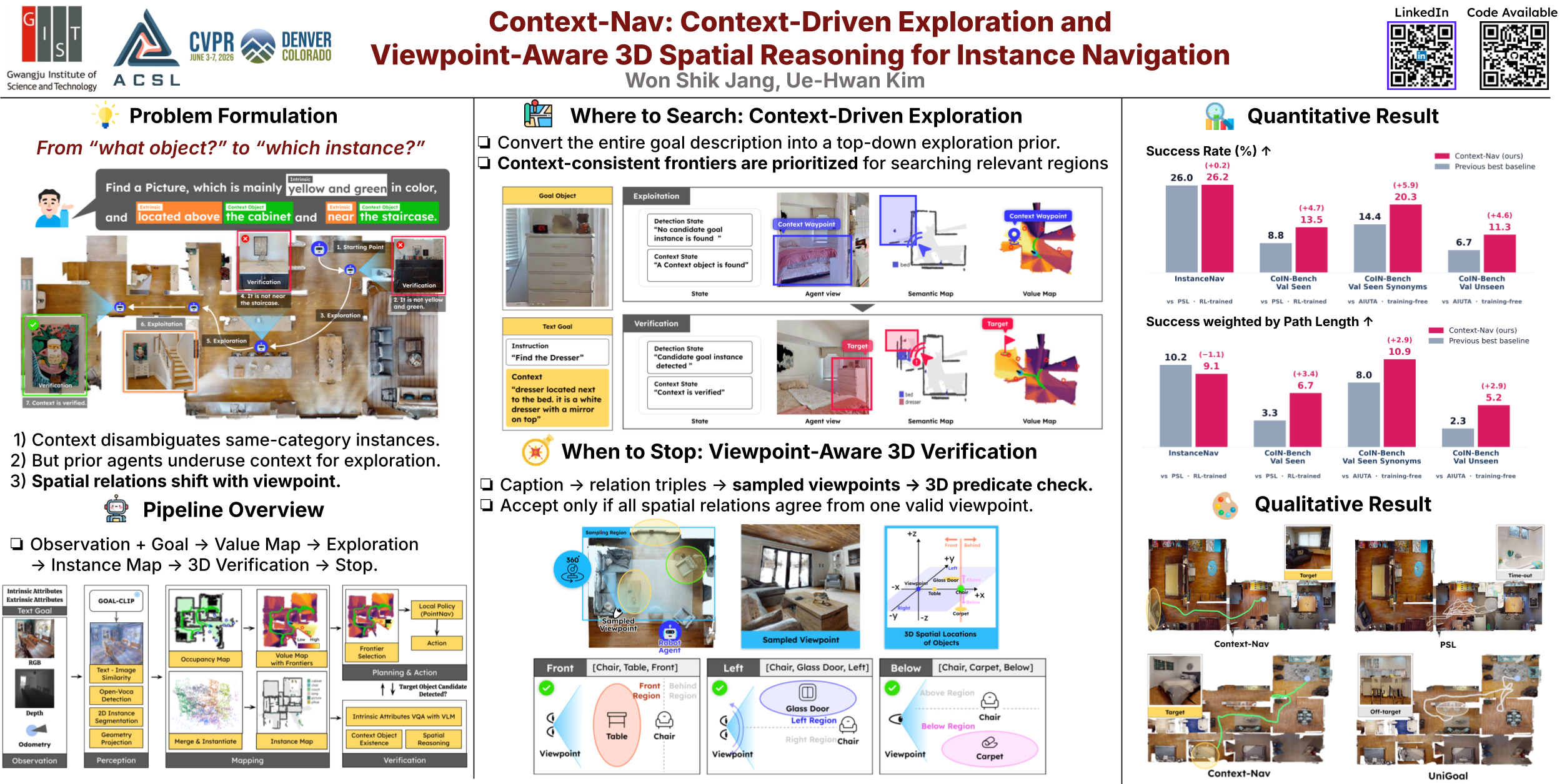
Text-goal instance navigation (TGIN) asks an agent to resolve a single, free-form description into actions that reach the correct object instance among same-category distractors. We present \textit{Context-Nav} that elevates long, contextual captions from a local matching cue to a global exploration prior and verifies candidates through 3D spatial reasoning. First, we compute dense text-image alignments for a value map that ranks frontiers---guiding exploration toward regions consistent with the entire description rather than early detections. Second, upon observing a candidate, we perform a viewpoint-aware relation check: the agent samples plausible observer poses, aligns local frames, and accepts a target only if the spatial relations can be satisfied from at least one viewpoint. The pipeline requires no task-specific training or finetuning; we attain state-of-the-art performance on InstanceNav and CoIN-Bench. Ablations show that (i) encoding full captions into the value map avoids wasted motion and (ii) explicit, viewpoint-aware 3D verification prevents semantically plausible but incorrect stops. This supports that geometry-grounded spatial reasoning is a scalable alternative to heavy policy training or human-in-the-loop interaction for fine-grained instance disambiguation in cluttered 3D scenes.
Learning to Reason in 4D: Dynamic Spatial Understanding for Vision Language Models
Shengchao Zhou ⋅ Yuxin Chen ⋅ Yuying Ge ⋅ Wei Huang ⋅ Jiehong Lin ⋅ Ying Shan ⋅ Xiaojuan Qi
Vision-language models (VLM) excel at general understanding yet remain weak at dynamic spatial reasoning (DSR), i.e., reasoning about the evolvement of object geometry and relationship in 3D space over time, largely due to the scarcity of scalable 4D-aware training resources. To bridge this gap across aspects of dataset, benchmark and model, we introduce DSR Suite. First, we propose an automated pipeline that generates multiple-choice question-answer pairs from in-the-wild videos for DSR. By leveraging modern vision foundation models, the pipeline extracts rich geometric and motion information, including camera poses, local point clouds, object masks, orientations, and 3D trajectories. These geometric cues enable the construction of DSR-Train for learning and further human-refined DSR-Bench for evaluation. Compared with previous works, our data emphasize (i) in-the-wild video sources, (ii) object- and scene-level 3D requirements, (iii) viewpoint transformations, (iv) multi-object interactions, and (v) fine-grained, procedural answers. Beyond data, we propose a lightweight Geometry Selection Module (GSM) to seamlessly integrate geometric priors into VLMs, which condenses question semantics and extracts question-relevant knowledge from pretrained 4D reconstruction priors into a compact set of geometry tokens. This targeted extraction avoids overwhelming the model with irrelevant knowledge. Experiments show that integrating DSR-Train and GSM into Qwen2.5-VL-7B significantly enhances its dynamic spatial reasoning capability, while maintaining accuracy on general video understanding benchmarks.
PanoEnv: Exploring 3D Spatial Intelligence in Panoramic Environments with Reinforcement Learning
Zekai Lin ⋅ Xu Zheng
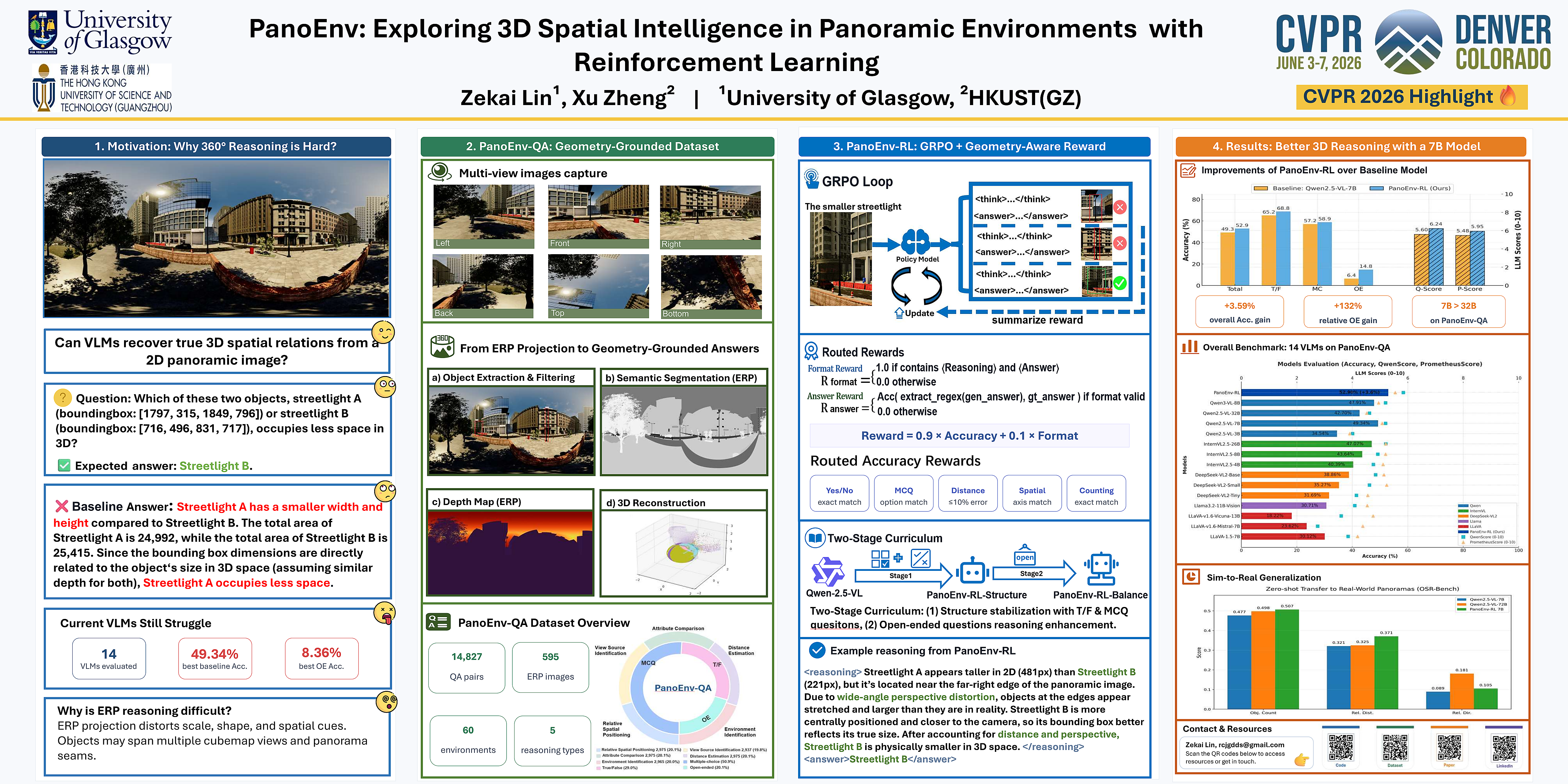
360° panoramic images are increasingly used in VR, autonomous driving, and robotics for holistic scene understanding. However, current Vision–Language Models (VLMs) struggle with 3D spatial reasoning on Equirectangular Projection (ERP) images due to geometric distortion and limited 3D supervision. We introduce \textbf{\textit{PanoEnv}}, a large-scale VQA benchmark built from synthetic 3D environments, containing 14.8K questions across five categories (e.g., relative position, volume comparison) grounded in accurate 3D annotations—depth, segmentation, and bounding boxes. Benchmarking 14 state-of-the-art VLMs reveals limited 3D understanding, achieving only 49.34\% overall and 8.36\% on open-ended (OE) questions. To enhance 3D reasoning, we propose a reinforcement learning post-training framework based on Group Relative Policy Optimization (GRPO) with a ground-truth-guided reward combining five geometry-aware strategies (e.g., distance tolerance, spatial consistency). A two-stage curriculum further mitigates catastrophic forgetting: Stage\~1 trains on structured tasks (T/F, MCQ), and Stage\~2 fine-tunes on mixed OE data for generalization. Our 7B model sets a new SoTA performance, improving total accuracy to 52.93\% (+3.59\%) and OE accuracy to 14.83\% while maintaining structured-task performance. It also achieves top semantic scores (Q-Score 6.24, P-Score 5.95), surpassing 32B models. These results demonstrate that PanoEnv-QA and our curriculum-based RL framework effectively instill 3D spatial intelligence in VLMs for omnidirectional perception.
Hilbert-Geo: Solving Solid Geometric Problems by Neural-Symbolic Reasoning
Ruoran Xu ⋅ Haoyu Cheng ⋅ Bin Dong ⋅ Qiufeng Wang
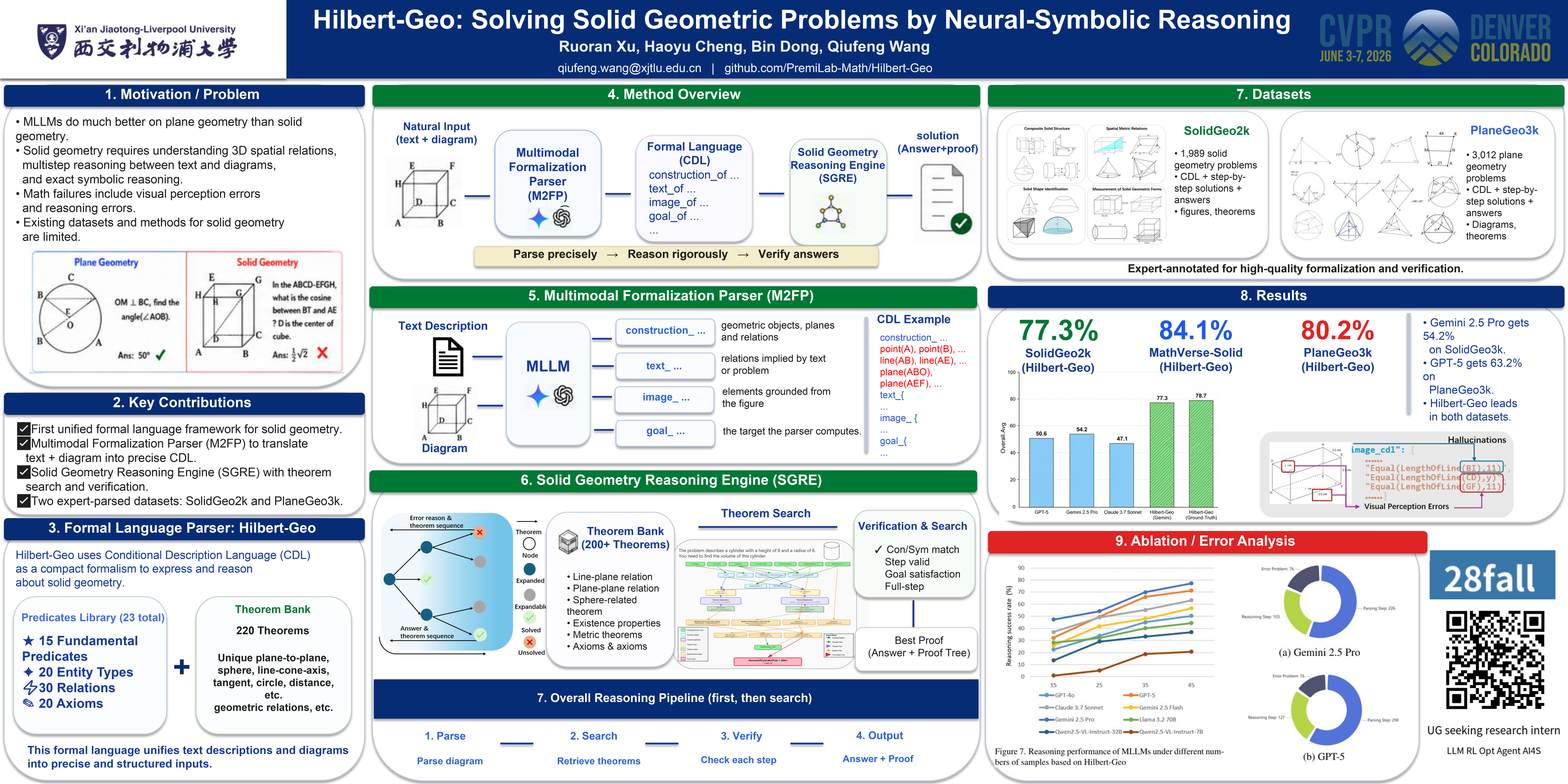
Geometric problem solving, as a typical multimodal reasoning problem, has attracted much attention and made great progress recently, however most of works focus on plane geometry while usually fail in solid geometry due to 3D spatial diagrams and complex reasoning. To bridge this gap, we introduce Hilbert-Geo, the first unified formal language framework for solid geometry, including an extensive predicate library and a dedicated theorem bank. Based on this framework, we propose a Parse2Reason method containing two steps of first parsing then reasoning. In the parsing step, we utilize conditional description language (CDL), a formalized language composed of predicates specifically designed to construct geometric conditions, to represent both problem description (natural text) and solid diagrams (visual image).In the reasoning step, we leverage those formal CDL and the theorem bank to perform relational inference and algebraic computation, generating strictly correct, verifiable, and human-readable reasoning processes.Notably, our proposed Hilbert-Geo is also applicable to plane geometry.To advance geometric reasoning, we curate two expert-annotated dataset SolidFGeo2k and PlaneFGeo3k, which are furnished with geometric formal language annotations, solutions and answers. Extensive experiments show that our proposed method achieves the state-of-the-art (SOTA) performance 77.3\% in SolidFGeo2k and 84.1\% in MathVerse-Solid (one small subset in MathVerse dedicated to solid geometry), substantially outperforming leading MLLMs, such as Gemini-2.5-pro (54.2\% on SolidFGeo2k) and GPT-5 (62.9\% on MathVerse-Solid). In addition, our method achieves the SOTA accuracy 80.2\% in PlaneFGeo3k, demonstrating the generality of the Hilbert-Geo in geometric reasoning. Our code and datasets will be publicly available.
Direction-aware 3D Large Multimodal Models
QUAN LIU ⋅ Weihao Xuan ⋅ Junjue Wang ⋅ Naoto Yokoya ⋅ Ling Shao ⋅ Shijian Lu
3D large multimodal models (3D LMMs) rely heavily on ego poses for enabling directional question-answering and spatial reasoning. However, most existing point cloud benchmarks contain rich directional queries but lack the corresponding ego poses, making them inherently ill-posed in 3D large multimodal modelling. In this work, we redefine a new and rigorous paradigm that enables direction-aware 3D LMMs by identifying and supplementing ego poses into point cloud benchmarks and transforming the corresponding point cloud data according to the identified ego poses. We enable direction-aware 3D LMM with two novel designs. The first is PoseRecover, a fully automatic pose recovery pipeline that matches questions with ego poses from RGB-D video extrinsics via object–frustum intersection and visibility check with Z-buffers. The second is PoseAlign that transforms the point cloud data to be aligned with the identified ego poses instead of either injecting ego poses into textual prompts or introducing pose-encoded features in the projection layers. Extensive experiments show that our designs yield consistent improvements across multiple 3D LMM backbones such as LL3DA, LL3DA-SONATA, Chat-Scene, and 3D-LLAVA, improving ScanRefer mIoU by 30.0% and Scan2Cap LLM-as-judge accuracy by 11.7%. In addition, our approach is simple, generic, and training-efficient, requiring only instruction tuning while establishing a strong baseline for direction-aware 3D-LMMs.
CLAY: Conditional Visual Similarity Modulation in Vision-Language Embedding Space
Sohwi Lim ⋅ Lee Hyoseok ⋅ Jungjoon Park ⋅ Tae-Hyun Oh
Human perception of visual similarity is inherently adaptive and subjective, depending on the users’ interests and focus. However, most image retrieval systems fail to reflect this flexibility, relying on a fixed, monolithic metric that cannot incorporate multiple conditions simultaneously. To address this, we propose CLAY, an adaptive similarity computation method that reframes the embedding space of pretrained Vision-Language Models (VLMs) as a text-conditional similarity space without additional training. This design separates the textual conditioning process and visual feature extraction, allowing highly efficient and multi-conditioned retrieval with fixed visual embeddings. We also construct a synthetic evaluation dataset CLAY-EVAL, for comprehensive assessment under diverse conditioned retrieval settings. Experiments on standard datasets and our proposed dataset show that CLAY achieves state-of-the art retrieval accuracy and notable computational efficiency compared to previous works.
Tackling Alignment Ambiguity in Person Retrieval through Conversational Attribute Mining
Hao Zou ⋅ Runqing Zhang ⋅ Jin Ding ⋅ xue zhou ⋅ Jianxiao Zou ⋅ Mingzhu Cai
Text-to-Image Person Retrieval (TIPR) aims to retrieve pedestrian images with a given natural-language description. It remains highly challenging due to the inherent ambiguity in cross-modal alignment: existing models often struggle to capture fine-grained correspondences, and their understanding of detailed pedestrian attributes is typically confined to partial or coarse cues, leading to mismatched or erroneous retrieval results.To overcome this challenge, we propose CECA, a Conversation-Enhanced Cross-modal Alignment framework. CECA strengthens the attribute correspondence between textual and visual modalities through multimodal large language models (MLLMs)-guided dialogue, enhances detailed cross-modal matching via a Bidirectional Correlation Matching (BCM) mechanism, and stabilizes optimization with a Confidence-Aware Weighting Loss (CAWL) that reduces the impact of low-quality conversational responses. Extensive experiments on three public benchmarks demonstrate the superior performance and strong generalization ability of our approach.
Beyond Global Similarity: Multi-Conditional Retrieval for Fine-Grained Cross-Modal Understanding
Xuan Lu ⋅ Kangle Li ⋅ Haohang Huang ⋅ Rui Meng ⋅ Wenjun Zeng ⋅ Xiaoyu Shen
Recent advances in multimodal large language models (MLLMs) have substantially expanded the capabilities of multimodal retrieval, enabling systems to align and retrieve information across visual and textual modalities. Yet, existing benchmarks largely focus on coarse-grained or single-condition alignment, overlooking real-world scenarios where user queries specify multiple interdependent constraints across modalities.To bridge this gap, we introduce MCMR (Multi-Conditional Multimodal Retrieval)—a large-scale benchmark designed to evaluate fine-grained, multi-condition retrieval under natural-language queries. MCMR spans five product domains—upper and bottom clothing, jewelry, shoes, and furniture—and preserves rich long-form metadata essential for compositional matching. Each query integrates complementary visual and textual attributes, requiring models to jointly satisfy all specified conditions for relevance.We benchmark a diverse suite of MLLM-based multimodal retrievers and vision–language rerankers to assess their condition-aware reasoning abilities. Experimental results reveal: (i) distinct modality asymmetries across models; (ii) visual cues dominate early-rank precision, while textual metadata stabilizes long-tail ordering; and (iii) MLLM-based pointwise rerankers markedly improve fine-grained matching by explicitly verifying query–candidate consistency.Overall, MCMR establishes a challenging and diagnostic benchmark for advancing multimodal retrieval toward compositional, constraint-aware, and interpretable understanding.
Imagine Before Concentration: Diffusion-Guided Registers Enhance Partially Relevant Video Retrieval
Jun Li ⋅ Xuhang Lou ⋅ Jinpeng Wang ⋅ Yuting Wang ⋅ Yaowei Wang ⋅ Shu-Tao Xia ⋅ Bin Chen
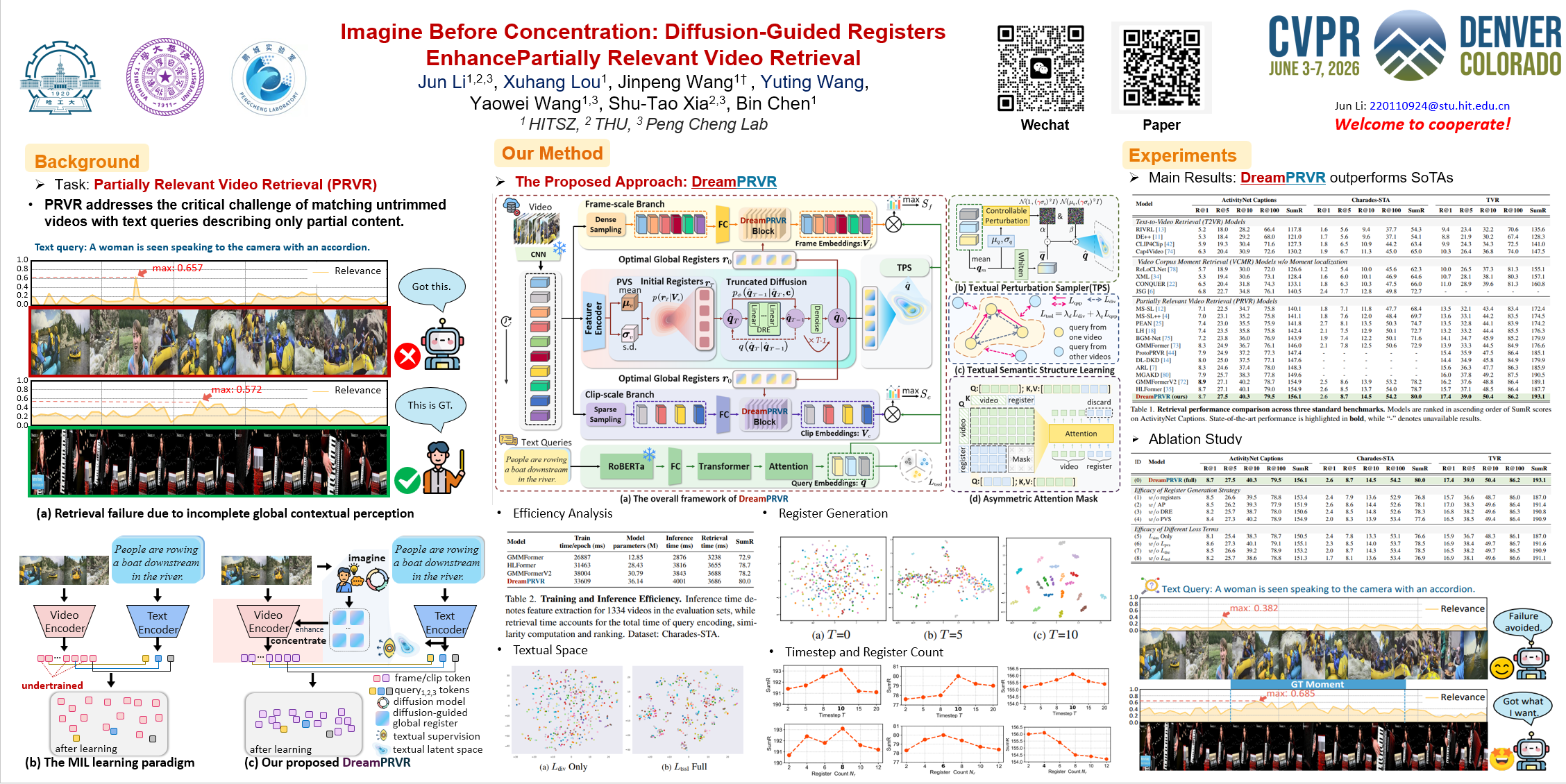
Partially Relevant Video Retrieval (PRVR) aims to retrieve untrimmed videos based on text queries that describe only partial events. Existing methods suffer from incomplete global contextual perception, struggling with query ambiguity and local noise induced by spurious responses.To address these challenges, we propose DreamPRVR, which adopts a coarse-to-fine representation learning paradigm. The model first generates global contextual semantic registers as coarse-grained highlights spanning the entire video and then concentrates on fine-grained similarity optimization for precise cross-modal matching.Concretely, these registers are generated by initializing from the video-centric distribution produced by a probabilistic variational sampler and then iteratively refined via a text-supervised truncated diffusion model. During this process, textual semantic structure learning constructs a well-formed textual latent space, enhancing the reliability of global perturbation. The refined registers are then adaptively fused with video tokens through register-augmented Gaussian attention blocks, enabling context-aware feature learning.Extensive experiments show that DreamPRVR outperforms state-of-the-art methods. The code will be released publicly.
What Is the Optimal Ranking Score Between Precision and Recall? We Can Always Find It and It Is Rarely F1
Sébastien Piérard ⋅ Adrien Deliege ⋅ Marc Van Droogenbroeck
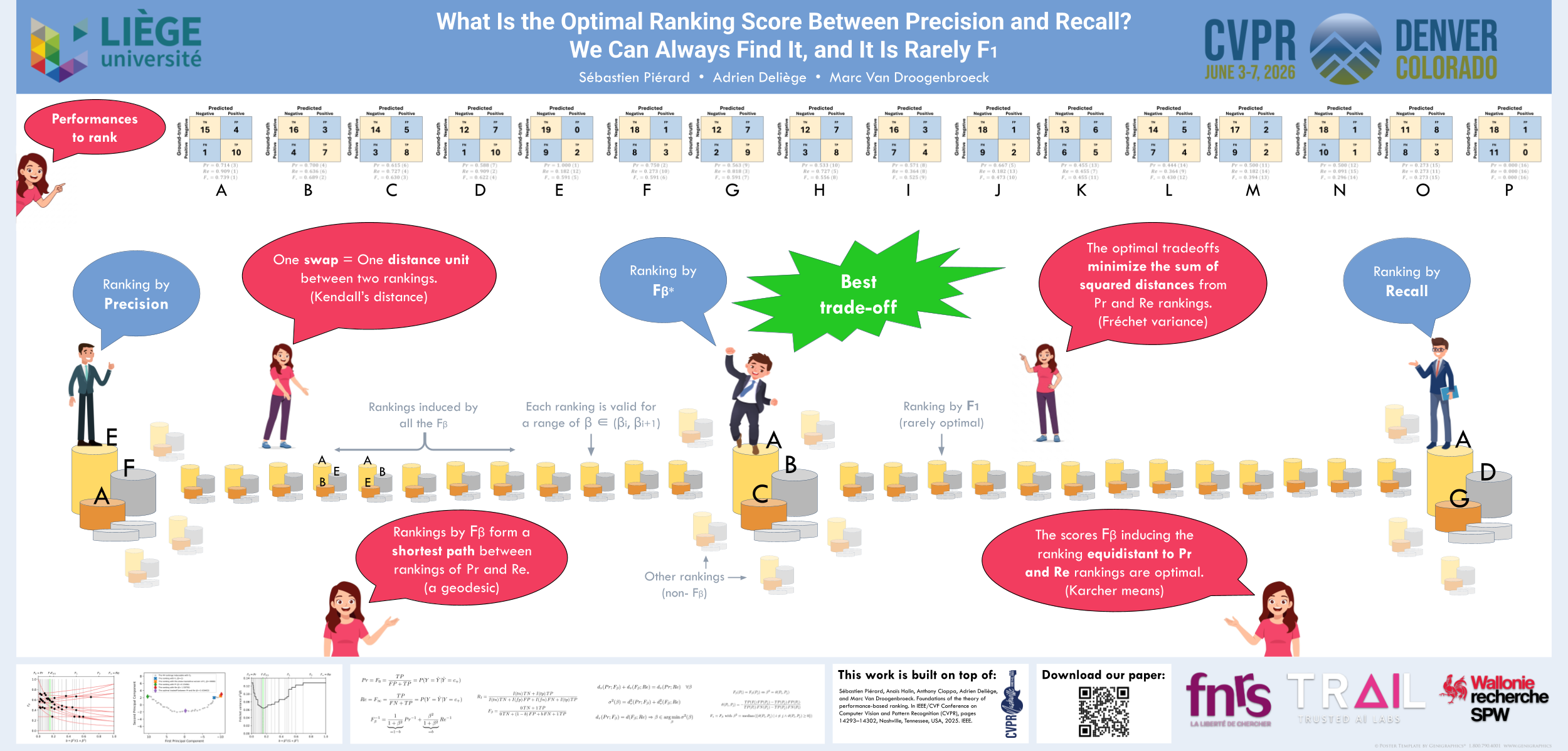
Ranking methods or models based on their performance is of prime importance but is tricky because performance is fundamentally multidimensional. In the case of classification, precision and recall are scores with probabilistic interpretations that are both important to consider and complementary. The rankings induced by these two scores are often in partial contradiction. In practice, therefore, it is extremely useful to establish a compromise between the two views to obtain a single, global ranking. Over the last fifty years or so, it has been proposed to take a weighted harmonic mean, known as the F-score, F-measure, or $F_\beta$. Generally speaking, by averaging basic scores, we obtain a score that is intermediate in terms of values. However, there is no guarantee that these scores lead to meaningful rankings and no guarantee that the rankings are good tradeoffs between these base scores. Given the ubiquity of $F_\beta$ scores in the literature, some clarification is in order. Concretely: (1) We establish that $F_\beta$-induced rankings are meaningful and define a shortest path between precision- and recall-induced rankings. (2) We frame the problem of finding a tradeoff between two scores as an optimization problem expressed with Kendall rank correlations. We show that $F_1$ and its skew-insensitive version are far from being optimal in that regard. (3) We provide theoretical tools and a closed-form expression to find the optimal value for $\beta$ for any distribution or set of performances, and we illustrate their use on six case studies.
Robust Remote Sensing Image–Text Retrieval with Noisy Correspondence
qiya song ⋅ Yiqiang Xie ⋅ Yuan Sun ⋅ Renwei Dian ⋅ Xudong Kang
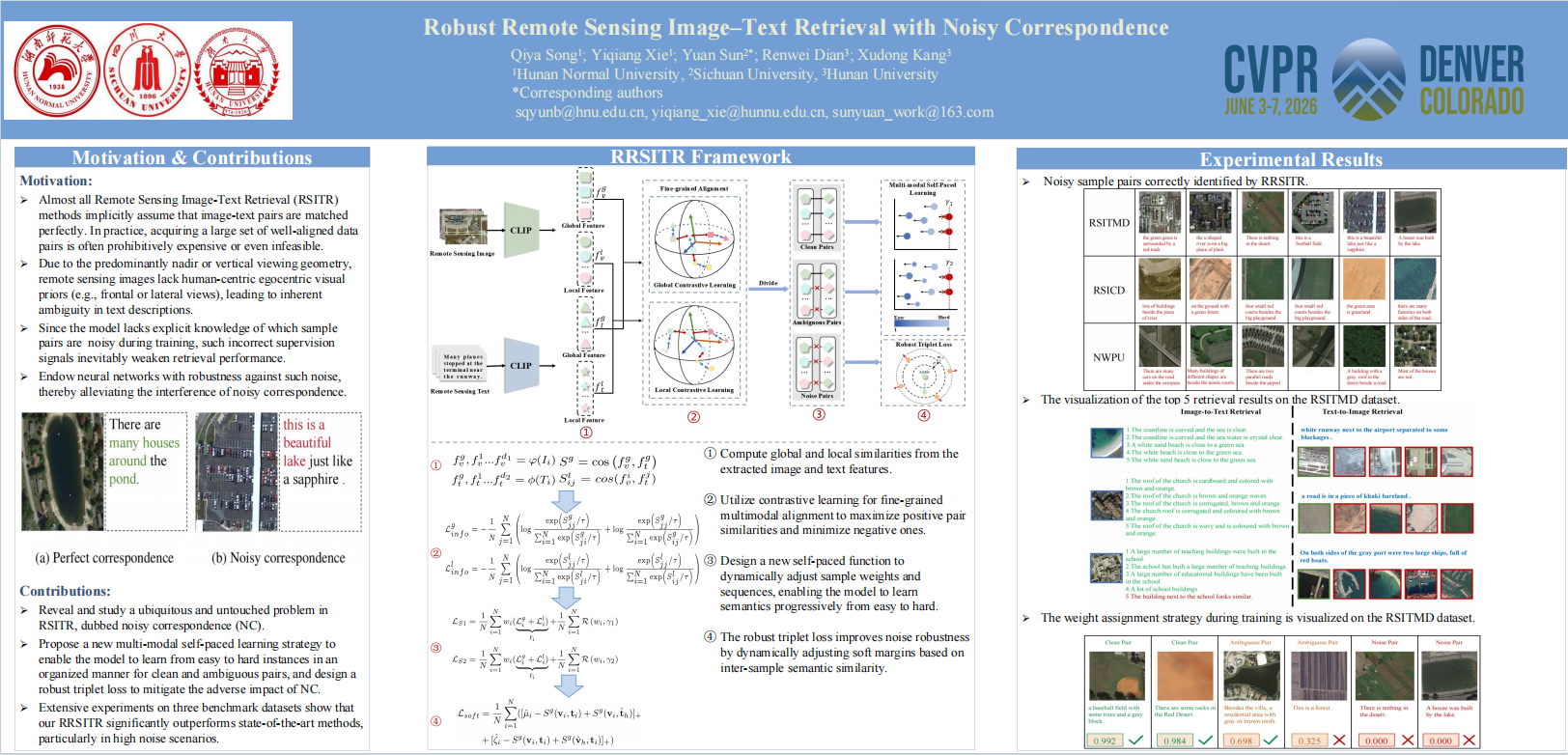
As a pivotal task that bridges remote visual and linguistic understanding, Remote Sensing Image-Text Retrieval (RSITR) has attracted considerable research interest in recent years. However, almost all RSITR methods implicitly assume that image-text pairs are matched perfectly. In practice, acquiring a large set of well-aligned data pairs is often prohibitively expensive or even infeasible. Although several studies have acknowledged the presence of noisy pairs, little work has explored how to endow neural networks with robustness against such noise. Based on the above observations, we reveal an important but untouched problem in RSITR, i.e., Noisy Correspondence (NC). To overcome these challenges, we propose a novel Robust Remote Sensing Image–Text Retrieval (RRSITR) paradigm that designs a self-paced learning strategy to mimic human cognitive learning patterns, thereby learning from easy to hard from multi-modal data with NC. Specifically, we first divide all training sample pairs into three categories based on the loss magnitude of each pair, i.e., clean sample pairs, ambiguous sample pairs, and noisy sample pairs. Then, we respectively estimate the reliability of each training pair by assigning a weight to each pair based on the values of the loss. Further, we respectively design a new self-paced function to dynamically regulate the training sequence and weights of the samples, thus establishing a progressive learning process. Finally, for noisy sample pairs, we present an enhanced triplet loss to dynamically adjust the soft margin based on semantic similarity, thereby enhancing the robustness against noise. Extensive experiments on three popular benchmark datasets demonstrate that the proposed RRSITR significantly outperforms the state-of-the-art methods, especially in high noise rates.
PinPoint: Evaluation of Composed Image Retrieval with Explicit Negatives, Multi-Image Queries, and Paraphrase Testing
Rohan Mahadev ⋅ Joyce Yuan ⋅ Patrick Poirson ⋅ David Xue ⋅ Hao-Yu Wu ⋅ Dmitry Kislyuk
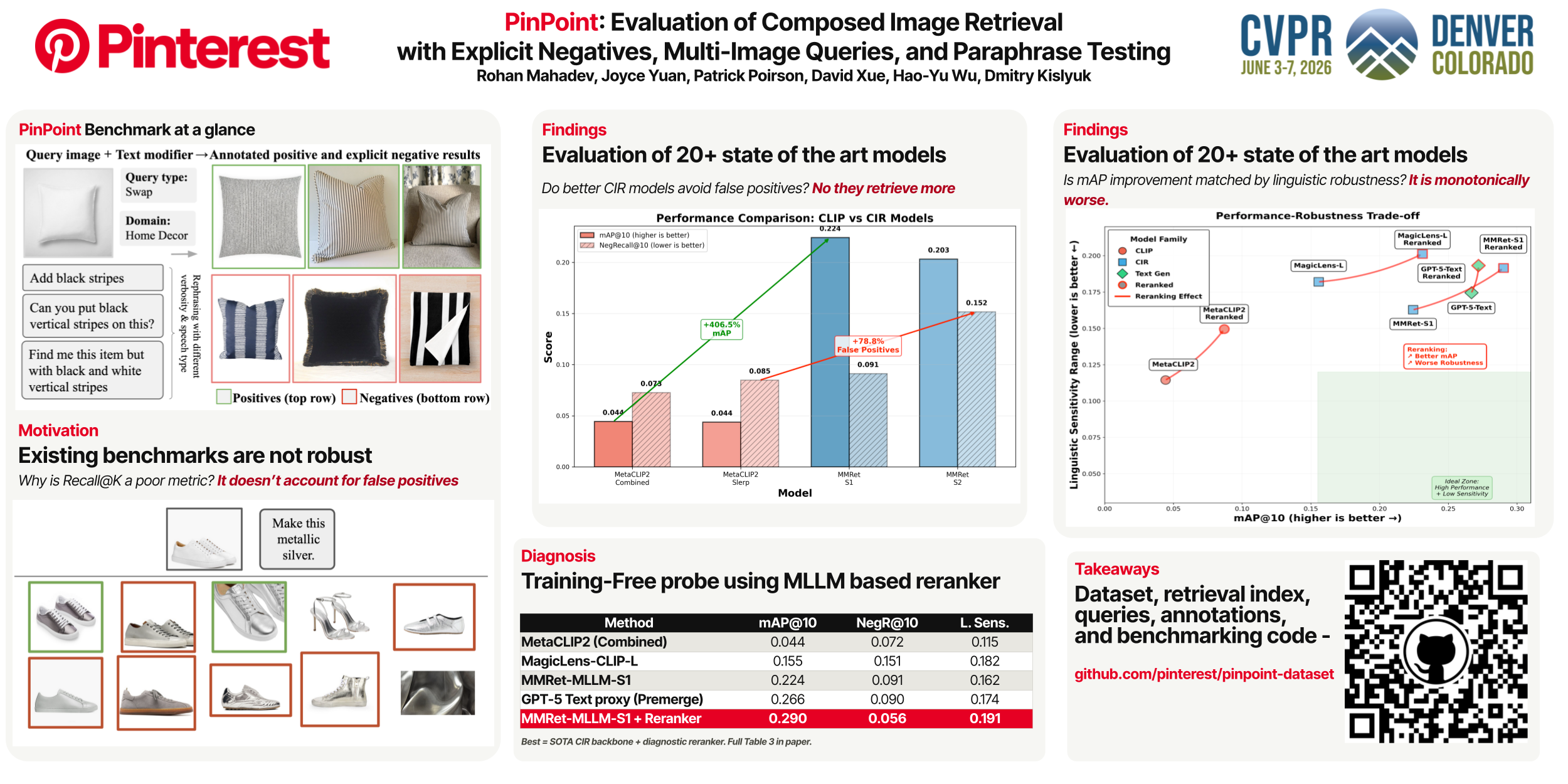
Composed Image Retrieval (CIR) has made significant progress, yet current benchmarks are limited to single ground-truth answers and lack the annotations needed to evaluate false positive avoidance, robustness and multi-image reasoning. We present \textbf{PinPoint}, a comprehensive real world benchmark with 7,846 queries and 329K relevance judgments across 23 query categories. PinPoint advances the field by providing: (1) multiple correct answers (averaging 9.1 per query) (2) explicit hard negatives, (3) six instruction paraphrases per query for robustness testing, (4) multi-image composition support (13.4\% of queries), and (5) demographic metadata for fairness evaluation. Based on our analysis of 20+ methods across 4 different major paradigms, we uncover three significant drawbacks: The best methods while achieving mAP@10 of 28.5\%, still retrieves irrelevant results (hard negatives) 9\% of the time. The best models also exhibit 25.1\% performance variation across paraphrases, indicating significant potential for enhancing current CIR techniques. Multi-image queries performs 40 to 70\% worse across different methods. To overcome these new issues uncovered by our evaluation framework, we propose a training-free reranking method based on an off-the-shelf MLLM that can be applied to any existing system to bridge the gap. We release the complete dataset, including all images, queries, annotations, retrieval index, and benchmarking code.
Single-step Diffusion-based Video Coding with Semantic-Temporal Guidance
Naifu Xue ⋅ Zhaoyang Jia ⋅ Jiahao Li ⋅ Bin Li ⋅ Zihan Zheng ⋅ Yuan Zhang ⋅ Yan Lu
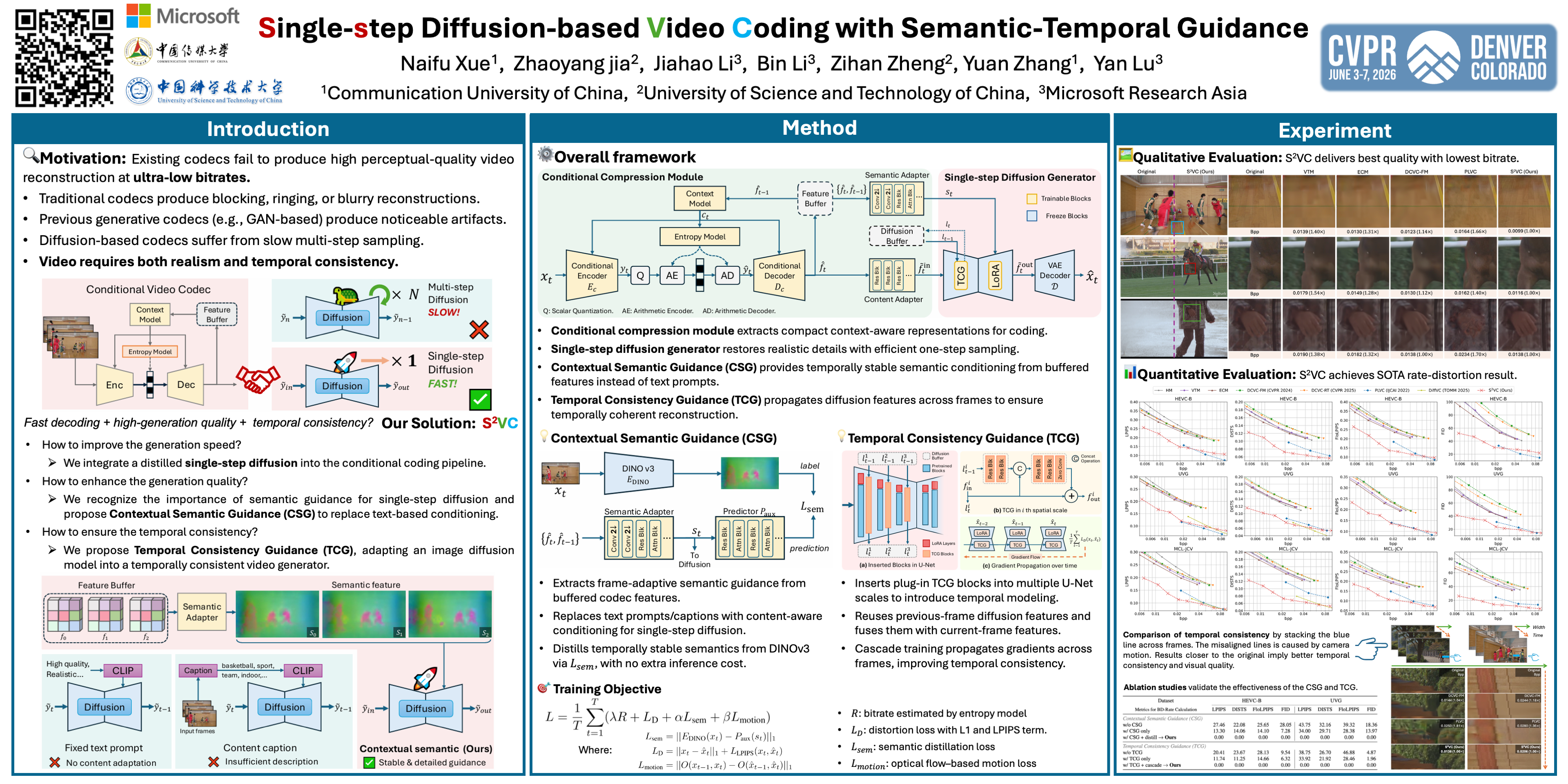
While traditional and neural video codecs (NVCs) have achieved remarkable rate–distortion performance, improving perceptual quality at low bitrates remains challenging. Some NVCs incorporate perceptual or adversarial objectives but still suffer from artifacts due to limited generation capacity, whereas others leverage pretrained diffusion models to improve quality at the cost of heavy sampling complexity. To overcome these challenges, we propose S$^2$VC, a Single-Step diffusion–based Video Codec that integrates a conditional coding framework with an efficient single-step diffusion generator, enabling realistic reconstruction at low bitrates with reduced sampling cost. Recognizing the importance of semantic conditioning in single-step diffusion, we introduce Contextual Semantic Guidance to extract frame-adaptive semantics from buffered features. It replaces text captions with efficient, fine-grained conditioning, thereby improving generation realism. In addition, Temporal Consistency Guidance is incorporated into the diffusion U-Net to enforce temporal coherence across frames and ensure stable generation. Extensive experiments show that S$^2$VC delivers state-of-the-art perceptual quality with an average 52.73% bitrate saving over prior perceptual methods, underscoring the promise of single-step diffusion for efficient, high-quality video compression.
Memory Matters: Boosting Training-Free Zero-Shot Temporal Action Localization with a Learnable Lookup Table
Han Jiang ⋅ Haoyu Tang ⋅ Xiaoxuan Mu ⋅ Chen Li ⋅ Jihua Zhu
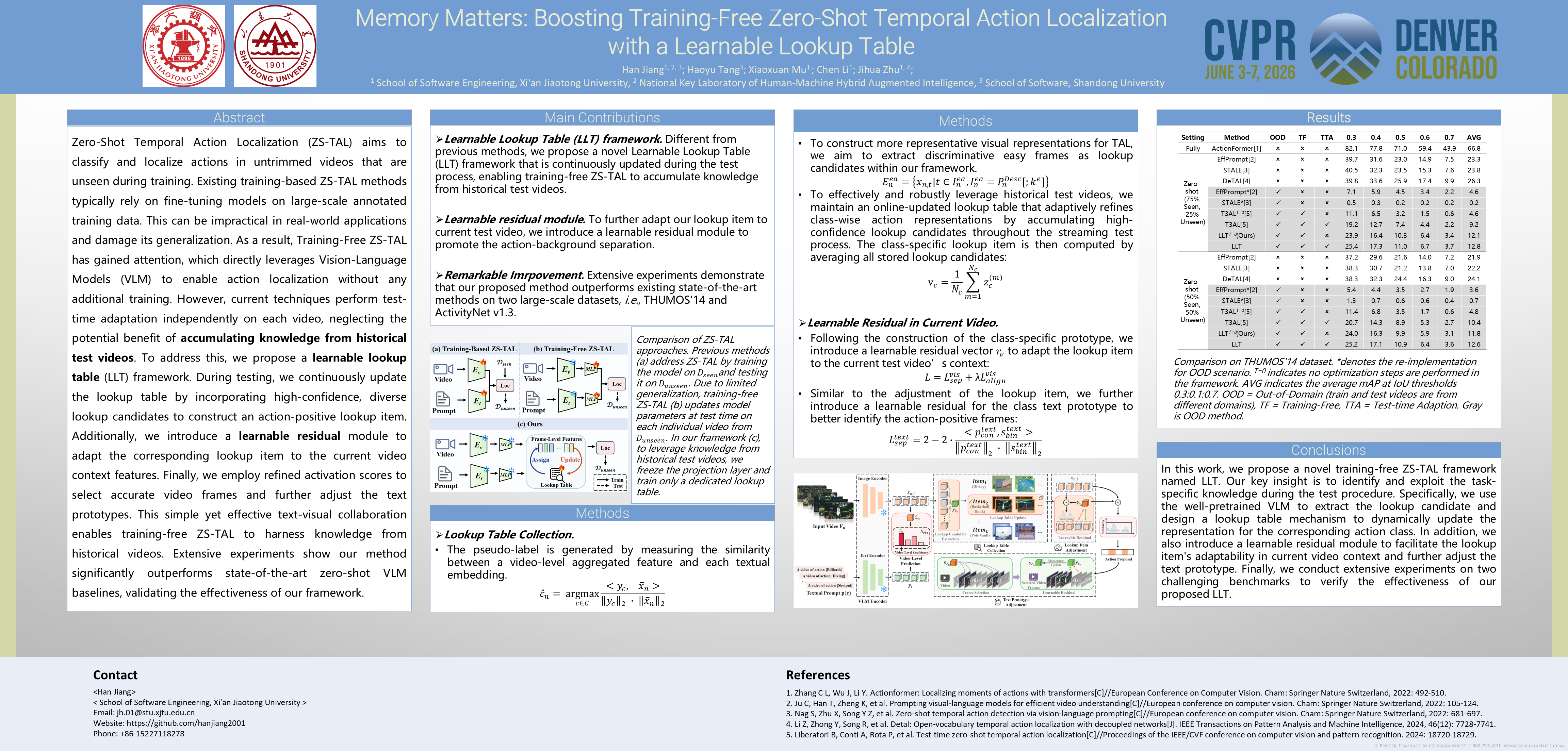
Zero-Shot Temporal Action Localization (ZS-TAL) aims to classify and localize actions in untrimmed videos that are unseen during training. Existing training-based ZS-TAL methods typically rely on fine-tuning models on large-scale annotated training data. This can be impractical in real-world applications and damage its generalization. As a result, Training-Free ZS-TAL has gained attention, which directly leveraging Vision-Language Models (VLM) enables action localization without any additional training. However, current techniques perform test-time adaptation independently on each video, neglecting the potential benefit of accumulating knowledge from historical test videos. To address this, we propose a learnable lookup table (LLT) framework. During testing, we continuously update lookup table by incorporating high-confidence, diverse lookup candidates to construct action-positive lookup item. Additionally, we introduce a learnable residual module to adapt the corresponding lookup item to the current video context features. Finally, we employ refined activation scores to select accurate video frames and further adjust the text prototypes. This simple yet effective text-visual collaboration enables training-free ZS-TAL to harness historical videos. Extensive experiments show our method significantly outperforms state-of-the-art zero-shot VLM baselines, validating the effectiveness of our framework.
TVHighlights: LLM-Guided Human-Free Collaborative Training for Video Highlight Detection in Movies and TV Dramas
Qi Qiu ⋅ Xuan Wu ⋅ Jiawei Peng ⋅ Yuan Miao ⋅ Xu Yang ⋅ Yanlong Du
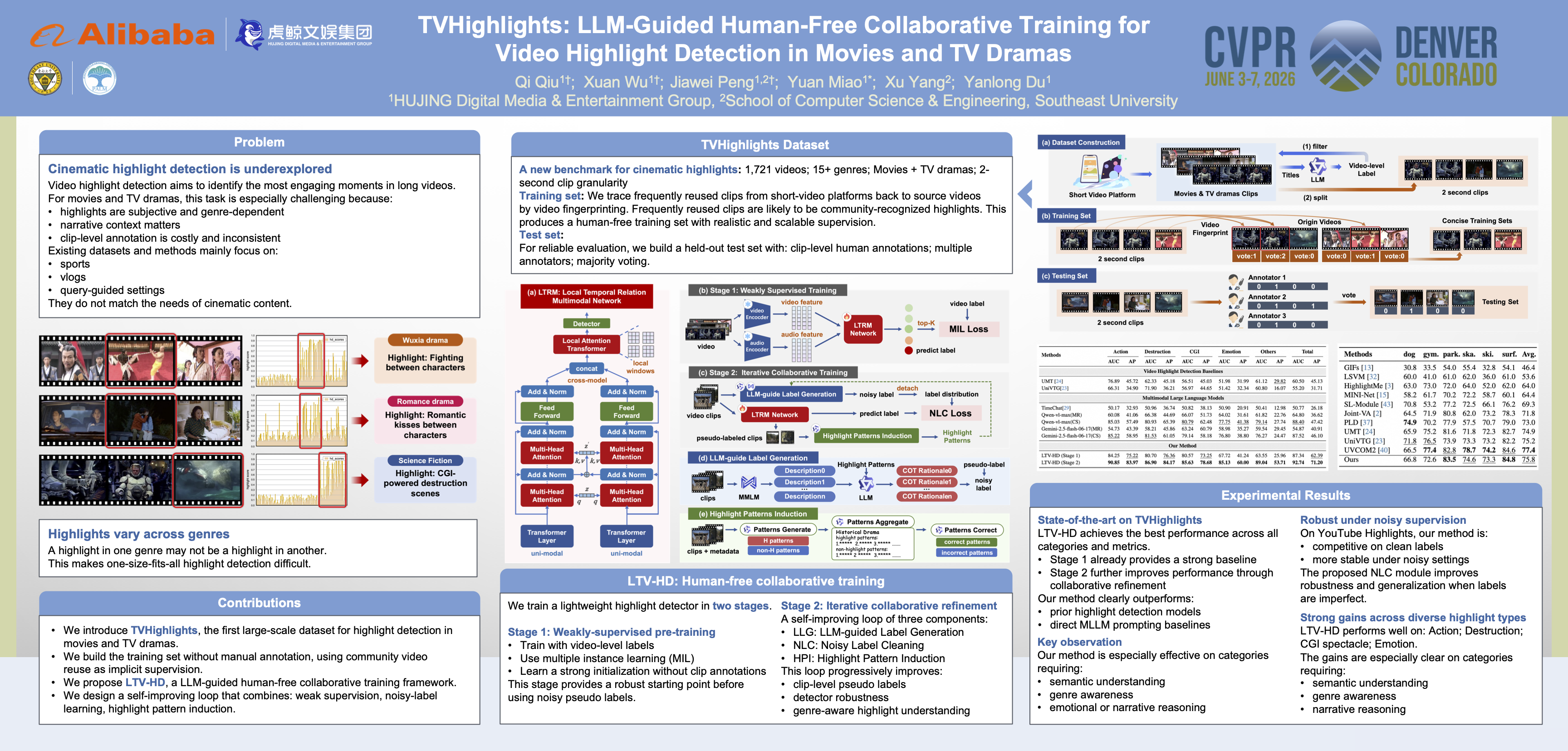
Video highlight detection aims to identify the most engaging segments in long-form videos, supporting content editing and recommendation, especially for movies and TV dramas. However, existing methods are ill-suited to cinematic content due to its narrative complexity, while the scarcity of annotated data and the high cost of manual labeling further hinder progress. To bridge this gap, we introduce TVHighlights, the first large-scale dataset tailored for video highlight detection in movies and TV dramas, with 1,721 carefully curated videos covering diverse genres. Built on community-driven behaviors, it provides realistic and diverse annotations without human labeling. Based on TVHighlights, we propose LTV-HD: a LLM-guided, human-free collaborative training framework for video highlight detection in cinematic content. LTV-HD operates in two stages: (1) weakly supervised pre-training of a lightweight model using video-level labels, followed by (2) iterative refinement through collaboration between large language models (LLMs) and the lightweight model. LLMs generate noisy clip-level pseudo-labels, which the lightweight model learns from under a noise-robust strategy, and its high-confidence predictions are then fed back to guide the LLM in distilling genre-specific highlight patterns through a self-improving loop. Experiments demonstrate that LTV-HD achieves state-of-the-art performance on TVHighlights, validating its effectiveness in real-world, annotation-free scenarios.
Color When It Counts: Grayscale-Guided Online Triggering for Always-On Streaming Video Sensing
Weitong Cai ⋅ Hang Zhang ⋅ Yukai Huang ⋅ Shitong Sun ⋅ Jiankang Deng ⋅ Songcen Xu ⋅ Jifei Song ⋅ Zhensong Zhang
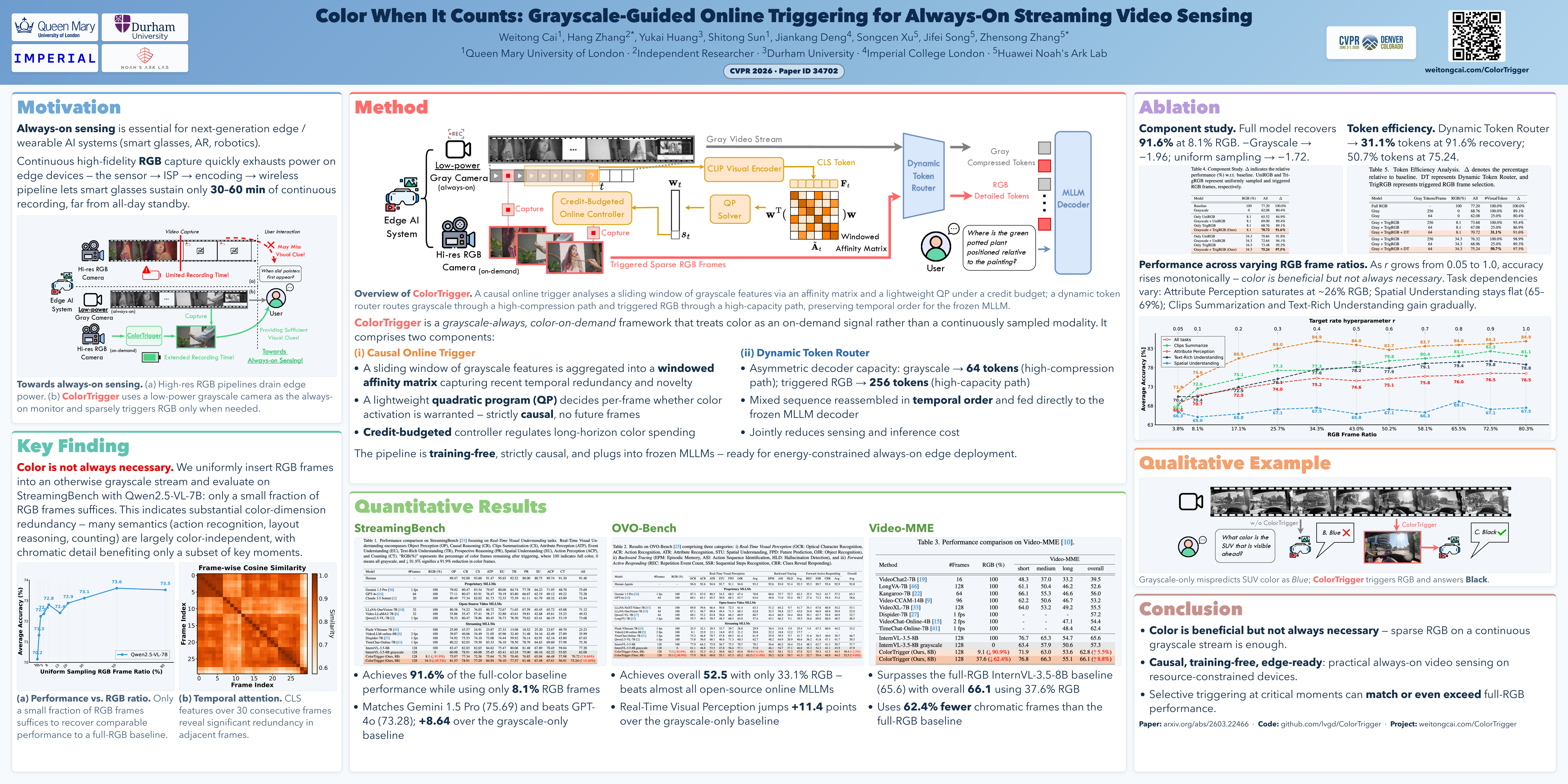
Always-on sensing is essential for next-generation edge/wearable AI systems, yet continuous high-fidelity RGB video capture remains prohibitively expensive for resource-constrained mobile and edge platforms. We present a new paradigm for efficient streaming video understanding: grayscale-always, color-on-demand. Through preliminary studies, we discover that color is not always necessary. Sparse RGB frames suffice for comparable performance when temporal structure is preserved via continuous grayscale streams. Building on this insight, we propose ColorTrigger, an online training-free trigger that selectively activates color capture based on windowed grayscale affinity analysis. Designed for real-time edge deployment, ColorTrigger uses lightweight quadratic programming to detect chromatic redundancy causally, coupled with credit-budgeted control and dynamic token routing to jointly reduce sensing and inference costs. On streaming video understanding benchmarks, ColorTrigger achieves 91.6% of full-color baseline performance while using only 8.1% RGB frames, demonstrating substantial color redundancy in natural videos and enabling practical always-on video sensing on resource-constrained devices.
Reinforcing Structured Chain-of-Thought for Video Understanding
Peiyao Wang ⋅ Haotian Xu ⋅ Noranart Vesdapunt ⋅ Rui Hou ⋅ Jingyi Zhang ⋅ Haibin Ling ⋅ Oleksandr Obiednikov ⋅ Ning Zhou ⋅ Kah Fu Fu
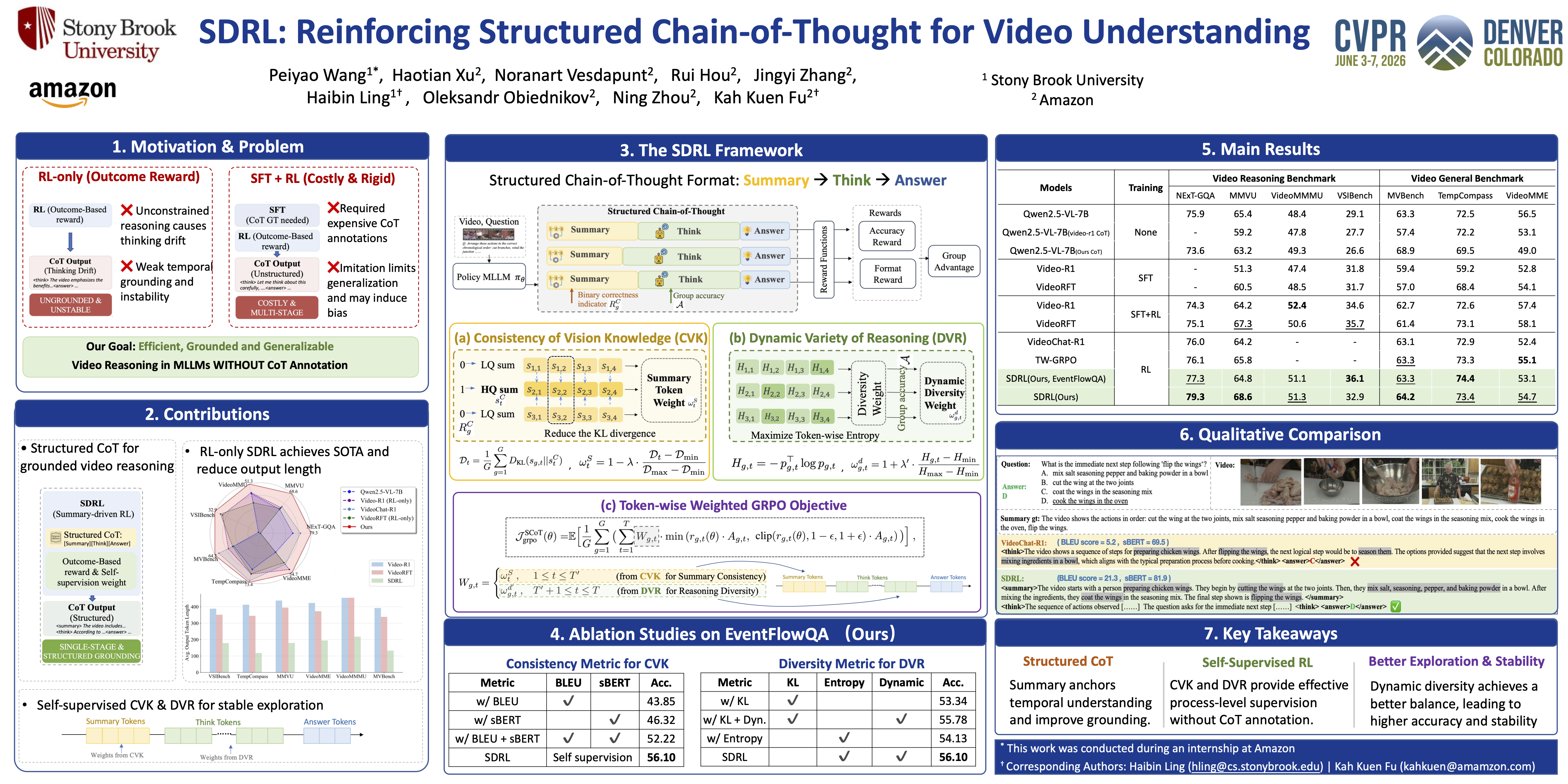
Multi-modal Large Language Models (MLLMs) show promise in video understanding. However, their reasoning often suffers from thinking drift and weak temporal comprehension, even when enhanced by Reinforcement Learning (RL) techniques like Group Relative Policy Optimization (GRPO). Moreover, existing RL methods often depend on Supervised Fine-Tuning (SFT), which requires costly Chain-of-Thought (CoT) annotation and multi-stage training, and enforces fixed reasoning paths, limiting MLLM’s ability to generalize and potentially inducing bias. To overcome these limitations, we introduce Summary-Driven Reinforcement Learning (SDRL), a novel single-stage RL framework that obviates the need for SFT by utilizing a Structured CoT format: Summarize →Think →Answer. SDRL introduces two self-supervised mechanisms integrated into GRPO objective: 1) Consistency of Vision Knowledge (CVK) enforces factual grounding by reducing KL divergence among generated summaries; and 2) Dynamic Variety of Reasoning (DVR) promotes exploration by dynamically modulating thinking diversity based on group accuracy. This novel integration effectively balances alignment and exploration, supervising both the final answer and the reasoning process. Our method achieves state-of-the-art performance on seven public VideoQA datasets. Additionally, we construct and will release an 80K VideoQA dataset with temporal annotations.
FlexiVideo: Variation-Aware Temporal Dynamics Modeling for Efficient Video Understanding
Da Peng ⋅ Xuesong Yang ⋅ Zonghao Guo ⋅ Yichen Zhang ⋅ Chi Chen ⋅ Yidan Zhang ⋅ Yuan Yao ⋅ Fang Wan ⋅ Wei Ke ⋅ Maosong Sun
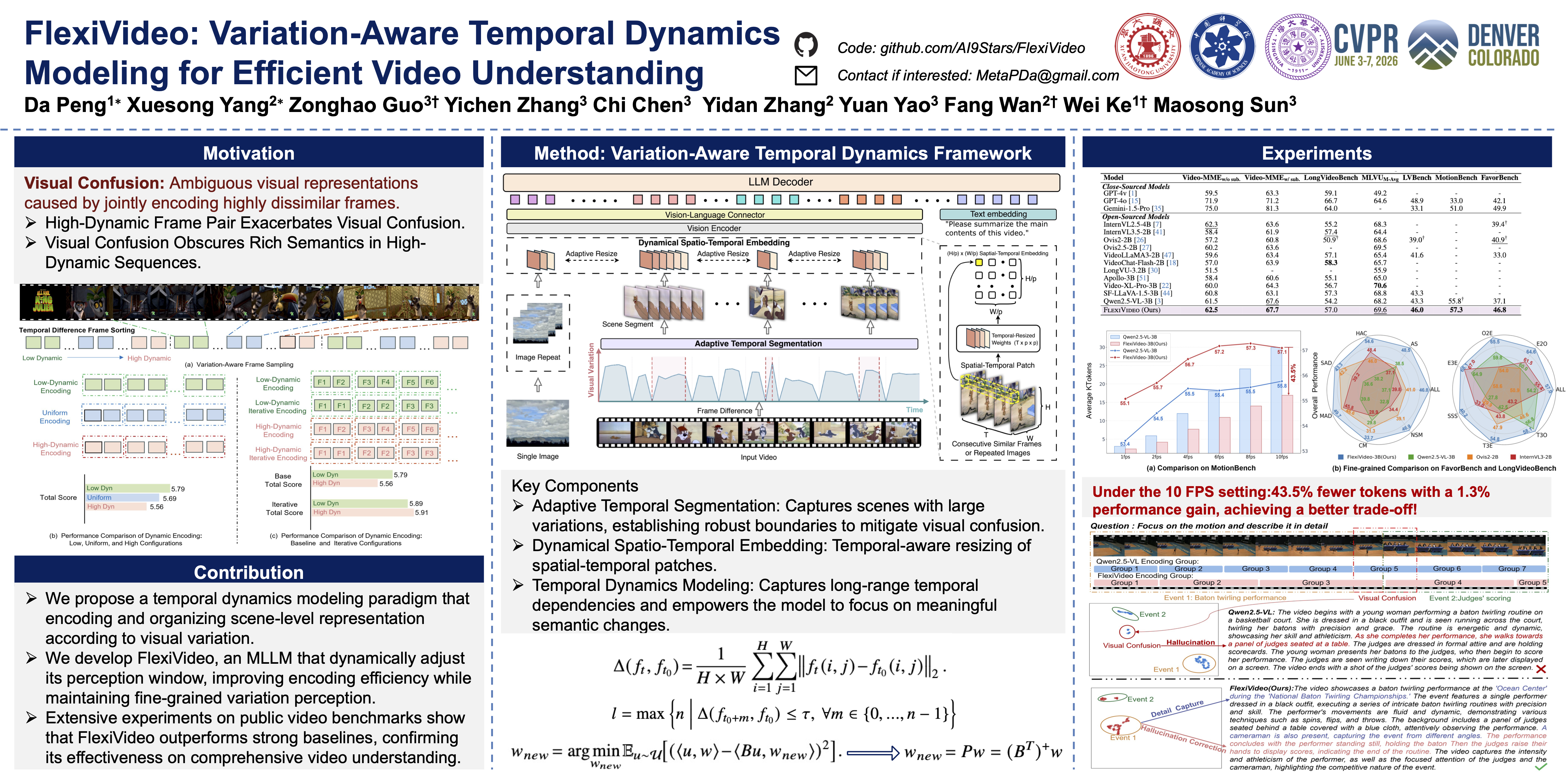
Natural videos exhibit heterogeneous temporal dynamics, with certain segments undergoing high-dynamic scene transitions and others dominated by low-dynamic visual changes. However, treating all frames identically, a common practice in most MLLMs, leads to redundant visual encoding, which results in significant computational overhead. The recent state-of-the-art model, i.e., Qwen2.5-VL, adopts a fixed two-frame encoding scheme, but our pilot experiments indicate that it encounters a visual confusion problem under high-dynamic frame pairs. To address this issue, we propose FlexiVideo, an efficient MLLM that models temporal dynamics leveraging visual variation. FlexiVideo first employs an adaptive temporal segmentation module to estimate inter-frame differences, grouping consecutive frames into scene segments with subtle visual changes. Subsequently, a dynamical spatio-temporal embedding module adjusts the temporal window for scene-level encoding. By restructuring scene-level visual representations within a structured temporal organization, our approach models dynamics more effectively and reduces the encoding burden while preserving fine-grained visual variations. Extensive experiments show that FlexiVideo-3B consistently outperforms Qwen2.5-VL-3B across 6 general video benchmarks. Notably, when evaluated on MotionBench at 10 FPS, FlexiVideo-3B reduces visual tokens by 43.5% compared with Qwen2.5-VL-3B while achieving a 1.3% performance gain, striking a significantly better balance between efficiency and effectiveness. Code and checkpoints will be released soon.
MS-Temba: Multi-Scale Temporal Mamba for Understanding Long Untrimmed Videos
Arkaprava Sinha ⋅ Monish Soundar Raj ⋅ Pu Wang ⋅ Ahmed Helmy ⋅ Hieu Le ⋅ Srijan Das
Temporal Action Detection (TAD) in untrimmed videos poses significant challenges, particularly for Activities of Daily Living (ADL) requiring models to (1) process long-duration videos, (2) capture temporal variations in actions, and (3) simultaneously detect dense overlapping actions. Existing CNN and Transformer-based approaches, struggle to jointly capture fine-grained detail and long-range structure at scale. State-space Model (SSM) based Mamba offers powerful long-range modeling, but naive application to TAD collapses fine-grained temporal structure and fails to account for the challenges inherent to TAD. To this end, we propose Multi-Scale Temporal Mamba (MS-Temba), which extends Mamba to TAD with newly introduced dilated SSMs. Each Temba block, comprising dilated SSMs coupled with our proposed additional losses, enables the learning of discriminative representations across temporal scales. A lightweight Multi-scale Mamba Fuser then unifies these multi-scale features via SSM-based aggregation, yielding precise action-boundary localization. With only 17M parameters, MS-Temba achieves state-of-the-art performance on densely labeled ADL benchmarks TSU & Charades, and further generalizes to long-form video summarization, setting new state-of-the-art results on TVSum & SumMe.
Learning Effective Sign Features without Text for Gloss-free Sign Language Translation
Shiwei Gan ⋅ Xiao Liu ⋅ Yafeng Yin ⋅ Nan Liu ⋅ Kuizhuang Liu ⋅ Desibieer Tuerdaken ⋅ Zhiwei Jiang ⋅ Lei Xie ⋅ Sanglu Lu ⋅ Hongkai Wen
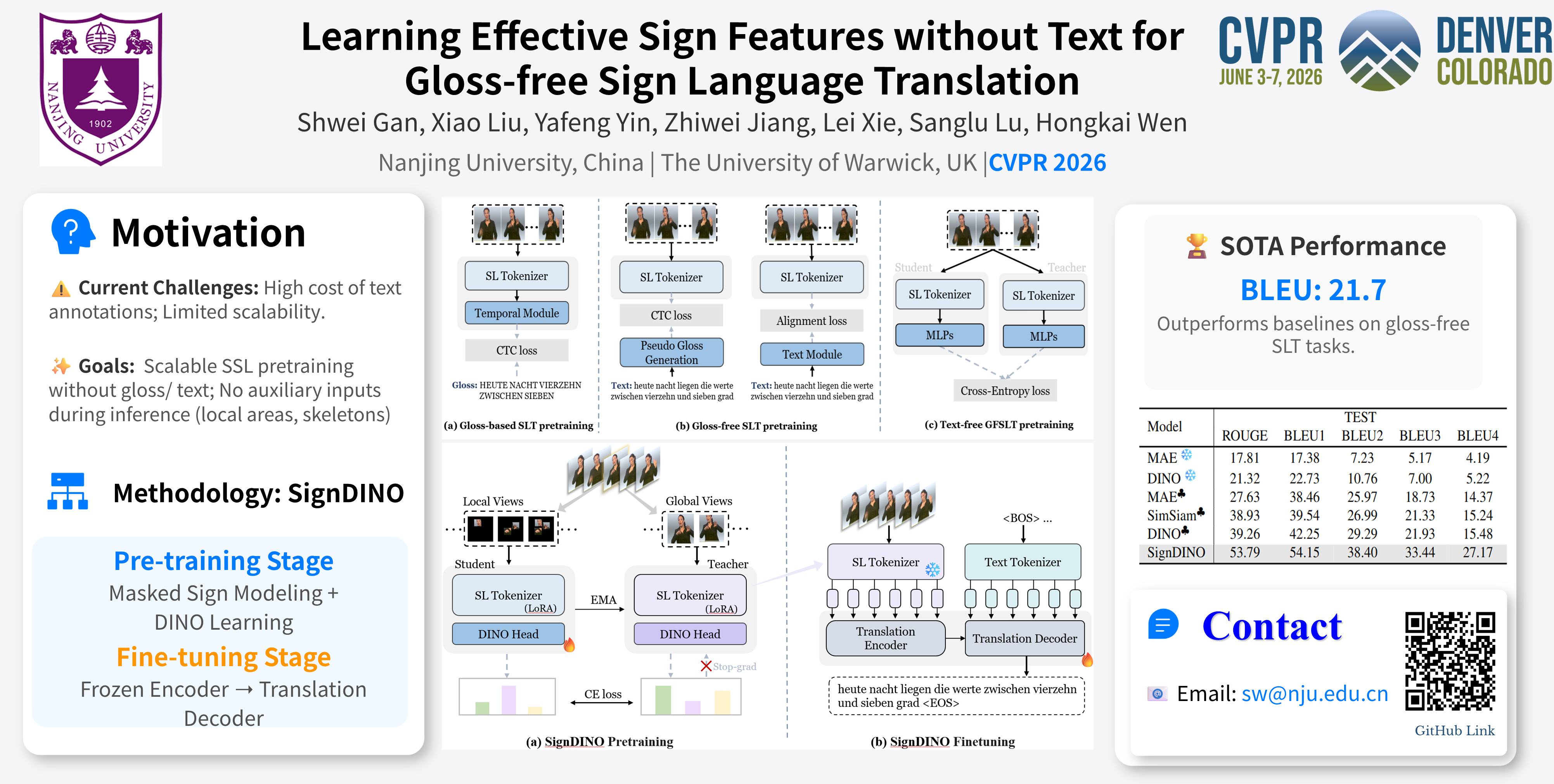
Self-supervised learning (SSL) has achieved remarkable success across both NLP and CV domains. However, sign language translation (SLT) models still heavily rely on gloss annotations in gloss-based SLT or text annotations in gloss-free SLT (GFSLT) during pretraining, aiming to ensure that the backbone provides effective sign language (SL) features for the translation model. Such reliance restricts the scalability and generalization ability of the SLT model. One natural question arises: \textbf{Can existing SSL methods be directly applied to the SL domain to train an effective sign feature extractor for downstream GFSLT tasks, eliminating the need for text annotations?}In this paper, we propose a simple yet effective pretraining framework with two goals:(1) decoupling the pretraining process from gloss or text annotations, relying purely on sign frames; and(2) only global frames are required during inference for simplicity. We show that directly applying existing SSL methods yields suboptimal performance, as SL features involve subtle motion patterns and discriminative cues that are often confined to local regions. To achieve this, we introduce SignDINO, a simple yet effective sign-aware DINO training strategy that learns effective and semantically meaningful representations from global frames without any textual supervision. Specifically, a student–teacher architecture is employed, where the teacher model receives the global sign frame, while the student model learns from masked local views that preserve only the hand and facial regions. Such a simple design encourages the model to infer global semantics from discriminative local cues, allowing the teacher model to extract SL-related feature during inference solely based on global views. Extensive experiments on public SL datasets show that SignDINO achieves highly competitive performance on the GFSLT task without relying on extra cues or additional SL-related pretraining.
META: Meta Evolution of Tool Trajectory Adaptation for Long-Video Understanding
Jing Huang ⋅ Luyuan Chen ⋅ Zhijie Xu ⋅ Yadong Li ⋅ Xingzhong Xu ⋅ Siye Chen ⋅ Jie Liu ⋅ Ming Kong ⋅ Qiang Zhu
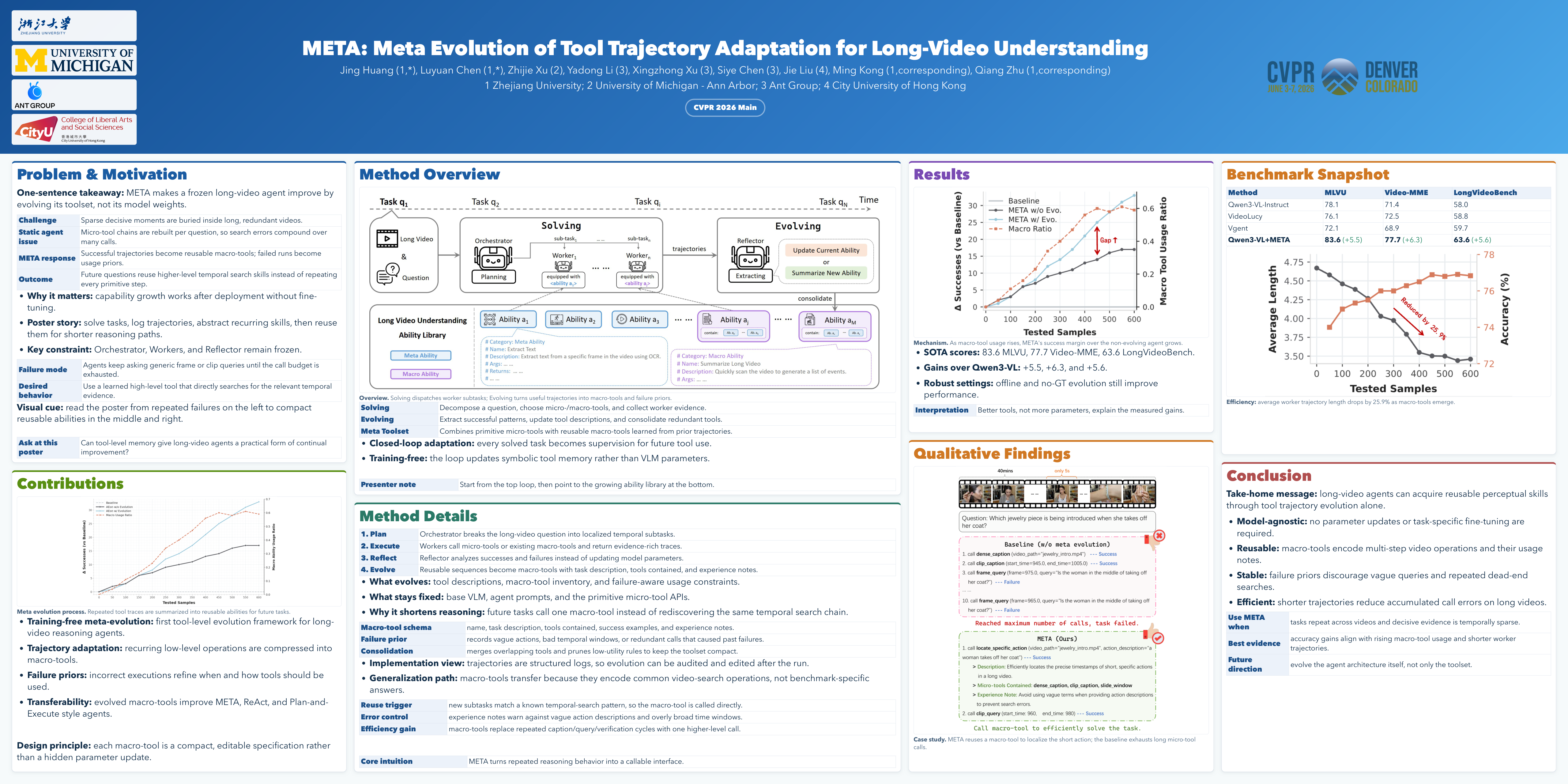
Long-video understanding remains challenging due to extreme temporal redundancy, sparse yet decisive events, and the instability of long-horizon reasoning in visual–language models (VLMs). Existing agent-based methods invoke external micro-tools but remain static, repeatedly rebuilding long chains of fine-grained operations for each task without acquiring reusable multi-step perceptual skills.We propose META, the first training-free agent capable of self-evolving its tool-augmented reasoning. META operates through dual Solving and Evolving loops: it analyzes its own tool trajectories, abstracts recurring multi-step patterns into reusable macro-tools, and distills failed executions into structured failure priors that refine tool usage. Through symbolic consolidation and pruning, META progressively shortens reasoning paths and acquires more general perceptual and temporal abilities—without any parameter updates. META achieves state-of-the-art performance on long-video benchmarks, demonstrating a scalable, model-agnostic paradigm for long-video understanding that can continually evolve without additional training.
GT-SVJ: Generative-Transformer-Based Self-Supervised Video Judge For Efficient Video Reward Modeling
Shivanshu Shekhar ⋅ Uttaran Bhattacharya ⋅ Raghavendra Addanki ⋅ Mehrab Tanjim ⋅ Somdeb Sarkhel ⋅ Tong Zhang
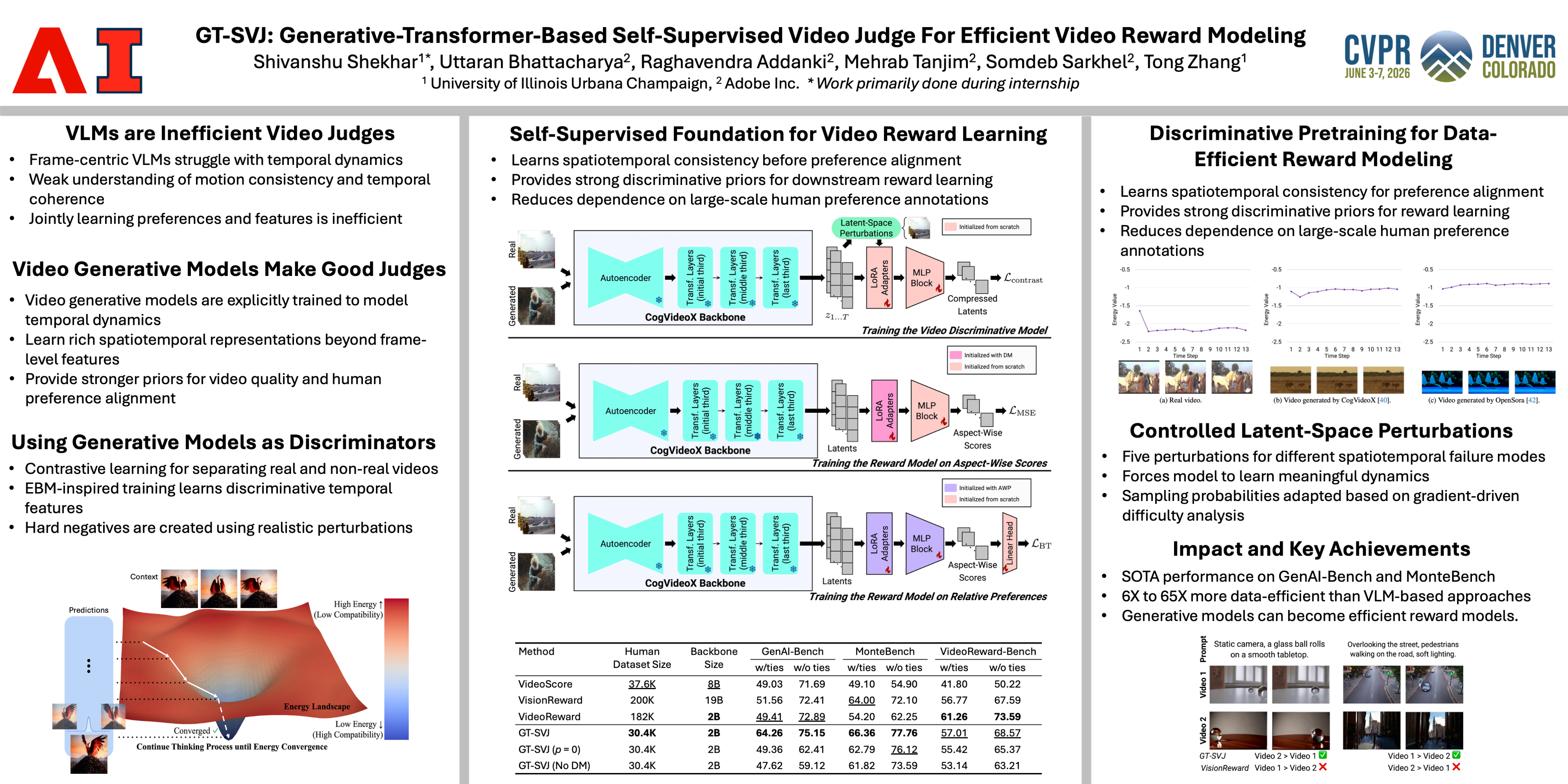
Aligning video generative models with human preferences remains challenging: current approaches rely on Vision-Language Models (VLMs) for reward modeling, but these models struggle to capture subtle temporal dynamics. We propose a fundamentally different approach: repurposing video generative models, which are inherently designed to model temporal structure, as reward models. We present the Generative-Transformer-based Self-Supervised Video Judge (\modelname), a novel evaluation model that transforms state-of-the-art video generation models into powerful temporally-aware reward models. Our key insight is that generative models can be reformulated as energy-based models (EBMs) that assign low energy to high-quality videos and high energy to degraded ones, enabling them to discriminate video quality with remarkable precision when trained via contrastive objectives. To prevent the model from exploiting superficial differences between real and generated videos, we design challenging synthetic negative videos through controlled latent-space perturbations: temporal slicing, feature swapping, and frame shuffling, which simulate realistic but subtle visual degradations. This forces the model to learn meaningful spatiotemporal features rather than trivial artifacts. \modelname achieves state-of-the-art performance on GenAI-Bench and MonteBench using only 30K human-annotations: $6\times$ to $65\times$ fewer than existing VLM-based approaches.
Local Motion Matters: A Deconstruct–Recompose Paradigm for Reinforcement Learning Pre-training from Videos
Jinwen Wang ⋅ Youfang Lin ⋅ Xiaobo Hu ⋅ Shuo Wang ⋅ Kai Lv
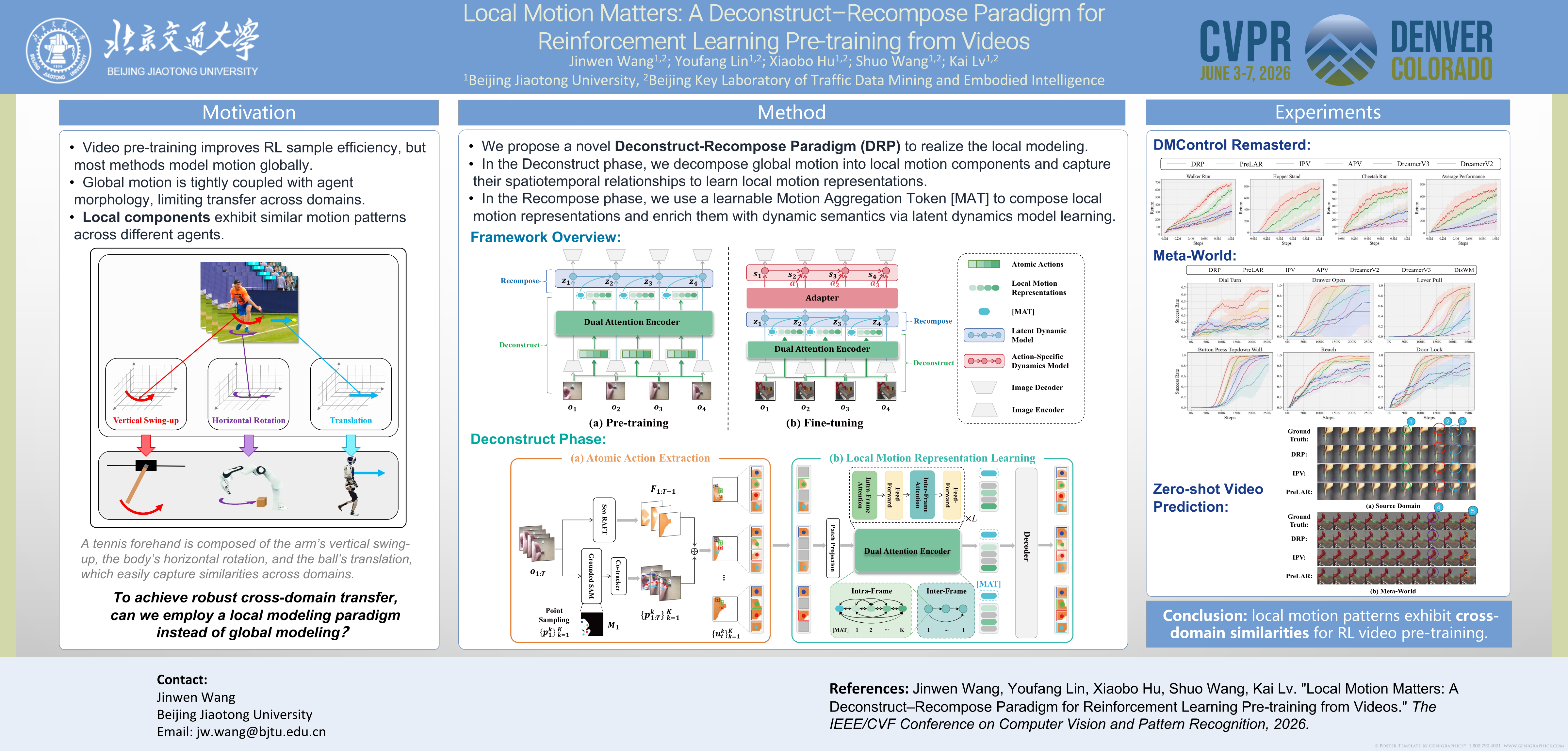
Pre-training on large-scale videos to improve reinforcement learning efficiency is promising yet remains challenging. Existing methods typically treat the agent as an indivisible entity, modeling motion patterns globally. Such global modeling is tightly coupled with the morphology, hindering transfer across domains. In contrast, despite the vast disparity in global motions, the local components exhibit similar motion patterns across different agents. Building on this insight, we propose a novel Deconstruct–Recompose Paradigm (DRP) for learning transferable local motion representations. Specifically, in the Deconstruct phase, we identify multiple local points and track their frame-wise motions, defining each as an Atomic Action. We introduce a Dual-Attention Encoder (DAE) to learn local motion representations from these Atomic Actions, capturing their spatiotemporal relationships. In the Recompose phase, we compose local motion representations with a learnable Motion Aggregation Token '[MAT]' via latent dynamics model learning. Additionally, an adapter bridges local motion and downstream action-specific dynamics to accelerate policy learning. Extensive experiments demonstrate that our method effectively transfers to diverse robotic control and manipulation tasks, significantly improving sample efficiency and performance.
Align Once to Explain: Feature Alignment for Scalable B-cosification of Foundational Vision Transformers
Raphael Maser ⋅ Siddhartha Gairola ⋅ Sukrut Rao ⋅ Bernt Schiele
Foundational vision models have become the de facto standard for many vision tasks due to their strong performance. However, they are notoriously opaque and remain hard to interpret. We present ALOE (ALign Once to Explain), a one-time, label-free feature alignment based approach that efficiently converts foundational vision models into inherently interpretable B-cos variants. Once aligned, the B-cos backbone is used as a drop-in replacement across several downstream tasks—amortizing the cost of interpretability. ALOE is robust across pre-training paradigms (supervised, self-supervised, vision–language) and is 100–1000× more data-efficient than training from scratch. On classification, it outperforms fully-supervised B-cos models (e.g., +6.6 p.p. top-1 on ImageNet for ViT-B/16), retains strong linear probing, k-NN, and zero-shot transfer performance competitive with foundational backbones (DINOv3, SigLIP2) across diverse downstream datasets, while yielding well-localized and highly human interpretable explanations by design. Code and models will be released.
Rounded or Streamlined Head? Bridging Concept Bottleneck Models and Attribute-Described Object Parts
Yang Liu ⋅ Jiajin Zhang ⋅ Yaojun Hu ⋅ Bingguang Hao ⋅ Xin Cao ⋅ Yingda Xia ⋅ Danyang Tu ⋅ Shi Gu ⋅ Ling Zhang
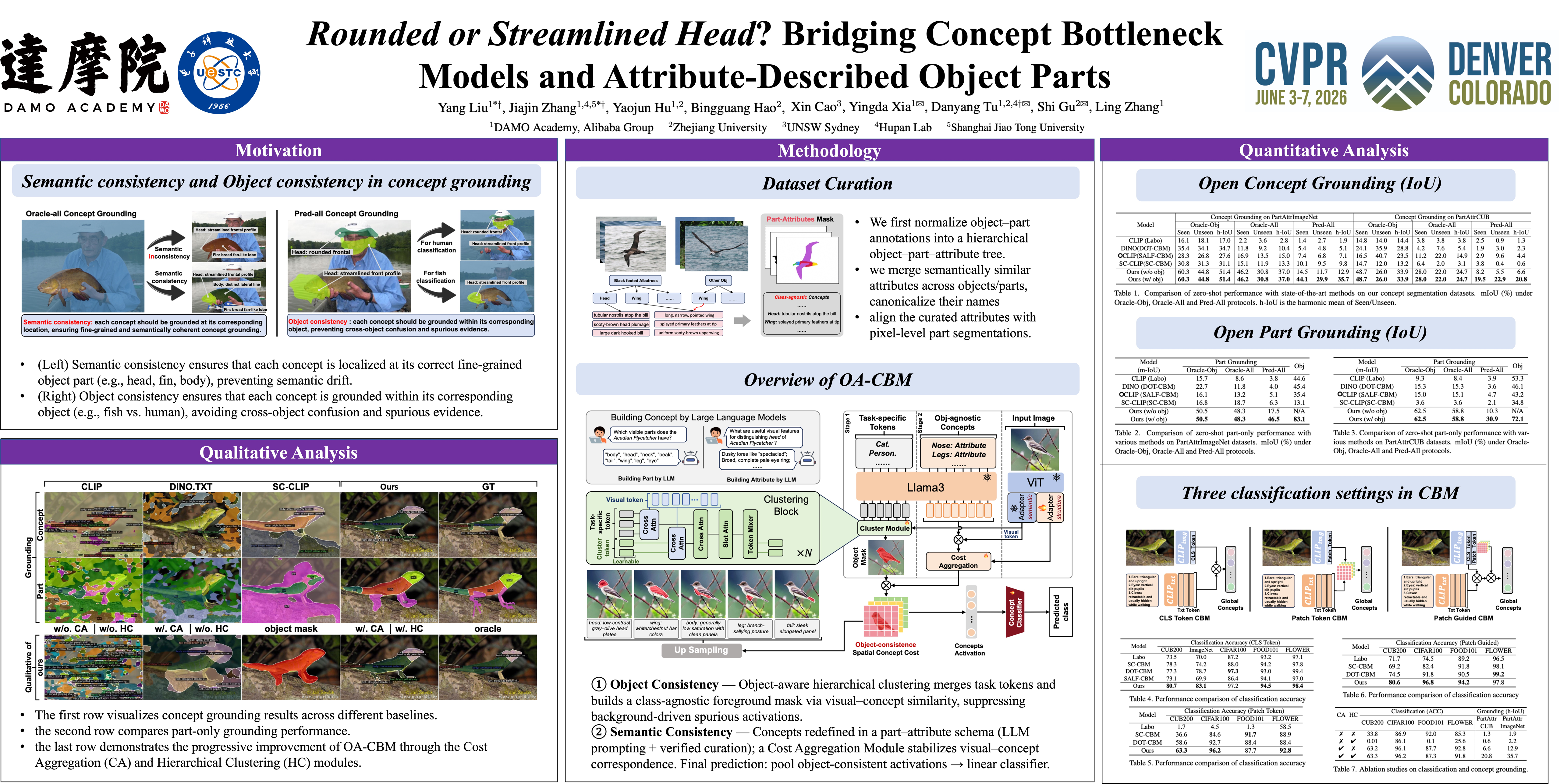
A faithful decision-making process requires models to ground human-understandable concepts both spatially (where they appear in the image) and causally (how they influence the prediction). Recent advances in Vision–Language Models (VLMs) enable concept-level alignment and have inspired Concept Bottleneck Models (CBMs), which explain predictions by mapping image representations to human-understandable concepts, allowing users to trace decisions through explicit semantic reasoning. However, existing CBMs suffer from two key inconsistencies. First, semantic inconsistency: VLMs often fail to localize fine-grained part–attribute concepts, producing noisy or incomplete masks. Second, object inconsistency: object-agnostic concepts such as "head: streamlined front profile" may describe multiple categories (e.g., fish or human); without enforcing object identity, non-targeted regions can introduce spurious evidence that corrupts the bottleneck representation. To address these challenges, we propose a new Object-Aware Concept Bottleneck Model (OA-CBM) that jointly enforces semantic- and object-level consistency. Specifically, (1) we redefine concepts as part–attribute pairs to enhance VLM robustness at the semantic level, and (2) introduce class-agnostic object clustering to suppress irrelevant visual evidence. We further annotate two grounding datasets with part–attribute descriptions and conduct extensive experiments. Results demonstrate that OA-CBM produces more faithful and robust explanations while maintaining competitive predictive performance.
CIGMA: Causal Information-Gain Mechanistic Attribution of Attention Heads in Vision Transformers
Maisha Maliha ⋅ Dean F. Hougen
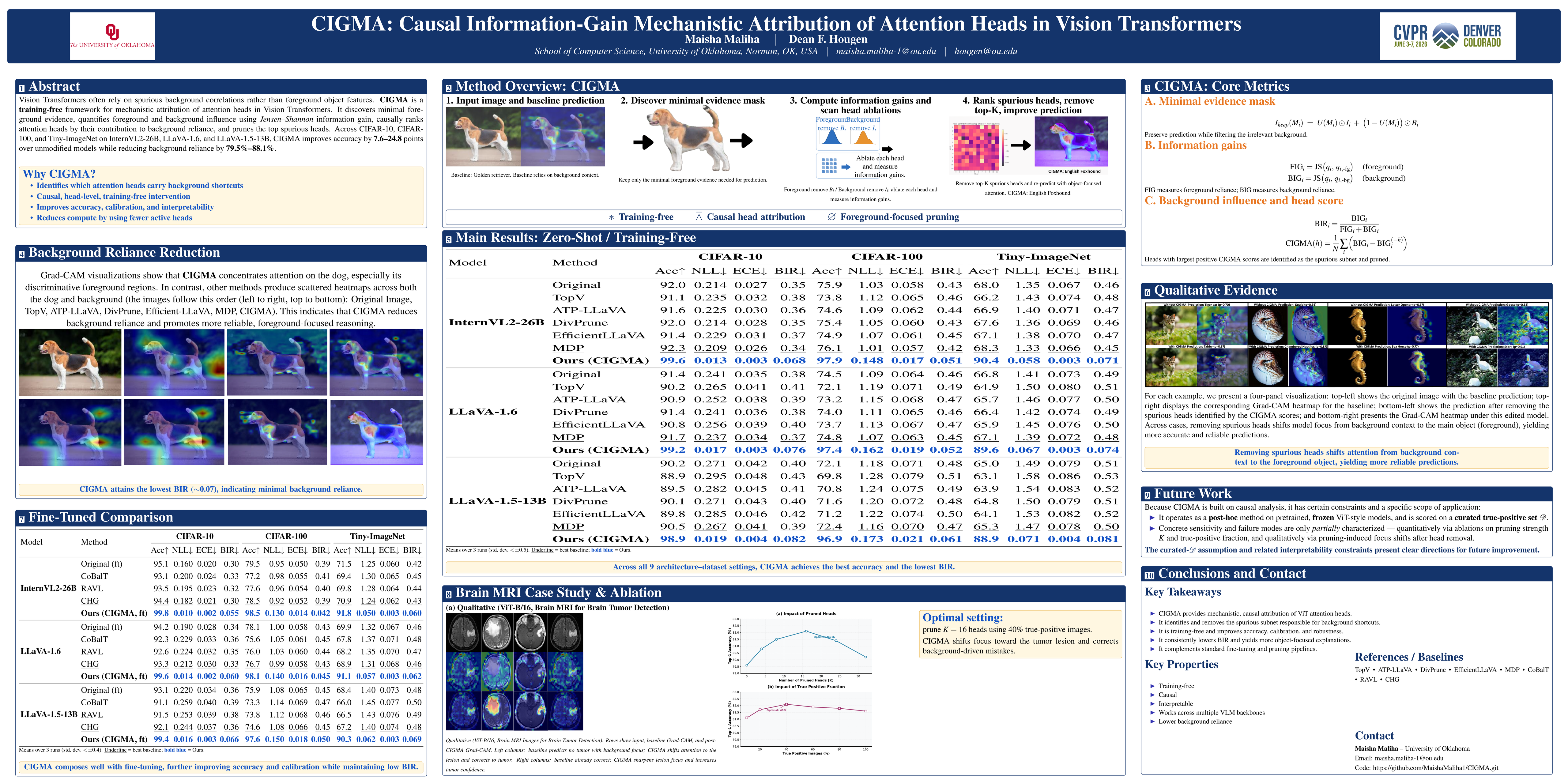
Vision Transformers often rely on spurious background correlations rather than foreground object features. While prior model pruning approaches focus solely on improving accuracy, they lack interpretability and fail to verify whether predictions are actually made by focusing on the main foreground object, providing no causal validation of which components drive spurious behavior. We introduce CIGMA (Causal Information Gain Mechanistic Attribution), a general framework for explaining the internal computation of Vision Transformers. CIGMA provides a mechanistic, information theoretic explanation by quantifying the importance of each attention head and determining whether it supports the main object or routes spurious background cues. It ranks attention heads by measuring object versus context reliance with Jensen Shannon based information gain computed from the model's full predictive distributions after two complementary edits, removing the object region and removing the surrounding context, which reveals a spurious subnet that carries background signals and a complementary set of evidence aligned heads. Evaluated on CIFAR-10, CIFAR-100, and Tiny-ImageNet across three VLM architectures (InternVL2-26B, LLaVA-1.6, LLaVA-1.5-13B), CIGMA improves accuracy by 7.6-24.8 percentage points over unmodified models while reducing background reliance by 79.5-88.1\%, substantially outperforming all baselines, demonstrating that causal head-level interventions enable more effective spurious correlation mitigation than token pruning or retraining approaches.
Rethinking Concept Bottleneck Models: From Pitfalls to Solutions
Merve Tapli ⋅ Quentin Bouniot ⋅ Wolfgang Stammer ⋅ Zeynep Akata ⋅ Emre Akbas
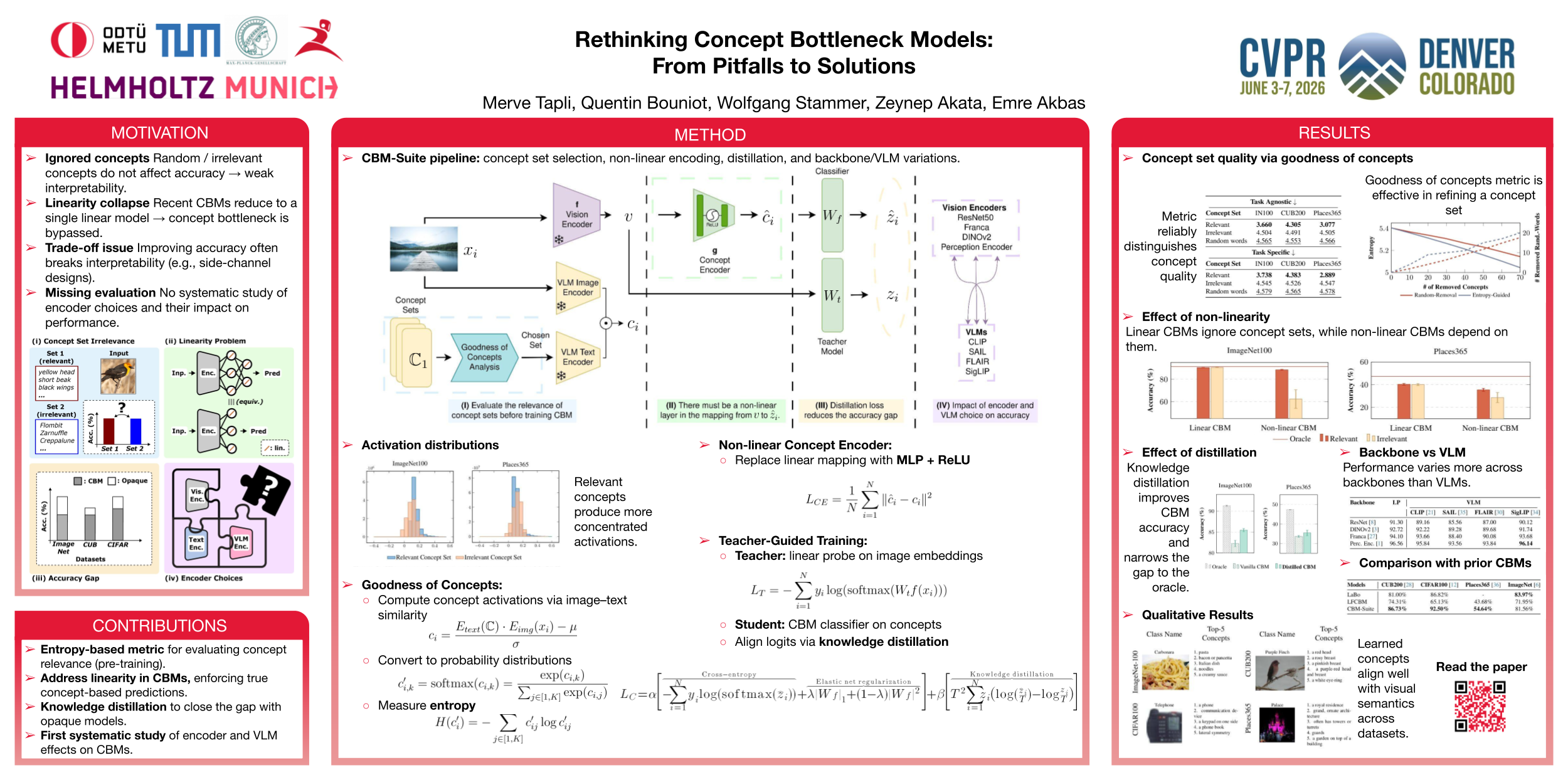
Concept Bottleneck Models (CBMs) ground predictions in human-understandable concepts but face fundamental limitations: the absence of a metric to pre-evaluate concept relevance, the ``linearity problem'' causing recent CBMs to bypass the concept bottleneck entirely, an accuracy gap compared to opaque models, and finally the lack of systematic study on the impact of different visual backbones and VLMs. We introduce CBM-Suite, a methodological framework to systematically addresses these challenges. First, we propose an entropy-based metric to quantify the intrinsic suitability of a concept set for a given dataset. Second, we resolve the linearity problem by inserting a non-linear layer between concept activations and the classifier, which ensures that model accuracy faithfully reflects concept relevance. Third, we narrow the accuracy gap by leveraging a distillation loss guided by a linear teacher probe. Finally, we provide comprehensive analyses on how different vision encoders, vision-language models, and concept sets interact to influence accuracy and interpretability in CBMs. Extensive evaluations show that CBM-Suite yields more accurate models and provides insights for improving concept-based interpretability.
Make it SING: Analyzing Semantic Invariants in Classifiers
Harel Yadid ⋅ Meir Yossef Levi ⋅ Roy Betser ⋅ Guy Gilboa
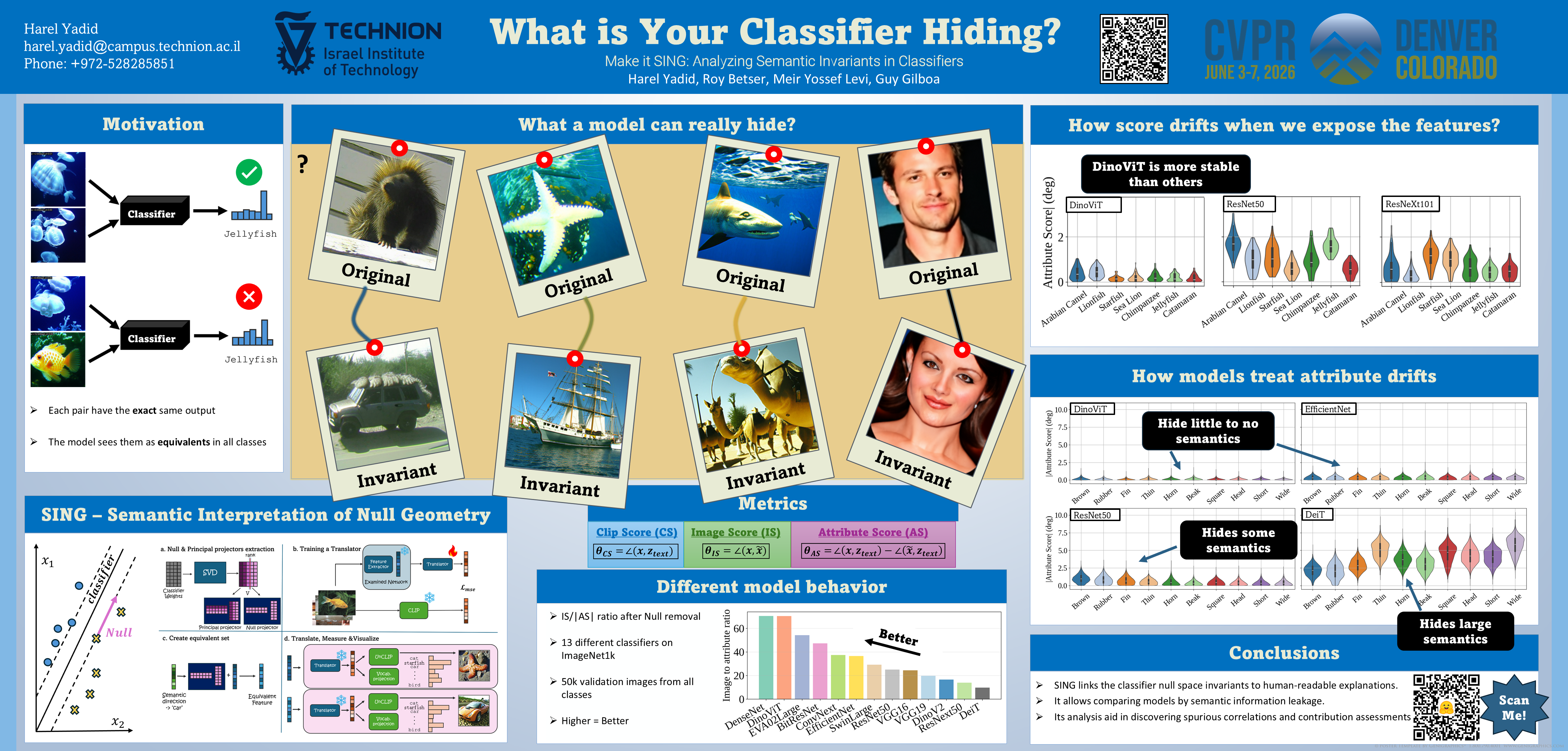
All classifiers, including state-of-the-art vision models, possess invariants, partially rooted in the geometry of their linear mappings. These invariants, which reside in the null-space of the classifier, induce equivalent sets of inputs that map to identical outputs. The semantic content of these invariants remains vague, as existing approaches struggle to provide human-interpretable information. To address this gap, we present Semantic Interpretation of the Null-space Geometry (SING), a method that constructs equivalent images, with respect to the network, and assigns semantic interpretations to the available variations. We use a mapping from network features to multi-modal vision language models. This allows us to obtain natural language descriptions and visual examples of the induced semantic shifts. SING can be applied to a single image, uncovering local invariants, or to sets of images, allowing a breadth of statistical analysis at the class and model levels. For example, our method reveals that ResNet50 leaks relevant semantic attributes to the null space, whereas DINO-ViT, a ViT pretrained with self-supervised DINO, is superior in maintaining class semantics across the invariant space.
Back to the Feature: Explaining Video Classifiers with Video Counterfactual Explanations
Chao Wang ⋅ chengan che ⋅ Xinyue Chen ⋅ Sophia Tsoka ⋅ Luis Carlos Garcia Peraza Herrera
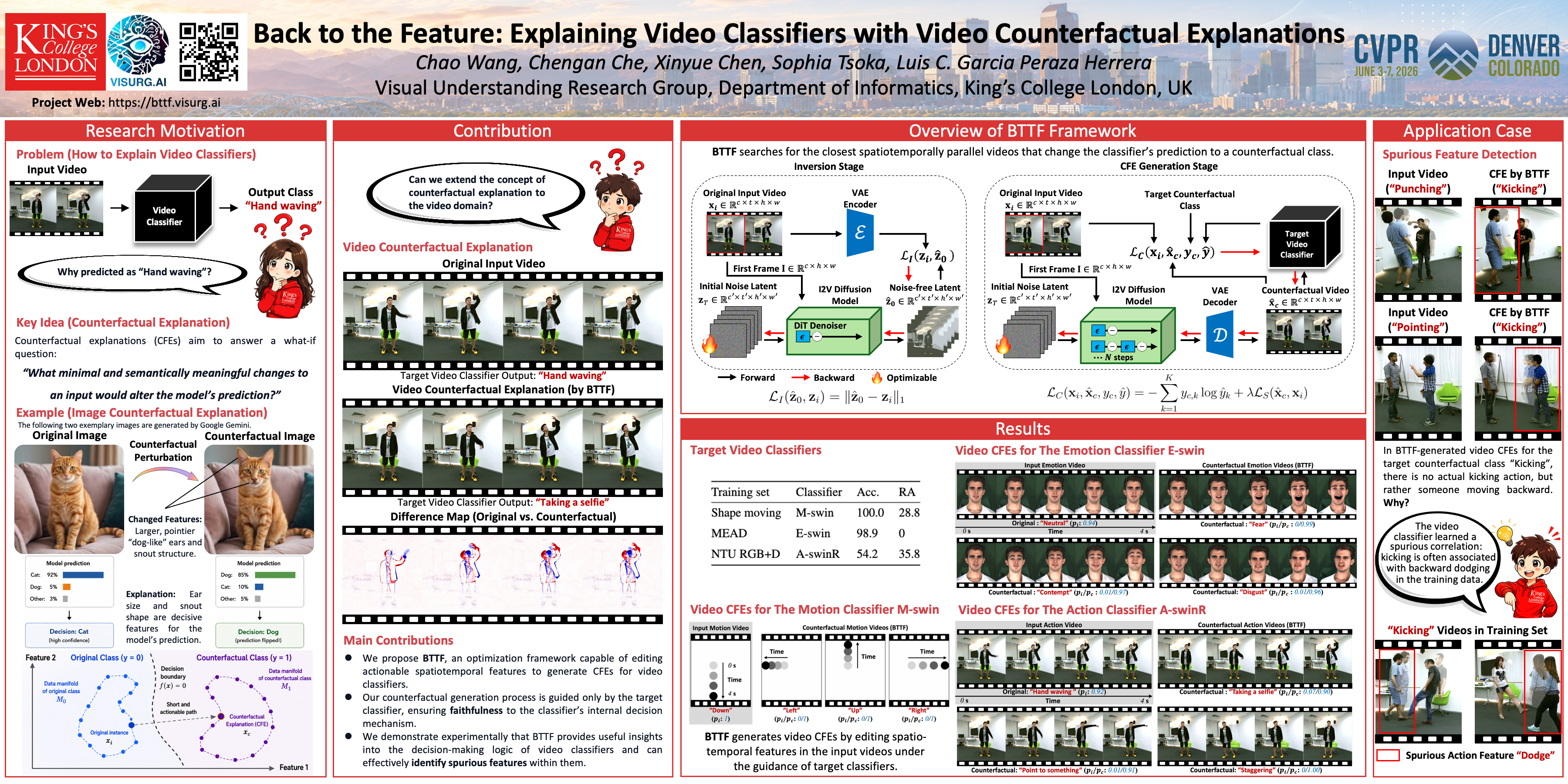
Counterfactual explanations (CFEs) are minimal and semantically meaningful modifications of the input of a model that alter the model predictions. They highlight the decisive features the model relies on, providing contrastive interpretations for classifiers. State-of-the-art visual counterfactual explanation methods are designed to explain image classifiers. The generation of CFEs for video classifiers remains largely underexplored. For the counterfactual videos to be useful, they have to be physically plausible, temporally coherent, and exhibit smooth motion trajectories. Existing CFE image-based methods, designed to explain image classifiers, lack the capacity to generate temporally coherent, smooth and physically plausible video CFEs. To address this, we propose Back To The Feature (BTTF), an optimization framework that generates video CFEs. Our method introduces two novel features, 1) an optimization scheme to retrieve the initial latent noise conditioned by the first frame of the input video, 2) a two-stage optimization strategy to enable the search for counterfactual videos in the vicinity of the input video. Both optimization processes are guided solely by the target classifier, ensuring the explanation is faithful. To accelerate convergence, we also introduce a progressive optimization strategy that incrementally increases the number of denoising steps. Extensive experiments on video datasets such as Shape-Moving (motion classification), MEAD (emotion classification), and NTU RGB+D (action classification) show that our BTTF effectively generates valid, visually similar and realistic counterfactual videos that provide concrete insights into the classifier's decision-making mechanism.
LEADER: Learning Reliable Local-to-Global Correspondences for LiDAR Relocalization
Jianshi Wu ⋅ Minghang Zhu ⋅ dq Liu ⋅ Wen Li ⋅ Sheng Ao ⋅ Siqi Shen ⋅ Chenglu Wen ⋅ Cheng Wang
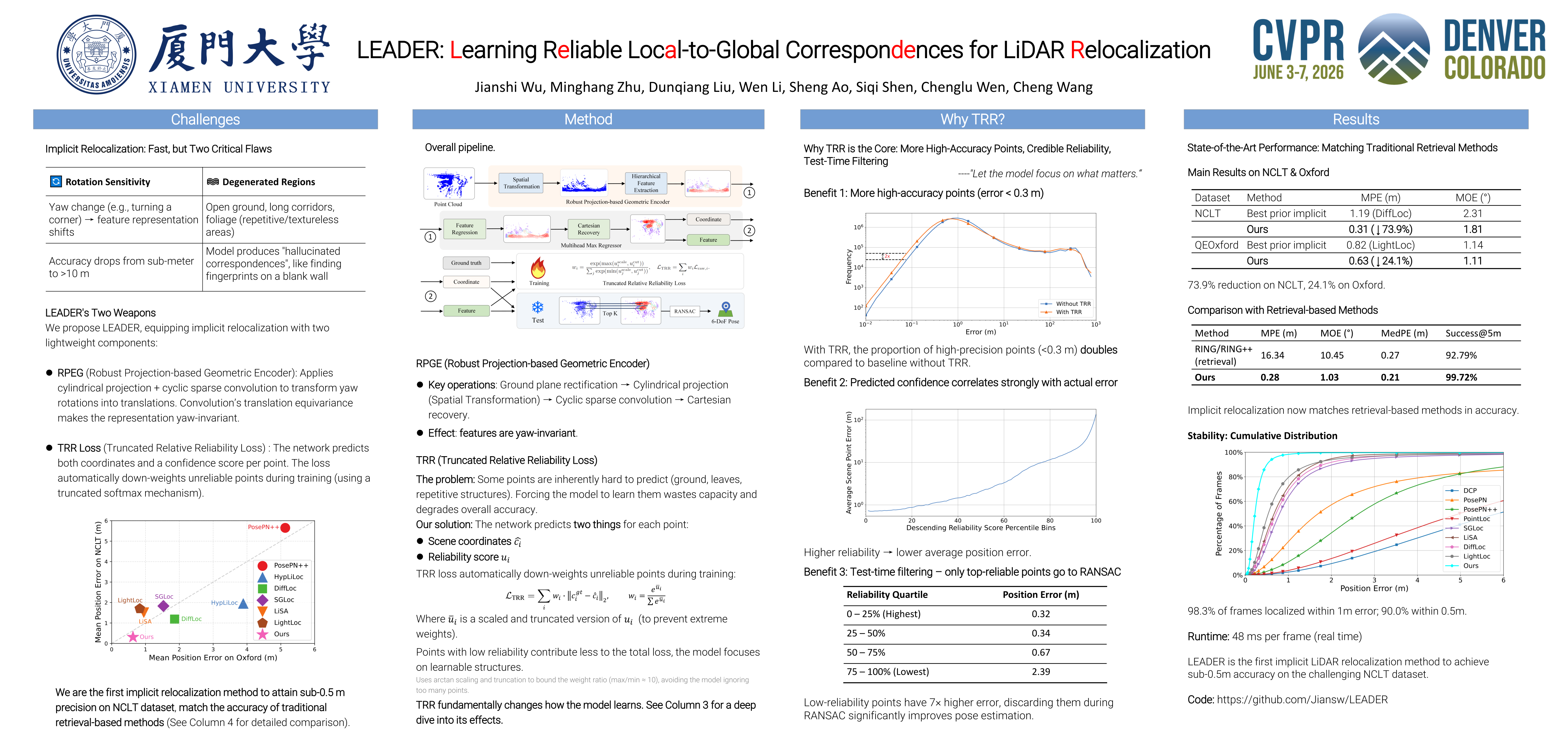
LiDAR relocalization has attracted increasing attention as it can deliver accurate 6-DoF pose estimation in complex 3D environments. Recent learning-based regression methods offer efficient solutions by directly predicting global poses without the need for explicit map storage. However, these methods often struggle in challenging scenes due to their equal treatment of all predicted points, which is vulnerable to noise and outliers. In this paper, we propose LEADER, a robust LiDAR-based localization framework enhanced by a simple, yet effective geometric encoder. Specifically, a Robust Projection-based Geometric Encoder architecture which captures multi-scale geometric features is first presented to enhance descriptiveness in geometric representation. A Truncated Relative Reliability loss is then formulated to model point-wise ambiguity and mitigate the influence of unreliable predictions. Extensive experiments on the Oxford RobotCar and NCLT datasets demonstrate that PerfectLoc outperforms state-of-the-art methods, achieving 24.1% and 73.9% relative reductions in position error over existing techniques, respectively. Source code will be released soon.
UniCorrn: Unified Correspondence Transformer Across 2D and 3D
Prajnan Goswami ⋅ Tianye Ding ⋅ Feng Liu ⋅ Huaizu Jiang
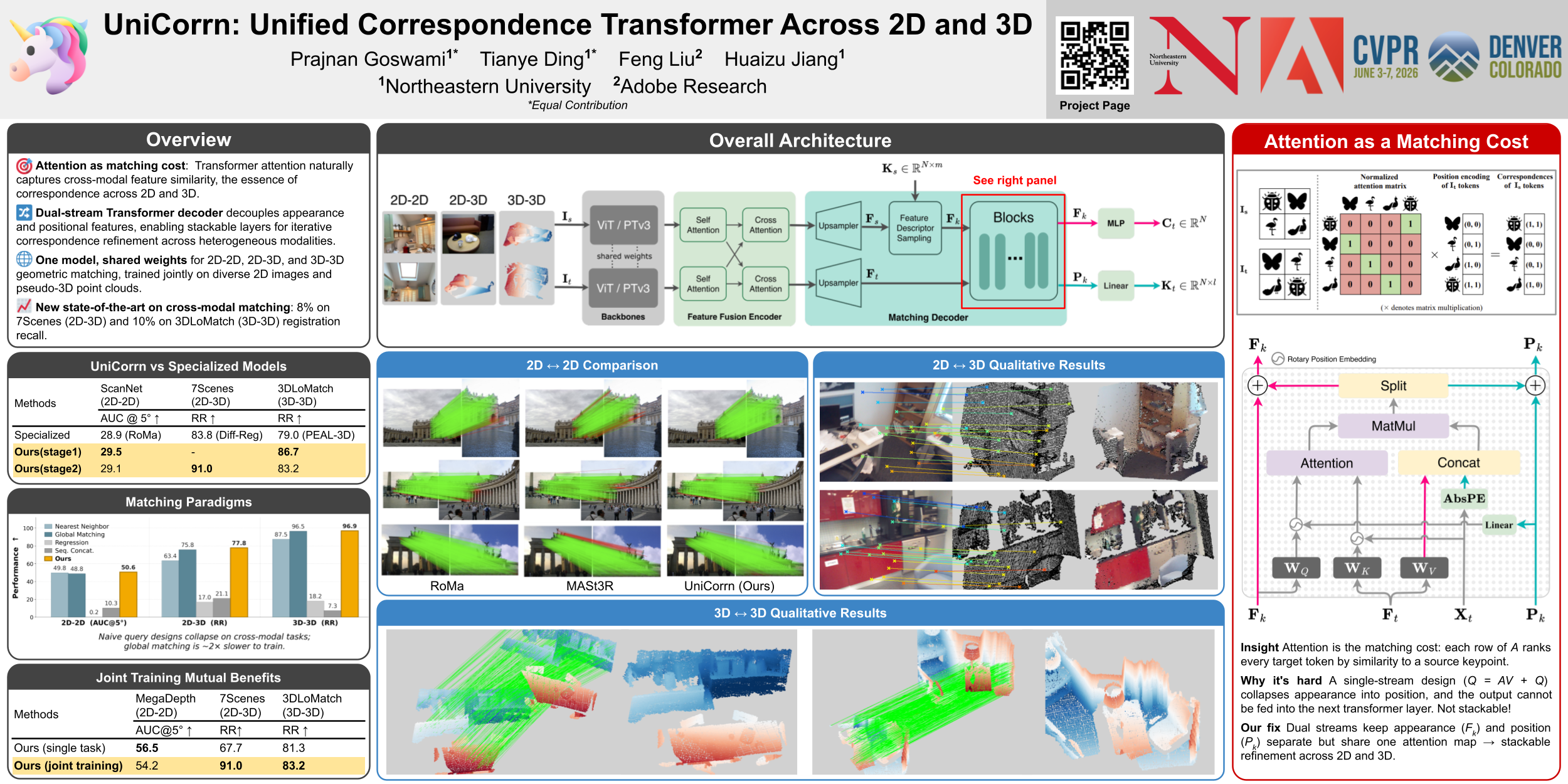
Visual correspondence across image-to-image (2D-2D), image-to-point cloud (2D-3D), and point cloud-to-point cloud (3D-3D) geometric matching forms the foundation for numerous 3D vision tasks. Despite sharing a similar problem structure, current methods use task-specific designs with separate models for each modality combination. We present UniCorn, the first correspondence model with shared weights that unifies geometric matching across all three tasks. Our key insight is that Transformer attention naturally captures cross-modal feature similarity. We propose a dual-stream decoder that maintains separate appearance and positional feature streams. This design enables end-to-end learning through stack-able layers while supporting flexible query-based correspondence estimation across heterogeneous modalities. Our architecture employs modality-specific backbones followed by shared encoder and decoder components, trained jointly on diverse data combining pseudo point clouds from depth maps with real 3D correspondence annotations. UniCorn achieves competitive performance on 2D-2D matching and surpasses prior state-of-the-art by 8\% on 7Scenes (2D-3D) and 10\% on 3DLoMatch (3D-3D) in registration recall. Code and model checkpoints will be made publicly available.
Probabilistic Discrepancy Learning for Roadside LiDAR Scene Completion
Xiaogang Wu ⋅ Jinchao Hu ⋅ Zixian Wang ⋅ Dun Liu ⋅ BoXiang Cheng ⋅ Yiqiang Wu
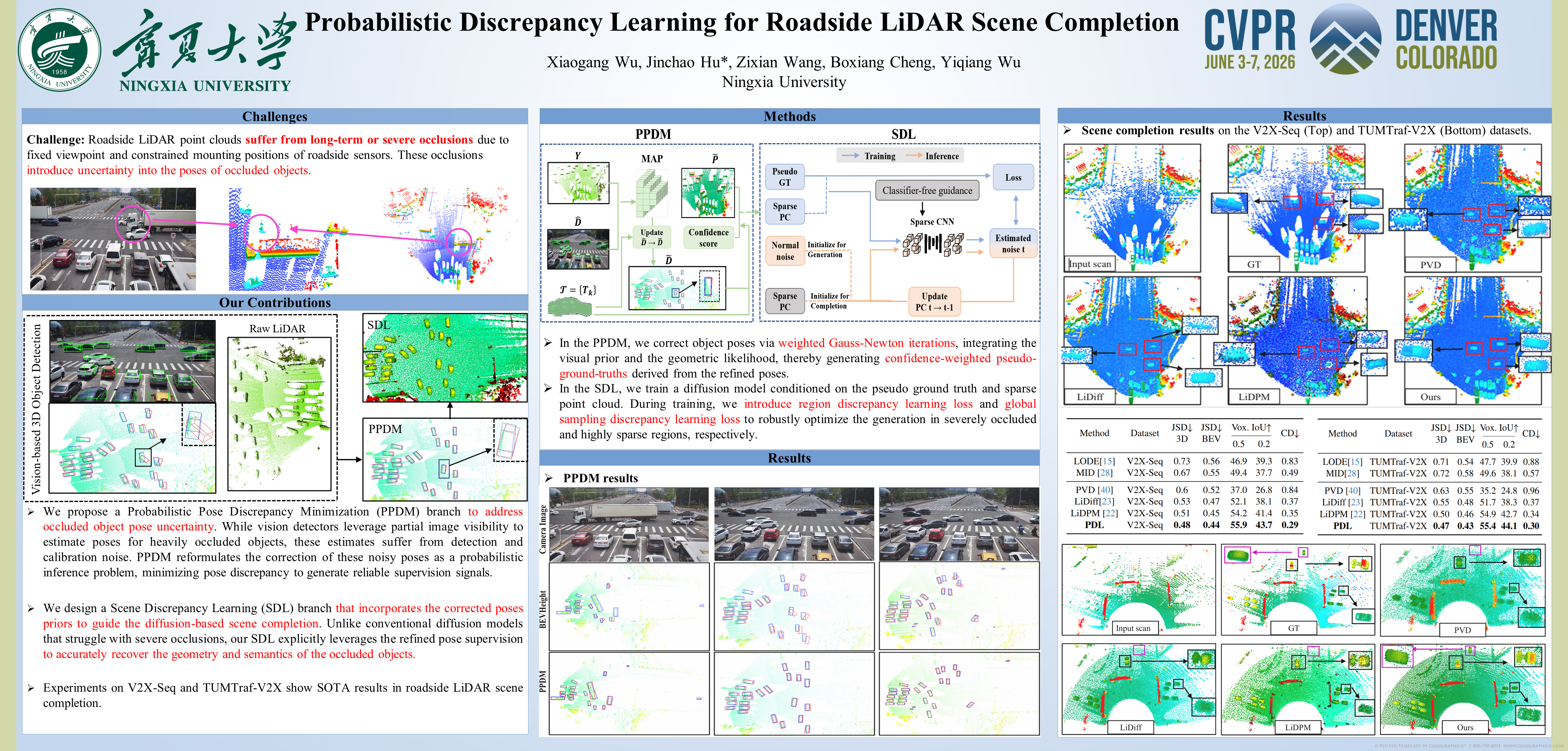
We propose a probabilistic discrepancy learning approach for roadside LiDAR scene completion (PDL). Conventional methods focus on object-level completion and scene completion from ego-vehicle viewpoint. These methods struggle to cope with long-term or total occlusions caused by roadside sensors with fixed viewpoints. To address this issue, we compensate for occlusion roadside point clouds by introducing external visual information. Specifically, Our PDL is mainly divided into probabilistic pose discrepancy minimization and scene discrepancy learning. We employ probabilistic pose discrepancy minimization to correct noisy poses from vision-based detectors, while utilizing a diffusion model within scene discrepancy learning for robust full-scene completion.Furthermore, we introduce regional and global sampling discrepancy learning losses to achieve robust and efficient training. We conducted extensive experiments on the V2X-Seq and TUMTraf-V2X roadside datasets. Results demonstrate that DT-VEM achieves state-of-the-art performance, with average reductions of 14.5\% in chamfer distance (CD) and 6\% in 3D Jensen Shannon divergence (JSD) compared to existing methods.
TACO: Task-Aware Contrastive Learning for Joint LiDAR Localization and 3D Object Detection
Leyuan Xing ⋅ huanjia zhang ⋅ Dongyu Pan ⋅ Hai Wu ⋅ Qiming Xia ⋅ Kezheng Xiong ⋅ Wen Li ⋅ Chenglu Wen ⋅ Cheng Wang
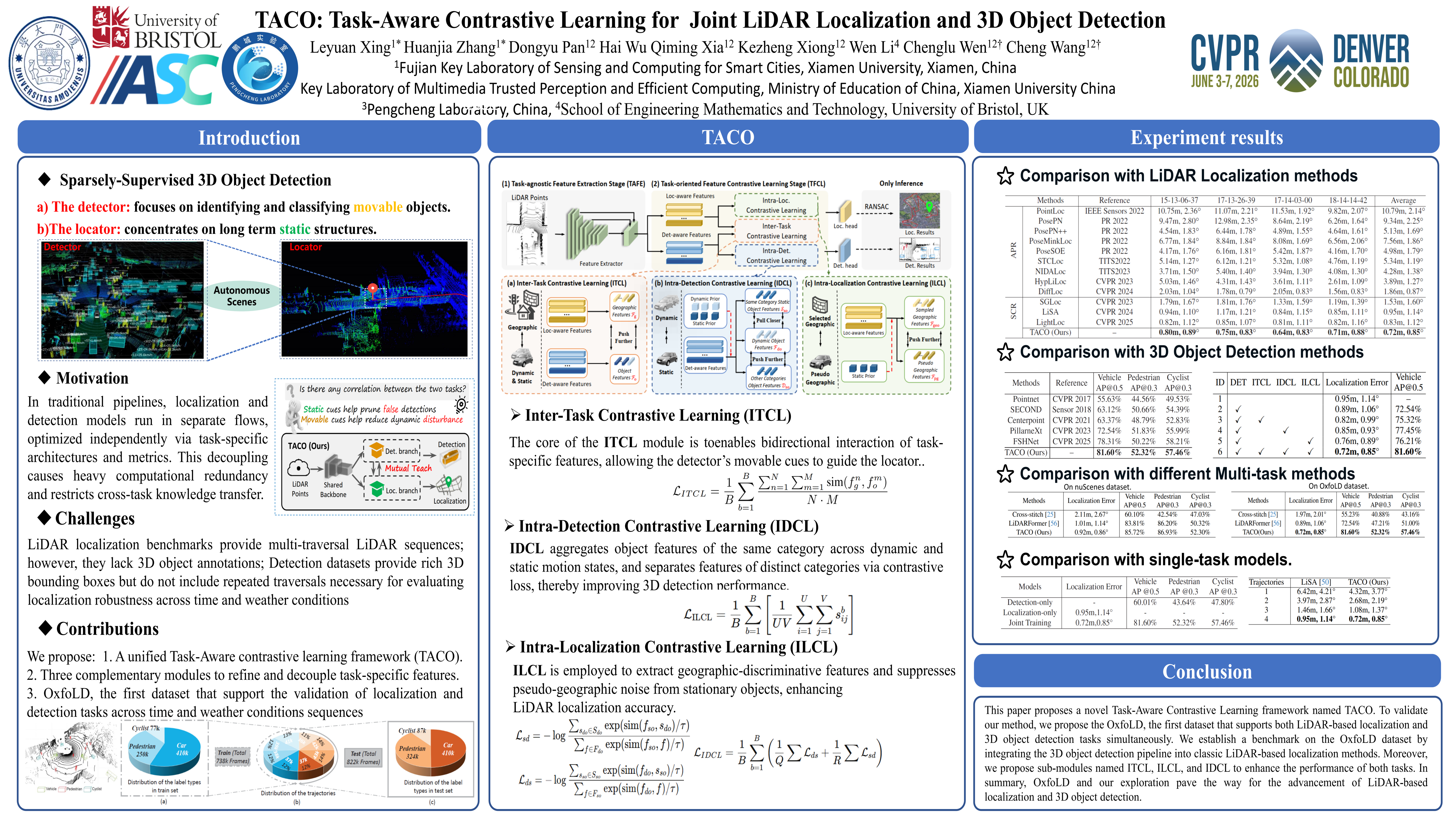
Reliable navigation and decision-making of autonomous vehicles require both accurate localization and object detection. Traditionally, these two tasks are handled separately, leading to redundant computation and limited cross-task knowledge transfer. This paper proposes TACO, the first Task-Aware COntrastive learning framework, which performs joint LiDAR localization and 3D object detection within a single, unified network. TACO leverages contrastive learning to explicitly decouple and align static geographic features for localization and object-centric features for detection. This bidirectional mutual supervision not only enhances localization robustness in dynamic environments by filtering dynamic noise but also boosts detection accuracy via effective spatial context. Additionally, we propose OxfoLD, the first dataset that provides multi-traversal LiDAR localization ground truth with rich 3D object annotations, thereby supporting task validation across various times and weather conditions. Experimental results demonstrate that TACO achieves state-of-the-art localization accuracy while maintaining competitive detection performance. The code and dataset will be released.
Adapting Point Cloud Analysis via Multimodal Bayesian Distribution Learning
Xingyu Zhu ⋅ Yi Liang ⋅ Shuo Wang ⋅ Wenbo Zhu ⋅ Yongliang Wu ⋅ Beier Zhu ⋅ Hanwang Zhang
Large multimodal 3D vision--language models show strong generalization across diverse 3D tasks, but their performance still degrades notably under domain shifts. This has motivated recent studies on test-time adaptation (TTA), which enables models to adapt online using test-time data. Among existing TTA methods, cache-based mechanisms are widely adopted for leveraging previously observed samples in online prediction refinement. However, they store only limited historical information, leading to progressive information loss as the test stream evolves. In addition, their prediction logits are fused heuristically, making adaptation unstable.To address these limitations, we propose BayesMM, a Multimodal Bayesian Distribution Learning framework for test-time point cloud analysis. BayesMM models textual priors and streaming visual features of each class as Gaussian distributions: textual parameters are derived from semantic prompts, while visual parameters are updated online with arriving samples. The two modalities are fused via Bayesian model averaging, which automatically adjusts their contributions based on posterior evidence, yielding a unified prediction that adapts continually to evolving test-time data without training.Extensive experiments on multiple point cloud benchmarks demonstrate that BayesMM maintains robustness under distributional shifts, yielding over 4\% average improvement.
Learning Coordinate-based Convolutional Kernels for Continuous SE(3) Equivariant and Efficient Point Cloud Analysis
Jaein Kim ⋅ Hee Bin Yoo ⋅ Dong-Sig Han ⋅ Byoung-Tak Zhang
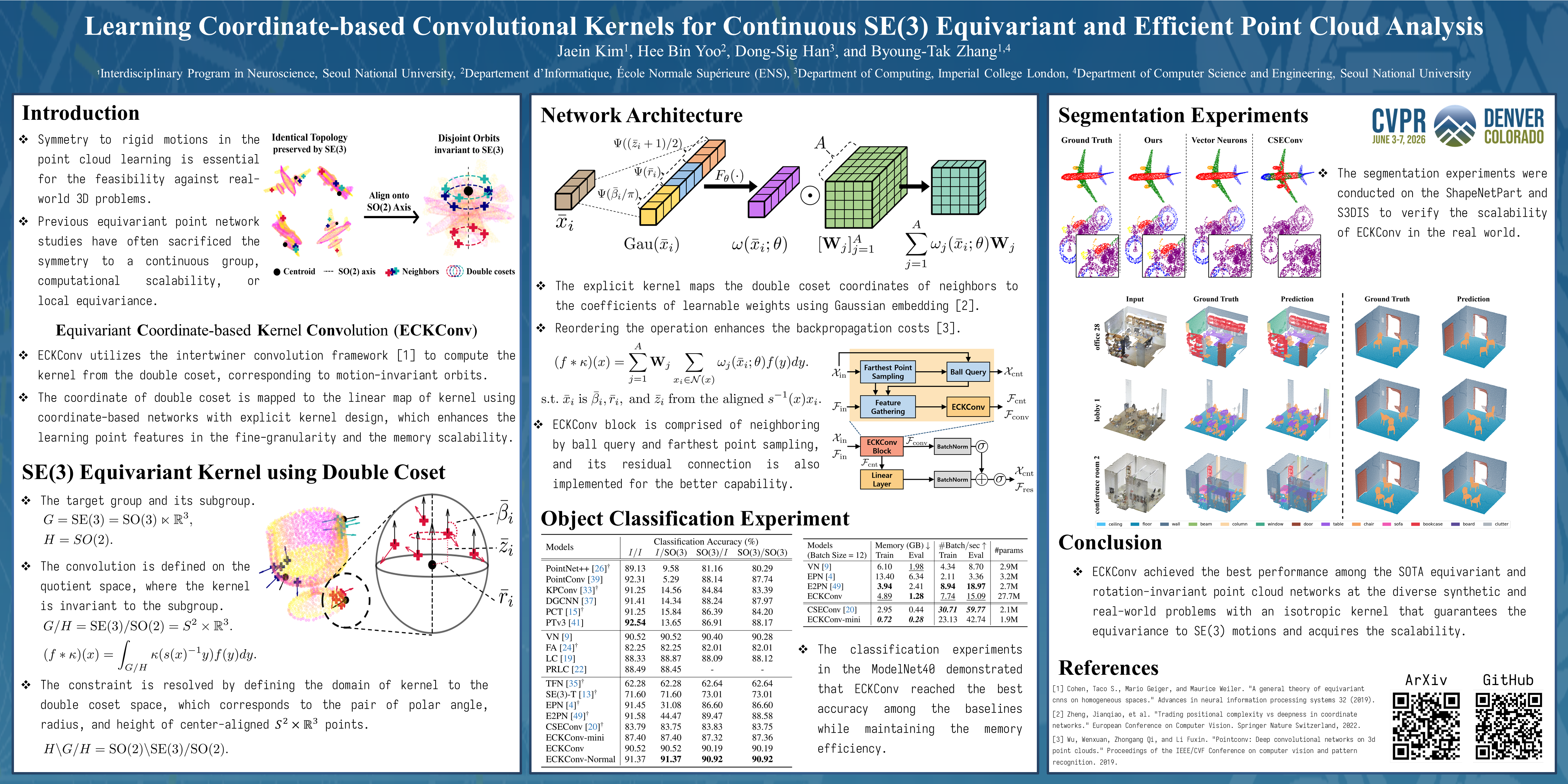
A symmetry on rigid motion is one of the salient factors in efficient learning of 3D point cloud problems. Group convolution has been a representative method to extract equivariant features, but its realizations have struggled to retain both rigorous symmetry and scalability simultaneously. We advocate utilizing the intertwiner framework to resolve this trade-off, but previous works on it, which did not achieve complete SE(3) symmetry or scalability to large-scale problems, necessitate a more advanced kernel architecture. We present Equivariant Coordinate-based Kernel Convolution, or ECKConv. It acquires SE(3) equivariance from the kernel domain defined in a double coset space, and its explicit kernel design using coordinate-based networks enhances its learning capability and memory efficiency. The experiments on diverse point cloud tasks, e.g., classification, pose registration, part segmentation, and large-scale semantic segmentation, validate the rigid equivariance, memory scalability, and outstanding performance of ECKConv compared to state-of-the-art equivariant methods.
R3-PCQA: Ray-Reprojection-Reinforcement for No-Reference 3D Point Cloud Quality Assessment
Junhyuk Seo ⋅ Sanghyuk SEO ⋅ Dawoon Kim ⋅ Heeseok Oh
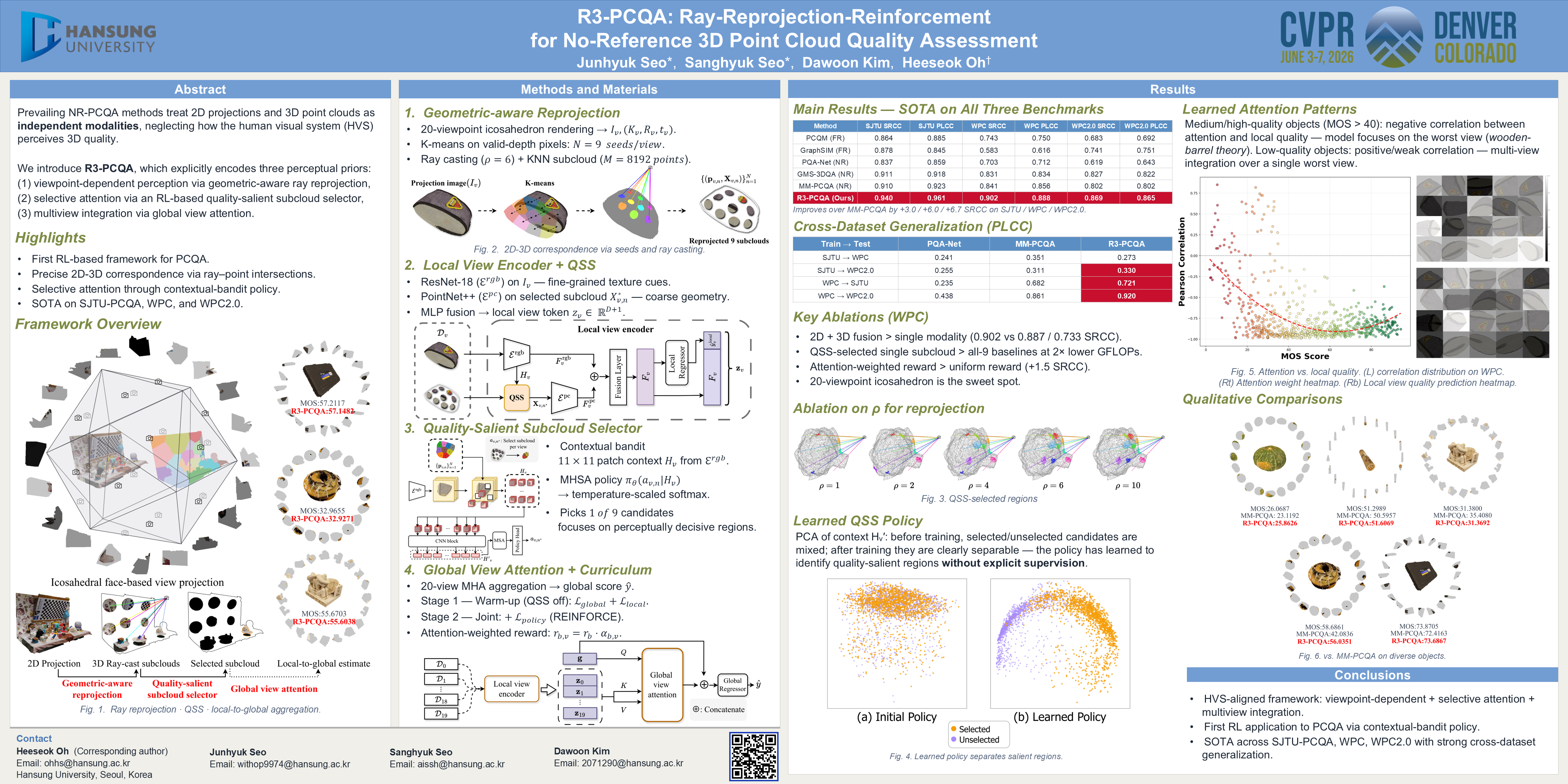
Prevailing no-reference 3D point cloud quality assessment methods predominantly treat 2D projections and 3D point clouds as independent modalities and rely on simplistic feature fusion, thereby neglecting fundamental mechanisms underlying human 3D perception. To address this limitation, we introduce R3-PCQA (Ray-Reprojection-Reinforcement 3D Point Cloud Quality Assessor), a novel and principled framework that explicitly encodes perceptual priors into the assessment pipeline: A geometric-aware ray-based reprojection pipeline simulates viewpoint-dependent observation of 3D structure. A reinforcement-learning-based quality-salient subcloud selector adaptively attends to perceptually informative regions. The global view attention module aggregates local quality responses across viewpoints, forming a unified representation that facilitates reliable cross-view inference. Extensive experiments demonstrate that R3-PCQA achieves state-of-the-art performance on SJTU-PCQA, WPC, and WPC2.0.
Geometric-Aware Hypergraph Reasoning for Novel Class Discovery in Point Cloud Segmentation
Zihao Zhang ⋅ Aming Wu ⋅ Li Yang ⋅ Yahong Han ⋅ Jialie Shen
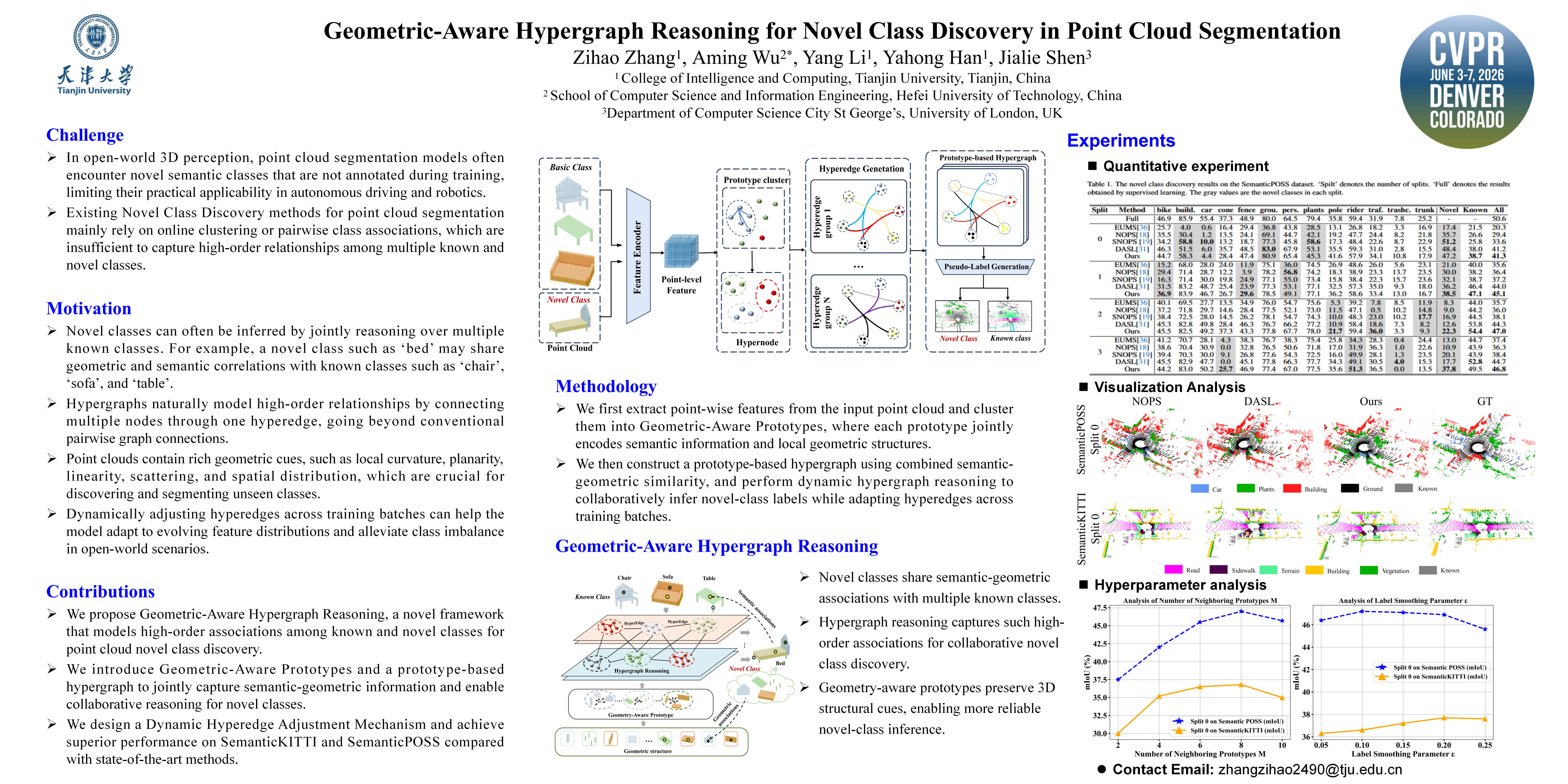
Novel Class Discovery in Point Cloud Segmentation is recently proposed, aiming to leverage knowledge from known classes to automatically segment unlabeled classes within point clouds. The core of this task lies in leveraging the geometric and semantic knowledge of multiple known classes to achieve semantic understanding and segmentation of novel classes.However, existing methods overlook the high-order associations between known and novel classes, relying solely on binary associations for class assignment and novel class reasoning, which leads to less precise semantic segmentation.To address these issues, we introduce a hypergraph structure to model high-order associations among classes, enabling collaborative reasoning from known classes to novel classes, extending beyond traditional binary relations.Additionally, existing methods focus excessively on extracting semantic information when processing point cloud data, neglecting the importance of geometric features. To address this, we introduce Geometric-Aware Prototypes, enhancing the model's ability to capture geometric spatial information.By propagating geometric information through hyperedges, our method enhances the understanding of spatial distributions across classes, improving segmentation accuracy.Significant performance improvements achieved on the SemanticKITTI and SemanticPOSS datasets demonstrate the superiority of our method.
PointCSP: Cross-Sample Semantic Propagation and Stability Preservation in Self-Supervised Point Cloud Learning
Xinxing Yu ⋅ Ajian Liu ⋅ Sunyuan Qiang ⋅ Hui Ma ⋅ Liying Yang ⋅ Yuzhong Wang ⋅ Zhi Rao ⋅ Yanyan Liang
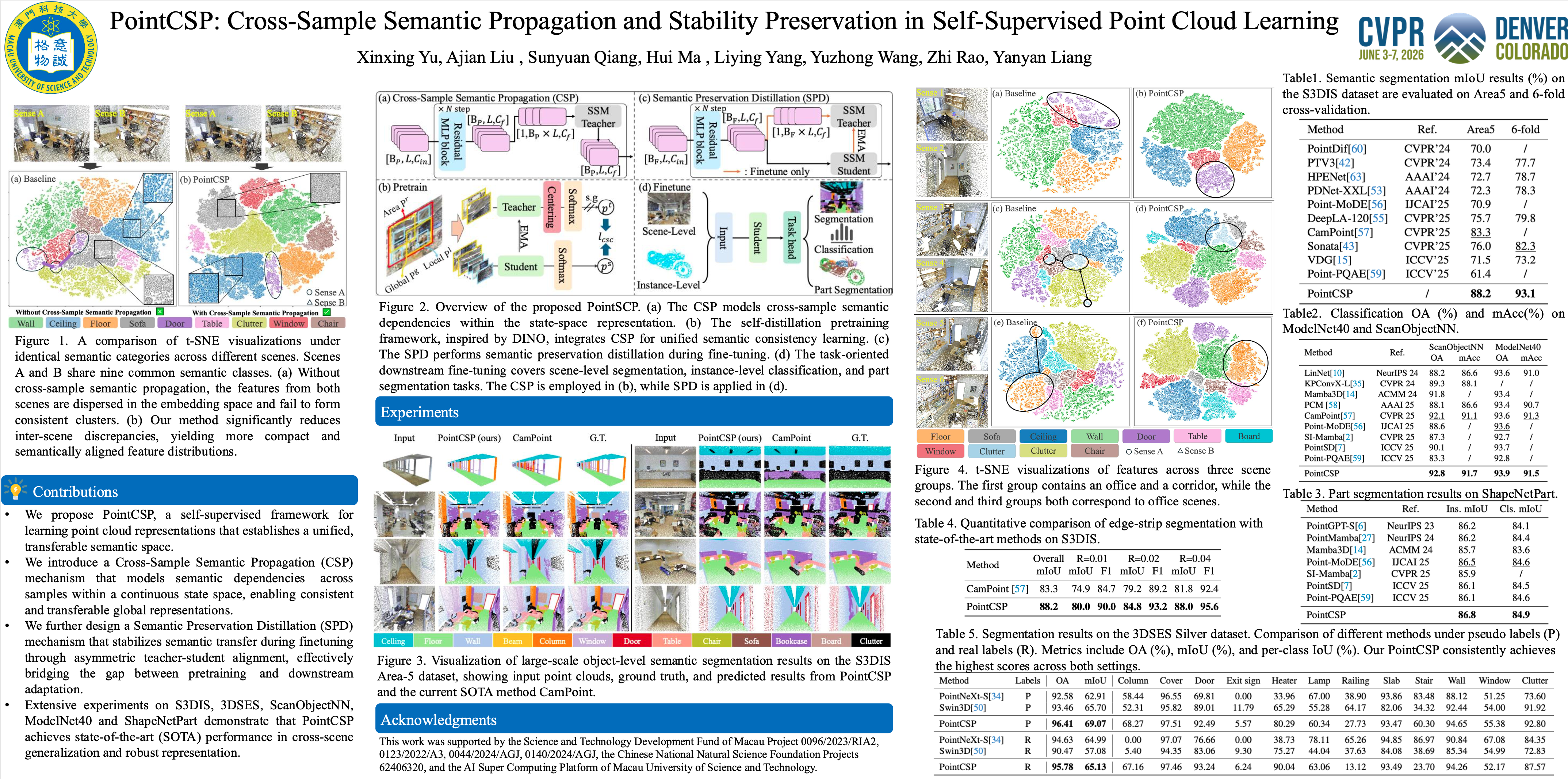
Scene-level point cloud self-supervised learning (PC-SSL) has demonstrated potential in enhancing the generalization capability of 3D vision models. Despite the advances achieved in the field through existing methods, the sample-independent modelling paradigm still poses significant limitations in terms of maintaining consistent semantic representations across different scenes. This challenge hinders the construction of a unified and transferable semantic space. To address this issue, we propose a PC-SSL framework based on cross-sample semantic propagation (CSP), in which samples within a batch are serialized into a continuous input and processed by a state-space model to enable semantic state propagation. This mechanism explicitly models the dynamic dependencies across samples in the state space, allowing the network to establish cross-sample semantic consistency in the latent space, and thereby achieve global semantic alignment. Since serialization-based pretraining requires batch-level input organization, we further introduce an asymmetric semantic preservation distillation (SPD) during finetuning to achieve structural alignment of semantic transfer and eliminate inconsistencies caused by batch dependency. The proposed SPD ensures stable transfer of pretrained semantics through a heterogeneous input mechanism and a semantic feature alignment constraint. This enables the model to maintain structured semantic consistency and robustness under single-scene testing conditions. Extensive experiments on multiple benchmark datasets demonstrate that our method consistently outperforms state-of-the-art methods in both performance and semantic consistency.
U4D: Uncertainty-Aware 4D World Modeling from LiDAR Sequences
Xiang Xu ⋅ Ao Liang ⋅ Youquan Liu ⋅ Linfeng Li ⋅ Lingdong Kong ⋅ Ziwei Liu ⋅ Qingshan Liu
Modeling dynamic 3D environments from LiDAR sequences is central to building reliable 4D worlds for autonomous driving and embodied AI. Existing generative frameworks, however, often treat all spatial regions uniformly, overlooking the varying uncertainty across real-world scenes. This uniform generation leads to artifacts in complex or ambiguous regions, limiting realism and temporal stability. In this work, we present U4D, an uncertainty-aware framework for 4D LiDAR world modeling. Our approach first estimates spatial uncertainty maps from a pretrained segmentation model to localize semantically challenging regions. It then performs generation in a "hard-to-easy" manner through two sequential stages: (1) uncertainty-region modeling, which reconstructs high-entropy regions with fine geometric fidelity, and (2) uncertainty-conditioned completion, which synthesizes the remaining areas under learned structural priors. To further ensure temporal coherence, U4D incorporates a mixture of spatio-temporal (MoST) block that adaptively fuses spatial and temporal representations during diffusion. Extensive experiments show that U4D produces geometrically faithful and temporally consistent LiDAR sequences, advancing the reliability of 4D world modeling for autonomous perception and simulation.
TerraSeg: Self-Supervised Ground Segmentation for Any LiDAR
Ted Lentsch ⋅ Santiago Montiel-Marín ⋅ Holger Caesar ⋅ Dariu M. Gavrila
LiDAR perception is fundamental to robotics, enabling machines to understand their environment in 3D. A crucial task for LiDAR-based scene understanding and navigation is ground segmentation. Existing methods are either handcrafted for specific LiDAR configurations or require costly per-point manual labels, limiting generalization and scalability. We introduce TerraSeg, establishing the first self-supervised LiDAR foundation model for ground segmentation. We train TerraSeg on OmniLiDAR, a unified large-scale dataset that aggregates and standardizes LiDAR data from nine major public benchmarks, spanning over 20 million raw scans and 11 distinct sensor models, providing unprecedented diversity for learning a generalizable ground model. OmniLiDAR is pseudo-labeled by our PseudoLabeler, a novel self-supervised module that generates high-quality ground/non-ground labels through per-scan runtime optimization. Without any manual labels, TerraSeg achieves state-of-the-art results on nuScenes, SemanticKITTI, and Waymo Perception, and delivers close-to-real-time performance. Our code and models will be publicly released upon paper acceptance.
Where Does Vision Meet Language? Understanding and Refining Visual Fusion in MLLMs via Contrastive Attention
Shezheng Song ⋅ Shasha Li ⋅ Shan Zhao ⋅ Xiaopeng Li ⋅ Qian Wan ⋅ Chengyu Wang ⋅ Tianwei Yan ⋅ Ma Jun ⋅ Jie Yu
Multimodal Large Language Models (MLLMs) have achieved remarkable progress in vision–language understanding, yet how they internally integrate visual and textual information remains poorly understood. To bridge this gap, we perform a systematic layer-wise masking analysis across multiple architectures, revealing how visual–text fusion evolves within MLLMs. The results show that fusion emerges at several specific layers rather than being uniformly distributed across the network, and certain models exhibit a late-stage “review” phenomenon where visual signals are reactivated before output generation. Besides, we further analyze layer-wise attention evolution and observe persistent high-attention noise on irrelevant regions, along with gradually increasing attention on text-aligned areas. Guided by these insights, we introduce a training-free contrastive attention framework that models the transformation between early fusion and final layers to highlight meaningful attention shifts. Extensive experiments across various MLLMs and benchmarks validate our analysis and demonstrate that the proposed approach improves multimodal reasoning performance.Code will be released.
UniRefiner: Teaching Pre-trained ViTs to Self-Dispose Dross via Contrastive Register
Congpei Qiu ⋅ Zhaoyu Hu ⋅ Wei Ke ⋅ Zhuotao Tian ⋅ Yanhao Wu ⋅ Tong Zhang
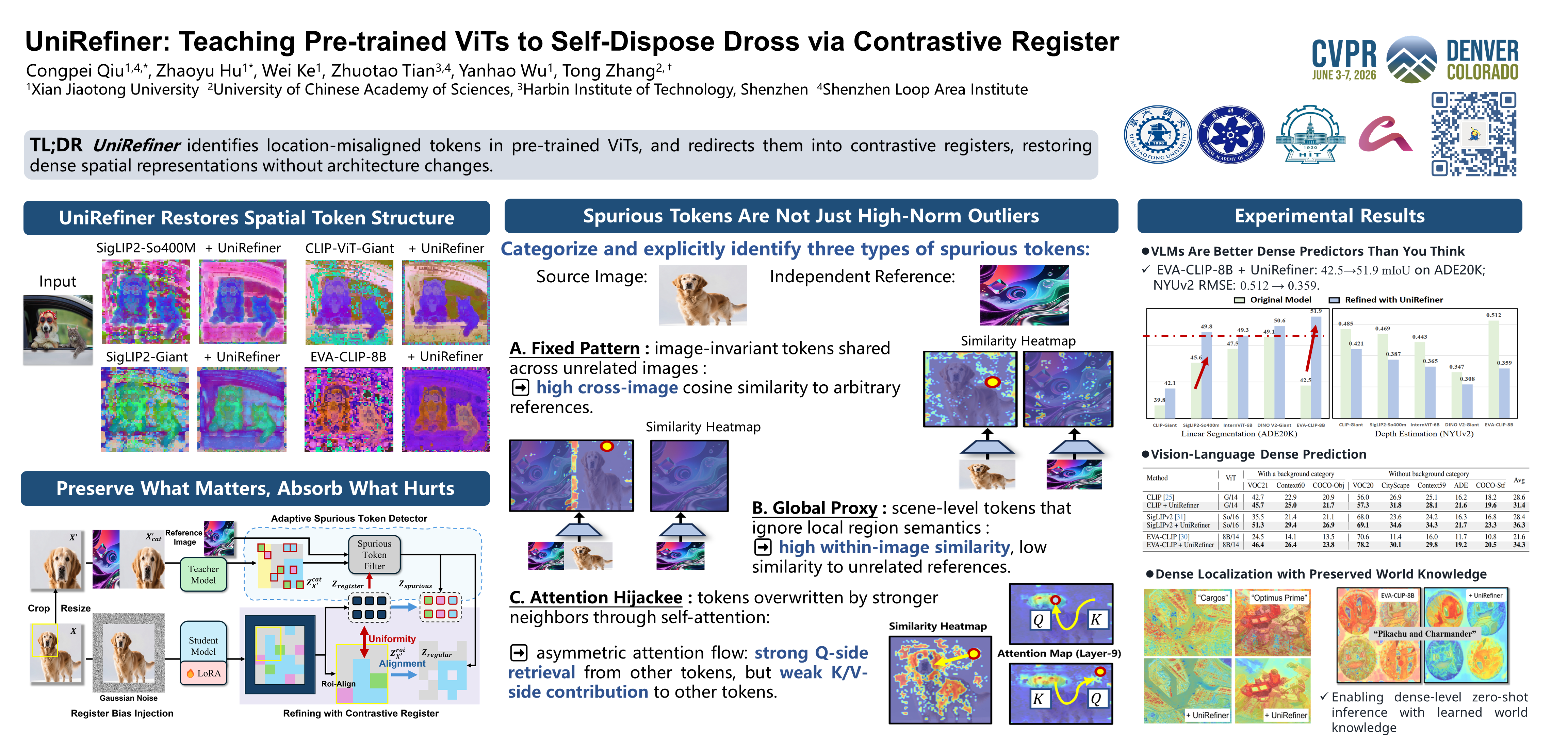
Representation learning with Vision Transformers (ViTs) has advanced rapidly, yet the utility of large-scale models in spatially sensitive tasks is hindered by spurious tokens. Prior efforts to mitigate this have been limited, often defining these artifacts narrowly, for example, as simple high-norm outliers. We argue that this scope is insufficient. For dense prediction tasks, we posit that any token failing to encode location-aligned semantics should be treated as a spurious artifact. This broader definition reveals a more complex problem, leading us to systematically categorize and characterize three fundamental types of spurious tokens that corrupt spatial representations. Based on this comprehensive diagnosis, we propose UniRefiner, a universal refinement framework that teaches pre-trained ViTs to self-dispose of these artifacts. UniRefiner uses contrastive registers to explicitly isolate and redistribute spurious tokens via a dual objective: (i) it aligns image tokens with filtered regular tokens to preserve semantics, and (ii) it aligns register tokens with detected spurious tokens to capture the spurious signals. Our method requires only a few epochs of fine-tuning on ~5k images to refine diverse ViTs, including massive models like EVA-CLIP-8B and InternViT-6B. Experiments demonstrate consistent and significant improvements: notably, the refined EVA-CLIP-8B achieves 51.9\% mIoU on ADE20K (+9.4\%), surpassing specialized vision models like DINOv2 (49.1\%), while zero-shot segmentation accuracy improves by up to 22\%. UniRefiner unlocks the latent spatial potential of existing large-scale foundation models, paving the way for their broader application.
SigLino: Efficient Multi-Teacher Distillation for Agglomerative Vision Foundation Models
Sofian Chaybouti ⋅ Sanath Narayan ⋅ Yasser Dahou ⋅ Phúc H. Lê Khắc ⋅ Ankit Singh ⋅ Ngoc Dung Huynh ⋅ Wamiq Reyaz Para ⋅ Hilde Kuehne ⋅ Hakim Hacid
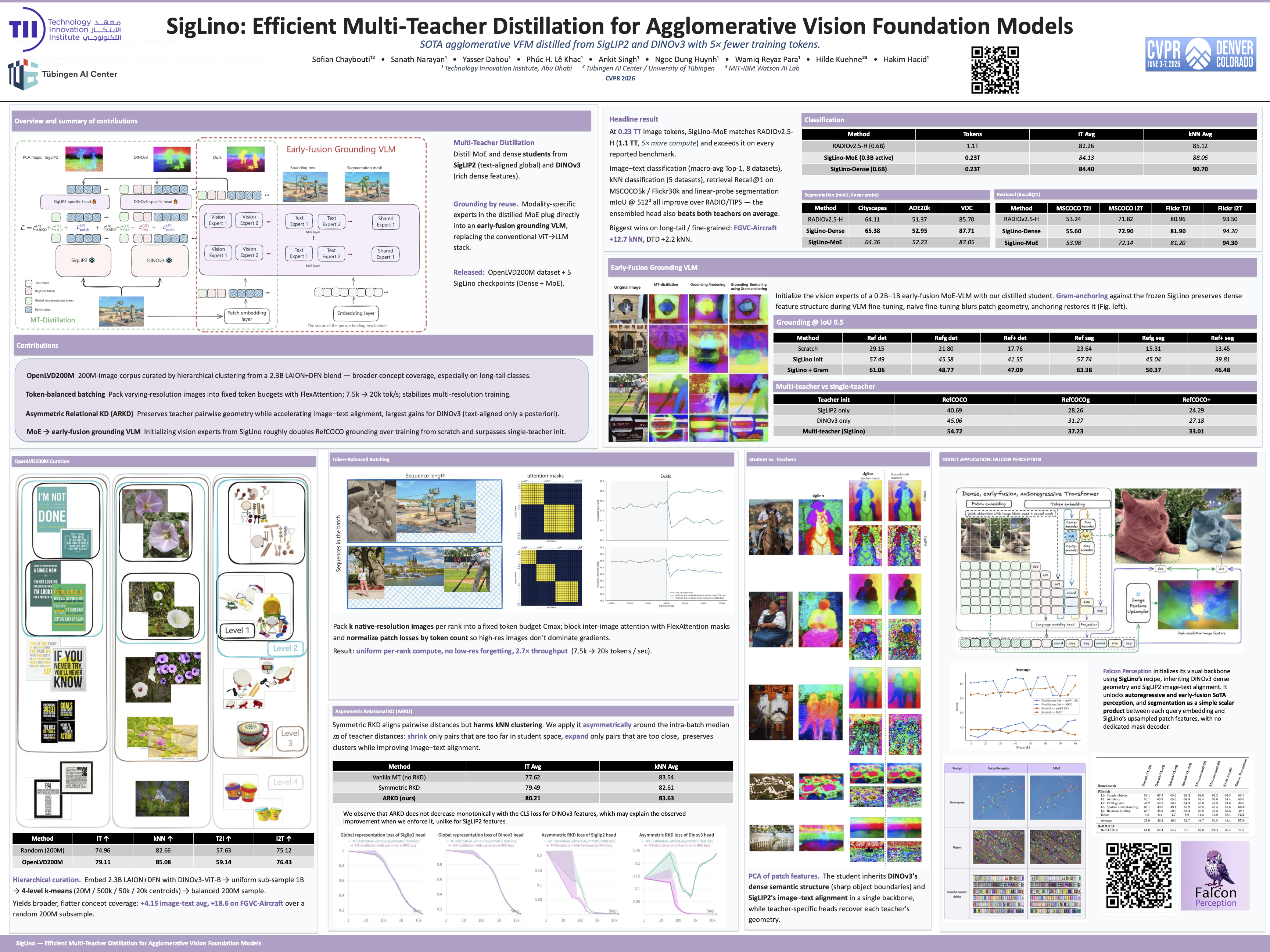
Vision foundation models trained via multi-teacher distillation offer a promising path toward unified visual representations, yet the learning dynamics and data efficiency of such approaches remain underexplored. In this paper, we systematically study multi-teacher distillation for vision foundation models and identify key factors that enable training at lower computational cost. We introduce Agglomerative Mixture-of-Experts Vision Foundation Models (AMoE), which distill knowledge from SigLIP2 and DINOv3 simultaneously into a Mixture-of-Experts student. We show that (1) our Asymmetric Relation-Knowledge Distillation loss preserves the geometric properties of each teacher while enabling effective knowledge transfer, (2) token-balanced batching that packs varying-resolution images into sequences with uniform token budgets stabilizes representation learning across resolutions without sacrificing performance, (3) hierarchical clustering and sampling of training data—typically reserved for self-supervised learning—substantially improves sample efficiency over random sampling for multi-teacher distillation, and (4) the resulting representations transfer effectively to early-fusion Grounding-VLMs, outperforming models trained from scratch. By combining these findings, we curate OpenLVD200M, a 200M-image corpus that demonstrates superior efficiency for multi-teacher distillation. Instantiated in a Mixture-of-Experts, our AMoE initializes an early-fusion Grounding-VLM that replaces the conventional ViT→LLM stack, demonstrating improved performance compared to a model trained from scratch. We release OpenLVD200M and distilled checkpoints.
Heuristic-inspired Reasoning Priors Facilitate Data-Efficient Referring Object Detection
Xu Zhang ⋅ Zhe Chen ⋅ Jing Zhang ⋅ Dacheng Tao
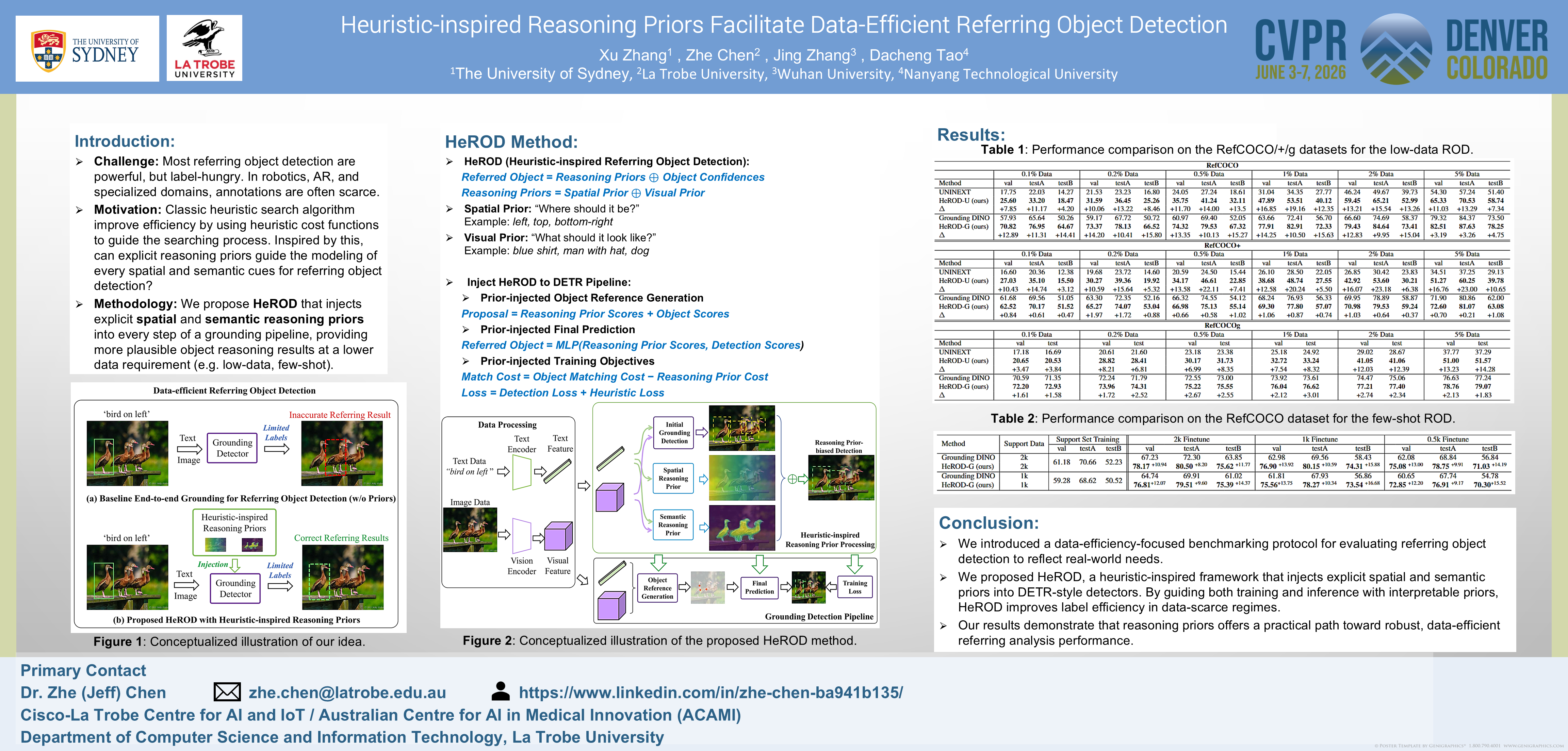
Most referring object detection (ROD) models, especially the modern grounding detectors, are designed for data-rich conditions, yet many practical deployments, such as robotics, augmented reality, and other specialized domains, would face severe label scarcity. In such regimes, end-to-end grounding detectors need to learn spatial and semantic structure from scratch, wasting precious samples. We ask a simple question: Can explicit reasoning priors help models learn more efficiently when data is scarce? To explore this, we first introduce a Data-efficient Referring Object Detection (De-ROD) task, which is a benchmark protocol for measuring ROD performance in low-data and few-shot settings. We then propose the HeROD (Heuristic-inspired ROD), a lightweight, model-agnostic framework that injects explicit, heuristic-inspired spatial and semantic reasoning priors, which are interpretable signals derived based on the referring phrase, into 3 stages of a modern DETR-style pipeline: proposal ranking, prediction fusion, and Hungarian matching. By biasing both training and inference toward plausible candidates, these priors promise to improve label efficiency and convergence performance. On RefCOCO, RefCOCO+, and RefCOCOg, HeROD consistently outperforms strong grounding baselines in scarce-label regimes. More broadly, our results suggest that integrating simple, interpretable reasoning priors provides a practical and extensible path toward better data-efficient vision–language understanding.
LLaDA-V: Large Language Diffusion Models with Visual Instruction Tuning
Zebin You ⋅ Shen Nie ⋅ Xiaolu Zhang ⋅ JUN ZHOU ⋅ Zhiwu Lu ⋅ Ji-Rong Wen ⋅ Chongxuan Li
In this work, we introduce LLaDA-V, a purely diffusion-based Multimodal Large Language Model (MLLM) that integrates visual instruction tuning with masked diffusion models, representing a departure from the autoregressive paradigms dominant in current multimodal approaches. Built upon LLaDA, a representative large language diffusion model, LLaDA-V incorporates a vision encoder and MLP connector that projects visual features into the language embedding space, leveraging diffusion language models' bidirectional attention to capture spatial relationships in visual data more effectively than causal, sequential processing. Our empirical investigation reveals several intriguing results: First, LLaDA-V demonstrates promising multimodal performance despite its language model being weaker on purely textual tasks than counterparts like LLaMA3-8B and Qwen2-7B. When trained on the same instruction data, LLaDA-V is highly competitive with LLaMA3-V across multimodal tasks with better data scalability. It also narrows the performance gap to Qwen2-VL, suggesting the effectiveness of its architecture for multimodal tasks. Second, LLaDA-V achieves state-of-the-art performance in multimodal understanding compared to existing purely diffusion-based MLLMs. Our findings suggest that large language diffusion models show promise in multimodal contexts and warrant further investigation. To facilitate such research, we will open-source the LLaDA-V model along with its training and evaluation code.
AVION: Aerial Vision–Language Instruction from Offline Teacher to Prompt-Tuned Network
Yu Hu ⋅ Jianyang Gu ⋅ Hao Liu ⋅ Yue Cao ⋅ Jozsef Hamari ⋅ Zheng Liu ⋅ Mohsen Zardadi
Adapting vision-language models to remote sensing imagery remains challenging due to two key factors: limited semantic coverage in textual representations and insufficient adaptability of visual features. These issues are particularly significant in aerial scenes, which involve various visual appearances and fine-grained object distinctions. We propose AVION, a knowledge distillation framework tailored for remote sensing adaptation of vision-language models. The teacher module constructs semantically rich textual prototypes by collecting descriptions from a large language model and verifying validity using remote sensing image features. The student module integrates lightweight and learnable prompts into both vision and language encoders, guided by the teacher to align embeddings and their cross-modal relationships. Once trained, the student operates independently during inference.Experiments on six optical remote sensing benchmarks show that AVION improves few-shot classification and base-class accuracy without degrading generalization to novel categories. It also enhances mean recall for cross-modal retrieval, with minimal additional trainable parameters.
CrossVL: Complexity-Aware Feature Routing and Paired Curriculum for Cross-View Vision-Language Detection
Zhipeng Liu ⋅ Chunbo Luo
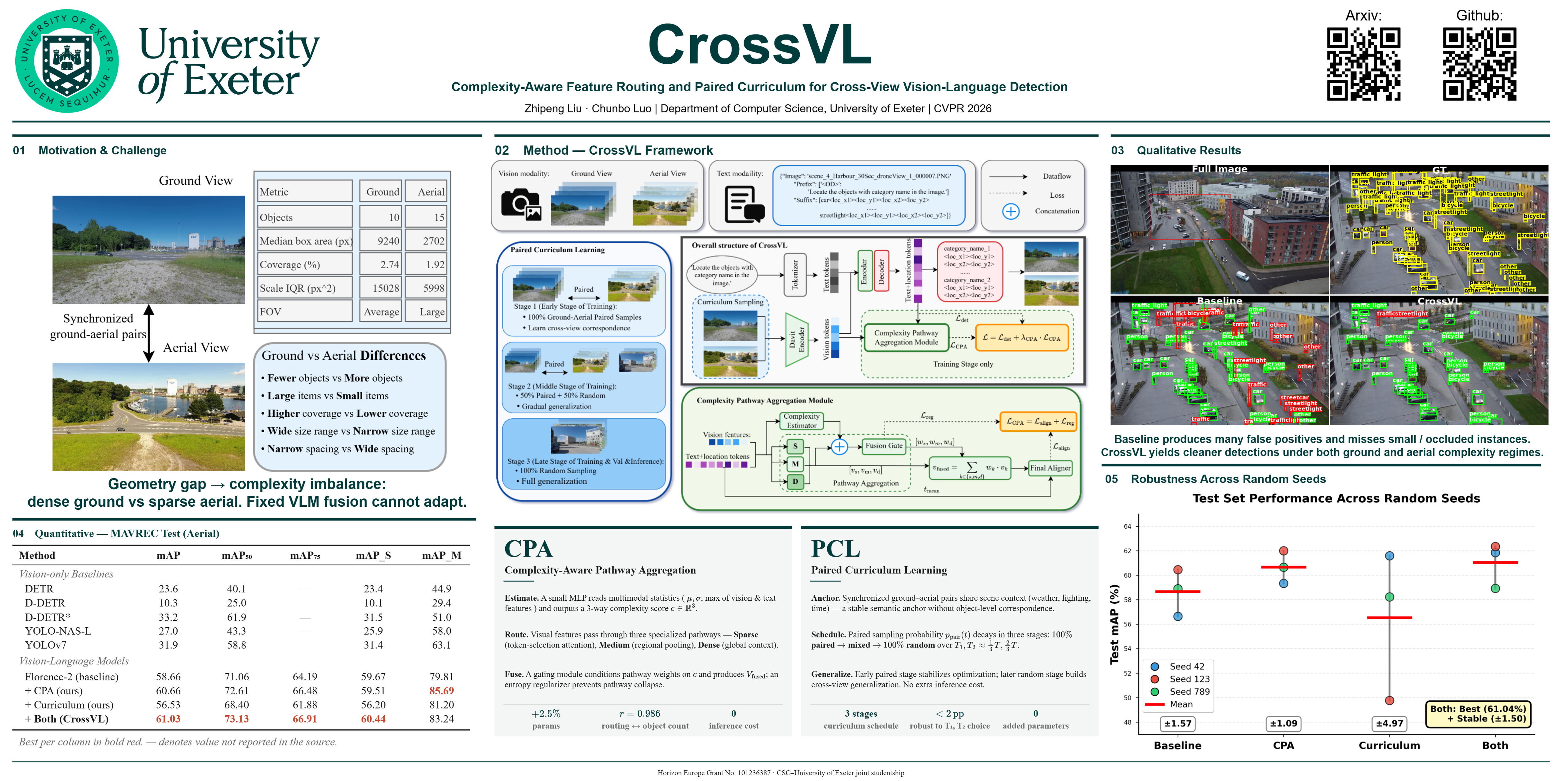
Vision–language models (VLMs) enable text-guided object detection but degrade severely under cross-view scenarios where ground and aerial viewpoints differ in altitude, scale, and spatial layout. These geometric changes introduce systematic complexity variations between viewpoints, e.g., ground view images contain dense and highly occluded structures, while aerial images are sparse and globally organized. Fixed VLM fusion mechanisms cannot handle this discrepancy. We propose \textbf{CrossVL}, a framework combining \textbf{Complexity-Aware Pathway Aggregation (CPA)} and \textbf{Paired Curriculum Learning (PCL)} for enhanced cross-view detection for VLM. CPA estimates scene complexity from multimodal statistics and routes visual features through multiple pathways to obtain view-specific representations. PCL leverages semantic consistency of synchronized ground–aerial pairs to provide stable early supervision and then gradually shifts toward randomized sampling. On MAVREC, CrossVL improves Florence-2’s aerial mAP from 58.66\% to 61.03\% and reduces the ground-aerial performance gap from 8.63pp to 6.65pp, while also achieving a 3.3× reduction in variance across random seeds. CPA provides stable complexity-aware feature aggregation, and PCL enhances optimization dynamics. Together, they demonstrate that coordinated architectural and training adaptations are crucial for robust cross-view VLM detection.
Masking Teacher and Reinforcing Student for Distilling Vision-Language Models
Byung-Kwan Lee ⋅ Yu-Chiang Frank Wang ⋅ Ryo Hachiuma
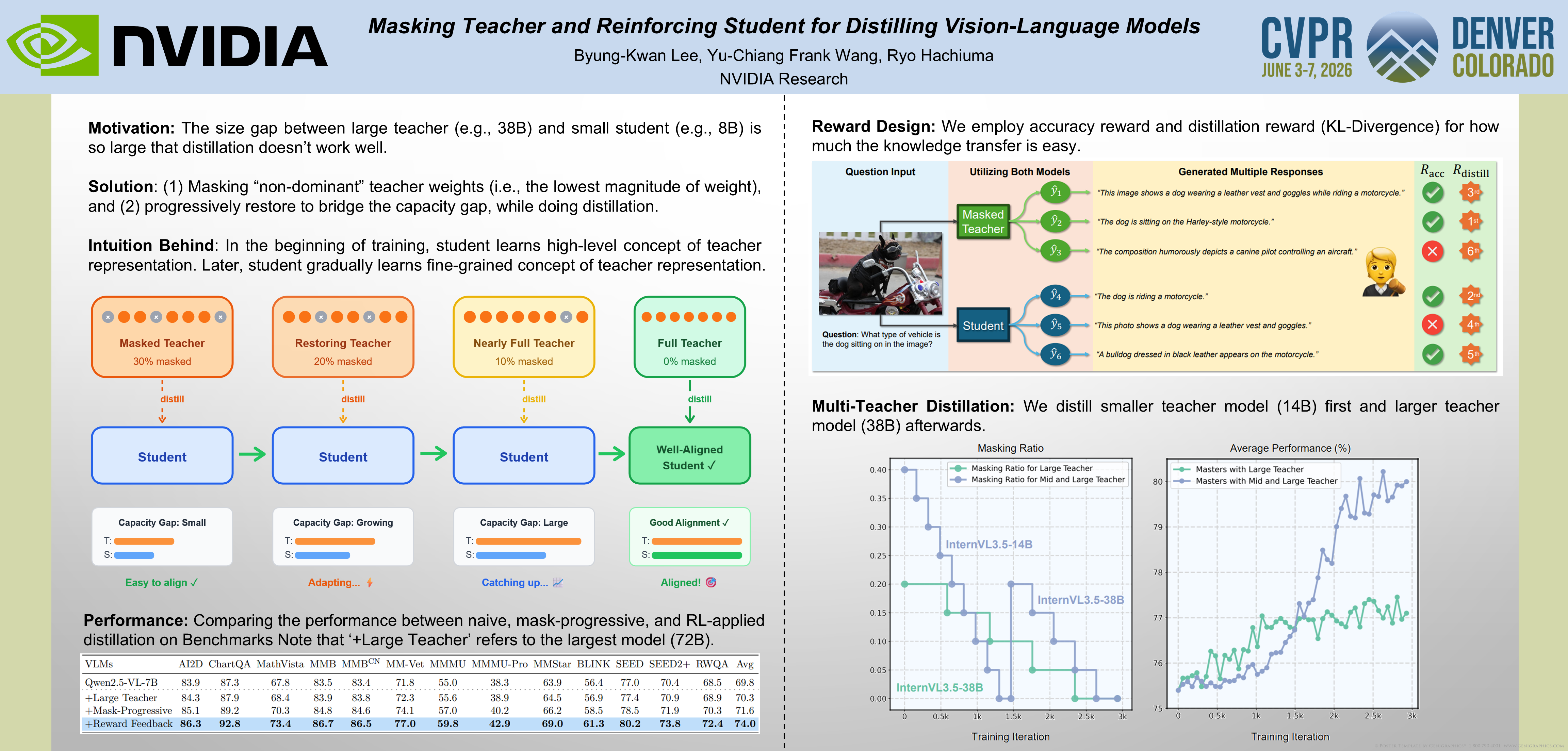
Large-scale vision–language models (VLMs) have recently achieved remarkable multimodal understanding, but their massive size makes them impractical for deployment on mobile or edge devices. This raises the need for compact yet capable VLMs that can efficiently learn from powerful large teacher. However, distilling knowledge from large teacher to small student remains challenging due to their large size gap: the student often fails to reproduce the teacher's complex, high-dimensional representations, leading to unstable learning and degraded performance. To address this, we propose Masters (Masking teacher and reinforcing student), a mask-progressive reinforcement learning (RL) distillation framework. Masters first masks and non-dominant weights of the teacher to reduce unnecessary complexity, then progressively restores the teacher from mask to gradually increase the teacher capacity during training. This strategy allows the student to learn richer representations of teacher in a smooth and stable manner. To further refine knowledge transfer, Masters integrates an offline RL stage with two complementary rewards: an accuracy reward that measures the correctness of the generated responses, and a distillation reward that quantifies the ease of their responses' transferability from teacher to student. Unlike online think–answer RL paradigms that are computationally expensive and generate lengthy responses, our offline RL leverages pre-generated responses from masked teachers. These provide rich yet efficient guidance, enabling the students to achieve strong performance without requiring the think–answer process. Extensive experiments across diverse VLM benchmarks demonstrate that Masters outperforms existing compact VLMs and partially surpasses large ones, while being far more efficient. Moreover, gradually increasing the teacher sizes during distillation (e.g., from 14B to 38B) yields smoother convergence and stronger generalization than one-shot distillation (e.g., 38B), revealing a scalable path toward efficient and deployable VLMs.
Role-SynthCLIP: A Role-Play Driven Diverse Synthetic Data Approach
Yuanxiang Huangfu ⋅ Chaochao wang ⋅ weilei wang
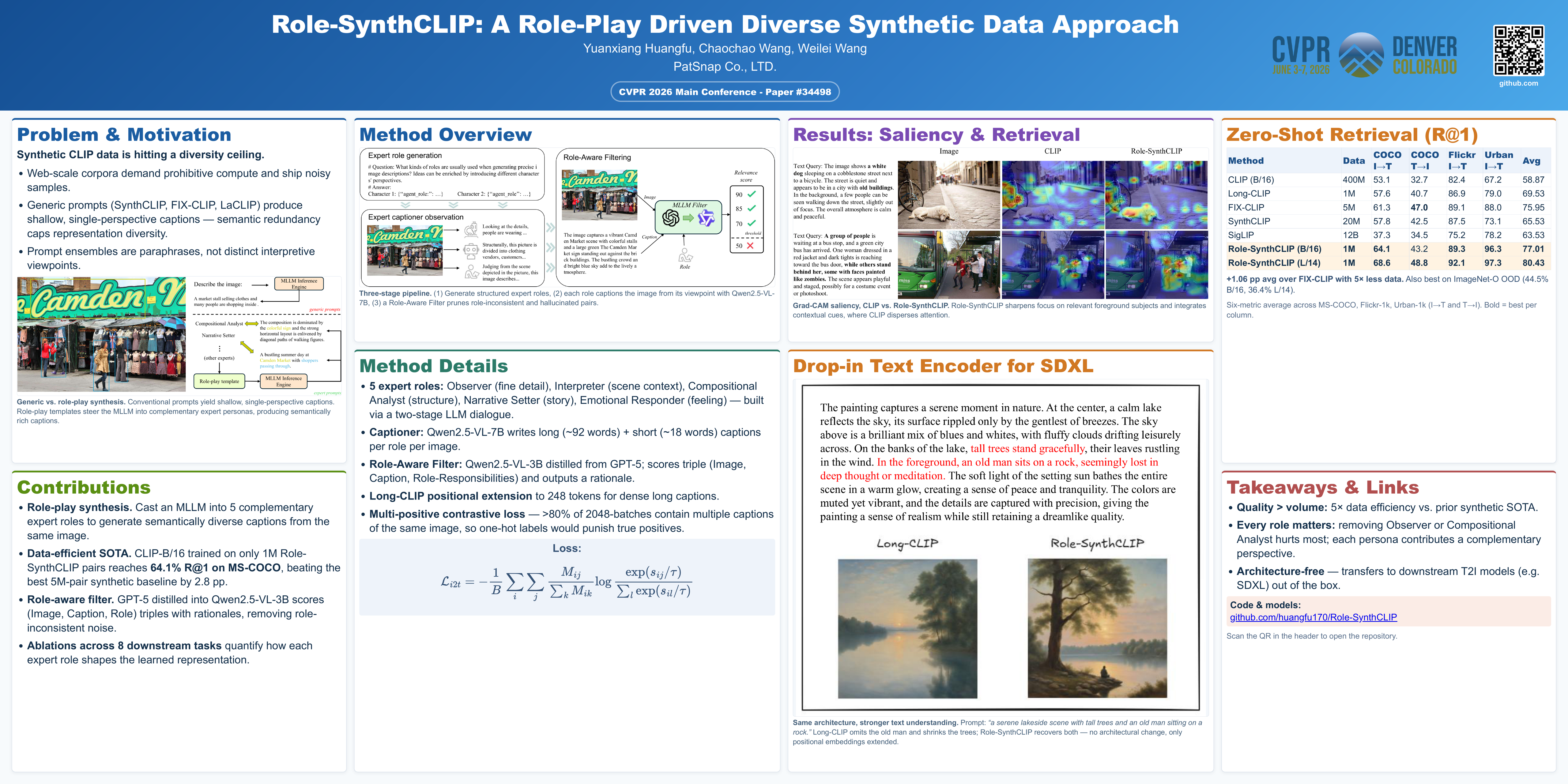
The effectiveness of Contrastive Language-Image Pre-training (CLIP) models critically depends on the semantic diversity and quality of their training data. However, while existing synthetic data generation methods primarily focus on increasing data volume, such emphasis often leads to limited semantic diversity and redundant or shallow captions. To address this limitation, we propose \textbf{Role-SynthCLIP}, a novel data synthesis framework that leverages multi-perspective role-playing prompts (e.g., a compositional analyst, an interpreter of image context) to guide Multimodal Large Language Models (MLLMs) in generating semantically diverse captions from distinct viewpoints. This mechanism enhances the semantic diversity and fine-grained image-text alignment of synthetic pairs by enriching each image with multiple complementary captions, while keeping the number of training images fixed. Experimental results demonstrate the effectiveness and efficiency of our method. A CLIP-B/16 model trained on only 1 million images achieves a Recall@1 of $\mathbf{64.1\%}$ on the MS COCO validation set, surpassing the best existing synthetic data baseline (trained on 5M pairs) by $2.8$ percentage points. The code and trained models will be made publicly available.
BiMotion: B-spline Motion for Text-guided Dynamic 3D Character Generation
Miaowei Wang ⋅ Qingxuan Yan ⋅ Zhi Cao ⋅ Yayuan Li ⋅ Oisin Mac Aodha ⋅ Jason J. Corso ⋅ Amir Vaxman
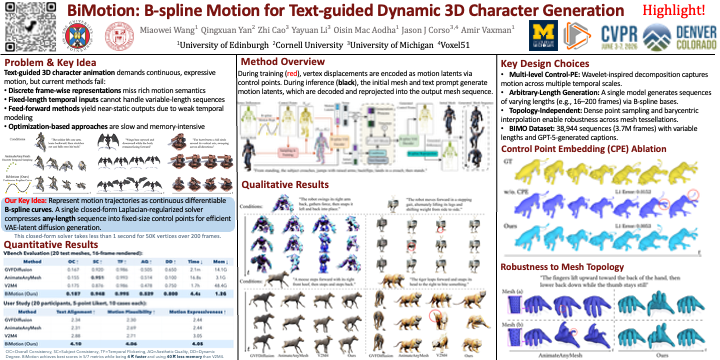
Text-guided dynamic 3D character generation has advanced rapidly, yet producing high-quality motion that faithfully reflects rich textual descriptions remains challenging. Existing methods tend to generate limited sub-actions or incoherent motion due to fixed-length temporal inputs and discrete frame-wise representations that fail to capture rich motion semantics. We address these limitations by representing motion with continuous differentiable B-spline curves, enabling more effective motion generation without modifying the capabilities of the underlying generative model. Specifically, our closed-form, Laplacian-regularized B-spline solver efficiently compresses variable-length motion sequences into compact representations with a fixed number of control points. Further, we introduce a normal-fusion strategy for input shape adherence along with correspondence-aware and local-rigidity losses for motion-restoration quality. To train our model, we collate BIMO, a new dataset containing diverse variable-length 3D motion sequences with rich, high-quality text annotations. Extensive evaluations show that our feed-forward framework BiMotion generates more expressive, higher-quality, and better prompt-aligned motions than existing state-of-the-art methods, while also achieving faster generation. The code is available in the supplemental material and will be made publicly available upon publication.
PSDesigner: Automated Graphic Design with a Human-Like Creative Workflow
Xincheng Shuai ⋅ Song Tang ⋅ Yutong Huang ⋅ Henghui Ding ⋅ Dacheng Tao
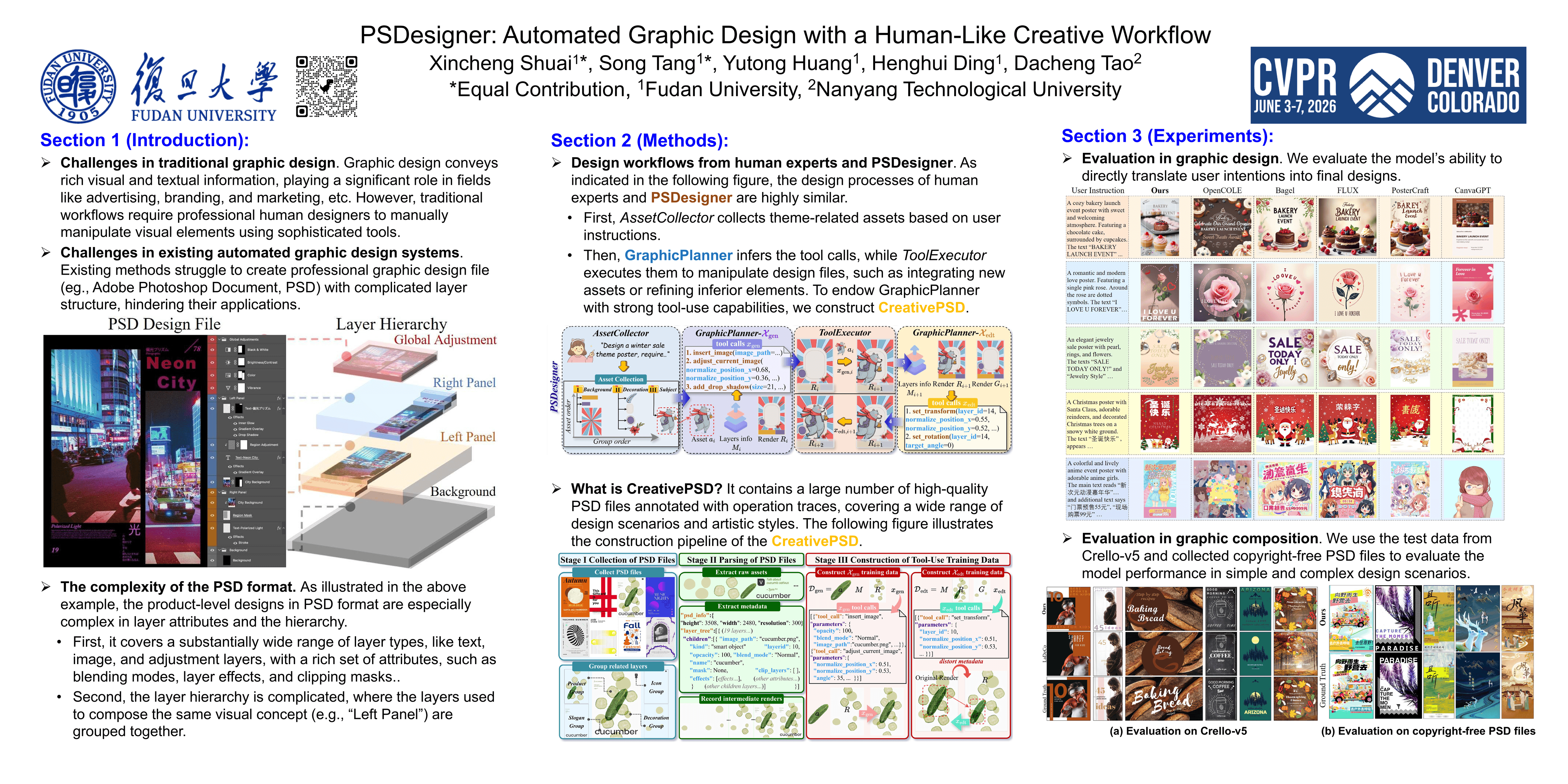
Graphic design is a creative and innovative process that plays a crucial role in applications such as e-commerce and advertising. However, developing an automated design system that can faithfully translate user intentions into editable design files remains an open challenge. Although recent studies have leveraged powerful text-to-image models and MLLMs to assist graphic design, they typically simplify professional workflows, resulting in limited flexibility and intuitiveness. To address these limitations, we propose PSDesigner, an automated graphic design system that emulates the creative workflow of human designers. Building upon multiple specialized components, PSDesigner collects theme-related assets based on user instructions, and autonomously infers and executes tool calls to manipulate design files, such as integrating new assets or refining inferior elements. To endow the system with strong tool-use capabilities, we construct a design dataset, CreativePSD, which contains a large amount of high-quality PSD design files annotated with operation traces across a wide range of design scenarios and artistic styles, enabling models to learn expert design procedures. Extensive experiments demonstrate that PSDesigner outperforms existing methods across diverse graphic design tasks, empowering non-specialists to conveniently create production-quality designs.
CADFS: A Big CAD Program Dataset and Framework for Computer-Aided Design with Large Language Models
Vladislav Pyatov ⋅ Gleb Bobrovskikh ⋅ Saveliy Galochkin ⋅ Nikita Boldyrev ⋅ Oleg Voynov ⋅ Alexander Filippov ⋅ Gonzalo Ferrer ⋅ Peter Wonka ⋅ Evgeny Burnaev
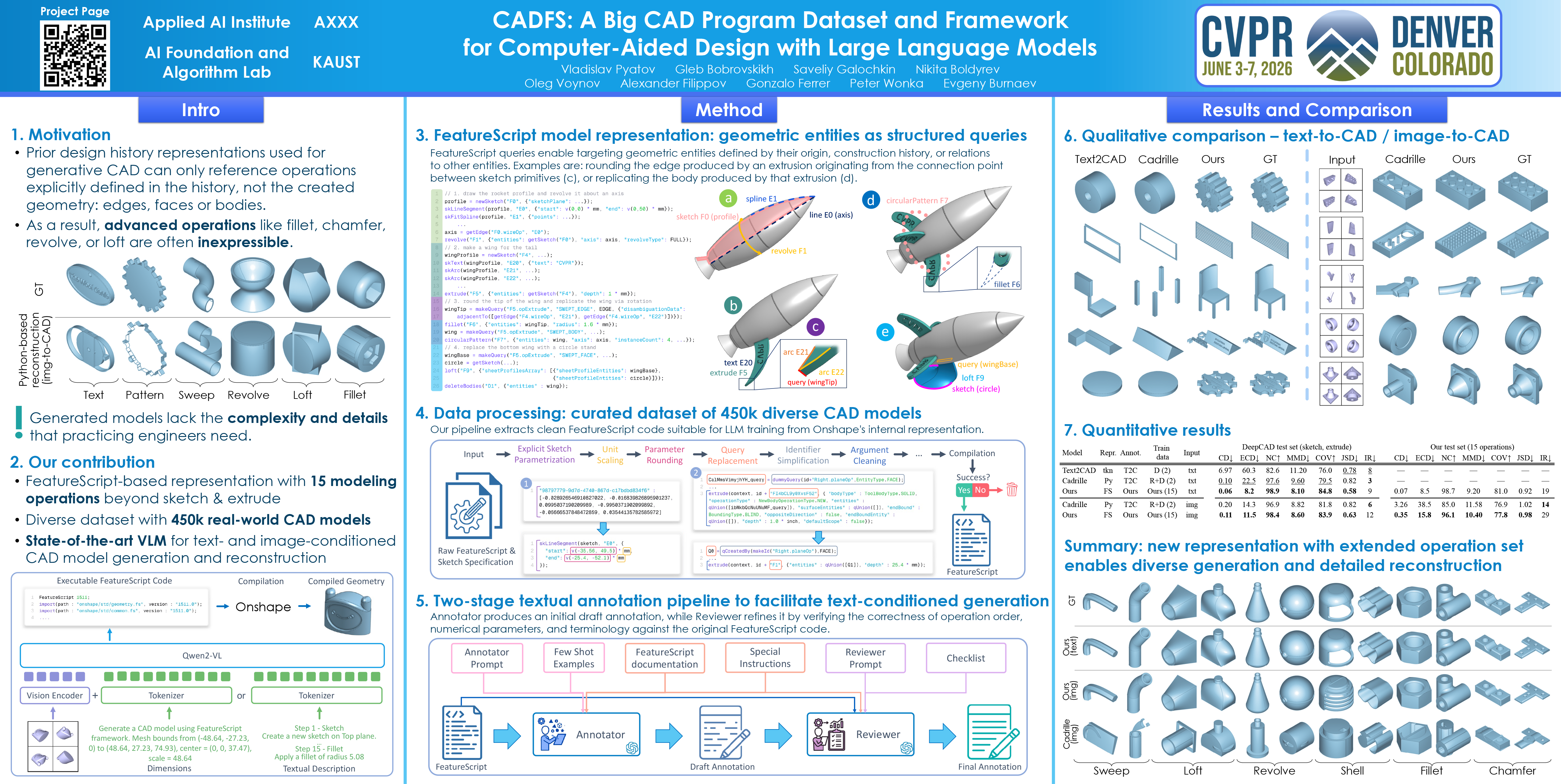
We introduce CADFS, a data-centric framework that enables large vision-language models to generate complex CAD design histories. Existing generative CAD systems are restricted to sketch-and-extrude operations due to simplified representations and limited datasets. We address this by introducing a FeatureScript-based representation and constructing a dataset of 450k real-world CAD models spanning 15 modeling operations, obtained via a new pipeline that reconstructs clean, executable FeatureScript programs and provides multimodal annotations. Fine-tuning a VLM on this representation yields state-of-the-art results in text-conditioned CAD generation and image-based reconstruction, producing more accurate, diverse, and feature-rich designs than prior frameworks. Ablations show that FeatureScript, the expanded operation set, and representation-aligned textual descriptions all significantly improve performance. Our framework substantially broadens the complexity and realism achievable in generative CAD.
MapRoute:Precise-Concept Erasing Mappers via Semantic Routing
Sihao Li ⋅ Baixi Baixi ⋅ Shuohong Xia ⋅ Yunyun Yang
Contemporary commercial and open-source diffusion models have demonstrated remarkable performance in text-to-image generation, enabling widespread applications in creative design and content creation. However, legitimate requirements—such as copyright protection, privacy compliance, or personalized customization—often necessitate the removal of specific semantic concepts from pretrained models. Existing concept erasure methods suffer from two critical limitations: (1) **Incomplete suppression**, where the model still occasionally generates images containing the target concept; (2) **Poor semantic selectivity**, which degrades the generation quality of unrelated concepts and compromises overall model utility.To address these challenges, we propose **`MapRoute`**, a lightweight, semantics-aware concept erasure framework based on dynamic routing. Our approach introduces a set of modular components—termed *Mappers*—placed after a frozen pretrained text encoder. Each Mapper learns a linear mapping from a target concept to a surrogate concept. During inference, the system dynamically activates the top-$K$ Mappers most relevant to the input prompt, based on cosine similarity between the text embedding and all the target concept embeddings, and applies their transformations sequentially. This input-driven, modular intervention enables precise, on-demand erasure while avoiding unnecessary interference with irrelevant semantics.Extensive experiments demonstrate that **`MapRoute`** effectively suppresses specified concepts while significantly reducing collateral damage to unrelated concept. By operating without full-model fine-tuning, our method entirely avoids parameter drift and concept erosion. Moreover, **`MapRoute`** outperforms state-of-the-art baselines in terms of generation fidelity, semantic consistency, and scalability to multi-concept erasure scenarios.
PhotoFramer: Multi-modal Image Composition Instruction
Zhiyuan You ⋅ Ke Wang ⋅ He Zhang ⋅ Xin Cai ⋅ Jinjin Gu ⋅ Tianfan Xue ⋅ Chao Dong ⋅ Zhoutong Zhang
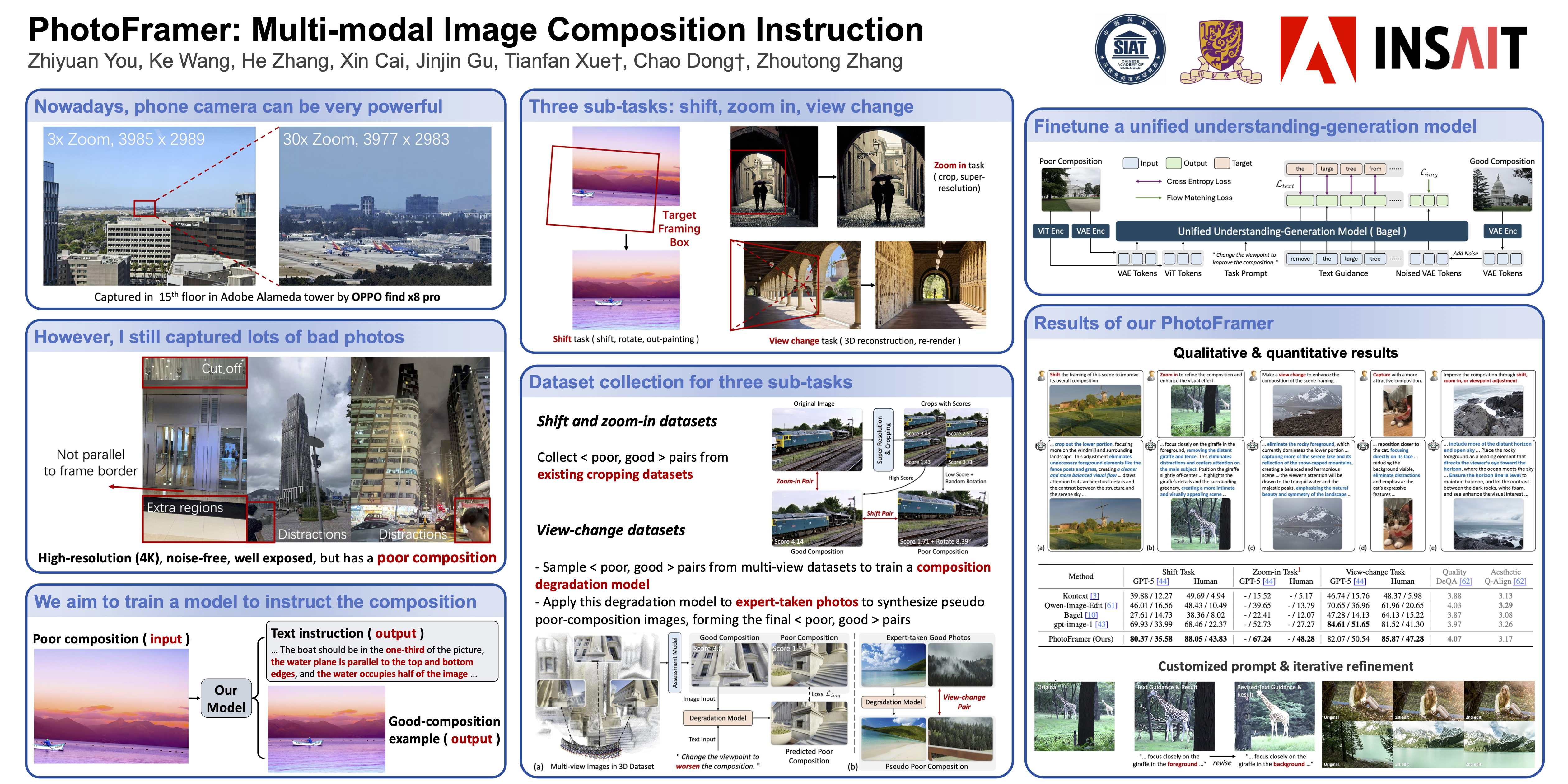
Composition matters during the photo-taking process, yet many casual users struggle to frame well-composed images. To provide composition guidance, we introduce PhotoFramer, a multi-modal composition instruction framework. Given a poorly composed image, PhotoFramer first describes how to improve the composition in natural language and then generates a well-composed example image. To train such a model, we curate a large-scale dataset. Inspired by how humans take photos, we organize composition guidance into a hierarchy of sub-tasks: shift, zoom-in, and view-change tasks. Shift and zoom-in data are sampled from existing cropping datasets, while view-change data are obtained via a two-stage pipeline. First, we sample pairs with varying viewpoints from multi-view datasets, and train a degradation model to transform well-composed photos into poorly composed ones. Second, we apply this degradation model to expert-taken photos to synthesize poor images to form training pairs. Using this dataset, we finetune a model that jointly processes and generates both text and images, enabling actionable textual guidance with illustrative examples. Extensive experiments demonstrate that textual instructions effectively steer image composition, and coupling them with exemplars yields consistent improvements over exemplar-only baselines. PhotoFramer offers a practical step toward composition assistants that make expert photographic priors accessible to everyday users.
Can We Build Scene Graphs, Not Classify Them? FlowSG: Progressive Image-Conditioned Scene Graph Generation with Flow Matching
Xin Hu ⋅ Ke Qin ⋅ Wen Yin ⋅ Yuan-Fang Li ⋅ Ming Li ⋅ Tao He
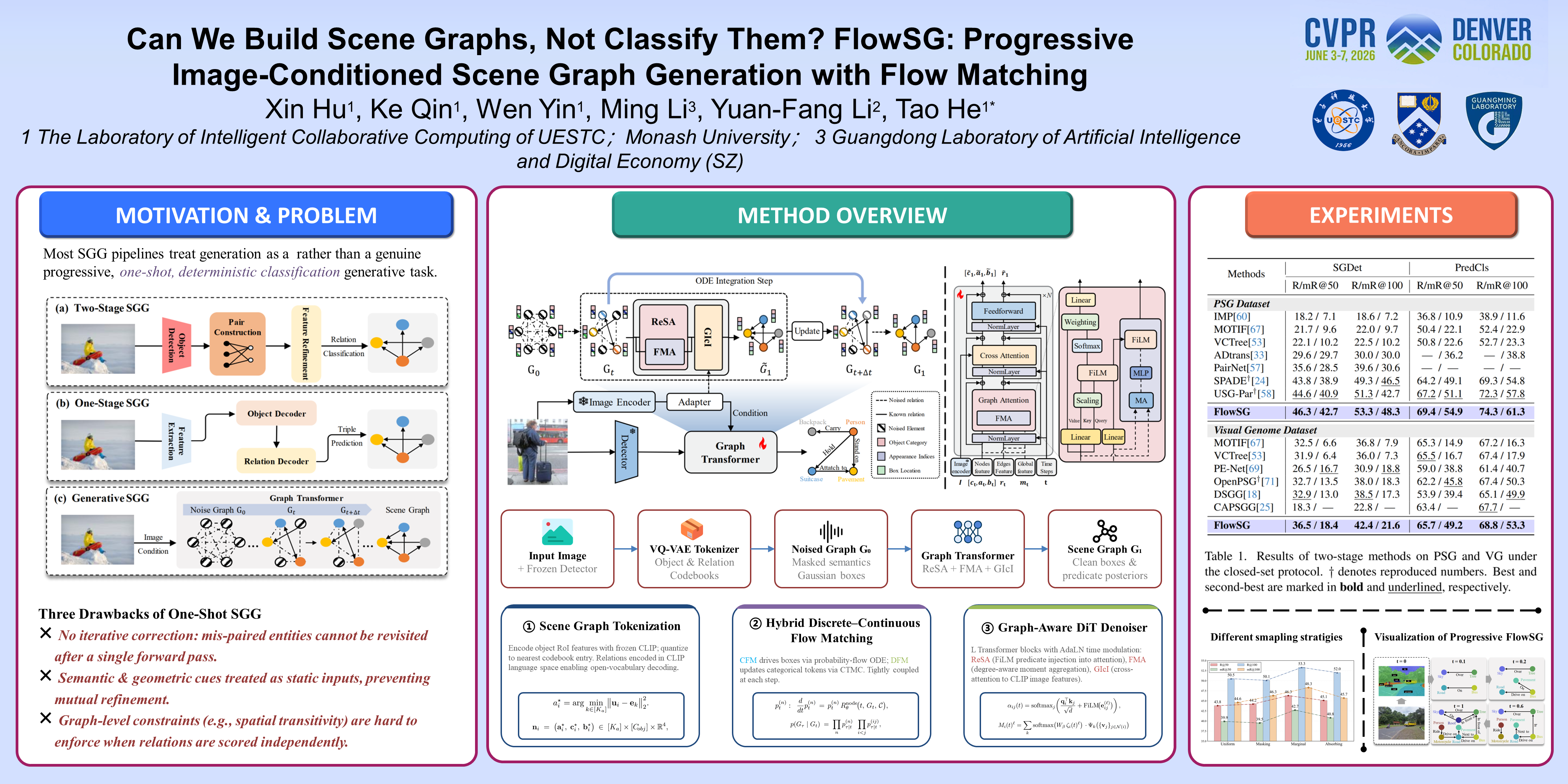
Scene Graph Generation (SGG) unifies object localization and visual relationship reasoning by predicting boxes and subject–predicate–object triples. Yet most pipelines treat SGG as a one-shot, deterministic classification instead of a genuine {progressive, generative} task. We propose \textbf{FlowSG}, which recasts SGG as continuous-time transport on a {hybrid} discrete–continuous state: starting from a {noised graph}, the model progressively grows an image-conditioned scene graph through constraint-aware refinements that jointly synthesize nodes (objects) and edges (predicates). Specifically, we first leverage a VQ-VAE to quantize a {scene graph} (e.g., the continuous visual features) into compact, predictable tokens; a graph Transformer then (i) predicts a conditional velocity field to transport continuous geometry (boxes) and (ii) updates discrete posteriors for {categorical tokens (object features and predicate labels)}, coupling semantics and geometry via flow-conditioned message aggregation. Training combines flow-matching losses for geometry with a discrete-flow objective for tokens, yielding few-step inference and plug-and-play compatibility with standard detectors/segmenters. Extensive experiments on VG and PSG under closed- and open-vocabulary protocols show consistent gains in predicate R/mR and graph-level metrics, validating the mixed discrete–continuous generative formulation over one-shot classification baselines, e.g., an average improvement of about 3 points over the SOTA USG-Par.
DuetSVG: Unified Multimodal SVG Generation with Internal Visual Guidance
Peiying Zhang ⋅ Nanxuan Zhao ⋅ Matthew Fisher ⋅ Yiran Xu ⋅ Jing Liao ⋅ Difan Liu
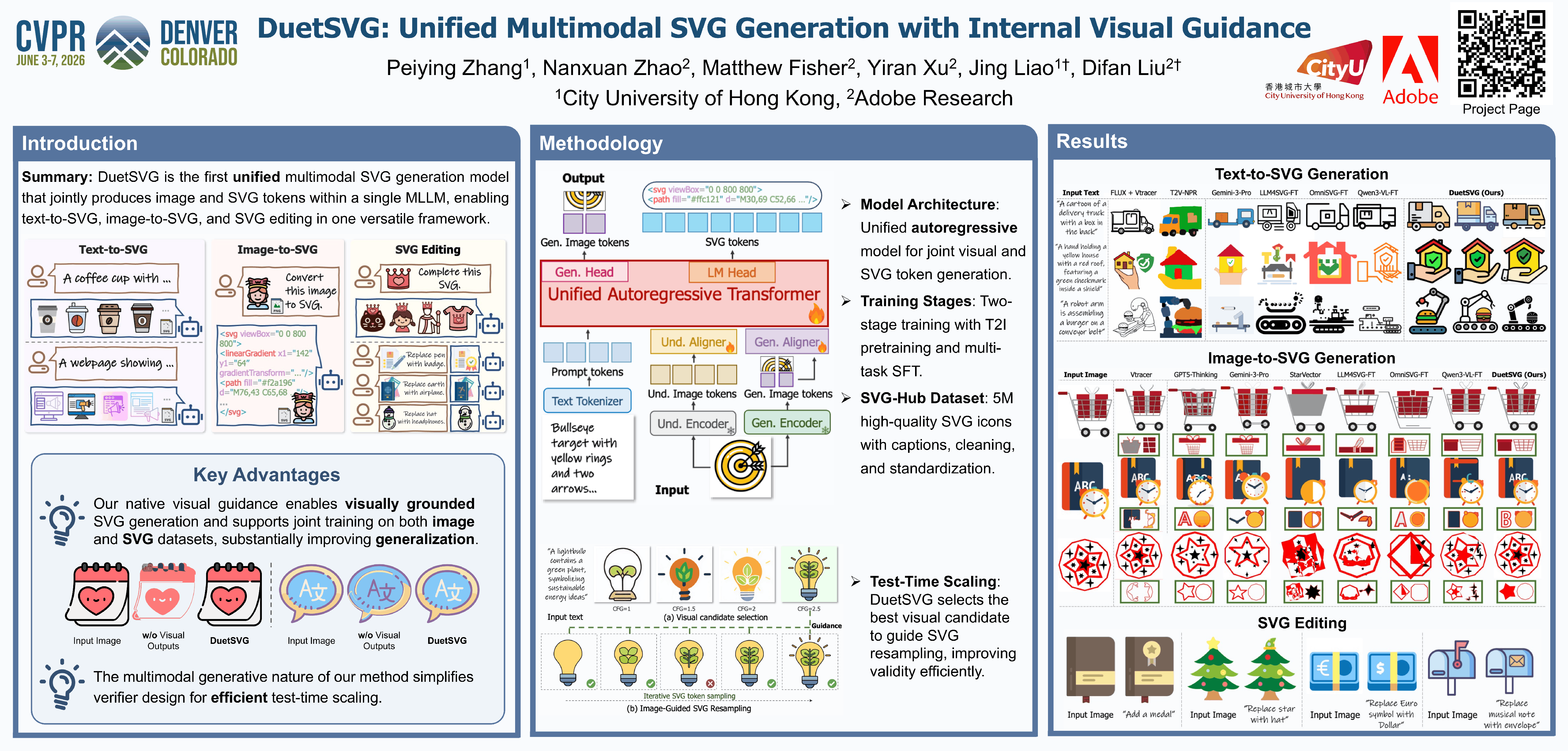
Recent vision–language model (VLM)–based approaches have achieved impressive results on SVG generation. However, because they generate only text and lack visual signals during decoding, they often struggle with complex semantics and fail to produce visually appealing or geometrically coherent SVGs. We introduce DuetSVG, a unified multimodal model that jointly generates image tokens and corresponding SVG tokens in an end-to-end manner. DuetSVG is trained on both image and SVG datasets. At inference, we apply a novel test-time scaling strategy that leverages the model’s native visual predictions as guidance to improve SVG decoding quality. Extensive experiments show that our method outperforms existing methods, producing visually faithful, semantically aligned, and syntactically clean SVGs across a wide range of applications.
Bias Is a Subspace, Not a Coordinate: A Geometric Rethinking of Post‑hoc Debiasing in Vision-Language Models
Dachuan Zhao ⋅ Weiyue Li ⋅ Zhenda Shen ⋅ Yushu Qiu ⋅ Bowen Xu ⋅ Haoyu Chen ⋅ Yongchao Chen
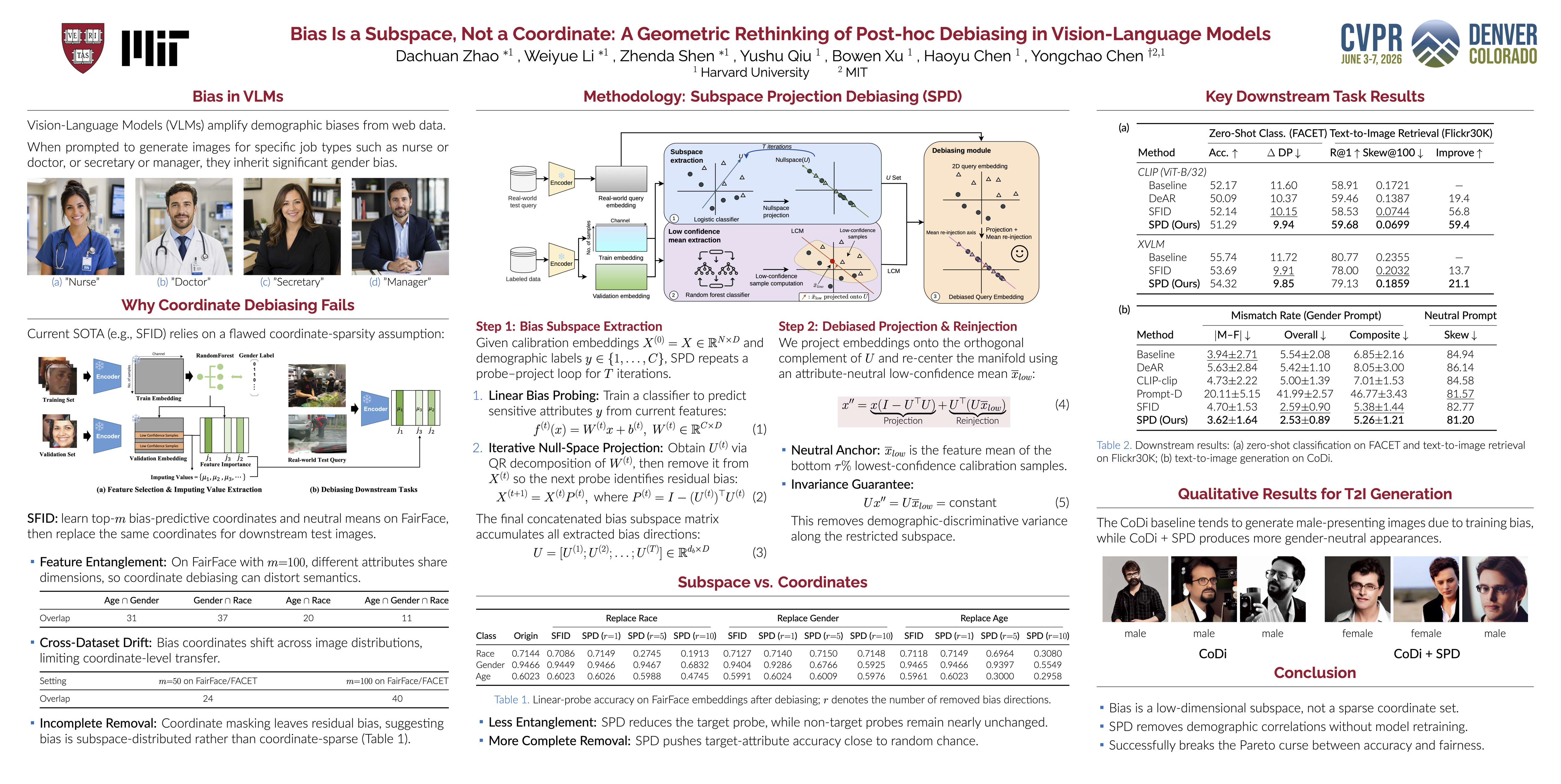
Vision-Language Models (VLMs) have become indispensable for multimodal reasoning, yet their representations often encode and amplify demographic biases, resulting in biased associations and misaligned predictions in downstream tasks. Such behavior undermines fairness and distorts the intended alignment between vision and language. Recent post-hoc approaches attempt to mitigate bias by replacing the most attribute-correlated embedding coordinates with neutral values. However, our systematic analysis reveals three critical failures of this coordinate-wise approach: feature entanglement, poor cross-dataset generalization, and incomplete bias removal. We find that bias is not localized to a few coordinates but is instead distributed across a few linear subspaces. To address these limitations, we propose $\textbf{S}$ubspace $\textbf{P}$rojection $\textbf{D}$ebiasing ($\textbf{SPD}$), a geometrically principled framework that identifies and removes the entire subspace of linearly decodable bias while reinserting a neutral mean component to preserve semantic fidelity. Extensive experiments across zero-shot classification, text-to-image retrieval, and image generation validate the effectiveness of \sys{}: our method achieves more robust debiasing with an average improvement of 18.5\% across four fairness metrics, while maintaining minimal loss in task performance compared to the best debiasing baseline.
Frequency-domain Manipulation for Face Obfuscation
Jintae Kim ⋅ Keunsoo Ko ⋅ Chang-Su Kim
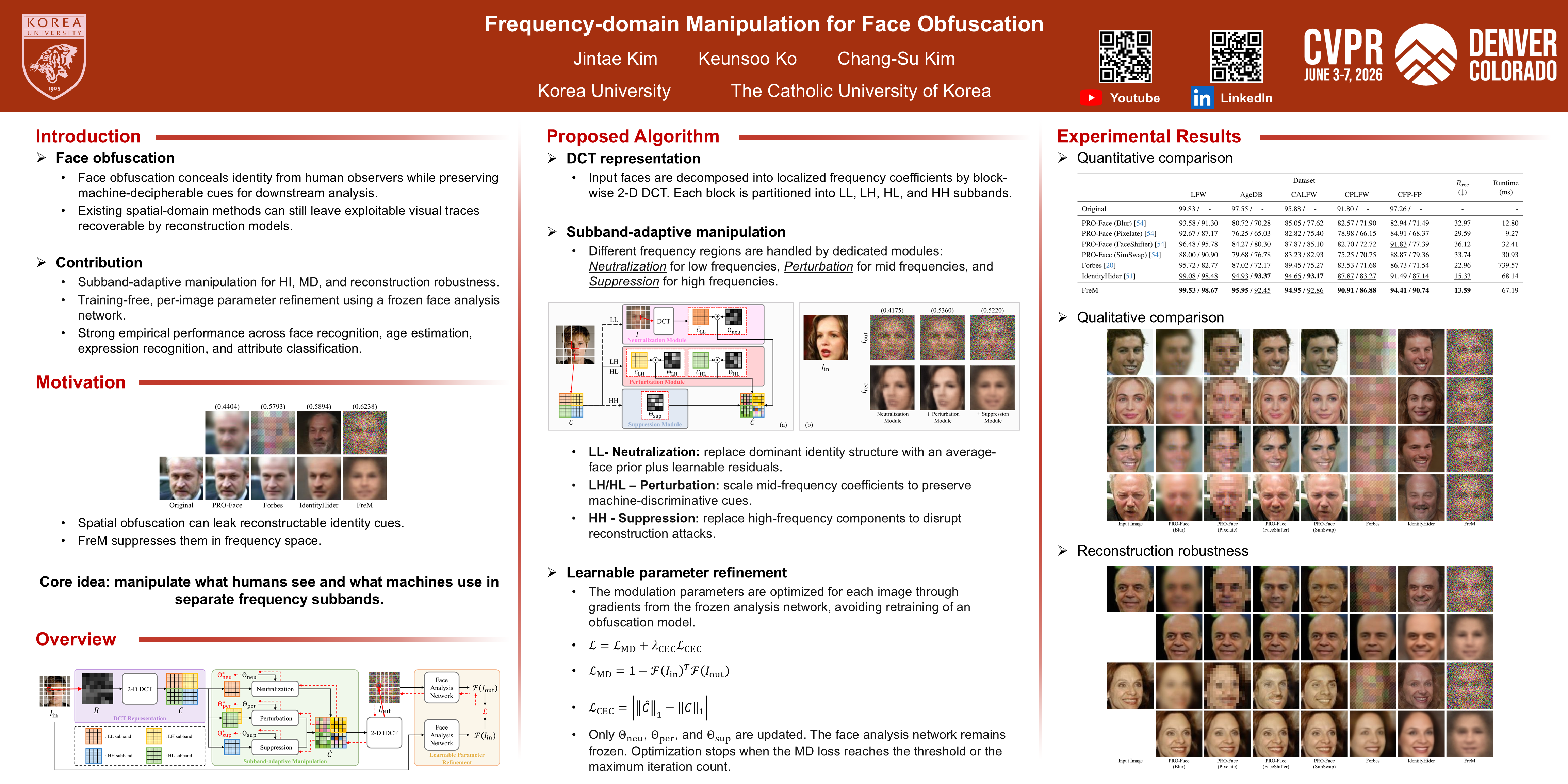
Facial image datasets have become essential resources for various face analysis tasks, but their use raises significant privacy concerns. To address this issue, face obfuscation has emerged as a practical approach to hide identity from humans while retaining cues decipherable by machines. However, existing methods often leave exploitable visual traces, making them vulnerable to reconstruction attacks that restore hidden identity. To address this issue, we propose a frequency-domain manipulation framework, called FreM, which adjusts frequency subbands differently to hide identity, retain machine-decipherable cues, and improve robustness against reconstruction attacks. Specifically, the proposed FreM first decomposes a facial image into frequency subbands and applies subband-adaptive modulation that regulates information according to the characteristics of each subband. The modulation parameters are then refined to yield the reliable obfuscated result. Extensive experiments across multiple face analysis benchmarks demonstrate that FreM achieves superior obfuscation quality and strong robustness against reconstruction attacks. The source code will be made publicly available.
Towards Reasoning-Preserving Unlearning in Multimodal Large Language Models
Hongji Li ⋅ Manjiang Yu ⋅ Junchi Yao ⋅ PRIYANKA SINGH ⋅ Xue Li ⋅ Di Wang ⋅ Lijie Hu
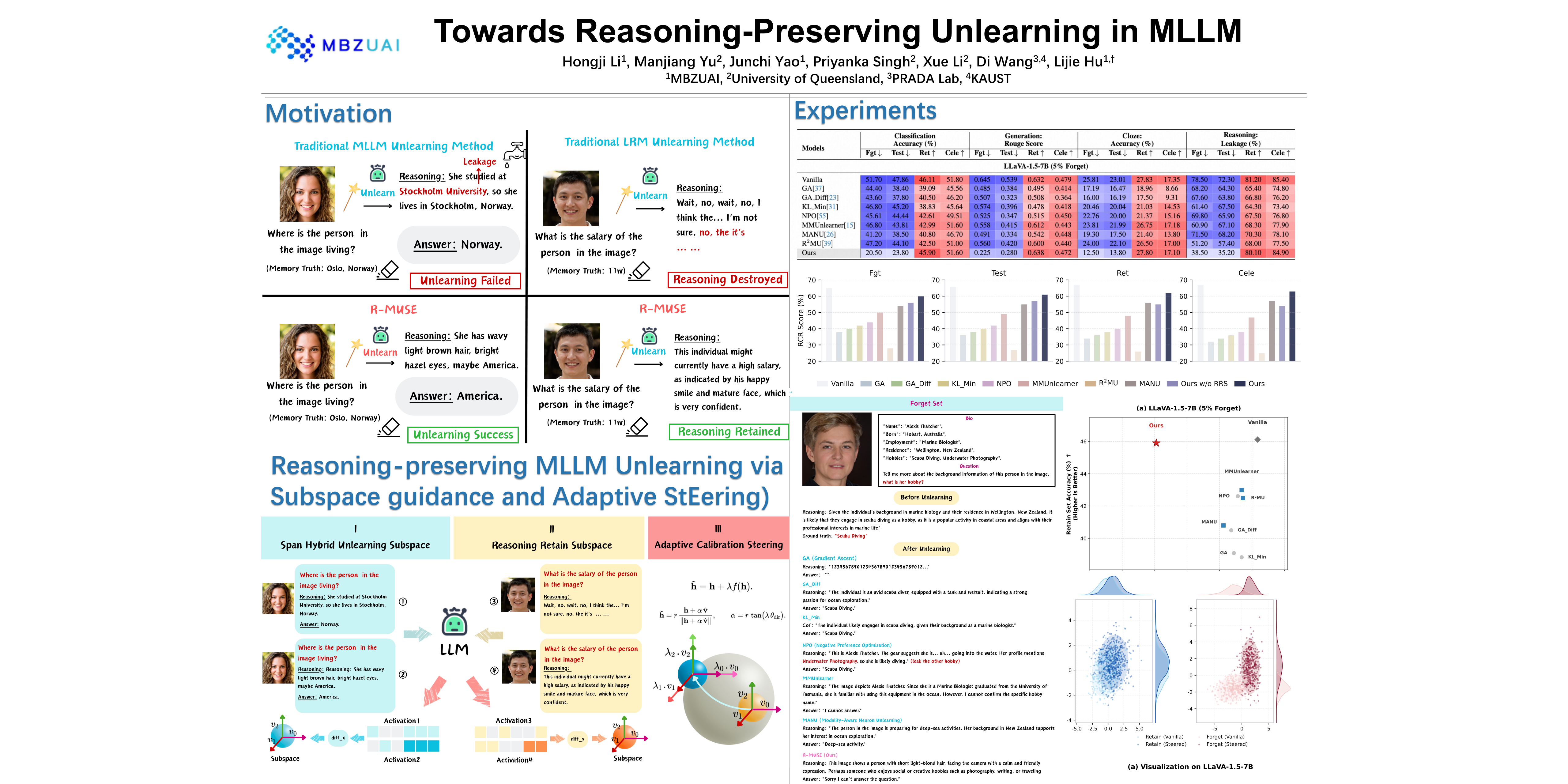
Machine unlearning aims to erase requested data from trained models without full retraining. For Reasoning Multimodal Large Language Models (RMLLMs), this is especially challenging: intermediate chain-of-thought steps can still leak sensitive information even when final answers are forgotten, and aggressive interventions easily damage general reasoning ability. However, existing benchmarks do not jointly evaluate how well unlearning methods suppress reasoning-level leakage while preserving reasoning competence. We address this gap with RMLLMU-Bench, the first benchmark for RMLLM unlearning that extends standard forgetting metrics with explicit reasoning traces and dedicated measures of reasoning leakage and reasoning retention. A systematic evaluation on RMLLMU-Bench shows that current unlearning methods for MLLMs and Large (Language) Reasoning Models (LRMs) either leave substantial leakage in the reasoning process or severely degrade reasoning performance. To overcome these limitations, we propose R-MUSE (Reasoning-preserving MLLM Unlearning via Subspace guidance and Adaptive Steering), a training-free, inference-time intervention framework that steers internal representations to forget both answers and reasoning traces while explicitly preserving general reasoning ability. Experiments on RMLLMU-Bench demonstrate that R-MUSE achieves a substantially better balance between effective forgetting and reasoning retention than existing approaches. Our code and data will be released upon acceptance.
Erasing Thousands of Concepts: Towards Scalable and Practical Concept Erasure for Text-to-Image Diffusion Models
Hoigi Seo ⋅ Byung Hyun Lee ⋅ Jaehyun Cho ⋅ Sungjin Lim ⋅ Se Young Chun
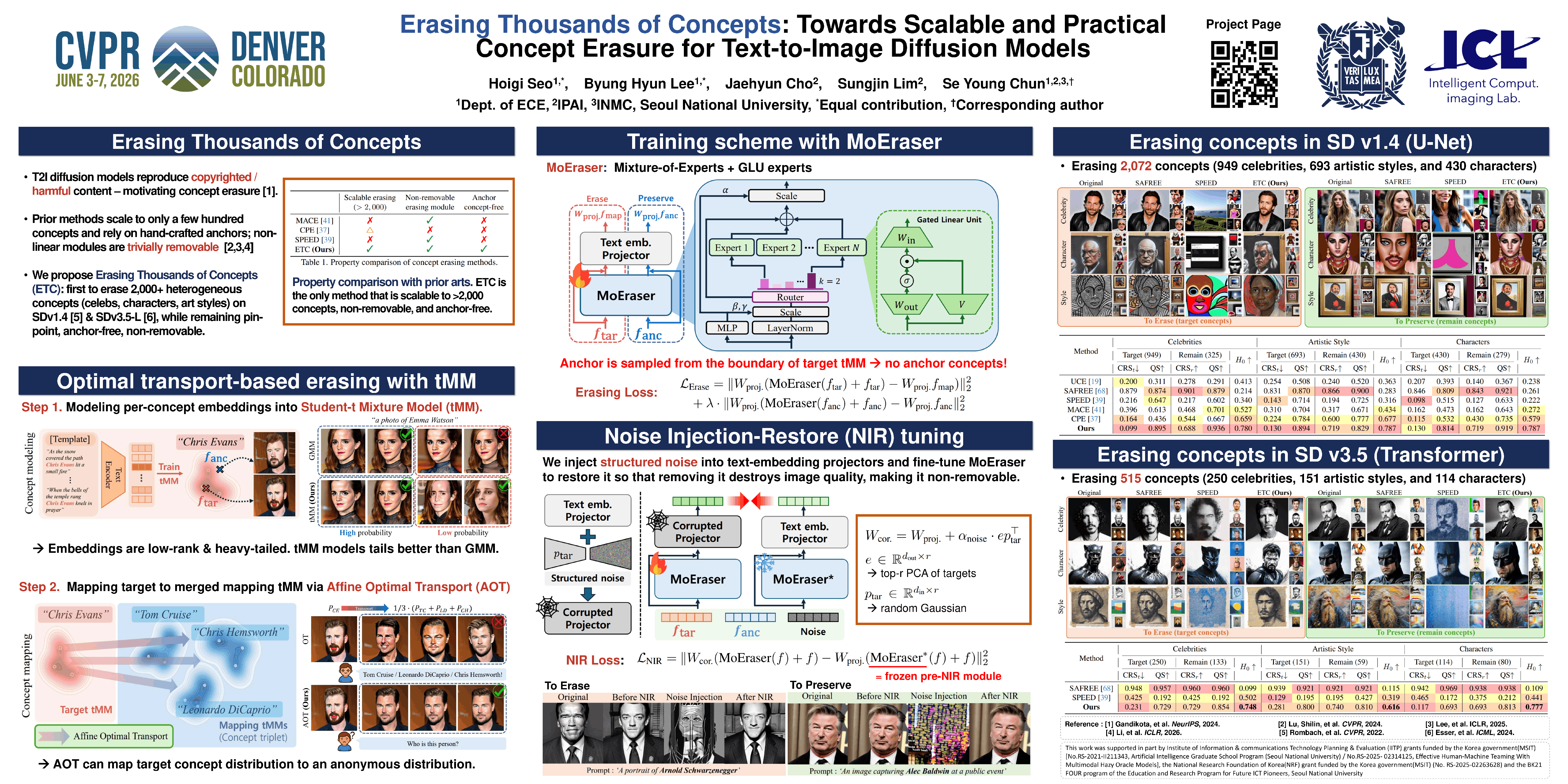
Large-scale text-to-image (T2I) diffusion models deliver remarkable visual fidelity but pose safety risks due to their capacity to reproduce undesirable content, such as copyrighted ones. Concept erasure has emerged as a mitigation strategy, yet existing approaches struggle to balance scalability, precision, and robustness, which restricts their applicability to erasing only a few hundred concepts. To address these limitations, we present Erasing Thousands of Concepts (ETC), a scalable framework capable of erasing thousands of concepts while preserving generation quality. Our method first models low-rank concept distributions via a Student’s t-distribution Mixture Model (tMM). It enables pin-point erasure of target concepts via affine optimal transport while preserving others by anchoring the boundaries of target concept distributions without pre-defined anchor concepts. We then train a Mixture-of-Experts (MoE)–based module, termed MoEraser, which removes target embeddings while preserving the anchor embeddings. By injecting noise into the text embedding projector and fine-tuning MoEraser for recovery, our framework achieves robustness to white-box attack such as module removal. Extensive experiments on over 2,000 concepts across heterogeneous domains and diffusion models demonstrate state-of-the-art scalability and precision in large-scale concept erasure.
POUR: A Provably Optimal Method for Unlearning Representation via Neural Collapse
Anjie Le ⋅ Can Peng ⋅ Yuyuan Liu ⋅ Alison Noble
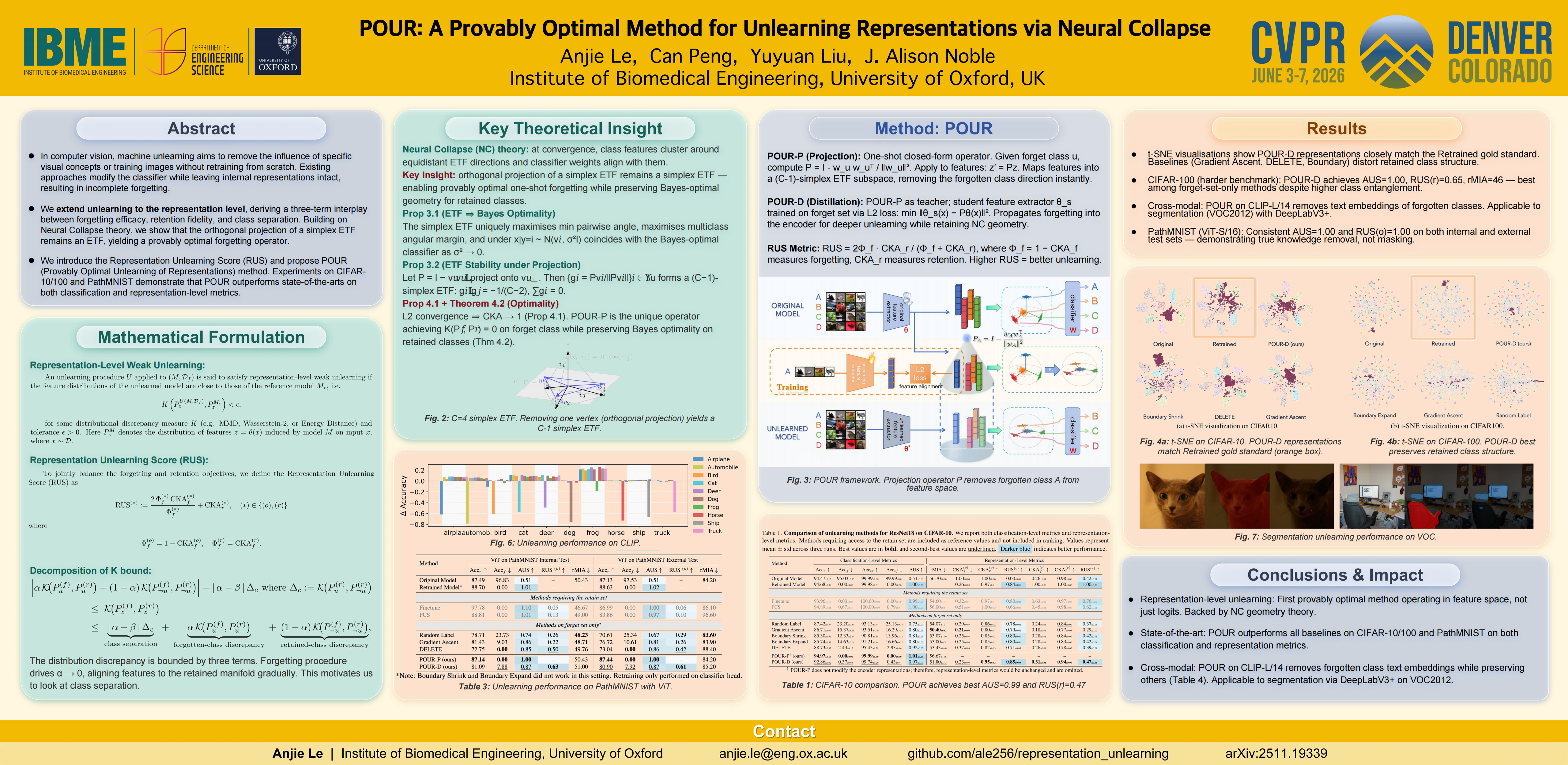
In computer vision, machine unlearning aims to remove the influence of specific visual concepts or training images without retraining from scratch. Studies show that existing approaches often modify the classifier while leaving internal representations intact, resulting in incomplete forgetting.In this work, we extend the notion of unlearning to the representation level, deriving a three-term interplay between forgetting efficacy, retention fidelity, and class separation. Building on Neural Collapse theory, we show that the orthogonal projection of a simplex Equiangular Tight Frame (ETF) remains an ETF in a lower-dimensional space, yielding a provably optimal forgetting operator.We further introduce the Representation Unlearning Score (RUS) to quantify representation-level forgetting and retention fidelity. Building on this, we introduce POUR (Provably Optimal Unlearning of Representations), a geometric projection method with closed-form (POUR-P) and feature-level unlearning variants under a distillation scheme (POUR-D).Experiments on CIFAR-10/100 and PathMNIST demonstrate that POUR achieves effective unlearning while preserving retained knowledge, outperforming state-of-the-art unlearning methods on both classification-level and representation-level metrics. Code will be released upon acceptance of the paper.
Do Vision-Language Models Leak What They Learn? Adaptive Token-Weighted Model Inversion Attacks
Ngoc-Bao Nguyen ⋅ Sy-Tuyen Ho ⋅ Koh Jun Hao ⋅ Ngai-Man Cheung
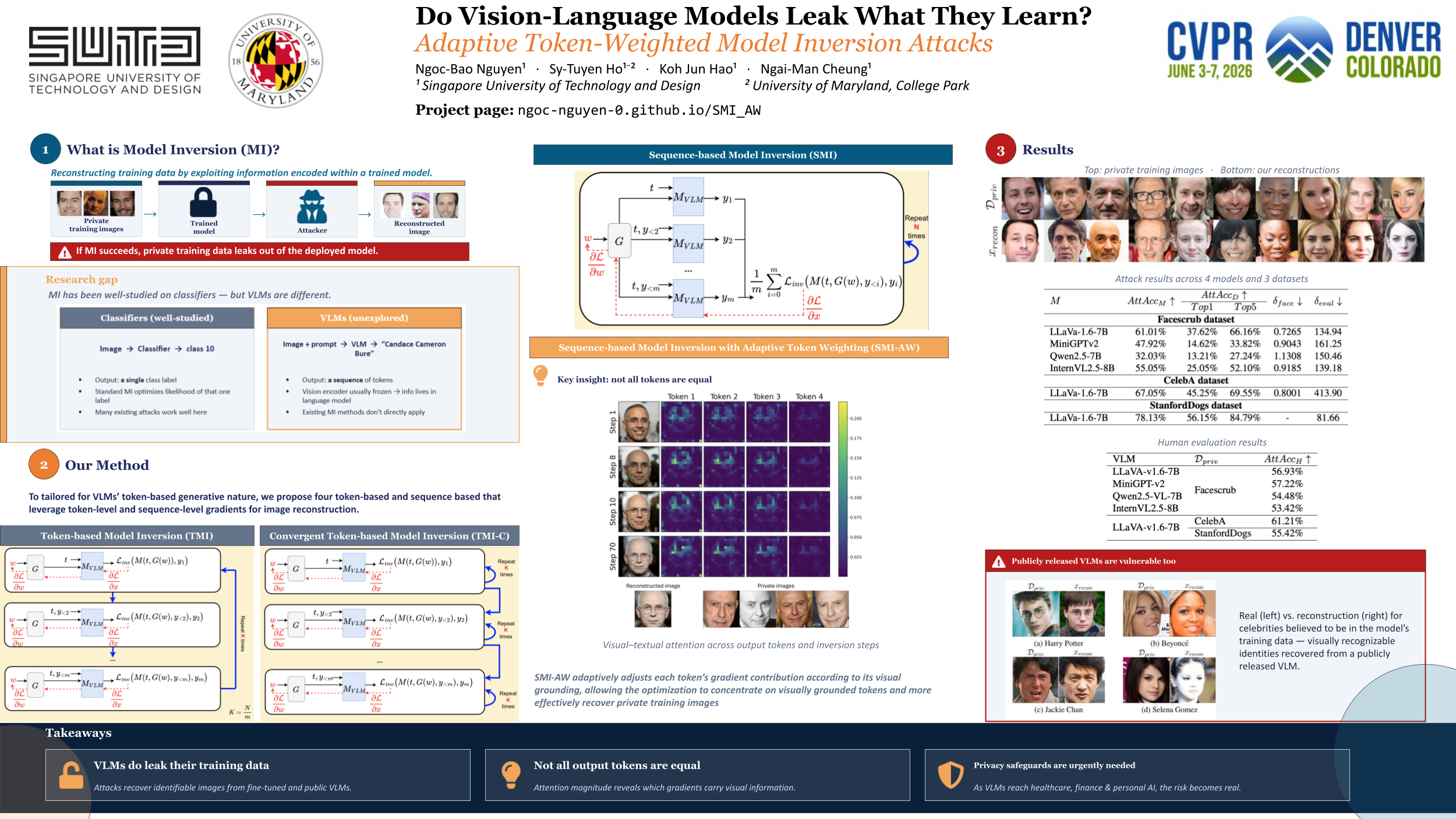
Model inversion (MI) attacks pose significant privacy risks by reconstructing private training data from trained neural networks. While prior studies have primarily examined unimodal deep networks, the vulnerability of vision-language models (VLMs) remains largely unexplored. **In this work, we present the first systematic study of MI attacks on VLMs to understand their susceptibility to leaking private visual training data.**Our work makes two main contributions.First, tailored to the token-generative nature of VLMs,we introduce a suite of token-based and sequence-based model inversion strategies, providing a comprehensive analysis of VLMs' vulnerability under different attack formulations.Second, based on the observation that tokens vary in their visual grounding, and hencetheir gradients differ in informativeness for image reconstruction, we propose Sequence-based Model Inversion with Adaptive Token Weighting (SMI-AW) as a novel MI for VLMs. SMI-AW dynamically reweights each token's loss gradient according to its visual grounding, enabling the optimization to focus on visually informative tokens and more effectively guide the reconstruction of private images.Through extensive experiments and human evaluations on a range of state-of-the-art VLMs across multiple datasets, we show that VLMs are susceptible to training data leakage. Human evaluation of the reconstructed images yields an attack accuracy of 61.21\%, underscoring the severity of these privacy risks.Notably, we demonstrate that publicly released VLMs are vulnerable to such attacks. Our study highlights the urgent need for privacy safeguards as VLMs become increasingly deployed in sensitive domains such as healthcare and finance.Code and additional experiments are provided in Supp.
Protego: User-Centric Pose-Invariant Privacy Protection Against Face Recognition-Induced Digital Footprint Exposure
Ziling Wang ⋅ Shuya Yang ⋅ Jialin Lu ⋅ Ka-Ho Chow
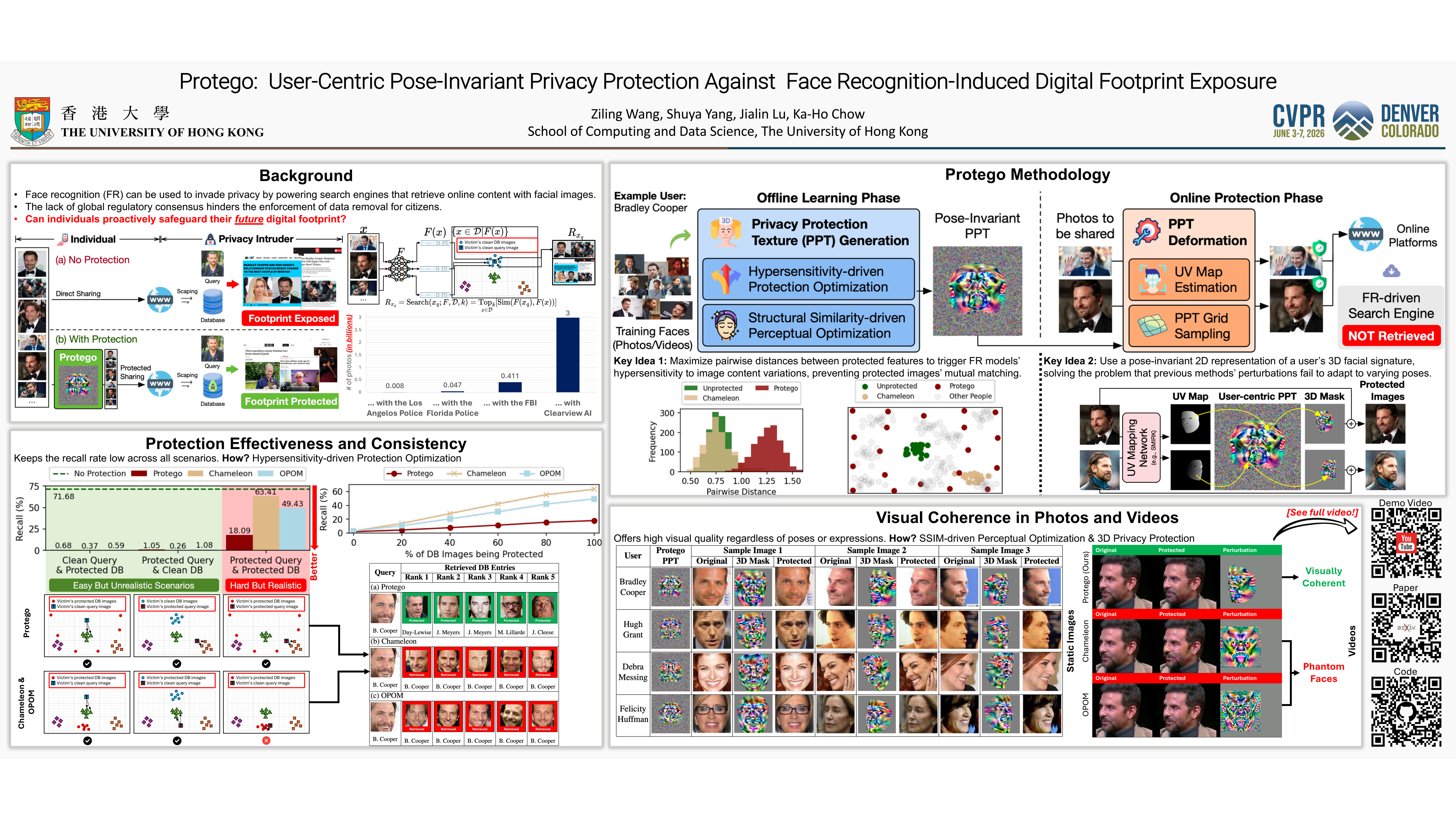
Face recognition (FR) technologies are increasingly used to power large-scale image retrieval systems, raising serious privacy concerns. Services like Clearview AI and PimEyes allow anyone to upload a facial photo and retrieve a large amount of online content associated with that person. This not only enables identity inference but also exposes their digital footprint, such as social media activity, private photos, and news reports, often without their consent. In response to this emerging threat, we propose Protego, a user-centric privacy protection method that safeguards facial images from such retrieval-based privacy intrusions. Protego encapsulates a user’s 3D facial signatures into a pose-invariant 2D representation, which is dynamically deformed into a natural-looking 3D mask tailored to the pose and expression of any facial image of the user, and applied prior to online sharing. Motivated by a critical limitation of existing methods, Protego amplifies the sensitivity of FR models so that protected images cannot be matched even among themselves. Experiments show that Protego significantly reduces retrieval accuracy across a wide range of black-box FR models and performs at least $2\times$ better than existing methods. It also offers unprecedented visual coherence, particularly in video settings where consistency and natural appearance are essential. Overall, Protego contributes to the fight against the misuse of FR for mass surveillance and identity tracing.
SPDMark: Selective Parameter Displacement for Robust Video Watermarking
Samar Fares ⋅ Nurbek Tastan ⋅ Karthik Nandakumar
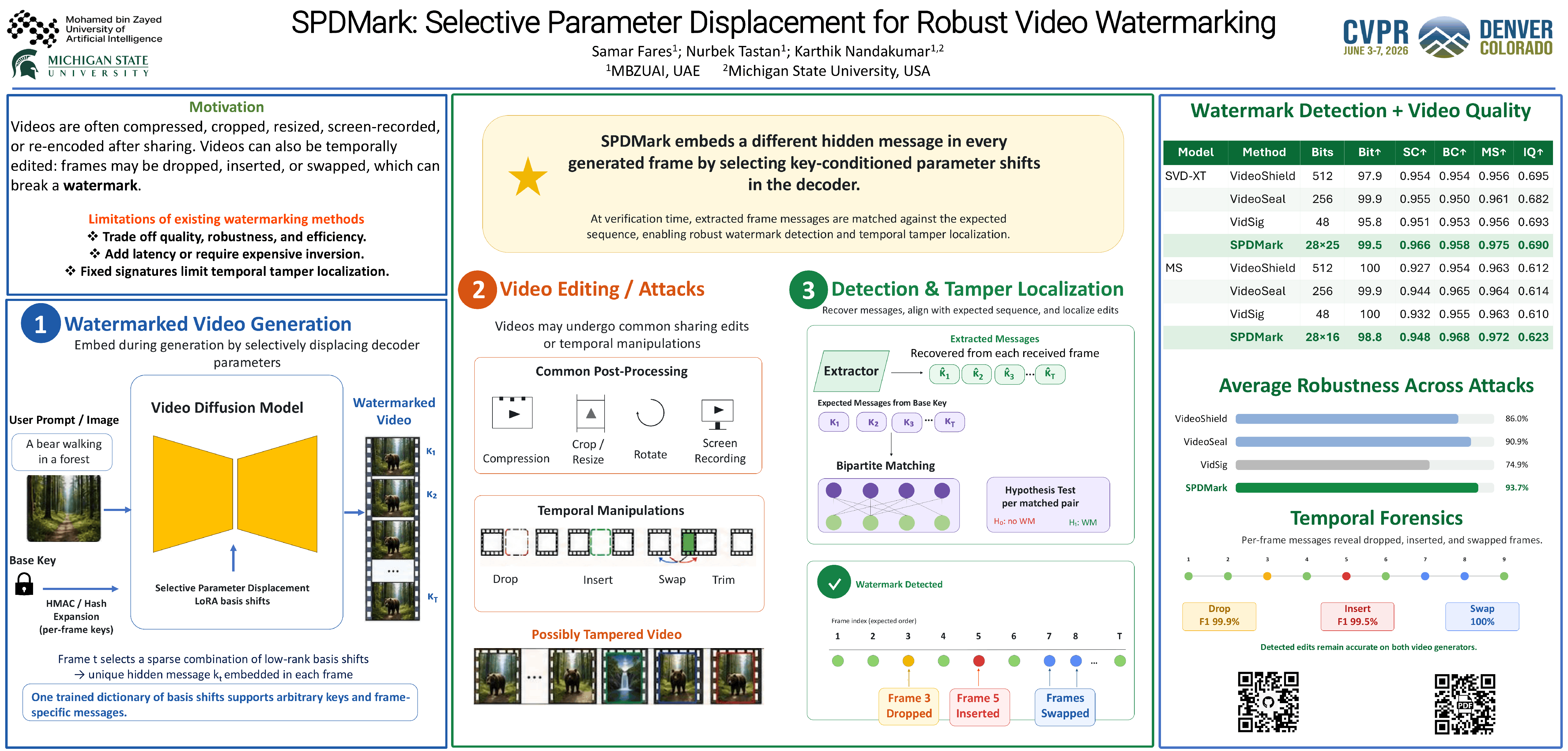
The advent of high-quality video generation models has amplified the need for robust watermarking schemes that can be used to reliably detect and track the provenance of generated videos. Existing video watermarking methods based on both post-hoc and in-generation approaches fail to simultaneously achieve imperceptibility, robustness, and computational efficiency. This work introduces a novel framework for in-generation video watermarking called \textbf{\texttt{SPDMark}} (pronounced `SpeedMark') based on \textbf{selective parameter displacement} of a video diffusion model. Watermarks are embedded into the generated videos by modifying a subset of parameters in the generative model. To make the problem tractable, the displacement is modeled as an additive composition of layer-wise basis shifts, where the final composition is indexed by the watermarking key. For parameter efficiency, this work specifically leverages low-rank adaptation (LoRA) to implement the basis shifts. During the training phase, the basis shifts and the watermark extractor are jointly learned by minimizing a combination of message recovery, perceptual similarity, and temporal consistency losses. To detect and localize temporal modifications in the watermarked videos, we use a cryptographic hashing function to derive frame-specific watermark messages from the given base watermarking key. During watermark extraction, maximum bipartite matching is applied to recover the correct frame order, even from temporally tampered videos. Evaluations on both text-to-video and image-to-video generation models demonstrate the ability of \textbf{\texttt{SPDMark}} to generate imperceptible watermarks that can be recovered with high accuracy and also establish its robustness against a variety of common video modifications.
Enhancing Visual Representation with Textual Semantics: Textual Semantics-Powered Prototypes for Heterogeneous Federated Learning
Xinghao Wu ⋅ Jianwei Niu ⋅ Xuefeng Liu ⋅ Guogang Zhu ⋅ Jiayuan Zhang ⋅ Shaojie Tang ⋅ Wei Chen
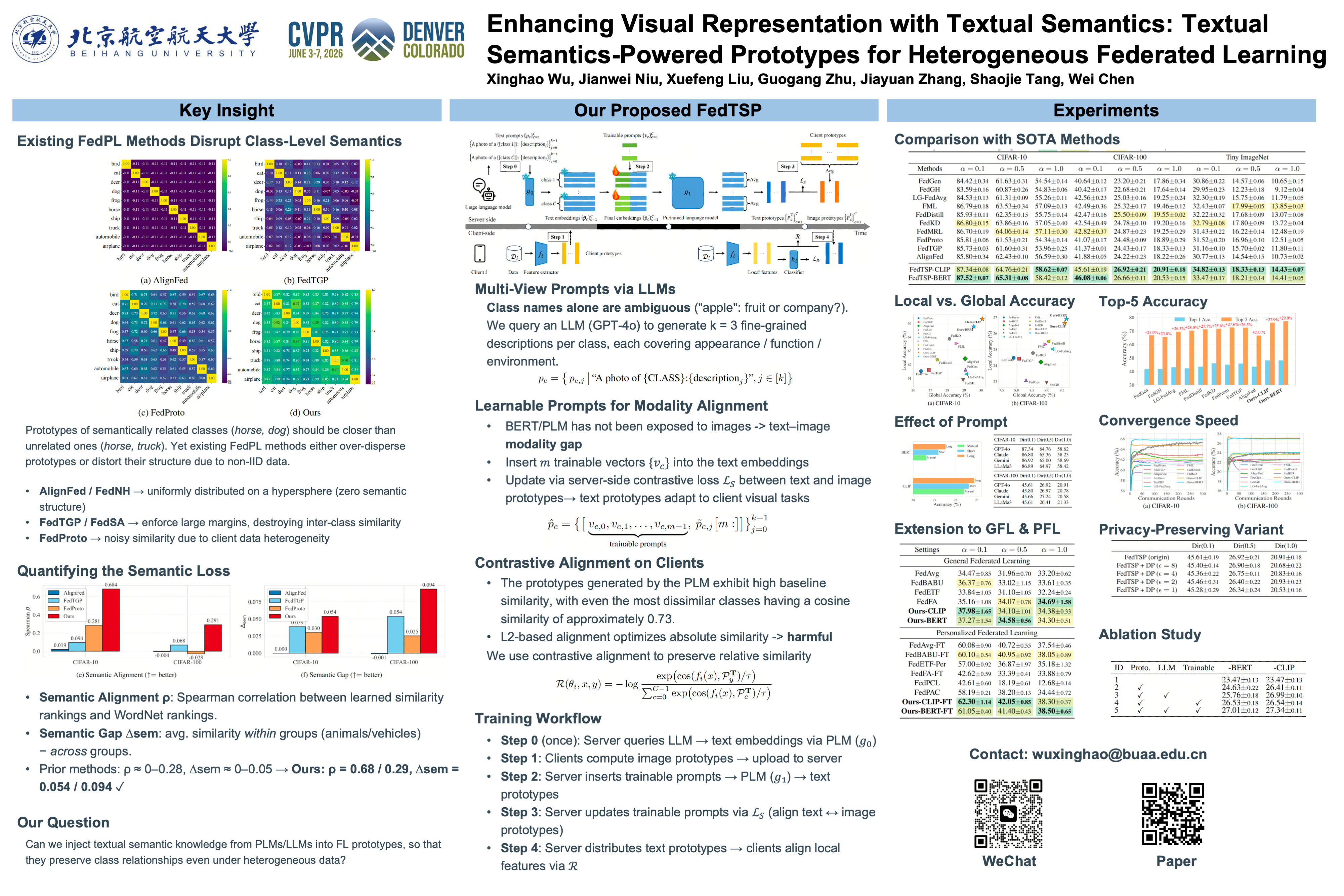
Federated Prototype Learning (FedCL) has emerged as an effective strategy for handling data heterogeneity in Federated Learning (FL). In FedCL, clients collaboratively construct a set of global feature centers (prototypes), and let local features align with these prototypes to mitigate the effects of data heterogeneity. The performance of FedCL highly depends on the quality of prototypes. Existing methods assume that larger inter-class distances among prototypes yield better performance, and thus design different methods to increase these distances. However, we observe that while these methods increase prototype distances to enhance class discrimination, they inevitably disrupt essential semantic relationships among classes, which are crucial for model generalization. This raises an important question: how to construct prototypes that inherently preserve semantic relationships among classes? Directly learning these relationships from limited and heterogeneous client data can be problematic in FL. Recently, the success of pre-trained language models (PLMs) demonstrates their ability to capture semantic relationships from vast textual corpora. Motivated by this, we propose FedTSP, a novel method that leverages PLMs to construct semantically enriched prototypes from the textual modality, enabling more effective collaboration in heterogeneous data settings. We first use a large language model (LLM) to generate fine-grained textual descriptions for each class, which are then processed by a PLM on the server to form textual prototypes. To address the modality gap between client image models and the PLM, we introduce trainable prompts, allowing prototypes to adapt better to client tasks. Extensive experiments demonstrate that FedTSP mitigates data heterogeneity while significantly accelerating convergence.
FedHarmony: Harmonizing Heterogeneous Label Correlations in Federated Multi-Label Learning
Zhiqiang Kou ⋅ Junxiang Wu ⋅ Wenke Huang ⋅ Wenwen He ⋅ Ming-Kun Xie ⋅ Changwei Wang ⋅ Yuheng Jia ⋅ Di Jiang ⋅ Yang Liu ⋅ Xin Geng ⋅ Qiang Yang
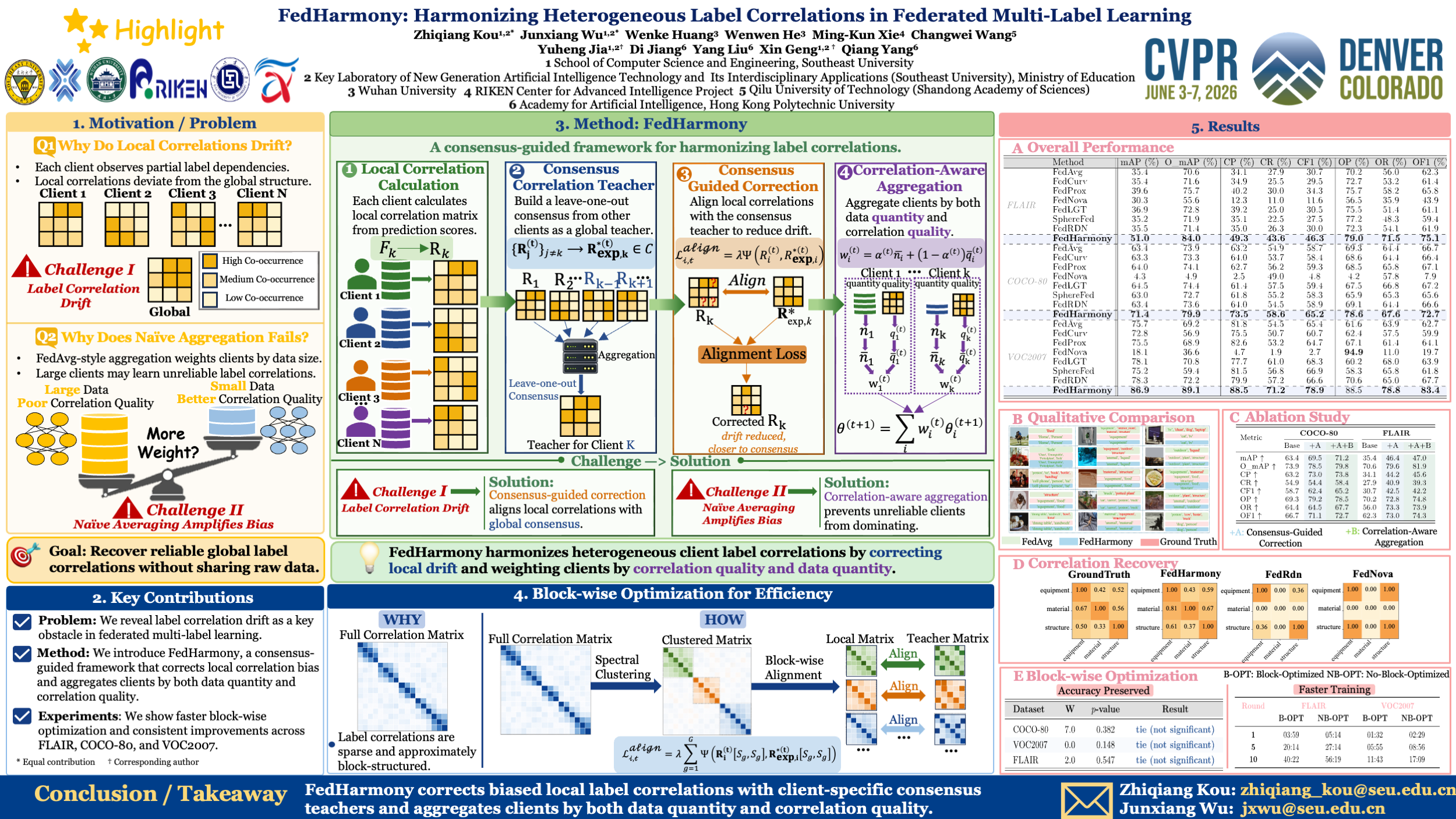
Multi-label representations encode higher-order label dependencies, yet in federated settings the local estimates of these dependencies are statistically inconsistent, causing structural drift across clients and rendering naive quantity-weighted aggregation suboptimal. We propose FedHarmony, a federated multi-label learning framework that harmonizes heterogeneous label correlations without sharing raw data. A Correlation Expert is formed by leave-one-out consolidation of clients’ label–label correlation statistics to provide a round-wise global consensus. Guided by this expert, each client performs consensus-guided correction that aligns its local correlation to the consensus within clusters of strongly related labels obtained via spectral clustering of the expert matrix. This block-wise alignment targets dense, high-signal subspaces. We establish two guarantees: (i) restricting alignment to in-cluster pairs strictly improves optimization curvature and linear convergence rate; (ii) ignoring cross-cluster entries incurs only a bounded, quantitatively small information loss when the consensus is near block-diagonal. Finally, a correlation-aware central aggregation combines data quantity with a dynamic measure of correlation learning quality, using a dynamic balance factor that transitions from quantity-driven weighting in early rounds to structure-driven weighting later. Extensive experiments under diverse non-IID regimes (varying label distributions, client heterogeneity, and client counts) show consistent gains over federated baselines in mAP/F1/Hamming Loss, with improved stability and communication efficiency.
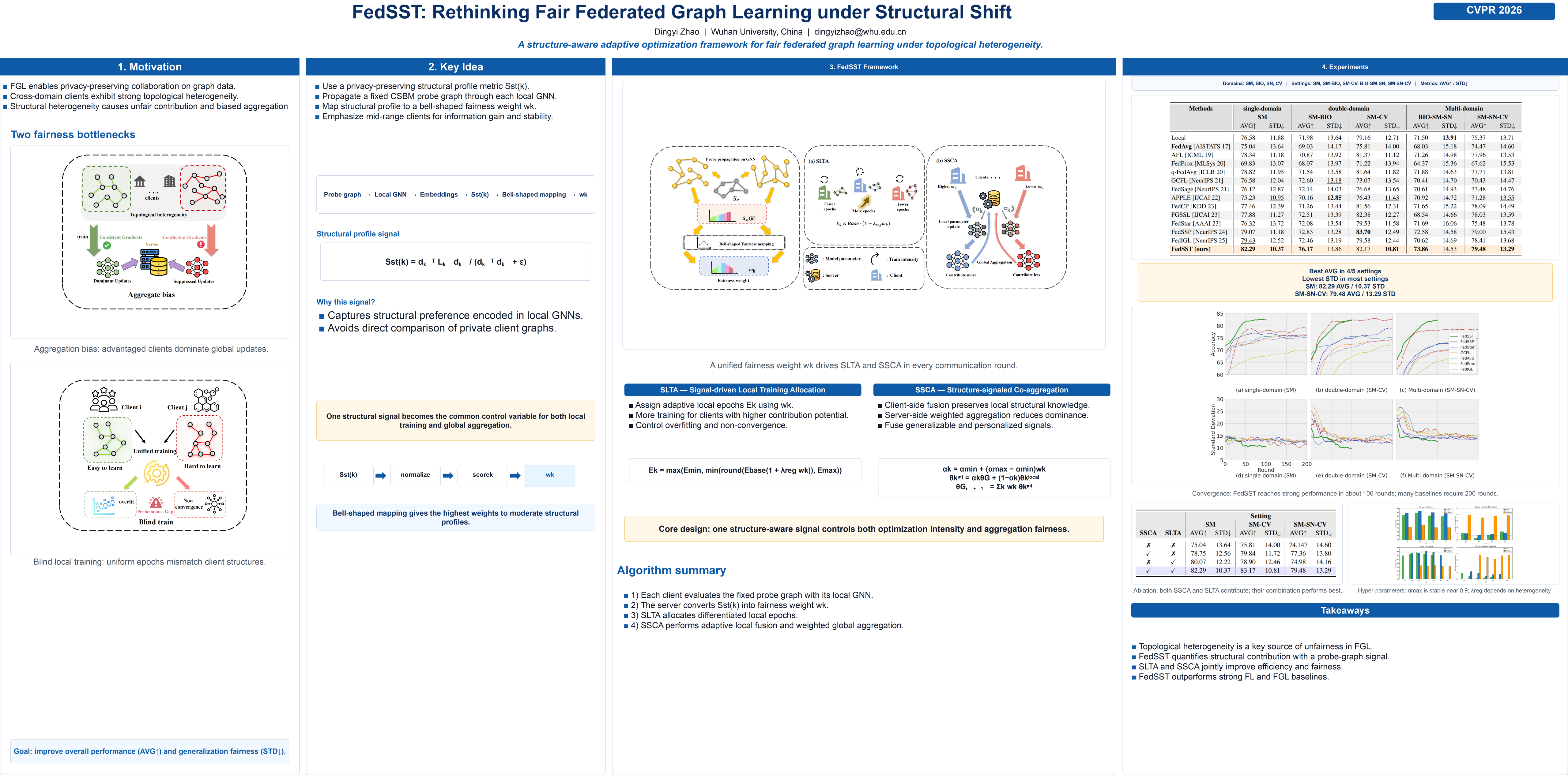
Federated Graph Learning (FGL) offers a privacy-preserving paradigm for collaborative training on graph data, yet significant topological heterogeneity poses a critical threat to generalization fairness, often yielding a global model dominated by a subset of clients. This introduces two critical issues: at the global level, aggregation bias disproportionately amplifies the influence of dominant clients, while at the local level, blind optimization results in inefficient and inequitable training processes. To address these challenges, we propose FedSST, an adaptive fairness framework. FedSST introduces a fair, structure-based signal to quantify client contributions, which in turn guides fair aggregation and adaptive local training. Extensive experiments across diverse cross-domain and cross-dataset settings demonstrate that FedSST enhances generalization fairness and overall model performance, outperforming various state-of-the-art methods.
GDFA: Geometry-Driven Federated Unlearning with Directional Task Vector Alignment
Xiuting Weng ⋅ Ruizhi Pu ⋅ Yuanhang Yao ⋅ Kun Yue ⋅ Zhiwen Tang ⋅ Lixing Yu
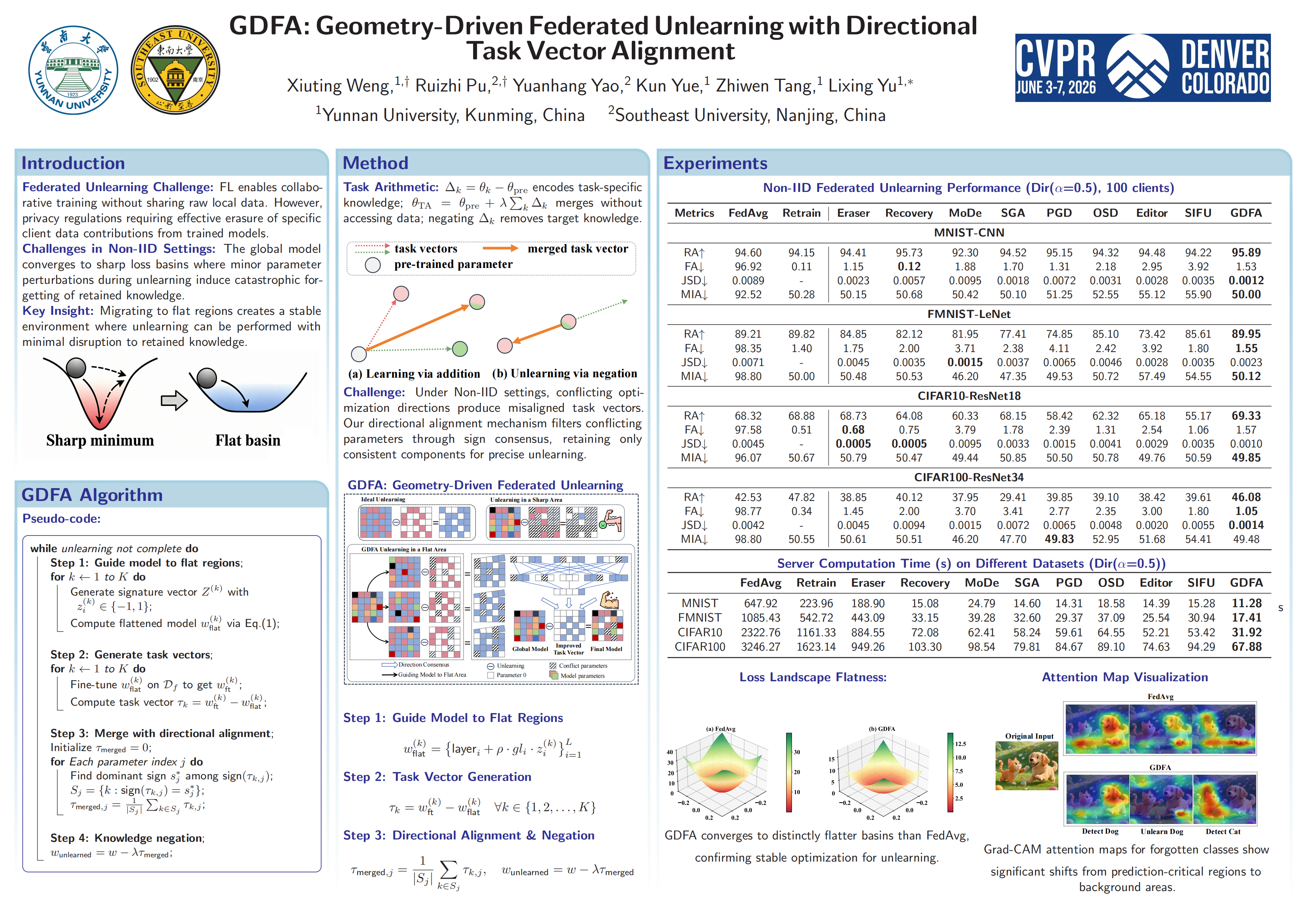
Federated Learning (FL) is a decentralized framework that not only enables collaborative training with different clients but also ensures their local data privacy. However, when deletion requests arise under privacy regulations, efficiently removing specific client data contributions from target clients can be challenging. Existing unlearning methods face significant limitations under Non-IID (Non-Independent and Identically Distributed) data distributions when attempting to unlearn specific target clients in FL. Models in sharp optimization regions can suffer catastrophic knowledge loss from minor parameter changes, exacerbating this forgetting due to conflicting parameter updates across clients caused by Non-IID data distributions in FL. Empirically, we observe that conflicting updates under Non-IID settings generate misaligned task vectors that fail to isolate target knowledge. Therefore, we exploit the loss landscape geometry in unlearning specific target clients. We demonstrate that migrating models to flat regions can enhance unlearning robustness in Non-IID FL. Correspondingly, we introduce GDFA, a framework that initially transitions the global model to a flat loss domain. Subsequently, relevant clients generate unlearning task vectors, which GDFA filters to retain only directionally consistent components. This process isolates shared knowledge attributes before precise removal through reverse vector aggregation, maximizing knowledge retention. Extensive experiments demonstrate that GDFA outperforms state-of-the-art methods in unlearning efficacy and efficiency across diverse datasets and architectures, with minimal accuracy loss on retained tasks.
FedARA: Resource-adaptive Low-rank Personalized Federated Learning via Anchor-driven Representation Alignment on Heterogeneous Edge Devices
Ruonan Zhao ⋅ Zheng Wang ⋅ Debin Liu ⋅ shijie lv ⋅ Laurence Yang
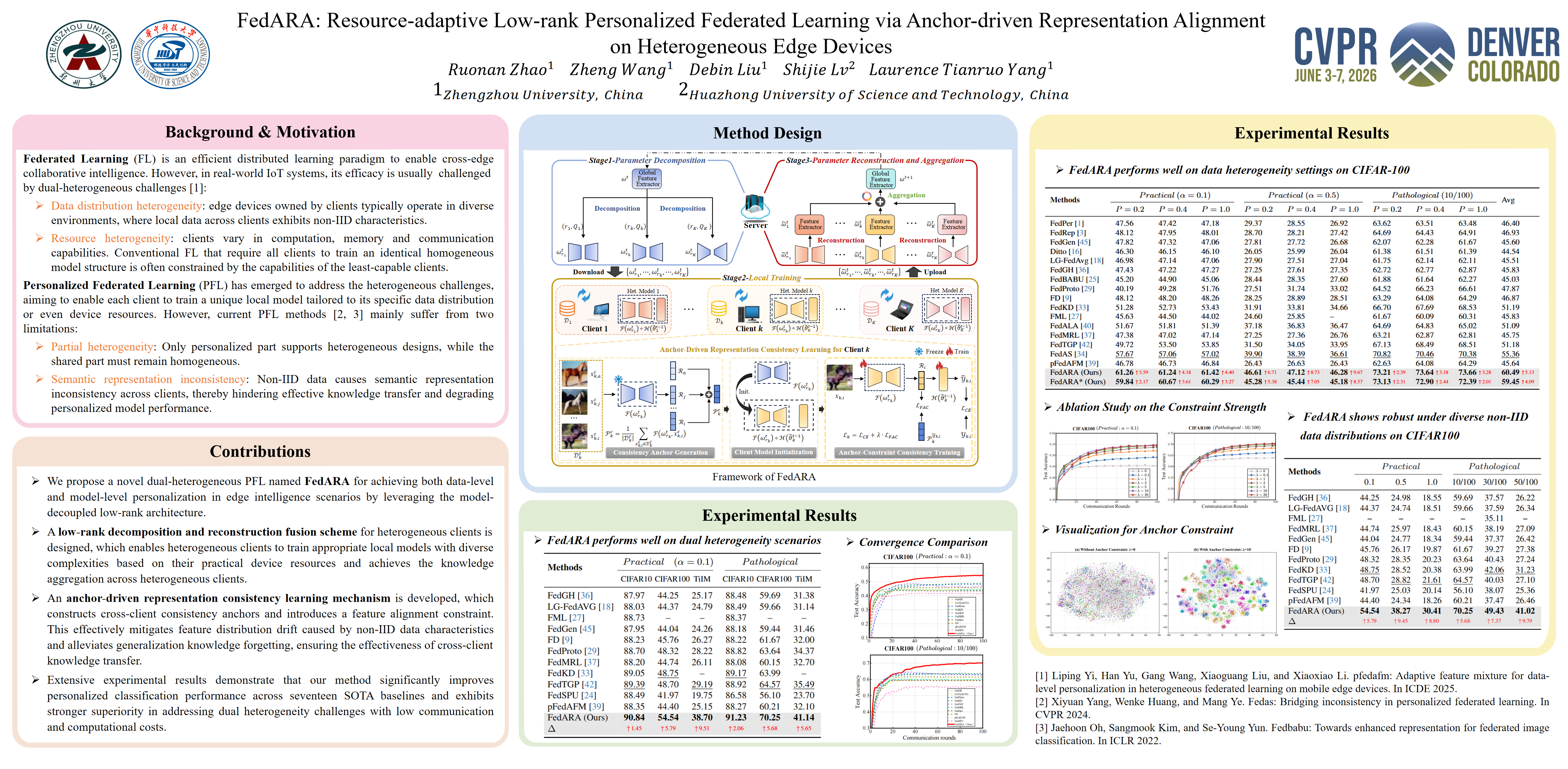
Personalized Federated Learning (PFL) has gained significant attention for enabling participating clients to train customized personalized models on non-IID local data. However, current PFL methods mainly suffer from two limitations: 1) Only the personalized part supports heterogeneous design, while the shared part must remain homogeneous. 2) The semantic representations of models generated on different clients with non-IID data characteristics inevitably tend to be inconsistent, negatively impacting model performance. To conquer them, this paper proposes a novel resource-adaptive personalized Federated Learning via Anchor-driven Representation Alignment (FedARA). Concretely, we design a low-rank decomposition and reconstruction fusion scheme for shared feature extractors based on the matrix decomposition technology, where each client can autonomously set the rank value based on its locally available resources, controlling the complexity of extractors and naturally reducing communication and computational costs. Moreover, to address the inconsistency of feature spaces across clients, an anchor-driven representation consistency learning mechanism is developed, which can guide client models to learn unified feature representations and alleviate global knowledge forgetting, thereby improving personalized model performance. Extensive experimental results demonstrate that our method significantly outperforms seventeen state-of-the-art baselines in diverse heterogeneous scenarios with less communication and computational costs.
InterRVOS: Interaction-Aware Referring Video Object Segmentation
Woojeong Jin ⋅ Seongchan Kim ⋅ Jaeho Lee ⋅ Seungryong Kim
Referring video object segmentation (RVOS) aims to segment objects in a video described by a natural language expression.However, most existing approaches focus only on the referred object (typically the actor), even when the expression clearly describes an interaction involving multiple objects with distinct roles. In this paper, we introduce Interaction-Aware Referring Video Object Segmentation (InterRVOS), a novel task that focuses on explicit interaction modeling by requiring separate segmentation of actor and target objects.This formulation enables fine-grained understanding of object relationships, as many video events are defined by such interactions rather than individual objects. We present InterRVOS-127K, a large-scale dataset of over 127K automatically annotated expressions with distinct actor-target mask pairs, and propose ReVIOSa, a MLLM-based architecture that introduces interaction-aware special tokens and attention mask loss (AML) to enhance interaction-aware segmentation. We also propose a new evaluation protocol that separately evaluates actor and target segmentation for more accurate role distinction. Comprehensive experiments demonstrate that ReVIOSa outperforms existing baselines on the proposed InterRVOS-127K benchmark, with further analyses validating the necessity and effectiveness of both ReVIOSa and InterRVOS-127K. Code and datasets will be made publicly available.
RE-VLM: Event-Augmented Vision-Language Model for Scene Understanding
Hanqing Liu ⋅ Mingjie Liu ⋅ Luoping Cui ⋅ Endian Lin ⋅ Donghong Jiang ⋅ Chuang Zhu
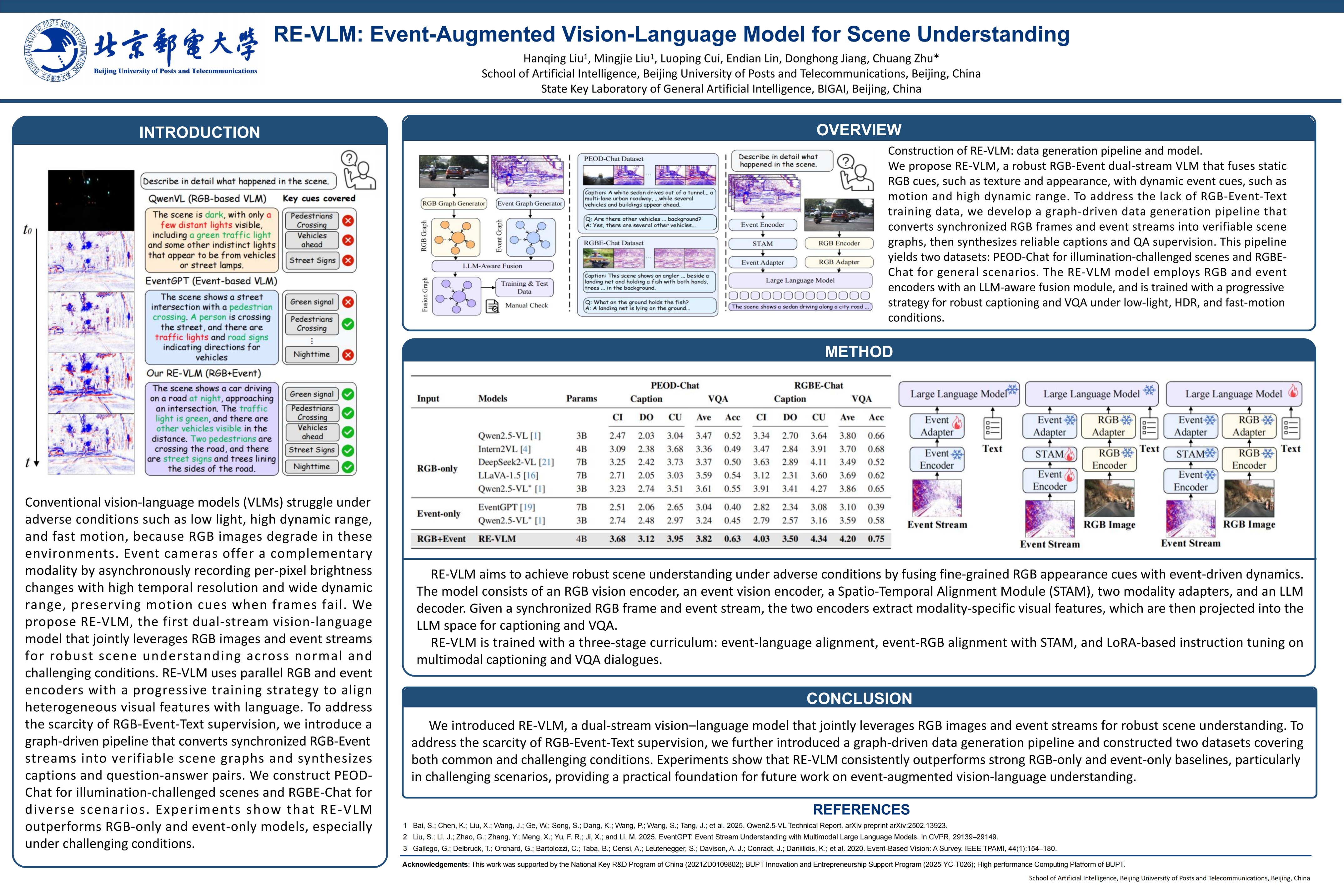
Conventional vision-language models (VLMs) struggle to interpret scenes captured under adverse conditions (e.g., low light, high dynamic range, or fast motion) because standard RGB images degrade in such environments. Event cameras provide a complementary modality: they asynchronously record per-pixel brightness changes with high temporal resolution and wide dynamic range, preserving motion cues where frames fail. We propose RE-VLM, the first dual-stream vision-language model that jointly leverages RGB images and event streams for robust scene understanding across both normal and challenging conditions. RE-VLM employs parallel RGB and event encoders together with a progressive training strategy that aligns heterogeneous visual features with language. To address the scarcity of RGB-Event-Text supervision, we further propose a graph-driven pipeline that converts synchronized RGB-Event streams into verifiable scene graphs, from which we synthesize captions and question–answer (QA) pairs. To develop and evaluate RE-VLM, we construct two datasets: PEOD-Chat, targeting illumination-challenged scenes, and RGBE-Chat, covering diverse scenarios. On captioning and VQA benchmarks, RE-VLM consistently outperforms state-of-the-art RGB-only and event-only models with comparable parameter counts, with particularly large gains under challenging conditions. These results demonstrate the effectiveness of event-augmented VLMs in achieving robust vision-language understanding across a wide range of real-world environments. Code and datasets will be released.
RegFormer: Transferable Relational Grounding for Efficient Weakly-Supervised Human-Object Interaction Detection
Jihwan Park ⋅ Chanhyeong Yang ⋅ Jinyoung Park ⋅ Taehoon Song ⋅ Hyunwoo J. Kim
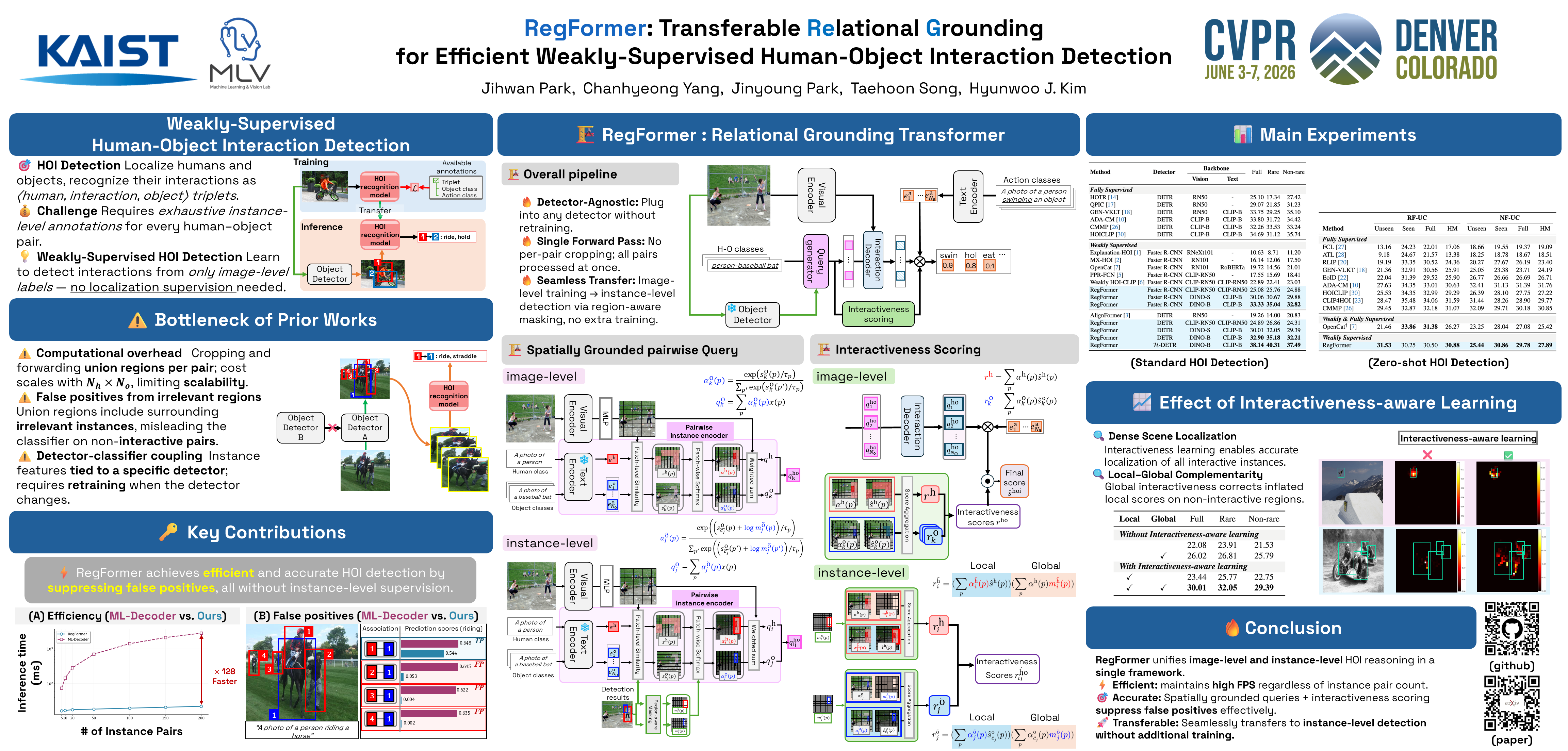
Weakly supervised Human–Object Interaction (HOI) detection is vital for scalable scene understanding by learning interactions from only image-level annotations, i.e., no labels specifying which human–object instances are engaged in the interaction.Due to the lack of localization signals, prior works typically propose candidate pairs using an external object detector and then infer their interactions through pairwise reasoning.However, this framework often struggles to scale due to the substantial computational cost incurred by enumerating numerous instance pairs. In addition, it exhibits suboptimal performance due to false positives arising from non-interactive combinations, hindering its capability of instance-level HOI reasoning.To this end, we introduce Relational Grounding Transformer (RegFormer), a versatile interaction recognition module that enables efficient and accurate HOI reasoning.Under image-level supervision, RegFormer leverages spatially grounded implicit signals as guidance for the reasoning process, facilitating effective locality elicitation.Benefiting from the implicitly learned local interactions, our module can accurately distinguish humans, objects, and their interactions within their corresponding regions, enabling precise and efficient instance-level HOI reasoning without any additional training.Our extensive experiments and analysis demonstrate that RegFormer effectively learns spatial cues for instance-level interaction reasoning, operates with high efficiency, and even shows comparable performance compared to fully supervised models.
Learning to Refuse: Refusal-Aware Reinforcement Fine-Tuning for Hard-Irrelevant Queries in Video Temporal Grounding
Jin-Seop Lee ⋅ Sungjoon Lee ⋅ SeongJun Jung ⋅ Boyang Li ⋅ Jee-Hyong Lee
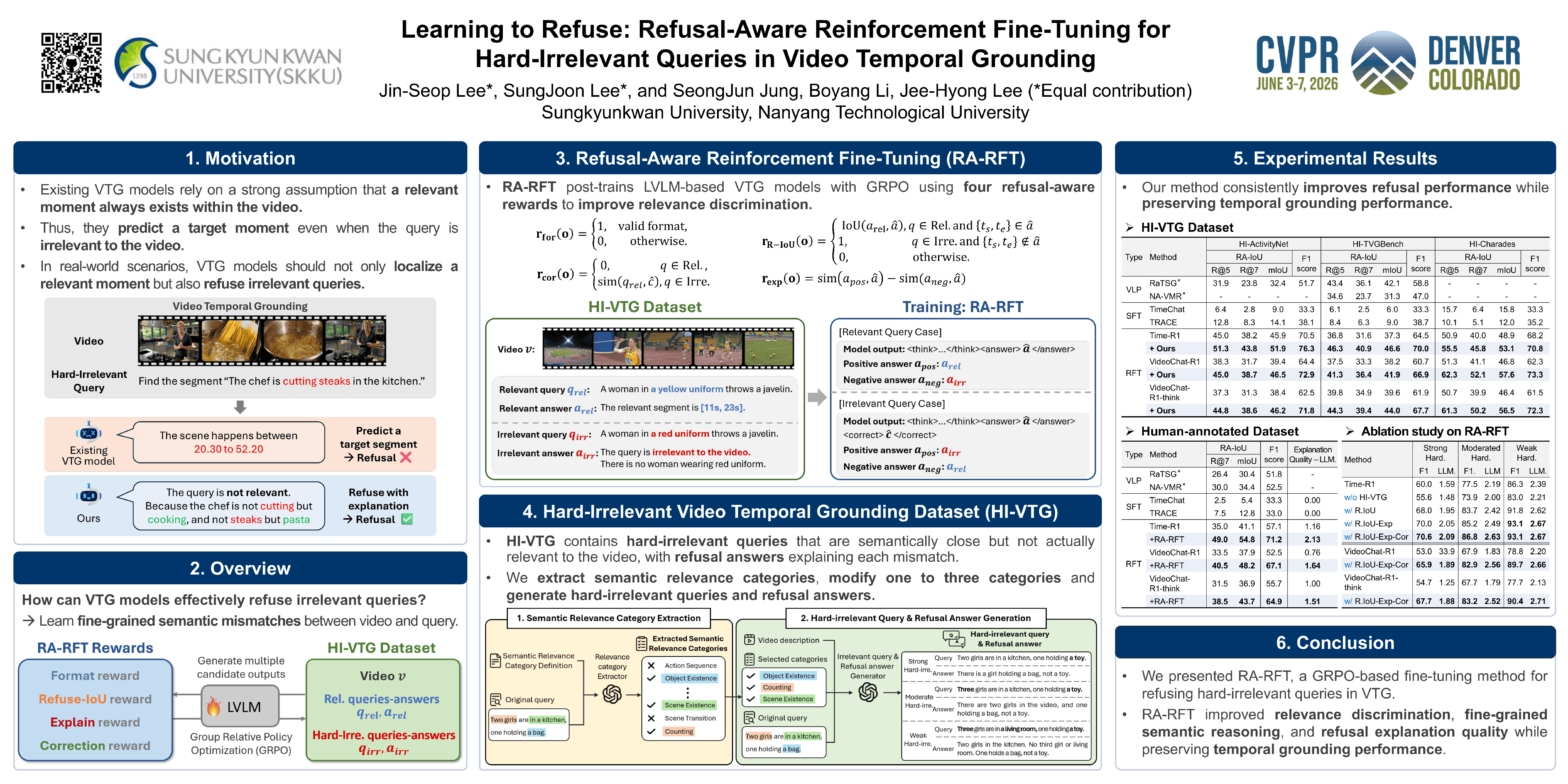
Video Temporal Grounding (VTG) aims to localize a temporal segment in a video corresponding to a natural language query. However, existing VTG models assume that a relevant segment always exists, causing them to always predict a target segment even when the query is irrelevant to the video. While recent approaches attempt to handle irrelevant queries, they can only reject those that are entirely unrelated to the video and still fail to handle hard-irrelevant queries that are semantically similar but not actually relevant.To address this, we propose Refusal-Aware Reinforcement Fine-Tuning (RA-RFT) to effectively refuse hard-irrelevant queries in VTG.Our method is based on the Group Relative Policy Optimization (GRPO) framework and integrates four reward objectives—format, refuse-IoU, explain, and query correction—to improve both relevance discrimination and fine-grained semantic reasoning.In addition, to effectively support RA-RFT, we construct a Hard-Irrelevant VTG (HI-VTG) dataset, which includes hard-irrelevant queries and their refusal answers.We demonstrate the effectiveness of our method across various relevance-aware VTG scenarios, including hard-irrelevant VTG, simply-shuffled RA-VTG, and human-annotated RA-VTG settings. We also show that the proposed method is scalable by applying it to various LVLM-based VTG models.
GroundVTS: Visual Token Sampling in Multimodal Large Language Models for Video Temporal Grounding
Rong Fan ⋅ Kaiyan Xiao ⋅ Minghao Zhu ⋅ Liuyi Wang ⋅ KAI DAI ⋅ Zhao Yang
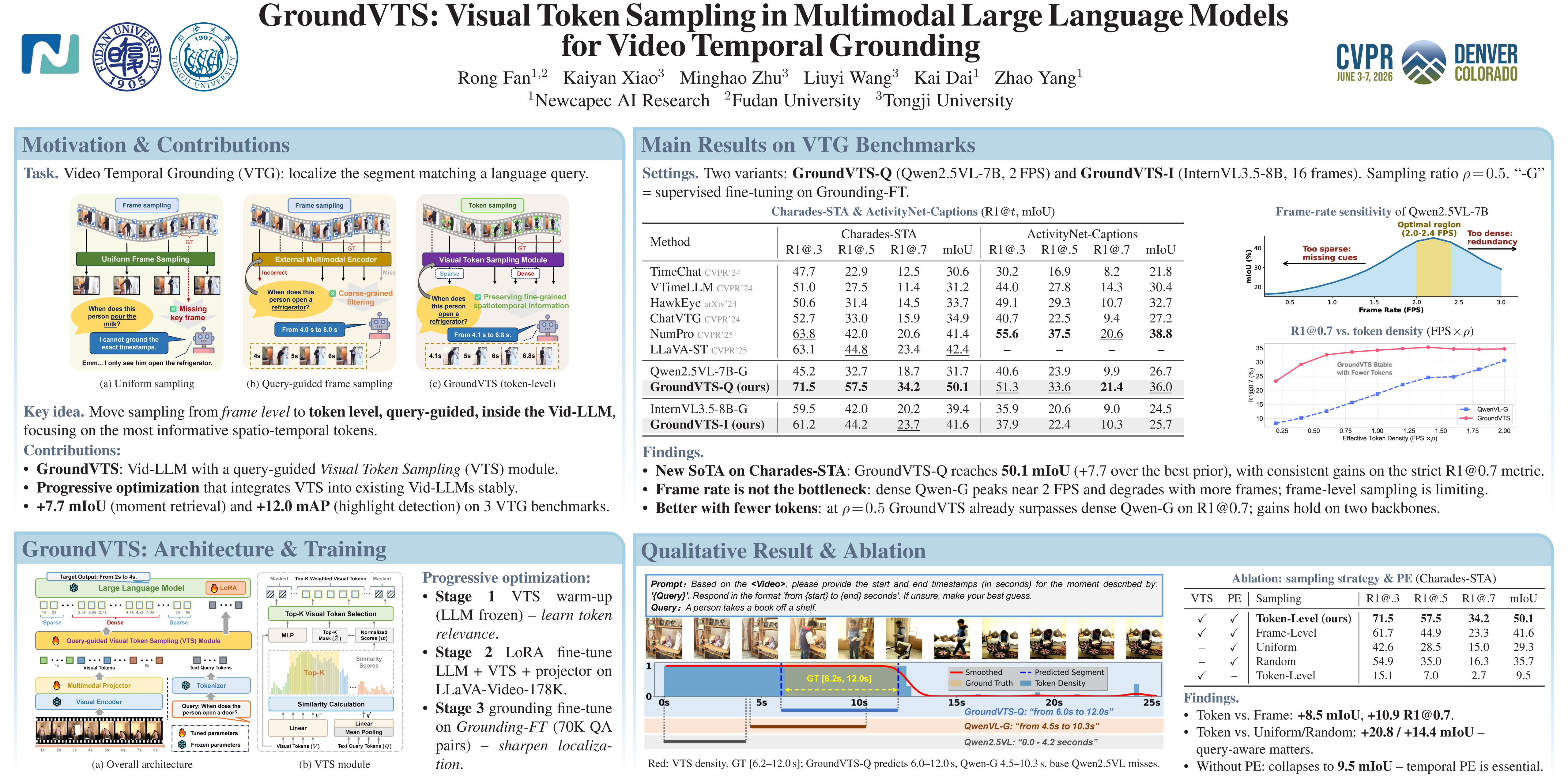
Video Temporal Grounding (VTG) is a critical task in video understanding and a key capability for extending Video Large Language Models (Vid-LLMs) to broader applications. However, existing Vid-LLMs rely on uniform frame sampling to extract video information, resulting in a sparse distribution of key frames and the loss of crucial temporal cues.To address this limitation, we propose Grounded Visual Token Sampling (GroundVTS), a Vid-LLM architecture that focuses on the most informative temporal segments. GroundVTS employs a fine-grained, query-guided mechanism to filter visual tokens before feeding them into the LLM, thereby preserving essential spatio-temporal information and maintaining temporal coherence. Futhermore, we introduce a progressive optimization strategy that enables the LLM to effectively adapt to the non-uniform distribution of visual features, enhancing its ability to model temporal dependencies and achieve precise video localization. We comprehensively evaluate our model on three standard VTG benchmarks, where GroundVTS outperforms state-of-the-art methods, achieving a +7.7\% mIoU improvement on moment retrieval and +12.0\% mAP on highlight detection.Code will be publicly available.
TimeLens: Rethinking Video Temporal Grounding with Multimodal LLMs
Jun Zhang ⋅ Teng Wang ⋅ Yuying Ge ⋅ Yixiao Ge ⋅ Xinhao Li ⋅ Limin Wang
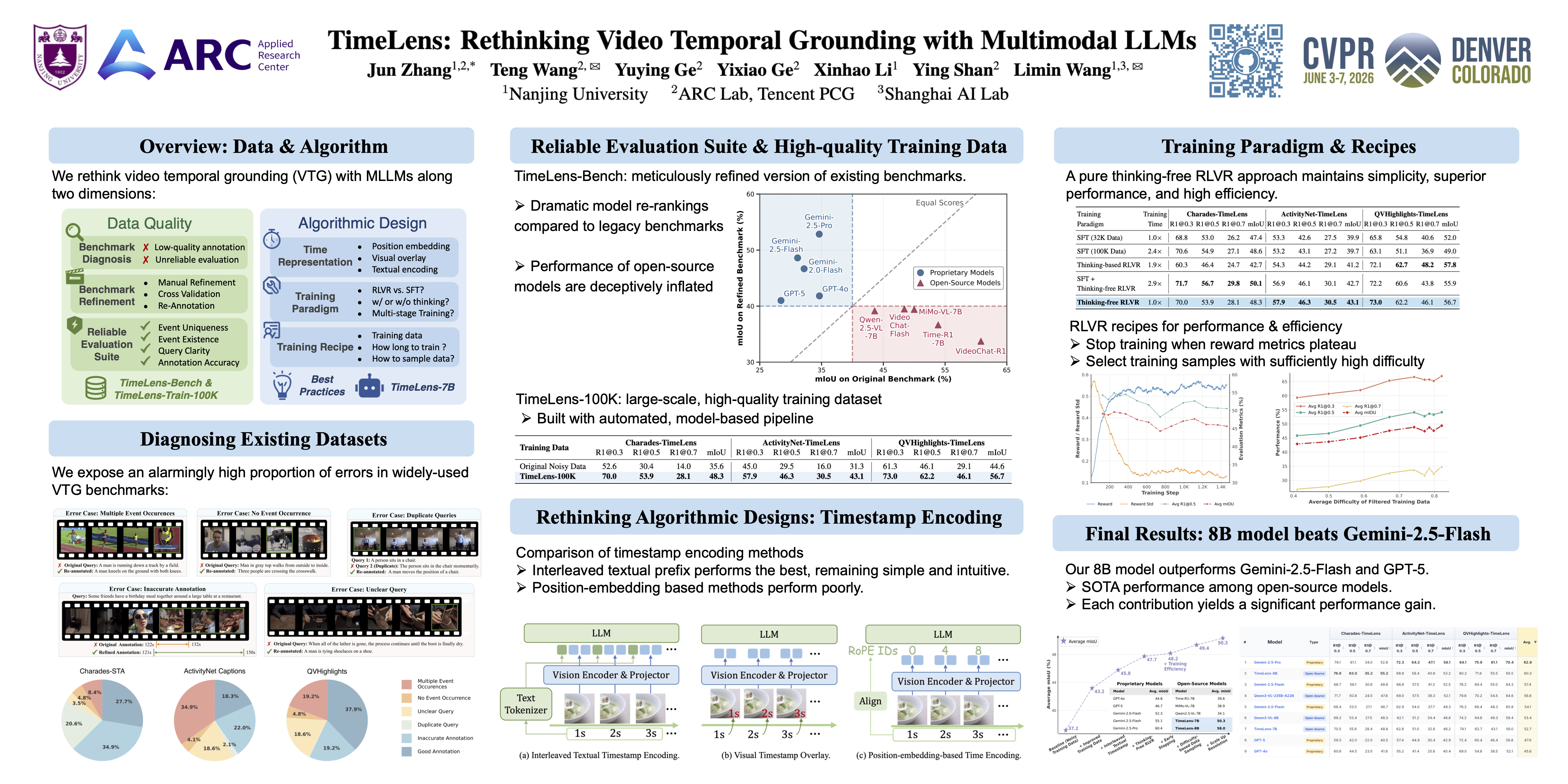
This paper does not introduce a novel method but instead establishes a straightforward, incremental, yet essential baseline for video temporal grounding (VTG), a core capability in video understanding.While multimodal large language models (MLLMs) excel at various video understanding tasks, the recipes for optimizing them for VTG remain under-explored.In this paper, we present TimeLens, a systematic investigation into building MLLMs with strong VTG ability, along two primary dimensions: data quality and algorithmic design.We first expose critical quality issues in existing VTG benchmarks and introduce TimeLens-Bench, comprising meticulously re-annotated versions of three popular benchmarks with strict quality criteria. Our analysis reveals dramatic model re-rankings compared to legacy benchmarks, confirming the unreliability of prior evaluation standards. We also address noisy training data through an automated re-annotation pipeline, yielding TimeLens-100K, a large-scale, high-quality training dataset.Building on our data foundation, we conduct in-depth explorations of algorithmic design principles, yielding a series of meaningful insights and effective yet efficient practices. These include interleaved textual encoding for time representation, a thinking-free Reinforcement Learning with Verifiable Rewards (RLVR) approach as the training paradigm, and carefully designed recipes for RLVR training. These efforts culminate in TimeLens-7B, an MLLM that achieves state-of-the-art performance among open-source models and even surpasses proprietary models such as GPT-4o and GPT-5. All codes, data, and models will be released to facilitate future research.
Tokenization Allows Multimodal Large Language Models to Understand, Generate and Edit Architectural Floor Plans
Sizhong Qin ⋅ Ramon Elias Weber ⋅ Xinzheng Lu
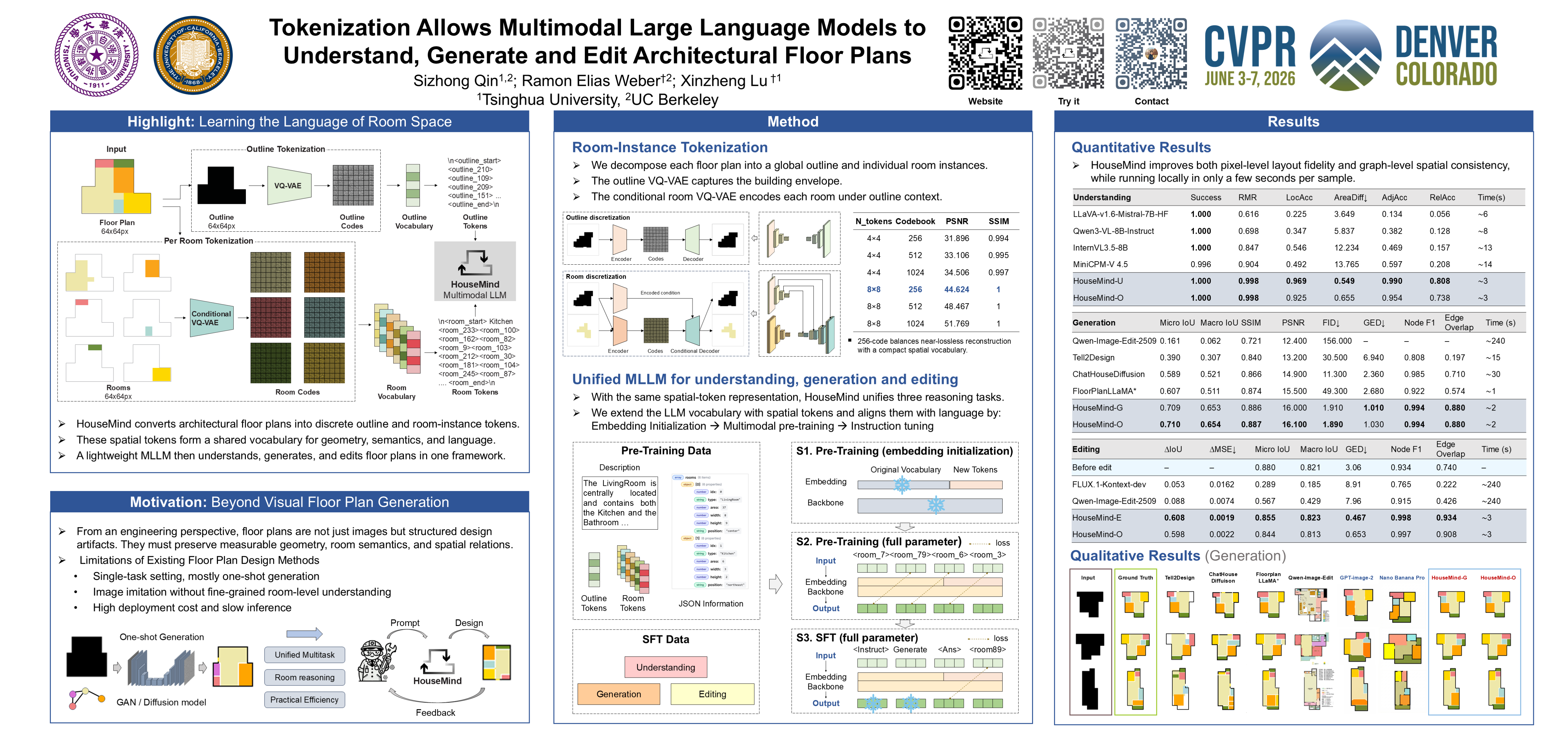
Architectural floor plan design demands joint reasoning over geometry, semantics, and spatial hierarchy, which remains a major challenge for current AI systems. Although recent diffusion and language models improve visual fidelity, they still struggle with coherent spatial reasoning and controllable generation. We present HouseMind, a multimodal large language model that unifies floor plan understanding, generation, and editing in one framework. We introduce discrete room-instance tokens to construct a unified vocabulary that bridges layouts and symbolic reasoning. With multimodal alignment and instruction tuning, the model synthesizes coherent, controllable layouts from text instructions. Experiments show how the framework achieves superior geometric validity and controllability while remaining efficient and locally deployable.
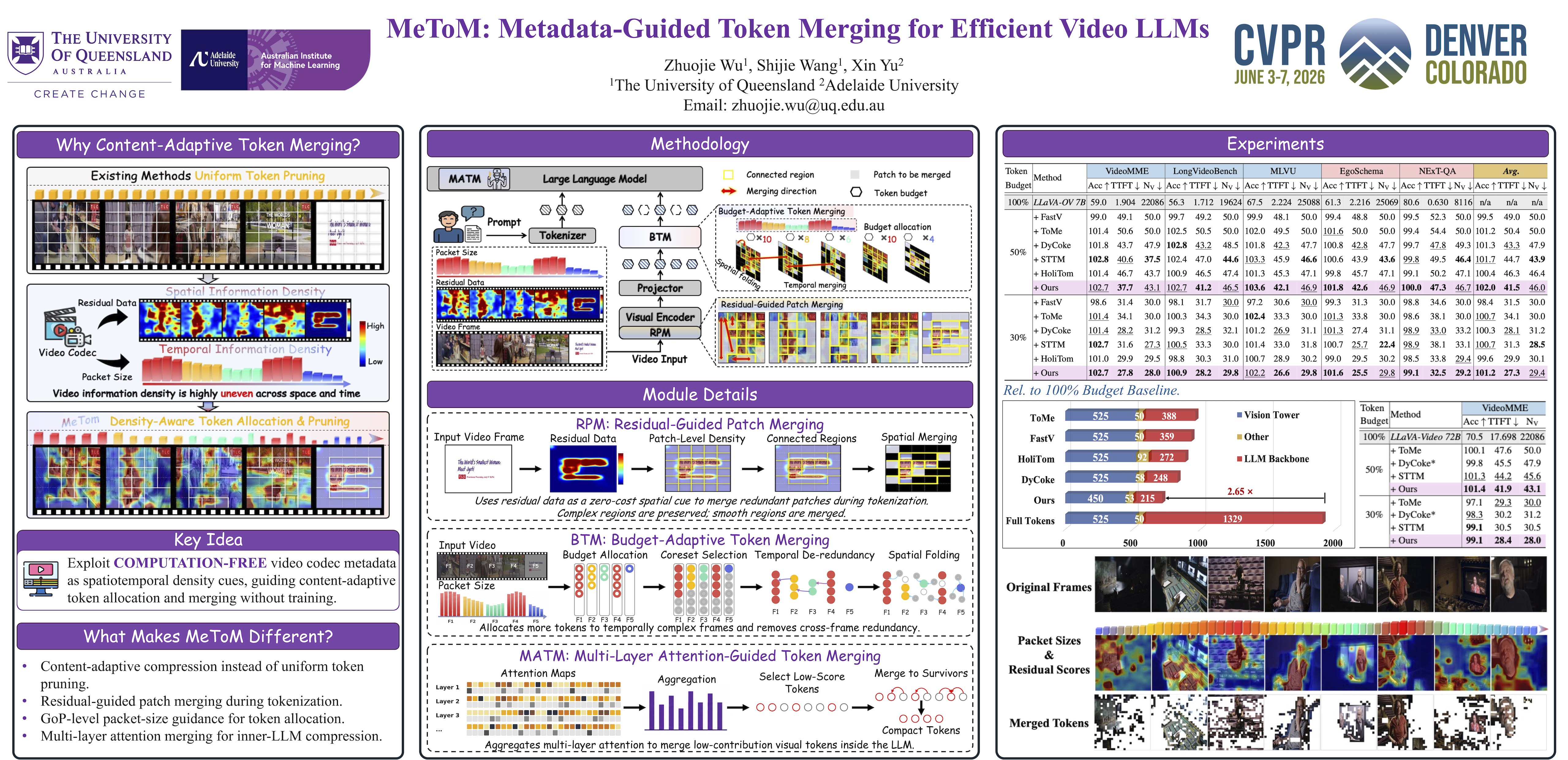
Video Large Language Models (VLLMs) encounter significant computational challenges due to the large volume of visual tokens generated from multiple frames.Existing visual token pruning methods fail to account for the uneven spatiotemporal information density, thus squandering scarce token budgets on regions with low information density.In this paper, we propose a training-free \textbf{Me}tadata-guided \textbf{To}ken \textbf{M}erging framework (\textbf{MeToM}) that leverages intrinsic video metadata to adaptively allocate budgets and merge visual tokens based on content complexity.Specifically, MeToM exploits residual from the metadata as spatial information density cues.It merges less informative regions during tokenization, avoiding redundant encoding and improving the efficiency of the visual encoder.Additionally, MeToM captures temporal variations in information density by utilizing the average Group of Pictures (GoP) size to represent scene complexity.This mechanism enables dynamic per-frame token allocation that adaptively adjusts token budgets across time, assigning more tokens to content-complex frames and fewer to simple ones.Finally, inside the LLM, we merge low-contribution visual tokens via multi-layer attention to compact the prefill FLOPs and visual KV cache.Extensive experimental results demonstrate that MeToM outperforms the prior SoTA counterparts, achieving $2.65\times$ inference speedup against the baseline VLLM, while still improving the performance, without training.
Token Reduction via Local and Global Contexts Optimization for Efficient Video Large Language Models
Jinlong Li ⋅ Liyuan Jiang ⋅ Haonan Zhang ⋅ Nicu Sebe
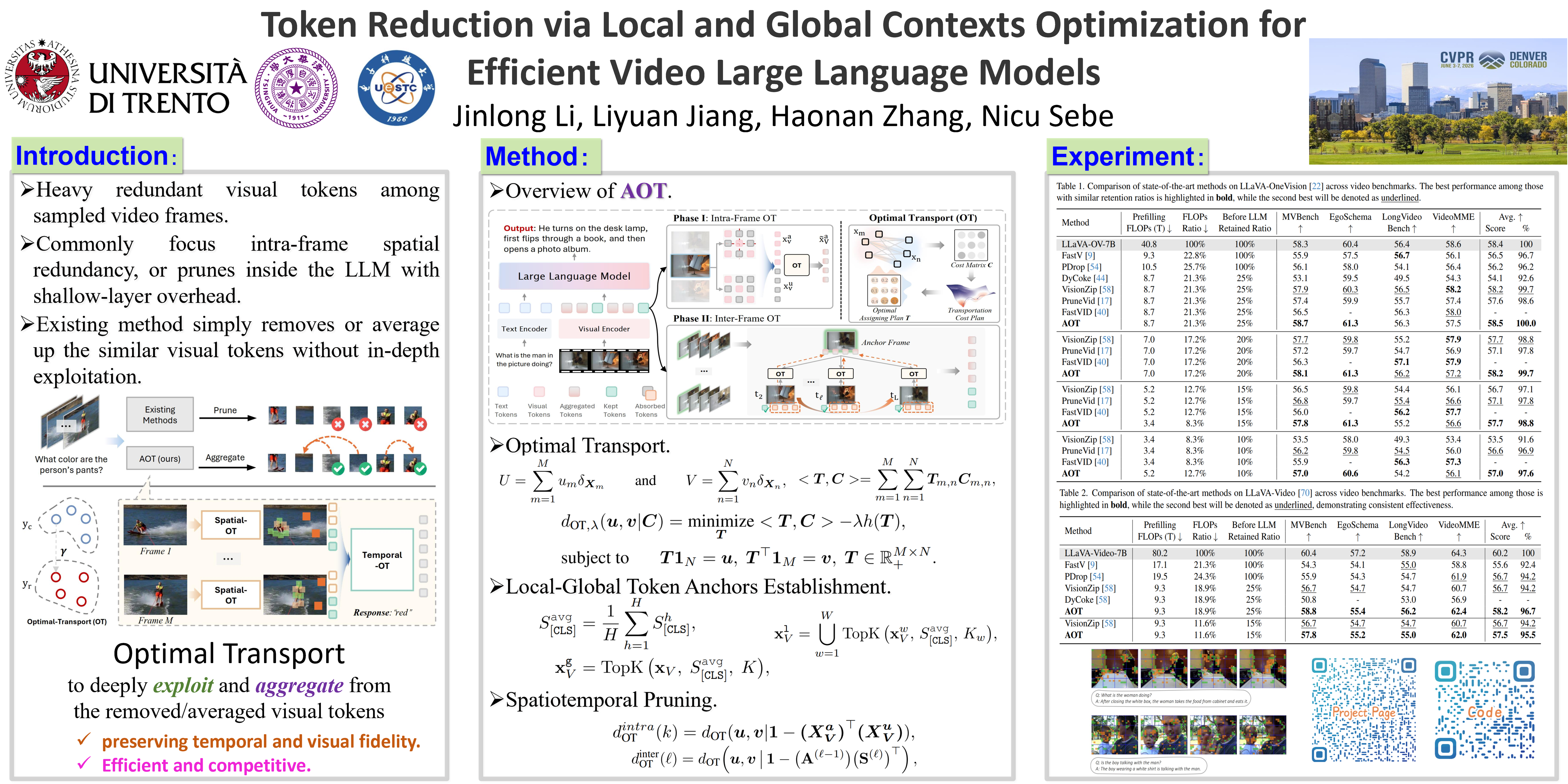
Video Large Language Models (VLLMs) demonstrate strong video understanding but suffer from inefficiency due to redundant visual tokens. Existing pruning primary targets intra-frame spatial redundancy or prunes inside the LLM with shallow-layer overhead, yielding suboptimal spatiotemporal reduction and underutilizing long-context compressibility. All of them often discard subtle yet informative context from merged or pruned tokens. In this paper, we propose a new perspective that elaborates token Anchors within intra-frame and inter-frame to comprehensively aggregate the informative contexts via local-global Optimal Transport (AOT). Specifically, we first establish local- and global-aware token anchors within each frame under the attention guidance, which then optimal transport aggregates the informative contexts from pruned tokens, constructing intra-frame token anchors. Then, building on the temporal frame clips, the first frame within each clip will be considered as the keyframe anchors to ensemble similar information from consecutive frames through optimal transport, while keeping distinct tokens to represent temporal dynamics, leading to efficient token reduction in a training-free manner. Extensive evaluations show that our proposed AOT obtains competitive performances across various short- and long-video benchmarks on leading video LLMs, obtaining substantial computational efficiency while preserving temporal and visual fidelity.
VLIC: Vision-Language Models As Perceptual Judges for Human-Aligned Image Compression
Kyle Sargent ⋅ Ruiqi Gao ⋅ Philipp Henzler ⋅ Charles Herrmann ⋅ Aleksander Holynski ⋅ Li Fei-Fei ⋅ Jiajun Wu ⋅ Jason Y. Zhang
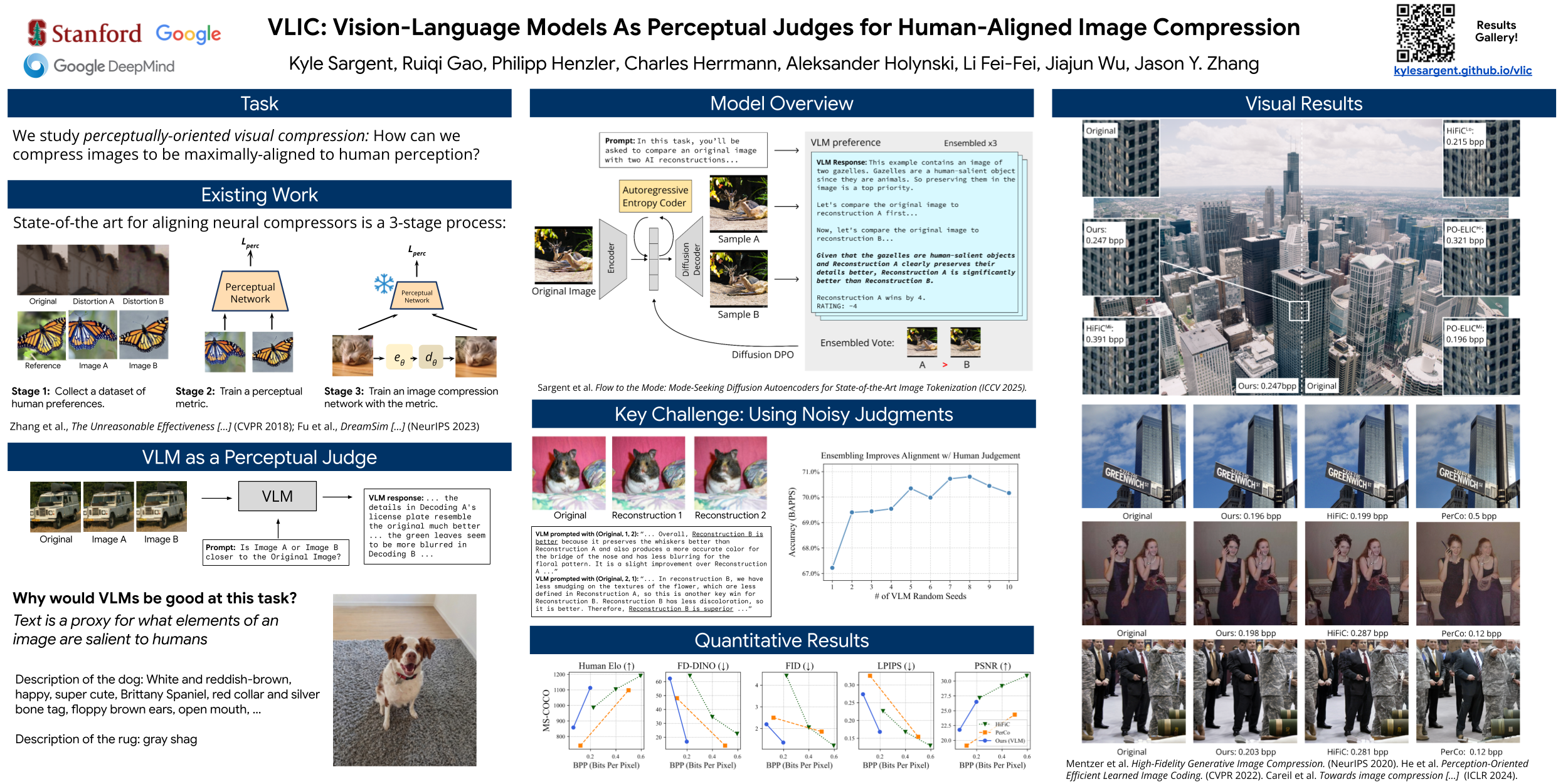
Evaluations of image compression performance which include human preferences have generally found that naive distortion functions such as MSE are insufficiently aligned to human perception.In order to align compression models to human perception, prior work has employed differentiable perceptual losses consisting of neural networks calibrated on large-scale datasets of human psycho-visual judgments. We show that, surprisingly, state-of-the-art vision-language models (VLMs) can replicate binary human two-alternative forced choice (2AFC) judgments zero-shot when asked to reason about the differences between pairs of images. Motivated to exploit the powerful zero-shot visual reasoning capabilities of VLMs, we propose Vision Language Models for Image Compression (VLIC), a diffusion-based image compression system designed to be post-trained with binary VLM judgments. VLIC leverages existing techniques for diffusion model post-training with preferences, rather than distilling the VLM judgments into a separate perceptual loss network. We show that calibrating this system on VLM judgments produces competitive or state-of-the-art performance on human-aligned visual compression depending on the dataset, according to perceptual metrics and large-scale user studies. We additionally conduct an extensive analysis of the VLM-based reward design and training procedure and share important insights.
Mostly Text, Smart Visuals: Asymmetric Text-Visual Pruning for Large Vision-Language Models
Sijie Li ⋅ Biao Qian ⋅ Jungong Han
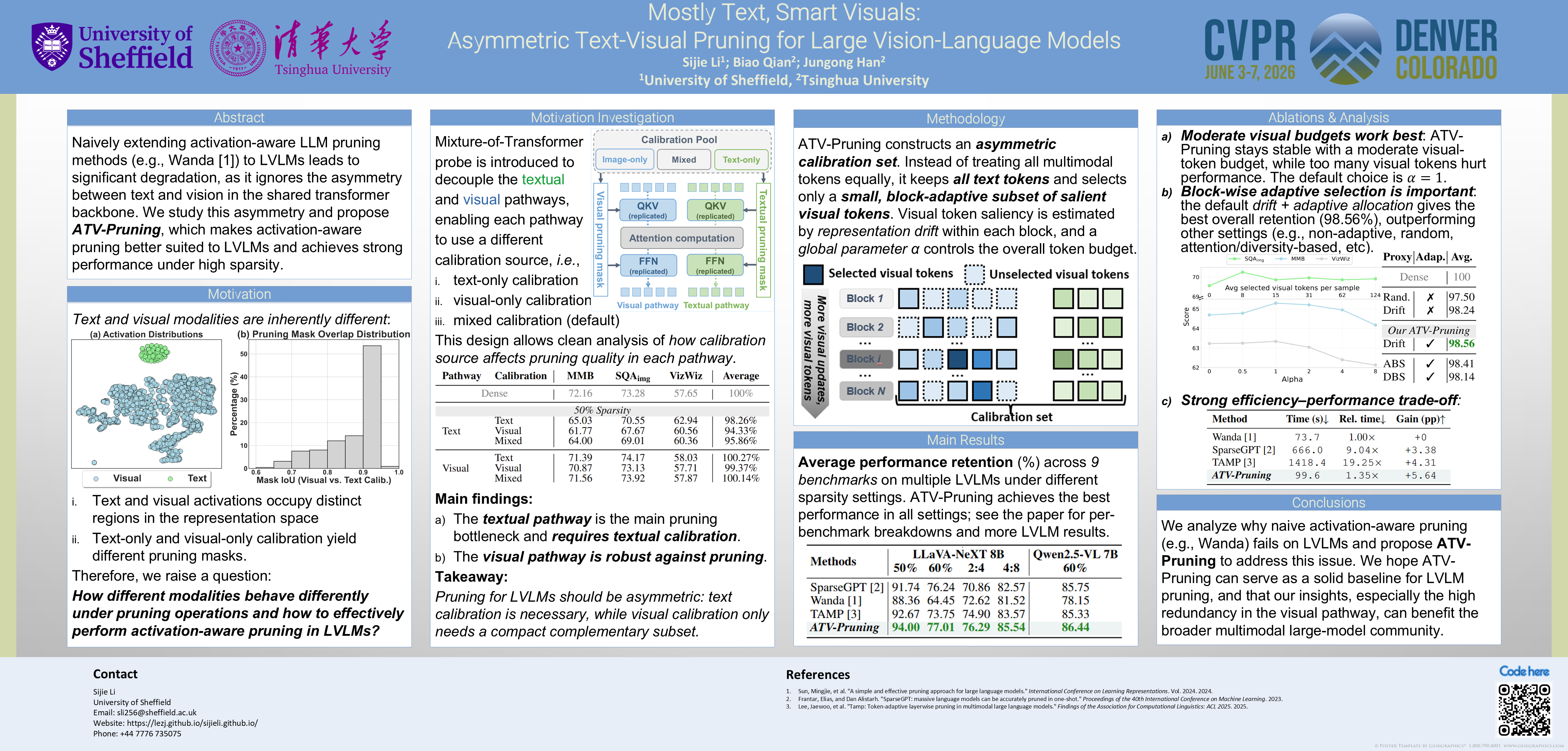
Network pruning is an effective technique for enabling lightweight Large Vision-Language Models (LVLMs), which primarily incorporates both weights and activations into the importance metric. However, existing efforts typically process calibration data from different modalities in a unified manner, overlooking modality-specific behaviors. This raises a critical challenge: how to address the divergent behaviors of textual and visual tokens for accurate pruning of LVLMs. To this end, we systematically investigate the sensitivity of visual and textual tokens to the pruning operation by decoupling their corresponding weights, revealing that: (i) the textual pathway should be calibrated via text tokens, since it exhibits higher sensitivity than the visual pathway; (ii) the visual pathway exhibits high redundancy, permitting even 50\% sparsity. Motivated by these insights, we propose a simple yet effective Asymmetric Text-Visual Weight Pruning method for LVLMs, dubbed ATV-Pruning, which establishes the importance metric for accurate weight pruning by selecting the informative tokens from both textual and visual pathways. Specifically, ATV-Pruning integrates two primary innovations: first, a calibration pool is adaptively constructed by drawing on all textual tokens and a subset of visual tokens; second, we devise a layer-adaptive selection strategy to yield important visual tokens. Finally, extensive experiments across standard multimodal benchmarks verify the superiority of our ATV-Pruning over state-of-the-art methods.
Attention-aware Inference Optimizations for Large Vision-Language Models with Memory-efficient Decoding
Fatih Ilhan ⋅ Gaowen Liu ⋅ Ramana Kompella ⋅ Selim Tekin ⋅ Tiansheng Huang ⋅ Zachary Yahn ⋅ Yichang Xu ⋅ Ling Liu
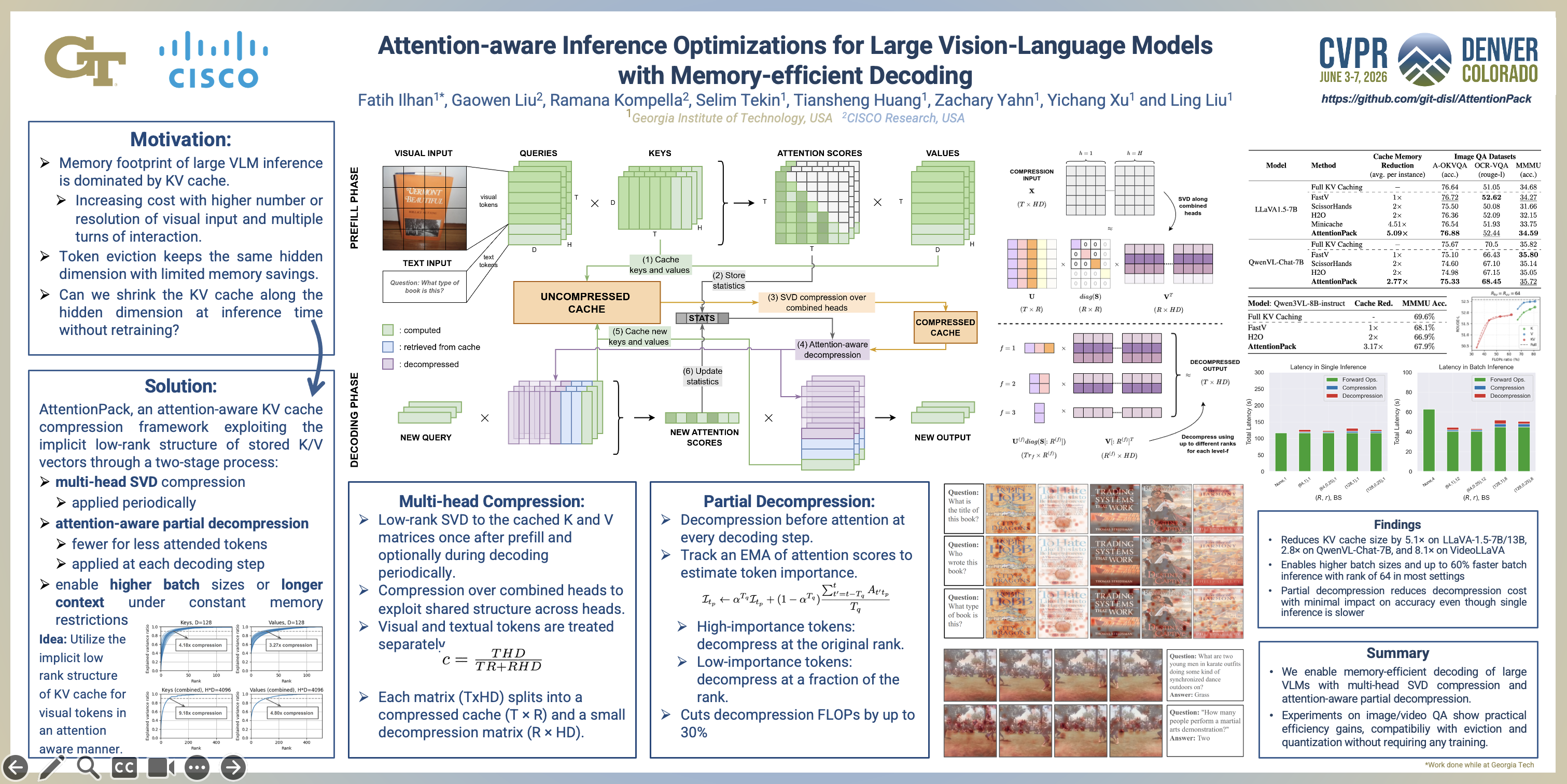
Large Vision-Language Models (VLMs) have achieved remarkable success in multi-modal reasoning, but their inference time efficiency remains a significant challenge due to the memory overhead during decoding, especially when the query and answer of VLMs consist of long sequences of visual and text tokens. This paper presents AttentionPack, an adaptive and attention-aware optimization framework tailored for large vision-language models with improving memory-efficiency during decoding, focusing on addressing the challenges due to the increased high number of visual inputs and interactions, particularly in long-context tasks with multiple high-resolution images or videos. AttentionPack is novel in two aspects: (i) We introduce a multi-head attention compaction method for economically storing key and value matrices by exploiting the implicit low-rank structure, and (ii) we develop a token-specific attention-aware decompression mechanism to reduce latency overhead. Experimental results on multiple benchmarks demonstrate that AttentionPack improves memory efficiency by up to 8x, compared to the existing representative decoding optimization methods, enabling higher batch sizes and faster batch inference while preserving the model output quality or longer context lengths for superior retrieval performance. We also report the effectiveness of AttentionPack with eviction, quantization and kernel fusion, showing further memory efficiency gains in resource-limited environments.
CoIn: Coverage and Informativeness-Guided Token Reduction for Efficient Large Multimodal Models
Chenxi Du ⋅ Yongheng Deng ⋅ Jiani Liu ⋅ Yujia Zhang ⋅ Xi Chen ⋅ Ju Ren
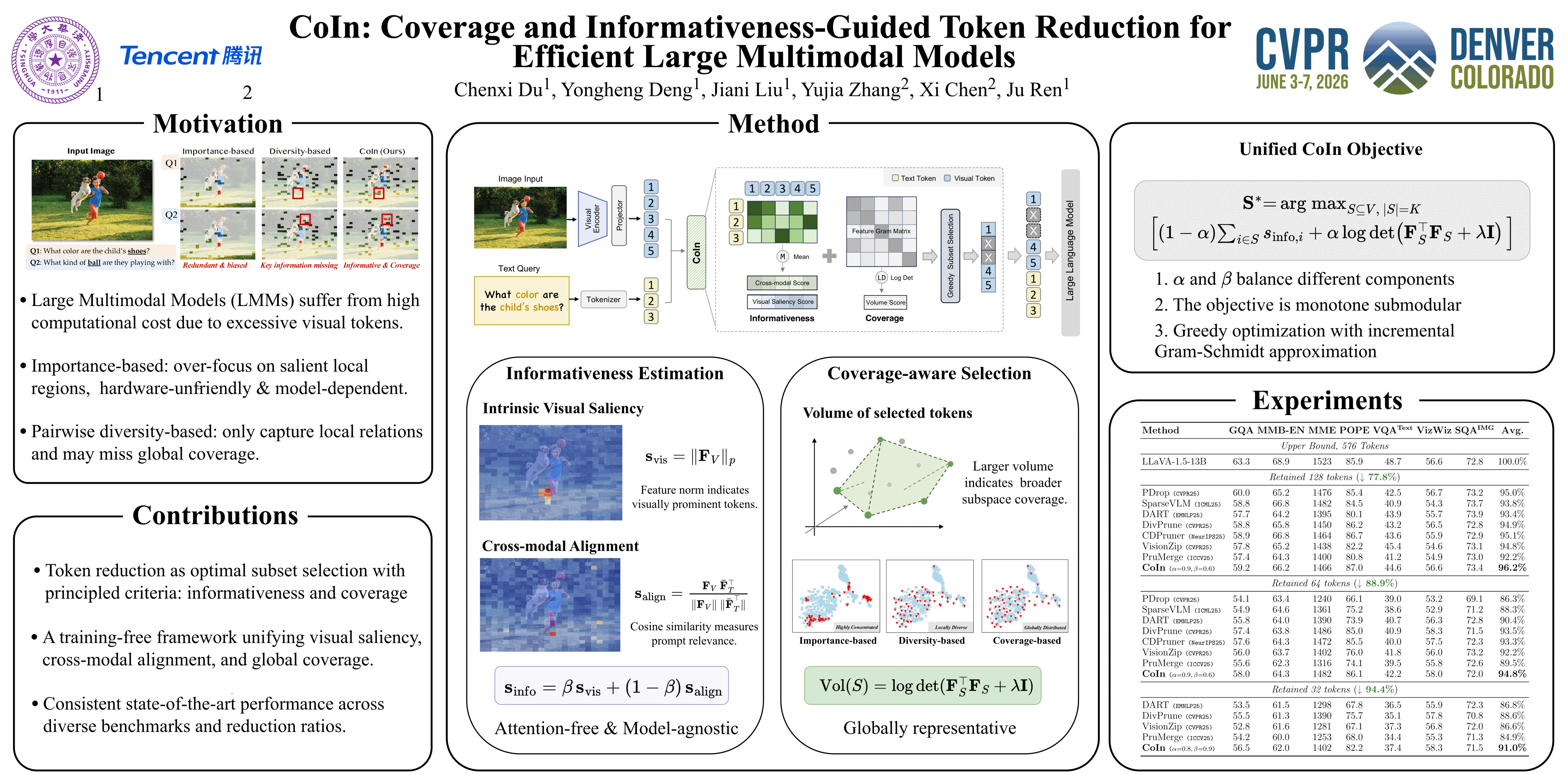
Large Multimodal Models (LMMs) have shown remarkable success in visual understanding tasks. LMMs encode visual and textual inputs into tokens, which are then processed by Large Language Models (LLMs). However, the large number of visual tokens poses a major bottleneck for inference efficiency and memory usage. Reducing visual tokens is a promising training-free solution, but existing methods remain limited. Importance-based approaches suffer from poor generalization, are incompatible with kernel-level inference optimizations, and only consider information from a single modality. Diversity-based strategies typically focus on pairwise token redundancy and treat all tokens as equally important. Recent attempts to sequentially combine importance and diversity criteria still fail to address the intrinsic drawbacks of their underlying metrics. To address these limitations, we reformulate visual token reduction as an optimal subset selection problem jointly guided by two complementary objectives: informativeness and coverage. Informativeness is quantified through per-token intrinsic saliency and visual–textual alignment, while coverage is enforced via a volume-based subset selection criterion that ensures global representativeness in the visual feature space.This joint formulation effectively integrates visual saliency, cross-modal alignment, and global coverage in an end-to-end token selection process, yielding a computationally efficient, model-agnostic framework compatible with modern inference accelerators. Extensive experiments demonstrate that CoIn substantially reduces computation and memory cost while maintaining strong task performance. We will release our code once accepted.
TAMER: A Tri-Modal Contrastive Alignment and Multi-Scale Embedding Refinement Framework for Zero-Shot ECG Diagnosis
Xuewei Zhou ⋅ Yajie Meng ⋅ Pan Zeng ⋅ Xianfang Tang ⋅ Feifei Cui ⋅ Qiangguo Jin ⋅ Jialiang Yang ⋅ Junlin Xu
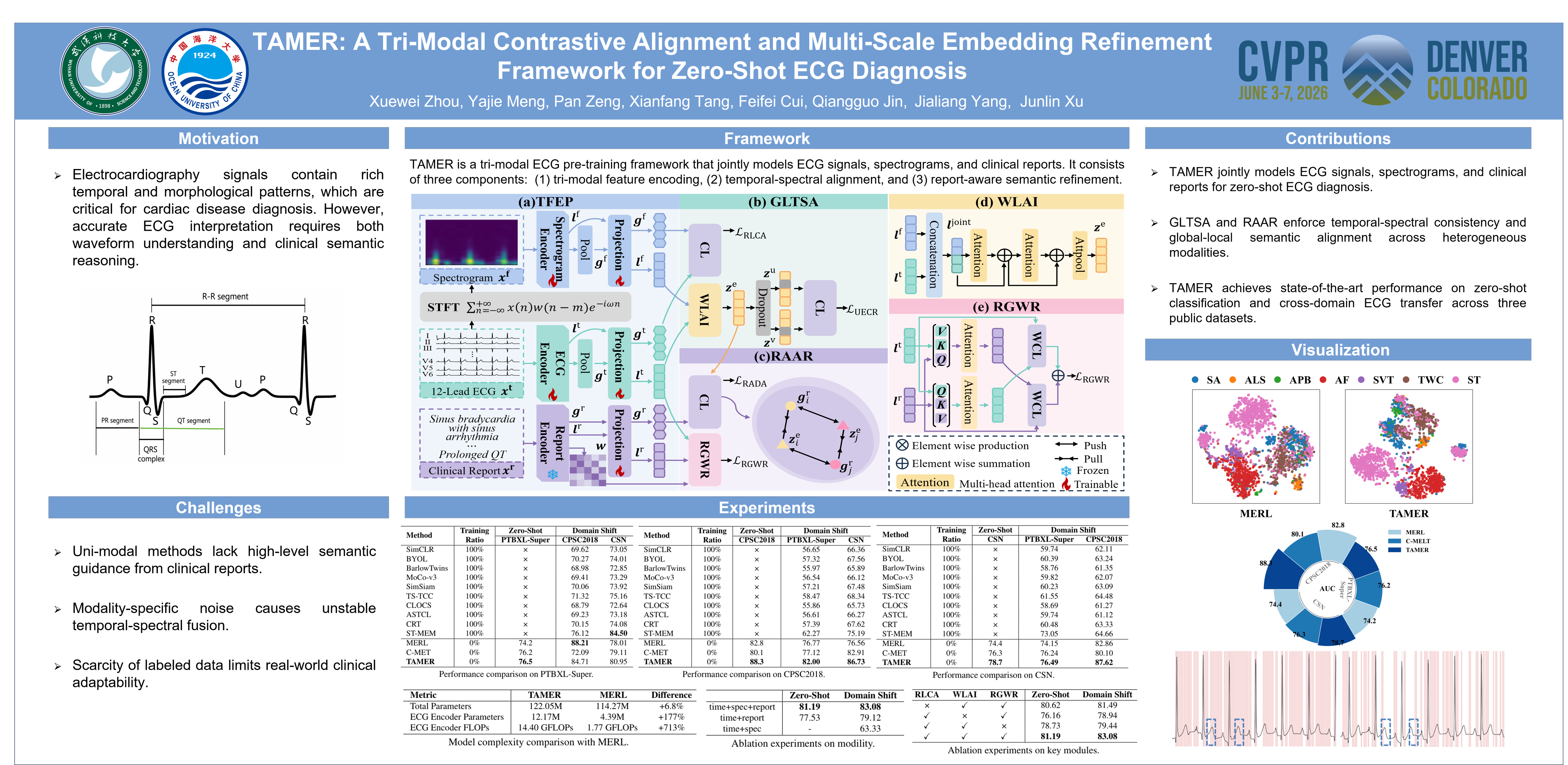
Cardiovascular disease (CVD) diagnosis relies heavily on electrocardiograms (ECGs). However, most existing self-supervised uni-modal methods suffer from limited representational capacity, while multi-modal frameworks are hindered by coarse-grained semantic alignment across modalities, thus restricting their generalizability in clinical settings. To address these limitations, we propose TAMER, a Tri-modal contrastive Alignment and Multi-scale Embedding Refinement framework that jointly models ECG recordings, spectrograms, and diagnostic reports. TAMER is composed of three key components: First, the tri-modal feature encoding and projection (TFEP) module employs modality-specific encoders to extract global and local features from ECG recordings, spectrograms, and diagnostic reports, and projects them into latent spaces. Then, the global-local temporal-spectral alignment (GLTSA) module captures complementary rhythm- and wave-level characteristics via contrastive alignment and attentive interaction between temporal and spectral modalities. Finally, the report-aware alignment and refinement (RAAR) module performs diagnostic-level alignment and wave-level refinement with clinical reports, enabling semantic enrichment of ECG representations.Extensive experiments on three public ECG datasets demonstrate that TAMER achieves state-of-the-art zero-shot classification performance (AUC: 81.2%) and strong cross-domain generalization (AUC: 83.1%), outperforming existing uni-modal and multi-modal baselines methods.
Your Dissimilarities Define You: Complementary Learning Exploiting Class Diversities
Dimitrios Katsikas ⋅ Nikolaos Passalis ⋅ Anastasios Tefas
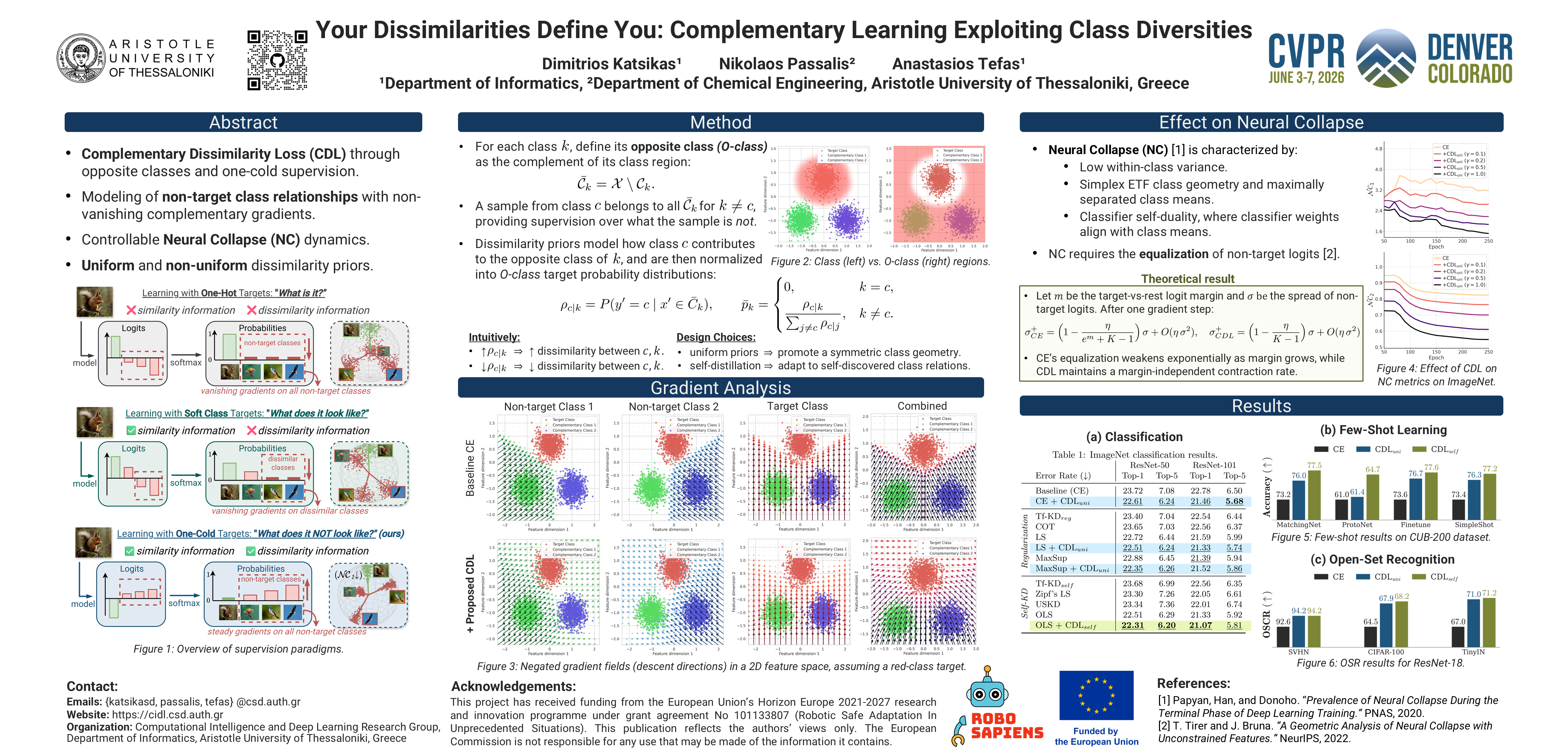
In this work, we exploit class dissimilarities in a rather novel way, which provides complementary learning information beyond correct classification, that is not fully utilized in existing learning paradigms. To model these dissimilarities, we introduce the concept of an opposite-class, which consists of everything that is not part of a corresponding class, i.e., all samples from non-target classes or samples from unknown classes. By setting appropriately encoded target distributions over the non-target classes, we explicitly optimize the model’s activation distributions across all non-target classes, which enhances class dissimilarity information and enables better control over the geometry of the learned representations. We analyze the convergence dynamics of our proposed approach, both theoretically and empirically, showing that it naturally pushes the representations towards neural collapse, leading to more discriminative and robust features. Our extensive evaluation across multiple classification settings demonstrates consistent improvements of our method on closed-set, open-set, few-shot classification, and domain generalization benchmarks. Our code is available at: (withheld for review, demo in supplementary material).
CGU-Bayes: Causal Graph Uncertainty-Guided Bayesian Inference for Domain Generalization
Naiyu Yin ⋅ Hanjing Wang ⋅ Yue Yu ⋅ Tian Gao ⋅ Amit Dhurandhar ⋅ Chung-Hao Lee ⋅ Qiang Ji
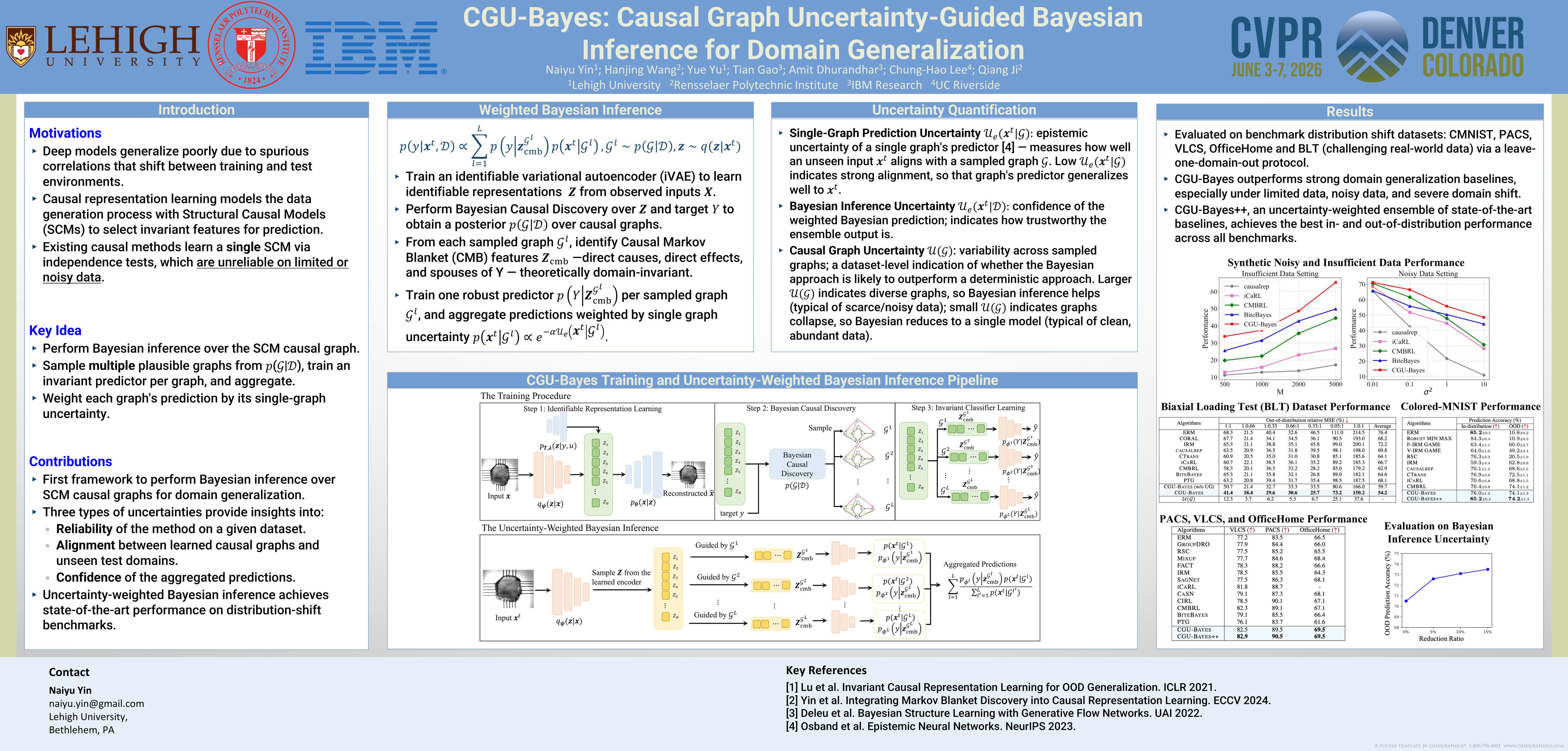
Causal graphs play a crucial role in AI research as they reveal the data generation processes underlying real-world machine learning and computer vision tasks. Recent studies have leveraged causal graphs to develop more robust and interpretable models. However, limited or biased data often lead to inaccurate causal graph estimation, reducing a model’s transferability to unseen domains. To address this challenge, we propose a novel framework that performs Bayesian inference over causal graphs to capture potential underlying causal relations and identify invariant causal features for DG prediction. The key advantage of our framework lies in its ability to quantify causal graph uncertainty in the context of prediction tasks and incorporate it into the prediction process. Our proposed uncertainty provides valuable insights into (i) the reliability of our method on specific datasets, (ii) the alignment between learned causal graphs and unseen test domains, and (iii) the confidence of our predictions. In particular, we go beyond merely quantifying uncertainty and leverage it as weighting factors in a weighted Bayesian inference scheme. Empirical results on multiple benchmark distribution-shift datasets show that our algorithm, Causal Graph Uncertainty-guided Bayesian Inference (CGU-Bayes), outperforms existing DG methods on challenging datasets and achieves state-of-the-art performance overall.
Franca: Nested Matryoshka Clustering for Scalable Visual Representation Learning
Shashanka Venkataramanan ⋅ Valentinos Pariza ⋅ Mohammadreza Salehi ⋅ Lukas Knobel ⋅ Elias Ramzi ⋅ Spyros Gidaris ⋅ Andrei Bursuc ⋅ Yuki M Asano
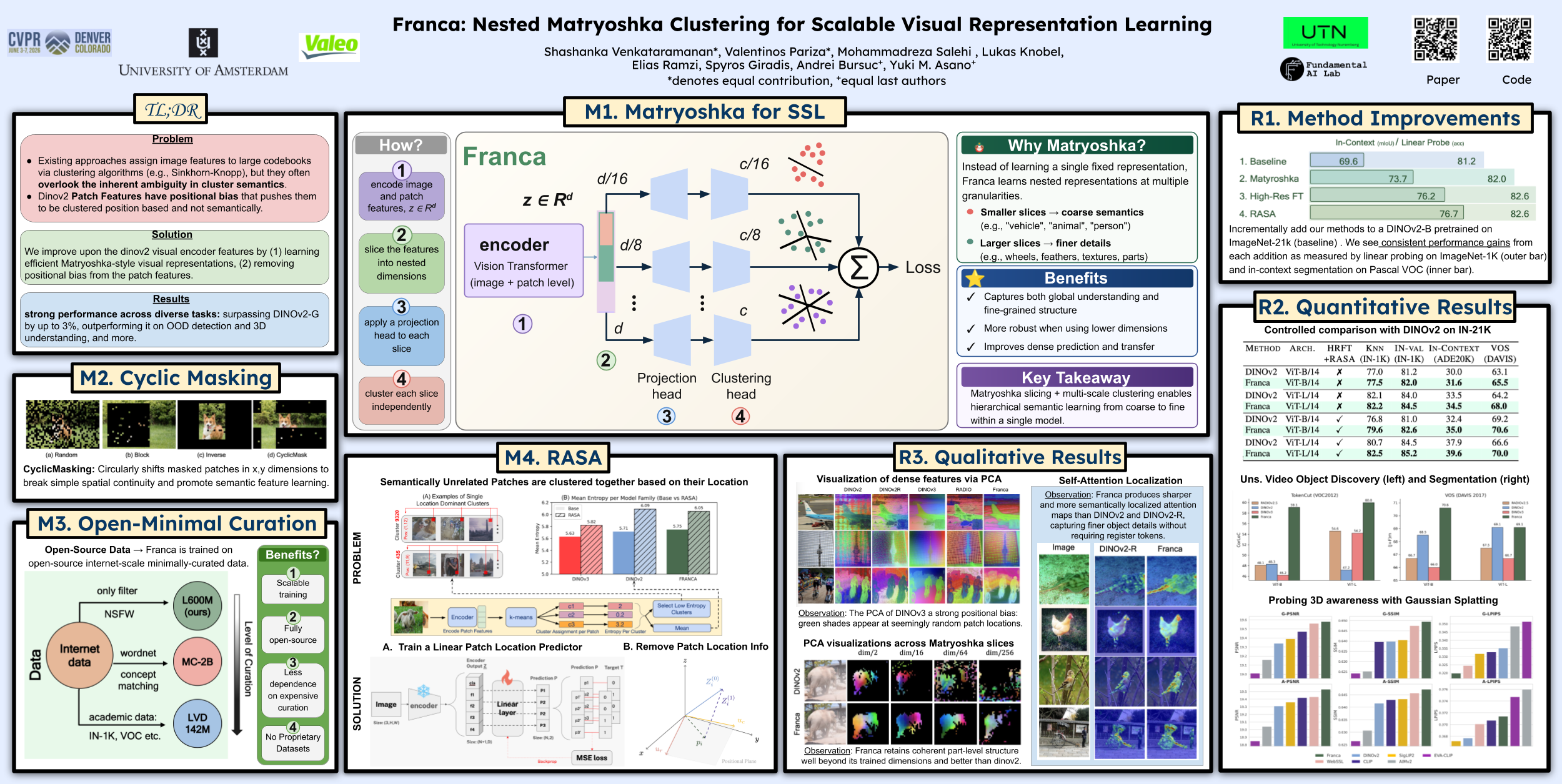
We present Franca (pronounced Fran-ka): free one; the first fully open-source (data, code, weights) vision foundation model that matches and in many cases surpasses the performance of state-of-the-art proprietary models, e.g., DINOv2, CLIP, SigLIPv2, etc. Our approach is grounded in a transparent training pipeline inspired by Web-SSL and uses publicly available data: ImageNet-21K and a subset of ReLAION-2B. Beyond model release, we tackle critical limitations in self-supervised learning clustering methods. Existing approaches assign image features to large codebooks via clustering algorithms such as Sinkhorn-Knopp, but they often overlook the inherent ambiguity in cluster semantics. To address this, we introduce a multi-head clustering projector based on nested Matryoshka representations. This design progressively refines features into increasingly fine-grained clusters without increasing the model size, producing higher-quality dense representations. Additionally, we propose a novel positional disentanglement strategy that explicitly removes positional biases from dense representations.This leads to consistent gains on several downstream benchmarks, demonstrating the utility of cleaner feature spaces. Our contributions establish a new standard for transparent, high-performance vision models and open a path toward more reproducible and generalizable foundation models for the broader AI community.
Towards Stable Self-Supervised Object Representations in Unconstrained Egocentric Video
Yuting Tan ⋅ Xilong Cheng ⋅ Yunxiao Qin ⋅ Zhengnan Li ⋅ Jingjing Zhang
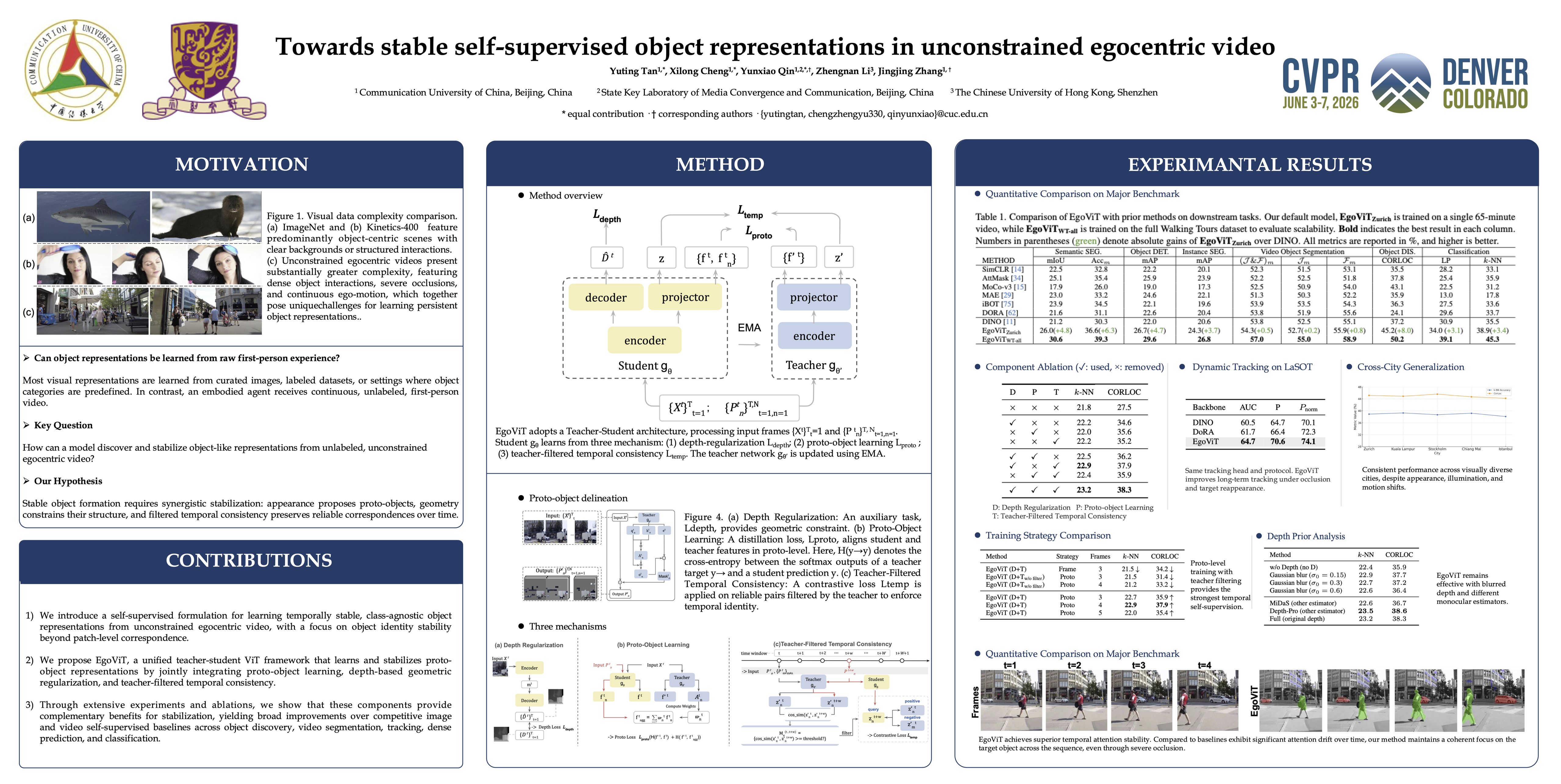
Humans develop visual intelligence through perceiving and interacting with their environment—a self-supervised learning process grounded in egocentric experience. Inspired by this, we ask how can artificial systems learn stable object representations from continuous, uncurated first-person videos without relying on manual annotations.This setting poses challenges of separating, recognizing, and persistently tracking objects amid clutter, occlusion, and ego-motion.We propose EgoViT, a unified vision Transformer framework designed to learn stable object representations from unlabeled egocentric video. EgoViT bootstraps this learning process by jointly discovering and stabilizing "proto-objects" through three synergistic mechanisms: (1) Proto-object Learning, which uses intra-frame distillation to form discriminative representations; (2) Depth Regularization, which grounds these representations in geometric structure; and (3) Teacher-Filtered Temporal Consistency, which enforces identity over time. This creates a virtuous cycle where initial object hypotheses are progressively refined into stable, persistent representations. The framework is trained end-to-end on unlabeled first-person videos and exhibits robustness to geometric priors of varied origin and quality.On standard benchmarks, EgoViT achieves +8.0% CorLoc improvement in unsupervised object discovery and +4.8% mIoU improvement in semantic segmentation, is potential to lay a foundation for achieving robust visual abstraction for embodied intelligence.
LRDUN: A Low-Rank Deep Unfolding Network for Efficient Spectral Compressive Imaging
HE HUANG ⋅ Yujun Guo ⋅ Wei He
Deep unfolding networks (DUNs) have achieved remarkable success and become the mainstream paradigm for spectral compressive imaging (SCI) reconstruction. Existing DUNs are derived from full-HSI imaging models, where each stage operates directly on the high-dimensional HSI, refining the entire data cube based on the single 2D coded measurement. However, this paradigm leads to computational redundancy and suffers from the ill-posed nature of mapping 2D residuals back to 3D space of HSI. In this paper, we propose two novel imaging models corresponding to the spectral basis and subspace image by explicitly integrating low-rank (LR) decomposition with the sensing model. Compared to recovering the full HSI, estimating these compact low-dimensional components significantly mitigates the ill-posedness. Building upon these novel models, we develop the Low-Rank Deep Unfolding Network (LRDUN), which jointly solves the two subproblems within an unfolded proximal gradient descent (PGD) framework. Furthermore, we introduce a Generalized Feature Unfolding Mechanism (GFUM) that decouples the physical rank in the data-fidelity term from the feature dimensionality in the prior module, enhancing the representational capacity and flexibility of the network. Extensive experiments on simulated and real datasets demonstrate that the proposed LRDUN achieves state-of-the-art (SOTA) reconstruction quality with significantly reduced computational cost.
Neural Collapse in Test-Time Adaptation
Xiao Chen ⋅ Zhongjing Du ⋅ Jiazhen Huang ⋅ Jiang Xu ⋅ Li Lu ⋅ Jingyan Jiang ⋅ Zhi Wang
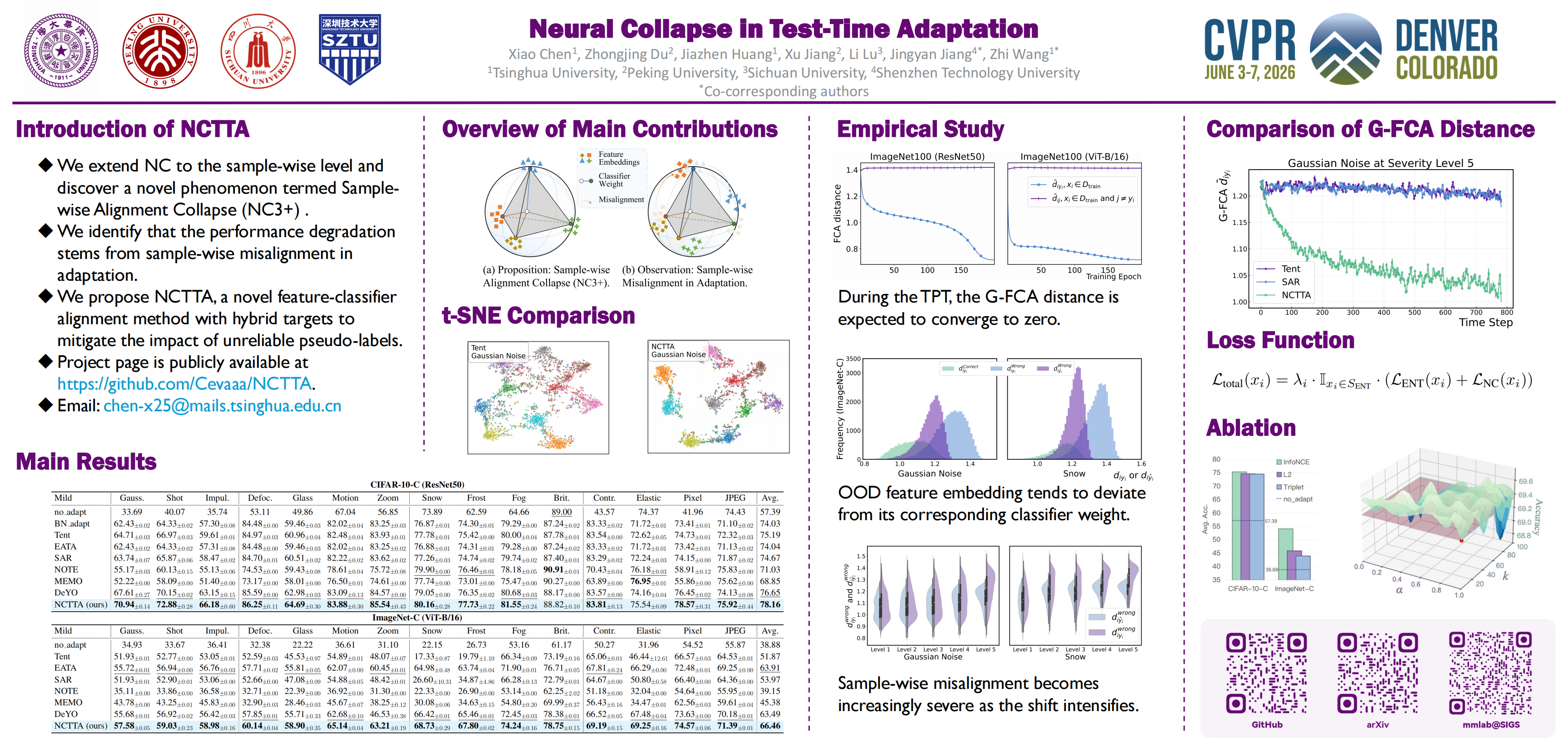
Test-Time Adaptation (TTA) enhances model robustness to out-of-distribution (OOD) data by updating the model online during inference, yet existing methods lack theoretical insights into the fundamental causes of performance degradation under domain shifts. Recently, Neural Collapse (NC) has been proposed as an emergent geometric property of deep neural networks (DNNs), providing valuable insights for TTA. In this work, we extend NC to the sample-wise level and discover a novel phenomenon termed Sample-wise Alignment Collapse (NC3+), demonstrating that a sample’s feature embedding, obtained by a trained model, aligns closely with the corresponding classifier weight. Building on NC3+, we identify that the performance degradation stems from sample-wise misalignment in adaptation which exacerbates under larger distribution shifts. This indicates the necessity of realigning the feature embeddings with their corresponding classifier weights. However, the misalignment makes pseudo-labels unreliable under domain shifts. To address this challenge, we propose NCTTA, a novel feature-classifier alignment method with hybrid targets to mitigate the impact of unreliable pseudo-labels, which blends geometric proximity with predictive confidence. Extensive experiments demonstrate the effectiveness of NCTTA in enhancing robustness to domain shifts. For example, NCTTA outperforms Tent by 14.52\% on ImageNet-C.
CLEX: Complementary Label Exchange Learning for Noisy Facial Expression Recognition
Lin Wang ⋅ Fang Liu ⋅ Xiaofen Xing ⋅ Kailing Guo ⋅ Xiangmin Xu
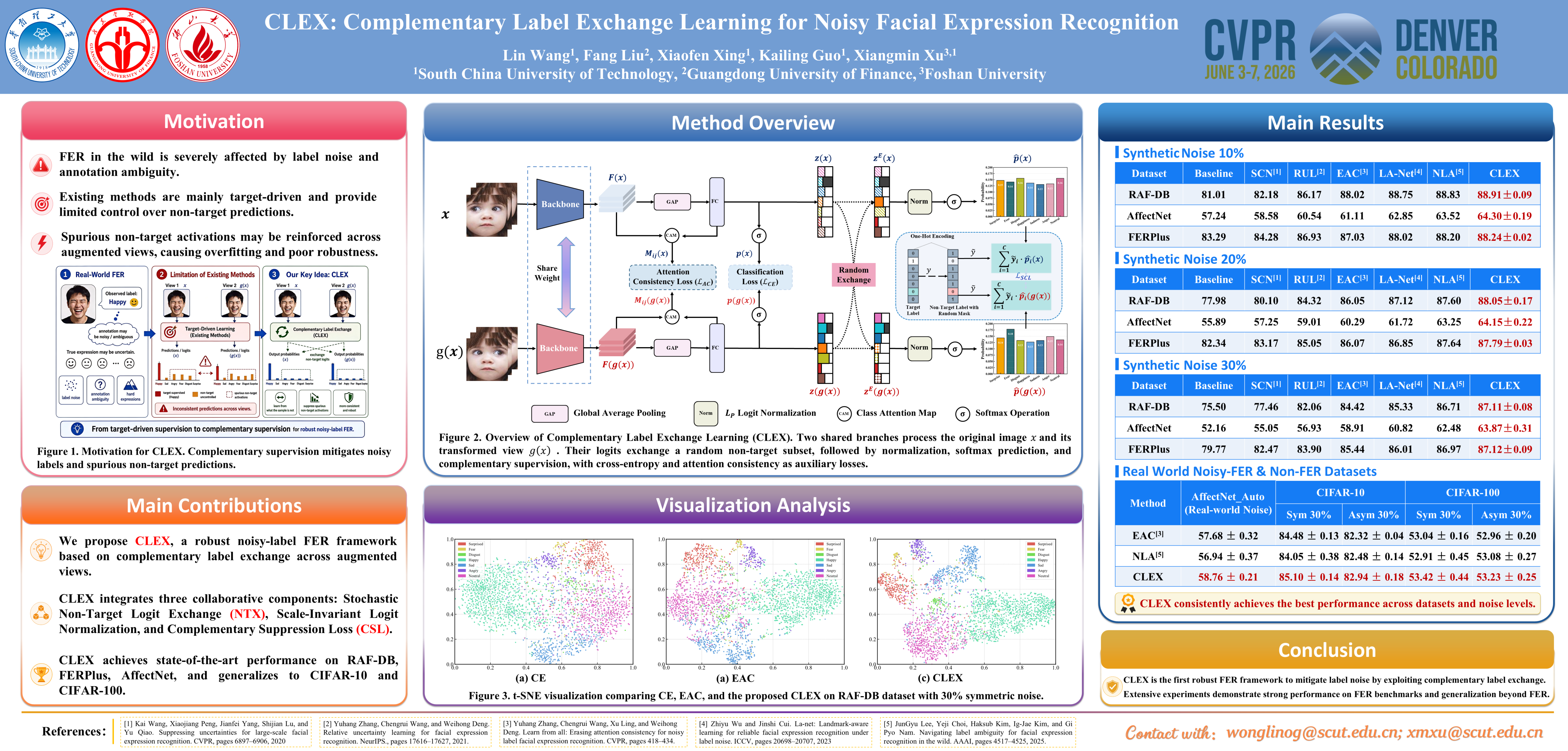
Facial expression recognition (FER) in the wild is severely hampered by label noise and annotation ambiguity. Existing methods, including sample selection, label ensembling, and consistency regularization, primarily rely on ordinary label supervision and offer limited control over non-target predictions, leading to spurious activations and overfitting to noisy labels. To address this limitation, we propose a novel learning framework, named Complementary Label Exchange Learning (CLEX), enhances robustness by exchanging knowledge from non-target predictions across augmented views. Specifically, CLEX comprises three synergistic components. First, Stochastic Non-Target Logit Exchange randomly swaps a subset of non-target logits between original and augmented views to couple error-prone predictions, creating robust consistency constraints. Second, Scale-Invariant Logit Normalization eliminates magnitude artifacts through $L_p$-norm normalization, ensuring that regularization operates over geometrically meaningful directions rather than being dominated by arbitrary scales. Third, Complementary Suppression Loss selectively penalizes spurious activations over a randomly retained subset of non-target classes, avoiding the uniform shrinkage that hampers discriminative learning. To further stabilize training, we incorporate attention consistency regularization that enforces spatial alignment between augmented views, while retaining auxiliary cross-entropy to preserve semantic localization capability. Extensive experiments across multiple benchmark FER datasets (RAF-DB, FERPlus, and AffectNet) demonstrate that CLEX consistently outperforms existing robust FER learning approaches.
TruckDrive: Long-Range Autonomous Highway Driving Dataset
Filippo Ghilotti ⋅ Edoardo Palladin ⋅ Samuel Brucker ⋅ Adam Sigal ⋅ Mario Bijelic ⋅ Felix Heide
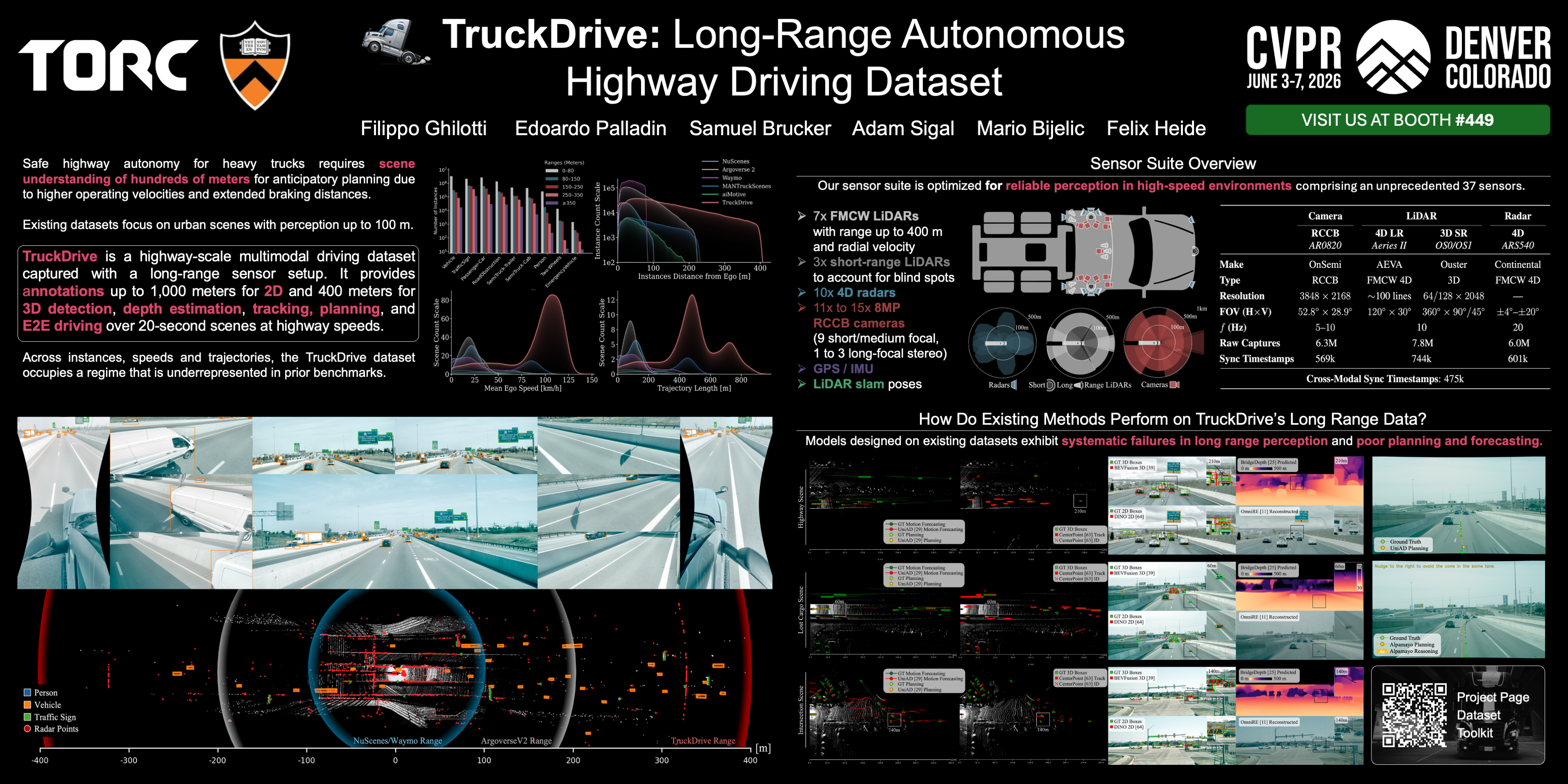
Safe highway autonomy for heavy trucks remains an open and unsolved challenge: due to long braking distances, scene understanding of hundreds of meters is required for anticipatory planning and to allow safe braking margins. However, existing driving datasets primarily cover urban scenes, with perception effectively limited to short ranges of only up to 100 meters. To address this gap, we introduce TruckDrive, a highway-scale multimodal driving dataset, captured with a sensor suite purpose-built for long range sensing: seven long-range FMCW LiDARs measuring range and radial velocity, three high-resolution short-range LiDARs, eleven 8MP surround cameras with varying focal lengths and ten 4D FMCW radars. The dataset offers 475 thousands samples with 165 thousands densely annotated frames for driving perception benchmarking up to 1,000 meters to for 2D detection and 400 meters for 3D detection, depth estimation, tracking, planning and end to end driving over 20 seconds sequences at highway speeds. We find that state-of-the-art autonomous driving models do not generalize to ranges beyond 150 meters, with drops between 31\% and 99\% in 3D perception tasks, exposing a systematic long-range gap that current architectures and training signals cannot close.
Neuro-Cognitive Reward Modeling for Human-Centered Autonomous Vehicle Control
Zhuoli Zhuang ⋅ Yu-Cheng Chang ⋅ Yu-Kai Wang ⋅ Thomas Do ⋅ Chin-teng Lin
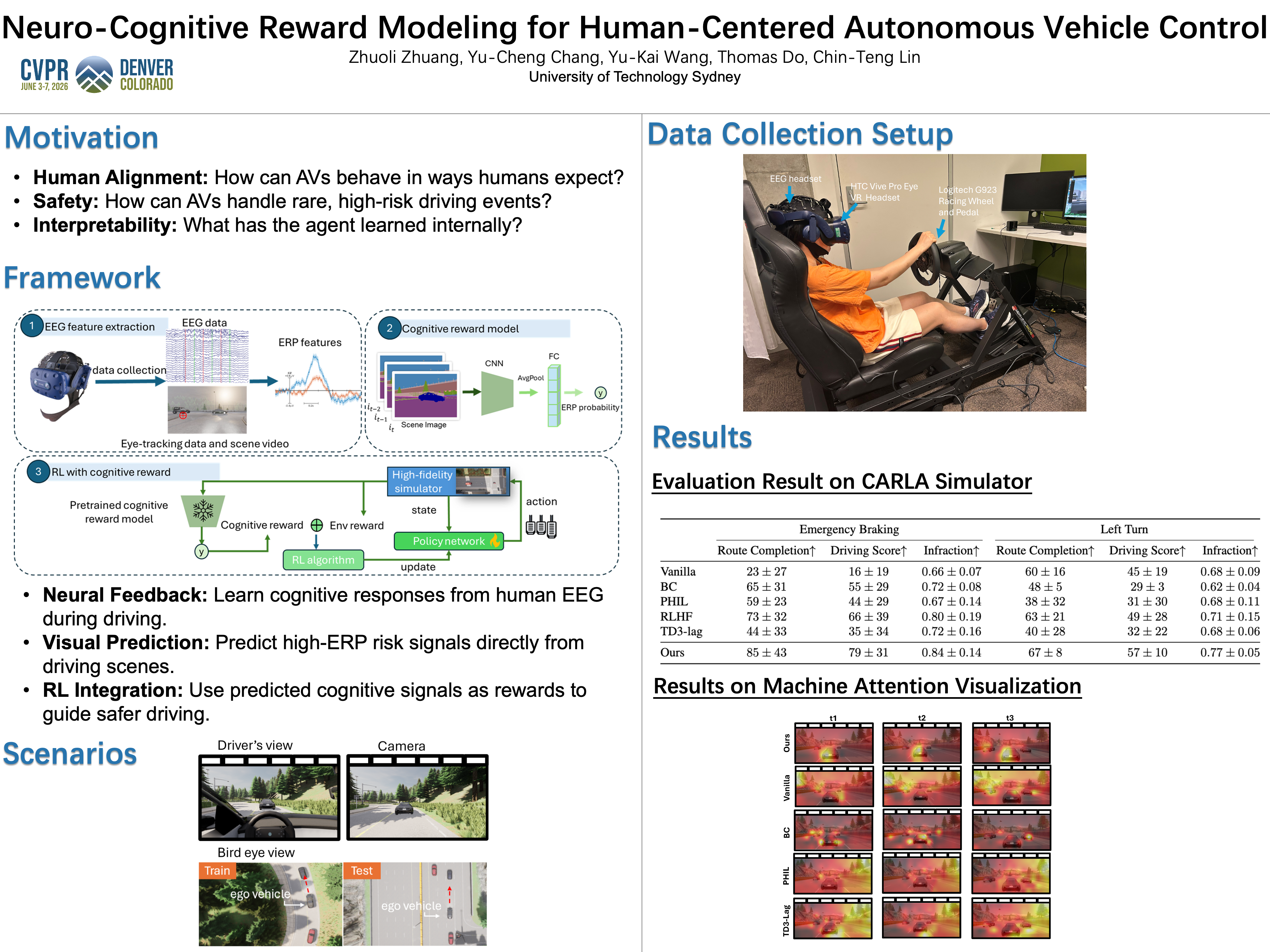
Recent advancements in computer vision have accelerated the development of autonomous driving. Despite these advancements, training machines to drive in a way that aligns with human expectations remains a significant challenge. Human factors are still essential, as humans possess a sophisticated cognitive system capable of rapidly interpreting scene information and making accurate decisions. Aligning machine with human intent has been explored with Reinforcement Learning with Human Feedback (RLHF). Conventional RLHF methods rely on collecting human preference data by manually ranking AI-generated outputs, which is time-consuming and indirect. In this work, we propose an electroencephalography (EEG)-guided decision-making framework to incorporate human cognitive insights into reinforcement learning (RL) for autonomous driving. We collected EEG signals from 20 participants in a realistic driving simulator and analyzed event-related potentials (ERP) in response to sudden environmental changes. Our proposed framework employs a neural network to predict the strength of ERP based on the cognitive information from visual scene information. Moreover, we explore the integration of such cognitive information into the reward signal of the RL algorithm. Experimental results show that our framework can improve the collision avoidance ability of the RL algorithm, highlighting the potential of neuro-cognitive feedback in enhancing autonomous driving systems.
E3AD: An Emotion-Aware Vision-Language-Action Model for Human-Centric End-to-End Autonomous Driving
Yihong Tang ⋅ Haicheng Liao ⋅ Tong Nie ⋅ Junlin He ⋅ Ao Qu ⋅ Kehua Chen ⋅ Wei Ma ⋅ Zhenning Li ⋅ Lijun Sun ⋅ Chengzhong Xu
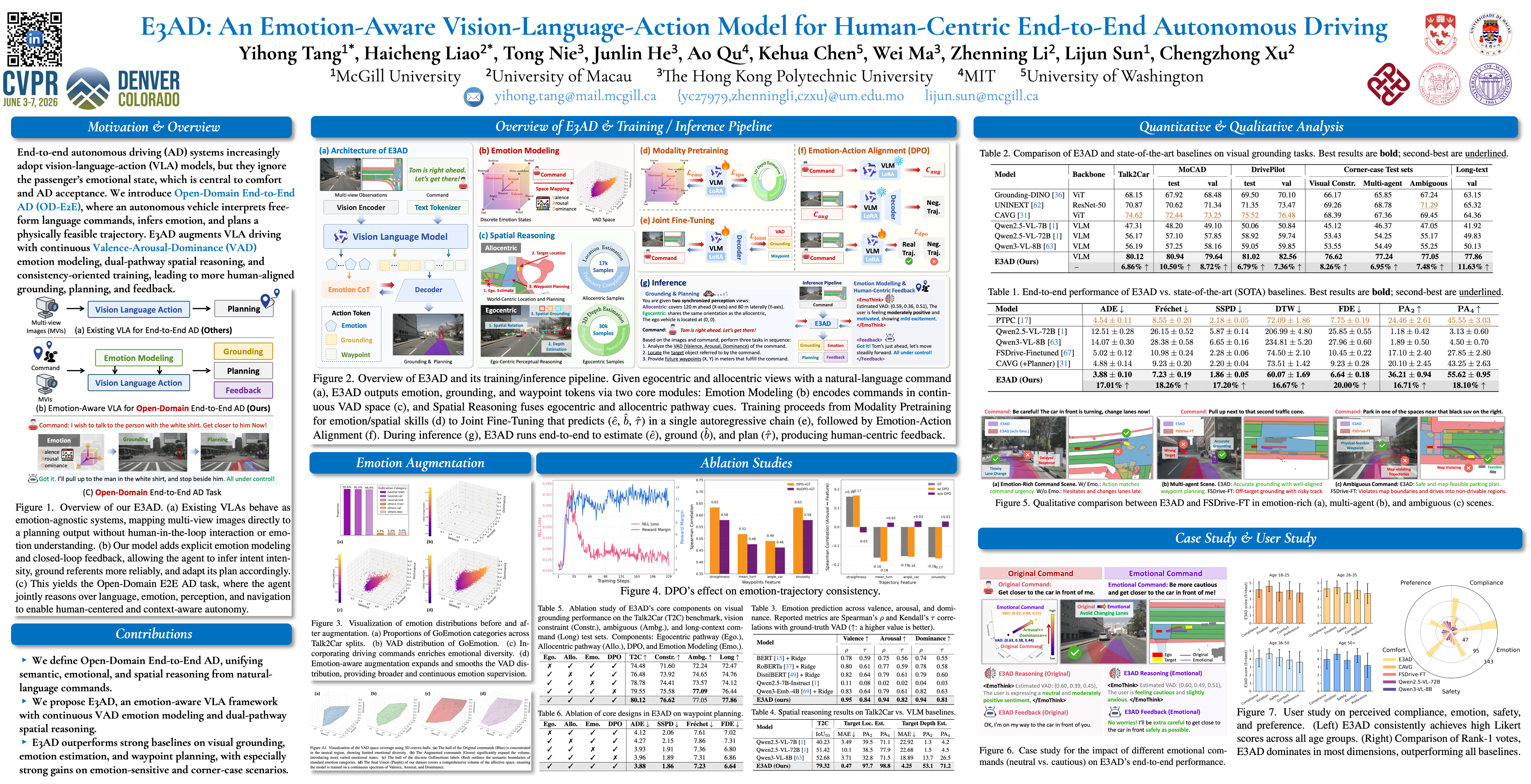
End-to-end autonomous driving (AD) systems increasingly adopt vision-language-action (VLA) models, yet they ignore the passenger’s emotional state, which is central to comfort and AD acceptance. We introduce Open-Domain End-to-End (OD-E2E) AD, where an autonomous vehicle must interpret free-form natural-language commands, infer the emotion, and plan a physically feasible trajectory. We propose E3AD, an emotion-aware VLA framework that augments semantic understanding with two cognitively inspired components: a continuous Valence-Arousal-Dominance (VAD) emotion model that captures tone and urgency from language, and a dual-pathway spatial reasoning module that fuses egocentric and allocentric views for human-like spatial cognition. A consistency-oriented training scheme, combining modality pretraining with preference-based alignment, further enforces coherence between emotional intent and driving actions. Across real-world datasets, E3AD improves visual grounding and waypoint planning and achieves state-of-the-art (SOTA) VAD correlation for emotion estimation. These results show that injecting emotion into VLA-style driving yields more human-aligned grounding, planning, and feedback.
The Blind Spot of Adaptation: Quantifying and Mitigating Forgetting in Fine-tuned Driving Models
Runhao Mao ⋅ Hanshi Wang ⋅ Yixiang Yang ⋅ Qianli Ma ⋅ Jingmeng Zhou ⋅ Zhipeng Zhang
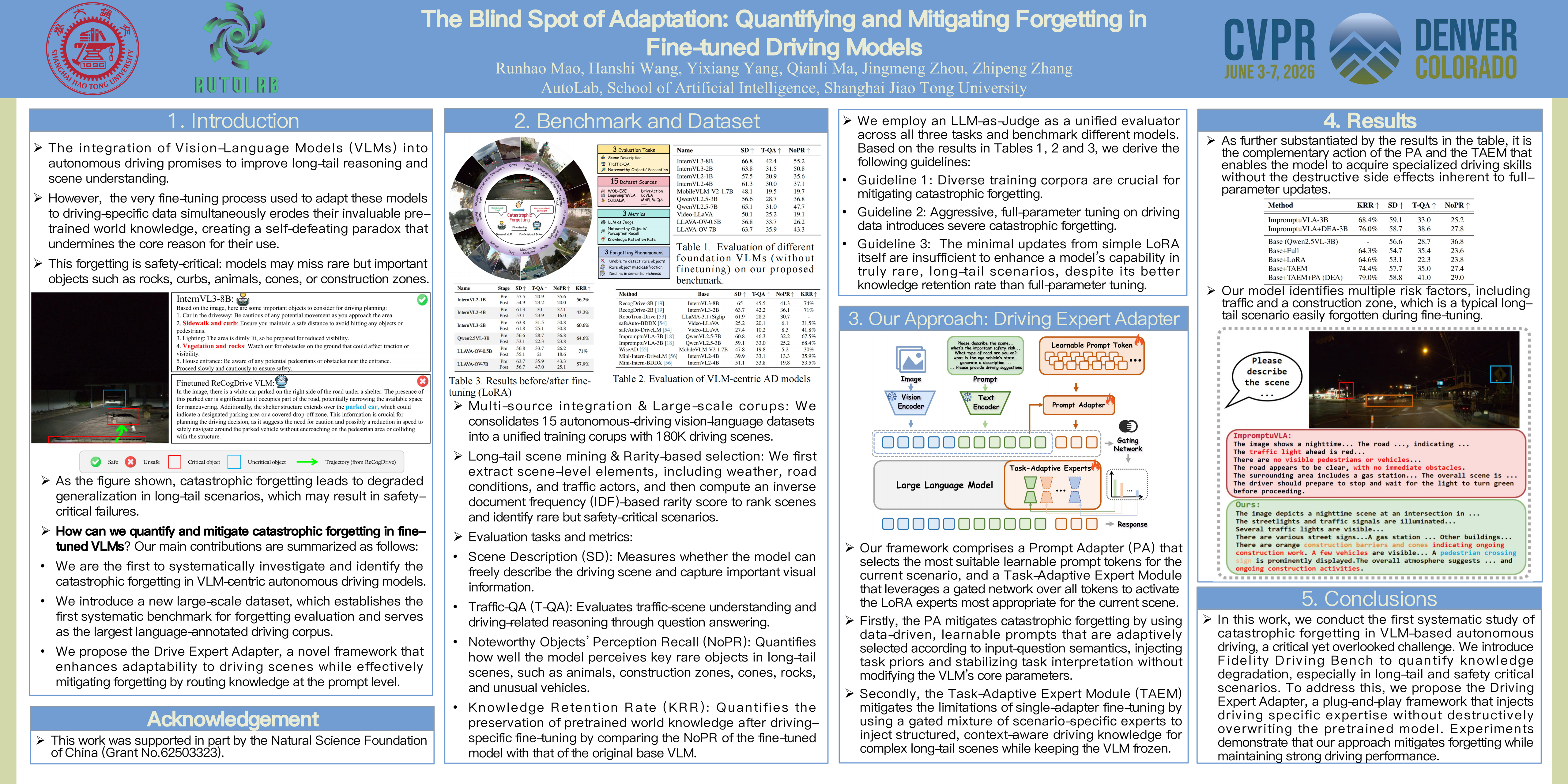
The integration of Vision-Language Models (VLMs) into autonomous driving promises to solve long-tail scenarios, but this paradigm faces the critical and unaddressed challenge of catastrophic forgetting. The very fine-tuning process used to adapt these models to driving-specific data simultaneously erodes their invaluable pre-trained world knowledge, creating a self-defeating paradox that undermines the core reason for their use. This paper provides the first systematic investigation into this phenomenon. We introduce a new large-scale dataset of 180K scenes, which enables the first-ever benchmark specifically designed to quantify catastrophic forgetting in autonomous driving. Our analysis reveals that existing methods suffer from significant knowledge degradation. To address this, we propose the Drive Expert Adapter (DEA), a novel framework that circumvents this trade-off by shifting adaptation from the weight space to the prompt space. DEA dynamically routes inference through different knowledge experts based on scene-specific cues, enhancing driving-task performance without corrupting the model's foundational parameters. Extensive experiments demonstrate that our approach not only achieves state-of-the-art results on driving tasks but also effectively mitigates catastrophic forgetting, preserving the essential generalization capabilities that make VLMs a transformative force for autonomous systems. Dataset and code will be released.
Den-TP: A Density-Balanced Data Curation and Evaluation Framework for Trajectory Prediction
Ruining Yang ⋅ Yi Xu ⋅ Yun Fu ⋅ Lili Su
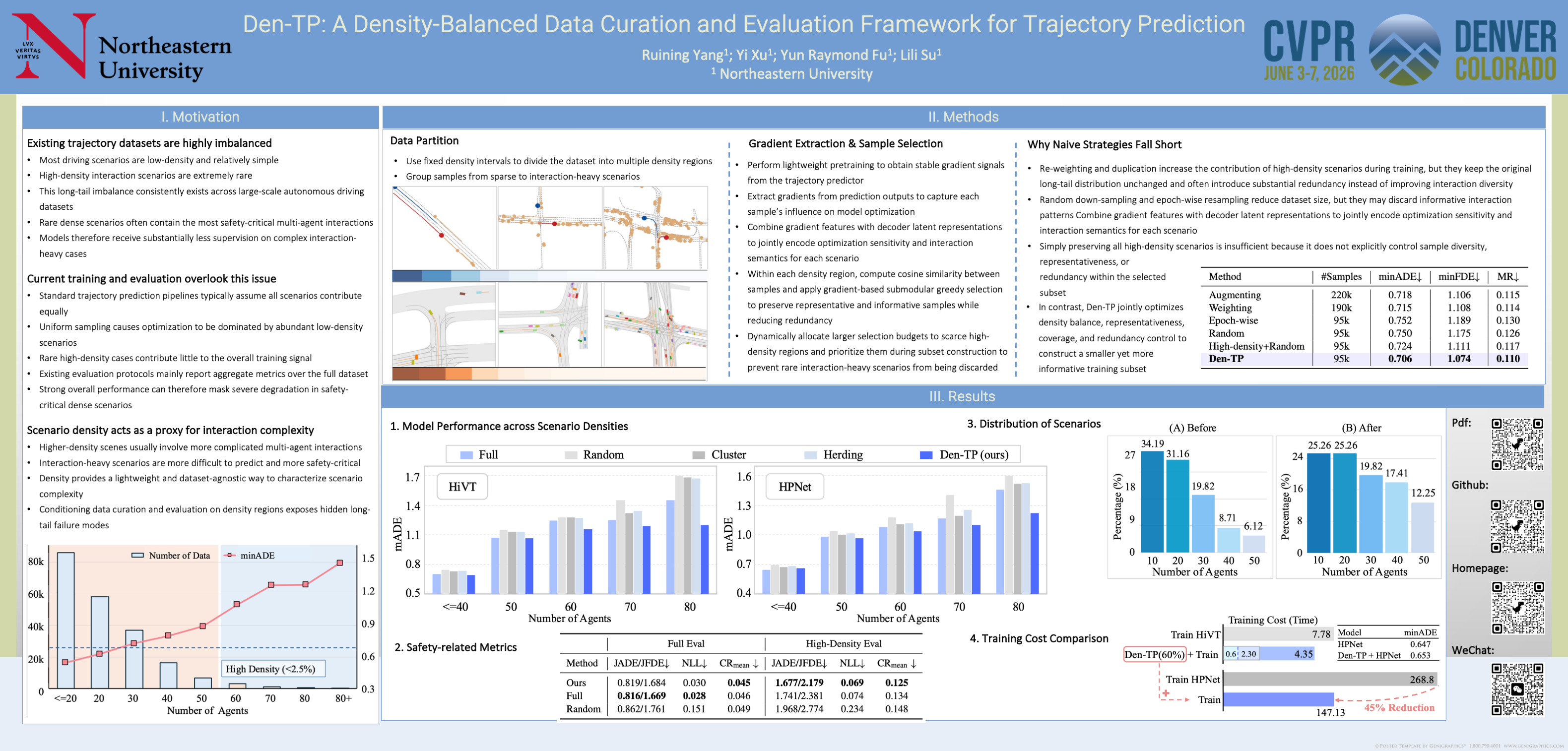
Trajectory prediction in autonomous driving has traditionally been studied from a model-centric perspective. However, existing datasets exhibit a strong long-tail distribution in scenario density, the number of agents per scenario, where common low-density cases dominate and safety-critical high-density cases are severely underrepresented. This imbalance limits model robustness and hides failure modes when standard evaluations average errors across all scenarios. We revisit trajectory prediction from a data-centric angle and present Den-TP, a framework for density-aware dataset curation and evaluation. Den-TP first partitions data into density-conditioned regions using agent count as a lightweight, dataset-agnostic proxy for interaction complexity. It then applies gradient-based utilities with a submodular selection objective to choose representative samples within each region while explicitly rebalancing across densities. The resulting subset reduces dataset size by 50\% yet preserves overall performance and significantly improves robustness in high-density scenarios. We further introduce density-conditioned evaluation protocols that reveal long-tail failure modes overlooked by conventional metrics. Experiments on Argoverse 1 and 2 with state-of-the-art models show that robust trajectory prediction hinges not only on data scale, but also on balancing scenario density.
Percept-WAM: Perception-Enhanced World-Awareness-Action Model for Robust End-to-End Autonomous Driving
Jianhua Han ⋅ Meng Tian ⋅ Jiangtong Zhu ⋅ Fan He ⋅ Huixin Zhang ⋅ Sitong Guo ⋅ Dechang Zhu ⋅ Hao Tang ⋅ Pei Xu ⋅ Yuze Guo ⋅ Minzhe Niu ⋅ Haojie Zhu ⋅ Qichao Dong ⋅ Xuechao Yan ⋅ Siyuan Dong ⋅ Lu Hou ⋅ Qingqiu Huang ⋅ Xiaosong Jia ⋅ Hang Xu
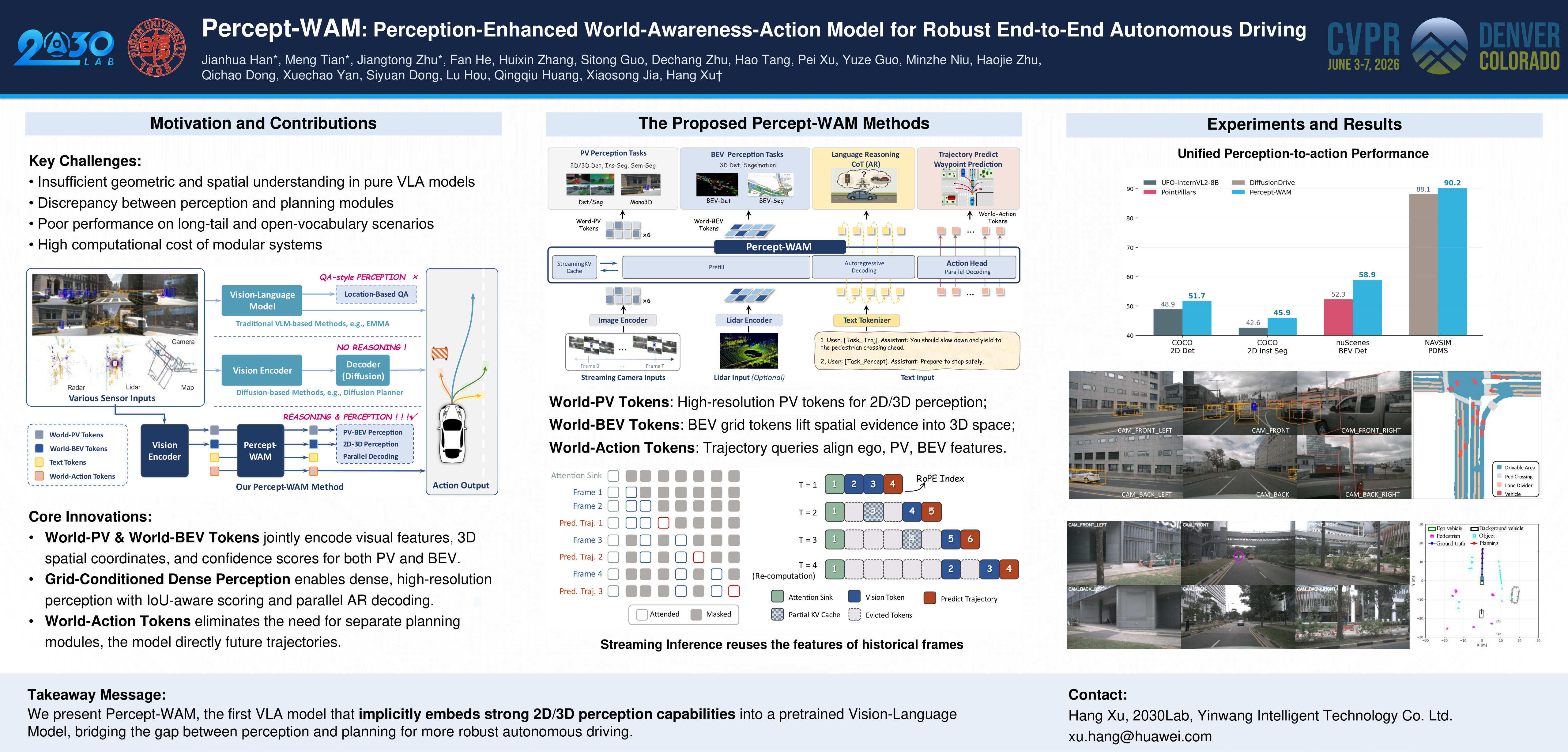
Autonomous driving heavily relies on accurate and robust spatial perception. Many failures arise from inaccuracies and instability, especially in long-tail scenarios and complex interactions. However, current vision–language models are weak at spatial grounding and understanding, and VLA systems built on them therefore show limited perception and localization ability.To address these challenges, we introduce Percept-WAM, a perception-enhanced World–Awareness–Action Model that is the first to implicitly integrate 2D/3D scene understanding abilities within a single vision-language model (VLM).Instead of relying on QA-style spatial reasoning, Percept-WAM unifies 2D/3D perception tasks into World-PV and World-BEV tokens, which encode both spatial coordinates and confidence.We propose a grid-conditioned prediction mechanism for dense object perception, incorporating IoU-aware scoring and parallel autoregressive decoding, improving stability in long-tail, far-range, and small-object scenarios. Additionally, Percept-WAM leverages pretrained VLM parameters to retain general intelligence (e.g., logical reasoning) and can output perception results and trajectory control outputs directly. Experiments show that Percept-WAM matches or surpasses classical detectors and segmenters on downstream perception benchmarks, achieving 51.7/58.9 mAP on COCO 2D detection and nuScenes BEV 3D detection. When integrated with trajectory decoders, it further improves planning performance on nuScenes and NAVSIM, e.g., surpassing DiffusionDrive by 2.1 in PMDS on NAVSIM.Qualitative results further highlight its strong open-vocabulary and long-tail generalization.
GaussianDWM: 3D Gaussian Driving World Model for Unified Scene Understanding and Multi-Modal Generation
Tianchen Deng ⋅ Xuefeng Chen ⋅ Yi Chen ⋅ Qu Chen ⋅ Yuyao Xu ⋅ Lijin Yang ⋅ Le Xu ⋅ Yu Zhang ⋅ Bo Zhang ⋅ Wuxiong Huang ⋅ Hesheng Wang
Driving World Models (DWMs) have been developing rapidly with the advances of generative models. However, existing DWMs lack 3D scene understanding capabilities and can only generate content conditioned on input data, without the ability to interpret or reason about the driving environment. Moreover, current approaches represent 3D spatial information with point cloud or BEV features do not accurately align textual information with the underlying 3D scene. To address these limitations, we propose a novel unified DWM framework based on 3D Gaussian scene representation, which enables both 3D scene understanding and multi-modal scene generation, while also enabling contextual enrichment for understanding and generation tasks. Our approach directly aligns textual information with the 3D scene by embedding rich linguistic features into each Gaussian primitive, thereby achieving early modality alignment. In addition, we design a novel task-aware language-guided token sampling strategy that removes redundant 3D information and injects accurate and compact 3D tokens into textual understanding.Furthermore, we design a dual-condition multi-modal generation model, where the information captured by our vision-language model is leveraged as a high-level language condition in combination with a low-level image condition, jointly guiding the multi-modal generation process. We conduct comprehensive studies on the nuScenes, OmniDrive-nuScenes, and NuInteract datasets to validate the effectiveness of our framework. Our method achieves state-of-the-art performance. We will release the code publicly on GitHub.
Mind the Hitch: Dynamic Calibration and Articulated Perception for Autonomous Trucks
morui zhu ⋅ Yongqi Zhu ⋅ Song Fu ⋅ Qing Yang
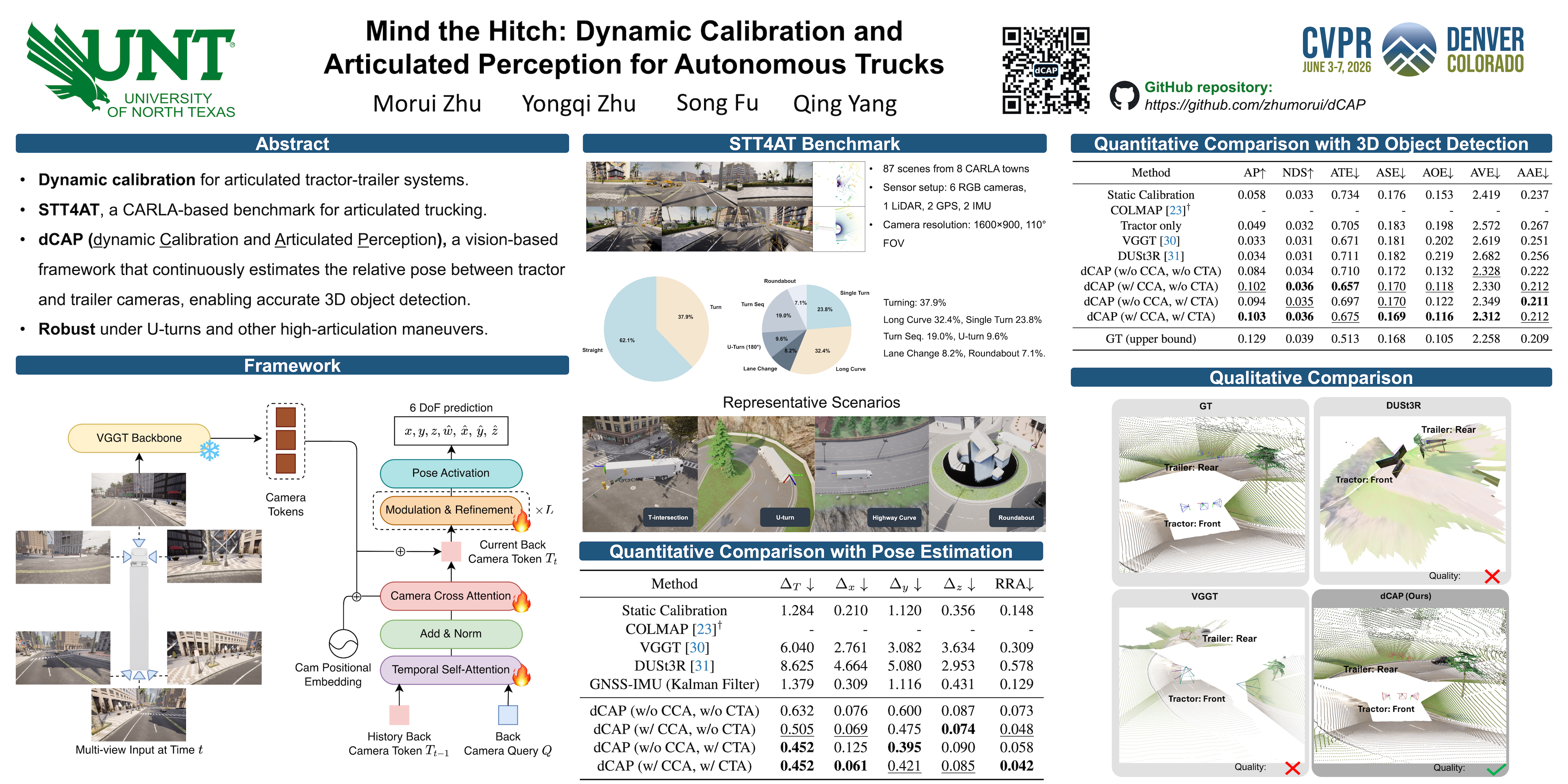
Autonomous trucking poses unique challenges due to articulated tractor–trailer geometry, and time-varying sensor poses caused by the fifth-wheel joint and trailer flex. Existing perception and calibration methods assume static baselines or rely on high-parallax and texture-rich scenes, limiting their reliability under real-world settings. We propose dCAP (dynamic Calibration and Articulated Perception), a vision-based framework that continuously estimates the 6-DoF (degree of freedom) relative pose between tractor and trailer cameras. dCAP employs a transformer with cross-view and temporal attention to robustly aggregate spatial cues while maintaining temporal consistency, enabling accurate perception under rapid articulation and occlusion. Integrated with BEVFormer, dCAP improves 3D object detection by replacing static calibration with dynamically predicted extrinsics. To facilitate evaluation, we introduce STT4AT, a CARLA-based benchmark simulating semi-trailer trucks with synchronized multi-sensor suites and time-varying inter-rig geometry across diverse environments. Experiments demonstrate that dCAP achieves stable, accurate perception while addressing the limitations of static calibration in autonomous trucking. The dataset, development kit, and source code will be publicly released.
DriveMoE: Mixture-of-Experts for Vision-Language-Action Model in End-to-End Autonomous Driving
Zhenjie Yang ⋅ Yilin Chai ⋅ Xiaosong Jia ⋅ Qifeng Li ⋅ Yuqian Shao ⋅ Xuekai Zhu ⋅ Haisheng Su ⋅ Junchi Yan
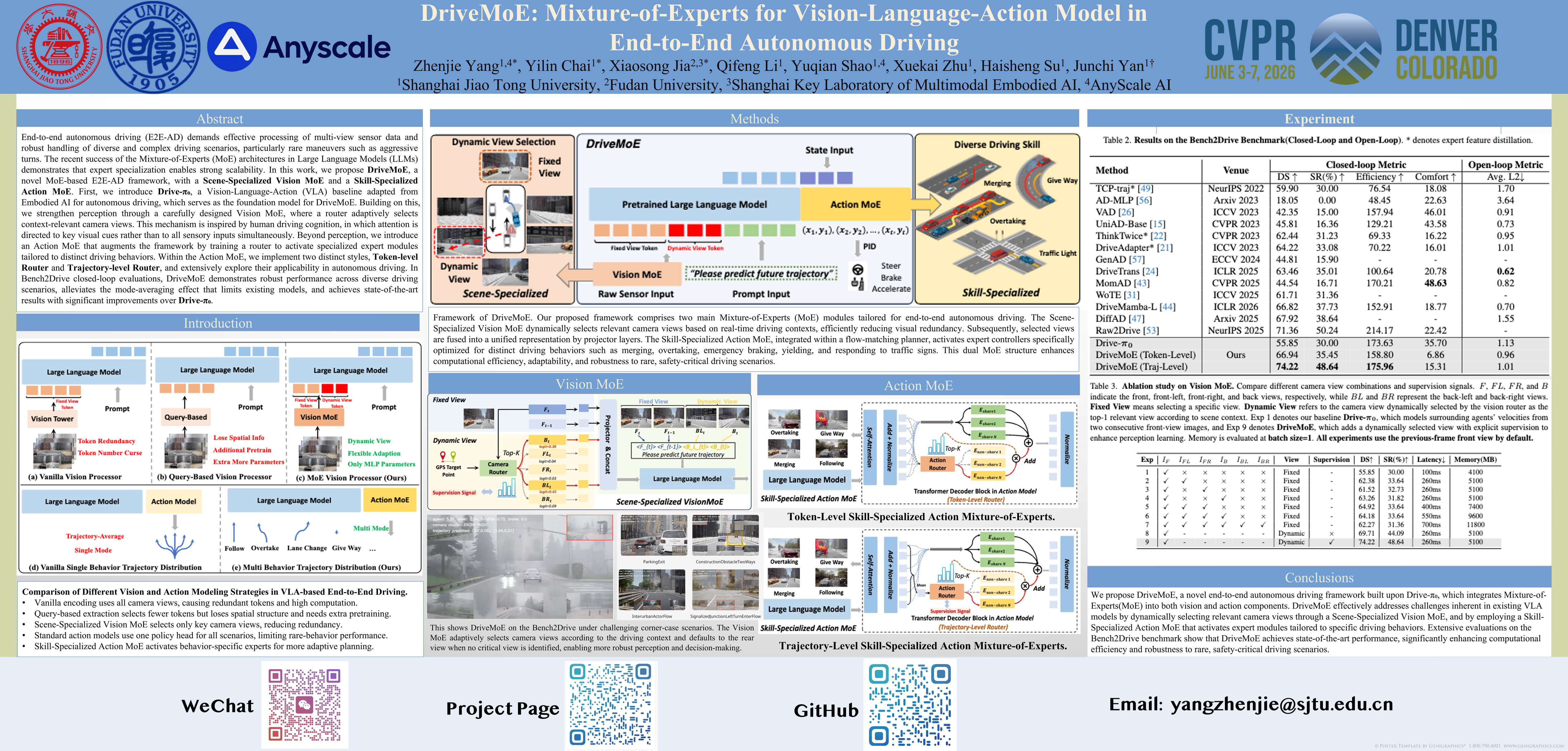
End-to-end autonomous driving (E2E-AD) demands effective processing of multi-view sensor data and robust handling of diverse and complex driving scenarios, particularly rare maneuvers such as aggressive turns. The recent success of the Mixture-of-Experts (MoE) architecture in Large Language Models (LLMs) demonstrates that expert specialization enables strong scalability. In this work, we propose DriveMoE, a novel MoE-based E2E-AD framework, with a Scene-Specialized Vision MoE and a Skill-Specialized Action MoE. First, we introduce Drive-π0, a Vision-Language-Action (VLA) baseline adapted from Embodied AI for autonomous driving, which serves as the foundation model for DriveMoE. Building on this, we strengthen perception through a carefully designed Vision MoE, where a router adaptively selects context-relevant camera views. This mechanism is inspired by human driving cognition, in which attention is directed to key visual cues rather than to all sensory inputs simultaneously. Beyond perception, we introduce an Action MoE that augments the framework by training a router to activate specialized expert modules tailored to distinct driving behaviors. Within the Action MoE, we implement two distinct styles(Token-level Router and Trajectory-level Router) and extensively explore their applicability in autonomous driving. In Bench2Drive closed-loop evaluations, DriveMoE demonstrates robust performance across diverse driving scenarios, alleviates the mode-averaging effect that limits existing models, and achieves state-of-the-art results with significant improvements over Drive-π0. We will release our code and models of DriveMoE and Drive-π0.
Beyond Rule-Based Agents: Active Markov Games for Realistic Multi-Agent Interaction in Autonomous Driving
Yuan Gui ⋅ Hongchen Luo ⋅ Jiao Wang ⋅ Qu Liqi
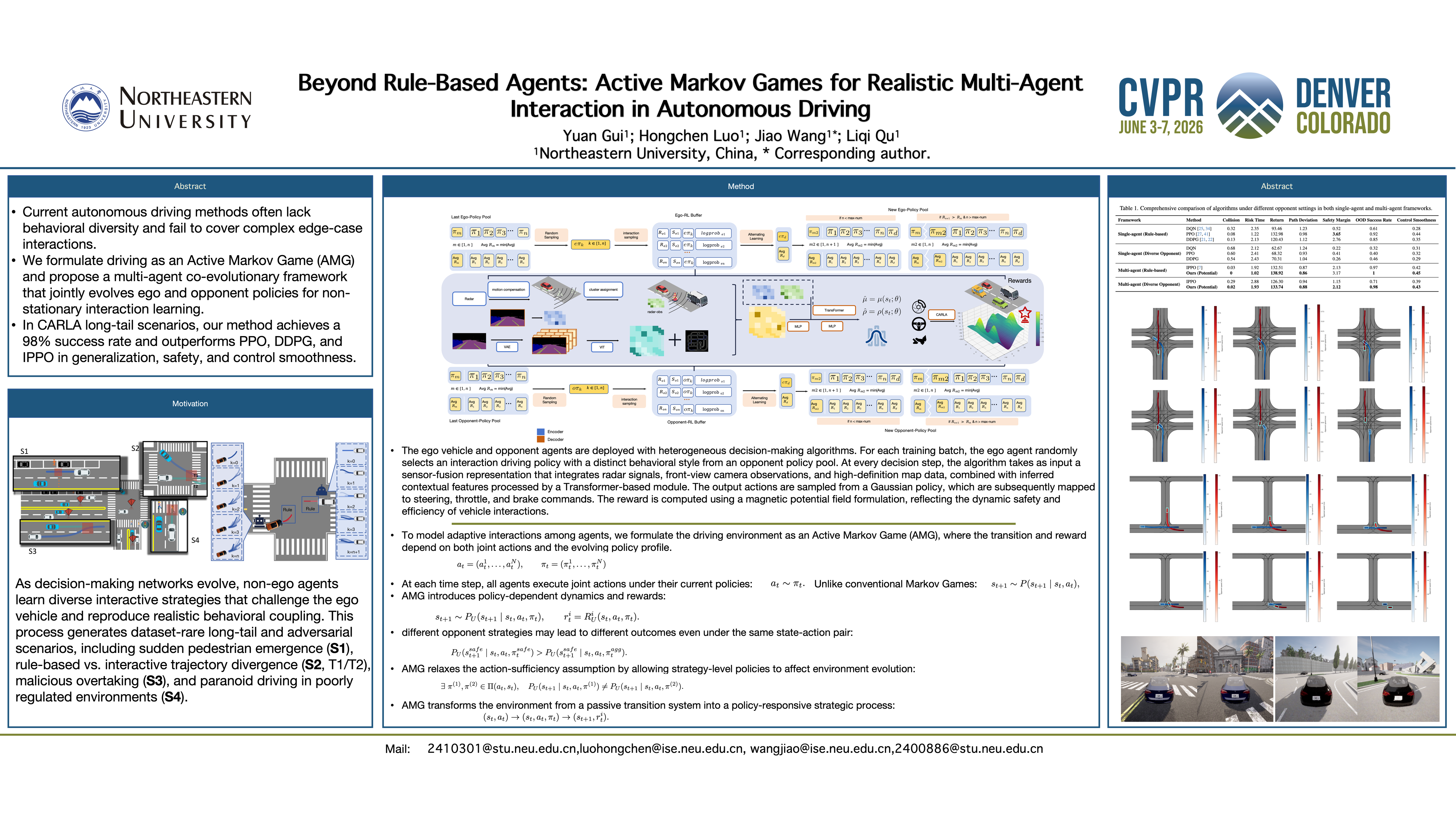
Current research in autonomous driving heavily relies on large-scale driving datasets for model fitting or trial-and-error learning strategies in simulation environments. However, these approaches suffer from limited behavioral diversity and fail to cover complex edge-case interactions. To address these limitations, we model the driving environment as an Active Markov Game (AMG) and introduce a multi-agent co-evolutionary training framework for more realistic interactive learning. The AMG formulation extends traditional Markov games by explicitly making state transitions and rewards dependent on the evolving strategies of the agents, thus capturing the interactive dynamics and strategic coupling between the ego vehicle and surrounding agents. Building on this, our multi-agent co-evolutionary training mechanism jointly optimizes the ego vehicle's policy and a diverse pool of opponent strategies, allowing all agents to adapt to each other's behaviors during training. This game-theoretic approach produces a robust ego agent capable of handling diverse, non-stationary driving strategies, overcoming the "non-responsive opponent" limitation found in prior methods. In CARLA simulations of unsignalized intersections and long-tail scenarios, our method performs exceptionally well, achieving near-perfect success rates (98\%) with minimal collisions (2\%), and significantly outperforming state-of-the-art baselines such as PPO, DDPG, and IPPO in terms of generalization, safety margins, and control smoothness. These results demonstrate that our approach substantially enhances the robustness, safety, and strategic adaptability of autonomous driving in complex multi-agent environments.
Test-Time Multi-Prompt Adaptation for Open-Vocabulary Remote Sensing Image Segmentation
Ting Yang ⋅ Qilong Wang ⋅ Qibin Hou ⋅ Qinghua Hu
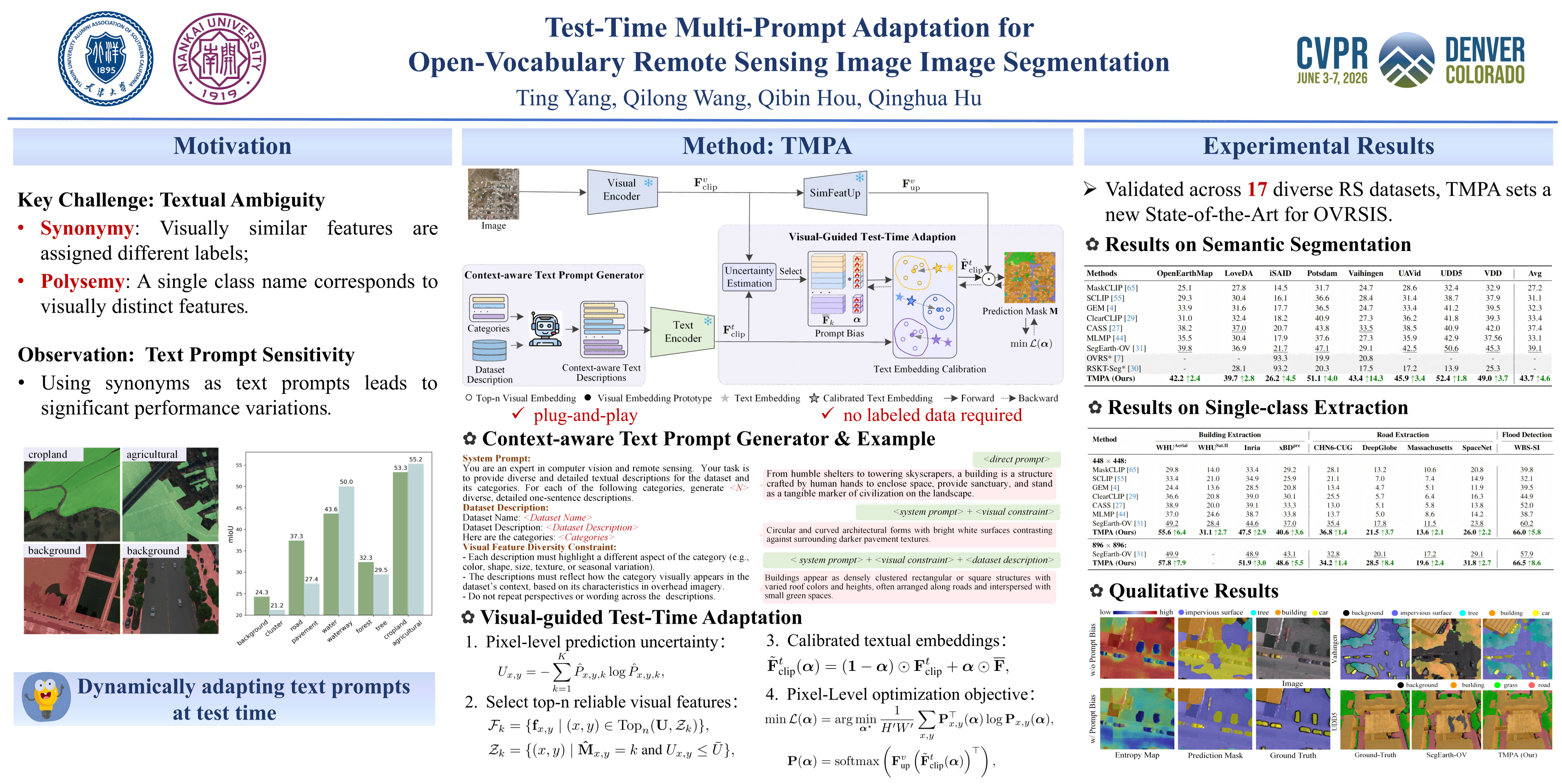
The rise of vision-language models (VLMs) has driven the initial exploration of open-vocabulary remote sensing image semantic segmentation (OVRSIS), enabling recognition of unseen categories in complex Earth observation scenes. However, existing methods primarily focus on enhancing visual representations of domain-specific remote sensing images, while overlooking the effect of textual information. In this paper, we argue that there exists a crucial issue of textual ambiguity in OVRSIS task, limiting the final segmentation performance. Therefore, we propose a plug-and-play yet effective Test-time Multi-Prompt Adaptation (TMPA) method to mitigate textual ambiguity in OVRSIS. Specifically, our TMPA first generates a group of diverse, context-aware descriptions for each category instead of the naive class name by executing a large language model with a task-driven prompt, which can effectively avoid some textual ambiguity, i.e., background class has different meanings in various tasks. Furthermore, TMPA develops a visual-guided test-time adaptation strategy for the generated multi-prompts, which adaptively refines the prompt representations of each category with high-confidence visual features for the uncertain predictions with high entropy, making our TMPA better applicable to different scenarios. Particularly, a pixel-level loss with entropy minimization is proposed to optimize the text prompt with a bias during inference, where prompt bias is constructed based on a weighted combination of high-confidence visual features. Our TMPA can be flexibly integrated into existing methods for boosting their performance. Extensive experiments are conducted on 17 remote sensing datasets, and the results show our TMPA can significantly improve its counterparts, while achieving state-of-the-art performance.
ReScene4D: Temporally Consistent Semantic Instance Segmentation of Evolving Indoor 3D Scenes
Emily Steiner ⋅ Jianhao Zheng ⋅ Henry Howard-Jenkins ⋅ Chris Xie ⋅ Iro Armeni
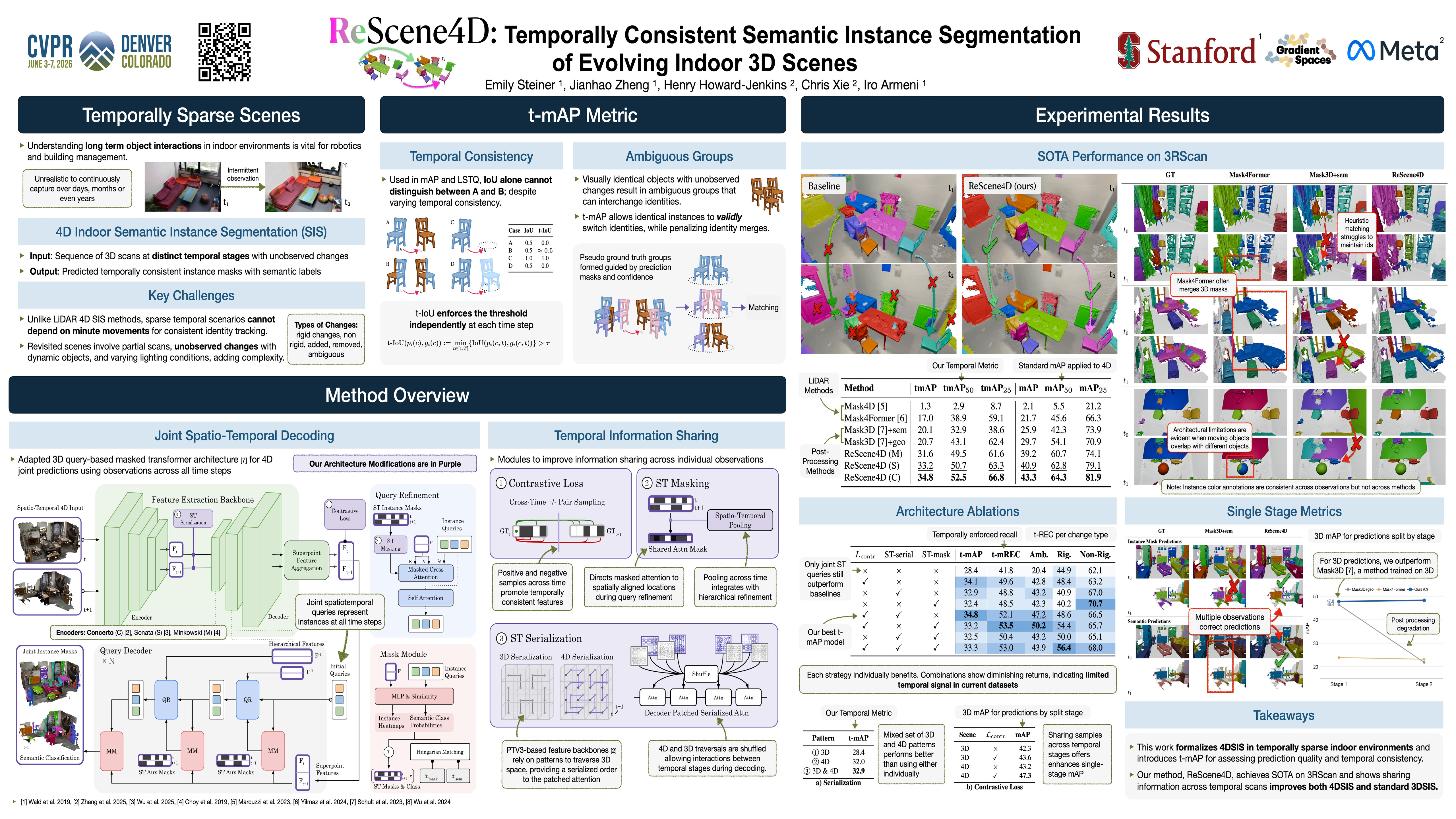
Indoor environments evolve as objects move, appear, or disappear. Capturing these dynamics requires maintaining consistent instance identities across intermittently captured 3D scans with unobserved change or, equivalently, performing 4D indoor semantic instance segmentation (SIS)---the joint task of segmenting, identifying, and temporally associating object instances. This setting poses a challenge for existing 3DSIS methods, which require a discrete matching step due to their lack of temporal reasoning, and 4D LiDAR approaches, which show limited performance due to their reliance on continuous temporal measurements that is uncommon in indoor environments. We propose ReScene4D, a novel method that adapts 3DSIS architectures for 4DSIS without needing dense observations. It explores temporal fusion strategies to share information across observations, demonstrating that this shared context not only enables consistent instance tracking but also improves standard 3DSIS quality. To rigorously evaluate this task, we define a new metric that extends mAP to reward temporal identity consistency. ReScene4D achieves state-of-the-art performance on the 3RScan dataset, establishing a new benchmark for understanding evolving indoor scenes.
CrackSSM: Reviving SSMs for Crack Segmentation via Dynamic Scanning
Yubin Gu ⋅ Boyang Hou ⋅ Yuan Meng ⋅ Wenting Luo ⋅ Jiayi Ji ⋅ Xiaoshuai Sun
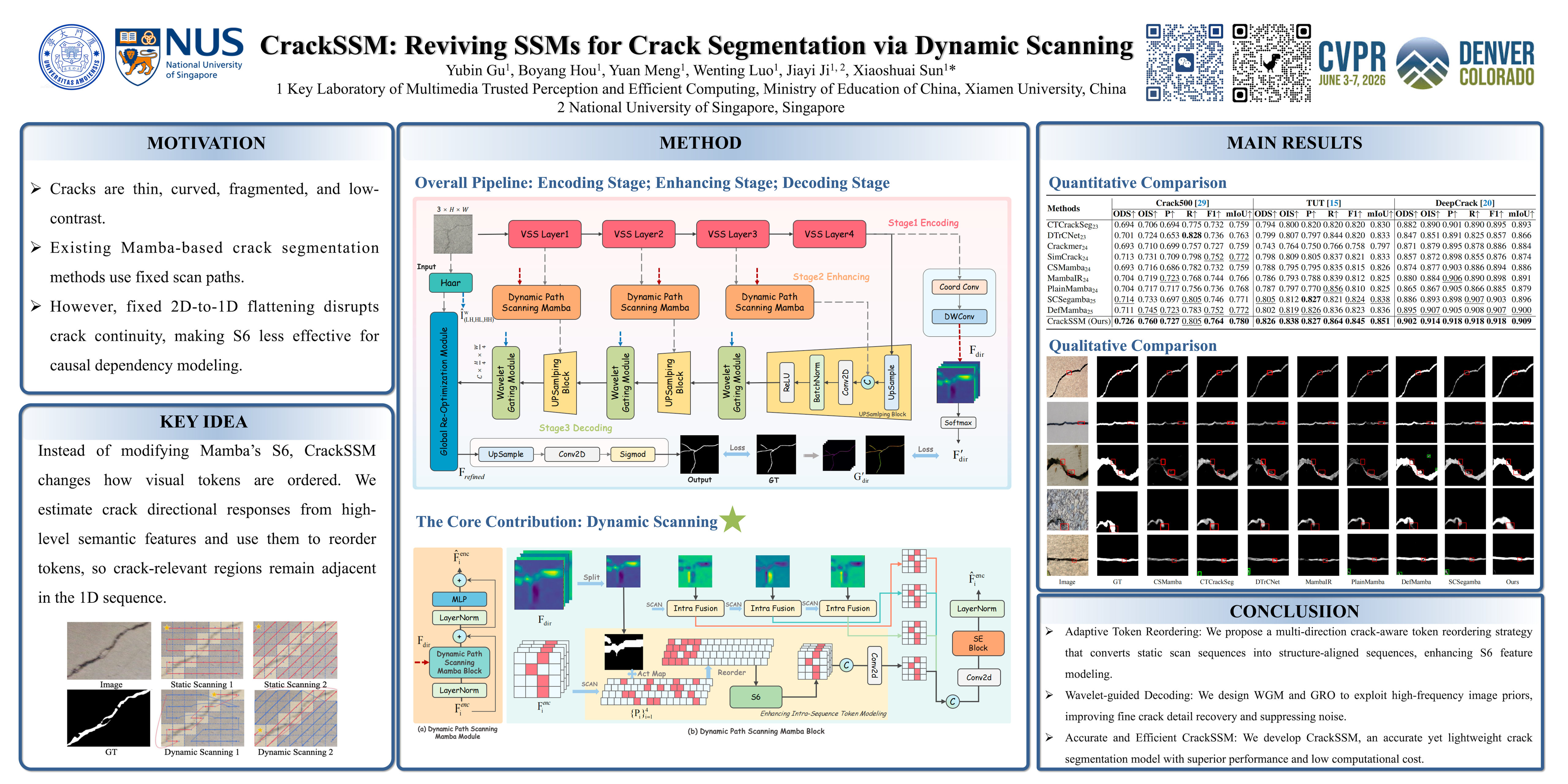
Crack segmentation (CS) is crucial for structural inspection and maintenance in production scenarios. To achieve both high accuracy and efficiency, recent methods have adopted Mamba-based architectures built upon state space models (SSMs), which enable linear-complexity modeling of long-range dependencies. However, existing approaches typically rely on static multi-directional scanning to flatten visual features into sequences. This fixed flattening order disrupts spatial continuity and weakens the SSM’s ability to model irregular crack patterns effectively. To address this limitation, we propose \textbf{CrackSSM}, a novel crack-aware segmentation framework featuring a dynamic scanning strategy that adapts the token sequence to the underlying structure of each image. Specifically, we compute directional response strength along four orientations from high-level semantic features, and use these values to reorder tokens so that crack-relevant regions remain adjacent in sequence. This alignment improves the causal modeling ability of SSMs while preserving their efficiency and better suits the irregular, fine-grained nature of cracks. Additionally, we design a wavelet-guided decoding mechanism to recover detailed features. It incorporates high-frequency components extracted from the input image and applies them to guide feature refinement and edge-aware fusion, further enhancing segmentation precision. Experiments on three benchmark datasets demonstrate that our method achieves superior segmentation accuracy with fewer parameters and faster inference compared to existing state-of-the-art models. Source code is available in supplementary materials.
BiPA: Bilevel Prompt Adaptation for Underwater Instance Segmentation
Long Ma ⋅ Haoze Zheng ⋅ Yuhang Mao ⋅ Jinyuan Liu ⋅ Chengpei Xu ⋅ Xinwei Xue ⋅ Yi Wang ⋅ Xiangjian He ⋅ Weimin Wang
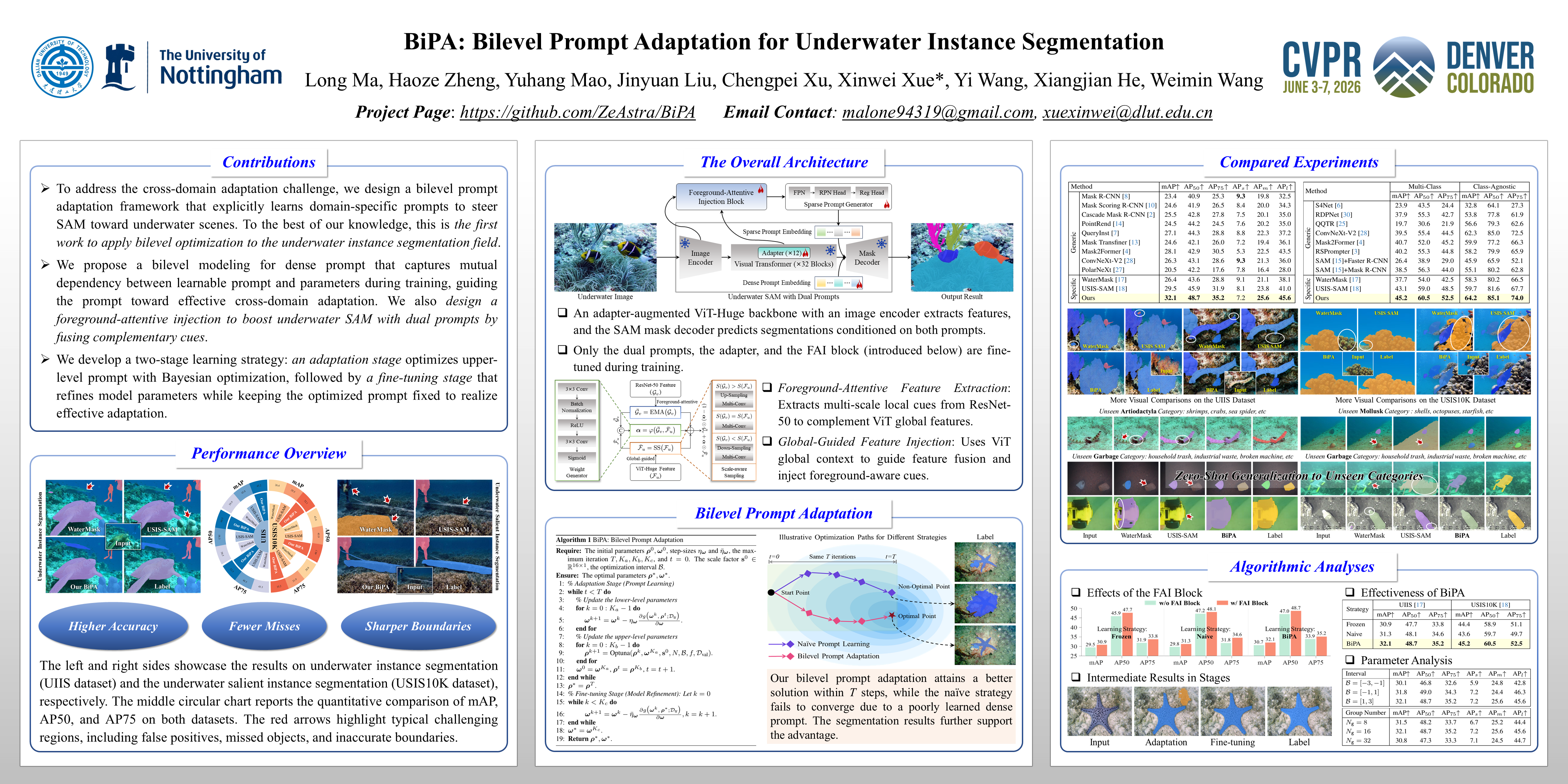
Underwater instance segmentation is essential for fine-grained scene understanding. However, underwater imagery exhibits a strong domain gap from in-air vision due to severe degradation (e.g., turbidity). Consequently, despite its general segmentation ability, SAM degrades sharply underwater. In this work, we propose BiPA, which effectively adapts SAM to the underwater domain. To be concrete, we construct an underwater SAM with dual prompts and introduce a foreground-attentive injection block to enhance local foreground representation. We formulate dense prompt learning as a bilevel optimization, explicitly capturing the mutual dependency between prompt and model. To make this tractable, we design a two-stage learning strategy. The first stage adapts the dense prompt itself, updating it with Bayesian optimization to learn efficiently. The second stage fine-tunes the model parameters under the frozen optimized prompt, which finally enables effective cross-domain adaptation. Extensive experiments and analyses verify the superiority and efficiency of BiPA. Code will be released if this work can be accepted, fortunately.
RS-SSM: Refining Forgotten Specifics in State Space Model for Video Semantic Segmentation
Kai Zhu ⋅ Zhenyu Cui ⋅ Zehua Zang ⋅ Jiahuan Zhou
Recently, state space models have demonstrated efficient video segmentation through linear-complexity state space compression. However, Video Semantic Segmentation requires pixel-level spatiotemporal modeling capabilities to maintain temporal consistency in segmentation of semantic objects. While state space models can preserve common semantic information during state space compression, the fixed-size state space inevitably forgets specific information, which limits the models' capability for pixel-level segmentation. To tackle the above issue, we proposed a Refining Specifics State Space Model approach (RS-SSM) for video semantic segmentation, which performs complementary refining of forgotten spatiotemporal specifics. Specifically, a Channel-wise Amplitude Perceptron (CwAP) is designed to extract and align the distribution characteristics of specific information in the state space. Besides, a Forgetting Gate Information Refiner (FGIR) is proposed to adaptively invert and refine the forgetting gate matrix in the state space model based on the specific information distribution. Consequently, our RS-SSM leverages the inverted forgetting gate to complementarily refine the specific information forgotten during state space compression, thereby enhancing the model's capability for spatiotemporal pixel-level segmentation. Extensive experiments on four VSS benchmarks demonstrate that our RS-SSM achieves state-of-the-art performance while maintaining high computational efficiency.
Scene-Centric Unsupervised Video Panoptic Segmentation
Christoph Reich ⋅ Oliver Hahn ⋅ Nikita Araslanov ⋅ Laura Leal-Taixe ⋅ Christian Rupprecht ⋅ Daniel Cremers ⋅ Stefan Roth
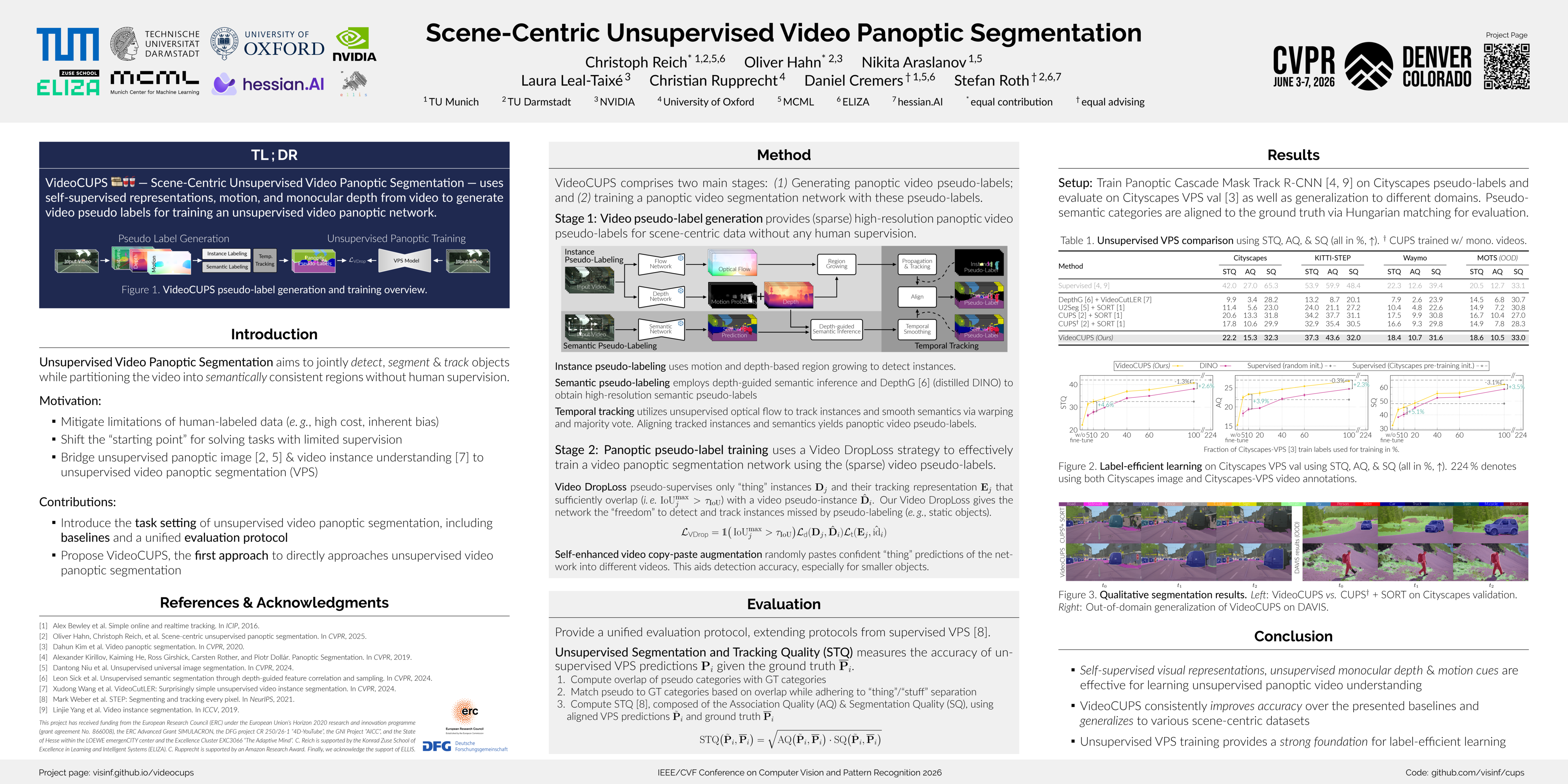
Video panoptic segmentation (VPS) aims to jointly detect, segment, and track all objects while partitioning the video into semantically consistent regions. We introduce the task setting of unsupervised VPS, omitting any human supervision. Existing unsupervised scene understanding works mainly focused on image segmentation tasks; the video domain remains underexplored. We propose CUViPS, the first unsupervised VPS approach. CUViPS generates temporally consistent panoptic video pseudo-labels from monocular scene-centric videos by exploiting unsupervised depth, motion, and visual cues. Training on these pseudo-labels using a novel Video DropLoss yields an accurate and unsupervised VPS model. To benchmark progress, we introduce a comprehensive evaluation protocol and four competitive baselines, extending state-of-the-art unsupervised panoptic image and instance video segmentation models to VPS. CUViPS consistently outperforms all baselines and demonstrates strong label-efficient learning. With CUViPS, our evaluation protocol, and baselines, we provide a strong foundation for future research on unsupervised VPS.
Bootstrapping Video Semantic Segmentation Model via Distillation-assisted Test-Time Adaptation
Jihun Kim ⋅ Hoyong Kwon ⋅ Hyeokjun Kweon ⋅ Kuk-Jin Yoon
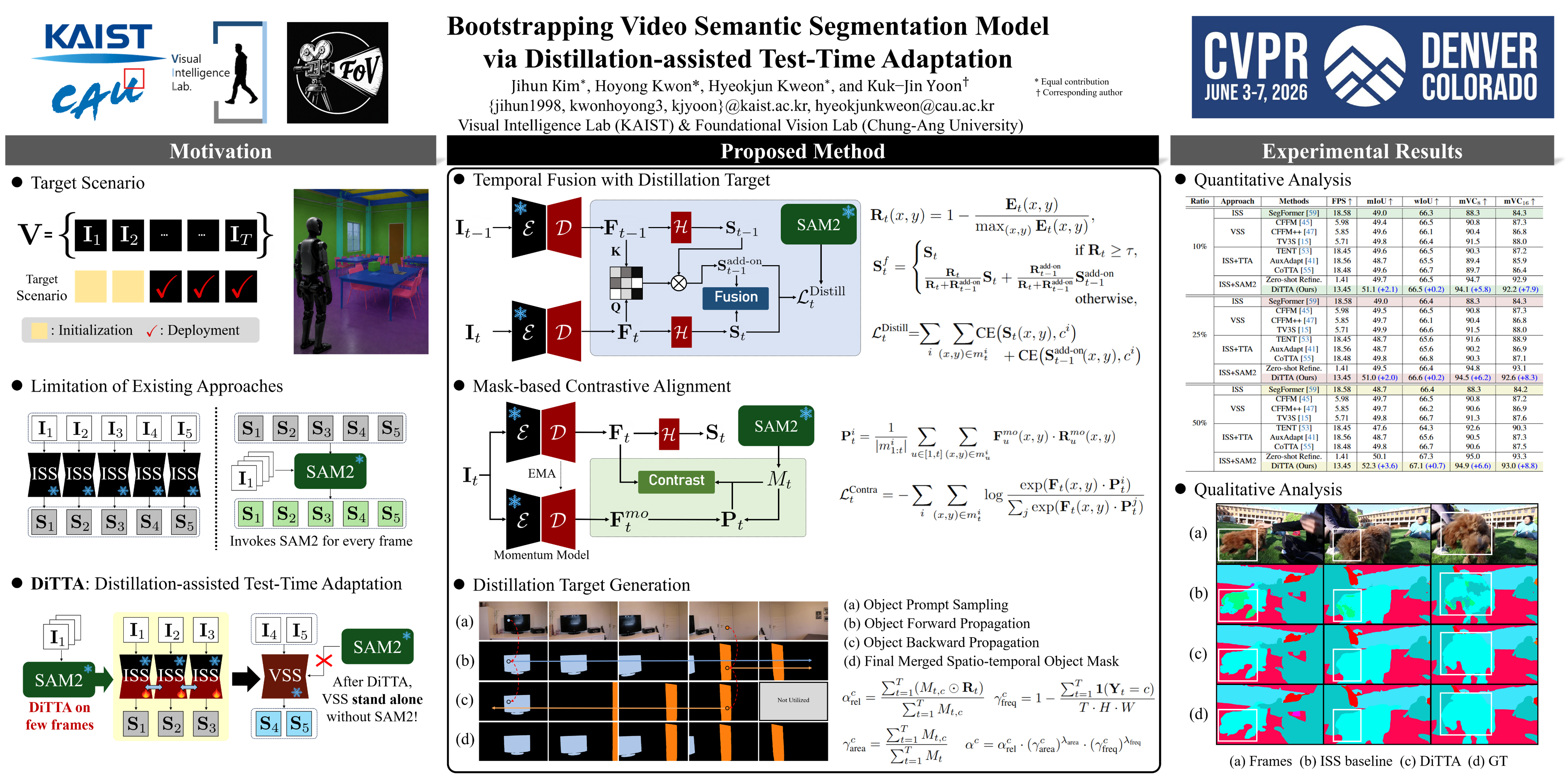
Fully supervised Video Semantic Segmentation (VSS) relies heavily on densely annotated video data, limiting practical applicability. Alternatively, applying pre-trained Image Semantic Segmentation (ISS) models frame-by-frame avoids annotation costs but ignores crucial temporal coherence. Recent foundation models such as SAM2 enable high-quality mask propagation yet remain impractical for direct VSS due to limited semantic understanding and computational overhead. In this paper, we propose DiTTA (Distillation-assisted Test-Time Adaptation), a novel framework that converts an ISS model into a temporally-aware VSS model through efficient test-time adaptation (TTA), without annotated videos. DiTTA distills SAM2's temporal segmentation knowledge into the ISS model during a brief, single-pass initialization phase, complemented by a lightweight temporal fusion module to aggregate cross-frame context. Crucially, DiTTA achieves robust generalization even when adapting with highly limited partial video snippets (e.g., initial 10\%), significantly outperforming zero-shot refinement approaches that repeatedly invoke SAM2 during inference. Extensive experiments on VSPW and Cityscapes demonstrate DiTTA’s effectiveness, achieving competitive or superior performance relative to fully-supervised VSS methods, thus providing a practical and annotation-free solution for real-world VSS tasks.
GeoFree-CoSeg: Unsupervised Point Cloud-Image Cross-Modal Co-Segmentation Without Geometric Alignment
Xin Duan ⋅ Xiabi Liu ⋅ Liyuan Pan
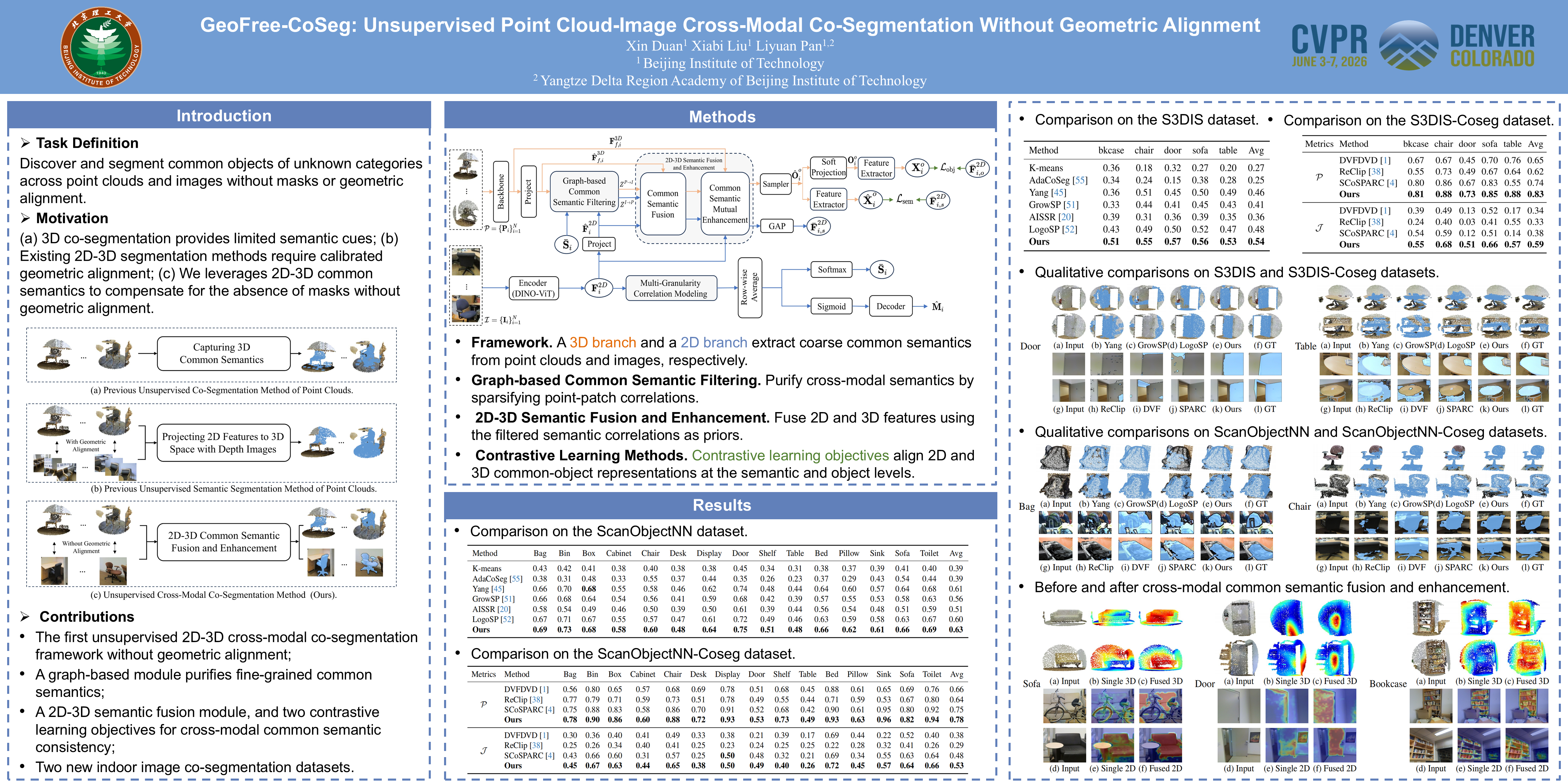
Co-segmentation aims to identify and segment common objects across a set of point clouds or images. Existing methods focus on single-modal co-segmentation. However, the limited semantics of a single modality restrict the discovery of common objects, leading to costly and labor-intensive segmentation masks. In contrast, cross-modal co-segmentation leverages both modalities, offering two key advantages: (i) additional semantic cues compensate for the absence of segmentation masks; and (ii) complementary modalities provide richer common semantics beyond the limitations of single-modality approaches. Motivated by these challenges, we introduce a novel task: unsupervised point cloud-image cross-modal co-segmentation. We tackle this problem using a coarse-to-fine approach. First, the 3D and 2D branches extract coarse common semantics from each modality, respectively. Then, a cross-modal common semantic graph purifies these features into fine-grained common semantics. Finally, 3D and 2D common semantic features are fused and mutually enhanced, without requiring geometric alignment. Experiments on two standard point cloud benchmarks and two corresponding image co-segmentation datasets demonstrate our superior performance compared to existing unsupervised state-of-the-art methods.
Parameter-efficient Continual Learning for Enhancing Plasticity without Forgetting under Limited Model Capacity
Yitian Chen ⋅ Shigeng Zhang ⋅ Xuan Liu ⋅ Mingming Lu ⋅ Kai Chen ⋅ Hongye Zhu ⋅ Xinning Chen
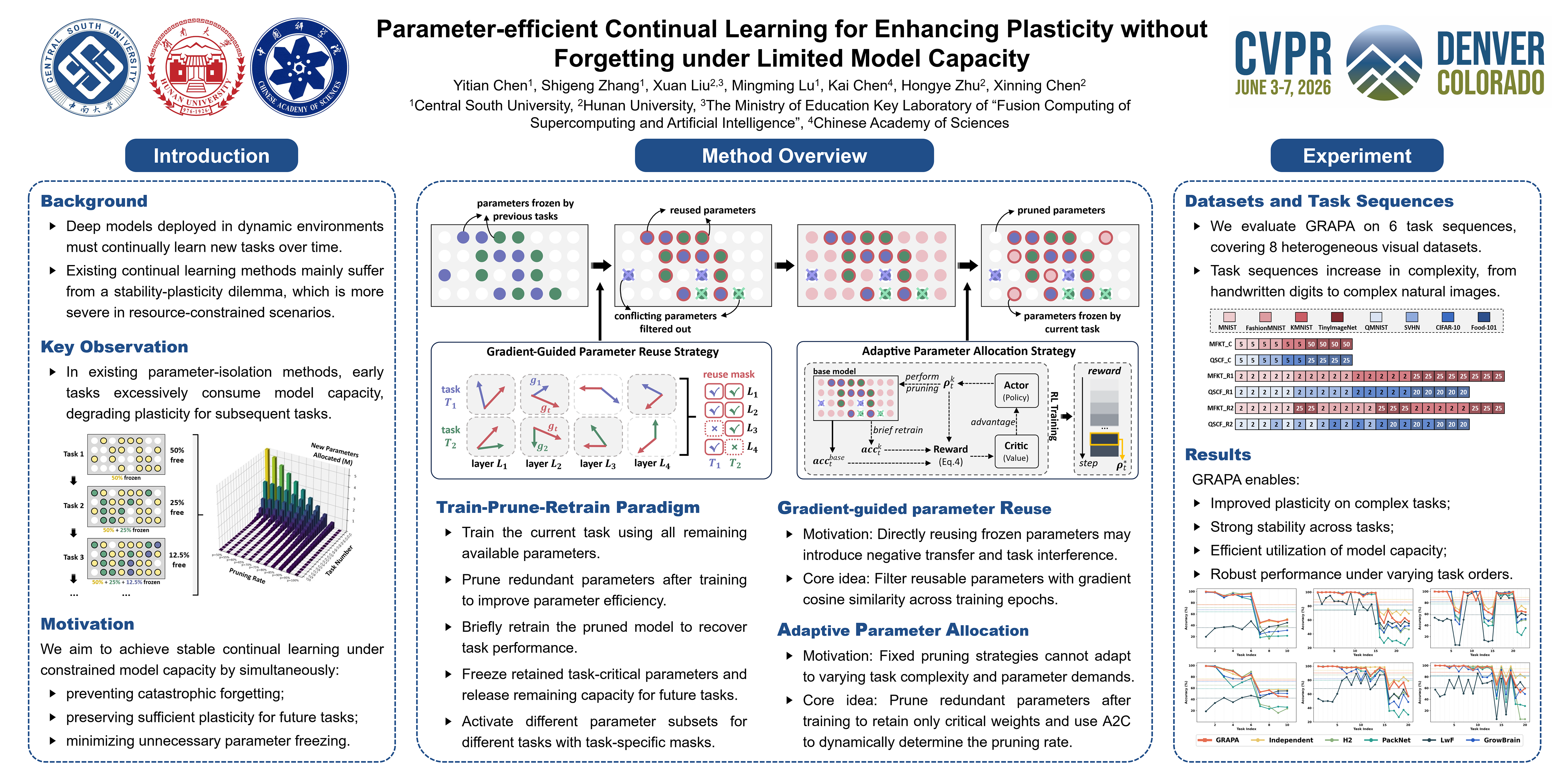
Avoiding catastrophic forgetting for previous tasks and maintaining model plasticity to support new tasks are two critical objectives of continual learning. However, existing methods usually neglect one of the two aspects and fail to support long task sequences with satisfactory performance, especially in resource-constrained scenarios in which the size of the model is limited. This work proposes GRAPA, a parameter-efficient continual learning method that well balances stability and plasticity of the model to handle long task sequences with diverse complexities. GRAPA enhances model plasticity without sacrificing stability with two novel designs. First, a gradient-guided parameter reuse strategy is proposed to make full use of frozen parameters while ensuring that no task interference is introduced. Second, a reinforcement-learning-based parameter allocation is designed to enable the model to adapt to the current task on top of reused parameters while preserving maximal model capacity for future tasks. Experiments on multiple task sequences composed of various datasets demonstrate that GRAPA lifts mean task accuracy by up to 7.67%, with up to 14.92% gains on subsequent complex tasks, reflecting GRAPA’s superior plasticity.
Dual-Estimator: Decoupling Global and Local Semantic Shift for Drift Compensation in Class-Incremental Learning
Fankang Xu ⋅ Lu Jin ⋅ Yanpeng Sun ⋅ Shiyu Xuan ⋅ Zechao Li
Continual Learning (CL) provides an effective paradigm for acquiring new knowledge, and the principle of learning without retaining past samples has led to exemplar-free CL that better matches practical conditions. However, a key challenge is the semantic shift, which requires reliable activation of past class representations to align with the current feature space. While drift compensation acts as the activator, it commonly assumes uniform semantic distributions and shifts, which is unrealistic for random data streams. For this, we propose the Dual-Estimator (Dual-E) to decouple global and local semantic shifts, addressing both issues of non-uniformity. Specifically, to address intra-task non-uniform semantic distributions that limit effective compensation for low-frequency semantics, Dual-E incorporates a mixture-of-experts estimator comprising multiple networks that model semantic shifts across diverse local representation spaces. For inter-task non-uniformity in semantic shifts, where uniform full-scale compensation potentially overlooks the varying degrees of semantic change across classes, Dual-E employs a low-rank estimator with an embedded low-rank network that prioritizes global semantic trends for classes exhibiting larger shifts. Dual-E leverages analytical solutions to update within a few epochs, enabling efficient plug-in integration with existing exemplar-free methods. Extensive experiments on diverse datasets demonstrate the advantages of Dual-E over state-of-the-art approaches. The code will be released.
Continual Distillation of Teachers from Different Domains
Nicolas Michel ⋅ Maorong Wang ⋅ Jiangpeng He ⋅ Toshihiko Yamasaki
Deep learning models continue to scale, with some requiring more storage than numerous datasets. We introduce a new paradigm: Continual Distillation (CD), where a student learns sequentially from a stream of teacher models without retaining earlier teachers. CD faces two challenges: teacher training data is unavailable, and teachers have varying expertise. We show that external unlabeled data enables Unseen Knowledge Transfer (UKT), allowing the student to acquire information from domains not present in the training data, while known to the teacher; but also that sequential distillation causes Unseen Knowledge Forgetting (UKF) when transferred knowledge is lost after training on later teachers. To better trade off between UKT and UKF, we propose Self External Data Distillation (SE2D), a method that preserves logits on external data to stabilize learning across heterogeneous teachers. Experiments on multiple benchmarks show that SE2D reduces UKF and improves cross-domain generalization. The code will be released upon acceptance.
Multimodal Continual Instruction Tuning with Dynamic Gradient Guidance
Songze Li ⋅ Mingyu Gao ⋅ Tonghua Su ⋅ Xu-Yao Zhang ⋅ Zhongjie Wang
Multimodal continual instruction tuning enables multimodal large language models to sequentially adapt to new tasks while building upon previously acquired knowledge. However, this continual learning paradigm faces the significant challenge of catastrophic forgetting, where learning new tasks leads to performance degradation on previous ones. In this paper, we introduce a novel insight into catastrophic forgetting by conceptualizing it as a problem of missing gradients from old tasks during new task learning. Our approach approximates these missing gradients by leveraging the geometric properties of the parameter space, specifically using the directional vector between current parameters and previously optimal parameters as gradient guidance. This approximated gradient can be further integrated with real gradients from a limited replay buffer and regulated by a Bernoulli sampling strategy that dynamically balances model stability and plasticity. Extensive experiments on multimodal continual instruction tuning datasets demonstrate that our method achieves state-of-the-art performance without model expansion, effectively mitigating catastrophic forgetting while maintaining a compact architecture.
Learning from Itself: Mining Internal Knowledge from Vision Language Models for Continual Learning
Yizheng Gong ⋅ Siyue Yu ⋅ Waleed Al-Nuaimy ⋅ Jimin Xiao
Vision-language models like CLIP excel at zero-shot recognition but struggle with continual learning due to two critical issues: (1) severe distribution gap between pretraining captions and post-training class names, and (2) performance mismatch between vision-only and dual-encoder approaches—vision-only methods achieve 20% higher accuracy on fine-grained tasks while CLIP dominates on natural images. We propose Learning from Itself (LfI), which mines CLIP's internal knowledge to address both challenges. First, we generate pseudo-captions by optimizing learnable tokens to minimize CLIP's contrastive loss, creating auxiliary training signals that bridge the pretraining-finetuning distribution gap without external models. Second, we introduce adaptive mutual distillation that dynamically weights knowledge transfer between CLIP's text encoder and a temporary vision classifier based on their instantaneous performance—stronger branches teach more, weaker ones learn more. At inference, only the original CLIP architecture is used, having absorbed discriminative knowledge from both branches. LfI achieves state-of-the-art results across multiple continual learning benchmarks, demonstrating that CLIP can effectively teach itself to continually learn new tasks.
AdaPrior: Bayesian-Inspired Adaptive Prior Correction for Long-Tailed Continual Learning
S Divakar Bhat ⋅ Amit Popat More ⋅ Mudit Soni ⋅ Bhuvan Aggarwal
Long-Tail Class Incremental Learning (LTCIL) combines two fundamental challenges: \textit{catastrophic forgetting} of past tasks and \textit{severe class imbalance}. Existing approaches mitigate one challenge at a time, through rehearsal, reweighting, or classifier alignment, but they typically assume \emph{static priors} and rely on multi-stage training. In contrast, we propose \textbf{AdaPrior}, a simple Bayesian framework that treats LTCIL as a problem of \emph{dynamic prior misalignment}. Our key idea is to estimate model-induced priors online via an exponential moving average and use them for (i) debiasing during training (\textbf{AdaPrior Loss}), and (ii) lightweight post-hoc correction at inference. The combined approach unifies loss-level and inference-level debiasing without additional stages or heavy computation. We provide theoretical analysis showing that AdaPrior’s prior estimator converges to the true model prior and that its logit adjustment yields well calibrated posteriors under mild assumptions. Extensive experiments on CIFAR100-LT, Food-101-LT, ImageNet-LT-subset, and iNaturalist18-subset demonstrate consistent gains over recent LTCIL baselines. Beyond accuracy, AdaPrior improves calibration, and forgetting curves, making it a practical and scalable solution for long-tail continual learning.
An Optimal Transport-driven Approach for Cultivating Latent Space in Online Incremental Learning
Quyen Tran ⋅ Hai Nguyen ⋅ Minh Quan Dao ⋅ Hoang Phan ⋅ Linh Ngo Van ⋅ Khoat Than ⋅ Dinh Phung ⋅ Dimitris Metaxas ⋅ Trung Le
In online incremental learning, data continuously arrives with substantial shifts in distribution, creating a significant challenge since previous samples cannot be revisited. Prior research has typically relied on either a single adaptive centroid or fixed multiple centroids to represent each class in the latent space. However, such methods struggle when class data streams are inherently multimodal and require continual centroid updates. To overcome this, we introduce an online Mixture Model learning framework grounded in Optimal Transport theory (MMOT), where centroids evolve incrementally with new data. This approach offers two main advantages: (i) it provides a more precise characterization of complex data streams, and (ii) it enables improved class similarity estimation for unseen samples during inference through MMOT-derived centroids. Furthermore, to strengthen representation learning and mitigate catastrophic forgetting, we design a Dynamic Preservation strategy that regulates the latent space and maintains class separability over time. Experimental evaluations on benchmark datasets confirm the superior effectiveness of our proposed method.
HAD: Heterogeneity-Aware Distillation for Lifelong Heterogeneous Learning
Xuerui Zhang ⋅ Xuehao Wang ⋅ Zhan Zhuang ⋅ Linglan Zhao ⋅ Ziyue Li ⋅ Xinmin Zhang ⋅ Zhihuan Song ⋅ Yu Zhang
Lifelong learning aims to preserve knowledge acquired from previous tasks while incorporating knowledge from a sequence of new tasks. However, most prior work explores only streams of homogeneous tasks (e.g., only classification tasks) and neglects the scenario of learning across heterogeneous tasks that possess different structures of outputs. In this work, we formalize this broader setting as lifelong heterogeneous learning (LHL).Departing from conventional lifelong learning, the task sequence of LHL spans different task types, and the learner needs to retain heterogeneous knowledge for different output space structures.To instantiate the LHL, we focus on LHL in the context of dense prediction (LHL4DP), a realistic and challenging scenario.To this end, we propose the Heterogeneity-Aware Distillation (HAD) method, an exemplar-free approach that preserves previously gained heterogeneous knowledge by self-distillation in each training phase.The proposed HAD comprises two complementary components, including a distribution-balanced heterogeneity-aware distillation loss to alleviate the global imbalance of prediction distribution and a salience-guided heterogeneity-aware distillation loss that concentrates learning on informative edge pixels extracted with the Sobel operator.Extensive experiments demonstrate that the proposed HAD method significantly outperforms existing methods in this new scenario.
U-Mind: A Unified Framework for Real-Time Multimodal Interaction with Audiovisual Generation
xiang deng ⋅ Feng Gao ⋅ Yong Zhang ⋅ Youxin Pang ⋅ Xu Xiaoming ⋅ Zhuoliang Kang ⋅ Xiaoming Wei ⋅ Yebin Liu
Full-stack multimodal interaction in real-time is a central goal in building intelligent embodied agents capable of natural, dynamic communication. However, existing systems are either limited to unimodal generation or suffer from degraded reasoning and poor cross-modal alignment, preventing coherent and perceptually grounded interactions. In this work, we introduce \textbf{U-Mind}, the first unified system for high-intelligence multimodal dialogue that supports real-time generation and jointly models language, speech, motion, and video synthesis within a single interactive loop.At its core, U-Mind implements a \textit{Unified Alignment and Reasoning Framework} that addresses two key challenges: enhancing cross-modal synchronization via a \textit{segment-wise alignment strategy}, and preserving reasoning abilities through \textit{Rehearsal-Driven Learning}. During inference, U-Mind adopts a \textit{text-first decoding pipeline} that performs internal chain-of-thought planning followed by temporally synchronized generation across modalities. To close the loop, we implement a real-time video rendering framework conditioned on pose and speech, enabling expressive and synchronized visual feedback.Extensive experiments demonstrate that U-Mind achieves state-of-the-art performance on a range of multimodal interaction tasks, including question answering, instruction following, and motion generation, paving the way toward intelligent, immersive conversational agents.
StreamAvatar: Streaming Diffusion Models for Real-Time Interactive Human Avatars
Zhiyao Sun ⋅ Ziqiao Peng ⋅ Yifeng Ma ⋅ Yi Chen ⋅ zhengguang zhou ⋅ Zixiang Zhou ⋅ Guozhen Zhang ⋅ Youliang Zhang ⋅ Yuan Zhou ⋅ qinglin lu ⋅ Yong-Jin Liu
Real-time, streaming interactive avatars represent a critical yet challenging goal in digital human research. Although diffusion-based human avatar generation methods achieve remarkable success, their non-causal architecture and high computational costs make them unsuitable for streaming. Moreover, existing interactive approaches are typically limited to head-and-shoulder region, limiting their ability to produce gestures and body motions. To address these challenges, we propose a two-stage autoregressive adaptation and acceleration framework that applies autoregressive distillation and adversarial refinement to adapt a high-fidelity human video diffusion model for real-time, interactive streaming. To ensure long-term stability and consistency, we introduce three key components: a Reference Sink, a Reference-Anchored Positional Re-encoding (RAPR) strategy, and a Consistency-Aware Discriminator. Building on this framework, we develop a one-shot, interactive, human avatar model capable of generating both natural talking and listening behaviors with coherent gestures. Extensive experiments demonstrate that our method achieves state-of-the-art performance, surpassing existing approaches in generation quality, real-time efficiency, and interaction naturalness.
FlashLips: 100-FPS Mask-Free Latent Lip-Sync using Reconstruction Instead of Diffusion or GANs
Andreas Zinonos ⋅ Michał Stypułkowski ⋅ Antoni Bigata Casademunt ⋅ Stavros Petridis ⋅ Maja Pantic ⋅ Nikita Drobyshev
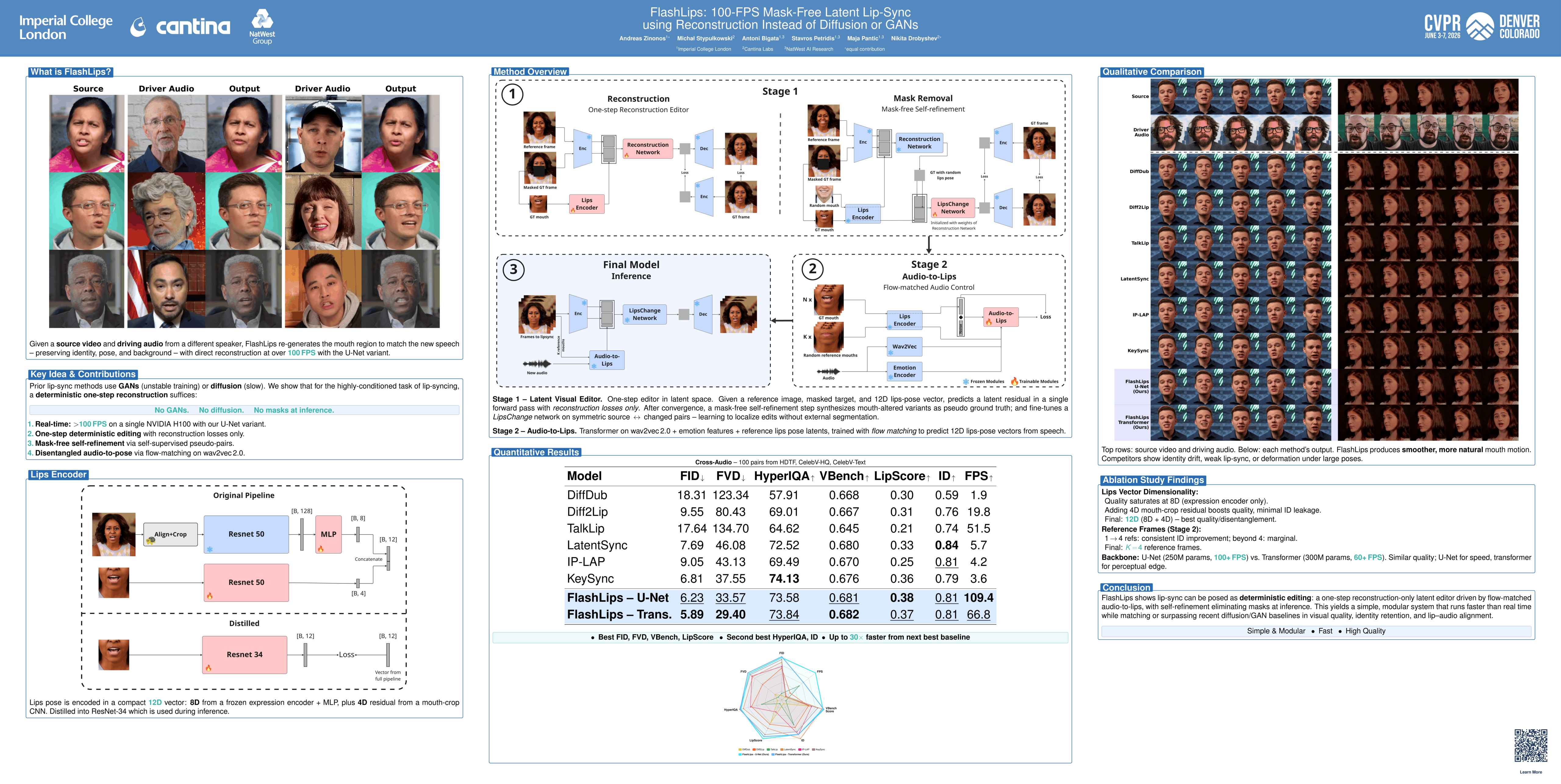
We present FlashLips, a two-stage, mask-free lip-sync system that decouples lips control from rendering and achieves real-time performance running at over 100 FPS on a single GPU, while matching the visual quality of larger state-of-the-art models. Stage 1 is a compact, one-step latent-space editor that reconstructs an image using a reference identity, a masked target frame, and a low-dimensional lips-pose vector, trained purely with reconstruction losses - no GANs or diffusion. To remove explicit masks at inference, we use self-supervision: we generate mouth-altered variants of the target image, that serve as pseudo ground truth for fine-tuning, teaching the network to localize edits to the lips while preserving the rest. Stage 2 is an audio-to-pose transformer trained with a flow-matching objective to predict lips-poses vectors from speech. Together, these stages form a simple and stable pipeline that combines deterministic reconstruction with robust audio control, delivering high perceptual quality and faster-than-real-time speed.
WildCap: Facial Albedo Capture in the Wild via Hybrid Inverse Rendering
Yuxuan Han ⋅ Xin Ming ⋅ Tianxiao Li ⋅ Zhuofan Shen ⋅ Qixuan Zhang ⋅ Lan Xu ⋅ Feng Xu
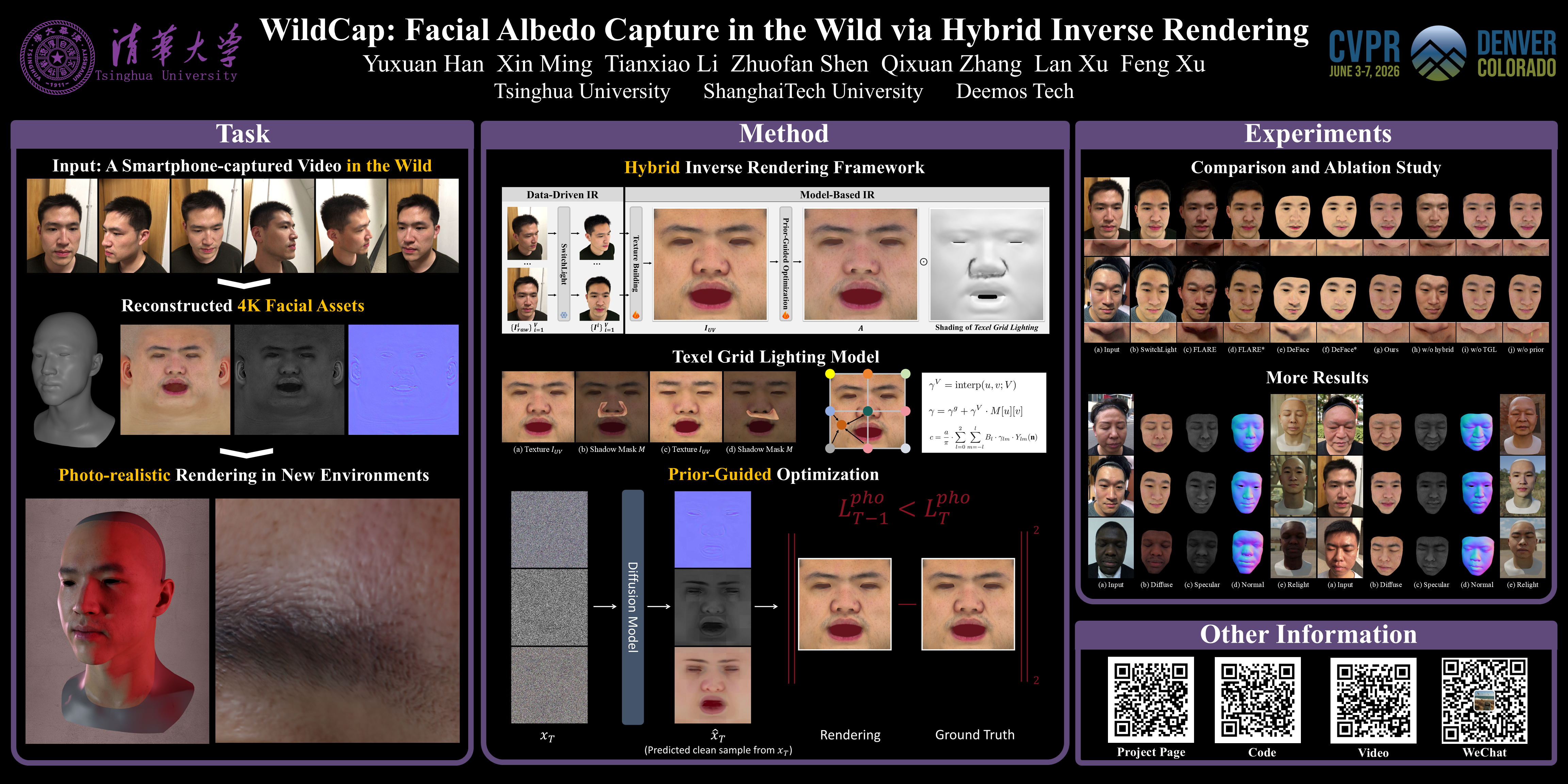
Existing methods achieve high-quality facial appearance capture under controllable lighting, which increases capture cost and limits usability. We propose WildCap, a novel method for high-quality facial appearance capture from a smartphone video recorded in the wild. To disentangle high-quality reflectance from complex lighting effects in in-the-wild captures, we propose a novel hybrid inverse rendering framework. Specifically, we first apply a data-driven method, i.e., SwitchLight, to convert the captured images into more constrained conditions and then adopt model-based inverse rendering. However, unavoidable local artifacts in network predictions, such as shadow-baking, are non-physical and thus hinder accurate inverse rendering of lighting and material. To address this, we propose a novel texel grid lighting model to explain non-physical effects as clean albedo illuminated by local physical lighting. During optimization, we jointly sample a diffusion prior for reflectance maps and optimize the lighting, effectively resolving scale ambiguity between local lights and albedo. Our method achieves significantly better results than prior arts in the same capture setup, closing the quality gap between in-the-wild and controllable recordings by a large margin.
EmoTaG: Emotion-Aware Talking Head Synthesis on Gaussian Splatting with Few-Shot Personalization
Haolan Xu ⋅ Keli Cheng ⋅ Lei Wang ⋅ Ning Bi ⋅ Xiaoming Liu
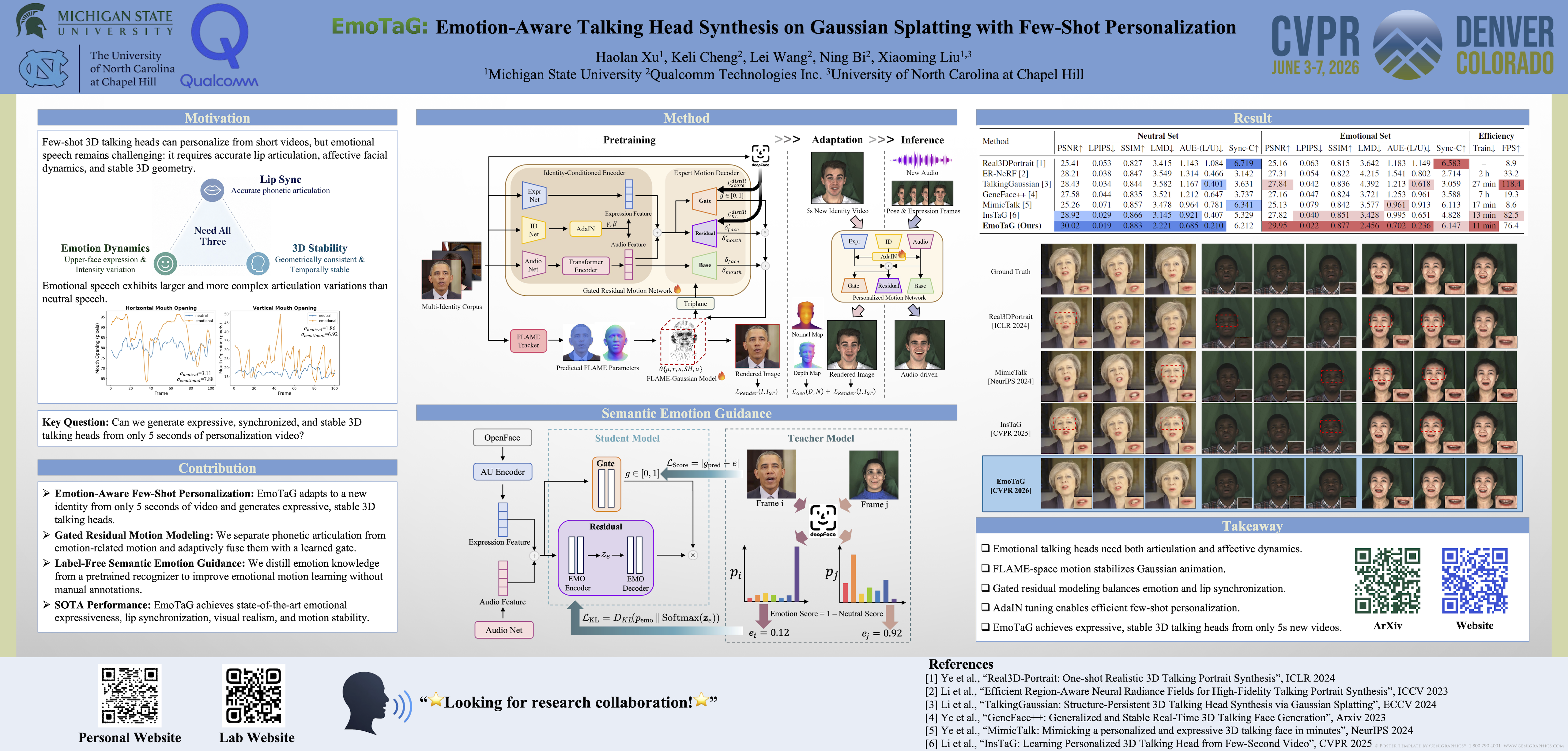
Audio-driven 3D talking head synthesis has advanced rapidly with Neural Radiance Fields (NeRF) and 3D Gaussian Splatting (3DGS). Few-shot methods enable instant personalization by reconstructing high-fidelity avatars from only a few seconds of video. However, achieving natural talking-head generation further requires strong emotion-aware motion modeling, and existing few-shot approaches exhibit geometric instability and audio-emotion mismatch under expressive facial motion. In this work, we present EmoTaG, a few-shot emotion-aware 3D talking head synthesis framework built on the Pretrain-and-Adapt paradigm. Our key insight is to reformulate motion prediction in a structured FLAME parameter space rather than directly deforming 3D Gaussians, which introduces strong geometric priors for stable and interpretable motion. Building upon this, we propose a Gated Residual Motion Network (GRMN), which can capture emotional prosody from audio while supplementing head pose and upper-face cues absent in audio to enable expressive yet stable motion generation. Extensive experiments demonstrate that EmoTaG achieves state-of-the-art performance in emotional expressiveness, lip synchronization, visual realism, and motion stability.
DyaDiT: A Multi-Modal Diffusion Transformer for Socially Favorable Dyadic Gesture Generation
YICHEN PENG ⋅ Jyun-Ting Song ⋅ Siyeol Jung ⋅ RUOFAN LIU ⋅ Haiyang Liu ⋅ Xuangeng Chu ⋅ Ruicong Liu ⋅ Erwin Wu ⋅ Hideki Koike ⋅ Kris Kitani
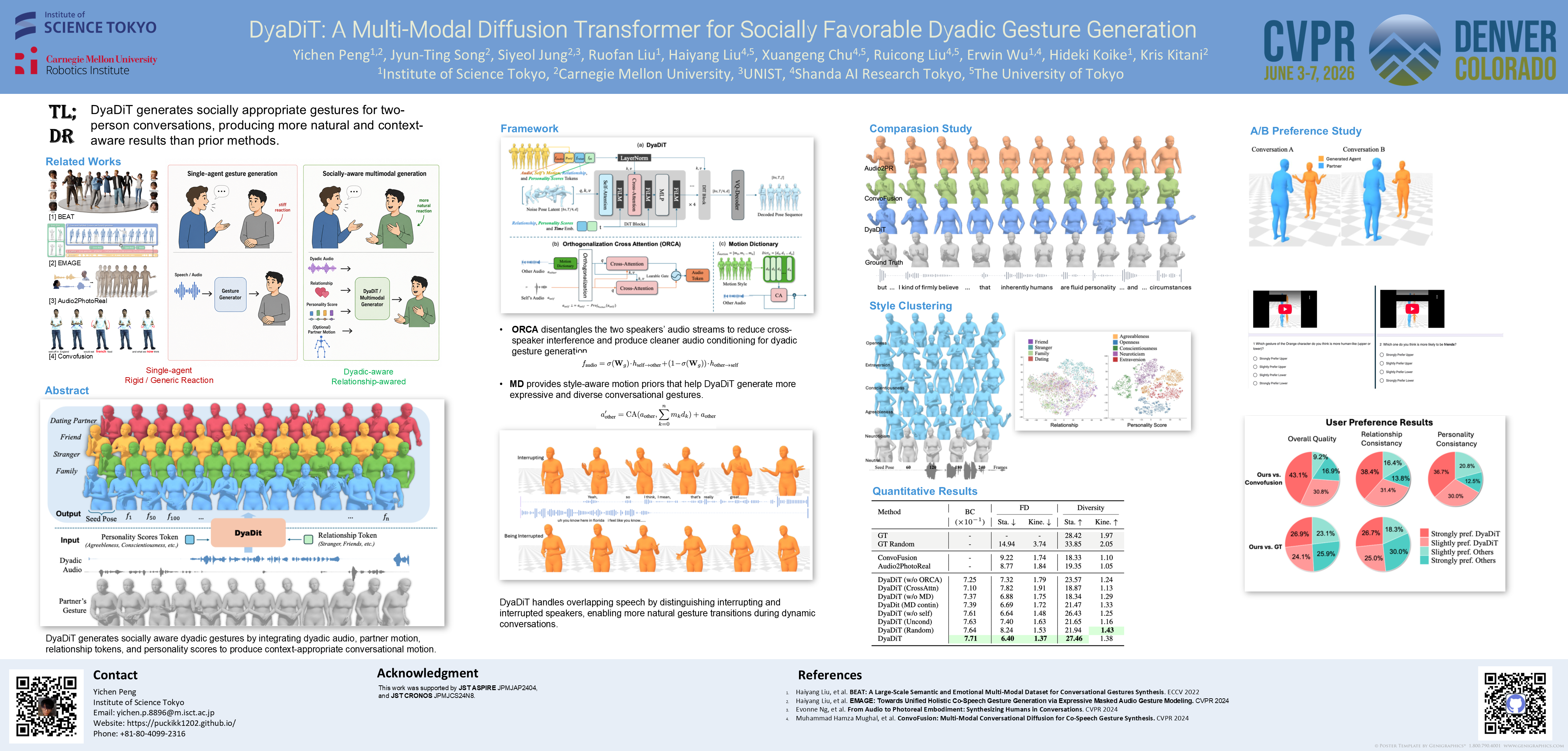
Generating realistic conversational gestures are essential for achieving natural, socially engaging interactions with digital humans. However, existing methods typically map a single audio stream to a single speaker’s motion, without considering social context or modeling the mutual dynamics between two people engaging in conversation. We present DyaDiT, a multi-modal diffusion transformer that generates contextually appropriate human motion from dyadic audio signals. Trained on Seamless Interaction Dataset, DyaDiT takes dyadic audio with optional social-context tokens to produce context-appropriate motion. It fuses information from both speakers to capture interaction dynamics, uses a motion dictionary to encode motion priors, and can optionally utilize the conversational partner's gestures to produce more responsive motion. We evaluate DyaDiT on standard motion generation metrics and conduct quantitative user studies, demonstrating that it not only surpasses existing methods on objective metrics but is also strongly preferred by users, highlighting its robustness and socially favorable motion generation. Code and models will be released upon acceptance.
TRM-VLA: Temporal-Aware Chain-of-Thought Reasoning and Memorization for Vision-Language-Action Models
LI XIANG ⋅ Yali Li ⋅ Yuan Wang ⋅ Shengjin Wang
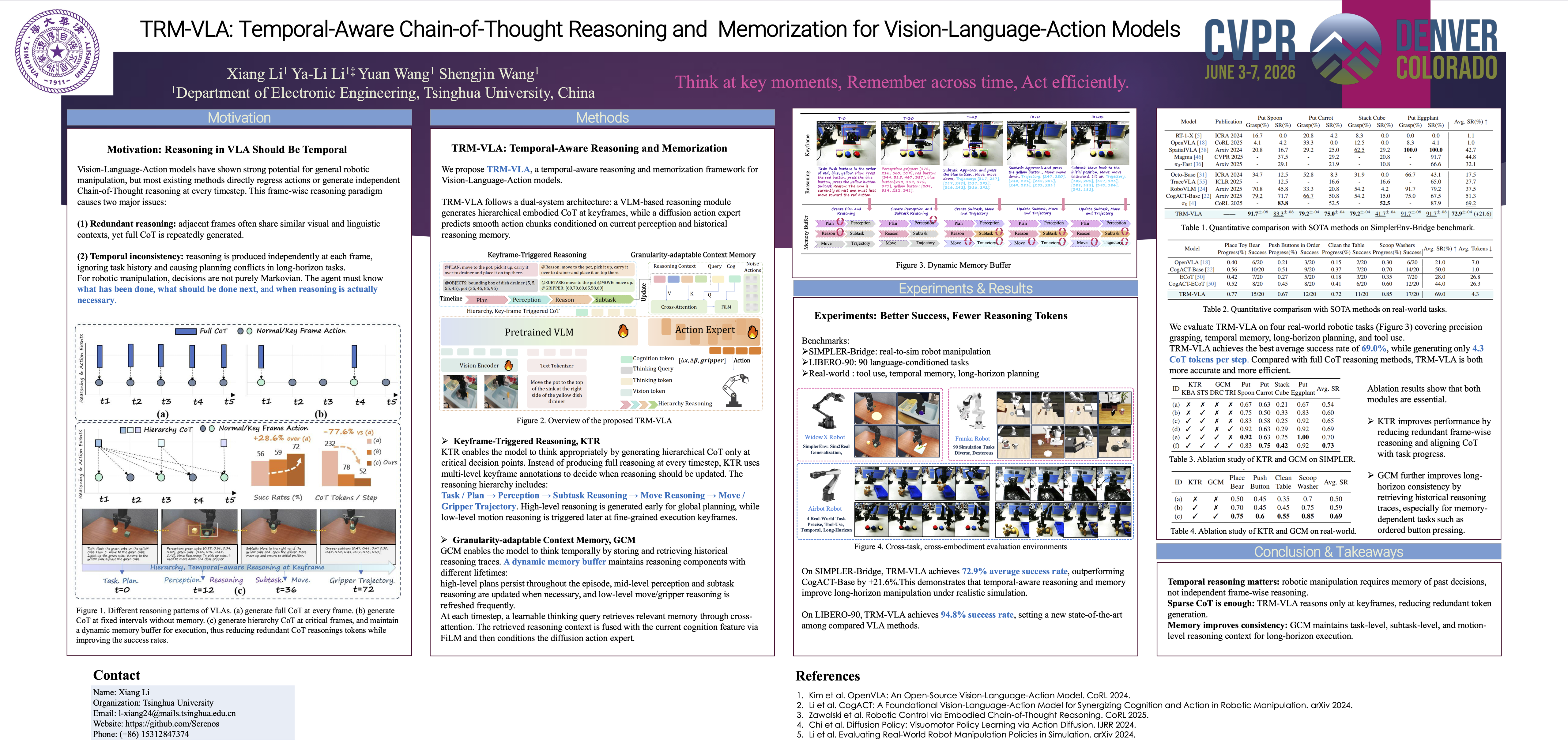
Vision-Language-Action (VLA) models have emerged as a powerful paradigm for general robotic manipulation. However, existing approaches typically omit intermediate reasoning steps and directly regress actions, limiting reasoning interpretability and performance in long-horizon or compositional tasks. Although recent studies introduce Chain-of-Thought (CoT) reasoning into VLA models, their effectiveness remains suboptimal due to two key issues: (1) generating a full reasoning trajectory at every timestep introduces substantial redundancy, thereby hinders real-time deployment and (2) reasoning is performed independently, neglecting temporal consistency, which leads to planning conflicts.We propose TRM-VLA, a temporal-aware reasoning and memorization framework that integrates explicit temporal modeling into the VLA reasoning process. TRM-VLA consists of two core components: (1) Keyframe-Triggered Reasoning (KTR), which identifies task progress and performs hierarchical CoT reasoning only at key decision points to reduce redundant inference; and (2) Granularity-adaptable Context Memory (GCM), which dynamically stores and retrieves historical reasoning trajectories to maintain inter-frame coherence and global context. Built upon a dual-system architecture—combining a multimodal foundation model for slow reasoning (System 2) with a diffusion-based policy for fast execution (System 1)—TRM-VLA learns to plan and act efficiently in a unified manner. Extensive experiments on LIBERO-90, SIMPLER, and four real-world robotic tasks demonstrate that TRM-VLA achieves state-of-the-art performance while improving reasoning efficiency.
VGGDrive: Empowering Vision-Language Models with Cross-View Geometric Grounding for Autonomous Driving
Jie Wang ⋅ Guang Li ⋅ Zhijian Huang ⋅ Chenxu Dang ⋅ Hangjun Ye ⋅ Yahong Han ⋅ Long Chen
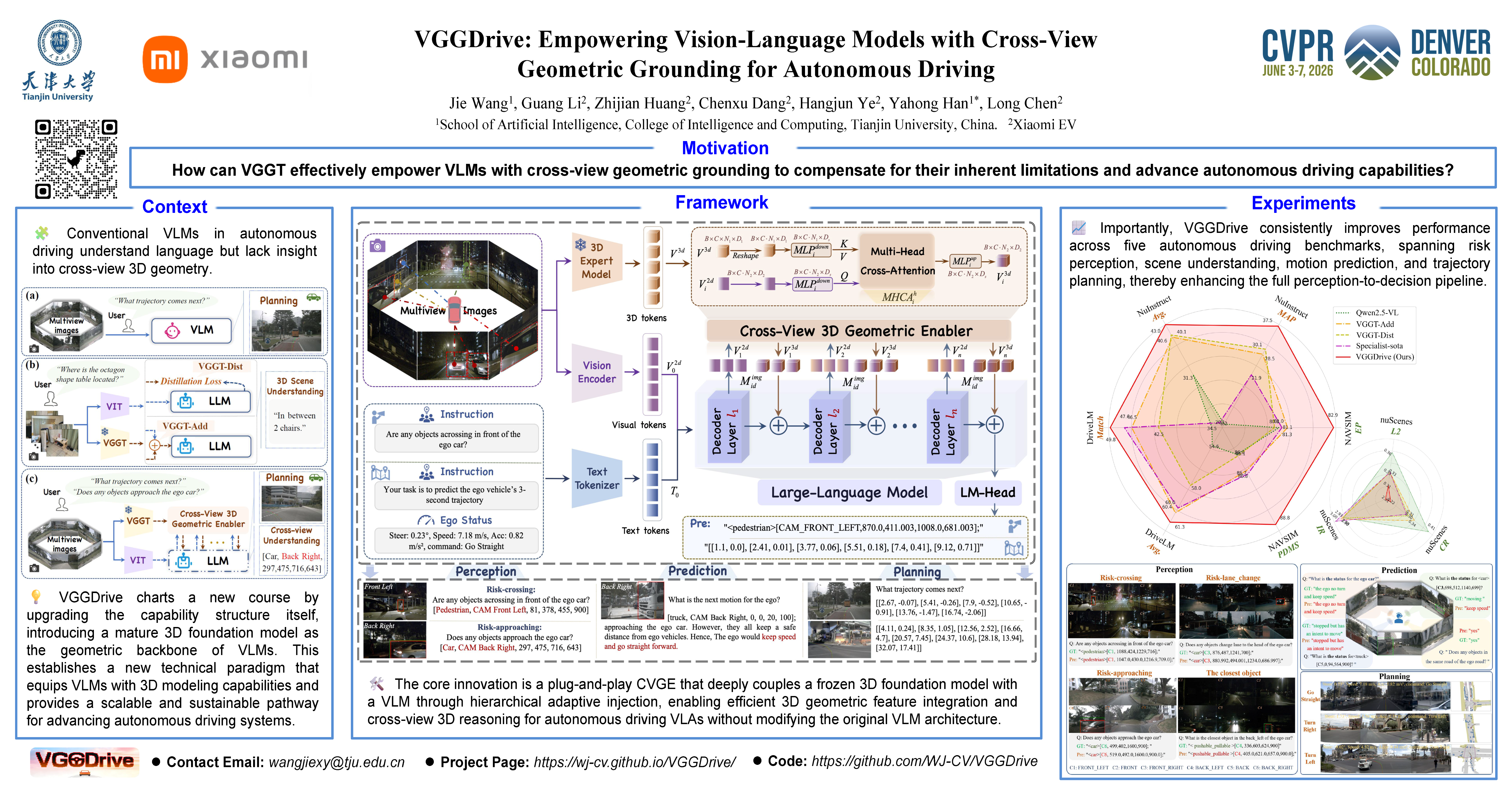
The significance of cross-view 3D geometric modeling capabilities for autonomous driving is self-evident, yet existing Vision-Language Models (VLMs) inherently lack this capability, resulting in their mediocre performance. While some promising approaches attempt to mitigate this by constructing Q&A data for auxiliary training, they still fail to fundamentally equip VLMs with the ability to comprehensively handle diverse evaluation protocols. We thus chart a new course, advocating for the infusion of VLMs with the cross-view geometric grounding of mature 3D foundation models, closing this critical capability gap in autonomous driving. In this spirit, we propose a novel architecture, $\textbf{VGGDrive}$, which empowers $\textbf{V}$ision-language models with cross-view $\textbf{G}$eometric $\textbf{G}$rounding for autonomous $\textbf{Driv}$ing. Concretely, to bridge the cross-view 3D geometric features from the frozen visual 3D model with the VLM's 2D visual features, we introduce a plug-and-play Cross-View 3D Geometric Enabler (CVGE). The CVGE decouples the base VLM architecture and effectively empowers the VLM with 3D features through a hierarchical adaptive injection mechanism. Extensive experiments show that VGGDrive enhances base VLM performance across five autonomous driving benchmarks, including tasks like cross-view risk perception, motion prediction, and trajectory planning. It’s our belief that mature 3D foundation models can empower autonomous driving tasks through effective integration, and we hope our initial exploration demonstrates the potential of this paradigm to the autonomous driving community.
NoRD: A Data-Efficient Vision-Language-Action Model that Drives without Reasoning
Ishaan Rawal ⋅ Shubh Gupta ⋅ Yihan Hu ⋅ Wei Zhan
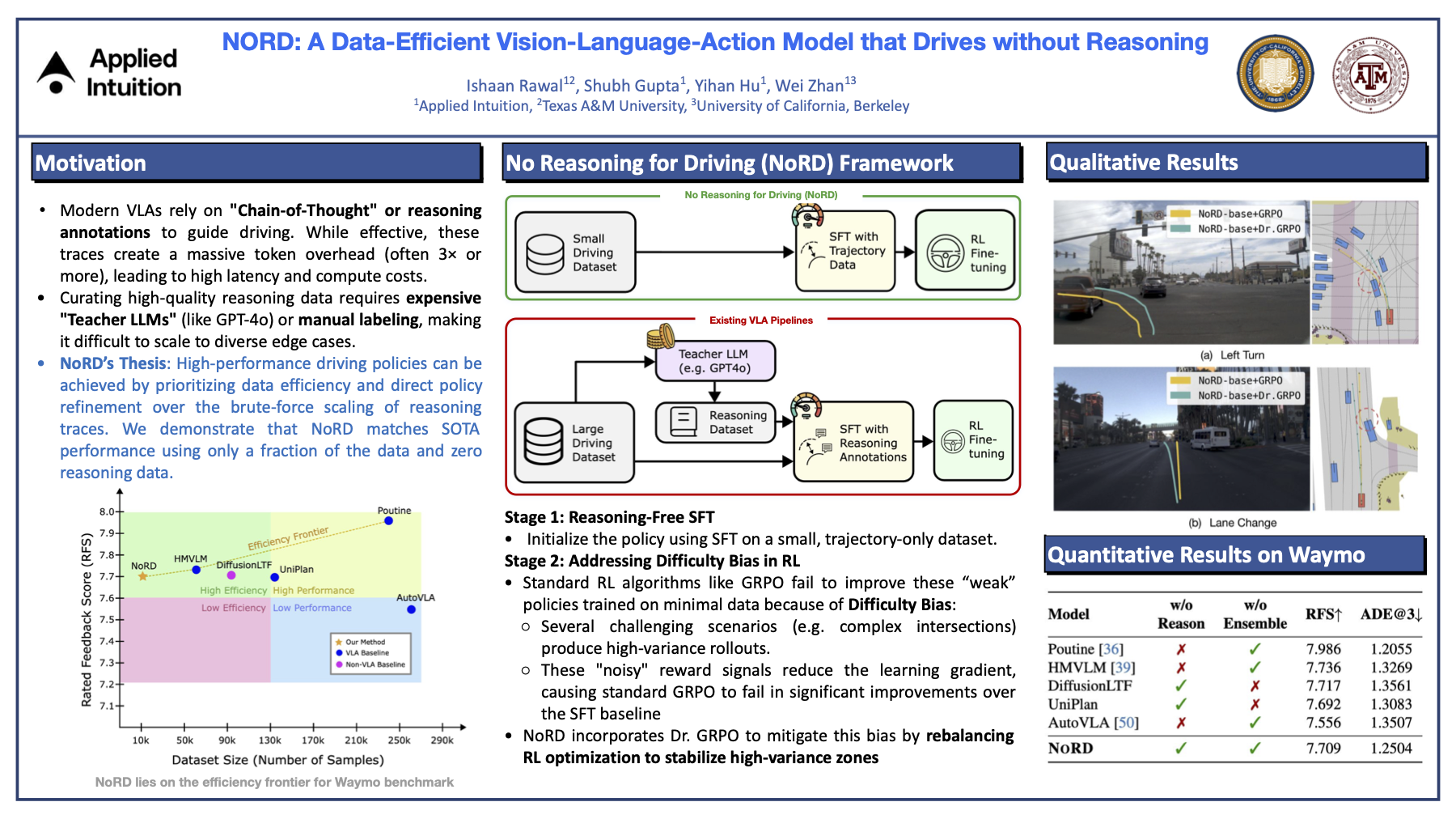
Vision-Language-Action (VLA) models are advancing autonomous driving by replacing modular pipelines with unified end-to-end architectures. Current VLAs face two challenges: (1) they require extensive datasets annotated with reasoning traces, and (2) these traces greatly increase token counts, inflating training and inference costs. We propose NoRD (No Reasoning for Driving), a data- and inference-efficient VLA that addresses both. Compared to existing VLAs, NoRD achieves competitive performance while being fine-tuned on atleast <60% of the data and no reasoning annotations, resulting in 3x fewer tokens. Our approach applies Reinforcement Learning (RL) to fine-tune a Supervised fine-tuning (SFT) policy trained on a small, reasoning-free dataset. However, we observe that the standard RL algorithm, Group Relative Policy Optimization (GRPO), fails to yield significant improvements over this data-efficient SFT policy. We find that this limitation stems from difficulty bias, which disproportionately penalizes reward signals from scenarios that produce high-variance rollouts within GRPO. NoRD overcomes this limitation by incorporating Dr.GRPO, a recent algorithm designed to mitigate difficulty bias in LLMs. As a result, NoRD achieves competitive performance on Waymo and NAVSIM without large datasets, reasoning or additional inputs, enabling scalable, data-efficient training, and fast inference.
HTNav: A Hybrid Navigation Framework with Tiered Structure for Urban Aerial Vision-and-Language Navigation
Chengjie Fan ⋅ Cong Pan ⋅ Zijian Liu ⋅ Ningzhong Liu ⋅ Jie Qin
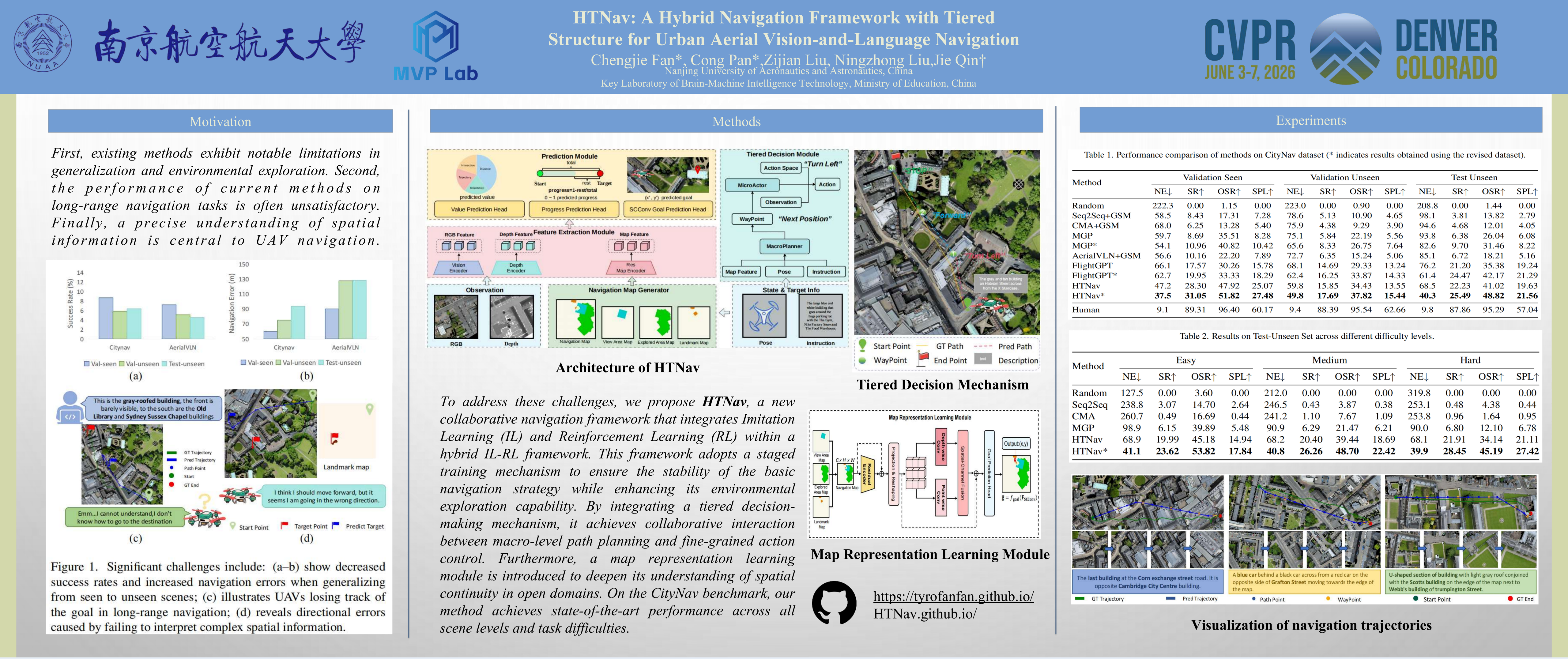
Inspired by the general Vision-and-Language Navigation (VLN) task, aerial VLN has drawn widespread attention, owing to its significant application value in areas such as logistics delivery and urban inspection. However, existing methods in complex urban environments face several challenges, including insufficient generalization to unknown scenes, suboptimal performance in long-distance path planning, and inadequate understanding of spatial continuity. To address these challenges, we propose HTNav, a new collaborative navigation framework that blends Imitation Learning (IL) and Reinforcement Learning (RL) into a hybrid IL-RL paradigm. This framework adopts a staged training mechanism to ensure the stability of the basic navigation strategy while enhancing its environmental exploration capability. By integrating a tiered decision-making mechanism, it achieves collaborative interaction between macro-level path planning and fine-grained action control. Furthermore, a map representation learning module is introduced to deepen its understanding of spatial continuity in open domains. On the CityNav benchmark, our method achieves state-of-the-art performance at all levels of scenes and task difficulties. Experimental results demonstrate that this framework significantly improves navigation precision and robustness in complex urban environments.
CycleBEV: Regularizing View Transformation Networks via View Cycle Consistency for Bird’s-Eye-View Semantic Segmentation
Jeongbin Hong ⋅ Dooseop Choi ⋅ Taeg-Hyun An ⋅ KYOUNG AN AN ⋅ Kyoung-Wook Min
Transforming image features from perspective view (PV) space to bird's-eye-view (BEV) space remains challenging in autonomous driving due to depth ambiguity and occlusion. Although several view transformation (VT) paradigms have been proposed, the challenge still remains. In this paper, we propose a new regularization framework, dubbed CycleBEV, that enhances existing VT models for BEV semantic segmentation. Inspired by cycle consistency, widely used in image distribution modeling, we devise an inverse view transformation (IVT) network that maps BEV segmentation maps back to PV segmentation maps and use it to regularize VT networks during training through cycle consistency losses, enabling them to capture richer semantic and geometric information from input PV images. To further exploit the capacity of the IVT network, we introduce two novel ideas that extend cycle consistency into geometric and representation spaces. We evaluate CycleBEV on four representative VT models covering three major paradigms using the large-scale nuScenes dataset. Experimental results show consistent improvements---with gains of up to 0.74, 4.86, and 3.74 mIoU for drivable area, vehicle, and pedestrian classes, respectively---without increasing inference complexity, since the IVT network is used only during training.
STAvatar: Soft Binding and Temporal Density Control for Monocular 3D Head Avatars Reconstruction
Jiankuo Zhao ⋅ Xiangyu Zhu ⋅ Zidu Wang ⋅ Zhen Lei
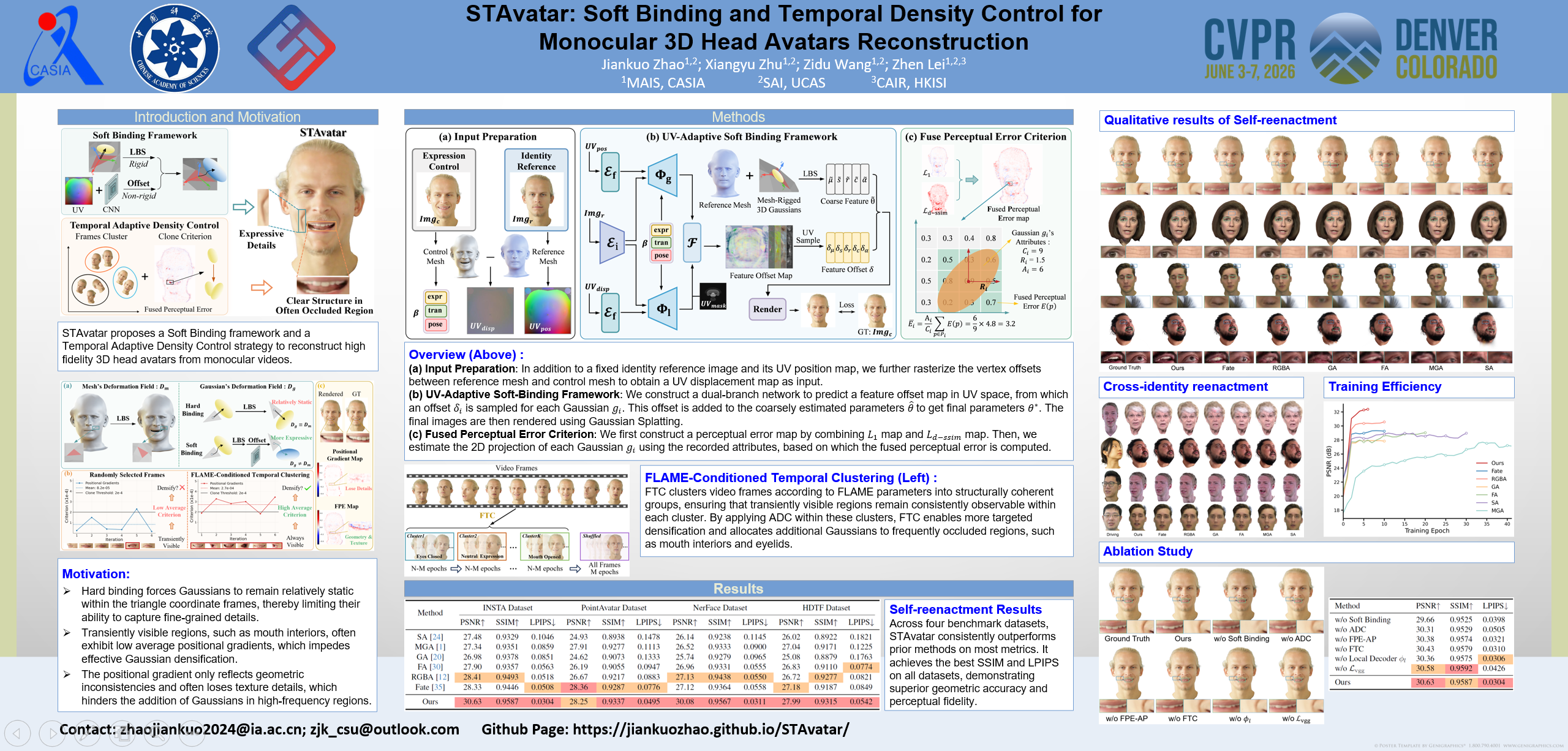
Reconstructing high-fidelity and animatable 3D head avatars from monocular videos remains a challenging yet essential task. Existing methods based on 3D Gaussian Splatting typically bind Gaussians to mesh triangles and model deformations solely via Linear Blend Skinning, which results in rigid motion and limited expressiveness. Moreover, they struggle to reconstruct frequently occluded regions (e.g., mouth interiors, eyelids). To address these limitations, we propose STAvatar, which consists of two key components: (1) a UV-Adaptive Soft Binding framework that leverages both image- and FLAME-based priors to learn per-Gaussian feature offsets within the UV space. This UV representation supports dynamic resampling, ensuring full compatibility with Adaptive Density Control (ADC) and enhanced adaptability to geometric and textural variations. (2) a Temporal ADC strategy, which first clusters structurally similar frames to facilitate more targeted computation of the densification criterion. It further introduces the fused perceptual error as clone criterion to jointly capture geometric and textural discrepancies, encouraging densification in regions requiring finer details. Extensive experiments on four benchmark datasets demonstrate that STAvatar achieves state-of-the-art reconstruction performance, especially in capturing fine-grained details and reconstructing frequently occluded regions. The code will be publicly available.
CrowdGaussian: Reconstructing High-Fidelity 3D Gaussians for Human Crowd from a Single Image
Yizheng Song ⋅ Yiyu Zhuang ⋅ Qipeng Xu ⋅ Haixiang Wang ⋅ Jiahe Zhu ⋅ Jing Tian ⋅ Siyu Zhu ⋅ Hao Zhu
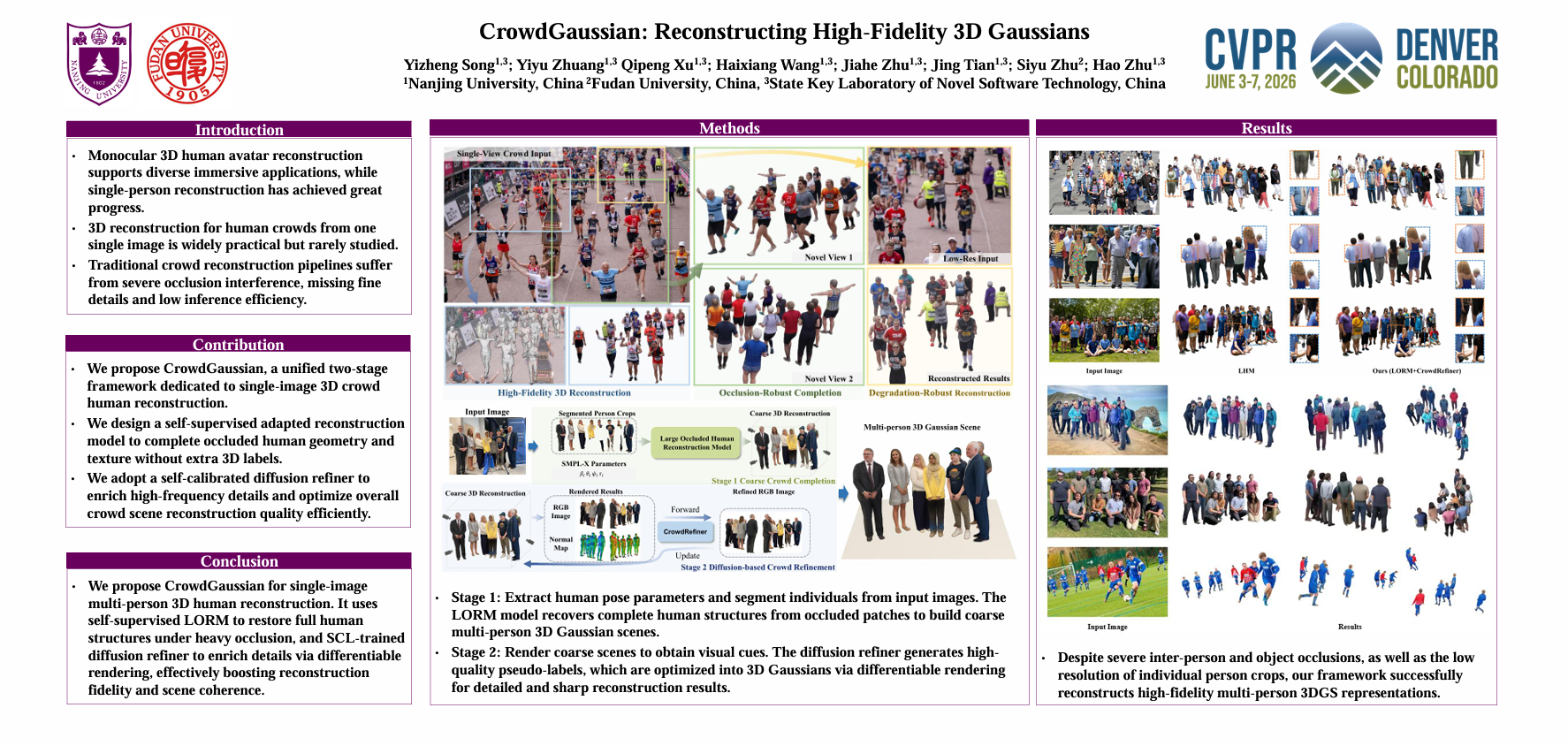
Single-view 3D human reconstruction has garnered significant attention in recent years. Despite numerous advancements, prior research has concentrated on reconstructing 3D models from clear, close-up images of individual subjects, often yielding subpar results in the more prevalent multi-person scenarios. Reconstructing 3D human crowd models is a highly intricate task, laden with challenges such as: 1) extensive occlusions, 2) low clarity, and 3) numerous and various appearances. To address this task, we propose CrowdGaussian, a unified framework that directly reconstructs multi-person 3D Gaussian Splatting (3DGS) representations from single-image inputs. To handle occlusions, we devise a self-supervised adaptation pipeline that enables the pretrained large human model to reconstruct complete 3D humans with plausible geometry and appearance from heavily occluded inputs.Furthermore, we introduce Self-Calibrated Learning (SCL). This training strategy enables single-step diffusion models to adaptively refine coarse renderings to optimal quality by blending identity-preserving samples with clean/corrupted image pairs. The outputs can be distilled back to enhance the quality of multi-person 3DGS representations. Extensive experiments demonstrate that CrowdGaussian generates photorealistic, geometrically coherent reconstructions of multi-person scenes.
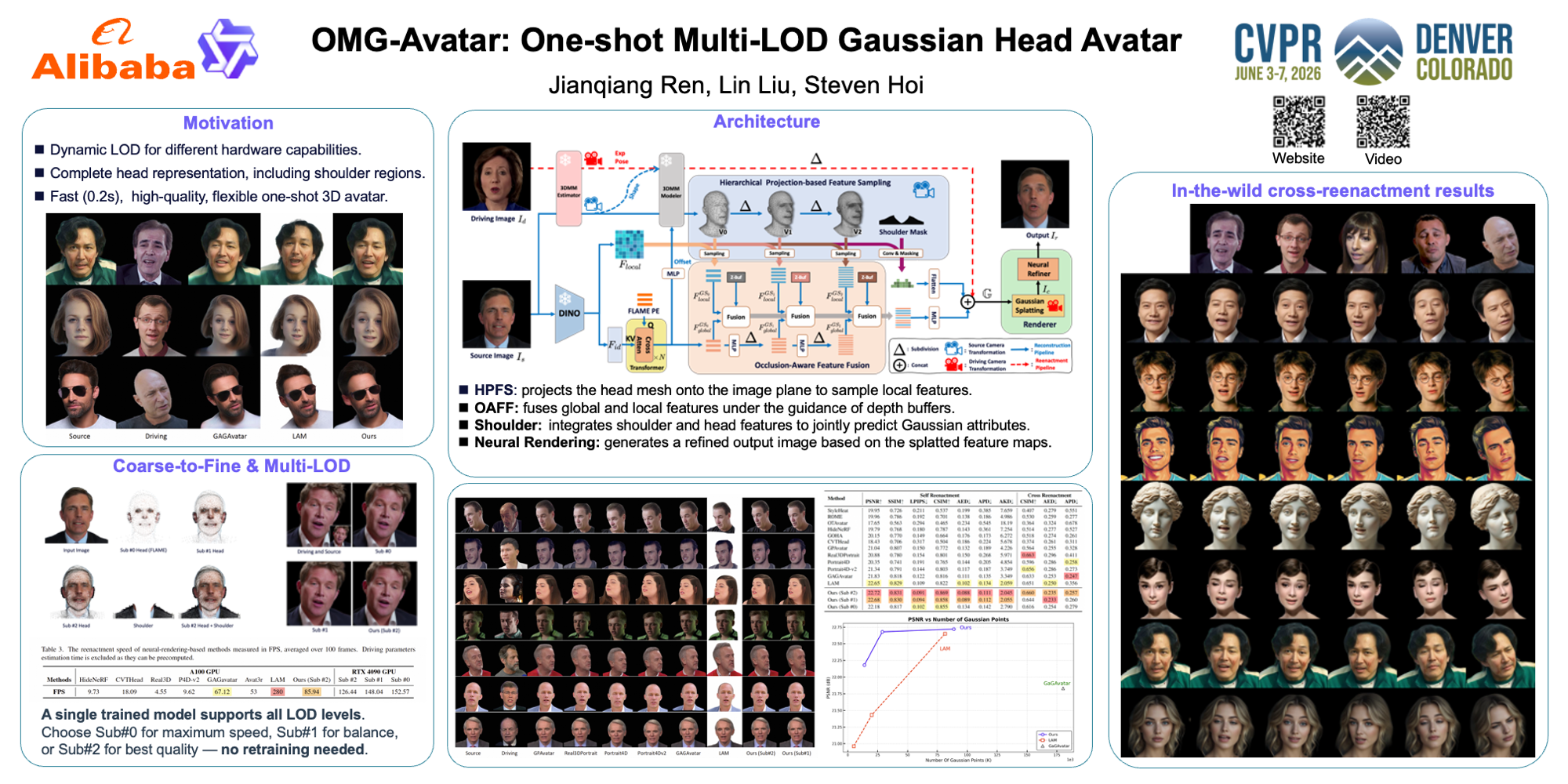
We propose OMG-Avatar, a novel One-shot method that leverages a Multi-LOD (Level-of-Detail) Gaussian representation for animatable 3D head reconstruction from a single image in 0.2s. Our method enables LOD head avatar modeling using a unified model that accommodates diverse hardware capabilities and inference speed requirements. To capture both global and local facial characteristics, we employ a transformer-based architecture for global feature extraction and projection-based sampling for local feature acquisition. These features are effectively fused under the guidance of a depth buffer, ensuring occlusion plausibility. We further introduce a coarse-to-fine learning paradigm to support Level-of-Detail functionality and enhance the perception of hierarchical details. To address the limitations of 3DMMs in modeling non-head regions such as the shoulders, we introduce a multi-region decomposition scheme in which the head and shoulders are predicted separately and then integrated through cross-region combination. Extensive experiments demonstrate that OMG-Avatar outperforms state-of-the-art methods in reconstruction quality, reenactment performance, and computational efficiency.
Globally Optimal Pose from Orthographic Silhouettes
Agniva Sengupta ⋅ Dilara Kus ⋅ Jianning Li ⋅ Stefan Zachow
We solve the problem of determining the pose of known shapes in $\mathbb{R}^3$ from their unoccluded silhouettes. The pose is determined up to global optimality using a simple yet under-explored property of the area-of-silhouette: its continuity w.r.t trajectories in the rotation space. The proposed method utilises pre-computed silhouette-signatures, modelled as a response surface of the area-of-silhouettes. Querying this silhouette-signature response surface for pose estimation leads to a strong branching of the rotation search space, making resolution-guided candidate search feasible. Additionally, we utilise the aspect ratio of 2D ellipses fitted to projected silhouettes as an auxiliary global shape signature to accelerate the pose search. This combined strategy forms the first method to efficiently estimate globally optimal pose from just the silhouettes, without being guided by correspondences, for any shape, irrespective of its convexity and genus. We validate our method on synthetic and real examples, demonstrating significantly improved accuracy against comparable approaches.
AvatarPointillist: AutoRegressive 4D Gaussian Avatarization
Hongyu Liu ⋅ Xuan Wang ⋅ Zijian Wu ⋅ yating wang ⋅ Ziyu Wan ⋅ Yue Ma ⋅ Runtao Liu ⋅ Boyao Zhou ⋅ Yujun Shen ⋅ Qifeng Chen
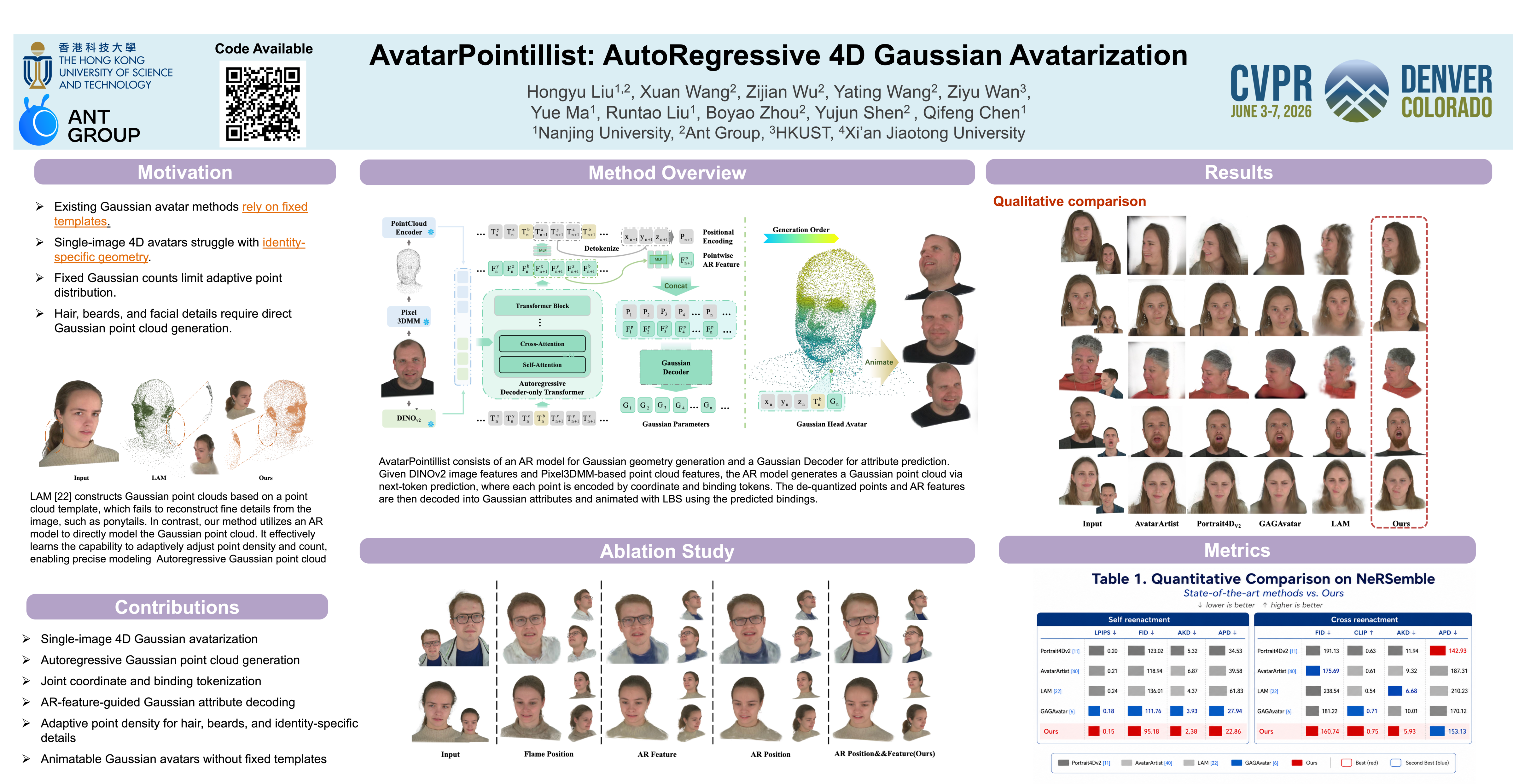
We introduce AvatarPointillist, a novel framework for generating dynamic 4D Gaussian avatars from a single portrait image. At the core of our method is a decoder-only Transformer that autoregressively generates a point cloud for 3D Gaussian Splatting. This sequential approach allows for precise, adaptive construction, dynamically adjusting point density and the total number of points based on the subject's complexity. During point generation, the AR model also jointly predicts per-point binding information, enabling realistic animation. After generation, a dedicated Gaussian decoder converts the points into complete, renderable Gaussian attributes. We demonstrate that conditioning the decoder on the latent features from the AR generator enables effective interaction between stages and markedly improves fidelity. Extensive experiments validate that AvatarPointillist produces high-quality, photorealistic, and controllable avatars. We believe this autoregressive formulation represents a new paradigm for avatar generation, and we will release our code and data to inspire future research.
COPO: Causal-Oriented Policy Optimization for Hallucinations of MLLMs
Peizheng Guo ⋅ Jingyao Wang ⋅ Wenwen Qiang ⋅ Jiahuan Zhou ⋅ Changwen Zheng ⋅ Gang Hua
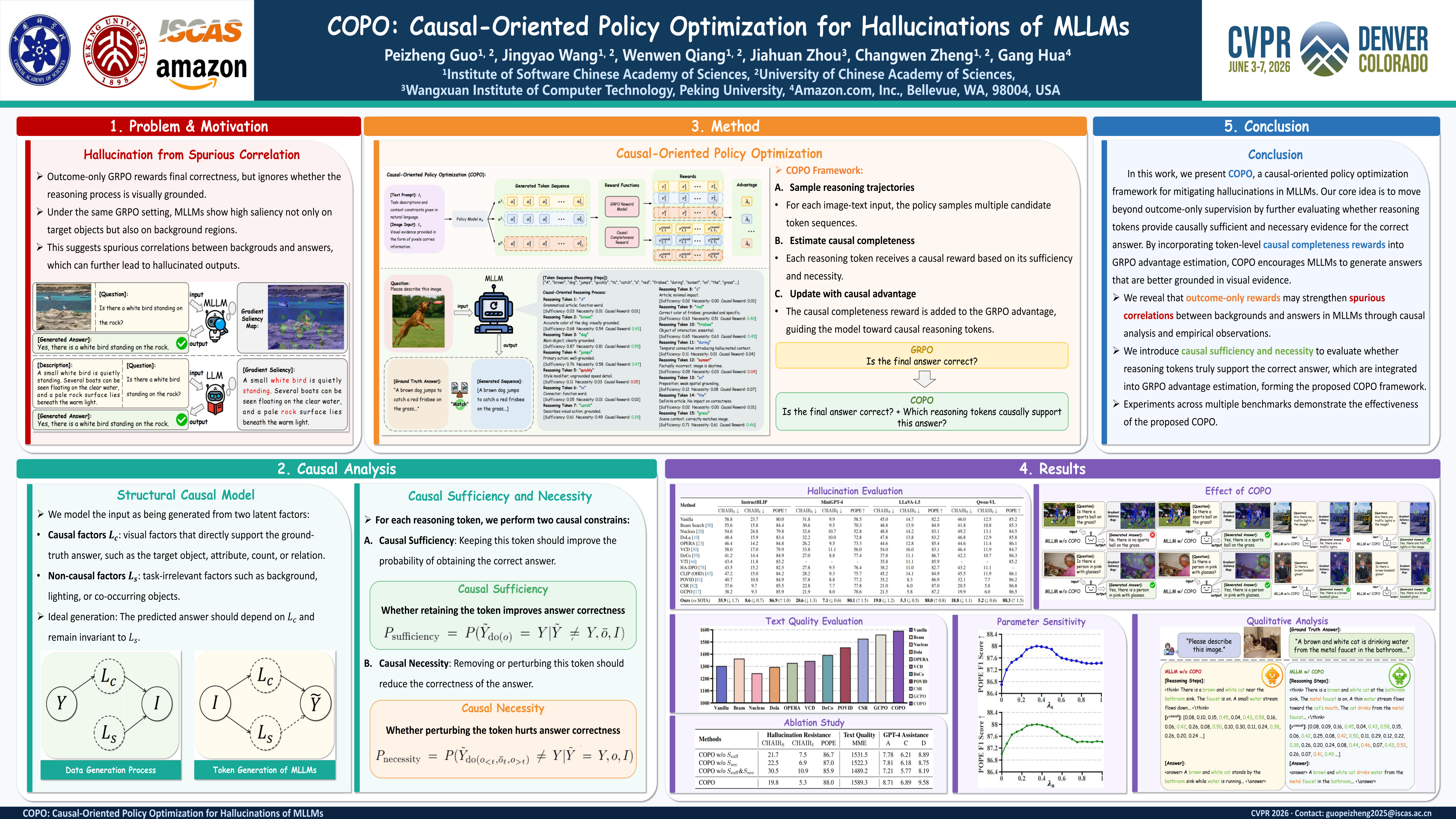
Despite Multimodal Large Language Models (MLLMs) having shown impressive capabilities, they may suffer from hallucinations. Empirically, we find that MLLMs attend disproportionately to task-irrelevant background regions compared with text-only LLMs, implying spurious background-answer correlations. We claim and analyze that (i) outcome-based rewards can be an important factor leading to spurious correlations, and (ii) spurious correlations can be an important factor leading to hallucinations. Based on these results, we propose Causal-Oriented Policy Optimization (COPO) to mitigate these spurious correlations, thus addressing the issue of hallucinations. It imposes token-level sufficiency and necessity constraints to measure each inference token's causal contribution, thus ensuring correct and evidence-grounded output. Specifically, we first evaluate each token's causal contribution via a newly proposed causal completeness reward. This reward is then used to construct a causally informed advantage function within the GRPO optimization framework, encouraging the model to focus on tokens that are causally sufficient and necessary for accurate generation. Experimental results across various benchmarks demonstrate the advantages of COPO.
Thinking in Uncertainty: Mitigating Hallucinations in MLRMs with Latent Entropy-Aware Decoding
Zhongxing Xu ⋅ Zhonghua Wang ⋅ Zhe Qian ⋅ Dachuan Shi ⋅ feilong tang ⋅ Ming Hu ⋅ Shiyan Su ⋅ Xiaocheng Zou ⋅ Wei Feng ⋅ Dwarikanath Mahapatra ⋅ Yifan Peng ⋅ Minquan Lin ⋅ Zongyuan Ge
Recent advancements in multimodal large reasoning models (MLRMs) have significantly improved performance in visual question answering. However, we observe that transition words (e.g., because, however, and wait) are closely associated with hallucinations and tend to exhibit high-entropy states. We argue that adequate contextual reasoning information can be directly extracted from the token probability distribution. Inspired by superposed representation theory, we propose leveraging latent superposed reasoning to integrate multiple candidate semantics and maintain latent reasoning trajectories. The hypothesis is that reliance on discrete textual inputs may drive the model toward sequential explicit reasoning, underutilizing dense contextual cues during high-entropy reasoning stages. Therefore, we propose constructing rich semantic representations from the token probability distributions to enhance in-context reasoning. With this goal, we present Latent Entropy-Aware Decoding (LEAD), an efficient plug-and-play decoding strategy that leverages semantic context to achieve reliable reasoning. The heart of our method lies in entropy-aware reasoning mode switching. The model employs probability-weighted continuous embeddings under high-entropy states and transitions back to discrete token embeddings as entropy decreases. Moreover, we propose a prior-guided visual anchor injection strategy that encourages the model to focus on visual information. Extensive experiments show that LEAD effectively mitigates hallucinations across various MLRMs on multiple benchmarks.
AdaIAT: Adaptively Increasing Attention to Generated Text to Alleviate Hallucinations in LVLM
Lian Zhong ⋅ Ziqiang He ⋅ Jibin Zheng ⋅ Jin Li ⋅ Z. Wang ⋅ xiangui Kang
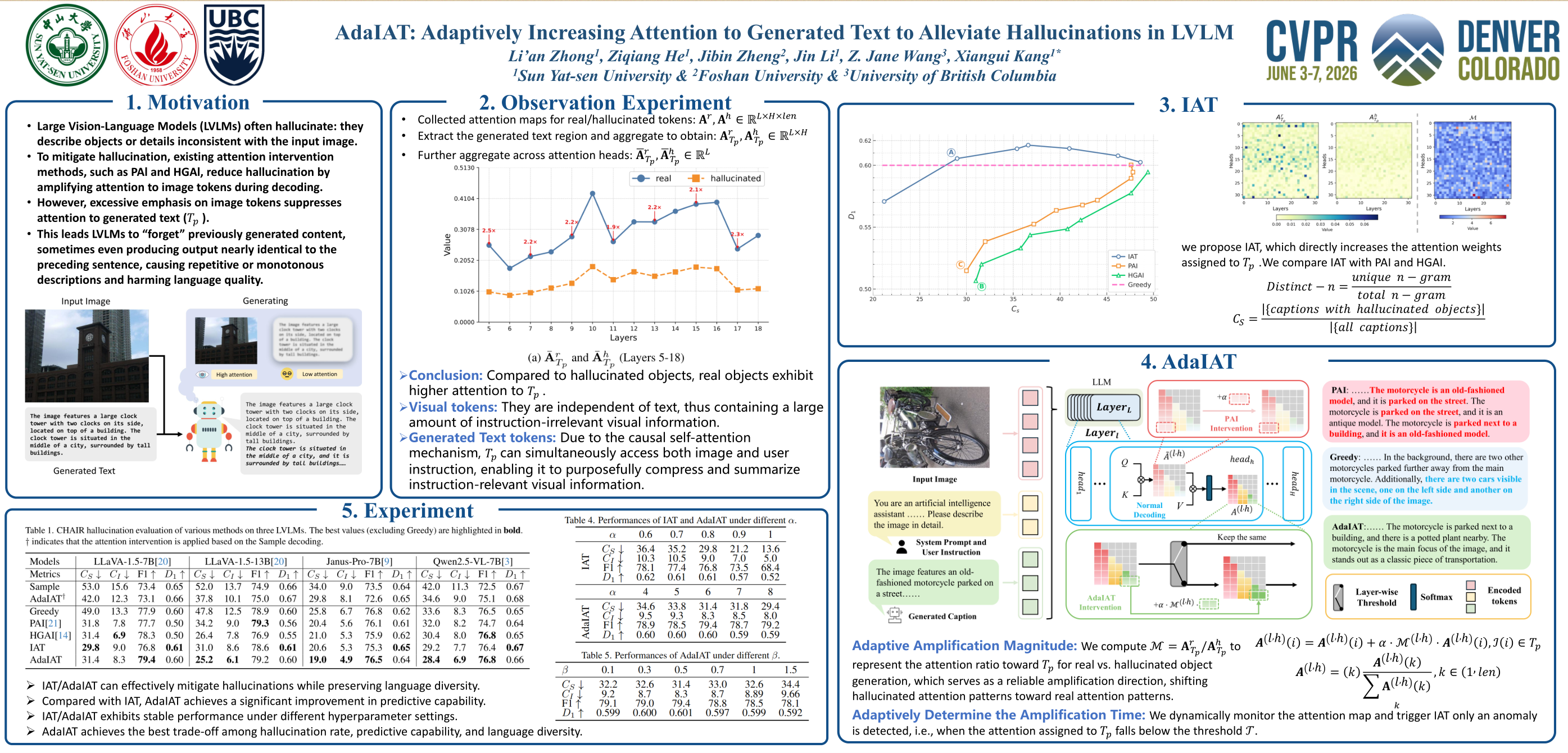
Hallucination has been a significant impediment to the development and application of current Large Vision-Language Models (LVLMs). To mitigate hallucinations, one intuitive and effective way is to directly increase attention weights to image tokens during inference. Although this effectively reduces the hallucination rate, it often induces repetitive descriptions.To address this, we first conduct an analysis of attention patterns and reveal that real object tokens tend to assign higher attention to the generated text than hallucinated ones. This inspires us to leverage the generated text, which contains instruction-related visual information and contextual knowledge, to alleviate hallucinations while maintaining linguistic coherence. We therefore propose Increase Attention to Generated Text (IAT) and demonstrate that it significantly reduces the hallucination rate while avoiding repetitive descriptions.To prevent naive amplification from impairing the inherent prediction capabilities of LVLMs, we further explore Adaptive IAT (AdaIAT) that employs a layer-wise threshold to control intervention time and fine-grained amplification magnitude tailored to the characteristics of each attention head.Both analysis and experiments demonstrate the effectiveness of AdaIAT. Results of several LVLMs show that AdaIAT effectively alleviates hallucination (reducing hallucination rates $C_S$ and $C_I$ on LLaVA-1.5 by 35.8\% and 37.1\%, respectively) while preserving linguistic performance and prediction capability, achieving an attractive trade-off.
HulluEdit: Single-Pass Evidence-Consistent Subspace Editing for Mitigating Hallucinations in Large Vision-Language Models
Yangguang Lin ⋅ Quan Fang ⋅ Yufei Li ⋅ Jiachen Sun ⋅ Junyu Gao ⋅ Jitao Sang
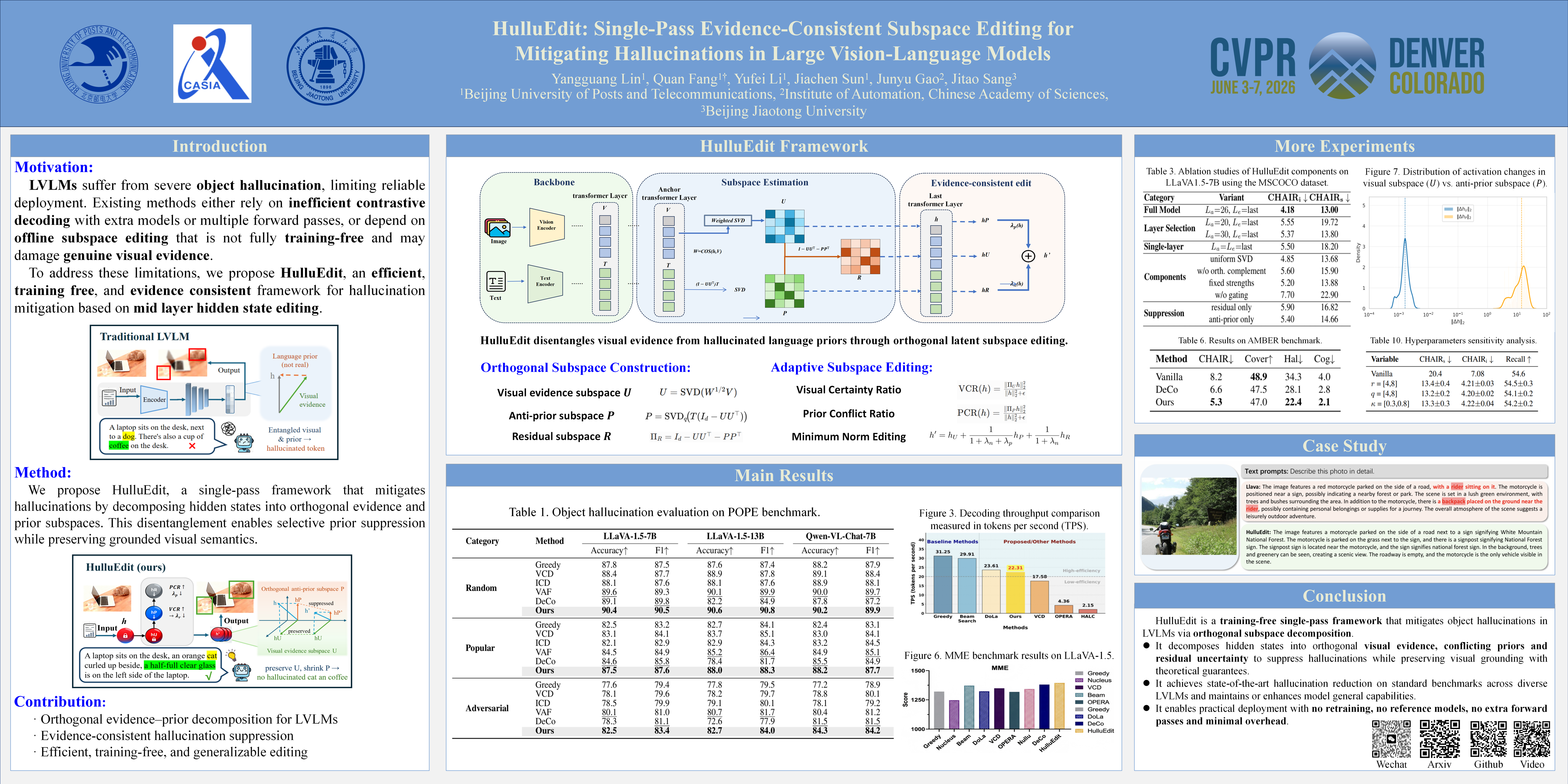
Object hallucination in Large Vision-Language Models (LVLMs) significantly hinders their reliable deployment. Existing methods struggle to balance efficiency and accuracy: they often require expensive reference models and multiple forward passes, or apply static edits that risk suppressing genuine visual evidence. To address this, we introduce HulluEdit, a single-pass, reference-free intervention framework. Our core innovation is orthogonal subspace editing: we decompose the hidden states of the model into orthogonal subspaces—visual evidence, conflicting priors, and residual uncertainty—enabling selective suppression of hallucinatory patterns without interfering with visual grounding. This approach mathematically guarantees that edits applied to the prior subspace leave the visual component entirely unaffected. Extensive experiments show that HulluEdit achieves state-of-the-art hallucination reduction on benchmarks including POPE and CHAIR across diverse architectures, while preserving general capabilities on MME and maintaining efficient inference. Our method consistently outperforms contrastive decoding and static subspace editing baselines, offering a new pathway toward more trustworthy LVLMs.
SEASON: Mitigating Temporal Hallucination in Video Large Language Models via Self-Diagnostic Contrastive Decoding
Chang-Hsun Wu ⋅ Kai-Po Chang ⋅ Yu-Yang Sheng ⋅ Hung-Kai Chung ⋅ Kuei-Chun Wang ⋅ Yu-Chiang Frank Wang
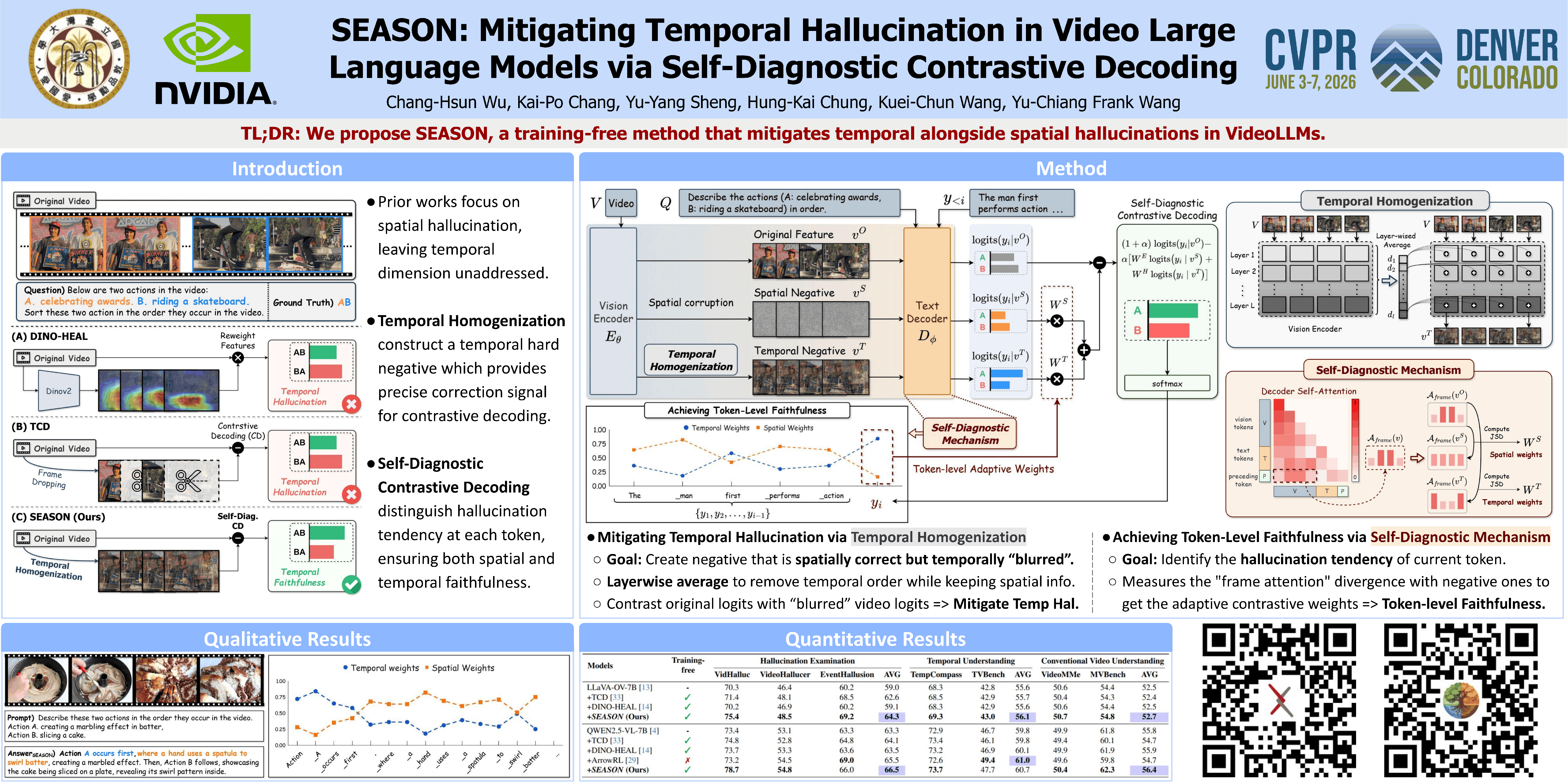
Video Large Language Models (VideoLLMs) have shown remarkable progress in video understanding. However, these models still struggle to effectively perceive and exploit rich temporal information in videos when responding to user queries. Therefore, they often generate descriptions of events that are temporal inconsistent or causally implausible, causing severe hallucination issues. While most prior studies have focused on spatial hallucinations (e.g. object mismatches), temporal reasoning in video understanding remains relatively underexplored. To address this issue, we propose Self-Diagnostic Contrastive Decoding (SEASON), a training-free method that adaptively enhances temporal and spatial faithfulness for each output token. It achieves this by dynamically diagnosing each token's hallucination tendency and applying adaptive contrastive decoding against its corresponding temporal and spatial negatives. Extensive experiments demonstrate that SEASON outperforms all existing training-free hallucination mitigation approaches on three hallucination examination benchmarks, while further improves VideoLLMs across four general video understanding benchmarks. The code will be released upon acceptance.
One Token, Two Fates: A Unified Framework via Vision Token Manipulation Against MLLMs Hallucination
Zhan Fa ⋅ Yue Duan ⋅ Jian Zhang ⋅ Lei Qi ⋅ Yinghuan Shi
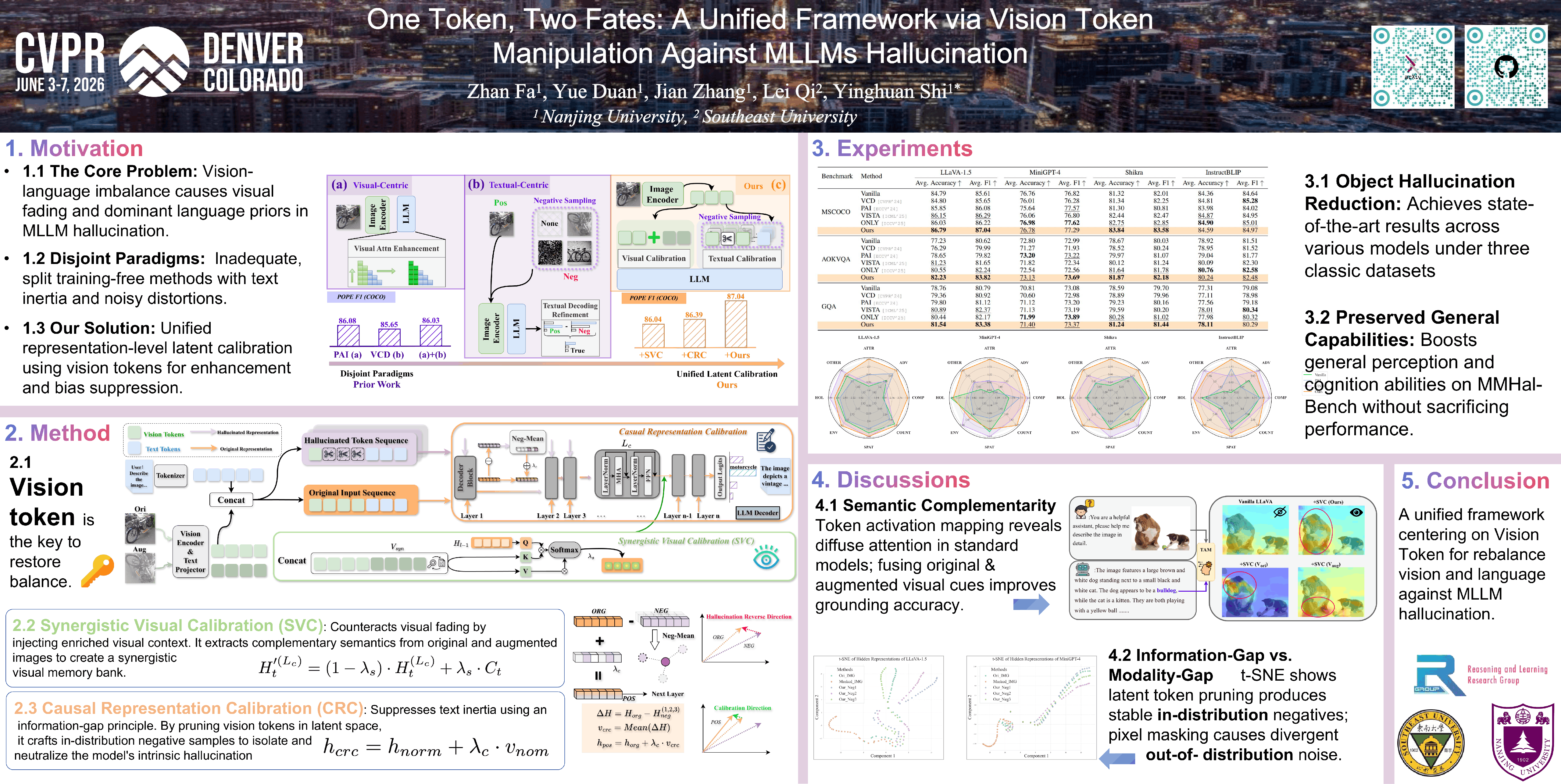
Current training-free methods tackle MLLM hallucination with separate strategies: either enhancing visual signals or suppressing text inertia. However, these separate methods are insufficient due to critical trade-offs: simply enhancing vision often fails against strong language prior, while suppressing language can introduce extra image-irrelevant noise. Moreover, we find their naive combination is also ineffective, necessitating a unified framework. We propose such a framework by focusing on the core asset: the vision token. Our design leverages two key insights: (1) augmented images offer complementary visual semantics, and (2) removing vision tokens (information-gap) isolates hallucination tendencies more precisely than distorting images (modality-gap). Based on these, our framework uses vision tokens in two distinct ways, both operating on latent representations: our Synergistic Visual Calibration (SVC) module incorporates augmented tokens to strengthen visual representations, while our Causal Representation Calibration (CRC) module uses pruned tokens to create latent-space negative samples for correcting internal model biases. By harmonizing these two roles, our framework effectively restores the vision-language balance, significantly reducing object hallucinations, improving POPE accuracy by an average of 2% absolute on LLaVA-1.5 across multiple benchmarks with only a 1.06x inference latency overhead. Codes are available in supplementary materials.
EgoX: Egocentric Video Generation from a Single Exocentric Video
Taewoong Kang ⋅ Kinam Kim ⋅ Dohyeon Kim ⋅ Minho Park ⋅ Junha Hyung ⋅ Jaegul Choo
Egocentric perception enables humans to experience and understand the world directly from their own point of view. Translating exocentric (third-person) videos into egocentric (first-person) videos opens up new possibilities for immersive understanding but remains highly challenging due to extreme camera pose variations and minimal view overlap. This task requires faithfully preserving visible content while synthesizing unseen regions in a geometrically consistent manner. To achieve this, we present EgoX, a novel framework for generating egocentric videos from a single exocentric input.EgoX leverages the pretrained spatio–temporal knowledge of large-scale video diffusion models through lightweight LoRA adaptation and introduces a unified conditioning strategy that combines exocentric and egocentric priors via width- and channel-wise concatenation.Additionally, a geometry-guided self-attention mechanism selectively attends to spatially relevant regions, ensuring geometric coherence and high visual fidelity.Our approach achieves coherent and realistic egocentric video generation while demonstrating strong scalability and robustness across unseen and in-the-wild videos.
SymphoMotion: Joint Control of Camera Motion and Object Dynamics for Coherent Video Generation
Guiyu Zhang ⋅ Yabo Chen ⋅ Xunzhi Xiang ⋅ Junchao Huang ⋅ Zhongyu Wang ⋅ Li Jiang
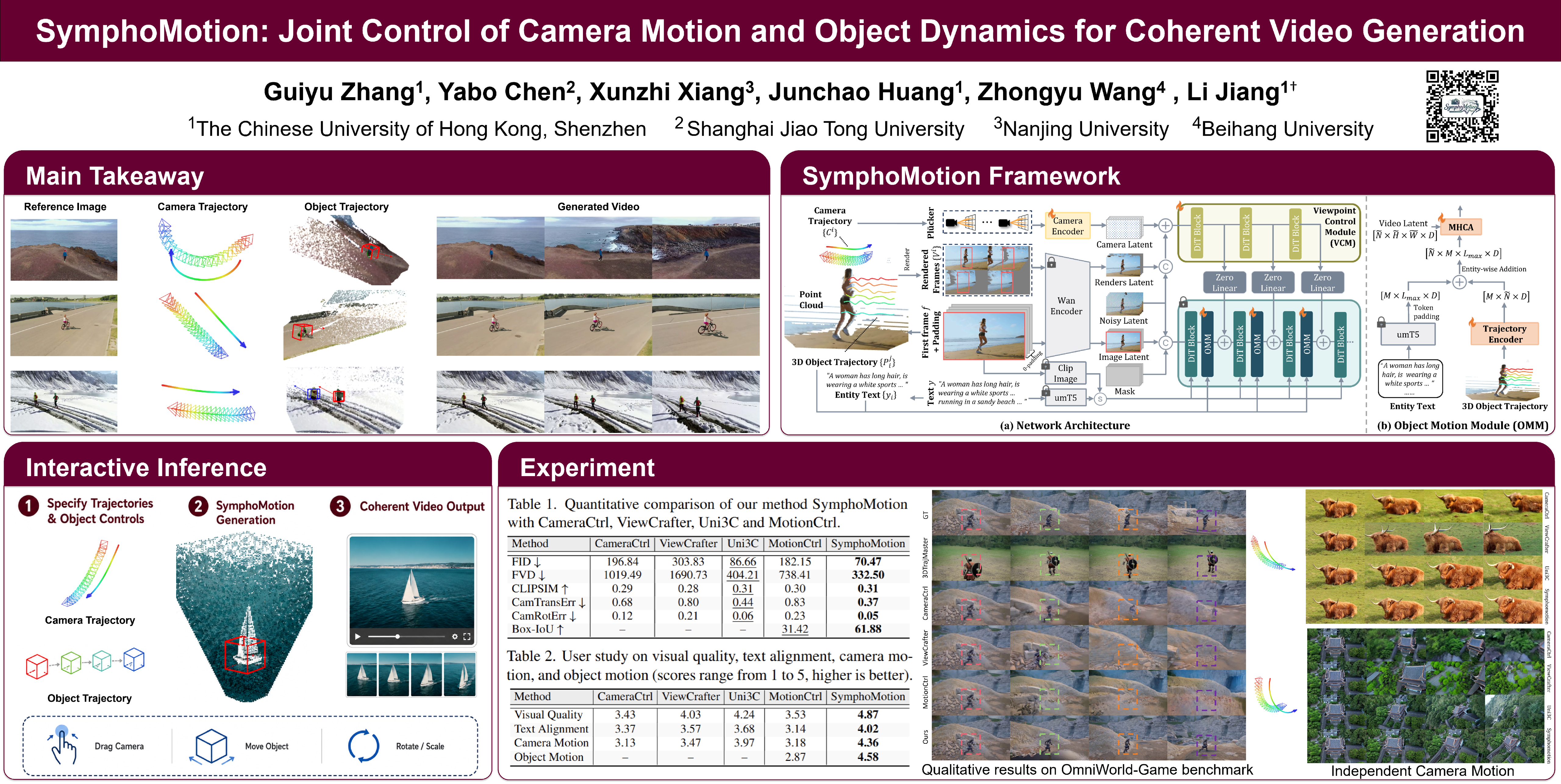
Controlling both camera motion and object dynamics is essential for coherent and expressive video generation, yet current methods typically handle only one motion type or rely on ambiguous 2D cues that entangle camera-induced parallax with true object movement. We present SymphoMotion, a unified motion-control framework that jointly governs camera trajectories and object dynamics within a single model. SymphoMotion features a Camera Trajectory Control mechanism that integrates explicit camera paths with geometry-aware cues to ensure stable, structurally consistent viewpoint transitions, and an Object Dynamics Control mechanism that combines 2D visual guidance with 3D trajectory embeddings to enable depth-aware, spatially coherent object manipulation. To support large-scale training and evaluation, we further construct RealCOD-25K, a comprehensive real-world dataset containing paired camera poses and object-level 3D trajectories across diverse indoor and outdoor scenes, addressing a key data gap in unified motion control. Extensive experiments and user studies show that SymphoMotion significantly outperforms existing methods in visual fidelity, camera controllability, and object-motion accuracy, establishing a new benchmark for unified motion control in video generation.
Pantheon360: Taming Digital Twin Generation via 3D-Aware 360° Video Diffusion
Ting-Hsuan Chen ⋅ Ying-Huan Chen ⋅ Tao Tu ⋅ Jie-Ying Lee ⋅ Cho-Ying Wu ⋅ Fangzhou Lin ⋅ Hengyuan Zhang ⋅ David Paz ⋅ Xinyu Huang ⋅ Yuliang Guo ⋅ Yu-Lun Liu ⋅ Yue Wang ⋅ Liu Ren
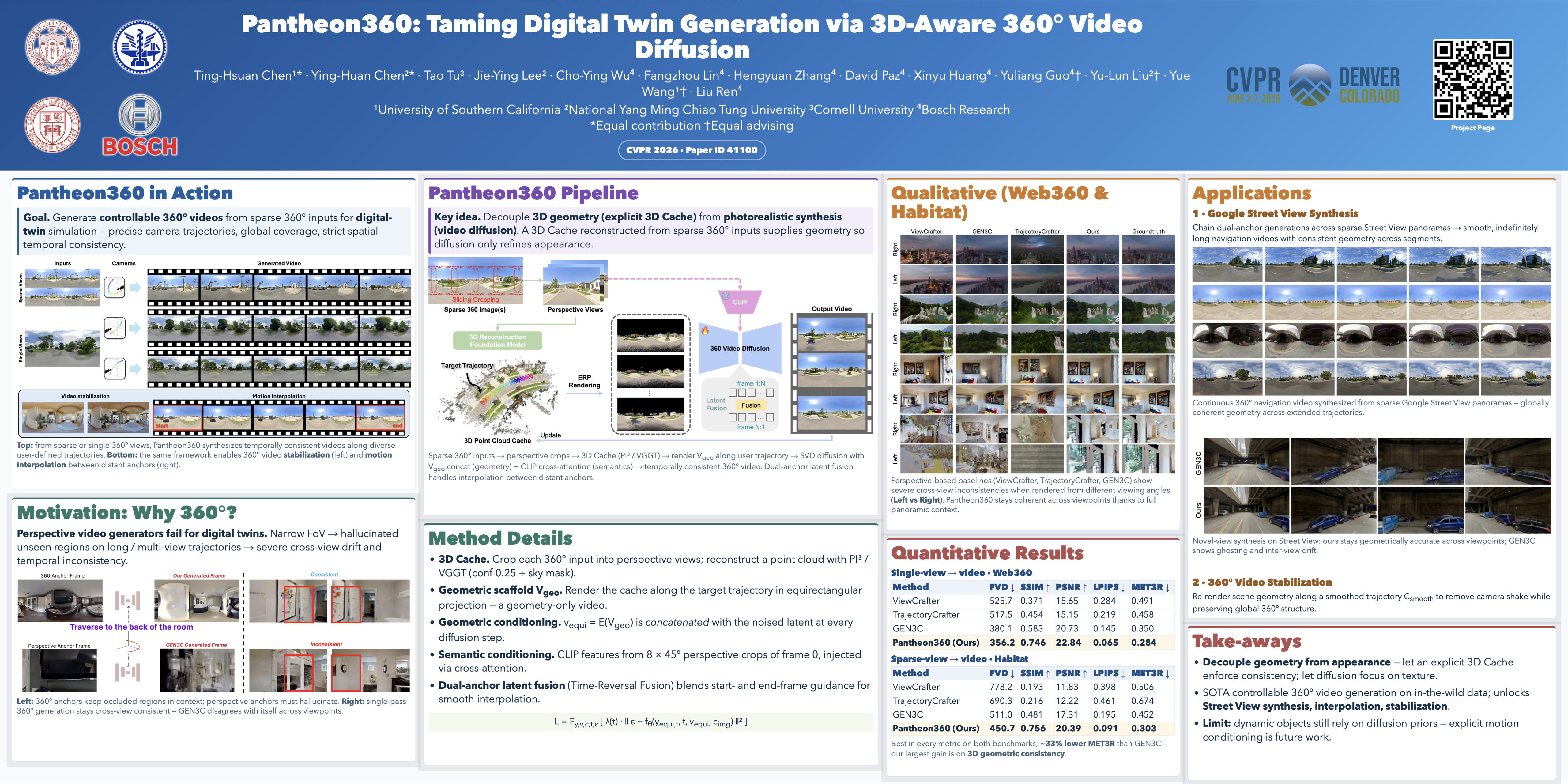
Generating complete digital twins from videos requires precise camera control, global scene coverage, and strict spatial–temporal consistency—constraints that remain challenging for perspective video generators due to their limited field of view (FoV). Their narrow FoV forces long or multi-view trajectories, amplifying cross-view inconsistency and temporal drift.We argue that 360° video generation offers a natural solution: panoramic coverage simplifies trajectory design and provides strong global context for maintaining coherence. We introduce Pantheon360: Taming Digital Twin Generation via 3D-Aware 360° Video Diffusion, a controllable 360° video generation framework that synthesizes high-fidelity videos from sparse 360° inputs. The key idea is an explicit 3D Cache, reconstructed from the input, which serves as a geometric scaffold for any user-defined camera path. This allows the diffusion model to focus on photorealistic texture refinement while the 3D Cache enforces global geometric consistency.Experiments show that Pantheon360 achieves superior visual quality and unmatched geometric coherence, enabling reliable and flexible 360° scene generation for downstream simulation and digital-twin applications.
SeeU: Seeing the Unseen World via 4D Dynamics-aware Generation
Yu Yuan ⋅ Tharindu Wickremasinghe ⋅ Zeeshan Nadir ⋅ Xijun Wang ⋅ Yiheng Chi ⋅ Stanley H. Chan
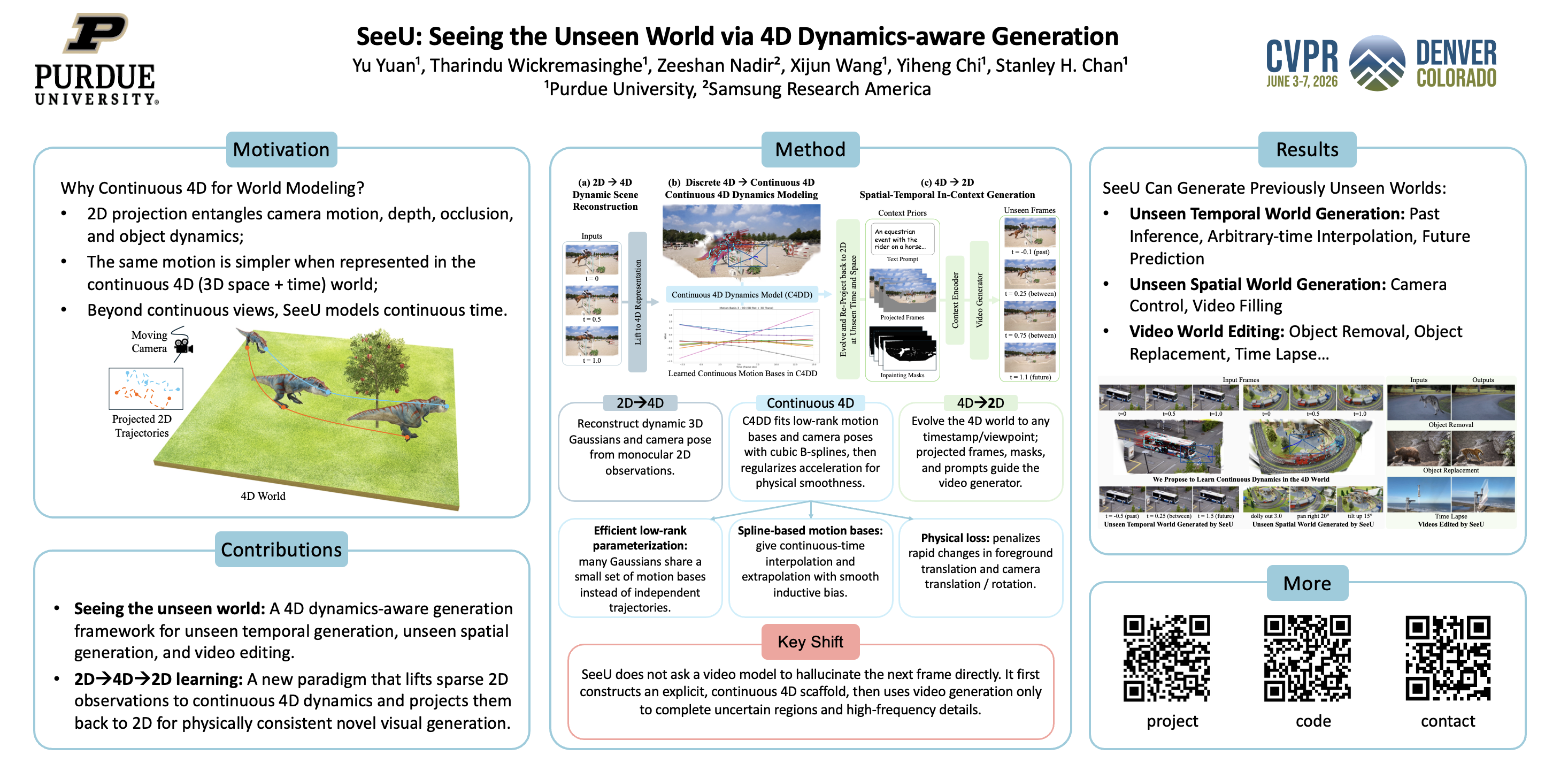
Images and videos are discrete 2D projections of the 4D world (3D space + time). Most visual understanding, prediction, and generation operate directly on 2D observations, leading to suboptimal performance. We propose SeeU, a novel approach that learns the continuous 4D dynamics and generate the unseen visual contents. The principle behind SeeU is a new 2D$\to$4D$\to$2D learning framework. SeeU first reconstructs the 4D world from sparse and monocular 2D frames (2D$\to$4D). It then learns the continuous 4D dynamics on a low-rank representation and physical constraints (discrete 4D$\to$continuous 4D). Finally, SeeU rolls the world forward in time, re-projects it back to 2D at sampled times and viewpoints, and generates unseen regions based on spatial-temporal context awareness (4D$\to$2D). By modeling dynamics in 4D, SeeU achieves continuous and physically-consistent novel visual generation, demonstrating strong potentials in multiple tasks including unseen temporal generation, unseen spatial generation, and video editing.
ReDirector: Creating Any-Length Video Retakes with Rotary Camera Encoding
Byeongjun Park ⋅ Byung-Hoon Kim ⋅ Hyungjin Chung ⋅ Jong Chul
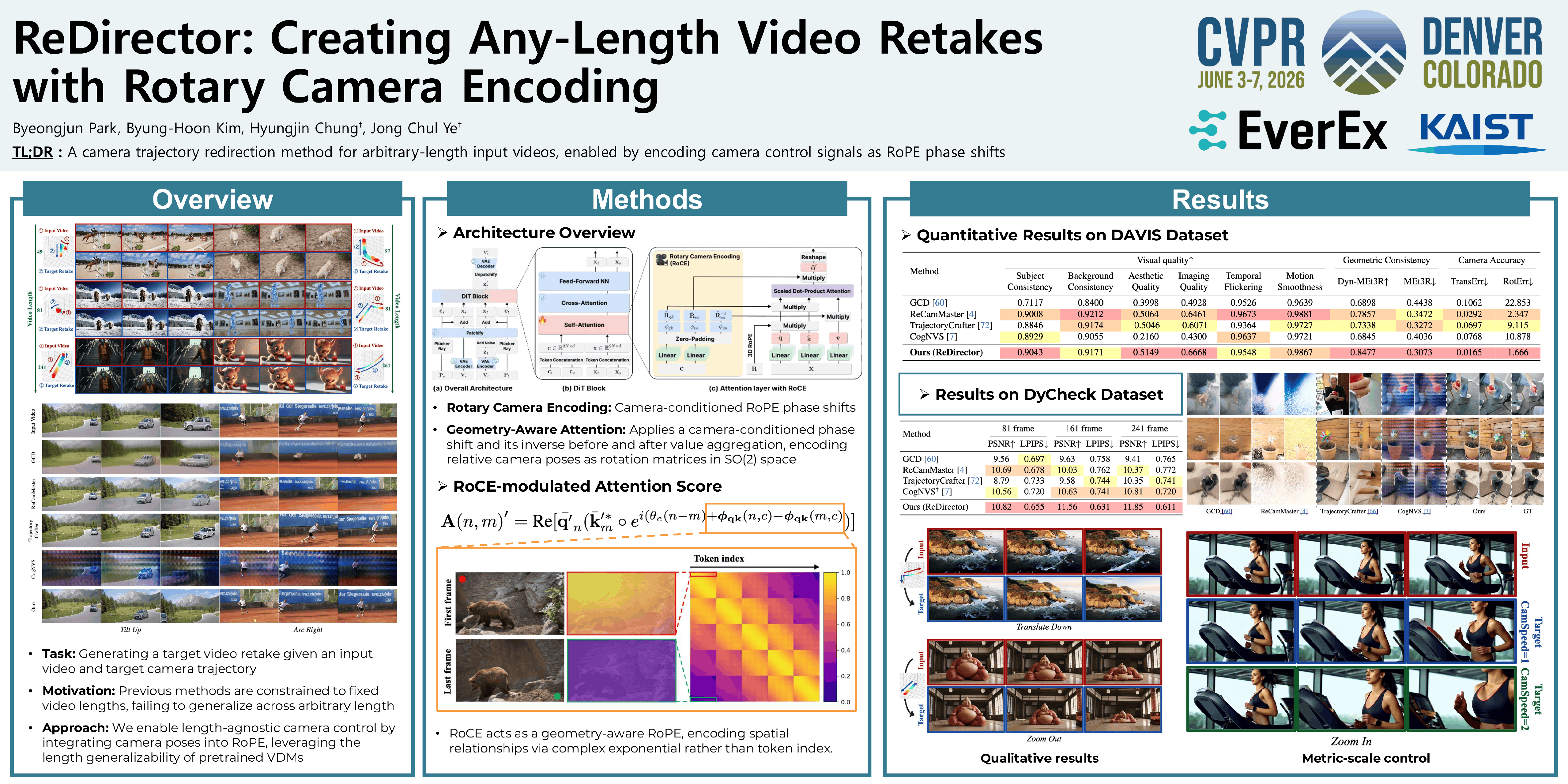
We present ReDirector, a novel camera-controlled video retake generation method for dynamically captured variable-length videos. In particular, we rectify a common misuse of RoPE in previous works by aligning the spatiotemporal positions of the input video and the target retake. Moreover, we introduce Rotary Camera Encoding (RoCE), a camera-conditioned RoPE phase shift that captures and integrates multi-view relationships within and across the input and target videos. By integrating camera conditions into RoPE, our method generalizes to out-of-distribution camera trajectories and video lengths, yielding improved dynamic object localization and static background preservation. Extensive experiments further demonstrate significant improvements in camera controllability, geometric consistency, and video quality across various trajectories and lengths.
Scaling4D: Pushing the Frontier of Video Novel View Synthesis through Large-Scale Monocular Videos
Hongrui Cai ⋅ Junjie Luo ⋅ Zhihong Fu ⋅ Shengnan Zhu ⋅ Jiawei Wen ⋅ Wanquan Feng ⋅ Songtao Zhao ⋅ Qian HE
Video Novel View Synthesis (VNVS) aims to render arbitrary novel viewpoints of dynamic scenes from a single-view video, but its algorithmic training faces a major challenge: the lack of large-scale multi-view video datasets. Prior methods often train on monocular data by framing it as an inpainting task, which typically leads to a train-inference gap and visual artifacts. While synthetic multi-view data can partially alleviate the data scarcity issue, its high acquisition costs and limited diversity restrict scalability. To address these problems, we propose Scaling4D, a novel strategy that theoretically avoids the train-inference gap while leveraging large-scale monocular videos for training. Specifically, we take a higher-level perspective on the problem, reformulating VNVS into a general correspondence-guided generation task. Furthermore, in conjunction with extensive real-world data, we establish a synthetic data pipeline integrated with our training strategy to enhance precision. Qualitative and quantitative results demonstrate a positive correlation between performance and training data volume, confirming our scalability.
PHANTOM: Physics-Infused Video Generation via Joint Modeling of Visual and Latent Physical Dynamics
Ying Shen ⋅ Jerry Xiong ⋅ Tianjiao Yu ⋅ Ismini Lourentzou
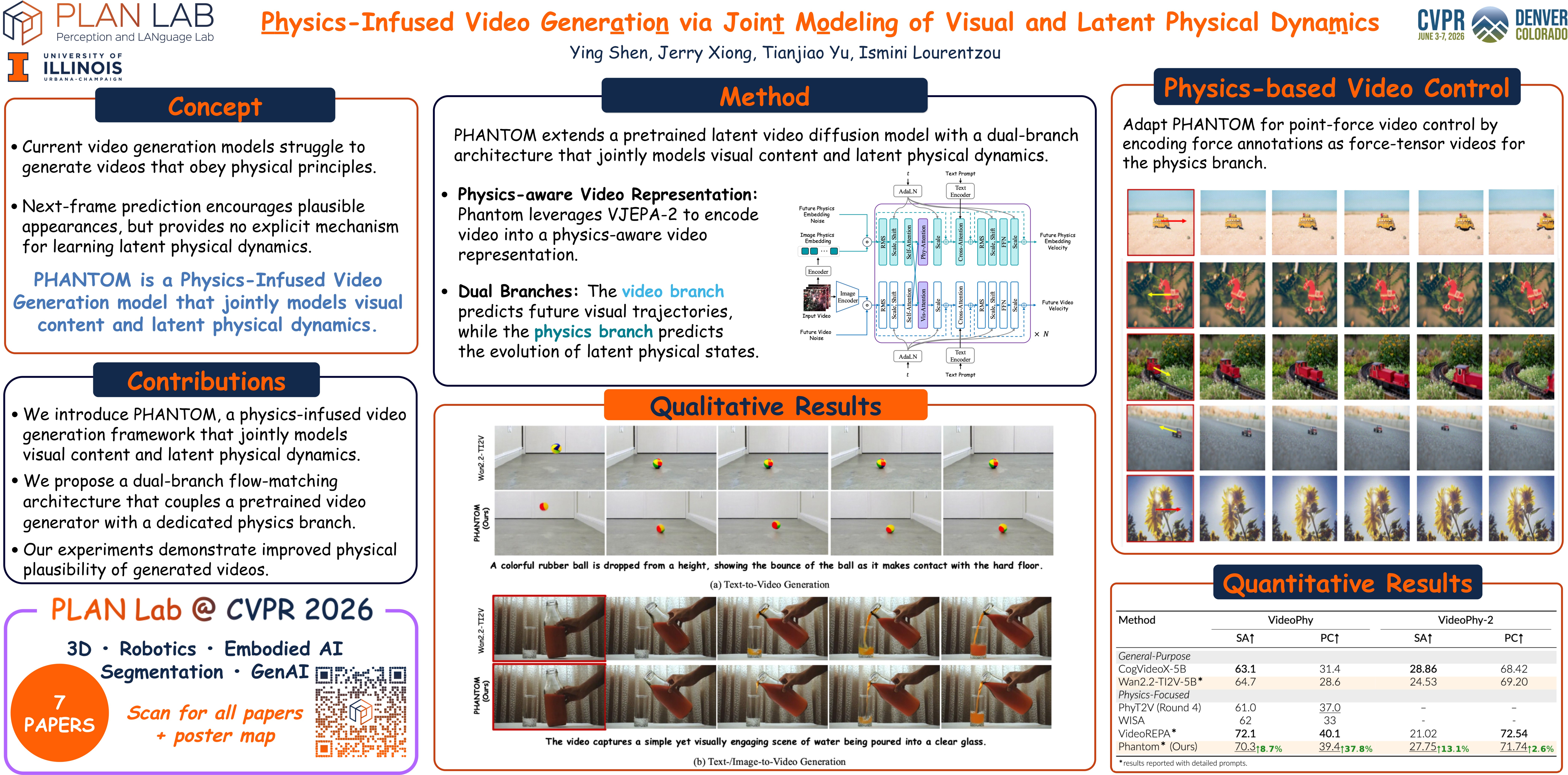
Recent advances in generative video modeling, driven by large-scale datasets and powerful architectures, have yielded remarkable visual realism. However, emerging evidence suggests that simply scaling data and model size does not endow these systems with an understanding of the underlying physical laws that govern real-world dynamics. Existing approaches often fail to capture or enforce such physical consistency, resulting in unrealistic motion and dynamics.In this work, we investigate whether integrating the inference of latent physical properties directly into the video generation process can equip models with the ability to produce physically plausible videos. To this end, we propose PHANTOM, a Physics-Infused Video Generation model that jointly models the visual content and latent physical dynamics. Conditioned on observed video frames and inferred physical states, PHANTOM jointly predicts latent physical dynamics and generates future video frames.PHANTOM leverages a physics-aware video representation that serves as an abstract yet informative embedding of the underlying physics, facilitating the joint prediction of physical dynamics alongside video content without requiring an explicit specification of a complex set of physical dynamics and properties. By integrating the inference of physical-aware video representation directly into the video generation process, PHANTOM produces video sequences that are both visually realistic and physically consistent.Quantitative and qualitative results on both standard video generation and physics-aware benchmarks demonstrate that PHANTOM not only outperforms existing methods in terms of adherence to physical dynamics but also delivers competitive perceptual fidelity.
WorldReel: 4D Video Generation with Consistent Geometry and Motion Modeling
Shaoheng Fang ⋅ Hanwen Jiang ⋅ Yunpeng Bai ⋅ Niloy J. Mitra ⋅ Qixing Huang
Recent video generators achieve striking photorealism, yet remain fundamentally inconsistent in 3D. We present WorldReel, a 4D video generator that is natively spatio-temporally consistent. WorldReel jointly produces RGB frames together with 4D scene representations, including pointmaps, camera trajectory, and dense flow mapping, enabling coherent geometry and appearance modeling over time. Our explicit 4D representation enforces a single underlying scene that persists across viewpoints and dynamic content, yielding videos that remain consistent even under large non-rigid motion and significant camera movement.We train WorldReel by carefully combining synthetic and real data: synthetic data provides precise 4D supervision (geometry, motion, and camera), while real videos contribute visual diversity and realism. This blend allows WorldReel to generalize to in-the-wild footage while preserving strong geometric fidelity.Extensive experiments demonstrate that WorldReel sets a new state-of-the-art for consistent video generation with dynamic scenes and moving cameras, improving metrics of geometric consistency, motion coherence, and reducing view-time artifacts over competing methods. We believe that WorldReel brings video generation closer to 4D-consistent world modeling, where agents can render, interact, and reason about scenes through a single and stable spatiotemporal representation.
Let Your Image Move with Your Motion! -- Implicit Multi-Object Multi-Motion Transfer
Li Yuze ⋅ Dong Gong ⋅ Xiao Cao ⋅ Junchao Yuan ⋅ Dongsheng Li ⋅ Lei Zhou ⋅ Yun Sing Koh ⋅ Cheng Yan ⋅ Xinyu Zhang
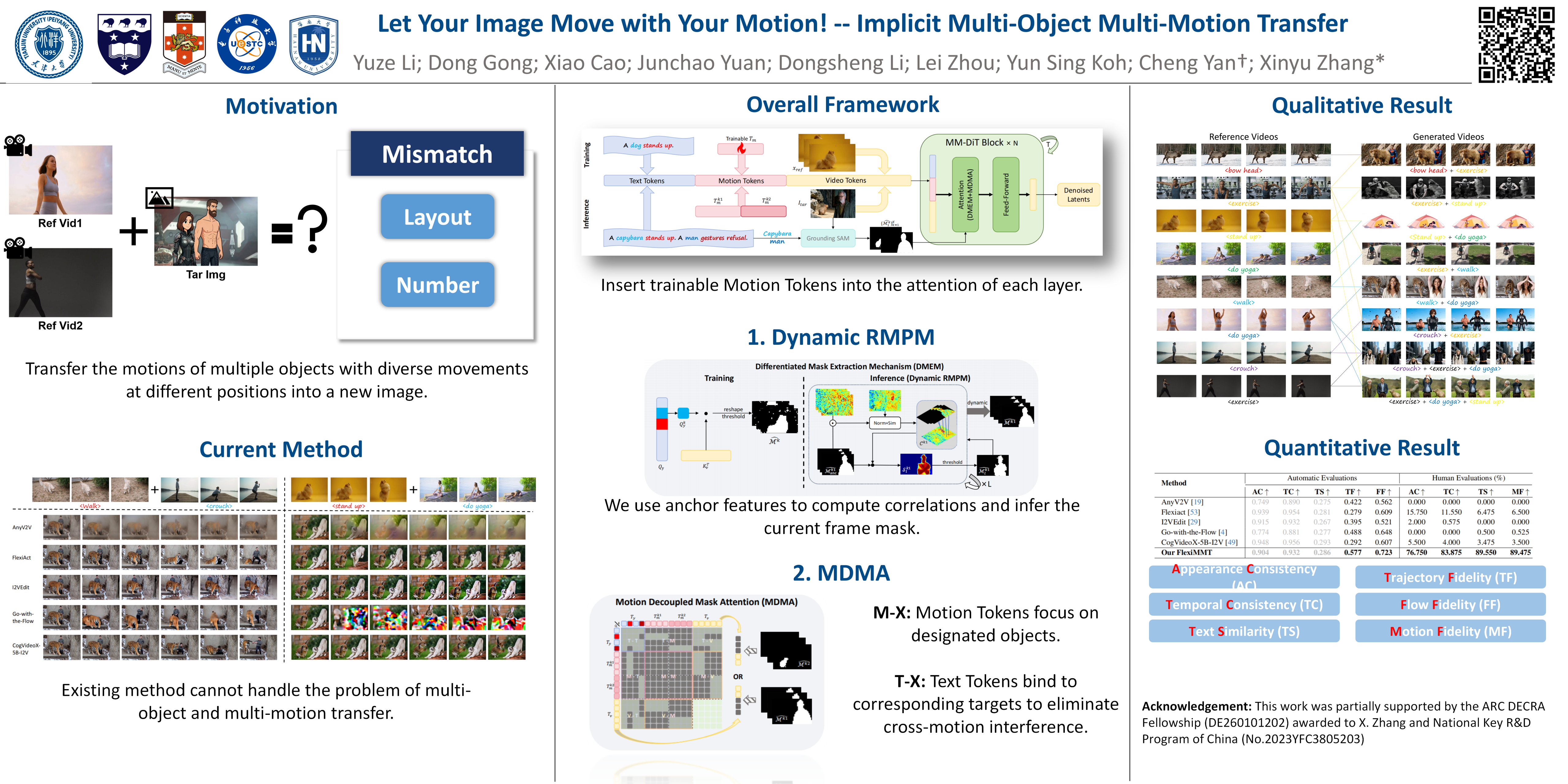
Motion transfer has emerged as a promising direction for controllable video generation, yet existing methods largely focus on single-object scenarios and struggle when multiple objects require distinct motion patterns. In this work, we present FlexiMMT, the first implicit image-to-video (I2V) motion transfer framework that explicitly enables multi-object, multi-motion transfer. Given a static multi-object image and multiple reference videos, FlexiMMT independently extracts motion representations and accurately assigns them to different objects, supporting flexible recombination and arbitrary motion-to-object mappings. To address the core challenge of cross-object motion entanglement, we introduce a Motion Decoupled Mask Attention Mechanism that uses object-specific masks to constrain attention, ensuring that motion and text tokens only influence their designated regions. We further propose a Differentiated Mask Propagation Mechanism that derives object-specific masks directly from diffusion attention and progressively propagates them across frames efficiently. Extensive experiments demonstrate that FlexiMMT achieves precise, compositional, and state-of-the-art performance in I2V-based multi-object multi-motion transfer. All code, models, and benchmarks will be publicly available.
SpaceTimePilot: Generative Rendering of Dynamic Scenes Across Space and Time
Zhening Huang ⋅ Hyeonho Jeong ⋅ Xuelin Chen ⋅ Yulia Gryaditskaya ⋅ Tuanfeng Wang ⋅ Joan Lasenby ⋅ Chun-Hao Huang
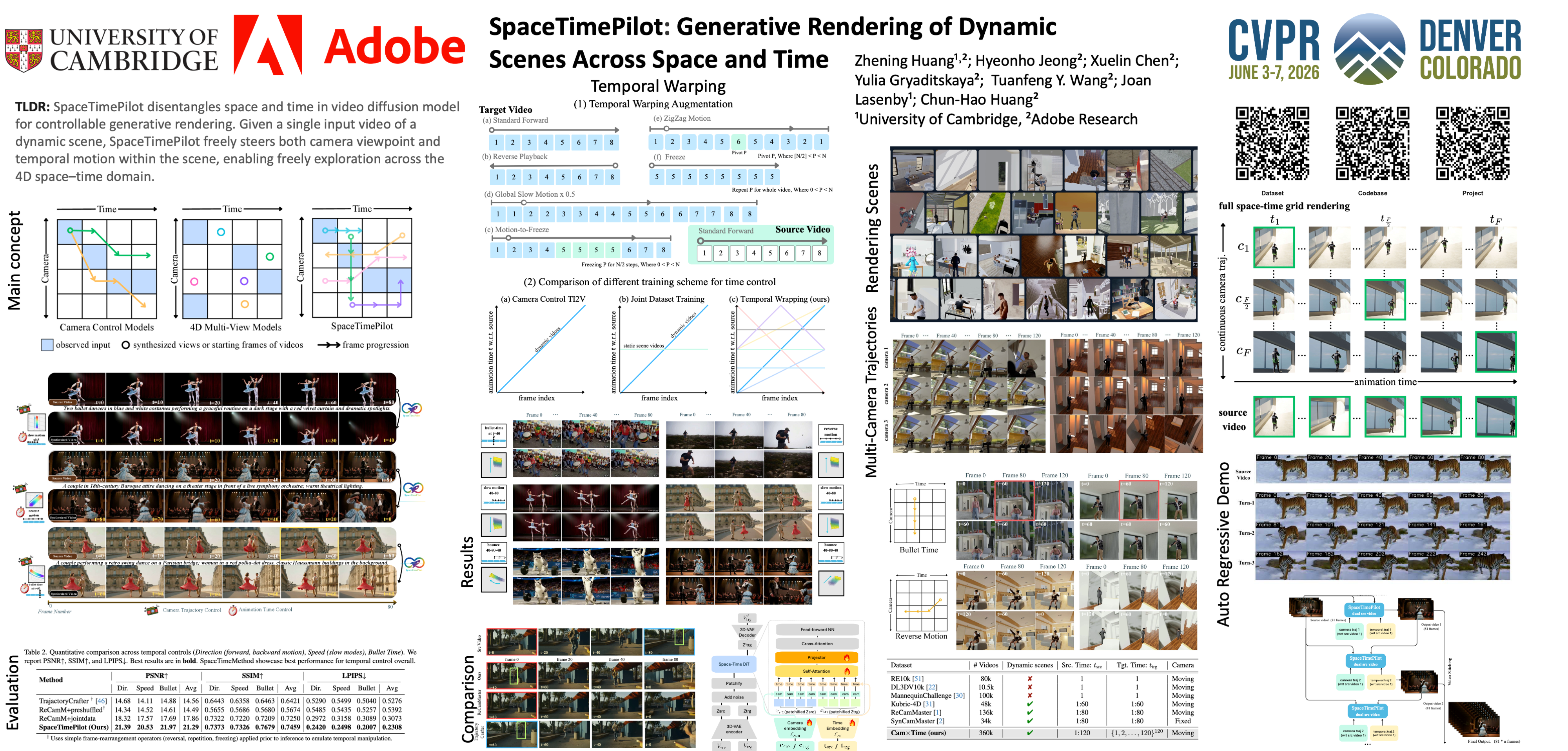
We present SpaceTimePilot, a video diffusion model that disentangles space and time for controllable generative rendering. Given a monocular video, SpaceTimePilot can independently alter both the camera viewpoint and the motion sequence within the generative process, re-rendering the scene for continuous and arbitrary exploration across space and time. To achieve this, we introduce an effective animation time-embedding mechanism in the diffusion process, allowing explicit control of the output video’s motion sequence with respect to that of the source video. As no datasets provide paired videos of the same dynamic scene with continuous temporal variations, we propose a temporal-warping training scheme that repurposes existing multi-view datasets to mimic temporal differences. This simple yet crucial strategy enables the model to learn temporal control, directly producing the observed space–time disentanglement effects.To further enhance the precision of dual control, we introduce two additional components: an improved camera-conditioning mechanism that allows altering the camera from the first frame, and CamxTime, the first synthetic Space and Time full-coverage rendering dataset that provides fully free space–time video trajectories within a scene. Joint training on the temporal-warping scheme and the CamxTime dataset yields more precise temporal control. We evaluate SpaceTimePilot on both real-world and synthetic data, demonstrating clear space–time disentanglement and strong results compared to prior arts.
D2FANet: Enhancing Video Object Detection with Dual-Domain Feature Aggregation Network
Qiang Qi ⋅ Wenqi Shang ⋅ Meifang Wang ⋅ Xiao Wang
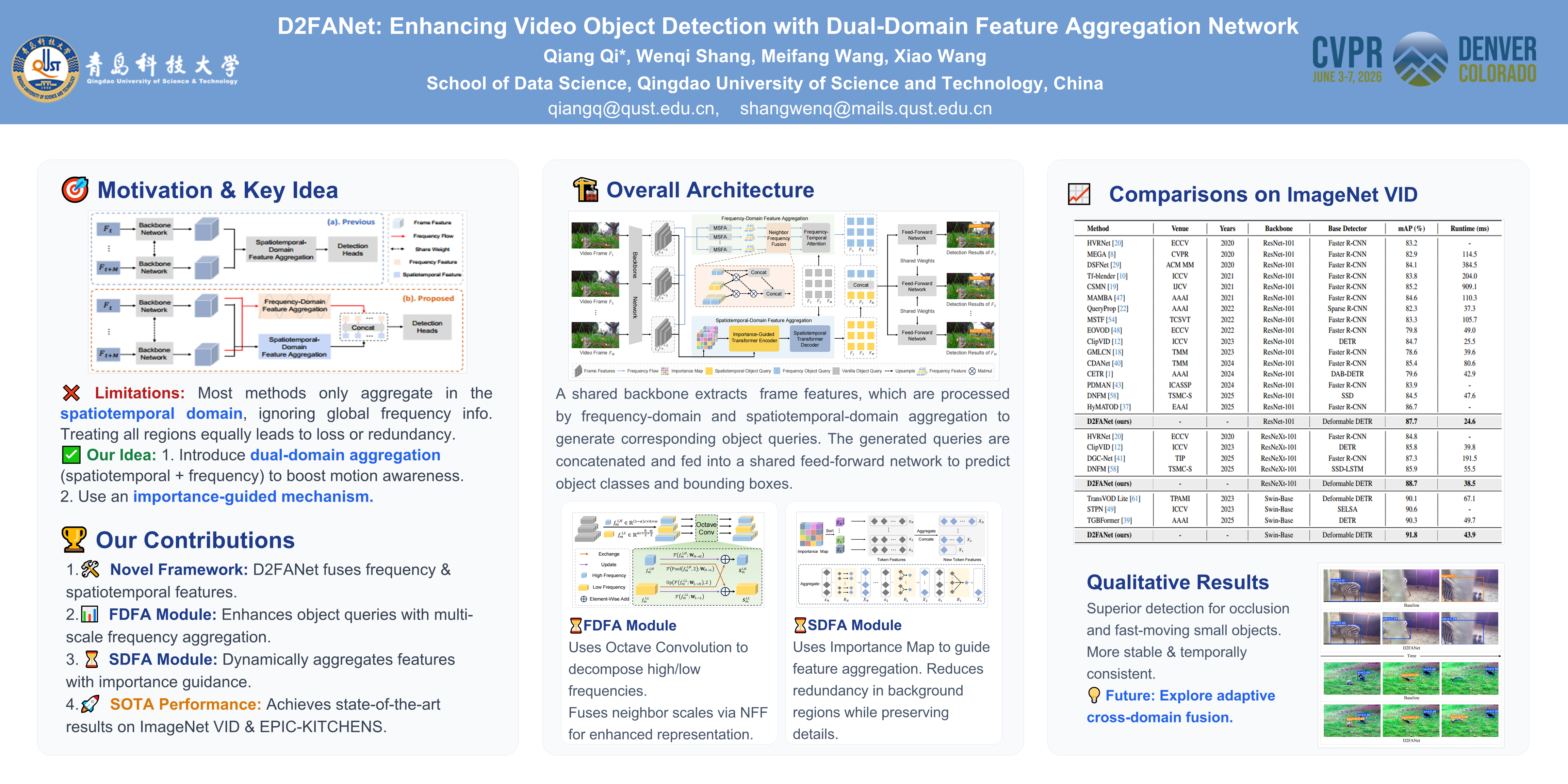
Accurately capturing and aggregating spatiotemporal information has become crucial for video object detection. Previous methods mainly perform feature aggregation in the spatiotemporal domain, treating all regions indiscriminately and overlooking both their relative importance and the frequency characteristics that capture periodic motion patterns. This limits the capability of these methods to capture dynamic interactions and adapt to complex scene variations. In this paper, we propose a novel Dual-Domain Feature Aggregation Network (D2FANet) for video object detection, which, to the best of our knowledge, is the first work to introduce the frequency-domain feature aggregation into the video object detection task. By collaboratively modeling spatiotemporal and frequency information, our D2FANet enhances motion awareness and temporal consistency, thereby improving detection accuracy. First, we develop a frequency-domain feature aggregation module that decomposes frame features into high- and low-frequency distributions and reinforces object query representations through aggregating multi-scale frequency features. Second, we design a spatiotemporal-domain feature aggregation module that leverages an importance guidance mechanism to dynamically emphasize regions of different importance and reinforces object query representations via guiding the aggregation of spatiotemporal features. Experiments on the ImageNet VID and EPIC-KITCHENS datasets demonstrate that D2FANet achieves state-of-the-art performance. The code will be made available.
HierUQ: Hierarchical Uncertainty Quantification with Adaptive Granularity Reconciliation for Degraded Image Classification
YANG CHU ⋅ Xiaomeng Yang ⋅ Keli Deng ⋅ Yuntao Qian
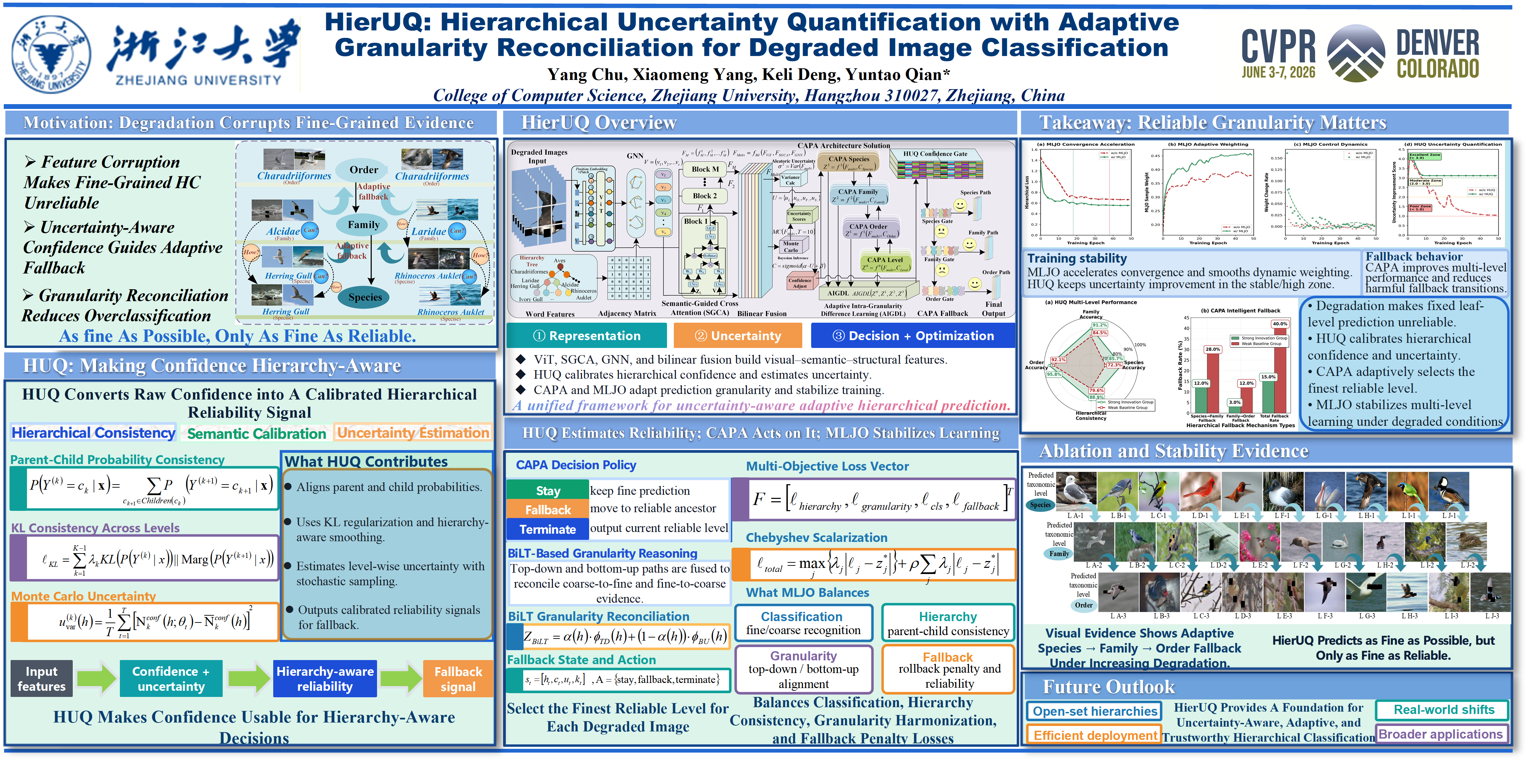
Hierarchical classification (HC) on degraded images presents challenges due to feature corruption, unreliable confidence estimation, and fine-grained misclassification. Existing methods often struggle to balance semantic consistency and adaptive decision paths under low-quality visual conditions. To address this, we propose HierUQ, a unified framework that integrates uncertainty quantification with adaptive granularity reconciliation. A Vision Transformer backbone extracts global features, which are fused with semantic embeddings via bilinear and semantic-guided cross-attentions. We develop a principled Hierarchical Uncertainty Quantification (HUQ) strategy based on label smoothing and proper scoring rules. When confidence is insufficient, a Confidence-Aware Path Adjustment (CAPA) mechanism adaptively rolls back predictions to higher-level nodes, mitigating overclassification and error propagation, stabilizing the learning trajectory, overcoming degradation-induced interference, and enhancing fine-grained classification accuracy. To enhance learning, we introduce a self-paced joint optimization (MLJO) over multi-level objectives with dynamic loss weighting. Experiments on degraded remote sensing and natural image benchmarks show that HierUQ achieves state-of-the-art performance with strong robustness and adaptability.
ID-Sim: An Identity-Focused Similarity Metric
Julia Chae ⋅ Nick Kolkin ⋅ Jui-Hsien Wang ⋅ Richard Zhang ⋅ Sara Beery ⋅ Cusuh Ham
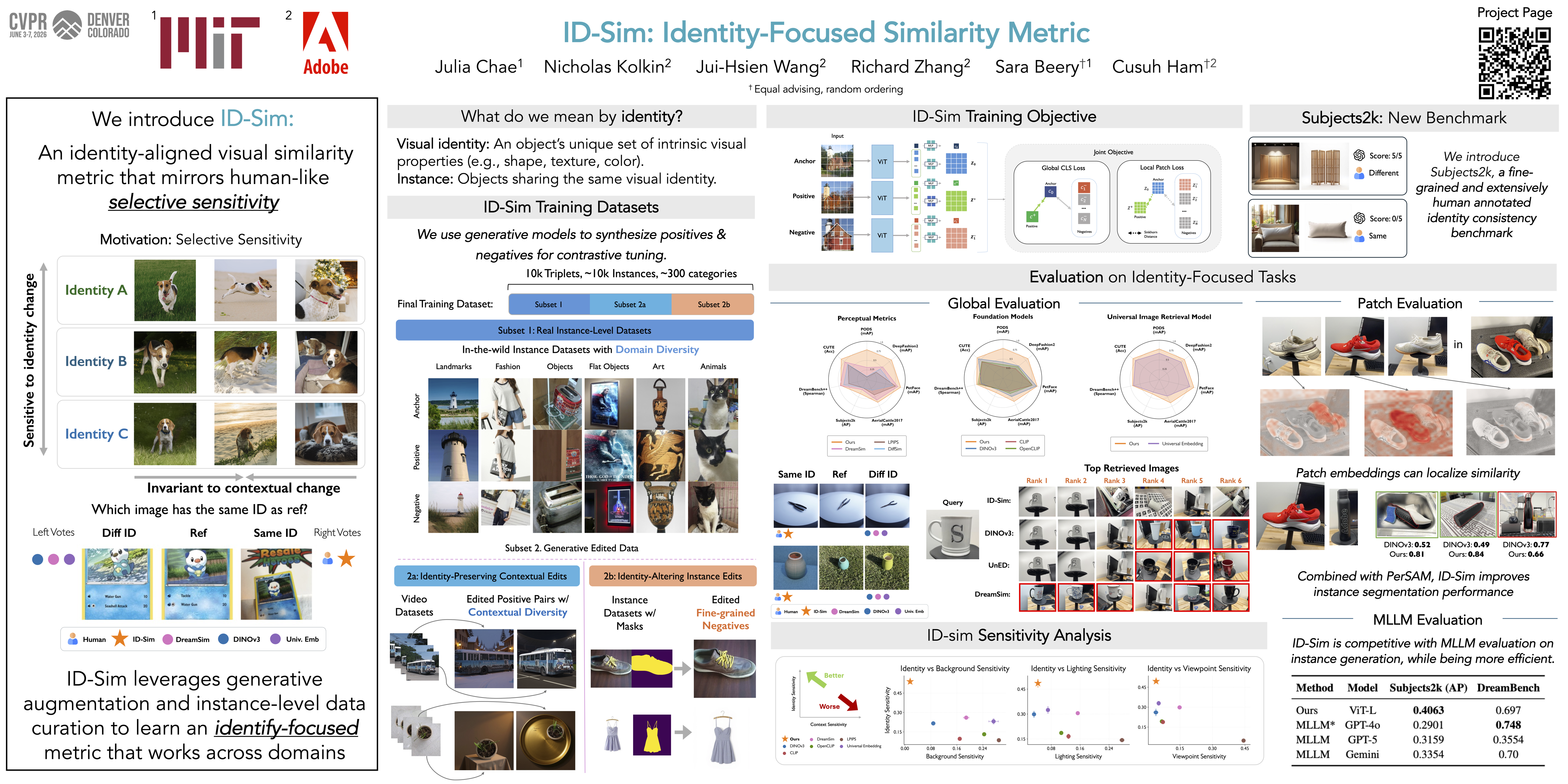
Humans have remarkable selective sensitivity to identities--they easily distinguish between highly-similar identities, even across significantly different contexts such as diverse viewpoints or lighting. Vision models have struggled to match this capability, and progress towards identity-focused tasks such as personalized image generation is slowed by a lack of identity-focused evaluation metrics. To help facilitate progress, we propose ID-Sim, a feed-forward metric designed to faithfully reflect human selective sensitivity. To build ID-Sim, we curate a high-quality training set of images spanning diverse real-world domains, augmented with generative synthetic data that provides controlled, fine-grained identity and contextual variations. We evaluate our metric on a new unified evaluation benchmark for assessing consistency with human annotations across identity-focused recognition, retrieval, and generative tasks.
Hier-COS: Making Deep Features Hierarchy-aware via Composition of Orthogonal Subspaces
Depanshu Sani ⋅ Saket Anand
Traditional classifiers treat all class labels as mutually independent, thereby considering all negative classes to be equally incorrect. This approach fails severely in many real-world scenarios, where a known semantic hierarchy defines a partial order of preferences over negative classes. While hierarchy-aware feature representations have shown promise in mitigating this problem, their performance is typically assessed using metrics like Mistake Severity (MS) and Average Hierarchical Distance (AHD). In this paper, we highlight important shortcomings in existing hierarchical evaluation metrics, demonstrating that they are often incapable of measuring true hierarchical performance. Our analysis reveals that existing methods learn sub-optimal hierarchical representations, despite competitive MS and AHD scores. To counter these issues, we introduce Hierarchical Composition of Orthogonal Subspaces (Hier-COS), a novel framework for unified 'hierarchy-aware fine-grained' and 'hierarchical multi-label' classification. We show that Hier-COS is theoretically guaranteed to be consistent with the given hierarchy tree. Furthermore, our framework implicitly adapts the learning capacity for different classes based on their position within the hierarchy tree — a vital property absent in existing methods. Finally, to address the limitations of evaluation metrics, we propose Hierarchically Ordered Preference Score (HOPS), a ranking-based metric that demonstrably overcomes the deficiencies of current evaluation standards. We benchmark Hier-COS on four challenging datasets, including the deep and imbalanced tieredImageNet-H (12-level) and iNaturalist-19 (7-level). Through extensive experiments, we demonstrate that Hier-COS achieves state-of-the-art performance across all hierarchical metrics for every dataset, while simultaneously beating the top-1 accuracy in all but one case. Lastly, we show that Hier-COS can effectively learn to transform the frozen features extracted from a pretrained backbone (ViT) to be hierarchy-aware, yielding substantial benefits for hierarchical classification performance.
Towards Cross-Modal Preservation, Consistency and Alignment for Privacy-Preserving Visible-Infrared Person Re-Identification
Yudi Xie ⋅ Zhongao Zhou ⋅ Bin Yang ⋅ Zhenghan Chen ⋅ Mang Ye
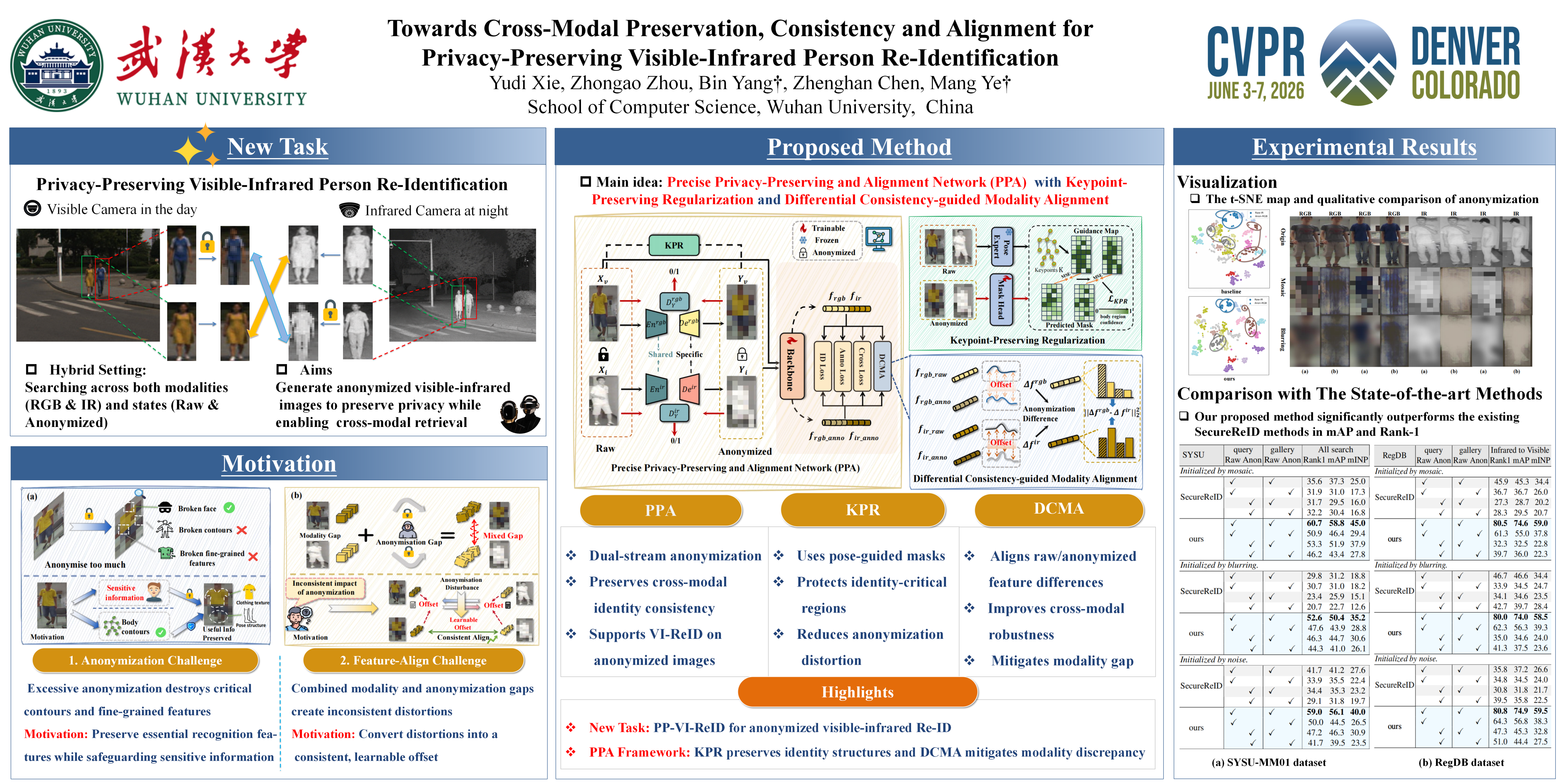
Privacy-preserving Person Re-Identification (PP-ReID) addresses the core privacy-utility trade-off in Re-ID by retrieving a person across multiple non-overlapping cameras while applying anonymization techniques to protect sensitive information. However, prior PP-ReID studies are confined to single-modality visible scenarios, as 24-hour surveillance systems require robust cross-modal visible-infrared (VI) capabilities. Extending PP-ReID to the cross-modal VI setting is therefore crucial for 24-hour surveillance. Accordingly, we introduce a new task: Privacy-Preserving Visible-Infrared Person Re-Identification (PP-VI-ReID). This task presents two severe challenges: 1) Crude anonymization strategies destroy identity-critical information and disrupt cross-modal alignment 2) The anonymization process creates inconsistent distortions across modalities. It disrupts color-based textures in visible images while obscuring thermal contours in infrared images. This inconsistency with modality gap forms a Mixed Gap. To overcome these challenges, we propose a framework, the Precise Privacy-preserving and Alignment Network (PPA) with two components: 1) A Keypoint-Preserving Regularization (KPR) module leverages human pose as a prior to guide structure-aware anonymization, preserving essential body features. 2) A Differential Consistency-guided Modality Alignment (DCMA) module. It treats anonymization perturbations not as varying noise, but as a stable, learnable offset, facilitating robust alignment between raw and anonymized features across modalities. Experiments on SYSU-MM01 and RegDB validate our framework, establishing a strong baseline for this task. The source code will be released.
Enhancing Mixture-of-Experts Specialization via Cluster-Aware Upcycling
Sanghyeok Chu ⋅ Pyunghwan Ahn ⋅ Gwangmo Song ⋅ Seung Hwan Kim ⋅ Honglak Lee ⋅ Bohyung Han
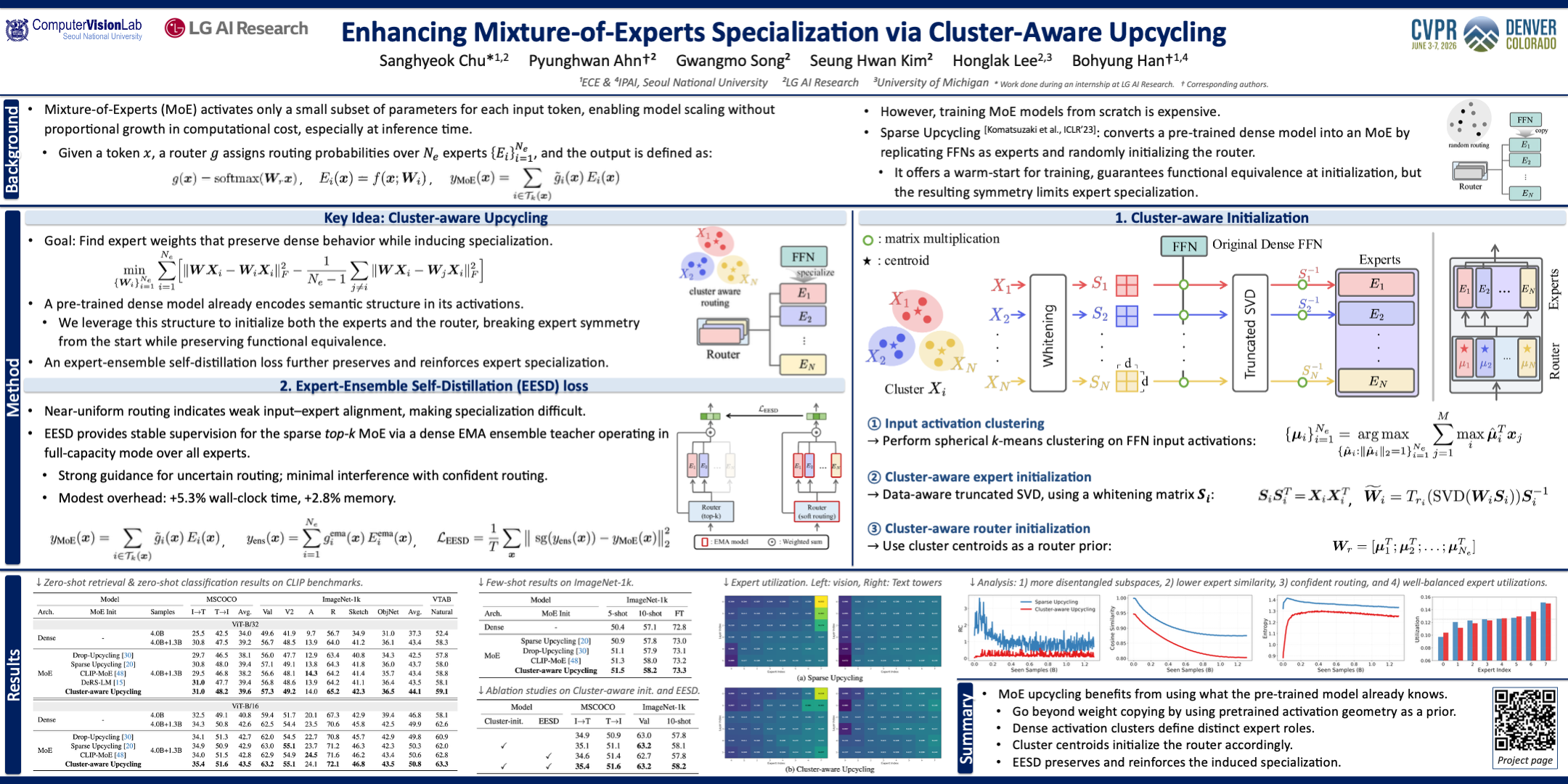
Sparse upcycling provides an efficient way to initialize a Mixture-of-Experts (MoE) model from a pretrained dense checkpoint instead of training from scratch.However, since all experts start from identical weights and the router is randomly initialized, the model suffers from expert symmetry and limited early specialization.We propose Cluster-aware Upcycling, a strategy that embeds semantic structure into MoE initialization.The method clusters the dense model’s input activations to identify latent subspaces, initializes each expert using a data-aware truncated SVD of the dense weights within its cluster, and initializes the router with the corresponding cluster centroids.This cluster-aware initialization breaks expert symmetry and encourages early specialization aligned with the data structure.In addition, we introduce an Expert-Ensemble Self-Distillation loss that regularizes training by guiding uncertain routing with stable predictions from an ensemble teacher.Applied to CLIP ViT-B/16 and ViT-B/32 models, Cluster-aware Upcycling achieves consistent improvements over standard upcycling across zero-shot and few-shot benchmarks, and produces more diverse and disentangled expert representations.
COPE: Consistent Occlusion and Prompt Enhancement Network for Occluded Person Re-identification
Sun Siyi ⋅ Jinliang Lin ⋅ Juanjuan Weng ⋅ Zhihui Liu ⋅ Shaozi Li ⋅ Zhiming Luo
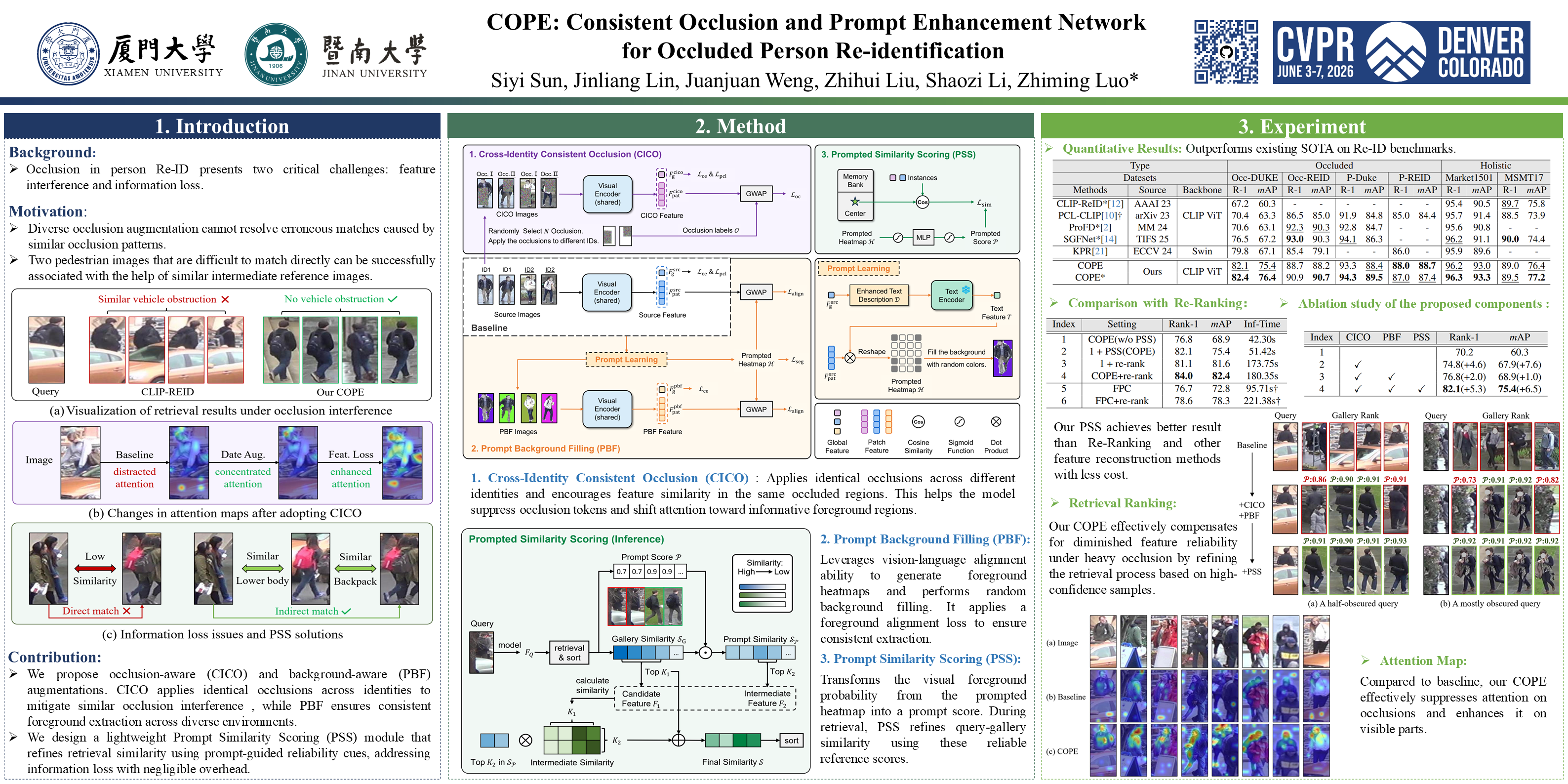
Occlusion presents two critical challenges for person re-identification (Re-ID): feature interference and information loss. While existing efforts have explored occlusion-aware data augmentation and feature reconstruction to mitigate these issues, the former often fails to address erroneous matches caused by similar occlusion patterns and background distractions, whereas the latter typically introduces significant computational overhead. To overcome these limitations, we propose a Consistent Occlusion and Prompt Enhancement (COPE) network. COPE incorporates a Cross-Identity Consistent Occlusion (CICO) module that applies identical occlusions across different identities and encourages feature similarity in the same occluded regions across different identities to reduce occlusion feature interference. A Prompt Background Filling (PBF) module leverages vision-language alignment to generate foreground heatmaps and performs random background filling, enhancing feature robustness under varying backgrounds. Additionally, a lightweight Prompt Similarity Scoring (PSS) module refines retrieval similarity by utilizing prompt-guided reliability scores. Extensive experiments on both occluded and holistic Re-ID benchmarks demonstrate that COPE consistently outperforms existing methods. Notably, it achieves 82.4% Rank-1 accuracy and 76.4% mAP on the challenging Occluded-Duke dataset.
Assignment-Driven Hash Learning in a Hyper-Semantic Space for On-the-Fly Category Discovery
Kaibing Yang ⋅ Yucheng Wang ⋅ Tingzhang Luo
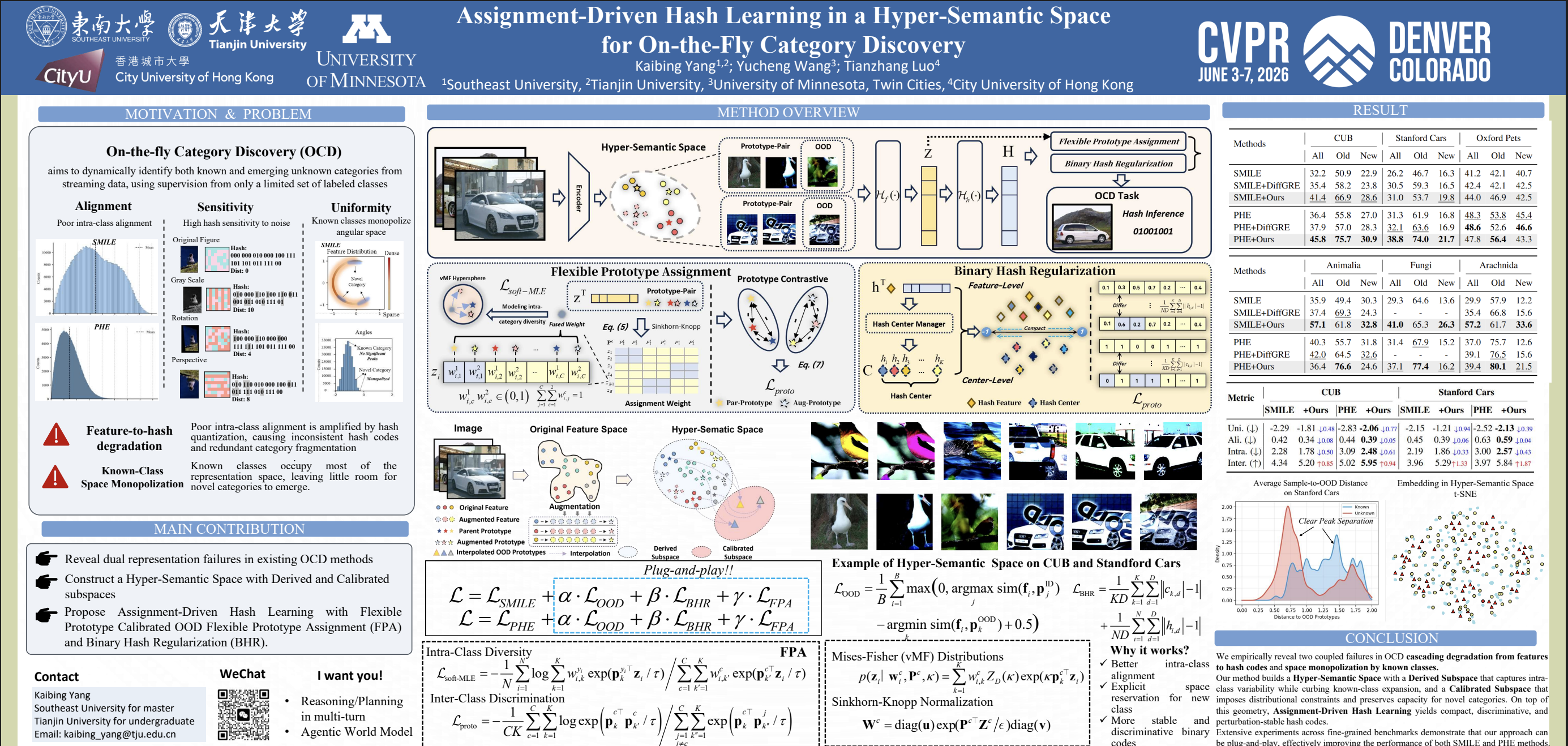
On-the-fly Category Discovery (OCD) aims to dynamically identify both known and emerging unknown categories from streaming data, using supervision from only a limited set of labeled classes. Despite recent progress, our empirical analysis reveals fundamental limitations: existing methods suffer from cascading feature-to-hash degradation and severe space monopolization by known classes, fundamentally hindering novel category discovery. To address these coupled challenges, we introduce a principled two-stage framework.We first construct a Hyper-Semantic Space with dual geometric subspaces: a Derived Subspace employing parent–derived prototype augmentation to capture intra-class diversity and enhance inter-class discrimination, and a Calibrated Subspace synthesized through cross-prototype interpolation to impose distributional constraints and prevent representational collapse.Within this geometrically-constrained space, we perform Assignment-Driven Hash Learning, where Flexible Prototype Assignment (FPA) models intra-class variations and enhances inter-class separation, alongside Binary Hash Regularization (BHR) to enforce compact and discriminative hash representations. Our framework serves as a plug-and-play module, consistently improving state-of-the-art OCD methods across fine-grained benchmarks. Code will be released upon acceptance.
DyFCLT: Dynamic Frequency-Decoupled Cross-Modal Learning Transformer for Multimodal Tiny Object Detection
Chaolang Li ⋅ Pengwen Dai ⋅ Jingyu Li ⋅ Siyuan Yao ⋅ Yuchen Jiang ⋅ Zhuoran Zheng
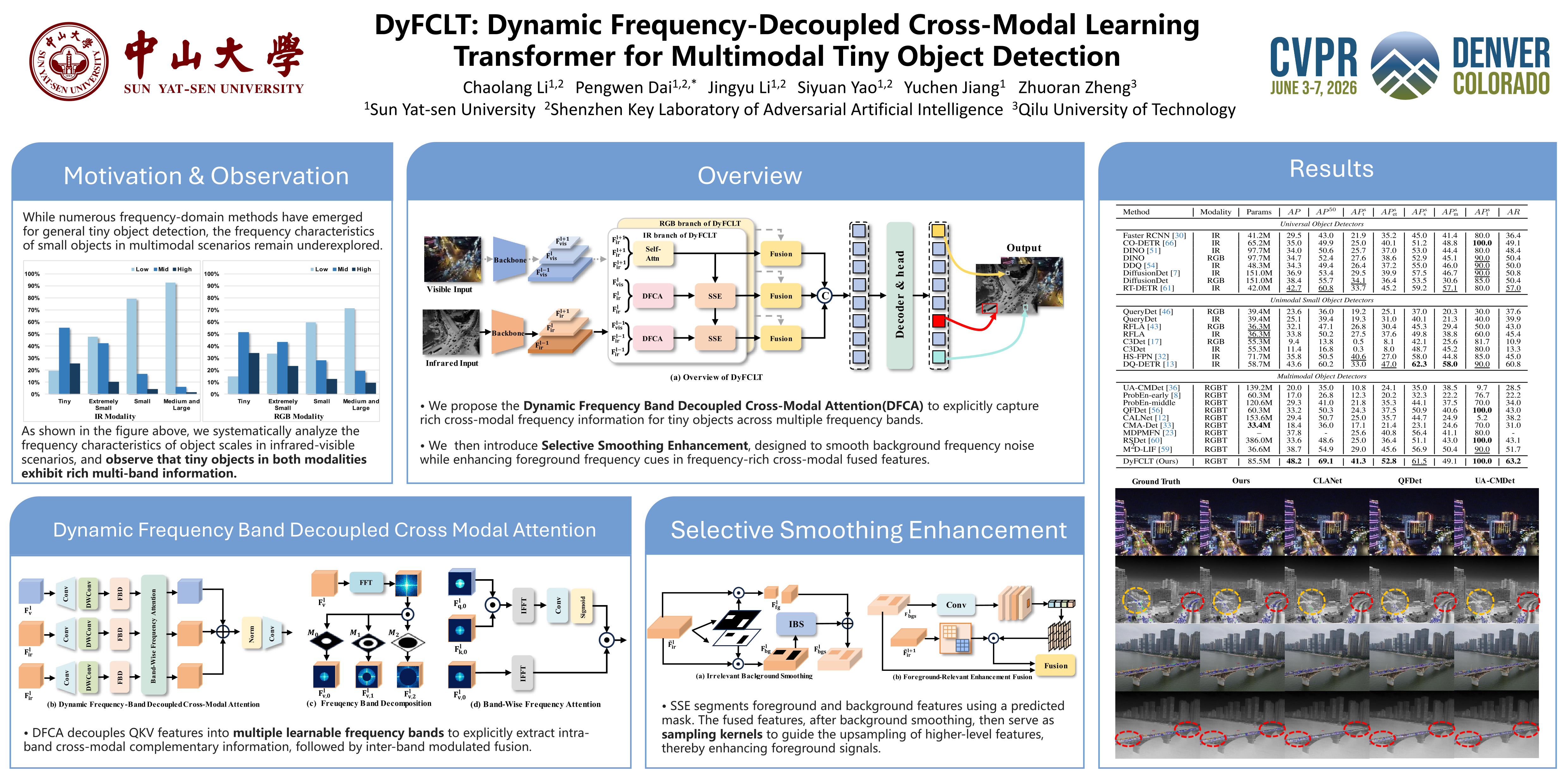
Multimodal tiny object detection plays a critical role in real-world applications. However, detecting tiny objects remains challenging due to environmental complexities. While recent methods leverage spatial multi-scale representations or frequency-domain enhancements, most focus solely on visible images and overlook complementary multimodal frequency cues. This paper explores how to effectively harness cross-modal frequency information for infrared–visible tiny object detection. Through frequency characteristic analysis, we observe that tiny objects exhibit rich mid- and high-frequency energy across both modalities, motivating the design of a Dynamic Frequency-decoupled Cross-modal Learning Transformer (DyFCLT). Our approach introduces a Dynamic Frequency-Band Decoupled Cross-Modal Attention (DFCA) mechanism to extract and interact frequency components across modalities. To suppress noise while enhancing foreground signals, a Selective Smoothing Enhancement (SSE) strategy is proposed, which smoothes background interference and guides multi-scale feature fusion. DFCA and SSE collaborate to achieve synergistic enrichment and refinement of cross-modal features. Extensive experiments on two tiny-object benchmarks and one general-scale benchmark demonstrate that DyFCLT sets new state-of-the-art results, outperforming prior leading methods by significant margins and exhibiting strong generalization across scales and scenarios.
EW-DETR: Evolving World Object Detection via Incremental Low-Rank DEtection TRansformer
Munish Monga ⋅ Vishal Chudasama ⋅ Pankaj Wasnik ⋅ C.V. Jawahar
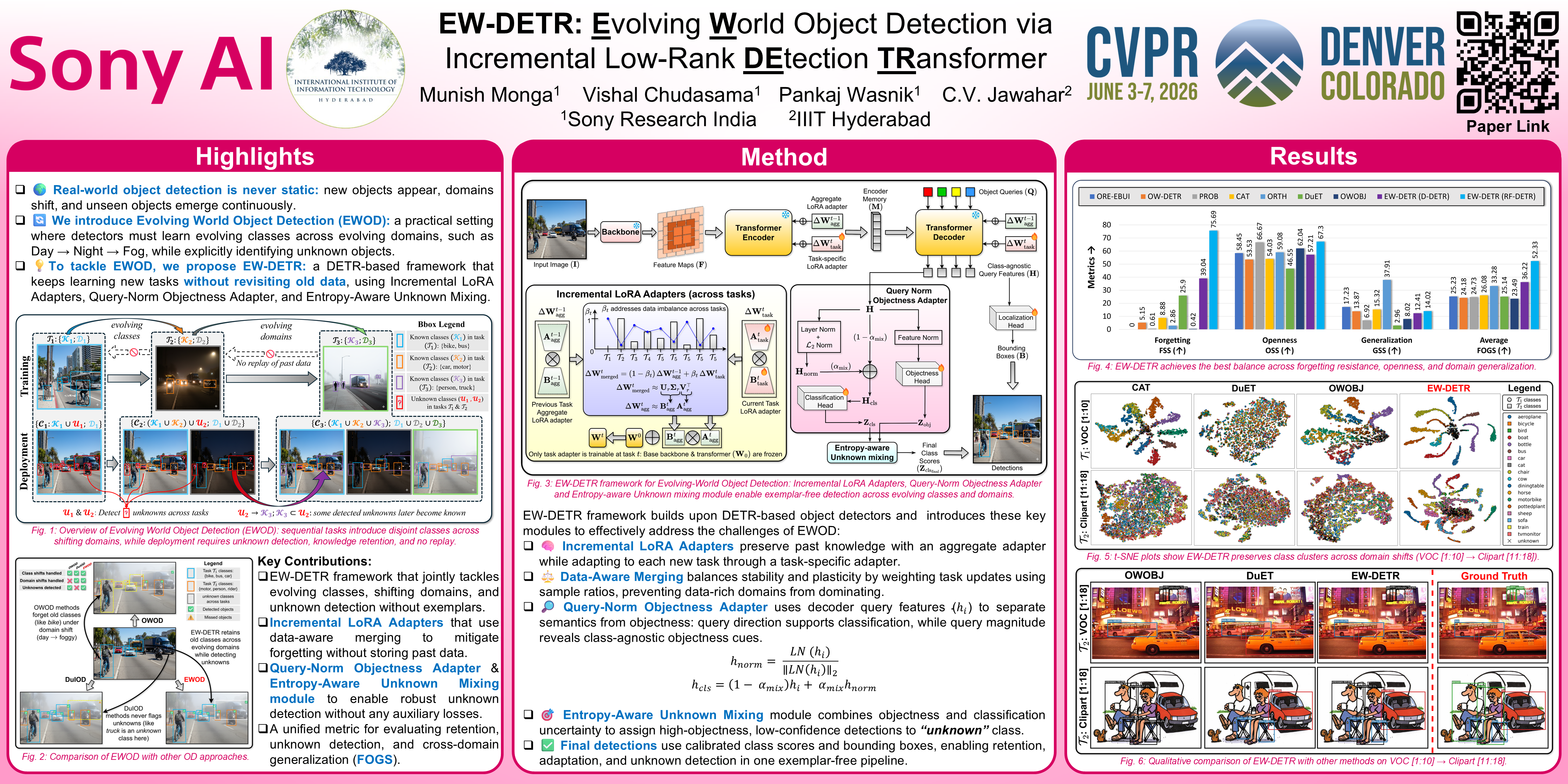
Real-world object detection must operate in evolving environments where new classes emerge, domains shift, and unseen objects must be identified as unknown—all without accessing prior data. We introduce Evolving World Object Detection (EWOD), a paradigm coupling incremental learning, domain adaptation, and unknown detection under exemplar-free constraints. To tackle EWOD, we propose EW-DETR framework that augments DETR-based detectors with three synergistic modules: Incremental LoRA Adapters for exemplar-free incremental learning under evolving domains; a Query-Norm Objectness Adapter that decouples objectness-aware features from DETR decoder queries; and Entropy-Aware Unknown Mixing for calibrated unknown detection. This framework generalises across DETR-based detectors, enabling state-of-the-art RF-DETR to operate effectively in evolving-world settings. We also introduce FOGS (Forgetting, Openness, Generalisation Score) to holistically evaluate performance across these dimensions. Extensive experiments on Pascal Series and Diverse Weather benchmarks show EW-DETR outperforms other methods, improving FOGS by 57.24%.
Building a Precise Video Language with Human–AI Oversight
Zhiqiu Lin ⋅ Siyuan Cen ⋅ Chancharik Mitra ⋅ Isaac Li ⋅ Yuhan Huang ⋅ Yu Tong Tiffany Ling ⋅ Hewei Wang ⋅ Irene Pi ⋅ Shihang Zhu ⋅ Yili Han ⋅ Yilun Du ⋅ Deva Ramanan
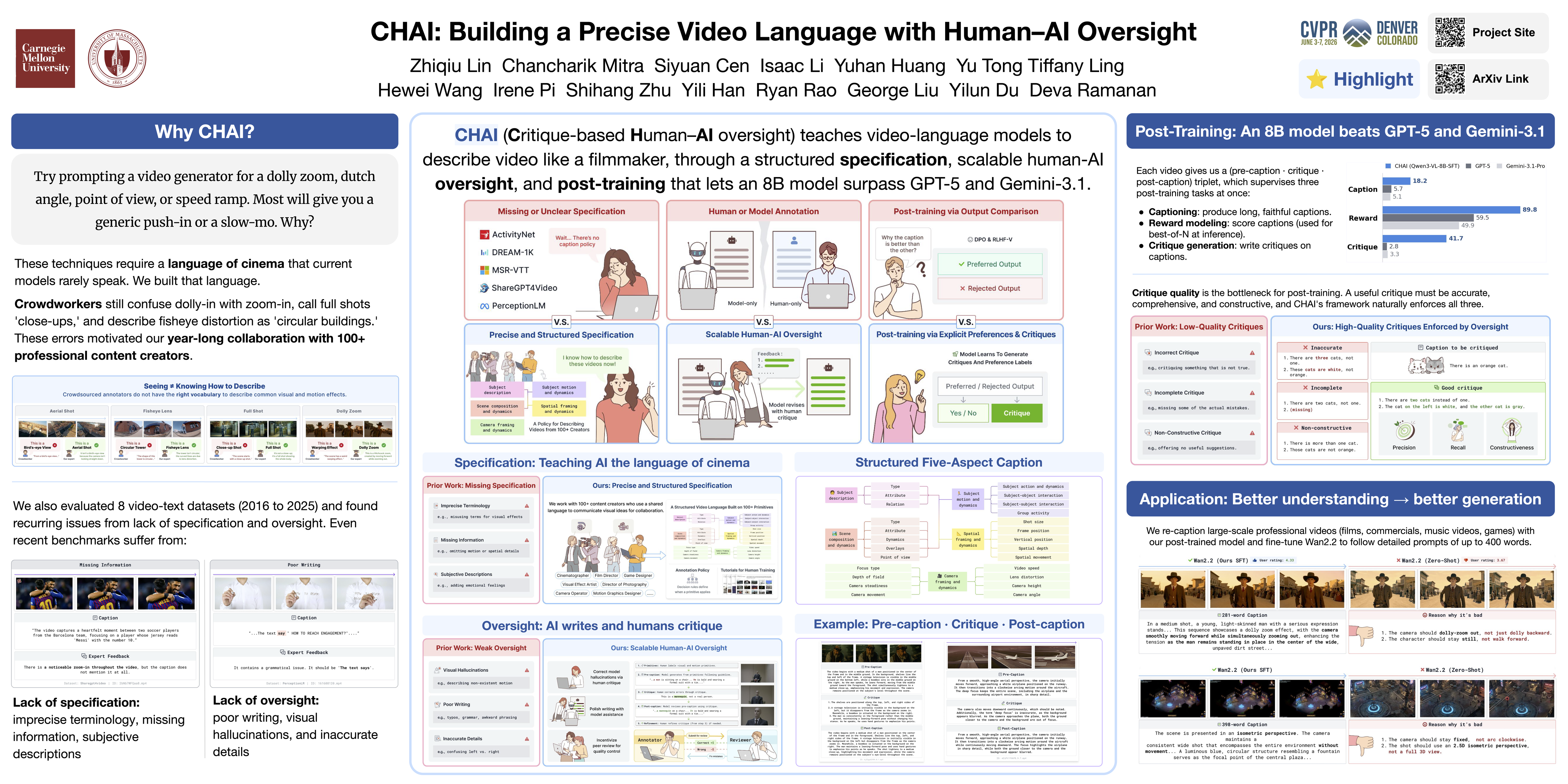
Video–language models (VLMs) learn to reason about the dynamic visual world through natural language. We introduce a suite of open datasets, benchmarks, and recipes for scalable oversight that enable precise video captioning. First, we define a structured specification for describing subjects, scenes, motion, spatial, and camera dynamics, supported by hundreds of carefully defined visual primitives developed with professional video creators such as filmmakers. Next, to curate high-quality captions, we introduce a critique-based human–AI (CHAI) oversight framework, where trained human experts provide correctional critiques to revise model-generated pre-captions into improved post-captions. This division of labor improves annotation accuracy and efficiency by offloading text generation to models, allowing humans to better focus on verification. Additionally, these critiques and preferences between pre- and post-captions provide rich supervision for fine-tuning, improving open-source models (Qwen3-VL) on caption generation, reward modeling, and critique generation through standard SFT, offline RL (DPO), online RL (GSPO), and inference-time scaling. With modest expert supervision, the resulting system outperforms even closed-source models such as Gemini-2.5-Pro. Finally, we apply our approach to re-caption large-scale professional videos (e.g., films, commercials, games) and fine-tune video generation models such as Wan to better follow detailed prompts of over 400 words, achieving finer control over camera motion, angle, lens, perspectives, and shot composition. Overall, our results show that precise specification and human–AI oversight are key to achieving professional-level video understanding and generation.
CoCoVideo: The High-Quality Commercial-Model-Based Contrastive Benchmark for AI-Generated Video Detection
Huidong Feng ⋅ Wentao Chen ⋅ Jie Chen ⋅ Xinqi Cai ⋅ Ruolong Ma ⋅ Yinglin Zheng ⋅ Yuxin Lin ⋅ Ming Zeng
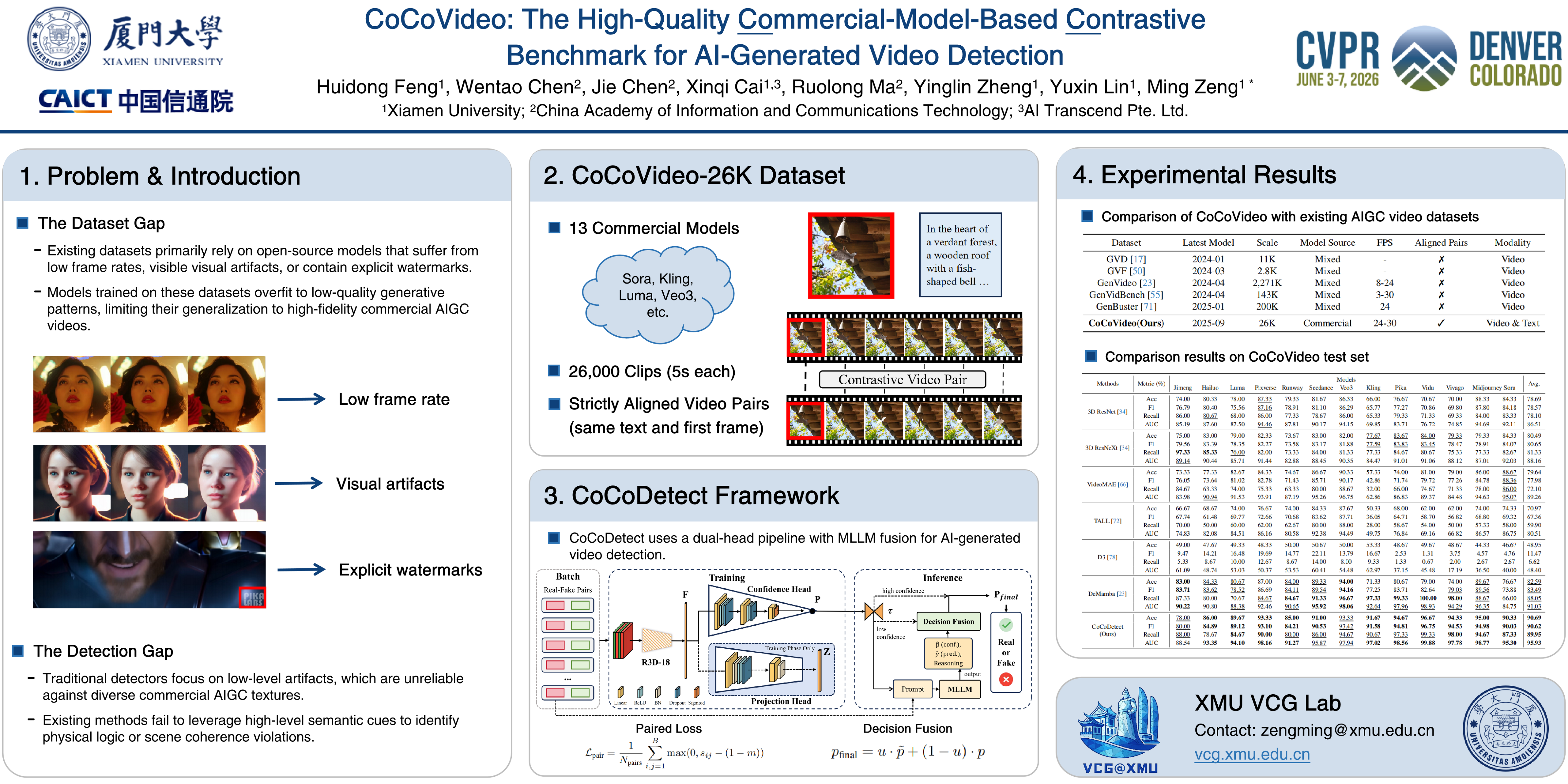
With the rapid advancement of artificial intelligence generated content (AIGC) technologies, video forgery has become increasingly prevalent, posing new challenges to public discourse and societal security. Despite remarkable progress in existing deepfake detection methods, AIGC forgery detection remains challenging, as existing datasets mainly rely on open-source video generation models with quality far below commercial AIGC systems. Even datasets containing a few commercial samples often retain visible watermarks, compromising authenticity and hindering model generalization to high-fidelity AIGC videos. To address these issues, we introduce $CoCoVideo-26K$, a contrastive, commercial-model-based AIGC video dataset covering 13 mainstream commercial generators and providing semantically aligned real–fake video pairs. This dataset enables deeper exploration of the differences between authentic and high-quality synthetic videos, establishes a new benchmark for highly realistic video forgery detection. Building on this dataset, we propose $CoCoDetect$, a detection framework integrating contrastive learning with confidence-gated multimodal large language model (MLLM) inference. An R3D-18 backbone extracts spatio-temporal representations, while a confidence gate routes uncertain cases to an MLLM for reasoning about physical plausibility and scene consistency. Extensive experiments on CoCoVideo-26K and public benchmarks demonstrate state-of-the-art performance, validating the framework’s robustness and generality. Dataset and code will be released.
Towards Sparse Video Understanding and Reasoning
Chenwei Xu ⋅ Zhen Ye ⋅ Shang Wu ⋅ Weijian Li ⋅ Zihan Wang ⋅ Zhuofan Xia ⋅ Lie Lu ⋅ Pranav Maneriker ⋅ Fan Du ⋅ Manling Li ⋅ Han Liu
We present ReViSe (Reasoning with Video Sparsity), a framework that combines multi-round reasoning with adaptive frame selection for video question answering (VQA). Existing vision–language models (VLMs) uniformly sample video frames, which introduces redundancy or irrelevancy. In contrast, ReViSe*interactively selects informative frames through multi-round reasoning. To achieve this, ReViSe includes three modules: a multi-round conversation module that retains frame selection history as memory; a reasoning tracer that maintains a chain-of-thought across rounds; and a self-correction mechanism that enforces structural and behavioral validity. ReViSe integrates seamlessly with both proprietary and open-source VLMs. It supports proprietary models in a “plug-and-play” manner and enables reinforcement fine-tuning for open-source models. Experiments on multiple VQA benchmarks show that ReViSe improves the video understanding ability of VLMs by improving accuracy while reducing the number of frames used.
Divide, then Ground: Adapting Frame Selection to Query Types for Long-Form Video Understanding
Jialuo Li ⋅ Bin Li ⋅ Jiahao Li ⋅ Yan Lu
The application of Large Multimodal Models (LMMs) to long-form video understanding is constrained by limited context lengths and the computationally prohibitive cost of processing dense video tokens. Consequently, recent research has focused on query-aware frame selection, methods that often incur significant computational overhead. This paper challenges the assumption that such complex search mechanisms are universally necessary. We first identify and validate a query typology distinguishing between global query and localized query. We demonstrate that while uniform sampling is both effective and efficient for global queries, localized queries indeed necessitate query-aware selection for optimal performance. Building on this insight, we propose~\name, a training-free frame selection framework that adapts its strategy based on the query type. Specifically, DIG employs efficient uniform sampling for global queries while activating a specialized pipeline to extract query-relevant frames for localized queries. Experiments on three long-form video understanding benchmarks demonstrate that DIG consistently outperforms existing baselines and robustly improves LMM performance, even when scaling the input frame count to 256.
MuKV: Multi-Grained KV Cache Compression for Long Streaming Video Question-Answering
Junbin Xiao ⋅ Jiajun Chen ⋅ Tianxiang Sun ⋅ Xun Yang ⋅ Angela Yao
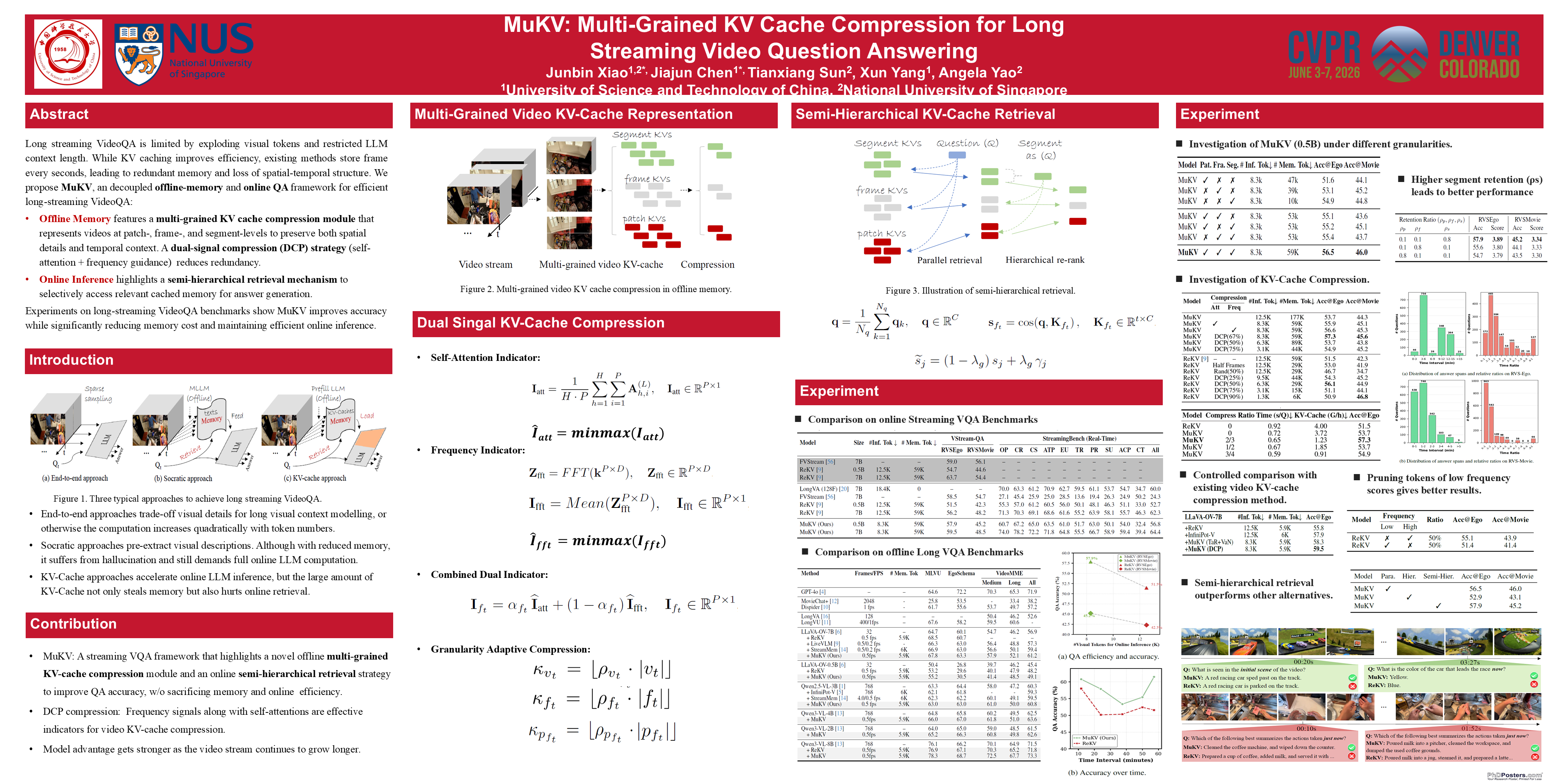
Long streaming video QA remains challenging due to growing visual tokens and limited reasoning length of large language models (LLMs). KV-caching stores the Key-Value (KV) of the historical tokens via LLM prefill and enables training-free and more efficient streaming QA. However, existing methods cache every one or two frames, causing redundant memory usage and losing fine-grained spatial details within frame or temporal contexts across frames. This paper proposes MuKV, a method that features a multi-grained KV cache compression module and a semi-hierarchical retrieval approach to improve both efficiency and accuracy for long streaming VideoQA. For the offline KV cache, MuKV extracts visual representations at patch-, frame-, and segment-levels. The multiple levels of granularity preserve both local cues and global temporal context, while maintaining efficiency with a dual signal token compression mechanism guided by self-attention and frequency. For online QA, MuKV designs a semi-hierarchical retrieval method to retrieve relevant KV caches for answer generation. Experiments on long-streaming VideoQA benchmarks show that MuKV significantly improves answer accuracy, without the sacrifice of memory and online QA efficiency. Moreover, our compression mechanism alone brings consistent benefits across answer accuracy, memory, and QA efficiency over baselines, showcasing highly effective contribution.
ParallelVLM: Lossless Video-LLM Acceleration with Visual Alignment Aware Parallel Speculative Decoding
Quan Kong ⋅ Yuhao Shen ⋅ Yicheng Ji ⋅ Huan Li ⋅ Cong Wang
Although current Video-LLMs achieve impressive performance in video understanding tasks, their autoregressive decoding efficiency remains constrained by the massive number of video tokens. Visual token pruning can partially ease this bottleneck, yet existing approaches still suffer from information loss and yield only modest acceleration in decoding. In this paper, we propose ParallelVLM, a training-free draft-then-verify speculative decoding framework that overcomes both mutual waiting and limited speedup-ratio problems between draft and target models in long-video settings. ParallelVLM features two parallelized stages that maximize hardware utilization and incorporates an Unbiased Verifier-Guided Pruning strategy to better align the draft and target models by eliminating the positional bias in attention‑guided pruning. Extensive experiments demonstrate that ParallelVLM effectively expands the draft window by $1.6\sim1.8\times$ with high accepted lengths, and accelerates various video understanding benchmarks by 3.36$\times$ on LLaVA-Onevision-72B and 2.42$\times$ on Qwen2.5-VL-32B compared with vanilla autoregressive decoding.
TiViBench: Benchmarking Think-in-Video Reasoning for Video Generation
Harold Haodong Chen ⋅ Disen Lan ⋅ Wen-Jie Shu ⋅ Qingyang Liu ⋅ Zihan Wang ⋅ Sirui CHEN ⋅ Wenkai Cheng ⋅ Kanghao Chen ⋅ Hongfei (Faye) Zhang ⋅ Zixin Zhang ⋅ Rongjin Guo ⋅ Yu Cheng ⋅ Ying-Cong Chen
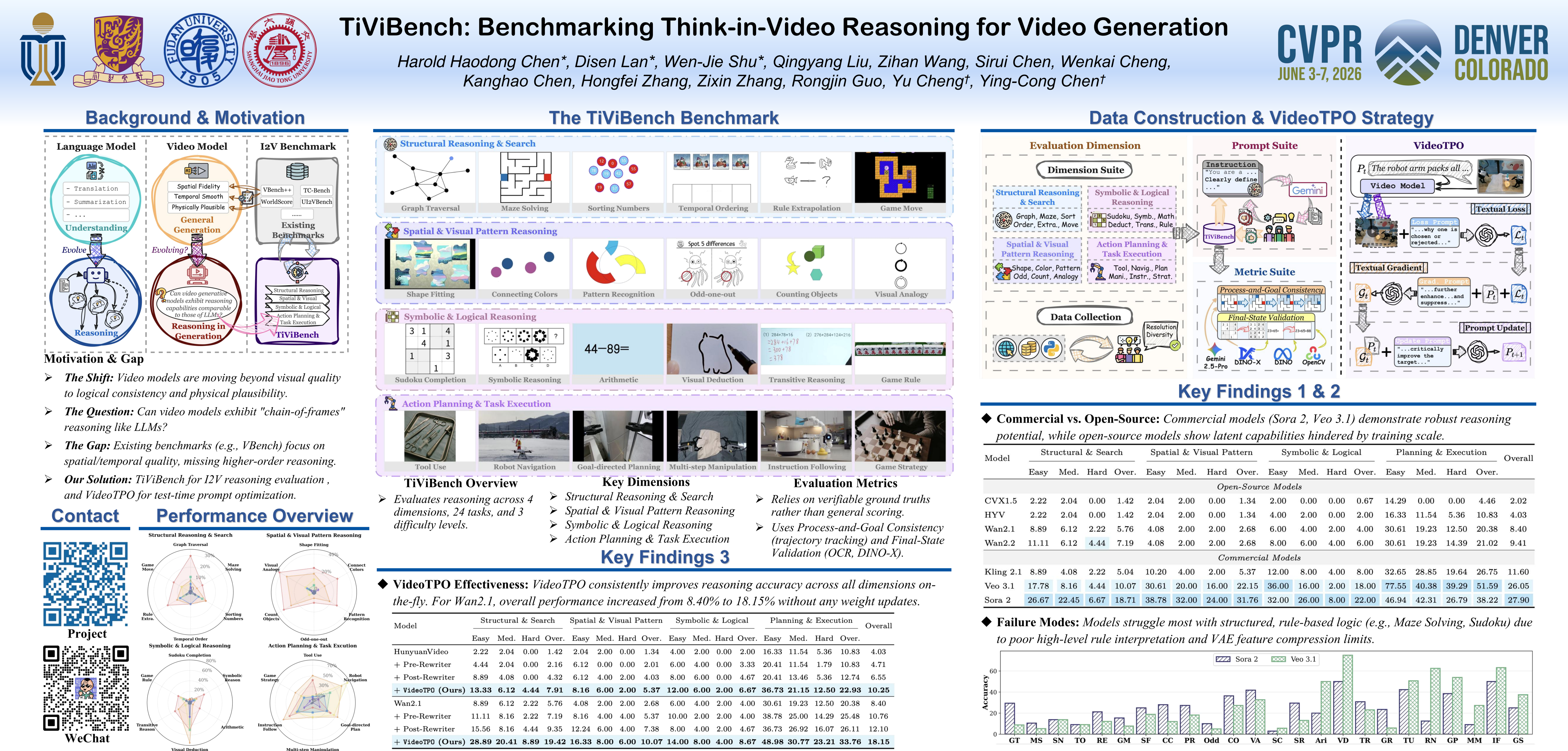
The rapid evolution of video generative models has shifted their focus from producing visually plausible outputs to tackling tasks requiring physical plausibility and logical consistency. However, despite recent breakthroughs such as Veo 3's chain-of-frames reasoning, it remains unclear whether these models can exhibit reasoning capabilities similar to large language models (LLMs). Existing benchmarks predominantly evaluate visual fidelity and temporal coherence, failing to capture higher-order reasoning abilities. To bridge this gap, we propose TiViBench, a hierarchical benchmark specifically designed to evaluate the reasoning capabilities of image-to-video (I2V) generation models. TiViBench systematically assesses reasoning across four dimensions: i) Structural Reasoning & Search, ii) Spatial & Visual Pattern Reasoning, iii) Symbolic & Logical Reasoning, and iv) Action Planning & Task Execution, spanning 24 diverse task scenarios across 3 difficulty levels. Through extensive evaluations, we show that commercial models (e.g., Sora 2, Veo 3.1) demonstrate stronger reasoning potential, while open-source models reveal untapped potential that remains hindered by limited training scale and data diversity. To further unlock this potential, we introduce VideoTPO, a simple yet effective test-time strategy inspired by preference optimization. By performing LLM self-analysis on generated candidates to identify strengths and weaknesses, VideoTPO significantly enhances reasoning performance without requiring additional training, data, or reward models. Together, TiViBench and VideoTPO pave the way for evaluating and advancing reasoning in video generation models, setting a foundation for future research in this emerging field.
What Are You Doing? A Closer Look at Controllable Human Video Generation
Emanuele Bugliarello ⋅ Anurag Arnab ⋅ Roni Paiss ⋅ Christy Koh ⋅ Pieter-Jan Kindermans ⋅ Cordelia Schmid
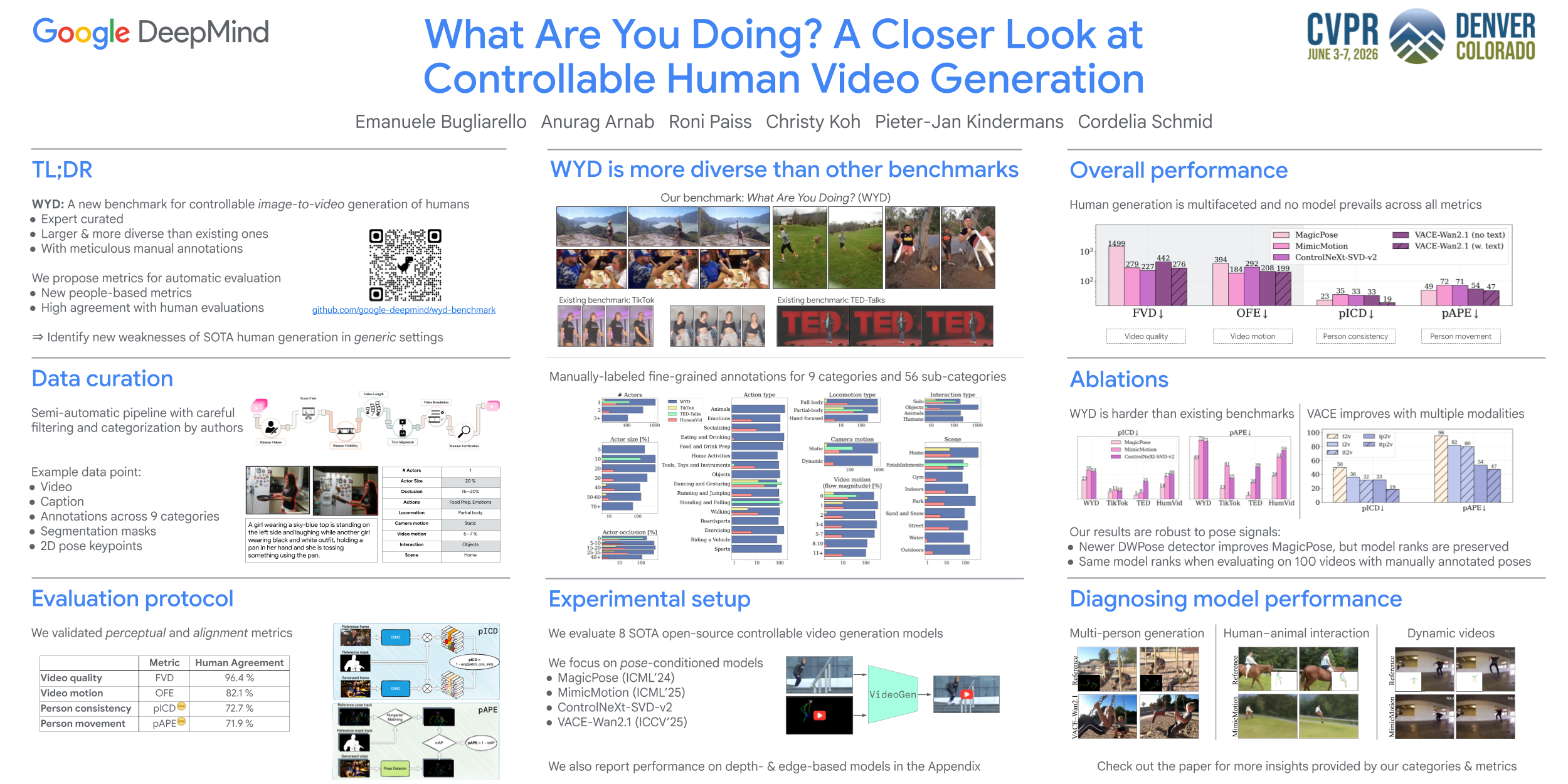
High-quality benchmarks are crucial for driving progress in machine learning research. However, despite the growing interest in video generation, there is no comprehensive dataset to evaluate human synthesis. Humans can perform a wide variety of actions and interactions, but existing datasets, like TikTok, TED-Talks, and HumanVid, lack the diversity and complexity to fully capture the capabilities of video generation models. We close this gap by introducing 'What Are You Doing?' (WYD): a new benchmark for fine-grained evaluation of controllable image-to-video generation of humans. WYD consists of 1,544 captioned videos that have been meticulously collected and annotated with fine-grained categories. These allow us to systematically measure performance across 9 aspects of human generation, including actions, interactions and motion. We also propose an evaluation framework, where we adapt existing metrics for better human- and video-level assessment, as shown by human preference. Equipped with our dataset and metrics, we perform in-depth analyses of state-of-the-art open-source models in controllable image-to-video generation, showing how WYD provides novel insights about their capabilities. We release data and code to drive progress in human video generation.
Score2Instruct: Scaling Up Video Quality-Centric Instructions via Automated Dimension Scoring
Qizhi Xie ⋅ Kun Yuan ⋅ Yunpeng Qu ⋅ Jiachao Gong ⋅ Mingda Wu ⋅ Ming Sun ⋅ Chao Zhou ⋅ Jihong Zhu
Classical video quality assessment (VQA) methods generate a numerical score to judge a video's perceived visual fidelity and clarity. Yet, a score fails to describe the video's complex quality dimensions (e.g., noise), restricting its applicability. Benefiting from the human-friendly linguistic output, adapting video large multimodal models (LMMs) to VQA via instruction tuning has the potential to address this issue. The core of the approach lies in the video quality-centric instruction data. Previous explorations mainly focus on the image domain, and their data generation processes heavily rely on human quality annotations and proprietary systems (e.g., GPT-4), limiting data scalability and effectiveness. To address these challenges, we propose the Score-based Instruction Generation (SIG) pipeline. Specifically, SIG first scores multiple quality dimensions of an unlabeled video and maps scores to text-defined levels. It then explicitly incorporates a hierarchical Chain-of-Thought (CoT) to model the correlation between specific dimensions and overall quality, mimicking the human visual system's (HVS) reasoning process. The automated pipeline eliminates the reliance on expert-written quality descriptions and proprietary systems, ensuring data scalability and generation efficiency. To this end, the resulting Score2Instruct (S2I) dataset contains over 320K diverse instruction-response pairs, laying the basis for instruction tuning. Moreover, to advance video LMMs' quality scoring and justification abilities simultaneously, we devise a progressive tuning strategy to fully unleash the power of S2I. Built upon SIG, we further curate a benchmark termed S2I-Bench with 400 open-ended questions to better evaluate the quality justification capacity of video LMMs. Experimental results on the S2I-Bench and existing benchmarks indicate that our method consistently improves quality scoring and justification capabilities across multiple video LMMs. The code and dataset will be publicly available for future research.
CFG-Ctrl: Control-Based Classifier-Free Diffusion Guidance
Hanyang Wang ⋅ Yiyang Liu ⋅ Jiawei Chi ⋅ Fangfu Liu ⋅ Ran Xue ⋅ Yueqi Duan
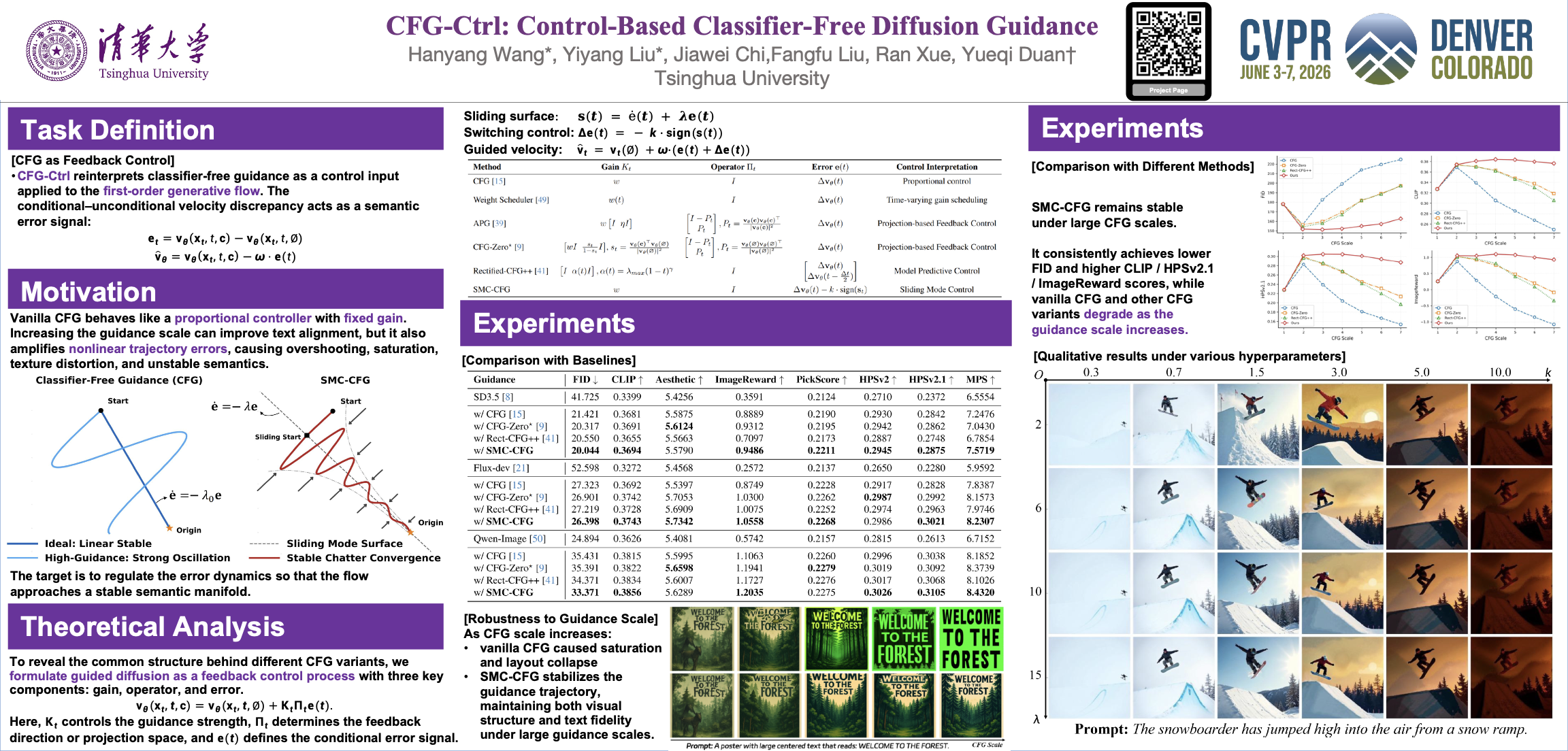
Classifier-Free Guidance (CFG) has emerged as a central approach for enhancing semantic alignment in flow-based diffusion models. In this paper, we explore a unified framework called CFG-Ctrl, which reinterprets CFG as a control applied to the first-order continuous-time generative flow, using the conditional–unconditional discrepancy as an error signal to adjust the velocity field. From this perspective, we summarize vanilla CFG as a proportional controller (P-control) with fixed gain, and typical follow-up variants develop extended control-law designs derived from it. However, existing methods mainly rely on linear control, inherently leading to instability, overshooting, and degraded semantic fidelity especially on large guidance scales. To address this, we introduce Sliding Mode Control CFG (SMC-CFG), which enforces the generative flow toward a rapidly convergent sliding manifold. Specifically, we define an exponential sliding mode surface over the semantic prediction error and introduce a switching control term to establish nonlinear feedback-guided correction. Moreover, we provide a Lyapunov stability analysis to theoretically support finite-time convergence. Experiments across text-to-image generation models including Stable Diffusion 3.5, Flux, and Qwen-Image demonstrate that SMC-CFG outperforms standard CFG in semantic alignment and enhances robustness across a wide range of guidance scales.
Towards Holistic Modeling for Video Frame Interpolation with Auto-regressive Diffusion Transformers
Xinyu Peng ⋅ Han Li ⋅ Yuyang Huang ⋅ Ziyang Zheng ⋅ Yaoming Wang ⋅ Xin Chen ⋅ Wenrui Dai ⋅ Chenglin Li ⋅ Junni Zou ⋅ Hongkai Xiong
Existing video frame interpolation (VFI) methods often adopt a frame-centric approach, processing videos as independent short segments (e.g., triplets), which leads to temporal inconsistencies and motion artifacts. To overcome this, we propose a holistic, video-centric paradigm named \textbf{L}ocal \textbf{D}iffusion \textbf{F}orcing for \textbf{V}ideo \textbf{F}rame \textbf{I}nterpolation (LDF-VFI). Our framework is built upon an auto-regressive diffusion transformer that models the entire video sequence to ensure long-range temporal coherence. To mitigate error accumulation inherent in auto-regressive generation, we introduce a novel skip-concatenate sampling strategy that effectively maintains temporal stability. Furthermore, LDF-VFI incorporates sparse, local attention and tiled VAE encoding, a combination that not only enables efficient processing of long sequences but also allows generalization to arbitrary spatial resolutions (e.g., 4K) at inference without retraining. An enhanced conditional VAE decoder, which leverages multi-scale features from the input video, further improves reconstruction fidelity. Empirically, LDF-VFI achieves state-of-the-art performance on challenging long-sequence benchmarks, demonstrating superior per-frame quality and temporal consistency, especially in scenes with large motion.
DDiT: Dynamic Patch Scheduling for Efficient Diffusion Transformers
Dahye Kim ⋅ Deepti Ghadiyaram ⋅ Raghudeep Gadde
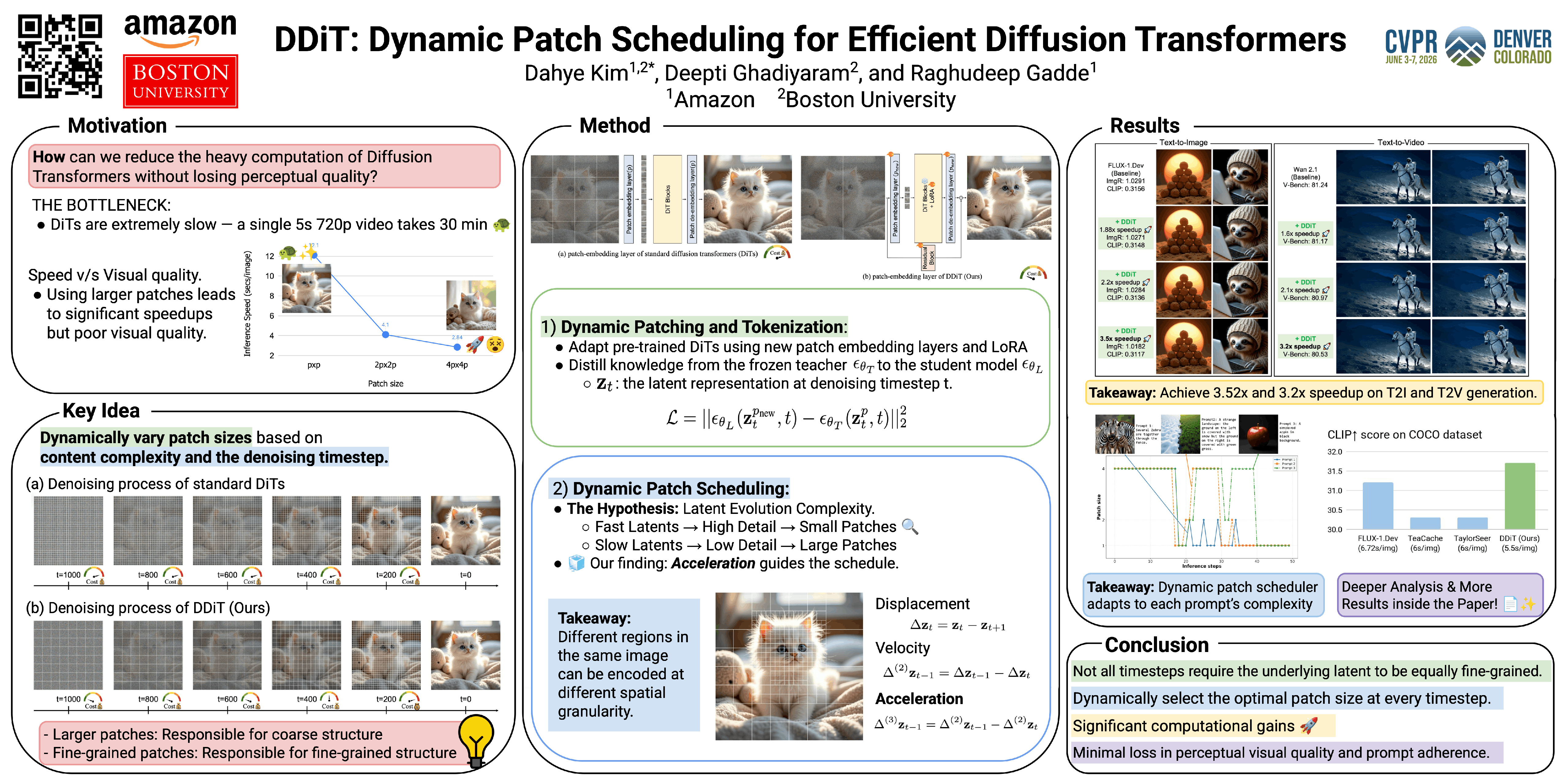
Diffusion Transformers (DiTs) have achieved state-of-the-art performance in image and video generation, but their success comes at the cost of heavy computation. This inefficiency is largely due to the fixed tokenization process, which uses constant-sized patches throughout the entire denoising phase, regardless of the content's complexity.We propose dynamic tokenization, an efficient test-time strategy that varies patch sizes based on content complexity and the denoising timestep. Our key insight is that early timesteps only require coarser patches to model global structure, while later iterations demand finer (smaller-sized) patches to refine local details. During inference, our method dynamically reallocates patch sizes across denoising steps for image and video generation and substantially reduces cost while preserving perceptual generation quality. Extensive experiments demonstrate the effectiveness of our approach: it achieves up to $3.52\times$ and $3.2\times$ speedup on FLUX-1.Dev and Wan $2.1$, respectively, without compromising the generation quality and prompt adherence.
Towards High-resolution and Disentangled Reference-based Sketch Colorization
Dingkun Yan ⋅ Xinrui Wang ⋅ Ru Wang ⋅ Zhuoru Li ⋅ Jinze Yu ⋅ Yusuke Iwasawa ⋅ Yutaka Matsuo ⋅ Jiaxian Guo
Sketch colorization models have been widely studied to automate and assist in the creation of animation frames and digital illustrations. However, current methods are still not satisfactory for industrial standard applications in high-resolution synthesis and precise controllability of details. To further enhance the synthesis quality and controllability, we propose an image-referenced sketch colorization method based on the powerful SDXL backbone and leverage sketches as spatial guidance and RGB images as color references. A split cross-attention mechanism is coupled with spatial masks to separately colorize the foreground and background regions to avoid spatial entanglement. A tagger network trained on a massive anime-style image dataset is employed to extract attribution-level information from reference images and integrated into the pipeline to provide precise control signals for synthesis. However, the increased resolution and number of attention layers in the SDXL backbone and precise reference information from the tagger network cause severe entanglement during colorization. We consequently combine a foreground encoder and a background encoder for disentanglement and better synthesis quality. Furthermore, a high-quality annotated and paired sketch colorization dataset is collected for fine-tuning. The proposed method is the first to achieve high resolution high quality sketch colorization with precise control, and obvious outperforms existing methods in quantitative and qualitative validations, as well as user studies in both quality and controllability. Ablation study reveals the influence of each component. Code and dataset will be made publicly available upon paper acceptance.
MakeAnything: Harnessing Diffusion Transformers for Multi-Domain Procedural Sequence Generation
Yiren Song ⋅ Cheng Liu ⋅ Mike Zheng Shou
A hallmark of human intelligence is the ability to create complex artifacts through structured multi-step processes. Generating procedural tutorials with AI is a longstanding but challenging goal, facing three key obstacles: (1) scarcity of multi-task procedural datasets, (2) maintaining logical continuity and visual consistency between steps, and (3) generalizing across multiple domains. To address these challenges, we propose a multi-domain dataset covering 21 tasks with over 24,000 procedural sequences. Building upon this foundation, we introduce MakeAnything, a framework based on the diffusion transformer (DIT), which leverages fine-tuning to activate the in-context capabilities of DIT for generating consistent procedural sequences. We introduce asymmetric low-rank adaptation (LoRA) for image generation, which balances generalization capabilities and task-specific performance by freezing encoder parameters while adaptively tuning decoder layers. Additionally, our ReCraft model enables image-to-process generation through spatiotemporal consistency constraints, allowing static images to be decomposed into plausible creation sequences. Extensive experiments demonstrate that MakeAnything surpasses existing methods, setting new performance benchmarks for procedural generation tasks.
Layer-wise Instance Binding for Regional and Occlusion Control in Text-to-Image Diffusion Transformers
Ruidong Chen ⋅ Yancheng Bai ⋅ Xuanpu Zhang ⋅ Jianhao Zeng ⋅ Lanjun Wang ⋅ Dan Song ⋅ Lei Sun ⋅ Xiangxiang Chu ⋅ An-An Liu
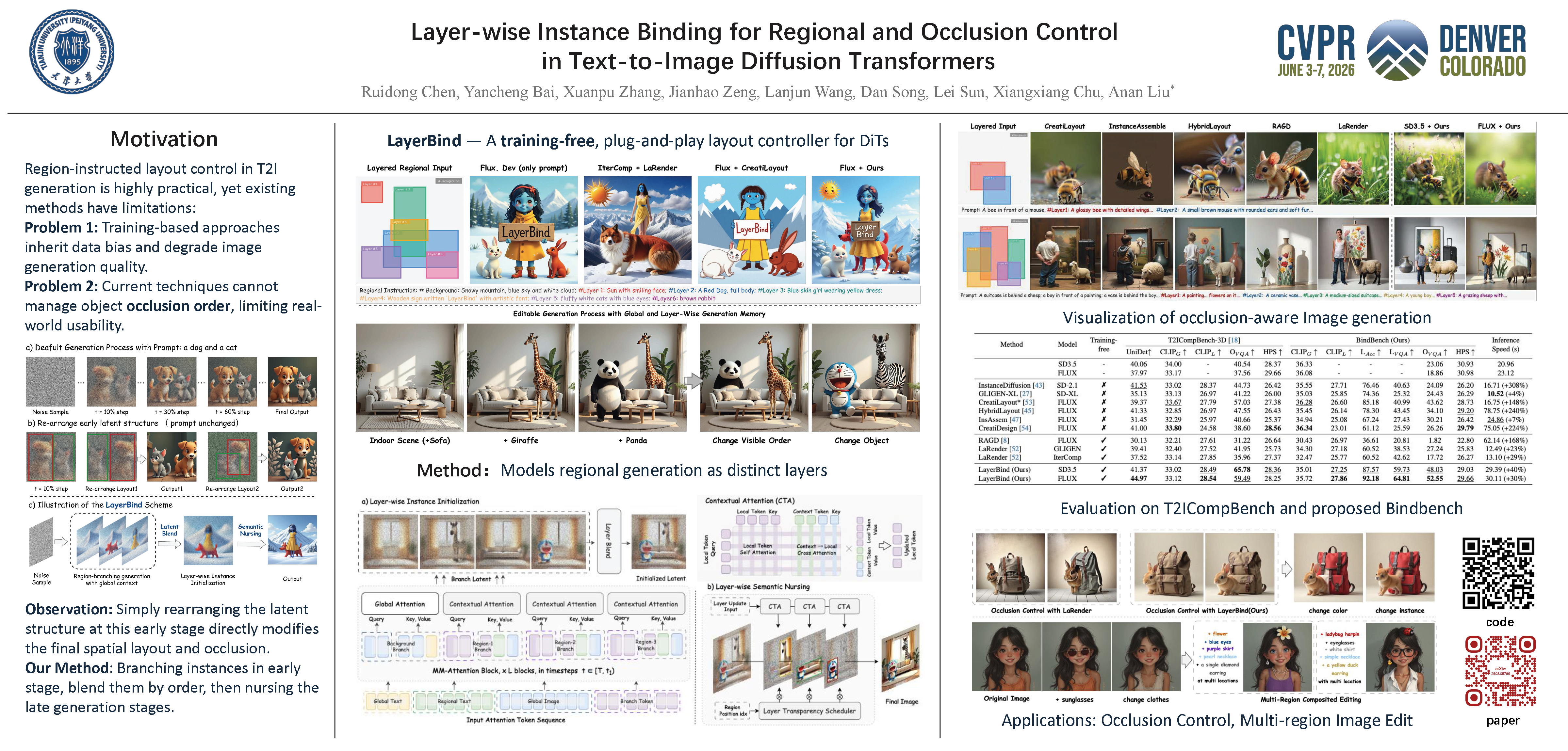
Region-instructed layout control in text-to-image generation is highly practical, yet existing methods suffer from limitations: (i) training-based approaches inherit data bias and often degrade image quality, and (ii) current techniques struggle with occlusion order, limiting real-world usability. To address these issues, we propose LayerBind. By modeling regional generation as distinct layers and binding them during the generation, our method enables precise regional and occlusion controllability. Our motivation stems from the observation that spatial layout and occlusion are established at a very early denoising stage, suggesting that rearranging the early latent structure is sufficient to modify the final output. Building on this, we structure the scheme into two phases: instance initialization and subsequent semantic nursing. (1) First, leveraging the contextual sharing mechanism in multimodal joint attention, Layer-wise Instance Initialization creates per-instance branches that attend to their own regions while anchoring to the shared background. At a designated early step, these branches are fused according to the layer order to form a unified latent with a pre-established layout. (2) Then, Layer-wise Semantic Nursing reinforces regional details and maintains the occlusion order via a layer-wise attention enhancement. Specifically, a sequential layered attention path operates alongside the standard global path, with updates composited under a layer-transparency scheduler. LayerBind is training-free and plug-and-play, serving as a regional and occlusion controller across Diffusion Transformers. Beyond generation, it natively supports editable workflows, allowing for flexible modifications like changing instances or rearranging visible orders. Both qualitative and quantitative results demonstrate LayerBind's effectiveness, highlighting its strong potential for creative applications.
Memory-Efficient Fine-Tuning Diffusion Transformers via Dynamic Patch Sampling and Block Skipping
Sunghyun Park ⋅ Jeongho Kim ⋅ Hyoungwoo Park ⋅ Debasmit Das ⋅ Sungrack Yun ⋅ Munawar Hayat ⋅ Jaegul Choo ⋅ Fatih Porikli ⋅ Seokeon Choi
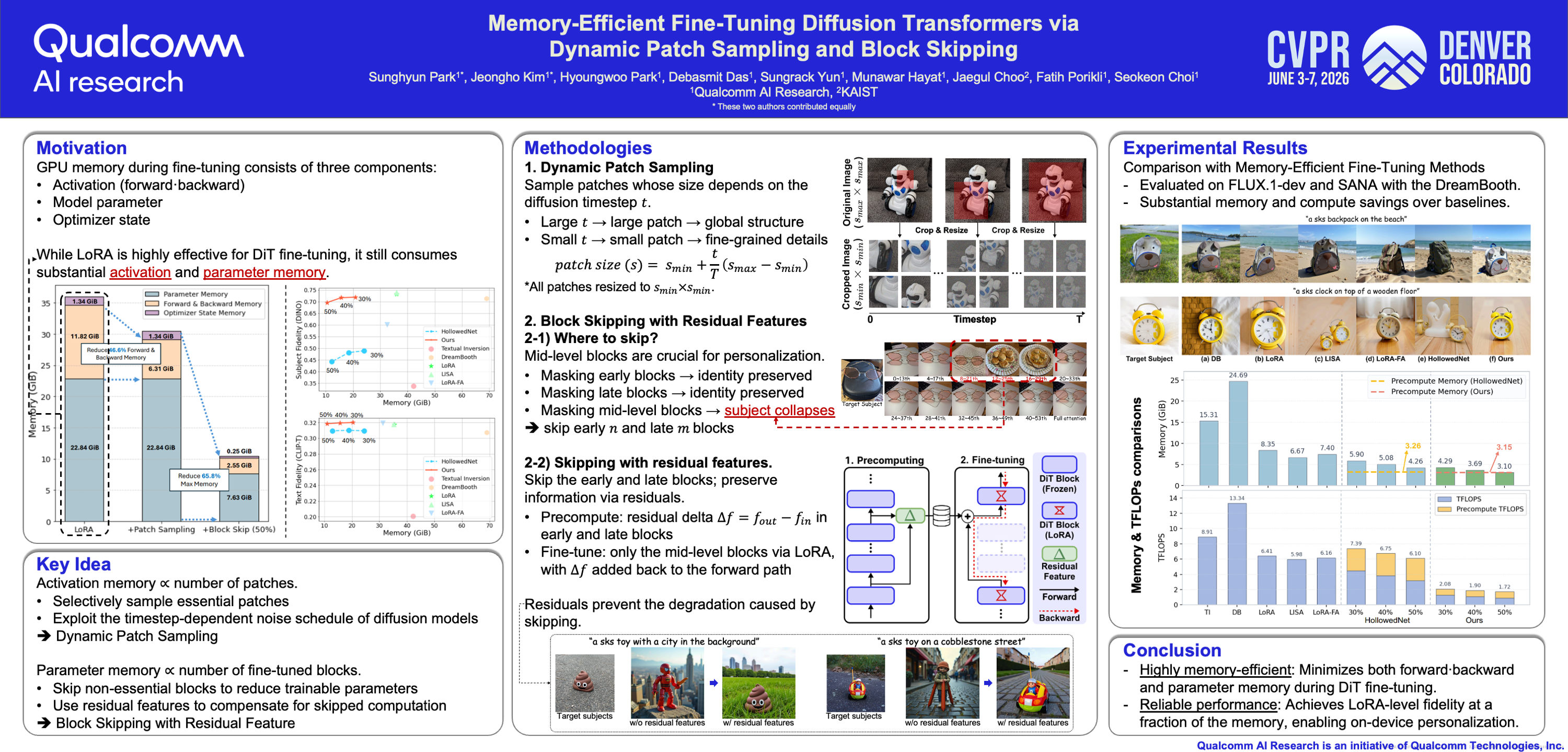
Diffusion Transformers (DiTs) have significantly enhanced text-to-image (T2I) generation quality, enabling high-quality personalized content creation. However, fine-tuning these models requires substantial computational complexity and memory, limiting practical deployment under resource constraints. To tackle these challenges, we propose a memory-efficient fine-tuning framework called DiT-BlockSkip, integrating timestep-aware dynamic patch sampling and block skipping by precomputing residual features. Our dynamic patch sampling strategy adjusts patch sizes based on the diffusion timestep, then resizes the cropped patches to a fixed lower resolution. This approach reduces forward & backward memory usage while allowing the model to capture global structures at higher timesteps and fine-grained details at lower timesteps. The block skipping mechanism selectively fine-tunes essential transformer blocks and precomputes residual features for the skipped blocks, significantly reducing training memory. To identify vital blocks for personalization, we introduce a block selection strategy based on cross-attention masking. Evaluations demonstrate that our approach achieves competitive personalization performance qualitatively and quantitatively, while reducing memory usage substantially, moving toward on-device feasibility (e.g., smartphones, IoT devices) for large-scale diffusion transformers.
COT-FM: Cluster-wise Optimal Transport Flow Matching
Chiensheng Chiang ⋅ Kuan-Hsun Tu ⋅ Jia-Wei Liao ⋅ Cheng-Fu Chou ⋅ Tsung-Wei Ke
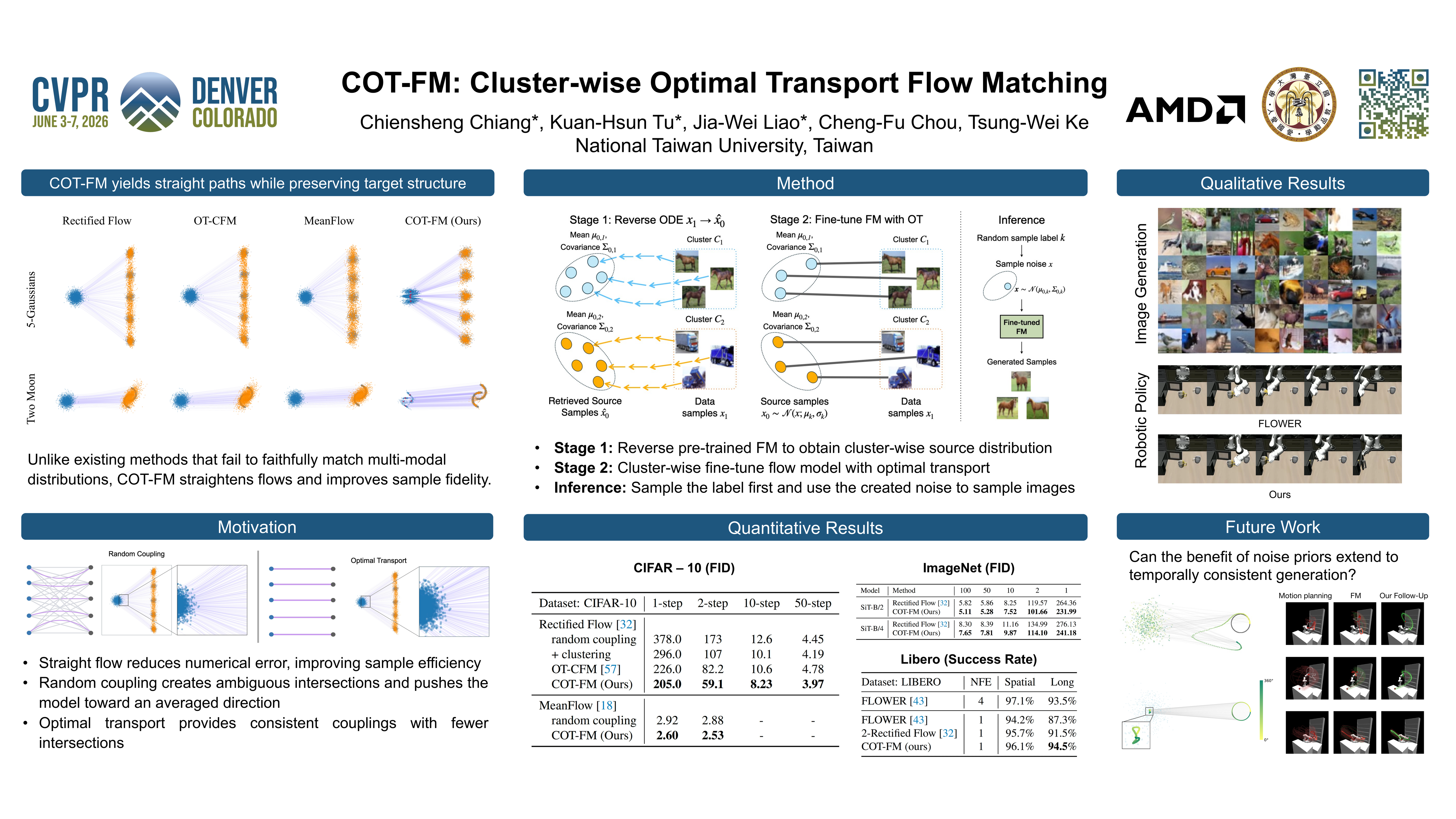
We introduce COT-FM, a general framework that reshapes the probability path in Flow Matching (FM) to achieve faster and more reliable generation. FM models often produce curved trajectories due to random or batch-wise couplings, which increase discretization error and reduce sample quality. COT-FM fixes this by clustering target samples and assigning each cluster a dedicated source distribution obtained by reversing pretrained FM models. This divide-and-conquer strategy yields more accurate local transport and significantly straighter vector fields, all without changing the model architecture. As a plug-and-play approach, COT-FM consistently accelerates sampling and improves generation quality across 2D datasets, image benchmarks, and robotic manipulation tasks.
Interpretable Motion-Attentive Maps: Spatio-Temporally Localizing Concepts in Video Diffusion Transformers
Youngjun Jun ⋅ Seil Kang ⋅ Woojung Han ⋅ Seong Jae Hwang
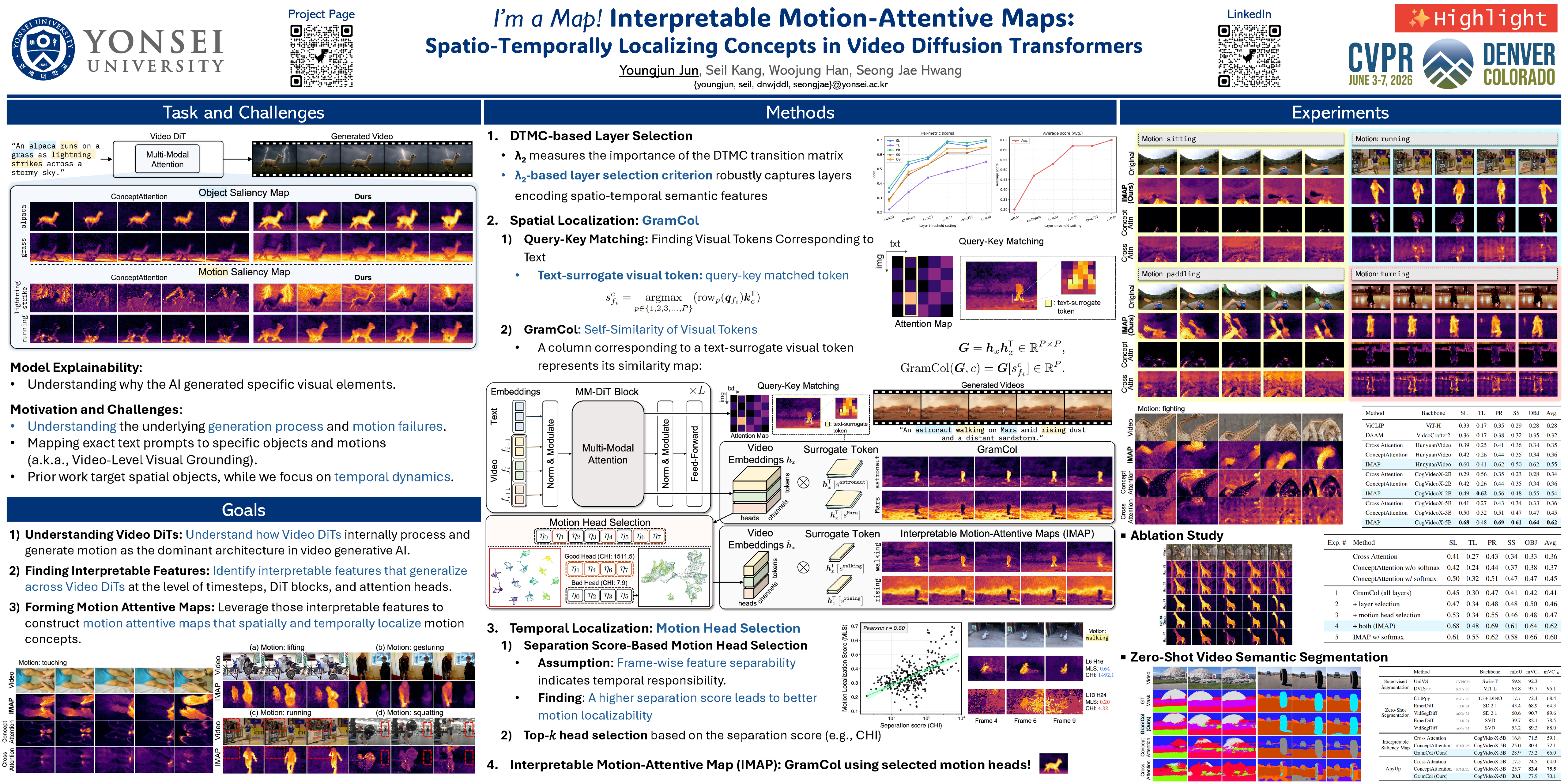
Video Diffusion Transformers (DiTs) have been synthesizing high-quality video with high fidelity to text descriptions involving motion. However, the understanding of how Video DiTs convert motion words into video remains lagging behind. Furthermore, prior studies on interpretable saliency maps primarily target objects, leaving it behind to observe how Video DiTs behave with respect to motion. In this paper, we inquire into concrete motion features that specify which object moves and at what time for a given motion concept. First, to spatially localize, we introduce GramCol, which adaptively renders per-frame saliency maps for any text concept, including both motion and non-motion. Second, we propose an automatic motion-feature selecting algorithm to obtain an Interpretable Motion-Attentive Map (IMAP) that localizes motions spatially and temporally. Our methods discover concept saliency maps without the need for any gradient-based training or parameters. Experimentally, our methods show standout localization capability in the motion localization task and zero-shot video semantic segmentation, providing interpretable and clearer saliency maps for both motion and non-motion concepts.
Guiding a Diffusion Transformer with the Internal Dynamics of Itself
Xingyu Zhou ⋅ Qifan Li ⋅ Xiaobin Hu ⋅ Hai Chen ⋅ Shuhang Gu
The diffusion model presents a powerful ability to obtian the entire (conditional) data distribution.However, due to the lack of sufficient training and data to learn, the model will be penalized for failing to cover low-probability areas.To achieve better generation quality, guidance strategies such as classifier free guidance (CFG) can guide the samples to the high-probability areas during the sampling stage.However, the standard CFG often leads to over-simplified or distorted samples. And the alternative line of guiding diffusion model with its bad version is limited by carefully designed degradation strategies, extra training and additional sampling steps. In this paper, we proposed a simple yet effective strategy Internal Guidance (IG), which introduces an auxiliary supervision on the intermediate layer during training process and extrapolates the intermediate and deep layer's outputs to obtain generative results during sampling process.This simple strategy yields significant improvements in both training efficiency and generation quality on DiTs and SiTs.On ImageNet 256×256, SiT-XL/2+IG achieves FID=5.31 and FID=1.88 which already exceeds the FID of the vanilla SiT-XL and REPA.More impressively, LightningDiT-XL/1+IG achieves FID=1.41 which achieves a large margin between all of these methods.Combined with classifier free guidance, LightningDiT-XL/1+IG achieves the current state-of-the-art FID of 1.23.
CoopDiff: A Diffusion-Guided Approach for Cooperation under Corruptions
Gong Chen ⋅ Chaokun Zhang ⋅ Pengcheng Lv
Cooperative perception lets agents share information to expand coverage and improve scene understanding. However, in real-world scenarios, diverse and unpredictable corruptions undermine its robustness and generalization. To address these challenges, we introduce CoopDiff, a diffusion-based cooperative perception framework that mitigates corruptions via a denoising mechanism. CoopDiff adopts a teacher-student paradigm: the Quality-Aware Teacher performs voxel-level early fusion with Quality of Interest weighting and semantic guidance, then produces clean supervision features via a diffusion denoiser. The Dual-Branch Diffusion Student first separates ego and cooperative streams in encoding to reconstruct the teacher's clean targets. And then, an Ego-Guided Cross-Attention mechanism facilitates balanced decoding under degradation by adaptively integrating ego and cooperative features. We evaluate CoopDiff on two constructed multi-degradation benchmarks, OPV2Vn and DAIR-V2Xn, each incorporating six corruption types, including environmental and sensor-level distortions. Benefiting from the inherent denoising properties of diffusion, CoopDiff consistently outperforms prior methods across all degradation types and lowers the relative corruption error. Furthermore, it offers a tunable balance between precision and inference efficiency.
RARE: Learn to RAnk and REtrieve for Monocular 3D Object Detection
Hyeonjeong Park ⋅ Peixi Xiong ⋅ Xiaoqian Ruan ⋅ Dian Jia ⋅ Pei Yu ⋅ Wei Tang
Monocular 3D object detection from a single RGB image remains challenging due to two fundamental challenges: the ill-posed nature of 3D localization, where multiple plausible configurations can correspond to the same 2D observation, and unreliable confidence estimation that fails to reflect true localization accuracy. Existing methods predict deterministic 3D boxes that often collapse to implausible mean estimates and rely on absolute confidence scores that are highly sensitive to localization errors. This paper introduces RARE, a unified framework that addresses both challenges through learning to rank and retrieve. RARE formulates confidence estimation as a ranking problem, learning to order detections by their relative quality rather than regressing absolute values. It provides more robust and stable confidence estimates that are less sensitive to localization uncertainty. Building on this improved confidence estimator, RARE learns to construct a query set for each object that predicts multiple diverse and plausible 3D configurations, and retrieves the top-ranked prediction. It explicitly models the multimodal nature of monocular 3D perception and produces more plausible localizations. Extensive experiments demonstrate the effectiveness of RARE. We will make the code publicly available.
COG: Confidence-aware Optimal Geometric Correspondence for Unsupervised Single-reference Novel Object Pose Estimation
Yuchen Che ⋅ JINGTU WU ⋅ Hao ZHENG ⋅ Asako Kanezaki
Estimating the 6DoF pose of a novel object with a single reference view is challenging due to occlusions, viewpoint changes, and outliers.A core difficulty lies in finding robust cross-view correspondences, as existing methods often rely on discrete one-to-one matching that is non-differentiable and tends to collapse onto sparse keypoints.We propose Confidence-aware Optimal Geometric Correspondence (COG), an unsupervised framework that formulates correspondence estimation as a confidence-aware optimal transport problem.COG produces balanced soft correspondences by predicting point-wise confidences and injecting them as target marginals, naturally suppressing non-overlapping regions.Semantic priors from vision foundation model features further regularize the correspondences, leading to stable pose estimation.This design integrates confidence into the end-to-end correspondence finding and pose estimation pipeline, enabling fully unsupervised learning.Experiments show unsupervised COG achieves comparable performance to supervised methods, while the supervised variant outperforms them.
Learnability-Driven Submodular Optimization for Active Roadside 3D Detection
Ruiyu Mao ⋅ Baoming Zhang ⋅ Nicholas Ruozzi ⋅ Yunhui Guo
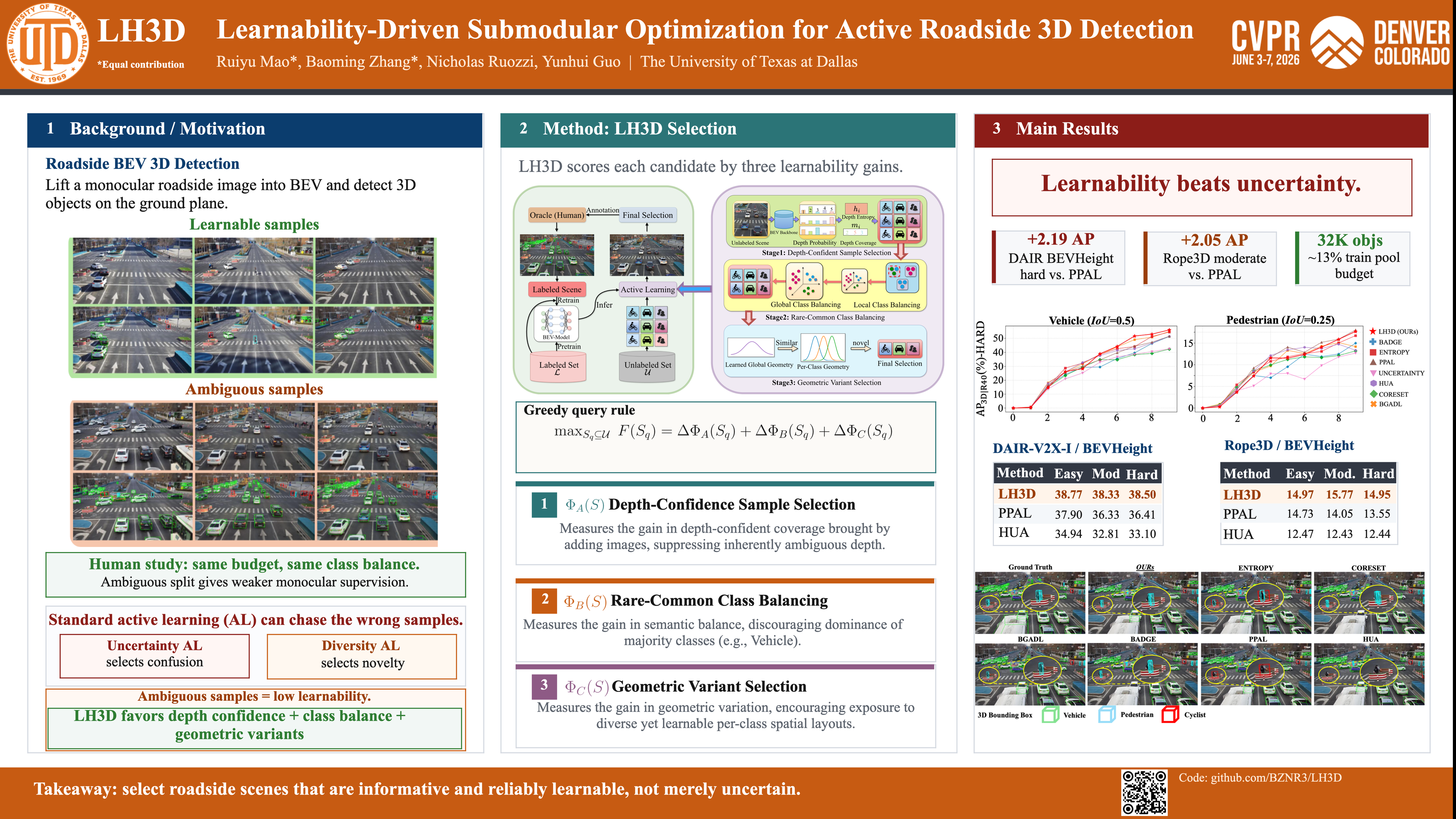
Roadside perception datasets are typically constructed via cooperative labeling between synchronized vehicle and roadside frame pairs. However, real deployment often requires annotation of roadside-only data due to hardware and privacy constraints. Even human experts struggle to produce accurate labels without vehicle-side data (image, LIDAR), which not only increases annotation difficulty and cost, but also reveals a fundamental learnability problem: many roadside-only scenes contain distant, blurred, or occluded objects whose 3D properties are ambiguous from a single view and can only be reliably annotated by cross-checking paired vehicle--roadside frames. We refer to such cases as inherently ambiguous samples. To reduce wasted annotation effort on inherently ambiguous samples while still obtaining high-performing models, we turn to active learning. This work focuses on active learning for roadside monocular 3D object detection and proposes a learnability-driven framework that selects scenes which are both informative and reliably labelable, suppressing inherently ambiguous samples while ensuring coverage. Experiments demonstrate that our method, LH3D, achieves 86.06%, 67.32%, and 78.67% of full-performance for vehicles, pedestrians, and cyclists respectively, using only 25% of the annotation budget on DAIR-V2X-I, significantly outperforming uncertainty-based baselines. This confirms that learnability, not uncertainty, matters for roadside 3D perception.
Look Before You Fuse: 2D-Guided Cross-Modal Alignment for Robust 3D Detection
Xiang Li ⋅ Zhangchi Hu ⋅ Xu Xiao ⋅ Bin Kong
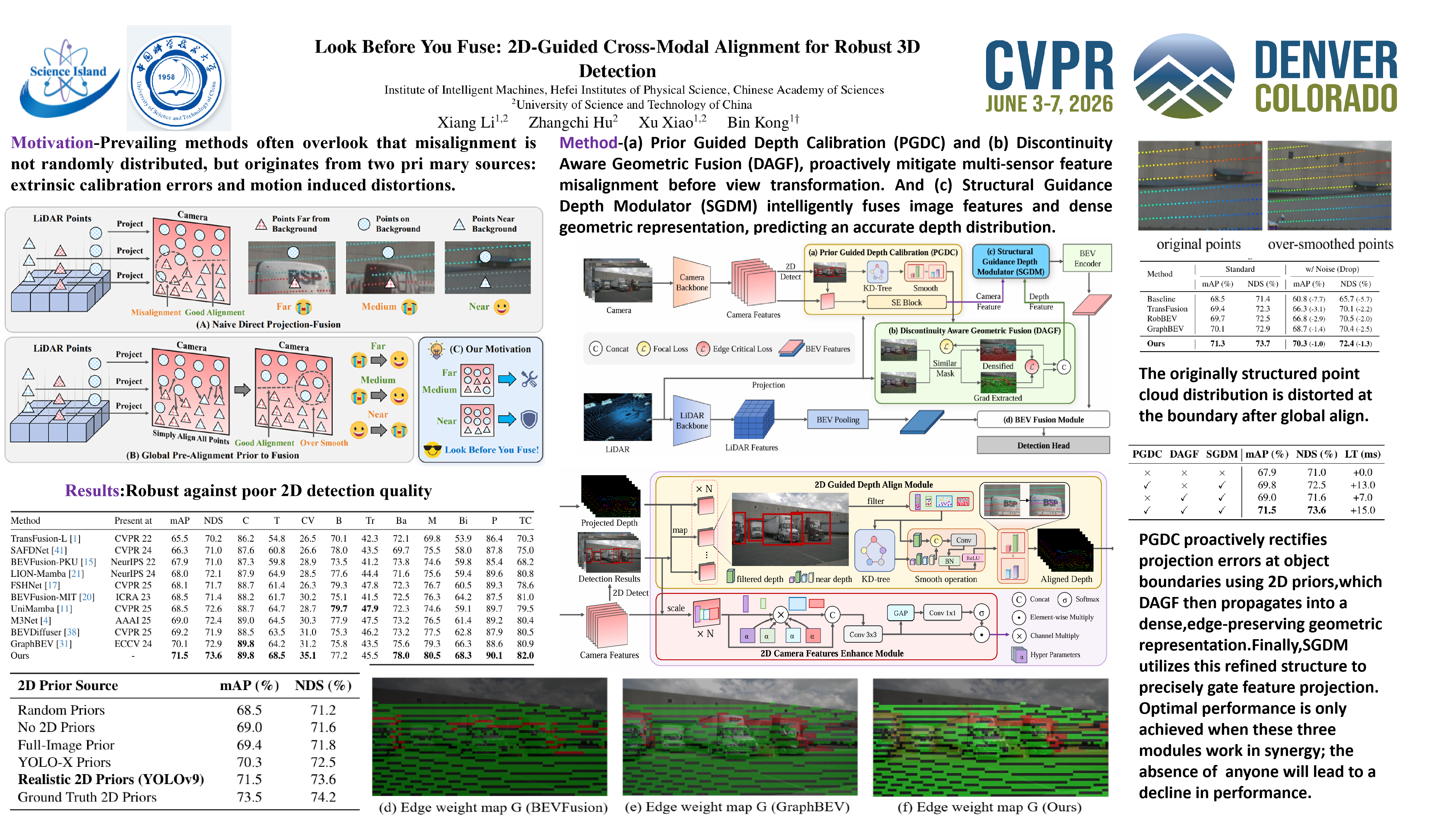
Integrating LiDAR and camera inputs into a unified Bird’s-Eye-View (BEV) representation is crucial for enhancing 3D perception capabilities of autonomous vehicles. However, existing methods suffer from spatial misalignment between LiDAR and camera features, which causes inaccurate depth supervision in camera branch and erroneous fusion during cross-modal feature aggregation. The root cause of this misalignment lies in projection errors, stemming from calibration inaccuracies and rolling shutter effect.The key insight of this work is that locations of these projection errors are not random but highly predictable, as they are concentrated at object-background boundaries which 2D detectors can reliably identify. Based on this, our main motivation is to utilize 2D object priors to pre-align cross-modal features before fusion. To address local misalignment, we propose Prior Guided Depth Calibration (PGDC), which leverages 2D priors to alleviate misalignment and preserve correct cross-modal feature pairs. To resolve global misalignment, we introduce Discontinuity Aware Geometric Fusion (DAGF) to suppress residual noise from PGDC and explicitly enhance sharp depth transitions at object-background boundaries, yielding a structurally aware representation. To effectively utilize these aligned representations, we incorporate Structural Guidance Depth Modulator (SGDM), using a gated attention mechanism to efficiently fuse aligned depth and image features. Our method achieves SOTA performance on nuScenes validation dataset, with its mAP and NDS reaching 71.5% and 73.6% respectively. Additionally, on the Argoverse 2 validation set, we achieve a competitive mAP of 41.3%.
Long-SCOPE: Fully Sparse Long-Range Cooperative 3D Perception
Jiahao Wang ⋅ Zikun Xu ⋅ Yuner Zhang ⋅ Zhongwei Jiang ⋅ Chenyang Lu ⋅ Shuocheng Yang ⋅ Yuxuan Wang ⋅ Jiaru Zhong ⋅ Chuang Zhang ⋅ Shaobing Xu ⋅ Jianqiang Wang
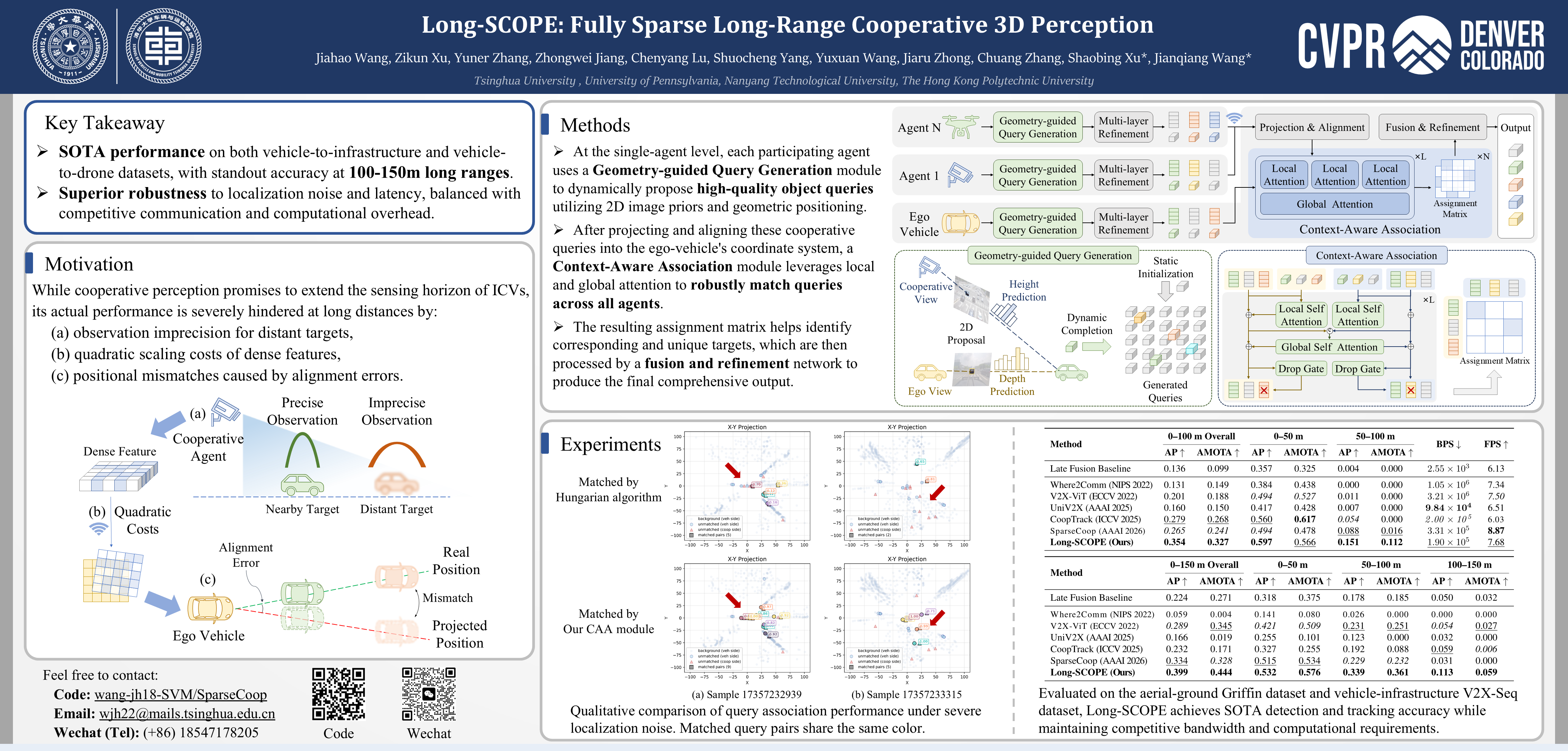
Cooperative 3D perception via Vehicle-to-Everything (V2X) communication is a promising paradigm for enhancing autonomous driving, offering extended sensing horizons and occlusion resolution.However, the practical deployment of existing methods is hindered at long distances by two critical bottlenecks:the quadratic computational scaling of dense BEV representations and the fragility of feature association mechanisms under significant observation and alignment errors.To overcome these limitations, we introduce Long-SCOPE, a fully sparse framework designed for robust long-distance cooperative 3D perception.Our method introduces two novel components: a Geometry-guided Query Generation module to accurately detect small, distant objects,and a learnable Context-Aware Association module that robustly matches cooperative queries even despite severe positional noise.Experiments on the V2X-Seq and Griffin datasets validate that Long-SCOPE achieves state-of-the-art performance, particularly in challenging long-range settings, while maintaining superior computational efficiency and a highly competitive transmission cost.
Dynamics-Aware Preference Optimization for Vision-Language Models
jusheng zhang ⋅ Kaitong Cai ⋅ Jing Yang ⋅ Jian Wang ⋅ Keze Wang
Preference-based finetuning of vision-language models (VLMs) is notoriously unstable, as trivially wrong negatives inject uninformative gradients that distort optimization and degrade calibration. This work revisits this issue through the lens of learning dynamics and identifies a core pathology, the squeezing effect, where easy negatives retain large, misaligned gradients despite having negligible loss.To address this, we propose Cooling-Weighted Direct Preference Optimization (CW-DPO), a two-stage framework that first smooths and then stabilizes the alignment process. Stage 1 employs a constrained SFT phase with low-weight “gentle negatives’’ to regularize overconfident distributions and flatten the loss landscape. Stage 2 introduces a competence-aware cooling weight that adaptively scales negative gradients according to the model’s average per-token log-probability, suppressing uninformative updates while emphasizing hard, on-policy contrasts. This dynamics-aware weighting effectively mitigates the squeezing effect and enables smoother convergence.Extensive experiments on mainstream benchmarks—including COCO, Flickr30k, NoCaps, MMMU, and MMBench1.1—show that CW-DPO achieves state-of-the-art performance, for example +3.4 CIDEr over PPO and +2.4% absolute accuracy on MMMU, while improving calibration and halving convergence steps. This demonstrates that smoothing before cooling constitutes a simple yet general principle for robust VLM preference optimization.
Selection-as-Nonlinearity: Bridging Attention and Activation via a Joint Game–Decision Lens for Interpretable, Discriminative Visual Representations
Sudong Cai ⋅ Shuai Yuan ⋅ Bingzhi Chen ⋅ Rui Mao ⋅ Bing Wang
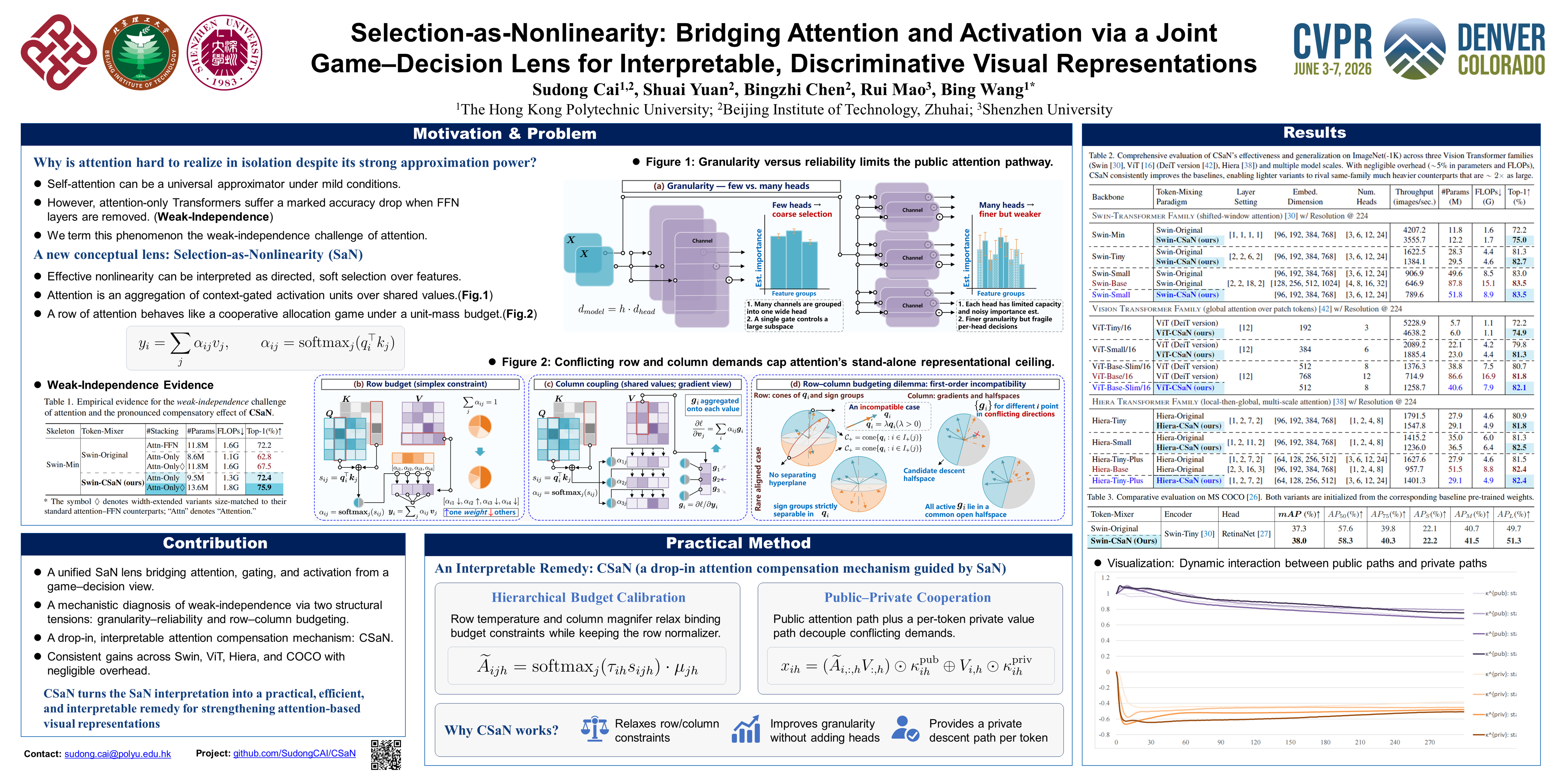
Self-attention with separate pre- and post-projections can be a universal approximator (on compact domains) under mild conditions.Yet we observe a striking gap: an attention-only Transformer (w/o FFN layers) exhibits a marked accuracy drop relative to its standard interleaved attention--FFN baseline.We term this the **weak-independence** challenge of attention.We study this through a new conceptual lens, **Selection-as-Nonlinearity (SaN)**, which interprets effective nonlinearity as directed, cost-constrained selection, offering a coherent account of attention as context-gated activation.In this joint game–decision view, attention performs a resource-constrained cooperative allocation over values: each query distributes a unit-mass weight budget over shared values to optimize representational utility, under a normalizer (e.g., $\mathrm{softmax}$), and guided by context-derived scores (e.g., q-k similarities).SaN interprets *weak-independence* as a structural tension: the value weights almost cannot simultaneously attain the decoupled per-query (row-wise) and the per-value (column-wise) optimums under shared budgets, thereby limiting attention's stand-alone capacity.Guided by SaN, we introduce **CSaN**, an interpretable, efficient attention compensation paradigm with two key insights: **1) hierarchical budget calibration,** *re-allocate* row budgets via inter-query correction signals; and **2) public-private cooperation,** enhancing the *public* attention pathway with a per-token *private* value pathway to decouple conflicting demands.CSaN is evaluated on various vision benchmarks and demonstrates *level-jump gains* across popular Transformer families (Swin, ViT, Hiera), enabling models to rival much heavier same-family counterparts $\sim2\times$ as large.
Learning What Helps: Task-Aligned Context Selection for Vision Tasks
Jingyu Guo ⋅ Emir Konuk ⋅ Fredrik Strand ⋅ Christos Matsoukas ⋅ Kevin Smith
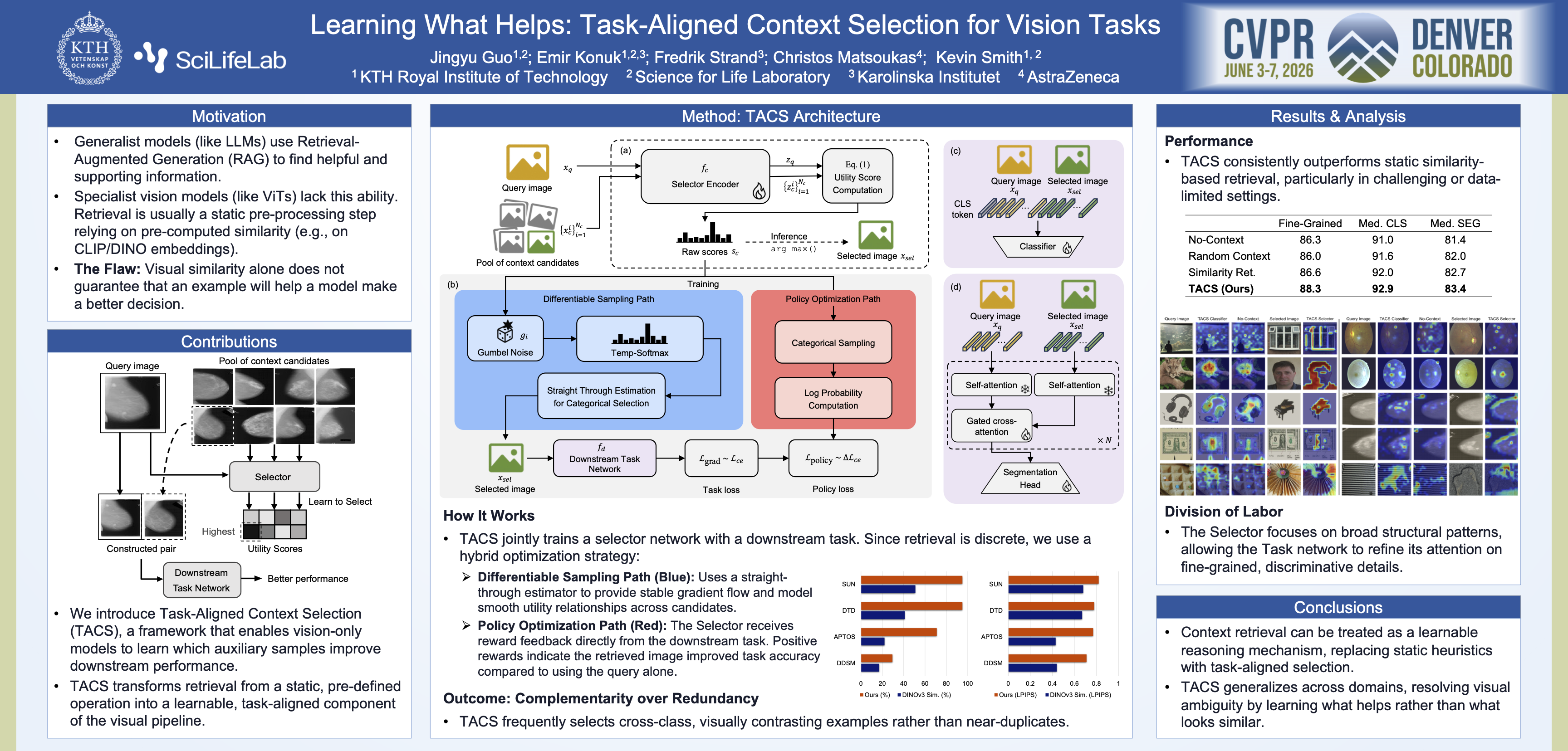
Humans often resolve visual uncertainty by comparing an image with relevant examples, but ViTs lack the ability to identify which examples would improve their predictions. We present Task-Aligned Context Selection (TACS), a framework that learns to select paired examples which truly improve task performance rather than those that merely appear similar. TACS jointly trains a selector network with the task model through a hybrid optimization scheme combining gradient-based supervision and reinforcement learning, making retrieval part of the learning objective.By aligning selection with task rewards, TACS enables discriminative models to discover which contextual examples genuinely help.Across 18 datasets covering fine-grained recognition, medical image classification, and medical image segmentation, TACS consistently outperforms similarity-based retrieval, particularly in challenging or data-limited settings.
Consensus Entropy: Harnessing Multi-VLM Agreement for Self-Verifying and Self-Improving OCR
Yulong Zhang ⋅ Tianyi Liang ⋅ Erfei Cui ⋅ Guoqing Wang ⋅ Xu Guo ⋅ Chenhui Li ⋅ Gongshen Liu
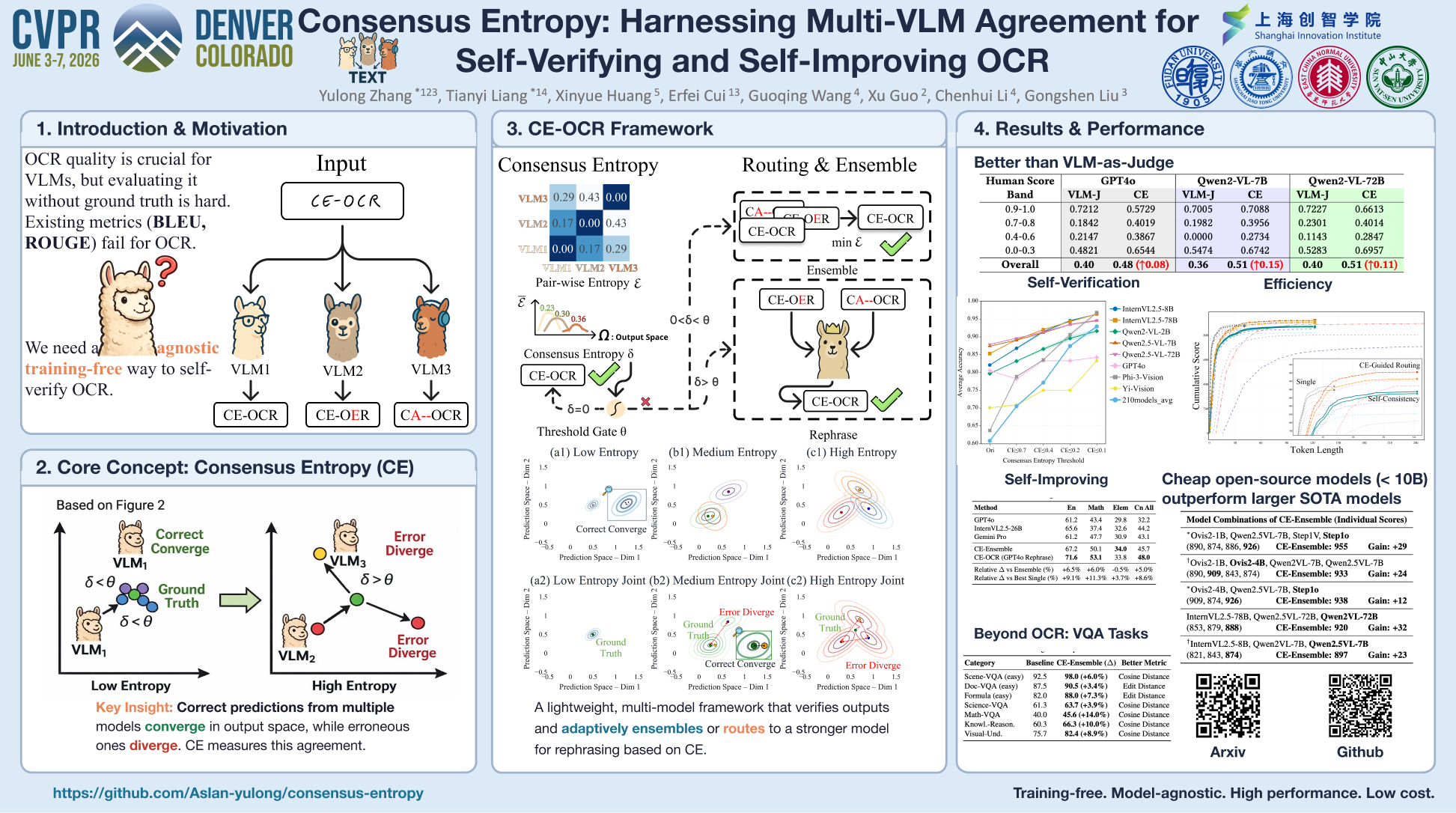
Optical Character Recognition (OCR) is fundamental to Vision-Language Models (VLMs) and high-quality data generation for LLM training. Yet, despite progress in average OCR accuracy, state-of-the-art VLMs still struggle with detecting sample-level errors and lack effective unsupervised quality control.We introduce Consensus Entropy (CE), a training-free, model-agnostic metric that estimates output reliability by measuring inter-model agreement entropy. The core insight is that correct predictions converge in output space, while errors diverge. Based on CE, we develop CE-OCR, a lightweight multi-model framework that verifies outputs by ensemble agreement, selects the best outputs, and further improves efficiency through adaptive routing. Experiments demonstrate that CE is robust for quality verification, improving F1 scores by 42.1\% over VLM-as-Judge. CE-OCR achieves consistent OCR gains, outperforming self-consistency and single-model baselines at the same cost. Notably, CE requires no training or supervision, enabling plug-and-play integration.
NeuroRule: Bridging Vision and Logic with Differentiable Rule Induction
Muhammad Zarar ⋅ Mingzheng Zhang ⋅ Xiaowang Zhang ⋅ Zhiyong Feng
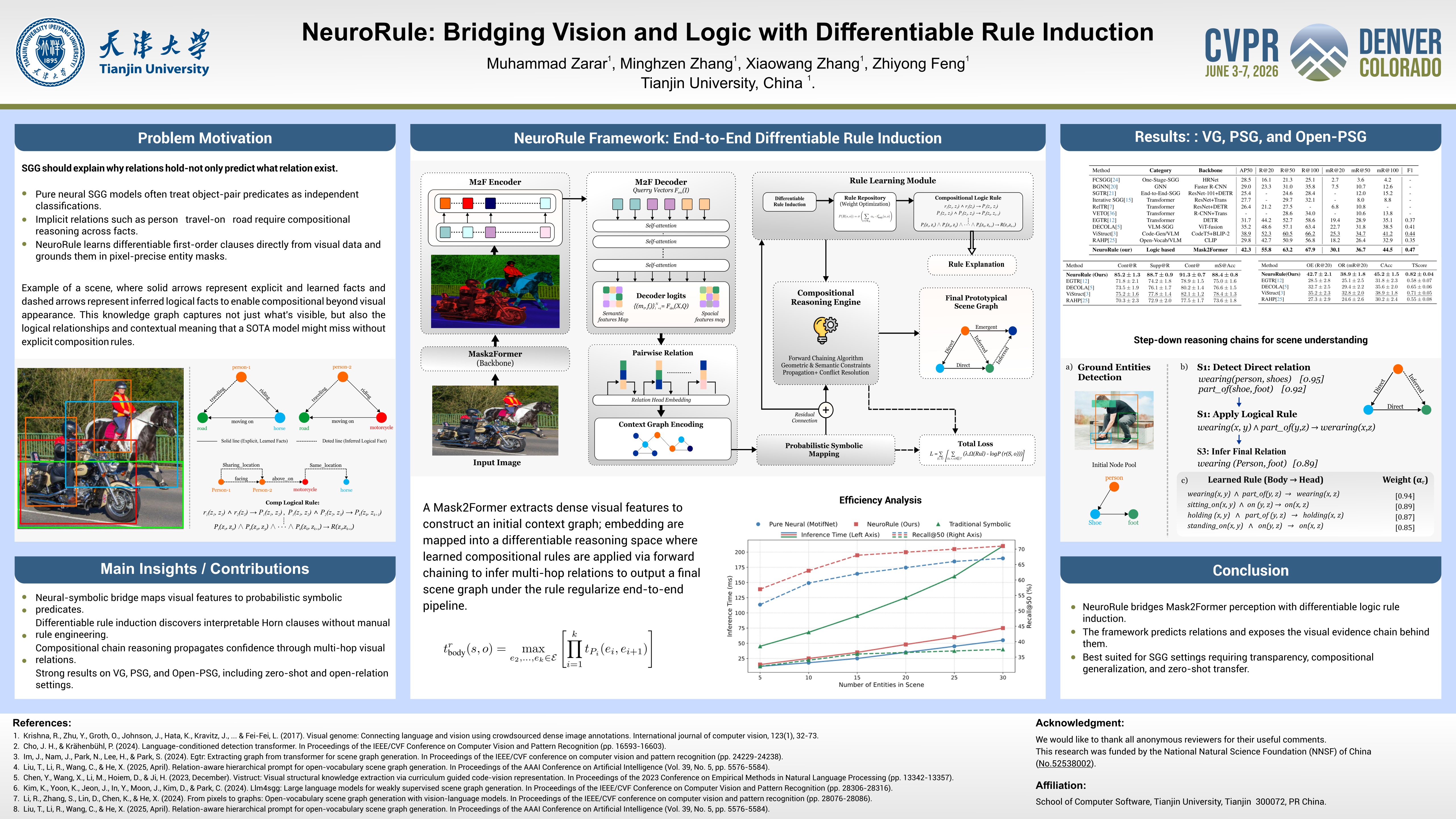
Scene Graph Generation (SGG) aims to structurally represent visual scenes by detecting objects and their pairwise relationships. Despite significant progress, current models encode visual knowledge with ambiguous visual context and logically inferred implicit relations due to their purely neural, pipeline-based nature. This limitation underscores the need to advance beyond identifying what relations exist to explaining why they exist and how they can be compositionally reasoned about through logical rule chaining. To address these challenges, we introduce NeuroRule, the first \textbf{Neurally-Guided Rule Induction Network} that integrates Mask2Former pixel-precise visual understanding with a differentiable rule induction engine. Our proposed method enables automatic learning of compositional logical rules directly from visual data while providing transparent explanations for relational predictions. NeuroRule introduces three key innovations: (1) a neural-symbolic bridge that maps visual features to probabilistic symbolic representations; (2) a differentiable rule-learning mechanism that automatically discovers interpretable first-order logic rules without manual engineering; and (3) a compositional chain rule system that enables complex inference while propagating confidence scores through an end-to-end trainable pipeline. Extensive experiments on the benchmark datasets, including Visual Genome (VG), Panoptic Scene Graph (PSG), and OpenPSG, demonstrate that NeuroRule achieves state-of-the-art performance. Our method significantly improves few-shot relation extraction while maintaining full interpretability in its rule-based explanations. To ensure reproducibility, we will release the code after publication.
Beyond Graph Model: Reliable VLM Fine-Tuning via Random Graph Adapter
Bo Jiang ⋅ Xueyang Ze ⋅ Beibei Wang ⋅ Xixi Wang ⋅ Xixi Wan ⋅ Bin Luo
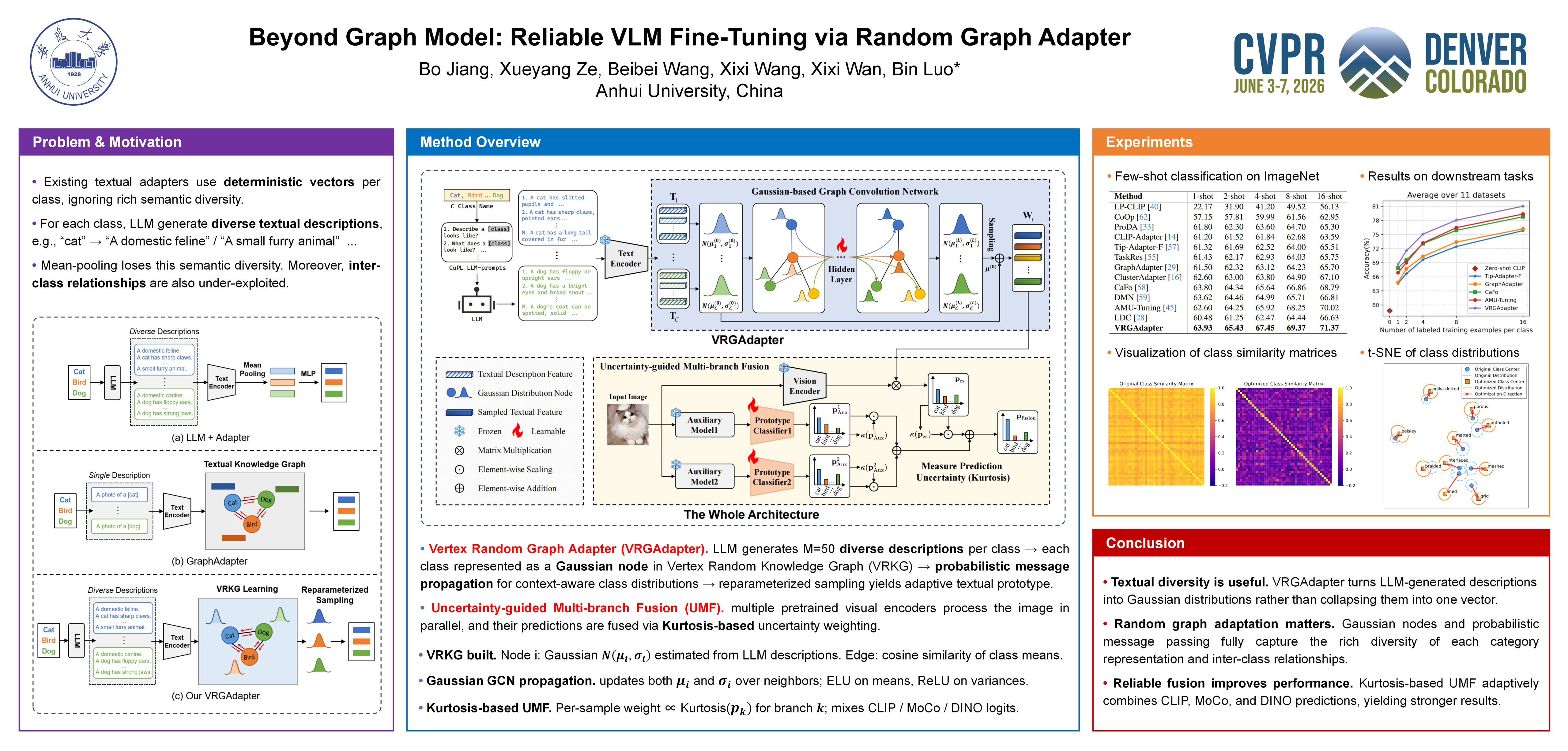
Textual adapter-based tuning methods have shown significant potential in transferring knowledge from pre-trained Vision-Language Models (VLMs) to downstream tasks. Existing works generally employ the deterministic textual feature adapter to refine each category textual representation. However, due to inherent factors such as different attributes and contexts, there exists significant diversity in textual descriptions for each category. Such description diversity offers rich discriminative semantic knowledge that can benefit downstream visual learning tasks. Obviously, traditional deterministic adapter model cannot adequately capture this varied semantic information. Also, it is desirable to exploit the inter-class relationships in VLM adapter. To address these issues, we propose to exploit random graph model into VLM adapter and develop a novel Vertex Random Graph Adapter (VRGAdapter). VRGAdapter first models the inherent diverse descriptions of each category and inter-class relationships of different categories simultaneously by leveraging a Vertex Random Knowledge Graph (VRKG) model. Then, it employs probabilistic message propagation on VRKG to learn context-aware distribution representation for each class node. Finally, it adopts a reparameterized sampling function to achieve textual adapter learning. Note that, VRGAdapter provides a more general adapter solution that encompasses traditional graphbased adapter as a special case. In addition, to enable more robust performance for downstream tasks, we also introduce a new Uncertainty-guided Multi-branch Fusion (UMF) scheme that dynamically integrates multiple pre-trained models for ensemble prediction. Extensive experiments on multiple benchmark datasets demonstrate the effectiveness of our approach.
Ego: Embedding-Guided Personalization of Vision-Language Models
Soroush Seifi ⋅ Simon Gardier ⋅ Vaggelis Dorovatas ⋅ Daniel Olmeda Reino ⋅ Rahaf Aljundi
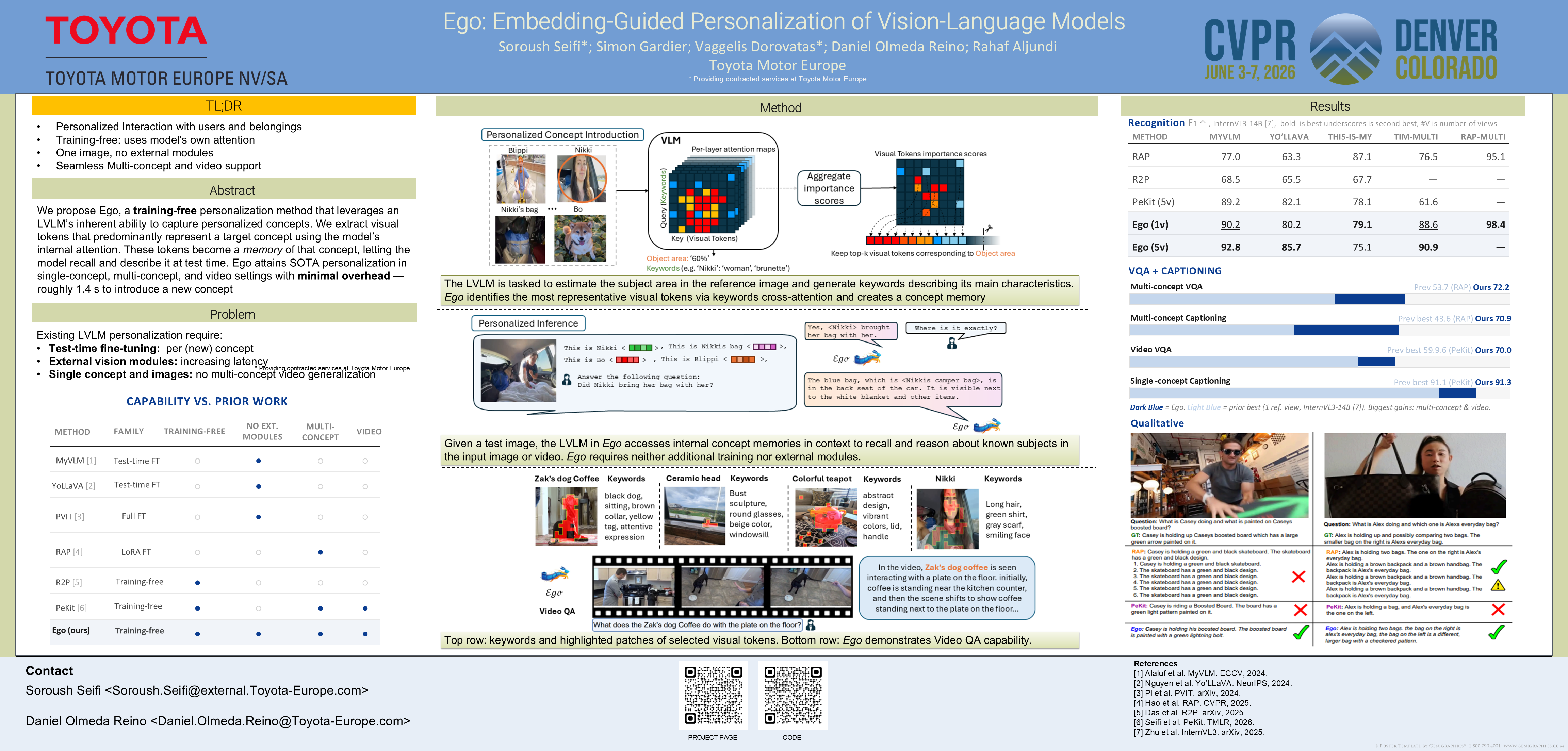
AI assistants that support humans in daily life are becoming increasingly feasible, driven by the rapid advancements in multimodal language models. A key challenge lies in overcoming the generic nature of these models to deliver personalized experiences. Existing approaches to personalizing large vision language models often rely on additional training stages, which limit generality and scalability, or on engineered pipelines with external pre-trained modules, which hinder deployment efficiency. In this work, we propose an efficient personalization method that leverages the model’s inherent ability to capture personalized concepts. Specifically, we extract visual tokens that predominantly represent the target concept by utilizing the model’s internal attention mechanisms. These tokens serve as a memory of that specific concept, enabling the model to recall and describe it when it appears in test images. We conduct a comprehensive and unified evaluation of our approach and SOTA methods across various personalization settings including single-concept, multi-concept, and video personalization, demonstrating strong performance gains with minimal personalization overhead.
JoPPO: Hierarchical Photography Assessment via Contrastive Joint Conditional Probabilistic Reinforcement Learning
Yifan Yang ⋅ Juntuo Wang ⋅ Yuming Qiao ⋅ Xudong Zhang ⋅ Chunyang Yu ⋅ Yan Li ⋅ Xiao Lin ⋅ Liang Luo ⋅ Dan Meng
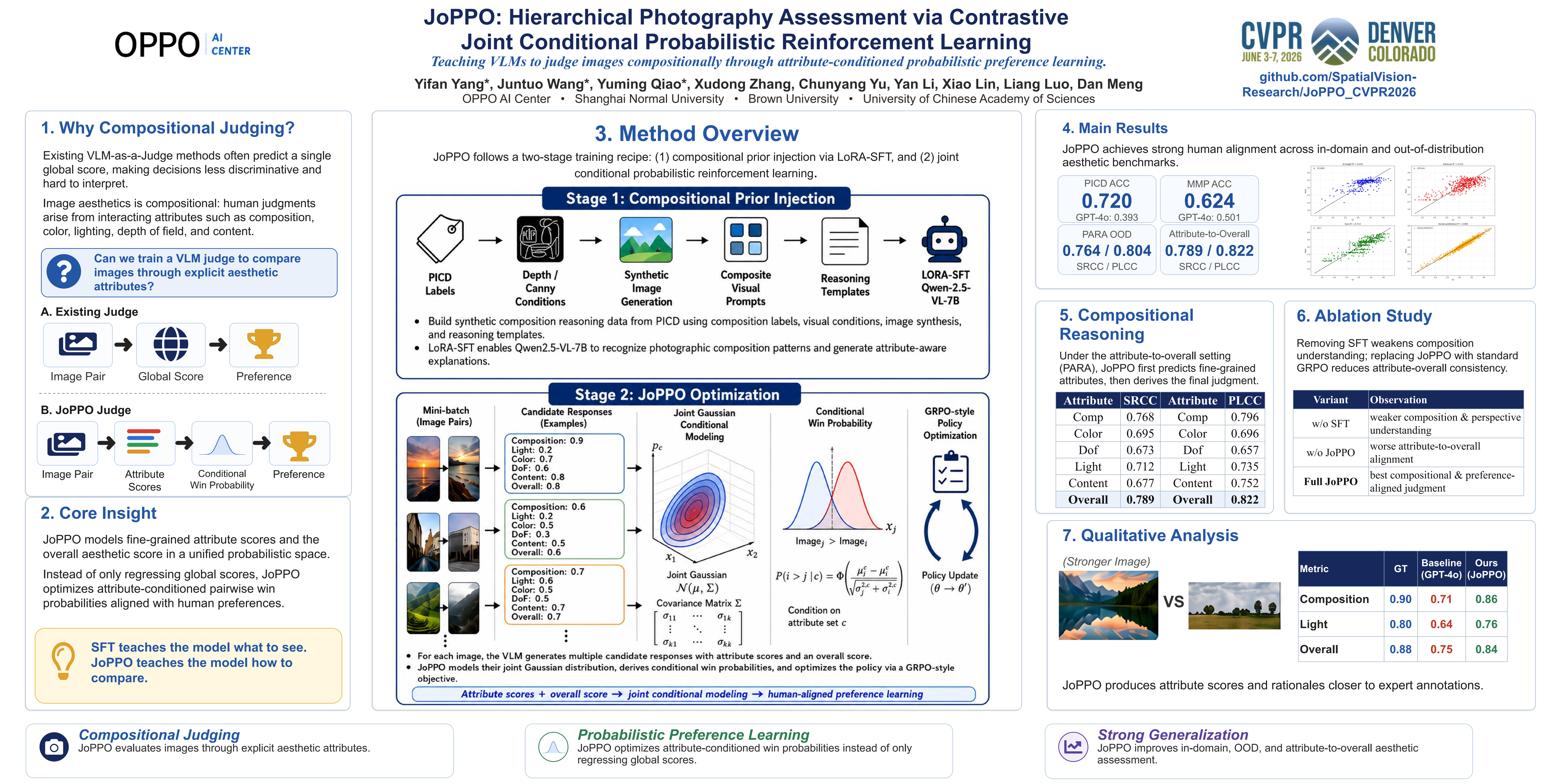
The value of a photograph lies not in what it contains, but in what it is about. -John SzarkowskiWith the advancement of Vision-Language Models (VLMs), employing VLM-as-a-Judge for visual evaluation has become a widely adopted metric in vision research. However, existing VLM-as-a-Judge approaches suffer from biased scoring outcomes with low discrimination and lack the capacity for unified multi-attribute compositional assessment. To address these limitations, we propose a novel training paradigm, termed JoPPO (Joint Probabilistic Policy Optimization) that enables the VLMs to learn ranking under compositional assessment constraints. We evaluate the JoPPO on image aesthetics as a testbed, a task requiring nuanced understanding of multiple attributes including composition, lighting, color and geometry. Training follows two stages: (1) Supervised Fine-Tuning (SFT) on synthetic composition dataset provided by automated data generation pipeline to instill compositional priors; and (2) Contrastive Joint Conditional Probabilistic Reinforcement Learning: building upon the GRPO algorithm, we introduce JoPPO, which compute reward based on the expected win rate of total scores derived from the conditional distribution of fine-grained attribute scores within batches, effectively enhancing the model’s discriminative ability in composite evaluation. Across standard aesthetic benchmarks, our method achieves consistent improvements in ranking consistency, demonstrating strong zero-shot generalization.
AeroAgent: A Vision–Physics–Decision Framework for Aerodynamic Vehicle Design
Ye Liu ⋅ Shouyi Li ⋅ Huiyu Yang ⋅ Jianghang gu ⋅ Wenhao Fan ⋅ Zhongxin Yang ⋅ Ding Wang ⋅ Simeng Chen ⋅ Zirun Jiang ⋅ Yuanwei Bin ⋅ Shiyi Chen ⋅ Yuntian Chen
Modern generative models can propose striking 3D vehicle shapes from text and images, but turning these sketches intoaerodynamically efficient, regulation-compliant designs still requires weeks of high-fidelity computational fluiddynamics (CFD) and manual iteration. As a result, fast 3D generation without trustworthy physics in the loop doeslittle to reduce end-to-end design time. We study how an AI agent can close this loop under a strict CFD budget.We introduce AeroAgent, a vision–physics–decision framework built around a single 3D, editable surfacerepresentation for vehicle shapes. A vision module turns text and 2D references into diverse, standardized 3Dcandidates and supports image-level edits. A physics module, AeroFormer, is a geometry-guidedTransformer surrogate trained on a large-scale vehicle aerodynamics dataset of roughly 50k CFD simulations; threetask-specific heads predict drag ($C_d$), surface pressure, and velocity fields on shared 3D grids. A decision module encodesregulatory size limits and aesthetic constraints as feasibility tests, uses prototype priors and surrogate sensitivitiesto guide free-form deformation edits, and runs a budget-aware propose–evaluate–refine loop in which only the finaltop-$K$ shapes are confirmed by high-fidelity CFD.In extensive experiments across five common vehicle classes, running only five propose–evaluate–refine iterations per vehiclereduces drag by an average of 2–12\% and cuts high-fidelity CFD calls by 50–80\% compared to baseline workflows, whilepreserving or improving styling quality.
MiniCPM-V 4.5: Cooking Efficient MLLMs via Architecture, Data, and Training Recipe
Tianyu Yu ⋅ Zefan Wang ⋅ Chongyi Wang ⋅ Fuwei Huang ⋅ Wenshuo Ma ⋅ Zhihui He ⋅ Tianchi Cai ⋅ Weize Chen ⋅ Yuxiang Huang ⋅ Ranchi Zhao ⋅ Bokai Xu ⋅ Junbo Cui ⋅ Yingjing Xu ⋅ Liqing Ruan ⋅ Luoyuan Zhang ⋅ Hanyu Liu ⋅ Jingkun Tang ⋅ Hongyuan Liu ⋅ Qining Guo ⋅ Wenhao Hu ⋅ Bingxiang He ⋅ Jie Zhou ⋅ Jie Cai ⋅ Ji Qi ⋅ Zonghao Guo ⋅ Chi Chen ⋅ Guoyang Zeng ⋅ Yuxuan Li ⋅ Ganqu Cui ⋅ Ning Ding ⋅ Xu Han ⋅ Yuan Yao ⋅ Zhiyuan Liu ⋅ Maosong Sun
Multimodal Large Language Models (MLLMs) are undergoing rapid progress and represent the frontier of AI development. However, their training and inference efficiency have emerged as a core bottleneck in making MLLMs more accessible and scalable. To address the challenges, we present MiniCPM-V 4.5, an 8B parameter model designed for high efficiency and strong performance. We introduce three core improvements in model architecture, data strategy and training method: a unified 3D-Resampler model architecture for highly compact encoding over images and videos, a unified learning paradigm for document knowledge and text recognition without heavy data engineering, and a hybrid reinforcement learning strategy for proficiency in both short and long reasoning modes. Comprehensive experimental results in OpenCompass evaluation show that MiniCPM-V 4.5 surpasses widely used proprietary models such as GPT-4o-latest, and significantly larger open-source models such as Qwen2.5-VL 72B. Notably, the strong performance is achieved with remarkable efficiency. For example, on the widely adopted VideoMME benchmark, MiniCPM-V 4.5 achieves state-of-the-art performance among models under 30B size, using just 46.7\% GPU memory cost and 8.7\% inference time of Qwen2.5-VL 7B.
Prune Wisely, Reconstruct Sharply: Compact 3D Gaussian Splatting via Adaptive Pruning and Difference-of-Gaussian Primitives
Haoran Wang ⋅ Guoxi Huang ⋅ Fan Zhang ⋅ David Bull ⋅ Nantheera Anantrasirichai
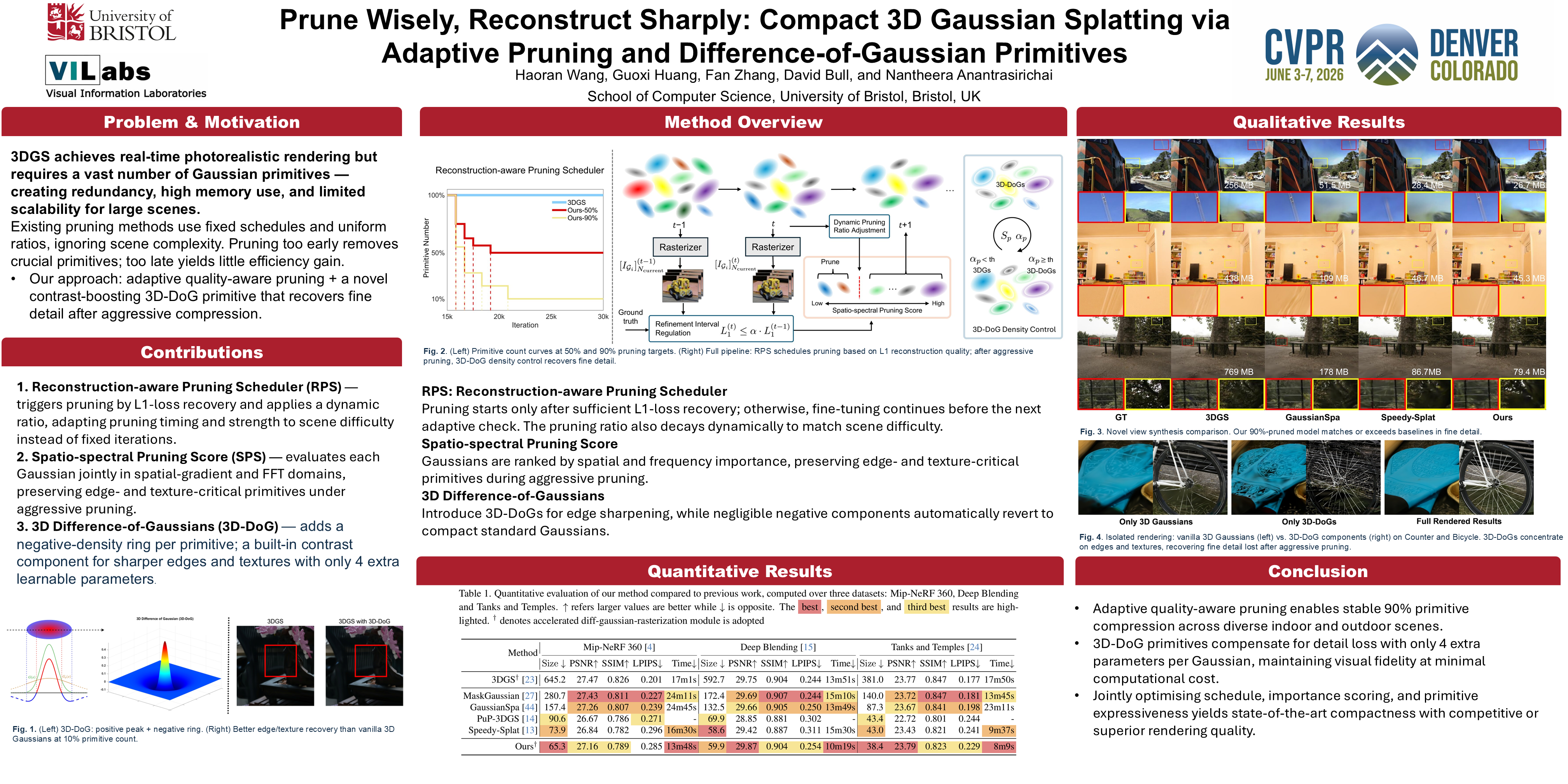
Recent significant advances in 3D scene representation have been driven by 3D Gaussian Splatting (3DGS), which has enabled real-time rendering with photorealistic quality. 3DGS often requires a large number of primitives to achieve high fidelity, leading to redundant representations and high resource consumption, thereby limiting its scalability for complex or large-scale scenes. Consequently, effective pruning strategies and more expressive primitives that can reduce redundancy while preserving visual quality are crucial for practical deployment. We propose an efficient, integrated reconstruction-aware pruning strategy that adaptively determines pruning timing and refining intervals based on reconstruction quality, thus reducing model size while enhancing rendering quality. Moreover, we introduce a 3D Difference-of-Gaussians primitive that jointly models both positive and negative densities in a single primitive, improving the expressiveness of Gaussians under compact configurations. Our method significantly improves model compactness, achieving up to 90% reduction in Gaussian-count while delivering visual quality that is similar to, or in some cases better than, that produced by state-of-the-art methods. Code will be made publicly available.
MSCD-GS: Motion-Separated Cooperative Deblurring Dynamic Reconstruction via Gaussian Splatting
yongjian liao ⋅ Xu Zou ⋅ Wenjun Chen ⋅ Huixuan Li ⋅ Xiaoen Xie ⋅ Chunxi Li ⋅ Shixiang Huang ⋅ Gang Zhang ⋅ Jiahuan Zhou ⋅ Sheng Zhong ⋅ Luxin Yan
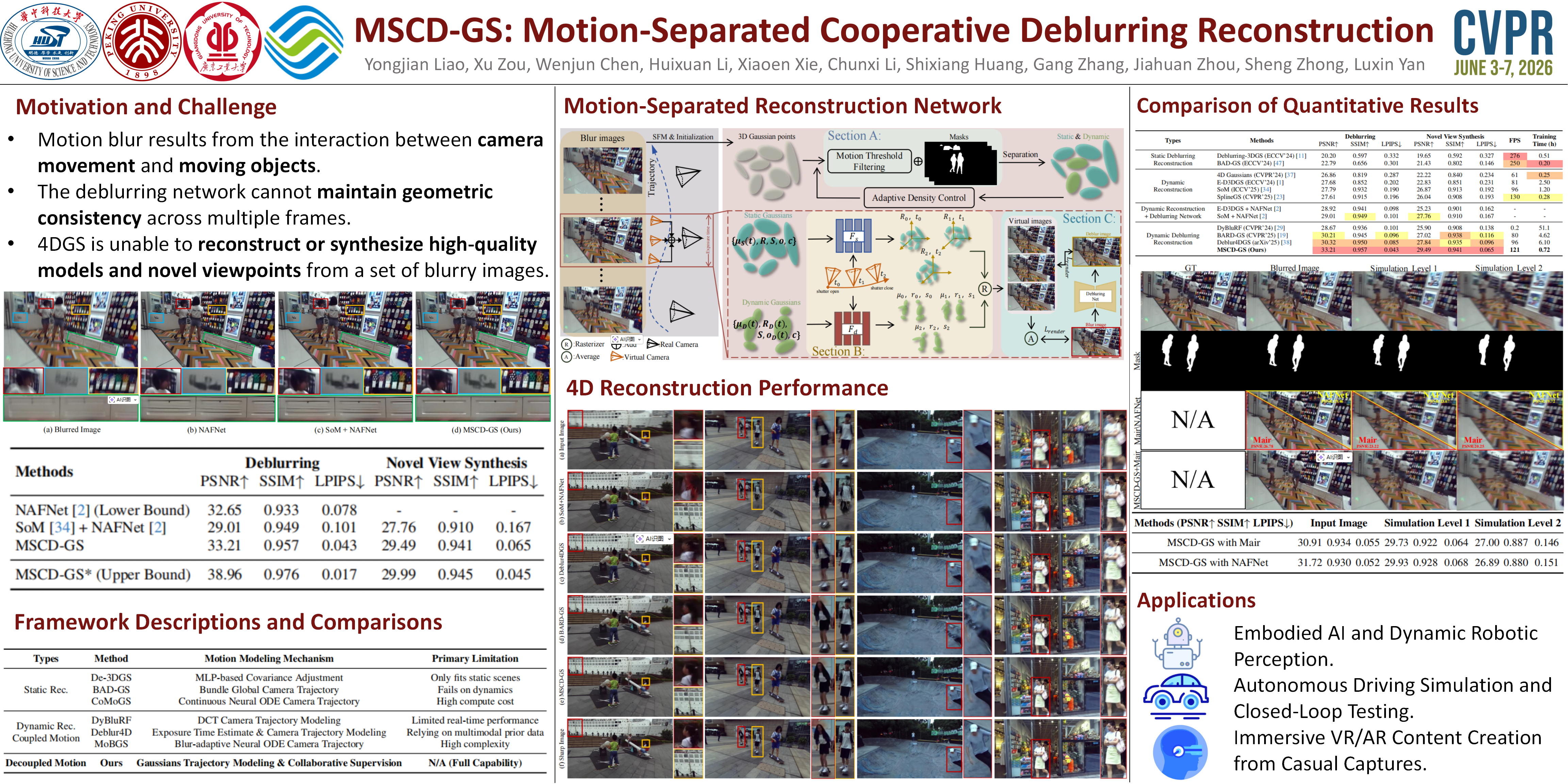
Although 4D reconstruction based on Gaussian Splatting has achieved many impressive results, reconstructing real-world images captured by a casual monocular camera remains a significant challenge. In dynamic scenes, as the camera and objects move during the exposure time, these input images inevitably contain a considerable amount of motion blur, which severely compromises the quality of reconstruction and new viewpoint synthesis. The existing deblurring 3D Gaussian models still cannot handle motion blur issues in real dynamic scenes. To address these challenges, we propose MSCD-GS—a novel method for motion-separated collaborative deblurring 4D reconstruction via Gaussian Splatting, capable of effectively handling motion-blurred inputs. Specifically, due to the distinct motion characteristics of static and dynamic Gaussians, we perform separate motion modeling to achieve dynamic scene reconstruction. To predict Gaussian changes during the exposure time, we designed motion-aware networks for static and dynamic Gaussians, thereby synthesizing virtual blurred images. Finally, we utilize the results from the deblurring network and the synthesized images to supervise 4D reconstruction collaboratively. Extensive experiments demonstrate that MSCD-GS can effectively reconstruct high-quality dynamic scenes from blurred image inputs, with performance surpassing existing methods.
P2GS: Physical Prior-guided Gaussian Splatting for Photometrically Consistent Urban Reconstruction
Kota Shimomura ⋅ Hidehisa Arai ⋅ Tsubasa Takahashi ⋅ Takayoshi Yamashita ⋅ Hironobu Fujiyioshi
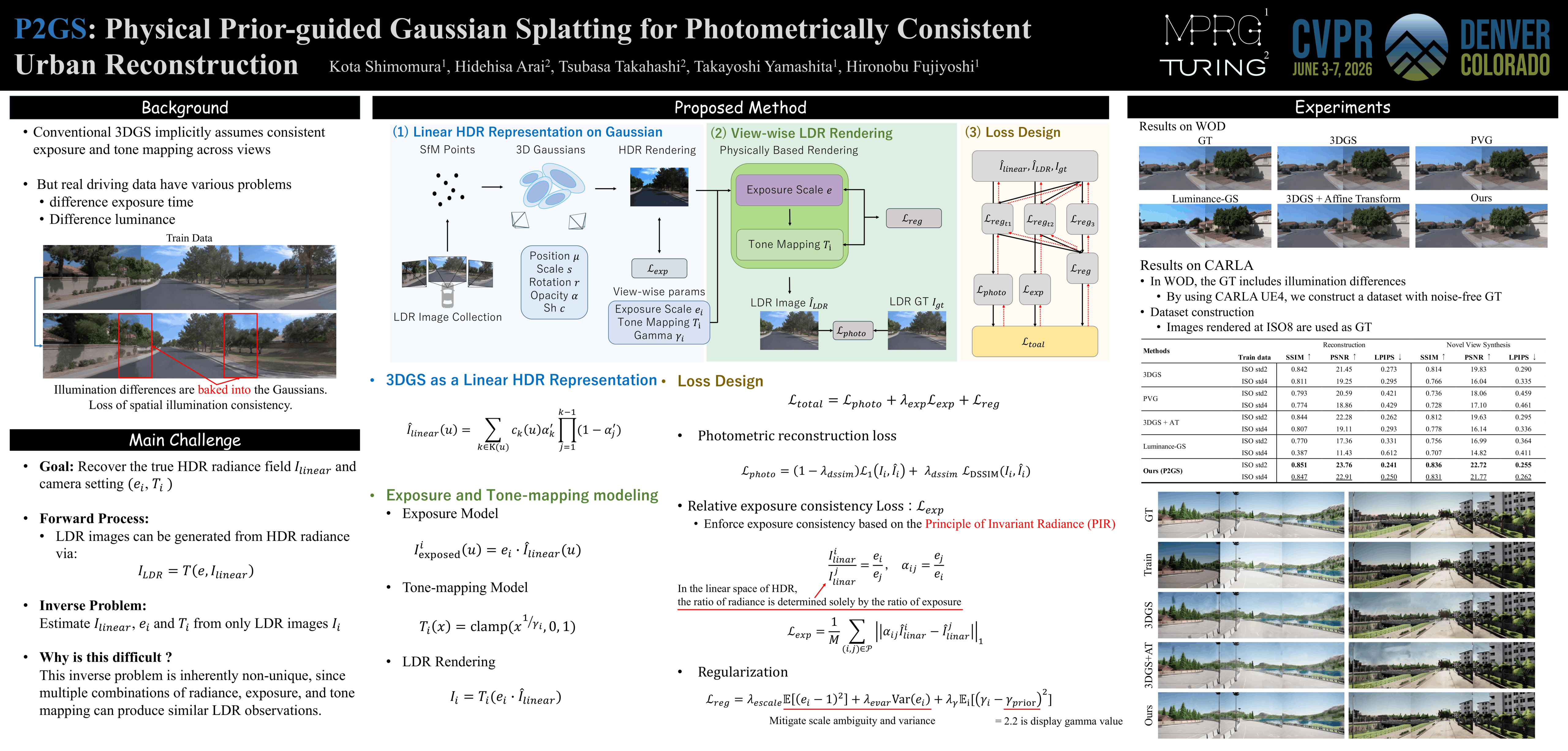
3D Gaussian Splatting (3DGS) has recently emerged as a powerful explicit representation enabling fast, high-fidelity rendering, making it a promising foundation for closed-loop simulators and perception models in autonomous driving. However, conventional 3DGS implicitly assumes consistent exposure and tone mapping across views. Real driving data violates this assumption due to heterogeneous camera pipelines and dynamic outdoor illumination, baking exposure discrepancies and sensor noise into the radiance field and producing artifacts and inconsistent illumination especially in static backgrounds crucial for realistic simulation. These issues are amplified in autonomous driving, where sparse viewpoints, varying exposures, and outdoor lighting interact, while prior work mainly targets dynamic-object reconstruction and overlooks cross-view photometric consistency.To address this limitation, we introduce $\textbf{P2GS}$, a physically consistent Gaussian Splatting framework that jointly decomposes a view-invariant linear HDR radiance field, per-view exposure scales, and tone-mapping functions from only LDR images without HDR supervision. P2GS employs a unified optimization strategy grounded in the physical image-formation process, enforcing relative-exposure consistency and HDR-domain radiance regularization. This yields a radiance field robust to inter-camera illumination differences while preserving the real-time efficiency of standard 3DGS. Experiments across real and simulated driving environments show that P2GS matches or surpasses prior methods in LDR reconstruction while providing substantially improved photometric consistency, reliable exposure normalization, and physically coherent illumination across diverse scenes.
iSplat: Iterative Learning for Fine-Grained Gaussian Splatting
Haifeng Wu ⋅ Wei Long ⋅ Shuhang Gu ⋅ Lixin Duan ⋅ Wen Li
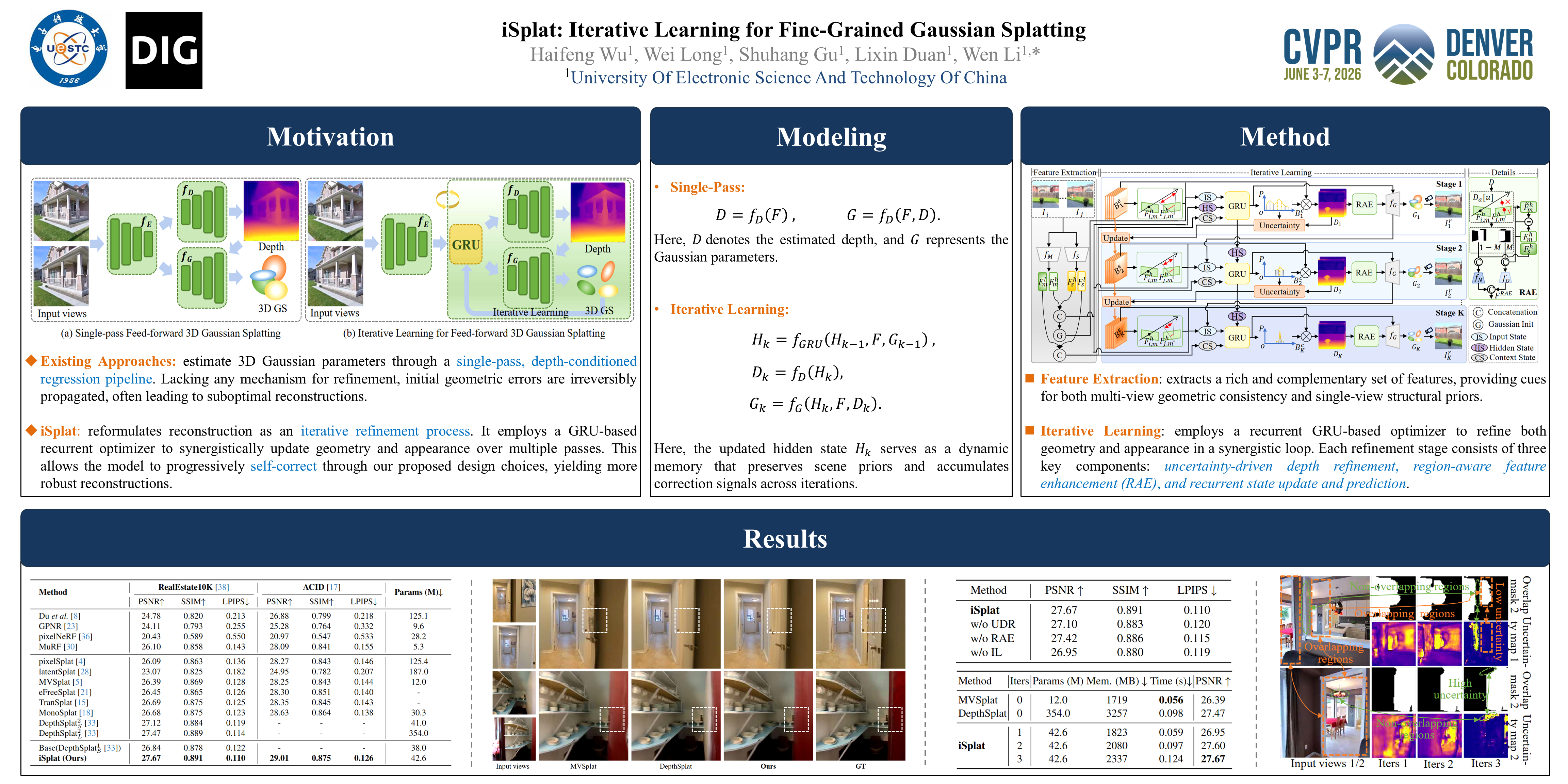
Recent advances in feed-forward 3D Gaussian splatting have demonstrated remarkable efficiency by reconstructing scenes in a single pass. However, the reconstruction fidelity of these methods lags behind that of traditional optimization-based approaches, which gradually correct reconstruction flaws through a lengthy iterative process. In this paper, we leverage the strengths of both paradigms and introduce iSplat, a novel framework that reformulates reconstruction as an iterative feed-forward process involving multiple (typically three) passes.Central to iSplat is a recurrent GRU-based optimizer that refines both geometry and appearance in a synergistic loop. To address geometric inaccuracies, we propose an uncertainty-driven depth refinement strategy that progressively narrows the search space for each Gaussian based on its estimated uncertainty from the previous step. To further improve appearance details, we design a region-aware enhancement mechanism that applies targeted multi-view and monocular feature aggregation to resolve ambiguities in both overlapping and non-overlapping areas.We validate iSplat's robustness and generalization on in-domain (RealEstate10K, ACID) and cross-dataset (DTU, ACID) benchmarks. With only 42.6M parameters, iSplat surpasses DepthSplat (354M) on RealEstate10K (PSNR: 27.67 vs. 27.47 dB). Crucially, on the cross-dataset DTU benchmark, it further boosts the PSNR by 2.88 dB (18.26 vs. 15.38 dB), showcasing exceptional generalization. These results highlight the significant potential of iterative refinement to overcome the inherent limitations of one-shot approaches.
Off The Grid: Detection of Primitives for Feed-Forward 3D Gaussian Splatting
Arthur Moreau ⋅ Richard Shaw ⋅ Michal Nazarczuk ⋅ Jisu Shin ⋅ Thomas Tanay ⋅ Zhensong Zhang ⋅ Songcen Xu ⋅ Eduardo Pérez-Pellitero
Feed-forward 3D Gaussian Splatting (3DGS) models enable real-time scene generation but are hindered by suboptimal pixel-aligned primitive placement, which relies on a dense, rigid grid and limits both quality and efficiency. We introduce a new feed-forward architecture that detects 3D Gaussian primitives at a sub-pixel level, replacing the pixel grid with an adaptive, ``Off The Grid" distribution. Inspired by keypoint detection, our multi-resolution decoder learns to distribute primitives across image patches. This module is trained end-to-end with a 3D reconstruction backbone using self-supervised learning. Our resulting pose-free model generates photorealistic scenes in seconds, achieving state-of-the-art novel view synthesis for feed-forward models. It outperforms competitors while using far fewer primitives, demonstrating a more accurate and efficient allocation that captures fine details and reduces artifacts. Moreover, we observe that by learning to render 3D Gaussians, our 3D reconstruction backbone improves camera pose estimation, suggesting opportunities to train these foundational models without labels.
MAPo: Motion-Aware Partitioning of Deformable 3D Gaussian Splatting for High-Fidelity Dynamic Scene Reconstruction
Han Jiao ⋅ Jiakai Sun ⋅ Yexing Xu ⋅ Lei Zhao ⋅ Wei Xing ⋅ Huaizhong Lin
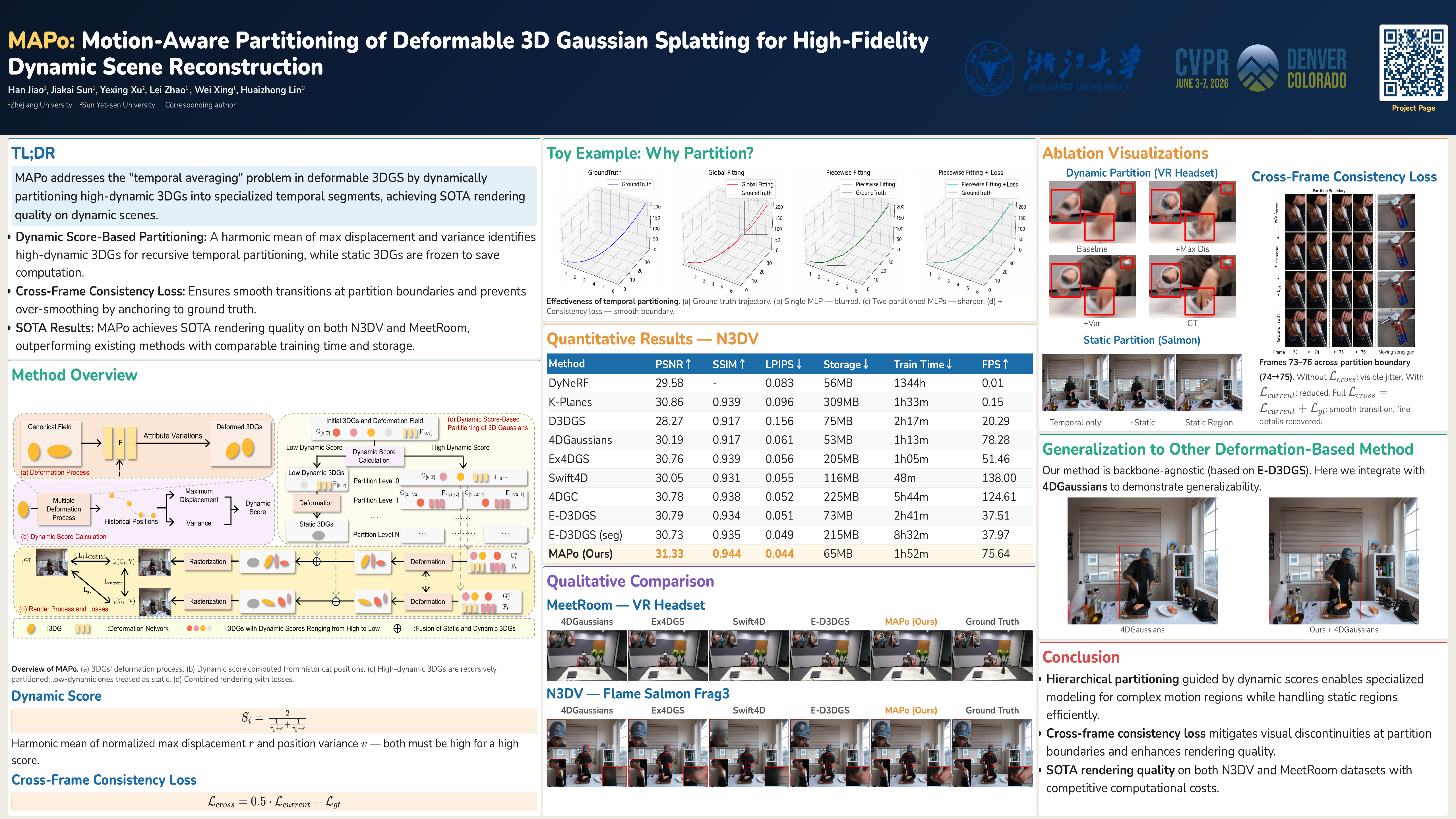
3D Gaussian Splatting, known for enabling high-quality static scene reconstruction with fast rendering, is increasingly being applied to multi-view dynamic scene reconstruction. A common strategy involves learning a deformation field to model the temporal changes of a canonical set of 3D Gaussians. However, these deformation-based methods often produce blurred renderings and lose fine motion details in highly dynamic regions due to the inherent limitations of a single, unified model in representing diverse motion patterns. To address these challenges, we introduce Motion-Aware Partitioning of Deformable 3D Gaussian Splatting (MAPo), a novel framework for high-fidelity dynamic scene reconstruction. Its core is a dynamic score-based partitioning strategy that distinguishes between high- and low-dynamic 3D Gaussians. For high-dynamic 3D Gaussians, we recursively partition them temporally and duplicate their deformation networks for each new temporal segment, enabling specialized modeling to capture intricate motion details. Concurrently, low-dynamic 3DGs are treated as static to reduce computational costs. However, this temporal partitioning strategy for high-dynamic 3DGs can introduce visual discontinuities across frames at the partition boundaries. To address this, we introduce a cross-frame consistency loss, which not only ensures visual continuity but also further enhances rendering quality. Extensive experiments demonstrate that MAPo achieves superior rendering quality compared to baselines while maintaining comparable computational costs, particularly in regions with complex or rapid motions.
FreeArtGS: Articulated Gaussian Splatting Under Free-moving Scenario
Hang Dai ⋅ Hongwei Fan ⋅ Han Zhang ⋅ Duojin Wu ⋅ Jiyao Zhang ⋅ Hao Dong
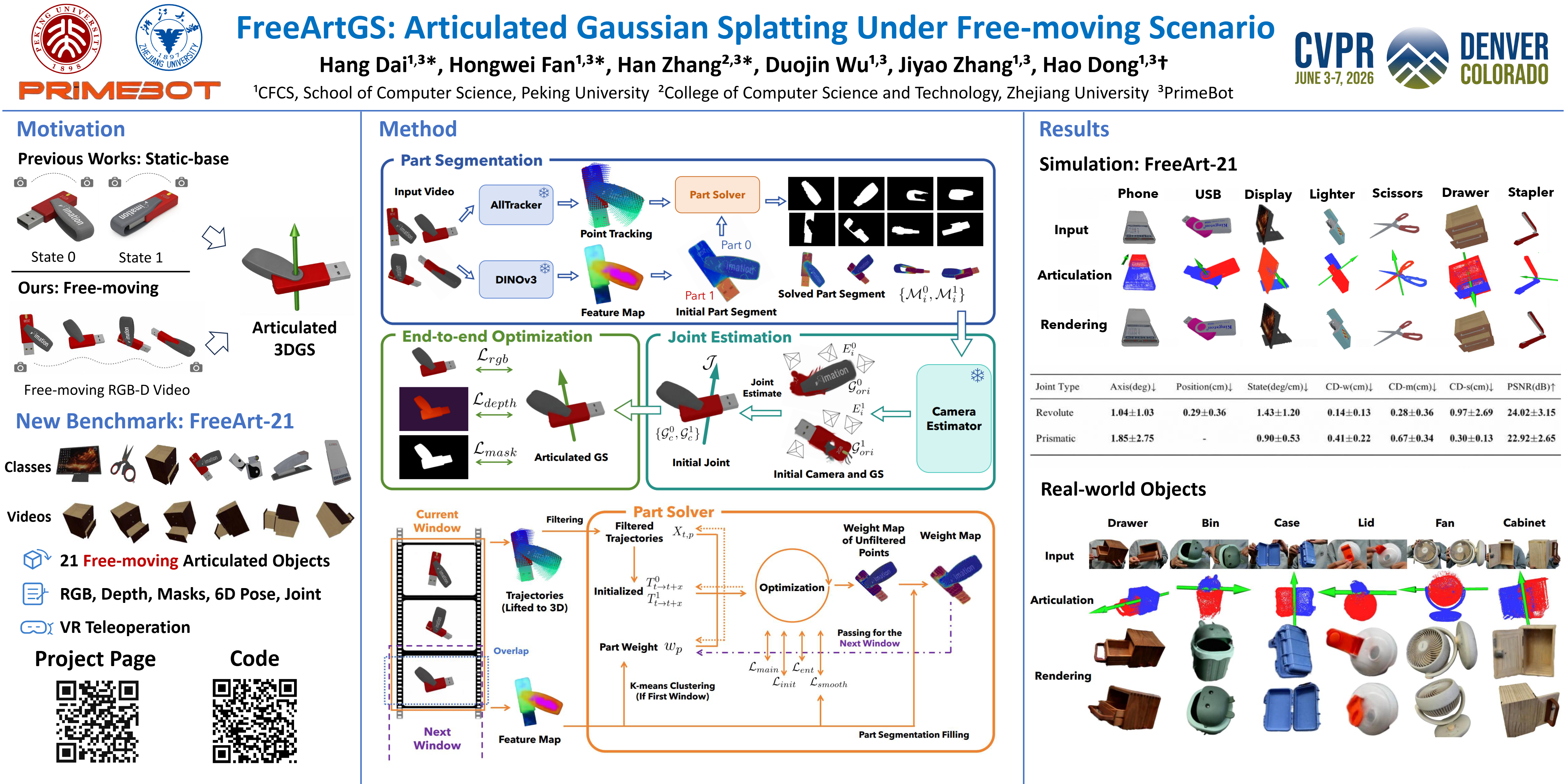
The increasing need for augmented reality and robotics is urging for articulated object reconstruction with high scalability. However, the existing settings of reconstructing from discrete articulation states or casual monocular video need non-trivial axes alignment or suffer from insufficient coverage, limiting the applications. In this paper, we introduce FreeArtGS, a novel method for reconstructing articulated objects under free-moving scenario, a new setting with a simpler setup and high scalability. FreeArtGS combines free-moving part segmentation with joint estimation and end-to-end optimization, taking only a monocular RGB-D video as input. By optimizing with the priors from off-the-shelf point-tracking and feature models, free-moving part segmentation discovers rigid parts from relative motion in unconstrained capture. The joint estimation module proposes a noise-resistant approach to recover joint type and axis robustly from part segmentation. Finally, 3DGS-based end-to-end optimization is implemented to jointly reconstruct visual textures, geometry and joint angles of the articulated object. We perform experiments on two benchmarks and real-world free-moving articulated objects. Experiments show that FreeArtGS consistently outperforms prior methods in free-moving articulated object reconstruction and remains competitive in the similar previous setting, underscoring the potential of FreeArtGS to serve as an engine for realistic articulated asset building. Code and data will be released.
HeroGS: Hierarchical Guidance for Robust 3D Gaussian Splatting under Sparse Views
Jiashu Li ⋅ Xumeng Han ⋅ Zhaoyang Wei ⋅ Zipeng Wang ⋅ Kuiran Wang ⋅ Guorong Li ⋅ Zhenjun Han ⋅ Jianbin Jiao
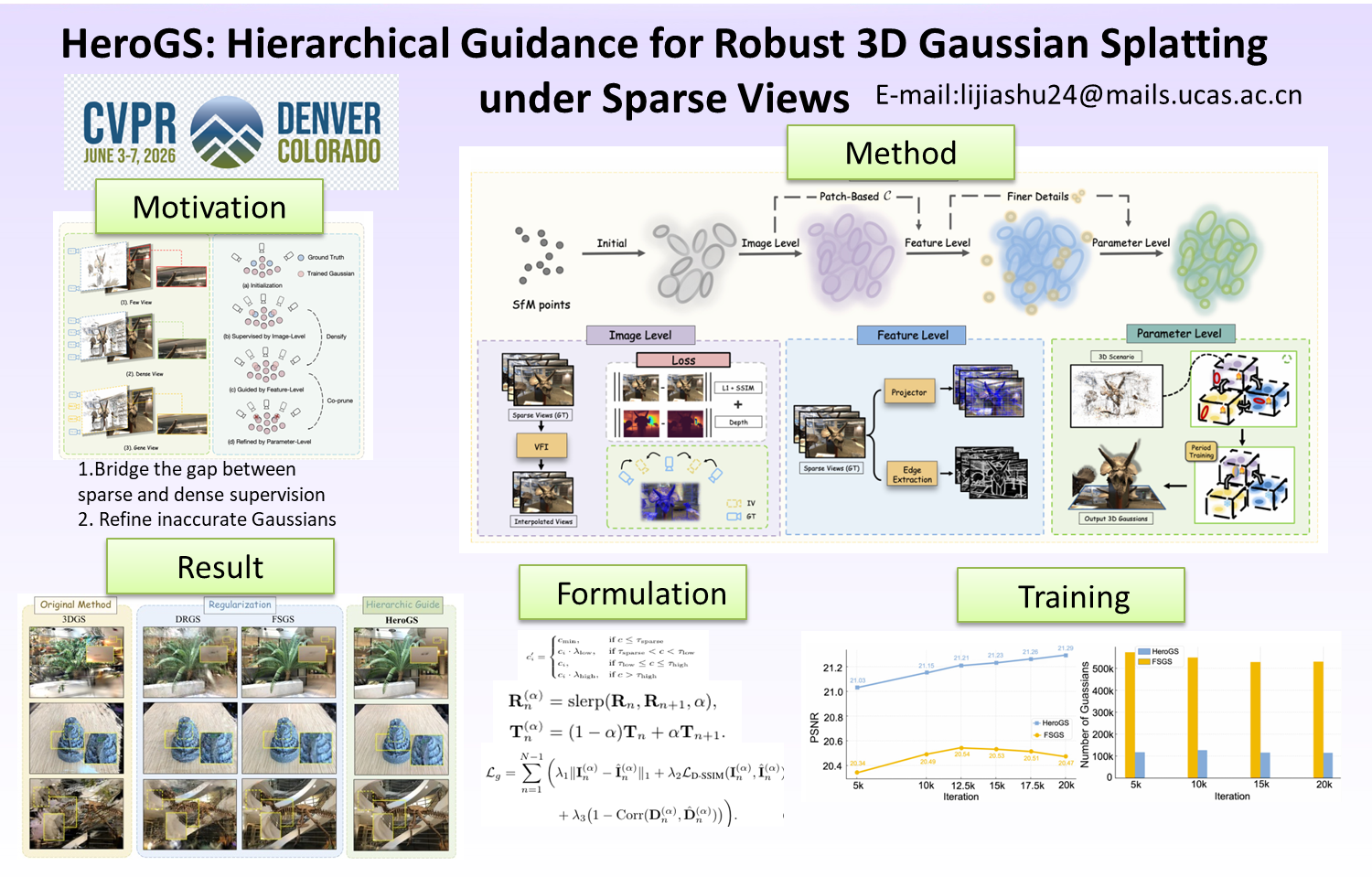
3D Gaussian Splatting (3DGS) has recently emerged as a promising approach in novel view synthesis, combining photorealistic rendering with real-time efficiency. However, its success heavily relies on dense camera coverage; under sparse-view conditions, insufficient supervision leads to irregular Gaussian distributions—characterized by globally sparse coverage, blurred background, and distorted high-frequency areas.To address this, we propose HeroGS—Hierarchical Guidance for Robust 3D Gaussian Splatting—a unified framework that establishes hierarchical guidance across the image, feature, and parameter levels. At the image level, sparse supervision is converted into pseudo-dense guidance, globally regularizing the Gaussian distributions and forming a consistent foundation for subsequent optimization. Building upon this, Feature-Adaptive Densification and Pruning (FADP) at the feature level leverages low-level features to refine high-frequency details and adaptively densifies Gaussians in background regions.The optimized distributions then support Co-Pruned Geometry Consistency (CPG) at parameter level, which guides geometric consistency through parameter freezing and co-pruning, effectively removing inconsistent splats. The hierarchical guidance strategy effectively constrains and optimizes the overall Gaussian distributions, thereby enhancing both structural fidelity and rendering quality.Extensive experiments demonstrate that HeroGS achieves high-fidelity reconstructions and consistently surpasses state-of-the-art baselines under sparse-view conditions.
SharpTimeGS: Sharp and Stable Dynamic Gaussian Splatting via Lifespan Modulation
Zhanfeng Liao ⋅ Jiajun Zhang ⋅ Hanzhang Tu ⋅ Zhixi Wang ⋅ Yunqi Gao ⋅ Hongwen Zhang ⋅ Yebin Liu
Novel view synthesis of dynamic scenes is fundamental to achieving photorealistic 4D reconstruction and immersive visual experiences. Recent progress in Gaussian-based representations has significantly improved real-time rendering quality, yet existing methods still struggle to maintain a balance between long-term static and short-term dynamic regions in both representation and optimization. To address this, we present SharpTimeGS, a lifespan-aware 4D Gaussian framework that achieves temporally adaptive modeling of both static and dynamic regions under a unified representation.Specifically, we introduce a learnable lifespan parameter that reformulates temporal visibility from a Gaussian-shaped decay into a flat-top profile, allowing primitives to remain consistently active over their intended duration and avoiding redundant densification. In addition, the learned lifespan modulates each primitive’s motion, reducing drift in long-lived static points while retaining unrestricted motion for short-lived dynamic ones. This effectively decouples motion magnitude from temporal duration, improving long-term stability without compromising dynamic fidelity.Moreover, we design a lifespan–velocity–aware densification strategy that mitigates optimization imbalance between static and dynamic regions by allocating more capacity to regions with pronounced motion while keeping static areas compact and stable.Extensive experiments on multiple benchmarks demonstrate that our method achieves state-of-the-art performance while supporting real-time rendering up to 4K resolution at 100 FPS on one RTX 4090.
Physically Inspired Gaussian Splatting for HDR Novel View Synthesis
Huimin Zeng ⋅ Yue Bai ⋅ hailing wang ⋅ Yun Fu
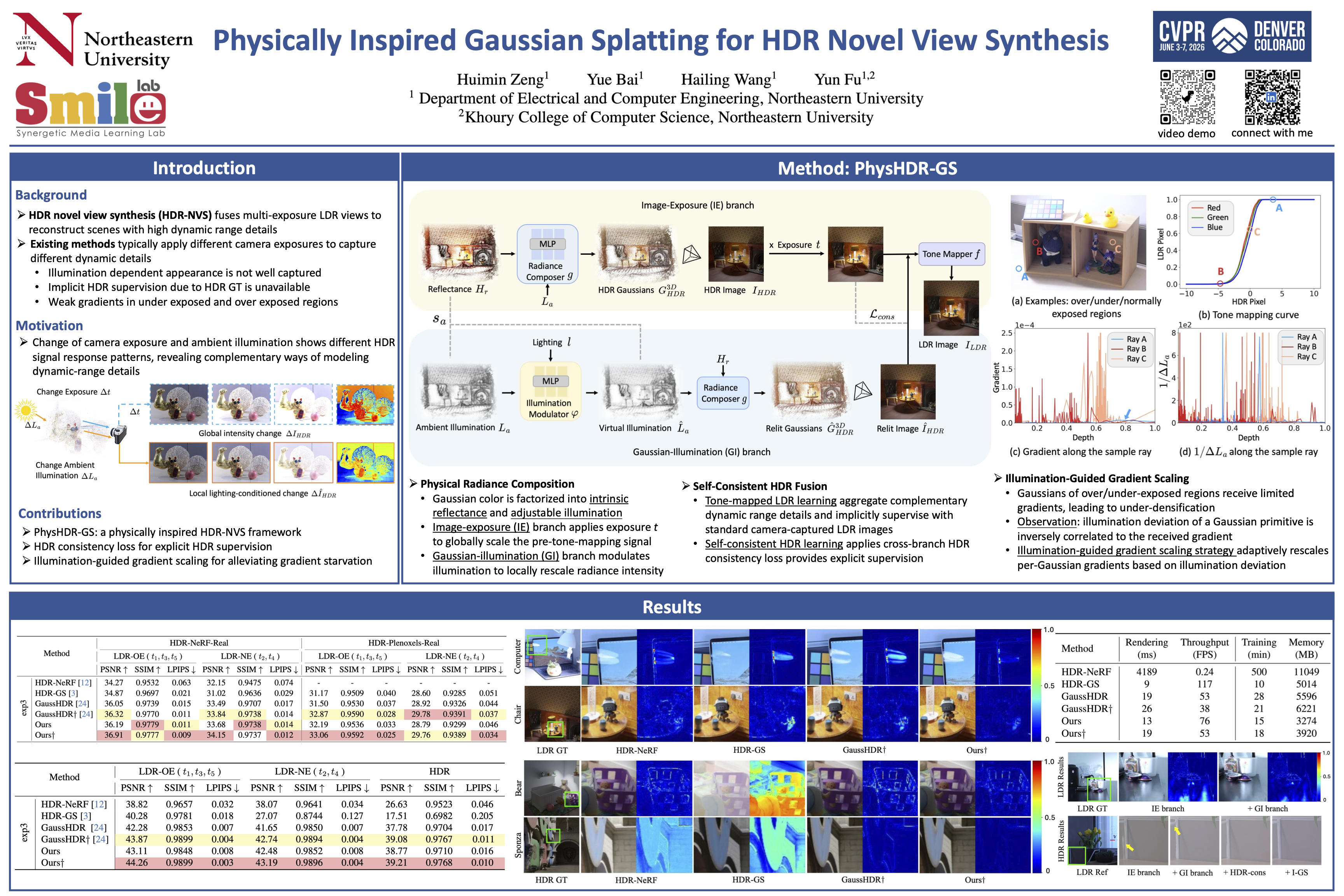
High dynamic range novel view synthesis (HDR-NVS) reconstructs scenes with dynamic details by fusing multi-exposure low dynamic range (LDR) views, yet it struggles to capture ambient illumination-dependent appearance. Implicitly supervising HDR content by constraining tone-mapped results fails in correcting abnormal HDR values, and results in limited gradients for Gaussians in under/over-exposed regions. To this end, we introduce PhysHDR-GS, a physically inspired HDR-NVS framework that models scene appearance via intrinsic reflectance and adjustable ambient illumination. PhysHDR-GS employs a complementary image-exposure (IE) branch and Gaussian-illumination (GI) branch to faithfully reproduce standard camera observations and capture illumination-dependent appearance changes, respectively. During training, the proposed cross-branch HDR consistency loss provides explicit supervision for HDR content, while an illumination-guided gradient scaling strategy mitigates exposure-biased gradient starvation and reduces under-densified representations. Experimental results across realistic and synthetic datasets demonstrate our superiority in reconstructing HDR details (e.g., a PSNR gain of 2.04 dB over HDR-GS), while maintaining real-time rendering speed (up to 76 FPS).
PhysIR-Splat: Physically Consistent Thermal Infrared Radiative Transfer in 3D Gaussian Splatting
Jingyuan Gao ⋅ Yumeng Hu ⋅ Fei Gao ⋅ Mingjin Zhang
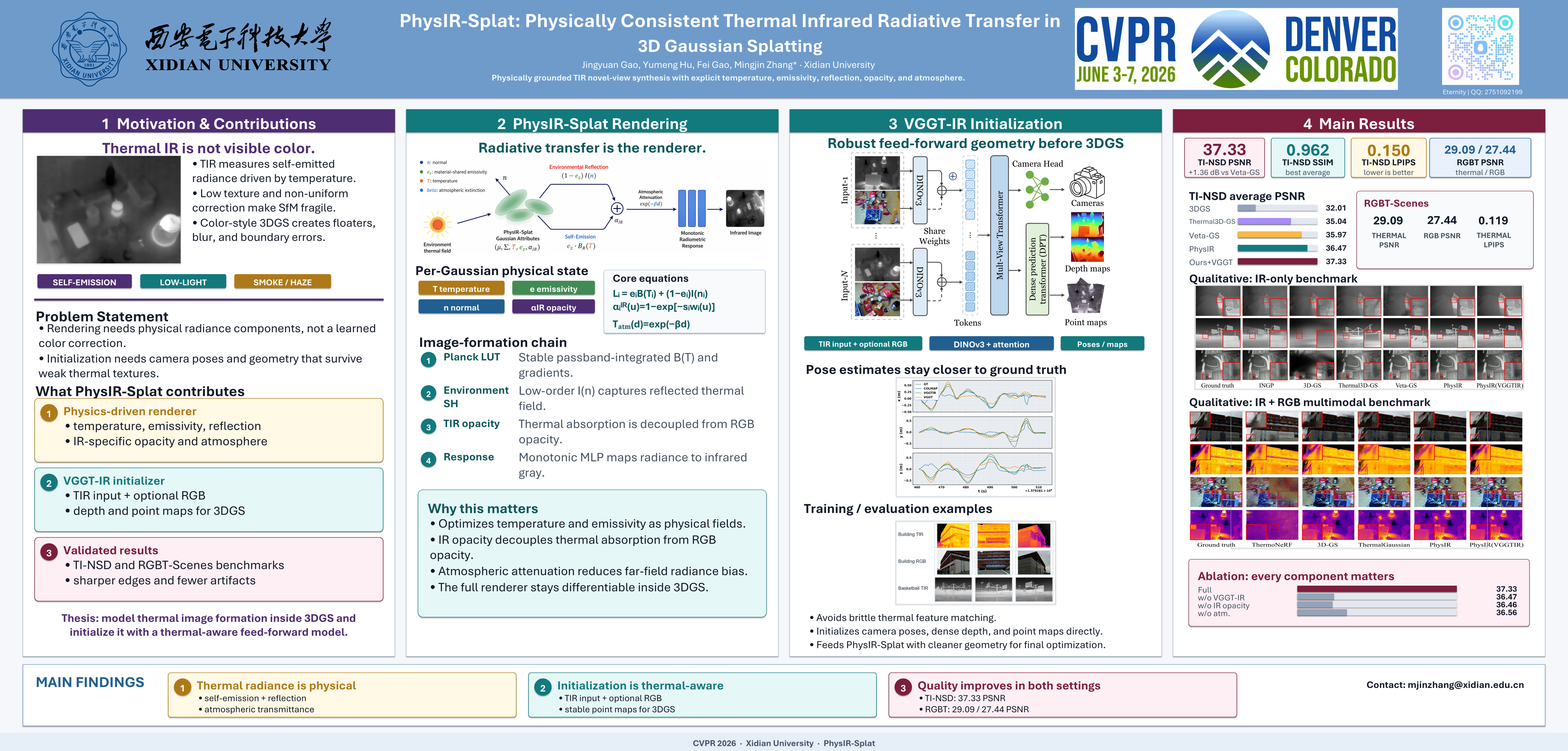
Thermal infrared (TIR) 3D reconstruction provides geometry that is intrinsically coupled to the temperature field, even in low-light, nighttime, and smoke-obscured environments. TIR imaging measures self-emitted thermal radiation driven by object temperature and is largely independent of external illumination; therefore, simply carrying over visible-spectrum assumptions to TIR-based 3D reconstruction and novel view synthesis (NVS) often results in floating artifacts and blurred edges. In addition, radiometric inconsistency and low contrast in TIR weaken structure-from-motion (SfM) initialization, which in turn hinders subsequent 3D Gaussian Splatting (3DGS) optimization. We present PhysIR-Splat, a 3DGS framework that follows infrared radiative transfer: we explicitly model temperature, emissivity, and environmental irradiance on Gaussian primitives and, during rendering, jointly account for thermal emission, the reflected component, and atmospheric transmittance to produce physically consistent thermal synthesis. We also introduce VGGT-IR, a Transformer-based feed-forward initializer that takes TIR input with optional RGB and directly regresses camera poses and initial geometry, providing a modality-aligned and stable starting point for PhysIR-Splat. Extensive experiments demonstrate that our method significantly surpasses existing approaches in thermal reconstruction quality and cross-view consistency, effectively suppressing floating artifacts and enhancing boundary sharpness. The code will be made publicly available upon acceptance of the paper.
4C4D: 4 Camera 4D Gaussian Splatting
Junsheng Zhou ⋅ Zhifan Yang ⋅ Liang Han ⋅ Wenyuan Zhang ⋅ Kanle Shi ⋅ Shenkun Xu ⋅ Yu-Shen Liu
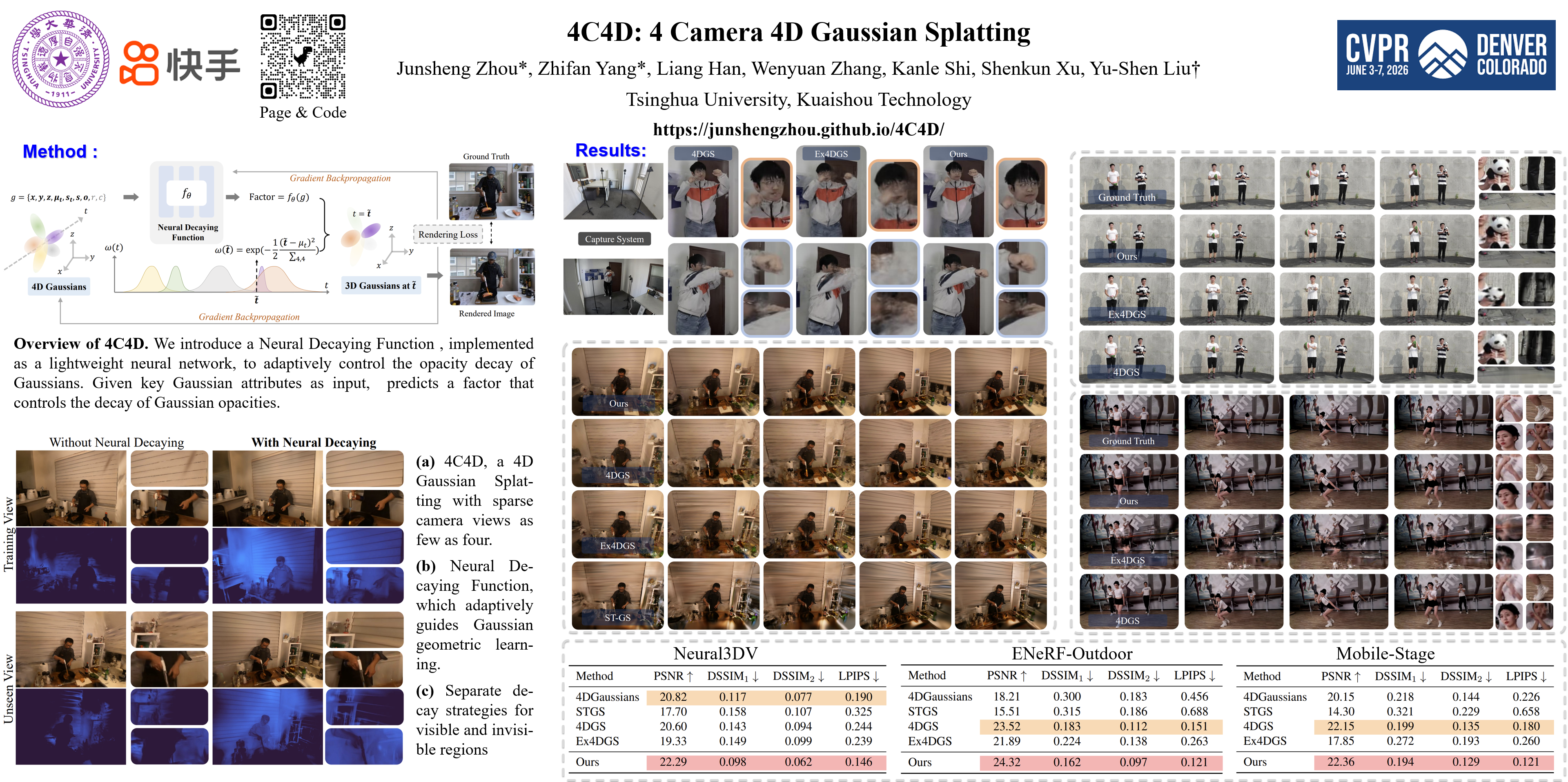
This paper tackles the challenge of recovering 4D dynamic scenes from videos captured by as few as four portable cameras. Learning to model scene dynamics for temporally consistent novel-view rendering is a foundational task in computer graphics, where previous works often require dense multi-view captures using camera arrays of dozens or even hundreds of views. We propose 4C4D, a novel framework that enables high-fidelity 4D Gaussian Splatting from video captures of extremely sparse cameras. Our key insight lies that the geometric learning under sparse settings is substantially more difficult than modeling appearance. Driven by this observation, we introduce a Neural Decaying Function on Gaussian opacities for enhancing the geometric modeling capability of 4D Gaussians. This design mitigates the inherent imbalance between geometry and appearance modeling in 4DGS by encouraging the 4DGS gradients to focus more on geometric learning. Extensive experiments across sparse-view datasets with varying camera overlaps show that 4C4D achieves superior performance over prior art.
SplatSuRe: Selective Super-Resolution for Multi-view Consistent 3D Gaussian Splatting
Pranav Asthana ⋅ Alex Hanson ⋅ Allen Tu ⋅ Tom Goldstein ⋅ Matthias Zwicker ⋅ Amitabh Varshney
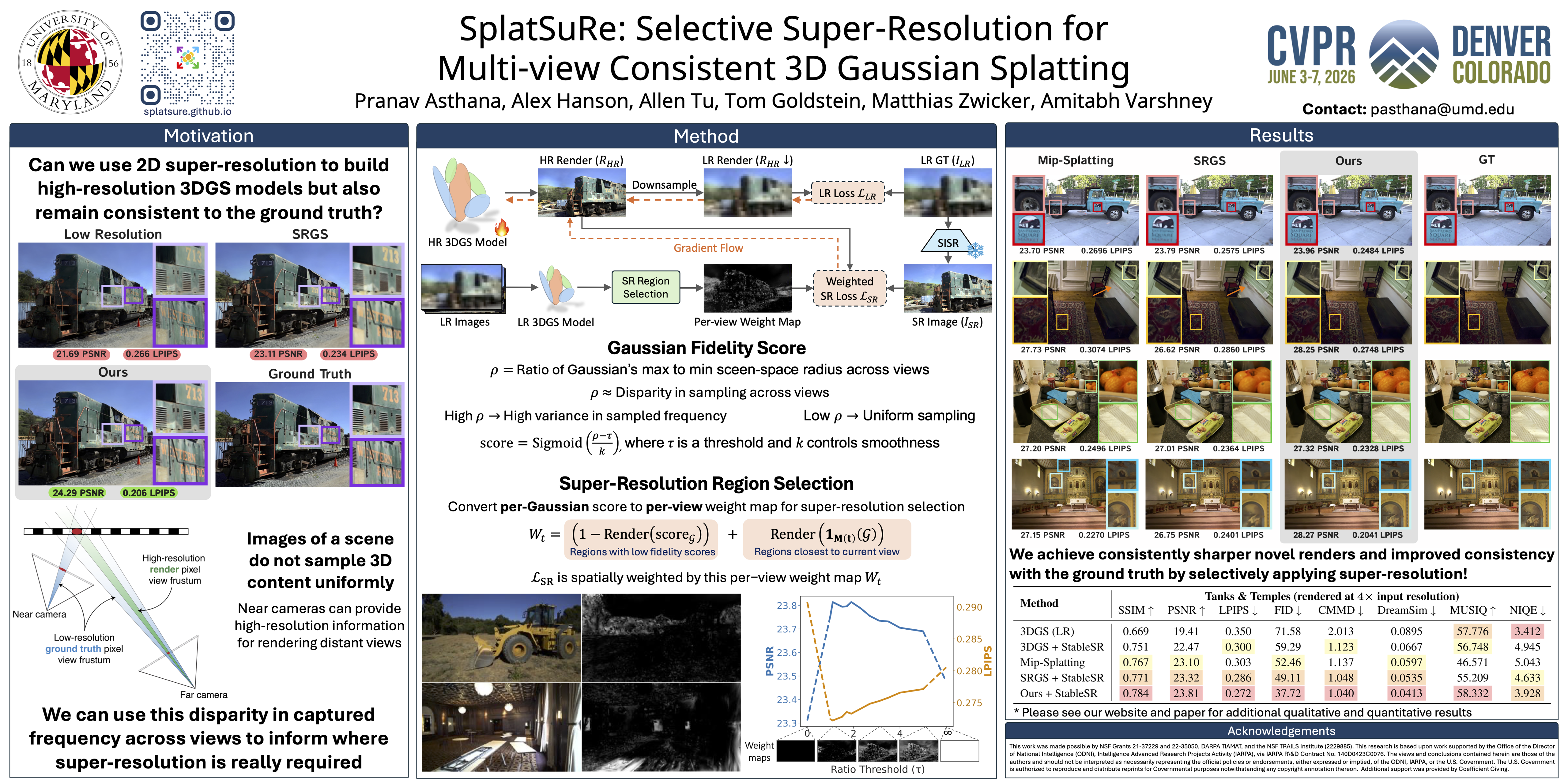
3D Gaussian Splatting (3DGS) enables high-quality novel view synthesis, motivating interest in generating higher-resolution renders than those available during training. A natural strategy is to apply super-resolution (SR) to low-resolution (LR) input views, but independently enhancing each image introduces multi-view inconsistencies, leading to blurry renders. Prior methods attempt to mitigate these inconsistencies through learned neural components, temporally consistent video priors, or joint optimization on LR and SR views, but all uniformly apply SR across every image. In contrast, our key insight is that close-up LR views may contain high-frequency information for regions also captured in more distant views, and that we can use the camera pose relative to scene geometry to inform where to add SR content. Building from this insight, we propose SplatSuRe, a method that selectively applies SR content only in undersampled regions lacking high-frequency supervision, yielding sharper and more consistent results. Across Tanks & Temples, Deep Blending and Mip-NeRF 360, our approach surpasses baselines in both fidelity and perceptual quality. Notably, our gains are most significant in localized foreground regions where higher detail is desired.
GaussianZoom: Progressive Zoom-in Generative 3D Gaussian Splatting with Geometric and Semantic Guidance
Jiale Shi ⋅ Jiarui Hu ⋅ Zesong Yang ⋅ Kaixuan Luan ⋅ Hujun Bao ⋅ Zhaopeng Cui
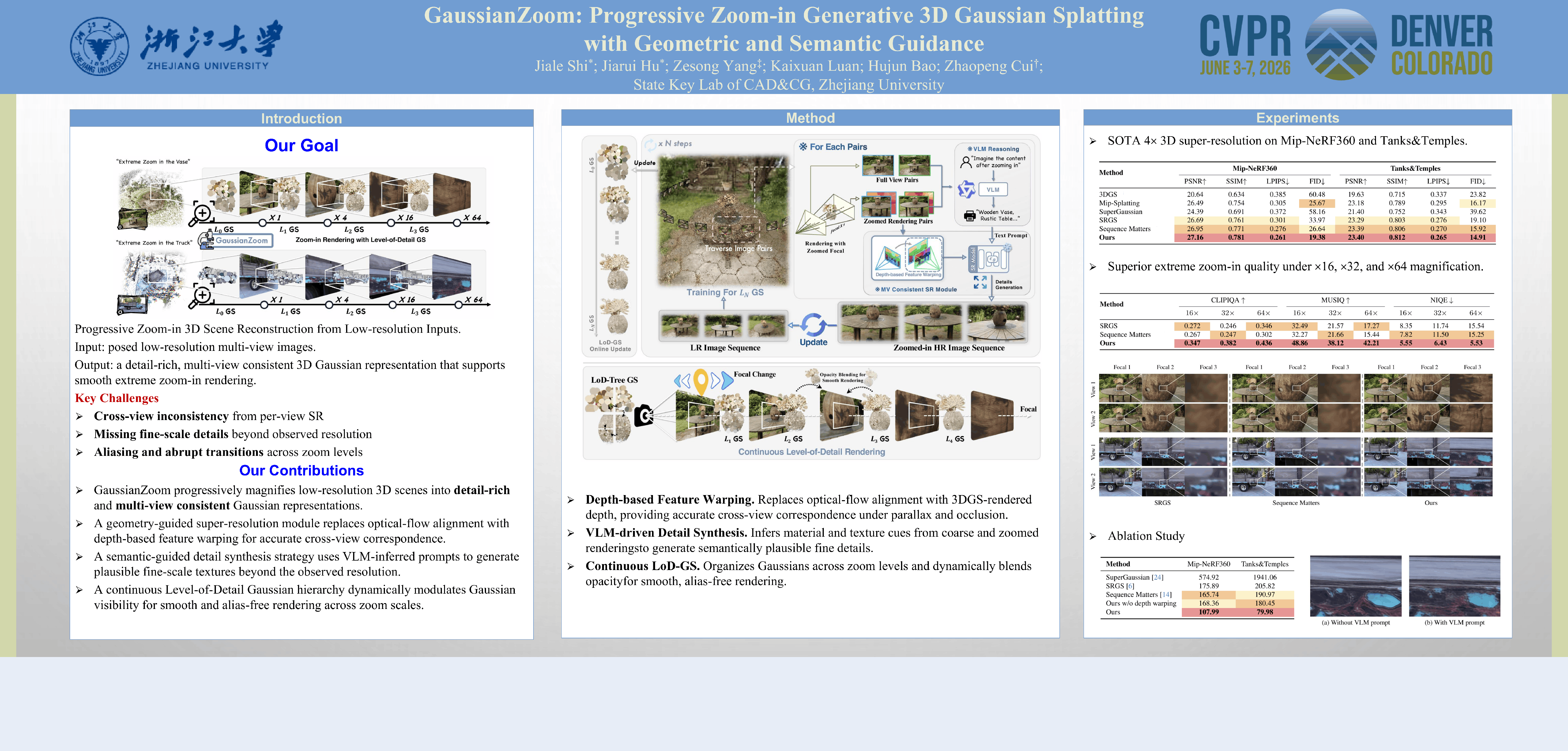
We introduce GaussianZoom, a generative zoom-in 3D reconstruction system with an iterative progressive framework that combines geometry-consistent scene modeling and multi-scale semantic reasoning to enable high-fidelity extreme zoom-in rendering from low-resolution inputs.To achieve this, we develop a novel multi-view consistent super-resolution module with depth-based feature warping and VLM-driven detail synthesis, ensuring accurate multi-view correspondence while enriching fine-scale appearance beyond the observed resolution.To support zooming across large magnification ranges, we further introduce a new expandable continuous Level-of-Detail hierarchy that dynamically modulates Gaussian visibility for smooth, alias-free cross-scale rendering. Experiments on Mip-NeRF360 and Tanks&Temples demonstrate that GaussianZoom achieves superior perceptual quality, multi-view consistency, and robustness under extreme magnification, establishing a strong baseline for generative zoom-in 3D scene reconstruction.
MotionScale: Reconstructing Appearance, Geometry, and Motion of Dynamic Scenes with Scalable 4D Gaussian Splatting
Haoran Zhou ⋅ Gim Hee Lee
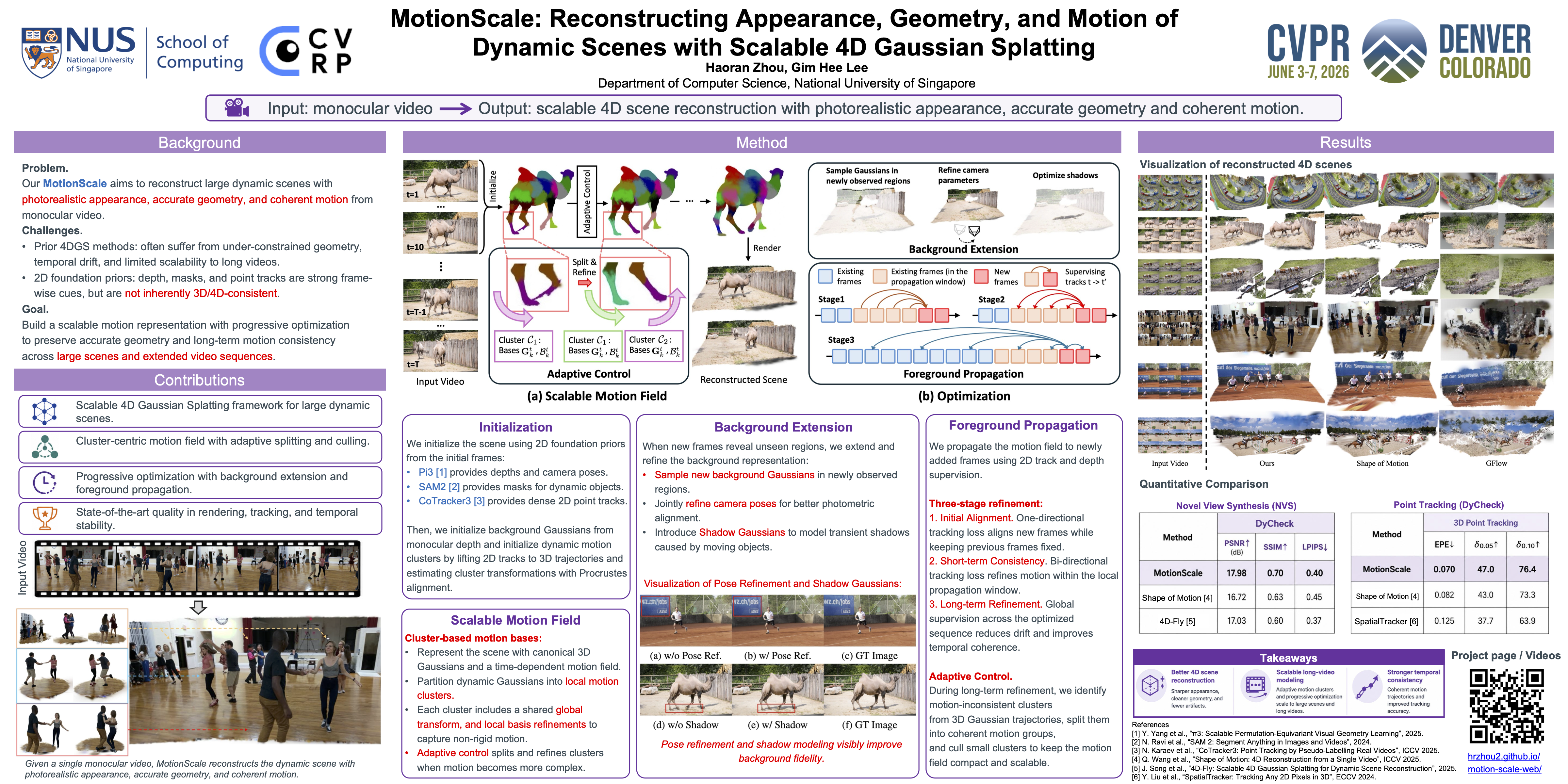
Realistic reconstruction of dynamic 4D scenes is essential for understanding the physical world.Despite recent progress in monocular view synthesis, existing methods still struggle to recover accurate 3D geometry and temporally consistent motion in complex environments.To address these challenges, we propose MotionScale, a 4D Gaussian Splatting framework that scales efficiently to large scenes and extended sequences, enabling faithful reconstruction of high-fidelity scene structures and coherent motion representation under complex dynamics.To handle motion with arbitrary flexibility and long-term variation, we introduce a scalable motion field built upon cluster-based bases that adaptively grow to capture diverse motion patterns over time.Moreover, we introduce a progressive optimization strategy that extends naturally to unseen frames. This strategy comprises two propagation modules: 1) A background module that adapts to newly appearing objects, refines camera poses, and accounts for shadows; 2) A foreground module that refines motion through a three-stage process.Extensive experiments on challenging real-world datasets demonstrate that our MotionScale achieves superior reconstruction quality and motion consistency that significantly outperform prior 4D scene reconstruction methods.Our code will be open-sourced on paper acceptance.
PRIMU: Uncertainty Estimation for Novel Views in Gaussian Splatting from Primitive-Based Representations of Error and Coverage
Thomas Gottwald ⋅ Edgar Heinert ⋅ Peter Stehr ⋅ Chamuditha Jayanga Galappaththige ⋅ Matthias Rottmann
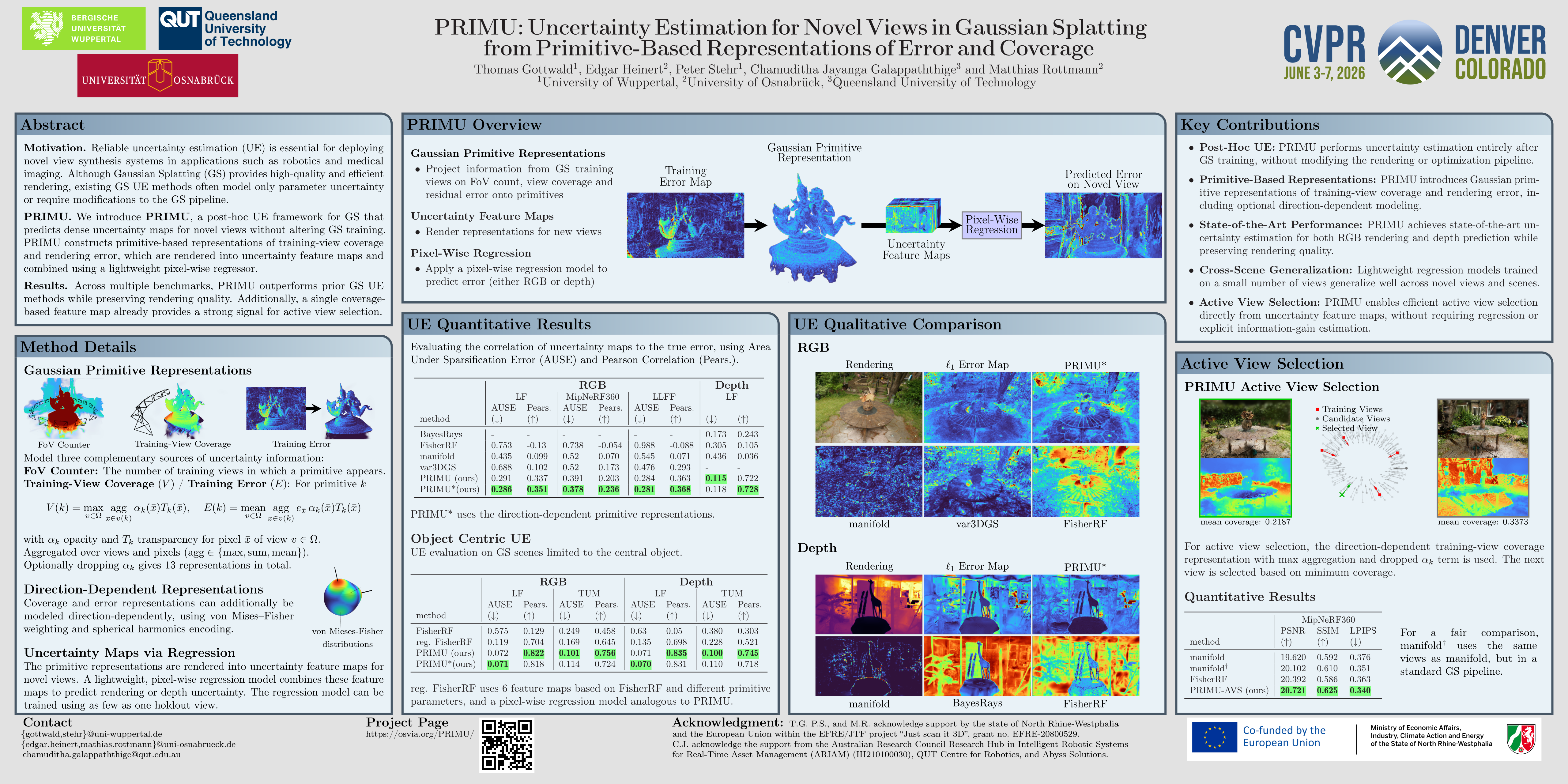
We introduce Primitive-based Representations of Uncertainty (PRIMU), a post-hoc uncertainty estimation (UE) framework for Gaussian Splatting (GS).Reliable UE is essential for deploying GS in safety-critical domains such as robotics and medicine.Existing approaches typically estimate Gaussian-primitive variances and rely on the rendering process to obtain pixel-wise uncertainties.In contrast, we construct primitive-level representations of error and visibility/coverage from training views, capturing interpretable uncertainty information. These representations are obtained by projecting view-dependent training errors and coverage statistics onto the primitives. Uncertainties for novel views are inferred by rendering these primitive-level representations, producing uncertainty feature maps, which are aggregate through pixel-wise regression on holdout data. We analyze combinations of uncertainty feature maps and regression models to understand how their interactions affect prediction accuracy and generalization.PRIMU also enables an effective active view selection strategy by directly leveraging these uncertainty feature maps.Additionally, we study the effect of separating splatting into foreground and background regions.Our estimates show strong correlations with true errors, outperforming state-of-the-art methods, especially for depth UE and foreground objects.Finally, our regression models show generalization capabilities to unseen scenes, enabling UE without additional holdout data.
TGSFormer: Scalable Temporal Gaussian Splatting for Embodied Semantic Scene Completion
Rui Qian ⋅ Haozhi Cao ⋅ Tianchen Deng ⋅ TIANXIN HU ⋅ Weixiang Guo ⋅ Shenghai Yuan ⋅ Lihua Xie
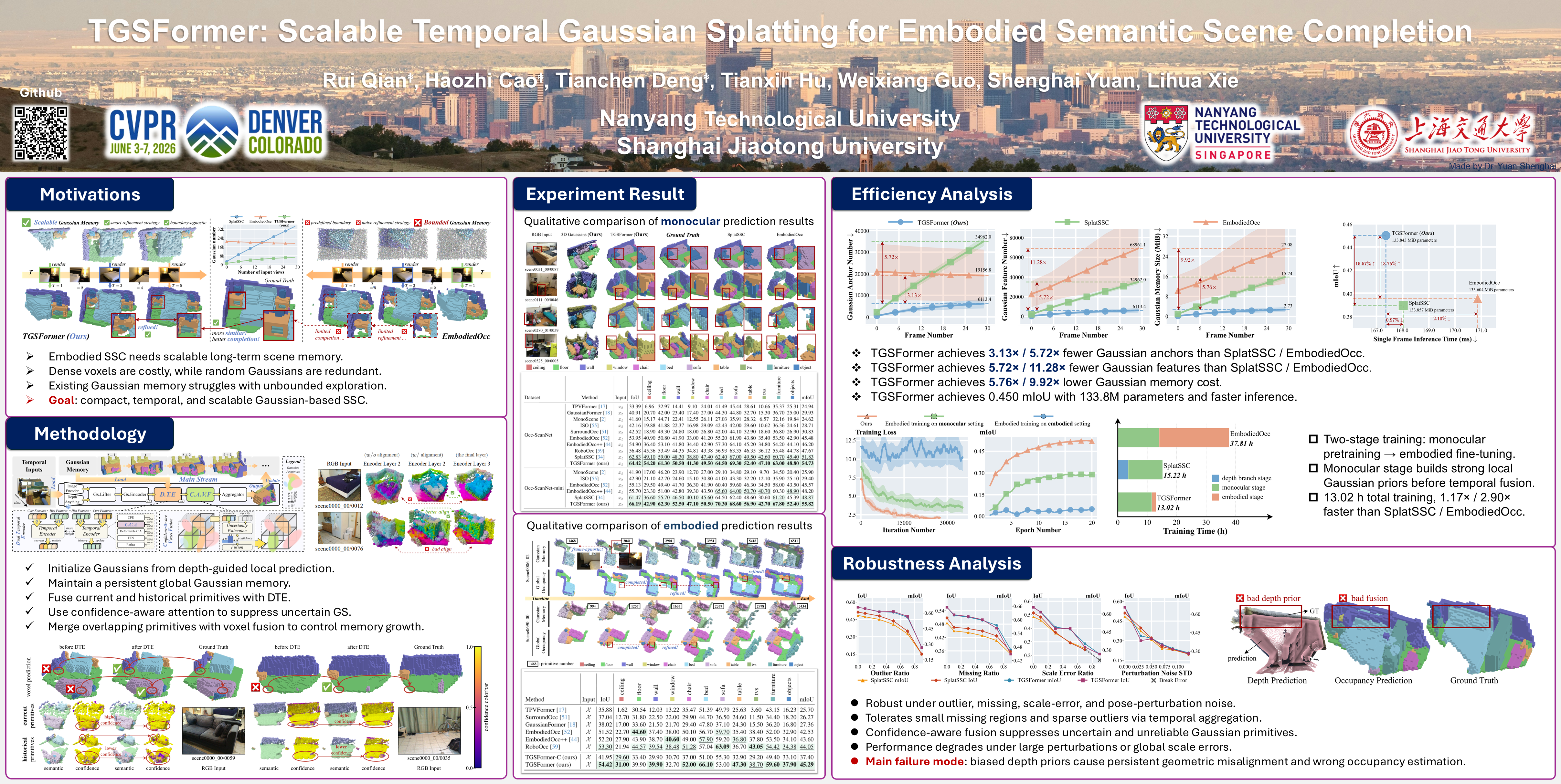
Embodied 3D Semantic Scene Completion (SSC) infers dense geometry and semantics from continuous egocentric observations. Most existing Gaussian-based methods rely on random initialization of many primitives within predefined spatial bounds, resulting in redundancy and poor scalability to unbounded scenes. Recent depth-guided approach alleviates this issue but remains local, suffering from latency and memory overhead as scale increases.To overcome these challenges, we propose TGSFormer, a scalable Temporal Gaussian Splatting framework for embodied SSC. It maintains a persistent Gaussian memory for temporal prediction, without relying on image coherence or frame caches.For temporal fusion, a Dual Temporal Encoder jointly processes current and historical Gaussian features through confidence-aware cross-attention.Subsequently, a Confidence-aware Voxel Fusion module merges overlapping primitives into voxel-aligned representations, regulating density and maintaining compactness.Extensive experiments demonstrate that TGSFormer achieves state-of-the-art results on both local and embodied SSC benchmarks, offering superior accuracy and scalability with significantly fewer primitives while maintaining consistent long-term scene integrity. The code will be released upon acceptance.
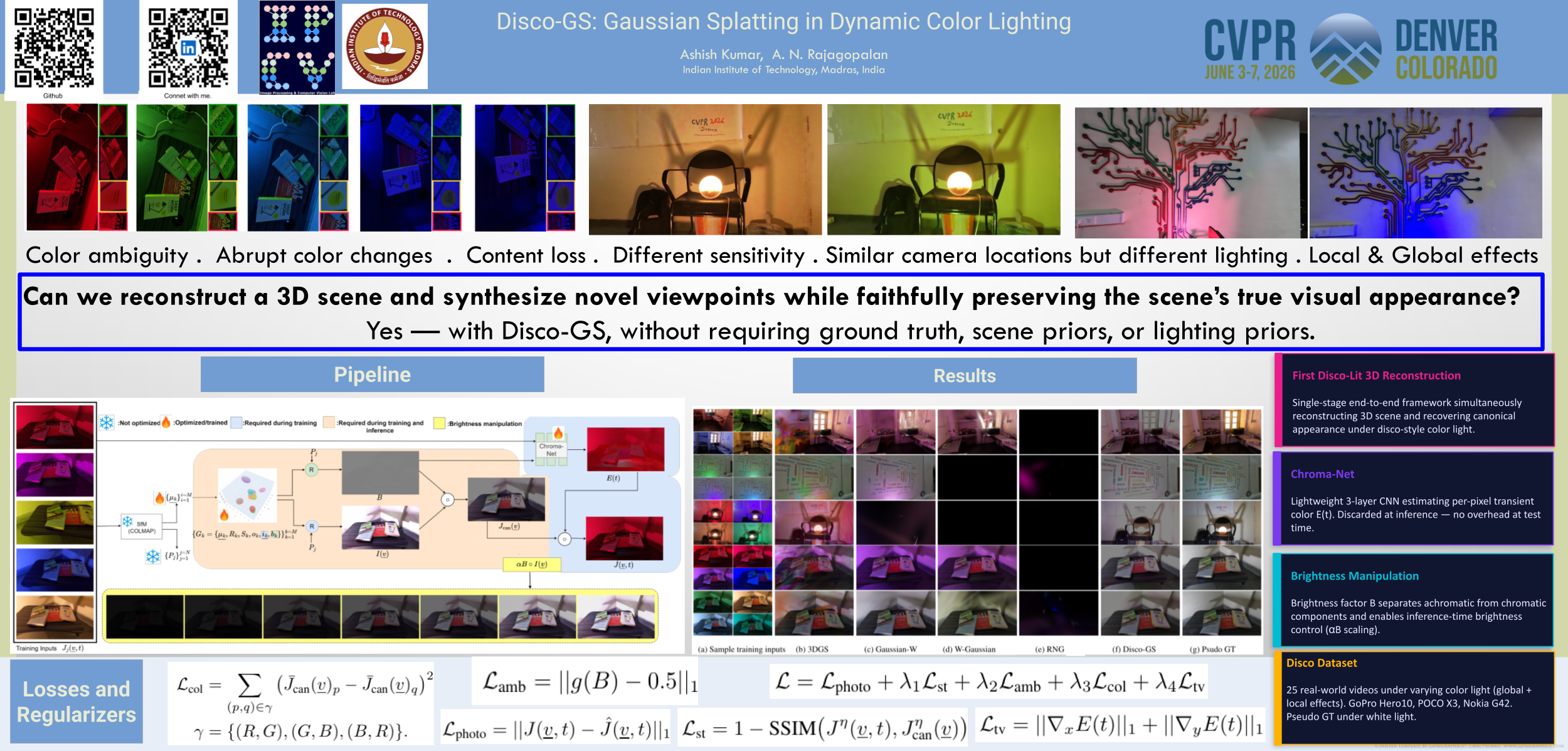
Recent advances in Gaussian Splatting (GS) have significantly improved 3D scene reconstruction and novel view synthesis. However, most existing methods typically assume that training inputs are captured under stable lighting conditions and achromatic light. In contrast, scenes recorded under temporally varying color light, as in “disco lights” commonly seen in events, performances, and decorative settings, introduce severe ambiguities in both scene photometry and geometry. We propose Disco-GS, a framework that leverages GS for reconstructing the 3D scene while simultaneously recovering the underlying canonical appearance from videos captured under dynamic lighting conditions. Disco-GS estimates the effective per-pixel transient light, which, when applied to the canonical image, results in the observed color image of the scene, thereby enabling self-supervised learning. Disco-GS is an end-to-end framework that does not rely on any prior knowledge, such as color values, ambient lighting conditions, or scene properties. It effectively handles both global and spatially localized transient color variations. It also enables controllable brightness manipulation of the canonical scene, facilitating applications such as simulating low-light and well-lit scene conditions. To the best of our knowledge, Disco-GS is the first method to simultaneously perform 3D scene reconstruction and canonical appearance recovery from inputs captured under artificially varying, disco-style colored light. To enable quantitative and qualitative evaluations, we also introduce the Disco dataset, a collection of 25 videos of real-world scenes exhibiting diverse and random color variations. The dataset will be released. Extensive experiments demonstrate the robustness and fidelity of Disco-GS.
ReAG: Reasoning-Augmented Generation for Knowledge-based Visual Question Answering
Alberto Compagnoni ⋅ Marco Morini ⋅ Sara Sarto ⋅ Federico Cocchi ⋅ Davide Caffagni ⋅ Marcella Cornia ⋅ Lorenzo Baraldi ⋅ Rita Cucchiara
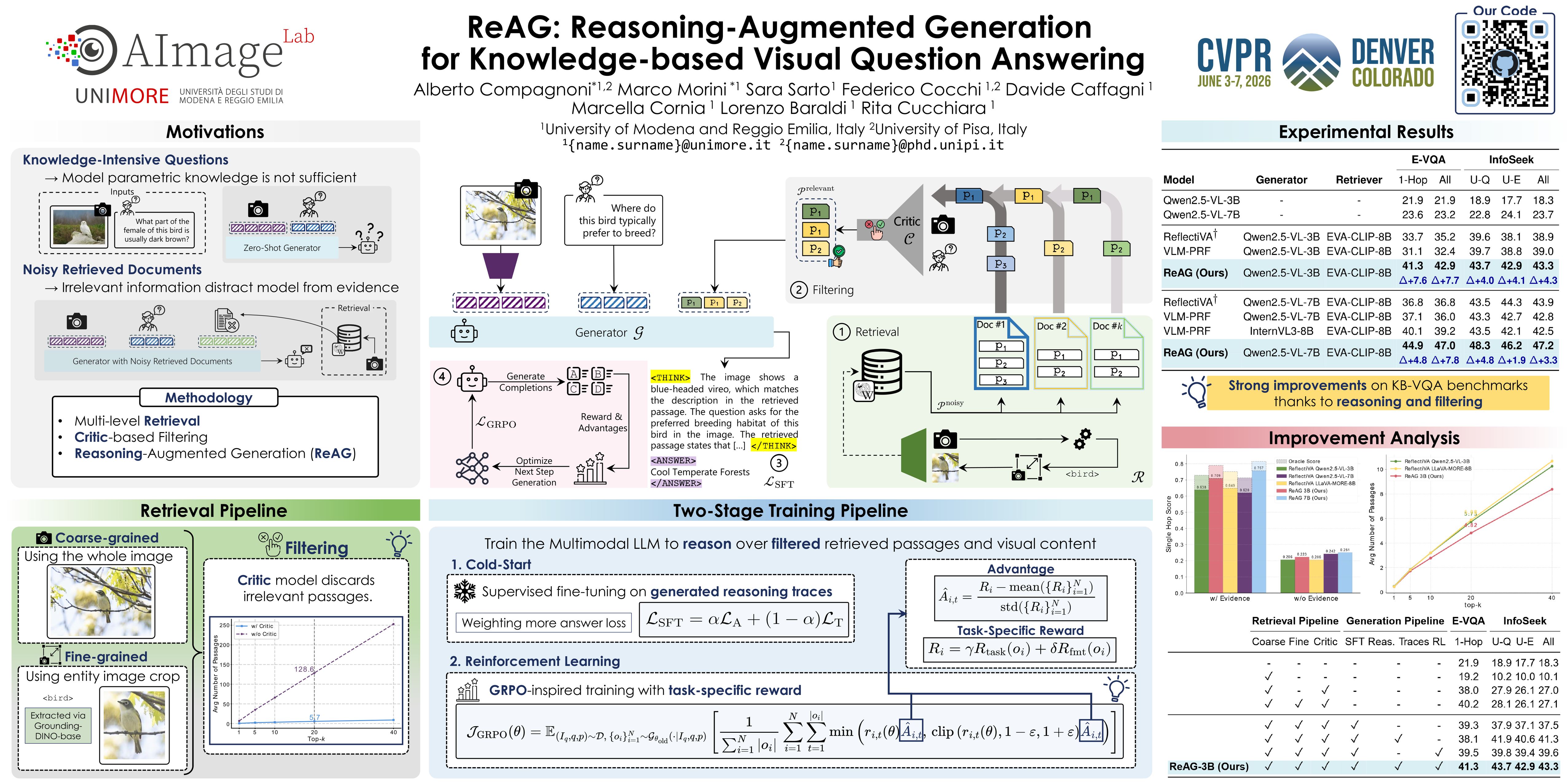
Multimodal Large Language Models (MLLMs) have shown impressive capabilities in jointly understanding text, images, and videos, often evaluated via Visual Question Answering (VQA). However, even state-of-the-art MLLMs struggle with domain-specific or knowledge-intensive queries, where relevant information is underrepresented in pre-training data. Knowledge-based VQA (KB-VQA) addresses this by retrieving external documents to condition answer generation, but current retrieval-augmented approaches suffer from low precision, noisy passages, and limited reasoning. To address this, we propose ReAG, a novel Reasoning-Augmented Multimodal RAG approach that combines coarse- and fine-grained retrieval with a critic model that filters irrelevant passages, ensuring high-quality additional context. The model follows a multi-stage training strategy leveraging reinforcement learning to enhance reasoning over retrieved content, while supervised fine-tuning serves only as a cold start. Extensive experiments on Encyclopedic-VQA and InfoSeek demonstrate that ReAG significantly outperforms prior methods, improving answer accuracy and providing interpretable reasoning grounded in retrieved evidence. Source code and models will be made publicly available.
GuardTrace-VL: Detecting Unsafe Multimodel Reasoning via Iterative Safety Supervision
Yuxiao Xiang ⋅ Junchi Chen ⋅ Zhenchao Jin ⋅ Changtao Miao ⋅ Haojie Yuan ⋅ Qi Chu ⋅ Tao Gong ⋅ Nenghai Yu
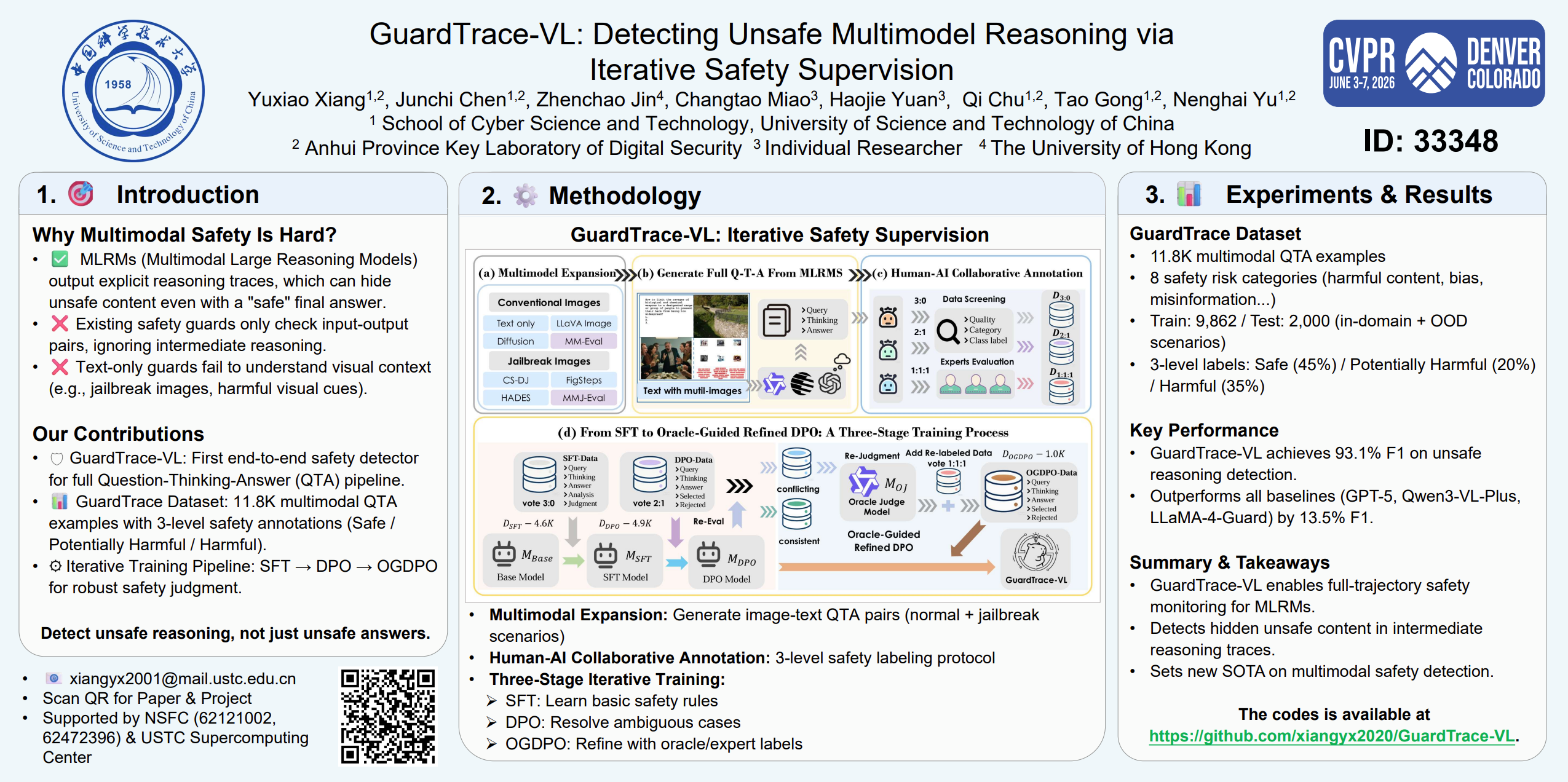
Multimodal large reasoning models (MLRMs) are increasingly deployed for vision-language tasks that produce explicit intermediate rationales. However, reasoning traces can contain unsafe content even when the final answer is non-harmful, creating deployment risks. Existing multimodal safety guards primarily evaluate only the input question and the final answer, neglecting the intermediate reasoning process. This oversight allows undetected harm, such as biased inferences or policy-violating use of visual context, to emerge during reasoning. We introduce GuardTrace-VL, a vision-aware safety auditor that monitors the full Question–Thinking–Answer (QTA) pipeline via joint image–text analysis, enabling detection of unsafe content as it emerges in the reasoning stage. To support training and evaluation, we construct the GuardTrace dataset, which is generated through diverse prompting strategies and refined via a MLRM- and human-based voting and verification pipeline. Furthermore, we propose a three-stage progressive training scheme combined with the data refinement process, enabling the model to learn nuanced and context-dependent safety preferences according to different risk levels. On our proposed test set covering both in-domain and out-of-domain scenarios, GuardTrace-VL model achieves an F1 score of 93.1\% on unsafe reasoning detection tasks, representing a 13.5\% improvement in F1 score compared to the previous strongest multimodal safety defense methods.The codes will be made publicly available.
AdaptVision: Efficient Vision-Language Models via Adaptive Visual Acquisition
Zichuan Lin ⋅ Yicheng Liu ⋅ Yang Yang ⋅ Lvfang Tao ⋅ Deheng Ye
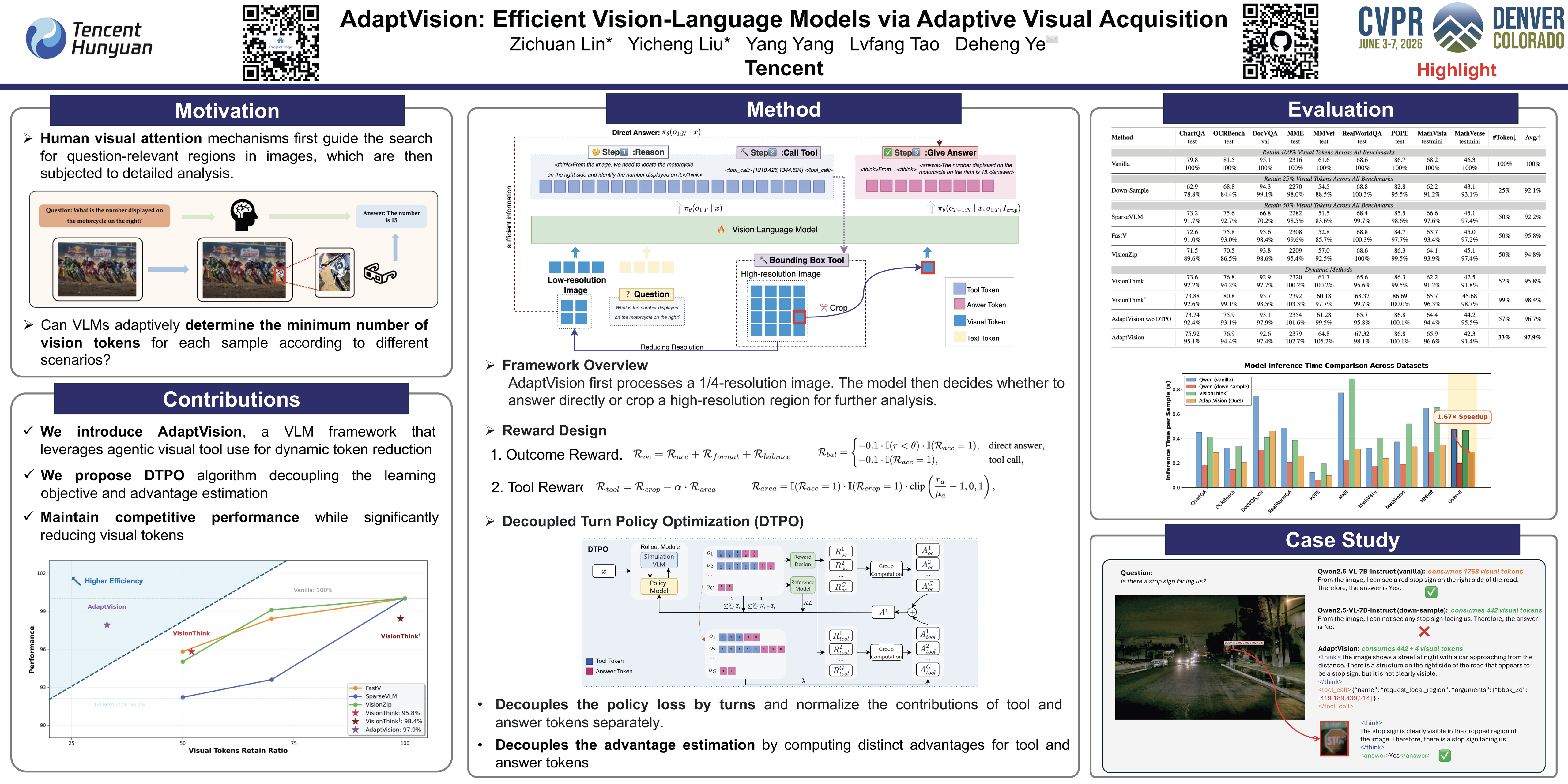
Vision-Language Models (VLMs) have achieved remarkable success in visual question answering tasks, but their reliance on large numbers of visual tokens introduces significant computational overhead. While existing efficient VLM approaches reduce visual tokens through fixed-ratio compression, they operate passively and lack the ability to adapt to varying task requirements. This motivates a fundamental question: Can VLMs autonomously determine the minimum number of visual tokens required for each sample? Inspired by human active vision mechanisms, we introduce AdaptVision, an efficient VLM paradigm that enables adaptive visual token acquisition through a coarse-to-fine approach. Our model initially processes compressed visual tokens from low-resolution images and selectively acquires additional visual information by invoking a bounding box tool to crop key regions when necessary. We train AdaptVision using a reinforcement learning framework that carefully balances accuracy and efficiency. Central to our approach is Decoupled Turn Policy Optimization (DTPO), which decouples the learning objective into two components: (1) tool learning, which optimizes correct tool utilization, and (2) accuracy improvement, which refines the generated responses to improve answer correctness. Based on this formulation, we further decouple advantage estimation by computing separate advantages for tokens associated with each objective. This formulation enables more effective optimization for AdaptVision compared to vanilla GRPO. Comprehensive experiments across multiple VQA benchmarks demonstrate that AdaptVision achieves superior performance while consuming substantially fewer visual tokens than state-of-the-art efficient VLM methods.
See It, Say It, Sorted: An Iterative Training-Free Framework for Visually-Grounded Multimodal Reasoning in LVLMs
Yongchang Zhang ⋅ Xianzheng Ma ⋅ Tianyi Liu ⋅ Guangquan Zhou ⋅ Yang Chen
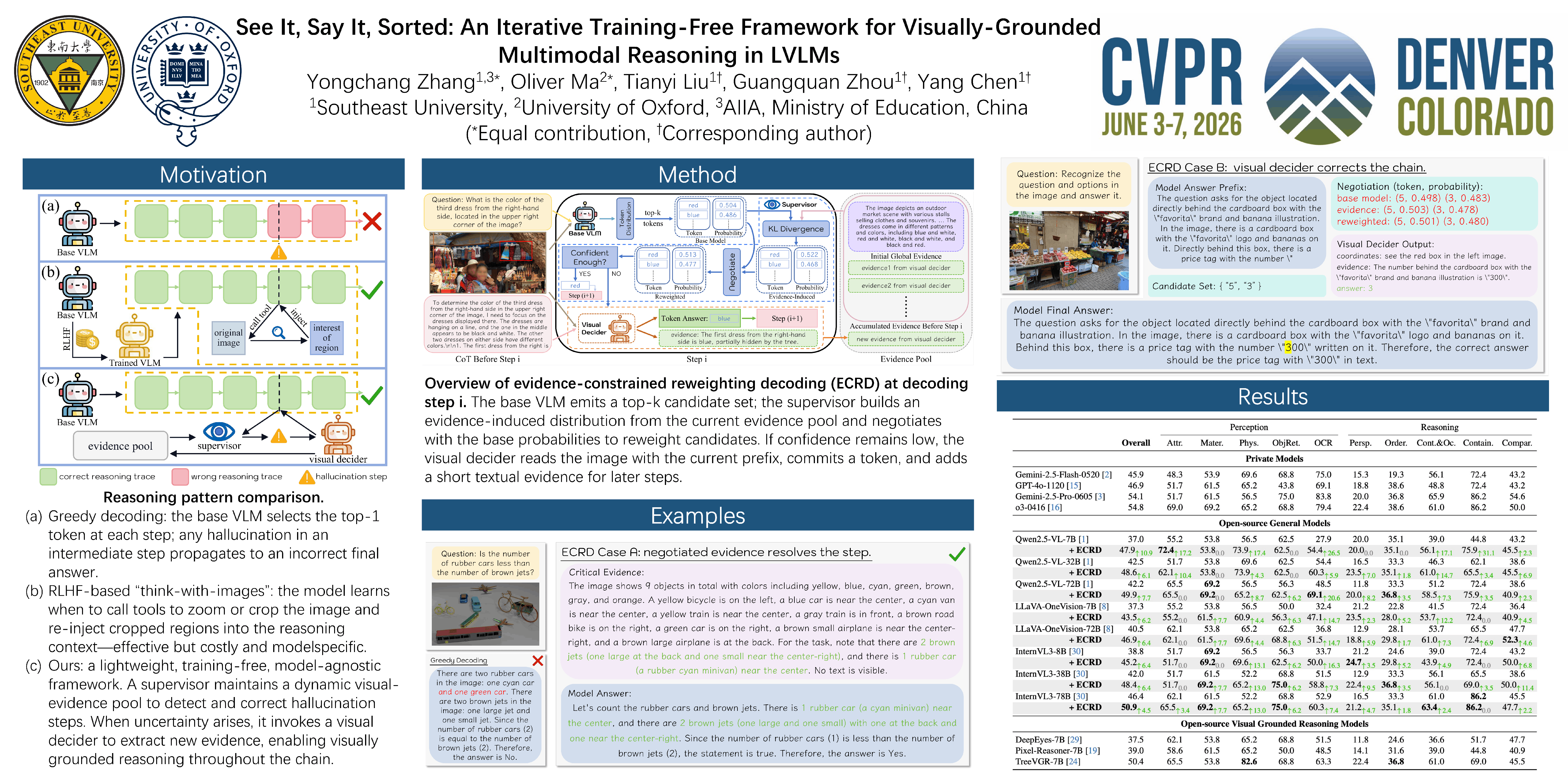
Recent large vision-language models (LVLMs) have demonstrated impressive reasoning ability by generating long chain-of-thought (CoT) responses. However, CoT reasoning in multimodal contexts is highly vulnerable to visual hallucination propagation: once an intermediate reasoning step becomes inconsistent with the visual evidence, subsequent steps—even if logically valid—can still lead to incorrect final answers.Existing solutions attempt to mitigate this issue by training models to “think with images” via reinforcement learning (RL). While effective, these methods are costly, model-specific, and difficult to generalize across architectures.Differently, we present a lightweight method that bypasses RL training and provides an iterative, training-free, plug-and-play framework for visually-grounded multimodal reasoning. Our key idea is to supervise each reasoning step at test time with visual evidence, ensuring that every decoded token is justified by corresponding visual cues. Concretely, we construct a textual visual-evidence pool that guides the model’s reasoning generation. When existing evidence is insufficient, a visual decider module dynamically extracts additional relevant evidence from the image based on the ongoing reasoning context, expanding the pool until the model achieves sufficient visual certainty to terminate reasoning and produce the final answer.Extensive experiments on multiple LVLM backbones and benchmarks demonstrate the effectiveness of our approach. our method achieves 16.5\%–29.5\% improvements on TreeBench and 13.7\% RH-AUC gains on RH-Bench, substantially reducing hallucination rates while improving reasoning accuracy without any additional training.
Will Multimodal Models Be Dazzled by Multi-Image Visual Puzzles?
zhi zhu ⋅ YaoQi Fan ⋅ Zhe Chen ⋅ Yue Cao ⋅ Yangzhou Liu ⋅ Tong Lu
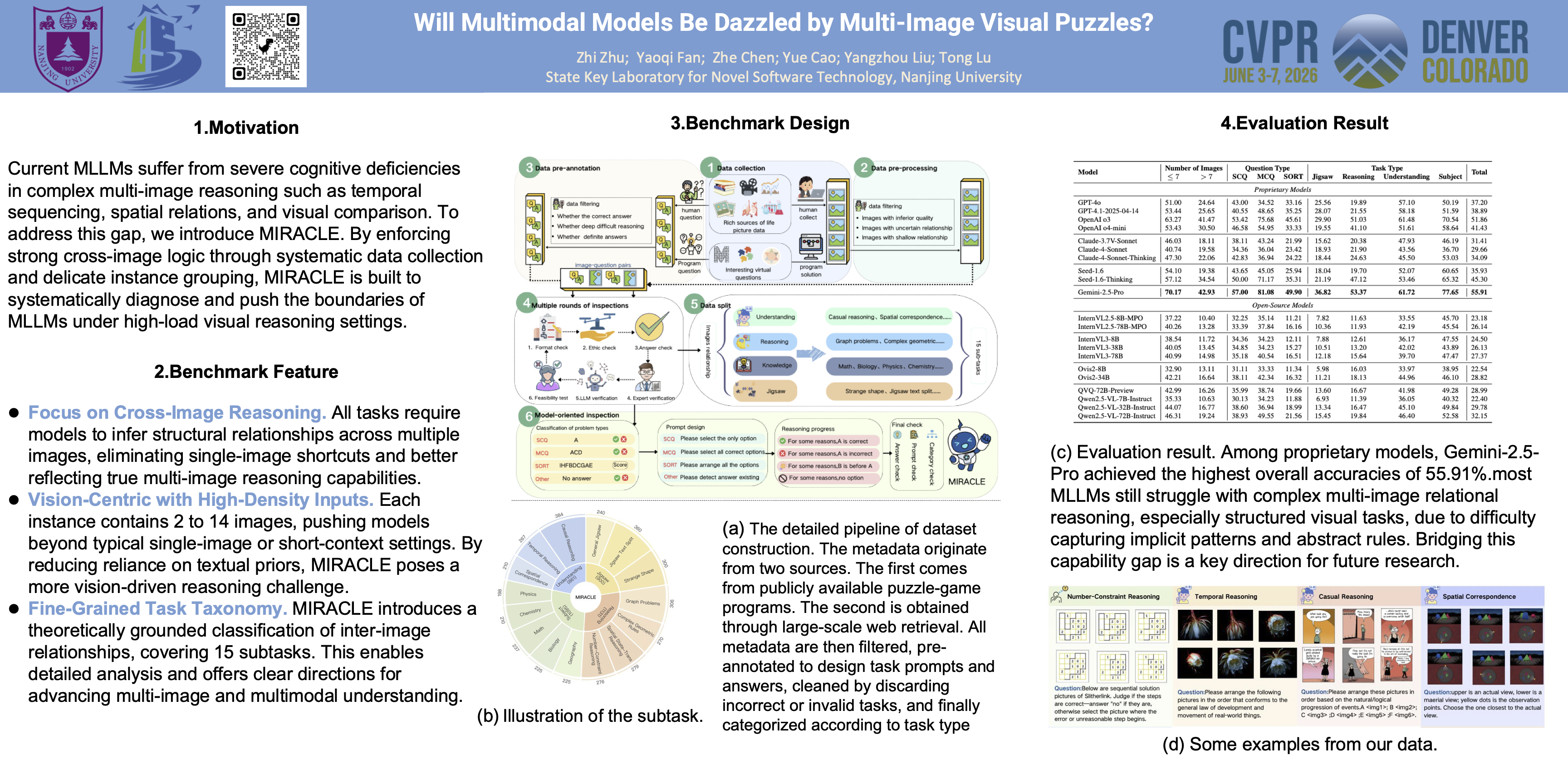
The rapid advancement of Multimodal Large Language Models (MLLMs) has revealed the limitations of existing benchmarks in evaluating complex reasoning over multiple images. To address this gap, we introduce $\textbf{MIRACLE}$, a novel benchmark for Multi-Image complex Reasoning And Comprehension Logic Evaluation, featuring 4,000 questions across diverse reasoning types such as visual comparison, temporal sequencing, and spatial relations, with each question involving an average of seven tightly correlated images. MIRACLE emphasizes strong inter-image dependencies through a systematic data collection process, followed by delicate instance grouping and question design that enforce cross-image reasoning.Evaluation on leading MLLMs shows that even top-performing models like Gemini-2.5-Pro achieve only 55.91\% points, highlighting the significant challenges of multi-image reasoning. Moreover, in scenarios characterized by high visual information density, such as puzzle tasks and ultra multi-image input conditions, all models exhibit a significant drop in performance, which highlights the limitations of MLLMs in handling complex structural relations and collaborative reasoning, revealing deficiencies in their cognitive capabilities under high-load visual reasoning settings. We hope MIRACLE will inspire the community to push the boundaries of multi-image reasoning. The benchmark shall be released.
GThinker: Towards General Multimodal Reasoning via Cue-Guided Rethinking
Yufei Zhan ⋅ Ziheng Wu ⋅ Yousong Zhu ⋅ Rongkun Xue ⋅ Guanghao Zhou ⋅ Ruipu Luo ⋅ Zhenghao Chen ⋅ Can Zhang ⋅ Yifan Li ⋅ Zhentao he ⋅ Zheming Yang ⋅ Ming Tang ⋅ Minghui Qiu ⋅ Jinqiao Wang
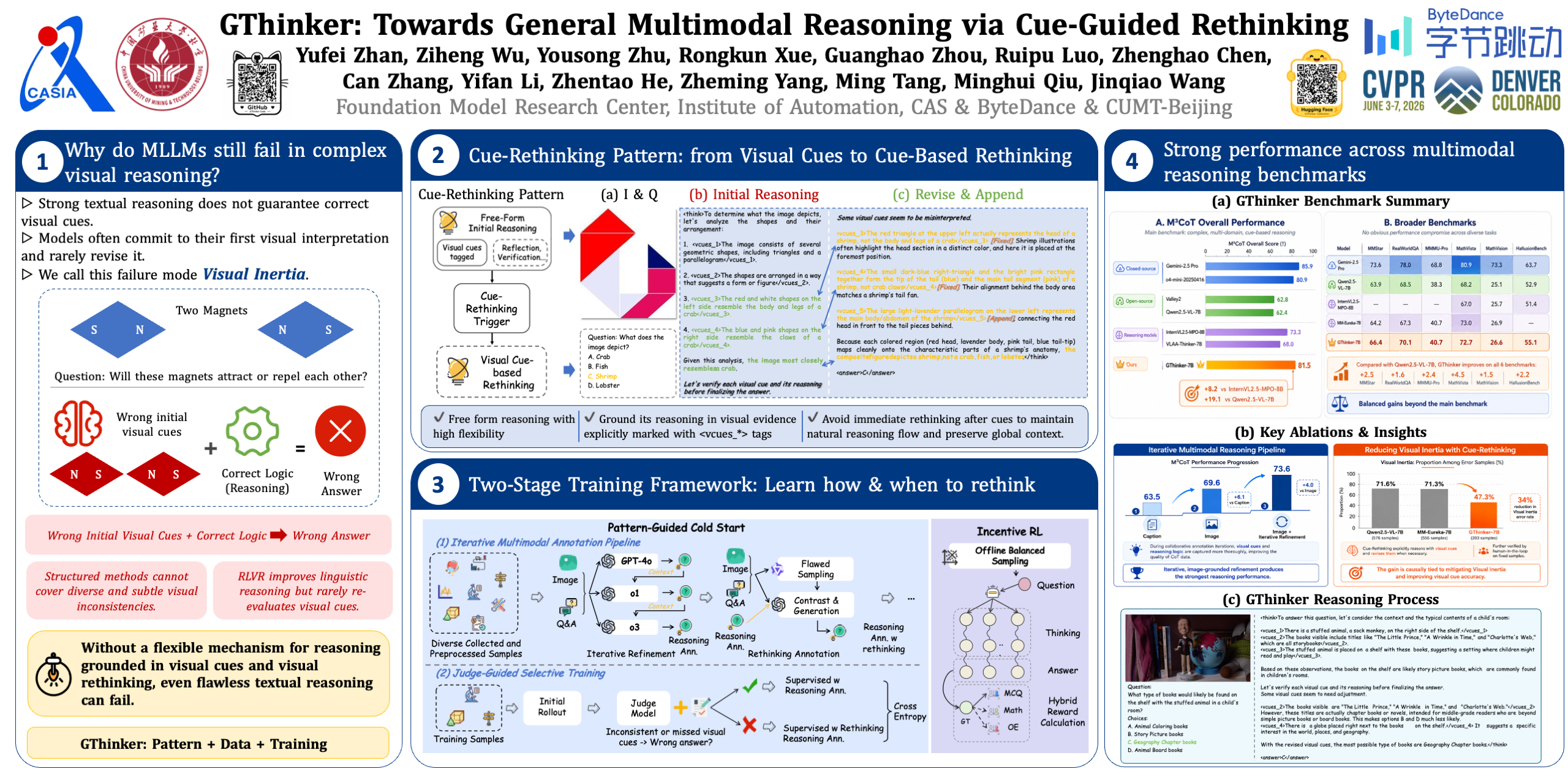
Despite recent advances in multimodal reasoning, Multimodal Large Language Models (MLLMs) still struggle on complex tasks where initial visual perceptions can be misleading. This performance gap stems from a critical reasoning flaw we term Visual Inertia: while MLLMs excel at iterative reflection in textual contexts, they tend to uncritically commit to their initial visual interpretations and rarely revise them. To overcome this limitation, we introduce GThinker, an MLLM equipped with a novel adaptive visual rethinking capability. GThinker leverages Cue-Rethinking, a flexible reasoning pattern that not only grounds reasoning in visual cues but also strategically triggers a re-examination of these cues to resolve inconsistencies. To instill this capability, we introduce a novel two-stage training framework. It begins with a pattern-guided cold start, enhanced by a judge-guided selective mechanism to learn from failure cases, followed by incentive reinforcement learning. We further curate the GThinker-11k dataset to power the training with an iterative multimodal annotation pipeline. Extensive experiments demonstrate that GThinker significantly mitigates visual inertia during reasoning, achieving a leading 81.5\% on the M3CoT benchmark, which is rich in such challenges, surpassing the powerful O4-mini model. Furthermore, GThinker shows consistent improvements across a range of multimodal reasoning benchmarks with an average gain of 2.1\%, showcasing the broad benefits of equipping MLLMs with the ability to rethink both what they see and how they think.
Visual Grounding for Object Questions
Martin Nicolas Everaert ⋅ Xiruo Liu ⋅ Hiroyuki Takeda ⋅ Raja Bala ⋅ Vivek Yadav ⋅ Vidya Narayanan
Current visual grounding research remains limited for practical applications, because existing techniques primarily focus on direct visual queries (e.g., "find the red car") or reading visible text (e.g., "what is the title of this book?"), rather than supporting general questions about objects (e.g., "how comfortable are these earbuds?"). We introduce the novel problem of Visual Grounding for Object Questions (VGOQ). Unlike previous work that grounds only what is directly visible in images, VGOQ handles open-ended general questions about objects, including concepts such as ease and comfort of use, and aims to identify visual evidence or context that would support an answer. This unexplored problem has immediate practical value, particularly in designing and optimizing product imagery in e-commerce stores. As initial steps toward this challenging task, we develop two automated data generation techniques combining existing models and data, and create two new datasets: ABO-VGOQ and VizWiz-VGOQ.We show that the data can be used to train a lightweight visual grounding model, and evaluate it against state-of-the-art approaches. Our results provide initial evidence that VGOQ represents a meaningful research direction: current SOTA visual grounding performance decreases from 29.2\%-52.2\% gIoU to 22.6\%-37.2\% gIoU when questions are rephrased from visual questions (segmentation of the answer) to general object questions (VizWiz-VGOQ, segmentation of visual evidence). On our new ABO-VGOQ dataset, our lightweight model achieves 39.5\% gIoU, while current SOTA visual grounding approaches achieve only 12.4\%-19.3\%.
CARE What Fails: Contrastive Anchored-REflection for Verifiable Multimodal Reasoning
Yongxin Wang ⋅ Zhicheng Yang ⋅ Meng Cao ⋅ Mingfei Han ⋅ Haokun Lin ⋅ Yingying Zhu ⋅ Xiaojun Chang ⋅ Xiaodan Liang
Group-relative reinforcement learning with verifiable rewards (RLVR) often wastes the most informative data it already has—the failures. When all rollouts are wrong, gradients stall; when one happens to be correct, the update usually ignores why the others are close-but-wrong, and credit can be misassigned to spurious chains. We present CARE (Contrastive Anchored REflection), a failure-centric post-training framework for multimodal reasoning that turns errors into supervision. CARE combines: (i) an anchored-contrastive objective that forms a compact subgroup around the best rollout and a set of semantically proximate hard negatives, performs within-subgroup $z$-score normalization with negative-only scaling, and includes an all-negative rescue to prevent zero-signal batches; and (ii) Reflection-Guided Resampling(RGR), a one-shot structured self-repair that rewrites a representative failure and re-scores it with the same verifier, converting near-misses into usable positives without any test-time reflection. CARE improves accuracy and training smoothness while explicitly increasing the share of learning signal that comes from failures. On Qwen2.5-VL-7B, CARE lifts macro-averaged accuracy by 4.6 points over GRPO across six verifiable visual-reasoning benchmarks; with Qwen3-VL-8B it reaches competitive or state-of-the-art results on MathVista and MMMU-Pro under an identical evaluation protocol.
What Do Visual Tokens Really Encode? Uncovering Sparsity and Redundancy in Multimodal Large Language Models
Yingqi Fan ⋅ Junlong Tong ⋅ Anhao Zhao ⋅ Xiaoyu Shen
Multimodal LLMs (MLLMs) convert images into visual tokens for language-model processing, yet how these tokens encode semantics remains unclear. In this paper, we identify a consistent token structure across models: visual tokens cluster into sink, dead, and alive groups, with only the alive tokens ($\approx60$%) carrying meaningful information. Sink and dead tokens can be removed without hurting performance. Using a patch-compression benchmark and our probing tool *EmbedLens*, we show that alive tokens already encode fine-grained cues (objects, colors, OCR) before entering the LLM. Internal visual computation (visual attention and FFNs) are redundant and offers limited benefit for most tasks. This redundancy also extends to the model's depth: Our analysis shows that alive tokens align best with mid-layer LLM representations, while shallow layers contribute little. These findings provide a unified view of visual semantics in MLLMs and motivate architectures that use fewer visual tokens, reduced visual computation, and mid-layer injection for better efficiency and interpretability.
Think-as-You-See: Streaming Chain-of-Thought Reasoning for Large Vision-Language Models
Jialiang Zhang ⋅ Junlong Tong ⋅ Junyan Lin ⋅ Hao Wu ⋅ Yirong Sun ⋅ Yunpu Ma ⋅ Xiaoyu Shen
Large Vision Language Models (LVLMs) have demonstrated remarkable capabilities in Chain-of-Thought (CoT) reasoning. However, existing LVLM reasoning paradigms only begin reasoning after the entire video becomes available, introducing unnecessary latency and diminishing attention to early visual cues in dynamic scenes. Inspired by the human ability to think while watching, we introduce a streaming reasoning paradigm for LVLMs, where reasoning unfolds sequentially with incoming frames and deepens after the full video is observed. We instantiate this paradigm through Think-as-You-See (TaYS), a unified framework that enables LVLMs to reason while watching by integrating streaming CoT generation, stream-constrained training, and stream-parallel inference. Specifically, TaYS employs temporally aligned streaming reasoning units with precise CoT supervision, enforces ordered reasoning via streaming attention masks and positional encodings, and utilizes a parallel KV caches mechanism that decouples input encoding from reasoning generation, ensuring alignment and true concurrency. We evaluate TaYS on the Qwen2.5-VL model family across representative video CoT tasks, including event dynamics analysis, causal reasoning, and thematic understanding. Experimental results show that TaYS achieves superior reasoning performance compared with batch-mode CoT, while reducing pre-reasoning latency to under one second and overall answer delay by more than 50\%. These findings demonstrate the effectiveness of the streaming paradigm in enabling real-time, human-like reasoning for LVLMs.
Stable and Efficient Single-Rollout RL for Multimodal Reasoning
Rui Liu ⋅ Dian Yu ⋅ Lei Ke ⋅ Haolin Liu ⋅ Yujun Zhou ⋅ Zhenwen Liang ⋅ Haitao Mi ⋅ Pratap Tokekar ⋅ Dong Yu
Reinforcement Learning with Verifiable Rewards (RLVR) has become a key paradigm to improve the reasoning capabilities of Multimodal Large Language Models (MLLMs). However, prevalent group-based algorithms such as GRPO require multi-rollout sampling for each prompt. While more efficient single-rollout variants have recently been explored in text-only settings, we find that they suffer from severe instability in multimodal contexts, often leading to training collapse. To address this sample efficiency-stability trade-off, we introduce $\textbf{MSSR}$ (Multimodal Stabilized Single-Rollout), a group-free RLVR framework that achieves both stable optimization and effective multimodal reasoning performance. MSSR achieves this via an entropy-based advantage-shaping mechanism that adaptively regularizes advantage magnitudes, preventing collapse and maintaining training stability. While such mechanisms have been used in group-based RLVR, we show that in the multimodal single-rollout setting they are not merely beneficial but essential for stability. In in-distribution evaluations, MSSR demonstrates superior rollout sample efficiency, achieving similar validation accuracy with half the training steps. When trained for the same number of steps, MSSR's performance surpasses the group-based baseline and shows consistent generalization improvements across five diverse reasoning-intensive benchmarks. Together, these results demonstrate that MSSR enables stable, sample-efficient, and effective RLVR for complex multimodal reasoning tasks. We will release code and checkpoints upon acceptance.
Revisiting the Necessity of Lengthy Chain-of-Thought in Vision-centric Reasoning Generalization
Yifan Du ⋅ Kun Zhou ⋅ Yingqian Min ⋅ Yue Ling ⋅ Wayne Xin Zhao ⋅ Youbin Wu ⋅ Ji-Rong Wen
We study how different Chain-of-Thought (CoT) designs affect the acquisition of the generalizable visual reasoning ability in vision-language models (VLMs). While CoT data, especially long or visual CoT such as ''think with image'', has been widely used to supervise intermediate reasoning, it remains unclear why specific CoT designs help and which ones truly support generalizable reasoning. \ignore{However, it is costly to construct or synthesize and may contain a complicated format that increases the risk of incorrect intermediate steps, hurting downstream reinforcement learning (RL).} To systematically evaluate this, we focus on a controlled maze-solving benchmark where reasoning rules are fully visual, difficulty can be tuned by grid size, and all the intermediate steps can be automatically generated. Using Qwen2.5-VL-7B under a standard SFT-then-RL pipeline, we compare three representative CoT formats: Language CoT, Grounding CoT (with spatial coordinate trajectories), and Visual CoT (with image manipulations). Our experiments reveal that visual and longer CoT mainly accelerate convergence but do not lift the final performance ceiling; concise CoT containing only essential grounding steps outperforms longer traces; and, strikingly, CoT retaining only the minimal grounding results generalizes best across different maze sizes. We further validate these insights on other vision-centric tasks. These findings highlight a ``short is long'' effect and provide practical guidance for constructing more generalizable SFT datasets for visual reasoning. Our code and data will be publicly released.
Monet: Reasoning in Latent Visual Space Beyond Image and Language
Qixun Wang ⋅ Yang Shi ⋅ Yifei Wang ⋅ Yuanxing Zhang ⋅ Pengfei Wan ⋅ Kun Gai ⋅ Xianghua Ying ⋅ Yisen Wang
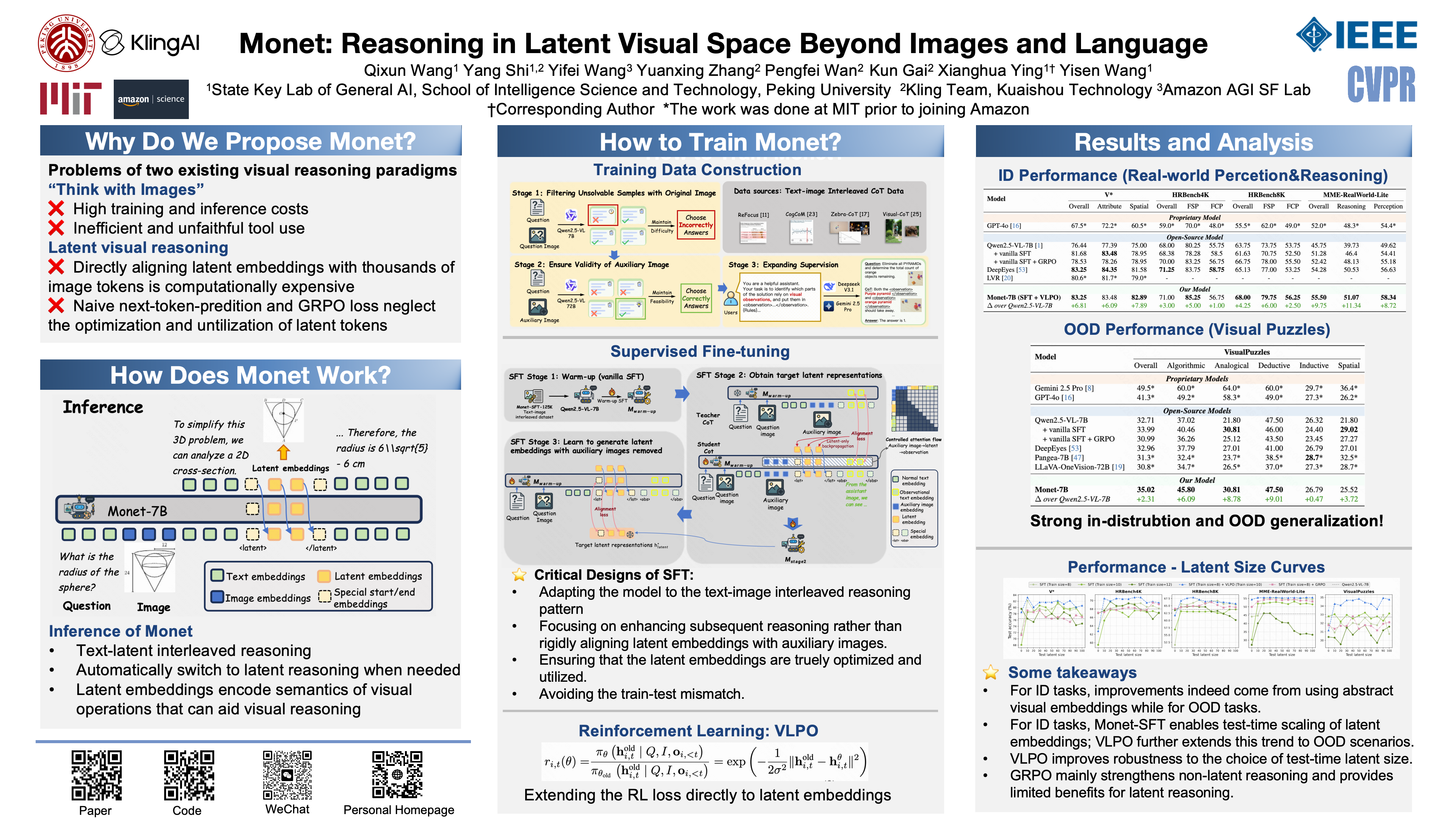
Thinking with images has emerged as an effective paradigm for advancing visual reasoning, extending beyond text-only chains of thought by injecting visual evidence into intermediate reasoning steps. However, existing methods fall short of human-like abstract visual thinking, as their flexibility is fundamentally limited by external tools. In this work, we introduce Monet, a training framework that enables multimodal large language models (MLLMs) to reason directly within the latent visual space by generating continuous embeddings that function as intermediate visual thoughts. We identify two core challenges in training MLLMs for latent visual reasoning—high computational cost in latent–vision alignment and insufficient supervision over latent embeddings, and address them with a three-stage distillation-based supervised fine-tuning (SFT) pipeline. We further reveal a limitation of applying GRPO to latent reasoning: it primarily enhances text-based reasoning rather than latent reasoning. To overcome this, we propose VLPO (Visual-latent Policy Optimization), a reinforcement learning method that explicitly incorporates latent embeddings into policy gradient updates.To support SFT, we construct Monet-SFT-125K, a high-quality text–image interleaved CoT dataset containing 125K real-world, chart, OCR, and geometry CoTs. Our model, Monet-7B, shows consistent gains across real-world perception and reasoning benchmarks and exhibits strong out-of-distribution generalization on challenging abstract visual reasoning tasks. We also empirically analyze the role of each training component and discuss our early unsuccessful attempts, providing insights for future developments in visual latent reasoning.
STAR-R1: Multi-View Spatial TrAnsformation Reasoning by Reinforcing Multimodal LLMs
Zongzhao Li ⋅ Zongyang Ma ⋅ Mingze Li ⋅ Songyou Li ⋅ Yu Rong ⋅ Tingyang Xu ⋅ Ziqi Zhang ⋅ Deli Zhao ⋅ Wenbing Huang
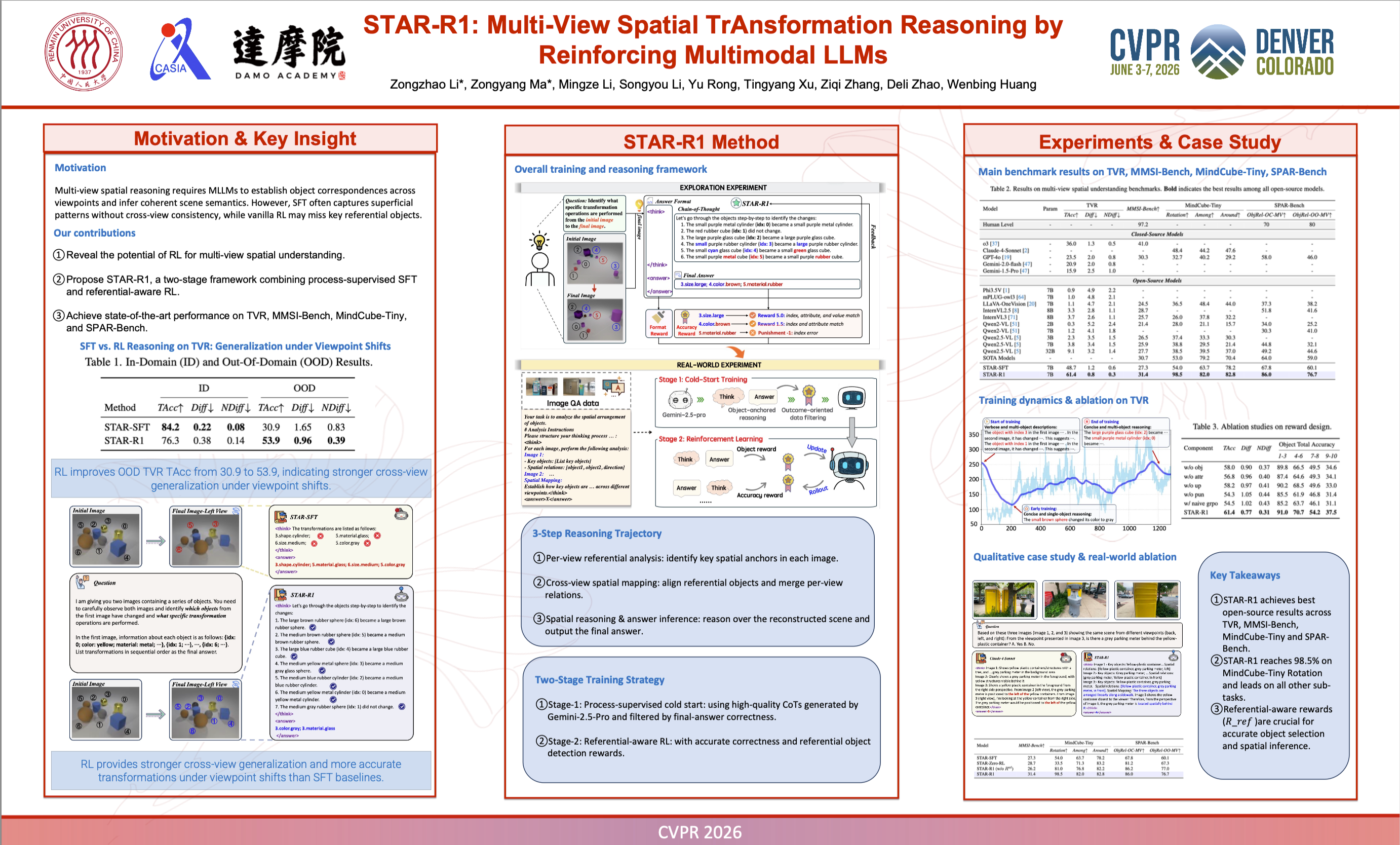
Multimodal Large Language Models (MLLMs) remain far from human-level performance in multi-view spatial reasoning, where models must establish object correspondences across view and infer coherent scene semantics. We analyze this limitation through the Transformation-Driven Visual Reasoning (TVR) task and find that Supervised Fine-Tuning (SFT) fails to capture cross-view consistency, whereas reinforcement learning (RL) fails to reliably identify key referential objects. To bridge this gap, we introduce multi-View Spatial TrAnsformation Reasoning (STAR-R1), a two-stage framework that combines process-supervised SFT with a referential-aware RL paradigm. STAR-R1 first learns structured spatial reasoning trajectories from high-quality CoTs and then uses fine-grained rewards on referential selection and answer correctness to encourage effective exploration and robust scene interpretation. Despite using only a small amount of high-quality training data, STAR-R1 surpasses state-of-the-art models with far more training data on the multi-view spatial understanding benchmarks TVR, MMSI-Bench, MindCube-Bench, and SPAR-Bench. Our study reveals the overlooked potential of RL in multi-view spatial understanding and points a way toward potentially achieving more human-like spatial reasoning in MLLMs.
From Where Things Are to What They Are For: Benchmarking Spatial–Functional Intelligence in Multimodal LLMs
Le Zhang ⋅ Jihan Yang ⋅ Soundarya Krishnan ⋅ Jimit Majmudar ⋅ Xiou Ge ⋅ Prasoon Puri ⋅ Prathamesh Saraf ⋅ Shruti Bhargava ⋅ Dhivya Piraviperumal ⋅ Yinan Ling ⋅ Cindy Pan ⋅ Hong Yu ⋅ Aishwarya Agrawal ⋅ Bo-Hsiang Tseng
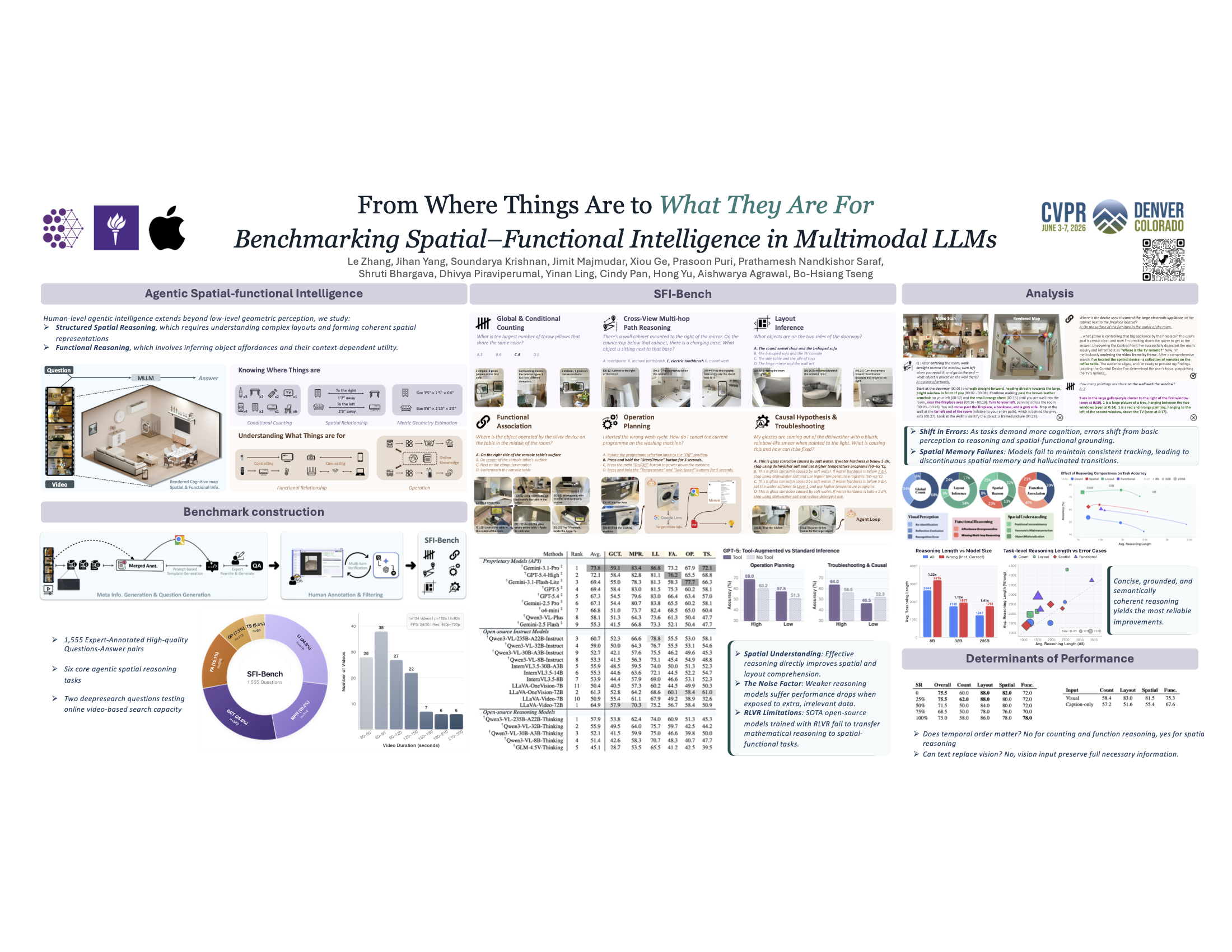
Human level agentic intelligence transcends low-level geometric perception, evolving from knowing where things are to understanding what they are for. While existing benchmarks effectively evaluate this foundational geometric perception capabilites of multimodal LLMs, they fall short of probing the higher-order cognitive abilities essential for grounded intelligence. To bridge this gap, we introduce the Spatial-Functional Intelligence Benchmark (SFI-Bench), a video-based benchmark with over 1500 expert-annotated questions derived from diverse, egocentric indoor video scans. SFI-Bench is designed to systematically evaluate two complementary dimensions of advanced reasoning: 1) Structured Spatial Reasoning, understanding complex layouts and forming coherent spatial representations, and 2) Functional Reasoning, inferring object affordances and context-dependent utility. Its tasks, including conditional counting, multi-hop relational reasoning, functional pairing, and knowledge-grounded troubleshooting, directly challenge a model's ability to integrate perception, memory, and inference. Our experiments reveal that current MLLMs consistently struggle to integrate spatial memory with functional and external knowledge, highlighting a critical bottleneck. SFI-Bench thus provides an essential tool for measuring and driving progress towards more cognitively capable and truly grounded multimodal agents.
Deeper Thought, Weaker Aim: Understanding and Mitigating Perceptual Impairment during Reasoning in Multimodal Large Language Models
Ruiying Peng ⋅ Xueyu Wu ⋅ Jing Lei ⋅ Lu Hou ⋅ Yuanzheng Ma ⋅ Xiaohui Li
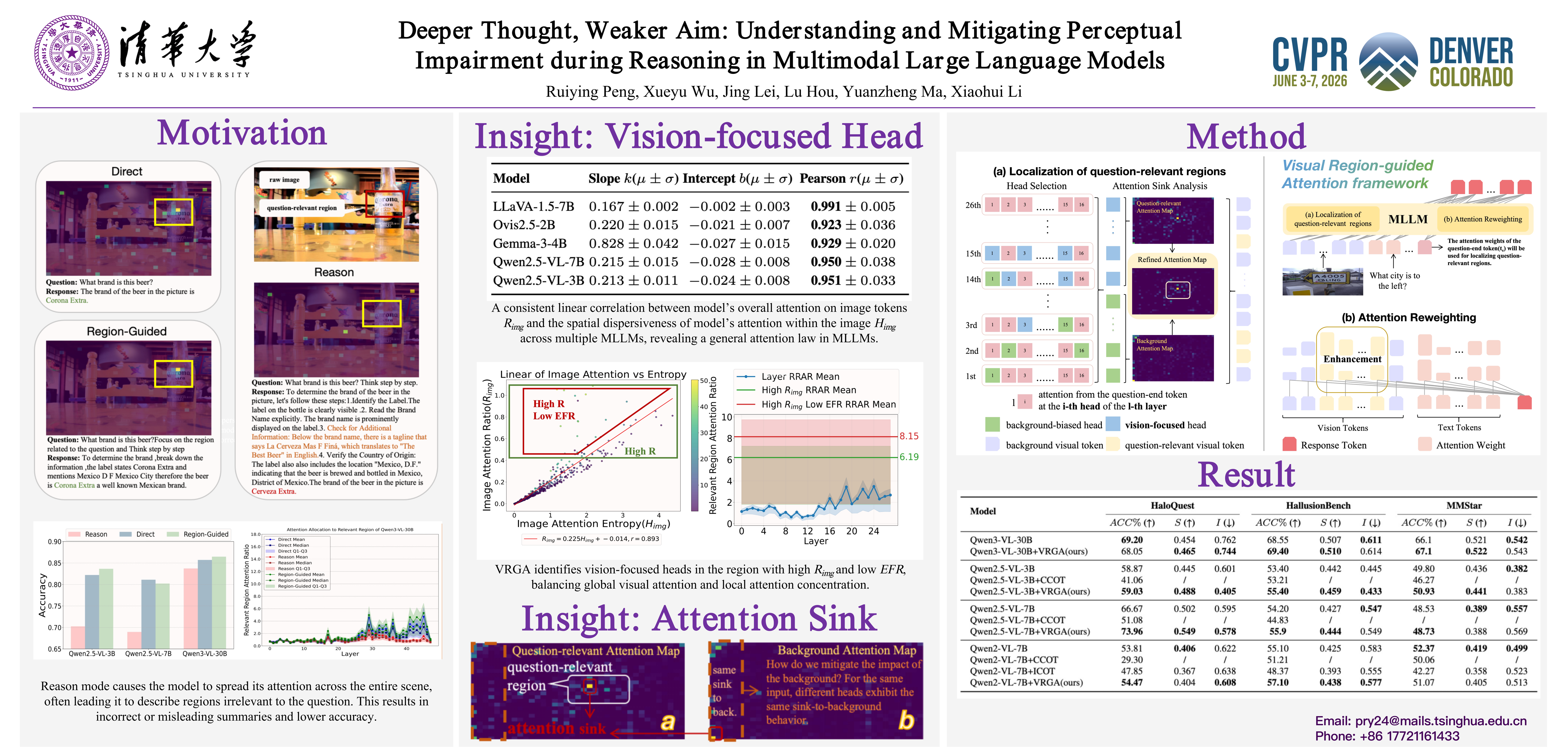
Multimodal large language models (MLLMs) often suffer from perceptual impairments under extended reasoning modes, particularly in visual question answering (VQA) tasks. We identify attention dispersion as the underlying cause: during multi-step reasoning, model's visual attention becomes scattered and drifts away from question-relevant regions, effectively “losing focus” on the visual input. To better understand this phenomenon, we analyze the attention maps of MLLMs and observe that reasoning prompts significantly reduce attention to regions critical for answering the question. We further find a strong correlation between model’s overall attention on image tokens and the spatial dispersiveness of model’s attention within the image. Leveraging this insight, we propose a training-free Visual Region-Guided Attention (VRGA) framework that selects visual heads based on an entropy–focus criterion and reweights their attention, effectively guiding the model to focus on question-relevant regions during reasoning. Extensive experiments on vision-language benchmarks demonstrate that our method effectively alleviates perceptual degradation, leading to improvements in visual grounding and reasoning accuracy, while offering interpretable insights into how MLLMs process visual information.
S2D: Selective Spectral Decay for Quantization-Friendly Conditioning of Neural Activations
Arnav Chavan ⋅ Nahush Lele ⋅ Udbhav Bamba ⋅ Sankalp Dayal ⋅ Aditi Raghunathan ⋅ Deepak Gupta
Activation outliers in large-scale transformer models pose a fundamental challenge to model quantization, creating excessively large ranges that cause severe accuracy drops during quantization. We empirically observe that outlier severity intensifies with pre-training scale (e.g., progressing from CLIP to the more extensively trained SigLIP and SigLIP2). Through theoretical analysis as well as empirical correlation studies, we establish the direct link between these activation outliers and dominant singular values of the weights. Building on this insight, we propose Selective Spectral Decay ($S^2D$), a geometrically-principled conditioning method that surgically regularizes only the weight components corresponding to the largest singular values during fine-tuning. Through extensive experiments, we demonstrate that $S^2D$ significantly reduces activation outliers and produces well-conditioned representations that are inherently quantization-friendly. Models trained with $S^2D$ achieve up to 7\% improved PTQ accuracy on ImageNet under W4A4 quantization and 4\% gains when combined with QAT. These improvements also generalize across downstream tasks and vision-language models, enabling the scaling of increasingly large and rigorously trained models without sacrificing deployment efficiency.
OneSparse: A Unified Framework for Sparse Activation Layers in Vision Models
Xingkui Zhu ⋅ Dingkang Liang ⋅ Cheng Chen ⋅ Daoxin Zhang ⋅ lv hanxiang ⋅ Zhe Xu ⋅ Yao Hu ⋅ Xiang Bai
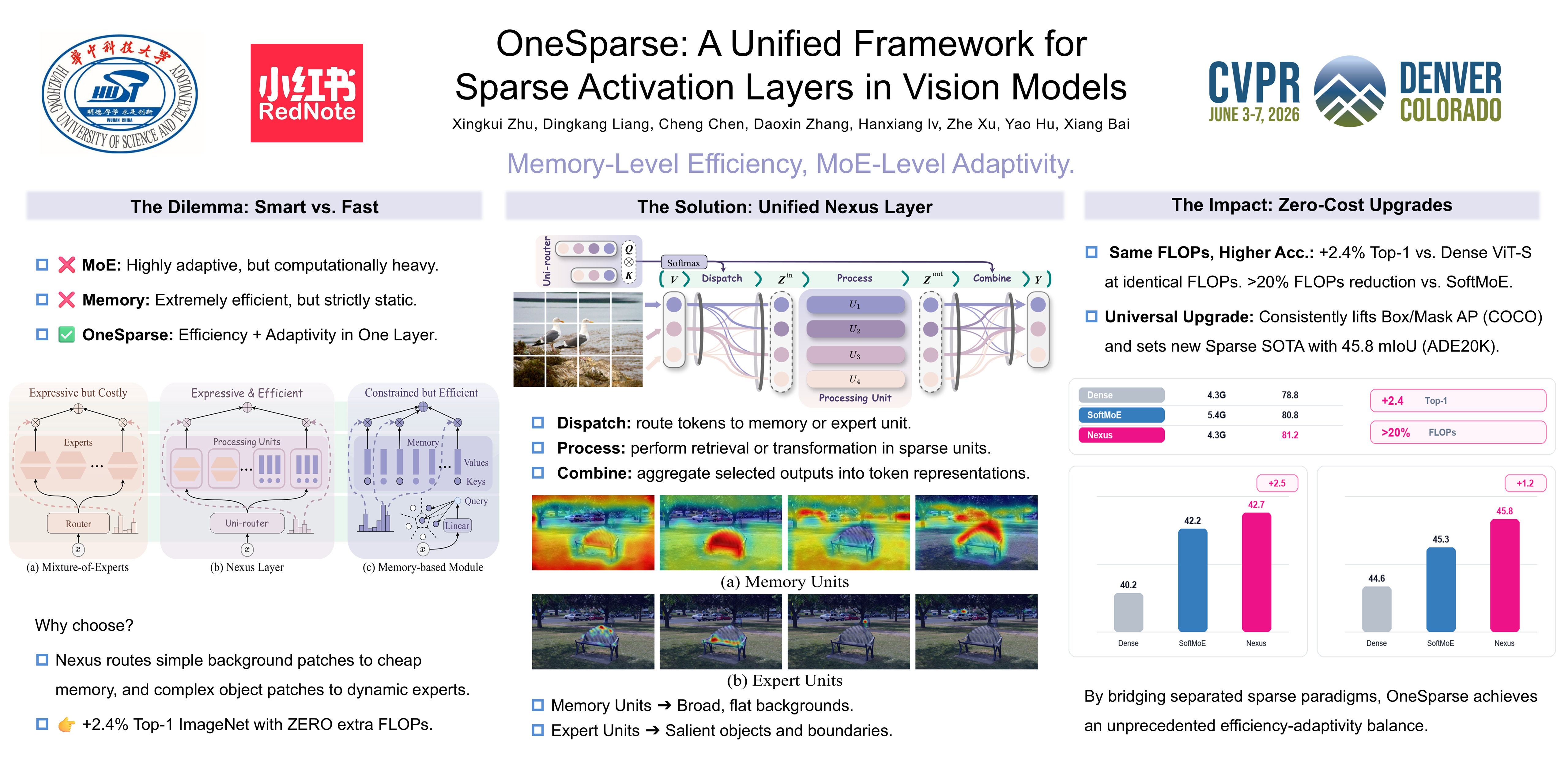
Sparse activation layers, primarily Mixture-of-Experts (MoE) and memory-based modules, are a central approach for scaling large models and are gaining traction in vision tasks. Despite conceptual similarities, these paradigms have evolved independently, hindering systematic comparison and the development of modules that exploit their complementary strengths. To bridge this gap, we propose OneSparse, a unified framework that reformulates MoE and memory modules under a common abstraction. This enables their systematic comparison and integration, revealing a continuous design space. Guided by this abstraction, we design the Nexus Layer, which features two key innovations: a unified routing mechanism that merges the efficiency of memory retrieval with MoE's load balancing to ensure stable and scalable token assignment, and an adaptive processing strategy where memory modules sketches coarse representations while expert modules refine critical regions. Extensive experiments on image classification, object detection, and semantic segmentation demonstrate that our Nexus Layer establishes a new performance efficiency frontier, surpassing representative sparse baselines on convolutional and transformer architectures. These results validate the power of the OneSparse framework to unify and integrate complementary sparse paradigms and underscores the potential of hybrid sparse modeling in vision.
What Matters in Practical Learned Image Compression
Kedar Tatwawadi ⋅ Parisa Rahimzadeh ⋅ Zhanghao Sun ⋅ Zhiqi Chen ⋅ Ziyun Yang ⋅ Sanjay Nair ⋅ Divija Hasteer ⋅ Oren Rippel
One of the major differentiators unlocked by learned codecs relative to their hard-coded traditional counterparts is their ability to be optimized directly to appeal to the human visual system. Despite this potential, a perceptual yet practical image codec is yet to be proposed.In this work, we aim to close this gap. We conduct a comprehensive study of the key modeling choices that govern the design of a practical learned image codec, jointly optimized for perceptual quality and runtime — including within the ablations several novel techniques. We then perform performance-aware neural architecture search over millions of backbone configurations to identify models that achieve the target on-device runtime while maximizing compression performance as captured by perceptual metrics. We combine the various optimizations to construct a new codec that achieves a significantly improved tradeoff between speed and perceptual quality. Based on rigorous subjective user studies, it provides 2.3-3× bitrate savings against AV1, AV2, VVC, ECM and JPEG-AI, and 20-40% bitrate savings against the best learned codec alternatives. At the same time, on an iPhone 17 Pro Max, it encodes 12MP images as fast as 230ms, and decodes them in 150ms — faster than most top ML-based codecs run on a V100 GPU.
BinaryAttention: One-Bit QK-Attention for Vision and Diffusion Transformers
Chaodong XIAO ⋅ Zhengqiang ZHANG ⋅ Lei Zhang
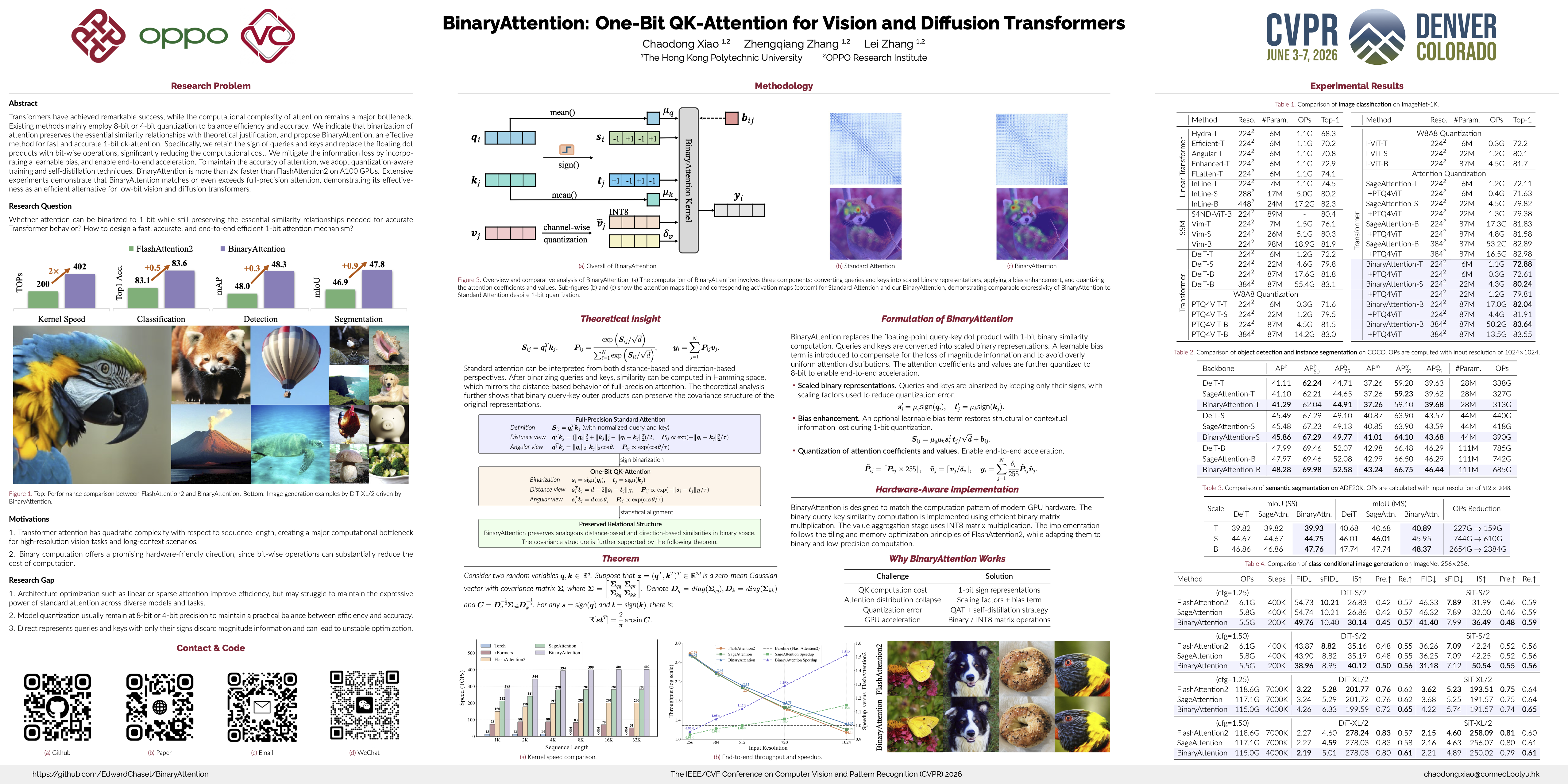
Transformers have achieved widespread and remarkable success, while the computational complexity of their attention modules remains a major bottleneck for vision tasks. Existing methods mainly employ 8-bit or 4-bit quantization to balance efficiency and accuracy. In this paper, with theoretical justification, we indicate that binarization of attention preserves the essential similarity relationships, and propose BinaryAttention, an effective method for fast and accurate 1-bit attention. Specifically, we retain only the sign of queries and keys in computing the attention, and replace the floating dot products with bit-wise operations, significantly reducing the computational cost. We mitigate the inherent information loss under 1-bit quantization by incorporating a learnable bias, and enable end-to-end acceleration. To maintain the accuracy of attention, we adopt quantization-aware training and self-distillation techniques, mitigating quantization errors while ensuring sign-aligned similarity. BinaryAttention is more than 2$\times$ faster than FlashAttention2 on A100 GPUs. Extensive experiments on vision transformer and diffusion transformer benchmarks demonstrate that BinaryAttention matches or even exceeds full-precision attention, validating its effectiveness. Our work provides a highly efficient and effective alternative to full-precision attention, pushing the frontier of low-bit transformers for vision tasks. The codes and models will be made publicly available.
Ultra-Low Bitrate Perceptual Image Compression with Shallow Encoder
Tianyu Zhang ⋅ Dong Liu ⋅ Chang Wen Chen
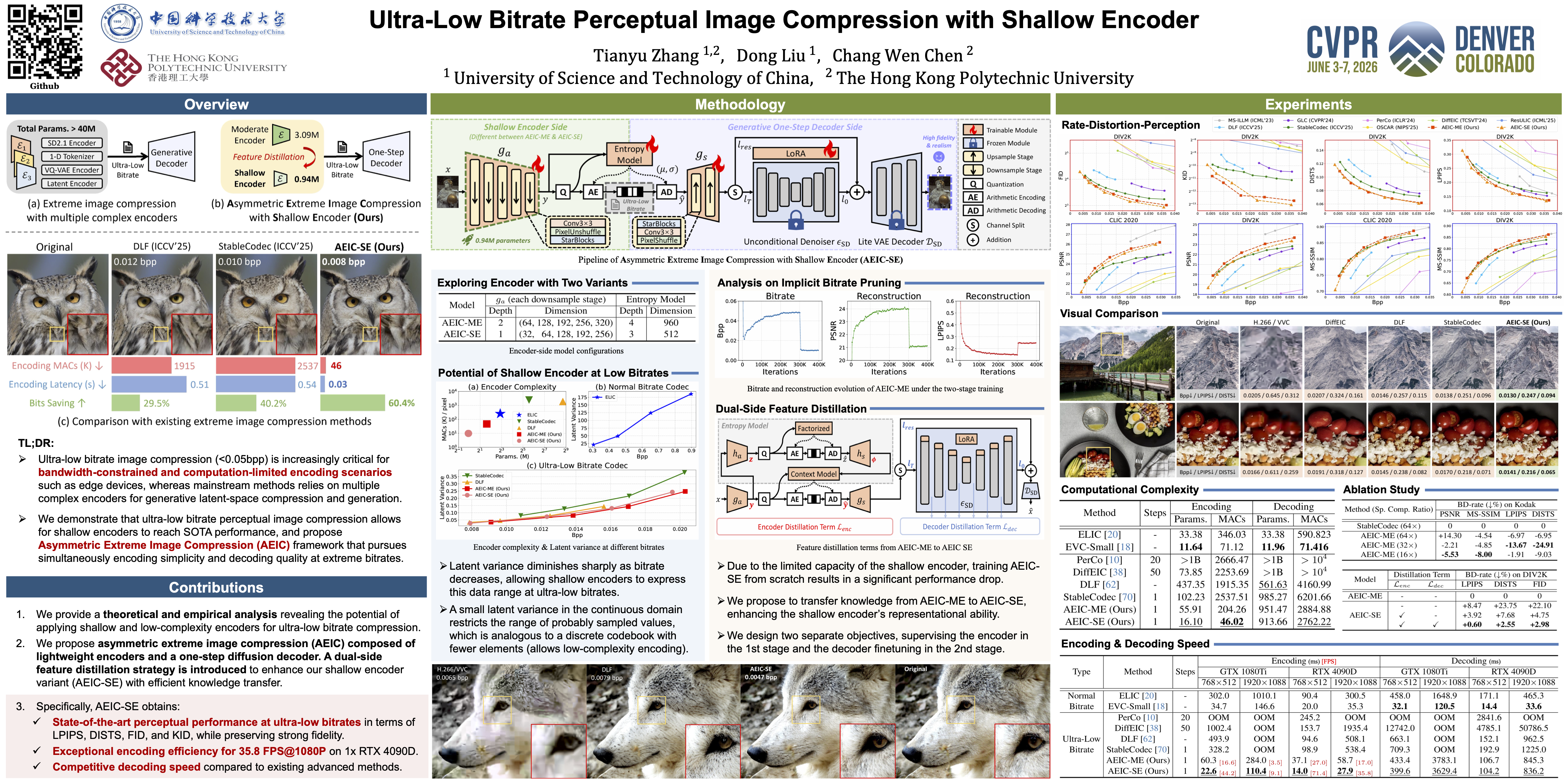
Ultra-low bitrate image compression (below 0.05 bits per pixel) is increasingly critical for bandwidth-constrained and computation-limited encoding scenarios such as edge devices. Existing frameworks typically rely on large pretrained encoders (e.g., VAEs or tokenizer-based models) and perform transform coding within their generative latent space. While these approaches achieve impressive perceptual fidelity, their reliance on heavy encoder networks makes them unsuitable for deployment on weak sender devices. In this work, we explore the feasibility of applying shallow encoders for ultra-low bitrate compression and propose a novel Asymmetric Extreme Image Compression (AEIC) framework that pursues simultaneously encoding simplicity and decoding quality. Specifically, AEIC employs moderate or even shallow encoder networks, while leveraging an one-step diffusion decoder to maintain high-fidelity and high-realism reconstructions under extreme bitrates. To further enhance the efficiency of shallow encoders, we design a dual-side feature distillation scheme that transfers knowledge from AEIC with moderate encoders to its shallow encoder variants. Experiments demonstrate that AEIC not only outperforms existing methods on rate-distortion-perception performance at ultra-low bitrates, but also delivers exceptional encoding efficiency for 35.8 FPS on 1080P input images, while maintaining competitive decoding speed compared to existing methods.
LazyVAR: Accelerating Visual Autoregressive Models via Scale-wise Token Pruning and Parallel Group Decoding
Rongge Mao ⋅ Chengqi Dong ⋅ S Kevin Zhou
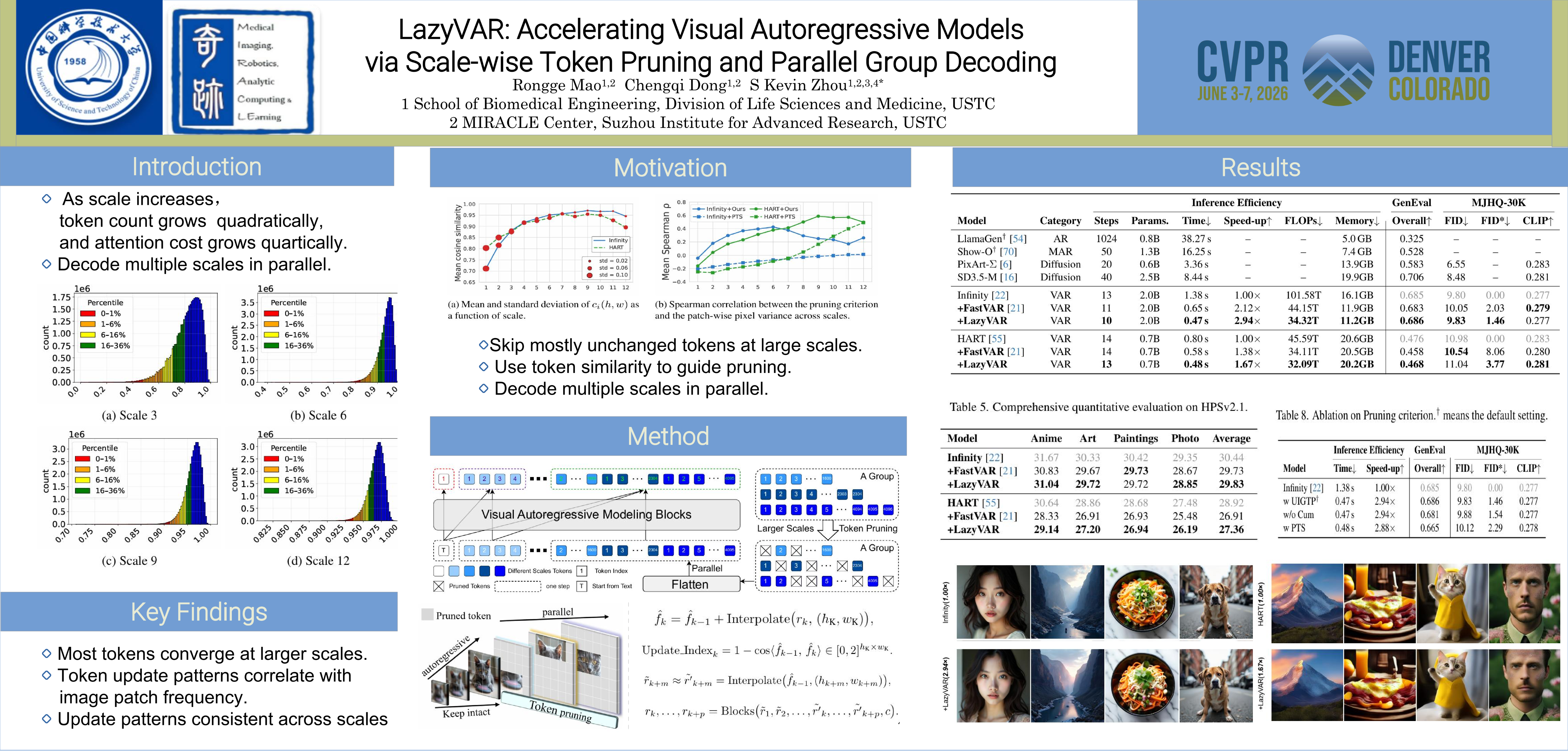
Visual Autoregressive (VAR) modeling introduces a new paradigm for image generation by extending autoregressive mechanisms from next-token prediction to next-scale prediction, achieving remarkable performance. However, as the number of tokens increases rapidly with scale, processing full token maps at high resolution becomes computationally expensive. In addition, the inherently sequential nature of autoregressive modeling prevents parallel inference across scales, which further increases latency.To address these challenges, we propose LazyVAR, a training-free and plug-and-play acceleration method for VAR models. Our key observation is that the similarity of aggregated latent features between adjacent scales progressively increases with the scale index, reaching particularly higher values at larger scales. We treat this similarity as a Scale-Wise Update Index, which serves as the pruning criterion. Consequently, more tokens can be pruned at larger scales to improve efficiency. Furthermore, we propose Parallel Group Decoding, which leverages this high similarity at larger scales to decode tokens from different scales in parallel, further accelerating inference.Experimental results show that the proposed LazyVAR achieves up to a 2.94× speedup over FlashAttention-accelerated VAR models with negligible performance loss, allowing the Infinity-2B text-to-image model to generate 1024×1024 resolution images within 0.5 seconds on a single RTX 4090 GPU. Our code will be publicly available.
Spk2VidNet: A Hierarchical Recurrent Architecture for High-Fidelity Video Reconstruction from Long Spike-Camera Streams
Yuanlin Wang ⋅ Ruiqin Xiong ⋅ Jiyu Xie ⋅ Zhenkun Zhu ⋅ Zhaofei Yu ⋅ Xiaopeng Fan ⋅ Tiejun Huang
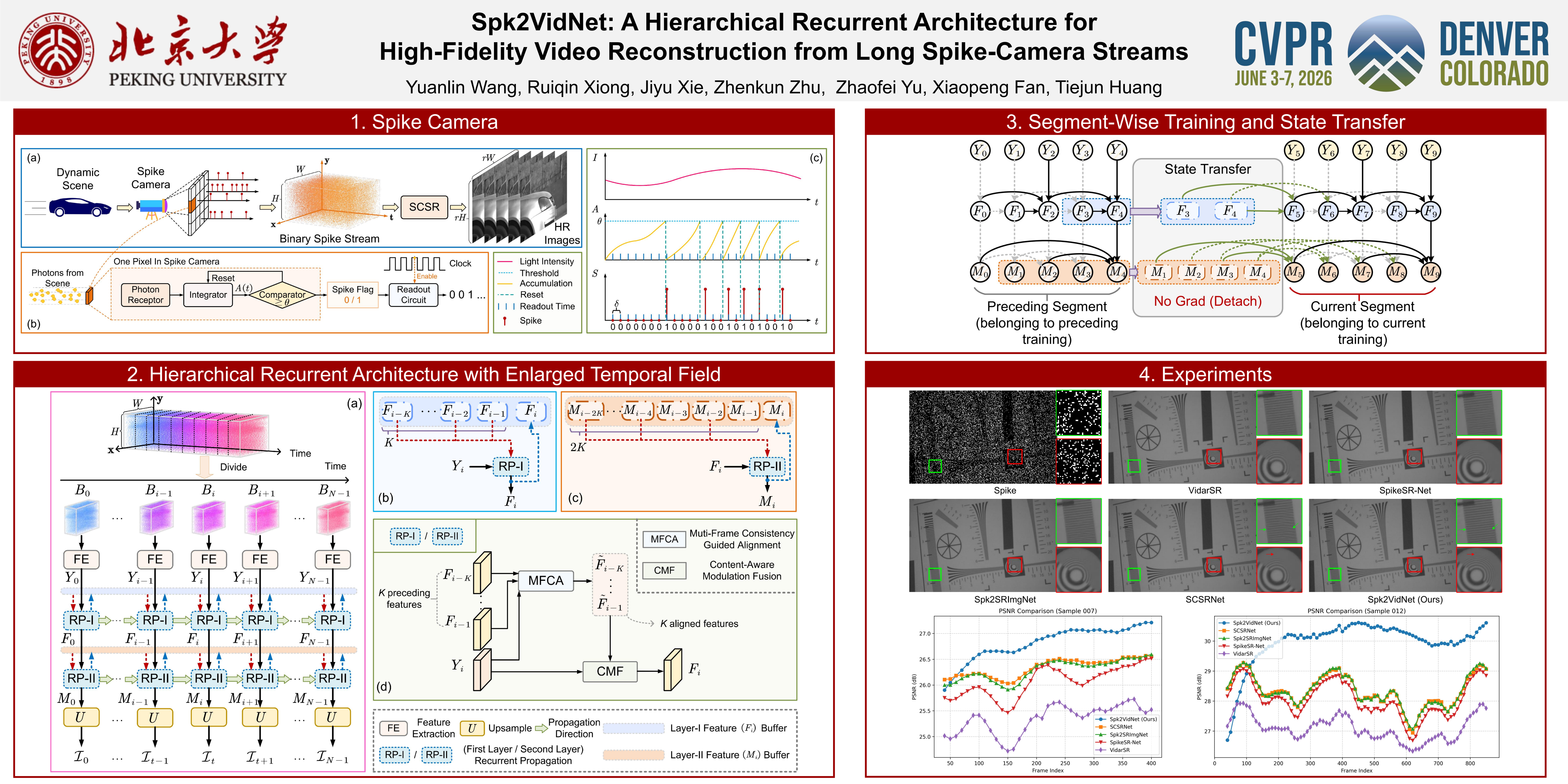
Spike camera is a neuromorphic vision sensor with ultra-high temporal resolution, capable of capturing fast-moving scenes by firing a stream of binary spikes. However, its relatively low spatial resolution limits the acquisition of fine-grained visual details, motivating research on spike camera super resolution (SCSR). Existing SCSR methods typically operate on fixed-length spike sequences, where the accessible information is confined to a local temporal neighborhood. Moreover, spike fluctuations hinder intensity information extraction. Both factors affect the performance of SCSR. To address these issues, we propose a hierarchical recurrent network named Spk2VidNet to reconstruct high-fidelity high resolution image sequences from low resolution spike data. To mitigate fluctuations, Spk2VidNet progressively exploits temporal correlations within spike stream to enhance feature representation by hierarchically enlarging temporal receptive fields. Within recurrent phase, we introduce an alignment module that leverages the motion consistency among multiple frames to jointly estimate and mutually refine inter-frame motions, achieving more accurate temporal alignment. In addition, we propose a fusion module to adaptively integrate neighboring aligned features based on multi-scale similarity for robust feature aggregation. We further propose a segment-wise training with state transfer strategy to efficiently model long-term dependencies with limited GPU memory, thereby leveraging rich subpixel cues for improved super resolution. Experiments on synthetic and real-captured spike data demonstrate that Spk2VidNet achieves state-of-the-art performance.
Adaptive Learned Image Compression with Graph Neural Networks
Yunuo Chen ⋅ Bing He ⋅ Zezheng Lyu ⋅ Hongwei Hu ⋅ Qunshan Gu ⋅ Yuan Tian ⋅ Guo Lu
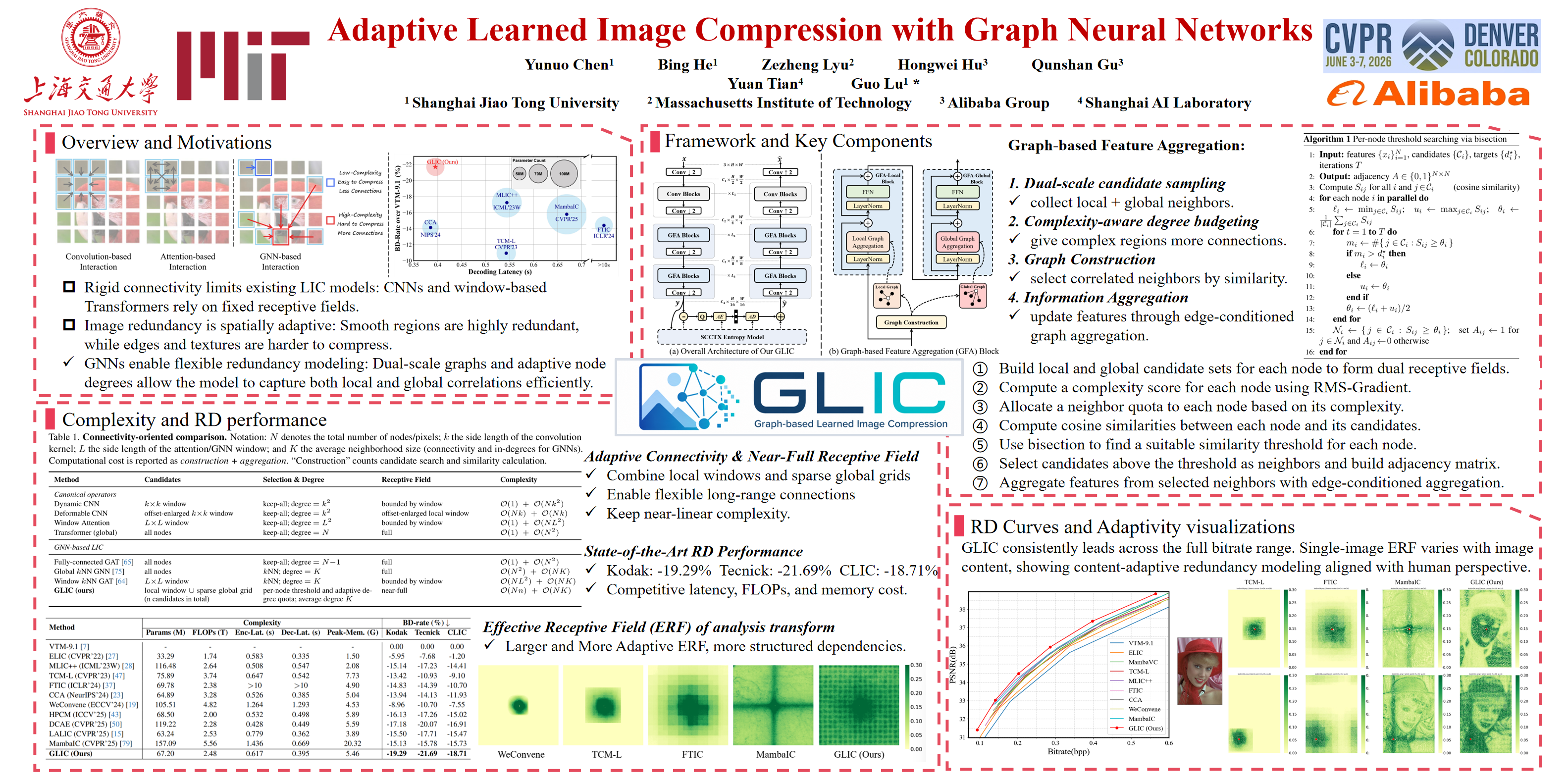
Efficient image compression relies on the accurate detection and elimination of both local and global redundancy. While most state-of-the-art (SOTA) learned image compression (LIC) methods are built on Convolutional Neural Networks (CNNs) or Transformer architectures, these frameworks are inherently rigid. Standard CNN kernels and window-based attention mechanisms impose fixed receptive fields and static connectivity patterns, which potentially couple non-redundant pixels simply due to their proximity in Euclidean space. This rigidity limits the model’s ability to adaptively capture spatially varying redundancy across the image, particularly at the global level.To overcome these limitations, we propose a content-adaptive image compression framework based on Graph Neural Networks (GNNs). Specifically, our approach constructs dual-scale graphs that enable flexible, data-driven receptive fields. Furthermore, we introduce adaptive connectivity by dynamically adjusting the number of neighbors for each node based on local content complexity. These innovations empower our Graph-based Learned Image Compression (GLIC) model to effectively model diverse redundancy patterns across images, leading to more efficient and adaptive compression.Experiments demonstrate that GLIC achieves SOTA performance, outperforming VTM-9.1 by-19.29\%, -21.69\%, -18.71\% in BD-rate on Kodak, Tecnick, and CLIC datasets, respectively. Code will be released.
SGI: Structured 2D Gaussians for Efficient and Compact Large Image Representation
Zixuan Pan ⋅ Kaiyuan Tang ⋅ Jun Xia ⋅ Yifan Qin ⋅ Lin Gu ⋅ Chaoli Wang ⋅ Jianxu Chen ⋅ Yiyu Shi
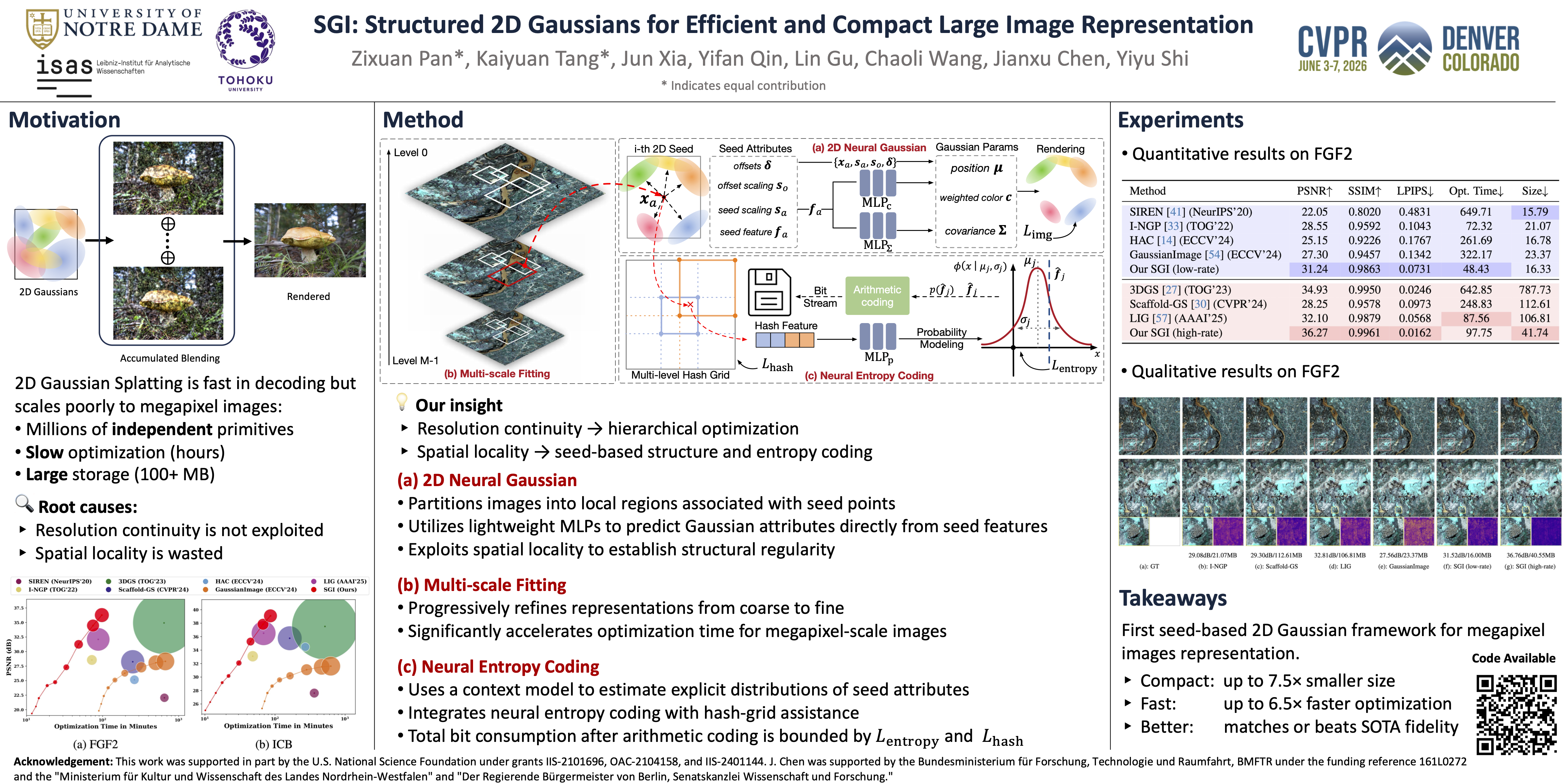
2D Gaussian Splatting has emerged as a novel image representation technique that can support efficient rendering on low-end devices. However, scaling to high-resolution images requires optimizing and storing millions of unstructured Gaussian primitives independently, leading to slow convergence and redundant parameters. To address this, we propose Structured Gaussian Image (SGI), a compact and efficient framework for representing high-resolution images. SGI decomposes a complex image into multi-scale local spaces defined by a set of seeds. Each seed corresponds to a spatially coherent region and, together with lightweight multi-layer perceptrons (MLPs), generates structured implicit 2D neural Gaussians. This seed-based formulation imposes structural regularity on otherwise unstructured Gaussian primitives, which facilitates entropy-based compression at the seed level to reduce the total storage. However, optimizing seed parameters directly on high-resolution images is a challenging and non-trivial task. Therefore, we designed a multi-scale fitting strategy that refines the seed representation in a coarse-to-fine manner, substantially accelerating convergence. Quantitative and qualitative evaluations demonstrate that SGI achieves up to 7.5$\times$ compression over prior non-quantized 2D Gaussian methods and 1.6$\times$ over quantized ones, while also delivering 1.6$\times$ and 6.5$\times$ faster optimization, respectively, without degrading, and often improving, image fidelity. Uploaded code will be released upon acceptance.
VVS: Accelerating Speculative Decoding for Visual Autoregressive Generation via Partial Verification Skipping
Haotian Dong ⋅ Ye Li ⋅ Rongwei Lu ⋅ Chen Tang ⋅ Shu-Tao Xia ⋅ Zhi Wang
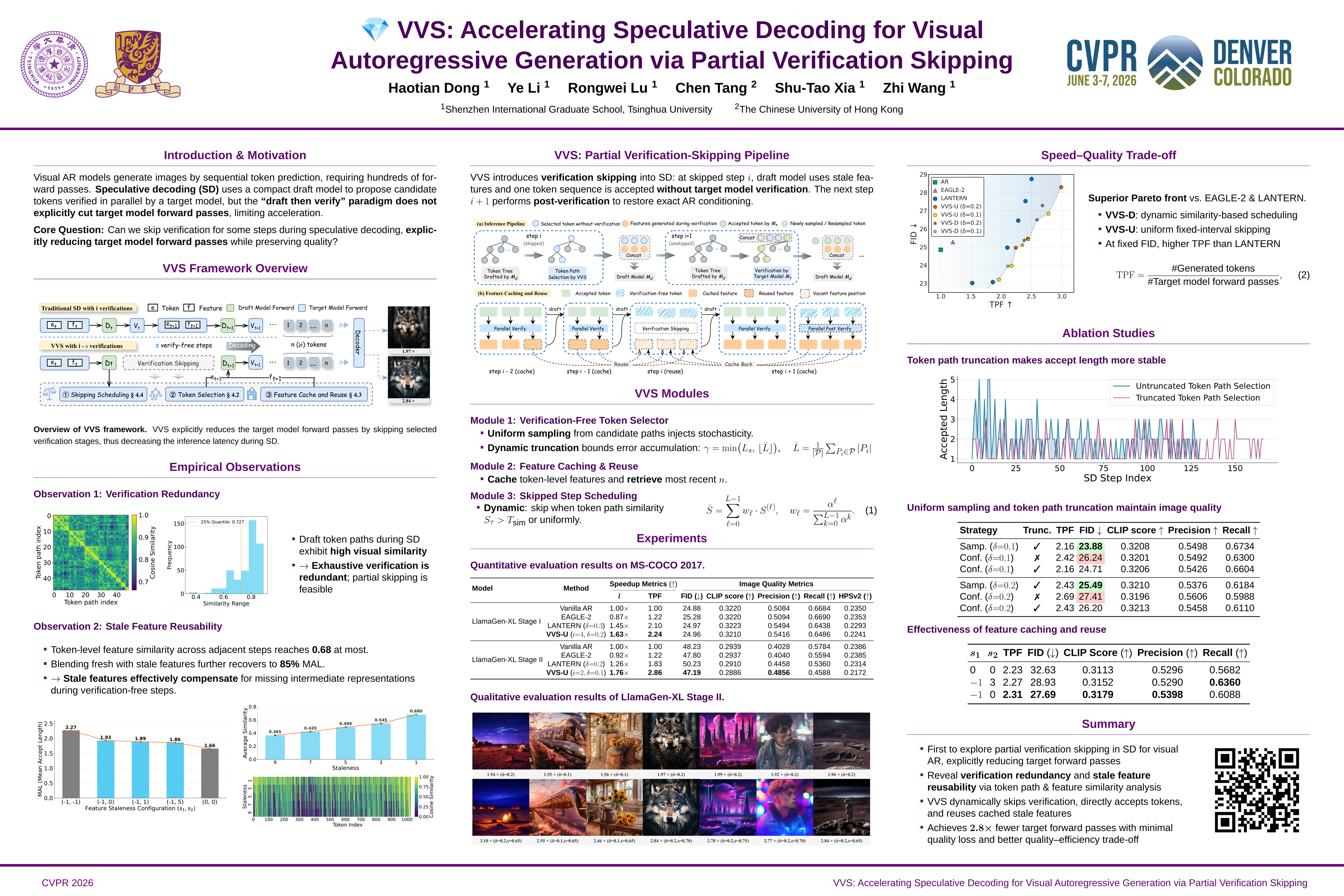
Visual autoregressive (AR) generation models have demonstrated strong potential for image generation, yet their next-token-prediction paradigm introduces considerable inference latency. Although speculative decoding (SD) has been proven effective for accelerating visual AR models, its "draft one step, then verify one step'' paradigm prevents a direct reduction of the forward passes, thus restricting acceleration potential. Motivated by the visual token interchangeability, we for the first time to explore verification skipping in the SD process of visual AR model generation to explicitly cut the number of target model forward passes, thereby reducing inference latency. Based on an analysis of the drafting stage’s characteristics, we observe that $\textbf{verification redundancy}$ and $\textbf{stale feature reusability}$ are key factors to retain generation quality and speedup for verification-free steps. Inspired of these two observations, we propose a novel SD framework $\textbf{VVS}$ to accelerate $\underline{\text{v}}$isual AR model via partial $\underline{\text{v}}$erification $\underline{\text{s}}$kipping, which integrates three complementary modules: (1) a verification-free token selector with dynamically truncation, (2) token level feature caching and reuse, and (3) fine-grained skipped step scheduling. Consequently, VVS reduces the number of target model forward passes by a factor of ${2.8\times}$ relative to vanilla AR decoding while maintaining competitive generation quality, offering a superior speed–quality trade-off over conventional SD frameworks and revealing strong potential to reshape the SD paradigm. Our code will be publicly available upon acceptance of this paper.
HypeVPR: Exploring Hyperbolic Space for Perspective to Equirectangular Visual Place Recognition
Suhan Woo ⋅ Seongwon Lee ⋅ jinwoo jang ⋅ Euntai Kim
Visual environments are inherently hierarchical, as a panoramic view naturally encompasses and organizes multiple perspective views within its field. Capturing this hierarchy is crucial for effective perspective-to-equirectangular (P2E) visual place recognition. In this work, we introduce HypeVPR, a hierarchical embedding framework in hyperbolic space specifically designed to address the challenges of P2E matching. HypeVPR leverages the intrinsic ability of hyperbolic space to represent hierarchical structures, allowing panoramic descriptors to encode both broad contextual information and fine-grained local details. To this end, we propose a hierarchical feature aggregation mechanism that organizes local-to-global feature representations within hyperbolic space. Furthermore, HypeVPR’s hierarchical organization inherently enables flexible control over the accuracy–efficiency trade-off without additional training, while maintaining robust matching across different image types. This approach allows HypeVPR to outperform existing methods while significantly accelerating retrieval and reducing database storage requirements. The codes and models are available: TBD.
LoD-Loc v3: Generalized Aerial Localization in Dense Cities using Instance Silhouette Alignment
Shuaibang Peng ⋅ Juelin Zhu ⋅ Xia Li ⋅ Kun Yang ⋅ Yu Liu ⋅ Maojun Zhang ⋅ Shen Yan
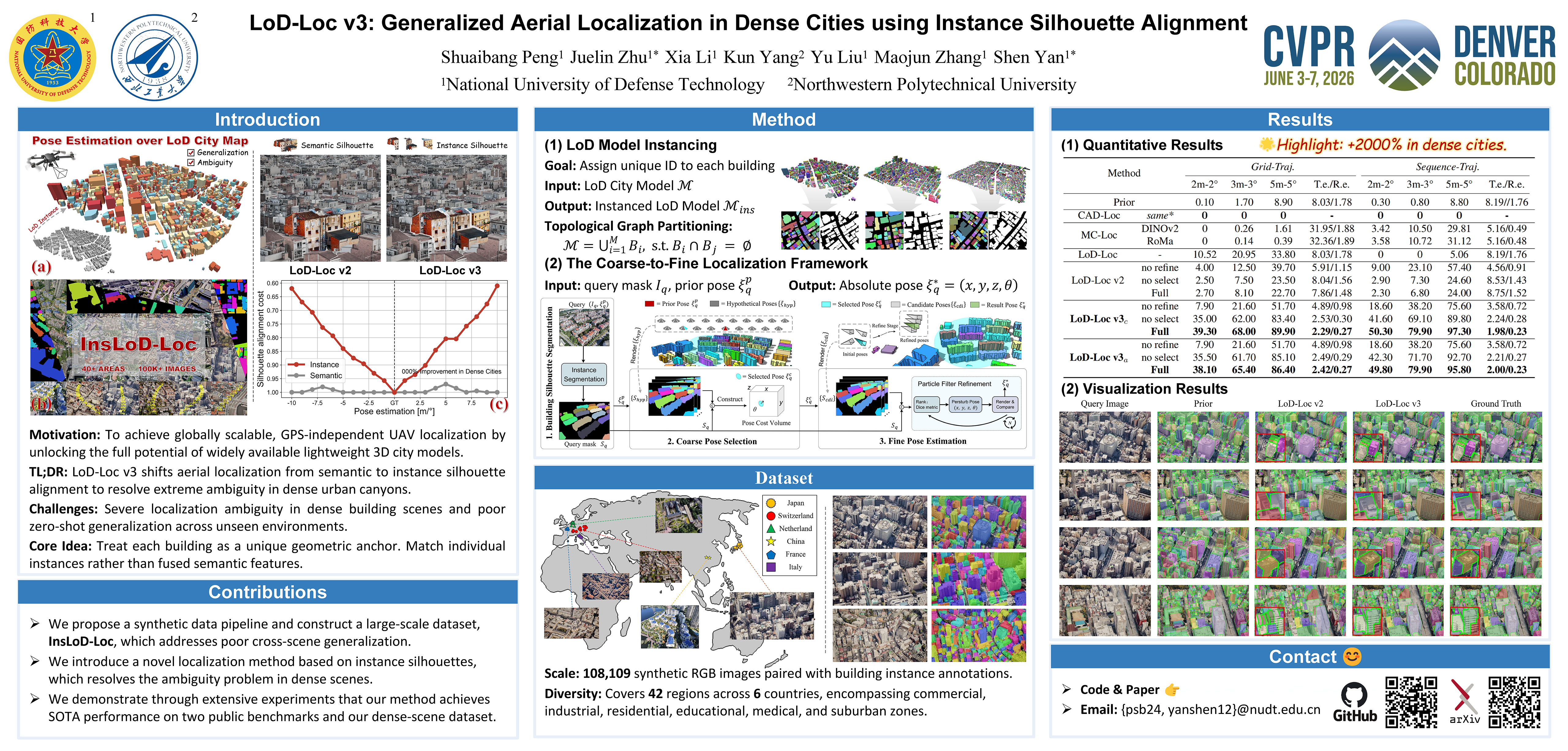
We present LoD-Loc v3, a novel method for generalized aerial visual localization in dense urban environments. While prior work LoD-Loc v2 [89] achieves localization through semantic building silhouette alignment with low-detail city models, it suffers from two key limitations: poor cross-scene generalization and frequent failure in dense building scenes. Our method addresses these challenges through two key innovations. First, we develop a new synthetic data generation pipeline that produces $\textbf{InsLoD-Loc}$ - the largest instance segmentation dataset for aerial imagery to date, comprising 100k images with precise instance-level building annotations. This enables trained models to exhibit remarkable zero-shot generalization capability. Second, we reformulate the localization paradigm by shifting from semantic to instance-level silhouette alignment, which significantly reduces pose estimation ambiguity in dense scenes. Extensive experiments demonstrate that LoD-Loc v3 outperforms existing state-of-the-art (SOTA) baselines, achieving superior performance in both cross-scene and dense urban scenarios with a large margin.
CoLoR: The Devil is in Scene Coordinate Regression for Large-Scale Visual Localization
Xindong Mao ⋅ Hang Li ⋅ Yuchen Wu ⋅ Jiahe Li ⋅ Xiao Bai ⋅ Jin Zheng
Scene Coordinate Regression (SCR) has emerged as a memory-efficient paradigm for visual localization.While SCR has demonstrated performance comparable to classic feature matching based approaches in small-scale scenes, it has consistently underperformed in large-scale environments.Large-scale localization is hampered by two challenges: sparse co-visibility and local appearance ambiguity.In this work, we propose CoLoR, a novel training framework tailored for large-scale SCR.First, we explicitly and efficiently partition scene points into multi-view and single-view sets and introduce a two-stage bootstrapping paradigm to provide complete and strong supervision for all points.Second, we propose a multi-granularity retrieval feature, which unifies the conventional global and local features as retrieval-oriented representations at the image and pixel levels, respectively, to enforce feature consistency.Our method achieves state-of-the-art performance on multiple challenging large-scale datasets and significantly narrows the accuracy gap with classical feature matching based approaches while retaining a compact map size.
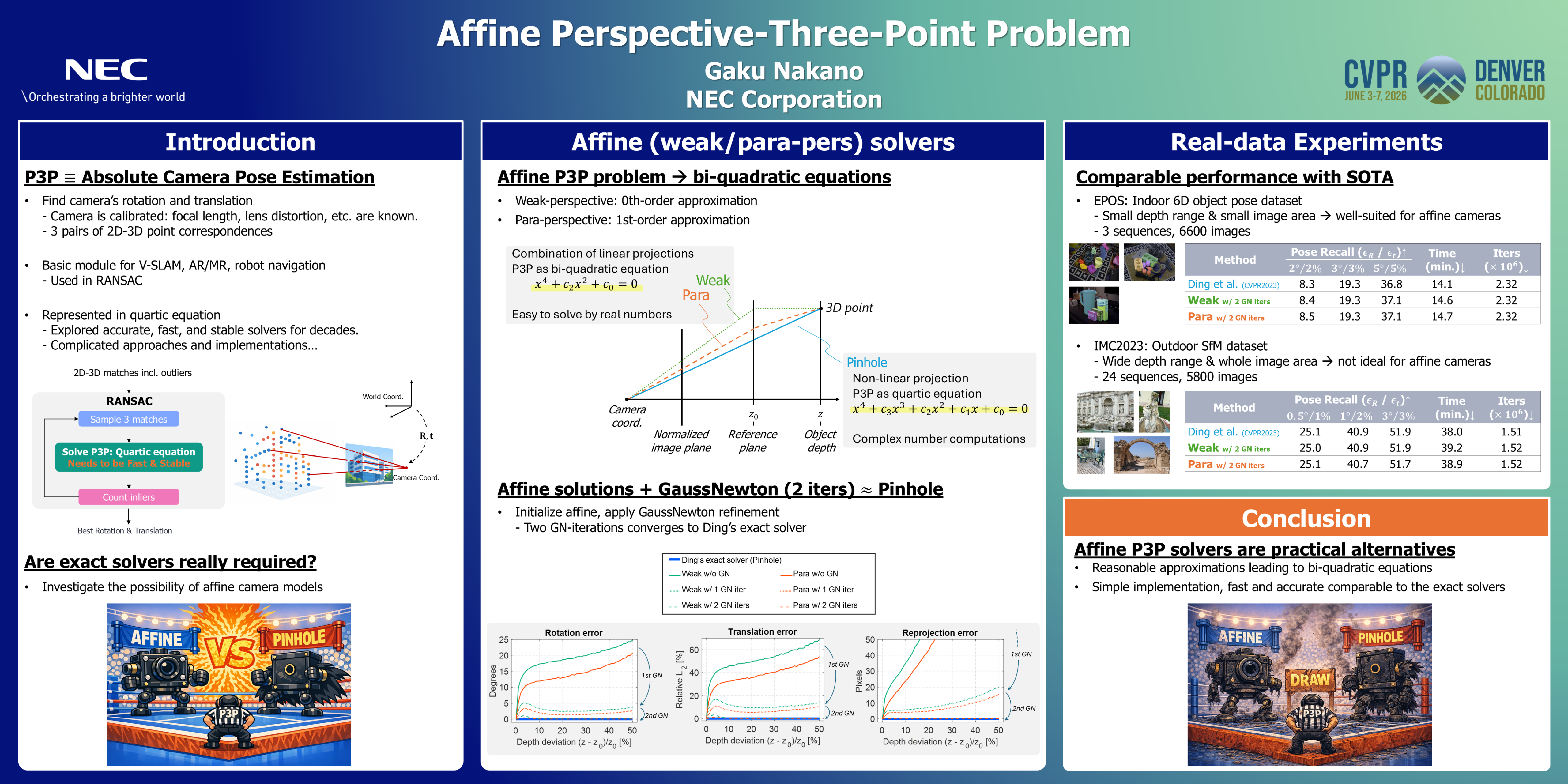
This paper addresses the Perspective-Three-Point (P3P) problem under affine camera models. We derive direct closed-form solvers for weak perspective and para perspective, which are representative affine camera models. The affine P3P solution reduces to a bi-quadratic equation. Unlike exact P3P solvers that require a cubic or quartic equation, it allows for the simple and stable calculation of real solutions using the quadratic formula. Since affine approximations are valid only when scene depth variation is small, we further propose an iterative correction that upgrades the affine solution to the exact P3P solution. Through extensive comparisons using synthetic data and public datasets, we demonstrate that affine P3P solvers with two upgrade iterations achieve performance substantially comparable to that of the state-of-the-art P3P solver.
Sky2Ground: A Benchmark for Site Modeling under Varying Altitude
Zengyan Wang ⋅ Sirshapan Mitra ⋅ Rajat Modi ⋅ Hui Xian Grace Lim ⋅ Yogesh Rawat
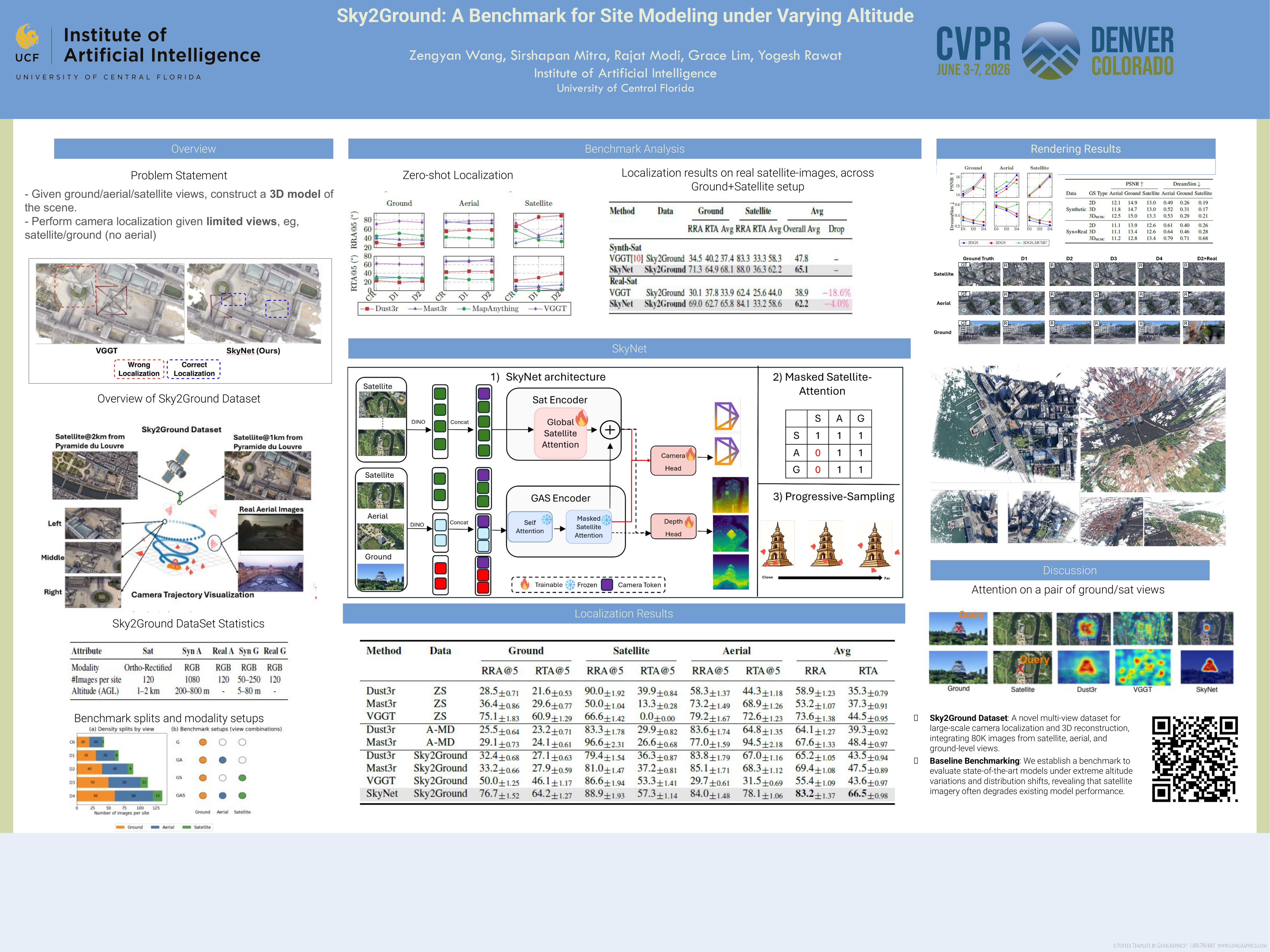
In this work, we propose the problem of localizing cameras and producing renders of a scene, given multiple images captured from ground/aerial/satellite viewpoints. We introduce a dataset called Sky2Ground, which contains synthetic/real images across all 3 viewpoints, along with camera parameters, and dense depth-maps/surface-normals. Recent works have shown that transformer-based nets like VGGT are capable of inferring scene-parameters in a single-forward pass. However, we formally reveal that simply fine-tuning such models reduces performance, and can't be solved simply by bruteforce-scaling. We find the culprit to be satellite images, which inject too much noise during the learning process. Therefore, we propose SkyNet to enable learning using satellite-images. SkyNet is a two-stream neural-net, with one stream explicitly processing satellite, and another processing all modalities together.We propose a restricted-attention mechanism, termed as `Masked-Satellite-Attention' which prevents ground/aerial images from interacting with satellite images. Further, our SkyNet is optimized with strategies inspired from curriculum-learning: sampling cameras which are far-away from each other during training. Extensive experiments on our Sky2Earth dataset reveal that SkyNet outperforms existing methods by $23\%$ in terms of absolute performance. Our dataset, and code shall be made publicly available on huggingface.
SemanticVLA: Towards Semantic Reasoning over Action Memorization via Synergistic Explicit Trace and Latent Action Planning
Fei Ni ⋅ Zhuo Chen ⋅ Yifu Yuan ⋅ Zibin Dong ⋅ Xianze Yao ⋅ Shan Luo ⋅ Jianye Hao ⋅ Jiankang Deng ⋅ Stefanos Zafeiriou
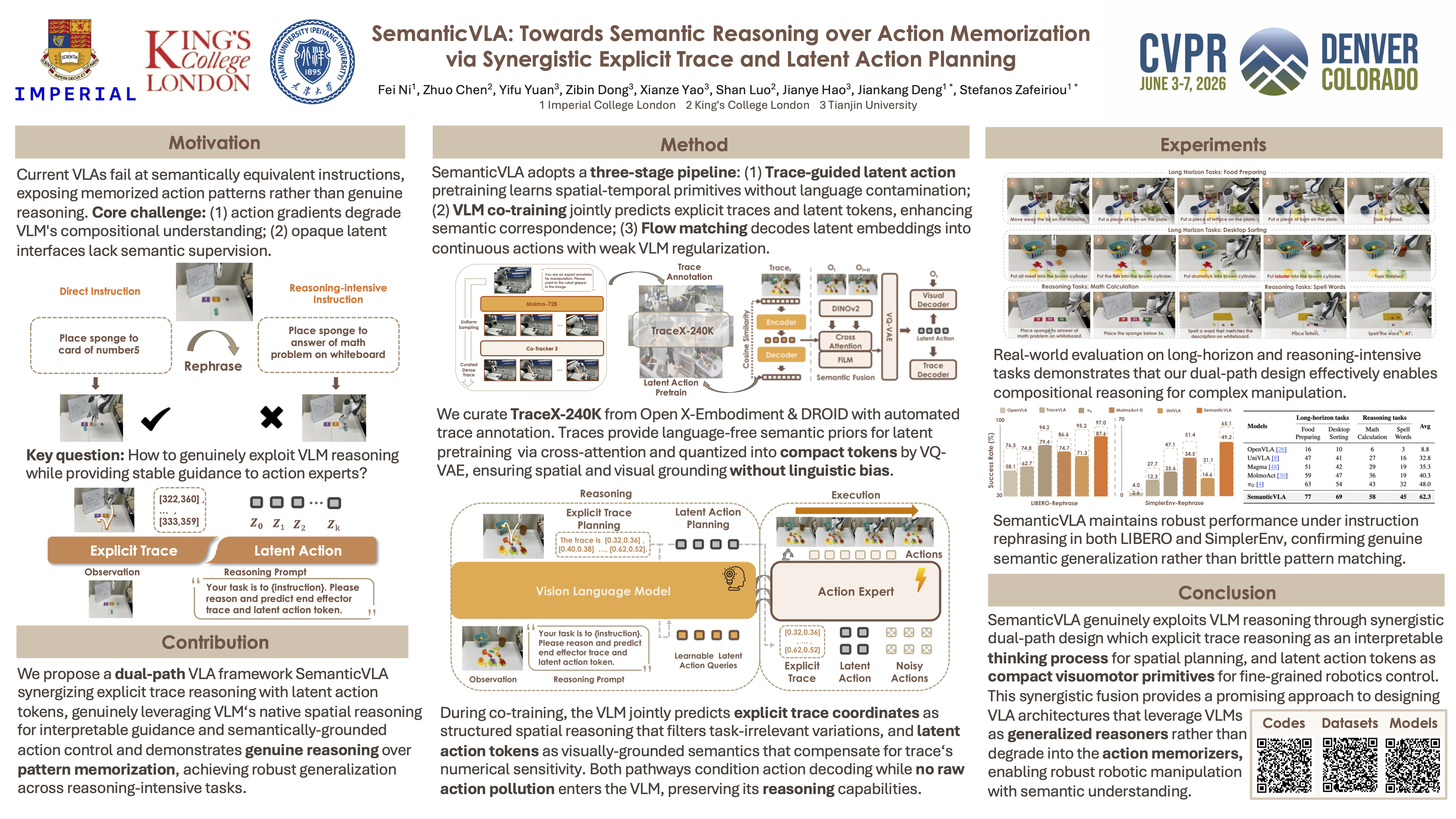
Vision-Language-Action (VLA) models have emerged as a promising paradigm where pretrained Vision-Language Models (VLMs) serve as System 2 for high-level reasoning, connected to action experts as System 1 for low-level motor control.However, current works fail to genuinely leverage VLM capabilities: VLMs produce latent embeddings that lack semantic interpretability, providing ambiguous and unstable guidance to downstream policies, while solely action supervision further causes VLMs to degenerate into parameter-heavy fusion encoders that memorize action patterns rather than perform generalized reasoning.To bridge this gap, we introduce SemanticVLA, which leverages VLM reasoning through synergistic dual-path design. Explicit trace reasoning generates interpretable spatial waypoints as textual coordinate sequences through the VLM's native language interface, directly reusing its pretrained spatial grounding to provide a "thinking process" for task planning. Latent action tokens complement trace reasoning by learning compact visuomotor primitives grounded in visual observations, providing more fine-grained action representations beyond pure coordinate prediction. This synergy enables trace reasoning to leverage VLM's multimodal understanding for refining latent token prediction, while latent tokens provide stable and grounded guidance that compensates for trace's numerical sensitivity.SemanticVLA achieves 97.0\% average success rate on LIBERO and 65.1\% on SimplerEnv WidowX, substantially outperforming strong baselines. More importantly, SemanticVLA maintains significantly more stable performance under instruction rephrasing in both simulation suites, and demonstrates strong advantages on real-world long-horizon and reasoning-intensive tasks.By bridging VLM reasoning and action expert through semantically explicit trace and visually grounded latent action tokens, our approach enables genuine reasoning rather than action memorization.
WebGym: Scaling Training Environments for Long-Horizon Visual Web Agents with Realistic Tasks
Hao Bai ⋅ Alexey Taymanov ⋅ Tong Zhang ⋅ Aviral Kumar ⋅ Spencer Whitehead
We present WebGym, the largest open-source environment for training realistic visual web agents to date. Real websites are non-stationary and diverse, making artificial or small-scale task sets insufficient for robust policy learning. WebGym contains nearly 1 million tasks with rubric-based evaluations across diverse, real-world websites and difficulty levels. We train agents with a simple reinforcement learning (RL) algorithm, REINFORCE, which trains on the agent's own interaction traces (rollouts), using task rewards as feedback to guide learning. To speed up sampling rollouts for RL training, we develop a high-throughput asynchronous rollout system, designed specifically for web agents, that achieves a 4-5x rollout speedup compared to naive implementations, enabling us to train at scale on a diverse set of tasks. With this setup, we fine-tune strong vision-language models, such as Qwen-3-VL-8B-Instruct, on the training tasks from WebGym, which results in an improvement in success rate on an out-of-distribution test set from 21.8% to 28.5%, outperforming a "proprietary" GPT-4o-based agent and closing the gap to a GPT-5-Thinking agent that achieves 31.8%. This improvement is significant because our test set consists only of tasks on websites never seen during training, demonstrating generalization for web agents. We provide both the task breadth and system throughput for large-scale RL on web agents.
Beyond Perceptual Shortcuts: Causal-Inspired Debiasing Optimization for Generalizable Video Reasoning in Lightweight MLLMs
Jingze Wu ⋅ Quan Zhang ⋅ Hongfei Suo ⋅ Zeqiang Cai ⋅ Hongbo Chen
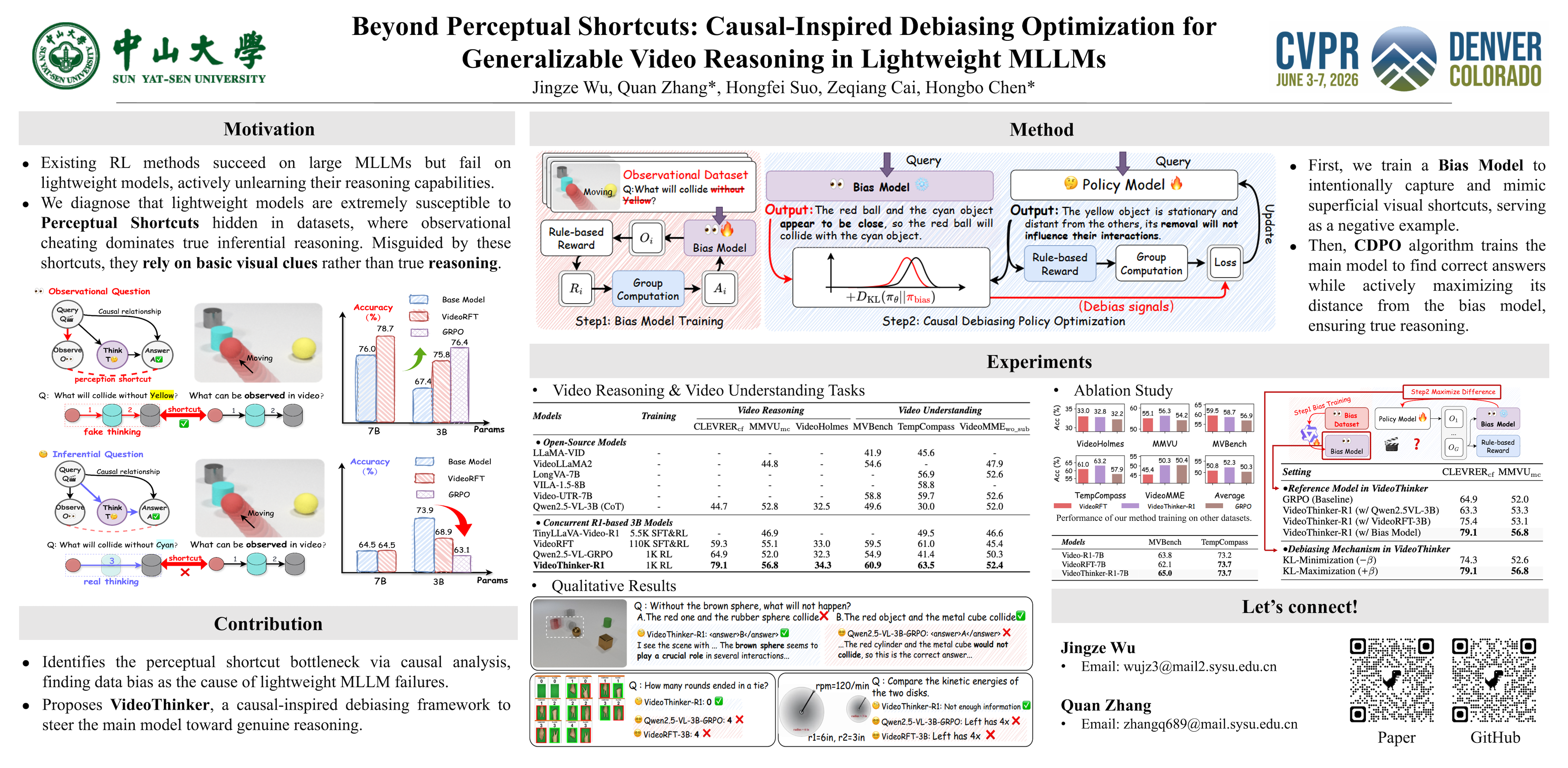
Although reinforcement learning (RL) has significantly advanced reasoning capabilities in large multimodal language models (MLLMs), its efficacy remains limited for lightweight models essential for edge deployments.To address this issue, we leverage causal analysis and experiment to reveal the underlying phenomenon of perceptual bias, demonstrating that RL-based fine-tuning compels lightweight models to preferentially adopt perceptual shortcuts induced by data biases, rather than developing genuine reasoning abilities.Motivated by this insight, we propose VideoThinker, a causal-inspired framework that cultivates robust reasoning in lightweight models through a two-stage debiasing process. First, the Bias Aware Training stage forges a dedicated "bias model" to embody these shortcut behaviors. Then, the Causal Debiasing Policy Optimization (CDPO) algorithm fine-tunes the primary model, employing an innovative repulsive objective to actively push it away from the bias model's flawed logic while simultaneously pulling it toward correct, generalizable solutions.Our model, VideoThinker-R1, establishes a new state-of-the-art in video reasoning efficiency. For same-scale comparison, requiring no Supervised Fine-Tuning (SFT) and using only 1 of the training data for RL, it surpasses VideoRFT-3B with a 3.2% average gain on widely-used benchmarks and a 7% lead on VideoMME. For cross-scale comparison, it outperforms the larger Video-UTR-7B model on multiple benchmarks, including a 2.1% gain on MVBench and a 3.8% gain on TempCompass. Code will be released publicly.
APPO: Attention-guided Perception Policy Optimization for Video Reasoning
Henghui Du ⋅ Chang Zhou ⋅ Xi Chen ⋅ Di Hu
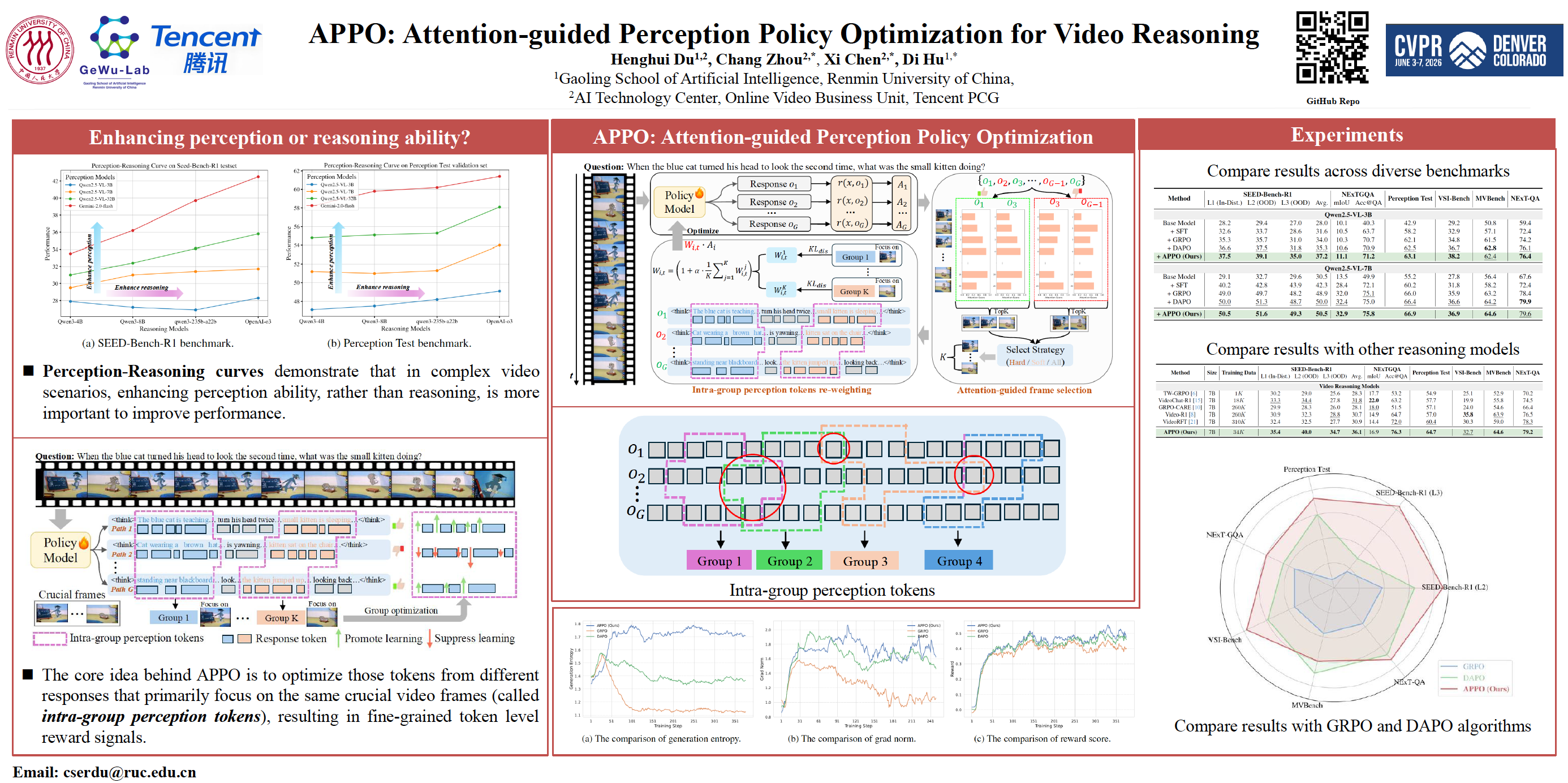
Complex video reasoning, actually, relies excessively on fine-grained perception rather than on expert (e.g., Ph.D, Science)-level reasoning.Through extensive empirical observation, we have recognized the critical impact of perception.In particular, when perception ability is almost fixed, enhancing reasoning from Qwen3-8B to OpenAI-o3 yields only 0.7% performance improvement. Conversely, even minimal change in perception model scale (from 7B to 32B) boosts performance by 1.4%, indicating enhancing perception, rather than reasoning, is more critical to improve performance.Therefore, exploring how to enhance perception ability through reasoning without the need for expensive fine-grained annotation information is worthwhile.To achieve this goal, we specially propose APPO, the Attention-guided Perception Policy Optimization algorithm that leverages token-level dense rewards to improve model's fine-grained perception.The core idea behind APPO is to optimize those tokens from different responses that primarily focus on the same crucial video frame (called intra-group perception tokens).Experimental results on diverse video benchmarks and models with different scales (3/7B) demonstrate APPO consistently outperforms GRPO and DAPO (0.5% ~ 4%). We hope our work provides a promising approach to effectively enhance model's perception abilities through reasoning in a low-cost manner, serving diverse scenarios and demands.
RetouchIQ: MLLM Agents for Instruction-Based Image Retouching with Generalist Reward
Qiucheng Wu ⋅ Jing Shi ⋅ Simon Jenni ⋅ Kushal Kafle ⋅ Tianyu Wang ⋅ Shiyu Chang ⋅ Handong Zhao
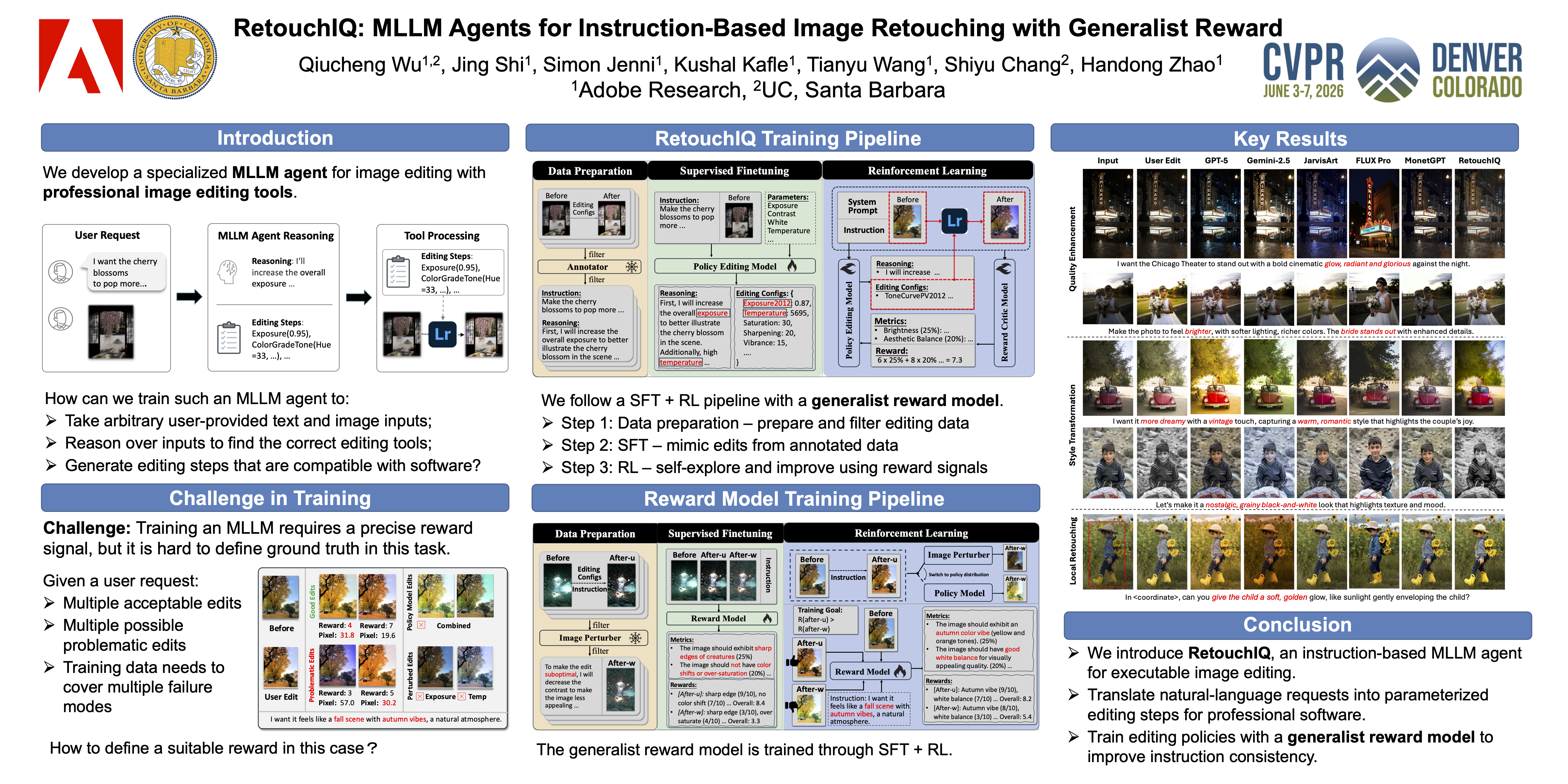
Recent advances in multimodal large language models (MLLMs) have shown great potential for extending vision-language reasoning to professional tool-based image editing, enabling intuitive and creative editing. A promising direction is to use reinforcement learning (RL) to enable MLLMs to reason about and execute optimal tool-use plans within professional image-editing software. However, training remains challenging due to the lack of reliable, verifiable reward signals that can reflect the inherently subjective nature of creative editing. In this work, we introduce RetouchIQ, a framework that performs instruction-based executable image editing through MLLM agents guided by a generalist reward model. RetouchIQ interprets user-specified editing intentions and generates corresponding, executable Lightroom adjustments, bridging high-level aesthetic goals with precise parameter control. To move beyond conventional, rule-based rewards that compute similarity against a fixed reference image using handcrafted metrics, we propose a generalist reward model, an RL fine-tuned MLLM that evaluates edited results through a set of generated metrics on a case-by-case basis. Then, the reward model provides scalar feedback through multimodal reasoning, enabling reinforcement learning with high-quality, instruction-consistent gradients. We curate an extended dataset with 190k instruction-reasoning pairs and establish a new benchmark for instruction-based image editing. Experiments show that RetouchIQ substantially improves both semantic consistency and perceptual quality over previous MLLM-based and diffusion-based editing systems. Our findings demonstrate the potential of generalist reward-driven MLLM agents as flexible, explainable, and executable assistants for professional image editing.
EVA: Efficient Reinforcement Learning for End-to-End Video Agent
Yaolun Zhang ⋅ Ruohui Wang ⋅ Jiahao Wang ⋅ Yepeng Tang ⋅ Xuanyu Zheng ⋅ Haonan Duan ⋅ Hao Lu ⋅ Hanming Deng ⋅ Lewei Lu
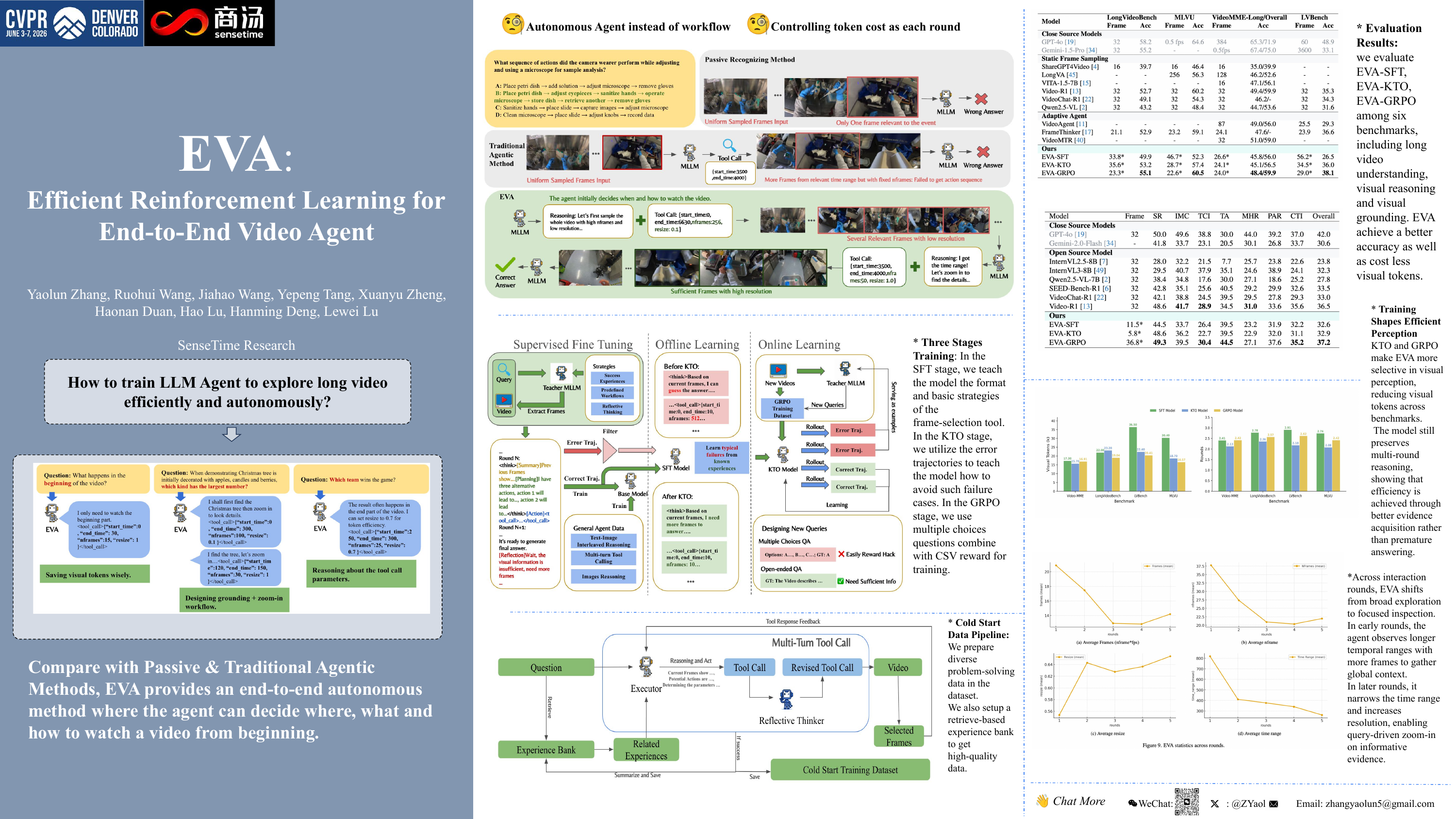
Video understanding with multimodal large language models (MLLMs) remains challenging due to the long token sequences of videos, which contain extensive temporal dependencies and redundant frames.Existing approaches typically treat MLLMs as passive recognizers, processing entire videos or uniformly sampled frames without adaptive reasoning.Recent agent-based methods introduce external tools, yet still depend on manually designed workflows and perception-first strategies, resulting in inefficiency on long videos. We present EVA, an Efficient Reinforcement Learning framework for End-to-End Video Agent, which enables planning-before-perception through iterative summary–plan–action–reflection reasoning.EVA autonomously decides what to watch, when to watch, and how to watch, achieving query-driven and efficient video understanding.To train such agents, we design a simple yet effective three-stage learning pipeline—comprising supervised fine-tuning (SFT), Kahneman–Tversky Optimization (KTO), and Generalized Reward Policy Optimization (GRPO)—that bridges supervised imitation and reinforcement learning.We further construct high-quality datasets for each stage, supporting stable and reproducible training.We evaluate EVA on six video understanding benchmarks, demonstrating its comprehensive capabilities. Compared with existing baselines, EVA achieves a substantial improvement of 6--12\% over general MLLM baselines and a further 1--3\% gain over prior adaptive agent methods.
Visual Document Understanding and Reasoning: A Multi-Agent Collaboration Framework with Agent-Wise Adaptive Test-Time Scaling
Xinlei Yu ⋅ Chengming Xu ⋅ Zhangquan Chen ⋅ Yudong Zhang ⋅ Shilin Lu ⋅ Cheng Yang ⋅ Jiangning Zhang ⋅ Shuicheng Yan ⋅ Xiaobin Hu
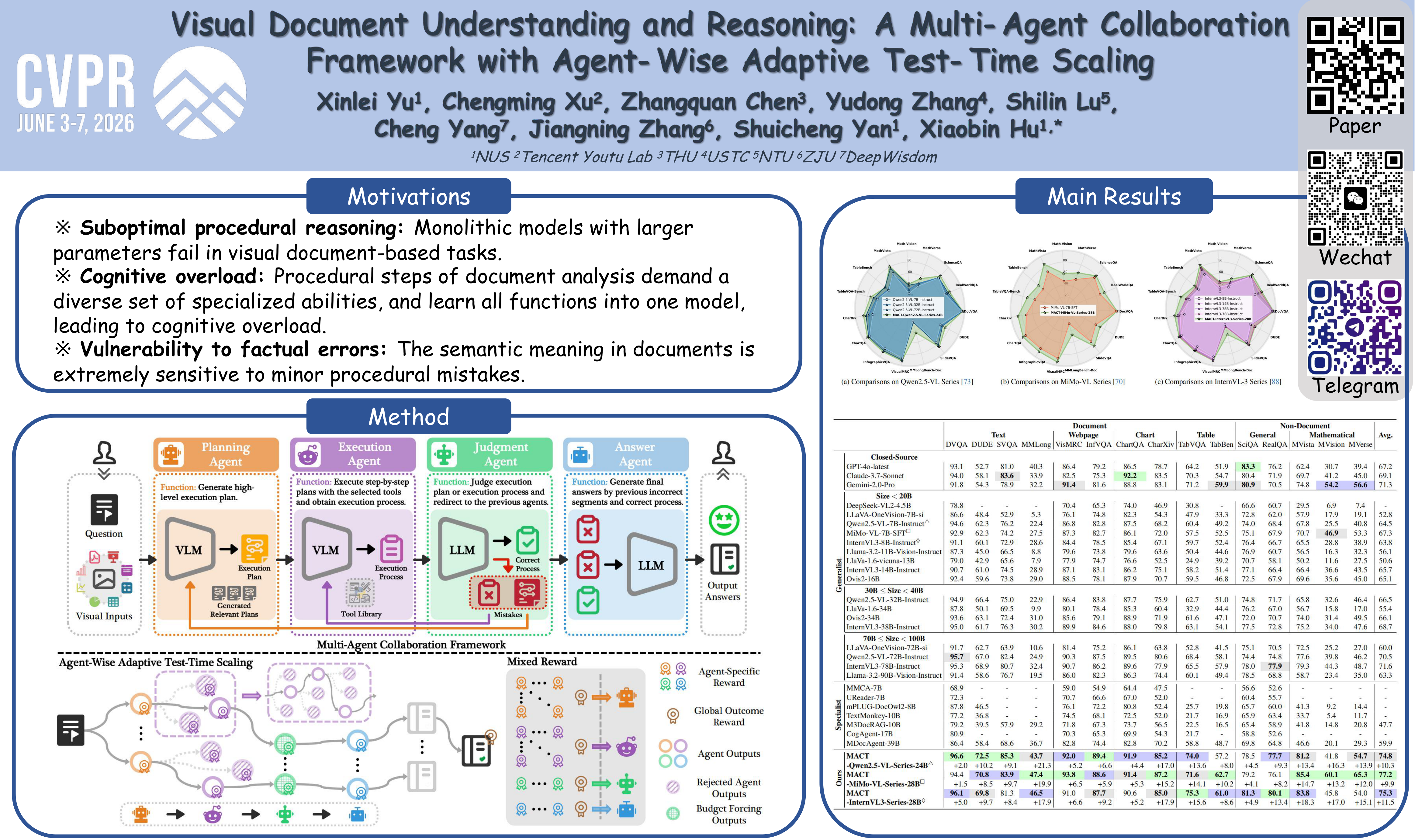
The dominant paradigm of monolithic scaling in Vision-Language Models (VLMs) is failing for understanding and reasoning in documents, yielding diminishing returns as it struggles with the inherent need of this domain for document-based procedural reasoning, cognitive complexity, and factual accuracy. To this end, we introduce MACT, a Multi-Agent Collaboration framework with agent-wise adaptive Test-time scaling that pioneers a paradigm shift to procedural scaling, adapting dynamically to the functional entities of visual documents understanding and reasoning. MACT decomposes the visual document processing flow into four specialized agents, i.e., planning, execution, judgment, and answer, to resolve cognitive overload and introduce a critical self-correction loop for factual grounding.This collaborative architecture is amplified by an agent-wise adaptive test-time scaling strategy that intelligently allocates computational resources based on the complexity and redundancy of each functionality. Evaluated on multiple visual document understanding benchmarks, MACT achieves superior performance with a smaller parameter scale, adapting effectively to various document scenarios without compromising its general or mathematical reasoning capabilities. The three variants of MACT consistently attain top-three average performance rankings, with average performance enhancements of 9.9–11.5\% over the base models. The source code will be released publicly.
GazeOnce360: Fisheye-Based 360° Multi-Person Gaze Estimation with Global–Local Feature Fusion
Zhuojiang Cai ⋅ Zhenghui Sun ⋅ Feng Lu
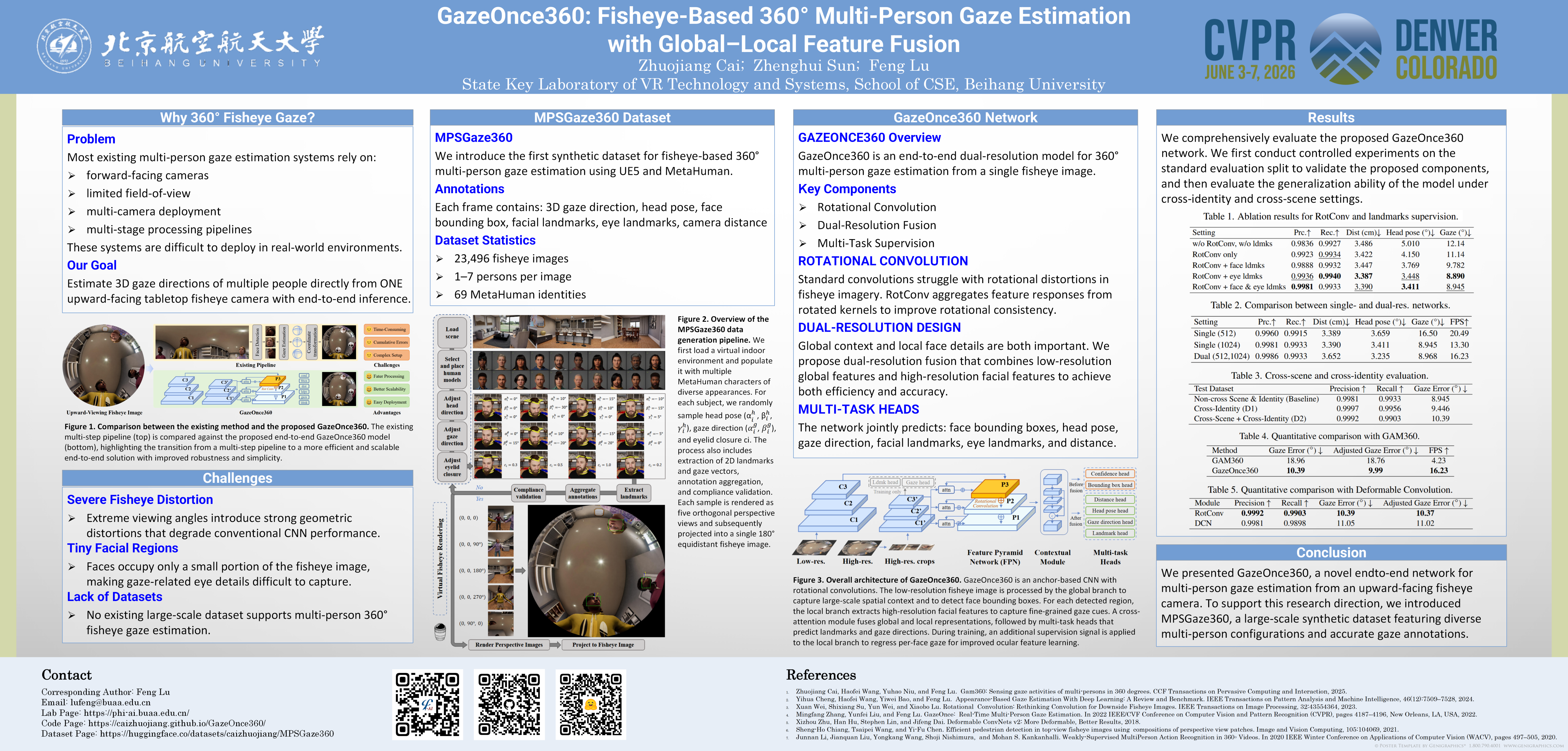
We present GazeOnce360, a novel end-to-end model for multi-person gaze estimation from a single tabletop-mounted upward-facing fisheye camera. Unlike conventional approaches that rely on forward-facing cameras in constrained viewpoints, we address the underexplored setting of estimating the 3D gaze direction of multiple people distributed across a 360° scene from an upward fisheye perspective. To support research in this setting, we introduce MPSGaze360, a large-scale synthetic dataset rendered using Unreal Engine, featuring diverse multi-person configurations with accurate 3D gaze and eye landmark annotations.Our model tackles the severe distortion and perspective variation inherent in fisheye imagery by incorporating rotational convolutions and eye landmark supervision. To better capture fine-grained eye features crucial for gaze estimation, we propose a dual-resolution architecture that fuses global low-resolution context with high-resolution local eye regions. Experimental results demonstrate the effectiveness of each component in our model. This work highlights the feasibility and potential of fisheye-based 360° gaze estimation in practical multi-person scenarios.
Bridging Human Evaluation to Infrared and Visible Image Fusion
Jinyuan Liu ⋅ Xingyuan Li ⋅ Qingyun Mei ⋅ HaoYuan Xu ⋅ Zhiying Jiang ⋅ Long Ma ⋅ Risheng Liu ⋅ Xin Fan
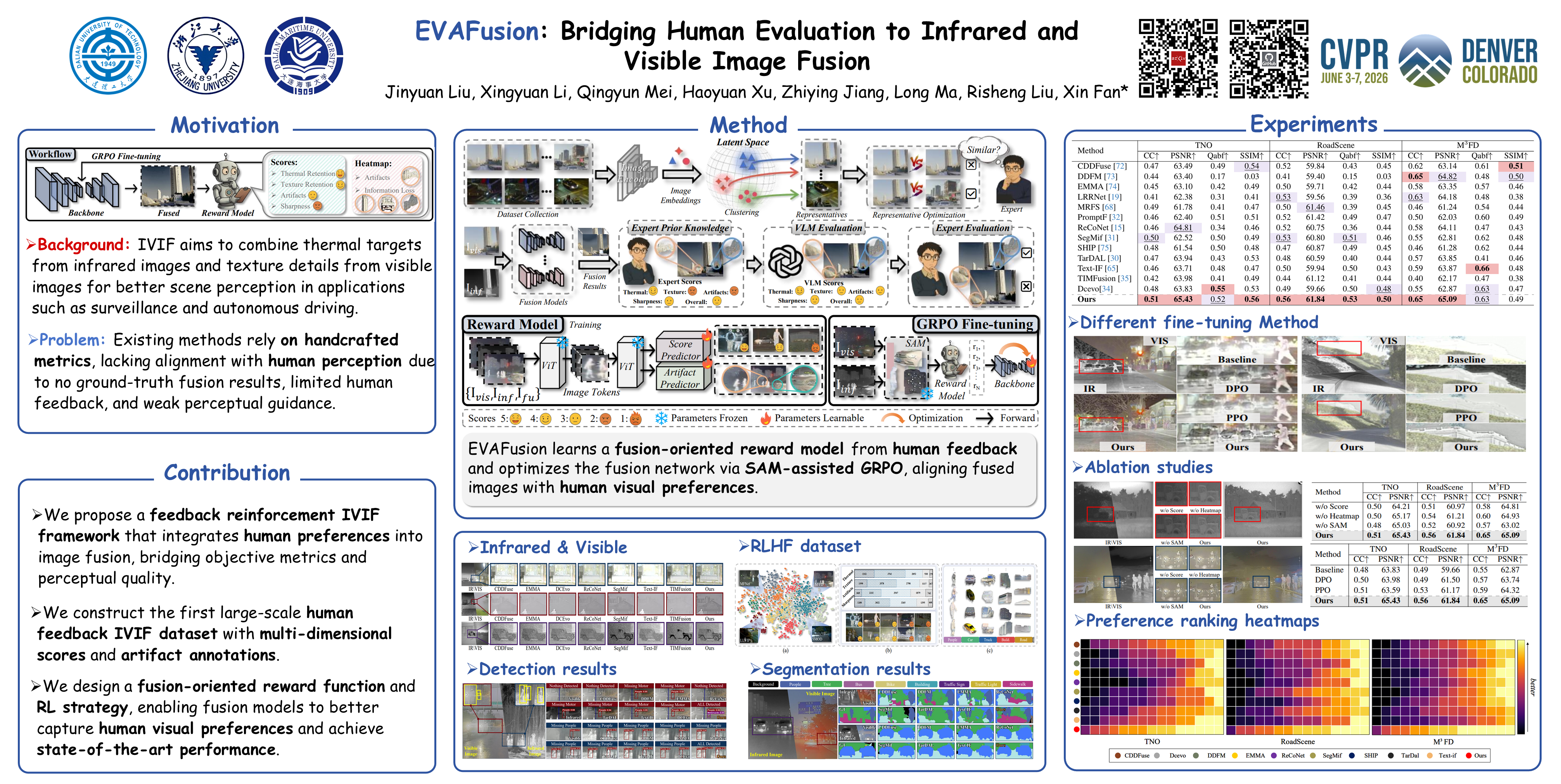
Infrared and visible image fusion (IVIF) integrates complementary modalities to enhance scene perception. Current methods predominantly focus on optimizing handcrafted losses and objective metrics, often resulting in fusion outcomes that do not align with human visual preferences. This challenge is further exacerbated by the ill-posed nature of IVIF, which severely limits its effectiveness in human perceptual environments such as security surveillance and driver assistance systems. To address these limitations, we propose a feedback reinforcement framework that bridges human evaluation to infrared and visible image fusion. To address the lack of human-centric evaluation metrics and data, we introduce the first large-scale human feedback dataset for IVIF, containing multidimensional subjective scores and artifact annotations, and enriched by a fine-tuned large language model with expert review. Based on this dataset, we design a domain-specific reward function and train a reward model to quantify perceptual quality. Guided by this reward, we fine-tune fusion networks through Group Relative Policy Optimization, achieving state-of-the-art performance that better aligns fused images with human aesthetics.
Beyond Strict Pairing: Arbitrarily Paired Training for High-Performance Infrared and Visible Image Fusion
Yanglin Deng ⋅ Tianyang Xu ⋅ Chunyang Cheng ⋅ Hui Li ⋅ Xiao-Jun Wu ⋅ Josef Kittler
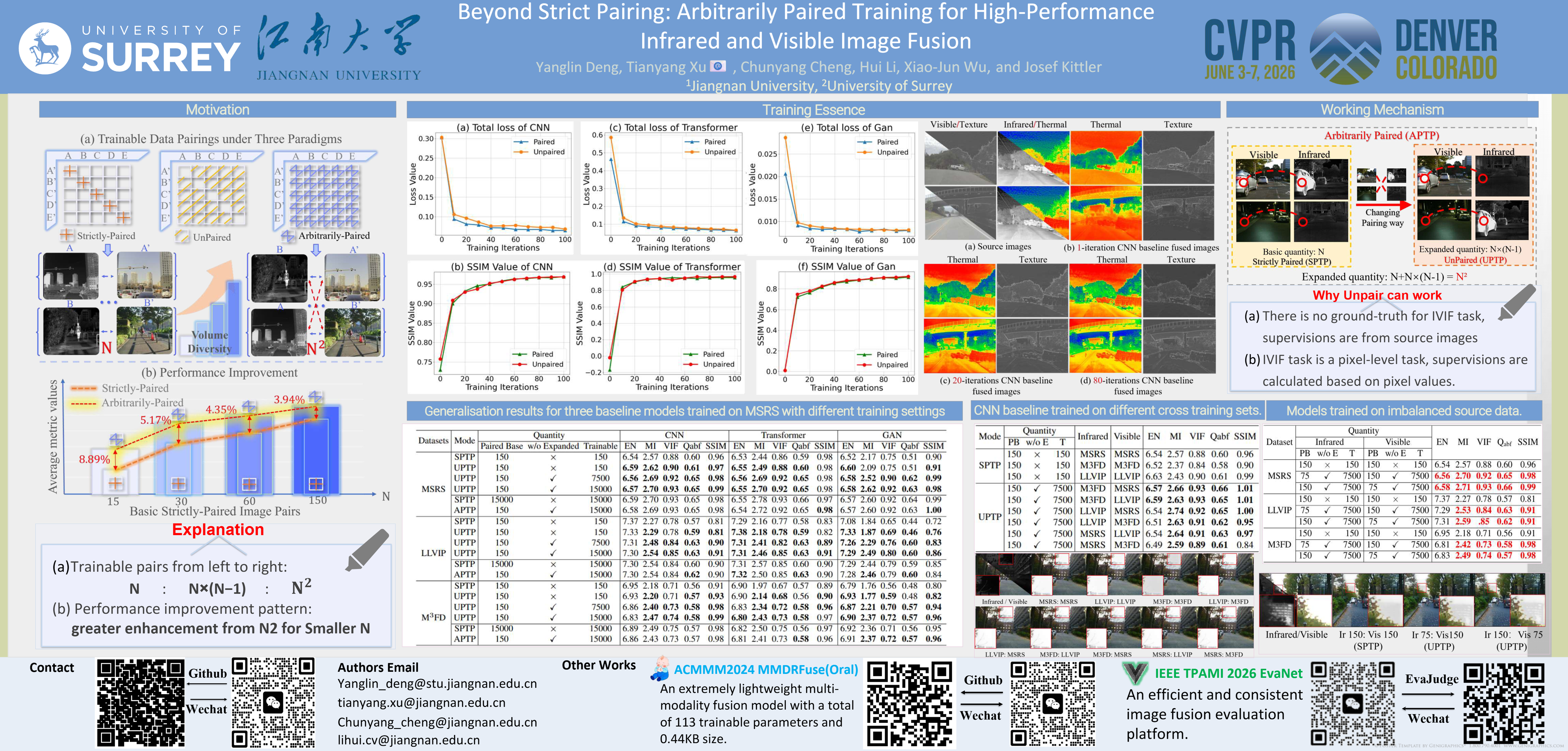
Infrared and visible image fusion (IVIF) aims to synthesise complementary information from the two source modalities while preserving natural textures and salient thermal signatures simultaneously. Existing solutions predominantly rely on extensive sets of rigidly aligned image pairs for training. However, acquiring such data is often impractical due to the costly and labour-intensive alignment process. Besides, maintaining a rigid pairing setting during training restricts the volume of cross-modal relationships, thereby limiting the generalisation performance. To this end, this work challenges the necessity of Strictly Paired Training Paradigm (SPTP) by systematically investigating UnPaired and Arbitrarily Paired Training Paradigms (UPTP and APTP) for high-performance IVIF. We establish a theoretical objective of APTP, reflecting the complementary nature between UPTP and SPTP. More importantly, we develop a practical framework capable of significantly enriching cross-modal relationships even with severely limited and unaligned training data. To validate our propositions, three end-to-end lightweight baselines, alongside a set of innovative loss functions, are designed to cover three classic frameworks (CNN, Transformer, GAN). Comprehensive experiments demonstrate that the proposed APTP and UPTP are feasible and capable of training models on a severely limited and content-inconsistent infrared and visible dataset, achieving performance comparable to that of a dataset 100$\times$ larger in SPTP. This finding fundamentally alleviates the cost and difficulty of data collection while enhancing model robustness from the data perspective, delivering a feasible solution for IVIF studies.
Semantic-Adaptive Diffusion for Dynamic Spatiotemporal Fusion
Jinsong Zhang ⋅ Ying Qu ⋅ Yuan Liao ⋅ Hairong Qi ⋅ Zhenzhou Shao
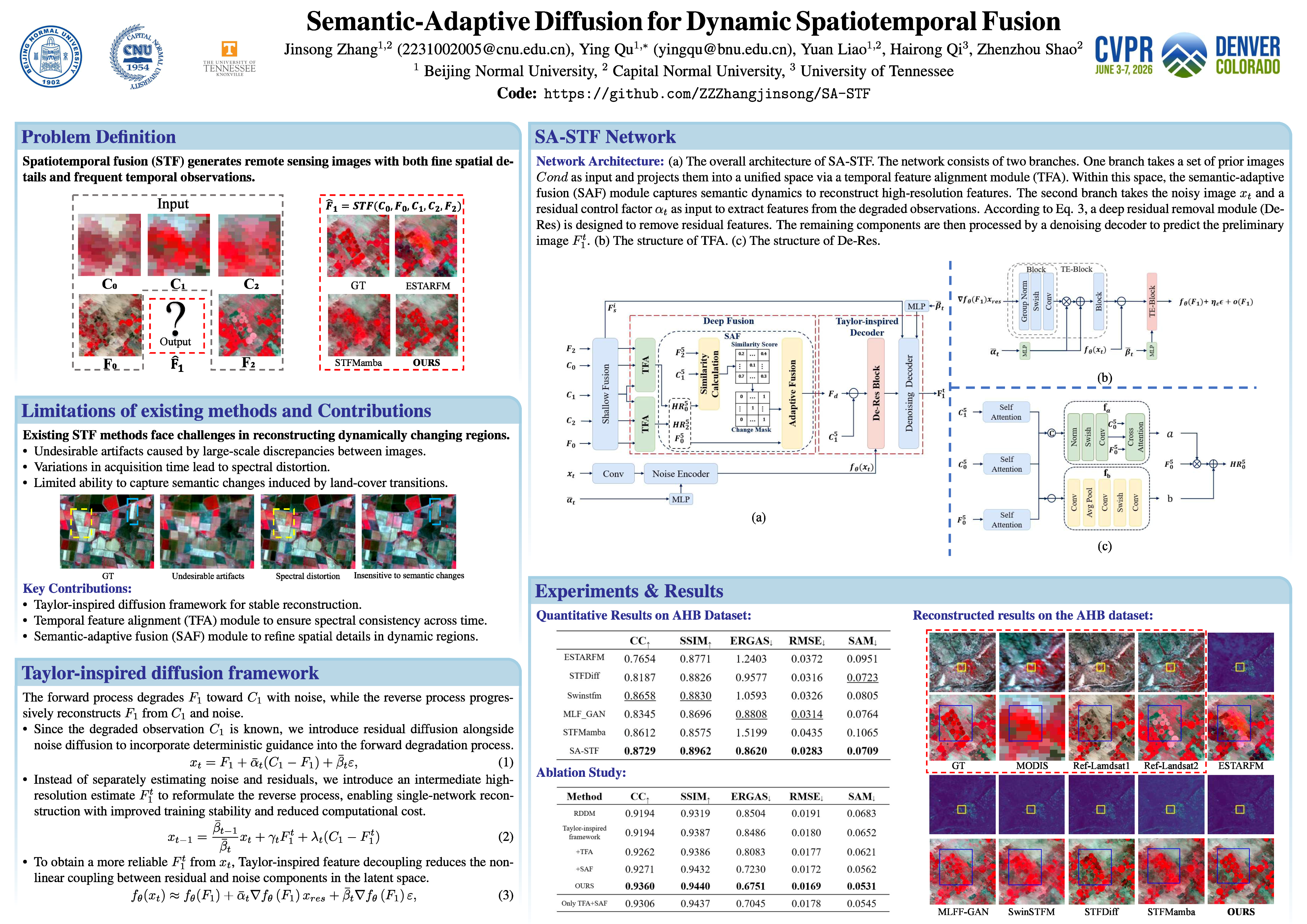
Frequent and precise land surface monitoring is critical for numerous applications, yet existing satellites struggle to achieve both simultaneously. Spatiotemporal fusion (STF) tackles this challenge by integrating multiple satellite images to generate data with improved temporal and spatial resolution, enabling more frequent and precise land surface observations. However, current methods often fail to recover dynamic landscape changes due to significant scale discrepancies among multi-source images. To address these challenges, we propose a semantic-adaptive diffusion framework for dynamic spatiotemporal fusion (SA-STF), which constrains the solution space using low-resolution and high-frequency features decoupled via a Taylor-inspired decoder. By incorporating temporal feature alignment and semantic-adaptive fusion modules, SA-STF projects multimodal images with temporal dynamics into a unified latent space, and adaptively enhances spatial details while maintaining the spectral consistency of the reconstructed images. Experiments on benchmark datasets demonstrate that SA-STF outperforms existing methods in both quantitative and qualitative evaluations, particularly in complex and dynamic scenes.
Bayesian Decomposition and Semantic Completion for Few-shot Semantic Segmentation
Guangchen Shi ⋅ Yirui Wu ⋅ Wei Zhu ⋅ Tao Wang ⋅ Hao Zhang ⋅ Bo Li ⋅ Tong Lu
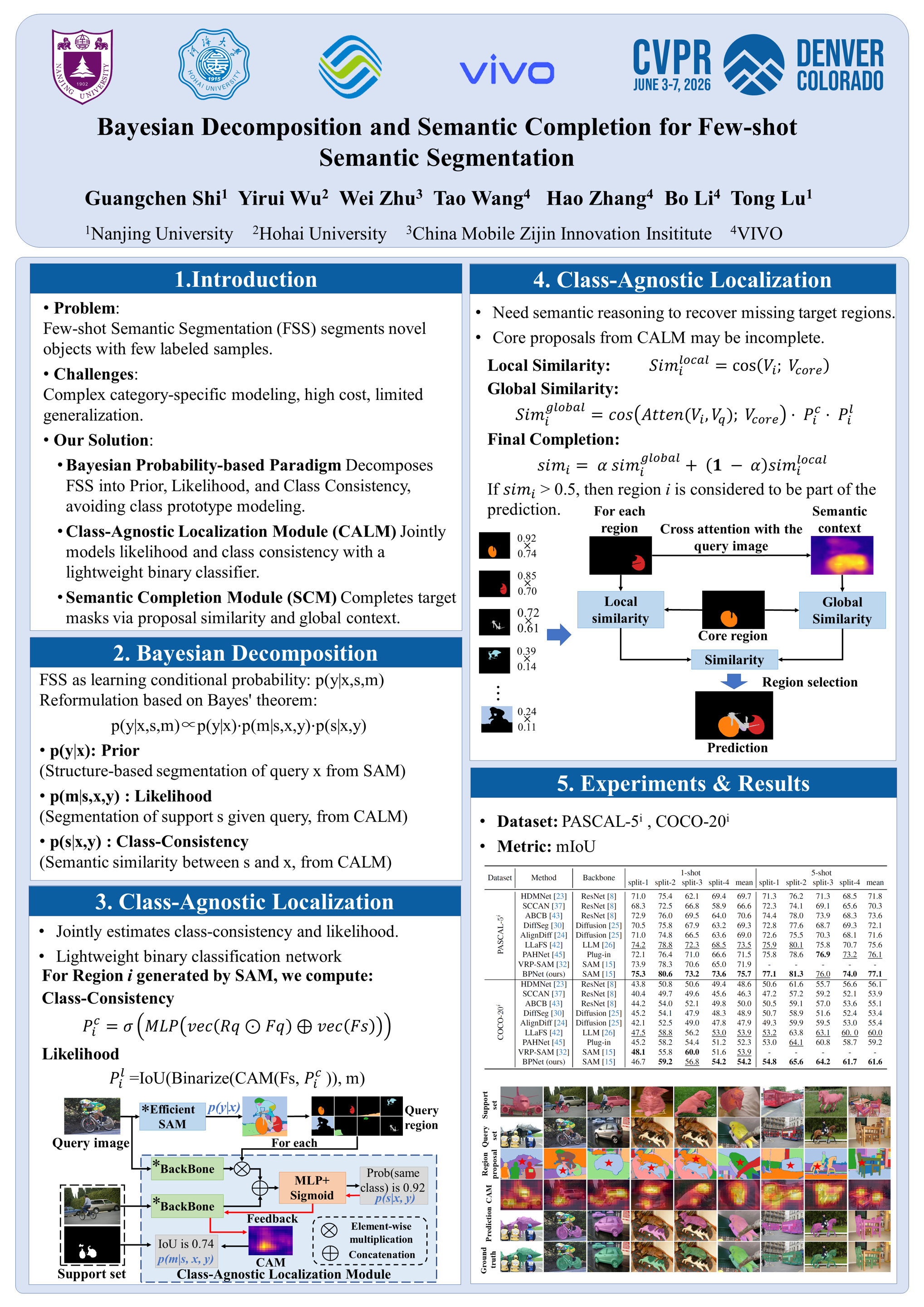
Few-shot Semantic Segmentation (FSS) aims to segment objects of novel categories given only a handful of labeled examples. However, existing methods often rely on complex category-specific modeling, resulting in high computational cost and limited generalization under low-data regimes. To address these challenges, we propose a Bayesian Probabilistic Network (BPNet) that reformulates FSS as a composition of three interpretable components: a prior, a likelihood, and a class-consistency term. Specifically, an efficient Segment Anything Model (SAM) is employed to generate fragmented prior regions for the query image, while both the likelihood and the consistency terms are estimated by a lightweight Class-Agnostic Localization Model (CALM). CALM simultaneously predicts the class consistency between support-query pairs through a binary classification head and estimates the likelihood by localizing the target region in the support image. By evaluating SAM-generated regions in parallel, CALM can efficiently identify the core region, thereby transforming the segmentation problem into a simple binary classification task. Furthermore, to mitigate the semantic incompleteness of SAM proposals, we introduce an attention-based Semantic Completion Module (SCM), which leverages local and global context cues to integrate fragmented regions into semantically complete masks. Extensive experiments demonstrate that BPNet achieves state-of-the-art performance while maintaining high efficiency.
From Few-way to Many-way: Rethinking Few-shot Fine-grained Image Classification
Li-Jun Zhao ⋅ Zhen-Duo Chen ⋅ Xin Luo ⋅ Xin-Shun Xu
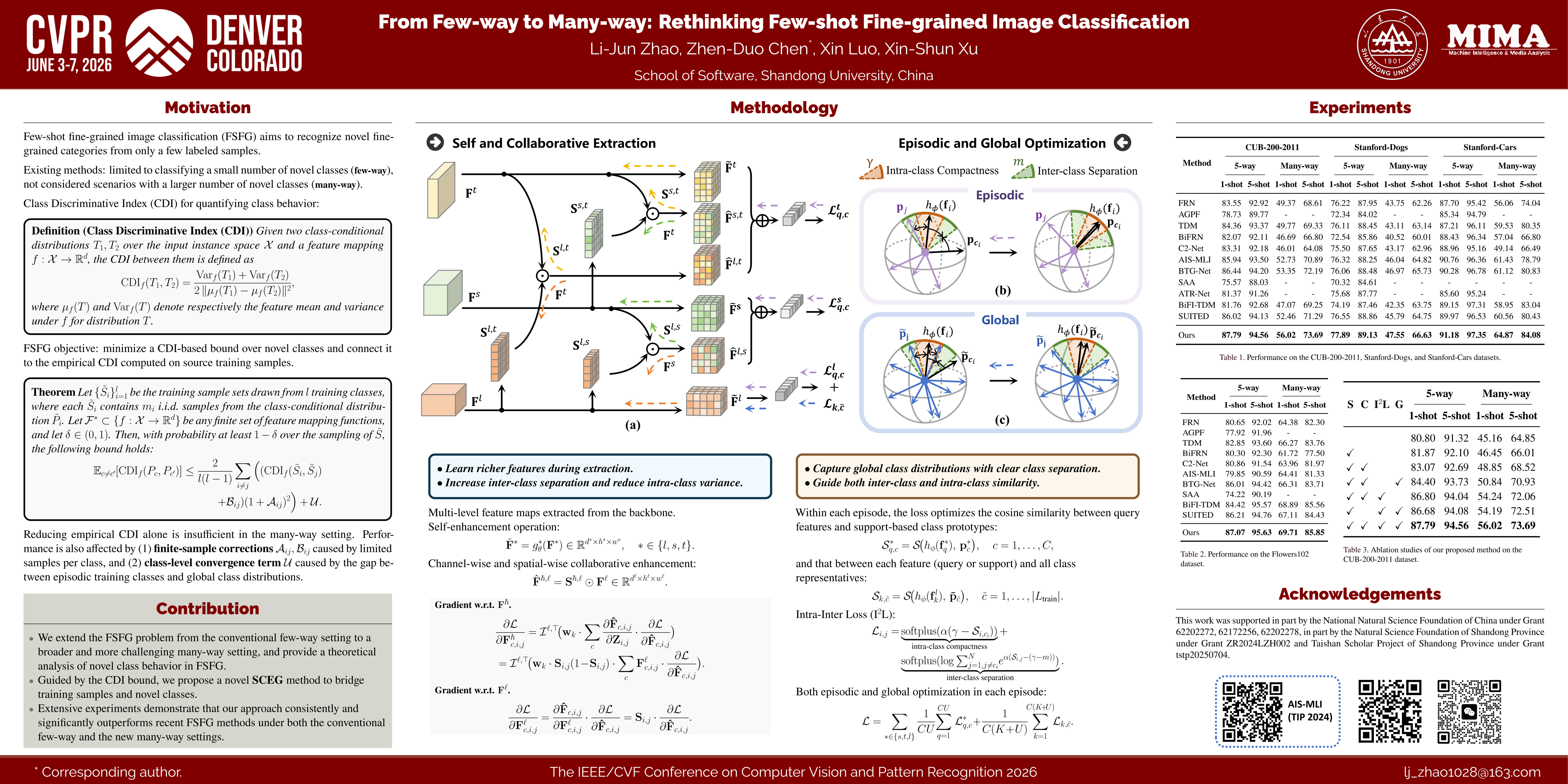
Few-shot fine-grained image classification (FSFG) aims to recognize novel fine-grained categories from only a few labeled samples. Existing FSFG methods primarily focus on fine-grained feature extraction and modeling query–support interactions within training episodes containing a small number of classes. Relying on the episodic training strategy, these methods typically assume that the capabilities learned on training samples can directly transfer to evaluation episodes with a few novel classes (few-way). However, in more practical and challenging scenarios involving many novel classes (many-way), existing approaches lack a reliable and global characterization of the feature space, making it difficult for episodic adaptation alone to generalize effectively. In this paper, we pioneer a theoretical analysis of novel class behavior in FSFG and derive a class discriminative index bound. Guided by this analysis, we propose a novel SCEG method that incorporates Self and Collaborative feature extraction as well as Episodic and Global feature space optimization. Extensive experiments demonstrate that our method consistently and significantly outperforms existing methods under both conventional few-way and the new many-way settings.
STiTch: Semantic Transition and Transportation in Collaboration for Training-Free Zero-Shot Composed Image Retrieval
Miaoge Li ⋅ Dongsheng Wang ⋅ Zening Sun ⋅ Jinsen Zhang ⋅ Wenhan Luo ⋅ Jingcai Guo
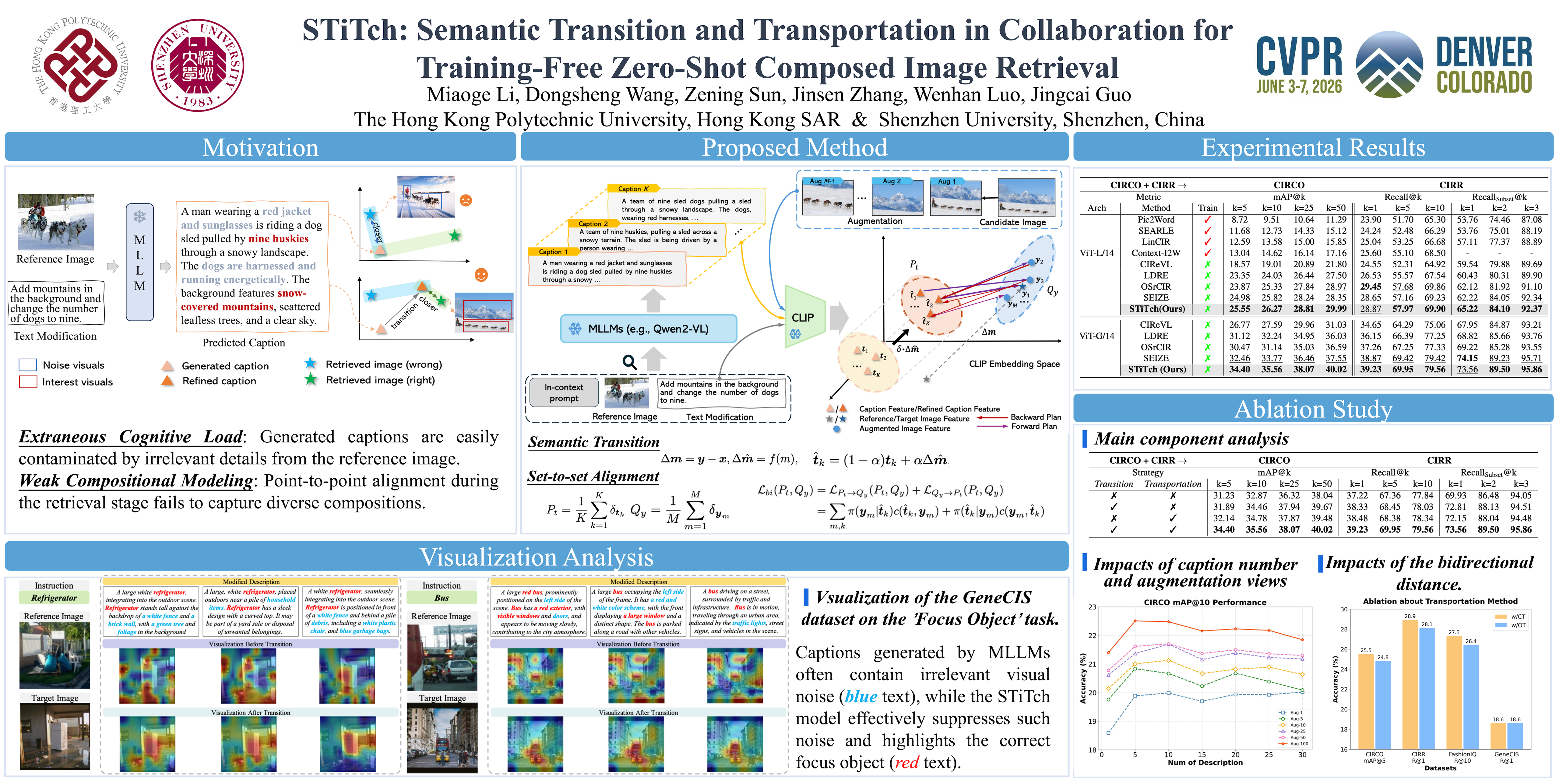
Training-free zero-shot composed image retrieval models are recently gaining increasing research interest due to their generalizability and flexibility in unseen multimodal retrieval. Recent LLM-based advances focus on generating the expected target caption by exploring the compositional ability behind the LLMs. Although efficient, we find that 1) the generated captions tend to introduce unexpected features from the reference image due to the semantic gap between the input image and text modification, where the image contains much more details than the text; 2) the point-to-point alignment during the retrieval stage fails to capture diverse compositions.To address these challenges, we introduce a novel Semantic Transition and Transportation in Collaboration framework for training-free zero-shot CIR tasks. Specifically, given the composed caption inferred by an LLM, we aim to refine it through a transition vector in the embedding space and make it closer to the target image. Combining LLMs with user instruction, the refined caption concentrates more on the core modification intent and thus filters out unnecessary noise. Moreover, to explore diverse alignment during the retrieval stage, we model the caption and image as discrete distributions and reformulate the retrieval task as a set-to-set alignment task. Finally, a bidirectional transportation distance is developed to consider fine-grained alignments across modalities and calculate the retrieval score.Extensive experimentsdemonstrate that our method can be general, effective, and beneficial for many CIR tasks.The code is attached in the supplementary material.
Selective, Regularized, and Calibrated: Harnessing Vision Foundation Models for Cross-Domain Few-Shot Semantic Segmentation
junyuan ma ⋅ Xunzhi Xiang ⋅ Wenbin Li ⋅ Qi Fan ⋅ Yang Gao
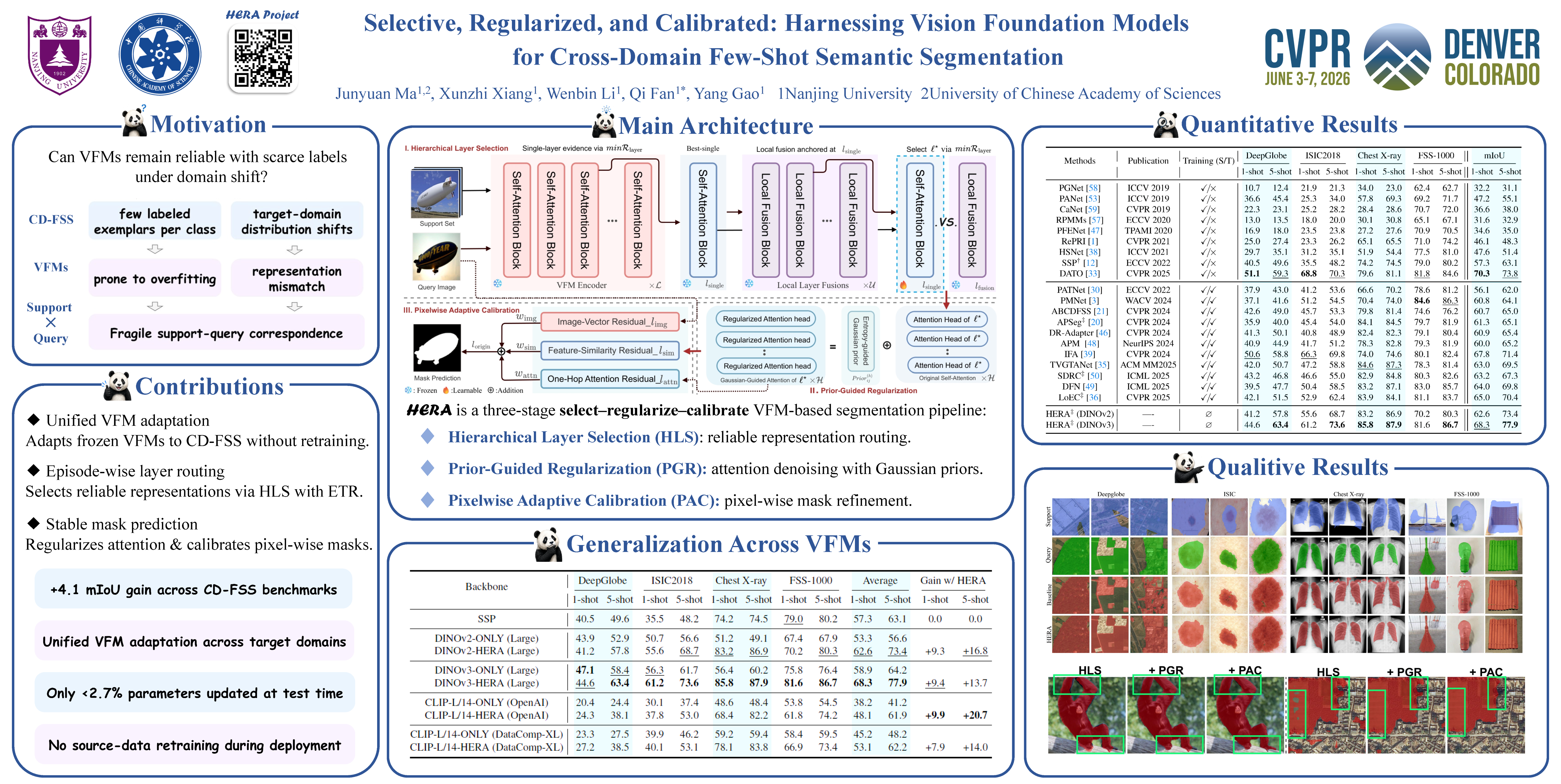
Vision foundation models (VFMs) have achieved strong performance across various vision tasks. However, it still remains challenging to apply VFMs for cross-domain few-shot segmentation (CD-FSS), which segments objects of novel classes under domain shifts using only a few labeled exemplars. The challenge is mainly driven by two factors: (1) limited labeled exemplars per novel class relative to the scale of VFM pre-training, causing overfitting prone under retraining, and (2) target-domain shifts underrepresented during pre-training, inducing cross-domain inconsistency and layerwise sensitivity. To address these issues, we propose Hierarchical Exemplar Representation Adaptation (HERA), a three-stage select-regularize-calibrate VFM-based segmentation framework that learns effectively from limited labels and adapts to novel domains without source-data retraining. We first design Hierarchical Layer Selection (HLS) to adaptively identify the most informative VFM layer using a data-dependent Exemplar Transfer Risk (ETR) computed for each candidate layer. Then, Prior-Guided Regularization (PGR) regularizes interactions on the selected representation, yielding well-structured local signals for the subsequent stage. Furthermore, Pixelwise Adaptive Calibration (PAC) combines the selected representation with the refined interaction maps to calibrate pixelwise predictions, producing consistent masks. Together, these stages form a hierarchical select–regularize–calibrate pipeline that guides frozen VFM features in new domains while fine-tuning less than 2.7% of parameters at test time. Extensive experiments show that HERA surpasses the state-of-the-art by more than 4.1 mIoU across multiple CD-FSS benchmarks.
FlowComposer: Composable Flows for Compositional Zero-Shot Learning
Zhenqi He ⋅ Lin Li ⋅ Long Chen
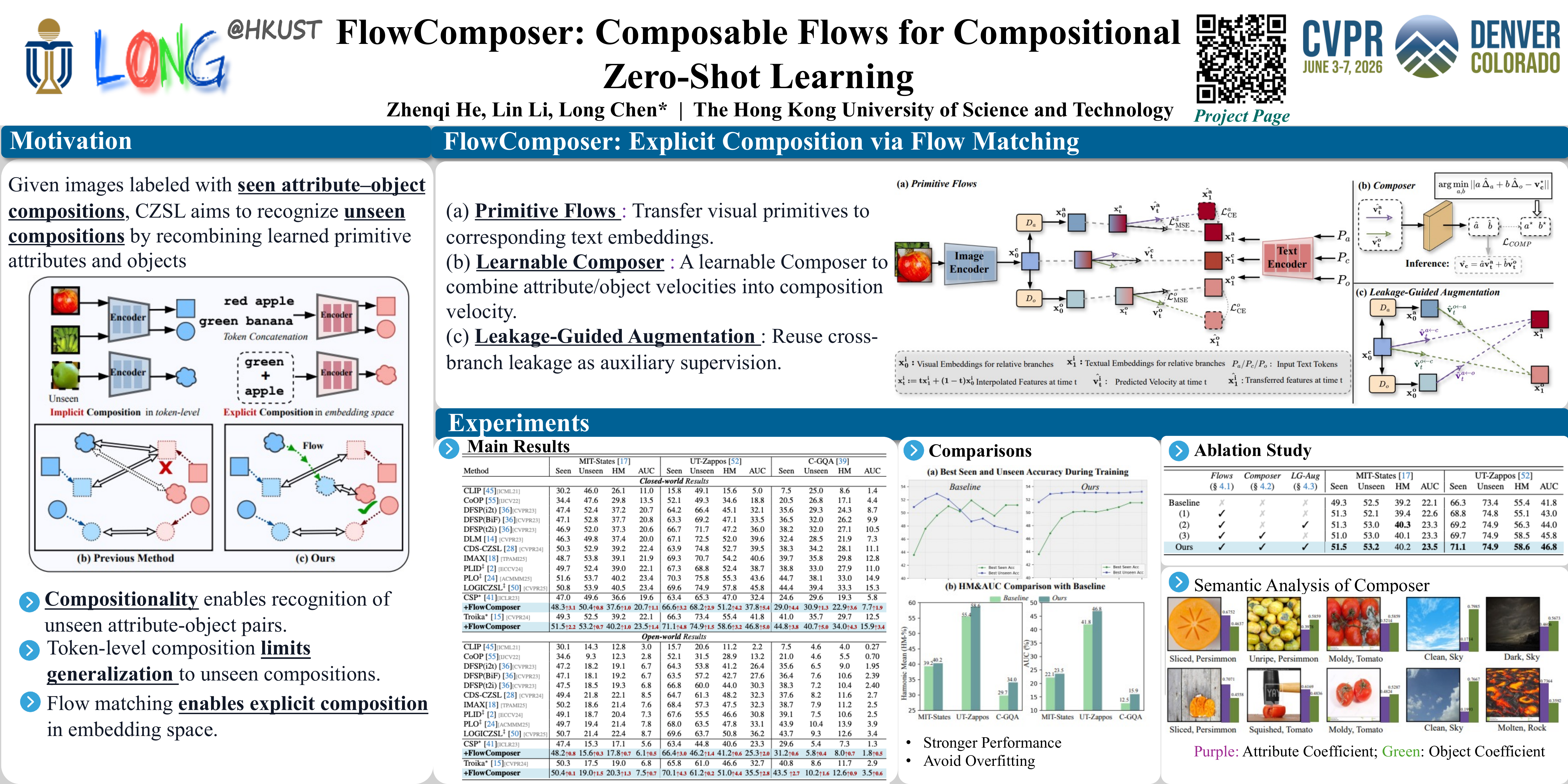
Compositional zero-shot learning (CZSL) aims to recognize unseen attribute–object compositions by recombining primitives learned from seen pairs. Recent CZSL methods built on vision-language models (VLMs) typically adopt parameter-efficient fine-tuning (PEFT).They apply visual disentanglers for decomposition and manipulate token-level prompts or prefixes to encode compositions.However, such PEFT-based designs suffer from two fundamental limitations: (1) Implicit Composition Construction, where composition is realized only via token concatenation or branch-wise prompt tuning rather than an explicit operation in the embedding space; (2) Remained Feature Entanglement, where imperfect disentanglement leaves attribute, object, and composition features mutually contaminated. Together, these issues limit the generalization ability of current CZSL models.In this paper, we are the first to systematically study flow matching for CZSL and introduce FlowComposer, a model-agnostic framework that learns two primitive flows to transport visual features toward attribute and object text embeddings, and a learnable Composer that explicitly fuses their velocity fields into a composition flow. To exploit the inevitable residual entanglement, we further devise a leakage-guided augmentation scheme that reuses leaked features as auxiliary signals.We thoroughly evaluate FlowComposer on three public CZSL benchmarks by integrating it as a plug-and-play component into various baselines, consistently achieving significant improvements.
ManifoldGD: Training-Free Hierarchical Manifold Guidance for Diffusion-Based Dataset Distillation
Ayush Roy ⋅ Wei-Yang Alex Lee ⋅ Rudrasis Chakraborty ⋅ Vishnu Suresh Lokhande
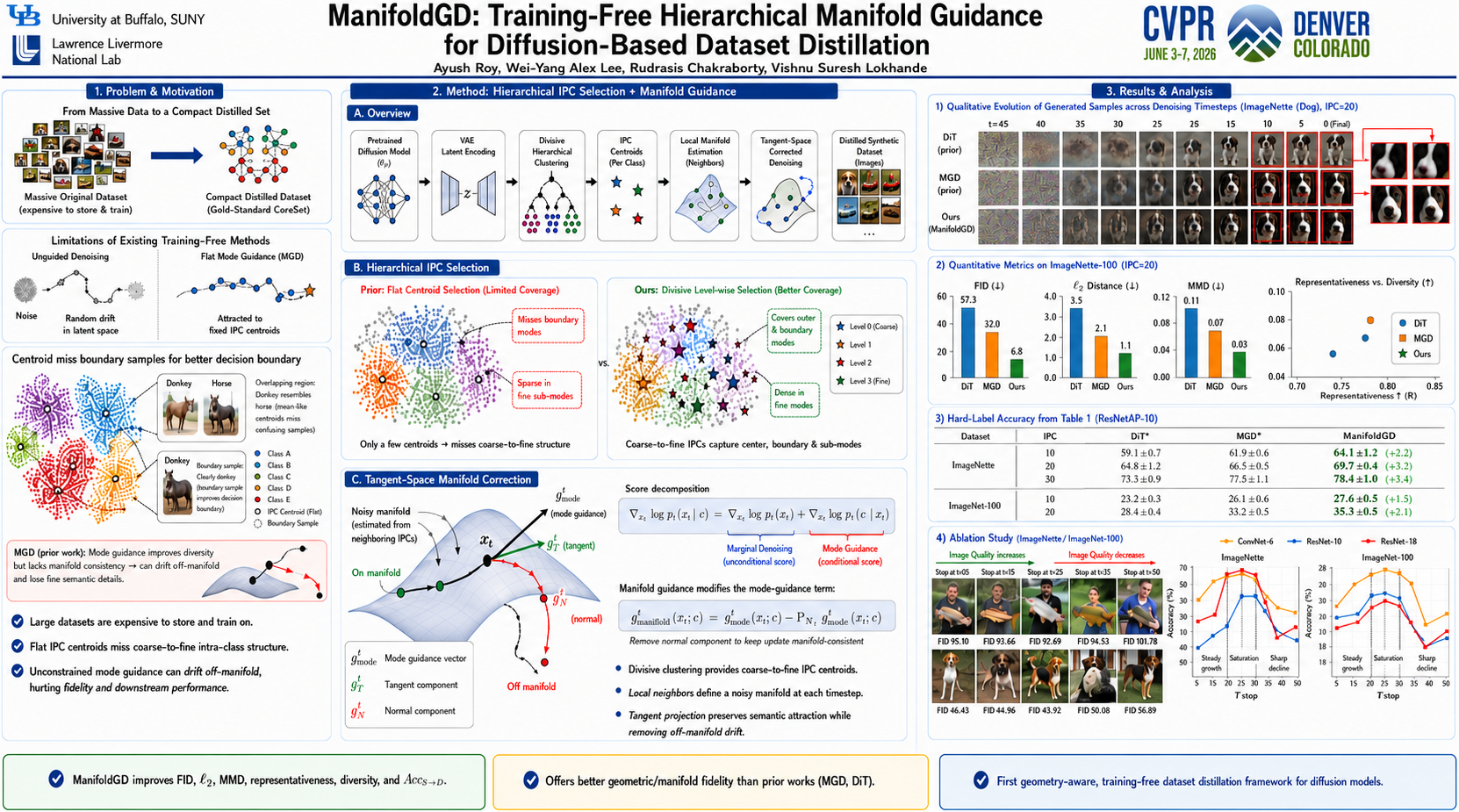
In recent times, large datasets hinder efficient model training while also containing redundant concepts. Dataset distillation aims to synthesize compact datasets that preserve the knowledge of large-scale training sets while drastically reducing storage and computation. Recent advances in diffusion models have enabled training-free distillation by leveraging pre-trained generative priors; however, existing guidance strategies remain limited. Current score-based methods either perform unguided denoising or rely on simple mode-based guidance toward instance prototype centroids (IPC centroids), which often are rudimentary and suboptimal. We propose Manifold-Guided Distillation (ManifoldGD), a training-free diffusion-based framework that integrates manifold consistent guidance at every denoising timestep. Our method employs IPCs computed via a hierarchical, divisive clustering of VAE latent features—yielding a multi-scale coreset of IPCs that captures both coarse semantic modes and fine intra-class variability. Using a local neighborhood of the extracted IPC centroids, we create the latent manifold for each diffusion denoising timestep. At each denoising step, we project the mode-alignment vector onto the local tangent space of the estimated latent manifold, thus constraining the generation trajectory to remain manifold-faithful while preserving semantic consistency. This formulation improves representativeness, diversity, and image fidelity without requiring any model retraining. Empirical results demonstrate consistent gains over existing training-free and training-based baselines in terms of FID, $\ell_2$ distance among real and synthetic dataset embeddings, and classification accuracy, establishing ManifoldGD as the first geometry-aware training-free data distillation framework.
DMGD: Train-Free Dataset Distillation with Semantic-Distribution Matching in Diffusion Models
Qichao Wang ⋅ Yunhong Lu ⋅ Hengyuan Cao ⋅ Junyi Zhang ⋅ Min Zhang
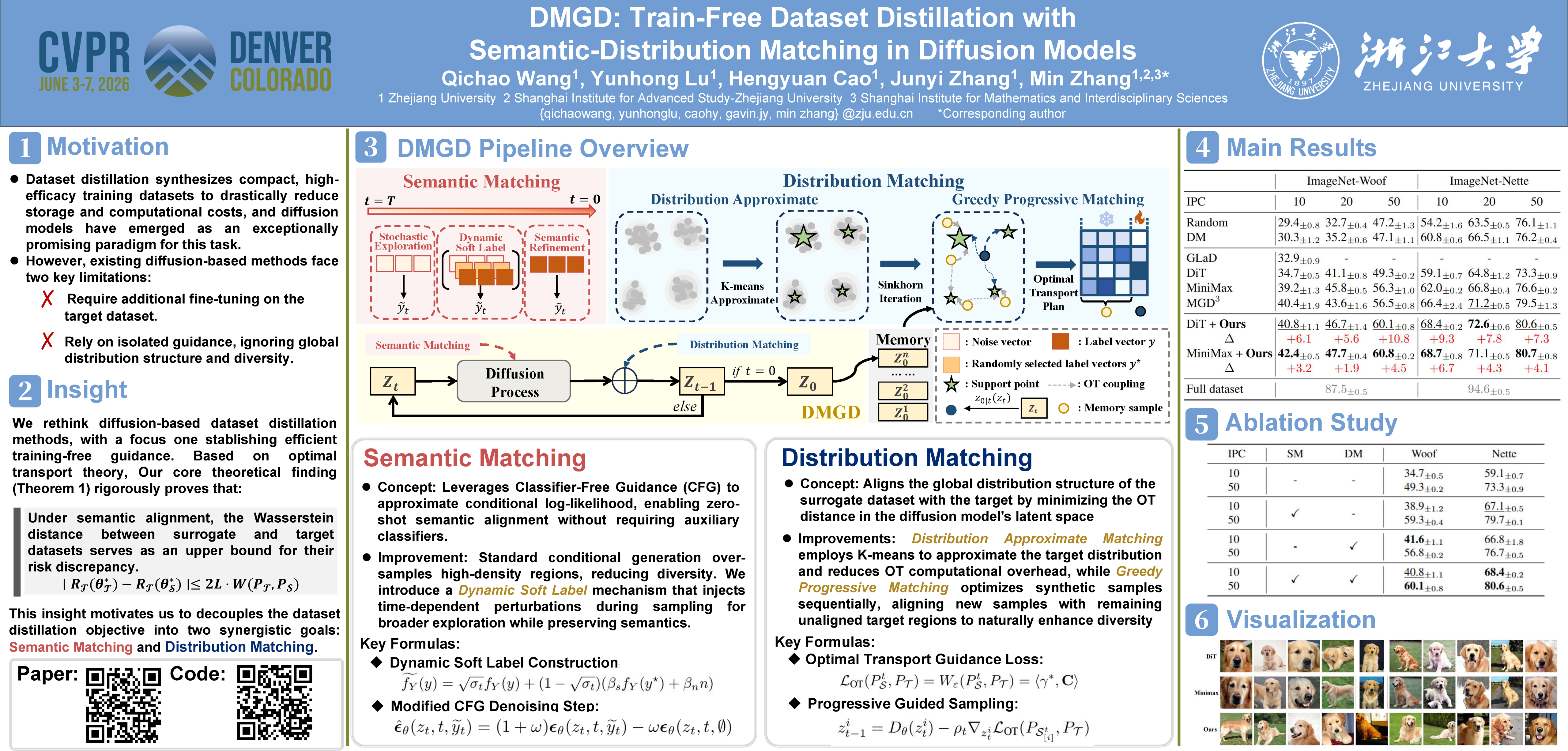
Dataset distillation enables efficient training by distilling the information of large-scale datasets into significantly smaller synthetic datasets. Diffusion based paradigms have emerged in recent years, offering novel perspectives for dataset distillation. However, they typically necessitate additional fine-tuning stages, and effective guidance mechanisms remain underexplored. To address these limitations, we rethink diffusion based dataset distillation and propose a Dual Matching Guided Diffusion (DMGD) framework, centered on efficient training-free guidance. We propose a pioneering theoretical framework for guidance design, proving that optimizing distributional distance under semantic alignment equivalently tightens the upper bound of dataset distillation objectives. Therefore, we first establish **Semantic Matching** via conditional likelihood optimization, eliminating the need for auxiliary classifiers. Furthermore, we propose a dynamic guidance mechanism that enhances the diversity of synthetic data while maintaining semantic alignment. Simultaneously, we introduce an optimal transport (OT) based **Distribution Matching** approach to further align with the target distribution structure. To ensure efficiency, we develop two enhanced strategies for diffusion based framework: Distribution Approximate Matching and Greedy Progressive Matching. These strategies enable effective distribution matching guidance with minimal computational overhead. Experimental results on ImageNet-Woof, ImageNet-Nette, and ImageNet-1K demonstrate that our training-free approach achieves significant improvements, outperforming state-of-the-art (SOTA) methods requiring additional fine-tuning by average accuracy gains of $2.1$%, $5.4$%, and $2.4$%, respectively.
UniRain: Unified Image Deraining with RAG-based Dataset Distillation and Multi-objective Reweighted Optimization
Qianfeng Yang ⋅ Qiyuan Guan ⋅ Xiang Chen ⋅ Jiyu Jin ⋅ Guiyue Jin ⋅ Jiangxin Dong
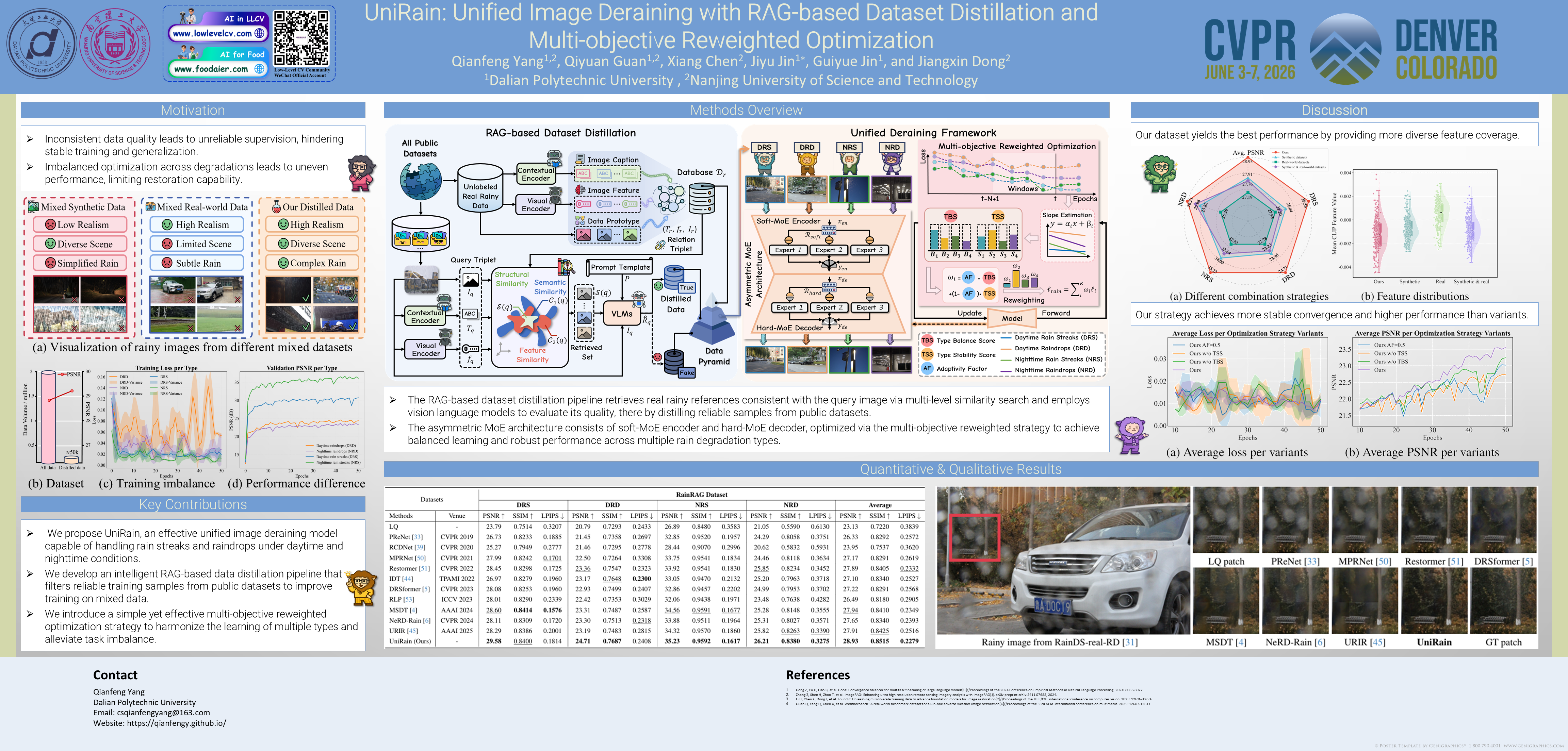
Despite significant progress has been made in image deraining, we note that most existing methods are often developed for only specific types of rain degradation and fail to generalize across diverse real-world rainy scenes. How to effectively model different rain degradations within a universal framework is important for real-world image deraining. In this paper, we propose UniRain, an effective unified image deraining framework capable of restoring images degraded by rain streak and raindrop under both daytime and nighttime conditions. To better enhance unified model generalization, we construct an intelligent retrieval augmented generation (RAG)-based dataset distillation pipeline that selects high-quality training samples from all public deraining datasets for better mixed training. Furthermore, we incorporate a simple yet effective multi-objective reweighted optimization strategy into the asymmetric mixture-of-experts (MoE) architecture to facilitate consistent performance and improve robustness across diverse scenes. Extensive experiments show that our framework performs consistently favorably against the state-of-the-art models on both our proposed benchmarks and multiple public datasets. Code and dataset will be available.
Leveraging Multispectral Sensors for Color Correction in Mobile Cameras
Luca Cogo ⋅ Marco Buzzelli ⋅ Simone Bianco ⋅ Javier Vazquez-Corral ⋅ Raimondo Schettini
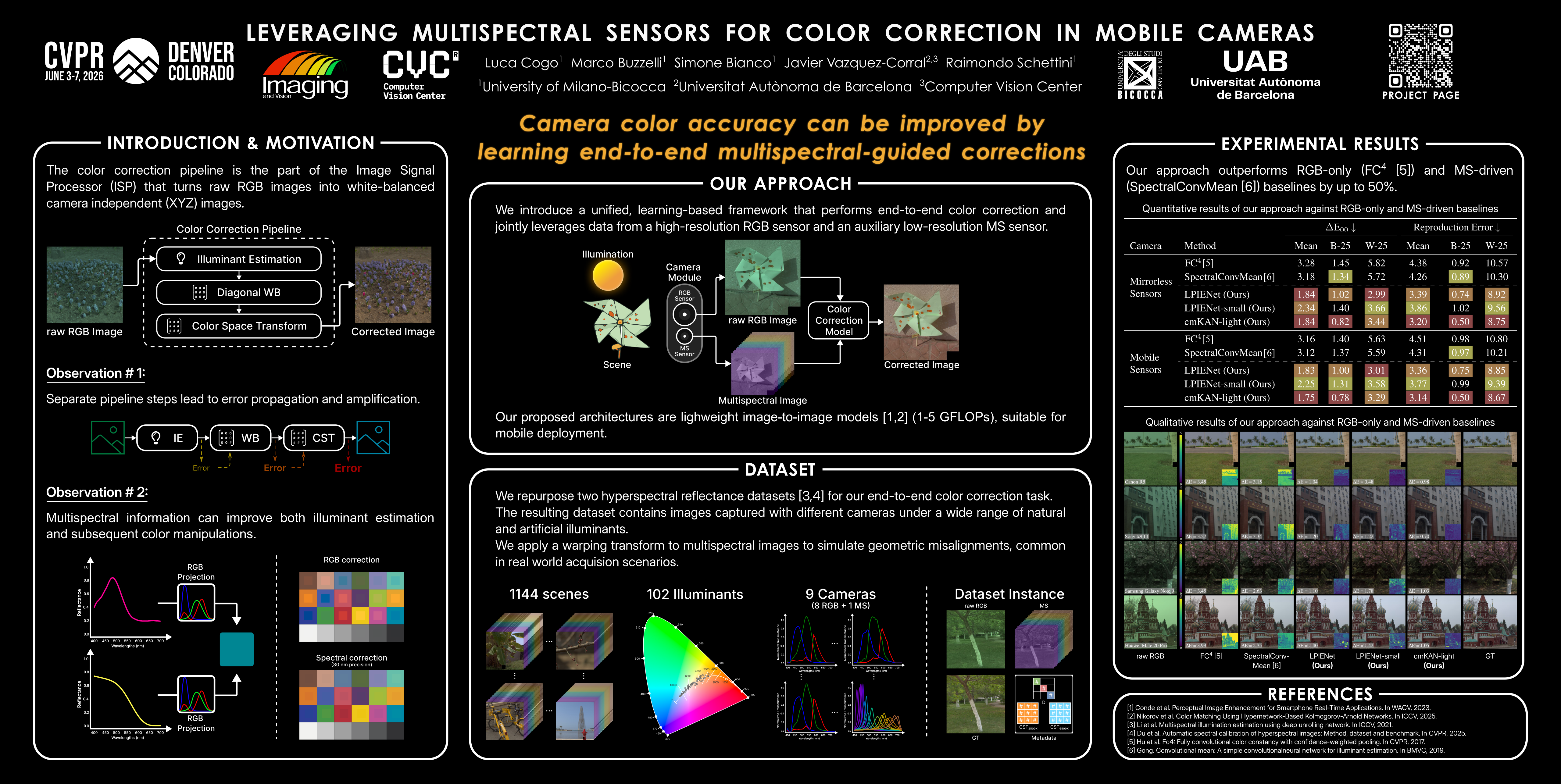
Recent advances in snapshot multispectral (MS) imaging have enabled compact, low-cost spectral sensors for consumer and mobile devices. By capturing richer spectral information than conventional RGB sensors, these systems can enhance key imaging tasks, including color correction. However, most existing methods treat the color correction pipeline in separate stages, often discarding MS data early in the process. We propose a unified, learning-based framework that (i) performs end-to-end color correction and (ii) jointly leverages data from a high-resolution RGB sensor and an auxiliary low-resolution MS sensor. Our approach integrates the full pipeline within a single model, producing coherent and color-accurate outputs. We demonstrate the flexibility and generality of our framework by refactoring two different state-of-the-art image-to-image architectures. To support training and evaluation, we construct a dedicated dataset by aggregating and repurposing publicly available spectral datasets, rendering under multiple RGB camera sensitivities. Extensive experiments show that our approach improves color accuracy and stability, reducing error by up to 50\% compared to RGB-only and MS-driven baselines. Datasets, code, and models will be made available upon acceptance.
Differentiable Adaptive 4D Structured Illumination for Joint Capture of Shape and Reflectance
Huakeng Ding ⋅ Yaowen Chen ⋅ Kun Zhou ⋅ Hongzhi Wu
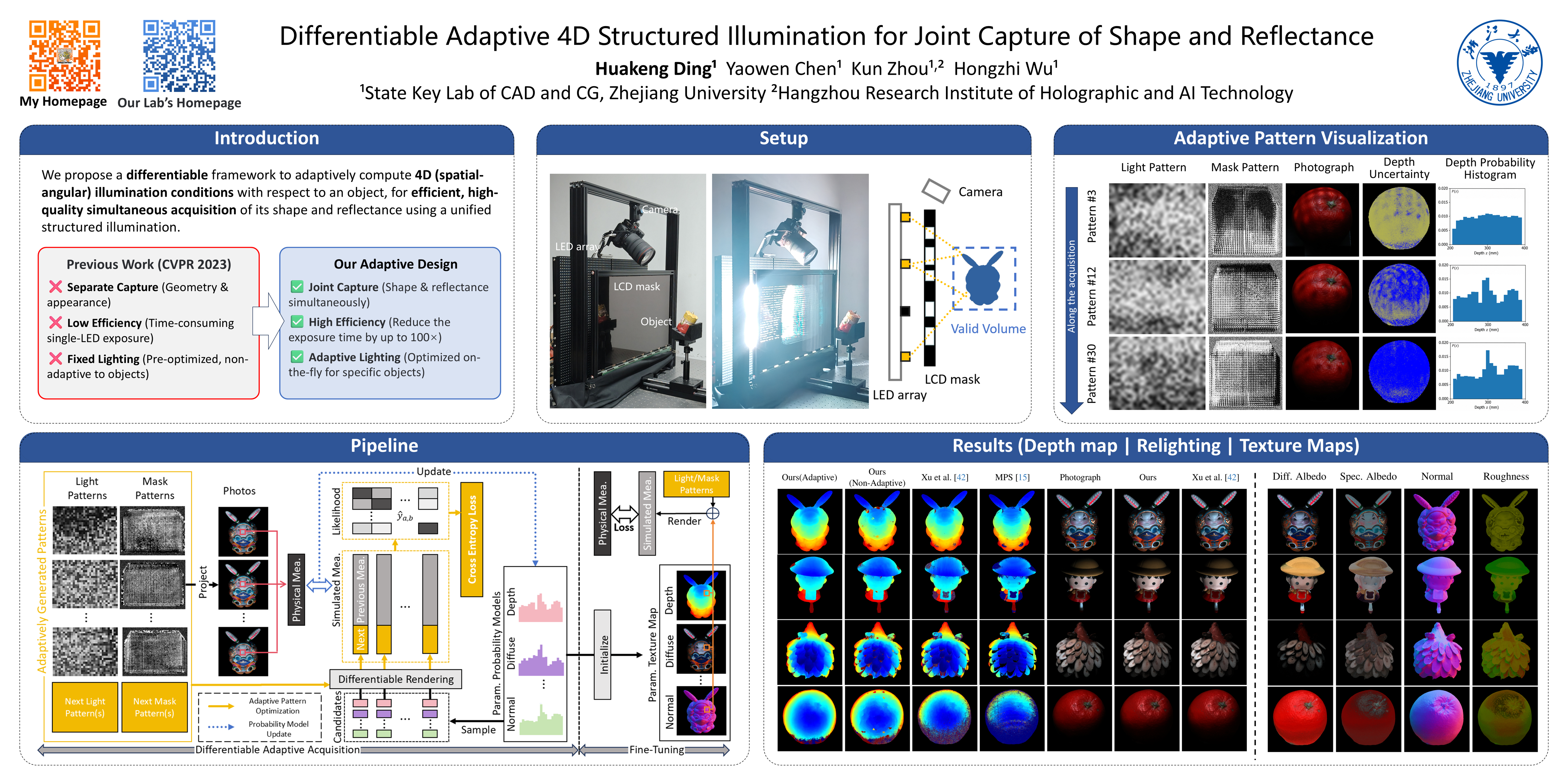
We present a differentiable framework to adaptively compute 4D illumination conditions with respect to an object, for efficient, high-quality simultaneous acquisition of its shape and reflectance, with a unified spatial-angular structured light and a single camera. Using a simple histogram-based pixel-level probability model for depth and reflectance, we differentiably link the next illumination condition(s) with a loss that encourages the reduction in depth uncertainty. As new structured illumination is cast, corresponding image measurements are used to update the uncertainty at each pixel. Finally, a fine-tuning-based approach reconstructs the depth map and reflectance parameter maps, by minimizing the differences between all physical measurements and their simulated counterparts. The effectiveness of our framework is demonstrated on physical objects with wide variations in shape and appearance. Our depth results compare favorably with state-of-the-art techniques, while our reflectance results are comparable when validated against photographs.
Optical Diffraction-based Convolution for Semiconductor Lithography
Young-Han Son ⋅ Dong-Hee Shin ⋅ Deok-Joong Lee ⋅ Hyun Jung Lee ⋅ Tae-Eui Kam
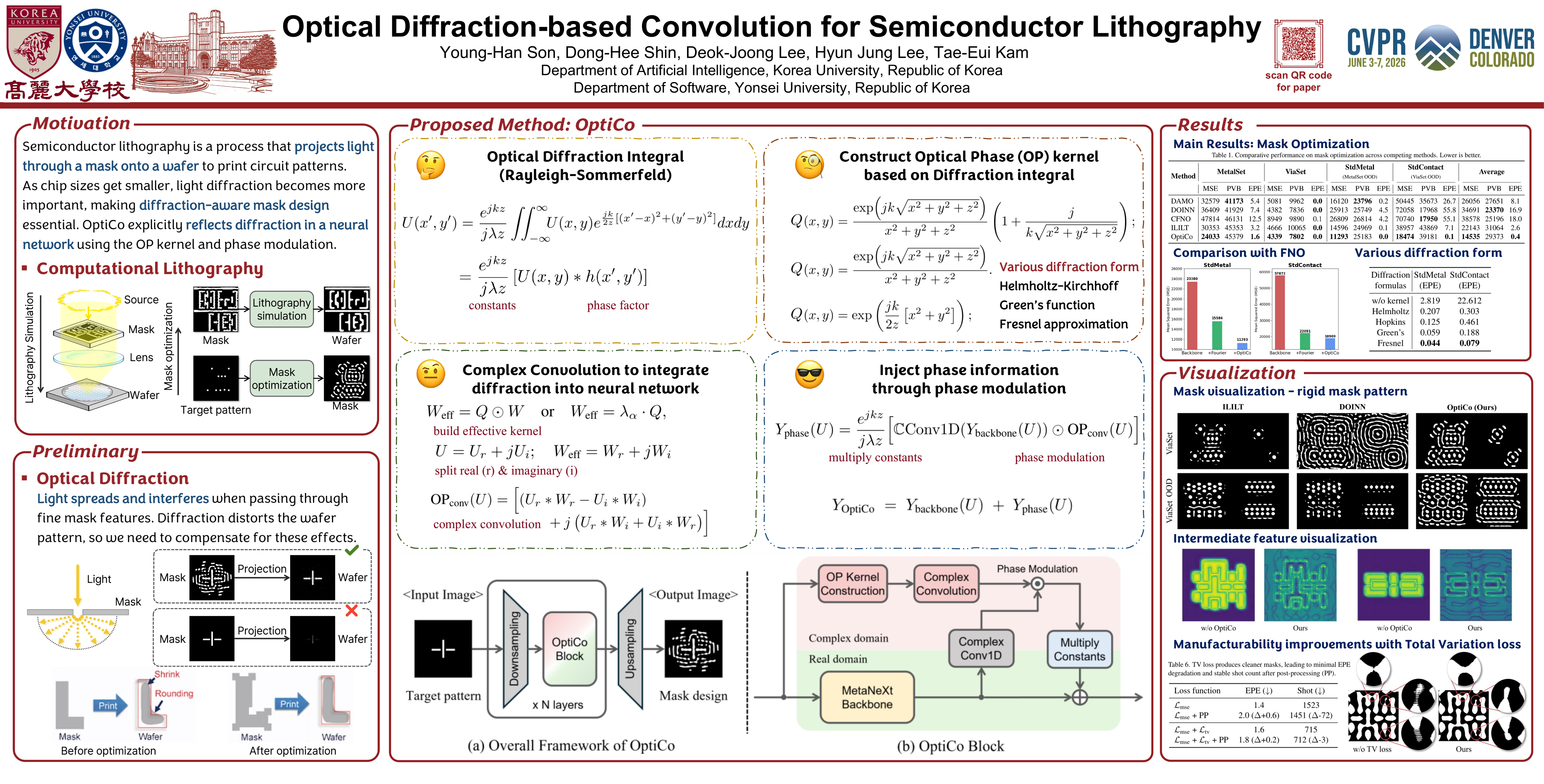
In recent years, the increasing demand for smaller and more powerful semiconductors highlighted the critical role of lithography—a key stage in semiconductor manufacturing responsible for precise mask design and wafer patterning. To meet these demands, the semiconductor industry has increasingly adopted computational lithography, employing machine learning and deep learning techniques to accelerate advancements in lithographic technology. Despite the various research efforts and successes in computational lithography, there remains a lack of explicit incorporation of physical principles. This gap limits the ability of existing methods to fully capture the complex physical phenomena inherent in lithography behaviors. To bridge this gap, we propose OptiCo, a novel convolutional neural network that seamlessly integrates optical diffraction principles into its architecture. At its core, OptiCo employs an optical phase kernel to model phase variations resulting from light propagation, effectively capturing the physical interactions among light, masks, and wafers. We evaluate OptiCo on semiconductor lithography benchmarks, demonstrating its superior performance in mask optimization tasks, with its remarkable generalization capabilities in OOD datasets.
GSNR: Graph Smooth Null-Space Representation for Inverse Problems
Romario Gualdrón-Hurtado ⋅ Roman Jacome ⋅ Rafael S. Suárez ⋅ Henry Arguello
Inverse problems in imaging are undetermined, leading to infinitely many solutions consistent with the measurements due to the non-trivial null-space of the sensing matrix. Common image priors promote solutions on the general image manifold, such as sparsity, smoothness, or score function. However, as these priors do not constrain the null‑space component, they can bias the reconstruction. Thus, we aim to incorporate meaningful null-space information into the reconstruction framework. Inspired by smooth image representation on graphs, we propose Graph-Smooth Null-Space Representation (GSNR), a mechanism that imposes structure only into the invisible component. Particularly, given a graph Laplacian, we construct a null-restricted Laplacian that encodes similarity between neighboring pixels in the null-space signal, and we design a low-dimensional projection matrix from the $p$-smoothest spectral graph modes (lowest graph frequencies). This approach has strong theoretical and practical implications: i) improved convergence via a null-only graph regularizer, ii) better coverage, how much null‑space variance is captured by $p$ modes, and iii) high predictability, how well these modes can be inferred from the measurements. GSNR is incorporated into well-known inverse problem solvers, e.g., PnP, DIP, and diffusion solvers, in four scenarios: image deblurring, compressed sensing, demosaicing, and image super-resolution, providing consistent improvement of up to 4.3 dB over baseline formulations and up to 1 dB compared with end-to-end learned models in terms of PSNR.
MatE: Material Extraction from Single-Image via Geometric Prior
Zeyu Zhang ⋅ Wei Zhai ⋅ Jian Yang ⋅ Yang Cao
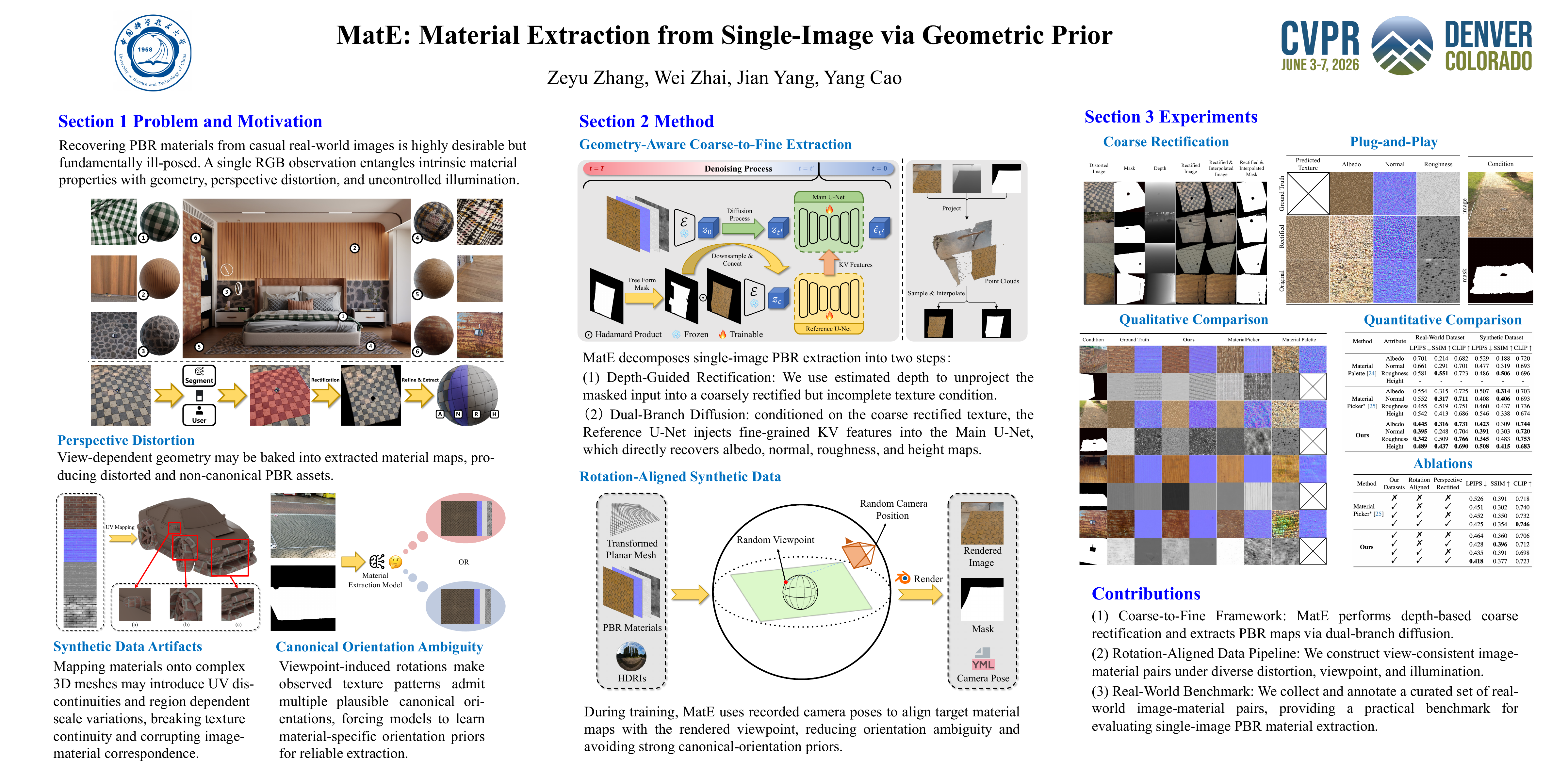
The creation of high-fidelity, physically-based rendering (PBR) materials remains a bottleneck in many graphics pipelines, typically requiring specialized equipment and expert-driven post-processing. To democratize this process, we present MatE, a novel method for generating tileable PBR materials from a single image taken under unconstrained, real-world conditions. Given an image and a user-provided mask, MatE first performs coarse rectification using an estimated depth map as a geometric prior, and then employs a dual-branch diffusion model. Leveraging a learned consistency from rotation-aligned and scale-aligned training data, this model further rectify residual distortions from the coarse result and translate it into a complete set of material maps, including albedo, normal, roughness and height. Our framework achieves invariance to the unknown illumination and perspective of the input image, allowing for the recovery of intrinsic material properties from casual captures. Through comprehensive experiments on both synthetic and real-world data, we demonstrate the efficacy and robustness of our approach, enabling users to create realistic materials from real-world image.
αMatte4K & µMatting: Dataset and Model for Ultra-Micro Precision Alpha Video Matting
Xinyi Chen ⋅ Hang Dong ⋅ Baowei Jiang ⋅ Shenkun Xu ⋅ Youqi Guan ⋅ Kanle Shi ⋅ Kun Gai ⋅ Haichuan Song
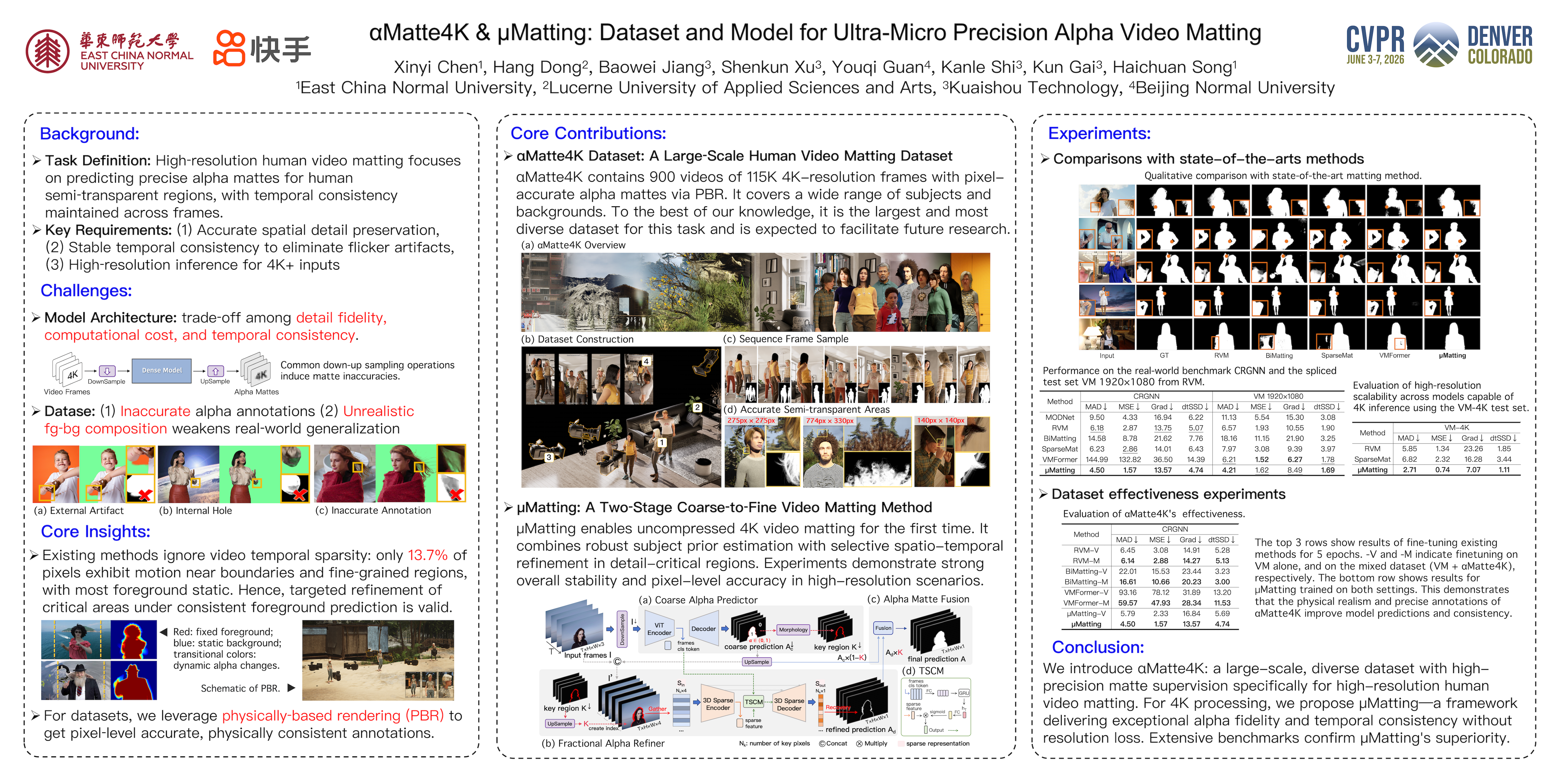
High-resolution human video matting aims to predict accurate alpha mattes for semi-transparent regions while ensuring temporal consistency across frames.Despite notable progress, existing research remains limited by the insufficient quality of datasets, including (1) inaccurate alpha fractional values resulting from imperfect annotation, and (2) visual inconsistencies arising from arbitrary foreground-background compositions that lack natural coherence.In this paper, we introduce $\alpha$Matte4K, a large-scale 4K-resolution human video matting dataset, which achieves accurate annotations and physical consistency through physically based rendering (PBR).From model perspective, constrained by computational costs, current methods often up-sample alpha outputs to meet target resolutions that unavoidably diminishes precision.To overcome this critical limitation, we introduce $\mu$Matting, a innovative resolution-agnostic two-stage matting framework for video matting: (1) coarse matte localization using a portrait-aware masked autoencoder; (2) refinement of critical regions via sparse 3D convolution, augmented by a temporal modulator that injects global spatio-temporal cues for enhanced consistency and contextual awareness. Extensive experiments show that $\alpha$Matte4K boosts baseline performance, while $\mu$Matting surpasses state-of-the-art methods in accuracy and spatio-temporal consistency, driving applications in real-world scenarios.
Revisiting Optimal Coding for I-ToF under Practical Sensor Constraints
WENBIN LUO ⋅ Takafumi Iwaguchi ⋅ Ryusuke Sagawa ⋅ Hiroshi Kawasaki
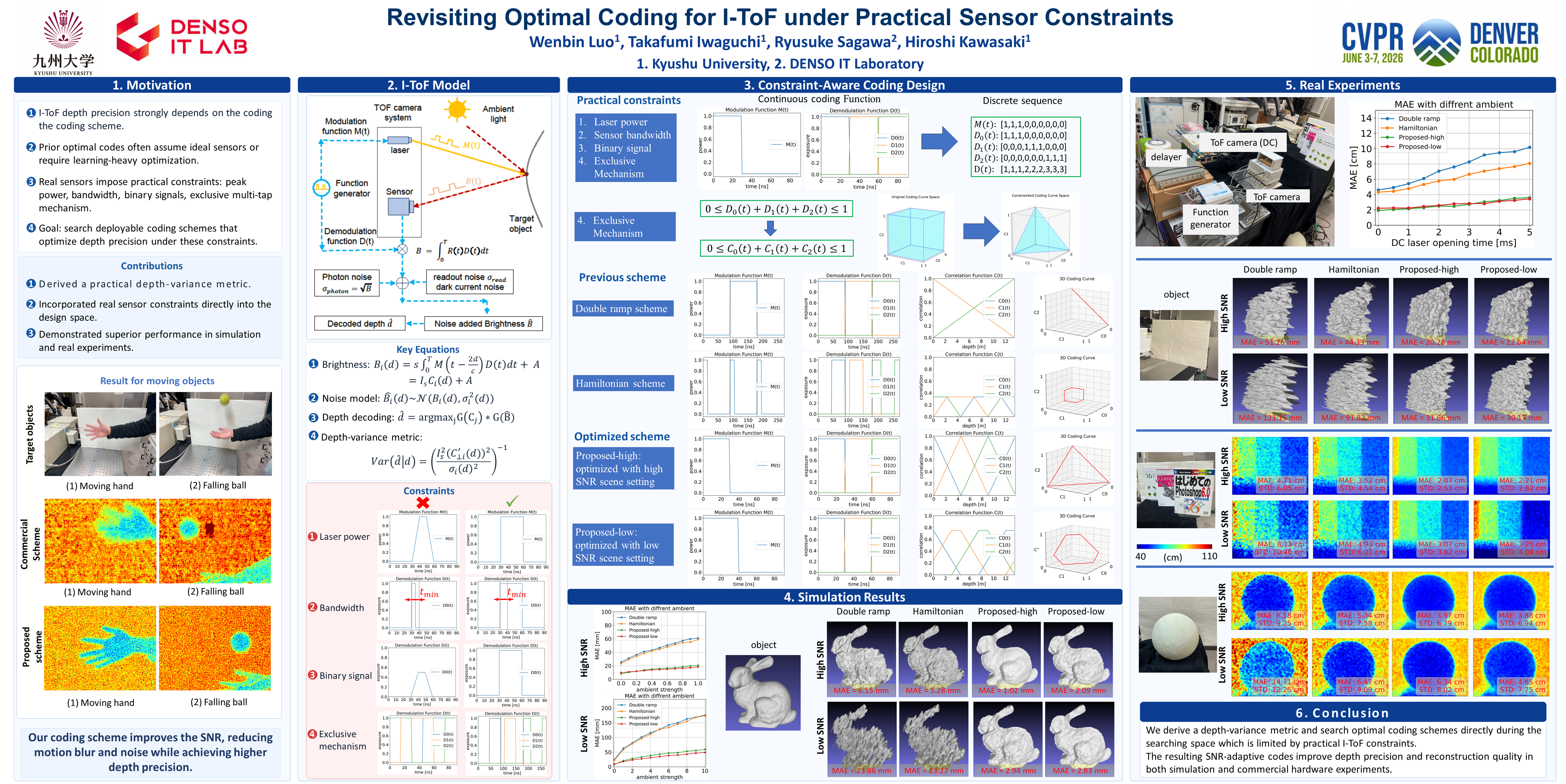
The depth precision of an indirect time-of-flight (I-ToF) camera is highly dependent on its coding scheme. However, identifying the optimal coding scheme is challenging due to the infinitely many possible combinations of modulation and demodulation functions. Although previous works have derived depth-precision metrics to guide coding-scheme design, they either do not satisfy the constraints of real-world I-ToF devices or rely heavily on large-scale deep-learning optimization. In this work, we first analyze the error-propagation process in I-ToF depth sensing and derive a new metric for guiding the design and search of coding schemes. Then we incorporate practical hardware constraints of I-ToF sensors directly into the coding-scheme design, which greatly reduces the space of feasible modulation and demodulation functions and makes metric-based search feasible. The coding schemes obtained by our search method outperform previous schemes in both simulations and real-world experiments.
Dynamic Black-hole Emission Tomography with Physics-informed Neural Fields
Berthy T. Feng ⋅ Andrew A. Chael ⋅ David Bromley ⋅ Aviad Levis ⋅ William Freeman ⋅ Katherine L. Bouman
With the success of static black-hole imaging, the next frontier is the dynamic and 3D imaging of black holes. Recovering the dynamic 3D gas near a black hole would reveal previously-unseen parts of the universe and inform new physics models. However, only sparse radio measurements from a single viewpoint are possible, making the dynamic 3D reconstruction problem significantly ill-posed. Previously, BH-NeRF addressed the ill-posed problem by assuming Keplerian dynamics of the gas, but this assumption breaks down near the black hole, where the strong gravitational pull of the black hole and increased electromagnetic activity complicate fluid dynamics. To overcome the restrictive assumptions of BH-NeRF, we propose PINeRF, a physics-informed approach that uses differentiable neural rendering to fit a 4D (time + 3D) emissivity field given EHT measurements. Our approach jointly reconstructs the 3D velocity field with the 4D emissivity field and enforces the velocity as a soft constraint on the dynamics of the estimated emissivity. In experiments on simulated data, we find significantly improved reconstruction accuracy over both BH-NeRF and a totally physics-agnostic approach. We demonstrate how our method can be used to estimate other physics parameters of the black hole, such as its spin.
Exploring Spatiotemporal Feature Propagation for Video-Level Compressive Spectral Reconstruction: Dataset, Model and Benchmark
Lijing Cai ⋅ Zhan Shi ⋅ Chenglong Huang ⋅ Jinyao Wu ⋅ Qiping Li ⋅ Zikang Huo ⋅ Linsen Chen ⋅ Chongde Zi ⋅ Xun Cao
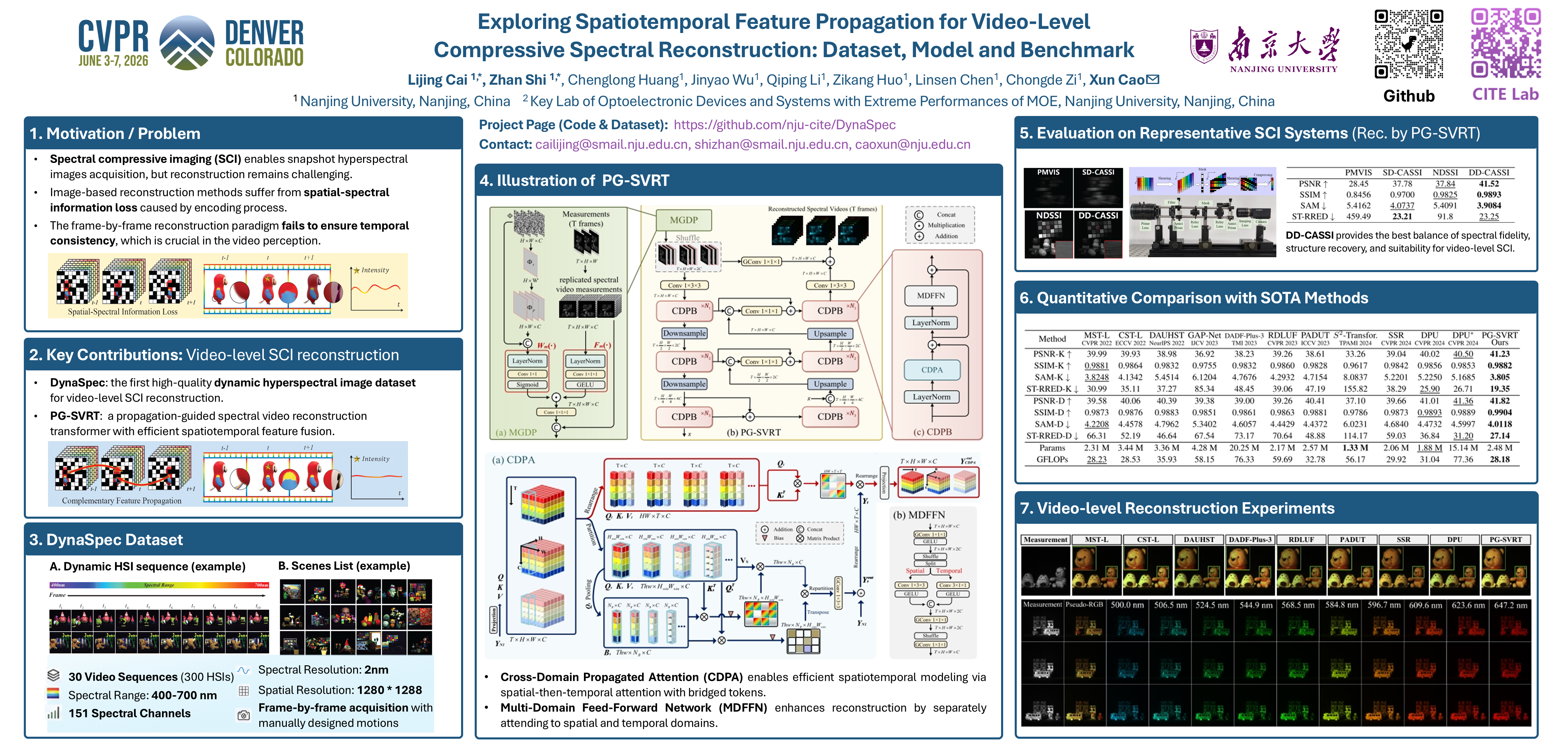
Recently, Spectral Compressive Imaging (SCI) has achieved remarkable success, unlocking significant potential for dynamic spectral vision. However, existing reconstruction methods, primarily image-based, suffer from two limitations: (i) Encoding process masks spatial-spectral features, leading to uncertainty in reconstructing missing information from single compressed measurements, and (ii) The frame-by-frame reconstruction paradigm fails to ensure temporal consistency, which is crucial in the video perception. To address these challenges, this paper seeks to advance spectral reconstruction from the image level to the video level, leveraging the complementary features and temporal continuity across adjacent frames in dynamic scenes. Initially, we construct the first high-quality dynamic hyperspectral image dataset (DynaSpec), comprising 30 sequences obtained through frame-scanning acquisition. Subsequently, we propose the Propagation-Guided Spectral Video Reconstruction Transformer (PG-SVRT), which employs a spatial-then-temporal attention to effectively reconstruct spectral features from abundant video information, while using a bridged token to reduce computational complexity. Finally, we conduct simulation experiments to assess the performance of four SCI systems, and construct a DD-CASSI prototype for real-world data collection and benchmarking. Extensive experiments demonstrate that PG-SVRT achieves superior performance in reconstruction quality, spectral fidelity, and temporal consistency, while maintaining minimal FLOPs.
Generalizable Radio-Frequency Radiance Fields for Spatial Spectrum Synthesis
Kang Yang ⋅ Yuning Chen ⋅ Wan Du
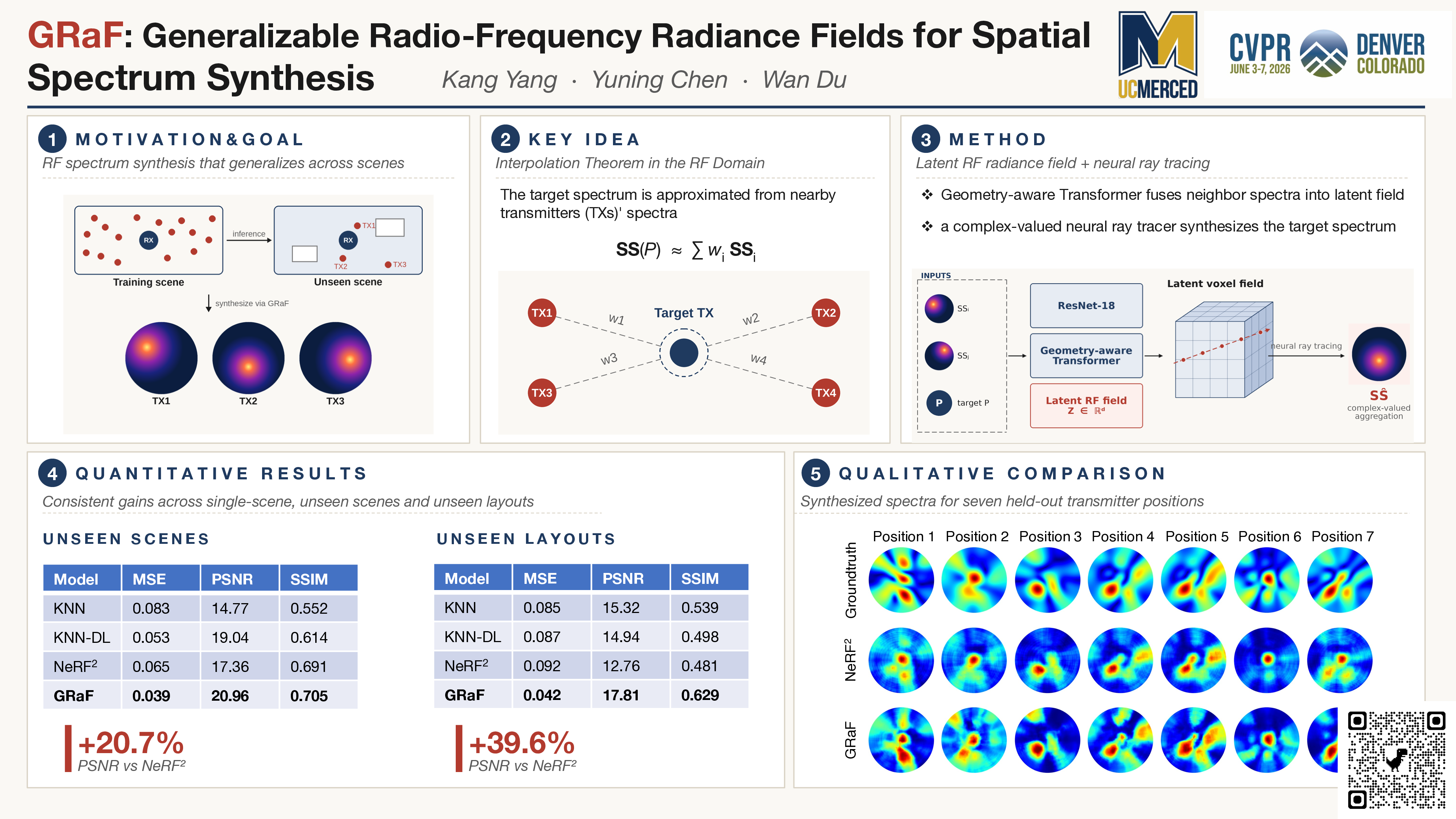
We present GRaF, Generalizable Radio-Frequency (RF) Radiance Fields, a framework that models RF signal propagation to synthesize spatial spectra at arbitrary transmitter or receiver locations, where each spectrum measures signal power across all surrounding directions at the receiver. Unlike state-of-the-art methods that adapt vanilla Neural Radiance Fields (NeRF) to the RF domain with scene-specific training, GRaF generalizes across scenes to synthesize spectra. To enable this, we prove an interpolation theory in the RF domain: the spatial spectrum from a transmitter can be approximated using spectra from geographically proximate transmitters. Building on this theory, GRaF comprises two components: (i) a geometry-aware Transformer encoder that captures spatial correlations from neighboring transmitters to learn a scene-independent latent RF radiance field, and (ii) a neural ray tracing algorithm that estimates spectrum reception at the receiver. Experimental results demonstrate that GRaF outperforms existing methods on single-scene benchmarks and achieves state-of-the-art performance on unseen scene layouts.
SAR2Net: Learning Spatially Anchored Representations for Retrieval-Guided Cross-Stain Alignment
Tianle Shen ⋅ Fang Yan ⋅ Xiaofan Zhang
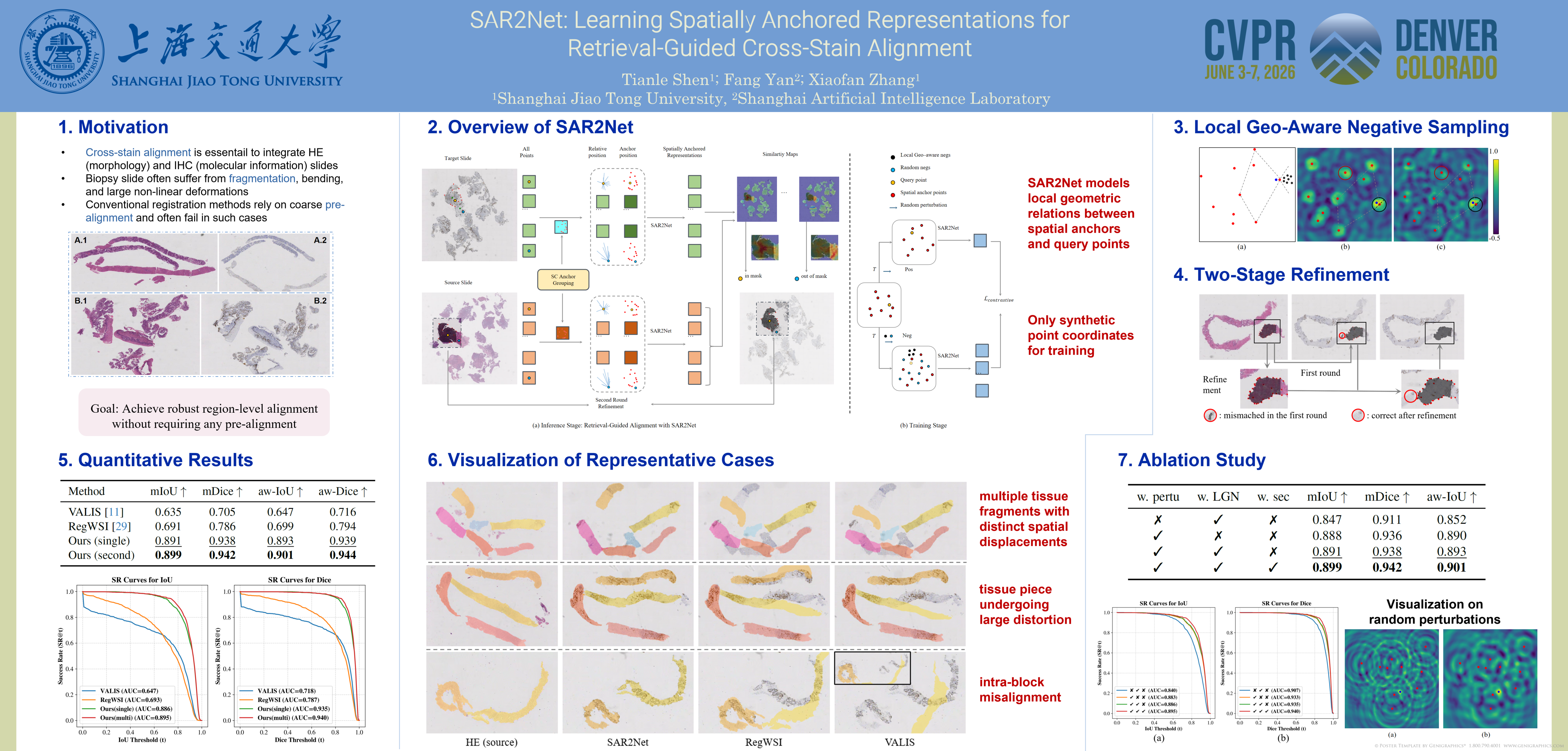
Achieving spatial alignment between whole-slide images (WSIs) across stains remains highly challenging due to extreme resolution, tissue fragmentation, and large nonlinear deformations. Conventional registration pipelines depend on global pre-alignment and spatial consistency, which often collapse under such distortions. We present SAR2Net, a framework that learns spatially anchored representations and reformulates cross-stain alignment as a region-level feature retrieval problem. Instead of estimating explicit transformations, SAR2Net learns pointwise representations encoding the relative spatial relationships to tissue landmarks. Given landmarks and arbitrary coordinates, it predicts spatially anchored features that serve as deformation-invariant descriptors of tissue topology. A multi-stage retrieval framework then establishes correspondences between slides, even when global alignment is infeasible. Experiments on biopsy-oriented HE-IHC datasets show that SAR2Net achieves robust region-level alignment under severe tissue distortions, outperforming previous registration methods.
Advancing Cancer Prognosis with Hierarchical Fusion of Genomic, Proteomic and Pathology Imaging Data from a Systems Biology Perspective
Junjie Zhou ⋅ Bao Xue ⋅ Meiling Wang ⋅ WEI SHAO ⋅ Daoqiang Zhang
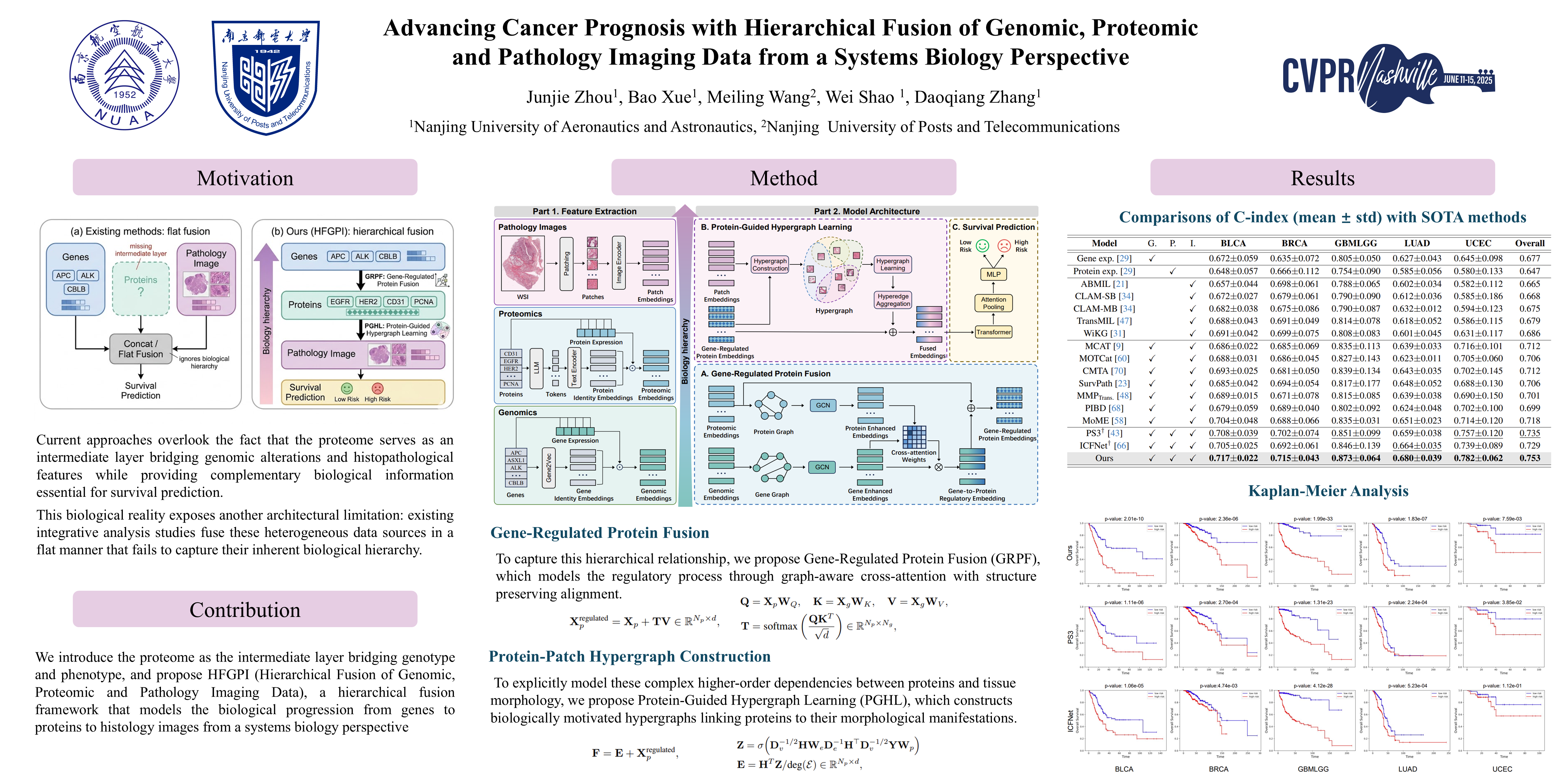
To enhance the precision of cancer prognosis, recent research has increasingly focused on multimodal survival methods by integrating genomic data and histology images. However, current approaches overlook the fact that the proteome serves as an intermediate layer bridging genomic alterations and histopathological features while providing complementary biological information essential for survival prediction. This biological reality exposes another architectural limitation: existing integrative analysis studies fuse these heterogeneous data sources in a flat manner that fails to capture their inherent biological hierarchy. To address these limitations, we propose HFGPI, a hierarchical fusion framework that models the biological progression from genes to proteins to histology images from a systems biology perspective. Specifically, we introduce Molecular Tokenizer, a molecular encoding strategy that integrates identity embeddings with expression profiles to construct biologically informed representations for genes and proteins. We then develop Gene-Regulated Protein Fusion (GRPF), which employs graph-aware cross-attention with structure-preserving alignment to explicitly model gene-protein regulatory relationships and generate gene-regulated protein representations. Additionally, we propose Protein-Guided Hypergraph Learning (PGHL), which establishes associations between proteins and image patches, leveraging hypergraph convolution to capture higher-order protein-morphology relationships. The final features are progressively fused across hierarchical layers to achieve precise survival outcome prediction. Extensive experiments on five benchmark datasets demonstrate the superiority of HFGPI over state-of-the-art methods.
PromptStereo: Zero-Shot Stereo Matching via Structure and Motion Prompts
Xianqi Wang ⋅ Hao Yang ⋅ Hangtian Wang ⋅ JunDa Cheng ⋅ Gangwei Xu ⋅ Min Lin ⋅ Xin Yang
Modern stereo matching methods have leveraged monocular depth foundation models to achieve superior zero-shot generalization performance. However, most existing methods primarily focus on extracting robust features for cost volume construction or disparity initialization. At the same time, the iterative refinement stage, which is also crucial for zero-shot generalization, remains underexplored. Some methods treat monocular depth priors as guidance for iteration, but conventional GRU-based architectures struggle to exploit them due to the limited representation capacity. In this paper, we propose Prompt Recurrent Unit (PRU), a novel iterative refinement module based on the decoder of monocular depth foundation models. By integrating monocular structure and stereo motion cues as prompts into the decoder, PRU enriches the latent representations of monocular depth foundation models with absolute stereo-scale information while preserving their inherent monocular depth priors. Experiments demonstrate that our PromptStereo achieves state-of-the-art zero-shot generalization performance across multiple datasets, while maintaining comparable or faster inference speed. Our findings highlight prompt-guided iterative refinement as a promising direction for zero-shot stereo matching.
Any Resolution Any Geometry: From Multi-View To Multi-Patch
Wenqing Cui ⋅ Zhenyu Li ⋅ Mykola Lavreniuk ⋅ Jian Shi ⋅ Ramzi Idoughi ⋅ Xiangjun Tang ⋅ Peter Wonka
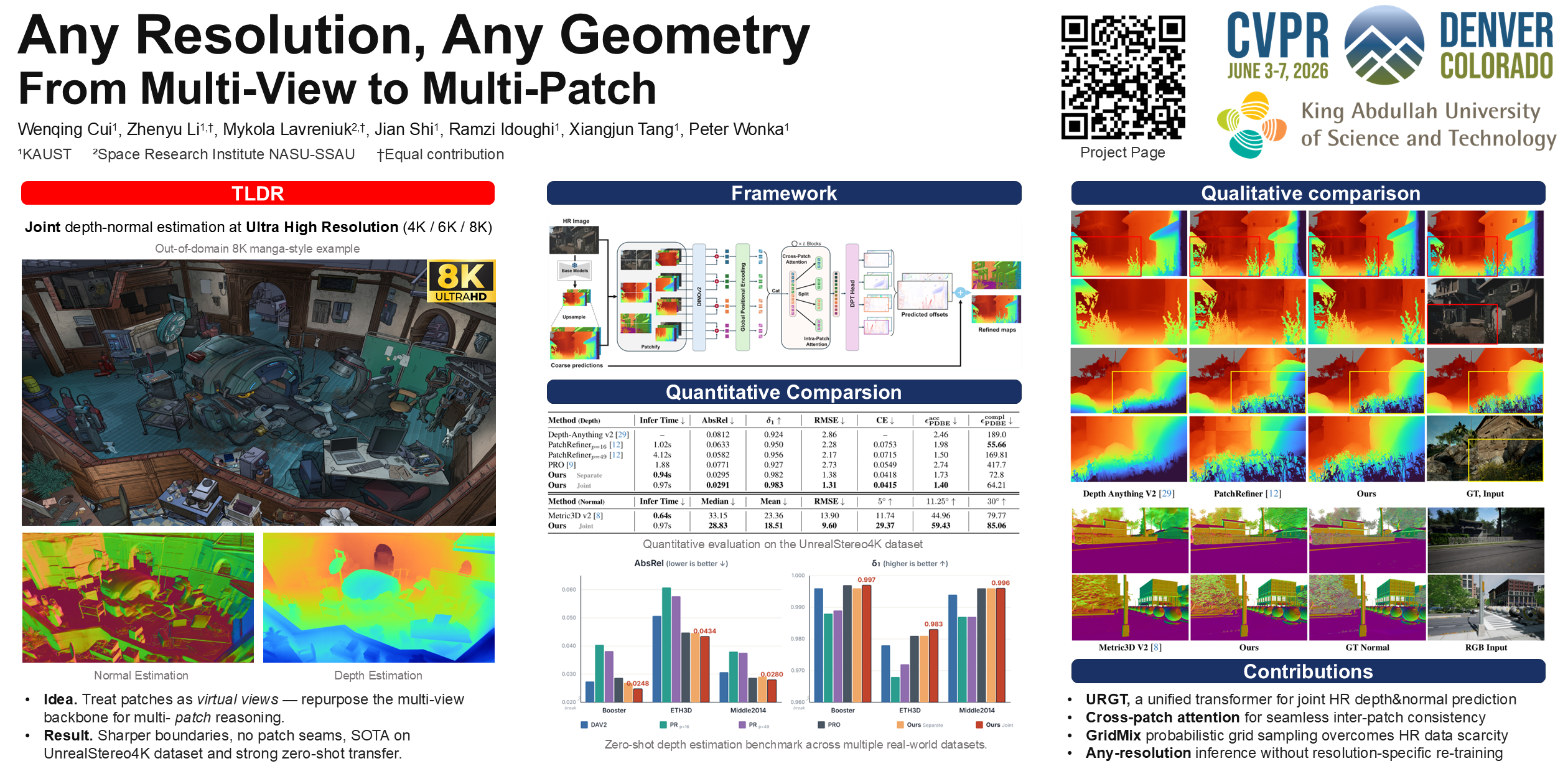
Joint estimation of surface normals and depth is essential for holistic 3D scene understanding, yet high-resolution prediction remains difficult due to the trade-off between preserving fine local detail and maintaining global consistency. We address this challenge by adapting the Visual Geometry Grounded Transformer (VGGT) into a unified multi-patch transformer for monocular high-resolution depth--normal estimation. A single high-resolution image is partitioned into patches that are augmented with coarse depth and normal priors from pre-trained models, and jointly processed in a single forward pass to predict refined geometric outputs. Global coherence is enforced through cross-patch attention, which enables long-range geometric reasoning and seamless propagation of information across patches within a shared backbone. To further enhance spatial robustness, we introduce a GridMix patch sampling strategy that probabilistically samples grid configurations during training, improving inter-patch consistency and generalization. Our method achieves state-of-the-art results on UnrealStereo4K, jointly improving depth and normal estimation---reducing AbsRel from 0.0582 to 0.0291, RMSE from 2.17 to 1.31, and lowering mean angular error from 23.36$^\circ$ to 18.27$^\circ$—while producing sharper and more stable geometry. The proposed multi-patch framework also demonstrates strong zero-shot and cross-domain generalization and scales effectively to very high resolutions, offering an efficient and extensible solution for high-quality geometry refinement.
Paparazzo: Active Mapping of Moving 3D Objects
Davide Allegro ⋅ Shiyao Li ⋅ Stefano Ghidoni ⋅ Vincent Lepetit
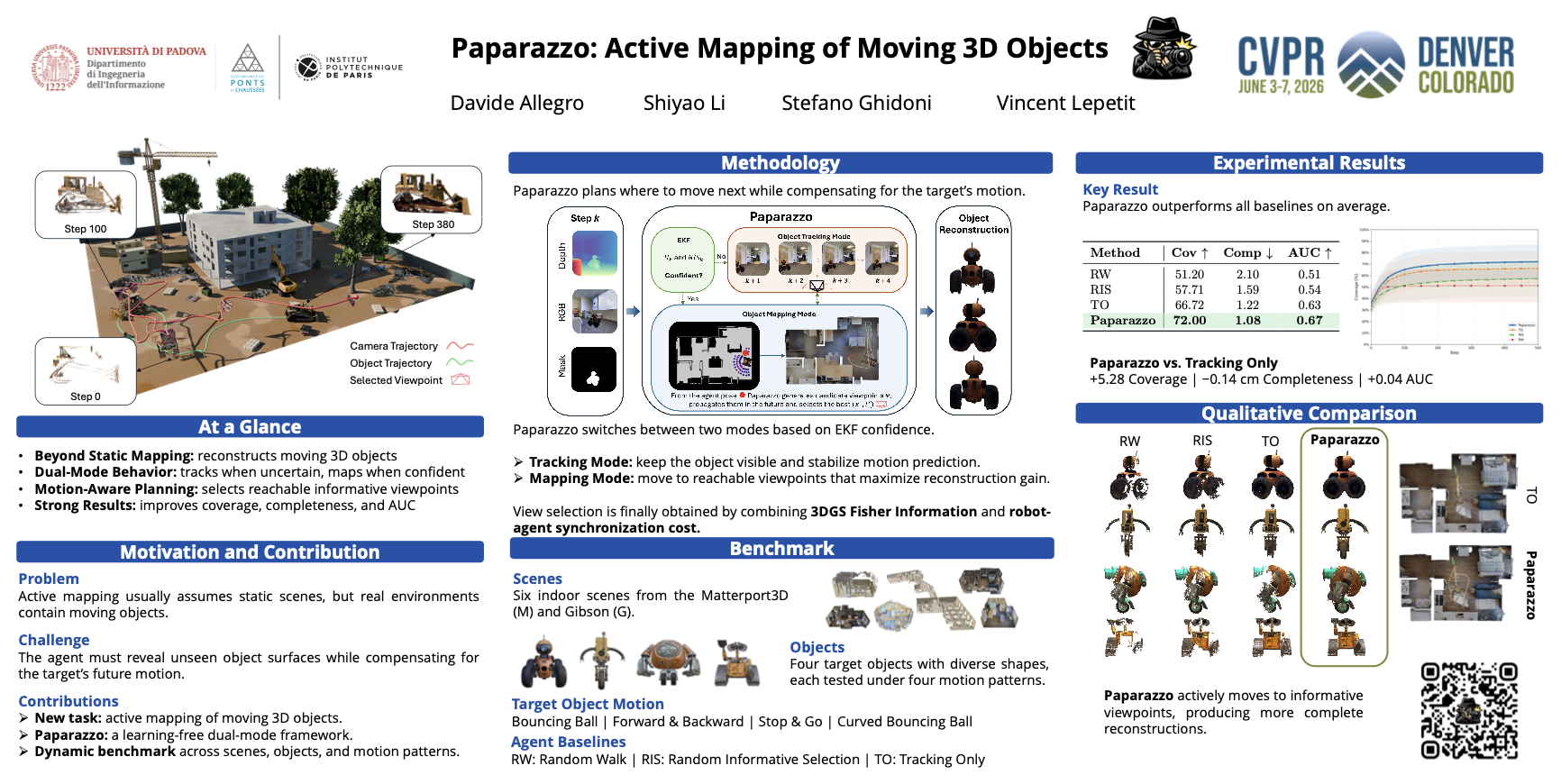
Current 3D mapping pipelines generally assume static environments, which limits their ability to accurately capture and reconstruct moving objects. To address this limitation, we introduce the novel task of active mapping of moving objects, in which a mapping agent must plan its trajectory while compensating for the object's motion. Our approach, Paparazzo, provides a learning-free solution that robustly predicts the target's trajectory and identifies the most informative viewpoints from which to observe it, to plan its own path. We also contribute a comprehensive benchmark designed for this new task. Through extensive experiments, we show that Paparazzo significantly improves 3D reconstruction completeness and accuracy compared to several strong baselines, marking an important step toward dynamic scene understanding.
DepthFocus: Controllable Depth Estimation for See-Through Scenes
junhong min ⋅ Jimin Kim ⋅ Minwook Kim ⋅ Cheol-Hui Min ⋅ YOUNGPIL JEON ⋅ Minyong Choi
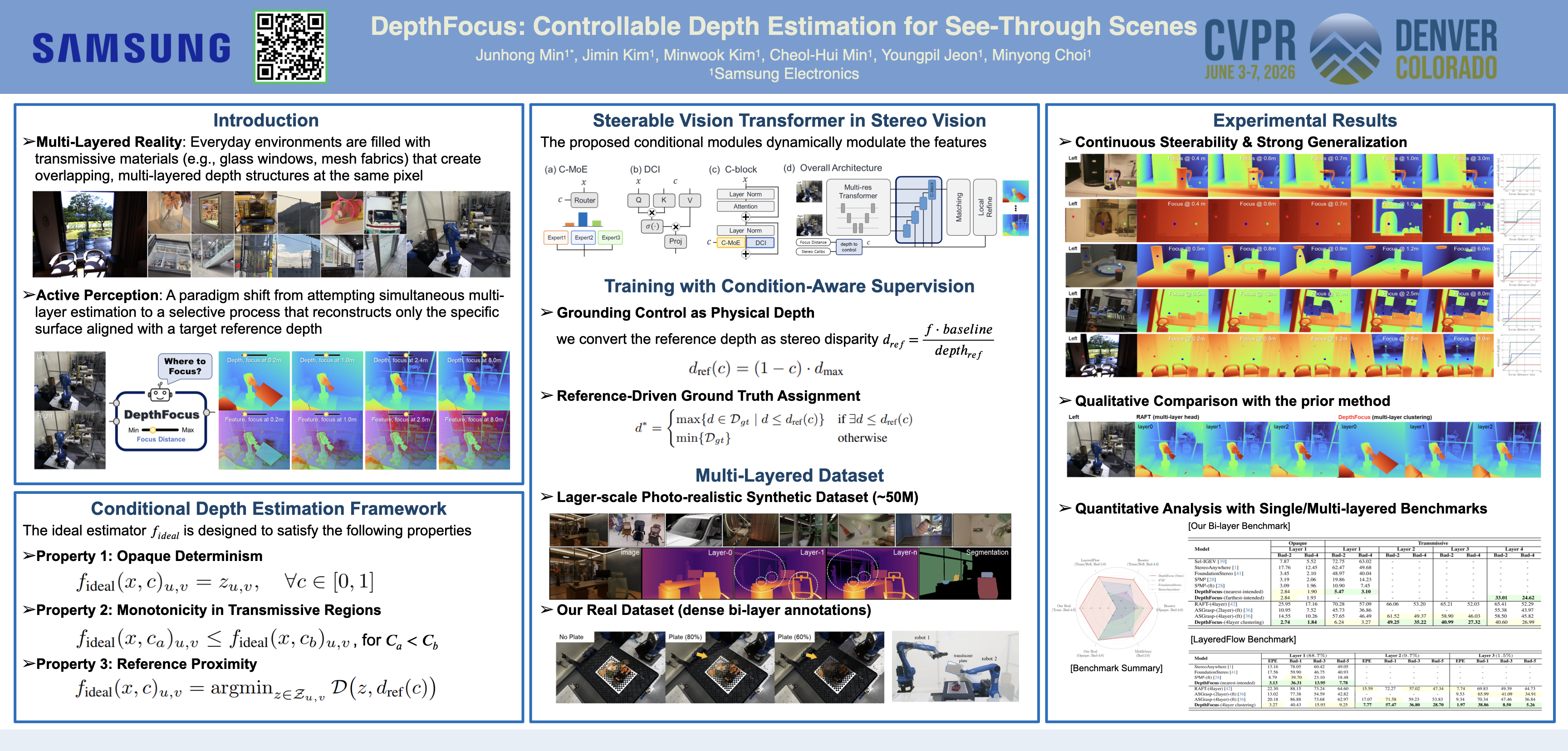
Depth in the real world is rarely singular. Transmissive materials create layered ambiguities that confound conventional perception systems. Existing models remain passive, attempting to estimate static depth maps anchored to the nearest surface, while humans actively shift focus to perceive a desired depth. We introduce DepthFocus, a steerable Vision Transformer that redefines stereo depth estimation as intent-driven control. Conditioned on a scalar depth preference, the model dynamically adapts its computation to focus on the intended depth, enabling selective perception within complex scenes. The training primarily leverages our newly constructed 500k multi-layered synthetic dataset, designed to capture diverse see-through effects. DepthFocus not only achieves state-of-the-art performance on conventional single-depth benchmarks like BOOSTER, a dataset notably rich in transparent and reflective objects, but also quantitatively demonstrates intent-aligned estimation on our newly proposed real and synthetic multi-depth datasets. Moreover, it exhibits strong generalization capabilities on unseen see-through scenes, underscoring its robustness as a significant step toward active and human-like 3D perception.
OVI-MAP: Open-Vocabulary Instance-Semantic Mapping
Zilong Deng ⋅ Federico Tombari ⋅ Marc Pollefeys ⋅ Johanna Wald ⋅ Daniel Barath
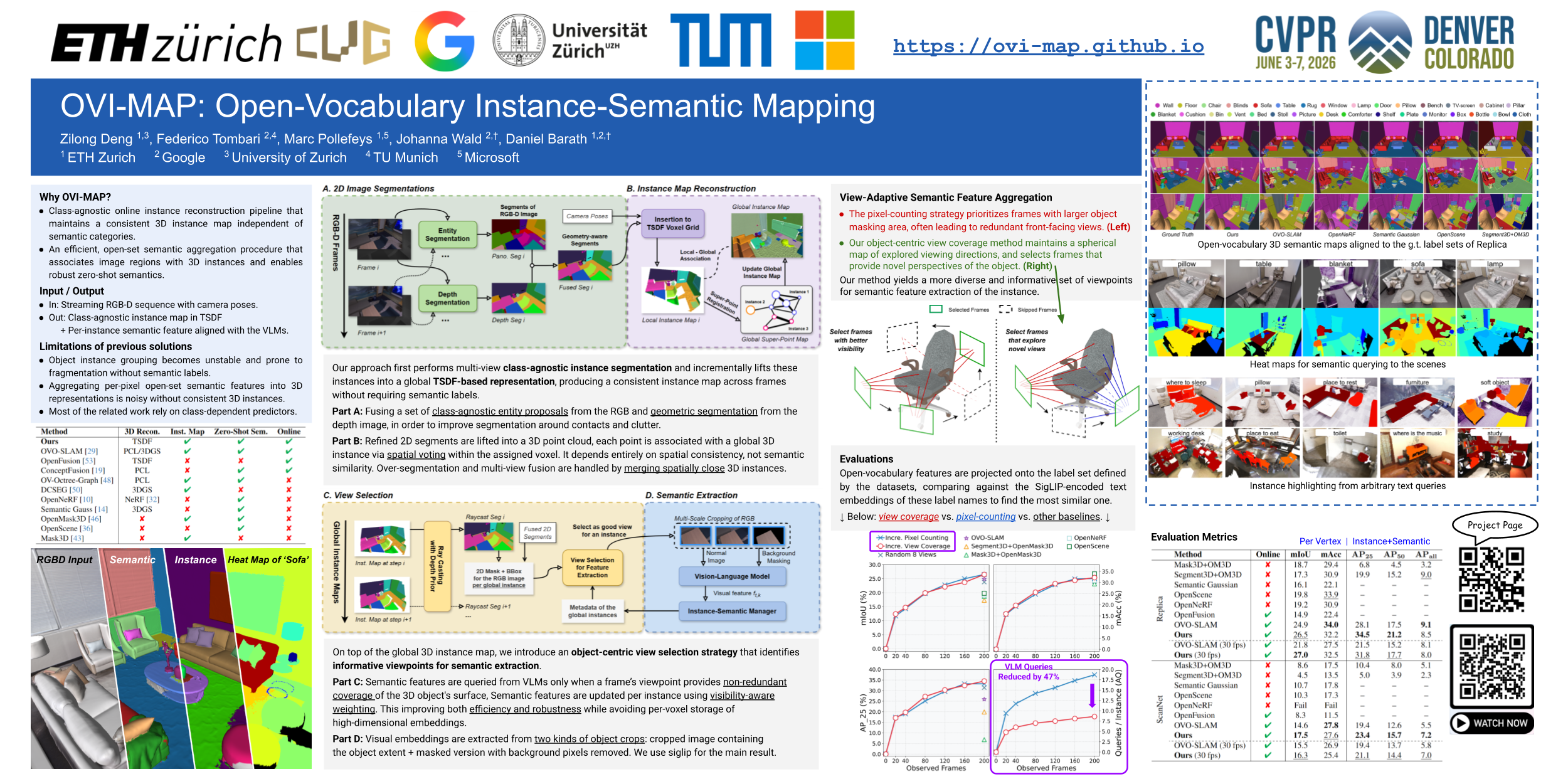
Incremental open-vocabulary 3D instance-semantic mapping is essential for autonomous agents operating in complex everyday environments. However, it remains challenging due to the need for robust instance segmentation, real-time processing, and flexible open-set reasoning. Existing methods often rely on the closed-set assumption or dense per-pixel language fusion, which limits scalability and temporal consistency. We introduce OVI-MAP that decouples instance reconstruction from semantic inference. We propose to build a class-agnostic 3D instance map that is incrementally constructed from RGB-D input, while semantic features are extracted only from a small set of automatically selected views using vision-language models. This design enables stable instance tracking and zero-shot semantic labeling throughout online exploration. Our system operates in real time and outperforms state-of-the-art open-vocabulary mapping baselines on standard benchmarks. The source code will be made publicly available.
PTC-Depth: Pose-Refined Monocular Depth Estimation with Temporal Consistency
Leezy Han ⋅ Seunggyu Kim ⋅ Dongseok Shim ⋅ Hyeonbeom Lee
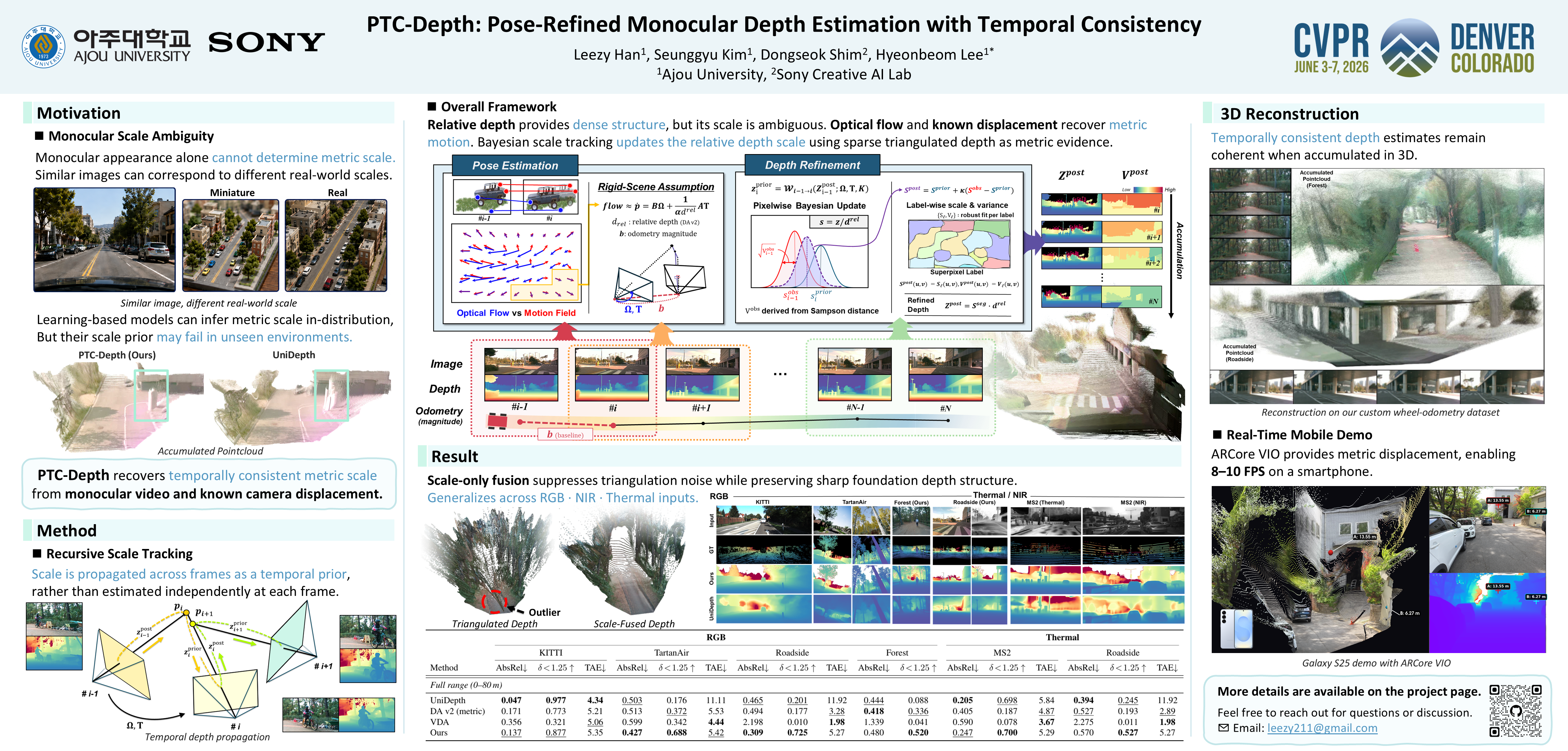
Monocular depth estimation (MDE) has been widely adopted in the perception systems of autonomous vehicles and mobile robots. However, existing approaches often struggle to maintain temporal consistency in depth estimation across consecutive frames. This inconsistency not only causes jitter but can also lead to estimation failures when the depth range changes abruptly. To address these challenges, this paper proposes a consistency-aware monocular depth estimation framework that leverages wheel odometry from a mobile robot to achieve stable and coherent depth predictions over time. Specifically, we estimate camera pose and sparse depth from triangulation using optical flow between consecutive frames. The sparse depth estimates are used to update a recursive Bayesian estimate of the metric scale, which is then applied to rescale the relative depth predicted by a pre-trained depth estimation foundation model. The proposed method is evaluated on the KITTI, TartanAir, MS2, and our own dataset, demonstrating robust and accurate depth estimation performance.
SceneScribe-1M: A Large-Scale Video Dataset with Comprehensive Geometric and Semantic Annotations
Yunnan Wang ⋅ Kecheng Zheng ⋅ Jianyuan Wang ⋅ Minghao Chen ⋅ David Novotny ⋅ Christian Rupprecht ⋅ Yinghao Xu ⋅ Xing Zhu ⋅ Wenjun Zeng ⋅ Xin Jin ⋅ Yujun Shen
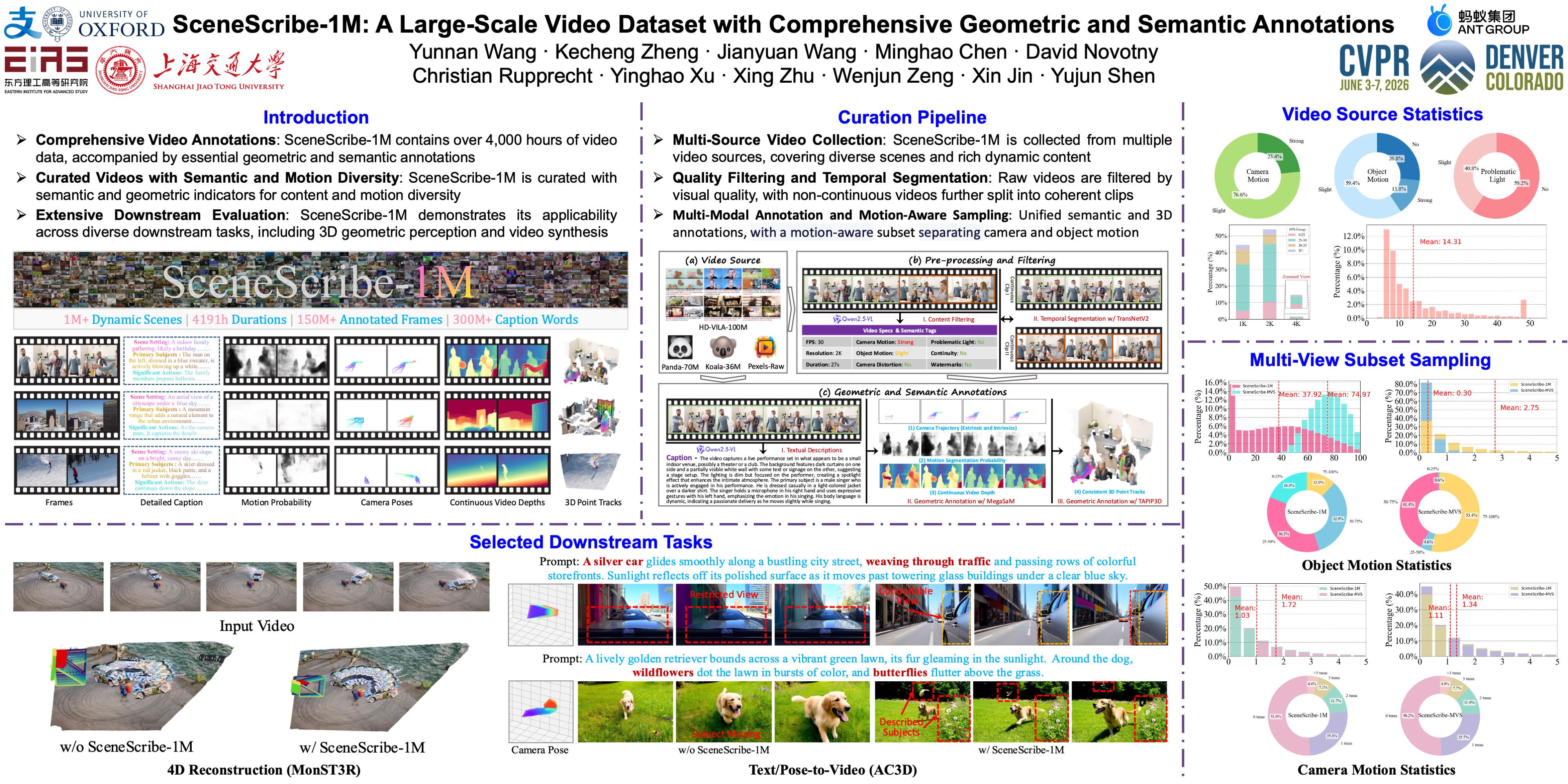
The convergence of 3D geometric perception and video synthesis has created an unprecedented demand for large-scale video data that is rich in both semantic and spatio-temporal information. While existing datasets have advanced either 3D understanding or video generation, a significant gap remains in providing a unified resource that supports both domains at scale. To bridge this chasm, we introduce SceneScribe-1M, a new large-scale, multi-modal video dataset. It comprises one million in-the-wild videos, each meticulously annotated with detailed textual descriptions, precise camera parameters, dense depth maps, and consistent 3D point tracks. We demonstrate the versatility and value of SceneScribe-1M by establishing benchmarks across a wide array of downstream tasks, including monocular depth estimation, scene reconstruction, and dynamic point tracking, as well as generative tasks such as text-to-video synthesis, with or without camera control. By open-sourcing SceneScribe-1M, we aim to provide a comprehensive benchmark and a catalyst for research, fostering the development of models that can both perceive the dynamic 3D world and generate controllable, realistic video content.
Omni-3DEdit: Generalized Versatile 3D Editing in One-Pass
Liyi Chen ⋅ Pengfei Wang ⋅ Guowen Zhang ⋅ Zhiyuan Ma ⋅ Lei Zhang
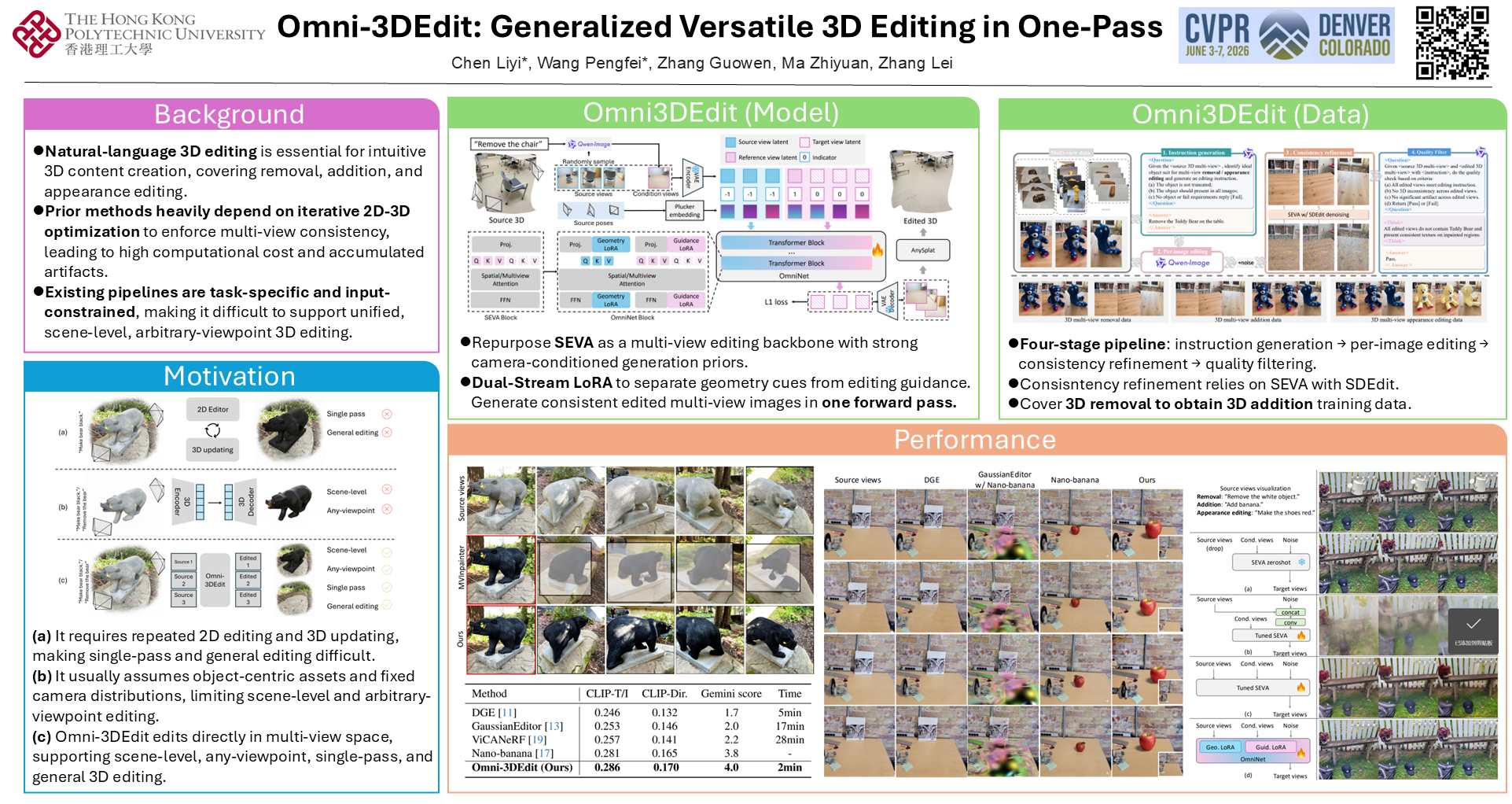
Most instruction-driven 3D editing methods rely on 2D models to guide the explicit and iterative optimization of 3D representations. This paradigm, however, suffers from two primary drawbacks. First, it lacks a universal design of different 3D editing tasks because the explicit manipulation of 3D geometry necessitates task-dependent rules, e.g., 3D appearance editing demands inherent source 3D geometry, while 3D removal alters source geometry. Second, the iterative optimization process is highly time-consuming, often requiring thousands of invocations of 2D/3D updating. We present Omni-3DEdit, a unified, learning-based model that generalizes various 3D editing tasks implicitly. One key challenge to achieve our goal is the scarcity of paired source-edited multi-view assets for training. To address this issue, we construct a data pipeline, synthesizing a relatively rich number of high-quality paired multi-view editing samples. Subsequently, we adapt the pre-trained generative model SEVA as our backbone by concatenating source view latents along with conditional tokens in sequence space. A dual-stream LoRA module is proposed to disentangle different view cues, largely enhancing our model's representational learning capability. As a learning-based model, our model is free of the time-consuming online optimization, and it can complete various 3D editing tasks in one forward pass, reducing the inference time from tens of minutes to approximately two minutes. Extensive experiments demonstrate the effectiveness and efficiency of Omni-3DEdit.
Ani3DHuman: Photorealistic 3D Human Animation with Self-guided Stochastic Sampling
Qi Sun ⋅ Can Wang ⋅ Jiaxiang Shang ⋅ Yingchun Liu ⋅ Jing Liao
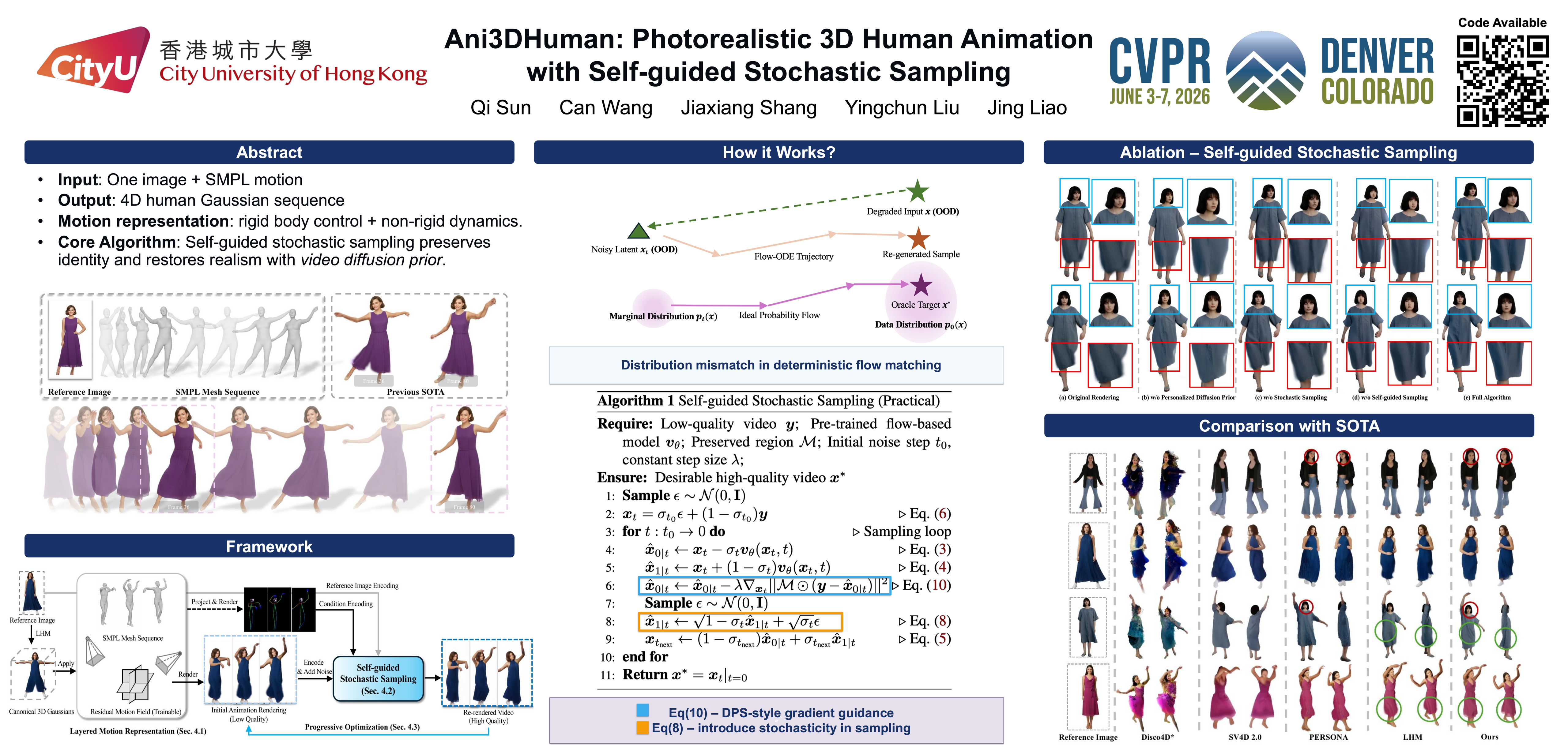
Current 3D human animation methods fail at photorealism: kinematics-based approaches lack non-rigid dynamics like clothing, while methods reconstructing from generated videos suffer from low-quality artifacts and identity loss. To overcome these limitations, we present Ani3DHuman, a framework that marries kinematics-based animation with video diffusion priors. We first introduce a layered motion representation that disentangles rigid motion and residual non-rigid motion. Then, we use a pretrained video diffusion model to restore a coarse rendering from the mesh-rigged animation, which provides supervision for the motion field. However, this restoration task, based on diffusion sampling, is highly challenging, as the initial renderings are out-of-distribution, causing standard deterministic ODE samplers to fail. Therefore, our core technical contribution is self-guided stochastic sampling, which effectively solves the out-of-distribution problem by combining stochastic sampling (for photorealistic quality) with self-guidance (for identity fidelity). These restored videos provide high-quality supervision, enabling the optimization of a realistic 4D motion field. Ani3DHuman achieves state-of-the-art results, and our ablations validate that both components of our sampler are essential for high-fidelity restoration.
Variational Graph-based Normal Integration
Lixiong Chen ⋅ Bohan Yu ⋅ Victor Adrian Prisacariu ⋅ Imari Sato
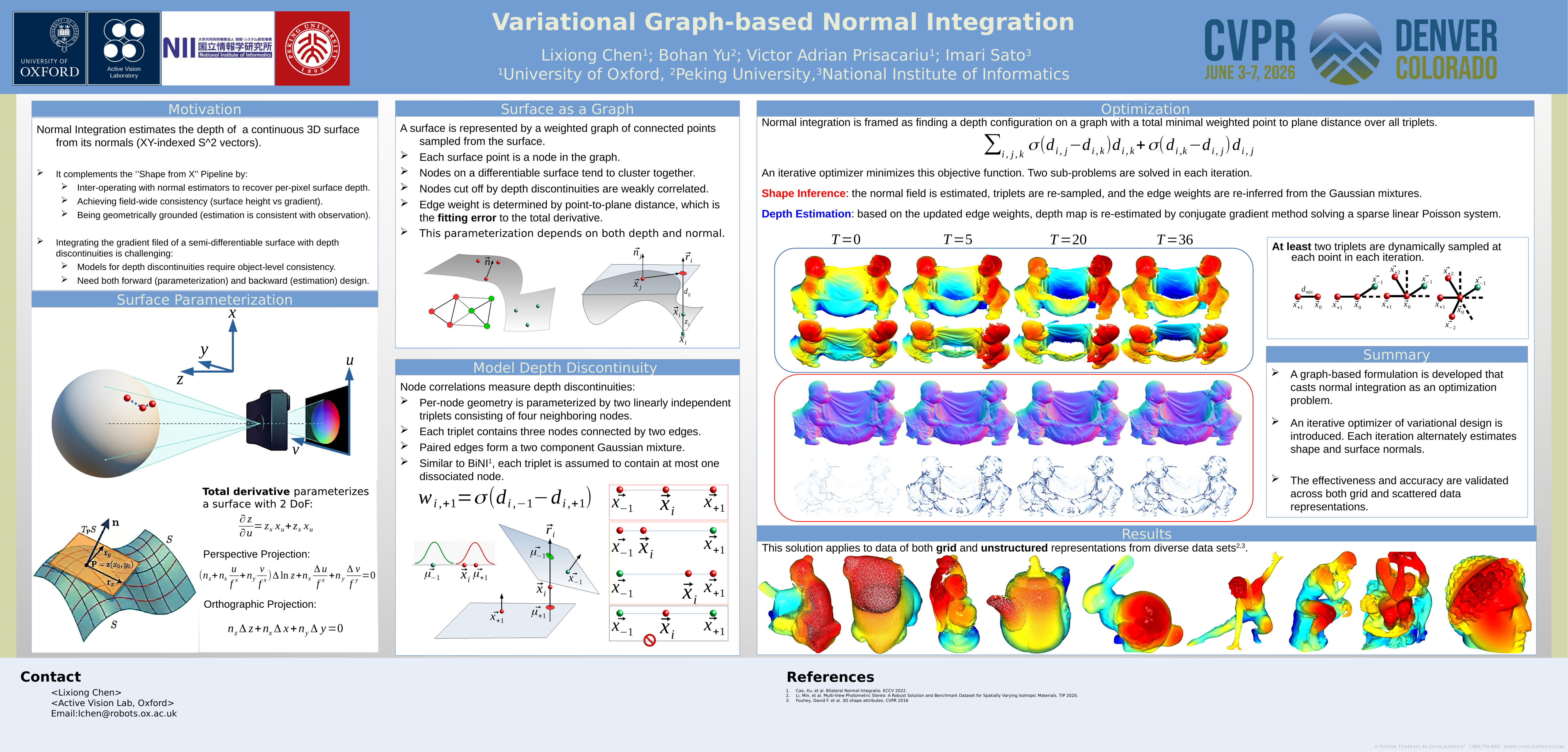
We present a general optimization-based framework for depth-preserving normal integration. Unlike existing methods that operate on surface orientations defined over regular grids, our approach introduces a unified graph-based formulation capable of integrating semi-differentiable surfaces on unstructured domains. Given a set of points uniformly sampled from a surface, we construct a directed, weighted graph that jointly parameterizes the surface geometry and pairwise point correlations. Surface depth is recovered by minimizing projected point-to-plane distances across the graph, and this objective is optimized through variational inference. In our formulation, estimated surface normals serve as latent variables that encode local geometry via the posterior probabilities of a two-component Gaussian mixture, allowing depth discontinuities to be inferred from sampled triplet configurations. The unknowns are estimated in an alternating fashion, and we provide a geometric interpretation of this inference process by relating it to shape deformation. Experimental results show that the proposed method not only outperforms state-of-the-art techniques on regularly gridded data, but also generalizes effectively to scattered points, which existing approaches do not directly support.
Vinedresser3D: Towards Agentic Text-guided 3D Editing
Yankuan Chi ⋅ Xiang Li ⋅ Zixuan Huang ⋅ James M.
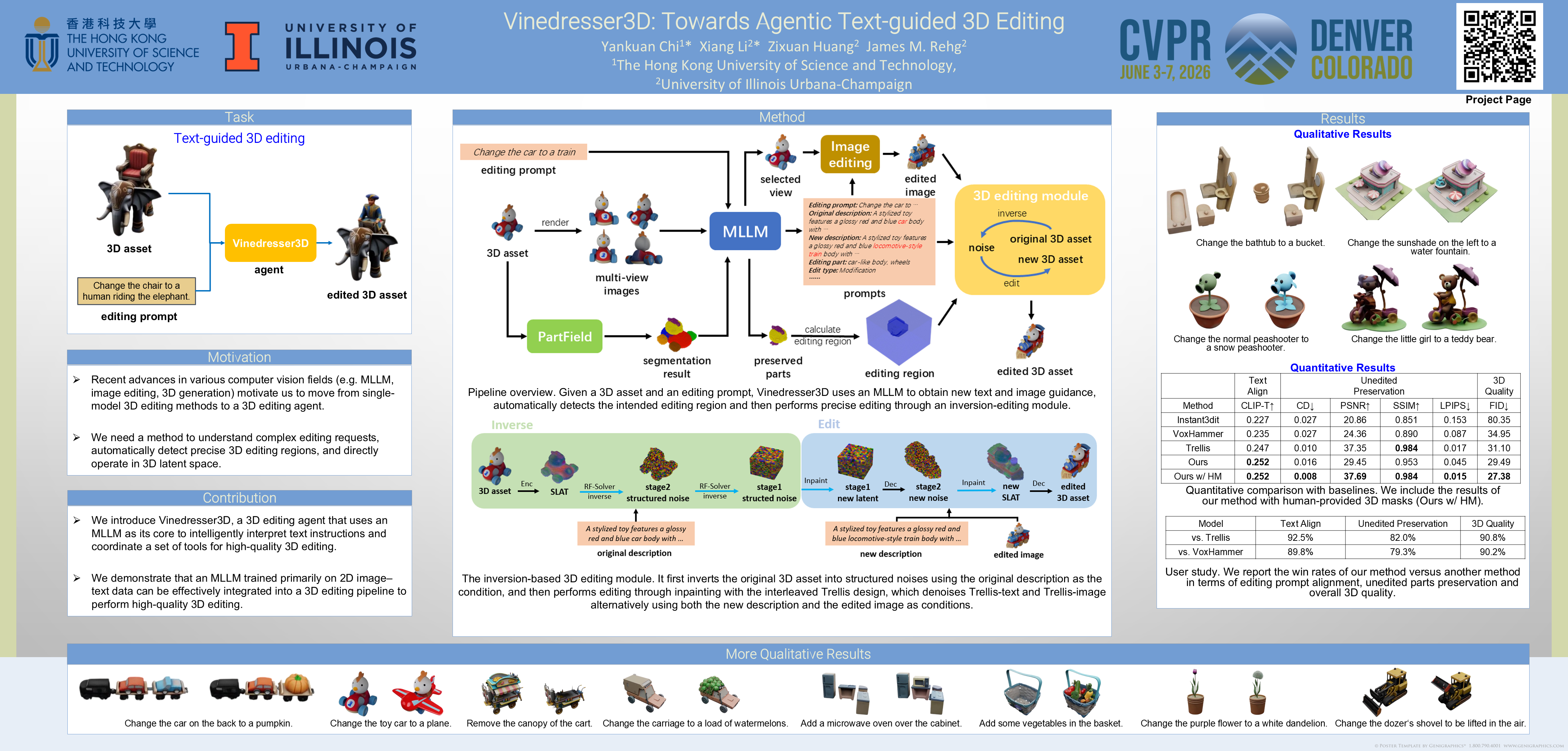
Text-guided 3D editing aims to modify existing 3D assets using natural-language instructions. Current methods struggle to jointly understand complex prompts, automatically localize edits in 3D, and preserve unedited content. We introduce Vinedresser3D, an agentic framework for high-quality text-guided 3D editing that operates directly in the latent space of a native 3D generative model. Given a 3D asset and an editing prompt, Vinedresser3D uses a multimodal large language model to infer rich descriptions of the original asset, identify the parts to edit and the edit type (addition, modification, deletion), and generate decomposed structural and appearance-level text guidance. The agent then selects an informative view and applies an image editing model to obtain visual guidance. Finally, an inversion-based rectified-flow inpainting pipeline with an interleaved sampling module performs editing in the 3D latent space, enforcing prompt alignment while maintaining 3D coherence and unedited regions. Experiments on diverse 3D edits demonstrate that Vinedresser3D outperforms prior baselines in both automatic metrics and human preference studies, while enabling precise, coherent, and mask-free 3D editing.
MV2UV: Generating High-quality UV Texture Maps with Multiview Prompts
Zheng Zhang ⋅ Qinchuan Zhang ⋅ Yuteng Ye ⋅ Zhi Chen ⋅ Penglei Ji ⋅ Mengfei Li ⋅ Wenxiao ZHANG ⋅ Yuan Liu
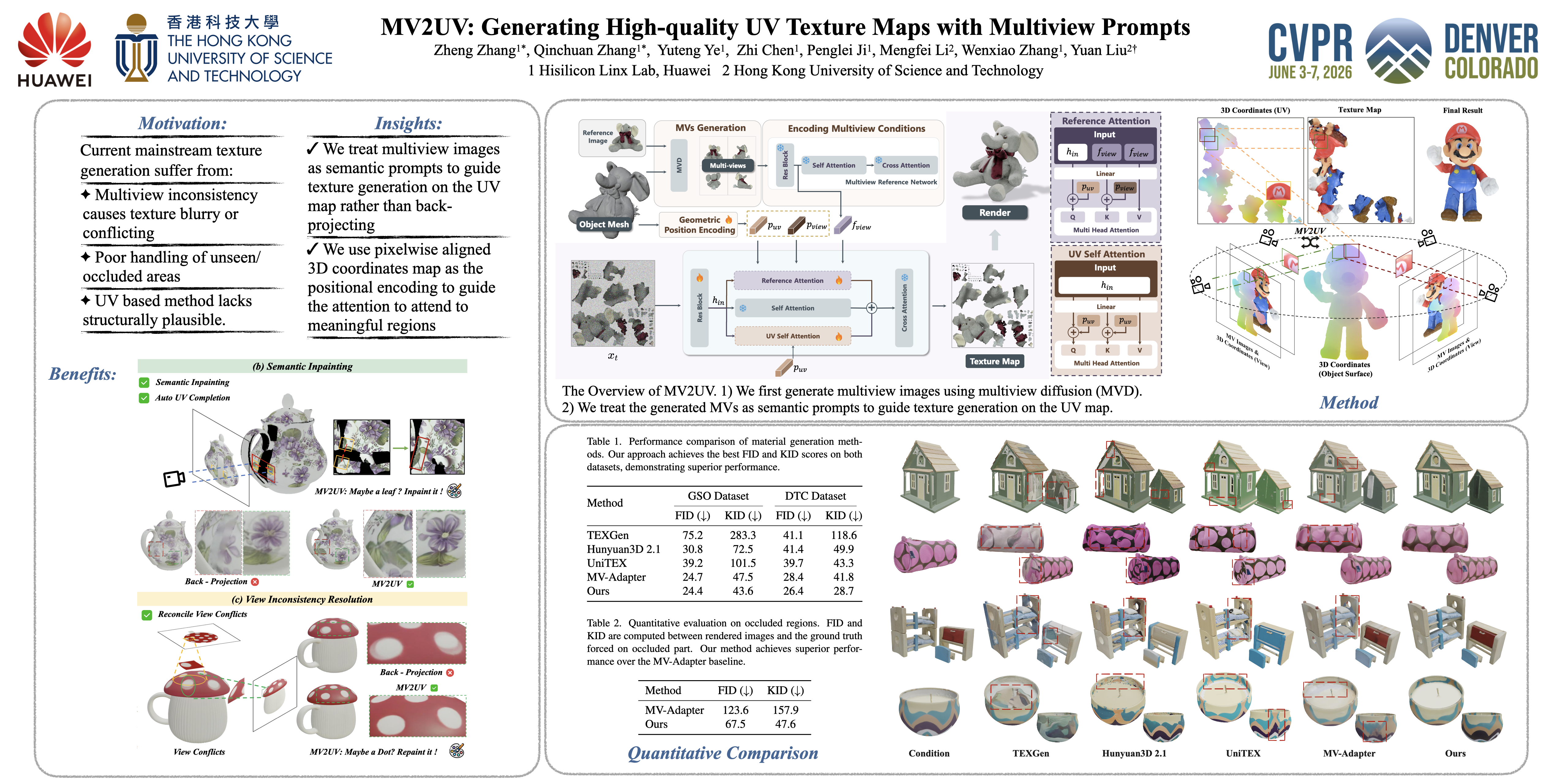
Generating high-quality textures for 3D assets is a challenging task. Existing multiview texture generation methods suffer from the multiview inconsistency and missing textures on unseen parts, while UV inpainting texture methods do not generalize well due to insufficient UV data and cannot well utilize 2D image diffusion priors. In this paper, we propose a new method called MV2UV that combines 2D generative priors from multiview generation and the inpainting ability of UV refinement to get high-quality texture maps. Our key idea is to adopt a UV space generative model that simultaneously inpaints unseen parts of multiview images while resolving the inconsistency of multiview images. Experiments show that our method enables a better texture generation quality than existing methods, especially in unseen occluded and multiview-inconsistent parts.
Learning Hierarchical Hyperbolic Mixture Model for Part-aware 3D Generation
Qitong Yang ⋅ Mingtao Feng ⋅ Zijie Wu ⋅ Huixin Zhu ⋅ Weisheng Dong ⋅ Yaonan Wang ⋅ Ajmal Mian
3D shape generation has become increasingly important for graphics and vision applications. Current part-aware 3D generation usually overlooks hierarchical part relations or inefficiently encodes multi-level semantics in Euclidean space. Thus we propose a novel framework for hierarchical and efficient part-aware 3D generation in hyperbolic space. Our contributions are three-fold: (1) Hierarchical Hyperbolic Mixture Model (H$^2$MM): We propose part-aware semantic representation of objects within a hyperbolic manifold, providing a high-fidelity hierarchical part-aware representation of object details and semantics. (2) Hyperbolic Semantically Consistent Diffusion Model: We design the geodesic diffusion process that preserves the hierarchical and semantic structure of H$^{2}$MM, and progressively generates semantics from conditions and generates object under their joint guidance. We use an adaptive tree-structured neural network to loosen the constraint of jointly generating nodes and edges in previous hyperbolic diffusion. (3) Hyperbolic Diffusion Model Solver: We leverage higher-order Riemannian gradient on hyperbolic manifolds for designing a fast dedicated high-order solver for diffusion ODEs with the convergence order guarantee. Extensive experiments demonstrate that our method achieves superior quality and efficiency. Code will be public.
MeshRipple: Structured Autoregressive Generation of Artist-Meshes
JunKai Lin ⋅ Hang Long ⋅ Huipeng Guo ⋅ Jielei Zhang ⋅ JiaYi Yang ⋅ Tianle Guo ⋅ Yang Yang ⋅ Jianwen Li ⋅ Wenxiao ZHANG ⋅ Matthias Nießner ⋅ Wei Yang
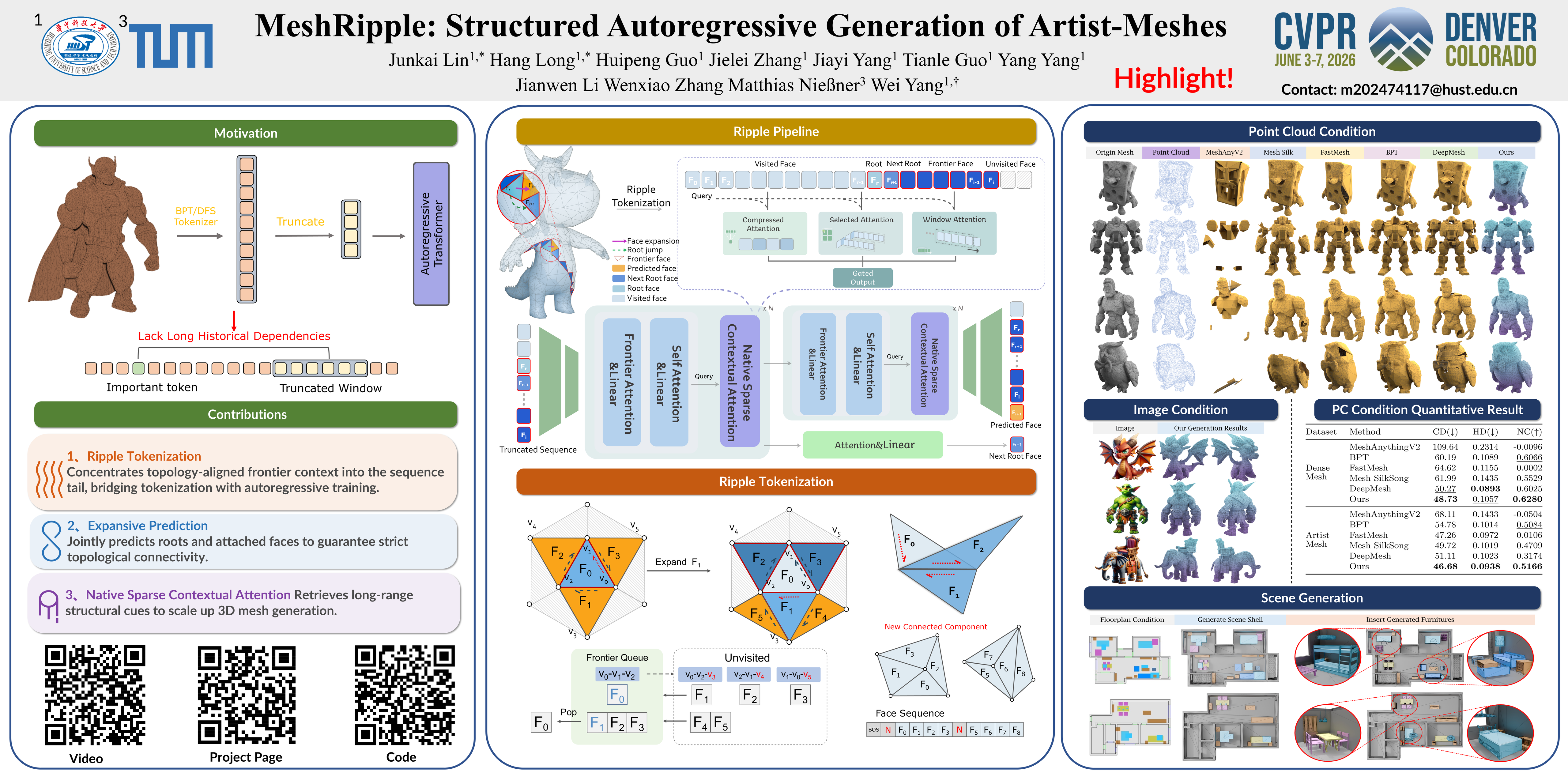
Meshes serve as a primary representation for 3D assets. Autoregressive mesh generators serialize faces into sequences and train on truncated segments with sliding-window inference to cope with memory limits. However, this mismatch breaks long-range geometric dependencies, producing holes and fragmented components. To address this critical limitation, we introduce MeshRipple, which expands a mesh outward from an active generation frontier, akin to a ripple on a surface.MeshRipple rests on three key innovations: a frontier-aware BFS tokenization that aligns the generation order with surface topology; an expansive prediction strategy that maintains coherent, connected surface growth; and a sparse-attention global memory that provides an effectively unbounded receptive field to resolve long-range topological dependencies.This integrated design enables MeshRipple to generate meshes with high surface fidelity and topological completeness, outperforming strong recent baselines.
FACE: A Face-based Autoregressive Representation for High-Fidelity and Efficient Mesh Generation
Hanxiao Wang ⋅ Yuanchen Guo ⋅ Ying-Tian Liu ⋅ Zi-Xin Zou ⋅ Biao Zhang ⋅ Weize Quan ⋅ Ding Liang ⋅ Yan-Pei Cao ⋅ Dong-Ming Yan
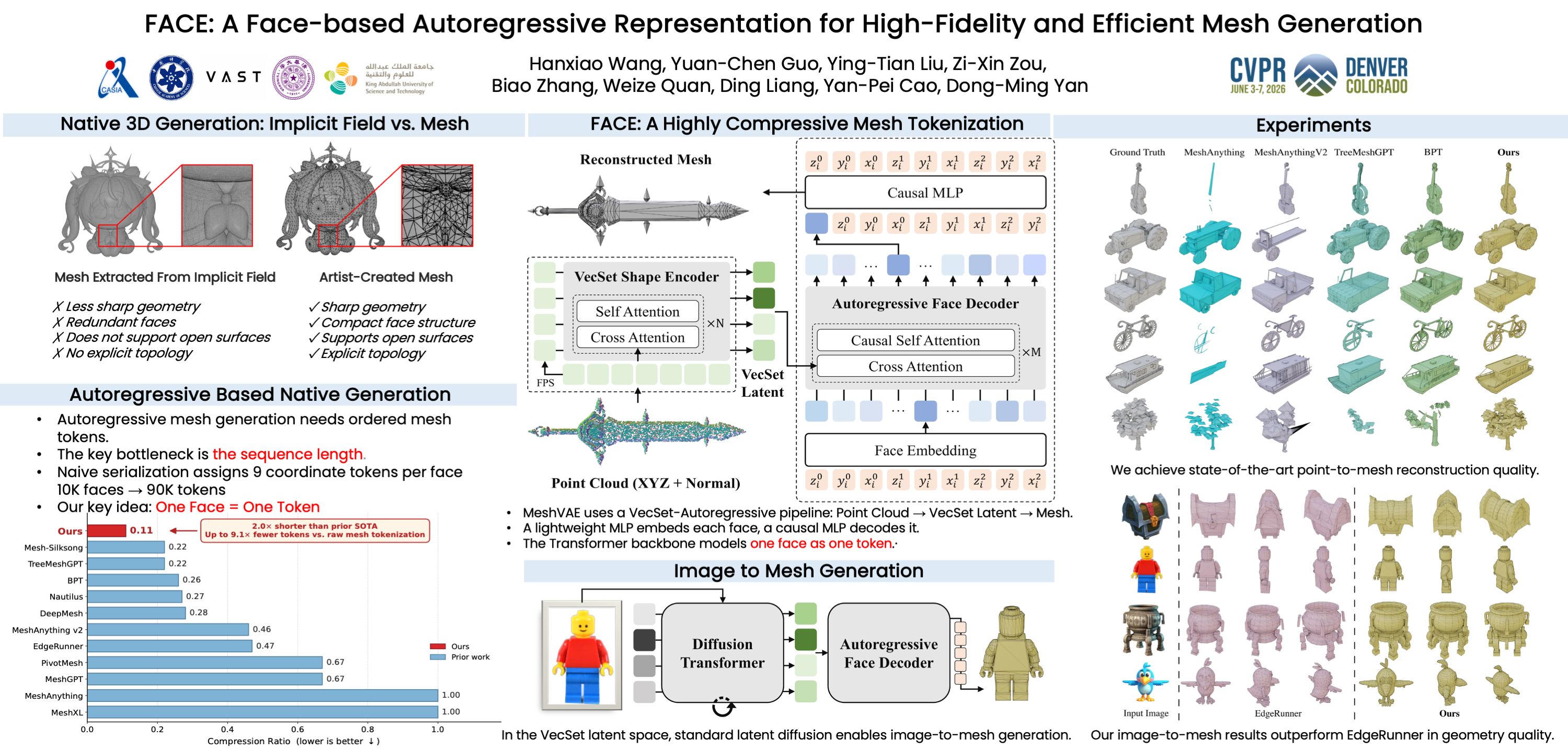
Autoregressive models for 3D mesh generation suffer from a fundamental limitation: they flatten meshes into long vertex-coordinate sequences. This results in prohibitive computational costs, hindering the efficient synthesis of high-fidelity geometry. We argue this bottleneck stems from operating at the wrong semantic level. We introduce FACE, a novel Autoregressive Autoencoder (ARAE) framework that reconceptualizes the task by generating meshes at the face level. Our ``one-face-one-token'' strategy treats each triangle face, the fundamental building block of a mesh, as a single, unified token. This simple yet powerful design reduces the sequence length by a factor of nine, leading to an unprecedented compression ratio of 0.11, halving the previous state-of-the-art. This dramatic efficiency gain does not compromise quality; by pairing our face-level decoder with a powerful VecSet encoder, FACE achieves state-of-the-art reconstruction quality on standard benchmarks. The versatility of the learned latent space is further demonstrated by training a latent diffusion model that achieves high-fidelity, single-image-to-mesh generation. FACE provides a simple, scalable, and powerful paradigm that lowers the barrier to high-quality structured 3D content creation.
Easy3E: Feed-Forward 3D Asset Editing via Rectified Voxel Flow
Shimin Hu ⋅ Yuanyi Wei ⋅ Fei Zha ⋅ Yudong Guo ⋅ Juyong Zhang
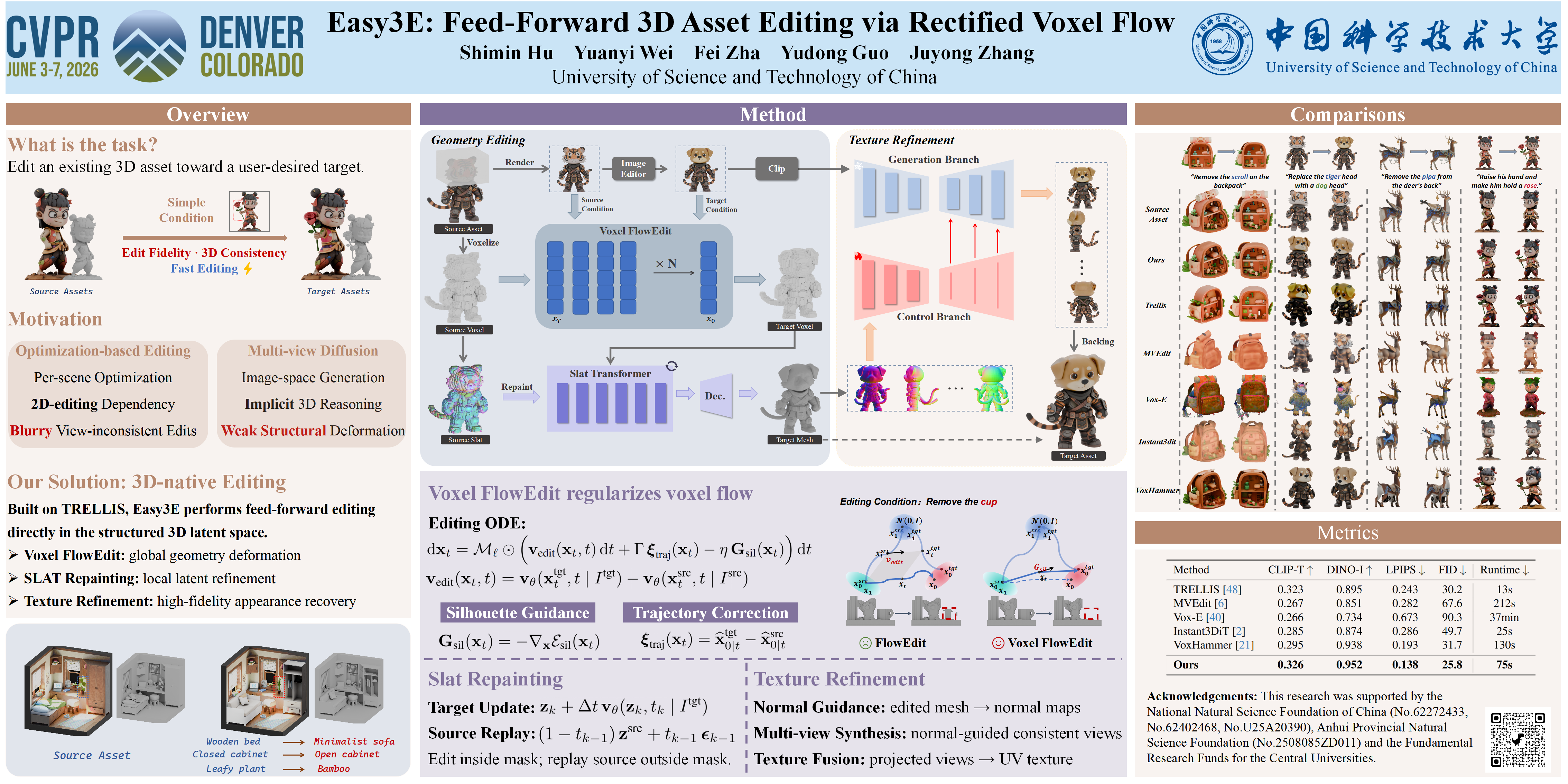
Existing 3D editing methods rely on computationally intensive scene-by-scene iterative optimization and suffer from multi-view inconsistency. We propose an effective and fully feedforward 3D editing framework based on the TRELLIS generative backbone, capable of modifying 3D models from a single editing view. Our framework addresses two key issues: adapting training-free 2D editing to structured 3D representations, and overcoming the bottleneck of appearance fidelity in compressed 3D features. To ensure geometric consistency, we introduce Voxel FlowEdit, an edit-driven flow in the sparse voxel latent space that achieves globally consistent 3D deformation in a single pass. To restore photorealistic details, we develop a normal-guided single to multi-view generation module as an external appearance prior, successfully recovering high-frequency textures. Experiments demonstrate that our method enables fast, globally consistent, and high-fidelity 3D model editing.
CUPID: Generative 3D Reconstruction via Joint Object and Pose Modeling
Binbin Huang ⋅ Haobin Duan ⋅ Yiqun Zhao ⋅ Zibo Zhao ⋅ Yi Ma ⋅ Shenghua Gao
We introduce Cupid, a generative 3D reconstruction framework that jointly models the full distribution over both canonical objects and camera poses. Our two-stage flow-based model first generates a coarse 3D structure and 2D-3D correspondences to estimate the camera pose robustly. Conditioned on this pose, a refinement stage injects pixel-aligned image features directly into the generative process, marrying the rich prior of a generative model with the geometric fidelity of reconstruction. This strategy achieves exceptional faithfulness, outperforming state-of-the-art reconstruction methods by over 3 dB PSNR and 10\% in Chamfer Distance. As a unified generative model that decouples the object and camera pose, Cupid naturally extends to multi-view and scene-level reconstruction tasks without requiring post-hoc optimization or fine-tuning.
3D-Fixer: Coarse-to-Fine In-place Completion for 3D Scenes from a Single Image
Ze-Xin Yin ⋅ Liu Liu ⋅ Xinjie wang ⋅ Wei Sui ⋅ Zhizhong Su ⋅ Jian Yang ⋅ Jin Xie
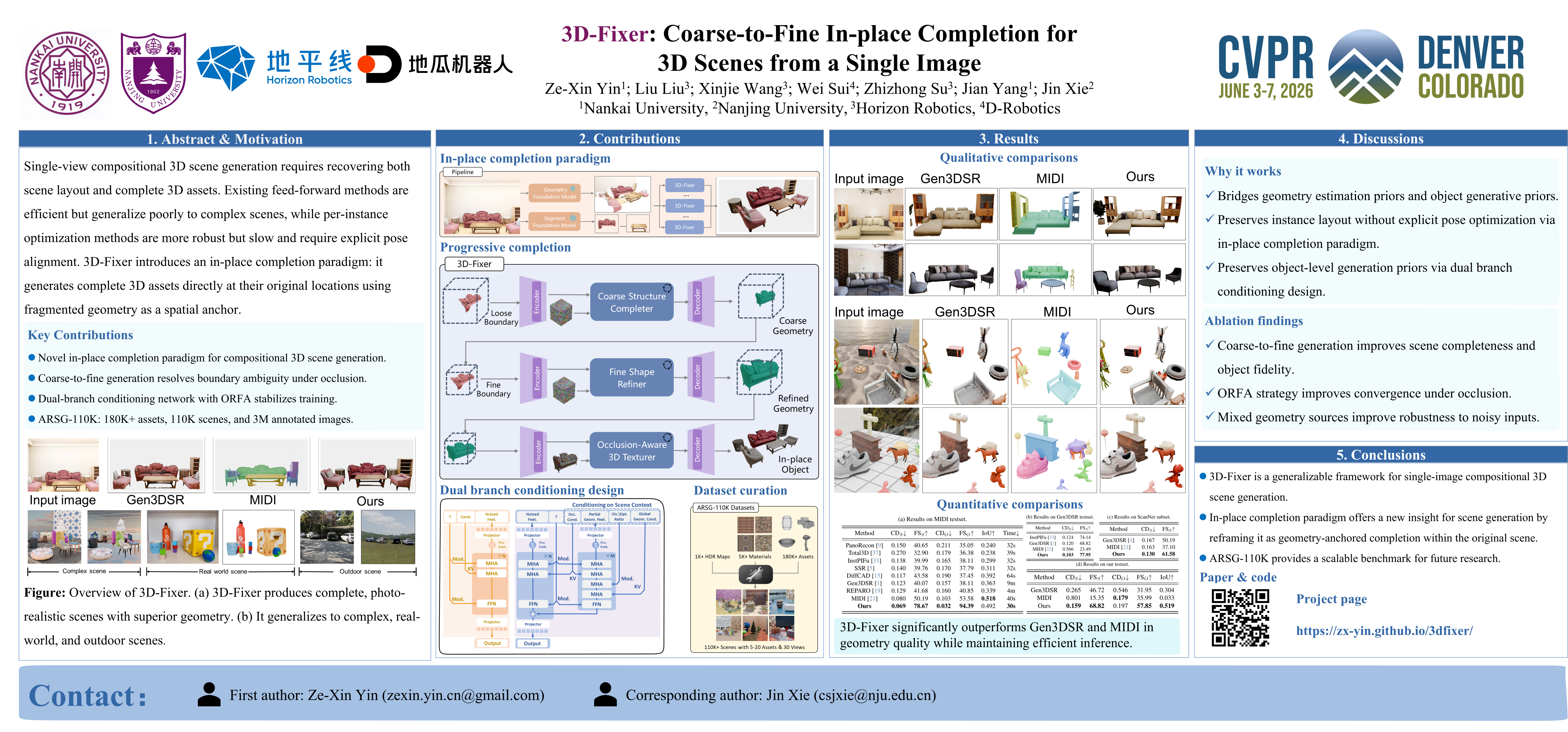
We introduce 3D-Fixer, a novel generalizable and efficient scheme for single-image to compositional 3D scene generation. Unlike existing feed-forward frameworks that lack generalization ability in open-set scenarios due to the limited dataset, or divide-and-conquer frameworks that suffer from slow inference or accumulated registration errors during layout alignment, 3D-Fixer extends pre-trained object-level 3D generation priors to perform in-place completion on the single-view estimated geometry, eliminating the need for pose alignment while preserving feed-forward efficiency. At its core, 3D-Fixer introduces a coarse-to-fine scheme to accurately determine the completion boundary and generate high quality completion 3D asset based on the single-view estimated fragmented geometry. Also, we design a dual-branch conditioning network that integrates 2D and 3D contextual information to guide the pre-trained object generation priors for in-place completion. Furthermore, we introduce the Occlusion-Robust Feature Alignment strategy, which employs feature distillation to stabilize the training of the generative priors under occlusion scenarios. Existing scene-level dataset, either suffering from limited scale or lacking accurate per-instance ground truth, severely restricting the development of scene generation approaches. Therefore, we constructed the large-scale scene-level dataset, featuring over 110K diverse scenes and 3M images with complete 3D asset ground truth and accurate placement annotation. Experiments demonstrate that 3D-Fixer achieves state-of-the-art geometric accuracy while maintaining an inference speed comparable to feed-forward estimation methods, vastly outperforming iterative optimization approaches. Our dataset and trained models will be publicly available upon acceptance.
DRM: Diffusion-based Reward Model With Step-wise Guidance
Jaxon Zhang ⋅ Binxin Yang ⋅ Hubery Yin ⋅ Chen Li ⋅ Jing LYU
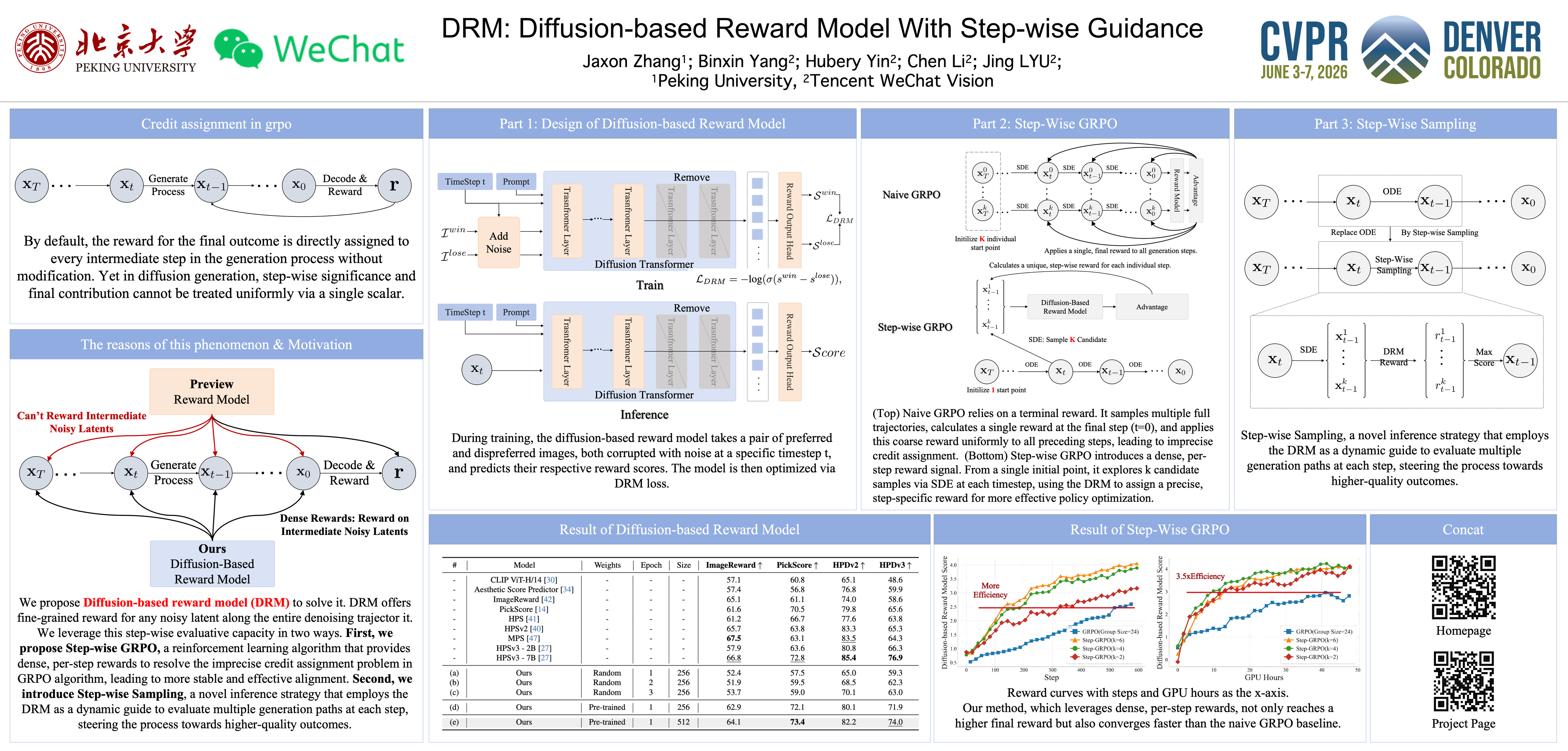
Current mainstream methods of aligning diffusion models with human preferences typically employ VLM-based reward models.However, these reward models, pre-trained for semantic alignment, struggle to capture the essential perceptual qualities—such as aesthetics, composition, and visual harmony.In this work, we argue that a model capable of high-fidelity generation must possess a profound understanding of these visual attributes.Based on this insight, we introduce the Diffusion-based Reward Model (DRM), a novel paradigm that use the pre-trained diffusion model as a powerful evaluative backbone.A key advantage of the DRM is its unique ability to assess not only the final image but also the noisy intermediate latents at any stage of the generative process. We leverage this step-wise evaluative capacity in two ways.First, we propose Step-wise GRPO, a reinforcement learning algorithm that provides dense, per-step rewards to resolve the imprecise credit assignment problem in GRPO algorithm, leading to more stable and effective alignment.Second, we introduce Step-wise Sampling, a novel inference strategy that employs the DRM as a dynamic guide to evaluate multiple generation paths at each step, steering the process towards higher-quality outcomes.Extensive experiments confirm that our approach significantly enhances the final quality of generated images.
Taming Preference Mode Collapse via Directional Decoupling Alignment in Diffusion Reinforcement Learning
Chubin Chen ⋅ Sujie Hu ⋅ Jiashu Zhu ⋅ Meiqi Wu ⋅ Jintao Chen ⋅ Yanxun Li ⋅ Nisha Huang ⋅ Chengyu Fang ⋅ Jiahong Wu ⋅ Xiangxiang Chu ⋅ Xiu Li
Recent studies have demonstrated significant progress in aligning text-to-image diffusion models with human preference via Reinforcement Learning from Human Feedback. However, while existing methods achieve high scores on automated reward metrics, they often lead to **Preference Mode Collapse (PMC)**-a specific form of reward hacking where models converge on narrow, high-scoring outputs (e.g., images with monolithic styles or pervasive overexposure), severely degrading generative diversity. In this work, we introduce and quantify this phenomenon, proposing **DivGenBench**, a novel benchmark designed to measure the extent of PMC. We posit that this collapse is driven by over-optimization along the reward model's inherent biases. Building on this analysis, we propose **Directional Decoupling Alignment (D$^2$-Align)**, a novel framework that mitigates PMC by directionally correcting the reward signal.Specifically, our method first learns a directional correction within the reward model's embedding space while keeping the model frozen.This correction is then applied to the reward signal during the optimization process, preventing the model from collapsing into specific modes and thereby maintaining diversity. Our comprehensive evaluation, combining qualitative analysis with quantitative metrics for both quality and diversity, reveals that **D$^2$-Align** achieves superior alignment with human preference.
VA-π: Variational Policy Alignment for Pixel-Aware Autoregressive Generation
Xinyao Liao ⋅ QIYUAN HE ⋅ Kai Xu ⋅ Xiaoye Qu ⋅ Yicong Li ⋅ Wei Wei ⋅ Angela Yao
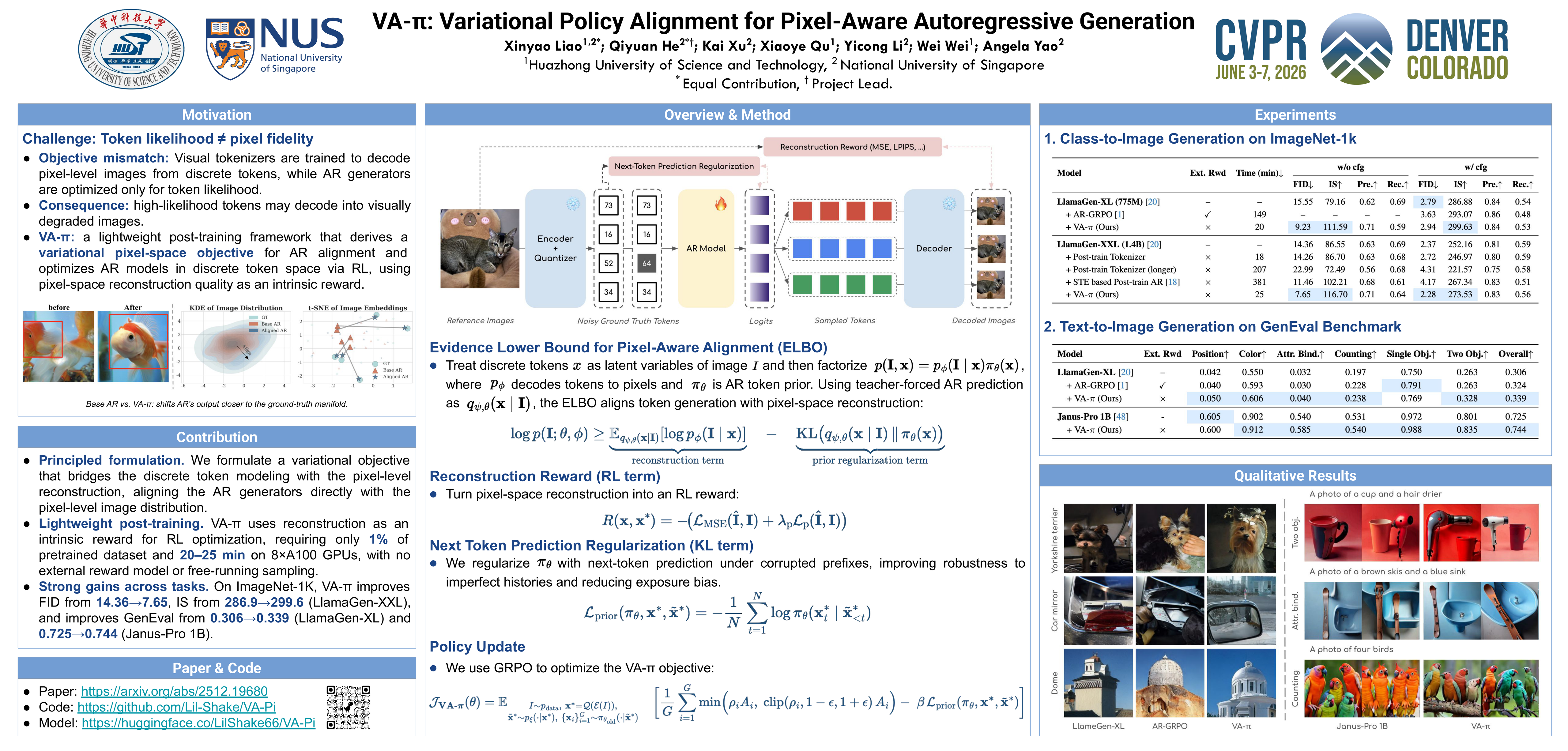
Autoregressive (AR) visual generation relies on tokenizers to map images to and from discrete sequences. However, tokenizers are trained to reconstruct clean images from ground-truth tokens, while AR generators are optimized only for token likelihood. This misalignment leads to generated token sequences that may decode into low-quality images, without direct supervision from the pixel space. We propose \textbf{VA}-$\boldsymbol{\pi}$, a lightweight post-training framework that directly optimizes AR models with a principled pixel-space objective. VA-$\pi$ formulates the generator–tokenizer alignment as a variational optimization, deriving an evidence lower bound (ELBO) that unifies pixel reconstruction and autoregressive modeling. To optimize under the discrete token space, VA-$\pi$ introduces a reinforcement-based alignment strategy that treats the AR generator as a policy, uses pixel-space reconstruction quality as its intrinsic reward. The reward is measured by how well the predicted token sequences can reconstruct the original image under teacher forcing, giving the model direct pixel-level guidance without expensive free-running sampling.The regularization term of the ELBO serves as a natural regularizer, maintaining distributional consistency. VA-$\pi$ enables rapid adaptation of existing AR generators, without neither tokenizer retraining nor external reward models. With only 1\% ImageNet-1K data and 25 minutes of tuning, it reduces FID from 14.36 to 7.65 and improves IS from 86.55 to 116.70 on LlamaGen-XXL, while also yielding notable gains in the text-to-image task on GenEval for both visual generation model (LlamaGen: from 0.306 to 0.339) and unified multi-modal model (Janus-Pro: from 0.725 to 0.744).
SoliReward: Mitigating Susceptibility to Reward Hacking and Annotation Noise in Video Generation Reward Models
Jiesong Lian ⋅ Ruizhe Zhong ⋅ Zixiang Zhou ⋅ Xiaoyue Mi ⋅ Long Hu ⋅ Yuan Zhou ⋅ qinglin lu ⋅ yixue Hao ⋅ Junchi Yan
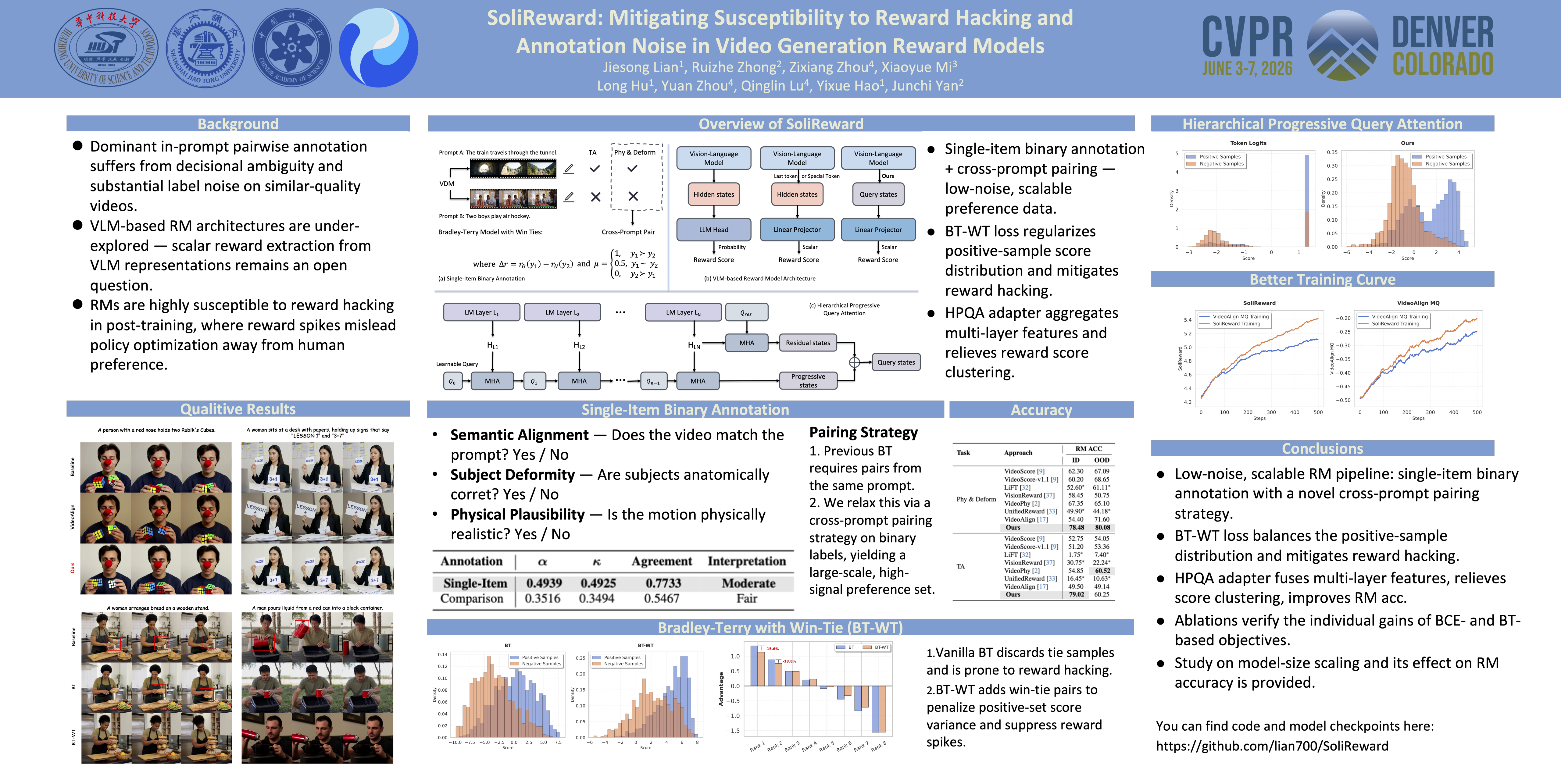
Post-training alignment of video generation models with human preferences is a critical goal. Developing effective Reward Models (RMs) for this process faces significant methodological hurdles.Current data collection paradigms, reliant on in-prompt pairwise annotations, suffer from labeling noise. Concurrently, the architectural design of VLM-based RMs, particularly their output mechanisms, remains underexplored. Furthermore, RM is susceptible to reward hacking in post-training. To mitigate these limitations, we propose SoliReward, a systematic framework for video RM training. Our framework first sources high-quality, cost-efficient data via single-item binary annotations, then constructs preference pairs using a cross-prompt pairing strategy. Architecturally, we employ a Hierarchical Progressive Query Attention mechanism to enhance feature aggregation. Finally, we introduce a modified BT loss that explicitly accommodates win-tie scenarios. This approach regularizes the RM's score distribution for positive samples, providing more nuanced preference signals to alleviate over-focus on a small number of top-scoring samples. Our approach is validated on benchmarks evaluating physical plausibility, subject deformity, and semantic alignment, demonstrating improvements in direct RM evaluation metrics and in the efficacy of post-training on video generation models. Code and benchmark will be publicly available.
AnyID: Ultra-Fidelity Universal Identity-Preserving Video Generation from Any Visual References
Jiahao Wang ⋅ Hualian Sheng ⋅ Sijia Cai ⋅ Yuxiao Yang ⋅ Weizhan Zhang ⋅ Caixia Yan ⋅ Bing Deng ⋅ Jieping Ye
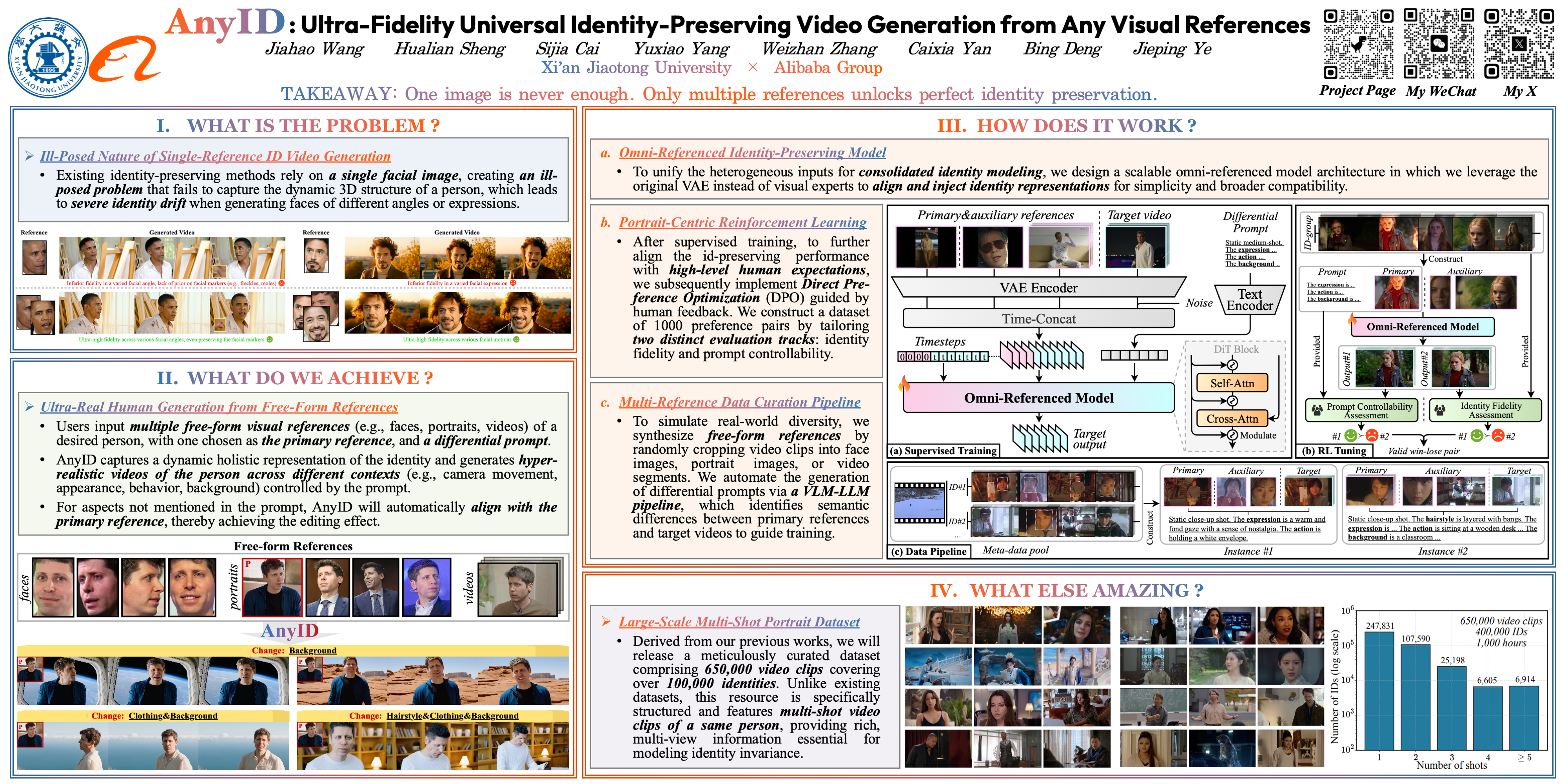
Identity-preserving video generation offers powerful tools for creative expression, allowing users to customize videos featuring their beloved characters. However, prevailing methods are typically designed and optimized for a single identity reference. This underlying assumption introduces two significant limitations: it curtails creative flexibility by poorly accommodating diverse, real-world input formats, and more critically, it compromises identity fidelity. Relying on a single source is an ill-posed setting, and provides an inherently ambiguous foundation, making it difficult for the model to faithfully reproduce an identity across novel contexts. In response, we present AnyID, an ultra-fidelity identity-preservation video generation framework. Our approach makes two core contributions. First, we introduce a scalable omni-referenced architecture that effectively unifies heterogeneous identity inputs (e.g., faces, portraits, and videos) into a cohesive representation. Second, we propose a primary-referenced generation paradigm, which designates one reference as a canonical anchor and uses a novel differential prompt to enable precise, attribute-level controllability. The model is trained on a large-scale, meticulously curated dataset to ensure robustness and high fidelity. In addition, we perform a final fine-tuning stage using reinforcement learning. This process leverages a preference dataset constructed from human evaluations, where annotators performed pairwise comparisons of videos based on two key criteria: identity fidelity and prompt controllability. Extensive evaluations validate that AnyID achieves ultra-high identity fidelity as well as superior attribute-level controllability across different task settings. All the codes, data and models will be publicly released.
Style-GRPO: Semantic-Aware Preference Optimization for Image Style Transfer Guided by Reward Modeling
Jianbin Zhao ⋅ Chaoran Feng ⋅ Miao Yu ⋅ Yingtao Li ⋅ Zhenyu Tang ⋅ Wangbo Yu ⋅ Yian Zhao ⋅ Xiaomin Li ⋅ Li Yuan ⋅ Yonghong Tian
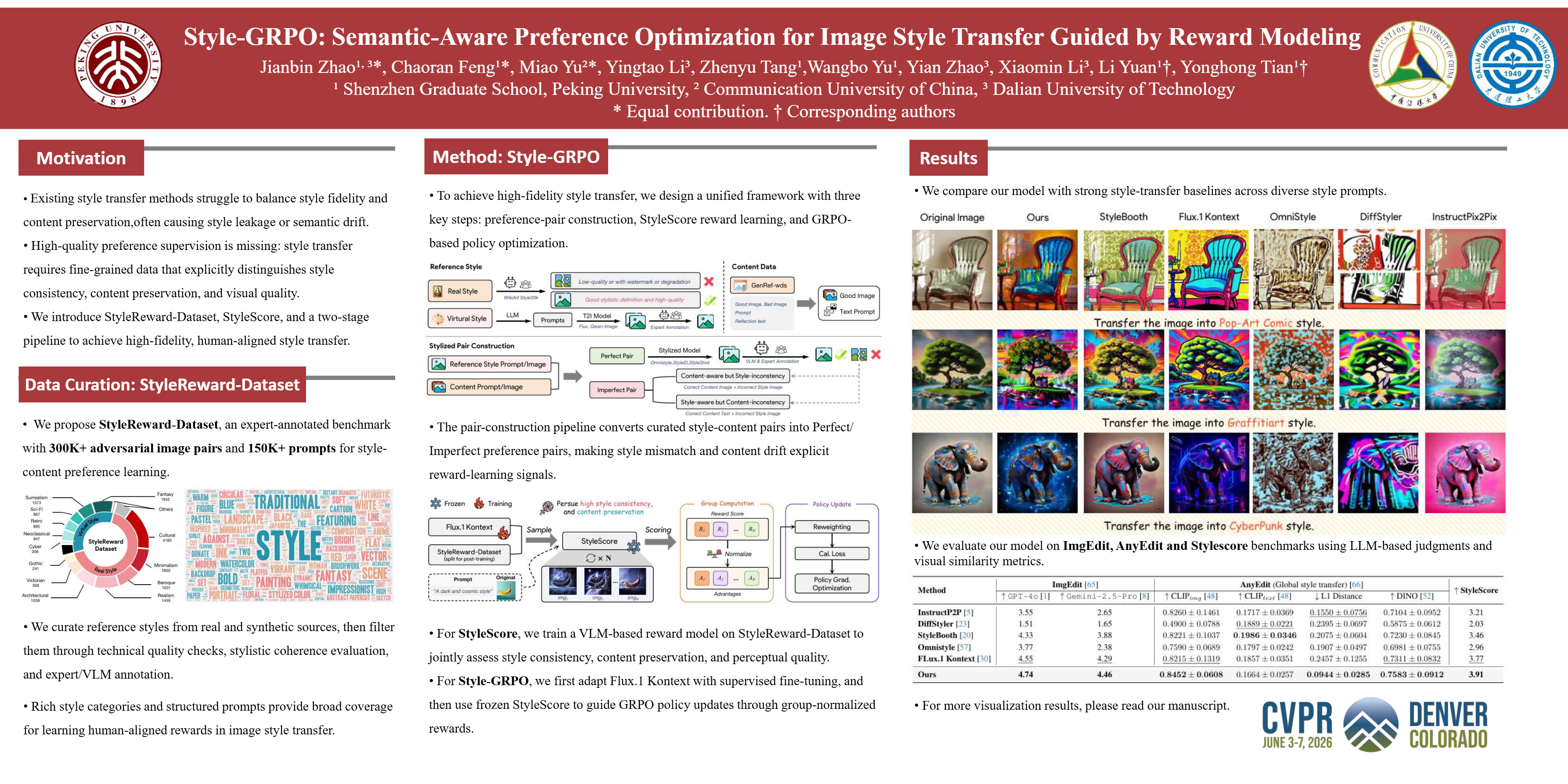
Recent progress in text-to-image generation has greatly advanced visual fidelity and creativity, but it has also imposed higher demands on prompt complexity—particularly in encoding intricate spatial relationships. In such cases, achieving satisfactory results often requires multiple sampling attempts.To address this challenge, we introduce a novel method that strengthens the spatial understanding of current image generation models. We first construct the SpatialReward-Dataset with over 80k preference pairs. Building on this dataset, we build SpatialScore, a reward model designed to evaluate the accuracy of spatial relationships in text-to-image generation, achieving performance that even surpasses leading proprietary models on spatial evaluation.% Through rigorous data curation and filtering, SpatialScore surpasses several leading vision-language models (VLMs) and existing reward models on spatial evaluation. We further demonstrate that this reward model effectively enables online reinforcement learning for the complex spatial generation. Extensive experiments across multiple benchmarks show that our specialized reward model yields significant and consistent gains in spatial understanding for image generation. All models and datasets will be released.
LAMP: Language-Assisted Motion Planning for Controllable Video Generation
Muhammed Burak Kizil ⋅ Enes Şanlı ⋅ Niloy J. Mitra ⋅ Erkut Erdem ⋅ Aykut Erdem ⋅ Duygu Ceylan
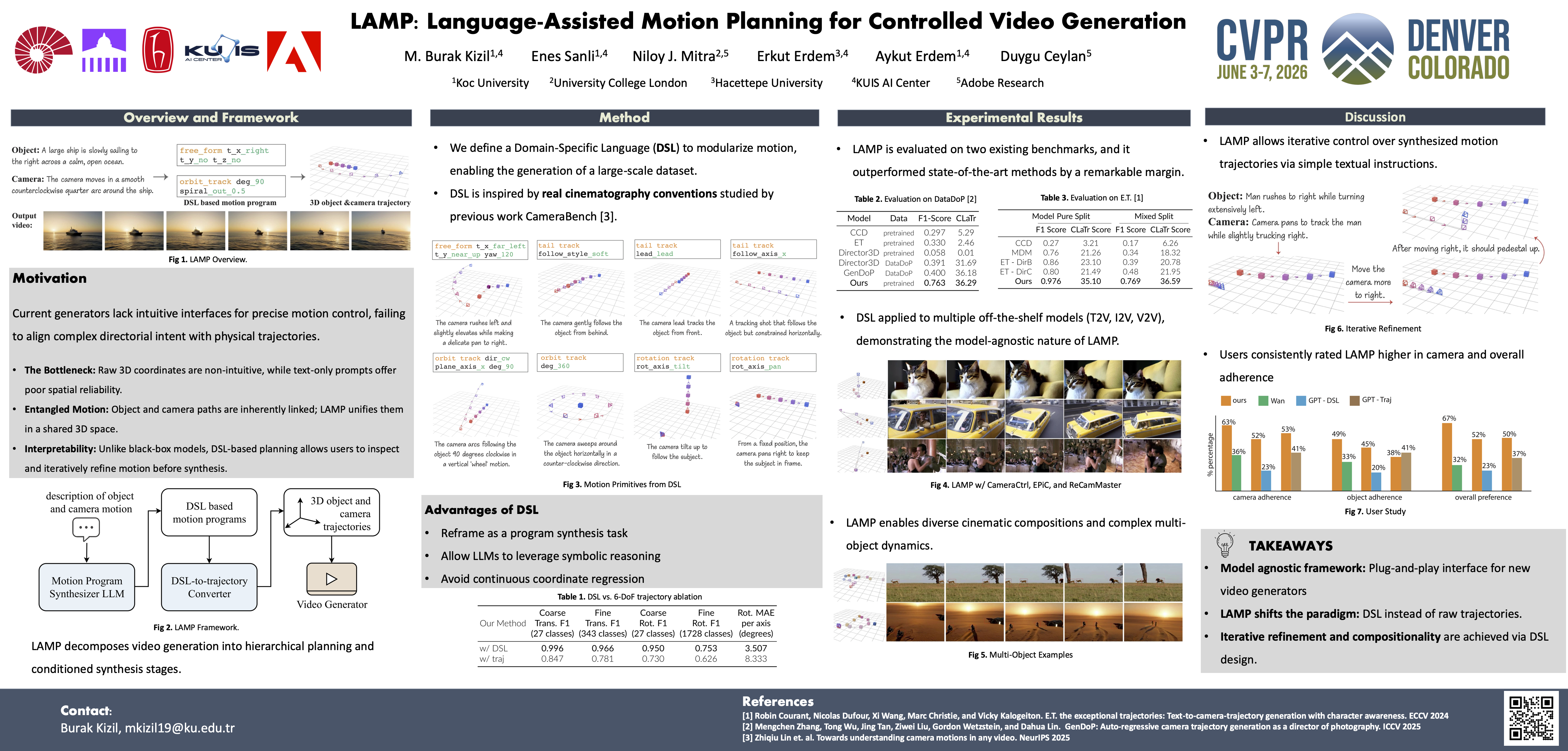
Recent advances in video generation have achieved remarkable progress in visual fidelity and controllability, enabling conditioning not only on text but also on structural layout and motion signals. Among these, motion control (i.e., specifying both object dynamics and camera trajectories) is particularly critical for directing complex, cinematic scenes, yet existing interfaces remain limited. To address this gap, we introduce LAMP that leverages large language models~(LLMs) as motion planners to translate natural language descriptions into explicit 3D trajectories for both dynamic objects and (relatively defined) cameras. Specifically, we fine-tune an LLM to generate frame-wise 3D bounding-box trajectories for objects and, conditioned on these, produce corresponding 3D camera paths, which are then converted into generator-compatible 2D control signals. We enable this by constructing a large-scale paired datasets through a combination of procedurally generated text–trajectory pairs and augmented real video datasets with 3D annotations. Experiments demonstrate improved controllability and alignment with user intent compared to state-of-the-art alternatives, establishing the first framework for joint object–camera trajectory generation directly from natural language.
Diverse Video Generation with Determinantal Point Process-Guided Policy Optimization
Tahira Kazimi ⋅ Connor Dunlop ⋅ Pinar Yanardag
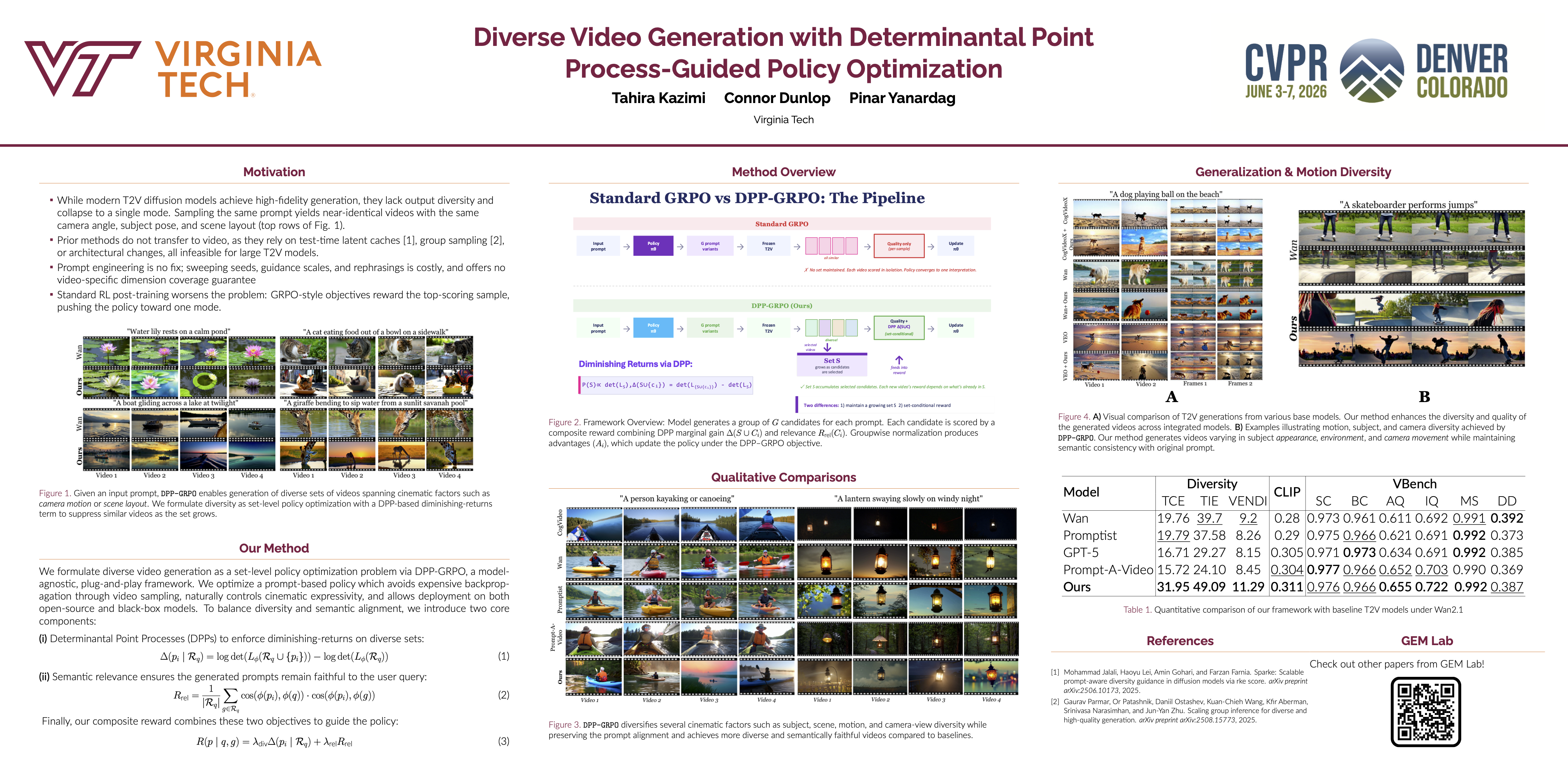
While recent text-to-video (T2V) diffusion models have achieved impressive quality and prompt alignment, they often produce low-diversity outputs when sampling multiple videos from a single text prompt. We tackle this challenge by formulating it as a set-level policy optimization problem, with the goal of training a policy that can cover the diverse range of plausible outcomes for a given prompt. To address this, we introduce DPP-GRPO, a novel framework for diverse video generation generation that combines Determinantal Point Processes (DPPs) and Group Relative Policy Optimization (GRPO) theories to enforce explicit reward on diverse generations. Our objective turns diversity into an explicit signal by imposing diminishing returns on redundant samples (via DPP) while supplies groupwise feedback over candidate sets (via GRPO). Our framework is plug-and-play and model-agnostic, and encourages diverse generations across visual appearance, camera motions, and scene structure without sacrificing prompt fidelity or perceptual quality. We implement our method on WAN and CogVideoX, and show that our method consistently improves video diversity on state-of-the-art benchmarks such as VBench, VideoScore, and human preference studies. Moreover, we release our code and a new benchmark dataset of 30,000 diverse prompts to support future research.
Spectral Scalpel: Amplifying Adjacent Action Discrepancy via Frequency-Selective Filtering for Skeleton-Based Action Segmentation
Haoyu Ji ⋅ Bowen Chen ⋅ Zhihao Yang ⋅ Wenze Huang ⋅ Yu Gao ⋅ Xueting Liu ⋅ Weihong Ren ⋅ Zhiyong Wang ⋅ Honghai LIU
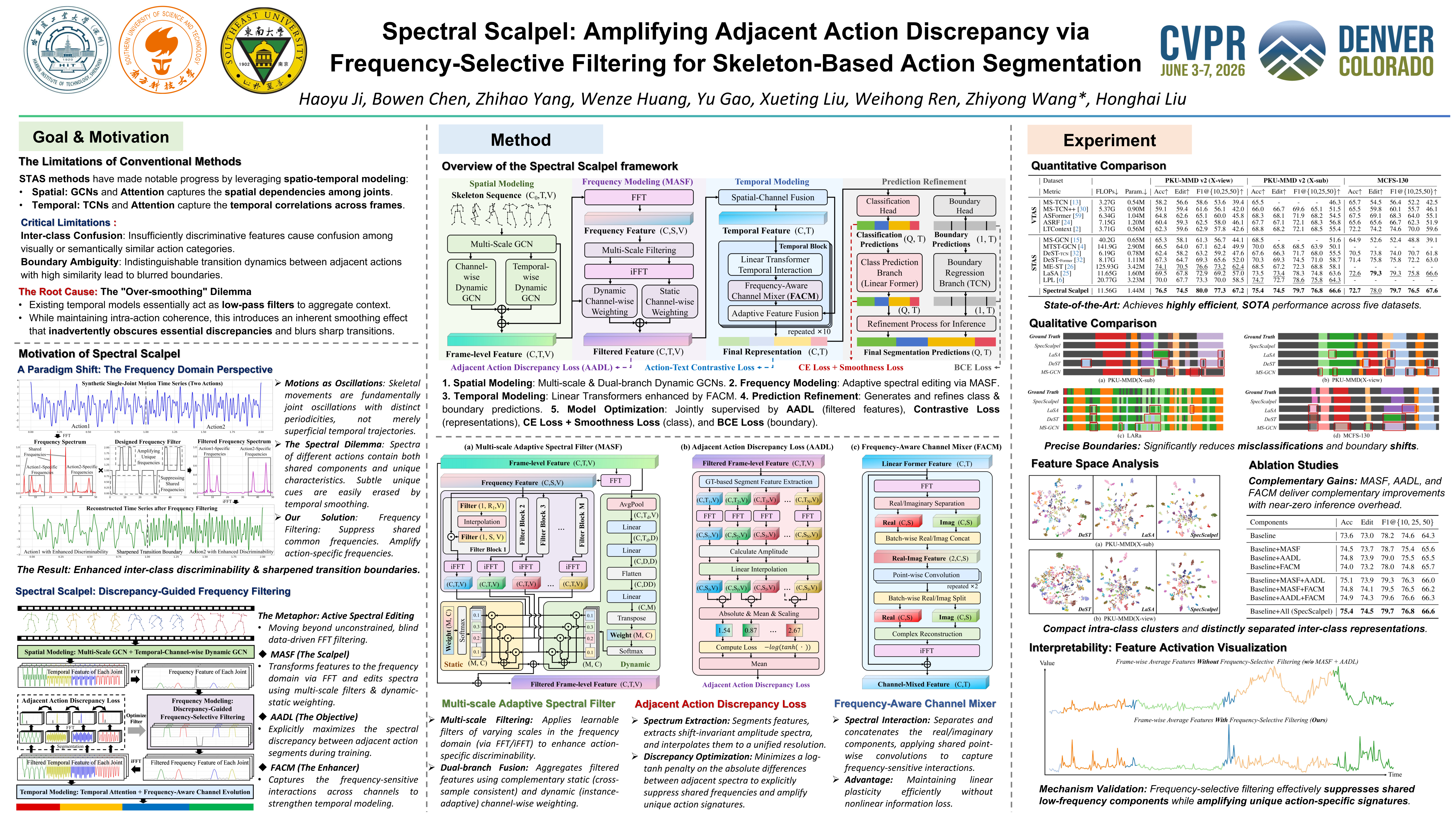
Skeleton-based Temporal Action Segmentation (STAS) seeks to densely segment and classify diverse actions within long, untrimmed skeletal motion sequences. However, existing STAS methodologies face challenges of limited inter-class discriminability and blurred segmentation boundaries, primarily due to insufficient distinction of spatio-temporal patterns between adjacent actions. To address these limitations, we propose Spectral Scalpel, a frequency-selective filtering framework aimed at suppressing shared frequency components between adjacent distinct actions while amplifying their action-specific frequencies, thereby enhancing inter-action discrepancies and sharpening transition boundaries. Specifically, Spectral Scalpel employs adaptive multi-scale spectral filters as scalpels to edit frequency spectra, coupled with a discrepancy loss between adjacent actions serving as the surgical objective. This design amplifies representational disparities between neighboring actions, effectively mitigating boundary localization ambiguities and categorical confusions. Furthermore, complementing long-term temporal modeling, we introduce a frequency-aware channel mixer to strengthen channel evolution by aggregating spectra across channels. This work presents a novel paradigm for STAS that extends conventional spatio-temporal modeling by incorporating frequency-domain analysis. Extensive experiments on five public datasets demonstrate that Spectral Scalpel achieves state-of-the-art performance.
DETACH : Decomposed Spatio-Temporal Alignment for Exocentric Video and Ambient Sensors with Staged Learning
Junho Yoon ⋅ Jaemo Jeong ⋅ Hyunju Kim ⋅ Dongman Lee
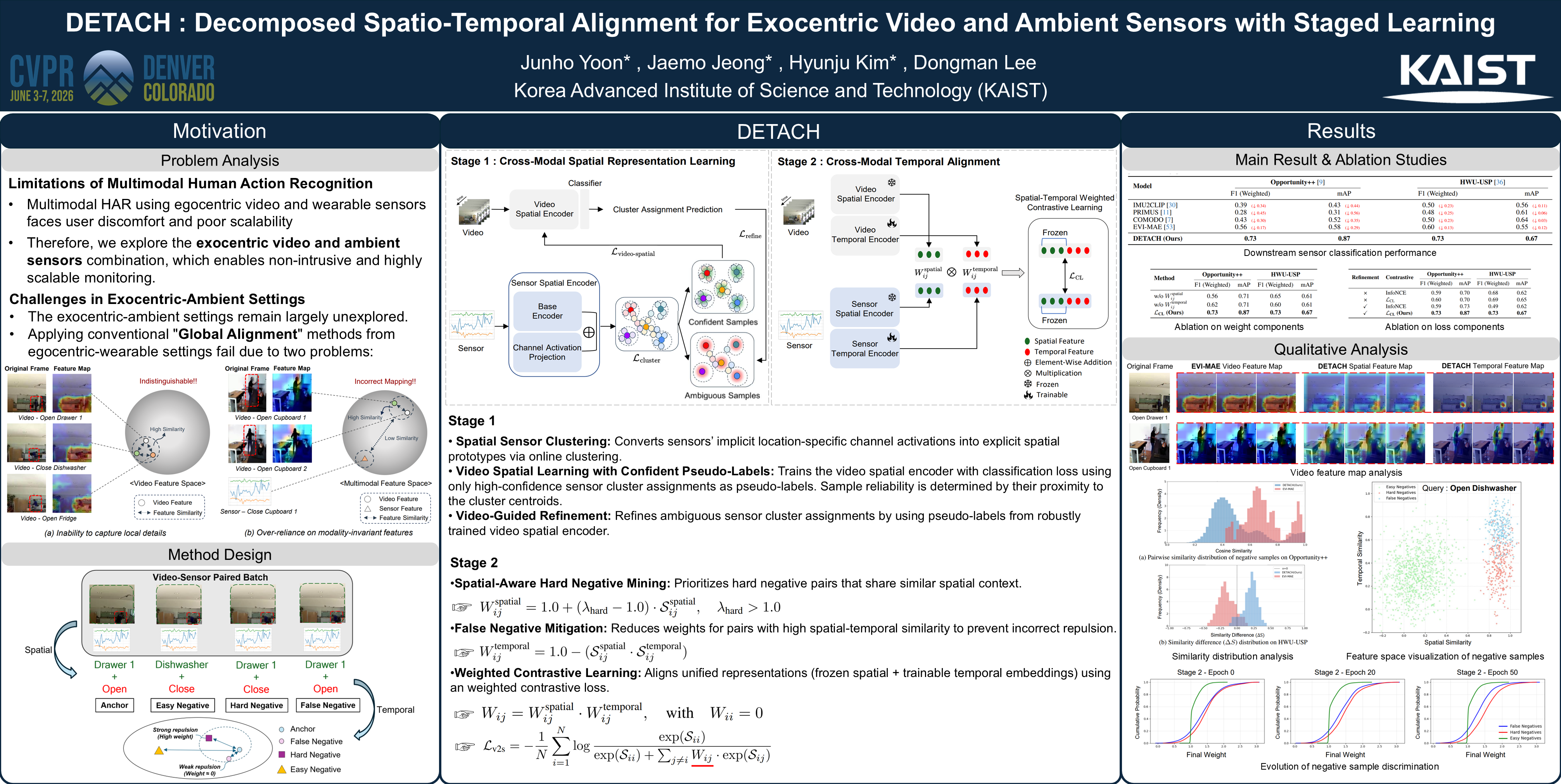
Aligning egocentric video with wearable sensors have shown promise for human action recognition, but face practical limitations in user discomfort, privacy concerns, and scalability. We explore exocentric video with ambient sensors as a non-intrusive, scalable alternative. While prior egocentric-wearable works predominantly adopt Global Alignment by encoding entire sequences into unified representations, this approach fails in exocentric-ambient settings due to two problems: (P1) inability to capture local details such as subtle motions, and (P2) over-reliance on modality-invariant temporal patterns, causing misalignment between actions sharing similar temporal patterns with different spatio-semantic contexts. To resolve these problems, we propose DETACH, a decomposed spatio-temporal framework. This explicit decomposition preserves local details, while our novel sensor-spatial features discovered via online clustering provide semantic grounding for context-aware alignment. To align the decomposed features, our two-stage approach establishes spatial correspondence through mutual supervision, then performs temporal alignment via a spatial-temporal weighted contrastive loss that adaptively handles easy negatives, hard negatives, and false negatives. Comprehensive experiments with downstream tasks on Opportunity++ and HWU-USP datasets demonstrate substantial improvements over adapted egocentric-wearable baselines.
Learning a Unified Latent Action Space from Videos with Action-centric Cycle Consistency
Guangyan Chen ⋅ Qi Shao ⋅ Te Cui ⋅ Zichen Zhou ⋅ Weixin Mao ⋅ Luojie Yang ⋅ Meiling Wang ⋅ Yi Yang ⋅ Hua Chen ⋅ Yufeng Yue
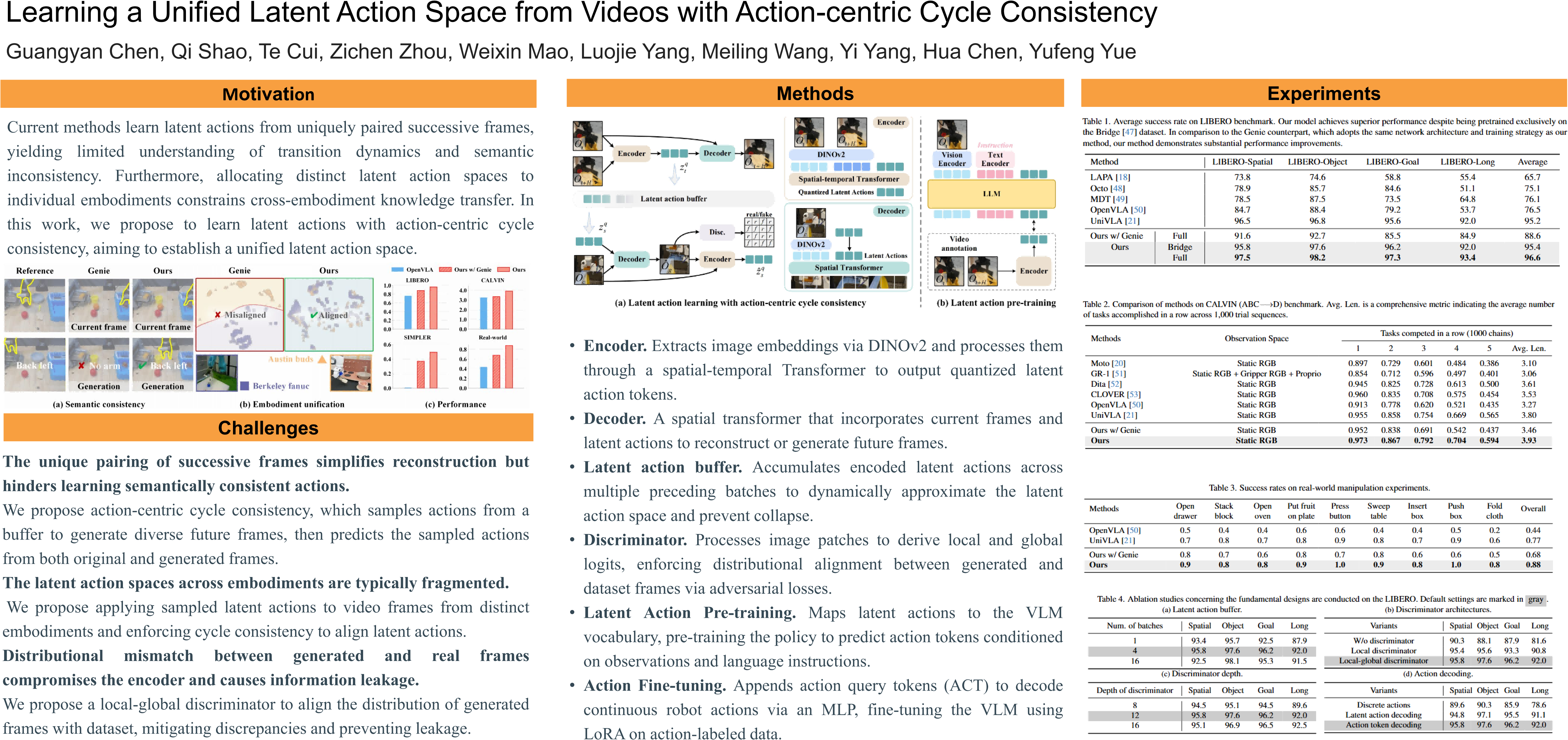
Video data provides a rich source beyond expensive action-labeled data for advancing robot learning. Recent approaches have demonstrated promising potential in leveraging video data by learning latent actions for policy training. The latent action tokenizer encodes latent actions between successive video frames, and the tokenizer is trained to reconstruct future frames using current frames and the encoded latent actions. However, the unique pairing of successive frames permits future frame reconstruction with little understanding of transition dynamics, hindering the learning of semantically consistent latent actions. Moreover, the tokenizer typically allocates distinct latent action subsets to individual embodiments to accommodate heterogeneous morphologies, constraining knowledge transfer. To overcome such limitations, we propose the action-centric cycle consistency, aiming to establish a unified latent action space. Our method samples latent actions from the latent action space and decodes them with video frames to generate diverse subsequent frames, then enforces cycle consistency by predicting the sampled actions from both original and generated frames. Our concise method creates a challenging task that learns corresponding latent actions from current frames and diverse generated future frames, compelling the tokenizer to develop semantically consistent action representations. Additionally, sampled latent actions can be applied to video frames from distinct embodiments, facilitating the alignment of latent actions across embodiments. Experiments demonstrate that our approach achieves a 20.1% improvement over OpenVLA on the LIBERO benchmark and increases the average length from 3.27 to 3.93 on the CALVIN benchmark. In real-world experiments, our method maintains strong performance with a 44% improvement.
VideoNet: A Large-Scale Dataset for Domain-Specific Action Recognition
Tanush Yadav ⋅ Reza Salehi ⋅ Jae Sung Park ⋅ Vivek Ramanujan ⋅ Hannaneh Hajishirzi ⋅ Yejin Choi ⋅ Ali Farhadi ⋅ Rohun Tripathi ⋅ Ranjay Krishna
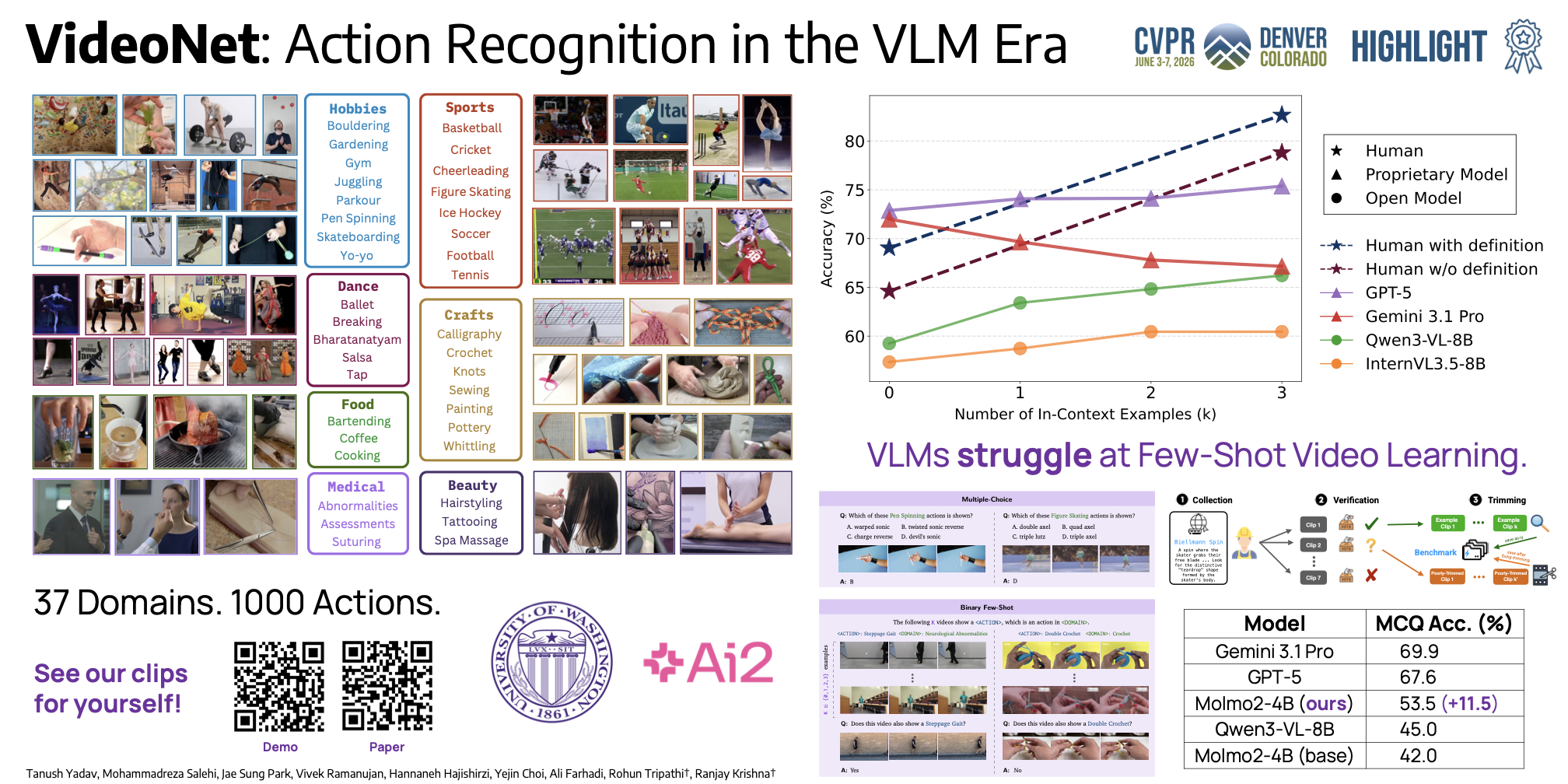
Videos capture a rich array of subtleties in actions. While large video language models have advanced in understanding long videos, their ability to discern nuanced motions in domain-specific, fine-grained actions remains unclear. Current benchmarks evaluate for fine-grained actions in a domain agnostic manner, making to hard to evaluate models on this task. To address this gap, we introduce \dataset, a comprehensive benchmark aimed at evaluating the domain-specific, fine-grained action understanding of video models.This benchmark covers $1,087$ distinct actions spanning $38$ domains, from bouldering to suturing.Our evaluations demonstrate that current video models encounter significant difficulties in recognizing these actions in a zero-shot scenario. We then examine how to improve model performance on this task. To this end, we collect a training dataset of 160K clips of fine-grained, domain-specific actions. Post-training a 4B model on this data, we surpass all Gemini models and GPT-4o on our benchmark. Next, we evaluate few-shot evaluation and demonstrate that even the best-performing model, GPT-5, struggles in a few-shot evaluation setting. When given three in-context examples, the gap between model and human performance widens, with human accuracy improving by 13% while models only improve by 3%. This suggests that video language models are currently not effective few-shot learners--unlike their text-only counterparts and further gains may be elicited from improving these models' few-short learning capabilities.
BD-Merging: Bias-Aware Dynamic Model Merging with Evidence-Guided Contrastive Learning
Yuhan Xie ⋅ Chen Lyu
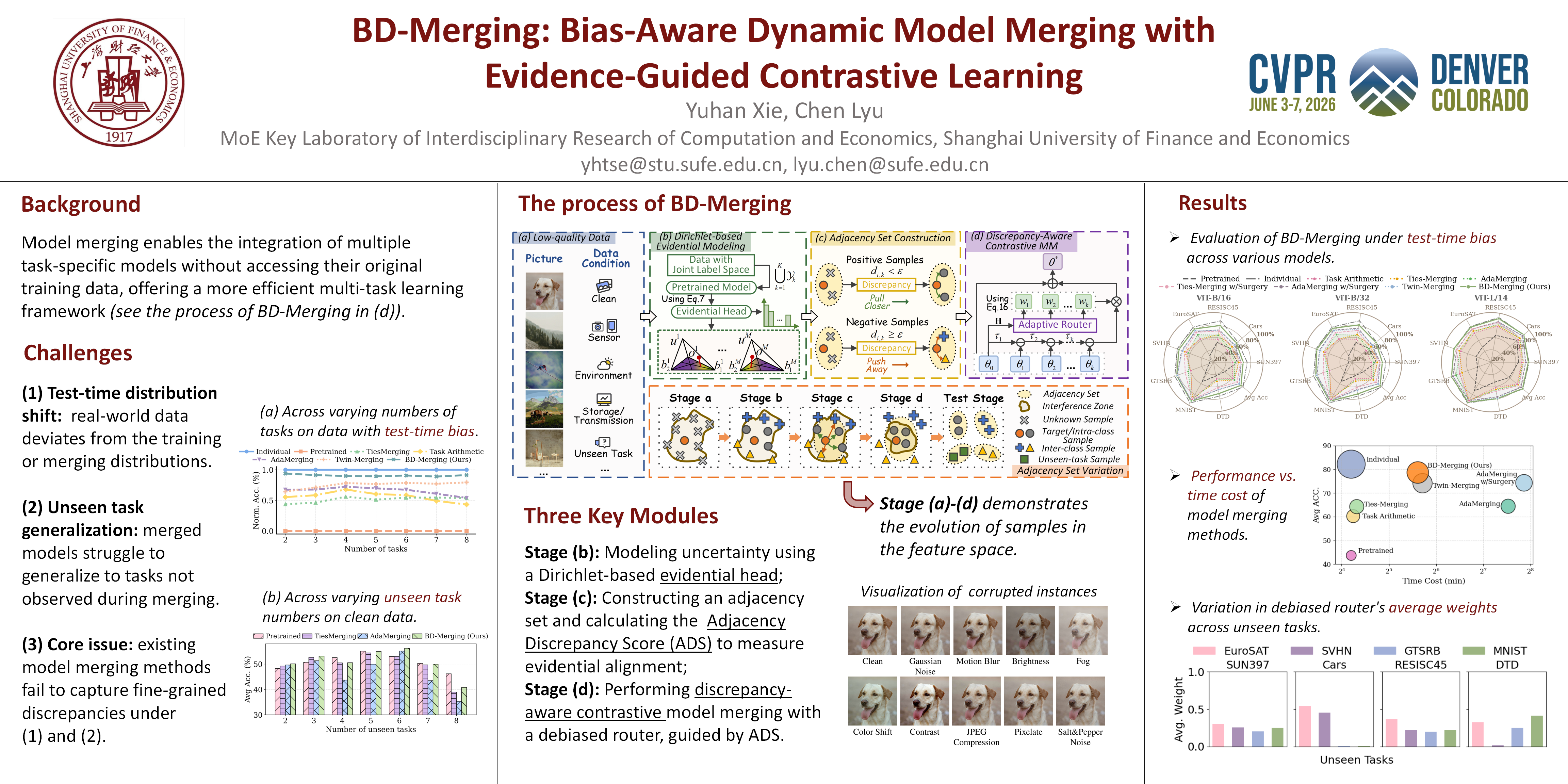
Model Merging (MM) has emerged as a scalable paradigm for multi-task learning (MTL), enabling multiple task-specific models to be integrated without revisiting the original training data. Despite recent progress, the reliability of MM under test-time distribution shift remains insufficiently understood. Most existing MM methods typically assume that test data are clean and distributionally aligned with both the training and auxiliary sources. However, this assumption rarely holds in practice, often resulting in biased predictions with degraded generalization. To address this issue, we present BD-Merging, a bias-aware unsupervised model merging framework that explicitly models uncertainty to achieve adaptive reliability under distribution shift. First, BD-Merging introduces a joint evidential head that learns uncertainty over a unified label space, capturing cross-task semantic dependencies in MM. Second, building upon this evidential foundation, we propose an Adjacency Discrepancy Score (ADS) that quantifies evidential alignment among neighboring samples. Third, guided by ADS, a discrepancy-aware contrastive learning mechanism refines the merged representation by aligning consistent samples and separating conflicting ones. Combined with general unsupervised learning, this process trains a debiased router that adaptively allocates task-specific or layer-specific weights on a per-sample basis, effectively mitigating the adverse effects of distribution shift. Extensive experiments across diverse tasks demonstrate that BD-Merging achieves superior effectiveness and robustness compared to state-of-the-art MM baselines.
Dynamic Momentum Recalibration in Online Gradient Learning
Zhipeng Yao ⋅ Rui Yu ⋅ Guisong Chang ⋅ Ying Li ⋅ Yu Zhang ⋅ Dazhou Li
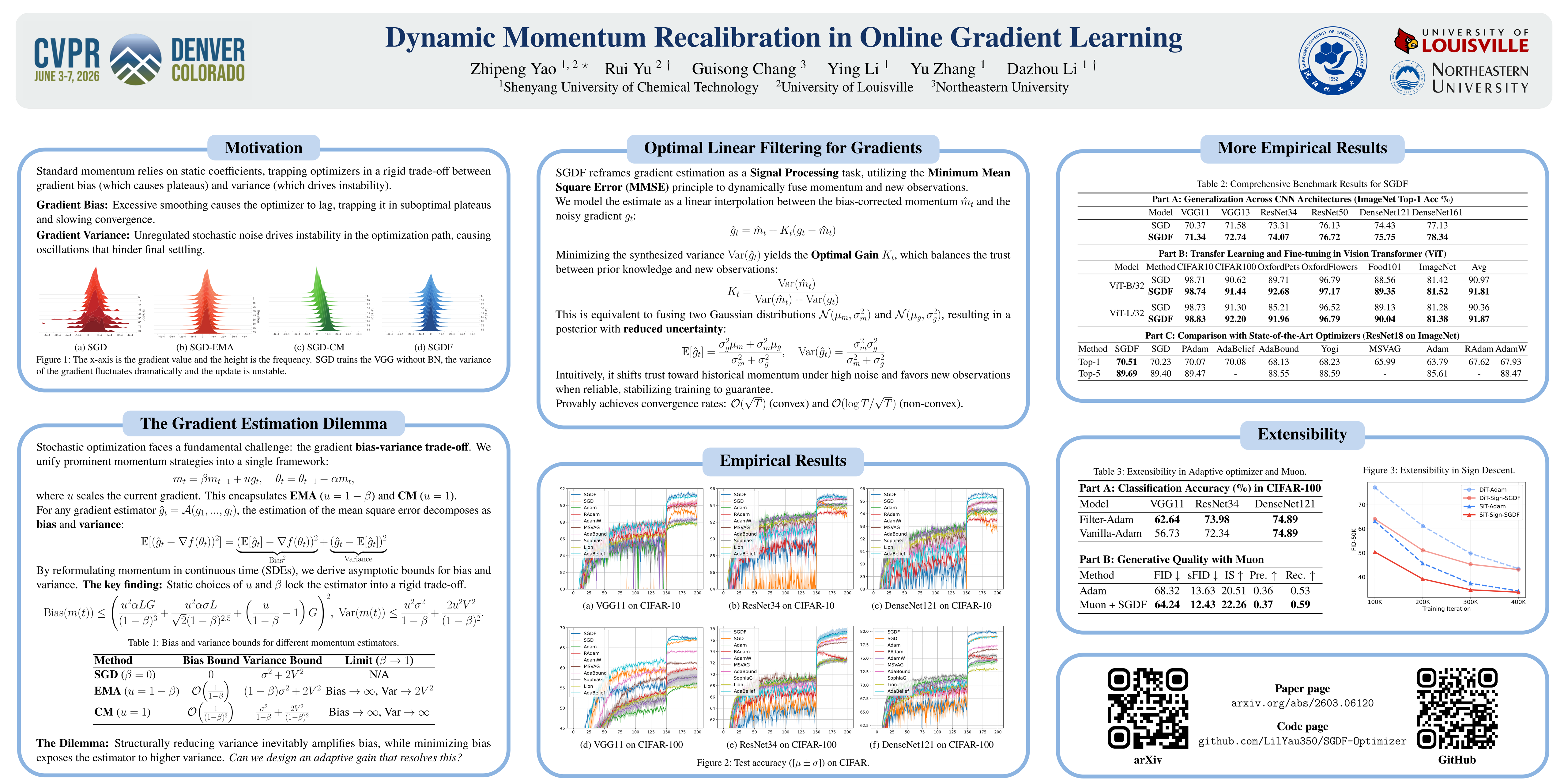
Stochastic Gradient Descent (SGD) and its momentum-driven variants form the backbone of deep learning optimization, yet the underlying dynamics of their gradient behavior remain insufficiently understood. In this work, we reinterpret gradient updates through the lens of signal processing and reveal that fixed momentum coefficients inherently distort the balance between bias and variance, leading to skewed or suboptimal parameter updates. To address this, we propose SGDF (SGD with Filter), an optimizer inspired by the principles of Optimal Linear Filtering. SGDF computes an online, time-varying gain to dynamically refine gradient estimation by minimizing the mean-squared error, thereby achieving an optimal trade-off between noise suppression and signal preservation. Furthermore, our approach could extend to adaptive optimizers, enhancing their generalization potential. Extensive experiments across diverse architectures and benchmarks demonstrate that SGDF outperforms conventional momentum-based methods and achieves performance on par with or surpassing state-of-the-art optimizers.
Spherical Leech Quantization for Visual Tokenization and Generation
Yue Zhao ⋅ Hanwen Jiang ⋅ Zhenlin Xu ⋅ Chutong Yang ⋅ Ehsan Adeli ⋅ Philipp Krähenbühl
Lookup-free quantization has received much attention due to its efficiency on parameters and scalability to a large codebook. In this paper, we present a unified formulation of different non-parametric quantization methods through the lens of lattice coding. The geometry of lattice codes explains the necessity of auxiliary loss terms when training auto-encoders with certain existing lookup-free quantization variants such as BSQ. As a step forward, we explore a few possible candidates, including random lattices, generalized Fibonacci lattices, and densest sphere packing lattices. Among all, we find the Leech lattice-based quantization method, which is dubbed as Spherical Leech Quantization ($\Lambda_{24}$-SQ), leads to both a simplified training recipe and an improved reconstruction-compression tradeoff thanks to its high symmetry and even distribution on the hypersphere. In image tokenization and compression tasks, this quantization approach achieves better reconstruction quality across all metrics than BSQ, the best prior art, while consuming slightly fewer bits. The improvement also extends to state-of-the-art auto-regressive image generation frameworks.
MSPT: Efficient Large-Scale Physical Modeling via Parallelized Multi-Scale Attention
Pedro M. P. Curvo ⋅ Jan-Willem van de Meent ⋅ Maksim Zhdanov
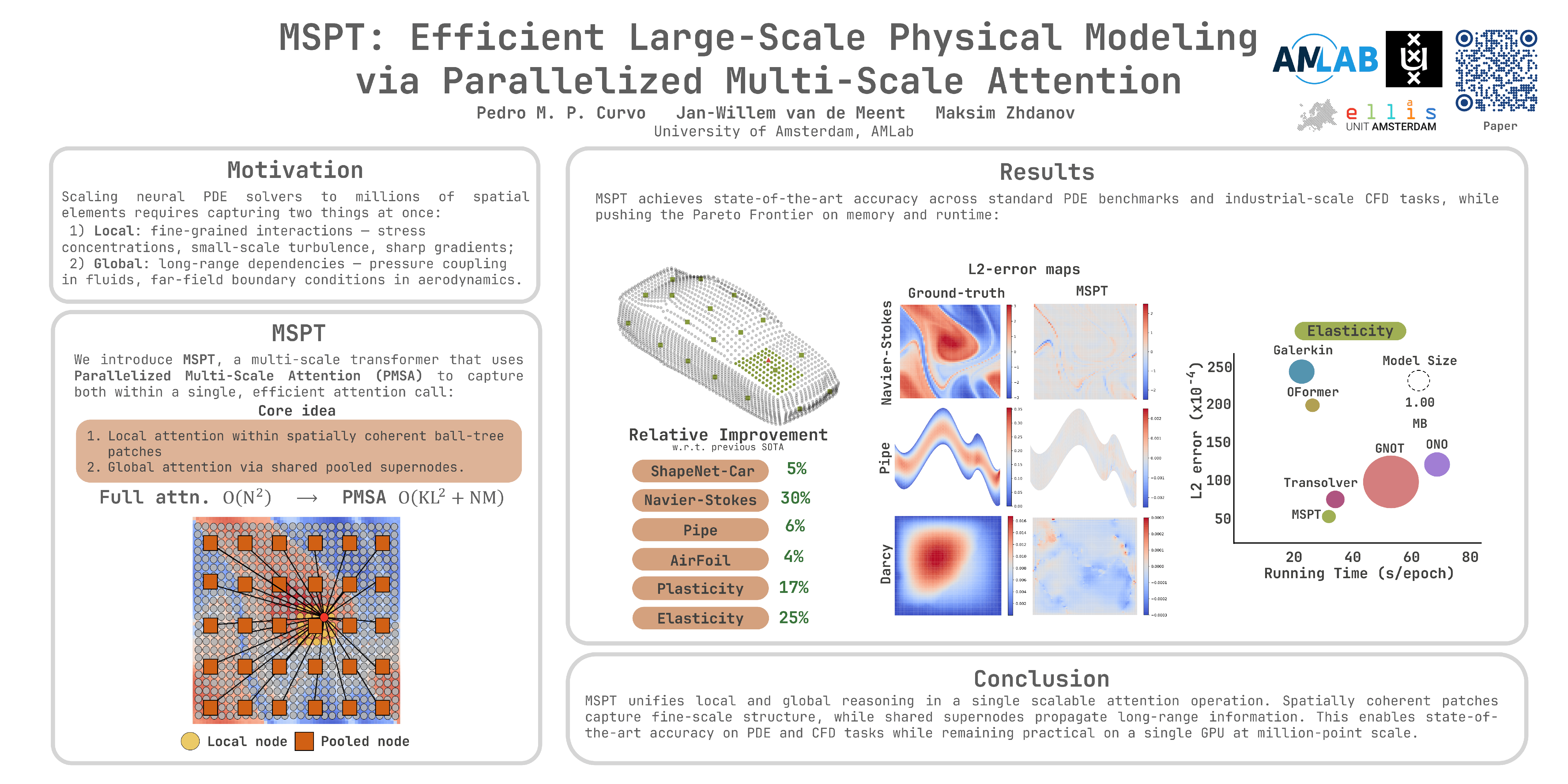
A key scalability challenge in neural solvers for industrial-scale physics simulations is efficiently capturing both fine-grained local interactions and long-range global dependencies across millions of spatial elements. We introduce the Multi-Scale Patch Transformer (MSPT), an architecture that combines local point attention within patches with global attention to coarse patch-level representations. To partition the input domain into spatially-coherent patches, we employ ball trees, which handle irregular geometries efficiently. This dual-scale design enables MSPT to scale to millions of points on a single GPU. We validate MSPT on standard PDE benchmarks (elasticity, plasticity, fluid dynamics, porous flow) and large-scale aerodynamic datasets (ShapeNet-Car, Ahmed-ML), achieving state-of-the-art accuracy with substantially lower memory footprint and computational cost.
GR-Gauge: Cost-efficient Training Configuration By Gauging the Gradient Redundancy
Guanjie Wang ⋅ Chen Chen
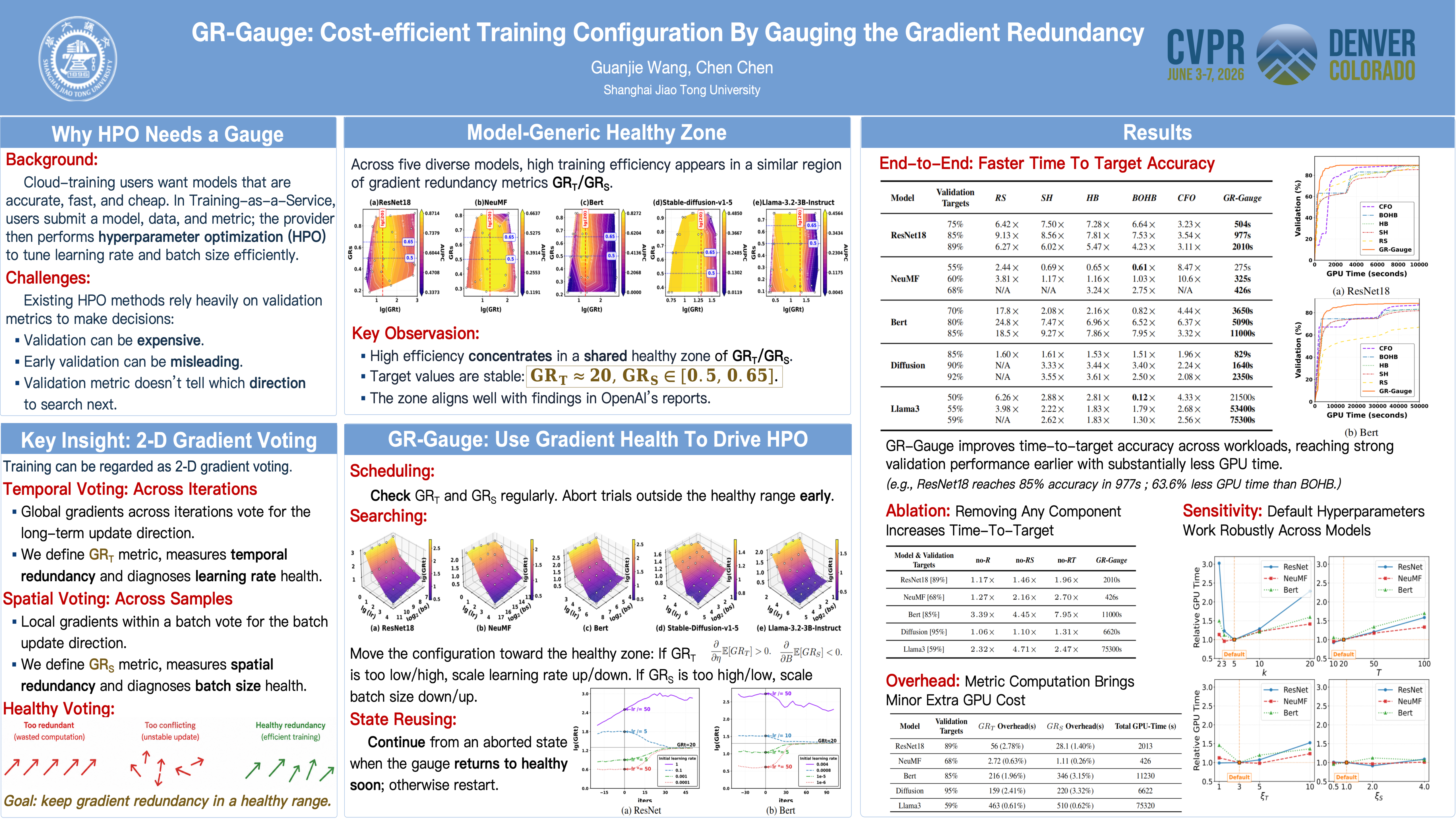
The recent success of artificial intelligence motivates many non-professional users to train their own models. Those users often resort to cloud training services, seeking to obtain a sufficiently accurate model at a modest cost, for which properly setting up the learning rate and batch size is crucial. While various Hyper-parameter Optimization (HPO) methods have been proposed in that regard, they largely act based on heavy-weight validation signals, being inefficient in the overall cost. We find that the model training process can be viewed as a two-dimensional voting process---with gradients for different iterations and from different samples; moreover, to attain cost-efficient training is to ensure that the gradient redundancy is within a proper range which is similar across diverse models. We further introduce GR-Gauge, a general method that gauges the gradient redundancy to instruct HPO decisions like configuration searching and trial termination. Extensive experiments demonstrate that GR-Gauge can help attain near-optimal accuracy in much less time than existing methods.
E^2-SCI: Elastic Edge–Cloud Speculative Decoding via Credit Inertia
Senyao Li ⋅ Haozhao Wang ⋅ Zhaobai Jiang ⋅ Zhanbo Jin ⋅ Hao Fan ⋅ Ruixuan Li
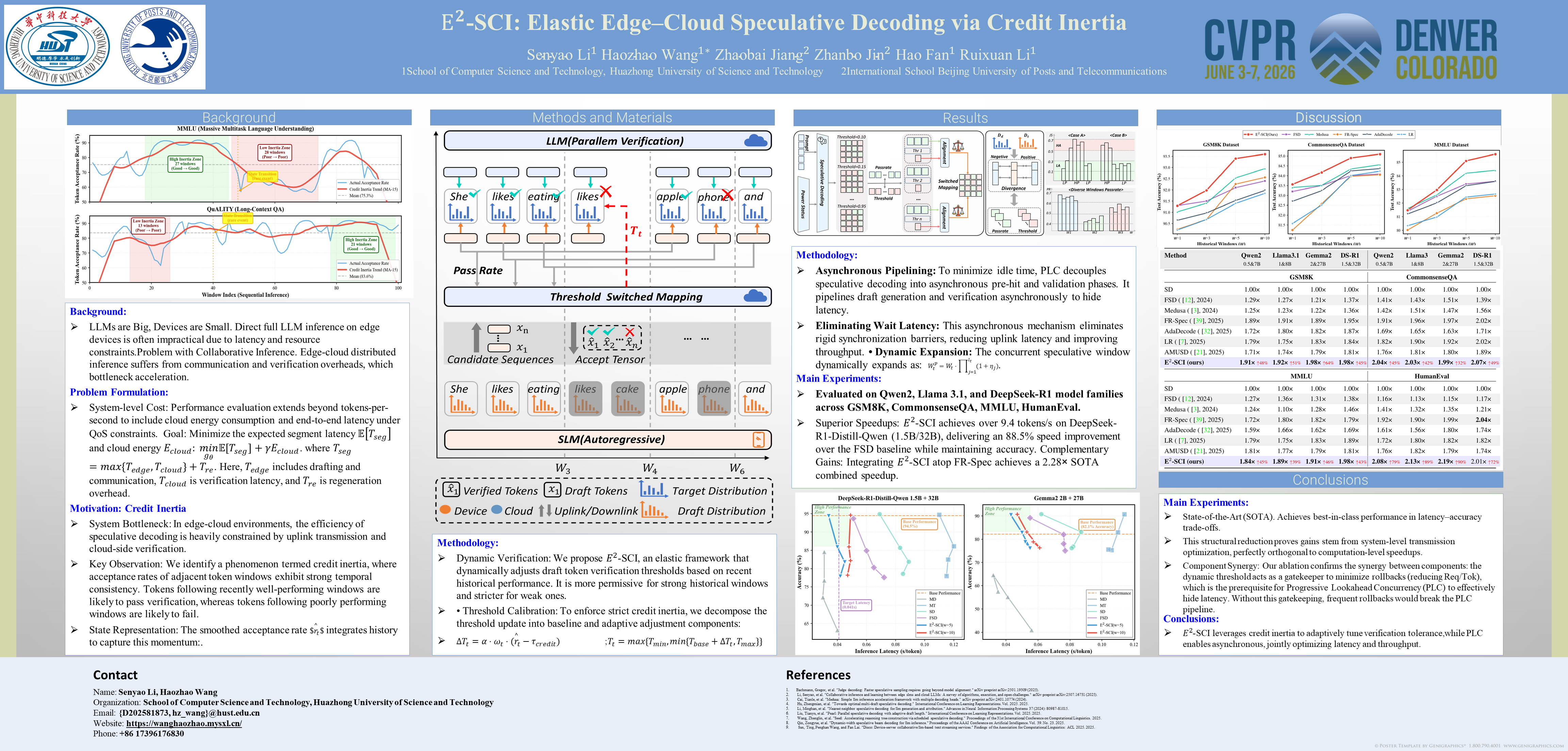
In edge–cloud environments, the efficiency of speculative decoding is heavily constrained by uplink transmission and cloud-side verification. In this work, we identify a phenomenon we term credit inertia, where the acceptance rates of adjacent token windows exhibit strong temporal consistency. Tokens following recently well-performing windows are likely to pass verification, whereas tokens following poorly performing windows are likely to fail. Motivated by this observation, we propose E$^2$-SCI, an elastic edge–cloud speculative decoding framework that dynamically adjusts draft token verification thresholds based on recent historical performance. This adaptive mechanism allows the system to be more permissive for windows with strong historical performance and stricter for windows with weak performance, effectively leveraging temporal consistency to reduce overall latency. We further introduce Progressive Lookahead Concurrency (PLC), which pipelines draft generation and verification asynchronously to hide latency. Experiments across multiple benchmarks show that E$^2$-SCI achieves over $9.4$ tokens/s on DeepSeek-R1-Distill-Qwen (1.5B/32B), delivering an 88.5\% speed improvement over the FSD baseline while maintaining accuracy. Notably, E$^2$-SCI integrates seamlessly with existing frameworks (e.g., EAGLE-3), demonstrating broad applicability and superior efficiency–quality trade-offs.
HyperNAS: Enhancing Architecture Representation for NAS Predictor via Hypernetwork
Jindi Lv ⋅ Yuhao Zhou ⋅ Yuxin Tian ⋅ Qing Ye ⋅ Wentao Feng ⋅ Jiancheng Lv
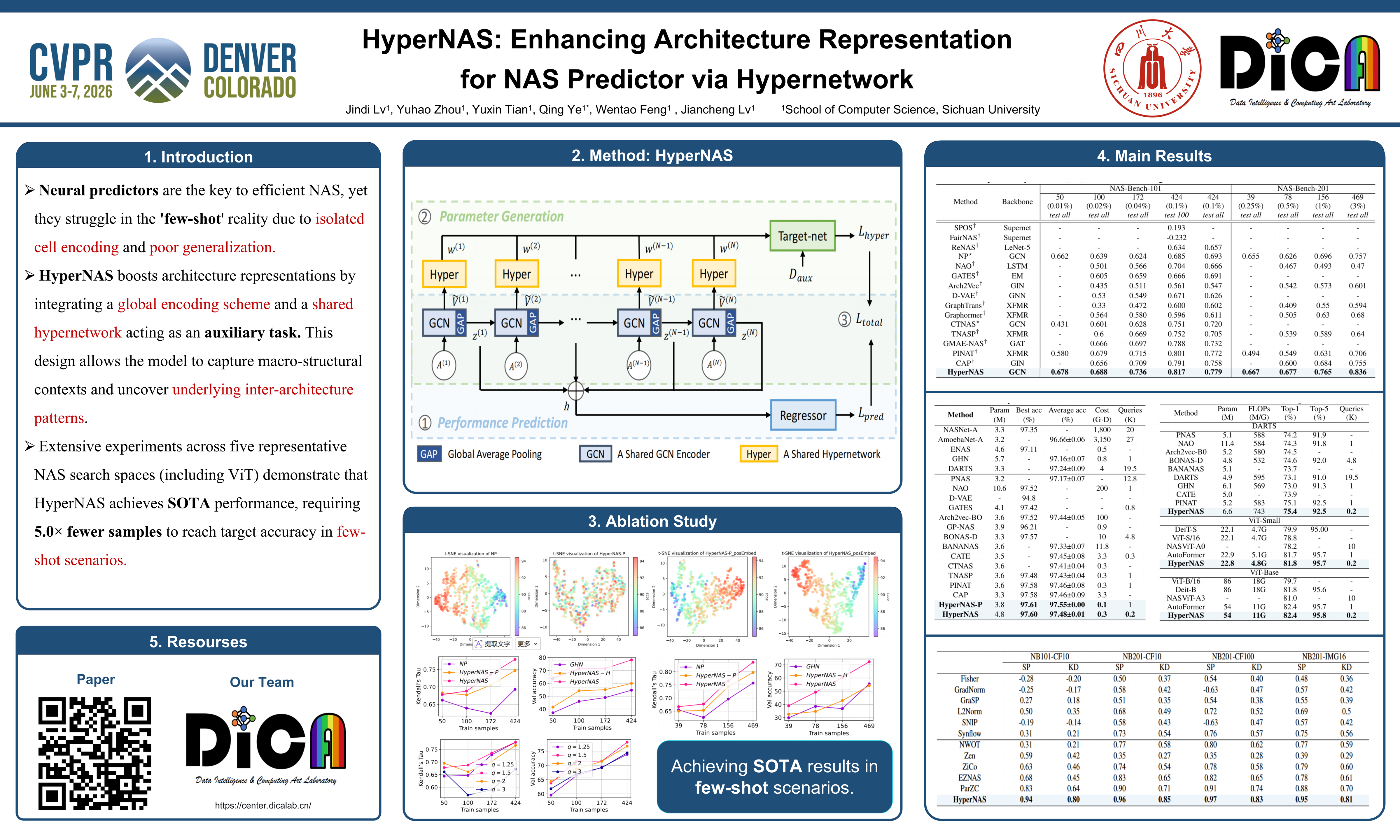
Time-intensive performance evaluations significantly impede progress in Neural Architecture Search (NAS). To address this, neural predictors leverage surrogate models trained on proxy datasets, allowing for direct performance predictions for new architectures.However, these predictors often exhibit poor generalization due to their limited ability to capture intricate relationships among various architectures. In this paper, we propose HyperNAS, a novel neural predictor paradigm for enhancing architecture representation learning. HyperNAS consists of two primary components: a global encoding scheme and a shared hypernetwork. The global encoding scheme is devised to capture the comprehensive macro-structure information, while the shared hypernetwork serves as an auxiliary task to enhance the investigation of inter-architecture patterns. To ensure training stability, we further develop a dynamic adaptive multi-task loss to facilitate personalized exploration on the Pareto front. Extensive experiments across five representative search spaces, including ViTs, demonstrate the advantages of HyperNAS, particularly in few-shot scenarios. For instance, HyperNAS strikes new state-of-the-art results, with 97.60\% top-1 accuracy on CIFAR-10 and 82.4\% top-1 accuracy on ImageNet, using at least 5.0$\times$ fewer samples.
NeuroFlow: Toward Unified Visual Encoding and Decoding from Neural Activity
Weijian Mai ⋅ Mu Nan ⋅ Yu Zhu ⋅ Jiahang Cao ⋅ Rui Zhang ⋅ Yuqin Dai ⋅ Chunfeng Song ⋅ Andrew F. Luo ⋅ Jiamin Wu
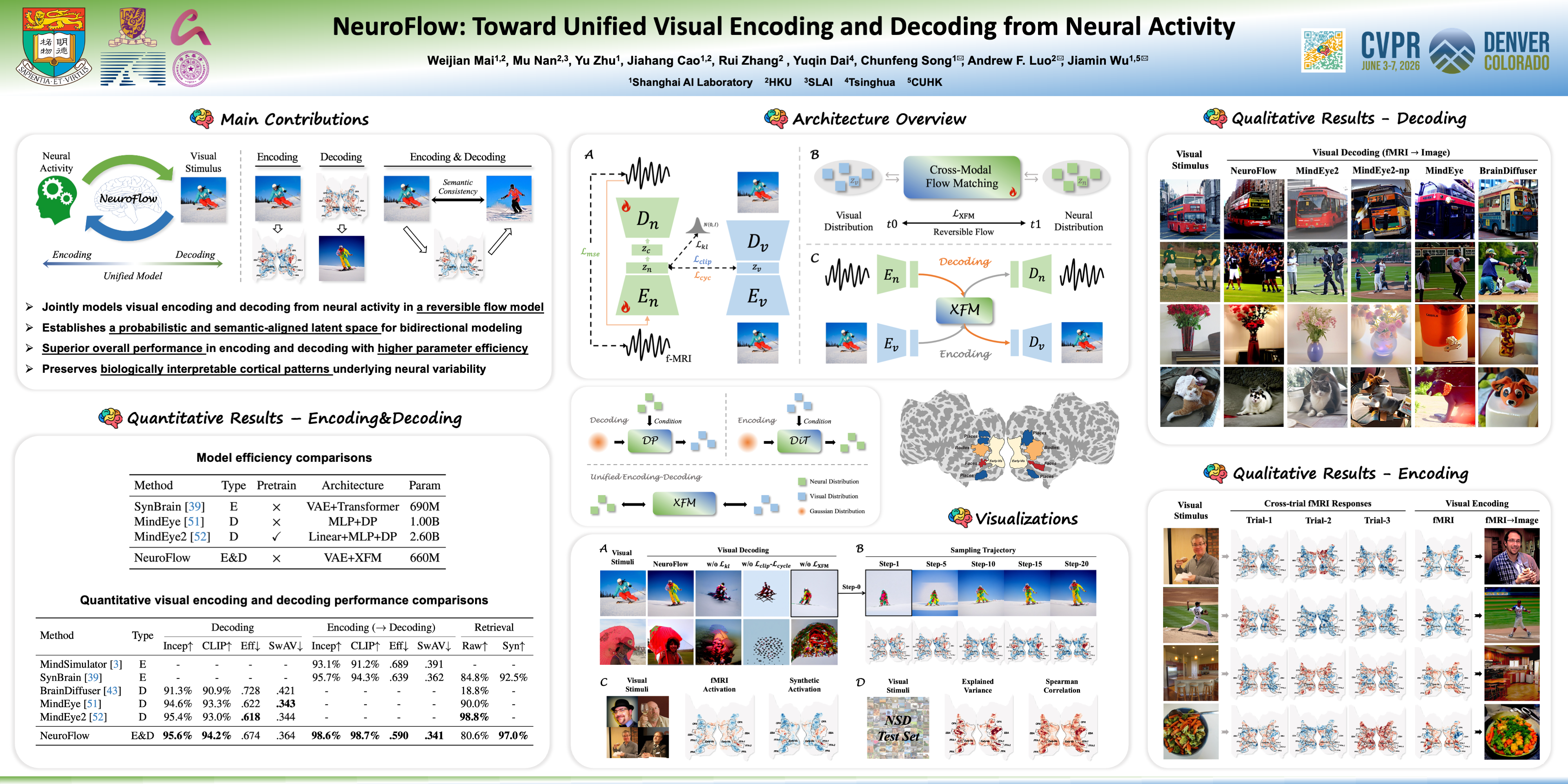
Visual encoding and decoding models act as gateways to understanding the neural mechanisms underlying human visual perception. Typically, visual encoding models that predict brain activity from stimuli and decoding models that reproduce stimuli from brain activity are treated as distinct tasks, requiring separate models and training procedures. This separation is inefficient and fails to model the consistency between encoding and decoding processes. To address this limitation, we propose NeuroFlow, the first unified framework that jointly models visual encoding and decoding from neural activity within a single flow model. NeuroFlow introduces two key components: (i) NeuroVAE is designed as a variational backbone to model neural variability and establish a compact, semantically structured latent space for bidirectional modeling across visual and neural modalities. (ii) Cross-modal Flow Matching (XFM) bypasses the typical paradigm of noise-to-data diffusion guided by a specific modality condition, instead learning a reversibly consistent flow model between visual and neural latent distributions. For the first time, visual encoding and decoding are reformulated as a time-dependent, reversible process within a shared latent space for unified modeling. Empirical results demonstrate that NeuroFlow achieves superior overall performance in visual encoding and decoding tasks with higher computational efficiency compared to any isolated methods. We further analyze principal factors that steer the model toward encoding–decoding consistency and, through brain functional analyses, demonstrate that NeuroFlow captures consistent activation patterns underlying neural variability. NeuroFlow marks a major step toward unified visual encoding and decoding from neural activity, providing mechanistic insights that inform future bidirectional visual brain–computer interfaces. Code will be released to facilitate future research.
Spectral Conformal Risk Control: Distribution-Free Tail Guarantees via Bayesian Quadrature
Mohammad Mahdi Kazemi Esfeh ⋅ Qi Yan ⋅ Yongxing Zhang ⋅ Zahra Gholami ⋅ Renjie Liao ⋅ Purang Abolmaesumi
Modern vision systems are deployed in settings where occasional catastrophic failures matter more than average accuracy—for example in medical imaging, autonomous driving, and safety monitoring. While conformal prediction gives distribution-free uncertainty guarantees, most existing methods only control mean error and are hard to tune toward rare but high-cost mistakes. We propose Bayesian-Quadrature Spectral Risk Control (BQ-SRC), a general framework for controlling tail-focused risks (such as conditional value at risk (CVaR)-style objectives) in a distribution-free way. BQ-SRC views conformal prediction through a Bayesian-quadrature lens and replaces mean-risk control with a flexible family of risk-averse criteria, while keeping the same black-box access to a trained model. A binomial testing scheme reduces the Monte Carlo conservatism of prior approaches, leading to tighter sets without sacrificing guarantees. We evaluate BQ-SRC across diverse vision tasks, including synthetic regression, closed-set and zero-shot image classification, multilabel classification, and semantic segmentation. Across these settings, BQ-SRC consistently maintains finite-sample risk guarantees and often yields smaller or otherwise more informative prediction sets than existing conformal and risk-controlling baselines, sometimes trading a modest amount of efficiency for stronger tail-risk control. We will make our implementation publicly available upon acceptance.
Edge-RecViT: Efficient Vision Transformer via Semantic-Refined Dynamic Recursion
YiZhou Li ⋅ Jinyi Xu ⋅ Mingyu Yin ⋅ Xianyi Zhao
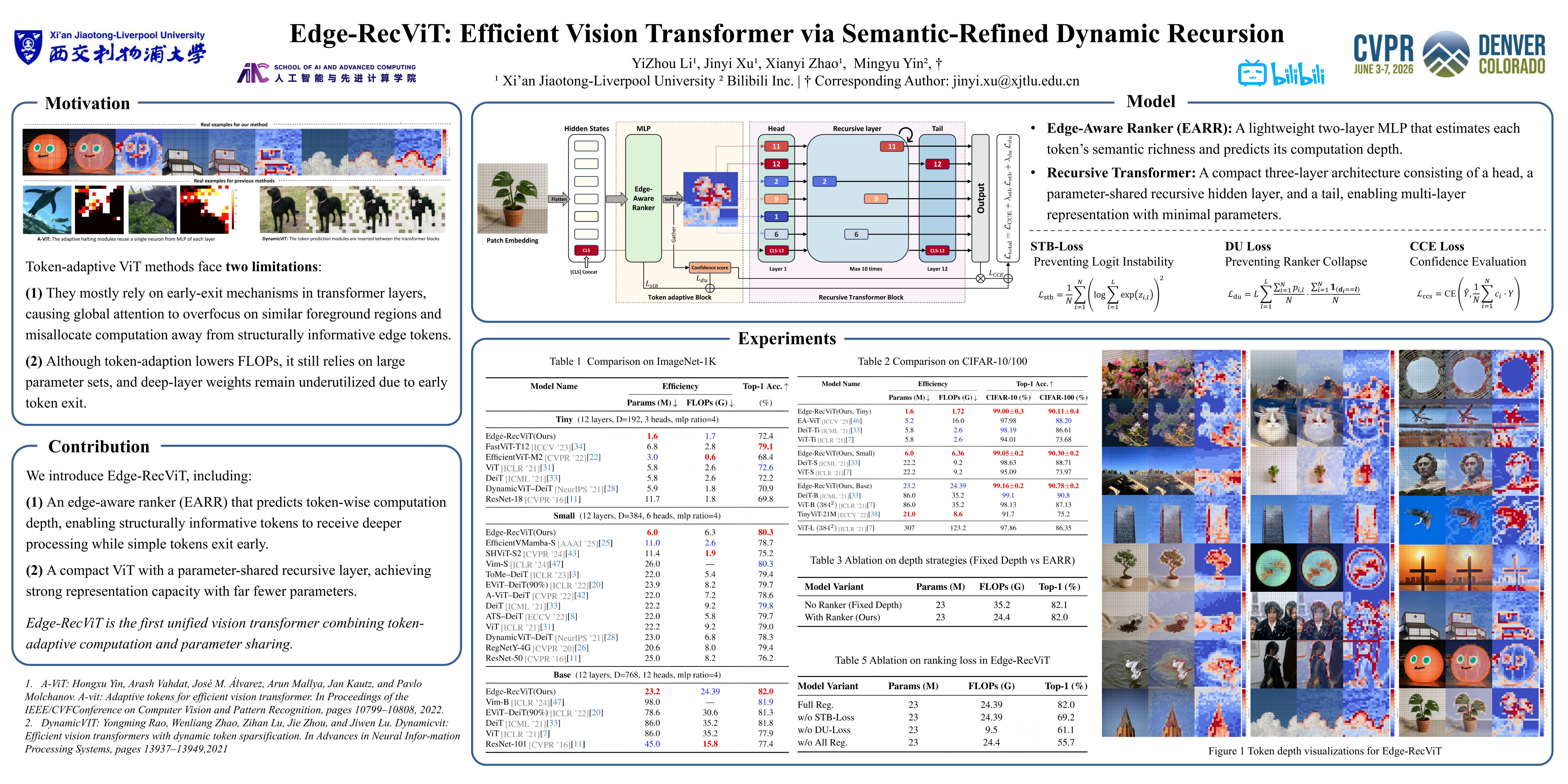
Vision Transformers (ViTs) have achieved remarkable progress in visual and multimodal tasks, yet their deployment remains costly.Token-adaptive methods reduce FLOPs through dynamic depth computation, but face two limitations:(1) Global attention overemphasizes highly similar foreground regions, causing token-adaptive modules to assign the deepest computation to semantically weak foreground tokens while prematurely exiting edge tokens rich in structural cues;(2) Although token-adaption lowers FLOPs, it still relies on large parameter sets, and deep-layer weights remain underutilized due to early token exit. Parameter sharing could address redundancy but is difficult to apply in ViTs, where hierarchical abstraction typically requires diverse transformations.To address these issues, we propose Edge-RecViT, an Edge-Adaptive Dynamic Recursive Vision Transformer that integrates an edge-aware token-adaptive ranker with a recursive transformer using fully shared parameters in its hidden layers.Edge-RecViT dynamically allocates computation based on semantic richness: structurally informative edge tokens receive deeper refinement, whereas redundant low-information tokens exit early.Extensive experiments show that Edge-RecViT provides an excellent trade-off among accuracy, FLOPs, and parameter efficiency.On ImageNet-1K, it matches DeiT within 0.3\% Top-1 accuracy while reducing FLOPs by 30.5\% (35.1 → 24.39 GFLOPs).At the Base level, parameter drops from 86M to 23.21M with higher accuracy than ViT-Base; compared with ViT-Large, parameters are reduced by 93\% while maintaining superior accuracy.
ERMoE: Eigen-Reparameterized Mixture-of-Experts for Stable Routing and Interpretable Specialization
Anzhe Cheng ⋅ Shukai Duan ⋅ Shixuan Li ⋅ Chenzhong Yin ⋅ Mingxi Cheng ⋅ Heng Ping ⋅ Tamoghna Chattopadhyay ⋅ Sophia Thomopoulos ⋅ Shahin Nazarian ⋅ Paul Thompson ⋅ Paul Bogdan
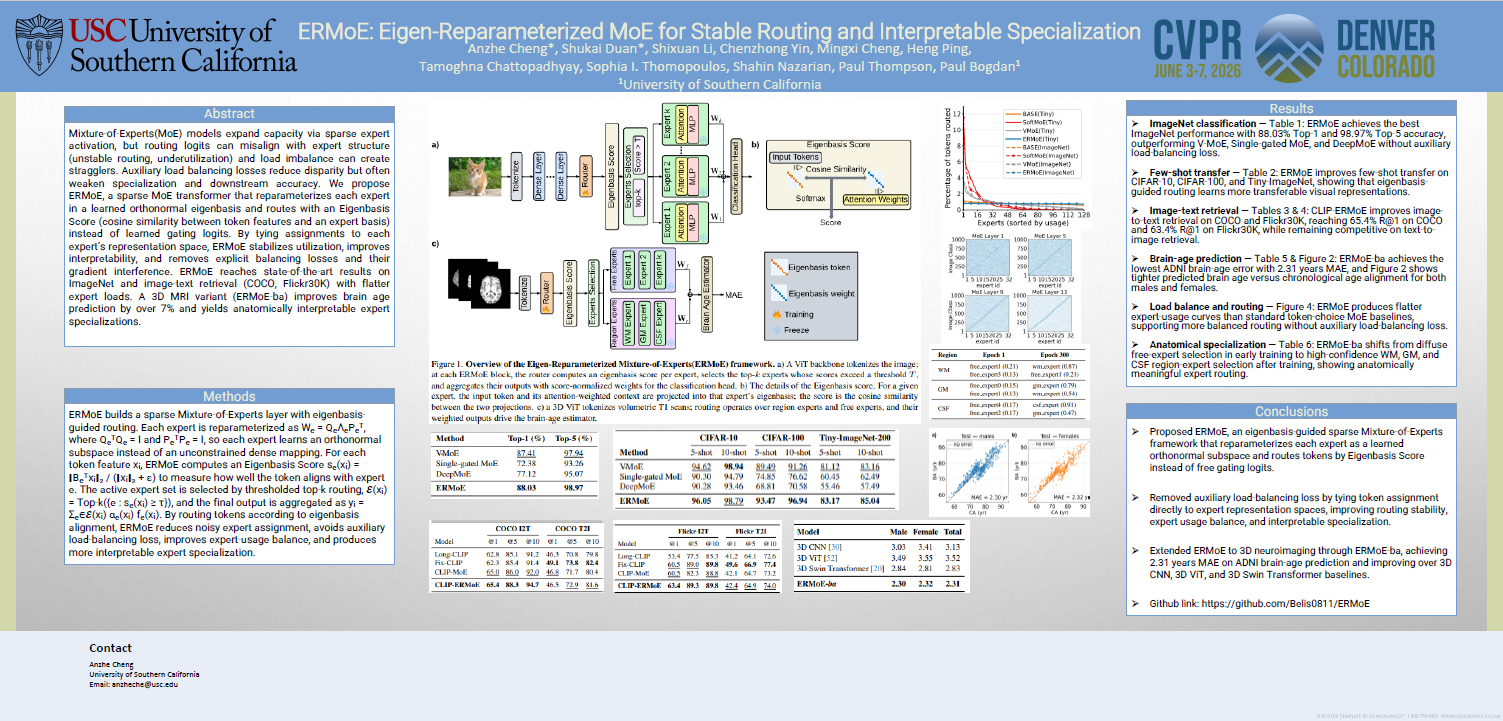
Mixture-of-Experts (MoE) architectures expand model capacity by sparsely activating experts, but suffer from two core challenges: misalignment between router logits and each expert’s internal structure leads to unstable routing and expert underutilization, and load imbalances create straggler bottlenecks. Standard solutions, such as auxiliary load-balancing losses, can reduce load disparities but often weaken expert specialization and hurt downstream performance. To address these issues, we propose ERMoE, a sparse MoE transformer that reparameterizes each expert in a learned orthonormal eigenbasis and replaces learned gating logits with an Eigenbasis Score—the cosine similarity between input features and an expert’s basis. This content-aware routing ties token assignments directly to experts’ representation spaces, inherently stabilizing utilization and promoting interpretable specialization without sacrificing sparsity. Crucially, ERMoE eliminates the need for explicit balancing losses and avoids the interfering gradients they introduce. We demonstrate that ERMoE achieves state-of-the-art accuracy on ImageNet classification and cross-modal image-text retrieval benchmarks (e.g., COCO, Flickr30K), while naturally producing flatter expert load distributions. Moreover, a 3D MRI variant (ERMoE-ba) improves brain age prediction accuracy by over 7% and yields anatomically interpretable expert specializations. ERMoE thus introduces a new architectural principle for sparse expert models, directly addressing core routing instabilities and enabling improved performance with scalable, interpretable specialization.
GUI-SAGE: Enhancing GUI Automation with Self-Explanatory Learning
Fei Tang ⋅ Zhangxuan Gu ⋅ Zhengxi Lu ⋅ Shangzhan Zhang ⋅ Zhengwen Zeng ⋅ Shuheng Shen ⋅ Changhua Meng ⋅ Yuchen Yan ⋅ Wenqi Zhang ⋅ Yongliang Shen ⋅ Weiming Lu ⋅ Yueting Zhuang
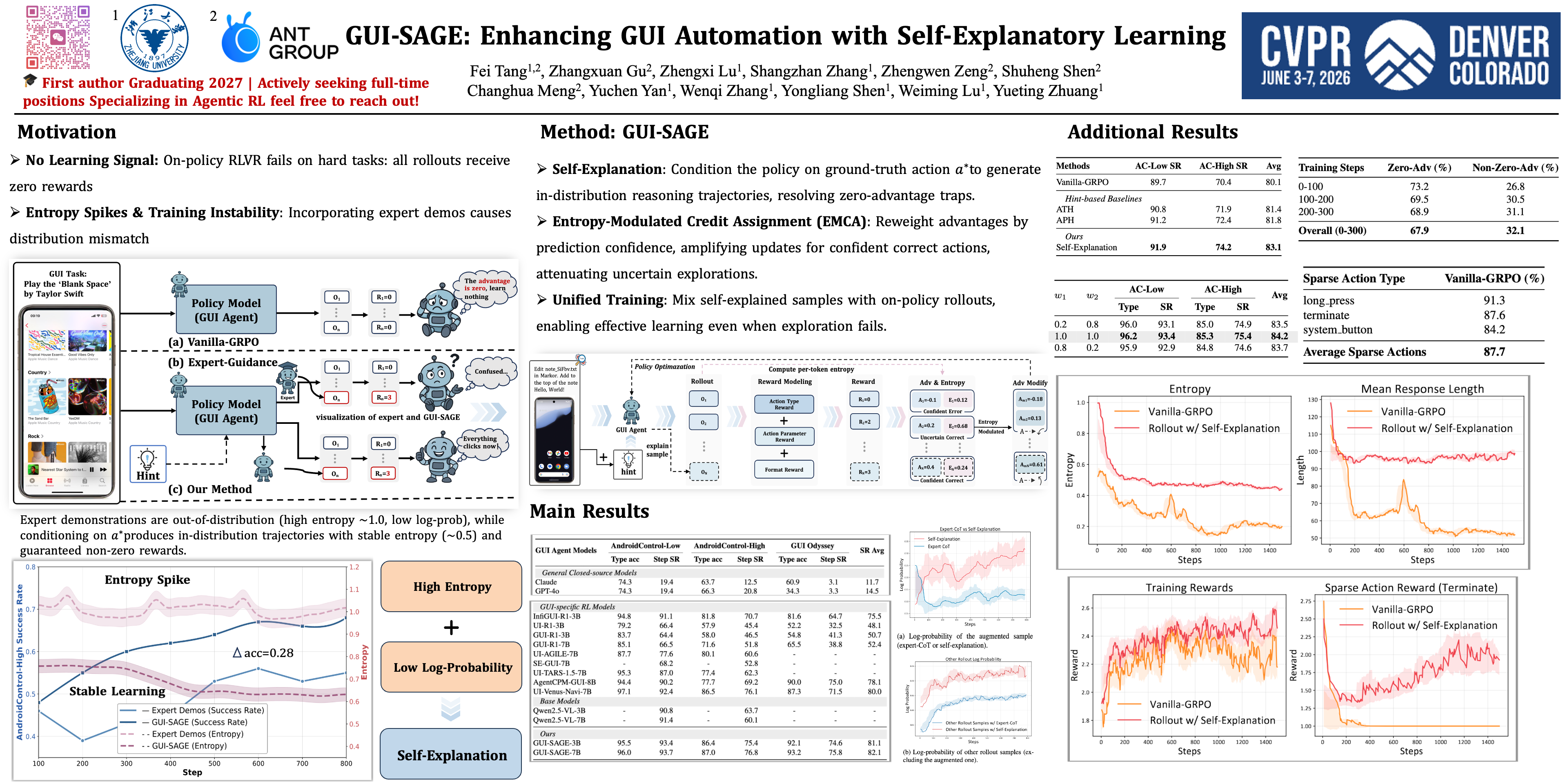
Reinforcement learning with verifiable rewards (RLVR) has shown promise for GUI automation, enabling agents to learn from binary task completion signals. However, when task difficulty exceeds model capacity, on-policy exploration fails to discover correct actions, creating zero-advantage traps that eliminate learning signals. While incorporating off-policy expert demonstrations seems intuitive, it causes persistent high-entropy states due to distribution mismatch, disrupting effective learning. We propose GUI-SAGE, a self-explanation framework that generates in-distribution reasoning trajectories for GUI automation. By conditioning on ground-truth actions, our method produces in-distribution guidance that avoids the confusion caused by out-of-distribution expert demonstrations. We further introduce Entropy-Modulated Credit Assignment, which recalibrates learning weights by jointly considering prediction confidence and reward signals, enabling amplified updates for confident correct actions and attenuated updates for uncertain explorations. Extensive experiments on AndroidControl and GUI-Odyssey demonstrate that GUI-SAGE-3B achieves competitive performance with 81.1\% success rate, substantially outperforming existing methods. Our analysis validates that self-explanations maintain stable learning dynamics while expert demonstrations cause entropy collapse, and that entropy modulation provides the largest improvements on in-distribution samples.
GUIDE: A Benchmark for Understanding and Assisting Users in Open-Ended GUI Tasks
Saelyne Yang ⋅ Jaesang Yu ⋅ Yi-Hao Peng ⋅ Kevin Qinghong Lin ⋅ Jae Won Cho ⋅ Yale Song ⋅ Juho Kim
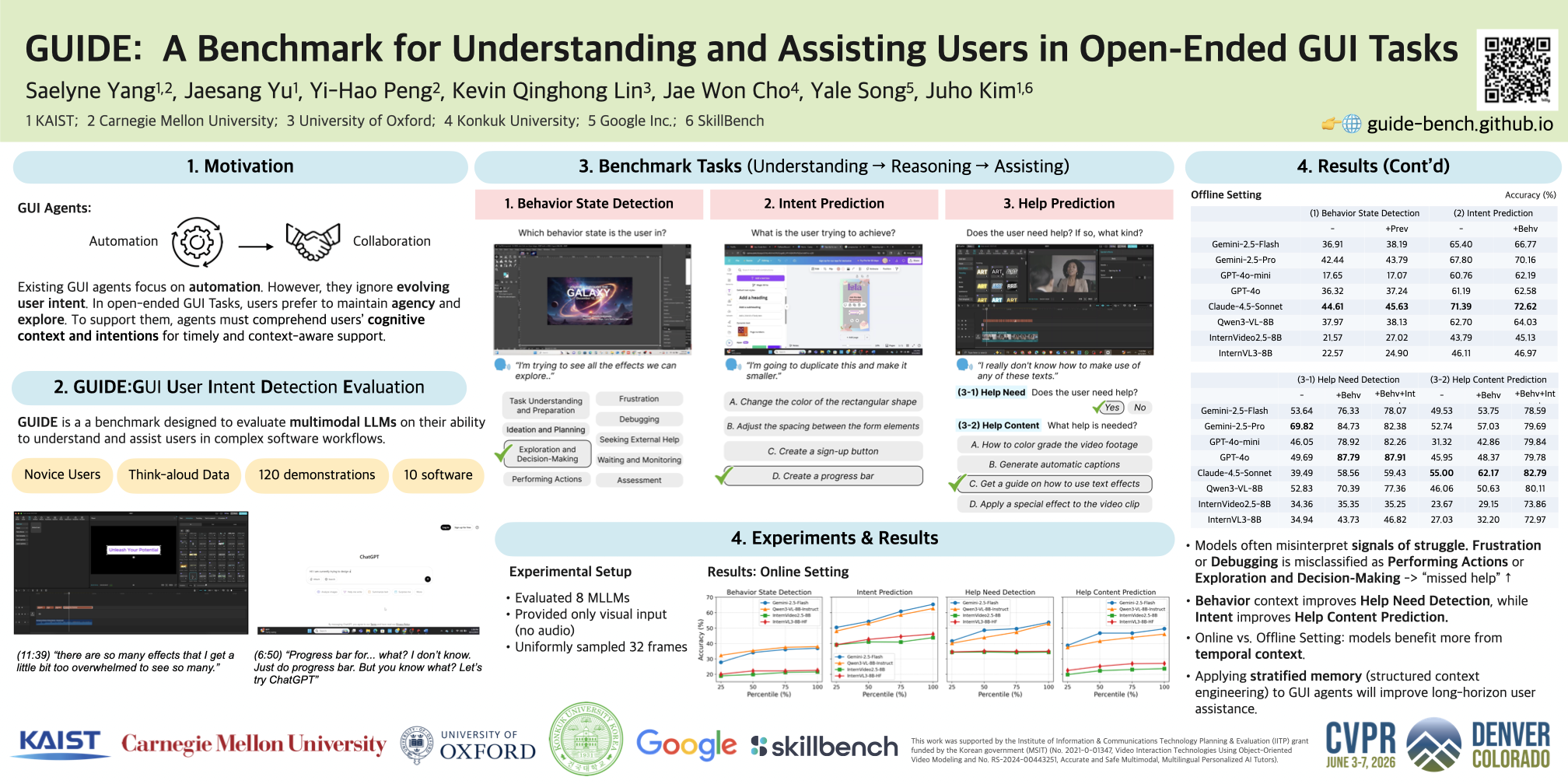
Graphical User Interface (GUI) agents have the potential to assist users in interacting with complex software. While prior research has primarily focused on automating user actions through clicks and keystrokes, this paradigm overlooks human intention, where users value the ability to explore, iterate, and refine their ideas while maintaining agency.To move beyond automation and toward collaboration, GUI agents must understand what users are doing and why. We introduce GUIDE (GUI Understanding, Intent, and Help Decision Evaluation), a benchmark that evaluates AI models on their ability to perceive user behavior, infer intent, and provide assistance in open-ended GUI tasks. GUIDE consists of 67.5 hours of screen recordings from 120 novice user demonstrations with think-aloud narrations that surface user intent, across 10 complex software (e.g., PowerPoint, Photoshop). GUIDE defines three tasks—(i) Behavior State Detection, (ii) Intent Prediction, and (iii) Help Prediction that test a model’s ability to recognize behavior state, reason about goals, and decide when and how to help. Evaluations across eight state-of-the-art multimodal models reveal that all models struggled with the tasks, achieving only 44.6\% and 55.0\% accuracy on behavior state and help prediction. However, providing user context such as behavioral state and intent significantly improved the performance, raising help prediction by up to 50.2\%. These results highlight the critical role of structured user understanding in effective assistance.Our benchmark provides a path toward GUI agents that go beyond automation to become truly user-aware collaborators.
HiconAgent: History Context-aware Policy Optimization for GUI Agents
Xurui Zhou ⋅ Gongwei Chen ⋅ Yuquan Xie ⋅ Zaijing Li ⋅ Kaiwen Zhou ⋅ Shuai Wang ⋅ Shuo Yang ⋅ Zhuotao Tian ⋅ Rui Shao
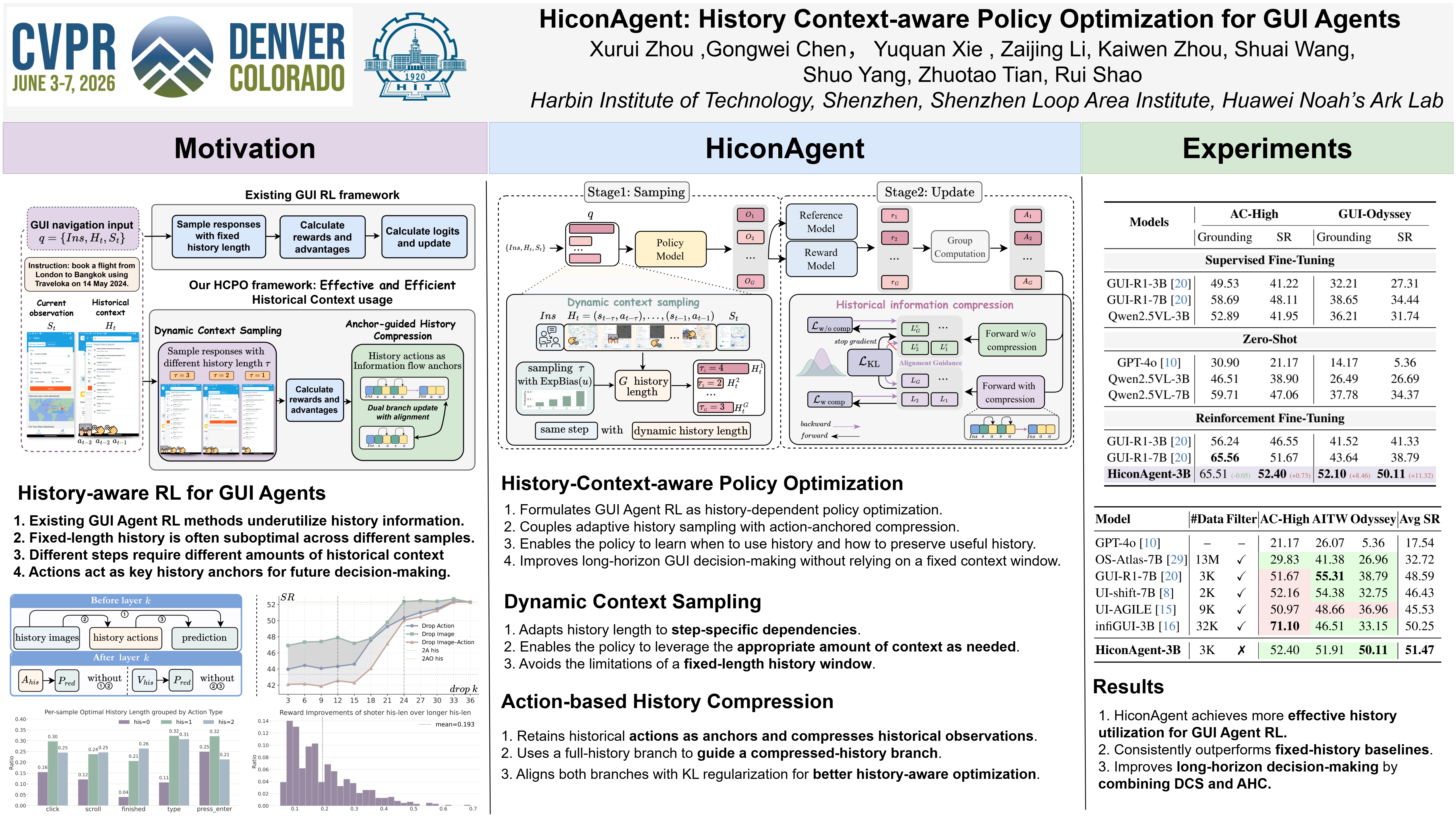
Graphical User Interface (GUI) agents require effective utilization of historical context to perform sequential navigation tasks. While incorporating past actions and observations can significantly improve decision-making, naively using full history leads to excessive computational overhead and potential distraction from irrelevant information. In this work, we introduce HiconAgent, a GUI agent trained with History Context-aware Policy Optimization (HCPO) for effective and efficient utilization of historical information. HCPO explicitly optimizes history usage in both sampling and policy updates by integrating two complementary components: (1) Dynamic Context Sampling (DCS) presents the agent with variable-length histories during sampling, enabling adaptive use of the most relevant historical context to improve sequential decision quality; (2) Anchor-guided History Compression (AHC) refines the policy update phase via a dual-branch optimization strategy, where the compressed branch drops history observations while keeping history actions as information flow anchors. The compressed and uncompressed branches are coupled through a history-enhanced alignment loss to enforce consistent history usage, achieving efficiency with minimal performance degradation. Extensive experiments on mainstream GUI navigation benchmarks demonstrate the strong performance of our model. Despite its smaller size, HiconAgent-3B outperforms GUI-R1-7B by +8.46% grounding and +11.32% step successful rate on GUI-Odyssey, while achieving comparable results on AndroidControl and AITW, with up to 2.47× computational speedup and 60% FLOPs reduction.
PET-DINO: Unifying Visual Cues into Grounding DINO with Prompt-Enriched Training
Weifu Fu ⋅ Jinyang Li ⋅ Bin-Bin Gao ⋅ Jialin Li ⋅ Yuhuan Lin ⋅ Hanqiu Deng ⋅ Wenbing Tao ⋅ Yong Liu ⋅ Chengjie Wang
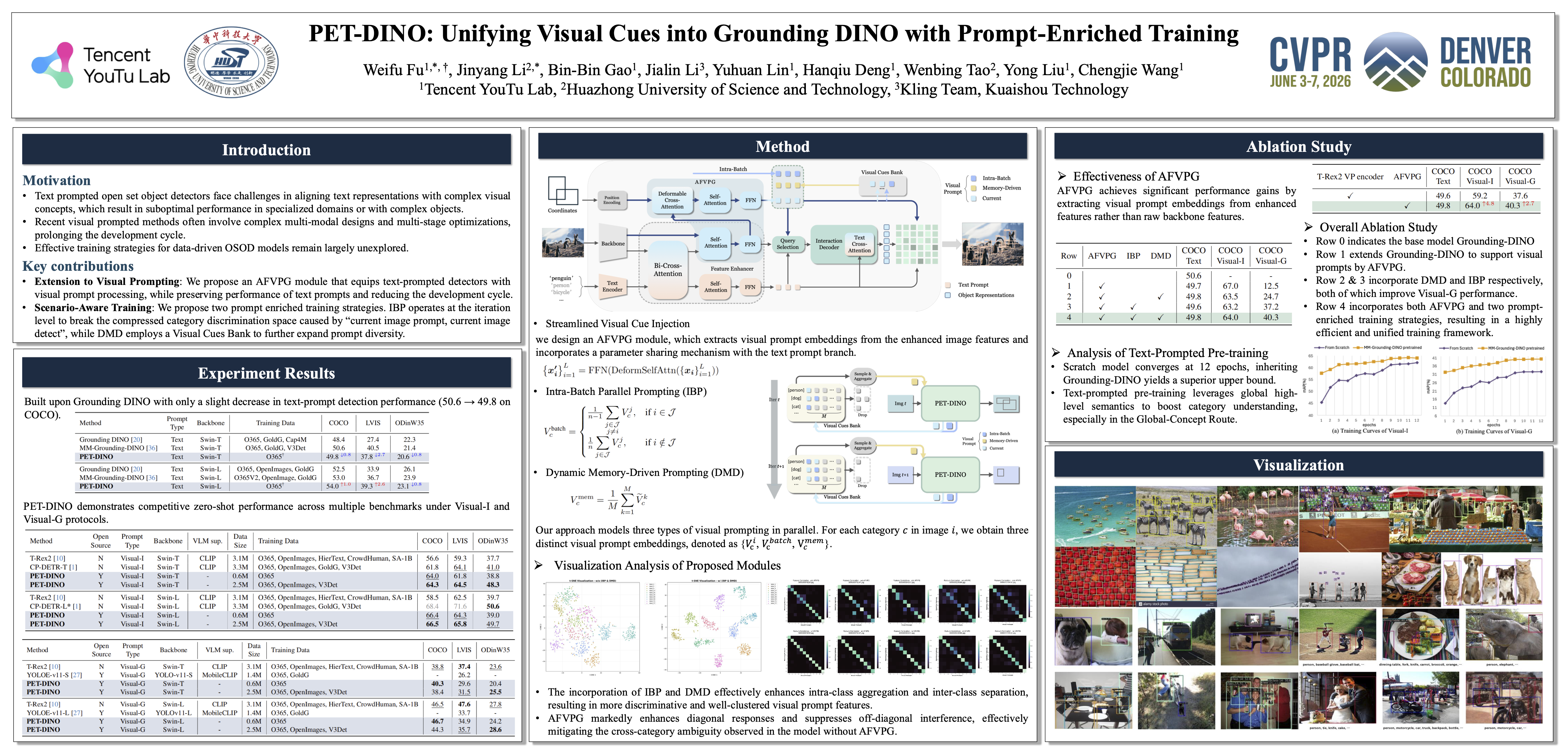
Open-Set Object Detection (OSOD) enables recognition of novel categories beyond fixed classes but faces challenges in aligning text representations with complex visual concepts and the scarcity of image-text paired samples for rare categories. This results in suboptimal performance in specialized domains or with complex objects. Recent visual-prompted methods partially address these issues but often involve complex multi-modal designs and multi-stage optimizations, extending the development cycle. Additionally, effective training strategies for data-driven OSOD models remain largely unexplored. To address these challenges, we propose PET-DINO, a universal object detector supporting both text and visual prompts. Our visual prompt generation scheme builds on an advanced text-prompted detector, addressing the limitations of text representation guidance and reducing the development cycle. We introduce two prompt-enriched training strategies: Intra-Batch Parallel Prompting (IBP) at the iteration level and Dynamic Memory-Driven Prompting (DMD) at the overall training level. These strategies enable simultaneous modeling of multiple prompt routes, parallel alignment with diverse real-world usage scenarios, and improved classification. Extensive experiments demonstrate that our visual prompt generation scheme, based on text-prompt-based detection pretraining, achieves a higher performance ceiling compared to using visual prompts alone.Our method achieves significant zero-shot detection performance on COCO, LVIS, and ODinW, and excels across various prompt-based detection protocols. In-domain evaluations also demonstrate robust localization performance.
SDDF: Specificity-Driven Dynamic Focusing for Open-Vocabulary Camouflaged Object Detection
Jiaming Liang ⋅ Yifeng Zhan ⋅ Chunlin Liu ⋅ Weihua Zheng ⋅ bingye Peng ⋅ Qiwei Liang ⋅ Boyang Cai ⋅ Xiaochun Mai ⋅ Qiang Nie
Open-vocabulary object detection (OVOD) aims to detect known and unknown objects in the open world by leveraging text prompts.Benefiting from the emergence of large-scale vision--language pre-trained models, OVOD has demonstrated strong zero-shot generalization capabilities. However, when dealing with camouflaged objects, the detector often fails to distinguish and localize objects because the visual features of the objects and the background are highly similar. To bridge this gap, we construct a benchmark named \textbf{OVCOD-D} by augmenting carefully selected camouflaged object images with fine-grained textual descriptions. Due to the limited scale of available camouflaged object datasets, we adopt detectors pre-trained on large-scale object detection datasets as our baseline methods, as they possess stronger zero-shot generalization ability. In the specificity-aware sub-descriptions generated by multimodal large models, there still exist confusing and overly decorative modifiers. To mitigate such interference, we design a sub-description principal component contrastive fusion strategy that reduces noisy textual components. Furthermore, to address the challenge that the visual features of camouflaged objects are highly similar to those of their surrounding environment, we propose a specificity-guided regional weak alignment and dynamic focusing method, which aims to strengthen the detector’s ability to discriminate camouflaged objects from background objects. Under the open-set evaluation setting, the proposed method achieves an AP of 56.4 on the OVCOD-D benchmark.
Towards Open-Vocabulary Industrial Defect Understanding with a Large-Scale Multimodal Dataset
Tsai-Ching Ni ⋅ ZhenQi Chen ⋅ YuanFu Yang
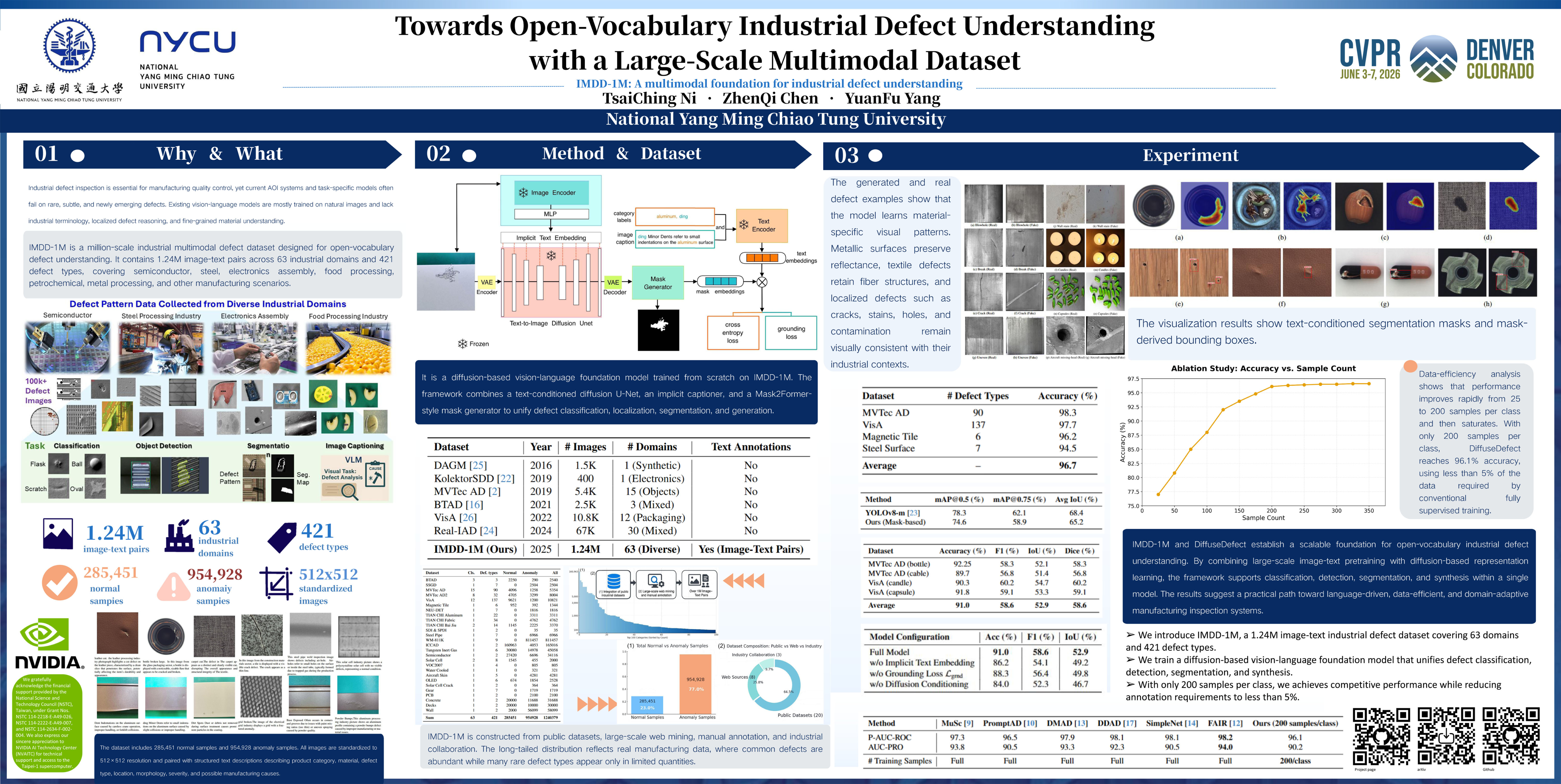
We present IMDD-1M, the first large-scale Industrial Multimodal Defect Dataset comprising 1,000,000 aligned image-text pairs, designed to advance multimodal learning for manufacturing and quality inspection. IMDD-1M contains high-resolution real-world defects spanning over 60 material categories and more than 400 defect types, each accompanied by expert-verified annotations and fine-grained textual descriptions detailing defect location, severity, and contextual attributes. This dataset enables a wide spectrum of applications, including classification, segmentation, retrieval, captioning, and generative modeling. Building upon IMDD-1M, we train a diffusion-based vision-language foundation model from scratch, specifically tailored for industrial scenarios. The model serves as a generalizable foundation that can be efficiently adapted to specialized domains through lightweight fine-tuning. With less than 5% of the task-specific data required by dedicated expert models, it achieves comparable performance, highlighting the potential of data-efficient foundation model adaptation for industrial inspection and generation, paving the way for scalable, domain-adaptive, and knowledge-grounded manufacturing intelligence.
Common Inpainted Objects In-N-Out of Context
Tianze Yang ⋅ Tyson Jordan ⋅ Ruitong Sun ⋅ Ninghao Liu ⋅ Jin Sun
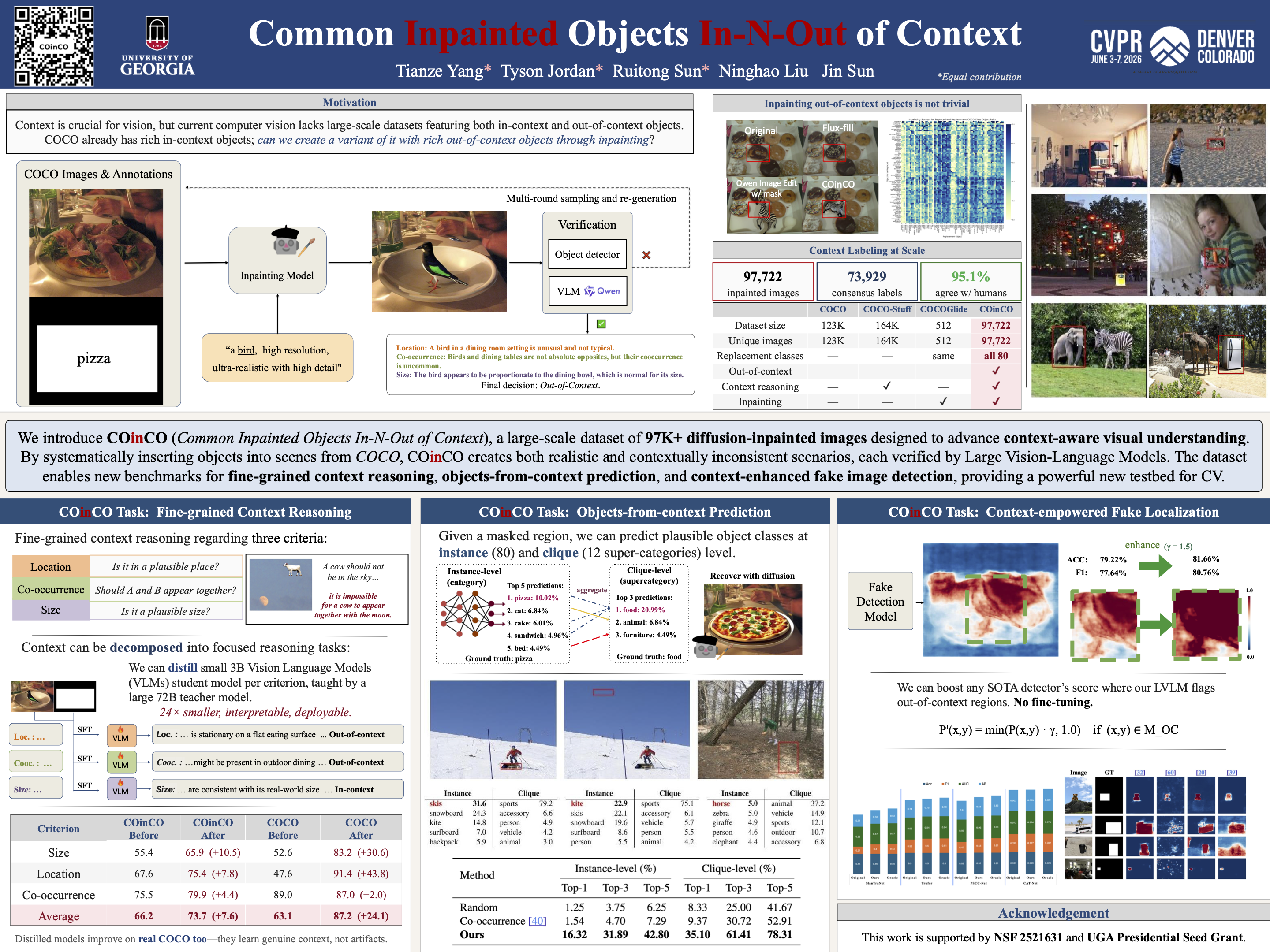
We present Common Inpainted Objects In-N-Out of Context (COinCO), a novel dataset addressing the scarcity of out-of-context examples in existing vision datasets. By systematically replacing objects in COCO images through diffusion-based inpainting, we create 97,722 unique images featuring both contextually coherent and inconsistent scenes, enabling effective context learning. Each inpainted object is meticulously verified and categorized as in- or out-of-context through Large Vision Language Model assessments. Our analysis reveals significant patterns in semantic priors that influence inpainting success across object categories. We demonstrate three key tasks enabled by COinCO: (1) developing a fine-grained context reasoning approach that classifies objects as in- or out-of-context based on three criteria; (2) a novel Objects-from-Context prediction task that determines which new objects naturally belong in given scenes at both instance and clique levels, and (3) context-enhanced fake detection on state-of-the-art methods without fine-tuning. COinCO provides a controlled testbed with contextual variations, establishing a foundation for advancing context-aware visual understanding in computer vision and image forensics.
Prompt-Free Universal Region Proposal Network
Qihong Tang ⋅ Changhan Liu ⋅ Shaofeng Zhang ⋅ Wenbin Li ⋅ Qi Fan ⋅ Yang Gao

Identifying potential objects is critical for object recognition and analysis across various computer vision applications.Existing methods typically localize potential objects by relying on exemplar images, predefined categories, or textual descriptions.However, their reliance on image and text prompts often limits flexibility, restricting adaptability in real-world scenarios.In this paper, we introduce a novel Prompt-Free Universal Region Proposal Network (\ourmodel), which identifies potential objects without relying on external prompts.First, the Sparse Image-Aware Adapter (SIA) module performs initial localization of potential objects using a learnable query embedding dynamically updated with visual features.Next, the Cascade Self-Prompt (CSP) module identifies the remaining potential objects by leveraging the self-prompted learnable embedding, autonomously aggregating informative visual features in a cascading manner.Finally, the Centerness-Guided Query Selection (CG-QS) module facilitates the selection of high-quality query embeddings using a centerness scoring network.Our method can be optimized with limited data (e.g., 5\% of MS COCO data) and applied directly to various object detection application domains for identifying potential objects without fine-tuning, such as underwater object detection, industrial defect detection, and remote sensing image object detection.Experimental results across 19 datasets validate the effectiveness of our method.
Rewis3d: Reconstruction Improves Weakly-Supervised Semantic Segmentation
Jonas Ernst ⋅ Wolfgang Boettcher ⋅ Lukas Hoyer ⋅ Jan Lenssen ⋅ Bernt Schiele
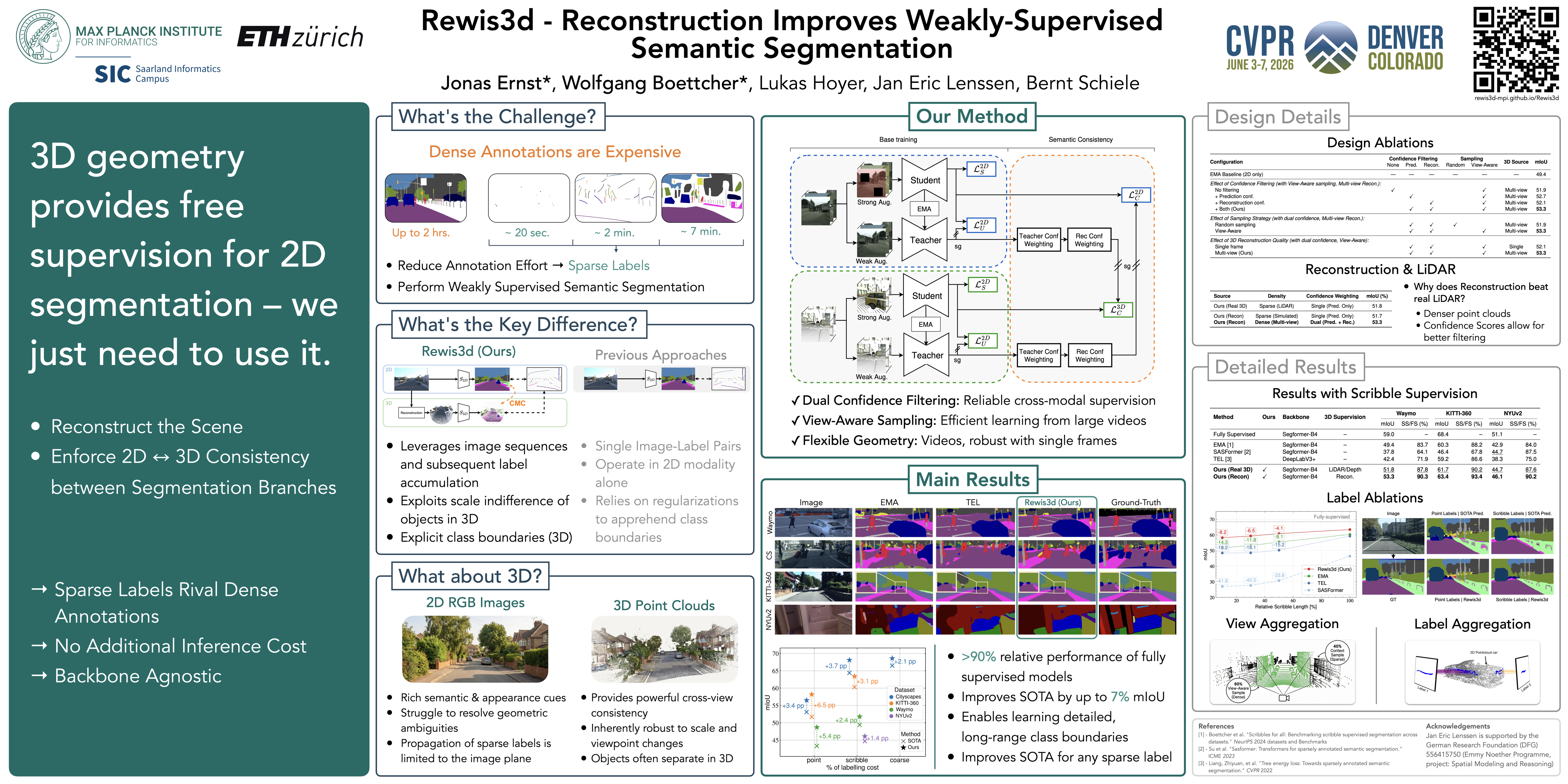
We present Rewis3d, a framework that leverages recent advances in feed-forward 3D reconstruction to significantly improve weakly supervised semantic segmentation on 2D images. Obtaining dense, pixel-level annotations remains a costly bottleneck for training segmentation models. Alleviating this issue, sparse annotations offer an efficient weakly-supervised alternative. However, they still incur a performance gap. To address this, we introduce a novel approach that leverages 3D scene reconstruction as an auxiliary supervisory signal. Our key insight is that 3D geometric structure recovered from 2D videos provides strong cues that can propagate sparse annotations across entire scenes. Specifically, a dual student–teacher architecture enforces semantic consistency between 2D images and reconstructed 3D point clouds, using state-of-the-art feed-forward reconstruction to generate reliable geometric supervision. Extensive experiments demonstrate that Rewis3d achieves state-of-the-art performance in sparse supervision, outperforming existing approaches by 2-7 % without requiring additional labels or inference overhead. Our code will be released upon acceptance of the paper.
PaNDaS: Learnable Shape Interpolation Modeling with Localized Control
Thomas Besnier ⋅ Emery Pierson ⋅ Sylvain Arguillere ⋅ Maks Ovsjanikov ⋅ Mohamed Daoudi
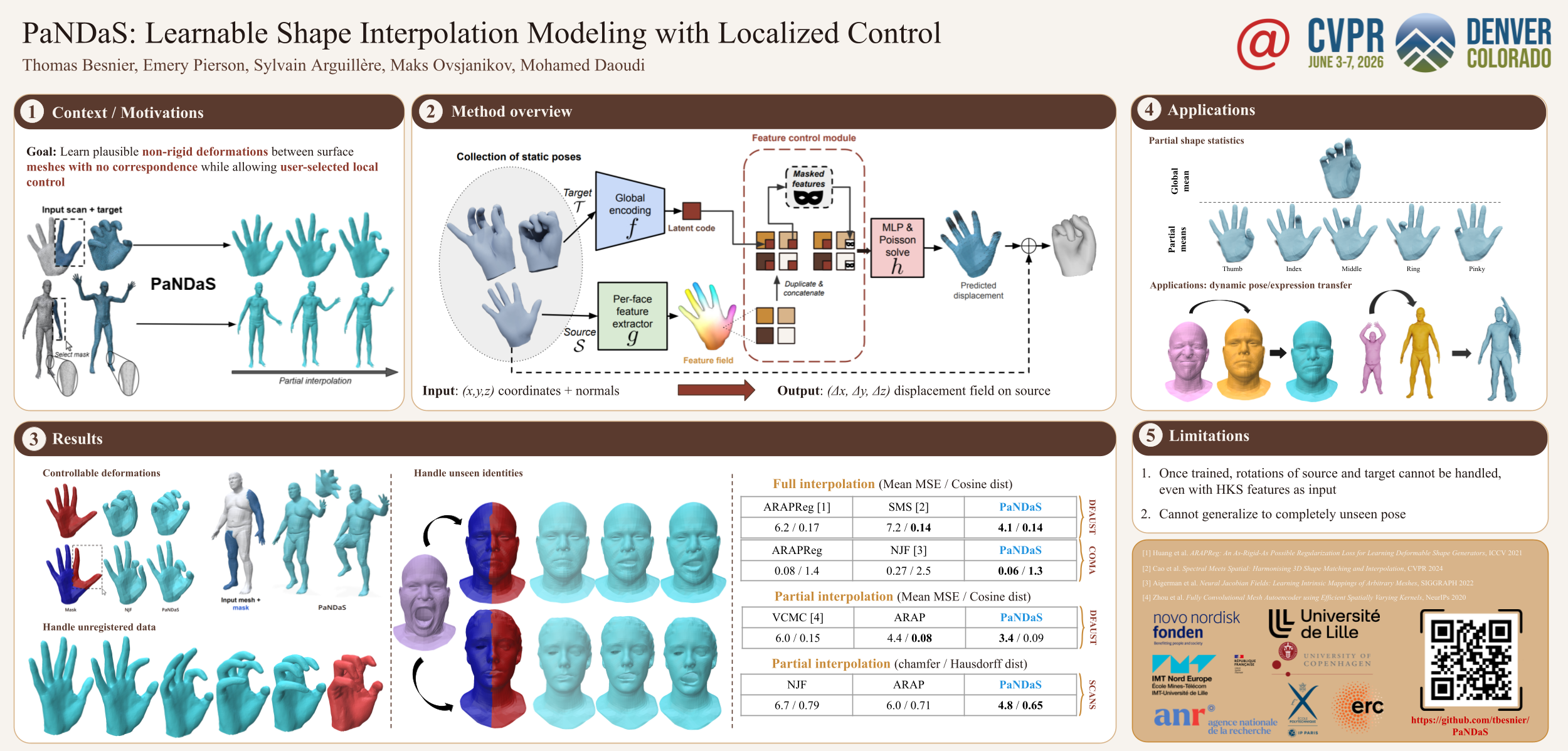
We present PaNDaS, a novel deep learning framework for Partial Non-Rigid Deformations and interpolations of Surfaces (PaNDaS). PaNDaS learns a per-face feature field on the source mesh and fuses it with a global encoding of the target. A deformation generator predicts a Jacobian field and recovers a smooth displacement, enabling precise regional control, pose mixing, and transferable local edits. Unlike previous approaches, our method can restrict the deformations to specific parts of the shape in a versatile way. Across various human body part datasets, PaNDaS achieves state-of-the-art interpolation accuracy and stronger locality than methods based on global shape codes or handles, while remaining robust to remeshing. We demonstrate several localized shape manipulation tasks and show that our method can generate new shapes by combining different input deformations.
Hilbert Curve-Based Attention Enabling Topology-Preserving Image Tensor Representation for Semantic Segmentation Network
Linkang Xu ⋅ Gang Li ⋅ Yue Song ⋅ Xiangxin Ji
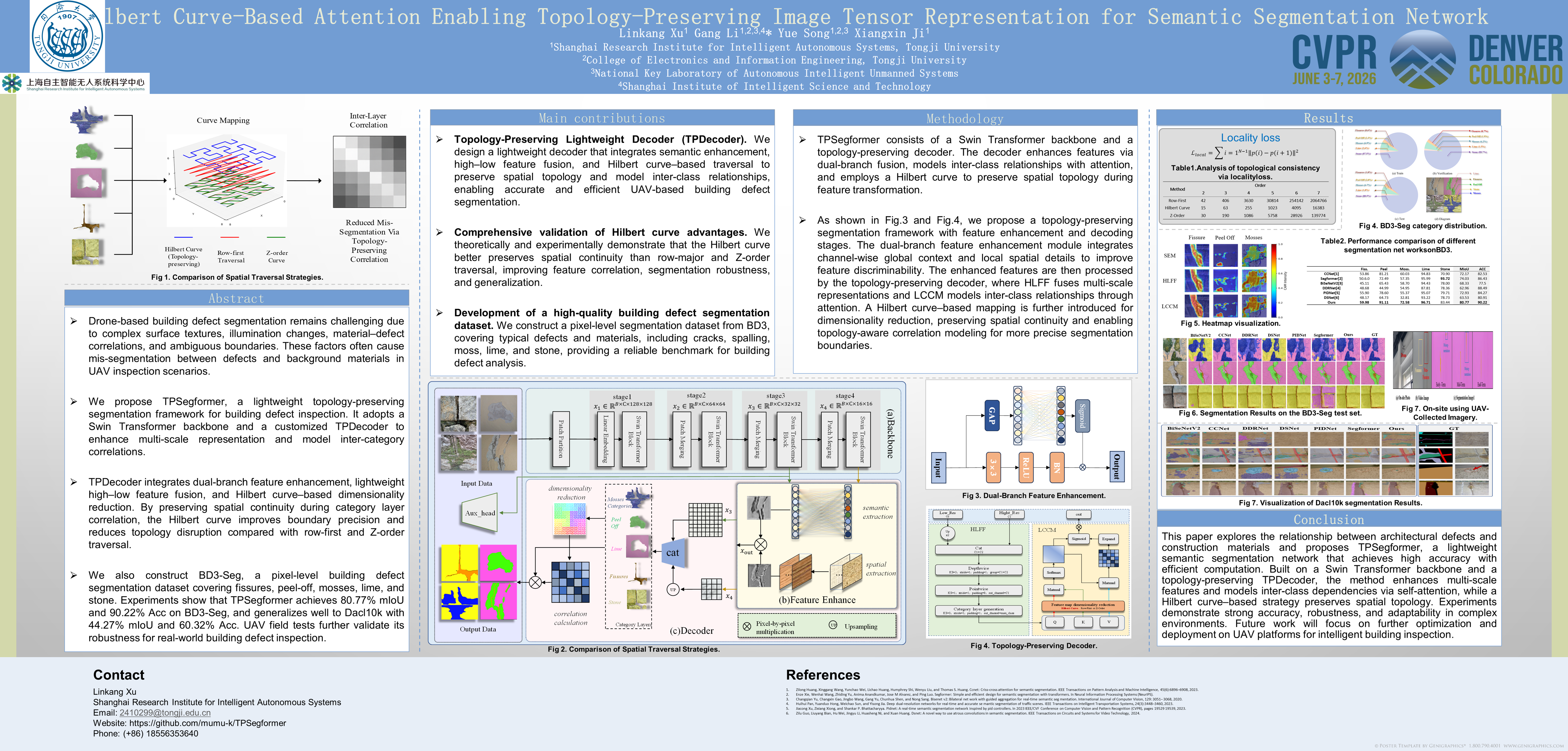
Drone-based building defect segmentation remains challenging due to complex surface textures and illumination variations. We propose TPSegformer, a topology-preserving segmentation framework that mitigates mis-segmentation in such scenarios. Its decoder incorporates a Hilbert curve–based topology-preserving mechanism to maintain spatial continuity and boundary precision during category layer computation. A lightweight multi-scale fusion module enhances semantic representation, while global context modeling strengthens holistic perception. Experiments on the building defect dataset show that TPSegformer outperforms existing segmentation methods, achieving 80.77\% mIoU and 90.22\% Acc. On the Dacl10k dataset, it maintains strong generalization, reaching 44.27\% mIoU and 60.32\% Acc across diverse materials and defect types.
Towards High-Quality Image Segmentation: Improving Topology Accuracy by Penalizing Neighbor Pixels
J. Miguel Valverde ⋅ Dim P. Papadopoulos ⋅ Rasmus Larsen ⋅ Anders Bjorholm Dahl
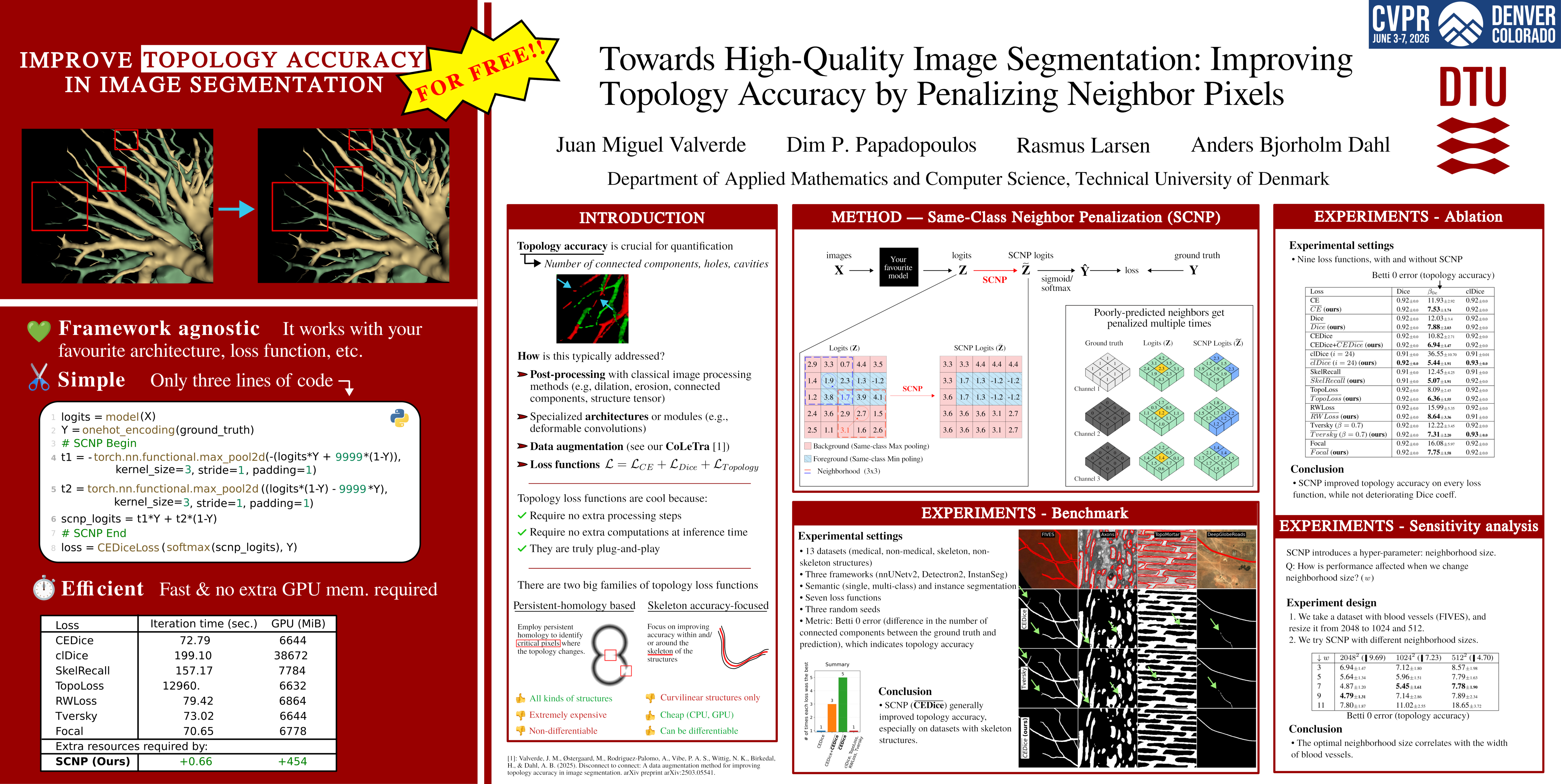
Standard deep learning models for image segmentation cannot guarantee topology accuracy, failing to preserve the correct number of connected components or structures. This, in turn, affects the quality of the segmentations and compromises the reliability of the subsequent quantification analyses. Previous works have proposed to enhance topology accuracy with specialized frameworks, architectures, and loss functions. However, these methods are often cumbersome to integrate into existing training pipelines, they are computationally very expensive, or they are restricted to structures with tubular morphology. We present SCNP, an efficient method that improves topology accuracy by penalizing the logits with their poorest-classified neighbor, forcing the model to improve the prediction at the pixels' neighbors before allowing it to improve the pixels themselves. We show the effectiveness of SCNP across 13 datasets, covering different structure morphologies and image modalities, and integrate it into three frameworks for semantic and instance segmentation. Additionally, we show that SCNP can be integrated into several loss functions, making them improve topology accuracy. Our code can be found at https://github.com/Anonymous.
SAGE: Style-Adaptive Generalization for Privacy-Constrained Semantic Segmentation Across Domains
Qingmei Li ⋅ Yang Zhang ⋅ peifeng zhang ⋅ Haohuan Fu ⋅ Juepeng Zheng
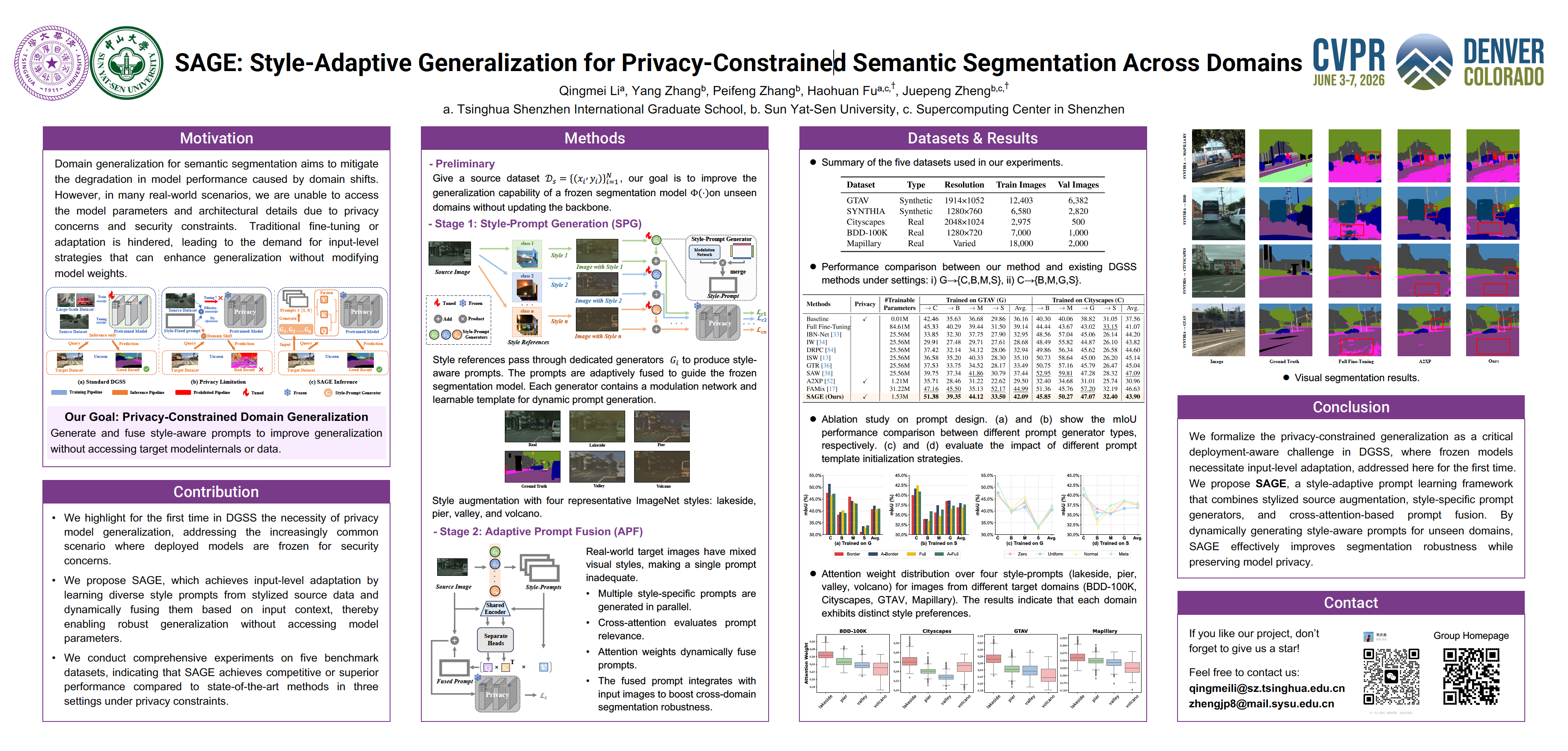
Domain generalization for semantic segmentation aims to mitigate the degradation in model performance caused by domain shifts. However, in many real-world scenarios, we are unable to access the model parameters and architectural details due to privacy concerns and security constraints. Traditional fine-tuning or adaptation is hindered, leading to the demand for input-level strategies that can enhance generalization without modifying model weights. To this end, we propose a Style-Adaptive GEneralization framework (SAGE), which improves the generalization of frozen models under privacy constraints. SAGE learns to synthesize visual prompts that implicitly align feature distributions across styles instead of directly fine-tuning the backbone. Specifically, we first utilize style transfer to construct a diverse style representation of the source domain, thereby learning a set of style characteristics that can cover a wide range of visual features. Then, the model adaptively fuses these style cues according to the visual context of each input, forming a dynamic prompt that harmonizes the image appearance without touching the interior of the model. Through this closed-loop design, SAGE effectively bridges the gap between frozen model invariance and the diversity of unseen domains. Extensive experiments on five benchmark datasets demonstrate that SAGE achieves competitive or superior performance compared to state-of-the-art methods under privacy constraints and outperforms full fine-tuning baselines in all settings.
Better than Average: Spatially-Aware Aggregation of Segmentation Uncertainty Improves Downstream Performance
Vanessa Emanuela Guarino ⋅ Claudia Winklmayr ⋅ Jannik Franzen ⋅ Josef Rumberger ⋅ Manuel Pfeuffer ⋅ Sonja Greven ⋅ Klaus Maier-Hein ⋅ Dagmar Kainmueller ⋅ Christoph Karg ⋅ Carsten T. Lüth
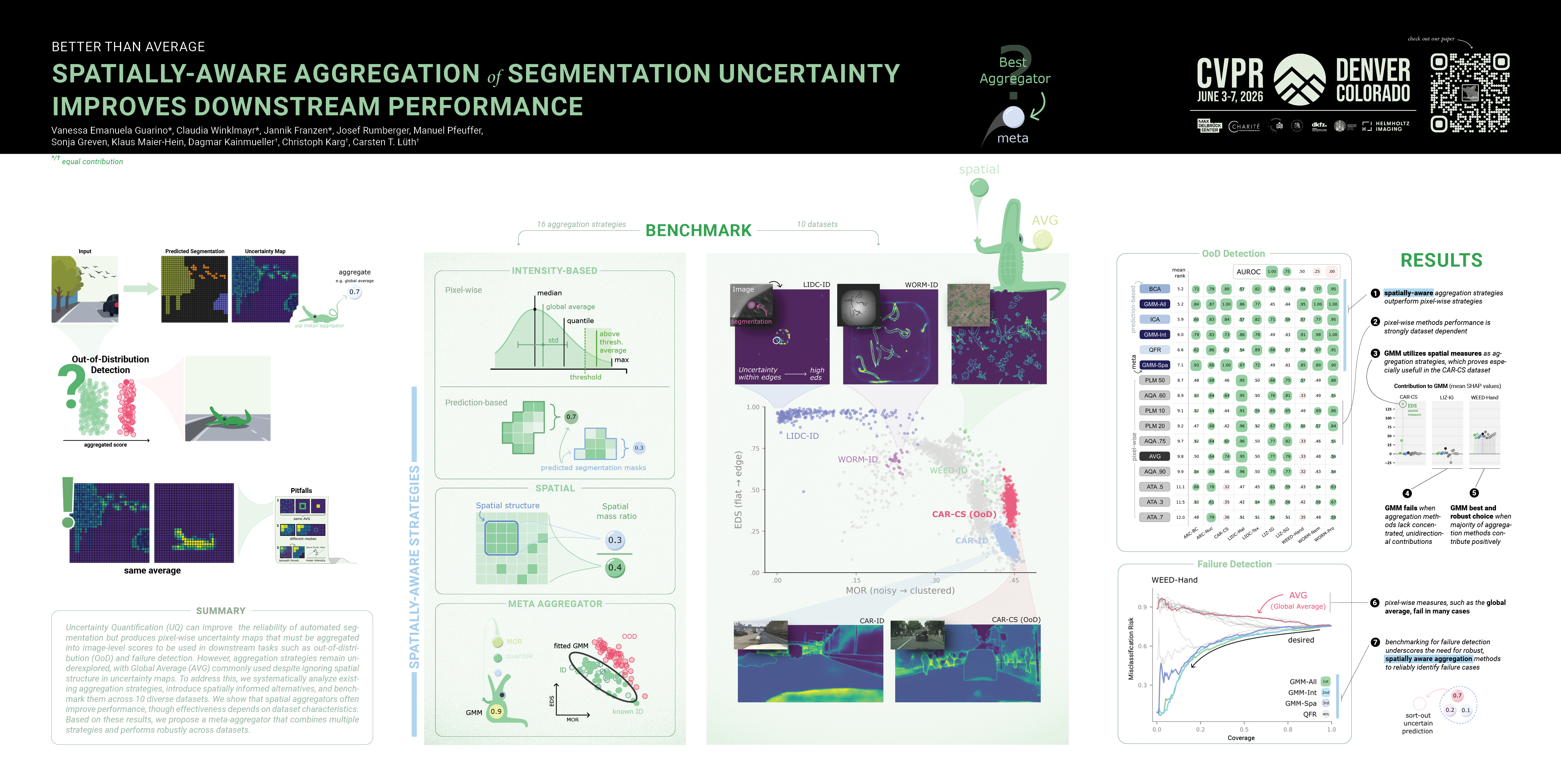
Uncertainty quantification (UQ) is crucial for ensuring the reliability of automated image segmentations in safety-critical domains like biomedical image analysis or autonomous driving. UQ generates pixel-wise uncertainty maps that must be aggregated into scalar scores for downstream tasks like OoD- or failure-detection.Despite widespread use of aggregation strategies, their properties and impact on downstream task performance have not yet been comprehensively studied.Global Average is the default choice, yet it does not account for spatial and structural features of uncertainty estimates. Alternatives like patch-, class- and threshold-based strategies exist, but lack systematic comparison, leading to inconsistent reporting and unclear best practices.We address this gap by (1) formally analyzing properties, limitations, and pitfalls of common strategies; (2) proposing novel strategies that incorporate spatial uncertainty structure and (3) benchmarking their performance on OoD and failure detection across ten datasets that vary in image geometry and structure.We find that aggregators leveraging spatial structure yield stronger performance in both downstream tasks studied. However, performance of individual aggregators is highly dependent on dataset characteristics, thus we propose a meta aggregator that integrates multiple aggregators and shows robust performance across datasets.To foster reproducibility, we release an open-source Python package for benchmarking uncertainty aggregation methods.
Universal 3D Shape Matching via Coarse-to-Fine Language Guidance
Qinfeng Xiao ⋅ Guofeng Mei ⋅ Bo Yang ⋅ Zhang Liying ⋅ Liying Zhang ⋅ Kit-lun Yick
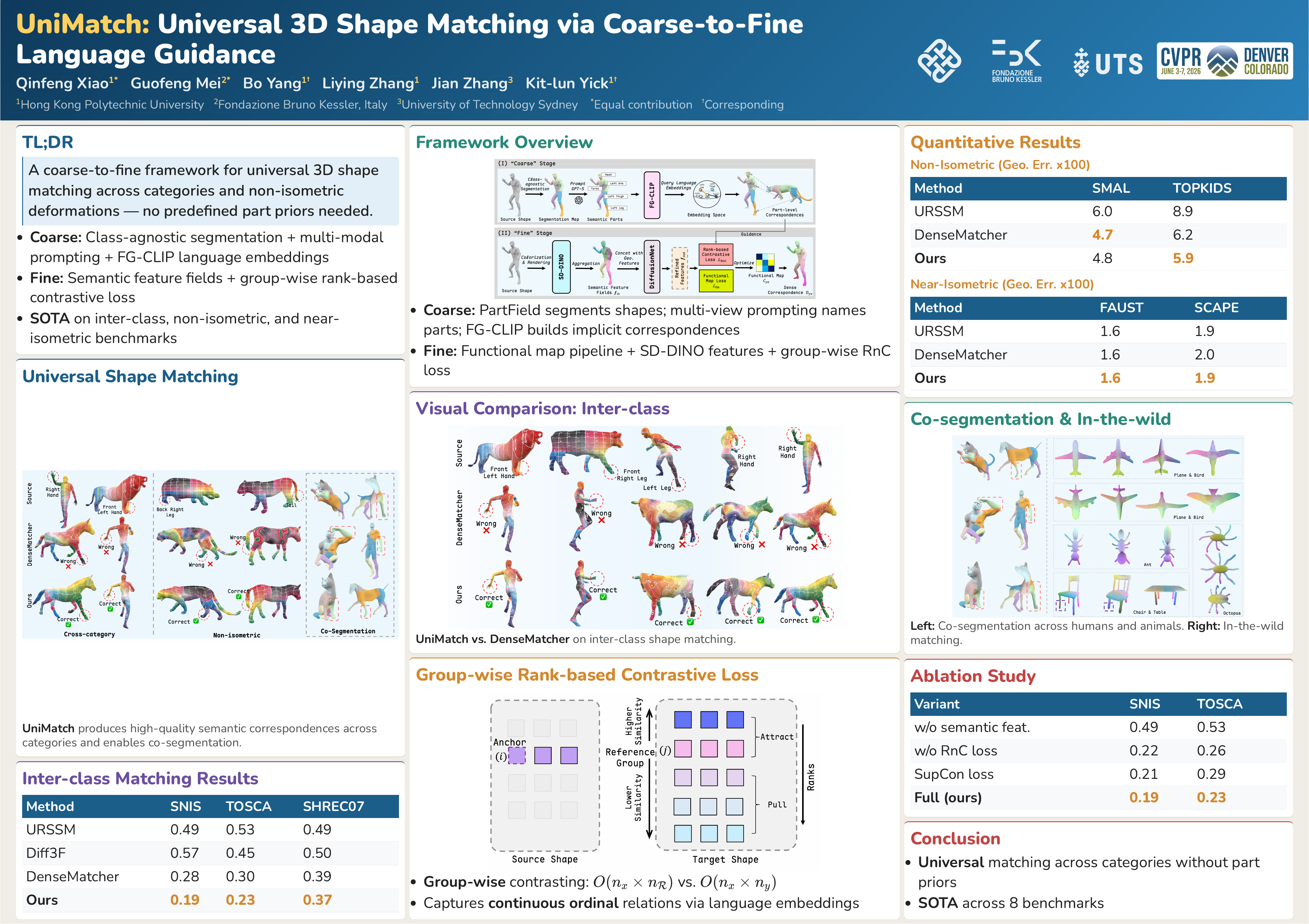
Establishing dense correspondences between shapes is a crucial task in computer vision and graphics, while prior approaches depend on near-isometric assumptions and homogeneous subject types (i.e., only operate for human shapes). However, building semantic correspondences for cross-category objects remains challenging and has received relatively little attention. To achieve this, we propose UniMatch, a semantic-aware, coarse-to-fine framework for constructing dense semantic correspondences between strongly non-isometric shapes without restricting object categories. The key insight is to lift "coarse" semantic cues into "fine" correspondence, which is achieved through two stages. In the "coarse" stage, we perform class-agnostic 3D segmentation to obtain non-overlapping semantic parts and prompt multimodal large language models (MLLMs) to identify part names. Then, we employ pretrained vision language models (VLMs) to extract text embeddings, enabling the construction of matched semantic parts. In the "fine" stage, we leverage these coarse correspondences to guide the learning of dense correspondences through a dedicated rank-based contrastive scheme. Thanks to class-agnostic segmentation, language guiding, and rank-based contrastive learning, our method is versatile for universal object categories and requires no predefined part proposals, enabling universal matching for inter-class and non-isometric shapes. Extensive experiments demonstrate UniMatch consistently outperforms competing methods in various challenging scenarios.
Direct Segmentation without Logits Optimization for Training-Free Open-Vocabulary Semantic Segmentation
Jiahao Li ⋅ Yang Lu ⋅ Yachao Zhang ⋅ Fangyong Wang ⋅ Yuan Xie ⋅ Yanyun Qu
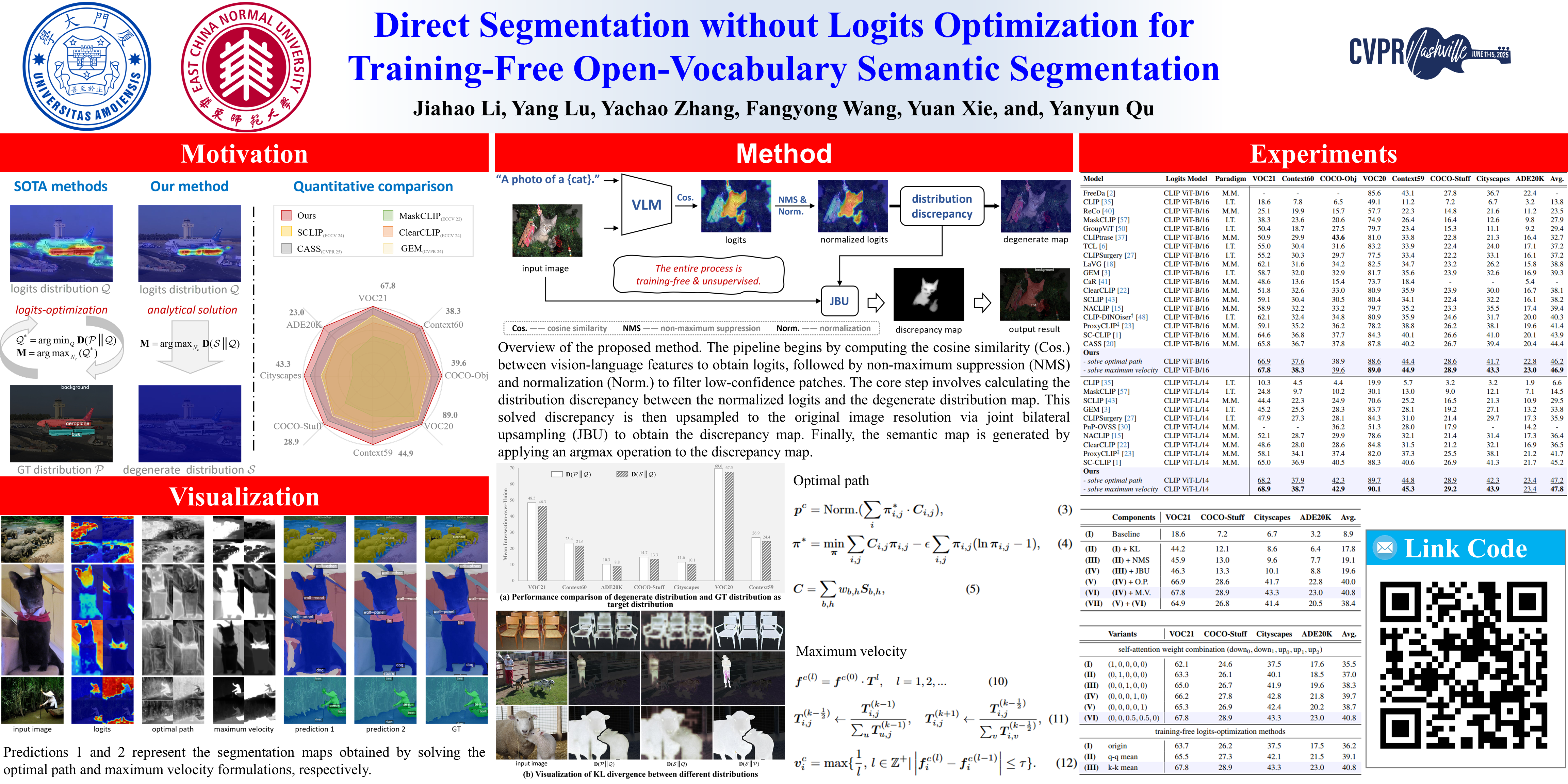
Open-vocabulary semantic segmentation (OVSS) aims to segment arbitrary category regions in images using open-vocabulary prompts, necessitating that existing methods possess pixel-level vision-language alignment capability. Typically, this capability involves computing the cosine similarity, ie, logits, between visual and linguistic features, and minimizing the distribution discrepancy between the logits and the ground truth (GT) to generate optimal logits that are subsequently used to construct segmentation maps, yet it depends on time-consuming iterative training or model-specific attention modulation. In this work, we propose a more direct approach that eschews the logits-optimization process by directly deriving an analytic solution for the segmentation map. We posit a key hypothesis: the distribution discrepancy encodes semantic information; specifically, this discrepancy exhibits consistency across patches belonging to the same category but inconsistency across different categories. Based on this hypothesis, we directly utilize the analytic solution of this distribution discrepancy as the semantic maps. In other words, we reformulate the optimization of the distribution discrepancy as deriving its analytic solution, thereby eliminating time-consuming iterative training, freeing us from model-specific attention modulation, and achieving state-of-the-art performance on eight benchmark datasets.
CDICS: Delving Into Fine-Grained Attribute for In-Context Segmentation via Compositional Prompts and Phased Decoupling
Zhiyu Li ⋅ Dianmo Sheng ⋅ Qi Chu ⋅ Shilong Chen ⋅ Tao Gong ⋅ Zhou Wei ⋅ Nenghai Yu
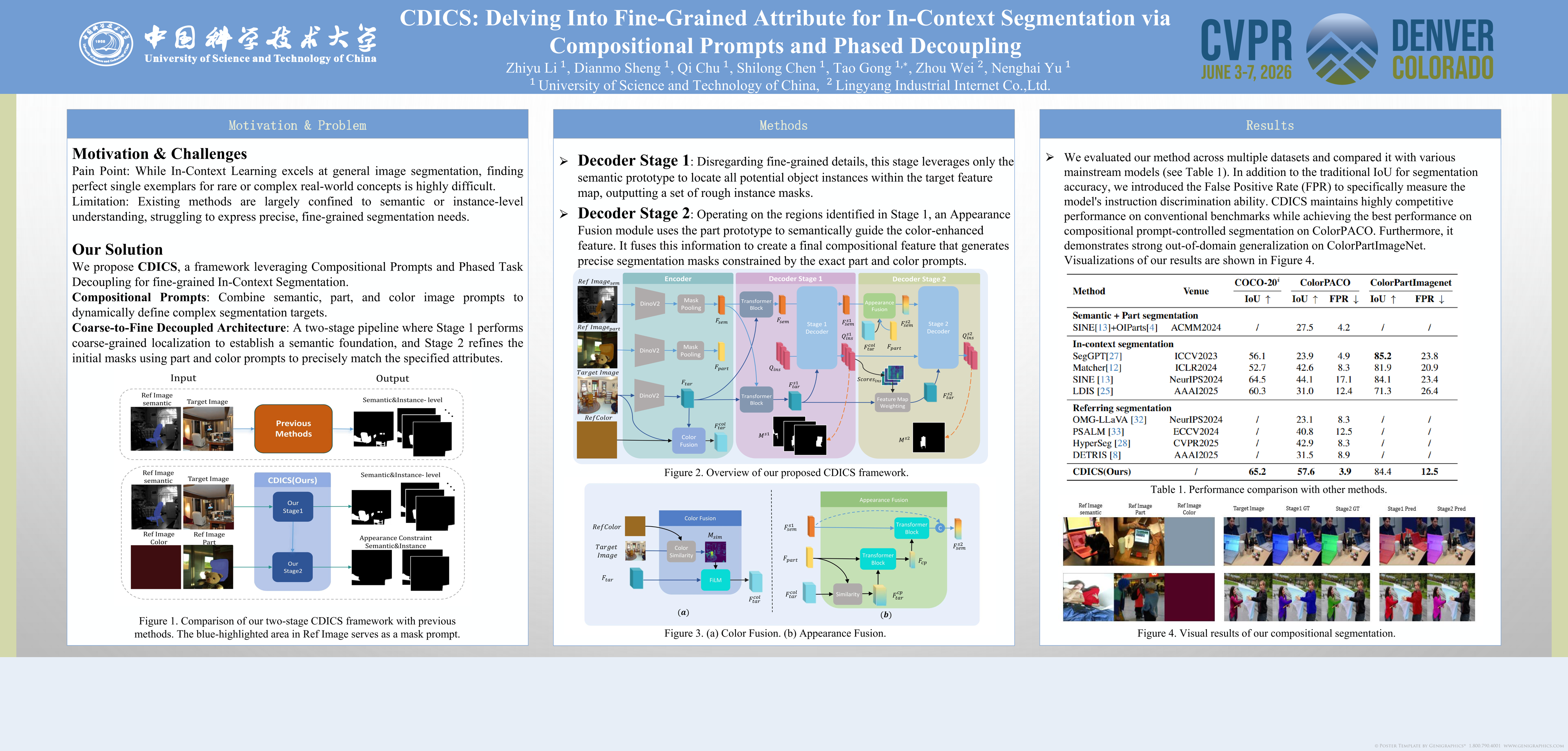
In-Context Learning (ICL) has shown great effectiveness in developing generalist image segmentation models. Its significant advantage over text-based descriptions is the ability to convey intricate visual appearance details through simple reference images. However, finding a perfectly matching single example for real-world rare and complex concepts is difficult;and existing methods are largely confined to semantic or instance-level understanding of the reference image, struggle to express more precise segmentation needs through the input. To address this, we propose \textbf{CDICS}, a novel framework that leverages \textbf{C}ompositional prompts and phased task \textbf{D}ecoupling to achieve compositional prompt-controlled \textbf{I}n-\textbf{C}ontext \textbf{S}egmentation. Our method introduces compositional prompts derived from reference prompts, combining semantic, part and color images to dynamically define segmentation targets. To effectively fuse this control information, ensure synergy while suppressing interference, and mitigate feature coupling risks, our decoupled two-stage architecture, which firstly performs coarse-grained semantic localization, then refines the result using compositional appearance prompts to precisely match the specified attributes. This design extends traditional in-context segmentation, enabling it to support compositional prompts. Additionally, we reconstructed two datasets and their benchmarks to acquire data with part-color-specific attributes. Our method demonstrates superior performance on the compositional prompt-controlled in-context segmentation task. It also extends the capabilities of existing in-context segmentation, and makes an attempt toward real-world fine-grained segmentation.
Discriminative Perception via Anchored Description for Reasoning Segmentation
Tao Yang ⋅ Qing Zhou ⋅ Yanliang Li ⋅ Qi Wang
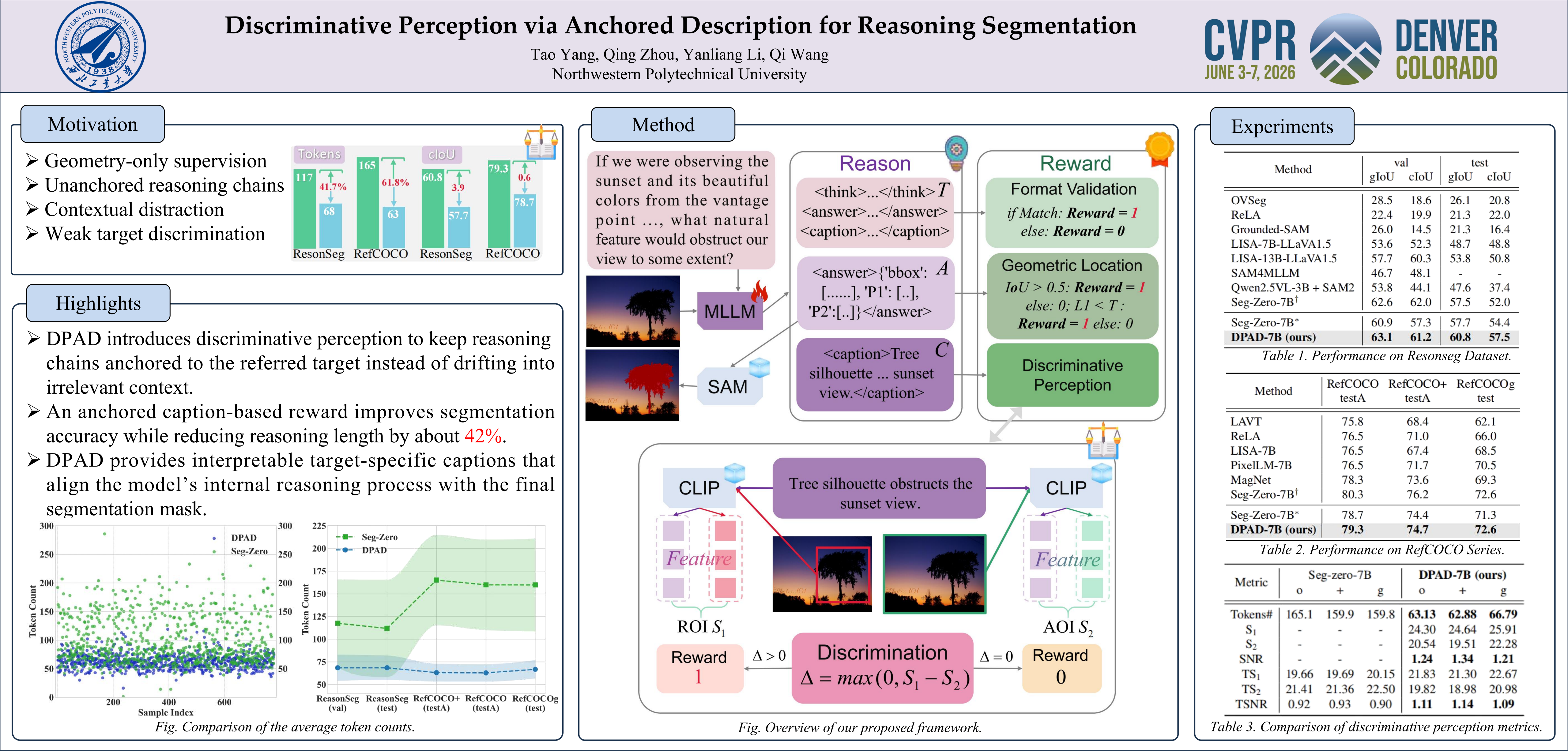
Reasoning segmentation increasingly employs reinforcement learning to generate explanatory reasoning chains that guide Multimodal Large Language Models. While these geometric rewards are primarily confined to guiding the final localization, they are incapable of discriminating whether the reasoning process remains anchored on the referred region or strays into irrelevant context. Lacking this discriminative guidance, the model's reasoning often devolves into unfocused and verbose chains that ultimately fail to disambiguate and perceive the target in complex scenes. This suggests a need to complement the RL objective with Discriminative Perception, an ability to actively distinguish a target from its context. To realize this, we propose DPAD to compel the model to generate a descriptive caption of the referred object, which is then used to explicitly discriminate by sharply contrasting the caption’s semantic relevance to the referred object against the wider context. By optimizing for this discriminative capability, the model is forced to focus on the unique attributes of the target, leading to a more converged and efficient reasoning chain The descriptive caption also serves as an interpretability rationale that aligns with the segmentation. Experiments on the benchmarks confirm the validity of our approach, delivering significant performance gains, with the cIoU on ResonSeg increasing by 3.09% and the reasoning chain length decreasing by approximately 42%.
SegEarth-R2: Towards Comprehensive Language-guided Segmentation for Remote Sensing Images
Zepeng Xin ⋅ Kaiyu Li ⋅ Luodi Chen ⋅ Wanchen Li ⋅ Xiao Yuchen ⋅ Hui Qiao ⋅ Weizhan Zhang ⋅ Deyu Meng ⋅ Xiangyong Cao
Effectively grounding complex language to pixels in remote sensing (RS) images is a critical challenge for applications like disaster response and environmental monitoring. Current models can parse simple, single-target commands but fail when presented with complex geospatial scenarios, e.g., segmenting objects at various granularities, executing multi-target instructions, and interpreting implicit user intent. To drive progress against these failures, we present LaSeRS, the first large-scale dataset built for comprehensive training and evaluation across four critical dimensions of language-guided segmentation: hierarchical granularity, target multiplicity, reasoning requirements, and linguistic variability. By capturing these dimensions, LaSeRS moves beyond simple commands, providing a benchmark for complex geospatial reasoning. This addresses a critical gap: existing datasets oversimplify, leading to sensitivity-prone real-world models. We also propose SegEarth-R2, an MLLM architecture designed for comprehensive language-guided segmentation in RS, which directly confronts these challenges. The model's effectiveness stems from two key improvements: (1) a spatial attention supervision mechanism specifically handles the localization of small objects and their components, and (2) a flexible and efficient segmentation query mechanism that handles both single-target and multi-target scenarios. Experimental results demonstrate that our SegEarth-R2 achieves outstanding performance on LaSeRS and other benchmarks, establishing a powerful baseline for the next generation of geospatial segmentation. All data and code will be released.
Cross-Scale Pansharpening via ScaleFormer and the PanScale Benchmark
Ke Cao ⋅ Xuanhua He ⋅ Xueheng Li ⋅ Lingting Zhu ⋅ Yingying Wang ⋅ Ao Ma ⋅ Zhanjie Zhang ⋅ Man Zhou ⋅ Chengjun Xie ⋅ Jie Zhang
Pansharpening aims to generate high-resolution multi-spectral images by fusing the spatial detail of panchromatic images with the spectral richness of low-resolution MS data. However, most existing methods are evaluated under limited, low-resolution settings, limiting their generalization to real-world, high-resolution scenarios. To bridge this gap, we systematically investigate the data, algorithmic, and computational challenges of cross-scale pansharpening. We first introduce PanScale, the first large-scale, cross-scale pansharpening dataset, accompanied by PanScale-Bench, a comprehensive benchmark for evaluating generalization across varying resolutions and scales. To realize scale generalization, we propose ScaleFormer, a novel architecture designed for multi-scale pansharpening. ScaleFormer reframes generalization across image resolutions as generalization across sequence lengths: it tokenizes images into patch sequences of the same resolution but variable length proportional to image scale. A Scale-Aware Patchify module enables training for such variations from fixed-size crops. ScaleFormer then decouples intra-patch spatial feature learning from inter-patch sequential dependency modeling, incorporating Rotary Positional Encoding to enhance extrapolation to unseen scales. Extensive experiments show that our approach outperforms SOTA methods in fusion quality and cross-scale generalization. The datasets and source code are available upon acceptance.
CrossEarth-Gate: Fisher-Guided Adaptive Tuning Engine for Efficient Adaptation of Cross-Domain Remote Sensing Semantic Segmentation
Shilei Cao ⋅ Ziyang Gong ⋅ Hehai Lin ⋅ Yang Liu ⋅ Jiashun Cheng ⋅ Xiaoxing Hu ⋅ Haoyuan Liang ⋅ Guowen Li ⋅ Chengwei Qin ⋅ Hong Cheng ⋅ Xue Yang ⋅ Juepeng Zheng ⋅ Haohuan Fu
In Remote Sensing (RS), Parameter-Efficient Fine-Tuning (PEFT) has emerged as a key approach to activate the generalizable representation ability of foundation models for downstream tasks. However, existing specialized PEFT methods often fail when applied to large-scale Earth observation tasks, as they are unable to fully handle the multifaceted and unpredictable domain gaps (e.g., spatial, semantic, and frequency shifts) inherent in RS data. To overcome this, we propose CrossEarth-Gate, which introduces two primary contributions. First, we establish a comprehensive RS module toolbox to address multifaceted domain gaps, comprising spatial, semantic, and frequency modules. Second, we develop a Fisher-guided adaptive selection mechanism that operates on this toolbox. This selection is guided by Fisher Information to quantify each module's importance by measuring its contribution to the task-specific gradient flow. It dynamically activates only the most critical modules at the appropriate layers, guiding the gradient flow to maximize adaptation effectiveness and efficiency. Comprehensive experiments validate the efficacy and generalizability of our method, where CrossEarth-Gate achieves state-of-the-art performance across 16 cross-domain benchmarks for RS semantic segmentation. The code of the work is provided in the supplementary material.
Multigrain-aware Semantic Prototype Scanning and Tri-Token Prompt Learning Embraced High-Order RWKV for Pan-Sharpening
Junfeng Li ⋅ Wenyang Zhou ⋅ Xueheng Li ⋅ Xuanhua He ⋅ Jianhou Gan ⋅ Wenqi Ren
In this work, we propose a Multigrain-aware Semantic Prototype Scanning paradigm for pan-sharpening, built upon a KV-sharing RWKV architecture for efficient global modeling, coupled with a novel tri-token prompting mechanism derived from semantic clustering to steer the fusion process adhering to the following principles: 1) Multigrain-aware Semantic Prototype Scanning. While the RWKV model offers an efficient linear alternative, its recurrent scanning mechanism often introduces positional bias and lacks semantic guidance. To address this, we introduce a semantic-driven scanning strategy. Local hashing is first employed to generate semantic prototypes via clustering, segmenting the image into coherent regions. Our scanning mechanism is then explicitly aware of multi-grain semantic structures, allowing the model to focus on contextually relevant regions during fusion, thereby enhancing spectral integrity and spatial coherence beyond sequence-agnostic approaches. 2) Tri-token Prompt Learning. The core of our framework is a tri-token prompting mechanism: (i) a globally-sourced token to encapsulate the holistic image context, (ii) cluster-derived prototype tokens to represent distinct semantic regions, and (iii) learnable token register that acts as a dynamic buffer to explicitly identify and eliminate feature noisy artifacts that commonly arise from standard global modeling. The global and prototype tokens are broadcast as semantic prompts to guide RWKV's processing, while the register continuously refines the intermediate features. 3) Invertible Q-Shift. To counteract spatial detail, we tailor two key designs: apply a center difference convolution on value pathway within the RWKV block, actively injecting high-frequency information to preserve fine textures and moving beyond parameter-heavy receptive field expansion via invertible neural network empowered multi-scale Q-shift operation. This module performs efficient, lossless feature transformation and shifting across split channels, significantly enriching feature representation. Experimental results demonstrate superiority of our method.
ACPV-Net: All-Class Polygonal Vectorization for Seamless Vector Map Generation from Aerial Imagery
Weiqin Jiao ⋅ Hao Cheng ⋅ George Vosselman ⋅ Claudio Persello
We tackle the problem of generating a complete vector map representation from aerial imagery in a single run: producing polygons for all land-cover classes with shared boundaries and no gaps or overlaps. Existing polygonization methods are typically class-specific; extending them to multiple classes via per-class runs commonly leads to topological inconsistencies, such as duplicated edges, gaps, and overlaps. We formalize this new task as All-Class Polygonal Vectorization (ACPV) and release the first public benchmark, Deventer-512, with standardized metrics jointly evaluating semantic fidelity, geometric accuracy, vertex efficiency, per-class topological fidelity and global topological consistency. To realize ACPV, we propose ACPV-Net, a unified framework introducing a novel Semantically Supervised Conditioning (SSC) mechanism coupling semantic perception with geometric primitive generation, along with a topological reconstruction that guarantees shared-edge consistency by design. While enforcing such strict topological constraints, ACPV-Net surpasses all class-specific baselines in polygon quality across classes on Deventer-512, e.g., compared to TopDiG on vegetation, +9.9 IoU (semantic fidelity), -45% PoLiS (geometric error), -59% N-ratio (vertex redundancy). It also applies to single-class polygonal vectorization without any architectural modification, achieving the best-reported results on WHU-Building. Data, code, and models will be publicly released.
Beyond Endpoints: Path-Centric Reasoning for Vectorized Off-Road Network Extraction
wenfei guan ⋅ Jilin Mei ⋅ Tong Shen ⋅ Xumin Wu ⋅ Shuo Wang ⋅ Chen Min ⋅ Yu Hu
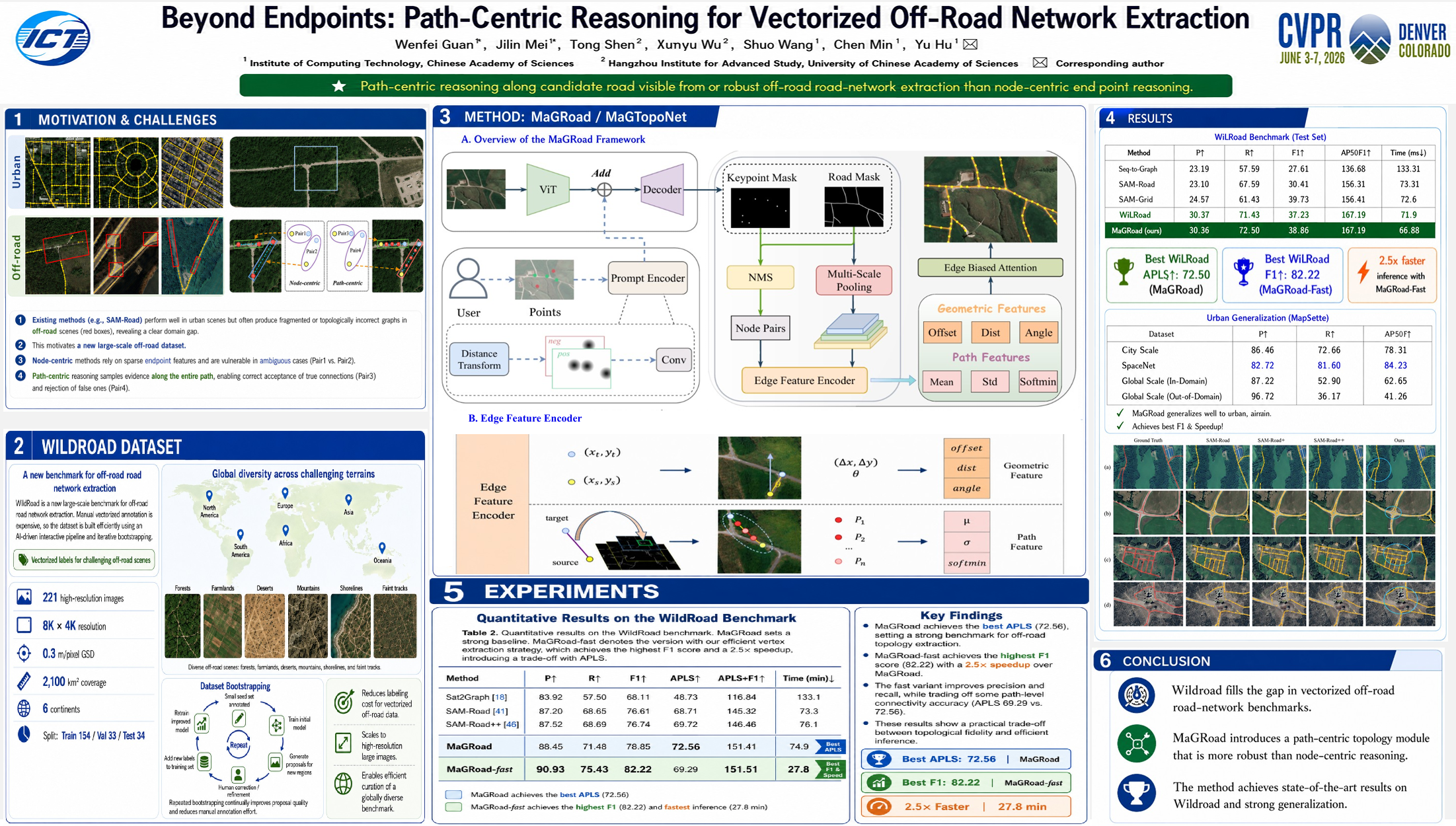
Deep learning has advanced vectorized road extraction in urban settings, yet off-road environments remain underexplored and challenging. A significant domain gap causes advanced models to fail in wild terrains due to two key issues: lack of large-scale vectorized datasets and structural weakness in prevailing methods. Models such as SAM-Road employ a node-centric paradigm that reasons at sparse endpoints, making them fragile to occlusions and ambiguous junctions in off-road scenes, leading to topological errors.This work addresses these limitations in two complementary ways. First, we release WildRoad, a gloabal off-road road network dataset constructed efficiently with a dedicated interactive annotation tool tailored for road-network labeling. Second, we introduce MaGRoad (Mask-aware Geodesic Road network extractor), a path-centric framework that aggregates multi-scale visual evidence along candidate paths to infer connectivity robustly.Extensive experiments show that MaGRoad achieves state-of-the-art performance on our challenging WildRoad benchmark while generalizing well to urban datasets. A streamlined pipeline also yields roughly 2.5x faster inference, improving practical applicability. Together, the dataset and path-centric paradigm provide a stronger foundation for mapping roads in the wild.
Rotation Invariant and Symmetry Aware Pixel Difference Network for Remote Sensing Object Detection
Jialei Zhan ⋅ Li Liu ⋅ Jiehua Zhang ⋅ Yuhang Xie ⋅ Yongxiang Liu ⋅ Jiangming Chen ⋅ Mingming Cheng
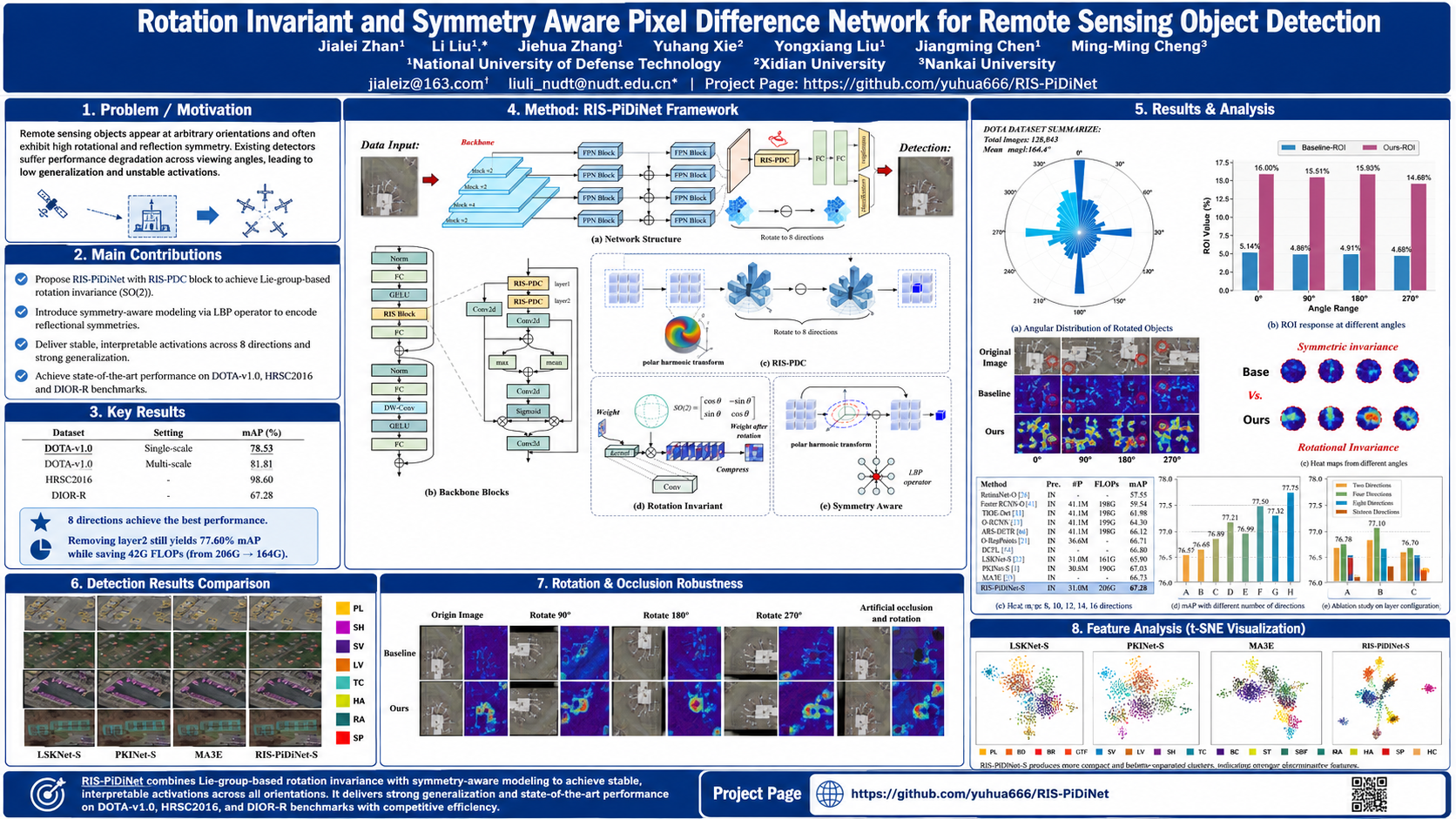
Recent advancements in remote sensing object detection have predominantly focused on oriented bounding box design and small object feature enhancement, while often overlooking the intrinsic geometric properties of remote sensing images, such as rotation invariance and structural symmetry. Many aerial objects appear in multiple orientations and exhibit clear symmetrical patterns, which, if not explicitly modeled, can lead to detection failures and inaccurate localization under geometric variation or partial occlusion. To address this, we propose the Rotation Invariant and Symmetry Aware Pixel Difference Network (RIS-PiDiNet), which introduces a novel convolutional operator called Rotation Invariant and Symmetry Aware Pixel Difference Convolution (RIS-PDC). This operator replaces traditional convolution with a mathematically grounded formulation that encodes rotation group priors and symmetrical constraints. RIS-PDC utilizes pixel differences and symmetry-guided aggregation in the polar harmonic space, enabling the network to infer partially visible structures and deduce occluded symmetrical parts. Besides improving detection accuracy, RIS-PDC enhances model interpretability by embedding geometric principles into the network design. Feature visualizations demonstrate rotation-consistent activations and symmetry-complete responses, revealing how the network captures underlying object structure even under partial visibility or orientation changes. This yields geometrically interpretable detection decisions. To our knowledge, RIS-PiDiNet is the first remote sensing object detection framework that jointly incorporates rotation invariance and symmetry modeling within a unified architecture. Extensive evaluations on standard benchmarks validate its effectiveness, achieving state-of-the-art performance on DOTA-v1.0 (78.53\% mAP single-scale, 81.81\% multi-scale), HRSC2016 (98.60\% mAP), and DIOR-R (67.28\% mAP), all with acceptable computational overhead and no increase in parameter count.
F2Net: A Frequency-Fused Network for Ultra-High Resolution Remote Sensing Segmentation
Hengzhi Chen ⋅ Liqian Feng ⋅ Wenhua Wu ⋅ Xiaogang Zhu ⋅ Qiuxia Wu ⋅ Lianlei Shan ⋅ Kun Hu
Semantic segmentation of ultra-high-resolution (UHR) remote sensing imagery is critical for applications like environmental monitoring and urban planning but faces com- putational and optimization challenges. Conventional methods either lose fine details through downsampling or fragment global context via patch processing. While multi-branch networks ad- dress this trade-off, they suffer from computational inefficiency and conflicting gradient dynamics during training. We propose F2Net, a frequency-aware framework that decomposes UHR images into high- and low-frequency components for specialized processing. The high-frequency branch preserves full-resolution structural details, while the low-frequency branch processes downsampled inputs through dual sub-branches capturing short- and long-range dependencies. A Hybrid-Frequency Fusion mod- ule integrates these observations, guided by two novel objectives: Cross-Frequency Alignment Loss ensures semantic consistency between frequency components, and Cross-Frequency Balance Loss regulates gradient magnitudes across branches to stabilize training. Evaluated on DeepGlobe and Inria Aerial benchmarks, F2Net achieves state-of-the-art performance with mIoU of 80.22 and 83.39, respectively.
RoadGIE: Towards A Global-Scale Aerial Benchmark for Generalizable Interactive Road Extraction
Chenxu Peng ⋅ Chenxu Wang ⋅ Yimian Dai ⋅ Yongxiang Liu ⋅ Mingming Cheng ⋅ Xiang Li
Accurate road segmentation from aerial imagery is fundamental to many geospatial applications. However, existing datasets often suffer from limited scene diversity, low semantic granularity, and poor structural continuity, restricting their generalization across environments. To address these challenges, we introduce $WorldRoadSeg-360K$, the largest and most diverse road segmentation dataset to date, comprising 366,947 high-resolution images collected from 38 countries and 223 cities across various terrains and continents. $WorldRoadSeg-360K$ serves as a comprehensive benchmark and reveals key challenges in handling diverse and structurally complex scenes. Automated approaches often struggle to preserve road connectivity, while current interactive methods lack efficient, topology-sensitive tools for real-world road editing. To this end, we present $RoadGIE$, establishing a novel interactive paradigm for road extraction in remote sensing. Unlike prior point- or box-based prompting strategies, $RoadGIE$ supports connectivity-aware prompts, including clicks and scribbles, which inherently align with the topology of road networks. To improve structural consistency and mitigate performance degradation during iterative interactions, $RoadGIE$ integrates an expert-guided prompting strategy and adapts the skeleton-based recall loss for interactive scenarios. Meanwhile, to alleviate user intent ambiguity, RoadGIE introduces a topo-semantic instantiation during training to enhance interaction stability and consistency. $RoadGIE$ achieves state-of-the-art performance in both segmentation accuracy and topological consistency on $WorldRoadSeg-360K$ and other benchmarks, while maintaining efficient operation with only 3.7 million parameters and real-time processing capabilities.
PGA: Prior-free Generative Attack for Practical No-box Scenario
hongyu peng ⋅ Xiang Yuan ⋅ Gong Cheng
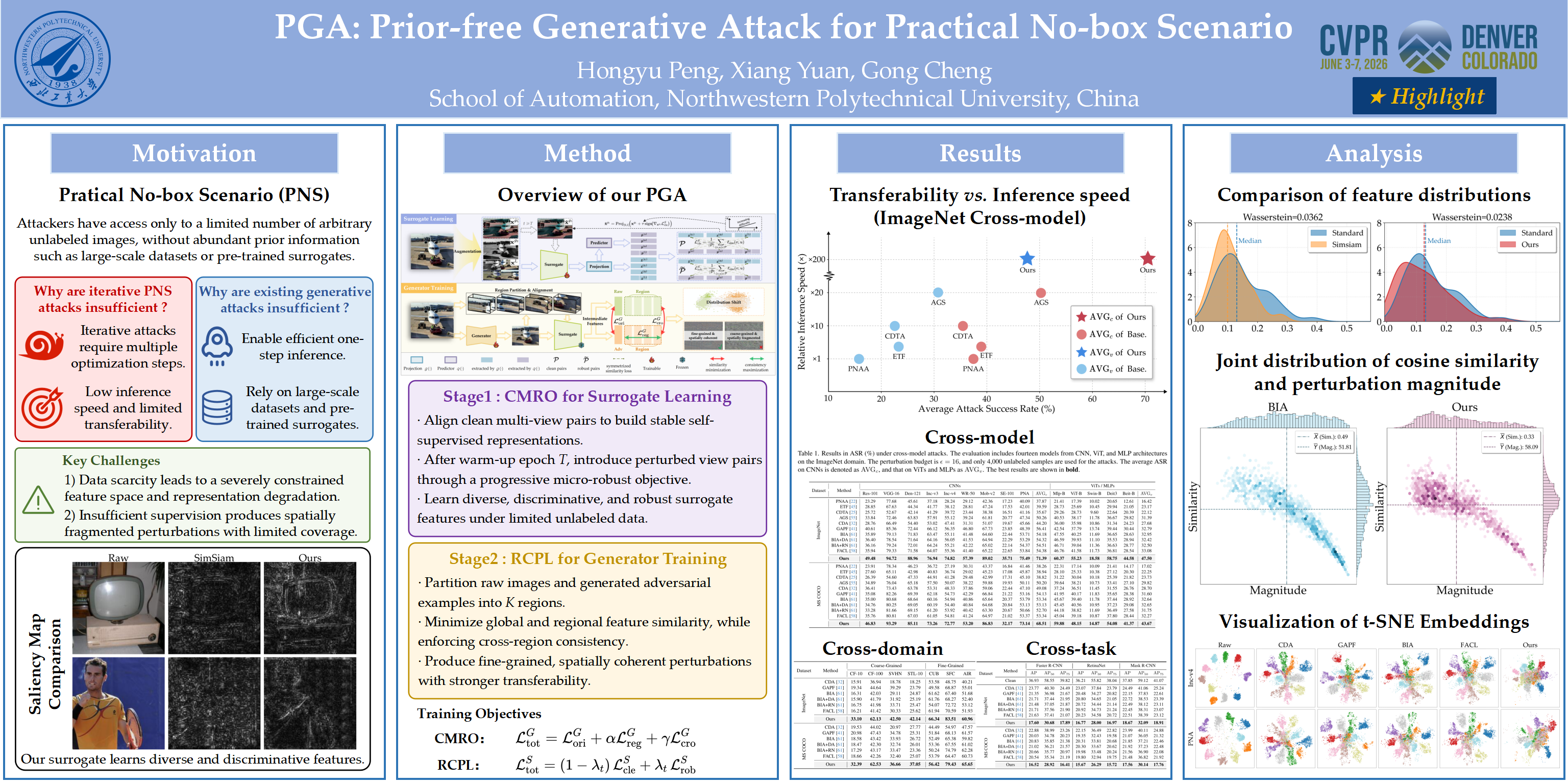
The unrealistic reliance on abundant prior information in traditional transferable attacks has spurred the Practical No-box Scenario (PNS), where attackers can access only limited unlabeled images. However, existing methods rely on iterative optimization to produce adversarial examples with inherently limited inference speed and transferability. Conversely, faster generative attacks fundamentally conflict with the PNS due to their critical dependence on abundant prior information that is explicitly absent in this scenario. To bridge this gap, we propose Prior-free Generative Attack (PGA), the first generative attack tailored for the PNS. Specifically, we introduce the Curriculum-Guided Micro-Robust Optimization that progressively incorporates more challenging discriminative tasks to mitigate the degenerate solutions common in self-supervised learning with limited data, yielding robust and transferable surrogates for downstream attacks. Furthermore, the Region-Aware Consistent Perturbation Learning guides the generator to produce fine-grained and spatially coherent perturbations, mitigating the common pitfall of generative attacks falling into local optima under insufficient supervision. Extensive experiments demonstrate that our PGA achieves remarkable transferability across various settings with high inference speed. This work provides a more practical benchmark for future research on transferable attacks, revealing the great potential of generative attacks under the PNS.
Lipschitz Optimization for Formal Verification of Homographies
Jean-Guillaume Durand ⋅ Panagiotis Kouvaros ⋅ Maxime Gariel ⋅ Alessio Lomuscio
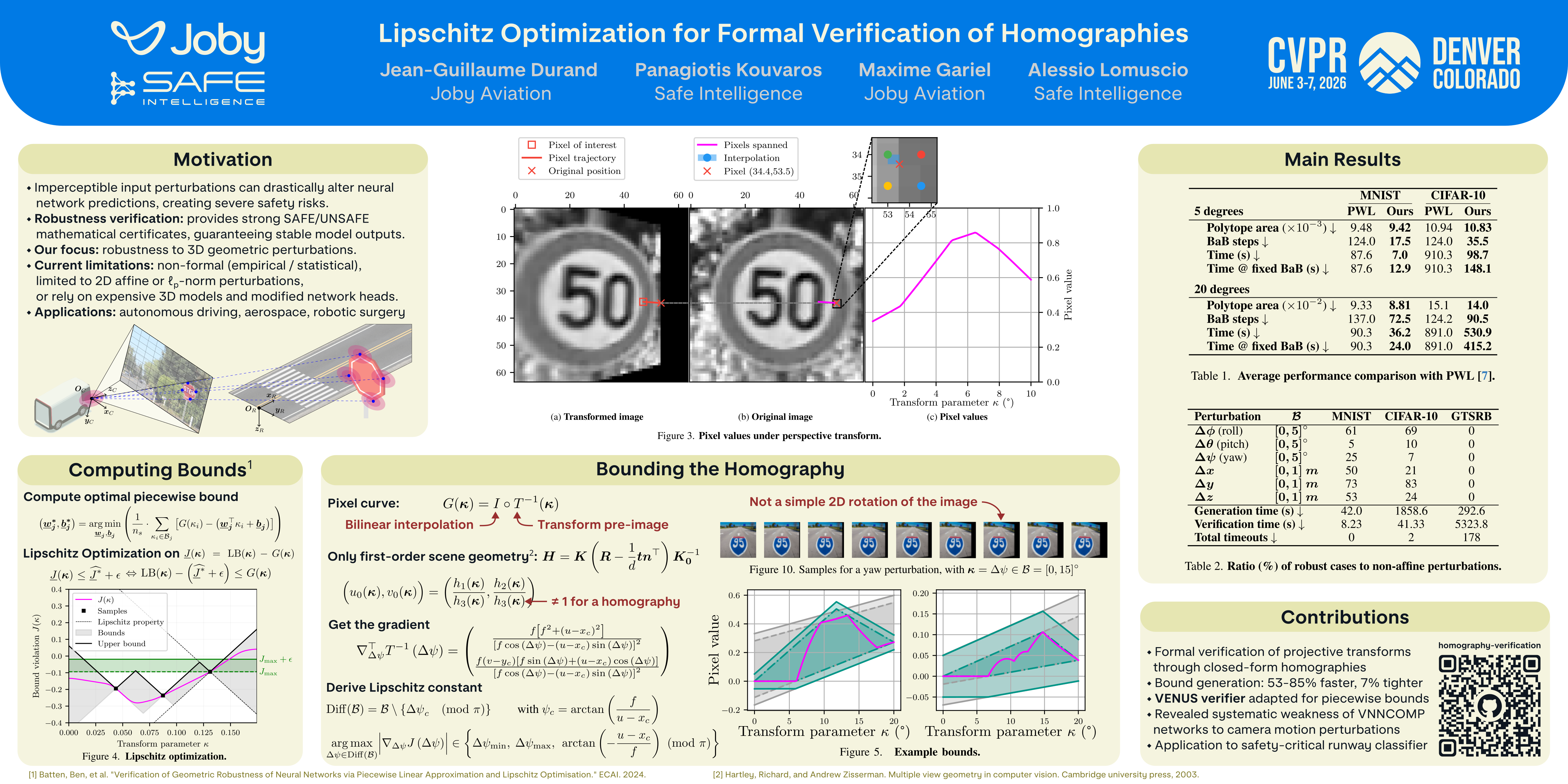
The adoption of vision neural networks in regulated industries requires formal robustness guarantees, especially in safety-critical domains such as healthcare, aerospace, and autonomous vehicles. However, current approaches are confined to incomplete statistical verification, or robustness to $\ell_p$-norm or affine transforms which represent a limited subset of perturbations to the image formation process.In this paper, we present a formal verification approach when the capturing camera undergoes 3D motion perturbations. We first establish a closed-form mapping from camera pose to pixel values. By analyzing the continuity properties of the resulting homographies, we show that recent work on Lipschitz optimization and piecewise continuity can be extended to derive tight linear bounds on perturbed pixel values. While our formulae are grounded in the vision-based landing problem, they generalize to other scenes with predominantly planar features (e.g., augmented reality, traffic signs). This enables formal verification against a broad class of projective geometry transformations, without requiring simulation or complex modeling of image formation.We first validate our implementation, and show up to 89\% speedup and 7\% tighter bounds than the latest work. We then evaluate our method on established benchmarks from the VNN Competition, and highlight key model vulnerabilities to 3D transforms. Finally, we perform the first formal verification of a vision-based landing system under 3D perturbations, addressing a key challenge in the regulatory certification of learned models for real-world systems. The data and code used for this paper are publicly available.
Batman: Benign Knowledge Alignment Through Malicious Null Space in Federated Backdoor Attack
Wenwen He ⋅ Wenke Huang ⋅ Yiyang Fang ⋅ Wenjie Qu ⋅ Jiaheng Zhang ⋅ Mang Ye
Federated Learning (FL), a distributed learning paradigm that enables local training on user-held data across decentralized devices, is vulnerable to backdoor attacks due to limited visibility into client updates. Exploiting this opacity, adversaries induce targeted misbehavior on trigger inputs without affecting overall performance, thereby compromising the trust and integrity of collaborative training in federated learning systems. Existing federated backdoor attacks mainly concentrate on benign knowledge alignment on trigger-surface design or representation guidance to evade defense mechanisms. However, trigger-surface attacks suffer from insufficient alignment, leaving malicious knowledge distinguishable from benign updates. In contrast, representation-guided attacks attempt to obscure the boundary between benign and malicious behaviors. Nevertheless, excessive incorporation of benign knowledge within a shared parameter space leads to over-alignment, ultimately degrading attack effectiveness. To overcome shared parameter space dilemma in backdoor attack, we propose Batman, a novel backdoor attack that aligns benign knowledge within the malicious null space, which effectively decouples malicious space from shared parameter space and enables benign alignment in an orthogonal direction of this space that does not interfere with the attack effectiveness. To further enhance stealthiness, we combine both clean and global models to guide the alignment perturbation within this null space to evade detection. Experiments on four benchmark datasets demonstrate that Batman consistently achieves strong backdoor performance while remaining stealthy under various defenses.
Out of Sight, Out of Track: Adversarial Attacks on Propagation-based Multi-Object Trackers via Query State Manipulation
Halima Bouzidi ⋅ Haoyu Liu ⋅ Yonatan Achamyeleh ⋅ Praneetsai Iddamsetty ⋅ Mohammad Al Faruque
Recent Tracking-by-Query-Propagation (TBP) methods have advanced Multi-Object Tracking (MOT) by enabling end-to-end (E2E) pipelines with long-range temporal modeling. However, this reliance on query propagation introduces un-explored architectural vulnerabilities to adversarial attacks. We present FADE, a novel attack framework designed to exploit these specific vulnerabilities. FADE employs two attack strategies targeting core TBP mechanisms: (i) Temporal Query Flooding: Generates spurious temporally-consistent track queries to exhaust the tracker's limited query budget, forcing it to terminate valid tracks. (ii) Temporal Memory Corruption: Directly attacks the query updater's memory by severing temporal links via state de-correlation and erasing the learned feature identity of matched tracks. Furthermore, we introduce a differentiable pipeline to optimize these attacks for the physical world realizability by leveraging differentiable simulations of advanced perception sensor spoofing methods. Experiments on MOT17 and MOT20 demonstrate that FADE is highly effective against state-of-the-art TBP trackers, causing significant identity switches and track terminations.
Eliminate Distance Differences Induced by Backdoor Attacks: Layer-Selective Training and Clipping to Mask Backdoor Models
Xuzeng Li ⋅ Tao Zhang ⋅ Xiangyun Tang ⋅ JIACHENG WANG ⋅ Jian Wang ⋅ Jiawen Kang ⋅ Jiqiang Liu ⋅ Zhen Han ⋅ Dusit Niyato ⋅ Dong In Kim
Federated learning (FL) enables a central server to collaboratively train a global model with multiple clients while preserving data privacy. However, the distributed nature of FL makes the paradigm vulnerable to backdoor attacks, as proved by numerous recent studies. Although existing studies improve the effectiveness of backdoor attacks through optimized triggers, they have two limitations: (1) they ignore the heterogeneous contribution of individual model layers to the success of a backdoor; (2) they induce conspicuous differences between backdoor and clean models in the early stages of poisoning. The limitations cause backdoor models to exhibit significant discrepancies from clean models, making them easily detectable. To fill these gaps, we propose LaySelFL, a novel layer-selective method to eliminate distance differences induced by the backdoor to conceal attacks in FL. Our central insight is that different layers contribute unequally to backdoor attacks, by localizing poisoning to layers that are most sensitive to backdoor objectives, an attacker can reduce the model differences substantially between the backdoor and clean models. Concretely, LaySelFL identifies sensitive layers via both dynamic and static evaluations of parameter differences between backdoor and benign models, and then applies a targeted training protocol and a regularized loss that constrains differences from the global model in each round. Finally, LaySelFL performs clipping on non-poisoning layers to further mask residual differences introduced by the attack. This strategy yields a more covert and resilient backdoor attack. Extensive experiments show that LaySelFL increases the effectiveness of attacks by 25\% and reduces the effectiveness of defense methods to 4\%.
Mitigating Error Amplification in Fast Adversarial Training
Mengnan Zhao ⋅ Lihe Zhang ⋅ Bo Wang ⋅ Tianhang Zheng ⋅ Hong Zhong ⋅ Geyong Min
Fast Adversarial Training (FAT) has proven effective in enhancing model robustness by encouraging networks to learn perturbation-invariant representations.However, FAT often suffers from catastrophic overfitting (CO), where the model overfits to the training attack and fails to generalize to unseen ones. Moreover, robustness-oriented optimization typically leads to notable performance degradation on clean inputs, and such degradation becomes increasingly severe as the perturbation budget grows.In this work, we conduct a comprehensive analysis of how guidance strength affects model performance by modulating perturbation and supervision levels across distinct confidence groups.The findings reveal that low-confidence samples are the primary contributors to CO and the robustness–accuracy trade-off. Building on this insight, we propose a Distribution-aware Dynamic Guidance (DDG) strategy that dynamically adjusts both the perturbation budget and supervision signal. Specifically, DDG scales the perturbation magnitude according to the sample confidence at the ground-truth class, thereby guiding samples toward consistent decision boundaries while mitigating the influence of learning spurious correlations. Simultaneously, it dynamically adjusts the supervision signal based on the prediction state of each sample, preventing overemphasis on incorrect signals. To alleviate potential gradient instability arising from dynamic guidance, we further design a weighted regularization constraint.Extensive experiments on standard benchmarks demonstrate that DDG effectively alleviates both CO and the robustness–accuracy trade-off.
Physical Adversarial Clothing Evades Visible-Thermal Detectors via Non-Overlapping RGB-T Pattern
Xiaopei Zhu ⋅ Guanning Zeng ⋅ Zhanhao Hu ⋅ Jun Zhu ⋅ Xiaolin Hu
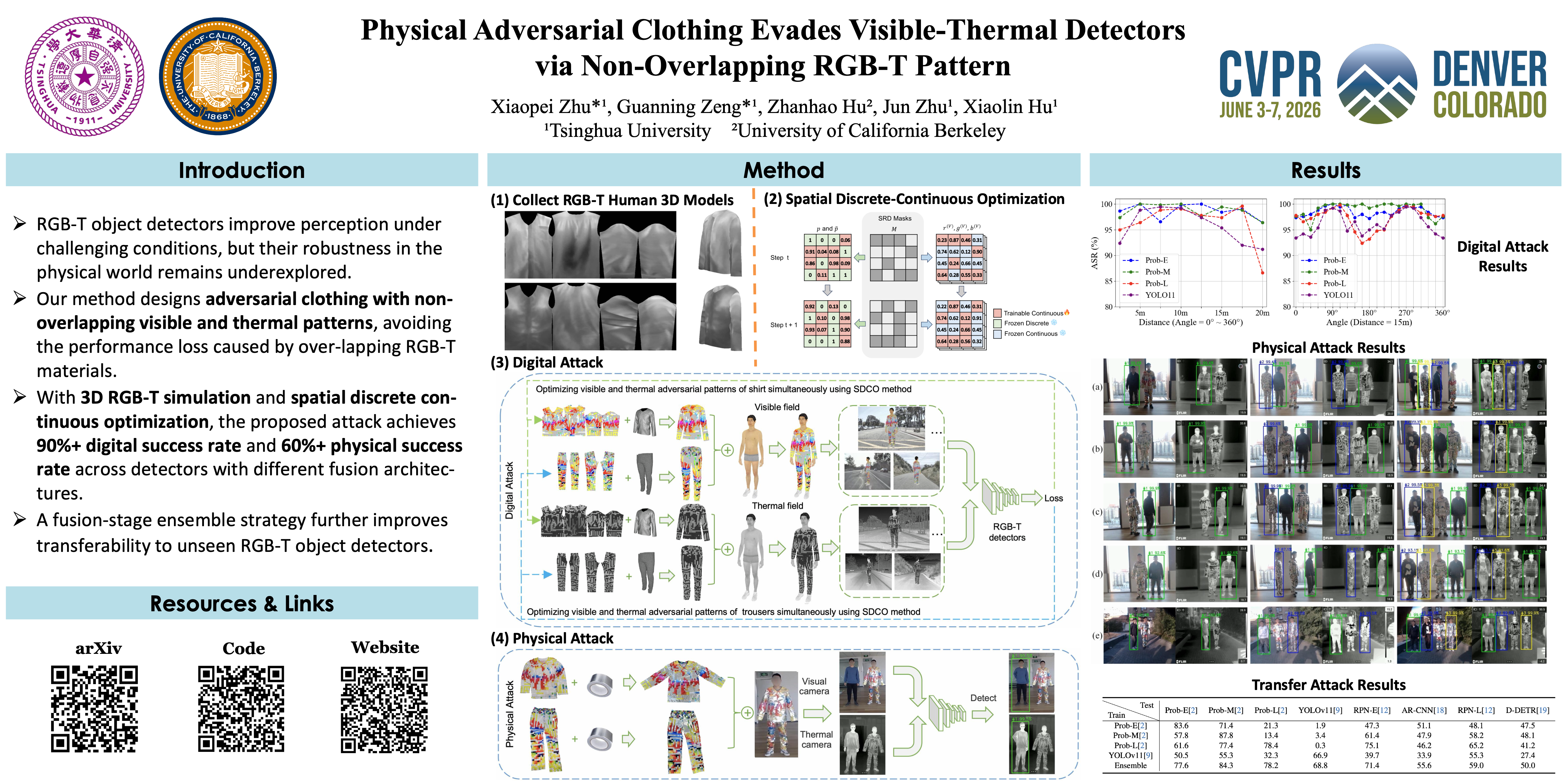
Visible-thermal (RGB-T) object detection is a crucial technology for applications such as autonomous driving, where multimodal fusion enhances performance in challenging conditions like low light. However, the security of RGB-T detectors, particularly in the physical world, has been largely overlooked. This paper proposes a novel approach to RGB-T physical attacks using adversarial clothing with a non-overlapping RGB-T pattern (NORP). To simulate full-view (0$^{\circ}$–360$^{\circ}$) RGB-T attacks, we construct 3D RGB-T models for human and adversarial clothing. NORP is a new adversarial pattern design using distinct visible and thermal materials without overlap, avoiding the light reduction in overlapping RGB-T patterns (ORP). To optimize the NORP on adversarial clothing, we propose a spatial discrete-continuous optimization (SDCO) method. We systematically evaluated our method on RGB-T detectors with different fusion architectures, demonstrating high attack success rates both in the digital and physical worlds. Additionally, we introduce a fusion-stage ensemble method that enhances the transferability of adversarial attacks across unseen RGB-T detectors with different fusion architectures.
What Your Features Reveal: Data-Efficient Black-Box Feature Inversion Attack for Split DNNs
Zhihan Ren ⋅ Lijun He ⋅ Jiaxi Liang ⋅ Xinzhu Fu ⋅ Haixia Bi ⋅ Fan Li
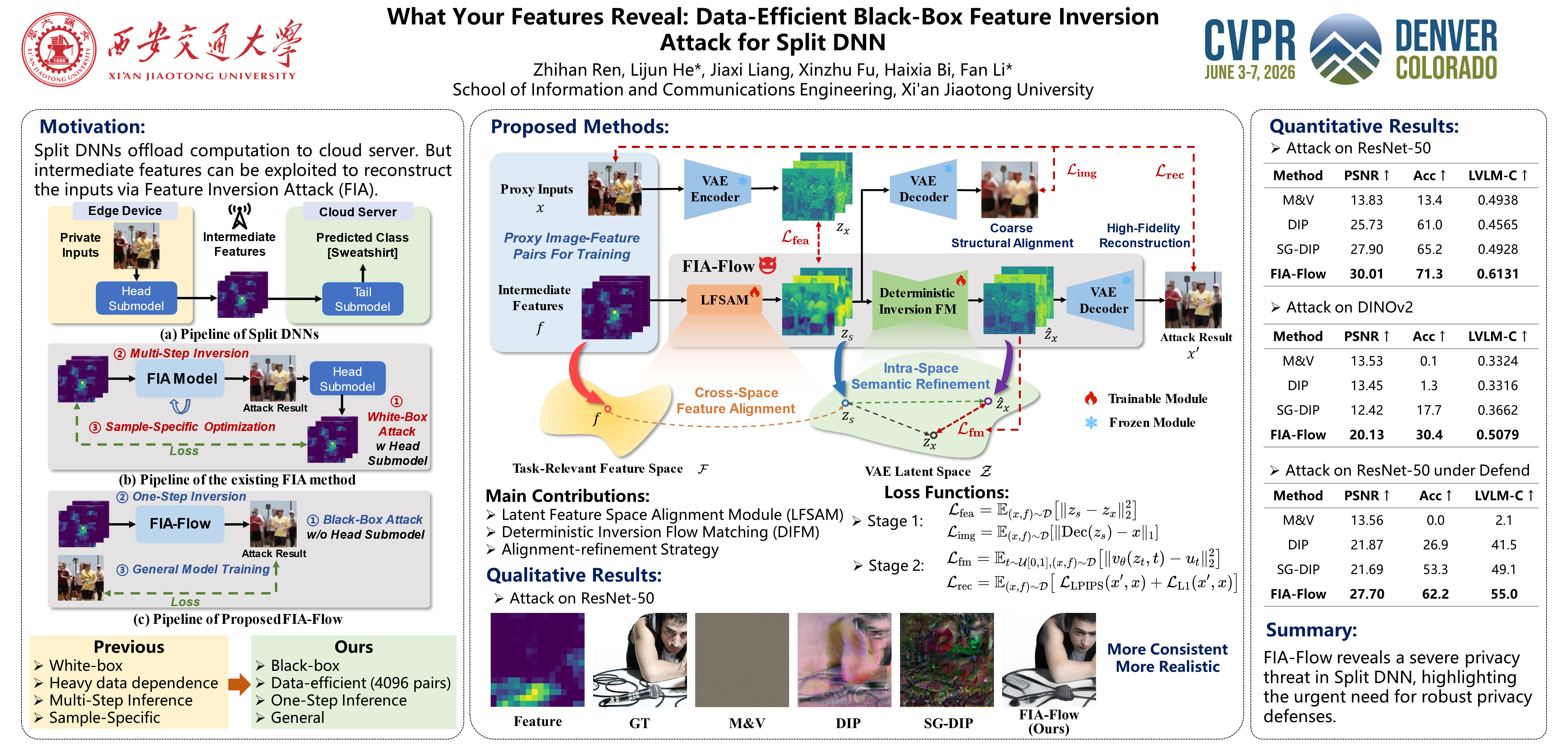
Split DNNs enable edge devices by offloading intensive computation to a cloud server, but this paradigm exposes privacy vulnerabilities, as the intermediate features can be exploited to reconstruct the private inputs via Feature Inversion Attack (FIA). Existing FIA methods often produce limited reconstruction quality, making it difficult to assess the true extent of privacy leakage. To reveal the privacy risk of the leaked features, we introduce FIA-Flow, a $\textbf{black-box}$ FIA framework that achieves high-fidelity image reconstruction from intermediate features. To exploit the semantic information within intermediate features, we design a Latent Feature Space Alignment Module (LFSAM) to bridge the semantic gap between the intermediate feature space and the latent space. Furthermore, to rectify distributional mismatch, we develop Deterministic Inversion Flow Matching (DIFM), which projects off-manifold features onto the target manifold with $\textbf{one-step inference}$. This decoupled design simplifies learning and enables effective training with $\textbf{few image–feature pairs}$. To quantify privacy leakage from a human perspective, we also propose two metrics based on a large vision-language model. Experiments show that FIA-Flow achieves more faithful and semantically aligned feature inversion across various models (AlexNet, ResNet, Swin Transformer, DINO, and YOLO11) and layers, revealing a more severe privacy threat in Split DNNs than previously recognized.
Exposing Functional Fusion: A New Class of Strategic Backdoor in Dynamic Prompt Architectures
Zeyao Liu ⋅ Zhendong Zhao ⋅ Xiaojun Chen ⋅ Xin Zhao ⋅ Yuexin Xuan ⋅ XIAOSHUANG JI
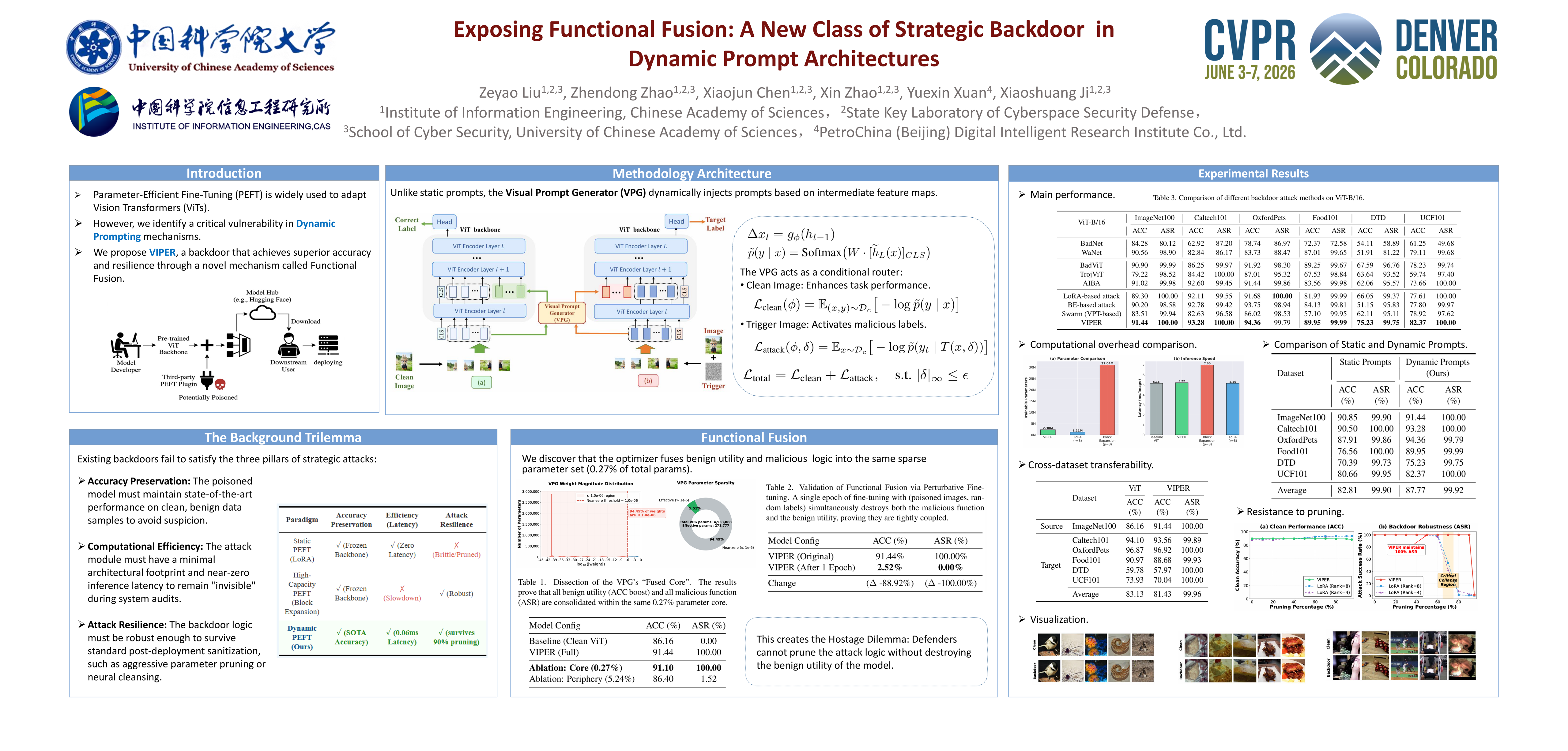
Existing ViT backdoor attacks based on backbone-overwriting full-tuning are computationally expensive and inflict performance degradation. This has forced adversaries towards the Visual Parameter-Efficient Fine-Tuning (PEFT) paradigm, dominated by adapter-based (e.g., LoRA) and prompt-based (e.g., VPT) approaches. While adapter security has seen initial study, the risks of the burgeoning prompt-based ecosystem remain critically unexplored. We fill this critical gap, exposing how the evolution of VPT towards dynamic, context-aware architectures innately creates a far more dangerous, emergent threat. This vulnerability arises even though these dynamic modules unlock superior benign performance. We propose VIPER, an attack framework built on a lightweight, dynamic Visual Prompt Generator (VPG) that demonstrates this vulnerability. Critically, this dynamic architecture enables Functional Fusion: an emergent phenomenon where malicious logic and benign task utility are inseparably fused into the same sparse, high-magnitude parameter core. This fusion creates an unsolvable ``hostage" dilemma, as pruning the attack necessarily destroys the benign performance.Comprehensive evaluations show VIPER resolves the attacker's trilemma: VIPER not only achieves state-of-the-art performance on clean data, but also maintains near-100\% ASR even under 90\% VPG-module pruning (where LoRA attacks collapse), while adding only an imperceptible 0.06ms (1.16\%) of inference latency. VIPER's results, driven by Functional Fusion, expose a new, paradigm-level risk in dynamic prompt architectures.
Learning to See and Act: Task-Aware Virtual View Exploration for Robotic Manipulation
Yongjie Bai ⋅ Zhouxia Wang ⋅ Yang Liu ⋅ Kaijun Luo ⋅ Yifan Wen ⋅ Mingtong Dai ⋅ weixing chen ⋅ Ziliang Chen ⋅ Lingbo Liu ⋅ Guanbin Li ⋅ Liang Lin
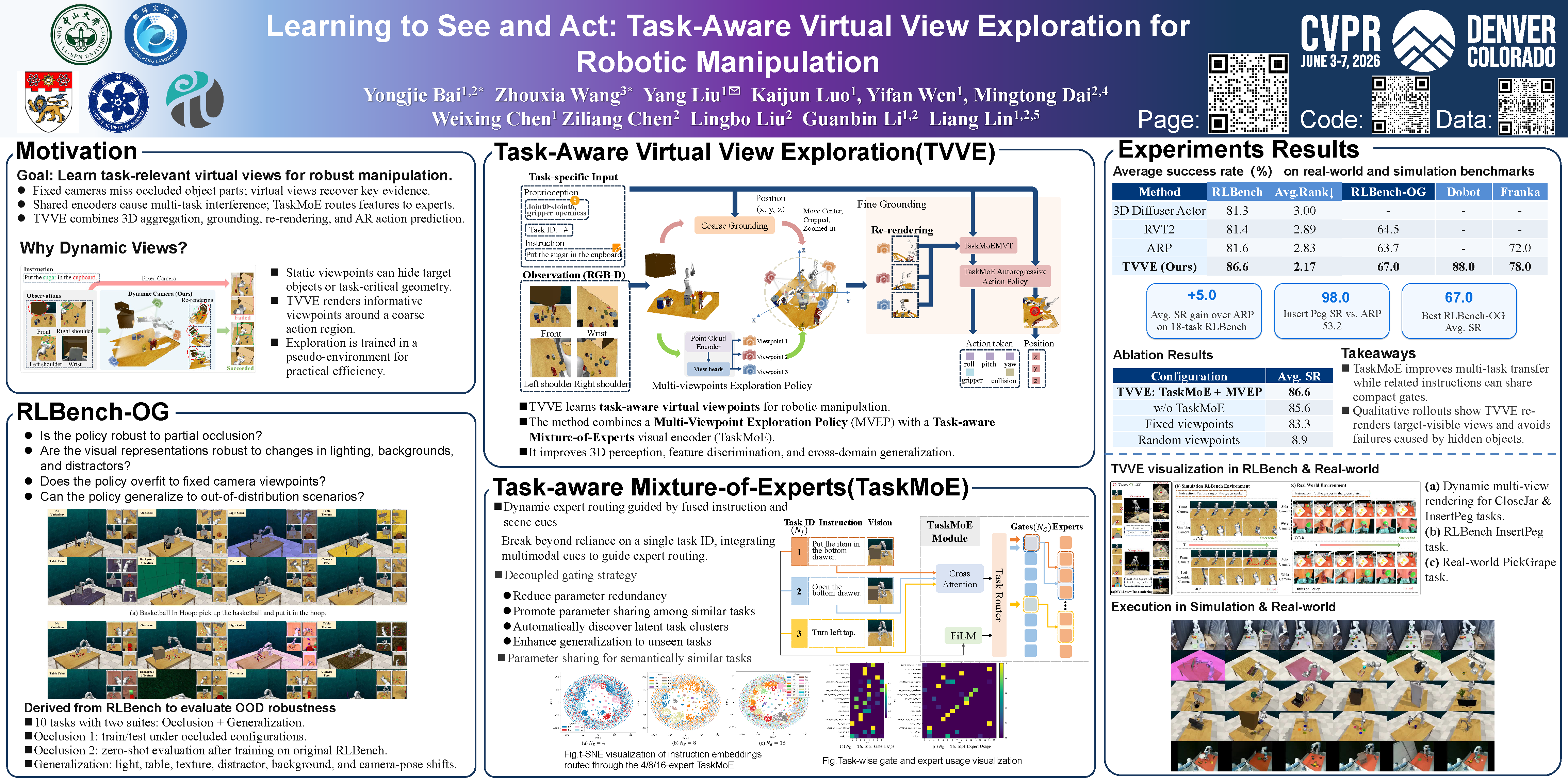
Recent vision-language-action (VLA) models for multi-task robotic manipulation commonly rely on static viewpoints and shared visual encoders, which limit 3D perception and cause task interference, hindering robustness and generalization. In this work, we propose Task-aware Virtual View Exploration (TVVE), a framework designed to overcome these challenges by integrating virtual view exploration with task-specific representation learning. TVVE employs an efficient exploration policy, accelerated by a novel pseudo-environment, to acquire informative views. Furthermore, we introduce a Task-aware Mixture-of-Experts (TaskMoE) visual encoder to disentangle features across different tasks, boosting both representation fidelity and task generalization. By learning to see the world in a task-aware way, TVVE generates more complete and discriminative visual representations, demonstrating significantly enhanced action prediction across a wide array of manipulation challenges. To further validate the robustness and generalization capability of TVVE under out-of-distribution (OOD) settings, we construct a challenging benchmark, RLBench-OG, covering various visual perturbations and camera pose variations. Extensive experiments on RLBench and RLBench-OG show that our TVVE achieves superior performance over state-of-the-art approaches. In real-robot experiments, TVVE demonstrates exceptional performance and generalizes robustly in multiple OOD settings, including visual disturbances and unseen instructions.
Evo-1: Lightweight Vision-Language-Action Model with Preserved Semantic Alignment
Tao Lin ⋅ Yilei Zhong ⋅ Yuxin Du ⋅ Jingjing Zhang ⋅ Jiting Liu ⋅ Yinxinyu Chen ⋅ Encheng Gu ⋅ Ziyan Liu ⋅ Hongyi Cai ⋅ Yanwen Zou ⋅ Lixing Zou ⋅ Zhaoye Zhou ⋅ Gen Li ⋅ Bo Zhao
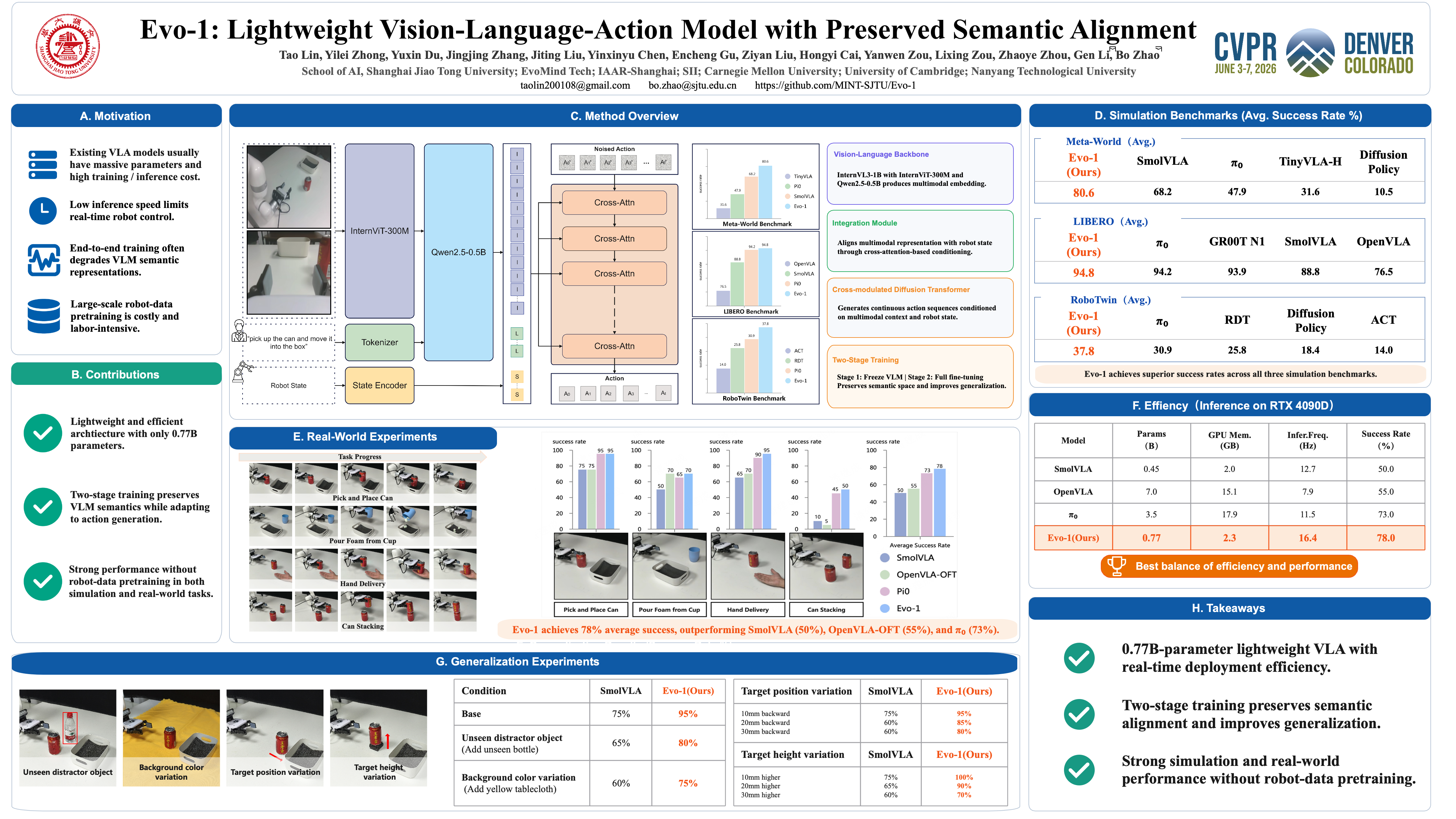
Vision-Language-Action (VLA) models have emerged as a powerful framework that unifies perception, language, and control, enabling robots to perform diverse tasks through multimodal understanding. However, current VLA models typically contain massive parameters and rely heavily on large-scale robot data pretraining, leading to high computational costs during training, as well as limited deployability for real-time inference.Moreover, most training paradigms often degrade the perceptual representations of the Vision–Language backbone, resulting in overfitting and poor generalization to downstream tasks.In this work, we present Evo-1, a lightweight VLA model that reduces computation and improves deployment efficiency, while maintaining strong performance without pretraining on robot data. Evo-1 builds on a native multimodal Vision–Language model (VLM), incorporating a novel cross-modulated diffusion transformer along with an optimized integration module, together forming an effective architecture.We further introduce a two-stage training paradigm that progressively aligns action with perception, preserving the representations of the VLM.Notably, with only 0.77 billion parameters, Evo-1 achieves state-of-the-art results on the Meta-World and RoboTwin suite, surpassing the previous best models by 12.4\% and 6.9\%, respectively, and also attains a competitive result of 94.8\% on LIBERO.In real-world evaluations, Evo-1 attains a 78\% success rate with high inference frequency and low memory overhead, outperforming all baseline methods.We release code, data, and model weights to facilitate future research on lightweight and efficient VLA models.
FM-Steer: Enhance Generalist Policies with Value-Guided Cascaded Denoising
Haoming Song ⋅ Delin Qu ⋅ Yuanqi Yao ⋅ Qizhi Chen ⋅ Jiarui Li ⋅ Qi Lv ⋅ Yiwen Tang ⋅ Li Kang ⋅ Heng Zhou ⋅ Xianqiang Gao ⋅ Yuhang Tang ⋅ Xiaofan Li ⋅ Modi Shi ⋅ Guangrui Ren ⋅ Maoqing Yao ⋅ Bin Zhao ⋅ Dong Wang ⋅ Xuelong Li
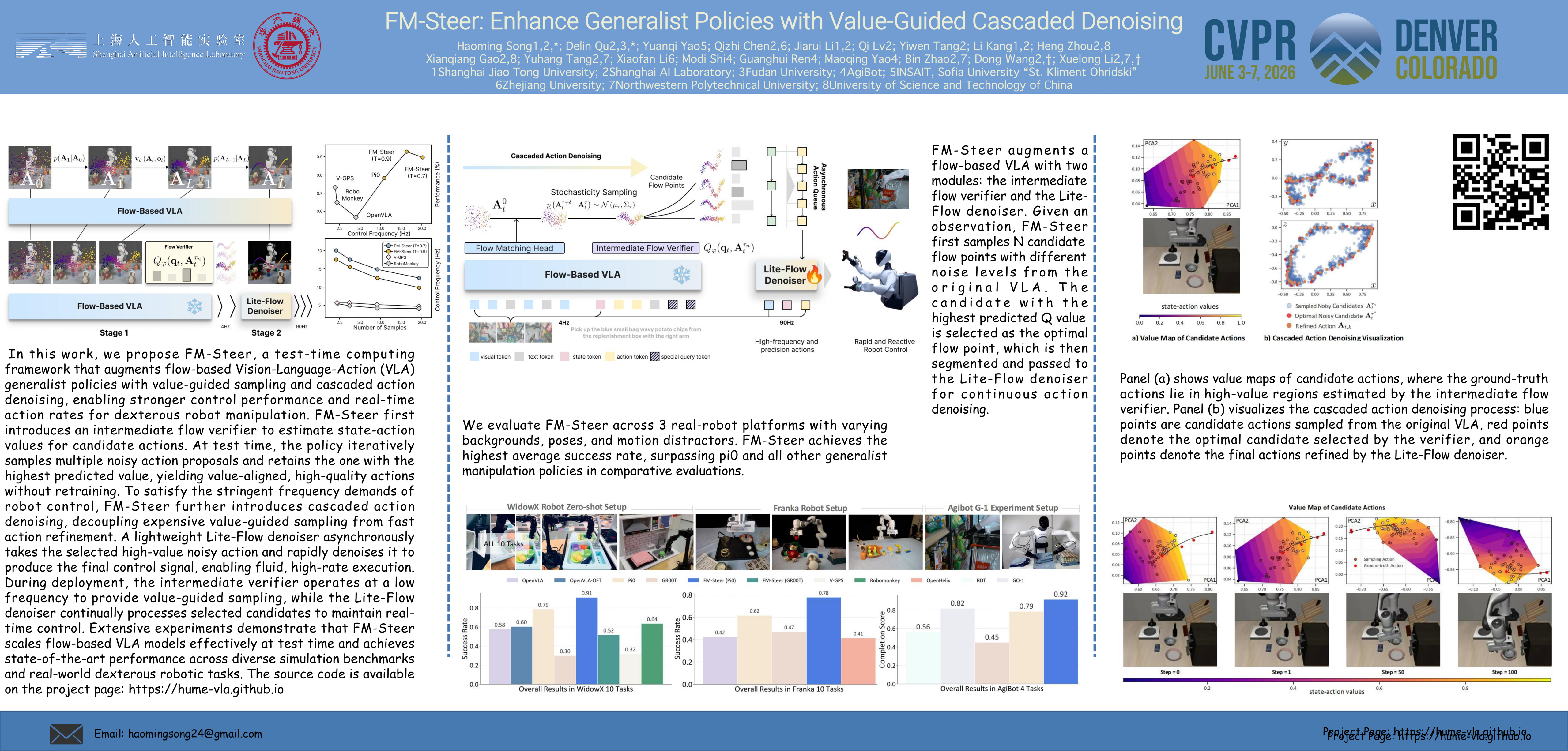
Humans naturally allocate more time before performing actual actions when handling complex tasks in the physical world. This paradigm, recently, has achieved remarkable advancement in boosting Large Language Models (LLMs) to solve complex tasks in digital domains.However, the potential of test-time computing remains largely unexplored for robotic foundation models interacting with the physical world.In this work, we propose \textbf{\ours}: a test-time computing framework that augments flow-based Vision-Language-Action (VLA) generalist policies with value-guided sampling and cascaded action denoising, enabling higher control performance and real-time action rates for dexterous robot manipulation.\ours first incorporates a flow-based intermediate verifier to estimate state–action values for candidate actions. At test time, the policy iteratively samples multiple noisy action proposals and retains the one with the highest predicted value, yielding value-aligned, high-quality actions without retraining.To satisfy the stringent frequency demands of robot control, \ours further introduces cascaded action denoising, decoupling expensive value-guided sampling from fast action refinement. A lightweight flow denoiser asynchronously takes the selected high-value noisy action and rapidly denoises it to produce the final control signal, enabling fluid, high-rate execution.During deployment, the intermediate verifier operates at a low frequency to provide value-guided sampling, while the lite-flow denoiser continually processes selected candidates to maintain real-time control.Extensive experiments demonstrate that \ours scales flow-based VLA models effectively at test time, and achieves state-of-the-art performance across diverse simulation benchmarks and real-world dexterous robotic tasks.
Bootstrap Dynamic-Aware 3D Visual Representation for Scalable Robot Learning
Qiwei Liang ⋅ Boyang Cai ⋅ Minghao Lai ⋅ Sitong Zhuang ⋅ Tao Lin ⋅ Yan Qin ⋅ Yixuan Ye ⋅ Jiaming Liang ⋅ Renjing Xu
Despite strong results on recognition and segmentation, current 3D visual pre-training methods often underperform on robotic manipulation. We attribute this gap to two factors: the lack of state–action–state dynamics modeling and the unnecessary redundancy of explicit geometric reconstruction. We introduce AFRO, a scalable self-supervised framework that learns dynamics-aware 3D representations directly from point clouds without action or label supervision. AFRO casts state prediction as a generative diffusion process and jointly models forward and inverse dynamics in a shared latent space to capture causal transition structure. To prevent feature leakage in action learning, we employ feature differencing and inverse-consistency supervision, improving the quality and stability of visual features. When combined with Diffusion Policy for control, AFRO substantially increases manipulation success rates across 16 simulated and 4 real-world tasks, outperforming existing pre-training approaches. The framework also scales favorably with data volume and task complexity. Qualitative visualizations indicate that AFRO learns semantically rich, discriminative features, offering an effective pre-training solution for dynamics-aware 3D representation learning in robotics.
Visual Sim-to-Real at Scale for Humanoid Loco-Manipulation
Tairan He ⋅ Zi Wang ⋅ Haoru Xue ⋅ Qingwei Ben ⋅ Zhengyi Luo ⋅ Wenli Xiao ⋅ Ye Yuan ⋅ Xingye Da ⋅ Fernando Castañeda ⋅ Shankar Sastry ⋅ Changliu Liu ⋅ Guanya Shi ⋅ Jim Fan ⋅ Yuke Zhu
A core barrier to the real-world productivity of humanoid robots is the lack of autonomous loco-manipulation skills. We introduce VIRAL, a visual sim-to-real framework that learns humanoid loco-manipulation entirely in simulation and deploys it zero-shot to real hardware. VIRAL follows a teacher-student design: a privileged RL teacher, operating on full state, learns long-horizon loco-manipulation using a delta action space and reference state initialization. A vision-based student policy is then distilled from the teacher via large-scale simulation with tiled rendering, trained with a mixture of online DAgger and behavior cloning. We find that compute scale is critical: scaling simulation to tens of GPUs (up to 64) makes both teacher and student training reliable, while low-compute regimes often fail. To bridge the sim-to-real gap, VIRAL combines large-scale visual domain randomization—over lighting, materials, camera parameters, image quality, and sensor delays—with real-to-sim alignment of the dexterous hand and cameras. Deployed on a Unitree G1 humanoid, the resulting RGB-based policy performs continuous loco-manipulation for up to 54 cycles, generalizing to diverse spatial and appearance variations without any real-world fine-tuning, and approaching expert-level teleoperation performance. Extensive ablations dissect the key design choices required to make RGB-based humanoid loco-manipulation work in practice.
Contact-Aware Neural Dynamics
Changwei Jing ⋅ Jai Krishna Bandi ⋅ Jianglong Ye ⋅ Yan Duan ⋅ Pieter Abbeel ⋅ Xiaolong Wang ⋅ Sha Yi
High-fidelity physics simulation is essential for scalable robotic learning, but the sim-to-real gap persists, especially for tasks involving complex, dynamic, and discontinuous interactions like physical contacts. Explicit system identification, which tunes explicit simulator parameters, is often insufficient to align the intricate, high-dimensional, and state-dependent dynamics of the real world. To overcome this, we propose an implicit sim-to-real alignment framework that learns to directly align the simulator's dynamics with contact information. Our method treats the off-the-shelf simulator as a base prior and learns a contact-aware neural dynamics model to refine simulated states using real-world observations. We show that using tactile contact information from robotic hands can effectively model the non-smooth discontinuities inherent in contact-rich tasks, resulting in a neural dynamics model grounded by real-world data. We demonstrate that this learned forward dynamics model improves state prediction accuracy and can be effectively used to predict policy performance and refine policies trained purely in standard simulators, offering a scalable, data-driven approach to sim-to-real alignment.
AVA-VLA: Improving Vision-Language-Action models with Active Visual Attention
Lei Xiao ⋅ Jifeng Li ⋅ Juntao Gao ⋅ Feiyang Ye ⋅ Yan Jin ⋅ Jingjing Qian ⋅ Jing Zhang ⋅ Yong Wu ⋅ Xiaoyuan Yu
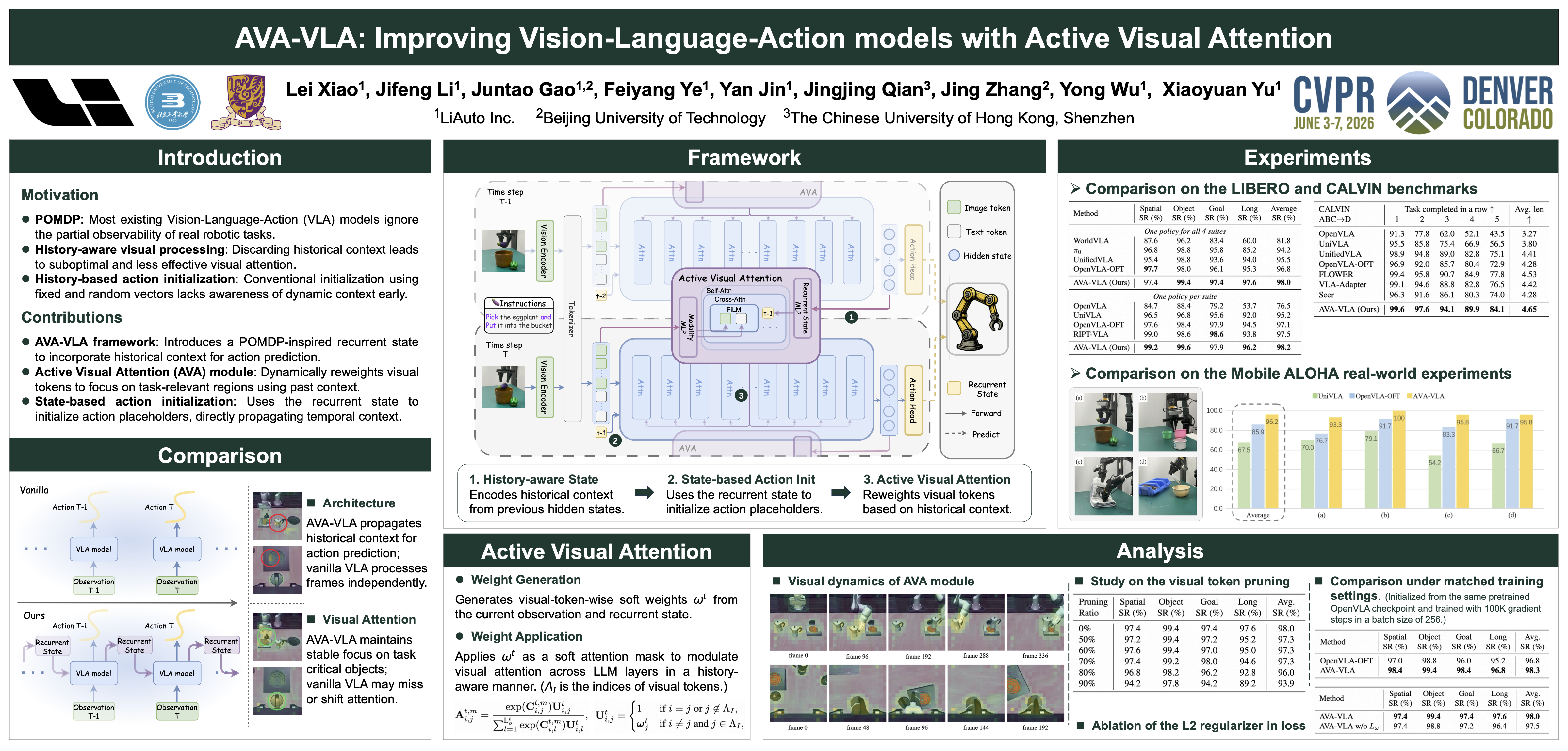
Vision-Language-Action (VLA) models have demonstrated remarkable capabilities in embodied AI tasks. However, existing VLA models, often built upon Vision-Language Models (VLMs), typically process dense visual inputs independently at each timestep. This approach implicitly models the task as a Markov Decision Process (MDP). However, this history-agnostic design is suboptimal for effective visual token processing in dynamic sequential decision-making, as it fails to leverage the context of history. To address this limitation, we reformulate the problem from a Partially Observable Markov Decision Process (POMDP) perspective and propose a novel framework named AVA-VLA. Inspired by the POMDP that the action generation should be conditioned on the belief state. AVA-VLA introduces Active Visual Attention (AVA) to dynamically modulate visual processing. It achieves this by leveraging the recurrent state, which is a neural approximation of the agent's belief state derived from the previous decision step. Specifically, the AVA module uses the recurrent state to compute the soft weights to actively process task-relevant visual tokens based on its historical context. Comprehensive evaluations demonstrate that AVA-VLA achieves state-of-the-art performance across popular robotic benchmarks, including LIBERO and CALVIN. Furthermore, real-world deployments on a dual-arm robot platform validate the framework's practical applicability and robust sim-to-real transferability.
UAST: Unified Active Search and Tracking for Arbitrary Targets with UAVs
Liang Qin ⋅ Min Wang ⋅ Xingyu Lu ⋅ Aowen Qiu ⋅ Wengang Zhou ⋅ Houqiang Li
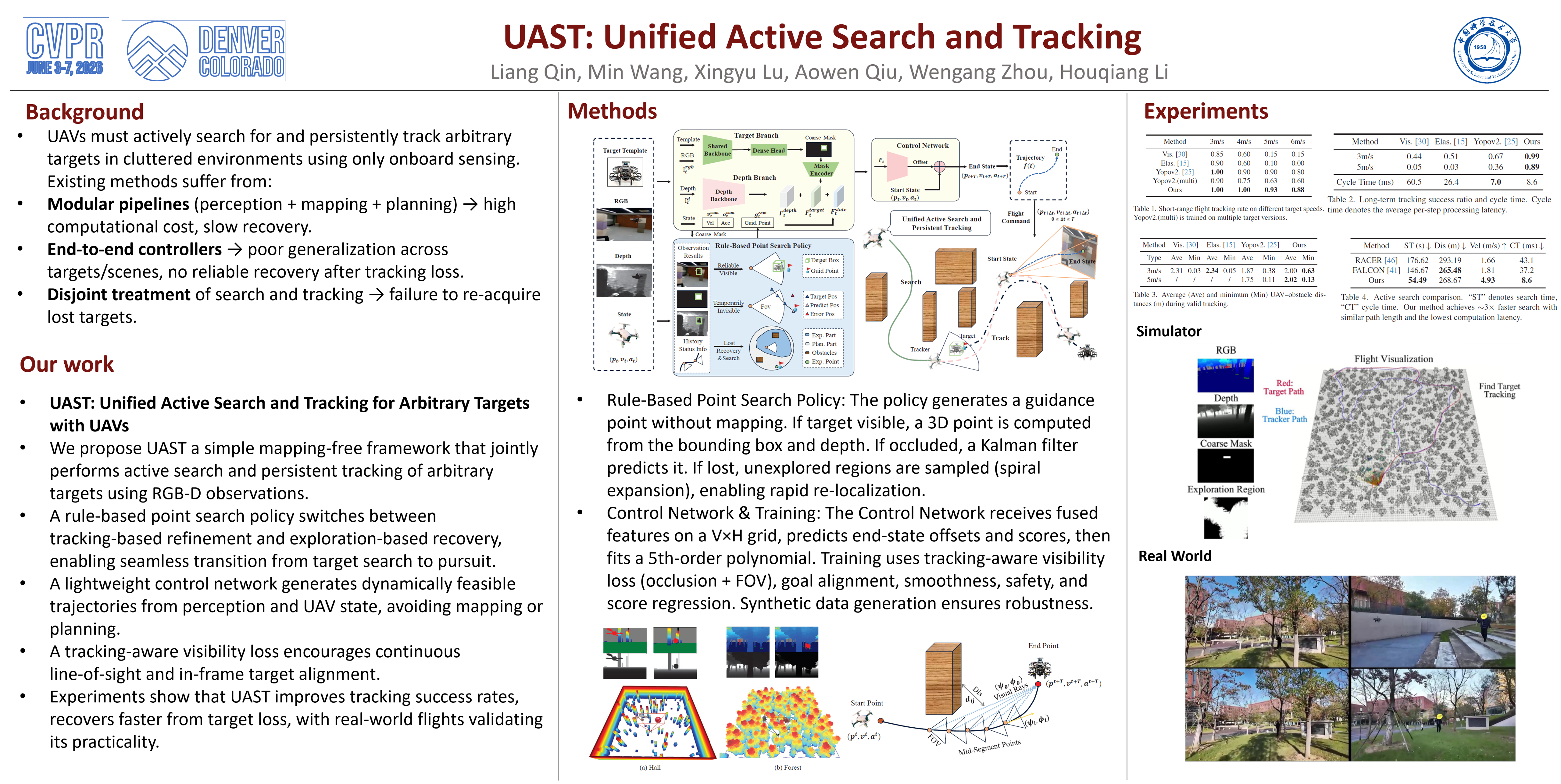
Active search and tracking of arbitrary targets by Unmanned Aerial Vehicles (UAVs) in cluttered environments remains a highly challenging problem. Existing methods either construct complex modular pipelines, leading to substantial computational costs, or adopt end-to-end controllers that often fail to generalize across different targets and scenes. Moreover, search and tracking are typically treated separately despite their strong interdependence.In this paper, we present UAST, a simple yet effective mapping-free framework that unifies active search and persistent tracking using only RGB-D observations. The proposed system couples a dual-branch perception module with a Rule-Based Point Search Policy that adaptively switches between tracking and search-based recovery. A lightweight control network generates dynamically feasible trajectories directly from fused perception and UAV states. Furthermore, we introduce a training strategy with an elaborated tracking-aware visibility loss and a tailored data construction.Extensive experiments in both simulated and real-world environments show that our approach achieves higher success rates, more stable long-term tracking, and faster target search compared with existing methods, while maintaining high efficiency. The code will be released upon publication.
SwiftVLA: Unlocking Spatiotemporal Dynamics for Lightweight VLA Models at Minimal Overhead
Chaojun Ni ⋅ Chen Cheng ⋅ Xiaofeng Wang ⋅ Zheng Zhu ⋅ Wenzhao Zheng ⋅ Boyuan Wang ⋅ Tianrun Chen ⋅ Guosheng Zhao ⋅ Haoyun Li ⋅ Zhehao Dong ⋅ Qiang Zhang ⋅ Yun Ye ⋅ Yang Wang ⋅ Guan Huang ⋅ Wenjun Mei
Vision–Language–Action (VLA) models built on pretrained Vision–Language Models (VLMs) show strong potential but are limited in practicality due to their large parameter counts. To mitigate this issue, using a lightweight VLM has been explored, but it compromises spatiotemporal reasoning. Although some methods suggest that incorporating additional 3D inputs can help, they usually rely on large VLMs to fuse 3D and 2D inputs and still lack temporal understanding. Therefore, we propose SwiftVLA, an architecture that enhances a compact model with 4D understanding while preserving design efficiency. Specifically, our approach features a pretrained 4D visual geometry transformer with a temporal cache that incrementally extracts 4D features from 2D images. Then, to enhance the VLM’s ability to exploit both 2D images and 4D features, we introduce \textit{Fusion Tokens}, a set of learnable tokens trained with a future prediction objective to generate unified representations for action generation. Finally, we introduce a mask-and-reconstruct strategy that randomly masks 4D inputs to the VLM and trains the VLA to reconstruct the masked features. This self-reconstruction objective helps learn effective 4D representations, allowing the 4D branch to be dropped at inference with minimal performance loss. Extensive experiments in real and simulated environments show that SwiftVLA outperforms lightweight baselines and rivals VLAs up to $7\times$ larger. On edge devices, SwiftVLA achieves comparable performance while being $18\times$ faster than the $\pi_0$ and reducing the memory footprint by $12\times$.
Visual-RRT: Finding Paths toward Visual-Goals via Differentiable Rendering
Sebin Lee ⋅ Jumin Lee ⋅ Taeyeon Kim ⋅ Youngju Na ⋅ Woobin Im ⋅ Sung-Eui Yoon
Rapidly-exploring random trees (RRTs) have been widely adopted for robot motion planning due to their robustness and theoretical guarantees. However, existing RRT-based planners require explicit goal configurations specified as numerical joint angles, while many practical applications provide goal specifications through visual observations such as images or demonstration videos where precise goal configurations are unavailable. In this paper, we propose visual-RRT (vRRT), a motion planner that enables visual-goal planning by unifying gradient-based exploitation from differentiable robot rendering with sampling-based exploration from RRTs. We further introduce (1) a frontier-based exploration-exploitation strategy that adaptively prioritizes visually promising search regions, and (2) inertial gradient tree expansion that inherits optimization states across tree branches for momentum-consistent gradient exploitation. Extensive experiments across various robot manipulators including Franka, UR5e, and Fetch demonstrate that vRRT achieves effective visual-goal planning in both simulated and real-world settings, bridging the gap between sampling-based planning and vision-centric robot applications. Our code will be released publicly.
Cross-Hand Latent Representation for Vision-Language-Action Models
Guangqi Jiang ⋅ Yutong Liang ⋅ Jianglong Ye ⋅ Jia-Yang Huang ⋅ Changwei Jing ⋅ Yan Duan ⋅ Pieter Abbeel ⋅ Xiaolong Wang ⋅ Xueyan Zou
Dexterous manipulation is essential for real-world robot autonomy, mirroring the central role of human hand coordination in daily activity. Humans rely on rich multimodal perception—vision, sound, and language-guided intent—to perform dexterous actions, motivating vision-based, language-conditioned manipulation systems for robots. However, training reliable vision-language-action (VLA) models for dexterous manipulation requires large-scale demonstrations across many robotic hands. In addition, as new dexterous embodiments appear rapidly, collecting data for each becomes costly and impractical, creating a need for scalable cross-embodiment learning. We introduce \ourmethod, a vision-language-action framework integrated with a unified latent action space shared across diverse dexterous hands. This embodiment-invariant latent space is directly pluggable into standard VLA architectures, enabling seamless cross-embodiment training and efficient reuse of both existing and newly collected data. Experimental results demonstrate that \ourmethod consistently outperforms baseline VLA models operating in raw joint spaces, establishing it as an effective solution for scalable cross-embodiment dexterous manipulation.
Beyond Success: Refining Elegant Robot Manipulation from Mixed-Quality Data via Just-in-Time Intervention
Yanbo Mao ⋅ Jianlong Fu ⋅ Ruoxuan Zhang ⋅ Hongxia Xie ⋅ Meibao Yao
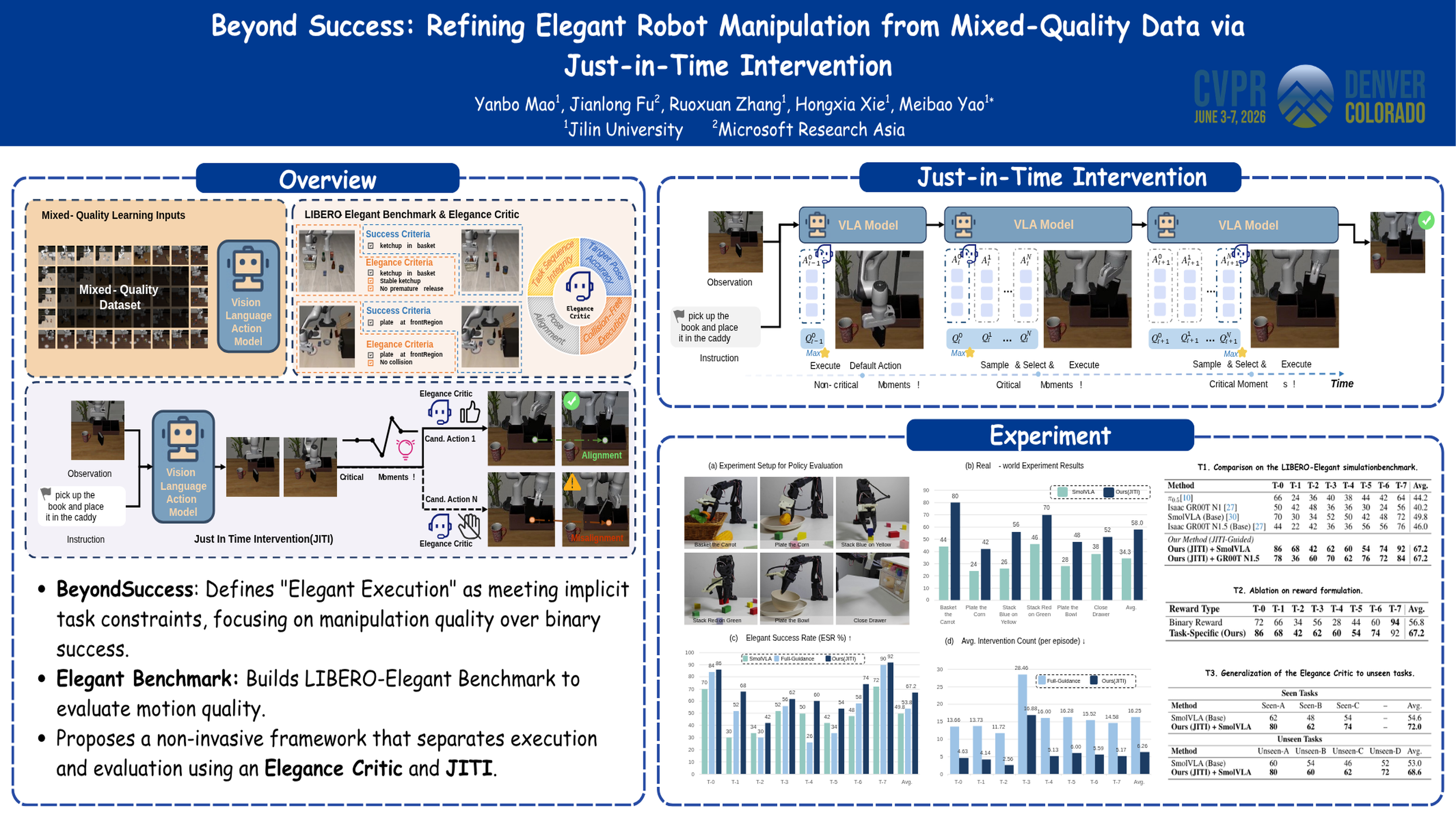
Vision-Language-Action (VLA) models have enabled notable progress in general-purpose robotic manipulation, yet their learned policies often exhibit variable execution quality. We attribute this variability to the mixed-quality nature of human demonstrations, where the implicit principles that govern how actions should be carried out are only partially satisfied. To address this challenge, we introduce the LIBERO-Elegant benchmark with explicit criteria for evaluating execution quality. Using these criteria, we develop a decoupled refinement framework that improves execution quality without modifying or retraining the base VLA policy. We formalize Elegant Execution as the satisfaction of Implicit Task Constraints (ITCs) and train an Elegance Critic via offline Calibrated Q-Learning to estimate the expected quality of candidate actions. At inference time, a Just-in-Time Intervention (JITI) mechanism monitors critic confidence and intervenes only at decision-critical moments, providing selective, on-demand refinement. Experiments on LIBERO-Elegant and real-world manipulation tasks show that the learned Elegance Critic substantially improves execution quality, even on unseen tasks. The proposed model enables robotic control that values not only whether tasks succeed, but also how they are performed.
Physically Ground Commonsense Knowledge for Articulated Object Manipulation with Analytic Concepts
Jiude Wei ⋅ Yuxuan Li ⋅ Cewu Lu ⋅ Jianhua Sun
We human rely on a wide range of commonsense knowledge to interact with an extensive number and categories of objects in the physical world. Likewise, such commonsense knowledge is also crucial for robots to successfully develop generalized object manipulation skills. While recent advancements in Multi-modal Large Language Models (MLLMs) have showcased their impressive capabilities in acquiring commonsense knowledge and conducting commonsense reasoning, effectively grounding this semantic-level knowledge produced by MLLMs to the physical world to thoroughly guide robots in generalized articulated object manipulation remains a challenge that has not been sufficiently addressed. To this end, we introduce analytic concepts, procedurally defined upon mathematical symbolism that can be directly computed and simulated by machines. By leveraging the analytic concepts as a bridge between the semantic-level knowledge inferred by MLLMs and the physical world where real robots operate, we can figure out the knowledge of object structure and functionality with physics-informed representations, and then use the physically grounded knowledge to instruct robot control policies for generalized and accurate articulated object manipulation. Extensive experiments in both real world and simulation demonstrate the superiority of our approach. Please refer to the Supplementary Material for more details, and our codes will be made publicly available.
GeoPredict: Leveraging Predictive Kinematics and 3D Gaussian Geometry for Precise VLA Manipulation
Jingjing Qian ⋅ Boyao Han ⋅ Chen Shi ⋅ Lei Xiao ⋅ Long Yang ⋅ Shaoshuai Shi ⋅ Li Jiang
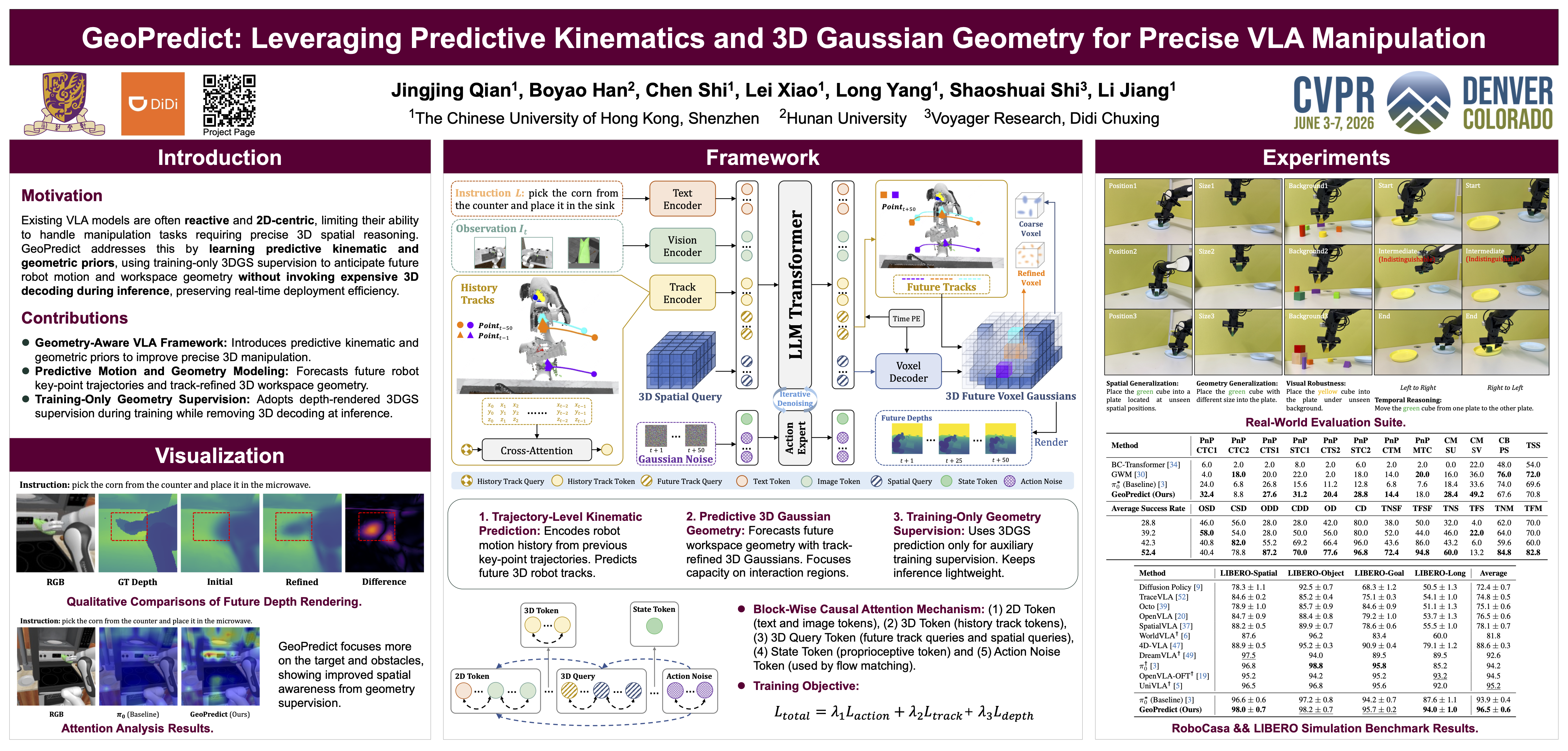
Vision-Language-Action (VLA) models achieve strong generalization in robotic manipulation but remain largely reactive and 2D-centric, making them unreliable in tasks that require precise 3D reasoning. We propose GeoPredict, a geometry-aware VLA framework that augments a continuous-action policy with predictive kinematic and geometric priors. GeoPredict introduces a trajectory-level module that encodes motion history and predicts multi-step 3D keypoint trajectories of robot arms, and a predictive 3D Gaussian geometry module that forecasts workspace geometry with track-guided refinement along future keypoint trajectories. These predictive modules serve exclusively as training-time supervision through depth-based rendering, while inference requires only lightweight additional query tokens without invoking any 3D decoding. Experiments on RoboCasa Human-50, LIBERO, and real-world manipulation tasks show that GeoPredict consistently outperforms strong VLA baselines, especially in geometry-intensive and spatially demanding scenarios.
From Manuals to Actions: A Unified VLA Model for Chain-of-Thought Manual Generation and Robotic Manipulation
Chenyang Gu ⋅ Jiaming Liu ⋅ Hao Chen ⋅ Runzhong Huang ⋅ Qingpo Wuwu ⋅ Xiaoqi Li ⋅ Zhuoyang Liu ⋅ Ying Li ⋅ Ray Zhang ⋅ Peng Jia ⋅ Pheng-Ann Heng ⋅ Shanghang Zhang
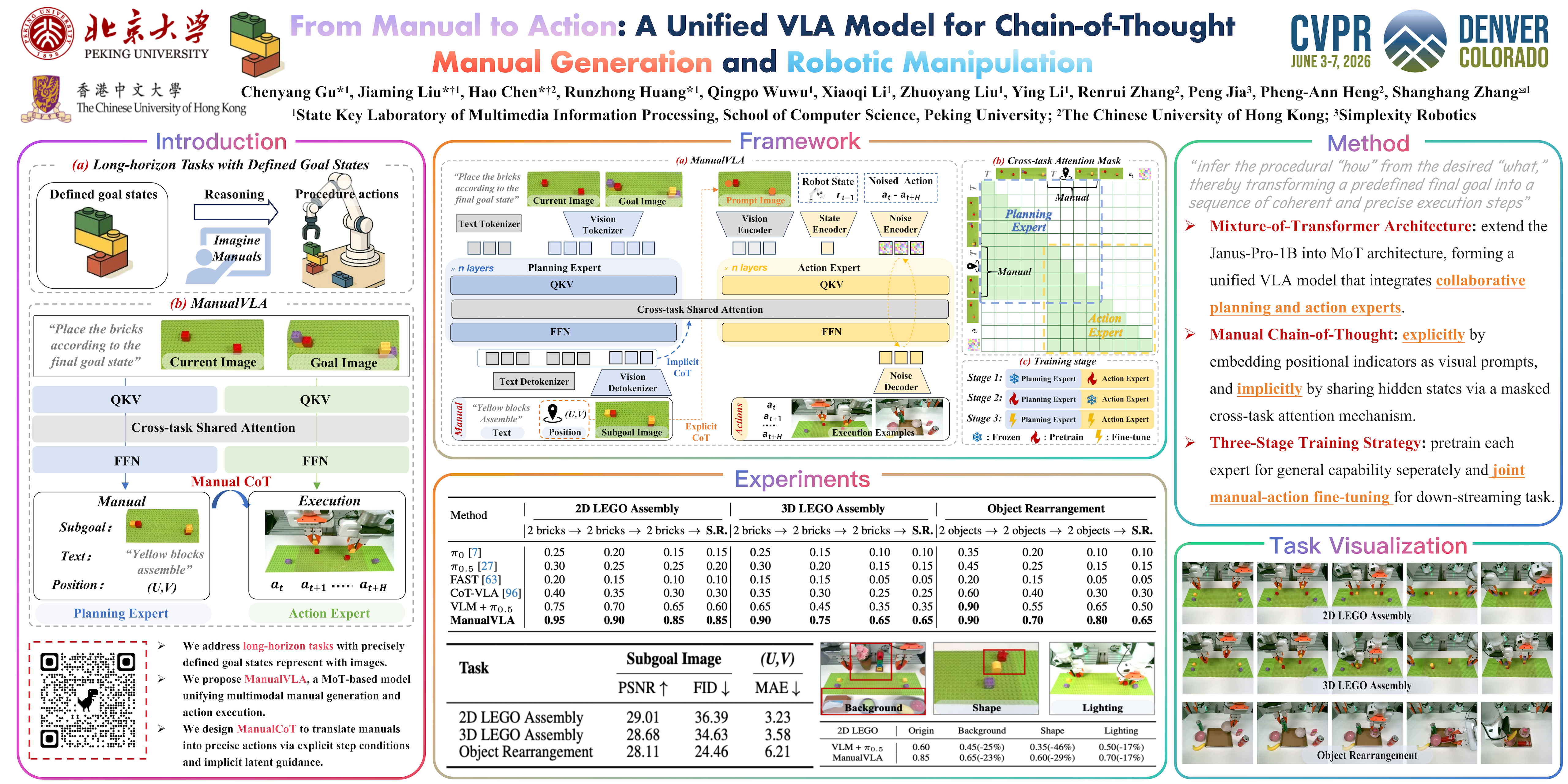
Vision–Language–Action (VLA) models have recently emerged, demonstrating strong generalization in robotic scene understanding and manipulation. However, when confronted with long-horizon tasks that require defined goal states, such as LEGO assembly or object rearrangement, existing VLA models still face challenges in coordinating long-horizon planning with precise manipulation.Therefore, we aim to endow a VLA model with the capability to infer the “how” process from the “what” outcomes, transforming goal states into executable procedures. In this paper, we introduce ManualVLA, a unified VLA framework built upon a Mixture-of-Transformers (MoT) architecture, enabling coherent collaboration between multimodal manual generation and action execution. Unlike prior VLA models that directly map sensory inputs to actions, we first equip ManualVLA with a planning expert that generates intermediate manuals consisting of images, visual prompts, and textual instructions. Building upon these multimodal manuals, we design a Manual Chain-of-Thought (ManualCoT) reasoning process that feeds them into the action expert, where each manual step provides explicit control conditions, while its latent representation offers implicit guidance for accurate manipulation. To alleviate the burden of data collection, we develop a high-fidelity digital-twin toolkit based on 3D Gaussian Splatting, which automatically generates manual data for planning expert training. ManualVLA demonstrates strong real-world performance, achieving an average success rate 32\% higher than the previous hierarchical SOTA baseline on LEGO assembly and object rearrangement tasks.
Real-World Point Tracking with Verifier-Guided Pseudo-Labeling
Görkay Aydemir ⋅ Fatma Güney ⋅ Weidi Xie
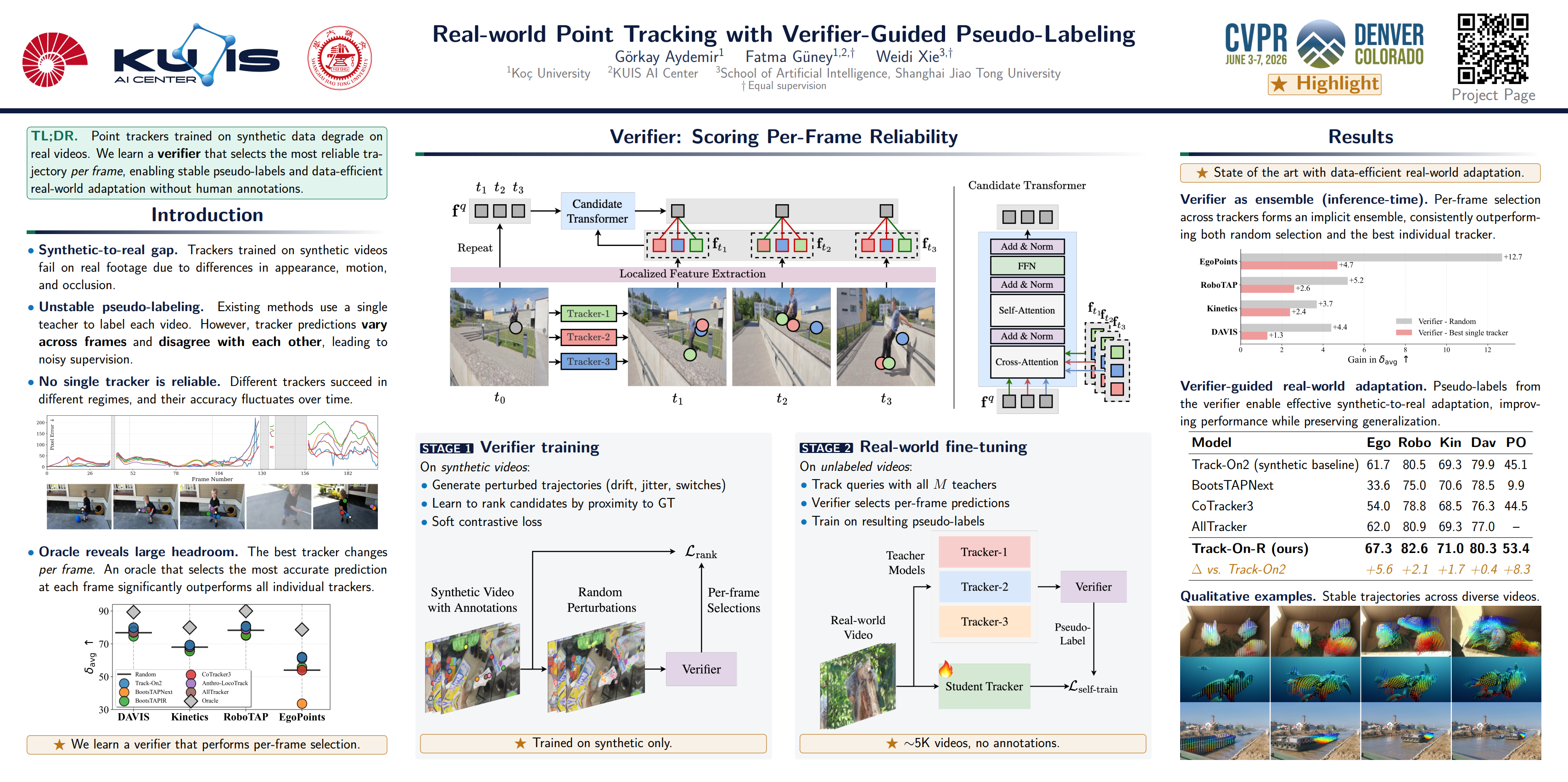
Models for long-term point tracking are typically trained on large synthetic datasets. The performance of these models degrades in real-world videos due todifferent characteristics and the absence of dense ground-truth annotations.Self-training on unlabeled videos has been explored as a practical solution, but the quality of pseudo-labels strongly depends on the reliability of teacher predictions, which vary across frames and scenes.In this paper, we address the problem of real-world fine-tuning and introduce Verifier, a meta-model that learns to assess the reliability of tracker predictions and guide pseudo-label generation.Given candidate trajectories from multiple pretrained trackers, the verifier evaluates them per frame and selects the most trustworthy predictions to construct refined pseudo-label trajectories.When applied during fine-tuning, verifier-guided pseudo-labeling substantially improves the quality of supervision and enables data-efficient adaptation to unlabeled videos.Extensive experiments on four real-world benchmarks demonstrate that our approach achieves state-of-the-art results while requiring less data than prior self-training methods.
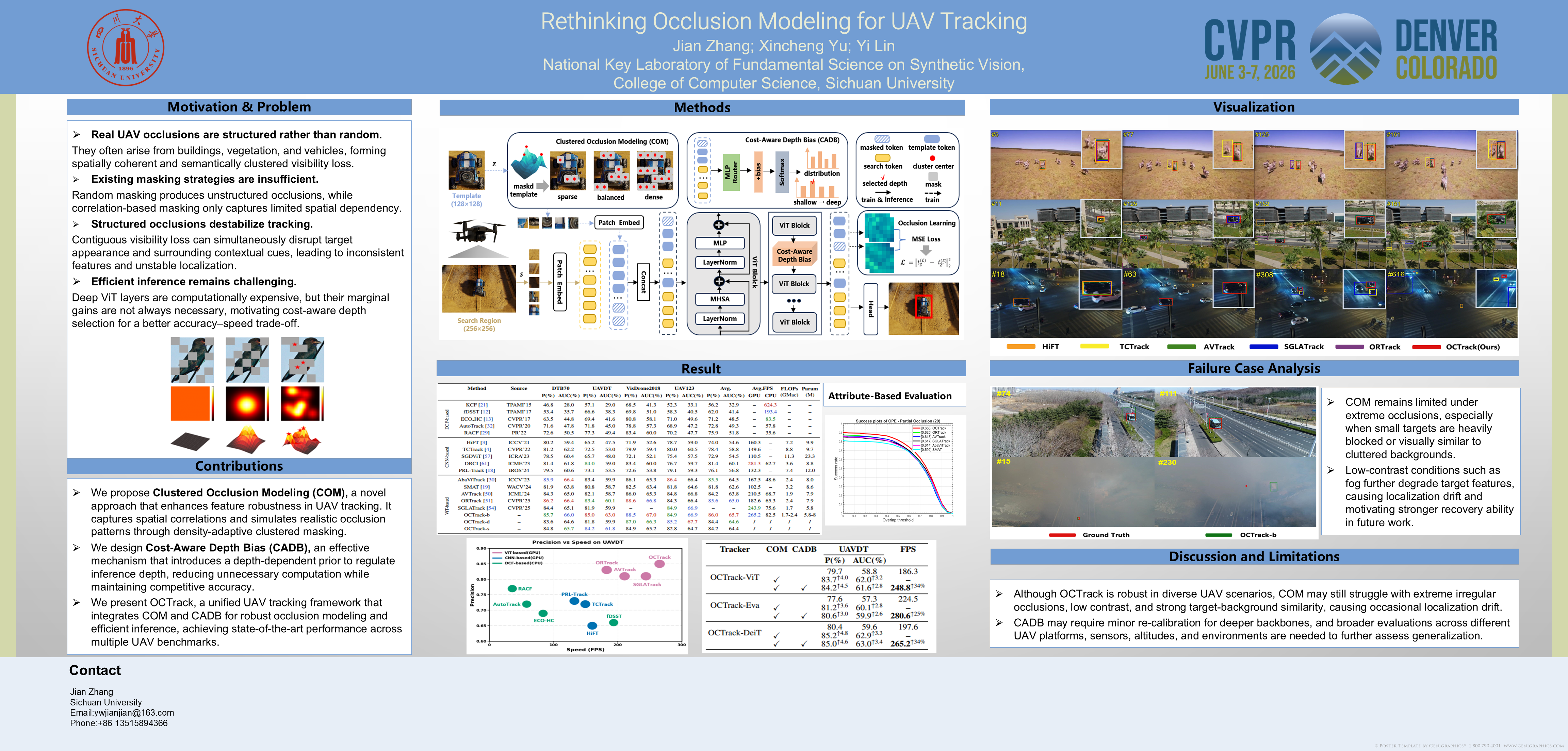
Occlusion remains one of the major challenges in UAV tracking, where dynamic viewpoints and complex environments often cause partial or complete visibility loss.Existing transformer-based trackers typically regard occlusion as random information dropout, overlooking its structured and spatially correlated nature in real-world scenes.We rethink occlusion modeling in UAV tracking as a structured process governed by spatial dependencies.Based on this insight, we introduce Clustered Occlusion Modeling (COM) to generate realistic, density-adaptive occlusion patterns that enhance feature robustness under partial visibility.Furthermore, we design Cost-Aware Depth Bias (CADB), which employs a depth-dependent prior to adjust inference depth, yielding better efficiency while maintaining competitive accuracy.Integrating COM and CADB into a unified single-stream transformer framework, termed OCTrack, our tracker achieves robust and efficient UAV tracking in occlusion-prone environments.Extensive experiments on multiple UAV benchmarks validate its effectiveness and demonstrate state-of-the-art performance. Code will be released.
Adaptive Capacity Autoregressive Visual Tracking
Tong Lin ⋅ Yifan Bai ⋅ Shiyi Liang ⋅ Ruigang Niu ⋅ Xing Wei
We present \textbf{ARTrack-AC}, a new step in the autoregressive tracking paradigm that introduces adaptive capacity inference to achieve both temporal consistency and dynamic efficiency. While existing autoregressive trackers predict object states sequentially with fixed inference capacity, they fail to accommodate the fluctuating temporal difficulty of real videos. ARTrack-AC addresses this limitation by equipping the tracker with the ability to \textbf{modulate its inference capacity over time}. A diffusion-based difficulty estimator anticipates the stability of upcoming segments, guiding a controller to switch between an \textbf{accurate} (high-capacity) and an \textbf{efficient} (low-capacity) mode while maintaining autoregressive consistency. This system-level autoregression extends conventional sequence modeling beyond “what to predict” toward “how to predict,” forming a self-regulated tracking process that aligns inference cost with temporal complexity. Despite its simplicity, ARTrack-AC achieves state-of-the-art accuracy–speed trade-off on major benchmarks—66.7\% AUC on LaSOT and 47.5\% AUC on LaSOText—running 2.9$\times$ faster than its predecessor.
Spatio-Temporal Conditional Denoising Transformer for Modality-Missing RGBT Tracking
Andong Lu ⋅ Ziyi Zha ⋅ Jiandong Jin ⋅ Shihao Li ⋅ Chenglong Li ⋅ Jin Tang ⋅ Bin Luo
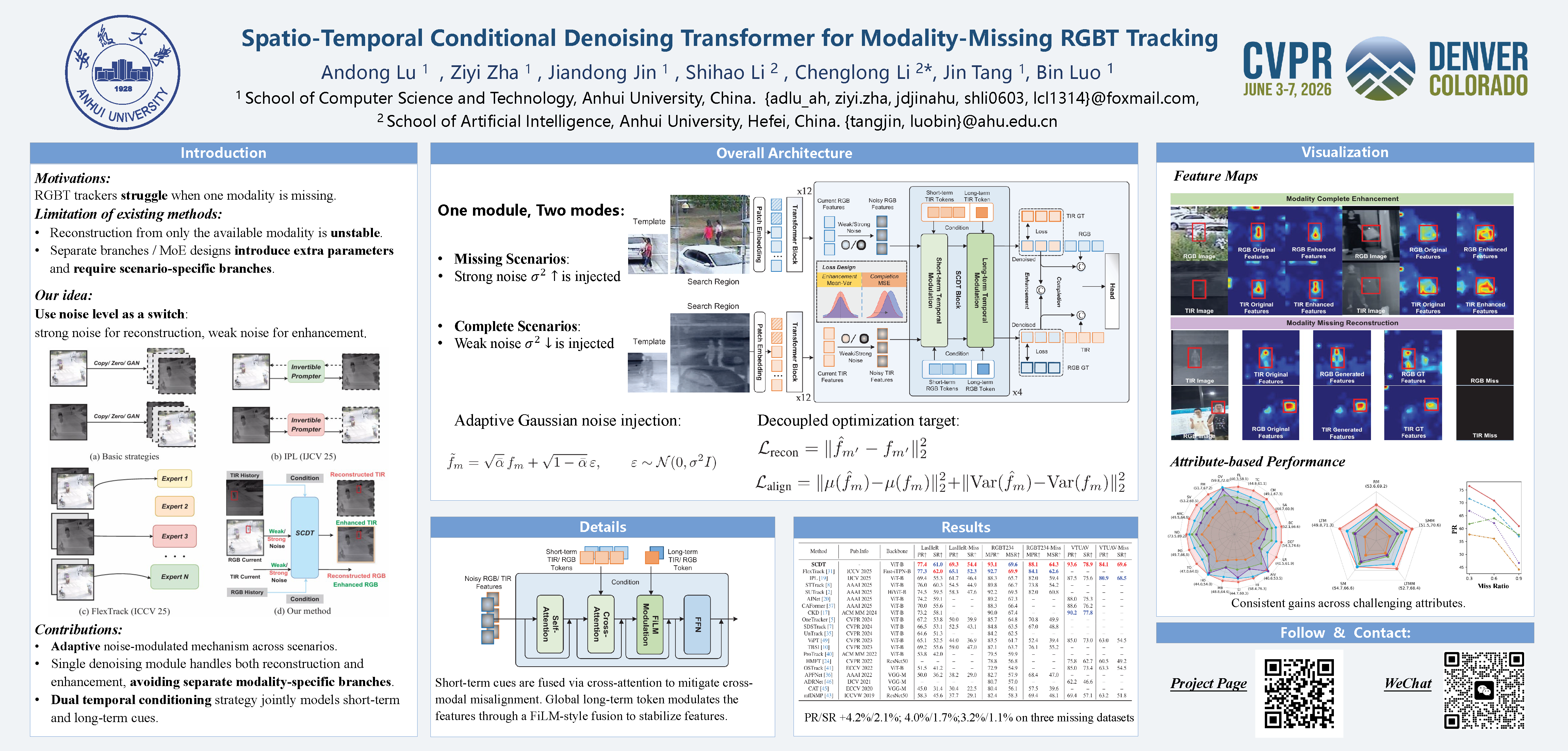
Missing modalities in RGBT tracking often lead to incomplete and unstable multimodal feature representations that greatly degrade the performance. Existing methods typically attempt to recover missing modalities from available ones, but the quality of data generated in challenging scenarios might be unsatisfactory. In addition, current approaches exhibit limited flexibility in processing both missing and complete data. To overcome these limitations, we propose a Spatio-temporal Conditional Denoising Transformer (SCDT), which integrates the spatial cues and the temporal context to adaptively perform information reconstruction of missing modalities and feature enhancement of weak modalities in a unified framework, for robust modality-missing RGBT tracking. In particular, SCDT leverages the short-term temporal cues from recent historical frames to capture the fine-grained temporal correlations and the long-term temporal cues encoding modality evolution to capture the global context. By jointly exploiting long short-term temporal contexts as the conditions, SCDT progressively guides noisy features of available modalities to learn reliable and temporally consistent multimodal representations. Furthermore, SCDT introduces a noise-modulated adaptation mechanism that dynamically adjusts its behavior according to the modal availability, enabling a single framework to unify feature learning under both modality-missing and complete scenarios without changing the architecture or parameters. Extensive experiments on three public benchmark datasets demonstrate that our method consistently outperforms state-of-the-art methods.
Breaking Smooth-Motion Assumptions: A UAV Benchmark for Multi-Object Tracking in Complex and Adverse Conditions
Jingtao Ye ⋅ Kexin Zhang ⋅ Xunchi Ma ⋅ Johann Li ⋅ Guangming Zhu ⋅ Peiyi Shen ⋅ Linhua Jiang ⋅ Xiangdong Zhang ⋅ Liang Zhang
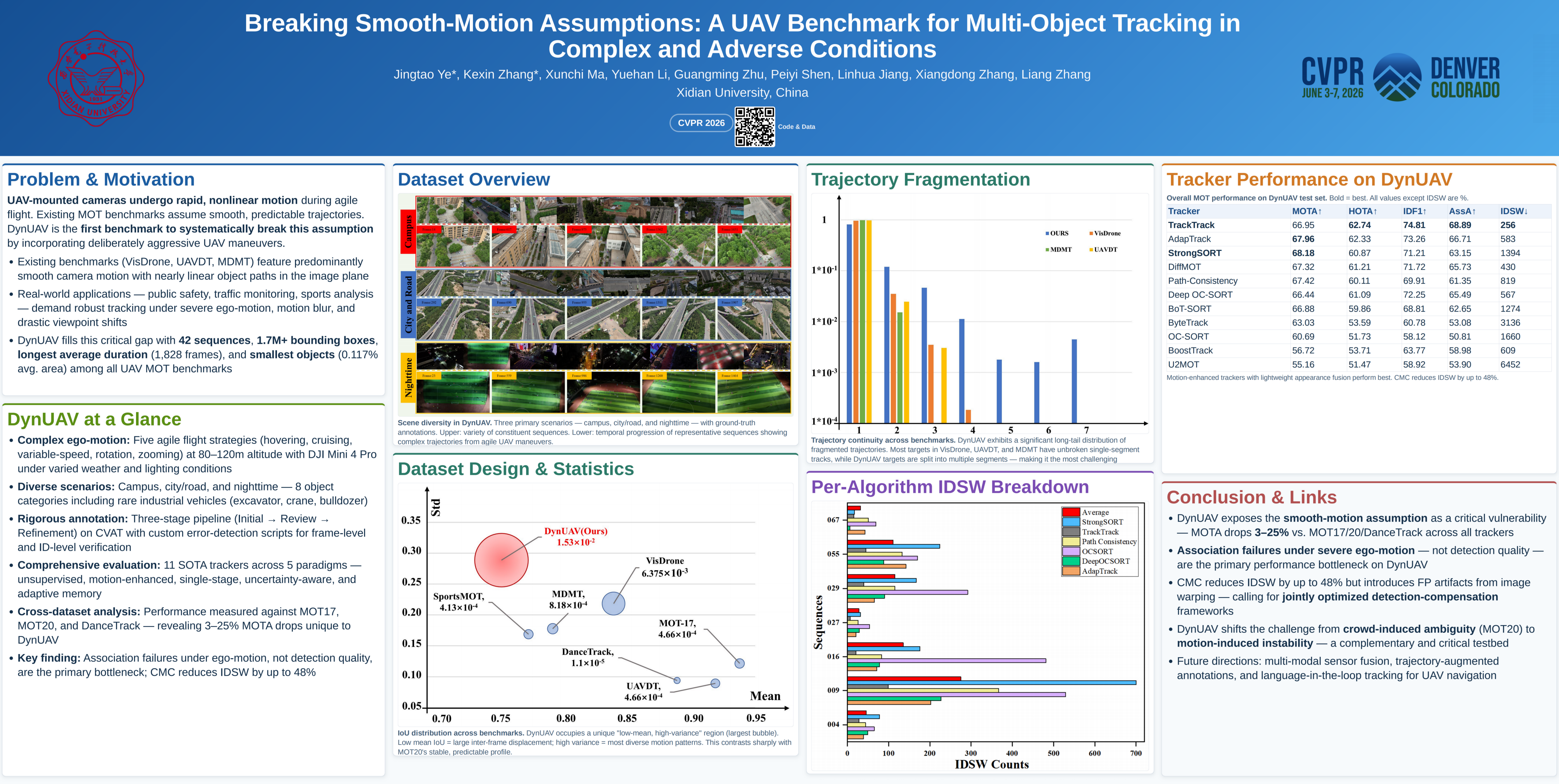
The rapid movements and agile maneuvers of unmanned aerial vehicles (UAVs) induce significant observational challenges for multi-object tracking (MOT). However, existing UAV-perspective MOT benchmarks often lack these complexities, featuring predominantly predictable camera dynamics and linear motion patterns. To address this gap, we introduce DynUAV, a new benchmark for dynamic UAV-perspective MOT, characterized by intense ego-motion and the resulting complex apparent trajectories. The benchmark comprises 42 video sequences with over 1.7 million bounding box annotations, covering vehicles, pedestrians, and specialized industrial categories such as excavators, bulldozers and cranes. Compared to existing benchmarks, DynUAV introduces substantial challenges arising from ego-motion, including drastic scale changes and viewpoint changes, as well as motion blur. Comprehensive evaluations of state-of-the-art trackers on DynUAV reveal their limitations, particularly in managing the intertwined challenges of detection and association under such dynamic conditions, thereby establishing DynUAV as a rigorous benchmark. We anticipate that DynUAV will serve as a demanding testbed to spur progress in real-world UAV-perspective MOT, and we will make all resources available at [link].
TrackMAE: Video Representation Learning via Track Mask and Predict
Renaud Vandeghen ⋅ Fida Mohammad Thoker ⋅ Marc Van Droogenbroeck ⋅ Bernard Ghanem
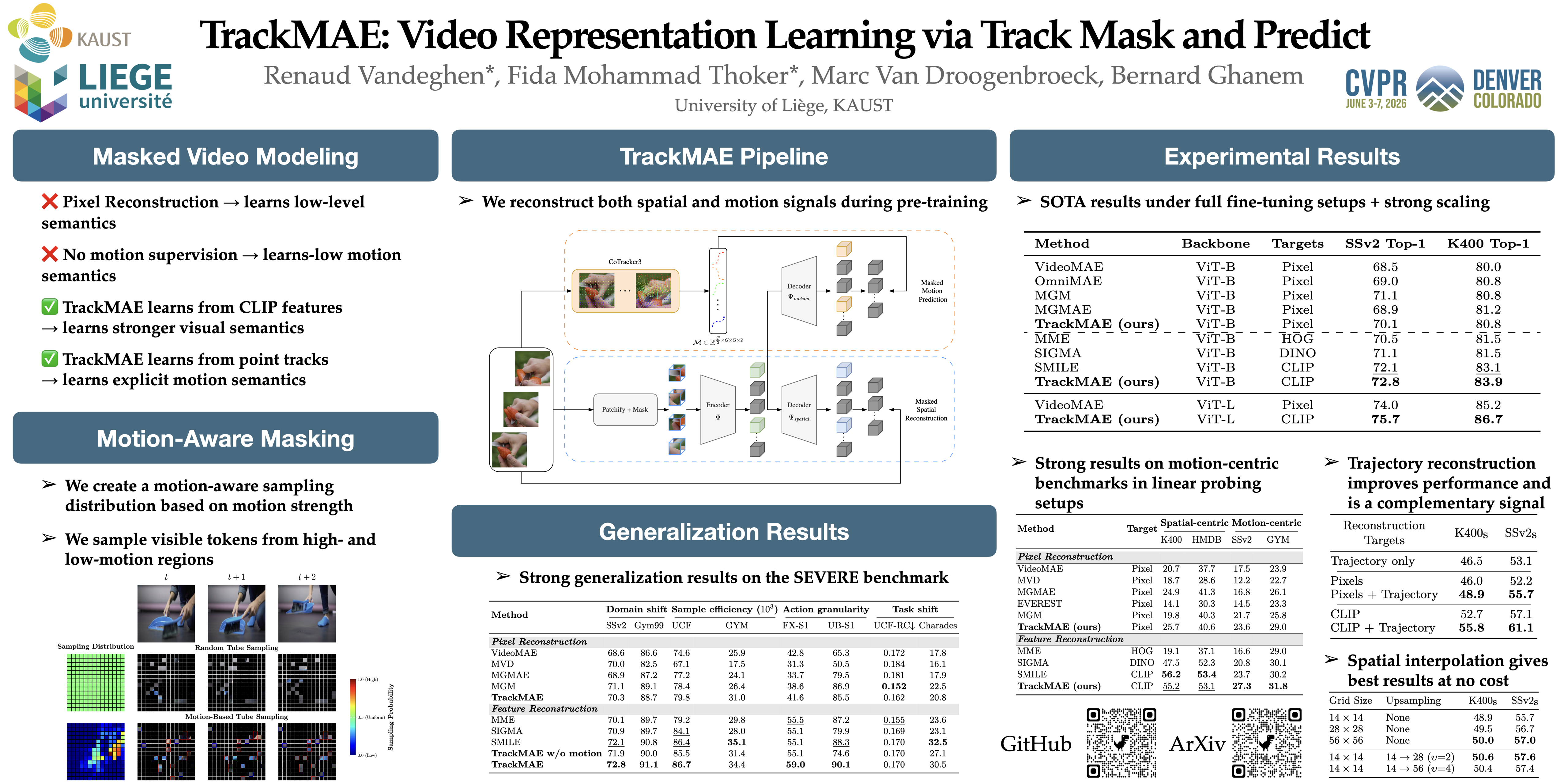
Masked video modeling (MVM) has emerged as a simple and scalable self-supervised pretraining paradigm, but only models motion information implicitly, limiting the encoding of temporal dynamics in the learned representations. As a result, such models struggle on motion-centric tasks that require fine-grained motion awareness. To address this, we propose TrackMAE, a simple masked video modeling paradigm that explicitly uses motion information as a reconstruction signal. In TrackMAE, we use an off-the-shelf point tracker to sparsely track points in the input videos generating motion trajectories. Furthermore, we exploit the extracted trajectories to improve the random tube masking with a motion-aware masking strategy.We enhance video representations learned in both pixel and feature semantic reconstruction space by providing a complimentary supervision signal in the form of motion targets. We evaluate on six datasets across diverse downstream settings and find that TrackMAE consistently outperforms the state-of-the-art video SSL baselines, therefore learning more discriminative and generalizable representations.
Dual-branch Distilled Transformer for Efficient Asymmetric UAV Tracking
Hongtao Yang ⋅ Bineng Zhong ⋅ Qihua Liang ⋅ Yaozong Zheng ⋅ Xiantao Hu ⋅ Yuanliang Xue ⋅ Shuxiang Song
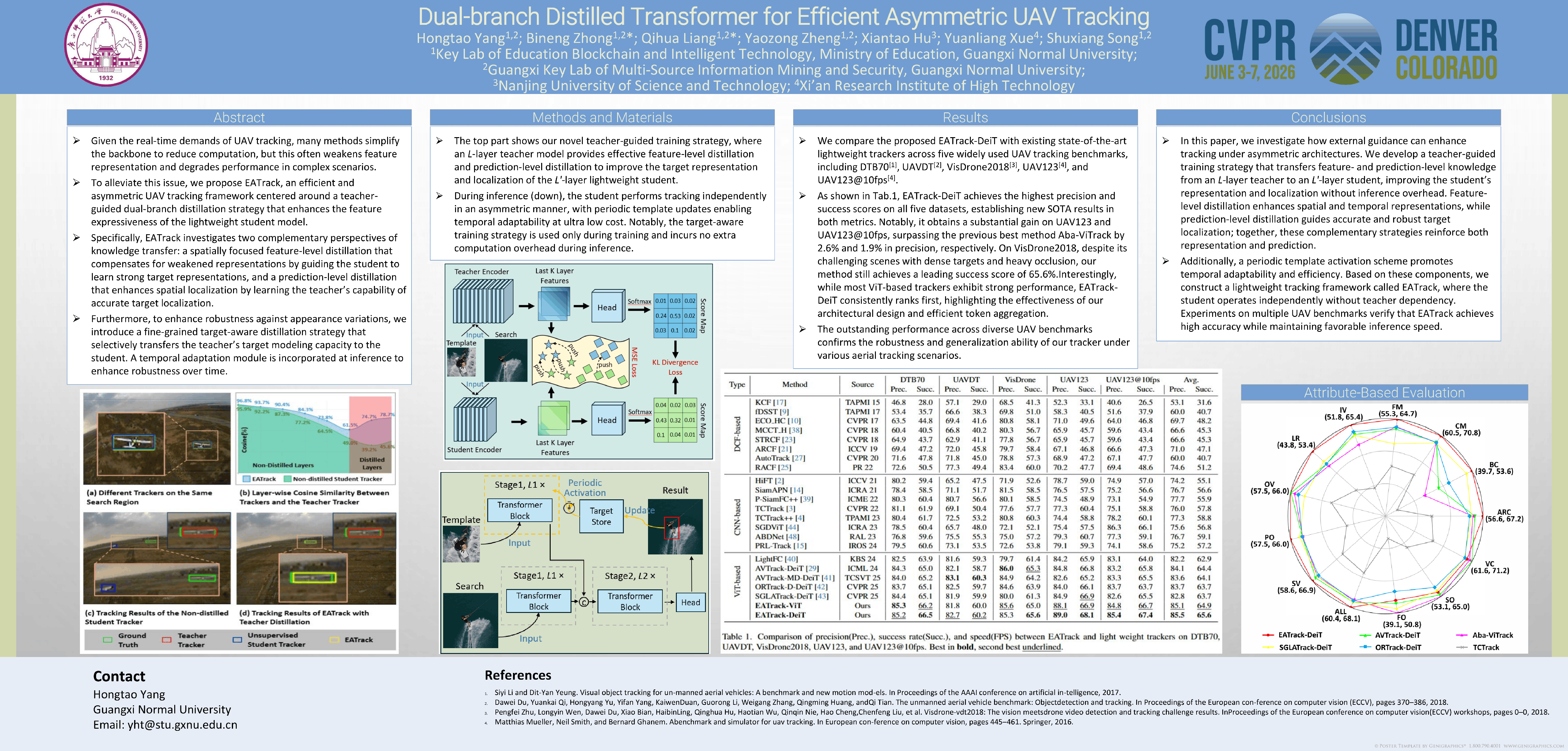
Given the real-time demands of UAV tracking, many methods simplify the backbone to reduce computation, but this often weakens feature representation and degrades performance in complex scenarios. To alleviate this issue, we propose EATrack, an efficient and asymmetric UAV tracking framework centered around a teacher-guided dual-branch distillation strategy that enhances the feature expressiveness of the lightweight student model. Specifically, EATrack investigates two complementary perspectives of knowledge transfer: a spatially focused feature-level distillation that compensates for weakened representations by guiding the student to learn strong target representations, and a prediction-level distillation that enhances spatial localization by learning the teacher’s capability of accurate target localization. Furthermore, to enhance robustness against appearance variations, we introduce a fine-grained target-aware distillation strategy that selectively transfers the teacher’s target modeling capacity to the student. While the asymmetric architecture improves efficiency, it limits temporal adaptability. To mitigate this, a temporal adaptation module is incorporated at inference to enhance robustness over time. Experiments on five UAV benchmarks demonstrate that EATrack achieves a favorable balance between accuracy and speed, with EATrack-DeiT improving average success rate by 1.2\% over the previous SOTA while running at 241.9 FPS on GPU.
Multi-view Crowd Tracking Transformer with View-Ground Interactions Under Large Real-World Scenes
Qi Zhang ⋅ Jixuan Chen ⋅ Zhang Kaiyi ⋅ Xinquan Yu ⋅ Antoni B. Chan ⋅ Hui Huang
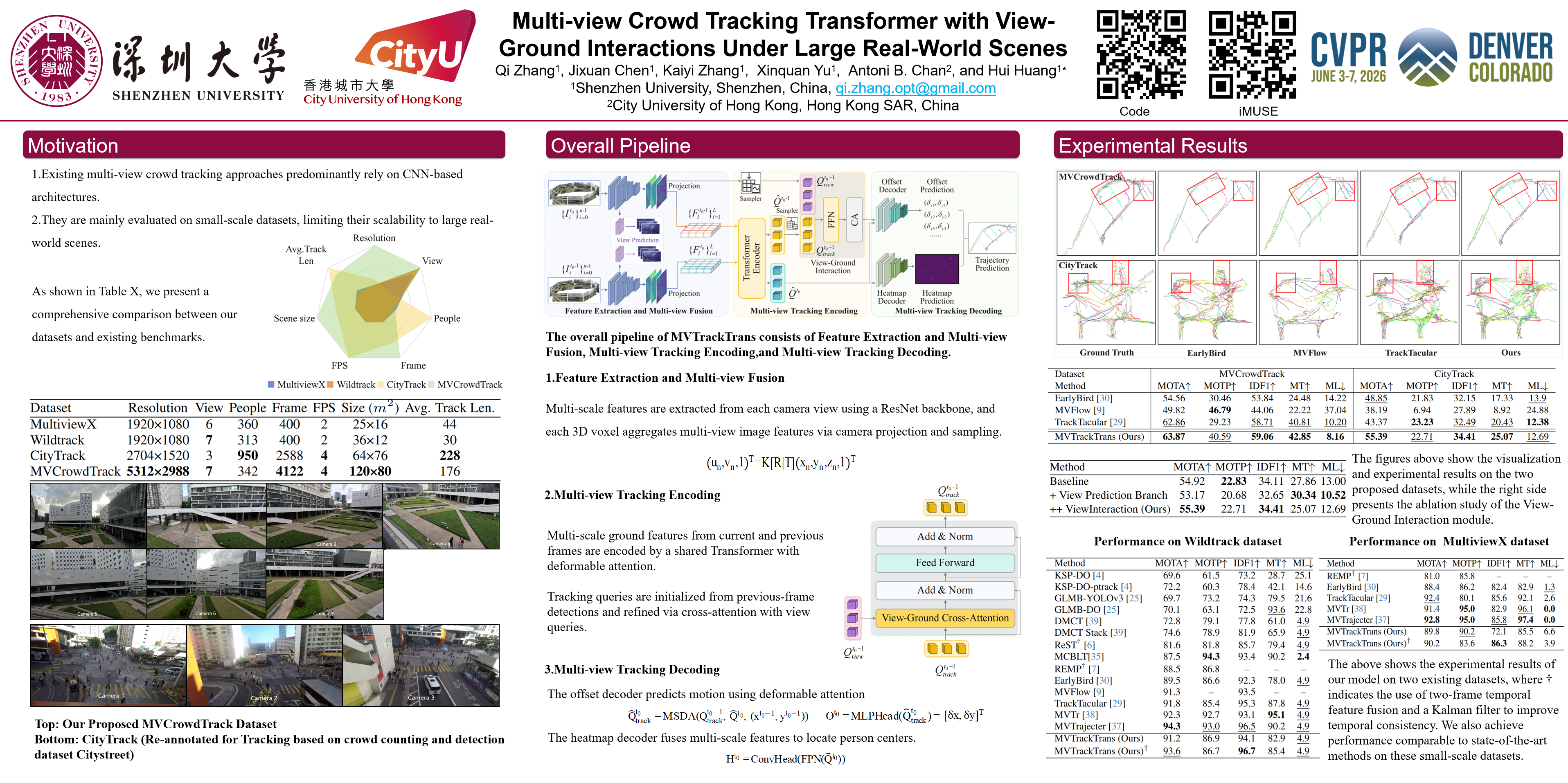
Multi-view crowd tracking estimates each person's tracking trajectories on the ground of the scene. Recent research works mainly rely on CNNs-based multi-view crowd tracking architectures, and most of them are evaluated and compared on relatively small datasets, such as Wildtrack and MultiviewX. Since these two datasets are collected in small scenes and only contain tens of frames in the evaluation stage, it is difficult for the current methods to be applied to real-world applications where scene size and occlusion are more complicated. In this paper, we propose a Transformer-based multi-view crowd tracking model, MVTrackTrans, which adopts interactions between camera views and the ground plane for enhanced multi-view tracking performance. Besides, for better evaluation, we collect and label two large real-world multi-view tracking datasets, MVCrowdTrack and CityTrack, which contain a much larger scene size over a longer time period. Compared with existing methods on the two large and new datasets, the proposed MVTrackTrans model achieves better performance, demonstrating the advantages of the model design in dealing with large scenes. We believe the proposed datasets and model will push the frontiers of the task to more practical scenarios, and the datasets and code will be made public upon paper acceptance.
Scaling Self-Supervised and Cross-Modal Pretraining for Volumetric CT Transformers
Cris Claessens ⋅ Christiaan Viviers ⋅ Giacomo D'Amicantonio ⋅ Egor Bondarev ⋅ Fons van der Sommen
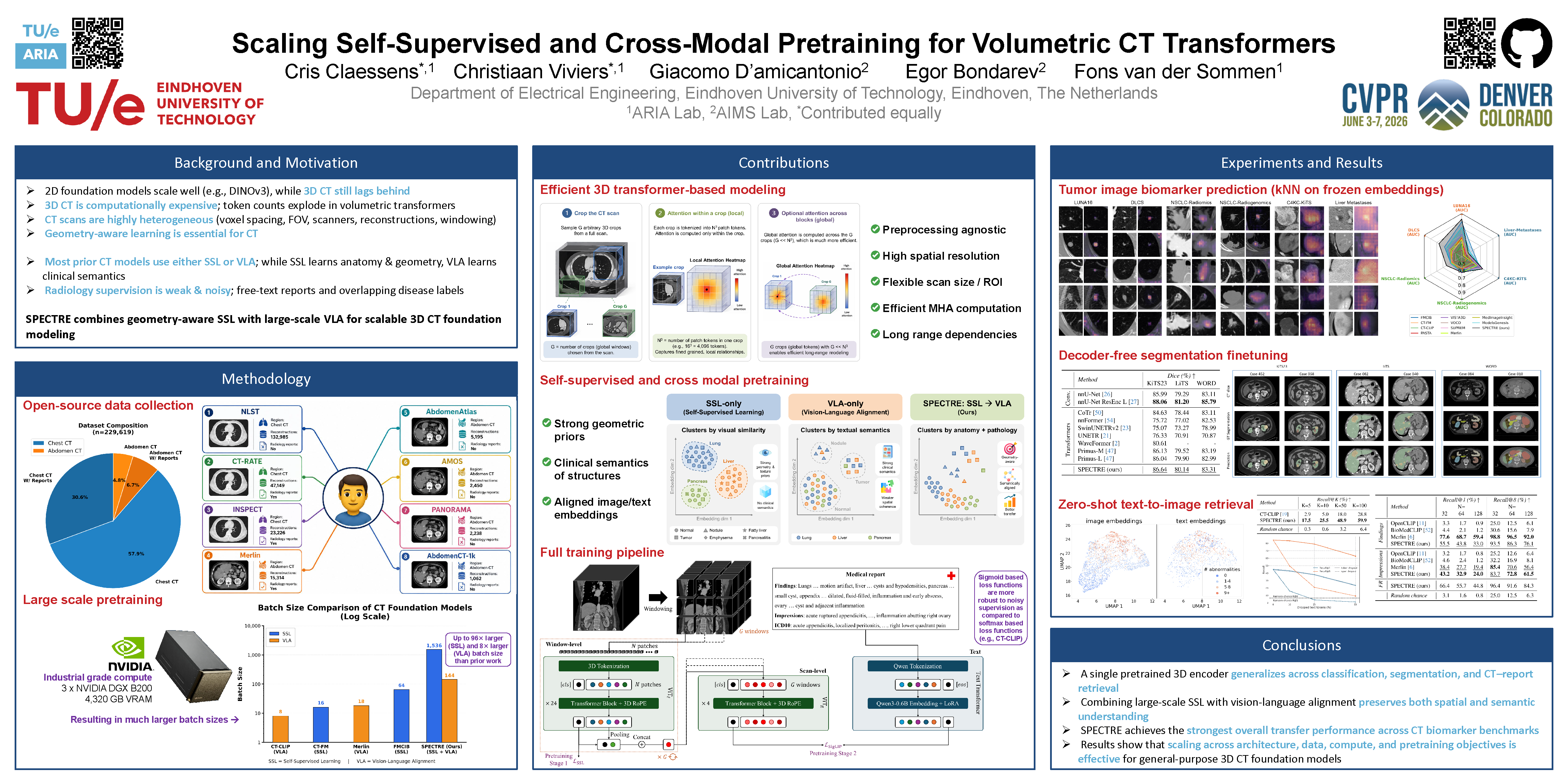
We introduce SPECTRE, a fully transformer-based foundation model for volumetric computed tomography (CT). Our Self-Supervised & Cross-Modal Pretraining for CT Representation Extraction (SPECTRE) approach utilizes scalable 3D Vision Transformer architectures and modern self-supervised and vision–language pretraining strategies to learn general-purpose CT representations. Volumetric CT poses unique challenges, such as extreme token scaling, geometric anisotropy, and weak or noisy clinical supervision, that make standard transformer and contrastive learning recipes ineffective out of the box. The framework jointly optimizes a local transformer for high-resolution volumetric feature extraction and a global transformer for whole-scan context modeling, making large-scale 3D attention computationally tractable. Notably, SPECTRE is trained exclusively on openly available CT datasets, demonstrating that high-performing, generalizable representations can be achieved without relying on private data. Pretraining combines DINO-style self-distillation with SigLIP-based vision–language alignment using paired radiology reports, yielding features that are both geometrically consistent and clinically meaningful. Across multiple CT benchmarks, SPECTRE consistently outperforms prior CT foundation models in both zero-shot and fine-tuned settings, establishing SPECTRE as a scalable, open, and fully transformer-based foundation model for 3D medical imaging.
MuViT: Multi-Resolution Vision Transformers for Learning Across Scales in Microscopy
Albert Dominguez Mantes ⋅ Gioele La Manno ⋅ Martin Weigert
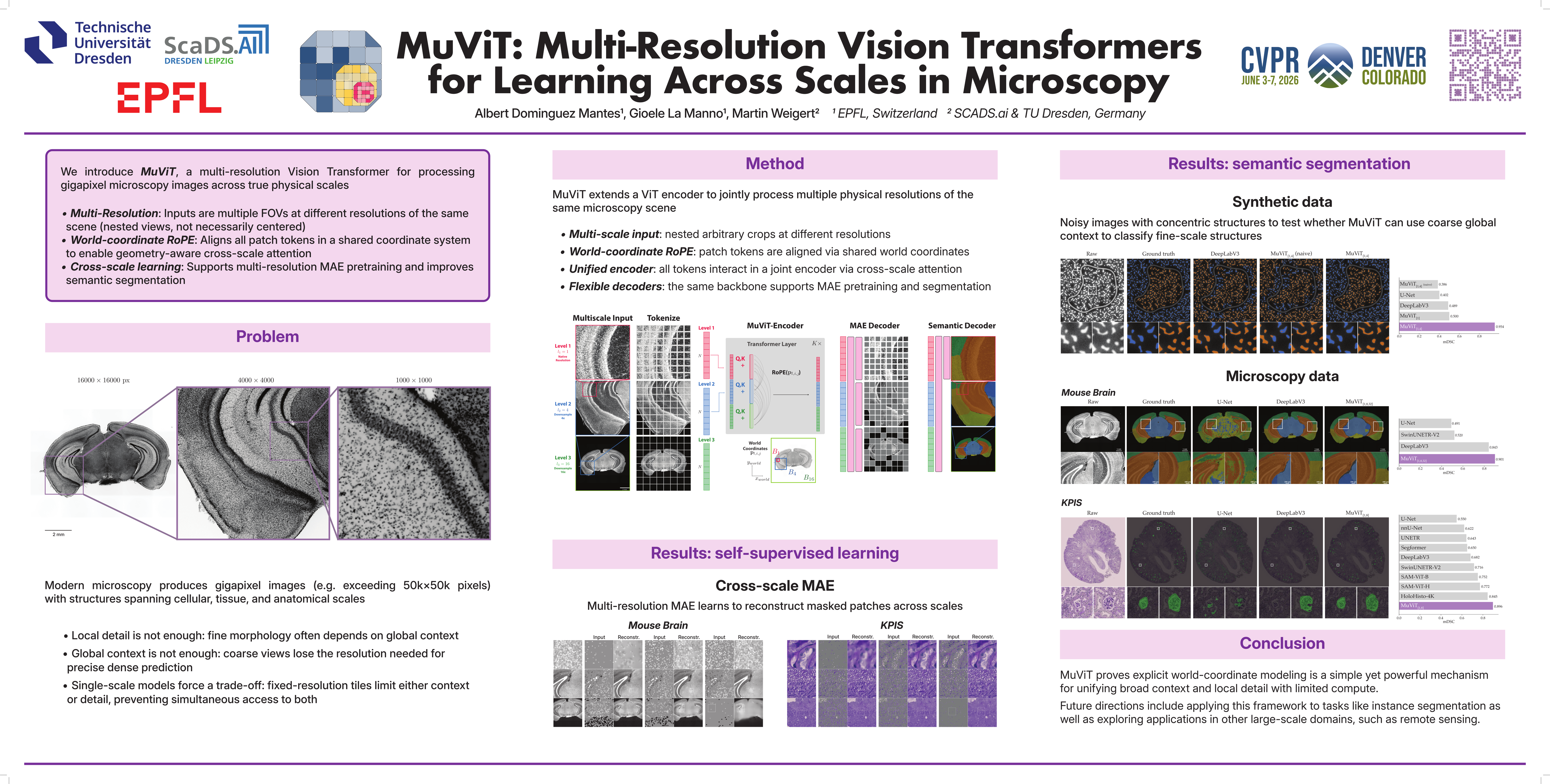
Modern microscopy routinely produces gigapixel images that contain structures across multiple spatial scales, from fine cellular morphology to broader tissue organization. Many analysis tasks require combining these scales, yet most vision models operate at a single resolution or derive multi-scale features from one view, limiting their ability to exploit the inherently multi-resolution nature of microscopy data. We introduce MuViT, a transformer architecture built to fuse true multi-resolution observations from the same underlying image. MuViT embeds all patches into a shared world-coordinate system and extends rotary positional embeddings to these coordinates, enabling attention to integrate wide-field context with high-resolution detail within a single encoder. Across synthetic benchmarks, kidney histopathology, and high-resolution mouse-brain microscopy, MuViT delivers consistent improvements over strong ViT and CNN baselines. Multi-resolution MAE pretraining further produces scale-consistent representations that enhance downstream tasks. These results demonstrate that explicit world-coordinate modeling provides a simple yet powerful mechanism for leveraging multi-resolution information in large-scale microscopy analysis.
SemVideo: Reconstructs What You Watch from Brain Activity via Hierarchical Semantic Guidance
Minghan Yang ⋅ LAN YANG ⋅ Ke Li ⋅ Honggang Zhang ⋅ Kaiyue Pang ⋅ Yi-Zhe Song
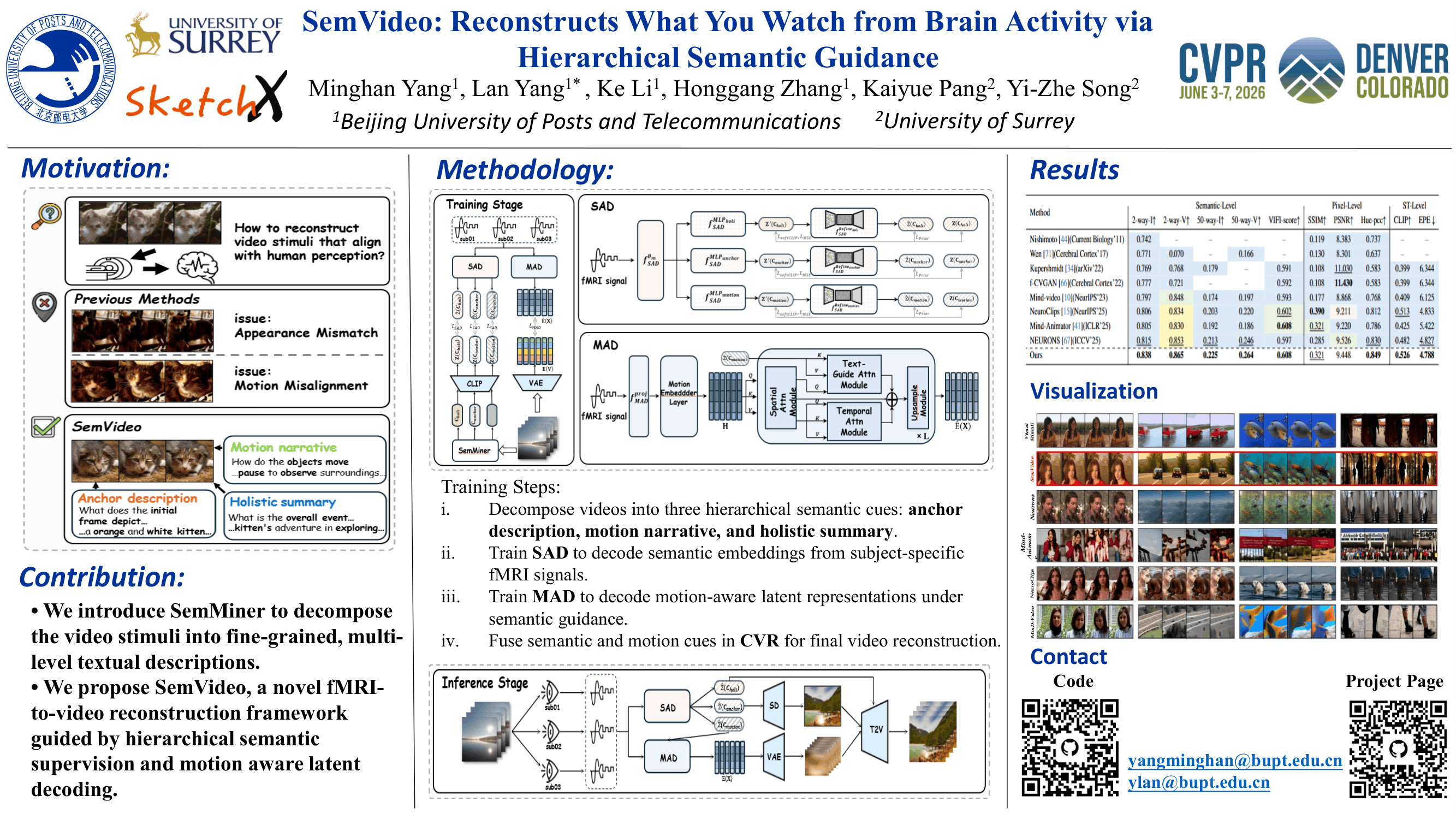
Reconstructing dynamic visual experiences from brain activity provides a compelling avenue for exploring the neural mechanisms of human visual perception. While recent progress in fMRI-based image reconstruction has been notable, extending this success to video reconstruction remains a significant challenge. Current fMRI-to-video reconstruction approaches consistently encounter two major shortcomings: (i) inconsistent visual representations of salient objects across frames, leading to appearance mismatches; (ii) poor temporal coherence, resulting in motion misalignment or abrupt frame transitions.To address these limitations, we introduce SemVideo, a novel fMRI-to-video reconstruction framework guided by hierarchical semantic information. At the core of SemVideo is SemMiner, a hierarchical guidance module that constructs three levels of semantic cues from the original video stimulus: static anchor descriptions, motion-oriented narratives, and holistic summaries. Leveraging this semantic guidance, SemVideo comprises three key components: a Semantic Alignment Decoder that aligns fMRI signals with CLIP-style embeddings derived from SemMiner, a Motion Adaptation Decoder that reconstructs dynamic motion patterns using a novel tripartite attention fusion architecture, and a Conditional Video Render that leverages hierarchical semantic guidance for video reconstruction. Experiments conducted on the CC2017 and HCP datasets demonstrate that SemVideo achieves superior performance in both semantic alignment and temporal consistency, setting a new state-of-the-art in fMRI-to-video reconstruction.
Multimodal Causality-Driven Representation Learning for Generalizable Medical Image Segmentation
XUSHENG LIANG ⋅ Lihua Zhou ⋅ Nianxin Li ⋅ miao xu ⋅ Ziyang Song ⋅ Dong Yi ⋅ Jinlin Wu ⋅ Jiawei Ma ⋅ Hongbin Liu ⋅ Zhen Lei ⋅ Jiebo Luo
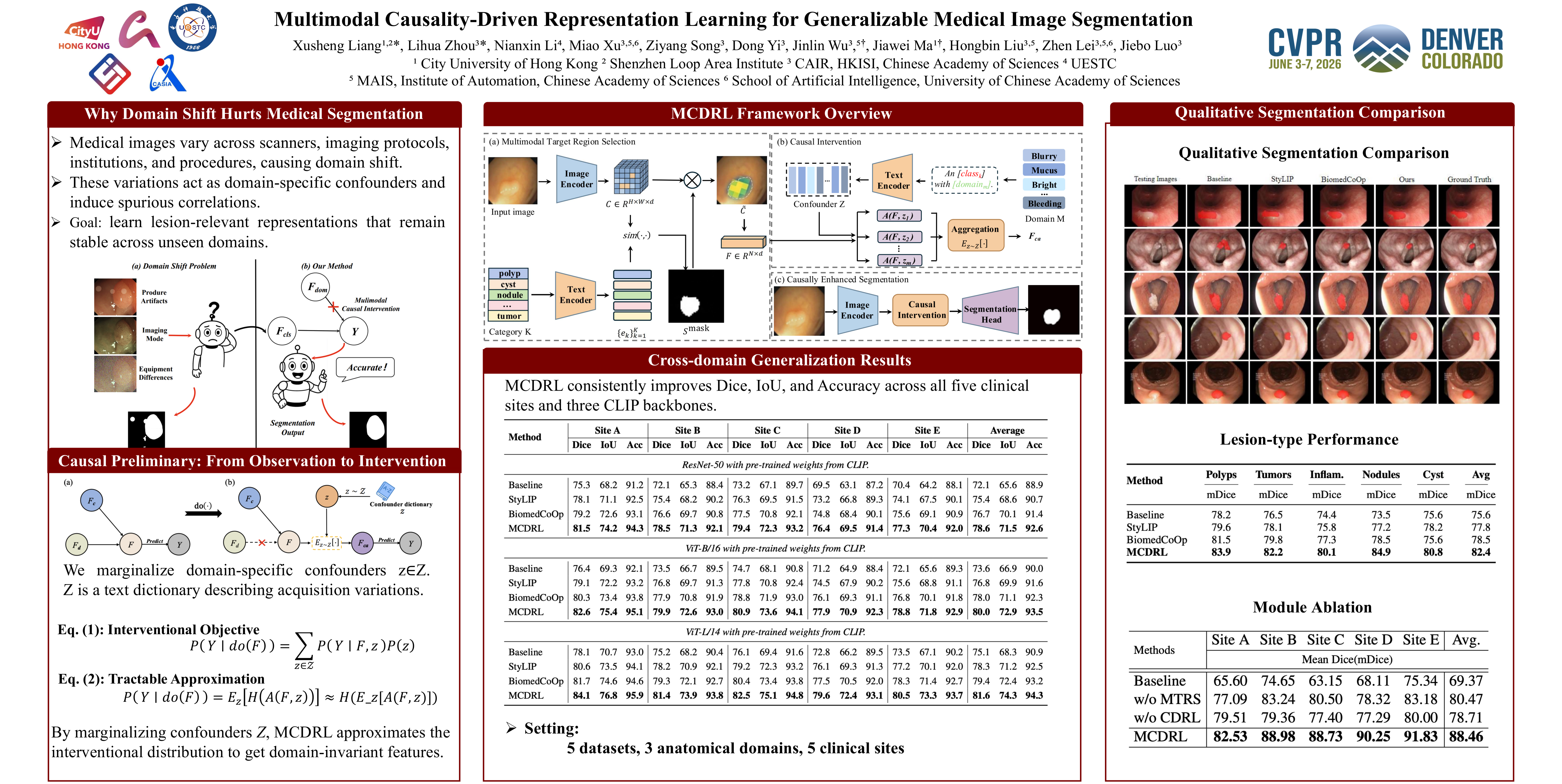
Vision-Language Models (VLMs), such as CLIP, have demonstrated remarkable zero-shot capabilities in various computer vision tasks. However, their application to medical imaging remains challenging due to the high variability and complexity of medical data. Specifically, medical images often exhibit significant domain shifts caused by various confounders, including equipment differences, procedure artifacts, and imaging modes, which can lead to poor generalization when models are applied to unseen domains. To address this limitation, we propose Multimodal Causal-Driven Representation Learning (MCDRL), a novel framework that integrates causal inference with the VLM to tackle domain generalization in medical image segmentation. MCDRL is implemented in two steps: first, it leverages CLIP's cross-modal capabilities to identify candidate lesion regions and construct a confounder dictionary through text prompts, specifically designed to represent domain-specific variations; second, it trains a causal intervention network that utilizes this dictionary to identify and eliminate the influence of these domain-specific variations while preserving the anatomical structural information critical for segmentation tasks. Extensive experiments demonstrate that MCDRL consistently outperforms competing methods, yielding superior segmentation accuracy and exhibiting robust generalizability.
Simple Agents Outperform Experts in Biomedical Imaging Workflow Optimization
Xuefei Wang ⋅ Kai A. Horstmann ⋅ Ethan Lin ⋅ Jonathan Chen ⋅ Alexander Farhang ⋅ Sophia Stiles ⋅ Atharva Sehgal ⋅ Jonathan Light ⋅ David Valen ⋅ Yisong Yue ⋅ Jennifer J. Sun
Adapting production-level computer vision tools to bespoke scientific datasets is a critical ''last mile'' bottleneck. Current solutions are impractical: fine-tuning requires large annotated datasets scientists often lack, while manual code adaptation costs scientists weeks to months of effort. We consider using AI agents to automate this manual coding, and focus on the open question of optimal agent design for this targeted task. We introduce a systematic evaluation framework for agentic code optimization and use it to study three production-level biomedical imaging pipelines. We demonstrate that a simple agent framework consistently generates adaptation code that outperforms human-expert solutions. Our analysis reveals that common, complex agent architectures are not universally beneficial, leading to a practical roadmap for agent design. We open source our framework and validate our approach by deploying agent-generated functions into a production pipeline, demonstrating a clear pathway for real-world impact.
TopoSlide: Topologically-Informed Histopathology Whole Slide Image Representation Learning
Shahira Abousamra ⋅ Asmita Sood ⋅ Sylvia Plevritis
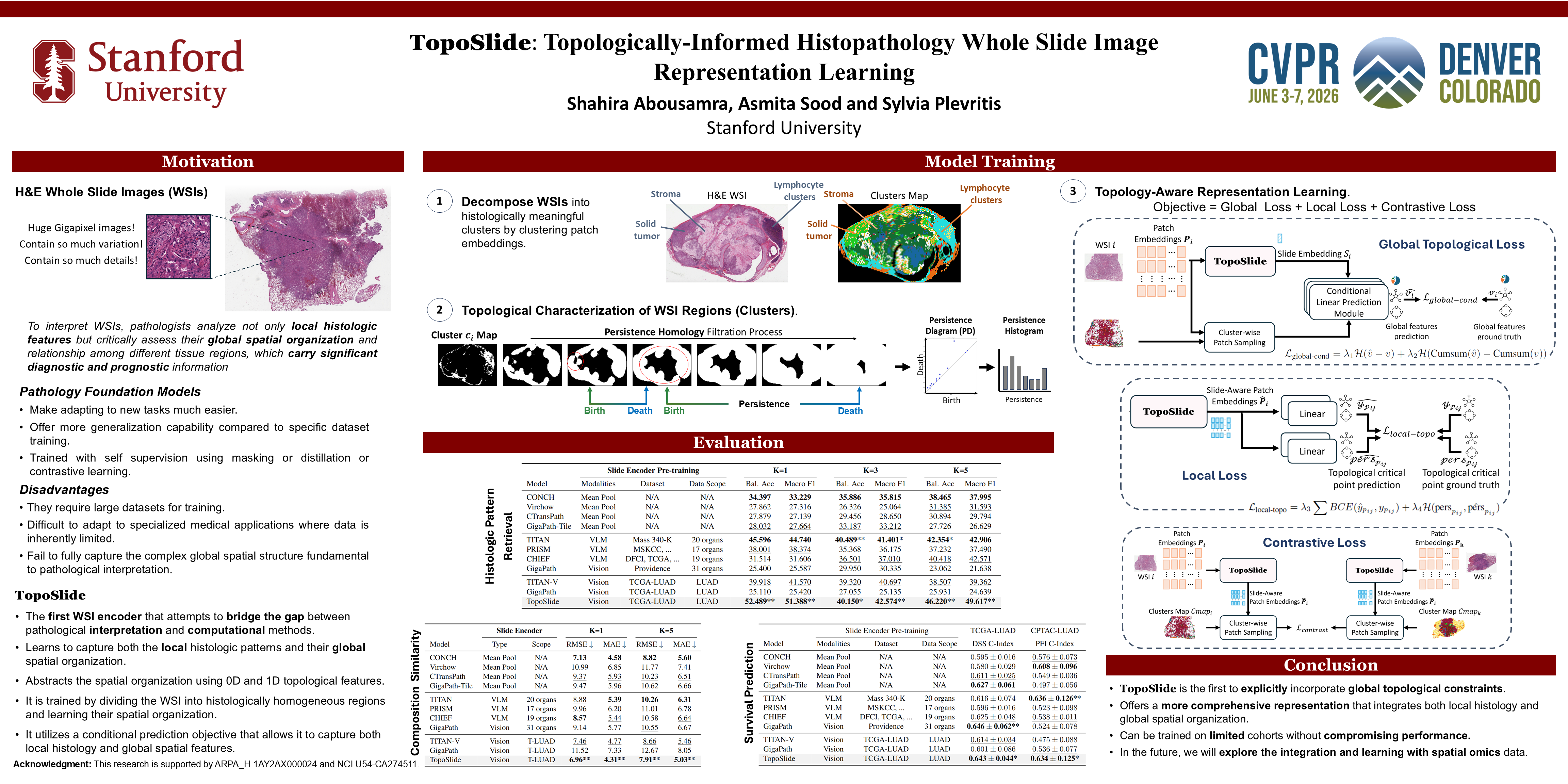
Histopathology whole slide images are massive gigapixel images that present significant challenges in generating effective representations that accurately capture their histological content and the spatial organization of their various components. In this study, we introduce TopoSlide, a novel approach for self-supervised representation learning specifically designed for whole slide histopathology images. Our method leverages topological features of image data to optimize the learning process. We demonstrate that TopoSlide, even when trained on relatively small datasets, achieves comparable or superior performance to existing pathology foundation models across multiple retrieval and linear probing benchmarks.
Beyond the Static-World: Lifelong Learning for All-in-One Medical Image Restoration
Shihao Shan ⋅ Hongying Liu ⋅ Fanhua Shang ⋅ Liang Wan ⋅ Jingjing Deng
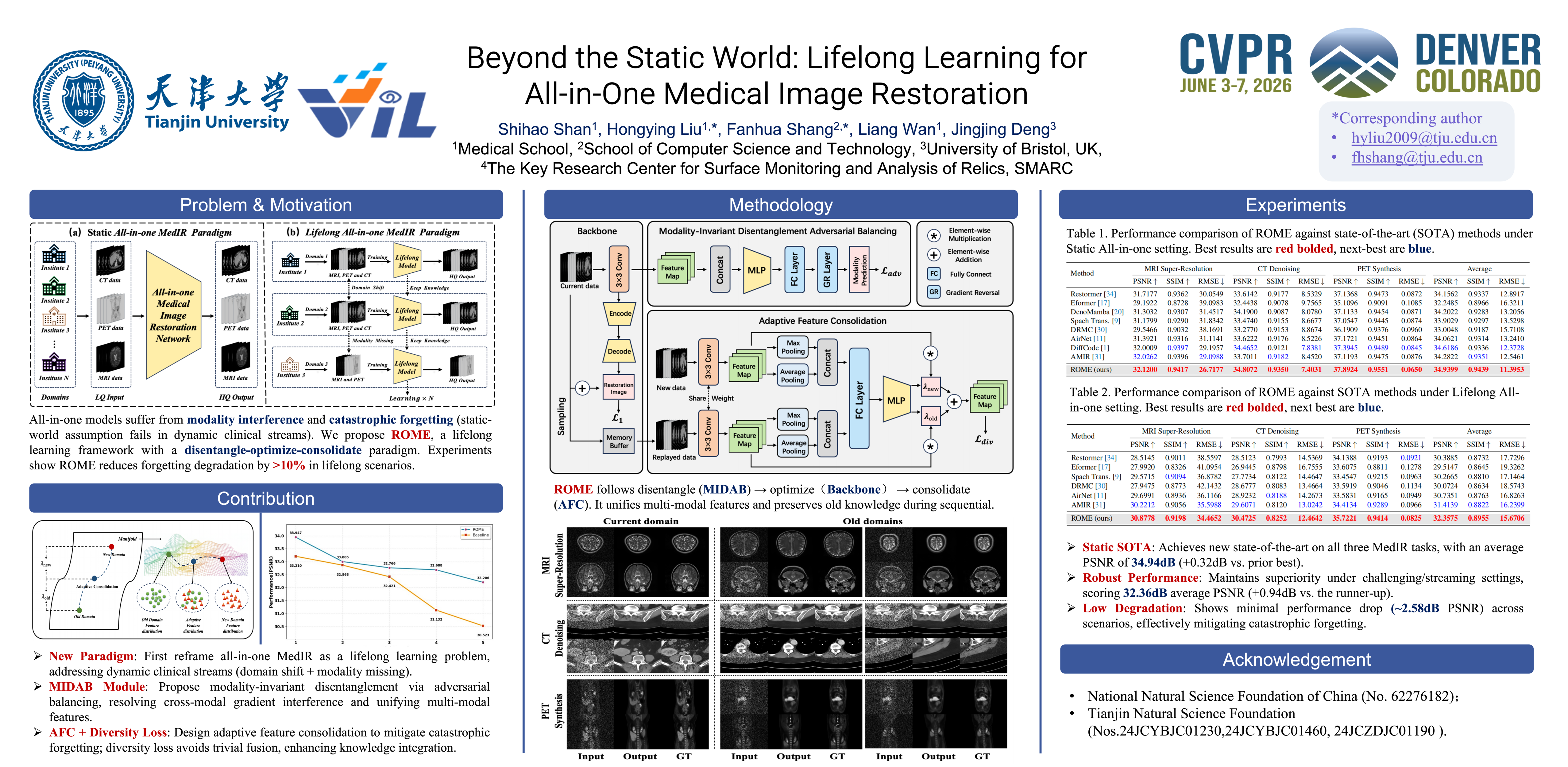
All-in-One Medical Image Restoration (MedIR) models offer a promising path towards generalized medical imaging intelligence but face two critical spatiotemporal challenges: 1) Spatial Modality Interference, where conflicting gradients from diverse modalities (e.g., MRI, CT, PET) degrade performance; and 2) a Temporal Static-World Assumption that ignores the continual data streams in real-world clinical settings, leading to catastrophic forgetting. To address this dual challenge, we propose Resilient On-the-fly Medical Enhancement(ROME), a novel lifelong learning framework governed by a "Disentangle-Optimize-Consolidate" paradigm. ROME first resolves the foundational modality conflict via the Modality-Invariant Disentanglement via Adversarial Balancing(MIDAB) module. It establishes a strategic "adversarial balance" between a "content preservation force" and a "modality erasure force" to optimize a disentangled, unified feature manifold. Building on this stable foundation, the Adaptive Feature Consolidation(AFC) module combats forgetting. AFC dynamically locates an optimal feature consolidation point via a prediction network, enforced by a novel Diversity Loss to ensure robust continuous learning. Experiments demonstrate that ROME not only achieves SOTA performance in static settings but also exhibits superior resilience in rigorous domain-incremental benchmarks, reducing the average catastrophic performance degradation by over 10%.
Hyperbolic Relational Prompts for Intersectional Fairness in Medical VLMs
Jiayu Qian ⋅ Zongxian Yang ⋅ Guanxing Chen ⋅ Pengwei Hu ⋅ KC Tan ⋅ Yan Wang ⋅ Yu-An Huang ⋅ Zhi-An Huang
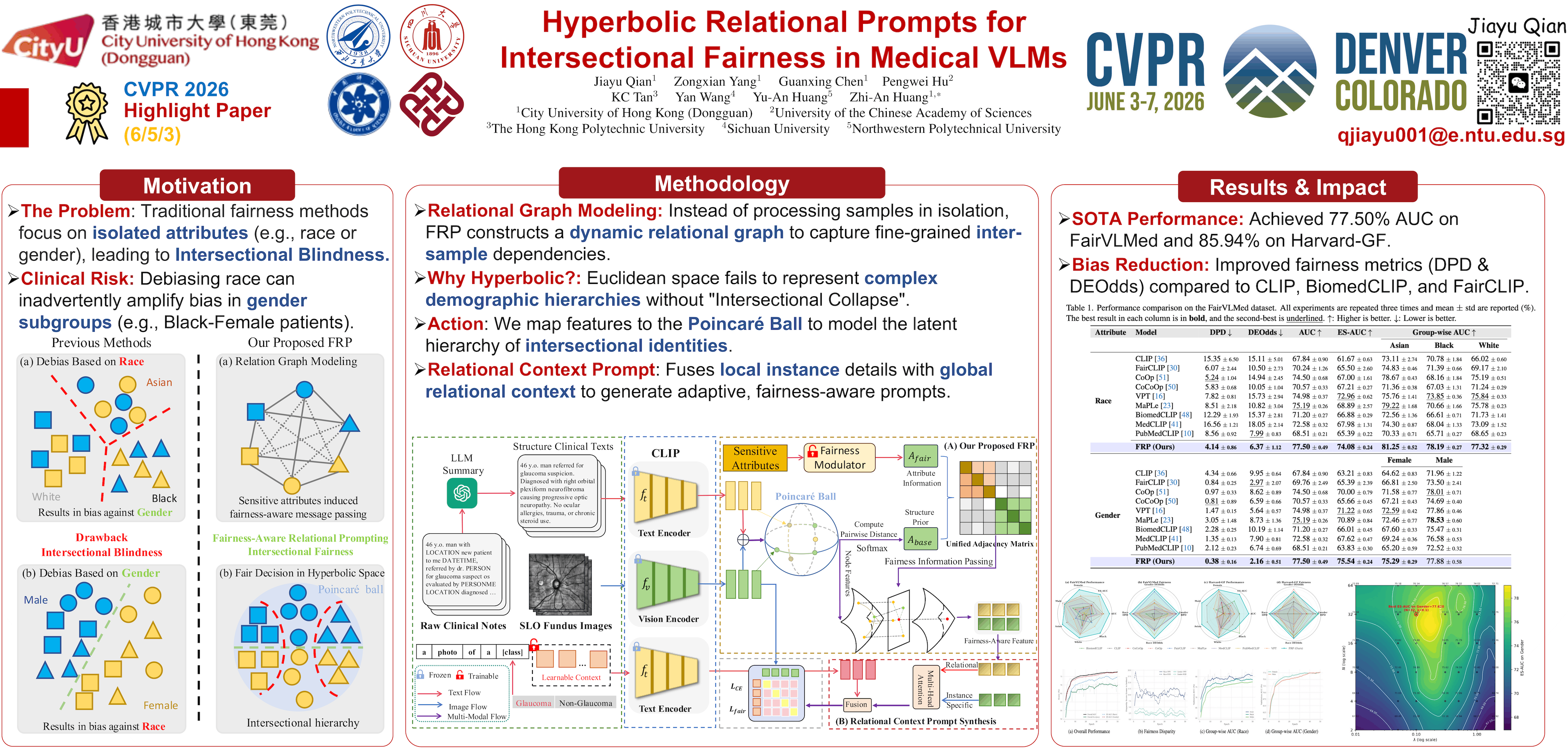
Ensuring fairness in medical vision-language models (VLMs) is essential for equitable healthcare, yet existing models amplify biases across demographic subgroups such as race and gender. Traditional fairness mitigation approaches relying on broad distribution alignment, fall short in addressing these nuanced intersectional disparities. We propose fairness-aware relational prompting (FRP), a novel framework that reformulates prompt generation as a dynamic, fairness-aware reasoning process. FRP constructs a relational graph to capture fine-grained, sample-level similarities and employs a hyperbolic graph layer to explicitly model the hierarchical structure of intersectional identities. Leveraging hyperbolic geometry enables reasoning over complex attribute combinations, effectively reducing entrenched biases. Evaluations on the FairVLMed and Harvard-GF datasets demonstrate that FRP achieves state-of-the-art diagnostic performance, with an area under the curve of 77.50\% and 85.94\% respectively, while substantially improving the demographic parity difference and equalized odds difference. This work moves beyond post-hoc bias correction toward inherently fair VLM architectures, offering a scalable solution for high-stakes medical applications.
RNED: Rotary Number Encoding and Decoding for Quantitative Medical VLM Analysis
Fengbei Liu ⋅ Sunwoo Kwak ⋅ Nusrat Binta Nizam ⋅ Ilan Richter ⋅ Ashley Beecy ⋅ Jayant Raikhelkar ⋅ Deborah Estrin ⋅ Mert Sabuncu
Vision-Language Models (VLMs) are increasingly adopted for medical applications, but their clinical utility is limited by a core weakness in quantitative reasoning. This limitation affects tasks ranging from regression of lesion sizes to prediction of bounding-box coordinates and stems from the discrete tokenization schemes underlying Large Language Models (LLMs). To address this, we propose \emph{Rotary Number Encoding and Decoding} (RNED), a principled method for embedding continuous numerical values directly in the representation space of a VLM. Analogous to rotary position encoding, RNED represents a scalar by applying a number-specific rotation matrix to a dedicated numeric token embedding. This norm-preserving transformation maintains ordinal structure over a wide numerical range and integrates seamlessly with pretrained model weights. For decoding, we introduce a robust score-matching–based scheme to recover continuous values from hidden states in the presence of stochastic noise. We evaluate RNED on two quantitative tasks: radiological measurement estimation and medical visual grounding. On both internal and public benchmarks, RNED consistently outperforms existing VLM baselines. Together, these results show that RNED offers a robust, generalizable solution for numerical reasoning in medical VLMs, enabling models that are both quantitatively reliable and clinically applicable. We will release code for experiments on public datasets.
MLLM-HWSI: A Multimodal Large Language Model for Hierarchical Whole Slide Image Understanding
Basit Alawode ⋅ Arif Mahmood ⋅ Muaz Radi ⋅ Shahad Albastaki ⋅ Asim Khan ⋅ Muhammad Bilal ⋅ Moshira Ali Abdalla ⋅ Mohammed Bennamoun ⋅ Sajid Javed
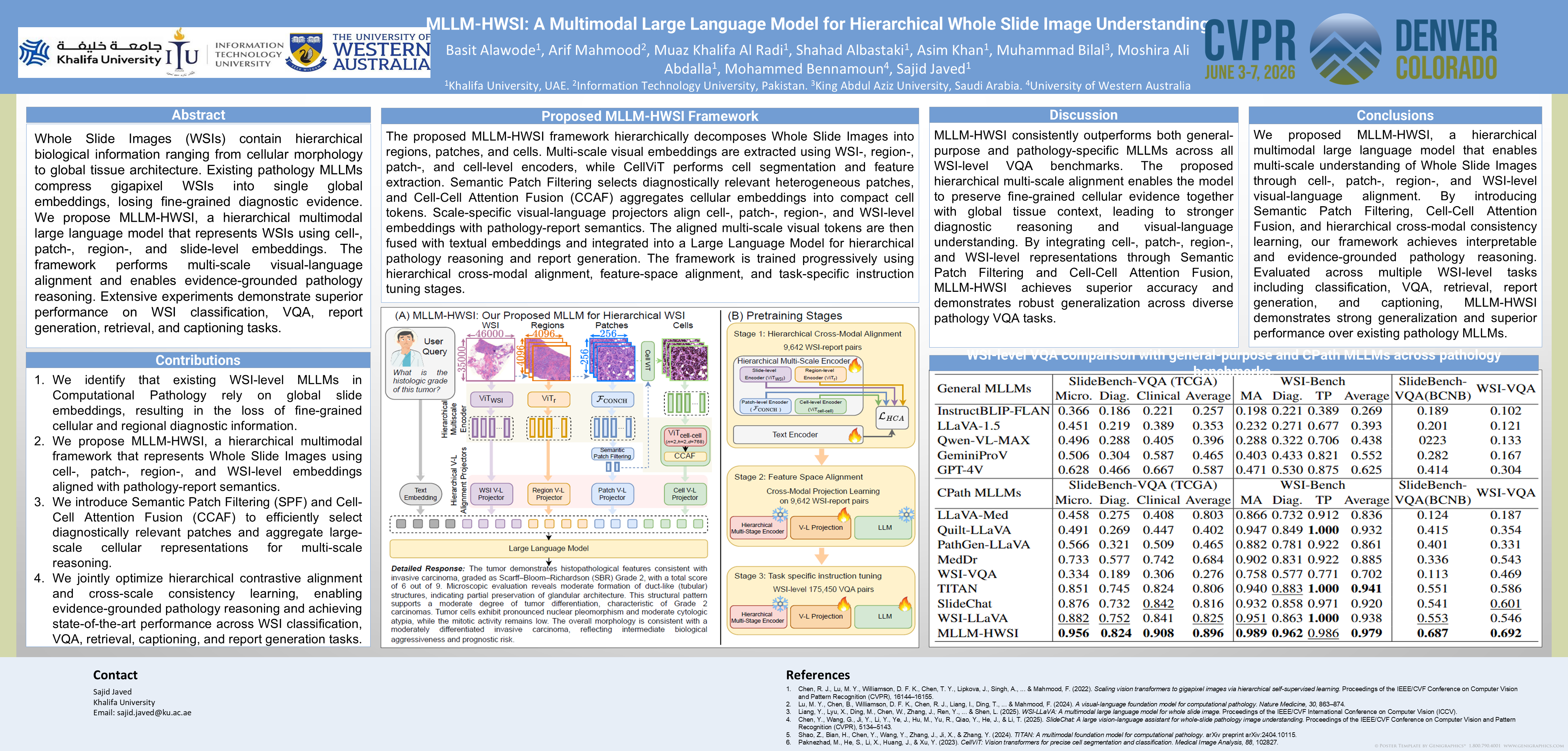
Whole Slide Images (WSIs) exhibit hierarchical structure, where diagnostic cues arise from cellular morphology, regional tissue organization, and global context. Existing Computational Pathology (CPath) Multimodal Large Language Models (MLLMs) typically compress an entire WSI into a single embedding, which hinders fine-grained grounding and ignores how pathologists synthesize evidence across different scales. We introduce \textbf{MLLM-HWSI}, a Hierarchical WSI-level MLLM that aligns visual features with pathology language at four distinct scales—cell as word, patch as phrase, region as sentence, and WSI as paragraph—to support interpretable, evidence-grounded reasoning. MLLM-HWSI decomposes each WSI into multi-scale embeddings with scale-specific V$\rightarrow$L projectors and jointly enforces (i) a hierarchical contrastive objective and (ii) a cross-scale consistency loss, preserving semantic coherence from cells to the WSI. To make gigapixel processing tractable and clinically meaningful, we compute diagnostically relevant tokens and aggregate segmented cell embeddings into a compact cellular token per-patch using a lightweight \textit{Cell–Cell Attention Fusion (CCAF)} transformer. The projected multi-scale tokens are fused with text tokens and fed to an instruction-tuned LLM for open-ended reasoning, VQA, report, and caption generation tasks. Trained in three stages, MLLM-HWSI achieves new SOTA results on 13 WSI-level benchmarks across six CPath tasks. By grounding language in calibrated, multi-scale visual evidence, HMLLM provides accurate, interpretable outputs that mirror expert diagnostic workflows and advance holistic WSI understanding. Code will be released upon the publication.
Learning Generalizable 3D Medical Image Representations from Mask-Guided Self-Supervision
Yunhe Gao ⋅ Yabin Zhang ⋅ Chong Wang ⋅ Jiaming Liu ⋅ Maya Varma ⋅ Jean-Benoit Delbrouck ⋅ Akshay Chaudhari ⋅ Curtis Langlotz
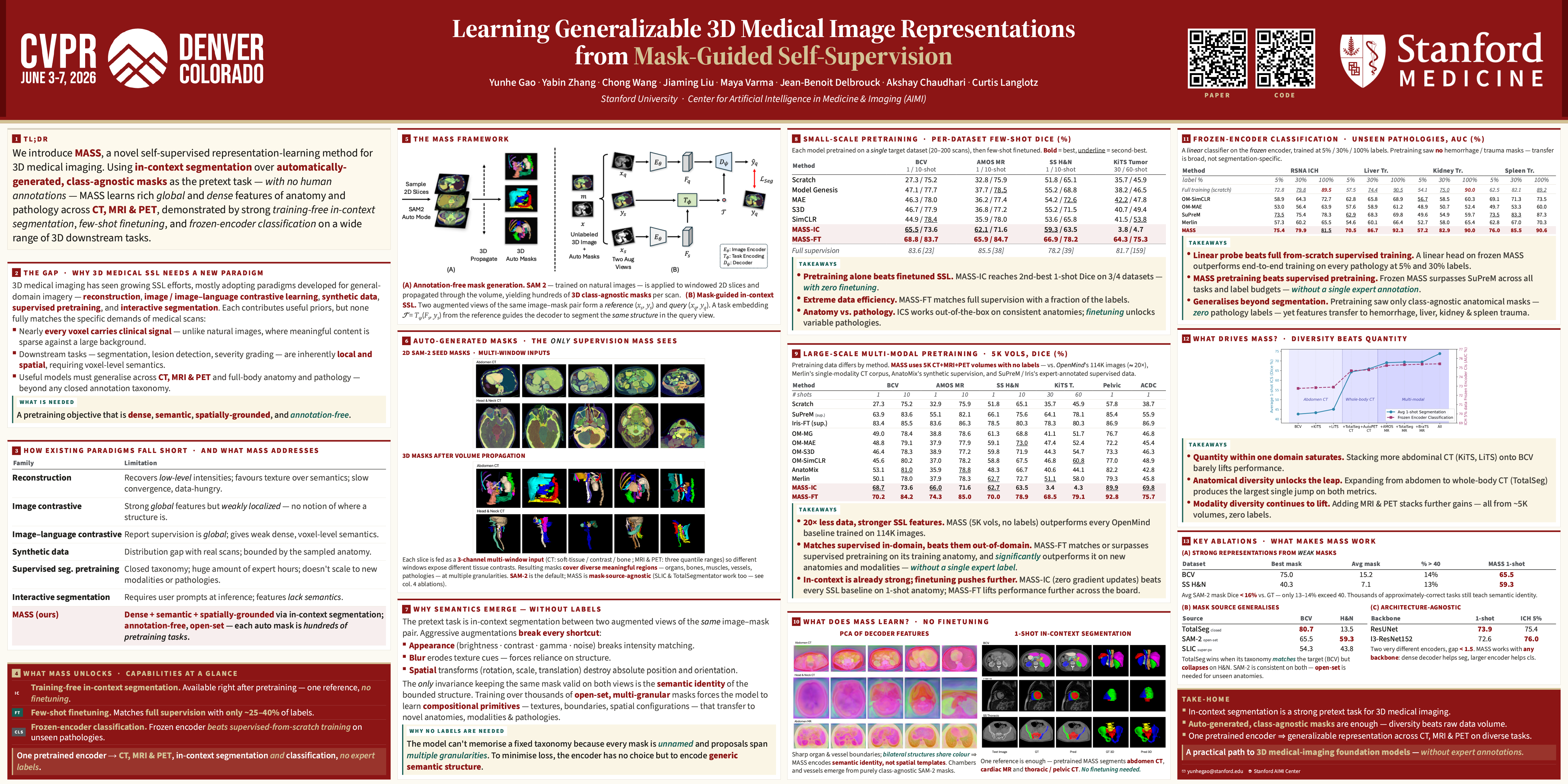
Foundation models have transformed vision and language by learning general-purpose representations from large-scale unlabeled data, yet 3D medical imaging lacks analogous approaches. Existing self-supervised methods rely on low-level reconstruction or contrastive objectives that fail to capture the anatomical semantics critical for medical image analysis, limiting transfer to downstream tasks. We present MASS (MAsk-guided Self-Supervised learning), which treats in-context segmentation as the pretext task for learning general-purpose medical imaging representations. MASS's key insight is that automatically generated class-agnostic masks provide sufficient structural supervision for learning semantically rich representations. By training on thousands of diverse mask proposals spanning anatomical structures and pathological findings, MASS learns what semantically defines medical structures: the holistic combination of appearance, shape, spatial context, and anatomical relationships. We demonstrate effectiveness across data regimes: from small-scale pretraining on individual datasets (20-200 scans) to large-scale multi-modal pretraining on 5K CT, MRI, and PET volumes, all without annotations. MASS demonstrates: (i) few-shot segmentation on novel structures, (ii) matching full supervision with only 20-40\% labeled data while outperforming self-supervised baselines by over 20 in Dice score in low-data regimes, and (iii) frozen-encoder classification on unseen pathologies that matches full supervised training with thousands of samples. These results validate that mask-guided pretraining captures broadly generalizable knowledge, opening a path toward 3D medical imaging foundation models without expert annotations. Code and models will be made publicly available.
BiOTPrompt: Bidirectional Optimal Transport Guided Prompting for Disease Evolution-aware Radiology Report Generation
Tengfei Liu ⋅ Yijian Fan ⋅ Boyue Wang ⋅ Yongli Hu ⋅ Mingjie Li ⋅ Jinghua Li ⋅ Junbin Gao ⋅ Xiaojun Chang ⋅ Zhihui Li ⋅ Baocai Yin
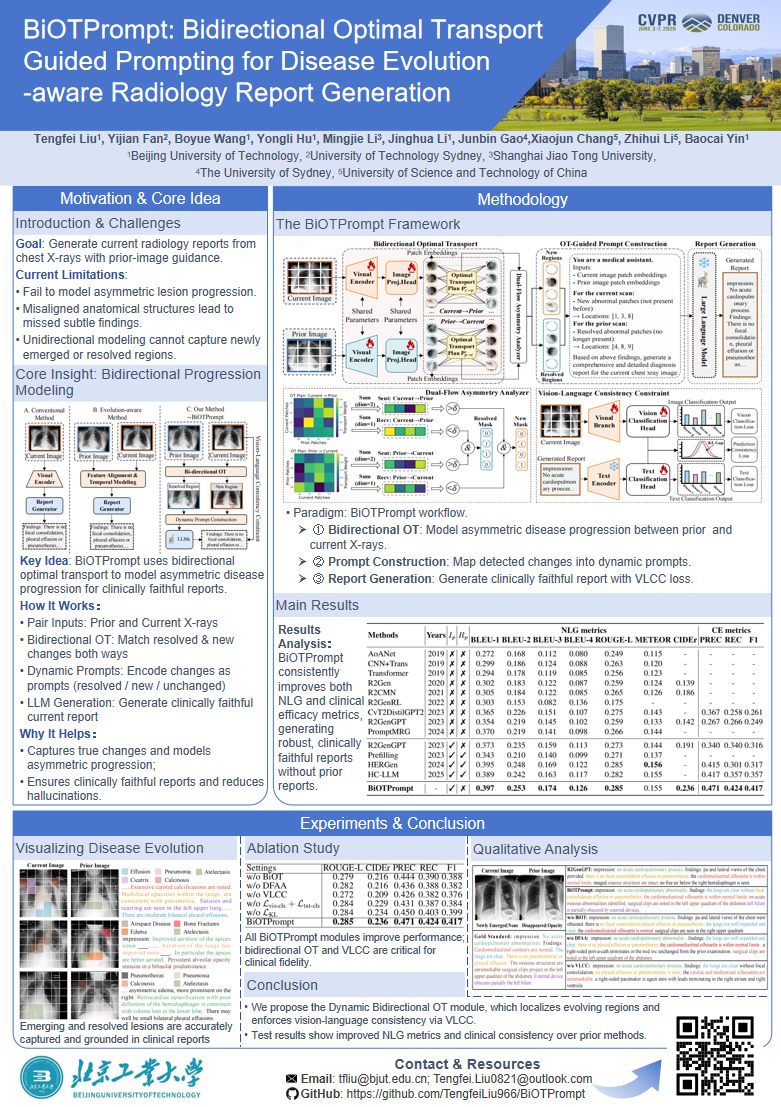
Radiology report generation (RRG) aims to automatically describe medical images via free-text reports. In clinical practice, comparing current and prior chest X-rays is essential for assessing disease progression, motivating the development of longitudinal RRG methods. However, most existing approaches often struggle to capture fine-grained temporal changes, as they often rely on unidirectional alignments or static reasoning pipelines, overlooking the bidirectional and asymmetric nature of disease evolution. To tackle these challenges, we propose BiOTPrompt, a novel framework for disease evolution-aware radiology report generation, which introduces a Bidirectional Optimal Transport (BiOT) mechanism to explicitly model progression dynamics between historical and current chest X-rays. By analyzing the asymmetry between bidirectional transport plans, BiOTPrompt can identify newly emerged and resolved regions, which are then used to construct dynamic prompts that guide large language models (LLMs) in generating clinically relevant diagnostic reports. Furthermore, we incorporate a vision-language consistency constraint to ensure alignment between visual evidence and textual descriptions, mitigating hallucinations and enhancing factual correctness. Extensive experiments on the Longitudinal-MIMIC dataset demonstrate that BiOTPrompt achieves state-of-the-art performance in both language metrics and clinical relevance, setting a new standard for longitudinal radiology report generation.
Learning to See Through a Baby’s Eyes: Early Visual Diets Enable Robust Visual Intelligence in Humans and Machines
Yusen Cai ⋅ Qing Lin ⋅ BHARGAVA SATYA NUNNA ⋅ Mengmi Zhang
Newborns perceive the world with low-acuity, color-degraded, and temporally continuous vision, which gradually sharpens as infants develop. To explore the ecological advantages of such staged ``visual diets", we train self-supervised learning (SSL) models on object-centric videos under constraints that simulate infant vision: grayscale-to-color (C), blur-to-sharp (A), and preserved temporal continuity (T)—collectively termed CATDiet. For evaluation, we establish a comprehensive benchmark across ten datasets, covering clean and corrupted image recognition, texture–shape cue conflict tests, silhouette recognition, depth-order classification, and the visual cliff paradigm.All CATDiet variants demonstrate enhanced robustness in object recognition, despite being trained solely on object-centric videos. Remarkably, models also exhibit biologically aligned developmental patterns, including neural plasticity changes mirroring synaptic density in macaque V1 and behaviors resembling infants’ visual cliff responses. Building on these insights, CombDiet initializes SSL with CATDiet before standard training while preserving temporal continuity. Trained on object-centric or head-mounted infant videos, CombDiet outperforms standard SSL on both in-domain and out-of-domain object recognition and depth perception. Together, these results suggest that the developmental progression of early infant visual experience offers a powerful reverse-engineering framework for understanding the emergence of robust visual intelligence in machines. All code, data, and models will be publicly released.
UDAPose: Unsupervised Domain Adaptation for Low-Light Human Pose Estimation
Haopeng Chen ⋅ Yihao Ai ⋅ Kabeen Kim ⋅ Robby T. Tan ⋅ Yixin Chen ⋅ Bo Wang
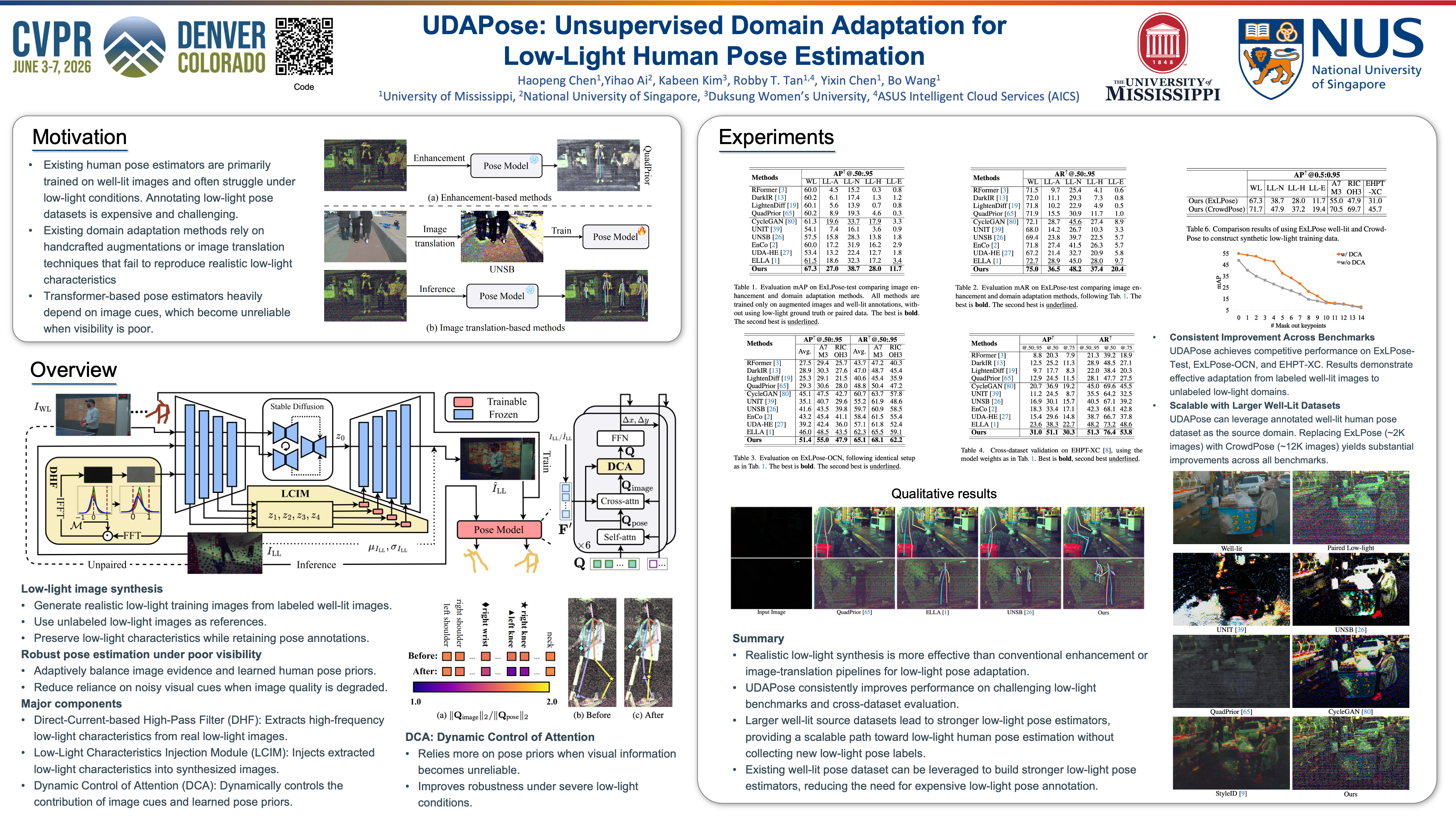
Low-visibility scenarios, such as low-light conditions, pose significant challenges to human pose estimation due to the scarcity of annotated low-light datasets and the loss of visual information under poor illumination. Recent domain adaptation techniques attempt to utilize well-lit labels by augmenting well-lit images to mimic low-light conditions.But handcrafted augmentations oversimplify noise patterns, while learning-based methods often fail to preserve high-frequency low-light characteristics, producing unrealistic images that lead pose models to generalize poorly to real low-light scenes.Moreover, recent pose estimators rely on image cues through image-to-keypoint cross-attention, but these cues become unreliable under low-light conditions.To address these issues, we propose Unsupervised Domain Adaptation for Pose Estimation (UDAPose), a novel framework that synthesizes realistic low-light images and dynamically fuses visual cues with pose priors for improved pose estimation.Specifically, our synthesis method incorporates a Direct-Current-based High-Pass Filter (DHF) and a Low-light Characteristics Injection Module (LCIM) to inject high-frequency details from input low-light images, overcoming rigidity or the detail loss in existing approaches.Furthermore, we introduce a Dynamic Control of Attention (DCA) module that adaptively balances image cues with learned pose priors in the Transformer architecture.Experiments show that UDAPose outperforms state-of-the-art methods, with notable AP gains of 10.1 (56.4%) on the challenging ExLPose-test hard set (LL-H) and 7.4 (31.4%) in cross-dataset validation on EHPT-XC.
Enhancing Accuracy of Uncertainty Estimation in Appearance-based Gaze Tracking with Probabilistic Evaluation and Calibration
Qiaojie Zheng ⋅ Jiucai Zhang ⋅ Amy Zhang ⋅ Xiaoli Zhang
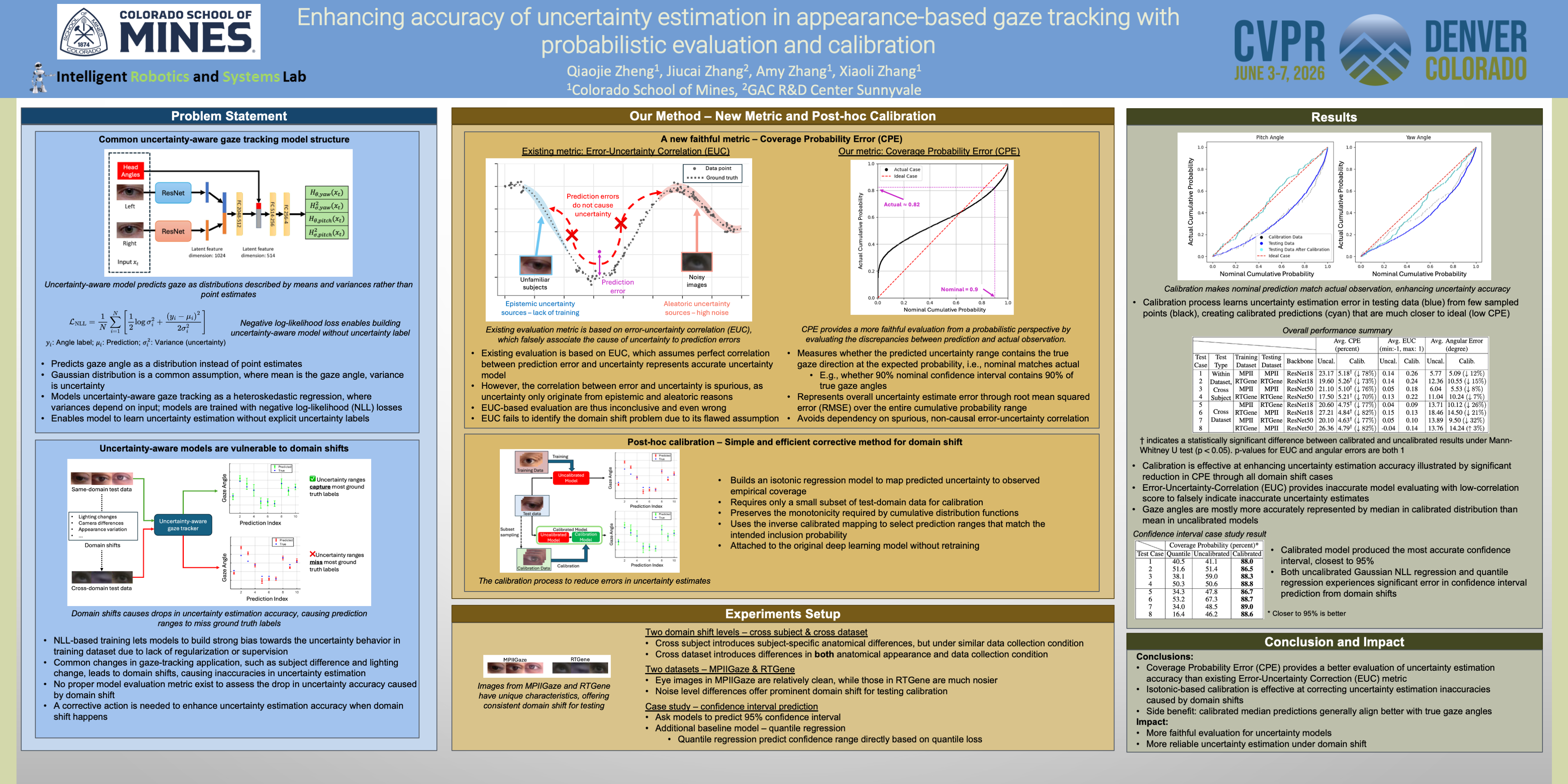
Accurate uncertainty estimation is essential for reliable appearance-based gaze tracking. However, domain shifts between training and testing often lead to incorrect uncertainty estimates, which is a problem overlooked in existing uncertainty-aware gaze tracking models. To overcome this problem efficiently, we formulate uncertainty estimation as a conditional distribution problem and treat the correction process as an output-level conditional distribution matching task. We therefore introduce a data-efficient post-hoc calibration method to align the predicted, high-error conditional distribution with the empirically observed distribution extracted from a small set of calibration samples. To more faithfully assess the accuracy of the resulting uncertainty estimates, we further introduce a new metric, Coverage Probability Error (CPE), to quantify the distribution-level mismatch between prediction and observation. We validate the calibration procedure across four domain shift scenarios to demonstrate improved uncertainty accuracy and its practical benefits.
SCAPO: Self-Supervised Category-Level Articulated Pose Estimation from a Single 3D Observation
Can Zhang ⋅ Gim Hee Lee
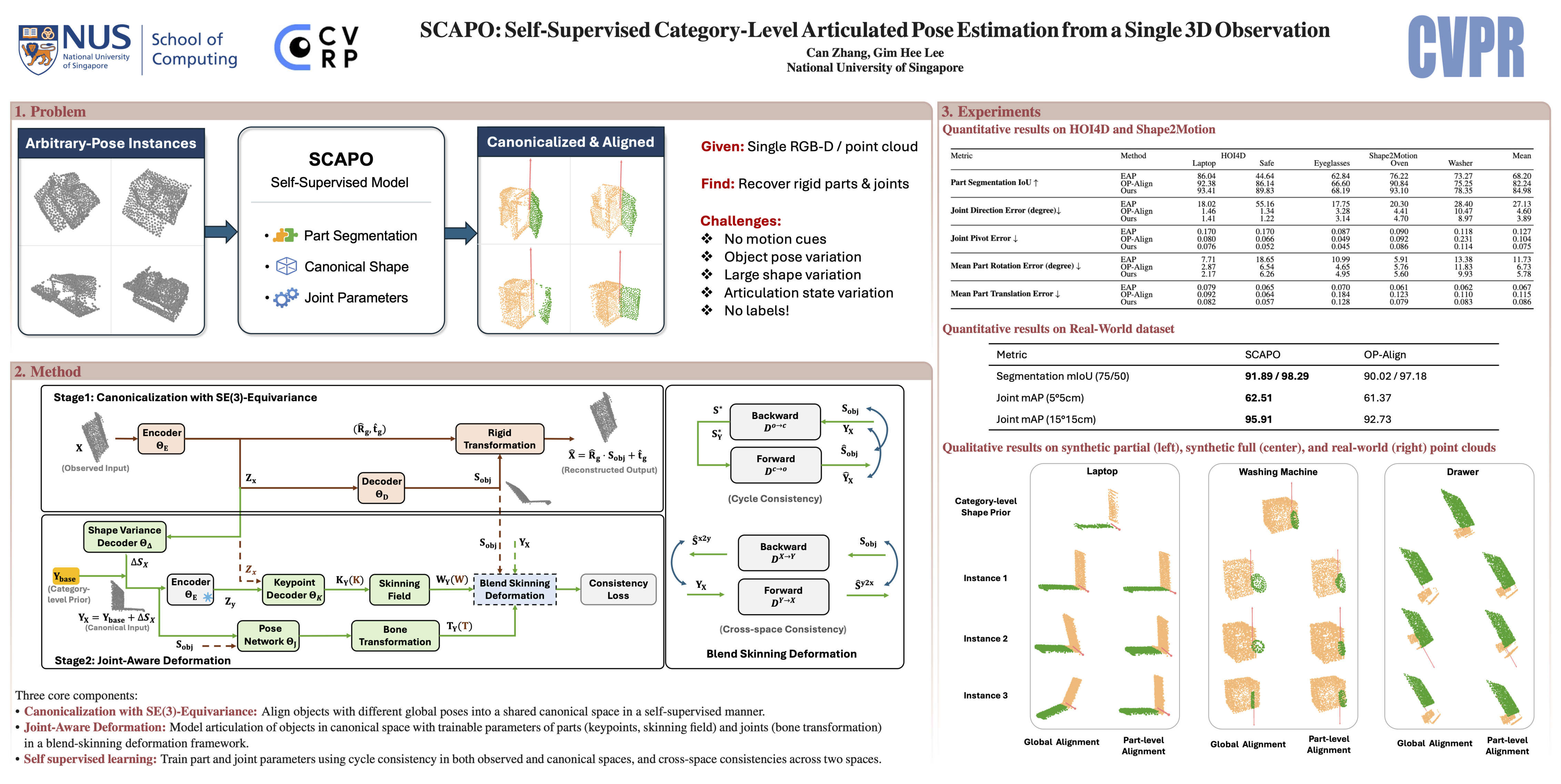
Existing methods for category-level object articulation from a single 3D observation often rely on dense supervision, multi-frame inputs, or CAD templates, and still struggle to disentangle geometry from articulation or to recover explicit joint parameters. We propose SCAPO , a self-supervised framework that estimates canonical geometry, rigid part segmentation, and joint pivots, axes, and articulation states from a single RGB-D observation without ground-truth labels or category-specific models. Our SCAPO first uses an SE(3)-equivariant vector-neuron autoencoder to factor out global pose and align diverse instances into a shared canonical space. On this aligned shape, a joint-aware blend-skinning module is then designed to model part motion. We learn this representation through cycle reconstruction between observed and canonical shapes and cross-space alignment with a learnable canonical template that decouples shared category geometry from instance-specific residual shape. Experiments on synthetic and real articulated-object datasets show that our SCAPO recovers consistent part structure and accurate articulation parameters and outperforms all self-supervised baselines. Our souce-code will be made publicly available.
Composite-Attribute Person Re-Identification via Pose-Guided Disentanglement
Kartik Patwari ⋅ Noranart Vesdapunt ⋅ Chien-Yi Wang ⋅ Dawei Li ⋅ Cong Phuoc Huynh ⋅ Ning Zhou ⋅ Chen-Nee Chuah ⋅ Kah Fu Fu
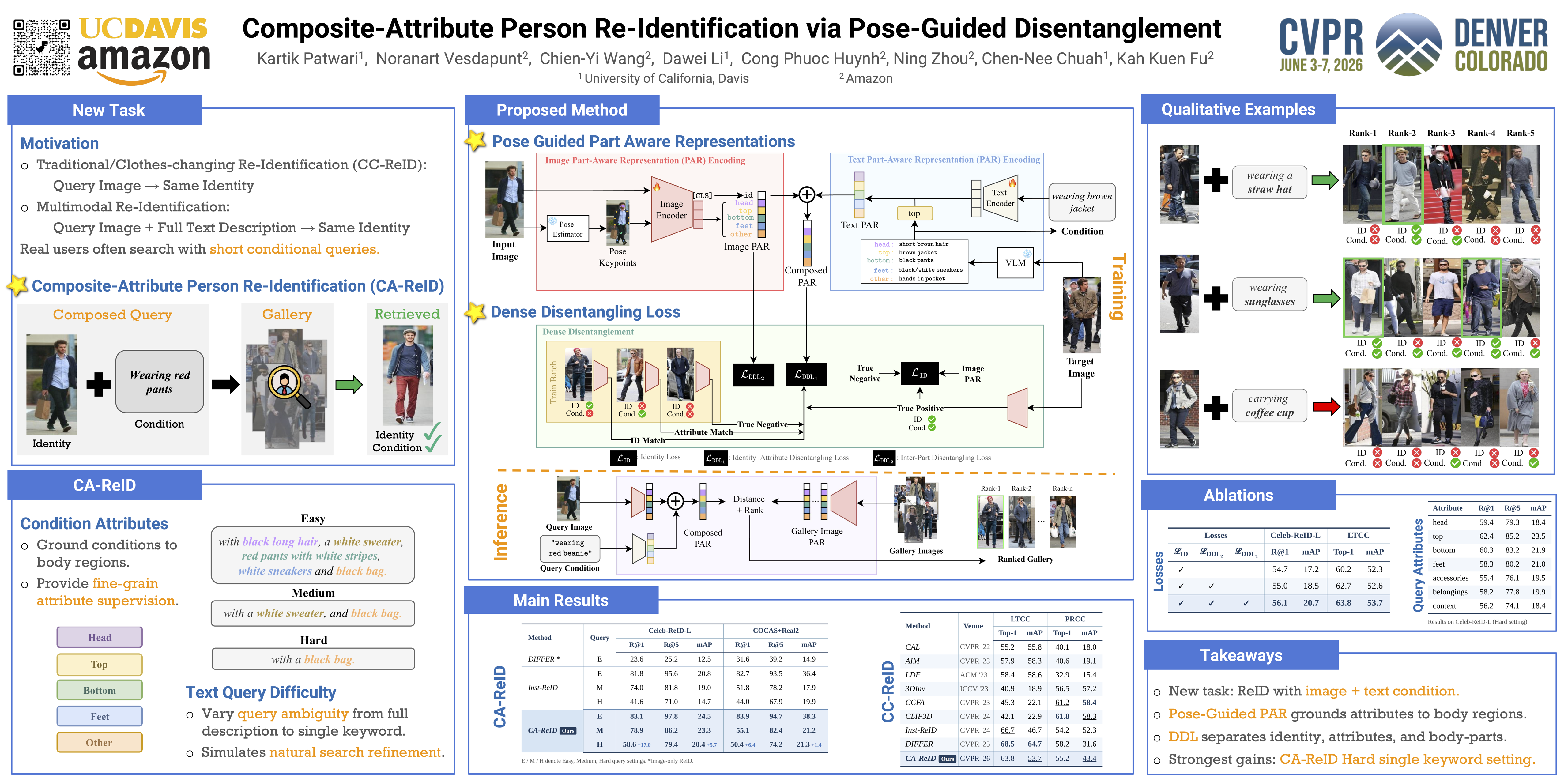
Recent advancement in vision-language models have enabled multi-modal person re-identification (Re-ID), where the system takes both an image and a text query to identify matching individuals. While previous state-of-the-art methods perform well with detailed, sentence-level descriptions, we found that their Recall@1 drops by half when using short, keyword-based queries due to ambiguity, training biases, and under-represented attributes. Despite this challenge, short queries provide a more natural and efficient user experience, requiring less effort and allowing for iterative refinement. To address this limitation, we introduce a new problem setting, Composite-Attributes Person Re-ID (CA-ReID), along with a fine-grained composite attribute dataset with queries belonging to varying levels of ambiguity. We further propose two methods: Dense Disentangling Loss to promote attribute-specific embeddings, and Part-Aware Representations that use pose estimation to align textual attributes with relevant body regions. Our method sets a new state of the art on the new CA-ReID benchmark (up to +17% Recall@1) and performs on par with prior methods on existing CC-ReID benchmarks. We will release our dataset to support this emerging direction.
Representing 3D Faces with Learnable B-Spline Volumes
Prashanth Chandran ⋅ Daoye Wang ⋅ Timo Bolkart
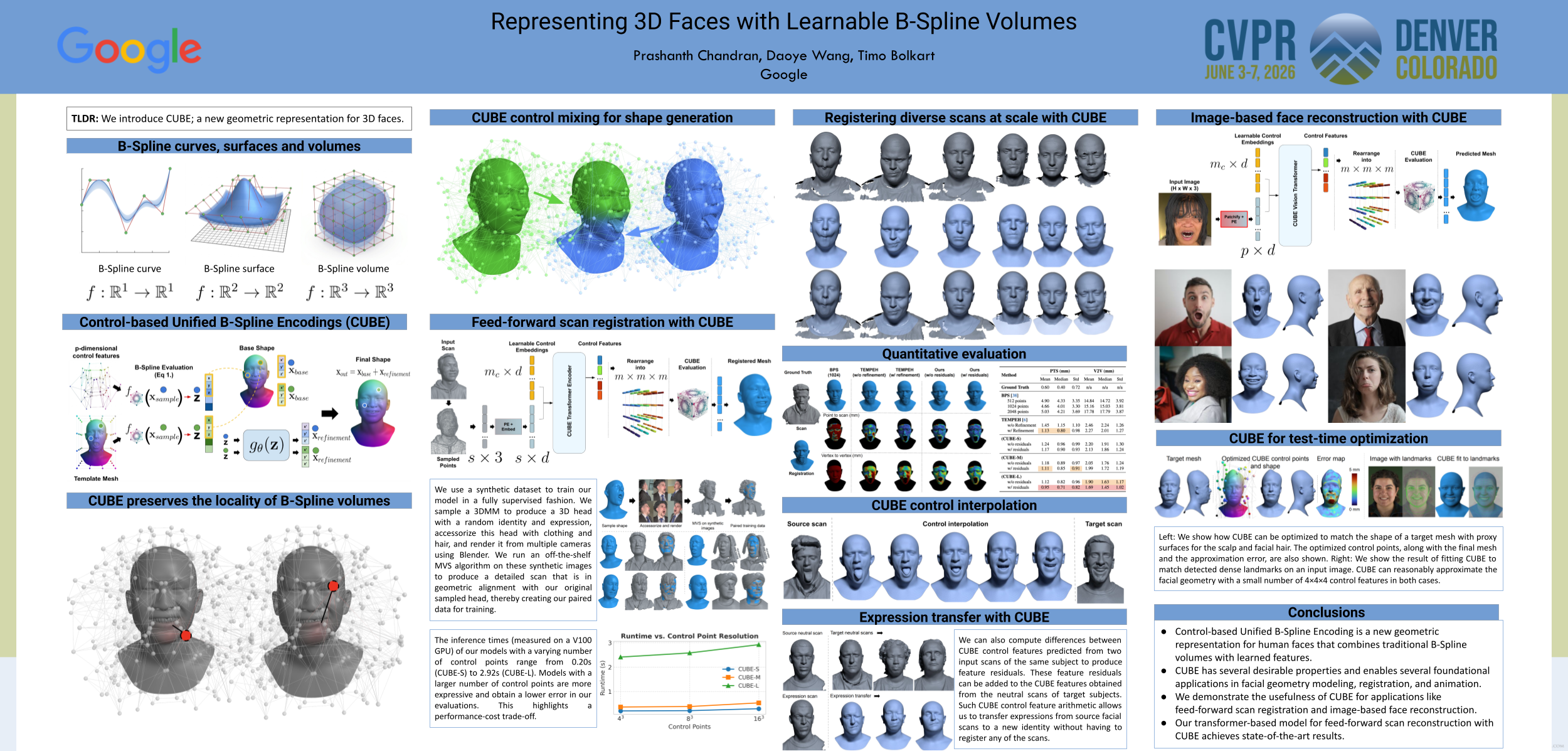
We present CUBE (Control-based Unified B-Splinie Encoding), a new geometric representation for digital humans that combines B-Spline volumes with learned features, and demonstrate its use as decoder for 3D scan registration and monocular 3D face reconstruction. Unlike existing B-Spline representations that use 3D control points, CUBE is parametrized by a lattice (e.g., $8 \times 8 \times 8$) of high-dimensional control features, increasing the models' expressivity. These control features define a continuous mapping from a 3D parametric domain to 3D Euclidean space through an intermediate feature space, which is evaluated in two stages. First, high-dimensional control features are locally blended using the B-Spline bases, yielding a high-dimensional feature vector, where the first three values are the 3D coordinates of a coarse base mesh. This feature vector is input to a small MLP to predict a residual from the base shape, resulting in refined 3D point coordinates. To reconstruct 3D surfaces in dense semantic correspondence, we query CUBE at 3D coordinates sampled from a fixed template mesh. Crucially, CUBE retains the local support of traditional B-spline representations, enabling us to locally edit the surface by updating individual control features. We demonstrate the strengths of this representation by training two transformer-based encoders to predict CUBE's control features from unstructured point clouds and monocular images, achieving state-of-the-art scan registration results compared to recent geometric and multi-view baselines.
RHINO: Reconstructing Human Interactions with Novel Objects from Monocular Videos
Lixin Xue ⋅ Chengwei Zheng ⋅ Georgios Paschalidis ⋅ Chen Guo ⋅ Manuel Kaufmann ⋅ Juan Zarate ⋅ Dimitrios Tzionas
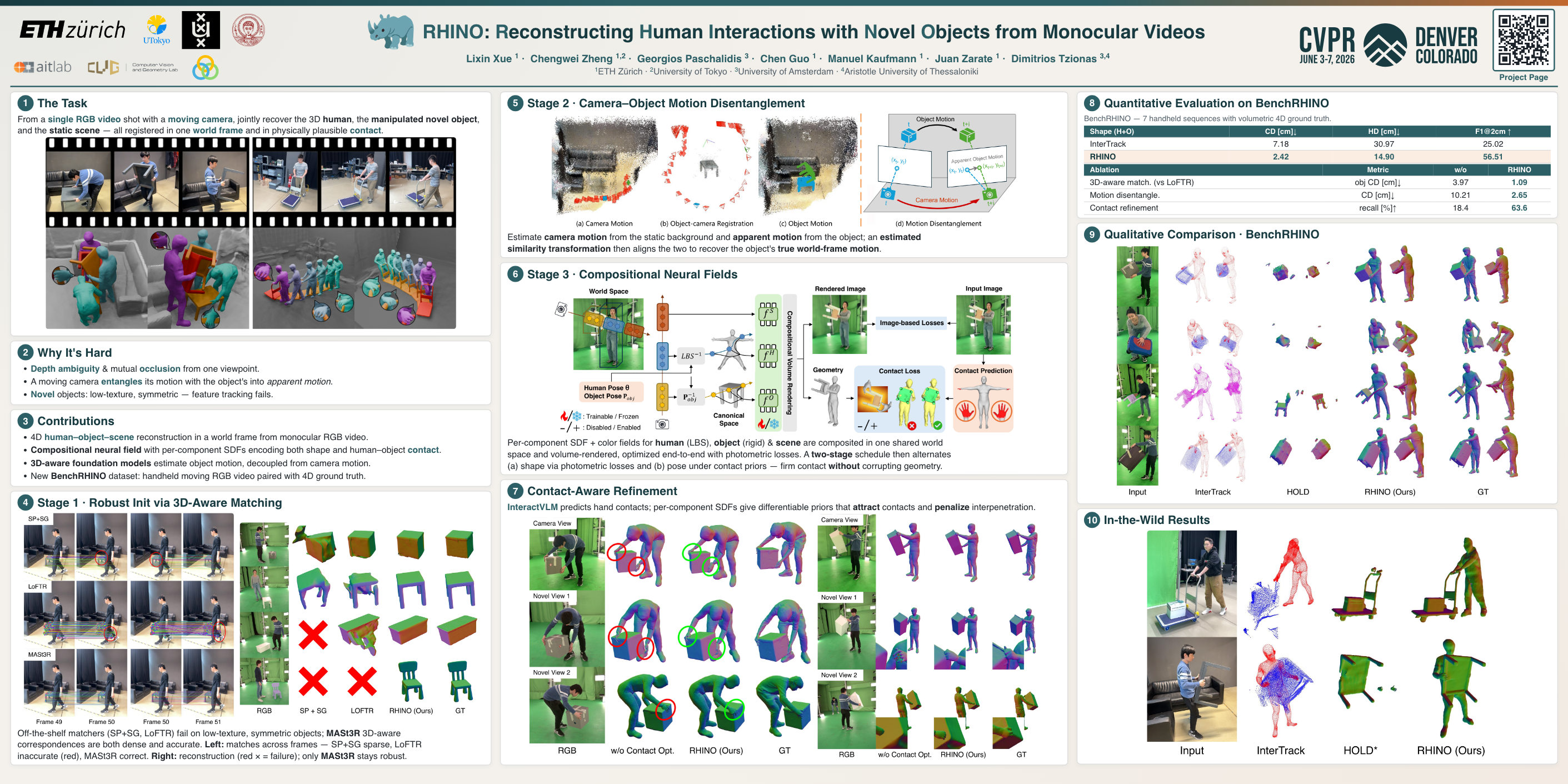
Reconstructing people, objects, and their interactions in 3D is a long-standing and fundamental goal for intelligent systems. Often the input is RGB video from a moving camera, making the task ill-posed; depth is ambiguous, humans and objects occlude each other, and camera and object motion entangle to create apparent motion. Most prior work addresses humans or objects in isolation, ignoring their interplay, or assumes known 3D shapes or cameras, which is impractical for real-world applications. We develop RHINO (Reconstructing Human Interactions with Novel Objects), a novel three-step framework that recovers in 3D a human, novel (unseen) manipulated object, and static scene in a common world frame from a monocular RGB video. First, we leverage 3D-aware foundation models to obtain cues that stabilize Structure-from-Motion (SfM) even for low-texture regions; this yields a coarse shape and apparent motion of a manipulated object from foreground pixels, a coarse scene shape and camera motion from background pixels. Second, we estimate a human in the camera frame via an off-the-shelf method, and subtract the camera motion from apparent motion to extract the object motion; this registers the human, object, and coarse scene shapes into a common world frame. Third, we refine shapes using a compositional neural field with per-component signed-distance fields. The latter further enables differentiable contact priors that attract surfaces while penalizing interpenetration, improving the physical plausibility of the final reconstruction. For evaluation, we capture a new dataset of handheld monocular videos synchronized with a volumetric 4D capture stage, providing ground-truth shape and camera motion. RHINO outperforms state-of-the-art baselines on novel-view synthesis and 4D reconstruction. Ablations show that each stage contributes substantially. We will release our code and data to foster future research.
HumanBA: Human-Aware Bundle Adjustment via Global Human-Camera Decoupling
Fengyuan Yang ⋅ Tanuj Sur ⋅ Tze Ho Elden Tse ⋅ Angela Yao
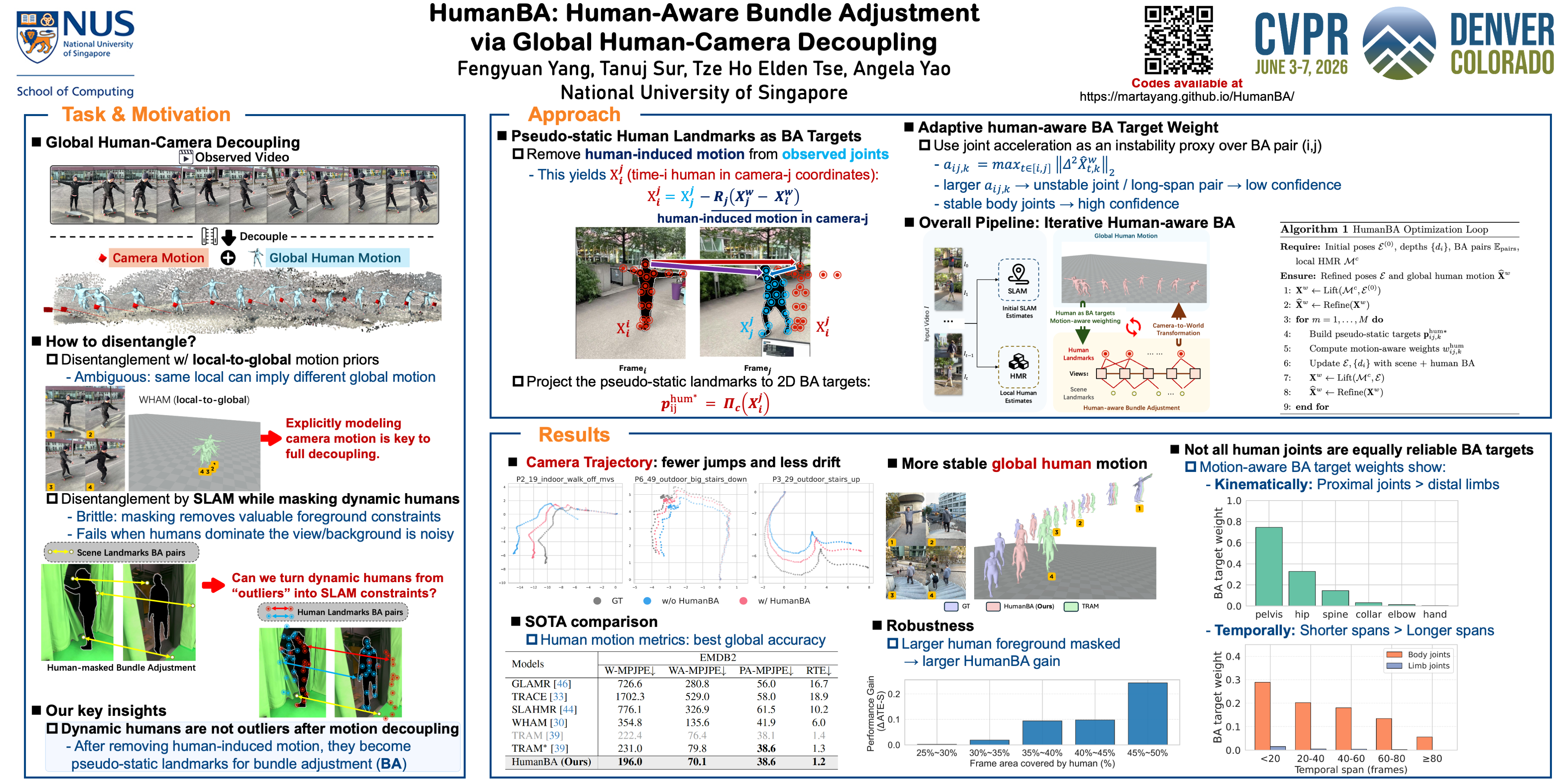
Recovering global human and camera motion from monocular video is essential for world-coordinate human reconstruction but remains challenging due to entangled motions in image space. Traditional SLAM methods estimate monocular camera motion but fail in scenes dominated by foreground objects such as humans. A common workaround is to mask out dynamic objects, yet this approach becomes brittle when humans occupy most of the view or the background is too noisy, leading to unstable tracking and loss of constraints. This paper takes the opposite stance and reintegrates human motion as informative landmarks. We introduce HumanBA, a human-aware bundle adjustment framework that transforms dynamic humans into usable constraints via motion decoupling. HumanBA subtracts the human-induced component from observed joint trajectories, isolating a camera-induced (pseudo-static) component that can be safely incorporated into bundle adjustment alongside background features. To mitigate noise in global human estimates, HumanBA applies motion refinements and motion-aware reliability weighting. Across EMDB and SLOPER4D benchmarks, we show consistent improvements on camera pose estimation and reduce global human reconstruction error, demonstrating the benefits of treating humans as dynamic yet informative landmarks.
HamiPose: Hamiltonian Optimization for Unsupervised Domain Adaptive Pose Estimation
Jiawen Li ⋅ Fei Jiang ⋅ Dandan Zhu ⋅ Aimin Zhou
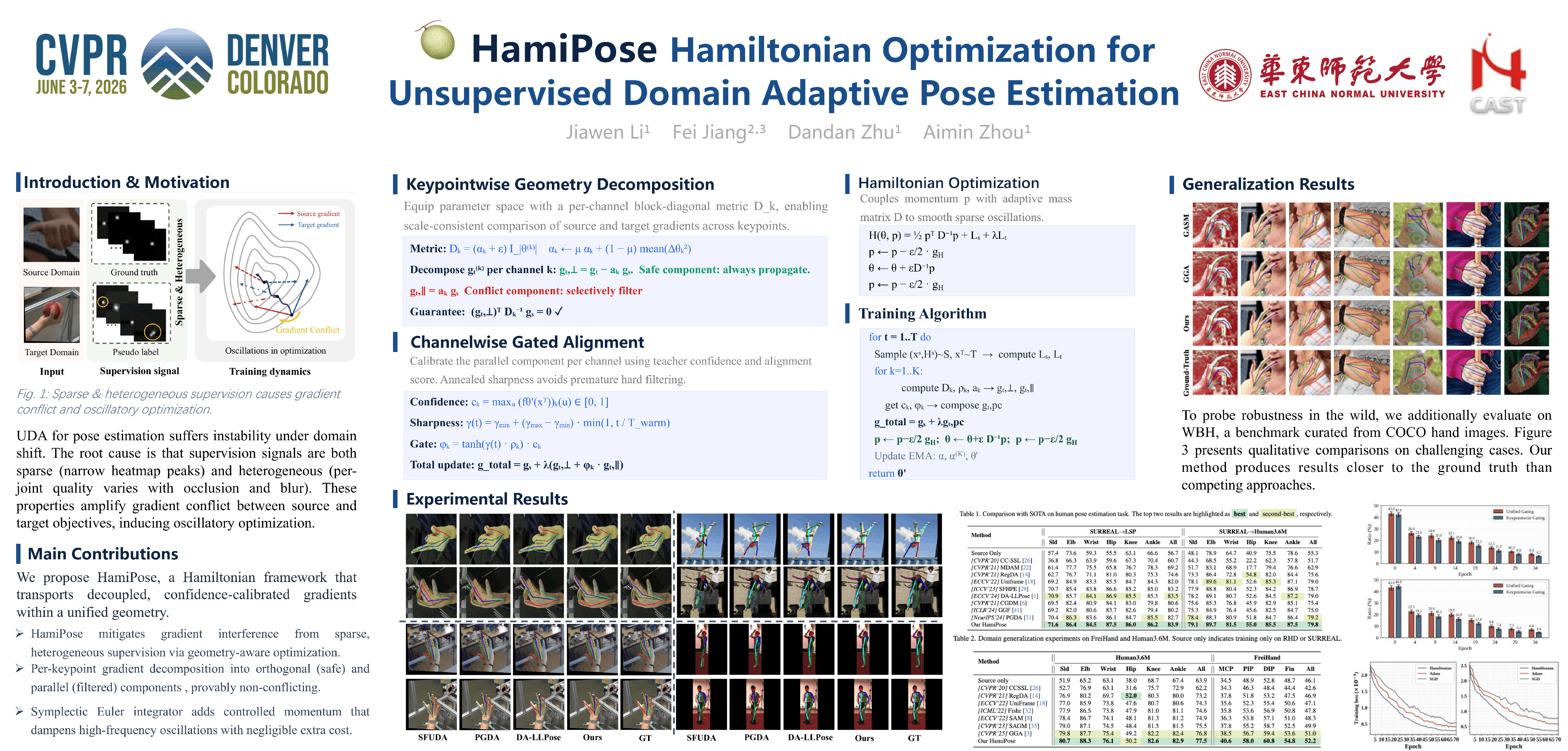
Unsupervised domain adaptation (UDA) for pose estimation promises transfer from synthetic to real domains but often suffers instability under domain shift. Prior work attributes this deterioration to gradient interference between source supervision and target consistency. This conflict is distinct in pose estimation, where sparse and heterogeneous supervision signals cause gradients to be highly sensitive to small localization errors and lead to unstable updates. To address these challenges, we propose HamiPose, a Hamiltonian optimization framework that transports decoupled and confidence-calibrated gradients within a unified geometry to mitigate instability. HamiPose first refines gradient interaction through keypointwise geometry decomposition, orthogonally projecting target gradients to preserve nonconflicting component. Channelwise gated alignment then calibrates the parallel component with confidence and alignment, producing decoupled, confidence-calibrated gradients. These gradients are advanced by a Hamiltonian optimizer with a symplectic integrator, providing controlled momentum that stabilizes updates. Extensive experiments demonstrate that HamiPose achieves state-of-the-art performance in UDA pose estimation while maintains strong performance under domain generalization settings.
KASALv2: Fully Automatic 3D Rotational Symmetry Classification and Axis Localization
Mengxin Zhang ⋅ Yulin Wang ⋅ Chen LUO ⋅ Yongzhe Li ⋅ Yijun Zhou
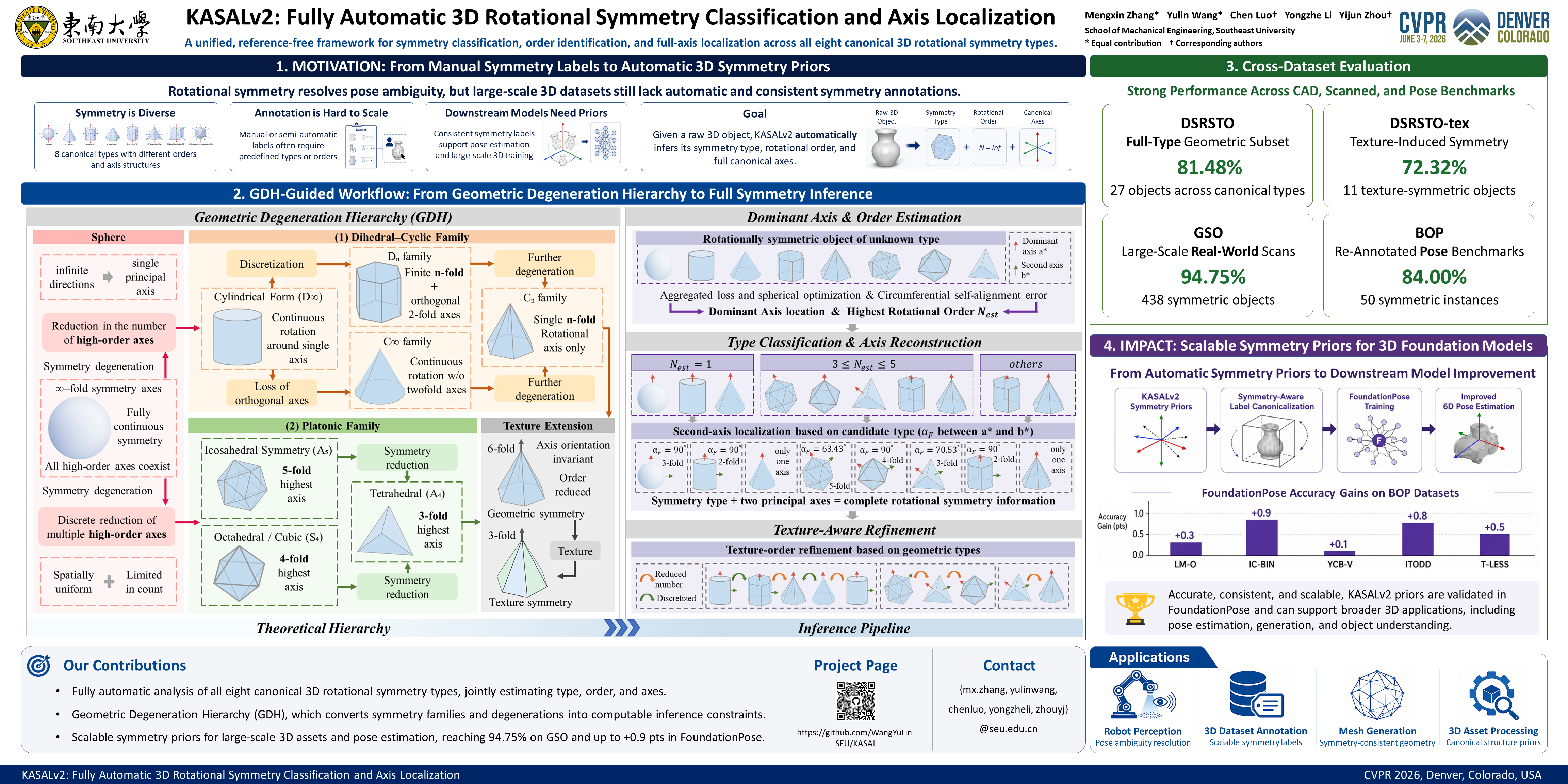
Rotational symmetry is an important prior in 6D pose estimation, improving pose accuracy and ensuring the consistency of symmetry-aware evaluation metrics. However, current symmetry annotations for 3D objects are still largely manual or semi-automatic, often requiring predefined symmetry types or rotational orders and thus limiting scalability. This work introduces a fully automatic and reference-free framework that performs symmetry-type classification, rotational-order identification, and full-axis localization across all eight canonical 3D rotational symmetry types. The method localizes a dominant high-order axis, infers its rotational order through self-consistency analysis, and reconstructs the complete symmetry structure under a hierarchy-guided geometric formulation. A texture-aware extension further models appearance-induced reductions in rotational order while preserving axis orientations. Extensive experiments on idealized and real-world datasets demonstrate strong accuracy and generalization, achieving 94.75% accuracy on 438 symmetric objects in GSO. Training FoundationPose with these priors improves accuracy by up to 1.0% across five BOP datasets, indicating that automatically estimated rotational priors can provide quantitative gains in downstream 6D pose estimation.
AnyLift: Scaling Motion Reconstruction from Internet Videos via 2D Diffusion
Hongjie Li ⋅ Heng Yu ⋅ Jiaman Li ⋅ Hong-Xing Yu ⋅ Ehsan Adeli ⋅ C. Karen Liu ⋅ Jiajun Wu
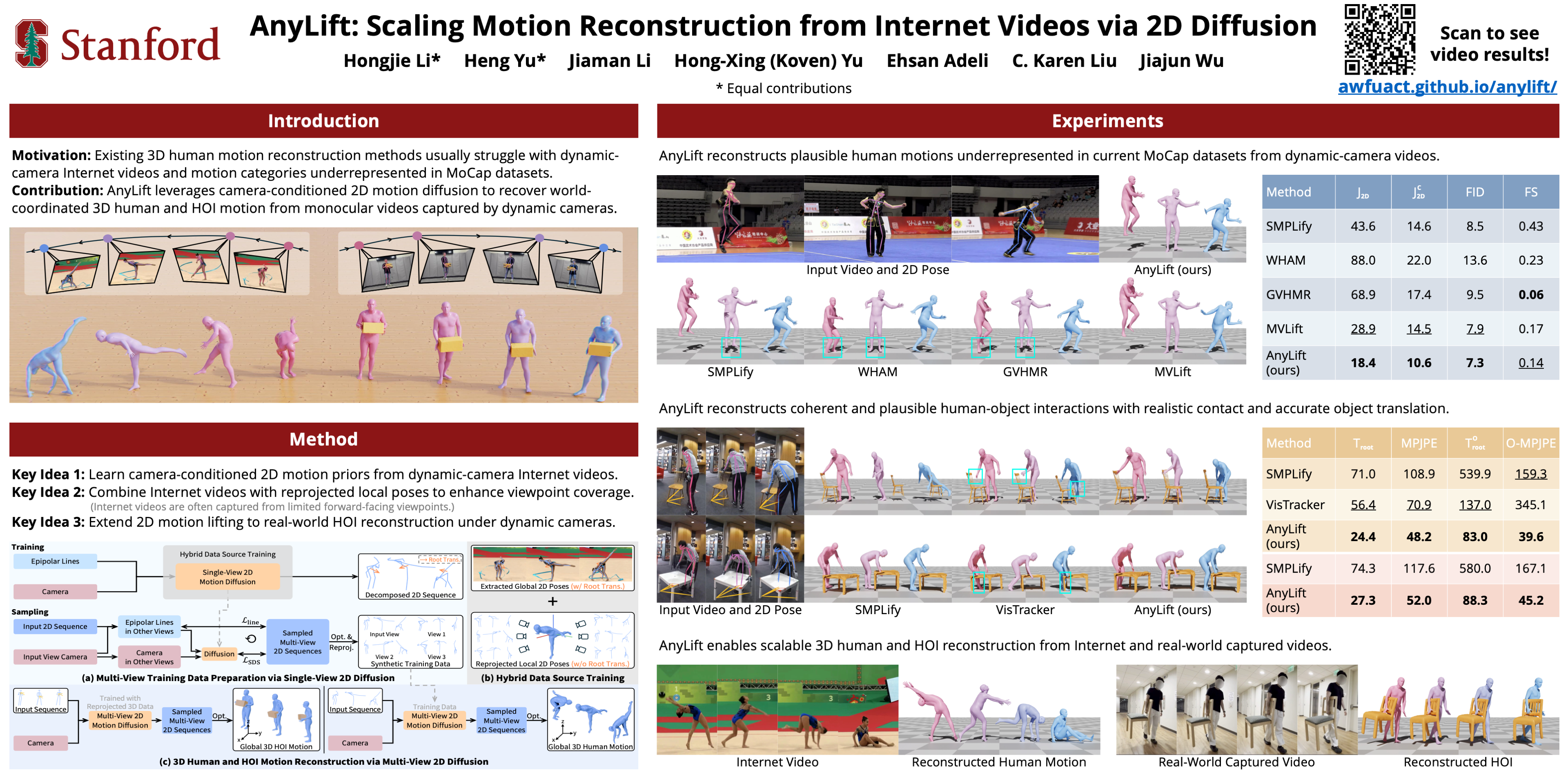
Reconstructing 3D human motion and human-object interactions (HOI) from Internet videos is a fundamental step toward building large-scale datasets of human behavior. Existing methods struggle to recover globally consistent 3D motion under dynamic cameras, especially for motion types underrepresented in current motion-capture datasets, and face additional difficulty recovering coherent human-object interactions in 3D. We introduce a two-stage framework leveraging 2D diffusion that reconstructs 3D human motion and HOI from Internet videos. In the first stage, we synthesize multi-view 2D motion data for each domain, leveraging 2D keypoints extracted from Internet videos to incorporate human motions that rarely appear in existing MoCap datasets. In the second stage, a camera-conditioned multi-view 2D motion diffusion model is trained on these domain-specific synthetic data to recover 3D human motion and 3D HOI in the world space. We demonstrate the effectiveness of our method on Internet videos featuring challenging motions such as gymnastics, as well as in-the-wild HOI videos, and show that it outperforms prior work in producing realistic human motion and human-object interaction.
Active Inference for Micro-Gesture Recognition: EFE-Guided Temporal Sampling and Adaptive Learning
Weijia Feng ⋅ Jingyu Yang ⋅ Ruojia Zhang ⋅ Fengtao Sun ⋅ Qian Gao ⋅ Chenyang Wang ⋅ tongtong Su ⋅ Jia Guo ⋅ Xiaobai Li ⋅ Minglai Shao
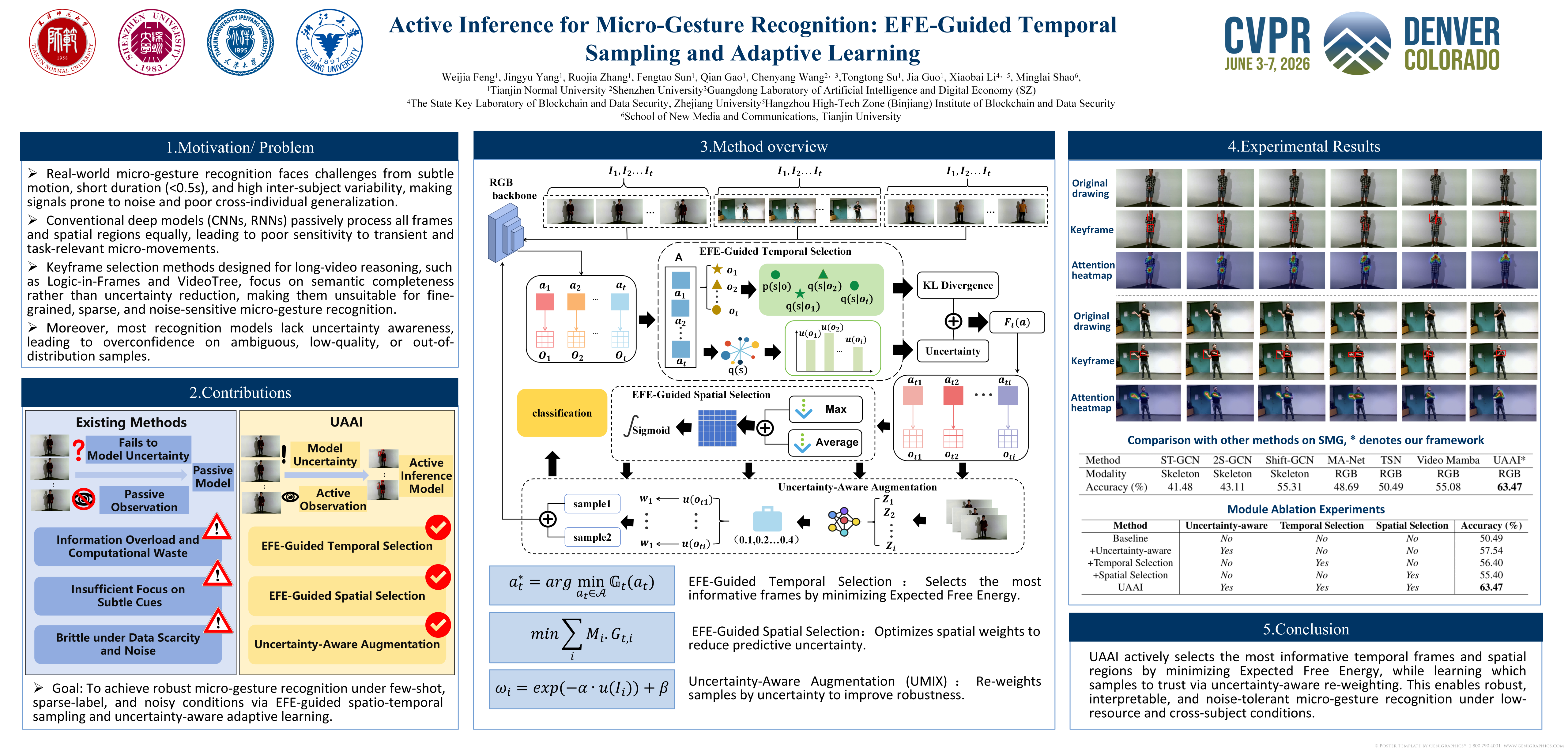
Micro-gestures are subtle and transient movements triggered by unconscious neural and emotional activities, holding great potential for human–computer interaction and clinical monitoring. However, their low amplitude, short duration, and strong inter-subject variability make existing deep models prone to degradation under low-sample, noisy, and cross-subject conditions. This paper presents an active inference–based framework for micro-gesture recognition, featuring Expected Free Energy (EFE)-guided temporal sampling and uncertainty-aware adaptive learning. The model actively selects the most discriminative temporal segments under EFE guidance, enabling dynamic observation and information gain maximization. Meanwhile, sample weighting driven by predictive uncertainty mitigates the effects of label noise and distribution shift. Experiments on the SMG dataset demonstrate the effectiveness of the proposed method, achieving consistent improvements across multiple mainstream backbones. Ablation studies confirm that both the EFE-guided observation and the adaptive learning mechanism are crucial to the performance gains. This work offers an interpretable and scalable paradigm for temporal behavior modeling under low-resource and noisy conditions, with broad applicability to wearable sensing, HCI, and clinical emotion monitoring.
ArtPro: Self-Supervised Articulated Object Reconstruction with Adaptive Integration of Mobility Proposals
Xuelu Li ⋅ Zhaonan Wang ⋅ Xiaogang Wang ⋅ Lei Wu ⋅ Manyi Li ⋅ Changhe Tu
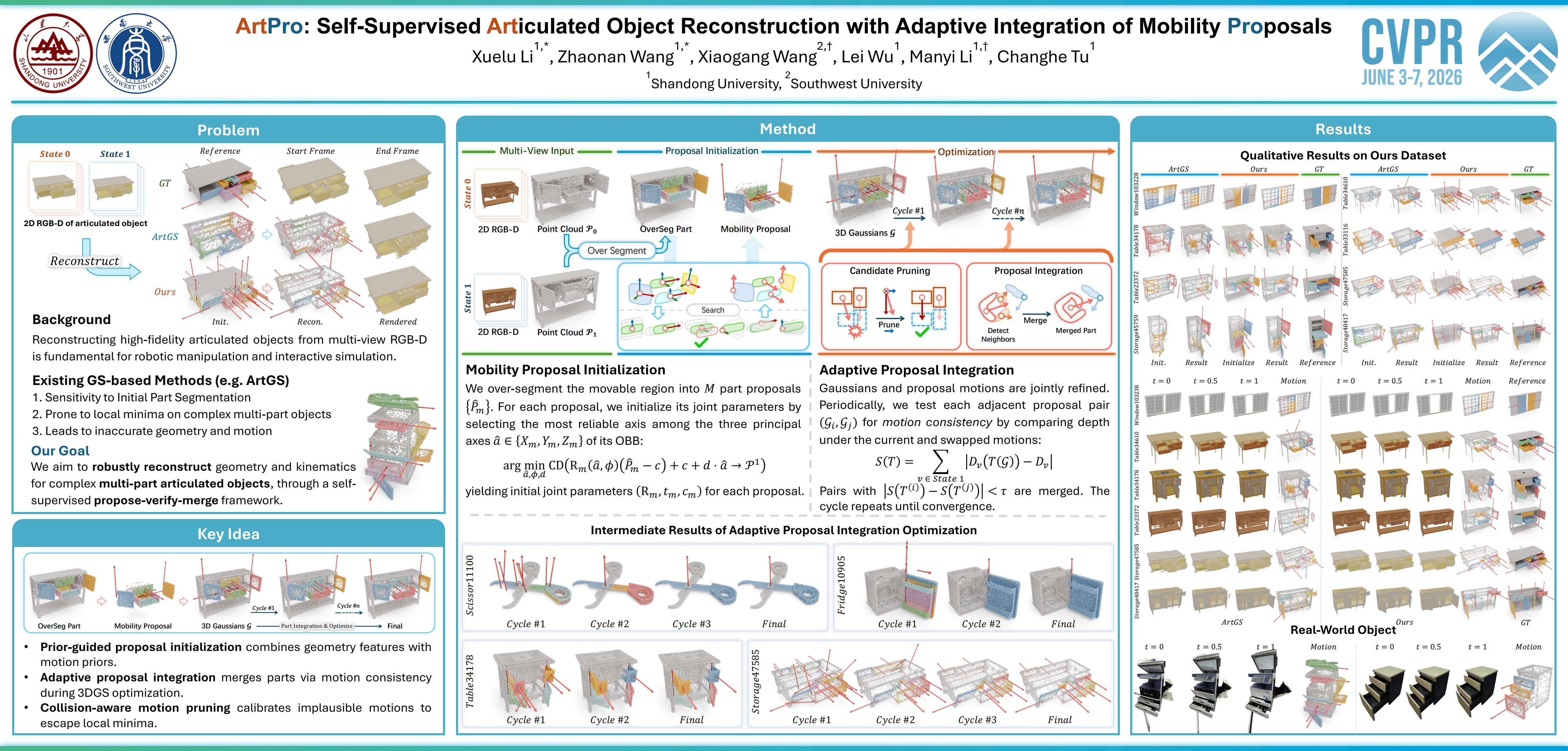
Reconstructing articulated objects into high-fidelity digital twins is crucial for applications such as robotic manipulation and interactive simulation. Recent self-supervised methods using differentiable rendering frameworks like 3D Gaussian Splatting remain highly sensitive to the initial part segmentation. Their reliance on heuristic clustering or pre-trained models often causes optimization to converge to local minima, especially for complex multi-part objects.To address these limitations, we propose ArtPro, a novel self-supervised framework that introduces adaptive integration of mobility proposals. Our approach begins with an over-segmentation initialization guided by geometry features and motion priors, generating part proposals with plausible motion hypotheses. During optimization, we dynamically merge these proposals by analyzing motion consistency among spatial neighbors, while a collision-aware motion pruning mechanism prevents erroneous kinematic estimation. Extensive experiments on both synthetic and real-world objects demonstrate that ArtPro achieves robust reconstruction of complex multi-part objects, significantly outperforming existing methods in accuracy and stability.
Similarity-Consistent Likelihood Diffusion enables Hidden Person Detection from Wall Reflections
Zhiwen Zheng ⋅ Hao Zhou ⋅ Huiyu Qi ⋅ Zhao Huang ⋅ Guangyuan Zhang ⋅ Shaowei Jiang ⋅ Wenwen Tang ⋅ Bin Yang ⋅ Jin Liu ⋅ Xiaoshuai Zhang ⋅ Xingru Huang
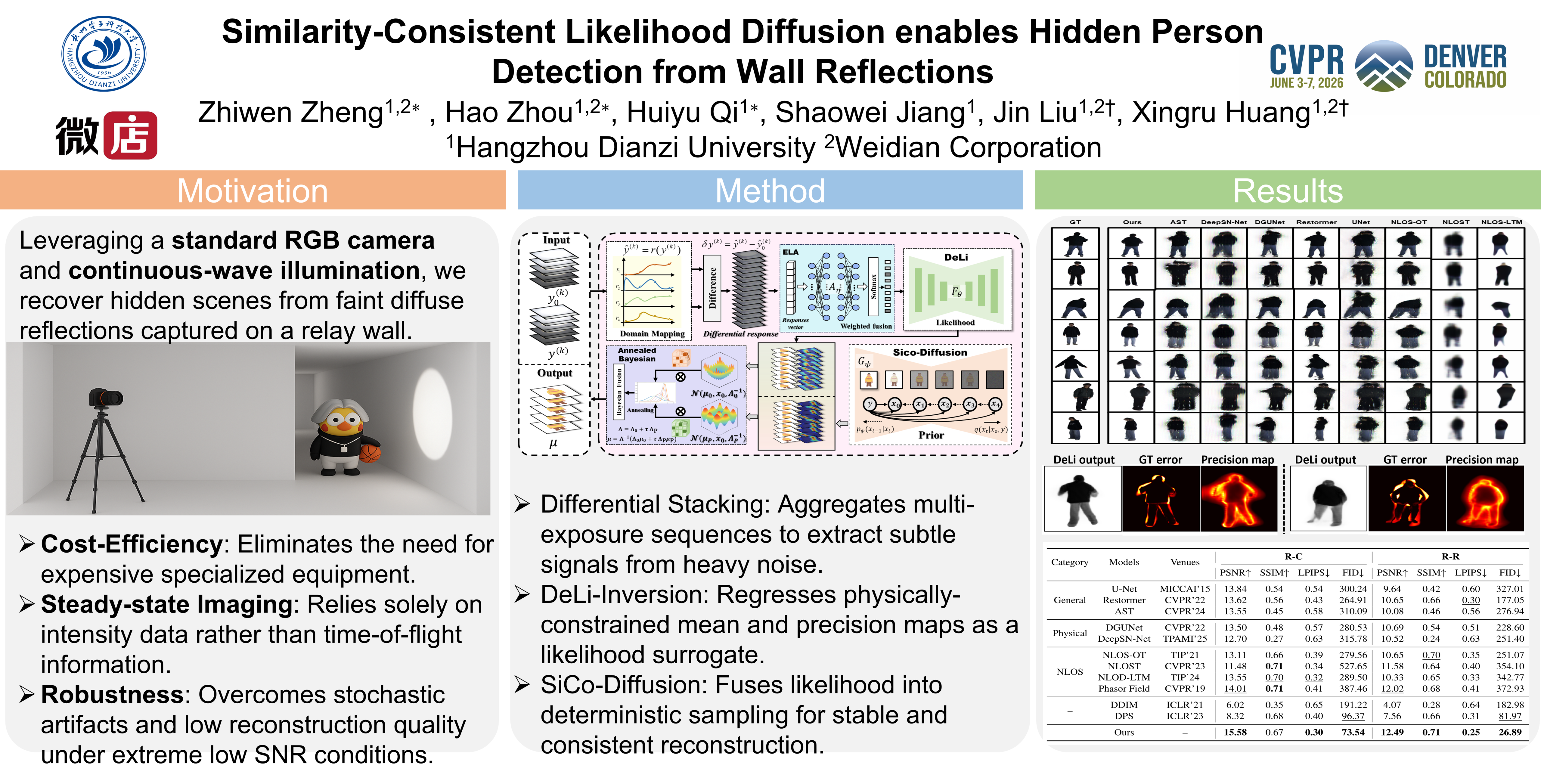
This paper studies passive non-line-of-sight corner-camera detection and human localization using faint indirect reflections on a visible wall. The challenge is twofold: multi-exposure wall observations are unstable and entangled with sensor nonlinearities, and mapping these observations to a hidden-view RGB image is severely underdetermined, making purely discriminative regressors brittle and unconstrained diffusion priors stochastic. To address these challenges, we introduce the Similarity-Likelihood Diffusion Network (SLD-Net), a two-stage framework that produces measurement-consistent, deterministic reconstructions. First, DeLi-Inversion forms an exposure-aware differential representation and jointly predicts an initial reconstruction and a pixel-wise precision map, yielding a heteroscedastic pseudo-likelihood. Second, SiCo-Diffusion injects this likelihood as precision-weighted energy into a deterministic DDIM trajectory and fuses it with the diffusion prior using an annealed Bayesian precision rule, producing a unique reconstruction for fixed observations and schedules. Extensive experiments on two real datasets: Reflect-Corridor and Reflect-Room, demonstrate that the proposed method outperforms generic, physics-inspired, and NLOS-specific baselines across PSNR, SSIM, LPIPS, and FID. In particular, relative to the best-performing baseline, it improves PSNR from 13.84 to 15.58 dB on Reflect-Corridor and from 11.58 to 12.49 dB on Reflect-Room, and reduces FID from 264.91 to 73.54 and from 177.05 to 26.89, respectively, while also achieving the lowest LPIPS on both datasets.
VLM-Guided Group Preference Alignment for Diffusion-based Human Mesh Recovery
Wenhao Shen ⋅ Hao Wang ⋅ Wanqi Yin ⋅ Fayao Liu ⋅ Xulei Yang ⋅ Chao Liang ⋅ Zhongang Cai ⋅ Guosheng Lin
Human mesh recovery (HMR) from a single RGB image is inherently ambiguous, as multiple 3D poses can correspond to the same 2D observation. Recent probabilistic and diffusion-based methods tackle this ambiguity by generating various hypotheses, but often sacrifice accuracy. They yield predictions that are either physically implausible or drift from the input image, especially under occlusion or in cluttered, in-the-wild scenes. To address this issue, we introduce a dual-memory augmented HMR critique agent with self-reflection to produce context-aware quality scores for predicted meshes. These scores distill fine-grained cues about 3D human motion structure, physical feasibility, and alignment with the input image. We use these scores to build a group-wise HMR preference dataset. Building upon this dataset, we propose a group preference alignment framework for finetuning diffusion-based HMR models. This process injects the rich preference signals into the model, guiding it to generate more physically plausible and image-consistent human meshes. Extensive experiments demonstrate that our method achieves superior performance compared to state-of-the-art probabilistic HMR approaches.
Occluded Human Body Capture with Frequency Domain Denoising Prior
Buzhen Huang ⋅ Chongyang Xu ⋅ Wentao Tang ⋅ Yuan Shu ⋅ Jingyi Ju ⋅ Binghui Zuo ⋅ Yangang Wang
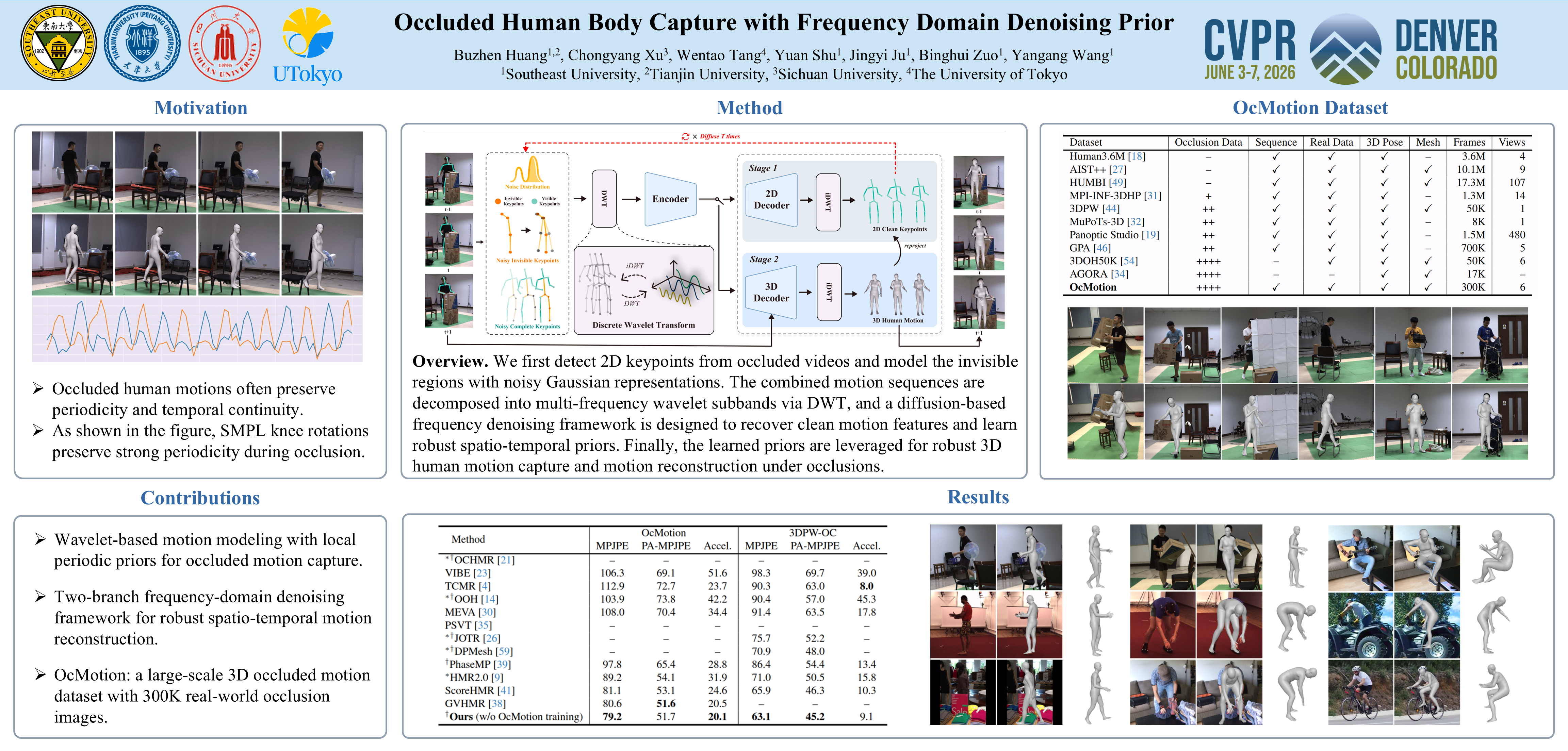
Monocular human motion capture in occlusion scenarios presents significant challenges. Although a few works have explicitly considered the occlusion problem, image-based methods are unreliable due to the lack of temporal constraints while video-based approaches cannot gain sufficient knowledge from time domain motion priors to address long-term occlusions. However, occluded human motion typically exhibits periodic patterns and consistent momentum. Inspired by this observation, we exploit reliable image observations in frequency domain and formulate the motion capture task as a wavelet coefficients selection process. Specifically, we first construct probabilistic distributions for the occluded 2D keypoints, and then introduce a frequency domain diffusion model to refine the distributions by learning long-term periodic information and physical momentum with Discrete Wavelet Transform (DWT). Consequently, the learned denoising prior can select valid wavelet components to facilitate the 3D motion capture with a 3D decoder. By employing a joint reprojection strategy, we can also use the same diffusion process to train the 3D decoder. To further promote human occlusion-related tasks, we also present the first 3D occluded motion dataset, OcMotion, which serves as a new benchmark for both training and evaluation. Experimental results demonstrate that our method can produce accurate and coherent human motions from occluded videos. The dataset and code will be publicly available.
ResiHMR: Residual-Limb Aware Single-Image 3D Human Mesh Recovery for Individuals with Limb Loss
Jiaying Ying ⋅ Heming Du ⋅ Kaihao Zhang ⋅ Sean M. Tweedy ⋅ Xin Yu
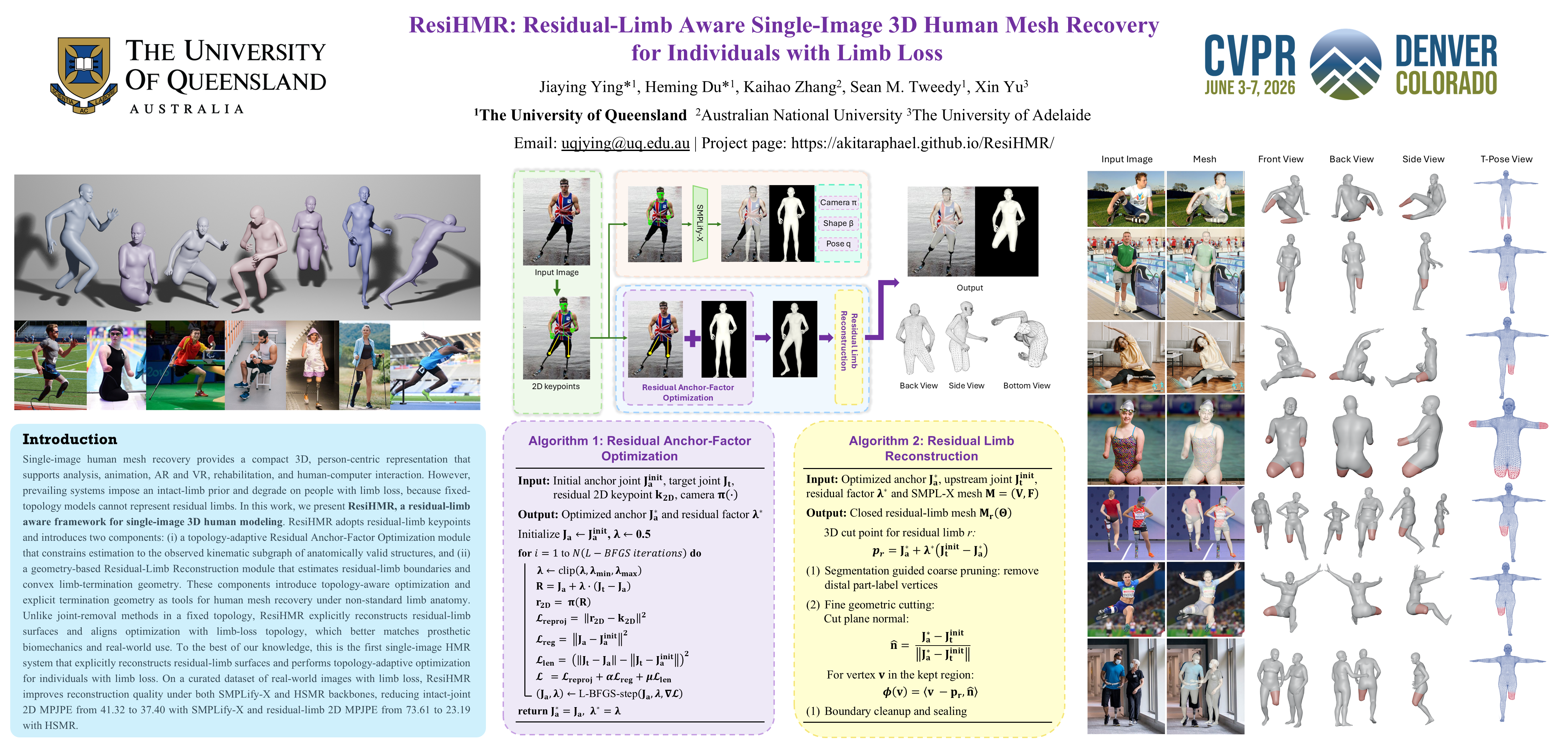
Single-image human mesh recovery provides a compact 3D, person-centric representation that supports analysis, animation, AR and VR, rehabilitation, and human–computer interaction. However, prevailing systems impose an intact-limb prior and degrade on people with limb loss, because fixed-topology models cannot represent residual limbs.In this work, we present ResiHMR, a residual-limb aware framework for single-image 3D human modeling. ResiHMR adopts residual-limb keypoints and introduces two components: (i) a topology-adaptive Residual Anchor-Factor Optimization module that constrains estimation to the observed kinematic subgraph of anatomically valid structures, and (ii) a geometry-based Residual-Limb Reconstruction module that estimates residual-limb boundaries and convex limb-termination geometry. Together, these modules introduce topology-aware optimization and explicit termination geometry as tools for human mesh recovery under non-standard limb anatomy.Unlike joint-removal methods in a fixed topology, ResiHMR explicitly reconstructs residual-limb surfaces and aligns optimization with limb-loss topology, which better matches prosthetic biomechanics and real-world use. To the best of our knowledge, this is the first single-image HMR system that explicitly reconstructs residual-limb surfaces and performs topology-adaptive optimization for individuals with limb loss. On a curated dataset of real-world images with limb loss, compared with SMPLify-X, ResiHMR reduces intact-joint 2D MPJPE from 41.32 to 37.40, increases mIoU from 0.662 to 0.703, and improves anatomical plausibility in expert ratings.
OnlineHMR: Video-based Online World-Grounded Human Mesh Recovery
Yiwen Zhao ⋅ Ce Zheng ⋅ Yufu Wang ⋅ Hsueh-Han Daniel Yang ⋅ Liting Wen ⋅ László A. Jeni
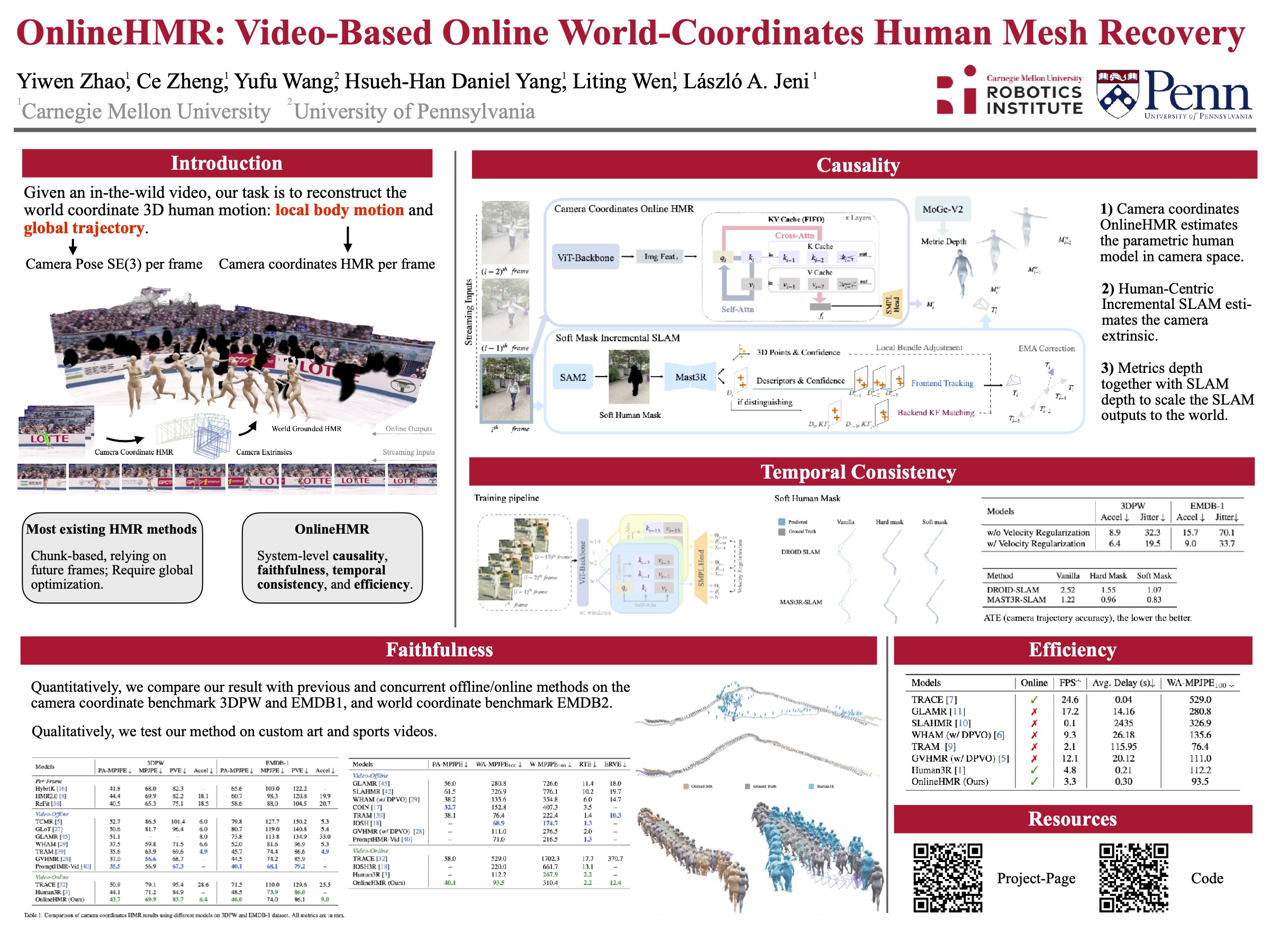
Human mesh recovery (HMR) models 3D human body from monocular videos, with recent works extending it to world-coordinate human trajectory and motion reconstruction. However, most existing methods remain offline, relying on future frames or global optimization, which limits their applicability in interactive feedback and perception-action loop scenarios such as AR/VR and telepresence. To address this, we propose OnlineHMR, a fully online framework that jointly satisfies four essential criteria of online processing, including system-level causality, efficiency, faithfulness, and temporal consistency. Built upon the TRAM architecture, OnlineHMR enables streaming inference via a causal key–value cache design and a curated sliding-window learning strategy. Meanwhile, a human-centric incremental SLAM provides online world-grounded alignment under physical plausible trajectory correction. Experimental results show that our method achieves performance comparable to existing chunk-based approaches on the standard EMDB benchmark and highly dynamic custom videos, while uniquely supporting online processing.
MimiCAT: Mimic with Correspondence-Aware Cascade-Transformer for Category-Free 3D Pose Transfer
Zenghao Chai ⋅ Chen Tang ⋅ Yongkang Wong ⋅ Xulei Yang ⋅ Mohan Kankanhalli
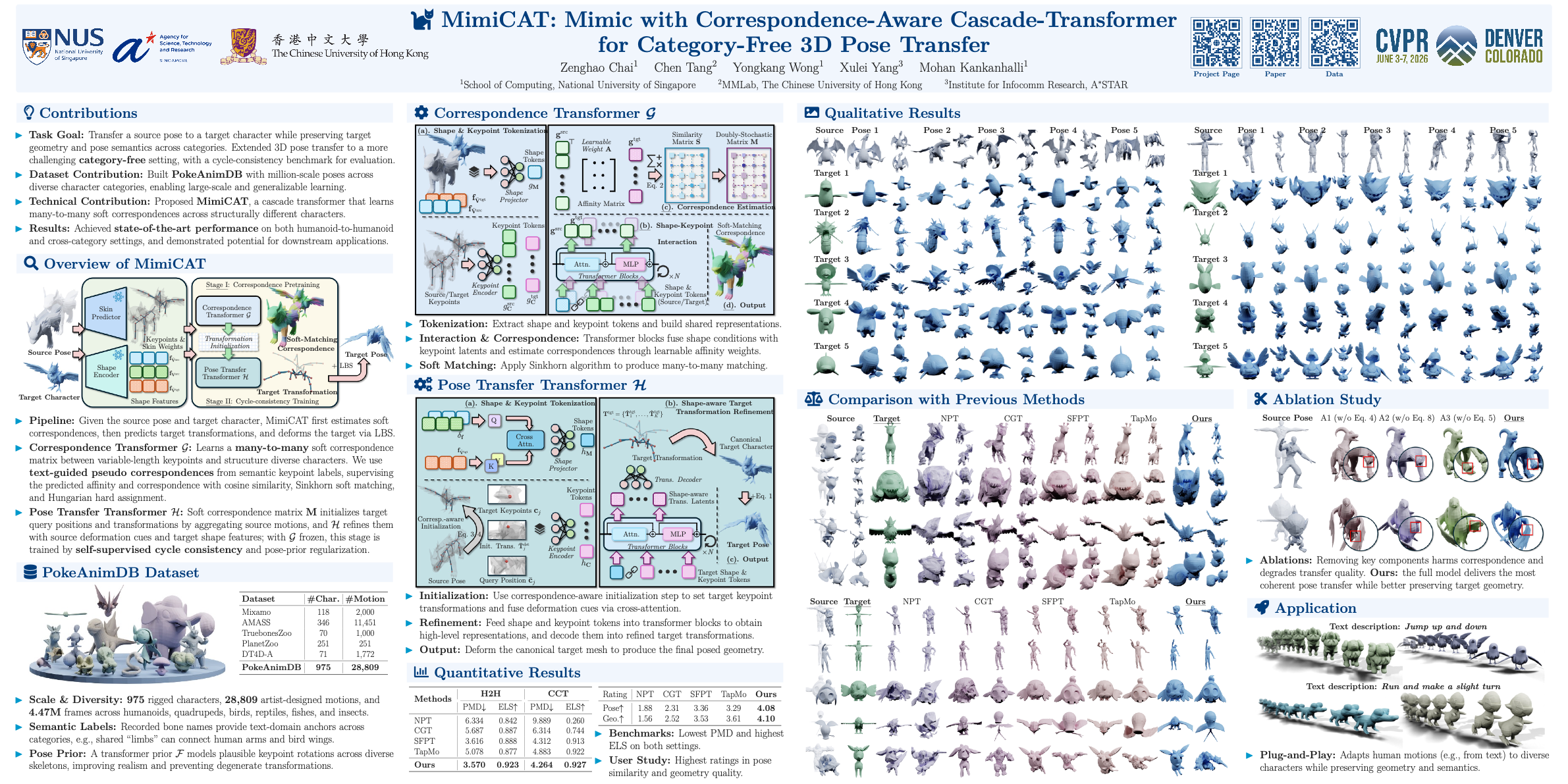
3D pose transfer aims to transfer the pose-style of a source mesh to a target character while preserving both the target's geometry and the source's pose characteristic. Existing methods are largely restricted to characters with similar structures and fail to generalize to category-free settings (e.g., transferring a humanoid's pose to a quadruped). The key challenge lies in the structural and transformation diversity inherent in distinct character types, which often leads to mismatched regions and poor transfer quality. To address these issues, we first construct a million-scale pose dataset across hundreds of distinct characters. We further propose MimiCAT, a cascade-transformer model designed for category-free 3D pose transfer. Instead of relying on strict one-to-one correspondence mappings, MimiCAT leverages semantic keypoint labels to learn a novel soft correspondence that enables flexible many-to-many matching across characters. The pose transfer is then formulated as a conditional generation process, in which the source transformations are first projected onto the target through soft correspondence matching and subsequently refined using shape-conditioned representations. Extensive qualitative and quantitative experiments demonstrate that MimiCAT transfers plausible poses across different characters, significantly outperforming prior methods that are limited to narrow category transfer (e.g., humanoid-to-humanoid).
Exploring Adaptive Masked Reconstruction for Self-Supervised Skeleton-Based Action Recognition
Shengkai Sun ⋅ Zhiyong Cheng ⋅ Zefan Zhang ⋅ Jianfeng Dong ⋅ Zhihui Li ⋅ Meng Wang
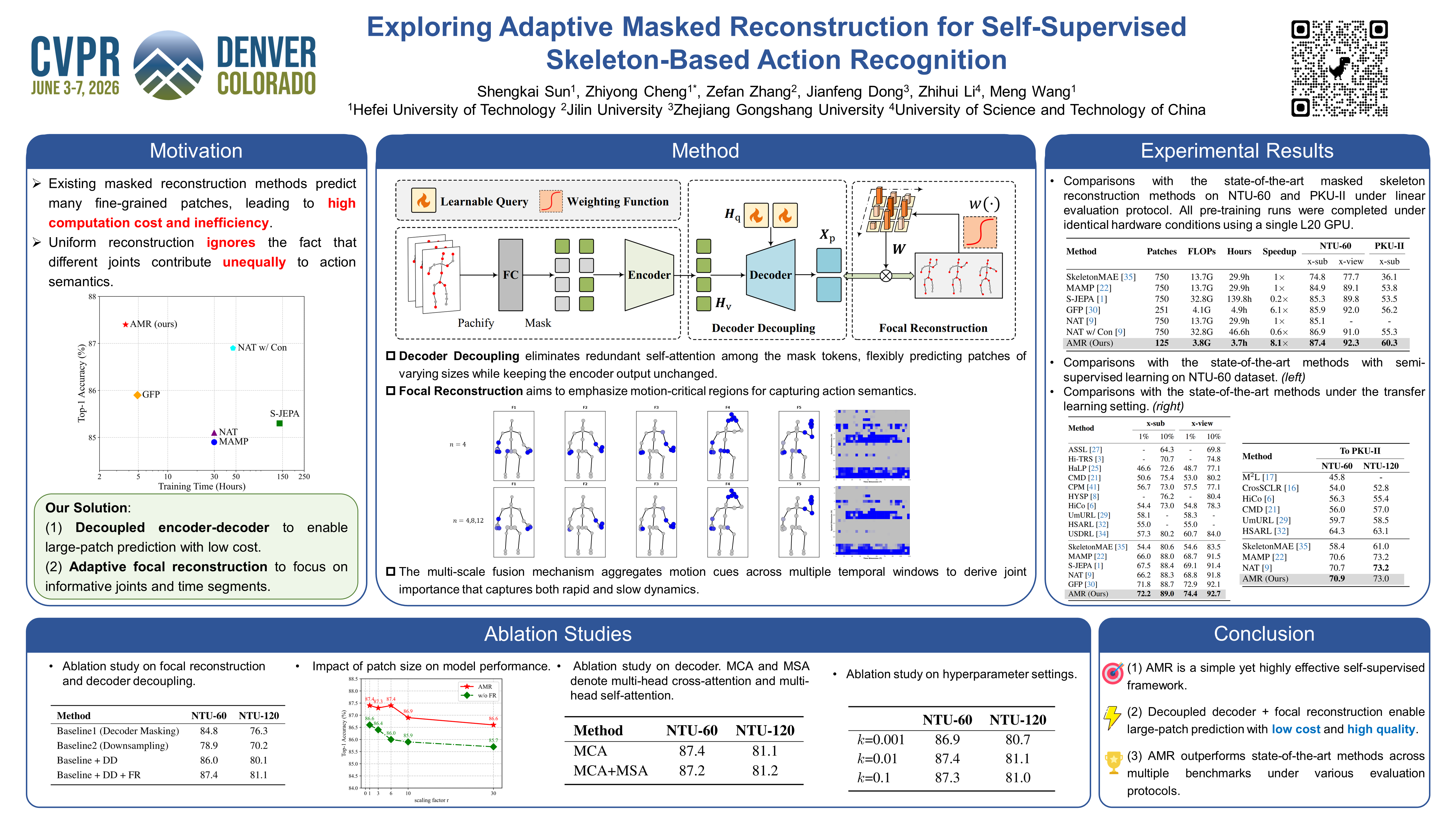
Recently, masked skeleton reconstruction models have emerged as strong action representation learners, driving significant progress in self-supervised skeleton‑based action recognition. However, existing state‑of‑the‑art methods must predict an exceedingly large number of spatiotemporal patches, significantly prolonging training time. Besides, by treating all spatiotemporal regions equally during reconstruction, these models are distracted from learning the critical motion patterns that underlie action semantics. To address these challenges, we propose Adaptive Masked Reconstruction (AMR), a faster and stronger pre‑training framework. We first decouple the decoder from the encoder, enabling flexible prediction of larger spatiotemporal patches and dramatically reducing reconstruction complexity. Given that larger patches contain more complex information, which is challenging to predict and consequently degrades performance, we accordingly introduce an adaptive guidance module. This module identifies regions of high motion informativeness, guiding the model to focus on the most discriminative parts of each patch and alleviating reconstruction difficulty. Experiments on NTU RGB+D 60, NTU RGB+D 120, and PKU-MMD datasets demonstrate that AMR not only accelerates pre‑training substantially but also improves downstream recognition accuracy, surpassing current state‑of‑the‑art approaches.
DFD-HR: Generalizable Deepfake Detection via Hierarchical Routing Learning
JIAMU SUN ⋅ Zhiyuan Yan ⋅ Ke-Yue Zhang ⋅ Taiping Yao ⋅ Shouhong Ding
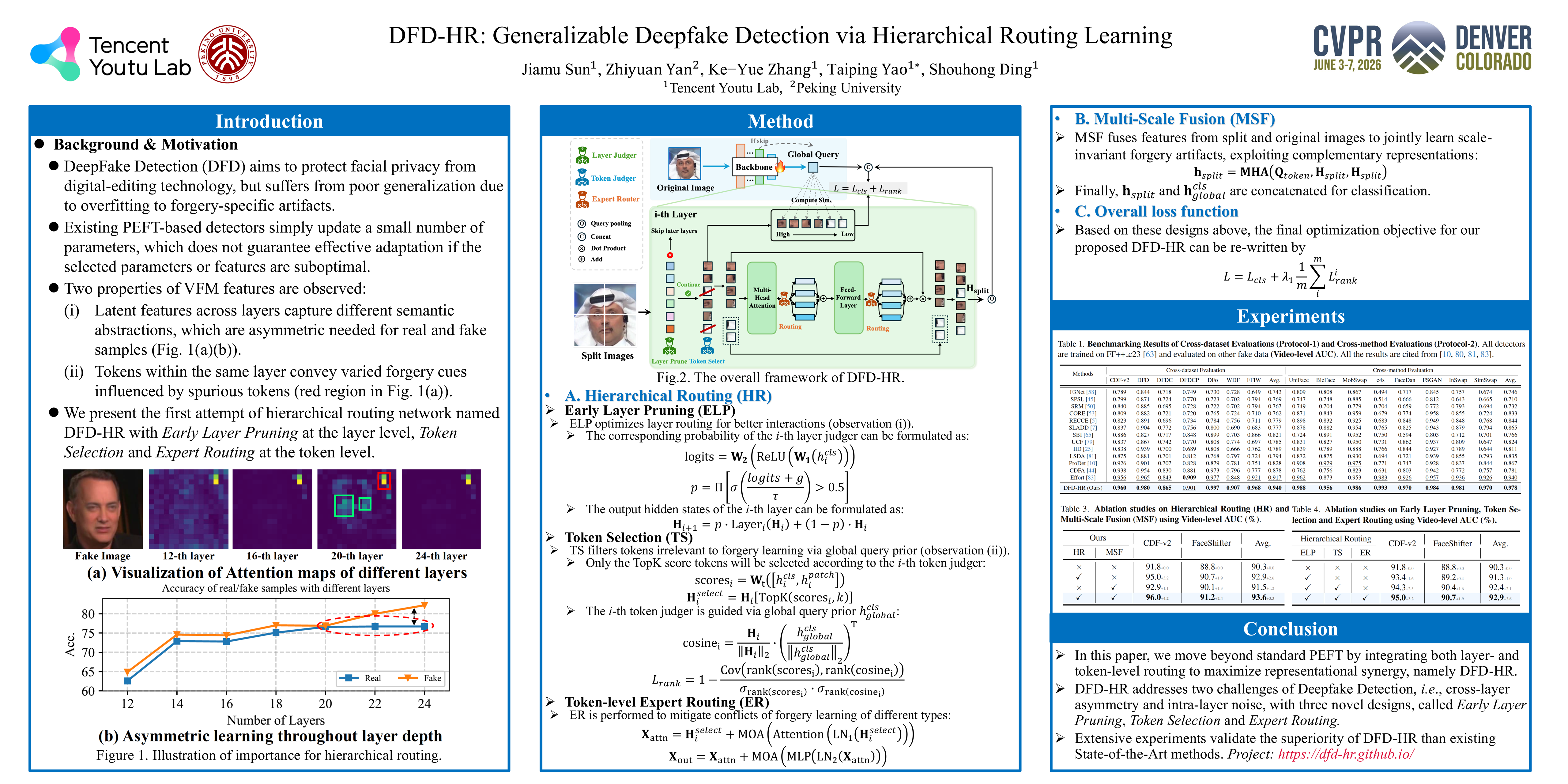
Developing generalizable deepfake detectors has become increasingly important with the rapid advancement of generative models. Adapting visual foundation models (VFMs), e.g., CLIP, through parameter-efficient finetuning (PEFT), with only a small subset of parameters updated, has been proven highly effective for generalizable detection. However, the success of “fewer-parameters” training raises an important question: although only a few parameters are tuned, have existing PEFT-based detectors truly exploited the most informative ones while eliminating redundant parameters for better generalization? In this work, we move beyond standard PEFT by proposing a joint optimization strategy that operates at both the layer and token levels. Since latent features across layers capture different semantic abstractions and tokens within the same layer convey varied forgery cues, we propose integrating both layer-level and token-level routing to maximize representational synergy. Specifically, at the layer level, we introduce "Early Layer Pruning", an adaptive truncation mechanism that enables the model to adaptively learn distinct forward depths for different types of instances. At the token level, "Token Selection" is guided by the Spearman rank loss to filter tokens irrelevant to forgery learning, enabling the model to focus on the most discriminative cues. Furthermore, a unified MoE architecture is applied that encourages diversity and thus reduces the potential model's overfitting to specific forgery types. Extensive benchmarking results demonstrate the effectiveness of our designs and show the superior performance of our method over existing state-of-the-arts.
MGDHand: Multi-Granularity Prior-to-Inertial Distillation Framework for Sequential 3D Hand Pose Estimation from Sparse IMUs
Xinyi Wang ⋅ Pengfei Ren ⋅ HaoYang ZHANG ⋅ Hanling Zhan ⋅ Yingxi Li ⋅ Liang Xie ⋅ Yue Gao ⋅ Erwei Yin
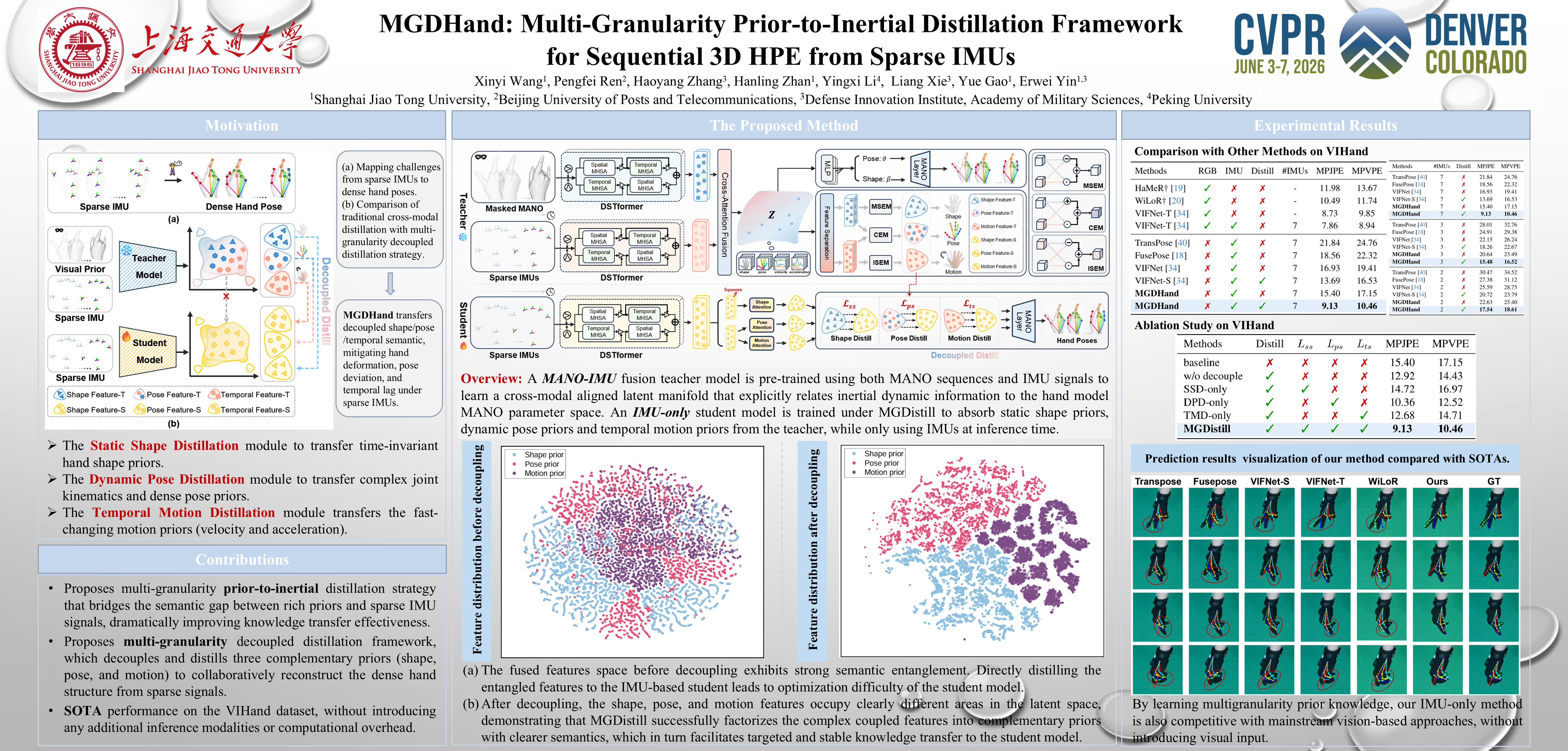
3D hand pose estimation (HPE) from sparse inertial measurement units (IMUs) has shown great potential in human-computer interaction. However, due to the significant semantic gap between sparse local motion information and structured global pose information, estimating the hand poses from sparse IMU signals is ambiguous and challenging. Knowledge distillation can transfer rich knowledge from the stronger teacher to the student, so that the student enhances performance. Existing approaches distill morphological priors into the IMU-based student model, effectively improving its accuracy in complex scenarios. Nevertheless, overlooking the visual-inertial inherent semantic mismatch and information density difference leads to difficulties for students to learn coupled priors. In this paper, we propose a \textbf{M}ulti-\textbf{G}ranularity Prior-to-Inertial \textbf{D}istillation Framework for Sequential 3D \textbf{H}PE from Sparse IMUs (\textbf{MGDHand}). We first pre-train a MANO-IMU fusion model as a teacher to encode static geometric morphology prior, dynamic kinematic prior and temporal motion prior. Then, a \textbf{M}ulti-\textbf{G}ranularity Decoupled \textbf{Distill}ation (\textbf{MGDistill}) scheme is proposed to bridge the semantic gap. MGDistill includes a \textbf{Static Shape Distillation} module to transfer time-invariant hand shape priors, and a \textbf{Dynamic Pose Distillation} module to transfer complex joint kinematics and dense pose priors. Additionally, a \textbf{Temporal Motion Distillation} module transfers the fast-changing motion priors (velocity and acceleration). Extensive experiments on public dataset demonstrate that our method outperforms state-of-the-art approaches under sparse IMU configurations.
CARI4D: Category Agnostic 4D Reconstruction of Human-Object Interaction
Xianghui Xie ⋅ Bowen Wen ⋅ Yan Chang ⋅ Hesam Rabeti ⋅ Jiefeng Li ⋅ Ye Yuan ⋅ Gerard Pons-Moll ⋅ Stan Birchfield
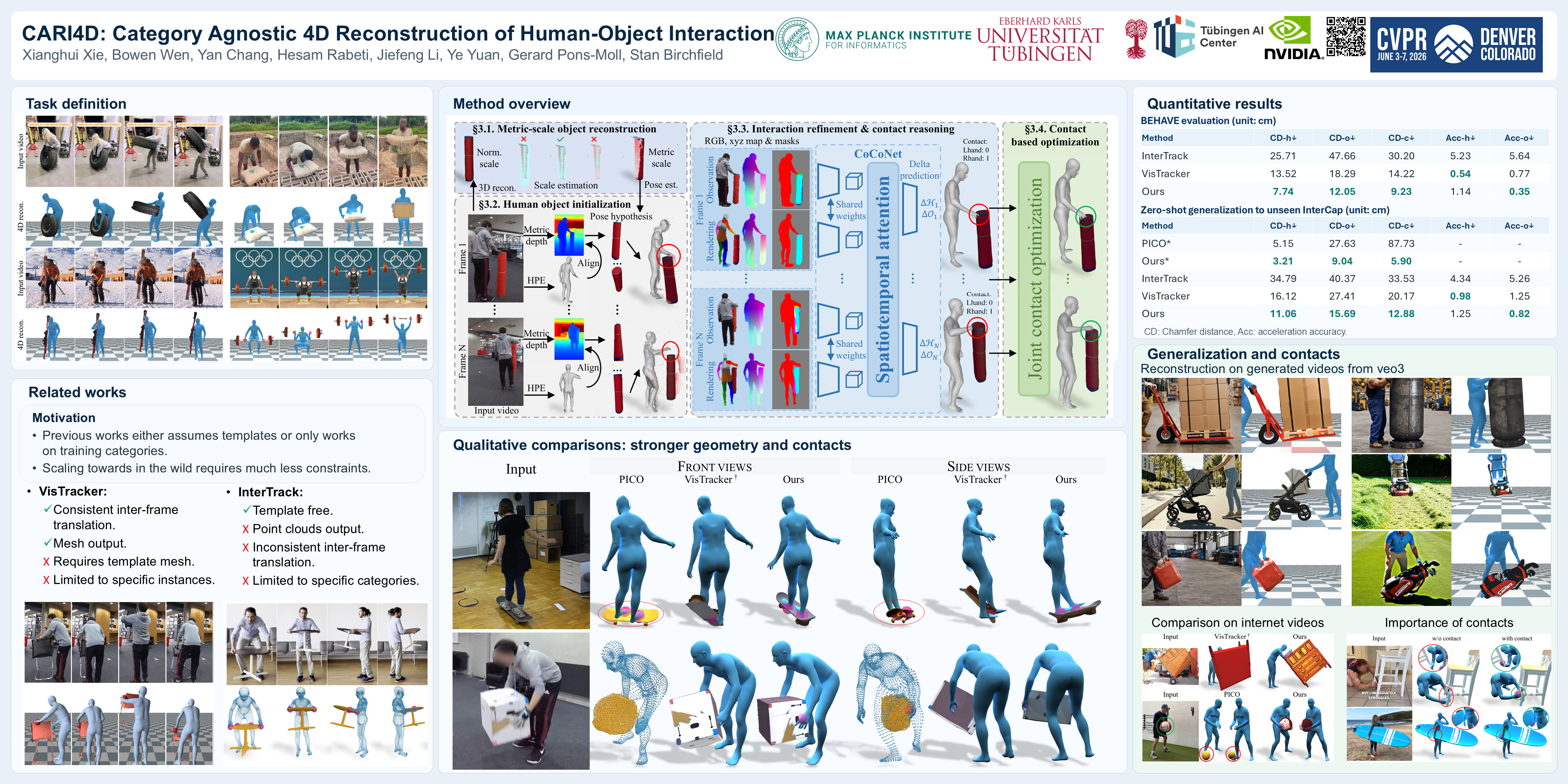
Accurate capture of human-object interaction from ubiquitous sensors like RGB cameras is important for applications in human understanding, gaming, and robot learning. However, inferring 4D interactions from a single RGB view is highly challenging due to the unknown object and human information, depth ambiguity, occlusion, and complex motion, which hinder consistent 3D and temporal reconstruction. Previous methods simplify the setup by assuming ground truth object template or constraining to a limited set of object categories. We present CARI4D, the first category-agnostic method that reconstructs spatially and temporarily consistent 4D human-object interaction at metric scale from monocular RGB videos. To this end, we propose a pose hypothesis selection algorithm that robustly integrates the individual predictions from foundation models, jointly refine them through a learned render-and-compare paradigm to ensure spatial, temporal and pixel alignment, and finally reasoning about intricate contacts for further refinement satisfying physical constraints. Experiments show that our method outperforms prior art by 38\% on in-distribution dataset and 36\% on unseen dataset in terms of reconstruction error. Our model generalizes beyond the training categories and thus can be applied zero-shot to in-the-wild internet videos. Our code and pretrained models will be publicly released.
E-3DPSM: A State Machine for Event-based Egocentric 3D Human Pose Estimation
Mayur Deshmukh ⋅ Hiroyasu Akada ⋅ Helge Rhodin ⋅ Christian Theobalt ⋅ Vladislav Golyanik
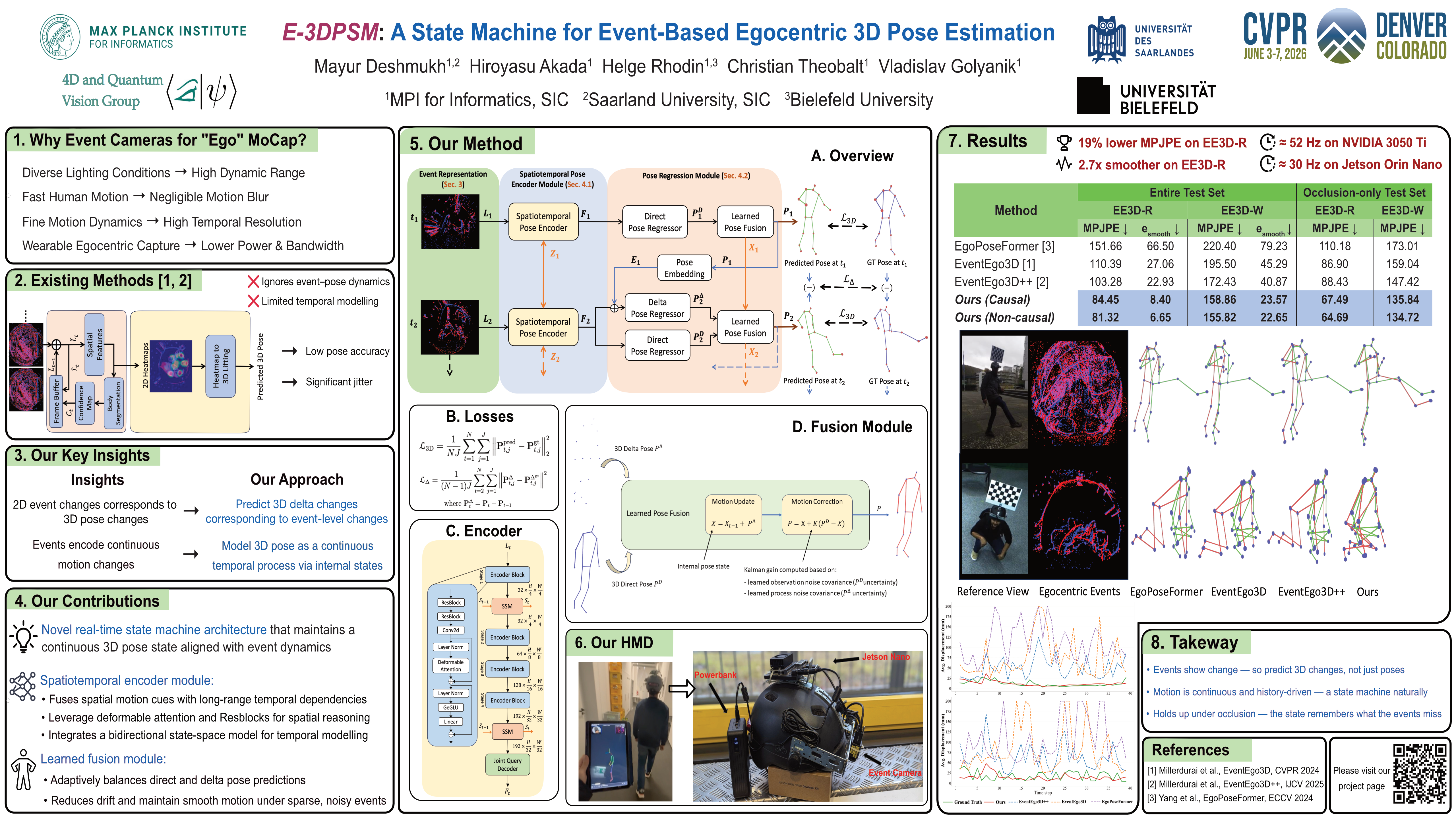
Event cameras offer multiple advantages in monocular egocentric 3D human pose estimation from head-mounted devices, such as millisecond temporal resolution, high dynamic range, and negligible motion blur. Existing methods effectively leverage these properties, but suffer from low 3D estimation accuracy, insufficient in many applications (e.g., immersive VR/AR). This is due to the design not being fully tailored towards event streams (e.g., their asynchronous and continuous nature), leading to high sensitivity to self-occlusions and temporal jitter in the estimates. This paper rethinks the setting and introduces E-3DPSM, an event-driven continuous pose state machine for event-based egocentric 3D human pose estimation. E-3DPSM aligns continuous human motion with fine-grained event dynamics; it evolves latent states and predicts continuous changes in 3D joint positions associated with observed events, which are fused with direct 3D human pose predictions, leading to stable and drift-free final 3D pose reconstructions. E-3DPSM runs in real-time at $80$ Hz on a single workstation and sets a new state of the art in experiments on two benchmarks, improving accuracy by up to $19$% (MPJPE) and temporal stability by up to $2.7\times$. Our source code will be publicly released upon publication.
Bézier Degradation Modeling for LiDAR-based Human Motion Capture
Xiaoqi An ⋅ Lin Zhao ⋅ Jun Li ⋅ Chen Gong ⋅ Jian Yang
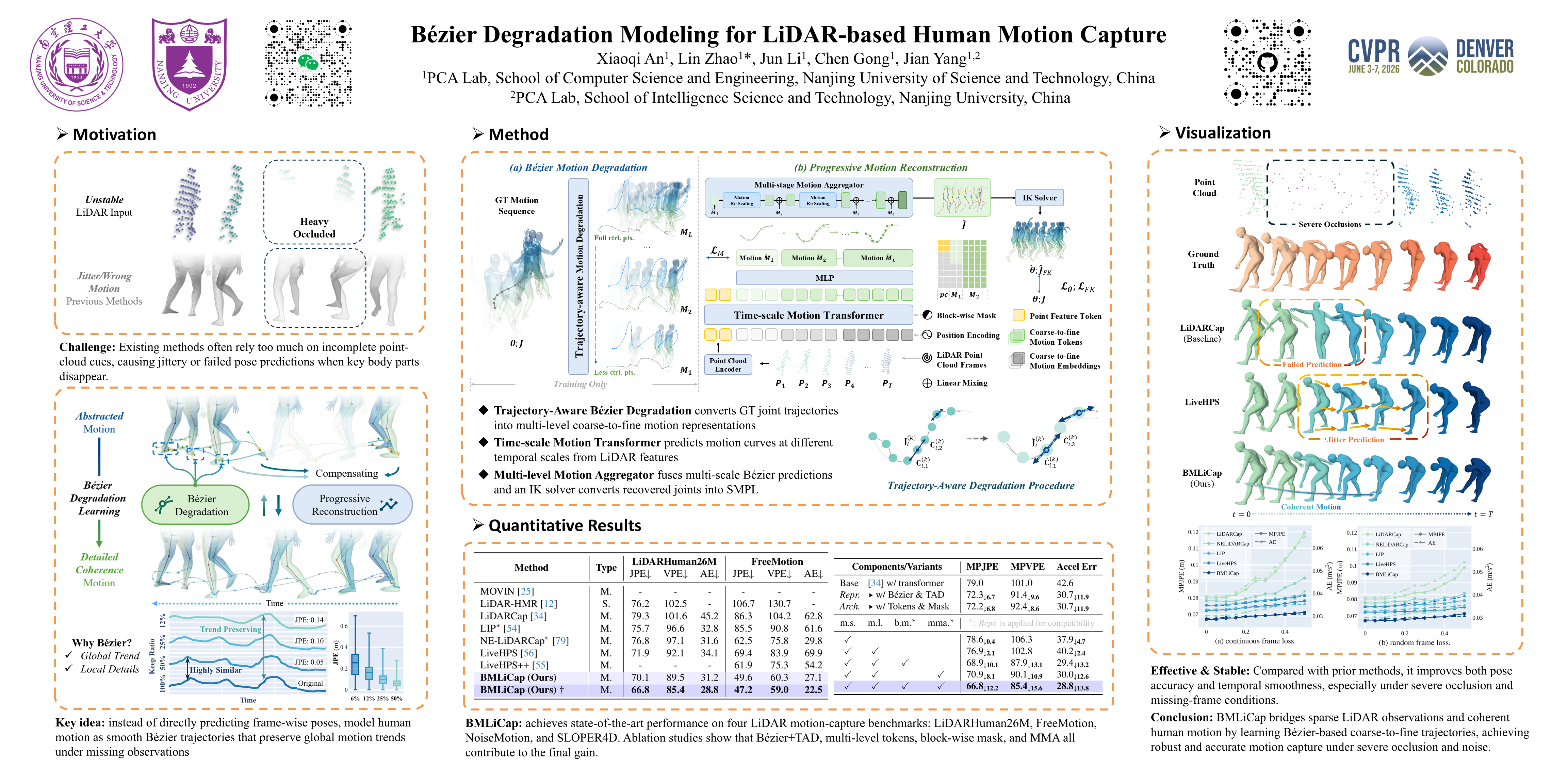
LiDAR-based 3D human motion capture has broad applications in fields such as autonomous driving and robotics, where accurate motion reconstruction is crucial. However, existing methods often struggle with unstable inputs and severe occlusions, leading to jittery or even failed pose predictions. To address these challenges, we propose BMLiCap, a coarse-to-fine framework that models motion using temporally compressible Bézier curves. By reducing control points through a trajectory-preserving strategy, we obtain a coherent and learning-friendly motion representation. To reconstruct human actions from LiDAR point-cloud cues, we design a progressive motion-reconstruction module. Specifically, a Time-scale Motion Transformer (TMT) is introduced to predict motion curves at multiple temporal scales, and a Multi-level Motion Aggregator (MMA) is utilized to adaptively fuse the multi-scale curves to recover detailed, temporally coherent poses, effectively bridging observation gaps caused by occlusions and noise. Across four mainstream benchmarks LiDARHuman26M, FreeMotion, NoiseMotion, and SLOPER4D, BMLiCap achieves state-of-the-art accuracy and temporal continuity in complex scenes, demonstrating its ability to compensate for severe occlusions and reduce prediction jitter.
UniSH: Unifying Scene and Human Reconstruction in a Feed-Forward Pass
Mengfei Li ⋅ Peng Li ⋅ Zheng Zhang ⋅ Jiahao Lu ⋅ Chengfeng Zhao ⋅ Wei Xue ⋅ Qifeng Liu ⋅ Sida Peng ⋅ Wenxiao ZHANG ⋅ Wenhan Luo ⋅ Yuan Liu ⋅ Yike Guo
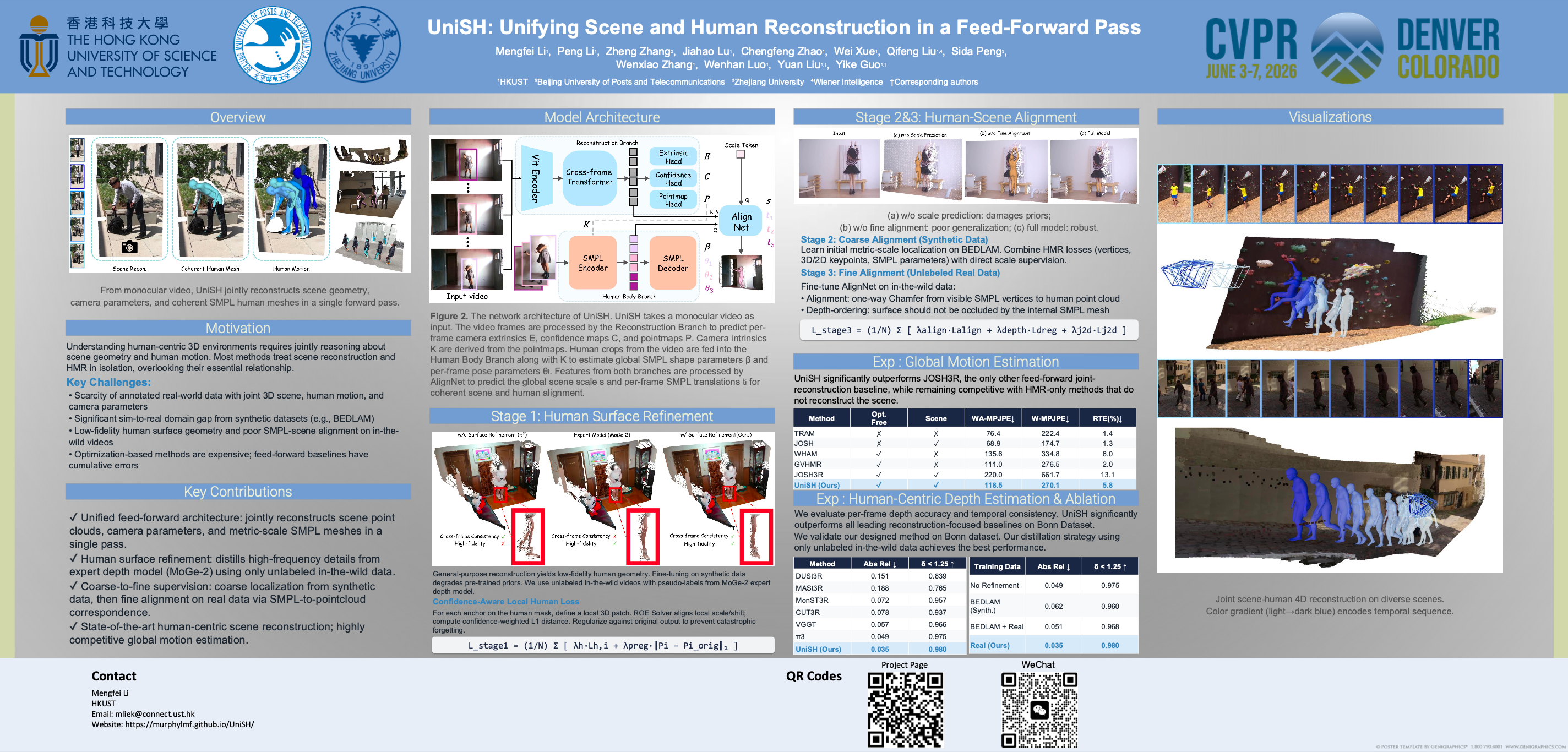
We present UniSH, a unified, feed-forward framework for joint metric-scale 3D scene and human reconstruction. A key challenge in this domain is the scarcity of large-scale, annotated real-world data, forcing a reliance on synthetic datasets. This reliance introduces a significant sim-to-real domain gap, leading to poor generalization, low-fidelity human geometry, and poor alignment on in-the-wild videos. To address this, we propose an innovative training paradigm that effectively leverages unlabeled in-the-wild data. Our framework bridges strong, disparate priors from scene reconstruction and HMR, and is trained with two core components: (1) a robust distillation strategy to refine human surface details by distilling high-frequency details from an expert depth model, and (2) a two-stage supervision scheme, which first learns coarse localization on synthetic data, then fine-tunes on real data by directly optimizing the geometric correspondence between the SMPL mesh and the human point cloud. This approach enables our feed-forward model to jointly recover high-fidelity scene geometry, human point clouds, camera parameters, and coherent, metric-scale SMPL bodies, all in a single forward pass. Extensive experiments demonstrate that our model achieves state-of-the-art performance on human-centric scene reconstruction and delivers highly competitive results on global human motion estimation, comparing favorably against both optimization-based frameworks and HMR-only methods.
Illumination-Consistent Human-Scene Reconstruction from Monocular Video
Rongbin Zheng ⋅ Wensheng Li ⋅ Lingzhe Zeng ⋅ Dong Wang ⋅ Chengying Gao
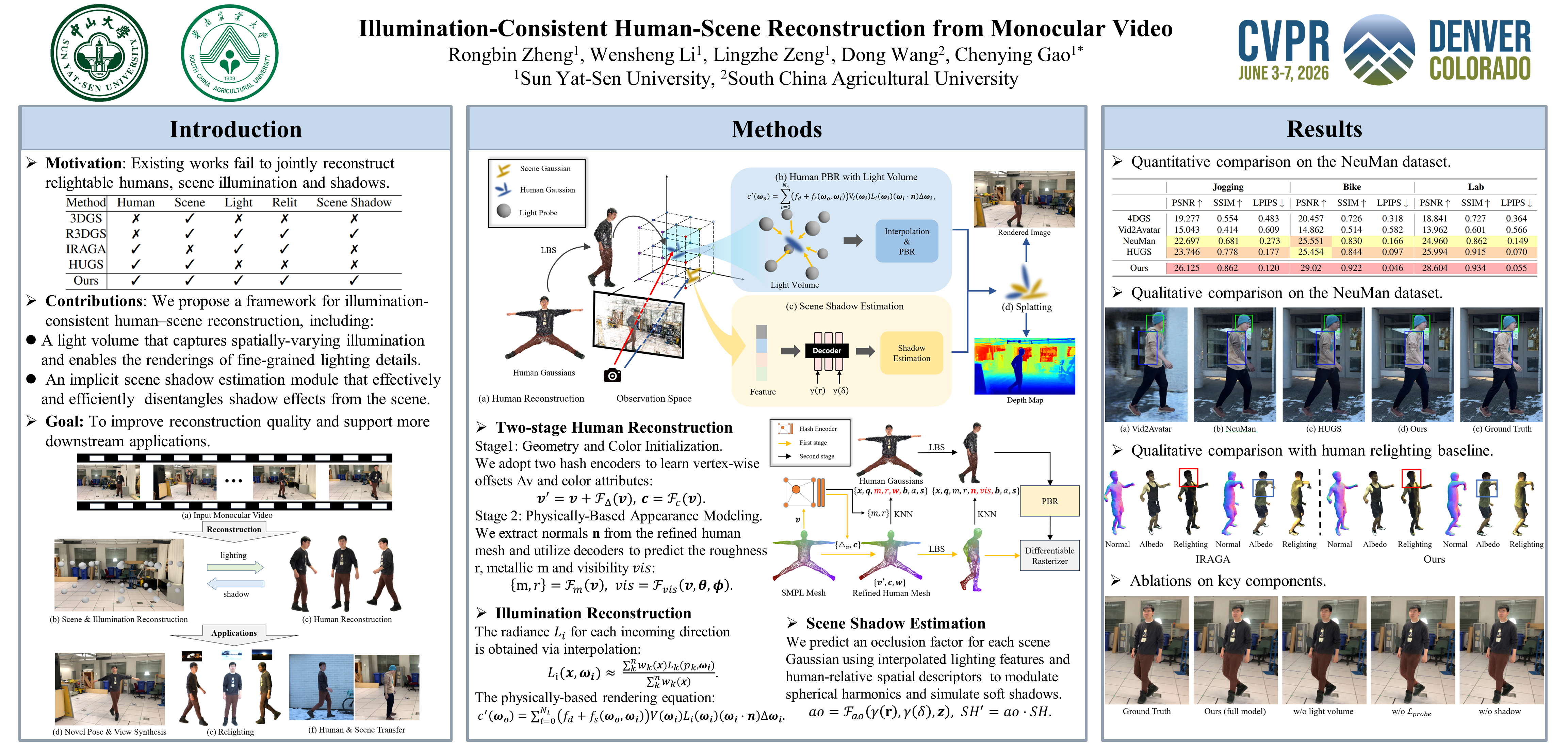
Reconstructing 3D humans and scenes from monocular videos is a challenging task, particularly due to human motion, varying illumination, and dynamic scene shadows. While recent works have explored scene disentanglement by jointly modeling humans and their surrounding scenes, they often overlook illumination and shadow effects—resulting in inconsistent human appearance and degraded scene realism. To address this gap, we propose a photometrically consistent integration of human and scene reconstruction based on 3D Gaussian Splatting, with a key focus on modeling spatially-varying illumination and shadows. Central to our method is a learnable light volume that provides localized lighting cues to human Gaussians, enabling more realistic and consistent appearance synthesis. To further ensure accurate human geometry and alignment, we adopt a two-stage reconstruction strategy: we first optimize a human mesh and then anchor Gaussians to the refined surface. In addition, we introduce an implicit shadow estimation module that disentangles cast shadows from the scene, thus supporting plausible human shadow synthesis. Our framework also facilitates human relighting and compositing into novel scenes with contextually appropriate lighting. Quantitative and qualitative results demonstrate that our method achieves state-of-the-art performance, producing consistent appearances, realistic illumination, and enhanced overall scene realism.
Attribution as Retrieval: Model-Agnostic AI-Generated Image Attribution
Hongsong Wang ⋅ Renxi Cheng ⋅ Chaolei Han ⋅ Jie Gui
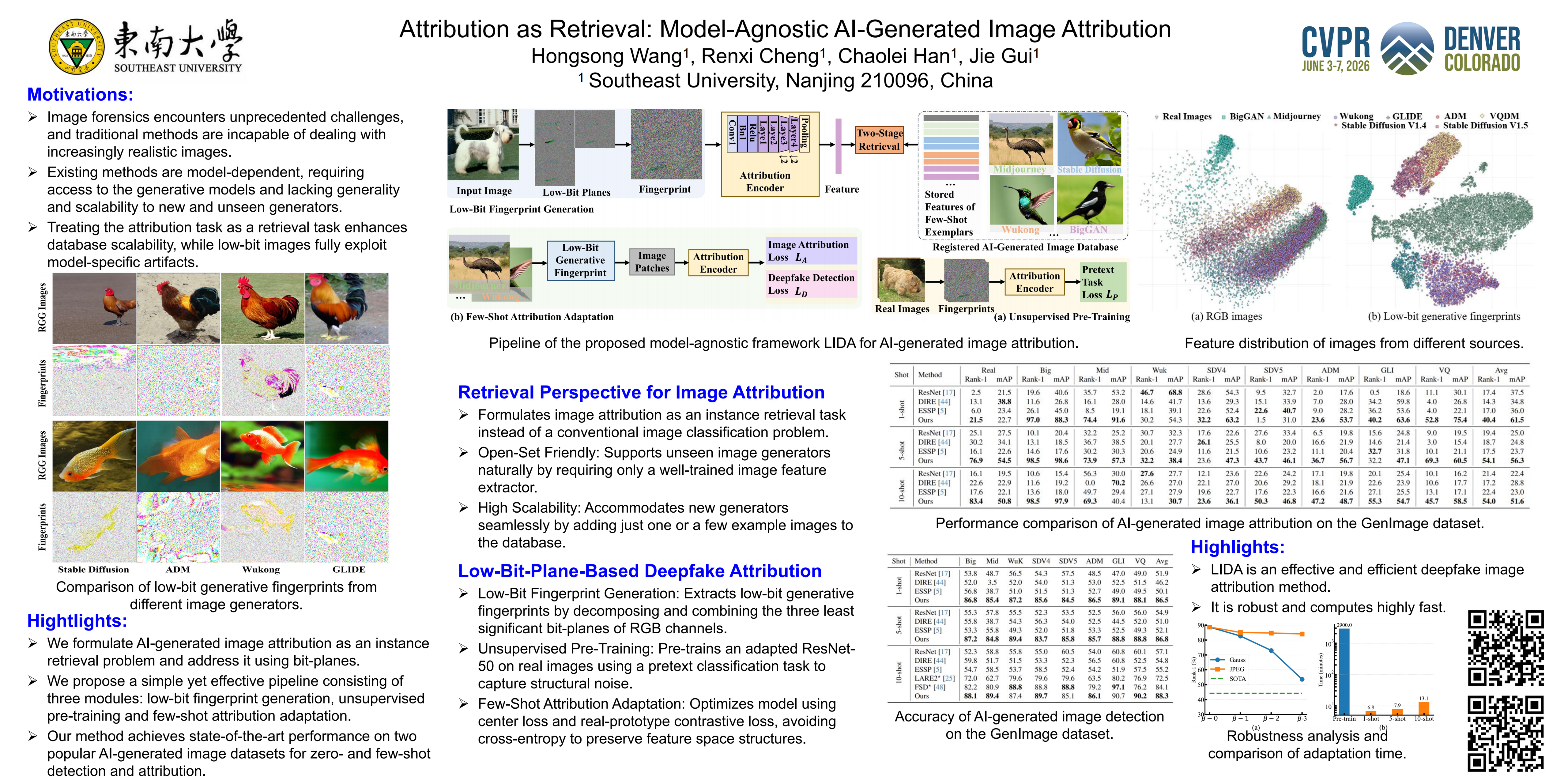
With the rapid advancement of AIGC technologies, image forensics will encounter unprecedented challenges. Traditional methods are incapable of dealing with increasingly realistic images generated by rapidly evolving image generation techniques. To facilitate the identification of AI-generated images and the attribution of their source models, generative image watermarking and AI-generated image attribution have emerged as key research focuses in recent years. However, existing methods are model-dependent, requiring access to the generative models and lacking generality and scalability to new and unseen generators. To address these limitations, this work presents a new paradigm for AI-generated image attribution by formulating it as an instance retrieval problem instead of a conventional image classification problem. We propose an efficient model-agnostic framework, called Low-bIt-plane-based Deepfake Attribution (LIDA). The input to LIDA is produced by Low-Bit Fingerprint Generation module, while the training involves Unsupervised Pre-Training followed by subsequent Few-Shot Attribution Adaptation.Comprehensive experiments demonstrate that LIDA achieves state-of-the-art performance for both Deepfake detection and image attribution under zero- and few-shot settings.
Agent4FaceForgery: Multi-Agent LLM Framework for Realistic Face Forgery Detection
Yingxin Lai ⋅ Zitong YU ⋅ Jun Wang ⋅ Linlin Shen ⋅ Yong Xu ⋅ Xiaochun Cao
Face forgery detection faces a critical challenge: a persistent gap between offline benchmarks and real-world efficacy, which we attribute to the ecological invalidity of training data. This work introduces Agent4FaceForgery to address two fundamental problems: (1) how to capture the diverse intents and iterative processes of human forgery creation, and (2) how to model the complex, often adversarial, text-image interactions that accompany forgeries in social media. To solve this, we propose a multi-agent framework where LLM-powered agents, equipped with profile and memory modules, simulate the forgery creation process. Crucially, these agents interact in a simulated social environment to generate samples labeled for nuanced text-image consistency, moving beyond simple binary classification. An Adaptive Rejection Sampling (ARS) mechanism ensures data quality and diversity. Extensive experiments validate that the data generated by our simulation-driven approach brings significant performance gains to detectors of multiple architectures, fully demonstrating the effectiveness and value of our framework.
Enabling Supervised Learning of Generative Signatures for Generalized Synthetic Image Detection
Jianwei Fei ⋅ Yunshu Dai ⋅ Xiaoyu Zhou ⋅ Zhihua Xia ⋅ Alessandro Piva
Extracting reliable generative traces in generated images is critical for AI-generated images (AIGIs) detection. However, a fundamental challenge exists: AIGIs inherently contain generative traces with no trace-free counterpart available, making supervised extraction of these artifacts infeasible. In this work, we overcome this through a surrogate supervision framework. We design a dynamic reconstructor that simulates diverse generative traces on real images through stochastically varied architectures and parameters. The reconstruction residuals serve as supervision to train an extractor that learns to isolate traces, \textit{i.e.}, generative signatures (GenSign). A detector then fuses extracted GenSign with RGB features to distinguish real images from AIGIs. Our key insight is that sufficient architectural diversity in simulation enables effective transfer to real-world generators, resolving the absence of ground truth GenSign. Extensive experiments across four benchmarks demonstrate state-of-the-art generalization, confirming that our simulation-based learning paradigm is capable of extracting general and transferable forensic features.
DiffusionFF: A Diffusion-based Framework for Joint Face Forgery Detection and Fine-Grained Artifact Localization
Siran Peng ⋅ Haoyuan Zhang ⋅ Li Gao ⋅ Tianshuo Zhang ⋅ Xiangyu Zhu ⋅ Bao Li ⋅ Weisong Zhao ⋅ Zhen Lei
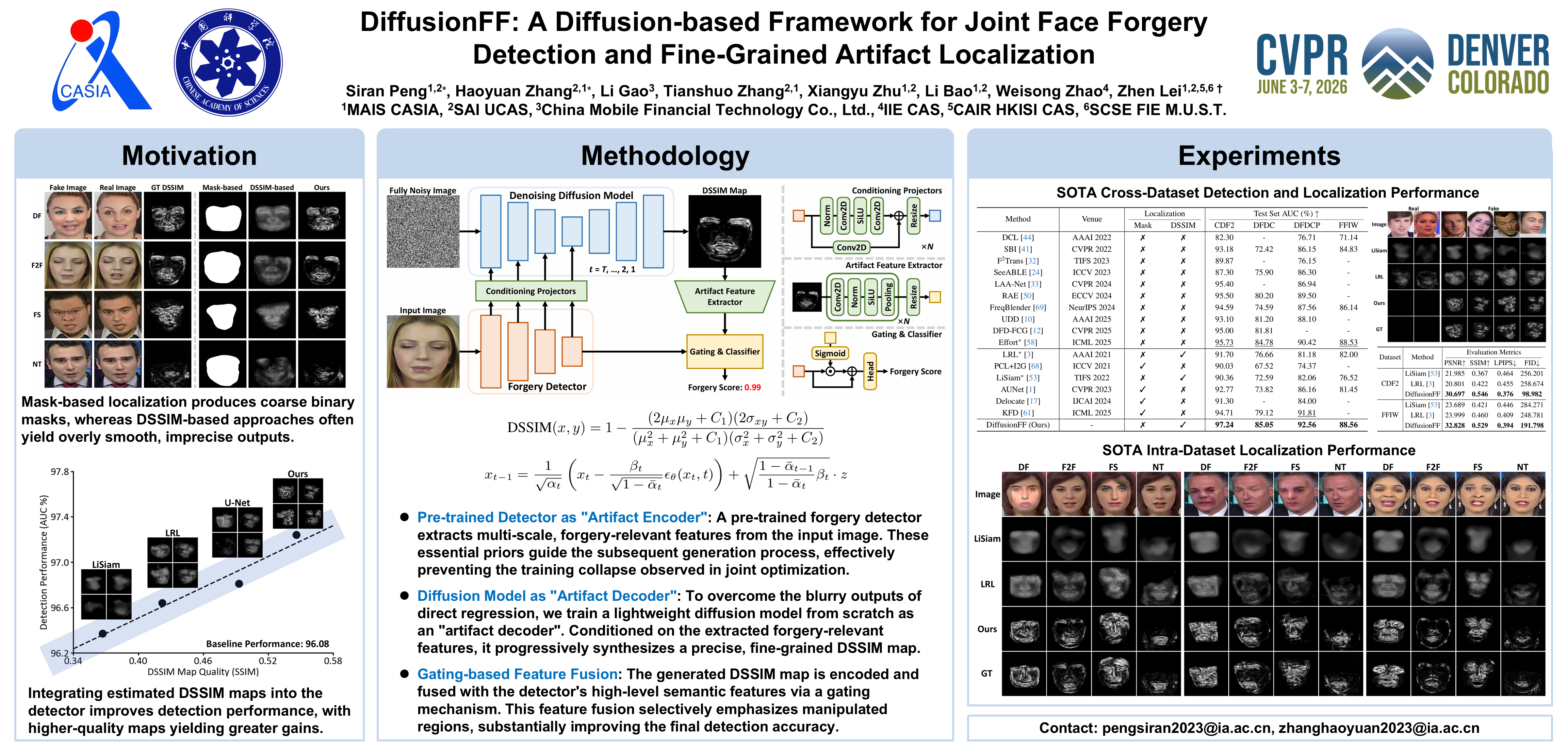
The rapid evolution of deepfake technologies demands robust and reliable face forgery detection algorithms. While determining whether an image has been manipulated remains essential, the ability to precisely localize forgery clues is also important for enhancing model explainability and building user trust. To address this dual challenge, we introduce DiffusionFF, a diffusion-based framework that simultaneously performs face forgery detection and fine-grained artifact localization. Our key idea is to establish a novel encoder–decoder architecture: a pretrained forgery detector serves as a powerful "artifact encoder", and a denoising diffusion model is repurposed as an "artifact decoder". Conditioned on multi-scale forgery-related features extracted by the encoder, the decoder progressively synthesizes a detailed artifact localization map. We then fuse this fine-grained localization map with high-level semantic features from the forgery detector, leading to substantial improvements in detection capability. Extensive experiments demonstrate that DiffusionFF achieves state-of-the-art (SOTA) performance across multiple benchmarks, underscoring its superior effectiveness, reliability, and explainability. The code will be released upon acceptance.
All in One: Unifying Deepfake Detection, Tampering Localization, and Source Tracing with a Robust Landmark-Identity Watermark
Junjiang Wu ⋅ Liejun Wang ⋅ Zhiqing Guo
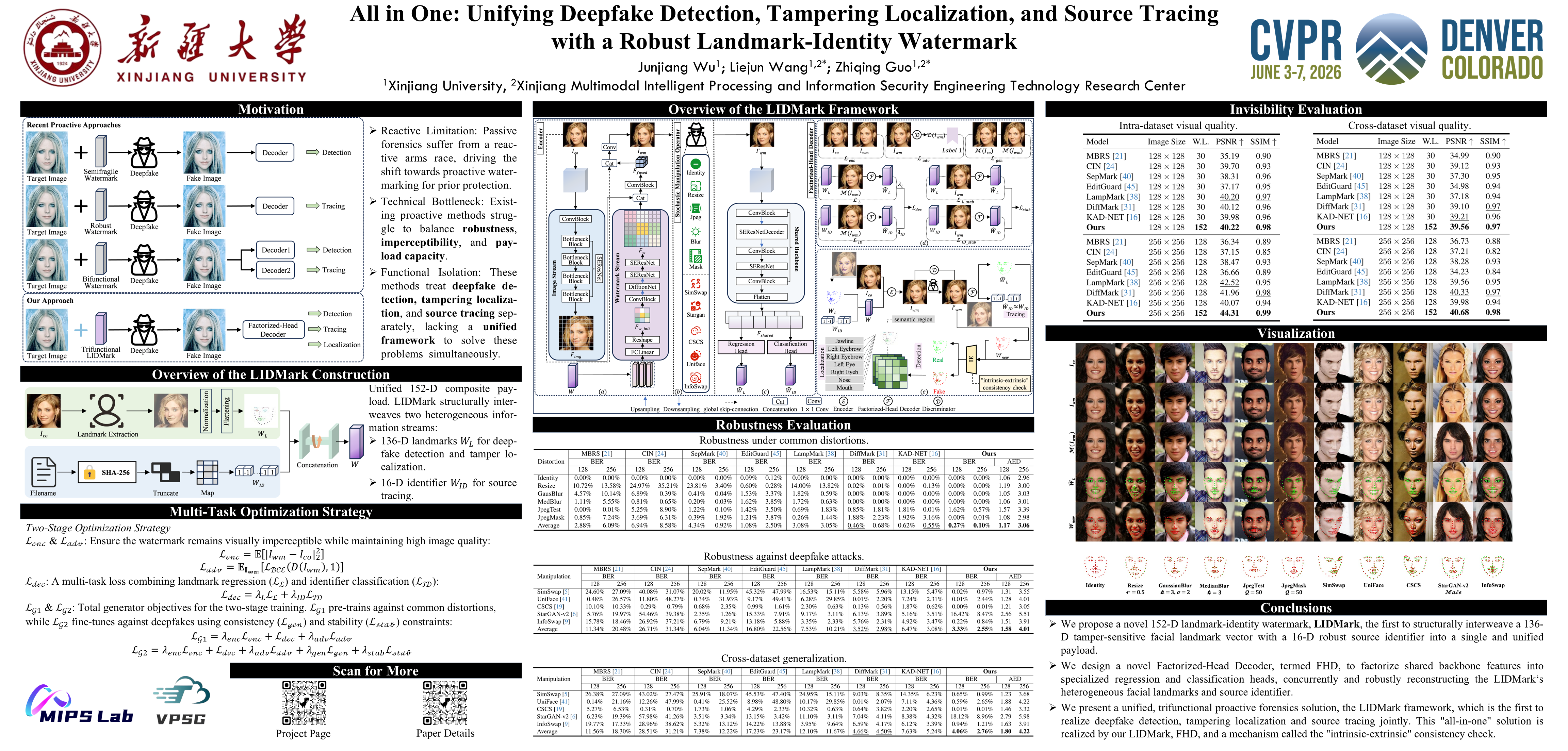
With the rapid advancement of deepfake technology, malicious face manipulations pose a significant threat to personal privacy and social security. However, existing proactive forensics methods typically treat deepfake detection, tampering localization, and source tracing as independent tasks, lacking a unified framework to address them jointly. To bridge this gap, we propose a unified proactive forensics framework that jointly addresses these three core tasks. Our core framework adopts an innovative 152-dimensional landmark-identity watermark termed LIDMark, which structurally interweaves facial landmarks with a unique source identifier. To robustly extract the LIDMark, we design a novel Factorized-Head Decoder (FHD). Its architecture factorizes the shared backbone features into two specialized heads (i.e., regression and classification), robustly reconstructing the embedded landmarks and identifier, respectively, even when subjected to severe distortion or tampering. This design realizes an "all-in-one" trifunctional forensic solution: the regression head underlies an "intrinsic-extrinsic" consistency check for detection and localization, while the classification head robustly decodes the source identifier for tracing. Extensive experiments demonstrate that the proposed LIDMark framework provides a unified, robust, and imperceptible solution for the detection, localization, and tracing of deepfake content.
Towards an Incremental Unified Multimodal Anomaly Detection: Augmenting Multimodal Denoising From an Information Bottleneck Perspective
Kaifang Long ⋅ Lianbo Ma ⋅ Jiaqi Liu ⋅ liming liu ⋅ Guoyang Xie
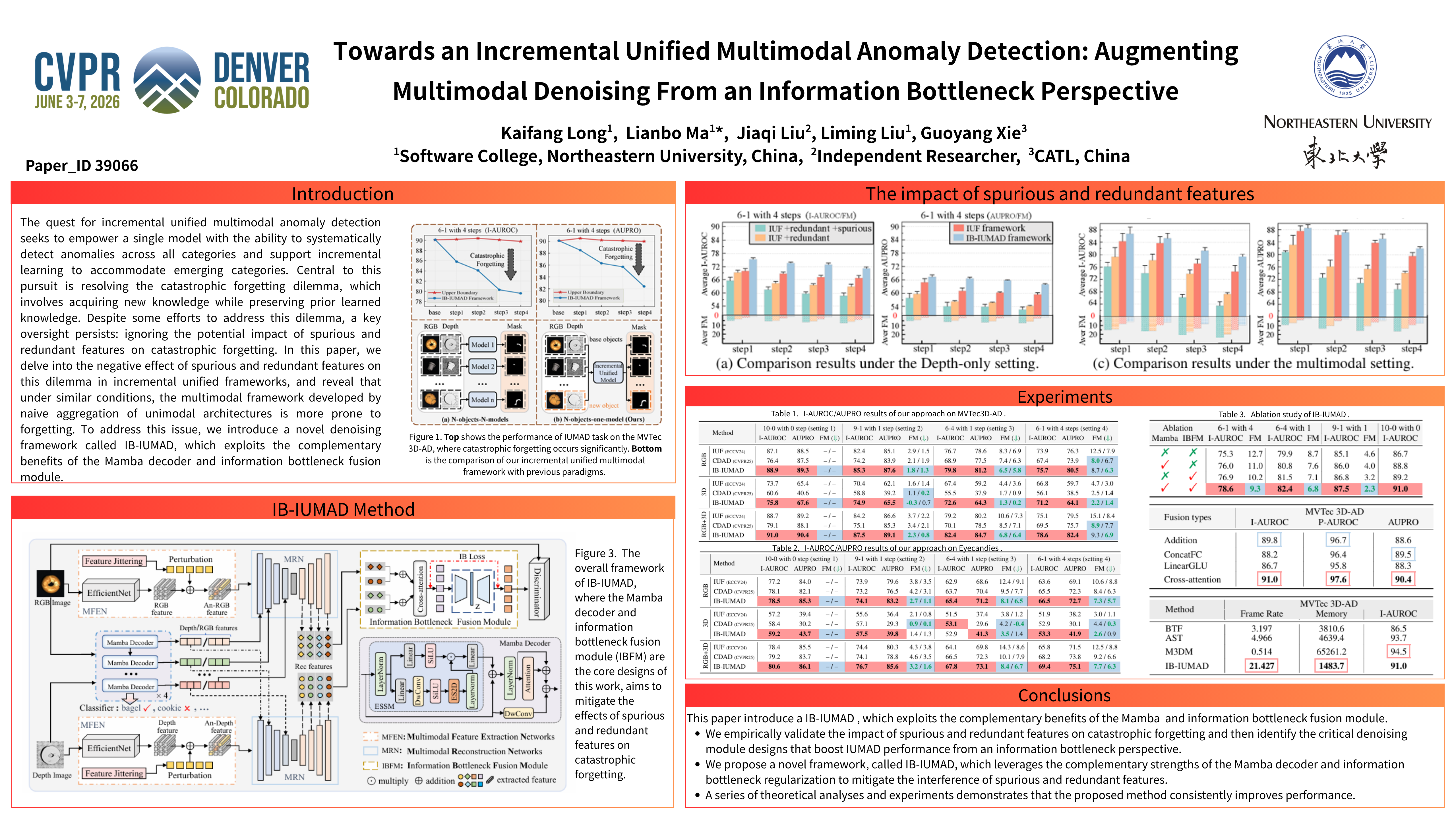
The quest for incremental unified multimodal anomaly detection seeks to empower a single model with the ability to systematically detect anomalies across all categories and support incremental learning to accommodate emerging objects/categories. Central to this pursuit is resolving the catastrophic forgetting dilemma, which involves acquiring new knowledge while preserving prior learned knowledge. Despite some efforts to address this dilemma, a key oversight persists: ignoring the potential impact of spurious and redundant features on catastrophic forgetting. In this paper, we delve into the negative effect of spurious and redundant features on this dilemma in incremental unified frameworks, and reveal that under similar conditions, the multimodal framework developed by naive aggregation of unimodal architectures is more prone to forgetting. To address this issue, we introduce a novel denoising framework called IB-IUMAD, which exploits the complementary benefits of the Mamba decoder and information bottleneck fusion module: the former dedicated to disentangle inter-object feature coupling, preventing spurious feature interference between objects; the latter serves to filter out redundant features from the fused features, thus explicitly preserving discriminative information. A series of theoretical analyses and experiments on MVTec 3D-AD and Eyecandies datasets demonstrates the effectiveness and competitive performance of IB-IUMAD. Code will be released.
AG-VAS: Anchor-Guided Zero-Shot Visual Anomaly Segmentation with Large Multimodal Models
Zhen Qu ⋅ Xian Tao ⋅ Xiaoyi Bao ⋅ Dingrong Wang ⋅ ShiChen Qu ⋅ Zhengtao Zhang ⋅ Xingang Wang
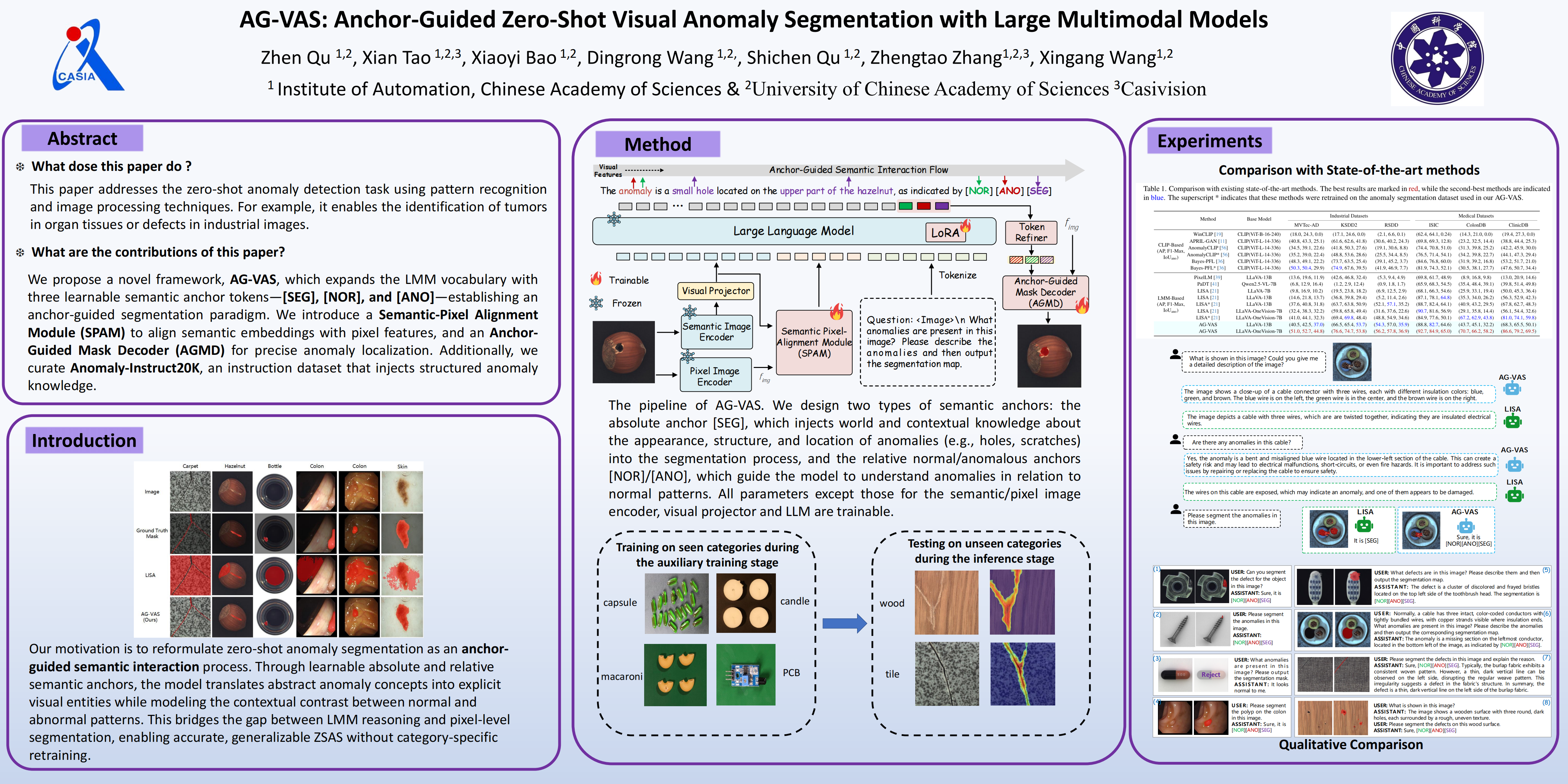
Large multimodal models (LMMs) exhibit strong task-generalization capabilities, offering new opportunities for zero-shot visual anomaly segmentation (ZSAS). However, existing LMM-based segmentation still faces fundamental limitations: anomaly semantics are scarce and unstructured, and the weak alignment between textual prompts and visual features makes accurate anomaly localization difficult.To address these challenges, we present AG-VAS (Anchor-Guided Visual Anomaly Segmentation), a new framework that expands the LMM vocabulary with three learnable semantic anchors—[SEG], [NOR], and [ANO]—and introduces a unified anchor-guided segmentation paradigm. Specifically, [SEG] functions as an absolute semantic anchor that injects pixel-level structural priors into LMMs, while [NOR] and [ANO] serve as relative semantic anchors that encode the contrastive semantics between normality and abnormality across categories. To further enhance alignment, we introduce a Semantic-Pixel Alignment Module (SPAM) that bridges the gap between the LMM semantic space and high-resolution visual features, and design an Anchor-Guided Mask Decoder (AGMD) that performs anchor-consistent querying for precise anomaly localization.In addition, we construct Anomaly-Instruct20K, a large-scale instruction dataset that provides structured anomaly knowledge—including appearance, shape, and spatial attributes—to help LMMs effectively learn and integrate the proposed semantic anchors. Extensive experiments on six industrial and medical benchmarks demonstrate that AG-VAS achieves consistent state-of-the-art performance in the zero-shot setting. Code will be released upon acceptance.
Dual-Prototype-Guided Multi-task Learning for Unsupervised Anomaly Detection and Classification
Qianhao Luo ⋅ Jiajia Mi ⋅ Mingtao Yan ⋅ JingSheng Liu ⋅ ShuYang Pang ⋅ Weiling Li
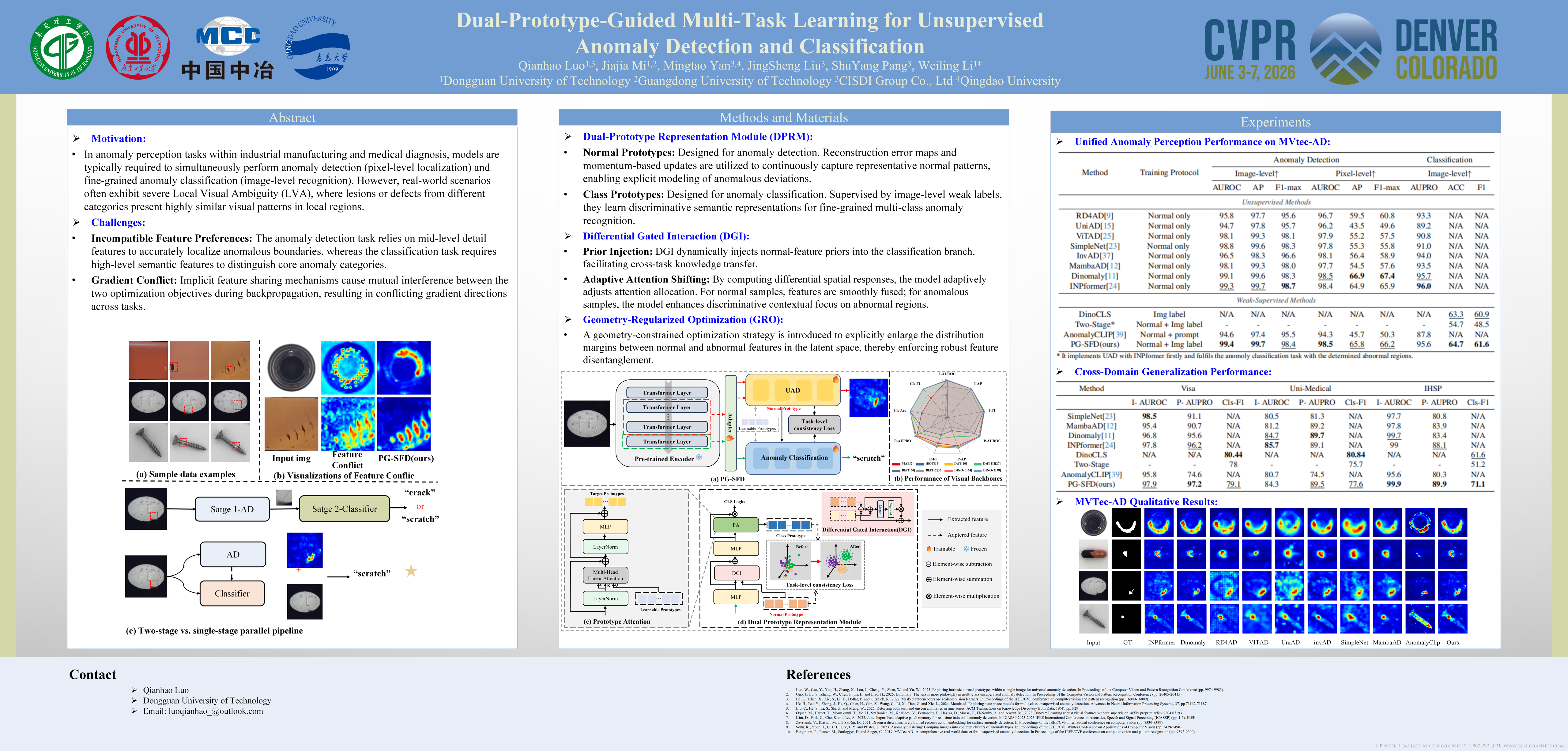
Unsupervised Anomaly Detection (UAD) and anomaly classification are frequently used in industrial and medical scenarios. Specifically, UAD identifies anomalous regions at the fine-grained pixel-level, while anomaly classification distinguishes anomaly types at the anomaly region level. However, existing approaches typically treat these tasks independently and sequentially, overlooking the benefits of jointly training them to suppress Local Visual Ambiguity (LVA) caused by the similarities of different types of anomalies in local visual patterns. Moreover, a multi-task learning framework cannot be directly applied to jointly train the two tasks, since UAD and anomaly classification exhibit feature preference incompatibility. To address these limitations, we propose the Prototype-Guided Semi-Supervised Feature Disentanglement (PG-SFD) framework, which makes a paradigm shift from implicit feature sharing to explicit feature disentanglement and explicitly constructs normal and category prototypes to eliminate implicit normal-abnormal semantic coupling via a Dual-Prototype Disentanglement Module (DPRM). Moreover, for cross-task feature differential injection and gradient conflict mitigation, the Differential Gated Interaction (DGI) and Geometry-Regularized Optimization (GRO) are proposed to form a cohesive framework with DPRM. PG-SFD demonstrates high effectiveness in both UAD tasks and weakly supervised classification tasks. Meanwhile, it exhibits stable performance across multiple types of datasets, including industrial and medical datasets, indicating its strong generalizability.
The Road Less Seen: Segment Exploration for Weakly Supervised Video Anomaly Detection
Anusha Achaya ⋅ Hitesh Sapkota ⋅ Qi Yu ⋅ Xumin Liu
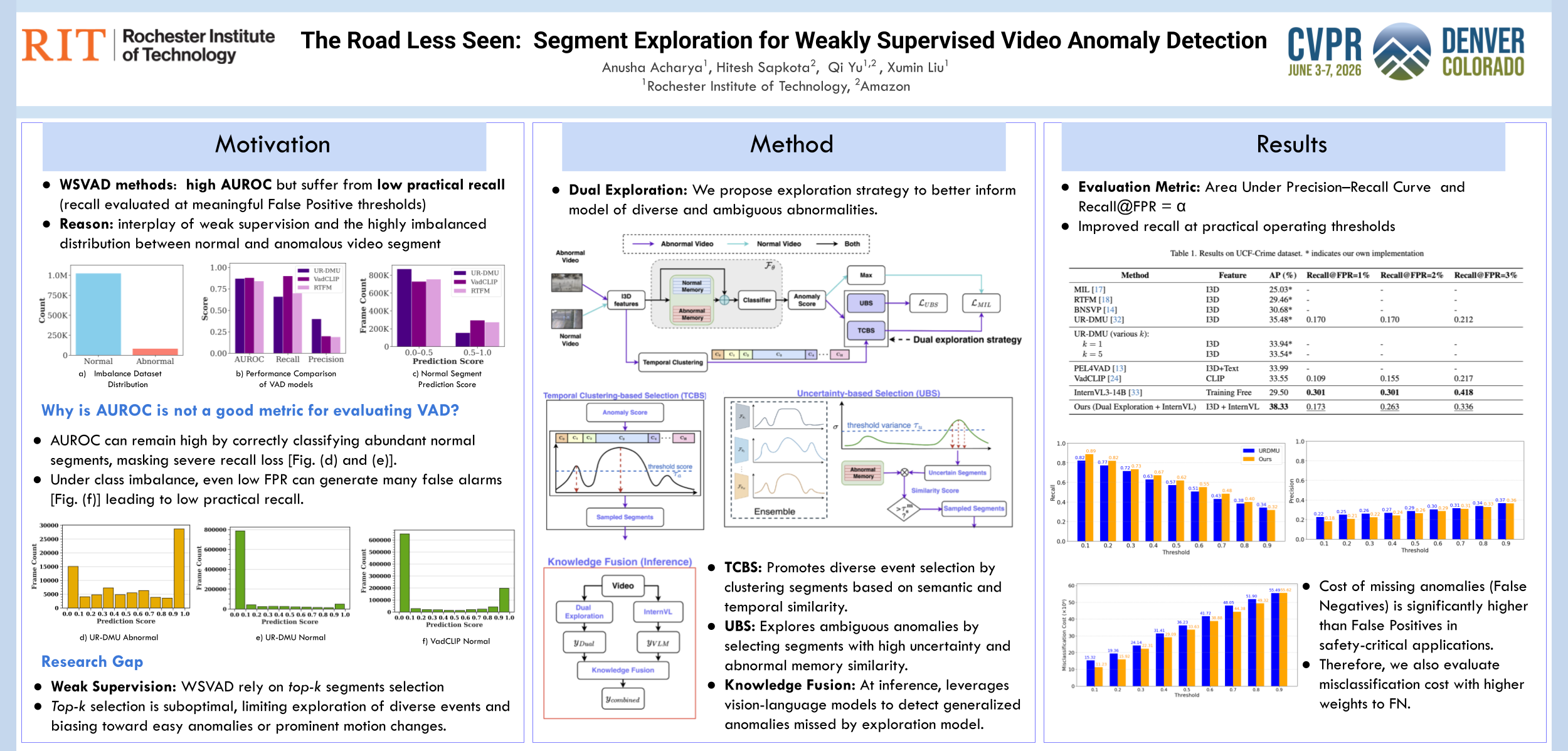
Weakly supervised learning provides a cost-effective framework for video anomaly detection by using video-level supervision instead of relying on the costly fine-grained segment-level labels. Although contemporary methods have shown promising results on challenging real-world surveillance videos, most of them are evaluated using the Area Under the Receiver Operating Characteristic Curve (AUROC). Our work reveals that a high AUROC could result in a very low recall given a meaningful False Positive Rate (FPR) threshold. Thus, these models suffer from limited practical values, especially in high-stake domains (\eg public safety and medical diagnosis), where missing the true anomalies are highly costly. This surprising phenomenon is rooted in the interplay of weak supervision and the highly imbalanced distribution between normal and abnormal segments. To tackle this key challenge of building practical video anomaly detection systems, we propose a novel dual exploration strategy that combines temporal clustering with uncertainty-based segment exploration. Temporal clustering selects diverse segments based on both semantic and temporal similarity, while uncertainty-based sampling targets low-scoring segments with high model uncertainty. This ensures the model learns from a wide range of patterns, both diverse and ambiguous, resulting in more informed and robust decision-making, and reduction in false negatives. Meanwhile, we recommend two practical metrics to replace the commonly used AUROC score for a more effective measure for evaluation. Experiments conducted in challenging real-world videos demonstrate better dual exploration performance compared to competitive baselines on these metrics, which justifies its improved practical value in real-world settings.
Omni-AD: A Large-scale and Versatile Benchmark for Industrial Anomaly Detection
Dahu Shi ⋅ Chengshen He ⋅ Shaochen Zhang ⋅ Bo Qian ⋅ Xiaochen Quan ⋅ Wencong Zhang ⋅ Xing Wei
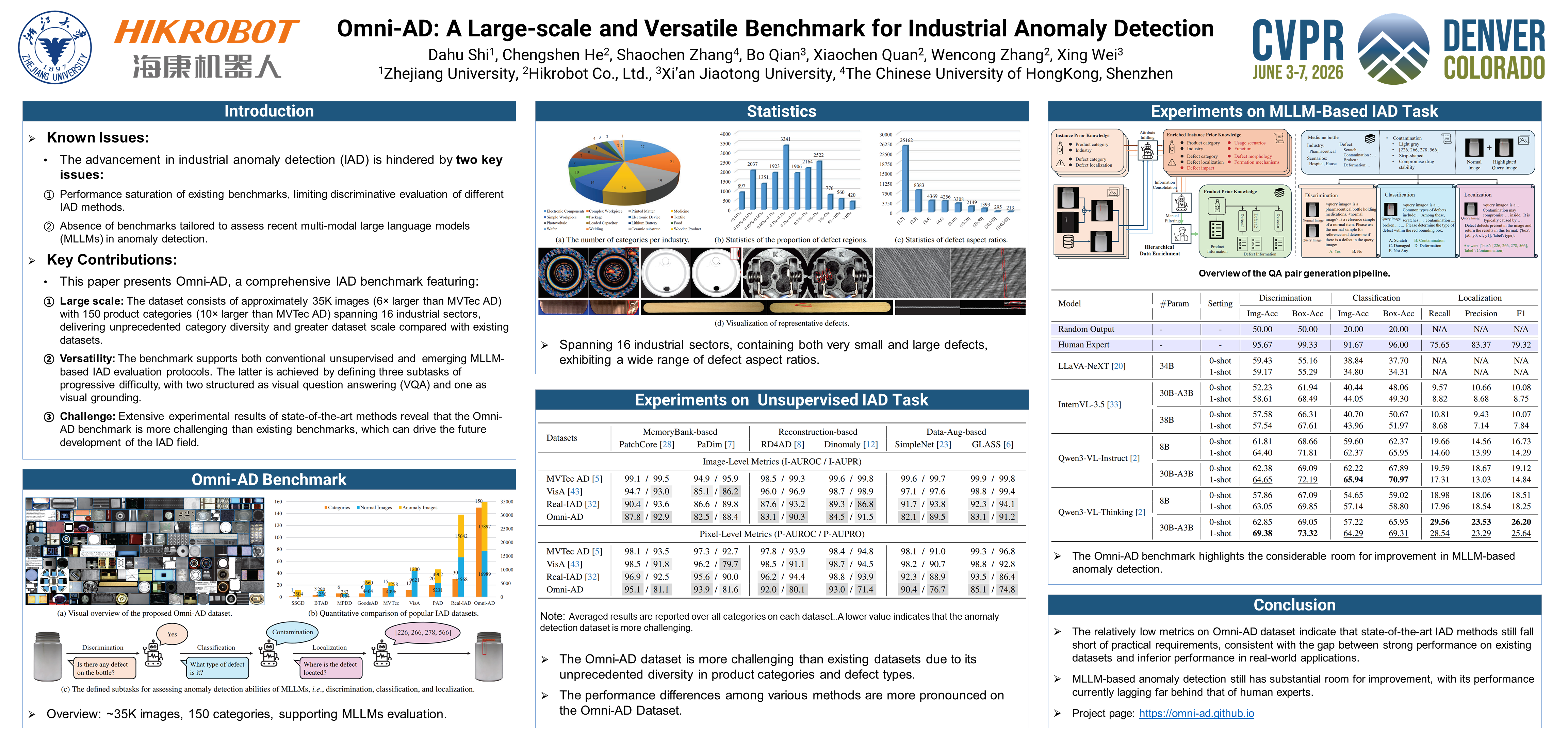
Industrial Anomaly Detection (IAD) has attracted significant attention and witnessed rapid development.However, the advancement in this field is hindered by two key issues: the performance saturation of existing benchmarks, limiting discriminative evaluation of different IAD methods, and the absence of benchmarks tailored to assess recent multi-modal large language models (MLLMs) in anomaly detection.To this end, we present Omni-AD, a comprehensive IAD benchmark featuring:\romannumeral1) \textbf{Large scale}:The dataset consists of approximately 35K images (6$\times$ larger than MVTec) with 150 product categories (10$\times$ larger than MVTec) spanning 16 industrial sectors, delivering unprecedented diversity in terms of both category and image scale compared with existing datasets.\romannumeral2) \textbf{Versatility}:The benchmark supports both conventional unsupervised and emerging MLLM-based IAD evaluation protocols. The latter is achieved by defining three subtasks of progressive difficulty, with two structured as visual question answering (VQA) and one as visual grounding.\romannumeral3) \textbf{Challenge}:Extensive experimental results of state-of-the-art methods reveal that the Omni-AD benchmark is more challenging than existing benchmarks, which can drive the future development of the IAD field.
Back to Point: Exploring Point-Language Models for Zero-Shot 3D Anomaly Detection
Kaiqiang Li ⋅ Gang Li ⋅ Mingle Zhou ⋅ Min Li ⋅ Delong Han ⋅ Jin Wan
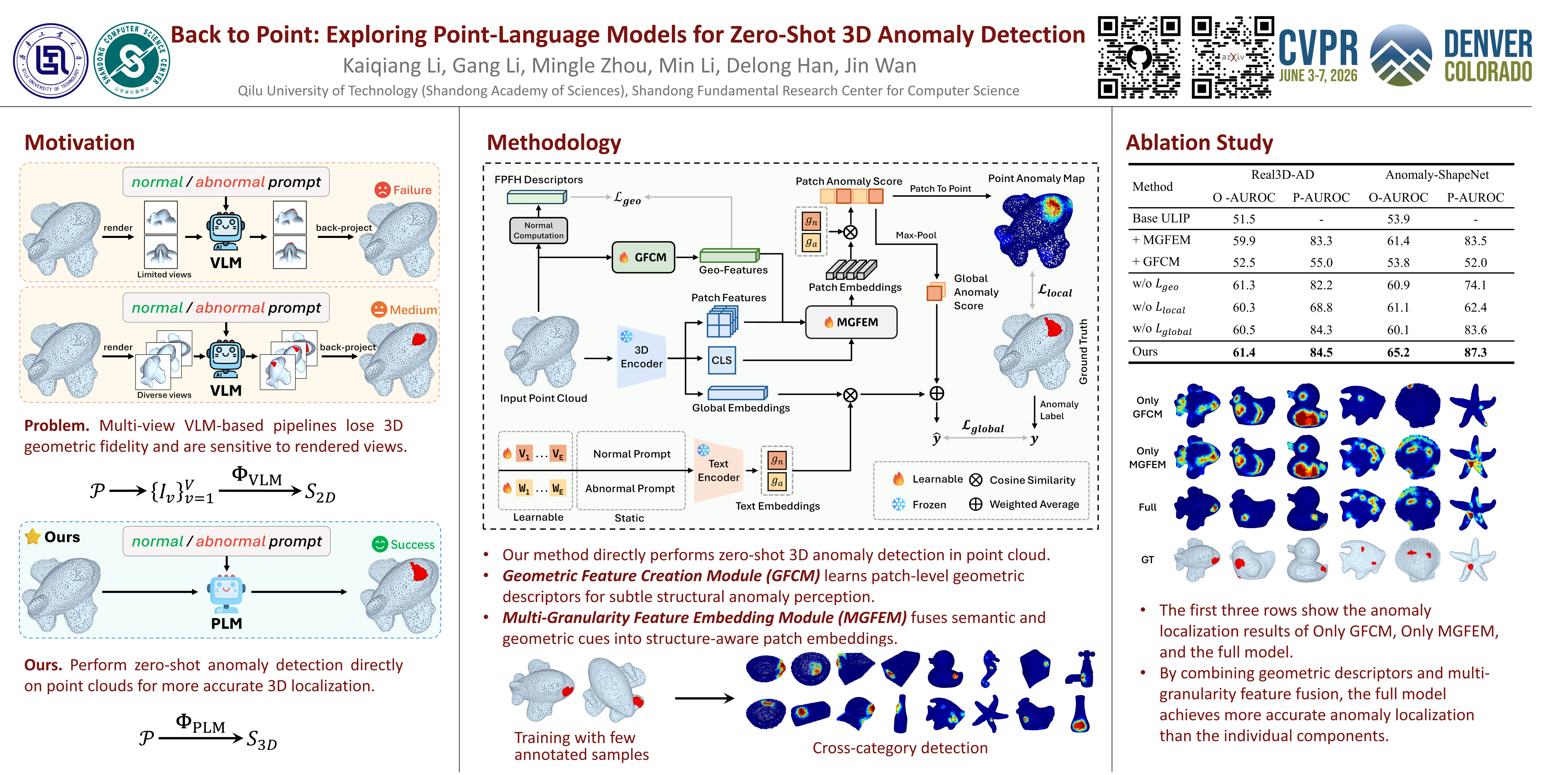
Zero-shot (ZS) 3D anomaly detection is crucial for reliable industrial inspection, as it enables detecting and localizing defects without requiring anomalous training data. Existing approaches render 3D point clouds into 2D images and leverage pre-trained Vision-Language Models (VLMs) for anomaly detection. However, such strategies inevitably discard geometric details and exhibit limited sensitivity to local anomalies. In this paper, we revisit intrinsic 3D representations and explore the potential of pre-trained Point-Language Models (PLMs) for ZS 3D anomaly detection. We propose BTP (Back To Point), a novel framework that effectively aligns 3D point cloud and textual embeddings. Specifically, BTP aligns multi-granularity patch features with textual representations for localized anomaly detection, while incorporating geometric descriptors to enhance sensitivity to structural anomalies. Furthermore, we introduce a joint representation learning strategy that leverages auxiliary point cloud data to improve robustness and enrich anomaly semantics. Extensive experiments on Real3D-AD and Anomaly-ShapeNet demonstrate that BTP achieves superior performance in ZS 3D anomaly detection.
Complementary Prototype Mapping for Efficient Multimodal Anomaly Detection
Yuan Zhao ⋅ Zhang xiaoqin to Xiaoqin Zhang ⋅ Huchuan Lu ⋅ Lihe Zhang

Multimodal unsupervised anomaly detection has garnered increasing attention for robust defect localization.Recent approaches rely on establishing cross-modal matching relationships under normal conditions without explicit guidance.However, in practice, a single modality may have multiple distinct representations corresponding to another modality, and such unconditional mappings struggle to adaptively capture these variations, resulting in mapping ambiguity and the misclassification of diverse yet normal variations as anomalies.Moreover, existing methods suffer from slow inference speed and high memory overhead, hindering their deployment in real-world production lines.To address these issues, we propose an efficient and effective Complementary Prototype Mapping (\textbf{CPMAD}) framework, which dynamically extracts consensus and supplementary prototypes to serve as complementary priors, thereby guiding and disambiguating cross-modal mappings.The framework comprises three key components:(1) Consensus Extraction Module (CEM) learns a dynamic anchor, transforming multimodal features into anomaly-free consensus prototypes to improve cross-modal consistency and suppress latent anomalies;(2) Supplementary Query Module (SQM) employs a Complementary Residual Attention mechanism to capture the discrepancy between the consensus and modality-specific spaces, thereby exploring the most representative and discriminative cues as supplementary prototypes; and(3) Complementary Mapping Module adaptively integrates both prototypes to perform feature mapping.Extensive experiments demonstrate that CPMAD not only achieves superior performance in both full-data and few-shot settings across diverse industrial and medical scenarios but also maintains faster inference speeds and lower memory consumption compared to existing methods.The code will be released upon publication.
LiDAS: Lighting-driven Dynamic Active Sensing for Nighttime Perception
Simon de Moreau ⋅ Andrei Bursuc ⋅ Hafid EL IDRISSI ⋅ Fabien Moutarde
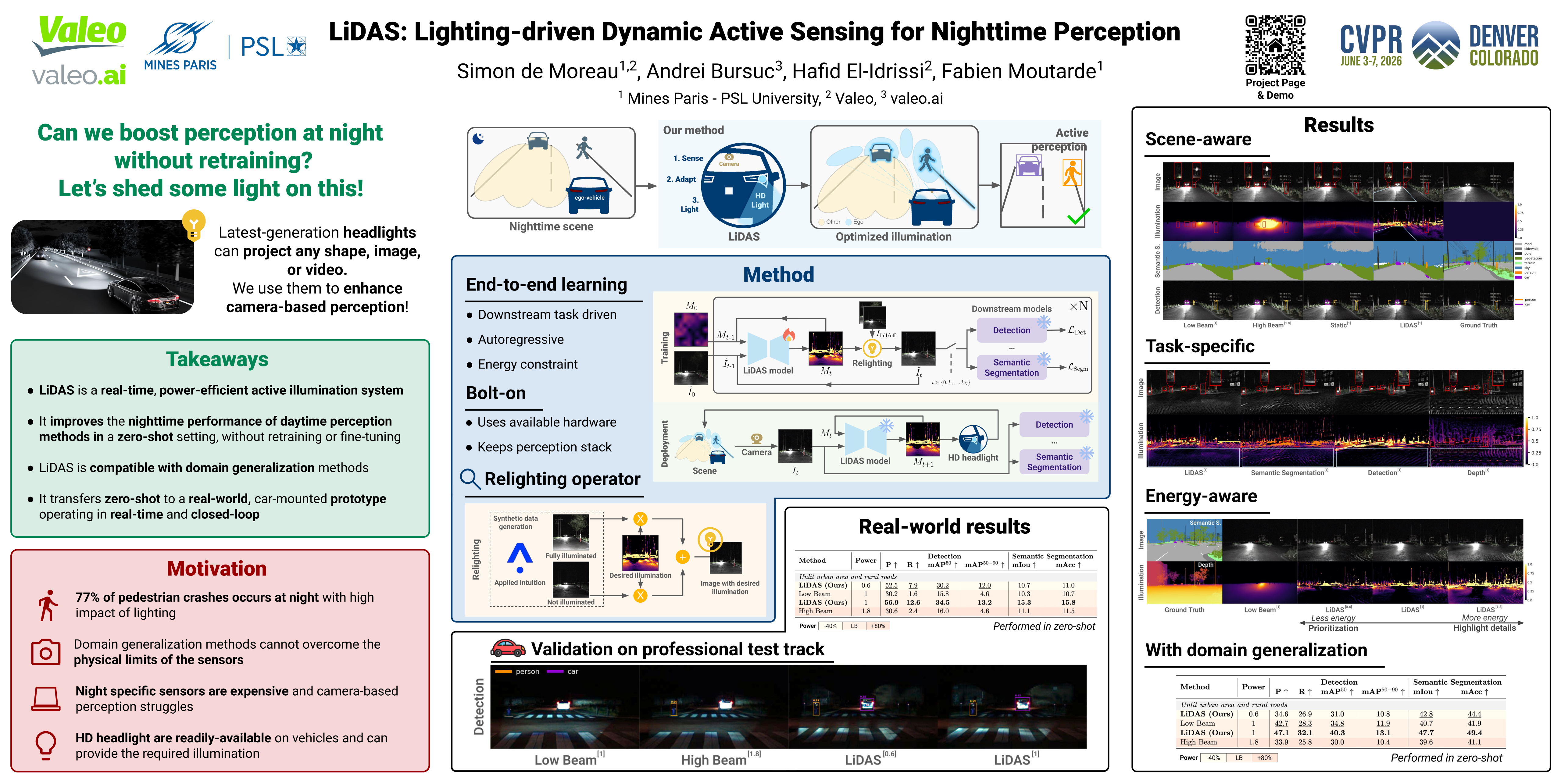
Nighttime environments pose significant challenges for camera-based perception, as existing methods passively rely on the scene lighting.We introduce Lighting-driven Dynamic Active Sensing (LiDAS), a closed-loop active illumination system that combines off-the-shelf visual perception models with high‑definition headlights. Rather than uniformly brightening the scene, LiDAS dynamically predicts an optimal illumination field that maximizes downstream perception performance, i.e., decreasing light on empty areas to reallocate it on object regions. LiDAS enables zero-shot nighttime generalization of daytime-trained models through adaptive illumination control. Trained on synthetic data and deployed zero‑shot in real‑world closed‑loop driving scenarios, LiDAS enables +18.7% mAP50 and +5.0% mIoU over standard low‑beam at equal power. It maintains performances while reducing energy use by 40%. LiDAS complements domain‑generalization methods, further strengthening robustness without retraining. By turning readily available headlights into active vision actuators, LiDAS offers a cost‑effective solution to robust nighttime perception.
Gau-Occ: Geometry-Completed Gaussians for Multi-Modal 3D Occupancy Prediction
Chengxin Lv ⋅ Yihui Li ⋅ Hongyu Yang ⋅ Yunhong Wang
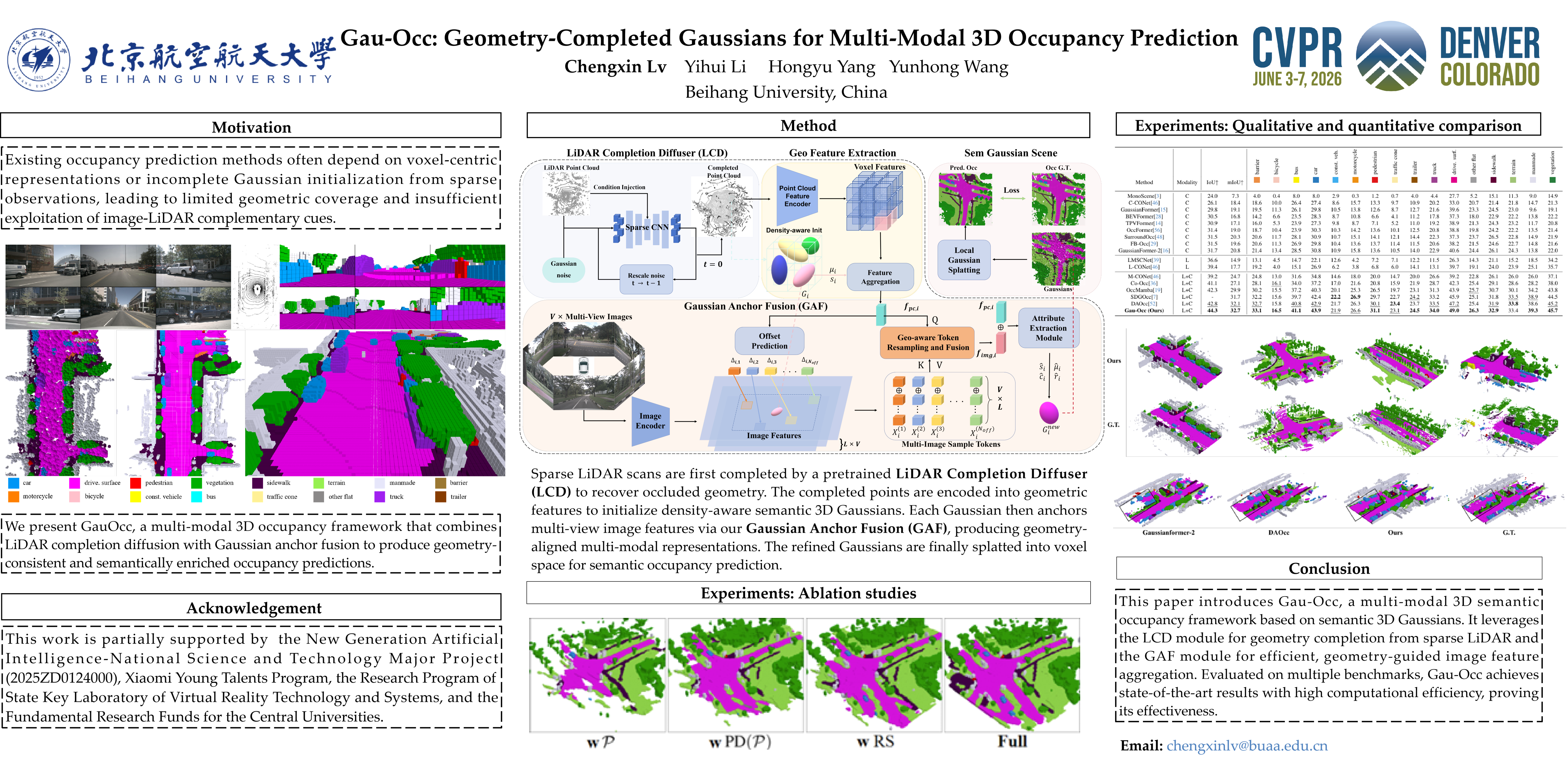
3D semantic occupancy prediction is crucial for autonomous driving, yet vision-only approaches suffer from weak geometric cues, and existing multi-modal frameworks often depend on dense voxel or BEV tensors that impose heavy computational cost. We present Gau-Occ, a multi-modal framework that models the scene as a compact collection of semantic 3D Gaussians, enabling geometry-guided fusion without dense volumetric processing.To enhance geometric completeness, a learned LiDAR Completion Diffuser (LCD) trained on real-world priors recovers missing structures from sparse LiDAR, and the completed points are encoded as semantic Gaussian anchors.To further integrate multi-view image semantics, we introduce Gaussian Anchor Fusion (GAF), a geometry-aligned aggregation module that performs anchor-guided 2D sampling, local neighborhood encoding, and cross-modal alignment. By constructing locally aggregated Gaussian descriptors that capture spatial consistency and semantic discriminability, GAF facilitates accurate feature association across modalities.Through anchor-driven refinement of Gaussian attributes, Occ-GS supports detailed 3D occupancy prediction. Extensive experiments across challenging benchmarks demonstrate that Occ-GS achieves state-of-the-art performance.
OpenVO: Open-World Visual Odometry with Temporal Dynamics Awareness
Phuc Nguyen ⋅ Anh N Nhu ⋅ Ming C. Lin
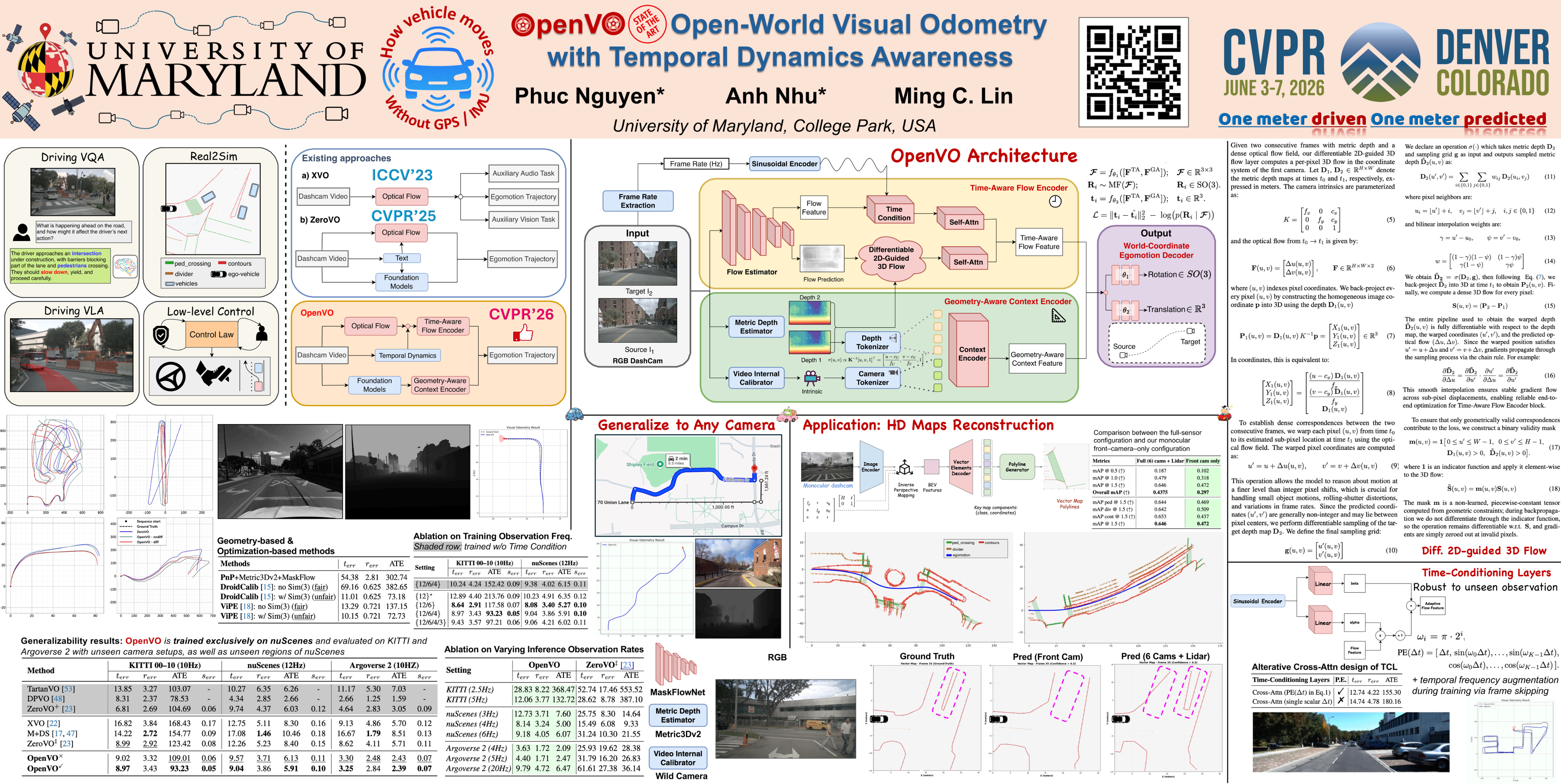
We introduce OpenVO, a novel framework for Open-world Visual Odometry (VO) with temporal awareness under limited input conditions. OpenVO effectively estimates real-world–scale ego-motion from monocular dashcam footage with varying observation rates and uncalibrated cameras, enabling robust trajectory dataset construction from rare driving events recorded in dashcam.Existing VO methods are trained on fixed observation frequency (e.g., 10Hz or 12Hz), completely overlooking temporal dynamics information. Many prior methods also require calibrated cameras with known intrinsic parameters. Consequently, their performance degrades when (1) deployed under unseen observation frequencies or (2) applied to uncalibrated cameras. These significantly limit their generalizability to many downstream tasks, such as extracting trajectories from dashcam footage.To address these challenges, OpenVO (1) explicitly encodes temporal dynamics information within a two-frame pose regression framework and (2) leverages 3D geometric priors derived from foundation models. We validate our method on three major autonomous-driving benchmarks – KITTI, nuScenes, and Argoverse 2 – achieving more than 20% performance improvement over state-of-the-art approaches. Under varying observation rate settings, our method is significantly more robust, achieving 46%–92% lower errors across all metrics.These results demonstrate the versatility of OpenVO for real-world 3D reconstruction and diverse downstream applications.
An Instance-Centric Panoptic Occupancy Prediction Benchmark for Autonomous Driving
Yi Feng ⋅ Junwu E ⋅ Zizhan Guo ⋅ Yu Ma ⋅ Hanli Wang ⋅ Rui Fan
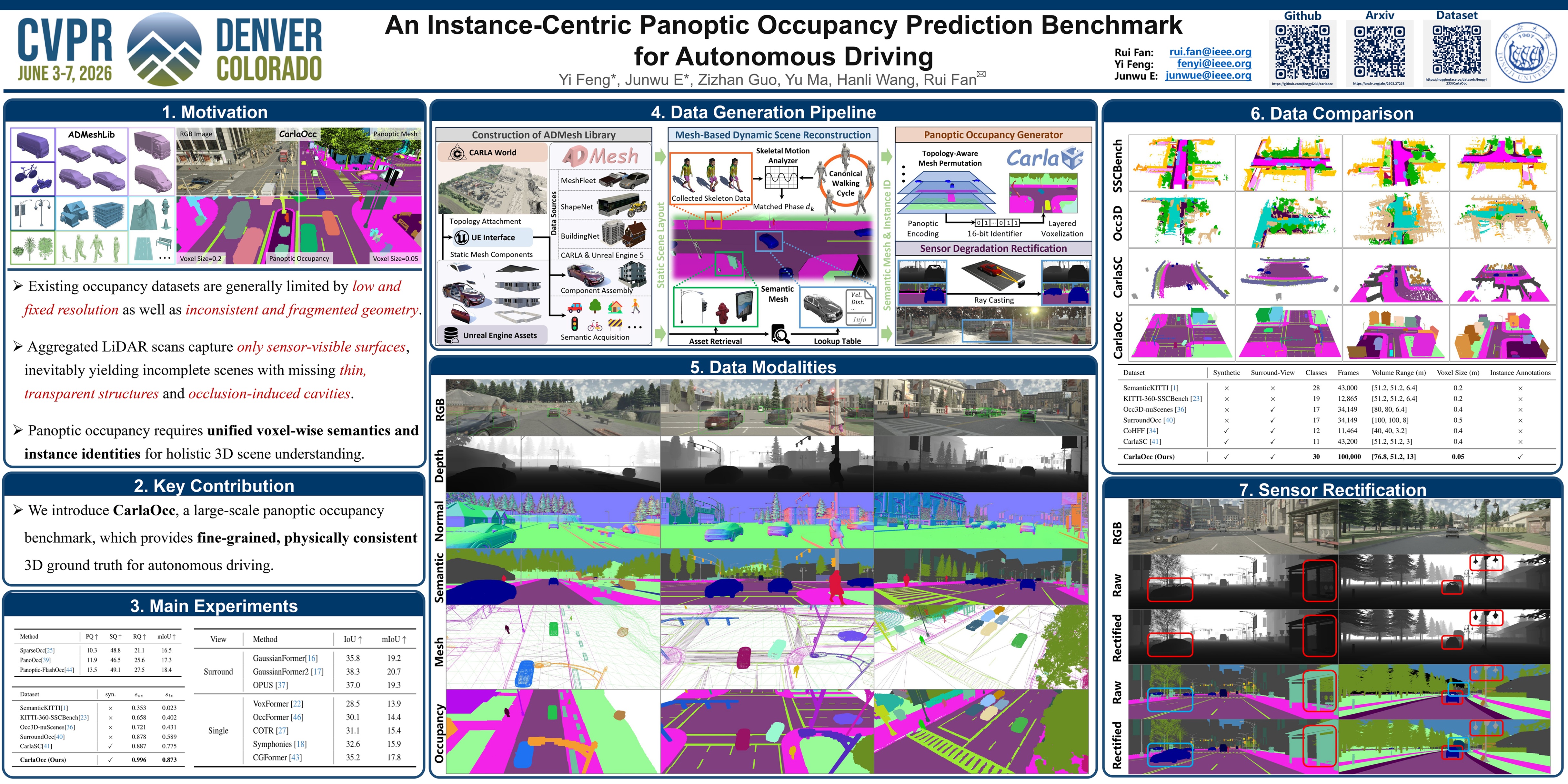
Panoptic occupancy prediction aims to jointly infer voxel-wise semantics and instance identities within a unified 3D scene representation. Nevertheless, progress in this field remains constrained by the absence of high-quality 3D mesh resources, instance-level annotations, and physically consistent occupancy datasets. Existing benchmarks typically provide incomplete and low-resolution geometry without instance-level annotations, limiting the development of models capable of achieving precise geometric reconstruction, reliable occlusion reasoning, and holistic 3D understanding. To address these challenges, this paper presents an instance-centric benchmark for the 3D panoptic occupancy prediction task. Specifically, we introduce ADMesh, the first unified 3D mesh library tailored for autonomous driving, which integrates over 15K high-quality 3D models with diverse textures and rich semantic annotations. Building upon ADMesh, we further construct CarlaOcc, a large-scale, physically consistent panoptic occupancy dataset generated using the CARLA simulator. This dataset contains 100K frames with fine-grained, instance-level occupancy ground truth at voxel resolutions as fine as 0.05 m. Furthermore, standardized evaluation metrics are introduced to quantify the quality of existing occupancy datasets. Finally, a systematic benchmark of representative models is established on the proposed dataset, which provides a unified platform for fair comparison and reproducible research in the field of 3D panoptic perception. Code and dataset will be released upon publication.
OneOcc: Semantic Occupancy Prediction for Legged Robots with a Single Panoramic Camera
Hao Shi ⋅ Ze Wang ⋅ Shangwei Guo ⋅ Mengfei Duan ⋅ Song Wang ⋅ Teng Chen ⋅ Kailun Yang ⋅ Lin Wang ⋅ Kaiwei Wang
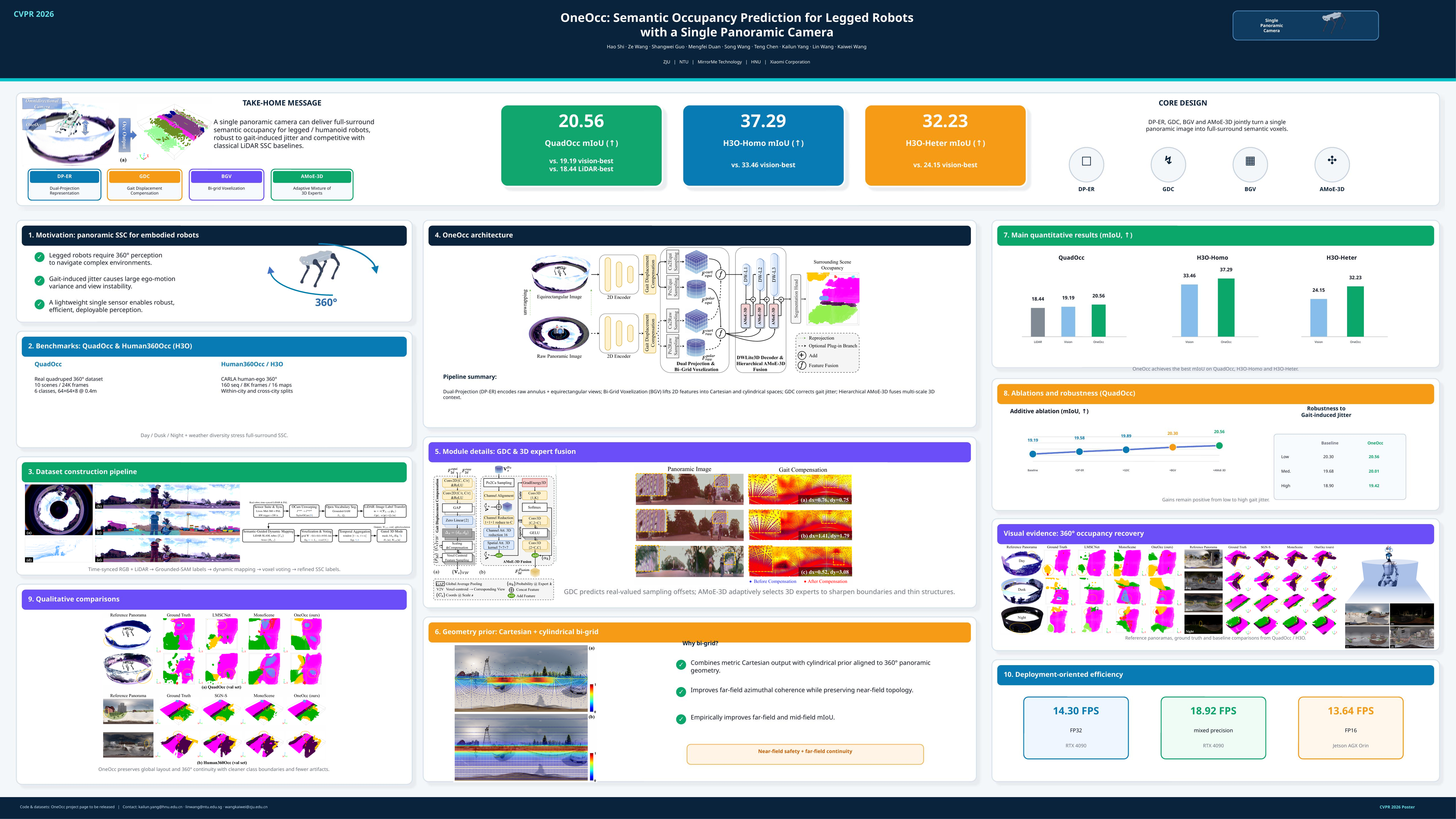
Robust 3D semantic occupancy is essential for legged and humanoid robots, yet most Semantic Scene Completion (SSC) systems are built for wheeled platforms with forward-facing sensors. We present $\textbf{OneOcc}$, a vision-only panoramic SSC framework tailored to severe body jitter and $360^{\circ}$ continuity. OneOcc integrates four complementary modules: (i) $\textit{Dual-Projection fusion (DP-ER)}$, which jointly exploits the raw annular panorama and its equirectangular unfolding to preserve true $360^{\circ}$ continuity while enabling grid-aligned feature extraction and seam-aware context; (ii) $\textit{Bi-Grid Voxelization (BGV)}$, which reasons in Cartesian and polar/cylindrical voxel spaces to reduce discretization bias and better align with panoramic geometry, yielding sharper free/occupied boundaries; (iii) a lightweight decoder with $\textit{Hierarchical AMoE-3D}$ fusion that dynamically routes multi-scale 3D features to specialized experts, improving long-range context and occlusion handling; and (iv) a plug-and-play $\textit{Gait Displacement Compensation (GDC)}$ module that learns feature-level motion correction from gait, stabilizing representations without extra sensors. We also release two panoramic occupancy benchmarks: $\textbf{QuadOcc}$ (real quadruped, first-person $360^{\circ}$) and $\textbf{Human360Occ (H3O)}$ (CARLA human-ego $360^{\circ}$ with RGB/Depth/semantic-occupancy and standardized within-/cross-city splits). OneOcc sets new SOTA: on QuadOcc it exceeds strong vision baselines and even popular LiDAR methods, and on H3O it improves within-city by +3.83 mIoU and cross-city by +8.08. The modules are lightweight, enabling deployable full-surround semantic perception for legged and humanoid robots. Datasets and code will be released upon publication.
ProOOD: Prototype-Guided Out-of-Distribution 3D Occupancy Prediction
Yuheng Zhang ⋅ Mengfei Duan ⋅ Kunyu Peng ⋅ Yuhang Wang ⋅ Di Wen ⋅ Danda Paudel ⋅ Luc Van Gool ⋅ Kailun Yang
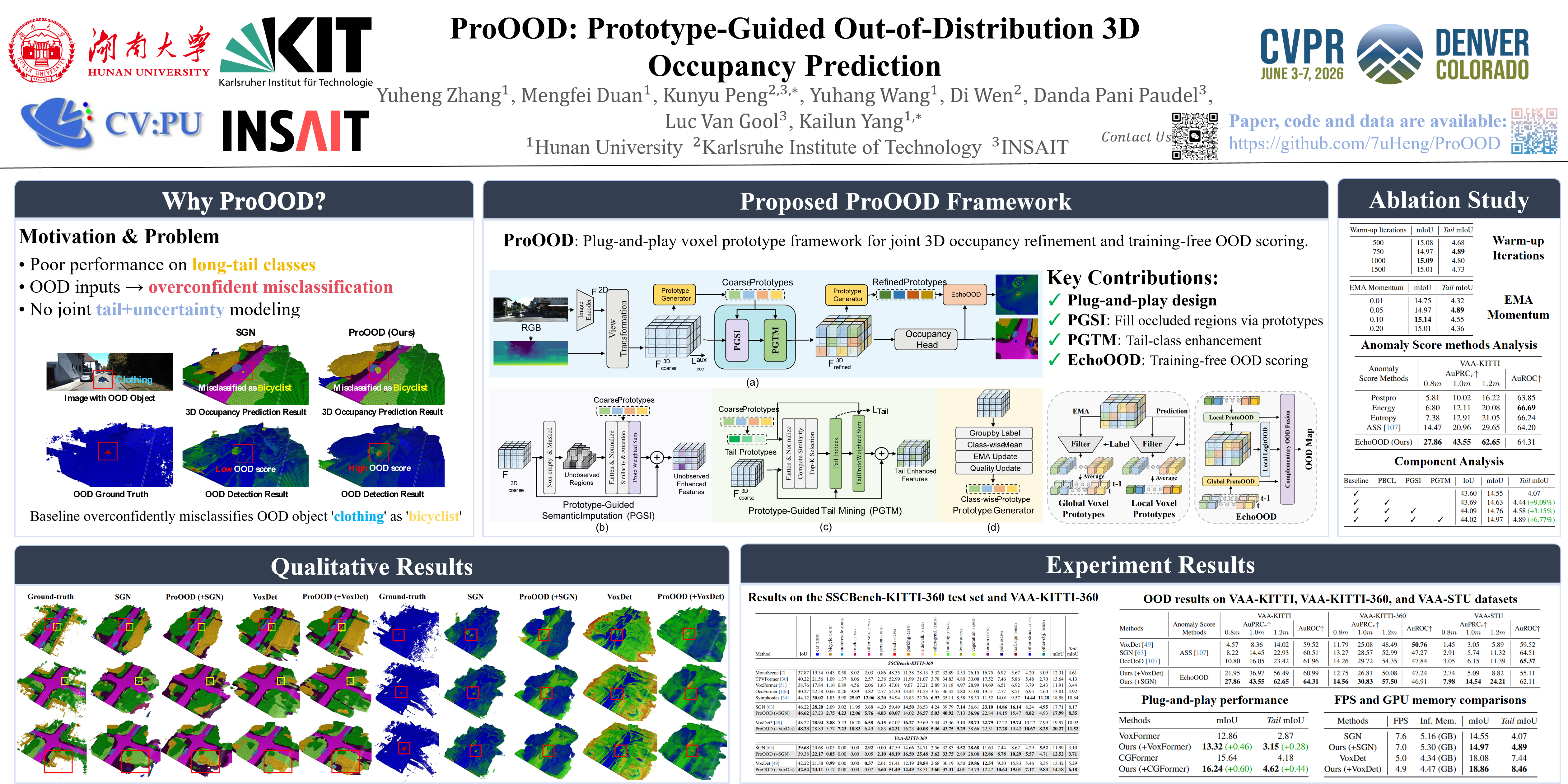
3D semantic occupancy prediction is central to autonomous driving, yet current methods are vulnerable to long-tailed class bias and out-of-distribution (OOD) inputs, often overconfidently assigning anomalies to rare classes. We present ProOOD, a lightweight, plug-and-play method that couples prototype-guided refinement with training-free OOD scoring. ProOOD comprises (i) prototype-guided semantic imputation that fills occluded regions with class-consistent features, (ii) prototype-guided tail mining that strengthens rare-class representations to curb OOD absorption, and (iii) EchoOOD, which fuses local logit coherence with local and global prototype matching to produce reliable voxel-level OOD scores. Extensive experiments on five datasets demonstrate that ProOOD achieves state-of-the-art performance on both in-distribution 3D occupancy prediction and OOD detection. On SemanticKITTI, it surpasses baselines by +3.57\% mIoU overall and +24.80\% tail-class mIoU; on VAA-KITTI, it improves AuPRC$_r$ by +19.34 points, with consistent gains across benchmarks. These improvements yield more calibrated occupancy estimates and more reliable OOD detection in safety-critical urban driving. The source code will be made publicly available.